SFBG Blogs

Two views:Joanna Newsom at the Fox, 8/2/10

0

By Amber Schadewald and Sam Stander

TAKE ONE “Have you seen her before?” a spirited woman asked a random couple in the front row at Oakland’s Fox theater Monday night, just before the lights began to dim. “She’s a fucking angel.” And it’s hard to disagree. California’s own folk-harp-composing-wonder Joanna Newsom is a beautiful, beautiful being who produced a perfectly impressive evening with song after long song of feather-light melodies. 

The show was lined with songs new and old, but consisted primarily of those from her February release, Have One On Me [Drag City, 2010]. Her fingers danced like tiny forest fairies across the towering collection of strings, creating surreal melodies that otherwise only exist in dream sequences and lands of happily ever after. Newsom’s whole face smiled as she played and I especially enjoyed watching her bright red lips as they took on various shapes; from large o’s that created airy open vowels to horizontal concoctions that produced Newsom’s classic, fluttering sounds. Her “new” voice, or what has developed after nodules were removed from her vocal chords last year, is gorgeous and full, yet hasn’t lost all the unique characteristics fans adore and non-fans despise. 

The evening’s mini-orchestra was comprised of local musicians, hailing from Oakland and Alameda. Together they delivered flute melodies, trombone solos, tender violins, banjo, electric guitar and all kinds of funky lil’ sounds to fulfill Newsom’s intricate compositions. Closing my eyes, I saw all kinds of stereotypical soothing images: dolphins clearing the surf, dew drops on roses, whiskers on kittens….well, to say the least, I left the Fox feeling so content, you could’ve wrapped me up with a bow.

Angel? I’d say Ms. Newsom is more of a real-life Cinderella, hypnotizing all the forest critters with her organic harp and piano sounds, calling them to her like a pied-piper, but instead of making them clean her room, she puts them all into a deep, satisfying slumber. Ahhhhh. (Schadewald)

TAKE TWO Remember when Joanna Newsom was this weird dark-horse harp wunderkind with a challenging (some would say grating, others might say revelatory) singing style? That was eight years ago, believe it or not, and by most accounts the 28-year-old singer songwriter has since outrun the shadow of her perceived fey persona to establish herself as a formidable force in modern popular music. Her prodigious skill (which opener Robin Pecknold compared, oddly, to Einstein) was on display Monday 8/2 at Oakland’s Fox Theater, where she took the stage with a five-piece backing band and played a set featuring material from all three of her LPs.

The band set-up is necessary to convey the complexity of her more recent compositions, including bangers like “Emily,” the epic opening track from 2006’s Ys [Drag City], originally arranged by Van Dyke Parks but reduced for this group by multi-instrumentalist Ryan Francesconi. Not so surprisingly, however, the most powerful sonic moments emanated from Newsom’s harp and voicebox. Sometimes, she reaches a kind of ecstatic energy where she is shout-singing some of her lyrics, hitting the odd notes that were more characteristic of her singing voice prior to her development of vocal cord nodules in 2009.

The other musicians provided texture throughout, but on certain numbers, the talented players especially stood out. Andrew Strain’s mournful trombone on “You and Me, Bess” complemented Newsom’s playing beautifully, while the Celtic-y fiddle from Mirabai Peart and Emily Packard added lushness to “Kingfisher.” Have One on Me highlight “Good Intentions Paving Company” was accompanied by “some Pecknolds and some Newsoms” who came out on stage and appeared to be tapping rhythm sticks or drum sticks together.

Newsom is a virtuoso harp player, but in keeping with the general diversification of her music on Ys and this year’s Have One on Me, she spent a lot of the show at the piano, switching off instruments roughly every other song. Her performance of “Inflammatory Writ,” which already features piano in its recorded form on The Milk-eyed Mender [Drag City, 2004], featured a country-inflected arrangement that may very well improve upon the classic album version. Other songs that benefited from live performance were Have One on Me opener “Easy,” on which the whole band just sounded smashingly good, and older track “Peach Plum Pear,” which closed the set before the encore. It’s a testament to Newsom’s development that her wailing intensity at the end of that song now far outstrips the force of the overdubbed choruses on the recording. Still one of her most strikingly beautiful compositions, both musically and lyrically, the track as performed Monday sounded like the closing song to a melancholy romantic film.

In contrast to the quasi-refined aesthetic of much of her music, Newsom brought Pecknold onstage for an encore of “Picture,” the boozy Kid Rock/Sheryl Crow (or Allison Moorer) duet. Perhaps those anticipating a collaboration on “On a Good Day,” a Newsom track that Pecknold covers, might have been disappointed, but the change in tone was both hilarious and well-executed. The auxiliary Pecknolds and Newsoms returned to the stage to snap in time and dance across the stage, before the close of the show was met with a second standing ovation.

Newsom’s novel-length songs might seem a tight fit for a riveting live show, but especially when juxtaposed with Pecknold’s lovely-sounding but formless songs in the opening act, the brilliant structure of her pieces kept the concert hurtling forward. If you’re the sort to dismiss Newsom’s harp-driven stylings as something quaint or merely trendy, seeing her live might persuade you otherwise, since this harpist is as exhilarating as any more conventional rocker or folkie you’ll encounter onstage anytime soon. (Stander)


 

Prop 8 struck down by federal judge

0

US District judge Vaughan Walker has struck down California’s ban on same-sex marriage. Turns out the 18,000 same-sex marriages left intact from before the proposition was passed were key. Dang, I just planned my wedding in Connecticut.  

SFBG Radio: New Venom

1

In today’s episode, Johnny Wendell’s guest, Johnny Venom, urges we use a ton of caution when considering Lennar’s Development plan-their track record in Chicago is dismal.

NewVenom by endorse


(A rhythmic series of) slaps on the back for the Body Music Festival artists

0

Slap a belly, claps them hands, shake your head side to side and buzz through your lips like a motorboat. It’s called body music, mon cheri – and since 2008 the Bay Area’s been the yearly gathering spot for all manner of the diverse artistes that call this noise home at the International Body Music Festival. This year, the festie’s moving down south to Sao Paolo, Brazil – but before it does, festival founder and primo tap dancer Keith Terry has organized a benefit show (Sat/7 La Peña Cultural Center) that features his group, Slammin, along with sometimes-clown and presently hambone performer Derique McGee. The show will fund Bay performers trips down south – and more presently, out to NYC where they will perform at the Lincoln Center (Thurs/12). We spoke with the mastermind behind this convergence of natural noisemakers over the phone, and found him to be more than happy to explain his unusual passion for playing with one’s self. Keith, what’s all this noise about?


Keith Terry on the ones and two-legs 


San Francisco Bay Guardian: Now then. Body music. I must admit, I wasn’t previously familiar with the art from. How’d you get turned on to it?

Keith Terry: I came to it 30 years ago – I’m a drummer, and I was in a rehearsal with tap dancers, and I had this thought that I could displace everything I was playing on my drums onto my body. And it became a career.


SFBG: Did you start out by researching the background of body music? It’s been around for quite some time, hasn’t it?

KT: I was really into tap dancers, people like Charles “Honi” Coles, Eddie Brown, Steve Condos. I’m really drawn to dance that has its own inherent soundtrack, or music that has a visual component. I’ve been fascinated by that for a long time. I was aware of hambone for a long time, that it grew out of slavery, of drums being taken away from slaves to suppress rebellion. There are a lot of traditional styles of body music. I’m a student of world music. But the style that I do is a contemporary style. 


SFBG: Tell me about it?

KT: I do solo and group shows, but for the festival my group is called Slammin’; 3 singers: beatboxer, and body music – eight in the ensemble. It’s very urban music: we draw from jazz, hip hop, R&B. There’s usually five of us, but for the Lincoln Center show we’re adding three additional body musicians, so this is the enhanced Slammin’.


SFBG: The Body Music Festival has been doing great the past few years in SF. Why are you moving the event to Sao Paolo?

KT: We’ve always had performers come to the festival from all over – we’ve had people from Indonesia, Turkey, Polynesia, France, Brazil, Spain. One thought I had in 2008 when I started the festival was that it would be great if the festival itself became international. I had asked Barbatuques, a group from Sao Paolo of 12 performers, I asked if they would host, and they accepted. Next year the full festival will be back in the Bay Area, then the next year in Istanbul. 


SFBG: Do audience members ever call foul on you and say that what you do is actually dance, not music?

KT: It’s hard to categorize and put it in a box. But people find it really accessible.


Body Music Festival Benefit Send-off Concert

Sat/7 8 p.m., $20-100

La Peña Cultural Center

3105 Shattuck, Berk.

(510) 849-2568

www.lapena.org

www.internationalbodymusicfestival.com


Coilhouse rules

6

Founded by three brilliant renaissance women with roots in L.A. and the Bay, the alt-everything institution known as Coilhouse exists both as a fantastic groupblog and a quasi-quarterly magazine. According to the mission statement on their website, “Coilhouse is a love letter to alternative culture, written in an era when alternative culture no longer exists.” They cover everything from fashion to visual art to film to comics, with a wealth of youtube clips and beautiful images in all their posts. These ladies — Zoetica Ebb, Meredith Yayanos, and Nadya Lev — and their various collaborators are down with Klaus Nomi and at home with esoteric Russian literature, and more than happy to share with you what made them weird.

The print incarnation of Coilhouse is on its fifth issue, released just under a month ago and already sold out online, but still available at a variety of real-world retailers. Each incarnation of the magazine has brought new experiments in design, ranging from the subtle and inspired (eerie silver foil accents on the cover of Issue 4) to the endearingly goofy (candy-colored section frontispieces in the latest issue). This issue incorporates bonus items — a pull-out poster of Chet Zar art and two trading cards featuring images from the magazine’s Dorian Gray photoshoot. The pages of the issue itself are frantically crowded with original art, photography, and outrageous pull-quotes, but in a way that ultimately suggests raw, genuine enthusiasm.

The content of the magazine is divided between interviews, photo spreads, and primer-style features. Oh, and paper dolls. The new issue features interviews with geek luminaries like horror writer Clive Barker and power-couple Neil Gaiman and Amanda Palmer. Former- Star-Trek -teen-turned-celebrity-blogger Wil Wheaton contributes a non-fiction piece excerpted from his recent book The Happiest Days of Our Lives, and Jess Nevins chronicles the history and highlights of Chinese pulp fiction as a formidable counterpart to the western version. Zoetica Ebb compiles attitudes on “shoe lust,” and Angeliska Polacheck provides a photo-heavy history of the dance part Gadjo Disko

Photography in the issue includes a tribute to the late fashion designer Tiffa Novoa as well as the aforementioned Dorian Gray concept series of photos. The images range from glamorous to grotesque, with an attractive post-goth pall over the whole affair.

Special-interest magazines have taken a huge hit in the past several years, as the Internet has expanded to cater to any and every niche curiosity, so one of the few ways to grab a wide community of readers (for a blog as well as a magazine) is to express a weird, specific aesthetic that crosses subcultural lines. The fact that Coilhouse is essentially a blog that congeals into a magazine a handful of times each year makes it squarely a product of Internet culture. Perhaps that accounts for why it’s so mad and overwhelming, but it also accounts for why it feels so fresh and energetic, and so engaged in the benefits of the magazine as a form of communication distinct from blogging.

Street Threads: Look of the Day

0

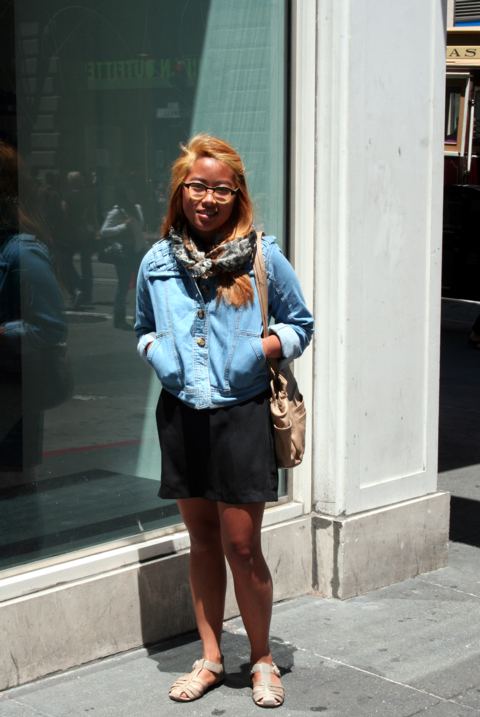
Today’s Look: Kathy, Powell and Ellis

Tell us about your look: “I just throw on whatever’s around.”

Labayen Dance/SF revisits Carl Orff’s iconic Carmina Burana

0

Enrico Labayen’s dance company Labayen Dance/SF took a hiatus from 2004 to 2009 while Labayen was off studying traditional folkloric dances in Southeast Asia. Labayen may have been absent for a few years, but the world premiere of his Carmina Burana, Revisited at Dance Mission Theater (July 23-25) proved that Labayen Dance/SF is back in full force. Inspired by the Philippine matriarchal ritual Tadtarin and set to Carl Orff’s iconic score, Carmina Burana, Revisited was a powerful and passionate celebration of female strength.

From the beginning the women dominated the stage. Dressed in long red skirts and red strapless tops, the dancers (Daiane Lopes, Alyson Abriel, Crystaldawn Bell, Diane Mateo, Leda Pennell, Morgan Eichwald and Lisa Lincoln) emerged into the light, one after another, to stand before the audience like regal warriors ready for battle. As “Ol Fortuna” (perhaps the most well-known and dramatic movement of Orff’s score) began, the well-rehearsed dancers moved perfectly in sync through a series of powerful shoulder shrugs as if tossing off anything that stood in their way. Such dramatic music has the potential to outweigh and undermine (even render silly) any kind of choreographed movement. Yet these women rose to the almost impossible occasion. They didn’t simply own the music, they fed off of its intensity, eating up not only “Ol Fortuna” but every musical movement that followed, hyper-aware of the score’s subtle, and sometimes not so subtle, emotive undertones.

The women also fed off of each others energy. The full-length evening featured various solos, duets, and ensemble dances. While lacking a narrative base, these dances captured a wide range of feminine identities, issues, and emotions, from jealousy and rage to love and triumph. Even in the dances that depicted female rage and cattiness, it was obvious that underneath it all, the dancers were committed to inspiring each other to reach full potential. On Sat/24, after Mateo finished a truly mesmerizing solo to “Omnia Sol Temperat,” she sat down aside Lopes, and I couldn’t help but notice Lopes take Mateo’s hand in her own as if acknowledging the spectacular performance. It’s possible that this gesture took place within character, as part of the performative world the women created. But it just as likely might have been an impulsive moment between the two. Regardless, the act of acknowledgment was an intimate moment that felt characteristic of the powerfully female-centered evening.

The women’s physical stamina was as impressive as their contagious energy. They moved through everything from extremely fast-paced jumps and leaps to slower, more lyrical, classical ballet poses with zest and playful charisma. Nothing seemed too difficult or too grand. Incorporating classical ballet, folkloric dance forms, and more sensual modern movement, Labayen’s elegant and exciting choreography emphasized the women’s versatile strength, but it was the all-female cast of badass dancers that not only brought Carmina Burana to life, but ultimately brought the admiring audience — screaming and stomping — to their feet.

A new community congress

2

Bad times are great times to try new ideas – the second Community Congress convenes Aug. 14 and 15 at the University of San Francisco

EDITORIAL The first time a group of activists from across San Francisco met in a Community Congress, it was 1975 and the city was in trouble. Runaway downtown development was creating massive displacement and threatening the quality of life. Rents were rising and tenants were facing eviction. An energy crisis had left residents and businesses with soaring power bills. The manifesto of the Congress laid out the problem:

“Every poor and working class community in San Francisco has learned the hard way that its interests are at the bottom of the list as far as City Hall is concerned. At the top of the list are the banks, real estate interests, and large corporations, who view San Francisco not as a place for people to live and work and raise families, but as a corporate headquarters city and playground for corporate executives. By using their vast financial resources, they have been able to persuade local government officials that office buildings, hotels, and luxury apartments are more important than blue-collar industry, low-cost housing and decent public services and facilities.”

The Community Congress hammered out a platform — a 40-page document that pretty much defined what progressive San Francisco believed in and wanted for the city. It included district elections of supervisors, rent control, public power, a requirement that developers build affordable housing, and a sunshine ordinance — in fact, much of what the left has accomplished in this town in the past 35 years was first outlined in that document.

Beyond the details, what the platform said was profound: it suggested that the people of San Francisco could reimagine their city, that local government could become a force for social and economic change on the local level, even when politics in Washington and Sacramento were lagging behind. It called for a new relationship between San Franciscans and their city government and looked not just at what was wrong, but what was possible.

That’s something that too often gets lost in political debate today. With urban finances in total collapse, the progressives are on defense much of the time, trying to save the basic safety net and preserve essential programs and services. It seems as if there’s little opportunity to talk about a comprehensive alternative vision for San Francisco.

But bad times are great times to try new ideas — and when the second Community Congress convenes Aug. 14 and 15 at the University of San Francisco, that’s exactly what they’ll be trying to do. It’s not going to be easy — the left in San Francisco has always been fractious, and there’s no consensus on a lot of central issues. But if the Community Congress attracts a broad enough constituency and develops a coherent platform that can guide future political organizing efforts, it will have made a huge contribution to the city.

The event also offers the potential for the creation of a permanent progressive organization that can serve as a forum for discussion, debate, and action on a wide range of issues. That’s something the San Francisco left has never had. Sup. Chris Daly tried to create that sort of organization but it never really worked out. The city’s full of activist groups — the Tenants Union, the Harvey Milk LGBT Club, the Sierra Club, and many others — that work on important issues and generally agree on things, but there’s no umbrella group that can knit all those causes together. It may be an impossible dream, but it’s worth discussing.

The organizers of the Community Congress discuss some of their agenda in the accompanying piece on this page. It should be based on a vision of what a city like San Francisco can be. Think about it:

This can be a city where economic development is about encouraging small businesses and start-ups, where public money goes to finance neighborhood enterprises instead of subsidizing massive projects.

This can be a city where planning is driven by what the people who live here want for their community, not by what big developers can make a profit doing.

This can be a city where housing is a right, not a privilege, where new residential construction is designed to be affordable for the people who work here.

This can be a city where renewable energy powers nearly all the needs of residents and businesses and where the public controls the electricity grid.

This can be a city where the wealthy pay the same level of taxes that rich people paid in this country before the Reagan era, where the individuals and corporations that have gotten filthy rich off Republican tax cuts give back a little bit to a city that is proud of its liberal Democratic values.

This can be a city where it’s safe to walk and bike on the streets and where clean, reliable buses and trains have priority over cars.

This can be a city where all kids get a good education in public schools.

Despite all the economic woes, this is one of the richest cities in one of the richest countries in the history of human civilization. There are no economic or physical or scientific or structural constraints to reimagining the city. The only obstacles are political.

In the next two years, control of City Hall will change dramatically. Five seats on the Board of Supervisors are up in November, and the mayor’s office is open the year after that. The progressives have made great progress in the past few years — but downtown is gearing up to try to reverse those advances. The community congress needs to address not just the battle ahead, but describe the outcome and explain why San Francisco’s future is worth fighting for.

Is a serial killer with a knife on the loose in SF?

6

That’s the question Melissa Nix, ex-girlfriend of Hugues de la Plaza posed, on reading in the Examiner that Philp DiMartino, 36, had been found dead from multiple stab wounds inside an apartment in San Francisco.
It’s definitely a scary thought—one that Nix kept raising when she was fighting with the San Francisco Police Department over de la Plaza’s cause of death. The San Francisco Medical Examiner initially ruled that de la Plaza’s cause of death was “undetermined.”
But Nix, who challenged the notion that de la Plaza would ever have killed himself, kept worrying that de la Plaza had been murdered—and that his killer was still on the loose, and possibly walking the streets of San Francisco.
In February, de la Plaza’s father announced that the SFPD was now considering the case as a murder. And Nix uncovered another forensic report that supported her belief that her ex had been stabbed by someone else.

Either way, the two men certainly died in close proximity to one another: de la Plaza’s apartment was on Linden Street, Martino’s was at 138 Hermann Street.

Filing fees and public financing as clues to 2010 supervisor races

5

For months now–and in a few cases, over a year- a bunch of dedicated residents have been campaigning in the hopes of becoming the next supervisor in districts 2,4,6,8 and 10. But now comes the moment of truth:

Between July 12 and August 6, all these potential candidates must file all necessary paperwork and pay all necessary fees to qualify for the November ballot.

And, provided they get enough signatures, they can submit a petition in which each signature represents 50 cents towards offsetting their $500 candidate-filing fee.

These signatures are called signatures-in-lieu (or SIL) and they provide an interesting data point if you are trying to figure out who has community support and/or money.

A spokesperson for the San Francisco Elections Department recently told me that the point of the signature-in-lieu petition is to allow anyone to get on the ballot, regardless of their financial circumstances—provided they have valid support.

“If they were to collect, let’s say, 1,000 valid signatures, then that totally offsets their candidate filing fee,” the Elections spokesperson said. “But if they go over 1,000 signatures, they don’t get extra money back.”

And, as of July 26, Elections started to look at candidates’ SIL petitions to get an idea of who will owe what come Friday, when the filing fees are due. This is done by figuring out of the signatures are valid or not. To be valid, a signature must come from a person who resides in the geographical area that is covered by the race.

So, D. 2 candidates must gather signatures from D2 residents, and so on.

“Let’s say the candidates didn’t want to do all that, they just file and write a check,” the Elections spokesperson said. “But they must collect at least 20 valid nominating signatures.”

These signatures can be the same as those on the SIL petition, but they must be re-submitted on a nominating petition. And these signatures must come from folks residing in the district covered by each race. So, D 10 nominators must also be D. 10 residents.

“We expect a long line on Friday, which is when we’ll see a lot of people,” the Elections Department representative added. “And we will be working through the weekend to create an ‘unofficial’ official list of candidates by Monday [August 9]. A list we call “unofficial’ because we may need to check out some of the signatures.”

So, what do the candidates’ signature-in-lieu submissions reveal, so far?

Leading the pack in terms of candidates who submitted the least amount of valid signatures-in-lieu is D. 6 supervisor candidate Theresa Sparks.
As of July 27, Sparks had submitted 20 signatures, but only 19 were valid.

Sparks is closely followed, in terms of low SIL numbers, by D.6 candidate Jim Meko: Meko submitted 33 signatures, and only 28 were valid.

Now, this paucity of signatures-in-lieu could suggest that Sparks and Meko do not have massive grassroots support in D. 6. It could also mean that Meko and Sparks are focusing their campaign energies elsewhere. And, to be fair, both could submit more signatures by Friday.

Meko admitted that his campaign did not spend time gathering signatures-in-lieu.

‘We did not devote a whole lot of energy on that,” Meko told me today.”You can only spread yourself so far.”

To date, Sparks’ signatures only count towards $19.50 of her $500 filing fee. This suggests Sparks will pay for the filing fee herself. (Or from the $10,000 public financing that she had qualified for, as of July 14, with a possible increase coming soon, as Elections examines her filings.).

Likewise for Meko: His 28 signatures-in-lieu means $14 off his $500 filing fee. Meko has already qualified for $10,000 in public funds and has an application for another $22,000 in publid funds in the works. This combined with the $7,000 Meko raised in 2009, and the $6,000 he has raised in the first half of 2010, means Meko will have $45,000 in hand to run his campaign.

“That’s no small potatoes to run a campaign in little old District 6,” Meko observed.

Unlike signatures-in-lieu, which must be from within the geographical boundaries of the race, candidates can qualify for public financing based on their ability to raise $5,000 in contributions of less than $100 each, with no requirement that those contributions come from within their electoral district. If the candidates raise $5,000 in this way, the city will double it, meaning that the candidates will receive  $10,000 in public funds. And if candidates raise another $10,000, the city will match those funds by a 1:4 ratio.

But unlike Meko, Sparks still appears to need another valid nominating signature from a D. 6 resident to qualify, since 20 sigs is the nominating minimum. So, someone do her a favor and sign the petition, why don’t you.

Sparks’ and Meko’s numbers stand in stark contrast to D6 candidates Jane Kim and Debra Walker.
Kim has already submitted 1,732 signatures-in-lieu, and 1,281 are valid. This means Kim qualifies to have her filing fee waived and to complete her nominating petition.

The same holds for Walker. She submitted 1,107 signatures, and 1,041 are valid.

Kim also leads the pack with $71,148 in public funds, followed by Walker ($57,344) and Elaine Zamora (S50, 999) with Sparks a distant fourth ($10,00). So, again, it looks like Kim and Walker are running strategic grassroots campaigns, compared to Sparks and Meko. (I left a message with Sparks campaign manager Chris Lee today, and if there are any updates that shed more light on these numbers, I’ll be sure to post them here. Same for Meko.)
Combined, D.6 candidates have seen $199,491 in public funds disbursed.

Over in  D. 4, incumbent Carmen Chu has submitted 401 signatures, and only 282 are valid. But judging from the megabucks that Chu raised from wealthy contributors in 2008, including $11,500 from PG&E, a $500 filing fee is probably the least of her worries.

In D. 8, Rebecca Prozan submitted 1,147 sigs, and 1,056 were valid, so she cleared the waiver and nominating petition requirements, as did Scott Weiner (1,479 sigs submitted, 1,264 valid) and Rafael Mandelman (1,036  sigs submitted, 1,011 are valid.)

In D. 10, none of the candidates has so far succeeded in qualifying for a complete waiver, which is an interesting statistic in a race that remains wide open at this point.
But Steve Moss came close (1097 sigs submitted, 955 are valid). Chris Jackson came fairly close (904 submitted, 802 valid), Marlene Tran got half way (718 submitted, 574 valid) as did Lynette Sweet (509 submitted, 479 valid), and Malia Cohen secured a third of needed sigs to waive the fee (504 submitted, 338 valid).

Fellow D. 10 candidate Tony Kelly told me that he decided not to concentrate his energies on signature-in-lieu gathering, based on on-the-ground intel that Jackson and Moss had already done a thorough job of knocking on doors and asking for folks’ sigs.

Kelly said he’s focusing his efforts on qualifying for increasing levels of public financing. And so far, Kelly is one of eight candidates in D. 10, who have either qualified or are under review for public financing, making D. 10 the top public financing district, citywide, with $233,065 distributed, as of July 30.

Leading the D. 10 public financing pack is Malia Cohen with $53,671 in public funds disbursed. She is followed by Moss ($53,284) and Jackson ($50,220). Kelly is in fourth place ($39,548), Kristine Enea is in fifth ($26,342), DeWitt Lacy is sixth—and Lynette Sweet and Eric Smith’s public funds applications are still under review.

In D. 8, Rafael Mandelman is one of only two candidates to qualify for public financing. Mandelman has received $62,153, placing him ahead of Scott Weiner ($10,000.)

And in D. 2, Kat Anderson has received $40,480, followed by Abraham Simmons ($36,160) but neither made inroads on the signatures-in-lieu front: Anderson submitted 99 and 82 were valid, while Simmons appears not to have submitted any. Of course, everything in D. 2 is up in the air, now that a judge has ruled that incumbent Michela Alioto-Pier can run again this fall, and D. 2 candidate Janet Reilly has not yet decided whether to run. With the latest campaign finance disclosure reports due this week, stay tuned…

Bondassage gets at that kink in your back

1

Headphones pump cool, slow beats into your ears as hands wander over your back’s knots. Assured, soothing touch works its way down your spine. A feather tickles your lumbar. Is that a whip running over your ass? Relax, you’re in the hands of professionals. “I wanted to make it accessible to quote-unquote newbies,” Jaeleen Bennis says of her S&M-massage hybrid, Bondassage. “It’s great for people who are afraid to take that first step of going to see a dominatrix.”

It was a simple equation for Bennis, a certified massage therapist with 20 years of experience and a professional dominatrix with five years under her latex belt, to (spike-heeled) boot. Why not handcuff together the two things that brought her joy? The fruit of her joyful union combines the soothing touch of therapeutic body work with something a little darker. 

Here’s a table side view: Bondassage customers are blindfolded, a collar placed on their neck, and cuffs on their wrists and ankles. “You’re lightly tied to the table,” Bennis told me over the phone. “There’s no crazy positions or anything.” Those headphones block out all noise from the room so what comes next can’t be anticipated by happy victims. Hint: prop play may figure even more prominently in Bondassage than realignment of that tricksy vertebrae from last week’s soccer game.

The formula appears to have found its audience in health-hungry Bay Area kinksters. “Everything is moving so fast for me!” Bennis told me, happy as hell with the way her passion has taken off. Though the lady herself is based out of Capitola, you have lots of options if you’d like to get caned (therapeutically) up here in the Bay. To date she’s trained 14 sex positive body workers in the art of Bondassage, including a phalanx around SF, Oakland, and Berkeley, and one outlier in the sexy slums of Indiana. Bennis and partner Mistress Montaine are taking the act to the road this fall, when they’ll be teaching workshops on the form around the country. Get in while the getting’s good people, it’s not every day that a new form of sensual touch comes around (but if you know of one, give a girl a shout, willya?).


For appointments, contact one of the practicioners listed at www.bondassage.com

Celebrate popped 16

Pacific Gas & Electric Co. invested some $45 million into a June ballot initiative known as Proposition 16, a change to the state constitution that would have impeded the creation of green municipal electricity programs by requiring a two-thirds majority vote at the ballot. Widely viewed as a bid to secure its lucrative monopoly by snuffing out competitors before they could get on their feet, the utility’s bubble went pop when voters — especially those from PG&E service territory — rejected it.
 
Despite the utility’s deep pockets, a small cadre of public-power advocates and consumer watchdogs across the state worked tirelessly to defeat Prop. 16, employing creativity and volunteer efforts to counter PG&E’s slick, well-funded marketing campaign.

On Thursday, Aug. 5, the No on 16 Campaign Committee and a host of other individuals and organizations who helped defeat PG&E’s ballot initiative will hold a victory workshop and celebration at The Merchants Exchange Building in San Francisco.

The event is two-fold: From 1 p.m. to 5 p.m., a workshop will be held to examine California’s grassroots response to Prop. 16, and to discuss strategies for building a renewable, clean-energy infrastructure throughout the state. At 5:30 p.m., a celebration will get under way with food, music, and a campaign awards ceremony. For more information and to RSVP, attendees should visit www.celebrateno16.org

Sup. Ross Mirkarimi, Marin County Sup. Charles McGlashan, former California Energy Commissioner John Geesman, and others will lead a panel discussion during the workshop. In San Francisco, Mirkarimi was a key opponent of Prop. 16, bringing the Board of Supervisors on board in opposing the initiative, and traveling to Sacramento to speak out against it. He chairs a local commission working to implement CleanPower SF, an ambitious citywide clean-energy program.

No on 16 Victory Workshop and Celebration (free)
Thursday, August 5, 2010; Workshop 1:00-5:00 p.m., Celebration 5:30 p.m. 
The Merchants Exchange Building, Julia Morgan Ballroom, 465 California St, San Francisco

Street Threads: Look of the Day

0

Today’s Look: Julie, Union Square

Tell us about your look: “I wear clothes that go with my skin tone.”

SFBG Radio: Why Meg isn’t Ike

0

In today’s episode, Johnny and Tim talk about why Meg Whitman isn’t Dwight Eisenhower (or Nelson Rockefeller), and lots of other fun and related topics. You can listen and join the fun after the jump

sfbgradio7302010 by jwangell

FAIR: WikiLeaks and the U.S. Press

0

Media resistance to exposure of government secrets

The website WikiLeaks posted tens of thousands of classified intelligence documents relating to the Afghanistan War on Sunday, July 25. Spanning the years 2004-09, the documents had been shared in advance with reporters from the New York Times, the British Guardian and the German Der Spiegel, all of which produced long pieces offering their interpretations of the documents.

In corporate U.S. media, the documents produced several narratives. For some, the WikiLeaks revelations were either not all that important, or certainly not as important as the leak of the Vietnam War-era Pentagon Papers. As a Washington Post story put it (7/27/10), “Unlike the Pentagon Papers, these documents–although they are closer to a real-time assessment and although they land in the superheated Internet era–do not reveal any strategy on the part of the government to mislead the public about the mission and its chances for success.” The New York Times (7/26/10) noted that

overall, the documents do not contradict official accounts of the war. But in some cases the documents show that the American military made misleading public statements–attributing the downing of a helicopter to conventional weapons instead of heat-seeking missiles, or giving Afghans credit for missions carried out by Special Operations commandos.

Such comments reflect a somewhat puzzling standard for what qualifies as official deception. But the overriding message of some prominent outlets was that there was little to glean from the disclosures. The July 27 Washington Post provided a remarkable case study. One news story, headlined “WikiLeaks Disclosures Unlikely to Change Course of Afghanistan War,” presented the leaks as good news for the war effort, asserting that the “release could compel President Obama to explain more forcefully the war’s importance,” and conveying White House claims that “the classified accounts bolstered Obama’s decision in December to pour more troops and money into a war effort that had not received sufficient attention or resources from the Bush administration.”

Another Post story, headlined “WikiLeaks Documents Cause Little Concern Over Public Perception of War,” suggested that the White House and Congress were trying to turn the leaks into “an affirmation of the president’s decision to shift strategy and boost troop levels in the nearly nine-year-long war.” The same could be said for the Washington Post, which also editorialized that the WikiLeaks release “hardly merits the hype offered by the website’s founder.”

One area of obvious concern were documents that described attacks on civilians by U.S. and NATO forces. The WikiLeaks files brought this issue back into the media spotlight, but it’s worth considering how different papers treated the issue. One of the Guardian‘s July 26 stories began with this lead:

A huge cache of secret U.S. military files today provides a devastating portrait of the failing war in Afghanistan, revealing how coalition forces have killed hundreds of civilians in unreported incidents, Taliban attacks have soared and NATO commanders fear neighboring Pakistan and Iran are fueling the insurgency.

While the British paper led with civilian deaths, the New York TimesJuly 26 story reported that the archive of classified documents “offers an unvarnished, ground-level picture of the war in Afghanistan that is in many respects more grim than the official portrayal.” The article’s second paragraph describes it as a “daily diary of an American-led force often starved for resources and attention as it struggled against an insurgency that grew larger, better coordinated and more deadly each year.” Ten paragraphs into the piece there is a reference to commando missions that “claim notable successes, but have sometimes gone wrong, killing civilians and stoking Afghan resentment.” But the documents’ numerous accounts of civilians killed by U.S. or allied forces got little attention in the Times‘ write-up, a choice justified that executive editor Bill Keller (NYTimes.com, 7/25/10) attempted to justify by saying that “all of the major episodes of civilian deaths described in the War Logs had been previously reported in the Times.”

The possibility that the leaked documents might lead to more discussion of civilian casualties was frequently raised as a concern in U.S. media. The Washington Post editorial tried to minimize the documents’ revelations on this issue: “The British newspaper in turn highlights what it says are 144 reported incidents in which Afghan civilians were killed or wounded by coalition forces. But the 195 deaths it counts in those episodes, though regrettable, do not constitute a shocking total for a four-year period.” That point of view was echoed on CBS Evening News by correspondent Lara Logan:

Well, the issue of civilian casualties is a major one. And the U.S. has taken a lot of criticism because of this. However, what’s interesting to note is that according to the documents, 195 Afghan civilians have been killed. But also according to the documents, 2,000 Afghan civilians have been killed by the Taliban, which is more than 10 times the number said to be killed by U.S. and NATO forces. And very little is being made of that. If the coverage would indicate that it’s more of an issue for the U.S. to kill Afghan civilians than it is for the Taliban to do so.

The suggestion that this tally of 195 Afghan civilian deaths is comprehensive is absurd on its face, given that the WikiLeaks documents are in no way at all a comprehensive account of any aspect of the war. As the Guardian noted, that number “is likely to be an underestimate as many disputed incidents are omitted from the daily snapshots reported by troops on the ground and then collated, sometimes erratically, by military intelligence analysts.” Estimates of civilian casualties vary, but several thousand noncombatant Afghans were killed by U.S. and coalition forces during these years of the war. As for Logan’s point about who bears more responsibility for civilian killings, there have been various attempts to make such determinations. In 2008, for instance, U.N. monitors counted over 2,000 civilian casualties; when responsibility could be determined, 41 percent of the deaths were attributed to U.S./NATO forces.

On the same broadcast in which Logan offered her critique, CBS reporter Chip Reid stressed that civilian deaths would remain a potent issue for the White House. Reid feared that the Obama administration

may be underestimating the problems here because, yes, people were aware and certainly the president was aware of the problem with civilian casualties, but if we’re now going to be bombarded for days on end with a long series of specific examples, that’s going to make it more difficult for both the Afghan people and the American people to support this war.

It is difficult to imagine that corporate media would be “bombarding” anyone “for days on end” with stories of dead Afghan civilians. Liberal Washington Post columnist Eugene Robinson (7/27/10), for instance, downplayed the importance of WikiLeaks‘ information about civilian deaths:

We already knew that U.S. and other coalition forces were inflicting civilian casualties that had the effect of enraging local villagers and often driving them into the enemy camp. The documents merely reveal episodes that were previously unpublicized–an October 2008 incident in which French troops opened fire on a bus near Kabul and wounded eight children, for example, and a tragedy two months later when a U.S. squad riddled another bus with gunfire, killing four passengers and wounding 11 others.

Old news, in other words–albeit news about which we were unaware.

Post columnist Anne Applebaum struck a different note (7/29/10), congratulating the media for already thoroughly documenting the sorts of events described in the WikiLeaks documents: “If you don’t know by now that the ISI helped create the Taliban, or that civilian casualties are generally a problem for NATO, or that special forces units are hunting for Al-Qaeda fighters, all that means is that you don’t read the mainstream media. Which means that you don’t really want to know.” (It’s true that regular readers of outlets like the Post may be under the impression that Afghan civilian deaths are more of a problem for NATO than they are for Afghan civilians–FAIR Blog, 5/7/09.)

In the new issue of Time magazine (dated 8/9/10), managing editor Rick Stengel notes that WikiLeaks “has already ratcheted up the debate about the war,” and that Time is trying “to contribute to that debate.” They do so with a cover photo of a disfigured Afghan woman with the headline “What Happens If We Leave Afghanistan.” The clear implication is that the Taliban will commit similar atrocities without the presence of U.S. forces. It is difficult to imagine the magazine proposing the opposite: a headline like “What Happens If We Stay in Afghanistan,” accompanied by a photo of the corpse of an Afghan child killed in an airstrike or a house raid.

Stengel argues, “We do not run this story or show this image either in support of the U.S. war effort or in opposition to it,” adding: “What you see in these pictures and our story is something that you cannot find in those 91,000 documents: a combination of emotional truth and insight into the way life is lived in that difficult land and the consequences of the important decisions that lie ahead.”

The idea that the way to respond to the WikiLeaks documents is to highlight atrocities committed by the Taliban is precisely what CBS correspondent Lara Logan called for. And it’s also more propaganda than it is journalism.

FAIR, the national media watch group, has been offering well-documented criticism of media bias and censorship since 1986. We work to invigorate the First Amendment by advocating for greater diversity in the press and by scrutinizing media practices that marginalize public interest, minority and dissenting viewpoints. As an anti-censorship organization, we expose neglected news stories and defend working journalists when they are muzzled. As a progressive group, FAIR believes that structural reform is ultimately needed to break up the dominant media conglomerates, establish independent public broadcasting and promote strong non-profit sources of information.

My buddy and meme: Winnebago Man’s unlikely star turn

0

An irascible ex-TV news anchor shoots a promo video for Winnebago in Iowa in the summer of 1988. It’s hot out, the crew isn’t giving him what he needs, and he swears. A lot. Fast forward 20 years, and the video that damn crew complied of his least flattering outtakes has garnered over 20 million hits on YouTube. Filmmaker Ben Steinbauer hired a detective to find out what happened to the star of his favorite viral video, and the ensuing film, Winnebago Man (which starts Fri/30), turns up some surprising conclusions about the notion of, as Steinbauer put it to me in our recent interview at the Mark Hopkins Hotel, “accidental notoriety.” Some people are calling the film an exploitation of the alternately crude and eloquent Jack Rebney, a new media naïf – but my half hour with the pair raised questions in my eyes of who was using who to tell what story.   


San Francisco Bay Guardian: So Jack, tell me about the last time you were in San Francisco. That’s the climax of the film.

Jack Rebney: Well of course, just when we were finishing the movie we had the opportunity to be up in the Haight playing [at the 2008 Found Footage Festival at Red Vic Movie House] and that was the first opportunity for Ben and I to do our dog and pony show. We had just an incredible time.

Ben Steinbauer: You’l l never guess who the pony is.

JR: The people were just, it was electric. It was just quite unusual. I was enormously taken with it. You could feel the vibes between the people and Ben and I. 


SFBG: That’s Haight-Ashbury for you. Ben, I have a question for you. Did your intent and motivation for this film change throughout filming it?

BS: No question. I started out making the movie because I was a big fan of the clip. I got the VHS tape in 2001, my friends and I would all quote it. Cut to four years later when YouTube was popping up and there was this idea of accidental celebrity, or unwanted notoriety. I thought, I wonder how the star of my favorite clip is dealing with this same thing? It just started from there with me as a fan wanting to meet Jack and understand this new technological and cultural phenomenon.


SFBG: Jack, do you remember the original Winnebago shoot?

JR: Like a boil. It was horrible, it was a violent, violent moment in my life. I was used to operating with camera crews, and audio people, and grips, ecetera who were at the highest levels of media. I never had to do a damn thing. All I had to do was babble, do my patented babble. As it was the middle of the summer in Iowa it was 100 degrees or more. The humidity was 98%. There were billions upon billions of flies. There’s a quote that always amuses me, apparently a lot of other people too: God in his infinite wisdom created the fly and they’re all in Iowa. But you have to keep in mind that there was never any of what today we categorize as anger. Its been said I’m the angriest man on earth — that’s actually not true at all. The Winnebago corporation had hired me to do the very best possible marketing film I could do, they percieved that I would be able to do a good film for them. So when it didn’t work right, I swear. Because I think it’s marvelously expressive. If you hit your thumb with a hammer, you don’t say golly wompers.

BS: Jack worked in media at a time when the news was shot on 16mm film. The concept that you could leave the cameras rolling to capture outtakes was foreign, let alone the idea that you could rapidly share video like this and 20 plus years later people in Japan could be laughing – it’s literally science fiction.


SFBG: Jack, did you know the cameras were rolling?

JR: No! Because I would say “cap it!” which in the vernacular means shut it down, stop rolling. 


SFBG: Do you guys think after going through this process that it’s important for people these days to be aware of what’s going on with the Internet?

BS: My interest in this was the realization that we all have digital reputations. That’s a new concept.

JR: Harry Truman made the comment, if you can’t stand the heat, get out of the kitchen. It is for me a total absence of interest. I get a lot of film shot at me, I’ve shot a lot of film at people, stuck a lot of microphones in the face of a lot of people who are actually of some consequence. This was an irrelevancy. But now it’s taken on something else, a life unto itself. 


SFBG: When did you become vested in this film, Jack?

JR: After the first time Ben came up to my little cabin. As is explained in the film, I was on my best behavior, Mary Poppin-esque.

BS: He basically fooled me.

JR: There are two things that are terribly important here. One, this kid knows what he’s doing: he teaches media at the University of Texas. Could this be an adjunct at the beginning of what is possibly his film career? Could this help him? Could this be something? I have people that when I was a youngster make it possible  for me to get positions that normally I could never have attained. On the other hand, for years and years I’ve been a socio-political commentator and I’ve attacked very nearly everything, and I love it because it strikes that the vast majority of people are not thinking, they’re not given anything in media. They’re given milk and honey. Well there’s no more milk and honey! It’s over. It’s time to either fall into a very deep abyss or we’re going to pull ourselves up by our bootstraps and I thought wait a minute, I can enunciate this. I thought well, okay, this kid wants to shoot me? He wants to turn the camera on? I’ll give him something to think about.


SFBG: Are you having a good time traveling together? You’re spending a lot of time together.

BS: Well we just had the best lunch I think I’ve ever eaten –

JR: Years ago when I had the opportunity to come to SF, I would eat lunch or dinner at Scoma’s [random note: this year’s Best of the Bay seafood restaurant!]. It is absolutely nonpareil.

BS: We tried to order that on the menu.

JR: Shut up Ben. In any event, it was absolutely magnificent. San Francisco is a city that has – there is nothing lacking here. There’s an enormous number of absolute nutcases running around, but that what gives it it’s vitality. 


Winnebago Man 

Starts Fri/30 2:25, 4:45, 7:15, and 9:45 p.m.

 With introduction by the Dead Kennedys East Bay Ray and post show Q&A with Jack Rebney and Ben Steinbauer at Fri/30 and Sat/31’s 7:15 and 9:45 shows

Landmark Lumiere Theatre

1572 California, SF

(415) 267-4893

www.landmarktheatres.com


also playing at Shattuck Cinemas (2230 Shattuck, Berk. (510) 464-5980, www.landmarktheatres.com)

Legal Brahmins organize against Nava

19

Some of the most prominent lawyers in San Francisco, including two high-ranking judges, have launched a full-scale political campaign to protect Judge Richard Ulmer, a straight white former Republican and Schwarzenegger appointee, against a challenge by a gay Latino Democrat.


Among the Ulmer supporters, who have vowed to raise a substantial amount of money for the fall judicial election, are J. Anthony Kline, presiding justice of the state Court of Appeal in San Francisco and James McBride, presiding judge of the San Francisco Superior Court. They’re joined by a surprising number of leading liberal lawyers, including James Brosnahan, senior partner at Morrison and Foerster, Joe Cotchett, the widely known trial lawyer, and Sid Wolinsky, a founder of Disability Rights Advocates and a lifelong public interest attorney.


And John Burton, the chair of the California Democratic Party, is contacting members of the San Francisco County Central Committee to try to get that panel to rescind its endorsement of Ulmer’s opponent, Michael Nava.


It is, by any standard, an astonishing amount of political firepower for a local judicial race – and it’s all being done in the name of avoiding politicizing the judiciary.


Nava, a former prosecutor who now works as a staff attorney for state Supreme Court Justice Carlos Moreno, finished first among three candidates in the June primary election, and will face Ulmer in a November runoff. Nava finished with 45 percent of the vote, Ulmer with 42. Dan Deal, also a gay man, won 11 percent of the vote, and most observers agree that if he hadn’t been in the race, Nava would have exceeded 50 percent of the vote and won the seat outright.


So Ulmer heads into the fall with a significant disadvantage — Nava needs only another five percent to put him over the top, and has the endorsement of the local Democratic Party, a major factor in a race that typically doesn’t attract much public attention.


That, by all accounts, has given the local judiciary a bit of a scare. Judges by law serve six-year terms, and can face a challenge when they come up for election, but it doesn’t happen often. And there aren’t many elections for open seats. That’s because the vast majority of Superior Court judges retire or step down in mid-term, giving the governor the opportunity to appoint somenone to the post.


And judges typically don’t like running for re-election; it forces them to raise money from people who might appear in their courtroom and makes them get out and about and glad hand in the community — something that isn’t a normal part of a judge’s life.


Ulmer’s only been on the bench a little more than a year, and hasn’t done anything unprofessional or inappropriate; most attorneys who’ve appeared before him consider him an honest, competent judge. But he was appointed by a Republican governor to a bench that critics say is not reflective of the diversity of San Francisco, and if a local Democrat can unseat him, a lot of other judges could be vulnerable.


That’s what drove McBride, who told me he normally avoids politics, into the fray. Early in July, McBride sent an email to every past president of the Bar Association of San Francisco, inviting (some would say summoning) them to a July 7th meeting at the law office of Pillsbury, Madison and Sutro. The tagline talked about the “independence of the judiciary,” but the event turned out to be something of a pep talk and rally for Ulmer.


According to several accounts, Kline made the main pitch: He called this a “game-changing judicial election,” and made the arguments he would publish two days later in an opinion piece in the Recorder, a legal newspaper.


“The unseating of Judge Ulmer, widely considered an outstanding judge, would have a far greater politicizing effect than many realize,” his piece stated.


He added:


“If challenges to sitting judges without regard to their competence and character become acceptable in California, the consequences for our judiciary will be transformative. Exceptionally able but politically inexperienced lawyers will be less likely to seek judicial appointment. Lawyers who do seek appointment might feel it necessary to seek and obtain the political support of well-financed or influential groups, which may want to know where they stand on issues courts decide. Governors will favor judicial candidates possessing the political skills and financial resources necessary to defend themselves. Some judges may think twice about ruling against politically influential parties, lawyers, or interest groups. Judges may establish campaign funds to discourage potential challengers, and lawyers who appear before such judges may feel compelled to contribute.”


And in a move that disturbed some of those present, Kline argued, in essence, that the local court already has considerable diversity, and that the fact that Ulmer is a straight white male shouldn’t be an overriding factor in the race.


“With the election of Linda Colfax,” his Recorder article states, “25 of the court’s 51 members will be women, 10 gay men or lesbians, 9 Asian-Americans; 3 Latinos; and 3 African-Americans. The court must already be the most diverse in the United States.”


McBride told the group that Ulmer would need money — substantial sums of money — to compete against Nava, and made it clear that he needed help raising it. According to some accounts, there was discussion of seeking a war chest of $350,000. The presiding judge also asked the former bar presidents to sign a letter asserting that the election of Nava would be an attack on the judiciary.


Peter Keane, dean emeritus of the Golden Gate University Law School, was among those invited, and the meeting left him deeply disturbed. “It was something disgraceful, the tone of opposition from people like Kline,” he told me. “It felt like a Dick Cheney weapons of mass destruction speech, this fear about the independence of the judiciary. I raised my hand and said I disagree.”


Keane said that “to frame this as an independence of the judicary question cheapens that argument.” Nava, he said, has every legal right to run and make the case that he’d be a better judge than Ulmer. “Ulmer’s been endorsed by the Republicans,” Keane said. “So what’s wrong if Nava is endorsed by the Democrats?”


Keane said he’d voted for Ulmer in June, but was switching to supporting Nava this fall, in part because he sees a powerful attack coming down against the challenger. “A lot of Brahmins in the legal society have gotten stampeded into the lynch mob against Michael,” he said.


In the end, the bar presidents agreed to what Keane called a mild statement saying that party affiliation shouldn’t be the sole basis for making judicial election decisions.


Kline, a former judicial appointments secretary for Gov. Jerry Brown who is widely considered one of the most liberal judges in the state, told me that he barely knows Ulmer, but knows of his pro bono work cleaning up the California Youth Authority. But he said he will continue to speak out for the incumbent because he fears the election of Nava would open the floodgates to challenges against judges on purely political grounds.


McBride confirmed that he called the July 7th meeting and was happy to discuss what happened and his perspective. He told me that it’s difficult and often inappropriate for judges to raise money for campaigns, since the people most likely to be interested in those races — lawyers — often have business before the courts. And he argued that the fear of a challenge could make judges hesitant to rule against powerful interest groups.


“One of the things that came up at the meeting,” he said, “is that judges are the only public officials who are required by the Constitution and their oath of office to act against their constituents.”


But Nava points out that state law provides for judges to face the voters — and potential opponents — once every six years. “This is simply the judges trying to establish standards for the voters to decide when and under what circumstances a judge can be challenged,” he told me. “They want to decide what qualifies someone to be a judge and what doesn’t.”


He said that the argument that the court is already diverse is “offensive.” The court’s own statistics, he noted, show that 70 percent of the judges are white and “most have been appointed by governors of a particular partisan and ideological bent.”


That, of course, is one reason Nava is running against an incumbent: He thinks (probably correctly) that Gov. Schwarzenegger would never appoint him to the bench, and unless Jerry Brown wins this fall, he’ll be essentially unable to become a local judge for years. Of course, if more judges retired at the end of their terms, and create more openings, there’d be less of a problem; lawyers who want to ascend to the bench would have a fair shot at running without taking on any incumbents.


Nava agreed that it was unpleasant and unseemly for judges, or judicial candidates, to go around raising money — but he thinks there’s another solution. “Why don’t they work to make all judicial campaigns fully publicly financed?” he asked. “If Justice Kline wants to do that, I’ll be happy to join him.”


Although McBride said he hopes the Ulmer campaign will be able to raise enough money to reach the voters directly this fall, the focus right now is on the DCCC. “Since the Democratic Party is so dominant in this town, having the endorsement of the party shifts the balance way towards Nava,” McBride told me. Everybody knows the party won’t endorse Ulmer, who was a Republican until he was appointed to the bench, at which point he switched his registration to decline to state. But McBride hopes enough DCCC members will agree to reverse the Nava endorsement to leave the local party neutral in the race.


That’s going to be difficult – it takes a two-thirds vote to change an endorsement. But Ulmer supporters are pulling out all the stops – Burton has written a letter, prominent local lawyers who support Ulmer are calling DCCC members,  and in some cases, cornering them in person.


“I was at an event the other day, and Joe Cotchett comes up and tells me he needs to talk to me,” DCCC member Alix Rosenthal told me. “He corners me and starts talking about how I need to reverse the endorsement of Nava.”


And the power of the Brahmins seems to be having at least some impact – a few of the members who supported Nava in the spring appear to be wavering, and some newly elected progressives are still undecided.


Reversing an endorsement would be highly unusual. “I’ve never seen anything like this done in my eight years on the committee,” member Gabriel Haaland told me.


But no matter what happens at the DCCC in August, when the issue will come up, the relatively low-profile race for Superior Court judge is going to get heated this fall – and Nava will be in the crosshairs.

Congestion pricing plan headed to board this fall

10

San Francisco is now one step closer to becoming the first American city to implement a congestion pricing plan as the San Francisco County Transportation Authority staff prepares to present their final study findings to the Board of Supervisors this fall.

Dubbed the San Francisco Mobility and Access Pricing Study, the investigation considered the costs and benefits of charging drivers a fee to enter or leave the most traffic-burdened areas of the city. The million-dollar study was funded through the Federal Highway Administration’s Value Pricing Pilot program.

“We’ve been looking at how we improve transportation options and conditions today and also how our city can grow in a sustainable and competitive way in the future,” SFCTA deputy director for planning Tilly Chang said Tuesday in the first in a series of public meetings.

According to the Transportation Authority, congestion pricing generally tends to “pick off people on the margin,” prompting drivers who don’t really need a car to ride the bus, walk or bike instead. If the system runs according to plan, commuters would see a 21 percent reduction in time spent on roadways and cause a 5 percent reduction in local greenhouse gas emissions.

“We also want to solve very real and current congestion problems, particularly for our surface transportation,” Chang said. “Our buses are operating on our city streets at rather low speeds.”

What’s more, the system is projected to bolster city revenue by more than $60 million annually. Zabe Bent, SFCTA principal transportation planner, said that extra revenue would be a necessity considering the enormous boom predicted for the city.

“Over the next 20 years, the region expects to add 150,000 residents and 230,000 more jobs,” Bent said. “This is essentially the population of Santa Rosa and all the jobs in Oakland today. So that’s pretty significant growth by 2030.”

Congestion pricing, Bent said, is an option that will both remedy the population increase and lighten the load of an underfunded public transportation system.

“We need to have solutions that are both managing demand and also generating revenue so that we can fund much needed improvement projects,” Bent said. “Some of that, we want to spend on capital improvements that could be provided up front or over the course of the program as well as Muni operating improvements on an annual basis.”

The toll zone has yet to be determined and the exact amount to charge drivers remains subject to change. Bent said that the model evaluated fees between 50 cents and $5. “A $3 fee in peak periods seems like the most viable option,” she said. “We’ve found that cost to be the most balanced. It encourages a substantial number of people to reduce congestion but yet doesn’t overwhelm the system.”

The most likely candidate for paid use is the area east of Laguna and Guerrero streets and north of 18th Street, a section the group is calling the Northeast cordon. A similar program was implemented in London more than five years ago, with drivers subject to fees upon entering central parts of the city. Stockholm, Singapore, and Rome also have congestion charges in place. Most recently, the city of New York supported charging drivers $8 upon entering the highly congested streets of Manhattan. However, the fledgling plan died after reaching the State Assembly last year.

Although the program was modeled after pricing plans in other countries, transportation officials said that the plan intends to account for the uniqueness of San Francisco, perhaps even using current electronic collection technology such as FasTrak.

“We want to preserve the urban design of the city,” Bent said. “We’ve heard ideas of mounting camera-based detectors on our existing mast arms or, potentially, new signs on the streets. Essentially, it would look very much like a red light running camera.”

The Transportation Authority held two informational meetings this week and has plans for two lunchtime webinars in August. Transportation officials said that the meetings were arranged with public feedback in mind, with each session containing an electronic polling segment and ample time for dissenters to ask questions.

To ease the minds of skeptics, Chang was careful to note that the congestion pricing plan would not be approved or finalized immediately.

“By no means would we be looking at doing anything tomorrow,” Chang said. “We understand that now is not any time to be adding to existing burdens and costs, but what we are trying to do is anticipate the city’s growth and development needs.”

Despite the lengthy timeline, the plan has come under attack by business owners and regional commuters. Hut Landon, executive director of San Francisco Locally Owned Merchants Alliance, worried that a $3 fee might deter customers from visiting shops within the cordon, thereby slashing profit.

“Any policy that will have a negative affect on businesses is misguided,” he said. “Local businesses are revenue and job generators and doing something that gives people less incentive to shop in certain areas is, I would argue, bad for San Francisco.”

Mid season huddle: roller derby’s Bay Bombers talk track

6

Oh Bay Bombers, won’t you stop in your roller derby tracks and tell us how you’ve been? San Francisco’s famed co-ed blocking, pivoting, jamming squadron has been packing ever-increasing crowds into Kezar Pavilion, their historical home this year – and no wonder, they’re killing it on track. To tell us by just how much, we wrangled a phone interview with general manager Jim Fitzpatrick, who we last checked in with shortly before his home opening match with league Lucifer Georgia Hase’s Brooklyn Red Devils.


San Francisco Bay Guardian: Jim you old so-and-so! We hear you’ve been hit with a typhoon of reality TV shows [this year Bombers have been featured on both Jerry Seinfeld’s Marriage Ref and TLC’s Ultimate Cake-Off] What’s up with that? Is derby just the larger than life kind of visuals those shows look for?

Jim Fitzpatrick: We’ve been hit with a lot of great media coverage. We even have the German version of Borat coming to film the tournament next month and there’s another potential project – that’s what’s so bizarre about this. Years ago I skated, I blew out my shoulder, roller derby ended. Then I became a firefighter, got hurt, that ended. My doctor is actually working on a reality show about dealing with people with chronic pain, and I was so successful in that, I’ll be on of the first people they profile on the show.


SFBG: Damn, superstar. So how’s the actual season been going?

JF: It’s been going great. The crowds have dramatically increased. It’s bizarre, but if you look back and trace the history of the sport from the Depression on up, during bad economic times and times of war — it’s one of those things, it’s an outlet for people that they can get their aggressions out and root for somebody that reminds them of themselves. Some of our skaters are kind of small, they wouldn’t be able to compete in traditional sports like football and basketball. But put them on skates and they’re amazing athletes! If you look at the crowd you see anything there from grandmas to little kids.

A man that just screams reality TV: Bombers general manager Jim Fitzpatrick. Photo by Tim Figueras

SFBG: What’s the Bombers’ record right now?

JF: We’ve won all four of our regular season games. 


SFBG: Nice. What’s your secret?

JF: Me. [laughs] It’s one of those things, roller derby has so many diverse people that get into it. Our group is so diverse, but we really get along – it’s the camaraderie. 


SFBG: You have a lot of history with some of the team managers you’ve been going head to head with. Does it change a game for you when you’re competing against someone you’re acquainted with?

JF: I don’t let it get to me. Dave [“Wildman”] Marez was a guy I broke in with, trained with — we both started out with the Bay Bombers, but he left the team and we skated against each other for most of our years in the league. We get together off the track and get along great — but on the track it’s an intense rivalry.

Kezar Stadium cradles those that throw the bows. Photo by Tim Figueras

SFBG: A favorite on track moment from the season so far?

JF: Theres a couple. I have a girl on my team, Lisa Hartmayer, that blows me away. She’s a registered nurse and she was one of the Olympic torch bearers in San Francisco for the Beijing Olympics. She’s taken off this year, scoring a lot of points. Very physical. She’s got an advantage because she’s an ice hockey skater, so she loves the physical. 


SFBG: Prediction for your upcoming tournament?

JF: I’m predicting we’re going to be in the finals against the Red Devils. The last few championship games we’ve ended up facing them. It’s been close, but we’ve beat them both times. They’re one of the best teams out there. 


The Bombers will be one of the top four teams in the league playing in next month’s Calvello Cup (Fri/27-Sat/28). You can also catch recordings of past games on  KFTY TV50 digital 199.  They’ll air Aug 15 and Aug 22, 11 a.m.- 12 p.m. 


The Calvello Cup

Fri/27 and Sat/28 7:30 p.m., $5-20

Kezar Pavilion

755 Stanyan, SF

www.arsdbombers.com


“Growing Up Twisted:” take it … or leave it

2

For every awesome reality show (Real Housewives of New Jersey), there are dozens that feel forced and pointless (keeping it within Bravo, the Housewives network, anyone else seen that Work of Art show? Can you explain the point, or the appeal?) Into the “I’m already famous” sub-genre of reality shows (as opposed to the “I’ll do anything to be famous” sub-genre) tumbles Growing Up Twisted, a new seven-part series that debuted this week on A&E. It’s unclear if we have the success of Gene Simmons Family Jewels (also an A&E production) to thank for this, or if this is some kind of attempt to reclaim the glory that once was MTV’s The Osbournes. If it’s the latter, the world needs to realize that there’s only one Ozzy (and only one Sharon, for that matter), and there will never be another Osbournes.

That said, Dee Snider — fright-wigged leader of Twisted Sister and enemy-for-life of Tipper Gore’s Parents Music Resource Center — was entertaining in the 80s, and appears to have aged with far less slurring side effects than Osbournes-era Ozzy. If there’s no discernable reason we should be watching his brood stomp around their Long Island mansion, at least there are some genuinely funny moments along the way. Filling the Sharon role is Dee’s wife Suzette; they met when she was 15 and he was 21, and have been together ever since (one of the first episodes highlights their 34th anniversary). A busty blonde who considers a skin-tight leopard-print dress to be a “conservative” look, the boisterous Suzette wears the pants in the marriage — I could see her fitting into a Real Housewives scenario, no problem. She’s be the one who gets into fistfights and doesn’t apologize.

Other Sniders include aspiring rocker Jesse (his ability to rock remains unconfirmed as of episode two, for all we see him croon is a sappy ballad to his infant daughter; in addition, he wears his hair in a most unfortunate mohawk, with designs shaved into the sides of his head); stand-up comedian Shane (initially, I thought he was the most normal of the crew, until I realized he was periodically wearing a cape around the house); Cody (described as “a filmmaker,” he’s probably more accurately tagged “a shit-starter); and baby of the family Cheyenne (a Hot Topic-clad young teen who throws a toddler-style tantrum when her beloved trampoline is removed from the family’s backyard).

So, to quickly recap: the kids are named Jesse, Shane, Cody, and Cheyenne. Wild West theme much?

Anyway, A&E aired the first two 30-minute episodes back-to-back on Tues/27; according to A&E’s website, they’ll repeat before the new eps air Tues/3. The first episode, “Baptism By Snider,” follows the frantic efforts of the family to put together a backyard christening for Jesse’s baby (hence, the need to move Cheyenne’s trampoline: “It meeeeeans something to me!” she wails in protest, taking a stand like only a 13-year-old kid who’s been showered with expensive toys all her life can). There’s also a side bit about Jesse’s music career (he’s written a song about how he won’t leave his daughter at home while he goes on tour, like Dee did to him — burn), and a family outing to a comedy club to see Shane perform (do I need to tell you he includes a “We’re Not Gonna Take It” joke?)

Episode two, “Carpet and Drapes,” goes for a slightly raunchier theme; there’s no baby business in this one. Instead, it’s Dee and Suzette’s anniversary. Tender tributes to their love include Suzette’s decision to shave her pubic hair into a heart shape and dye it hot pink (Shane and Cody are either overly offended by this notion, or a little too excited by it; you be the judge). In a scene that’s as close as Growing Up Twisted will ever come to O. Henry, Dee takes Suzette out for a romantic dinner to reveal he’s touched up the fading “Suzette” tattoo on his arm — only to discover that she’s just had her “Dee” tattoo lasered off. This is played for high drama; Dee’s deep Wound of Body Art Betrayal is healed only when Suzette decides she’ll get a big new tattoo where only he can see it (even though she admits that her wardrobe doesn’t leave many places the sun don’t shine).

What’s ahead for this kooky, ooky family? Episode three involves Shane shooting a video for his improv class (and with his brothers, taking revenge on a store clerk who insults his mother’s deliberately cultivated MILF aesthetic); Episode 4 focuses on Suzette’s empty nest syndrome (should they adopt another kid? Especially when Child Protective Services is paying calls regarding other matters?) Hmm. The theme song for Growing Up Twisted insists “Once you get a taste, you’re forever addicted!” Dunno. Perhaps they can loan out that ditty to the Housewives.

Check out the first two episodes of Growing Up Twisted on A&E.com. And, just for fun: Twisted Sister’s video for “I Wanna Rock.” Classic.

Newsom’s budget and DCCC hypocrisy

9

Hypocrisy hung thickly in the air at City Hall today as Mayor Gavin Newsom refused to responsively address glaring contradictions on a pair of high-profile policy stances, pursuing naked self interest while cloaking himself in deceptive but high-minded rhetoric. Newsom used the city budget-signing ceremony to effusively praise the labor unions that he publicly shamed into giving back $250 million over two years to balance the budget without tax increases, a budget that cut services and increased various fees and fines.

“Labor has been under attack in this state and country. They’ve become a convenient excuse for our lack of leadership in Sacramento and around the country,” Newsom said without blushing, defending unions against pension reform measures such as Public Defender Jeff Adachi’s SF Smart Reform, which he opposes while continuing to support the need for pension reform.

But Newsom seemed unaware that the layoffs, forced furloughs, and voluntary pay cuts accepted by the unions that he publicly demonized just a couple months ago and now praises – whose support he needs for his current run for lieutenant governor – is connected to his steadfast opposition to new taxes, which he reiterated today: “We balanced the budget without raising taxes. I don’t believe in raising taxes, we don’t need to raise taxes.”

Despite the fact that just 10 percent of San Francisco businesses pay any business taxes to the city, Newsom opposed and this week helped kill a measure by Board President David Chiu to reform the business tax system in a way that would increase taxes on large corporations, lower them on small businesses, create private sector jobs, bring $25 million per year into the city, and expand the tax burden to 25 percent of businesses, including the large banks, insurance companies, and financial institutions that are now exempt. Instead, labor took a deep hit and the city still faces projected $500 million budget deficits each of the next two fiscal years.

But Newsom’s hypocrisy isn’t confined fiscal issues. After the ceremony, he told reporters that he was sticking by his November ballot measure to ban local elected officials from serving on the Democratic County Central Committee, even after last night insisting that body give him a seat, which they had to change the bylaws to accommodate.

At last night’s DCCC meeting, members of an elected committee that includes four progressive supervisors and three current supervisorial candidates called for Newsom or his proxy John Shanley to explain why he is pushing a policy to ban locally elected officials from serving on the DCCC, a body in which elected state and federal officials automatically get seats.

“This mayor is on record as saying local officials should not serve on the committee,” Sup. David Campos said at the meeting, calling for Newsom to clarify this policy contradiction and offer his reasoning for the policy: “We don’t want to do anything that is inconsistent with what the mayor has said so far.”

Chair Aaron Peskin translated Campos’s comments as indicating “some level of irony or hypocrisy,” but Campos objected, insisting “it’s not a personal attack” but a genuine desire to know why Newsom sought to ban local elected officials after progressives won a majority of the DCCC seats in June.

Both Shanley last night and Newsom today gave the same legalistic answers, noting that he’s not serving in his capacity as the mayor, but as an ex officio member who automatically gets a seat for being the Democratic nominee for a statewide office (although the DCCC legal counsel said Newsom wasn’t entitled to a seat because the bylaws only award a seat when the current holder of the office being sought is a Democrat).

But DCCC member Carole Migden objected to Shanley’s answer, saying of Newsom’s effort to unseat duly elected members, “That’s picking a fight, if we want to be clear…That effects my vote, I have to say. It’s disrespectful and unconstitutional.”

DCCC member David Chiu noted that Newsom’s ballot measure would explicitly ban supervisors and the mayor from serving on the DCCC and said that the mayor still had a few days before the deadline for him to withdraw the measure, which he single-handedly placed on the ballot using his authority as mayor.

But today, when asked by the Guardian, Newsom said he had no intention of either withdrawing the measure or explaining it to the DCCC. When we asked about the contradiction in his positions, Newsom said only, “If the voters support it then it would be the right thing to do.”

He was similarly dismissive when other reporters continued to ask about the controversy, gesturing toward me with a dismissive wave of his hand as he said, “Certain people with certain newspapers major in the minor.”

After being told that Newsom is sticking by his DCCC ballot measure, Chiu told us, “I hope the mayor can move beyond the politics of personality and build a party vehicle that is about unity.”


81 percent support amnesty for undocumented immigrants

2

Here’s a statistic that’s guaranteed to get anti-immigrant groups seeing majorly red: A CNN poll found the 81 percent of those questioned support a program that would allow undocumented workers who have already been living in the country for a number of years to remain legally if they had a job and paid taxes.

The same poll found that 78 percent of white respondents favor the program, which is 16 points lower than the 94 percent of Latinos questioned who back the plan.


New debate surrounds New Mission Theater

The New Mission Theater, a dilapidated landmark that sits on the 2500 block of Mission Street, has been vacant for years, but controversy surrounding its fate is alive as ever and will be discussed at this afternoon’s July 29 City College of San Francisco Board of Trustees meeting.

In 2004, the city designated the theater as historically significant for its ties to the Mission’s early 20th century “vaudeville and movie house district.” Once upon a time, patrons regularly circulated through its palacial interior, which features Art Deco-syle ornamental metalwork at the ballustrades, plaster moldings imprinted with Greek key motifs, etched Art Deco glass panel doors, ceiling ornaments with floral motifs, and a balcony adorned with a frieze of garlands and urns, according to a landmark designation file.

Plans to restore and reopen the theater have been in the works for several years, and a 100-percent affordable housing development adjacent to the theater could move forward if everything falls into place. That’s turning out to be a big ‘if.’

In 2005, CCSF sold the theater, along with an adjacent shuttered Giant Value store, to Gus Murad — Medjool restaurant owner and a former small business commissioner appointed by Mayor Gavin Newsom — for $4.35 million, according to CCSF counsel Greg Stubbs. Now, CCSF is considering initiating foreclosure proceedings against Murad due to nonpayment. He owes more than $2 million on the property, according to notice of default issued June 21. During open and closed sessions at the July 29 Board of Trustees meeting, trustees will decide whether to proceed with taking back the property from Murad or grant him a 120-day extension. Murad is expected to offer his pitch for an extension at the meeting.

CCSF board member John Rizzo told the Guardian he was fed up with the missed payments. “Gus Murad keeps assuring us, oh yes, it’s going to happen, we’re on the verge,” Rizzo said. “But the affordable housing is not being built,” he said. If CCSF took the property back, “we wouldn’t sell it for market-rate housing,” he added. “We would want to see affordable housing.”

P.J. Johnston, a spokesperson for Gus Murad, declined to answer questions about possible foreclosure but told the Guardian that the central goal is to create 85 to 100 affordable units in the heart of the Mission. “We’ve been working with Mission Housing and hopefully are very close to a reaching an agreement with Mission Housing and the Mayor’s Office of Housing, which would obviously be a chief funder of the project,” he said.

Securing financing and reaching a deal with Mission Housing and the Mayor’s Office of Housing would allow Murad to square things away with CCSF, get the ball rolling on the development, and get something out of his investment.

Murad initially planned to develop market-rate housing on the lot curently occupied by the Giant Value storefront, but switched to an affordable housing project 1.5 years ago, Johnston said. Plans have always included rehabbing the theater. Negotiations with Bernal Housing came close to a deal, but ultimately fell through, he said. Now, Murad is hopeful that CCSF will grant a 120-day extension and a deal with Mission Housing can be secured in time.

“It has been a challenging time for the economy as it relates to land use,” Johnston said. “And it’s been a very difficult couple of years for restaurants.”

Mayor’s Office on Housing Director Doug Shoemaker declined to comment for this story.

Chris Jackson, a trustee, said he worried that if CCSF were to move ahead with foreclosure, “it’ll probably scuttle the affordable housing project. I’d rather wait an extra four months to bring affordable housing than just put the screws to the guy,” Jackson said. “If it was a market-rate project, I’d be like no, give us the money.” Jackson said under state law, any funds generated by a sale of the property — which was originally purchased with bond money — would have to go back into the capital project fund, and couldn’t go into college’s operations budget. “It won’t go to save one class at City College,” he explained. “It just goes into capital project reserves.”

Rizzo noted that certain “political forces” aligned with Newsom had been contacting board members in advance of the meeting to try and persuade trustees to grant an extension for Murad, who will clearly benefit if he is allowed to hold onto the property. Murad has hosted campaign fundraisers for Newsom in the past and has contributed to campaigns of the mayor’s political allies. It isn’t the first time the New Mission Theater development has generated political buzz.

When an earlier incarnation of Murad’s plans for the New Mission Theater and adjacent lot came before the Board of Supervisors in Feburary of 2009, it generated some controversy. Murad had won approval from planning staff for a 20-foot height extension that would have brought his housing project to 85 feet, but that was rejected by the Board of Supervisors. In an odd twist, a typo kept the 85-foot limit intact, so the Board was required to vote again to bring it down to the 65 feet they approved. When Mayor Newsom vetoed the board’s second vote, Sup. Chris Daly lambasted Newsom for engaging in “pay-to-play politics.”

Immigrant advocates protest AZ law and Jerry Brown’s SecureComm support

0

SF Pride’s Gabriel Haaland reports that the California Highway Patrol made them take down their “No One is Illegal” drop banner at 9.a.m.
 
The SF Pride action came on the heels of yesterday’s protest in which over a hundred people gathered in front of the federal building to rally for comprehensive immigration reform, oppose AZ’s SB 1070 law and to oppose the fingerprinting program that was imposed on SF known as S-Comm (i.e., Secure Communities), effectively undermining the city’s sanctuary ordinance. Nineteen people were arrested for engaging in civil disobediance and blocking Seventh Street.

Today, several more immigrant rights rallies are taking place, including one outside the San Francisco office of gubernatorial candidate and Attorney General Jerry Brown. The protest, which was organized by the SF Day Labor Program and the Women’s Collective, targets Brown for not supporting San Francisco Sheriff Mike Hennessey’s request to opt San Francisco out of the  S-Comm program. 

Meanwhile, over at City Hall, San Francisco Mayor Gavin Newsom said he doesn’t see any problem with the SecureComm program.
“There is no reason to opt out,”Newsom told reporters at a budget signing press conference.