SFBG Blogs

Newsom’s homeless policy failure

11

I have no reson to dispute the figures in the Chron this morning showing that Mayor Newsom has moved 12,210 people off the streets of San Francisco, 6,692 of them placed into supportive housing and 5,518 shipped out of town with a free bus ticket. Randy Shaw, who has a city contract to run some of the hotels that Newsom is using for formerly homeless people, says Newsom has the “best record [on the issue] of any mayor in the United States”


And still the Chron laments, there are still homeless people on the streets:


Yet many of San Francisco’s neighborhoods remain plagued with panhandlers, and residents and tourists alike complain of feeling scared or just plain disgusted.


Let me suggest one possible reason that there’s so much panhandling still going on: Even the formerly homeless who now have residential hotel rooms don’t have enough money to eat. That’s because Newsom’s signature “Care Not Cash” measure took money away from welfare payments and shifted it into housing. These days, general assistance pays just $59 a month. Try living on that. Even with food stamps (which don’t buy you meals if you don’t have a kitchen to cook in) the money the city pays out is too little. So people beg for more.


Yes, there are people who panhandle to buy money for drink and drugs. Reality check here: People — homeless or otherwise — are going to drink and do drugs in this city. Give them enough money in a monthly welfare check and they’ll use that instead of bothering the tourists. Panhandling isn’t easy or pleasant; people don’t do it because they want to. They do it because there’s no other way to get money.


(And please, my trolls: Don’t tell me that these folks should “get a job.” There are currently five unemployed people for every job opening in America, and it’s worse in San Francisco.)


Of course, now that Newsom has decided to evict the Haight Ashbury Neighborhood Council recycling center — a place where homeless people can legally make a little money without panhandling — the problem’s going to get worse.  

Dufty was Avalos’ eighth vote on local hire

3

History was made at City Hall on December 7, when the Board voted 8-3 to approve local hire legislation for city-funded construction projects.
“This is the strongest local hiring measure in the nation, “ said Sup. John Avalos, the legislation’s chief sponsor. “It doesn’t just have a mandated 50 percent goal. It has a ‘by trade’ mandate. It requires 50 percent of apprentices to be residents. More than anything we are moving away from a good faith policy. That’s a sea change in our local hiring discussion.”
Sup. Sophie Maxwell thanked Avalos “for taking up the mantle” and pushing construction industry legislation that will provide opportunities for ”growing the middle class instead of importing it.”
“This industry closes the economic gap,” Maxwell said,
Board President David Chiu, Sups. John Avalos, David Campos, Chris Daly, Bevan Dufty, Eric Mar, Sophie Maxwell and Ross Mirkarimi voted for the legislation. But Dufty was the eighth vote that gave the measure a veto-proof majority. His vote came after he met ABU (Aboriginal Blacks United) leader James Richards and other advocates of unemployed residents. They see the legislation as a way to invest local tax dollars in local communities, reduce crime and poverty, and lessen pollution by reducing workers’ commutes.


“It’s been too long that we have been protesting and fighting this good faith effort,” Richards said.” We need a mandatory policy.”
ABU member Troy, 47, who was born and raised in the Bayview, and has two sons, said he had been unemployed for six months.
“If we don’t work, nobody works, that’s ABU’s motto,” Troy said. ‘We can’t have nobody come from Marin, taking our jobs and pushing us back onto the streets, selling drugs. We gotta put the merry back into Christmas.”


“A lot of moving parts had to come together for this legislation to be successful,” Dufty told the Board, a couple of hours after he met ABU’s Richards. “This is very reminiscent of Healthy San Francisco, which was one of the most monumental changes in the city.”
Dufty said he believes that, much like Healthy San Francisco, local hire legislation is bigger than just San Francisco. “At a certain point, I looked at labor and said, yes, I’m going for this legislation, but not just for San Francisco,” Dufty said. “You want to take this concept to other cities.”


Dufty  was hopeful that Mayor Gavin Newsom will get behind the legislation, before its Dec.14 second reading.
“But I respect that there may be a little bit of coming together between now and the second reading,” he said.
Newsom spokesperson Tony Winniker told reporters that the mayor plans to review the amended legislation and consult with impacted contractors and unions before deciding whether to veto the legislation.
A December 1 report from city economist Ted Egan estimated that the local hire legislation will create 350 jobs and cost the city $9 million annually, or 1 percent of whatever it spends on public works. (San Francisco is set to spend an estimated $27 billion on capital projects over the next decade.)
Vincent Pan of Chinese Affirmative Action, which supports Avalos’ local hiring policy, suggested that the mayor “check the temperature.”
“It would be leadership on the part of the mayor not to veto legislation that’s about San Francisco,” Pan said.

Supervisors punt mayoral decision back a week

11

The San Francisco Board of Supervisors today voted to delay until Dec. 14 the process of choosing a mayor to succeed departing Mayor Gavin Newsom after taking about 40 minutes worth of public testimony, most of it calling on supervisors to act quickly to choose a public-spirited mayor to deal with a variety of neglected issues.
After Assembly member Tom Ammiano announced earlier today that he would not accept the board’s nomination to become mayor, it seemed unlikely that anyone could get the required six votes. But Sup. Chris Daly, who led the campaign to recruite Ammiano, argued for beginning the process today as agendized.
“While the Board of Supervisors is not prepared today to appoint someone as successor mayor of San Francisco, we shouldn’t truncate the conversation,” Daly argued, reiterating his call last week for a mayor who is experienced, compassionate, and willing to work cooperatively with the board.
But Sup. Sophie Maxwell didn’t want to have that conversation, making the motion to continue the item for one week, a motion seconded by Sup. Bevan Dufty. Neither offered reasons or arguments for the action.
Yet Daly noted that the board has an approved process for selecting a new mayor and “it might be a good idea to try it out and see how it works,” even if six votes aren’t there yet to approve a nominee. “I’m prepared to make a nomination.”
He addressed calls for delaying the mayoral succession decision by noting that Oakland Mayor-elect Jean Quan and Governor-elect Jerry Brown have both put together transition teams to prepare for taking power at the same time that Newsom will resign as mayor to become lieutenant governor.
“Typically, a mayor would have had about a month to put together a transition team,” Daly said, also noting, “We are now borrowing time against the next administration of San Francisco.”
Sups. David Campos and Eric Mar also spoke in support of this board making the mayoral succession decision “sooner rather than later,” as Campos put it. “We do have a very tough budget year we will be facing and many challenges in front of us,” he said. Campos said he was open to the delay, but he said “it would be a mistake” not to begin dealing with the decision in earnest next week.
Mar said he was open to the delay because he was interested to read the “Values-based Platform for the next Mayor” that a coalition of labor and progressive groups called San Francisco for All distributed at the meeting. The four-page document called for a mayor to value accessibility, consensus-building, making appointments who are accountable to the community, more equitable budget priorities, and transparency.
The motion to delay was approved on a 9-2 vote, with Daly in Sup. John Avalos in dissent.

EDITORIAL: No PG&E caretaker

0

We’ve made it clear in several editorials that the Board of Supervisors would be wasting a great opportunity and making a political mistake by choosing a mayor who vows to serve only as a “caretaker” and not run in the fall. A caretaker would lack the authority to make the significant changes that are needed at City Hall — and a vow not to run again would deprive the voters of the right to choose the next chief executive of the city. What would happen if the interim mayor did a great job? What if the so-called caretaker turns out to be the perfect person to continue on in the role?

But the real danger is that the board might choose a caretaker who not only continues the dangerous and divisive policies of Mayor Gavin Newsom, but sends the city in the wrong direction on the key decisions that will come up in the next 12 months.

The budget crisis is going to be the central concern of both the mayor and the supervisors, but there’s plenty more on the agenda. For example, the city will be moving next year to implement community choice aggregation — and since Pacific Gas and Electric Co. fought bitterly (and apparently illegally) to block Marin County from implementing a similar program, the next mayor needs to be prepared to fight PG&E vigorously. So anyone who lacks a record of taking on PG&E, or is weak on CCA, should be disqualified.

There will be a significant number of commission appointments coming up — and since the members of some panels serve at the mayor’s pleasure, and other commissioners often resign to give a new mayor the chance to put his or her own people in charge, the next mayor can remake city government on a larger level. We just saw, in the atrocious vote to evict the Haight Ashbury Neighborhood Council’s recycling center, how badly the Recreation and Park Commission functions. The Public Utilities Commission has dragged its feet on CCA. The Port and Airports Commission need new blood. And quite a few department heads should be replaced. Anyone serving in the Mayor’s Office next year needs to be willing to make those moves.

A bad caretaker could do real, lasting damage to the city; allowing PG&E to torpedo CCA would set progressive energy policy back a decade. Let’s remember, the progressives have six votes on the board; if they’re unable to agree on a longer-term replacement and want a caretaker, that person needs to have strong progressive, anti-PG&E credentials. Otherwise San Franciscans will be regretting the decision for a long time to come

Secrets of the state’s death-drug deal

0

After weeks of grilling the California Department of Corrections and Rehabilitation (CDCR) on the source of their newly acquired sodium thiopental, we are finally getting some answers.

Deputy Press Secretary of the CDCR Terry Thornton verified to the Associated Press yesterday that the state has acquired 521 grams of the lethal injection component from a British manufacturer, Archimedes Phrama.


Thornton said that the state paid $36,415 for the drug, “its chemicals, all legal and processing fees, and shipping and handling.”


So CDCR has finally given the public some information to work with — although many of the details are still sketchy. We filed a formal public records request in October asking for information on the procurement, and the agency still hasn’t turned over the documents.


But at least we know that California has obtained its death drug from overseas. And apparently, British officials aren’t thrilled about it. No European nation has the death penalty, and officials across the pond are dubious about helping other nations kill their own citizens.


Earlier this week, Britain’s secretary of state for business, Vince Cable, issued an order adding sodium thiopental to the list of items that must be licensed for export — effectively banning its sale to institutions that will use it for executions. Although Cable issued the order after Arizona inmate Jeffrey Landrigan’s execution on October 26, the British media commended him for putting an end to the export of the death drug.


According to the UK Guardian, Cable realized that the sodium thiopental “was not being sent there to help save lives, only to take them.”


The London paper also noted that since California uses just 3 grams of the drug to execute each individual— and keeps an additional 3 grams as backup — the state has acquired enough of the stuff to kill 86 people.


California’s executions have been on hold until the state could acquire more of the drug — and the legality of using thiopental in the first place is still a matter of debate. And given the fact that this new batch will expire in 2014, why does the state need so much of the drug for just three years? Does CDCR really expect to kill almost 30 people a year, one every 10 days or so — between now and 2014?


Actually, that’s not even remotely possible — executions involve long legal proceedings, and there are no more than a handful of cases that could possible reach that state in the next 36 months. So will California be reselling this stuff to other states? Will we become the default death-drug dealer for America? Who in Sacramento approved that policy? We couldn’t get an answer from Thornton on that.


Thornton told AP that the state’s fresh shipment is currently on the East Coast waiting to be approved by the FDA, and is already authorized by the DEA to be sent to the prisons.Facing lawsuits from the ACLU, the CDCR must soon release its documents, which include most of the details of the drug’s acquisition.


 “We’ve been as transparent as we can be,” Thornton said.


Well, not exactly.


Mayor? Ammiano says no thanks

4

Assemblymember Tom Ammiano made it official today, Dec. 7th — despite the efforts of Sup. Chris Daly and others to get him to serve as the city’s interim mayor, he’s declining. I just got the official statement:


I sincerely appreciate and understand the recent public efforts asking that I seek the nomination for interim mayor when Mayor Newsom steps down in January to become Lt. Governor but I must respectfully decline any nomination from the Board of Supervisors.


I was sworn in yesterday for my second term in the California State Assembly and I believe that the same strong progressive values that have inspired my twenty years as an elected official are needed now more than ever in the State Capitol.  One of the weaknesses of our current state government is a lack of true investment in the various elected offices due to the revolving door syndrome caused by term limits but I am committed to finishing the work that I have begun in Sacramento, including reforming our antiquated marijuana laws, closing the corporate loopholes in Proposition 13, ensuring adequate funding for the on-going battle against AIDS and continuing the struggle for equal rights for our LGBT community.


Since the board meets this afternoon to start the process of choosing a new mayor, Ammiano clearly wants to be sure that his name isn’t placed into nomination — a move that would force his many allies and supporters on the board either to vote against him (a potential show of disrespect for a man who many see as the father of the modern progressive movement in San Francisco) for vote for him (and push him toward a job he doesn’t want).


I don’t know if Daly will still nominate Ammiano; he was quoted today in the Bay Citizen saying that Ammiano “knows the gravity of the situation … I think if he has to opportunity to let that sink in a bit he might change his mind.” But I do know that Ammiano isn’t happy about being pushed by Daly, and would like to get his name out of the mix and move on.


So with all due respect to the many folks I know who want to encourage Tom (and I personally think he’d be a great mayor), he’s made his decision, and we have to respect that.

The Performant: Jingle Balls

0

Decking the halls with “The Oddman Family Christwanzaakah Spectacular” and “Balls to Balzac”

How many more ways are there to teach the true meaning of Christmas-Solstice-Chanukah-Kwanzaa now that Jim Carrey has been both the Grinch and Scrooge, dreidels come in rainbow colors, and Kwanzaa candles are available in soy wax? Well, you could start by teaching your children that everyday is like a holiday, and that the spirit of giving can permeate the entire year. That’s what the Oddmans do. And look at how multi-talented their precious little tykes are turning out. They sing, they dance, they play music, they translate the songs in ASL — some without the average number of limbs usually sported by working musicians (besides Rick Allen, that is). All the Oddman family wants is to spread a little multi-cultural holiday cheer around. In Hollywood. Right now. SHOW ME THE MONEY.


Of course the Oddmans aren’t the first family in the history of show business to hit upon the idea that perseverance in the face of physical adversity makes for good television. The forcibly-mutilated beggar children of the Middle Ages were assembled with a similar desire to tug the heartstrings and pursestrings of the general public. Gathering a group of discarded orphans together in a rock-solid backup band for star duo Johnny (Ryan Marchand) and La’ree (Whitney Thomas), who do in fact retain possession all their limbs and most of their mental faculties, is downright philanthropic in comparison. Or is it?

I definitely went into “The Oddman Family Christwanzaakah Spectacular” at the Exit Theatre with the more-or-less on the mark notion that it would be a weird evening. But I certainly didn’t anticipate the gleeful depths of depravity to which the characters stooped. In particular, Mother and Father (Sheena McIntyre and Matt Gunnison) whose creepily literal interpretation of the motto “give ‘til it hurts” and entrenched cultural myopia took what could have been just another attempt at holiday fruitcake to turn it into the most debauched food-for-thought of the season. Above all, teaching the valuable lesson of how when the ghouls of Christmas Present are coming for your kidneys, sometimes it’s better to give a little than a lot. 

Meanwhile, a neighborhood away, choreographer Amy Lewis presented a lecture at Cellspace entitled “Balls to Balzac: A Journey from Testicles to Women in the Bourbon Restoration” to a hardy breed braving the rain. She began by exploring the true true meaning of the word “balls” and why there were not as many other euphemisms used in its place as with other major players in the nether regions, then worked her way up to discussing the literary treatment that Balzac, the prolific author of The Human Comedy, gave to his female protagonists. What was most fascinating to me though was the topic she touched upon only briefly — the use of mapping techniques in choreography, a tool I admit I’d been hitherto ignorant of. Now that my interest is piqued, I only hope that Ms. Lewis will incorporate more examples and explanation of this very topic into her next public presentation.
 
The Oddman Family Christwanzaakah Spectacular
Through Dec 18
Exit Theatre
156 Eddy, SF
$20
(415) 673-3847
www.sffringe.org
www.guerillarep.org

Give the gift of fungal growth

2

And yet, and yet… even after this weekend’s Fungus Fair and my ensuing blithe commentary, I am not quite ready to turn my mind to things unrelated to the mushroom. It’s a little like how I was with beards this summer. Luckily, ‘shrooms are multifarious, earthy, adorable, subversive-leaning, and utterly delicious! Or poisonous, sometimes. Below, my four favorite mushroom gift ideas for the season of buying things “for other people.”

Mushroom mini-farm, $19.50 (photo above)

I actually got this for my boyfriend’s birthday and hid it so poorly that he immediately found it. Luckily, as it hadn’t sprouted yet, he thought it was a foul, mold-covered loaf of bread. Perhaps it is testament to our relationship that he didn’t hurl it into the trash bin, but instead set it out on the kitchen counter for my perusal. No, love, it is not bread – but leave it uncovered and soon this pre-germinated lump of … something… will sprout up to one and a half pounds of delicious mushrooms cultivated by the folks at Far West Fungi, Monterey Bay’s primo mushroom farm. Available in shiitake or tree oyster mushroom. 

1 Ferry Building, SF; (415) 989-9090, www.farwestfungi.com

FUNGIfolio calendar, $7-12 sliding scale

Does your baby-baby love mushrooms and need a calendar? “I love mushrooms so I made this calendar,” says Ramona Hopkins, creator of the FUNGIfolio wall calendar. Perfect! Keep in mind that the Bay Area is home to a year-round bounty of fungal growth with this indie score. Bonus: Ramona will be hawking her wares at the sure-to-be-awesome East Bay Alternative Press Expo this weekend (Sat/11) – so if you’re feeling the need to wax mycologically, she’ll love to oblige. 

fungifolio.blogspot.com

Golden shiitake mushroom ring, $40

Gone are the days when the friendly ‘shroom was confined to the mediums of obvious backpack patches and fimo bead necklaces. Now you may announce your affliation to the basidiomycota phylum as befits you – in sheer class. Scope this wood-metal ring from local Bay jeweler J. Fein – a plump shiitake to sit on your daintly uplifted pinky. Sipping tea while conversating with a loved one on voyages taken, perhaps?

Sold in various Bay Area locations, www.etsy.com/people/jfeindesigns  

All That the Rain Promises and More, $17.99

Oh yes. OH YES. You know you’re not supposed to be heading out on your own, picking up any bulbous what’s-it that you find – that’s how you hurt your liver! In fact, you should probably check out one of the area’s beginner’s mushrooming forays before you hit the duff. But for the armchair mushroom hunter, or anyone who’d like a handy guide of the area’s yummy and yucky fungi friends, California crazy man David Arora’s guide to over 200 species should do nicely. Look at this guy on his book’s cover: he’s trucking around with a loose-cannon grin in a tux, a trumpet, and the biggest damn chanterelle you’ve ever seen. Score!

Bay Area bookstores, www.davidarora.com


Chronicle employees told to accept “substandard” contract

1

After some tough talk about resisting a “substandard offer” from San Francisco Chronicle management, the California Media Workers Guild has decided to urge Chronicle workers to approve a new contract offer that is “essentially the same company proposal” that workers resoundingly rejected just last month. The vote is set for Dec. 13.

Guild representative and longtime Chronicle writer Carl Hall told the Guardian last week that “they basically stiff-armed us” and “refused to negotiate any compromise since October” in contract talks. “We see it as insulting, irresponsible corporate behavior given everything staff has done,” Hall told the Guardian last week.

He told us workers planned to rally against the Chronicle and enlist the help of the community, readers, and local labor leaders. “The company is just not listening, so we’re going to have to get a louder voice to achieve that.” The Guild’s campaign included online testimonials from various Chronicle employees, including conservative columnist Debra Saunders, who began her missive by writing, “I am probably the last person Chronicle readers would expect to see standing up for a union.”

But since then, the Guild has essentially capitulated to management’s demand for a status quo contract, arguing that it’s the best they can get for now despite the 106-29 vote against that contract. “Since then, however, the economy has deteriorated even further, and other media companies in the Bay Area have announced fresh concession demands. At the Chronicle, many Guild members said they were ready to fight, but most recognized it would take some months to build up a potent campaign and public support,” the Guild wrote in a statement on its website. “Given those circumstances, the commitee decided it would be better to accept the current proposed changes — and continue mobilizing in advance of the next round of talks.”

Guardian calls to the Chronicle’s Publisher’s Office were not returned.

A twisted “Alright” from Public Jones

0

In the grand tradition of creatively uglifying yourself for videos comes this catchy (if somewhat bleak) little number from LA “groove-based electronic art rockers” Public Jones, who’ll be playing the Red Devil Lounge on Fri/10 with Fake Your Own Death.

Legal fight brewing over HANC Recycling Center eviction

The Haight Ashbury Neighborhood Council (HANC) Recycling Center, located at the Kezar Triangle in Golden Gate Park, received a 90-day eviction notice following a Dec. 2 Recreation and Park Commission meeting approving plans for a community garden in its current location. However, tenant lawyer Robert De Vries, who is representing HANC, submitted in a Dec. 2 letter to Rec & Park Commissioners that HANC could not legally be made to vacate until the end of June.

The eviction has prompted an outcry from progressive groups, environmental organizations, and other HANC supporters, who turned out en masse at the Dec. 2 meeting and voiced strong disapproval over the proposal. It now appears that the issue may wind up in court.

“HANC has no intention of vacating the premises any earlier than legally required,” De Vries wrote to Rec & Park Commissioners. “HANC is also not willing to allow disruptive construction work or other activities to go forward on the leased property while it is in possession.”

In an earlier memo to Rec & Park Commissioners, city staff proposed issuing HANC a 30-day eviction notice, which would have ousted the recycling center by the end of December. That timing was significant, because it would have occurred under the administration of Mayor Gavin Newsom, a proponent of the eviction, who will vacate office Jan. 8 to be sworn in as Lieutenant Governor. Citing advice from the San Francisco City Attorney, the memo noted that Rec & Park could proceed with a 30-day eviction without commission approval.

But that initial advice was erroneous, City Attorney spokesperson Matt Dorsey told the Guardian, because it did not take into account HANC’s quarterly rental payments. Since the organization pays rent once every 90 days, instead of once a month, it cannot be evicted with just 30 days notice, according to state law. Once it was informed of HANC’s quarterly payments (by city staff, not De Vries’ letter, Dorsey said), the City Attorney advised Rec & Park that it should extend the eviction notice to 90 days.

The extra 60 days doesn’t just buy HANC time, it gives them hope. Newsom will be in Sacramento by then, and it’s possible that he could be replaced with an interim mayor who’s sympathetic to their cause.

De Vries, however, contends that 90 days is still too soon, and that HANC can’t legally be evicted until June 30, 2011. HANC’s original five-year, fixed-term lease ended on June 30, 2001. Since then, it’s been paying rent to the city every 90 days. De Vries wrote that under state law, this arrangement means that “the lease is automatically renewed” for one year, and that it’s renewed annually since 2001. California courts have found that “a tenancy from year to year is created where a tenant holds over after the expiration of a former lease for one or more years and pays rent,” De Vries wrote in his letter. His analysis is based on his reading of California Civil Code Section 1945.

“I don’t really see any other interpretation, frankly,” De Vries told the Guardian. In his view, by issuing a 90-day notice, “they’re putting something into the statute that isn’t there.”

The City Attorney’s office rejects De Vries’ analysis, and insists that the eviction notice is legal. “The lease does not expire on June 30,” Dorsey said, “and Rec & Park delivered a proper notice of termination.”

If this dispute winds up in court, it’s possible that the question won’t be settled until June of 2011 anyhow.

The end of Obama’s presidency?

6

The tax-cut deal with the Republicans is almost unfathomable. It’s the most dramatic sign of President Obama’s failure as a leader, his refusal to stand up for the platform he ran on — and it could mark the end of his presidency. I mean, he’ll still be in office for two more years — but now that he’s rolled over and given the Republicans everything they want, he has no moral or political authority left, no national constituency to back him up and he might as well be a lame duck. He’s certainly finished as far as most of the progressive movement is concerned. Kos:


This shouldn’t be worrisome to the White House because these people won’t vote for him in 2012. They probably will. But will they give money and knock on doors and make phone calls and drag their social circle to the polls? Nope. They didn’t in 2010. And at this rate, they sure as hell won’t in 2012.


Already, some Obama supporters are starting to ask whether we all should have backed Hillary Clinton.


So far, Nancy Pelosi is standing up to the “compromise,” which essentially gives the Republicans everything they want. And the House can still call the GOP bluff: Refuse to reauthorize tax cuts for the rich — and force the Republicans to vote to raise taxes on the middle class and deny unemployment benefits to a few million Americans. That’s the only way to salvage the situation.


The Dec. 7 press conference was terribly disappointing. Obama said, in effect, that he — the president of the United States — is powerless against a Republican minority in the Senate. “I have been unable to budge them,” he announced. He’s decided to negotiate with terrorists, to let a few right-wingers hold him and the millions of unemployed Americans hostage. The polls are on his side, the public sentiment is on his side — and he’s acting as if he’s being forced to negotiate from weakness.


The real-time Washington Post poll shows that 66 percent think Obama made a bad deal. 


The big problem here is that Obama looks shaken, doesn’t look tough, is on the defensive. A very sad moment.  


Would ICE deport Superman?

3

Would ICE deport Superman?

That’s a question Erick Huerta, a journalism student in Los Angeles, poses in a timely DREAM Act-related first-person piece about the double life of an undocumented student.

“Once, when I was seven, I fell asleep in Michoacán and woke in Boyle Heights. No joke. Now I am a bewildered 26-year-old undocumented college student, whose life may become a slightly less surreal dream if the DREAM Act ever passes, but only slightly less so,” Huerta writes.

Huerta describes the depression he underwent when he graduated high school in 2002.

“I was horribly depressed because all I had to look forward to in life was selling hot dogs, fruit and shaved ice in a cart my dad owned. Not to mention that a decade of internalized oppression and instilled fear of La Migra traumatized me,” Huerta recalls.

His situation improved somewhat with the passage of state Assembly Bill 540, which allows folks in his situation to pay in-state tuition at college if they are California high school graduates. And inspired by a young woman named Tam Tram, the first undocumented student he ever saw speaking out openly and unafraid, Huerta stopped feeling bad for himself and started to try and make the best of his situation.

This mental shift included finding undocumented students organizing for the DREAM Act.
“I share my story regularly with high school kids because I know my words will resonate with others who are undocumented and afraid,” Huerta concludes. “I let them know they’re not alone and that things will get better if they continue their education. Despite lack of legal status, no one can take away our education.”

Huerta’s words probably won’t stop the haters from leaving offensive comments on the blogs. But as more undocumented youth step forward, tell their stories and put faces on their otherwise shadowy figurres, it’s going to get harder to scapegoat them.

A recent report by the Center for Investigative Reporting suggests the Obama administration has been trying to look tough on immigration enforcement in the past two years, in an effort to appease Republican factions that have been hell-bent on blocking immigration reform. It’s unclear whether personal stories by undocumented students  will be able to transcend partisan politics and give undocumented youth a pathway to citizenship. But if they did, it would be the best gift the nation could give itself this holiday season.

Live Shots: ‘Pilot Light’ at ODC Theater, 12/05/10

1

The hardest part for me about watching dance is that if it’s really good, I want to start dancing too — and it bothers me that I have to stay cemented to my seat or risk embarrassment. This happened this weekend when I went to see Pilot Light at ODC Theater, a program 20 years in the making, that gives blossoming choreographers the chance to showcase their work in a professional theater. The evening’s program consisted of eight dance performances by six talented choreographers. I was awed by the variety of movement, costumes, and emotion, from utterly comical to positively serious.


Two choreographer’s work especially stuck with me. First, a piece choreographed by Amy Foley titled “Nearly/Known” really made me want to dance. The four dancers in their flowing dresses were stunning, their movements graceful and fluid. The piece consisted of three parts, each perfectly paired with beautiful music, including a piece by Yann Teirsen, whose music appeared in the film Amelie. The second piece I really loved was Charles Slender’s “Pretonically Oriented v.1.” This is the second time I’ve seen Slender’s work, and each time I’m struck by how unique and different his style of dance is. His dancers truly embrace his vision, releasing themselves physically, without any qualms in order to create both something that is beautiful and also slightly grotesque through their odd facial expressions. Each movement is precise and extended to that farthest possible point, and I find myself leaning forward in my seat, unblinking, wondering what in the world will happen next.

The whole evening was extremely interesting and enjoyable and I highly recommend you check out future Pilot Light performances if they return. Now, I’ve gotta go. I have to get my dancing shoes on!

SFBG Radio: After the Prop. 8 hearing

1

Today our crack team of legal analysts (that is, Tim and Johnny) discuss the meaning of the Prop. 8 hearing, what comes next and why there’s really only one outcome for this debate. Listen up after the jump.

sfbgradio12/6/2010 by endorsements2010

Shroomin’ at the Fungus Fair

2

All photos by Erik Anderson

“See, it’s starting to smell.” It’s day two of the Mycological Society of San Francisco‘s winter Fungus Fair at Berkeley’s Lawrence Hall of Science this weekend and the ‘shrooms are getting a little funky. MSSF member Peter Wegner is showing us around the caps and stems and he sounds a little apologetic for the earthy musk that has descended on us as we enter the fair’s specimen room. 

But he needn’t be – the sight of the room’s fungi, collected by society volunteers in the Bay Area over the past few days from 25 forage sites, more than makes up for any scent it emits. Not to mention the fair’s culinary offerings, educational bonanza, and the ‘shroom gnome hats so delicately worn by gung-ho clan members – this is the cardinal event of the country’s largest amateur mushroom society. 

Fungus Fair, I think I love you.

Wegner himself has been a MSSF member for eight years. His mushroom mania began on a trip to Italy, incensed by the delectable array of edible fungi that lined dinner tables in the area. He is now  happy to tell Fungus Fair newbies that his favorite mushroom is the black chanterelle (“they’re mysterious,” he says). 

Delicious meals are but one type of draw to the study of mycology – other members we spoke with yesterday expressed interest in the taxonomy of the fungi kingdom, in dyeing clothes from the mushroom’s natural pigment, and in the sheer camaraderie that’s inherent in finding roughly 800 others with an atypical attraction to fine fungal growth. 

“There’s a lot of mentoring that goes on,” says Norm Andresen, MSSF member and conductor of the society’s beginner’s forays into the wilds of McLaren Park and other damp corners of the Bay. A Brobdingnagian, white-haired man, Andresen towers above the tables of the specimen room, keeping his distance from a particularly pungent stand of growths as he answers questions on their providence, properties, and shelf life (“you probably wouldn’t want to eat any of these display ones, they’ve been getting touched by little kids all weekend.”)

In a lecture room a few halls down from Andresen’s post, a man introduced as “the best mushroom photographer in the world” by fair chair person J.R. Blair is playing the music video to his self-penned ode to the fungus among us, “Mushroom Fever.” On repeat. “Hopefully we don’t scare anybody away!” he announces blithely into his microphone as he readies his presentation on his recent mushroom-finding jaunt around the Americas.

Such is the intro to the glory that is Taylor Lockwood, who has achieved a near-godlike status in my eyes by having cobbled together a living off of traveling, digging around in the dirt, and hoisting himself up tree-supported ladders to get the best shot of aerially-inclined mysterious mushrooms. The man flips through a Power Point presentation of some of his best clips, which include squishy mushrooms (“good for the kids!”), fungi resembling tropical purple coral (“probably just convergent evolution”), and Brazilian ‘shrooms he captured on illicit night-time jaunts through a nature preserve.

Lockwood’s pitch for his calendars and assorted publications concluded, we wander past the sold-out mushroom soup kitchen and into the realm of Pat George, the society’s culinary chair. George, set up at at a table kitty-corner from an impressive display of psilocybin, is distributing recipes and information on the group’s regular potluck dinners. She explains that the events feature a carefully planned barrage of  the mushroom’s power to sate — mushroom ragus, mushroom desserts flavored by candy cap mushrooms (“cheesecake, biscotti, there’s all kinds of stuff you can make with a candy cap,” she ventures), even the rare bottle of mushroom beer. 

It’s all very tasty, as is the prospect of the MSSF’s other fare for the nascent mycological enthusiast. Beginners are welcome also to the group’s regular forays into the not-quite-wild for ‘shrooms, many of which are located here in the city for extreme accessibility. For the lazy, Far West Fungi has set up a stand in the vendor hall that stocks the farm’s “mini-farms” in oyster and shiitake — simply uncover the germinated logs and let the fungal growth loose in a shady corner of your bedroom. 

Why so much mushroom mania here in the Bay? The answer, says SF State mycology lecturer Thomas Jenkinson, who is stationed at the fair’s “Introduction to Mushrooms” booth, lies in the ubiquity of fungi throughout the year in our fair glens and dales. “The Bay Area’s a real center of mycology,” he tells me. San Francisco State is the site of the West Coast’s longest study of mycology, as well as what he calls “the most prolific mycology professors.”

And mushrooms lend themselves to a real community notion of life in our natural world. “Fungus is a whole other kingdom – we don’t think about it that much because it’s underground, but microscopic threads of it are just everywhere,” says Jenkinson. The ‘shrooms are getting real neighborly down there, due to these interconnected systems. “The concept of individuality that we have – they just don’t have that underground.” Lack of individuality: a trait hardly shared by the mycological aficionados of Fungus Fair.


The prop. 8 hearing

2

Watching the hearing was a couple of hours well spent; it’s not often that you get to see an actual live oral argument before a federal appeals court. And it’s not often that you get to see three judges, not all of them liberals by any stretch, take apart the fundamental claims of the anti-gay-marriage folks.


There’s a nice live-blog and analysis here.


One of the most interesting elements in this case is the possibility that the legality of same-sex marriage in California may hinge on whether a deputy clerk in Imperial County has the right to represent the people of California in a legal appeal. See, the governor and the attorney general usually defend state laws when they’re challenged in court, but in this case, both Arnold Schwarzenegger and Jerry Brown declined. In essence, they both said they thought Judge Vaugh Walker’s decision overturning Prop. 8 was just fine.


So the supporters of Prop. 8 have to make the case they have legal “standing” to appeal — and the judges seemed more than a little dubious about that. The political group that backed Prop. 8 was in trouble from the start, and couldn’t really demonstrate what legal authority it had to handle the appeal. The deputy clerk from Imperial County, which has a population of 166,000, argued through her lawyer that she would have to sign marriage certificates, and that Prop. 8 directly affects her job. That didn’t get very far, either. And if the appeals court tosses the case on the standing issue, nothing else matters. Walker’s ruling is affirmed and same-sex marriage is legal in California.


Then to the meat of the case. Judge Hawkins instantly asked Charles Cooper, attorney for the Prop. 8 proponents, if the voters of the state of California could legally amend the state Constitution to re-segregate the public schools. Cooper: No. The point was pretty clear: The voters have the right to amend the Constitution, but not in a way that violates fundamental rights.


Cooper went on with what rapidly devolved into lunacy, eg: “When a relationship between a man and a woman becomes sexual, society has a profound interest.” In other words, a man and a woman have sex; they might conceive a child, who might be born “out of wedlock” and raised by a single parent, which would be a bad thing. Judge Reinhardt: That’s a good argument for prohibiting divorce — but isn’t really on point here.


Theodore Olson, representing the plaintiffs, pretty much knocked it out of the park in his first few minutes, noting that California has effectively engineered discrimination into the Constitution by eliminating a right that the U.S. Supreme Court has said repeatedly (14 times, according to Olson) is fundamental. He pointed out that in Lawrence v. Texas, which overturned the sodomy laws, the U.S. Supremes determined that sexual conduct between consenting adults of any gender is protected. So how, he asked, can you take away marriage rights because of a Constitutionally protected activity?


Since the Prop. 8-ers have argued that same-sex marriage would force children to have “a premature interest in sexual activity,” Olson suggested that the court would have to “ban comic books, video games and conversations with other children.”


The judges, as is typical, interrupted all the lawyers to ask questions — until Theresa Stewart stood up, representing the San Francisco City Attorney’s Office. She was sharp, quick on her feet, perfectly prepared — and for most of her short presentation, the judges simply listened. Her point: When it comes to children, family law in California treats same-sex couples and opposite-sex couples precisely and exactly the same; why should marriage be any different?


In the end, what I saw was three judges struggling not with the outcome of the case — Walker’s decision seems likely to be upheld — but with how broad they want the final decision to be. Based on the questioning at the end, it seemed as if they’d rather uphold Walker’s ruling without making a sweeping statement that gay marriage is Constitutionally protected and must be the law of the land everywhere in the United States.


But unless they try to duck the real issues and rule only on standing, that’s going to be a stretch. Any honest, logical ruling can only come to one conclusion — that treating lesbians and gay men differently than straight people violates the Equal Protection provisions of the U.S. Constitution. And if the Supreme Court agrees, it will be the end of gay marriage bans, the end of Don’t Ask, Don’t Tell and the beginning of a new era in America.


UPDATE (thanks to Nichole Dial for research);


Lots of news media coverage on the some good, some lame. The Prop. 8 Trial Tracker website had some of the best breaking stuff. The Mercury News did a live blog by Howard Mintz that was full of details. SF Weekly covered the more amusing accounts such as the crowd outside the court room.  The Bay Citizen also had a live blog and analysis.


Brian at Calitics had one of the best quick analyses and the Chron’s Bob Egelko came out with a really fast story that touches on the major themes of the case.


The AP postings on the Huffington Post covered the highlights as well as an overview of the background of prop 8. The New York Times used the same article, then later added a short, fairly superficial piece by Jesse McKinley  (what, the Times had no live blogger on this?)


Thrown under the bus, Arc sues Redevelopment

5

Arc Ecology filed suit today in federal court against the San Francisco Redevelopment Agency, citing First Amendment issues and the Commission’s alleged retaliation for Arc’s criticism of the Agency’s Candlestick Point/ Hunters Point Shipyard project

Represented by attorneys from the First Amendment Project, Arc said the purpose of the suit is to hold the Redevelopment Commission accountable on two counts. First, for attaching an unconstitutional condition to the contract that requires silence from its contractors on matters of public concern outside the scope of the contract and second, for taking reprisal actions against Arc Ecology for its award-winning critique of the Candlestick Point Hunters Point Shipyard Redevelopment Plan.

 Redevelopment commissioners threw Arc under the bus this September, when they rejected the recommendation of Agency staff, an independent interagency selection panel, the Hunters Point Citizens Advisory Committee and dozens of Bayview Hunters Point and San Francisco residents to rehire Arc to provide environmental technical and educational services for the cleanup of the shipyard.

At that same meeting, the Commissioners voted to award the contract to Circle Point, a San Francisco-based consulting company that Commissioner Francee Covington worked for, in support of a bridge project near Sacramento, several years earlier.

During the Commission’s Sept. 21 meeting, Commissioners Leroy King, Francee Covington and Darshan Singh joined Commission President Rick Swig in calling for Arc’s ouster, variously accusing Arc’s executive director Saul Bloom of disloyalty and dishonesty, but failing to support their claims with evidence related to the contract in question.

“I’m opposed to giving the contract to Arc,” Commissioner King said, accusing Bloom of talking, “against Lennar.” But Lennar is the developer for the city’s massive Candlestick Point/Shipyard project, and as such it is not in charge of the Navy’s clean-up of the shipyard.

Commissioner Covington pulled out the city’s response to comments on its EIR (environmental impact report) for Lennar’s redevelopment plans, as alleged evidence of Arc’s malfaisance, even though the non-profit’s  Redevelopment contract involved assessing environmental issues related to the Navy’s shipyard clean-up, and not assessing rLennar’s redevelopment proposal.Covington then pointed to, but did not identify, letters she claimed were from individuals who alleged their names were falsely included in a letter supporting Arc’s EIR comments.

(The Guardian subsequently discovered that these missives were form letters. Both were written in identical language. Naim Harrison, who works for Positive Directions, which sent the city one of the form letters, told the Guardian that he signed Arc’s EIR letter, which asked for more time to review the city’s draft EIR. “It seemed a reasonable request,” Harrison said. But Positive Directions director Cedric Akbar, who sent the form complaint letters and was running as a candidate in the hotly contested D10 race, did not return the Guardian’s repeated calls.)

Commission President Swig, a hotel and tourism industry consultant, sought to frame Arc, which was hired as an independent non-profit, as an ungrateful consultant. “As a consultant myself, I don’t agree with all my customers, but I don’t bite the hand that feeds me,” Swig said.
Then the Commission voted 4-0 to reject Arc and award the contract to Circle Point, instead.

“The Redevelopment Commission’s punishment of Arc Ecology sends a message to all contractors that they must now lie for the Commission.” Bloom stated in a Dec. 6 press release. “Just listen to the Agency’s own web-audio of the Commission’s September 21st meeting. This unelected, unaccountable legislative body, one of only a handful of such Commissions in California, is attempting to put responsible criticism in the deep freeze.”

“No matter that the subject of our commentary was outside the scope of our contract, no matter that purpose of the contract was to provide the community with an independent view of the decision-making regarding the Shipyard’s cleanup, and no matter that its own staff found our analysis helpful, the Commission’s action states clearly they prefer public relations to transparency,” Bloom continued. “This is a governmental body with a duty to uphold speech not their private business. The Commission has given notice that to contract with the Agency be prepared to kiss the First Amendment goodbye.”

Arc and the First Amendment Project say their lawsuit will also demonstrate that the Office of Economic and Workforce Development “clearly biased the applicant evaluation score against Arc Ecology but failed in its attempt to rig the recommendation of the Selection Panel” and that the Redevelopment Commissioners “falsely stated the Commission’s policy as always awarding contracts to the highest scoring applicant – even if the difference is only two tenths of one percent out of a possible score of 100.”

First Amendment Project staff attorney Geoffrey King told the Guardian that Arc’s suit focuses on two distinct areas of concern.

“First, there was the attachment of an unconstitutional condition to Arc’s contract, and then there was the taking of retalitory action,” King said. “We allege that statements that Arc made were wholly outside the scope of its contract. But even if its statements were inside the scope of its contract, Arc was hired to be a watch dog and not a lap dog. Arc’s role within that process was to be an independent voice. You can’t condition funding on someone’s silence over something they were not contracting for.”

You could impose conditions like that, King says, if the government hired a public relations firm to disseminate an approved message.

‘That’s where you can control the content,” King said. “But if the government is hiring you to be independent, it can’t get mad at you for providing answers it doesn’t like.”

“And nobody accused Arc of a breach of the duty of loyalty,” King continued, noting that Bloom asked Redevelpment Agency staffers if he was in a breach, and was told that he was not.

“It’s pretty stark when you look at the transcripts of that Redvelopment Commission meeting what the real issue was,” King said.

Can the U.S. be great again?

13

I know I’m getting a little obsessed with the NY Times and it’s sometimes amazing, sometimes utterly clueless analysis of what’s happening with tax policy and the American economy. But I had to comment on Matt Bai’s piece in the Sunday Times about the debt-reduction commission, also known as the cat-food commission. Bai’s thesis is that American’s don’t want to hear that they are going to have to sacrifice something because it runs against our national grain, our desire to be ever bigger and stronger and number one in the world:

What makes this case for sacrifice so much harder to embrace, perhaps, is that it goes to our national psyche, threatening our self-image as a land with limitless potential. While past generations have readily sacrificed for national greatness, debt reduction — at least in the gloomy way its advocates argue for it — feels like a call to sacrifice in the name of our national decline.

And, of course, like every writer who takes on this topic, he harkens back to the Good Old Days when America seemed to be on top of the world:

For much of the Industrial Age, and especially between World War II and the oil crises of the 1970s, this was, in fact, reality. Wages and profits rose, the social safety net and the nation’s military reach both expanded, and government lived largely within its means. College education, suburban lawns, good pensions and blissful security all became part of the pact with the middle class, as much a part of the constellation of entitlements as Medicare and Medicaid.

He says, of course, in the end, that by tighening its fiscal belt, America can pave the way for more greatness:

In fact, policy experts argue that steps along the lines of the commission’s recommendations could actually modernize outdated systems — making the country more competitive as a result — without profoundly affecting the American experience. A simpler, updated tax code for businesses might help spur entrepreneurship, while a hard line on inefficient spending (farm subsidies come to mind) might free up government to invest more in new technologies and infrastructure. A streamlined military of the kind championed by Robert Gates, the defense secretary, would probably be better prepared for the challenges ahead than a military burdened by the costs of obsolete weapons systems and bases left over from the cold war.

But he totally misses a key point: Between World War II and the 1970s (actually, until the election of Ronald Reagan in 1980) the American economy was driven in part by a stable middle class, created in part by trade unions but also — to a great degree — by a tax system built on socioeconomic equality. Rich people paid taxes in the good old days — in fact, the highest income earners paid around 60 percent or more of their income in taxes. and that money allowed the nation to build highways and watger systems and offer public education to all and to create the entitlements that kept old people out of dire poverty.

And because the public sector — the government — was largely able to live within its means, and offered quality public services, people were willing to pay taxes and not blame public employees for everything and demand that Santa Claus bring them goodies for free.

Yes, this country can be great again. It’s richer than ever. But as long as that wealth is so tightly controlled by such a small elite, we’re going to continue to slide down until we become another banana republic. There’s really no way around it.


Killing Casiotone: Owen Ashworth says goodbye — and looks ahead

1

Owen Ashworth is on the phone with me, explaining his decision to retire Casiotone for the Painfully Alone:

“Definitely something has changed in me the last six or seven months where I haven’t enjoyed a lot of the things about making music the way I had. I feel like I haven’t been as nice of a person as I’m used to being. For the sake of my sanity I need to stop for a while. It’s been an insane couple of months doing these last tours, emotionally draining in ways that I didn’t anticipate. So I’m just really looking forward to being done for a while and coming back to it when I’m excited to come back to it.”

He pauses briefly, and adds, “There are a handful of songs I’ve already written for the next album, and a lot of half-finished ideas, which is usually how I work, with a lot of small skeletons for songs floating around until I figure out what to do with them.”

If this seems like a glaring contradiction, remind yourself of one simple fact: musicians never retire. Even an attempt to do so is usually greeted by confusion and misunderstanding. Earlier this year Ted Leo had to address misquotes that made it seem like he was hanging up his guitar. When musicians make the claim outright, it usually turns out to be hot air, as is the case with Jay-Z, who in 2003 made leaving the rap game a frequent subject of interviews and lyrics, and was never heard from again.

Ashworth isn’t oblivious. In September, he broke the relative silence of cftpaforever.livejournal.com/, usually reserved for tour info, to say, “I’d just like to clarify that this doesn’t mean that I’m quitting music. I love writing & recording songs, & I hope to make lots more records in my lifetime. But, after nearly thirteen years of being the dude from Casiotone for the Painfully Alone, I’m ready for a fresh start & a new challenge. So, after December 5, 2010 (the thirteen year anniversary of my first show), I’m throwing out the old songs & I’m trying something new. I’ll have more news about new projects & plans in the coming months.”

So far, Ashworth’s committed to the plan. On Sunday, Dec. 5, he’ll be back in the city where he started making music, for a final show as Casiotone for the Painfully Alone at Bottom of the Hill.

In a way it’s been a long time coming. Truth is, Owen Ashworth never intended to be Casiotone for the Painfully Alone at all. It was a much of a fluke as his first show in 1997, at a warehouse space at 17th and Capp. “I played that show at the request of a friend of mine who booked it. I had just made tapes and she liked the sound of the tape so she kind of tricked me — she made fliers without asking me to play the show. She thought I wouldn’t say no that way. So I played the show with the idea that this is probably never gonna happen again, I’m gonna get this over with. I remember that I was very nervous, very shaky. I had one keyboard through a really tiny amp.” The next week he had another show booked, under the name of the mixtape he had given his friend: Casiotone for the Painfully Alone.

“It was just the name of a tape I had given her. I didn’t realize it was going to refer to me, you know. Seriously, from the first show to when I decided to quit Casiotone, I considered changing the name the entire time, but having it already done, it seemed like so much work to try and call it someone else. I decided it didn’t really matter, it was just the name and it was kind of catchy and stupid enough for people to remember it. At least in the beginning it described the music pretty well.”

Arguably, the name has mattered. As descriptive as the name was, particularly in the early days, for Ashworth’s distinctive style of indie pop, with consumately pathetic lyrics layered on top of cheap keyboards and electronic samples, it prefigured an audience’s response. The press around each album has been centered around two poles.

First, how closely the music sticks to the sound of a suburban child’s first piano. With each Casiotone for the Painfully Alone album, there has been an incremental departure from the titular keyboard, adding in instruments and collaborators, particularly since 2006’s Etiquette (Tomlab). Ashworth, who in a typically self-effacing fashion describes Casiotone as “an insane, slow learning process, learning how to tour and write and record, doing all of these things and kind of just falling on my face in front of people for the last thirteen years,” sees the development of his instrumental side driving him in separate directions.

“The way I make music is kind of getting fragmented between recording and performance. I’ve been producing for a Chicago rapper, Serengeti, and that’s been my project over the summer. He has a new album coming out on anticon and it’s half stuff he did with me and half with Yoni from WHY? That’s sort of the more electronic side of the music. I enjoy recording that, but it’s not what I’m interested in doing live, so I think it works really well that I’ve been moving into production more. I can fuck with samplers and drum machines in my house and then just sort of give that music to other vocalists. Then for the music that I’ll be taking on the road and being accountable for and presenting over and over again in live settings, I’m more interested in playing with other people and real instruments.”

The Casiotone as an instrument may be easier to move past than the loneliness that Ashworth’s band name invokes and the lyrics bring to life. Simple, sad words that screw in as you listen, about regular people with typical lives. They’ve brought the musician a following, they’ve been his brand. But the association that the audience has for Ashworth and his emotional resonance has also been a nagging burden. “There’s generally a lot of assumption that I’m writing about myself, which is something that when I’m actually writing songs doesn’t occur to me much. I mean it’s fiction. Like any writer I’m inspired by real things that happen to me and my friends but it never occurs to me that it comes off as autobiographical.”

“With the name Casiotone for the Painfully Alone, the original idea was that the Painfully Alone was meant to refer to the listener and the idea of music as comfort music. It didn’t occur to me at the time that people would think that I was referring to myself as the painfully alone person.”

Casiotone records are galleries of character. A pedestrian world populated with eerily familiar people: high school teachers, Scrabble players, cellists, petty thieves, bedroom killers, landlords, and neighbors. Half of them you know by name. Half of them you’ve met before in real life. Sitting down to listen to a Casiotone record, you can relate to the situations. You’ve been in them, or know someone who has. The music engenders an emotional intimacy, it draws you in. “The way I make music is totally a tribute to the music I love and that claustrophobic, really intimate sense, I’m trying to create that because that’s a quality that I have an emotional reaction to in other music,” Owen says.

But the imagined intimacy that the fans has with the music, a sense of something real isn’t what drives Ashworth. “Genuineness isn’t even a factor to me. When I listen to Willie Nelson’s song “Crazy,” it doesn’t occur to me as, ‘Holy shit, Willie Nelson is going through the most intense stuff, I cant believe he’s singing about this.’ I think ‘That’s such a well-written song and he creates such a great atmosphere.’ I want to know how to write songs like that. I admire Willie Nelson as a songwriter, not as this survivor of all kinds of emotional problems.”

Ashworth has the remove of fiction writer for whom characters have there own will. When he talks about his characters, it’s not as a doting mother in whose eyes they can do no wrong, but as a friend who’s seen them make one too many mistakes. “I got really self conscious about what kind of people I was writing about, and I wanted them to start owning up to some of their own problems and take responsibility for the stupid things they did.” This culminated with 2009’s Vs. Children (Tomlab), an album he envisioned even before Etiquette as the end of Casiotone, with “a lot of more family-type relationships where people are having to consider their older relatives, having children and the young people they’re responsible for in their lives. I guess just showing more consequences of irresponsible living.”

It’s not uncommon for fiction writers to look back on old stories, and feel estranged, as if they were written by someone else. Ashworth has felt a similar distancing from his early work. “There are songs I wrote when I was twenty that don’t really mean the same thing to me as at the time that I wrote them. I feel like I’m covering those songs when people request them and it doesn’t feel relevant to me and I think that it would serve the material much better to be sort of left alone in the context of itself than for a man well into his thirties to continue performing these songs written by someone much younger.”

As Ashworth feels more alienated from his work over time, fans feel closer to it, and if they don’t, there’s always the potential for people to discover his early material for the first time, making it brand new all over again. (For better and worse.)

Of course, Ashworth’s not alone in the situation. All artists fight against their early successes, in an attempt to stay relevant, and practically, to stay financially above water. (Ashworth admits at one point, “Casiotone has been my source of income for a good while now and to cut off that source of income is a bit scary, but I can’t be proud of just doing this as a job, there’s gotta be more to it than that.”) For bands, this trend can result in fans demanding to hear “Free Bird” while they’re starting to intro “All I Can Do Is Write About It.” Eventually, almost everyone becomes a cover band of themselves, jamming at the County Fair or playing full albums for a new generation.

There’s always a break between artists and fans. The fans can romanticize the life, not seeing the physical and mental fatigue that can set in after playing the same material over and over, particularly when you damaged your hearing after too many nights being responsible for the full sound mix (as Ashworth has). They might not realize that the nostalgia for an old song never sets in when you play it every night. Or that, like an old marriage, the excitement is gone.

“It was really scary when I started Casiotone, and it felt so great to write a new song and be like ‘I have a new song I can play, my shows can be three minutes longer now.’ Whereas at this point, I feel like at my shows the priority for me is playing new material — [that’s] the stuff that I feel [is] most representative of me now, and that I’m most excited to share and excited to get better playing. But after thirteen years, there are so many songs that people want to hear I feel like I can’t get out of a show without playing — this list of songs that are expected as people;s favorites. I mean it’s super flattering and great,
but it’s really hard to move forward with new work when there’s this expectation for what you’ve done before.”

Ashworth already has an album in mind for the future, called Advance Base, the name of his studio, after the Antarctic meteorological station where Richard E. Byrd spent five months alone, even though it was built for three. Clearly, there are common themes and and interests that will persist in Ashworth’s music. But he’ll take his time and it won’t be under the exhausted banner of Casiotone.

“I’m killing Casiotone. I’m glad you enjoyed it, the records will be forever available, this is the new thing I’m gonna do now. I’m fully aware that there will probably be a smaller audience for the next thing I do. At the very least a different audience, and I’m sure there will be people who are super not on board with the idea that I’m not making what sounds like video game music anymore. That’s fine, and I’m glad Casiotone is still there for those people, but I’m gonna make myself crazy if I keep playing those songs for the rest of my life. I really love writing and recording songs and I just want to concentrate on continuing to do that. Just trotting out a greatest hits set for as long as I make music does not feel like a challenge.”

This may sound a little harsh for the tender-hearted lovers of Casiotone. But Sunday’s show, with accompaniment by the Donkeys and other SF musicians, is likely to be “a longer set, with some older songs I haven’t been playing that much lately. And just some stuff I don’t play usually.” So there you have it. Last chance. For now.

“I’m welcoming the chance to miss those songs.”

“Greed is an issue we’ve got to deal with”

6

As President Barack Obama and other top Democrats cravenly negotiate a surrender to Republican extortion and class warfare on behalf of the greedy rich, Sen. Bernie Sanders (I-Vermont) took to the floor of the U.S. Senate to give a full-throated denunciation of the effort and the “war being waged by some of the wealthiest and most powerful people in this country against the working families of the United States of America.”

It’s an extraordinary speech that everyone should watch:

http://www.youtube.com/watch?v=H5OtB298fHY

Sanders correctly notes the hypocrisy of right-wingers who complain about the budget deficit when the topic is social programs or extending unemployment insurance, but then turn around and advocate for extending $700 billion in tax cuts to the richest 2 percent of Americans and abolishing the estate tax, which would give $1 trillion to the richest one-third of 1 percent.

“Their greed has no end, and apparently there is very little concern for the country or the people of this country if it gets in the way of the accumulation of more and more wealth and more and more power,” Sanders said as he compared the U.S. to a banana republic and cited statistics showing the grossly unbalanced distribution of income and wealth is at one of the worst points in our history, and far worse than any other industrialized country in the world. “And still they want more!”

Obama and the Democrats: Please listen to Sanders! History, and the working people of this country, are watching. As Sanders said, “Greed is a issue we’ve got to deal with.”

Rec & Park trashes HANC Recycling Center

At yesterday’s Recreation & Park Commission meeting on Dec. 2, hundreds of San Francisco residents turned out to urge commissioners not to replace the Haight Ashbury Neighborhood Council (HANC) Recycling Center with a community garden. Their pleas fell on deaf ears.

It didn’t matter that a sunnier spot for a community garden had already been identified in the same area, with funding approved by the commission more than a year ago. It didn’t matter that thousands of people use the recycling center every month, and that the nonprofit bolsters community gardens throughout the city with donations and funding. It didn’t matter that we’re in a recession and there were jobs on the line. It didn’t matter that HANC pays rent to a city department facing a $12.5 million deficit, but the community garden would cost $250,000.

All that mattered in the end was that Rec & Park, and Mayor Gavin Newsom, wanted the HANC recycling center out. They thought removing it might discourage homeless people from sleeping in the park and hanging around the neighborhood. After nearly four hours of listening to residents urge them not to do it, the commissioners yawned and pushed the eject button. They unanimously voted in favor of the community garden. A 90-day eviction notice is expected to go out to HANC today.

The fight over HANC’s eviction has been described as a political battle between progressives and moderates, a showdown between heroes who stand up for public safety versus intimidating thugs and the lefties who enable them, and even a sequel to the sit /lie controversy. I think there’s an 800-pound gorilla sitting in the middle of this fight that no one wants to talk about: Class.

Community gardens are wonderfully empowering. I used to volunteer at one at a public housing complex in North Carolina. It was especially important for people who lived in that low-income community, since they benefited from nutritious produce that also lowered their grocery bills. Under the city’s plan for this new, gated community garden, 30 of the 40 garden plots will go to area residents. Given the affluence of that neighborhood, the garden beds will likely go to people who can afford organic groceries at Whole Foods without breaking into a sweat. For well-to-do San Franciscans, growing produce is not a means of survival — it’s about feeling good, and being green. By itself, there’s nothing wrong with that.

The problem is that it will be installed at the expense of a long-standing community resource that employs 10 people and lightens the load for hundreds of others during a recession, when people are truly struggling to get by. The Rec & Park Commission has essentially decided that this parcel of public space should be taken from a nonprofit that benefits people of all classes, and given to a small number of residents who’ve voiced complaints about “quality-of-life issues.”

In its current function, the HANC Recycling Center is empowering to many different kinds of people. Most aren’t homeless. Tough-as-nails Asian grandmas show up with bags full of cans that they can exchange for some extra spending money. Urban gardeners purchase native plants in hopes of pleasing native insects and birds. People on fixed incomes get a small financial boost by turning in recyclables.

A small number of the HANC Recycling Center patrons do sleep outside. In order to earn small amounts of cash for things like food, many of them have to go digging around in garbage cans, which is gross and humiliating. Why would someone paw through the garbage for hours, battling bees and germs, and then haul smelly bottles uphill in a shopping cart just to make a few bucks? My guess is that it’s to ward off desperation. They make their own work, and they get to eat.

“Some of them may use drugs,” one of the speakers acknowledged last night. “But,” he paused for dramatic effect. “Some of us use drugs, too.”

When sit / lie was under debate, critics wondered where the homeless were supposed to go, if they couldn’t sit on the sidewalks. Often, the reply was that they could go to the parks. But this latest attack on the homeless shows that they aren’t welcome there, either.

This is an opinion piece.

Amazing data: How taxes used to be

3

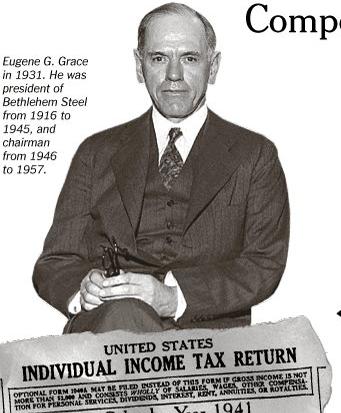
The New York Times has a truly amazing graphic presentation of how the rich used to pay taxes. Check out the image here. The data comes from old IRS filings, made public through the National Archives. They show, for example, that in 1941 — PRIOR to the WWII tax hikes — Eugene Grace, the president of Betehem Steel and one of the highest paid Americans, earned $522,637 (the equivalent of about $7.5 million today), had an adjusted gross income of $336,953 — and paid 66 percent of it, or $114,902, in federal income taxes. Thomas Watson, the president of IBM, paid 69 percent of his AGI in taxes.


Back then, the top marginal tax rate was 81 percent.


And guess what? Those folks were still very rich, still worked hard, still built big companies and created the most poweful economy in the world.


In fact, I could argue that it was precisely BECAUSE OF those high marginal rates that America grew so prosperous in what are now seen as the good old days.

SFBG Radio: From Wikileaks to class warfare

0

In today’s episode, we talk about Wikileaks, why there’s more outrage about embarassing leaks than about really dangerous leaks — and why everybody’s so afraid of talking about class warfare. Cuz we aren’t. Listen up after the jump.


sfbgradio12/3/2010 by endorsements2010