SFBG Blogs

Chiu and Kim are making a quick trip to Burning Man

18

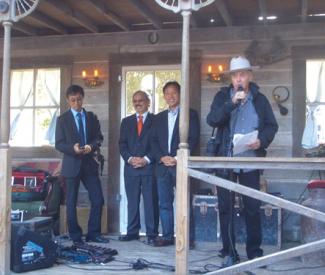
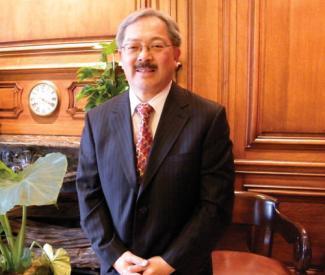
Board of Supervisors President David Chiu will take a day off from his busy mayoral campaign next week to attend Burning Man, which he’ll fly into on a small private airplane along with Sup. Jane Kim and spend less than 24 hours on the ground.

“For several years, I’ve wanted to visit the Black Rock Desert to learn about how Burning Man is building 21st Century community, creating art, and fostering sustainability,” Chiu told the Guardian after we learned about the trip from several sources.

Black Rock City LLC, the company that stages Burning Man – an arts and cultural extravaganza that began in 1986 on San Francisco’s Baker Beach and now takes place in Nevada’s Black Rock Desert – has long sought to woo influential city officials to the event, offering free tickets to elected officials and some board aides. With this year’s move into a new Mid-Market headquarters space and creation of the new Burning Man Project nonprofit, both the LLC and City Hall have more reason than ever to seek stronger ties.

Sup. Eric Mar, who attended his first Burning Man last year, will be returning this year on his own to spent most of the week on the playa. By contrast, Chiu and Kim will fly into an airport set up at the event on the morning of Sept. 1 – accompanied by activists Sunny Angulo and Dan Nguyen-Tan, who will essentially staff them during their visit – stay in accommodations set up by supporters and the LLC, and fly out the next morning.

“It’ll be a super quick trip,” Chiu said, but he says that he’s excited to experience the event because, “Burning Man is an extension of our San Francisco community.”

Neither Kim nor Angulo returned calls for comment. Sources who helped set up the trip say they are trying to keep the value of the contributions to each supervisor under California’s $420 limit on gifts to public officials, and that if the value of the tickets, flight, and accommodations exceed that, Kim and Chiu will pay for the difference.

Organizers of the trip were also trying to woo another mayoral candidate, Sup. John Avalos, who considered it but ultimately decided against it. “Can’t pull away, what with being from a working family and with the kids and campaign and all,” he told us.

Tickets to Burning Man, which runs from Aug. 29-Sept. 5, sold out for the first time in its history this year, setting off a mad scramble for tickets that belied the event’s focus on a decommodified gift economy. To deal with that escalating demand, the event is expected to grow from a population of around 52,000 this year up to 70,000 within five years.

To learn more about the event and the culture is has spawned, check out our recent guide; read my book, The Tribes of Burning Man: How an Experimental City in the Desert is Shaping the New American Counterculture; or listen to the podcast of KQED’s Forum that I was on last week with event founder Larry Harvey and celebrated artist Karen Cusolito.

Project Dog brings out the purebred in rescue dogs

0

“I once split my pants photographing a Finnish spitz on the cliffs above Sutro Baths,” the lovely, energetic Kira Stackhouse laughed over drinks at Blackbird Bar in the Castro last week. She was recounting some very interesting stories about her ambitious Project Dog — an attempt to meticulously photograph woofy representatives of all 170 official American Kennel Club registered breeds next to purebred counterparts from dog rescue agencies.

“A big part of my mission is to photograph as many of these dogs as I can in iconic San Francisco and Bay Area settings, sometimes I’m trying to shoot five or six dogs a day. It’s not like I travel around with a change of clothes –but apparently there’s no lengths I won’t go to! So I just tried to hold my legs together until I got the shot.”

Stackhouse, who left a high profile job in marketing to expand her Nuena Pets photography business, launched a Kickstarter campaign earlier this month to help fund a full-color coffeetable book that will come out of Project Dog. (The campaign wraps up in three more days.) I asked her to explain the motivations behind the project — which has become a viral hit in the Bay Area and beyond, and has garnered several local accolades —  and what she hoped to accomplish. 

“It was weird how the idea came about. I love pets, but I always thought of myself as more into cats — until I got a dog of my own a couple years ago and fell completely in love. The dog was a purebred from a breeder, a Boston terrier. And when I would take him out, people would give me such shit about not going to an animal rescue place.

“So I thought, ‘You know, most people don’t know that rescued animals can be purebred — or that almost all official breed groups contain rescue organizations.’ It dawned on me that one way to get this message out would be to start a project that gets these dogs side by side in a format that would be instantly recognizable and appealing to people.

A sample layout from the forthcoming Project Dog book, featuring Basenjis — one from a breeder and one from an animal rescue organization.

“On top of that, I wanted this to be a community effort — so I asked people to submit their purebreds for picture consideration and tell stories about them on the Project Dog site. People really got into that — some of the stories are so funny, and we attracted entries from people like the mayor of Carmel! Then I could see what was out there and choose which dogs to photograph.

“But another community function I wanted to fulfill was building a platform to host the debate about purebred rescue dogs. People feel passionately — some owners are afraid rescue purebreds will diminish the ‘brand’ of the dogs, and some rescue dog fans are really vocal about their opposition to breed fetishization. This is somewhere they can all go at it.

And of course, I get to photograph some really beautiful dogs — and get really creative in a way I feel can benefit the community.”

It’s true, she does — some of the photos and test layouts for the book are stunning. But Project Dog, which is partnered with the SPCA, is also helping to enlarge perceptions of rescue dogs, usually knee-jerked as mangy mutts (not that those aren’t cute!), when in fact any kind of dog can find itself in need of a loving home. The Project Dog motto is, “Every dog is a work of art,” and Stackhouse’s dedication is proving that true. 

Preorder the Project Dog book for three more days on the Project Dog Kickstarter.

Live Shots: Stepology at Herbst Theater, 8/21/2011

0

At most performance rehearsals, there isn’t the need to do a sound-check with the drummer and the dancers. At a tap show, it’s a must. The beats are coming from both parties, so those amps better be set to pitch perfect.

This past weekend, metal-soled kicks took the stage, for a performance by the very talented Stepology, a local tap dance organization who is trying to preserve those classic tip-tappity steps through its annual Bay Area Tap Fest program. I stopped by the Stepologists’ final rehearsal to get a taste of what they were up to, and was very glad I did. 

As a child, I had a large portrait of Fred Astaire in my bedroom (no joke!) and remember spending hours watching classics like Holiday Inn and Swing Time with my grandmother. They were such entertaining and silly movies. Those classics definitely had an influence on me, because I too took tap lessons and started dressing in long vintage skirts that made a perfect bell shape when I twirled.

Stepology is keeping that genuine spark of classy foot moves alive, while adding in some modern sensibility, with live contemporary music and clever originality. I’m sure anyone who sees the troupe perform will feel just a bit of nostalgia — and excitement for the future of this art form.

Fred, showing off the moves in Holiday Inn:

Street Threads: Downtown Edition

0

Today’s Look: Leezet, United Nations Plaza

Tell us about your look: “My best friend dresses me.”


Maximum Consumption: Singing and slinging with One Ring Zero

1

This is the first installment of our new series, Maximum Consumption, an unseasoned look at the increasingly overlapping fields of music and culinary arts. So if you’re in a band and looking to talk chop, or a chef that moonlights as an acoustic guitar-playing busker, we’d like to talk to you.

An enticing little book landed on my desk last week. It’s part cookbook, part music journalism, part rock opus, and hell, part coffee table book. The Recipe Project (subhead “A Delectable Extravaganza of Food and Music) is a concept spearheaded by New York-based gypsy-klezmer act One Ring Zero. The band’s co-founders, Michael Hearst and Joshua Camp, created songs using the recipes of well-known chefs (Mario Batali, Isa Chandra Moskowitz, Chris Cosentino) as the word-for-word lyrics. The meals themselves served as musical influence; each recipe inspired a different sound.

While the songs are not likely ones you’d listen to say, on a long lonesome drive, they do have a certain childlike glint of glee. It’s conceptual. The true genius of this project is its overall cohesiveness. It’s an all-in-one package. Follow the recipe, listen to the song, get some interesting background factoids. There’s also the starpower — and that goes for both rockers and chefs.

Celebrated vegan author Isa Chandra Moskowitz, a.k.a one-half of Post Punk Kitchen, offers her recipe for peanut butter brunettes, and to match it One Ring Zero brought in singer Tanya Donelly (of Belly, the Breeders, and Throwing Muses) to add dreamy pop vocals. Donelly also makes another appearance later in the book as the author of a recipe called the ugly muffin.

San Francisco’s Cosentino, of Incanto, includes a recipe for brains and eggs and One Ring Zero matched it with a hyper Beastie Boys-esque rap song, as Cosentino suggested. In the preface, the reader learns that Cosentino’s brains and eggs recipe was the original impetus for the project, given its lyrical instructions. I, however, am particularly fond of the song matching Mark Kurlansky’s recipe for a raw peach. With the whisk-whisk-whisk of an old record scratch kicking off the song, it naturally leads to a sweet vintage Parisian-style ditty, you might as well be wandering the Champs-Élysées munching some ripe fruit.

But it’s not all just matchy-match recipes with songs, The Recipe Project also includes full recipe playlists, articles rock journalists, and some pretty interesting interviews with chefs, along with “A Wine Lover’s Guide to Mexican Music.” Those in-between articles start off with headlines such as “Raspberries, Moussaka, and Metallica” in which we learn that chef Michael Symon is “America’s MVP of pork” — and that Stevie Ray Vaughan is the musical equivalent.

It’s a cookbook that’s worth a spin. The Recipe Project is out Oct. 15, 2011 on Black Balloon Publishing.

Why doesn’t BART just apologize?

48

It’s pretty clear that people are still mad at BART for cutting off cell phone service — and that the agency is doing a miserable job of responding. The latest protest featured BART cops arresting people for nothing more than speaking out in the station, which leaves the train system in the horrible position of attacking First Amendment rights. And the protests are likely to continue, making life difficult for commuters and discouraging people from taking BART.

And it’s all so pointless.

All the anonymous protesters want is for BART to apologize and promise not to cut off cell phone service again. That seems like a really easy solution. Cutting off service was a bad idea in the first place; why not admit it, enact a policy against future disruptions and call it a day? How hard can that be? What level of arrogance is required to ignore a simple way of resolving an increasingly intractable conflict?

The BART directors, never a blue-ribbon bunch, need to get their collective act together. Because this is really stupid.

Holy manta rays! (A journey to Treasure Island with Tiny Town Productions)

0

I’m coming to pick you up right now, we’re going to Treasure Island, and we’re gonna see manta rays. Jeff Waldman and Andrew Hartley shot this footage of the scrap of land (recently labeled a “food desert” for its low income residents by the Department of Agriculture) to practice their videography skills for the upcoming Bolivian leg of their “multi-country experiment in random acts of kindness.” What’d they find?

Definitely not grocery stores, but public housing, art collectives, condemned military structures, wineries, and a family of manta ray-anglers. “It’s a crazy weird place that’s largely abandoned but also partially inhabited by an eclectic mix of bizarre personalities. You get the sense that you can do anything there, without consequence or attention, despite being a stone’s throw from the most densely populated metropolitan area on the West Coast,” says Waldman. 

BART arrests protesters for speaking out

Faced with yet another protest over BART’s disruption of cell phone service on August 11 to preemptively disrupt a protest, and with lingering anger over the BART police shooting of Charles Hill on the Civic Center station platform on July 3, BART police stifled vocalizations of dissent with immediate arrests during an Aug. 22 protest on the Civic Center Station platform.

“Free speech is the best kind of speech,” said one protester on the Civic Center BART platform as the second protest called by the international hacker group Anonymous in as many weeks challenged the BART system at rush hour.

As a few protesters began to gather, surrounded by dozens of riot police and media, a uniformed BART police officer told a young African American man he would be arrested if he raised his voice. Chanting began in response among the small pack of protesters, and the man was promptly arrested by BART police.

As he was being led off the platform by police, a woman who stood in the center of the platform began verbally engaging a BART officer, saying, “BART police need to be reformed. Make BART Safe. Make BART safe.” She was apparently arrested for nothing more then her words. Deputy BART Police Chief Daniel Hartwig said he could not provide any information about what the arrestees would be charged with.

Video by Shawn Gaynor

Shortly after, BART police declared the small gathering an illegal assembly. Riot police surrounded some 40 protesters for arrest as media was ejected from the station.

Civic Center station and Powell Station were both shuttered, blocking many transit passengers from their evening commute.

What started as a cell phone disruption has apparently escalated into BART arresting anyone expressing an unfavorable opinion of BART.

When asked if the arrested represented a new BART police policy for protests, Hartwig told the Guardian BART’s policy remains the same. “This environment has to remain safe, and if that safety is jeopardized in any way, we will make arrests,” he said. “We have a responsibility to maintain a safe station.”

Protesters said it was appropriate to protest on the Civic Center platform because it is the location of the July 11 shooting of Hill by BART police.

Earlier in the day, the National Lawyer’s Guild issued a statement calling on BART to respect passengers’ and community members’ civil liberties during the Aug. 22 demonstration.

“First and foremost, the BART Police should provide transparency regarding the killing of Charles Hill and should stop shooting people, especially unarmed and incapacitated individuals,” the NLG statement read. “Second, BART should apologize for its disruption of cell service on August 11th and not repeat this unconstitutional action. Finally, BART should recognize passengers’ right to freedom of speech on platforms and in trains.”

Calls to the BART for the names of the arrestees and number of arrests had not yet been returned by press time.

Polls suggest anti-Lee mudslinging is coming

10

One of the advantages of ranked-choice voting is that candidates have a disincentive for nasty attacks — after all, you want second-place votes from the other candidates, so you don’t want to piss off their supporters.


But when you have a dominant front-runner, as we appear to have in the San Francisco mayor’s race, all bets are apparently off.


I get this from the reports I’m hearing on recent polls. Sue Hestor, the land-use lawyer, tells me she got two calls from pollsters in the past few days — one apparently from the Michela Alioto-Pier campaign, the other most likely commissioned by Dennis Herrera. Both included plenty of questions about Ed Lee. Hestor’s impression: Both campaigns are digging in to the Ed Lee negative stuff to develop their attack lines. They asked about Mohammed Nuru, about Willie Brown and Rose Pak, and about Lee’s promise not to run. The Alioto-Pier poll also had some negative stuff on Herrera and on Jeff Adachi.


Alioto-Pier’s pollster asked a lot of questions about the schools — should the superintendent be elected? Should the board members be elected by district? Should school selection be based on neighborhoods? And there were questions about Alioto-Pier’s support for increased condo conversion. Oddly, there was a public-power question that made it sound as if Alioto-Pier would be the only candidate opposing public power.


The Herrera poll was more subtle, with a lot of questions about how the voters view him.


But the key element is that both candidates are apparently poll-testing how attacks on Lee would play and what might work. And I’m sure many of the others are doing the same thing. So we may be heading for a gang-up, where candidates from the back of the pack converge on the leader. That could get ugly, fast.  

Who doesn’t support Ed Lee?

37

One of the more interesting things about the Democratic County Central Committee’s mayoral endorsements was the lack of support for Mayor Ed Lee among the eight state and federal office holders who sit on the panel.


Under the party charter, any Democrat who lives in the city and represents San Francisco in Sacramento or Washington gets to vote at the DCCC. So U.S. Senator Dianne Feinstein, U.S. Reps. Nancy Pelosi and Jackie Speier, state Senators Mark Leno and Leland Yee, State Assembly Members Tom Ammiano and Fiona Ma and Attorney General Kamala Harris all had a say in who the party would support for mayor. None of those people ever show up at the meetings, but they’re allowed to appoint an alternate to represent their views.


And only Feinstein voted to endorse Lee.


Pelosi’s alternate didn’t show up for the endorsement meeting. Speier abstained. Yee voted for himself. Leno voted No Endorsement. Ammiano suported Avalos. Harris abstained. Fiona Ma voted for Bevan Dufty.


Not a rousing show of support for the incumbent.


(It would have been interesting if Lt. Governor Gavin Newsom were still on the DCCC, but Gav has moved to Marin, and he will now have the distinct honor of serving on that county’s committee.)


Meanwhile: I almost want to ignore Randy Shaw’s attempt to portray the DCCC (and some white progressives in general) as racist for not supporting any of the Asian candidates, since I think it’s too easy to throw that word around in this city, and journalists ought to be pretty careful when they do it. White people (like me and Randy Shaw) need to be particularly sensitive to race issues in the media — and I do think there are real tensions between some old-line progressives and emerging Asian political leaders who don’t always agree with progressives on issues. But that sensitivity should include not sensationalizing race or using race to score political points.


That said, it’s worth noting that of the four Asians on the Board of Supervisors, the DCCC endorsed three (Eric Mar, David Chiu, and Carmen Chu). The only one who didn’t get the DCCC nod for supervisor was Shaw’s candidate in District 6, Jane Kim.


Oh, and the Number 1 candidate endorsed by the Democratic Party is Latino. And the two fastest-growing non-white political populations in the city are Asians and Latinos.


You can fight forever about the politics of the DCCC endorsement and why the panel only chose two candidates. The Guardian will almost certainly support three, since that’s how RCV works. Why Yee, who has the support of both SEIU Local 1021 and the Sierra Club, got only two votes at the DCCC is a fair question. Why Chiu, who is a member of the DCCC, didn’t win the third slot is also an interesting political question. But I honestly don’t think race was a factor. Maybe I’m wrong.    


And as for the whole flap about Aaron Peskin, Rose Pak and the People’s Republic of China (based, by the way, on Peskin’s comments in a Falun Gong newspaper): I met with Rose Pak a few weeks ago, and in the course of talking about Leland Yee (who I will be profiling in the Aug. 31 Guardian) she told me that some progressives were accusing her of being a Communist — a reference to comments by Peskin and Chris Daly linking her to the PRC. She called it “red baiting.”


Just for the record: I’d by happy if Pak WAS a communist — maybe she’d be more interested in income redistribution, progressive taxation and land reform in San Francisco. I like communists. I even got me a picture of ol’ Leon Trostky hangin’ in my office (along with a picture of John Ross, another noted pinko). And years ago, when I had a garage, I really did have a commie flag tacked up on the wall. A friend bought it for me in the Soviet Union back in the day, and one of the reasons I loved it was that it was so poorly made that it started to unravel the minute I stuck the tacks in it, and the colors weren’t quite right, and the silkscreened hammer and sickle was way off center. Go team.


Seriously, I think the era when the label “Communist” was a serious smear is long over. Nobody cares any more. Besides, China isn’t really a Communist country these days, is it? I’m not an expert on the Chinese economy, but it seems much more hyper-capitalist to me. And it’s safe to say that there’s no Cuba-style forced economic equality in China, a country that has a handful of billionaires and a lot of very poor people and may have even worse income distribution than the United States.


Maybe we could talk about the issues?

Incident by incident, the Bayview police report on the fan mayhem at Candlestick Park

0

One of the most fascinating local  communiques is issued  regularly to subscribers by the Bayview District Police Station, reporting on incidents handled by the police that cover the Potrero Hill, Bayview,  and Hunters Point districts.

Below, incident by incident, is the district’s PDF report of Monday (8/22/11) on the fan violence at the San Francisco 49er vs. Oakland Raiders game Saturday (8;20/11) at Candlestick Park.

http://test.sfbg.com/PDFs/a_MON_Recap_08-22-11.pdf

A great deal of photos from the Alamo Square Flea Market

1

The blue-threaded, stiff safari hat and the steel-lined canteen with the shoulder strap were hanging near each other on a metal railing at the 28th annual Alamo Square Flea Market. They were separated by a heavily-distressed grey motorcycle jacket, but surely hat and canteen had been tandem-teamed at some neo-colonialist theme party? I asked the gentleman vendor if that was the case.

It wasn’t. But he had sported the hat for a party recently, and he agreed the two bits of genteel ruggedness were a great pairing. In fact, he’d throw in the canteen for free. But first I had to buy the hat.

And so went the customarily predatory-laissez-faire dance of the flea market, brought for six overcast hours into the middle of the city, where there are not enough flea markets. But this was no flash in the pan — the Alamo Square affair has been around for decades, a smattering of vendors lining the treacherous path above Hayes Street, running along the southern edge of Alamo Square Park.

The winds were whipping around the flea market vendors Saturday morning but they, being the professional creatures that they are, had comfortable chairs to sit in, easy conversation starters for browsers fingering their baskets of $2 earrings, and ridiculously expensive starting quotes for the most unlikely of items ($45 for the alligator skin daschund purse? For shame, for shame). 

Indie Mart DIY-ers were there, as was the adoption ready pups from Rocket Dog Rescue, and terrarium craft tables overseen by neighborhood art clubhouse Workshop. 

I didn’t buy the hat (sorry boyfriend), but I will happily donate my new $2 earrings to anyone who can tell me why this isn’t a monthly event. 

Imprisoned hikers’ families react to sentencing

12

The families of Shane Bauer and Josh Fattal issued a statement yesterday (Sun/21) after receiving confirmation that the two men, both 29, had been sentenced to eight years in prison after an Iranian court found them guilty of illegal entry into Iran and espionage on behalf of the United States.

“Of the 751 days of Shane and Josh’s imprisonment, yesterday and today have been the most difficult for our families,” the statement notes. “Shane and Josh are innocent and have never posed any threat to the Islamic Republic of Iran, its government or its people.

“We are encouraged that the Iranian Foreign Minister, Ali Akbar Salehi, has said he hopes the case will proceed in a manner that will result in Shane and Josh’s freedom. We appeal to the authorities in Iran to show compassion and allow them to return home to our families without delay.

“We also ask everyone around the world who trusts in the benevolence of the Iranian people and their leaders to join us in praying that Shane and Josh will now be released.”

Bauer and Fattal were arrested with Bauer’s fiancée, Sarah Shourd, on July 31, 2009 on the unmarked border between Iran and Iraqi Kurdistan where the three had been hiking during a vacation. Shourd, 32, was released on humanitarian grounds last September after spending 410 days in solitary confinement. Bauer and Fattal were sentenced after more than two years of detainment awaiting trial.

“We have repeatedly called for the release of Shane Bauer and Joshua Fattal,” U.S. State Department Spokesperson Victoria Nuland told the Guardian. “Shane and Josh have been imprisoned too long, and it is time to reunite them with their families.”

The United States maintains the two men have no connection to the United States government. Speaking earlier on the issue, President Barack Obama said, “I want to be perfectly clear: Sarah, Shane and Josh have never worked for the United States government. They are simply open-minded and adventurous young people who represent the best of America, and of the human spirit.”

Iraqi Kurdistan, the region where the three had been hiking, is a semi-autonomous region of northern Iraq that has been notably more stable then other areas of Iraq since the 2003 U.S. lead invasion. The U.S. State department had affirmed the relative safety of travel in the Kurdistan region of Iraq just weeks before their ill-fated trip.

Bauer, a freelance writer and photojournalist who has written for the Guardian and other Bay Area news outlets, and Fattal, an environmental advocate, are both graduates of UC Berkeley had both traveled extensively abroad pursuing their vocations and interests.

Shourd has indicated that she does not plan to return to Iran to stand trial, but has been a constant advocate for the release of her traveling companions. Supporters have organized several events in the Bay Area, including an art auction and film screening, to assist in the efforts calling for the hikers’ release from Iran.

Bauer and Fattal appeared in court only once on February 6 this year when they testified to their innocence verbally and in writing. Their Iranian lawyer, Masoud Shafiee, has said he will appeal the verdict. It remains unclear if the time they have served thus far will apply to the court sentence.

Speaking about the case, Secretary Of State Hillary Clinton said, “We continue to express our hope that the Iranian authorities will exercise the humanitarian option of releasing these two young men.”

The Iranian Ambassador to the United Nations has not yet returned the Guardian’s request for comment.

Rebecca Bowe contributed to this report.

Food cart captures: Snaps from the Street Food Festival

1

We still had five blocks to walk, but we could already smell the medley of exotic flavors wafting up the street. Sam Love and I were headed to the third annual SF Street Food Festival, which took over blocks and blocks of Folsom Street this past Saturday, bringing together street food vendors from La Cocina, San Francisco, and even a few from across the country to share edible wares with local foodies.

Signs lined the street, warning us to “pace yourself.” This was no joke. It was hard to decide where to start, but we chose to stick with the stars of the event: the entrepreneurial women of La Cocina. When we finally picked a vendor line to wait in, some of were snaking half way down the block.

We started with some tamales from Alicia’s Tamales Los Mayas. They were creamy and delicate, and as Alicia put it with a huge smile on her face, “stuffed with love.” We could have eaten a whole suitcase full of those babies. Yum!

Then we moved on to a more tactile eating experience, stopping at Eji’s Ethiopian Gourmet for some spongy injera topped with lentils and cabbage. Using the bread as utensil, we scooped the perfectly spiced veggies up, letting them drip satisfyingly down our chins.

After a pit stop for some agua fresca, we made one more beeline to Los Cilantos, to grab an elote (how had I never had one of these before!), which is roasted corn on the cob, smothered in mayo and parmesan cheese. So good. So good!

I have no idea how many zillions of people showed up for the festival on Saturday, but I do know that everyone at the stands was working their butts off to make sure no one went home hungry.


The Keynes vs. Hayek rematch

42

By Robert Skidelsky

Robert Skidelsky, a member of the British House of Lords, is Professor Emeritus of Political Economy at Warwick University.

LONDON – The Austrian economist Friedrich von Hayek, who died in 1992 at the age of 93, once remarked that to have the last word requires only outliving your opponents. His great good fortune was to outlive Keynes by almost 50 years, and thus to claim a posthumous victory over a rival who had savaged him intellectually while he was alive.

Hayek’s apotheosis came in the 1980’s, when British Prime Minister Margaret Thatcher took to quoting from The Road to Serfdom (1944), his classic attack on central planning. But in economics there are never any final verdicts. While Hayek’s defense of the market system against the gross inefficiency of central planning won increasing assent, Keynes’s view that market systems require continuous stabilization lingered on in finance ministries and central banks.

Both traditions, though, were eclipsed by the Chicago school of “rational expectations,” which has dominated mainstream economics for the last twenty-five years. With economic agents supposedly possessing perfect information about all possible contingencies, systemic crises could never happen except as a result of accidents and surprises beyond the reach of economic theory.

The global economic collapse of 2007-2008 discredited “rational expectations” economics (though its high priests have yet to recognize this) and brought both Keynes and Hayek back into posthumous contention. The issues have not changed much since their argument began in the Great Depression of the 1930’s. What causes market economies to collapse? What is the right response to a collapse? What is the best way to prevent future collapses?

For Hayek in the early 1930’s, and for Hayek’s followers today, the “crisis” results from over-investment relative to the supply of savings, made possible by excessive credit expansion. Banks lend at lower interest rates than genuine savers would have demanded, making all kinds of investment projects temporarily profitable.

But, because these investments do not reflect the real preferences of agents for future over current consumption, the savings necessary to complete them are not available. They can be kept going for a time by monetary injections from the central bank. But market participants eventually realize that there are not enough savings to complete all the investment projects. At that point, boom turns to bust.

Every artificial boom thus carries the seeds of its own destruction. Recovery consists of liquidating the misallocations, reducing consumption, and increasing saving.

Keynes (and Keynesians today) would think of the crisis as resulting from the opposite cause:  under-investment relative to the supply of saving – that is, too little consumption or aggregate demand to maintain a full-employment level of investment – which is bound to lead to a collapse of profit expectations.

Again, the situation can be kept going for a time by resorting to consumer-debt finance, but eventually consumers become over-leveraged and curtail their purchases. Indeed, the Keynesian and Hayekian explanations of the origins of the crisis are actually not very different, with over-indebtedness playing the key role in both accounts. But the conclusions to which the two theories point are very different.

Whereas for Hayek recovery requires the liquidation of excessive investments and an increase in consumer saving, for Keynes it consists in reducing the propensity to save and increasing consumption in order to sustain companies’ profit expectations. Hayek demands more austerity, Keynes more spending.

We have here a clue as to why Hayek lost his great battle with Keynes in the 1930’s. It was not just that the policy of liquidating excesses was politically catastrophic: in Germany, it brought Hitler to power. As Keynes pointed out, if everyone – households, firms, and governments – all started trying to increase their saving simultaneously, there would be no way to stop the economy from running down until people became too poor to save.

It was this flaw in Hayek’s reasoning that caused most economists to desert the Hayekian camp and embrace Keynesian “stimulus” policies. As the economist Lionel Robbins recalled:  “Confronted with the freezing deflation of those days, the idea that the prime essential was the writing down of mistaken investments and…fostering the disposition to save was…as unsuitable as denying blankets and stimulus to a drunk who has fallen into an icy pond, on the ground that his original trouble was overheating.”

Except to Hayekian fanatics, it seems obvious that the coordinated global stimulus of 2009 stopped the slide into another Great Depression. To be sure, the cost to many governments of rescuing their banks and keeping their economies afloat in the face of business collapse damaged or destroyed their creditworthiness. But it is increasingly recognized that public-sector austerity at a time of weak private-sector spending guarantees years of stagnation, if not further collapse.

So policy will have to change. Little can be hoped for in Europe; the real question is whether President Barack Obama has it in him to don the mantle of President Franklin Roosevelt.

To prevent further crises of equal severity in the future, Keynesians would argue for strengthening the tools of macroeconomic management. Hayekians have nothing sensible to contribute. It is far too late for one of their favorite remedies – abolition of central banks, supposedly the source of excessive credit creation. Even an economy without central banks will be subject to errors of optimism and pessimism. And an attitude of indifference to the fallout of these mistakes is bad politics and bad morals.

So, for all his distinction as a philosopher of freedom, Hayek deserved to lose his battle with Keynes in the 1930’s. He deserves to lose today’s rematch as well.

Robert Skidelsky, a member of the British House of Lords, is Professor Emeritus of Political Economy at Warwick University.

Copyright: Project Syndicate, 2011.

www.project-syndicate.org

Appetite: Orson cocktails — worth a revisit?

0

Orson bar manager Ian Adams shows inspired vision in his cocktails. He’s having fun pairing them with a new four-course dinner, but even more so, his everyday cocktails shine with enough twists to keep me intrigued.

Amorosa ($10) comes on the stem in a champagne glass. It exhibits a rosy Campari and house cinnamon-rose kombucha hue, mixed with cachaca and housemade curacao. The elegant kombucha is not too vinegary, but adds a complex, unexpected layer to the drink’s gently bitter Campari finish. Refreshing and unique, I’d return for this one. A musky, playful course is taken in Ichi the Killer ($10): rye whiskey and lush amari are balanced with Peychaud’s bitters, then given that “little something extra” with pink peppercorn.

Orson is currently running a Blackboard Eats ​”Hotel California” special menu, a delightful concept of four-course meal with cocktail pairings, each drink and dish named after a line in the Eagles’ most famous song. The happiest pairing is “Can’t Kill the Beast”: maple-glazed roasted pig in a butter Tabasco sauce, over a can’t-go-wrong mix of cornbread, pickled peaches and broccolini. Fresno chilies are a genius touch from chef Elizabeth Falkner, nodding to California in a Southern-inspired dinner. “Far Away” is a shoo-in pork companion: bourbon, maple syrup, mint, and muddled peach make for a bright, bracing summer cocktail.

I appreciate the smoky, savory creativity behind the dessert cocktail, “Dance to Forget”, utilizing peat standard, Laphroaig 10yr scotch, rich with a house cherry brandy, spicy with ancho chili-infused chocolate and a bit of cayenne. Paired with Falkner’s “Last Thing I Remember” (chocolate, smoke, plum and a sweet black olive ice cream reminiscent of chocolate chip), it feels like the right way to end a meal.

— Subscribe to Virgina’s twice monthly newsletter, The Perfect Spot

PSIgasm explores the science of the climax

0

Kinsey was an obvious pioneer of sexy science and the sexual revolution was sparked in the decades after his first studies contributed hard facts about human sexuality, but at this point his findings needs refreshing.

But instead of intensified sexual investigations, our country is regressing and the frigidness of conservative politics tied up with the pharmaceutical industry have pushed sex nerds away from researching healthy bodies to focus their attention on limp studies — deficiencies, dysfunction, and anything else that can be prescribed.

The PSIgasm Project, a Bay Area sex-positive research project, wants to jump back into the fun stuff and track down just what exactly the the big “o” does to the human body.

It may look like a super powerful dildo, but the PSIgasm is actually a fancy scienticfic device that records changes in body temperature, heat capacity, heart rate, blood volume, moisture, and movement; all signs pointing to orgasm. The smart instrument of pleasure was concieved in 2010 by Ned Mayhem, a PhD candidate in experimental physics at UC Berkeley and his lover Maggie Mayhem, an HIV prevention specialist, both of whom are sex positive activists, queer porn performers. The aim of their project is simple: to get people off and simaltaeously monitor the physiological responses correlated with arousal and orgasm. You can almost hear this city full of tech geeks pleading, “more, more!”

“The idea that the reactions to sex can be quantified blows their minds,” says Mr. Mayhem of excited audeinces and test subjects who have been introduced to the project. “Sex is usually talked about in a kind of ‘woo-woo’ way, but what’s going on in your body are real physical processes. When you’re turned on, it’s not just your mental state, or magic divorced from your body. It’s actual chemicals, flowing.”

psigasm

The scientific shaft, version II

Mr. Mayhem is currently bulking up version three of the PSIgasm, which involves a lot of technical tweaking and electronics upgrading to make sure it’s reliable enough for vigerous, all-night, hot and heavy testing. The plan is to record data from people with all different anatomies, gender identities, ages and cultures, engaged in sex for various reasons and in different places, like dungens, bedrooms, and backseats. If there were ever a research study that would gain ethusiastic volunteers in this city, PSIgasm would be it. 

The Mayhems want their findings to not only inform people about the wonders of their own bodies, but dispute society’s widespread misconceptions of “normal” sex by showing conclusive data that people orgasm from differnt types of action, both soft and rough, wild and quiet. The mobility of the PSIgasm will also keep the data honest by allowing individuals using the smart dildo to play privately however they please, without white lab coats standing over their shoulder.

Eventaully Mr. Mayhem plans to make all of the PSIgasm’s designs public so people can build their own equipement and anonomously share their data.

For the time being, he’s working the projects presentation for Arse Elektronika, which may or may not include a live demonstration. Now that sounds like exciting science!

San Franciscans want higher taxes

94

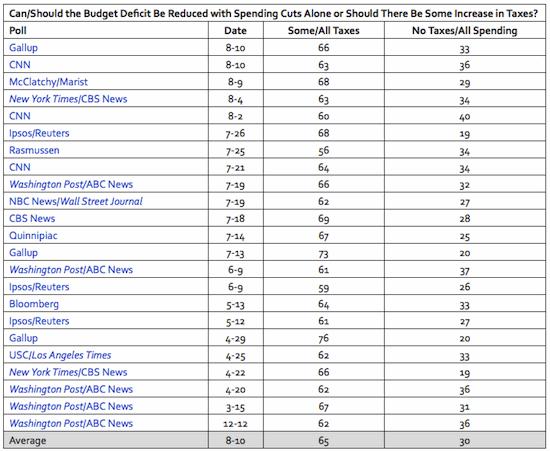
At least, I assume they do. That would seem to be the what the evidence shows. Because in 23 polls taken over the past nine months, Americans say they support higher taxes  as a part of the budget solution — by an average margin of 65-30. And by almost every measure, San Franciscans are more liberal than Americans as a whole. So it’s likely that if those polls collected data just from this city, we’d see closer to 75 percent of the voters saying they support higher taxes, particularly on the rich and big corporations.


And since San Francisco is so far out on the cutting edge on so many other issues, I have to wonder: Why is everyone at City Hall so afraid of taxes? Why is progressive taxation (and not pension reform) the central issue in the mayor’s race?


Gavin Newsom build his political career on a plan to cut welfare payments for homeless people. Jeff Adachi is trying to get elected mayor by campaigning to cut city employee pensions. Dennis Herrera is talking about his efforts to legalize same-sex marriage. But there’s not a single politician in town who has made fair taxation the centerpiece of a citywide campaign. Although it’s likely that three-quarters of city residents would support at least the concept of higher local taxes on the local rich, this isn’t a signature issue for anyone running for anything. 


Doesn’t that seem a little odd?

Bartlett Street showing shades of Clarion

0

We asked Jet Martinezthe mural artist, yesterday at the mural unveiling for “Amate” at the Mission Community Market:

“Soo… it’s all about loving yourself?” [Such is the title’s meaning in Spanish.]

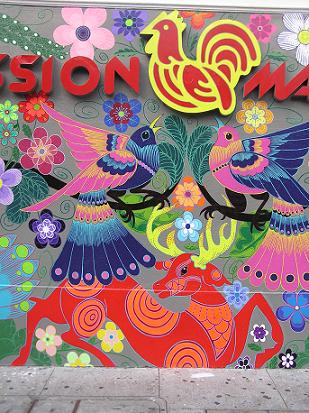
Not really, kind of, not really. The word — depending on where you place the accent — can refer to auto-adoration, or to the brown paper on which many Mexican folk art designs are painted. Whatever the ultimate meaning of the title, Martinez’ new piece (there’s a gorgeous full shot of it here) is easily the most vividly colored wall we’ve seen in this city in a minute — it’s like those scenes in Disney movies where all the woodland forest creatures get frenzied-happy during the climax of a musical number. Make you wonder what song they’re singing.

And there’s more street art where that came from on Bartlett

“Amate” is not the only large-scale street art you should peep on the street (preferably while you’re heirloom tomato shopping with a greasily-transcendent pupusa balanced precariously in one hand). You perhaps know about Ben Woods’ recreation of a 1700s Ohlone mural from Mission Dolores — which sits directly next to Martinez’ creation. 

A few more from the block:

Roa‘s three seals (there’s another stretched out along the bottom of the building, sorry I suck at taking photos) are amazing. 

And here’s a piece which has gotta be by Ben Eine (UPDATE: aaand it is), even though it’s not included on this White Walls map of the recent pieces the British artist painted around the city. Whoever did it, it appears to have garnered the attention of some paint-throwers. 

Word on the street from the Mission Community Market is that the organization is in talks with property owners of the condo-parking lot on the southwestern side of the block to liven up that surface as well. Pretty soon, we may have a block so colorful enough to match the MCM produce stalls. 

Street Threads: Downtown Edition

0

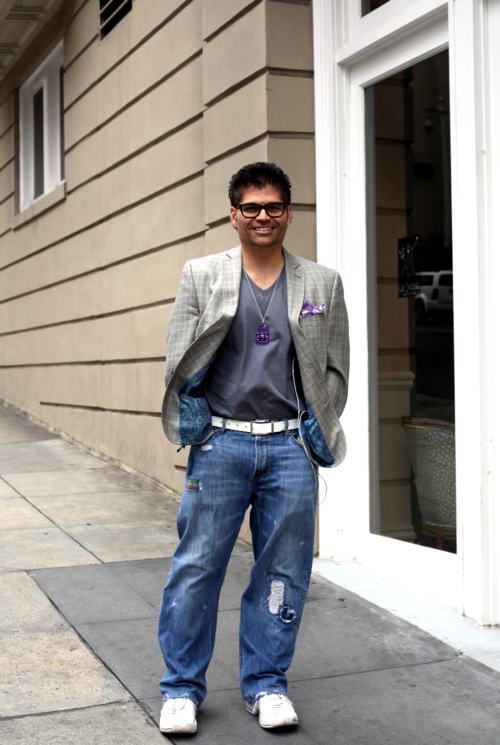
Today’s Look: Greg, Geary and Taylor

Describe your fashion philosophy: “Comfort.”

Craving more Street Threads? Check out Ariel’s official Street Threads book and blog.

UPDATED: Is time travel possible? A Potrero Hill sign warns of the possibility.

10

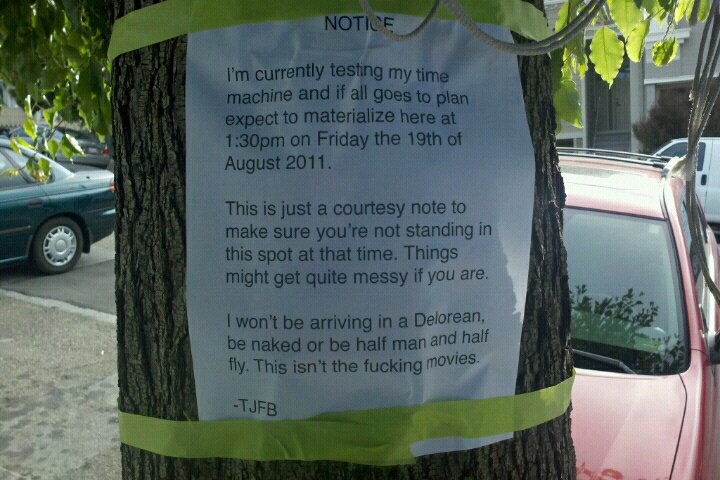
Something strange popped up on an unassuming tree near the Guardian offices in Poterero Hill earlier this week. Walk up Mississippi Street, in between Mariposa and 18th Streets, and you will find a white sheet of paper taped to a trunk with neon green electrical tape. The sign warns bystanders of an attempt at time travel.

The picture is pasted here. I’ve also taken the liberty of typing it out for you.

“NOTICE

I’m currently testing my time machine and if all goes according to plan expect to materialize
here at 1:30pm on Friday the 19th of August 2011.

This is just a courtesy note to make sure you’re not standing in this spot at that time. Things might get messy if you are.

I won’t be arrive in a Delorean, or be naked or be half man and half fly. This isn’t the fucking movies.

TJFB”

So what does this all mean? Is there a nut planning to do something freaky near us? It is an actual scientific endeavor? It is a marketing ploy (I’m usually quick to assume such things)? We’ll find out at 1:30 p.m. today and update this post. A crack team of Guardian editors will be on hand to find out the truth. It’s out there.

Update 1: Something does indeed look fishy, as suspected. Check out this conversation on Reddit. However, as dedicated time travel enthusiasts, we still plan to stake it out.

Update 2: HOLY CRAP, IT WAS AMAZING! There was a huge puff of smoke, and lasers, and unicorns, and roller skates, and books containing sports scores from the year 2012 … just kidding. What do you think happened? Until the next alien landing or chupacabra sighting ’round these parts, the Guardian’s X-files division will be returning to our regularly scheduled duties.

Swear ta god, there was like 12 witnesses assembled for the event.

Update 3: See you next week! Looks like our time traveler had some family law issues to tend to. 

Inside the V.I.P. cocktail party with Willie Brown

The Alliance for Jobs and Sustainable Growth hosted a V.I.P. reception just before a mayoral candidate forum held at UCSF Aug. 16, and former Mayor Willie Brown appeared to be the guest of honor. Although the theme of the event was technically “honoring San Francisco’s mayors” — former Mayor Frank Jordan was there, someone indicated that former Mayor Art Agnos was in the room, former Mayor Gavin Newsom was invited but didn’t show, and Mayor Ed Lee was of course in attendence — Brown seemed to be given more prominent recognition than any of the others.

The moment he strolled in, Sup. Mark Farrell, who was doing introductions for the the affair, scrambled onstage to announce Brown’s presence and deliver a warm welcome, and everyone applauded. Within minutes, the former mayor was seen chatting with a crowd that included Mayor Lee and several others. Soon after, Brown and former Mayor Frank Jordan were summoned to the stage to say a few words.

Once in the limelight, Brown cracked a few jokes. He said he felt for the 36 mayoral candidates, who are forced to campaign in an era when the Internet threatens to reveal videos and photos of them at any time to thousands of online viewers. “I’m glad they didn’t have that kind of communication system when I was running,” he said. “I can’t imagine the photographs you’d have of me floating around doing things I shouldn’t have been doing.”

As for his own time in Room 200, “I enjoyed every single solitary minute of it, and if I really thought I had great skills, I would be number 37,” he said, drawing more applause.

Then again, common wisdom says it isn’t necessary for Brown to bother campaigning in order to gain access to Room 200 these days. Later that same evening, during his own turn in the spotlight at the mayoral debate, Mayor Lee came under fire from Board President David Chiu, who revealed that Lee had privately confided to him about a week before he announced his candidacy that he was having a difficult time saying no to Brown and influential Chinatown business consultant Rose Pak when it came to launching a campaign for a full term.

Chiu’s pointed question for the mayor was what had changed in his mind since that conversation, but Lee referenced neither Brown nor Pak in his answer. Instead, he said he’d changed his mind after witnessing his success in changing the tone of government and getting things done in City Hall.

Back at the V.I.P. reception, Brown and Jordan were invited onstage again, this time to receive awards presented by the Alliance for Jobs and Sustainable Growth. But first Steve Falk, president and CEO of the San Francisco Chamber of Commerce, reminded the crowd that there was still time to buy a drink before the debate got underway. He said, “Debates are much more interesting after three drinks.”

Before Falk presented Brown with a commemorative plaque, he said, “It’s tough to put in a few sentences the life and times of Willie Brown,” and proceeded to note that, with his term in the California Assembly and time serving as mayor of San Francisco behind him, Brown “has now followed his friend Herb Caen into an honest line of work as a columnist for the San Francisco Chronicle.”

Being a newspaper columnist doesn’t mean Brown is always kind to members of the local media. While mixing through the crowd minutes after receiving his award, he fired some harsh words at a well-known City Hall reporter who had recently published some unflattering articles about the “Run, Ed, Run” effort to encourage Lee to seek a full term.

In recent months, Brown’s columns have provided the public at large with a rare glimpse into Mayor Lee’s dining experiences in San Francisco. In February, Brown wrote in one of his columns that he went out to North Beach Restaurant at sat at the window table with Lee, Brown’s “friend” Sonya Molodetskaya, and Jack Baylis, who serves as the US Group Executive of Strategic Development for AECOM, one of the city’s largest contractors and a sponsor of the Alliance for Jobs and Sustainable Growth Event. (Baylis was on the invite list for the V.I.P reception, too.)

Apparently, AECOM had something to celebrate that same day — according to an Aug. 16 press release, an AECOM joint venture was just awarded a $150 million contract for program management services for the San Francisco Public Utilities Commission’s wastewater improvement program.

The V.I.P. reception had representation from many key players in the downtown business community, with sponsorship from AT&T, AECOM, Pacific Gas & Electric Co., Wells Fargo, Motorola, California Pacific Medical Center, the San Francsico Chamber of Commerce, the Building Owners and Managers Association, the San Francisco Police Officer’s Association, Shorenstein Properties, and others. Several labor unions, including the United Association of Plumbers & Pipefitters Union Local 38, United Brotherhood of Carpenters and Joiners of America Local Union No. 22, and United Food and Commercial Workers Union Local 5 were also listed as sponsors. Guests included district supervisors, developers, lobbyists, business owners, mayoral candidates, media spokespeople, executives from the health care industry, and other political insiders.

Clearly, there were many people in the room who wanted to get on Brown’s good side.

New comments policy

107

My friends on the politics blog:


We’ve been getting a lot of complaints about the tone of some of the comments here. We are all for vigorous debate, and we have no desire to censor anyone’s ideas. As you all know, you are free (in fact, encouraged) to disgree with what you see here, in the strongest terms. But of late, the nastiness quotient is driving some of our loyal readers away and discouraging others from joining the discussion.


We aren’t going to try to block anyone or force registration or do anything else that would discourage any of you from easily posting. But we are going to get a bit more aggressive about deleting comments that are nothing more than personal ad hominem attacks — mean-spirited stuff that is off point, does nothing for the issue debates and seeks to abuse or intimidate individuals.


You know who you are, and you know what I’m talking about.


I can’t promise that we’ll catch everything (we have a small staff), but if there’s anything in particular that bothers you that we missed, just let me know. Thanks.


Our new comments policy is here


Vigilante Vigilante: The anti-anti-tagging movie

5

Fred Radke buffs Banksy and can’t stand public mural walls, even when they’re meant to inspire  hope in his post-Katrina NoLa. 

Joe Connolly deals with the death of his 11-year old son by zealously trucking around cans of paint and paint-removing chemicals, occasionally throwing up his own tag as a caution sign to the other, bad, graffiti artists.

Jim “Silver Buff” Sharp will even take down signs for lost dogs in his mission to purge Berkeley’s streets of DIY expression.

Meet your anti-graffiti activists, courtesy of a new film by Berkeley producers, Vigilante Vigilante.

The movie, shot over the course of 500-some days by Max Good and Nathan Wollman, gives a breathless history of people writing on walls (including a dubious reference to graff buffers back in the Paleolithic days), right up to modern day Bay Area strife – anybody remember the Warm Water Cove “clean-up”? The timeline focuses on the conflict between taggers and law-and-order types. If, in this age of JR and other highly-publicized and lauded street art, you don’t think is for real anymore, watch this video

Good capturing Sharp’s technique

The movie then moves onto Good and Wollman’s mission to expose the unaffiliated lone wolfs who spend their days erasing other people’s works of self-expression. They travel across the country, gaining surprising amounts of access to the three men’s routines.

But as it turns out, Vigilante isn’t down to use the middle-aged to elderly white guys they profile (add to this list a one “Silver Circle” from Portland, who is now retired) as the faces of evil. Instead, the movie couches its critique in the wack broken windows sociological theory – itself a tool used by elite populations to justify wiping clean the visible signs of any disenfranchised citizens. 

By the end of the movie, Good and Wollman are arranging meet-ups between the anti-taggers so that they can swap paint-matching and poster removal techniques. The scene is almost heartwarming: the anti-graffiti vigilantes, with their relentless schedules and dedication to their craft almost win the audience over. Even if we’re a little creeped out by them.

Coca Cola vs. Twist’s tag wall: Which is the visual pollution?

So who is the villan in all this? Vigilante Vigilante finds a plausible symbol of nefariousness: James Q. Wilson, the sociologist behind the broken window theory (the inspiration, by the way, for Rudy Giuliani’s 1990s purging of downtown Manhattan).

The producers were right to do so. For the community member upset that their neighborhood is poor, that their area’s youth are unemployed, that circumstances seem beyond their control, Wilson’s theory successfully obfuscates cause and effect, a standard conservative trick of defeating class consciousness. Graffiti doesn’t cause race riots, poorly-dealt-with natural disasters, or high unemployment rates. Writing on a wall is often the response to a society that belittles minority youth, the middle class and poorer, and anyone who is having trouble with the capitalistic treadmill. Jeff Chang‘s Can’t Stop Won’t Stop is a great place to start if you’re interested in this anti-colonialist view of street art.

The obsessive cover-ups of the vigilantes (that in more than one case have morphed into tags themselves, a fact the filmmakers highlight when they begin covering up Sharp’s silver buffs with neon pink and gold buffs, to his dismay), are ultimately their attempt at regaining control in a world that can seem really mean at times. Which doesn’t change the fact that what they’re doing is lame — can hardly blame this guy… 

Vigilante Vigilante is at the Roxie through Sat/20