SFBG Blogs

Shrouded in black, Lykke Li makes eye contact with us at the Fox

0

Lykke Li doesn’t want you. Let’s just get that straight.

Lykke Li wants me. Or at least I think so. Because even though it’s a cliche to say that it sounds like someone is singing just to you, that’s what she does. Particularly when the most common word in her lyrics is the word “you,” and you’re standing in the pit at the Fox Theater on Wednesday night, and you (you!) seem to make eye contact right when she says it, so that suddenly it’s not the royal “you,” it’s you, as in “Hey you. You in the tan coat. Hi.” And you – or at least I – blush, for a moment, not caring at all who this Jerome guy is, although he may just be her noisy upstairs neighbor.

Lykke Li doesn’t want anyone. At least not you (royal “you.”) She hardly can even stand to have you look at her. That’s why she’s draped in black. That, and because it’s a funeral. A funeral for her love. Or a celebration of heartbreak, but those are same thing.

Lykke Li is in control. A few of the songs from her first album, particularly “I’m Good, I’m Gone,” still have the heavy stamp of producer/co-writer/collaborator Björn Yttling, but otherwise these songs are Lykke Li’s. The band is Lykke Li’s, and they steamroll through every track from the latest album, Wounded Rhymes, in an emotional arch that roughly seems to go from collapse to strength, culminating with a Kanye West infused version of “Youth Knows No Pain” and “Get Some.”

Aside from what Lykke Li calls “really indulgent cover song,” “Unchained Melody,” (it kind of was, but let’s still blame the movie Ghost for that) everything goes off according to a clear plan, particularly the extra theatrical lighting and slow building dugga-dugga-da beat around “Rich Kid Blues.” From there to the end, they just smash it.

Lykke Li comes back on stage for an encore, the sparsely accompanied slow doo-wop number, “Unrequited Love.” A few minutes later, there’s a bottleneck in the lobby of the Fox, people clamoring around the merch table. Among the swag were a number of t-shirts, a couple screenprinted with her face, but the majority just have text, a message which reads: “LYKKE LI LOVES YOU”. Someone once said you “can’t buy me love.”  They were wrong. You can buy it on a t-shirt. Lykke Li loves me.

1. Jerome
2. I’m Good I’m Gone
3. Sadness Is A Blessing
4. I Follow Rivers
5. Dance Dance Dance
6. Silence My Song
7. I Know Places
8. Unchained Melody (Righteous Brothers)
9. Little Bit
10. Love Out Of Lust
11. Rich Kid Blues
12. Silent Shout (The Knife)
13. Youth Know No Pain / Power (Kanye West)
14. Get Some
Encore:
15. Unrequited Love

Also: Maybe it was just all the fabric flapping in the fog, but I had some weird Stevie Nicks moments during the night. Particularly during openers, First Aid Kit, Swedish sisters Johanna and Klara Söderberg. Tremendous voices on those two, who have a second album, The Lion’s Roar, coming out next year. But the Fleetwood Mac feel may have just been when the drummer leaned away from folk to rock drumming.

Once in a century

4

We’re all obsessed by politics right now, but I want to take a moment to remind everyone that a day like this only comes around once in a century. I mean, it’s 11/11/11. That has to mean something. Maybe we should all just stop working and listen to the Grateful Dead. Or maybe not.

Dick Meister: Strange bedfellows: Labor’s Tim Paulson and the Chamber’s Steve Falk

5

By Dick Meister

Dick Meister, former labor editor of the SF Chronicle and KQED-TV Newsroom and a former city editor of the Oakland Tribune, has covered labor and politics for a half-century as a reporter, editor, author and commentator. Contact him through his website, dickmeister.com, which includes more than 300 of his columns.

It’s hard to imagine organized labor and the thoroughly anti-labor Chamber of Commerce on the same side, especially in a city like San Francisco with a major union presence.

It’s especially hard to imagine it at a time when unions everywhere are joining with Occupy Wall Streeters to demand justice from anti-labor business and corporate leaders like those who control the Chamber.

But consider what Tim Paulson, executive director of SF’s Labor Council, and President Steve Falk of the SF Chamber of Commerce had to say in a joint statement about the results of Tuesday’s election.

They were downright overjoyed about the passage of Proposition C, which will raise the amounts city employees must pay toward their less-than lucrative pensions and limit future cost-of-living raises. That’s a way to avoid raising business taxes to maintain city services in these recessionary times.

Perhaps most distressing, the passage of Prop C shifted control of the City Health Service System from the employees who are covered by the system to City Hall appointees who won’t have to demonstrate any particular experience in health care matters.

At least Paulson and Falk said they were pleased with the defeat of Public Defender Jeff Adachi’s outrageous Prop D – even though it would have changed the city pension system in almost exactly the same ways as Prop C.

In any case, the difference between C and D was not necessarily their content, but how they got on to the ballot.

Why, exclaimed Paulson in a separate, self-congratulatory statement, the results “sent new shock waves across San Francisco and America as workers demonstrated that collaborative democracy is the best way to set public policy.”

Collaborative democracy? By that I guess Tim was referring to the joining together of labor leaders and public employee unions and Chamber of Commerce members in a coalition with city officials, non-profit social agencies and community groups to put Prop C on the ballot.

The collaborators didn’t even include representatives of the retired employees whose health care would be seriously affected and who were quite active in helping elect labor-friendly candidates.

Paulson, a generally ineffective leader who always seems to be seeking approval of the City establishment, singled out billionaire Warren Hellman for being one of the principal collaborators.

Paulson boasted that every city employee union joined in what he actually described as “a real San Francisco way of doing things.” Hardly. If there really were such a thing, it would be a far cry from the “collaborative” approach that involved labor giving in to the wishes of its anti-labor corporate and business opponents.

Paulson and Falk claimed the approach will be “a model for the rest of the country.” Thankfully for the rest of the country, that seems highly unlikely given the widespread demands for actual reform triggered by the Occupy Wall Street protests.

Negotiations between labor and management eventually reach agreements that both can live with, albeit often uncomfortably. But no agreement can be reached, or should be reached, when one party – the Chamber of Commerce in this case – is not seeking real compromise with an enemy – namely unions – that it would like to put out of business, or at least seriously weaken. Unions, of course, have the same feelings about union foes like the Chamber.

Tim Paulson actually declared the election results “a great victory during difficult times.”

Dick Meister, former labor editor of the SF Chronicle and KQED-TV Newsroom and a former city editor of the Oakland Tribune, has covered labor and politics for a half-century as a reporter, editor, author and commentator. Contact him through his website, dickmeister.com, which includes more than 300 of his columns.


Is SF moving to the right?

92

The Bay Citizen/New York Times thinks so. The headline on the story — “more conservative is the new normal” — says it all. Matt Smith (formerly of our price-fizing rival SF Weekly) and Gerry Shih say the Nov. 8 election signals a turn to the right for this famously liberal city:

But Tuesday’s election signaled a palpable shift: In addition to Lee, a pro-business moderate, voters overwhelmingly picked George Gascón, the law-and-order former police chief — and former Republican — as district attorney.

“To whoever thinks San Francisco is loopy and left-wing, this election basically said, ‘No, it’s really not,’” said David Latterman, associate director of the Leo T. McCarthy Center for Public Service and the Common Good at the University of San Francisco. “We just elected an ex-Republican, pro-death penalty district attorney by a landslide. Just ponder that.”

Well: It’s interesting that they call Lee a “pro-business moderate,” which is probably accurate but differs from how Lee’s more progressive supporters see the new mayor. But while they talk about Gascon, they conveniently leave out the fact that San Francisco has elected the first solid progressive to a citywide office in a long, long time. Ross Mirkarimi — a former Green Party member and without a doubt one of the most left-leaning supervisors — won a tight, contested race for sheriff running honestly as a progressive. I think you have to go back to 1987, when Art Agnos ran for mayor as the candidate of the left, to find another example of a progressive champion winning all across town.

The interesting element of all of this — and something I think Smith and Shih got absolutely right — is that the demographic makeup of the city is changing, and has been for a while:

“From a political perspective, the tech companies are employing young workers who often prefer to live in San Francisco, even if they commute to Silicon Valley, said Wade Randlett, a Bay Area technology executive and top fund-raiser for President Obama.”

Wade Randlett is not my favorite person in local politics, but the point he makes is valid — and it’s not happening by accident. Virtually all of the new housing that’s been built in San Francisco in the past decade has been aimed at wealthy people, a lot of them young tech types who commute from the city to Silicon Valley. The other people moving into new housing are empty-nest retirees from places like Marin County. If you walk through the new condo buildings in Soma, the residents are mostly white, with a few Asians; there are almost no African Americans, very few families and essentially zero working-class people.

For years, downtown groups (including Randlett’s former employer, SFSOS) have pushed for this kind of housing, and some of them have been very open about their goal: By bringing in more rich people and tech workers, you can change the politics of the city. Housing activist Calvin Welch puts it succinctly: Who lives here, votes here.

That’s the reason why land use and housing are so critically important in this town. If poor and working-class people are pushed out to make way for a more upscale set of residents, then progressives who talk about taxing the wealthy to provide services for the poor will have a harder time getting elected.

It’s not a conspiracy; it’s an open, stated policy goal of the people who spent vast sums of money electing Ed Lee.


Occupy SF: The eviction drumbeat begins

38

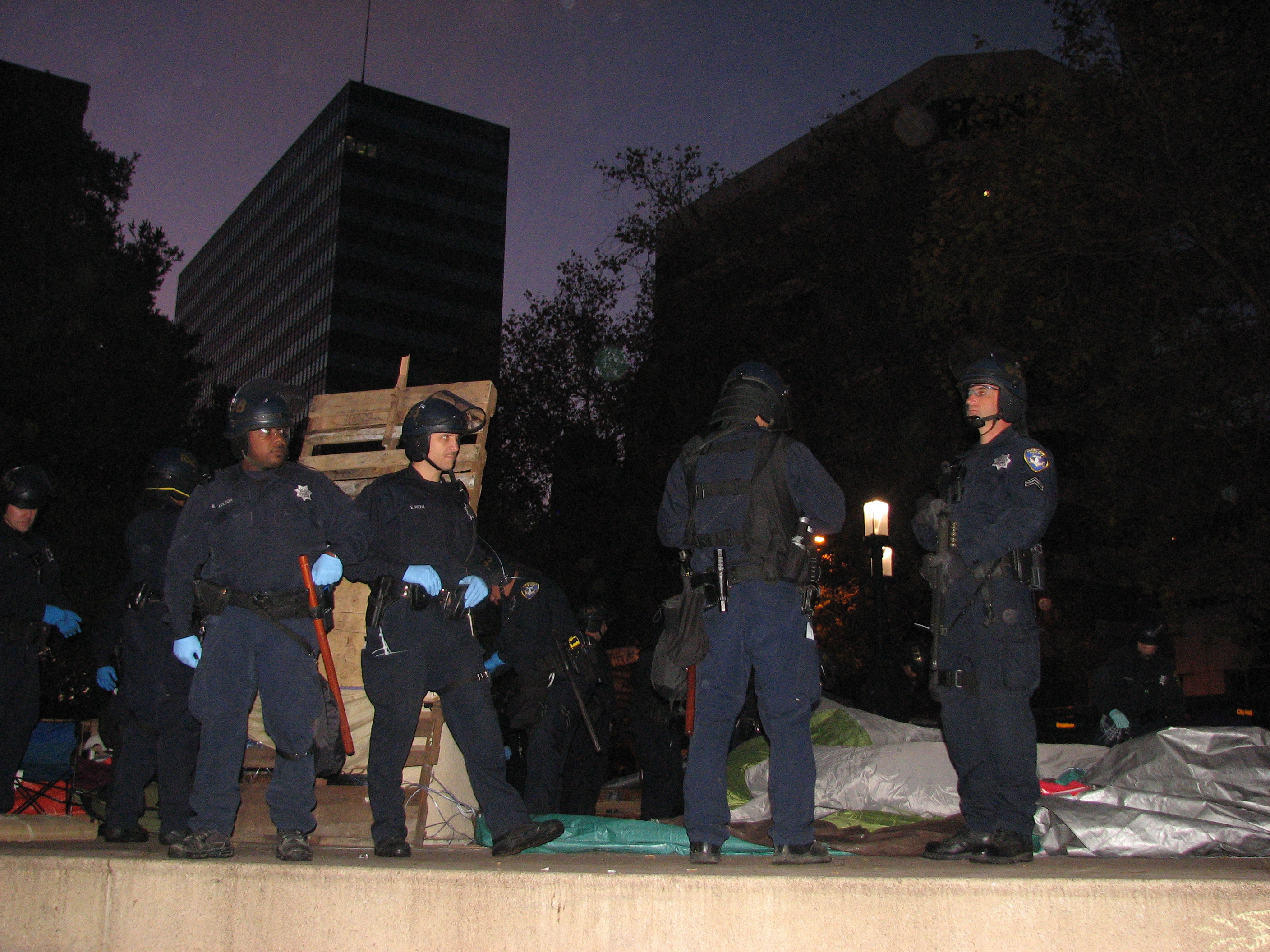
We all knew that Mayor Lee wouldn’t risk sending the cops in to evict OccupySF until after the election. But now the newspaper drumbeat has begun — the place is filthy, there’s shoplifting nearby and (gasp) the Ferry Building has to spend more money on toilet paper.

There’s an easy solution to the toilet paper problem: Install and maintain some more portable toilets near the camp. Not difficult, not expensive. And when you have that many people around (the camp keeps growing) and some of them have been living on the streets for a long time, having to hustle to stay alive, it’s not surprising that some cookies have been stolen. For the most part, the camp is pretty self-sufficient and there’s plenty of food, but if theft is a problem, a couple more beat cops at the Ferry Building would probably put a lid on it.

It’s too bad the Bay is so cold at this time of year; a quick dip with some Dr. Bronner’s would solve the need for the alleged sponge baths (and I just can’t imagine anything worse than the thought of a few people washing themselves off in a …. bathroom). It really wouldn’t be hard to install a solar shower on the scene, if the Department of Public works cooperated.

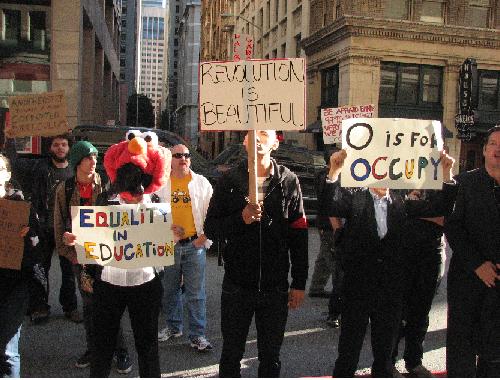
We all know there are going to be challenges dealing with a growing outdoor encampment in the middle of a big city. But this is something special, something important, a popular movement that’s responding to an emergency situation in the United States. This is a sophisticated city; we can deal.

But just as the merchants complaining in Oakland is putting pressure on Mayor Jean Quan, this sort of stuff will put pressure on Lee to send in the cops. Ugh.


Appetite: Insects and mezcal

2

A new twist on the tequila worm at Don Bugito dinner at Headlands Center for the Arts

Nestled near the ocean in the wilds of the Marin Headlands sits Headlands Center for the Arts, an artists’ haven in a reclaimed military barracks that is inspiring just to be in, as it must be for its artists in residence. Known for the culinary care and special event meals they host in their warm, open kitchen and dining room, I was intrigued to check it out. So what better excuse than for a five-course insect and mezcal dinner?

You heard right. Don Bugito, a new La Cocina business that premiered at SF Street Food Festival this August (which I wrote about here), hosted this unique meal.

Paired with Mexican juices, a take on the Michelada (a beer and spice-based imbibement), and the Mission’s De La Paz Coffee, the drink highlight was San Honesto Mezcal, a bright, grassy, gently smoky mezcal that is not yet available in the US but should be by early next year.

Having eaten mealworms and wax moth larvae with Don Bugito before, I was hoping for even further challenges at this meal. As an intro to bugs, the textures and tastes of the five insects served were inoffensive (yes, even to those who fear bugs), even tasty, proving the points made in a pre-dinner educational session: eating insects is nutritional, ecological and sustainable. One could see this becoming a micro movement in urban centers such as ours, just as beekeeping and urban farming have become.

Don Bugito owner, Monica Martinez, says, “Our goal is not to introduce insects as a novelty, but as something that will last.” I’d say with the palatable insect-tinged dinner we experienced, she is introducing an approachable, realistic way to eat insects.

The Headlands Center’s next dining event is December 7, a speakeasy-style, small plates dinner with cocktails from the incomparable Bon Vivants.

Subscribe to Virgina’s twice-monthly newsletter, The Perfect Spot at www.theperfectspotsf.com


AIDS vigil returns at Occupy SF

3

A coalition has come together to bring a striking new component to OccupySF: a rebirth of the ARC/AIDS Vigil. The vigil created an encampment similar to OccupySF’s at UN Plaza in the 1980s and remained there for ten years, protesting the federal government’s refusal to put resources into research and support for people with HIV/AIDS. Some who were involved in the vigil are currently part of the OccupySF encampment as individuals. Now, many hope to make that relationship more direct and active.


Brian Basinger, a longtime activist in several capacities including work with the AIDS Housing Alliance, is one of those involved in this effort. Says Basinger, “We are resurrecting the ARC/AIDS Vigil at 11/11/11 at 11:11 am. We are going to provide housing counseling, bring needle exchange, providing HIV testing, distributing organic vegetarian brown bag lunches, holding a speak-out, and presenting our demands to mayor Ed Lee to cure homelessness for people with HIV/AIDS, LGBT youth and transgender San Franciscans.”

All of this will take place tomorrow from 11am-2pm at Justin Herman Plaza, the site of Occupy SF’s encampment. Or, says Basinger, “Ethel Merman Plaza, as we like to call it.”

Those interested in the speak-out should be sure to get there by 11:11, as that will likely be first on the agenda. The food distribution is planned for the end of the kick-off event.

The group will provide services to the OccupySF encampment and anyone who comes through it. “We’re looking to create a safe space for homeless LGBT youth to gather…queer homelessness is invisible. We experience homelessness differently than the non-gay world.”

Like the ARC/AIDS Vigil of the 1980s and the Occupy Movement today, this event has the potential to be ongoing. Said Basinger plainly, “We won’t leave until we get our demands are met.”

Basinger warns: “It’s going to rain. But we want to highlight that people with fullblown AIDS and cancer are out in the goddamn rain everyday because the mayor has failed. ‘Ed Lee gets it done’- he’s not ‘getting it done’ for people with AIDS.” Basinger added that San Francisco “has the highest rate of homelessness for people with AIDS in the country.”

The group is putting out a call for “Rain gear to keep us warm- tarps and umbrellas.” Added Basinger, “Umbrella, ella, ella. Also, we put out a call for Rhianna. Rhianna, if you’re listening, come tomorrow.”

And with the impossible to predict explosion of the Occupy Movement- hey, anything could happen.


Mirkarimi victory seems assured

49

The San Francisco Elections Department counted more than 25,000 ballots today and just posted new ranked choice voting tallies that continue to indicate Ross Mirkarimi has been elected sheriff, widening his margin of victory from yesterday’s count. Mayor Ed Lee and District Attorney George Gascon saw their margins shrink slightly, but they are also the clear winners.

With only about 7,000 provisional ballots still be counted, it’s unlikely that these results will change. Lee’s share of first place votes dipped by about a half percentage point to 31 percent, while second place John Avalos, third Dennis Herrera, fourth David Chiu, and fifth place Leland Yee each gained a bit of ground.

It took 12 rounds of reallocating votes, one more than yesterday’s tally, but the latest count shows Lee winning with 60 percent of the vote to Avalos’s 40 percent.

In the sheriff’s race, the only variable after yesterday’s count was whether Paul Miyamota might be eliminated before Chris Cunnie – raising the question of whether Mirkarimi would get a big enough chunk of Miyamoto’s votes to put him over to top. But with Mirkarimi gaining ground in first place votes to 38 percent, and with 1,117 votes separating Cunnie and Miyamoto in the second round, it would be almost impossible for the winner to change.

In the DA’s race, Gascon dropped and David Onek rose by about a half percentage point, but with more of Sharmin Bock’s votes going to Gascon, he wins in the third round with 63 percent of the vote.

Live Shots: Shonen Knife at Bottom of the Hill

2

Japanese pop and the Ramones; it’s a combination you might not hear anywhere else besides a Shonen Knife show (or on the band’s tribute album Osaka Ramones). On Friday night at Bottom of the Hill, the Osaka-bred trio of pop punk rockers wound up an already-worked over crowd with a full encore set of Ramones songs.

But long before that rowdy ode,  they received cheers as they were collectively spotted through the window behind the stage, making their way down the stairs outside and into the venue. They stood with a pre-recorded theme song and held up banners with Japanese words (anyone know what they said?  which said “Shonen Knife”) then launched into endless stage theatrics that included Kiss-style twin head-banging by vocalist-guitarist Naoko Yamano (the only original member since 1981) and cheery bassist-guitarist Ritsuko Taneda. From start to finish, there was a lot of rock star posing: devil horns, guitar swinging, head-banging, arms thrown in the air.

The trio played high-energy tracks off a back catalogue that stretches 30 years; standouts included “Rock Society” off 2006’s Genki Shock and  “Perfect Freedom”  off 2010’s Free Time. They played “Redd Kross,” a tribute to the Red Kross, which is Yamano’s favorite band (not the Ramones?). They also highly recommended the burgers at Bottom of the Hill — Shannon Shaw, during the Shannon and the Clams set did mention that on their joint seven-day tour, they’d learned that Shonen Knife “really likes burgers, especially from Wendy’s.”

After the trio returned from a hyper-brief trip offstage, it was time for the all-Ramones encore. “Beat on the Brat,” “The KKK Took My Baby Away,” “Sheena is a Punk Rocker,” “Rock’n’Roll High School” — the works. It was then, and only then, that the crowd began crowd surfing. The first surfer failed to give enough warning of his intent, and was dropped unceremoniously. With the crowd worked up into a oafish frenzy, the momentum picked up and secondary jumpers were successfully surfed. Like a proper punk show.

The next D5 supervisor

21

Now that it appears Sup. Ross Mirkarimi will be the next sheriff — and Ed Lee will be mayor for the next four years — the speculation is starting over who Lee will name to replace Mirkarimi as District Five supervisor. There are an abundance of qualified candidates, but my sources tell me the Mayor’s Office is looking right now primarily at two people — London Breed, director of the African American Art and Culture Complex and a former redevelopment commissioner, and Malcolm Yeung, an attorney who is president of the Asian American Bar Association and longtime policy person at the Chinatown Comminity Development Center.

Both, of course, were Lee supporters.They have a history of working on progressive causes (Yeung, at CCDC) and strong ties to the community (Breed at AAACC). Breed has spent more time as an activist in D5 (and was appointed to her job by former mayor Willie Brown), but Yeung is reportedly popular with Rose Pak, who clearly has the mayor’s ear.

I don’t know who Lee will be taking to about the appointment, but you can be sure both Brown and Pak will be giving their advice. And so far — although it’s still early — nobody has been talking to the current supervisor.

I called Mirkarimi and asked him who he would suggest, and he told me there were plenty of people — although neither Breed nor Yeung would be on his short list. He didn’t want to name names, but I can: queer/labor activist Gabriel Halland and Community College Board Member John Rizzo are both eminently qualified for the job, and Julian Davis would also be on a lot of short lists. So would Christina Olague, a planning commissioner (and Lee supporter) — but one City Hall insider told me that “Willie would never let that happen.”

Mirkarimi did suggest that he ought to be consulted. “I would think after all the work I’ve done in the district over seven years and two administration that  Mayor Lee would at least want my input,” he said. We’ll see.

Weird Al Yankovic never misses a beat at the Fox

0

For someone who got his start in the music business by recording his first single in the men’s room, “Weird Al” Yankovic has certainly come a long way. Forging a wildly successful career that has lasted three decades and counting, the master of musical parodies hit the stage at the Fox Theater in Oakland on Sunday night, proving that while his act is hilarious, his talents for showmanship and performance are no joke.

Throughout the nearly two-hour show, Yankovic was a tornado of comic energy, leading his band through selections from his entire catalog, starting with “Polka Face,” a medley of contemporary pop parodies from his latest record, Alpocolypse, which includes spoofs of current radio stars such as Lady Gaga, Katy Perry and Justin Bieber, among others. Fan favorites like “Eat It,” “Amish Paradise,” “My Balogna,” and “White and Nerdy” drew wild applause from the audience, while lesser known, but equally gleeful tracks including “I Want A New Duck” and “Lasagna” were welcome additions to the set list.

When he first appeared on stage, Yankovic was dressed in his trademark Hawaiian shirt, but he and the band quickly began a series of fast-paced costume changes, running backstage between various songs while a series of videos were shown on giant screens above the stage. Entertaining clips of various pop culture references to Yankovic and from the likes of Johnny Carson and The Simpsons, mixed with segments cleverly edited to look like zany interviews between Yankovic and pop culture heads such as Eminem, Madonna, and Jessica Simpson.

Al and company wore a vast and dizzying array of costumes and grabbed props to match his iconic music videos, wardrobe included spot-on wigs and sweaters for “Smells Like Nirvana,” and headbands and a keytar for the Dire Straits take off “Beverly Hillbillies.” Yankovic even managed to pull off the look in the original clip of Michael Jackson spoof “Fat,” charging out in an over-the-top fat suit, and still somehow jumped around stage, singing and dancing without missing one uproarious beat.

While he is mainly known for direct parodies of specific songs, Yankovic has also comically mastered the art of synthesizing a band’s general sound and parlaying it into a
witty and humorous send up. Two of his best and more recent examples were “CNR,” his ode to actor Charles Nelson Reilly, done in the vein of the White Stripes, and “Craigslist,” a Doors-esque tune where he channeled his inner Jim Morrison, complete with leather pants and dark baritone intonations.

For the encore, Yankovic and band came back dressed as Jedi, and were flanked by a line of Stormtroopers and Darth Vader for a rendition of “The Saga Begins,” which tells a tongue in cheek tale of the life story of Anakin Skywalker set to the tune of Don McLean’s “American Pie.” When the song started, the Imperial troops and Sith lord stood at fast attention, but as the song picked up tempo, they broke character and started dancing about to hilarious effect.

Continuing with the Star Wars theme for his last song, Yankovic ended the entertaining show with “Yoda,” his tribute to everybody’s favorite Jedi master,
encouraging the crowd to chant along during the chorus.

The (theater)-sporting life: BATS Improv turns 25!

0

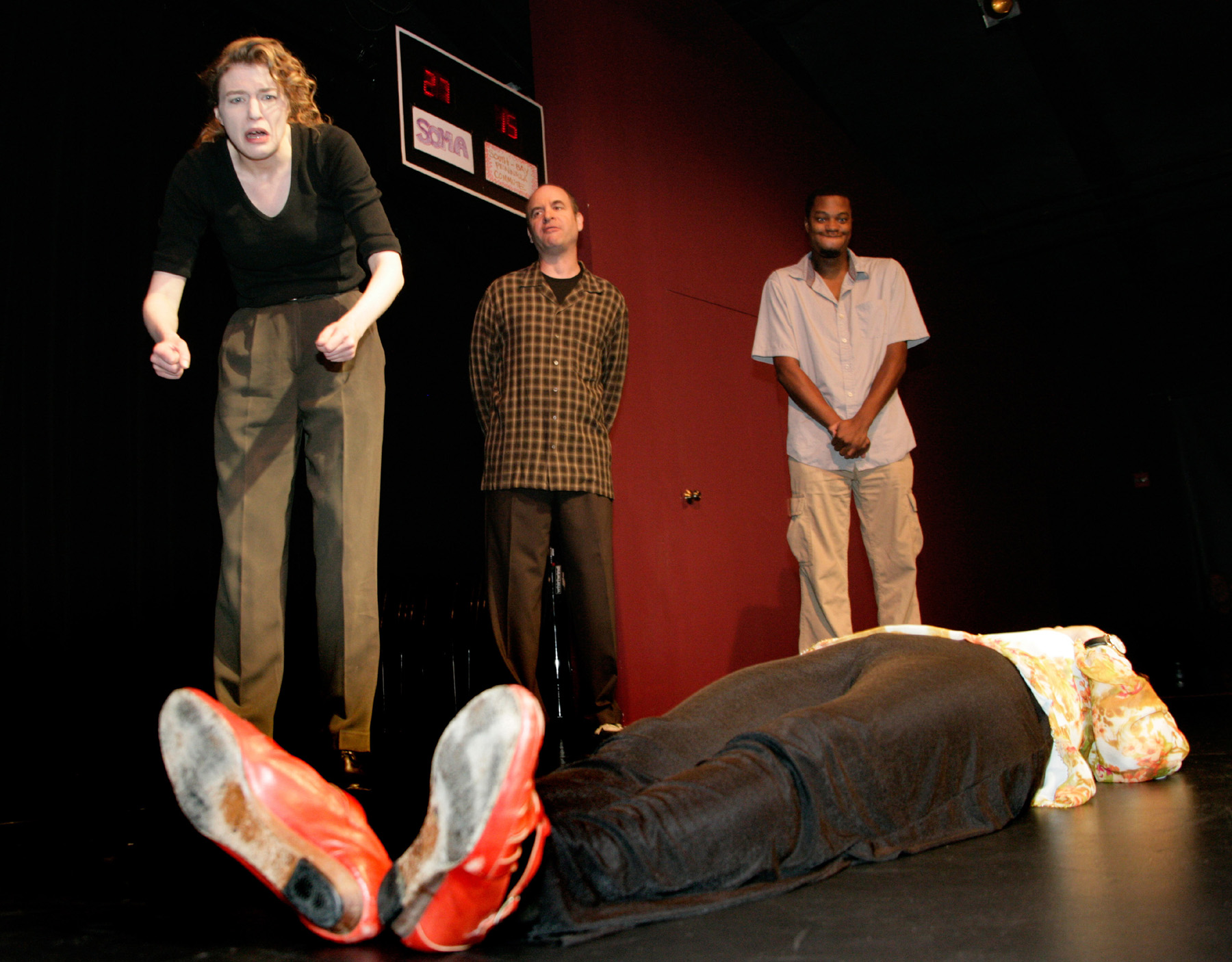
It was 1986, the year of Top Gun, Dallas, “Hands Across America,” and “Papa Don’t Preach.” In San Francisco, a comedy troupe called Fratelli Bologna joined forces with Seattle Theatresports’ Rebecca Stockley, and the rest was history. Bay Area Theatresports, now known as BATS Improv, marks its 25th anniversary this year with a special show Sat/12 — a one-off celebration smack-dab in the company’s already-packed calendar of weekly shows. How does an arts organization stay so energetic after 25 years? Could a certain flair for improv have something to do with it? I spoke with BATS artistic director Kasey Klemm to get the scoop.

San Francisco Bay Guardian: What’s your history with the company?

Kasey Klemm: I started taking classes at BATS when I was 17, back in 1997. I’ve been with the organization ever since. I just became artistic director in April of this year. I’m just at the beginning of my three-year term.

SFBG: Is that an elected position?

KK: It’s an open job position, so anyone in the main stage company is allowed to apply for it. People put together their artistic vision for where they want to develop and see the company grow, and move toward, as well as some organizational stuff. How they kind of functionally see the company working with each other, and developing as artists as well, so that we’re not just staying stagnant and doing the same stuff, and we keep challenging each other. And also, a proposed six-month calendar.

SFBG: How do you think BATS has managed to stick around for 25 years?

KK: This organization has got a tremendous amount of heart behind it, and it really is the people that make it [that way]. We were just looking at some old photos that we had blown up for our lobby for the 25th anniversary display, and we have this company photo from, I think it was 1989. And it was about nine people who were with us in ’89, still with us today. Phenomenal actors, and not people who are staying here because they have no other choice, but because the work that we do is so rewarding, both for the audience and personally as an artist. It’s really a thrill to literally go do something new every night. It’s exciting and the craft of it keeps you coming back for more.

I also think it’s because we’re an organization that really values stories, and stories that are driven by relationships and truth, versus trying to make something funny happen. That keeps people connected and interested much more than trying to be funny, or if this were a group where people were trying to outshine each other. But there’s a real passion for telling truthful, connected stories. And what happens is, because it’s being improvised, the result is often much more hilarious than anything that could have been written.

SFBG: So does BATS identify as a comedy group, or more just as a theater troupe?

KK: We self-identify more as a theater group. In some of our marketing, we started using the term “comedy theater,” but the word theater is really important and central to what we do, because it’s not about doing sketches or telling jokes. It’s about creating theater that an audience can connect with and can be moved by, whether it’s moved to uproarious laughter, or tears sometimes. We’re after that sincere stuff, the sincere human experiences that are traditionally at the roots of theater.

SFBG: Do you think having strong improv skills has helped the company beyond just performing onstage?

KK: Absolutely. There’s a culture of yes, and being inclusive, so it’s an organization where everybody’s voice gets to be heard. We’re really good at communicating with each other, because you need to be. And we honor that kind of direct and honest communication with each other. Everybody knows that everybody else is here for the same reason: because we love doing theater-based improvisation. We’re a group that all has the same goal: we’re all artistically in pursuit of a very special kind of theater that we think only gets created through making it up on the spot.

With that, you get to know each other very well. Our main stage company is 19 people right now, some of whom have been around for the whole 25, some who are as new as having joined us last year. But because of the way we work onstage, we’re very connected to each other.

SFBG: Why do you think Bay Area audiences love improv so much?

KK: Well, it’s not boring! There’s a lot of theater out there that for whatever reason, doesn’t connect with every audience. An experimental new play might not be any good. But if we’re in the middle of something, we’ve got the ability to go, “Hey, this is not very good. Let’s change it up, let’s start again.” And everybody can laugh with the release of that kind of tension or pressure, so you don’t have to sit through stuff that’s not working.

As an audience member, when you’re watching the improv happen onstage, you’re much more engaged than in a scripted play, because you know the actors are creating it on the spot, so there’s a part of you that’s always creating these shadow stories: “Oh, I bet those two characters are going to end up romantically linked together.” So they’re creating the story with us. And it’s a much more engaging type of theater than one that’s just being told to the audience.

I think that’s why you get those moments where 200 people laugh at the same time, because we’ve just put our finger on something that everybody was thinking, whether it was conscious or subconscious. We tap into this kind of group experience with it, and there’s this explosion of laughter that happens from just hitting some sort of primal truth that exists in that moment, in that theater, with these particular actors onstage, and these particular audience in the house.

SFBG: What’s the backstory on the 25th anniversary show this weekend?

KK: This weekend we’re celebrating the 25th anniversary of the first Theatresports show in San Francisco. So 25 years ago there was a group of local actors that was kind of housed by a group called Fratelli Bologna, who brought their friend down from Seattle, Rebecca Stockley, who’s now with us here at BATS. And she started teaching some workshops on the Theatresports format, which is creating theater with this kind of imaginary hook of it being a competition that draws people forward in their seats the same kind of way that a sporting event would, and gives the actors a lot of opportunities to create a lot of different types of theater in one night.

For a scene where there wasn’t much improvisation happening, there were mostly scripted actors, to be able to work in film noir, and Tennessee Williams, and play a silly game all on the same night created this kind of magic that everyone got really inspired by. So 25 years ago on November 10, 1986, they did the first public performance of Theatresports in San Francisco, and there was such a great response from the audience and from the players that those players went, “There’s something here. We want to keep doing this!” So that group went on and formed Bay Area Theatresports, which is now known as BATS Improv.

On Saturday night, we’re going to have a Theatresports match that’s going to be hosted by one of our founding members, and it’s going to feature two teams of improvisers that are a mix of some of our most veteran players, and some of our newest players, and they’re going to do about a 70-minute Theatresports match, and after that we’re going to hold a champagne and dessert reception with the cast and audience. We’re going to have people there from our history who’ve been important to us, longtime fans, etc. So it’s going to be a big community celebration.

SFBG: What else is coming up for BATS Improv?

KK: More great theater! We’re doing Theatresports on Friday nights through the end of the year. On Saturday nights in November we’re doing a format called “Family Drama,” which is an improvised three-act play, done very much in the classical stage play format. It’s a single set that the audience helps endow at the beginning of the show; each actor only plays one character, there are no cuts or time jumps. It’s a very straight-ahead, relationship-driven, three-act play.

In December, we’re bringing back a show called “Very Merry Murder Mystery!,” which is a British whodunnit with the hook being that not even the improvisers know who committed the murder. It’s a very strongly character-driven piece that feels very much like a big, silly Agatha Christie play. It’s a really fun show filled with a bunch of surprises.

“BATS Improv 25th Anniversary”
Sat/12, 8 p.m., $30
Bayfront Theater
Fort Mason Center, Marina at Laguna, SF
(415) 474-6776
www.improv.org


San Francisco’s political spectrum: a primer

120

During yesterday’s post-election wrap-up at the San Francisco Planning and Urban Research Association, political consultant and analyst David Latterman cited the ideological breakdown of San Francisco voters: 19 percent are progressive, 36 percent are liberal, 39 percent are “moderate,” and 6 percent are conservative. I cited those figures in a post I wrote yesterday on the latest election results, and some people responded by asking me to explain those terms, so let me take a crack at that because I think it’s important to understanding the city’s political dynamics.

I even discussed the matter with Latterman – who self-identifies as moderate, whereas I and the Guardian have a progressive worldview. “That’s a fantastic question and I don’t think any of us can give suitable answers,” Latterman said. “These aren’t hard lines. It’s like: I don’t know how to define pornography, but I know it when I see it.” Nonetheless, we agreed on the basic outlines and borders between the labels, even though we might frame them and value them a little differently.

In San Francisco, there is general agreement on most social issues among the moderates, liberals, and progressives, although we may disagree on political tactics. We all basically support gay rights, reproductive freedom, the value of diversity, environmentalism, and freedom of expression. That’s why most people consider San Francisco to be a famously liberal city, because of our tolerance on social issues, which only that 6 percent who are conservatives don’t share.

Yet San Francisco is still a deeply divided city on economic issues, including land use and the role of government. This is where most of the political conflicts and divisions occur, and it is here where our political spectrum is as wide as anywhere – perhaps even wider given the extreme wealth and poverty here, as well as the long history of political activism and the setting of national political trends. And it is in this realm that our labels come from.

A “moderate” in San Francisco – which is a real misnomer despite its widespread usage – is a fiscal conservative: anti-tax, anti-regulation, an almost religious faith in the free market, and a resentment of the poor (particularly the homeless and the jobless) and those who advocate for them. They want bare minimal government and see the role of government as primarily to facilitate economic activity in the private sector and to provide the basic infrastructure that the private sector needs to operate efficiently. They even believe social services should be provided by the private sector, such as nonprofits, rather than by government. On economic issues, they’re almost indistinguishable from conservatives, with whom they disagree on social issues.

On the other end of the spectrum are the progressives, who don’t trust capitalists and large corporations and believe they need to be heavily regulated and taxed to provide for the common good. We believe in progressive taxation and a redistribution of wealth, particularly from the richest 1 percent, and that government has an important role to play in leveling the economic playing field and playing referee. Progressives generally believe this country has been drifting to the right for at least the last 31 years and that this is a dangerous trend that needs to be addressed with fundamental, systemic reforms. And at this point, we’re willing to adopt radical strategies for triggering that change, such as Occupy Wall Street or other forms of civil disobedience.

The liberals of San Francisco are somewhere in the middle. They’re Democrats (or DTS) who don’t believe in radical change or anything that might disrupt the existing order, preferring incremental reforms over long period of time. They accept the legitimacy of the two-party political system and an economic system governed by Wall Street and powerful corporations, and they believe we need to do what we can within that framework. They use neoliberal economic policies like business tax cuts and incentives to encourage private sector job creation and housing development, and they accept a shrinking public sector, which they expect to operate more like the private sector, and a waning labor movement.

The reactions to the OccupySF movement is an interesting illustration of the dividing lines. Moderates have voiced tepid support for the movement’s critique of the growing gap between rich and poor, but they’re appalled at the tactic of occupation, believing curfew and anti-camping laws are more important. Progressives have been the most enthusiastic supporters of a movement that echoes their core values and physically challenges the status quo. Liberals basically support the movement, but they’ve been very uneasy with the tactic of occupation and have been vacillating on how to deal with it.

Latterman and the moderates – as well as many liberals – see ideology as a dirty word, and he was happy that in this election “it was the least ideological race we’ve seen in a long time.” Mayor Ed Lee and Board President David Chiu – both of whom hover in the liberal to moderate range, depending on the issue – also treat the notion of ideology with disdain, claiming to support practical, pragmatic, or common sense solutions to problems.

But progressives see ideology as the essence of politics. They understand the world in terms of class struggle, and believe that the very rich have been aggressively exploiting the people and the planet for too long, and that the only real way to make progress is to fight them and win. They believe in the Occupy paradigm that the 1 percent – the greedy rich who have corrupted our political and economic systems – are actively hostile to the interests of the 99 percent. We know that’s an unsustainable system and we’re hopeful that this is the moment when progress – the core of our belief system, that it’s possible to devise better economic and political systems than the ones we’ve inherited – could finally be attainable if we continue to organize and challenge the system.

That’s my general analysis of San Francisco’s political dynamics. What’s yours?

The low-turnout election

25

A factor that hasn’t been discussed much in the analysis of the election results is the very low turnout for a contested mayor’s race. The turnout without the provisionals and final absentees was about 30 percent; by my figures, when the 35,000 remaining ballots are counted, it will total about 37 percent.

That’s about the same level as the 2007 race, when Gavin Newsom had no serious opposition and the races for sheriff and district attorney were essentially uncontested.

The past two contested mayoral races had much higher turnout. In 1999, when Tom Ammiano ran against Willie Brown, 45 percent of the voters turned out; same for the 2003 race pitting Matt Gonzalez against Gavin Newsom.

It’s odd — the weather was good, there were three contested races, all of the candidates had and spent money … and even in traditionally high-turnout areas, not that many voters went to the polls.

In the Mission, where John Avalos won overwhelmingly, turnout was only 30 percent.

Clearly, one of the reasons that Ed Lee won is that he got his voters to the polls. Would higher turnout on election day have made a difference? Maybe. Lee had support all over the city, and he was going to be tough to beat. He also got most of the second-place votes from candidates like David Chiu and even Leland Yee, who had spent much of the fall attacking him. And although Avalos won on election day, Lee was so far ahead from the absentees that catching him would have been difficult.

Still: The race certainly would have been closer. And the low turnout is curious. Did people just assume Lee was going to win? It’s hard to imagine that voters had no appealing candidates — there were so many choices. And there was so much election hype — I got about 30 mail pieces in the last week.

By the way: Randy Shaw did his list of winner and losers, and he left out Avalos entirely. Avalos didn’t win the election, but his suprisingly strong finish established him as a progressive leader for the future and helped keep the left organized and in the game. He also left out Ross Mirkarimi, who is the first solid progressive to win a citywide office in quite a while — and he did it running for sheriff against two law-enforcement types. Mirkarimi has now established himself as someone who can win in all parts of town and has made crime and law-enforcement a progressive issue.

Then there’s OccupySF — and while a lot of the people there probably didn’t vote, the fact that that Avalos stood with the occupiers and contrasted himself to Ed Lee (who came very close to using the cops to evict the protesters) helped his campaign immensely.

Our Brother the Native documents love on ‘Vows’

0

When I call Josh Bertram of Our Brother The Native at his home in Pontiac, Mich., he’s unwinding with hot tea and whiskey after “one of those days” at the office. The 22-year-old art director harbors an insuppressible passion for music, which is tough to convey to his older coworkers. “I feel like they progressively get more and more weirded out by me,” he admits. Bertram graciously welcomes my questions, speaking openly and eloquently about his new album, Vows.

At age 16, Bertram began recording with high school friend John-Michael Foss. They soon linked up with California resident Chaz Knapp and started collaborating via the Internet. “There wasn’t a lot of that kind of thing going on,” says Bertram. “Now, that’s really common.”

Bertram, Foss, and Knapp only met face to face after Our Brother The Native recorded its first full length album. Following its debut, Tooth And Claw, the band put out a host of material ranging from “pretty folk” to “post rock” on FatCat Records. Through all the style shifts, an avid fascination with circuit-bent instruments and layered sounds remained a consistent focus. After 2009’s Sacred Psalms, however, the steady outflow of releases came to a halt.

“Chaz and I were never really satisfied with the records we put out,” says Bertram. “I’ve been documenting my artistic growth over the years. It’s kind of like looking at embarrassing photos from high school. Finally, I was like alright, I need to slow it down.”

Production slowed, but Bertram’s been busier than ever. “It’s such an ambitious project to get all these players and instruments recorded,” he says. “It just took a lot longer.” The self-described sound geek did all the tracking for Vows himself. Guitar, banjo, ukulele, piano, synthesizer, and alto saxophone were among the instruments he played on the album. Knapp wrote the orchestral arrangements, and Nick Cowman of Oakland’s Religious Girls laid down the drums. “A lot of these songs had almost 120 tracks of instruments and sounds,” Bertram tells me. The final mixing of the album became an eight month endeavor.

Vows (released late October) is a dynamic flurry of sounds. Dense arrangements of strings, wind instruments, and clattering percussion accompany harrowing vocals from Bertram and an ethereal chorus of friends. “There’s so much to take in on this record,” Bertram affirms. “It’s kind of exhausting.”

In the course of recording the album, Bertram fell in love for the first time. “I wanted to make it sort of like marriage vows documenting various stages of love,” he says. “This is the first [album] I feel has actual human depth.” Ironically, it’s also the first time Bertram’s had difficulty finding a label. He’s digitally self-releasing Vows in the hopes that someone takes interest in putting out a physical version. “I don’t want fame or fortune or anything,” Bertram tells me. “I just want people to hear it. If I could have a conversation with you about your art, my art… I just want music to instigate these sort of things.”

Our Brother the Native
With Future Twin, Dead Eyes, and the Mallard
Sat/12, 9 p.m., $5
Engine Works
190 Capp, SF
(415) 563-8941

Party Radar: Rarebits gets eclectic at Truck

0

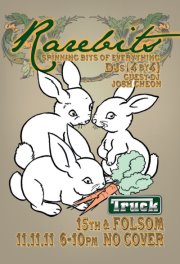
Well. I was so excited about the return of beloved DJ Chicken to the party-throwing arena that I listed the launch date of his new free monthly shindig, Rarebits at Truck, incorrectly in my latest Super Ego clubs column. It’s actually tomorrow night ( Friday 11/11/11 — the neat date should have been a mnemonic no-brainer, but hey, as I said, I’m still drunk).

So, let’s turn lemonade into vodka lemonade, shall we? I described the night, also featuring fab guest DJ Josh Cheon, of Dark Entries and Honey Soundsystem, as being “eclectic.” What the heck does “eclectic” even really mean? DJ Chicken has curated a collection of neato tracks — from tUnE-yArDs to Captain Beefheart — you may or may not hear tomorrow night at Truck after the jump. I’ll drink to that!     

The Like
http://www.youtube.com/watch?v=42p2nERiNFk

tUnE-yArDs
http://www.youtube.com/watch?v=YQ1LI-NTa2s

Sparks
http://www.youtube.com/watch?v=1JjbFWU6TqI

Captain Beefheart
http://www.youtube.com/watch?v=hCSPf5Viwd0

oOoOO
http://www.youtube.com/watch?v=4TJPbVd0oAM

Anita O’Day
http://www.youtube.com/watch?v=4XH4Uzusrc0

The Family
http://www.youtube.com/watch?v=joI86Fk6lNw


RAREBITS

Fri/11, 6 p.m.-10 p.m., free

Truck,

1900 Folsom, SF.

www.trucksf.com

Wag the dog: The SF kennel that makes your apartment look like kibble

2

Wiggle that paw into your trusty Birkin for a spare $150 this holiday season — you’re staying in the best room in town. Of course, the hospitality staff there is going to be a little hands-on. They’ll wake you at 6 a.m., feed you breakfast, put you in a play group with future-friends that share your weight, age, and temperment. They’ll read you a short story during nightly “cuddletimes” and make sure your owners can see you on the livefeed at all times. Also, in this scenario you are a dog.

“People don’t want a kennel these days,” Jose Gonzales, director of guest services at the Mission’s Wag Hotel, is showing me through his kennel’s state-of-the-art facilities. “They want a safe, clean, convenient place to leave their pet.”

Wag’s first branch opened in Sacramento in 2005, at which time Gonzales tells me “we really, literally redefined pet care.” Redefined it to mean luxury summer camp for the dander set, that is.

Where’s my mint. Guardian photo by Caitlin Donohue

The center is open 24 hours a day. In Wag’s parlance, its human customers are “parents,” individuals who need only peek at their iPhones and the hotel’s playroom livestreams shown thereon to determine whether Pawla Abdul needs another dog biscuit (Gonzales says he is wont to call in requests that employees give snacks to his own pooch when he leaves his furry friend to Wag). 

Wag smells more like air freshener than canine as the two of us explore its bowels, Gonzales imparting a stream of information and myself dutifully following after. Here are the glistening, occasionally flatscreen-bedecked two-room enclosures that house steerage boarders (the dog bowl in the door means the “room” has been serviced), the vast playrooms looked down upon by even more vast skylights. 

There are 239 of these quarters at Wag. Usually there are less than 100 dogs staying in them, although at peak times over holidays, there can be enough to necessitate 50 to 60 employees, when it’s “all paws on deck,” as Gonzales puns. There is a rooftop garden for dogs that love to feel the sun on their furry faces, even report cards given to each parent at their offspring-from-another-bitch’s terminus at Wag. These rate Puppy’s bowel movements, and cite the friends they’ve made at Wag by breed and name. There are special activities planned intermittently, like the 12 Days of Winter event from Dec. 1-16 that will afford the dogs opportunities to take photos on Santa’s lap and have staff members design stockings for them that suit their personalities. 

Reading selections in the Wag Suite. Guardian photo by Caitlin Donohue

But for some, this comfort is not enough. And there is still a chance for your young pup to be the first guest at the $150 a night Golden Gate Suite.

This is the grand finale of Gonzales’ tour. Here, in a secluded hallway far from the whines and yelps of steerage, a genteel canine can while away the three to four days that constitute the average stay at the hotel, in jet-setting style. 

A double bed (slung low to the floor, no jumping for the dogs of the one percent) with organic sheets, layers of pillows, and a faux fur throw is the centerpiece of the room, which rather resembles a slick private double in a high-end hostel. Upon the pillows rest a box of doggy “chocolates” made by a local artisan and a plush remote control, which does not operate the large flatscreen on one side of the room where room occupants will view their owners each night for a heart-warming Skype chat. 

There is also a stack of books for storytime on a coffee table. “I personally like The Giving Tree,” Gonzales tells me. “But that’s a personal favorite.”

“A lot of people thought that the room was built to be over the top,” he reflects, shortly before we call in a golden labrador named Montana to lounge for my camera on the bed and whine impatiently for the box of artisan treats Gonzales has safely hid behind his back. “But we built it to be practical. We looked at what a dog needs and what will make the client and dog super-happy.”

This super-happiness, Wag has decided, lies in bridging the gap between pet and human when the two must be geographically separated. To mimic the home environment, Golden Gate Suite patrons can even sit down with hotel employees to determine which Pandora channel their beloved four-legger will listen to. 

On the occasion of my visit, classical is playing throughout the hotel. “We’ve had different feedback from clients that they don’t want their dog listening to classical,” says the director of guest services. “Maybe they want movie noise. Yeah, dogs don’t watch movies. But we want them to feel at home.”


Wag Hotel

25 14th St., SF

(415) 876-0700

www.waghotels.com

Lee, Mirkarimi, and Gascon win first ranked choice tally

67

San Francisco’s first run of ranked choice voting tallies for yesterday’s election shows Ed Lee winning the mayor’s race (with progressive favorite John Avalos in second), George Gascon remaining district attorney, and Ross Mirkarimi becoming the new sheriff in town.
“Progressive victory, citywide, that’s huge,” Sup. David Campos told Mirkarimi this afternoon outside the Elections Department, where a scrum of journalists and politicos gathered to get the results. It would indeed be a rare citywide victory for progressives, which analyst David Latterman says constitute about 19 percent of the electorate, compared to 39 percent who identify as moderate and 36 percent who call themselves liberals.   
About 7,500 provisional and 24,000-25,000 absentee ballots remain to be counted over the next few days, said Elections Chief John Arntz, telling reporters, “I’m not saying these are the final results by any stretch.” But there is good reason to believe these winners will stick.
In the sheriff’s race, where Mirkarimi faced off against three candidates with long law enforcement backgrounds, David Wong was the first to be eliminated, and the lion’s share of his 9,487 votes went to fellow Sheriff’s Deputy Paul Miyamoto rather than Chris Cunnie, the former head of the San Francisco Police Officers Association, knocking Cunnie out of the race.
Of Wong’ votes, 3,828 went to Miyamoto, 2,637 were exhausted (meaning Wong voters had no second choice), 1,682 went to Mirkarimi, and just 1,325 went to Cunnie, who had been in second place. That gave Mirkarimi almost 40 percent of the vote, compared with 30.7 percent for Miyamoto and 29.8 percent for Cunnie.
On the next round, Cunnie’s 42,877 votes were redistributed as follows: 16,820 to Miyamoto, 14,675 exhausted, and 11,322 to Mirkarimi, giving him 53 percent of the vote. “I’m optimistic, but I’m not declaring victory,” Mirkarimi told reporters. He said that he hopeful that he’ll get the chance to continue the 30-year progressive legacy of retiring Sheriff Michael Hennessey, who endorsed Mirkarimi.
The only real variable in the sheriff’s race is how Cunnie’s second place votes break in the event that incoming ballots change who gets eliminated after Wong, but Mirkarimi said he was happy with how well progressive campaigns did in this election.  
“I want to say how proud I am of the Avalos campaign. It did a good job at getting people out who have felt disenfranchised,” Mirkarimi added.
Indeed, Avalos surprised much of the political establishment by finishing strongly in second place with 18.3 percent of the vote compared to Lee’s 31.5 percent and Dennis Herrera’s 11.3 percent. In the first ranked choice run, it took 11 rounds of eliminations for Lee to break the 50 percent threshold of victory. And when he did, he jumped all the way to 61 percent, mostly because voters who chose Herrera as their third choice exhausted their ballots.
When Herrera was eliminated in Round 10, 18,276 of his 29,717 votes were exhausted, and of the balance, 6,683 went to Avalos and 4,705 went to Lee, where they had been at 28 percent and 49 percent respectively. Avalos then finished second with 39 percent of the vote.
Other notable rounds in the mayoral runoff were when fourth place finisher David Chiu was eliminated and his nearly 20,000 votes broke most heavily in favor of Ed Lee and being exhausted, reinforcing the idea that he draws his support mostly from moderates and is no longer part of the progressive movement that helped elect him to the Board of Supervisors.
Avalos got just 2,376 of Chiu’s second place votes, compared to 5,894 for Lee and 3,832 for Herrera. By contrast, when Leland Yee was eliminated a round earlier, his votes were redistributed fairly evenly among Lee, Chiu, Herrera, and Avalos. Part of the reason that Avalos never gained ground on Lee was that the mayor got more second place votes than his progressive challenger on every elimination between Round 3 and the final round.
In the DA’s race, Gascon’s 42 percent total of first place votes is an insurmountable lead, particularly given that he also did well on the second place votes, showing that attacks on his secrecy and police connections didn’t do much to hurt him. When third place finisher Sharmin Bock was eliminated in the third round, Gascon got 13,301 of her votes, compared with 10,430 for David Onek, and 11,840 exhausted.
The Elections Department will run new totals every day at 4 pm

Dick Meister: Labor and the occupiers: a natural fit

0

LABOR & THE OCCUPIERS: A NATURAL FIT

By Dick Meister

Dick Meister, former labor editor of the SF Chronicle and KQED-TV Newsroom and a former city editor of the Oakland Tribune, has covered labor and politics for a half-century as a reporter, editor, author and commentator. Contact him through his website, dickmeister.com, which includes more than 300 of his columns.

Think of what a combined effort by unions and the Occupy Wall Street movement could do to weaken the tight grip of corporate greed on the economy. Think of how it could greatly strengthen both the labor movement and the occupiers.

OWS and labor have worked together in some locations. But many occupiers consider labor a part of the economic and political establishment that they’re protesting, and fear that union leaders might try to take control of their movement, which, unlike unions, is based on direct rather than representative democracy.

And labor is not happy that OWS has no clearly identified leaders or formal demands, which of course is how unions operate.

Unions and the occupiers, however, have the same powerful enemies. They need each other if they are to overcome them. It seems to me that unions are in the best position to bring the two much closer together.

So, how to go about it? Unions need to make clear, in words and deeds, that they are indeed facing the same problems and opponents as the occupiers and that they need to join together so as to act as forcefully as possible to overcome their mutual enemies. They must make clear as well that union leaders do not want to take over their movement, but seek to strengthen it.

There’s an old, but still highly effective tactic that labor must stress to its potential OWS friends. It’s called solidarity.

Clearly identified unionists must march and otherwise demonstrate with occupiers, join them in their rallies and in their tent cities and elsewhere. They should provide them with food, blankets, medical care and other necessities. They should organize joint actions and show that labor leaders are doing important work in the occupiers’ behalf.

At the same time, unions should make clear that they do not support the destructive vandals who’ve tried to attach themselves to the OWS movement.

If necessary, labor should also take dramatic actions such as were taken November 2nd by Occupy Oakland protestors who had been camped in front of Oakland’s City Hall for close to a month. They led a rally and then a march of some 7,000 people through downtown Oakland to the city’s port, one of the most important on the West Coast.

Occupiers and their supporters forced the port to close by blocking delivery trucks from loading or unloading cargo on the docks. At any rate, many dock workers, union members all, didn’t show up for work.

The march and port closure were planned as part of a citywide general strike that, while drawing many words of support from Oaklanders and others, was not widely supported otherwise.

Most notable among those who showed their support physically as well as verbally were more than 300 teachers who did not report to school. Some other teachers used the day to explain the nature of such protests to their students.

Unions certainly have had a long experience in doing what needs to be done to build the strength for battling powerful economic and political enemies. During the Great Depression, for instance, unions waged massive organizing drives to recruit workers and give them the strength they needed to overcome the greedy oppressors of the 1930s. That led to the laws that guarantee workers the right to unionization and regulate their hours and other working conditions.

Like the union activists of the thirties, occupiers have helped focus widespread attention on the financial interests which are responsible for battering the economy and on what the financial interests must do to make it right.

That has helped OWS gain support from the AFL-CIO, and from more than two dozen national unions and many of their local affiliates. Some of the unions have made participation in the occupy movement a major activity.

Unions already have spent lots of money and put lots of members into the occupiers battles to win much better treatment for workers from the same forces that are denying decent treatment to unionists.

A partnership of labor and the Occupy Wall Street movement could very well lead to reforms as far-reaching and vital as those won by activists eight decades ago.

Dick Meister, former labor editor of the SF Chronicle and KQED-TV Newsroom and a former city editor of the Oakland Tribune, has covered labor and politics for a half-century as a reporter, editor, author and commentator. Contact him through his website, dickmeister.com, which includes more than 300 of his columns.

The Performant: Revenge of the nerds

0

Gaiman and Palmer, the Bay Area Science Festival, and a live game of Frogger

Nerd might still be a four-letter word in high school locker rooms (assuming these are still high school locker rooms to be found), but there’s really never been a better time in history to be an adult nerd. No matter if your inclinations lie in language, linux, or the laws of thermodynamics, a nerdish life lived well is truly the best revenge for all those real or imagined slings and arrows of awkward youth.

Epitomizing this truism, geek-elite power couple Neil Gaiman and Amanda Palmer launched a joint mini-tour across the West Coast entitled simply “An Evening with Neil Gaimna and Amanda Palmer,” which turned out to be exactly that, no more and no less.


Though shades of goth tinge both artists’ output, their overall aesthetic is more playful than grim. Neil Gaiman, a prolific writer in many mediums, will perhaps always be best known for his long-running graphic novel series The Sandman, while Amanda Palmer, first hit international acclaim as co-founder of the antique punk/Weimer cabaret act The Dresden Dolls. During a pleasurably meandering three-hour evening at the Brava Theatre (two days before their appearance at The Palace of Fine Arts), the two performed bits of their own work—Neil reading from his 2006 collection of short stories Fragile Things, she playing the ukulele and piano with her singular panache. The songs that they performed together were naturally the highlights. Who knew that Neil Gaiman had a torch singer tucked within his black garb and quiet English reserve? He also penned the lyrics for some of the more notable tunes, including a lovelorn lament “I Google You,” plus one of opening act The Jane Austen Argument’s tunes: “Holes.”

It was a brainiac weekend all around, thanks to the Bay Area Science Festival, which hosted a plethora of walking tours, lectures, exhibitions, and hands-on activities for all. Ducking into my friendly neighborhood Sci-Fi/Fantasy/Horror fiction bookshop, Borderlands, I got an earful from science fiction authors Scott Sigler, Mira Grant, and Jeff Carlson about the “Science of Science Fiction,” primarily about how much research goes into being able to create with a mostly scientific justification for “melting faces” and “zombification”.

Last but not least, the Come Out and Play Festival, wrapped up a week’s worth of street games with an intensely-packed weekend of battle-scaled dodgeball, cardboard tube fighting, city-wide scavenger hunts, and labyrinths. In Everett Middle School’s vast playground, about forty adults plus a handful of kids, showed up to play a few rousing rounds of Field Frogger, a completely analog twist on the classic arcade game of yore. Participants playing “froggers” sat on giant yoga balls and bounced through an obstacle course of banner-carrying “cars,” “turtles,” and ”logs.” By the end of the morning, there were six froggers hopping through the roads and rivers at the same time, which gave the playing field more of an appearance of a collision course than in the original Konami version, combining innovation with chaos and homage with humor.

http://www.youtube.com/watch?v=zDgqJjht2vQ