Destiny introduced herself to the audience as “your friendly harp player from the ‘hood.” Word. This ain’t your grandmama’s tea parlor harp music. This is jazz harp – maybe the only jazz harp in the world – with all the syncopation and improvising you would expect to hear at any classic jazz joint.
Destiny and her trio worked together to create familiar rhythmic curiosities like “Bye Bye Blackbird,” but then also went above and beyond by taking a classic nineteenth-century Celtic jig and making it jazz-tastic. Super inventive. It’s fun to see people do what they truly love, and as a musician, Destiny has definitely found her path in life.
Fun Jazz Harp Video: http://www.youtube.com/watch?v=N_sFSlukHp0
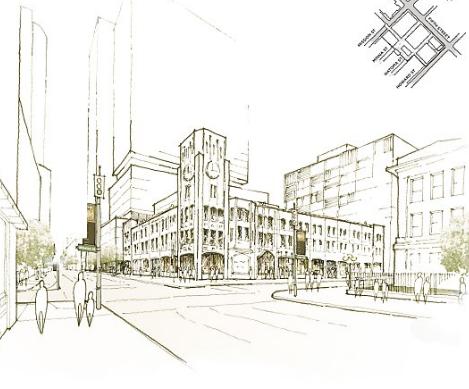
The project’s allure is what happens on the ground. Jackson Street would extend east as a 47-foot-wide pedestrian path; Pacific would conclude at the new triangular park. A narrow greenway north from Drumm would be widened to 37 feet.
The open spaces are the work of Peter Walker, who also designed nearby Sidney Walton Park, the green heart of otherwise drab Golden Gateway. What’s envisioned at 8 Washington extends the artful simplicity of that popular space. But it takes cues from the transitional location, offering pathways and nooks rather than trying to upstage the waterside drama.
So the landscape is going to look nice.
But there’s a lot more to a project than the way it looks. I’m not going to go all Form Follows Function here, but before you evaluate how much green space the development will have and what pedestrians will encounter, you have to ask another question: Why are we building this thing in the first place?
The recurring theme of Sunday night’s Kimya Dawson show at the Rickshaw Stop was: be who you are and plainly say whatever you have to say. It began with Dave End— whose eccentric set included a cover of Seal’s “Kiss From A Rose” in a dress made of flowers — followed by Clyde Pattersen, from Your Heart Breaks, who flat out told the audience that one song was about his schizophrenic mother. It all culminated with Kimya Dawson. Some would have disparaged the night’s roster of confessional, fun-loving songwriters — it’s the prey of critics. But the night was about relating to people and — dare I say it? — Having fun.
In the case of the ex-Moldy Peach (Dawson), she’s where she is now not because of the critics, but because young people have long been able to relate to her honest songwriting. More than perhaps most other songwriters playing today, Dawson seems to write with her audience in mind. She wants to improve fans’ self-esteem and make them feel better about themselves: a fact that makes the skeptics wince.
However, watching Dawson summon what must be pages and pages worth of risible lyrics on stage from memory could easily turn the heads of any one of those skeptics. With an acoustic guitar scrawled with doodles and an octopus necklace around her neck, Dawson faithfully performed songs that spanned her solo career with an emphasis on her new album, Thunder Thighs, and the one prior, Remember That I Love You. She also played a few songs off her children’s album, Alphabutt. Not many stood out in the set besides those where the audience, seated on the hard cement floors, joined in. On “Loose Lips,” for instance, everyone chanted, “remember that I love you.” It was in those moments, however brief, that what Dawson does became clear and even profound.
She wasn’t up there by herself all the time. A highlight of the night happened when someone from the audience shouted out a request for “It’s A Hard Knock Life,” and Dawson and Dave End decided to do an animated, wickedly funny duet of “Tomorrow”— a spontaneous and comical moment that you couldn’t have seen anywhere else. Rapper Aesop Rock, who makes many appearances on Thunder Thighs, performed a few songs with Dawson as well. But these felt unfamiliar to the audience, perhaps even awkward, and obviously a disappointment for anyone who came to hear, say, the popular Juno soundtrack material.
Dawson’s performance was hardly perfect: she made some slips. By the time she was finishing her set, at least a third of the already modest audience had vanished. Does anyone go to a Kimya Dawson show to see a flawless performance? You would think not. But perhaps honesty alone is only charming for so long.
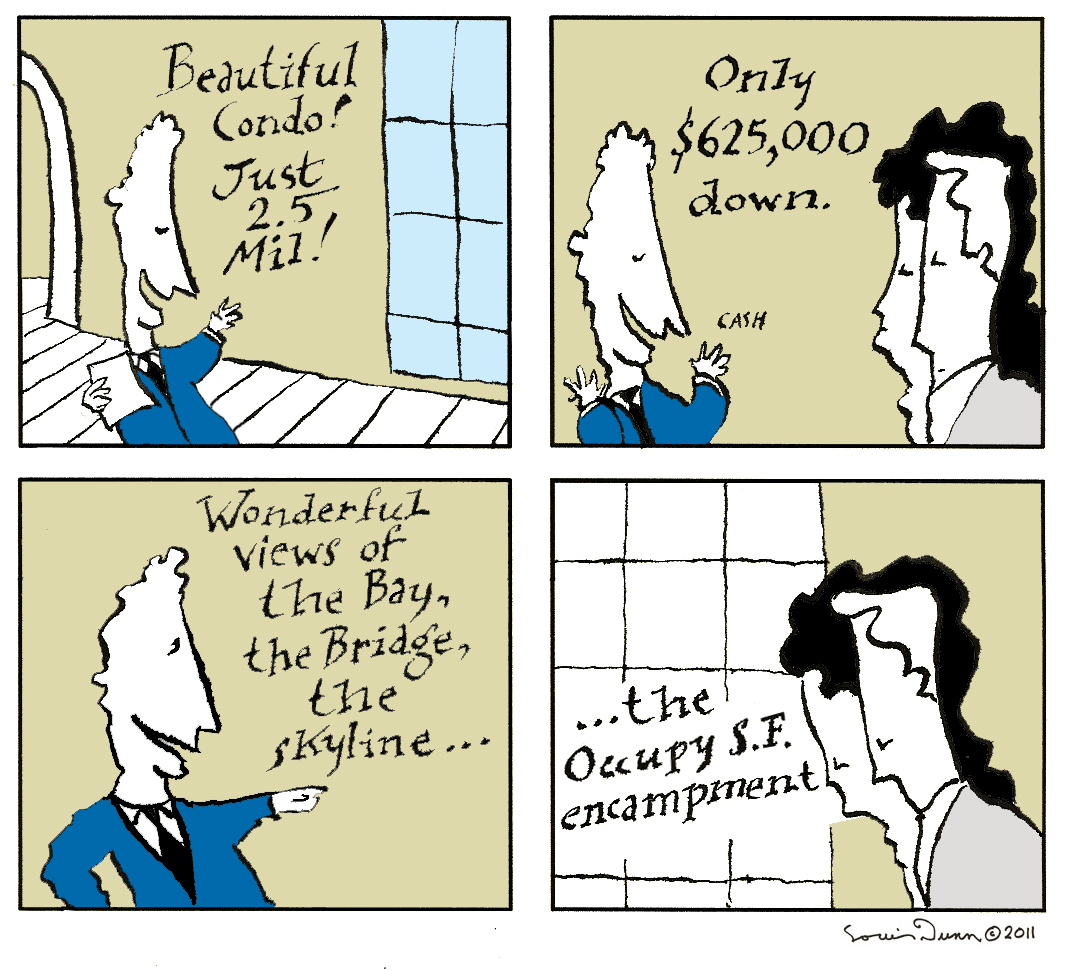
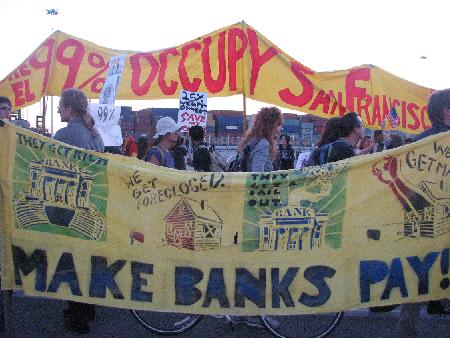
EDITORIAL While Mayor Ed Lee struggles with the OccupySF encampment, another, very different group has its eyes on the city’s waterfront. On the edges of the ground where protesters are talking about the one percent of Americans that control the vast majority of the nation’s wealth, two major development projects aimed entirely at that very wealthy sliver are starting to move forward.
At 8 Washington and 75 Howard, developers want to build a total of 365 condominiums aimed at people with incomes that place them in the top sliver of the richest Americans. It will be a key test for the Ed Lee administration: Will he evict the Occupy protesters and allow the One Percent to claim choice property on the waterfront?
The 8 Washington project calls for 165 of what developer Simon Snellgrove says will be the most expensive condos ever built in San Francisco. The 12-story building, sitting on the edge of the Embarcadero, would include units selling for as much as $10 million, and even the low-end places would go for $2.5 million or more.
At 75 Howard, the Paramount Group and Morgan Stanley want to demolish a parking garage and erect a 284-foot tower with units that the San Francisco Business Times predicts would sell for at least $1,000 a square foot.
Just to be clear what we’re talking about here, a $2.5 million condo, according to real estate experts, would require that a buyer have $625,000 cash to put down and an income of more than $450,000 a year. Either that or millions in spare cash to plunk down.
That, needless to say, is not the majority of the working people in San Francisco.
There’s no conceivable planning or housing-policy rationale for either of these projects. They offer nothing that the city needs; there is absolutely no shortage of housing for people with that kind of income. In fact, allowing these two projects to proceed would directly violate the city’s own General Plan and every regional planning proposal for San Francisco’s housing mix. The General Plan states that some 60 percent of all the new housing built in San Francisco should be below market rate. Environmental sanity suggests that the city ought to be building housing for people who work here — high housing costs have driven thousands of local workers to live in the East Bay or further out, leading to long, energy-intensive commutes. And the more of this ultra-luxury housing the city builds, the more the housing balance gets disrupted — and the more rapidly San Francisco becomes a city of, by and for the One Percent.
The two projects have powerful support — among other things, Lee’s friend and ally Rose Pak is promoting 8 Washington, as is lobbyist Marcia Smolens. If Lee has any scrap of independence, he’ll make it clear that both of these projects are dead on arrival.
After eleven weeks of creating, fine-tuning, and probably lots of serious sweating, six emerging choreographers presented their work this weekend at ODC for Pilot 59 that showed an eager, sold-out audience what they’ve got. It turns out, that entails quite a bit — the diversity in dancers and themes was striking. Two pieces especially caught my eye.
I loved the sex-bot, robo-girl piece choreographed by Bianca Cabrera, titled “Feral.” It gave a peculiar vision of the future, with a hint of zombie take-over and a pinch of nasty. The glittery costumes were fantastic. Major props to her dancers on capturing pixilated pulsations perfectly. Very impressive.
I also enjoyed “Allegretto,” choreographed by Charles Slender. I’m a bit of a FACT/SF groupie and find their work incredibly innovative and perfectly quirky. Set to Beethoven’s familiar Symphony No. 7 in A Major (if you heard it, you’d recognize it), the dancer’s movements struck me as innovative and beautifully strange. The beginning of the piece made me think a bit of traffic guards, while my husband said that it reminded him of Russian kittens (the fuzzy hats probably had something to do with that). Slender’s ability to make people dream of the bizarre (i.e. flag signals and cute pets, all in the same dance) for me, is the genius of his choreography.
Police dismantled the OccupySF protest and campsite in front of the Federal Reserve building early Sunday morning.
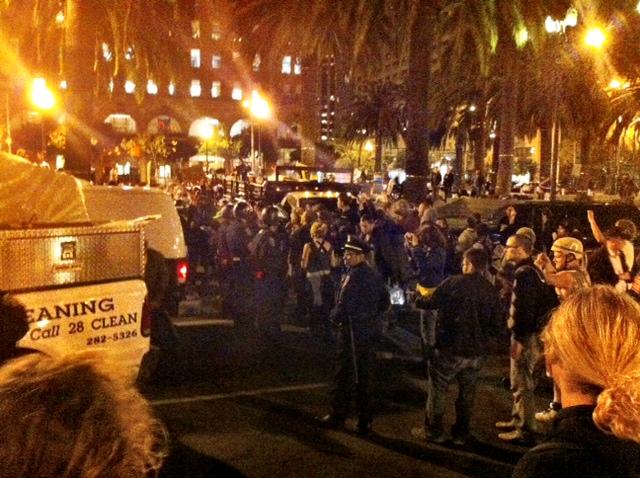
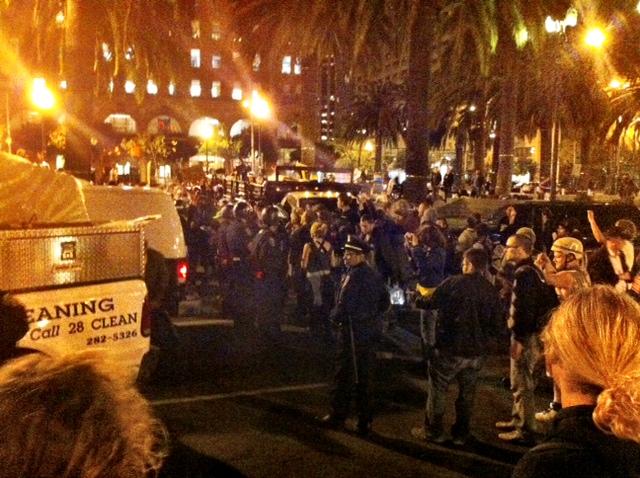
Around 1 a.m., police massed on Market Street between Main and Spear. They drove up to the Federal Reserve protest site, which consisted of a kitchen, small library and information table, and about a dozen tents. The 30 or so tents that had been pitched there for weeks were gone, voluntarily taken down by protesters around 12:40 p.m. Saturday, when police threatened to arrest and confiscate the belongings of anyone who continued to camp on at the 101 Market Street location.
Apparently considering that afternoon’s actions and previous notices concerning vacating 101 Market Street fair warning, police did not warn campers this morning before beginning to arrest. Six people who were sleeping in tents report having been awoken and put under arrest within a matter of minutes. Several had no time to put on socks or shoes before being dragged out of their tents.
All six were cited and released in a matter of hours, and arrived back at camp by 2:50am.
One man who had a small radio had heard a warning that police were present from camp security patrol about one minute before the police arrived. He says he had time to “spring out of bed” and exit his tent before police arrived and “Told me, ‘You need to leave now or get arrested.’ By the time I started to shake my head no they had already started putting the ziptie on me.”
Department of Public Works employees put tents and materials in DPW trucks police barricaded and blocked all of Market Street, including sidewalks, between Steuart and Main Streets.
Shortly after 1:00, OccupySF put out calls for support. Many heeded the call and arrived around 1:40 to the site. By this time, only the sidewalk was barricaded, and protesters continued to chant and argue with the about 120 police in partial riot gear who lined the sidewalk. A few tried aggressively to shake or take down metal police barricades and were stopped by other protesters and met with chants of “non-violent protest!”
For the next few hours, protesters slowly left 101 Market and congregated back at Justin Herman Plaza, discussing strategy and trying to understand what had happened. The raid was over in a matter of minutes and very few protesters had witnessed it.
The 101 Market Street site had been used by the protest movement since September 29, when it was established as the main camp site. The encampment had since expanded, and as of yesterday 101 Market Street was serving as the group’s “protest central,” distinct from the main camp at Justin Herman Plaza.
As of 8:00 this morning, about 15 police officers were still stationed, warming themselves by heating lamps that have been placed behind the barricades in front of the Federal Reserve. Barricades surround empty space on the sidewalk on Market Street from Main to Steuart Street.
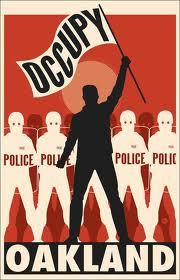
Police raided Occupy Oakland’s new encampment at Fox Square Park at 19th and Telegraph streets early Nov. 20. Some 30 tents had been set up at the park, which protesters entered Saturday evening after tearing down a chain-link fence surrounding the perimeter.
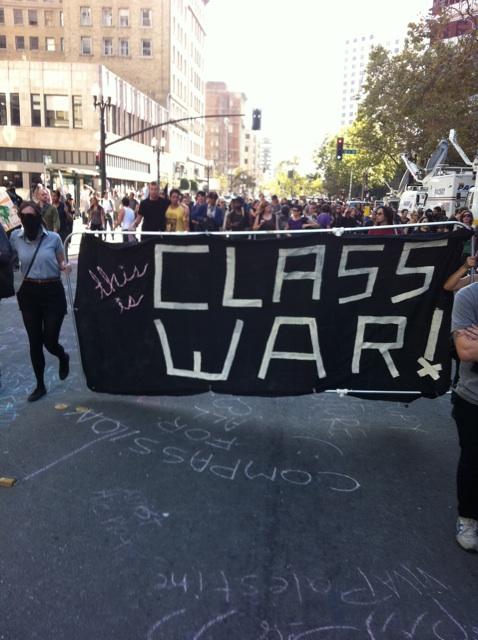
The camp was created following a Saturday afternoon march meant to highlight cuts to education which passed through the downtown Oakland banking district and stopped Lakeside Elementary School, one of five Oakland public schools that are slated for closure at the end of the school year due to budget cuts.
Occupy Oakland has called for general assembly at Frank Ogawa Plaza (renamed Oscar Grant Plaza by protesters) on Nov. 20 at 6 p.m. to talk about next steps.
Although Occupy Oakland’s home was short-lived, the Guardian was on hand to capture the moment when the fence came down and occupiers rushed in.
Earlier in the afternoon, an Oakland school teacher sounded off against the budget cuts.
Following a rally and march from downtown Oakland’s Frank Ogawa Plaza that may have been more than 2,000 strong, activists with Occupy Oakland tore down a fence that had been erected around Fox Square Park at 19th and Telegraph, the site organizers had announced would be the home of their new encampment, and began setting up tents.
The fence was in place when activists reached the park, and a line of police were positioned nearby. However, activists managed to tear down the fence, and police moved away from the park but were still standing by.
As of 5:45 p.m. Nov. 19, there were more than a dozen tents set up. Music was playing and occupiers were holding a dance party in the park. Shouts of “we need more tents!” could be heard.
The former site of the Occupy Oakland encampment — Frank Ogawa Plaza, which was renamed Oscar Grant Plaza by occupiers — has been muddied by sprinklers that are spraying water on the bare ground in frequent intervals. Police removed the encampment in a pre-dawn raid Nov. 14.
Speaking at a 2 p.m. rally, International Longshore and Warehouse Union (ILWU) Local 21 president Dan Coffman said, “The hedge fund managers and the bankers have been getting away with robbery. Where are the Justice Department indictments? The recession will only worsen unless we fight.”
According to the proposal that was passed unanimously by the Occupy Oakland general assembly last night, “The EGT is an international grain exporter led by Bunge LTD, a company constituted of 1% bankers whose practices have ruined the lives of the working class all over the world, from Argentina to the West Coast of the US. During the November 2nd General Strike, tens of thousands shutdown the Port Of Oakland as a warning shot to EGT to stop its attacks on Longview. Since the EGT has disregarded this message, and continues to attack the Longshoremen at Longview, we will now shut down ports along the entire West Coast.”
In terms of the still relatively young and action-packed life of the Occupy movement, Dec. 12 is ages from now. For today, Nov. 19, the question will be whether the activists can hold their ground at the new encampment.
Dick Meister, former labor editor of the SF Chronicle and KQED-TV Newsroom, has covered labor and politics for more than a half-century. Contact him through his website, www.dickmeister.com, which includes more than 350 of his columns.
AFL-CIO President Richard Trumka has drawn some important lessons from last week’s election in Ohio that repealed a state law severely limiting the collective bargaining rights of public employees. Worse, it threatened to inspire passage of similar anti-bargaining laws elsewhere.
Listen to Trumka, a man who obviously knows what he’s talking about. In an article he wrote for Reader Supported News, he cites post-election polls showing that more than half of Ohio’s voters correctly “perceived the law as a political maneuver by Gov. John Kasich and state Republicans to weaken labor unions, rather than a genuine effort to make state government more efficient.”
Another poll, done for the AFL-CIO, showed that more than half the voters also found that Kasich and his allies “are putting the interests of big corporations ahead of average working people.”<–break->
Voters everywhere in the mid-term elections clearly wanted change. But, as Trumpka says, they did not want “political maneuvers and overreach” like those of Kasich and Republican legislators. They want effective action to curb unemployment, create jobs and deal with the other severe economic problems facing the country.
As Trumka notes, public employees, union members, Democrats and liberals voted overwhelmingly to repeal the Ohio law, but so did a majority of voters “from households with no public employee, workers without union representation and independents – as well as 30 percent of Republicans and 36 percent of conservatives.”
One of the key lessons Trumka draws from Ohio’s election is that “the myth of the pampered public employee has been busted. Public employees didn’t cause the economic crisis and they’re not the enemy. Demonization of public employees is neither a strategy nor a solution and the heartland Americans who voted to restore rights for public employees understood that.”
The election also reinforced the continued need for working people, public and private employees alike, to join closely together. That’s what happened in Ohio. There, as Trumka notes, “firefighters, teachers and other public employees were joined by plumbers, pilots and all kinds of private sector employees to win. Worker to worker, neighbor to neighbor, the message spread, and what began as an attempt to divide workers flopped famously. In the end, working people’s solidarity was the message.”
Politicians could also learn important lessons – if they will. For the Ohio voters “showed that when fundamental rights and livelihoods are targeted, working people will not only defend themselves, but come back stronger.”
The outcome of the Ohio vote should show politicians seeking office that it would be wise for them to pay much more attention to the wishes of working and middle class voters than to those of the wealthy and privileged. Says Trumka:
“Cutting taxes for millionaires and billionaires, scapegoating working Americans and their unions and downsizing Social Security and Medicare may get you a standing ovation from the 1%, but the voters who decide elections will not be fooled – and you may just get more than you bargained for.”
Trumka’s correct. But despite the results in Ohio and the lessons they hold for the anti-labor political right, many undoubtedly will continue what the AFL-CIO sees as “part of Wall Street’s strategy to chip away at collective bargaining rights, piece by piece, law by law, until unions and collective bargaining rights are destroyed.”
Working people and their unions can be reasonably certain, at least, that they’ll have strong support in trying to withstand the attack – including support from the Occupy Wall Street movement, which Trumka credits with “redefining the political narrative.”
The next major test will come in the presidential and congressional elections in 2012. They’re especially looking for support from the swing voters who supported President Obama in the 2008 election and generally have the same political views as the majority of Ohio voters.
Trumka describes the swing voters as “working Americans with modest incomes, moderate views and little patience for polices that aren’t fair and don’t work.”
He says politicians seeking election or re-election next year must heed them and “support public policies for the 99 percent – policies that create jobs, invest in America’s future, safeguard Social Security, Medicare and Medicaid, and promote fiscal sanity by requiring millionaires and billionaires to pay their fair share.”
OK, that’s asking for much more than we’ve been getting. But the Ohio vote demonstrated that it is possible to garner the votes necessary to overcome the forces that would deny us vital economic and political rights.
Dick Meister, former labor editor of the SF Chronicle and KQED-TV Newsroom, has covered labor and politics for more than a half-century. Contact him through his website, www.dickmeister.com, which includes more than 350 of his columns.
Tim Paulson, director of the San Francisco Labor Council, just told me that he’s got as many as 500 union members on alert to stand with the OccupySF encampment if the city attempts to evict the protesters. The Labor Council has put together a communications system to let members who have volunteered to help know when a showdown with the police is coming, and the volunteers are ready to spend as much as 24 hours at Justin Herman Plaza, and if necessary, in jail.
“We mobilized for last night, but nothing happened,” he said. “We’re in a state of constant vigilance.”
Paulson noted that the San Francisco encampment “is the symbol of the Occupy Movement.”
The solidarity of San Francisco labor will make it considerably more difficult for Mayor Ed Lee to send in the police and break up the camp. The idea that he would be ordering the arrests not only of several hundred Occupy protesters but a large contingent of local labor leaders and union members has to be giving him second (and third, and fourth) thoughts.
And whatever the outcome, the connenctions between labor and Occupy are critical to building and sustaining a national movement to demand economic justice. It’s great to see the SF Labor Council in the heart of the fight.
Thirteen labor and community leaders wrote to Mayor Ed Lee Nov. 17 asking him not to evict the OccupySF protesters. The message of the hand-delivered letter: It’s worth the time and effort the city will have to make to allow the encampment to remain. It was signed by Conny Ford, OPEIU Local 3, Bob Offer-Westord, Coalition on Homelessness, Pilar Sciavo, California Nurses Association, Elizabeth Alexander, SEIU 1021, Rev. Carol Been, Clergy and Laity United for Economic Justice, Steve Williams, POWER, Gabriel Haaland, SEIU 1021, Tim Paulson, San Francisco Labor Council, Kate Huge, La Raza Centro Legal, Gordon Mar, Jobs with Justice, Forrest Schmidt, ANSWER, Shaw-San Liu, Chinese Progressive Association, and Mike Casey, UNITED-HERE Local 2.
Here’s the full letter:
Dear Mr. Mayor:
Occasionally a movement takes hold of the imagination of a people, resulting in major social and economic shifts in public policy. Thirty to forty years ago, such a movement driven by a coalition of the religious right and corporate America and spearheaded by the National Chamber of Commerce and the National Association of Manufacturers, changed the course of our nation for the worse.
With the election of Ronald Reagan and scores of corporate-backed politicians since then, our nation has seen a reversal of the progressive gains made in the decades immediately preceding 1980, from the New Deal to the War on Poverty.
In yesterday’s meeting, you and several city department heads questioned whether it is “worth the investment” to meet and work with the SF Occupy movement to address certain health and safety issues. We think it is.
The national Occupy Wall Street movement has brought dramatic focus to the disproportionate concentration of wealth and power held by the top 1% of America. They have drawn broad attention to the devastation wrought by Wall Street upon communities throughout the country: home foreclosures, record unemployment, attacks on immigrants, union busting, school closures, social service cutbacks, etc.
Over the years, in our own city, a number of legendary movements and causes have led to meaningful and lasting progressive change. The 1934 General Strike and the I-Hotel are but two examples. These and other struggles such as the Civil Rights movement are iconic not based on whether they resulted in victory or defeat, but because these struggles inspired and trained a new generation of organizers and activists committed to economic and social change.
Whether the Occupy movement is helping usher in yet another shift remains to be seen. But of this we are certain: the City of San Francisco working with Occupy SF to support their vision and work is “worth the investment.”
Provocative police actions in Oakland resulted in unnecessary injuries and threatened the very safety of the community they’ve sworn to protect.
We appeal that you not shut down the occupation of Justin Herman Plaza and continue to meet, daily if necessary, in order to work through the issues connected with Occupy SF.
They Might Be Giants wrapped up a busy weekend in the Bay Area last Sunday night, playing a second night at the Fillmore on top of a free show at the SF Amoeba Music earlier that day. Starting the show, Johns Flansburgh announced that the band would be playing Flood –which he later called the band’s “1990 near-breakthrough album”– in its entirety. And, since the album was only about 43 minutes long, it would be padded first by some old and new hits.
Getting ready to play the title track from Join Us, Flansburgh debated with John Linnell whether they should call it the “new album,” having also released both it and a “new, new album,” the appropriately named compilation Album Raises New and Troubling Questions, in 2011.
The show would be as much about music as it would be about showcasing the oddball humor that’s endeared the two Johns to fans for 25 years (some in attendance were noticeably younger than that, but most seemed to have been with the band for a good while.) Before “Battle for the Planet of the Apes” Flansburgh used a handheld spotlight to divide the audience on the floor into competing camps of chanting “apes” and “people,” adding that “the one-percenters in the balcony don’t get to play.” (Apes won.)
Flood was performed in reverse order, building up to a crescendo that included both “Istanbul (Not Constantinople)” and “Birdhouse in Your Soul,” ending with the now ironic “Theme From Flood” (“It’s a brand new record for 1990!”) Highlights included an in the dark version of “Whistling in the Dark” by Linnell* with bass drum gong support from Flansburgh and a Flood half-time show with the sock puppet “Avatars of They” singing “Singing Spoiler” alert with Meg Ryan (not really Meg Ryan.)
Opening Set -Older -Subliminal -Doctor Worm -Drink! -Join Us -Damn Good Times -We’re the Replacements -XTC Vs. Adam Ant -Battle for the Planet of the Apes
Flood (in reverse order): -Road Movie to Berlin -They Might Be Giants -Sapphire Bullets of Pure Love -Women and Men -Hot Cha -Whistling in the Dark -Letterbox -Minimum Wage -Hearing Aid -Someone Keeps Moving My Chair
Halftime Show: Spoiler Alert (Avatars of They)
Second (First) Half of Flood: -We Want a Rock -Twisting -Particle Man -Your Racist Friend -Dead -Istanbul (Not Constantinople) (Four Lads cover) -Lucky Ball and Chain -Birdhouse in Your Soul -Theme From Flood
Encore: -Can’t Keep Johnny Down -Fingertips
Second Encore: -How Can I Sing Like a Girl? -When Will You Die
*Definitely the quieter on stage of the two Johns, I was reminded elsewhere during the show that Linnell is worth keeping an eye on, if only because he makes fairly inscrutable faces the entire time. Kind of like someone is playing slightly off key and he’s trying to figure out who it is, if only because he likes it.
What does Hearst Corporation own at the corner of Fifth and Mission that’s actually worth a lot of money?
No, it’s not the San Francisco Chronicle. The New York-based media congomerate bought the Chron in 1999, at the top of the newspaper market, for something in the neighborhood of a billion dollars, but it’s not even worth a small fraction of that today. Mid-sized dailies like the Chron have lost so much value over the past 12 years that Hearst would have trouble getting ten cents on the dollar if it put the paper on the market.
So here’s this unperforming asset on the Hearst balance sheet that can’t be unloaded without a huge write-down. What’s a corporate bean-counter to do?
Well, in this case (as in the case with urban dailies around the country) it turns out that the most valuable thing Hearst got when it bought the ol’ Chron was the real estate that came in the package. The Chronicle Building is worth a fortune as a development site, but it’s an historic structure that can’t be torn down. On the other hand, the old Examiner building, and the parking lots and the various odd lots on the edges, make up a nice site for high-end condos and office space — and now that the market is picking up, Hearst and its development partner, Forest City, are looking to make some cash off the Fifth and Mission dirt.
We’re talking two highrises, one residential and one commercial, and six smaller buildings. It will change the face of an area that’s outside the downtown core and that abuts a more low-rent district. Hearst and Forest City are talking about people working in the “creative economy” — particularly young tech firms. Between Twitter on one end and the Chron’s new project on the other, the Sixth Street corridor might start to get pinched.
I wonder what the supporters of the Twitter tax break are going to think about this. And I wonder whether the “young tech companies” that the city wants to attract to the area are going to be demanding tax breaks, too.
And I wonder what the Chron will have to say about all of that.
San Francisco, of course, has been home to more than a few spirited speeches, many of which have resulted in real protest-driven change. Local protests here have long been loci of larger nationwide movements. One cool example: the freeway revolt movement, a national pushback against the autofication of cities in the 1960s and ’70s which reached its peak in San Francisco in the fight against the Western Freeway.
Many of the 1955 organizers who battled the freeway that would have connected 101’s march up Octavia Boulevard all the way to the Golden Gate Bridge hadn’t protested anything before. They included pastors and churchgoers, housewives, concerned parents, World War II veterans, middle-class San Franciscans working and living in the path of a projected freeway.
The proposed Western Freeway would have included a major interchange around 7th and Irving Streets before heading into Golden Gate Park. Image courtesy San Francisco Public Library
The last addition to a city-wide highway plan, the double-decker Western Freeway would have snaked through West Portal, the Sunset District, and the Richmond (with, of course, a little jog through Golden Gate Park, devouring the Rose Garden and the Hall of Flowers). Three huge arteries would have tangled and clogged where Irving and Seventh Streets now intersect in a tree-lined corner.
Obviously, the protesters who assembled to challenge the Board of Supervisors at Lincoln High School in December of 1955 weren’t just speaking out against the views and noise that were to accompany the proposed concrete ribbon. They were challenging the disruption of a settled post-war life, the bisection of their parishes by eight lanes of concrete, the impossibility of getting their kids to previously accessible neighborhood schools. Thousands of homes were to be demolished, and businesses to be relocated.
“The turnout was enormous, and the angry crowd unanimous in opposing the freeway plan. The politicians were stunned,” writes Frank Dunnigan in a recollection of the 1955 meeting.
The struggle against the freeway lasted four years and was replicated, again and again, and with growing momentum by neighborhood groups across the entire city. Resolution 45-59, which passed in 1959, squashed plans for the Western Highway as well similar nasty proposals. It was the direct result of efforts by ordinary people with full-time jobs, families, and livelihoods that threatened by the powers that were. And they won.
After picking up some bulk food items at Rainbow Grocery, SFBG videographer Ariel Soto-Suver crossed Folsom to join local SF band Timmy Mezzy in its studio to check out the band’s sugar-soaked sound.
As cities across America evict encampments of the Occupy Wall Street movement, similarities of timing, talking points and tactics among major metropolitan mayors and police chiefs have led critics to wonder: Is some sort of national coordination going on?
The White House says there’s no federal oversight. Speaking November 15 aboard Air Force One, White House Press Secretary Jay Carney said “The president’s position is that obviously every municipality has to make its own decisions about how to handle these issues.”
But a little-known but influential private membership based organization has placed itself at the center of advising and coordinating the crackdown on the encampments. The Police Executive Research Forum, an international non-governmental organization with ties to law enforcement and the U.S. Department of Homeland Security, has been coordinating conference calls with major metropolitan mayors and police chiefs to advise them on policing matters and discuss response to the Occupy movement. The group has distributed a recently published guide on policing political events.
Speaking to Democracy Now! On November 17, PERF Executive Director Chuck Wexler acknowledged PERF’s coordination of a series of conference-call strategy sessions with big-city police chiefs. These calls were distinct from the widely reported national conference calls of major metropolitan mayors.
The coordination of political crackdowns on the Occupy movement has been conducted behind closed doors, with city officials and PERF refusing to say how many cities participated in the conference calls and the exact nature of the discussions. Reports of at least a dozen cities and some indication of as many as 40 accepting PERF advice and/or strategic documents include San Francisco, Seattle, New York, Portland, Oakland, Atlanta, and Washington DC.
The San Francisco Police Department and Mayor Ed Lee’s office did not returned the Guardian’s request for comment about the PERF calls by press time. However, Oakland interim Police Chief Howard Jordan was quoted by the Associated Press confirming Oakland and San Francisco police involvement in the strategy sessions.
PERF coordinated a November 10 conference call with city police chiefs across the country – and many of these cities undertook crackdowns shortly afterward.
“We know that there were influential conference calls of private groups that include police chiefs who played key roles in repressing the anti-globalization movement, in order to stage rolling attacks on occupations across the country,” said Baruca Peller, an organizer for Occupy Oakland. “In less than a week an unprecedented number of protesters have been brutalized and arrested, and in many cities such as Oakland these evictions were pushed for by the local one-percent.”
“Occupy Oakland is calling for a national day of re-occupation on Saturday, to let them know that if they can take a national offensive against us, we can take a national offensive in response and we will re-take these public spaces and what is already ours.”
According to PERF’s website, general membership in the group is exclusive to “the executive head of a municipal, county or state-funded agency that provides general police services. The agency must have at least 100 full-time employees, or serve a population of 50,000 or more people.”
PERF’s current and former directors read as a who’s who of police chiefs involved in crackdowns on anti-globalization and political convention protesters resulting in thousands of arrests, hundreds of injuries, and millions of dollars paid out in police brutality and wrongful arrest lawsuits.
These current and former U.S. police chiefs — along with top ranking police union officials and representatives from Canadian and British police — have been marketing to municipal police forces and politicians their joint experiences as specialists on policing mass demonstrations.
Chairing PERF’s board of directors is Philadelphia Police Commissioner and former Washington D.C. Metro Police Chief Charles Ramsey, who was responsible for coordinating the police response to protests against international banking institutions including the World Bank and International Monetary Fund. Those protests, and Ramsey’s response to massive anti-war demonstrations in Washington DC in the lead up the the Iraq War, often resulted in preemptive mass arrest of participants that were later deemed to be unconstitutional.
Ramsey’s predecessor as organization chair is former Philadelphia Police Commissioner and former Miami Police Chief John Timoney, who is responsible for the so called “Miami Model,” coined after the police crackdown on the 2003 Free Trade Agreement of the Americas protest. The police response to protesters in Miami lead to hundreds of injuries to protesters. The ACLU won multiple suits against the Miami P.D. over abuse to protesters and free speech concerns.
Prior to the 2003 protest, Timoney was quoted as saying that the FTAA was “the first big event for homeland security … the first real realistic run-through to see how it would work.”
Timoney arrived in Miami with plenty of baggage. At the 2000 Republican National Convention, Timoney coordinated a crackdown that resulted in more than 420 arrests with only 13 convictions, none of which resulted in jail time. As in Miami, there was well documented abuse of some of the people arrested.
Also among PERF’s directors is Minneapolis police chief Tim Dolan, who was responsible for the crackdown on protesters at the 2008 Republican National Convention. That event also resulted in lawsuits, protester injuries and an outcry from the national press about police brutality and the preemptive nature of the police action.
PERF is more than a mere policy group. Wexler has personally represented PERF at major political events, in face-to-face dialog with police tactical commanders and leadership. That was the case at the 2008 Republican National Convention, where Wexler and Minneapolis Police Chief Dolan coordinated what is widely regarded as one of the most aggressive political crackdowns in recent American history.
Wexler spent the afternoon of October 14 observing Occupy Philadelphia with Philadelphia police commissioner Ramsey. Speaking to the Philadelphia Tribune, Ramsey said: “They wanted to see what the Occupy protesters were doing here in Philadelphia. As we walked through their encampment, almost immediately they were texting other groups around the country – it was happening while we were there and that was very, very interesting. It’s instant communication, and it’s worldwide. We have to become more adept at using the technology. Our police department has its own active Facebook page as a way of reaching out to the community.”
“Had a great one-day conference in Philly about social media – very pertinent these days with the occupy protests …” Wexler stated from his twitter account.
As the occupation movement grew, PERF began circulating a publication titled Managing Major Events: Best Practices from the Field. The manual – a copy of which we downloaded — amounts to a how-to guide for policing political events, and gives special attention to policing “Anarchists” and “Eco Terrrorists” at political events.
The guide encourages the use of undercover officers and snatch squads to “grab the bad guys and remove them from the crowd.” It urges local law enforcement to use social media to map the Occupy movement.
An earlier PERF guide Police Management of Mass Demonstrations advocates the use of embedded media to control police messages, the use of undercover cops to infiltrate protest groups, the use and pitfalls of preemptive mass arrest, an examination of the use of less-than-lethal crowd control weapons, and general discussion weighing the use of force in crowd control.
The authorities keep cracking down on the Occupy encampments, but the movement isn’t going away — and by Spring, it could be even bigger. Tim and Johnny discuss after the jump.
Today marks the two-month anniversary of the beginning of the Occupy Wall Street movement, which started when protesters began setting up tents in New York City Sept. 17. And following a police raid of Zucotti Park, renamed Liberty Square by activists, occupiers in the Big Apple are marching through the streets of Manhattan en masse right now, following an afternoon of demonstrations intended to shut down Wall Street that resulted in 175 arrests and numerous instances of police brutality. You can watch the livestream here. It’s an exciting, chaotic, and historic scene.
Meanwhile, here in the Bay Area, expectations are high that a police raid of the Occupy San Francisco encampment is imminent. Two events have been planned for tonight, according to a text update: a 7 p.m. mass nonviolent action training for responding to a raid, and 10 p.m. rally and dance party at Justin Herman Plaza.
One of the early tests of the political impact of the Occupy movement will come in the next two months, as California prepares to make drastic further cuts in education and social services for the poor and the Democratic governor begins — cautiously and hesitantly — to talk about new revenues.
The numbers from the Legislative Analysts Office are fairly bleak — the state budget relied on $4 billion in revenue that hasn’t been collected. That’s because Gov. Brown and the Democrats in the Legislature assumed that the economy would pick up more than it has. We don’t know what the final shortfall will be — but because the budget deal included automatic trigger cuts, it’s clear that K-12 education, CSU and UC are going to get hit again, as will, for example, medical assistance for the disabled.
The cops may be poised to shut down OccupySF, but this is a movement that isn’t about to go away. And if the governor and the Democrats in the Legislature (who are going to be running from new districts next fall) start to feel the heat and realize that the Occupy movement is already influencing the political debate and will, directly or indirectly, be playing a major role in state and national politics, they’re going to have to respond.
How? Well, the Legislature can always decide to scrap the cuts and raise taxes now. Unlikely, since that would require a two-thrids vote and the Republicans still care more about their no-taxes pledge than they do about the tens of thousands of people (including in their own districts) who are taking to the streets to protest economic inequality.
More likely the talk will be about November, 2012, and what sort of revenue measures Jerry Brown wants to put on the ballot. And that’s where the politics of Occupy can have a significant impact.
There are so many ways to go with tax measures; the easiest, in some ways, is to talk about the state sales tax, which bothers the GOP hardliners (like any tax) but bothers the big-business world a lot less. Most of any sales tax hike would be paid by consumers and the poor would pay more than the rich; typically, big business groups are willing to accept a sales tax hike before they’ll go for anything more progressive.
Obviously, the best option is to do exactly what Occupy is talking about, and raise the income tax on the top brackets (and cut corporate loopholes, and pass an oil severance tax). And that’s what will drive the California Chamber of Commerce types absolutely mad.
But I think a there’s a way to make this a winner at the polls, and a winner for the legislators who push it — and maybe even a winner for a Dem or a moderate Republican in some of the potential swing districts. Just call it a One Percent Tax — that is, a tax on the One Percent. Could be a combination of income taxes and corporate taxes, as long as it’s a package carefully written to target largely the wealthiest in the state.
Hard for anyone these days to oppose something that is totally defined and promoted that way. Gives the Occupy movement something to vote for. Could save jobs, keep classrooms open, keep sick people alive … I see no downside at all.
Mark Sultan is an embattled crusader for true rock’n’roll. Though in prose, he’ll have you believe that it must be destroyed – to save it from itself.
The former Spaceshit, once known as the one-man band, BBQ, later paired up for trashy garage doo-wap duo King Khan & BBQ Show, has gone back to solo. After the disbandment of KK&BQ, he last year put out $ and more recently released the free stripped-down live album The War on Rock’n’Roll, which showcases his raw vocal talent, along with two new vinyl records (Whatever I Want and Whenever I Want) on In the Red Records and a CD version (Whatever I Want, Whenever I Want) that grabs a handful of songs from each of those two records. He also is touring, and hits SF this weekend to play Hemlock Tavern.
On the phone, the Montreal-born, Toronto-based musician is all over the place, with grand statements, mumbly asides, and clever observations; he’s shaking large bottles of homeopathic pills into the receiver and claiming he’s on the toilet during half the conversation. His words are captivating, he’s the silver-tongued mad hatter of his domain – that of music that means something. He’s a rambler, so this interview is long, but it’s all golden:
San Francisco Bay Guardian: Do you have any backup on this tour? Mark Sultan: No, just me. It’s something I started doing years ago, before I even got involved with King Khan. I put out some records and then I kind of stopped doing it on myown and started using the same set-up with Khan. Listen [shakes the bottle of vitamins into the phone]. But at that point, I had to put my own personality aside and adopt a different role in that project, [it was] kind of similar to an actual personality I have, but I magnified it and made it more curmudgeonly. So [now] my personality, I have a sense of humor, it comes through, it’s more schizophrenic. I try to play songs I wrote in a lot of bands, including stuff with Khan. SFBG: What instruments are you playing on stage? MS: The main instrument is tuba, then I have a glockenspiel and then I have a ’69 synth that takes up the whole room, and also a bunch of iPods, like 40 of them at once and Iactually grew a beard and shaved half of it off, so I can be really hip with my 40 iPods. All I do is take a photo of that set-up, then I project it on a screen and then I just strut around with a megaphone and narrate Seinfeld episodes. The “Elaine” role is my favorite to enact, it’s very cathartic. SFBG: So what do you really play? MS: Ah, drums and guitar and I sing. Not as exciting as the other answer, but it’s true. SFBG: How did these new releases grow so big? Two records, the albums… MS: Hold on, I’m swallowing pills. Oh god, that’s awful. It’s make my pee electric yellow. So, the albums – I basically was just recording for fun, and I ended up with 30 songs. I’m not a fan of self-censorship, I wanted to release a lot of them because even if the listener doesn’t enjoy all of the songs – or any of the songs – even the worst songs that were recorded during this time meant something because it was a time in my life. Then Larry [Hardy] at in In the Red [and I] were talking about the idea of a double album, but I don’t like those, I think they’re annoying. I know how it is, you don’t want to buy a double album and not know what it is. So I thought, you can buy one of these albums and if you like one, buy the other. And then the CD, I didn’t even really want to put out the CD to be honest, but I think it was created so it could be sent to college radio or for review, I don’t know how this shit works. Also, I was in Brazil on tour and I had access to a studio built into my friend’s bar there, called Berlin. Oh god, everybody’s coming upstairs and I’m the bathroom, this is uncomfortable – okay, so I did this thing in Brazil. I wanted to record with these guys who do really awesome psychedelic stuff, but because of the time limitation I couldn’t really do it. I just said, ‘I’ll record live and I’ll do an improv set.’ So that became a free album [The War on Rock’n’Roll] I put out myself, downloadable. It has nothing to do with the other two albums, I just wanted to put that out there to document how I actually sound live when I’m playing by myself. SFBG: Could you tell me more about your blog post on the current state of rock’n’roll? MS: I’m very facetious and I like to speak in allegory, I also like to upset people, and say things hoping to get a response. I didn’t need to write that. I do believe honestly, deep in my heart, that rock’n’roll music – and I mean the stuff in my personal timeline, stuff from early ’50s – is important and holy music. And I know it has a history of being tampered with and fucked with but I think now, more than ever. And I know everyone knows this, but we’re in an age of illumination, universally. I think someone can take one minute of their time to realize that if they’re in to this kind of music and they love it, it does need to be protected or destroyed. By destroying it, I mean we just call it quits right now then [outside] predators can’t get at it, the meat’s been tainted. Somebody will dig up the bones in 20 years and extract the DNA, and make it work again. And that’s a grandiose, annoying thing to say. This music means a lot to me, and I owe my life to it – I think it really is being raped and people are allowing this to happen because they see money or the smallest modicum of fame or notoriety. People should do things for the love of things. Love your life and love everything. Or hate it. Don’t go in the middle ground, that’s boring and fucking pointless. I think we should always do something that means something. The moment I do something that doesn’t mean something – that isn’t outside of a purposeful need for nonsense and abstraction and surrealism – then I think it’s a waste of life. Maybe that’s just too crazy.
Mark Sultan With King Lollipop, Lovely Bad Things Sat/19, 9:30 p.m., $10 Hemlock Tavern 1131 Polk, SF www.hemlocktavern.com
“I Am The End” (and he is): http://www.youtube.com/watch?v=IedOHwrzPEQ
Tuesday and Wednesday, Nov. 15 and 16, marked galvanizing student-led protests that shut down a Bank of America branch at Davis and California streets in San Francisco, prompted walk-outs and marches through the streets of Berkeley, and fed the momentum initiated by the Occupy Oakland and Occupy San Francisco encampments.
In San Francisco on Nov. 16, protesters from OccupySF joined with students from US campuses, city colleges, and California State University schools to launch a peaceful day of action that included a march from the OccupySF encampment to the California State building, with sit-in stops at downtown offices of corporations associated with several wealthy UC Regents.
The days’ actions were the result of a last-minute change of plans. Students had been organizing for months for a day centered on the scheduled UC Regents meeting at the UCSF Mission Bay campus. The meeting was cancelled on November 14, citing potential violent disruptions. Organizers from the group Occupy Education decided instead to march, rally, and occupy in San Francisco’s financial district.
“The 1% on the Board of Regents cancelled their meeting because we demanded they do the people’s business. So now we’re going to where they do Wall Street’s business,” an official statement from Occupy Education noted.
The march left from the encampment site, renamed Bradley Manning Plaza by some occupiers, around 1 p.m. About 500 students, OccupySF participants and supporters marched along the Embarcadero, chanting “Whose university? Our university!” and “No cuts, no fees, education must be free.”
Around 2:20, the march stopped at the Bank of America branch at California and Davis. There, about 200 entered the building. Protesters held doors open as employees pushed back. One woman speaking into a cell phone yelled “This is private property! Get away!”
The bank’s main room soon filled with protesters who stood on chairs, desks and other furniture, chanted slogans, and pounded on drums. Several gave speeches decrying UC Regents with large salaries and their involvement in fee hikes. Said organizer David Solnit, “If they occupy our education, we occupy their banks!”
The final arrests were made shortly before 7 p.m. Video by Rebecca Bowe
Organizers singled out Monica Lozano, UC Regent and member of the Bank of America board of directors, as one of the reasons for targeting the Bank of America. Fliers explaining the reason to target Lozano said, “We hear it every day. There’s no more money. No money to keep college affordable…make Wall Street corporations and the super-rich pay, including those who sit on our schools’ and universities’ boards.”
The protesters remained peaceful while inside the building. Some scrawled messages on file cabinets in white chalk.
Around 2:40, at the Davis Street bank entrance, protesters formed a circle in front of the door, in front of police who were guarding the door. OccupySF participant Amy O told the Guardian, “My arms were in peace signs and I had inserted myself in between a yelling police officer and an overly aggressive protester. Then more police came up from behind me. They pulled my hoodie and I was thrown to the ground…there was no warning and I fell hard on my elbow. My hands were up in the air.”
Craig Rouskey was involved in the same incident. He says he was shocked when, without warning, police “jumped into the crowd and started beating people over the head with batons.” Rouskey named “Officer Turvis” as the specific police officer involved in beating protesters with batons.
After this incident, which to stem from police efforts to clear the space in front of the door, about 100 protesters moved into the space and staged a sit-in outside the bank, while several hundred more looked on, blocking the street.
All other police-protester interaction was calm. Those inside the bank sat in, spoke out and played music for about an hour until police began to arrest. Then, as officers processed each arrestee individually, the process of removing them from the bank took over four hours. A total of 95 arrests were made.
The last relic of the sit-in to go was a tent protesters had pitched inside the bank. The tent is now being auctioned on Ebay, and the current bid is at $255.
Around 3 p.m., the march continued on Market to its final destination — the State Building on Golden Gate and Larkin streets – while several dozen remained at the Bank of America branch to support those sitting in. The march ended with a speak-out in front of the building, where students and other supporters talked about how University budget cuts have affected them and their families. Several students said they would not be able to afford continued schooling if proposed UC budget cuts, which include an 89 percent increase over the next four years, move forward.
Destiny Iwuoma, a first-year student at UC Berkeley with a double major in Legal Studies and African American Studies and a minor in Education who has also participated in Occupy Cal, was proud of the day’s participants. “I think the people inside the Bank of American are pretty brave,” he said.
Occupy protests around the Bay Area are working in tandem and relying on each other, Iwuoma said. “Buses from Occupy Cal left to support OccupySF. Occupy Oakland and SF came to support Occupy Cal. We’re supporting each other.”
A day earlier, the East Bay city of Berkeley was besieged with student protests. A day packed with rallies, marches, speakers, and a general assembly that drew thousands at the end of the day to UC Berkeley marked the Nov. 15 student strike and Day of Action called in response to a police crackdown less than a week earlier. Hundreds filled Sproul Plaza for a 2 p.m. rally. Honest Cheung, one of the 39 Berkeley students to be arrested after the first attempt to set up tents, condemned the campus police’s excessive use of force against student protesters. ”When they increase our debt, they increase their profit! And that is why they use violence,” Cheung said. “What kind of democracy do we live in when peaceful protestors are met with violence?”
Students moved to an intersection off campus to hear Robert Slaughter, a black student from St Mary’s College, describe how he beaten by police and arrested with 38 others, but was the only one charged with a felony and held on $15,000 bail.
A mass of students then marched down Bancroft Street, stopping traffic on Shattuck Avenue. They circled the streets around Berkeley High and made stops in front of Berkeley High and the Berkeley Civic Center, chanting, “Who’s university? Our university!” “Tell me what democracy looks like! This is what democracy looks like!” “Banks got bailed out, we got sold out.” At the high school, they chanted, “UC Berkeley, Berkeley High, hella hella Occupy,” and “Education is a right, Berkeley High is hella tight.”
By 4:30, the crowd had returned as a huge mass to Sproul Plaza. Protesters from Occupy Oakland arrived soon after, en masse, waving around a tent on a stick to announce their presence. After that, they had people sit down to form the General Assembly. After many mic checks and early announcements, they handed out agendas and announced the details of an afternoon shooting that occurred at Haas School of Business.
Someone stood and announced that a lawsuit would be filed against campus police for targeting protesters with excessive force Nov. 9. Occupy Cal plans to hold general assemblies at Sproul Plaza each night at 6 p.m. (Their Twitter feed is here)
The crowd continued to swell, and perhaps ten thousand people crammed into the plaza for the general assembly. They voted to re-establish the occupation of the plaza, and to demand an end to the wave of tuition hikes and funding cuts that have put higher education beyond the reach of many Californians.
“I believe words have the power to create change,” Said Jeanie Shoumacer, 47, an undergrad student who’d brought her 5-year-old son along for the civics lesson. “We must not let this end,” she urged the crowd, speaking from the steps of Sproul Hall. “We cannot give up.”
Berkeley’s Free Speech Movement began at Sproul Plaza. Signs of free speech activist Mario Savio had been set up with a sign reading, “This is Our History.” Speakers were flanked by banners that read, “Free education for all,” and “Defend public education.”
Morgan Crawford, a Berkeley student, had participated in the protests a week prior. “I was beaten last week,” he said. “I could hardly walk. I’m back here to speak in favor of re-establishing the encampment. Our voices will be heard, and when the police return to beat us into submission, stand strong, and stand together.”
Senior Andrea Barrera was one of the meeting facilitators. “We stand in solidarity with all the people in the world who are struggling with the system that we are working so hard to defeat,” she said.
The general assembly was run on a model of participatory democracy. Issues were presented, debated in small groups, and then voted on by everyone present. Friendly amendments were recorded, votes tallied, and proposals passed under a system that required an 80 percent super-majority to go forward. Though chaotic at times, Occupy activists were able to address and pass several resolutions in just over an hour – a display of efficiency.
“We don’t just organize,” Barrera said. “We communize. We work together.”
The OccupySF camp is filthy. There’s violence, drugs and disease. Half the protesters are just drunken thugs who are there to party and make a mess. It’s a public-health hazard. Jeez, it looks like the message is lost and the place has to go.
That’s what the Chron and the Ex are saying — and it’s a perfect setup, a ready-made public excuse for Mayor Ed Lee to send the cops in with riot gear and an eviction notice. It could happen tonight, or tomorrow night.
Frankly, Lee needs the bad (for Occupy) press. The movement’s goals are popular in this city, and when he came very close to evicting the campers, with cops running around the city in buses, his popularity dropped. He saw what happened to Jean Quan in Oakland; her tear-gas assault on Occupy Oakland may have been the end of her political career.
But hey, it’s different now: The daily papers are proclaiming that the encampment isn’t about economic inequality any more. It’s devolved into an unruly mob that can’t be tolerated. Who can blame Lee for cleaning it up?
That also happens to be an utterly unfair characterization of what’s going on. Sure, there are homeless people in the camp, and yes, some of them have mental health issues. But OccupySF is talking about the 99 percent, some of whom have suffered greatly in this economy — and it’s no surprise that some of them part of the occupation. Yes, it’s a challenge, but it something that OccupySF is taking on. Oh, and by the way — the homeless people and people with mental health issues (that sometimes lead to violence) will still be on the streets of San Francisco is they evict the Occupy encampment. But they’ll be worse off than they are today.
Yael Chanoff just filed her report on what’s really going on at OccupySF:
At last night’s General Assembly, OccupySF organizer Philip Oje debriefed on that days meeting with Mayor Ed Lee, and participants in the 150-person meeting debated the best next steps. Several different viewpoints were discussed. Many were indignant about reorganizing camp to appease the city, saying that “I didn’t come her to comply with city ordinances that change every day. I came here to do what I think is right.” Others believed believed that the camp should do everything possible to comply with the city in order to hopefully avoid a raid (and maintain credibility if one does occur.) It was generally acknowledged that the situation was a Catch-22: The camp could not comply with requirements such as maintaining four feet of space between tents without expanding past Justin Herman Plaza, but the city refused to allow any expansion to stand until their requirements were met. In general, those assembled agreed that regardless of the city’s difficult to follow guidelines, a clean-up would benefit the health and well-being of campers, and got to work.
This comes after a hard week of dealing with the frustrating realities of human interaction in a cramped space. The encampment has grown steadily since its start, and in recent weeks has been home to upwards of 300 people on a regular basis. Many campers would agree that in the past two weeks that tensions have built as high as they did. When Examiner Reporter Mike Aldax spent 24 hours at camp, it was during the peak of conflict.
Indeed, many at OccupySF are frustrated. There is a general feeling that there is not enough time in the day to maintain a safe and caring community that does not exclude anyone as well as progress with the political agenda that the movement stands for. However, there is also a basic agreement that those with addiction, mental illness, and other causes of suffering are affected directly by an unjust society in which a small percentage hoards vast majority of wealth while the masses struggle to afford food, shelter, health care and education; to attempt to exclude those who are in desperate situations, the most in need of emergency action to change our system and our lives, would be morally intolerable hypocrisy.
As famed radical environmentalist Derrick Jensen put it when he came to speak at the encampment November 12, “At the same time you’re building a resistance movement, you’re being put in the position of dealing with the needs of those who have been dispossessed and damaged by the system.”
It’s true: according to Connie Ford, a member of OPEIU Local 3 which represents many on the city’s Homeless Outreach Team, “The homeless come there because it’s safer than the shelters.”
This has caused difficulties in the past few weeks that the camp has been struggling to deal with. The solution is starting to come together. After physical fights began to become a major problem last week, the camp stepped up the process of enacting a culture of community policing. The night of November 15, when “Instigator Jimmy” was involved in an altercation during a general assembly, about 50 formed a mass between him and camp and slowly pushed him off the site, chanting “Whose park? Our park.” As one camper put it, “Jimmy’s individual will was extinguished by our collective will.” This is an experiment in radically non-violent coercion.
Since then, this tactic has been employed to greater and greater success. Last night, when one camper began to instigate conflict, it only took 10 or so others to cause him to leave in the same way, and hardly disrupted the peaceful mood at the site.
In addition, despite starting out completely unequipped to provide medical and mental health to the masses for free, OccupySF has set up a medical tent run by nurses from the National Nurses Association and several “emotional assistance” spaces, one of which has been facilitated by the Icarus Project and other groups with alternative approaches to mental health. According to an OccupySF press release today: “Forty clergy, including bishops, have recently formed as ‘San Francisco Interfaith Allies of Occupy’ because we share the concerns of the ninety-nine percent,” said Rev. Carol Been of CLUE California, “and they have asked us for help because they were not prepared to handle homelessness, mental illness, people attracted for unseemly reasons not associated with the occupation. Resources have recently begun to be put into place.”
It seems that all of this grappling with difficult issues and hard work on the part of OccupySF has begun to pay off. Last night after General Assembly, campers worked to clear off the Bacci Ball courts as per the city’s request, take down tarps, and space out tents to the extent that they could without expanding past Justin Herman Plaza (renamed by some Bradley Manning Plaza.) Camp was clean and vastly quieter than it had been in previous days.
Around midnight, there were about 30 people awake, talking and playing mellow drums on the outskirts of camp while hundreds more slept in the approximately 180 tents. One man who had been sleeping there three weeks said, “There’s a new energy. After we cleaned, a lot of the riff-raff left.” With a grin he added “It looks like there’s still some, but they’ve been over there having some kind of profound conversation all night,” gesturing to the camp east side.
I pitched my tent about 10 feet from the “profound conversation” and drifted off easily, though I admittedly prefer a nice buzz of humanity while I sleep. I was, however, woken up around 6:00, when others began waking up and excitedly discussing the fact that the camp had made it through the night without a police raid.
It remains to be seen if the same will be said for tonight.
As I retreated from the Bottom of the Hill’s courtyard into the venue Tuesday night, Future Islands vocalist Sam Herring held the door open and flashed me a dazzling smile. As soon as Herring took to the stage, however, gone was the polite Southern gentleman I’d met outside. He transformed into a raving beast that would hold his audience captive for an intensely theatrical and cathartic performance.
Without Gerritt Welmers on synthesizers and William Cashion on bass, the lush, emotional synth-pop of Future Islands wouldn’t exist, but Herring’s charisma and monstrous one-of-a-kind voice made it impossible to focus on anyone else. Herring worked overtime to connect with the audience, gazing into as many eyes as possible while delivering deeply personal and poetic vocals. During “Before The Bridge” from Future Islands’ most recent album On The Water (Thrill Jockey), Herring crouched down and pointed directly to each person in the front row, asking, “Do you believe in love?”
Eye contact was only the beginning. With an expressive face capable of conveying insufferable longing and immeasurable pain, Herring didn’t really need to stalk the stage like a caged animal or pantomime yanking his soul out of his throat, but he did. Though I’m a big fan of On The Water, selections from 2010’s smash hit In Evening Air (Thrill Jockey) were the evening’s greatest successes. During the slow-burning “An Apology” and “Inch Of Dust,” Herring repeatedly beat himself on the chest, resembling Mark Wahlberg in Fear. I suspected a bunch of bruises were hidden beneath the singer’s tucked-in cotton jersey.
Uptempo numbers like “Tin Man,” “Long Flight,” and “Vireo’s Eye” turned the crowd into a dance floor frenzy led by Herring. He threw punches into the air and danced like a member of the Rat Pack on speed. The trio closed its set with “Old Friend,” a bubbly favorite from its debut Wave Like Home (Upset The Rhythm).
The audience wasn’t about to let the band off the hook that easily. The sold-out crowd shouted and clapped until a thumbs-up and expression of sheer joy from an elated fan signaled the band’s return. Future Islands ended the night with a lively encore comprised of time-tested singles. By the time it was over, Herring was completely drenched in sweat, and I was exhausted just from watching him.
Opener: It’s always disappointing to see an opening band that’s a sub par version of the headliner. Ed Schrader’s Music Beat was not that band. With its sole light source coming from within Schrader’s drum, the duo – also featuring Devlin Rice on bass – exuded a dark vibe that was paralleled in its music. It executed an impressive set of short, heavy songs. I’m a hardcore Joy Division fan, so I was delighted to see Schrader channeling Ian Curtis with deep vocals and spooky, trance-like presence.
Right now, all the signs say no — the economy isn’t improving, he’s pissing off his base, the GOP kicked his ass in the 2010 midterms, and a vast majority of Americans think the country is headed in the wrong direction. But then, at this time in 1991, all the signs said that George Bush I was unbeatable.
And then, of course, you have the Republican candidates.
That’s why the political consultant brain trust at CalBuzz predicts by a 2-1 margin that Obama will be relected. We’re talking Democrats and Republicans, from across the ideological spectrum (although mostly centrist; there aren’t many radical political consultants, since they have to make a living working with all sorts of candidates).
I always get these things wrong — a good way to win an election-day bet is to listen to my predictions then go the other way — and I’m not the Obama supporter I once was. But I think these folks have a point — is there a single Republican now in the field who won’t self-destruct by the end of next year, in the heat of battle? You can say all you want about his namby-pamby positions and the bimbo eruptions, but Bill Clinton was a hell of a campaigner — and it takes a hell of a campaigner to unseat an incumbent president, no matter how bad he looks in the polls.
Some of their comments:
As much as history points to no president being re-elected with unemployment numbers this high, there is no sign that the GOP can get its act together and nominate anyone capable of defeating Obama. As amazing as it may be the GOP is poised to grasp defeat from the jaws of victory — what a party!
Romney, the probable GOP nominee, combines most of the worst features of Walter Mondale, Michael Dukakis, Al Gore and John Kerry. That’s some feat — and it won’t get him to the White House.
Obama will win . . . more because the Republican field is pathetic. “Mittens” is the likely winner, but has flip-flopped more than a tuna on the deck of a boat.