SFBG Blogs

Cursive gets candid during Noise Pop

0

Tears, booze, sex, pain, martyrdom, regret. Against my better judgment, I was singing along with the band. I was singing carefully, with my eyes closed and likely a smile creeping up in the corners of my mouth. I couldn’t help it, it came from within, as much as that particular act generally annoys me in packed settings. The swell of angular guitar and thundering drums pulled back mostly leaving higher octave vocals from a scale that slides to and fro: “Your tears are only alibis/To prove you still feel/You only feel sorry for yourself/Well get on that cross/That’s all you’re good for.”

It was mid-song (“The Martyr,” 2000’s Domestica), mid-set (Noise Pop), of Cursive’s likely sold-out performance at Great American Music Hall. I opened my eyes, scanned the room, and saw we were all singing along breathlessly. Plaid-shirted forearms thrust towards stage, fringed heads bobbing, and everyone within earshot hollering towards the center. There in the middle stood grizzled singer-guitarist Tim Kasher, leader of the Omaha-bred longtime Saddle Creek Records fixture Cursive, as well as the Good Life. Parsing his words carefully, Kasher spoke for nearly the first time after a quick-fire opening shot of beloved Domestica and Ugly Organ tracks, interspersed with brand newer, understandably less-clapped-for I Am Gemini cuts. “Let’s get candid,” he understated.

As with the folly of any continuous lovers, there was ecstasy and there was heartbreak. Dashing Kasher, the classic storyteller, the frog-croaking boozehound, inspires great emotion in his followers, only those who’ve been with him for quite some time – say, more than a decade – may question the direction of sound. Cello out, trumpet in. Perhaps it was projection, but it appeared the crowd and Kasher were mutually orgasmic during early career, well-worn classics, and likewise, faking it to get through the newer ones.

Ending the official set with “Art is Hard” (later explaining he’d be back for an encore, after taking a shot), Kasher reminded us why we were there, because making art is indeed hard and trying, and thrilling and sometimes, routine. “Fall in love to fail – to boost your CD sales.” It’s pulling all those creative types like taffy, up to fame, sideways to monotony, and sometimes, down with it, but if you don’t have a soundtrack to the downward spiral of inventive misery, well, all else is lost too: “You gotta’ sink to swim.”


All photos by Chris Stevens.

Die Antwoord’s athletic use of the F-word

4

When South African hip-hop duo Die Antwoord played “Fok Juule Naaiers,” the first single off latest album Ten$ion — the track that opened the group’s Noise Pop gig last night at the Regency Ballroom — for its LA manager, they were told it had some problems. The problem’s name was homophobia, their manager ventured. US audiences, he said, don’t take kindly to the F-word (I wish that were consistently true).

In response, Die Antwoord released this video. It is entitled “F-word,” the version of that term that lacks my lavish commitment to political correctness

Ninja, a.k.a. Watkin Tudor Jones, says the usage is all good because he has good homo friends, and that one of them is Hi-Tek, the group’s DJ, who opened up last night’s show with his charming “Fok Juule Naaiers” verse. Assorted lyrics below:

DJ Hi-Tek will fuck you in the ass, punk ass white boy

Look at you scared/Scared of a real man

Fuck it ’til you love me, [F-word]

So, was this song Hi-Tek’s coming out party? What a bummer party.

Of course, the crowd (sold out to the gills — I had press credentials and still had to beg, borrow, and perform mild thievery to get in) ate it all up. Die Antwood’s stage show is less weird than its videos, because matching them would entail wearing coats made of live rats, which would be hard to get through customs.

Emcee Yolandi Vi$$er without her album cover blood-soaked visage is massively sexy on stage (the whole group looks like they hit the gym hard together). By the end of the show, she had stripped down to running shoes, spandex shorts, and a midriff-bearing pink tee with “zef” printed inside a heart. She always looks like her clothes are about to fall off. Next to Ninja in his orange running shoes and signature Dark Side of the Moon underwear (infamous jiggling penis beneath), they looked like they were hosting a really agressive workout video. Ninja crowdsurfed, constantly. Let no one say that Die Antwoord doesn’t work it out on stage.

Yolandi Vi$$er at the Regency last night.

And, Ninja. Guardian photos by Caitlin Donohue

And it is a good show. Yolandi hype-chirps after Ninja’s every line. She spins around five times and picks up her verse right on cue, and the two reverse roles with Ninja cooing after her lines end. New single “I Think You’re Freaky” was a huge hit, particularly, one imagines, with the guy in a rubber pig mask sweating balls in the front row, a couple in the middle of the crowd wearing the hooded plushie onesies that Die Antwoord rocked — weirdly, always weirdly — in its “Umshini Wam” video. The front lighting blacks out after songs, silhouetting Ninja and Yolandi’s distinctive haircuts. They are unapologetic in their stage presence, crowd love.

Earlier that day, afraid of not getting on the list for the show, I lurked outside Upper Playground’s Fifty24SF gallery, where Ninja had spent the day painting the walls with the black chicken scratches and Evil Boy engorged penis characters that now adorn Die Antwoord merch, stage sets, and his own body. At 4 p.m., there was a line of Die Antwoord fans lined up to greet Yolandi and Ninja. You could cut the line if you bought a $200 Evil Boy latex toy.

Few people did. First-in-liner Stephanie Farrell, who came straight from school for the signing didn’t. But she got what she wanted out of her wait: a really awkward experience with her idols. 

“What was your interaction with them like?” I asked her while looking at the Die Antwoord’s signatures, written in her wire-bound, lined notebook. 

“They didn’t say anything, it was really awkward. I was like ‘hey,’ and they were like ‘hey.'”

“But are you still a fan?”

“Absolutely. I didn’t expect it to be a normal experience whatsoever.”

In the “[F-word]” video, Ninja says that people from the United States who are upset by the way they use that and other (N-word) offensive bullshit should quit being a little less PC and learn from “your brothers and sisters here in the dark depths of Africa,” where a local saying is translated into “we are one.” He then grabs his Evil Boy dolls, a black one and a white one, and knocks their monster toy dicks together while repeating the “we are one” phrase in a high-pitched voice. “That’s why they say South Africa is a rainbow nation.”

Weird. 

Photos of Die Antwoord’s Ninja painting the inside of the Fifty24SF gallery are by John Orvis

The ‘ruination’ of Peter Gleick

27

Oooh, sfgate has dropped climate scientist Peter Gleick’s column on the City Brights section of the site. Harsh, man; I guess that’s enough to “damage, if not ruin” the reputation of one of the world’s leading authorities on climate change. Fired by City Brights; I bet he feels as if he’s been unfriended by Garrison Keillor.

I continue to be amazed at the ethics of the San Francisco Chronicle, which can’t tolerate Gleick but still allows Willie Brown to write a column in the news section of the paper.

And I’m amazed at all the handwringing over this incident. I means, what, exactly did Gleick do that is going to destory his scientific reputation after years of unimpeachable work? Here’s what he did: He contacted the nuts at the Heartland Institute and asked them to send him some material. Oh, and he didn’t give his real name.

It doesn’t appear that he broke into the Heartland office, or hacked into the Heartland server, or went in under false pretenses and made a bogus video. In fact, I’d argue that, whatever the Chron’s legal sources say, it’s pretty hard to call this “stealing.”

Look, if my phone rang and the person on the line said his name was Warren Buffet and he asked me to send him confidential Guardian business information because he was thinking about investing $1 billion in the alternative press, I’d make a coupla phone calls first — wouldn’t you? If I ran a right-wing nonprofit and somebody called and said she was a board member and could you please send a package of sensitive internal documents to an address in Oakland, California, I’d call back at the number I had for her and ask if she’d move to crazyland — wouldn’t you? Who on Earth sends that kind of material out without making sure it’s going where it’s supposed to go — unless the vast majority of what Heartland sent Gleick was in fact the same sort of stuff that the loonies there regularly ship out to other loonies who they think might agree that Al Gore was born a thetan and is secretly plotting the United Nations takeover of the planet so that nobody can have round light bulbs any more.

I’m not condoning this sort of behavior — although the history of journalism (sometimes excellent, important journalism) is filled with examples of reporters using what some would call dubious methods to get through what Robert Scheer used to call “the palace guard.” But compared to shit the right wing pulls routinely, as a matter of practice, this is hardly a major crime. And you have to put some of the blame on whatever fool at the Heartland Institute mailed the company secrets off without checking where they were going.

And isn’t it good that we now know how the oil industry is trying to create a K-12 curriculum that denies climate change?


Spanning time with the Flaming Lips

0

I ran into a temporal anomaly while driving. My first warning sign was the police cruiser with one headlight flashing its sirens behind me. Wrong place at the wrong time? Well, I was getting pulled over in Sebastopol on the way to Richmond from SF, but when the cop told me I was doing 78 in a 55, it suggested one thing —speeding.

And speeding isn’t spatial — location is irrelevant — you are precisely where you should be, just too fucking soon. The cop seemed hopeful that he could help me, but as he took my papers and ran back to his car I knew he had abandoned me to the crush of an impending temporal singularity, as time began to move in slow motion.

Slow motion. Some refer to it as time dilation. The sensation that a certain duration lasts longer than it should. The Flaming Lips have a song about it, called, obviously, “Slow Motion.” It goes like this:

Hey, come on over.

You know the day is going slower.

It takes a year, to make a day.

And I’m feeling like a float in the Macy’s Day parade.

Or like a boat, out on the ocean. 
I’m drifting round in slow motion.

LSD and other narcotics aside, time generally doesn’t work that way. Compared to your life so far, each additional day is a smaller proportion. Time telescopes, you speed up, it goes faster. Slowing down is the opposite, unnatural. Sitting in a car waiting for the cop to come back (Is he going to search me?) or laying on a couch with friends trying not to cry — whenever time slows down — it’s unnerving.

You only know this much about “Slow Motion” — an alternate track from The Soft Bulletin not released in the US — because you saw the Flaming Lips play it once. But which time? Not at that fair in Santa Rosa. That one had a rave after. Not at the Fox Theater. That was the one where you slow danced with your girlfriend (at the time) until the staff asked you to leave. At Sasquatch, there in the Gorge? They did play The Soft Bulletin then, but it was rushed. That guy stood behind you — when Wayne Coyne was recounting Steven Drozd almost losing his hand and Michael Ivins being in a car crash — screaming “Play-a-song!” No, there just hadn’t been time.

And time, for the Flaming Lips, is important. Because as a band — one that has been through all sorts of well documented shit — the Flaming Lips know the value of time (particularly borrowed) and have made it their work to not just create music but get into the complete manufacture of moments. Which is a tricky business, because moments are bastards. Take all the pictures you want of the blinding lights, the beautiful costumed kids, the confetti cannons or all the other individual weapons that the Flaming Lips use to wage musical psychedelic war on time, and the moment still might not fit in a shutter, no matter how you slice a second.

It was at Bimbo’s. Not the time they played Noise Pop a few years back, but more recently. They were playing The Soft Bulletin, and taking their time. Hitting every single track from every single version of the album. Not quite slow motion, but close. When was that?

It was the night after the couch. When you were watching Blade Runner on TV, just the end part. Where the maniac with white hair is running around, trying to knock some sense into the other idiot character, who hardly even realizes he’s alive most of the time. And it starts getting heavy. Meaningless inevitability; the crushing force of time. Fucking tears in the rain. Before you know it, you’re happy it’s basic cable, because sometimes a commercial interruption is all that’s keeping you from crying.

It was the night after that. The Lips were going slower for sure, but still way too fast. The moments going by before you’re ready. Before you know it, they are on to other songs, and “Slow Motion” is somewhere in the past, back there with your best friends on the couch, never to return.

The band is getting ready to play something else, Steven readying both miraculous hands on another instrument while Michael stands ready, as ever, on the bass. You want to reach into your bag to take the camera out again, but you resist the urge. It won’t capture the cold press of the air canisters at your back anyway. Or, for that matter, the hookah scented air from the smoke machines. And anyway, if you’re taking pictures during “Feeling Yourself Disintegrate,” you’re probably irretrievably lost.

And suddenly, everything has changed. The cop comes back to the car. Tells me my record is clear, that he just marked 65 on the ticket, because I was didn’t know where I was. He gives me some directions, regarding the roads. I don’t really listen (but do thank him and let him know about his broken headlight.) I drive forward, knowing exactly where I am. I was at a Flaming Lips show, and now I’m driving home.  

Campaign cash roundup and questions about our sleeping watchdog

3

Oliver Luby – the last true public-spirited employee at the Ethics Commission (a campaign lapdog when it should be a watchdog) before being forced out in 2010 – has written an insightful and comprehensive analysis of spending by candidates and outside groups during last year’s election. It’s published by CitiReport.

Among his findings are that the largely unregulated spending by supposedly independent third-party groups totaled $3.6 million, with $1.4 million of that going to support Mayor Ed Lee, and much of it coming so late in the race that voters weren’t able to factor its sources into their decisions.

Those outside groups spent almost as much to elect Lee as the campaign itself raised, which was almost $1.6 million. When those two figures are combined, and one subtracts the $419,891 in independent expenditure (IE) spending in opposition to Lee, the appointed mayor and his supporters spent $33.87 for each first place vote he received, or about 2.5-times that of second-place finisher John Avalos, whose $757,327 in “supportive financing” works out to $13.25 per vote.

Luby has long called for Ethics to get tougher on violators of campaign finance law, playing whistleblower at several key points in his career, starting in 2004 when he and then-staffer Kevin DeLiban exposed notorious campaign attorney Jim Sutton’s alleged scheme to illegally launder unregulated funds being collected for then-Mayor Gavin Newsom’s inauguration into paying off some of his $550,000 campaign debt.

In his latest piece, Luby again calls out his old bosses at Ethics for ignoring local laws against maxing out donations to many candidates in order to buy influence at City Hall. Donors are limited to an “overall contribution limit” that equals the maximum individual donation of $500 times the number of offices open, which was three in this election. It allows the city recoup from the campaigns money collected in excess of that, which Luby said totals $29,111 in this election.

“The SF Ethics Commission does not enforce this law. Supervisor Scott Wiener wants to help them get rid of it,” Luby wrote. Ethics Commission Executive Director John St. Croix was out of the office and hasn’t returned a Guardian call for comment.

Among those whose excessive contributions would be diverted to city coffers are Planning Commissioner Michael Antonini (perhaps the city’s most powerful Republican), PR powerhouse Sam Singer, medical marijuana activist Kevin Reed, political fundraiser Wade Randlett, city staffer-turned-developer Michael Cohen, moderate Democrat Mary Jung, and Coalition for Responsible Growth (a pro-development group) President Rodrigo Santo. Not surprisingly, they all contributed to Lee, whose campaign would be on the hook for the most in givebacks, $7,725, followed by David Chiu’s mayoral campaign at $4,700.

Finally, for all their talk about fiscal responsibility, Lee and his supporters couldn’t seem to live within their means in this election. Lee’s campaign finished about $275,000 in debt, while two of the pro-Lee IEs also finished in the red: SF Neighbor Alliance ($11,338) and Progress for All ($35,890), the ethically challenged creators of the “Run Ed Run” campaign that purported to talk Lee out of his pledge not to run for a full term in the office he’d been appointed to.

These are just some of the findings in Luby’s voluminous reporting, so check it.

Occupy 4 Prisoners hits San Quentin

5

About 800 protesters marched to San Quentin’s East Gate in a day to protest what they called inhumane conditions in prison Feb. 20

Protesters called for an end to the practice of trying children as adults, three strikes laws, life sentences, life without the possibility of parole, and the death penalty.They did not call for the dismantling of the prison system or an end to the practice of incarceration, as Chip Johnson implies here.

In San Quentin– and in prisons across the country—inmates are subjected to solitary confinement, sometimes for decades. Kids as young as 13 are tried as adults and sometimes sentenced to life without the possibility of parole. In three-strikes states, people are sentenced to decades in prison for non-violent crimes that sometimes amount to less than a couple hundred dollars in damages. And in death penalty states, state-sponsored execution means that lives, sometimes innocent, are thrown away.

Twenty-four US states do not have three strikes laws, many countries cap prison sentences at 15 years regardless of the severity of the crime, and only one European country- Belarus- continues to impose the death penalty. The United States incarcerates its citizens at a rate that far surpasses any other country in the world; second on the list in Rwanda.

Conditions and laws like these have spurred decades of prison reform and prison abolition activism, both from inmates and supporters on the outside. Feb. 20, this movement joined with Occupy Oakland to protest outside San Quentin prison and demand that these issues be addressed.

As protesters arrived, organizers blasted music, hoping to reach the ears of prisoners. Dozens of prison guards and representatives from the Marin County sheriff’s department were stationed in front of the prison gate, and well as on hills looking down on the protest group.

The loud music continued with a performance from the Brass Liberation Orchestra, and subsequently a drumming ritual.

“As First Nations people, we’re no strangers to occupation. We’re also no strangers to prison. The first prisons were the reservation and the slave plantation,” said George Galvis, Executive Director of Communities United for Restorative Youth Justice.

“We have post-colonial stress disorder in our communities,” added Galvis.

Author, film producer (Redemption: The Stan Tookie Williams Story) and 2006 California gubernatorial candidate Barbara Becnel helped facilitate the event.

In her opening statements, Becnel praised the crowd, packed with Occupy activists, family members of incarcerated people, formerly incarcerated people, and others.

“We should really be proud of ourselves today. Because today, we are history makers. We have merged the prison rights movement with the Occupy movement,” said Becnel to an eruption of applause.

Throughout the program, speakers read solidarity statements addressed to Occupy Oakland from prisoners across the country, including Mumia Abu Jamal, Leanard Peltier, Kevin Cooper, and group statements from Pelican Bay human rights organizers, and those involved in state-wide prison strikes in Georgia.

A movement has coalesced around the claim that Cooper, a death row inmate at San Quentin since 1985, is innocent. Cooper was denied an appeal in 2009 in a ninth-circuit court case in which five judges dissented, declaring that, “the state of California may be about to execute an innocent man.” Their 103-page dissent statement includes descriptions of evidence tampering leading to Cooper’s conviction.

Cooper helped call for the Occupy 4 Prisoners day of action.

Speakers at the rally called for Cooper’s freedom, and for the end of death row entirely.

Becnel related a story about some prisoners, charged with life without the possibility of parole, that she had met while campaigning against the death sentence for Stan “Tookie” Williams.

The men, Becnel said, told her: “We only leave here in a casket also. We are also dead men walking.”

Speakers also decried the use of solitary confinement as a punishment in prisons.

Sarah Shourd, known for her imprisonment in Iran after accidentally crossing the border during a hike, spoke along with fellow imprisoned hikers Josh Fattal and Shane Bauer.

Shourd, who was held in solitary confinement for 14 months, related her experiences.

“After just two months my mind began to slip. I would spend large portions of my day crouched down by a small slot in my door, listening for any sounds from the outside that might distract me from the sheer terror of my isolation.”

A statement from a Texas prisoner, read by an Occupy Wall Street organizer, also addressed solitary confinement.

“We tend to think of man as a collection of individuals, each complete in himself, who just happen to come together to satisfy certain needs. Actually, however, there is nothing distinctly human that can be exhibited by an individual in isolation,” said the philosophical letter.

The Pelican Bay Hunger Strike last year highlighted solitary confinement, and prisoners demanded an end to the practice, in which inmates are held in isolated rooms with no sunlight for 23 hours a day, often for years on end. Some inmates at Pelican Bay have been held in these conditions for over 30 years.

Organizers of the hunger strike called it off when the California Department of Corrections promised to investigate the issue, but started to strike again several months later when no changes had been made to any of the conditions that they were protesting.

Kelly Turner, 42, who was sentenced to 25 years to life for writing a bad check for $146.16 in 1997, was also placed in solitary confinement for one year. However, she focused her speech at the rally on California’s three strikes law, the legislation that turned what would have been a three-year sentence for forgery into a possible life sentence for Turner. Turner said she was lucky that good pro bono lawyers defended her, and would likely still be in prison had they not; she now owns her own business.

Turner, who advocates for Families to Amend California Three Strikes (FACTS), urged the crowd to vote for an initiative to amend the law that is slated to appear on the California ballot this November. 

In her speech, Turner described meeting women in the Central California Women’s Facility is Chowchilla that were also serving decades-long sentences after having been charged with a third strike.

“I am here today for the woman that was on my dorm that had 27 years to life for drinking a 99 cent lemon line soda out of a store. Or the woman who stole a jar of Vaseline, a bottle of vitamins, two pairs of boxers,” said Turner.

Tatiana, a young prisoners rights advocate who spent time in juvenile hall, read a statement from incarcerated youth Veronica Hernandez.

Hernandez, 20, has been imprisoned since age 16.

She was tried as an adult, an outcome that she attributes to a public defender who did not do his best to fight for her.

“There are no law libraries or legal services at juvenile hall, so a juvenile, for better or for worse, is entirely dependent on his or her court-appointed attorney, and must trust that he or she will lead them in the right direction. Unfortunately for me, that direction was to adult court. I now face a life sentence should I be convicted,” said Hernandez in her statement.

No speaker argued for the dismantling of the prison system, instead focusing on what they saw as unjust sentencing and inhumane treatment in prisons.

In a statement calling for Occupy 4 Prisoners, Kevin Cooper connected a call to end the death penalty with struggle for correct racial and economic justice and an end police brutality:

“America has a deep-seeded philosophy in which it only allows for the execution of its poorest people. These seeds have taken root and have grown in such a way that no person who this system sees as a ‘have-not’ is safe from the death machine. Whether they are within (San Quentin) or on a BART platform.”

Bauer also expressed the importance of tying prison rights to the Occupy movement, saying, “This Occupy movement needs to permeate the prisons. God forbid one day some people here will be on the other side of this fence. But when movements get strong, people start getting locked up. We should know this. This happens in every country. Prisons are places where movements are killed. But at the same time, when movements successfully permeate prisons, a space built to break people down, the movement is at its strongest. This is true all over the world.”

Occupy Oakland organizers have already been hit with bizarre and seemingly invalid charges, such as “lyching,” “bike,” “boat,” and umbrella. In one of the most extreme cases, Khali, an Occupy Oakland protester, may face life in prison after being arrested for a allegedly taking a blanket out of a garbage can. Advocates for Khali say that he was denied prescription medications in jail for ten days before allegedly assaulting a police officer; his third strike.

Well-known prison rights advocate and former Black Panther Elaine Brown ended the program. After remarking that “there aren’t enough songs in this movement,” she sang Oh, Freedom as the crowd peacefully exited the site, as several volunteers picked up any trash that was left behind.

“Before I’ll be a slave, I’ll be buried in my grave, and go home to my comrades and be free,” sang Brown.


Ice Cream Bar’s soda fountain revives the ’30s jerk

0

In this week’s Appetite food and drink column in the paper, I relished the opportunity to return to a time of delicious handmade fountain drinks at Cole Valley’s new Ice Cream Bar (albeit with some innovative contemporary flavor twists). In between sips of wild cherry phosphate, I got to talk to Russell Davis, the bartender who developed the fantastic soda fountain program, about the soda jerk revival — and got him to share some of his sassafras secrets.

SFBG Why is Ice Cream Bar different from other soda fountain revival spots in the US?

Russell Davis There are a few spots in the country supporting the “revival” of the soda fountain and its lost drinks, but none take it to the extent and level that we do at Ice Cream Bar. From top to bottom, our menu is not just based on using quality ingredients and refined processes, but also on its inherent historical value. Our syrups are all fresh, cold agitated and our ice is all hand cut. Even our floats are built to the same specifications as they would have made them in 1894 Chicago. We are not playing around.

SFBG What connection do you see between classic and creative cocktails, the world you come from, and old fashioned soda fountain drinks?

RD Many bartenders who didn’t flee the country during Prohibition to practice their craft became soda jerks. There was a beautiful way of mixing that was refined during this period. Also, the techniques that we apply to soda fountain drinks can, and I believe will, be used in the crafting of a refined cocktail.  What I’ve noticed as the biggest difference between mixology and soda jerking is that whereas bartenders focus on using fresh fruits and other seasonal ingredients, soda jerks try to capture flavors (in a tincture or extract)….

SFBG Tell me about the sassafras root beer featured at ice Cream Bar. How is this different from other homemade root beers?

RD First, it’s made using fresh sassafras and a house built sassafras extract, something that you do not find in mass-produced root beer because, by USDA standards, it is illegal due to its slightly carcinogenic properties. But, there is nothing to be afraid of: it’s about as dangerous as cinnamon or nutmeg.  Most people use wintergreen, spearmint, and licorice or anise to replicate that sassafras flavor that was in the original old school recipes of root beer, but nothing compares to the flavor of the true stuff. Next, I use black and jasmine tea as a base combined with a variety of other herbs, then cold brew it with ground marshmallow root to create a thick creamy texture and give it head. Lastly, I add a little bit of St John’s Wort in so, hopefully, it will put you in a good mood as well.

SFBG Given more than 75 tincture options and house-made extracts, what crazy concoction would you order if you wanted something unusual?

RD [Laughs] You’ll just have to wait and see when the next menu comes out!

Subscribe to Virgina’s twice-monthly newsletter, The Perfect Spot, www.theperfectspotsf.com

Snap Sounds: Young Magic

0

YOUNG MAGIC
MELT

(CARPARK)

Hearing a band being described as “tribal electronic” gives me a headache, but Young Magic actually pulls it off on its debut full-length, Melt. This New York-via-Australia trio works irregular drum machine beats, swirling synths, and haunting vocals into dark, psychedelic pop songs. The sluggish, heavily reverbed “Night In The Ocean” is sensual and explosive. With its fluttering synths and repeated “I found love with you” vocals, “Jam Karet” is catchy and almost chant-like. “The Dancer” opens with a few creepy music box notes, and features what sounds like a shrieking tropical bird.

There are a lot of playful juxtapositions of ambient nature sounds and electronic elements on Melt, creating a feeling of these tracks being played on a MPC in some distant, secluded cave. Supposedly, the album was recorded all over the world, in Germany, Iceland, and Australia. These songs sound vaguely exotic and, as the band’s name suggests, snugly rooted in the occult. 


The video for “Night in the Ocean” is equally sexy:

Guardian editorial: The DA and mayoral corruption

8

EDITORIAL The indictments of two executives of an airport shuttle company on charges of laundering campaign money are, in themselves, a rarity and something to celebrate: the district attorney of San Francisco is actually attempting to enforce the laws against political corruption. That’s unusual in this city, and worthy of note.

But at this point, the entire sum total of prosecutions involving the scandal-ridden campaign of Mayor Ed Lee amounts to a pair of cases against people who made what appear to be illegal contributions. As of today, the message that’s being sent is that nobody in the Lee campaign did anything wrong. And that seems a little bit curious.

Lee’s late entry into the race — after he’d promised for months not to run — and his refusal to abide by the rules of public financing forced his supporters to raise a large amount of money very quickly. There were so-called independent expenditure committees collecting donations and running parallel campaigns that, by law, should have been entirely distinct from Lee and his official effort. We’ve always been dubious about the supposed lack of coordination.

Then there were the well-documented instances of irregularities serious enough that every other candidate in the race asked for state and federal monitors to watch the election. Several eyewitnesses told local reporters that they saw volunteers for one of the supposedly independent groups filling out absentee ballots for voters, using a special template that ensured the votes would go for Lee. Some said they saw ballots being collected at a makeshift voting booth. In a video provided by the campaign of State Sen. Leland Yee, it appears that volunteers were both filling out ballots and placing them in bags — both clear violations of law.

Gascon’s announced investigations of all the allegations — but more than three months later, nothing has come of it. His office won’t confirm or deny whether investigations are ongoing or whether any further indictments may be forthcoming. But at the Chinese New Year Parade, Chinatown powerbroker and Lee ally Rose Pak announced that she had heard Gascon was investigating her.

There’s been plenty of time to collect evidence, and Gascon has a responsibility to let the public know, as quickly as possible, what’s happened to the rest of the allegations. If everyone in the Lee campaign is really innocent, and none of the independent groups supporting the mayor did anything wrong, he should say that, and present the evidence.

It doesn’t help Lee, the city, or the integrity of the voting process to have these cases drag out. Gascon needs to conclude them, expeditiously.

Will shutting down two businesses really ‘clean up’ the Tenderloin?

21

It was noon on the Jan. 30 when I broke the news to 24-year-old Amer Mousa that the City of San Francisco was filing a civil suit to shut down Walid Abdulrahman, his friend and owner of the Razan Deli on Ellis Street in the Tenderloin.

Two hours earlier, City Attorney Dennis Herrera and San Francisco Police Chief Greg Suhr held a press conference out the front of the Azaal Market on the corner of Leavenworth and Turk streets in the Tenderloin to announce the dual lawsuits against the markets owners, Jaber A. Algahim and Walid Abdulrahman, for maintaining a public nuisance. Our efforts to get comments from Algahim and Abdulrahman were not successful, but Mousa spoke freely about the situation.

The City’s complaint says the deli is a safe haven for criminal activity and that Abdulrahman either allows it to continue unabated or is actively involved himself. It is not hard to understand the logic behind the suit; shut down problem businesses and the neighborhood will heal. But in a City with a history of going after small businesses as if they are the root cause of all criminality, the question remains about whether this is really about helping the neighborhood or about being seen to help.

Abdulrahman does not speak English well, so it was Mousa who answered the phone. When first asked about the store’s involvement in illicit activity, Mousa became flustered, confused, and denied any knowledge of drug activity within the store. “Maybe outside, in the neighborhood, but I wouldn’t risk my job like that,” he said at the time.

Both Abdulrahman and Mousa are from Jordan. Abdulrahman is a close friend of Mousa’s father, so close Mousa refers to him as “uncle.” Mousa came to the U.S. on a greencard in 2009 and has been studying to be a nurse. He met his future wife in school and they married in 2010. Every day he heads into San Francisco from Daly City to work in deli from 10pm until 6am to support his young family.

The Razan Deli is a pokey little deli open 16 hours a day that does not sell alcohol and keeps little stacked on the shelves. It caters for the homeless and street population with candy, burritos, and cheap pre-made frozen meals. Bigger items are left to liquor-selling competitors across the road whose owners refuse to say anything about what happens outside their doors, lest some doped-up gang member decide to make an example of them. When asked, they just stare at the ceiling and say they put their faith in God.

Outside, Ellis Street is quiet, at least during the day, with the exception of a woman in a wheelchair and another leaning against a wall who mumbles something about robbery and cackles to herself. Stopping at any intersection along Turk Street invariably means being approached by dealers. The greatest concentration stand just outside the Azaal Market while they chatter constantly and offer passers-by narcotics with incomprehensible street names.

The lawsuit was the result of a two-year undercover operation by the SFPD that claimed to have found evidence of a “pattern of illegal activity” at each business. The complaint and police statements claim the deli acted as a safe-haven and intermediary for drug dealing and buys stolen goods for resale. To build the case, undercover officers visited a local Walgreen’s and asked the business to donate items before trying to re-sell the product to businesses in the Tenderloin, while slipping in the fact that they were stolen goods.

Police statements say Abdulrahman bought stolen goods and helped facilitate undercover officers buying drugs from the dealers loitering outside the shop. Mousa does not deny that Abdulrahman took the bait on the two occasions he was present. “Look, we’re not angels,” he says. “When the undercover police came, they gave us razors, you know like Gillette, and my uncle bought some stolen merchandise for personal use. He didn’t buy all, he just bought some.”

If true, that would be a very different accusation than the one being made by the city in its civil suit, which has asked the court to close the business and impose an initial penalty of $25,000, additional penalties of $2,500 for “each act of unlawful business practice” and costs for the suit and investigation. In a criminal prosecution, Abdulrahman might receive up to a year in jail for receiving stolen goods of around $200 in value and a separate charge for being an accessory to the sale of a small quantity illicit substances. That is, assuming he is guilty of everything the police say he is. And they have evidence.

Yet none of that matters. Abdulrahman cannot afford an attorney; he will appear self-represented. Either he will be sent into bankruptcy or he will be run out of business. This legal fight seems lopsided, to say the least.

The City of San Francisco has a history of going after small liquor shops and markets in the Tenderloin and the Mission on a crusade to shut down criminal “safe-havens” or “magnets of drug dealing,” as Matt Dorsey, media liaison for the City Attorney’s Office, framed it during a phone conversation about the city’s tactics in choosing to bring a civil claim against Abdulrahman. “Civil cases have lower standard of evidence. Effectively we’re going to try and shut the business down. As they say, the City’s Attorney tries to take their money. The District Attorney puts people in jail,” he said.

The theory goes that shutting down such places will force the criminal element out, leave them nowhere to go and ultimately make the neighborhood a safer place. Randy Shaw, Director of the Tenderloin Housing Clinic (THC) and editor of BeyondChron, has endorsed this view and has said he “cheered” the litigation.

Shaw’s hostility for the Azaal Market, alternatively known as the Barah Market, was plain. His tone indicated the market’s continued existence was a personal slight. “We sued the Maryland and the Barah markets in the 90’s and the Maryland hasn’t been a problem since,” said Shaw, a housing right attorney turned Tenderloin political power broker. Shaw said he welcomes any city efforts to try to clean up the neighborhood. But it’s hard to see how this action will make much difference, particularly given the neighborhood’s open criminality.

“I called the police more than seven or eight times, from the cell phone,” Mousa said. “What did they do? Nothing. They know who the drug dealers are. There’s just two to four drug dealers on the whole block. Most of the others just work for them. If police don’t come and do their job, what am I supposed to do? Start shooting? … If I keep calling the police I’m going to get shot. All I can do is tell them to get outside the store. Go sell your shit outside the store.”

Abdulrahman’s shop will close, that seems like the likely outcome. Once the shutters are drawn, the City Attorney and the Chief of Police will hold another press conference and claim a great victory in their fight to “clean up the neighborhood” in the name of “families and the elderly.” It will sound good on television, and read well in the papers. Everyone will clap and agree that the streets are a safer place for it, but it seems like a huge stretch of imagination to blame the Tenderloin’s problems on these two small businesses.

“I’m a full time student, I have a wife, I’m not living by myself, I cannot live by myself or with some buddies, I need to have a home. After the store closes, what’s going to happen to me? There are no jobs right now. Even if I get a full-time job, how much am I going to make?” Mousa says. “This is just going to destroy two families, two households. What’s going to happen? Nothing’s going to change. There are still going to be drug dealers outside… This neighborhood is broken. It was broken when we got here, it will be broken when we leave.”

Justin Vivian Bond talks Occupy Wall Street, the power of language, and the politics behind the music

1

When Justin Vivian Bond was a little kid, v (more about that unique pronoun below) confidently wore Iced Watermelon lipstick to school and, inspired by feminist movements of the time, brandished a sign reading “Kids Lib!” Adults told the young Mx. Bond that these things were wrong, but v knew how right they felt, and represents for queer pride and radical poltics to this day. The writer, singer and activist is best known for v’s role as Kiki DuRane in Kiki and Herb, a drag cabaret show with partner Kenny Mellman. The show started in San Francisco and made it to Broadway, and was nominated for a 2007 Tony award. V’s memoir Tango: My Childhood, Backwards and in High Heels was released this year (wherein Bond tells the lipstick story and a lot more about growing up gender-free). Bond is still touring and will be back in San Francisco Feb. 23, performing from v’s new album, Dendrophile. I talked with v about the upcoming concert, v’s recent performance at Occupy Wall Street, and how music can bring people together.

SFBG What can people expect at your upcoming concert?

JVB I’m going to be performing songs from Dendrophile. I did my release concert when I was in the Bay Area in the spring. So some songs from that, some others songs, and some monologues about contemporary political observations. Also– 20 years ago I married a local performer by the name of Leigh Crow, aka Elvis Herselvis, and she and her band the Whoa Nellies are going to be opening. So it’s going to be an anniversary celebration.

SFBG You performed at Occupy Wall Street. What was that like?

JVB It was really awesome. I performed for the Trans-form the Occupation rally Nov. 13. It was a lot of trans activists talking about trans issues and establishing a presence of trans people within the revolution. It was so inspiring, empowering and exciting for me to perform my song on the Peoples’ Mic. The song, New Economy, is about the current obsession with whether people have enough and who has it. It was such a great experience.

Of course, the next day the police came in and closed Zuccoti park down. In my show I joked that once the queers and the trans people started making their presence known the police they realized they’d better shut it down. They were probably having flash backs to the ACT UP and Queer Nation days!

SFBG Do you think there has been a good presence of queer and trans issues in the Occupy movement?

JVB There certainly was that day. We didn’t get to see how that manifested within the community at the park. But I do feel that there are a lot of queer and trans people involved in raising awareness about social and economic disparities within our culture, so I think that its an inevitability that the subjects are going to be part of the Occupy conversation. Because trans people are constantly being oppressed and harassed.

SFBG How do you think music can help bring that kind of political awareness?

JVB I think that music is a way of bringing people together, especially people that may not realize how much they have in common, or may not have an excuse to be in the same space. If there’s an artist who starts voicing thoughts, ideas, and political sentiments, that’s one person making a statement, and people all of a sudden find themselves in a room with like-minded people. Community is formed. That community can become a larger voice, and that’s a powerful way of affecting the culture. Historically, music and artists have been a rallying potent for great and powerful change.

SFBG What’s your most powerful political song?

JVB Probably New Economy, this song that I did at occupy Wall Street . There’s also my cover of 22nd Century, which was written by Exuma, whose a Bahamian voodoo priest and spiritual revolutionary writer. That one really seems to get people going.


SFBG What inspired New Economy?

JVB I wrote it when the stock market was collapsing and everybody was freaking out. People were losing their 401k plans or health insurance. As an artist, I’ve never had those things. So seeing people freaking about something I’m so used to dealing with was kind of comforting. It was like, we are all going to be on a similar level for a while and try to figure out how to solve peoples problems. The song is about our commonality. The final line is “take what you need and give a little back,” because I believe there is enough out there for everybody.

SFBG
You’ve been involved with Radical Faeries, a group that celebrates queer sexuality, connection with the earth, and community. Have you been involved recently, and what does it mean to you?
 

JVB I haven’t been to a Faerie Gathering since the fall, but yes, I’m still involved. Its about community, and its about finding alternative economies, and ways of sharing and supporting each other on a very human, person-to-person level. That’s as opposed to having your reality dictated by the mass media and corporations.

SFBG Last year, you announced your official pronoun: V. You also use the honorific Mx. The move raised awareness for genderqueer and non-gender-conforming people, and also created backlash. It’s been a year now—how are you feeling about your pronoun decision?

JVB It’s been really great for me. Of course there’s frustration with people who somehow feel like they know me or my trip better than I do. But in general its been really liberating. And on a social level, I’ve met a lot of wonderful people who are going through similar experiences, that are not interested in being part of a fundamentalist or gender-fascist paradigm. So it’s nice to meet other people who feel this same way, and amazing to find out how many of those people there are out there.

SFBG
I know some writers don’t like using gender-neutral pronouns (some commonly-used pronouns that don’t signify a particular gender include ze and they.) But as a writer who has used the incorrect pronoun for somebody in the past, then edited the piece, I feel– it’s not that hard to respect how people identify!

JVB
I’ve been shocked to find out how heavily invested some writers are are in what they’re used to. For people that make their living using words, I’m almost shocked at how inflexible they can be. As for me, I love language and the power of it. The conversation that the pronoun provokes has been a great conversation to have with so many people. There have been times when people have done that same thing with me, then they fix it online and apologize, so that’s a nice thing.

SFBG Well thank you, and we’re excited for your concert.

JVB It’s going to be really fine show. It’s going to be a celebration, and I’m looking forward to it.

Localized Appreesh: Churches

1

Localized Appreesh is our weekly thank-you column to the musicians that make the Bay. To be considered, contact emilysavage@sfbg.com.
 
There’s a whole lot of religious imagery going on within new local guitar-and-drums superduo Churches. Most vivid, beyond the obvious, is the guilty, desperate strain in mesmerizing first single, “Save Me,” and its jittery remixes. The track and remixes (available on Bandcamp) are both pleading and sensual, evoking the classic good/evil ecstasy of sacred customs.

Musically, the band – made up of Caleb Nichols (Grand Lake, Port O’Brien) and Pat Spurgeon (Rogue Wave) – arouses memories of ’90s bedroom angst; “Save Me,” recorded at Tiny Telephone, utilizes this vibe and mixes it with distorted pop, repetitive calls, and lightly-employed synth. Second single “Feel Alright,” released today, follows the garage trail deeper, occasionally evoking an early Nirvana-lite.

What better way to showcase an auspicious local act than with a slot during Noise Pop? Churches plays Bottom of the Hill this week with Fresh & Onlys. But first, they gave us the rundown on a new life as Churches.

http://www.youtube.com/watch?v=0AH9XkyhkQE

Year and location of origin: September 2011. San Francisco and Oakland. Tiny Telephone and Harlan Street.

Band name origin: I came up with the name while on tour with WATERS (I was playing bass with them). I remember that Van and Niko and I were talking about what my next music thing should be and we came up with the idea for Churches, which is the English translation of my middle name, Kirke, but plural.

Band motto: Aequalis opus aequalis stipendium.

Description of sound in 10 words or less: Re-experience teen angst through distortion and chorus plus loud drums.

Instrumentation: Guitar, Singing, Drums + (a little) Bass and Moog.

Most recent release:  “Feel Alright”  – a self-released single, out today, Feb. 21.

Best part about life as a Bay Area band: Lots of great venues, lots of great musicians and studios.

Worst part about life as a Bay Area band: Living here can be expensive. Being a musician can be expensive. Many musicians are poor. So, the math is against some of us.

First album ever purchased: Michael Jackson Dangerous.

Most recent album purchased/borrowed from the Web:
Cloud Nothings, Attack on Memory.

Favorite local eatery and dish: 
Super Duper on Market and Castro.  Best burger in the WORLD.

Noise Pop: Churches
With Fresh and Onlys, Talkdemonic, Disappears
Wed/22, 8 p.m., $12
Bottom of the Hill
www.bottomofthehill.com

The Performant: Rep flow

0

Boxcar Theatre gets hardcore with Sam Shepard

Every year it feels like it’ll be impossible for the ever-inventive Boxcar Theatre company to top their last season, and somehow each year they pull it off. After launching an ultra-ambitious repertory program of four Sam Shepard plays, to be performed in two separate locations over the course of the next two-and-a-half months, artistic director Nick A. Olivero — who isn’t just producing the festival, but also directing “Fool For Love,” and co-starring in “True West” — still made time for an internet interview about “Sam Shep in Rep.”


The Performant A couple of years ago you guys presented a three-play repertory program of Tennessee Williams plays. What made you decide to up the ante to four for Shepard?
 
Nick A. Olivero Because I’m insane. People should know that by now…

Performant What is it specifically about those two playwrights that makes them so appealing to be tackled in such a manner?

Olivero They are both amazing writers… Rep is not easy, any actor will tell you that, and you won’t convince an actor to give up four months of their acting life for crummy roles. Williams and Shepard write rich characters that just about every actor is foaming at the mouth to play.

Performant You yourself are alternating the roles of Lee and Austin in “True West” with Brian Trybom. What attracts you about each role? What daunts you?

Olivero Have you ever heard the phrase, “It sounded like a good idea at the time?” This show is exhausting. And invigorating. Lee has this incredible physical journey and is completely spontaneous, it’s fun to play that on stage. Austin’s journey is much more emotional; the descent into madness (and drunkenness)… Although audiences historically tend to love Lee… it is actually Austin who is the tougher role to play. Anyone can go out there and start slapping people around, it takes precision to figure out the mental roller coaster of Austin who loses it all. It’s precisely that which attracts and scares the hell out of us at the same time.

Performant Originally you had planned to stage “Fool for Love” in an actual motel, but are now working on building space for it in your Boxcar Studio space. What were some of the complications in trying to arrange for an offsite presentation?

Olivero I would still love to do it in a motel room, but with everything going on in this project it became a larger headache then it was worth… Plus this new space as been an idea of mine for some time now and it made financial sense to invest that motel rental money into a permanent venue that other groups can benefit from as well.

Performant  Tell me a bit about the staged Sam Shepard reading series. What plays will you be reading and who will be involved?

Olivero We are presenting Icarus’ Mother, Savage Love, Curse of the Starving Class, Suicide in B Flat, Action, 4-H Club, and Cowboy Mouth throughout March at the Studios. We are working with Eileen Tull, Barry Eitel, Ellery Schaar, Mark Mieklejohn, Will Hand, and Ben Randle

Performant Ever think to yourself that life would be so much simpler if you had just gone into Dentistry?

Olivero I have no idea why I do this except there is some stupid part of my brain that says “wake up and go into the theatre and do dumb stuff”… truth be told, when the houses are packed I never give it a second thought …. nowhere else in the world is someone stupid enough to craft a rep experience like this where, as an audience member, you can dig deep into a Contemporary American treasure like Sam Shepard and fully explore the themes and characters he has created. Dentistry has got nothing on a visit like that.

“Sam Shep in Rep”
Through April 26
Boxcar Playhouse and Boxcar Studios
505 Natoma and 125A Hyde, SF.
(415) 967-2227
www.boxcartheatre.org

Give The Performant a reason to Twit. Follow @enkohl for of-the-minute updates from the underground.

Dick Meister: Celebrating the Farmworkers’ Filipino American Champion

1

By Dick Meister

Dick Meister, former Labor Editor of SF Chronicle and KQED-TV Newsroom, has covered labor and politics for more than a half-century. He’s co-author of “A Long Time Coming: The Struggle To Unionize America’s Farm Workers.” Contact him through his website, www.dickmeister.com, which includes more than 350 of his columns.

The birth date of Cesar Chavez, the late farm workers’ leader, will be celebrated next month, and rightly so.  But it’s well past time we also celebrated the life of probably the most important of the other leaders who played a major role in winning union rights for farm workers and otherwise helping them combat serious exploitation.

That’s Larry Itliong. He died 35 years ago this month at age 63. Itliong got involved in the farm workers’ struggle very early in life, not long after he arrived as a 15-year-old immigrant from the Philippine Islands. He was among some 31,000 Filipino men who came to California in the late 1920s.

They migrated throughout the state doing low-paying farm work, isolated from the rest of society and discriminated against because of their race.  They were prohibited from marrying Caucasians, from buying land and otherwise integrating into the community at large.

The Filipinos were perhaps the most isolated of the groups of penniless workers that growers imported from abroad. That, however, caused the Filipinos to band closely together. They formed extremely efficient work crews to travel the state under the direction of their own leaders, at times even forming their own unions.

They actually struck – a rarity for farm workers at the time – when grape growers in Southern California’s Coachella Valley rejected their pay demands in 1965. The strike was led by Itliong, who was then working for the AFL-CIO’s recently-formed Agricultural Workers Organizing Committee. The strikers got what they wanted in just ten days.

Elsewhere, however, the Filipinos were forced to accept growers’ terms, initially after brief strikes at several vineyards to the north.  But their fortunes changed after they struck grape growers in the Delano area of Kern County, where many Filipinos lived.

Again, they called on Itliong to lead them.  He clearly understood the deep anger and frustration that motivated his fellow Filipinos – an understanding based on his own long experience. Soon after he came to California from the Philippines, he turned to farm work and, while still in his teens, was involved in an unsuccessful tomato pickers strike in Washington State.

After that, Itliong traveled up and down California, trying, as he said,  “to get a job I could make money on . . . Whatever money I made from one job was not enough for me to live on until I got to the next job.” He barely made enough to pay for food and the cigars he seemed to be endlessly chomping. School was out of the question. But Itliong did learn plenty.

Like Chavez, he said he learned that farm workers could not improve their wretched working and living conditions, could not win any rights, if they did not band together to demand decent treatment.

Itliong did not have the intellectual and philosophical bent of Chavez. Nor did he share Chavez’ deep distrust of outside unions and their orthodox tactics. But Itliong was as convinced as Chavez of the need for unionization. And the depth of his conviction made Itliong a natural leader among the Filipinos.

He was readily hired as a full-time organizer by the AFL-CIO’s Agricultural Workers Organizing Committee, eventually leading the strike against Delano grape growers that drew worldwide attention, much of it focused on Chavez.

The vineyard strikers were seeking no more than a pay raise of 15 to 20 cents an hour. But growers refused to negotiate with Itliong and meanwhile evicted strikers from the grower-owned camps where they lived.

Growers relied on animosity between Mexican-American and Filipino workers, caused in large part by the growers’ practice of setting up separate camps and work crews for various racial and ethnic groups.

But Chavez, who was then forming a union in Delano for Mexican American workers, did not hesitate when Itliong asked him for help.  Chavez felt that his group, then called the National Farm Workers Association, wasn’t ready to strike itself, but would honor the picket lines of the striking Filipinos.

Yet if they were to honor the picket lines of Itliong’s group, Chavez’ members asked, Why not strike themselves? Why not? And so they did.

That became the grape strike of 1965 that drew worldwide attention and support and ultimately led to the unionization, at long last, of California’s farm workers. It was Larry Itliong and his Filipino members who started it all, and who played an indispensable role throughout the struggle.

Without them there could not have been a strike. Without them, there could not have been the victory of unionization, without them no right for the incredibly oppressed farm workers to bargain with their employers

Within a year of the strike’s launching, Chavez and Itliong’s organizations merged to form what became the widely acclaimed United Farm Workers union – the UFW. Chavez was president, Itliong vice president. Chavez and the UFW’s far more numerous Mexican American members were in firm control.

Itliong never really accepted this situation. He finally resigned from the UFW’s executive board in 1971. He complained that the union’s outnumbered Filipinos “were getting the short end of the stick” from the Anglo lawyers, clergymen and other activists who were Chavez’ chief advisors.

Itliong preferred the more orthodox tactics of the AFL-CIO organizing committee, apparently not realizing it was the unorthodox tactics of Chavez’ group that finally led to unionization – boycotts, non-violence, use of religious and student groups and all manner of other help from outside the labor movement.

But this is not to detract from the extremely important role Itliong played in bringing farm workers a union of their own. He may not have clearly understood the need for new tactics, but he most certainly understood the paramount need of farm workers for unionization, and the great needs of Filipino Americans generally.

Larry Itliong devoted most of his life to seeing that they got much of what they badly needed.

After resigning from the UFW’s executive board, Itliong joined a project to develop desperately needed low-cost housing for the union’s retired Filipino members. Most of them were aging bachelors who had been unable to save much from the pittance growers had paid them for their years of sweating in the fields of California.

Few had families to shelter them now that they could no longer work and so were no longer welcome in the grower-owned labor camps that had been their only homes for decades. They faced living in squalid little rooms on Skid Row, lucky if they got enough to eat, far away from the fellow farm workers who had been their only family.

Itliong was determined that they would have decent housing and helped them get it by playing a key role in construction of a retirement village on union-owned land in Delano. Here they could live among their friends in clean, comfortable rooms, with plenty of food, recreational facilities and medical care.

Dick Meister, former Labor Editor of SF Chronicle and KQED-TV Newsroom, has covered labor and politics for more than a half-century. He’s co-author of “A Long Time Coming: The Struggle To Unionize America’s Farm Workers.” Contact him through his website, www.dickmeister.com, which includes more than 350 of his columns.

6 places to take a nude figure drawing class

3

Clothes are nothing but hindrances when it comes to drawing the human body. Strip down to the barest essentials in these nude figure drawing classes offered around the Bay Area. Most of these classes are uninstructed, so you will be on your own to explore the aesthetic beauty of the human form.

“Figure Drawing Without Instruction”

9:30-12:30 p.m. and 6:30-9:30 p.m.; Wednesdays 6:30-9:30 p.m., $16/class. 23rd Street Studio, 3747 23rd St., SF. (415) 824-3408, www.23rdstreetstudio.com 

“Uninstructed gesture poses with nude art model”

Tuesdays 6:30-9:30 p.m., $15/class. Frank Bette Center for the Arts, 1601 Paru, Alameda. (510) 523-6957, www.frankbettecenter.org

“Drawing from the Nude Model”

Tuesdays 7-10 p.m., $12/class. Lightning Coyote Studio, 2914 Linden, Oakl. (510) 836-0363, www.lightningcoyote.com

“Berkeley Nude Life Drawing Group”

Wednesdays 7 p.m., $13/class. Firehouse North Gallery, 1790 Shattuck, Berk. www.firehouseartcollective.blogspot.com

“Gay Men’s Sketch”

Tuesday 6:30 p.m., call for reservations. Mark I. Chester Studio, 1229 Folsom, SF. (415) 621-6294, www.markichester.com

“Figure Drawing: Gestural Poses”

Wednesdays 9:30-12:30 p.m, $55/four sessions. The Emerald Tablet, 80 Fresno, SF. (415) 500-2323, www.emtab.org


San Francisco honors the memory of Warren Hellman with a free daytime concert

0

San Francisco will honor the memory of philanthropist Warren Hellman this weekend with a fittingly free, live bluegrass showcase. The event includes performances by: Poor Man’s Whiskey, John Doe, Kevin Welch, Kieran Kane & Fats Kaplin, Dry Branch Fire Squad, Steve Earle, Buddy Miller, The Wronglers (Hellman’s old band) with Jimmie Dale Gilmore, Gillian Welch, Boz Scaggs, Old Crow Medicine Show, Robert Earl Keen, Emmylou Harris with special guest The Go to Hell Man Clan.    

The Warren Hellman Public Celebration takes place Sun/19 from 11 a.m. to 6 p.m. down by Ocean Beach,  in the Great Highway (Hwy 1) parking lot between JFK Drive and  Lincoln Avenue. The event also will be streaming live at www.strictlybluegrass.com. 

As Guardian city editor Steven T. Jones expressed the week following Hellman’s death late last year, “Warren Hellman left a hole in the heart of San Francisco when he died.” As most San Franciscans know by now, Hellman, a venture capitalist, was a music lover at heart – he bankrolled the city’s prized fall festival, Hardly Strictly Bluegrass.

http://www.youtube.com/watch?v=9YDTx_yXfeI

When culture writer Caitlin Donohue visited Hellman in his office two years before his passing she noted, , “I realize that central to [Hellman] is bluegrass music. His corner office is comfortably packed with stacks of banjos and guitars, a signed CD from Emmylou Harris that wishes him a happy birthday, a metal sculpture that wears aviator sunglasses and a white cowboy hat, thank you plaques from the Berkeley music venue Freight and Salvage, where Hellman is a keystone donor and acted as chairman for the club’s fundraising campaign in years past. It’s impossible to avoid the music in the room, indeed the music is the room.”

Warren Hellman Public Celebration
Sun/19, 11 a.m.-6 p.m., free
Great Highway (Hwy 1) parking lot
Between JFK Drive and  Lincoln Avenue, SF
www.strictlybluegrass.com

Blues guitarist Gary Clark Jr. solos as long as he damn well pleases

0

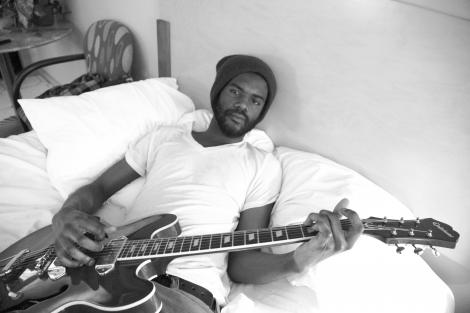
“Well you gonna know my name, by the end of the night,” Gary Clark Jr. sings during his take off Jimmy Reed’s blues classic, “Bright Lights, Big City.” The Animals, Rolling Stones, Clapton, Dylan –  many have had their take on it, but Clark flipped the tale of urban intoxication, giving it extra bravado and, with a notable performance at the Crossroads Guitar Festival 2010 and resulting Warner Bros record contract, turned it into an announcement of his own impending stardom (with risks involved).

As Clark Jr. walked out onto the stage of the Great American Music Hall Wednesday night it was clear that “Bright Lights” had been working given that the sold out crowd not only knew who he was, but readily sang him “Happy Birthday.” Of course Clark, turning 28, has had plenty of time to build up a following. At 17, in his home of Austin, TX the mayor was already proclaiming a Gary Clark Jr. Day, on account of his prodigious and heralded guitar skills.

It was those skills that people came out to hear at the Great American, and that’s what they got. There’s a lot of ways someone like Clark could go, but at this point in his career, Clark is still more of an old school, straight ahead blues rockers than successful popular contemporaries like Jack White or the Black Keys’s Dan Auerbach.

Clark opened the night with a couple tracks from his The Bright Lights EP. With “When My Train Pulls In,” he set a simple rule – the length of the songs would be less structured around the verses and would instead go as long as he wanted to solo. That one’s a bit heavier and slow, but he followed it up with “Don’t Owe You A Thang,” a catchy number built from some Bo Diddley-esque guitar playing. Clark would alternately double time or halve the solos, but kept the number well balanced by coming right back in with forceful vocals right before a shift in beat.

As he worked through a set that consisted of some covers and some originals, it was clear that Clark was experimenting with a number of styles, with mixed results. Compared to the confidence on display in “Don’t Owe You A Thang” and “Bright Lights,” the fluttery soul piece, “Things Are Changin’” had a John Meyer quality to it that I found unappealing. Almost reading my mind, Clark finished playing the number and said, “So enough of that sweet soft stuff, we’re about to get crazy up in here.” After a noisy intro that recalled another Austin guitar hero, Eric Johnson, the band started breaking the beat down more, playing “If You Love Me Like You Say,” with a big funky drummer solo, over which Clark pulled out some tricked out technique that sounded more like scratching on vinyl than anything I was expecting.

After a set involving a couple of real stretched out numbers, Clark met expectations with “Bright Lights.” But as he walked off stage it seemed like a number of people either had enough or got what they wanted, not waiting for the encore. People still called for it, though, and the guitarist returned, first without his band, saying “I want some alone time with you guys,” softly playing a couple songs. Anyone who left missed out, as the band came back on stage to closed the night with Curtis Mayfield’s “Move On Up.” It’s a song that’s hard for almost anyone to cover, particularly if they lack a really good horn section. But at Clark Jr.’s hands, it didn’t seem like anything was missing.

1. When My Train Pulls In
2. Don’t Owe You A Thang
3. ?
4. Please Come Home
5. Things Are Changing
6. If You Love Me Like You Say (Albert Collins)
7. 3 O’Clock Blues (Lowell Fulson)
8. ?
9. Bright Lights
Encore
10. When The Sun Goes Down
11. Freight Train (Elizabeth Cotten)
12. Move On Up

Openers:
Aren’t there a lot of bands right now with White Something as their name? In any case, when the White Buffalo finished its set, someone next to me remarked “Man, I wish there were encores for openers. I could go home right now and been glad I heard that.” For my part I could have stood to hear some more of the first opener, White Dress, particularly the twangy, smoky voice of Arum Rae, who seems to do equally well with or without accompaniment.

Burning Man winners: theme camps, and maybe ticket scalpers

35

Burning Man organizers faced at least two serious problems created by its flawed new ticketing system, and they chose to deal with just one of them yesterday in announcing that the open sale of the final 10,000 tickets would be canceled and those tickets would instead be sold through the theme camps, art collectives, and volunteer groups that make Black Rock City what it is.

But Black Rock City LLC has decided not to address – at least not yet – its other major problem, which was scalpers and ticket agencies gaming the new ticket lottery to snap up tickets and sell them for huge profits. I and many others have long suggested the LLC register tickets to individual buyers and regulate their exchange to prevent gouging, and after announcing the new system last night, the company got such fierce criticism from online commenters arguing that point that it felt compelled to amend the post a few hours later to address the issue.

“If we don’t fill the holes in the social fabric, who cares about the scalpers, because then we’ve got nothing,” Marian Goodell, the LLC board member who authored last night’s announcement, told me this morning, explaining the emphasis on theme camps.

Without ensuring the city’s art, entertainment, and infrastructure gets build, Burning Man could suffer a fatal blow to its reputation, she said, making the theme camp decision a tough but necessary one. But creating what she called “identity-based tickets” is a far more complicated issue, and she just doesn’t think the scalper problem is as big as many burners believe.

But she doesn’t know for sure. “Nobody knows, it’s all speculation,” Goodell said, and that’s part of the problem. All they really know is demand for tickets this year far exceeded anyone’s expectations – Goodell will only confirm that there were 80,000-120,000 requests for the 40,000 ticket allocated on Feb. 1 – and that tickets often sold for double face value last year after the event sold out a month early for the first time in its 25-year history.

“Is it 100 people or 1,000 people that are going to take advantage of the community, and can we just discourage that?” Goodell said of the number of multiple-ticket-buying profiteers, reiterating her hopes that burners will starve out the scalpers by refusing to pay more than face value for tickets, which is part of the culture’s ethos.

And if it’s just 100, or even 1,000, she said it might not be worth it for the LLC to require the 40,000 people whose tickets will be mailed in June to register by name and to try to bar entry to those whose tickets don’t match their names, particularly given the chance for human error and the remoteness of this temporary city. “How do you punish them? What do you do?” she said, noting that the LLC has delayed the decision on registration while it gathers more information.

But what if the profiteers have managed to wrangle 10,000 tickets? Some bloggers out there have demonstrated how easy it is to generate multiple credit card numbers and argued that scalpers must have done so, despite the LLC claims to have ferreted out the obvious scalper scams before tickets were awarded. “There’s no way it’s 10,000,” Goodell said confidently, although she was also confident that this system would work well, and then that there would be enough extra tickets circulating in the community to satisfy most of the demand, which so far doesn’t seem to be true, with most theme caps reporting that less than a one-third of their members have scored tickets, far less in some cases.

Goodell and the LLC are counting on the STEP ticket exchange system whose registration launches on Feb. 29, but the details of that also generated controversy last night and forced Goodell to say it may still tweak the system. It allows people to sell back their unwanted tickets, with the LLC covering the normal $12 restocking fee. They will then be resold to people who register on a first come, first served basis, but they’ve decided to limit purchases to one per person and only to people who registered and were denied tickets on Feb. 1. Couples were irked that it punishes people who tried to buy two tickets at the main sale using only a single entry, so Goodell said they’ll take another look.

“We are trying to make the STEP system be fluid, so if there’s only a limited number of tickets available then more people can get them,” Goodell said. “We want STEP to work.”

But many burners just don’t think it will. Burning Man tickets have suddenly become a hotter commodity than ever, and even community-minded burners who aren’t seeking to make a profit will probably prefer to sell any extra tickets to someone directly, or to hang onto them for awhile, rather than give them up now to some random people who will then be forced to wait at the gate in the long will-call line, which is a new anti-scalping precaution that Goodell announced.

And then there’s the major thrust of yesterday’s announcement: distributing tickets through theme camps. I and most of the online commenters generally support that decision – at least as the best of a bad set of options – even though it’s certainly a controversial one that values one type of citizen over another and seems to fly in the face of the event’s principle of “radical inclusion.”

Yet it seems to be one that creates some difficult decisions ahead for the LLC. The criteria they laid out say the decisions will be made based on a camp’s history (both its longevity and record of leaving no traces of litter, which the LLC monitors in a very detailed way), what it offers to the city each year, and its adherence to the event’s 10 Principles.

Goodell confirmed my observation of how subjective that judgment will be – something that has spurred criticism that camps cozy with the LLC will get favorable treatment – but she said the large team of volunteers that work with theme camps and volunteer crews each year have already made many of those judgments and determined who will get tickets.

“We already did the math,” she told me. “Just because you’re a theme camp on the map doesn’t entitle you to x-number of tickets.”

While there may be about 700 registered theme camps in recent years, Goodell said the LLC is focused on getting tickets to camps that are truly interactive or offer entertainment, transportation, art, or volunteers to key functions such as the Lamplighters or Gate crew. “And we know who they are,” she said.

For everyone else, there are still a couple more chances to get tickets, beyond just the open market. There will be 4,000 low-income tickets (just $160) offered through a process that will likely be more competitive than ever, with registration beginning Feb. 29. And then there are the major art projects that receive grant funding and free tickets for crew members from the LLC, with the announcements of winners expected next month.

So now, burners and outside observers will just have to wait and see – first how the LLC’s solutions work, then this summer to see how the scalpers’ really did – as Burning Man muddles through what is proving to be a pivotal year.

Lackluster finish to case that made serious political charges

9

A jury awarded the City and County of San Francisco $24,498 yesterday following its deliberations of a complicated civil case filed by the city in 2003 against a minority-owned computer services company accused of fraud and breach of contract, a company that countersued with a claim of being harmed by top city officials.

But that paltry sum and the jury’s verdict of shared responsibility in failing to root out corruption in city government belied the more politically significant accusations made through depositions in the case that Mayor Ed Lee and former Mayor Willie Brown overrode city staff to give contracts to a “fraudulent” yet politically connected company, which proved to be a tangential issue that was left largely unexplored at trial.

In CCSF vs. Cobra Solutions, the jury found that both the city and Cobra Solutions failed in their responsibilities to prevent a former Department of Building Inspection information technology manager, Marcus Armstrong, from fraudulently bilking the city out of at least $482,000 between 1999 and 2001. An alleged Armstrong accomplice, Government Computer Sales, Inc. – which witnesses said Brown and Lee improperly certified, and which they say they don’t remember – fled and was never brought to justice.

Cobra Solutions, which was awarded master contract status in 1998, was bound by a provision in its agreement with the city that required Cobra to “supervise” sub-contractors. The allegation of fraud against Cobra, however, was effectively dropped from the city’s complaint, but not until the end of the trial when consideration of fraud was omitted from the city’s closing arguments.

The award to the city was the difference between the monies paid by the city to Cobra Solutions ($269,739.93) and the monies paid by Cobra Solutions to Armstrong’s phony companies ($245,241.93), or the markup Cobra Solutions received from the city following the submission of several fraudulent invoices from two phony sub-contractor companies, Monarch Enterprises and Mindstorm technologies, set up by Armstrong.

Following the verdict announcement, a juror who did not want to be identified, said there wasn’t a single piece of evidence that was most compelling, but that, “the city proved its case. Cobra failed to prove its case.” The “vast majority” of jurors shared that opinion, the juror said. “It wasn’t even close.”

“The jury thought there was obviously a failure to supervise,” the juror continued. “[Cobra Solutions] took on work without even knowing who the party was that was working for them. Who was Monarch?”

Several invoices from Armstrong’s phony companies contained different addresses that the juror described as “a bit of a red flag.”

“If I’m in business, I’m not going to have someone working for me who I don’t know, and I’m not going to be paying them checks,” the juror said.

“The city also bore responsibility” in its failure to detect Armstrong’s kickback scheme, the juror said, mirroring the same sentiment echoed by then-City Controller Ed Harrington, who took the stand and conceded the city’s internal controls – as well as those of Cobra Solutions – failed to detect Armstrong’s kickback scheme.

Cobra had sought damages for breach of contract (the city’s failure to pay monies owed Cobra) and due process violations in connection with the city’s alleged debarment of Cobra from doing further business with the city.

“I’m disappointed,” said Cobra Solutions founder and president James Brady. “Life goes on. We’ll continue to move forward and repair our damaged reputation, raise our grandchildren, and focus on our families.”

Asked about the issue of sub-contractor supervision, Brady said, “I don’t think anybody could supervise a con man and the city was negligent in hiring this guy – they wouldn’t even bring him in the courtroom – so it’s just betrayal. And it’s a sad day that you hire con man and you won’t take any responsibility for his actions and you blame the small business. That’s not the American way.”

On the jurors finding that Cobra was not intentionally or defacto debarred from doing further business with the city, Brady said, “I think they got it wrong. I have no doubt about that.”

“The jury missed a lot of important facts,” said Mr. Brady’s wife, Deborah Brady, a co-founder of Telecon, the parent company of Cobra Solutions. The city had originally sued Telecon in its case-in-chief, but pursued no claims against Telecon at trial. “I don’t know how they missed them, but they missed them.”

Ms. Brady said the city gave another company, Desktop, the opportunity to defend itself against debarment, but “they never gave us that opportunity.”

“Judith Blackwell, she told the whole story in terms of Monique Zmuda saying they wanted us out, that we’re crooks,” Ms. Brady continued. “They accused us… and never gave us the opportunity to respond, ever.” Monique Zmuda is the deputy City Controller.

“I feel really betrayed by a city that I used to really love and [City Attorney] Dennis Herrera, who is our private attorney, betrayed us,” a tearful Ms. Brady said. “Ed Lee, who claims he barely knew us, betrayed us. Ed Harrington? I don’t know what that was all about, or Monique Zmuda… but Ed Lee and Dennis Herrera, they let down really good people who used to live in this city and loved this city and did all that we could to do good in the community and this city. “

“So I pretty much call it, ‘The City of Betrayal.’”

Cobra’s lead counsel in the case, Whitney Leigh, told us, “The jury made its decision. We’re concerned that the jury was allowed to find that Cobra could have breached the contract by refusing to submit to an audit by the City Attorney. So we believe there are some issues that need to be researched, so we’ll be looking at those issues.”

Asked if there would be post-trial motions, Leigh said, “Post trial motions and/or appeal.”

“Obviously we’re disappointed,” Leigh added, “but we’ll review the transcripts and see what options are available.”

Because of the possibility of an appeal, Herrera was unable to comment on the verdict or to discuss city’s costs in trying the case, said Herrera spokesperson Matt Dorsey.


Live Shots: Surreal Valentine’s re-wedding at Eternity Ball

2

Photos by Bowerbird Photography

For Valentine’s Day, Sam Love and I celebrated by going to one gigantic wedding reception. Oh wait, there was a wedding ceremony too. Actually a re-commitment ceremony, where a popular SF wedding officiant, Cynthia Gregory, in her formal black robe, honored a husband and wife’s 20 years of marriage together and blessed them and their continued union. The bride still fit in her wonderfully fluffy satin wedding dress a-la 1992, cinched tight in the back with a gigantic bow.

Weddings are expensive. Tickets to the Eternity Ball, were steep, at $150 a pop, adding to the feeling of a genuine wedding experience. But also like a wedding, any second doubts or financial jitters could be easily soothed with an open bar, and then liberated on the dance floor with a good shake, to all the best 1980s cover songs by some fine Bay Area wedding crooners.

I have to say, I was a bit nervous that the event would be a snooty, swanky affair, but despite the fact that the invitation suggested tuxedos, ball gowns, and wedding dresses as appropriate attire, it was really just another excuse for San Franciscans to do what they do best: dress up and go wild.

One bride sported a pink wig, and her groom wore a black top hat over his flowing dreadlocks. A posse of about six ladies dominated the color palette in their fire engine red, polka dot country girl dresses. Way back in 1985, one of the women bought the dresses at Gunny Sacks for two dollars each. She wrapped them in boxes and told her girlfriends to come over for a surprise, and to bring their pearls. They opened their “gifts,” and after some adjustments, went out on the town, looking perfectly matchy-matchy.

The dresses still fit and come out once or twice a year. This time, the ball gave them a chance to be instant bride’s maids. Besides dancing, costumes, music and drinks, there were space-age edibles to nibble, like mac-and-cheese served in a flying saucer and truffles floating on liquid nitrogen. The whole evening was rather surreal and amazing, much like a wedding party dancing in a house of mirrors, and fueled with a bottomless supply of booze.

But there was one thing missing … where was my slice of wedding cake?

Valentine’s Day dump the banks rally: If only all break-ups involved this much singing (VIDEO)

7

Protesters across the country participated in “break up with your bank” day on Feb. 14. Several protesters happened throughout the Bay Area, including a demonstration organized by Causa Justa :: Just Cause, Occupy Bernal, Occupy SF Housing, and the San Francisco Tenants Union.

In past months those organizations have variously stopped evictions and foreclosures, prevented homes from being auctioned off, and organized mass protests. They’ve created trouble shutting down bank branches, sometimes for hours, on dozens of occasions.

For Valentine’s Day, protesters decided to have a little fun.

“Our intention is not to shut down the banks,” insisted Causa Justa organizer Maria Zamudio. “Just to break up with them.”

About 60 marched through the financial district Feb. 14, presenting large red broken hearts and “dump the banks” banners decorated with pink balloons.

http://www.youtube.com/watch?v=6-f6pHXQkbs

Security guards at the banks that the group approached locked their doors. Protesters, amused, began chanting “the banks shut themselves down.”

Bank of America building locked their doors when they saw the protest approaching. At the Wells Fargo west coast headquarters around the corner, a representative who identified himself as David accepted the card.

Afterwards, a dozen members of the group headed to City Hall for a Board of Supervisors meeting in support of a resolution brought by Supervisor John Avalos and co-sponsored by Supervisor Eric Mar. The resolution supports the city treasurer’s office in its recent efforts to include social responsibility and community reinvestment in its evaluation criteria as it searches for new banks in which to invest San Francisco’s money. The resolution passed.

“It’s not a victory, but a great step in the right direction,” said Zamudio. She hopes that the social responsibility assessment will look at a bank’s history with predatory loans, investment in small businesses, and refinancing mortgages.