SFBG Blogs

Editorial: The case against the 8 Washington tower

27

Editorial note: In 1971, at the height of the Alvin Duskin anti-highrise battle, the Guardian did a special first ever cost benefit study for high rise office development.

We found that highrises cost the city  more in services than they produce in revenue.  This meant that the commercial high rise boom could be fought on economic grounds, not just aesthietic and environmental grrounds, and the Chamber of Commerce/Big development gang could never adequately refute our findings.  In fact, they are now taken for  granted. So, as the 8 Washington battle is poised to open the floodgates even further for a forest of market rate residential  buildings, it’s time for the city to do its own study to determine the economics of high end  residential buildings.  Does the cost of servicing luxury residential buildings exceed the taxes they pay? We and many others in the neighborhoods are certain that market rate housing doesn’t pay for itself. But the facts are needed and so we urge the supervisors to direct the budget analyst or the city economist to do a similar analysis  for luxury condos.  Below is Executive Editor Tim Redmond’s powerful argument against 8 Washington.

By Tim Redmond

tredmond@sfbg.com

In city planning terms, it’s a fairly modest project: 134 condos, no buildings more than 12 stories tall, on a 27,000-square-foot site. It’s projected to meet the highest environmental building standards and offers new open space and pedestrian walkways. It’s near Muni, BART, and ferry lines. And the city will collect millions of dollars in new taxes from it.

But the 8 Washington project, which will come before the Planning Commission March 8, has become a flashpoint in city politics, one of the defining battles of Mayor Ed Lee’s administration — and a symbol of how the city’s housing policy has failed to keep pace with the needs of the local workforce.

Put simply, it will create the most expensive condos in city history, housing for the richest of the 1 percent on the edge of the waterfront — and will further push San Francisco toward becoming a city that caters almost entirely to the very wealthy.

So in a city where the growing divide between the 1 percent and the rest of us has become a central issue and where the lack of affordable housing is one of the top civic concerns, 8 Washington is an important test. By any rational standard, this sort of development is the last thing San Francisco needs.

But some of the best-connected lobbyists in the city are pushing it. One of the mayor’s closest allies, Chinatown powerbroker Rose Pak, is a leading advocate — and the final outcome will say a lot about city politics in the Lee administration.

There are all sorts of half-truths and misleading statements by supporters of 8 Washington. Here are the five main reasons the project shouldn’t be approved.

1. It fills no housing need. San Francisco has no shortage of housing for the very rich; the dramatic need, outlined in both regional planning documents and the city’s own General Plan, is for low- and moderate-income housing for the people who actually work in this city (see “Dollars or sense?” 9/28/10). While San Francisco is getting richer by the day, the core workforce — public employees, workers in the hotel and restaurant industry, service workers, construction and trade workers, and a majority of the people in the lower levels of the finance and tech sector — are being priced out of the city. That means more people working here and living far out of town, often commuting by car, in what everyone agrees is an unsustainable situation. Meanwhile, more and more high-paid workers from Silicon Valley are living in San Francisco — again, commuting to distant jobs, either by car or by corporate bus.

The city’s General Plan states that some 60 percent of all new housing built in the city should be below market rate. San Francisco desperately needs housing for its workforce. This type of project simply puts the city deeper in the hole and further from its housing goals.

2. It’s a reward for bad actors. The main developer of this project is Simon Snellgrove, but one of his partners is, by necessity, Golden Gateway, which owns a significant part of the land — and which has been flouting at least the spirit if not the letter of city and state law and costing San Francisco tens of millions of dollars.

As project opponent Brad Paul has noted in written testimony, when Timothy Foo, the current owner, bought the complex from Perini Corp. about 20 years ago, he used a loophole in state law that allowed him to avoid a formal transfer of ownership. That means the property wasn’t re-assessed, costing the city about $1.5 million a year. According to the Assessor’s Office, the deal wasn’t illegal (and these tricks to avoid reassessment are relatively common) but still: He’s costing the city millions by using a loophole not available to most people.

Golden Gateway, which was built in a redevelopment area as middle-class housing, is now renting out apartments as short-term tourist or corporate rentals. There are dozens of examples right now on Craigslist. City law bars the owners of rental housing from converting it to hotel rooms, but a loophole in that law makes what Foo’s outfit is doing technically legal. But he’s clearly violating the spirit of the city ordinance that seeks to protect rental housing from hotel conversions.

One of the main aesthetic complaints about the area — something Snellgrove’s lobbyists have tried to use to support the project — is the ugly fence that now surrounds the Golden Gateway Tennis and Swim Club. But who do you suppose put that fence there?

Do we as a city want to be giving special zoning benefits to companies that try to circumvent tax and housing laws?

3. It’s an environmental disaster. Snellgrove and his architects, Skidmore Owning and Merrill, are seeking LEED platinum certification for the project, saying that its energy-efficiency, water use, and green building materials will make it one of the most sustainable structures in San Francisco. It is, the project website notes, close to all types of public transit.

But LEED doesn’t take into account what the building is used for (see “Is LEED really green,” 7/5/11) — and in this case, the use makes a huge amount of difference.

People who buy multi-million-dollar condos don’t tend to take Muni or BART when they go places. That’s not conjecture, it’s a proven fact. A 2008 study by the American Public Transportation Association notes, bluntly, that wealthier people are more likely to drive cars. When you move into the stratospheric regions of the ultra-rich, that’s even more true. A 2011 report on the Charting Transport website notes: “The very rich tend to shun public transport.”

The current zoning in the area allows for one parking space for every four residential units. Snellgrove is asking for one space per unit — in other words, he figures every single buyer will have a car.

Many of the people who buy these condos won’t be working or even living most of the time in San Francisco. These are condos for world travelers, second and third homes for people who want to spend a few weeks a year in San Francisco. “They aren’t going to be living here all year,” Christina Olague, a former Planning Commission member who is now the District 5 supervisor, told us last July.

If five of the 165 residents of 8 Washington fly in a private or corporate jet from, say, New York to their SF pad once a month, the project will cause the use of jet fuel equivalent to what a normal family would use driving a car for 330 years, Paul noted.

“How many solar panels are needed compensate for burning 396,000 gallons of jet fuel a year?” he asked.

Then there’s the construction issue. If the developer’s projections are correct, as many as 20,000 dump truck runs will be trundling along the Embarcadero for several months, one every two minutes — and it could be happening right as the traffic nightmare called the America’s Cup is hitting the waterfront.

It also goes against some 40 years of waterfront planning policy, all of which as focused on downzoning and creating open space. This would be the first upzoning of San Francisco waterfront property in decades.

4. It will wipe out what is mostly a middle-class recreation facility. The Golden Gateway Tennis and Swim Club will be closed for three years, then (possibly) reopened later as a smaller facility. The club — with two outdoor pools and six tennis courts — sounds like something for the elite, and it’s managed by the upscale Bay Club, but a lot of the users are longtime Golden Gateway residents and seniors. “I would say 30 or 35 percent of the users are seniors,” Lee Radner, chair of Friends of Golden Gateway, told me. Most, he said, are middle-class people, and the expense isn’t that high. “My wife and I pay $3 a day to use the pool,” he said. “I swim every day, and it would cost more than that to use the public pools in the city.” He added: “There are some wealthier people, of course, but many of us are retired and on fixed incomes.”

We’re talking about 90,000 total square feet of outdoor recreation space — which dwarfs the 20,000 square feet of open space the developer promised to provide.

5. The city doesn’t get much out of the deal. In exchange for upzoning the waterfront, creating a big all of buildings and screwing up the city’s housing balance, what does the San Francisco general fund get? Not a lot. The estimates for new tax revenue run about $1.5 million a year of the next 60 years — and when you translate that to what economist call “net present value,” the cash equivalent today of that revenue stream, it’s about $30 million. The Port of San Francisco is talking about creating a special infrastructure financing district — sort of the equivalent of a redevelopment area — to pull that money out in advance, which may not even be legal (since part of the land is a former redevelopment area, the state law that allows these special finance districts may not apply). But even so, a Jan. 14 Port memo suggests that the agency has plans to spend all that money on its own infrastructure — setting up a potential battle between the supervisors and the Port Commission over where the money, if it actually can be collected up front, will go.

Like any developer, Snellgrove will pay into the city’s affordable housing fund — in this case, about $9 million to pay for the equivalent of 27 units. No affordable units will be on site, of course; that would detract from the uber-wealthy ambience of the place. And it’s not clear when those units would be built. “Nobody builds 27-unit buildings any more,” Paul, a former deputy mayor for housing, said. “We’ll have to wait until there’s enough money for a bigger project, somewhere, sometime down the road. That’s what we’re getting here.”

Either way, it’s not a huge benefit for allowing this disaster of a project — and it’s a terrible statement for San Francisco to make. At a time when the mayor has cleared the Occupy protesters — who are talking about how little the rich pay in taxes — off the waterfront, the city is preparing to move in the exceptionally rich, who aren’t paying anywhere near their fair share in tax revenue to local government.

(Nobody knows for sure whether the costs of servicing high-end residential exceed the revenue the city gets from property taxes. In 1971, the Guardian put together the first-ever cost-benefit study for highrise office development, which showed that commercial buildings cost the city more than they paid; that’s been confirmed and demonstrated over the years to the point where it’s hardly even an argument any more. The supervisors ought to ask the city economist or the budget analyst to do the same sort of analysis for luxury condos.)

There’s another element here: Mayor Lee made a point during his campaign to say over and over again that he was an independent thinker, that powerful and influential allies like Rose Pak would not be calling the shots at City Hall. This will be his first major test: Pak and lobbyist Marcia Smolens are working hard to promote 8 Washington. And we’re already getting some disturbing signals out of the mayor’s office.

Lee told us that he has “no thoughts” about the project and hasn’t been paying any attention to it. That’s an odd stance, considering that his own Port Commission is pushing it and staffers in his office are working with the developer. This is a big priority for Pak, and the notion that she has never mentioned it to the mayor defies reason. Board President David Chiu, who talks to the mayor regularly, opposes the project, which is in Chiu’s district.

It’s hard to imagine that anyone who pays attention to local politics could be missing what will be one of the landmark votes this spring on the Planning Commission — which will take up the project March 8 — and the Board of Supervisors.

The mayor, may, indeed, be ignoring everything that supporters and opponents of 8 Washington have said and may be waiting until the Planning Commission vote to take a position. But if he’s just ducking questions because he’s planning to support it, he’s making a big mistake.

This is a chance for San Francisco to go beyond the platitudes about building housing, go beyond the hype about “green” buildings, see through the fraud about community benefits and consider what this really is: A special favor for a developer who wants to cater to the top 1 percent of the 1 percent and move San Francisco even closer to being a city of, by, and for the elite. The only reasonable vote on 8 Washington is No.

C’mon inside “Silent House” with co-director Laura Lau

0

Yep, it’s another remake of a foreign horror movie — but Uruguay’s La casa muda is obscure enough that Silent House, which recycles its plot and filming style, feels like a brand-new experience. Co-directors Chris Kentis and Laura Lau, last seen bobbing in shark-infested waves for 2003’s similarly bare-bones Open Water, apply another technical gimmick here: Silent House appears to be shot in one continuous take.

Though it’s not actually made this way, each shot is extraordinarily long — way longer than you’d expect in a horror film, since the genre often relies on quick edits to build tension. Instead, the film’s aim is “real fear captured in real time” (per its tag line), and there’s no denying this is one shriek-filled experience.


The dwelling in question is an isolated, rambling lake house being fixed up to sell by Sarah (Elizabeth Olsen), her father (Adam Trese), and uncle (Eric Sheffer Stevens). The lights don’t work, the windows are boarded up, most doors are padlocked shut, and there are strange noises coming from rooms that should be empty. Much of the film follows Sarah as she descends into deeper and deeper terror, scrabbling from floor to floor trying to hide from whoever (or whatever) is lurking, while at the same time trying to bust her way out. Though the last-act exposition explosion is a little hard to take, the film’s slow-burn beginning and frantic middle section offer bona fide chills.

I caught up with the Tiburon, Calif.-born, New York-based co-director and writer Laura Lau just prior to Silent House‘s release.

SFBG: Like Open Water, which used a minimal crew and took place, for the most part, in the middle of the ocean, Silent House combines a streamlined story with a complicated technical set-up — the illusion of one long take. What do you think attracts you and co-director Chris Kentis to these types of films?

Laura Lau: I think it’s true that we want to challenge ourselves as filmmakers. We don’t want to repeat what’s already been done. We want to try and do things that are different — that makes it interesting for us. I think that’s absolutely true about both of these projects. Each one of them had its own really unique challenges. But of course it’s all about telling a story, and what it is that, emotionally, creates a reaction in us. Both of these films were really about certain kinds of horrors, true horrors that really spoke to us and we wanted to make films about.

http://www.youtube.com/watch?v=Wc7-biVJlJQ

SFBG: And just to clarify, Silent House is not really one continuous shot. You did cut sometimes.

LL: Yes. It is a seamless, continuous shot, and the experience for the viewer is that it is one continuous take. However, to achieve that we did that in very long takes, but they were different shots that we stitched together.

SFBG: But the takes are, as you say, a lot longer that what you would see in an average film.

LL: Absolutely. And not only that, but all of the sort of usual filmmaking tools that you have were taken away from us. We didn’t shoot any coverage at all. Usually, you go on a film shoot and you shoot a lot of coverage, and then you go and make your movie in the editing room. In our situation here, we had to make all those decisions ahead of time; what we shot was what we had. And all of the usual ways that you would control pacing, revealing information, even sculpting performances were taken away from us.

SFBG: The lighting appears to come only from on-set sources, mostly flashlights. Was this really what happened?

LL: Well, the whole house was pre-lit from above, and it was all on a dimmer board. We had a dimmer board operator who had to ride those lights. That was one of the elements that made it tricky, because not only was there performance and camera choreography, but there were elements like the lights, like the [assistant director] department hitting cues, like props. All of those things that were critical to actually getting the shot the way we wanted it — if any one of those elements went awry, we would have to start over again.

SFBG: Did you do a lot of rehearsing?

LL: We did. After I had written the script, and then, once we had gotten the location, I re-wrote the script. And then Chris and I just started to run the movie from top to bottom. I would actually just act out Sarah’s part, and we could run it over and over again. Especially since the script was like, 60 pages, so it was short for a feature, and there was a lot of trepidation about whether it was feature-length. Which it was, but nobody knew, because nobody in our crew had made a movie in this way, and of course [neither had any of the] producers. So, there was that process of Chris and I basically running it through, and our [director of photography], Igor Martinovic, came on, and we ran it with him. And then we went into rehearsal. We had two weeks of rehearsal with the actors, and then we had three weeks to shoot the movie. We had 15 days.

SFBG: Martinovic has a lot of documentary experience (2010’s The Tillman Story; 2008’s Man on Wire). Did that play into your decision to work with him on Silent House?

LL: Absolutely.

SFBG: Silent House isn’t part of the “we’re filming ourselves!” trend in films right now, but it has some similarities to those types of movies.

LL: I can see why you would say that, and I think it’s because the continuous shot is entirely coming from one person’s experience. Since there’s no cutting, you really are trapped with this character, who is trapped in a nightmare, in a terrifying situation. We hope that the experience is that you really feel like you are there with her as she’s going through this.

SFBG: How did you approach building tension and suspense within the continuous shots?

LL: I think that actually the continuous take is what really builds the tension. If you can’t release yourself, and there’s no cutting, I think it just builds the intensity. You can’t get away from this character and you can’t get away from her experience. I think that the story I wanted to tell with this technique of the continuous take was really about one woman’s experience. It’s about her experience and what it is that she’s going through.

SFBG: How did you cast Elizabeth Olsen as Sarah?

LL: We had been working with casting directors Kerry Barden and Paul Schnee on previous projects that we’d been trying to get off the ground, and as soon as they read the script, they said, “Oh, we know who Sarah has to be.” They had cast Jennifer Lawrence in Winter’s Bone the year before. So [Olsen] came in as the girl our casting directors had already cast, and they were right! She had the charisma and the luminosity and the depth, because again, this is a film where we knew that we were going to be watching one character, and she had to be somebody that we wanted to watch, and somebody that we would care about.

SFBG: A lot of what’s scary about Silent House are the unseen elements, including mysterious noises throughout the house. Did you choreograph the sounds as carefully as the lighting and performances?

LL: Yes, of course, the sound and the score were all part of the design of conveying Sarah’s experience. What she was going through, throughout the film. So everything was working together through the entire film.

SFBG: You mentioned earlier that you’re interested in making movies that don’t repeat what’s already been done. Silent House is a remake, but the source film hasn’t been seen in the U.S., has it?

LL: No, it has not. And I think the last time a film that was a continuous take has been seen by American audiences was Hitchcock’s Rope, in 1948. It’s been a long time. It really is a very different cinema experience, we think. And Rope is not a horror movie. It’s a very different genre. It feels very theater-like; all of the action takes place in two rooms, it could really almost be like a theater stage. It’s quite different from our film. We were just thrilled when we were offered to do the remake, because it was really an opportunity to do something different. And how often do you get to actually do something different?

Silent House opens Fri/9 in Bay Area theaters.

Food-truck battle at the board of supes

14

The supervisors are weighing in on a state bill that would ban food truck from parking within 1500 feet of schools — and it’s really tricky.

Let’s start with a bit of reality: My kids go to public schools, my son’s in middle school, he rides Muni home — and there’s ample opportunity for him to buy some really nasty stuff. There’s a 7-Eleven a couple of blocks from his school, and kids walk over there all the time and buy those disgusting 32-ounce sugar bombs. If a truck selling chips and soda and greasy tacos showed up at 3:30 p.m., the kids would be lined up to spend the money their parents though was going for a nice healthy lunch.

And the trucks would go there, if they could, the same way the ice cream trucks used to cruise through my suburban neighborhood in the 1960s (yeah, I’m old, old, old) in the late afternoon, when they could guarantee America’s children would be hungry and ready to spoil their supper.

But they can’t, see, because San Francisco already bans food trucks from within 1,500 feet of a public middle school or high school — which is a pretty broad zone.

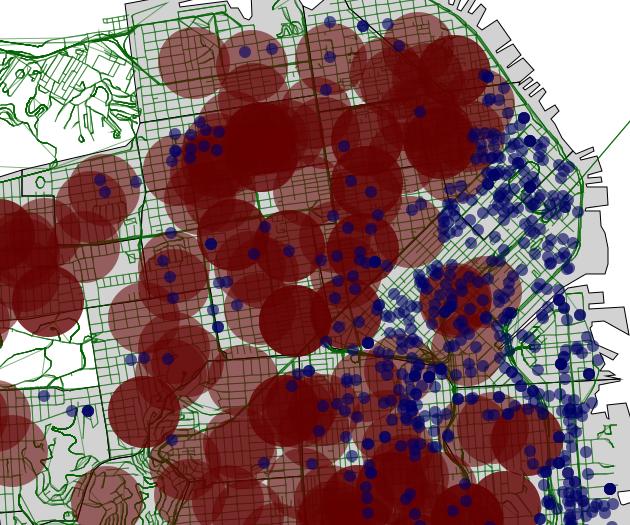
Now Assemblymember Bill Monning has introduced a bill that would make that ban statewide — and would include middle schools and private schools. Sounds good, and some healthy-food advocates love it. But San Francisco’s a little different than, say, Hayward or Fresno — this is such a dense city that there are schools almost everywhere. If you ban food trucks from within 1,500 feet of all schools, then you ban them from about 80 percent of the city. Burrito Justice has a great set of maps that give you the picture (burritohibition!)

The maps also suggest the problems with banning anything from within 1,500 feet of a school in San Francisco. Pot clubs, liquor stores, sex clubs … there are all sorts of places where you really don’t want your kids hanging out, but if you make those broad exclusions, you force them all into a very few small areas (including northern Soma, the waterfront and Bayview) and that’s not exactly fair, either. Should all the food trucks in the city be congregated in those crowded places that fit the 1,500 foot rule?

My 10-year-old daughter walks through the heart of the Castro, which is probably within 1,500 feet of her school, and there’s some stuff in the storefronts that isn’t exactly age appropriate, and we deal. She asked me once why people were walking around naked, and I said “because they like to,” and she shrugged and that was that.My 12-year-old son knows that people smoke pot and that it’s legal for adults to use as medicine; I don’t think the notion of him walking past a well-regulated dispensary is going to make him any more (or less, god help me) likely to try some for himself some day.

So I’m kind of with Sup. Scott Wiener, who wants the city to oppose the Monning bill — not because I want trucks selling Doritos out in front of Aptos in the afternoon, but because I think San Francisco already prevents that, and 1,500 feet is way too much for a city this size. Maybe amend the bill to allow cities to make their own rules, but have the state rules apply if they don’t. Maybe allow cities beyond a certain density to change the distance to 500 feet.

Maybe think a little more about what it really means to ban things because they’re close to schools. It doesn’t always make sense.

PS: Actually, I’m thinking maybe we should ban all multimillion-dollar condos from anywhere within 5,000 feet of a school. Exposing the impressionable minds of small children to such graphic, disgusting, ostentatious displays of wealth has to be bad for them. Worse than seeing a sex club, anyway.


15 lipsmacking cocktails for $5 and under

0

Screw on your drinking hats, cheapos — we tracked down 15 watering holes that’ll leave you toasted, in a financially stable kind of way. 

1. Tempest Bar’s $5 boilermaker

A shot of Jim Beam in a pint of PBR. Is this a terrible idea? Yes. Should you do it anyways? Yes. 

431 Natoma. (415) 495-1863

2. Phone Booth’s $4 tequila sunrise 

It’s a small place, but is embellished with awesome décor, cute bartenders, an eclectic mix of people, and really strong, cheap drinks. Their jukebox will have you coming back for more.  

1398 S. Van Ness, SF. (415) 648-4683


3. Moby Dick’s $6 2-for-1 margaritas 

Put both straws in your mouth, ease in to your brain freeze, and distract yourself with any of the three music videos playing on the screen overhead — a flawless solution for the worst of dates. 

4049 18th St., SF. (415) 861-1199, www.mobydicksf.com


4. Edinburgh Castle Pub’s $5 Jameson and coke 

It kind of looks like a barn — and this isn’t necessarily a bad thing. It’s a dive bar with a second floor, and is a fun place to go with a big group of friends.  

950 Geary, SF. (415) 885-4074, www.castlenews.com


5. Gold Cane Cocktail Lounge’s $4 bloody mary

The back patio here makes you forget you’re in a bar and feel like you’re in someone else’s backyard. The bartenders are sweet, the regulars always have a crazy story or four to share, and there’s free books in the back. 

1569 Haight, SF. (415) 626-1112


6. Butter’s $5 trailer tea 

Trailer tea, for those who were wondering, is sweet tea vodka. Butter also serves Prom Night punch in mason jars and has deep-fried Twinkies and SpaghettiOs. 

354 11th St., SF. (415) 863-5964, www.smoothasbutter.com 


7. You See Sushi’s $2.75 hot sake 

Now you see it, now you don’t. Your third round of sake will bring a whole new meaning to the restaurant’s name. 

94 Judah, SF. (415) 681-4010, www.youseesushi.com 


8. The Blue Light’s $3 SF Giant’s shot 

There’s not as much blue light as you think there would be, which is kind of disappointing. But their SF Giant’s shot — Harlem liqueur mixed with orange soda — will make you forget all of that anyway. 

1979 Union, SF. (415) 922-5510, www.thebluelightsf.com 


9. Delaney’s $4 vodka cranberry

A wonderful breath of dive bar air away from the typical Marina bars. Fully quipped with a jukebox, popcorn machine, and a Galaga/Pacman sit-down video game. 

2241 Chestnut, SF. (415) 931-8529 


10. Tornado’s $5 pomegranate cider 

This is a no-nonsense kind of bar. Know what you’re going to order, grab your drink, and gulp it down with a sausage from Rosamunde next door. 

547 Haight. (415) 863-2276, www.tornado.com


11. Lucky 13’s $4 whiskey sour

This dimly lit bar has cheap drinks, a good looking juke box, and free movie-grade popcorn (think butter). And the cutest dogs show up too.  

2140 Market, SF. (415) 487-1313 


12. Mission Bar’s $4 Manhattan

The red “BAR” sign that hangs outside lets you know this place gets straight to the point. Forget about names, just drink your drink. 

2695 Mission, SF. (415) 647-2300 


13. Specs’ Twelve Adler Museum Cafe’s $5 dirty vodka martini 

Postcards from around the world adorn the walls, a bluesy pianist playing in the corner, and an old school vibe that will take you back. 

12 William Saroyan, SF. (415) 421-4112 


14. Pittsburgh’s Pub’s $4 Ketel One and tonic 

If you ever fall asleep on the N-Judah and end up at the end of the Muni line, pick yourself up with any of the many cheap drinks at Pittsburgh’s Pub. 

4207 Judah, SF. (415) 664-3926 


15. Lexington Club’s $1 Margarita Fridays 

The only time it is perfectly okay to drink five margaritas in one sitting is at Lexington before 10 p.m. on Fridays. 

3464 19th St., SF. (415) 863-2052, www.lexingtonclub.com

Cannabis’ unlikely new crusader: Pat Robertson?

20

File this one under #OKsure: Televangelist and all-around dubious individual Pat Robertson has come out in support of the decriminalization of marijuana.

Of course, it’s all the liberals’ fault. Robertson made the following comments on the March 1 episode of the 700 Club. (Many thanks to Tom Angell of Law Enforcement Against Prohibition for providing us with the link fest, lookit this hilarious retraction his network posted when Robertson made similar comments in December!)

Even though these prisoners may have been sentenced by some court for some offense, should they be behind bars? Here’s the thing, we have over 3,000 – the number must be much higher than that, but over 3,000 federal crimes.

And every time the liberals pass a bill, I don’t care what it involves! They stick criminal sanctions on it. They don’t feel that there’s any way that people are going to keep a wall unless they can put them in jail. And so we have the jails that are filled with people who are white collar criminals and I’ve became sort of a hero of the hippie culture I guess when I said I think we ought to decriminalize the possession of marijuana.

I just think it’s shocking how many of these young people wind up in prison and they get turned into hardcore criminals because they had a possession of a very small amount of controlled substance. I mean, the whole thing is crazy! And we’ve said, we’re conservatives, we’re tough on crime – that’s baloney! It’s costing us billions and billions of dollars.

Look at California. California is spending more money on prisons than it spends on schools! I mean there’s something wrong about the equation, there’s something wrong. 

Here’s the video itself (start at 20:40 and go until 29:25) — the comments precede a pretty interesting segment on how the NAACP, the Tea Party, and a group called Prison Fellowship, a faith-based counseling group for prisoners and families founded by a Watergate ex-con and one-time Nixon aide.

Despite his classist assertion that white collar criminals shouldn’t get jail time, we’re with ya, homeslice. Hero of the hippie culture, yes you are. 

And so, our nominally-progressive president now has a less tenable position on the War on Drugs than one of our country’s head crazies (who — let us not forget despite his newfound stoner ways — was the one who announced that Haiti was hit by those earthquakes in 2010 because it was “cursed” by a “pact to the devil.”)

Holler back, President Obama? Personally, we’d be happy if his attorneys would just stop shutting down our local dispensaries


The failure of Lee’s business tax plan

16

The Mayor’s Office and city finance officials are circulating drafts of a new business tax plan that would largely abolish the payroll tax and replace it with a levy on gross receipts.

Ben Rosenfield, the city controller, and Ted Egan, the chief economist, have been meeting with business groups and presenting what’s described in the documents they’re circulating as “one possible idea.” And there’s some very positive news about the proposal: It would greatly broaden the tax base (only about 10 percent of the city’s businesses are hit by the payroll tax) and it’s designed to be somewhat progressive: Businesses with higher gross receipts would pay a higher percentage tax.

The plan is complicated — since some types of industries (retailers, for example) have high gross receipts compared to payroll, and some (financial services) have high payrolls compared to gross receipts, the levies are broken down into four schedules. At the lowest end, companies with comparatively large gross reciepts would pay between 0.05 percent and 0.125 percent. At the highest end, the tax would go from 0.220 to 0.535.
But there’s one central — and simple — element of the proposal: At this point, it’s entirely revenue neutral. In fact, finance officials say, over time the total tax burden paid by local businesses would go down, since payroll tends to rise slightly faster than gross receipts.

That, sources say, is something the mayor has made clear he doesn’t want to budge on. He’s not willing to accept a plan that raises the total amount of money the city gets from business taxes.

Which puts him in synch with what some business groups want: “The business community thinks this should be revenue-neutral,” Scott Hauge, who runs Small Business California, told me.

But in a city that faces a large structural budget deficit, some supervisors have other ideas. “I want to look at new revenue possibilities,” Sup. John Avalos said.

And even the current proposals would let banks, which are exempt from local business taxes, escape without paying anything.
In reality, the proposals are less then revenue-neutral. Rosenfield and Egan project that the new tax system would lead to the creation of 2,500 jobs a year — mostly because businesses over time would be paying lower taxes.

Hague told me that he’s not sure exactly how business leaders feel about this. “We don’t know yet how it will affect people,” he noted. But some political leaders have been clamoring for years for the elimination of the payroll tax, which, by taxing employment, appears to be a damper on job growth.

That’s actually a myth. The payroll tax is so minor that it can’t possibly influence any individual hiring decision. It’s true that if city business taxes in general are reduced, companies will have more money — and some might spend that on new hiring. But San Francisco, like most major cities, has to have some kind of business tax — and I can already hear some downtown types complaining that a gross receipts tax “punishes growth and success.”

This proposal is a long way from what Sup. David Chiu suggested a year ago. His plan would have included a commercial rent tax — ensuring that financial institutions that get away with paying nothing would have to contribute like other businesses. Like most local taxes, it wasn’t perfect — state law bars cities from imposing corporate income taxes and limits what else municipalities can do — but together with a reworked gross receipts tax, it was projected to bring $28 million more dollars into the city treasury — without any job loss.

But the Chamber of Commerce and crew fought bitterly against that idea, and Chiu withdrew it.

At this point, Chiu said, he’s working with the mayor and trying to get the business community to accept the idea of a change in the tax structure. But this is a rare opportunity to do two things — to make the local tax system more fair, and to raise taxes on the biggest companies to bring additional revenue into the city.

The plan will probably have to go to the ballot anyway, so why not do it right?

Localized Appreesh: Date Palms

0

Localized Appreesh is our weekly thank-you column to the musicians that make the Bay. To be considered, contact emilysavage@sfbg.com.

It’s hard to imagine a better fit to experimental film than psychedelic drone. The brief images on screen take you away to darkened unknown landscapes, the multitracked tape manipulation of sound mimics the calm yet uneasy mood in a segmented rhythm.

It’s with this symbiosis in mind that I recommend Date Palms – the Oakland band, made up of veteran droners Gregg Kowalsky and Marielle Jakobsons  – and its double-feature this weekend. The duo will perform its soothing/unsettling, lost-in-the-rippling-barren-desert, music during two nights (one in SF, one in Oakland) of Super 8 films by Paul Clipson, himself a recipient of last year’s GOLDIES.

http://www.youtube.com/watch?v=yEknV_BW-bg

Year and location of origin: Jingletown, Oakland, 2009.

Band name origin: I grew up in South Florida.

Band motto: Slow and Low.

Description of sound in 10 words or less: Psychedelic minimalism with Eastern tinged melodies driven by cyclical, distorted bass patterns.

Instrumentation: Bass, Violin, Tanpura, Fender Rhodes, various analog synths, tapes.

Most recent release: Four-way split double LP on Immune Records for Record Store Day with Date Palms, Expo 70, Pulse Emitter, and Faceplant (one half of Peaking Lights).

Best part about life as a Bay Area band: An open minded audience.

Worst part about life as a Bay Area band: Pacific Coast isolation, makes it difficult to tour East Coast and Europe.

First album ever purchased: Kiss – Dynasty (cassette).

Most recent album purchased/downloaded: Miles Davis – Live Evil LP (reissue).

Favorite local eatery and dish: Cholita Linda, Fish Tacos

Date Palms
With Barn Owl, Ensemble Economique, and Super 8 films by Paul Clipson
Fri/9, 8 p.m.
Lab
2948 16th St., SF
www.thelab.org

With Barn Owl, Ensemble Economique, and Super 8 films by Paul Clipson
Sat/10, 8 p.m., $7-$10 donation
Liminal Space
950 54th St., Oakl.
www.liminal-space.org


Herbwise: Shambhala Healing Center next on the federal chopping block

1

When Al Shawa, founder of Shambhala Healing Center, was asked about what he was going to do now that the federal government is trying to shut down his business, he was (understandably) irresolute. 

“I have no idea. Who comes first, the chicken or the egg? Do I blame the federal government or the city? Somebody did me wrong.”

Shawa opened his medical cannabis dispensary one short year ago on Mission Street. He knew he was close to Jose Coronado Playground, but that’s why he underwent an 18-month permitting process with the city, which assured him that the playground’s clubhouse was not being used. In late February, his landlord received a letter from US attorney Melinda Haag that asserted illegal trafficking of drugs were taking place near a children’s playground. His landlord, Haag informed, risked criminal prosecution, imprisonment, fines, and civil forfeiture if Shawa’s business wasn’t out of the space in 40 days. Similar letters were sent out to roughly 12 dispensaries last autumn. Those dispensaries are now closed.

But on Saturday morning, Shawa seemed confused, and not entirely hopeless that his small business could be saved. He sat in his back office, a man trimming weed one room over. “I would hope the city would stand firm and protect these entities,” he said from behind his desk, next to a bank of security cameras. “I don’t understand where it stands on this – it should be taking a leading role.”

Posted: these signs now greet patients at the Shambhala Healing Center. Guardian photos by Caitlin Donohue

Though the SF Board of Supervisors passed a resolution in support of cannabis dispensaries’ right to operate without federal persecution last October, Mayor Ed Lee has yet to speak out on the federally-compelled closures, besides to comment that he’ll kow-tow to the authorities on the matter of marijuana’s medicinal efficacy. We asked Lee’s office for comment when the Department of Justice requested Department of Public Health records for 12 Bay Area dispensaries in February (a move that preceded the previous round of letters from Haag), to no avail. 

Shawa had previously operated a clothing store named Privilege at the address, but opened up Shambala when a fire damaged his inventory. Since opening, he said he’s become attached to many of the regular patients. “You feel like your responsible for their wellbeing,” he said, before talking about how his dispensary passed out 200 turkeys to the community on Thanksgiving, and gave the nearby Folsom Street firehouse $5,000 worth of toys to distribute during the holiday season. 

Throughout the recent travails of the medical cannabis industry, one of the more frustrating issues has been the seemingly random way businesses have been targeted by federal agencies. Shawa’s is a case in point. While he grapples with the notion of shutting his doors, the owner of a restaurant across the street, Gus Murad of Medjool Restaurant and Lounge, is applying for a permit to open a new dispensary on the same block (as reported by Mission Local). 

Lupe Ruiz, who has been floor manager at Shambala since the dispensary opened, seemed likewise shaken and frustrated with the city’s lack of response in the matter. 

“I’m kind of devastated,” she told me in between helping patients. “How do you allow someone to open and then when things get hot you don’t say anything about it?” She recalled a picnic in Dolores Park Shambala recently organized for its patients at which people played ball games and got to meet each other.

The dispensary does seem to be a gathering place of sorts – on the morning I interviewed Ruiz and Shawa, patients consulted budtenders about the right strain of cannabis for them, joking and friendly-like. Shawa says that more than one patient has teared up when he told them that the dispensary’s future was uncertain. 

“Who listens to these stories?” Ruiz concludes sadly, with a sentiment that the rest of the medical marijuana community can surely sympathize with. “People are not being heard.”

Green Film Fest shorts: Just Do It

0

Activist ire need a jump start? The Green Film Festival takes over Japantown’s San Francisco Film Society Cinema now through Wed/7. Go for tidings on the fight for our planet around the world — documentaries, expert panel presentations, and short films will be taking place. Check out Ali Lane’s previous reviews from the festival here.

Just Do It

In this intimate peek inside the world of “Environmental Direct Action,” viewers will marvel at the organization and cooperation displayed by the film’s English subjects. Occupy Oakland could really learn a thing or two from these self-proclaimed “domestic extremists,” champions against climate change, who the filmmakers followed for a year. The film starts off in the lead-up to “Climate Camp,” a literal camp-out of protesters in a secret location on a hill above London. From here, the protesters plan an “action.” Their actions seem pretty harmless and whimsical: gluing their hands together and invading the trade floor of RBS to sing songs; putting up posters at the entrance of a bank that says “Undergoing Ethical Renovation”; handcuffing themselves to the front gate of an MP’s home in order to publicly berate his policies. But these protests work. They get the news media to cover topics that were previously ignored.

The subjects of this film are mainly photogenic young people, with a few seasoned veterans as well, like . Some are Cambridge educated. All are uniformly anti-capitalist, as they believe capitalism inevitably leads to exploitation of the environment. They designate spokespeople, meticulously map out their “actions,” and memorize the legal consequences and potential charges faced, making sure to minimize any criminal property damage along the way. Before going out on an action, they write the phone number of their organization’s legal counsel on their forearms. What they’re doing is certainly risky, disobedient, and outside the margins of normal behavior, but the viewer gets the sense that these people have their act together and aren’t much of a threat to civil society.

This is a very sympathetic portrait of a movement, and it’s clear where director Emily James’s heart is. Her subjects’ enthusiasm for the cause, and for activism in general, is infectious. By the end it’s hard not to feel like a lazy bum as one subject intones, “Anyone out there thinking, ‘I wanna do more,’ just do it!” Indeed, this film doesn’t just give an impetus, but also a blueprint for how such things can be done.

The lingering question I had while watching the film, however, remained unanswered: where did these people get their money, for camp tents, and massive amounts of food, and buses, and superglue, and d-locks, and ladders: everything that it takes to protest, and live full-time as a protestor. Where do those funds come from? Perhaps this is a question to ask the filmmakers at the closing night party.

Green Film Festival closing night film and party

Wed/7 7:30 p.m., $12 for film, $15 for film and party

SF Film Society Cinema

1746 Post, SF

(415) 742-1394

www.sfgreenfilmfest.org


Calvin Trillin: We pick Rick

0


(A Santoram campaign song, sung to the tune of “I like Ike,” by Irving Berlin)

‘We pick Rick.

Yes, Rick’s with whom we’ll stick.

He’s the guy

All over whom we’re swarming.


We pick Rick.

Though some imply that he’s thick,

He well knows

There is no global warming.


He’ll say on CNN

The sins that we must smother,

And he can keep those men

From marrying each other


We pick Rick

‘Cause he’ll tell liberals real quick

What God says

No matter if they’re willing:

Abortion’s baby-killing,

So we pick Rick.

Calvin Trillin: Deadline Poet (The Nation, 3/5/2012)


SF Chamber poll distorts the facts…again

61

The San Francisco Chamber of Commerce this week released its annual City Beat poll – promoting its results at the top of its website and feeding it to media outlets such as the San Francisco Examiner, which faithfully reported its finding, apparently without seeking underlying data – and once again the poll was marred by distortions and hidden agendas.

For example, the Chamber claims that 58 percent of the poll’s 500 respondents prefer runoff elections (up from 52 percent in 2011) and 31 percent prefer ranked-choice voting (down from 42 percent last year), with the balance refusing to answer or saying they don’t know. But what the Chamber doesn’t say is that voters were read a series of arguments for each system first, and the anti-RCV statement contained a flat-out inaccuracy.

“Critics of ranked choice voting say that it is a confusing system that results in lower voter turnout – as the last Mayoral election had the lowest overall voter turnout in more than 35 years. They say candidates are getting elected with extremely low number of votes which doesn’t represent the true will of the voters. Instead of ranked choice voting, they propose having run-off elections so that voters have a clear choice on something as important as Mayor,” the statement read.

Yet it’s simply not true that November’s 42.47 percent turnout was the lowest in 35 years (as you can see here). Off-year elections have far lower turnouts, as did the last mayoral election in 2007, which had a turnout of 35.6 percent. Even the hotly contested, pre-RCV November mayoral election of 2003 had a turnout of 45.67 percent, just a few percentage points higher that the low turnout that the question implies that RCV causes.

But Jim Lazarus, the Chamber’s vice president of public policy, won’t concede the error, telling the Guardian that respondents understand the statement to apply to only closely contested mayoral elections. “We believe the average voter realizes a competitive race is what we’re talking about,” Lazarus said, dismissing the 2007 mayor’s race as uncompetitive.

Yet Rob Richie, executive director of FairVote, which supports RCV, said the poll was deceptive and seems designed to achieve results that are consistent with public policy stands that the Chamber has taken. “I think they do a better job of making their arguments than the RCV arguments,” he said.

“Supporters of ranked choice voting say it gives voters more choices and does not force voters to vote twice in just five weeks on the same contest. They say it has resulted in more diverse representatives for the city. They also say that it encourages campaigns to find common ground and ways to work together because they must win supporters of other candidates,” reads the polling statement.

Richie concedes that supporters of RCV have made these statements, but he said they aren’t the strongest arguments or the ones they generally tend to lead with, such as how big spending by well-funded independent expenditure groups tend to dominate the low-turnout runoff elections, which more conservative candidates win every time in San Francisco.

But Lazarus claims the Chamber was trying to honestly gauge public opinion, not influence it in favor of Chamber positions. “We didn’t skew it, we’re trying to get honest answers,” he told us. “It doesn’t do us any good to fake the outcomes. We aren’t doing this for PR reasons or press releases.”

Yet many of the issues the poll dealt with are active campaigns in which the Chamber is trying to influence the decisions made at City Hall, such as its longstanding crusade to repeal the city’s payroll tax. In the poll results, 57 percent of respondents said the supported a “payroll tax decrease from 1.5 percent to 1 percent, making up the difference with other revenues.” In the Examiner story, the paper even deleted that last crucial clause.

Yet what neither the Chamber nor the Examiner told readers was that the question was set up with this statement: “It has also been suggested that reforming the city’s payroll tax system could spur job growth. I would like to read you some potential tax reforms that have been suggested to help spur job growth.”

But even with that repetition of “spur job growth” as a prompt, only 25 percent of respondents agree with the crusade of the Chamber and its allies in City Hall to “Eliminate the payroll tax all together, replacing lost revenue with higher license fees and taxes on businesses.”

On the half-dozen tax measures the poll asked about, none of which received majority support, the questions were set up with this statement, “Some members of the Board of Supervisors have suggested a vote on new taxes may be necessary to help solve this budget deficit,” referring to the oft-demonized legislative body that enjoyed 45 percent in this poll, rather than Mayor Ed Lee, who has made similar suggestions and enjoys 68 percent support.

The poll was conducted by David Binder Research, and Binder was out-of-town and unavailable to answer questions. Lazarus said the language in the questions was jointly developed by Binder and the Chamber.

Green Film Fest shorts: The Global Catch

0

Chins up, enviros — this week there’s a slew of movies showing that prove that you’re not alone in fighting the good fight. The Green Film Festival takes over Japantown’s San Francisco Film Society Cinema now through Wed/7, and includes looks at exciting new forms of activism, as well as the film work from intrepid whistleblowers the earth over. Drop through for tidings on the fight for our planet around the world — documentaries, expert panel presentations, and short films. And be sure to check out the rest of Ali Lane’s reviews of Green Fest flicks.

Sushi: The Global Catch

The opening of this film shows Tokyo chef Mamoru Sugiyama carefully placing gorgeous transparent and artistically sliced pieces of nigiri atop perfectly formed mounds of vinegar rice, in his Michelin-starred restaurant kitchen. If you’re the kind of person who loves sushi, this scene makes your mouth water. It’s such a cruel tease. The film proceeds to tell you all the reasons why your San Franciscan appetite for sushi, so geographically remote from the land of its creation, is actually a very destructive thing.

The construction of sushi, in classical Japanese style, is a precise and elegant process, that this film does a beautiful job of exploring. It takes aspiring chefs two years of apprenticeship just to learn how to properly prepare the rice. But sushi is now being mass-produced all over the world, to feed a growing international taste for this once esoteric Japanese delicacy. Elegance and precision have fallen by the wayside, in favor of quantity and expediency. As with most such trade-offs, the environment is suffering for it. Of course the story revolves around money – as the demand has exploded, Bluefin Tuna has become a piscine gold for fisherman.   At legendary Tsukiji fish market in Tokyo, tuna can be auctioned for as much as $1200 per pound. Tuna has been so overfished that at this point, some propose to put it on the endangered species list.

This is a story of global food trends, an intimate cultural portrait of a revered Japanese tradition, and a conservationist’s field guide to seafood. The message is clear: don’t eat more than the earth can comfortably provide. But if, after watching, you still can’t help but crave a bite of sushi, head over to Tataki, San Francisco’s first sustainable sushi bar, profiled in the film and located in Pacific Heights.

Screening followed by panel: “Sushi, Sustainability, and the Fate of Fish”

Sat/3 1:00 p.m., $12

SF Film Society Cinema

1746 Post, SF.

(415) 742-1394

www.sfgreenfilmfest.org


Green Film Fest shorts: You’ve Been Trumped

0

Activist ire need a jump start? The Green Film Festival takes over Japantown’s San Francisco Film Society Cinema now through Wed/7. Go for tidings on the fight for our planet around the world — documentaries, expert panel presentations, and short films will be taking place for the next six days. Check out Ali Lane’s review of Blood in the Mobile (screening Sun/4), and stay tuned for more Green Film Fest reviews next week. 

You’ve Been Trumped

If you needed another reason to hate Donald Trump, besides the crazy hair and enormous ego, this is the film to watch. Turns out he’s destroying Scotland! The documentary follows the land preservation efforts of the town of Aberdeen in Scotland, in the face of the development of Trump’s new multi-million dollar golf resort. The entire project is based on international tourism, bound to generate huge carbon costs associated with jetting people to what Trump claims will be the “world’s greatest golf course.”

This is the story of a big, rich bully and a small, plucky town determined to stare him down. Of course, since it’s nonfiction, it’s actually more complicated than that. It’s also the story of sheep farmers and sand dunes, of neighbors and fences, and a country divided by a single issue. Trump’s initial plan to develop the land in Aberdeen was rejected due to sustainability concerns, but later the Scottish National government overturned these objections, lured by the smell of Trump’s money. The film is a vivid portrait of American greed, and how it warps the local culture of Aberdeenshire, turning its police against its people and stirring up a lot of anger. People are arrested on their own property for “trespassing,” reporters are thrown in jail for covering the story, and the townspeople are forced to suffer thousands of small indignities in order to appease the land appetite of this prototypical tycoon. Even though we live very far away from Aberdeen, the righteous ire that this film generates feels very close to home. We’re all part of that 99 percent Trump so gleefully tramples over.

Double bill with Local Hero

Fri/2 7:45 p.m., $12

SF Film Society Cinema

1746 Post, SF.

(415) 742-1394

www.sfgreenfilmfest.org


EMA deals with a tough crowd at Rickshaw Stop

0

No one likes to be shushed. The most intense shushing I ever endured was at the Independent, during an Owen Pallett show. I was talking to a friend as the lights went down, when the woman standing in front of me turned around, stuck her finger closer to my mouth than hers, and said “shush.” Maybe it was because Pallett is associated with Arcade Fire and plays violin – two things that demand musical respect, right? – but considering that the dude hadn’t even picked up his instrument yet, and we were standing back under the balcony, I thought the least this stranger could do was let a guy finish his thought. That said, I would have preferred all the preempting, anal shushers in the world to the shitheads at the EMA show last night.

The girl to my right, perched on a speaker with her feet on the stage, who kept hitting on guys under the guise of insisting on telling them that what they were about to see, seeing, saw, was “the most amazing thing ever.” Adoration and high praise that did not stop her from constantly asking to borrow camera phones to record videos, until the point that they demanded them back. (“Can I just email myself the video?” ”Uh, sure.” “OK. How do I do that?”).

Nor did it stop this super-fan, who works in advertising (of course) from shouting nonstop requests for “Hearts on Fire,” which EMA’s Erika M. Anderson found as perplexing as I did. “Do you mean ‘Soul on Fire’?” Anderson asked. “No, Hearts on Fire!” “Uh, I don’t know that one.” This, combined with a bro calling out “Reptar! Reptar!*” nonstop, caused Anderson to reply, “I think you guys have the wrong night.” When the brave Popscene cameraman tried to shush (in this case deservedly, right near the front of stage and throughout the whole performance) said bro’s nonstop yammer, his response was, “I’m sorry, man.” [Pause for a beat]. “Except that I’m not.”

Now EMA doesn’t exactly demand respect, and isn’t dainty.** (Quote: “I’m a lady on stage, so I want to spit and burp.”) She does have a violin player, who did open the set with that relatively austere instrument, although here less a classical influence than an experiment in electric noise, like ringing feedback. But considering that so much of her album from last year, Past Life Martyred Saints – an experiment in lo-fi versus hi-fi – involves contrasting quiet, soft moments with loud, harsh ones (particularly on songs “The Grey Ship” and “Marked”) EMA does occasionally seem to suggest that you might want to shut the fuck up. Anderson is originally from South Dakota, and I don’t usually interpret the line “fuck California” in a straightforward, hostile manner, but when she got to it at the end of her set, it was a sentiment I was ready to get behind. No one likes to be shushed, but some people deserve it.

Setlist:
-Stand
-The Grey Ship
-Anteroom
-Marked
-Butterfly
-Angelo
-Milkman
-Soul on Fire
-Red Star
-California

*Reptar was the band that was supposed to open the night, but whose van broke down en route from L.A., leaving the crowd at Popscene stranded with the DJ and likely drinking extra while waiting for something to entertain them on stage.

**I wish you could see her red, “hipster haircut” (compliments of Portland, where “the dream of 2003 is alive”) or her extra large Looney Tunes Taz t-shirt, but camera fail.

Teachers, students demand funding for education

9

People across the Bay Area joined in the National Day of Action to Defend Public Education March 1, with rallies at Berkeley City Hall, UC Berkeley, Oakland City Hall, SF State, and at the State Building on Golden Gate Ave.  Demonstrators at UC Santa Cruz shut down the campus for the day demanding well-funded and quality public education.

At the State building, about 100 engaged in civil disobedience, entering the building’s large lobby for a teach-in on the importance of public education. Speakers included teachers and students from several local schools, including City College of San Francisco, San Francisco State University, and Mission High School.

Around 4 p.m, most left the building to go two blocks down the street to Civic Center Plaza, where about 400 converged to share stories of hardship in affording education and voice demands.

Students from local elementary schools express their concerns at the Civic Center rally to defend public education. Video by Carol Harvey

The day of action was supported and shaped in part by Occupy groups throughout the country, including, here in the city, Occupy SF, Occupy SF State and Occupy CCSF. But unlike most occupy-affiliated demonstrations, speakers March. 1 urged the crowd to support specific policies; initiatives that may go to the ballot in November.

Specifically, the group expressed support for the Millionaire’s Tax measure. If the measure passes, California residents earning $1 million per year would pay an additional three percent in income taxes; those making $2 million or make per year would add five percent. 60 percent of funds raised would go towards education.

There are several competing ballot initiatives to fund education, including one proposed by Governor Jerry Brown. According to a recent Field Poll, the Millionaire’s Tax polls the highest, with 63 percent support.

Some protesters also expressed support for the Tax Oil to Fund Education Initiative.

Support for both measures was one of the demands on a demand letter distributed throughout the events. Activists began the protest with lobbying at the offices of state legislators, and convinced four aides to fax the demand letter to their representatives, including Leland Yee, Mark Leno, Fiona Ma, and Tom Ammiano.

However, some protesters at the State Building teach-in emphasized that legislation would not solve the whole problem.

“This issue is bigger than just taxes. The same power structure that is causing the destruction of our educational system is also destroying the face of the planet that we live on. It’s destroying our personal relationships with one another and all of our brothers and sisters around the world,” said Ivy Anderson, a 2011 SF State graduate and organizer with the environmental group Deep Green Resistance.

The event was peaceful and lasted only a few hours. When the state building closed at 6 p.m., 14 remained inside, continuing to “occupy.” Police issued a dispersal order shortly after six o’ clock, and by 6:40, 13 had been cited on-site and released, according to SF occupier Joshua.

At that point, several raced to board buses down the block, joining about 100 others who began a march to Sacramento. Known as the “99 Mile March for Education,” protesters plan to walk about 20 miles a day until arriving in Sacramento March 5 to take their demands for accessible education to the governor.

According to Joshua, the conflict-free day was a success.

“We had a great rally, and I thought it was an excellent lead-up to Sacramento,” said Joshua.

“But the capitol is obviously going to be a bigger fish.”

The organ, the laptop, and ‘Digital Loom’

0

The SF Symphony’s awesome-looking American Mavericks festival — which will present a “wild side” of contemporary and modernist classical works not often heard on a Davies Hall scale (Meredith Monk! Jessye Norman singing John Cage!) — kicks off next week with a host of edgy aural goodies. 

And this Sun/4, in a kind of pre-fest wallop, Quebecoise organist Isabelle Demers will take advantage of the enormous Davies pipes to play a number of neat pieces, including one by SF’s electronic-adventurous Mason Bates, entitled “Digital Loom,” (hear a sample here). “Digital Loom,” from 2009, embodies Bates’ signature fusion of techno-ambient effects, often laptop generated, with symphonic elements to create something not quite Sci-Fi, not quite rave, not quite Stravinsky at his most cosmic-colorful, but all quite cool.

http://www.youtube.com/watch?v=bin545LXrRY

The Symphony has featured Bates before, you could spot him with his laptop in the midst of the players on one particular brain-tickling, multi-media occasion, generating drum patterns and swoops and swooshes for his major piece “The B-Sides” in 209. He also DJs around town as DJ Masonic, and hosts his occasional dancefloor-meets-classical party with young conductor Benjamin Schwarz, Mercury Soul.

It will be a total treat to hear the super-dextrous Demers take on “Digital Loom” on a Sunday afternoon (partly to see how she actually performs it), in the midst of an ambitious program that also includes Bach, Prokofiev, Henry Martin, and Rachel Laurin. Organ and electronica fanatics unite!

ORGAN RECITAL WITH ISABELLE DEMERS

Sun/4, 3 p.m., $20-$30

Davies Symphony Hall

201 Van Ness, SF

www.sfsymphony.org

Complete event details here

Dick Meister: Apple’s unethical innovation

2

By Dick Meister

Dick Meister, former labor editor of the SF Chronicle and KQED-TV Newsroom, has covered labor and politics for more than a half-century. Contact him through his website, www.dickmeister.com, which includes more than 300 of his columns.

Apple’s position as a worldwide leader in technological innovation has brought huge rewards to those who run the company or own stock in it, and has raised co-founder Steve Jobs to demigod status. But the men and women who manufacture Apple’s highly profitable products are not doing well – and the AFL-CIO wants very much for that to change.

“When it comes to technology,” notes AFL-CIO President Richard Trumka, ” Apple has revolutionized its industry and set a standard other companies aspire to meet . It is now the biggest publicly traded company in the world, worth a whopping $465 billion.”

But, adds Trumka, “Apple’s record-breaking success comes at a back-breaking price.”

He cites news reports that workers who assemble iPhones, iPads and iPods at Foxconn, Apple’s major supplier in China, “have needlessly suffered lifelong injuries, and even died from avoidable tragedies, including suicides, explosions and exhaustion from 30- to 60- hour shifts.” There also have been reports of some workers suffering repetitive motion injuries that caused them to permanently lose use of their hands. Others have suffered from exposure to chemical toxins.

The manufacturing plants run by Foxconn clearly are sweatshops of the worst sort, relying heavily on child labor and rampant violation of basic labor rights. The working conditions are truly horrendous and brutal.

So what to do? For starters, the AFL-CIO is joining a global movement aimed at presenting hundreds of thousands of petitions from activists worldwide to Apple CEO Tim Cook. The petitions tell Cook to make sure that the workers who manufacture Apple’s products are treated fairly and ethically. Their work, after all, is essential to Apple’s success and its development of products happily bought and used by millions of people.

Trumka himself is one of those satisfied Apple customers. He uses an Apple iPhone, which he describes as “intuitive and powerful – an incredible piece of machinery.”

But the AFL-CIO insists that Apple “transform its industry by being ethical and innovative . . . to ensure the quality of its working conditions matches the quality of its products.”

The AFL-CIO wants Apple “to immediately allow genuine unions, with truly independent factory inspections and worker trainings” in its plants in China and elsewhere.

Apple obviously could afford the reforms demanded – and then some. Manufacturing costs, as the AFL-CIO’s Trumka notes, “are only a very small portion of Apple’s expenses. Chinese workers are paid just $8 to manufacture a $499 iPad, for example, while Apple pockets $150 of the retail price. And the company is sitting on nearly $100 billion in cash.”

Apple also could tell suppliers to improve their working conditions or lose Apple’s business. As one anonymous Apple executive told the New York Times recently, “suppliers would change everything tomorrow if Apple told them they didn’t have another choice.”

The Times cited another revealing quote from another anonymous Apple executive, which contradicts the AFL-CIO contention that Apple could be both innovative and ethical. The executive claimed there’s a trade-off between working conditions and innovation: “You can either manufacture in comfortable, worker-friendly factories,” or you can “make it better and faster and cheaper, which requires factories that seem harsh by American standards.”

Apple’s choice, of course, has been to move its manufacturing to overseas facilities where it can indeed get work done “faster and cheaper” by highly exploited and easily manipulated workers under conditions that would not be tolerated in the United States.

Apple has been trying to fend off complaints by joining an employer group, the Fair Labor Association (FLA) to arrange for inspection of Apple suppliers’ factories. That’s unlikely to change anything, however, since the FLA is funded and controlled by the multinational corporations that it’s charged with investigating.

As Richard Trumka points out, “What leaders do matters. And Apple is now the leader in its industry. That’s why the AFL-CIO will be watching Apple closely to make sure the company does right by the workers who make its products – no matter where they live.”

Dick Meister, former labor editor of the SF Chronicle and KQED-TV Newsroom, has covered labor and politics for more than a half-century. Contact him through his website, www.dickmeister.com, which includes more than 300 of his columns.

Mayor Lee praises the importance of nightlife to SF

3

Addressing a gathering of nightlife advocates at a California Music and Culture Association event last night, Mayor Ed Lee praised the economic and cultural role that the entertainment industry plays in San Francisco, announced plans to add a “nightlife unit” in the Mayor’s Office of Economic and Workforce Development, and even hinted that Halloween in the Castro might be returning after being shut down during the city’s so-called “war on fun.”

“If I’m going to be about jobs,” he said, referring to his near-constant emphasis on economic development, “it should be both for the day and for the night…I do recognize this as a business, as a serious contributor to the economic engine of city.”

Lee referenced the new Controller’s Office report that was requested by Sup. Scott Wiener, which concludes that the nightlife industry generates about $4.2 billion in annual economic activity in the city (that report will be the subject of a rally and hearing on Monday at City Hall starting on the steps at noon). And he said that the benefits of a vibrant nightlife scene also help make San Francisco an appealing city for other businesses, an indirect economic benefit.

“You’re all part of a great part of the city that keeps everyone refreshed,” Lee said, later adding, “I think we can do more at night. The young people who work gobs of hours need to have an entertaining evening.”

As he announced plans to add a nightlife unit to OEWD, the office that works with private companies looking to locate or expand here, he said, “We, as government, need to fast-track things that are successful.” Yet he also said that public safety is still a challenge and called for the industry to work closely with police to keep everyone safe.

Yet Lee spoke positively about Halloween in the Castro, a once-popular event that was canceled because Mayor Gavin Newsom and then-Sup. Bevan Dufty (who Lee recently hired as his new homeless czar) feared the city couldn’t control it, and Lee alluded to plans being developed to revive it in some form. “I hate to see any event that brought so many people to the city gone,” he said.

The event was held at The Grand, a club owned by CMAC board member and new Entertainment Commissioner Steven Lee. CMAC was formed two years ago in response to crackdowns on SF nightlife by city and state officials.

The Performant: The Secret to Life, the Universe, and Nothing in Particular

0

“Celestial Observatories for Cyanobacteria” illuminate the knowledge gap at the San Francisco Arts Commission

“The purpose of our lives is to celebrate the grandeur of the cosmos” — William Kotzwinkle, Dr. Rat

At the age of eight, possibly inspired by my first encounter with Madeleine L’Engle’s A Wind in the Door, the notion occurred to me that just as individual cells were undetectable (to the naked eye) in the human body, so were individual human beings virtually undetectable on the great organism that is the world, and just as the planet earth was virtually undetectable in the vastness of a single galaxy, that single galaxy was virtually undetectable within the infinite scope of the universe.

As I imagined that individual cells were equally incapable of fully comprehending the individual body or organism that they inhabited, so I became aware that mere specks such as human beings could never hope to comprehend the universe entire. Not really a ground-breaking theory, you understand, but heady conjecture for an eight year-old.

It’s precisely that gap of comprehension between the very large and very small that conceptual artist Jonathon Keats addresses with his “Celestial Observatories for Cyanobacteria,” aka the Microbial Academy of Sciences.

At first glance you might mistake it for the leftovers from a classroom science experiment, a tabletop of uniform petri dishes each filled with clear liquid (“brackish water” the description clarifies). But when you bend over the otherwise unremarkable display, a projection of Hubble telescope imagery shimmers into view, a colorful array of swirling galaxies and sparkling stars, spread out across the patient petri plates, an exotic tapestry.

What you can’t really tell about the contents of the petri dishes just by looking is that each one contains cyanobacteria, oft-referred to as blue-green algae, a photosynthetic bacterium with an ability to withstand almost any environmental extreme. But whisked from the relative comfort of their “homes”, these particular bacteria are being exposed to the grandeur of the cosmos for a reason—so that they might tackle the knotty conundrum that has plagued human scientists for generations—that of a unified theory of everything. “Might it be,” wonders Keats in his artist statement, ”that organisms simpler than us are better able to grasp the simplicity underlying the universe?” If so, the cyanobacteria aren’t telling—not in a language we can comprehend anyhow. But after their higher education is over (presumably when the show closes), the plan is to introduce them back to where they originated, so that they might further educate their bacterial peers in whatever grand hypotheses they might have hit upon. 

Just one exhibit of several at the San Francisco Art Commission’s “Vast and Undetectable” show, a collection of artworks exploring the stated theme in a variety of mediums, Keats’ piece comes closest to identifying the unknowable on both sides of the undetectability spectrum—from the unfathomable expanses of the cosmos, to the infinitesimal recesses of the micro-universe. And though we may never know how their exposure to astronomy will affect the microscopic “students” of Keats’ academy, we can follow their example, however briefly, by pondering the implications of a space race between beings so fundamentally disparate they might never even know that they are in competition.


American Idol: Jeremy Lin and the women

0

Our story so far:

The season has opened with a lot less weeping and drama than last year. The producers focused more on the winners than the losers, the `personal profiles weren’t so bad and other than Steven Tyler diving naked (TMI) into a hotel pool and telling St. Louis Cardinals pitcher Joe Magrane that his 15-year-old daughter Shannon was “hot, humid, and happening” (just like Boston in the summer), it’s all been relatively smooth.

Tyler looks half the time like he’s wearing his pajamas. J-Lo has been looking great, except for Feb 29, when the red lipstick was out of control and her shirt looked like a paper bag with some sort of rodent on the shoulder.

The background visuals are even worse this year than ever. With all the money going into this show, can’t they hire an artist who can do better than random flames, trees and pictures of the ocean?

And then there’s the singing. The last five winners have been guys — and the women have been, overall, the stronger contestants. This year it’s even more dramatic: Of the 12 women who sang in the first round, not one had a really bad performance, and some were outstanding. Of the 12 guys, only one or two were more than mediocre.

The star in the boy set: Heejun Han, who grew up in Korea and told the judges that he wanted to show how great Asian singers can be and who is already being called American Idol’s Jeremy Lin. He’s really funny, too:

Q: We haven’t had an Asian Idol, have we?

A: There are a couple. But they are all ugly. I am good looking.

Q: Do you have a problem walking down the street? Do women throw themselves at you?

A: I throw myself at them, actually.

Q: Is there a love connection with Fox 5 reporter Julie Chang? She offered to buy you dinner if you made it to the next round of the contest.

A: Julie Chang loves me. I think it should be like that for every girl. But it is just Julie Chang for now.

And he said it was every Asian man’s dream to hug J-Lo, which he got to do and it made him cry, which he’s very proud of.

And the guy can sing. He’s absolutely my favorite of the guys, although if a woman doesn’t win this year, my daugher will boycott Fox for life and I’ll start to wonder if the whole thing isn’t rigged.

J-lo and Steven really like Phil Phillips, who works in a pawn shop which makes me like him, too, except that he doesn’t really sing that well. Viv kind of likes Eben, who is 15 and looks like Justin Bieber, but I wasn’t impressed. Joshua really has the pipes, but he’s a little too gospel for my taste.

So Viv and me are sticking with Heejun.

On to the girls. A lot of tall blondes with the same kind of hairstyles. Three country singers. Lots of strong performers.

Chelsea’s one of the country girls, did a very predictable song, but did it well. Erica hit all the notes on “what about love,” even if she’s kind of breathy.  Jen did an Adele song and Viv (who loves Adele) says it’s the best cover she’s ever heard. Breall did “sitting on the dock of the bay” and rocked it. Skylar did Rod Stewart, which is really hard, and she nailed it, hilarious, great rocking country approach. Bailey had by far the hottest outfit of the night and sang well. Hollie has a dog named Shankly so I already love her, and she’s a torch-song type like Pia, who got robbed last time. Jessica sang with a sore throat and blew everyone away.

Haley’s the only one who had a weak night; Randy called her performance “a little train-wrecky,” which was, sadly, accurate.

Tonight we find out who makes the next cut.


Bayview man who filmed cops convicted

14

In a case that has gained notoriety in San Francsico, Debray Carpenter, also known as Fly Benzo, was convicted Feb. 22 of two misdemeanors.

Benzo was filming the police with his cell phone camera at the time of his arrest. Videos of his arrest are available online.

Video evidence

Benzo was arrested at an Oct. 18 rally. During that incident, police officers John Norment and Joshua Fry of the Bayview precinct apparently unplugged a boombox that they said was not authorized in a street outlet. Then, when officers began videotaping Benzo, he took out his camera phone and began videotaping them as well. Witnesses report that police told Benzo to get the camera “out of my face.”

According to transcripts of three videos of the incident, police told Benzo “back up” and “don’t put your hand in my face.” Benzo claimed his right to stand “where I want to stand” and to film the police. Other individuals near him at the time objected to police orders for Benzo to “stand back,” saying, “he didn’t even touch you though” and asserting that Benzo had done nothing wrong.

After a minute or so of back and forth, Officer Fry stated “Don’t put your hand – You know what? Put your hands behind your back.” At that point, the video shows four officers converging to detain Benzo and knocking him to the ground.

The assault in question occured after Benzo was detained.

“[Benzo] was moving himself from side to side. He didn’t want to get knocked to the ground. During that incident, Officer Fry scraped his elbow and that’s the alleged assault,” said Severa Keith, Benzo’s attorney.

The jury convicted Benzo of misdemeanor assault rather than felony, citing insuffient evidence that Officer Norment had suffered a concussion after the incident.

Trial by jury

Benzo’s trial concluded Feb. 22. The jury found Benzo not guilty of felony assault of a police officer, but did convict him of three misdemeanors. Benzo was convicted of “resisting, obstructing or delaying a peace officer in his or her lawful duties” (California Penal Code Section 148 A1) and misdemeanor assault committed against a peace officer (Section 241 C).

Assistand District Attorney Omid Talai emphasized that  “Benzo was convicted by a jury of his peers.” The jury spent four days deliberating the case.

“The jury obviously took this very seriously and went through each element of the defense. They said they’d watched the videos numerous times,” said Talai.

But some supporters have raised doubts about the jury, partly because there were no African American jurors.

“He did not get indicted by a group of his peers,” said Tracey, a comrade of Benzo’s from the Black Star Liner Coalition. The Coalition is a CCSF student club aimed at improving the relationship between the college and its surrounding community.

Benzo has said that he was consistently harassed by police, including Norment and Fry, for several months prior to the incident.

Keith says she had several witnesses ready to testify to this harassment at the trial.

“These officers would sometimes flip him off, there were a couple of officers who would go by him and hold up the black power fist in a mocking way. There was testimony of how these officers had threatened him,” said Keith.

However, prosecutors successfully exluded all evidence concerning previous incidents between Benzo, Norment and Fry with a pre-trial motion

According to Keith, “We had a really good and very thoughtful jury. But they were not given the chance to understand all the aspects of what happened that day.”

She added that jurors were permitted to write questions to ask witnesses, and several jurors used this tool to attempt to ask about previous incidents between the officers and the defendent in order to better understand the motives of all parties. These questions were not answered due to the pre-trial motion.

“A lot of middle class people hear stories about the way that people in poor black neighborhoods experience the police, even on a day to day basis when nothing out of the ordinary had occured, and they don’t believe it because it’s so different form their experiences. Or they don’t want to believe it because they don’t want to believe that people get treated that way, or that police act that way,” said Kieth.

Troubled history
Benzo is known for speaking out against issues of police harassment in the Bayview, including the killing of Kenneth Harding. Harding, 19, was shot by police in August 2011. Harding was leaving a T train when police asked to see his transfer, a two-dollar value. Harding presumably panicked and ran away from the police. Officers shot at him as he ran. Police have claimed that Harding produced a gun and, while running, shot behind himself at police, and that it was his own bullet that killed him.

Police then approached and surrounded the fallen Harding and prevented others from approaching him. After 30 minutes, the young man had bled to death. A video of his death has since circulated widely on youtube.

Harding’s death sparked an upsurge in the continued outrage over police violence and racist disparities in law enforcement tactics.

Many of Benzo’s supporters feel that his convictions impinge on first amendment rights, and feel that the convictions are unjust.

But Benzo, a CCSF student and musician, is also trying to spend time taking care of his life responsibilities.

“[Benzo] is a college student. He’s doing what he needs to do, and going to school,” explained Tracey.

Benzo is scheduled for sentencing April 20, to be decided by Judge Jerome Benson. Each misdemeanor could carry a year in county jail.

Kieth is considering appealing the verdict.

Death penalty could go before California voters in November

12

It appears that California voters will get a chance to abolish the death penalty this November, and that supporters of the proposed ballot measure will use mostly fiscal and public safety arguments to pick away at the majority of state residents that polls have shown still support capital punishment.

The group SAFE (which stands for Savings, Accountability, Full Enforcement) California this morning held press conferences in San Francisco and three other cities to announce that it is turning in more than 800,000 voter signatures (504,764 are needed) to qualify a measure that would make life in prison without the possibility of parole the maxiumum sentence in California. It would also spare the 720 inmates now on death row in San Quentin Prison, converting their sentences to life in prison.

“We make history today. This is the first time that voters in California will have the opportunity to replace the death penalty with life in prison without the possibility of parole,” LaDoris Cordell, a retired Santa Clara County Superior Court judge, said at San Francisco City Hall.

She was flanked by Sups. Scott Wiener and Christina Olague and other supporters of the measure, as well to two visuals showing a county-by-county breakdown of the unsolved homicides and rapes in California. San Francisco ranks near the top in both categories, with 58 percent of murders (450) and 70 percent of reported rapes (1,236) going unsolved between 2000 and 2009.

“The money to catch these murderers and rapists is not there because it is on death row,” Cordell said, noting that the state wastes an estimated $184 million per year on capital punishment, a figure that represents the roughly $100,000 more per year it costs to house someone on death row versus in the normal prison population and the cost of lifetime legal representation and appeals to which condemned prisoners are entitled.

They argue that in a cash-strapped state, that money could be put to better use solving crimes and supplementing police budgets, with Wiener calling for state residents “to be rational in our approach to public safety and end the death penalty in California.”

Most studies on capital punishment have shown that it does not act as a crime deterrent and that it does not save money, so most arguments supporting it have been emotional ones offered by grieving families or law enforcement officials describing the heinous details of crimes. 

SAFE California seemed to be trying to preempt those appeals with speeches in San Francisco by three other supporters of the measure: Jeanne Woodford, the former San Quentin warden who now runs Death Penalty Focus; Obie Anthony, who was wrongfully accused of murder and exonerated last year after serving 17 years in prison; and Deldelp Medina, whose aunt was murdered by her cousin during a psychotic breakdown and faced capital punishment.

Woodford oversaw four executions at San Quentin and said she and other corrections workers were plagued by the questions of whether the person they were executing was innocent and whether state-sanctioned killing was really making the world safer: “No public employee should ever carry that burden, because I can tell you the system is flawed.”

Many studies have shown the criminal justice system is often biased against African Americans like Anthony. “At the age of 19, I was charged and faced with a murder I did not commit,” said Anthony, who was convicted based on eyewitness testimony of a pimp who later admitted that he was lying to get leniency in his own criminal charges, a deal with police that jurors never learned about.

“I’m living proof that terrible mistakes can happen and there is no perfect system,” Anthony said.

Medina told another story common to California’s flawed justice system, that of overzealous prosecutors seeking to appear tough, often for political reasons, being matched against overburdened public defenders who often lack the resources to properly defend poor people accused of serious crimes.

She noted how the death penalty gets “trotted out as a show pony in every election cycle” by politicians using the families of crime victims. But the reality is that vengeance isn’t a healthy emotion, and she said that capital punishment does little to heal a family’s pain: “The death penalty is an empty promise to the families of victims.”

Cordell said that capital punishment, which often takes 25 years to occur once all the appeals are exhausted, simply prolongs the survivors’ pain. “A quarter of a century is not justice for these families,” she said. And with the high cost of capital punishment exacerbating government funding shortfalls and inherent flaws in the court system, she said, “Justice in our criminal justice system is in grave peril.”   

Green Film Fest shorts: Blood in the Mobile

0

San Francisco is, famously, home to film festivals that wanna make a difference. The Transgender Film Festival, the Anti-Corporate Film Festival, the Bicycle Film Festival — the list and cameras roll on. There’s a reason for all these cinematic communes. The power of a film festival to make people sit down and hang out with open eyes and enough snacks to keep them in one place is formidable. It’s prime time to absorb information — or just catch that activist flame that the whipping winds of a presidential election year can threaten to extinguish. 

This week, the second annual Green Film Festival hits the big screen starting today, from Thu/1-Wed/7, taking over the must-see-if-you-haven’t-yet SF Film Society Cinema in the basement of Japantown’s New People mall. So thrilled were we by its enviro-conscious, better world-making fervor (and its capable, enjoyable program of films) that we will be running brief reviews of its offerings for the next four — business, c’mon now — days. Here’s the first of these, a Sun/4 screening that explains the connection between conflict and Africa and your cell phone. Blood in the Mobile‘s screening will be followed by a panel discussion on how consumer products can be made more sustainably, and built to last. 

Blood in the Mobile

Social consciousness rises to a whole new level in Danish director Frank Poulsen’s film about the minerals used in mobile phones. Poulsen goes deep into the mines of the Democratic Republic of the Congo in a first-person investigation that implicates the viewer along its dark and frightening course. The film manages to be both extremely informative, as well as thrilling in a way that is usually curtailed to the domain of Hollywood action films. Gorgeous camera work accentuates the intimacy of Poulson’s revealing interviews. One example: the Congo colonel who shows off his collection of combat uniforms with a childlike pride. Poulsen and his camera get to know his subjects in a three-dimensional way, capturing many real spontaneous moments of connection. The viewer comes away shocked by both how cell phones are made, and by how other people must live in order for such things to continue to be made. A beautiful, intense, and emotionally draining film, Blood in the Mobile literally takes you to hell and back. The inside of those mines are pitch-dark, and crammed with sweating bodies; children as young as 12 hammer away so that we can all text our friends.

Sun/4 3 p.m., $12. SF Film Society Cinema, 1746 Post, SF. www.sfgreenfilmfest.org