SFBG Blogs

Hosi Simon of VICE offers tips on this weekend’s Creators Project

6

As most know by now, there’s been an email circulating about a massive free event in San Francisco all weekend with art, tech workshops, food, and live sets by the Yeah Yeahs Yeahs, James Murphy, HEALTH, Teen Daze, Zola Jesus, and more. The catch: to attend the Saturday Creators Project gathering (the day when all those epic bands play), you had to win a virtual lottery, by RSVP-ing and rolling the e-dice.

Most of those with the lucky RSVP have now been notified (as one friend put it: “I got one! I feel like I’m going to Willy Wonka’s Chocolate Factory!”) but fear not everyone else, Hosi Simon, GM of VICE, says more will be dispersed Friday (though RSVP-ing is now closed).

For those who got the winning Wonka email, those still waiting to hear, or everyone else who is perfectly fine just checking out the art+technology on Friday or Sunday – no ticket needed those days –  Simon offered up some pointers on what to look out for, and answered a few additional burning questions:

SFBG Okay, what should attendees check out?
Hosi Simon  Most important, the first one is UVA and Scanner’s piece, “Origin.” The instillation is opening tomorrow night [and is] open through Sunday. It’s the perfect place for a romantic walk – I’ve tried it and it worked in New York. It’s the massive 40×40 foot light instillation that was started at Coachella 2011 and we traveled with it country to country. These steel cubes in different formations have developed.

Secondly, we encourage people to check out all the local artists, born and bred in San Francisco. Casey Reas is doing a workshop that teaches people how to use programming – it’s a super fun thing for people to get involved with. And Chris Milk is debuting his new interactive instillation, “The Treachery of Sanctuary” –  he went to school in San Francisco and did the “Wilderness Downtown” video for  Arcade Fire [“We Used To Wait”], you know?

Third, the legendary Squarepusher will be playing brand new music from his new record coming out in May.

Fourth – it will turn into an epic marathon. On average people stay for about 10 hours – [for] films, panels, workshops, bands. Be prepared to be tired and overwhelmed. Pretty much everything is inside. Eat, hydrate, do some stretching exercises. 

Fifth, If you weren’t able to get a ticket in the lottery for Saturday, Sunday is totally open, you don’t need a ticket. All the artwork including David Bowie’s will still be open Sunday and there will be panels.

SFBG How many tickets did you give away? Why the lottery system?
HS We will be giving away about 12,000 tickets. We’ll give away another quarter of those tickets on Friday. We’ve labored with this, we feel it’s the fairest way to guarantee entry.

The main thing is we don’t want to charge and want to make [tickets] as available as possible. There’s no perfect system for anything. We started as an industry party in New York, and we’ve [since] pushed it as a democratic cultural project. We want it to be open to as many people as we can.

SFBG When did that first New York party happen?
HS The first one was June 2010. It’s gone to seven [Creators Project events] in 2010, nine in 2011, and there will be seven or eight  in 2012 –  São Paulo, Bejing, Paris, New York. This is our first time in San Francisco, we’ve always wanted to bring it here. And a lot of the artworks [created here] will travel to all the stops around the world.

Oakland police keep track of “anarchists”

26

Oakland Police Department’s internal communications about the Occupy Oakland movement, which the Guardian obtained through the California Public Records Act, reveal interesting patterns of what officers deem important to note about protesters.

Officers’ reported observations of the crowd generally concern activity, movement, and sometimes mood. However, there are also mentions of the percieved political affiliations of protesters. In an Oct. 24 briefing, a plainclothes officer, having strolled through the encampment, reports that “the group is diverse, made up of persons including self proclaimed anarchists, labor unions, long term homeless individuals, special cause supporters and others.” 

But by Nov. 2, it seems, all other categories fall away and officers seem interested in reporting on only one perceived type of protester: anarchists. 

Police make several reports in the notes of where and when they’ve noticed “anarchists” or “anarchist behavior.” 

In activity logs reporting “major events” throughout Oct. 25, police include anarchist sightings in that category. In the afternoon, there is “black block (sic) spotted, approximately 12.”

When protesters briefly occupied the Travelers Aid Society building on Oct. 25, police reported “10 anarchists on the roof and inside.”

In an afternoon planning meeting Nov. 3, an officer describes the scene on the streets: “there have been reports that there were 5000 people with relatively no injuries. There seem to be people dressed in regular clothing displaying anarchist behavior.” 

A press release from Nov. 2 also states that “the Oakland Police Department has identified a small group of anarchists roaming through the crowds. OPD is focused on preventing illegal activity while affording the majority their rights to assemble and march.”

It seems that those officers reporting on the crowd equate anarchists with illegal activity, and believe they can identify adherents to anarchism based on appearance and behavior.

Anarchism is a political ideology, and not illegal. Yet officers apparently count out individuals that they perceive as anarchists. 

While popular stereotypes associate illegal activity such as vandalism with anarchism, many who identify with anarchist principles have not broken laws in that fashion. In fact, these documents imply that police may be associated with another illegal activity; targeting some of those they protect and serve based on political belief.

Outerlands: Serving sunshine by the seashore

0

Speaking with surfing-baking co-owner Dave Mueller about the Outer Sunset hotspot

I’m on the southeast corner of Judah Street and 45th Avenue—roughly five blocks from the cold, churning sea—on a bright winter morning. Outerlands will open for lunch in an hour, and the restaurant’s chef and a couple of employees are swiftly making preparations. Dave Muller offers me a cappuccino, which he whips up seamlessly, and asks if we can chat outside in the sun.

Muller co-owns this cozy Outer Sunset eating space known for its savory soups and sandwiches, handcrafted bread, and earthy atmosphere with his wife, Lana Porcello. Muller and Porcello had teamed up on visual art and music projects before Outerlands, but Muller calls the restaurant their most 50/50 artistic collaboration.

Noticing a need for food in this remote San Francisco neighborhood pressed up against the Pacific, Muller and Porcello set out in 2008 to design and build a soup kitchen of sorts. “We planned on serving a few soups a day and fresh-baked bread,” Muller says, smiling. “Simple.”

Muller is the man behind Outerlands’ thick, delicious slabs of levain bread. He originally considered buying bread instead of baking it, but Tartine’s bread-maker Chad Robertson, whom Muller met through surfing, encouraged him not to. “You can just make your own bread,” Robertson said. “I can show you how to do it. It’s not that hard.” 

Since Outerlands opened its doors in 2009, the intimate sea dwellers’ escape has evolved into a destination for foodies traveling from east of Golden Gate Park, New York, and Sweden alike. Muller designs and mixes cocktails in addition to making his bread, and the couple employs a full-time chef (Brett Cooper) and a pastry chef (Zoe Dering). Despite the buzz, simplicity remains at the heart of their enterprise.

“We find the best ingredients and cook them as simply as possible to bring out their natural flavors,” explains Muller. Outerlands sources its ingredients locally and is currently operating at 98 to 99 percent organic.

Keeping prices as low as possible—a grilled cheese sandwich brushed with garlic oil goes for $5—Muller is committed to serving the Sunset wholesome, handcrafted food you’d probably have to pay more for across town. “I love having a connection to my community and having something to contribute that I believe in—food that’s healthy, stimulating, and sustainable,” says Muller.

Muller’s background in art, farmers’ markets, and surfing helped inform the concept behind this eight-table restaurant built from wood. Although Muller says he didn’t do much research when he was building Outerlands and simply “did what made sense,” he considers Big Sur an aesthetic influence, as well as things his friends have built.

Outerlands seems to have been born out of a desire to build a sanctuary: the perfect place to share a meal. Muller says they wanted to create “a healing environment—a place you could go to and feel nourished.”

I think they’ve succeeded. Eating at Outerlands sort of feels like your mom has made you your favorite dish and is serving it to you—along with an expertly mixed antifogmatic—while you’re warming your feet by a fire after a four-hour surf session and conversing with the most compelling person in the world; or something to that effect.

Outerlands serves lunch and dinner Tuesday through Saturday and brunch on Sunday. The dinner menu features savory meat dishes, e.g. cumin crusted pork tenderloin and braised shank with cranberry beans, smoked dates, cabbage, and juniper, as well as mouth-watering vegetarian options like the fresh cavatelli with wild mushrooms, winter squash, rapini, and parmesan. Brunch favorites include the bacon-stuffed dutch pancake outfitted with organic maple syrup drizzle, along with lemon ginger apple cider.

The wait for one of the eight tables can be long on the weekends, but the expansion that’s in the works may make it a bit easier to get in. They’re knocking down the wall between Outerlands and what was formerly Wo’s Restaurant, building a bar, and adding over 20 seats this summer.

I thank Muller for his time, and wander into Outerlands to snap a couple of photos. It’s 11 a.m. on a Thursday, and the place is already starting to fill up. Muller quickly disappears into the restaurant’s treehouse loft to continue putting in the hours he calls “excruciating, but worth it.”

OUTERLANDS

Tues.-Sat. 11 a.m.-3 p.m. (lunch); 6-10 p.m. (dinner);

Sun. 10 a.m.-2:30 p.m. (brunch)

4001 Judah, SF

(415) 661-6140

www.outerlandssf.com


Mayor Lee discusses removing Mirkarimi from office

24

Mayor Ed Lee today seemed to take a step back from his quote in today’s San Francisco Chronicle that his “gut feeling” was that Sheriff Ross Mirkarimi’s guilty plea to a misdemeanor false imprisonment charge represents a conflict with Mirkarimi’s official duties that could warrant his removal from office.

Speaking to reporters after an appearance before the Board of Supervisors, Lee said he hasn’t made up his mind whether to charge Mirkarimi with official misconduct – which would ultimately require at least nine of 11 supervisors to vote for removal over what was alleged to be an incident of domestic violence – but that Lee said he would probably make that decision next week.

“My gut reaction wasn’t that,” Lee said when asked about his newspaper quote, explaining that he was simply surprised when the new charge replaced the three that Mirkarimi had initially been charged with: domestic violence, dissuading a witness, and child endangerment, all misdemeanors. 

“In the surprise of the legal settlement of the case, I’m required to take a look at this charge that wasn’t talked about before and determine whether those charges and the factual allegations behind those charges are measured up to the standard I have to deal with, which is official misconduct. And I have to allow myself enough time to do that with our City Attorney’s advice to make sure I’m on good legal footing. I was just surprised because it wasn’t one of the original charges,” Lee said, noting he had been doing research on the previous charges.

“Because it’s a new charge and one that was accepted by the courts as well, I have to make a thorough study of that, which is something I wasn’t prepared to do,” he said.

When asked whether the term “false imprisonment” (a broad legal charge that can mean different things depending on the context) affects his approach, Lee responded, “The word false imprisonment is obviously connected to a sheriff who does make a determination about imprisonment in general. But we’re going through the elements of what false imprisonment are and what the factual basis is and then, again, reapplying that to the standards of official misconduct.”

As for the timeline of his decision, Lee said, “I think it’s appropriate to wait until after the sentencing,” which is set for Monday, “so probably sometime next week.” Later, he said, “I am cognizant of the public distraction this case has made to the office, so I’m doing the best I can to comply with at least my own time frame.”

We asked Lee why he thought the charges – which resulted from an incident on New Year’s Eve in which Mirkarimi’s wife allegedly told a neighbor that he grabbed her and left a bruise on her arm – might rise to the level of official misconduct, particularly considering he hadn’t been sworn into office yet.

Lee replied, “That’ll be part of the assessment because I don’t think there’s an automatic thing here. He was elected and this was post election, so it doesn’t matter when he was sworn in and I think he was expected to be sworn in, so we have to take into consideration all of those elements.”

Supervisors ban illegal SFPD spying, but veto threat looms

15

The Board of Supervisors today gave initial approval to legislation that would prevent the San Francisco Police Department from working with the FBI to spy on law-abiding citizens, but the 6-5 vote wouldn’t be enough to overcome a possible veto by Mayor Ed Lee, which would take eight votes.

SFPD officials have said the measure is unnecessary because Police Chief Greg Suhr and the Police Commission last year approved a Department General Order requiring officers to obey state and local privacy laws, which they say supercedes the MOU that the SFPD secretly signed with the FBI in 2007 placing local officers under federal control. That secret document was unearthed last year by the ACLU, causing a local furor.

But supervisors who support the measure and the broad coalition that is supporting it, ranging from the Asian Law Caucus to groups representing Muslims who have been targeted with federal surveillance since 9/11, say it is important to enshrine these protections in city law and they don’t understand the SFPD resistance to doing so.

“If this is that important to us, if we believe in these values, then it deserves to be codified in our laws,” said Sup. Jane Kim, the measure’s main sponsor. “I was shocked to discover our city entered into a secret agreement with the FBI,” said President David Chiu, adding that while he trusts Suhr to oppose illegal spying, this legislation was about ensuring successive chiefs and members of the Police Commission uphold that standard.

Sups. Scott Wiener, Malia Cohen, Sean Elsbernd, Mark Farrell, and Carmen Chu voted against the measure, but Wiener was the only one who tried to explain his vote, much to the disappointment of the large coalition that showed up to support the legislation.

“This has been a tough issue for me and I’ve struggled with it,” Wiener said, sharing Chiu’s outrage over the secret memo and his position on the government spying on citizens who aren’t suspected of a crime. “We have our own local policies that SFPD officers are required to comply with,” Wiener said. “The question for me is whether this needs to be legislated.”

The legislation is set to receive final approval at next week’s board meeting, after which Mayor Lee will have 10 days to sign it or issue the second veto of his run as mayor (the first, also controversial, was over legislation to close a loophole in the Health Care Security Ordinance that allows businesses to at the end of the year raid employee health savings accounts they set up to comply with city law requiring employee health coverage).

Before the vote, as he was leaving his monthly Question Time session with the board, I asked Lee about his position on the SFPD spying measure and he said, “I’ll be getting an update. The chief who I appointed has been working directly with the supervisor on this and he’ll be reporting to me all his efforts soon so I can make a determination. I’d like to have input for our Police Commission as well before announcing what we’re going to do about it.”

After the vote, I asked Kim about the threat of a veto and she said, “It’s definitely a concern and we as a community need to think about what our next steps are.” Activists said they plan to lobby supervisors who opposed the measure and the Mayor’s Office. “Talk to your communities, let them know the supervisors who supported it and the supervisors who didn’t support it,” Fairuz Abdullah, former president of the Bay Area Association of Muslim Lawyers, told the group of about two dozen. “This is a great showing, but it needs to continue.”

Booty quake: Nicky Da B’s the next big thing from NOLA

0

“Diplo calls the bounce beat the perfect beat,” said NOLA bounce DJ Rusty Lazer in our recent mid-Mardi Gras Guardian interview at his Bywater home. If you’re wondering just what the world of bounce looks like, Swoon wheatpastes, drinks-to-go, street parties, and all, you can check Rusty protege Nicky Da B’s new video for “Express Yourself”, featuring Diplo himself and local dance queen Quack. Following in the wake of Big Freedia’s nationwide success, Nicky’s the next wave of bounce exuberance. (I mean, @2:00 he’s dancing upside-down, jungle gym-style.) If you thought Big Freedia had azz everywhere, you should probably watch this clip. 

Why the Post Office matters

4

Nobody writes letters any more. My kids barely know what a letter is. We pay our bills online, and when we buy crap valuable consumer items from Ebay or Amazon, they arrive in a UPS truck. With direct deposit, people don’t even get benefit checks in the mail.

Plus, the Post Office is so much a part of old-fashioned government, an agency that people used to relate to in a positive way. These days, it’s all about bloat and pensions and crazy people. So it’s not surprising that conservative politicians would just as soon shut it down, get rid of employee pensions and eliminate one more part of the public sector.

But there are times when the postal system really matters — elections, for example.

As Brian at Calitics points out, a growing number of people in California vote by mail — and when you shut down post offices and processing centers, the mail gets slowed down. That could be a significant factor in a close election. Secretary of State Debra Bowen:

The USPS asserts the closures won’t affect your ballot, but its future best hopes do not coincide with the current reality voters and elections officials have already witnessed in California. When mail facilities closed last year in Monterey, Ventura, and Yuba counties, officials conducting small local elections there reported mail that used to take one to three days to deliver was instead taking five to seven days.

Of course, that would also apply to last-minute attack mail — because political consultants also use the USPS to deliver their positive and negative messages, timed to arrive in the carefull targeted mailboxes just at the right moment.

Some day, we’ll vote by email. But for now, this particular arm of the hated federal government has a really important role.

Eating and drinking Santorum

1

Our frothy fecal friend is unlikely to become president, but there’s plenty of cause for celebration: You can now both eat and drink Santorum.

Slate has the tale of a bar in Brooklyn called the Pacific Standard that offers a really gross scrumptious-sounding Santorum cocktail: Bailey’s Irish Cream and orange-flavored vodka. Garnished with little chocolate bits. It has a nice color to it, but the writer wasn’t too enamored of the flavor:

Savoring one last slurp, I slid my half-full glass back to the bartender: “That was a lovely experience, but I need to wash the taste out of my mouth. Would you please pour me a glass of Doc’s?”

“Sure thing,” he said. Then he tried the line on his tongue: “’That was a lovely experience, but I need to wash the taste out of my mouth.’” Beat. “I haven’t heard that since college.”

Har har.

Then there’s the Santorum Frothy Chocolate Cream Pie, which seems a little more tasty, as is the Apocalypsecakes description of Prez Frothy’s administration:

Santorum will spend his first day in office detaining you at Guantanamo for all your yoga and blowjobs. You will be chained to a rock, naked and pregnant, by Santorum’s legion of Abercrombie youth group members. Then, while you’re cold and alone and left to give birth to your gay best friend’s gay-by, a mob of Catholic priests will take a break from their Cuban slave-boy auction to tase you for each non-procreative orgasm you’ve ever had.

Although I would be careful not to bake the contraceptives.

Localized Appreesh: The Myonics

0

Localized Appreesh is our weekly thank-you column to the musicians that make the Bay. To be considered, contact emilysavage@sfbg.com.

Older sister band to previously profiled rabble-rousers Symbolick Jews, offensive psych-rock locals the Myonics just released their new, aptly-titled LP, Pagans. Richard Hell, Syd Barrett, and pioneering Japanese electronic act Yellow Magic Orchestra all equally inspired the record. Can’t really go wrong with that mix, right?

Plus, a super-special limited edition vinyl purchase of Pagans includes “occult figurines, religious and faux-religious artifacts, found objects and stolen mantelpieces personalized by the band” – along with the requisite download code.

So let’s take a sloppy punk-as-fuck attitude (“I Don’t Give a Fuck About You”), throw down some truncated pop hits mixed with meandering psychedelia then plop in some beep-beep, knob-twisting digi-organisms, and you could extract the very essence of the Myonics. Or you could buy the record. Or you could see it performed live this Friday at Lost Church.

Year and location of origin: 2006 in Los Angeles.

Band name origin: A made-up word meant to sound scientific and possessive.

Band motto: Either “That’s a really hot shot” or “We’ll figure it out.”

Description of sound in 10 words or less: The end is nigh.

Instrumentation: 1-3 guitars, electric bass, 1-2 drum kits, electric autoharp, trumpet, cheap synths, microcasette recorder, and some vocals

Most recent release: Pagans, a full-length long playing vinyl record containing 10 concise pop masterworks. The album’s also available in a “Special Edition” – folk objects personalized by the band with a download code affixed to them. Buy either online here. Or better yet, come to the shows and save yourself the shipping charge (by giving us more money). Also available at Amoeba Music.

Best part about life as a Bay Area band: Living on the edge of destruction is creatively stimulating.

Worst part about life as a Bay Area band: Living on the edge of destruction is stressful. There are also way too many bands here and we’re claustrophobic.

First album ever purchased:
Jasper – The Beatles – Yesterday…and Today (on cassette)
Nat – The Backstreet Boys – Millennium (I think)
Tom – In Utero
Eric – Midnight Oil – Species Deceases
Brian – Queen – LIVE Killers
Billy – Peter Pan (soundtrack)

Most recent album purchased/downloaded: 
Jasper – Tom Verlaine – Cover
Nat – Wax Idols – No Future
Tom – Starsailor (tired of memorizing the scratches on my mp3s, i finally got the vinyl)
Eric – Emily’s Sassy Lime – Desperate, Scared, But Social [ed. note – rad]
Brian – Sun Ra – It’s After The End of the World
Billy – The Tornadoes – Meet The Tornadoes

Favorite local eatery and dish:
Jasper – The Great Koonaklaster’s Strawberry Ice Cream Sodas or Eddy’s Steakburgers.
Nat – The taco truck on Harrison near 19th street; veggie tacos.
Tom – Eggplant with Tofu at Chili Cha Cha 2.
Eric – “I got nothin.'”
Brian – The pizza at Golden Boy’s.
Billy – Redwood Cafe – Meditation Plate.

The Myonics
With the Wounded Stag
Fri/16, 8:30 p.m.
Lost Church
65 Capp, SF
www.thelostchurch.com

You need to know about Afghanistan. Here’s how you can start

0

What fresh hell is this. Last weekend, a US Army staff sergeant who has suffered past traumatic head injury walked off his military base and allegedly shot 16 Afghani men, women, and children.

Sadly, that Wall Street Journal article about the matter that I linked to in the first sentence of this post goes on to state that not only does Hilary Clinton think the incident has no bearing on our country’s “steadfast dedication to protecting the Afghan people,” the Afghan people don’t seem to be all that surprised by the US serial killer in their midst. A tribal elder from the Helmand province was quoted as saying “even if he was a madman, what about all the other times when they’ve killed our innocent women and children? How do you explain those?” Iraq Veterans Against the War has one answer — the group released a statement that says the military’s policy of redeploying mentally unfit troops in the field is to blame. The suspect soldier was on his fourth tour of duty.

The incident only underlines the fact that Afghanistan is no longer on anyone’s mind anymore. What is going on out there? Read on for an upcoming Bay Area event that hopes to provide some answers.

“The Longest War: Afghanistan Beyond the Taliban”

Those flummoxed by the lack of attention being put on Afghanistan in the media could do a lot worse than attend this panel discussion, which is the opener of what is planned to be a bi-monthly event series on under-reported current events. This time around, it’s structured as a casual discussion with two experts: Masood Farivar, a one-time fighter in the country’s anti-Soviet resistance cum newswire journalist who trains other members of the press to cover the region intelligently; and Tim McGirk, who has been reporting in the area since 1990 and has served as a Time Magazine bureau chief. After peppering them with any and all questions that have been pinging around in your brain, you’re invited to take in Million Dollar Militia, a documentary originally shot for Aljazeera on the $1 million the US government gave directly to the Shinwari tribe to fight the Taliban and end poppy (read: drug) production in the area.  

Thu/22 7 p.m.-8:30 p.m., free

Arbor Cafe

4210 Telegraph, Oakl.

(415) 730-4755

www.blackbeardfilms.com

Street Threads: Look of the Day

0

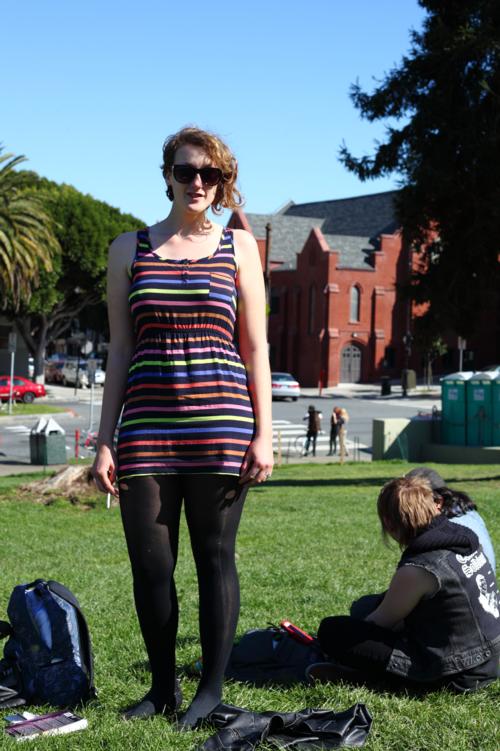
Today’s look: Ivy, Dolores Park

Tell us about your look: “Wear whatever the cleanest thing on your floor is.”

Telegenic Band Check: Daniel Fries

0

SFBG videographer Ariel Soto-Suver met up with local flamenco guitar player Daniel Fries at Dolores Park for some serious plucking while dreaming of Spain.

The giant penis in the sky

21

When Lily Hitchcock Coit donated money to beautify the city, and a tower was built in her name, a lot of locals suggested that it looked like a firehose nozzle, not surprising given her love of firefighters. Others over the years have suggested a more phallic image.

But that’s nothing compared to the new tower that is slated for the Transbay Terminal site. The round shaft, the distinct head at the top … it’s the Giant Dick in the Sky! Coming soon to downtown San Francisco.

Why Mirkarimi pled guilty

103

Sheriff Ross Mirkarimi didn’t want to cop a plea. He knew the damage it  would cause to his political career and he was prepared to fight the charges. But when it became clear that he was losing every single motion around the admissibility of evidence, even when he and his attorney, Lidia Stiglich, were convinced they were right on the merits — and when it was clear from juror surveys that virtually everyone in town had read the salacious press accounts and it was impossible to find a neutral jury, he decided he had no choice.

That’s what people close to the sheriff told me shortly after Mirkarimi unexpectedly agreed to plead guilty to misdemeanor false imprisonment. It may seem an odd plea for a sheriff, but it was a way to get rid of the more serious charges. A domestic violence conviction would seriously interfere with Mirkarimi’s job — among other things, nobody with a DV rap can possess a gun — not that the sheriff of San Francisco needs to carry a gun, but in the law-enforcement world, domestic violence is (properly) taken very seriously.

The calls for the sheriff to resign have already started. An informal sfgate poll on the subject is already posted.

I talked to Mirkarimi shortly after he appeared in court, and he told me he has no plans to step down. “I wanted to resolve this matter and move forward with the important work of the department. And I terribly miss my family and I want to be re-united.”

That’s going to be tough — someone will probably try to mount a recall effort and every single detail that has come out so far in the news media will be repeated if and when he runs for re-election in three years. In politics, that’s a long time away — but these kinds of charges never disappear.

People close to the sheriff told me that that Mirkarimi was concerned that he couldn’t find a jury that hadn’t already convicted him in their minds. “The questionnaires were very clear,” one ally said. “Nearly everyone had read the newspapers and already had some kind of a negative opinion.”

Among other things, his friends said, Mirkarimi was concerned that  a former girlfriend, Christina Marie Flores, would be allowed to testify against him — despite what his team considered serious questions about her credibility.

Flores used to be my next-door neighbor and I’ve always been friendly with her. I was on her TV show once. But the news media accounts have essentially ignored a detail that was in one of Mirkarimi’s defense motions:  After they broke up, Flores sent Mirkarimi a hate poem in which she not-terribly subtly threatened to damage his political career.

I’m not going to quote all of the emails cited in the brief (breakup+email=bad news); suffice to say that until December, 2008, Flores was clearly in love with Mirkarimi and sending him passionate notes asking him to reconsider what was obviously a move by Mirkarimi to end the relationship. (And yeah, there were nude pictures that Mirkarimi was supposed to “enjoy when you miss me.” Gak.)

On Jan 2, 2009, the brief states, “having understood that the relationship with Mirkarimi was over, Flores sent Mirkarimi a lengthy hate poem. In startling contrast to her prior e-mails to Mirkarimi, Flores now called Mirkarami `the worst type of waste of air’ and said that there ‘are smarter and more handsome men BY FAR.’

“Flores ended the poem with the following:

So as 2009 rolls in and you roll out
I remember what my life was all about
Surrounded by so many of my friends
I am rich and happy with how my story ends

Except one thing.

I have never had the distinct pleasure
Of meeting such an idiot of such great measure
That freely let me know of things
That could unwind plans of what his political future brings

Yes, I do know those, some of whom you hate.
Who could have a say in your fate
And long friendships with some that you despise
That after the fact have opened my eyes.

What to do with the ball in my court …
Let us see what happens.”

Don’t know who “some of whom you hate” means, but Mirkarimi has had a contentious relationship the San Francisco Police Department. Flores is the daughter of a police officer and the ex-wife of another officer, who happens to be a domestic violence inspector.

Three years after that poem was written, when she heard about the DV allegations against Mirkarimi, she filed a police report alleging similar behavior. She also talked to two newspapers, the Chronicle and SF Weekly.

In her statement to the district attorney’s office, the brief states, “Flores conceded that she wanted to go public for personal reasons: ‘He said that that woman from Venuzuela (Lopez) knew about our relationship and it didn’t matter to her … which I think is a lie. And that’s probably why I’m here because I don’t think she knew.’”

Doesn’t mean that anything she claims about Mirkarimi was untrue. A woman who is mad at her ex-boyfriend for whatever still has every right to complain about domestic violence, even later; if she was physically abused, then what happened at other points in the relationship doesn’t change anything.
But it’s interesting that the daily papers, which reported freely on the prosecution’s side of this story, haven’t mentioned the equally fascinating (and tawdry) allegations in the defense brief.

It’s the kind of thing that, Mirkarimi’s allies say, made it hard to find a fair jury.

Judges these days go out of their way not to exclude evidence in DV cases, and the fact that this was such a high-profile political case made that even more dramatic. Ruling that the videotape of Mirkarimi’s wife crying and showing a bruise and the testimony of an ex-girlfriend who said he abused her inadmissible would most likely have forced the district attorney to drop the charges. Very few judges would want to take that risk.

So now Mirkarimi has to deal with the fallout, and it raises the question: Can the progressive community accept and once again support a sheriff who has all of this baggage? Is there anything Mirkarimi can do to convince his allies and the voters that either (a) the charges were overblown or (b) he’s learned from this, is going into counseling, is a changed person, and can seek political redemption?

The city forgave Gavin Newsom when he had sex with his close friend’s wife (after he allegedly went into treatment for alcohol abuse) and forgave Willie Brown when he impregnated a campaign fundraiser (because nobody cares about that sort of thing these days), but domestic violence is a very different deal. As it should be.

Any yet, some people are clearly willing to give him a chance. Alix Rosenthal, a longtime leader on women’s issues who supported Mirkarimi for sheriff, told me that she doesn’t think he should step down.

“I think this whole thing has been blown way out of proportion,” she said.

Mirkarimi, she noted, needs to publicly go into counseling with his wife (which he can’t do until the stay-away order is lifted — seriously, right now he can’t even go to counseling with his wife) and he needs to make it clear that he’s addressing anger-management issues. But she thinks he can still play a role in the progressive community.

There will be other progressives who disagree, and Mirkarimi will have to win them over. And all the while, the supporters of Chris Cunnie, the former Police Officers Association president who lost to Mirkarimi in the fall, aren’t going to let this go away quietly.

UPDATE: The Chron is already calling on Mayor Ed Lee to “investigate” the sheriff for misconduct. Investigate? As if there’s anything that hasn’t already become public? The real message is that the Chron wants Lee to try to get rid of Mirkarimi. And so it begins.

The future of the DCCC

26

Now that Aaron Peskin is retiring as chair of the Democratic County Central Committee, and is not even seeking re-election, the future of a realtively obscure but political important agency is very much up in the air.

Peskin had his share of critics, and he would be the fist to say it was time for him to move on, but he orchestrated the progressive takeover of the DCCC four years ago and turned it into an operation that helped get progressives elected to local office. He raised money for the party and kept the often (ahem) fractious progressive committee members going in the same direction. He was a leader — and without him, the left wing of the local Democratic Party is struggling.

Nobody has been able at this point to take Peskin’s place — and in the meantime, the moderate-to-conservative folks are moving agressively to take the DCCC back.

It’s going to be a fascinating race — Gov. Jerry Brown just signed a bill that changes the makeup of the committee, giving the east side of town more members. That’s because more than 60 percent of the Democrats in the city live in what is now Tom Ammiano’s Assembly district. (The east side district of Fiona Ma now includes more of the Peninsula.)

So 14 of the members will be elected from Ammiano’s district, and only 10 from Ma’s (more conservative) district.

But Peskin won’t be on the ballot, and incumbent Debra Walker has stepped down and won’t run (she’s been replaced by Police Commission member Petra DeJesus).

Meanwhile, among the more centrist people who have filed to run: Former Supervisor Bevan Dufty. Sup. Malia Cohen, School Board Member Hydra Mendoza, and former Redevelopment Commission member London Breed. Sup. Scott Wiener, a longtime incumbent, is running for re-election.

The left starts with a vote deficit, since all of the statewide and federal elected officials who are Democrats and live in or represent part of SF are automatically members. That means Sen. Dianne Feinstein, Rep. Nancy Pelosi, Rep. Jackie Speier, Attorney General Kamala Harris, state Sen. Leland Yee, State Sen. Mark Leno, Ma and Ammiano all have votes — and while they never show up, the elected officials send proxies, and other than Ammiano and sometimes Yee and Leno, they can’t be counted on to support progressive candidates and causes.

So progressives need to win more than a simple majority of the contested 24 seats, and while that’s entirely possible, it’s hard to see a full slate in both districts. At best, most progressive groups will probably endorse 12 candidates on the east side and eight on the west — and since the most conservative incumbents will likely win, as will Dufty, probably Cohen and quite possibly Breed, it’s entirely possible that the moderate wing will regain control.

There’s been some tension among progressives in the past few weeks, some arguments about who would best replace Peskin as chair. Animosity over those discussions was one reason Walker resiged. And while there are legit questions about which of the progressives would best run the committee, I fear the candidates were getting ahead of themselves. Because you can’t fight over leadership until you have a majority. And that’s going to be a bigger struggle than it’s been in quite a while.

Street Threads: Look of the Day

0

Today’s look: Inga, New Montgomery and Mission

Tell us about your look: “I love fashion! I try to put things together that are different.”

Live Shots: Women’s History Month office intrigue with 3 Girls Theatre

0

In celebration of Women’s History Month, 3 Girls Theatre is staging a lunar cycle chockful of girl power greatness. Part of its month of XX chromosoned-fueled creativity opened Friday, March 9: The Right Thing. The production provides a strikingly realistic window into the life of a female CEO via a long day spent in ruthless mediation on her recent expulsion from her high-power job amid allegations of sexual harassment. The play tells the truth about being a woman in a male-dominated workplace, while dissecting the inner workings of what feels like a real life legal dispute. All the actors held their ground while playing either a super-smart judge or a super-slimy ex-boss, but the real fireball of the show was spunky-punk Sam — the sexual harassment victim — played by Karina Wolfe. With a red head of hair and serious Madonna lace gloves, Wolfe’s character brought something colorful and quirky to the world of “executive Barbies.” The show runs until April 1 and opening night sold out, get your tickets soon!

The Right Thing

Through April 1, various times, $20-$38

Thick House

(415) 801-8081

1695 18th St., SF

www.thickhouse.org

www.3girlstheatre.org


Earthquake relief, one year later: “Shinsai: Theaters for Japan”

0

On March 11, 2011, hot on the heels (so to speak) of a devastating 9.0 earthquake and resultant tsunami, the world’s largest nuclear disaster since Chernobyl made Fukushima, Japan a household name. And just like previous mega-disasters such as the Sumatran tsunami of 2004, and the 2010 quake in Haiti, Japan’s unexpected and devastating crisis drew attention and support from across the globe.

One year later, with an estimated 300,000 people still homeless from the combined natural and unnatural disasters that shook the Fukushima prefecture, it appears that the crisis is far from being over. Inspired by an impromptu fundraising effort spearheaded by New York-based, Japanese-born actor James Yaegashi, a unique memorial will take place Sun/11 in theaters across the United States.

Entitled “Shinsai,” which means “great earthquake,” the structure of the performances is up to the individual participating theatres — a tactic utilized by the roving world premiere of Suzan-Lori Parks’ 365 Plays — the common material a series of exclusive ten-minute shorts penned by some of the greats of both the American and Japanese Theatre Scene: Toshiro Suzue, David Mamet, Edward Albee, Oriza Hirata, Philip Kan Gotanda and Parks, to name but a few.

Two San Francisco playhouses will host their own versions of Shinsai. Theatre of Yugen will present works by Gotanda, Parks, Naomi Iizuka, and others as well as special dance performances by Heather Law and Las Japonesas Flamencas. American Conservatory Theater will host readings of several of the works with a lineup of eight Bay Area actors and seven directors, including Anna Ishida and Evren Odcikin. All proceeds will go to the Japan Playwrights Association, to fund the rebuilding of infrastructure supportive of theatre artists in the affected regions. Developed by Theatre Communications Group, this event has the potential to remind us both of the importance of the arts within any given society, and that of any given society upon the global stage.

Sun/11, 5:30 p.m., $15

Theatre of Yugen, NOHspace
2840 Mariposa Street, SF
(415) 621-0507
www.theatreofyugen.org

Sun/11, 7 p.m., $5

American Conservatory Theater
415 Geary, SF
(415) 749-2228
www.act-sf.org

Olague explains her support for RCV repeal measure

52

  Sup. Christina Olague has drawn ire from progressive circles over her pivotal co-sponsorship of a proposed charter amendment that aims to eliminate Ranked Choice Voting in all citywide races. It takes six members of the Board of Supervisors to place the repeal measure on the November ballot and she is the sixth co-sponsor.

Olague has long ties to the progressive community and was appointed by Mayor Ed Lee to the District 5 seat, one of the city’s most progressive, in January after Ross Mirkarimi was elected Sheriff. This week, she joined Sean Elsbernd, Carmen Chu, Scott Wiener, and Malia Cohen – all considered moderate/conservative supervisors – in supporting Sup. Mark Farrell’s proposal to replace RCV with runoff elections for the mayor’s race and other citywide offices.

“To me, this isn’t a progressive or moderate issue. This is a democratic one here in San Francisco,” Farrell said during Tuesday’s Board of Supervisors meeting, where he introduced the measure, which will have a hearing next month. “Ranked Choice Voting has continued to confuse and disenfranchise voters here for over a decade and, in my opinion, it’s time to restore our voting system to the one person, one vote rule.”

Farrell’s sentiments mirror a similar line trumpeted by the San Francisco Chamber of Commerce, a supporter of runoff elections and longtime opponent of RCV. A recent poll commissioned by the Chamber, which claims 58 percent of respondents prefer runoff elections, has been discounted as biased and based on misleading statements. Farrell, who was elected to the District 2 seat in November using RCV, said he would have prefers to eliminate RCV altogether in San Francisco but said, “This is a significant step in the right direction.” A proposed ballot measure by Farrell and Elsbernd to eliminate RCV was rejected by the Board of Supervisors last month.

Steven Hill, who helped crafted the city’s voter-approved RCV system, criticized the move to repeal it: “Critics of RCV have long maintained that voters are confused and even disenfranchised and yet they have offered no credible evidence to support these claims. In fact, the evidence shows just the opposite, that voters understand what they have to do with RCV, which is to rank their ballots, 1, 2, 3, and they are using their ranked ballots effectively.”

In an interview conducted as she was departing the Westbay Community Center on Thursday, Olague initially rebuffed our request to discuss her support for Farrell’s amendment (just as she had an earlier request by the Guardian), but she ultimately relented.

Here’s what she had to say:

Olague: “What it is is that it begins a conversation.  There was talk of eliminating RCV altogether, which I certainly don’t support.  There was talk from a lot of different corners, not just moderate circles, but progressive circles as well, that maybe we need to examine it and see how has it or has it not really been – has it really helped us reach our goals in the way that we had originally intended that it would.”

SFBG: What were those goals?

Olague: “I think it was to try to make sure that more progressives were elected… and make it easier for people who had lesser means to prevail… So I think maybe it is time to reflect on that a little bit.”

SFBG: What parts of RCV don’t you like or don’t support?

Olague: “Well, I think it’s just time to have a conversation about it.  I’m not even sure that I’m against it, per se. When I signed on to it, I believed it was looking at keeping some of the citywide races, where there are fewer numbers of candidates engaged, to reverting back to a runoff, and keeping the races where we have a diversity of candidates and numerous candidates, which are the district races, as they are – which is ranked choice voting.”

“Now there’s some people who say what we need to do is, well, maybe revisit that and maybe just, rather than have it apply to all citywide races, maybe it should just apply to the mayor’s race.”

“So I think there needs to be a conversation and there needs to be a reflection on its effectiveness.  I think that’s what [Sup. John] Avalos and even [Sup. David] Campos were thinking that there needs to be more education – and I do think there needs to be more education as it relates to RCV.”

SFBG: Voters don’t seem to be confused about filling out an RCV ballot, but maybe there’s confusion about how votes are tallied and candidates are eliminated.  It would appear that there’s a myth being spread that voters are confused about filling in a RCV ballot, but that doesn’t appear to be the case…

Olague: “Do you know that?  I think when you talk to people out there on either side of spectrum, politically, I think there’s still a lot of – I don’t think that people have necessarily concluded that this is the most effective way of achieving certain goals.  But, you know, I think it starts a conversation and it may end up that the voters decide, you know, let’s just leave it the way it is, we’re happy with it.”

SFBG: And how would you feel if RCV is completely eliminated?

Olague: “Well it’s not going to be eliminated because there’s nothing in the charter amendment asking that RCV be eliminated.  What I was concerned about was that there was a push to eliminate it altogether, which I don’t support.  What this does, I figured I’ll meet them halfway because I can’t support a complete repeal of RCV and currently the way this charter amendment is drafted, what is does is it keeps RCV in the District elections.  That stays the same, and the citywide elections would be reverting back to a runoff, so it goes to a more citywide for a runoff, ranked choice voting for District [elections]. There is an argument to be made for why that should be the case.”

SFBG: Wouldn’t this eliminate a diversity of candidates if there were a repeal of RCV in citywide races?

Olague: “So let’s have the debate and people may decide, you know, if it’s not a good idea. People may decide they want to push to amend the charter amendment as it is before us.  Some people are thinking it should just apply to the mayor’s race and not other citywide races like public defender and others. So maybe there’ll be amendments to the charter amendment before it even hits the ballot.”

SFBG: Why do you think some people are up in arms over your support on this?

Olague: “I guess, you know, I mean – I just think that everyone is going to sit around and wait for something, right?  They’re, sort of, laying in wait, right? So it’s just what it is, you know – it’s like people are going to agree with me sometimes, they’re not going to agree with me other times.  There are some things that I am doing that is progressive, there are some things people will perceive as not being progressive.”

SFBG: Did you come to this decision by yourself, or was there any influence or pressure from others to vote the way you did on this?

Olague: “No.  I just think it’s funny because it’s like I don’t really succumb to pressure.  I’m willing to start the conversation at some kind of a compromise.  To me, this is as close to a compromise as we’re going to get and then it can start the conversation. So I think the conversation will start and people can assume all kinds of things, and they will.”

SFBG: So you voted in good conscience?  You didn’t have any doubts about your vote?

Olague: “I vote in good conscience, but sometimes you have to go with a compromise.  It’s not completely what you want and it might not be completely what you don’t want, but the alternative might be something that is completely unacceptable, which could be the complete elimination of RCV.”


A version of this story also appears on Fog City Journal, which is run by Luke Thomas.

Sisters unite: Hyatt workers picket on International Women’s Day

5

About 80 protesters from a coalition of women workers yesterday staged a peaceful protest demanding that Hyatt reinstate two workers, Martha and Lorena Reyes, who were fired in October. 

The Reyes sisters claim they were fired after Martha tore down photoshopped images of the sisters’ heads tacked onto the cartoon images of women’s bodies in bikinis. These images were displayed in their workplace, the Hyatt Santa Clara, along with similar images of 70 fellow housekeepers. Hyatt has denied that tearing down the picture was the cause for the Reyes’ sisters’ termination. 

The protest, planned for International Women’s Day, was also meant to draw attention to what the demonstrators see as widespread disregard for the health and safety of women workers at Hyatt, as well as an ongoing contract dispute between UNITE HERE and Hyatt hotels.

“Underpaid, Underrated”

Demonstrators formed a picket line outside the Grand Hyatt Hotel at Union Square, chanting “women united will never be defeated.” The protest was accompanied by a creative project; a “clothesline” displaying more than 50 garments on which workers and allies had painted solidarity slogans. 

Women: 51 percent of world’s population, 70 percent of world’s poor, 66 percent of world’s workers, produce 50 percent of food, earn 10 percent of the income. Underpaid, underrated” read one puff-painted t-shirt.

“We are taking out the dirty laundry and talking about the injustices that Hyatt has done,” Martha Reyes told the Guardian.

Groups such as Mujeres Unidas y Activas, the Day Labor Program, the Chinese Progressive Association, and Gabriela USA (an coalition advocating for the rights of Filipino women workers), and the Progressive Jewish Alliance represented at the rally. 

Sup. John Avalos also marched in the picket line supporting the workers.

“I’m here to support the workers on International Women’s Day,” said Avalos. He decried the bikini pictures, which he said “create a hostile work environment,” and remarked that hostile work environments for women are all too common.

Inspired by the large turn-out, which Labor Council representative Conny Ford called “a multi-generational, multi-ethnic group of community and labor,” UNITE HERE Local 2 decided to enter the Grand Hyatt in an attempt to meet with General Manager David Nadelman. He conceded, and spoke with a delegation of about 30 women.

In a polite and non-confrontational meeting, Nadelman listened as each woman in the delegation took a minute to tell her story. 

Nadelman, who has managed 16 different Hyatt locations, gave a supportive response. 

“I appreciate and respect each and every one of you, and I want you to know your words will not go unheard. I will share the message, because that’s the least I can do,” Nadelman told the group.

Ford, who helped facilitate the meeting, responded that “the proof will be in the pudding.”

In a debrief about the meeting that closed the rally, the group expressed uncertainty that Nadelman’s promise to help would be fruitful. Some suggested ramping up tactics in the future, and potentially demanding that Nadelman call the Hyatt Santa Clara and ask them to reinstate the Reyes’s. 

The rally closed with chants of “we’ll be back.”

When asked to clarify his positions, Nadelman reiterated to the Guardian that “the message will be brought back to the folks I report to and beyond.”

He also expressed frustration with UNITE HERE Local 2, who was been locked in a contract battle with several Bay Area Hyatt locations since 2009.

Conflicted history

In an ongoing contract negotiation, the Hyatt wants to remove a part of the hotel workers’ contract that allows workers to vote on whether or not new hotels built in San Francisco or San Mateo will be unionized, on their terms. 

“Workers did 53-day lockout to win that language in 2005,” said Wong. “They’re not going to give it up.”

UNITE HERE is requesting a “solidarity clause,” which would allow workers to protest if they feel any Hyatt in the US or Canada is mistreating its workers. Currently, the contract contains a clause prohibiting workers from striking, boycotting or picketing while the contract is in place. 

Neither party seems likely to give up their demand. Since 2009, UNITE HERE and other supporters have spread a boycott of Hyatt hotels throughout the country, which they claim has cost Hyatt $25 million worth of business. 

Hyatt has made strides to counter UNITE HERE in their contract campaign as well as claims that Hyatt mistreats workers. They created a website, devoted largely to countering claims made by UNITE HERE. 

Hyatt representatives have also issues statement alleging that a 2010 peer-reviewed, UNITE HERE-funded study entitled Occupational Injury Disparities in the US Hotel Industry  “distorted data to achieve a result that was negative to the hotel industry.”

The report compared injuries of workers at 50 hotel properties owned by five companies, and found that Hyatt housekeepers had the highest rate of injury.

Workers report being injured while lifting heavy mattresses that often exceed 100 pounds in order to change the sheets and cleaning slippery bathrooms. According to Wong, these issues could be addressed in part if housekeepers were given proper tools. Fitted sheets, for example, would halve the work involved in bed-making, but housekeepers are provided only with flat sheets, according to Wong.

“When the Hyatt bought their location in Santa Clara, they took away the long-handled mops and replaced them with kneepads,” she says. 

The Hyatt Santa Clara has since provided long-handled mops to its housekeepers.

But Nenita Ibe, 70, is still angry that she was made to clean the bathroom on her hands and knees.

“I would always bump my head on the sink,” Ibe told the Guardian. “It’s completely wrong.”

Ibe has also lost full use of her left arm due to the repetitive motion involved in making beds.

A similar protest at the Hyatt Santa Clara the morning of March 8 brought more than 150 supporters. A delegation also successfully met with that location’s general manager, Dania Duke. 

After meeting with the delegation, Nadelman expressed frustration to the Guardian.

“It would make a lot of sense for both Hyatt and Local 2 to sit down at the table and negotiate a new, fair contract,” he said.

“We keep asking them for dates to do this, and have yet to be given one.”

But according to Wong, UNITE HERE is willing to negotiate, but not to concede some aspects of the agreement.

“As far as this contract, they know what we are demanding and they know how to get in touch with us. We’re just going to keep fighting until that happens,” said Wong.

Sisters in struggle

UNITE HERE’s campaign against the Hyatt covers working conditions and contracts all over the country. Now, they’re also hoping to get Martha and Lorena Reyes they’re jobs back, and the campaign has galvanized support. 

The sisters filed complaints with the Equal Employment Opportunities Commission in November. 

Jan. 7, they met Gloria Steinem at a conference at Stanford on the future of feminism and told her their story; she signed on to the nationwide Hyatt boycott. 

The women, who worked in the hotel for decades, say they will continue to fight until they are rehired.

“We want to have respect at work and to be treated fairly and equally. WE want to also put pressure on Hyatt for us to be able to return to work.  And we want to be able to make sure that Hyatt respects women and gives them safe working conditions and job protection, not get fired like we were,” said Martha Reyes.


SFPD-FBI spying restrictions could face mayoral veto

8

If the San Francisco Police Department isn’t working with the FBI to secretly spy on law-abiding local residents – as a secret document released last year indicated they had the authority to do – then why are Police Chief Greg Suhr, Mayor Ed Lee, and others opposing legislation that would ban such surveillance?

That’s the question that longtime police policy expert John Crew of the American Civil Liberties Union of Northern California is asking as he tries to get two more members of the Board of Supervisors to join the six current co-sponsors of the legislation, which the board will consider on Tuesday, in anticipation of having to override a mayoral veto.

“What’s the harm?” Crew told us. “There’s something that doesn’t add up here.”

As we reported at the time, the ACLU last year obtained a 2007 memorandum-of-understanding between the SFPD and the FBI establishing procedures for the Joint Terrorism Task Force, in which SFPD personnel would be under the command of the FBI, circumventing local and state restrictions on domestic surveillance of people who haven’t committed any crimes.

After the ensuring controversy and under pressure from members of the Police Commission, Police Chief Greg Suhr issued Bureau Order #2011-07 to clarify that SFPD personnel are bound by local and state privacy protections. “With this Bureau Order, the language of the 2007 Memorandum of Understanding no longer applies and SFPD personnel are bound by the provisions of the 2011 Order,” SFPD Public Information Officer Albie Esparza told us last month.

Suhr and Lee have each made public statements indicating that the new legislation – developed by the ACLU and carried by Sup. Jane Kim with five progressive supervisors as co-sponsors – is redundant and unnecessary. But Crew and the ACLU made a Sunshine Ordinance request for any modifications to the MOU or communications with the FBI indicating that SFPD’s contractual obligations no longer apply, and there were no such documents.

“When you talk about civil rights, you put it in writing,” Crew said. “This really doesn’t add up. We’re getting conflicting explanations. And the bottom line is this problem has been solved in Portland.”

When a similar issue arose in Portland, Oregon, civil libertarians pressured the city to withdraw from its MOU with the FBI and create a new one that includes restrictions on the surveillance of people who were not suspected of any crimes, but who may have been subjected to FBI attention because they were Muslims or because of their political beliefs. And Crew said it didn’t harm the relationship of the two policing agencies.

At an emotional hearing last week before the Public Safety Committee, a long string of representatives from groups that have been singled out for FBI surveillance that violated protections under the California Constitution – Muslims, anarchists, anti-war activists, Occupy demonstrators, immigrant groups, environmentalists, animal rights activists, etc. – urged supervisors to stand up for them. The legislation has a long and diverse list of organizational supporters.

Sup. Scott Wiener – one of two supervisors that Crew is hoping to win over – told us, “I agree that local surveillance rules should govern. But I’m not convinced that we need this legislation.”

Wiener said he still hasn’t made up his mind, and he plans to speak with Portland’s mayor before Tuesday’s hearing.

So why wouldn’t he support legislation that simply made his position official city policy? Wiener said he’s wary of telling SFPD how to do law enforcement and with “reducing the ability of the department to be flexible in the future.”

Crew said representatives of the Mayor’s Office, which did not respond to our calls for comment, have told him that Lee would defer to the SFPD’s determination of whether to sign the legislation. “That’s a pretty stunning claim,” Crew said, “which does not bode well in terms of reasonable civilian control of the SFPD for the next few years. I sure hope they back off that.”

Kim, who has a good relationship with the Mayor’s Office, also did not return calls for comment. But Crew was incredulous about why anyone who believes in civil liberties would oppose this legislation, telling us, “This is not a radical stand here.”

Families leaving SF: It’s housing costs, stupid

34

City officials continue to wring their hands over why families are leaving the city, and I’m sure there are a number of factors, but I can tell you that from the people I know — families who live in the city or want to live in the city — it’s all about the cost of housing.C

Critics of the SFUSD like to say that families are leaving for better schools, but those families haven’t been paying attention to the tremendous strides the district has made in recent years. Yes, middle schools are still a challenge in some areas, and yes, not all the public schools are great, but overall, most families that make the effort to find a quality school for their kids can do it.

The folks I know who work in the city hate the idea of living in the burbs. Nobody wants to commute across that bridge or through the BART tunnels every day; more important, nobody wants to be on the other side of the Bay from their house and their kids when the Big Earthquake hits. The problem is the money.

You want to keep families in San Francisco? Building housing for multimillionaires isn’t going to do it. If it were up to me, I’d float about a $5 billion revenue bond, buy up all the housing on the private market, put it all in a land trust and resell it — with the provision that the buyers had every right of ownership except the right to sell for a profit. That’s not likely to happen — but the city has to get serious about both building new affordable housing and (even more important) preserving what’s already there.

Yes, a lot of families want to buy a house, but a lot of families would be happy with a decent, affordable place to rent. Particularly if they knew that they wouldn’t be evicted so a richer person can buy or rent the place. What most families want is stability — they want to know where they’re going to live not just this year but when their kids are older. So many renters in this town live in such fear of eviction that it’s a huge incentive to move somewhere else.

You can talk about parks and playgrounds and youth programs, but San Francisco’s never going to be as family-friendly as we’d all like unless we can do something about housing costs and rental stability.