Lest we forget, today marks the ninth anniversary of the start of our war in Iraq. If you plan on passing by City Hall today, you’ll have a vivid reminder of today’s important milestone — 481 pairs of combat boots will be lined up on the seat of our city government’s steps, a visual precursor to the afternoon of speeches by vets and their families that has been organized by the Bay Area chapter of Iraq Veterans Against the War.
The vets’ message is rendered all the more important now that US conflict in Iraq technically ended last December. A US service member commits suicide once every 36 hours, and 223,609 veterans are struggling with possible signs of Post Traumatic Stress Disorder. Many battle with the after-effects of head trauma, a poorly-understood injury that can lead to serious psychological problems (the suspect in the massacre that took the lives of 16 Afghanis a few weeks ago was a US soldier who suffered from head trauma and multiple re-deployments.)
President Obama has decided that today will be a “Day of Honor” for our veterans. Now might just be a good time to get down to City Hall and hear what the United States citizens most affected by our engagement in the Middle East and elsewhere have to say. Today’s speakers at the City Hall demonstration will include Scott Olsen (the vet whose skull was fractured by a police-thrown projectile in an October Occupy Oakland demonstration), Ryan Hollerman (an active-duty soldier), and Paula Santos, whose son commited suicide after coming home from war, in addition to others from Swords to Plowshares and Military Families Speak Out.
Iraq Veterans Against the War press conference and “Eyes Wide Open” exhibit
During my last day in Austin SXSW reached critical mass. This year St. Patrick’s Day happened to coincide with the big Saturday blowout, and as I made my way downtown the revelry was in full effect. Partiers who looked to be in high school swirled about dressed in t-shirts with slogans like “Hello, My Name is Beer” and “Let’s Get Wasted!!!” In the midst of this I came across a couple contentedly sitting in the middle of the street in complete stillness while staring into one another’s eyes.
I had to forgo a set by British soul singer Michael Kiwanuka in order to catch CHLLNGR at Karma Lounge. CHLLNGR is the moniker of electronic musician Steven Borth, a native-Californian who lives in Denmark full-time and is one of Spoek Mathambo‘s main collaborators. Backed by drummer Gunnar Olsen, Borth is a talented multi-instrumentalist who liberally played his saxophone throughout a set that was deeply steeped in sexy R&B.
After that it was off to the Nat Geo showcase at Stage on Sixth. British singer Alice Russell and Quantic were in full swing. Russell’s larger-than-life voice and the band’s rolling soul had everyone putting their hands together. “Pushin’ on” was a crowd favorite.
I stopped by the Montreal musician showcase and caught a few songs by Haligonian garage band Each Other. From there it was a several block climb to Empire Auto Garage where I thought I was going to catch some French bands. But I must have read the schedule wrong because MC Kosha Dillz was holding court on the small patio. After he finished his last song he mentioned that his performance was part of the Oy Vey showcase, “The coolest Jewish rap party without many Jewish rappers.”
As I crossed the threshold into the venue’s main warehouse space I was enveloped by a complete sensory overload. The room was bathed in light that was directed in such a way that it felt like the crowd was hanging in suspension, and Philadelphia-based dubstep producer Starkey had the crowd feeling his beats. Literally. The bass was so pounding that it rattled my organs. As I approached the stage the speakers’ vibrations became too intense so I hung in the back of the room to survey the scene. A few minutes later the bass cut out completely, leaving the crowd adrift as Starkey protested over the PA “Yo, I wasn’t even in the red! Is anyone out there even working?”
I asked the production manager what had happened. He said that the bass was so heavy that it knocked the Starkey’s laptop off the table, and that they were trying to get him to take it down a notch. Yet the thing he was even more worried about was that Daedelus was returning to the venue later that eve. Apparently two nights ago his bass was so relentless that it had blown two woofers, cracked two windows, and fried the hard drive of the computer delivering the club’s visuals. Hopefully the night didn’t go out with too much of a bang. Meanwhile the woofers came back online and the crowd commenced thrashing to Starkey’s beats.
Back at Stage on Sixth Israeli culture-clashers Balkan Beat Box were setting up after having spent 24 hours en route from California to Austin. While playing though complete exhaustion they rocked several songs from their newly released album Give. One track that had particular traction was “Enemy in Economy,” which details frontman Tomer Yosef’s experience being mistaken for a terrorist on an Alaska Airlines flight. The crowd couldn’t get enough of the song’s hook “Welcome to the USA, we hope you have a wonderful day.”
http://www.youtube.com/watch?v=xPDxJIW0Xzo
Nigerian-German singer Nneka was inside playing her beautiful blend of politically conscious music. Her set took place under the watchful eyes of Willie Nelson, Janis Joplin, and Johnny Cash… all featured on the venue’s huge wall mural.
My SXSW experience closed out with Jimmy Cliff‘s set on the patio stage. By kicking things off with “You Can Get It If You Really Want” he wasted no time in giving the capacity crowd what they really wanted. As the patio tent got progressively hazy it seemed the perfect moment to bid adieu to the festival and make my way home.
In the airport-hanger openness of midday in the Festival Pavilion — after a brief, freak hale storm outside — a loud, high-pitched electro-clatter came ringing down the forever long row of speakers. The culprit being Bejing indie rock act, New Pants.
With rapid energy the band bounced through hyperactive synth pop “punk disco,” while video projections by new media artist Feng Mengbo flashed on the screen behind. I most recall one song nearly matched up lyrically with clips from Spongebob Squarepants — the lyrics inexplicably being “I am not gay. Gay gay gay gay gay” and later, New Pants singer Peng Lei in a white button-up smashing a computer on stage, much to the small gathering crowd’s amusement.
After a quick trip back through the “Origin” cube and a saucy vegan tofu burger with pineapple from an Off the Grid truck (Koja Kitchen), I crawled back through the slightly more filled up hanger for always-entertaining LA noise band, HEALTH. As far as I’m concerned, the best parts of HEALTH were the drumming and the headbanging, which went hand in hand.
The experimental sounds, the mixed vocals, the frantic live show, it was great — but the drummer just killed it, and when another band member picked up the sticks to drum along in pummeling unison, it was near blistering perfection. And to my other point, I just like seeing bands headbang on stage, especially in this odd setting (still bright and light outside, still relatively empty in the enormous space).
There was one true fan in the crowd — though I’m sure more were there, just possibly bodily contained — that couldn’t help but headbang along with dark flowing hair flying, jump methodically in place, and throw a near-empty cup of beer, much to the chagrin of the nerds around him.
The Antlers followed, and were rather unexciting. It was just that mild, lovely indie rock from a former blog buzz band, suitable for impassioned scenes on nighttime soaps. Though they played it well, not a whole lot of heat.
Seattle’s Shabazz Palaces brought the fun back. While the music off last year’s Black Up is sometimes playful, there’s a refined dynamic in the act, laid out by the casual-close interplay and synchronized dancing between smooth lyricist-808 controller Ishmael “’Palaceer Lazaro” Butler (once of ‘90s jazz-rap group Digable Planets) and bongo slapping multi-instrumentalist Tendai “Baba” Maraire. Lots of grooving followed, and some memorably awkward white boy shoulder jerks of free-form dance in the crowd.
After a round of sweet potato tator tots from Brass Knuckle, it was Zola Jesus mind-melting time. And just in time to catch that powerfully operatic voice soaring through moving single “Avalanche” off Conatus.
The diminutive vocalist, wrapped in her usual flowing, cape-y white frock, spread her winged-arms out wide during high notes, giving the illusion of a bird about to take flight, or an eerily angelic force, like the inverse of the black angel in Chris Milk’s interactive installation in the nearby Herbst Pavillion.
She was the first act of the day able to truly transcend the challenges of the wide-open space fighting the elements (outdoor rain, shots of wind through open doors, free concert-itus causing general disinterest). Though that also could have been because the sun was finally officially down, and the true crowds were finally there, more efficiently using the room to huddle.
And this is when a balding elder with a badge around his neck began holding up his camera and filming Zola Jesus’ set. And it was right in front of me. And then I was watching the floating eerie angel through his tiny screen.
With general media personnel, bloggers, reporters, Intel people, and VICE people all there with a barrage of fancy cameras with huge lenses, or iPads, or iPhones snapping away all day, it felt like nearly everyone was there to document the event. If not for a specific outlet, most definitely for some form of social networking.
It left me wondering, who was there to simply absorb the magic in real-time? Who came for fun? Are we all part of some scary dystopia in which nothing happens but documentation? But also, perhaps paradoxically, who cares? This was a great event, tying together master creators in the worlds of technology, art, music, and food. Who am I to shit on that?
Left pondering this, I realized: my cheeks were frozen stiff, my belly ached from fried foods, and my ugly sniffling cold was rearing its ugly sniffling head. It was time to go home. Luckily, my photographer stayed behind to document Squarepusher and Yeah Yeah Yeahs for those who missed it real-time.
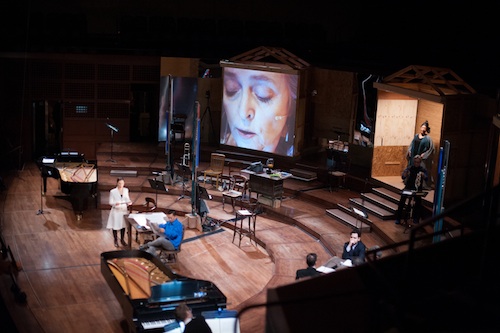
“The best form of government … is no government at all!” announced singer Meredith Monk in the second program of the SF Symphony’s rollicking American Mavericks festival at Davies Hall on Sat., March 10, her trademark braided pigtails and Shuffling Elf gait in full effect. And while I could hear the pleated pants of several libertarians around me surely being wetted (and a few liberal feathers ruffling in the back), this was no mere Ron Paul back-pat, though it was delivered with all the empty bluster we’ve come to expect from the current campaign season.
We were in the midst of an astonishing presentation of John Cage’s epic, random Song Books from 1970, after all — revered experimental vocalist Joan La Barbara had delivered a beribboned gift of apples or cranberries to an arbitrary audience member, magnificent diva Jessye Norman (in a stunning Issey Miyake gown) had joined in a boisterous card game and typed a letter on a mic’d typewriter, and conductor Michael Tilson Thomas had chopped up various fruits and veggies and Cuisinarted them into an orange-y beverage for the pianist. Cage, our 20th Century channeler of chance, would never allow such an inflexible utterance to stand unchallenged.
Meredith Monk, Jessye Norman, and MTT with Symphony members performing John Cage.
Sure enough, the phrase began to dissolve in Monk’s mouth as she repeated it, leaning from the stage like a satiric demagogue: “The b-best f-f-f-form of-f-f-f g-g-g …. ,” and adding “And we shall have it, when we are ready for it!” All the while, three large black flags were being hoisted on neon polls, unfurling into the wind from three fans, ghastly pennants at a flourescent funeral. No, we were not just in the land (our land) of anti-government sloganeering, mouthed by Tea Partiers, Occupiers, and hedge fund profiteers alike. With Monk as our guide, we were slipping through the black flags of anarchy into a gaudier lawlessness, that of death. And like pure music death, of course, shall have no dominion.
Jessye Norman and MTT
We’ll probably not see such a lavish, loving tribute to Cage’s aleatory masterwork for a long time. The randomness-conjuring Song Books are governed, in a somewhat oxymoronic twist, by a large set of instructions — “Leave the stage by going up (flying) or by going down through a trap door. Return in the same way wearing an animal’s head,” for example — and forego traditional musical notation and expression for doodlings, drawings, charts, projections, lighting effects, electronic improvisation, bird calls, horn squonks, chess games, and a plethora of intersecting stage actions. (That’s not to say there weren’t gorgeous passages of melody — one especially near the end, a meandering duet with electronics in which Norman sang in a wistful voice about, I think, purple finches.)
That all this potential chaos not only didn’t come off as pretentious avant-gardism but actually formed something deeply touching, hilarious, human, and even quaint was a triumph for director Yuval Sharon and his cast and crew. Only one dude stormed out — perhaps to towel his pleats.
Joan La Barbara, Meredith Monk, Jessye Norman, and MTT
Bracingly, the American Mavericks festival — MTT’s tribute to the barbaric yawp of the American musical spirit — has retained most of the wonder, if not all of the risk, of its first installment a dozen years ago.
Things had kicked off in splendid form on Thu., March 8, with program one — I saw the repeat performance that Friday — including an exciting and lush presentation of quintessential American composer Aaron Copland’s “Orchestral Variations” from 1967, which delivered both ethereal, avant-garde jaggedness (the piece is composed of 20 variations on a four-note “cell,” in an atonal manner) and occasional glimpses of Copland’s generous, down-home spirit (this was the composer of “Appalachian Spring” and “Rodeo,” after all).
It also gave us a bit of dish.
In researching “Orchestral Variations,” I’d run into some trouble — I kept finding more evidence of Copland’s “Piano Variations” from 1930, a work deemed so stark and forbidding that no professional pianist would debut it. (So Copland, in a nifty show of self-confidence, played the premiere himself, to many critics’ disdain.) Here’s a version by pianist Marc-Andre Hamelin:
But what of the piano work’s expansive, full-bodied and spirited transcription for orchestra? It turns out that MTT himself had, in a visit to Copland’s home decades ago, suggested the piece be transformed from a single piano piece to an orchestral work, in order to reach more people on a different scale. “He turned to me, raised an eyebrow, and said, ‘Yes, yes, that all sounds nice — but who’s going to do all that work?'” MTT told the audience during the introduction. Then the big reveal: “And I said, ‘Well, with your permission …’ So — here’s a little thing that we do.”
Insider-y! It was a rare treat of a rare performance of a rare masterwork, from one of the major players involved.
It was also the perfect lead-in to the next piece on the program, Lou Harrison’s “Concerto for Organ with Percussion Orchestra” from 1972, in an absolutely transcendent rendition from Paul Jacobs on the enormous Davies Hall organ, with an ensemble of super-agile Symphony percussionists playing everything from Chinese crash cymbals and huge muted prayer gongs to celesta, rasp, and glockenspiel.
Organist Paul Jacobs and the SF Symphony’s percussion orchestra performing Lou Harrison.
Previously I had a slight aversion to Harrison — while I appreciate him as an out-and-proud gay man in the 1960s (he has a kind of Burl Ives meets Harry Hay aura in queer iconography), I sometimes felt his musical project suffered from the same knee-jerk Orientalism that turns me off of a lot of famous Bay Area poets, mystics, artists, and composers who attempt “East meets West.” Hairy legs jutting from a silk kimono, shudder.
My prejudices were quickly dispatched when the sprightly Jacobs immediately began coaxing the most amazingly powerful sounds from the organ, using a block-muffle tool to play whole ranges of keys at once in various rapid-fire combinations and agglomerations, accompanied by the percussionists’ clanging, hypnotically abstract tattoos. Movements ranged from crepuscular tootling to sci-fi bombast as Harrison ushered us into a kind of hallucinatory meditation full of bright oranges and shooting blues, neither East nor West but a cosmic recombinant being of both. I want to rediscover this formidable magician. Here’s a taste from another recording, although I found Jacobs’ playing to be even more spirited:
Harrisons counterpart on program two was Henry Cowell, the great popularizer of tone clusters (think of playing a whole bunch of clashing yet somehow wondrous-sounding notes at once) — Cowell’s “Piano Concerto“ of 1928, performed by Jeremy Denk with the orchestra, was a sensation to almost equal the Cage before it. You would never have thought odd cacophany could achieve such nuance. It sounded like a foray into negative beauty. Denk was using his entire forearms on the piano most of the time, with the symphony meeting him at a level of intense energy and empathy, and yet there were moments of quiet, complex reflection and runs of exhilirating virtuosity that matched the height of the redwoods in Henry Cowell state park (no relation, except metaphorically). Am I gushing? I am gushing. More Cowell everywhere, please. And as for the multi-talented Denk, check out his recent, revealing, and witty essay and podcast from the New Yorker.
Jeremy Denk performing Henry Cowell.
Preceding Cowell on program two was Lukas Foss’ fantastic 1967 Phorion, given a perfectly out-there rendition by the Symphony, which feeds ragtag bits of the famed solo violin prelude to Bach’s “Partita in E” (phorion is Greek for borrow or steal) through a phtasmagorical wood-chipper of various twists and inversions that spews forth everything from droopy jazz-surrealism to hard-driving, proto-techno minimalism. It’s a monument of sampling avant la lettre, sure to prick up any iPod-shufflers ears.
There were two slight fizzles on both nights, to my ear. Program one concluded with Charles Ives’ “A Conchord Symphony“ reconfigured, perhaps more accurately “massaged,” from other Ives works, (including his brilliant “Concord Sonata,” from around 1916) by comtemporary Canadian composer Henry Brandt. The piece — craggy, magniloquent, full of profound philosophical and unfettered musical ideas — is partly meant to invoke New England and its literary heroes, and in recordings is an excellent rush of jigging melody lines and bracing moods. Goatish, devoted, unabashedly intellectual, Ives is the spiritual godfather of American musical mavericks (and Mavericks), and MTT is one of his great champions. So I expected much. Here’s the Symphony’s recorded version:
But after the first two luminous movements the orchestra sounded a bit ragged (understandable in the face of the huge Mavericks project), the work lost some shape, and we ended up getting more a series of declarative statements than a metaphysical journey through the East Coast of the mind. (The great game of “Concord” is to see how many times Ives references those famous mortal knocks that open Beethoven’s Fifth Symphony, which is kinda fun.) At the end we’re supposed to be soul-hiking under the wheeling stars with Thoreau, but it felt more like soaking in a hot tub with the Sidewalk Guru from “Doonesbury” and a glass of good champagne.
Carl Ruggles’ “Sun-treader“ of 1926-31 concluded program two, and tapped into a strident strain of deliberative machismo and sci-fi nerdiness that brought to mind none other than Newt Gingrich, of all people. Cosmic bombast is the aim of this 13-minute brass-churning blast, a fanfare to Big Idea perserverance. It came off as dude music in the extreme, which may have perked up some of the unwilling husbands in the house, but after all that came before seemed a wee bit threadbare in its unrelenting bravado. Still, it cut a bold, bronze shape in the quivering air.
My third day at South by Southwest kicked off with the big SPIN Magazine party at Stubb’s. Best Coast was wrapping up their set and everyone was eagerly anticipating headliner Santigold.
Santigold’s rhythm section entered the stage wearing Max Headroom-esque caps, then her backup singers came on in outfits that were a spin on matador chic, and finally she came on donning a crown. She’s been busy working on a new album for the past few years, so her high profile gigs at SXSW seem to be serving as a homecoming of sorts.
Jason Newman of Fuse went as far as to dub her the festival’s “prom queen”… hence the crown. While her big hits like L.E.S. Artistes sent the crowd into frenzied sing-a-longs, her new material was received almost as enthusiastically… boding well for her album release come April.
Later that eve I got to chat with Venezuelan rockers La Vida Boheme before heading to the globalFEST showcase at Speakeasy. Each year globalFEST brings acts from all over the world to New York’s Webster Hall, and this year they’ve taken their act on the road for the first time. As I arrived Janka Nabay and the Bubu Gang were on stage leading the crowd through their high-BPM take on Sierra Leone’s bubu music.
After the Bubu Gang’s set the globalFEST crowd awaited the Colombian sounds of Queens-based M.A.K.U SoundSystem, but technical issues plagued the venue. Nearly an hour later the band was finally able to get going. Most of the crowd stayed on and it seemed like delaying the gratification heightened their excitement.
I stopped in to see Glen Hansard who’s devoted fans were singing along with every word. Then walked back across to the Nacional Records showcase just in time to catch the beginning of Ritmo Machine‘s set. A collaboration between Chilean beatmaker Latin Bitman and Cypress Hill percussionist Eric Bobo, their set was a mix of impressive turntablism and percussion set to music that ranged from blaxploitation-era soundtracks to Tito Puente.
After that it was back to globalFEST at Speakeasy where Chicha Libre were playing a psychedelic rendition of Guns of Brixton. From there it was off to see French-Moroccan chanteuse Hindi Zahra who had the crowd in the palm of her hand.
My night ended with globalFEST’s final set by Boston’s Debo Band. Their take on Ethiopian pop music has garnered notice in the past year and they recently signed on with legendary indie rock label Sub Pop. I first caught the band a little over a year ago and since then their live act has grown by leaps and bounds. They’ve been working with producer Thomas “Tommy T” Gobena of Gogol Bordello and it seems they’ve learned a few things from the Gogol playbook… in terms of the energy and the ecstatic vibe they’re bringing to their performances. Keep an eye out for their release later this summer.
After an early afternoon chat with Portuguese electro-kuduro group Buraka Som Sistema, I wandered downtown only to run into Andy and Christian of San Franpsycho. They’ve got a rack of clothes, a mobile screenprinting setup, and are representing SF style deep in the heart of Texas. As we commiserated about the craziness that is SXSW, SF local Danny Lannon of The Frail happened by.
Then it was off to catch a few songs by The White Eyes at the Taiwan music showcase. Frontwoman Gau Xiao-gao was festooned in a nude leotard with fabric streamers while she led her band through the punk and straight-ahead rock paces.
Later that eve it was off to Buca Lounge to see Kali Mutsa, the alter-ego of Chilean actress Celine Reymond. As lazer lights danced around the room, it was hard to resist the hip-shaking gypsy sounds she and her band were pumping out.
After that it was off to Spinlet All Africa party at Copa to check out South African electro-rapper Spoek Mathambo. The room was already crowded and people were grooving to the beats being played by Sierra Leonean dj Chief Boima. For some reason Spoek’s show was being delayed and it was 45 minutes before there was any action on the stage. The crowd was antsy but finally a group took the stage and it was Kenya’s Sauti Sol.
The first thing to notice about Sauti Sol was their incredible clothing. They were wearing these beautifully tailored kanga-print jackets, some even had beaded epaulettes. En masse they kind of resembled an East African Sgt. Pepper’s Lonely Hearts Club Band. The second thing to notice was their great music. From the get go they navigated effortlessly from rocking out to singing soaring harmonies… all the while spontaneously breaking into lockstep dancing. The crowd ate it up.
From there I went to the Colombian showcase over at Speakeasy. Up by the stage I found myself next to one of the bandmates from M.A.K.U. Sound System who was eager to show me some dance moves. Also got the chance to chat with Kike, the drummer from Bomba Estereo. I first met Kike when he was playing with Sidestepper years ago and he mentioned that Richard Blair has recently gotten the group back together… so I made a note to check out what they’re up to.
Back at Copa, Kenya’s Just a Band was in full swing. Playing music that seemed to range from hybridized watusi to 80s synth… the emphasis was on dancing. It was impossible not to.
And as my night wound down I caught South Africa’s Spoek Mathambo. His brand of avant-garde electro-rap seems to be striking a note here at the festival. The common theme of my night was African bands willing to break boundaries.
Last night’s opening of North Beach’s brand spanking new Penthouse Club and Steakhouse (formerly Show Girls, before that Boy Toys) was glittery enough and did have a two-story pole for the women to play on, but – and I will only say this once – ladies, when you are being introduced onstage in the first moments of a strip club officially being open and you are next to a two-story stripper’s pole, and you are a stripper, you better get up there and show the crowd what they’re going to be getting for its rumpled, sweaty single bills.
Like, wrap your calf around its and spin. Blow it air kisses. Something.
Other than that, North Beach has another, very serviceable strip club. Gone is the cramped upper floor of Showgirls, annihilated in favor of a clear view to the main (there are four total) stage below and a round Lucite dais on which platform stilettos can twinkle about, their owners’ rear ends winking attractively for the up-gazers in the nightclub’s round tables on the first floor.
The club is touting its seasonal, locally-sourced menu hard. Last night at the press preview (thanks to the open bar during this segment of the evening, my hangover from the stripper/porn star-themed cocktails made me want to stab myself with a seven inch glitter shoe this morning) there were roast beef sliders, spoonfuls of tuna tartare topped with “mango jelly,” and salmon on toast from executive chef Michael Ellis’ menu. Ellis has a Michelin star earned from his time at Dry Creek Kitchen in Healdsburg.
I hope to god the Michelin people come to dine at the Penthouse Club. Might I suggest the all-white circular booths, or perhaps the seats separated by shimmery silver fringe on the second floor? For more casual dining, take your slider over to the lap dance station, a circular seat providentially perched within swiping distance of the ATM. I’d be interested to see what the service was like for sit-down diners – the waitstaff was hotter than the strippers onstage.
Dancers Samira and Ivy had found a quiet moment during the press preview portion of the evening to snack a slider and a martini at a table marked ‘reserved’ when I started harassing them about their thoughts on the big opening.
“It looks a lot better than it did,” said Samira. Samira was wearing an ass crack-displaying tight blue dress. This is a style, I’ve noticed, that’s been spreading like wildfire among the more trend-forward sex workers (as evidenced by my onsite reporting from this year’s AVN Awards in Vegas). Other vivid entries on the sartorial stage included one young lady’s forest green velvet, off-shoulder frock, and a be-fringed number whose owner told me people were insulting for not being stripper-y enough. Some people have no taste.
But I digress. Ivy, who has been working at the club for three years, told me that business continued as usual throughout the entire renovation process. “It used to be real crazy,” she reflected. Surely the tips will improve now that the dust has settled, I ventured. “I hope so!” said Samira. “But tonight it’s more about getting our name out.” Anything I can do to help ladies! The women were all carrying Clueless-style glitter cube purses available in pink, purple, and green. They use them to carry their cash and, I made up in my head, their lipstick for quick touch ups. One of them in a tight, translucent floor-length dress told me that I could purchase one for myself at Target. Also, that she used to work at an underground Asian coffeeshop in San Jose.
And then the gladiator music started and it was time to stop pole dancing on the structurally unsound glitter tubes lining one of the strip platforms and sit pretty for the introduction of the club’s full lineup, who vamped one by one across the stage. Here we come to the disappointing part of the evening, wherein roughly two of the 1,000 strippers on stage worked the pole in a satisfactory manner.
When the actual performances began, the first few ladies to take their solo turns on the fresh new stage were a little lethargic, but then that thrilling moment came when the first one scaled the full height of the pole, and spun down to the floor with an accompanying shower of dollars and the full, back-breaking explosion that comes mid-break in “We Found Love.” Rihanna, you must make your songs for ladies to take their clothing off to them.
And so: go to the Penthouse Club for Lucite, slutwear fashion, and if you like your lap dance with a side of $3 ATM fees. Also, the top floor bar has ice on it, so your drinks will stay cold if you are the kind of person who takes a long time to pick up your stripper-themed cocktail after you bartender makes it.
Damn, I’m a day late here, sorry: All this fuss over the sheriff of San Francisco has taken me away from my sacred American Idol responsibilities. But Vivian has been on the case for me, and I caught most of the March 14 show and Viv watched March 15, so I’ve got the scoop, which goes like this:
What is up with AI kicking off a really cool guy with a great voice who had a couple of really stupid warrants out for giving a false name to a cop — in New Jersey? Seriously — and interrogating him on the air? This isn’t Judge Judy, dudes; bad, bad form.
But we solider on, minus Jermaine Jones, to the next round, where everyone has to sing a song from the year they were born, which also allows us all to watch pretty inane baby videos and hear proud parents say insightful things like “she was always a handful.” Not the best night of performances; actually, pretty bad all around.
J-Lo is wearing a yellow top that makes her look like a banana. Randy has a red jacket and a polka-dot shirt (huh?) Steven’s in a hippie hat, shirt open so we can see his non-hairy chest and his disco chains.
Phillip has a kidney stone, which we have to hear all about, but the surgery was successful (whew!) and he was able to do a fairly tolerable “Hard to Handle.” Jessica, who is one of my faves, wearing heels so high she looks like she’s on stilts, does “Turn the Beat Around,” decent, but not her best song. Wil.i.am is giving them backstage advice, and so far most of it sucks.
Heejun asks Wil.i.am for Fergie’s phone number, then says he loves his girlfriend most, but that Fergie and J-Lo are close behind. “Right Here Waiting” is entirely the wrong song (thanks, coaches) done the wrong way but I don’t care — he’s still Number One.
Elise has a cool voice, and fucks up “Let’s Stay Together,” but pulls it back in by the finish. Deandre has the worst child video — he’s in a red suit singing “76 Trombones” — and his version of “Endless Love” is boring.
Shannon — she of the “hot, humid and happening” — tries Mariah Carey. No. The judges loved it but Viv and I said: Train wreck.
Colton. “Broken Heart.” Does a good job with a really bad song.
Erika. Going a long way in this show, she’s one of the best. “Heaven.” We liked it more than the judges did.
Skyer. Such a redneck that she wears pistol earrings. “Love Sneakin’ Up On You.” She rocks Bonnie Raitt with a country twist; on of the best of a bad night.
Joshua. “When A Man Loves A Woman.” Now we’re talking American Idol — the guy’s amazing, the AI moment of the week, J-Lo is so excited that she blurts out “that was the best thing I’ve ever heard on American Idol.” Sorry Scotty. Steven: “You gave it so big that God came through your eyes.” I’m not even going there.
Hollie. Celine Dion. Continuing the terrible song selection, but she can sing.
So let’s just pretend I made a clever joke about Napoleon invading and just skip to the point: Bonaparte, an electro rock’n’roll circus led by an inspired madman, is hitting San Francisco for the first time next week (after playing SXSW and Dim Mak Studios in LA).
A collective of musicians, designers, dancers, and freaks out of Berlin, Bonaparte has toured throughout Europe, Russia and Australia, gaining a reputation forits out-of-control live show. The only constant member is the black-eyed Swiss songwriter Tobias Jundt, but if videos are any indication the other members perform with a constant theatrical, trashy punk energy that proves they’re either committed or should be.
http://www.youtube.com/watch?v=K269Y6t4cnI
There’s no better introduction to the band than “3 Minutes in the Mind of Bonaparte,” which, appropriately, consists of Jundt asking-answering a stream-of-consciousness series of questions, free associating everyone from Bobby Layne/Mickey Mantle (“If I’d have known I was going to live this long, I would have taken better care of myself, my son.”) to Richard David Precht (“Who am I? – And if yes, how many?”), and maybe even himself (“If nothing lasts forever, say, can I be nothing?”).
Jundt almost perfectly captures the fun part of being in the throes of a schizo existential crisis, while backing up what he asserts on the vaudeville strutting “Rave Rave Rave” where he says “Words are my main obsession” – the man knows how to turn a phrase.
http://www.youtube.com/watch?v=WOFoButqan0
That video comes from the band’s DVD, 0110111 – Quantum Physics & A Horseshoe, a showcase of not only Bonaparte’s musical side, but its collective ability to create a madcap live experience, aided by diva dancers and wildly inventive costumes that cross the sacrilegious with mundane, profane with fantastic, and baroque with straight broke.
Take, for example, the best tribute to technological dependency Devo never wrote, “Computer in Love.” While Jundt sings from the perspective of a PC – creepy, but apt lyrics like “you stare at me when you touch yourself” and “I’m your glory hole to the universe” – topless, leotard-ed, electrical-tape pastied dirty dancers writhe around with monitor heads.
It’s a bizarrely licentious display that could be termed surreal if the visual metaphor wasn’t also so god-damned dead-on. Whenever the band hits on a political or artistic agenda (and with “Anti Anti” and “Boycott Everything” they come close to manifesting a manifesto), it’s secondary. “You say Dada, I say it rhymes!” Jundt sings. Avowed hedonists, the primary goal is putting on a good show.
http://www.youtube.com/watch?v=2Fh2BUE9hsw
Of course, those videos feature a band in its home city, in front of a big audience of enthralled fans, and it wouldn’t be fair to expect that scale on Bonaparte’s first outing by the Bay. Accordingly, the band issues the following warning on its tour schedule:
“if you book us you DON’T really get 21 people and 12 disturbed animals and a real elephant because you wouldn’t be ready for that, we’d need a house, a chef de cuisine, a gardener, a horse whisperer, a doctor, and a pool – in short an entire hotel…And also a huge old Rokoko theater to perform in. Since you don’t have all of that… what you DO get is: a show with plus/minus 9 people from the collective risking their private and public lifes for you, dressed as animals or wurst and a loud concert.”
Still, sounds like a deal. Here’s one last video, recorded on a cell phone a couple days ago in NYC, to give you an idea of what they’re currently working with.
http://www.youtube.com/watch?v=xM85GwG0xgg Bonaparte With 2 Men Will Move You, Stay Gold DJs Rapid Fire and Pink Lightning Wed/21, 9 p.m., $10 Public Works 161 Erie, SF (415) 932-0955 www.publicsf.com
Ross has already pled guilty and so he’s already accepted the plea bargain. In order to enter a plea, you have to waive your constitutional rights and the judge has to be satisfied you are voluntarily and intelligently entering a plea of guilty. In the 25 years I’ve been practicing law, I’ve never seen a DA ask a person who already pled guilty to a plea bargain, “Are you really, really sure you are guilty?” so it would be highly unusual for a prosecutor to do so, and even more unusual for the elected DA to do so in a misdemeanor case.
Which is pretty much my point: This is very odd behavior for the DA. I don’t get it.
Dick Meister, former labor editor of the SF Chronicle and KQED-TV Newsroom, has covered labor and politics for more than a half-century. Contact him through his website, www.dickmeister,com, which includes more than 350 of his columns.
Organized labor is doing exactly what it must do to combat the onslaught against unions being waged by Republican politicians nationwide, throwing lots of money and lots of ground troops into the election campaigns of Democrats – most especially President Obama’s campaign for re-election.
The AFL-CIO made it official with a ringing endorsement of Obama. Federation President Rich Trumka declared that “as president, Barack Obama has placed his faith in America’s working men and women to lead our country to economic recovery and our full potential. So we’re putting our faith in him.”
Trumka acknowledged that the AFL-CIO has sometimes disagreed with Obama and “often pushed his administration to do more – and do it faster.” But he said there never has been any doubt about Obama’s commitment to working families.
On the other hand, Trumka noted, the Republicans seeking their party’s presidential nomination have all “pledged to uphold the special privileges of Wall Street and the 1% that have produced historic economic inequality and drowned out the voices of working people.”
Trumka characterized working people as “the Davids standing up to Goliath in today’s politics. Our strength is in our numbers, our values and plain hard work. When we come together, we are formidable.”
Labor’s political forces have indeed been formidable in past elections, putting millions of dollars and millions of union members into the campaigns of labor-friendly Democrats such as Obama. The AFL-CIO pledges to do even more for Obama’s re-election bid, aided in part by a 2010 Supreme Court ruling that allows unions to go door-to-door to solicit support from non-union voters as well as union members.
Unions expect to spend $400 million this year on national, state and local elections, fully one-fourth of it coming from a key AFL-CIO affiliate, the American Federation of State, County and Municipal Employees. The Service Employees International Union expects to mobilize 100,000 of its members, many of them public employees. The AFL-CIO itself anticipates spending nearly $7 million it has collected primarily for campaigning among non-union voters.
The federation aims to outdo its extraordinary campaign for Obama’s election in 2008. A quarter-million union volunteers took part in that effort, knocking on 14 million doors, making 76 million phone call, sending out 57 million pieces of mail and distributing 29 million leaflets at work sites.
It’s certainly true that Obama has generally been a good friend to organized labor. But what, specifically, has he done for working people and their unions? Why do unionists feel he’s deserving of so much union money and so much union effort?
Why? The AFL-CIO’s Trumka cites, for example, Obama’s American Recovery and Reinvestment Act which “saved or created 3.6 million jobs” and averted a second Great Depression. There’s also Obama’s championing of comprehensive health insurance reform which “set the nation on a path toward health security,” and Wall Street reform that will eventually lead to reversal of the financial deregulation “that put our entire economy at risk.”
Re-electing a labor-friendly president will be only a part of labor’s election-day mission. Unions will be campaigning at least as hard to defeat the many anti-union Republicans who are running at the local, state and national level and threatening the very existence of unions.
As AFL-CIO Political Director Michael Podhorzer notes, “they’ve clearly tried to weaken unions and drain our treasuries. But the consequence has been more like kicking a hornets’ nest than draining our resources.”
Unions hope to repeat their success of last November in Ohio, where they waged a major campaign that repealed a Republican-sponsored law that greatly weakened the collective bargaining rights of the state’s public employees. It was an overwhelming victory with 62 percent voting for repeal, only 38 percent for retaining the law, which was similar to those proposed elsewhere, along with other anti-union measures.
The AFL-CIO is confident that it can rally millions of voters for Obama in Ohio and other battleground states, including Michigan, Pennsylvania and Wisconsin. Unions have already had a major impact in Wisconsin, where voters have approved the holding of recall elections for Gov. Scott Walker, his lieutenant governor and four Republican state senators because of their support for legislation that stripped public employees of their collective bargaining rights. Previous labor campaigns led to the recall of two other Republican state senators.
Obama would seem to need unions as much as they need him. The latest polls indicate that only about half the citizenry approves of the job he’s doing. He’s going to have to work hard to win over the large body of Americans who apparently don’t share labor’s view of him, but who could be convinced to at least give him another four years to meet their expectations.
Labor’s election–year role, in short, will be to do much of the convincing needed to help rally millions of voters behind their friend in the White House. That would be highly rewarding to labor and to millions of Americans, union and non-union alike.
Dick Meister, former labor editor of the SF Chronicle and KQED-TV Newsroom, has covered labor and politics for more than a half-century. Contact him through his website, www.dickmeister,com, which includes more than 350 of his columns.
The Mirkarimi case has taken another strange turn: The district attorney, George Gascon, just told the Chronicle that he doesn’t think the sheriff really thinks he’s guilty, and wants to raise that at his sentencing March 19.
I find this pretty unusual and remarkable. Whatever you think of the Mirkarimi case (and there are plenty of differentopinions), the guy pled guilty to a fairly serious crime — and Gascon’s staff negotiated the plea deal with Mirkarimi’s lawyers. Why is he talking about messing around with the situation at this point?
Well, according to the Chron, Gascon was responding to a Matier and Ross column in which the sheriff acknowledged that he owes some hefty legal bills and that the cost of defending himself, and the cost to his family, was a factor in his guilty plea. Gascon is taking that as a sign that Mirkarimi maybe still thinks he’s innocent:
“There is a guilty plea here and I know there’s almost an attempt (by Mirkarimi) to deny that this has occurred: ‘I didn’t really do this. I’m being forced to do this.’ That’s very concerning to me, to be very honest with you,” Gascón said in a meeting with The Chronicle editorial board.
That’s a fair amount of extrapolation — Mirkarimi never told Matier and Ross that he’s innocent, although (like most criminal defendants) he maintained that position all the way up to the plea bargain. That’s what happens in a court case; the accused pleads not guilty, says he or she will fight the charges, proclaims innocence — and then, in the vast majority of the cases in the U.S. criminal justice system, eventually cops a plea.
Why? There are lots of reasons. The New York Times had a fascinating piece on this March 10. You might think you’re innocent, but won’t get a fair trial. You might be innocent, but fear that you can’t prove it and you don’t want to take the risk of the harsh sentence you might get if you lose. You might just decide that it’s better to accept some degree of punishment instead of dragging the case out. You might really be guilty, but not in the way the original charges read. You might be guilty as hell; you just said you were innocent because you were waiting for a good plea deal. This is how the criminal justice system works in the United States.
I called Gascon to talk about this, and he started off by saying, as he did in the meeting with the Chron ed board, that “we’re not accustomed to accepting a guilty plea from someone who isn’t guilty.” If that’s really the case, then he’s the only district attorney in the country with that policy. When we talked a bit further, he made the point that domestic violence is a special case: “When the defendant goes through counseling, they have to admit responsibility,” he said. “I want to make sure he understands what a guilty plea is and what it means.” Which is valid — I agree that step one in any sort of anger-management or DV program is taking responsibility for your actions. But didn’t this all come up when Gascon’s staff first cut the deal? Isn’t it a little late now to have second thoughts?
Mirkarimi has already agreed to go to counseling and take a domestic violence class. I talked to his lawyer, Lidia Stiglich, and she told me that she was “at a little bit of a loss. The sheriff accepted responsibility. We have a plea agreement and a disposition, and I don’t see any legal reason why it wouldn’t go forward as proposed.”
I agree, and have said in public many times, that Mirkarimi has to take responsibility for his actions, has to tell the public what really happened that day, and, like any other defendant who enters domestic violence counseling, admit that he’s done something wrong and that it wasn’t at all OK or excusable. That’s all part of the package.
I just don’t get what the district attorney is up to.
Explorations in the language of the living at SFAI and NOHspace
Long before I moved to San Francisco, there were already certain things I’d learned to associate as being quintessentially San Franciscan via some kind of cross-cultural osmosis: the Castro, the cable-cars, Critical Mass, and George Kuchar.
True, the prolific filmmaker was himself a transplant, but his influence was indelibly stamped on San Francisco’s filmic underground. And unlike some heroes, who live impossibly removed from their admirers, George was accessible to his as a teacher, a neighbor, a legend, and a friend. Six months after his passing, a thoughtfully-curated tribute to his legacy opened at the San Francisco Art Institute — where he taught absurdly-monikered classes in filmmaking such as “Electro-graphic Sinema” for 40 years.
Since the hallmark of a successful memorial is to celebrate in the company of the living, a string of heartfelt eulogies and screenings of clips took place in the SFAI lecture hall, presented by friends and family, elders and youth. United thusly in our pleasant memories of the man, we entered the Walter and McBean Galleries, which had been transformed into a monument to the myth — a gleeful hodgepodge of photographs, set dressing, racks of cheap costume pieces, sketchbooks, choose-your-own screenings of the over 200 films in George’s oeuvre, and playful, personal ephemera.
Down the hall, an interactive studio installation encouraged visitors to get dressed up in a costume and “star” in their own straight-to-video blockbuster. A veritable Rosetta Stone on the language and legacy of Kuchar’s no-budget filmmaking, the exhibit runs through April 21, and is free to the public: adoring fans and the unconverted alike.
Part memorial for the dead, and part fundraiser for the living, the nationwide, one-night only performance series Shinsai found San Francisco stage time at both NOHspace and ACT. Directed by Theatre of Yugen apprentice Nick Ishimaru, the NOHspace edition opened with a trilogy of monologues penned by Suzan-Lori Parks that begged the question “where were you on 3/11”? Similarly themed play-lettes followed, including an introspective monologue on grieving by Phillip Kan Gotanda. Mixing dance, classic noh, and a quixotic bit of performance art (Jose Navarrete’s “Found and Lost”) into the evening put a distinctive stamp on the event.
What most tied the disparate disciplines together were the expressive nuances of the hands, mimicking in certain ways the purported intricacies of the language of fans, secretive yet overt. In the dances of Las Japonesas Flamencas, each finger held its own position, extending the arch of an elbow or the turn of a wrist, a gestural eloquence. In contrast, the extremities of Nick Ishimaru and Meg Theil in a comical excerpt from kabuki drama Vengeful Sword, remained actively poised yet perfectly still as they each portrayed Manno, a wily Madame. The event ended with Heather Law’s graceful Hula ’Auana, hands fluttering like startled birds and 1960’s Go-Go girls, hearkening to an era of popular dance “moves” like the hand jive with the subtle grace of her more refined art: an expressive, whole-body sign language which spoke of life.
File them under “things I don’t understand, ergo I hate them”: getting stood up and online dating. How backwards, no? Thank god for writer Oscar Raymundo, for in addition to being a gleefully catty bitch on this selfsame website and Internet-everywhere, he is taking part in a panel discussion to demystify online encounters tonight, on Thu/15.
On his blog, Raymundo promises to broach such need-to-know subjects as “Craigslist killers, Facebook stalkers and eHarmony homophobes! How fun.” His fellow panelists will include sexy writer goddess Violet Blue, Nick Abramovic, chief strategy officer (scary!) at OkCupid, and a dating coach. And there will be a pool. You won’t want to swim in it, because it’s gross out.
Intimate auteur Travis Mathews has been documenting real boys and their bedrooms for years, and he’s hoping to take his act across the pond. You can help support his efforts to bring realness to the land of guy-on-guy by digging deep in front of your computer. No, I’m talking about his new Kickstarter campaign.
Because how often does a new strip club open up? Not often enough. Broadway Street plays host to yet another shimmy-shake space starting this week – the new Penthouse Club. Penthouse Pets Jenna Rose and Sabrina Maree are hosting, there will be a performance by Jes, and Michael Ellis’ locally-sourced menu will be available for those who are there for more than just the boobs. Fyi, the club is still looking for entertainers, find info on its website about auditions.
Let’s put aside the fact that Mardi Gras was last month and just enjoy the fact that finally there is an arena in which it is not only appropriate, but desirable to offer beads in exchange for sexual favors (Bourbon Street = Hellmouth). This month’s pansexual play party at Mission Control encourages everyone to don their shiny jester masks and screw to the sounds of burlesque and Dixieland brass band.
Any reader of this column worth their salt is having safe sex, but Good Vibrations thinks that even you can take it up a notch. Hence the sex toy chain’s Humpday happy hours, at which perverted patrons can learn about the extra measures of pleasure available to them, from lubes to customized protection correction.
My first reaction to today’s news that the popular Millionaires Tax measure was merging with Gov. Jerry Brown’s broad-based tax measure was “What the fuck!?!?” Taxing millionaires had over two-thirds support in recent polls and seemed to clearly tap the tax-the-rich zeitgeist that animated and was amplified by the Occupy movement.
Now, it’s being married to a measure that increases the regressive sales tax and brings the income taxes increases down to those making $250,000 per year, possibly turning more self-interested voters against it. This just seemed to blow a golden opportunity to do the one simple thing that most Californians agree we need to do to address the state’s perpetual and deepening fiscal crisis: tax the rich.
But then I talked to Assembly member Tom Ammiano, someone with longstanding and unwavering progressive values, and he said, “It’s the art of the deal. It’s acceptable to me, not because it’s perfect.” While he’s not a fan of sales tax increases, he explained how it improves upon the Millionaires Tax in a couple key ways, and that is finally represents some new political cooperation after years of frustrating dysfunction in Sacramento.
“This is something we can build on,” Ammiano told me. “It’s a pretty good coming together.”
Clearly, there is value in creating a functional center-left coalition to counteract the inflexible conservatism that a shrinking minority of Republicans has used to mindlessly block all revenue measures, defund education, and plunge the state into a serious fiscal crisis. And it is good strategy to reduce the number of competing tax measures on the ballot, and to broaden the coalition of supporters.
But beyond those tactical benefits, the new measure is worth supporting on its merits. Ammiano notes that it actually raises more money than the Millionaires Tax (about $2 billion per year more) and frees up how that money can be spent (rather than limiting it solely to education).
“We raise more money over more years and we cut back his sales tax increase,” said Steve Hopcraft, a spokesperson for the campaign, noting that Brown’s proposed half-cent sales tax increase is now a quarter-cent increase and the measure now raises $3.3 billion per year from the top 2 percent of wage earners. “It’s a progressive measure that has almost a consensus now…It’s basically what we were proposing but with a quarter percent increase in the sales tax.”
And a expiration date that the Millionaires Tax didn’t have. But while the sales tax increase sunsets in four years, the income tax increases — which range from a 1 percent bump for $250,000 earners to 3 percent for those making more than $1 million — last for seven years.
So Brown’s measure, which had broad institutional support, gets better. And the Millionaires Tax — developed by the California Federation of Teachers and others and receiving strong popular support — gets watered down just a bit. I suppose that alright, if they can still make the ballot and win over voters in November.
That’s a big “if,” perhaps bigger today than it was yesterday. And if supporters of this measure blow this important opportunity — after all, the threshold for approving tax increases drops to a simple majority only during presidential elections, so the stakes now are high — then we’ll all pay a heavy price for this decision.
I’m in Austin to blog the SXSW Music festival for the second year. With evening slates that usually have around 50 official showcases happening at any given moment (and many more unofficial shows), one person’s perspective can feel dreadfully unrepresentative.
To be at SXSW is to know you’re missing out on a lot of good music. Fortunately the music you do see makes up for the difference, and very often it’s the unexpected showcases, the things that weren’t on your radar until that very moment, that end up being the highlights of your experience. That said here are some of my impressions from Wednesday’s evening slate:
Ethiopian/Finnish singer Mirel Wagner played the first set of the night at Red 7. I spoke with her earlier in the day about her haunting songs that tend toward the darker side of existence. While in person Wagner doesn’t come across as terribly morbid, she does have a healthy dose of scandinavian deadpan. When introducing her third song she said “This is a song called Joe… and it’s about a guy named Joe.”
After that it was off to the Mohawk Patio for an outdoor show with French band Anoraak. They delighted the crowd with their gleeful, synth-pop.
On the way to the ZZ Ward show I stumbled across Grupo Canalon playing on a street corner. A friend from SF who’s not here had earlier recommended them as an act that couldn’t be missed at the festival. They hail from the town of Timbiqui in Cauca and play traditional Afro-Colombian roots music, with lots of percussion, a marimba, and acapella vocals. Even the hipsters on 6th Street couldn’t resist dancing.
Amidst an extended sound check plagued with feedback and technical issues, a frustrated ZZ Ward assured the Parish audience that her performance would be worth the wait. The words seemed cocky in the moment but she and her band delivered. Based in LA, the chanteuse’s “dirty blues with beats” sound has gathered its fair share of buzz and she seems to have the poise and the chops to become a star.
As I walked through the heart of 6th Street not only was every venue overflowing with showcases but it was hard to walk 10 feet without stumbling across an impromptu “unofficial” street showcase. I snapped photos of two guys furiously strumming acoustic guitars in front of the Ritz Theater. When asked what their band’s name was the taller one replied “Well I’m Mike and he’s Gabe… that’s as far as we’ve gotten.”
Continuing down 6th Street I ran into a pedicab driver who had rigged a big, boxy speaker to his ride. As I ambled past he was dancing to his latest selection while waiting for a fare. I asked him what he usually likes to blast from his system and he replied “Most of the time I play dubstep, but just now I needed to hear some Jay Z.”
After that it was on to Andres Levin and Cucu Diamantes’ showcase at Speakeasy. As I walked in Mexican singer Lila Downs was just setting foot on stage… resplendent in a flower-covered dress. The word on the street is that she’s working on the score for a Broadway adaptation of Like Water for Chocolate. After breaking out a bottle of mezcal (making sure to point out the worm) and making an offering to “the spirits that have come before us,” Downs broke into a rendition of the ballad Maldito Cariño that brought down the house.
Last stop of the night was the Casa do Brasil showcase at Maggie Mae’s where carioca Tita Lima’s band was playing forro. A lone couple on the dance floor tried to adjust their ingrained salsa moves to forro’s more folky steps, with middling success. As Tita began her last song of the night she told the audience to check out the music of fellow brasileiro Junio Barreto, saying that “his music is comparable to Chico Buarque’s.” Buarque’s music is so revered that it would be hard to give higher praise, so I’ll take Tita’s advice and see what Barreto is up to.
Let’s start off with a basic assumption: This stuff is gross. If you eat hamburgers, you don’t want to know what goes in them anyway, since it’s never been pretty, but the idea of taking stuff so likely to be infected with e. coli that you have to run it through a centrifuge and the expose it to ammonia gas — and then call it “food” — is pretty icky even to me, and I eat sausage.
And like a lot of things in our world-class corporate agribusiness food system, nobody knew much about it until ABC News revealed that it’s in most of the ground beef sold in America.
It’s actually not too hard to find out. The San Francisco Unified School District has a press office, and the folks there answer the phone, and it took me exactly four minutes to get ahold of Heidi Anderson, who told me that the district had contacted the Illinois-based food service it uses, and has been assured that pink slime is not on the mix or in the menu.
She sent me a March 9, 2012 memo from James Gunner, director of quality assurance at Preferred Meal Systems, which said:
Please be assured that Preferred Meal Systems does NOT use any lean fine textured beef in any of the burger or meat crumble products we produce. All of the beef we use comes from ‘block beef’, which are whole muscle meat trimmings. These trimmings are not pre-ground in any way similar to the lean fine textured beef. Preferred Meal Systems actually grinds its own beef from this block to produce its hamburger patties, Salisbury steak and crumbles which are then used in our customer’s meals.
How appetizing.
I have no reason to believe that’s untrue, although I bet if we really wanted to check, the chemistry students at one of the high schools could run a test for ammonia traces in the school hamburgers.
I get Woldow’s complaint — the district could have put this up on its website, could have issued a press release, could have made more of an effort to get out ahead of this story. On the other hand, what passes for the education coverage in the mainstream media could have been better (and I’m to blame too — I could have called SFUSD the minute the first word about this nastiness hit the news). In the old days, when the Chron and Ex had hundreds of staffers and TV news had big investigative teams and there were people scouring the city for stories, I suspect someone one would have asked this question a week ago, when the ABC news story broke.
That’s part of the tragedy of the decline of newspapers (I know, I know, the dailies weren’t much good even the glory days, and it’s their own damn fault that they didn’t keep up with technology, I get it, heard it, been there, done that, threw away the T-Shirt) — we still count on reporters to do the work of monitoring local government, and until we all figure out a new way to make enough money to pay the staff, it’s getting harder and harder to do. As Anderson told me: “We just haven’t gotten an official query from the press on this.”
Amazing. A week after a blockbuster story (and again, if ABC news didn’t pay investigative reporters, none of us would have known anything about this) and nobody in the local news media thought to pick up the phone and call the SFUSD press office.
My usual parental concern didn’t kick in on this one, in part because my elementary-school daughter alwasy brings her own lunch and my middle-school son, who loves animals, wants to be a vet and never ate much meat, has recently announced that he’s a vegan. That’s quite a challenge at the local school district — there’s not a whole lot of vegan fare in the cafeteria. Most of the protein in the veggie lunches comes from milk and cheese, which is understandable, I guess, since there’s probably not enough demand for vegan food to justifiy a special set of entrees. But, you know, beans and rice. And vanilla soy milk.
The bigger problem here is that SFUSD gets so little money for its lunches that there aren’t many options — and the district doesn’t have a central kitchen to cook better food locally. When Margaret Brodkin ran for school board, that was one of her issues, and I agree with it: In this food-obsessed (and rich) city, we ought to be able to figure out a way to get decent locally-produced food to the kids.
That, and the fact that the PR staff at public agencies need to start thinking like reporters, and getting news like this out to the public, because too often the reporters aren’t doing it for them anymore.
It must be so awful to be a recruiter in the finance industry these days. Seems college kids just aren’t as interested in going to work for companies that crashed the U.S. economy, perpetuate the wealth gap and screw their clients. Besides, the money’s just not as good any more: The folks at Goldman Sachs only got $125,000 in bonuses last year.
I wonder if anyone’s talking about cutting their pensions. Oh, wait — their greed helped cut other people’s pensions!
Now maybe the smartest college students will think about doing something more productive for the world. Except that the ones who didn’t start out rich will have trouble with that, since they’ll graduate with about $100,000 in debt, and the only way to pay it off is to work for someplace that pays a shitload of money. So maybe Wall Street will be saved anyway.
San Francisco School Superintendent Carlos Garcia is retiring, which is no surprise — most school superintendent’s rarely stay anywhere for more than five years, and Garcia’s contract was up in June. I haven’t agreed with him on everything, but overall, he’s done a good job — the schools are better than when he arrived, enrollment is increasing, and there’s no more of the imperious attitude and gag orders of the old Ackerman days. The district is on the right track — although Garcia would be the first to admit that there’s a lot more work to be done.
And I have nothing bad to say about his annointed successor, Deputy Superintendent Richard Carranza. He’ll probably do a fine job.
But it’s a little odd that the board simply handed the job over to Carranza (well, actually they’ve just agreed to enter contract talks with him, but that’s really the same thing) without any sort of public forum, search process or outreach. I mean, there really aren’t that many top-rate big-city school superintendents out there, and San Francisco is a tough place for any school chief to work, but still: Do we absolutely know that Carranza is the very best candidate we could ever find? Would it have been worth taking a month or so to check around first?
Again: I believe Carranza will be an excellent successor to Garcia, and if he carries on the same tradition and policies, the schools will be fine. He’s been groomed for the job, and won’t have to learn the local political scene. Makes perfect sense — on one level.
But that was awfully quick.
As Board Member Kim-Shree Maufas told me, “It’s a transition and things are going well. But where is the public process? Where do our partners — the unions, the city, corporate partners, the community — get to weigh in? To take SFUSD to the next level, they need to hear from the community. The board can make that happen.”
EDITORS NOTE: This story includes a correction. The original version misstated the disposition of Judge McBride’s charges.
Everything I’ve written on the Mirkarimi case has attracted sizable volumes of comments (see here). Our suggestion that the mayor tread cautiously before seeking his official removal is bound to create controversy, too. Some advocates for victims of domestic violence are satisfied with the outcome of the case, and some are not. Former Sheriff Mike Hennessey told the Chron that Mirkarimi should stay in office:
“My opinion is that he should remain in the job and be given a chance to show what he can do with the office. I think he’s being punished accordingly by the justice system,” said Hennessey, who has been lauded by victims’ advocacy groups over the years for domestic violence services and programs that began under his watch. While admitting guilt to the crime of false imprisonment is serious, he added, it should not automatically disqualify Mirkarimi from holding office. “During my time as sheriff, I hired many people with criminal records who have done outstanding jobs for the department,” Hennessey said. “Oftentimes, you have to look at the whole issue of rehabilitation and redemption.”
If Mirkarimi remains in office, he won’t be the only public official in the law-enforcement business who was charged with domestic violence and pled to a lesser offense but kept his job. In 1999, Superior Court Judge James McBride was charged with slamming his wife’s hand into a door during an argument; represented by Jim Collins, who is also now on the bench, McBride got diversion on a witness intimidation charge (diversion, which leads to dismissal of all charges, is not normally available in DV cases) and stayed on the bench the entire time.
The chair of San Francisco NOW thinks none of that is OK — she thinks the city needs to adopt a zero-tolerance policy for law-enforcement officers who are convicted of a broadly defined set of domestic violence offenses (and Sheriff Mirkarimi, she argues, would fall under those guidelines). I’m posting the opinion piece she sent me below to keep the discussion going.
By Mona Lisa Wallace chair, San Francisco National Organization for Women (NOW) vice president, California National Organization for Women.
When the new sheriff in town, Ross Mirkarimi, pled guilty Monday to misdemeanor false imprisonment (in exchange for prosecutors dropping three other charges), it begged a bigger question: Should Mirkarimi keep his office? Mayor Ed Lee has turned to the to the City Charter asking whether there are grounds for dismissal. San Francisco NOW proposes a simpler solution: the San Francisco Sheriff’s Office and Police Department should immediately adopt a model policy on police domestic violence.
The International Association of Chiefs of Police put forth a model policy for domestic violence by police officers in 2003. The policy “recognizes that the profession of law enforcement is not immune from members committing domestic violence against their intimate partners.” The policy defines domestic violence, emphasizes victim safety and prescribes zero tolerance for domestic violence by police officers.
Once adopted, this policy provides very clear definitions of domestic violence and policies for addressing domestic violence committed by police officers. Although Mirkarimi’s plea avoided the domestic violence charges, the videos and photos of the sheriff’s wife’s bruised arm after the December 31st incident confirm physical restraint, which under the model policy is defined as domestic violence. Police officers found guilty of committing domestic violence must be terminated.
San Francisco NOW believes we need to hold ourselves to the highest standards in preventing domestic violence, which affects one in four women in their lifetimes. The number of victims grows exponentially because children who experience the abuse are also traumatized.
Actions have consequences. Rush Limbaugh verbally abused a woman and he lost sponsors. Mirkarimi committed what the model policy defines as domestic violence, so he should lose his job and his pension. That’s what zero tolerance means. It should not matter that he has friends in high places. It should not matter that he needs the sheriff’s salary and pension.
People who uphold the law against domestic violence need to be beyond reproach. Mirkarimi is not.
SFNOW is disturbed by the national resurgence of a “war on women” apparent in the current presidential primary elections and congressional hearings working to roll back women’s rights through legislation. We have joined “Unite Against the War on Women,” a movement now 20,000 strong who will march on every state capitol on April 28th to say enough is enough. Join us at: uniteCalifornia@gmail.com
We sincerely hope that San Francisco rises to take a strong position opposing the war on women. The city’s sheriff’s and police departments should immediately adopt the model policy on domestic violence by police officers, and quickly apply the zero tolerance standards to our top law enforcement officers.
The Restore California campaign and Governor Jerry Brown’s—the authors of two competing ballot initiatives that would both raise taxes to fund education—are in talks today. The two groups hope to strike a deal and agree on one measure.
“I think we’ll have a compromise measure that will be more progressive than governor’s current one,” said Fred Glass, communications director for the California Federation of Teachers (CFT).
The CFT, along with the measure’s co-sponsor Restore California, have seen widespread support for their proposed Millionaires Tax. In its current form, the measure would raise taxes on the state’s highest income earners. California residents earning $1 million per year would pay an additional three percent in income taxes; those making $2 million or make per year would add five percent. 60 percent of funds raised would go towards education.
The proposed initiative would not raise taxes on anyone earning less than $1 million per year, and tax increases would be permanent.
Brown’s plan included a half-cent sales tax increase and would expire after five years.
But Brown has expressed concern that competing measures would mean defeat for any plan to fund education, and now a deal may be reached between the two parties.
The Sacramento Bee reports that the compromise measure may lower Brown’s proposed sales tax increase to a quarter-cent and extend the tax increase to seven years.
But the deal could pose an organizing challenge. Polls have consistently shown majority support for the Millionaires Tax, and signature gathering is already well underway; if a new deal is reached, proponents would need to start fresh and may face only four to five weeks to gather more than one million signatures.
According to Glass, many lawmakers might have supported the Millionaires Tax in its original version if it hadn’t been for Brown’s competing version.
“Everybody wanted to support the governor. There was enormous pressure on the legislature, even those who were sympathetic [to the Millionaires Tax],” said Glass.
Details of a finalized compromise measure could be announced as soon as this afternoon.