SFBG Blogs

Mayor Lee and high ethical standards

37

If Mayor Ed Lee thinks that a person who pled guilty to false imprisonment can’t do the job of San Francisco sheriff, he’s welcome to say that. He would hardly be alone in that position, and it’s one that a fair number of progressives support.

But I didn’t know whether to laugh or puke when I heard his statement on the suspension:

Sheriff Mirkarimi’s actions and confession of guilt clearly fall below these standards of decency and good faith, rightly required of all public officials.

“Standards of decency and good faith?” This from a mayor who lied repeatedly about his intentions to seek office. A mayor who promised that there were absolutely no conditions under which he would seek a full term as mayor. A mayor whose campaign has already led to money-laundering indictments. A mayor whose supporters appeared on camera to be illegally collecting ballots. A guy who was caught up in a really sleazy bid deal under Mayor Willie Brown. A politician whose closest allies are powerful people with very checkered ethics records.

I’m surprised I didn’t see Mohammed Nuru up there, too, talking about the great high ethical standards in the Mayor’s Office.

Look: You can argue that Mirkarimi doesn’t belong in law-enforcement, and you can argue that he should resign, and you can argue his fate all day, as people have been doing, mostly in good faith, on this here website. I never have defended Mirkarimi’s conduct, and I’m not going to start now.

But please: Ed Lee has no business talking about high standards of decency and good faith. By those rules, we could kick out a sizable part of his administration.

A new food-truck map

2

Sup. Scott Wiener wants to compromise on the food-truck limits, and is working with the folks at SFUSD and the food advocates.

Dana Woldow, who is working with Nancy Waymack, director of policy and planning for SFUSD, Chris Armentrout, the district’s director of development and government relations, and School Board member Jill Wynns, told me that the advocates are open to the idea of allowing more trucks in the Mission:

As I have said, I (and other parent advocates wanting to maintain a viable school meal program which can afford to offer healthy food to all students) do understand the dilemma of gourmet food trucks; that’s why we are willing to reduce the zone around all middle schools in the City to 500 feet from the current 1500 feet. Additionally, we would consider looking at drawing a custom boundary, which could possibly be smaller than the current 1500 feet, around each of the high schools in the Mission district. That way, we could free up some prime parking for trucks while still maintaining a wide enough truck-free area to discourage students from leaving school at lunchtime.

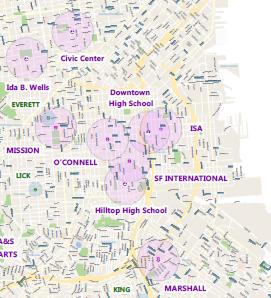
She’s got a new map for me that shows where trucks would be banned under the compromise proposal — one that includes only public middle schools and high schools. Check it out here. (pdf) And compare it to the old map here.

This all seems eminently reasonable, and maybe we can have healthy school food and burrito trucks, too.

“Hunger Games” tix sold out? See one of these movies instead!

0

Reports are flooding in about sold-out Hunger Games woes. Don’t worry, you won’t have to hit up John Carter again for your cinematic fix — here’s a list of some great new films opening this weekend, from mad action to tender realism. For even more, hit up this week’s Film Listings. All films open Fri/23.

The Kid with a Bike Slippery as an eel, Cyril (Thomas Doret) is the bane of authorities as he tries to run away at any opportunity from school and a youth home — being convinced that the whole adult world is conspiring to keep his father away from him. During one such chase he literally runs into hair-salon proprietor Samantha (Cécile De France), who proves willing to host him on weekends away from his public facility, and is a patient, steadying influence despite his still somewhat exasperating behavior.

It’s she who orchestrates a meeting with his dad (Jerémié Renier, who played the child in the Dardennes’ 1996 breakthrough La Promesse), so Cyril can confront the hard fact that his pa not only can’t take care of him, he doesn’t much want to. Still looking for some kind of older male approval, Cyril falls too easily under the sway of Wes (Egon Di Mateo), a teenage thug whom everyone in Samantha’s neighborhood knows is bad news. This latest neorealist-style drama from Belgium’s Dardenne Brothers treads on very familiar ground for them, both in themes and terse execution. It’s well-acted, potent stuff, if less resonant in sum impact than their best work. (1:27) Embarcadero, Shattuck. (Dennis Harvey)

Drama not your thing? Hold onto your butts for this one…

http://www.youtube.com/watch?v=v0hSL3a_kaw

The Raid: Redemption As rip-roaring as they come, Indonesian import The Raid: Redemption (from, oddly, a Welsh writer-director, Gareth Huw Evans) arrives to reassure genre fans that action films are still being made without CG-embellished stunts, choppy editing, and gratuitous 3D. Fists, feet, and gnarly weapons do the heavy lifting in this otherwise simple tale of a taciturn special-forces cop (Iko Uwais) who’s part of a raid on a run-down, high-rise apartment building where all the tenants are crooks and the landlord is a penthouse-dwelling crime boss (Ray Sahetapy). Naturally, things go awry almost immediately, and floor-to-floor brawls (choreographed by Uwais and co-star Yayan Ruhian, whose character is aptly named “Mad Dog”) comprise nearly the entirety of the film; of particular interest is The Raid‘s focus on pencak silat, an indigenous Indonesian fighting style — though there are also plenty of thrilling gun battles, machete-thwackings, and other dangerous delights. Even better: Redemption is the first in a planned trilogy of films starring Uwais’ badass (yet morally rock-solid) character. Bring it! (1:40) Sundance Kabuki. (Cheryl Eddy)

Just looking for a feel-good movie (with added bonuses: cute cop, insane musicians)?

Sound of Noise The ingenious 2001 short Music for One Apartment and Six Drummers expands to feature length — and blankets an entire (unnamed) Scandinavian city in anarchic soundscapes — in Ola Simonsson and Johannes Stjärne Nilsson’s eccentric, engaging comedy. A cop (Bengt Nilsson) on the anti-terrorism squad also happens to be the only tone-deaf member of his musical-genius family; the fact that his name is Amadeus only makes his hatred of music all the more potent. When a mysterious band of percussionists begin holding disruptive performance-art “concerts” in odd places (a hospital, a bank), Amadeus becomes obsessed with the case — though, in a nifty bit of fantasy, once an object has been played on by the group, he can no longer hear the sound it makes. Sound of Noise is worth seeing just for the toe-tapping musical interludes, played on objects both commonplace  and ridiculous, but Nilsson and the musicians (especially ringleader and lone female Sanna Persson Halapi) are also deadpan delights. (1:38) SF Film Society Cinema. (Cheryl Eddy)

Plus, at rep houses:

A tribute to William Shatner Thurs/22 at the Vortex Room: “Deep Shat”

And some seriously sick, twisted (read: amazing) B- and Z-movie finds Fri/23-Sun/25 at the Roxie: “Cinemadness”

http://www.youtube.com/watch?v=QTCJWVLfAYo

Peter Whitehead manipulates strange and beautiful sounds using unlikely materials

0

“When I hear instrumental music, I often see how it’s designed – the movement of the different shapes in space; the changing of colors,” says Peter Whitehead, a San Francisco-based musician-visual artist who makes instruments out of found materials and visual art that represents his world of sound.

Whitehead began making instruments as a way to develop truly unique sounds; sounds he’d never heard before. “The process of creating an instrument that produces its own unique and beautiful sound is almost like alchemy to me,” Whitehead explains. “You take an array of everyday, familiar materials and put them together, and they are transformed into a system that can speak for itself as well as become a conduit for your own personal expression.”

His instruments include the Spoon Harp, Ektar, Buzzing Bass Lyre, Spiral Corrugahorn (to name just a few), and his materials have ranged from kitchen spoons to bicycle wheels to weedwacker line.

The Brightness of the Day . . ., an exhibit of Whitehead’s handmade instruments, along with his collages and paintings, opens this Friday at Gallery 60Six. Whitehead’s visual art illustrates pattern and variation – important elements of musical composition.

The exhibit bears the name of his new album, The Brightness of the Day is Bigger Than the Bed, which was released earlier this year and is a compilation of songs that have been commissioned for dance performances and films.

This album’s songs certainly lack stylistic cohesion and at times feature noises not usually associated with music  – a testament to his belief that all sounds are interesting.

Take “Wash (Short Cycle),” which was originally commissioned for a giant washing machine exhibit at the Children’s Creativity Museum. Whitehead produced a noise akin to someone screaming “wheeee!” coupled with high-pitched beeps over a deep accordion-like sound that calls to mind some type of twisted carnival. Whitehead tacked the piece onto the end of his album against the advice of others. “It drives people crazy,” he says with a chuckle, “but I wanted to put it on.”

“Wash” demonstrates Whitehead’s inspirational artistic perspective –   you can create beauty out of the mundane, unassuming, and strange. “I was always drawn to sound [with] lots of harmonics – drums and buzzing sounds; things with a slight amount of distortion in them,” he says.

But some tracks on the album are milky and melodic, like the piece Anna Halprin commissioned (aptly titled, “For Anna H”). And others feel like a sexy blast of electronic sound.

“[The Brightness of the Day Is Bigger Than the Bed] is unusual in that I started using [more] electronics,” Whitehead says. He also explained that his frequent use of conventional instruments (about 50 percent of the instruments on the album are his own and 50 percent are conventional) makes it an atypical work for him, as in the past he’s created albums in which 90 percent of the featured instruments were his creations.

Whitehead will be exhibiting about 30 of his instruments at Gallery 60Six, and while he’s shown instruments and visual art in museums and galleries in the past, this exhibit will be his first time bringing together the various aspects of his music, visual art, and instrument building for one show. He’s also planning on playing an experimental instrument or two at the opening. Watching a grown man make a water bottle attached to a spoon and steel string sound good is probably not something you’re going to want to miss.

The Brightness of the Day . . .
Fri/23, 6 p.m., free
Gallery 60six
66 Elgin Park, SF
www.gallery60six.com

Hot sexy events: March 22-29

3

Perhaps you caught Soojin Chang’s review of the first month’s edition of Cum and Glitter (my god, the trolls from SFGate sure did!), the Mission’s new alt-queer live sex show that had Ava Solanos squirting, yes squirting, the to thrums of a cello perched mere feet away from her audience-spritzing climax. Yes! Well even if you didn’t, you will note from that description that C&G is the classiest thing that an experienced exhibitionist could be possibly be involved in, in the city these days. And so it is with pleasure that we announce that the show is currently holding auditions. Will you don baby bloomers and molest your babysitter onstage? Sexy ribbon-dance? Those were actually last month’s ideas, babe, but we know you can think of something great. Now, the week’s sex events from lectures to slutty cigar parties.

“Pink Japan: Contemporary Sex Culture”

An expert in Japanese bondage (in fact, she wrote the first English language book on shibari), sex worker Midori brings a unique perspective on the sexual mores and more!s of that particular island nation. Come to her presentation today on her voyages in the East — if you come early you can check out her collection of dirty mags and other goodies from her trips. 

Thu/22 7:30 p.m., $10-$30

Center for Sex and Culture

1349 Mission, SF

www.sexandculture.org

The League

Here’s a great reason to start volunteering at town’s premier pansexual playspace: cheese, chocolate, cigars, cabaret music, and sexy time with all the dappers and dandies of the Mission Control community. Live tunes provided by This Can’t End Well, hotness provided by you. 

Thu/22 8 p.m.-midnight, only open to Mission Control allies, volunteers, and crew

Mission Control

www.missioncontrolsf.org

Sacred Grounds: A kinky sexuality munch

Remember when Wicked Grounds shut down? Yeah, we’d rather forget that time too. But SF’s best-and-only kink coffeeshop has been re-opened long enough to get back into the swing of things, and we’re excited to see that it’s hosting its standard line-up of pervy-perfect community happenings. Come tonight to talk O with other om-ers — kinky sexuality takes the conversational stage at this meet-and-greet (typically used to hunt down future play partners, lucky you.)

Sun/25 7 p.m.-9:30 p.m., free

Wicked Grounds

289 Eighth St., SF

(415) 503-0405

www.wickedgrounds.com

“Sex, Race, and Class: The Perspective of Winning”

Author Selma James has a sexy theory and it is this: capitalism is a ware waged against human life — life that is driven by reproduction. (Small wonder that the Republicans want to take the fun out of sex.) Learn all about it on this stop of her book tour, which is happily timed to coincide with Shaping SF public lecture series. She’ll bring with her Andaiye, the founder of the Guyana’s Red Thread movement for female financial autonomy and community connectedness. 

Wed/28 7:30 p.m., free

CounterPULSE 

1310 Mission, SF

(415) 626-2060

www.counterpulse.com

“Girl Talk”: A trans and cis woman dialouge

Could be hard to hear, could be heart-warming, will probably be both, this spoken word event has sold out to the gills online, and with good reason. Gina de Vries, Elena Rose, and Julia Serano have crafted an evening of performances that will center around the theme of sisterhood between trans and cis-gendered women. They’re hoping it will be the jumping-off point for a dialouge that really doesn’t get enough play in the queer community (or anywhere, for that matter). 

Thu/29 7-10 p.m., $12-$20 (sold-out on line, but limited standing room-only tickets remain)

LGBT Community Center

1800 Market, SF

www.queerculturalcenter.org

7 spots for wine and wi-fi

0

Are those cubicle walls closing in? For those of us who prefer to pair our work with a side of wine, here are some places to consider retreating to when the office begins to feel stale.

The Grove

Curl up in a comfy chair or communal wooden bench with a glass of red wine at one of this quaint café’s three locations, and you won’t want to leave. 

Mon.-Thu. 7 a.m.-11 p.m.; Fri. 7 a.m.-11:30 p.m.; Sat. 8 a.m.-11:30 p.m.; Sun. 8 a.m.-11 p.m. 2016 Fillmore, SF. (415) 474-1419

Monday-Friday 7 a.m.-11 p.m.; Saturday-Sunday 8 a.m.-11 p.m. 690 Mission, SF. (415) 957-0558

Monday-Friday 7 a.m.-11 p.m.; Saturday-Sunday 8 a.m.-11 p.m. 301 Hayes, SF. (415) 624-3953

Matching Half

Bright, airy Nopa neighborhood café that serves Sightglass coffee, sought-after almond croissants, and a small selection of red and white wines; a quintessentially San Francisco café conducive to productivity. 

Mon.-Fri. 7 a.m.- 7 p.m.; Sat.-Sun. 8 a.m.-7 p.m. 1799 McAllister, SF. (415) 674-8699, www.matchinghalfcafe.com

Coffee Bar

This chic Mission spot has a frequently rotating list of wines from Spain, New Zealand, Napa, and beyond. The barista recommends the citrusy, medium-bodied Hunter’s sauvignon blanc. 

Mon.-Fri. 7 a.m.-8 p.m.; Sat.-Sun. 8 a.m.-7 p.m. 1890 Bryant, SF. (415) 551-8100, www.coffeebar-usa.com

Noeteca

Last year our readers named this warm and cozy Noe Valley space the best wine bar in the city. Its wine list has been carefully curated, and its price list won’t break the bank. Try the much-hyped Sexual Chocolate California red, and get back to us. (Half-glasses start at $4.50.)

Wi-fi hours are limited to weekdays from noon to 4 p.m. 1551 Dolores, SF. (415) 824-5524, www.noeteca.com

Vinyl

Happening Divisadero Street wine bar with a lengthy list of West Coast and foreign selections. Best bet is to stroll over on a Wednesday night for grub from the Fogcutter Food Truck or Thursday for pizza from Pizza Hacker. 

Mon. 5:30-10 p.m.; Tue.-Thu. 5:30-11 p.m.; Fri.-Sat. 5:30 p.m.-midnight; Sun. 5:30-10 p.m. 359 Divisadero, SF. (415) 621-4132, www.vinylsf.com

Press Club

If you like your wine coupled with an environment that’s quite swankier than your average SF café, Press Club’s the call. Most of the bar’s wines are from Napa and Sonoma, and its menu features seven themed flights.

Mon.-Thu. 4 p.m.-10 p.m.; Fri. 4 p.m.-12 a.m.; Sat. 2 p.m.-midnight. 20 Yerba Buena Lane, SF. (415) 744-5000, www.pressclubsf.com

Bean Bag Café

Fun, friendly café a drunk stumble from The Independent. Come for the scene and the $4.50 glasses of zin or cab.

Mon.-Fri. 7 a.m.-10 p.m.; Sat. 7:30 a.m.-10 p.m.; Sun. 8 a.m.-10 p.m. 601 Divisadero, SF. (415) 563-3634

Street Threads: Look of the Day

0

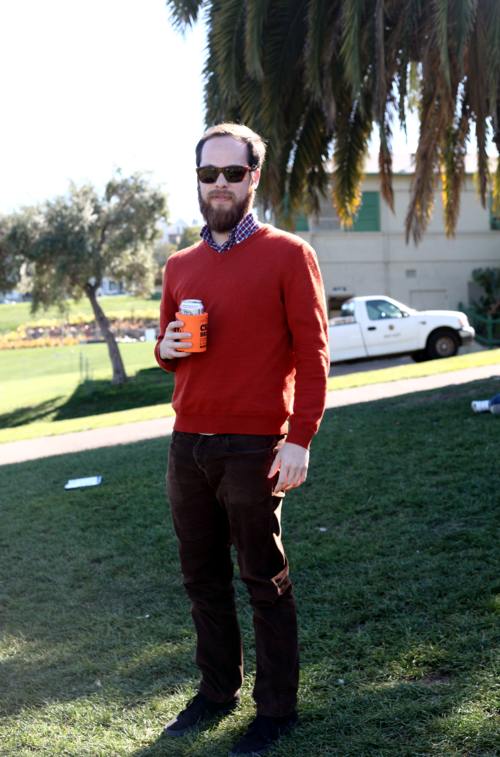
Today’s look: Kayla, New Montgomery and Mission

Tell us about your look: “My fashion is inspired by my grandmother because she gives me all her old things.”

Supervisors hope to halt foreclosures with new resolution

70

John Avalos introduced a resolution today urging support for homeowners facing foreclosure in San Francisco. The resolution calls for several actions, including suspending all foreclosures until state and federal measures to protect homeowners are in place.

Sponsors of the resolution Avalos, David Chiu, Jane Kim, Eric Mar, and Christina Olague joined a coalition of community organizations to explain the resolution at a press conference.

The resolution would call for support of a statewide Homeowners Bill of Rights, a series of bills that would address predatory loans and robosigning, as well as California Attorney General Kamala Harris’s campaign for a statewide suspension on foreclosures in properties controled by Fannie Mae and Freddie Mac. It also “urges all city and county officials and departments to work proactively to ensure that San Francisco residents do not fall victim to unlawful foreclosure practices,” as Avalos explained.

Supervisors cited a report released in February by Assessor Phil Ting as one of the reasons for the resolution. The report found “irregularities” in 99 percent of foreclosure documents in San Francisco between 2009 and 2011, and “what appear to be one or more clear violations of the law” in 84 percent of cases. 

The resolution’s language also names “predatory banking practices that disproportionately targeted racial and ethnic minority communities, especially working class African Americans and Latinos” as an impetus for the resolution, noting that “from 2007 to 2008, Wells Fargo, and mortgage lenders it has since acquired, was 188 percent more likely to put African American borrowers and 117 percent more likely to put Latino borrowers into higher-cost, subprime loans.”

“What we see around foreclosures is that we have a systemic problem,” said Campos. Over 1,000 homes in San Francisco are currently in the process of foreclosure, 

Supervisor Kim connected the issue to another systemic problem affecting San Francisco, that has been a recent topic of discussion at City Hall: family flight. 

“We do have many low-income families that are actually homeowners in the city, primarily in the southeast sector. But how they afford to buy homes is by squeezing often two to three families in these homes in the southeast. So we’re talking about not just one household when we foreclose on a home, we’re often talking about two, three families with multiple youth and seniors,” said Kim.

“This is something that has been an important issue for many of our supervisors across the political spectrum, is how to retain families in San Francisco. Stopping foreclosure has to be a key part of that.” 

A few supervisors congratulated community organizers for focusing on the foreclosure crisis.

“I want to thank Occupy Bernal for not only shedding light on what’s happening in Bernal Heights, but realizing that the foreclosure crisis that we’re facing is something that involves all of us. Every single neighborhood,” said Campos.

The resolution was introduced to the Board of Supervisors March 20. It will be discussed further at the Land Use and Economic Development committee meeting April 2. 

If it eventually passes the Board of Supervisors, the resolution will be non-binding; a citywide foreclosure moratorium is likely not imminent. Yet many supporters expressed urgency and commitment for city action to address foreclosures. 

“When speaking with the sheriff about how we can stop evictions, what struck me most was he said that sometimes when we walk into these homes, we’ve found that people have committed suicide before the sheriffs even come in,” said Supervisor Kim. “This is a life and death issue for many of our residents.”


Mayor Lee ousts Sheriff Mirkarimi

96

San Francisco Mayor Ed Lee temporarily removed Sheriff Ross Mirkarimi from office today over a domestic violence case, dragging this long and sordid saga into the summer as city officials prepare a rare official misconduct hearing.

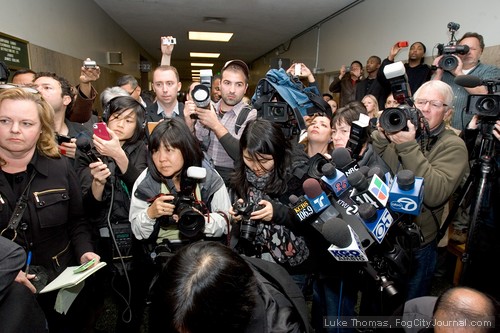
The brief announcement came just minutes after a 24-hour deadline Lee had set for Mirkarimi to resign or be removed. Lee took no questions from the huge crowd of journalists that had packed into his office and offered scant explanations about why he believes the process is warranted and how it will affect the city.

Standing behind Lee were City Attorney Dennis Herrera, with whom Lee had consulted on the decision, and Vicki Hennessy, a retired chief deputy from the Sheriff’s Department who Lee named interim sheriff. Shortly before the announcement, Mirkarimi told reporters he had no intention of resigning.

“He has chosen not to resign and now I must act,” Lee told reporters, emphasizing that “I do so with an understanding of the seriousness and gravity of the situation.”

Lee made no statements about how Mirkarimi’s guilty plea to a misdemeanor false imprisonment charge – reduced down from the three more serious charges he originally faced – rose to the level of official misconduct or why it warrants his removal, other than making general statements about ethics.

“We must always be held to the highest ethical and legal standards,” Lee said, adding that Mirkarimi had failed to do so. “I’m doing what’s in the best interests of the people of San Francisco.”

Time may tell whether that last statement is true, and whether the Ethics Commission and nine members of the Board of Supervisors agree and are willing remove a public official from office in San Francisco for just the third time in the last century.

Teacher’s Union unhappy with SF school chief process

9

Key Tray from the United Educators of San Francisco called me to comment on my description of the outgoing and incoming school superintendent, which he found a little too flattering:

I haven’t agreed with him on everything, but overall, he’s done a good job — the schools are better than when he arrived, enrollment is increasing, and there’s no more of the imperious attitude and gag orders of the old Ackerman days. The district is on the right track — although Garcia would be the first to admit that there’s a lot more work to be done. And I have nothing bad to say about his annointed successor, Deputy Superintendent Richard Carranza. He’ll probably do a fine job.

Tray’s point: Yes, on a lot of levels Garcia did well, but in the past few weeks he’s created a labor mess. “It’s a big disappointment,” Tray told me. “He’s poisoned the well and now he’s leaving the farm.”

The problem: Garcia decided this year to exempt 14 low-performing schools from the annual round of layoffs. The layoff process is annoying anyway — by state law, teachers have to be warned of layoffs in the spring although the state budget isn’t done until the summer so the schools don’t really know how much money they’ll have. In most cases, the layoffs are later rescinded. Out of the 500-plus layoff notices this year, “most won’t come to fruition,” Tray notes.

But the bigger problem for the union is that Garcia tossed out the seniority process when he made the decision to protect schools in the “Superintendent’s Zone.” And while some people think that’s just dandy, the teacher’s union calls it a disaster: Seniority is one of the most sacred elements of a union contract.

“Now he’s at war with the teacher’s union,” Tray said.

That, he said, won’t be pleasant for the new superintendent, who has been one of Garcia’s top aides: “Carranza’s walking into a toxic mess.”

Garcia, not too surprisingly, sees it very differently. “I’m the most pro-union guy you’ll ever find,” he told me. The 14 schools have a history of high turnover — and in an effort to keep a team of teachers, some of whom don’t have the highest seniority, in place, he exempted them from the layoffs. “We’re talking about 70 people,” he said. “And our figures suggest that this would have an impact on only three tenured teachers” who might face pink slips that they otherwise would have avoided.

As for the toxic labor environment? “It’s too bad they see it that way. We’ve worked together on every issue for five years, and I hope this one area where we disagree doesn’t ruin the entire relationship. This isn’t the only issue that matters in the world; I just wish they wouldn’t be this extreme.”

Good luck, Mr. Carranza — you’ve got some fence-mending to do.


Localized Appreesh: Doe Eye

0

Localized Appreesh is our weekly thank-you column to the musicians that make the Bay. To be considered, contact emilysavage@sfbg.com.

Doe Eye, aka Maryam Qudus, is perhaps the most local of Localized Appreeshers. (That is, despite her current traveler status while studying at Berklee College of Music in Boston.) The lady with the big brown eyes and soulful voice is a true blue, born-and-raised San Franciscan. And she often uses the city as her muse.

The ooh-ooh pain of hazy torch hit “I Hate You” off last year’s Run Run Run EP is likely about a former lover, though it could easily refer to this push-pull foggy city we inhabit. “Darling,” she coos repeatedly, “it hurts to love you.”

Her full-length is due out later this year. This week she headlines Cafe Du Nord.

http://www.youtube.com/watch?v=hjGN2Mbqky0

Year and location of origin: I’m a solo artist, so I’ve been songwriting since I was a kid. But the origin of Doe Eye was February 2011 – Union City, Calif.

Name origin: My friend gave me the nickname “doe eye” because of my freakishly large eyes.
Personal motto: “Eat cake for breakfast”. I have a sticker of it on my journal – where I write deep philosophical thoughts. Helps lighten the mood when I write.

Description of sound in 10 words or less: Dreamy and epic.

Instrumentation: Lead vocals, two guitars, keys, two cellos, violin, bass, trumpet, drums and two-to-three back-up vocalists.

Most recent release: My EP titled Run Run Run in August of 2011 – available for free on doeeye.bandcamp.com.

Best part about life as a Bay Area musician: The Bay Area music scene is crackin. It’s the best it has ever been. Having huge support systems like LIVE 105 and so many great venues like Bottom of the Hill, the Independent and Cafe Du Nord. San Francisco is my favorite city in the world, so I find myself influenced by the city a lot.

The weather, the Bay Bridge, the people –  all of it. I love it.

Worst part about life as a Bay Area musician: I fly back and fourth a lot between the Bay Area and Boston because I study at the Berklee College of Music in Boston. I hate loving the Bay Area so much and not being able to be here. There is always so much going on in the Bay – shows, events, that I have to miss.

First album ever purchased: I grew up listening to a lot of rap – which doesn’t really influence my music much. My older brother was a huge influence for that. I honestly don’t remember what my first album purchase was – but I do remember listening to a lot of 2Pac.

Most recent album purchased/downloaded: Beach House, Teen Dream. For some reason, I never listened to Beach House until now. A lot of people have been asking me lately if my music is influenced by Beach House so I decided to listen. Uh – yeah I can see why they would ask that. The really reverbed-out dreamy sound – that’s my forte. Teen Dream is an amazing album. I can’t stop listening to it. I can’t wait for their next record.

Favorite local eatery and dish: Delarosa, Eggplant Panini – yum.

Doe Eye
With the Bins, Minor Kingdom
Thurs/22, 9 p.m., $10
Cafe Du Nord
2170 Market, SF
(415) 861-5016
www.cafedunord.com

Threats from mayor and neighbor in evolving Mirkarimi saga

43

In Old West and pulp fiction stories, it’s usually the sheriff who tells a criminal that he has 24 hours to get out of town or else. But in the latest twist in an increasingly ugly San Francisco drama, that’s what Mayor Ed Lee reportedly told Sheriff Ross Mirkarimi yesterday afternoon, setting up a 5 pm showdown by which Lee told Mirkarimi to resign or face removal from office.

That’s just one of a few rapidly unfolding developments surrounding domestic violence allegations against Mirkarimi, who pleaded guilty to a reduced charge of false imprisonment and is now facing Lee’s threat of bringing official misconduct charges against him.

With the criminal case ending yesterday, Mirkarimi’s wife, Eliana Lopez, and her attorney Paula Canny called a press conference for noon today to finally tell the story of what happened on New Year’s Eve, when the couple fought and Lopez was left with a bruise on her arm, the next day telling neighbor Ivory Madison that Mirkarimi had inflicted it.

But Canny arrived without Lopez, telling the large pack of journalists that they were no longer free to talk because of a cease-and-desist letter and civil lawsuit threatened by Madison and her lawyer husband, Abraham Mertens, who wrote an op-ed in today’s Chronicle calling for Mirkarimi’s removal and accusing Mirkarimi, Lopez, and their lawyers of trying to “discredit, dissuade and harm my wife.”

“Events have risen so that Eliana Lopez is no longer willing to come speak,” Canny said, noting that she has had to get her own lawyer to defend against the accusations and legal threats from Mertens and Madison. 

[added from here at 3:30 pm] Canny repeated a previous claim that Lopez knew Madison had attended law school and was seeking legal help from her, making the videotape confidential under attorney-client privilege, a claim Mirkarimi’s judge rejected. “My client sought legal advice from someone she thought reasonably to be an attorney,” Canny said today, noting that only Lopez can lift the veil of confidentiality in such cases.  

Although Lopez didn’t cooperate with the prosecution of her husband, maintaining that she was not a victim of domestic violence, Canny reiterated that Lopez was willing to testify in court as to what really happened that night but that she wanted immunity from prosecution first. “She has always said she would testify under immunity, but the District Attorney’s Office refused to offer it,” Canny said today. 

Given that Mirkarimi faced a child endangerment charge because their two-year-old son, Theo, was present during the altercation, it’s conceivable that Lopez could also be charged with a crime. Sources close to Mirkarimi and Lopez told the Guardian that Lopez was prepared to say today that Mirkarimi was restraining rather than attacking her, something she was willing to discuss with reporters before these latest legal threats.

Canny noted that the media circus and threats made on the couple’s livelihood have been the most damaging part of a saga that she called “an amazing, horrible experience” and  “oppressive and unfair,” noting the irony of a prosecution that purported to be about helping victims of domestic violence.

“Has any of this helped Eliana Lopez? Has any of this helped Theo?” Canny said. “This is not about helping her.”

She said that neither Lee nor anyone from the Mayor’s Office have tried to contact Lopez. “If the mayor wants to call me, I’d say he’s not trying to make the world a better place,” Canny said.

Canny also had this message for Lee: “To the mayor, please respect the electoral process,” adding that Lopez also strongly wants Mirkarimi to remain in office and that “Eliana Lopez is not afraid of Ross. Eliana Lopez loves Ross…If people care about them at all, let Ross do his job.”

Canny also took issue with La Casa de las Madres and other domestic violence advocates that have pressured Lee to oust Mirkarimi and sought to capitalize on the case, even circulating Lopez’s name and image. “That’s not how crime victims are to be taken care of,” Canny said. 

Many political and legal observers say they’re surprised by Lee’s apparent decision to suspend Mirkarimi and bring official misconduct charges, saying it will be a complicated, distracting, and divisive process that is unlikely to result in Mirkarimi’s removal. They say the charges so clearly don’t rise to the level of official misconduct that even the Ethics Commission, where the hearing is held, may reject them. If Ethics recommends Mirkarimi’s removal, it was take nine of the 11 members of the Board of Supervisors to remove him.

Then again, these observers speculate that Lee may simply want to use the hearings to air the evidence and discredit Mirkarimi so that he’d be easy pickings for a recall campaign that could be launched this summer — in the process, potentially gaining a campaign issue to use against progressive supervisors facing reelection this fall. The Chronicle reported yesterday that the case has generated a bonanza of donations to La Casa de las Madres, which is planning to do Spanish-language billboards in the Mission District, where Sup. David Campos is now running for reelection.

Lee has not offered many substantial comments on why he may believe official misconduct charges are warranted, but he’s expected to do so as soon as this afternoon when he announces his decision on the Mirkarimi matter.


Editorial: Mayor Lee: Ease off Mirkarimi and help stop the foreclosure crisis

16

And so the downtown gang (Willie Brown/Rose Pak, PG&E, the Chamber, the big developers et al) used Ed Lee to outmaneuver the progressives and roll Lee into the job of “interim mayor” on condition Lee not run for mayor.  Then Lee kept lying for months about his intentions and saying over and over that he would not run for mayor–until the downtown gang convinced him to run as a way to further damage the progressives. And now, according to news reports, Mayor Lee is poised to file misconduct charges against Mirkarimi for his gulty plea of false imprisonment in the Mirkarimi domestic violence case.

This could lead to an explosive and polarizing scenario where the Board of Supervvisors, in an election year, would be asked to remove Mirkarimi, a former fellow supervisor and political ally, as sheriff or side with him on what has turned out to become a toxic political issue. This would affect at minimum Mar, Avalos, Campos, and Olague in the supervisors’ races and Mar, Avalos, and Campos in the upcoming Democratic County Central Committee race. It would also affect any candidate in any race that said a nice word about Mirkarimi.  If anybody thinks the mayor and the downtown gang would be unhappy with this prospect, think again. I recommend that Lee hold off on Mirkarimi, and work to uphold his position as a “unifier,” and not become a polarizer and promoter of media and City Hall circuses. Instead of taking on Mirkarimi and the progressives, he should concentrate on such important and timely issues as helping stop the foreclosure process on the thousands of homes facing foreclosure in San Francisco. More: he should go after the big foreclosure banks, starting with the Bank of America and its multi-million dollar short term cash account with the city, and  Wells Fargo, with its national headquarters here in town.b3

More than 1,000 homes in San Francisco are either in foreclosure or at the start of the process. Some 16,000 homeowners are underwater, and as many as 12,000 may face foreclosure in the next 12 months. A report by the Alliance of Californians for Community Empowerment shows that the city could lose $115 million from the reduced property taxes and the costs of carrying out evictions.

That’s a crisis — and while the mayor has no direct control over home foreclosures, he ought to be speaking out and joining the protesters who are fighting this cascade of often-fraudulent bank actions.

The problems are legion: An audit released in February by Assessor Phil Ting shows that more than 80 percent of the foreclosure notices filed in San Francisco contain at least one legal irregularity, and many contain multiple. Banks back-date documents, use faulty information, and in some cases clearly and directly break the law when they move to seize property — often because of bad-faith loans that were more the fault of the banks than the homeowners.

A group from Occupy Bernal, the well-organized, sophisticated operation that’s been intervening in foreclosures and evictions in the Southeast neighborhoods, visited us recently, and the stories we heard were alarming. Some told of bankers who promised to make loan modifications — then went ahead with foreclosure anyway. Some people spend weeks just trying to figure out who actually owns the mortgage — and while the financial institutions are ducking calls and hiding from responsibility, they’re moving forward to toss people out of their homes.

ACCE and Occupy Bernal have had some successes — they slowed down foreclosure actions, forced banks to come to the table and in some cases saved homes. But the activists are up against big corporations and big numbers — too many homes on the block, too many financial institutions, and not enough people and money.

The Ting report showed enough violations of law that we’ve already urged the city attorney and the district attorney to start taking action.

But we’ve heard little beyond silence from the office of Mayor Ed Lee.

Lee’s the city’s chief executive, the person who has to handle the financial fallout of the foreclosure crisis as well as the human impacts — families evicted from their homes have a high chance of winding up on the streets, putting additional pressure on already-stressed social services.

Besides, this is a tragedy — and a lot of the problem is simply unaccountable, unreachable financial institutions. If Occupy Bernal and ACCE, through volunteer organizing and community pressure, can prevent a fair number of evictions, think of what the mayor of San Francisco could do — just by speaking out.

Lee ought to show up at some of the Occupy Bernal actions, but that may be too much to ask. But it’s not too much to suggest that he publicly support the foreclosure fighters and call on the banks to work with local homeowners.

The city keeps its multibillion-dollar short-term cash accounts in institutions like Bank of America, which is responsible for more than 10 percent of all foreclosures in the city. Wells Fargo, with its headquarters right here in town, is responsible for 22 percent of the local foreclosures. Lee ought to let the banks know the city won’t keep doing business with bad actors.

With a little visibility, the mayor could help save hundreds, maybe thousands of families from facing homelessness. This crisis calls for leadership; where’s the mayor?

Artists still puzzling over destruction of international exchange mural

6

In 2003, artists from a San Francisco-Indonesia cultural exchange painted murals on one of the outer walls of Project Artaud, a non-profit art collective in the Mission that provide live-work studios and exhibition space for artists. Within nine years, the expansive mural became a part of the street’s geography — adorning the street like colorful flowers or trees — and was loved by neighbors and passersby alike. But starting last month, tags started to appear on top of the paintings, and within a 24-hour span, the mural faced its tragic and final destruction.

“It feels like a death,” said Jonah Roll, one of the mural’s artists, during a Guardian interview at his home in Project Artaud. During their interview with the Guardian, Roll and Alejandra Rassvetaieff (another artist whose mural was ruined) attempted, to no avail, to understand the reasoning behind the tagger’s recent actions. With so many other empty street walls, why did somebody choose to tag here? Could it have been a personal attack? And is there ever a worthy excuse that justifies destroying someone else’s artwork? 

“If you consider yourself an artist, I don’t think you can just paint on top of another artist’s work,” commented Rassvetaieff. “It’s sad because the murals in the Mission have been here for years, and it’s something that people should respect.”

Scenes from the mural’s 2003 creation. Photos via Project Artaud

The mural was created in 2003 as part of a collaboration between San Franciscan artists from the Clarion Alley Mural Project and artists from a public art collective in Indonesia (the project also gave birth to murals at Rainbow Grocery, Clarion Alley, and Le Beau Market in Nob Hill. Entitled “Sama-sama/You’re Welcome,” the wall was completed after a cultural exchange that sent CAMP artists to Indonesia, and Indonesian artists here to San Francisco. The wall recieved a Best of the Bay award from the Guardian in 2004 for Best Transnational Art Undertaking.

Although there are rumors as to who may have done the taggings — Rassvetaieff noticed the same signature sprayed on her friend’s mural on Market Street — the artists preferred not to disclose names during the interview. “It coincide[d] with a big tagging of work in Clarion Alley that got destroyed around the same time,” said Roll, “they’re doing it for publicity, to spread their name.”

Graffiti is increasingly becoming accepted as a respected art form — and for many good reasons. It serves as an expressive channel for underrepresented people, especially  youth, and is a kind of satisfying slap in the face of corporate advertising that often mars our streetscapes. But tagging on community murals is not a stance against big business. Individual people dedicated hours towards creating these panels of art. 

“I respect the art form of graffiti — there’s a lot of amazing work out there— but it’s sad when something that has value to our community is destroyed,” said Roll. 

The mural in question was a community project that was self-funded by the seven artists. Roll’s section of the mural was a painting dedicated to the passing of his mother and the birth of his new family. Rassvetaieff’s mural, titled “Happiness,” showed a couple embracing under a starry night sky. She said it was meant to celebrate the soul of the human being. 

But Roll’s love for her work was no match for the endurance of the taggers, who returned again and again to re-tag the wall. “I couldn’t even go out there in the end for the last tags,” concluded Roll. “I was completely exhausted.” 

Perhaps the most regrettable loss of all was Federico “Pico” Sanchez’s colorful watermelons. The esteemed muralist and art community leader recently passed away in November 2011. 

Street art and graffiti should be working alongside each other — challenging traditional notions of art and working together to promote a sense of expressive cohesiveness in the community. Competition is great, if it fuels growth and demands progress. But artists, hone your craft and create an attention-worthy piece. Real talent tends to get noticed — especially on the streets. 

Weary of covering up tags, Project Artaud members eventually painted the wall a solid shade of green. Bummer.

Guardian photo by Marke B.

Success won’t jinx Sharon Van Etten’s ability to write sad love songs

0

Ed. note – Ahead of Sharon Van Etten’s long-sold out show in SF this week, Ryan Prendiville had the chance to catch up with the rising indie folk singer-songwriter (who recently released critically lauded third album ‘Tramp’) to discuss her songwriting process, lessons of South by Southwest pasts, and the influence of Nick Cave:

SFBG: How many shows are you playing at SXSW?

Sharon Van Etten:
Just two. Last year we did eight in three days. It was really stupid. I burnt out and lost my voice for three days when we had just started a tour. I decided this year it just wasn’t worth it.

SFBG:
You’re going to be touring nonstop for probably the rest of the year, are you not too worried about burning out?

SVE: I have to worry about burning out. These songs are more intense vocally with more band members, which I’ll still have to sing over. If the drummer loses his voice it’s one thing, but if I lose my voice we can’t really play. Before I just played as many shows as I could whereas now I realize that five in a row is kind of the max before we all start losing our minds.

SFBG: Are you thinking more of the long-term now?

SVE: I’m realizing that if I can learn how to perform in a healthy way, I’ll be able to do this for a long time. I know it sounds kind of adult or something. But for every record, if you really want people to hear it, you have a responsibility to tour at least a year, cover as much ground as you can, and play the best show that you can everyday. So you should take care of yourself. You’ve got to have fun, of course.

SFBG: Since your music is generally pretty sad, is there any danger, with your career going well and having fun, of hurting your ability to make similar music?

SVE: Some people are concerned that I’m going to start writing happy songs now that I’m doing well. The whole joke is, if you’re not miserable you’re not going to write as well. I’m not too worried about that. If I write differently, I write differently. I’m pretty at peace and proud of what I’m writing. I don’t want to jinx myself and say that people will like it just as much, but you don’t have to be miserable or tortured to record or be successful. So far most of my songs have been written in intense periods where I’ve been going through a hard time, but I think I can write songs just as well when I’m happy.

http://www.youtube.com/watch?v=-1OBHLTaHnU

SFBG: There’s a bit of a stereotype that female musicians are often more personal, writing from their own life experience, than their male counterparts. Obviously a great aspect when it’s true, but can downplay a creative aspect.

SVE: Writing more emotional songs doesn’t makes a person less creative. I think a lot of men avoid it while women tackle it, and that’s just a difference in genders. It’s not necessarily a bad thing, just how most people are. Men are often more storytellers and detach themselves from an actual event, but I don’t think that makes them not passionate. I’d like to learn to be more of a storyteller, it just doesn’t come naturally to me right now. I’ve been listening to a lot of Nick Cave, and he’s really, really good at that. It makes me want to try a different way of writing next time.

SFBG:
Are you working on new material while you’re touring, or do you kind of give yourself a mental break?

SVE: I’m always kind of writing, I just don’t know what it will turn into. I have different side projects that I’m working on but who knows if they’ll fuse together into something someday. I have piano music. I have electronic music. I have really minimal stuff but I also want to write more rock songs. Right now i have a lot of ideas, but can’t call them songs yet.

Sharon Van Etten
With the War on Drugs
Weds/21, 8 p.m., sold out
Independent
628 Divisadero, SF
(415) 771-1421
www.theindependentsf.com

Street Threads: Look of the Day

0

Today’s look: Ryan, Dolores Park

Tell us about your look: “Keep it comfortable. I don’t like just one style.”

Club bouncers and FBI spies keep us safe from the terrorists

5

The post-9/11 hysteria over terrorist threats continues to the day, taking many forms. The San Francisco Board of Supervisors is poised to give final approval tomorrow (Tues/20) to limitations on the SFPD’s participation in the FBI’s Joint Terrorism Task Force, legislation that ever-vigilant Mayor Ed Lee may veto.

But it turns out there are already thousands of eyes on San Francisco’s streets looking out for terrorists and their dreaded (and fabled) Weapons of Mass Destruction, something I learned today when the California Music and Culture Association announced a training it is sponsoring for nightclub security guards.

The training includes four hours of “power to arrest,” which makes sense. But it also includes another four hours of “WMDs & Terrorism Awareness,” which strikes me as paranoid to the point of lunacy. Are we seriously worried about a terrorist plot to destroy the godless heathens at the Makeout Room?

I didn’t realize CMAC was so paranoid, so I contacted the organization and learned that this is actually a requirement under state law governing private security officers, passed in 2005 as legislation sponsored by Abel Maldonado, then a Republican Assembly member from Santa Maria. Yeah, that made a bit more sense. Right-wingers see terrorist plots everywhere.

So while the FBI (with or without SFPD’s help) taps our phones and reads our mail, the bouncer at the club on the corner is keeping a watch out for suicide bombers disguised as ravers and dirty nukes hidden in DJ’s record boxes. Gee, I feel so much safer now.

The food (truck) fight heats up

13

Sup. Scott Wiener and public-school parent and advocate Dana Woldow are flinging dueling opinion pieces back and forth over the food-truck issue — and it’s getting hot.

Here’s the background: San Francisco currently bans food trucks within 1,500 feet of a public middle school or high school. That was almost encoded in state law, but the sponsor backed down. Now Wiener wants to modify the local law to allow trucks within maybe 500 feet or maybe a city block (of varying size) from a middle or high school.

Woldow thinks that’s way too lax — that, as she told me in an email, “a one block distance is not an obstacle at all for a long legged 15 year old. They can cover that distance and back in 5 minutes flat. And if a school is even partially open campus, (ie – seniors with 2.0 GPA can leave, or seniors and juniors, or whatever), then the kids who leave bring back food for the kids who stay.”

The thing is, this is a crowded, dense city, and there are schools all over, and in some places, like the Mission, a 1,500-foot limit means no food trucks at all, since there’s no place that exists that isn’t 1,500 feet from one school or another. Here’s a nifty map that shows the problem.

Woldow is ferocious when she gets into this stuff, and she decries the low-end food trucks as “roach coaches” and compares the industry to Big Soda (which we all know is evil.) Wiener’s hitting back, saying that Woldow (who he doesn’t name) is specious and that her comparisons to the sugar-mongers is nothing more than a quack conspiracy theory.

There are lots of elements to this — it’s not just about the unhealthy food that kids will (and yes, they will, I can speak from parental experience) buy and consume if they have the slightest opportunity. It’s also about how San Francisco provides lunch for students.

The school lunch program is subsidized — but also lives, to a certain extent, off the money that the schools charge for non-subsidized lunches. That is, if the kids who can afford to pay cough up for school lunches, there’s more money around to make the food better for everyone, including the kids who don’t pay. (It’s the same way at hospitals — if people who have insurance and can pay only go to a few high-end clinics, then the public hospitals and the ones in poor neighborhoods get only the charity cases, and don’t have the cash to improve services.)

As Caroline Grannan points out in a letter she sent me:

Let’s say there’s a restaurateur who feeds low-income diners free, subsidizing their meals by charging full price (albeit a modest full price) to non-low-income customers. Tempting food trucks pull up outside, luring away all the paying customers who can afford the food trucks. The restaurateur is no longer able to feed low-income diners free.
 
That simplified analogy conveys the basic situation, though it leaves out both the labyrinthine regulations governing school meals and the inadequate government subsidy for low-income students’ meals. The SFUSD meal program will, of course, continue to feed low-income children even if it suffers economic setbacks. It will just feed them a little less and a little worse, in both nutrition and overall quality. (And when the school meal program runs a deficit, classroom resources take the hit, another blow that inflicts the most harm on low-income kids.)

There’s a big difference between middle schools and high schools. Nobody’s allowed out of middle school during the day — you eat what the cafeteria offers or you bring your own lunch in a bag. Some high school campuses allow some kids to leave at lunch time; if there are food trucks nearby, and they sell cheap junk food, they’ll get plenty of patrons.

So Woldow and the nutrition folks at SFUSD want a compromise — they’ll allow the trucks to come within 500 feet of middle schools, but they want the 1,500-foot limit for all public high schools. Since there aren’t as many high schools, that’s less of a burden and cuts out less of the city. But you’d still lose about five blocks in every direction around Mission High on 18th near Dolores Park (including the space where the city wants to have a food truck in the park, but Rec-Park property is exempt, so the kids can go there anyway), and the same around John O’Connell at 19th and Folsom and International at 23rd and York.

I don’t think there’s another neighborhood where food trucks are popular that would take as much of a hit as the Mission.

I wonder: Can you regulate what food trucks near schools sell? Could you, for example, license two types of trucks — ones that are allowed to sell soda and chips, and ones that have to meet certain nutritional standards, and allow the ones with higher standards near the schools? There are plenty of trucks in the city that sell more gourmet, high-end stuff anyway. Then you could let the trucks park within, say, 750 feet (or whatever) of Mission high schools, but keep the real crap at a greater distance.

I know: More bureacracy. More regulations. But food trucks are already regulated and licensed, and if the choice was between staying away from the (hungry, captive) audience near high schools and letting Dana Woldow and the SFUSD nutritionists have some say in what you sold, I bet some of the truckers would take the good-food deal.

But that still leave the problem Grannan was talking about: If the cool kids with money all run out to eat at the (moderately) healthy food trucks, the district loses a lot of money from the lunch program. That’s a real concern, even if it goes beyond the food-truck fight. And it goes back to something some of us have been pushing for a while: If SF had a central kitchen for the schools, there might be better, fresher food for the kids in the cafeteria — maybe even food that could compete with the trucks.

I called Wiener to talk about what compromises he’s open to, but I haven’t heard back yet. I’ll update when I do.


Calvin Trillin: Contraception is the big issue

0

Contraception (of all things)

Republicans are bashing birth control,

As candidates far-rightward scurry.

The voters haven’t heard such talk in years.

We’re going backward in a hurry.

Calvin Trillin: Deadline Poet (The Nation 3/26/2012)


Mirkarimi sentenced, absent drama

59

The drama that hordes of reporters were waiting for didn’t happen. District Attorney George Gascon’s threat to “bring up” at Sheriff Ross Mirkarimi’s sentencing the notion that Mirkarimi didn’t really think he was guilty vanished. Mirkarimi sat in front of Judge James Collins, who years ago helped a sitting judge duck a domestic violence charge, and agreed to the terms of his sentence (three years probation, mandatory attendance at a 52-week DV counseling program and some modest fines). Deputy District Attorney Elizabeth Aguilar-Tarchi said she had nothing to add; neither did Mirkarimi’s lawyer, Lidia Stiglich. And that was that — as far as the courtroom went.

Outside, Mirkarimi faced the expected scrum of cameras and microphones, and read a prepared statement that sounded as if the district attorney had insisted on it. “I deeply and humbly apologize for my behavior,” he said. “There are no excuses and I accept full responsibility.” He said he had started counseling “to remedy my arrogance and anger issues” and apologized for saying earlier that the incident was “a private family matter.”

And he gave no signs of being ready to step down, saying he would “work so much harder to regain your trust … to be a better public servant.”

An hour or so later, Gascon faced the same press crew and announced that he had treated this case “just like any other domestic violence incident.” He denied that there was any political motivation; in fact, he denied it twice. He never made exactly clear why he had decided not to intervene after all at the sentencing hearing, except to say that Mirkarimi’s statements after receiving his sentence were satisfactory (see above).

He said he’s a “strong believer in redemption and restorative justice” and said this deal would “offer [Mirkarimi] an opportunity to redeem himself.”

Which, of course, led to the question of the day: Did Gascon think Mirkarimi could, or should, hold onto his job? Phil Matier from the Chron asked it directly, and Gascon refused to answer, saying “it’s not my place” to say. I tried again a few minutes later, asking if, given Gascon’s belief in redemption, there was any possibility that the sheriff could sufficiently redeem himself to remain in his elected position. Again: “It’s not my place to say.”

It was, however, what everyone was talking about. Matier and Ross reported that Mayor Ed Lee was huddling with lawyers to try to figure out whether he has legal grounds to begin the process of removing Mirkarimi from office. It’s tricky, and has only happened twice in the last 100 years, once in the 1930s, when a public defender was involved in a murder-for-hire case, and again in the 1970s, when an airport commissioner who was also a union official was charged with favoring union workers.

One obstacle, according to Matier and Ross: The D.A.’s Office won’t give Lee the video that was at the heart of this case. Gascon confirmed that, saying the video was considered internal work product and wouldn’t be released to anyone.

The law on removing a sitting elected official in San Francisco is murky and confusing, with little precedent. Does a guilty plea to false imprisonment of his wife equal “official misconduct?” Can an incident that took place before Mirkarimi became sheriff count as misconduct in the office he assumed later?Would the supervisors hold a public trial? What rules of evidence would apply?

The politics are murky, too: If Lee files charges, he’ll be tossing the matter to the Board of Supervisors in an election year, which the supes will hate and it will be a blow to the concept of civility that the mayor tries so hard to promote. If he doesn’t, then in the unilkely event that Mirkarimi does anything else bad, critics will blame the mayor for not acting.

So this isn’t over yet.

Meanwhile, the award for the most inappropropriate question at the Gascon news conference goes to the San Jose Mercury news reporter who, after much discussion about whether Mirkarimi could carry a weapon again and when the stay-away order would be lifted, asked (I kid you not):

“Which should he get back first — his gun or his wife?”


Entering the pixels at the Creators Project

3

The computer mouse was invented by Douglas Engelbart in 1963, and don’t get Jamie Zigelbaum wrong, because he thinks it was a great invention.

For its time.

But, surrounded by his and other feats of computational art at last weekend’s Creators Project at Fort Mason, Zigelbaum was understandably over the mouse.

“I don’t want to poke at things with a stick anymore. I want to form things with my hands. And touchscreens, that’s still like poking stuff behind glass,” he says.

I’ve had my share of psychedelic discussions at festivals, and this is actually not one of them. Zigelbaum and creative partner Marcelo Coelho created the epic-sized Lite-Brite behind us that allows Creators Project-goers the chance to manipulate pixels with their hands. Touch one of the palm-sized magnetic boxes and its oscillating light will change colors – touch one and then another and the second will swap hues to reflect that of the first. Your body becomes a conduit. We stayed far away from technical details in our interview, so don’t expect me to explain how this happens. 

His project is one of many lining the Herbst Pavilion hanger early in the afternoon on Saturday. Hours still lie between us and the festival’s musical headliner the Yeah Yeah Yeahs (check Guardian music editor Emily Savage’s report for the best of the day’s sounds), and the space is relatively calm, lacking lines, and resembles a museum more than part of a weekend-long affair of big ticket bands and hype organized and curated by VICE and Intel. 

Jamie Zigelbaum guards over his baby at Creators Project. Guardian photos by Caitlin Donohue

There is a constant, ambient hum. One side of the space is lined by Chris Milk’s “The Treachery of Sanctuary,” a massive three-panel interactive projection that allows users to be converted into a wing-flapping guardian angel or two other flight-related visual trip-outs. Outside in Fort Mason’s bitter winds stands the festival’s version of Mecca: a 40-feet by 40-feet cube made of scaffolding grid traversed by beams of light, perfectly calibrated to match the work’s haunting soundtrack of chords arranged by composer Scanner. 

Zigelbaum’s piece is situated in what he calls the “Media Lab triangle,” a triad of works by artists who studied at MIT’s Media Lab. The other two are Casey Reas, who has made a slow-doodling Technicolor algorithm and Sosolimited, with a Big Brother-skew of a live TV channel feed.

Compared to other places where Zigelbaum and Coelho have shown work (Design Miami during Art Basel Miami Beach comes to mind), Zigelbaum says the Creators Project has a less commercial focus, and is more dedicated to the kind of computational, gestural art that he does. 

Be the bird: Chris Milk’s “The Treachury of Sanctuary”

“These people are just really interested in this stuff,” he reflects. Zigelbaum’s primary interest lies in getting people to realize that “computing can be a much deeper and richer form,” than is typically employed by our hunt and peck iPhoning era. His Creators’ piece “Six-Forty by Four-Eighty” could be adapted for commercial use, he thinks, though the right offer hasn’t presented itself to himself and Coelho yet. 

But surely having his piece at a traveling festival that has been incarnated everywhere from Sao Paolo to Seoul gives him a wider perspective on the capabilities of the system he and his co-artist have built. Festival-goers constantly discover new features of the piece, like when one pushed all the pixels together, and left a human-shaped shadow on their surfaces after someone changed the color scheme with the piece’s remote behind their back. Zigelbaum is still surprised by what his creation is capable of.

Wandering through “Origin” by United Visual Artists

The human traffic is also a good reminder that not even computational, gestural interface art lasts forever – hence the three staff members positioned around the velvet ropes of “Six-Forty by Four-Eighty”. 

“Oh yeah, people will take the pixels,” Zigelbaum sighs. “It’s like, c’mon – that thing isn’t even going to be lighting up after a week! The pixel will end up in the garbage.”