SFBG Blogs

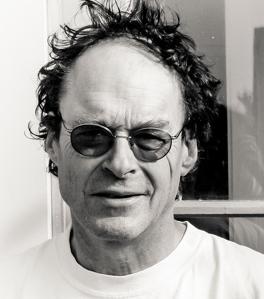
Alex Cockburn, funny man

13

So Alex Cockburn is dead. What a piece of work he was.

Yeah, he was vitriolic and could be savage when going after his enemies. Yeah, he was an old-fashioned leftist who was sometimes accused of Stalinist tendencies (tho he also had a weird libertarian side to him). But most of the obits missed the fact that Alex could be really, really funny.
Left-wing writers (and right-wing writers) have a grand tendency toward self-importance, and he was as guilty as any of us. But he didn’t always take himself and what he was doing so seriously that he couldn’t make fun of it.

I remember hearing him talk once about a piece he was doing lambasting some poor East Coast academic for writing something that Alex found way too pro-Israel. The poison pen was out and sharpened, the vitriolic hit-piece for The Nation was halfway done … and then, he said, he decided he ought to call the guy for comment.

Big mistake. Turns out the man was a huge Alex Cockburn fan, his comments had been misinterpreted, he really agreed with everything Alex was writing and saying … and, as Alex told us, it totally ruined a good column.

“I learned,” he said with a smile, “that you should never call the other side, because it just screws up the story.”

He was at his best when he was being funny; the piece on McNeil and Lehrer and the insanity of balanced journalism is one of the best things I’ve ever read, and I cite it all the time when I talk to journalism students:

ROBERT MACNEIL (voice over): A Galilean preacher claims he is the Redeemer and says the poor are blessed. Should he be crucified? (Titles)
MACNEIL: Good evening. The Roman procurator in Jerusalem is trying to decide whether a man regarded by many as a saint should be put to death. Pontius Pilate is being urged by civil libertarians to intervene in what is seen here in Rome as being basically a local dispute. Tonight, the crucifixion debate. Jim?

In a classic 1986 piece in the Nation, he discussed a missive from the Spartacist League discussing ways to travel across the nation without hitting any states with anti-sodomy laws:

I am in receipt of mail from intending vacationers, perturbed by the Supreme Court decision upholding the Georgia sodomy laws and anxious about their travel plans. For many of them the question comes down to this: Can you drive coast to coast across the United States without entering states that have legal sanctions against the practicing sodomite, remembering that the Georgia law defines sodomy as “any sex act involving the sex organs of one person and the mouth or anus of another’?

After laying out the best options for “sods on the road,” he ended: “And I didn’t think the Sparts were into that sort of thing.”

He will be remembered for his columns in the Village Voice, for being the token leftist on the Wall Street Journal oped page, for blasting all of us who weren’t quite pure enough for him …. And I will remember how he was a rare guy on the Left who made me laugh, even in the 1980s when we were all way too serious.

Celebrate a book about DJs at a bar that is in said book

0

A rather strange-looking book alit upon my desk the other day. It told me it would teach me how to fold underwear. It lied. Luckily, the book did contain a rather amusing little cat-and-mouse story about a cute SF DJ traversing Hong Kong and surrounds in the exuberant days of the late 1990s. This is local author Steven Fruhmoto’s Underwear Origami — a misleading title if ere I’ve heard one. Nonetheless, Mr. Fruhmoto invites you to swallow your dismay at not being able to learn how to fold underwear (it’s a metaphor), and accompany him to the location of the book’s first scene for some beveraging, reading, and book signing on Sat/28. 

I read the book, and recommend for anyone who is into tales that revolve around international party scenes, casual drug use, and Norweigan pop stars emerging from dancing mushrooms. Fruhmoto is a product of Dartmouth College’s masters program in electro-acoustic music — founded in 1989, do you believe? — and Underwear Origami‘s tone is educated in the bpm of the music that fuels its characters, but also literate enough that the whole thing doesn’t come off as a product of someone’s bed-bound Burning Man comedown. 

Why the 1990s, though? Don’t we have enough DJs around these days. Says Fruhmoto, via an email sent to the Guardian in response to that question: 

I lived in San Francisco from 1994 to 2002. The period of the mid- to late ’90s was a uniquely optimistic time in the city, and I wanted to capture the exuberance and innocence of that time. It was pre-9/11, with no Osama Bin Laden, no Iraq, no Guantanamo, no Great Recession, etc. It was also the early days of the Internet, with the excitement of the dot-com phenomenon, and the US economy was booming overall.

I suppose if I were to have set the book in current times, the feel might be a lot more edgy, because the 1990s were a very different time. Also, the advancement of music composition and performance technology, and the advent of the social media connectedness of people would be important themes. In terms of music, I’d probably be talking about the phenomenon of the mainstreaming of electronic musicians, and new genres like dub-step, glitchhop, etc.

Anyways, I suppose we’re all in for some unique optimism. Drop by the Noc Noc for a free beer when you buy a paperback copy of the book. 

Underwear Origami book signing 

Sat/28 6-8pm, free

Noc Noc

557 Haight, SF

www.nocnocs.com

Live Shots: Phono Del Sol

2

Hosting an all-day outdoor festival in the middle of a chilly SF summer was a crapshoot, but the Bay Bridged bet well. The sun sizzled so strongly over Phono Del Sol attendees and bands last Saturday that one musician had to call out into the crowd for coverage.

La Sera’s Katy Goodman (also of Vivian Girls) had to take a pause from her creamy crooning – likely at that moment singing of a break-up – to borrow a baseball hat from one of a few dude lounging in the grass just out front of the Potereo del Sol Park stage.

To stage right a handful of skaters glided through the skatepark, mostly rolling just above lip of the half-pipe then back down again. To stage left, a sea of women in sundresses and men in flimsy T-shirts stood behind the fence drinking $5 cups of beer, or munching Kung-Fu Tacos or Kasa Indian Eatery rice plates from the bank of food trucks.

It was a prime, summery, music-punctuated Saturday in San Francisco for the second annual Phono Del Sol, with a good turnout of fans parking themselves along the shade-covered hills first, then slowly filling in the direct-sun center bowl.
 
Host Broke-Ass Stuart popped up between each act with a Pauly Shore joke or witty aside, and DJs Andy Cabic, Kevin Meenan, and Zach Rogue, kept the music pumping while the acts set up. The break-down times were quick, leaving precious minutes to rush to beer and food. And Vitamin Water offered free, sticky-sweet beverages to those in need of non-alcoholic liquid between acts.

After Sacramento’s Sea of Bees left the stage, Stuart described its sound as “make-out music” and implored the then-sparse crowd of fans to kiss their partners, a rare awkward moment.

La Sera’s Goodman next arrived on the concrete stage, wearing one of those seasonal sundresses, and opening with dreamy, girl group-esque ditty “Break My Heart.” She asked for that aforementioned cap a few songs in and swayed steadily throughout the set, occasionally mentioning the “chill” vibe at the intimate fest.

Gardens & Villa came out pan-flute first, kicking off the set with “Thorn Castle” off last year’s self-titled LP, an insta-indie pop classic. As the director of the band’s video for “Spacetime” noted during the Phono Del Sol appearance, Gardens & Villa (that’s “vee-ya”) sounds precisely the same live as it does on the record – a notable achievement as the album was a joint project with legendary producer Richard Swift.

A cluster of sun-chasers later gathered to dance by the stage in a sinewy fashion during minimalist psych act Unknown Mortal Orchestra’s riff-heavy performance. You could get lost in those dance moves as the guitar crawled on.

The closing performance, by SF’s own the Fresh & Onlys, was the perfectly appropriate finale for such a pleasurable afternoon. Peppered with tracks off the upcoming Long Slow Dance, the swirling, hooky garage band’s set was both familiar and enticingly…fresh.

In a cap and camo jacket, swarthy singer-guitarist Tim Cohen seemed in relaxed spirits, repeatedly asking those in the crowd to hold up their kids (they obliged). He later addressed the general grass-sprawled audience, “you guys look like little kids at an assembly.” Pause. “That’s what happens you take acid.”

Only complaint? The entire bottle of sticky-sweet Vitamin Water I spilled on my weather-appropriate sundress. That and the sunburn.

Guardian feminism panel calls for change, gang activity

31

In the interest of behaving badly, let us first say that we won’t apologize for the “roving feminist gangs” comment, nor the laughter that ensued at our July 11 “Bay Area Feminism Today” panel. In the light of the sexual attacks that have terrorized Mission District residents this year, Celeste Chan’s joke (actually a reference to comments made by Fox News in reference to the New Jersey Seven) has to be read as a self defense tactic — and source of comfort and strength to the women living in the neighborhood. Not a threat to men. Unless they’re commiting sexual assault, of course — but then, women commiting sexual assault will probably have the gang’s wrath to face as well. 

Seven women from all walks of Bay Area activism — arts, nightlife, immigrant advocacy, domestic violence organizations, and more — came together at City College’s Mission branch to discuss what our SF progressive community needs to work on, recent feminist victories, whether they even believe in the term “feminism,” and everything in between. Our “Faces of feminism” cover story announcing the event attracted a decent-sized crowd of around 120 (mainly young women, with zero male elected officials in attendance.) We laughed, we nearly cried, we came away with a lot to think about. Here’s some of the general topics that were discussed. And here’s to this being a spark for continued talks, however a Fourth Wave Bay feminism may take shape.

>>FOR THE FULL BIOS OF OUR PANELISTS, CHECK OUT THE EVENT ANNOUNCEMENT 

Reproductive justice

Reproductive justice has long been a feminist goal, but with the recent spate of attacks on birth control and abortion access it’s come up again. Are we here in the Bay Area isolated from the War On Women?Some panelists thought we can affect the country’s situation positively.

“Part of what we do here in the Bay Area is we send strong women to Washington,” the Drug Policy Alliance‘s Laura Thomas said. “We are responsible for a significant amount of women in Congress.” But California’s reproductive justice situation is more complicated than it may seem. St. James Infirmary‘s Stephany Ashley noted that reproductive health here is under attack with “criminalization of HIV-positive people,”  and that California “just cut all funding for HIV prevention for women.”

>>CHECK OUT REBECCA BOWE’S RECORDED LIVESTREAM OF THE EVENT HERE

Chan, founder of Queer Rebels Productions, added that California is cutting domestic violence services through slashing CalWORKS funding. Mujeres Unidas‘ Juana Flores noted that the Bay’s Latino communities can find it difficult to support aspects of reproductive health because of religion and tradition. But she said that people need to work together and realize that “it’s a real war. It’s a real war on us.” She warned that “politicians are not going to fix things just because they want to improve our lives. We need to fight back.”

Transgender activist and member of SF’s Youth Commission Mia Tu Mutch said that part of the war on women has been a wave of anti-trans legislation across the country, as well as a wave of hate crimes, especially against trans women of color. Some legislation in Tennessee is making it more difficult for trans people to go the bathroom, she said. “Reproductive justice is important, but we also need just the simple right to pee.”

But what about the word itself?

Does feminism have power as its own concept now, or has its work been rightly subsumed into the queer movement, the civil rights movement, and other forms of activism? “A lot of us can agree that there isn’t something you can point to and say, this is the feminist movement in San Francisco,” Ashley said. “But there are many important feminist projects happening.”
Alix Rosenthal, who created a controversial women’s slate in her bid for re-election on the SF Democratic County Central Committee recalled how “30 to 40 years ago, we all had to join together because there weren’t enough of us. Now people have splintered off.” Chan brought up the bicycle scene in 1983’s feminist sci-fi film Born in Flames, and quoted Audre Lourde: “for so long, we’ve been on the edge of each other’s battles.”

Tu Mutch said that she “would rather identify as fighting for LGBT rights, progressive rights” than as feminist. But, she continued that it is “under the system of patriarchy that we’re all getting screwed over.” She said that women are treated as second-class citizens, and trans and gender non-conforming people are treated as third class citizens in our society.  Edaj, longtime Bay Area DJ and director of the Women’s Stage at Pride for a decade, agreed that the word feminism “sparks a lot of emotion in people” and can create obstacles in growing support. Said Flores: “it’s a big word. People call me a feminist when I claim my rights. When I see another women who is suffering or being abused it’s unbearable to me,” Flores said. “When someone calls me a feminist, I feel proud.”

The inward gaze: how does the San Francisco progressive community do on feminist issues?

In a word: okay. But there’s work to be done even here, in “progressive” San Francisco. Thomas led the charge, talking about the state’s current legal ability to shackle women prisoners during childbirth. Tu Mutch expressed a need to stop “pitting groups against each other,” and to get rid of a City Hall attitude that says “my budget is more important than yours.” Tu Mutch said “there’s still rampant transphobia and gender essentialism,” that affects not just women, but the “countless people born with intersex conditions and who identify outside the binary.”

Ashley pointed out that “even some of our favorite male progressive politicians, you don’t see them cultivating leadership among women, queer people, trans people.” She talked about how that’s a traditional feminist organizing principle, “mentorship and meaningful participation, not just tokenizing participation.”

As a (not) side note, there wasn’t a single male politician in the audience that day. As Ashley put it, “patriarchy is really the problem.” Ashley and panel moderator, SFBG culture editor Caitlin Donohue shared the fact that they’ve felt diminished by remarks made by and in the company of the city’s so-called “progressive politicians.”

Recent feminist victories

But enough depressing stuff. How about recent feminist victories, asked an audience member.

This question was met with a disconcerting silence. Until Chan jumped in: “I’m really inspired by the place queer arts are at right now.” She told of the “lineage of resistance” of art that deals with questions like “how do people survive the unimaginable? How do people survive the truly horrific?” Disturbing incidents like that of transgender prisoner Cece McDonald beg the question, “is the perfect victim a dead victim? If you fight back, you’ll be criminalized? Now more than ever we need a movement. We really need to come together,” concluded Chan.

Rosenthal saw hope in surprising places. “Sarah Palin and Michelle Bachman,” she said. “These women are so incompetent. But they made it. They really made it.” She talked about how usually women have had to be five times better than the men they competed with, but “Sarah Palin and Michelle Bachman are not five times better than anyone. But they made it.”
Laura Thomas was inspired by Julia Bluhm, the 14-year old ballet dancer from Maine whose online petition led Seventeen to promise to stop using Photoshop to alter women’s body types. Ashley acknowledged Tu Mutch’s advocacy work, and said she was recently inspired by a “take back the plaza” event Tu Mutch had organized. Edaj was inspired by being named a Pride Grand Marshall, and the feeling that the Pride organization was acknowledging the importance of the space created at the Women’s Stage. She was also inspired by Morningstar Vancil, a Filipino vet who is a two-spirit drag king, and Vancil’s commitment to disabled veterans issues.

Action items

In response to a question that asked what the 2012 action plan for Bay Area feminists should involve, Ashley said “principles of intersectionality, anti-colonialism, anti-capitalism” had to be valued more than they have been in past feminist movements. They’re there in Third Wave feminism, Ashely said, only they are “wrapped up in theory and academia.” Those guiding principles should have “more on the ground” applicability. What needs to happen right now, speaking of on the ground? Back to 2012’s spate of sexual violence in the Mission, there’s a distinct necessity for “a perfect community response that doesn’t involve the police, so that we all of a sudden feel really comfortable taking a walk at 3 in the morning through our favorite neighborhood.”

Flores said that any new form of feminism would need to be about “mutual respect” and “against any form of injustice,” to which Thomas agreed, saying it needs to be “less theory, more practice.” It also, Thomas said “has to deal with gender in a different way. A new feminism needs to go beyond gender, or deal with gender differently” in the sense of respecting gender non-conforming identities. A tricky prospect, she admitted. “How you develop a gendered movement that doesn’t use gender as a defining construct, I don’t know.” More specifically, she underlined the importance of “progressive revenue measures,” and “an end to cuts to childcare and domestic violence programs.” “Our economy’s not coming back through more cuts. We need revenue, more taxes,” she said, to cheers from the crowd. Well this was a Guardian forum, after all. 

Edaj reiterated that “that word scares off a lot of people who might otherwise want to join.” Tu Mutch underlined that it would need to “take up the idea that men and women are opposites. That only serves to degrade women.” A new feminism, she said, would be about “turning away from that and realizing there’s lots of different genders.”

Tu Mutch said she would like to see success for her organization to fight for trans healthcare rights, FEATHER. “People have to spend ridiculous amounts of money to transition,” she said. “We need universal healthcare for all, including trans people.”

Chan pondered the question. In the end, she concluded, “roving feminist gangs,” inspiring at least one angry letter from a slighted middleaged white man in the crowd. Which wasn’t the only reason why we deemed the panel a success, but an important one.

Dick Meister: A sure path to economic health

0

By Dick Meister 

Guardian columnist Dick Meister is former labor editor of the SF Chronicle and KQED-TV Newsroom. He has covered labor and politics for more than a half-century. Contact him through his website, www.dickmeister.com, which includes more than 350 of his columns.

It’s way past time to raise the pitifully low federal minimum wage. That would provide badly needed help to the millions who are living in poverty or near-poverty at the current rate of $7.25 an hour, and would help all Americans by stimulating the sagging economy.

Democratic Sen. Tom Harkin of Iowa and Democratic Rep. Jesse Jackson Jr. of Illinois are carrying bills that would set a new minimum of $10 an hour. They’re pressing hard – as they very well should – to get the general public and their allies in Congress to fully appreciate the widespread good that would come from helping some of the country’s neediest workers.

“We’ve bailed out banks, we’ve bailed out corporations, we’ve bailed out Wall Street, we’ve tried to create sound fundamentals in the economy,” Jackson noted. “Now it’s time to bail out working people who work hard every day and still make only $7.25. The only way to do that is to raise the minimum wage.”

It’s been five years since the minimum was last raised, from $5.15 an hour to the current level. States, cities and counties are allowed to set their own minimums, as long as they at least equal the federal rate, and 18 states and several cities and counties have enacted minimums greater than the federal rate. But even their rates are below what’s needed for a decent living.

About four million workers are now paid at or below the federal minimum and obviously need help if they are to escape poverty. Even those paid at the full minimum earn a mere $15,000 a year before taxes and other deductions.  They are among some 28 million workers whose earnings – and spending  – would immediately increase under the proposed bills.

Legislation to raise the minimum has been called for repeatedly in the years since the last raise in 2007, but has gained only relatively minimal support in Congress and the White House. President Obama pledged during his election campaign to get the rate increased to $9.50 an hour by 2011, but has taken no public action. Mitt Romney, Obama’s Republican opponent in his re-election campaign this year, has wavered. He once voiced support for a raise, but later said he opposed an increase.

Polls have clearly shown strong public support for a raise. That support is likely to grow significantly if the economic benefits that a raise would undoubtedly bring to all Americans can be clearly shown – and it can.

It’s simple: Raise the pay of working people, and as the workers buy more goods and services with their new earnings, the businesses that sell them will hire more people to provide what they want to buy with the extra money they’ve earned at a higher minimum wage.

The National Employment Law Project estimates that the increased consumer spending generated by the proposed raise would create the equivalent of more than 100,000 full-time jobs. Other estimates indicate that every dollar increase in wages for workers at the minimum creates more than $3,000 in new spending after a year.

And so the cycle goes, round and round:  More pay, more spending on goods and services, more hiring of people to provide them, more important government services and the taxes to support them, a healthier and wealthier economy.

Guardian columnist Dick Meister is former labor editor of the SF Chronicle and KQED-TV Newsroom. He has covered labor and politics for more than a half-century. Contact him through his website, www.dickmeister.com, which includes more than 350 of his columns.


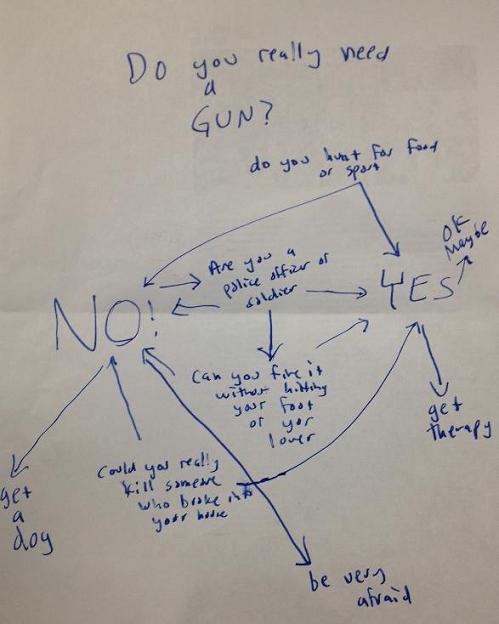
A 2nd Amendment Infographic

5

With apologies to the Awl, where they draw better than I do.

Eliana Lopez is a victim, but of whom?

237

It’s been an eventful visit to San Francisco this week for Venezuelan actress Eliana Lopez, who spent the last two evenings on the witness stand testifying before the Ethics Commission as it considers removing her husband, Sheriff Ross Mirkarimi, from office for official misconduct for grabbing her arm on Dec. 31. And then today in court, she helped persuade Judge Garrett Wong to lift the stay-away order that has barred the couple from having any contact with each other since January, allowing this battle-weary couple to finally share an much-needed embrace.

Lopez didn’t want any of this – not the police and prosecutors going after her husband and getting an order to keep her family apart, not Mayor Ed Lee suspending Mirkarimi and taking away the salary the family needed now more than ever (compounding his failure to ask Lopez what really happened by refusing to allow the city to pay for her plane fare back from Venezuela, where she’s been staying with family and looking for acting jobs, to testify in his proceedings), not the hypocritical statements of concern that she’s been victimized, made by people who she considers to be the real abusers of her and her family.

Her perspective on this whole sordid affair became crystal clear while spending more than three hours on the stand being grilled by Deputy City Attorney Peter Keith and the commissioners, where she said that she’s never been scared of Mirkarimi but that San Francisco has become a scary place to her after being betrayed and victimized by the people entrusted to help her.

“At this point, I think he’s safer in Venezuela than San Francisco,” Lopez said of her three-year-old son when Keith condescendingly asked about how he’s doing in her home country. Keith’s belittling tone toward this supposed crime victim prompted Mirkarimi attorney Shepherd Kopp to tell reporters, “The questioning of Ms. Lopez, so far, I think is just offensive.”

Clearly, some of Lopez’s decisions helped create this mess. She said on the stand that she regrets telling her neighbors Callie Williams and Ivory Madison what happened on Dec. 31, even if she believes they should have kept her confidence as they promised. And there are good legal reasons why domestic violence victims shouldn’t be able to stop the prosecutions of their abusers, who they may still be scared to offend.

But none of that excuses the complete disregard for Lopez, her perspective, and her interests that has been shown by San Francisco’s law enforcement, political, and domestic violence advocacy communities – a point that Mirkarimi supporters have repeatedly made throughout the proceedings, emphasizing that they believe and support Lopez.

“I didn’t expect that my lawyer could call the police on her own,” Lopez said of Madison, whom she said had represented herself as a legal adviser who was helping her create evidence for a child custody case if her marital problems ended in divorce. “I thought that was my decision.”

Once Madison took a more aggressive posture in urging Lopez to go the police, including “calling Ross’s political enemies” to help her bring him down, Lopez testified, “I realized that I couldn’t trust her.” But it was too late. As soon as Lopez clearly said that she didn’t want police involvement, that was when Madison called them.

“I told her, ‘you don’t have my permission to do this. I trusted you,’” Lopez said she told Madison after being told the police were on the way, sending Lopez into a panic. “When I left Ivory Madison’s house, I was so shaking I couldn’t find my car…I was feeling betrayed and I was so angry.”

Toward the end of her testimony, she said, “After Ivory Madison called the police, I felt betrayed, I felt like I had betrayed Ross.”

Anyone who knows Lopez or watched her on the stand understands that this is a strong woman who is used to taking care of herself, not a shattered domestic violence victim incapable of acting on her own behalf.

“I said we have to think, Ross, we have to do something,” Lopez testified, explaining her reaction to the police involvement and her text message to “use your power” to do something, which Mirkarimi replied to by saying there was nothing he could do at that point, despite unproven accusations that he tried to dissuade witnesses and thwart the investigation. “It was me who was pushing him.”

Even after the controversy went public and threatened his career, Lopez said it her who told him not to resign and to fight for his job. “I told him, ‘you won the election, stay strong, we can win this,” she testified.

Nobody wants to minimize domestic violence, but let’s keep some perspective on what happened here. Lee may or may not really believe that Mirkarimi “beats his wife,” as he told reporters in justifying his overreaction, but the evidence that has emerged doesn’t dispute the consistent contention by Mirkarimi and Lopez that he grabbed her arm one time, for one moment, and that was the full extend of the abuse.

“I bruise really easily,” Lopez testified. “Just Theo playing with me, I get bruised.”

Some people do. And while that doesn’t excuse what Mirkarimi did – getting physical with a partner is never okay, as he said on the stand, accepting his fate – it does indicate that perhaps Mirkarimi’s critics have lost their perspective, sense of proportion, and realization that domestic violence laws are supposed to be about helping and protecting the victim.

Does anyone even want to try to make an argument that’s what’s happened in this case?

Killing of suspect with box cutter may have been legal. But was it necessary?

12

Police officers have dangerous jobs, and when confronted with subjects who may threaten their lives, they have to think fast under stress. When a subject has something classified as a “deadly weapon,” police are justified by law in shooting to stop the threat.

As SFPD spokesperson Carlos Manfredi explained to me for an article in this week’s paper, the official policy isn’t “shoot to kill.” But subjects are often killed, since officers are trained at the police academy to aim for the body’s center mass and to shoot until any threat to their life is neutralized.

It seems many tools and common items can fall under the “deadly weapon” category. The SFPD’s third fatal officer-involved shooting this year occurred July 18 when Pralith Pralourng apparently lunged at an officer. His deadly weapon? A box cutter.
 
In January 2011, Raheim Brown Jr. was shot by Oakland School Police. He was allegedly wielding a screw driver. Last July, Charles Hill was shot by BART police. He was drunk, lying on the ground, and hurled a pocketknife at police, missing them by 10 feet.

When used just right, a box cutter, a screwdriver, or a pocket knife can certainly be deadly weapons. But when a subject is exhibiting likely mental disability, drunk and lying on the ground, or 20 years old and in a car, isn’t there any other type of combat police could use to neutralize the threat?

At a press conference today Police Chief Greg Suhr said that police do take defensive tactical training, which trains officers in using less than lethal weapons. But the July 18 situation warranted the use of lethal weapons, Suhr said.

“The officer was facing a life or death situation. She had to do what she could to protect herself.,” Suhr said.

Suhr explained that the officer had been on the force 20 years, during which time she had received multiple trainings in crisis intervention training, which he called the “most progressive in the country.”

That training deals with psychology and teaches how to deescalate situations in which a subject is a “danger to himself,” Suhr said. But, since the subject had already allegedly attacked a co-worker, the the officer’s life was considered in danger.

Meanwhile, Occupy San Francisco activists who still protest and sleep outside the Federal Reserve on Market Street attained video and audio of people who claim to be witnesses who contradict the police story. One says that “he was on his back, then [paramedics from] the ambulance turned him facing downwards…they but a bag over his body and his head. Next thing, when everybody started looking at they got nervous and they started acting like they were doing CPR even though the guy was gone. It took the ambulance 20 minutes to get there.”

In a video that has been viewed more than 17,000 times on youtube, another man who claims to be a witness says “they had him in cuffs, and they shot him.” In another video shot by the same man, Robert Benson, another man says “he was in handcuffs and they shot him twice in the chest…I saw it.”

The Bay Guardian has not been able to confirm these accounts.

Pralourng’s death was likely legal. He could likely have injured an officer with the six-inch box cutter he carried, although it may have been difficult to kill her. But his crime did not merit the death penalty, and he now joins the ranks of Hill, Brown and others who’s small blades and screwdriver were considered weapons deadly enough to justify their deaths by the SFPD, BART Police, Oakland School Police respectively. It’s hard not to ask—did Pralourng have to die?

Werk It Out! dances under the disco ball

0

Add a disco ball to any situation and you will not decrease its likelihood of becoming a party. When I stopped by ODC Theater earlier this week to snap some photos of the Alyce Finwall Dance Theater‘s rehearsals for the upcoming three-day dance festival Werk It Out!, it appeared that the dancers were in a festive mood. Werk It Out! features performances by six up-and-coming Bay Area choreographers, including Alyce Finwall, Minna Harri, Tanya Bello, Christine Bonansea, Michelle Fletcher, and Malinda LaVelle.

The pieces incorporate music ranging from the Beach Boys to Biosphere and themes revolve around a variety of topics — relationships and sexuality are there in spades, just like at any good party. Some pieces request audience participation, so make sure you’re wearing dancing shoes. From the preview I was able to see this week, this dance showcase is not to be missed, and not only because over it all spins that fabulous, glittering disco ball.

Werk It Out!

Fri/20, 8pm; Sat/21, 3pm and 8pm; Sun/22 3pm, one performance $25, festival pass $50-$60

ODC Theater

3153 17th St., SF

www.odcdance.org

You know I have to talk about guns now

31

My son is 13. He and a friend went to the movies the other afternoon, at the San Francisco Metreon. I was at work; I wasn’t a bit worried. They’re good kids, city kids, they travel around on Muni and BART, hang out with their friends after school … and what’s safer than a movie theater?

Jesus fucking Christ.

It’s apparently random, and the guy who killed at least 12 people in Colorado is probably crazy, and you can’t decide to keep your kids locked up in a bulletproof room all day just because a nutcase 2,000 miles away went crazy at a Batman show. People get killed riding bikes, too, and Michael rides everywhere.

But I’m not the only one who thinks that this massacre could have been prevented — or at least, the severity of it could have been prevented — if it wasn’t so easy to get high-powered assault-style weapons in this country. Here’s a press release from state Sen. Leland Yee:

My thoughts and prayers go out to the victims of this horrific tragedy and their families. These events are shocking to all of us and sadly remind us of the carnage that is possible when assault weapons get into the wrong hands. It is imperative that we take every step possible to eliminate the types of senseless killings witnessed in Aurora, Colorado. We must limit access to weapons that can carry massive rounds of bullets or that can be easily reloaded. SB 249 is a step in that direction and should be approved by the Legislature as soon as possible.

Here’s US Senator Dianne Feinstein (who knows a thing or two about gun violence):

Today is a time for grieving but my hope is the country will also reflect on the roots of gun violence that has again visited terror on an American community, claiming the lives of more innocents.

Here’s LA Times columnist Paul Whitefield:

We don’t need to disarm Americans.  But neither do we need to arm Americans with assault rifles.  We can respect the 2nd Amendment — and respect the right of young people to go to a theater without having to survive a fusillade normally reserved for the battlefield.

And here’s me:

Nobody needs a AK 47. Nobody needs to be able to carry around a weapon that has the kind of firepower that it takes to create this level of terror and carnage. And for those people who want to argue that an armed populace would prevent this kind of thing, imagine if half a dozen pistol-packing civilians started firing through smoke grenades at a guy wearing body armor in a crowded theater. You want the body count any higher?

This, my friend and trolls and gun lovers, is just insane.

UPDATE: Damn, those federal regulations make it hard for an honest citizen to buy a gun.

I have a Gander Mountain gift card in my wallet. Seriously. Wonder what I should do with it.


Getting into a pickle: Canning beans and beets at La Cocina

0

I’m a sucker for pickled things, probably because I grew up in a house where my dad always had a pot of kimchee fermenting on the counter or a bottle of homemade pineapple vinegar, getting perfectly bubbly on top of the fridge. Preserving food also feels very nostalgic for the times when our great-grandparents would can the summer’s bounty so we could eat peaches and tomatoes through the winter. So you can imagine how excited I was to take my dad with me to La Cocina for a pickling party with Emiliana Puyane of Jarred SF Brine, to brush up on our fermentation implementation.

There were three pickles on the to-do list for the evening: garlic-and-dill pickled green beans, oven-roasted golden beets and shallots, and the one that I was most excited to try (and still am — we have to wait a week or more before we can pop the lids), cinnamon-and-thyme pickled peaches. Emiliana led us through the process, from the sanitation of the jars to making a perfectly-balanced brine. There was a lot of peeling, chopping, and de-stemming to be done. Everyone helped, including my dad, who helped blanch peaches over a steaming pot.

After two hours we jarred our creations and indulged in the most delicious Nepalese dinner, prepared by Bini’s Kitchen. Crazy-good rice, wonderful eggplant, everything made with spices that Bini herself mixes, a homemade touch which yielded bright and fresh flavor in her dishes.

I’d also just like to say how much I love La Cocina. I’ve been to a couple of their cooking classes and they are such great events, bringing together a lovely group of people for a night of cooking. La Cocina’s director Caleb Zigas always gives the warmest welcome. As an entrepreneur myself, I know how much work goes into starting a business, and I think it’s wonderful that La Cocina gives blossoming chefs the tools, space and skills they need to get their business up and running. If you want to try some of these amazing eats, don’t miss the SF Street Food Festival, which starts August 18. 


To be a poster artist during Occupy: Chuck Sperry on psychedelic art, social change, and port shutdowns

0

With Occupy’s first anniversary sneaking up on us, has enough time past since its inception to reflect on its urban encampments and frightening conflicts with law enforcement in a rational, reasonable manner? Maybe rational is the wrong word — I’m sure many would agree that the movement’s major contributiont to date was a general firing up of the 99 percent, even of those 99 percenters who would sooner have ridden a bike to work than sit in on GA meeting in Oscar Grant Plaza. Through leaving its agenda undefined, Occupy allowed us all to paint our own hopes and dreams for the world onto it like a piece of drawing paper. 

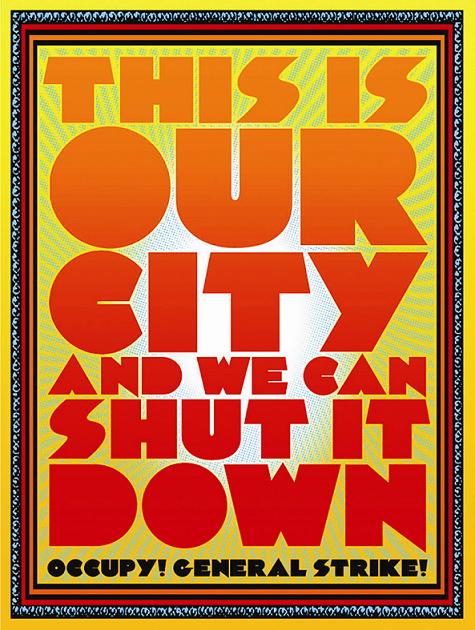
For some more literally than others. This month, an exhibit opened at Yerba Buena Center for the Arts that accumulates the work of 25 Bay Area artists who spun their Occupy dreams into poster form. Chuck Sperry is perhaps one of the most well-known name of the bunch. Sperry’s lived in the Bay since 1989, and recently came home early from a camping trip to answer our questions about his relationship with Occupy, the way he distributed his “This Is Our City And We Can Shut It Down” prints on the day of the Oakland port shutdown, and general “what does art mean” token asks. 

SFBG: At what moment did you realize that Occupy was an important event? How did you first hear about it? 

CS: Through the beginning of 2011, I was creating an installation for the San Francisco Museum of Modern Art curated by Renee de Cossio, with artists Chris Shaw and Ron Donovan. Each artist would install work in one of three artists’ gallery windows on the side of the SFMOMA on Minna Street. The proposal for the installation was to bring the aesthetic of San Francisco’s poster traditions to painting, and to realize these in monumental form. I wanted this piece to reflect San Francisco’s poster history beginning in the freedom of speech movement through the 1960’s, and to also reflect the psychedelic tradition that gave birth to the rock poster.

While I was working on an 11-foot by nine-foot acrylic painting, I was following the progress of the Arab Spring movements, Tahrir Square, and the gathering Occupy Wall Street movement that was spreading across America. I decided to use my reaction to these events as inspiration for an iconographic painting titled, “Saint Everyone.” I wanted to express the opening mind, and spreading enlightened humanism, the decentralization of power — or awakening sense of people power — to the piece. I used vibrating, reactive colors to paint a figure holding an opening lotus (symbol of enlightenment), against a background of op-art circles, which communicate decentralization — that the background has many centers — like the movement which has no leaders.

“Saint Everyone” was installed at the SFMOMA in June 2011. So I was getting with it by then.

As Occupy Oakland was forming by the fall of 2011, my artist friend Jon-Paul Bail of Political Gridlock was printing his iconographic “Hella Occupy Oakland” posters on Frank Ogawa Plaza (re-named Oscar Grant Plaza) from the point when people were first gathering there. When I say printing, Jon-Paul Bail was printing live, right there, with a table set up in the open, printing and handing people freshly-made posters. In a few short weeks he had printed hundreds, if not, thousands of posters which were being handed out to people there. He was joined there on Oscar Grant Plaza by Melanie Cervantes and Jesus Barraza of Dignidad Rebelde, who created more iconographic posters for the Occupy movement.

SFBG: What led to your decision to make art inspired by Occupy? Was it a different process than your other creative projects?

CS: In September I was in an art show, LA VS. WAR, with Bail, Barraza, and Cervantes, (among others) and we discussed making posters for the November 2 Occupy action to close the Port of Oakland. Fellow artist Chris Shaw — who was involved in the SFMOMA Window Gallery Installation — offered to pay for the production of any Occupy posters through the printing account of rock band Moonalice who was in solidarity with Occupy. 

I created “This Is Our City, And We Can Shut It Down.” I usually work with images and take a lot of time to work my art into a design. In this case, the message was so overriding and important that I felt it was my job as an artist to stay out of the way, and let the words and message do their job. So in this way it was different. I used color theories learned in studying the long San Francisco tradition of psychedelic poster art, the use of hot colors against cold colors to make the words read from a half mile away — haha! I wanted a strong, radical message, used with bold nurturing colors that convey a positive emotion. It would not be a typical political poster.  

SFBG: How do you want your Occupy poster to be used?

CS: Chris Shaw and I discussed printing our posters on heavy paper stock, and printing on both sides to double the exposure we could give people to our message. You could use this poster as a placard, hold it up over your head. It would make quite an impression and be useful to the action. I stood at Oscar Grant Plaza next to the street and passed out nearly 1000 posters in 45 minutes to the front of the march, so when television camares picked up the action at the Port of Oakland, the front of the march was a sea of my poster with the message, “This Is Our City, And We Can Shut It Down.” No one directed us to make these posters. No one asked. We just did it. And passed them out.

SFBG: What’s been some of your favorite protest art throughout history?

CS: I am very inspired by Emory Douglas‘ art in the Black Panther Party newspaper. I’ve had the honor to work with Mr. Douglas to reprint some of his iconic images. I also am very fond of the French Situationist posters of May 1968, and had the good fortune to print a poster, while I was visiting Paris to make a poster show about five years ago, on the very same press that produced these memorable images. When my artist friend told me that Guy Debord had worked with artists on this very same press, I laughed and dropped to my knees and just could not believe it.

Sperry at Occupy

I invited Jon-Paul Bail to collaborate in teaching a class at the Free University of San Francisco, as I’m organizing the art department of that cooperatively-organized free school. We told the story of making posters for the Occupy movement and created a poster for the Occupy Education action last spring. I think the ideas coming together from the Occupy protests will move through society in a very healthy and transformative way. There’s no way to stop people once they have been awakened to their potential. 

SFBG: What is the role of art in social protest?

CS: Art can reach many people in many walks of life. I was invited by San Francisco’s Varnish fine art gallery to exhibit at SCOPE / Miami in conjunction with Art Basel Miami art fair. Even in the context of the fine art world I felt it was important to express the social revolution that was taking place through the Occupy movement, and created a piece titled, “Mind Spring,” which expressed some of the same ideas I put in my SFMOMA painting and my Occupy poster. In “Mind Spring”, I created an icon of the worldwide Occupy movement and it’s antecedent in the Arab Spring. The figure wreathed in blooming spring flowers is a representation of the surprising enlightened humanism, the opening mind, the broadened socio-political possibilities which has swept the world in 2011.

I’ve had many discussions about the role of political art over the years. Two solutions to this problem constantly come to mind, first, “content over style” — that content is more important than style. Your message is the most important element in creating art of social protest. Second, that “the personal is political”, your own experience is so very often shared by others all over the world. When you make a piece of art in social protest, and just tell your story from your own perspective, and you do not hold back, you will be describing a situation that is shared by others half a world away. It’s uncanny, but our local problems are very similar to everyone else’s globally. So get in there and try to change what you can from where you are. Many hands make light work.  

“Occupy Bay Area”

Through Oct. 14

Yerba Buena Center for the Arts

701 Mission, SF

(415) 978-ARTS

www.ybca.org

8 Washington’s going on the ballot

63

San Franciscans are going to get a chance to vote on the most expensive condos in the city’s history and the future of development on the waterfront as soon as this November.

Opponents of the 8 Washington project turned in 31,721 signatures to the Department of Elections July 19, and since only about 19,000 have to be valid, it’s a safe bet the referendum will qualify.

That means no work can be done on the development until after the election — and since the deadlines are tight and it’s possible the DOE won’t get its counting and verifying done in time for November, 2012, the whole thing could be on hold until 2013.

It’s going to be a bitter and expensive campaign: Developer Simon Snellgrove tried to keep this off the ballot — and, since he has about $200 million riding on the outcome, he’s going to spend what it takes to win. The Stop the Wall on the Waterfront folks aren’t going to be able to match Snellgrove by any stretch, but they’ve raised some money and they’ll be able to run an effective campaign.

And we can have an important public debate: Should the city continue to build housing for the very rich when it can’t keep up with its existing affordable-housing requirements? And what will happen to San Francisco if the people who work here can’t afford to live here and the people who live here don’t work here (or in many cases, don’t work at all because they’re stinking rich)?

Is $11 million in affordable housing money enough for a project that will make a $200 million profit?

Gonna be a good one.

Charo talks flamenco guitar, San Francisco, and bulls

0

Unfortunately, Charo had to cancel all of her Yoshi’s shows this weekend due to illness. We enjoyed the conversation so thoroughly, we’re publishing it anyways. Get well soon Charo. 

Maria Rosario Pilar Martinez Molina Baeza. Charo. Cha-rrr-o (roll those Rs). The name brings to mind glittering sequined bodysuits, impossibly high hair, flashes of iconic moments sitting across from Johnny Carson or arms hooked with Dean Martin in the 1970s, and the perplexing catchphrase that made it into our shared lexicon: cuchi-cuchi.

Passionate, skilled flamenco guitar is the other thing that should be there in your conscious when you dream of Charo. The comedian-actress-drag icon has been playing guitar since before she hit puberty, back in ’50s Murcia, Spain.

These days, when she’s not grand marshaling pride parades or guest-starring on shows such as VH1’s Surreal Life, Charo is showcasing her variety talent at massive money venues: Las Vegas casinos, Southern California casinos, any dazzling commerce hotspot with slots and craps.

She was set to play far more intimate flamenco concerts at Yoshi’s this weekend and seemed beyond thrilled — or at least, that’s what she kept saying during a hyper half-hour conversation a few weeks back. Here are some of those interview highlights:

On San Francisco: “I’ve got a tremendous admiration for the city of San Francisco. There is nothing in these United States of America with the same light and energy. It’s a beautiful city, and there are a lot of cool people there.”

On performing: “To me, I’m never too happy with the success of yesterday. It’s always, what’s new? What can I do to improve? And what I discovered is that people really love and respect when I play guitar. I like comedy, and beautiful costumes and everything. But when I play the guitar, I feel like the audience is in disbelief and so respectful and appreciative.”

On flamenco guitar: “Flamenco is the spirit of excitement, passion, energy, and the position of the body; it’s telling you a story.

“In Spain, in the summer, the gypsies go to farms to help the owners take care of the animals. My grandma was nice and let them camp. They would say goodbye to the sun during sunset and make a bonfire and dance and play pure flamenco. It was so exciting around the campfire — no machine can produce what they do!

“So I began playing with them, and became part of their group. At ages 8 and 9 I knew buleria, rhumba, alegrías. Then when I auditioned for Andrés Segovia in Madrid, he was so impressed.”

On the media: “They were always a little ahead of the mentality. When I came to the United States in the 1950s, many audiences didn’t know the grandeur of musical flamenco or Latin salsa, but the media always knew it. So when I was playing heavy duty bulerias, the audience was thinking ‘okay, why doesn’t she do cuchi-cuchi?’ but the media would say, ‘this girl knows what the hell she’s doing.'”

On dealing with emotions: “When people say ‘ah, so beautiful! Everything is pink!’ that’s bullshit. Seriously, not every day is pink. But with my guitar, I try to make it easier. I go to a room with no telephones and no problems, pick up a guitar, and put my negative thoughts away.”

On reality TV: “When I appeared [on The Surreal Life], your generation had fun with me — the accent and energy, the guitar. So I’ve turned down two offers already for reality shows. One was to put cameras in my house. We are crazy! We would make the Kardashians look like they have a big case of diarrhea. I don’t know if you’ve seen the old reruns of The Beverly Hillbillies. But we are here in Beverly Hills with a bull.

“Jennifer Lopez was my neighbor; she probably is one of the people who have called the police department because, okay, I’ll bring mariachi at 10 o’clock, or we have big paella parties with flamenco. [But] the answer is, I do have a project coming, but it’s set in Hawaii where we have a house. It’s comedy, fun, and music.”

More on that bull: “His name is Manolo — it comes from the most famous matador in Spain, who was killed by a bull in the town where I was born. I hate bull fighting with a passion. They torture bulls before the fight. The young Spanish people hate it like me.

“I made a video complaining against the cruelty of bull fighting and I had a baby bull in the video — at the end of filming, I ended up with a baby bull. He didn’t know he was a bull. He’d be like ‘eh, mama mama!’

http://www.youtube.com/watch?v=5phOPenZV2g

The neighbors complained ‘we saw a bull’ and we said, ‘no! It’s a big dog!’ [laughs]. I made a deal that he also has a residence in Malibu on a huge ranch that belonged to the late Bob Hope. [Manolo] is officially supposed to live there, but he has visiting rights here.”

For refunds, contact the Yoshi’s Box Office at (415) 655-5600.

Guardian Voices: There’s something happening here

25

There are distinct signs of the rebirth of a grassroots  balanced-growth  movement in San Francisco, and some small indication that it’s even beginning to shift, ever so slightly,  the politics of the Board of Supervisors.  This is very good news for the vast majority of San Franciscans.

First, a little history.

Land use and the approval of major development projects lie at the very heart of San Francisco politics. Developers and their allies (the building trades, contractors, bankers, architects, land-use lawyers, consultants, and  permit expeditors) are the primary source of political money for candidates for local office. Since the freeway and urban renewal fights of the 1960s, the very definition of  progressive  politics in San Francisco has been the attempt to build a political base of  residents to resist that money.  So-called moderates are simply the political extension of the pro-development lobby using its money to consolidate developer control of the public approval process.

In most cities, land-use issues — zoning, permits, urban design — is left to elites. Not so in San Francisco. Here, land use is talked about at neighborhood meetings and on street corners. The heart the reason is our compact size: 46.7 square miles, and the prohibition of filling in any more of the Bay to create new land. There is no vacant land in San Francisco. Any new major development almost always displaces something already there.  Development is a zero sum game, with winner and losers.  And the losers  leave town.

Land-use politics is about staying here — and that creates real interest among San Francisco residents.

The funding for major development in San Francisco has dramatically changed in the 45 years since the freeway and anti-urban-renewal fights of the mid-1960s. Back then, it was public sector money that fueled development. Yet, with that money, due to the actions of  progressive politicians like Phil and John Burton and George Moscone, came its own remedy: votes to not accept the public money for freeways (Moscone) and votes creating either laws that either prohibited displacement or funded legal assistance to the poor, empowering  them to stop government agencies through litigation (the Burtons at both the state and federal level).

Since the money for freeways and urban renewal was from the government, the focus of the early balanced growth  forces was on government itself, through massive lobbying campaigns to affect officials’ votes (the freeway fight), or the use of government-funded lawyers  to protect poor people’s  interests ( the WACO and TOOR lawsuits against redevelopment).

All of that changed starting in the 1970s, when Richard Nixon and later Ronald Reagan deregulated oversight of urban development by creating a system of  block grants and ended funding for legal assistance for the poor.  Large-scale development was effectively privatized, moving it from being designed, funded, and approved at public meetings by government officials following regulations to being designed and funded in private — and having a Kabuki-play-like public approval process with little real oversight. With the passage of Prop 13 in 1978, which limited the main source of local government revenue — property taxes — local governments became even more reliant on private developer money to create new revenue.

The popular response to this change in the development process in San Francisco was the emergence of a politics that relied on the old progressive-era reforms of the initiative, referendum, and recall. Through a series of initiatives, the community sought to impose regulations on the development process, culminating in the 1986 Proposition M, which actually limited the amount of high-rise office space developers could build, completely imposing the popular will over a supine set of local officials and politicians. Indeed, ten years earlier, again through the initiative processes, the very nature of the Board of Supervisors was changed from a developer-friendly at-large system to a district-election system. Hotly opposed by real estate and development interests, district elections in its brief three years of existence (repealed in the wake of the Moscone-Milk assassinations, even though they were both strong supporters of the system and their assassin opposed it…ironies abound in San Francisco politics) saw limits placed on condo conversions and the passage of rent control.

In each of these multi-year efforts, a citywide coalition was formed, including an ever-expanding set of communities and neighborhoods.  Common interests were defined that cut across race, class, and geography and issues of community (neighborhood) control and funding for essential services like Muni, affordable housing, childcare, and employment training were placed on the table – and developers had to address them if they wanted projects approved.

The point is that balanced growth came from community-based political forces, not elected officials.  Broad movements were built — in the end, encompassing elements of labor. These were victories won not by elected officials but by a popular movement.

In 2000, in the wake of  the dot-com bust, another balanced-growth measure, Prop. L, aimed at cutting then-Mayor Willie Brown’s power over development, was paired with the new district election system — and a broad coalition of forces including labor, community and neighborhood organizations won a major progressive victory.

Every candidate for supervisor who supported the balanced-growth measure won. Every candidate who opposed it and supported Brown lost. While Prop L narrowly lost, its policies and objectives were passed as ordinances by the new Board of Supervisors (banning live-work lofts, closing loopholes in the planning code, requiring neighborhood-based plans for the Mission, SOMA, and Potrero Hill).

But as is so often the case, the victory of 2000 led to the slow dissolution of the coalition that created it. Folks had won. Our supervisors could handle all these issues; we no longer had to. By the end of the term of the supervisors elected as the class of 2000, very little of that citywide coalition existed any more.

With the Great Recession of 2008, advances were rolled back.  Fees on local developers for affordable housing, childcare and transit were deferred in order to stimulate development.  A new era of “moderation” was announced by elected officials, led by Mayor Gavin Newsom. Desires to “attract and retain”  business saw new tax concessions in the name of “jobs” and a new willingness to use open space and public facilities for “private/public partnerships” was announced.

By 2012 any concept of balanced growth had been replaced with a new era of “cooperation” between city officials and developers.

Until recently, that is.

It should be clear to all that for the last four years, City Hall has been eager to approve any scheme presented by private developers — from the America’s Cup nonsense to highrise luxury condos on the waterfront. The siren song of the developers — more revenue if you approve our project — has been proven false again and again, as the revenue never really matches the real costs of these projects. The city’s essential services continue to shrink. Transit fees are too low to pay for the actual new costs of Muni. The affordable housing  fees are too little to actually meet the affordable housing needs of the new, poorly-paid workers employed in the retail and service industry that is always a part of these projects.

More and more of our parks and public open spaces are made available to private users, while few if any new public parks or open spaces are being created.  Indeed, the Department of Parks and Recreation often opposes new public parks — because it can’t maintain what it has.

So it is with fondness that these old eyes see the stirring of what appears to be the awakening political  giant of a new controlled-growth movement.

Here’s how it’s happening: The formation of a multi-neighborhood coalition to oppose fee increases at the Arboretum leads to a bigger coalition to oppose artificial turf  fields in western Golden Gate Park, which leads to an even-bigger coalition placing a policy statement against the privatization of Coit Tower on the ballot and winning.

These are important indications of a broad dissatisfaction with the endless private-public-partnership ( in which all the costs are public and all the profits are private) babble from Rec and Park.

The submission by a broad based coalition of more than 30,000 signatures to place the 8 Washington on the ballot — the first land-use referendum in decades — is an incredibly important achievement, and shows the popular sentiment against much of the City Hall happy talk about development on the waterfront.

But it was the unanimous ( yes, unanimous) vote by the Board of Supervisors last Tuesday to hold California Pacific Medical Center accountable for its constant shape shifting  on its massive project at Geary and Van Ness that shows, perhaps, the outline of the potential future of the balanced-growth movement in San Francisco.

Six supervisors stated their willingness to turn down the environmental impact report on the project unless Sutter/CPMC committed to a project that addressed not only the promise to keep St. Luke’s open for at least 20 years but also hired more San Franciscans, corrected the traffic nightmare predicted for Geary and Van Ness, provided more affordable housing for its own low-income new workforce, and committed  to cap the city’s health care costs as a result of CPMC’s market control the new project would create.

There is always the possibility that the two-week delay will go nowhere, but this kind of talk from this Board of Supervisors to a huge private developer simply has not occurred in the recent past.  No one from Room 200 showed up to twist supervisors’ arms in favor of Sutter.  Sutter was on its own and got rolled.

The coalition that fought Sutter to a standstill at the board, that defined the inadequacies of  the project listed by the supervisors, was a multi-neighborhood, multi-issues organization composed of community, neighborhoods, and labor. Middle class “Baja” Pacific Heights residents and low income seniors from Bernal Heights, non-profit affordable housing advocates and trade unionists, tenant organizers from the Tenderloin and Sierra Club members from the Haight-Ashbury; single moms from the Bayview and Filipino youth from the South of Market.

It was a San Francisco coalition, one that has been working together for nearly three years, blending issues, making concessions to one another and staying together.  A group like this with a set of demands such as these has not prevailed at City Hall for nearly a decade.  It still may not, indeed the chances are slim that its full demands will be achieved.

But this group moved the Board of Supervisors in a way not seen in years.  If the folks mobilized about our parks and the folks mobilized about our waterfront and the folks mobilized about CPMC get together, we have something very big happening. And it might be just in time to make a real difference.
It reminds me of an old saying: “ The people alone are the makers of world history.”

Snap Sounds: Guantanamo Baywatch

0

GUANTANAMO BAYWATCH
CHEST CRAWL
(DIRTNAP RECORDS)

Thick, wet reverb lays the sexy underwater groundwork for most Guantanamo Baywatch songs. Those surfy chords echo forever then build to dissolving fizzy chaos on the sleazy Portland, Oreg. trio’s full-length Chest Crawl, which veers towards the Ventures on uppers during mostly instrumental songs like opener “Barbacoa” and the title track, or rises to unintelligible screams like Dick Dale on crank on tracks such as “Frizella” and energetic doo-wop standout “Baby Please.”

There’s also some Phantom Surfers and our own nasally King Lollipop/Shannon and the Clams underpinnings, but this is under such a haze it’s difficult to make those direct comparisons. Despite all the racket, the record has the right timing for aliens go-go dancing on mars. Or better yet, San Franciscans surfing an urban packed bus.

Full-flavored beer talk with Russian River Brewing Co.

1

Over the past 30 years, California microbrew has conquered niche markets and infiltrated the mainstream in its evolution from “social lubricant” to “serious, artisanal product.” Arguably, no individual is more responsible for this spirit of innovation than Vinnie Cilurzo of Russian River Brewing Company, based in Santa Rosa.

Acclaimed for his generously hoppy beers, which possess a cult following of Trekkie-like fervor, Cilurzo is credited with inventing the double IPA early in his career in San Diego; and Russian River’s elusive, seasonally released Pliny the Younger was recently determined, by popular vote, to be the best beer in the world.

However, Cilurzo’s mavericky side is perhaps best reflected in his sour ales: a highly specialized range of Belgian-derived brews, revered in beer-geek circles for their complexity. Aged in wine barrels for years at a time, with the addition of fruit like sour cherries and currants, and often subjected to the risky practice of spontaneous fermentation, sours are as temperamental as they are inefficient in respect to time, cost-effectiveness, and space preservation. Often called “wild ales,” these beers require a knowledgeable, experienced brewer to tame them.

I spoke with Cilurzo over the phone recently about his approach to sour beers, his brand’s esteemed reputation, some recent collaborations with Sierra Nevada and Toronado, and his favorite hops, as well as the various brews gracing his fridge at home. Beer lovers, and novices alike, read on:

SFBG You make a pretty diverse lineup of beers. Is there anything that your beers have in common? Anything that ties them all together?

Vinnie Cilurzo They’re all, for the most part, full-flavored beers. Obviously, we have a pretty eclectic lineup, from our super-hoppy beers [Pliny the Elder; Blind Pig IPA], to the Belgian beers [Damnation; Sanctification], to barrel-aged beers [Supplication; Beatification]. And then we make a lot of session-type beers at the pub. I’m not sure there’s anything that ties them together, other than from a quality standpoint, you know, being Russian River. But we like having the diversity at the brewpub for sure, and the brewpub is hands-down the main part of our operation.

http://www.youtube.com/watch?v=bYzqf0Ukssg

SFBG “Sour” is a pretty popular umbrella term for a whole range of beers. Do you accept that term? Reject that term? How do you classify them?

VC I’m fine if someone wants to call them sour, or barrel-aged, or whatever they want to call them. I think, for the most part, the beer connoisseurs know what they are. You know, on occasion, a non-beer-enthusiast will buy a bottle and be surprised when they find it is sour in flavor. It doesn’t say it on the front of the label, but we don’t make a huge deal out of it, either way. Barrel-aged funky beers… is the term we tend to go with, typically [laughs].

SFBG Looking at opposite ends of the spectrum, what do you think is a good barrel-aged beer to start out with, for someone who’s looking to jump in? What’s a good example of one that goes all the way, and just does something radical?

VC We have three main barrel-aged beers, and then the fourth being Sanctification, which is the 100% brett-fermented, and we add bacteria to it. The Sanctification is probably the mildest. We purposefully make it less sour and less tart, so that, maybe a person that’s new to the funky beers can maybe taste one of these, as sort of an entry level funky, barrel-aged beer…

On the most extreme side, I would definitely go with Consecration, which is 10% alcohol, and we age it in Cabernet Sauvignon barrels. There’s currants added to the barrels, so that provides sugar for the secondary fermentation. That’s definitely got the biggest, boldest flavors, not only from the beer part of it, but the wine contribution, and the barrel contribution, and although it’s not over-the-top sour, there’s just a lot of big, bold, complex flavors there.

SFBG Also, Beatification. That’s the only one that’s completely spontaneously fermented, right?

VC Yeah, it is. That, too, could also be considered, probably on the pretty extreme side of the funky beers, in that we do 100% spontaneous fermentation… In Belgium, a spontaneous beer would originally be called a Lambic, but that’s a protected term that can only be used in Belgium. We obviously respect our friends in Belgium making lambic, so we’ve come up with this kind of playful term called “Sonambic” (a contraction between Sonoma and Lambic.)

So, we have multiple batches of Sonambic aging all the time, and then we take different batches, blending them together to make Beatification. Beatification is, typically, a once-a-year release.

SFBG Since this beer’s picking up these wild yeasts, do you think they have a specific flavor profile that you would not get if you were aging these beers in Belgium, or somewhere else?

VC No, I think they’re wild yeasts that are inherent to brewing these types of beers, in general. So, if you know how to manipulate your environment, you can probably get these types of flavors to come through. But, it certainly takes time.

SFBG You mentioned “manipulating your environment.” These sours, you’ve been making them for a while. Do you feel like you’ve kind of gotten the variables down, and know how to control it, pretty much every step of the way?

VC We have a good handle on it, but the beer is always in control. The time when you start feeling that you know what you’re doing, the yeast and the bacteria will throw a curveball at you, that’s for sure. So, the beer really does tell you when it’s ready. It’s weather dependent; it’s temperature dependent; it’s seasonally dependent; it’s what was in the barrel before; it’s how long you clean the barrel. For the spontaneous beers, specifically, it’s how long we leave the wort in the koelship, which is the open fermenter. There’s so many variables. So, you have to be very, very pliable, and be able to go with the flow, if you will.

http://www.youtube.com/watch?v=q9-umFtNSVE

SFBG Moving on, there’s the Toronado 25th Anniversary collaboration

VC Yeah, we’ve got that in the bottle now. Four-and-a-half years ago, we made Toronado’s 20th anniversary beer, [Toronado owner] Dave Keene liked it a lot and asked me if I’d do the 25th anniversary. We actually started it about a year ago, so by the time the Toronado 25th anniversary happens, which is Aug. 11, it’ll have been about a year-and-a-half project.

We started brewing them in the spring of 2011, and we just bottled it recently. It’s a disproportionate blend of the six beers… Dave and I made the blend ourselves, so he came up here one day a while back. We sat down and tasted through all the beers first, and created the base blend, started tweaking it here and there, and got it to a point where we were happy with it.

SFBG Are there any other San Francisco-centric collaborations going on? Any other collaborations with breweries, in general?

VC We do have a big one coming out, but it was actually brewed at Sierra Nevada, so it was a Russian River / Sierra Nevada collaboration… specifically between Brian Grossman [Sierra Nevada owner Ken Grossman’s son] and I. Brian and I are very close friends so, we wanted to do a beer together.

We didn’t want to do something that we both make already, so hoppy beers were out. Being that we do sour, barrel-aged beers, that was out. And, also, there was no way that Ken was going to allow bacteria at Sierra Nevada. But, they had never used brettanomyces before, and Brian thought his dad would be okay with that. So, I started working on a recipe on our pilot brewery here, and then Brian started working on his dad to get him to sign off on the project. Finally, Ken was okay with it.

We came up with an original recipe here at our brewery, on our little half-barrel pilot system, and then we handed that recipe off to Sierra Nevada, and they brewed it for several months, on their 10-barrel pilot brewery. Then, once we dialed the recipe in, there, and made a couple more tweaks to the recipe, it was ready to go. Earlier this year, January, we brewed it there in Chico on their 100-barrel system, and it got bottled mid-February. They start shipping it out late this month, to all their respective distributors throughout the country.

The beer is called Brux, which is short for bruxellensis: a strain of brettanomyces. You’ve got multiple strains of brett, and so we chose the bruxellensis strain as the one we wanted to use, as it had the best flavor profile. So, it’s bottle-conditioned with the brettanomyces, and that’s one of the flavor components, although there’s contributions from the main yeast, and all kinds of nice, beautiful, round flavors in the beer. I’m really excited about it. It’s probably one of my favorite beers I’ve ever brewed before.

SFBG Given all these American breweries innovating with Belgian beers, is there anything you’d like to see American beer culture pick up from Belgian beer culture?

VC Glassware, to me, is something where we could do a better job. That’s looking internally at ourselves, too. We could do a better job getting pubs and restaurants to use proper glassware, even for our own beers. It’s a little more difficult to do. But yeah, that is a part of the Belgian culture that I do absolutely love.

SFBG Is there a glass that you feel that your sours are particularly well served in?

VC If you’re at home drinking Belgians or sour, barrel-aged beers, I’d say: try a pint glass with half the beer, and put the other half in a wine glass, if you don’t have a stemmed, beer-type glass, and see if you can tell the difference. I think you can tell a big difference, particularly in aroma, and obviously some flavor, as well, by using a non-pint glass. A wine-type glass works a lot better.

http://www.youtube.com/watch?v=kZEISow-vM4

SFBG Moving on to your hoppier beers… Are there any hops in particular that you feel you have an affinity for?

VC Simcoe would be the main hop. If not the first, we were one of the first breweries in America to use Simcoe, back in the late ‘90s when it came out originally. That is kind of the predominant hop that you get in Pliny the Elder, [which] we’ve been making since 1999. I think I first messed around with Simcoe in ‘97 or ‘98 back when it was an experimental hop called YCR-014.

We originally designed the Pliny recipe around Simcoe, and we also use it in Pliny the Younger. A little bit goes into Blind Pig IPA. Then, we have this new beer called Row 2/Hill 56, which is a 100% Simcoe beer. The name Row 2/Hill 56 references the exact location of the very first ever Simcoe vine, up in Yakima, that was grown through the experimental program. So, it was in the second row, and the 56th hill into the hopyard.

It’s sort of a deconstructed pale ale. There’s only three farms in the world that grow Simcoe, and they’re all in Yakima Valley, so… we pelletize the hops separately, and process them separately, [adding] the hops to the brew kettle based on the farm, not just by the variety. Normally, when you’re doing a hop addition, you’re looking at it, saying, ‘I’m gonna add Cascade, or Simcoe, or whatever the recipe is.’ In this case, it’s all Simcoe and it’s farm specific.

We use a ton of other hops, too: CTZ, Amarillo, Chinook, Cascade, Centennial. In the Belgian beers, we use a lot of Styrian Golding, Sterling, Saaz, and Northern Brewer.

SFBG You’re basically credited with inventing the double IPA in San Diego, and it’s developed a lot since then. What do you think about that?

VC To be honest with you, it doesn’t really mean that much to me. If I was the first, then great. If not, then no big deal. It really is amazing, though, to see the amount of hops being used in the craft beer industry right now. I was at the Hop Growers’ Convention earlier this year, and there was a fact that was thrown out, that by the end of 2013, if craft beer grows at the same pace that it is now, craft brewers in general will be using the exact same amount of hops as all the big breweries in America, the big industrial breweries, making industrial lagers. So, it does go to show that we use a lot of hops, and we use them rather inefficiently, as Matt Reynoldson at Firestone Walker says. Anyways, it’s nice for people to recognize me, but it’s not the end-all by any means.

SFBG I read in a previous interview that Orval is your favorite beer.

VC Yeah, you can always find Orval, Duvel, and Sierra Nevada Pale Ale in my fridge at home. Those are my three go-to beers at home. But, there’s some other great little Belgian breweries. There’s a little brewery in West Flanders called De Ranke that makes a beer called XX Bitter, that is a beautiful, hoppy Belgian beer. There’s a small startup brewery (well, they’ve been in business for several years now) in Brussels called De la Senne, and they make a beer called Taras Boulba, that’s just absolutely beautiful, as well.

SFBG Do you think Orval’s rubbed off on the way you make beer? Do you look to it for inspiration?

VC Well, Orval is a brett-finished beer, and until we’ve done this beer with Sierra Nevada, Brux, it was actually the first brett-finished beer we’ve really done on any kind of scale. Although we have made one or two at the pub over the years, they were single, one-off batches, so, we use brettanomyces at Russian River as just a part, just one component of the barrel-aged beers, where Orval is a brett-finished beer. It’s refermented in the bottle with brett, so I would say that Brux is more Orval-esque than anything Russian River has ever done, because we are souring our beers, and brettanomyces doesn’t make the acidity; bacteria makes the acidity in the barrel-aged funky beers. Brett just contributes a funky, earthy flavor and characteristic.

Although I do plan to put more of those style beers out, and I really love that style of beer, it’s actually not something we’ve done a lot of. When we made Brux with Sierra Nevada, it was as much a learning curve for me as it was for Sierra Nevada, who had never used brett before.

SFBG Are there any American brewers who you feel are approaching beer from a similar angle that you are? Or, just some that you feel are doing a really good job?

VC Top of the list is Sierra Nevada. I love what they do. Their commitment to quality is like no one else, and it was really neat to kind of be a part of a process there, with a beer like Brux. And, although they don’t do funky beers, they are my everyday, go-to beer at home. They’re doing a tremendous job, but yeah, there’s lots of breweries.

Although you don’t get it here in California, I love what Brooklyn Brewery is doing. They’re doing some phenomenal Belgian inspired beers. Particularly, they’ve got a beer called Sorachi Ace which is a saison. Just a really beautiful beer. Allagash are some of my favorite Belgians. There’s a little brewery down in Central Valley: Kern River Brewing. They make a really good IPA. The list is too long. I mean, there’s just so much good beer being made in the US right now.

Probably, in the big picture, the US is leading the way in innovation now for beer, whereas in the past, you probably would have said Belgium, or Germany, or something like that. But really, it probably is American breweries doing it. All these little breweries coming up with all these crazy, wacky beer recipes, you know?


Batman and beyond: new movies

1

Yep. It’s here.

But THERE IS MORE TO LIFE THAN THE LATEST BATMAN MOVIE, PEOPLE! (Especially when this entry ain’t even the best in the series. See my review below. And to those who would jump all over a critic for being a critic … why so serious?)

First of all, the very excellent San Francisco Jewish Film Festival begins tonight. Check out our takes here (docs) and here (music docs).

Todd Solondz has a new one. Dennis Harvey reviews Dark Horse right herrre.

And the Lumiere is screening a digitally-remastered Monty Python and the Holy Grail (1975), complete with all the lines you love to quote and featuring a new 12-minute short, Terry Gilliam’s Lost Animations.

Oh yeah, and this…

http://www.youtube.com/watch?v=q-Sktgm0aD8

The Dark Knight Rises Early reviews that called out The Dark Knight Rises’ flaws were greeted with the kind of vicious rage that only anonymous internet commentators can dish out. And maybe this is yet another critic-proof movie, albeit not one based on a best-selling YA book series. Of course, it is based on a comic book, though Christopher Nolan’s sophisticated filmmaking and Christian Bale’s tortured lead performance tend to make that easy to forget. In this third and “final” installment in Nolan’s trilogy, Bruce Wayne has gone into seclusion, skulking around his mansion and bemoaning his broken body and shattered reputation. He’s lured back into the Batcave after a series of unfortunate events, during which The Dark Knight Rises takes some jabs at contemporary class warfare (with problematic mixed results), introduces a villain with pecs of steel and an at-times distractingly muffled voice (Tom Hardy), and unveils a potentially dangerous device that produces sustainable energy (paging Tony Stark). Make no mistake: this is an exciting, appropriately moody conclusion to a superior superhero series, with some nice turns by supporting players Gary Oldman and Joseph Gordon-Levitt. But in trying to cram in so many characters and plot threads and themes (so many prisons in this thing, literal and figural), The Dark Knight Rises is ultimately done in by its sprawl. Without a focal point — like Heath Ledger’s menacing, iconic Joker in 2008’s The Dark Knight — the stakes aren’t as high, and the end result feels more like a superior summer blockbuster than one for the ages. (2:44) (Cheryl Eddy)

http://www.youtube.com/watch?v=BKCWELGjpg8

Romantics Anonymous An awkward, bumbling Parisian chocolatier named Jean-Rene (Benoît Poelvoorde) falls for his gorgeous, equally awkward sales rep, Angélique (Isabelle Carré), while never missing an opportunity to say the wrong thing, surrender to shyness, or panic under pressure. It’s crucial for films involving such protracted awkwardness to give the audience something to cling to emotionally, but instead we’re handed a limp, formulaic story, sorely underdeveloped characters, and lazy writing in which the protagonists act uncharacteristically stupid/gullible/oblivious for the sake of plot-expedience. Amélie (2001) mined similar thematic territory, but its success lay in the depth of its characters; Romantics Anonymous is about little more than the idea of two hopeless romantics, and that’s simply not enough to hold interest. It’s beautifully scored, lovingly shot, and steeped in vintage French atmosphere — but that doesn’t compensate for sketchy characterization and weak, predictable storytelling. (1:20) Roxie. (Taylor Kaplan)

http://www.youtube.com/watch?v=7Iy6gPnPlks

30 Beats A sweltering summer day or two in the city ushers in a series of youthful good-lookers, unencumbered and less than dressed, together in kind of NYC-based mini-La Ronde that I’m surprised Woody Allen hasn’t yet attempted. Fresh young thing Julie (Condola Rashad) is off to pop her cherry with lady’s man Adam (Justin Kirk of Weeds), who’s more accustomed to chasing than being chased. Unsettled, he consults with sorceress Erika (Jennifer Tilly), who plies him with sexual magic and then finds herself chasing down her booty-call bud, bike messenger Diego (Jason Day), who’s besotted with the physically and emotionally scarred Laura (Paz de la Huerta). What goes around comes around in director-writer Alexis Lloyd’s debut feature, but alas, not till it’s contorted and triangulated itself in at least one ridiculously solemn BDSM scene. Matters get trickier when romance begins to creep into these urban one-offs. Nonetheless, those with short attention spans who like their people-watching with a healthy splash of big-city hookups, might find this adult indie as refreshing as a romp with a beautiful stranger they’ve briefly locked eyes with. (1:28) (Kimberly Chun)

http://www.youtube.com/watch?v=gdFiV9yDHG4

Trishna Ever difficult to pin down, director Michael Winterbottom continues his restless flipping between the light (2010’s The Trip), artily experimental (2004’s 9 Songs), pulpy (2010’s The Killer Inside Me), and the dead serious (2007’s A Mighty Heart). Trishna, loosely based on Thomas Hardy’s Tess of the d’Urbervilles and set in small-town and big-city modern-day India, lines up neatly on the bookshelf alongside Winterbottom’s other Hardy bodice-ripper, 1996’s Jude. By chance beautiful village girl Trishna (Freida Pinto) falls in with the handsome, thoroughly Westernized Jay (Riz Ahmed) and his laddish pals on holiday. A truck accident leaves her father unable to provide for their family, so she goes to work at the luxury hotel owned by Jay’s father and overseen by his privileged son. There she gently gives him language tips, accepts his offer to educate her in travel industry management, and enjoys his growing attentions, until one day when he rescues her from roving thugs only to seduce her. Though she flees to her family home and eventually has an abortion, Trishna still proves to be an innocent and consents to live in Mumbai with Jay, who is flirting with the film industry and increasingly effaces his trusting girlfriend as their sexual game-playing becomes increasingly complicated. The shadows of both Hardy and Bollywood flit around Trishna, and this cultural transplant nearly works — the hothouse erotic entanglement between its two principals almost but not quite convinces one that Trishna would be driven to desperate ends. Still, even as Trishna, like Tess, infuriates with her passivity, her story occasionally enthralls — the fruit of Pinto’s surprisingly brave, transparent performance. (1:53) (Kimberly Chun)

Oh, please

8

A “lewd act?” Isn’t that what you’re supposed to do in porn theaters? Why else would you go?

And why are the LA police conducting routine inspections of wank-houses and arresting people who wank?

Your tax dollars at work.


The Performant: Storming the Bastille

0

How fortunate for lovers of patriotic display, that just as the last of the illegal Fourth of July fireworks have been shot off, the 14th should roll around, giving us all another excuse to celebrate liberty, equality and fraternity en français. Of course Bastille Day, France’s Fête Nationale, is much less the spectacle in Californi-ay than along the Champs Elysees, but you’ll still find the Francophones of (don’t-call-it) Frisco decked out in their own brand of red-white-and-blue sipping Bordeaux and nibbling on quiche, if not rioting in the streets.

A special Friday the 13th edition of French pop dance party Bardot A Go Go kicked off the Francophilic festivities at the Rickshaw Stop Friday night. Though the awkwardly laid-out venue, with its crowded entryway and underutilized upper level, is a far cry from a smoke-filled 1960s era Parisian boîte de nuit, a modish, mostly French soundtrack, heavy on the Gainsbourg, pulsated through the room. Psychedelic minis, tall boots, sleek bouffants, and frantic fruggers crowded the dance floor, gyrating to playful hits such as the growly “Roller Girl” (which sounds suspiciously similar to “Get off of My Cloud,” but cute … and French).

As with Paris-Dakar at the Little Baobab, opportunities abounded to brush up on one’s conversational French skills, no matter how rudimentary, and for the time-pressed coquette, free mod hairstyling was being offered at the door, which lent many a mane bobbing on the dance floor a certain glamorous je ne sais quoi.

It was good for me to get my French fantasy on early, as Sat/14 I landed smack dab right back in America, the Great American Music Hall to be exact, for a locals-only double header CD release party: officially for Joe Rut, and unofficially for opening band the Low Rollers. Shades of Santa Cruz color the laid-back Caliphorisms of both bands, a bit of the old Camper Van, manifesting itself in the wryly nostalgic, conversational lyrics penned by Joel Murach of the Low Rollers, and multi-instrumental jam magic orchestrated by Joe Rut.

One aspect of Joe Rut’s oeuvre that speaks more directly of San Francisco than Santa Cruz is his fondness for silly props, including an imposing, 12-foot flyswatter, giant inflatable Koi floating around the room, and a tiny, foul-mouthed robot named “Chatbot” who threw around some abuse before being literally thrown himself. But though Rut’s props and lyrics are mostly of the overtly humorous kind, think Mojo Nixon with a bigger vocal range, they don’t detract a bit from the sheer energy and passion underlying the composition, from the down-home exasperated twang of “Turn Signal” and the breakneck blues of his foot-fetish anthem “Barbie Feet.”

His new album, Joe Rut Live, recorded during his last show at the Great American Music Hall in 2010, is a comprehensive overview of his obsessions past and present (copyright law, myspace, hippie chicks) performed by a stellar guest lineup, many of who were in attendance for this triumphal reprise. Now that they’re practically regulars, hopefully it won’t take another two years for Rut and friends to grace the GAMH stage a third time.

The future of St. Luke’s Hospital

8

The CPMC hospital-rebuild deal is on life support — and some say, to use the harsh medical code, it’s CTD. Stands for Circling the Drain.

IF the arrogant leadership at CPMC and Sutter Health comes back in two weeks with a radically improved plan, and IF community groups get behind it, and IF the supervisors can trust Sutter enought to even consider it, then there’s a chance this creature can be electroshocked back into the land of the living. But that’s a lot of ifs. It’s entirely possible at this point that the city and CPMC are so far away from agreement that the billion-dollar proposal for a fancy spankin new hospital on Van Ness will never happen.

We’re all hopeful. As Emily Lee, an organizer with the Chinese Progressive Association, put it, “we’re hearing a very different tone than they took before.” CPMC is in something of a bind: Its existing main hospital on California St. doesn’t meet state seismic standards, and has to be replaced or upgraded by 2015. And this isn’t a typical business that can just pack up and move out of the city — CPMC would lose far too many patients and too much money. So the crew there has to do business with San Francisco.

But it also has leverage over the city. Everyone in San Francisco agrees that St. Luke’s Hospital in the Mission is a critical part of the city’s health-care infrastucture. Everyone agrees that it has to remain open as a full-service hospital with emergency and acute-care facilities. And everyone agrees that it also has to be rebuilt (at a cost of about $250 million) and that it loses money every year.

Oh, and CPMC owns it. And threatens to close it down if the city won’t move on the Van Ness palace.

 So Sup. David Campos has authored a resolution calling on city officials to start looking into Plan B: What do we do to save St. Luke’s if CPMC won’t put up the money to rebuild and operate it?

It’s a tough question. CPMC, owned by Sutter Health, is a private nonprofit. The city could, in theory, seize the facility under eminent domain, and float a bond to pay for the rebuild and come up with $25 million a year in General Fund money to cover its operating loses, but that seems a stretch, particularly since the taxpayers have already approved a much bigger bond to rebuild SF General.

There are other health-care providers in the city, though — and some argue that St. Luke’s is only a money-loser because CPMC keeps shrinking its operations. “It’s become too small to survive without a subsidy,” Chuck Idelson, from the California Nurses Association, told me. And in theory, Dignity Health or even Kaiser could decide it was worth the investment to assume operations, particularly if the city joined in some sort of partnership to help. UCSF runs a big ol’ hospital on Parnassus Heights, and already helps staff SF General with attending physicians and residents; maybe St. Luke’s could be integrated into the university’s medical training program.

“We need to explore what it would be like if St. Luke’s was operated by someone who cared about the hospital for itself,” Lee said. Unlike CPMC, which seems to care about it largely as a bargaining chip.

Joanne Jung, also with CNA, told me that “there has to be a St. Luke’s. It’s just too important to the city.” And if CPMC doesn’t want to keep it going, “clearly there has to be another operator., someone who has some decency and respect for the community St. Luke’s serves.”

Of course, nobody can force CPMC to sell the hospital or give it to another (competing) provider (although I suspect CPMC would be glad to get rid of it) — and nobody can force Dignity or Kaiser to take it on.

The wildest idea I’ve heard is for the city to use bond money for the rebuild — then let the health-care unions run it. A hospital run by hospital workers. Hospitals used to be run by doctors. But Idelson says CNA doesn’t have anywhere near the kind of money that would be needed to upgrade and expand services — and managing a hospital is a huge undertaking.

Chinese Hospital has its own nonprofit; maybe one gets created for St. Luke’s.

But something has to happen, and we have to start thinking about it now. Otherwise, CPMC can continue to hold the city hostage.


Lopez steals the show as the city’s case against Mirkarimi falters

117

This afternoon’s must-watch television is on the city’s SFGTV starting at 5pm when Venezuelan actress Eliana Lopez returns to the witness stand as the Ethics Commission considers Mayor Ed Lee’s effort to remove her husband, Sheriff Ross Mirkarimi, from office on official misconduct charges. Because after last night’s hearings, the city’s case has been severely weakened, making the standoff between a charming Lopez and flailing Deputy City Attorney Peter Keith even more pivotal.

For those with the patience and stomach to sit through these sordid and often tedious hearings – including a press gallery that has packed each hearing – there is a growing sense that the city is in trouble and getting desperate, largely because Keith and Deputy City Attorney Sherri Kaiser have been unable to support their speculative central charges, nonetheless grinding away at them, thus highlighting that lack of support.

That seemed especially true last night during Kaiser’s disastrous cross-examination of Mirkarimi campaign manager Linnette Peralta Haynes, a figure who was central to the city’s allegation that Mirkarimi dissuaded witnesses and sought to thwart a police investigation into a Dec. 31 incident in which he grabbed Lopez’s arm and left a bruise.

Haynes had communicated with Lopez and Mirkarimi via phone and text message throughout the day on Jan. 4, when neighbor and Lopez confidante Ivory Madison reported the incident to police, even briefly speaking to Madison that day when Lopez suddenly handed the phone to her. The city’s apparent theory was that Haynes acted as Mirkarimi’s agent in trying to cover up the incident and do damage control, including coaching Lopez on what to say to Madison and another neighbor, Callie Williams, as Lopez desperately tried to prevent the situation from spinning out of control.

But the city has never had any evidence to support its theory, and this was its first chance to question Haynes, who had been at the end of a high-risk pregnancy and resisted cooperating with the investigation, which seemed to only feed the city’s conviction that she had incriminating information that Kaiser would be able to pry loose on the witness stand.

Yet that didn’t happen, despite Kaiser and commissioners grilling Haynes for more than three hours, twice as long as she had told the commission that she would need. Whereas Haynes seemed calm and consistent as she described giving Lopez emotional support and probing to ensure that she wasn’t in danger, Kaiser fumbled through technical difficulties and maintained an accusatory and belittling tone even as the answers she was receiving seemed to destroy her line of questioning.

“I think the house of cards that mayor has been trying to establish about witness dissuasion was demolished by Linnette Peralta Haynes, who was absolutely credible,” Mirkarimi attorney Shepherd Kopp told reporters after the hearing.

But the star of last night’s show was Lopez, who had just returned from Venezuela, where she and her son have been staying with family since March because Lee stripped Mirkarimi of his salary and because the couple is barred from seeing one another by a restraining order they didn’t seek, but which has been extended by these proceedings.

Keith’s first line of questioning tried to use that separation against them, implying that Lopez was supporting Mirkarimi – which she has done since the beginning, claiming that he’s not abusive and that they are working on their problems – only so that he would continue to sign off in family court on his son remaining in Venezuela.

“Ms. Lopez has a thriving life in Venezuela and she wouldn’t want to do anything to upset the sheriff,” Keith proffered to a skeptical commission to justify his line of questioning about Lopez, who begins a 20-day film shoot on Monday.

But he seemed to score few points in that realm as Lopez – who was alternately resolute and playfully charming, sparking some of the only moments of levity and laughter during hearings that have dragged on for months – laid the blame for her family plight on Madison (“my nutty neighbor,” she Lopez once described her) and the investigators and prosecutors that she believes have misinterpreted her words and intentions and blown the incident out of proportion.

Keith also tried to find support for another key allegation against Mirkarimi – that he claimed to be a “powerful man” who could use his office to keep custody of their son in the event of a divorce – but he also seemed to hit a brick wall there. Based on statements by Madison – most of whose hyperbolic and unsupported written testimony has been disallowed by the commission – Keith tried to tie Lopez’s custody concerns to his status as sheriff, driving at that point with many questions.

But Lopez said her concern was that California family courts would favor Mirkarimi simply because he’s an American and she’s from a country that has bad relations with the US. “In this country, I think he’s in a better position than me,” she said. After he again tried to make it about his official position, she said, “As a sheriff, no; as an American, yes.”

It was that concern over custody that prompted Lopez to consult with Madison and make a tearful video of the bruise on her arm, something Lopez said Madison coached her through and promised would remain confidential, something Lopez believed because Madison had attended law school and presented herself as a lawyer.

When Keith confronted Lopez with a prior written statement that she was worried about Mirkarimi’s power as “an American and politician,” Lopez said that it was Madison who planted that idea in her head, not Mirkarimi. “After our conversation, she made me feel even more scared. She said it was an all boys network and they would protect themselves so you need evidence,” Lopez said.

But she denied the claim by the city and Madison that it was Mirkarimi who sought to improperly use his position, a key element of removing him for official misconduct. Lopez said her conclusions about Mirkarimi’s advantages in a potential custody battle were the result of conversation that happened much earlier.

“That conversation happened in March 2011. He wasn’t even thinking about running for sheriff at that point,” she said, denying that Mirkarimi ever raised his official position in their custody conversations and claiming the concerns about his power were her own. “He never said that, that was my conclusion of our conversations. He never said, ‘I am a powerful man.’”

Because the interrogation of Haynes dragged on so long, it was nearly 9pm when Lopez took the stand, and she only got through about 40 minutes of testimony before the hearing adjourned. Keith estimated that she would be on the stand for about two and a half hours – and so far, the city’s attorneys have underestimated how long they would question each witness – so there’s probably much more to come this afternoon.

Governor signs high-speed rail funding bill at Transbay Terminal

8

The mood was jubilant at the Transbay Terminal construction site in downtown San Francisco this afternoon as political leaders gathered to watch Gov. Jerry Brown sign Senate Bill 1029, the hard-won recent authorization for selling the first $4.7 billion in state bonds to fund the California High-Speed Rail Project.

That money – part of the $10 billion that voters approved for the project in 2008 – and $7.9 billion in federal matching funds will go mostly to build the first high-speed rail section linking Merced to the San Fernando Valley. But it also includes money for related projects in the Bay Area, including $820 million to electrify and improve the Caltrain tracks that the project will share, $145 million for BART replacement cars and track improvements, and $61 million for SF’s Central Subway project.

The fact that Brown chose Transbay Terminal – the northern terminus for trains expected to travel at up to 220 mph between there and Los Angeles’ Union Station in less than three hours by the year 2027 – was an indicator of his focus on the long-term benefits of the project rather than its immediate impacts, a theme he emphasized in his speech.

“What this is about is investing in the future,” he said, pointing to the high-rises around him and noting how they were also the products of people with long-term vision. “The buildings that are up here didn’t come out of fear, they came from bold risk-taking.”

High-speed rail has been under increasing criticism from conservatives who complain about its cost (the total project cost is estimated at about $68 billion) and SB 1029 squeaked through the Legislation, with not a vote to spare in the Senate, where President Pro Tem Darrell Steinberg and other political leaders had to twist arms to get it done.

“The people know we can cut, the people know we can patch and mend, but the skeptics wonder whether we have the will to build,” Steinberg said at the event, which he said answered that question. “This is about economic vitality.”

Mayor Ed Lee praised state leaders for moving the project forward and said, “This project means more than just celebrating a great transit system, which high-speed rail is,” noting that the overall Transbay Terminal project will also include about 40,000 new residential units being built on a dozen surrounding buildings, including what will be the tallest on the West Coast.

But that project has its critics, including Quentin Kopp, the retired judge and former legislator who sponsored the bill that created the California High-Speed Rail Project and was the first chair of the California High-Speed Rail Authority. He has derided Transbay Terminal as simply a “real estate deal,” noting that the tunnel from there to the Caltrain station is too expensive, still unfunded, and shouldn’t be built.

Asked about that $1 billion-plus funding shortfall, Brown replied, “Let’s see the first phase, then the second phase, then we’ll figure out how to get it here.” He criticized the “NIMBYs and fearful men” and emphasized the long view of the project: “I signed my first high-speed rail bill 30 years ago. It’s taken some time to get this going.”

Several speakers cast the project as an obligation to future generations. Deputy US Secretary of Transportation John D. Porcari said most of the country’s most important infrastructure we enjoy today was built by past generations, and he asked, “Are we doing right by the next generation? Are we paying it forward?”

Dicks on the cover

29

So SFist likes our cover this week. I haven’t heard any complaints yet, but we’ll get some. And they’ll be utterly predictable: Why are there penises on the front page, right out there (as my mother used to say) in front of God and everyone?

Here’s the thing: I’ve been doing this a long time, and we’ve put a lot of naked people on the cover (nude beaches, sex issue, random stories about public nakedness) — and when it’s just women, nobody peeps. Full frontal, whatever — it seems in our society that it’s perfectly okay to show the unclothed female body. But not a dick. God, not a dick.

I’ve often wondered why a movie that shows tits and (female) asses can get away with a PG-13 rating and even full-frontal female, and lots of it, only gets you an R. But a single glimpse of a male organ, even in its unaroused state, automatically turns a movie into NC-17.

What, are penises really that scary? Or are most of the censors guys who have, you know, issues?’

>>See the full cover in our Nude Beaches Guide 2012