Print sections as they appeared in the early 2010s

To find articles by keyword or author, you may want to use our Search function.

Print Sections

In the dark

5

A battle for transparency that has dragged on for years is nearing a milestone, as Bay Area civil liberties advocates await a judge’s ruling on whether the federal government will be forced to hand over memos outlining its legal justification for overseas drone strikes targeting US citizens.

The First Amendment Coalition, an Oakland-based civil liberties organization, submitted a Freedom of Information Act request in October 2011 seeking a legal memo prepared by the Office of Legal Counsel to the US Department of Justice.

Initially referenced in the New York Times and the Washington Post, the memo reportedly justifies the legal arguments underpinning the DOJ’s decision to track down and execute Anwar al-Awlaki, an American-born Al Qaeda operative who was killed by a US drone strike in Yemen in September 2011.

In its request, FAC noted that it was not interested in factual information about intelligence sources, but rather “discussion of the legal issues posed by prospective military action against a dangerous terrorist who also happens to be a US citizen.”

It’s hard to see how releasing a legal memo would constitute a threat to national security, an exemption that allows government to classify much of its information about military operations, but nevertheless federal authorities refused to honor FAC’s request.

In fact, the DOJ took its denial a step further, stating that it “neither confirms nor denies the existence of the document described in your request … because the very existence or nonexistence of such a document is in fact classified.”

After filing an appeal and getting nowhere, the civil liberties organization filed suit in Feb. 2012, demanding the release of the memo. Attorney Tom Burke, of Davis Wright Tremaine LLP, is representing FAC.

“We are not interested in how the US government found Al-Awlaki,” he explained. “Our suit is to release that memo with all intelligence information redacted.”

In Oakland on Jan. 23, US District Judge Claudia Wilken heard arguments from Burke and DOJ lawyers in motions for summary judgment, seeking a pretrial decision to settle the matter. By press time, Wilken still had not issued her ruling.

“It’s hard to know the ruling,” Burke said in a phone interview a week after the hearing. “The judge was being very short and blunt.” He added, “We’ve been fighting for this for years. If the ruling doesn’t go our way, I look forward to taking this to the Ninth Circuit [Court of Appeals].”

Meanwhile, the US District Court for the Southern District of New York heard two similar cases, brought against the DOJ by the New York Times and a New York chapter of the American Civil Liberties Union. In January of 2013, that court decided in favor of the DOJ, albeit with grave reservations.

“I find myself stuck in a paradoxical situation in which I cannot solve a problem because of contradictory restraints and rules — a veritable Catch-22,” Judge Colleen McMahon wrote in her opinion. “I can find no way around the thicket of laws and precedents that effectively allow the Executive Branch of our Government to proclaim as perfectly lawful certain actions that seem on their face incompatible with our Constitution and laws, while keeping the reasons for their conclusion a secret.”

The New York Times and ACLU appealed the decision, and are currently awaiting further ruling from the Court of Appeals for the Second Circuit.

The American citizens at the heart of these convoluted proceedings are al-Awlaki, his teenage son, Abdulrahman al-Awlaki, and Samir Khan. Al-Awlaki and his son — who was 16 at the time of his death — were both born in the United States, while Khan was a naturalized citizen of Pakistani origin.

Although all three were killed in strikes associated with counter terrorism operations, the elder al-Awlaki was the only one specifically targeted, according to a letter Attorney General Eric Holder wrote to members of Congress last May.

While the US government’s use of drone strikes has always been politically contentious because of stray civilian deaths, the use of this tactic to target American citizens has been particularly controversial. How is it that the US government — a global beacon for democracy and due process — can find guilty and execute its own citizens without a modicum of a trial?

“Judge McMahon expressed serious concerns that what the government was doing was unconstitutional,” said Brett Kaufman, an ACLU attorney who is handling the cases concerning drone strikes. “But on the merits of [the Freedom of Information Act], which was the issue before her, she had to agree with the DOJ.”

Francisco Alvarado contributed to this report.

Conservative star in ‘Monologos de la Vagina’ replaced

5

Following national controversy over the resignation of a politically conservative actress from the local Spanish-language production of The Vagina Monologues, producer Eliana Lopez announced last week that the production had found a replacement.

Actress Alba Roversi, a veteran of the Spanish language Monologos de la Vagina, will take the place of Maria Conchita Alonso, whose departure from the play had Fox News crying foul over her being “forced out” for her conservative political views.

Any chance to needle San Francisco, right?

Roversi starred in over 20 Spanish language soap operas, though she may not have the same name recognition in the US as Alonso, whose filmography includes Predator 2 and The Running Man (with our former Governator). Roversi is in, and Alonso is out.

Alonso stirred the pot for backing Tea Party gubernatorial candidate Tim Donnelly in a YouTube ad that garnered just over 100,000 hits. Donnelly, a Republican Assemblymember representing the 33rd District along the Arizona border, is running a long-shot campaign to unseat the ever-popular Jerry Brown this November on a core right-wing platform.

“We’re Californians, I want a gun in every Californian’s gun safe, I want the government out of our businesses and our bedrooms,” he says in the controversial ad, standing in a cowboy hat next to Alonso.

“He has ‘big ones,’ and he is angry,” Alonso says in Spanish, by way of translation.

The ad had San Franciscans fired up, diverting attention from a performance celebrating women and devolving into a political shouting match, Lopez told the Guardian. Threats of boycotts put Monologos de la Vagina in the crosshairs. Alonso told media outlets she’d stepped down from the play to protect her fellow performers.

“The other actors don’t have to go through this,” she said to Fox News & Friends host Clayton Morris. “They don’t deserve this. It’s on me only, they can do whatever they want with me.”

Residents of the historically Latino Mission District have good reason to be pissed at Donnelly: The Tea Party wunderkind rose to fame as a former member of the gun toting border-patrollers, the Minutemen.

“Of course she [Alonso] has a right to say whatever she wants. But we’re in the middle of the Mission. Doing what she is doing is against what we believe,” Lopez, who is also starring in the play, said in her most oft-mentioned quote in national media outlets.

In particular, Alonso’s endorsement didn’t jibe with the intention behind bringing the Spanish-language Monologos de la Vagina to the Mission’s Brava Theater, which was to celebrate the rapidly disappearing Latino/a culture of the area.

“I’ve been working on this show for almost a year trying to raise the money, find the venue, the sponsors,” she said. “My feeling was, as Latinas we have such beautiful things to offer. We have great actors and actresses who can bring things to the Mission and feel proud of. Inside me I felt, I want to bring that here, I want to do it. We can bring attention to our culture in a beautiful way, a high quality way.”

With a new actress in place, she’s ready to move beyond the controversy, Lopez said. “How do you say in English? The show must go on.” 

Cities face legal obstacle to safer biking

7

San Francisco has been blazing the trail toward safer cycling with innovative designs such as cycletracks, or bike lanes that are physically separated from cars, which have been installed on Market Street and JFK Drive. But cycletracks aren’t legal under state law, something that a San Francisco lawmaker and activist are trying to solve so that other California cities can more easily adopt them.

“Right now, many cities are not putting in cycletracks for fear they don’t conform to the Caltrans manual,” says Assemblymember Phil Ting, whose Assembly Bill 1193 — which would legalize and set design standards for cycletracks — cleared the Assembly on Jan. 29 and is awaiting action by the Senate.

Ting is working on the issue with the California Bicycle Coalition, whose executive director, Dave Snyder, is a longtime San Francisco bike activist. Snyder says Caltrans doesn’t allow bike lanes that include physical barriers against traffic, even though they are widely used in other countries and states and considered to be safest design for cyclists.

“San Francisco is technically breaking the law because they have the best traffic engineers in the state and a good City Attorney’s Office and they know they can defend it in court if they have to,” Snyder said. “Most places in the state won’t do that.”

In addition to the direct benefits of the legislation in San Francisco and other cities, Snyder said the legislation seems to be triggering a long-overdue discussion at Caltrans and other agencies about how to encourage more people to see cycling as an attractive transportation option, with all the environmental, public health, and traffic alleviation benefits that it brings.

“It’s opened up a conversation about bike lane design and Caltrans’ role in encouraging safe cycling,” Snyder told the Guardian, praising Ting for championing the legislation. “It’s having an impact beyond its immediate impact.”

In response to a request for comment, a Caltrans spokesperson said, “It’s our policy not to comment on pending legislation.”

Surveys conducted by the San Francisco Bicycle Coalition have shown safety is the top concern of those considering riding to work or school more often. Ting said he hopes this legislation will address that concern: “By building more cycletracks in California, there will be increased ridership.”

Alerts: February 5 – 11, 2014

0

THURSDAY 6


Speaking event: After the Arab Spring 312 Sutter, 2nd Floor Auditorium, SF. www.globalexchange.org/events. 7-8pm, $15 or $5 for students. Three years ago, the Arab Spring started with a single protest in Tunisia and quickly spread across the rest of the region, bringing with it promise of a brighter future. As part of the national Engage America Series, internationally renowned blogger and professor Marc Lynch will discuss the current state of affairs in the Middle East, what’s gone wrong across the region, and what it means for the United States.


FRIDAY 7


Speaking Event: Islamaphobia Holy Spirit Parish, 2700 Dwight Way, Berk. (510) 499-0537. 7pm, free. Newman Nonviolent Peacemakers and the Fr. Bill O’Donnell Social Justice Committee are honored to present Attorney Zahre Billoo, who will examine the roots of anti-Muslim hate (or Islamaphobia), the funding which makes it possible, how it overlaps with other forms of bigotry, and how best to challenge it.


SATURDAY 8  

LGBTQ Rally for Winter Olympics UN Plaza, 7th St and Market, SF. maketheworldbetterSF@gmail.com. 11-1pm, free. Show your support for the victims of escalating fascism in Russia on the opening day of the Winter Olympic Games in Sochi. Recent legislation from the Kremlin unfairly persecutes the LGBTQ community in Russia, with sweeping laws that repress virtually any expression of queerness. Join the rally — and stand up for people who are prohibited for standing up for themselves.  

Citywide Tenant Convention Tenderloin Community School, 627 Turk, SF. www.sftu.org. 12pm, free. The San Francisco Anti-Displacement Coalition was formed by tenant organizations and their allies, who banded together and led the successful fight to curb condo conversions. Its mission is to organize against soaring evictions and rent increases which have resulted in the displacement of thousands of residents. Help build tenant power in SF, and participate in crafting a ballot measure to protect tenant concerns.  

Stop privatization of public goods Mission Cultural Center for Latino Arts, 2868 Mission, SF. (415) 282-1908. 1-6pm, $10 donation (no one turned away for lack of funds). Veolia is a multinational corporation that works to privatize water supply, waste management, transport services, and energy. They are currently pushing for water privatization in Richmond, CA, working against unions and environmental groups. A Veolia VP was also hired to represent BART management during the recent negotiations. Educate yourself and learn more by attending this conference.

Residents vs. tourists

64

steve@sfbg.com

Evictions and displacement have become San Francisco’s top political issues, amplified by protests against tech companies that are helping gentrify the city. Yet Airbnb, which facilitates the conversion of hundreds of San Francisco apartments into de facto hotel rooms, has so far avoided that populist wrath.

Tenants use the online, short-term rentals to help make rent in this increasingly expensive city, a point that the company often emphasizes.

“For thousands of families, Airbnb makes San Francisco more affordable,” Airbnb spokesperson Nick Papas wrote to the Guardian by email, citing a company survey finding that “56 percent of hosts use their Airbnb income to help pay their mortgage or rent.”

But it’s also true that Airbnb allows hundreds of rent-controlled apartments to be removed from the permanent housing market — in violation of local tenant, zoning, tax, and other laws — something that has united tenant, landlord, hotel, and labor groups against it (see “Into thin air,” 8/6/13).

“The problem is Airbnb is so easy and attractive that you can take a unit out from under rent control forever,” San Francisco tenant attorney Joseph Tobener told the Guardian.

“We’re getting 15 calls a week on Airbnb,” he said, describing four categories of complaints: landlords evicting tenants to increase rents through Airbnb, tenants complaining about neighbors using Airbnb, tenants being evicted for getting caught illegally subletting through Airbnb, and Airbnb hosts who can’t get guests to leave (city law gives even short-term residents full tenant rights, except in hotels).

There isn’t good public data on how many units are being taken off the market, but Airbnb generally lists well over 1,000 housing units in San Francisco at any given time, with its smaller competitors (such as Roomorama and VRBO) adding hundreds more.

The San Francisco Rent Board listed 326 no-fault evictions (Ellis Act, owner move-in, capital improvement) in its 2012-13 annual report. That number is almost certain to rise in the 2013-14 report due out in March, and it is compounded by an unknown number of buyouts that pressure tenants to voluntarily leave, all of it creating a displacement crisis that has galvanized the city.

“Isn’t it far more likely that more units are being lost [from the rental market] through Airbnb?” San Francisco Magazine recently quoted a UC Berkeley professor as saying in an article questioning whether Ellis Act evictions are really a “crisis.”

So Airbnb is clearly having a big impact on the city’s affordable housing crisis. Yet Airbnb is largely flying under the political radar in its hometown and ducking questions about its impacts.

“Airbnb has all the statistics we need to assess its impacts on the city’s housing market,” Tobener said. The company refuses to disclose such data. Airbnb’s customers need to consider their impacts to the city’s affordable housing crisis, Tobener added, because “there are social consequences to the decisions we make.”


STALLED IN LIMBO

Last year I discovered Airbnb was flouting a ruling that it should be paying the city’s 15 percent transient occupancy tax (“Airbnb isn’t sharing,” 3/19/13), a nearly $2 million per year tax dodge.

Yet Airbnb, which has quickly grown from a small start-up into a company worth nearly $3 billion, has some powerful friends in Mayor Ed Lee and venture capitalist Ron Conway, who invests in both Airbnb and Mayor Lee’s political campaigns and committees.

So the company has stonewalled Guardian inquiries for the last year as it has worked with Board of Supervisors President David Chiu on legislation that tries to bring the company’s business model into compliance with local laws. That hasn’t been easy, as Chiu told us.

“It has been difficult to corral the different stakeholders to get on the same page,” Chiu said. “Airbnb has been like unraveling an onion. The more progress we make, the more issues come up.”

Janan New, executive director of the San Francisco Apartment Association, says it shouldn’t be so hard. “They need to enforce the law. They need to collect the hotel tax. They don’t need new laws,” she told us.

While the city is unlikely to simply follow New’s advice, the displacement issue adds another layer to Airbnb’s onion, one that sources say has become an issue of growing concern within the company, which has finally begun to respond to Guardian inquiries.

Those concerns have also been compounded as Airbnb is now being sued by one of Tobener’s clients, Chris Butler, who says he was evicted from his rent-controlled Russian Hill apartment so the landlord could make more money through Airbnb (see “Airbnb profits prompted SF eviction, ex-tenant says,” SF Chronicle, 1/22/14).

“We strongly support rules that keep people in their homes, and the vast majority of Airbnb hosts are regular people just trying to make ends meet,” Airbnb told the Guardian. “Whatever happened in this case, we certainly do not support unscrupulous landlords who evict long term tenants solely to turn their apartments into short-term rentals, but it is important to note that experts have found such cases to be extremely rare.”

Airbnb didn’t respond to our follow-up questions, but those “expert” findings appear to be a reference to a study the company commissioned late last year from Berkeley-based Rosen Consulting Group entitled “Short-Term Rentals and Impact on Apartment Market.”

But that study of Airbnb’s impact to rental housing in San Francisco doesn’t really draw the conclusions that company seems to think and hope it does.


MISLEADING NUMBERS

One number that the study and Airbnb have repeatedly sought to highlight is the claim that “90 percent of Airbnb hosts in San Francisco use Airbnb to occasionally rent out only the home in which they live,” as the company put it to us.

“Airbnb users generally do not identify themselves as utilizing short-term rentals as a business. In fact, 90 percent of Airbnb hosts [in San Francisco] indicated that they live in the home listed on Airbnb,” was how the study put it.

“It’s trash. They pick and choose the data they want to share,” Tobener said of the study and the 90 percent figure, which he says was derived from a 2011 user survey before the local housing market exploded. Rosner Consulting told us it stands by the study but won’t discuss it.

The figure also lumped in those with multiple rooms in their homes that have traditionally been rented by local residents and covered by rent-control laws. It also discloses that 10 percent of Airbnb hosts are renting out outside units simply as a business, a figure that has likely risen over the last three years.

The study does disclose that there were 1,576 properties booked through the company in August 2012, which the study notes was just 0.4 percent of the 378,000 homes in San Francisco, which Airbnb uses to dismiss its impacts on the market.

But the study includes only macroeconomic data, rather than looking at the company’s impact on certain socioeconomic groups — such as those making 120 percent or less of median area income, the people being evicted from and priced out of the city — or the supply of rent-controlled housing.

“The average gross income per Airbnb property in the previous 12 months was $6,722, or an average of $564 per month,” the study discloses, choosing to use average rather than median figures even though they’re considered less accurate gauges of income and housing data.

Customers who only use Airbnb once or twice will skew those averages way down. Yet the study then compares that number to the “average market-rate apartment rent in San Francisco, which was $2,498 per month in mid-2013. The average income generated is insufficient to cover monthly rental expenses in full.”

Which tells us nothing about how Airbnb is impacting either rent-controlled housing or the median income San Franciscans who rely on it. According to the US Census Bureau, the median rent in San Francisco was $1,463 in 2012 and 64 percent of San Franciscans rent their homes.

“The study is bullshit,” Tobener said. “They could pull data and tell us how many people are renting full units on Airbnb, but they don’t.”

Yet the company claims that it is concerned about these issues and working with the city.

“We believe our community of hosts should pay applicable taxes and we are eager to discuss how this might be made possible. We’ve reached out to officials in San Francisco and we continue to have productive discussions with city leaders,” Airbnb told the Guardian. “These issues aren’t always easy, but if we work together, we can craft fair, responsible, clear rules that ensure San Francisco continues to benefit from home-sharing.”

Yet neither Airbnb nor its political supporters seem to want to have this public discussion. The company has stopped responding to our inquiries, again, and when we asked the Mayor’s Office about Airbnb’s impacts to the affordable housing market, we got this response and a refusal to directly answer either the original or follow-up questions: “The Mayor has prioritized preserving, stabilizing and growing the City’s housing stock. His policy priorities include protecting residents from eviction and displacement, including Ellis Act reform and stabilizing and protecting at-risk rent-controlled units, through rehabilitation loans and a new program to permanently stabilize rent conditions in at-risk units.”

Yet Airbnb continues to have an impact on those “at-risk rent-controlled units” that few people seem to want to discuss.

Psychic Dream: Jan. 29-Feb. 4

0

ARIES

March 21-April 19

If you could trust that your survival is secure and that what you are striving towards is abundance and not necessity, how do you think that would change your approach? The more ownership you take of what you’ve got, the more you’ll find you actually have. Have faith this week, Aries.


TAURUS

April 20-May 20

It’s not a waste of time to have a relationship run its course and end, Taurus. All of our connections offer opportunities to act in accordance with our values, to become a better person, or to learn our limits. Don’t minimize its significance when you find yourself at the end of something meaningful.


GEMINI

May 21-June 21

This week is an excellent one to fortify your plans, follow up on leads, and finish what you’ve started. Be the boss of your own life and a balanced and effective leader of Twin Star Teams. There’s no time like the present to stay focused and get ‘er done, so leave all distractions and excuses for another day.


CANCER

June 22-July 22

Your sign is hecka emo, so it’s no surprise that you’re full of feeling this week, but that doesn’t make it easy on you. Sadness may be trailing you, and you shouldn’t hide from it. You’ll be able to get the most out of your circumstances by being open to your feelings, even if they suck, Moonchild.


LEO

July 23-Aug. 22

Trust is one of the most important parts of any relationship, but how can you trust others when you are not being trustworthy yourself? This week you need to be careful that you don’t overextend your self beyond what you can emotionally cope with. Set up realistic expectations that others can rely on.


VIRGO

Aug. 23-Sept. 22

You are not Queen of the World (though you should be, doll) and you do not get to control the ebb and flow of things. The Universe needs you to relax your grip and let it do its job; trust that others will reveal themselves to you, situations will progress, and you will get where you need to be with time.


LIBRA

Sept. 23-Oct. 22

Your instincts and intellect need to get together and sign a peace treaty so they can work together for the benefit of all. Things are really opening up for you, and all you need to do is be flexible and willing to get the most out of it. Change doesn’t have to suck, so be on the lookout for new perspectives this week.


SCORPIO

Oct. 23-Nov. 21

You took on too much and now are paying the price, but the worst thing you can do is drop into a Scorpion hole and alienate yourself from others. Challenge your self to behave differently while in the throws of some old patterns. Reach out to the people that you can be yourself with this week.


SAGITTARIUS

Nov. 22-Dec. 21

It would be all too easy to get distracted this week and convince yourself that other peoples dramas are your own, or that you should pile more stuff on top of your already long to-do list. Make sure that you finish what’s on your plate before you order anything else, and that you mind your own business, pal.


CAPRICORN

Dec. 22-Jan. 19

Your relationships should be top priority this week, Cap. It doesn’t matter what else you’ve got going on, the people who hold you up and have your back need your attention! Make sure you are giving the trifecta of intimacy up to the people who deserve it. Make time, communicate freely and love openly.


AQUARIUS

Jan. 20-Feb. 18

You have so much going for you and you’re pointing your life in the right direction. The only trouble is this pesky thing called time; it crawls when you’d rather it run. Let things develop at their own pace this week, not only because you have no choice, but so that you can better figure out your next steps.


PISCES

Feb. 19-March 20

Invest in your future Pisces. There are things in your life that are not where you want them to be, and that’s a bummer. This is not the time to let the crap in your life slow you down, though. Let your troubles inspire you to get off your keester and get to work, and to appreciate the support you have to get it done.


Want more in-depth, intuitive or astrological advice from Jessica? Schedule a one-one-one reading that can be done in person or by phone.  

Music Listings: Feb 5-11, 2014

0

WEDNESDAY 5

ROCK

Brick & Mortar Music Hall: 1710 Mission, San Francisco. The Pack A.D., 9 p.m., $10-$12.

DNA Lounge: 375 11th St., San Francisco. My Body Sings Electric, Belle Noire, Six Steps North, 8 p.m., $8-$10.

Hemlock Tavern: 1131 Polk, San Francisco. Man Forever, Life Coach, Brian Chase, Death Cheetah, 8:30 p.m., $6.

The Independent: 628 Divisadero, San Francisco. St. Lucia, Sir Sly, 9 p.m., sold out.

Milk Bar: 1840 Haight, San Francisco. Cool Ghouls, That Ghost, Midnight Sons, 8:30 p.m., $5.

DANCE

Beaux: 2344 Market, San Francisco. “BroMance: A Night Out for the Fellas,” 9 p.m., free.

The Cafe: 2369 Market, San Francisco. “Sticky Wednesdays,” w/ DJ Mark Andrus, 8 p.m., free.

Cat Club: 1190 Folsom, San Francisco. “Bondage A Go Go,” w/ DJs Damon, Tomas Diablo, & guests, 9:30 p.m., $5-$10.

Club X: 715 Harrison, San Francisco. “Electro Pop Rocks,” 18+ dance party, 9 p.m., $10-$20.

Elbo Room: 647 Valencia, San Francisco. “Replicant,” w/ Emotional, Zanna Nera, Sophie Ginou, plus DJs Rachel Aiello, Sky Madden, and Kerri Lebon, 9 p.m., $5.

F8: 1192 Folsom St., San Francisco. “Housepitality,” 9 p.m., $5-$10.

Harlot: 46 Minna, San Francisco. “Qoöl,” 5 p.m.

Infusion Lounge: 124 Ellis, San Francisco. “Indulgence,” 10 p.m.

Lookout: 3600 16th St., San Francisco. “What?,” w/ resident DJ Tisdale and guests, 7 p.m., free.

Madrone Art Bar: 500 Divisadero, San Francisco. “Rock the Spot,” 9 p.m., free.

MatrixFillmore: 3138 Fillmore, San Francisco. “Reload,” w/ DJ Big Bad Bruce, 10 p.m., free.

Mezzanine: 444 Jessie, San Francisco. Skrillex, Etnik, Seven Lions, 9 p.m., sold out.

Q Bar: 456 Castro, San Francisco. “Booty Call,” w/ Juanita More, Joshua J, guests, 9 p.m., $3.

HIP-HOP

Skylark Bar: 3089 16th St., San Francisco. “Mixtape Wednesday,” w/ resident DJs Strategy, Junot, Herb Digs, & guests, 9 p.m., $5.

Slate Bar: 2925 16th St., San Francisco. “Special Blend,” w/ resident DJs LazyBoy & Mr. Murdock, 9 p.m., free.

Slim’s: 333 11th St., San Francisco. Action Bronson, Trash Talk, 9 p.m., $25.

Yoshi’s San Francisco: 1330 Fillmore, San Francisco. “Hump Day Happy Hour,” w/ Ren the Vinyl Archaeologist, 6:30 p.m., free.

ACOUSTIC

Cafe Divine: 1600 Stockton, San Francisco. Craig Ventresco & Meredith Axelrod, 7 p.m., free.

Club Deluxe: 1511 Haight, San Francisco. Happy Hour Bluegrass, 6:30 p.m., free.

Hotel Utah: 500 Fourth St., San Francisco. Warbler, Strange Ideas, Puffalo Phil & The C&W Band, 8 p.m., $6.

Plough & Stars: 116 Clement, San Francisco. Jeanie & Chuck’s Bluegrass Country Jam, First Wednesday of every month, 9 p.m., free.

JAZZ

Amnesia: 853 Valencia, San Francisco. Gaucho, Eric Garland’s Jazz Session, The Amnesiacs, 7 p.m., free.

Biscuits and Blues: 401 Mason, San Francisco. Mitch Woods & His Rocket 88s, 7:30 & 9:30 p.m., $15.

Burritt Room: 417 Stockton St., San Francisco. Terry Disley’s Rocking Jazz Trio, 6 p.m., free.

Jazz Bistro at Les Joulins: 44 Ellis, San Francisco. Charles Unger Experience, 7:30 p.m., free.

Le Colonial: 20 Cosmo, San Francisco. The Cosmo Alleycats featuring Ms. Emily Wade Adams, 7 p.m., free.

Savanna Jazz Club: 2937 Mission, San Francisco. “Cat’s Corner,” 9 p.m., $10.

Top of the Mark: One Nob Hill, 999 California, San Francisco. Ricardo Scales, Wednesdays, 6:30-11:30 p.m., $5.

Yoshi’s San Francisco: 1330 Fillmore, San Francisco. Mads Tolling Quartet featuring Kim Nalley, 8 p.m., $19-$23.

Zingari: 501 Post, San Francisco. Anne O’Brien, First Wednesday of every month, 7:30 p.m., free.

INTERNATIONAL

Bissap Baobab: 3372 19th St., San Francisco. Timba Dance Party, w/ DJ WaltDigz, 10 p.m., $5.

Boom Boom Room: 1601 Fillmore, San Francisco. Cha-Ching, First Wednesday of every month, 9 p.m., $5.

Cafe Cocomo: 650 Indiana, San Francisco. “Bachatalicious,” w/ DJs Good Sho & Rodney, 7 p.m., $5-$10.

Make-Out Room: 3225 22nd St., San Francisco. “Frigo-Bar,” First Wednesday of every month, 8 p.m., free.

Pachamama Restaurant: 1630 Powell, San Francisco. Cafe Latino Americano, 8 p.m., $12.

REGGAE

Bottom of the Hill: 1233 17th St., San Francisco. Passafire, Ballyhoo!, Pacific Dub, 9 p.m., $12-$14.

COUNTRY

The Chapel: 777 Valencia St., San Francisco. Swinging Doors, 9 p.m., $12.


THURSDAY 6

ROCK

Amnesia: 853 Valencia, San Francisco. Pat Thomas, The Cairo Gang, Tomorrows Tulips, Joseph Childress, 8 p.m., $10.

Bottom of the Hill: 1233 17th St., San Francisco. The Hounds Below, Blisses B, Growwler, 9 p.m., $10.

Hemlock Tavern: 1131 Polk, San Francisco. Nasty Christmas, Can of Beans, Courtney & The Crushers, 8:30 p.m., $5.

Hotel Utah: 500 Fourth St., San Francisco. Whitethorn Singers, Little Person, Lissy, 9 p.m., $8.

Slim’s: 333 11th St., San Francisco. Breakaway Patriot, Midnight Cinema, Pushing the Sun, They Went Ghost, 8 p.m., $13.

Thee Parkside: 1600 17th St., San Francisco. White Murder, Musk, Quaaludes, Bad Daddies, 9 p.m., $8.

DANCE

1015 Folsom: 1015 Folsom St., San Francisco. Oneohtrix Point Never, Holly Herndon, Shawn Reynaldo, Marco de la Vega, DJ Will, Chad Salty, 10 p.m., $17.50-$20 advance.

Abbey Tavern: 4100 Geary, San Francisco. DJ Schrobi-Girl, 10 p.m., free.

Aunt Charlie’s Lounge: 133 Turk, San Francisco. “Tubesteak Connection,” w/ DJ Bus Station John, 9 p.m., $5-$7.

Beaux: 2344 Market, San Francisco. “Men at Twerk,” 9 p.m., free.

The Cafe: 2369 Market, San Francisco. “¡Pan Dulce!,” 9 p.m., $5.

Cat Club: 1190 Folsom, San Francisco. “Throwback Thursdays,” ‘80s night with DJs Damon, Steve Washington, Dangerous Dan, and guests, 9 p.m., $6 (free before 9:30 p.m.).

The Cellar: 685 Sutter, San Francisco. “XO,” w/ DJs Astro & Rose, 10 p.m., $5.

Club X: 715 Harrison, San Francisco. “The Crib,” 9:30 p.m., $10, 18+.

Elbo Room: 647 Valencia, San Francisco. “Afrolicious,” w/ DJs Pleasuremaker, Señor Oz, and guests, 9:30 p.m., $5-$8.

F8: 1192 Folsom St., San Francisco. “Beat Church,” w/ resident DJs Neptune & Kitty-D, First Thursday of every month, 10 p.m., $10.

Harlot: 46 Minna, San Francisco. “Modular,” w/ Supernova, Pedro Arbulu, MFYRS, 9 p.m., $7-$10.

Infusion Lounge: 124 Ellis, San Francisco. “I Love Thursdays,” 10 p.m., $10.

Lookout: 3600 16th St., San Francisco. “Fluff: A Queer Night of House,” w/ DJs Sissyslap & Dr. Sleep, First Thursday of every month, 9 p.m., $3.

Madrone Art Bar: 500 Divisadero, San Francisco. “Night Fever,” 9 p.m., $5 after 10 p.m.

Manor West: 750 Harrison, San Francisco. “Twerkteam Thursdays,” w/ DJ Solarz & Marcus Lee, 10 p.m., $20.

Mezzanine: 444 Jessie, San Francisco. “Lights Down Low,” w/ Scuba, DJ Hell, Richie Panic, Sleazemore, Kozee, 9 p.m., $17-$20.

Q Bar: 456 Castro, San Francisco. “Throwback Thursday,” w/ DJ Jay-R, 9 p.m., free.

Raven: 1151 Folsom, San Francisco. “1999,” w/ VJ Mark Andrus, 8 p.m., free.

Rickshaw Stop: 155 Fell, San Francisco. “Popscene,” w/ Moullinex, DJs Aaron Axelsen & Omar, 10 p.m., $13-$15.

Ruby Skye: 420 Mason, San Francisco. “Awakening,” w/ John Dahlback, 9 p.m., $15-$50 advance.

The Tunnel Top: 601 Bush, San Francisco. “Tunneltop,” DJs Avalon and Derek ease you into the weekend with a cool and relaxed selection of tunes spun on vinyl, 10 p.m., free.

Underground SF: 424 Haight, San Francisco. “Bubble,” 10 p.m., free.

Vessel: 85 Campton, San Francisco. “Base,” w/ No Regular Play, 10 p.m., $5-$10.

W San Francisco: 181 Third St., San Francisco. First Thursday with DJ Van Cliffe, 8:30 p.m., free with RSVP (required).

HIP-HOP

Eastside West: 3154 Fillmore, San Francisco. “Throwback Thursdays,” w/ DJ Madison, 9 p.m., free.

John Colins: 138 Minna, San Francisco. “The Premiere,” video hip-hop party with VDJ T.D. Camp, First Thursday of every month, 9 p.m., $5.

Skylark Bar: 3089 16th St., San Francisco. “Peaches,” w/ lady DJs DeeAndroid, Lady Fingaz, That Girl, Umami, Inkfat, and Andre, 10 p.m., free.

ACOUSTIC

Amnesia: 853 Valencia, San Francisco. Misisipi Mike & The Midnight Gamblers, First Thursday of every month, 9 p.m.

Atlas Cafe: 3049 20th St., San Francisco. The Kentucky Twisters, 8 p.m., free.

Bazaar Cafe: 5927 California, San Francisco. Acoustic Open Mic, 7 p.m.

Milk Bar: 1840 Haight, San Francisco. Secret Town, M. Lockwood Porter, Jimbo Scott & The Hot Mess, 8 p.m., $8.

Musicians Union Local 6: 116 Ninth St., San Francisco. San Francisco Singer-Songwriters’ Workshop, hosted by Robin Yukiko, First Thursday of every month, 6:30 p.m., $25 (free for AFM members).

Plough & Stars: 116 Clement, San Francisco. The Shannon Céilí Band, First Thursday of every month, 9 p.m., free.

JAZZ

Blush! Wine Bar: 476 Castro, San Francisco. Doug Martin’s Avatar Ensemble, 7:30 p.m., free.

Cigar Bar & Grill: 850 Montgomery, San Francisco. Jimmy Grant Quartet, First Thursday of every month, 8 p.m., free.

Jazz Bistro at Les Joulins: 44 Ellis, San Francisco. Eugene Pliner Quartet with Tod Dickow, First and Third Thursday of every month, 7:30 p.m., free.

Le Colonial: 20 Cosmo, San Francisco. Steve Lucky & The Rhumba Bums, 7:30 p.m.

Pier 23 Cafe: Pier 23, San Francisco. Sara & Swingtime, 7 p.m., free.

The Royal Cuckoo: 3202 Mission, San Francisco. Charlie Siebert & Chris Siebert, 7:30 p.m., free.

Savanna Jazz Club: 2937 Mission, San Francisco. Savanna Jazz Jam with Eddy Ramirez, 7:30 p.m., $5.

SFJAZZ Center: 205 Franklin St., San Francisco. Henry Butler, in the Joe Henderson Lab, 7 & 8:30 p.m., $30.

Top of the Mark: One Nob Hill, 999 California, San Francisco. Stompy Jones, 7:30 p.m., $10.

Yoshi’s San Francisco: 1330 Fillmore, San Francisco. Marcus Shelby Orchestra featuring the Dynamic Miss Faye Carol, 8 p.m., $20-$23.

Zingari: 501 Post, San Francisco. Barbara Ochoa, 7:30 p.m., free.

INTERNATIONAL

Bissap Baobab: 3372 19th St., San Francisco. “Pa’Lante!,” w/ Juan G, El Kool Kyle, Mr. Lucky, 10 p.m., $5.

Brick & Mortar Music Hall: 1710 Mission, San Francisco. Fanfare Zambaleta, Mission Delirium, 9 p.m., $7-$10.

Pachamama Restaurant: 1630 Powell, San Francisco. “Jueves Flamencos,” 8 p.m., free.

Sheba Piano Lounge: 1419 Fillmore, San Francisco. Gary Flores & Descarga Caliente, 8 p.m.

Verdi Club: 2424 Mariposa, San Francisco. The Verdi Club Milonga, w/ Christy Coté, DJ Emilio Flores, guests, 9 p.m., $10-$15.

REGGAE

Pissed Off Pete’s: 4528 Mission St., San Francisco. Reggae Thursdays, w/ resident DJ Jah Yzer, 9 p.m., free.

BLUES

50 Mason Social House: 50 Mason, San Francisco. Bill Phillippe, 5:30 p.m., free.

Biscuits and Blues: 401 Mason, San Francisco. Grady Champion, 7:30 & 9:30 p.m., $22.

The Saloon: 1232 Grant, San Francisco. Chris Ford, First Thursday of every month, 4 p.m.

COUNTRY

The Parlor: 2801 Leavenworth, San Francisco. “Twang Honky Tonk & Country Jamboree,” w/ DJ Little Red Rodeo, 7 p.m., free.

EXPERIMENTAL

The Luggage Store: 1007 Market, San Francisco. Christopher Luna’s Jatyantara-parinamah, Dylan Neely, 8 p.m., $6-$10.

SOUL

Boom Boom Room: 1601 Fillmore, San Francisco. West Grand Boulevard, Mama Foxxy, 9:30 p.m., $5.

Brava Theater Center: 2781 24th St., San Francisco. SF IndieFest Opening Night Bash, w/ Vokab Kompany, Gene Washington & The Ironsides, 9 p.m., $10.


FRIDAY 7

ROCK

El Rio: 3158 Mission, San Francisco. Friday Live: The Galloping Sea, DJ Emotions, 10 p.m., free.

Hemlock Tavern: 1131 Polk, San Francisco. Venus Beltran, El Terrible, I Am Animal, 9 p.m., $6.

Hotel Utah: 500 Fourth St., San Francisco. War Poets, Lance Burden, Star Anna, Neokane, 9 p.m., $10.

The Independent: 628 Divisadero, San Francisco. Lucius, You Won’t, 9 p.m., sold out.

Milk Bar: 1840 Haight, San Francisco. The Electric Magpie, Cigarette Bums, Criminal Hygiene, Sad Tires, 8:30 p.m., $5-$7.

Neck of the Woods: 406 Clement, San Francisco. The Memorials, Blood Party, Wildlife Indoors, Ever So Android, 8 p.m., $10.

Slim’s: 333 11th St., San Francisco. Fortunate Youth, Hirie, Dewey & The Peoples, Midnite Raid, 8 p.m., $16.

Sub-Mission Art Space (Balazo 18 Gallery): 2183 Mission, San Francisco. Global Affront, Point of View, Mad Judy, Communist Kayte, Ally’s Anatomy, 7 p.m., $7.

Yoshi’s San Francisco: 1330 Fillmore, San Francisco. House of Floyd, 8 & 10 p.m., $18-$35.

DANCE

1015 Folsom: 1015 Folsom St., San Francisco. “All S.F. Everything,” w/ The M Machine, WhiteNoize, Tenderlions, Manics, Niteppl, more, 10 p.m., $17.50 advance.

Amnesia: 853 Valencia, San Francisco. “Brass Tax,” w/ resident DJs JoeJoe, Ding Dong, Ernie Trevino, Mace, First Friday of every month, 10 p.m., $5.

Audio Discotech: 316 11th St., San Francisco. Oxia, Dax, Martin Aquino, John Kaberna, 9:30 p.m., $10 advance.

BeatBox: 314 11th St., San Francisco. “Soul Krush,” w/ KINGMCK, 10 p.m., $10-$20.

Beaux: 2344 Market, San Francisco. “Manimal,” 9 p.m.

Cafe Flore: 2298 Market, San Francisco. “Kinky Beats,” w/ DJ Sergio, 10 p.m., free.

The Cafe: 2369 Market, San Francisco. “Boy Bar,” w/ DJ Matt Consola, 9 p.m., $5.

Cat Club: 1190 Folsom, San Francisco. “Strangelove: 9-Year Anniversary,” w/ DJs Tomas Diablo, Joe Radio, Andy T, Daniel Skellington, Sage, Netik, Fact.50, Unit 77, and Mz. Samantha, 9:30 p.m., $7 ($3 before 10 p.m.).

The Cellar: 685 Sutter, San Francisco. “F.T.S.: For the Story,” 10 p.m.

The Chapel: 777 Valencia St., San Francisco. Bluetech, Christopher Willits, Manitous, Swoonz, Michelangelo, 10 p.m., $15-$20.

The EndUp: 401 Sixth St., San Francisco. “Trade,” 10 p.m., free before midnight.

The Grand Nightclub: 520 Fourth St., San Francisco. “We Rock Fridays,” 9:30 p.m.

Harlot: 46 Minna, San Francisco. “The Animal Party: Mythical Love,” w/ Traviswild, Lisbona, The Maurice, 9 p.m., $10-$20 advance.

Infusion Lounge: 124 Ellis, San Francisco. “Flight Fridays,” 10 p.m., $20.

Lookout: 3600 16th St., San Francisco. “HYSL: Handle Your Shit Lady,” 9 p.m., $3.

Madrone Art Bar: 500 Divisadero, San Francisco. “Dirty Rotten Dance Party,” w/ Kap10 Harris, Shane King, guests, First Friday of every month, 9 p.m., $5.

Manor West: 750 Harrison, San Francisco. “Fortune Fridays,” 10 p.m., free before 11 p.m. with RSVP.

MatrixFillmore: 3138 Fillmore, San Francisco. “F-Style Fridays,” w/ DJ Jared-F, 9 p.m.

Mezzanine: 444 Jessie, San Francisco. “Future Fridays,” w/ Twrk, ElCoolJ, Tech Minds, Tchphnx, 9 p.m., $10.

Monarch: 101 6th St., San Francisco. Lee Coombs, Syd Gris, Ethan Miller, Kimba, 9 p.m., $10-$15 advance.

OMG: 43 Sixth St., San Francisco. “Release,” 9 p.m., free before 11 p.m.

Powerhouse: 1347 Folsom, San Francisco. “Nasty,” First Friday of every month, 10 p.m., $5.

Public Works: 161 Erie, San Francisco. “As You Like It,” w/ Rebolledo, Blondes, Axel Boman, Conor, Mossmoss (in the main room), 9 p.m., $10-$15.

Q Bar: 456 Castro, San Francisco. “Pump: Worq It Out Fridays,” w/ resident DJ Christopher B, 9 p.m., $3.

Ruby Skye: 420 Mason, San Francisco. Digitalism (DJ set), 9 p.m., $20 advance.

Slate Bar: 2925 16th St., San Francisco. “Haçeteria,” w/ Heatsick, Jason P, Smac, Tristes Tropiques, and Nihar, 10 p.m., $10.

Temple: 540 Howard, San Francisco. DJ Enfo, DJ E20, BFMJ, DJ Tone, DJ Von, 10 p.m., free.

Underground SF: 424 Haight, San Francisco. “Bionic,” 10 p.m., $5.

Vessel: 85 Campton, San Francisco. “Blitz,” w/ Charity Strike, Key Method, Genesis, 10 p.m., $10-$30.

Wish: 1539 Folsom, San Francisco. “Bridge the Gap,” w/ resident DJ Don Kainoa, Fridays, 6-10 p.m., free; “Depth,” w/ resident DJs Sharon Buck & Greg Yuen, First Friday of every month, 10 p.m., free.

HIP-HOP

EZ5: 682 Commercial, San Francisco. “Decompression,” Fridays, 5-9 p.m.

F8: 1192 Folsom St., San Francisco. Soulection Paradise Tour 2014, w/ Esta, The Whooligan, GoldenChyld, Vinroc, Dubstantial, PRZNR., 10 p.m., $5-$10.

Mighty: 119 Utah, San Francisco. “… This One Is for Dilla,” w/ DJs House Shoes, Shortkut, Mr. E, and Haylow, 9 p.m., free before midnight with RSVP.

Red Devil Lounge: 1695 Polk, San Francisco. KRS-One, Ren the Vinyl Archaeologist, 8 p.m., $25.

ACOUSTIC

Bazaar Cafe: 5927 California, San Francisco. The Shelby Foot Three, 7 p.m.

The Sports Basement: 610 Old Mason, San Francisco. “Breakfast with Enzo,” w/ Enzo Garcia, 10 a.m., $5.

St. Cyprian’s Episcopal Church: 2097 Turk, San Francisco. First Fridays Song Circle, First Friday of every month, 7 p.m., $5-$10.

Thee Parkside: 1600 17th St., San Francisco. The Dead Westerns, The Human Condition, The Parmesans, 9:30 p.m., $7.

JAZZ

Atlas Cafe: 3049 20th St., San Francisco. Jazz at the Atlas, 7:30 p.m., free.

Beach Chalet Brewery & Restaurant: 1000 Great Highway, San Francisco. Johnny Smith, 8 p.m., free.

Bird & Beckett: 653 Chenery, San Francisco. Don Prell’s SeaBop Ensemble, First Friday of every month, 5:30 p.m., free.

Center for New Music: 55 Taylor, San Francisco. Jon Raskin 60th Birthday Concert, w/ Rova Saxophone Quartet, The Fab Lab, The Long Table Project, 8 p.m., $10-$15.

Jazz Bistro at Les Joulins: 44 Ellis, San Francisco. Charles Unger Experience, 7:30 p.m., free.

The Palace Hotel: 2 New Montgomery, San Francisco. The Klipptones, 8 p.m., free.

Red Poppy Art House: 2698 Folsom, San Francisco. Amendola vs. Blades, 7:30 p.m., $15-$20.

SFJAZZ Center: 205 Franklin St., San Francisco. Henry Butler, in the Joe Henderson Lab, 7 & 8:30 p.m., $35.

Top of the Mark: One Nob Hill, 999 California, San Francisco. Black Market Jazz Orchestra, 9 p.m., $10.

Zingari: 501 Post, San Francisco. Joyce Grant, 8 p.m., free.

INTERNATIONAL

Bissap Baobab: 3372 19th St., San Francisco. “Paris-Dakar African Mix Coupe Decale,” 10 p.m., $5.

Brick & Mortar Music Hall: 1710 Mission, San Francisco. Lagos Roots, Cha-Ching, 9 p.m., $9-$12.

Cafe Cocomo: 650 Indiana, San Francisco. Taste Fridays, featuring local cuisine tastings, salsa bands, dance lessons, and more, 7:30 p.m., $15 (free entry to patio).

New Dehli Restaurant: 160 Ellis, San Francisco. Vintage Glam Bollywood Style Party, 6 p.m., $65-$95.

Pachamama Restaurant: 1630 Powell, San Francisco. Cuban Night with Fito Reinoso, 7:30 & 9:15 p.m., $15-$18.

REGGAE

Gestalt Haus: 3159 16th St., San Francisco. “Music Like Dirt,” 7:30 p.m., free.

Showdown: 10 Sixth St., San Francisco. “How the West Was Won,” w/ Nowtime Sound, First Friday of every month, 10 p.m., free.

BLUES

Biscuits and Blues: 401 Mason, San Francisco. Grady Champion, 7:30 & 10 p.m., $22.

Lou’s Fish Shack: 300 Jefferson St., San Francisco. Robert “Hollywood” Jenkins, 6 p.m.

Tupelo: 1337 Green, San Francisco. Jinx Jones & The KingTones, First Friday of every month, 9 p.m.

COUNTRY

Plough & Stars: 116 Clement, San Francisco. The Bitter Diamonds, Bob Spector, 9 p.m.

EXPERIMENTAL

Joe Goode Annex: 401 Alabama, San Francisco. Pamela Z & Christina McPhee’s Carbon Song Cycle, Feb. 7-8, 8 p.m., $12-$25.

FUNK

Amnesia: 853 Valencia, San Francisco. Swoop Unit, First Friday of every month, 6 p.m., $3-$5.

Make-Out Room: 3225 22nd St., San Francisco. “Loose Joints,” w/ DJs Centipede, Damon Bell, and Tom Thump, 10 p.m., $5-$10.

SOUL

Edinburgh Castle: 950 Geary, San Francisco. “Soul Crush,” w/ DJ Serious Leisure, 10 p.m., free.

The Knockout: 3223 Mission, San Francisco. “Oldies Night,” w/ DJs Primo, Daniel, Lost Cat, friends, First Friday of every month, 10 p.m., $5.


SATURDAY 8

ROCK

Bender’s: 806 S. Van Ness, San Francisco. Kicker, Assbackwards, Reckless, 10 p.m., $5.

Bottom of the Hill: 1233 17th St., San Francisco. Shearwater, Jesca Hoop, Cazadero, 9:30 p.m., $12.

El Rio: 3158 Mission, San Francisco. Here Come the Saviours, The Cold & Lovely, Face Tat, 9 p.m., $8.

Hemlock Tavern: 1131 Polk, San Francisco. Tony Molina, Life Stinks, Violent Change, Swiftumz, 9 p.m., $6.

Milk Bar: 1840 Haight, San Francisco. SpiralArms, Zed, The Devil in California, Gypsy Flight, 8:30 p.m., $8-$10.

Slim’s: 333 11th St., San Francisco. Mad Caddies, illScarlett, United Defiance, 9 p.m., $18.

Thee Parkside: 1600 17th St., San Francisco. Before the Brave, Rio Rio, Girls in Suede, 1955, 9 p.m., $10.

DANCE

Amnesia: 853 Valencia, San Francisco. “2 Men Will Move You,” w/ DJs Primo & Jordan, Second Saturday of every month, 9 p.m.

Audio Discotech: 316 11th St., San Francisco. “Konnekted,” w/ Stefan Biniak, J. Remy, 9:30 p.m., $10 advance.

Cafe Flore: 2298 Market, San Francisco. “Bistrotheque,” w/ DJ Ken Vulsion, 8 p.m., free.

Cat Club: 1190 Folsom, San Francisco. “Club Gossip: Cure Night,” w/ DJs Damon, Shon, Low-Life, Daniel Skellington, and Panic, 9 p.m., $5-$8 (free before 9:30 p.m.).

DNA Lounge: 375 11th St., San Francisco. “Bootie S.F.,” w/ A+D, DJ Dada, Brother Darkness, A Boy Named Art, Meikee Magnetic, Mixtress ShiZaam, Airsun, Chucky Brown, more, 9 p.m., $10-$15.

Elbo Room: 647 Valencia, San Francisco. “Tormenta Tropical,” w/ Ape Drums, 2 Deep, Oro11, DeeJay Theory, 10 p.m., $5-$10.

The EndUp: 401 Sixth St., San Francisco. “Dose,” w/ Cosmic Selector, Jeff Taisch, Dutch, Zach Moore, Billy Casazza, Vitamindevo, Mystr Hatchet, Sonny Daze (afterhours starts 2 a.m. Sunday morning).

The Grand Nightclub: 520 Fourth St., San Francisco. “Love Generation,” w/ Steve Smooth, 10 p.m., $20-$30.

The Hot Spot: 1414 Market, San Francisco. “Love Will Fix It,” w/ DJ Bus Station John, Second Saturday of every month, 10 p.m., $5.

Infusion Lounge: 124 Ellis, San Francisco. “One Way Ticket Saturdays,” w/ Eric D-Lux, Second Saturday of every month, 10 p.m., $20.

The Knockout: 3223 Mission, San Francisco. “Galaxy Radio,” w/ resident DJs Smac, Emils, Holly B, and guests, Second Saturday of every month, 9 p.m., free.

Lookout: 3600 16th St., San Francisco. “Bounce!,” 9 p.m., $3.

Madrone Art Bar: 500 Divisadero, San Francisco. “Music Video Night,” w/ DJs Satva & 4AM, Second Saturday of every month, 10 p.m., $5.

Mezzanine: 444 Jessie, San Francisco. “Blow Up Forever,” w/ Poolside (DJ set), Vito & Duzzi, Tropicool, DJ Dials, 9 p.m., $15.

Mighty: 119 Utah, San Francisco. “Salted,” w/ DJ Spinna, Miguel Migs, Julius Papp, 10 p.m., $10-$15 advance.

Monarch: 101 6th St., San Francisco. Angels of Bass, Ana Sia, 9 p.m., $15-$20.

Neck of the Woods: 406 Clement, San Francisco. USF Don-A-Roo After Party, w/ Caked Up, Bixel Boys (on the upstairs stage), 10 p.m., $15-$20.

OMG: 43 Sixth St., San Francisco. “Fixup,” Second Saturday of every month, 10 p.m., $5 (free before 11 p.m).

Public Works: 161 Erie, San Francisco. “Isis,” w/ Kele Okereke; Hi, Today; Brittany B (in the OddJob Loft), 9:30 p.m., $12-$15.

Q Bar: 456 Castro, San Francisco. “Shoop!,” w/ DJs Tommy T & Bryan B, Second Saturday of every month, 9 p.m.

Rickshaw Stop: 155 Fell, San Francisco. “Cockblock,” w/ DJ Koslov & Ms. Jackson, 10 p.m., $10.

Ruby Skye: 420 Mason, San Francisco. Benny Benassi, Dvbbs, Tall Sasha, 9 p.m., $20-$55 advance.

Slate Bar: 2925 16th St., San Francisco. “The KissGroove S.F.,” w/ DJ Vinroc & The Whooligan, Second Saturday of every month, 10 p.m., free.

The Stud: 399 Ninth St., San Francisco. “Frolic,” w/ DJs Nightkat, Ikkuma, Blue, and NeonBunny, 8 p.m., $8 ($4 in costume).

Sub-Mission Art Space (Balazo 18 Gallery): 2183 Mission, San Francisco. “Batcave S.F.,” w/ Inferno of Joy, plus DJs Necromos, Lori Lust, and Burning Skies, 9:30 p.m., $5.

Temple: 540 Howard, San Francisco. James Egbert, Kid Alien, Philt3r, Rich Era, Airavata, Random, Sausee, 10 p.m., $20.

Vessel: 85 Campton, San Francisco. The Disco Fries, Wallace, 10 p.m., $10-$30.

Wish: 1539 Folsom, San Francisco. “All Styles & Smiles,” w/ DJ Tom Thump, Second Saturday of every month, 10 p.m., free.

HIP-HOP

111 Minna Gallery: 111 Minna St., San Francisco. “Back to the ‘90s,” Second Saturday of every month, 9:30 p.m., $10.

Brick & Mortar Music Hall: 1710 Mission, San Francisco. DJ Touré (with Casual, London, Dolla Will, Emakulant, and Word Up), Mars Today (with Sayknowledge, Cait La Dee, Alex Lee, Shamila Ivory, and Lilan Kane), DJ Sake One, 9 p.m., $10.

Double Dutch: 3192 16th St., San Francisco. “Cash IV Gold,” w/ DJs Kool Karlo, Roost Uno, and Sean G, Second Saturday of every month, 10 p.m., free.

John Colins: 138 Minna, San Francisco. “Second Saturdays,” w/ resident DJ Matt Cali, Second Saturday of every month, 10 p.m., free.

Showdown: 10 Sixth St., San Francisco. “The Shit Show,” w/ resident DJ Taurus Scott, Second Saturday of every month, 10 p.m., two for $5.

ACOUSTIC

Atlas Cafe: 3049 20th St., San Francisco. Craig Ventresco and/or Meredith Axelrod, Saturdays, 4-6 p.m., free.

Bazaar Cafe: 5927 California, San Francisco. Songwriters in the Round with Alex Jimenez, Starr Saunders, and Scarth Locke, 7 p.m., free.

The Chapel: 777 Valencia St., San Francisco. Marc Broussard, Jenn Grinels, Andy Suzuki, 9 p.m., $25-$30.

Hotel Utah: 500 Fourth St., San Francisco. Annie Lin, Cynthia Lin & The Blue Moon All Stars, Terry Matsuoka, Catherine Nguyen, 9 p.m., $7-$10.

Plough & Stars: 116 Clement, San Francisco. Daniel Seidel, 9 p.m.

The Riptide: 3639 Taraval, San Francisco. The Rock Soup Ramblers, 9:30 p.m., free.

Yoshi’s San Francisco: 1330 Fillmore, San Francisco. Duncan Sheik, 8 & 10 p.m., $21-$34.

JAZZ

Jazz Bistro at Les Joulins: 44 Ellis, San Francisco. Bill “Doc” Webster & Jazz Nostalgia, 7:30 p.m., free.

Savanna Jazz Club: 2937 Mission, San Francisco. Gina Harris & Torbie Phillips, 7:30 p.m., $10.

SFJAZZ Center: 205 Franklin St., San Francisco. Henry Butler, in the Joe Henderson Lab, 7 & 8:30 p.m., $40.

Sheba Piano Lounge: 1419 Fillmore, San Francisco. The Robert Stewart Experience, 9 p.m.

Zingari: 501 Post, San Francisco. Brenda Reed, 8 p.m., free.

INTERNATIONAL

1015 Folsom: 1015 Folsom St., San Francisco. “Pura,” 9 p.m., $20.

Bissap Baobab: 3372 19th St., San Francisco. Misión Flamenca, Monthly live music and dance performances., Second Saturday of every month, 7:30 p.m. “Paris-Dakar African Mix Coupe Decale,” 10 p.m., $5.

Boom Boom Room: 1601 Fillmore, San Francisco. La Gente, Sol Tevél, DJ Kush Arora, 9:30 p.m., $10-$15.

Cafe Cocomo: 650 Indiana, San Francisco. Jerry Rivera, 8 p.m.

The Independent: 628 Divisadero, San Francisco. LoCura, Ziek McCarter, 9 p.m., $14-$16.

Make-Out Room: 3225 22nd St., San Francisco. “El SuperRitmo,” w/ DJs Roger Mas & El Kool Kyle, 10 p.m., $5 before 11 p.m.

Pachamama Restaurant: 1630 Powell, San Francisco. Eddy Navia & Pachamama Band, 8 p.m., free.

Public Works: 161 Erie, San Francisco. “Non Stop Bhangra,” w/ Panjabi MC, J-Boogie, Mandeep Sethi, DJ Jimmy Love, DJ Rav-E, Dholrhythms dance troupe, more (in the main room), 9 p.m., $15-$20.

Red Poppy Art House: 2698 Folsom, San Francisco. Maria José Montijo, 7:30 p.m., $10-$15.

Space 550: 550 Barneveld, San Francisco. “Club Fuego,” 9:30 p.m.

BLUES

Biscuits and Blues: 401 Mason, San Francisco. Karen Lovely, 7:30 & 10 p.m., $22.

Lou’s Fish Shack: 300 Jefferson St., San Francisco. Eldon Brown, 6 p.m.

The Saloon: 1232 Grant, San Francisco. Dave Workman, Second Saturday of every month, 4 p.m.

EXPERIMENTAL

Joe Goode Annex: 401 Alabama, San Francisco. Pamela Z & Christina McPhee’s Carbon Song Cycle, Feb. 7-8, 8 p.m., $12-$25.


SUNDAY 9

ROCK

Amoeba Music: 1855 Haight, San Francisco. Secret Chiefs 3, 1:30 p.m., free.

Brick & Mortar Music Hall: 1710 Mission, San Francisco. The Sour Notes, The Tropics, Upstairs Downstairs, Dreadnought, 7:30 p.m., $5-$8.

Hotel Utah: 500 Fourth St., San Francisco. Incan Abraham, The Alternates, 8 p.m., $10-$12.

Milk Bar: 1840 Haight, San Francisco. Septacy, Known to Collapse, Even Gods Can Die, 8 p.m., $5-$7.

DANCE

Beaux: 2344 Market, San Francisco. “Full of Grace: A Weekly House Music Playground,” 9 p.m., free.

The Cellar: 685 Sutter, San Francisco. “Replay Sundays,” 9 p.m., free.

The Edge: 4149 18th St., San Francisco. “’80s at 8,” w/ DJ MC2, 8 p.m.

Elbo Room: 647 Valencia, San Francisco. “Dub Mission,” w/ MC Champian & Roots Hi Fi, DJ Sep, J-Boogie, 9 p.m., $6 (free before 9:30 p.m.).

The EndUp: 401 Sixth St., San Francisco. “T.Dance,” 6 a.m.-6 p.m.; “The Rhythm Room,” w/ Deron Delgado, Brian Salazar, Mario Dubbz, Christian Intrigue, J.J. Shay, Joe Lanzon, 8 p.m.

F8: 1192 Folsom St., San Francisco. “Stamina,” w/ Calyx, Teebee, Jamal, Lukeino, 10 p.m., free.

The Independent: 628 Divisadero, San Francisco. Delorean, Until the Ribbon Breaks, 8 p.m., $18-$20.

The Knockout: 3223 Mission, San Francisco. “Sweater Funk,” 10 p.m., free.

Lookout: 3600 16th St., San Francisco. “Jock,” Sundays, 3-8 p.m., $2.

MatrixFillmore: 3138 Fillmore, San Francisco. “Bounce,” w/ DJ Just, 10 p.m.

Otis: 25 Maiden, San Francisco. “What’s the Werd?,” w/ resident DJs Nick Williams, Kevin Knapp, Maxwell Dub, and guests, 9 p.m., $5 (free before 11 p.m.).

The Parlor: 2801 Leavenworth, San Francisco. DJ Marc deVasconcelos, 10 p.m., free.

Q Bar: 456 Castro, San Francisco. “Gigante,” 8 p.m., free.

Temple: 540 Howard, San Francisco. “Sunset Arcade,” 18+ dance party & game night, 9 p.m., $10.

HIP-HOP

Boom Boom Room: 1601 Fillmore, San Francisco. “Return of the Cypher,” 9:30 p.m., free.

ACOUSTIC

Bazaar Cafe: 5927 California, San Francisco. Ukuladies & Gentleman, 6 p.m.

The Lucky Horseshoe: 453 Cortland, San Francisco. Bernal Mountain Bluegrass Jam, 4 p.m., free.

Madrone Art Bar: 500 Divisadero, San Francisco. “Spike’s Mic Night,” Sundays, 4-8 p.m., free.

Plough & Stars: 116 Clement, San Francisco. Seisiún with Marla Fibish, Erin Shrader, and Richard Mandel, 9 p.m.

St. Luke’s Episcopal Church: 1755 Clay, San Francisco. “Sunday Night Mic,” w/ Roem Baur, 5 p.m., free.

JAZZ

Jazz Bistro at Les Joulins: 44 Ellis, San Francisco. Bill “Doc” Webster & Jazz Nostalgia, 7:30 p.m., free.

Madrone Art Bar: 500 Divisadero, San Francisco. “Sunday Sessions,” 10 p.m., free.

Martuni’s: 4 Valencia, San Francisco. Madame Jo Trio, second Sunday of every month, 4-6 p.m., free.

Pier 23 Cafe: Pier 23, San Francisco. The Robert Stewart Experience, 5 p.m., free.

Revolution Cafe: 3248 22nd St., San Francisco. Jazz Revolution, 4 p.m., free/donation.

The Royal Cuckoo: 3202 Mission, San Francisco. Lavay Smith & Chris Siebert, 7:30 p.m., free.

SFJAZZ Center: 205 Franklin St., San Francisco. Henry Butler, in the Joe Henderson Lab, 5:30 & 7 p.m., $30.

Zingari: 501 Post, San Francisco. Amanda King, 7:30 p.m., free.

INTERNATIONAL

Atmosphere: 447 Broadway, San Francisco. “Hot Bachata Nights,” w/ DJ El Guapo, 5:30 p.m., $10 ($18-$25 with dance lessons).

Bissap Baobab: 3372 19th St., San Francisco. “Brazil & Beyond,” 6:30 p.m., free.

El Rio: 3158 Mission, San Francisco. “Salsa Sundays,” Second and Fourth Sunday of every month, 3 p.m., $8-$10.

Old First Presbyterian Church: 1751 Sacramento, San Francisco. Wooden Fish Ensemble, 4 p.m., $5-$17.

Thirsty Bear Brewing Company: 661 Howard, San Francisco. “The Flamenco Room,” 7:30 & 8:30 p.m.

REGGAE

Slim’s: 333 11th St., San Francisco. Morgan Heritage, The Simpkin Project, 9 p.m., $26.

BLUES

Lou’s Fish Shack: 300 Jefferson St., San Francisco. Nat Bolden, 4 p.m.

The Saloon: 1232 Grant, San Francisco. Blues Power, 4 p.m.

Sheba Piano Lounge: 1419 Fillmore, San Francisco. Bohemian Knuckleboogie, 8 p.m., free.

Swig: 571 Geary, San Francisco. Sunday Blues Jam with Ed Ivey, 9 p.m.

Yoshi’s San Francisco: 1330 Fillmore, San Francisco. Ana Popovic, 7 p.m., $24-$28.

COUNTRY

The Riptide: 3639 Taraval, San Francisco. Joe Goldmark & The Seducers, Second Sunday of every month, 7:30 p.m., free.

Thee Parkside: 1600 17th St., San Francisco. “Twang Sunday All-Girl Country Showdown,” w/ Laura Benitez & The Heartache, The Bootcuts, 4 p.m., free.

SOUL

Delirium Cocktails: 3139 16th St., San Francisco. “Heart & Soul,” w/ DJ Lovely Lesage, 10 p.m., free.


MONDAY 10

ROCK

Bottom of the Hill: 1233 17th St., San Francisco. Bit Brigade, Mega Ran, Crashfaster, Danimal Cannon, Gnarboots, 9 p.m., $10.

Brick & Mortar Music Hall: 1710 Mission, San Francisco. Waters, 9 p.m., $6.

The Independent: 628 Divisadero, San Francisco. Augustines, My Goodness, 8 p.m., $13-$15.

DANCE

DNA Lounge: 375 11th St., San Francisco. “Death Guild,” 18+ dance party with DJs Decay, Joe Radio, Melting Girl, & guests, 9:30 p.m., $3-$5.

Q Bar: 456 Castro, San Francisco. “Wanted,” w/ DJs Key&Kite and Richie Panic, 9 p.m., free.

Underground SF: 424 Haight, San Francisco. “Vienetta Discotheque,” w/ DJs Stanley Frank and Robert Jeffrey, 10 p.m., free.

ACOUSTIC

Amnesia: 853 Valencia, San Francisco. The Pick Bluegrass Jam, Second Monday of every month, 6 p.m., free; Toshio Hirano, Second Monday of every month, 9 p.m., free.

The Chieftain: 198 Fifth St., San Francisco. The Wrenboys, 7 p.m., free.

Fiddler’s Green: 1333 Columbus, San Francisco. Terry Savastano, 9:30 p.m., free/donation.

Hotel Utah: 500 Fourth St., San Francisco. Open Mic with Brendan Getzell, 8 p.m., free.

Osteria: 3277 Sacramento, San Francisco. “Acoustic Bistro,” 7 p.m., free.

The Saloon: 1232 Grant, San Francisco. Peter Lindman, 4 p.m.

JAZZ

Jazz Bistro at Les Joulins: 44 Ellis, San Francisco. Eugene Pliner Quartet with Tod Dickow, 7:30 p.m., free.

Le Colonial: 20 Cosmo, San Francisco. Le Jazz Hot, 7 p.m., free.

Sheba Piano Lounge: 1419 Fillmore, San Francisco. City Jazz Instrumental Jam Session, 8 p.m.

Zingari: 501 Post, San Francisco. Nora Maki, 7:30 p.m., free.

REGGAE

Skylark Bar: 3089 16th St., San Francisco. “Skylarking,” w/ I&I Vibration, 10 p.m., free.

BLUES

The Saloon: 1232 Grant, San Francisco. The Bachelors, 9:30 p.m.

EXPERIMENTAL

Center for New Music: 55 Taylor, San Francisco. “Breaking the Sound,” w/ Aram Shelton & Philip White, Jessie Marino, Blood Wedding, 7:30 p.m., $10-$15.

SOUL

Madrone Art Bar: 500 Divisadero, San Francisco. “M.O.M. (Motown on Mondays),” w/ DJ Gordo Cabeza & Timoteo Gigante, 8 p.m., free.


TUESDAY 11

ROCK

Bottom of the Hill: 1233 17th St., San Francisco. Dave Davison, The Great Work, The Soonest, 9 p.m., $10-$12.

The Knockout: 3223 Mission, San Francisco. A Million Billion Dying Suns, What Fun Life Was, Lemme Adams, 9:30 p.m., $6.

Rickshaw Stop: 155 Fell, San Francisco. Hospitality, Air Waves, Matt Kivel, 8 p.m., $10-$12.

Slim’s: 333 11th St., San Francisco. Kid Congo Powers & The Pink Monkey Birds, Wax Idols, Dancer, DJ Omar, 8 p.m., $15.

Thee Parkside: 1600 17th St., San Francisco. Buffalo Tooth, The Blast, 8 p.m., $5.

DANCE

Aunt Charlie’s Lounge: 133 Turk, San Francisco. “High Fantasy,” w/ DJ Viv, Myles Cooper, & guests, 10 p.m., $2.

Harlot: 46 Minna, San Francisco. “Tutu Tuesday,” w/ resident DJ Atish, Second Tuesday of every month, 9 p.m., $7 ($2 in a tutu before 11 p.m.).

Hotel Nikko: 222 Mason, San Francisco. “Saké & Sound,” w/ Brian Salazar & DJ SteelE, 7 p.m., free.

Monarch: 101 6th St., San Francisco. “Soundpieces,” 10 p.m., free-$10.

Q Bar: 456 Castro, San Francisco. “Switch,” w/ DJs Jenna Riot & Andre, 9 p.m., $3.

Underground SF: 424 Haight, San Francisco. “Shelter,” 10 p.m., free.

Wish: 1539 Folsom, San Francisco. “Tight,” w/ resident DJs Michael May & Lito, 8 p.m., free.

HIP-HOP

Double Dutch: 3192 16th St., San Francisco. “Takin’ It Back Tuesdays,” w/ DJs Mr. Murdock & Roman Nunez, Second Tuesday of every month, 10 p.m., free.

ACOUSTIC

Bazaar Cafe: 5927 California, San Francisco. Songwriter in Residence: Paige Clem, continues through Feb. 25.

Hotel Utah: 500 Fourth St., San Francisco. Porkchop Express, He Who Cannot Be Named, Piss Pissedoffherson, 8 p.m., $8.

Plough & Stars: 116 Clement, San Francisco. Seisiún with Barry O’Connell & Vinnie Cronin, 9 p.m.

JAZZ

Beach Chalet Brewery & Restaurant: 1000 Great Highway, San Francisco. Gerry Grosz Jazz Jam, 7 p.m.

Blush! Wine Bar: 476 Castro, San Francisco. Kally Price & Rob Reich, 7 p.m., free.

Burritt Room: 417 Stockton St., San Francisco. Terry Disley’s Rocking Jazz Trio, 6 p.m., free.

Cafe Divine: 1600 Stockton, San Francisco. Chris Amberger, 7 p.m.

Jazz Bistro at Les Joulins: 44 Ellis, San Francisco. Clifford Lamb, Mel Butts, and Friends, 7:30 p.m., free.

Le Colonial: 20 Cosmo, San Francisco. Lavay Smith & Her Red Hot Skillet Lickers, 7 p.m.

Revolution Cafe: 3248 22nd St., San Francisco. West Side Jazz Club, 5 p.m., free.

Tupelo: 1337 Green, San Francisco. Mal Sharpe’s Big Money in Jazz Band, 6 p.m.

Verdi Club: 2424 Mariposa, San Francisco. “Tuesday Night Jump,” w/ Stompy Jones, 9 p.m., $10-$12.

Wine Kitchen: 507 Divisadero St., San Francisco. Hot Club Pacific, 7:30 p.m.

Yoshi’s San Francisco: 1330 Fillmore, San Francisco. Tommy Igoe Big Band, 8 p.m., $22.

Zingari: 501 Post, San Francisco. Anya Malkiel, 7:30 p.m., free.

INTERNATIONAL

The Cosmo Bar & Lounge: 440 Broadway, San Francisco. “Conga Tuesdays,” 8 p.m., $7-$10.

F8: 1192 Folsom St., San Francisco. “Underground Nomads,” w/ rotating resident DJs Amar, Sep, and Dulce Vita, plus guests, 9 p.m., $5 (free before 9:30 p.m.).

REGGAE

Milk Bar: 1840 Haight, San Francisco. “Bless Up,” w/ Jah Warrior Shelter Hi-Fi, 10 p.m.

BLUES

Biscuits and Blues: 401 Mason, San Francisco. Kyle Rowland, 7:30 & 9:30 p.m., $15.

Boom Boom Room: 1601 Fillmore, San Francisco. Dr. Mojo, 9:30 p.m., free.

EXPERIMENTAL

Center for New Music: 55 Taylor, San Francisco. sfSoundSalonSeries, w/ Bonnie Jones & Andrea Neumann Duo, Danishta Rivero, 7:49 p.m., $10-$15.

FUNK

Madrone Art Bar: 500 Divisadero, San Francisco. “Boogaloo Tuesday,” w/ Oscar Myers & Steppin’, 9:30 p.m., free.

SOUL

Make-Out Room: 3225 22nd St., San Francisco. “Lost & Found,” w/ DJs Primo, Lucky, and guests, 9:30 p.m., free.


Rep Clock: January 29 – February 4, 2014

0

Schedules are for Wed/29-Tue/4 except where noted. Director and year are given when available. Double and triple features marked with a •. All times pm unless otherwise specified.

ANSWER COALITION 2969 Mission, SF; www.answersf.org. $5-10 donation (no one turned away for lack of funds). We Are the Palestinian People (1973), Wed, 7.

BALBOA THEATRE 3630 Balboa, SF; cinemasf.com/balboa. $7.50-10. “Popcorn Palace:” Jason and the Argonauts (Chaffey, 1963), Sat, 10am. Matinee for kids. Barbie: The Pearl Princess (2014), Sun/2 and Feb 9, 10am.

BAY MODEL 2100 Bridgeway, Sausalito; www.tiburonfilmfestival.com. Free. Heaven’s Mirror: A Portuguese Voyage (Mellars, 2011), Tue, 6.

CASTRO 429 Castro, SF; (415) 621-6120, www.castrotheatre.com. $8.50-12. Check website for shows and times.

CHRISTOPHER B. SMITH RAFAEL FILM CENTER 1118 Fourth St, San Rafael; (415) 454-1222, www.cafilm.org. $6.50-$10.75. The Girls in the Band (Chaikin, 2011), call for dates and times. The Past (Farhadi, 2013), call for dates and times. The Act of Killing (Anonymous, Cynn, and Oppenheimer, 2013), Wed, 6:30. With filmmaker Joshua Oppenheimer in person. “Oscar Nominated Short Films 2014,” Jan 31-Feb 6, call for times.

CLAY 2261 Fillmore, SF; www.landmarktheatres.com. $10. “Midnight Movies:” Teenage Mutant Ninja Turtles (Barron, 1990), Fri-Sat, midnight.

ELLEN DRISCOLL PLAYHOUSE 325 Highland, Piedmont; www.diversityfilmseries.org. Free. “Diversity Film Series:” The Waiting Room (Nicks, 2012), Wed, 7. With filmmaker Peter Nicks in person. Film also screens Sat, 3pm, New Parkway, 474 24th St, Oakl.

EXPLORATORIUM Pier 15, SF; www.exploratorium.edu. Free with museum admission ($19-25). “Saturday Cinema:” Gyre: Creating Art from a Plastic Ocean, Sat, 1. Followed by a talk with photographer Kip Evans, plus a hands-on workshop with artist Claudio Garzón on crafting art from marine debris (2-4:30pm).

MIGHTY 119 Utah, SF; richwho.eventbrite.com. $15-20. “The Future of Soul,” with projections by filmmaker Terence Nance and music spun by King Britt, Rich Medina, and J Boogie, Fri, 9.

PACIFIC FILM ARCHIVE 2575 Bancroft, Berk; (510) 642-5249, bampfa.berkeley.edu. $5.50-9.50. “Film 50: History of Cinema:” The Lodger: A Story of the London Fog (Hitchcock, 1926), with lecture by Emily Carpenter, Wed, 3:10. “Funny Ha-Ha: The Genius of American Comedy, 1930-1959:” The Palm Beach Story (Sturges, 1942), Wed, 7; Adam’s Rib (Cukor, 1949), Sat, 8:15. “Jean-Luc Godard: Expect Everything from Cinema:” Breathless (1965), Fri, 7; Le petit soldat (1960), Fri, 8:50; A Woman Is a Woman (1961), Sat, 6:30. “African Film Festival 2014:” Burn It Up Djassa (Solo, 2012), Thu, 7; Zarafa (Bezançon and Lie, 2012), Sun, 3; Fidaï (Ounouri, 2012), Tue, 7. “The Brilliance of Satyajit Ray:” Davi (1960), Sun, 4:45.

PARAMOUNT THEATRE 2025 Broadway, Oakl; www.ticketmaster.com. $5. Dirty Harry (Siegel, 1971), Fri, 8.

ROXIE 3117 and 3125 16th St, SF; (415) 863-1087, www.roxie.com. $6.50-11. 12 O’ Clock Boys (Nathan, 2013), Jan 31- Feb 6, 6:30, 8:15 (also Sat-Sun, 4:30). 24 Exposures (Swanberg, 2013), Fri-Mon, 10:15 (also Sat-Sun, 2). “Super Bowl XLVII: Men in Tights,” large-screen showing of the big game with running comedy commentary, Sun, 2. Jobriath AD (Turner, 2012), Tue, 7 and 9:15.

YERBA BUENA CENTER FOR THE ARTS 701 Mission, SF; www.ybca.org. $8-10. “Ravishing, Radical, and Restored: The Films of Jack Smith:” Normal Love (1963-65), Thu, 7:30. SF Cinematheque presents: “Millennium Film Journal: 35th Anniversary Celebration,” Sat, 7:30. *


Expose yourself to art

0

arts@sfbg.com

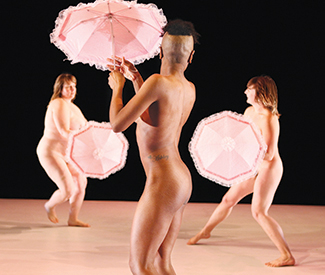
THEATER It takes a playwright of particular boldness to forgo text entirely in deference to movement and music. But in addition to the formal choices made in her Untitled Feminist Show, eminent New York downtown theater maker Young Jean Lee also pursues a theme (flagged by her “un-title”) that stubbornly remains as controversial as ever: the politics and pleasures of female empowerment. This theme plays out starkly, without clothes and without shame, over the course of an hour-long romp that will make its Bay Area premiere this weekend at Yerba Buena Center for the Arts.

Conceived and directed by Lee, with choreography by Faye Driscoll (another prominent New York artist whose You’re Me ran at CounterPULSE last March), Untitled Feminist Show is just one of the latest of Lee’s willfully provocative, consistently witty pieces. She and her Young Jean Lee’s Theater Company have made a national reputation by reaching for the most uncomfortable subjects, producing a set of humorous, audacious, experimental plays about race, sex, family, religion — great taboo regions normally shrouded in prickly mythology, limited by official debate, or otherwise smothered by good intentions.

Her works include Straight White Men, an exploration of success in contemporary American society; The Shipment, her “black-identity politics show”; Church, investigating American-brand Christianity through the structure of a church service; and the fierce, zany, and dis-Orienting Songs of the Dragons Flying to Heaven (produced locally by Crowded Fire in 2011) in which, drawing on her own Korean American roots, the fractured perspectives and sacrosanct traditions of an American minority serve a master narrative about a young white couple’s banal relationship.

YBCA’s presentation of Untitled Feminist Show comes, not coincidentally, as the organization transitions under its new leadership. Deborah Cullinan, who succeeded Ken Foster as YBCA’s executive director in September, was the longtime executive director of Intersection for the Arts. She has a well-deserved reputation for turning that esteemed arts organization around from hard times after she took over in 1996. YBCA’s director of performing arts, Marc Bamuthi Joseph, was a successful Oakland-based artist and activist when he took over from Angela Mattox (now running PICA in Portland) in 2012.

As longtime associates in the local arts scene, both of whom have been exceptionally community-oriented advocates for the arts, Cullinan and Joseph together promise a bold redrawing of the lines at YBCA. They recently sat down to speak with me about the vision they share for a 21st century arts organization — including the development of something they call the creative ecosystem — and where the work of an artist like Young Jean Lee fits into it.


SF Bay Guardian How are you settling in, after a couple of months and a couple of years now, respectively? And what are these creative ecosystems?

Deborah Cullinan Where I’m at: I’m still listening, learning—frankly a little astonished. I was, what, three blocks away? And my predecessor Ken Foster was one of my closest work friends; Bamuthi another one. I had no idea how much goes on here. It’s just abundant. The creative ecosystem is something Marc dreamed up, and certainly wooed me with. It’s something the two of us, and everybody here, considers to be a way we can think about a contemporary arts center in this century.

Marc Bamuthi Joseph The day that this feature runs will be my second anniversary. My last work [red, black & GREEN: a blues] was commissioned here, and premiered here. I interviewed for this position three days after the premiere. That last work was built around an integrated, documentary process of asking public intellectuals, doers, activists of all stripes—and by activists I don’t mean by vocation but in the purest sense of the word—to contemplate a question and create a physical response. The result, in terms of making art but also in terms of my personal relationships (the way that community might interact with an artistic process), was something that I essentially adapted and created here.

Our community engagement program is a curatorial department. It doesn’t function as a traditional department in that it’s not supplementary. They are agitators; they are intentional. They make space, as opposed to supplementing work. Their gig is not to cue up the Q&A after a play. [It’s] ultimately about the cultivation of relationships.

So that’s what the creative ecosystem is. It’s an adjunct to my own artistic process; it’s a scheme and structure that works within the infrastructure that we have at Yerba Buena Center. What we do is we curate small groups, somewhere between 30 and 50, around key questions that artists are driving. We bring these folks together in salon spaces to watch work together. So, for Young Jean Lee, the questions are: “What is on the other side of your body’s joy?” and “What is on the other side of your body’s shame?” The group has been together for about a year. And when we present the work, they’ll create in our theater lobby physical responses — performative, immersive, antagonistic, and also very vulnerable responses to those questions of joy and shame in the body.

Having piloted a group already (which was contemplating futurity and soul), and now working with body politics, we’re going to add a layer of the onion every year, so that in the coming years we’ll have hundreds if not thousands of folks operating on our campus not just as audience members but as agents within artistic inquiry, so that while we’re here it’s a place of thinking and doing and not just watching.

SFBG Who makes up this group?

MBJ They come from all over the educational spectrum, and all over the vocational spectrum. That too is by design. We wanted at least 10 different practices in each of these groups. These groups aren’t made up of artists exclusively, and ideally artists are in the minority. What we’re creating is a platform by which an arts space might be a hub for diverse intellectual activity. It’s art-framed, but it’s not necessarily art-centered.

DC I’m excited to see us pursue not an either/or definition of what an arts center is — or what art is — but a both/and. What we’re trying to suggest here is that the more we consider what the art is doing, who’s gathering around it or who’s making it, the more valuable that art itself is. The community engagement structure Marc talked about suggests that if you don’t have an active curatorial arm asking, “Who’s not here still?” and “What don’t we know yet?” then the curatorial structure is static. I think putting things together in this way means it’s much more of a circle, and it’s much more inclusive.

SFBG Where does Young Jean Lee’s Untitled Feminist Show come in?

MBJ There’s an arc around relationship to the body—in a way that’s not so much about identity; I think it’s more about empathy and vulnerability. These broad themes of joy and shame are more visceral than intellectual. The alchemy of transformation, the movement of molecules in a room, that’s currency to me. An artistic experience is more valuable if I feel my chemistry changing. So I look for art and artists that demonstrate a similar value system. Myra Melford’s work; Dohee Lee’s work; all of the artists in our New Frequencies music festival — these are artists who demonstrate that same sensibility: the attack of inquiry with brilliant intellectual design, but also a fierceness and unflinching-ness around personal transformation.

The work I subscribe to is work where I feel an artist being transformed, with a magic or sorcery around the ability to have personal transformation be a conduit for collective transformation. I think that’s at work [in Untitled Feminist Show]. And in terms of an intentional community design, this is what we foreground. *

“UNTITLED FEMINIST SHOW”

Thu/30-Sat/1, 8pm, $30-$35

Yerba Buena Center for the Arts

Lam Research Theater

700 Howard, SF

www.ybca.org

Theater Listings: January 29 – February 4, 2014

0

Stage listings are compiled by Guardian staff. Performance times may change; call venues to confirm. Reviewers are Robert Avila, Rita Felciano, and Nicole Gluckstern. Submit items for the listings at listings@sfbg.com.

THEATER

OPENING

Hir Magic Theatre, Fort Mason Center, Bldg D, Third Flr, SF; www.magictheatre.org. $20-60. Previews Wed/29-Sat/1, 8pm; Sun/2, 2:30pm; Mon/3, 7pm. Opens Tue/4, 8pm. Runs Wed-Sat, 8pm (no show Feb 5; additional show Feb 19, 2:30pm); Sun, 2:30pm (also Feb 9, 7pm); Feb 11, 7pm. Through Feb 23. Magic Theatre presents the world premiere of Taylor Mac’s comedic drama about a woman determined to help her two wayward children succeed, while stretching the boundaries of her own gender identity

The Scion Marsh San Francisco, 1062 Valencia, SF; www.themarsh.org. $15-60. Previews Thu/30-Fri/31, 8pm. Opens Sat/1, 5pm. Runs Thu-Fri, 8pm; Sat, 5pm. Through March 1. Brian Copeland’s fourth solo show takes on “privilege, murder, and sausage.”

BAY AREA

Gideon’s Knot Aurora Theatre, 2081 Addison, Berk; www.auroratheatre.org. $32-60. Previews Fri/31-Sat/1 and Feb 5, 8pm; Sun/2, 2pm; Tue/4, 7pm. Opens Feb 6, 8pm. Runs Tue, 7pm; Wed-Sat, 8pm; Sun, 2 and 7pm. Through March 2. Aurora Theatre Company performs Johnna Adams’ drama set within the tense atmosphere of a parent-teacher conference.

The House That Will Not Stand Berkeley Repertory Theatre, Thrust Stage, 2025 Addison, Berk; www.berkeleyrep.org. $29-59. Previews Fri/31-Sat/1 and Tue/4, 8pm; Sun/2, 7pm. Opens Feb 5, 8pm. Runs Tue and Thu-Sat, 8pm (also Sat, Feb 13, and March 13, 2pm; no Sat matinee Feb 15); Wed, 7pm; Sun, 2 and 7pm. Through March 16. Berkeley Rep performs the world premiere of Marcus Gardley’s tale of free women of color in 1936 New Orleans.

ONGOING

Foodies! The Musical Shelton Theater, 533 Sutter, SF; www.foodiesthemusical.com. $32-34. Fri-Sat, 8pm. Open-ended. AWAT Productions presents Morris Bobrow’s musical comedy revue all about food.

Hemorrhage: An Ablution of Hope and Despair Dance Mission Theater, 3316 24th St, SF; www.dancemission.com. $20-25. Thu-Sat, 8pm (Feb 8, shows at 4 and 7pm); Sun, 6pm. Through Feb 8. Dance Brigade presents this “dance installation at the intersection of the new San Francisco and world politics.”

Jerusalem San Francisco Playhouse, 450 Post, SF; www.sfplayhouse.org. $20-100. Tue-Thu, 7pm; Fri-Sat, 8pm (also Sat, 3pm); Sun/2, Feb 9, and 16, 2pm. Through March 8. SF Playhouse performs the West Coast premiere of Jez Butterworth’s Tony- and Olivier-wining epic.

Lovebirds Marsh San Francisco Studio, 1062 Valencia, SF; www.themarsh.org. $15-50. Thu-Fri, 8pm; Sat, 8:30pm. Through March 15. Theater artist and comedian Marga Gomez presents the world premiere of her 10th solo show, described as “a rollicking tale of incurable romantics.”

Major Barbara ACT’s Geary Theater, 415 Geary, SF; www.act-sf.org. $20-140. Wed/29-Sat/1, 8pm (also Wed/29, 2pm); Sun/2, 2pm. American Conservatory Theater performs a new production of George Bernard Shaw’s political comedy.

Noises Off Shelton Theater, 533 Sutter, SF; www.sheltontheater.org. $38. Thu-Sat, 8pm. Through Feb 8. Shelton Theater presents Michael Frayn’s outrageous backstage comedy.

The Oy of Sex Marsh San Francisco, 1062 Valencia, SF; www.themarsh.org. $20-100. Sat, 5pm. Extended through Feb 22. Comedian Alicia Dattner performs her solo show, based on her stories from her own life and love addiction.

Pardon My Invasion Phoenix Theatre, 414 Mason, SF; pardonmyinvasion.brownpapertickets.com. $15-30. Thu-Sat, 8pm; Sun/2, 2pm. Through Feb 8. A pulp fiction writer’s characters come to life in this dark comedy by Joy Cutler.

The Paris Letter New Conservatory Theater Center, 25 Van Ness, SF; www.nctcsf.org. $25-45. Wed-Sat, 8pm; Sun, 2pm. Through Feb 23. New Conservatory Theatre Center performs Jon Robin Baitz’s tale of a Wall Street powerhouse desperately trying to keep his sexual identity a secret.

The Pornographer’s Daughter Z Below, 470 Florida, SF; www.zspace.org. $32. Thu-Sat, 8pm (also Sat, 10:30pm); Sun, 5pm. Through Feb 16. Liberty Bradford Mitchell was a good kid growing up, and a pretty innocent one — probably more than you would expect given her proximity to the family business, the veritable empire of porn founded and run by her father and uncle, San Francisco legends Artie and Jim Mitchell. Now in her 40s and a mother of her own, Mitchell proves a likeably earthy presence if a less-then-compelling actor-playwright in her new one-woman show, directed by Michael T. Weiss, a firsthand account of growing up in San Francisco’s first family of raunch. Inseparable brothers Artie and Jim were the 1970s porn pioneers who founded the O’Farrell Theatre and road high in the industry, weathering court battles and substance abuse and divorce, but succumbing ultimately to their own lethal fallout — Jim Mitchell shot and killed Liberty’s father Artie in 1991. The material here is rich to say the least, and together with generous and explicit excerpts from archival footage and classic porn (including the Mitchells’ own era-defining Behind the Green Door, from 1972), it makes a fascinating bed for Liberty Mitchell’s reminiscences. Musical accompaniment by three-person SF band the Fluffers, meanwhile, punctuates the chronology with blasts of period rock, though often just a few bars worth, and backs up Liberty on the a single, rather awkward musical number. Moreover, despite the keen interest the basic historical facts and family anecdotes can generate, Mitchell’s filial narrative lens is only intermittently effective, being finally too pat, poorly drawn, and predictably sentimentalized to fully reverberate with the larger, almost archetypical or classical themes hovering nearby. (Avila)

“SF Sketchfest: The San Francisco Sketch Comedy Festival” Various venues, SF; www.sfsketchfest.com. Prices vary. Through Feb 9. This year’s 13th Sketchfest features over 200 shows in more than 20 venues, featuring both big-name talents (Alan Arkin, Tenacious D, Laura Dern and the cast of Enlightened, Maya Rudolph, etc.) and up-and-comers, plus tributes to films, theatrical and musical events, improv showcases, and more. Much, much, much more.

Shit & Champagne Rebel, 1772 Market, SF; shitandchampagne.eventbrite.com. $25. Fri-Sat, 8pm. Through Feb 8. D’Arcy Drollinger is Champagne White, bodacious blonde innocent with a wicked left hook in this cross-dressing ’70s-style white-sploitation flick, played out live on Rebel’s intimate but action-packed barroom stage. Written by Drollinger and co-directed with Laurie Bushman (with high-flying choreography by John Paolillo, Drollinger, and Matthew Martin), this high-octane camp sendup of a favored formula comes dependably stocked with stock characters and delightfully protracted by a convoluted plot (involving, among other things, a certain street drug that’s triggered an epidemic of poopy pants) — all of it played to the hilt by an excellent cast that includes Martin as Dixie Stampede, an evil corporate dominatrix at the head of some sinister front for world domination called Mal*Wart; Alex Brown as Detective Jack Hammer, rough-hewn cop on the case and ambivalent love interest; Rotimi Agbabiaka as Sergio, gay Puerto Rican impresario and confidante; Steven Lemay as Brandy, high-end calf model and Champagne’s (much) beloved roommate; and Nancy French as Rod, Champagne’s doomed fiancé. Sprawling often literally across two buxom acts, the show maintains admirable consistency: the energy never flags and the brow stays decidedly low. (Avila)

The Speakeasy Undisclosed location (ticket buyers receive a text with directions), SF; www.thespeakeasysf.com. $60-90 (add-ons: casino chips, $5; dance lessons, $10). Thu-Sat, 7:40, 7:50, and 8pm admittance times. Through March 15. Boxcar Theatre presents Nick A. Olivero’s re-creation of a Prohibition-era saloon, resulting in an “immersive theatrical experience involving more than 35 actors, singers, and musicians.”

Too Much Light Makes the Baby Go Blind Boxcar Playhouse, 505 Natoma, SF; www.sfneofuturists.com. $11-16. Fri/31, 9pm. Thirty plays in 60 minutes, with a show that varies each night, as performed by the Neo-Futurists.

Ubu Roi Exit on Taylor, 277 Taylor, SF; www.cuttingball.com. $10-50. Opens Thu/30, 7:30pm (gala opening Fri/31, 8pm). Runs Thu, 7:30pm; Fri-Sat, 8pm (also Sat, 2pm); Sun, 5pm. Through Feb 23. Cutting Ball Theater performs Alfred Jarry’s avant-garde parody of Shakespeare’s Macbeth, presented in a new translation by Cutting Ball artistic director Rob Melrose.

The World’s Funniest Bubble Show Marsh San Francisco, 1062 Valencia, SF; www.themarsh.org. $8-11. Sun, 11am. Through March 9. The popular, kid-friendly show by Louis Pearl (aka “The Amazing Bubble Man”) returns to the Marsh.

BAY AREA

Can You Dig It? Back Down East 14th — the 60s and Beyond Marsh Berkeley, 2120 Allston, Berk; www.themarsh.org. $20-35. Sat/1, 8:30pm; Sun/2, 7pm. Don Reed’s new show offers more stories from his colorful upbringing in East Oakland in the 1960s and ’70s. More hilarious and heartfelt depictions of his exceptional parents, independent siblings, and his mostly African American but ethnically mixed working-class community — punctuated with period pop, Motown, and funk classics, to which Reed shimmies and spins with effortless grace. And of course there’s more too of the expert physical comedy and charm that made long-running hits of Reed’s last two solo shows, East 14th and The Kipling Hotel (both launched, like this newest, at the Marsh). Can You Dig It? reaches, for the most part, into the “early” early years, Reed’s grammar-school days, before the events depicted in East 14th or Kipling Hotel came to pass. But in nearly two hours of material, not all of it of equal value or impact, there’s inevitably some overlap and indeed some recycling. Note: review from an earlier run of the show. (Avila)

Geezer Marsh Berkeley, 2120 Allston, Berk; www.themarsh.org. $25-50. Thu, 8pm; Sat, 5pm. Through March 1. Geoff Hoyle moves his hit comedy about aging to the East Bay.

The Grapes of Wrath Hillbarn Theatre, 1285 E. Hillsdale, Foster City; www.hillbartheatre.org. $23-38. Fri-Sat, 8pm; Sun, 2pm. Through Feb 9. Hillbarn Theatre continues its 73rd season with Frank Galati’s adaptation of John Steinbeck’s classic American novel.

Man in a Case Berkeley Repertory Theatre, 2015 Addison, Berk; www.berkeleyrep.org. $45-125. Tue and Thu-Sat, 8pm; Wed, 7pm; Sun, 2pm. Through Feb 16. Mikhail Baryshnikov returns to Berkeley Rep to star in a play based on a pair of Anton Chekhov’s short stories, “Man in a Case” and “About Love.” Obie-winning Big Dance Theater stages the high-tech adaptation.

Silent Sky TheatreWorks, Mountain View Center for the Performing Arts, 500 Castro, Mtn View; www.theatreworks.org. $19-73. Tue-Wed, 7:30pm; Thu-Sat, 8pm (also Sat, 2pm); Sun 2 and 7pm. Through Feb 9. Lauren Gunderson’s drama explores the life of groundbreaking early 20th century astronomer Henrietta Leavitt.

PERFORMANCE/DANCE

Caroline Lugo and Carolé Acuña’s Ballet Flamenco Peña Pachamama, 1630 Powell, SF; www.carolinalugo.com. Sat/1, Feb 8, 14, 16, 22, 6:15pm. $15-19. Flamenco performance by the mother-daughter dance company, featuring live musicians.

“Dance and Diaspora” ODC Theater, 3153 17th St, SF; www.odcdance.org. Sat/1-Sun/2, 8pm. $25-35. Works by Persian artists Farima Berenji and Shahrzad Khorsandi.

“Does This Joke Make Me Look Fat?” Mutiny Radio, 2781 21st St, SF; www.mutinyradio.org. Fri/31, 8pm. $10. Also Sat/1, 5pm, $10, Purple Onion at Kells, 530 Jackson, SF; www.purpleonionatkells.com. Pam Benjamin performs her solo comedy show at two different venues. Aaron Barrett and Christopher Conatser open.

Feinstein’s at the Nikko Hotel Nikko, 222 Mason, SF; www.feinsteinssf.com. This week: Anita Gillette in “After All,” Thu/30, 8pm, $30-40; Leslie Jordan in “Fruit Fly,” Fri/31, 8pm, $25-35; Terry White, Sat/1, 7pm, $25-30.

“Gang Bang Comedy Show” Playland, 1351 Polk, SF; www.playlandbar.com. Wed/29, 8pm. $10. Hella gay Comedy presents queer and queer-friendly stand-up with Charlie Ballard, Carrie Avritt, Jesus Fuentes, Yuri Kagen, and Sampson McCormick.

Jess Curtis/Gravity Joe Goode Annex, 401 Alabama, SF; www.joegoode.org. Thu/30-Sat/1, 8pm. $15-20. The company performs Performance Research Experiment #2.2.

“Live Yiddish Radio Show” Contemporary Jewish Museum, 736 Mission, SF; www.thecjm.org. Sun/2, 1-3pm. $20 (includes museum admission). Musicians, comedians, and actors combine their talents to re-create a Yiddish radio show as it might have sounded in the 1930s.

“Magic at the Rex” Hotel Rex, 562 Sutter, SF; www.magicattherex.com. Sat, 8pm. Ongoing. $30. Magic and mystery with Adam Sachs and mentalist Sebastian Boswell III.

“Point Break Live!” DNA Lounge, 373 11th St, SF; www.dnalounge.com. Feb 7, March 7, and April 4, 7:30 and 11pm. $25-50. Dude, Point Break Live! is like dropping into a monster wave, or holding up a bank, like, just a pure adrenaline rush, man. Ahem. Sorry, but I really can’t help but channel Keanu Reeves and his Johnny Utah character when thinking about the awesomely bad 1991 movie Point Break or its equally yummily cheesy stage adaptation. And if you do an even better Keanu impression than me — the trick is in the vacant stare and stoner drawl — then you can play his starring role amid a cast of solid actors, reading from cue cards from a hilarious production assistant in order to more closely approximate Keanu’s acting ability. This play is just so much fun, even better now at DNA Lounge than it was a couple years ago at CELLspace. But definitely buy the poncho pack and wear it, because the blood, spit, and surf spray really do make this a fully immersive experience. (Steven T. Jones)

“The Romane Event Comedy Show” Make-Out Room, 3225 22nd St, SF; www.pacoromane.com. Wed/29, 8pm. $10. With Paco Romane, Jules Posner, Matt Gubser, Rajeev Dhar, Cameron Vaninni, Joey Devine, and host Nicole Calasich.

“This Boy is Just So Strange” Eric Quezada Center, 518 Valencia, SF; www.518valencia.org. Sat/1, 8pm; Sun/2, 3pm. Free. Original songs and monologues with Tommi Avicolli Mecca, Joel Mark, and Diana Hartman.

“Untitled Feminist Show” Yerba Buena Center for the Arts, Lam Research Theater, 700 Howard, SF; www.ybca.org. Thu/30-Sat/1, 8pm. $30-35. Playwright and director Young Jean Lee’s latest work “shakes up gender norms through movement and music.”

BAY AREA

Company C Contemporary Ballet Lesher Center for the Arts, 1601 Civic, Walnut Creek; www.companycballet.org. Thu/30-Sat/1, 8pm (also Sat/1, 3pm). Also Feb 13-14, 8pm; Feb 15, 6pm (benefit gala); Feb 16, 3pm. $25-48. Yerba Buena Center for the Arts, Lam Research Theater, 701 Mission, SF; www.companycballet.org. The company’s winter program includes premieres by Susan Jaffe and Charles Anderson.

Diablo Ballet Shadelands Arts Center, 111 N. Wiget Lane, Walnut Creek; www.diabloballet.org. Fri/31-Sat/1, 8pm (also Sat/1, 2pm). $29-34. The company’s 20th anniversary season continues with its Emotions Into Movement program.

“Die Fledermaus” Napa Valley Performing Arts Center, Yountville; www.lincolntheater.com. Sat/1, 8pm; Sun/2, 2pm. $15-59. Lamplighters Music Theatre (noted for its Gilbert and Sullivan productions) performs Johann Strauss’ “bubbly tale of revenge and temptation.” Continues at Bay Area theaters through Feb 23; visit www.lamplighters.org for future dates.

“MarshJam Improv Comedy Show” Marsh Berkeley, 2120 Allston, Berk; www.themarsh.org. Fri, 8pm. Ongoing. $10. Improv comedy with local legends and drop-in guests.

Martha Graham Dance Company Zellerbach Hall, Bancroft at Telegraph, UC Berkeley, Berk; www.calperformances.org. Fri/31-Sat/1, 8pm. $30-92. Performing Appalachian Spring (1944), Cave of the Heart (1946), and Maple Leaf Rag (1990). *


Film Listings: January 29 – February 4, 2014

0

Film listings are edited by Cheryl Eddy. Reviewers are Kimberly Chun, Dennis Harvey, Lynn Rapoport, Sam Stander, and Sara Maria Vizcarrondo. For rep house showtimes, see Rep Clock.

OPENING

At Middleton Andy Garcia and Vera Farmiga play strangers paying introductory visits to the titular (fictive) college with offspring on the brink of leaving home and starting independent adult lives. Everyone is temperamentally ill-matched — jokester mom with humorless daughter, persnickety dad with laid-back son — but during the course of the day strolling around campus, frissons of romance and new self knowledge occur on both sides of the generation gap. Adam Rodgers’ feature is pleasant but a little too pat, relying overmuch on the appeal of lead actors who’ve been better served elsewhere. (1:39) (Harvey)

Labor Day Pie-baking escaped con (Josh Brolin) meets lonely single mom (Kate Winslet) in Jason Reitman’s adaptation of Joyce Maynard’s novel. (1:51) Presidio.

“Oscar Nominated Short Films 2014: Animated” Five nominees — plus a trio of “highly commended” additional selections — fill this program. If you saw Frozen in the theater, you’ve seen Get a Horse!, starring old-timey Mickey Mouse and some very modern moviemaking techniques. There’s also Room on the Broom, based on a children’s book about a kindly witch who’s a little too generous when it comes to befriending outcast animals (much to the annoyance of her original companion, a persnickety cat). Simon Pegg narrates, and Gillian Anderson voices the red-headed witch; listen also for Mike Leigh regulars Sally Hawkins and Timothy Spall. Japanese Possessions is based on even older source material: a spooky legend that discarded household objects can gain the power to cause mischief. A good-natured fix-it man ducks into an abandoned house during a rainstorm, only to be confronted with playful parasols, cackling kimono fabric, and a dragon constructed out of kitchen junk. The most artistically striking nominee is Feral, a dialogue-free, impressionistic tale of a foundling who resists attempts to civilize him. But my top pick is another dialogue-free entry: Mr. Hublot, the steampunky tale of an inventor whose regimented life is thrown into disarray when he adopts a stray robot dog, which soon grows into a comically enormous companion. It’s cute without being cloying, and the universe it creates around its characters is cleverly detailed, right down to the pictures on Hublot’s walls. Embarcadero, Shattuck. (Eddy)

“Oscar Nominated Short Films 2014: Live Action” With the exception of one entry — wryly comedic The Voorman Problem, starring Sherlock‘s Martin Freeman as a prison doctor who has a most unsettling encounter with an inmate who believes he’s a god — children are a unifying theme among this year’s live-action nominees. Finnish Do I Have to Take Care of Everything?, the shortest in the bunch, follows a cheerfully sloppy family’s frantic morning as they scramble to get themselves to a wedding. Danish Helium skews a little sentimental in its tale of a hospital janitor who makes up stories about a fanciful afterlife (way more fun than heaven) for the benefit of a sickly young patient. Spanish That Wasn’t Me focuses on a different kind of youth entirely: a child soldier in an unnamed African nation, whose brutal encounter with a pair of European doctors leads him down an unexpected path. Though it feels more like a sequence lifted from a longer film rather than a self-contained short, French Just Before Losing Everything is the probably the strongest contender here. The tale of a woman (Léa Drucker) who decides to take her two children and leave her dangerously abusive husband, it unfolds with real-time suspense as she visits her supermarket job one last time to deal with mundane stuff (collecting her last paycheck, turning in her uniform) before the trio can flee to safety. If they gave out Oscars for short-film acting, Drucker would be tough to beat; her performance balances steely determination and extreme fear in equally hefty doses. Embarcadero, Shattuck. (Eddy)

That Awkward Moment Zac Efron, Michael B. Jordan, and Miles Teller star in this tale of three best buds struggling with the messy business of growing up and falling in love. (1:34)

12 O’Clock Boys Lotfy Nathan’s documentary starts with a talk radio guy dismissing as “little scumbags” the urban dirt bikers of Baltimore, saying their menace to public safety is tolerated because they’re African American. Boldly leaping past that dread specter of political correctitude, he opines “”I don’t care if they get hurt. I don’t care if one of them dies,” so long as the problem is dealt with. We then meet the problem in the person of Pug, a 12-year-old observed for three years as he grows older if not bigger (he’s got a Napoleon complex), forever trying to get into the titular fabled pack of “renegade riders” who exasperate the city’s police. An ex-member, who no longer rides but provides mobile “support” to the 12 O’Clockers (so named for their near-vertical wheelies) from his van, says, “You will learn the right way to do all the wrong things in Baltimore.” Dirt biking, he offers, is one of very few “positives” available to those growing up in a community beset by joblessness, crime, and poverty. It’s certainly an outlet for Pug, though whether it’s keeping him out of or getting him into more trouble is an open question. It stays open here, as we see him increasingly exasperating former exotic dancer mom Coco and school officials alike. He’s turning into a bit of an asshole, but will he become a major one? Will he even make it to 18? This vérité slice is itself frustrating as well as compelling — but you’ll hope Nathan makes a sequel so we can see what fate has in store for Pug. (1:15) Roxie. (Harvey)

24 Exposures See “Mumble, Mumble, Murder.” (1:20) Roxie.

ONGOING

American Hustle David O. Russell’s American Hustle is like a lot of things you’ve seen before — put in a blender, so the results are too smooth to feel blatantly derivative, though here and there you taste a little Boogie Nights (1997), Goodfellas (1990), or whatever. Loosely based on the Abscam FBI sting-scandal of the late 1970s and early ’80s (an opening title snarks “Some of this actually happened”), Hustle is a screwball crime caper almost entirely populated by petty schemers with big ideas almost certain to blow up in their faces. It’s love, or something, at first sight for Irving Rosenfeld (Christian Bale) and Sydney Prosser (Amy Adams), who meet at a Long Island party circa 1977 and instantly fall for each other — or rather for the idealized selves they’ve both strained to concoct. He’s a none-too-classy but savvy operator who’s built up a mini-empire of variably legal businesses; she’s a nobody from nowhere who crawled upward and gave herself a bombshell makeover. The hiccup in this slightly tacky yet perfect match is Irving’s neglected, crazy wife Rosalyn (Jennifer Lawrence), who’s not about to let him go. She’s their main problem until they meet Richie DiMaso (Bradley Cooper), an ambitious FBI agent who entraps the two while posing as a client. Their only way out of a long prison haul, he says, is to cooperate in an elaborate Atlantic City redevelopment scheme he’s concocted to bring down a slew of Mafioso and presumably corrupt politicians, hustling a beloved Jersey mayor (Jeremy Renner) in the process. Russell’s filmmaking is at a peak of populist confidence it would have been hard to imagine before 2010’s The Fighter, and the casting here is perfect down to the smallest roles. But beyond all clever plotting, amusing period trappings, and general high energy, the film’s ace is its four leads, who ingeniously juggle the caricatured surfaces and pathetic depths of self-identified “winners” primarily driven by profound insecurity. (2:17) Four Star, Metreon, 1000 Van Ness, Presidio, Shattuck, Sundance Kabuki. (Harvey)

Anchorman 2: The Legend Continues Look, I fully understand that Anchorman 2: The Legend Continues — which follows the awkward lumberings of oafish anchor Ron Burgundy (Will Ferrell) and his equally uncouth team (Paul Rudd, Steve Carell, David Koechner) as they ditch San Diego in favor of New York’s first 24-hour news channel, circa 1980 — is not aimed at film critics. It’s silly, it’s tasteless, and it’s been crafted purely for Ferrell fans, a lowbrow army primed to gobble up this tale of Burgundy’s national TV rise and fall (and inevitable redemption), with a meandering storyline that includes chicken-fried bat, a pet shark, an ice-skating sequence, a musical number, epic amounts of polyester, lines (“by the bedpan of Gene Rayburn!”) that will become quoteable after multiple viewings, and the birth of infotainment as we know it. But what if a film critic happened to be a Ferrell fan, too? What if, days later, that film critic had a flashback to Anchorman 2‘s amplified news-crew gang war (no spoilers), and guffawed at the memory? I am fully aware that this ain’t a masterpiece. But I still laughed. A lot. (1:59) Metreon. (Eddy)

August: Osage County Considering the relative infrequency of theater-to-film translations today, it’s a bit of a surprise that Tracy Letts had two movies made from his plays before he even got to Broadway. Bug and Killer Joe proved a snug fit for director William Friedkin (in 2006 and 2011, respectively), but both plays were too outré for the kind of mainstream success accorded 2007’s August: Osage County, which won the Pulitzer, ran 18 months on Broadway, and toured the nation. As a result, August was destined — perhaps doomed — to be a big movie, the kind that shoehorns a distracting array of stars into an ensemble piece, playing jes’ plain folk. But what seemed bracingly rude as well as somewhat traditional under the proscenium lights just looks like a lot of reheated Country Gothic hash, and the possibility of profundity you might’ve been willing to consider before is now completely off the menu. If you haven’t seen August before (or even if you have), there may be sufficient fun watching stellar actors chew the scenery with varying degrees of panache — Meryl Streep (who else) as gorgon matriarch Violet Weston; Sam Shepard as her long-suffering spouse; Julia Roberts as pissed-off prodigal daughter Barbara (Julia Roberts), etc. You know the beats: Late-night confessions, drunken hijinks, disastrous dinners, secrets (infidelity, etc.) spilling out everywhere like loose change from moth-eaten trousers. The film’s success story, I suppose, is Roberts: She seems very comfortable with her character’s bitter anger, and the four-letter words tumble past those jumbo lips like familiar friends. On the downside, there’s Streep, who’s a wizard and a wonder as usual yet also in that mode supporting the naysayers’ view that such conspicuous technique prevents our getting lost in her characters. If Streep can do anything, then logic decrees that includes being miscast. (2:10) Albany, Balboa, Metreon, 1000 Van Ness, Sundance Kabuki. (Harvey)

Blue Jasmine The good news about Blue Jasmine isn’t that it’s set in San Francisco, but that it’s Woody Allen’s best movie in years. Although some familiar characteristics are duly present, it’s not quite like anything he’s done before, and carries its essentially dramatic weight more effectively than he’s managed in at least a couple decades. Not long ago Jasmine (a fearless Cate Blanchett) was the quintessential Manhattan hostess, but that glittering bubble has burst — exactly how revealed in flashbacks that spring surprises up to the script’s end. She crawls to the West Coast to “start over” in the sole place available where she won’t be mortified by the pity of erstwhile society friends. That would be the SF apartment of Ginger (Sally Hawkins), a fellow adoptive sister who was always looked down on by comparison to pretty, clever Jasmine. Theirs is an uneasy alliance — but Ginger’s too big-hearted to say no. It’s somewhat disappointing that Blue Jasmine doesn’t really do much with San Francisco. Really, the film could take place anywhere — although setting it in a non-picture-postcard SF does bolster the film’s unsettled, unpredictable air. Without being an outright villain, Jasmine is one of the least likable characters to carry a major US film since Noah Baumbach’s underrated Margot at the Wedding (2007); the general plot shell, moreover, is strongly redolent of A Streetcar Named Desire. But whatever inspiration Allen took from prior works, Blue Jasmine is still distinctively his own invention. It’s frequently funny in throwaway performance bits, yet disturbing, even devastating in cumulative impact. (1:38) Opera Plaza. (Harvey)

Dallas Buyers Club Dallas Buyers Club is the first all-US feature from Jean-Marc Vallée. He first made a splash in 2005 with C.R.A.Z.Y., which seemed an archetype of the flashy, coming-of-age themed debut feature. Vallée has evolved beyond flashiness, or maybe since C.R.A.Z.Y. he just hasn’t had a subject that seemed to call for it. Which is not to say Dallas is entirely sober — its characters partake from the gamut of altering substances, over-the-counter and otherwise. But this is a movie about AIDS, so the purely recreational good times must eventually crash to an end. Which they do pretty quickly. We first meet Ron Woodroof (Matthew McConaughey) in 1986, a Texas good ol’ boy endlessly chasing skirts and partying nonstop. Not feeling quite right, he visits a doctor, who informs him that he is HIV-positive. His response is “I ain’t no faggot, motherfucker” — and increased partying that he barely survives. Afterward, he pulls himself together enough to research his options, and bribes a hospital attendant into raiding its trial supply of AZT for him. But Ron also discovers the hard way what many first-generation AIDS patients did — that AZT is itself toxic. He ends up in a Mexican clinic run by a disgraced American physician (Griffin Dunne) who recommends a regime consisting mostly of vitamins and herbal treatments. Ron realizes a commercial opportunity, and finds a business partner in willowy cross-dresser Rayon (Jared Leto). When the authorities keep cracking down on their trade, savvy Ron takes a cue from gay activists in Manhattan and creates a law evading “buyers club” in which members pay monthly dues rather than paying directly for pharmaceutical goods. It’s a tale that the scenarists (Craig Borten and Melisa Wallack) and director steep in deep Texan atmospherics, and while it takes itself seriously when and where it ought, Dallas Buyers Club is a movie whose frequent, entertaining jauntiness is based in that most American value: get-rich-quick entrepreneurship. (1:58) Balboa, Embarcadero, 1000 Van Ness, Piedmont, Presidio, Shattuck, Sundance Kabuki. (Harvey)

Devil’s Due (1:29) Metreon, 1000 Van Ness.

Frozen (1:48) Metreon, 1000 Van Ness, Shattuck.

G.B.F. High schooler Brent (Paul Iacono) decides his path to social success will be established once he comes out. I mean, duh — he’ll become the pet pick of the would-be prom queens: the girl-with-the-best-hair Fawcett (Sasha Pieterse), drama mama Caprice (Xosha Roquemore), and Mormon good girl ‘Shley (Andrea Bowen), and mad popularity will ensue. Alas, wholly unprepared comic-book fan Tanner (Michel J. Willet) gets outed first — and the battle for the O.G. G.B.F. (or “gay best friend”) is on. Working with a fast, sassy, and slangy script — and teen comedy vets Natasha Lyonne, Rebecca Gayheart, and Jonathan Silverman — director Darren Stein (1999’s Jawbreaker) has already traversed some of this uber-camp territory; yes, there’s a multiplayer saunter down a high school hall and a major makeover montage. But the snappy, laugh-out-loud dialogue by first-time screenwriter George Northy (fresh from the Outfest Screenwriting Lab), along with some high-speed improvising by the cast, makes for an effortlessly enjoyable viewing experience. (1:38) Metreon. (Chun)

Gimme Shelter Pope Francis has been making up for lost time, but nevertheless, it’s tough to get a good dose of up-with-Catholicism promotional material these days. Like Francis, Gimme Shelter aims to highlight the church’s tangible and spiritual support to those in need — and here, in this movie based on a real story, would-be teen moms uninterested or unwilling to abort. Oh yes, and it’s down to shelter those battered by bad press about pedophile priests and provide a role with some meat to an ingenue itching to grow. Vanessa Hudgens is that actress, who seems to be making the right career moves following last year’s Spring Breakers by playing crust-punk teen runaway Apple. The girl is trying to break away from her abusive, cracked-out mom (Rosario Dawson) and is forced to reconnect with her privileged stranger of a dad (Brendan Fraser). The cherry — or lack thereof — on top of her troubles is the fact that she’s preggers, which inspires her father’s pinched spouse (Stephanie Szostak) to march her straight to the clinic to terminate. With the help of a hospital priest Frank (James Earl Jones), she finds, yes, shelter in a home for teen moms in need, though we never quite understand why Apple is so determined to have the child —especially when her own mother, brought scarily to life by an intense, unrecognizable Dawson, is such a monster. Still, it’s a measure of how believable Hudgens is, working with what little she has in the way of verbiage, that a viewer is touched by her trajectory. Meanwhile the avid film fan can’t help but wonder how this well-meaning movie — which incidentally has absolutely nothing to do with the Stones and doesn’t quite deserve this way-too-literal title — would have unfolded in the hands of a Lee Daniels or even a Olivier Assayas. (1:40) SF Center, Shattuck. (Chun)

The Girls in the Band Judy Chaikin’s upbeat documentary is in step with the recent, not-unwelcome trend of bringing overlooked musicians into the spotlight (think last year’s Twenty Feet from Stardom and A Band Called Death). The Girls in the Band takes a chronological look at women in the big-band and jazz scenes, taking the 1958’s “A Great Day in Harlem” as a visual jumping-off point, sharing the stories of two (out of just three) women who posed amid that sea of male musicians. One is British pianist Marian McPartland, who’s extensively featured in interviews shot before her death last year; the other is gifted composer and arranger Mary Lou Williams, who died in 1981 but left behind a rich legacy that still inspires. Others featured in this doc (which culminates in a re-creation of that famous Harlem photo shoot — with all-female subjects this time) include saxophone- and trumpet-playing members of the multi-racial, all-female International Sweethearts of Rhythm, which toured the segregated south at great peril during the 1930s and was a favorite among African American servicemen during World War II. No matter her race, nearly every woman interviewed cites the raging sexism inherent in the music biz — but the film’s final third, which focuses on contemporary successes like Esperanza Spalding, suggests that stubborn roadblock is finally being chipped away. (1:26) Smith Rafael. (Eddy)

Gravity “Life in space is impossible,” begins Gravity, the latest from Alfonso Cuarón (2006’s Children of Men). Egghead Dr. Ryan Stone (Sandra Bullock) is well aware of her precarious situation after a mangled satellite slams into her ship, then proceeds to demolition-derby everything (including the International Space Station) in its path. It’s not long before she’s utterly, terrifyingly alone, and forced to unearth near-superhuman reserves of physical and mental strength to survive. Bullock’s performance would be enough to recommend Gravity, but there’s more to praise, like the film’s tense pacing, spare-yet-layered script (Cuarón co-wrote with his son, Jonás), and spectacular 3D photography — not to mention George Clooney’s warm supporting turn as a career astronaut who loves country music almost as much as he loves telling stories about his misadventures. (1:31) Metreon. (Eddy)

The Great Beauty The latest from Paolo Sorrentino (2008’s Il Divo) arrives as a high-profile contender for the Best Foreign Language Film Oscar, already annointed a masterpiece in some quarters, and duly announcing itself as such in nearly every grandiose, aesthetically engorged moment. Yes, it seems to say, you are in the presence of this auteur’s masterpiece. But it’s somebody else’s, too. The problem isn’t just that Fellini got there first, but that there’s room for doubt whether Sorrentino’s homage actually builds on or simply imitates its model. La Dolce Vita (1960) and 8 1/2 (1963) are themselves swaying, jerry-built monuments, exhileratingly messy and debatably profound. But nothing quite like them had been seen before, and they did define a time of cultural upheaval — when traditional ways of life were being plowed under by a loud, moneyed, heedless modernity that for a while chose Rome as its global capital. Sorrentino announces his intention to out-Fellini Fellini in an opening sequence so strenuously flamboyant it’s like a never-ending pirouette performed by a prima dancer with a hernia. There’s statuary, a women’s choral ensemble, an on-screen audience applauding the director’s baffled muse Toni Servillo, standing in for Marcello Mastroianni — all this and more in manic tracking shots and frantic intercutting, as if sheer speed alone could supply contemporary relevancy. Eventually The Great Beauty calms down a bit, but still its reason for being remains vague behind the heavy curtain of “style.” (2:22) Metreon, Opera Plaza, Shattuck. (Harvey)

Her Morose and lonely after a failed marriage, Theodore (Joaquin Phoenix) drifts through an appealingly futuristic Los Angeles (more skyscrapers, less smog) to his job at a place so hipster-twee it probably will exist someday: beautifulhandwrittenletters.com, where he dictates flowery missives to a computer program that scrawls them onto paper for paying customers. Theodore’s scripting of dialogue between happy couples, as most of his clients seem to be, only enhances his sadness, though he’s got friends who care about him (in particular, Amy Adams as Amy, a frumpy college chum) and he appears to have zero money woes, since his letter-writing gig funds a fancy apartment equipped with a sweet video-game system. Anyway, women are what gives Theodore trouble — and maybe by extension, writer-director Spike Jonze? — so he seeks out the ultimate gal pal: Samantha, an operating system voiced by Scarlett Johansson in the year’s best disembodied performance. Thus begins a most unusual relationship, but not so unusual; Theodore’s friends don’t take any issue with the fact that his new love is a machine. Hey, in Her‘s world, everyone’s deeply involved with their chatty, helpful, caring, always-available OS — why wouldn’t Theo take it to the next level? Inevitably, of course, complications arise. If Her‘s romantic arc feels rather predictable, the film acquits itself in other ways, including boundlessly clever production-design touches that imagine a world with technology that’s (mostly) believably evolved from what exists today. Also, the pants they wear in the future? Must be seen to be believed. (2:00) Four Star, 1000 Van Ness, Piedmont, Presidio, SF Center, Shattuck, Sundance Kabuki. (Eddy)

The Hobbit: The Desolation of Smaug Just when you’d managed to wipe 2012’s unwieldy The Hobbit: An Unexpected Journey from your mind, here comes its sequel — and it’s actually good! Yes, it’s too long (Peter Jackson wouldn’t have it any other way); arachnophobes (and maybe small children) will have trouble with the creepy, giant-spider battle; and Orlando Bloom, reprising his Lord of the Rings role as Legolas the elf, has been CG’d to the point of looking like he’s carved out of plastic. But there’s much more to enjoy this time around, with a quicker pace (no long, drawn-out dinner parties); winning performances by Martin Freeman (Bilbo), Ian McKellan (Gandalf); and Benedict Cumberbatch (as the petulent voice of Smaug the dragon); and more shape to the quest, as the crew of dwarves seeks to reclaim their homeland, and Gandalf pokes into a deeper evil that’s starting to overtake Middle-earth. (We all know how that ends.) In addition to Cumberbatch, the cast now includes Lost‘s Evangeline Lilly as elf Tauriel, who doesn’t appear in J.R.R. Tolkien’s original story, but whose lady-warrior presence is a welcome one; and Luke Evans as Bard, a human poised to play a key role in defeating Smaug in next year’s trilogy-ender, There and Back Again. (2:36) Metreon, 1000 Van Ness. (Eddy)

The Hunger Games: Catching Fire Before succumbing to the hot and heavy action inside the arena (intensely directed by Francis Lawrence) The Hunger Games: Catching Fire force-feeds you a world of heinous concept fashions that’d make Lady Gaga laugh. But that’s ok, because the second film about one girl’s epic struggle to change the world of Panem may be even more exciting than the first. Suzanne Collins’ YA novel The Hunger Games was an over-literal metaphor for junior high social survival and the glory of Catching Fire is that it depicts what comes after you reach the cool kids’ table. Katniss (Jennifer Lawrence) inspired so much hope among the 12 districts she now faces pressures from President Snow (a portentous Donald Sutherland) and the fanatical press of Capital City (Stanley Tucci with big teeth and Toby Jones with big hair). After she’s forced to fake a romance with Peeta (Josh Hutcherson), the two watch with horror as they’re faced with a new Hunger Game: for returning victors, many of whom are too old to run. Amanda Plummer and Jeffrey Wright are fun as brainy wackjobs and Jena Malone is hilariously Amazonian as a serial axe grinder still screaming like an eighth grader. Inside the arena, alliances and rivalries shift but the winner’s circle could survive to see another revolution; to save this city, they may have to burn it down. (2:26) Metreon, Shattuck. (Vizcarrondo)

I, Frankenstein (1:33) Metreon, 1000 Van Ness.

Inside Llewyn Davis In the Coen Brothers’ latest, Oscar Isaac as the titular character is well on his way to becoming persona non grata in 1961 NYC — particularly in the Greenwich Village folk music scene he’s an ornery part of. He’s broke, running out of couches to crash on, has recorded a couple records that have gone nowhere, and now finds out he’s impregnated the wife (Carey Mulligan) and musical partner of one among the few friends (Justin Timberlake) he has left. She’s furious with herself over this predicament, but even more furious at him. This ambling, anecdotal tale finds Llewyn running into one exasperating hurdle after another as he burns his last remaining bridges, not just in Manhattan but on a road trip to Chicago undertaken with an overbearing jazz musician (John Goodman) and his enigmatic driver (Garrett Hedlund) to see a club impresario (F. Murray Abraham). This small, muted, droll Coens exercise is perfectly handled in terms of performance and atmosphere, with pleasures aplenty in its small plot surprises, myriad humorous idiosyncrasies, and T. Bone Burnett’s sweetened folk arrangements. But whether it actually has anything to say about its milieu (a hugely important Petri dish for later ’60s political and musical developments), or adds up to anything more profound than an beautifully executed shaggy-dog story, will be a matter of personal taste — or perhaps of multiple viewings. (1:45) California, Embarcadero, Piedmont, Sundance Kabuki. (Harvey)

The Invisible Woman Charles Dickens was a regular scold of the British class system and its repercussions, particularly the gentry’s general acceptance that poverty was something the bottom rung of society was suited for, perhaps even deserved. Given how many in positions of power would have preferred such issues go ignored, it was all the more important their highest-profile advocate be of unimpeachable “moral character” — which in the Victorian era meant a very high standard of conduct indeed. So it remains remarkable that in long married middle-age he heedlessly risked scandal and possible career-ruin by taking on a much younger mistress. Both she and he eventually burned all their mutual correspondence, so Claire Tomalin’s biography The Invisible Woman is partly a speculative work. But it and now Ralph Fiennes’ film of the same name are fascinating glimpses into the clash between public life and private passion in that most judgmentally prudish of epochs. Framed by scenes of its still-secretive heroine several years after the central events, the movie introduces us to a Dickens (Fiennes) who at mid-career is already the most famous man in the UK. In his lesser-remembered capacity as a playwright and director, at age 45 (in 1857) he hired 18-year-old actress Nelly Ternan (Felicity Jones) for an ingénue role. He was instantly smitten; she was, at the least, awed by this great man’s attention. Their professional association permitted some further contact without generating much gossip. But eventually Dickens chafed at the restraints necessary to avoid scandal — no matter the consequences to himself, let alone his wife, his 10 (!) children, or Ternan herself. Fiennes, by all accounts an exceptional Shakespearean actor on stage, made a strong directorial debut in 2011 with that guy’s war play, Coriolanus — a movie that, like this one, wasn’t enough of a conventional prestige film or crowd-pleaser to surf the awards-season waves very long. But they’re both films of straightforward confidence, great intelligence, and unshowy good taste that extends to avoiding any vanity project whiff. (1:51) Opera Plaza, Shattuck. (Harvey)

Jack Ryan: Shadow Recruit Throwback Terror Thursday, anyone? If the early Bourne entries leapt ahead of then-current surveillance technology in their paranoia-inducing ability to Find-Replace-Eliminate international villains wherever they were in the world, then Jack Ryan: Shadow Recruit flails in the opposite direction — toward a nonsensical, flag-waving mixture of Cold War and War on Terror phobias. So when covert mucky-muck Thomas Harper (Kevin Costner) solemnly warns that if mild-mannered former Marine and secret CIA analyst Jack Ryan stumbles, the US is in danger of … another Great Depression, you just have to blink, Malcolm Gladwell-style. Um, didn’t we just do that? And is this movie that out of touch? It doesn’t help that director Kenneth Branagh casts himself as the sleek, camp, and illin’ Russian baddie Viktor Cherevin, who’s styled like a ’90s club tsar in formfitting black clothing with a sheen that screams “Can this dance-floor sadist buy you another cosmo?” He’s intended to pass for something resembling sex — and soul — in Shadow Recruit‘s odd, determinedly clueless universe. That leaves a colorless, blank Chris Pine with the thankless task of rescuing whiney physician love Cathy (Keira Knightley) from baddie clutches. Pine’s no Alec Baldwin, lacking the latter’s wit and anger management issues, or even Ben Affleck, who has also succumbed to blank, beefcake posturing on occasion. Let’s return this franchise to its box, firmly relegated to the shadows. (1:45) Marina, Metreon, 1000 Van Ness. (Chun)

The Last Match Yosvani (Milton García) and Reinier (Reinier Díaz) are barely adult, unemployed Havana residents on the margins, each living under a girlfriend or wife’s roof, but more properly living under the thumb of that partner’s parent. While Yosvani has it somewhat easy in the household of black marketeer Silvano (Luis Alberto García), Reinier has to peddle his body to tourists — for a while snagging a good one in visiting Spaniard Juan (Toni Cantó) — to get by. There’s a simmering attraction between the two ostensibly heterosexual best friends that won’t make life any easier — and even when talented player Rey gets scouted by soccer pros, his potential good fortune could be undone by a debt owed to Silvano, who is not to be fooled with. This leisurely but compelling drama, a Spanish-Cuban co-production by director-cowriter Antonio Hens (2007’s Clandestinos) mixes a restrained love story (there’s some nudity but not much hot-guys-making-out titillation here) with observation of Cuban social norms re: macho vs. “down low” life, money (or the lack of it), and so forth. It’s not wildly original in content or style, but there’s an air of unassuming truth that makes the eventual turn toward tragedy feel more resonant than formulaic. (1:34) Opera Plaza. (Harvey)

The Legend of Hercules What better reason to wield the blunt force of 3D than to highlight the muscle-bound glory of a legendary hero — and, of course, foreground his impressive six-pack abs and impudently jutting nipples. Lead Kellan Lutz nails the eye candy aspect in this sword ‘n’ sandals effort by Renny Harlin (aka the man who capsized Geena Davis’s career), though it’s hard to take him seriously when he looks less like the hirsute, leonine hero depicted in ancient artwork than an archetypal, thick-necked, clean-shaven, all-American handsome-jock star (Lutz’s resemblance to Tom Brady is uncanny). Still, glistening beefcake is a fact of life at toga parties, and it’s clearly a large part of the appeal in this corny popcorner about Greek mythology’s proto-superhero. The Legend of Hercules is kitted out to conquer teen date nights around the world, with a lot of bloodless PG-13 violence for the boys and flower-petal-filled nuzzle-fests between Herc and Hebe (Gaia Weiss) for the girls, along with the added twist that Hercules’s peace-loving mother Alcmene conceived him with Zeus — with Hera’s permission — in order to halt her power-mad brute of a spouse King Amphitryon (Scott Adkins). In any case Harlin and company can’t leave well enough alone and piledrive each action scene with way too much super-slo-mo, as if mainlining the Matrix films in the editing booth to guarantee the attention of critical overseas markets and future installments. And the cheesy badness of certain scenes, like Hercules twirling the broken stone walls he destroys like a pair of giant fuzzy dice, can’t be denied. We all know how rich and riveting Greek mythology is, and by Hera, if the original, complicated Heracles is ever truly encapsulated on film, I hope it’s by Lars von Trier or another moviemaker capable of adequately harnessing a bisexual demi-god of enormous appetites and heroism. (1:38) SF Center. (Chun)

Lone Survivor Peter Berg (2012’s Battleship, 2007’s The Kingdom) may officially be structuring his directing career around muscular tails of bad-assery. This true story follows a team of Navy SEALs on a mission to find a Taliban group leader in an Afghani mountain village. Before we meet the actors playing our real-life action heroes we see training footage of actual SEALs being put through their paces; it’s physical hardship structured to separate the tourists from the lifers. The only proven action star in the group is Mark Wahlberg — as Marcus Luttrell, who wrote the film’s source-material book. His funky bunch is made of heartthrobs and sensitive types: Taylor Kitsch (TV’s Friday Night Lights); Ben Foster, who last portrayed William S. Burroughs in 2013’s Kill Your Darlings but made his name as an officer breaking bad news gently to war widows in 2009’s The Messenger; and Emile Hirsch, who wandered into the wilderness in 2007’s Into the Wild. We know from the outset who the lone survivors won’t be, but the film still manages to convey tension and suspense, and its relentlessness is stunning. Foster throws himself off a cliff, bounces off rocks, and gets caught in a tree — then runs to his also-bloody brothers to report, “That sucked.” (Yesterday I got a paper cut and tweeted about it.) But the takeaway from this brutal battle between the Taliban and America’s Real Heroes is that the man who lived to tell the tale also offers an olive branch to the other side — this survivor had help from the non-Taliban locals, a last-act detail that makes Lone Survivor this Oscar season’s nugget of political kumbaya. (2:01) Metreon, 1000 Van Ness, Sundance Kabuki. (Vizcarrondo)

Nebraska Alexander Payne may be unique at this point in that he’s in a position of being able to make nothing but small, human, and humorous films with major-studio money on his own terms. It’s hazardous to make too much of a movie like Nebraska, because it is small — despite the wide Great Plains landscapes shot in a wide screen format — and shouldn’t be entered into with overinflated or otherwise wrong-headed expectations. Still, a certain gratitude is called for. Nebraska marks the first time Payne and his writing partner Jim Taylor weren’t involved in the script, and the first one since their 1996 Citizen Ruth that isn’t based on someone else’s novel. (Hitherto little-known Bob Nelson’s original screenplay apparently first came to Payne’s notice a decade ago, but getting put off in favor of other projects.) It could easily have been a novel, though, as the things it does very well (internal thought, sense of place, character nuance) and the things it doesn’t much bother with (plot, action, dialogue) are more in line with literary fiction than commercial cinema. Elderly Woody T. Grant (Bruce Dern) keeps being found grimly trudging through snow and whatnot on the outskirts of Billings, Mont., bound for Lincoln, Neb. Brain fuzzed by age and booze, he’s convinced he’s won a million dollars and needs to collect it him there, though eventually it’s clear that something bigger than reality — or senility, even — is compelling him to make this trek. Long-suffering younger son David (Will Forte) agrees to drive him in order to simply put the matter to rest. This fool’s mission acquires a whole extended family-full of other fools when father and son detour to the former’s podunk farming hometown. Nebraska has no moments so funny or dramatic they’d look outstanding in excerpt; low-key as they were, 2009’s Sideways and 2011’s The Descendants had bigger set pieces and narrative stakes. But like those movies, this one just ambles along until you realize you’re completely hooked, all positive emotional responses on full alert. (1:55) Balboa, California, Embarcadero, 1000 Van Ness, Piedmont. (Harvey)

The Nut Job (1:26) Metreon.

The Past Splits in country, culture, and a harder-to-pinpoint sense of morality mark The Past, the latest film by Asghar Farhadi, the first Iranian moviemaker to win an Oscar (for 2011’s A Separation.) At the center of The Past‘s onion layers is a seemingly simple divorce of a binational couple, but that act becomes more complicated — and startlingly compelling — in Farhadi’s capable, caring hands. Ahmad (Ali Mosaffa) has returned to Paris from Tehran, where he’s been living for the past four years, at the request of French wife Marie (Bérénice Bejo of 2011’s The Artist). She wants to legalize their estrangement so she can marry her current boyfriend, Samir (Tahar Rahim of 2009’s A Prophet), whose wife is in a coma. But she isn’t beyond giving out mixed messages by urging Ahmad to stay with her, and her daughters by various fathers, rather than at a hotel — and begging him to talk to teen Lucie (Pauline Burlet), who seems to despise Samir. The warm, nurturing Ahmad falls into his old routine in Marie’s far-from-picturesque neighborhood, visiting a café owned by fellow Iranian immigrants and easily taking over childcare duties for the overwhelmed Marie, as he tries to find out what’s happening with Lucie, who’s holding onto a secret that could threaten Marie’s efforts to move on. The players here are all wonderful, in particular the sad-faced, humane Mosaffa. We never really find out what severed his relationship with Marie, but in the end, it doesn’t really matter. We care about, and end up fearing for, all of Farhadi’s everyday characters, who are observed with a tender and unsentimental understanding that US filmmakers could learn from. The effect, when he finally racks focus on the forgotten member of this triangle (or quadrilateral?), is heartbreaking. (2:10) Albany, Clay, Smith Rafael. (Chun)

Philomena Judi Dench gives this twist on a real-life scandal heart, soul, and a nuanced, everyday heft. Her ideal, ironic foil is Steve Coogan, playing an upper-crusty irreverent snob of an investigative journalist. Judging by her tidy exterior, Dench’s title character is a perfectly ordinary Irish working-class senior, but she’s haunted by the past, which comes tumbling out one day to her daughter: As an unwed teenager, she gave birth to a son at a convent. She was forced to work there, unpaid; as supposed penance, the baby was essentially sold to a rich American couple against her consent. Her yarn reaches disgraced reporter Martin Sixsmith (Coogan), who initially turns his nose up at the tale’s piddling “human interest” angle, but slowly gets drawn in by the unexpected twists and turns of the story — and likely the possibility of taking down some evil nuns — as well as seemingly naive Philomena herself, with her delight in trash culture, frank talk about sex, and simple desire to see her son and know that he thought, once in a while, of her. It turns out Philomena’s own sad narrative has as many improbable turnarounds as one of the cheesy romance novels she favors, and though this unexpected twosome’s quest for the truth is strenuously reworked to conform to the contours of buddy movie-road trip arc that we’re all too familiar with, director Stephen Frears’ warm, light-handed take on the gentle class struggles going on between the writer and his subject about who’s in control of the story makes up for Philomena‘s determined quest for mass appeal. (1:35) Embarcadero, Four Star, Shattuck, Sundance Kabuki. (Chun)

Ride Along By sheer dint of his ability to push his verbosity and non-threatening physicality into that nerd zone between smart and clueless, intelligent and irritating, Kevin Hart may be poised to become Hollywood’s new comedy MVP. In the case of Ride Along, it helps that Ice Cube has comic talents, too — proven in the Friday movies as well as in 2012’s 21 Jump Street — as the straight man who can actually scowl and smile at the same time. Together, in Ride Along, they bring the featherweight pleasures of Rush Hour-style odd-couple chortles. Hart is Ben, a gamer geek and school security guard shooting to become the most wrinkly student at the police academy. He looks up to hardened, street-smart cop James (Cube), brother of his new fiancée, Angela (Tika Sumpter). Naturally, instead of simply blessing the nuptials, the tough guy decides to haze the shut-in, disabusing him of any illusions he might have of being his equal. More-than-equal talents like Laurence Fishburne and John Leguizamo are pretty much wasted here — apart from Fishburne’s ultra lite impression of Matrix man Morpheus — but if you don’t expect much more than the chuckles eked out of Ride Along‘s commercials, you won’t be too disappointed by this nontaxing journey. (1:40) Metreon, 1000 Van Ness. (Chun)

Saving Mr. Banks Having promised his daughters that he would make a movie of their beloved Mary Poppins books, Walt Disney (Tom Hanks) has laid polite siege to author P.L. Travers (Emma Thompson) for over 20 years. Now, in the early 1960s, she has finally consented to discuss the matter in Los Angeles — albeit with great reluctance, and only because royalty payments have dried up to the point where she might have to sell her London home. Bristling at being called “Pam” and everything else in this sunny SoCal and relentlessly cheery Mouse House environ, the acidic English spinster regards her creation as sacred. The least proposed changes earn her horrified dismissal, and the very notion of having Mary and company “prancing and chirping” out songs amid cartoon elements is taken as blasphemy. This clash of titans could have made for a barbed comedy with satirical elements, but god forbid this actual Disney production should get so cheeky. Instead, we get the formulaically dramatized tale of a shrew duly tamed by all-American enterprise, with flashbacks to the inevitable past traumas (involving Colin Farrell as a beloved but alcoholic ne’er-do-well father) that require healing of Travers’ wounded inner child by the magic of the Magic Kingdom. If you thought 2004’s Finding Neverland was contrived feel-good stuff, you’ll really choke on the spoons full of sugar force-fed here. (2:06) SF Center, Shattuck. (Harvey)

The Secret Life of Walter Mitty Walter Mitty (Ben Stiller) works at the Life magazine archives, where the world’s greatest photojournalists send him images of their extraordinary adventures. Walter lives vicariously. When he imagines his office crush (Kristen Wiig) trapped in a burning building, his inner superhero arrests his faculties and sends him flying through windows, racing up stairs to liberate children from their flaming homes. It’s all a fantasy, of course: the man works in a basement with pictures and George Bailey-styled dreams of travel, what does he have but his imagination to keep him warm? Turns out his workplace is planning to kill off its print edition and become LifeOnline — so facing the end of Life, and imminent quiet desperation, this office-mouse is tasked with delivering the last cover the magazine will ever have. But frame 25 on the contact sheet — the one the magazine’s star photog (Sean Penn) calls “The Quintessence of Life” — is blank. Instead of crying defeat, Walter goes on a hunt for the photographer, his avatar of rugged outdoorsmanship, and the realization of his dreams of adventure. It’s liberating to watch him take risks — Stiller says years of watching Danny Kaye movies (Kaye starred in the 1947 adaptation of James Thurber’s short story) inspired the awkwardly balletic gestures of roving, frightened, ultimately exuberant Walter. The film, which Stiller also directed, is ultimately a dreamy parable about getting caught up in imagination — or just confusing images for real life — both of which feel timely in a world where libraries are cyberplaces and you can play “tennis” in front of your couch. The kind of guy who thought the biggest threat was making the first move, Walter learns differently when he takes actual risks: there is magic in this. (2:05) SF Center. (Vizcarrondo)

12 Years a Slave Pop culture’s engagement with slavery has always been uneasy. Landmark 1977 miniseries Roots set ratings records, but the prestigious production capped off a decade that had seen some more questionable endeavors, including 1975 exploitation flick Mandingo — often cited by Quentin Tarantino as one of his favorite films; it was a clear influence on his 2012 revenge fantasy Django Unchained, which approached its subject matter in a manner that paid homage to the Westerns it riffed on: with guns blazing. By contrast, Steve McQueen’s 12 Years a Slave is nuanced and steeped in realism. Though it does contain scenes of violence (deliberately captured in long takes by regular McQueen collaborator Sean Bobbitt, whose cinematography is one of the film’s many stylistic achievements), the film emphasizes the horrors of “the peculiar institution” by repeatedly showing how accepted and ingrained it was. Slave is based on the true story of Solomon Northup, an African American man who was sold into slavery in 1841 and survived to pen a wrenching account of his experiences. He’s portrayed here by the powerful Chiwetel Ejiofor. Other standout performances come courtesy of McQueen favorite Michael Fassbender (as Epps, a plantation owner who exacerbates what’s clearly an unwell mind with copious amounts of booze) and newcomer Lupita Nyong’o, as a slave who attracts Epps’ cruel attentions. (2:14) Embarcadero, 1000 Van Ness, Shattuck, Sundance Kabuki. (Eddy)

The Wolf of Wall Street Three hours long and breathless from start to finish, Martin Scorsese’s tale of greed, stock-market fraud, and epic drug consumption has a lot going on — and the whole thing hinges on a bravado, breakneck performance by latter-day Scorsese muse Leonardo DiCaprio. As real-life sleaze Jordan Belfort (upon whose memoir the film is based), he distills all of his golden DiCaprio-ness into a loathsome yet maddeningly likable character who figures out early in his career that being rich is way better than being poor, and that being fucked-up is, likewise, much preferable to being sober. The film also boasts keen supporting turns from Jonah Hill (as Belfort’s crass, corrupt second-in-command), Matthew McConaughey (who has what amounts to a cameo — albeit a supremely memorable one — as Belfort’s coke-worshiping mentor), Jean Dujardin (as a slick Swiss banker), and newcomer Margot Robbie (as Belfort’s cunning trophy wife). But this is primarily the Leo and Marty Show, and is easily their most entertaining episode to date. Still, don’t look for an Oscar sweep: Scorsese just hauled huge for 2011’s Hugo, and DiCaprio’s flashy turn will likely be passed over by voters more keen on honoring subtler work in a shorter film. (2:59) California, Marina, 1000 Van Ness, SF Center, Sundance Kabuki, Vogue. (Eddy) *


Young at heart

0

LEFT OF THE DIAL “Why are some songs so perfect in a way that never happens again in our lives? What is it about music and being older than 12 but younger than 20?”

Those are the lines of narration capping the final panel of one of my favorite Lynda Barry comic strips, an autobiographical story in her collection One Hundred Demons. In it, our teenage protagonist is lying in bed, staring at the ceiling, listening to the radio in a manner immediately recognizable to anyone who has ever been a teenager. The mood is: I am surely feeling feelings and thinking thoughts no one ever has before. As I recall, this is what being a teenager is. Every emotion, positive or negative, however fleeting, is all-consuming, and often you have no choice but to lie in your room, crushed by the weight of it, headphones drowning out the world. The idea that “this too shall pass” is impossible to understand, because you can’t even see past the econ test you’re surely going to flunk tomorrow, or that guy in biology who barely knows your name. This is why teenagers always seem so sluggish: That shit’s exhausting.

Ask any teenager what helps them get through it — and here I realize I’m starting to sound like adolescence is an inevitable six-year-long disease of sorts, or perhaps a heroin detox you just have to sweat through, but whatever, it kind of is — and near the top of the list, I bet you’ll find music.

“I would have ended up as a drug dealer, no question,” says John Vanderslice, the musician-producer-owner of SF’s storied Tiny Telephone studios, of what he might have become without music as a young person. “I would currently be residing in prison.”

Lucky for him, “My mother forced me by gunpoint to take piano lessons,” he says. “And this was the dirty South. I was in public schools, where the arts meant, you know, coloring. But I got really interested in music, and that became a huge open door for me. I think it would have been a lot tougher to do what I do now if I hadn’t had that music theory kind of shoved in to my brain when I was seven, eight, nine years old, even if I didn’t know it was happening at the time.”

Vanderslice is just one in a who’s who of Bay Area artists who were invited to think about what music meant to them when they were young — how and when and which music shaped their formative years — in preparation for a Friday, Jan. 31 show celebrating the 5th anniversary of the Magik*Magik Orchestra at the Fox Theater in Oakland. The orchestra, a group of more than 50 musicians who have provided “made-to-order” support on records and tours with Death Cab for Cutie, Zola Jesus, How to Dress Well, and Nick Cave, to name a few, is raising money for Magik For Kids, their nonprofit arm that throws hands-on music education events for school-aged kids in the Bay Area.

“When We Were Young,” presented by Noise Pop, will showcase bands — Nicki Bluhm and the Gramblers, the Dodos, Geographer, and a dozen others — collaborating with a 30-piece orchestra and the 30-piece Pacific Boychoir on songs that the artists themselves selected. The prompt: Pick a tune from your childhood that’s close to your heart.

“It was really interesting to see what people chose — I was expecting more ’80s given the age range, but you realize you’re not always listening to what’s new when you’re little,” says arranger, conductor and Magik*Magik founder Minna Choi, a Berkeley-born, classically trained 32-year-old colleagues refer to as a dynamo. (Vanderslice — who will be performing a Simon and Garfunkel song — agreed to Magik*Magik becoming the house band at Tiny Telephone after Choi cold-emailed him five years ago: “Minna’s the kind of person who can and will do absolutely anything she wants to do.”) Choi will conduct most of the show, with Michael Morgan, conductor of the Oakland East Bay Symphony, appearing on a couple pieces.

In designing music programming for children, says Choi, “We’re trying to create ways to expose younger kids not only to music, but to a music career and what that looks like.” The orchestra has organized instrument “petting zoos,” taught kids to build their own string instruments, and run a summer camp where children learn to conduct.

Many players in the orchestra also teach private music lessons, and some had to cancel a few lessons in order to rehearse for the show. “But the point of this show is music education,” says Choi. “So we came up with a kind of ‘Bring your student to Magik work’ day and had them reach back out to parents saying ‘I can’t do a traditional violin lesson Tuesday, but you’re welcome to bring your son or daughter to the studio, we’ll have it set up for them’…there’s so much to learn there, whether it’s rehearsal technique, or just how to communicate when you’re working with 40 other people.”

Diana Gameros, a staple of the Mission’s indie-folk scene — she’s been called “the Latin Feist” — chose an original song from her most recent album, a song she wrote for her hometown of Juárez, Mexico.

“I grew up listening to very traditional Mexican songs, because my grandparents lived on a little farm and that was what there was,” she recalls. “And I didn’t like it when I was young. I wanted to be hip, I wanted to be cool. I liked really poppy songs, which you could hear on the radio because we were so close to the border. What was that band that sang ‘I Saw the Sign’? That’s what I wanted.”

She moved to the States as a teenager, and began writing songs as a young adult. And that’s when she realized that the traditional Mexican music she’d disliked as a child “was embedded in me…it’s in my blood.” She chose “En Juárez” for this show in part because it’s written from a mother’s perspective: “If I had children, this is a song for them — explaining the realities of Juárez, the violence, but also talking to them about what’s possible, about dreams and the hope we should have regardless of problems,” she says.

“I was just honored to be asked to be part of this show, honestly. It’s going to be a magical night.”

A handful of scattered thoughts, while we’re on the topic of music that helped when you needed to lie on your bed blasting music through a Walkman:

  • Green Day’s Dookie was released Feb. 1, 1994 — 20 years ago this Saturday.
  • I’ve listened to that album from start to finish more recently and more frequently as an adult than I should probably admit. If “When I Come Around” starts on the radio when I’m driving, I will turn it all the way up.
  • Miley Cyrus. Skrillex.
  • My grandfather, in the last stages of Alzheimer’s at age 95 and unable to keep family members’ names straight, would sing along if you brought him tapes of Big Band songs from the 1930s.
  • Sherman Alexie: “Your generation’s music isn’t better than any others. It’s just inextricably linked to your youth.”


When We Were Young
With Nicki Bluhm and The Gramblers, The Dodos, Diana Gameros, Geographer, How To Dress Well, Zoe Keating, The Lonely Forest, Maestro Michael Morgan, The Pacific Boychoir, Rogue Wave, Two Gallants, and John Vanderslice

Fri/31, 8pm, $29.50 – $45
The Fox Theater
1807 Telegraph, Oakland
www.thefoxoakland.com


Radio Romance

0

Being a radio DJ in 2014 feels oddly radical.”What do you mean ‘radio’?” people ask, totally perplexed, when I tell them what I do. It’s an independent station on the Internets, I tell them. “Can I call in?” is, without fail, their next question. Not exactly, I say, but we can tweet. It’s not your grandfather’s radio, but the perks are all there.

Web or dial, radio at a very basic level is transmission and reception. No doubt DJing now is physically different from my days on college radio — for starters, 2005 meant I was still fumbling with stacks upon stacks of CDs. Sometimes that shit would skip. Sometimes the play button would stick. Once I lost a disc under the desk and that was that — no more Brother Ali.

As a young college pup, I started as most do — manning a graveyard shift that allowed for the inevitable fuck-ups all newbies make: leaving the mic on while you sing to yourself, messy transitions, stuttering, and awkward jokes. Eventually I smoothed my nerves, developed a more seductive voice, and became master of the knobs and buttons. All my hard work earned a prime-time slot — happy hour. I had arrived. People were listening. I flirted with the idea of radio as a career.

In came the warnings. People called me brave for attempting to make my way into “dying industries”: journalism and radio. They gave me sad eyes, as if envisioning a lifetime of layoffs and corner store ramen. I picked one sinking ship over the other and continued writing. My radio days earned me iPod rights on road trips and conversations at parties, but “DJ” wasn’t even listed on my resume.

I kind of forgot about my old friend, the radio — at least in terms of working with the medium. Then came my new friend, BFF.fm: A now four-month-old, web-based radio station housed in the Mission. The programming is a constant stream of rad, weird, new, and classic jams. The DJs are a diverse batch of local cats, bonded by their unique obsessions with music.

And so it’s official: Radio and I have rekindled our romance.

Every Friday night my human BFF, Brit Spangler, and I co-host “hello, cheetle,” two hours of ratty rock-and-roll and secrets about our whiskey habits, stoney shenanigans, pizza, merkins, and all kinds of naughty things that I’m slightly embarrassed to have my parents hear on the regular — yes, they’re dedicated listeners.

Thankfully the station founder, Amanda Guest, thinks all this is entertaining. Creepy girls being creeps is OK by BFF standards. The station aims to be the audible representation of San Francisco. Guest is beyond stoked by BFF’s growing popularity.

“Things are going prettyyyyy amazingly,” Guest tells me while sipping a gin and tonic. She’s smiling hard. “I know it’s dumb to say, since I started the station, but…I love the station. I think it’s great. It’s filling a need.”

Birthing a San Francisco radio station was the entire purpose of her move from the East Coast a couple years back. Her skeptical Massachusetts friends sent her packing for a city that might be down with such unique ambitions. The original plan included hosting the station from her and husband Forrest’s apartment, but the idea quickly outgrew the living room. “I had this dream, but it wasn’t big enough,” — her grand plans were taking shape and collecting support.

Guest — aka DJ Cosmic Amanda — craved a real broadcast studio. By a fat stroke of luck and plenty of charm, she landed a space in the fairytale-esque Peter Pan-style workspace that is the Secret Alley. Immediately she and her man began the work that would get BFF on air.

“Forrest became the station manager and pretty much handled everything else related to that department,” she says. “I was like, oh, I’ve seen a station, I know what it looks like — you just plug this into this. Clearly that is not how it works.”

Through technical concerns, financial woes, and equipment searches, the couple caressed the challenges until their lovechild of a station was born. “BFF.fm is the baby I will never have,” she says, laughing — in all seriousness.

Trading potential offspring for SF music nerds, the Guest family is growing — 60 DJs now host 45 shows throughout the week. From obscure electronica and ’80s favorites to garage rock and blues, BFF’s roster goes in all directions.

“I like to say our show plays ‘high-quality’ music — no point in using genres anymore,” says Gregory Hill, who DJs as Cool Greg on Monday nights. Together with co-hosts Marisa Breall and Katie Kopacz, the trio plays tracks to complement their other shared gig, Professional Fans: show promoters, DJs, and the like.

“Our show is the perfect way to plug both the shows we are going to as fans and the ones we are going to as promoters,” says Hill. The friends see the radio as bonding space for music lovers at large: fans, bands, labels, and venues, all mingling in new ways. “BFF is creating community. There’s some real closeness happening.”

This kind of passion is exactly what Guest is cultivating. “I want to see real excitement in the DJs. Putting together a thoughtful show every week isn’t easy. It takes a certain kind of person, someone who strives to keep it fresh,” she says, being a long-time DJ herself. “It’s a job done out of love.”

I ask her if streaming ever weirds her out. Does the connection feel less real? Less radio?

“It still feels very natural to me. The delivery has changed a lot but the basic components remain,” she says.

“It’s still a person in a room, sharing with another person somewhere else. It’s people devoting their attention to a shared media,” she says. “Radio is magic.”

Tune in to BFF.fm on the Internets here.

The language of hope

11


By Fernando Andres Torres

arts@sfbg.com

LIT When Alejandro Murguía was named San Francisco’s sixth Poet Laureate in July 2012, he brought a fresh momentum to poesía en español, a movement with historical traction in the city. Murguía, the first Latino appointed to the two-year seat, is a noted bilingual poet whose sharp takes on the city by night, dark notes on tumultuous love, and verses raging against poverty have helped his work rise to prominence. The last lines of his 16th & Valencia: “And we were going to stay angry/And we were not leaving/Not ever leaving/El corazón del corazón de La Mission/El Camino Real ends here.”

Murguía’s post as San Francisco laureate builds on a recent trend, along with Juan Felipe Herrera — California’s current poet laureate — and José Montoya, who was Sacramento’s poet laureate at the time of his death last year. And if we sprinkle in Obama’s second inaugural poet, Richard Blanco, we could say that the national establishment is also paying attention.

Lately, Latino poetry written in both English and Spanish (or “Spanglish”) is blossoming with a vigor not seen since the 1994 passage of Proposition 187 — when many poetas surfaced to protest the vindictive initiative to prohibit undocumented persons from using social services. In this great moment for poesía en español, many fresh voices are rising up and challenging the norms of two intertwined languages.

“There are thoughts in Spanish, and maybe the next one is in English. My poetry is the rhythm of the speech; it is born while I walk, giving me a poetic sense,” says Silvia Parra, also known as Mama Coatl, who strolls the streets of the Mission with her poems and Mayan-Quiché spiritual teachings. Descended from Sonora, Mexico’s Yaqui people, Mama Coatl is also a performance-art activist, and a strong advocate of preventing violence against women; she co-presents Guardianas de la Vida, an annual performance and healing event in honor of San Francisco’s observation of the International Day for the Elimination of Violence Against Women and Girls.

“Poetas have always existed in San Francisco,” says Salvadorean poet Jorge Argueta. Many of us have come from Latin America. Bilingual readings are organized all over the city where poets express themselves in the way they want.”

In 1980, Argueta fled El Salvador’s brutal military regime for San Francisco, where he began mingling with the Mission District’s Chicano poets. He went on to publish his first chapbook, Del Ocaso a la Alborada (From Sundown to Dawn). Several books later, 2001’s award-winning memoir Una Película En Mi Almohada (A Movie in My Pillow) made him one of the top children’s book authors in North America.

According to renowned California poet Francisco X. Alarcón, author of 13 bilingual books, the growing interest in bilingual poetry has turned the genre into “a boom reflecting the linguistic and demographic of the times. Poetry is the only literary genre Latinos continue to write in Spanish. It has to do with life experience and emotions.”

Latino poets reflect their own reality in the language of their intimacy, he says. “Besides, English and Spanish are cousins, sharing the same Roman alphabet.”

But poesía en español is hardly a new phenomenon in San Francisco. By 1959, the beatniks were already looking to the south when Chilean poet Gonzalo Rojas visited City Lights Bookstore to invite several of them to the First Encounter of Writers of the Americas at the Universidad de Concepción. In 1966, Pablo Neruda’s UC Berkeley reading packed the house, with prominent poets and writers (including Lawrence Ferlinghetti, Mario Vargas Llosa, Allen Ginsberg, and Fernando Alegría) in attendance. That night, many ended up at Alegría’s home, and it was a meeting of two different languages with one common denominator: poetry. It was also a historic gathering “of profoundly different movements, the counterculture of the Beats a contrast to the aspirations of Western acclaim of the Latin Americans,” writes author Deborah Cohn, who details the many points of intersection between Latinos and Beat poets since the 1950s in her 2012 book The Latin American Literary Boom and US Nationalism During the Cold War.

And what about those purists alarmed by the Spanglish? “It is ridiculous! Both languages are enriching themselves from each other,” insists Alarcón. Adds Argueta, “Sometimes newcomers are bothered; they see it as an insult. You can call it bilingualism or Chicanismo, but for me it doesn’t denigrate the language — it embellishes the language.”

Late Sacramento laureate Montoya, one of California’s most celebrated poets, mixed English and Spanish with ease. In 1969, he wrote El Louie; along with Corky Gonzales’ 1967 I’m Joaquin, it became one of Chicano poetry’s most famous works. Maximizing the natural rhythms of the languages, words intertwine in a ravishing dance. The poet crosses back and forth between English and his mother tongue, emerging with the language of California.

Which brings us to San Francisco, 2014: el poeta de las corbatas brillantes, the poet of the glittering ties, and the first Latino appointed as the city’s Poet Laureate, Alejandro Murguía. As part of its San Francisco Poet Laureate series, City Lights has just published Stray Poems, a collection of bilingual poems written on napkins, matchboxes, parking tickets and wrinkled pieces of paper over the past 12 years. He’ll celebrate its release at a reading next week, appropriately enough at the very bookstore where Rojas first met the Beats. *

ALEJANDRO MURGUÍA

Feb. 5, 7pm, free

City Lights Bookstore

261 Columbus, SF

www.citylights.com


Events: January 29 – February 4, 2014

0

Listings are compiled by Guardian staff. Submit items for the listings at listings@sfbg.com. For further information on how to submit items for the listings, see Selector.

WEDNESDAY 29

Sean Strub Books Inc., 2275 Market, SF; www.booksinc.net. 7:30pm, free. The author discusses Body Counts: A Memoir of Politics, Sex, AIDS, and Survival.

THURSDAY 30

“Playland After Dark” Playland-Not-at-the-Beach, 10979 San Pablo, El Cerrito; www.playland-not-at-the-beach.org. 6-10pm, $10. Adults (18 and up) get full run of Playland’s pinball and carnival games, plus board games galore and unique exhibits.

SATURDAY 1

Lunar Chinese New Year Festival on Fourth Street Near 1780 Fourth St, Berk; www.teance.com, www.fourthstreet.com. Noon-4pm, free. Welcome the Year of the Horse with Chinese Opera vignettes by Kei Lun Martial Arts, traditional lion dancing, drummers, and more.

“Sam & Max: A Look Back with Steve Purcell” Cartoon Art Museum, 655 Mission, SF; www.cartoonart.org. 4-5pm, free (reception, 7-9pm, $5). Booksigning celebrating The Collected Sam & Max: Surfin’ the Highway. The later reception also includes Purcell in person and a chance to check out the Cartoon Art Museum’s Sam & Max exhibit, as well as the concurrent exhibits “Grains of Sand: 25 Years of the Sandman” and “Searle in America.”

“Peralta Hacienda Saturday Kids Club” Peralta Hacienda Historical Park, 2465 34th Ave, Oakl; www.peraltahacienda.org. 2:30-5pm, free. Ongoing through May 31. Outdoorsy games, sports, and team-building fun for kids, who can learn about Ohlone Native American life, make crafts using dyes drawn from local plants, and go birdwatching, to name just a few of the offered activities.

Art Peterson Emerald Tablet, 80 Fresno, SF; www.emtab.org. 2-5pm, free. The author reads from Why Is That Bridge Orange? San Francisco for the Curious.

“Sick Plant Clinic” UC Botanical Garden, 200 Centennial, Berk; events.berkeley.edu. 9am-noon, free. Feeling like a green-thumb failure? Bring your ailing plants (covered or in a container) for diagnosis by volunteer plant pathologists and entomologists at this long-standing monthly event.

Gene Luen Yang SF Public Library, Latino/Hispanic Community Meeting Room, 100 Larkin, SF; www.sfpl.org. 2-3:30pm, free. The two-time National Book Award finalist discusses and signs his latest work, graphic novel Boxers & Saints: A Historical Duology of the Boxer Rebellion.

SUNDAY 2

Exploratorium free day Exploratorium, Pier 15, SF; www.exploratorium.edu. 10am-5pm, free. Regular adult admission is $25, so here’s your chance to check out (for free!) the science museum’s six exhibit galleries, including a Bay Observatory, and other attractions.

“Poetry Unbound #9” Art House Gallery, 2905 Shattuck, Berk; berkeleyarthouse.wordpress.com. 5:15pm, $5 donation (no one turned away for lack of funds). With Paradise, Jan Steckel, and Martin Heimstra, followed by a brief open mic. Hosts are Clive Matson and Richard Loranger.

MONDAY 3

Colin Meloy and Carson Ellis Booksmith, 1644 Haight, SF; www.booksmith.com. 7pm, $5 (advance tickets at www.brownpapertickets.com). Portland, Ore.-based author Meloy (also known at the lead singer and songwriter of the Decemberists) and illustrator Ellis — real-life partners and parents to two sons — share their latest literary collaboration, fantasy epic Wildwood Imperium: The Wildwood Chronicles, Part III. *


Mumble, mumble, murder

1

cheryl@sfbg.com

FILM Joe Swanberg’s latest film to play the Roxie, 24 Exposures, isn’t actually his newest. That’d be family drama Happy Christmas, which just premiered at Sundance. Going by festival reviews, Christmas sounds like it’s in the vein of Swanberg’s Drinking Buddies — last year’s Olivia Wilde-starring tiptoe into the mainstream, a departure for the indie writer-director-actor — with a marquee cast that includes Buddies‘ Anna Kendrick and hipster queen Lena Dunham.

24 Exposures is the busy artist’s 15th flick to play the Roxie in a year (the list includes Buddies, 2012’s acclaimed All the Light in the Sky, 2007 breakout Hannah Takes the Stairs, and the only public screening to date of short Privacy Settings). In some ways, 24 Exposures marks another departure, being an “erotic thriller” (scare quotes needed, because it’s highly aware of its genre) — though it also incorporates Swanberg’s affection for relationships that aren’t working out, no matter how much the principals talk about their problems. His interest in horror (see: his participation in 2012 anthology film V/H/S and 2011 cult hit You’re Next, etc.) flavors 24 Exposures‘ plot: Parallel lives collide when photographer Billy (Adam Wingard), who snaps cute, topless women posed in gruesome death scenes, meets depressed cop Michael (Simon Barrett), who happens to be investigating the actual murder of a cute, topless woman.

Yep, this film stars director Wingard and writer Barrett of You’re Next and V/H/S fame. That slurping sound you hear is the mumblecore snake eating its tail, and not for the first time. (Is there anyone in that scene who hasn’t appeared in or worked on a peer’s film? The answer is no.) In 24 Exposures, it’s less of an in-joke than expected, since Billy and Michael don’t achieve BFF mode until the film’s coda. The relationships that form the core of the film are between Billy and the various women in his life, including girlfriend Alex (Caroline White), who is totes cool with his artistic pursuits as long as she’s included in the process, and any three-ways that occur after the shoots. Inevitably, there’s tension when she returns from a weekend away and realizes Billy’s been “taking smutty pictures when I’m not here.”

Billy is a sleaze, but otherwise he’s basically a harmless dude in a cardigan. If 24 Exposures had been made in early 1980s Europe, the film would pump out more bloody bodies for Michael to find; there’d be way more POV creeping and probably a chase involving an unseen killer wearing black leather gloves. Despite a sleek credit sequence illustrated with pulpy artwork, this is no lo-fi giallo. A better reference point is one from the script itself: Silk Stalkings, that 1990s epitome of basic-cable sexy thrillerdom. That it’s brought up jokingly (as in, “Do you feel like a character in Silk Stalkings right now?”) only enforces 24 Exposures‘ aspirations toward meta-ness.

The self-consciousness doesn’t end there. The film’s synthy score, which swells knowingly during suspenseful moments, is another obviously obvious choice. But if you’re expecting 24 Exposures to descend into full-on camp, you’ll come away disappointed. Lurid is perhaps a better descriptor, since 24 Exposures is bulging with “boobies” — a word Billy uses moments after explaining to a skeptical model that he practices “dress-up mixed with fine art.” Earlier, he’s described his work as “personal fetish photos,” clarifying that they’re “classy.” (Truly, they’re not.) We never see the results displayed anywhere, yet this is apparently his profession, not a private hobby, since the photo shoots involve makeup artists and assistants.

Clearly, 24 Exposures is poking fun at the erotic-thriller genre, and itself by extension. Any haters who cry “misogyny!” — because Swanberg’s camera ogles just as much as Billy’s does — are answered in a scene that’s been planned with them in mind. Photographing death is “way more interesting than taking a picture of a fuckin’ tree in your front yard,” Billy tells Michael, who counters by asking, “Why is it always dead women? Why not a dead old guy?” It’s not about that, Billy insists. “It’s ridiculous for me to try and explain this, because it’s not something that I even think about. You can’t say, ‘Why am I doing this?’ You just have to say, ‘OK, I’m attracted to this, and that’s what I’m gonna do.'”

That’s vague, and — again — Billy is a sleaze, but Swanberg’s careful to make his underlying point visually. When Michael asks Billy, “Have you ever seen a real dead body?”, it foreshadows the film’s second cute-girl murder. A distinction is made when a character we’ve come to sympathize with is brutally killed, and hers is the only crime scene that doesn’t invite us to leer at the victim.

The film’s last act cuts some months ahead; we see aspiring memoirist Michael receiving feedback from a book agent (played by Swanberg), who advises him to rewrite his manuscript. There are too many loose ends, he says, and not enough strong connections between the cop and the photographer. Oh, and the ending needs work, too. 24 Exposures, you’re talking to yourself — and you know it, and we know it, and you know we know you know.

Up next for the prolific, probably sleep-deprived Swanberg, who’s likely also got a dozen or so new movies in the pipeline: helming an episode of the San Francisco-set HBO series Looking. Wonder if there’ll be a scene set at the Roxie? *


24 EXPOSURES opens Fri/31 at the Roxie.


META WORLD PIECES: CATCHING UP WITH 24 EXPOSURES DIRECTOR JOE SWANBERG


SF Bay Guardian How’s Sundance?

Joe Swanberg It’s been amazing. [Happy Christmas] is a pretty small, personal movie, so it’s nice that people seem to be liking it.


SFBG When will it be coming out theatrically?

JS We’re probably gonna follow the Drinking Buddies (2013) release pattern of doing VOD and theatrical sometime around July, and then having it come out on DVD around Thanksgiving.


SFBG You’ve had 15 movies screen at the Roxie Theater in the past year, which is a pretty astonishing number.

JS They did a retrospective, which was incredible. Not only was it a great chance to hang out in San Francisco for a week, but it was amazing for me to look back at a lot of movies that I hadn’t seen in a long time. It’s also crazy to think that there’s that much stuff. I sort of forget that I’ve made that many movies.


SFBG Do you not consider yourself prolific?

JS Because I don’t write, I can very quickly jump from one project right into the next. The first six years I was making movies, I was making around one a year, because I had a day job and that was all the time I could spend on it. As soon as I was able to support myself as a filmmaker, I really was making a lot of them [laughs] — there was one year where I made six, which was really too many by anyone’s standards. It made the following year really strange, trying to actually get all of those out into the world. And also, while they’ve all had some form of distribution, there’s really only four or five of my movies that people have heard of. There’s all of these others that only the hardcore cinephiles have checked out.


SFBG When you say you don’t write, do you mean because your films are improvised?

JS Yeah, exactly. I do write, but it’s just an outlining process. I’m working so collaboratively with the actors that it’s not the sort of difficult screenplay process that a lot of filmmakers go through.


SFBG With this long filmography, is it weird for you to be suddenly known as “the director of Drinking Buddies”?

JS It’s totally fine. I tend to like the newest film the best, just because it’s the closest to where my head is at. Drinking Buddies would be the one that I would recommend to people, and talk about as well. And probably Happy Christmas will very quickly become the next center of conversations. I haven’t watched a lot of those early ones in a long time, so I don’t even know if I would like them anymore [laughs]. Hopefully, they’re all leading toward something. Getting better. Let me put it this way: It’s great that people are talking about Drinking Buddies and not some movie I made six years ago.


SFBG You mentioned that Happy Christmas is a personal movie, and obviously Drinking Buddies ties into your much-documented love of beer. So what inspired 24 Exposures?

JS I had been acting in genre movies a lot, especially with Adam Wingard and Simon Barrett. I was really interested in what motivated them to make those kinds of movies instead of romantic comedies or something [laughs]. Also, I think a lot of what 24 Exposures is about is the responsibility and ownership of that stuff. I wanted to investigate where the women fit in. Are they passive models who are being exploited, or are they willing participants? Are they co-authors of the art? Is it a little bit of all of those things? It’s something that I’ve made other movies about, too. I’m genuinely interested in the collaborative process. Who ends up taking the credit, and who ends up feeling taken advantage of?  

SFBG The film is very meta.  

JS Definitely. I was reading Richard Brody’s book on Jean-Luc Godard at the time, so meta was very much on my mind. I was interested in the way that Godard played around with genre movies, but very atypical genre movies. They were always much more like Godard movies than they were genre movies. It was fun to sort of dabble in that space. The other thing that was exciting to me was how my generation’s sexuality was informed by late-night Cinemax and very cheesy, soft-focus, heavy-music kind of stuff. (I’m 32.) When all of us were in junior high, that was the most erotic thing we had access to. That aesthetic is such a joke now. It’s so dated. So I wanted to investigate that as well.  

SFBG Do you worry that someone will come across the film and not pick up on that subtext?

JS This is an interesting one for that question. Pretty much all of my movies have existed very squarely in the art-house audience, so I haven’t really thought much beyond that sort of space. But that’s changing these days, especially with Drinking Buddies, and, I’m assuming, with Happy Christmas too. So maybe 24 Exposures will be seen by considerably more people than some of those earlier ones. But I feel like the movie’s sort of subverting the genre at every turn. It never fully gains momentum as a pure exploitation thriller. Every five minutes it reminds you that you’re watching a movie, and puts in some sort of criticism or other unsexy thought into your head.  

SFBG Totally changing gears, but I noticed you directed an episode of HBO’s Looking, which all anyone here can talk about right now.  

JS Yeah! It was one of the most fun things I’ve done as a filmmaker. I really like the show, too, so I’m just happy to have had some little piece of involvement. I live in Chicago, so I have hometown pride, but San Francisco is without a doubt the most beautiful city in America. I spent three weeks trying to find a bad view, and I couldn’t. *

To the occasion

0

arts@sfbg.com

DANCE Now in its 19th season, Robert Moses’ Kin offered up a three-part program, “RISE,” this past weekend at Yerba Buena Center for the Arts. “RISE” contained two world premieres — Profligate Iniquities and The Slow Rise of a Rigid Man — and a reprise of last year’s ambitious NEVABAWARLDAPECE. It was an evening in which Moses’ 14-member ensemble showcased its individualities, and presented rich perspectives on two very different pieces of choreography. The dancers would have been even more appreciated if they could have been seen better. For some reason, David K. H. Elliott’s lighting design favored darkness; at times, it was so murky that it wasn’t easy to see who did what, where.

For Profligate, Moses chose a selection of glorious Sephardic music that evoked the cultural complexity of southern Spain before the expulsion of the Jews in 1492. Tiffany Snow’s brightly lit sukkah, the temporary and fragile dwelling associated with the High Holy Days, suggested a place of respite.

The duets that made up the majority of Profligate explored a wide range of relationships, yet all of them seemed to have a touch of anger and distrust to them. There was weariness in the way Katherine Wells and Brendan Barthel circled each other, with Wells bursting into limb-shaking explosions. Yet they finished by going off together into the darkness. Standing tall and self-assured, Crystaldawn Bell barely glanced at Victor Talledos, who crawled and slithered in her direction like something emerging from below the earth. They shared a couple of promising dominance encounters, but then she sent him off.

Norma Fong, fiery and fierce, and Dexandro Montalvo, the man with the loosest hips, went at each other like two different forces. When he swung her, she defiantly stared at us.

Individually, the duets were strongly delineated, beautifully showing off these fine dancers — including major solos by Carly Johnson in her second year with the company, and Jackie Goneconti in her first. But Profligate was too episodic. It dragged. It needed some thread, some trajectory to tie the individual parts together.

The evening’s second premiere was Artistic Director Moses in the modest but well-focused The Slow Rise of A Rigid Man, a solo he created for himself. The work is part of a project about family, Blood in Time, which Moses began in 2000.

Dressed in a flowing coat and wide pants, the dancer looked heavier than he is in real life. Walking calmly into the spotlight, Moses started a movement conversation with David Worm (heard on tape), a founding member of the SoVoSo singing group. His rich baritone roamed in a free-flowing but wide-ranging manner through the topic of emptiness, perhaps aging. Moses started with simple warm-up movements in place, repeatedly wishing his knee into action. As he began to spread into space, you could still see young Moses with ODC/Dance in the fluidity of his gestures. But every step, every turn has been distilled, not from memories but from a recognition of the now. At one point, he reached both arms high, perhaps to embrace Worm. Though modest in language, Slow resonated.

I had feared that without the live music and text that was such a major part of last year’s NEVABAWARLDAPECE (“never will be there a world of peace”), its reprise would lose power. In dance terms, it was made richer through the simple addition of four dancers — the unisons, for instance, whether simply sitting on the sidelines, working their way in line formations across the stage, or observing the action from the wings. However, the 45-minute work did not come more into focus.

The major issue seemed to be Carl Hancock Rux’s overwhelming text that ranges from ancient to contemporary injustices. His words thundered across the stage like some invisible doomsayer’s. Since we are more wired to absorb information aurally than visually that can’t be helped, but it put a big burden on the dance.

Often the stage looked like an arena for struggle. Jeremy Bannon-Neches gesturing and leaping as if attacked, Wells whipping through turns as if pursued, and Montalvo drawing on his hip-hop roots to tear into the fray. Even the gorgeously long-limbed Bell seemed besieged when simply standing still. In their solos, Goneconti and Johnson seemed as unstoppable as the passage of time. At one point two dancers appeared to be nailed to a wall, quite arbitrarily. And yet among these incidences, there were welcome moments of quiet, passages of waiting, and a double circle folk dance when everybody seemed to be on the same page.

The last image was of Montalvo vigorously gyrating his hips with some overhead comment about being creative, because that’s all we have. A noble thought, perhaps, but not enough to pull this ambitious project into focus. *


Broken bodies, broken lives

42

Motorists driving for rideshare companies have struck and also killed pedestrians in San Francisco, even since state regulations were adopted to make these new transportation businesses safer and more accountable to the public.

Four months after the new rules were created, lawsuits from these incidents reveal that the new regulations contain gaping holes that continue to place passengers, pedestrians, and even drivers at risk.

One recent local story actually started in 2004 in Florida’s Monroe County. A vehicle sped down the Overseas highway at over 100mph. Ever seen the movie The Fast and the Furious? It was like that.

In the Florida heat, the car blazed by palm trees and an ocean view, hell bent for Miami. It accelerated as it took a curve, swerving around two vehicles going half its speed. Brazenly passing a traffic control device, the car cut off one more vehicle, then another, and another. Still barreling over 100mph, the driver swerved across the double yellow lines, forcing an oncoming vehicle to veer off the highway.

A traffic snarl put an end to the thrill ride. According to the Monroe County Sheriff’s Office incident report, which the Guardian obtained through a records request, driver Syed Muzzafar was accompanied by his wife and three children during his death-defying drive. He told the police officer, “This was just a dumb thing to do. I know I’m wrong.”

Muzzafar was booked for reckless driving. Nine years later, he would be booked again in San Francisco for hitting a family as they crossed the street in the Tenderloin.

On New Year’s Eve 2013, picking up fares for the tech company Uber, Muzzafar’s car struck young Sofia Liu, her mother, Huan Kuang, and brother, Anthony Liu. Six-year-old Sofia did not survive. Her family filed a wrongful death suit against Uber on Jan. 27, and will be represented by attorney Christopher Dolan.

Uber is part of an emerging cast of companies commonly known as rideshares, now legally called Transportation Network Companies (TNCs). The gist of how they operate is this: the company’s mobile app connects a driver with a customer, much like a taxi dispatch. Only a few years old, the TNCs initially operated in a wild west, devoid of regulation. But the California Public Utilities Commission passed rules for TNCs in September with the aim of protecting pedestrians, passengers, and drivers in collisions.

Uber, formed in 2009, has drivers in over 50 cities worldwide and an estimated worth of just over $3 billion, according to leaked evaluations. But Uber may still be in need of a version 2.0.

The death of the young Sofia Liu, killed by a driver already arrested for reckless driving, shows the state still has a long way to go on the road to regulating rideshares.


NOT MY PROBLEM

The night Muzzafar struck the Liu family, he was ferrying customers using the Uber app — but the company disavowed responsibility for the incident.

“We thank law enforcement for the quick release of information,” Uber wrote in a blog post the day after Sofia Liu died. “We can confirm that the driver in question was a partner of Uber and that we have deactivated his Uber account. The driver was not providing services on the Uber system during the time of the accident.”

But that’s a half-truth: Muzzafar was picking up passengers for Uber all night, but because he’d just dropped off a customer, he allegedly ceased being an Uber driver. With no passengers in the vehicle, Uber did not consider him “on the Uber system.”

If that sounds like a giant loophole, you’d be right — but it’s a legal one, for now.

The new CPUC regulations specify that TNCs must only provide liability insurance when drivers are “in service.” The Taxicab Paratransit Association of California is suing to modify those rules, saying the meaning of “in service” was never defined — and they allege this wording allows companies to disavow responsibility for a driver not carrying passengers at the moment of an accident.

This gaping loophole can also lead to insurance and liability consequences.

“I would guess that’s on the order of a $20 million liability case,” Christiane Hayashi, director of Taxi services at the San Francisco Municipal Transit Agency, said of Liu’s death. “The question is, who is going to pay for it?”

Muzzafar, and not Uber, may be on the fiscal hook, even though it’s unlikely he could cover the family’s medical and legal fees on his own.

Though much reporting has focused on TNC drivers’ lack of insurance, the collision that killed Sofia Liu on New Year’s Eve raises other questions as well. Just how did a driver with a reckless driving record manage to become a partner with Uber in the first place?

Checking out drivers

The recently drafted CPUC regulations require the TNCs to carry out background checks, a key element for safety. As it turns out, not all background checks are made equal.

Uber hired a private company called Hirease to conduct its checks, the Guardian learned in emails obtained from drivers. While Hirease requires Uber drivers to fill out a form with their personal information, taxi drivers who must register with the city’s transportation agency are screened with fingerprinting, Hayashi from the SFMTA told us.

The fingerprint checks make use of the FBI’s national criminal database, something a company like Hirease lacks access to (since it isn’t a government agency). We called the FBI’s background check department, based in West Virginia, to better understand the two methods.

We spoke to a rank and file employee, not a spokesperson, so he declined to give his name. The FBI employee spoke with a twang, and clearly laid out the problems.

The first snag with private background checks are false positives from common names (like John Smith) or stolen identities, he said.

Self-identification is also a problem. “If you’re a criminal, you’re not going to use your information,” the FBI employee said. “What if you were a lady and you were married six times, which name will you use for a background check? Bottom line, fingerprints are exclusive. Names are not.”

Another flaw is that while background checks performed for entities like the SFMTA make use of a federal database that dates back 100 years, California law doesn’t allow private background checks to go beyond seven years — and Muzzafar’s reckless driving arrest was nine years ago.

“Uber works with Hirease to conduct stringent background checks,” Uber spokesperson Andrew Noyes wrote to us via email. “This driver (Muzzafar) had a clean background check when he became an Uber partner.”

Hirease and Uber did what they legally could, but the summation of laws and regulations blinded Uber to Muzzafar’s background — and nothing in the new CPUC regulations would have prevented this. That may go a long way toward explaining how a man caught recklessly driving with his own family in the car in Florida was driving for Uber the night he allegedly struck and killed a child.

Importantly, California law does allow for a taxi driver to have one reckless driving incident, or one count of driving under the influence, on his or her record. But as Hayashi told us, stricter background checks make it easier for taxi companies to spot a red flag before making hiring decisions.

The relative insecurity of private background checks raises an unsettling question: How many others with reckless driving records or DUIs drive for TNC companies like Uber, Sidecar, and Lyft without the companies’ knowledge?

The results of a collision can be severe, as San Francisco’s tragic New Year’s eve incident demonstrates. But even those who survive are left with bills that Uber, allegedly, isn’t paying.


PAYING NO ONE

Last September, Jason Herrera and Nikolas Kolintzas summoned an Uber driver via smartphone, intending to hop from Valencia Street to the Marina district. Driver Bassim Elbatniji responded, and drove the pair down Octavia, where his Prius collided with a Camry.

Herrera suffered a concussion and was knocked unconscious. Kolintzas also suffered a concussion, and they both sustained injuries to their necks and backs, according to court documents.

But when the two sought financial assistance from Uber to cover their medical costs, Uber said it was the driver’s responsibility.

“As far as Uber’s concerned, their insurance isn’t providing any of this,” attorney Colleen Li told the Guardian. Li is representing Kolintzas and Herrera in their suit against Uber, which seeks damages to cover their medical bills, which reached “tens of thousands” of dollars, Li told us.

According to a policy published on Uber’s website, the company maintains a $1 million “per incident insurance policy applicable to ridesharing trips,” which is in keeping with requirements under the new CPUC regulations.

Nevertheless, Uber has not stepped up to cover damages in response to a lawsuit arising from a similar incident. Months ago, the Guardian reported on the case of an Uber driver who hit a fire hydrant, which flew through the air and struck Claire Fahrbach, a barista living in San Francisco (“Lawsuit over injury from airborne fire hydrant tests Uber’s insurance practices,” 8/8/13). She sustained lacerations to her body, a fracture in her lower leg, and multiple herniated discs, according to her lawsuit against Uber.

Her medical bills and injuries destroyed her dreams of living in San Francisco, and she moved home with her parents in North Carolina to recover. Her lawyer, Doug Atkinson, told us Uber still hasn’t paid for his client’s medical services.

“They’re still denying they have any liability for the driver,” he said. “They said they wouldn’t fight the CPUC ruling, but in our case they obviously are.”

But the hydrant also sprouted a geyser that flooded a nearby business, Rare Device, and the apartment building above it. “It was horrible. Our store flooded, we lost a bunch of inventory,” Rare Device’s owner, Giselle Gyalzen, told us.

Her insurance covered the damage, but she’s still trying to recover the deductible from Uber.

Uber directed the lawyers to its terms of service, which tell people up front that they won’t cover anything: “Uber under no circumstance accepts liability in connection with and/or arising from the transportation services provided by the Transportation Provider or any acts, action, behavior, conduct, and/or negligence on the part of the Transportation Provider.”

Meanwhile, the drivers also find themselves in a bind when it comes to obtaining insurance. Given the lack of clarity, state agencies have opted to alert TNC drivers that they’re going without a safety net.

On its website, the California Department of Insurance posted a notice warning, “TNCs are not required to have medical payments coverage, comprehensive, collision, uninsured/underinsured motorist coverage or other optional coverages.” It goes on to explain that TNCs’ liability policies aren’t required to cover bodily injury to the drivers, damages to the drivers’ cars, or damage and injuries caused by an uninsured or underinsured motorist.

And as the Guardian previously reported (“Driven to Take Risks,” 8/6/13), rideshare drivers don’t qualify for commercial insurance since their vehicles are registered as private automobiles, yet insurance companies won’t grant complete insurance coverage to TNC drivers since it’s considered an insufficient safeguard against risk.

Notably, limo drivers who also work for Uber (and get commercial insurance through those companies) don’t have this problem — just those using Uber or other rideshare apps as independent contractors. Taxi drivers are also eligible for commercial coverage.

Is there any way for an independent TNC driver to legally insure him/herself on the road? “Not that I’m aware of,” said Patrick Storm, a spokesperson for the Department of Insurance.


FIXING SAFETY

Paul Marron is an attorney for the Taxicab Paratransit Association of California, the group suing the CPUC to tighten up its regulations. In his view, a key test of the new CPUC regulations is whether they’re enforced — and with a bare bones staff, enforcement is likely to be anemic.

“The CPUC does not have the adequate resources to regulate (transportation) safety statewide,” he told us.

As a lawyer for taxi interests competing against rideshares, Marron obviously has skin in the game, so we looked at the numbers.

We compared the staff counts of the SFMTA, the CPUC, and for some perspective, the New York City Taxi Commission.

The SFMTA has 15 employees who oversee San Francisco’s 1,850 taxi cabs. That’s one staff person for every 123 cabs in the city. The NYC Taxi Commission’s staff of 569 oversees 94,500 taxis, town cars and similar liveries, according to their posted annual report. Though the numbers are greater than San Francisco, the ratio is similar: One staff person for every 166 vehicles.

Now for the CPUC. Though it is now tasked with overseeing “rideshare” TNC vehicles, the agency is also responsible for regulating limos and town cars statewide. Public documents obtained by the Guardian show it oversees 1,900 liveries in the Bay Area, and though there are no official numbers, there are an estimated 3,000 rideshare drivers in the city, according to data compiled by the San Francisco Cab Driver’s Association.

The CPUC has a staff of six based in San Francisco, responsible for overseeing an estimated 4,900 vehicles. That leaves the CPUC with one staffer for every 700 vehicles, a ratio wildly out of sync with other vehicle safety regulators.

Hayashi pleaded with the CPUC to allow cities to regulate rideshares on the local level, saying, “You don’t even have the resources to monitor this stuff.”

Sup. Eric Mar met repeatedly with the SFMTA over these concerns, and will hold a February hearing to get to the heart of the safety culture around San Francisco’s TNC rideshares.

CPUC spokesperson Christopher Chow defended its safety regulations and enforcement. “We can clarify or modify our TNC requirements, if needed, particularly the insurance requirements, as we see how the TNCs attempt to comply with the decision’s directives,” Chow wrote in an email. “If we believe there are any issues that should be addressed, we will take action.”

But as things stand, Claire Fahrbach, Giselle Gyalzen, Jason Herrera, Nikolas Kolintas and the family of Sofia Liu are all waiting for that action.

Reed Nelson contributed to this report.


H. Brown: Goodbye to all that, we hope

137

OPINION While we mourn the tamping down of the fiery progressive idealism that characterized City Hall in the early 2000s, we celebrate the departure of that era’s dated man-warrior posturing. Last week proved a good occasion to pop a bottle: Misogynist blogger and progressive scene queen H. Brown announced he would soon be leaving San Francisco for destinations unknown.

Brown, a proud bigot famed for hurling invective from behind a double shot of whiskey at ex-Supervisor Chris Daly’s since-closed progressive hangout Buck Tavern, took the occasion to hang out for posterity with an SF Weekly reporter. Joe Eskenazi wrote a lyrical, subtly satiric ode to the aging troll’s legacy, “Last Call for Know-It-Alls: The Departure of a Classic Specimen of Old-San Francisco Bon Vivantery.”

But nuanced pokes at the longtime “character” proved too subtle to the victims of his bullying throughout the years. And since the piece failed to include the voice of a single woman, we thought we’d remedy with a retrospective of our own. Behold, the legacy of a real jerk:

“At a benefit at the Buck Tavern I walked in and there were all these progressive journalists sitting around a table with him. [Brown] said ‘you’re the one with the great ass!’ He started asking me if I had family members he could date. I was standing there horrified. I’m a mouthy lady, and even I couldn’t think of anything to come back with — not just to him, but to every other progressive journalist who was sitting there listening to him who laughed! I said hi to a few people, and then I left the event.”

– Laura Hahn, president of the San Francisco Women’s Political Committee

“H. is a bully and a sexist. If you want to look at why the progressive movement is failing it’s because it alienates youth, women, and people of color. Deifying somebody like him is shutting women out, the message is they aren’t welcome. It’s not separated from the fact that progressives are really faltering right now with no leadership and very little inspiration.”

– Debra Walker, artist and longtime activist

“As a purveyor of alcohol, I found that the man was a lawbreaking mooch and a pain to deal with. As a woman, I found him pathetic, insulting, gross, or all three, depending on his mood. The first time I met him he cussed me out for an imagined slight in a way that was actually shocking — and it takes a lot for cuss words to flummox me. For a time, I simply refused to serve him.”

– Siobhann Bellinger, Buck Tavern bartender

“His behavior symbolized the running joke amongst some progressive men that women were there for their own entertainment to be mocked and harassed with no one blinking an eye. FUCK. THAT.”

– Anonymous ex-City Hall aide

Ah, old San Francisco bon vivantery. Of course, the real reason we’re cheering on whatever Greyhound that will ferry this foul-mouthed sprite from our burg has nothing to do with Brown. Rather, we’re hoping no one will step into his shoes as your supervisor’s personal Bobby Riggs, to invoke the publicity-pig chauvinist who famously challenged tennis legend Billie Jean King to a match, the infamous Battle of the Sexes in which King mopped the floor with her opponent.

We hope that our purported progressive leaders will no longer invite woman-haters and homophobes to their household Sunday salons, or take Speedo-clad dips with them in the bay. That they will no longer think it’s OK to enable the presence of their own yapping id in polite company.

In the middle of City Hall’s current and unfortunate drift toward elite-serving “moderation,” one must wonder about what hangers-on like Brown did to the strength of our political movement. He and his ilk were allowed to establish through constant bullying, both online and off, that only straight men have the right to feel comfortable in our city’s high-powered progressive circles. What heroes did we lose in the process?

Caitlin Donohue is a staff writer at Rookie magazine and editor of AHDM4U.com.


Drought

41

steve@sfbg.com

I remember the dead lawns, 90-second timed showers, empty fountains and pools, and water cops issuing tickets for washing one’s dirty car. “If it’s yellow let it mellow, if it’s brown flush it down,” went the toilet edict they taught us in school. Water was too precious to just wantonly flush away.

I was 8 years old in 1976-77 during California’s last severe drought, but I retain vivid, visceral memories of that time. Water was an ever-present concern. I learned how dependent we are on the natural world and the role that individual responsibility plays in collective action, particularly in times of turmoil.

Everyone’s yards were brown; nobody’s cars were clean. We were in it together.

But even deeply implanted memories and learned behaviors fade. I may still feel subtle emotional pangs when I watch the water running down the drain when I shave or wash the dishes, yet I’d content myself with the knowledge that water is a renewable resource and we were no longer in a severe drought.

Or at least I was able to do that until this season. California experienced its driest year in recorded history in 2013, and it’s still not raining as we go to press. Yes, there are welcome predictions of finally getting some rain this week, but not the sustained precipitation we need to make a difference.

If current long-range weather forecasts hold true, this winter could be even drier than last winter, causing by far the most severe drought in state history, worse than ’76-’77, even worse than 1923-24, the driest winter ever and the beginning of a seven-year drought.

“We’re facing the worst drought California has ever seen,” Gov. Jerry Brown told reporters on Jan. 17 as he proclaimed a state of emergency, invoking powers to redirect water resources and asking Californians to reduce their consumption by 20 percent.

Yet as dire as this situation may be — and we’ll have a better idea by the end of March, when more stringent water restrictions will be enacted if we don’t get some serious rainfall by then — one of the scariest aspects to this drought is that it may be just a preview of things to come.

This could be the new normal by the end the century. Most reputable climate change models predict California’s average temperature will increase 3-8 degrees by 2100. That’s enough to radically change our climate, causing shorter winters with less precipitation, and more of it coming in the form of rain than snow, undermining the elegant system of storing water within the Sierra snowpack.

That also translates into more extreme conditions, from more flooding in the winter and spring to more dangerous heat waves and wildfires in the summer and fall — and more frequent and severe droughts.

“People should reflect on how dependent we are on rain, nature, and other another,” Brown said at the end of his news conference. “This is Mother Nature. At some point we have to decide to live with nature and get on nature’s side and not abuse the resources we have.”

That theme of interdependence was one he returned to several times during that 14-minute event. Brown was governor during that last big drought in ’76-’77, and when a reporter asked what lessons he took from that experience, he said, “We’re dependent on rain, we’re dependent on one another.”

He expressed confidence that Californians will find their way through even the most severe drought, although he acknowledged it will exacerbate existing conflicts between cities and rural areas, farmers and environmentalists, and Northern and Southern California as each fights for its interests.

“This takes a coming together of all the people of California to deal with this serious and prolonged event of nature,” Brown said. “This is going to take a lot of support and a lot of collaboration on the part of everybody.”


STATE OF DENIAL

California is on a collision course with reality. Whether or not it’s this drought that wakes us up, at some point we’ll awaken to the fact that a growing population can’t survive on dwindling water resources without a major shift in how we operate.

“California does not today live within its means. We want more water than nature is naturally providing, even in normal years,” said Dr. Peter Gleick, president of the Oakland-based Pacific Institute and a world-renowned expert on water issues whose research has fueled United Nations studies as well as his own books. “Some of the most serious impacts of climate change are going to be on water.”

That’s particularly true for California, whose large population and huge agricultural and other water-dependent industries belie a Mediterranean climate that is actually quite fragile and susceptible to droughts and the impacts of climate change.

“You’ve got 30 million people perched on the edge of a physical impossibility, unless we act with huge speed,” said Bill McKibben, an author and researcher who founded 350.org, one of the leading advocacy organizations for addressing climate change.

Gleick and McKibben are leading voices on the related issues of water policy and climate change, respectively, and they both told the Guardian that this drought should finally get people serious about conservation, efficiency, reducing our carbon output, and generally living in greater harmony with the natural world.

“The current drought ought to be a wake-up call to tell us we have to start thinking about our water resources differently,” Gleick told us, calling for far greater efficiency in how we use water, particularly in cities and the agriculture industry. “California has made great progress over the last several decades, but we’re nowhere near where we could be or should be.”

From low-flow toilets and shower heads to smarter irrigation techniques and recycled wastewater, California has made tremendous advances in its water efficiency since the last big drought. But Gleick and McKibben both say California needs a seismic shift in its thinking to grapple how a growing population can function within a changing climate.

“The assumption has always been that as we get larger populations, we’ll figure out their resource needs,” Gleick said, pointing out that climate change challenges that assumption and calls for more proactive thinking. “We need to do a better job at planning for future resource needs.”

Times of crisis can trigger that kind of shift in thinking. Gleick said Australia’s “Millennium drought” from 1995 to 2009 began with basic conservation measures and eventually led to a complete overhaul of water rights, “policies that we haven’t even contemplated” in California.

But Californians may soon be forced into such contemplations.

“It’s physics in action. This is what happens when you start to change the way the world has worked throughout human history,” McKibben told us. “Some people will be empowered to act, and some will have to go into denial. A truly interesting test will be Jerry Brown — he ‘gets it’ on climate, but he’d love to frack as well apparently. He’s like a Rorschach for the state.”

Brown’s call to work with nature and one another is encouraging, but neither Gleick nor McKibben were willing to wager that Brown is ready to lead the big discussion Californians need to have about our long-term needs.

Yet Gleick says something will have to start that conversation before too long: “It’s either going to take a more severe drought or better political leadership.”


FIRES IN JANUARY

California is a tinderbox right now, with a high risk of wildfires that could get unimaginably worse by this summer.

“We’re experiencing conditions in California that we typically see in August,” CalFire spokesperson Daniel Berlant told us. “We never really moved out of fire season in Southern California.”

And that will only get worse as global warming changes California’s climate.

“As summers get longer, it extends the window for fires,” Berlant said. “It’s a clear sign that this generation is seeing more and bigger fires.”

Farmers are also worried, facing the prospect of fields going fallow.

“There is considerable anxiety on farms and ranches throughout California,” Dave Kranz, spokesperson for the California Farm Bureau, told the Guardian. “We know it’s going to be bad, we just don’t know how bad.”

He described ranchers selling their animals before they reach market weight and farmers considering whether to plant field crops and how to keep trees and vines alive if things get bad.

“You have people irrigating crops in January, which is a very unusual occurrence,” Kranz said. And if the rains don’t come this winter, “hundreds of thousands of acres of land would be left unplanted.”

Kranz said that “farmers have become significantly more efficient in their water use,” citing stats that crop production doubled in California between 1967 and 2005 while the water used by the industry dropped 13 percent. “We talk about more crop per drop.”

But Gleick also said the fact that agriculture accounts for 80 percent of water use in California must be addressed, something that Kranz acknowledges. For example, he said Central Valley fields that once grew cotton, which takes a lot of water, have mostly switched to almonds. Pistachios are also big now, partially because they can be grown with saltier water.

“Farmers adapt, that’s what they’ve done historically in response to weather trends and market demands,” he said.

“There’s only so much water and much of it is spoken for for the environment,” Kranz said, acknowledging species needs but also complaining about much of the last big rains, in November and December of 2012, were released to protect the Delta smelt. “We should have saved some of that water.”

While the 1927-28 winter was the driest on record in the state, dropping just 17.1 inches of rain, this winter already looks worse, with just 3.5 inches falling so far as of Jan. 27. That could change quickly — indeed, a chance of rain was finally in the forecast for Jan. 30 and Feb. 2 — but it doesn’t seem likely that we’ll get enough to end this drought.

“Right now, we are saying the odds do not indicate a Miracle March, which is not good,” a meteorologist with the National Weather Service’s Climate Prediction Center told the San Jose Mercury News on Jan. 16 following release of its three-month forecast.

The worse it gets, the more heated the political battles will become over how to address it.

“You’re going to hear a lot of talk about additional water storage,” Kranz said. “We’re paying now for not creating more storage 10-15 years ago. Droughts happen in California.”

But even Kranz and his generally conservative constituency is talking about tweaks to existing reservoirs — such as increasing Shasta Lake’s capacity and expanding the Sykes Reservoir in Colusa County — rather than big new dam projects.

Gleick agrees that the era of building big dams in California is over. “You can’t build a new dam in California, with their enormous political, economic, and environmental costs.”

And that makes the challenges this state faces all the more vexing.


PAST AND FUTURE

California has dealt with drought many times before, including several that lasted for a few years. The last sustained drought was in 1987-1992, but it wasn’t nearly as dry as earlier droughts, such the 1928-1934 drought, the worst one on record.

Officials try to learn from each drought, studying what happened and trying to develop long-term solutions, such as the water banking and distribution systems established during the 1976-77 drought. Yet a study by the Department of Water Resources in 1978 also concluded that we’re essentially at the mercy of nature.

“The 1976-77 drought has again shown that finite nature of our resources and our limited ability to control nature,” read the introduction to the report “The 1976-77 California Drought: A Review.”

DWR’s then-Director Ronald Robie warned at the time that there was no way to predict when or how severe the next drought might be. “We can be assured, however, that drought will return,” he wrote, “and, considering the greater needs of that future time, its impact, unless prepared for, will be much greater.”

Those words could carry a special resonance now, but it’s even scarier given long-range climate change forecasts that Robie wasn’t taking into account when he wrote those words. California estimates it will add more than 15 million people between 2010 and 2060, crossing the 50 million people mark in 2049.

“California could lead the nation into renewable energy. You’ve got the sun. But it would take a 21st century statesman. I guess we’ll find out whether Brown’s that guy — he could be, freed from the need for political popularity after this next election,” McKibben said, calling Brown “a true visionary in many ways, but also a politician. What a fascinating gut check!”

Gleick said that he sometimes gets asked whether climate change is causing the current California drought or other specific weather incidents, and he said that question misses the crucial point: “All of our weather today is influenced by climate change.”

As the climate changes and the world warms, that becomes the new normal for California and other regions, affecting all of its weather patterns. “As goes our climate,” Gleick said, “so goes our water, and we’re not ready.”

SFMTA approves tech shuttle plan

8

The San Francisco Municipal Transportation Agency Board of Directors approved a pilot program Jan. 21 that allows operators of private commuter shuttles to use public bus stops, something they’ve been doing illegally for years on a very predictable basis.

The program will establish an “approved network” of 200 designated San Francisco stops where private shuttles may pick up and drop off passengers. It will issue permits and identifying placards to the private buses and require them to adhere to certain set of rules, like yielding to Muni buses if they approach the stop at the same time. (There’s already a Curb Priority Law stating that any vehicles not operated by Muni will be fined $271 for blocking a bus zone. But the city has chosen to ignore that law when it comes to private commuter shuttles.)

Finally, the program will charge shuttle operators $1 per stop per day, which seeks to cover the costs of the program implementation and no more. The meeting drew a very high turnout that included the protesters who have been blockading the buses, Google employees, private commuter shuttle drivers, and residents of various San Francisco neighborhoods.

Sup. Scott Wiener said at the meeting he was fully supportive of the pilot program, which was developed over the course of many months in collaboration with tech companies who operate the shuttles.

“These shuttles are providing a valuable service,” Wiener said. He said he was sensitive to widespread “frustration and anxiety” around the high cost of housing and rising evictions, but thought it was unfair to blame tech workers: “We need to stop demonizing these shuttles and these tech workers.”

Then Sup. David Campos addressed the board. “I think it’s really important for us to have a dialogue to find common ground,” Campos said, adding that pushing shuttle riders into private automobiles was not a good outcome. But he also urged the SFMTA board to send the proposal back to the drawing board: “It’s a proposal that simply does not go far enough.”

Campos was also critical of the SFMTA’s process of studying the growing private shuttle problem for years and drafting a proposal in collaboration with members of the tech community, with Campos pointing out, “Public input is being sought after the fact.”

Bus plan ignores real cost

Many community members have criticized the new $1 per stop tech shuttle fee as being too low, but city officials say their hands are tied by a state law prohibiting them from charging any more than that.

Yet under Proposition 218 — the state law that limits local governments’ ability to impose new fees — the city has more discretion about how to calculate “cost recovery” than officials have let on.

“Prop. 218 is part of a legal scheme that doesn’t so much limit how we calculate cost recovery,” San Francisco City Attorney’s Office spokesperson Gabriel Zitrin told us, “but limits the city to cost recovery.”

At the Jan. 21 SFMTA meeting, Project Manager Carli Paine explained how her team had arrived at the $1 per stop, per day fee amount.

“We identified everything it would take to implement this program,” Paine said. After identifying all the program components, the agency “took the number of stop events and came up with a ‘per stop event’ cost…The kinds of costs we included are upfront costs, ongoing program costs.”

Under Prop. 218, however, the SFMTA could determine whether there are other costs associated with allowing private commuter shuttles to use public transportation infrastructure, beyond just the cost of issuing and enforcing permits and placards.

Zitrin said the city can identify any costs not already being recovered elsewhere. If shuttles’ use of public bus stops cause transit delays, for instance, what are the costs associated with those delays? More overtime pay for bus drivers?

Low-income kids getting to school late and missing breakfast? What’s the cost of that?

If rents rise in neighborhoods located along the shuttle routes (and studies show they do), what are the associated costs of that phenomenon? What’s the cost of displacement resulting from those higher rents?