• No categories

Politics Blog

Advocates aim to change youth sentencing of life without parole

Christian Bracamontes was 16 years old and had never been in trouble with the law when he made a decision that landed him in a California prison, serving out a sentence of life without parole.

He was part of a tagging crew, and he and a friend had gone down to a wash to hang out and do graffiti. When his friend showed him that he had a gun in his bag, he was surprised. A group of kids came down to the wash and offered to sell them weed, but they refused. Then his friend got an idea. 

“He said to me, do you want to rob them? I said, ‘I don’t care,'” Bracamontes told an interviewer with Human Rights Watch years later. He trailed behind his friend as he approached the kid who’d offered to sell them drugs, but things did not go as planned: The victim threatened to kill them. Bracamontes figured the bluff had been called, and he turned to get his bike so they could leave. But then his friend fired the gun.

Bracamontes was found guilty of first degree murder and sentenced to life without parole. The prosecutor offered a lower sentence of 16-to-life if he accepted a plea deal, but he refused, since he could not fathom how he could possibly be found guilty when he wasn’t the one who pulled the trigger.

His story was one of many profiles included in a Human Rights Watch report titled, “When I Die, They’ll Send Me Home,” an in-depth analysis of California youth serving life sentences without parole. According to that 2008 study, an estimated 45 percent of youth offenders serving that sentence were convicted of murder, but didn’t physically pull the trigger. The convictions reflect a California law that holds youth responsible for a murder that occurs when they were part of a felony, even if they didn’t plan for it to happen. In nearly 70 percent of the cases surveyed by Human Rights Watch, youth didn’t act alone in their crimes, and at least one codefendant was an adult.

A broad statewide coalition of youth advocates and human rights organizations is now pushing for legislation that they hope will give youth in these circumstances a second chance to turn their lives around. Senate Bill 9, dubbed California Fair Sentencing for Youth, would make it possible for youth serving life without parole to petition for a court to review their case and determine whether to impose a lower sentence.

The legislation would permit up to three hearings after 15, 20, and 25 years of incarceration, and the minimum time that someone would have to serve before they could be granted parole is 25 years. Only inmates who exhibit signs of rehabilitation and remorse would be able to submit a petition for a case review. If resentenced, the offenders would still have to go before a parole board to prove that they deserve to be placed on parole.

According to Human Rights Watch, international human rights law prohibits life without parole for youth — and the United States is the only country that imposes this sentence in practice, though other countries have laws on the books permitting it.
 
“All of the organizations and literally thousands of individuals come to this with the idea that this extreme sentence is not a sentence we should be imposing on people who are under the age of 18,” Elizabeth Calvin of Human Rights Watch told the Guardian. Since Human Rights Watch released its national and statewide studies of the issue in 2005 and 2008, she said, “There’s more awareness nationally that our juvenile justice policies of lock them up and throw away the key are failing. It really is worthwhile to give young people a second chance.” Dozens of human rights, civil liberties, and faith-based organizations have pushed to pass the bill, with efforts beginning several years ago.

In California, roughly 300 people who were sentenced when they were minors are serving sentences of life without parole, representing around 12 percent of the estimated 2,500 incarerated individuals in the nation who serving out the same sentence.

Calvin described the bill as legislation that “balances the needs and interests of victim family members who believe that there are some cases that deserve life without parole.” She noted that the bill faced strong opposition from law enforcement and groups of victim family members, though certain individuals in those same communities have voiced support for SB 9. “We’re hopeful, but it’s definitely an uphill battle,” she said.

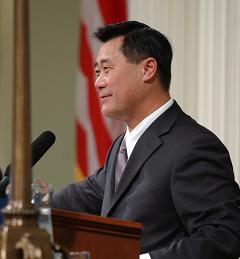
The Assembly Appropriations Committee will vote on SB 9 on Aug. 17, and if it clears that hurdle, it will go onto the full Assembly. The bill was authored by Sen. Leland Yee, with principal coauthors Darrell Steinberg (D-Sacramento) and Juan Vargas (D-Chula Vista), and co-authors Assemblymembers Felipe Fuentes (D-Arleta) and Bonnie Lowenthal (D-Long Beach).

“SB 9 is not a get-out-of-jail-free card; it is an incredibly modest proposal that respects victims, international law, and the fact that children have a greater capacity for rehabilitation than adults,” said Yee, who is also a child psychologist and a candidate for mayor. Research has shown that brain maturation continues throughout adolescence, so young people’s abilities to plan, make decisions, and think critically are not yet fully developed.

“It’s a pretty modest bill,” says Sue Burrell, a staff attorney with the San Francisco-based Youth Law Center. “It’s a pretty intense process even to get a hearing, and to be in a position where you could be released.”

She added that her organization has been engaged in similar work for years. “We’ve been very concerned about the adultification of kids,” she said. “You can’t decide when someone’s so young that … they could never move beyond this phase of their lives.” Many of the cases that land youth in prison without parole are similar, Burell said. “The classic scenario is, they’ll go out and do some low-level thing … but then it turns out that one of the buddies has a knife or a gun. And the rest is history.”


Lee appointment of Nuru darkens the ethical cloud over Room 200

10

City Attorney Dennis Herrera deserves credit for being the one mayoral candidate willing to bring a full-throated denunciation of the sleazy and corrupt politics now flowing from Mayor Ed Lee, who yesterday appointed discredited political fixer Mohammed Nuru to head the Department of Public Works, compounding a series of ethically questionable actions by Lee and his supporters.

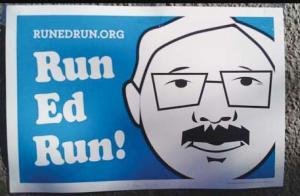
While it was inexplicably buried by editors at the bottom of Section C, the Chronicle’s City Insider today had a pair of good stories on Lee’s mounting political problems. The first was about how the U.S. Attorney’s Office has reportedly launched a probe of Progress for All and its “Run, Ed, Run” campaign, for which Lee ally Rose Pak illegally sought support from executives at Recology, the garbage company that had just been awarded a huge city contract, largely because then-City Administrator Lee had given the company far higher ratings than the other two supposedly impartial bid judges.

The second story was about Herrera slamming Lee’s choice of Nuru. On his campaign website, Herrera reminded voters about the scandals that have surrounded Nuru – like Lee, someone who has always taken his cues from former Mayor Willie Brown – who illegally diverted city funds and workers into campaigning for Brown in 1999 and Gavin Newsom in 2003. Brown now writes for the Chronicle and is even allowed to comment on the mayor’s race.

The scandal – first broken by the Chronicle in 2004, furthered by reporting in the Guardian, and then investigated by Herrera’s office – involved Nuru steering city funds to his nonprofit San Francisco League of Urban Gardeners and then requiring its employees to illegally do campaign work during work hours. Nuru then went to work for Lee at the DPW while continuing to illegally use SLUG’s funds and employees for political purposes.

Herrera said the appointment smacks of “cronyism, politics, and poor judgment.” Previously, Herrera had the best line about Lee as he jumped into race, telling a mayoral forum: “To my mind, Ed Lee’s biggest problem isn’t that he’s a dishonest man – it’s that he’s not his own man,” Herrera said. “The fact is, if Ed Lee is elected mayor, powerful people will continue to insist on things.”

Topping that list of the powerful people who have clearly been pulling Lee’s strings throughout his career are Pak and Brown, both of whom are consultants who regularly get paid by corporations that do big business with the city and need support from the Mayor’s Office. And their actions are often blatant and shameless, just like Nuru’s history, and even exposure of the misdeeds doesn’t correct the problem.

For example, as I reported last week, Brown’s administration helped Pak buy a Rincon Hill condo for half-price through a city affordable housing program in 2002, even though her disclosure forms showed she had $73,414 in her checking account, some of which probably included the $12,000 consulting fee she reported on her tax return from Emerald Fund – the politically connected developer of the project, employees of which are barred from buying such below-market rate units – and $10,000 from Chiang CM Construction, which helped fund Progress for All.

Most of this information was prominently reported in 2003 by the Examiner, but nothing was ever done. Pak got to keep her taxpayer-subsidized condo. Same thing with Nuru, who remained at DPW even after the City Attorney’s Office and Controller’s Office concluded his actions were corrupt. And Lee was appointed interim mayor even after being tied to several corrupt Brown scams, including overriding city workers to give contracts to fraudulent companies at Brown’s behest.

And now, Lee has placed Nuru in charge of a city department with a $129 million city budget and 1,200 employees, despite Nuru’s proven history of directing his subordinates to illegally campaign for his mayoral benefactors. You couldn’t even make this stuff up, and even Examiner columnist Melissa Griffin flatly calls the move “stupid.”

But I think it’s more than just stupid. And the appointment of Nuru is more than just a setback from DPW that good government activists had been fearing for a long-dysfunctional department that had gotten much better in recent years. It looks like flat-out corruption of the sort that ought to knock Lee out of the frontrunner position and hopefully land him in front of a grand jury at some point.

The post-labor world

8

The engineers at Intel are thinking about the future, and they’ve hired sci-fi writers to help them imagine what the next few generations of chips will need to do. We’re talking about cars that drive themselves and space stations with AI — and, of course, about a future where robots do most of the work:


In one of the stories in “The Tomorrow Project,” a couple dash from Paris to the south coast of France to provide an injured relative with a blood transfusion. They travel in a car that navigates and drives itself. Medical information is wirelessly beamed to the vehicle’s dashboard and into mobile-phone-like ear studs. In another story, robotic automation has rendered jobs a thing of the past, and one human ponders what to do with his free time.


What to do with your free time. Imagine that.


Got me thinking about Player Piano, the first Vonnegut novel (and the first one I read, back in high school). In Vonnegut’s world, there are rich, educated people who control the machines — and then there’s everyone else, poor and frustrated and marginalized because there’s no meaningful work to do.


Seem familiar? Sound a little tiny bit like our jobless recovery?


Let me suggest something radical, something that a few futuristic writers have discussed but that’s no longer part of our national political consciousness. We may soon be heading for an economic system that involves massive structural unemployment. There may not be a need for as many human beings to do as much labor, particularly manual labor, as there has been in all of the history of civilization. That’s not necessarily a bad thing — but it will require us as a society to be willing, at a certain level, to divorce labor from income.


In other words, we’ll have to accept that the productive wealth of society will have to be distributed in part on the basis of need, not just on work. I know that sounds awful Marxist, but it’s also the only way a post-labor world can actually work. It’s that or massive starvation and global warfare.


This stuff wasn’t all that crazy a generation ago. In 1973, with Nixon in the White House, Daniel Patrick Moynihan wrote “The Politics of a Guaranteed National Income,” and he wasn’t remotely a commie. But with the “end of welfare as we know it” and the Reagan-Bush II tax cuts and the worship of wealth that passes for civil discourse in the United States today, it seems hard to imagine how anyone can talk seriously about giving people money — for the long term, for life — even if they aren’t employed in compensated labor as we know it today.


The dystopian novels like “Player Piano” assume that there’s some inherent value in labor — that people who can’t find meaningful work that requires skill and pride and offers the rewards of craftsmanship — will become morose and depressed. That’s only true if you assume that work and pay are connected in a 2011-style model. There’s plenty of good work to do in the world; shit, I could put 200 people to work today, researching and writing articles and reports that would add to the base of civic knowledge and do at least some good for the world. I just can’t afford to pay them. There’s so much else that the world needs — work that can only be done by humans and that will enrich us all, but that has no “value” in the modern economic paradigm. That is, it’s good work — and nobody will pay anyone to do it.


I’ll give you a good example: San Francisco alone could probably use 500 full-time people to take care of seniors. I don’t mean people with medical training; I mean people who can cook and clean — and, more important, sit around and talk to lonely single seniors, give them company, make their lives more full. There’s absolutely no economic model for that work right now — the seniors who need it can’t afford to pay for it, there’s nowhere near enough government money (thank you, tax cuts) and no conceivable private-sector role. Good, meaningful work that needs to be done. Lots of qualified people around with no jobs. No functional way to pair them.


Now, you ask me, we raise taxes profoundly on the wealthy and big business and create government jobs to do all the work that needs to be done. Redistribute enough wealth and create enough public-sector employment and we’ll be able to keep modern capitalism going for a while longer.


But we also need to start thinking about the post-labor world, about whether we want people to “ponder what to do with their free time” (which isn’t such an awful thing) and then think about good uses for that free time (acknowleging that there will always be some freeloaders who get money and don’t do jack shit for anyone) — or whether we want large number of people to starve in the streets because there’s no paying work.


When robots do the labor, who gets the paycheck? If it’s the small class of people who own all the robots, we’re looking at a pretty damn ugly future.

Scenes from #opBART: video of the Civic Center protests

Protesters shut down afternoon rush hour BART operations on Aug. 15 as part of a campaign by international hacker group Anonymous in response to the transit agency’s unprecedented move to shut off cell service to prevent a protest. Here’s footage from underground at Civic Center Station, and on the street as stranded commuters sought a way home:

Video by Shawn Gaynor

Warren Buffet’s money

10

Just about everyone I know has been emailing and posting and talking about the Warren Buffett New York Times oped piece on the mega-rich (and I’m not alone — it’s the single most emailed piece on nytimes.com today). I appreciate what Buffett has to say; I’m glad he’s willing to point out that the “shared sacrifice” we’re hearing about from Washington doesn’t include any sacrifices at all from the people who can most afford to give up a little. But that’s not my favorite line; here’s the real crucial argument:


Back in the 1980s and 1990s, tax rates for the rich were far higher, and my percentage rate was in the middle of the pack. According to a theory I sometimes hear, I should have thrown a fit and refused to invest because of the elevated tax rates on capital gains and dividends.


I didn’t refuse, nor did others. I have worked with investors for 60 years and I have yet to see anyone — not even when capital gains rates were 39.9 percent in 1976-77 — shy away from a sensible investment because of the tax rate on the potential gain. People invest to make money, and potential taxes have never scared them off. And to those who argue that higher rates hurt job creation, I would note that a net of nearly 40 million jobs were added between 1980 and 2000. You know what’s happened since then: lower tax rates and far lower job creation.


Get it? Raising tax rates on investments and on the income of the very rich doesn’t impede job creation. RIch people don’t stop working or investing when they have to pay higher taxes. (And local business taxes don’t have a measurable impact on job creation or preservation in San Francisco.)


Here’s where Buffett’s argument bothers me: The guy’s got more money than he can ever spend. He’s going to give most of it away. If he really believes in what he wrote, why doesn’t he use some of that vast wealth to fund a campaign to educate American voters about the truth about taxes and jobs? Imagine what a billion dollars — a modest fraction of his wealth — could do to change the political dynamic in this country. Imagine a concerted advertising and PR campaign, similar to what the right wing has used over the years to promote its pro-corporate agenda, making the case that higher taxes on the rich are good for the economy, that government spending on job creation is a positive thing and that the central dynamic that dominates discussion in both parties is entirely wrong?


Warren: You can do it. I know there are plenty of great charities out there that can use your money, but that won’t change the world. This might.

City workers union backs Yee — and Avalos

18

The press release I got from Leland Yee’s campaign made it sound as if Yee had won a major victory over progressive supervisor John Avalos:


SAN FRANCISCO – Senator Leland Yee has landed the first choice endorsement of the largest organization of city workers – Service Employees International Union (SEIU 1021) – in his campaign for San Francisco Mayor. The move by the 54,000 member union is a complete rejection of the city’s top official, interim Mayor Ed Lee.


The endorsement comes after Yee has landed virtually every major labor endorsement in the race, including the California Nurses Association, California School Employees Association, International Brotherhood of Electrical Workers, San Francisco Building and Construction Trades Council, Laborers International Union, United Brotherhood of Carpenters, Communication Workers of America, and the American Federation of State, County, and Municipal Employees, among others.


Yee has also been endorsed by the major environmental groups, including the Sierra Club and San Francisco Tomorrow.


“I am proud to be the labor candidate in this race and honored to receive the endorsement from SEIU 1021 and our city’s workforce, who run our city and provide us essential services,” said Yee. “SEIU 1021 represents some of our lowest paid and hardest working employees, including healthcare workers, nurses, and janitors. Together, we have fought to ensure greater transparency and accountability at City Hall and within state government. I look forward to working with SEIU as we move San Francisco forward.”


Local 1021 is among the most progressive unions in the city — and when it comes to local politics, one of the most effective. Candidates backed by 1021 get the union’s volunteer work and wealth of political organizing skill, and it can make a huge difference.


Avalos, the leading progressive in the race, would seem a natural for the SEIU nod, and at first glance, it appeared that one of labor’s best friends at City Hall had been stiffed. You don’t learn until the end of the Yee release what really happened:


SEIU 1021 also endorsed John Avalos as a first or second choice and Bevan Dufty as a third choice.


Yep — Yee didn’t win the endorsement outright. Local 1021 was split between Yee supporters and Avalos supporters, and wound up doing a dual endorsement. Here’s what the official 1021 statement says:


The delegates were in support of both Supervisor John Avalos and State Senator Leland Yee, both progressives with strong labor credentials and records, both having been in SEIU at one time, and both friends. The delegates reasoned that with so many candidates in the race, neither could win without the others second votes, so they made a dual endorsement of them, asking members and supporters to vote their choice of first or second between them.


Dufty came in third in part because he did (and does) really well in these kinds of interviews. Watch the candidates on the trail — Dufty is funny, relaxed, personable … the kind of guy you want to go have a beer with. The others often come off as stiff and scripted. That doesn’t mean I’m necessarily voting for Dufty, who has been on the wrong side of too many issues. But in a crowded field, his personality stands out.


What does this mean? It means that SEIU members can and will work for both Yee and Avalos, which is good news for Avalos and probably better news for Yee. The senator has been working hard to get as many Avalos/Yee dual endorsements or 1-2 endorsements as he can, since any apparent connection between the two helps Yee with the progressive vote. And while I understand and appreciate the rights of candidates to promote themselves and hype every endorsement they get in the best terms possible, this one was a bit misleading. 

It’s official: Adachi’s in the race (VIDEO)

Public Defender Jeff Adachi filed to run for mayor of San Francisco on Aug. 12, the last possible day to enter the race.  Adachi said he’d decided to run in order to “make sure there’s a voice in there that’s talking about the fiscal realities of our city.”

At a mayoral candidate forum Aug. 11, every single contender — Mayor Ed Lee, Sup. John Avalos, venture capitalist Joanna Rees, Assessor Recorder Phil Ting, Board President David Chiu, City Attorney Dennis Herrera, former Sup. Michela Alioto-Pier, former Sup. Bevan Dufty, and Sen. Leland Yee — said they would support the pension reform package that was placed on the ballot after discussion with labor unions, the mayor’s office, and business interests, and not the pension reform measure authored by Adachi.

Here’s a video of Adachi explaining his decision to members of the press moments after filling out the paperwork.

Video by Rebecca Bowe

Adachi jumps in and the slugfest begins

94

With the Examiner reporting that Public Defender Jeff Adachi this morning unexpectedly pulled papers to run for mayor, the wide-open race – now with 11 top-tier candidates who are either office-holders or strong fundraisers – just got a bit more interesting and will probably get a lot more nasty.

While Mayor Ed Lee has the advantage of incumbency and support from powerful players like former Mayor Willie Brown and Chinatown fixer Rose Pak, he also has the biggest target on his back and decades of patronage politics dirt to be dug up on him, a process that has already begun and will get far worse in the coming months.

Previously, Leland Yee and his history as a political weather vane had been the biggest target for op-shop research and popular derision, but Adachi might now displace him as the second-biggest target of political ire after his back-to-back campaigns of pushing pension reform proposals that didn’t have buy-in from labor.

The only certain thing about this year’s mayor’s race, which has so far been marked by downright boring levels of civility, is that it is likely to turn into slugfest, ranked-choice voting be damned. Sure, Lee’s camp will labor mightily to sell its unofficial “it’s all about civility” motto, but perhaps they should have thought about that before naming Gavin Newsom’s prickly and belittling former press secretary, Tony Winnicker, as its spokesperson.

So buckle up, everyone, with today’s deadline for filing to run passing by, it’s game on!

Environmentalists: America’s Cup not green enough

A preliminary planning document for the America’s Cup doesn’t go far enough to protect San Francisco’s natural environment, a coalition of environmental organizations has said.

The Environmental Council — made up of a group of nonprofits including the Sierra Club, San Francisco Baykeeper, Turtle Island Restoration Network, the Dolphin Swimming and Boating Club, and others closely tracking planning for the America’s Cup — were gearing up to offer feedback to the San Francisco Planning Commission Aug. 11 on a hefty draft environmental impact review (DEIR) of the prestigious yachting event’s impacts on marine life, air quality, and parklands.

The draft EIR “does not go far enough to protect San Francisco’s air, water, and marine life,” said Teri Shore of the Turtle Island Restoration Network. She advocated for requiring vessels to use the cleanest possible fuels and to travel at slow speeds so as not to collide with dolphins, porpoises, seals, sea lions, or whales once outside the Golden Gate.

Ken Coren, Vice President of the Dolphin and Swimming Club, voiced concerns about the effects the race would have on swimming and recreational boating. “The bay would be sealed off — it would only be spectator viewing,” he said. Activities like swimming around Aquatic Park or entering the bay on rowboats “would be prevented if you were going to take the EIR as it stands today at its word.”

Jon Golinger, president of the Telegraph Hill Dwellers, said the report “dramatically underestimates the impact” to individual San Francisco neighborhoods.

http://www.youtube.com/watch?v=BngNbTCUcM8
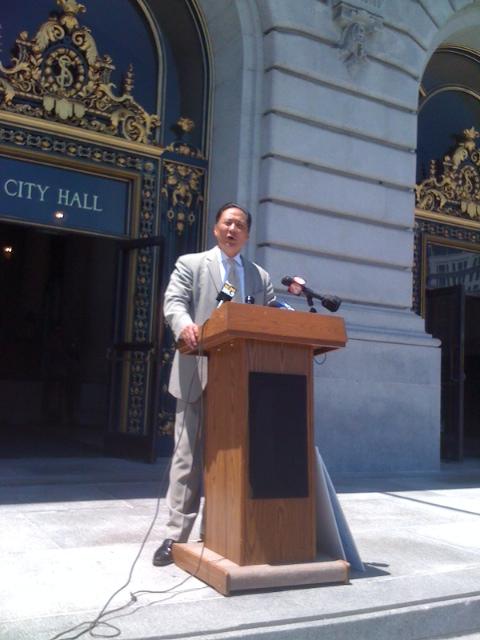
Jon Golinger speaks at a press conference on the steps of City Hall. Video by Rebecca Bowe

Jennifer Clary, of San Francisco Tomorrow, said the groups’ concerns centered on three key areas: Impacts to the water, such as the potential for oil spills or degraded water quality; impacts that huge crowds would have on surrounding lands, especially in protected areas such as the Presidio; and neighborhood impacts. “You have already busy locations, and they’re going to packing more people in,” she said.

While they raised concerns, the nonprofit representatives also made it clear that they were not opposed to the America’s Cup, and only wanted to see the city strengthen environmental protections during the event. David Anderson, Conservation Committee Chair with the Golden Gate Audubon Society, noted that the world-famous regatta would result in a major economic boon. “Certainly the city can afford some mitigation to make it right,” he said.

Obama, Lee, Avalos, and the arc of history

84

People need to hear compelling stories, particularly from those who aspire to lead them, a point that author and psychologist Drew Westen nailed in his incisive think-piece in Sunday’s New York Times, “What Happened to Obama?” His conclusions also apply in San Francisco, where progressives have lost control of the narrative to the tax-cutting centrists, who are telling stories that serve mainly to enfeeble the people and prop up powerful interests.

“The stories our leaders tell us matter, probably almost as much as the stories our parents tell us as children, because they orient us to what is, what could be, and what should be; to the worldviews they hold and to the values they hold sacred. Our brains evolved to ‘expect’ stories with a particular structure, with protagonists and villains, a hill to be climbed or a battle to be fought,” Westen writes.

Contrast that with the guiding narrative in San Francisco politics right now, put forth by Mayor Ed Lee, his supporters, and the crew of mostly bland centrists who aspire to replace him, all of whom cast conflict itself as the villain. Much like Obama, they all style themselves as the administrators-in-chief, conflict-averse protagonists content to compromise away what little wealth and power the average citizen still possesses. Not only does that narrative guarantee that Lee will be elected, but it’s a false and short-sighted narrative that does a profound disservice to this city.

The one candidate in the mayor’s race who understands that class matters, that conflict is a necessary part of politics, and that we’re all getting screwed over by the rich and powerful is John Avalos. But despite some flashes of progressive populism on the stump, he hasn’t really been consistently and boldly telling San Francisco the story of itself that it really needs to hear right now, which is the same story that Obama should be telling the American people.

“I know you’re scared and angry. Many of you have lost your jobs, your homes, your hope. This was a disaster, but it was not a natural disaster. It was made by Wall Street gamblers who speculated with your lives and futures. It was made by conservative extremists who told us that if we just eliminated regulations and rewarded greed and recklessness, it would all work out. But it didn’t work out,” begins the story that Westen said Obama should have told during his inaugural address.

And that’s the story that Avalos should be telling right now, combating the myths that have been put out there by Lee, David Chiu, Bevan Dufty, Dennis Herrera, and the other centrists in the race, that if we just give Twitter, Zynga, Oracle, Sutter Health, Willie Brown’s clients, and every other corporation and developer who promises to create jobs everything they want, then we’ll all be okay.

But on some level, we all know that just isn’t true, and it hasn’t been true for a long time. Only a fool would trust them to take care of us at this point. The greed and self-interest of rich individuals and corporations – which has gone unchecked for far too long, at least partly because of the political corruption they’ve sponsored – is reaching epidemic proportions. It is the villain that needs to be fought, it is the hill that needs to be climbed.

“When faced with the greatest economic crisis, the greatest levels of economic inequality, and the greatest levels of corporate influence on politics since the Depression, Barack Obama stared into the eyes of history and chose to avert his gaze. Instead of indicting the people whose recklessness wrecked the economy, he put them in charge of it. He never explained that decision to the public — a failure in storytelling as extraordinary as the failure in judgment behind it. Had the president chosen to bend the arc of history, he would have told the public the story of the destruction wrought by the dismantling of the New Deal regulations that had protected them for more than half a century. He would have offered them a counternarrative of how to fix the problem other than the politics of appeasement, one that emphasized creating economic demand and consumer confidence by putting consumers back to work. He would have had to stare down those who had wrecked the economy, and he would have had to tolerate their hatred if not welcome it. But the arc of his temperament just didn’t bend that far,” Westen wrote.

He was riffing off Obama’s penchant for quoting the MLK line, “The arc of the moral universe is long, but it bends toward justice,” which he returned to again with his devastating conclusion: “But the arc of history does not bend toward justice through capitulation cast as compromise. It does not bend when 400 people control more of the wealth than 150 million of their fellow Americans. It does not bend when the average middle-class family has seen its income stagnate over the last 30 years while the richest 1 percent has seen its income rise astronomically. It does not bend when we cut the fixed incomes of our parents and grandparents so hedge fund managers can keep their 15 percent tax rates. It does not bend when only one side in negotiations between workers and their bosses is allowed representation. And it does not bend when, as political scientists have shown, it is not public opinion but the opinions of the wealthy that predict the votes of the Senate. The arc of history can bend only so far before it breaks.”

That is the moment we find ourselves in, both as a country and as a city. And it is a story that we’re still waiting for a future leader to tell us with enough power and passion that we all begin to believe it.

Ed Lee does some ‘splainin

Ed Lee, appointed San Francisco’s interim mayor early this year after giving the San Francisco Board of Supervisors his word that he would not seek a full term, filed papers to enter the race as a mayoral candidate on Aug. 8.

“I haven’t changed at all,” Lee said when reporters questioned his 180-degree turnaround. “I’ve just made a change of mind in terms of running for this office.”

Standing beside his wife, Anita, the mayor delivered a five-minute speech about what has transpired in his seven months as interim mayor, saying he was motivated to run by his accomplishments in office so far.

http://www.youtube.com/watch?v=7u4DudZPY80

Lee said he had met with members of the Board of Supervisors and understood that some would be looking for an explanation on his change of heart.

Former District 6 Sup. Chris Daly has said he believes Lee’s run for mayor was scripted from the start. Whatever the case, an outburst that occurred as Lee was filling out paperwork certainly was not part of any script. Surrounded by news cameras, Charles Khalish heckled Lee, asking, “Sir, are you going to step down? You’re in the office under false pretenses, Mr. Lee.” When security surrounded him, he loudly protested, and a group of sheriff deputies and mayoral security officers with the San Francisco Police Department closed in and grabbed him.

http://www.youtube.com/watch?v=Gs0tFvWCNzo

While it was impossible for this reporter to see exactly what took place seconds before Khalish was forcibly removed, Tony Winnicker, a former press secretary to Mayor Gavin Newsom who is now issuing media advisories for Lee’s mayoral campaign, later claimed he wouldn’t have been removed if he hadn’t gotten pushy. The officers hauled Khalish down the corridor as he shrieked, “Heeeeeeelp!!” They restrained his arms behind his back and placed his head in a lock while they told him to stop resisting.

“He was cited for obstructing public business,” sheriff spokesperson Eileen Hirst later told the Guardian. “It is likely that he will be released as soon as the paperwork is finished.” She added that she had not yet seen an incident report.

The interim mayor said he made the decision to run over the weekend with the help of his family members. Chinatown power broker Rose Pak is not part of his family, but Lee’s daughter Brianna wrote in a January editorial called “Fear the ‘ Stache” that she had always known Pak as “Auntie Rose.”

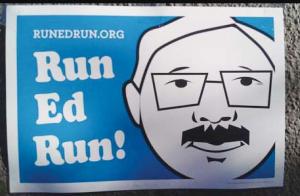
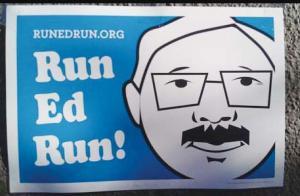
Pak was a key driver behind “Run, Ed, Run,” the campaign backed by Progress for All that plastered cartoon drawings of Lee all over San Francisco. Progress for All will be the subject of discussion at the Aug. 8 Ethics Commission meeting, since Ethics director John St. Croix has stated he believes the political organization filed improperly as a general purpose committee. In late July, five mayoral candidates — including Board President David Chiu — joined Democratic County Central Committee chair Aaron Peskin in asking for an investigation into whether Progress for All had violated local campaign laws. Campaign finance reports, meanwhile, show that the effort was backed by a small group of inflential business insiders. Asked about the role of “Run, Ed, Run,” on his campaign for mayor, here’s how Lee responded:

http://www.youtube.com/watch?v=CBI5SSmVr4E

This evening, Lee the will participate in a mayoral candidate forum hosted by the Duboce Triangle/Castro/Eureka Valley Neighborhood Association at the Castro Theater at 7 p.m.

Shady financial dealings mar the “Run, Ed, Run” campaign

68

Not only do the groups behind the campaign urging Mayor Ed Lee to run for mayor get lucrative city contracts, sometimes with Lee’s help, but at least one of the companies has also made direct payouts to Chinatown power broker Rose Pak, who arranged to place Lee in the Mayor’s Office and has been coordinating the campaign to keep him there.

This latest revelation, from documents uncovered by the Guardian, comes as other local media outlets have been exposing the financial self-interest that Pak, former Mayor Willie Brown, and their allies have in urging Lee to break his word and run for a full mayoral term, including a devastating front page article in today’s Chronicle.

Reporter John Cote writes that Progress for All, the group behind the “Run, Ed, Run” campaign, “has been bankrolled almost entirely by a small group of politically connected individuals, some of whom have received millions of dollars in city contracts in recent years.” Among them is Robert Chiang, owner of Chiang CM Construction, which has received millions of dollars in city contracts despite lawsuits and rulings by regulators alleging that the company violated a variety of wage laws.

Chiang CM has also paid Pak personally at least $10,000, according to her tax return form that she filed with the city back in 2002 when she bought a Rincon Hill condominium for half-price through a city affordable housing program. The tax form listed that payment under “miscellaneous income,” along with $12,000 from Emerald Fund, the politically connected developer of the project, “an apparent violation of regulations governing the distribution of the discount housing,” according to an Examiner article at the time (“Affordable-housing flap,” 2/24/03). But the Brown Administration, which approved Pak’s purchase of the condo, refused to take any action against Pak, a close ally of both Brown and Lee.

We reached Pak on her cell phone to discuss her financial ties to Chiang CM and what they paid her for, and after we explained our findings three times, she said, “I don’t remember,” and hung up the phone. When we called the company for comment, we were told “nobody is available to speak on that right now.”

More recently, the Examiner has reported on the millions of dollars in city contracts that Lee has helped steer to other key Progress for All leaders, including the Chinatown Community Development Center, whose executive director, Gordon Chin, also leads Progress for All. In addition to its city contracts, documents obtained by the Guardian also show that on Dec. 10, 2010, CCDC entered into a contract with Central Subway Partners – which is building the Central Subway project long pushed by Pak and Lee, but criticized as an overly expensive boondoggle by many transit activists – to be paid up to $810,000 for unspecified services that “will be issued on an Annual Task Order basis.” Chin hasn’t yet returned a Guardian call for comment.

The Chronicle also broke the story about Pak urging Recology – which just last month was awarded a lucrative city contract (with Lee’s support) giving it a monopoly over all aspects of waste management in the city – to improperly have its employees work for the “Run, Ed, Run” campaign. And the Bay Citizen has also exposed the financial self-interest of Progress for All backers, which Judge Quentin Kopp and local Democratic Party chair Aaron Peskin have separately called for prosecutors and regulators to investigate.

“Unlike all other candidates who must abide by the strict $500 contribution limit and source restriction (no corporate, union or City contractor money), Progress for All has been able to raise unlimited amounts from any source, making it easy to amass large sums of money for its efforts,” Peskin wrote in a July 28 letter to Ethics Commission director John St. Croix, requesting an investigation. The Ethics Commission is scheduled to discuss Progress for All at its Aug. 8 meeting.

Despite her considerable power and influence – including arranging regular trips to China for public officials, including Lee and Board President David Chiu – Pak’s 1999 tax return indicated she had an adjusted gross income of just $31,084. On her application, Pak reported a $60,000 income in 2002 as a “self employed consultant,” yet a whopping $73,414 in her checking account.

Although Maggie LaRue, the inclusionary program manager, wrote Pak a letter on June 17, 2002 challenging the “inadequate documentation” of her income in the application, the Mayor’s Office ultimately approved her purchase of a swanky two-bedroom apartment at 400 Beale Street for just $300,000, although it was valued at $580,000.

Although Pak seems to have fairly steady income from the vague consulting work that she does, a request for information from the Office of the Treasurer and Tax Collector indicates that she doesn’t have a business license and hasn’t paid any local taxes, even though city laws require a license from any “entity engaging or about to engage in business for seven or more days a year in San Francisco.”

Lee’s office has consistently denied knowledge of or connections to the Progress for All campaign, although the Chronicle has reported that Lee does plan to get into the mayor’s race, probably next week. The deadline to file for a run is Aug. 12.

Fall ballot gets stripped of progressive measures

25

The San Francisco Tenants Union suffered a pair of disappointing setbacks in the last week – first when a referendum on the Parkmerced project narrowly failed to qualify for the fall ballot, then when progressive supervisors withdrew a proposed ballot measure to prevent demolition of existing rental housing – leaving the fall ballot without any progressive measures (unless one counts the sales tax measure that was unanimously approved this week by the Board of Supervisors).

Also dropped from the ballot this week was another progressive measure that would have prevented the Recreation and Park Department from entering into new commercial leases of parks and recreation centers, a measure written by the citizens group Take Back Our Parks to reverse RPD’s recent push to monetize more of its assets.

Yet unlike last week’s removal of a third measure placed on the ballot by at least four progressive supervisors – the Fair Shelter Initiative, written by the Coalition on Homelessness, which was unhappy that Sup. Jane Kim dropped her support under pressure from the Mayor’s Office – it was the sponsoring groups that asked the supervisors to remove the two measures this week.

Sponsors of the parks measure say it had some legal problems that would have complicated the campaign, particularly after an analysis by the City Attorney’s Office concluded that it could affect things like private party reservations and leases associated with the America’s Cup.

Ted Gullicksen of the San Francisco Tenants Union said his group concluded there were legal problems with the anti-demolition measure as well and that it wouldn’t affect the demolition of 1,500 housing units associated with the Board of Supervisors’ 6-5 vote to approve the massive Parkmerced project, which was the catalyst for the measure.

SFTU sponsored the signature-gathering campaign to do a referendum on that vote, but the Elections Department concluded on July 29 that of the 18,487 signatures that were turned in, just 12,917 were valid, falling short of the 14,336 they needed. Gullicksen said delays in qualifying the 56-page petition gave them just three weeks to gather signatures, and a freak mid-June rainstorm hurt that effort as well.

“We knew from the get-go that it was going to be a challenge,” he said. “It was very disappointing that we fell just short.”

But he said there was a silver lining: “It sent a message to the supervisors. David Chiu [the swing vote on the Parkmerced approval] called me the next day to say he’d make sure demolitions don’t become an epidemic.”

Sup. David Campos – who helped sponsor all three measures and even kept his name on the shelter measure after Sups. Eric Mar and Kim had removed theirs – told us, “I think it’s disappointing that there isn’t a measure on the ballot to excite the progressive base, but at the end of the day, we do have an exciting mayor’s race and races for sheriff and district attorney.”

Campos has endorsed John Avalos of mayor and Ross Mirkarimi for sheriff, but has not yet made an endorsement for DA.

Stop the right-wing revolutionaries

59

The revolution has begun, but we aren’t the revolutionaries. That was the disturbing thought that occurred to me this morning as I listened to Fresh Air on KALW and its interview with Robert Draper, the New York Times Magazine journalist who is writing a book about the House of Representatives, where Tea Party backed members almost just succeeded in bringing down government as we know it.

That wasn’t how Draper cast the situation, although he did paint a vivid picture of the right-wing true believers who manufactured this debt ceiling “crisis” and their monomaniacal goals of slashing government to the bone, no matter what the consequences to the U.S. economy and way of life. Instead, the discussion triggered a memory of the powerful and prescient premise from economist Paul Krugman’s 2003 book The Great Unraveling.

In its opening pages, under the heading of “A Revolutionary Power,” Krugman cites an unlikely source for how to identify and oppose those bent on destroying a country’s institutions: Henry Kissinger. In 1957, as he was completing his doctorate at Harvard University, Kissinger wrote his dissertation, “A World Restored,” on Napoleon and the French reconstruction period after Waterloo, with some obvious parallels to the rise of fascism in Europe in the 1930s.

Kissinger argued for the importance of understanding the nature of a revolutionary force, and Krugman saw the inflexible right-wing movement in the U.S. as another example of that. “That is, it is a movement whose leaders do not accept the legitimacy of our current political system,” Krugman wrote, citing the oft-stated belief of modern Republicans that “long-established American political and social institutions should not, in principle, exist – and [they] do not accept the rules that the rest of us have taken for granted.”

At the time, Krugman cited the efforts of right-wing politicians and institutions to undo such New Deal era programs as Social Security, unemployment insurance, and Medicare, as well as their rejection of international treaties and cooperation in favor of empire and unilateralism. But since then, the right-wing has gone even further, willing to force the government into default in order to accomplish its ideological goal of destroying the federal government’s ability to ask anything of capital.

Kissinger made clear that such forces can’t be reasoned or compromised with, all you can do it try to defeat them before they destroy the country. The longer everyone delays arriving at that conclusion, the more difficult that task becomes, and that’s an important lesson for President Obama and the Democrats to learn right now.

“Lulled by a period of stability, which had seemed permanent, they find it nearly impossible to take at face value the assertion of the revolutionary power that it means to smash the existing framework. The defenders of the status quo therefore tend to begin by treating the revolutionary power as if protestation were merely tactical; as if it really accepted the existing legitimacy but overstated the case for bargaining purposes; as if it were motivated by specific grievances to be assuaged by limited concession. Those who warn against the danger in time are considered alarmists; those who counsel adaptation to circumstances are considered balanced and sane…But it is the essence of a revolutionary power that it possesses the courage of its convictions, that it is willing, indeed eager, to push its principles to their ultimate conclusion,” Kissinger wrote.

The Tea Party may have a fundamental misunderstanding of the principles and events surrounding the American Revolution, but make no mistakes that they do see themselves as revolutionaries, people who want to turn back the clock on the gains made in workers’ rights, environmental protection, tax equity, the creation of social safety net, and all the other hallmarks of civil society.

They’ve already taken over one of our two political parties, and succeeding in forcing the other one to do their bidding. Call me an “alarmist,” but if we don’t challenge the notion that Obama is “balanced and sane” and convince them that the American way of life is at stake, then we just might end up with another revolutionary war on our soil.

A song and dance at City Hall

It was a lively scene on the steps of City Hall Aug. 2, as back-to-back press events featured live performances, lots of cheering, and support for new legislation that supporters hope will benefit low-wage workers, small businesses, and musicians.

Spirits were high at the Progressive Workers’ Alliance (PWA) rally, as organizers anticipated strong support for an ordinance they helped craft which aims to prevent wage theft by strengthening the powers of the city’s Office of Labor Standards & Enforcement (OLSE).

The Wage Theft Prevention Ordinance would double fees for employers who retaliate against employees seeking to have labor laws enforced, impose a timeline in which employee complaints must be addressed, and create new penalties for employers who fail to adhere to local labor standards. During the rally, workers speaking in various languages described their experiences of working long hours without receiving minimum wage or overtime pay.

Organized under PWA as part of a number of organizations including the Chinese Progressive Association, Young Workers United, the Filipino Community Center, the San Francisco Day Laborer’s Program, and others, the crowd of PWA members crammed into the Board Chambers and exploded into applause when the board voted unanimously to pass the ordinance on first reading.

Following a noon rally, youth with the Chinese Progressive Association’s high school program treated supporters and members of the press to a dance performance.

http://www.youtube.com/watch?v=X7CVb4K3tcw

Directly afterward, District 5 Supervisor Ross Mirkarimi appeared at the podium to drum up support for legislation he’d proposed to create a more affordable permit for cafes and restaurants wishing to host live performances in their establishments. He described it as a business-friendly idea that could “put musicians to work,” adding that more music in smaller venues could help dispel the notion that San Francsico isn’t as supportive of the arts as Chicago, Boston, New York, or even Paris. A preliminary survey found that some 700 restaurants could benefit from having access to less expensive live performance permits, he said.

Supervisors showed unanimous support for Mirkarimi’s idea, but Sups. David Chiu and Mark Farrell each added amendments to ensure that live performances couldn’t go past 10 p.m. in certain neighborhoods in their districts.

Mirkarimi invited Jazz Mafia to play a tune before the board meeting started. Here’s what they sounded like.

http://www.youtube.com/watch?v=WjRbGBTEdMk

Videos by Rebecca Bowe

Mayor’s race a tight pack, but Gascón lags in DA’s contest

25

Despite the hype and spin from various mayoral campaigns and newspapers, the big story in yesterday’s release of semi-annual campaign finance reports is that there isn’t much of a story: It’s pretty much what everyone has been expecting, a tight field of qualified mayoral candidates with comparable financial resources.

It was also no surprise that Progress for All, the deceptive committee behind the effort to draft Mayor Ed Lee into breaking his word and running to keep his job, was funded mostly by a narrow group of business interests connected to longtime power brokers Rose Pak and Willie Brown, mostly with $5,000 contributions, or 10 times the contribution limit for legitimate mayoral campaigns.

The real story in yesterday’s numbers was in the district attorney’s race where the conventional wisdom that incumbent George Gascón is the clear frontrunner (“wisdom” that we’ve always questioned given his lack of local roots) was cast into doubt by his lackluster fundraising, big spending for small results, and the fact that each of his two major challengers have twice as much money in the bank.

Alameda County prosecutor Sharmin Bock led the fundraising race this year with $240,337, about $6,000 more than Gascón. And after spending $156,916 in just six months, Gascón has just $77,570 in the bank. David Onek, who has been getting progressive support and retail campaigning up a storm, raised $126,386 this year, but his early start and frugal spending leaves him with $153,474 in the bank.

In the mayor’s race, while both the Chronicle and Examiner led with David Chiu’s impressive fundraising this year, leading the pack with almost $400,000, all that really did was put him into financial contention with the top-tier candidates who have been raising money since last year: Leland Yee, Dennis Herrera, Bevan Dufty, Joanna Rees, and Michela Alioto-Pier.

As of last month, their campaigns’ cash-on-hand was Herrera at $586,294, Dufty at $493,372, Yee at $444,820, Ress at $441,168, Alioto-Pier at $406,574, and Chiu at $396,754. On the next tier down, Phil Ting appears dead in the water, raising just $67,526 and having more debt than money in the bank, although his campaign consultant Eric Jaye said public funds are just starting to come in and the campaign is on track to meet its $300,000 fundraising goal.

Two other major candidates were also well behind the pack, but both are running with an outsiders’ appeal that should keep them in the running throughout the race. Tony Hall, a conservative with a strong independent appeal, raised $102,612, has $173,368, and will likely continue nipping at the heels of the mainstream pack.

And then there’s progressive favorite John Avalos, who has been running a visible, enthusiastic campaign with lots of volunteer support, although he raised just $86,882 this period and has about $100,000 in the bank (contrary the erroneous report in today’s Chronicle that he only had $500, apparently because the reporter looked at his supervisorial campaign report instead of his mayoral – whoops).

But Avalos supporter Chris Daly said the campaign has recently raised another $32,000 and is due to soon receive about $120,000 in matching funds, bringing them up to around $250,000. “That’s what [then-mayoral candidate Tom] Ammiano had in his entirety in ’99,” Daly said, noting that progressive mayoral favorites always get outspent and usually by margins greater than what Avalos now faces. “Our people don’t have as much money or city contracts.”

By contrast, Chiu has been raking in the dough this year, with lots of $500 contributions mostly from lawyers, bankers, developers, people with Chinese surnames, and employees of Google and other tech firms, with almost half of the contributions from out of town.

“We raised almost a hundred grand more than the closest competitor,” said Chiu campaign manager Nicole Derse. “We’re in a super strong position.”

In addition to the big money sources that usually gravitate to strong moderate candidates, Chiu also had some notable financial support from some progressive constituencies, including bicyclist activists (such as Gary Fisher, Dan Nguyen-Tan, Jason Henderson, architect David Baker, and MTA member Cheryl Brinkman), progressive activists Susan King and Amy Laitenen (Matt Gonzalez’s former board aide), and medical marijuana advocate Kevin Reed from Green Cross.

Jim Stearns, who is running the Yee and Bock campaigns, said the funding picture is about what he and others predicted would be the case given public financing (and its $1.475 million spending cap) and the large field of qualified candidates. “That’s the interesting thing about this race, it’s like the World Series of Poker with everyone getting the same stake,” he said. “This is unlike every other mayor’s race where there have been huge disparities in funding.”

Many political analysts privately fear that this dynamic, with nobody really pulling away from the pack of candidates, could encourage Lee to get into the race. But Stearns notes that Lee, despite the power of incumbency, will have a hard time catching up in fundraising and a huge target on his back because of breaking his word, the sleazy “Run Ed Run” campaign tactics, and just the fact that he would become the instant frontrunner.

“In the ranked choice voting scenario, if there’s someone who looks like he’s going to come in first, you don’t lose anything by attacking him because his second place votes aren’t going anywhere,” said Stearns, who said the current mayor’s race appears to be a game of inches. “It’s an infantry game rather than an air game, where the gains are slow and people are proceeding carefully.”


Ethics Commission to discuss Progress for All

San Francisco Chronicle reporter John Cote’s scoop highlighting how Recology executives were working behind the scenes under pressure from Chinatown power broker Rose Pak to encourage Mayor Ed Lee to seek a full term is just the latest development for a committee that’s raised eyebrows already, and it may be just the beginning.

Five mayoral candidates — board President David Chiu, City Attorney Dennis Herrera, state Sen. Leland Yee, former Supervisor Michela Alioto-Pier, and businesswoman Joanna Rees — have teamed up to encourage the San Francisco Ethics Commission to investigate whether Progress for All has run afoul of local election laws, rallying behind an effort spearheaded by Democratic County Central Committee Chair Aaron Peskin in a July 28 letter to commissioners.

At the heart of the issue is whether Lee or any of his representatives have been coordinating with agents of Progress for All. If they are, Progress for All would have to be considered Lee’s own, candidate-controlled committee, Peskin asserts in the letter.

“Given the close relationship between Ms. Pak, the Mayor, and Progress for All, it is very possible that the committee has ‘consulted’ or ‘coordinated’ with the Mayor, and therefore its expenditures should be deemed to be made ‘at his behest,'” Peskin’s letter to the Ethics Commission argues. A City Hall insider told the Guardian that Pak — a primary driver behind the Run, Ed, Run campaign — is regularly observed going to and from the mayor’s office.

“If Progress for All or any of these other committees has been acting on Mayor Lee’s behalf, those committees may have violated the $500 contribution limit and prohibitions against accepting corporate, union or city contractor money, restrictions that apply to all candidate committees,” the letter states.

Financial disclosure filings for committees fundraising for the Nov. 8 election are due Monday.

Aside from the question of whether there is coordination between Lee, who has not yet announced that he will run for mayor, and Progress for All, concerns have been raised about city contractors aiding in the efforts of the campaign. Under the city’s Campaign Finance Reform Ordinance, contractors doing business with the city are not allowed to make political contributions.

(Given the revelations that Recology executives’ signature gathering efforts were done in violation of company policy, it’s no wonder Recology executives become bashful when approached by reporters who ask tough questions.)

Meanwhile, Recology might not be the only city contractor that Pak has encouraged to support Run, Ed, Run. A column that former Mayor Willie Brown published recently in the San Francisco Chronicle suggests that this isn’t the first conversation of this kind.

“One thing you can say about Chinatown powerhouse Rose Pak, she is not shy,” Brown’s column begins. “Holding court at the party for the opening of the new airport terminal, Rose was seated at the table with interim Mayor Ed Lee and his wife, Anita, and a host of other local officials. ‘I want every one of you to call his office and tell him he should run for mayor,’ Rose told the table. ‘And do it right away so that there’s no misunderstanding.’ Then she turned to the architect David Gensler. ‘Didn’t you do this terminal?’ she asked. ‘Yes,’ he said. ‘Didn’t you remodel this terminal before?’ ‘Yes,’ he said. ‘Then your firm should raise a million dollars for his election campaign.'”

While Brown may not be a visible player in the Run, Ed, Run campaign, he’s certainly been at the table with a key driver behind it and Lee himself — and he’s using his platform in the Chronicle to get the word out about Lee’s potential mayoral campaign.

“The specific revelations of unethical and possibly illegal activity are very troubling and need to be fully investigated by the Ethics Commission as soon as possible,” Chiu told the Guardian.

Political consultant Jim Stearns, whose firm is managing Sen. Yee’s mayoral campaign, joined the chorus in calling for an investigation. “If you think about the fact that these guys still, according to press reports, are eating together once a week, and there’s not supposed to be any coordination … You have this committee that is essentially operating in complete disregard of the campaign law,” he said. “It’s sort of like there’s a crime being committed, and where’s the police?”

The San Francisco Ethics Commission will hold a policy discussion about how to treat Progress for All at its Aug. 8 meeting, Ethics director John St. Croix told the Guardian.

“We’ve told the committee that we believe they’re a primarily form committee, which is an independent expenditure committee on behalf of a candidate for office or a ballot measure,” St. Croix explained. “They’re claiming that there’s no candidate, so they can’t be that committee, even though they’re acting pretty much exactly like one would.”

As things stand, Progress for All has filed as a general purpose committee, he added. “A general purpose committee is what you would think of as a [political action committee]. They usually represent an organization or elected group of individuals, they tend to exist for a long period of time, and they contribute to multiple campaigns, whereas a primarily formed committee is created to support or oppose a single candidate or a single ballot measure in a single election,” he explained. Another key distinction: “Independent expenditure committees don’t have contribution limits the way that candidate committees do. Candidate committees have a $500-per-contributor contribution limit.”

Peskin, meanwhile, hinted that there may be more to come. “There’s a lot of it,” he said, “and I think there are many people who have stories to tell.”

Police say they’ve recovered gun used by Harding

The San Francisco Police Department issued a statement this afternoon announcing that the gun that fired the fatal shot at Kenneth Wade Harding Jr. has been found.

“After a weeklong community effort, a neighborhood resident led officers from Bayview Police Station to the gun used by Kenneth Harding,” the SFPD statement says. “The gun, an AMT .380 caliber semi-automatic pistol, was matched through ballistic tests conducted by the San Francisco Police Department Crime Lab,” the official announcement goes on. “These tests confirmed that this was the same gun that fired the fatal .380 caliber bullet.” 

The police describe the weapon as a “small silver and black handgun,” and notes that it was “seen on the widely viewed cell phone video of the incident” and “picked up from the crime scene by an individual during the chaotic aftermath of the shooting.” 

One YouTube video showing the scene of the aftermath is titled, “Aftermath of Bayview gun battle in San Francisco,” and it has had 96,897 views so far.

At around 1 minute and 23 seconds into that video, an individual in a gray hooded sweatshirt reaches down and picks up an object off the sidewalk (which doesn’t look like a gun), but at another point in the clip, a gun-shaped object can be seen lying on the ground.

Lt. Troy Dangerfield, of the SFPD’s media relations unit, would not say whether the man in the hooded sweatshirt had anything to do with recovering the gun. Nor would he say whether an arrest had been made when the gun was turned over to police. “I can’t get into who turned over the gun, or whether that’s where we got the gun from,” he said, but asserted that ballistics testing had confirmed that it was the gun that fired the shot.

“We’re not speaking as to whether fingerprints are on it,” he added when asked if Harding’s fingerprints had been detected on the firearm. He said he did not know whether Harding’s cell phone had been recovered.

There are four separate investigations relating to the officer-involved shooting that occurred in connection with Harding’s death, Dangerfield said. They are being carried out by the District Attorney, the Office of Citizen Complaints, SFPD Homicide Unit and SFPD Internal Affairs.

Asked why SFPD officers did not move in quickly to snap up an unsecured weapon lying on the ground if a suspect had just fired and a crowd of alarmed bystanders was forming around them, Dangerfield said that the police had to prioritize officer safety — and in this case, he asserted, that meant keeping their weapons trained on a suspect who could still potentially pull out a gun and shoot at them. According to training protocol, “crime scene preservation” is a lower priority, he said. Asked if officers were trained to shoot to kill, he said, “we don’t shoot to kill, we shoot to stop the threat.”

Dangerfield went on to say that the video in which Harding is shown to still be moving while police stand with weapons trained on him would make a great police training video. “You do not remove yourself from the target until the target is no longer a threat to you,” he said, indicating that a suspect who is still moving is still perceived as a threat.

However, it was this aspect of the widely viewed video — that police continued to stand with weapons trained on Harding rather than calling for medical assistance after he’d been shot — that seemed to most inflame residents and protesters who’ve condemned the police response in the aftermath.

Dangerfield confirmed that data from SpotShotter revealed that a single bullet was fired, and then multiple rounds fired in succession 1.9 seconds later. The explanation that police have given for this, he confirmed, was that Harding fired a single shot and then police opened fire.

Assuming it’s true that Harding shot himself, as police have said, this suggests that the two police officers on the scene responded to a suspect shooting himself by firing eight rounds, just one of which entered through the leg. Asked why officers would respond to a self-inflicted shot in that way, Dangerfield said, “If you are a police officer and you’re running and chasing … and then shots are fired, what do you think?” He emphasized, “They’re trained to return fire.”

Civil Grand Jury: Parkmerced tenant protections ‘just talk’

The Board of Supervisor’s Government Audit & Oversight Committee heard from members of the San Francisco Civil Grand Jury this morning about a report it issued on the Parkmerced redevelopment.

“When you read this report, nowhere in this report does it say, ‘do not develop,'” said Michael Golrick, a juror with the civil grand jury. Yet he noted that the primary concern highlighted in the document was a perceived lack of tenant protections for residents living in rent-controlled units.

The assurances in the development agreement — that tenants will be moved into new units after their  existing units are demolished, with the same rent-control protections they had before — can’t be guaranteed due to unresolved legal questions, he said. “It is aspirational and inconclusive. Tenants will live under a cloud of uncertainty, possibly for years.” He added, “Until a court decides, it’s all just talk.”

Jennifer Matz of the Office of Economic and Workforce Development and John Rahaim, director of the San Francisco Planning Commission, both noted that the Civil Grand Jury report was hitting on a legal issue, so the city’s formal responses will be prepared in concert with City Attorney Dennis Herrera’s office.

Matz also noted that the draft of the Development Agreement which the Civil Grand Jury had based its assessment on had changed since the Civil Grand Jury report was issued, with new provisions to shore up tenant protections. She also charged that the report “fails to understand certain aspects of the Development Agreement.”

Meanwhile, residents organized under the Parkmerced Action Coalition are still hoping they may have a chance to reverse the Board’s decision to approve the Parkmerced overhaul by placing a referendum on the Nov. 8 ballot to ask voters whether the zoning for the project should be approved. The group of tenants, organized under the “Committee to Stop Mass Demolition of Housing,” submitted 18,487 signatures on July 8. The Department of Elections is still verifying them and so far, the referendum has not yet qualified for the ballot.

Those crazy San Franciscans

63

Joe Eskenazi has an SF Weekly piece that pretty much repeats what he’s been saying for years: That San Francisco has too much government. This time he goes after all the boards, task forces and commissions — and yeah, there are a lot of them, and yeah, some of them might not be necessary. I could also argue, though, that San Francisco is one of the most politically active cities in the world, and that having a whole lot of ways for residents to plug in to what’s going on in their city isn’t a bad thing at all.


Whatever. Here’s the stuff that drives me nuts:


Last month, the volunteer body appointed by the Board of Supervisors advocated curtailing all pet sales in the city — including guppies, goldfish, and live rodents meant as snake food. Coming on the heels of a proposed criminalization of circumcision, San Francisco was, once again, reduced to an international punchline — many were left to wonder whether a ban on circumcising goldfish is our logical next step. Disbelieving articles poured in from around the globe. Perhaps none was as caustic as a piece in London‘s Telegraph titled “San Francisco goldfish ban exposes the pathology of America’s bourgeois liberal nutjobs.”


Ah, yes, Joe: Those crazy San Francisco liberals and their madcap ideas.


I’m not for banning pet sales (although I think banning puppy mills — also a wacky idea that came out of the Animal Control and Welfare Commission — is a fine thing). And I’m not for the circumcision ban (although, geez, it has lead to some interesting commentary that gives new meaning to the term “dick face.”)


But every time I hear somebody talk about how San Franciscans should stop it with the nutty ideas, I think about a few I’ve followed over the years — and how they’ve changed the way the entire nation thinks. Let me suggest a few for Eskanazi to look at:


“Those crazy San Franciscans don’t want to build freeways.” Yep — in the late 1950s and early 1960s, while the rest of the country (and in particular, California) was rushing to build freeways as fast as possible, people in this city decided to say No. The freeway revolt and the movement that grew out of it changed the way Americans view cities. Wacky shit.


“Those crazy San Franciscans think homosexuals should have the same rights as married people.” Yep, back in the 1970s San Franciscans started talking not only about nondiscrimination — they actually said that gay people who live together should have health insurance benefits. Imagine that.


“Those crazy San Franciscans think that women should make the same amount of money as men.” When then- Sup Nancy Walker introduced legislation in 1985 making “comparable worth” (the notion that men and women who do jobs that require comparable skills should be paid the same) it made headlines all over the country — and was universally derided by the same set that now complain about “liberal nutjobs.” It cost the city a lot of extra money (money that the Eskinazi crew of the day said was too much for a broke city) and led to all sorts of comments about social engineering. San Francisco was the first to push the issue, and it’s now considered mainstream employment policy.


“Those crazy San Franciscans think we ought to give bicycles the same rights as cars.” All the way back in the mid-1980s, bicycle advocates were talking about bike lanes, bike maps, bike racks and alternatives to the automobile. What were they drinking?


“Those crazy San Franciscans think that transgender people ought to get health benefits.” This was as recent as 1993 — and if you think circumcision and pets put SF in the right-wing-talk-show and late-night-comedy targets, imagine when the city decided “to use taxpayer dollars to fund sex-change operations,” as the detractors insisted. Guess what? It turned out to be a major step forward for transgender rights.


“Those crazy San Franciscans think gay people should be allowed to get married.” We did. We do. We were first. The rest of the country is following.


“Those crazy San Franciscans want to ban plastic bags.” We did. For good reason. So did L.A. In another few years, it will be national policy.


“Those crazy San Franciscans want to ban happy meals.” Guess what — McDonald’s got the message. 


I could list plenty more.


Yeah, we’re ahead of the curve. Yeah, sometimes our shit seems crazy. But it’s the crazy shit that makes the world change — and over time, the world catches up to San Francisco. And if we weren’t doing it, the world would get better just a little more slowly.