• No categories

Politics Blog

Judge denies Mirkarimi motions; city process begins Monday

35

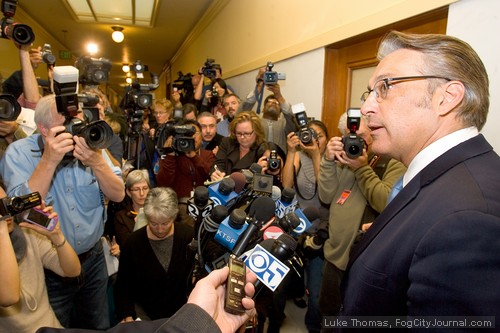
Superior Court Judge Harold Kahn today denied all motions by Sheriff Ross Mirkarimi’s legal team challenging his suspension without pay, city procedures, and the constitutionality of the city’s official misconduct charter language, saying it’s premature to conclude Mirkarimi isn’t being treated fairly.

“But the courthouse door remains open,” Kahn concluded, inviting Mirkarimi to return after the Ethics Commission establishes rules of procedure and evidence, which it will begin doing on Monday. Today’s rulings, and another yesterday, in which Kahn ruled against a motion to disqualify the City Attorney’s Office from overseeing the proceedings, clears the way for the Ethics Commission to consider recommending to the Board of Supervisors that Mirkarimi be removed from office.

Kahn also seemed to agree with Mirkarimi’s team that Mayor Ed Lee didn’t give him a fair hearing before suspending him or that he made an argument for suspending him without pay. But Kahn sided with the city on the legal question of whether Mirkarimi has a “property interest” in his salary, which would have triggered the right to a hearing before being suspended, making such procedural questions moot.

“If there was a property right, what the mayor stated would not be adequate due process,” Kahn said, referring to Lee’s affidavit describing their March 19 meeting, where Lee told Mirkarimi to resign or be suspended. Lee claims he gave Mirkarimi the opportunity to tell his side of the story, which Mirkarimi denies, saying the mayor had made up his mind and wasn’t interested in the real story. On the salary question, Deputy City Attorney Sherri Kaiser said Mirkarimi would be entitled to full back pay from his suspension period if the supervisors vote to keep him in office, arguing that he isn’t being harmed.

Mirkarimi was suspended based on language in the city charter that was adopted in 1996 – banning “conduct that falls below the standard of decency, good faith and right action impliedly required of all public officers” – that has never been reviewed by the courts and which Mirkarimi attorney David Waggoner contends is unconstitutionally vague.

But Kahn didn’t agree, saying, “The charter is not so clearly outside the bounds of California law that I should preempt the processes.”

Waggoner complained that the city procedures didn’t set rules of evidence or procedure or standards of guilt, making it difficult to prepare a defense, a point to which Kahn seemed sympathetic, noting the variety of legal standards for different types of cases, from “beyond reasonable doubt” to “a preponderance of evidence.”

“We don’t know which of any of those is going to apply here. Is that a problem?” Kahn asked Kaiser.

She said no, that Mirkarimi and his legal team could return to court for help “if the commissioners really mess up” in the work they’ll begin on Monday. “That summarizes my view. It is hypothetical to say the procedures are going to be unfair,” Kahn agreed. 

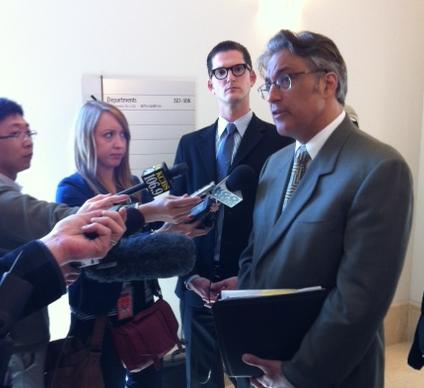
Addressing reporters after the hearing, Kaiser praised the judge’s rulings and offered a small window into what will likely transpire in the coming months: “Certainly, the sheriff is going to have to testify under oath and not just to the media.” (Waggoner told reporters “no comment” when asked whether Mirkarimi will indeed testify under oath).

Kaiser’s apparent dig at the various media interviews that Mirkarimi has just started to grant this week echoes statements that have come from District Attorney George Gascón, who has criticized Mirkarimi’s characterization of his guilty plea and the behaviors that constituted false imprisonment, calling the media accounts “disturbing and telling.”

But Mirkarimi shot back at Gascón today, noting that the two men “have had some very high-profile disagreements” when Gascón was police chief and Mirkarimi chaired the Board of Supervisors Public Safety Committee. They had high-profile clashes over requiring police to do foot patrols, the crime lab controversy, budget issues (including Mirkarimi’s unsuccessful efforts to find out how much Mayor Gavin Newsom’s police security detail was costing the city as he ran for governor), and Gascón’s controversial public statement equating people of Middle Eastern descent (such as Mirkarimi, who is Persian) with terrorists.

“It sometimes bubbles up in the course of these proceedings,” Mirkarimi said of Gascón’s alleged personal or political animosity toward him.

Asked for a response, District Attorney’s Office spokeperson Stephanie Ong Stillman wrote, ““It is the duty of the San Francisco District Attorney to uphold the law,
regardless of who violates it and without political motivation.  Ross Mirkarimi was afforded the same rights as any defendant. We treated his case no differently than any of the 776 domestic violence cases our office charged and reviewed last year.”

SEIU rally draws 1,000 to city hall

26

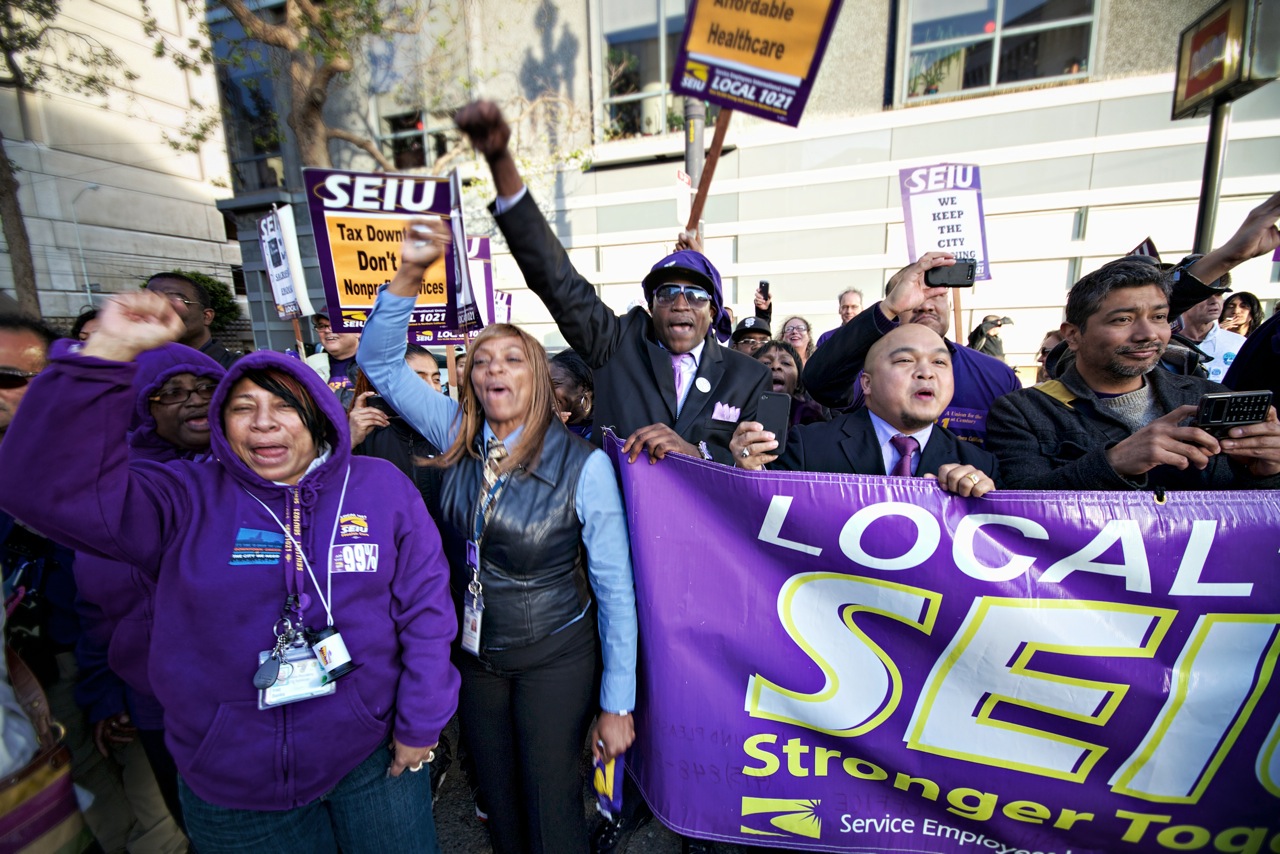
More than 1,000 city employees gathered at City Hall April 18 for a protest that ended in 23 arrests.

The protest comes as the SEIU Local 1021 contract negotiations with the city’s employee relations division are underway. According to Larry Bradshaw, Local 1021 vice president, the city’s proposal may result in pay cuts and health care cost increases for city workers.

“Here’s your negotiations update. The city and county wants you to take another 2 ½ percent pay cut this year and next year. The courts want their court-workers to take a five percent pay cut indefinitely,” Bradshaw, who works as a paramedic, told the crowd.

He also claimed that: “If you have Kaiser, under the city’s proposal you’re going to pay six times more than you’re paying currently. If you have Blue Shield, you’re going to pay twice as much. If you’re on the city plan—I’m not making this up—you’re going to pay one hundred times more than what you’re paying right now.”

Workers at the rally ranged from hall janitors to General Hospital nurses to Department of Emergency Management dispatchers donning shirts reading, “we run 911!”

Workers from the International Federation of Professional and Technical Engineers Local 21 also attended to show solidarity.

Sups Avalos, Mar, Kim, Chiu, Campos and Olague offered their support at the rally.

Around 6:30, the group left city hall and marched down Polk St. City workers then stretched caution tape across Market at Van Ness, in front of a Bank of America branch, and 23 sat down on the street. After a police warning, they were arrested for obstructing the sidewalk.

“We’re sitting to protest the greed of the city. The man is getting raises. The district attorney and the city attorney are getting raises. And they want us to take more pay cuts and furloughs,” said Arlette Smith, a protective services social worker, ten minutes before she was arrested.

The union wants to take these pay cuts off the table.

SEIU Local 1021 spokesperson Carlos Rivera also noted, “we’re sitting by Bank of America because banks and corporations don’t pay their fair share.”

The union is calling into question a tax settlement from 2001, in which a court ruled in favor of several corporations that sued the city over a hybrid payroll and gross receipts tax structure. The union characterizes the resulting loss of about $25 million per year in tax revenue as a loophole.

“The payroll tax is only paid by ten percent of San Francisco businesses, yet they’re asking city workers and non profit workers to continue to shoulder these massive budget deficits year after year,” said SEIU spokesperson Anna Bakalis.

Bakalis said that the SEIU is focusing on reinstating a gross receipts tax after researching alternative solutions for the city budget, if the pay cut and health care increases do not go though.

“We want to be able offer some solutions,” she told the Guardian. “We want to help them fix the budget.”

The union plans to return to city hall for further demonstration April 30 “if they have not taken those pay cuts and health care cuts off the table,” according to Bradshaw.

“This was such a wipeout psychologically”: Mirkarimi tells the story Lee didn’t want to hear

89

As Ross Mirkarimi and his legal team prepare for a trio of legal hearings that could determine the future of his career, the suspended sheriff sat down with the Guardian for nearly two hours in his first extended interview recounting what happened during that fateful New Year’s Eve conflict with his wife, their actions in its aftermath, and whether any of it should cost him his job.

As the story continues to unfold, and the facts come out, it’s becoming more and more clear that neither of two central players – Mirkarimi’s wife, Eliana Lopez, and the neighbor who called the police, Ivory Madison – had any idea how this would play out, or, apparently, any desire for the incident to bring down the elected sheriff.

Mirkarimi has been in a bind for much of the last four months: Because of a pending criminal case, he hasn’t been able to tell his side of the story. And since he pled guilty instead of going to trial, his version of events is only now beginning to trickle out.

And the interview made clear that the man who has in the past been accused of arrogance has lost a lot of his ego.

“This was such a wipeout psychologically,” Mirkarimi said. “It makes me immensely insecure and has left me in vulnerable state.”

He looks it – the elected sheriff’s face is drawn, almost haggard. His once-frequent smile and laughter is almost gone.

>>Read our full Mirkarimi coverage here.

He’s a politician who freely admits he had marital troubles, was in some ways a bad husband, treated his wife poorly and, in an incident sparked by his own anger, physically hurt her. He knows he’s let down his supporters and damaged his once-bright political future.

He’s struggling to keep his job, arguing that the incident has been blown out of proportion and inappropriately used to remove him from elected office, with Mayor Ed Lee showing a reckless disregard for the truth before making the rare decision to institute official misconduct proceedings.

And you don’t have to endorse Mirkarimi’s actions or even agree that he should stay in office to find indications that the mayor’s case against him is shaky and at times clearly unfair.

Judge Harold Kahn will hear arguments today [April 19] that the City Attorney’s Office should be barred for overseeing the official conduct proceedings, and the next day he will hear Mirkarimi’s main challenges to Lee’s actions, including the arguments that the city’s official misconduct statute is unconstitutionally broad and that Mirkarimi was denied due process before being suspended without pay.

Then, on April 23, the Ethics Commission will convene to discuss procedures for handling the case.

Some key issues that could affect the outcomes of the city and court processes involve what Mirkarimi actually did – as opposed to what others have suggested he did. The whole thing may hinge on whether the sheriff did anything to hinder the domestic violence investigation, what his plea deal to official misconduct entailed – and whether the mayor made efforts to differentiate between fact and rumor.  

But let’s start at the beginning, just before lunchtime on New Year’s Eve, with a story that Mirkarimi told in great detail as we peppered him with questions seeking details on what happened, what his motivations and thoughts were at critical junctures, and what it all meant.

Around 11:45 am on Dec. 31, Mirkarimi, Lopez, and their nearly three-year-old son, Theo, got into their red 1998 Dodge Caravan to go to lunch at Delfina Pizzeria. Just before leaving their house on Webster Street, the couple had started talking about how Lopez wanted to take Theo on a trip to her native Venezuela to visit her father, who is battling cancer.

“It was not an unfamiliar topic,” Mirkarimi said, recounting how it had become an issue of increasing concern by him after her three previous trips had each been extended. They had been having marital problems, and he told us he was concerned that she might not come back – or that Theo could be at risk of kidnapping.

“We didn’t have a plan and there was no permission,” Mirkarimi said, with “permission” meaning his written permission to take their son out of the country, which he had learned from a lawyer was required. “The body of our quarrel on Dec. 31 is we need a plan.”

But Lopez told him in the car than she had also talked to an attorney and she contested that it was as clear-cut as Mirkarimi claimed. He later learned that the “attorney” Lopez was referring to was their neighbor, Ivory Madison, a writer who had attended law school and noted her “legal training” on the www.redroom.com website she ran with her husband, lawyer Abraham Mertens. But Madison hadn’t taken the bar exam and wasn’t licensed to practice law in California.

“This was a sucker punch, it really walloped me,” Mirkarimi said of the news that Lopez was speaking with an attorney, and it made him angry. “I was acting inappropriately, I swore at my wife and said ‘where is this coming from?’ So I could have handled it better.”

“I decided, because we were quarreling, to make the unilateral decision against Eliana’s wishes to turn the car around,” he said.

This, he contends, was the act that constituted false imprisonment, the misdemeanor charge that he pled guilty to last month in exchange for prosecutors dropping misdemeanor charges of domestic violence, dissuading a witness, and child endangerment. Mirkarimi contends this was the only point in their conflict in which he restrained his wife’s freedom. Other reports suggest that he didn’t let her leave the house shortly after the conflict, which he denies.

Mirkarimi’s criminal attorney, Lidia Stiglich, told us false imprisonment is a very broad term, and because it was such low-level charge, there wasn’t a specific action it covered. In other words there’s nothing factual in the legal record or anywhere supporting the notion that Mirkarimi actually held his wife against her will.

“You don’t need to agree to a factual basis to plead to a misdemeanor,” Stiglich said, noting that Mirkarimi’s interpretation is reasonable, but prosecutors might mean something different by it. “We can agree to disagree,” she said, although she acknowledges that vagueness has opened him up to a variety of interpretations in the political arena.

In other words, the notion that a sheriff, who oversees the jails, has pled guilty of false imprisonment looks just terrible, and has been been played up in the press. But it’s not clear that he actually imprisoned anyone, beyond refusing to take his wife and son to lunch. It’s an oddity of law, and the nuance doesn’t play well in a scandal-crazed media.  

But back to the day of the incident.

“I was loud, I was gruff, I was just pissed off, and I am ashamed of my behavior,” Mirkarimi said. By the time they got back home, the sheriff-elect had calmed down, but Lopez was getting increasingly angry at being mistreated.

He said she quickly got out of the car and was brusquely trying to remove Theo, who was crying and upset over his parents’ conflict, from his car seat. “I got scared because Theo was in danger a little bit,” he said, his voice choking up and eyes filled with tears, saying that he reached back and grabbed Lopez’s right arm, with three fingers under her arm, while he was still seatbelted into the front seat.

“Eliana reacted like, get away from me, and she tugged her arm,” he said. “The incident was minutes.”

Inside the house, tensions quickly de-escalated, he said, and they didn’t discuss the conflict again that day. They went grocery shopping together, brought home takeout for dinner, and Lopez went out briefly that night while Mirkarimi stayed home with their son.

But the next morning, she showed him the bruise that had formed on her right bicep where he grabbed her. “She said, ‘Look,’ and it just crushed me,” Mirkarimi said, adding that he apologized for hurting her and that he agreed to go to couples counseling.

Lopez had been asking her husband to seek counseling for some time, he acknowledged, and he’d been putting it off. “I take full blame that that didn’t happen earlier,” he said.

Then, mid-morning, Lopez told him that she was going to talk with their neighbors, Madison and Mertens, who Mirkarimi considered “nice people. They were supporters during my race, but I didn’t know them that well.” He said that he didn’t think much of it or worry that she might talk about the previous day’s incident, although he said he did make the connection after she left that perhaps this was the “lawyer” Lopez has referred to the day before – something she later confirmed.

From Mirkarimi’s perspective, the next few days were uneventful. The family left for a long-planned vacation to Monterey the next day, staying at the Intercontinental Hotel and taking Theo to the Monterey Bay Aquarium. He said they talked “a little” about their New Year’s Eve conflict. “We were trying to gauge each other and our comfort level in talking about this,” he said. 

But Mirkarimi didn’t know about the storm that was brewing. He said he had no idea that Lopez had heeded Madison’s suggestion on Jan. 1 to make a video in which Lopez tearfully recounted the grabbing incident and displayed her bruise. Lopez, a former Venezuelan soap opera star, has consistently denied publicly that Mirkarimi ever abused her and has said, directly and through attorney Paula Canny, that the video was intended solely to be used in child custody proceedings if their marriage continued to devolve and that Lopez assumed she was getting legal advice and that the communications were private and subject to attorney-client privilege.

But Madison, who has not returned calls from the Guardian or other media outlets, wrestled with whether to go to the police and sought counsel on the question from several people, as information obtained by Mirkarimi’s team during discovery showed, including Phil Bronstein, the former editor for the Examiner and Chronicle who now chairs the board of the Center for Investigation and Bay Citizen.

Madison had two phone conversations with Bronstein, the veteran journalist told us. He said he knew Madison socially and “she gave me a brief narrative of the events.

“I said you should do whatever you think you should do to keep Eliana safe,” Bronstein told us.

Bronstein said he doesn’t know what happened between Mirkarimi and Lopez, but he understood from Madison that she was acting on behalf of Lopez, that the two women were communicating by text and e-mail, and that “I got the impression that Eliana was still trying to figure out what she wanted to do.”

“Eliana was continuing to e-mail with Ivory, saying he was being nicer now,” Bronstein said, but Madison was still concerned enough that she didn’t want to let the incident go, so Bronstein said she decided to call the San Francisco Police Department on Jan. 4 to get information on whether domestic violence incidents could be reported several days after they occurred, a decision he learned about after the fact.

“Ivory called the police hotline hypothetically to get information on when they can file,” Bronstein said, recounting a phone conversation they had on the afternoon of Jan. 4. But he said Madison was told by police that she could be charged with obstruction of justice for not reporting a crime – which isn’t exactly true under California law – and that SFPD had sent officers to her house to discuss the matter.

Shortly after that visit from police, Madison called Bronstein to tell him the story. “She was surprised that an inquiry had triggered a police investigation,” Bronstein said. Madison’s initial refusal to turn the videotape over to police, who needed a court order to seize it, is another indication that perhaps she didn’t want this case to explode the way it did.

In one version of events that Bronstein has discussed, Madison told him she wanted to help Lopez get in touch with three people who might be able to talk to Mirkarimi and convince him to seek counseling. Madison asked Bronstein if he had phone numbers for Aaron Peskin, Mike Hennessey and Art Agnos.

The odd thing about that is that Lopez already knew the three, and that their contact information was in the couple’s house.

But Mirkarimi had no idea any of this was going on, or even that his wife had discussed their conflict with Madison and made the videotape. “Everything happened on the 4th of January and literally I was the last one to know,” Mirkarimi told us.

Months later, Mertens wrote an op-ed for the Chronicle (“A neighbor’s side of Ross Mirkarimi case,” 3/20) in which he alleges Mirkarimi “paid a team of lawyers to relentlessly attempt to discredit, dissuade, and harm my wife,” although he didn’t return Guardian calls seeking comment or clarification of what he meant.

“The last time I spoke to Eliana was when she called me on Jan. 4. I recognized what I thought was Ross’ voice in the background as Eliana pressured me to destroy evidence and lie to the police. Then she repeatedly called Ivory, demanding that Ivory destroy the video, e-mail and texts from Eliana about the incident,” Mertens wrote. The allegation was parroted in the city’s official misconduct charges against Mirkarimi, which claim he “or his agents” sought to destroy evidence and obstruct the investigation.

But Mirkarimi and his lawyers say the charge is simply untrue. “The idea that he sought to get the videotape back or destroy it is nonsense,” Waggoner said, noting that Mirkarimi wasn’t even home as these events unfolded – on that fateful January day, he attended a ceremony marking the demolition of the old jail and then was in a long Budget Committee meeting, followed by a farewell celebration from the Local Agency Formation Commission. In other words, he couldn’t have been “in the background” during that call.

In fact, as far as we can tell, there is no evidence anywhere that Mirkarimi ever contacted Madison or Mertens. “I never talked to Ivory Madison and I never talked to her husband, Abraham Mertens, after any of this happened,” Mirkarimi said.

Mirkarimi said that Lopez first told him that she had told Madison about the grabbing incident by phone on the afternoon of Jan. 4, shortly after Madison told her in the street that she had called the police and they were on the way. Lopez didn’t know what to do and wanted to come meet her husband near City Hall. The officers that came tried to talk to Lopez, but she refused.

“She was panicked because she thought things were getting out of control with this neighbor and she asked for my recommendation,” Mirkarimi said, noting that Lopez literally ran from their home to City Hall and met Mirkarimi outside on Grove Street. It was then, he said, that Lopez first told Mirkarimi about making the videotape.

Mirkarimi said he greeted the news with stunned disbelief, and that his first instinct was to try to help his panic-stricken wife, but that he didn’t know what to do. “She was petrified about what was going on…She was frantic and I was getting frantic too,” he said. “I didn’t have a remedy, except oh my God, I think we need an attorney.”

They made a couple calls to find an attorney, and he said Lopez had the idea of having their friend, Linnette Peralta Haynes, a domestic violence advocate with the Our Family Coalition, reach out to Madison about why she had gone to police and what could be done at that point. “I had no idea what they were going to talk about,” Mirkarimi claims. Peralta Haynes didn’t return our calls and she is reportedly being sought as a witness by the City Attorney’s Office in the official misconduct proceedings.

Mirkarimi is adamant that he never did anything to gain possession of the videotape, dissuade his wife or any other witnesses from talking to police or prosecutors, or otherwise interfere with the investigation, even though Lopez was appealing to him to do something.

“She really wanted me to stop it, and I was like, dear, this bell has already rung and I don’t think we can unring it,” Mirkarimi said.

Lopez has said publicly that she felt betrayed by Madison, and Canny filed motions to suppress the video on the grounds of attorney-client privilege, conflicts that seem to have soured the relationship between the two women and fed feelings by Mertens that Madison was wronged for doing the right thing during the media circus that followed.

As a result, as part of Mirkarimi’s plea deal last month, the District Attorney’s Office insisted that Mirkarimi publicly apologize to Madison. It was an odd demand, since nobody (other than an op-ed writer in the Chron who gave no substantiation for his charges) had ever said that Mirkarimi had any contact at all with Madison.

DA’s spokesperson Stephanie Ong Stillman explained the insistence to us this way: “Ivory Madison’s actions were courageous. She found herself in a difficult situation trying to protect a friend who was in danger. In a surprising and disappointing turn, she was vilified for this act of courage. She suffered much unnecessary public scrutiny.”

Stillman wouldn’t deviate from that prepared statement when we asked specifically what Mirkarimi had done to Madison – or if there was any indication that the sheriff had ever done anything to “vilify” her – but she did said that the insistence on that direct apology was about encouraging witnesses of domestic violence, an underreported crime, to come forward. “We didn’t want other witnesses to be discouraged from reporting crimes after seeing what Ivory Madison went through,” she said.

Yet Stiglich said Canny’s motions and the divisions that developed between Lopez and Madison had nothing to do with Mirkarimi: “There were lot of actions taken by Eliana’s lawyers that caused a backlash that affected Ross.”

It’s not a minor issue: The allegation that Mirkarimi attempted to dissuade witnesses and used his official position to gain advantage is central to the mayor’s formal misconduct charges. But Mirkarimi and Stiglich maintain that there is nothing in the public record that supports the charge that he dissuaded witnesses or that he used his position as sheriff to gain advantage either before or after the incident.

“I was very surprised to see the allegation from the Mayor’s Office about dissuasion [of witnesses or interfering with the investigation] because there was no evidence of that,” Stiglich said. “He was the last person to know there was a video and that police were involved.”

It appears that Mirkarimi thought his guilty plea would end the case – and it was crafted not to give the mayor any grounds for removal. “I would not have entered a plea in a way that would inhibit my ability to be sheriff,” Mirkarimi said. “This was a very lucid conversation.”

In fact, he said, his instinct was to fight the charges all the way. “We were dying to go to trial,” Mirkarimi said.

But the cops and the DA’s Office did an excellent job of creating pre-trial publicity that made it almost impossible for Mirkarimi to get an impartial jury pool. Jury surveys showed that more than 70 percent of the potential jurors had already formed a negative opinion about Mirkarimi based on news coverage, he said.  

He has belatedly sought to address other oft-repeated misimpressions, disputing telling his wife that he would get custody because “I am a powerful man” (he says he told her the U.S. has powerful child custody laws) and saying journalists have distorted his comment that the conflict was “a private matter.”

In a charge that will be central to the upcoming legal battles, Mirkarimi and his attorneys say Mayor Lee wasn’t interested in hearing from Mirkarimi or discovering the truth about what happened before deciding to suspend Mirkarimi without pay and bring official misconduct charges against him. That, they say, denied the elected sheriff his due-process rights.

In his sworn affidavit in the case, Lee characterized his March 19 meeting with Mirkarimi – which he began by asking Mirkarimi to resign within 24 hours or be suspended – this way: “I explained to Sheriff Mirkarimi that I wanted to give him an opportunity to talk to me about this issue. It was a free flowing conversation with no time constraints. Sheriff Mirkarimi told me that he has not yet told his side of the story. I said, Okay, and waited for him to tell me his side of the story. He did not. Instead, after pausing, he asked me whether the suspension was based on his conduct as Sheriff. I responded that it was based on his conduct as a public official. I paused again and waited for Sheriff Mirkarimi to give me whatever information he thought important. He did not. Instead, Sheriff Mirkarimi asked me whether the suspension would be with or without pay. I told him it would be without pay. After giving him another chance to ask questions or give more information, I told Mr. Mirkarimi to consider my instruction to resign over the next 24 hours.”

But Mirkarimi said that narrative isn’t accurate or complete. He had sought to talk with Lee the previous week to explain what happened, but Lee refused. And when he showed up to talk to Lee on the March 19, he brought Sheriff’s Department legal counsel Freya Horne with him and asked that she be included in the conversation, but Lee refused, so there were no witnesses to the conversation.

“I went into that meeting with the express purpose to tell the mayor everything…As soon as I walk in the door, he gives me a little bit of preamble and then asks me to resign,”Mirkarimi said. “I said I’d really like you to talk to Eliana, can I give you her phone number? Nothing…I was asking questions and I wasn’t getting answers.”

Asked why he didn’t just start telling the full story, as Lee’s narrative indicates he was ready to hear, Mirkarimi insists that Lee simply informed him of the decision he had made and didn’t want to hear anything else. “He wanted the meeting to end after a minute, and I dragged it out by asking questions,” Mirkarimi said of the 15-minute meeting. Asked why he didn’t take a more forceful position, insisting on Horne being there or telling his full story, Mirkarimi said, “I’m the guy who’s trying to be contrite, not the one to walk in there with muscle.”

But now that those lines have been drawn, Mirkarimi says he intends to mount a vigorous defense, and he has some serious muscle on his legal team, including Waggoner and Shepard Kopp, who has worked on a variety of high profile cases.

Waggoner said the mayor’s affidavit, which he made under penalty of perjury, “is not truthful,” noting the inconsistency between telling Mirkarimi that he had made a decision to suspend him and saying he wanted to hear his side of story.

“That claim is undermined by his statements after when he describes how the meeting went down,” Waggoner said, saying he’s hopeful that the courts will agree that Lee acted inappropriately. “All that language undermines his initial claim that the purpose of the meeting was to gather information.”

That’s a central question: Did the mayor give the sheriff a chance to defend himself before making the highly unusual decision to suspend him? Or did Lee base that decision on evidence (like Mertens’ opinion piece) that lacked substantiation without giving Mirkarimi a chance to rebut it?

In other words, was Lee’s decision already made when he met with Mirkarimi? And if so, did the city’s chief executive deny another elected official the basic legal right to a fair hearing?

That’s what the courts will address.

Then if the case moves forward, the Ethics Commission will hold hearings –and again, Mirkarimi is at a disadvantage. The Mayor’s Office, through the city attorney, is already sending subpoenas to witnesses and preparing testimony. The defense can’t do that – because there are, at this point, no rules of evidence, no rights for the defense to compel testimony and, frankly, nothing for Mirkarimi’s lawyers to go on.

Four of the five members of the Ethics Commission are lawyers. At some point, they’re going to have to find a way to make this case comply to the rule of law.


Where would Jesus park?

31

The Examiner’s big front-page head, “Pay to Pray,” reflects the opposition of some religious folk, including the Rev. Amos Brown, who was one of the worst supervisors in San Francisco history, to Sunday afternoon meter enforcement. OMG! People won’t be able to go to church because they’ll have to feed the meter! It’s sexist, too, since: Women go to church! And, apparently, none of the Rev. Brown’s parishoners walk or take the bus.

But let’s put a little reality into this. First of all, the meters are good for four hours, and if you’re listening to Rev. Brown preach for that long, you need to take a break to feed the meter anyway. But in all seriousness, we know exactly what’s going to happen here: The cops and meter-readers who patrol the areas around the churches aren’t going to issue tickets while services are going on. They never do. Anywhere. 

Drive along Valencia some Sunday morning — the church-goers just park in the middle of the street. It’s fine — no tickets. It annoys the hell out of me, since you can’t go to, say, yoga on Sunday and park in the middle of the street without getting a ticket, maybe because Jesus never did yoga or something, but the reality is, nobody in any of these churches is going to have to pay anything.

At least, the ones who drive won’t. The poor souls who take the bus to church don’t get free passes on Sunday. They have to fork over the full fare like the rest of us.

And shouldn’t all these people of the cloth be encouraging their flocks to be good Christian citizens and avoid driving when they don’t need to? Aren’t all the bishops and stuff denoucing global warming? Isn’t God an environmentalist?

Pay to pray. As they say at the churches back where I came from, Yougoddabefuckinkiddin.

Happy Tax Day, suckers

18

It’s Tax Day, the deadline for filing income tax returns, which seems like an appropriate time for Senate Republicans to kill President Barack Obama’s proposed Buffett Rule, which would have required the richest Americans to pay at least a 30 percent tax rate rather than using various tax dodges to pay a lower tax rate than most of us.

Honestly, it’s hard to even summon the outrage or indignation anymore over the latest example of life under plutocracy. Most Americans seem resigned to accept being ruled by the rich in crass, obvious, and incredibly short-sighted ways – even on Tax Day, when our class resentments should be finely tuned.

Sure, California voters will probably get a chance to increase taxes on millionaires this November – a proposal that consistently polls well – but even that has now been tied to a sales tax increase. Whatever happened to good ole economic populism? Why has the Occupy Wall Street movement’s brilliant “We are the 99 percent” paradigm faded so quickly from the national stage?

Despite mountains of evidence that the richest individuals and corporations have written tax codes to their benefit, and that the tax code is fundamentally unfair to most Americans and damaging to this country’s long-term economic prospects, Americans seem to accept their lowly fate and role serving the greedy rich.

The latest examples of solid reporting on our corrupt and inequitable tax system come from the New York Times’ David Kocieniewski, whose year-long series “But Nobody Pays That” just won the Pulitzer Prize for explanatory reporting, with the committee calling it a “lucid series that penetrated a legal thicket to explain how the nation’s wealthiest citizens and corporations often exploited loopholes and avoided taxes.”

And yet today, Tax Day, the greedy rich still paid lower tax rates than most of us, and then used their Republican Party enablers to prevent that situation from changing anytime soon. But rather than heeding that simple fact or clicking on my links that explain the problem in more detail, the blog commenters will probably say I’m just jealous. Ugh, I think it’s my nap time.

Justice for Trayvon organizers react to Zimmerman murder charges

3

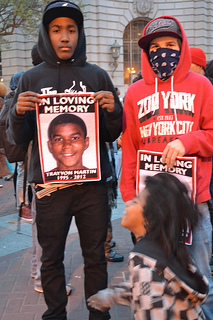
The Bay Area joined cities across the country in holding protests and rallies demanding justice for Trayvon Martin, a 17-year-old shot and killed by 28-year-old George Zimmerman in Sanford, Florida Feb. 26. 700 wore hoodies and marched downtown March 21. An “emergency scream-out” held March 26 outside of the Hall of Justice and jail at 850 Bryant called for justice for Martin as well as victims of police violence such as Ramarley Graham, an unarmed 18-year old Bronx man who was killed in his home by police. A “hoodies and hijabs” march last week in Oakland commemorated Martin’s death alongside the death of Shaima Al-Awadi, a 32-year old mother of five who was killed in a potential hate crime in her El Cajon home last month.

Speakers at these protests expressed outrage that Zimmerman had not been charged with any crime.

Now he has. On April 11, Zimmerman was charged with murder in the second degree.

I asked local activists- is this justice?

“I’m not jumping up for joy that this murderer has finally been arrested. I hope we can question what took so long,” said Tiny Gray-Garcia, creator of POOR magazine, who helped organize the scream-out.

She compared the case to that of Oscar Grant and his killer, Johannes Mehserle. After protest erupted demanding that Mehserle be charged with Grant’s killing, he became the first police officer in the history of California to be charged with murder. He was convicted of involuntary manslaughter and served eleven months in prison. 

“In the same way that Mehserle was finally charged, will Zimmerman eventually get a slap on the wrist?” asked Gray-Garcia. 

The March 26 scream-out was “not only for our young brother Trayvon. It was for Oscar Grant, Ramarley Graham, it was for Idress Stelley, Aiyana Jones, all the victims of police terror,” said Gray-Garcia

Unlike Graham, Stelley, and Jones, Martin was not killed by a police officer. But Gray-Garcia believes that his death can be atttibuted to “police culture.”

“Trayvon was murdered by a volunteer vigilante,” said Gray-Garcia of the neighborhood watch captain who had aspirations of becoming a police officer. “He was part of a violent police culture.”

If police and prison culture is a problem, is Zimmerman’s arrest- by police- justice?

In the media storm that followed the incident, some writers, such as this one at the Crunk Feminist Collective, have grappled with the question.

“How can I demand a criminal conviction for Zimmerman when I am opposed to prisons?” asks the Crunk Feminist Collective writer. “How do I reconcile these things?  I’m not sure yet.  But what I do know is that this really is not about the prison, but about a prison state that targets black and brown bodies in problematic ways.  It’s about a system of policing and surveillance, in which some bodies are always under the eye of the state.”

Isaac Ontiveros of the Oakland-based Critical Resistance, a group whose “vision is the creation of genuinely safe, healthy communities that respond to harm without relying on prisons and punishment,” has also struggled with this issue.

“That’s a challenging question for everybody,” said Ontiveros. “Part of it is, how can we start to dislodge the logic of neighborhood watches? You look at neighborhood watch associations and who are they watching, what do they mean by neighborhood, and who is considered suspicious?”

After Martin’s death, protests across the country were unrelenting calling for Zimmerman’s arrest. Days before the arrest and charge were made, a group of students who had marched 40 miles to Sanford from Daytona Beach “occupied” the Sanford police station, condemning how the case had been handled and demanding the termination of Sanford police Chief Bill Lee Jr. Police had declined to press charges against Zimmerman, saying that he had acted in self-defense.

On March 23, almost a month after the Feb. 26 shooting, Florida governor Rick Scott appointed special prosecutor Angela Corey to investigate the case. Zimmerman was charged with murder and taken into custody April 11.

“We do not prosecute by public pressure or petition. We prosecute based on facts and the laws of Florida,” said Corey at the time.

“She contends that neither petitions or media pressure influenced her decision, when we know too well that without it, nothing would have happened to Zimmerman,” said Mesha Irizarry, another scream-out organizer. Irizarry’s son, Idriss Stelley, was killed by police in 2001. 

The incident has put a national spotlight on racism in the United States. In Sanford, the NAACP held a town hall meeting for African American residents to air their frustrations with profiling in their own lives; hundreds attended

“If you’re black and you’re shot, particularly by someone who’s not black, that it is not viewed as seriously,” Sanford City Manager Norton Bonaparte told Reuters.

He added: “that’s why some feel that Mr. Zimmerman was allowed to just go on his way while Mr. Martin went to a morgue. And certainly if it was reversed, and Zimmerman had been black, he would have been detained and arrested.”

The same sentiment was expressed by protesters in San Francisco March 21. The speakers that day were family members of black teens who had been killed and whose murders had, they said, not been thoroughly investigated.

“Personal justice would be to open up all these other cases,” said Gray-Garcia.

Why free Muni for youth makes sense

62

Supervisor Scott Wiener has gone out of his way to dis the plan to let kids ride Muni for free. His oped in the Chron April 9 argued that the city just doesn’t have the money ($8 million):

We need to increase access to transportation for low-income youth, but a new and expensive obligation for Muni – at a time when Muni cannot pay for its basic operational needs and is expanding parking meters and increasing parking fines – is a bad idea.

But that misses the point — and People Organized to Win Employment Rights is mounting a petition campaign to get Wiener back on track.

The Municipal Transportation Agency, which oversees Muni, failed to approve the plan the first time around, but the vote was tied with Commission Chair Tom Nolan absent, so it’s still possible to move it forward. And on April 17, Sup. David Campos, who proposed the plan, and his allies will try again.

Yes, Muni is (perpetually) broke, and yes, deficits and cuts mean declines in service. But Campos has identified money to pay for the program without damaging operating and maintenance funds. Oh, and the parking meters get dragged in again:

The understandable public perception is that Muni is expanding parking meters to Sundays, adding new meters, and raising ticket prices not to pay for improvements to the system but rather to fund free Muni for all youth, even those who don’t need the subsidy.

And the problem with that is … what? People with cars ought to subsidize transit riders — young, old and everything in between. It’s really not that expensive to park at a meter in San Francisco, and now that most of them take credit cards, you don’t have to carry $5 in quarters around with you. I drive a car myself, to ferry my kids around. I have no sympathy for people who pay to have a large motor vehicle in a transit-first city and don’t want to pay for the impacts.

(Besides, what are all those religious people complaining about — nobody pays to park for Sunday church anyway. They just park in the middle of the street.)

But put all of that aside for a minute and think about this: San Francisco spends all kinds of money, directly and indirectly, trying to convince people to ride Muni instead of driving. And one of the best ways to get new riders is to get kids started as transit users as soon as their parents decide they’re old enough to get on the bus.

For us, that was sixth grade, when we bought my son a clipper card and told him we weren’t leaving work early to pick him up (in the car) after school any more. I showed him how to find the Muni map on the web, showed him how to connect to NextBus on his phone, gave him a pat on the head (not really) and sent him off to explore the wonders of San Francisco public transit. It’s worked like a charm: He takes the bus to his martial arts class, takes the bus to Cards and Comics to buy Magic Cards, takes the bus to the mall and to visit friends … and now he knows more about the system than I do. He can navigate on his own anywhere in town — and he loves it. It’s freedom. Suburban kids have to wait until they’re 16 and can get a driver’s license to even begin to get that sense that they don’t need parents in tow to go where they want to go.

Most of the teenagers I know in this city don’t bother to learn to drive any more. They bike and they take the bus. That’s a wonderful thing — and San Francisco should do everything possible to encourage it.

And a great way to start is to invest a modest amount of money — less than one percent of Muni’s budget — in training kids that the way to travel is by bus and train. Make it easy; make it free. Hell, half the middle-school kids who ride Muni never pay the fare anyway; they go in the back door and pocket the money that their parents gave them for bus fare so they can buy something they aren’t supposed to have. It’s the way of the world.

This isn’t just a subsidy for kids who can’t afford Muni, although that’s a great thing and I’m all in favor. It’s an investment in the future, a cheap step toward a future day when turning 16 isn’t all about going to the DMV, and travel doesn’t mean car travel — and the streets of San Francisco are cleaner, safer, less crowded and better for all of us. Isn’t that worth the money?

Come on, Tom Nolan; you’re the swing vote. Make this happen.


Mirkarimi claims Lee didn’t care what really happened

129

UPDATED BELOW Did Mayor Ed Lee ask Ross Mirkarimi what really happened in the conflict with his wife before removing him as sheriff? That question is not only important to understanding Lee and whether he was interested in the truth, but it could also be central to next week’s court hearing on whether Mirkarimi was denied due process before being suspended without pay.

In an interview published today in the New York Times, and in statements made today to the Guardian, Mirkarimi maintains that he sought to tell Lee the full story but that the mayor wasn’t interested. “He was clear that he was not interested in events or details, which were represented by me, even when I encouraged him,” Mirkarimi told The Bay Citizen, whose content the Times runs. “It was more than one occasion I offered to tell him my side of the story. If I had, it could have dramatically changed the mayor’s understanding of the situation.”

Yet the affidavit by Lee that was submitted to the court this week – which is written under penalty of perjury – paints a very different picture: one of the two men sitting in uncomfortable silence rather than Mirkarimi seizing the chance to shape Lee’s understanding of the situation.

“I asked Sheriff Mirkarimi to meet with me, because I felt that I needed to hear from him and consider what he had to say,” Lee wrote of the March 19 meeting where he gave Mirkarimi 24 hours to resign or be suspended, noting that he had reviewed the court records and “it appeared to me that he had engaged in official misconduct.”

“I explained to Sheriff Mirkarimi that I wanted to give him an opportunity to talk to me about this issue. It was a free flowing conversation with no time constraints. Sheriff Mirkarimi told me that he has not yet told his side of the story. I said, Okay, and waited for him to tell me his side of the story. He did not. Instead, after pausing, he asked me whether the suspension was based on his conduct as Sheriff. I responded that it was based on his conduct as a public official. I paused again and waited for Sheriff Mirkarimi to give me whatever information he thought important. He did not. Instead, Sheriff Mirkarimi asked me whether the suspension would be with or without pay. I told him it would be without pay. After giving him another chance to ask questions or give more information, I told Mr. Mirkarimi to consider my instruction to resign over the next 24 hours,” Lee wrote.

In an exchange of text messages with the Guardian, Mirkarimi maintains that Lee wasn’t interested in hearing from him or his wife, Eliana Lopez, what happened during the New Year’s Eve altercation or in its aftermath.

“On more than one occasion I offered details to Lee. He was either mute or changed the subject. Think about it – why else would they have DHR Miki Callahan [the city’s deputy human resources director] try to depose me after I was suspended without pay – they shoot first, then realize they better ask questions,” Mirkarimi wrote.

We asked why he didn’t use the opportunity of his meeting with Lee to tell his story.

“As I said, I did try. More than once. He wasn’t interested. In fact I told him how painful it’s been to not have contact [with Lopez, whom the court has barred him from contacting] since January 13, and encouraged him to get an independent account from my wife, Eliana; offered her phone number. Lee didn’t take it,” Mirkarimi said.

Paula Canny, Lopez’s attorney, has also said that Lee never tried to reach her and didn’t seem interested in what really happened. But the city’s official misconduct complaint makes a number of unsubstantiated allegations about that incident and what happened since that Mirkarimi and Lopez deny.

For example, the complaint claims that Mirkarimi “or his agents” asked Ivory Madison, the neighbor who helped Lopez make a videotape of her showing a bruise on her arm inflicted by Mirkarimi, to “destroy evidence,” a charge her husband, Abraham Mertens, made in a Chronicle op-ed. But in her own subsequent op-ed, Lopez says that wasn’t true and that Mirkarimi wasn’t even aware of the existence of the tape until after Madison had called the police and told them about it.

In the Times article, Mirkarimi also disputed another key allegation from the formal charges against him: “Sheriff Mirkarimi misused his office, and the status and authority it carries, for personal advantage when he stated to Ms. Lopez that he could win custody of their child because he was very powerful.”

That allegation also came from Madison, who hasn’t responded to calls from the Guardian, the Times, or other media outlets. But Mirkarimi told the Times that what he really told his wife was that California has “powerful” child custody laws that would make it difficult for her to take their son back to Venezuela if they divorced.

“I never said, ever, that I’m a powerful person,” he said. “It’s not even my style. I was quoting in the context of what had been a very familiar and painful reminder that, six months earlier, Eliana had been out of the country with Theo for two and a half months. I was referencing family law.”

Other news broken in the Times story was Mirkarimi disputing that he called the case a “private matter, a family matter,” saying that statement that so outraged domestic violence groups was “distorted by the press.” The article also quotes journalist Phil Bronstein minimizing the phone conversation he had with Madison before she decided to report the Mirkarimi-Lopez incident to the police, saying he only helped Madison contact “three people who Ross was close to” for reasons that weren’t clear. Bronstein, who hasn’t returned our calls on the issue [SEE UPDATE BELOW], was on the witness list for Mirkarimi’s domestic violence trial before Mirkarimi pled guilty to the lesser charge of false imprisonment.

The City Attorney’s Office isn’t commenting on the case, and when we asked the mayor’s Press Secretary Christine Falvey why Lee didn’t seek an account of what happened from Lopez or Mirkarimi, she told us simply, “The Mayor met with Ross Mirkarimi twice to discuss this.”

In the city’s response to Mirkarimi’s lawsuit seeking reinstatement of his pay and position until the official conduct hearings are resolved, which will be heard in Superior Court on April 20, they claim, “The Mayor met personally with Petitioner to discuss his intentions and has repeatedly invited Petitioner to tell his side of the story, an invitation Petitioner has repeatedly declined. But even more fundamentally, the due process claim fails as a matter of law. The constitutional right to due process is triggered only when the government works a deprivation of a legally recognized liberty or property interest.”

The city says caselaw is clear that elected officials can’t claim their office belongs to them. “A public office is always a public trust,” the city argues. But Mirkarimi’s attorneys say all employees have a clear property interest in their salaries, and they say it was illegal, coercive, and unfair to deprive Mirkarimi of his while he goes through the months-long official misconduct process. Police officers are almost always paid during their suspensions.

UPDATE 4/16: The message that I left for Bronstein seeking to speak with him about his conversation with Madison was nearly two weeks ago, and he called to take issue with my statement that he didn’t call back and with my characterization that he “minimized” his conversation with Madison in the New York Times article, although he did characterize their conversation as brief and fairly insignificant.

“Ivory Madison called me to say there were three people that Ross trusts and Eliana might want to get ahold of them, do you have their contact information, and I said I could probably get it,” Bronstein told us, noting that he never contacted any of them on her behalf. Sources tell us the three people were Aaron Peskin, Art Agnos, and Michael Hennessey. “No one was contacted, no information was passed, that was the extent of the conversation.”

Bronstein left those comments in a voicemail. I’m still waiting to talk to him about whether the conversation included talk of the incident and whether police should be involved, and I’ll update this post when I hear back.

Cyclists gain an unlikely defender against the backlash

53

After yesterday’s media pile-on – with the Examiner’s cover story and the Chronicle leading both its front page and Bay Area section with stories bashing bicyclists in the wake of a pedestrian death – it was refreshing to read today’s level-headed Examiner editorial “Rare pedestrian death exploited by bike foes.”

When I posted last week on the fatal cyclist-vs.-pedestrian collision (one of the first to report disturbing new details of the incident), I noted that the cycling community was braced for a backlash. And it came in the form of calls for police crackdowns, angry anti-cyclist diatribes, proposals for elaborate bike regulatory and re-education programs, and other opportunistic jabs.

The Examiner – which, under new ownership, has abandoned its nutty old right-wing stances – not only called out those critics as predictably lacking in perspective, but the editorial even took that next step of tying them to the pro-car reactionaries who get so lathered up about paying for street parking or losing any street turf they now control.

“There is an audience out there — mostly older, mostly cranky — that loves to marinate in the notion that drivers in The City are victimized by political correctness run amok,” the Examiner wrote. “This idea of two-wheeled liberalism is an attitude that is pandered to by the likes of curmudgeonly columnists at San Francisco newspapers.”

Yeah, git ’em, Ex 2.0! It’s amazing how the most privileged and entitled members of our society – such as rich white motorists – are so quick to play the victim card these days, a tactic popularized by Rush Limbaugh that has become the standard reaction to any perceived imposition on their comfort and convenience.

“Transportation policy and budget priorities are complex, especially in tough times. It is easy to sit back and paint in broad strokes about issues, but that does nothing to truly advance the conversations that need to be happening,” the Ex wrote (in sharp contrast to Chron’s reactionary, ridiculous editorial stance).

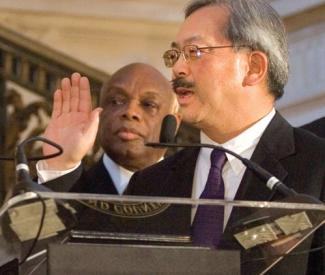
Mayor Ed Lee and SFMTA chief Ed Reiskin deserve credit for supporting the controversial proposal to put in new parking meters and begin charging on Sundays – an issue on which former Mayor Gavin Newsom pandered to the mob and showed a real lack of leadership – but that’s just the beginning of doing what needs to be done to create a 21st century transportation system.

The death of this pedestrian is a horrible accident that has reminded the cycling community of our responsibility to other road users, and it has prompted discussions and realizations that are probably overdue. We get it. But we shouldn’t lose sight of the fact that cars create more pressing and widespread problems – in terms of being deadly, costly, bad for the environment, and dominating public space – than do bikes. That’s not judgment, just perspective.

Or as the Examiner says, “Bicyclists can be rude — they certainly ride through red lights or on the sidewalk and are rarely punished, in part because on the scale of criminality, this is fairly minor. But the one thing they almost never do is kill someone. We shouldn’t let this incident distort our approach to traffic laws or add fuel to the apparently endless battle of the bike and the car.”

Activists hope to turn resolution into real foreclosure suspension

3

On April 10, the Board of Supervisors unanimously passed a resolution calling for a temporaray suspension on foreclosures in San Francisco.

The resolution “urges city contractors and all mortgage and banking institutions to suspend foreclosure activities and related auctions and evictions until State and Federal measures to protect homeowners from unfair and unlawful practices and provisions for principle reductions are in place.”

This comes after a report from Assessor-Recorder Phil Ting found that 84 percent of foreclosures in San Francisco in the past three years involved faulty paperwork and, likely, fraud.  

The resolution does not require anything, but instead urges the city to work on behalf of constituents swept up in the foreclosure crisis. 

It urges all city departments, “including but not limited to, the offices of the Mayor, the Assessor-Recorder, the City Attorney, the District Attorney, and the Sheriff, to take proactive steps and measures to ensure that the City and County of San Francisco prevents and protects its resident form illegal foreclosures, auctions, and evictions.”

“The controller is supposed to audit every case beyond what was in Phil Ting’s report. Based on that information the glaring illegal activity for the banks, the district attorney and city attorny should sue the banks and file an injunction to stop foreclosures. I think those are some of the steps we could take,” said Julien Ball, an anti-foreclosure activist with Occupy Bernal

The resolution also “urges the Mayor to direct…our city lobbyists in the California State Capital to prioritize support for California Homeowners Bill of Rights state bills.”

This series of bills, proposed by state attorney general Kamala Harris, would include efforts to stop dual tracking- when homeowners still in the process of a loan modification are simultaneously tracked for foreclosures. The package also includes a ban on robosigning and other practices that can constitute fraud in foreclosure proceedings. 

Sups. Avalos and Campos sponsored the resolution, and Kim, Mar, Olague and Cohen co-sponsored. 

Occupy Bernal’s goal remains a city-wide moratorium on foreclosure, and towards that end, the resolution represents an important step.  It puts San Francisco on record as being against unfair foreclosures and related evictions,” said Ball, “and its something we can use to put pressure on the banks and public officials to act.”

“That involves exposing and shaming banks through public protests, blasting them with phone calls, calling out their board members, its necessary if we have to stand in front of somebody’s home to stop them from being evicted we’ll do that to,” said Ball.

They plan to escalate these tactics April 24, when a coalition of groups has declared that it will “shut down” an April 24 Wells Fargo shareholders meeting in San Francisco.

Lee veto protects the SFPD’s ability to spy on you

15

Mayor Ed Lee yesterday vetoed legislation that would have banned San Francisco Police Department officers working with the FBI from conducting covert surveillance on law-abiding citizens. Not terrorists, not criminals, not foreign spies, but people like you (well, people like you who are Muslim, protesters, visitors to certain websites, or people who otherwise have caught the attention of the FBI) who are not even suspected of criminal activity.

While Lee says he will support a so-called “consensus ordinance” introduced yesterday by Sup. Jane Kim, the sponsor of the vetoed measure, his veto letter makes clear that he wants San Francisco to reserve the right to spy on whoever the FBI wants to, echoing post-9/11 fear-mongering and right-wing bait-and-switch tactics while still trying to placate civil libertarians with his rhetoric.

“This ordinance intends to amend the Administrative code to require the San Francisco Police Department to either terminate a counterterrorism Memorandum of Understanding with the Federal Bureau of Investigation or materially restrict the interaction between the two law enforcement bodies,” his veto letter begins.

That MOU with the FBI is the one that the SFPD secretly entered into back in 2007 (which was exposed last year by the American Civil Liberties Union after a long public records court battle) that placed SFPD officers under FBI control without recognizing state and local privacy and civil rights restrictions. The resulting scandal caused the SFPD to apologize and work with the Police Commission on a general order clarifying that local officers must obey those restrictions, which Lee, Police Chief Greg Suhr, and some supervisors have maintained is good enough.

But six members of the Board of Supervisors didn’t agree with this “trust us” approach, noting that future chiefs and Police Commissioners can change the policy at any time, and saying protecting the privacy and civil rights of city residents and visitors is an important enough issue to be formally codified in local law.

John Crew, the police practices expert for the ACLU, has said that the only reason to oppose the ordinance is if officials want to reserve the right to spy on law-abiding citizens, and Lee seemed to signal as much by writing “the restrictions it places on our Police Department overly constrain their ability to protect our City from very real threats.” And he enumerated those “threats” by equating those being spied on for their political beliefs or because of their ethnicity with terrorists who want to blow us up.

“Recently, the United States Department of Homeland Security raised San Francisco’s risk rating – we are now considered the fourth-highest terrorism target risk in the nation along with cities like New York and Washington, DC. Protecting San Franciscans is the most important responsibility I have as Mayor. This goal, however, does not justify a trampling of constitutionally protected principles, and we have a government structure in place to ensure this dichotomy never materializes,” Lee wrote.

See what he did there? There was nothing in this measure that limited the FBI or SFPD’s ability to monitor suspected terrorists, which they’re already free to broadly define, particularly since 9/11 and the USA Patriot Act and other police state changes, including the very creation of the Orwellian-named Department of Homeland Security. But civil libertarians have been trying to hold the line and prevent the FBI – which has a long and sordid history of spying on law-abiding citizens and using that intel for political sabotage – from going after anyone who looks different or criticizes this country’s leaders or policies.

It’s great that Lee, who was a civil rights attorney decades ago, gives lip service to that concern and says he’s willing to work with the Coalition for a Safe San Francisco on legislation that would allow a hearing by the Police Commission of any future JOAs with the FBI after it’s been signed. But Kim’s statement that, “It’s a compromise that essentially will accomplish the same thing” just isn’t true, as the activists who pushed this tell us. The vetoed measure was already a compromise, with Kim making many amendments at the request of Suhr and repeatedly delaying final consideration of the measure so any other concerns could be addressed.

The JOA should have been suspended and rewritten, as the city of Portland, Oregon did when these same concerns were raised there, with no detriment to its relationship with the FBI. But even that request to suspend our JOA had already been removed from the watered down ordinance that Lee vetoed. “When we work together to create solutions that represent our shared values, we make San Francisco a safer, better City together,” Lee piously wrote, glossing over his unwillingness to work with the coalition before vetoing the measure. “He won’t even meet with civil rights groups on this,” Crew told me last week, as the Coalition was trying to talk with Lee to head off a veto.

Activists like Shahid Buttar, executive director of Bill of Rights Defense Committee and a member of the Coalition, are trying to look on the bright side and they say they’re happy that Lee now wants to work with activists on the issue. But the compromise and consensus are what’s been happening over the last several months – now, it’s simply Lee bowing to the SFPD rather than trying to regulate it and trying to save face on a bad veto.

As Buttar told us, “It’s disappointing that Mayor Lee would choose to overrule the voice of residents of the city and their representatives on the Board of Supervisors.”

Mini nuclear bombs — such progress!

5

The little bit of propeller head in me thinks this is totally cool:

A team of physicists and engineers at the $3.5 billion National Ignition Facility said they fired an array of 192 laser beams, focused “in perfect unison,” and created a single pulse of energy that for 23 billionths of a second generated a thousand times more power than the entire United States consumes in a single second.

Think about that — 192 laser beams (wicked cool) and a pulse of energy lasting only 23 billionths of a second (they can actually measure something that lasts in the billionths of a second? Whoa.) It’s like they made a miniature sun inside a big building in Livermore. Think of what that means. Think of the potential for clean energy. Think of the concept of reproducing what happens inside the sun without having to trigger an atomic bomb to do it. What a great use of taxpayer money.

Ah, but wait:

The ultimate goal of the multibillion-dollar laboratory experiments is to safely mimic in miniature the immensely powerful thermonuclear explosions of hydrogen bombs so that experts can validate their bomb-making computer codes and verify the safety and reliability of America’s arsenal of nuclear weapons.

Damn. That’s what this is all about. Making better bombs that will never get used (without triggering the end of the world as we know it). What a huge waste of taxpayer money.

Free speech and Fidel Castro in Florida

40

The First Amendment protects your right to say just about anything, but doesn’t insulate you from the consequences. And there’s a difference between the right to free speech and the responsibility to be held accountable for saying something truly offensive.

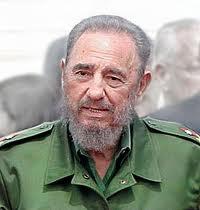
So it’s no surprise that the manager of the Florida Miami Marlins, a team with a spankin’ new publicly financed ballpark in Little Havana, would get himself in deep doo-doo by saying that Fidel Castro maybe wasn’t such a horrible guy after all. As Dave Zirin, my favorite sportswriter, notes:

Short of a hurricane or an armed taxpayer revolt, this had to have been Miami Marlins owner Jeffrey Loria’s worst nightmare. … Casual kind words for Castro in Miami is akin to looking at a leaky bottle of kerosene and thinking it could use a match.

I get it — Ozzie Guillen offended a sizable portion of the community in which he does business, and he’s supposed to be a community leader and bring Cuban Americans into the ballpark, and whether he misspoke or was having trouble expressing a complex political thought in English, he can’t really get out of this one without taking some hits.

Still, the AP story that ran in the Chron was a bit over the top:

The suspension recalled the punishment given to Marge Schott, the late owner of the Cincinnati Reds. Schott so embarrassed baseball in the 1990s with inflammatory racial remarks and fond recollections of Adolf Hitler that she was suspended from ownership duties for a season.

Wha-what? I’m not trying to defend ol’ Commie Fidel here, and I know he was a dictator who has political prisoners and didn’t tolerate dissent, but seriously? We’re comparing an offhand comment about Castro to support for Adolf Hitler?

As far as I know, Castro was never guilty of mass genocide. He didn’t systematically murder 6 million people. He didn’t invade Europe and attempt to take over the world. Hell, he couldn’t even “export the revolution” very far off his tiny island.

You don’t have to support every policy of the Cuban government to acknowledge that Castro took an impoverished nation controlled by a savage U.S. puppet and turned it into a functioning country where everyone gets enough to eat and has free education and medical care — and has done it up against a total boycott and for many years a secret war waged by the most powerful nation on Earth.

Hitler he ain’t.

In fact, I think that (possibly outside of Miami) it’s possible for sensitive, politically correct Americans to discuss Castro with a bit more nuance and subtlety than the ownership of the Marlins is willing to allow. You can respect the guy, as Guillen apparently did, for surviving for 65 years when the U.S. was doing just about everything, including planting an exploding cigar in his stash, to get rid of him. You can say that he was, and is, one of the most important Leftist leaders in the Western Hemisphere, and inspiration to revolutionaries from Nelson Mandela to Hugo Chavez. You can have a reasonable argument about whether he might have become more open to democracy and free speech if the U.S. wasn’t constantly trying to overthrow him.

You can say things here — because this is America — that you can’t say in Cuba. Except you apparently can’t say them in Miami.


Social liberalism beats economic populism?

13

Eric Alterman, who writes on media for The Nation, has a book out on the history of liberalism in America and a fascinating essay in The New York Times on how progessives lost the economic war. It’s hard to make a case this complicated in a few hundred words, so he sounds as if he’s somewhat downplaying the importance of civil rights. And American history is, of course, complicated and the post-War era one of the most confusing times to understand and analyze. But Alterman seems to come down on the side of those who argue that the fight for what he calls the “rights agenda” undermined the battle for economic equality:

In other words, economic liberalism is on life-support, while cultural liberalism thrives. The obvious question is why. The simple answer is that cultural liberalism comes cheap. Supporting same-sex marriage or a woman’s right to choose does not cost the wealthy anything or restrict their ability to become wealthier.

He also disses incompetence, always an easy target, since the economic crises that post-War liberals addressed — from inner-city and rural poverty to energy prices and inflation — defied easy solutions and there were bound to be mistakes. But here’s his basic hit:

“The great liberal failing of this time,” Daniel Patrick Moynihan observed as early as 1968, was “constantly to over-promise and to overstate, and thereby constantly to appear to under-perform.” This not only alienated key constituencies, but it also diminished the trust between the governing and the governed that previous generations of liberals had worked so hard to earn.

Caught in the crosswinds of so many simultaneous crises — I have not even mentioned Vietnam — many liberals chose to focus, rather perversely, on a “rights” agenda and the internecine fights it engendered within their increasingly fractured coalition. They lost sight of the essential element that had made the coalition possible in the first place: the sense that liberalism stood with the common man and woman in their struggle against economic forces too large and powerful to be faced by individuals on their own.

In other words, if we’d just been willing to throw the gays and the women under the bus (or do what so many “liberals” so often suggested, and move more slowly on things like abortion rights, comparable worth and same-sex marriage, which are so easy for the Right to use as wedge issues) we might have held on to the coalition that was able to wage the War on Povery under LBJ.

Okay, that’s not fair — Alterman is a lot more nuanced than that. And I agree with him entirely that it’s easy (particularly in a place like San Francisco) to support same-sex marriage, and that cultural issues can give fiscal conservatives cover with a left-leaning electorate. It drives me nuts. And I completely agree that Obama needs to return liberalism to an economic populist agenda.

And a lot of this discussion has been done before, starting with Thomas Frank and What’s the Matter with Kansas?

But would we really be better off in the long run if we’d abandoned the “rights” agenda in favor of economic equality? Or is it possible that the Right is losing steam on the Culture War and in the process discrediting its economic ideas? Do women who heard Rush Limbaugh call a law student a “slut” start questioning what he says about taxes?

I dunno. Interesting questions.

Why Wall Street loves the War on Drugs

46

The raid on Oaksterdam has just about everyone in local politics engaging in a little head-scratching: What possible reason would the Obama administration have to crack down on medical marijuana in an election year? How does it help the president, who will be facing an unsettled and angry electorate in a still-tough economy, to alienate the pot smoking liberals of the world, who were at one point among his most loyal constituents?

What a fucking idiot.

Here’s what make it worse: I don’t think anyone at Goldman Sachs talked to the White House about this, but the 1 percent clearly have a lot to gain from the drug war.

And it has nothing to do with drugs.

Let’s be logical here. There’s only one possible way to increase economic equality in this country, and it involves government intervention. With union membership at a fraction of what it once was, government is the only institution with the power these days to enforce income redistribution. The wealthy have to be forced to pay higher taxes, and that money has to be spent on public education, affordable housing, economic development, public-sector-driven job creation and other programs that are proven to narrow the wealth gap.

But that’s tricky, since the Right has done such an effective job (with the help of corrupt politicians of every stripe, including liberals) of making Americans mistrust government. How do you get people to vote for higher taxes when they think the money’s going to be wasted on pointless wars and crony contracts — and on sending federal agents to roust pot clubs?

The two factors that most accounted for the fall of economic liberalism in the 1960s were Vietnam and pot. My parents generation saw the government as the nation’s leaders who got us out of the Great Depression and won World War II. My generation saw government as the assholes who were sending us to die in Southeast Asia and putting us in jail for smoking weed. That’s why when Ronald Reagan announced that “government is not the solution, it’s the problem,” so many of my peers nodded (through the haze) and said: Right on.

There are more progressives in the Bay Area today who distrust and dislike the federal government than there were before the raids began. We’re going back to the days when “the feds” became a dirty word. And it’s undermining everything that Obama is tyring to do with the economy.

Yeah, Wall Street, which is trying to get rid of pesky regulations, loves this — if you hate the feds in Oaksterdam, it’s hard to love them at the IRS and Securities and Exchange Commission. That’s what the 1 percent relies on. And it’s working.


Aren’t we glad the Blue Angels still fly over SF?

47

I understand that the Angels are supposed to be the best pilots in the Navy, but still: These things crash, and when they do it really sucks. At least seven still missing in Virginia Beach. Imagine if that happened in, say, the Mission, or Telegraph Hill?

I’ve never been a big fan of the Blue Angels — what a waste of money and fuel in a celebration of military might — but every time we see a crash like this, I have to ask: For safety alone, is this still a good idea?

Was the cyclist who killed a pedestrian reckless?

215

San Francisco’s bicycling community is bracing for a backlash following the second recent case of a cyclist hitting and killing a pedestrian, particularly given a callous online posting by someone claiming to be the cyclist, whose 71-year-old victim this week died of injuries sustained a week ago at the intersection of Castro and Market streets.

The case was a hot topic at last night’s monthly Carfree Happy Hour, a gathering of cyclists, transportation professionals, and alternative transportation activists, many of whom had unearthed new information about a case they’re all grappling with. And the consensus opinion was that the cyclist seemed reckless and may deserve to face criminal charges.

Yet activists also sought to place this case in context, noting that an average of almost three pedestrians are hit by cars everyday in San Francisco, even though that rarely makes headlines. There were 220 pedestrians killed in San Francisco from 2000-2009, the vast majority hit by cars whose drivers rarely faced criminal charges. In fact, the same week that Sustchi Hui was killed there was another pedestrian killed by a motorist and another one by a Muni bus.

But that doesn’t lessen the importance of this latest bike-vs.-pedestrian fatality, which is sure to make news precisely because it’s so rare, and because it comes just weeks after 23-year-old Randolph Ang pled guilty to vehicular manslaughter for running a red light at Embarcadero and Folsom Street in July 2001, hitting a 68-year-old woman who later died from her head injury.

San Francisco Police Department won’t identify the cyclist in the latest incident unless he’s charged with a crime, and its investigation is still ongoing, said SFPD spokesperson Albie Esperanza. “It’s a tragic accident,” he told us, noting that the cyclist was cooperating with the investigation. Once the investigation is complete, the District Attorney’s Office will decide whether to bring criminal charges against the cyclist.

Someone who identified himself as Chris Bucchere posted a note on the Mission Cycling Google group on the afternoon of the incident, March 29, describing an accident that apparently took place at the same time and place. And the description that Bucchere gave of the accident is not likely to garner much public sympathy for him (We contacted Bucchere by e-mail and telephone, we’re waiting to hear back for him, and we can’t independently confirm the authenticity of the message or its contents).

“I wrecked on the way home today from the bi-weekly Headlands Raid today. Short story: I’m fine. The pedestrian I clobbered? Not so much,” the message began.

The post then goes on to describe the incident, which matches the details of other reported accounts of the fatal crash: “Around 8 am I was descending Divisidero Street southbound and about to cross Market Street. The light turned yellow as I was approaching the intersection, but I was already way too committed to stop. The light turned red as I was cruising through the middle of the intersection and then, almost instantly, the southern crosswalk on Market and Castro filled up with people coming from both directions. The intersection very long and the width of Castro Street at that point is very short, so, in a nutshell, blammo.”

Another member of the Carfree Happy Hour group who is a regular competitive cyclist said that Bucchere was a member of the website strava.com, which tracks minute-by-minute data of cyclists for training purposes. And this source said he was able to use the site to determine that Bucchere was traveling through the intersection – which is at the bottom of a steep hill – at approximately 35 mph at the time of the collision.

Bucchere’s message continued: “The quote/unquote ‘scene of the crime’ was that intersection right by the landmark Castro Theatre – it leads from a really busy MUNI station to that little plaza where The Naked Guy always hangs out. It was commuter hour and it was crowded as all getup. I couldn’t see a line through the crowd and I couldn’t stop, so I laid it down and just plowed through the crowded crosswalk in the least-populated place I could find.

“I don’t remember the next five minutes but when I came to, I was in a neck brace being loaded into an ambulance. I remember seeing a RIVER of blood on the asphalt, but it wasn’t mine. Apparently I hit a 71-year old male pedestrian and he ended up in the ICU with pretty serious head injuries. I really hope he ends up OK.

“They asked me a bunch of stupid easy questions that I couldn’t answer, so they kept me for a few hours for observation, gave me a tetanus shot and sent me on my way.

“Anyway, other than a stiff neck, a sore jaw/TMJ, a few bruises and some raspberries, I’m totally fine. I got discharged from the hospital during the lunch hour. The guy I hit was not as fortunate. I really hope he makes it.

“The cops took my bike. Hopefully they’ll give it back.

“In closing, I want to dedicate this story to my late helmet. She died in heroic fashion today as my head slammed into the tarmac. Like the Secret Service would do for a president, she took some serious pavement today, cracking through-and-through in five places and getting completely mauled by the ragged asphalt. May she die knowing that because she committed the ultimate sacrifice, her rider can live on and ride on. Can I get an amen?

“Amen.

“The moral of this little story is: WYFH”

Several members of the newsgroup took issue with the lesson Bucchere claims to have learned : WYFH, or “Wear Your Fucking Helmet.” One poster wrote, “I’m not sure that’s the moral of the story,” to which several others agreed. Another poster wrote: “What were you thinking ? As a 15 year sf resident and a 10 year cyclist and a pedestrian at that intersection every weekday .. I’m kind of embarrassed to wear my mc kit anywhere nearby now. I truly hope you’ve learned your lesson but I’d have to say this is not the end of the story for you, and yes you should get yourself a lawyer.”

Recent studies have shown that San Francisco is a dangerous city for pedestrians, but not as dangerous as many other cities on a per capita basis given our density and high pedestrian populations. A study released in January by the Alliance for Biking & Walking concludes San Francisco has the third highest biking and walking levels among major US cities, but ranks eighth in bicycle and pedestrian fatality rates.

A 2011 study by the group Transportation for America, “Dangerous by Design,” analyzed factors associated with pedestrian deaths – some of which seem to be at play in this case – and concluded, “Especially when combined with unsafe street and road design, vehicle speed presents a deadly threat to pedestrians.”

CPMC strike linked to new hospital

13

I stopped by the picket line outside Davies hospital and chatted with the members of Operating Engineers Local 39, who have been working without a contract since October, 2010 — and I heard a story that ought to be part of the discussion over CPMC’s plans to build a shiny new hospital on Cathedral Hill.

The striking engineers (who operate and maintain machinery and equipment at the hospitals) say the only remaining issue in the dispute is pay scale — and the last, best offer that CPMC, a Sutter Health affiliate, has put on the table is lower than what Sutter pays members of the same union at other Bay Area hospitals. Why? According to Joseph Klein, Local 39 business rep, the CPMC negotiators were pretty specific:

“They told us they need the money to build their new hospital.”

The CPMC negotiators, he said, “don’t even question whether they can afford to pay us comparable salaries. They just say they want to spend the money on that project.”

Wow — that’s the first time I’ve heard anything so detailed and specific about CPMC essentially using lower wages to help fund the Cathedral Hill medical palace. So I called Kathie Graham, spokesperson for CPMC, and asked her about it.

“The primary reason for our offer was that the wage we proposed was comparable to the raises that our other hospital workers got,” she said.

Okay, but was the cost of the new hospital a factor? Actually, yes.

“The primary issue is equity,” she said. “But do we have a billion-dollar rebuild that we have to fund? Yes. Because of the whole way health care is going — and because we need to rebuild — we have to be very careful stewards of our nonprofit dollars.”

Both sides want to go back to the bargaining table, and I know labor talks are always complicated, and I hope it gets resolved quickly. But I think it’s fair to say that all CMPC workers need to take a lesson here: It’s going to be hard bargaining for quite some time to come.

And I hope the supervisors who are reviewing this consider where the construction money is coming from.


Guest opinion: It’s not about Mirkarimi, it’s about us

70

Virtually unmentioned in the torrent of words that have flowed over the Ross Mirkarimi false imprisonment, suspension and pending vote to determine his removal by the Board of Supervisors is any reference to what should now be the most important issue to be considered as the sad saga unfolds: the fact that Mirkarimi was, just four months before his removal, elected by a majority vote and his removal from office would simply set aside that vote, diminishing all of our cherished beliefs about “majority rule.”

Mirkarimi didn’t just win, he won big. He beat the second place candidate by nearly 19,000 votes, winning outright without the need for the magic of instant run-off. Mirkarimi got more first place votes than did Ed Lee (70,204 vs. 59,663). Moreover, Mirkarimi’s election was without controversy, complaint or charge of illegality, unlike Ed Lee’s, which resulted in a total of 25 misdemeanor convictions for illegal campaign contributions by a city contractor with a pending contact before a commission appointed by the mayor.

Since the 5-4 vote of the Supreme Court to give George Bush the election in 2000 after Al Gore won a majority of the popular vote, there has been a distressingly frequent willingness by the media to accept executive and judicial actions that set aside popular votes. The conservative governor of Michigan has simply taken over local governments that he deems financially “irresponsible” setting aside the votes of local residents. In California, a tiny minority of Republican legislators, elected by a comparative handful of voters, yearly stymie the overwhelmingly majority elected legislators, forcing deeply unpopular budget cuts — and the media simply goes along.

Majority rule, the very bedrock of representative democracy, seems unnervingly easy to set aside now days. Majority rule is our bedrock because it’s the only way in which our system has to define the political will of the people. Let’s be clear, the very City Charter that is being used to remove Mirkarimi from office rests on the power given by “the people of the City and County of San Francisco,” (Preamble to the Charter) and was itself adopted by a majority vote. Setting aside majority votes is a dangerous business for us all; it risks substituting the will of a few insiders for the will of the people.

The political riskiness of the move has been entirely incorrectly cast by the San Francisco Chronicle, the main voice to overturn the expressed will of the people. The Chronicle asserts the political risks as now falling on the supervisors who most vote to sustain the mayor’s action with nine votes. Indeed, the ace vote counter at the “Comical,” former Mayor Willie Brown, who went zero-for-ever in the last four years of his term in votes at the board, confidently predicts that the vote will be 11-zip to sustain the mayor because of the fear of voter retribution.

But facts indicate that “fear” will play the other way. Last November Mirkarimi won in six of the 11 supervisorial districts (D3, D5, D6, D8, D9 and D10) . In two of them (D8 and D10), he won more first-place votes than the current supervisor. In these same six districts he outpolled Ed Lee by some 18,000 votes. By what measure, other than the huffing and puffing of ex-Mayor Willie, C(onsistenly) W(rong) Nevius, and the two stooges, Matier and Ross, does any political risk fall on these supervisors to vote with their constituents?

Chances are nine votes will NOT be there and that Mirkarimi will remain sheriff, where the people put him.We will have gone through a divisive fight addressing none of our deep problems, Mayor Lee will squander the good will of the supervisors and voters for nothing and we will be exactly where we are now.

We have a way to remove Mirkarimi from office that is far better for our democracy. It’s one of the great inventions of the Progressive Era. It’s called recall, and it puts the matter where it should be: before the people. It’s really not about Mirkarimi anymore. Its about us, the meaning of our votes, and the responsibility of supervisors to understand in whose name they govern. All power to the people!

Calvin Welch lives, works and plays in San Francisco.

Young man’s death commemorated at City Hall rally, vigil this evening

1

Family, friends and community members grieving for the life of Lawrence Richardson will meet on Fillmore and Eddy at 6:15 tonight for a candle light vigil. Richardson, 21, was shot and killed on Eddy April 2.

His death marks the 18th homicide in San Francisco this year.

At a rally at City Hall marking the 44th anniversary of the assassination of Martin Luther King, Jr, Amos Brown, president of the San Francisco chapter of the NAACP, mourned the young man’s death.

Brown, who has been Pastor at San Francisco’s Third Baptist Church since 1976, said Richardson was enrolled in his church’s after school program Back on Track. The murder occurred four blocks from the church.

“We are sad today to report that we have not become a harmonious society. That there is great dissonance of violence, there is great dissonance of destruction, in the land today,” said Brown, referencing Martin Luther King’s 1964 speech at the University of Dayton in which he said that “every man, from a bass black to a treble white, is significant on God’s keyboard.”

The vigil is organized in part by The Healing Circle for the Soul Support Group, a group for those who have lost a loved one due to violence.

No arrests have been made in Richardson’s murder.

Mayor McLaughlin on synthetic biology issue

1

For my story about synthetic biology in this week’s Guardian, I tried to reach Mayor Gayle McLaughlin of Richmond, where Lawrence Berkeley National Laboratory is building its second campus. The group Synbiowatch is questioning the safety and environmental responsibility of these new technologies. McLaughlin was traveling and just got back to us, so we thought we’d share the perspective of a Green Party mayor of the city where this work will take place.

SFBG: Do you have any concerns about safety at the lab or with the regulation of the synthetic biology field?

GM: I understand that this issue is extremely important. I was at the symposium “Unmasking the Synthetic Biology Lab” held in Berkeley last week and have been learning about the risks and concerns related to this field.

SFBG: Are you worried that we’re entering another “economic bubble,” this time with so-called “green jobs,” and that it could pop like previous bubbles and end up hurting Richmond?

GM: I think that green and sustainable job development will continue, as there is an absolute necessity for our human survival that we create a sustainable planet on which to live and thrive as well as pass along to future generations.

SFBG: The activists say the Precautionary Principle should dictate a slower and more careful and regulated approach to developing newly engineered microorganisms, do you share that view?

GM: I absolutely agree. There needs to a slow and deliberate process that fully researches and regulates this new engineering. I believe that science has a responsibility to examine step by step what is in the interest of us all as human beings – what truly advances us and what may cause us more problems.

SFBG: While the lab diversifies Richmond’s economy, much this research is funded by and could ultimately by developed by Chevron and other big energy companies. Is that appropriate for research into new energy forms that is sponsored with public money?

GM: I agree that the lab diversifies Richmond’s economy and I support opportunities it offers our community that come from positive, safe and healthy scientific exploration, education, and job opportunities. 

The fact that big energy corporations are funding much of the research definitely brings up concerns for me. We need to make sure that science is not conducted with an eye toward profit-making, but rather for the advancement of humanity. We know that our society currently is corporate-run, so we need to continuously raise the issue that true science has an obligation not to the corporations but to the people. This issue is something that should be raised everywhere.

Brown says Lee shouldn’t have taken Mirkarimi’s pay away

53

As Mayor Ed Lee continues to duck questions about why he suspended Sheriff Ross Mirkarimi without pay or due process, even former Mayor Willie Brown – who helped elevate Lee into Room 200 – is second-guessing the decision and its legality.

In his Willie’s World column in Sunday’s San Francisco Chronicle, entitled “Ross Mirkarimi needs cash in struggle to keep his job,” Brown wrote, “And on the salary point, I agree with Mirkarimi: He should not be suspended without pay. He should continue to get paid unless and until he ultimately is found guilty of misconduct by the Board of Supervisors.”

The issue isn’t just one of fairness or of Lee trying to coerce Mirkarimi into resigning to avoid city hearings that will determine whether grabbing his wife’s arm during a New Year’s Eve conflict constitutes official misconduct, as Lee charges. It’s also a specific legal issue, particularly to lawyers like Brown.

Mirkarimi’s attorney, David Waggoner, said it’s not surprising to see Brown publicly undercutting the mayor on this issue. “He’s simply stating what the applicable law is on the subject,” Waggoner told us. In this case, it was the Supreme Court, hearing the case Skelly v. State Personnel Board in 1975, that said an executive can’t just unilaterally take away someone’s livelihood.

“If you’re going to fire public employees, you have to give them notice, you have to let them respond, you need to observe due process,” Waggoner said.

That’s one of three causes of action that Superior Court Judge Harold Kahn will consider in a hearing set for April 18 at 9:30 am, where Mirkarimi is asking the courts to reinstate him and restore his salary pending hearings before the Ethics Commission and Board of Supervisors that could take months.

Given the pressure being applied by anti-domestic violence groups and many mainstream media voices, Lee may have felt like he had to remove Mirkarimi and that he could just blame supervisors or the process if it didn’t work. But if the courts find Lee acted illegally while attempting to put supervisors in such an untenable position, it could be a serious blow to Lee’s reputation and governing authority.

UPDATE 5 PM: I also placed a call on the issue to former Mayor Art Agnos, who just back to me and he agreed that Lee acted in a way that was unfair and probably illegal. “I think it’s heavy-handed,” said Agnos, who has been supporting Mirkarimi through the ordeal.

Agnos noted that former Sheriff Richard Hongisto served several days in jail for contempt of court for refusing to carry out the evictions of International Hotel tenants, and he never had his pay docked or faced official misconduct charges. “And here, we see the sheriff being charged with something that occurred before he even took office, and it’s a low-grade misdemeanor that he accepted a plea deal on.”

According to Agnos, Mirkarimi told him that during his brief conversation with the mayor, he offered to tell his side of the story and have Lee talk to his wife, Eliana Lopez, as well, but the mayor wasn’t interested. “When you’re the mayor, you like to hear both sides before making a decision,” Agnos said. “But Lee wasn’t interested.”

The slate controversy at the DCCC

30

There’s nothing like a combination of insider politics, a struggle for control of the local Democratic Party and the ongoing discussion about the need for progressives and moderates to get along better to make for a complicated political story.

Which is exactly what’s going on with Alix Rosenthal’s effort to put together a Women’s Slate for the Democratic County Central Committee.

I’ve spend way too much time trying to figure it all out, but it raises enough interesting issues to make it worth discussion in the progressive community.

The background: For four years, the progressives have controlled the DCCC – and thus the powerful local endorsements for the local Democratic Party. That’s taken considerable organizing – and it’s worked to a great extent because of a remarkable degree of unity among a famously fractious bunch.
In the past two elections, every progressive group, the Harvey Milk Club, the Tenants Union, the teacher’s union, the nurses, the Sierra Club — and the Bay Guardian – has endorsed essentially the slate of candidates. There are problems with that approach – it’s easy for some people or some groups to get excluded, and you get complaints of machine politics – but in reality, there weren’t a lot of people who identified as progressive getting left out. Quite the opposite – the slate organizers were working hard to recruit people to run. Serving on the DCCC isn’t glamorous and it’s a lot of work. (It’s also at times unpleasant — the arguments are harsh, sometimes more so than necessary.)

In 2012, we have a different problem: The people who are called moderates have convinced a lot of high-profile canidates (former Sup. Bevan Dufty, Sup. Malia Cohen, School Board member Hydra Mendoza) – people who will win on name-recognition alone – to run. Combined with the retirement of Aaron Peskin, and the all-but certain re-election of incumbents like Scott Wiener and Leslie Katz (who remains to this day the only member of the DCCC who refuses ever to take my phone calls) and you have the makings of a conservative victory.

Let me take a second on this “moderate” tag. Moderates in San Francisco are people who are liberal on social issues – like, frankly, 80 or 90 percent of the city – but conservative on economic issues. Conservative is the right word here: The moderates don’t typically support higher taxes on the rich and big business, don’t support development controls, are weak on tenant issues, don’t think that housing should be a right of all people and pretty much buy into what in the Clinton era we called neo-liberalism.

The progressives (who have economic policies more like the Democratic Party of FDR and Lyndon Johnson) and the moderates (who have economic policies more like the Democratic Party of  Walter Shorenstein, Dianne Feinstein and Bill Clinton) have been fighting for decades over the future of a city where there aren’t a whole lot of Republicans.

So when I say conservative I’m not talking about Reagan or Santorum — but I’m talking about a very different economic vision than mine.

And while I’m all in favor of being civil and polite to everyone and respecting friends and colleagues who disagree with you, I guess I’m enough of an old commie (with a lower case “c”) to believe deeply in class struggle and the idea that the rich and powerful don’t give up without a fight.

And having a good working relationship with the conservative Democrats (hey, I’m on great terms with Scott Wiener – we talk all the time and I respect him and like him personally) doesn’t mean I’m ready to give up the notion that in the United States and California and San Francisco, 2012, there’s a class war going on. We didn’t start the war, but we have to fight it to survive — and to keep the city from becoming an ossified playground of the very wealthy.

Okay, enough background and rhetoric. On March 29, Rosenthal – who is also my friend and I respect and often support – sent out an email that announced that all of the women running for DCCC were going to work together on a slate:

“The female candidates for the San Francisco Democratic County Central Committee (DCCC) have banded together to form a slate of our own. It’s called Elect Women 2012, and it includes all women running this June in both Assembly districts in San Francisco, moderates and progressives alike. The slate is intended to provide a support network for both new and seasoned candidates, to develop an amicable working relationship between moderate and progressive candidates, and above all to get more women elected to public office.”

 
That’s all good. More women in politics is good. Supporting new candidates is good. A working relationship between progressives and moderates is good.
But here’s the question, and it’s not a new one in San Francisco: Is it a good idea, both politically and as a matter of strategy, to promote the interests of people who largely disagree with you on issues? If a slate of women helps knock off a progressive man in favor of a conservative woman, is that a positive change?

Rosenthal doesn’t think that’s going to happen. We’ve had a couple of long discussions about this, and she’s looked at the math and the current list of candidates, and she thinks her slate is more likely to help a couple of progressive women (Petra DeJesus, for example) who might not otherwise win.
“You need to touch the voters three or four times before they know who you are,” she told me. “The winners will be people who are on several slates, and the progressives have more slates than the moderates.”

The guys who she agrees should really be on the DCCC and might have a close call (Matt Dorsey, for example, a gay man, or Dr. Justin Morgan, an African American man) won’t win or lose on the basis of a competing women’s slate.

Rosenthal ran for office on a pledge to bring more women into the DCCC and into public office, and that’s an important goal – right now, there’s not a single woman among the citywide elected officials in San Francisco. (That hasn’t always been the case — the mayor for 10 (awful) years was Dianne Feinstein, and in the past decade or so we’ve had a female treasurer, assessor, district attorney, city attorney and public defender. But right now: All guys.

The Board of Supes is a bit lopsided, too – seven men, four women.

And for the same reason that putting people of color into office almost by definition changes the perspective of politics, electing women is a progressive value. No matter how sympathetic the straight white men are, there are things we never had to experience and will never really understand.

That said, I would much rather have (mostly progressive) white guy Aaron Peskin run the Democratic Party than (mostly conservative) Asian woman Mary Jung – and so would Rosenthal. “No question, no doubt about it,” she told me.

Now that Jung has all but announced that she wants to be the next party chair, and since a number of the women on the slate will support her over a progressive (and would support her over Rosenthal) – is this doing the movement any good?

Gabriel Haaland, a transgender man and former president of the Harvey Milk Club, points out that “the Milk Club could simply endorse all LGBT candidates for our slate, and there are some who have argued for that over the years. But we don’t — because we work in coalitions, and that kind of slate undermines the whole concept of coalition politics.”

Hene Kelly, who is on the women’s slate but has insisted that the mailings make it clear she isn’t supporting some of the other candidates who will be connected with her, thinks the Rosenthal plan is a bad idea.

“There are people on this slate I could not and would not support because they don’t share my beliefs,” Kelly told me. “These are nice people, but they don’t see San Francisco the way that I do. Mary Jung and I don’t believe in the same things.”

Rosenthal says that the very fact that so many people who disagree on issues can work together on a slate shows that women can get along and end some of the divisiveness on the DCCC. Kelly – who is a passionate and often fierce fighter – disagrees: “I’m not that easy to get along with.”

Kelly is part of what will be a progressive coalition slate – including women and yes, men – and Latinos, African Americans, LGBT people, young people, older people … a mix. An imperfect but generally San Francisco mix. And all of them share the same political values.

Some of the people who don’t like the women’s slate are, indeed, men – and Rosenthal is at least a little proud of that. In another email talking about a Chronicle story, she notes:

“I have already received panicked calls from some male candidates and leaders, it seems there is quite a buzz about us and about Heather’s article. Which is great.  I hear that Malia said some good things, as did Supervisor Wiener.”

Wait — Scott Wiener and Malia Cohen are happy about the slate? This is supposed to be good news? I like Scott and we’ve worked together on issues we agree on, but I didn’t endorse him for office; on the most critical things, we don’t agree at all. And interestingly, there is not one progressive woman quoted as opposing the idea in the Heather Knight piece in the Chron.

I think the panic is not, alas, about men fearing the power of women. There isn’t a progressive man I know who would be unhappy with Hene Kelly running the party.

The question is about whether this effort might help shift the balance of  power away from the progressives – and, frankly, whether all this talk about getting along together is an excuse for watering down what we want to do and what we believe in.

Maybe Alix Rosenthal is right, and her slate — which will spend about $25,000 in what amounts to co-op advertising — will help bump a couple of progressive women to the top and help the left hold on (narrowly, because it will be close) to the DCCC. Maybe the moderate/conservative crew will win a majority, and some of the moderate women will be impressed by the help Rosenthal gave them and elect her chair (which would be a lot better than some of the alternatives).

Maybe politics should be less rancorous and we should all get along better – except that, in my 30 years of experience, getting along with the moderates has always, always, always, led to a watering down of the progressive program and agenda. 

Maybe I’m just a straight white guy who doesn’t get it – and I’m happy to cop to that possibility.

I agree that there aren’t enough women in local political office, that we need to encourage and promote progressive women candidates, that much of the leadership (such as it is) on the left is male — and that needs to change.

But I’m not sure that working to help elect people who disagree with you on the key economic and political issues is good for the values that I think Alix Rosenthal and I share.

It’s tricky, but at least we should be thinking and talking about it. Nicely. I promise.

Arrests after overnight ‘San Francisco Commune’ occupation

14

After at least 100 people remained in a building at 888 Turk for almost 24 hours, police ended the occupation at 1:30 pm today, blocking off the street, and arrested more than 70.

According to a press release from OccupySF, the occupation’s purpose was “creating a community center in the spirit of the buildings original intention, to create a center for health and healing.  In a city with ten thousand homeless people and thirty two thousand vacant but habitable units, it is a crime against humanity that people are prevented from sleeping through the night as part of a political protest or as a basic human right.”

A muni bus carrying police in riot gear pulled up in front of the building and officers ran out, issuing no warning to those inside.

The number of occupiers had jumped since noon, when a march of about 40 supporters arrived. A large group was on the second floor when police entered; according to protesters who remained inside, some had barricaded the stairway.

“For a while, we knew they were inside the building and we could hear a sound like a battering ram,” said one protester, who says that she was transported to the jail in the same vehicle as a man who sustained a broken wrist during the raid.

Some who were outside the building when police arrived were allowed to leave out the front door, and others may have exited from different routes.

Independent journalists were among those arrested.

Protesters say that they were occupying the space to demand rights for the homeless and a community center in which to organize.

The occupation was part of a “National Day of Action for the Right to Exist,” organized by the Western Regional Advocacy Project (WRAP) and USA-Canada Alliance of Inhabitants. According to Paul Boden, an organizer with WRAP, demonstrations in conjunction with the day of action took place in 17 cities.

“The government serves the people. If the laws stops working, and there are people who are homeless on the street and they need a place to stay, they should be able to stay there,” said Shannon Mueller, a sophomore environmental studies major at the University of San Francisco. Mueller and others from Occupy USF joined about 50 others who protested outside police lines as the arrests took place.

Most have been charged with misdemeanor trespass.

Neighbors varied in their responses to the occupation on their street. Some from the Parkview Terraces apartment building across the street expressed support and gave donations to occupiers, while others reproached the group or called, “get a job.”

A group of about 50 supporters gathered at Union Square to at 5pm and marched to 850 Bryant where some of those arrested were being released, blasting music, dancing, and chanting “this is what solidarity looks like.”