• No categories

Politics Blog

Mirkarimi case: Eliana Lopez friend and defender Myrna Melgar responds to critics

107

My opinion piece regarding the plight of my friend Eliana Lopez and San Francisco’s approach to handling domestic violence in her case has generated a lot of discussion since it was printed last week. I have heard from a lot of folks who tell me that it has challenged their assumptions about the particular situation but also about the unintended outcomes of handling all domestic violence through the criminal justice system. It has also generated quite a bit of defensiveness from some anti-domestic violence advocates, who have suggested that questioning their methods is an attack on their goals – it is not, and people who dedicate themselves to helping victims of domestic violence have my very highest respect and admiration.

So allow me elaborate that a little further on that point:

No one is advocating for the return to the bad old days when we looked away from the abuse of women. I am pointing out that for many, having the police automatically open a criminal investigation, regardless of the nature of the problem, which is then followed by prosecution, is a strong deterrent to seeking help.  Defining progress by rates of conviction while we know that more than half of domestic abuse incidents go unreported suggests that something in our approach is not working. 

Domestic violence seldom begins with a murder. It usually begins with the putdowns, the sarcasm, the psychological and emotional abuse, and then, often, to escalating levels of physical abuse. Of course, not every guy who makes sarcastic remarks will eventually hit his girlfriend. Instead of opening a criminal case when the first call comes in from an affected party or a well-meaning neighbor, how about we create a support system within mental health and family support that has a trained health professionals who can answer questions and guide a path to rehabilitation?  

San Francisco has led the way in showing the country how an integrated, public health-oriented healthcare system, community rooted and accessible to all, ought to be run.  We have the technology already to share data among health care professionals that can be immediately transferred to criminal justice professionals when needed.  A system that has only one gear — criminal prosecution — that treats women as children, robs them of their voice and their rights, and renders them incapable of making their own decisions at the slightest evidence or even accusation of abuse is a system that needs to evolve.  We can do better. We need to stop domestic violence while at the same time working towards equal rights and the empowerment of all women individually and as a whole. Those two things must never be mutually exclusive goals.

Despite the strong reactions my opinion has generated in the past week among people who defend the current system, no one has addressed the problem that the zero-tolerance criminalization approach has created in communities where there is fear of the police. It seems that everyone wants to talk about Eliana Lopez, mostly as an appendage of Ross Mirkarimi, but the many women facing this issue remain seemingly invisible in this conversation, their fears and issues unaddressed.  I have heard from immigrants’ rights advocates that they have been voicing these concerns for years, and have gotten nowhere within the domestic violence community. We can do better.

In her essay on March 29 in the Huffington Post, Andrea Shorter of the Commission on the Status of Women explains that the current system for dealing with domestic violence came about as the implementation of 84 recommendations by a group of advocates in response to the gruesome 2000 murder of an Asian immigrant woman at the hands of her boyfriend. In the past 12 years, great progress has been made in reducing domestic violence related homicide rates, both in San Francisco and across the country.

But 12 years is a long time, and a critical look at the system that we have created is needed. It’s important to note that immigrant women are still overrepresented in the domestic-violence homicide statistics in San Francisco. We can do better. We need a system that is both capable of responding quickly and decisively to cases where women’s security or lives are at stake, but of also handling the far more numerous and ambiguous cases in which domestic troubles have not reached that point, but in which families need help to make sure that they do not.

Finally, I feel I must address a couple of the specific accusations that have been made that are just not true. I have never worked for Ross Mirkarimi. I didn’t even contribute to his campaign. (It is, after all, possible for a woman to have an opinion independent of a man’s agenda). I care about my friend Eliana, and the issue of domestic violence. My interest was in addressing what I saw as an thoughtless reaction both by our government and much of our media, which produced results that were needlessly cruel and counter-productive to the people directly involved, and that also, ironically given the supposed purpose of the whole exercise, sent a bad message on how to respond to domestic violence.

Oaksterdam University gets a Monday morning federal raid

31

Good morning cannabis patients. Hopefully you weren’t planning on attending horticulture classes at Oaksterdam University today. The cannabis school in the heart of downtown Oakland is being raided by IRS and the DEA with support from US Marshals right now. 

At this point, little is known about the motivations behind the raid. The Huffington Post reports that an IRS spokesperson could only say that the incursion was authorized by a federal search warrant. There are reports that Oaksterdam owner Richard Lee was also detained and then released early today. 

A throng of protesters have gathered around the taped-off entrance to Oaksterdam, holding signs, heckling official vehicles for lacking valid license plates. Andrew Deangelo, brother of founder of Harborside Health Center Steve Deangelo, pleaded with law enforcement guarding the doors to Oaksterdam to refuse similar assignments “to arrest sick and suffering people” in the future. The federal agents have so far removed documents, safes, and cannabis plants from Oaksterdam. 

Oaksterdam University was founded in 2007 by Richard Lee as a place where patients and caregivers could learn the necessary skills to grow quality cannabis. The syllabus now includes courses in cannabis politics, history, and the legal rights of patients. Lee was one of the primary forces behind the 2010 California ballot measure Proposition 19 that would have legalized marijuana for use across the board. One of the central figures in the cannabis community, this raid is a bold move in a creeping movement by the feds that is curtailing patient access of late. 

A call this morning to Anne Campbell Washington, Quan’s chief of staff, yielded little information regarding the city’s response. “We don’t have information on it yet, because it wasn’t our operation,” Washington said. 

The Guardian will have a reporter on the scene shortly, so check back here and in this week’s Herbwise print column for updates on the fate of the University. 

UPDATE: The LA Times has reported that Richard Lee’s house was also raided today. 

Inside OccupySF’s ongoing building takeover

14

UPDATE 1:15 PM: Without warning or an order to disperse, riot police arriving by bus suddenly raided the building moments ago, making more than a dozen arrests so far. More soon as the story develops.

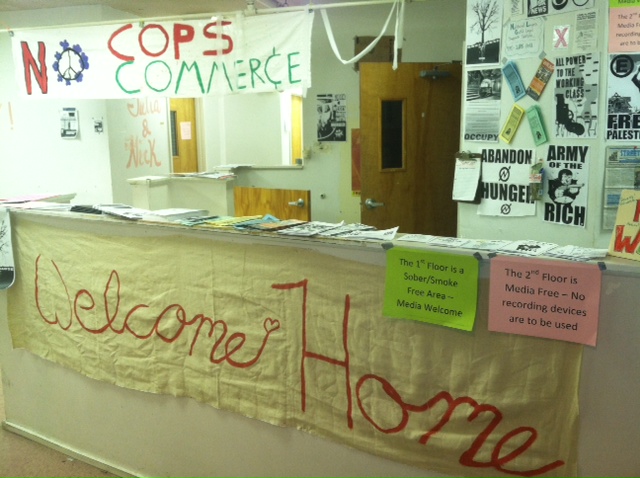
Editor’s Note: Guardian staff writer Yael Chanoff reports from the inside of vacant building that Occupy SF has taken over in hopes of creating a community center.

The inside is mainly filled with people organizing, exchanging ideas, and e-mailing and calling contacts from around the city who may be able to provide assistance for the effort. Many are coordinating for a meeting with the Catholic Archdiocese – which owns this former mental health clinic at 888 Turk Street – that is scheduled to take place this afternoon. A delegation from the Interfaith Council of San Francisco and the National Lawyers Guild are also on their way to building to help plan for the meeting.

A head count last night showed there were about 125 people here. Some have left, but many arrived this morning, leaving about 100 at this point. Various rooms in the building have been organized for different purposes including a welcome desk and information center, sleeping quarters, library, and medical clinic.

Last night, it was a relaxed party atmosphere with groups in every room expressing ideas for the community center and employing strategies for keeping the space. Graffiti art and messages were painted in hallways, a free hot meal was served, and people mostly respected designated composting, recycling, and trash bins. The commune received at least five deliveries of donated pizza.

By 7 am today, occupiers were sweeping, scrubbing and picking up stray trash, as well as painting over most of the message on the walls with white paint. The police are holding a partial line, with barricades blocking the sidewalk on two sides of Gough and Turk streets, and officers are attempting to prevent people from entering the building.

However, they have not blocked off the street and many people have entered by riding up to the entrance in bikes, cars, or simply walking past police. Deliveries of supplies this morning includes breakfast of cereal, milk, coffee and fruit; as well as mattresses and warming clothing.

About 20 people are sitting outside the building in the sun blasting KPOO radio, which made an announcement on air a few minutes ago that it is the soundtrack of the SF Commune. There is a tent set up on the roof, and a group up there doing a coordinated dance number.

There is a general assembly meeting set for 6 pm and most occupiers are hopeful that there won’t be a police raid before then.

Guest opinion: Free Muni for all youth

20

On Tuesday, April 3, the Municipal Transportation Agency board faces a decision between providing free Muni passes for all San Francisco youth or providing free passes to only low-income youth. ComMunity advocates and Sup. David Campos have identified the funding. We are calling on the MTA board to take this opportunity to invest in a new generation of transit riders by establishing free Muni for ALL youth.

The movement to win free Muni passes for youth originated from cuts of between 40 percent and 100 percent to yellow school busses over the next two years.  As a society, we have responsibility to make sure youth can access free public education — and as a city we have a responsibility to get kids to school even as state funding is eliminated.

Right now 60 percent of all trips in San Francisco are taken by car, and for years we have not seen a huge change in transit mode share. If San Francisco wants to meet our climate objectives, we need to take steps now to encourage young people to get out of their cars.  In New York City, a program of free transit passes for youth has created generations of loyal transit riders. In order to truly become a transit-first city, we need to do the same here.

While the struggle to afford bus fare is obviously a larger challenge for very low-income families, due to the high cost of living in the city, there are many working-class and middle-income families who also struggle with the costs of transit for their children. The costs of housing, food, healthcare, and transit add up quickly for San Francisco families and have all contributed to a crisis of family flight out of San Francisco.

San Francisco currently has the smallest child population of any major U.S. city. While this is complex problem, requiring a huge investment in affordable housing and a strategy to bring more working-class jobs to the city, by establishing free Muni for all youth the city can take a very concrete step forward towards making the city more family friendly. Thousands of families would benefit from an extremely modest investment of $8.7 million a year.

The low-income youth and parents who have been at the forefront of this movement advocating for the free youth passes are nervous about their own ability to access a low-income-only pass because of the bureaucratic challenges they experience trying to apply to other government programs. The Muni Lifeline pass for low-income adults is very hard to access, requiring applicants to wait for hours during a weekday at the Human Service Agency headquarters.

The Federal Free School Lunch Program requires parents to provide documentation of income level. Using a means test would be difficult and costly to administer and could exclude some low-income young people — especially those from undocumented families and the children of parents who work in the informal economy. San Francisco should not create paperwork barriers that will prevent our young people from getting to school.

The documentation required now to get youth clipper cards prevents many families from getting them. Immigrant families who do not have copies of all their birth certificates are prevented from getting youth passes when they encounter difficulties getting birth records from their native countries.

With all of those factors, it just makes sense to make Muni free for all youth.

Jane Martin is an organizer with People Organized to Win Employment Rights (POWER).

Breaking: hundreds with OccupySF ‘occupying’ building

40

UPDATE: Representatives of the Archdiocese have made clear that they will not make a decision regarding the building occupation until the morning 

OccupySF, along with at least 400 supporters and homeless advocacy groups, have entered a vacant ’building and plan to turn it into a community center. Participants served a free dinner, unrolled sleeping bags and tacked up posters in rooms marked “sleeping quarters” by organizers, and are currently meeting to decide next steps.

“Occupy San Francisco and Occupy Oakland originally were providing food and shelter to those who didn’t have it previously. That’s the plan I think, to provide food, shelter and a space for political organizing,” said protester Samantha Levens, 33, a deckhand on the Alameda-Oakland Ferry. 

The building, 888 Turk, is the former site of Westside Mental Health Center and has been vacant since the closure of that mental health clinic about five years ago. It is owned by the Archdiocese of San Francisco.

It is available for lease through HC&M Commercial Properties.

About 400 marched to the building at 4:30pm, trailed by an former AC Transit decorated and converted to a protest-party vehicle by Occupy Oakland. The march had the air of an April Fools Day Carnival, complete with clowns, jugglers, and a man dressed as Captain America alongside people with bandanas and Guy Fawkes masks. Protesters marched from Union Square on Geary, chanting “homes not jails” and ”housekeys not handcuffs.”

The march followed a rally in Union Square, in which homeless advocates from Berkeley, Oakland and Sacramento spoke to the crowd, and performers including the Mixcoatl Anahuac dance group and the Brass Liberation Orchestra kept the mood festive.

The protest was part of a national day to defend the rights of the homeless with protests in 17 cities. Paul Boden of the Western Regional Advocacy Project, which planned the Union Square protest, spoke speficically about Business Improvement Districts in San Francisco, which he claimed funell property taxes to businesses at the expense of the homeless.

When the march arrived at Turk and Gough, the site of the building, it had already been unlocked from the inside, and protesters on the roof held a sign reading “organize or starve.”

About 40 police officers provided an on-foot escort for the march. Officers as well as several police vehicles are currently standing by the “occupied” site, and declined to provide comment at this time. 

An OccupySF-associated building takeover occurred Jan. 20 just a few blocks away at the former Cathedral Hill Hotel. At the request of the building’s owners, police entered the building, and no occupiers remained the following morning.

“Occupy SF through the OccupySF commune has inhabited a vacant building for the purpose of creating a community center in the spirit of the buildings original intention, to create a center for health and healing,” according to a press release issued by the group.


Does Malia Cohen want to dump Potrero Hill?

27

Since the dawn of district elections in the 1970s, Potrero Hill and Bayview have been part of the same district. Of the four supervisors elected to represent that district — Bob Gonzalez and Doris Ward the first time around, Sophie Maxwell and Malia Cohen after the return of district elections — three have come from Potrero Hill. All three also won substantial votes from Bayview Hunters Point.

But now Sup. Cohen apparently wants to kick Potrero Hill out of District 10.

At the Redistricting Task Force meeting March 29, Cohen appeared in person, and during public comment said that she wanted to see the Portola district added to D10. That’s a huge change — under most of the proposals floating around, Portola would go into D9. Cohen did not directly address the obvious, inevitable impact of her suggestion, but it’s clear that if Portola goes into D10, Potrero Hill will have to go somewhere else. That’s simple math.

The immediate political impact would be to make D10 more conservative — and stick more of the progressive Potrero voters into either D6 (which would then have to sluff off what — more of the Mission into D9? The Tenderloin into D3? What a mess.)

The folks on Potrero Hill don’t seem happy about this at all. Tony Kelly, a longtime hill activist (who ran against Cohen for supe last year) sent out the following:

With her comments last night, Supervisor Cohen took the side of the real estate industry, and against her constituents on Potrero Hill. The real estate industry has demanded this exact exchange of Portola for Potrero at every Task Force meeting since early January, as part of their plan to re-shape the Board of Supervisors. Neighborhood residents and organizations from Potrero Hill, Bayview, Portola, and elsewhere have been speaking against it at the same meetings.

The real-estate industry wants, of course, to force as many progressives as possible into as few districts as possible, to try to make it easier to elect conservatives from D10, D11 and D1, to go with the moderate/conservative bloc already in D2, D4, and D8 — and guess what? Six vote majority.

I’ve been trying all day to reach Cohen in her office and by cell. So far no response. I’ll let you know if she calls me.

SFMTA seeks more parking meter revenue to balance its budget

49

San Francisco Municipal Transportation Agency staff and Director Ed Reiskin today unveiled a two-year budget proposal that avoids Muni fare increases or service cuts and directs more money to address the transit system’s deferred maintenance needs, but it relies on substantially increasing parking meter revenues in ways that have been tough sells before.

In addition, the budget proposal – which will be considered by the SFMTA Board of Directors on Tuesday – is seeking labor concessions to lop off another $7 million, which will still need to be negotiated with the militant Transport Workers Union Local 250A. That won’t be easy, but Reiskin made a good first move by recently canning 10 of the agency’s top-paid executives en route to saving $2 million per year just in management salaries.

But the parking meter proposals are likely to stir a hornet’s nest of angry motorists who have come to expect free street parking. Reiskin is proposing to eliminate the free parking on Sundays, making drivers pay for parking between noon and 6 pm. And he wants to add another 500 parking meters.

Both are good ideas for an agency that desperately needs the money, and it has done studies showing that businesses and motorists would benefit from the charges making parking spots more readily available. But each time the SFMTA has tried to implement these proposals – trying to do Sunday meter hours in 2009 and trying to add hundreds of new meters in the Mission and Potrero Hill earlier this year – the torches and pitchforks came out and agency officials sulked off to lick it wounds.

But Reiskin says this is what the city needs to do. An SFMTA press release labels the proposals “modernizing antiquated parking policies, and Reiskin says, “While we’ve made tough decisions in order to develop a responsible, balanced budget, we are doing everything we can to avoid fare increases and service cuts. These proposals reflect our commitment to the city’s Transit First policy and allows for improvement in all modes of transportation.”

Of Monsters, Men, and Me

3

Editor’s Note: California is transferring many prison inmates to jails in their counties of origin, a process known as Realignment that will impact the San Francisco Sheriff’s Department. Mayor Ed Lee removed the elected head of that department last week, and the process for determining whether Lee acted appropriately could take months. With that context in mind, we present this inside look at Realignment by Eugene Alexander Day, a third strike inmate at Soledad Prison who will be writing occasional articles about prison life for the Guardian.

A perfect storm is brewing. An unparalleled crisis in corrections is exacerbated by an even worse economy. As a reform-minded inmate buried under a life sentence, it feels like hope is on the horizon. Judicial oversight is the cornerstone.

Due to a murderous and unconstitutional medical department, the Supreme Court implemented a population cap on the California Department of Corrections and Rehabilitation (CDCR). December marked the first of four benchmarks. By mid-2013, the prison population must be brought down by 33,000 inmates.

In response, the Legislature passed Prison Realignment (AB 109), which started in October. Once the dust of Realignment settles, state facilities will become the sole domain of real criminals. Serious and violent offenders, called “strikers,” must serve 80 to 85 percent of their sentences. The rest of us are serving life sentences for third strikes, murders, or other violent crimes.

Under Realignment, the counties will maintain custody of those eligible for day-for-day time credits, called “half-timers,” which includes parole violators. For years, experts have been calling for such a shift. Stemming the flow of parole violators and nonviolent, non-serious, and non-sexual offenders, called the three “nons,” is the first real attempt by the state to do the right thing.

By ignoring the evidence for so long, austerity measures and public safety are extremely difficult to reconcile due to judicial oversight. In 2007, Gov. Schwarzenegger convened an expert panel that crafted a road map of rehabilitative recommendations to address overcrowding. The state’s other expert panel, the socially irresponsible Legislature, instead chose to double-down on a bad bet.

Under the banner of building more prisons, underscored by sending inmates out-of-state, some of Schwarzenegger’s panel’s rehabilitative recommendations were codified as unfunded mandates. When the economy took a dive in 2008, the state lawyered up – and got its ass kicked in court.

It took some of the sting off my life sentence when the Supreme Court smashed the CDCR in 2011. Systemic mismanagement corrupted a generation of salvageable prisoners. As someone who lives, breathes, and sleeps the politics of justice, the Legislature didn’t simply kick the can down the road – it pushed the state closer to the precipice. State leaders have set a poor example. By failing to follow the evidence in 2007, all 58 counties had Realignment shoved down their throats in 2011.

This lens through which I see the world is depicted as “synchronized drowning” by Attorney General Kamala Harris. For the last 13 years, I’ve struggled to keep my wits in this sea of despair. Deviants need structured treatment, not more of the same. Shifting the responsibility of tens of thousands of offenders away from CDCR is an idea of brilliant simplicity.

Local law enforcement, prosecutors, and the courts are better suited to solve local problems. These offenders are members of your community. The next time the task force stomps through the ghetto snatching up people of color, they must think about how to house all of these people of imperfection. Good. Most need help, not a jackboot.

To continually be considered part of this particular problem is unacceptable. In her book Monster Factory, Sunny Schwartz opined that everyone from civilians to officers to prisoners “were collaborators in a system that accepted and invested in failure.” No one is exempt. Everyone is to blame. Lives are at stake.

Both Schwartz and Harris describe jails and prisons as crime colleges. I feel like I received tenure in the worst-performing school district in the nation. Untreated criminogenic factors give serious offenders the artistic license to develop unholy subsocietal norms. We sow the seeds of recidivism when low-risk offenders are subjected to our gangbanger, dope-fiend bullshit. Parole violators and the three “nons” are low-hanging fruit: easy to treat and even easier to corrupt.

The counties might hate Realignment, but I hate the fact it took so long. Marking a happy day in this collaborator’s miserable life, a whole class of offenders have been diverted away from the Monster Factory. Excellent. Realignment is not some hug-a-thug program. It’s basic math. So used to being treated like shit, I will die before I advocate for mollycoddling prisoners. Using offenders as earmarks to maintain an unsustainable status quo is a feeling worse than death. Fix the problem.

My dreams are skewed. In my way of thinking, prisons should become factories that turn monsters into advocates for social justice. Offenders need to learn the difference between pro-social and antisocial behavior, not how to shove dope up their asses or participate in a riot.

District attorney distances self from anti-cannabis memo, ‘unequivocally supports medical marijuana’

4

Don’t believe everything you read, especially when it comes out of the District Attorney’s office. D.A. George Gascon’s press representative Stephanie Ong Stillman says a memo covered in this week’s Herbwise column circulated earlier this month outlining the “continued illegality of selling marijuana” — even in state regulated cannabis dispensaries — was sent out without Gascon’s knowledge and “does not represent his views on medical marijuana.”

“He unequivocally supports medical marijuana,” Stillman told the Guardian on the phone this afternoon. “Prosecuting illegal marijuana sales is not a priority.”

This is — unequivocally — good news for San Francisco’s medical cannabis patients. The memo (signed by assistant district attorney John Ullom) stated that cannabis dispensaries were acting under protection of state law were perpetrating “a marijuana mega-myth.” According to the East Bay Express, it was released in response to indignation expressed by an unnamed dispensary’s deliveryperson was apprehended by law enforcement. 

But Stillman says the brief was written over three years ago, before Gascon was elected to office. Calling it “a template brief,” she says it’s not the first time the memo has been circulated in response to legal questions about cannabis — but that it has not been since Gascon has been in office, and will not be used again under his administration. 

But what of today’s headline of the SF Examiner, a quote presumably attributed to Gascon reading “all sales of marijuana are illegal”? 

“It’s a misquote,” says Stillman. “They’re going to print a correction.”

UPDATE: The Guardian just recieved a call from Gascon himself, who confirmed Stillman’s comments, saying “I’ve already taken steps to make sure that this will not happen again.” Can we just say we’re pleased as punch that he’s upholding the values that he shared with us in his Guardian endorsement interview last September?

UPDATE: Although felony charges against the deliveryperson who was initially apprehended have not been dropped, Gascon’s office has filed for a two-week continuance.

Four hours in Mendell Plaza

5

Everyone stops what they were doing and ducks behind the plastic tables set up on the sidewalk. Flyers and  packaging rustle in the wind. There’s no yelling or chaos, but three police cars speed onto the scene from three different directions. 

I had been at Feed the People Day all of thirty seconds before gunshots were fired.

Feed the People Day, an international effort in which people get together to share food in black and poor communities from Australia to South Africa, was on its fourth year, and organizers from Bayview were joining in. 

A few minutes after the gunshots, we all get up from behind the table. “God is good,” one volunteer says. “That could have been us.”

The volunteers get back to serving food.

“It’s a typical day in the life,” says Jameel Patterson, one of the volunteers serving food. “Not every day. But every so often.”

They chose to set up at Mendell Plaza. It’s full of people, a common place to spend free time. It’s next to the Bayview Opera House, which holds frequent events, as well as a complex that includes a gym, elementary schools, a playground, and a 300-person auditorium. Those buildings don’t hold many events, though—they’re mainly used for storage by the school district.

Mendell Plaza is directly off the T train, whose installation was supposed to bring prosperity and foot traffic to Bayview. But most of the businesses on the few blocks surrounding the plaza are still boarded up. And this T stop has become well known for a different reason: it was here that Kenneth Harding, Jr, exited the train July 16, ran away after police asked for his transfer, got shot in the back and died.

And it was in Mendell Plaza that police stood around the bleeding Harding for 30 minutes, allegedly denying him medical care, before he died.

Tracey Bell-Borden, one of the organizers of Bayview’s Feed the People Day, wants to rename the spot Kenneth Harding Jr. Plaza. 

Fly Benzo, a musician and college student who has become well known after speaking out for Harding and a subsequent arrest–again at Mendell Plaza– while filming police, was a block away when the shots were fired. He was trying to take a young girl that he was looking after inside the gym to play. It was, inexplicably for a Sunday afternoon, locked.

“It’s never open,” said Benzo. “Where are we supposed to take our kids so they can be inside?”

The police, whose lightning-quick response time implies that they had a tip—according Patterson, it generally takes them 15 to 17 minutes to respond to gunshots– haven’t found a gun yet. Most of them are standing around three teenagers who, bystanders insist, were on the sidewalk doing nothing when the gunshots went off. The police run their IDs and take them to jail; probably on a gang injunction. 

20 minutes have gone by before a cop drives up to the tables. “What organization are you with?” he asks.

Bell-Borden replies, “the Kenneth Harding Foundation.” Denika Chatman, Harding’s mother who moved to San Francisco after his death to try and find out more details surrounding its circumstances, asks “do you have a contribution?” the cop gets back in his car and speeds off. 

“They didn’t want to know, is anyone here hurt? Are you guys OK?” says Patterson.

One man says he saw the smoke when the shots went off, directly behind him. The police rolled right past.

Patterson tells a story of the past Friday night, when lots of people had been out in Mendell Plaza. When one teenager who was playing with a remote control car accidentally steered it onto the street, a police officer pulled up and ran his ID.

Despite some dangers, neighbors continue to congregate in Mendell Plaza, and Bell-Borden says she is planning on turning Feed the People Day into a monthly event; the next date will be April 15.

Dewayne Isaacs, a community organizer who grew up in the Fillmore and Haight-Ashbury and had several Black Panther relatives killed in the 70s, says he, for one, will keep coming back for it.

“It’s us Bay Area natives,” says Isaacs. “We always fight back.”

Another perspective on the Mirkarimi case

34

We have an interesting opinon piece in this week’s paper by a close friend of Eliana Lopez, the wife of Sheriff Ross Mirkarimi. It gives a very different perspective on the situation than we’ve seen in the media so far. You can read it here.

Bay Area media merger approved, pending okay from AG

2

The Center for Investigative Reporting (CIR) and the Bay Citizen today approved a merger that would consolidate the media organizations into a single newsroom, eliminating its breaking news coverage of San Francisco but seeking to generate local news stories from the data-heavy reporting of CIR’s California Watch and figure out what’s next for the journalism industry.

The merger requires approval from the California Attorney General’s Office because of potential anti-trust issues, with approval becoming final if AG Kamala Harris doesn’t object within 20 days. Although it was announced as a merger by both organizations, the Bay Citizen reported that it’s really an acquisition given that CIR will run the combined organizations under the leadership of Phil Bronstein, the CIR Board President who served as editor of the Examiner and the Chronicle before spearheading this merger.

CIR Executive Director Robert Rosenthal, who will oversee the combined newsrooms, confirmed to us that CIR will play the lead role, but he emphasized the complimentary aspects of the two organizations. “They have strengths we don’t have in terms of membership and local brand,” he told us, noting the Bay Citizen’s website will be a local portal and “a way to send people to other stories that we’re doing.”

Membership-based fundraising has been Bay Citizen’s strong suit since the late financier Warren Hellman launched it as the Bay Area News Project in late 2009 with $5 million in seed money, raising more than $17 million since then. The Hellman family and Bay Citizen Board Chairman Jeff Ubben have also reportedly committed to give another $4 million as part of the merger.

Bay Citizen has broken some important stories since going live in 2010, although it has recently suffered from a leadership crisis after resignations from two consecutive editors and then its CEO, who had clashed with the journalists there. While welcoming the leadership of a respected editor like Rosenthal, one Bay Citizen source told us that many in the newsroom are disappointed that they’ll no longer be covering breaking news.

“We’re not going to be a breaking news organization,” Rosenthal told me, confirming the report. “But it does not mean we’re not going to be a lively site.”

So while the Bay Citizen may stop doing stories on City Hall meetings, developments in political scandals, and spot news stories likes fires and crimes, Rosenthal said the intention is still to do “accountability reporting” that would provide strong local coverage. “I would hope that what we’re doing as for as covering City Hall would be more in-depth,” he told us.

Jonathan Weber, Bay Citizen’s first editor who now serves as West Coast Bureau chief for Reuters, said it’s not clear how the new approach will work but he thinks strong local news coverage is important. “It was my view when we started the Bay Citizen that if you’re going to be a news site that it be very vibrant and give a sense of what’s happening around the Bay Area on a timely basis,” he told us.

But he doesn’t want to second-guess the decisions CIR is making, telling us, “The Bay Citizen has a bigger mission than it had resources to accomplish it, so making a decision about what you’re going to do and not do is appropriate.” Yet he believes the Bay Area is underserved with strong local news coverage, “so to the extent that goes away, it will be a loss.”

Still to be determined is whether Bay Citizen will continue providing semi-weekly content for the New York Times, an agreement that immediately elevated the stature of the media startup. Some local journalists say they fear the merger will mean less local journalism, which has already been hit hard by corporate media consolidations and layoffs.

Bay Citizen reports that Tom Goldstein, interim dean of UC Berkeley’s School of Journalism and the only journalist on Bay Citizen’s board, resigned in the last couple weeks after being the only board member resisting the merger. Calls and emails to Goldstein were not immediately returned, but I’ll update this post with his comments if and when I hear back.

The other aspect of this merger that may be troubling to some is the leadership by Bronstein, a controversial figure who led the Examiner and then the Chronicle through a era of major downsizing by Hearst Corp. Bronstein wasn’t available today, but when I asked him about the issue in February, he defended his local record and blamed cuts to local journalism on corporate decisions and general industry trends.

He also said, “I don’t know that I’m the best person to take it over. That’s something other people should determine, not me.” Yet the Bay Citizen’s coverage of merger indicates its board asked Bronstein to be its president – he was already president of the CIR board – and that he declined but suggested the merger as an alternative and has been working to make it happen.

Rosenthal, a longtime journalist who worked under Bronstein for years at the Chronicle, said they work well together and that Rosenthal has always felt supported in doing good journalism. Under the merged entity, Bronstein and Rosenthal will reportedly get the same salary, a little more than $200,000, and Rosenthal will focus on the newsroom while Bronstein focuses on the donor base.

As we reported in February, Rosenthal has had to expand on his journalism skill sets in recent years as he successfully sought foundation funding to beef up CIR’s news-gathering operations and launch California Watch, which partners CIR with media outlets around the state to do investigative reporting and statehouse coverage.

“Our merger with The Bay Citizen announced today puts us in a unique position as journalists, innovators, technologists and, yes, entrepreneurs. I worked in newspapers for decades, starting as a copy boy and ending up as the top editor. No one ever strung those four words together to describe what we were as an organization,” Rosenthal wrote today in blog post describing the merger. “But to survive, thrive and evolve, the journalism, the innovation, the technology and the entrepreneurial vision all have to be intertwined in the new model.”

That sense of trying to create a new model for the journalism industry – which has been decimated in recent years, hindering its ability to play a watchdog role in a country founded on the importance of a free press – seems to dominate in the comments coming out of each news organization, emphasizing new ways of funding, covering, and delivering the news.

“We are bringing together two Bay Area enterprises with very complementary strengths,” Bronstein said in the press release. “They are both devoted to protecting justice and democracy through great, engaging journalism.”

But what that looks like, whether it’s sustainable, and how it is going embraced by Bay Area residents remain open questions as the merged newsrooms struggle to work together and resolve outstanding issues. Or as Rosenthal told me, “This is going to evolve.”

The FBI spies on mosques

2

The FBI has been sending agents to mosques in California and filing intelligence reports without any suspicion of criminal activity, records obtained by the ACLU, the Asian Law Caucus and the Bay Guardian show.

The records, obtained under the federal Freedom of Information Act, show agents engaged in what the FBI calls its “mosque outreach” program gathering intelligence on the content of sermons, mosque finances and such mundane things as the sale of date fruit.

The agents apparently weren’t working undercover — in fact, in one instance, an FBI agent met with worshippers after a service and “handed out FBI pens.”

But the information collected — none of which has anything to do with any criminal activity or threat of criminal activity — was filed as “positive intelligence,” meaning the data would be maintained in the FBI’s intel files. Some of it was marked “secret” and distributed outside the agency.

Among other things, the records show that federal agents collected the names of congregants, the names of religious leaders, and the level of financial support individuals were giving to various mosques.

In one instance, FBI agents used a worshipper’s cell phone to run electronic checks on him.

As the ACLU notes:

Categorizing information about religious beliefs, practices, and otherwise innocent activities as “positive intelligence” could have very serious negative consequences for Muslim groups and their congregants. FBI agents accessing this information in intelligence files would assume it was relevant to the FBI’s investigative and intelligence mission, casting a cloud of suspicion over the group or individual mentioned and potentially leading to more intensive scrutiny or investigation. The dissemination of this “positive intelligence” outside the FBI would only increase the likelihood that other law enforcement or intelligence agencies would investigate innocent groups or individuals based solely on their religion.

You can download the ACLU report and the records here (pdf), and an earlier report on “mosque outreach” here. I’ll be updating this information as I go through the individual files.

Mirkarimi files court petition challenging his suspension

31

Suspended Sheriff Ross Mirkarimi and his new attorney, David Waggoner, today turned to the courts for help, alleging in a petition that Mayor Ed Lee abused his discretion in suspending Mirkarimi without pay, deprived him of due process rights, and relied on untested language in the City Charter that they say is unconstitutionally vague.

They are asking the court to reinstatement Mirkarimi pending official misconduct hearings that would take months, or to at least allow his family to continue to receive his $199,000 salary. “It makes it more difficult for the sheriff to fight these charges when he’s suspended without pay or due process,” Waggoner told us, adding that he expects a hearing to be scheduled in two to three weeks.

Mayor Lee brought official misconduct charges against Mirkarimi a week ago and since then has refused to answer questions about the issues his action raises (which we explore in this week’s Guardian). Among those issues is whether Mirkarimi’s plea to a misdemeanor count of false imprisonment, involving a conflict with his wife, relates to his official duties and rises to the level of official misconduct.

The city’s last official misconduct proceedings, brought in the 1970s against Airport Commissioner Joe Mazzola, was overturned by the state Court of Appeal, which found that Mazzola’s actions (refusing to order striking plumbers in his union back to work) weren’t related to his official duties. Waggoner relies on that ruling in arguing Lee abused his discretion.

“The official misconduct must occur while the official is in office and be directly related to that office,” the brief contends, noting that the alleged domestic violence incident occurred before Mirkarimi was sworn in a sheriff.

In suspending Mirkarimi, Lee relies on new official misconduct language since the Mazzola incident, during the last charter overhaul in 1995, when catch-all language was added banning, “conduct that falls below the standard of decency, good faith and right action impliedly required of all public officers.”

Waggoner says that is unconstitutionally vague and he is seeking to have the court invalidate it. “Ultimately, it’s a legal issue at this point,” Waggoner told us. “Is what the mayor accused Ross Mirkarimi of official misconduct or not?”

The America’s Cup meltdown

24

The America’s Cup Event Authority — the operation that Oracle CEO Larry Ellison set up to run the business side of his personal yacht race — is melting down, laying off half its staff and scrambling around for new leadership as projected revenues continue to slide and the ultimate size and impact of the event remains in question.

The once-glorious event that was going to be almost as big as the Super Bowl and the World Cup is now shrinking, and the billions of dollars that were going to come in are looking more and more dubious. Doesn’t mean it won’t happen; the races will go on, because Ellison’s pride is involved, but attendance may be lower than expected.

And the net gain to the city could be limited. A new report by Budget Analyst Harvey Rose (pdf) notes that if the America’s Cup Organizing Committee doesn’t raise the $32 million that it’s supposed to dredge up, then the city could wind up losing $11 million on the deal.

Here’s the problem with that scenario: Mark Buell, the head fundraiser for the ACOC, has to go to rich people and ask them for money. But the really rich person behind this event, Mr. Ellison, hasn’t chipped in a penny to that fund — and now it appears that money raised by sponsorships will go to pay Ellison back for the money’s he’s spent on his racing team.

Poor Mark. He has to ask people for money to subsidize the sixth richest person on the planet. And if he can’t pull it off, the city ends up with the tab.

Good luck with that.

Does electrifying Caltrain really help high-speed rail?

36

Mayor Ed Lee and other regional political and transportation officials are celebrating this week’s agreement to take bond money approved by state voters for the California High-Speed Rail Project and apply it to electrifying the Caltrain’s tracks up the peninsula, which has long been a goal for that troubled transit agency. Electrification will lower operating costs, reduce noise, and be better for the environment.

“Electrifying Caltrain as an early investment and extending Caltrain into the heart of downtown San Francisco at the new Transbay Transit Center are essential for the success of high speed rail and the future economic growth of our region,” Lee said in a prepared statement released yesterday.

Yet his office didn’t respond to questions about how the new agreement – which will apply $700 million in high-speed rail bond money from Prop. 1A to the $1.5 million electrification project, arguing it lays the foundation for high-speed trains to come later – will help the Transbay Terminal. That project needs to come up with the more than $2 billion for the 1.2-mile tunnel from the current Caltrain station at 4th and King streets to bring the trains downtown. The mayor’s press release argued only that it would “provide the momentum upon which to build the Downtown Extension to the Transbay Transit Center.”

Transbay Terminal Joint Powers Authority spokesperson Adam Alberti called the latest agreement “a big deal for transportation” and told us, “The MOU agrees that the early investment of Prop 1A funds should be placed on the electrification of Caltrain.” Even though it doesn’t give money directly to Transbay Terminal, Alberti said it advances a project in which that station is the designated terminus and it frees up future transportation funding for the needed tunnel.

But Quentin Kopp, who launched the high-speed rail project as a state legislator in the ’90s and until recently served on the project’s board, said this latest agreement doesn’t help Transbay Terminal (which he has derided as little more than a real-estate deal) and it represents a violation of Prop. 1A and other high-speed rail provisions.

“Here’s a pot of money and everybody wants to steal from it,” said Kopp, who has criticized recent changes in the high-speed rail plan, such as San Francisco-bound passengers having to transfer to Caltrain in San Jose rather than coming directly into San Francisco and how Caltrain’s tracks limit how many trains can run per hour, hurting the overall project’s financials. “It’s hardly the project that was envisioned.”

As we reported in January, the high-speed rail project has been working to overcome doubts and attacks by fiscally conservative politicians here, in Sacramento, and in Washington DC. And this latest agreement helps overcomes Caltrain’s deep fiscal problems and the opposition of many peninsula politicians and neighborhood groups to creating a larger and more robust high-speed rail line up the peninsula.

5 PM UPDATE: Lee Press Secretary Christine Falvey just responded to my inquiry and said, “The region is pursuing funding the $1.5 billion Downtown Extension through a combination of additional sources, including New Starts, and we expect to announce additional good news on this front soon.” It’s unclear why there is a discrepancy between Alberti’s figures and Falvey’s. Lee has pledged to make a priority of ensuring the train extension to Transbay Terminal gets built.

Parents in San Francisco: we want justice for Trayvon Martin

66

“If I had a son, he’d look like Trayvon,” President Obama reflected today. In the wake of Trayvon Martin’s death, said Obama, “I can only imagine what these parents are going through.”

Martin, a black 17-year-old walking back to a family friend’s home in a gated community in Sanford, Florida was killed Feb. 26. His killer shot him after pursuing him in his car, and then on foot. 911 tapes and a confession from the killer, George Zimmerman, confirm his guilt. But no jury has had the chance to decide the case, as police have refused to so much as arrest him.

This remains true, even after Sanford police chief Bill Lee Jr stepped down temporarily in response to a nationwide outcry.

Police say that, at the scene, Zimmerman told them he was acting in self-defense. 

“Mr. Zimmerman provided a statement claiming he acted in self defense which at the time was supported by physical evidence and testimony. By Florida Statute, law enforcement was PROHIBITED from making an arrest based on the facts and circumstances they had at the time,” (emphasis theirs) said the chief in a statement yesterday. 

The killing, which has been called a case of “walking while black,” has ignited a call for justice throughout the country.

This call was made March 21 in San Francisco, when hundreds gathered downtown after a protest organized just two days earlier.

At  6 p.m. in Justin Herman Plaza, 500 held candles and listened as parents of black sons murdered in the Bay Area spoke.

Cephus “Uncle Bobby” Johnson, whose nephew, Oscar Grant, was killed by BART police officer Johannes Mehserle in 2009, expressed his support to Martin’s family.

“He was only 17. His life was taken away from him. This murder of Trayvon is very personal to me,” said Johnson. “It’s another baby gone.”

He added that, if Zimmerman is not arrested by Sunday, he plans to fly to Florida. 

“My wife and I will be on a plane to support the community.”

“It’s our kids who are going through this thing. If we don’t stand up for them, who will,” said Denika Chatman. Her son, Kenneth Harding Jr, was killed by police in July 2011. He was 19 years old.

The parents of James Rivera, Jr, who was 16 when he was killed by police in July 2010 in Stockton, also spoke to the crowd. 

“The pain still feels like it was yesterday,” said Rivera’s mother, Dionne Smith-Downs. “It’s been almost two years and we’ve received nothing. They didn’t even tell us why they shot our son.”

Many speakers asserted that, had the races been switched in the Martin case, law enforcement would likely have immediately arrested the perpetrator and he would likely be charged by now. Both first degree murder and felony murder are punishable by death in Florida.

In the United States, persons convicted of killing whites are four times more likely to be sentenced to death than persons convicted of killing African Americans. 

Hundreds then marched up Market Street. Many held signs reading “In loving memory, Trayvon Martin: 1995-2012.” Many wore hoodies, the garment that apparently made Martin appear “suspicious” to Zimmerman. 

Chants included “we are all Trayvon Martin,” “protect and serve, that’s a lie, they don’t care when black kids die,” and ‘Zimmerman: guilty. The system: guilty.”

The group then marched to UN Plaza, gaining supporters, including handfuls of passers-by and shoppers on every block. By Sixth Street the group was 700-strong.

Mourners then created a memorial for Martin at the foot of a pillar in UN plaza inscribed with the Universal Declaration of Human Rights. Thousands in New York City also marched to the UN March 21, and the national call coincides with the UN’s International Day to End Racial Discrimination.

At the memorial, silence fell over the crowd when organizers called for participants to speak the name of anyone killed by the racism. In a chilling ceremony, many spoke, naming Sean Bell, Emmett Till, Nat Turner, Ramarley Graham, Fred Hampton, Troy Davis, Tookie Williams, and dozens of other black men killed in the United States spanning slavery, Jim Crow, the civil rights era and today.

Speakers demanded the immediate arrest of Zimmerman. But many maintained that arresting the killer in this case may not prevent “the next Trayvon Martin.”

“When Oscar was killed we said, we must work, because we cannot have another Oscar Grant. Now, we have another Oscar Grant. And there will be another one,” said Johnson.

Several mothers, many of whom did not give their names, spoke of the fear they feel for their children when they walk the streets, not knowing whether they will be the next victim of a racist crime.

“They don’t care when people kill our babies. We have to fight and stand up for our own people and for our children,” said one mother. 

Lee’s charges against Mirkarimi leave questions unaddressed

159

UPDATED BELOW WITH “RESPONSE” FROM LEE’S OFFICE: Sheriff Ross Mirkarimi was formally suspended today and served with “Written Charges of Official Misconduct” that for the first time outline why Mayor Ed Lee believes Mirkarimi should be removed from office, although they leave unaddressed many questions that Lee has been so far been avoiding answering.

The eight-page legal document prepared for Lee by the City Attorney’s Office briefly lays out the process (a hearing before the Ethics Commission, its recommendation, then action by the Board of Supervisors within 30 days thereafter) and the definition of official misconduct, focusing on this phrase: “conduct that falls below the standard of decency, good faith and right action impliedly required of all public officers.”

That vague language is fairly new and has never been considered or interpreted by any court, and the city acknowledges there are at least “two reasonable interpretations” of its meaning: “This phrase could be either (a) an example of misconduct that, by definition, relates to the duties of all public officers, or (b) an independent, alternative category of official misconduct that does not require a connection to an officer’s official.”

Lee’s attorneys argue that they don’t think a direct connection to an official’s duties is required, but they acknowledge that’s how it could be interpreted, so they try to make that connection as well, often by relying on evidence and testimony that hasn’t been vetted by the courts or by making connections likely to be challenged by Mirkarimi’s new attorney, David Waggoner.

The document recounts the “Wrongful Conduct by Sheriff Mirkarimi,” starting with his “acts of verbal and physical abuse against his wife, Eliana Lopez” on New Year’s Eve, continuing through the criminal charges filed against him on Jan. 13 with a focus on allegations that he dissuaded witnesses and “encouraged them to destroy evidence” and with his March 19 sentencing for false imprisonment, concluding the section with a reference to the newspaper quote from Don Wilson, president of the San Francisco Deputy Sheriff’s Association, that the plea had hurt morale in the department.

The DSA actively opposed Mirkarimi’s election, just as it did his predecessor and mentor, Michael Hennessey, in every contested election in the legendary progressive sheriff’s 32-year career, so it seems a little strange to rely on such a self-serving assessment. But that isn’t the only point that raises questions and potential challenges, particularly as they try to argue that Mirkarimi’s actions related to his official duties.

Part of Mirkarimi’s sentence included one day in jail, for which the judge said his booking qualified, meaning that he never actually was inside a cell. But Lee’s attorneys argue without explanation that, “Sheriff Mirkarimi’s one-day sentence to county jail undermines his ability to receive inmates and to supervise the County jails.” It certainly didn’t seem to for former Sheriff Dick Hongisto, who was jailed for several days after being held in contempt of court for refusing to carry out the International Hotel evictions, but who never faced sanctions from the mayor.

The first and seemingly strongest connection it makes between his actions and official duties listed was, “Sheriff Mirkarimi misused his office, and the status and authority it carries, for personal advantage when he stated to Ms. Lopez that he could win custody of their child because he was very powerful,” a charge taken from the videotaped testimony that Lopez gave to his neighbor Ivory Madison.

Lopez’s attorneys have noted that she made the video to paint Mirkarimi as abusive in case there was a custody battle, as she says on tape, and that she was seeking confidential legal help from Madison and never intended for it to be released. But her and Mirkarimi’s attempts to retrieve it are labeled in the charges as efforts to “encourage the destruction of evidence regarding criminal activity,” which they argue also relates to his duties as a law enforcement officer. This issue is likely to be a matter of serious debate during the Ethics Commission hearing.

Finally, the document argues that because the Sheriff’s Department can enforce protective orders in domestic violence cases and funds programs for domestic violence perpetrators – and because it sometimes interacts with the Adult Probation Department, given Mirkarimi’s three-year probation – that the charges directly relate to his official duties.

Clearly, these are complicated issues that raise a variety of questions, which is why it was disconcerting yesterday when Lee announced the charges to a room packed with journalists and refused to take any of our questions. City Attorney Dennis Herrera didn’t speak at all, simply standing behind Lee looking stone-faced and perhaps a bit uncomfortable.

Earlier today, I sent Lee and his Office of Communications a list of questions that I think he has a public obligation to address given the drastic action that he’s just taken against an elected official. I haven’t received a reply yet, but I’m including my comments here for you to consider as well:


I was disappointed that Mayor Lee took no questions during yesterday’s press conference, because I had several that I’m hoping you can address for a long story we’re writing on the Mirkarimi affair for our next issue. I’m hoping to get answers by the end of the workday on Friday.
– Will Mayor Lee release the memo he received from the City Attorney’s Office on Ross Mirkarimi and whether his crime rises to the level of official misconduct? [Note to reader: That advice memo is different than the charges I discuss above.] It is solely under Lee’s authority to waive attorney-client privilege and release the memo, as even Willie Brown urged him to do in his Chronicle column on Sunday. And if he won’t release it, can he explain why?
– Lee told reporters last week that he would explain why Mirkarimi’s action rise to the level of official misconduct if concluded they did, but Lee didn’t offer that explanation yesterday. Why does Lee believe actions that Mirkarimi took before assuming office, which were unconnected to his official duties, warrant his removal from office? Is Lee basing his decision primarily on the crime Mirkarimi committed on New Year’s Eve or his actions and statements since then? What specific actions or statements by Mirkarimi does the mayor believe rise to official misconduct?
– Why didn’t Lee consult with Eliana Lopez or her attorney before making this decision? None of the purported evidence in this case has been scrutinized by the courts as to its veracity or completeness (that would have happened at the trial). The only two people who know for sure what happened that night are Ross and Eliana, so why hasn’t Lee asked either of them what happened?
– Why did Lee set a 24-hour deadline for Mirkarimi to resign or be removed? Did Lee offer Mirkarimi anything in exchange for his resignation, such as another city job?
– Who did the mayor consult with about whether Mirkarimi should be removed before making this decision? Were any members of the DSA or SFPOA consulted? How about Rose Pak or other members of the business community? How about Michael Hennessey? Did he seek input and advice from John St. Croix or anyone from the Ethics Commission?
– It’s my understanding that the mayor wasn’t required to remove Mirkarimi from office without pay pending his official misconduct hearings, that Mirkarimi could have either remained in the job or been suspended with pay. Why did Lee feel a need to place this additional financial pressure on Mirkarimi to abandon the office that voters elected him to? Is he concerned about the impact of his decision on Eliana Lopez and Theo?
– Mayor Lee has prided himself on being someone focused on “getting things done” without creating unnecessary political distractions. So why does he want to drag out this distracting political drama for another few months? Why does he believe that it’s a good use of the city’s time and resources to be a forum for airing details of a sordid conflict that has proven to be a divisive issue? Is he worried about exposing the city to liability in a civil lawsuit if his charges against Mirkarimi are later found to be without merit?
– Does Lee intend for Vicki Hennessy to be the permanent replacement for Mirkarimi if the official misconduct charges are upheld? Will he take into account the will of the voters in electing Mirkarimi, someone who had pledged to uphold and continue the legacy of progressive leadership of the Sheriff’s Department as embodied by the long career of Michael Hennessey? Given that the DSA consistently opposed Hennessey at election time, and that in this election voters rejected the DSA’s choices, why is Lee substituting his own judgment and political preferences for those of San Francisco’s voters? Why did Lee feel a need to take preemptive action against Mirkarimi rather than simply allowing voters to launch a recall campaign, which is the typical remedy for removing politicians who have gone through some kind of public scandal?

UPDATE 3/26: Mayoral Press Secretary Christine Falvey told the Guardian that we would have answers to these questions by Friday, but then sent the following message as a response late Friday afternoon: “Steve, After looking at your questions, it seems Mayor Lee addressed much of this in his comments on Tuesday. After Sheriff Mirkarimi pleaded guilty to a crime of false imprisonment, Mayor Lee made a thorough review of the facts, reviewed his duties under the Charter and gave the Sheriff an opportunity to resign. When that did not happen, he moved to suspend the Sheriff. For any information regarding what is in the charges, I will refer you to the City Attorney’s office and their website that has all of the public documents posted.”

For the record, Lee has not addressed these questions nor made any public statements on whether he will release the advice memo (as even Willie Brown publicly urged him to do) or explained why he’s keeping that document secret. And we haven’t even had the opportunity to ask the mayor these questions directly because he hasn’t held any public events since announcing his decision to remove Mirkarimi.

Mayor Lee and high ethical standards

37

If Mayor Ed Lee thinks that a person who pled guilty to false imprisonment can’t do the job of San Francisco sheriff, he’s welcome to say that. He would hardly be alone in that position, and it’s one that a fair number of progressives support.

But I didn’t know whether to laugh or puke when I heard his statement on the suspension:

Sheriff Mirkarimi’s actions and confession of guilt clearly fall below these standards of decency and good faith, rightly required of all public officials.

“Standards of decency and good faith?” This from a mayor who lied repeatedly about his intentions to seek office. A mayor who promised that there were absolutely no conditions under which he would seek a full term as mayor. A mayor whose campaign has already led to money-laundering indictments. A mayor whose supporters appeared on camera to be illegally collecting ballots. A guy who was caught up in a really sleazy bid deal under Mayor Willie Brown. A politician whose closest allies are powerful people with very checkered ethics records.

I’m surprised I didn’t see Mohammed Nuru up there, too, talking about the great high ethical standards in the Mayor’s Office.

Look: You can argue that Mirkarimi doesn’t belong in law-enforcement, and you can argue that he should resign, and you can argue his fate all day, as people have been doing, mostly in good faith, on this here website. I never have defended Mirkarimi’s conduct, and I’m not going to start now.

But please: Ed Lee has no business talking about high standards of decency and good faith. By those rules, we could kick out a sizable part of his administration.

A new food-truck map

2

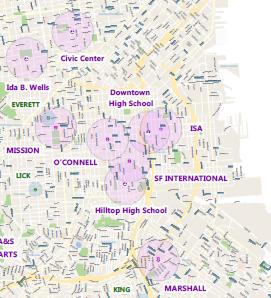
Sup. Scott Wiener wants to compromise on the food-truck limits, and is working with the folks at SFUSD and the food advocates.

Dana Woldow, who is working with Nancy Waymack, director of policy and planning for SFUSD, Chris Armentrout, the district’s director of development and government relations, and School Board member Jill Wynns, told me that the advocates are open to the idea of allowing more trucks in the Mission:

As I have said, I (and other parent advocates wanting to maintain a viable school meal program which can afford to offer healthy food to all students) do understand the dilemma of gourmet food trucks; that’s why we are willing to reduce the zone around all middle schools in the City to 500 feet from the current 1500 feet. Additionally, we would consider looking at drawing a custom boundary, which could possibly be smaller than the current 1500 feet, around each of the high schools in the Mission district. That way, we could free up some prime parking for trucks while still maintaining a wide enough truck-free area to discourage students from leaving school at lunchtime.

She’s got a new map for me that shows where trucks would be banned under the compromise proposal — one that includes only public middle schools and high schools. Check it out here. (pdf) And compare it to the old map here.

This all seems eminently reasonable, and maybe we can have healthy school food and burrito trucks, too.

Supervisors hope to halt foreclosures with new resolution

70

John Avalos introduced a resolution today urging support for homeowners facing foreclosure in San Francisco. The resolution calls for several actions, including suspending all foreclosures until state and federal measures to protect homeowners are in place.

Sponsors of the resolution Avalos, David Chiu, Jane Kim, Eric Mar, and Christina Olague joined a coalition of community organizations to explain the resolution at a press conference.

The resolution would call for support of a statewide Homeowners Bill of Rights, a series of bills that would address predatory loans and robosigning, as well as California Attorney General Kamala Harris’s campaign for a statewide suspension on foreclosures in properties controled by Fannie Mae and Freddie Mac. It also “urges all city and county officials and departments to work proactively to ensure that San Francisco residents do not fall victim to unlawful foreclosure practices,” as Avalos explained.

Supervisors cited a report released in February by Assessor Phil Ting as one of the reasons for the resolution. The report found “irregularities” in 99 percent of foreclosure documents in San Francisco between 2009 and 2011, and “what appear to be one or more clear violations of the law” in 84 percent of cases. 

The resolution’s language also names “predatory banking practices that disproportionately targeted racial and ethnic minority communities, especially working class African Americans and Latinos” as an impetus for the resolution, noting that “from 2007 to 2008, Wells Fargo, and mortgage lenders it has since acquired, was 188 percent more likely to put African American borrowers and 117 percent more likely to put Latino borrowers into higher-cost, subprime loans.”

“What we see around foreclosures is that we have a systemic problem,” said Campos. Over 1,000 homes in San Francisco are currently in the process of foreclosure, 

Supervisor Kim connected the issue to another systemic problem affecting San Francisco, that has been a recent topic of discussion at City Hall: family flight. 

“We do have many low-income families that are actually homeowners in the city, primarily in the southeast sector. But how they afford to buy homes is by squeezing often two to three families in these homes in the southeast. So we’re talking about not just one household when we foreclose on a home, we’re often talking about two, three families with multiple youth and seniors,” said Kim.

“This is something that has been an important issue for many of our supervisors across the political spectrum, is how to retain families in San Francisco. Stopping foreclosure has to be a key part of that.” 

A few supervisors congratulated community organizers for focusing on the foreclosure crisis.

“I want to thank Occupy Bernal for not only shedding light on what’s happening in Bernal Heights, but realizing that the foreclosure crisis that we’re facing is something that involves all of us. Every single neighborhood,” said Campos.

The resolution was introduced to the Board of Supervisors March 20. It will be discussed further at the Land Use and Economic Development committee meeting April 2. 

If it eventually passes the Board of Supervisors, the resolution will be non-binding; a citywide foreclosure moratorium is likely not imminent. Yet many supporters expressed urgency and commitment for city action to address foreclosures. 

“When speaking with the sheriff about how we can stop evictions, what struck me most was he said that sometimes when we walk into these homes, we’ve found that people have committed suicide before the sheriffs even come in,” said Supervisor Kim. “This is a life and death issue for many of our residents.”