• No categories

Politics Blog

Mayor Lee ousts Sheriff Mirkarimi

96

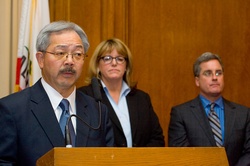
San Francisco Mayor Ed Lee temporarily removed Sheriff Ross Mirkarimi from office today over a domestic violence case, dragging this long and sordid saga into the summer as city officials prepare a rare official misconduct hearing.

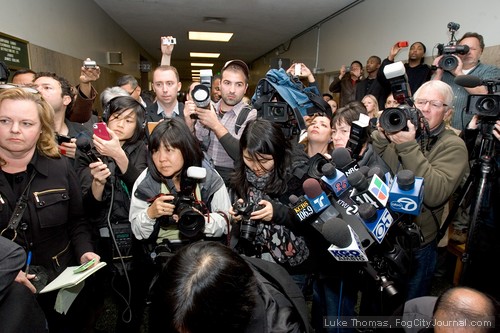
The brief announcement came just minutes after a 24-hour deadline Lee had set for Mirkarimi to resign or be removed. Lee took no questions from the huge crowd of journalists that had packed into his office and offered scant explanations about why he believes the process is warranted and how it will affect the city.

Standing behind Lee were City Attorney Dennis Herrera, with whom Lee had consulted on the decision, and Vicki Hennessy, a retired chief deputy from the Sheriff’s Department who Lee named interim sheriff. Shortly before the announcement, Mirkarimi told reporters he had no intention of resigning.

“He has chosen not to resign and now I must act,” Lee told reporters, emphasizing that “I do so with an understanding of the seriousness and gravity of the situation.”

Lee made no statements about how Mirkarimi’s guilty plea to a misdemeanor false imprisonment charge – reduced down from the three more serious charges he originally faced – rose to the level of official misconduct or why it warrants his removal, other than making general statements about ethics.

“We must always be held to the highest ethical and legal standards,” Lee said, adding that Mirkarimi had failed to do so. “I’m doing what’s in the best interests of the people of San Francisco.”

Time may tell whether that last statement is true, and whether the Ethics Commission and nine members of the Board of Supervisors agree and are willing remove a public official from office in San Francisco for just the third time in the last century.

Teacher’s Union unhappy with SF school chief process

9

Key Tray from the United Educators of San Francisco called me to comment on my description of the outgoing and incoming school superintendent, which he found a little too flattering:

I haven’t agreed with him on everything, but overall, he’s done a good job — the schools are better than when he arrived, enrollment is increasing, and there’s no more of the imperious attitude and gag orders of the old Ackerman days. The district is on the right track — although Garcia would be the first to admit that there’s a lot more work to be done. And I have nothing bad to say about his annointed successor, Deputy Superintendent Richard Carranza. He’ll probably do a fine job.

Tray’s point: Yes, on a lot of levels Garcia did well, but in the past few weeks he’s created a labor mess. “It’s a big disappointment,” Tray told me. “He’s poisoned the well and now he’s leaving the farm.”

The problem: Garcia decided this year to exempt 14 low-performing schools from the annual round of layoffs. The layoff process is annoying anyway — by state law, teachers have to be warned of layoffs in the spring although the state budget isn’t done until the summer so the schools don’t really know how much money they’ll have. In most cases, the layoffs are later rescinded. Out of the 500-plus layoff notices this year, “most won’t come to fruition,” Tray notes.

But the bigger problem for the union is that Garcia tossed out the seniority process when he made the decision to protect schools in the “Superintendent’s Zone.” And while some people think that’s just dandy, the teacher’s union calls it a disaster: Seniority is one of the most sacred elements of a union contract.

“Now he’s at war with the teacher’s union,” Tray said.

That, he said, won’t be pleasant for the new superintendent, who has been one of Garcia’s top aides: “Carranza’s walking into a toxic mess.”

Garcia, not too surprisingly, sees it very differently. “I’m the most pro-union guy you’ll ever find,” he told me. The 14 schools have a history of high turnover — and in an effort to keep a team of teachers, some of whom don’t have the highest seniority, in place, he exempted them from the layoffs. “We’re talking about 70 people,” he said. “And our figures suggest that this would have an impact on only three tenured teachers” who might face pink slips that they otherwise would have avoided.

As for the toxic labor environment? “It’s too bad they see it that way. We’ve worked together on every issue for five years, and I hope this one area where we disagree doesn’t ruin the entire relationship. This isn’t the only issue that matters in the world; I just wish they wouldn’t be this extreme.”

Good luck, Mr. Carranza — you’ve got some fence-mending to do.


Threats from mayor and neighbor in evolving Mirkarimi saga

43

In Old West and pulp fiction stories, it’s usually the sheriff who tells a criminal that he has 24 hours to get out of town or else. But in the latest twist in an increasingly ugly San Francisco drama, that’s what Mayor Ed Lee reportedly told Sheriff Ross Mirkarimi yesterday afternoon, setting up a 5 pm showdown by which Lee told Mirkarimi to resign or face removal from office.

That’s just one of a few rapidly unfolding developments surrounding domestic violence allegations against Mirkarimi, who pleaded guilty to a reduced charge of false imprisonment and is now facing Lee’s threat of bringing official misconduct charges against him.

With the criminal case ending yesterday, Mirkarimi’s wife, Eliana Lopez, and her attorney Paula Canny called a press conference for noon today to finally tell the story of what happened on New Year’s Eve, when the couple fought and Lopez was left with a bruise on her arm, the next day telling neighbor Ivory Madison that Mirkarimi had inflicted it.

But Canny arrived without Lopez, telling the large pack of journalists that they were no longer free to talk because of a cease-and-desist letter and civil lawsuit threatened by Madison and her lawyer husband, Abraham Mertens, who wrote an op-ed in today’s Chronicle calling for Mirkarimi’s removal and accusing Mirkarimi, Lopez, and their lawyers of trying to “discredit, dissuade and harm my wife.”

“Events have risen so that Eliana Lopez is no longer willing to come speak,” Canny said, noting that she has had to get her own lawyer to defend against the accusations and legal threats from Mertens and Madison. 

[added from here at 3:30 pm] Canny repeated a previous claim that Lopez knew Madison had attended law school and was seeking legal help from her, making the videotape confidential under attorney-client privilege, a claim Mirkarimi’s judge rejected. “My client sought legal advice from someone she thought reasonably to be an attorney,” Canny said today, noting that only Lopez can lift the veil of confidentiality in such cases.  

Although Lopez didn’t cooperate with the prosecution of her husband, maintaining that she was not a victim of domestic violence, Canny reiterated that Lopez was willing to testify in court as to what really happened that night but that she wanted immunity from prosecution first. “She has always said she would testify under immunity, but the District Attorney’s Office refused to offer it,” Canny said today. 

Given that Mirkarimi faced a child endangerment charge because their two-year-old son, Theo, was present during the altercation, it’s conceivable that Lopez could also be charged with a crime. Sources close to Mirkarimi and Lopez told the Guardian that Lopez was prepared to say today that Mirkarimi was restraining rather than attacking her, something she was willing to discuss with reporters before these latest legal threats.

Canny noted that the media circus and threats made on the couple’s livelihood have been the most damaging part of a saga that she called “an amazing, horrible experience” and  “oppressive and unfair,” noting the irony of a prosecution that purported to be about helping victims of domestic violence.

“Has any of this helped Eliana Lopez? Has any of this helped Theo?” Canny said. “This is not about helping her.”

She said that neither Lee nor anyone from the Mayor’s Office have tried to contact Lopez. “If the mayor wants to call me, I’d say he’s not trying to make the world a better place,” Canny said.

Canny also had this message for Lee: “To the mayor, please respect the electoral process,” adding that Lopez also strongly wants Mirkarimi to remain in office and that “Eliana Lopez is not afraid of Ross. Eliana Lopez loves Ross…If people care about them at all, let Ross do his job.”

Canny also took issue with La Casa de las Madres and other domestic violence advocates that have pressured Lee to oust Mirkarimi and sought to capitalize on the case, even circulating Lopez’s name and image. “That’s not how crime victims are to be taken care of,” Canny said. 

Many political and legal observers say they’re surprised by Lee’s apparent decision to suspend Mirkarimi and bring official misconduct charges, saying it will be a complicated, distracting, and divisive process that is unlikely to result in Mirkarimi’s removal. They say the charges so clearly don’t rise to the level of official misconduct that even the Ethics Commission, where the hearing is held, may reject them. If Ethics recommends Mirkarimi’s removal, it was take nine of the 11 members of the Board of Supervisors to remove him.

Then again, these observers speculate that Lee may simply want to use the hearings to air the evidence and discredit Mirkarimi so that he’d be easy pickings for a recall campaign that could be launched this summer — in the process, potentially gaining a campaign issue to use against progressive supervisors facing reelection this fall. The Chronicle reported yesterday that the case has generated a bonanza of donations to La Casa de las Madres, which is planning to do Spanish-language billboards in the Mission District, where Sup. David Campos is now running for reelection.

Lee has not offered many substantial comments on why he may believe official misconduct charges are warranted, but he’s expected to do so as soon as this afternoon when he announces his decision on the Mirkarimi matter.


Club bouncers and FBI spies keep us safe from the terrorists

5

The post-9/11 hysteria over terrorist threats continues to the day, taking many forms. The San Francisco Board of Supervisors is poised to give final approval tomorrow (Tues/20) to limitations on the SFPD’s participation in the FBI’s Joint Terrorism Task Force, legislation that ever-vigilant Mayor Ed Lee may veto.

But it turns out there are already thousands of eyes on San Francisco’s streets looking out for terrorists and their dreaded (and fabled) Weapons of Mass Destruction, something I learned today when the California Music and Culture Association announced a training it is sponsoring for nightclub security guards.

The training includes four hours of “power to arrest,” which makes sense. But it also includes another four hours of “WMDs & Terrorism Awareness,” which strikes me as paranoid to the point of lunacy. Are we seriously worried about a terrorist plot to destroy the godless heathens at the Makeout Room?

I didn’t realize CMAC was so paranoid, so I contacted the organization and learned that this is actually a requirement under state law governing private security officers, passed in 2005 as legislation sponsored by Abel Maldonado, then a Republican Assembly member from Santa Maria. Yeah, that made a bit more sense. Right-wingers see terrorist plots everywhere.

So while the FBI (with or without SFPD’s help) taps our phones and reads our mail, the bouncer at the club on the corner is keeping a watch out for suicide bombers disguised as ravers and dirty nukes hidden in DJ’s record boxes. Gee, I feel so much safer now.

The food (truck) fight heats up

13

Sup. Scott Wiener and public-school parent and advocate Dana Woldow are flinging dueling opinion pieces back and forth over the food-truck issue — and it’s getting hot.

Here’s the background: San Francisco currently bans food trucks within 1,500 feet of a public middle school or high school. That was almost encoded in state law, but the sponsor backed down. Now Wiener wants to modify the local law to allow trucks within maybe 500 feet or maybe a city block (of varying size) from a middle or high school.

Woldow thinks that’s way too lax — that, as she told me in an email, “a one block distance is not an obstacle at all for a long legged 15 year old. They can cover that distance and back in 5 minutes flat. And if a school is even partially open campus, (ie – seniors with 2.0 GPA can leave, or seniors and juniors, or whatever), then the kids who leave bring back food for the kids who stay.”

The thing is, this is a crowded, dense city, and there are schools all over, and in some places, like the Mission, a 1,500-foot limit means no food trucks at all, since there’s no place that exists that isn’t 1,500 feet from one school or another. Here’s a nifty map that shows the problem.

Woldow is ferocious when she gets into this stuff, and she decries the low-end food trucks as “roach coaches” and compares the industry to Big Soda (which we all know is evil.) Wiener’s hitting back, saying that Woldow (who he doesn’t name) is specious and that her comparisons to the sugar-mongers is nothing more than a quack conspiracy theory.

There are lots of elements to this — it’s not just about the unhealthy food that kids will (and yes, they will, I can speak from parental experience) buy and consume if they have the slightest opportunity. It’s also about how San Francisco provides lunch for students.

The school lunch program is subsidized — but also lives, to a certain extent, off the money that the schools charge for non-subsidized lunches. That is, if the kids who can afford to pay cough up for school lunches, there’s more money around to make the food better for everyone, including the kids who don’t pay. (It’s the same way at hospitals — if people who have insurance and can pay only go to a few high-end clinics, then the public hospitals and the ones in poor neighborhoods get only the charity cases, and don’t have the cash to improve services.)

As Caroline Grannan points out in a letter she sent me:

Let’s say there’s a restaurateur who feeds low-income diners free, subsidizing their meals by charging full price (albeit a modest full price) to non-low-income customers. Tempting food trucks pull up outside, luring away all the paying customers who can afford the food trucks. The restaurateur is no longer able to feed low-income diners free.
 
That simplified analogy conveys the basic situation, though it leaves out both the labyrinthine regulations governing school meals and the inadequate government subsidy for low-income students’ meals. The SFUSD meal program will, of course, continue to feed low-income children even if it suffers economic setbacks. It will just feed them a little less and a little worse, in both nutrition and overall quality. (And when the school meal program runs a deficit, classroom resources take the hit, another blow that inflicts the most harm on low-income kids.)

There’s a big difference between middle schools and high schools. Nobody’s allowed out of middle school during the day — you eat what the cafeteria offers or you bring your own lunch in a bag. Some high school campuses allow some kids to leave at lunch time; if there are food trucks nearby, and they sell cheap junk food, they’ll get plenty of patrons.

So Woldow and the nutrition folks at SFUSD want a compromise — they’ll allow the trucks to come within 500 feet of middle schools, but they want the 1,500-foot limit for all public high schools. Since there aren’t as many high schools, that’s less of a burden and cuts out less of the city. But you’d still lose about five blocks in every direction around Mission High on 18th near Dolores Park (including the space where the city wants to have a food truck in the park, but Rec-Park property is exempt, so the kids can go there anyway), and the same around John O’Connell at 19th and Folsom and International at 23rd and York.

I don’t think there’s another neighborhood where food trucks are popular that would take as much of a hit as the Mission.

I wonder: Can you regulate what food trucks near schools sell? Could you, for example, license two types of trucks — ones that are allowed to sell soda and chips, and ones that have to meet certain nutritional standards, and allow the ones with higher standards near the schools? There are plenty of trucks in the city that sell more gourmet, high-end stuff anyway. Then you could let the trucks park within, say, 750 feet (or whatever) of Mission high schools, but keep the real crap at a greater distance.

I know: More bureacracy. More regulations. But food trucks are already regulated and licensed, and if the choice was between staying away from the (hungry, captive) audience near high schools and letting Dana Woldow and the SFUSD nutritionists have some say in what you sold, I bet some of the truckers would take the good-food deal.

But that still leave the problem Grannan was talking about: If the cool kids with money all run out to eat at the (moderately) healthy food trucks, the district loses a lot of money from the lunch program. That’s a real concern, even if it goes beyond the food-truck fight. And it goes back to something some of us have been pushing for a while: If SF had a central kitchen for the schools, there might be better, fresher food for the kids in the cafeteria — maybe even food that could compete with the trucks.

I called Wiener to talk about what compromises he’s open to, but I haven’t heard back yet. I’ll update when I do.


Mirkarimi sentenced, absent drama

59

The drama that hordes of reporters were waiting for didn’t happen. District Attorney George Gascon’s threat to “bring up” at Sheriff Ross Mirkarimi’s sentencing the notion that Mirkarimi didn’t really think he was guilty vanished. Mirkarimi sat in front of Judge James Collins, who years ago helped a sitting judge duck a domestic violence charge, and agreed to the terms of his sentence (three years probation, mandatory attendance at a 52-week DV counseling program and some modest fines). Deputy District Attorney Elizabeth Aguilar-Tarchi said she had nothing to add; neither did Mirkarimi’s lawyer, Lidia Stiglich. And that was that — as far as the courtroom went.

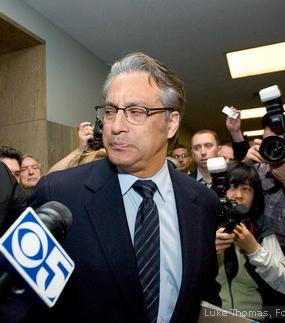
Outside, Mirkarimi faced the expected scrum of cameras and microphones, and read a prepared statement that sounded as if the district attorney had insisted on it. “I deeply and humbly apologize for my behavior,” he said. “There are no excuses and I accept full responsibility.” He said he had started counseling “to remedy my arrogance and anger issues” and apologized for saying earlier that the incident was “a private family matter.”

And he gave no signs of being ready to step down, saying he would “work so much harder to regain your trust … to be a better public servant.”

An hour or so later, Gascon faced the same press crew and announced that he had treated this case “just like any other domestic violence incident.” He denied that there was any political motivation; in fact, he denied it twice. He never made exactly clear why he had decided not to intervene after all at the sentencing hearing, except to say that Mirkarimi’s statements after receiving his sentence were satisfactory (see above).

He said he’s a “strong believer in redemption and restorative justice” and said this deal would “offer [Mirkarimi] an opportunity to redeem himself.”

Which, of course, led to the question of the day: Did Gascon think Mirkarimi could, or should, hold onto his job? Phil Matier from the Chron asked it directly, and Gascon refused to answer, saying “it’s not my place” to say. I tried again a few minutes later, asking if, given Gascon’s belief in redemption, there was any possibility that the sheriff could sufficiently redeem himself to remain in his elected position. Again: “It’s not my place to say.”

It was, however, what everyone was talking about. Matier and Ross reported that Mayor Ed Lee was huddling with lawyers to try to figure out whether he has legal grounds to begin the process of removing Mirkarimi from office. It’s tricky, and has only happened twice in the last 100 years, once in the 1930s, when a public defender was involved in a murder-for-hire case, and again in the 1970s, when an airport commissioner who was also a union official was charged with favoring union workers.

One obstacle, according to Matier and Ross: The D.A.’s Office won’t give Lee the video that was at the heart of this case. Gascon confirmed that, saying the video was considered internal work product and wouldn’t be released to anyone.

The law on removing a sitting elected official in San Francisco is murky and confusing, with little precedent. Does a guilty plea to false imprisonment of his wife equal “official misconduct?” Can an incident that took place before Mirkarimi became sheriff count as misconduct in the office he assumed later?Would the supervisors hold a public trial? What rules of evidence would apply?

The politics are murky, too: If Lee files charges, he’ll be tossing the matter to the Board of Supervisors in an election year, which the supes will hate and it will be a blow to the concept of civility that the mayor tries so hard to promote. If he doesn’t, then in the unilkely event that Mirkarimi does anything else bad, critics will blame the mayor for not acting.

So this isn’t over yet.

Meanwhile, the award for the most inappropropriate question at the Gascon news conference goes to the San Jose Mercury news reporter who, after much discussion about whether Mirkarimi could carry a weapon again and when the stay-away order would be lifted, asked (I kid you not):

“Which should he get back first — his gun or his wife?”


Join vets at City Hall today to mark nine years in Iraq

13

Lest we forget, today marks the ninth anniversary of the start of our war in Iraq. If you plan on passing by City Hall today, you’ll have a vivid reminder of today’s important milestone — 481 pairs of combat boots will be lined up on the seat of our city government’s steps, a visual precursor to the afternoon of speeches by vets and their families that has been organized by the Bay Area chapter of Iraq Veterans Against the War.

The vets’ message is rendered all the more important now that US conflict in Iraq technically ended last December. A US service member commits suicide once every 36 hours, and 223,609 veterans are struggling with possible signs of Post Traumatic Stress Disorder. Many battle with the after-effects of head trauma, a poorly-understood injury that can lead to serious psychological problems (the suspect in the massacre that took the lives of 16 Afghanis a few weeks ago was a US soldier who suffered from head trauma and multiple re-deployments.)

President Obama has decided that today will be a “Day of Honor” for our veterans. Now might just be a good time to get down to City Hall and hear what the United States citizens most affected by our engagement in the Middle East and elsewhere have to say. Today’s speakers at the City Hall demonstration will include Scott Olsen (the vet whose skull was fractured by a police-thrown projectile in an October Occupy Oakland demonstration), Ryan Hollerman (an active-duty soldier), and Paula Santos, whose son commited suicide after coming home from war, in addition to others from Swords to Plowshares and Military Families Speak Out

Iraq Veterans Against the War press conference and “Eyes Wide Open” exhibit

Press conference: Mon/19 noon, free

Exhibit: Mon/19 9 a.m.-5 p.m., free

City Hall

One Carlton B. Goodlett Plaza, SF

www.ivaw.org

Jeff Adachi on Gascon and Mirkarimi

36

Jeff Adachi, the public defender, who has been trying criminal cases for a quarter century, had some interesting comments on District Attorney George Gascon’s latest move:

Ross has already pled guilty and so he’s already accepted the plea bargain.  In order to enter a plea, you have to waive your constitutional rights and the judge has to be satisfied you are voluntarily and intelligently entering a plea of guilty. In the 25 years I’ve been practicing law, I’ve never seen a DA ask a person who already pled guilty to a plea bargain, “Are you really, really sure you are guilty?” so it would be highly unusual for a prosecutor to do so, and even more unusual for the elected DA to do so in a misdemeanor case.

Which is pretty much my point: This is very odd behavior for the DA. I don’t get it.

Gascon and the Mirkarimi plea deal

82

The Mirkarimi case has taken another strange turn: The district attorney, George Gascon, just told the Chronicle that he doesn’t think the sheriff really thinks he’s guilty, and wants to raise that at his sentencing March 19.

I find this pretty unusual and remarkable. Whatever you think of the Mirkarimi case (and there are plenty of different opinions), the guy pled guilty to a fairly serious crime — and Gascon’s staff negotiated the plea deal with Mirkarimi’s lawyers. Why is he talking about messing around with the situation at this point?

Well, according to the Chron, Gascon was responding to a Matier and Ross column in which the sheriff acknowledged that he owes some hefty legal bills and that the cost of defending himself, and the cost to his family, was a factor in his guilty plea. Gascon is taking that as a sign that Mirkarimi maybe still thinks he’s innocent:

“There is a guilty plea here and I know there’s almost an attempt (by Mirkarimi) to deny that this has occurred: ‘I didn’t really do this. I’m being forced to do this.’ That’s very concerning to me, to be very honest with you,” Gascón said in a meeting with The Chronicle editorial board.

That’s a fair amount of extrapolation — Mirkarimi never told Matier and Ross that he’s innocent, although (like most criminal defendants) he maintained that position all the way up to the plea bargain. That’s what happens in a court case; the accused pleads not guilty, says he or she will fight the charges, proclaims innocence — and then, in the vast majority of the cases in the U.S. criminal justice system, eventually cops a plea.

Why? There are lots of reasons. The  New York Times had a fascinating piece on this March 10. You might think you’re innocent, but won’t get a fair trial. You might be innocent, but fear that you can’t prove it and you don’t want to take the risk of the harsh sentence you might get if you lose. You might just decide that it’s better to accept some degree of punishment instead of dragging the case out. You might really be guilty, but not in the way the original charges read. You might be guilty as hell; you just said you were innocent because you were waiting for a good plea deal. This is how the criminal justice system works in the United States.

I called Gascon to talk about this, and he started off by saying, as he did in the meeting with the Chron ed board, that “we’re not accustomed to accepting a guilty plea from someone who isn’t guilty.” If that’s really the case, then he’s the only district attorney in the country with that policy. When we talked a bit further, he made the point that domestic violence is a special case: “When the defendant goes through counseling, they have to admit responsibility,” he said. “I want to make sure he understands what a guilty plea is and what it means.” Which is valid — I agree that step one in any sort of anger-management or DV program is taking responsibility for your actions. But didn’t this all come up when Gascon’s staff first cut the deal? Isn’t it a little late now to have second thoughts?

Mirkarimi has already agreed to go to counseling and take a domestic violence class. I talked to his lawyer, Lidia Stiglich, and she told me that she was “at a little bit of a loss. The sheriff accepted responsibility. We have a plea agreement and a disposition, and I don’t see any legal reason why it wouldn’t go forward as proposed.”

I agree, and have said in public many times, that Mirkarimi has to take responsibility for his actions, has to tell the public what really happened that day, and, like any other defendant who enters domestic violence counseling, admit that he’s done something wrong and that it wasn’t at all OK or excusable. That’s all part of the package.

I just don’t get what the district attorney is up to.


Millionaires Tax merger is a risk and opportunity

40

My first reaction to today’s news that the popular Millionaires Tax measure was merging with Gov. Jerry Brown’s broad-based tax measure was “What the fuck!?!?” Taxing millionaires had over two-thirds support in recent polls and seemed to clearly tap the tax-the-rich zeitgeist that animated and was amplified by the Occupy movement.

Now, it’s being married to a measure that increases the regressive sales tax and brings the income taxes increases down to those making $250,000 per year, possibly turning more self-interested voters against it. This just seemed to blow a golden opportunity to do the one simple thing that most Californians agree we need to do to address the state’s perpetual and deepening fiscal crisis: tax the rich.

But then I talked to Assembly member Tom Ammiano, someone with longstanding and unwavering progressive values, and he said, “It’s the art of the deal. It’s acceptable to me, not because it’s perfect.” While he’s not a fan of sales tax increases, he explained how it improves upon the Millionaires Tax in a couple key ways, and that is finally represents some new political cooperation after years of frustrating dysfunction in Sacramento.

“This is something we can build on,” Ammiano told me. “It’s a pretty good coming together.”

Clearly, there is value in creating a functional center-left coalition to counteract the inflexible conservatism that a shrinking minority of Republicans has used to mindlessly block all revenue measures, defund education, and plunge the state into a serious fiscal crisis. And it is good strategy  to reduce the number of competing tax measures on the ballot, and to broaden the coalition of supporters.  

But beyond those tactical benefits, the new measure is worth supporting on its merits. Ammiano notes that it actually raises more money than the Millionaires Tax (about $2 billion per year more) and frees up how that money can be spent (rather than limiting it solely to education).

“We raise more money over more years and we cut back his sales tax increase,” said Steve Hopcraft, a spokesperson for the campaign, noting that Brown’s proposed half-cent sales tax increase is now a quarter-cent increase and the measure now raises $3.3 billion per year from the top 2 percent of wage earners. “It’s a progressive measure that has almost a consensus now…It’s basically what we were proposing but with a quarter percent increase in the sales tax.”

And a expiration date that the Millionaires Tax didn’t have. But while the sales tax increase sunsets in four years, the income tax increases — which range from a 1 percent bump for $250,000 earners to 3 percent for those making more than $1 million — last for seven years.

So Brown’s measure, which had broad institutional support, gets better. And the Millionaires Tax — developed by the California Federation of Teachers and others and receiving strong popular support — gets watered down just a bit. I suppose that alright, if they can still make the ballot and win over voters in November.

That’s a big “if,” perhaps bigger today than it was yesterday. And if supporters of this measure blow this important opportunity — after all, the threshold for approving tax increases drops to a simple majority only during presidential elections, so the stakes now are high — then we’ll all pay a heavy price for this decision. 

Pink slime and the SFUSD

7

Let’s start off with a basic assumption: This stuff is gross. If you eat hamburgers, you don’t want to know what goes in them anyway, since it’s never been pretty, but the idea of taking stuff so likely to be infected with e. coli that you have to run it through a centrifuge and the expose it to ammonia gas — and then call it “food” — is pretty icky even to me, and I eat sausage.

And like a lot of things in our world-class corporate agribusiness food system, nobody knew much about it until ABC News revealed that it’s in most of the ground beef sold in America.

Which leads to the obvious question that Dana Woldow asked in BeyondChron today: Are San Francisco school kids eating pink slime?

It’s actually not too hard to find out. The San Francisco Unified School District has a press office, and the folks there answer the phone, and it took me exactly four minutes to get ahold of Heidi Anderson, who told me that the district had contacted the Illinois-based food service it uses, and has been assured that pink slime is not on the mix or in the menu.

She sent me a March 9, 2012 memo from James Gunner, director of quality assurance at Preferred Meal Systems, which said:

Please be assured that Preferred Meal Systems does NOT use any lean fine textured beef in any of the burger or meat crumble products we produce. All of the beef we use comes from ‘block beef’, which are whole muscle meat trimmings. These trimmings are not pre-ground in any way similar to the lean fine textured beef. Preferred Meal Systems actually grinds its own beef from this block to produce its hamburger patties, Salisbury steak and crumbles which are then used in our customer’s meals.

How appetizing.

I have no reason to believe that’s untrue, although I bet if we really wanted to check, the chemistry students at one of the high schools could run a test for ammonia traces in the school hamburgers.

I get Woldow’s complaint — the district could have put this up on its website, could have issued a press release, could have made more of an effort to get out ahead of this story. On the other hand, what passes for the education coverage in the mainstream media could have been better (and I’m to blame too — I could have called SFUSD the minute the first word about this nastiness hit the news). In the old days, when the Chron and Ex had hundreds of staffers and TV news had big investigative teams and there were people scouring the city for stories, I suspect someone one would have asked this question a week ago, when the ABC news story broke.

That’s part of the tragedy of the decline of newspapers (I know, I know, the dailies weren’t much good even the glory days, and it’s their own damn fault that they didn’t keep up with technology, I get it, heard it, been there, done that, threw away the T-Shirt) — we still count on reporters to do the work of monitoring local government, and until we all figure out a new way to make enough money to pay the staff, it’s getting harder and harder to do. As Anderson told me: “We just haven’t gotten an official query from the press on this.”

Amazing. A week after a blockbuster story (and again, if ABC news didn’t pay investigative reporters, none of us would have known anything about this) and nobody in the local news media thought to pick up the phone and call the SFUSD press office.

My usual parental concern didn’t kick in on this one, in part because my elementary-school daughter alwasy brings her own lunch and my middle-school son, who loves animals, wants to be a vet and never ate much meat, has recently announced that he’s a vegan. That’s quite a challenge at the local school district — there’s not a whole lot of vegan fare in the cafeteria. Most of the protein in the veggie lunches comes from milk and cheese, which is understandable, I guess, since there’s probably not enough demand for vegan food to justifiy a special set of entrees. But, you know, beans and rice. And vanilla soy milk.

The bigger problem here is that SFUSD gets so little money for its lunches that there aren’t many options — and the district doesn’t have a central kitchen to cook better food locally. When Margaret Brodkin ran for school board, that was one of her issues, and I agree with it: In this food-obsessed (and rich) city, we ought to be able to figure out a way to get decent locally-produced food to the kids.

That, and the fact that the PR staff at public agencies need to start thinking like reporters, and getting news like this out to the public, because too often the reporters aren’t doing it for them anymore.


Awww, the poor finance industry

63

It must be so awful to be a recruiter in the finance industry these days. Seems college kids just aren’t as interested in going to work for companies that crashed the U.S. economy, perpetuate the wealth gap and screw their clients. Besides, the money’s just not as good any more: The folks at Goldman Sachs only got $125,000 in bonuses last year.

I wonder if anyone’s talking about cutting their pensions. Oh, wait — their greed helped cut other people’s pensions!

Now maybe the smartest college students will think about doing something more productive for the world. Except that the ones who didn’t start out rich will have trouble with that, since they’ll graduate with about $100,000 in debt, and the only way to pay it off is to work for someplace that pays a shitload of money. So maybe Wall Street will be saved anyway.


School Board to hire new sup’t — quickly

5

San Francisco School Superintendent Carlos Garcia is retiring, which is no surprise — most school superintendent’s rarely stay anywhere for more than five years, and Garcia’s contract was up in June. I haven’t agreed with him on everything, but overall, he’s done a good job — the schools are better than when he arrived, enrollment is increasing, and there’s no more of the imperious attitude and gag orders of the old Ackerman days. The district is on the right track — although Garcia would be the first to admit that there’s a lot more work to be done.

And I have nothing bad to say about his annointed successor, Deputy Superintendent Richard Carranza. He’ll probably do a fine job.

But it’s a little odd that the board simply handed the job over to Carranza (well, actually they’ve just agreed to enter contract talks with him, but that’s really the same thing) without any sort of public forum, search process or outreach. I mean, there really aren’t that many top-rate big-city school superintendents out there, and San Francisco is a tough place for any school chief to work, but still: Do we absolutely know that Carranza is the very best candidate we could ever find? Would it have been worth taking a month or so to check around first?

Again: I believe Carranza will be an excellent successor to Garcia, and if he carries on the same tradition and policies, the schools will be fine. He’s been groomed for the job, and won’t have to learn the local political scene. Makes perfect sense — on one level.

But that was awfully quick.

As Board Member Kim-Shree Maufas told me, “It’s a transition and things are going well. But where is the public process? Where do our partners — the unions, the city, corporate partners, the community — get to weigh in? To take SFUSD to the next level, they need to hear from the community. The board can make that happen.”


Opinion: SF needs police domestic violence policy

33

EDITORS NOTE: This story includes a correction. The original version misstated the disposition of Judge McBride’s charges.


Everything I’ve written on the Mirkarimi case has attracted sizable volumes of comments (see here). Our suggestion that the mayor tread cautiously before seeking his official removal is bound to create controversy, too. Some advocates for victims of domestic violence are satisfied with the outcome of the case, and some are not. Former Sheriff Mike Hennessey told the Chron that Mirkarimi should stay in office:

“My opinion is that he should remain in the job and be given a chance to show what he can do with the office. I think he’s being punished accordingly by the justice system,” said Hennessey, who has been lauded by victims’ advocacy groups over the years for domestic violence services and programs that began under his watch. While admitting guilt to the crime of false imprisonment is serious, he added, it should not automatically disqualify Mirkarimi from holding office. “During my time as sheriff, I hired many people with criminal records who have done outstanding jobs for the department,” Hennessey said. “Oftentimes, you have to look at the whole issue of rehabilitation and redemption.”

If Mirkarimi remains in office, he won’t be the only public official in the law-enforcement business who was charged with domestic violence and pled to a lesser offense but kept his job. In 1999, Superior Court Judge James McBride was charged with slamming his wife’s hand into a door during an argument; represented by Jim Collins, who is also now on the bench, McBride got diversion on a witness intimidation charge (diversion, which leads to dismissal of all charges, is not normally available in DV cases) and stayed on the bench the entire time.

The chair of San Francisco NOW thinks none of that is OK — she thinks the city needs to adopt a zero-tolerance policy for law-enforcement officers who are convicted of a broadly defined set of domestic violence offenses (and Sheriff Mirkarimi, she argues, would fall under those guidelines). I’m posting the opinion piece she sent me below to keep the discussion going.

By Mona Lisa Wallace
chair, San Francisco National Organization for Women (NOW)
vice president, California National Organization for Women.

When the new sheriff in town, Ross Mirkarimi, pled guilty Monday to misdemeanor false imprisonment (in exchange for prosecutors dropping three other charges), it begged a bigger question: Should Mirkarimi keep his office? Mayor Ed Lee has turned to the to the City Charter asking whether there are grounds for dismissal. San Francisco NOW proposes a simpler solution: the San Francisco Sheriff’s Office and Police Department should immediately adopt a model policy on police domestic violence.

The International Association of Chiefs of Police put forth a model policy for domestic violence by police officers in 2003. The policy “recognizes that the profession of law enforcement is not immune from members committing domestic violence against their intimate partners.” The policy defines domestic violence, emphasizes victim safety and prescribes zero tolerance for domestic violence by police officers.

Once adopted, this policy provides very clear definitions of domestic violence and policies for addressing domestic violence committed by police officers. Although Mirkarimi’s plea avoided the domestic violence charges, the videos and photos of the sheriff’s wife’s bruised arm after the December 31st incident confirm physical restraint, which under the model policy is defined as domestic violence. Police officers found guilty of committing domestic violence must be terminated.

San Francisco NOW believes we need to hold ourselves to the highest standards in preventing domestic violence, which affects one in four women in their lifetimes. The number of victims grows exponentially because children who experience the abuse are also traumatized.

Actions have consequences. Rush Limbaugh verbally abused a woman and he lost sponsors. Mirkarimi committed what the model policy defines as domestic violence, so he should lose his job and his pension. That’s what zero tolerance means.  It should not matter that he has friends in high places. It should not matter that he needs the sheriff’s salary and pension. 

People who uphold the law against domestic violence need to be beyond reproach. Mirkarimi is not.

SFNOW is disturbed by the national resurgence of a “war on women” apparent in the current presidential primary elections and congressional hearings working to roll back women’s rights through legislation. We have joined “Unite Against the War on Women,” a movement now 20,000 strong who will march on every state capitol on April 28th to say enough is enough. Join us at: uniteCalifornia@gmail.com 

We sincerely hope that San Francisco rises to take a strong position opposing the war on women. The city’s sheriff’s and police departments should immediately adopt the model policy on domestic violence by police officers, and quickly apply the zero tolerance standards to our top law enforcement officers.

Brown compromise may water down Millionaires Tax

4

The Restore California campaign and Governor Jerry Brown’s—the authors of two competing ballot initiatives that would both raise taxes to fund education—are in talks today. The two groups hope to strike a deal and agree on one measure.

“I think we’ll have a compromise measure that will be more progressive than governor’s current one,” said Fred Glass, communications director for the California Federation of Teachers (CFT).

The CFT, along with the measure’s co-sponsor Restore California, have seen widespread support for their proposed Millionaires Tax. In its current form, the measure would raise taxes on the state’s highest income earners. California residents earning $1 million per year would pay an additional three percent in income taxes; those making $2 million or make per year would add five percent. 60 percent of funds raised would go towards education.

The proposed initiative would not raise taxes on anyone earning less than $1 million per year, and tax increases would be permanent.

Brown’s plan included a half-cent sales tax increase and would expire after five years.

But Brown has expressed concern that competing measures would mean defeat for any plan to fund education, and now a deal may be reached between the two parties.

The Sacramento Bee reports that the compromise measure may lower Brown’s proposed sales tax increase to a quarter-cent and extend the tax increase to seven years.

But the deal could pose an organizing challenge. Polls have consistently shown majority support for the Millionaires Tax, and signature gathering is already well underway; if a new deal is reached, proponents would need to start fresh and may face only four to five weeks to gather more than one million signatures.

According to Glass, many lawmakers might have supported the Millionaires Tax in its original version if it hadn’t been for Brown’s competing version.

“Everybody wanted to support the governor. There was enormous pressure on the legislature, even those who were sympathetic [to the Millionaires Tax],” said Glass.

Details of a finalized compromise measure could be announced as soon as this afternoon.

Oakland police keep track of “anarchists”

26

Oakland Police Department’s internal communications about the Occupy Oakland movement, which the Guardian obtained through the California Public Records Act, reveal interesting patterns of what officers deem important to note about protesters.

Officers’ reported observations of the crowd generally concern activity, movement, and sometimes mood. However, there are also mentions of the percieved political affiliations of protesters. In an Oct. 24 briefing, a plainclothes officer, having strolled through the encampment, reports that “the group is diverse, made up of persons including self proclaimed anarchists, labor unions, long term homeless individuals, special cause supporters and others.” 

But by Nov. 2, it seems, all other categories fall away and officers seem interested in reporting on only one perceived type of protester: anarchists. 

Police make several reports in the notes of where and when they’ve noticed “anarchists” or “anarchist behavior.” 

In activity logs reporting “major events” throughout Oct. 25, police include anarchist sightings in that category. In the afternoon, there is “black block (sic) spotted, approximately 12.”

When protesters briefly occupied the Travelers Aid Society building on Oct. 25, police reported “10 anarchists on the roof and inside.”

In an afternoon planning meeting Nov. 3, an officer describes the scene on the streets: “there have been reports that there were 5000 people with relatively no injuries. There seem to be people dressed in regular clothing displaying anarchist behavior.” 

A press release from Nov. 2 also states that “the Oakland Police Department has identified a small group of anarchists roaming through the crowds. OPD is focused on preventing illegal activity while affording the majority their rights to assemble and march.”

It seems that those officers reporting on the crowd equate anarchists with illegal activity, and believe they can identify adherents to anarchism based on appearance and behavior.

Anarchism is a political ideology, and not illegal. Yet officers apparently count out individuals that they perceive as anarchists. 

While popular stereotypes associate illegal activity such as vandalism with anarchism, many who identify with anarchist principles have not broken laws in that fashion. In fact, these documents imply that police may be associated with another illegal activity; targeting some of those they protect and serve based on political belief.

Mayor Lee discusses removing Mirkarimi from office

24

Mayor Ed Lee today seemed to take a step back from his quote in today’s San Francisco Chronicle that his “gut feeling” was that Sheriff Ross Mirkarimi’s guilty plea to a misdemeanor false imprisonment charge represents a conflict with Mirkarimi’s official duties that could warrant his removal from office.

Speaking to reporters after an appearance before the Board of Supervisors, Lee said he hasn’t made up his mind whether to charge Mirkarimi with official misconduct – which would ultimately require at least nine of 11 supervisors to vote for removal over what was alleged to be an incident of domestic violence – but that Lee said he would probably make that decision next week.

“My gut reaction wasn’t that,” Lee said when asked about his newspaper quote, explaining that he was simply surprised when the new charge replaced the three that Mirkarimi had initially been charged with: domestic violence, dissuading a witness, and child endangerment, all misdemeanors. 

“In the surprise of the legal settlement of the case, I’m required to take a look at this charge that wasn’t talked about before and determine whether those charges and the factual allegations behind those charges are measured up to the standard I have to deal with, which is official misconduct. And I have to allow myself enough time to do that with our City Attorney’s advice to make sure I’m on good legal footing. I was just surprised because it wasn’t one of the original charges,” Lee said, noting he had been doing research on the previous charges.

“Because it’s a new charge and one that was accepted by the courts as well, I have to make a thorough study of that, which is something I wasn’t prepared to do,” he said.

When asked whether the term “false imprisonment” (a broad legal charge that can mean different things depending on the context) affects his approach, Lee responded, “The word false imprisonment is obviously connected to a sheriff who does make a determination about imprisonment in general. But we’re going through the elements of what false imprisonment are and what the factual basis is and then, again, reapplying that to the standards of official misconduct.”

As for the timeline of his decision, Lee said, “I think it’s appropriate to wait until after the sentencing,” which is set for Monday, “so probably sometime next week.” Later, he said, “I am cognizant of the public distraction this case has made to the office, so I’m doing the best I can to comply with at least my own time frame.”

We asked Lee why he thought the charges – which resulted from an incident on New Year’s Eve in which Mirkarimi’s wife allegedly told a neighbor that he grabbed her and left a bruise on her arm – might rise to the level of official misconduct, particularly considering he hadn’t been sworn into office yet.

Lee replied, “That’ll be part of the assessment because I don’t think there’s an automatic thing here. He was elected and this was post election, so it doesn’t matter when he was sworn in and I think he was expected to be sworn in, so we have to take into consideration all of those elements.”

Supervisors ban illegal SFPD spying, but veto threat looms

15

The Board of Supervisors today gave initial approval to legislation that would prevent the San Francisco Police Department from working with the FBI to spy on law-abiding citizens, but the 6-5 vote wouldn’t be enough to overcome a possible veto by Mayor Ed Lee, which would take eight votes.

SFPD officials have said the measure is unnecessary because Police Chief Greg Suhr and the Police Commission last year approved a Department General Order requiring officers to obey state and local privacy laws, which they say supercedes the MOU that the SFPD secretly signed with the FBI in 2007 placing local officers under federal control. That secret document was unearthed last year by the ACLU, causing a local furor.

But supervisors who support the measure and the broad coalition that is supporting it, ranging from the Asian Law Caucus to groups representing Muslims who have been targeted with federal surveillance since 9/11, say it is important to enshrine these protections in city law and they don’t understand the SFPD resistance to doing so.

“If this is that important to us, if we believe in these values, then it deserves to be codified in our laws,” said Sup. Jane Kim, the measure’s main sponsor. “I was shocked to discover our city entered into a secret agreement with the FBI,” said President David Chiu, adding that while he trusts Suhr to oppose illegal spying, this legislation was about ensuring successive chiefs and members of the Police Commission uphold that standard.

Sups. Scott Wiener, Malia Cohen, Sean Elsbernd, Mark Farrell, and Carmen Chu voted against the measure, but Wiener was the only one who tried to explain his vote, much to the disappointment of the large coalition that showed up to support the legislation.

“This has been a tough issue for me and I’ve struggled with it,” Wiener said, sharing Chiu’s outrage over the secret memo and his position on the government spying on citizens who aren’t suspected of a crime. “We have our own local policies that SFPD officers are required to comply with,” Wiener said. “The question for me is whether this needs to be legislated.”

The legislation is set to receive final approval at next week’s board meeting, after which Mayor Lee will have 10 days to sign it or issue the second veto of his run as mayor (the first, also controversial, was over legislation to close a loophole in the Health Care Security Ordinance that allows businesses to at the end of the year raid employee health savings accounts they set up to comply with city law requiring employee health coverage).

Before the vote, as he was leaving his monthly Question Time session with the board, I asked Lee about his position on the SFPD spying measure and he said, “I’ll be getting an update. The chief who I appointed has been working directly with the supervisor on this and he’ll be reporting to me all his efforts soon so I can make a determination. I’d like to have input for our Police Commission as well before announcing what we’re going to do about it.”

After the vote, I asked Kim about the threat of a veto and she said, “It’s definitely a concern and we as a community need to think about what our next steps are.” Activists said they plan to lobby supervisors who opposed the measure and the Mayor’s Office. “Talk to your communities, let them know the supervisors who supported it and the supervisors who didn’t support it,” Fairuz Abdullah, former president of the Bay Area Association of Muslim Lawyers, told the group of about two dozen. “This is a great showing, but it needs to continue.”

Why the Post Office matters

4

Nobody writes letters any more. My kids barely know what a letter is. We pay our bills online, and when we buy crap valuable consumer items from Ebay or Amazon, they arrive in a UPS truck. With direct deposit, people don’t even get benefit checks in the mail.

Plus, the Post Office is so much a part of old-fashioned government, an agency that people used to relate to in a positive way. These days, it’s all about bloat and pensions and crazy people. So it’s not surprising that conservative politicians would just as soon shut it down, get rid of employee pensions and eliminate one more part of the public sector.

But there are times when the postal system really matters — elections, for example.

As Brian at Calitics points out, a growing number of people in California vote by mail — and when you shut down post offices and processing centers, the mail gets slowed down. That could be a significant factor in a close election. Secretary of State Debra Bowen:

The USPS asserts the closures won’t affect your ballot, but its future best hopes do not coincide with the current reality voters and elections officials have already witnessed in California. When mail facilities closed last year in Monterey, Ventura, and Yuba counties, officials conducting small local elections there reported mail that used to take one to three days to deliver was instead taking five to seven days.

Of course, that would also apply to last-minute attack mail — because political consultants also use the USPS to deliver their positive and negative messages, timed to arrive in the carefull targeted mailboxes just at the right moment.

Some day, we’ll vote by email. But for now, this particular arm of the hated federal government has a really important role.

Eating and drinking Santorum

1

Our frothy fecal friend is unlikely to become president, but there’s plenty of cause for celebration: You can now both eat and drink Santorum.

Slate has the tale of a bar in Brooklyn called the Pacific Standard that offers a really gross scrumptious-sounding Santorum cocktail: Bailey’s Irish Cream and orange-flavored vodka. Garnished with little chocolate bits. It has a nice color to it, but the writer wasn’t too enamored of the flavor:

Savoring one last slurp, I slid my half-full glass back to the bartender: “That was a lovely experience, but I need to wash the taste out of my mouth. Would you please pour me a glass of Doc’s?”

“Sure thing,” he said. Then he tried the line on his tongue: “’That was a lovely experience, but I need to wash the taste out of my mouth.’” Beat. “I haven’t heard that since college.”

Har har.

Then there’s the Santorum Frothy Chocolate Cream Pie, which seems a little more tasty, as is the Apocalypsecakes description of Prez Frothy’s administration:

Santorum will spend his first day in office detaining you at Guantanamo for all your yoga and blowjobs. You will be chained to a rock, naked and pregnant, by Santorum’s legion of Abercrombie youth group members. Then, while you’re cold and alone and left to give birth to your gay best friend’s gay-by, a mob of Catholic priests will take a break from their Cuban slave-boy auction to tase you for each non-procreative orgasm you’ve ever had.

Although I would be careful not to bake the contraceptives.

You need to know about Afghanistan. Here’s how you can start

0

What fresh hell is this. Last weekend, a US Army staff sergeant who has suffered past traumatic head injury walked off his military base and allegedly shot 16 Afghani men, women, and children.

Sadly, that Wall Street Journal article about the matter that I linked to in the first sentence of this post goes on to state that not only does Hilary Clinton think the incident has no bearing on our country’s “steadfast dedication to protecting the Afghan people,” the Afghan people don’t seem to be all that surprised by the US serial killer in their midst. A tribal elder from the Helmand province was quoted as saying “even if he was a madman, what about all the other times when they’ve killed our innocent women and children? How do you explain those?” Iraq Veterans Against the War has one answer — the group released a statement that says the military’s policy of redeploying mentally unfit troops in the field is to blame. The suspect soldier was on his fourth tour of duty.

The incident only underlines the fact that Afghanistan is no longer on anyone’s mind anymore. What is going on out there? Read on for an upcoming Bay Area event that hopes to provide some answers.

“The Longest War: Afghanistan Beyond the Taliban”

Those flummoxed by the lack of attention being put on Afghanistan in the media could do a lot worse than attend this panel discussion, which is the opener of what is planned to be a bi-monthly event series on under-reported current events. This time around, it’s structured as a casual discussion with two experts: Masood Farivar, a one-time fighter in the country’s anti-Soviet resistance cum newswire journalist who trains other members of the press to cover the region intelligently; and Tim McGirk, who has been reporting in the area since 1990 and has served as a Time Magazine bureau chief. After peppering them with any and all questions that have been pinging around in your brain, you’re invited to take in Million Dollar Militia, a documentary originally shot for Aljazeera on the $1 million the US government gave directly to the Shinwari tribe to fight the Taliban and end poppy (read: drug) production in the area.  

Thu/22 7 p.m.-8:30 p.m., free

Arbor Cafe

4210 Telegraph, Oakl.

(415) 730-4755

www.blackbeardfilms.com

The giant penis in the sky

21

When Lily Hitchcock Coit donated money to beautify the city, and a tower was built in her name, a lot of locals suggested that it looked like a firehose nozzle, not surprising given her love of firefighters. Others over the years have suggested a more phallic image.

But that’s nothing compared to the new tower that is slated for the Transbay Terminal site. The round shaft, the distinct head at the top … it’s the Giant Dick in the Sky! Coming soon to downtown San Francisco.

Why Mirkarimi pled guilty

103

Sheriff Ross Mirkarimi didn’t want to cop a plea. He knew the damage it  would cause to his political career and he was prepared to fight the charges. But when it became clear that he was losing every single motion around the admissibility of evidence, even when he and his attorney, Lidia Stiglich, were convinced they were right on the merits — and when it was clear from juror surveys that virtually everyone in town had read the salacious press accounts and it was impossible to find a neutral jury, he decided he had no choice.

That’s what people close to the sheriff told me shortly after Mirkarimi unexpectedly agreed to plead guilty to misdemeanor false imprisonment. It may seem an odd plea for a sheriff, but it was a way to get rid of the more serious charges. A domestic violence conviction would seriously interfere with Mirkarimi’s job — among other things, nobody with a DV rap can possess a gun — not that the sheriff of San Francisco needs to carry a gun, but in the law-enforcement world, domestic violence is (properly) taken very seriously.

The calls for the sheriff to resign have already started. An informal sfgate poll on the subject is already posted.

I talked to Mirkarimi shortly after he appeared in court, and he told me he has no plans to step down. “I wanted to resolve this matter and move forward with the important work of the department. And I terribly miss my family and I want to be re-united.”

That’s going to be tough — someone will probably try to mount a recall effort and every single detail that has come out so far in the news media will be repeated if and when he runs for re-election in three years. In politics, that’s a long time away — but these kinds of charges never disappear.

People close to the sheriff told me that that Mirkarimi was concerned that he couldn’t find a jury that hadn’t already convicted him in their minds. “The questionnaires were very clear,” one ally said. “Nearly everyone had read the newspapers and already had some kind of a negative opinion.”

Among other things, his friends said, Mirkarimi was concerned that  a former girlfriend, Christina Marie Flores, would be allowed to testify against him — despite what his team considered serious questions about her credibility.

Flores used to be my next-door neighbor and I’ve always been friendly with her. I was on her TV show once. But the news media accounts have essentially ignored a detail that was in one of Mirkarimi’s defense motions:  After they broke up, Flores sent Mirkarimi a hate poem in which she not-terribly subtly threatened to damage his political career.

I’m not going to quote all of the emails cited in the brief (breakup+email=bad news); suffice to say that until December, 2008, Flores was clearly in love with Mirkarimi and sending him passionate notes asking him to reconsider what was obviously a move by Mirkarimi to end the relationship. (And yeah, there were nude pictures that Mirkarimi was supposed to “enjoy when you miss me.” Gak.)

On Jan 2, 2009, the brief states, “having understood that the relationship with Mirkarimi was over, Flores sent Mirkarimi a lengthy hate poem. In startling contrast to her prior e-mails to Mirkarimi, Flores now called Mirkarami `the worst type of waste of air’ and said that there ‘are smarter and more handsome men BY FAR.’

“Flores ended the poem with the following:

So as 2009 rolls in and you roll out
I remember what my life was all about
Surrounded by so many of my friends
I am rich and happy with how my story ends

Except one thing.

I have never had the distinct pleasure
Of meeting such an idiot of such great measure
That freely let me know of things
That could unwind plans of what his political future brings

Yes, I do know those, some of whom you hate.
Who could have a say in your fate
And long friendships with some that you despise
That after the fact have opened my eyes.

What to do with the ball in my court …
Let us see what happens.”

Don’t know who “some of whom you hate” means, but Mirkarimi has had a contentious relationship the San Francisco Police Department. Flores is the daughter of a police officer and the ex-wife of another officer, who happens to be a domestic violence inspector.

Three years after that poem was written, when she heard about the DV allegations against Mirkarimi, she filed a police report alleging similar behavior. She also talked to two newspapers, the Chronicle and SF Weekly.

In her statement to the district attorney’s office, the brief states, “Flores conceded that she wanted to go public for personal reasons: ‘He said that that woman from Venuzuela (Lopez) knew about our relationship and it didn’t matter to her … which I think is a lie. And that’s probably why I’m here because I don’t think she knew.’”

Doesn’t mean that anything she claims about Mirkarimi was untrue. A woman who is mad at her ex-boyfriend for whatever still has every right to complain about domestic violence, even later; if she was physically abused, then what happened at other points in the relationship doesn’t change anything.
But it’s interesting that the daily papers, which reported freely on the prosecution’s side of this story, haven’t mentioned the equally fascinating (and tawdry) allegations in the defense brief.

It’s the kind of thing that, Mirkarimi’s allies say, made it hard to find a fair jury.

Judges these days go out of their way not to exclude evidence in DV cases, and the fact that this was such a high-profile political case made that even more dramatic. Ruling that the videotape of Mirkarimi’s wife crying and showing a bruise and the testimony of an ex-girlfriend who said he abused her inadmissible would most likely have forced the district attorney to drop the charges. Very few judges would want to take that risk.

So now Mirkarimi has to deal with the fallout, and it raises the question: Can the progressive community accept and once again support a sheriff who has all of this baggage? Is there anything Mirkarimi can do to convince his allies and the voters that either (a) the charges were overblown or (b) he’s learned from this, is going into counseling, is a changed person, and can seek political redemption?

The city forgave Gavin Newsom when he had sex with his close friend’s wife (after he allegedly went into treatment for alcohol abuse) and forgave Willie Brown when he impregnated a campaign fundraiser (because nobody cares about that sort of thing these days), but domestic violence is a very different deal. As it should be.

Any yet, some people are clearly willing to give him a chance. Alix Rosenthal, a longtime leader on women’s issues who supported Mirkarimi for sheriff, told me that she doesn’t think he should step down.

“I think this whole thing has been blown way out of proportion,” she said.

Mirkarimi, she noted, needs to publicly go into counseling with his wife (which he can’t do until the stay-away order is lifted — seriously, right now he can’t even go to counseling with his wife) and he needs to make it clear that he’s addressing anger-management issues. But she thinks he can still play a role in the progressive community.

There will be other progressives who disagree, and Mirkarimi will have to win them over. And all the while, the supporters of Chris Cunnie, the former Police Officers Association president who lost to Mirkarimi in the fall, aren’t going to let this go away quietly.

UPDATE: The Chron is already calling on Mayor Ed Lee to “investigate” the sheriff for misconduct. Investigate? As if there’s anything that hasn’t already become public? The real message is that the Chron wants Lee to try to get rid of Mirkarimi. And so it begins.