• No categories

Politics Blog

Ethics Commission rejects Mirkarimi delay request

143

The Ethics Commission – in a decision made by Chair Benedict Hur, to whom the commission had given the authority to make procedural decisions – today rejected a request by attorneys for suspended Sheriff Ross Mirkarimi to delay transfer of his official misconduct case to the Board of Supervisors until after the Nov. 6 election.

Mirkarimi’s attorneys argued that the decision has been overly politicized during the election season, with supervisorial challengers turning the decision into a litmus test and interest groups polling voters on whether they would be more likely to reject supervisors who voted for reinstating Mirkarimi. The City Charter requires the board to act within 30 days of receiving the official record from Ethics, which will probably happen early next week.

“The fate of the sheriff has been made a key political issue in the election by the media, candidates, consultants, mayoral appointees to commissions, and others. Sending the record to the Board immediately prior to an election deprives the Sheriff of a neutral decision-maker, as guaranteed by the Due Process clauses of the 5th and 14th Amendments,” attorney David Waggoner wrote to the commission on Sept. 10, attaching eight articles and campaign pieces linking the Mirkarimi decision to the supervisorial races.

But Hur disagreed. “There is no evidence suggesting that any member of the Board of Supervisors will disregard the facts and the law and instead vote to sustain the charges based upon perceived political pressure,” he wrote. Actually, he argued that “granting the Sheriff’s request would cause the Commission to engage in the type of political maneuvering that it seeks to avoid. The commission will not manipulate the timing of the Board’s decision in a misguided attempt to predict the nadir of public pressure on the Supervisors.”

Mirkarimi told the Guardian that he was disappointed by the decision, noting that it was Mayor Ed Lee’s piling on of excessive charges that the commission found no evidence to support that have delayed the board’s deliberations until the height of the election season. “This is so vividly and transparently political.”

Committee approves CleanPowerSF over downtown opposition

51

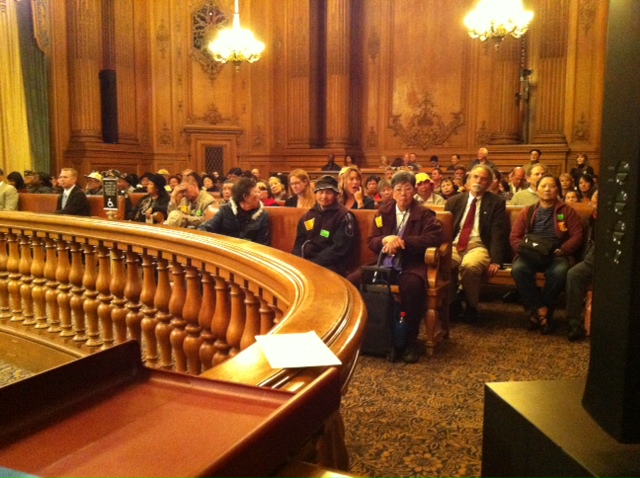
The question of whether San Francisco creates a renewable energy program that offers an alternative to Pacific Gas & Electric got its first major hearing at City Hall today, with the business community claiming it’s too expensive and supporters arguing that the time has come for the city to address climate change and the long-term energy needs of city residents and businesses.

The Board of Supervisors Budget & Finance Committee voted 2-1 in favor creating CleanPowerSF, entering into a contract with Shell Energy Northern California to administer the program, and devoting $19.5 million from the San Francisco Public Utility Commission’s water fund to help launch it and buy clean power for city residents.

Sups. John Avalos and Jane Kim supported the project, while Sup. Carmen Chu was opposed. It now goes to the full Board of Supervisors next week, where it is expected to have progressive support and be opposed by the fiscal conservatives.

“I do think we will have the necessary majority to get this through,” the measure’s sponsor, Sup. David Campos, told us. But one open question is whether Mayor Ed Lee will veto a measure that his SFPUC appointees developed but his downtown allies are trying to kill, and if so, whether there are eight supervisors willing to override a veto.

But Campos noted that SFPUC officials testified today that CleanPowerSF is the only way they’ve identified to meet the city’s ambitious official goals for reducing greenhouse gas emissions, which call for a reduction of 20 percent below 1990 levels by the end of this year and an 80 percent reduction by 2050.

Supporters who testified today included environmentalists, progressive groups, and young people who cast addressing climate change as the defining struggle of their generation. “This, not to go overboard, is the most important vote you’ll ever do,” said the Sierra Club’s Arthur Feinstein.

Those who spoke against the program included the usual array of downtown groups that have traditionally defended PG&E’s interests – including the Committee on Jobs, Golden Gate Restaurant Association, and Plan C – and they were joined by an unusually large number of elderly Asian individuals wearing stickers opposing the project.

“It’s a bad program that doesn’t meet even the basic elements of its original promise,” said Chris Wright, executive director of the Committee on Jobs, which PG&E has helped fund since its inception. Like most CleanPowerSF opponents, they have long opposed even the concept of community choice aggregation (CCA), the state law that allowed the city to create CleanPowerSF.

PG&E’s longtime support by local politicians has eroded in recent years because of its overkill campaigns against public power initiatives and supporters and its negligence in the deadly San Bruno pipeline explosion.

Even GGRA Executive Director Rob Black told the committee, “PG&E, a local company, candidly has its problems.” But he and other project opponents – and even a few supporters of the project – centered much of their opposition on the involvement of Shell, which has a bad reputation and environmental record, like almost every other multinational energy company.

“I have the same qualms about Shell that everyone else does,” said Katherine Roberts, who said that she nonetheless supports the project, calling it the only way for most San Franciscans to directly support the development of renewable energy sources. Shell was the sole bidder on a project that requires enormous financial wherewithal.

Campos calls the focus on Shell a diversionary tactic: “PG&E already buys energy from Shell. To the extent people don’t want Shell in the picture, Shell is already in the picture.”

Both the supervisors and the mayor will be under intense pressure to derail CleanPowerSF, with that campaign led by downtown groups and IBEW Local 1245, the union that represents PG&E workers. Sup. Scott Wiener, who says he’s still undecided, told us that his office was flooded with phone calls today, mostly in opposition to the project.

In the face of protest, City College moves forward with tough decisions

11

The City College Board of Trustees passed the college’s budget and new mission statement yesterday, as well as a proposal to request a special trustee to work with the board as they face an accreditation process and dire financial situation.

The special trustee will advise the board on decision making. But they also have the power to overrule board decisions, something opponents called an undemocratic process.

About 40 of those opponents stormed the meeting. The activists, from the Save CCSF coalition, surrounded the trustees and, when several walked out of the room, sat down at their meeting table.

“I propose that we convene the People’s Board of Trustees. All in favor, say aye,” CCSF journalism student Alex Schmaus declared with a bang of the board’s gavel.

The “People’s Board of Trustees” then passed a few proposals. They passed a proposal that “students appoint ourselves special trustee and oppose any other kind of special trustee,” and that “we stand in solidarity with the teachers’ strike in Chicago.”

The dissenters left the table voluntarily, but were briefly confronted by campus police when they continued to march, chant and hold banners inside the meeting room.

Afterwards, the Board of Trustees resumed their meeting. Trustees William Walker and Chris Jackson voted against calling the question to vote on the special trustee, citing a lack of sufficient information about the powers of the special trustee, such as details about how and when their vote would supersede board decisions and the process for firing the special trustee.

The proposal to invite a special trustee passed 6-1, with Chris Jackson voting no.

“This is a monumental step for the lack of information we have in this process,” Jackson told the board concerning his vote.

http://www.youtube.com/watch?v=O25Xnjj4RmY&feature=youtu.be

Video by Joe Fitzgerald

Tension and passion at the meeting underlined the community’s commitment to CCSF and dismay at the situation it faces. As SEIU 1021 representative Angela Thomas said during public comment, “None of us are happy. None of us.”

Save CCSF certainly isn’t happy. Many students involved had already been fighting the Student Success Act, which prioritizes those students who get through school in two years rather than those who take longer, as well as those in non-credit classes, ESL classes, and lifelong learners. Now, they fear that the accreditation process will cause City College to make cuts along similar lines.

“We are not a junior college. We are a community college,” said Shanell Williams, Associated Students president at Ocean campus.

Teachers and staff are also hurting. The 2012-2013 budget, passed at last night’s meeting, includes reductions in pay for both groups of college employees. During public comment at the board meeting, American Federation of Teachers 2121 Alisa Messer engaged the protesters in dialogue.

“Difficult decisions are coming down on us. We need to fight against them when appropriate and work with them when appropriate,” said Messer.

“The faculty of this college has voted for the pay cut at 89 percent. We did it because we love this college and we want to turn it around,” she later added.

Thomas also made comments directed at the protesters. “I see the same things you guys see,” she said. But she added that the trustees were forced into difficult decisions, and called protesters’ anger towards the board misplaced.

“I don’t have time for fighting folk that ain’t my enemy,” said Thomas.

At the meeting, the board also approved a revised mission statement. The new mission statement does not mention lifelong learning as a goal of the college, a concern for some of the public present at the meeting.

“I’m a senior who found City College towards the end of my career. We have a lot of seniors who are lifelong learners. And the mission statement just got rid of them,” said Al Yates, Vice President of the Associated Students at the Southeast campus.

One of the disagreement that permeated the meeting was the choice between working together to meet the accreditation requirements or coming together to protest and somehow resist those requirements, which many in Save CCSF say could lead to austerity measures and privatization.

Board members delayed the vote on the issue of requesting a special trustee at their last meeting after a smaller protest. They were provided with a packet of documents with information about the special trustee, but some critical questions remained unanswered.

The special trustee will advise the board on decision making. But they also have the power to overrule board decisions–to “stay and/or rescind board actions where such actions are inconsistent with the developed recovery plan, accreditation standards, and the fiscal health of the district,” according to a letter from Executive Vice Chancellor for Programs Erik Skinner.

What process and criteria define that “inconsistency” remain unclear.

“We can only go on the language that we have in the letter. We don’t have any additional or special knowledge other than what the state chancellor has told us,” said City College spokesperson Larry Kamer.

Those questions may come to the forefront as the board selects and begins to work with a special trustee.

“Now that the vote passed, its important to have an open and transparent process to select the trustee,” said Jackson after the meeting.

PG&E union mounts attack on Clean Power SF

31

The union that represents PG&E workers — and has opposed every single public-power initiative in modern San Francisco history — just launched an attack on Clean Power SF. And the union’s business representative is having a hard time explaining exactly why he’s working with PG&E to try to undermine this modest step toward public power.

Hunter Stern, with IBEW Local 1245, sent a press release out Sept. 11 announcing the start of a campaign to convince the supervisors not to approve the Clean Power SF plan. The line of attack: Shell Energy, which got the contract to supply sustainable energy to customers in the city, in competition with PG&E. The pitch:

San Francisco city government is considering a proposal to partner with Shell Energy of North America to inaugurate SF’s so-called “clean power” program. If the Board of Supervisors approves the proposal, San Francisco would pay millions to Shell, one of the most notorious environmental violators in business today.

Shell’s a pretty bad company. So is PG&E. So is just about everyone in the energy business. Not justifying Shell’s behavior, just noting: If you want a contractor to deliver electricty to San Francisco, you aren’t going to get a cool independent small business. You aren’t even going to get Google. These folks are evil, all of them.

Oh, and by the way: Shell Energy also sells power to PG&E (pdf). Stern’s boss has a contract similar to what the city is going to get. So the PG&E power we all pay for today is in part Shell power. And as Sup. David Campos points out, it wasn’t as if the city chose Shell over some better competitors: There was no other company out there anywhere in the world that responded to the city’s bid process and offered to work with Clean Power SF.

The key point here is that Clean Power SF is going to use Shell as a bridge — the private outfit will deliver power generated at renewable facililities to the city’s power operation, which will resell it to customers … for a while. The goal is to use the revenue stream from the sales of power to back bonds that will allow the city to build its own renewable energy system. Five, maybe ten years down the road, San Francisco will have solar generators on city property (including large swaths of Public Utilities Commission property in the East Bay), wind generators, maybe at some point tidal generators, and will be able to sell cheap, clean, local power to customers. Shell will be gone.

Let’s face it: this is a step on the path to creating a city-owned and city-run power system — that is, a step to eliminating PG&E as a player in San Francisco’s energy future. Public power will be cheaper and cleaner — and it’s going to take a while to get there. Which is why we need to start now.

PG&E knows this, too, and is fighting to block Clean Power SF, which comes before the board’s Budget and Finance Committee Sept. 12. Now IBEW is allied, as usual, with the giant company.

The Stern press release talks about how Clean Power SF will be expensive:

The average home can expect to see a rate increase of 77% over their current PG&E electricity generation rates. That comes out to an increase of over $200 per year.  The higher cost of power would eat up more and more of the City budget, forcing service reductions and costing San Francisco vitally needed jobs. Our local economy would take a multi-million dollar hit.

Actually, not true: The only people who will pay for Clean Power SF are the ones who want it. The idea is that a significant number of San Franciscans will be willing to pay a little more — maybe $10 a month — to help save the planet. The ones who want to stick with PG&E wil have every opportunity to do so. The city budget isn’t taking a hit — municipal services already use the city’s Hetch Hetchy hydropower. This doesn’t cost the city money or jobs.

It will, of course, hurt PG&E.

I called Hunter Stern to talk about all of this, and we had a long conversation. He was polite and answered all of my questions. Sort of.

He insisted that IBEW isn’t against community choice aggregation, that he’s only worried about the city budget and the impacts on ratepayers. And Shell. So we started going around in circles, like this:

Me: So you don’t oppose Clean Power SF?

Stern: We are not opposed to community choice aggregation. Just to this contract with Shell.

Me: I’m told Shell is the only contractor willing to fulfill this role.

Stern: That’s what I’m told, too.

Me: So if you support CCA, what should the city do?

Stern: Find somebody else.

Me: The city has made it clear there IS nobody else.

Stern: We should put this on hold and wait around until there is.

Me: Why is IBEW unhappy with Shell?

Stern: This is contracting out.

Me: Is Shell Energy a nonunion company?

Stern: They don’t generate power, they just buy and sell, so they don’t really have any employees who could be in IBEW.

Me: So what if they city can use this revenue to build its own renewables, with union labor?

Stern: We aren’t opposed to the city building its own renewables.

Me: But the idea here is to use the revenue stream from Clean Power SF to raise money for local renewables.

Stern: You don’t need revenue to build local renewables. Just creativity.

Me: But the city has a huge budget problem now. There’s no money to build local generation unless you have a revenue stream to bond against.

Stern: There are creative ways to do it.

Me: So you support CCA. You support building local renewables.Clean Power SF is a CCA program to build local renewables. Shell is the only company that answered the city’s call for bids for this project. You don’t have any labor issues with Shell. I don’t understand where you’re coming from.

Stern: I don’t disagree with your checklist.

Me: So why are you against this project?

Stern: We don’t think this is good for the city or for the ratepayers.

Me: But the ratepayers don’t have to be a part of it if they don’t want to.

Stern: I think the way the city is approaching that is a good strategy.

Round and round and round. It was making my head hurt. I wish I’d put it on tape so you could all listen.

I passed the press release along to Tyrone Jue at the SFPUC. He had a pretty clear response:

This attack is not surprising. IBEW is one of the largest unions at PG&E. They historically side with PG&E on all their issues. The fact is CleanPowerSF will not cost IBEW workers jobs. Ironically, the local renewable build out phase will be creating even more green union jobs. This happens while we weaning ourselves off dirty fossil fuel sources.San Franciscans want the choice to embrace a clean energy future. While PG&E shareholders stand to lose with CleanPowerSF, the consumer and environment stand to win.

He added:

Our ‘little creativity’ involves reinvesting revenue into aggressive energy efficiency and local renewable generation projects.  We’re simply not motivated to maximize profit at the expense of our customers or the environment.   Our common sense goal is to reinvest revenue into real projects that will reduce San Francisco’s carbon footprint, create local jobs, and build a sustainable energy future that is better for the environment and our customers.

Ugh. This is going to be a battle royal. I hope there are six votes on the board for Clean Power SF, which is imperfect but important. And then Mayor Lee will have to decide whether to side with his highly respected SFPUC general manager, Ed Harrington, who wants to make this happen, and PG&E, which doesn’t.

Oh, by the way: PG&E pays Willie Brown about $250,000 a year as a “legal retainer.” And I hear the mayor takes his phone calls.


Commissioners sharpen Mirkarimi case and select unlikely rep

165

 The Ethics Commission wrapped up nearly six months worth of proceedings on the official misconduct charges against suspended Sheriff Ross Mirkarimi today, finalizing its findings of fact and choosing Chair Benedict Hur to make its presentation to the Board of Supervisors even though he was the sole dissenting vote against removing Mirkarimi from office. 

After making the key decisions during a marathon meeting on Aug. 16, today’s hearing was mostly about mopping up, and it was the most sparsely attended of the hearings so far. But there were still a couple of tough issues to hash out, and the commissioners who voted against Mirkarimi tried to strengthen their case at the last minute.
The City Charter mandates removal of an official if at least nine supervisors find he committed official misconduct. The commission had earlier discussed how they viewed that finding and the punishment as separate issues, but decided against recommending a punishment after discussing that charter language. 
Commissioner Beverly Hayon today sought to remove any doubt about where she stood, adding a personal statement into the record that she thought the sustained charges — its 4-1 finding that Mirkarimi’s grabbed his wife’s arm during a Dec. 31 argument and subsequently pleaded guilty to false imprisonment — warranted Mirkarimi’s removal.
In a sign that the commissioners are paying attention to the political climate that has formed up around their deliberations, she made a reference to a discussion and vote last month by the Commission on the Status of Women and sought to clarify any “confusion” about where she stood.
Commissioner Paul Renne also sought to sharpen the findings of fact by adding language indicating the commission found the testimony of Mirkarimi and his wife, Eliana Lopez, to be a less credible and compelling description of what happened on Dec. 31 than the tearful 45-second video that neighbor Ivory Madison helped her make days after the incident displaying the bruise on her arm and saying she wanted to document the incident in case they divorced and there was a custody battle over their three-year-old son. 
That language was inserted in the document without objection, a decision that drew a sharp rebuke from Lopez’s attorney, Paula Canny, during the public comment portion of the hearing. “My client wants you to know that you’re flat out wrong,” Canny said, criticizing the commission’s hostile treatment of both Lopez and Linnette Peralta-Haynes, Lopez’s confidante on the day Madison unexpectedly called the police. 
“It has to be Eliana is not credible to justify your finding,” Canny said, accusing commissioners of selecting facts to fit impressions they formed when watching the emotional video. “The only reason Eliana made that video is to be used in a custody dispute.”
Mirkarimi attorney David Waggoner tried unsuccessfully to make changes to a commission summary document that he called “very one-sided,” including trying to add language indicating that the commission had unanimously rejected most of the charges that Mayor Ed Lee brought against Mirkarimi, such as witness dissuasion, abuse of power, and interfering with a police investigation. 
Waggoner also objected to Hur’s suggestion that attorney Scott Emblidge, who is doing pro bono legal work on the proceedings for both the commission and the Board of Supervisors, calling it a conflict of interest given that the commission’s role is akin to that of prosecutor. And on that point, he found support from Renne, who was unaware that Emblidge will also be advising the supervisors, a dual role he found troubling. “I’m a little surprised and I don’t know why the board doesn’t have independent counsel,” Renne said.
Emblidge promised a “dry recitation” of the commission’s findings, but Waggoner recommended the commission’s executive director, John St Croix, when pressed by Hur for an alternative, a choice Hur rejected because St. Croix hasn’t been present at all the hearings. Finally, Renne suggested that Hur do the presentation, saying that he has been fair and represented all arguments well during the proceedings so far, something that Hayon and Commissioner Dorothy Liu enthusiastically agreed with. 
It was an unconventional decision given that Hur made strong arguments on Aug. 16 about the troubling precedent that he thinks the commission’s decision represents, saying it gives the mayor too much power and opens the door to political manipulation if the official misconduct provisions are construed so broadly.
But he accepted the duty, telling the commissioners: “I’m willing to do it. It is awkward given that I was in the dissenting view, but I’ll do my best.”The case is expected to be sent to the board by Sept. 18 and it will have 30 days to act, meaning the decision will be just a few weeks before an election in which five supervisors are running to keep their jobs.Mirkarimi’s team has sought to delay the transfer of the case until after the election, noting many political interest groups and supervisorial candidates have been publicly putting pressure on the supervisors to remove Mirkarimi.

Insurance executive increases his payout to Greenlining

2

A consumer group that supports Mercury Insurance in its efforts to charge some drivers higher rates just got a donation of $195,000 from Mercury’s founder. The money is going to create a political operation supporting two ballot measures – Mercury’s Prop. 33 and Prop. 38, a tax measure sponsored by Molly Munger, who also gave the group $225,000.

Greenlining Institute, which has the mission of protecting low-income people from predatory financial institutions, defends its stands. But since the group opposed a very similar Mercury measure two years ago, critics are wondering how much Greenlining is influenced by its corporate donors.

Just as the Guardian was going to press last week with a story about the strange alliance between Greenlining and Mercury to back Prop. 33, which would increase car insurance rates for those who haven’t maintained continuous coverage, that connection got far cozier and more lucrative for Greenlining.

Greenlining’s General Counsel Sam Kang – the main proponent for backing Prop. 33, a stand that was controversial within the organization – has taken a sabbatical until Election Day to support the Yes on 33 campaign using a $195,000 donation that Mercury founder George Joseph made a new 501c4 offshoot organization: Greenlining Action.

Before the Guardian independently learned of those new developments, Greenlining Executive Director Orson Aguilar contacted us about writing a response to our article, which we welcome, although he hasn’t followed through yet. “Regarding the article, I think it was fair given your early conclusion that $25k led to our decision. Clearly we have issues with that, but enough said,” he wrote to us.

I disputed the characterization that my article implied the $25,000 donation from Joseph to Greenlining was the deciding factor in the organization’s decision to support Prop. 33 after opposing a similar measure in 2010, but Aguilar sounded a similar criticism in a piece he posted to Greenlining’s website on Sept. 6 entitled “Check the Facts and Support Prop. 33.”

“Simply put, Proposition 33 is good policy that will lead to lower rates by encouraging more competition among insurance carriers in California,” Aguilar wrote, a disputable claim that Kang offered. “You may have also heard that Harvey Rosenfield, the founder of Consumer Watchdog, is attacking Greenlining for supporting Prop 33. Harvey claims that a $25,000 table sponsorship by Mercury Insurance at Greenlining’s 2012 Annual Economic Summit led to our support of Prop 33.”

Actually, Rosenfield hadn’t made that claim in the Guardian article that Aguilar referenced in his write-up, nor did he acknowledge the $195,000 donation that Greenlining Action received from Joseph on Sept. 4, two days before posting his open letter minimizing the impact of a $25,000 contribution.

I asked Aguilar why he didn’t mention that hefty donation, or the fact that Kang had taken a long sabbatical to do campaign work (which I learned of by an auto-response to his email about the sabbatical that also said “If your note is regarding Proposition 33, please call my cell phone”), or asking about Kang’s current financial arrangements and possible conflicts of interest.

Aguilar responded with a high-minded announcement of Greenlining Action: “This November, voters will have a chance to pass tax measures that ensure that schools and colleges have enough money to serve our students. Other propositions would make common sense reforms to California’s system of incarceration – saving the state millions in dollars while keeping us safe. Another proposition would give large corporations unlimited influence over California politics and must be defeated. Another would bring lower auto insurance rates for families working from paycheck to paycheck.

“As an organization, we decided not to sit on the sidelines any longer. In our work listening to hundreds of working-class voters, they demanded more concise and accurate information on initiatives from a trusted reliable source.

Greenlining Launches Greenlining Action

“We have decided to take action by re-launching a c4 organization, Greenlining Action. Greenlining Action was originally launched several years ago when we unsuccessfully tried to freeze tuition at the University of California by imposing a tax on millionaires. Unfortunately, we came up a few hundred thousand signatures short to qualify our petition for the ballot. This year we have developed an initiative slate with recommendations on all ballot measures. Our hope is to put this slate in the hands of thousands of voters this election.”

So far, Greenling Action is only listed in campaign filing documents as officially advocating for two measures: Prop. 33 and Prop. 38, which would raise taxes to help fund public education, whose chief sponsor, attorney Molly Munger, also gave $225,000 to Greenlining Action.

Consumer Watchdog founder Harvey Rosenfield said he finds the dual roles played by Kang (who could not be reached for comment) unseemly, particularly if he’s being paid to work on the campaign: “To use the name of the nonprofit to further your personal interests, that’s personal inurement.”

Why Question Time is boring

9

So Sup. Jane Kim isn’t sure Question Time is useful. And the press and some other board members think that, to quote Sup. John Avalos, it’s “deadening.”

Well, there’s a reason for that — the mayor doesn’t like the idea of appearing in an unscripted forum with board members, where he could face tough questions he doesn’t expect and engage in some real debate. And led by Board President David Chiu, the supervisors intentionally created a system that guarantees nothing valuable will happen.

The board sets the rules for Question Time. It’s in the law. And the mayor has to follow those rules.

The whole idea, when Sup. Chris Daly first brought this up, was to mandate that the chief executive interact with the board — and to provide an opportunity for the supervisors to engage in public discussion and debate with the occupant of an office that under Mayors Willie Brown and Gavin Newsom had become increasinly imperious.

Lee’s nowhere near as bad — but still, what Daly envisioned, and what the voters approved, was an open forum. Instead, we got a farce, a pre-scripted scene where the supervisors submit questions in advance, the mayor reads from a prepared answer, and there’s no follow-up or back-and-forth.

Yeah, it’s boring. No, it’s not useless. It’s just broken, because the supervisors didn’t have the guts to put into practice what the voters wanted. It’s simple: Change the rules. Get rid of the requirement that questions be sumitted in advance. Let the supervisors ask, challenge, debate, follow up. That would be a public service.

And the idea that the mayor can’t handle a few unscripted questions is insulting. Lee handles press conferences just fine. And I suspect the supes would be no worse than those wild, unpredictable hordes in the City Hall press corps.

SF School Board members are suddenly pals

11

I’m used to negative campaigning in San Francisco School Board races. Two years ago, much of the effort candidates were putting forward seemed to be about trashing Margaret Brodkin. These days, I’m getting emails from all sides telling me IN CAPITAL LETTERS who the Guardian should never endorse.

And the board itself has been bitterly divided at times; Rachel Norton and Jill Wynns used to constantly fight with Sandra Fewer. There were two factions on the board, and there’s no way either side would support a member of the opposing crew.

But a funny thing is happening this fall. Among the torrent of trash-talk, the three incumbents — Norton, Wynns, and Fewer — have nothing bad to say about each other. In fact, everyone agrees that the board is working more closely together than it has in years, and while they aren’t always saying so in public, Wynns, Fewer and Norton are quietly helping each other out with their campaigns. All three told us they’d be happy to see their colleagues win re-election.

And it’s all because of the teacher’s union.

Back in March, the school board, by a 5-1 vote, did something almost unheard of in this union town: They discarded the rule of seniority and protected the jobs of 70 mostly newer teachers while issuing layoff notices to teachers with time on the job. The superintendent, Carlos Garcia, wanted to end the cycle of high turnover at 14 school with historically low performance rates, so he created a special “superintendent’s zone.” Teachers who agreed to work in schools that veterans often sought to avoid received extra training and support. Principals sought to build working teams that would stick together.

Then came the annual pink-slip ritual.

The SFUSD administration doesn’t know in the spring how much money it’s going to have for the next fiscal year. That’s because the state doesn’t finalize it’s budget until summer. And by law, the district is required to give teachers notice in March if they might be laid off come September.

So every year, the district issues pink slips to several hundred teachers — and most years, most of those layoffs are later rescinded.

Layoffs are mostly, but not entirely, done by seniority — teachers with advanced skills that are hard to find (special-ed teachers and some math and science teachers, for example) are exempt from the normal layoff process. But the union didn’t consider the 70 Superintendent Zone teachers as fitting that description — and when the board sided with Garcia and protected those teachers from pink slips, union leaders were furious.

Fewer, a staunch progressive who had never so directly defied the union before, told us she was so nervous before the vote that she wasn’t sure she could speak. But speak she did — making a strong statement that the visible, measurable progress in those 14 schools justified a tough decision. Four of her colleagues, including Wynns and Norton, backed her up.

For the United Educators of San Francisco, this was unacceptable. Seniority is at the heart of most union contracts, and once you carve out exceptions like this, the union argued, you go down a very dangerous path. An administrative law judge agreed, and ruled in May that the district acted improperly.

As it turns out, enough layoffs were rescinded that it isn’t really an issue any more — but the bad blood is still there. UESF has refused to support a single incumbent for re-election. Ken Tray, a UESF representative, told me that the superintendent was “at war with the teachers union” and called the vote “a toxic mess.”

But the ire of the union has brought the incumbents closer together. Wynns and Fewer have something in common now. They feel like they’ve been through — to use Tray’s term — a war together.

Not, I suspect, what UESF had in mind. But it’s happening. And it could affect the outcome of the election.

Endorsement interviews: Jill Wynns for School Board

4

Jill Wynns has been on the San Francisco school board for 20 years. She knows the system inside and out — and these days, she’s president of the California School Boards Association and had led the group’s efforts to pass (both) tax measures on the November ballot. We fought with her (on JROTC), supported her (on battles against school privatization) and always walked away with an understanding the she cares deeply about public schools and kids. You can hear her discuss why she wants a sixth term after the jump.

Endorsement interviews: Sandra Fewer for School Board

4

The San Francisco School Board has long been a fractious crew, with members sharply disagreeing on a lot of issues. They still disagree — but according to all the board members we’ve interviewed, there’s a much-better working relationship these days. Sandra Fewer, who has served for four years, talks about that — and restorative justice, ethnic studies and how she wants to build on her accomplishments in a second term. You can listen to the entire interview after the jump.

Endorsement interviews: London Breed for D5 supervisor

33

District 5 candidate London Breed has an amazing life story. She grew up in the Western Addition projects, living with her grandmother at a time when many of the people around her were killed or wound up in prison. She survived, went through public schools and UC Davis and now runs the African American Art and Culture Complex. She’s served on the Redevelopment Commission, where she voted in favor of the Lennar project, and is now on the Fire Commission. “I am here as the result of progressive politics in this city,” she said. She also talked about fiscal responsibility, and how it’s good to have someone at City Hall “who knows the value of a dollar.”

Listen to the full interview after the jump.

Endorsement interviews: Julian Davis for D. 5 supervisor

28

Julian Davis, a candidate in District Five, has lined up some impressive endorsements. He’s running to the left of the incumbent, Christina Olague, and talked about “why ordinary people can’t live in this city any more.” He told us that in the 1990s, the city of Chicago poured billions of dollars into affordable housing, and “San Francisco needs to think in the billions.” He also called for a “comprehensive and aggressive revenue strategyl.” You can listen to the entire interview after the jump.

Obama’s appeal to SF’s divided Left draws mixed reactions

26

President Barack Obama has a divided political base, as local Democrats who showed up at the Laborers Local 261 hall last night to hear his nomination acceptance speech were immediately reminded by leftist protesters. And despite the belief by some true believers that his speech won over its target audience, I have my doubts.

Courage to Resist and its allies from Code Pink, the Occupy movement, and other groups targeted this Democratic County Central Committee watch party (and 24 others around the country) with an appeal that Obama free Bradley Manning, the US soldier accused of turning over classified documents to Wikileaks who has been kept in solitary confinement for almost two years without trial.

“President Obama needs to live up to his promise to protect whistleblowers,” said Jeff Paterson, founder of Courage to Resist and himself a Gulf War resister (and coincidentally the ex-boyfriend of newly elected DCCC member Kat Anderson). For more on that protest, read this.

DCCC member Hene Kelly (and a phalanx of SFPD cops) helped keep the entrance clear – something the good-natured protesters didn’t seem to threaten – and said she understood their perspective: “They’re here because they have a right to ask President Obama to free Bradley Manning, and I agree with them.”

But inside, DCCC Chair Mary Jung wasn’t so happy about this rain on their parade, telling the Guardian that she supported the ideas behind Occupy but said, “I think the message is misdirected at us,” ticking off Democratic Party positions on same sex marriage, immigration reform, and other issues.

When I told her that the protest was actually about Manning, whose fate is pretty clearly in the hands of Obama and his appointees, she offered this hopeful assessment: “I would hope it’s going to work it’s way through the courts as it’s supposed to. There is a process.”

When I tried to get District Attorney George Gascon’s take on whether that process comports with normal legal and civil rights standards, he told us, “I have no opinion. I need to digest the information a little more.” (That was more than Willie Brown offered, with the former mayor, unregistered political lobbyist, and San Francisco Chronicle columnist responding to my questions with, “I’m a columnist. I don’t make comments to other newspapers,” after he gave a speech to the gathered Democrats.)

But it didn’t take Gascon long to digest Obama’s speech, telling us afterward, “I think he hit it out of park. If this doesn’t get the enthusiasm up, nothing will.”

Yet my reaction, and most that I’ve heard since then from people who listened to the speech, wasn’t quite so enthusiastic. Yes, Obama had some good lines, and yes, he fairly effectively countered many of the Republican misrepresentations of his record and ability to quickly turn around the failing economy he inherited. And yes, I think the substance and messaging were more progressive than his centrist acceptance speech of four years ago.

“Times have changed and so have I,” Obama declared at one point.

But this is a party that still shares the same basic paradigm as the Republican Party, this story of American exceptionalism, protected by noble military “heroes” and guided by altruistic virtues, working within an economic system that can just keep growing and expanding the prosperity of US citizens indefinitely – the kind of rhetoric that still drove the crowd to a jingoistic chant of “USA, USA, USA!” at one point.

Yet it was a crowd where not a single person in the local hall applauded or cheered for this line by Obama: “Our country only works when we accept our obligation to each other and future generations.” He’s right, but he’s also been running the country in a way that robs from future generations in many realms (debt, infrastructure, global warming, energy, education, etc.) and doesn’t address our obligation to the protesters out front and the valid perspective that they represent.

“There are many shades of blue in the Democratic Party. We’re all blue,” Jung told me.

Perhaps that true, because I felt a little blue coming away from this event, but maybe not in the sense that Jung intended.

Endorsement interviews: Norman Yee for D. 7 supervisor

28

Norman Yee, president of the School Board, is running in the tighly contested race for District 7, one of the most conservative districts in the city. Yee talked about the sorts of things you’d expect a district candidate to talk about — public safety (and pedestrian safety, an issue particularly important to Yee, who was seriously injured by a car), public schools, keeping libraries open, and parks.

But he also talked about citywide concerns — he’s a supporter of Local Hire, supports the City College parcel tax, and wants to see an audit of city-owned land to look for places to build affordable housing. He supports a program to legalize existing in-law units if they’re brought up to code.

You can listen to the entire interview here:


Protesters tell Obama to free Bradley Manning

3

Led by veterans from Iraq Veterans Against the War and Veterans for Peace, supporters of army PFC Bradley Manning protested in some 35 US cities tonight. The protests were planned to coincide with the Democratic National Convention, to demand that President Obama pardon Manning.

They also demanded that the President “retract and apologize for remarks made in 2011, in which he said Bradley Manning ‘broke the law.’” 

Manning allegedly released more than 700,000 classified files to Wikileaks, including the “Collateral Murder” video which depicts over a dozen Iraqis, including two Reuters employees, being shot without provocation from an Apache helicopter. 

Manning was arrested in Iraq in May 2010, and remains in jail, awaiting trial. His court martial may begin in February.

In San Francisco, supporters of Manning called for his release at a rally at 16th and Mission plaza. Speakers also decried Obama for wars that the United States continues to fight, for drone strikes, and for failing to close Guantanamo Bay.

Several veterans spoke to the crowd of about 60.

Jeff Paterson, founder of the war resister and conscientious objector support network Courage to Resist, spoke about the group’s work on Manning’s behalf.

“We ended Bradley’s torture at Quantico base,” Paterson said. The group also raised more than $200,000 for Manning’s legal defense fund.

Paterson told the crowd they won’t stop until Manning is free. 

“President Barack Obama can end this today by pardoning Bradley Manning,” Paterson said.

Paterson is known as the first US soldier to refuse to fight in Iraq. He was a Marine from 1986-1991, refusing deployment when he was stop-lossed in 1990. He was jailed for three months.

Joshua Shepherd, who served in the Navy for six years ending in 2008, also spoke at the rally.

“Our foreign policy is built upon lies,” said Shepherd. “Bradley Manning was instrumental in exposing our generation’s lies.”

Shepherd said that he began to question US foreign policy on a port visit in Nagasaki during his deployment.

“As far as I was concerned, we were pulling in for three days to enjoy our time in Nagasaki. And we were in a war ship,” Shepherd remembers.

But as they pulled into the shore, Shepherd said, “I saw the shore packed with protesters and they were terribly angry that we were there.” A visit to the Atomic Bomb Museum during his time in Nagasaki also influenced Shepherd, who now organizes with Iraq Veterans Against War. 

“It’s a process to turn around once you’ve joined the military and committed so much of yourself to this institution,” Shepherd told protesters today.

Shepherd was one of six veterans arrested at Obama campaign headquarters in Oakland Aug. 16. 

After the rally, protesters marched and protested a group watching Obama’s DNC speech.

“I find it hypocritical that Obama promised to protect whistle blowers four years ago,” said David Zebker, a San Francisco CPA who attended march.

While campaigning in 2008, President Obama promised to protect whistleblowers, saying their “acts of courage and patriotism, which can sometimes save lives and often save taxpayer dollars, should be encouraged rather than stifled.”

“No person was harmed from the information he released,” Paterson said of Manning. “He’s a whistle blower in every classic sense of the word.”

Hoping for change in Obama’s acceptance speech

22

Four years ago, when I watched Barack Obama accept the Democratic Party’s presidential nomination in Denver’s Mile High Stadium, I was hopeful about the prospects for change, but disappointed by his safely centrist acceptance speech. This year, opting to watch tonight’s speech on television rather than being there, the only hope I feel is that Obama will finally focus on fighting for the 99 percent, which seems like his best chance of keeping his job.

Frankly, I had just about given up on two-party politics – cynical about the feckless Democrats, refusing to be driven by fear of Republican boogie-men, ready to advocate for the Guardian to endorse Green Party nominee Jill Stein – when the Democrats speaking at the DNC rediscovered their populism and turned their rhetorical guns on the predatory rich who are exploiting most Americans.

“People feel like the system is rigged against them,” Elizabeth Warren, the consumer advocate and Senate candidate from Massachusetts, told the convention last night. “And here’s the painful part: They’re right.”

Yes, they are right. Most people understand that both the political and economic systems are rigged games controlled by powerful interests, for powerful interests. And it’s good to hear top Democrats sounding that theme again, as First Lady Michelle Obama did Tuesday night and former President Bill Clinton did last night.

Obama has been battered by his bi-partisan approach these last four years. Aggressive conservatives fought his every move, demonizing the first black president in ways that defy reason, labeling him a socialist taking over the health care for pushing health care reform that left insurance companies in charge and requires people to buy coverage, an idea long advocated by Republicans. And Progressives felt like Obama sold them out on issue after issue, from extending tax breaks on the rich to propping up predatory banks to escalating the wars on drugs and Afghanistan.

Now, Obama finds himself in a tight race with a Republican ticket that insanely wants to “double down on trickle down,” as Clinton put it. And if Obama thinks his centrist approach of four years ago is going to win this race – and, more importantly, break the debilitating political gridlock that his conciliatory approach and conservative intransigence have created – then all of us concerned about rising plutocracy could be sorely disappointed.

At this point, I’m not yet ready to place my hope back in a president whose unwillingness to fight for traditional Democratic Party values has delayed meaningful action on this country’s most pressing problems. But tonight, in setting the tone and themes for this election and his second term, my hope is that he makes a change and begins to fight for my side and my vote.

Where to watch: Rather than surrounded by tens of thousands of hopeful Democrats in a stadium, like four years ago, I’ll be surrounded by a few dozen hopeful Democrats at a watch party sponsored by the San Francisco Democratic County Central Committee. Join us at the Laborer’s Local 261, 3271 18th Street, San Francisco. It is from 6-8:30pm and the suggested donation is $25.

Pro-life Bernal billboard corrected by feminist vandals

56

[H/t Bernalwood]

Those in favor of a women’s right to choose need no longer avert their eyes from that squalling pro-life billboard on the corner of Cortland and Andover — some midnight marauders “corrected” its anti-choice sentiment. Who says there’s no good street art in San Francisco?

The real issue for the Dems in November

5

Lots of fun with convention democracy on Day Two, when the chair of the event, LA Mayor Antonio Villaraigosa, got caught up in the scam that happens almost every year, when the party rank-and-file doesn’t want to do what leadership says, and the unruly hordes have to be tamed. I’ve seen this happen at the state level (where Art Torres pulled a classic years ago to cut off party reformers at the knees) and it happens at the national level, too — typically not in prime time.

But this time around, the whole world got to see how it works.

It goes like this: When the American Israeli Political Action Committee (AIPAC) decided that the party’s official platform wasn’t sufficiently radically pro-Israel, and President Obama started feeling the pressure, the party leaders realized that they had to make a last-minute change. Party platforms are drafted by a fairly broad group, and I suspect the majority of the party faithful are concerned that Israeli settlements are making any longterm peace agreement impossible and are getting a little impatient with the same old “Israel is always right” position. So the 2008 plank asserting that Jerusalem is the capital of Israel (a meaningless statement designed largely to appeal to the AIPAC crowd and infuriate Palestinian supporters, since at least three major religions consider Jerusalem a holy city and and both Israel and Palestine claim it as a political center) didn’t make it in this time around.

Oh, but AIPAC howled and the Romney camp was going to use that against Obama (that and the again-meaningless use of the word “God”), the it had to be amended. On the convention floor. Which requires a two-thirds vote.

But the way Davey D described in on KPFA — generally confirmed by video and other reports on the scene — Villaraigosa had a bit of a problem, namely that he didn’t have anywhere near two-thirds of the delegates behind him. He tried three times; every time, it appeared that the vote was, at best, even — and if he’d actually done a roll call, he probably would have lost. And then the president would be in the embarassing position of having his own party reject his efforts — and whoa, the Romney folks would have gone to town.

So Mr. Chair had no choice but to pretend he had the votes, to rule from on high that he’d heard two-thirds say Aye when everyone knew that was bogus, and just put the issue away. Gotta love it.

But that’s all sideshow. The real problem the Democrats face this fall — and it’s only starting to get any real attention — is the blatant efforts by Republicans to suppress the votes of African Americans, Latinos, seniors, and poor people. That’s the core constituency that elected Obama four years ago, and since the swing-state votes are going to be super close, all Romney needs is a few percentage points to take the White House.

The tactic of choice this year is mandating voter ID — that is, telling people they can’t vote unless the present a government-issued identification card. Rep. Karen Bass, the former California Assembly Speaker, was on KPFA talking about the problem, and she noted that there are probably 25 million Americans who don’t have a valid government-issued ID.

Granted, a lot of the states that have passed these laws (Texas, for example) were never going to go for Obama anyway. But there are voter-suppresion laws now on the books in Wisconsin and Pennsylvania, two critical battlegrounds. And while the courts have tossed out some, others are still in effect — and the ones that are on hold are also on appeal.

And even if the courts chuck the worst of the laws, the message will have gotten out: If you’re on the margins, don’t bother to try to vote.

Remember: It only takes a couple of percentage points, a few hundred thousand discouraged or disenfranchised voters, to swing the half-dozen states that will determine the direction of this country for the next four years. If I were Obama, I’d stop worrying about AIPAC and Jerusalem and God and put all of my efforts into making sure that my folks actually get to cast ballots. Because that could be the only issue that matters Nov. 6.

Warren, Clinton, and the Demo divide

4

Talk about a contrast.

Tonight was all about the two sides of the Democratic Party, the two visions of how the party should approach policy, two utterly divergent approaches to the world that can hardly even be called “wings” of one party. And yet, they both got rousing cheers — and even the progressives were all hot about ol’ Bill.

Okay — the guy’s a pro. He’s one of the best off-the-cuff, unscripted public speakers in America, even if he doesn’t know when he’s done. He had all the right talking points, all the great ways to demolish everything that the Romney team has been saying. He can talk about the “real world” from experience, since for eight years he sorta ran it.

But let’s remember — this is the guy who threw millions off welfare (and now brags about it), who was responsible for the deregulation of Wall Street and the telecom industry, a guy who the financial world loved and whose policies were pretty close to what the mainstream of the Republican Party supported just a few years earlier.

I got to meet Clinton a few years ago at an alternative newsweekly convention in Little Rock, and I asked him why he didn’t consider same-sex marriage a civil-rights issue. He ducked and said in essence that America wasn’t ready for it.

And just before he took the stage, Elizabeth Warren — who talks seriously about regulating big business, who wasn’t afraid to say “corporations are not people” — was on stage. She talked like a member of the Democratic Wing of the Democratic Party, like someone who believes that too few have too much at the expense of the rest of us.

It’s not odd to have a wide spectrum of opinion in a major political party (except that the GOP doesn’t allow that any more). But it’s startling to see two speakers who might as well come from different planets, not just different parties, sharing the podium — and getting the same wild applause.

I get it — it’s all about the show. But it’s also all about people forgetting what Clinton was about.

The Dems open with a contrast

18

You couldn’t have scripted it better (and that’s what it was, carefully scripted). The contrast between the mayor of San Antonio, Julian Castro, grandson of immigrants, child of a working-class family, and the first lady, Michelle Obama, daughter of a disabled blue-collar public employee, teling their life stories just reminded everyone about the life of that other candidate. Yeah, the one who told students to borrow money from their parents to start a business.

Castro was good because of who he is, and he’s a fine speaker, and the HuffPo  thinks he’s been vaulted into the national spotlight, but this wasn’t a speech that’s going to change anyone’s life. Not like the keynote eight years ago. It was good campaign speech, some nice slaps at the Republicans, and a good line: The GOP wants to take back America — back to what and to when?

But Michelle Obama stole the show. I was listening in the car with my daughter, on the way home from her gymnastics class, and Viv — who generally tolerates nothing on the radio except Katy Perry and Lady Gaga and Kesha and J. Lo and like that — was actually quiet for a few minutes, and at one point asked me the same question I was asking myself:

Why isn’t she the president?

But she isn’t and her husband is, and we all have a lot of issues with him, and I’m not here to defend this administration. But the stark contrasts between the candidates and the conventions can’t be ignored. Davey D, who’s doing an awesome job of covering both conventions, talked about walking around the RNC and not seeing any black people (Colorlines looked carefully and found exactly 89) and from his perspective (and he’s certainly not a Democratic synchophant) the DNC was worlds away.

By most accounts, Mitt Romney didn’t get much bounce from his nomination speech, but most accounts — that is, the national polls — mean very little at this point. The next election will be won or lost in about six swing states, and the GOP clearly thinks it will be a “base” election, that there are enough right-wing types in those states to make the difference if they’re motivated. I don’t know if Obama can say or do anything that will change that.

But for those handful of undecided voters, most of whom are not rich, the Dems have a tailored message. And so far, it’s working well.


Yes on Prop. A rally urges support for City College parcel tax measure

18

Those who work at, attend and support City College of San Francisco have a lot of work ahead of them. The school’s budget has been regularly slashed, losing $20 million last year alone. The school cut 700 classes this semester. After receiving notice that they faced losing accreditation, students, faculty, staff and administrators have been working tirelessly to save the school.

A rally yesterday highlighted one issue of importance to City College: Proposition A.

Prop. A would create a parcel tax of $79 per year for eight years for San Francisco tax payers. The revenue, estimated at $15 million per year, would go to City College.

Prop. A will be one of three ballot measures that increase taxes in November, including Prop 30 and Prop 38. The second two are statewide measures that also raise taxes to fund schools. 

If both Prop. A and Prop. 30 pass it would restore much of the funds cut from City College. If either measure doesn’t pass, the college would face a large deficit.

Several members of the board of supervisors, the school board, and candidates for those seats spoke in support of City College. 

As Community College Board President John Rizzo mentioned at the rally, the school has cut 700 classes this semester alone. For many of those classes, the school still offers the subject but in far fewer class sections, lengthening wait lists and making it more difficult for students to get into the classes they need to graduate.

“This does not restore all the funding, but it goes a good way forward,” said Norman Yee, president of the board of education. Yee attended City College before going on to UC Berkeley, and taught ESL classes at City College for 10 years.

“If it wasn’t for City College I would have gone down a different path,” said Yee.

Alex Tom, Executive Director of the Chinese Progressive Association, emphasized that support for Prop A should be a citywide issue. He also pointed out that supporting City College “Is a big issue for Asian Americans.”

“Most people don’t know that half of the population of City College is Asian students,” said Tom.

Students, labor, and Democratic Party members also lended their voices to support Prop A. “It’s so important and critical for students to have this resource,” said Shanell Williams, president of the Associated Students organization at City College. 

Sup. John Avalos told Guardsman reporter Joe Fitzgerald that the accreditation process is related but separate from the need to pass Prop A. 

“We need to actually fund it, and make sure it’s around,” said Avalos. “If the parcel tax fails, we’ll see a real diminishment of the effectiveness of City College, and that’s something that I think would further deteriorate its ability to get accredited.”

Video by Joe Fitzgerald

The SFPUC’s cool new building

12

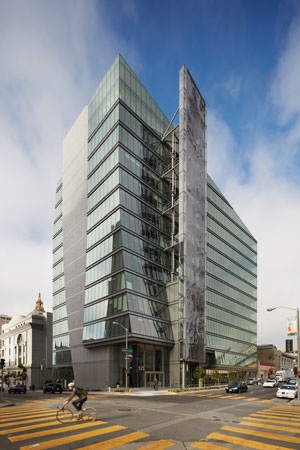
I finallly got a tour of the San Francisco Public Utilities Commission’s cool new building at 525 Golden Gate. It’s about as green as an urban building can be, with solar panels, wind turbines, a wastewater recycling system using the underground root structure of street gardens to clean sewage … the energy use is about 30 percent below a typical building that size, and water use is even lower; the PUC projects about a 60 percent savings, which is a good thing for a water agency that wants to promote conservation. So far, it’s gotten pretty good press.

For a 13-story office building done in a very modern style (not my favorite type of structure), it looks pretty cool, too, with polycarbonate panels that wave in the wind and light up at night. Inside, it’s open and full of light. There’s lots of space for bicycles and an on-site child-care center.

There’s also $4 million worth of public art — most of it purchased or commissioned from local artists. I love the painting and photos, and the cafe on the first floor has a pretty wild giant computerized display that shows the entire water and power system, with interactive popups as you approach different areas.

Nice.

I was a little disappointed that Ed Harrington, the SFPUC general manager, and Barbara Hale, the assistant general manager for power enterprise, had no idea why the power lines from the city’s hydroelectric facilities in the Sierra end in Fremont, where the city’s power gets plugged into the Pacific Gas and Electric system. “I’ve never heard that story,” Hale said. You’d think that I’d written enough about that tale; you’d think P&E’s role in denying the city its legal right to public power would be part of the official history of the Hetch Hetchy system.

But I forgive them; the story is long and complicated, and very rarely told or taught in San Francisco, which has been scrambling for more than 80 years to duck the Congressional mandate that should force us to kick out PG&E. Because here’s the thing: As he heads for retirement, I think Harrington now gets it.

We sat and talked on the top floor of his new building, in an oddly-shaped conference room with a stunning view, and I got the distinct impression that Harrington and Hale want to move the city toward public ownership of the local electrical system. They’re pushing Clean Power SF, which is a critical step down the path to energy independence; Harrington wants this to be part of his legacy. He’s careful not to say anything that sounds like he wants to fully replace PG&E and create a fully municipalized electric utility in San Francisco, but he can’t ignore the facts: The only way this city is going to get to a sustainable energy future is if we own the infrastructure.

Of course, even if we started today, that would happen long after Harrington’s tenure is over.

But when we talked about the city’s water system, he noted that there are all sorts of important policy decisions that we have only been able to make becuase we own the entire system, soup to nuts, water storage, pipes, delivery. And he didn’t try to argue with me when I said that the same clearly applies to power.

Harrington has made his peace with the energy activists who want to make sure that part of the Clean Power SF program involves buidling our own generation facilities. Even with a full build-out of solar and wind on all the land the city has access to, and with the Hetchy Hetchy hydro system, a municipal utility could probably only generate about 40 percent of the city’s current needs. But knock the current needs down by 20 percent (through better efficiency and conservation) and get every homeowner and commercial building to put solar on the roof, and look at wave energy down the road … and it’s not hard to imagine that 25 years from now San Francisco would have no need to buy electricity from PG&E, Shell Energy, or anyone else.

I know, I know, that’s a long time from now. But I wrote my first story about PG&E in 1982. If we’d started back then, we’d be well on our way by now.

So here’s to hoping that this slick $200 million building is the start of a new era for SF’s PUC, which in the past has been openly hostile to public power. Let’s hope that when I’m 80 years old I can write my last PG&E/Raker Act story and move on to something else.