• No categories

Politics Blog

City considers making building owners do seismic upgrades

84

City Hall sources have confirmed the basic details of a San Francisco Public Press report from Friday afternoon that the Board of Supervisors will consider requiring the owners of soft-story buildings of three stories or more to seismically retrofit them by 2020 – at the expense of building owners, something sure to rouse controversy.

The legislation was developed and introduced by the Mayor’s Office and it’s being sponsored by the board’s two most prolific and effective supervisors, Board President David Chiu and Sup. Scott Wiener, which is probably a signal that city officials know this one is going to be “challenging,” as one source told us.

Details are still being hammered out before the measure is introduced at tomorrow’s board meeting, including some of the financing options that would be open to property owners. But after voters in 2010 narrowly rejected Measure A, a bond that would have provided low-cost loans for the seismic retrofits, property owners could be forced to dig deep to ensure their buildings don’t collapse in an earthquake.

Wiener confirmed that the legislation would be mandate on building owners without public money attached: “It would be a mandate that they within a certain time frame do an earthquake retrofit,” Wiener told the Guardian.

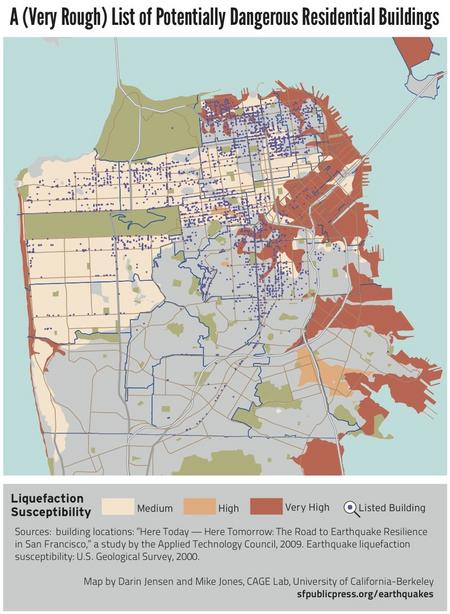
As the Public Press reported, the legislation would apply to all wood-framed buildings of three stories or more built before 1978, with smaller buildings and single-family homes exempted. In the most recent print edition of the Public Press, extensive coverage of the city’s earthquake vulnerabilities estimated that about 58,000 San Franciscans live in the nearly 3,000 soft-story buildings deemed dangerous places to be when the next big earthquake hits.

Wiener said city officials have been deeply involved with negotiations with various effected groups, including building owners and their tenants, who could face displacement as the work is done or higher rents if landlords pass through those costs. Wiener said the legislation is bound to evolve as talks and hearings continue: “There are a lot of variables and the introduction is really just a preliminary step.”

Supes call for stronger SRO safety measures

It’s no secret that tenants living in single room occupancy hotels (SROs) often grapple with health and safety issues, from bedbug infestations to plumbing problems.

At a committee hearing this afternoon, members of the Board of Supervisors will consider legislation [PDF] introduced by Sup. Eric Mar that would amend the housing code to require owners of SROs to install grab bars in common-area bathrooms, and to provide working phone jacks in each SRO unit.

These measures may seem relatively small, but Tony Robles of the Senior & Disability Action Housing Collaborative says installing grab bars can go a long way toward preventing falls, a leading cause of injury deaths for people older than 65.

In SROs, “there’s a lot of folks who have mobility problems,” Robles explains. “Many are disabled, or elders.” He said knows an elderly woman living in an SRO who recently fell and now faces hip surgery.

“This legislation is about safety, and it’s about quality of life,” Robles said. “It’s not just affluent folks who deserve to live in reasonably habitable conditions.”

Last June, advocates with Senior Action Network and several SRO collaboratives published detailed findings [PDF] from an in-depth survey of 151 SRO residents living in Chinatown, the Mission, SoMa and the Tenderloin. Most respondents were older than 55, and 62 percent identified as having a disability.

The in-depth study found that safety issues topped the list of residents’ concerns. Many respondents said they feared falling on the stairs or in the shower, and less than half reported having grab bars in their bathrooms.

The legislation, which was co-sponsored by Supervisors Jane Kim, David Campos and David Chiu, would also require SRO operators to install working phone jacks in residents’ rooms, which can be critical for tenants who need a way to communicate in case of an emergency.

According to the study findings, these low-income tenants face a host of other issues too:

“About one-third or more of survey respondents said their hotel had a problem with bedbugs, other infestations, visitor policy violations, electrical problems, unsanitary bathrooms, and harassment/ disrespect. One-fifth of respondents also cited problems with heat, plumbing, personal safety, fire safety, and maintenance and repairs. 
More than half (53%) had no access to a kitchen in their building, and 18% of respondents said they skip meals due to lack of resources or facilities.”

San Francisco has more than 500 residential hotels, according to city records, with more than 19,000 units. An estimated 8,000 seniors and adults with disabilities live in SROs.

Robles remarked that it took courage for the SRO residents to speak up in hopes of improving their living conditions. “Tenants in theses SROs oftentimes are intimidated to say anything,” he said. “Some folks might have feared reprisal.”

Trail to historic gay Boy Scouts vote started in the Bay Area

23

This Wednesday, the Boy Scouts of America’s (BSA) Executive Board will consider removing the controversial ban on gay members and allow each individual troop to adopt its own policy on gay scouts. The board publicly reaffirmed the anti-gay policy just last summer, but recent pressure from gay rights groups, corporate sponsors, and Bay Area troops has forced the governing body to revisit the blanket prohibition on gay members.  

Opposition to the Boy Scout’s ban first surfaced in Northern California in the late 1980s when Tim Curran, an Eagle Scout and aspiring scoutmaster, sued the Mount Diablo Boy Scout Council for discrimination after being denied the position. Curran took the suit to the Supreme Court and lost. The court’s landmark decision in Curran v. Mount Diablo Council of the Boy Scouts of America continues to provide the legal justification for the BSA’s anti-gay policies.

Since the ruling, the San Francisco Bay Area has emerged as a key battleground in the struggle for gay membership in the scouts. Local troops often clash with the national organization over the ban and many local scout leaders publicly denounce the policy as discriminatory and hateful.

In October, openly gay East Bay scout Ryan Andresen was denied his Eagle Scout badge by the Mt. Diablo-Silverado Council due to his sexual orientation. Although officials with the council voiced reservations about denying Andresen, they are bound by BSA national policy that has long maintained homosexuality is inconsistent with the scouts oath to be “morally straight.”  

Andresen’s father resigned his position as an assistant scoutmaster, and Andresen’s mother organized an online petition which collected nearly half a million signatures protesting her son’s expulsion. The incident is sparking a widespread public debate about the Scout’s discrimination policy. Andresen appeared on national TV, and his petition garnered high profile support from California politicians like Lt. Gov. Gavin Newsom and US Sen. Barbara Boxer.

Andresen’s national profile and the publicity surrounding his case inspired outrage among local scouts and adult leaders. Steve Tennant, committee chair of Palo Alto Troop 57, said the parents and volunteers in his troop felt compelled to act. “We were all outraged and we immediately started thinking about how we could go about changing this policy,” he told the Guardian.

The controversy quickly galvanized parents and scouts throughout the Bay Area to more openly challenge the gay ban. From San Francisco to Palo Alto, parents and scouts penned public letters of protest decrying the policy and and urging the local Mt. Diablo-Silverado Council to reconsider Andresen.

Parents in Tennant’s Troop 57, located just a few miles from Andresen’s troop, unanimously adopted a non-discrimination policy both to voice solidarity with Anderson and to avoid potential discrimination in their own troop.

“It was just a matter of time until a kid in our troop faced the same situation as Ryan. I would rather resign my position than kick a kid out of the Scouts for being gay,” Tennant, whose two sons are currently scouts, told the Guardian. “Seeing the reaction of our parents and seeing the support for Ryan convinced me personally to stay involved with the Scouts,” he added.  

Eagle Scouts from Andresen’s district also mobilized against the ban. Trevor Wallace, an Eagle Scout from the nearby Troop 57, helped to organize meetings to pressure the Mt. Diablo-Silverado Council to allow Andresen to earn his badge. “My troop has been completely outraged by what happened to Ryan,” Wallace told the Guardian. “I got my Eagle Scout badge the same time Ryan was supposed to get his… discriminating against him like this is old fashioned and wrong.”

Michael and Andrew Dotson, a father-son scoutmaster duo who lead San Francisco’s Troop 88, echoed the concerns of Wallace and Tennant. “I want the boys to feel safe and be able to be open,” Michael Dotson told the Guardian. “Troop 88 would be very accepting of gay members once the ban is removed. And I hope it is.”

Andrew Dotson, a recent Eagle Scout who now works as his father’s assistant scoutmaster also opposes the ban. Growing up in San Francisco, he encountered plenty of gay scouts. But because of the national policy, the boys in his troop had to stay formally in the closet or risk expulsion. “I just don’t think that’s right,” he told the Guardian. “Scouting should be open to everybody.

Andresen’s case and the outpouring of support from other Bay Area scouts drew the attention of Zack Wahls, founder of Scouts for Equality, a national organization founded last summer to pressure the BSA Executive Board d to revisit the gay-ban.  

Wahls credits Andresen and his supporters with providing the necessary grassroots pressure to potentially change the national policy.

“It’s important to remember that only seven months ago, the Scouts were adamant that this policy was not going to change,” Wahls told the Guardian. “What happened in those seven months was that we harnessed online tools and worked with people like Ryan to highlight the negative impact this ban has on the local level.”

Wahl and Boy Scouts for Equality also targeted corporations and sympathetic members of the BSA board.  Over the summer, board members Randall Stephenson, CEO of AT&T, and James Turley, CEO of Ernst & Young, announced publicly their opposition to the ban. Since September, several major corporate sponsors, including Intel and UPS, announced that they would rescind financial support for the BSA until the national organization lifted the ban.  

Ahead of the board meeting, BSA officials reiterated that lifting the ban would not force any individual troops to change their own membership policies. “The Boy Scouts would not, under any circumstances, dictate a position to units, members, or parents,” BSA spokesperson Deron Smith told the New York Times. “This would mean there would no longer be any national policy regarding sexual orientation.

For many scouts in the Bay Area, however, removing the national ban is just the beginning. The end goal is the adoption of a national non-discrimination policy. But given the Boy Scouts history of strident opposition to gay rights, reconsidering the ban is significant development. “I think a national policy will take time,” reflected Michael Dotson of Troop 88, “but this is a good first step.”


Suhr apologizes for sparse spying report, pledges more info

0

Police Chief Greg Suhr has issued an apology for the sparse report on joint SFPD-FBI surveillance activities that his department gave last week, pledging to work with the activists who had criticized it as failing to comply with a city law adopted last year. But it remains to be seen whether the two sides will agree on the level of detail that would constitute meaningful civilian oversight of sensitive domestic spying operations.

“The report was accurate and complied with the ordinance, but briefer than what he had hoped for,” SFPD Sgt. Michael Andraychak told the Guardian this afternoon. “Chief Suhr has ensured compliance with the ordinance but did not have an opportunity to review the report prior to the presentation to the commission. The chief personally apologizes to those who attended the commission meeting for the brevity of the report and promised to have future reports more developed. The Chief’s Office is in the process of scheduling meetings with Nasrina Bargzie [of the Asian Law Caucus] to develop a report with more detail so those concerned and the public can be as informed as possible. Chief Suhr is committed to remain in compliance with the ordinance.”

While Bargzie said she welcomes the apology and pledge to be more forthcoming, “We disagree that the report that was issued was in compliance with the ordinance.” While that watered down version of a stronger ordinance that Mayor Ed Lee had vetoed was vague, Bargzie said that, “It does require that the commission be given enough information to provide oversight.”

In correspondence between Bargzie and Suhr over the last year, the Coalition insisted that the report include details on the number of investigations or assessments requested by the FBI, how many requests SFPD personnel refused, how disputes were resolved, and other information, which she said Suhr told her last year that he would provide.

But he seemed to dispute that in a Jan. 23 letter to her, writing, “I assured you that the Department’s JTTF report would include all public information required by the ordinance. I did not commit to provide all information requested in your letter dated June 8, 2012.”

Sup. Jane Kim, who sponsored both the stronger original legislation that Lee vetoed and the compromise measure that followed, expressed hope Suhr and the Coalition will find common ground. “The chief himself met with me and apologized for it,” she told us. “He acknowledged that it was not a good report and said he would work with the Coalition on this.”

She acknowledged that the ordinance itself doesn’t spell out the specificity that the Coalition is seeking. “In order for us to get the compromise, we had to work with the Mayor’s Office. It was watered down,” she said. Yet Kim said meaningful oversight is still what she expects to see: “We need a lot more specificity and the details the Coalition would like to see.”

Police gear up for round two on Tasers

On February 4, the San Francisco Police Commission will hold the second of three planned community meetings to gauge support for a pilot program to arm 100 SFPD officers with Tasers. The controversial proposal pits police Chief Greg Suhr, a proponent, against civil liberties organizations and homeless advocates who are mobilizing public opposition to the Taser initiative. 

Shortly after being appointed police chief in 2011, Suhr said arming the SFPD with Tasers would not be a top priority. But following the police shooting of a mentally ill man last July, Suhr has pushed the Police Commission to allow members of the cities Crisis Intervention Team (CIT)—who receive special training to deal with the mentally ill—to carry Tasers.

Since the shooting, Suhr has repeatedly argued that Tasers would help save lives and reduce instances of gun use. “You do have to have as many tools in the tool box before you go to guns,” he said at the first community forum.

The ACLU and local homeless advocates disagree.

“Every time there is an officer-involved shooting, the department uses it as an excuse to outfit officers with Tasers,” ACLU attorney Micaela Davis told the Guardian. “We continue to believe that Tasers are not a good alternative to firearms and we fear that officers run the risk of going to Tasers too early in a confrontation instead of using de-escalation techniques.”

Equipping CIT officers with Tasers would inject the controversial stun guns into already tense confrontations between the mentally ill and the SFPD.

Lisa Marie Alatorre, an organizer with the San Francisco Homelessness Coalition, argues Tasers could have a devastating effect on the city’s homeless population. “The CIT typically deals with people in crisis, people who are mentally ill, and people who are currently destitute and have nowhere to live,” she told the Guardian. “The use of Tasers in the midst of a crisis will cause severe trauma and could inflict significant psychological damage.”

Both the Coalition on Homelessness and the ACLU charge that the SFPD has dragged its feet in implementing the nonviolent components of the CIT program. Less than 75 officers have been trained in nonviolent confrontational strategies since the program’s adoption last summer, and Alatorre charges SFPD has yet to implement protocols that would bring the program to fruition.

Police Commissioner Angela Chan, a longtime proponent of the CIT program, echoed these concerns. “We need to improve our de-escalation tactics with regards to crisis intervention. Many of the steps to train and implement CIT have not yet been implemented and that’s where we need to focus our energies,” she told the Guardian.

Despite strong local opposition to Tasers, they are becoming standard equipment for police departments across the nation. SFPD officers are hopeful that public opposition does not kill this pilot program, like similar attempts before it.

Sgt. Michael Andraychak, a spokesperson with the SFPD, argued that equipping CIT officers with Tasers would give police more flexibility to use force without engaging their firearms.

“On the street, not every situation can be managed in a nonviolent fashion,” he told the Guardian. “CIT is a great program, and the implementation of Tasers would give those officers an additional tool to use before they have to escalate to deadly force.”

Police commissioners will make a final decision about Tasers after the third community meeting, which is scheduled for Feb. 11 at the Bayview Opera House.

The next community forum on the SFPD Taser pilot program will be held on Feb. 4 from 6-8pm at the Scottish Rite Center, 2850 19th Ave, in SF.  

Harvey Milk and Cesar Chavez

32

The Chron continues its jihad against Harvey Milk Airport today, arguing that the price tag airport administrators came up with — $4 million — makes the plan too expensive. Not that $4 million is a trivial amount of money, but please: Compared to the tax breaks, upzonings, and other giveaways the the city routinely hands over to big corporations, this is birdseed. That’s if we can trust the folks at SFO, who are opposed to the name change. And there’s no reason all that money has to be spent at once, the first day; change the name, then implement all the signage changes over a couple of years or so. Not really a big deal.

Assemblymember Tom Ammiano called this morning to remind us of a similar battle in 1994 over renaming Army Street after Cesar Chavez. The costs were wildly inflated. The Chron kept raising all sorts of problems. “It was like, ‘oh we should honor him, but we can’t change a name,’ Amminano said. “The same tired bullshit we’re hearing now.”

And the truth is, changing Army Street to Cesar Chavez Street was an appropriate step, no big deal — and in the end, everyone came around. Ten years from now, they’ll feel the same way about Harvey Milk International Airport.

PS: The issue here isn’t really renaming the airport against leaving it as SFO. I guarantee if this fails, at some point someone’s going to try to name it after Dianne Feinstein or Willie Brown — and the Chron probably won’t have the same issues. If the question is whether to name an airport after Brown (terrible mayor) Feinstein (terrible mayor) or Milk (international civil-rights icon) … well, that’s a no-brainer.

PS2: The B.A.R. came out against the name change in an odd editorial that suggested the battle would be divisive and “turn our friends against us.” That, as a sharp letter from Ammiano, Bevan Dufty, Carole Migden, Jose Cisneros, and Anne Kronenberg ponts out, is the same argument that the more conservative elements of the gay community used to try to talk Milk out of running for office.


http://www.ebar.com/openforum/letters/letter.php?sec=letters&id=372

More unregulated cabs on the street

17

So the state regulators have decided that it’s just fine for companies that pretend not to be taxi operators to operate taxis in San Francisco. That means Lyft and Uber can keep picking up passengers, charging them a “recommended donation” and avoiding the regulations that San Francisco wisely put in place to protect the public.

But the fact that the state thinks this is just fine and dandy, for now anyway, doesn’t mean San Francisco has to do the same. This city has the right to put rules in place for people conveying passengers within its 49 square miles — and those rules ought to apply to Lyft and Uber and Sidecar, too.

Cabs have to carry medallions, or permits. There are a limited number, and they can’t be owned by corporations, only by active cab drivers. You can buy one now — for about $200,000 — or you can get in line and wait, for about 15 years. If the city wants more cabs on the streets and likes the Lyft model, fine: The Municipal Transportation Agency can issue more permits, and if the venture capitalists backing Lyft want to pay for them, they can do so.

I’m not against Lyft or anyone else who has a good idea to serve the public in a way that isn’t being offered now, and I agree that this is the kick in the pants a slow-moving industry needs to develop (fairly simple) apps that allow people to figure out where the nearest cab is and when it’s coming.

But right now, we have an unregulated industry operating in competition with a heavily regulated industry, and it’s not fair. The City Attorney’s Office ought to look into this; the supervisors ought to investigate and force the newcomers to follow the rules. Sure: Lyft. But not this way.

Activists slam hollow report on SFPD-FBI spying

108

UPDATE: SUHR APOLOGIZES FOR REPORT The San Francisco Police Department continues to resist meaningful oversight of its partnership with the FBI’s Joint Terrorism Task Force. After last year pressuring Mayor Ed Lee into vetoing a strong oversight measure and signing a weaker version, the SFPD last week issued a required report that activists are slamming as “grossly inadequate.”

The Coalition for a Safe San Francisco – which includes civil libertarians and members of Muslim groups and other targets of racial and religious profiling by the FBI – last May stood with Police Chief Greg Suhr and sponsoring Sup. Jane Kim as Lee signed what they called this “historic civil rights legislation.”

But at the time, the activists told the Guardian that the value of the watered-down legislation depended entirely on how it was implemented, particularly in the annual reports on SFPD-FBI operations that it required. To ensure they were specific enough to be meaningful, the coalition says it communicated with Suhr several times asking him to include the number of joint investigations undertaken, how many times FBI requests were denied by the SFPD, and possible violations of department policy and how they were handled.

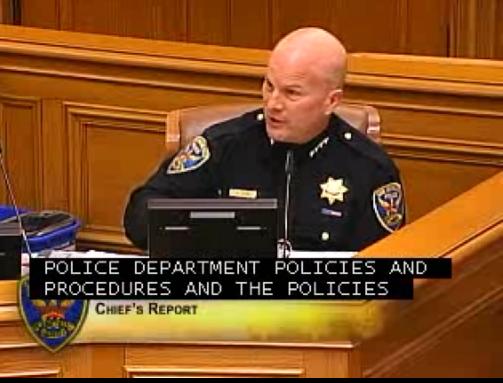
Instead, when Deputy Chief John Loftus gave the first of these annual reports to the Police Commission on Jan. 23, he spoke for only a couple minutes and said the SFPD was in “full compliance” with the ordinance and a Suhr general order banning surveillance of law-abiding citizens, offering no further details.

“We were very clear with the chief about what we expected to see,” Nadia Kayyali of the Bill of Rights Defense Committee, a coalition member, told the Guardian. She also said the report “was slipped on the agenda at the last minute,” despite assurances that the coalition would be notified and given a chance to respond. “It does show a lack of regard for the ordinance and the work that went into it.”

The activists say that Suhr broke his promise to them to include the more specific information that they sought, even after they recently followed up with messages reminding him about that assurance. “I was in the meeting where he said he would,” Nasrina Bargzie with the Asian Law Caucus, another coalition member, told us. Bargzie said she was disappointed and dismayed by what the report included, “but we’re going to keep pushing on it.”

The controversy surrounding possible SFPD-FBI spying on people who haven’t violated any laws – which is illegal under local and state law – broke almost two years ago when the American Civil Liberties Union obtained a secret 2007 SFPD-FBI memorandum of understanding placing SFPD officers under FBI command. It seemed to bypass local restrictions adopted after past SFPD scandals involving police spying on political groups.

Suhr tried to quell the controversy by issuing a general order banning officers from participating in surveillance that violates local rules or the state constitution’s privacy protections, but activists pushed for a stronger assurance. The Board of Supervisors then voted 6-5 to codify those protections into city law, but Suhr objected and Lee vetoed the measure. A weaker version calling for annual reports and Police Commission reviews of future SFPD-FBI MOUs was approved unanimously by the board.

Now, it appears the SFPD has done little to soften the “trust us” stance that it has taken from the beginning, frustrating activists who had pushed for more, here and in other cities that do domestic surveillance with the FBI.

“These policies are explicit and unequivocal. San Francisco Police Department members and their Joint Terrorism Task Force supervisors are aware of and familiar with these policies,” Loftus told the commission, explaining that the SFPD did its required quarterly reviews in November and two weeks ago, finding nothing to report.

Police Commissioner Suzy Loftus asked if he could “explain a bit more” and Suhr – who was at the stand giving his report as Deputy Chief Loftus (no relation) gave his from the lectern – answered: “All San Francisco police officers are held to the San Francisco Police Department policies and procedures and the policies and laws of San Francisco, whichever is more strict. So depending on wherever they are, their fallback, if you will, is whatever the policies, procedures, laws, ordinances, and all of San Francisco.”

Suhr’s answer seemed to satisfy the commission, which defended the SFPD’s secretive approach rather than asking any more questions.

“Our officers will not participate in any investigation unless there is a predicate offense that is a violation of the California Penal Code or the United States code, so they will not be involved in random surveillance or random assessments or talking to people,” Commission President Thomas Mazzucco said.

Commissioner Joe Marshall also said he trusts Suhr and we all should too: “I want the public to feel reassured that when the chief says that’s going to be the way it is, that’s the way it is.”

But the coalition, which includes 79 organizations, was less than satisfied with that answer. In a statement issued today, it wrote, “Deputy Chief Loftus’ report completely failed to provide the information required to ensure the accountability and transparency required under the Safe San Francisco Civil Rights Ordinance. The Coalition calls on the Chief of Police to promptly issue a public written report containing the information he promised he would provide.”

Neither Kim – who sponsored both the original legislation and weaker alternative – nor the SFPD have returned Guardian calls for comment yet, but I’ll update this post if and when they do. You can watch the hearing yourself here, with that item beginning at the 48:20 mark.


Sunday parking, free — for some

84

If you drive your car Sunday morning to a restaurant for breakfast, or if you go to a Yoga class, or if you’re going to work or shopping, you have to plug the meters now, or you’ll get a pricey ticket. Almost 1,800 people got caught up in the new crackdown on Sunday parking.

Which is fine with me; I think people who drive should pay to park, and as long as you can stay a couple of hours, most of the meters in the city are a bargain.

But for some people, there are no Sunday meters, and no tickets. Those are the ones who don’t bother with the meters and just park in the middle of the street while they’re going to church.

I’ve been complaining about this for a long time, and nothing seems to change:

If you go to see the (secular) Mime Troupe in Dolores Park and you stick your car in the middle of the street, you get a ticket. If you drink at a (secular) bar or eat at a (secular) restaurant and you leave your car in the Valencia Street median, you get cited. You can’t double park while you run in for a (secular) cup of coffee at Muddy Waters.

And now everyone engaging in secular activities has to pay to park, and the people who go to church get to park in the middle of the street, illegally, free of charge, and with full impunity.

I called Paul Rose, the MTA spokesperson, and asked if this harsh crackdown on Sunday meters would also include a crackdown on people who park illegally in the middle of Valencia Street, but he hasn’t gotten back to me. I’ll let you know if he does.

Don’t just stand there — squat!

59

You know I love this story. I love it so much I am going to be following it for weeks, and I hope for years. A homeless guy takes over a $2 million mansion in Florida, which was sitting empty while Bank of America dicked around and never sold or rented it, and now the bank is going to have a tough time getting rid of him.

Did I say I love this story?

Check it out:

It only gets more complicated. By invoking an obscure but never rescinded nor revised Florida law, Barbosa is using “adverse possession” to justify his claim in the house, as it allows a person to move in and claim title of a property “if they can stay there seven years.” Florida has suffered more than one similar case. The Sun Sentinel makes reference to a “handful” of adverse possession claims making their way through the Palm Beach County Property Appraiser’s Office, but Barbosa’s stands out because the house he’s possessing (adversely) is so valuable. And though Barbosa is certainly eccentric, posting a sign that he is the “living beneficiary to the Divine Estate being superior of commerce and usury” on the front of the home, he isn’t stupid. He even contacted the Appraiser’s Office to alert them that his tenancy had begun, presumably as he intends to stay for the required seven years.

We haven’t had any good high-profile public squats like this in San Francisco in years. Back in the day, my old friend Paul Kangas and his brother John were the kings of squats; Paul found an empty house in the Sunset in the late 1970s, with the paint peeling and the shutters hanging off the windows, moved into it, fixed it up, had the water and power turned on in his name and lived there for years. He didn’t operate in secret or the middle of the night; he got the lock re-keyed, moved all his stuff in, and acted like he owned the place. He fixed it up nicely, took care of the yard — and the neighbors loved him. An empty eyesore was now a clean, inhabited house.

Paul was no fool; he had researched the place and found out that the owner had died without leaving direct descendants or a clear will, and for a long time, nobody in the city or the legal system could figure out who actually did own it. Paul needed a place to live; this one was going to be empty for a long time. Why not use it?

John did the same thing with an abandoned house in the Mission, except that to open the door, he had to climb in a window. Somebody saw him, called the cops …. and he was arrested for burglary (for taking the front door knob, which he was going to replace.) He took the case to trial, and it was spectacular: His lawyer, Jonathan McCurdy, called a bunch of city officials and asked them who John had stolen the door knob from; “who,” he kept asking, “actually owns this property?” The title was unclear; nobody could answer the question.

Then John took the stand and said he wasn’t a burglar at all; he was a squatter, who was planning to take over, fix up, and live in an abandoned house.

The jury took about an hour to come back with a verdict of not guilty.

There are plenty of pieces of property around the Bay Area that are owned by banks and sitting vacant. Some of them are becoming eyesores. Somebody ought to be living there.

As we used to say, Don’t just stand there — squat!


Developer hypes art; screws artists

It’s late afternoon in Building 101 of the Hunters Point Shipyard artists’ colony, and Richard Bolingbroke has his forehead in his hands. The studio complex, which began as a squat in the 1970s, has been an artists’ sanctuary for decades, drawing flocks of curious visitors and housing internationally acclaimed residents. Bolingbroke has been there 17 years. “It’s like a sacred space,” he says.

But now, he and 15 other artists have been snagged in a minor wrinkle of the massive Hunters Point Shipyard redevelopment project—and they’re being told they’ll have to vacate. 

Lennar, the project developer, is using the artists’ presence as a selling point to market homes in the new neighborhood. Billboards touting art line the entrance to the site, where construction is expected to begin soon.

Lennar is obligated to relocate Eclectic Cookery, a commercial kitchen housed in a different shipyard building that’s slated for demolition. Under a scheme that caught many by surprise, the developer intends to demolish artist studios in one wing of Building 101 to make way for the kitchen.

Representatives of Lennar, the project developer, said at a Jan. 23 meeting that displacing 16 of the 150 artists now situated in Building 101 is the only workable solution.

Iconic poet and painter Lawrence Ferlinghetti has a studio there. He won’t be impacted, but he emailed fellow artists expressing disapproval. “As a 32-year resident in Building 101, I am shocked by the way the city and Lennar are evidently willing to break their promise that 101 will be maintained solely as artists’ studios,” he wrote. “Allowing any commercial business to move into 101 opens the flood-gates to further evictions of artists. I hope this is not really the city’s long-range plan!”

The artists have been promised temporary spaces with subsidized rent, and eventual accommodations in newly constructed studios. But their rents are expected to increase in the long term. Beyond their tenancies, the move would trigger a permanent loss of affordable, highly sought-after studio space in Building 101.

Some have had studios in the World-War-II era complex for more than two decades, allowing them to continue practicing their craft in ever-pricier San Francisco.

“If I don’t leave this space, my rent won’t change,” said Travis Somerville, who was preparing for a show at the Crocker Art Museum when the Guardian stopped by his studio. Somerville has been there since 1989, and he’s dedicated himself to making art full-time. Lennar’s proposed arrangement “would not only force me off the shipyard,” he said. “It would force me out of San Francisco.”

At the Jan. 23 meeting, Lennar joined representatives of the San Francisco Redevelopment Agency in hashing out the unpopular plan.

Company representative Jack Robertson broke it down in economic terms. “We’re a profit-motivated company here,” he said. “The city negotiated, very shrewdly, to require us to spend a whole lot of money up front for a whole bunch of community benefits. … We’re not getting anything out of that at all. And we’re not trying to. What we’re trying to do is make it work.”

Stacey Carter, an artist whose work is on display in Sup. Malia Cohen’s City Hall office, alerted Cohen to the issue, since her district includes the shipyard.

“The artists have been at the table, in the discussions, for a very long time. They’re an asset to the community,” Cohen told the Guardian. “We have been in touch with them, and my staff is very aware of their concerns.”

The multi-billion dollar redevelopment project will transform the landscape with 20,000 new homes, parking, and shopping amenities. It’s being financed in part with a $1.7 billion loan from a Chinese bank. Plans to accommodate the artists and the kitchen have been in the works for years, but Lennar realized only recently that its original plan for relocating Eclectic Cookery was unrealistic.

Scott Madison, who runs the commercial kitchen, is a longtime ally of the artists. He serves small businesses that can’t afford their own industrial kitchens, such as a client who cranks out 1,200 empanadas a day.

“We really want to stay on the shipyard,” Madison told the Guardian. “It has been known for a good many years now that Eclectic Cookery would likely need to be relocated. But it seems to be the nature of Lennar’s process that they don’t consider something until it’s right in front of their face.”

When Lennar first approached him about Building 101, Madison said, “We told them that this was not our first choice, because we definitely did not want to [cause] anybody to lose their studio.”

Lennar has indicated that any other option would either be too costly, or would disrupt the construction schedule. Delays translate to lower profitability.

Bolingbroke views the whole snafu as a culture clash between businesspeople and artists, and links it to a broader problem facing San Francisco. “It’s a bit like a tree,” he said. “Artists are like the roots. You can’t see them — but if you cut the roots off, the tree will wither and die.”

Today in gun deaths

28

I have friends in the Gun Left, and even a few in the Gun Right, who firmly believe that they have to have a large collection of dangerous weapons so that when the Forces of Repression or the International Socialist Order come marching up to their doors to lock them up in concentration camps, they can fight back for their freedom. Like this, I guess.

Only: The dozen or so rifles in your closet won’t do much good up against the US Army, if that’s who you fear — and if you fear the International Socialist Order, relax: You’ll get free health care.

But in the meantime, all these guns are doing an awful lot of killing. Teenage inauguration performer shot in Chicago. Five people shot at an office building in Phoenix. Urologist shot in California.

Of course, we all know that the only thing stopping a bad guy with a gun is a good guy with a gun, so: We need armed guards in every office building, and in every urologist’s office, and on the streets of Chicago. Wait — we already have cops in Chicago. And in Oakland. And still.


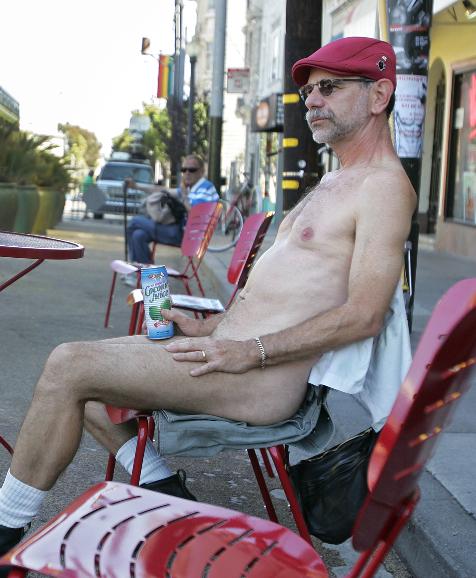
Nudity ban upheld, found to be stupid

27

The City Attorney’s Office just announced that a federal court has upheld San Francisco’s ban on public nudity. From the press release:

The court found that the nudism advocates’ challenge to the ordinance based on the First Amendment lacked merit because “public nudity alone is not expression protected by the First Amendment,” and because the ordinance was “not substantially overbroad.”  Judge [Edward] Chen additionally rejected plaintiffs’ arguments that exemptions for such permitted events such as Bay to Breakers and the Folsom Street Fair violated constitutional Equal Protection guarantees, holding that plaintiffs failed to demonstrate that the exceptions lacked a rational basis.  Though the nudism advocates’ facial challenge to the ordinance was dismissed without leave to amend, the court left the door open for nudism advocates to amend their pleading with subsequent “as-applied” claims, provided they were able to do so.

So maybe this isn’t over yet.

The news comes just as the Atlantic chimed in on the city’s nudity ban, calling it pretty dumb:

In San Francisco next week, it will remain perfectly legal for a 50-year-old man to seduce an 18-year-old, impregnate her, ridicule her physical appearance until she is brought to tears, walk out on her, seek out her mother, seduce that mother for no other reason than to further hurt the jilted daughter, draw a graphic novel of the whole sordid chain of events, and publish in on the Internet. But it’ll be illegal for him to be naked outside. Does anyone think the resulting moral signal is desirable?

There’s a long discussion of Judeo-Christian values, the Bible, Adam and Eve, etc. But the conclusion really makes the point:

Americans are bombarded with images of semi-clothed people all the time. It just happens that they’re all beautiful actors and actresses, magazine cover girls, television underwear models, and porn stars. The average person sees lots of naked bodies, but very little real variety. While that may be more aesthetically pleasant, it skewers our notion of what a normal human body looks like. In an age of Victoria’s Secret in the mall, substantial nudity on primetime television, and ubiquitous YouPorn, a ban on nonsexual street nudity begins to seem absurd. Society needs some relatively unattractive people to be naked in public now more than ever before.

So there you have it. Legal, stupid.


Life after the death penalty

18

Tell me: Does any sane person really believe that the world would be a better and safer place if Rick Stevens had been executed by the state of California?

The guy was all fucked up on drugs when he shot three men. Horrible crime. He spent most of his adult life in prison. And now, at 72, he’s out on the streets — where the odds that he will ever hurt anyone again are infintessimally small.

Instead of spending millions and millions of dollars to kill him, the state gave him a life sentence, with the possibility of parole, which was finally granted. It’s hard to argue that justice wasn’t done.

This was the legacy of the Rose Bird Court, the most progressive Supreme Court in California history, from back when Jerry Brown was a young governor. Bird and her colleagues didn’t like the death penalty, and ultimately ruled that the state’s executiion process was unconstitutional. So people like Stevens got a second chance.

Not saying he should have gone free; nobody says that. But the state saved money, and saved a life, by failing to carry out the ultimate punishment. And I think we’re all better off for it.

Condo conversion legislation on hold for now

Following a contentious five-hour hearing, a committee of the Board of Supervisors postponed voting on a controversial housing proposal, and agreed to revisit the issue on Feb. 25. Over the next few weeks, opposing sides are expected to negotiate a possible alternative.

Authored by Sups. Scott Wiener and Mark Farrell, the proposed condo conversion impact fee would have allowed as many as 2,000 tenancy-in-common (TIC) units to be immediately converted to condos for a fee, allowing owners to bypass a housing lottery system that places an annual cap on conversions.

While TIC owners voiced frustration about the backlogged lottery system, tenants expressed fears that the legislation could give rise to a wave of Ellis Act evictions if landlords or speculators interpreted it as a signal that lucrative condo conversion would be easier to achieve.

Prior to the hearing, a group of tenants gathered in front of City Hall in a show of opposition to the condo-conversion legislation, waving signs that read, “Stop the Attack on Rent Control.”

“The reality is, if this legislation passes, there will be more evictions in San Francisco,” said Tommi Avicolli Mecca of the Housing Rights Committee, who spoke at the rally.

Tenant advocates worry that the legislation would result in a permanent loss of affordable, rent-controlled units from the city’s housing stock, at a time when rents are soaring. When landlords rent out their condos or TICs in San Francisco, there’s a key difference: TICs are covered by rent control, but condos are exempt.

“I’ve been evicted three times,” one woman said while addressing members of the Land Use & Economic Development Committee. “I know so many people who have gotten evicted. I don’t know anyone who’s won their case against eviction.”

During the hearing, Farrell adopted a defensive tone against critics who’d described the proposal as an attack on rent control. “The tactics that these opponents have deployed is out of line,” he said. To assuage concerns, he noted that he and Wiener had included a provision guaranteeing lifetime leases for existing tenants in units that qualified for condo conversion under the program.

But Sup. Jane Kim drilled down on this detail, questioning whether such an agreement would be legally enforceable in the long run. In response, a representative from the City Attorney’s office said he thought the provision was on solid legal ground, but noted that the specific matter “has not been litigated before,” meaning there is still a question as to whether it could withstand a court challenge. When Kim asked if any funding was set aside to enforce these lifetime leases, the response was “no.”

Board President David Chiu proposed holding off on a vote for several weeks. “I do not support the legislation in its current form,” he said. If the current generation of TIC owners were allowed to convert this time, he explained, the next generation’s frustrations with the housing lottery would only “lead us back to an identical debate in a short period of time.”

Kim echoed this point. “My concern was that … folks were looking at this legislation as an ice-break for more condo conversion,” she said just after a public comment session that lasted several hours. And she acknowledged that there is a larger problem to consider. “It’s very tragic that we have set up a situation where [TICs and renters] are pitted against one another,” she said.

Herrera steps up his crackdown on surcharge fraud by restaurants

46

City Attorney Dennis Herrera has stepped up his efforts to ensure San Francisco restaurants aren’t committing consumer fraud with their healthcare surcharges – by pocketing money collected from diners ostensibly to cover their city obligation to provide health coverage to employees – offering an amnesty period for following city law.

At a City Hall press conference on Friday – flanked by Sups. David Campos and David Chiu, Assembly member Tom Ammiano, and local restaurant employees – Herrera announced an investigation and enforcement effort targeting dozens of local business who have reported spending less on employee health care than they collect from customers for that purpose. They will receive letters this week urging voluntarily compliance during an amnesty period, after which they could be hit with lawsuits and civil penalties.

“The enforcement program we’re launching today isn’t simply to protect employees and consumers from surcharge fraud – it’s also to protect the vast majority of competing restaurants that follow the law and provide health care benefits to their workers,” said Herrera. “We San Franciscans take great pride in a vibrant local restaurant scene that enriches our neighborhoods, employs thousands of our residents, and serves millions of tourists each year. And it’s unfortunate that the illegal business practices of a relative handful of bad actors require the creation of this enforcement initiative.”

The City Attorney’s Office is refusing to release the list of restaurants that will receive the letters, calling it an ongoing investigation that exempts the list from public disclosure. But the office did furnish reporters who asked with a spreadsheet from the city’s Office of Labor Standards Enforcement, which ensures compliance with the landmark Health Care Security Ordinance that Ammiano authored as a supervisor, going into effect in 2008 and creating the Healthy San Francisco program.

That list includes many well-known restaurants. Topping the list is Mina Group LLC (which includes restaurants Michael Mina, RN74, Bourbon Steak, and Clock Bar) collecting $539,806 and spending $211,809, Wayfare Tavern collecting $303,207 and spending $68,018, Layers LLC (owners of Paxti’s Pizza, which Herrera’s reached a settlement with two weeks ago), Squat & Gobble collecting $160, 498 and spending nothing on employee health care. Others on the list include Cheesecake Factory, Max’s Opera Cafe, Asia SF, Burgermeister, Folsom Pie, Cafe Bellini, and One Market Restaurant.

Golden Gate Restaurant Association Executive Director Rob Black lashed out at Herrera’s office for releasing that list and media outlets for publishing it, claiming that he’s talked to many of those restaurateurs and that they had filled out the forms wrong or that they simply hadn’t yet spent the surcharges collected even though the funds may be set aside for employee health care.

“They aren’t committing fraud, which is the accusation by the city attorney, just because of errors in filling out a form,” Black said, urging the public to reserve judgment until the investigation is complete.

But it’s hard to feel too bad for GGRA or the member restaurants that aggressively contested and then sued the city over the health care law, appealing it all the way to the Supreme Court, then turned around when they lost and used deceptive (and sometime fraudulent) surcharges to single out those costs for customers.

According to a press release put out by Herrera’s office:

“The City Attorney’s target letter outlined conditions worst-offender restaurants must take steps to meet by a deadline of April 10, 2013 to come into legal compliance, and avoid civil litigation by Herrera’s office for pocketing customer surcharge money intended to fund employee health care benefits.  
* Worst-offenders must provide an accounting to City Attorney investigators for all health care surcharges collected during the period from 2009 to 2011, along with health care expenditures pursuant to the Health Care Security Ordinance, or HCSO, for that time period.
* Worst-offenders must distribute 50 percent of unallocated health care surcharge funds  to employees who worked for the company during the time surcharges were imposed on customers, covering the years 2009 to 2011, in accordance with City Attorney instructions.
* Worst-offenders must remit amounts unredeemed by their eligible employees to the San Francisco City Attorney’s Office for the purpose of funding future enforcement of the HCSO and other consumer protection laws.
* Worst-offenders must attest that they will refrain from committing further consumer fraud and remain in full compliance in good faith with the HCSO going forward, in accordance with City Attorney instructions.”

In his press conference, Herrera emphasized the “relative handful” of restaurants targeted by his office, just a few dozen in a city with thousands of restaurants. But he also said that his office is aware of restaurants that use the surcharge without even reporting to the OLSE as required, so both the amnesty program and his investigation goes beyond just the restaurants who get letters.

“I’m tremendously gratified by this very statesmanlike and generous gesture by the City Attorney’s Office, Mr. Herrera in particular,” Ammiano said. “I feel somewhat parental toward this program, the Health San Francisco program. It was a hard fight to get it and it’s been successful, so any attempts to sully it, minimize it, or water it down get my dander up.”

Can Obama really unravel Reagan?

36

I like Robert Reich; he’s one of the smartest economic thinkers in the country and can explain everything that’s wrong with the economy in two minutes. And I really want to believe that he’s correct in his latest essay, and that President Obama really is poised to under the Reagan Revolution (or at least, the Reagan Republican Coalition).

I get it: The GOP is a fractured collection of groups that often have little in common (although the Democratic Party has some of the same problems). And the Reich message is hopeful:

Obama’s focus in his second inaugural — and, by inference, in his second term — on equal opportunity is hardly a radical agenda. But it aggravates all the tensions inside the GOP. And it leaves the GOP without an overriding target to maintain its fragile coalition. In hammering home the need for the rich to contribute a fair share in order to ensure equal opportunity, and for anyone in America — be they poor, black, gay, immigrant, women, or average working person — to be able to make the most of themselves, Obama advances the founding ideals of America in such way that the Republican Party is incapable of opposing yet also incapable of uniting behind.

All of that may be true — but it’s hard to understate the damage that Reagan did to America — and the amount of work and leadership it’s going to take to get us back to where we were as a nation before he and his ilk declared war on social programs, cities, and non-military government spending.

Before the Reagan Era, even Republicans accepted the concept that the very rich should be taxed at high rates; the marginal rates under Richard Nixon were at 70 percent. In the 1960s and 1970s, the federal government spent huge sums of money on cities. Before Reagan, economic equality was a value in this country. Now it’s not even on the agenda.

Obama’s second inaugural touched all the right notes. But he needs to do more than tinker around the edges of policy if he wants to have a Reagan-style impact on the country. And I don’t know if he’s up for it.

Ed Lee’s State of the City: What evictions? What displacement?

196

Mayor Ed Lee punctuated his State of the City speech with a nice little quip: “Every San Franciscan deserves a clean, safe place to call home.” I agree.

So why, in a speech lasting more than an hour, did the mayor not once mention that thousands of San Franciscans are facing the loss of their homes — and will be forced out of the city — because of the same policies that he’s proudly promoting?

These things are always self-congratualtory and full of the requisite bullshit. But Lee’s description of the State of the City was nothing more than a fantasy to the two-thirds of San Franciscans who live in rental housing, many of whom are living with an unacceptable level of insecurity. Much of the city’s rental stock — and the effectiveness of rent control — is at risk at speculators are buying up properties, tossing the tenants out with the Ellis Act, and converting them to tenancies in common. This is a massive civic crisis, brought on in part by the boom in tech jobs and the consequent boom in high-paid young people who want to live in a city that has virtually no vacant housing.

We saw this before, under Mayor Willie Brown; we called it the Economic Cleansing of San Francisco. It was awful, and it’s happening again.

But you wouldn’t know that to hear the mayor completely ignore the issue.

Oh, Lee gave it a toss-off line; gee, the rent is too high, but we can’t ignore the laws of supply and demand. Gee, we’re going to build 45,000 new housing units, and that will fix everything.

But Lee, of all people, ought to know that housing in San Francisco has never followed the laws of supply and demand. This is a highly irregular market, because demand is essentially unlimited. Housing fills us as fast as you build it. And none of the new housing that’s currently under construction or in the pipeline will be affordable to current SF residents who live in rent-controlled units and are at risk for eviction.

When you’re evicted under the Ellis Act in San Francisco today, to make room for someone with more money, you wind up having to leave the city. That’s the bottom line. And everywhere you turn, tenants are facing that ugly prospect.

The mayor spent much of his time talking about jobs. That’s fine; he’s proud that the unemployment rate in the city has fallen to 6.5 percent, but he insists he won’t rest until everyone has a job. Actually, most economists would say that’s impossible; capitalism, by its nature, exists with a structural unemployment rate that rarely falls below 4 percent. In fact, 4 percent is generally considered “full employment.”

More important, the overall rate is 6.5 percent, but it’s way higher for people without college degrees, for youth, and for African Americans. (It’s above 50 percent for transgender people.) The tech boom isn’t providing jobs for all of the unemployed current San Francisco residents; a lot of the jobs are going to people who don’t live here and are moving here for employment. They are putting pressure on the existing housing stock. That always leads to displacement.

None of this is to say that tech jobs are bad or that we shouldn’t have companies that pay high wages locate in San Francisco. What it means is that the city first has to protect its existing vulnerable populations — and that’s not happening.

I would encourage Mayor Lee to talk to the Housing Rights Committee, or the Tenderloin Housing Clinic, or any of the other tenant lawyers who are fighting desperately every day to state off evictions. He’d get a very different picture of the state of the city.

Gavin Newsom, author

16

Oh My Freakin God, the Gavster has a book and it’s called “Citizenville.” And it’s all about how government isn’t  a vending machine and we should look to the private sector to do everything much better with a lot of technology. I suspect there’s not a lot in the book about homelss policy or poverty or income inequality, since those can’t be solved with an app. Check out the trailer. Gack.


Poet laureate inauguration, Feb. 27

21

San Francisco’s new poet laureate, who also happens to be a Guardian columnist, gets officially inaugurated Jan. 27 — and while I have no idea what he’s going to say, I expect it will be lively. Murguia’s a political poet and has a lot to say about what’s happening and what’s happened to the Mission and the Latino community. He’s also, of course, an awesome writer, so expect a lyrical presentation. 1 pm to 3 pm, Koret Auditorium, SF public library.