• No categories

Politics Blog

Mayor Ed Lee’s committee gives $10,000 that it doesn’t have to the 8 Washington project UPDATED

186

Mayor Ed Lee presents himself as a model of fiscal responsibility, but the Mayor Ed Lee for San Francisco Committee that he controls has recently been spending big money that it doesn’t have, including more than $10,000 that it has recently given to the Yes on Propositions B&C campaign, according to campaign finance filings.

The Mayor Ed Lee for San Francisco Committee, a general purpose committee that Lee and its Treasurer Kevin Heneghan are jointly responsible for, made late contributions of $8,666.66 on Oct. 29 and $1,667 on Oct. 30 to San Franciscans for Parks, Jobs and Housing, Yes on Props. B&C, which supports the 8 Washington project. Lee’s committee also made a $4,333.34 contribution to the Yes on A campaign on Oct. 29.

The Lee committee’s contributions are actually small potatoes for the Yes on B&C campaign, which is spending more than $2 million to have voters green-light the project, most of it coming from the developer, Pacific Waterfront Partners, which kicked in late contributions of $450,000 on Oct. 28 and $250,000 on Oct. 24, bringing its total to about $1.8 million.

But what’s interesting about the Lee committee’s donations is that the final pre-election statement that it filed on Oct. 24 showed that it had just $1,208 in the bank and $26,886 in outstanding debts — most of that to Oakland-based EMC Research for polling it conducted during the Sept. 22-Oct. 19 period.

Neither Heneghan nor Lee responded to our calls for comment, and Lee doesn’t have any public events scheduled between now and election day on Tuesday, so details on this intriguing bit of deficit spending and what kind of polling work the mayor’s committee was doing remain a mystery. [UPDATE 11/5: Lee’s office deferred to Heneghan, who just emailed us this response: “As you know, political committee report filings are a snapshot in time. The Mayor Ed Lee for San Francisco ballot measure committee has received additional contributions since the most recent report that will be appropriately reported. All activity through the committee in support of ballot measures endorsed by Mayor Lee will continue to be appropriately reported as well.” We asked Heneghan whether he would disclose the donors, and we’re waiting to hear back.]

The Mayor Ed Lee for San Francisco Committee hasn’t reported raising any money this year, unlike last year when it raised about $400,000 from some of the city’s biggest establishment players, including Lennar Homes ($35,000), Committee on Jobs ($30,000), San Francisco Alliance for Jobs and Sustainable Growth ($25,000 in basically a pass-through from venture capitalist Ron Conway), San Francisco Association of Realtors ($20,000), and the city’s police and firefighters’ unions ($10,000 each).

But how exactly could the Mayor Ed Lee for San Francisco Committee give $10,000 to the Yes on Props. B&C campaign if it didn’t actually have the money to cover the checks?

When we asked a source at San Francisco Ethics Commission about it, at first he was puzzled, and then he told us that while the committee is required to report late expenditures that it makes before the election, it isn’t required to report late contributions that it receives. That we won’t find out until its Form 460s are due Jan. 31, 2014.

So who really paid for Lee’s contributions to the Yes on B&C campaign, as well as more than $20,000 in polling work that Lee’s committee paid for? And what will our mayor do in return for the people who are digging his committee out of its debts?  


Angered by senior evictions, Filipino American activists decline award

The board members of a local Filipino heritage organization, with ties to a high-profile eviction defense battle at San Francisco’s International Hotel in the late 1970s, have declined to an accept an award that San Francisco Mayor Ed Lee had planned to extend to them as part of a Filipino American History celebration because they are angry about a growing trend of senior evictions.

In a written statement sent to media by board member Tony Robles, the Manilatown Heritage Foundation explained that it couldn’t accept the award as long as “elders are being preyed upon, evicted and given a de facto death sentence thereof.”

The Manilatown Heritage Foundation board members were informed by Board of Supervisors President David Chiu that Lee had planned to recognize the I-Hotel as part of an annual cultural history celebration at City Hall, the statement noted. “Part of the occasion was to honor the I-Hotel and its many tenants and activists for its contribution to Filipino American history,” board members explained.

In 1976, the I-Hotel was targeted for demolition, prompting an historic eviction defense battle led by housing activists who rallied to the defense of the impacted tenants. A significant fixture in what was once a predominantly Filipino neighborhood known as Manilatown, the I-Hotel housed 196 tenants, predominantly low-income Filipino immigrants. 

“The I-Hotel fight was for dignity and it lived by the premise that housing is a human right,” Manilatown Heritage Foundation members explained in the written statement. “The fight for the I-Hotel galvanized the community around the fight for affordable housing, particularly for seniors—who sacrificed much and on whose shoulders we stand. The fight included tenants, elders, activists, artists and students who recognized that the real estate developers and financial interests were out of control—power unchecked.” 

The fight dragged on, at one point more than two thousand people surrounded the building to blockade the doors in an effort to prevent an eviction from going forward. The battle over the I-Hotel also brought on a famous San Francisco episode in which then-Sheriff Richard Hongisto served five days in his own jail for refusing to carry out the eviction order. In the end, the tenants were finally ousted. But the epic battle ultimately helped to produce a different outcome, many years later: The property became the site of low-cost senior housing, complete with a commemorative display in the interior documenting the dramatic I-Hotel fight.

As a young attorney who worked with the Asian Law Caucus, San Francisco Mayor Ed Lee was involved in that fight – as an activist defending tenants’ rights to stay. He frequently referred to this chapter of his personal history while running for mayor in 2011, to demonstrate his sensitivity to concerns about affordable housing.

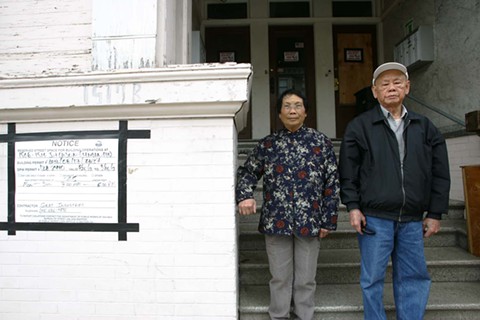
But now that Lee is well into his mayoral term, a surge of evictions of low-income seniors is worsening on his watch. Tenant defense organizations such as Eviction Free San Francisco are showing up outside landlords’ homes and offices to protest eviction notices that threaten to push low-income seniors with few options out of the city. Some evictions have caught the attention of mainstream media, such as the ouster of elderly Chinatown couple Gum Gee Lee and Poor Heung Lee and their disabled daughter, Shiuman Lee.

Some advocates have proposed legislative solutions; meanwhile, the situation has evidently become so criticial that even city’s Human Services Agency is seeking outside assistance to provide eviction prevention services for elderly and disabled tenants facing Ellis Act evictions.

And today, the board of the Manilatown Heritage Foundation drew a line in the sand to send Lee a clear message by refusing to accept the honor of recognition in the current housing climate. So far, mayoral spokesperson Christine Falvey has not responded to the Bay Guardian’s request for comment in response to the Manilatown Heritage Foundation’s statement.

“Given the current state of San Francisco housing by forces out to make a killing by killing our communities, we as the torch bearers of the I-Hotel struggle and in the memory of its displaced elders and advocates Al Robles, Bill Sorro, Felix Ayson, Wahat Tampao and others, cannot, in good consciousness, accept any honor or award while elders are being preyed upon, evicted and given a de facto death sentence thereof. And it doesn’t matter if the honor is bestowed by Mayor Lee, President Obama or the pope. We have to say no.”

Here’s the full statement from the Manilatown Heritage Foundation. Here’s an historical essay about the I-Hotel from Shaping San Francisco’s digital archive at FoundSF.org.

Zombies to attack City Hall! UPDATED

50

We in the Bay Guardian newsroom have just received word of an impending zombie attack on City Hall. I repeat: Zombies are planning to attack City Hall this afternoon! [Updated coverage from the scene below]

Oh, wait, it looks like it’s actually going to be City College of San Francisco students and supporters — dressed as zombies and other Halloween creatures — that will be descending on City Hall around 4pm today (Thurs/31). Okay, maybe this isn’t as big a deal as an actual zombie attack, but it’s still newsworthy.

The faux-zombies came to see Mayor Ed Lee to demand that he stop supporting the state takeover of CCSF and that he stand up for local control over this important, low-cost educational institution. The San Francisco-elected college’s board of trustees’ powers were given to Special Trustee Bob Agrella, who was in turn appointed by the California Community College Chancellor Brice Harris.

At the rally Alisa Messer, CCSF’s local faculty union president, called for Lee to push for the board’s reinstatement.

“We’re calling on Mayor Lee to ask the state chancellor to restore democracy at City College,” Messer said, “We want our board restored next year. Not two years from now, not three years from now, next year!” 

She also called on the mayor to demand that Accrediting Commission for Community and Junior Colleges restore CCSF’s accreditation immediately.

Christine Falvey, the mayor’s spokesperson, wrote in an email to the Guardian that the mayor supports efforts to save CCSF — but only the ones he thinks will work.

“The mayor has said these are difficult times for the college, but that this is the time to commit to true reforms,” she wrote. “The mayor wants to focus his efforts on activities that will ultimately help the college stay open.” 

When asked if the mayor supported City Attorney Dennis Herrera’s lawsuit against the ACCJC meant to stop the closure of CCSF, she responded that the lawsuit may “go up and beyond” critical deadlines to save the college. The mayor has so far shown no support for any of the efforts to combat the ACCJC, despite multiple lawsuits against the accreditors as well as condemnation from the U.S. Department of Education of their practices.

The zombie march will began at 3:30pm, at the CCSF Downtown Campus, 750 Eddy Street, and hundreds of protesters arrived at City Hall around 4pm — to see if there’s anyone in City Hall with any brains.


The Guardian’s voter Clip-Out Guide

88

So we’ve heard a little confusion — and even some amusing conspiracy theories — about why the Guardian’s regular voter Clip-Out Guide isn’t on our cover like it usually is in the issue before the election. Rest assured, loyal Guardian readers (and haters), it’s right there, along the bottom.

With only eight items on the ballot, and fairly minimal interest in all but two of those items, we didn’t think it made sense to devote our entire cover to the election (but check out our cool Death Issue instead). Besides, it was only a month ago that we did devote the whole cover to the hottest items on the ballot, Props. B&C.

But in the interests of tradition, let me reinforce, here and now, how the Guardian thinks you should be voting on Tuesday: Yes on Prop. A; No, no, no! on Prop. B; No on Prop. C; Yes on Prop. D; Dennis Herrera for City Attorney; Jose Cisneros for Treasurer; Katy Tang for D4 Supervisor; and Carmen Chu for Assessor.   

If you want longer explanations of our reasoning, read our full endorsements. And check back here on election night for some live blogging and tweeting of the results — that may also be in a more abbreviated form than in years’ past, but blame this lackluster election and not anything going on over here at the good ole Bay Guardian.


Media misses connection between BART tragedy and settlement

23

BART continues to stonewall important questions about whether it was training scab drivers to break the recent strike by its unions when its trainee-driven train killed two workers on Oct. 19 — a stance made possible by the failure of the mainstream media to connect the dots or correct the anti-union bias that characterized its coverage of this long labor impasse.

The failure of local journalists to highlight the connection between that tragedy and the subsequent decision by the district to suddenly soften its stance and sweeten its offer — within hours of the National Transportation Safety Board revealing that a trainee was driving and that BART’s “maintenance run” story was a deception — is as myopic as it is appalling.

After all, the daily newpapers, television stations, and wire services did finally, dutifully report that a trainee was driving, even as they failed to point out to readers and viewers the significance of that disclosure or ask the district, “Why were you training drivers during a strike? Were you planning to offer service during the strike?”

We have asked those questions of the district, and when we got misleading obfuscations, we asked again and again, and our questions are still being largely ignored (actually, we just got a limited but important response, see below). And here’s why they matter: Because if the district was planning to run trains during the strike, it reinforces the unions’ contention that the district was hard-bargaining to force a strike that it was preparing to break, a plan that became untenable when two people died, just as the unions warned might happen if the district ran trains without experienced drivers.

This should be a huge scandal, the kind of thing that might force General Manager Grace Crunican to resign and BART directors to lose their seats — except for the fact that the media is ignoring this simple, obvious narrative and failing to do its job.

The East Bay Express, which today published an excellent article on how the San Francisco Chronicle and Bay Area News Group (which includes the Oakland Tribune, Contra Costa Times, and San Jose Mercury News) mislead the public about the BART standoff, is the only other media outlet in the region to join the Bay Guardian in highlighting the relevant facts in this story.

Not only have these newspapers written some truly atrociously anti-worker editorials, but even the supposedly objective news stories have been clearly biased in their emphasis and omissions. Why else would they repeatedly emphasize a proposal by an obscure Republican member of the Orinda City Council to prohibit future BART strikes — a bit of election-related grandstanding that has no chance of passing in Democrat-controlled Sacramento — while failing to analyze why BART suddenly sweetened its offer beyond what Crunican said the district could afford?

But this could be a situation that backfires on local media managers considering that the truth will probably come out eventually, even if it’s long after the media spotlight has moved on. NTSB investigations can take up to a year, but they are remarkably thorough and it will probably eventually discuss why these drivers were being trained.

The Assembly Committee on Labor and Employment announced yesterday that it will also hold a hearing to “get to the bottom” of the tragedy, and one can only hope that someone on that committee will grill the district about its intentions in running that ill-fated train and conducting new driver training just one day into the latest strike.

UPDATE: As I was posting this story, I finally heard back from BART spokesperson Alicia Trost, who made it sound like preparations to break the strike weren’t news — even though it may be news to most newspaper readers.

“The District has publicly acknowledged, dating back to a September 13, 2013 Metropolitan Transportation Commission subcommitee meeting, that BART has been training some non-union employees to operate limited passenger train service in the event of an extended strike if so authorized by the Board of Director. The Board was never requested to authorize revenue service during the strike,” she wrote by email.

Yet those public aknowledgements don’t appear to have made it to the public. And when the Chronicle’s Matier & Ross did run an anonymously sourced item breaking the news that BART may be training replacement drivers, BART refused to comment, the duo soft-peddled the scoop, and the relevation failed to make it into the larger narratives the newspaper offered about BART.

And even now, Trost followed up her admission by minimizing its importance, saying that the ill-fated train was also being run for maintenance purposes, which the NTSB had also reported.

“BART has to ‘exercise the system’ by running trains on the tracks to prevent rust build up. Rust can build up quickly and will interfere with train service. BART continued to run inspection trains throughout the entire strike just as it did during the July strike,” she wrote.

But the real issue is whether the district deliberately triggered two strikes that the heavily impacted public angrily blamed on workers, thanks largely to how the standoff had been cast by the mainstream media and the district. After all, BART chose a notoriously anti-union labor consultant as its lead negotiator, a decision that even Willie Brown criticized in his Sunday column, although Brown cast the district as just dumb instead of intentionally forcing a strike.

I’m still waiting for Trost to answer my follow-up questions, and I’ll update this post if and when I hear back. I’m also still waiting to hear from BART Board President Tom Radulovich, whose progressive credibility has been tarnished in the eyes of some for playing such a lead role in BART’s media strategy.

Thankfully, the divisive standoff between BART and its unions seems to be over, but the questions about what really drove it and how its conclusion came about are still relevant and largely unanswered. And that says a great deal about the state of journalism today.

Latest NSA spying news features emoticons and Google engineers exploding with profanity

More revelations on spying by the National Security Agency were published in the Washington Post today. Thanks again to whistleblower Edward Snowden (whose actions gave this cartoonist pause with a “Post-Snowden moment”) we now know that the NSA is capturing massive amounts of communications data flowing between data centers maintained by Google and Yahoo.

According to the Post, digital information produced by Google and Yahoo account holders – texts, emails, documents, videos and yes, that does include content – is being copied by the NSA and sent to its Fort Meade headquarters, where some but not all is retained by the agency.

It’s known that the NSA is intercepting Google and Yahoo user account information as moves between data centers, but the exact collection points remain a mystery. While some of that information evidently belongs to Americans, there doesn’t seem to be detailed information about how much of it originates in the U.S. versus foreign nations. The main tool for capturing this data is a project called MUSCULAR, operated in collaboration with British intelligence agency GCHQ. 

A smiley face inserted into a hand-drawn sketch from a top-secret file was enough to cause a couple Google engineers to “explode in profanity,” the Post reporters noted. That drawing demonstrated how encryption, a security measure meant to shield data from third parties, is “added and removed here,” at an intersection between the public Internet and Google’s internal cloud servers.

Seeing as how Google is a ubiquitous presence in our lives and a key player in Silicon Valley’s tech industry, it’ll be interesting to see how native San Franciscan Sen. Dianne Feinstein responds to the news that the NSA has apparently been intercepting the tech giant’s data without its knowledge. Feinstein is uniquely positioned to weigh in on this activity in her capacity as chair of the Senate Intelligence Committee.

Since Snowden’s first leak, Feinstein has kept up the drumbeat that NSA’s spying program is good for national security.

On Oct. 2, at a Judiciary Committee hearing on oversight of the Foreign Intelligence Surveillance Act, she delivered the following statement:

“Our great strength today, ladies and gentlemen, in protecting this homeland, is to be able to have the kind of technology that’s able to piece together data while protecting rights. I listened to this program being described as a surveillance program. It is not. There is no content collected by the NSA. There are bits of data—location, telephone numbers—that can be queried when there is reasonable, articulable suspicion. … I will do everything I can to prevent this program from being cancelled out. To destroy it is to make this nation more vulnerable. I just wanted to say that. I had to say it.” 

Speaking earlier this year, at a Sept. 26 Senate Intelligence Committee hearing on FISA, Feinstein delivered a reminder of what happened on Sept. 11, 2001 and sought to offer reassurance on the data collection program, saying:

“This committee as well as the Judiciary Committee have reviewed the legality of these programs, been briefed on their operation, and been notified of problems with their implementation. Further, this committee has previously informed all senators of additional classified information regarding these programs available for their review prior to Senate consideration of these measures. 

It is my opinion that the surveillance activities conducted under FISA, and other programs operated by the National Security Agency, are lawful, they are effective, and they are conducted under careful oversight.”

But more recently, following revelations of spying on foreign leaders, Feinstein changed her tune. In an Oct. 28 statement, she said the Senate Intelligence Community was “not satisfactorily informed.”

Suddenly, rather than being notified and informed, the committee members were seemingly kept in the dark while the NSA ran wild. “It is abundantly clear that a total review of all intelligence programs is necessary so that members of the Senate Intelligence Committee are fully informed as to what is actually being carried out by the intelligence community,” she said.

Seems the members of the Senate Intelligence Committee could start by reading Washington Post articles detailing the contents of Snowden’s leaks. There’s plenty of information in there.

Red herring or not, park closure vote delayed while supes seek police input

26

There is only one police chief in this town, and no law regarding the usage of public parks shall pass without him. Or so they said yesterday when Sup. Scott Wiener continued for a week consideration by the Board of Supervisors of his controversial proposal to close the city’s parks and plazas at night.

Wiener – champion of the legislation that homeless advocates say specifically target the City’s homeless population — motioned for continuance on the hotly contested agenda item after Police Chief Greg Suhr was unavailable to discuss how the measure might be enforced. The motion was seconded by Sup. Malia Cohen and passed without objection. 

But the continuance request means that Wiener will have to deal with what he calls an “epidemic of vandalism” for another week as well. The legislation would amend the “Park Code to establish hours of operation for City parks from 5am to midnight, with certain exceptions; and make environmental findings.” 

“It’s long been illegal to sleep or camp in parks,” said Sup. Wiener. “[Police] don’t need another law.” 

“This. Is. About. Vandalism,” Recreation and Parks Department General Manager Phil Ginsburg told the Guardian. “The homeless won’t be thrown out. The laws are already on the books, man.”

And while Wiener and those in the RPD have continued their insistence that that the legislation was written explicitly to target late-night vandalism, illegal dumping, and other nefarious activities not related to homelessness, opposition to the legislation say it’s “red herring” legislation that, on its face, claims to combat vandalism, but underneath is actually a bill targeting the homeless.

Wiener disagrees with this stance, however, and actually called the argument made by the legislation’s opposition — that the bill is a “red herring” ostensibly aimed at vandalism, but that really targets the homeless — a “red herring” as well. A red herring, historically, is a distraction. It’s a Trojan Horse, a magician’s assistant, a tool designed to confuse and obfuscate actual information or intent. 

It is a term that first found a foothold in the hunting world, but made it’s transcendental leap into the world of politics. Politicians have employed the use of “red herrings” in the past. But why would a group called the Coalition on Homelessness actually support vandalism, as the supervisor’s “red herring” comments would suggest?

When this fact was pointed out, Wiener told the Guardian that he “wasn’t going to speculate.” (And neither will we, at least as to why the supervisor chose to use the phrase “red herring” to describe the COH’s argument in the first place.)

But regardless of rhetoric, next week’s vote promises to be close. COH Executive Director Jennifer Friedenbach told the Guardian last week that she had the support of the four most progressive supervisors — John Avalos, Jane Kim, David Campos and Eric Mar — and needed just two of the three swing votes to shoot down the legislation. Those three undecided votes rest in the hands of Sups. London Breed, Katy Tang and Norman Yee.

“This is going to be a close vote,” said Wiener.

But a vote that will have to wait a week.


Lee family quietly leaves home as activists pledge to push reforms

210

Members of Lee family quietly moved out of their longtime home in Chinatown last night, a day before their latest scheduled Ellis Act eviction, which had been postponed twice before thanks to headline-grabbing progressive activism that turned away deputies and persuaded the Mayor’s Office to intervene with the landlord.

But this time, the Mayor’s Office has been mum about the case (officials haven’t responded to our requests for comment) after failing to find a solution to the Lees – an elderly couple using Social Security to care their disabled 48-year-old daughter – still unresolved situation. With help from the Asian Law Caucus and Chinatown Community Development Center, the Lees moved their belongings into storage while they are staying in a hotel.

“The family is staying at a hotel in the city for the next few days as they try to finalize on a couple of potential rental units here. They’ll be paying over twice the amount that they had been paying for their rent-controlled unit. Their SSI won’t be enough to make ends meet, and so they will be spending down their relocation compensation, which may be depleted in the next several months,” Asian Law Caucus attorney Omar Calimbas told us. “Hopefully, the family will be able to find subsidized housing by then, or they will be in a precarious state of affairs again.”

Sheriff Ross Mirkarimi told us yesterday that he’s been waiting for word from the Mayor’s Office and hoping to avoid this evicting the family. “We’re duty bound. It’s a court order,” Mirkarimi said of his eviction obligation. “The eviction is on the books, but we’ve been expecting an alternative plan by the Mayor’s Office after he intervened in this case.”

The San Francisco Examiner, which had earlier given splashy credit to Mayor Ed Lee for stalling the Lee family’s eviction – to the irritation of some activists that probably deserve more credit than anyone in the Mayor’s Office – had the only journalist on the scene with the Lees last night, but the paper didn’t have any comments or updates from the Mayor’s Office.

Weeks before Mayor’s Lee’s headline-grabbing Sept. 25 intervention in the Lee case, Mirkarimi had his Eviction Assistance Unit contact the Lees and try to help them avoid being turned out with no place to go. But in a city where his office performs around 1,000 evictions per year – it executed 998 court-ordered evictions last year — the single full-time staffer in that office is overwhelmed.

“We need more staff to assist when it gets to this point,” Mirkarimi told us. But his budget request last year to add another position to the unit was denied by the Mayor’s Office and Board of Supervisors, a request that Mirkarimi renewed in a Sept. 30 letter to Mayor Lee.

“When there is a determination, our EAU attempts to support individuals and families facing eviction, not just Ellis Act evictions, but all evictions. This unit is comprised of one full time deputy sheriff and the partial time of another deputy.  Based on [the current eviction] trend, our EAU staffing is insufficient and ill-equipped to assist qualified individuals and families who may be at risk of becoming homeless,” Mirkarimi wrote. “With renewed focus on the consequences of evictions in San Francisco, I return to our FY 2013-2014 budget request to enhance our EAU with one full time clinical outreach worker.”

Meanwhile, the activists say they won’t wait for the next budget cycle or rely on the Sheriff’s Department for help with imminent evictions. They say that they plan to propose a package of reforms for dealing with the eviction crisis as soon as this week.

“Overall, the several weeks of reprieve from the eviction that were won after an incredible display of community solidarity with the Lees were very important in giving them time to find a temporary fix,” Calimbas told us. “Stay tuned in the next day or so for the next move by a growing coalition of community organizations, housing advocates and labor in pushing for a comprehensive package of legislative reform to curb the outbreak of displacement-based speculation.”

Guardian Staff Writer Joe Fitzgerald Rodriguez contributed to this report.


Celebrities tell NSA to stop spying as digital privacy advocates head to D.C.

Thousands of privacy and civil liberties activists are bound for Washington, D.C. for an Oct. 26 rally calling for surveillance legislation reform, in response to National Security Agency spying programs.

It’s being organized by more than 100 groups that have joined together as part of the Stop Watching Us coalition. The group has launched an online petition opposing NSA spying, and plans to deliver about 500,000 signatures to Congress on Sat/26. Many of the key drivers behind Stop Watching Us, from the Electronic Frontier Foundation to Mozilla, are based in San Francisco.

In advance of the rally, Stop Watching Us also released a video featuring celebrities who, like millions of Americans, happen to like corresponding via email and text messages. It features appearances from Phil Donahue, John Cusack, Maggie Gyllenhaal, Congressional Rep. John Conyers, NSA whistleblower Thomas Drake, Pentagon Papers whistleblower Daniel Ellsberg, and others.

Since Edward Snowden leaked the NSA spying documents earlier this year, the Bay Area has been host to a number of protests organized in response. This past July, some college kids who met on reddit organized a march against NSA spying, called Restore the Fourth (referring to Fourth Amendment privacy rights), and paraded through downtown San Francisco. Meanwhile, the first-ever clues that the NSA was running a domestic spying program were picked up at AT&T’s Folsom Street facility in San Francisco by whistleblower Mark Klein, who exposed the operations in technical documents that subsequently spurred a lawsuit and mainstream news coverage in 2006.

As The Atlantic Wire pointed out not too long ago, the Stop Watching Us coalition is unique in that it straddles ordinary political boundaries:

“It comprises perhaps the most diverse collection of groups in the modern history of American politics. Among the groups and businesses that are signatories to it are: 4Chan, Freedomworks, BoingBoing, CREDO Mobile, Greenpeace USA, Mozilla, reddit, Sunlight Foundation, Taxpayers Protection Alliance, and California’s The Utility Reform Network. You can see the thread that ties these organizations together, but it’s a thin one.” 

Is the growing digital privacy movement at all worrisome to Sen. Dianne Feinstein, who is chair of the Senate Intelligence Committee and a former San Francisco mayor? So far, she doesn’t seem to be showing any signs of backing down. Feinstein defended the spying program in a recent USA Today editorial, writing that she believes the program should continue and even stating that “the call-records program is not surveillance.”

Guardian forum examines who San Francisco is building housing for

218

Our original intention for “Housing for Whom?” — a Bay Guardian community forum tomorrrow night (Wed/23) at the LGBT Center — was to look at the hottest items on an otherwise lackluster fall election: Propositions B and C, which would allow a controversial waterfront luxury condo project to be build at 8 Washington St.

So we booked key proponents on the each side the measure: Jon Golinger, president of the Telegraph Hill Dwellers and a key opponent of the project; and Tim Colen of the Housing Action Coalition, one of three proponents of Prop. B. We’re excited to hear what they have to say and to discuss the measures.

But in the weeks since then, there’s been explosion of public concern over the related issues of gentrification and evictions, accompanied by a renewal of progressive activism that has scored some notable victories, all of its set against a skylight of construction cranes building a glut of high-end housing in Upper Market and other areas.

So we’ve decided to broaden our discussion to look at the implications of the city’s current housing and economic development policies, examining what the San Francisco of the the future will look like if we continue on our current course and what can be done to control our destiny.

To help guide that discussion, our panel will also include Fred Sherburn-Zimmer, an activist with the Housing Rights Committee who recently went through her own personal eviction battle; and Peter Cohen of the Council of Community Housing Organization, who will offer an overview of the housing now being built and the challenges in meeting the needs of current city residents.

We’ll also be turning to you, Guardian readers, for your input and observations. And to help with that, the crowd will include veterans of the successful recent campaign to prevent high-ending clothing chain Jack Spade from opening a store in the Mission and the struggles to prevent the Lee family eviction and a mass eviction on Market Street that would be the biggest single eviction since the I Hotel.

Moderating the discussion will be yours truly, Editor Steven T. Jones, and News Editor Rebecca Bowe. So come join us from 6-8pm at on the fourth floor of the LGBT Center, 1800 Market St.   

Supes approve funding request for jail construction

“A Costco warehouse with metal bunk beds” is how Matt Freeman of the San Francisco Sheriff’s Department described one of the county’s outmoded jail facilities, speaking at a meeting in City Hall today (Tue/22). At its meeting, San Francisco Board of Supervisors cleared the way for the Sheriff and the Department of Public Works to request $80 million in state funding to be put toward the construction of a modernized jail.

The new facility would replace seismically vulnerable 1950s era jails that are slated for demolition as part of a larger Hall of Justice overhaul. However, some supervisors voiced reservations about the plan.

As the Guardian recently reported, plans for the $290 million jail rebuild have drawn criticism from community advocates who question the use of resources that could be spent on programs to help people stay out of the criminal justice system.

Sup. Eric Mar, who refused to endorse the grant application at a recent Budget & Finance Committee meeting, piped up at the beginning of this meeting to say he’d had a change of heart. Evidently, Sheriff Ross Mirkarimi and some others from the Sheriff’s Department took him on a tour of the San Bruno jail, the county’s most modern facility, to show him the difference between an outmoded jail and one designed with rehabilitative programming in mind.

“I see now that the need is really critical, for safety for inmates but also … a seismically safe and modern jail,” Mar said. “I’m convinced now that it’s really about … supporting anti-recidivism and rehabilitation programs. I really appreciate the sheriff and his staff for opening my eyes.”

But Sup. David Campos was not yet entirely sold on the need for a new jail. “I am not in a position to say that I support the building of this facility,” he said, but said he could be open the possibility after studying the details. “I do acknowledge that I have a bias – I would rather spend less money building a jail than building other things that I think are better investments for our city. That’s not to say I don’t want the jail population to be taken care of. I clearly do.” His office has requested a hearing on this topic, which will be held in early December.

Sup. John Avalos said he too had found it “difficult to support a jail altogether,” but noted that a debate on that decision would come at a later time. “This is just making sure that we have an opportunity to receive state funding if we decide to rebuild,” he said.

In the end, the request to submit an $80 million grant application for state funding was approved without opposition. But the preliminary discussion suggests that a broader debate over San Francisco’s jail rebuild is on the horizon, and it’s an issue where typical political allies won’t necessarily see eye-to-eye. At the same time, it’s a big financial commitment. According to City Controller Ben Rosenfield, the total cost could be in excess of $500 million after financing is factored in.

BART reaches tentative deal with unions, ending the strike

79

The BART strike ended this morning — the second four-day strike of the current labor contract impasse, both of which hobbled the  Bay Area’s transportation system — after the district reached a tentative contract with its three unions late last night.

The agreement was spurred by the tragic deaths of two BART employees on Saturday and by yesterday’s National Transportation Safety Board revelation that the train that struck the workers was being used by the district to train drivers, presumably in preparation for offered limited public service during the strike.

“We are pleased to announce that we have reached a tentative agreement with union leadership that will bring the trains back into service, starting tomorrow, while union members consider the agreement and vote on it,” BART General Manager Grace Crunican said in a public statement issued at 10pm last night, withholding details of the deal. “This is a good package for our union members while still allowing the District to make the necessary investments in our infrastructure. That investment is critical to the future of the Bay Area.”

Union sources tell the Guardian that Saturday’s tragedy definitely created the conditions to reach an agreement, with the district softening its hardline insistence on its “last, best, and final offer” and the unions agreeing to some work rule changes, which they say the district and media had mischaracterized their position on. Technological modernizing will go through, but the unions retained authority over safety and other working conditions. 

For more on the breakdowns that led to the strike, the circumstances surrounding Saturday’s accident, and the aftermath of that tragedy, read tomorrow’s Guardian print edition, which goes on line this evening. 

Train that struck and killed two BART workers was operated by trainee

103

National Transportation Safety Board investigator James Southworth confirmed at a press conference on the afternoon of Oct. 21 that the train that struck two BART workers was “in operation for training and maintenance purposes,” and that the operator at the time of the fatal crash was a trainee. He said two of the six people on board were trainees.

The NTSB conducted interviews for 8-10 hours with the train operator, the operator’s supervisor and someone from the dispatch office. 

Asked whether the driver had received safety certification, he said, “the training is part of the certification process.” 

When asked if the driver was previously certified, Southworth said “that is information I don’t have.” It’s unclear if the driver was a new trainee or if his certification had lapsed.  

He said the train was going 60-70 miles per hour at the time, and there was an emergency stop. The train was driven by computer under “Automatic Train Operation” and was not in manual mode.

The district’s decision to run the trains without experienced operators would come against the safety advice of the three striking unions, one of whom — Amalgamated Transit Union Local 1555 — even filed a lawsuit earlier this month seeking to prevent BART from doing so. The case is pending, the union’s lawyers told the Guardian. 

“The use of uncertified training personnel to provide uncertified managers with a crash course in how to operate BART trains also presents a public safety issue,” the unions wrote in the suit. 

BART workers undergo 15 weeks of safety training every three years, they wrote, training that saves lives. 

For more on the concerns around safety training and certification for track inspection workers, read our interview with BART safety trainer Saul Almanza.

Brown takes heat on fracking

On Thursday Oct. 17, more than fifty people gathered in front of the Parc 55 Wyndham Hotel in downtown San Francisco to protest Governor Jerry Brown’s reception of an environmental award. 

Every year, the BlueGreen Alliance hosts its Right Stuff Awards dinner to honor prominent individuals promoting a sustainable environment and economy. This year, they selected Governor Jerry Brown as a winner in the government category. The choice enraged environmentalists, who congregated where the awards dinner was being held to voice their indignation.

Brought together by several collaborating organizations, including Idle No More and Gathering Tribes, the protesters blocked the entrance to Parc 55 as they awaited the governor’s arrival. Bearing signs with messages such as “Jerry Brown is Not BLUE or GREEN,” they yelled to drivers who honked horns in support as they sailed past.

They were upset by Brown’s support for Senate Bill 4, which he signed into law in September. SB-4 is California’s first legislation regulating hydraulic fracturing, more commonly known as fracking, which involves shooting massive amounts of water and toxic chemicals deep into the earth to crack rock formations and release otherwise trapped oil and natural gas deposits.

Widely viewed as flawed legislation that is far from what environmentalists had in mind when they called for the practice to be regulated in California, the bill allows fracking permits to be approved as long as oil and gas companies publicly disclose which chemicals are used in the process. The legislation also requires groundwater and air quality monitoring before operations begin. Environmentalists fear that SB-4 will lead to a dramatic expansion of fracking in California, by allowing access to the state’s vast Monterey Shale deposit, estimated to hold 15.4 billion barrels of recoverable oil.

“This award from BlueGreen is a travesty,” declared protester Steve Ongerth, after a flash mob of young people danced to the song “Toxic” by Brittney Spears, dressed in shirts spelling out TOXIC while donning surgical masks.

In the past several years, Governor Brown has accepted at least $2.49 million in financial donations from oil and natural gas interests. Environmentalists point to these donations as an explanation of Brown’s refusal to impose a moratorium or an outright ban on fracking, despite pressure from a statewide coalition of organizations calling for such protective measures.

They also blame him for the changes made to SB-4 in the final week before the bill was voted on, which followed intense lobbying by oil and gas interests. The amendments substantially weakened restrictions on fracking by removing some of the bill’s tougher regulations and diluting language intended to ensure that new wells go through adequate environmental review.

“Jerry Brown has sold out the California public for his own self-serving interests. He made a deal with the devil,” said protester Pamela Zuppo of 350 Bay Area. “This is a fracking bill gone wrong. It is referred to as a regulation bill, but it is not. It is an institutionalization of fracking bill and it’s the destruction of our democracy.”

When he signed SB-4, Brown said it “establishes strong environmental protections and transparency requirements,” but added that he plans to seek additional changes next year to clarify the new requirements. So far, details remain sketchy on what areas of the bill will actually be addressed.

At the last minute, activists learned that Brown would not be attending the event to accept his award in person. When this was announced, the crowd of protesters let out a cheer.

But environmentalists who remain concerned about fracking are keeping the pressure on. On Saturday, Oct. 19, activists from 350.org, Food & Water Watch and the Center for Biological Diversity held a march and rally in downtown Oakland to call on Brown to ban fracking.

“Over the past year, Governor Brown has gone against the wishes and best interests of Californians — the majority of which oppose fracking — and has clearly stated his support for the dangerous drilling process, said Food & Water Watch Northern California Organizer Tia Lebherz.

“By doing this he is embarrassing himself and putting his legacy and our state’s future at risk.”

BART workers say the district deliberately caused the strike

125

Photos by Tim Daw

Members of BART’s three striking unions gathered, rallied, and picketed outside the Lake Merritt BART station in Oakland for much of today, many of them still openly grappling with yesterday’s surprising turn of events that put them in the position of going out on strike for the second time this year.

As BART spokesperson Alicia Trost and SEIU Local 1021 President Roxanne Sanchez both confirmed this morning on KQED’s Forum, it was the district’s 11th hour demand for more authority to set work rules that caused negotiations to break down after days of intensive talks had gotten the two sides close to an agreement on the other issues.

BART officials such as Trost and BART Board President Tom Radulovich (who hasn’t yet returned our call for comment) publicly cast the work rule issue as about the district’s ability to modernize, citing how the district is still using fax machines and paper pay stubs rather than fully converting to electronic communications, blaming the requirement to consult with unions on procedural changes.

But Local 1021 Political Director Chris Daly told the Guardian that the pair had “completely mischaracterized” the conflict, and he speculated about whether Radulovich — who must approve the contracts but hasn’t been a party to the talks — was “being lied to” by BART’s management team and labor consultant.

Daly and other union leaders say work rules such as requiring union approval for changing past practices related to scheduling, hours, and the kind of tasks workers perform are essential to protecting things like the eight-hour workday, worker safety, and whistleblowing and free speech rights.

“We had a basic framework understanding on the economics, but then BART illegally tied that to this work rule change on past practices. And what that meant for us is in order to get a reasonable economic package, we needed to swallow this poison pill,” Daly told us.

George, a train engineer at the rally who wouldn’t give us his last name, said the work rules have been developed over decades and are important to the management-worker balancing act, but that they shouldn’t be a barrier to modernizing.

“We have long term work contracts because we’re here for the long haul and the employer is here for the long haul, so we try to work these things out,” he told us, saying that the workers strongly support their union leaders and have told them, “Do not bring us back a lousy offer to vote on, do your job.”

But not all BART workers feel that way, and some have supported the district’s demand that the union put its “last, best, and final offer” up for a vote of the membership.

“I’m really pissed. Obviously there’s been a decision in our union. I don’t think the union is representing us, the [transit vehicle mechanics]. Nobody wanted to strike, not us,” said Robert Earl Bright, a BART engineer/mechanic profiled in the Guardian this summer. “None of the TVMs wanted to strike. Work rules, I have no concept.”

SEIU Local 1021 Executive Director Peter Castelli told the the Guardian that he understands the concerns of workers like Bright, but that he think most members will support the decision to strike once they get more information.

“It’s a fast evolving situation, with the stewards and union leadership saying ‘we gotta go out.’ So explaining things to our own membership takes time. But it shows the unity and how they trust their leadership,” Castelli told us.

He ridiculed statements by district officials that the unions are resisting modernizing the system. “We’re not afraid of technology, so that’s really grasping,” Castelli told the Guardian. “Some of the people in BART have technology degrees and they’re keeping the trains from wrecking, so we’re not afraid of technology.”

Instead, both Daly and Castelli said that the district was deliberately trying to provoke a strike by making a last minute demand that it knew would be unacceptable to the unions. “It’s to make us strike. The public is devastated by this, and for good reason, and we’re very sympathetic. So they’re thinking that, ‘Maybe we make them strike one more time and they’ll fold,” Castelli told us. “Our only other option is submission and surrender.”