• No categories

Politics Blog

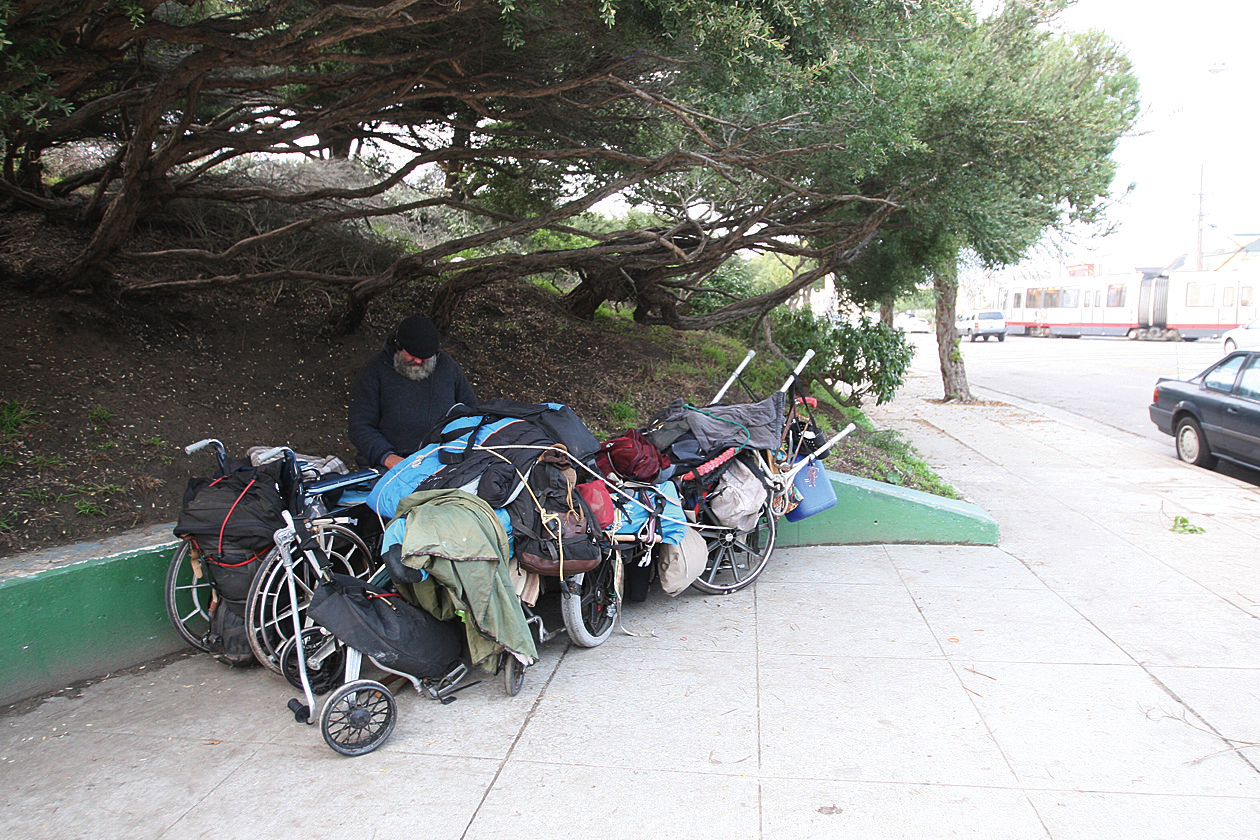
Homeless advocates fight Wiener’s effort to close parks at night

135

The Coalition on Homelessness has launched a campaign to defeat Sup. Scott Wiener’s legislation to close down all city parks and most major plazas from midnight to 5am, which the Board of Supervisors is set to consider on Oct. 29. Activists are targeting three swing votes who could decide the controversial issue: Sups. London Breed, Norman Yee, and Katy Tang.

In an email blast to supporters, COH urged people to contact those three supervisors to raise their concerns, even suggesting a script that includes these arguments, “It further eliminates access to public space for all, it will displace homeless people, and is a waste of city funds.”

COH Executive Director Jennifer Friedenbach told the Guardian that she has the support of the four most progressive supervisors — John Avalos, David Campos, Jane Kim, and Eric Mar — and that she just needs two of the three swing votes that COH is targetting to kill the measure outright and avoid the kind of compromise that has become Board President David Chiu’s specialty this year.

She said the measure would be particularly harmful to the homeless LGBT community and other vulnerable populations that seek refuge at night in Golden Gate Park and other hidden spots, but that it’s bad for everyone. “It forces them out into the storefronts and streets and neighborhoods and nobody will be happy with that,” she said.

Wiener denies that the measure is aimed at the homeless, telling the Guardian that his intent is to address graffiti, illegal dumping, and damage done to park facilities overnight. “We’ve had an epidemic of vandalism in our parks and it’s getting worse,” Wiener told us. “It’s a significant problem and it absolutely degrades people’s ability to use the parks.”

Friedenbach said she appreciates that Wiener isn’t aiming his rhetoric at the homeless, even though she said that’s who will be most effected by it.

“It’s great in terms of not bashing homeless people, but we know everytime something like this comes up, it increases public anger toward homeless people,” she told. And she notes that the measure is being trumpeted by people who do want to use it to go after the homeless, including Mayor Ed Lee, who went off script last month and told the Examiner that he hopes the measure will be a tool to clear the homeless from Golden Gate Park.

“The mayor said it was a great idea because we need to get the homeless people out of the park,” Friedenbach told us, noting also that, “Wiener has had a thing of going after homeless people.”

Wiener denies that this is about the homeless, and he responded to Lee’s comments by telling us, “I can’t speak for anyone else.” He also said that it’s already illegal to sleep in the parks and “to the extent the police want to do sweeps in the parks, they can already do so.”

The measure would apply the closing hours to all property controlled by the Recreation and Parks Department, which includes every city park and the city’s largest plazas, including Civic Center Plaza, Justin Herman Plaza, and Union Square.

“One thing people don’t think about is this also applies to the plazas,” Friedenbach told us. “A lot of our plazas are hangout spots late at night, and there’s no reason they shouldn’t be.”

Wiener said that small plazas, such as Harvey Milk and Jane Warner plazas in the Castro, aren’t under RPD jurisdiction and therefore aren’t effected by his legislation. And he said the ordinance was already modified to allow people to walk through the affected plazas without stopping, and that he’s open to further amendments.

As for his chances of success in the face COH’s activism on the issue, he told us, “I’m not sure what’s going to happen on the 29th.”

Undocumented immigrant activists block deportation bus

A group of young, undocumented immigrant activists temporarily halted a deportation bus from leaving downtown San Francisco on Oct. 17. The bus was parked outside Immigration and Customs Enforcement offices at 630 Sansome Street, where detainees are held during the day while they await court hearings.

They said they were inspired by recent actions in Arizona, and were putting themselves at risk to send a message to President Barack Obama that all deportations should be halted until federal immigration reform is in place.

Even though federal immigration police threatened them with felony charges if they did not allow the bus to pass, activists decided after an intense discussion to stay seated on the street where they were and continue their protest. 

“We will do whatever is necessary for our community,” protester Alex Aldana said into a megaphone after the group huddled to discuss how to respond to the threat, adding that they would risk arrest.

They chanted “undocumented, unafraid,” and at one point even taped a hot pink sign to the front of the bus that read, “Shut Down ICE.” Supporters circled the bus in a procession, waving signs and chanting, until authorities set up a police line and told them that they would risk arrest if they did not move to the sidewalk. There were federal immigration officials as well as San Francisco police officers on the scene. 

At one point, ICE officials told the activists that the protesters could be charged with felony false imprisonment if they did not get up and move. But in the end, federal officers merely escorted them away from the bus and released them on the sidewalk around the corner.

Organizations involved included the California Immigrant Policy Center, POWER, Causa Justa / Just Cause, the Asian Law Caucus, ASPIRE and others who are part of a coalition that has been focused on immigration reform.

“When they talked to me, they said they were going to arrest me,” said Emmanuel Valenciano, one of the activists who blocked the bus, after being released. He added that he had expected the San Francisco Police Department to take them into custody.

The passengers on the bus were not visible to protesters and bystanders, but Asian Law Caucus Staff Attorney Anoop Prasad had met with some of them earlier that day. They were from Russia, El Salvador, Ethiopia and other countries. Many had been swept into ICE custody after being identified via Secure Communities (S-Comm), an information-sharing program that links local law enforcement information with federal databases.

Some of the bus passengers were bound for the airport, where they would begin long deportation journeys. Others were headed back to ICE detention facilities throughout California, where they would remain while fighting their cases.  All of the detainees had their hands and waists in shackles, Prasad said.

Once the protesters were escorted off the scene and released, the bus backed up and continued on its way.

BART on strike after talks break down UPDATED

20

Buckle up, Bay Area, BART workers go on strike at midnight. After intense negotiations over the last few days, the two sides have failed to reach an agreement.

Leaders of the two unions fault the district for refusing to bend on the “last, best, and final” offer that it issued a few days ago. They say agreements have been reached on pension and health care contributions, but that the two sides remain far apart on pay and benefits, and the unions say the district rejected their offers to settle the remaining disagreements through binding arbitration.

[UPDATE: On KQED’s Forum this morning, BART spokesperson Alicia Trost and SEIU Local 1021 President Roxanne Sanchez each said it was the district’s 11th hour demand for more authority over work rules that led talks to break down. While Trost casts it authority to make changes like switching from faxes to email, Sanchez said the issue is more fundamental: protecting the eight-hour workday, giving workers predicability in scheduling, and preventing punitive changes aimed at whistleblowers and union activists — essentially, preventing union busting. Sanchez wants that issue submitted to binding arbitration, the district has refused, with Trost saying the district isolate it from the pay and benefits, where Sanchez said the sides have agreed to a “basic framework.” BART workers and union officials are current gathered at Lake Merritt Station and we’ll have more on the strike and contract impasse later in the day.]

Both sides are blaming the other for a strike that will likely have a huge impact on the Bay Area, particularly if it drags on past tomorrow (Fri/18).

Meanwhile, BART General Manager Grace Crunican issued the following statement after talks broke down:

“I am very disappointed that even after six months of day after day, night after night intense negotiations we are still unable to reach a deal. It hasn’t been all for nothing, we were able to make progress but a large gap remains.

“Today I gave an updated final offer to the unions on behalf of the Board. It reflects the limited progress we’ve made over the past four days of work and it addresses the essential work rule efficiencies BART desperately needs to modernize our operations.

“The package is a 3 percent raise per year for a total of a 12 percent, with a chance to earn up to $1,000 a year if ridership grows. It calls for contributions of 4 percent for pension and 9.5 percent for medical.  I think the offer is good for the workers and good for BART. We’ve given our unions until October 27th to consider the offer and take it to a vote of the members.

“I appreciate the riders’ and the Bay Area’s support in standing by us during these difficult negotiations. We are not going to agree to something we can’t afford. We have to protect the aging system for our workers and the public.

“Thank you to the mediators that were involved, BART staff, and Caltrans for their hospitality.

“We gave it our all and it didn’t come together and that is disappointing to everyone involved. We have a lot to do to build the future: a new fleet of rail cars, modern stations, better access, and a stronger partnership with our unions. I believe we can get there, but we have to get there together.”

Information on alternative commute options can be found at www.bart.gov andalert.511.org

INFOGRAPHIC: Brown signs legislation creating two tiers of college tuition, for the rich and the poor

6

For six California community colleges, when the classes get crowded, those with money will get in, and the poor will struggle. 

On Oct. 10, Gov. Jerry Brown signed Assembly Bill 955, allowing six allegedly overcrowded community colleges to charge $200 per unit instead of the state-mandated $46 for their most in-demand classes. 

The bill was sponsored by Assemblymember Das Williams (D- Santa Barbara), and would effect College of the Canyons, Crafton Hills College, Long Beach City College, Oxnard College, Pasadena City College, and Solano Community College. But state officials and local activists fear this is the first step towards steeply increasing community college fees.

At a California Community College Board of Governors meeting last month, state Chancellor Brice Harris said the tuition hikes could lead to less funding from Sacramento.

“The next time the budget goes in the tank, they’ll tell (us), ‘we can’t give it to you, tell your colleges to raise fees,’” he said. “We have had historically free and open equal access. This bill fundamentally changes that equation.”

When reached for comment, a spokesperson for Harris said he was unavailable.

Shanell Williams, student trustee at City College of San Francisco and an activist who’s fought student inequality at the state level before, echoed Harris’ sentiments back when AB955 was first on the table. “AB955 creates a system of haves and have nots,” she said. “Students that cannot afford to pay more will essentially be denied access.”

A two-tiered payment system was tried once before at Santa Monica College last year. Students protested and were pepper sprayed in an incident that blew up in the news media.

In light of the new tuition hike, we’ve created an infographic to help put the new costs in context. Check it out below, and link to it directly here.

For our previous coverage on AB955, click here.

Campaign cash still flows during lackluster election cycle

21

We may be headed for the most widely ignored election in many years on Nov. 5 — with very low turnout expected to decide the four measures and validate the four largely unopposed incumbent officeholders — but that hasn’t stopped the regular flood of campaign contributions.

The biggest spending this cycle has been by proponents of the 8 Washington waterfront luxury condo project, who have spent at least $857,224 so far to pass either Props. B or C, according to filings with the San Francisco Ethics Commission. San Franciscans for Parks, Jobs and Housing has been funded primarily by the project developers Pacific Waterfront Partners (which just kicked in another $200,000 late contribution on Oct. 11) and contractor Cahill Construction, although even Mayor Ed Lee’s campaign committee recently kicked some cash to the effort.

By contrast, the opposition group to the project and measures, No Wall on the Northeast Waterfront, has spent less than half what the developers have, or just over $400,000. But the group is still sitting on the some of the $553,626 that it’s raised so far, waiting for the home stretch. It’s campaign also got a boost today with the San Francisco Examiner endorsed the No on Props. B&C position, surprising some 8 Washington supporters. 

Assessor-Recorder Carmen Chu has no opposition in her first election since being appointed to the job earlier this year, but that hasn’t stopped her prodigious fundraising, taking in $177,425 and sitting on more than $84,000 in the bank as of Sept. 26. Perhaps Chu and her treasurer Jim Sutton — a bag man for various campaigns and schemes cooked up downtown — are flexing their muscles with an eye toward the future.

Another darling of downtown and the Mayor’s Office, Dist. 4 Sup. Katy Tang, has also been raising big money against only token opposition, taking in $169,329 for this year’s race. City Attorney Dennis Herrera has also raised a significant $127,875 for his one-horse race.

But unopposed Treasurer-Tax Collector Jose Cisneros has kept his fundraising in the realm the reasonable this year, collecting $47,441, and perhaps demonstrating the fiscal prudence that we hope to see in someone of his position.

The next round of pre-election campaign finance disclosures are due Oct. 24. For information on all the measures and candidates, read our endorsements here. 

“Suspicious package” found at Union Square did not contain a bomb

Police closed off Union Square this afternoon, Thu/17, while the San Francisco Police Department’s bomb squad investigated the contents of a “suspicious package” located there just before noon.

At 1:49 pm, police sent an update, saying: “The suspicious package at Union Square has been secured. There was no merit to a hazardous device. Streets are being reopened.”

The package was discovered on the Stockton Street side of Union Square, police spokesperson Albie Esparza said as he stood behind a police line. The officer found it independently rather than in response to a tip, Esparza said, and made the decision to notify the bomb squad.

Esparza declined to offer more details about the package, but explained, “The bomb squad has special devices that can examine packages to see the contents.”

Police tape had been strung across all surrounding streets, Muni buses were being re-routed, and a shelter-in-place was put into effect for people inside surrounding buildings.

All around the area, pedestrians walked up to the police line to ask what was going on, and many expressed disappointment that they would be unable to get to their hair appointments or go shopping at Nieman Marcus. They texted loved ones to say there was a bomb threat. Even Frank Chu was on the scene, holding his signature sign. Helicopters circled overhead and fire trucks were parked inside the closed-off area.

“It’s better to be safe than sorry,” Esparza said, noting that bomb threats happen from time to time. “We don’t want to have a tragedy just because of complacency.”


Commodifying urban real estate hurts the culture of big cities

98

When urban real estate is turned into merely a commodity — or just another safe place for the wealthy to park their cash in uncertain economic times, while also providing pied-a-terres in which to crash a few times a year — it tears at the social fabric of big cities such as San Francisco, New York City, and London.

That’s been the message in some excellent, widely circulated articles in the last week or so — including David Byrne’s Guardian article about New York City and “London’s Great Exodus” in Sunday’s NY Times — and it’s one that San Franciscans should be thinking about as we work through current eviction and gentrification battles and vote on the 8 Washington project through Props. B&C in a few weeks.

It’s also something that we’ll be discussing at Housing for Whom?, a free community forum that the Guardian is sponsoring on Oct. 23 from 6-8pm at the LGBT Center, 1800 Market Street, featuring opponents and proponents of those measures along with other activists and experts.

While both London and New York City may be ahead of the curve in letting capitalists and the real estate market drive away creative types and destroy what once made those cities great, San Francisco isn’t far behind, particularly given its current housing and economic development policies.

Another striking article on the issue comes from San Francisco Urban Research Association Executive Director Gabriel Metcalf, who wrote an article published in The Atlantic on Monday. It repeats his previous calls for San Francisco to build 5,000 new housing units per year and opens with a line many of us have uttered: “My friends keep moving to Oakland.”

But Metcalf (who hasn’t yet returned my calls for comment) also takes this familiar observation and his promotion of market rate housing a step further, basically calling for San Francisco and Oakland to start acting as one city: Rich people in SF, cool people and workers in Oakland, ala Brooklyn and Manhattan.

“If we were one city, San Francisco could spend some of its incredible wealth on the things Oakland needs, like hiring more cops and teachers, not to mention more transit connections between the two cities,” Metcalf writes. “This is not an argument for annexation but a call to think about the answers to our problems from a regional perspective. We can’t solve affordable housing or transit access within the limits of any one city.”

Actually, I’d argue that we can and should solve these problems within our borders rather than just ceding San Francisco to the wealthy. Yes, regional planning is good, and yes, there are things that San Francisco can do for Oakland (perhaps starting with not poaching it professional basketball team).

But regionalism isn’t the same thing as plutocracy — and San Francisco is still worth fighting for rather than just letting it go to the highest bidders.


CCSF’s new chancellor has a history running other troubled colleges

28

Former Compton College Special Trustee Dr. Arthur Q. Tyler will be City College of San Francisco’s new chancellor, sources tell the Guardian. The decision ends a months-long search and comes at a time when CCSF is under state control and facing the loss of its accreditation. 

City College is in the fight for its life as the deadline of July 2014 looms ahead, at which point the Accrediting Commission of Community and Junior Colleges, may revoke its accreditation. But Tyler has been in a similar position before — as the special trustee of Compton Community College.

Tyler held the same position overseeing the troubled Compton Community College that Special Trustee Bob Agrella held before CCSF lost its accreditation. But more importantly, Tyler was at Compton Community College when it was told its accreditation was revoked in 2005.

In a letter to the community, Compton’s Board of Trustees outlined what they’d need to do: regain their footing and win an appeal to the accreditation commission. They filed for review, much like City College of San Francisco recently did. And they lost.  

Compton Community College never regained its accreditation. The college was absorbed into a neighboring district, El Camino College, and is now known as The El Camino Compton College Center. It’s essentially another campus in the El Camino system.   

The letter Compton Community College sent students when it first learned it would soon lose accreditation.

Tyler’s is now tasked with saving San Francisco’s only community college. And you have to admit, attracting candidates to a school that’s on the edge of closure couldn’t have been easy. After City College was notified it would lose accreditation in a year, the state gave Agrella the full powers of City College’s Board of Trustees, leaving San Franciscos elected college board powerless. Just exactly how much power and influence Tyler will have while the state-appointed trustee remains at City College is still unclear. 

But its Tyler’s experience working with the community college accreditation agency and the California state chancellor’s office is that made him a strong candidate, said Alisa Messer, president of City College’s faculty union AFT 2121. When asked if it worried her that Tyler led Compton college while it lost its accreditation, she said “I’m not going in with preconceived notions.” 

Tyler’s resume is seemingly glowing. He’s an anti-terrorism expert who served in the US Air Force, was vice president at Los Angeles City College and was in charge at Sacramento City College. He also speaks Farsi.

But it was his time as Deputy Chancellor of Houston Community College where he walked through fire — from allegedly resisting bribes to sexual advances from contractors. Dave Wilson, 66, runs the investigative website “Inside HCCS” in Texas that’s a tell-all about alleged dirty dealings at Houston Community College, based on the many public records requests he’s made over the years. 

One gold mine of documents Wilson obtained came when the Harris County District Attorney’s office was investigating alleged corruption at HCC. Family members and close ties allegedly helped questionable construction contracts get approved by the HCC board of trustees, according to the Houston Chronicle’s stories at the time. 

Ultimately, those accused had to take ethics training courses, but it’s the investigation itself that’s really revealing.

Law Firm Smyser Kaplan & Veselka interviewed college officials at the behest of HCC’s board in 2010. Their goal — get to the bottom of who had anything to do with getting the dirty contracts passed. Tyler, who was deputy chancellor at the time, and Houston Community College’s attorney, Larry Veselka, took extensive notes on the interview.

When looking into a construction project, Tyler told Veselka he found about $14 million in questionable spending. The interview details allegations that Tyler was receiving vague promises of sexual favors and bribes from a pair of would-be contractors, both of which he refused. But one trustee was concerned enough about Tyler’s close relationship with another trustee’s friends that Tyler’s procurement authority was limited.      

The Guardian tried contacting Tyler as well as the law firm, but has so far received no response. His appointment is expected to be announced in the morning (Wed/16), so check back later for any updates.

When asked if he was worried about any of the allegations about Tyler, John Rizzo, City College’s board of trustees president, said that none of it came up in the chancellorship interviews — but even if there was truth to it, he wasn’t worried.

“He’s going to have a lot of eyes on him,” Rizzo said. “He’ll have the state chancellor and special trustee looking over his shoulder, more than a normal chancellor would.”

And though we couldn’t get Tyler to respond to our calls, he did speak about why he’s interested in working at City College of San Francisco in his public interview there on Wednesday, Oct. 9.

“I love helping. This is not a job,” he said. When he “saw the need here” and learned that San Francisco was ailing, he thought “I hate this. I can absolutely help. I shouldn’t sit on the sidelines. I have the right skillsets and the right experiences. I know how to organize people and at least talk and listen to each other so they’re communicating.”

Is it another tech bubble?

Apparently economists hired by the city are wondering if San Francisco is headed for another tech bubble. In the meantime, they’ve also documented how dramatically the cost of housing has increased – even though wages in almost every sector except tech have failed to keep pace with the higher rents and housing prices.

According to a set of slides presented at a recent meeting of the city’s Workforce Investment San Francisco board, “there are reasons for concern in the local economy.” From the city’s own analysis:

But so far, there have not been any signs of a technology bubble reflected in stock market data, the presentation noted.

The Office of Economic Analysis and the Controller’s Office prepared the slides, which were presented during an Oct. 2 meeting as part of an update on the city’s economy. The presentation also noted that San Francisco is the fastest-growing county in the United States in terms of private-sector employment.

It also linked the growth in tech with a rise in housing prices. Here’s a slide on how San Francisco’s housing market ranks in comparison with 15 other U.S. cities. It has the highest median home value and the prices went up more than 20 percent in 2011-12.

The slides also show that while the employment rate has bounced back from the dip experienced during the recession, that recovery has largely been fueled by jobs created in tech, which accounted for more than one out of four new jobs in 2011-12.

San Francisco’s economy, in a nutshell. “The recovery has been largely driven by employment in the Technology Sector. Demand for housing has driven up housing and rental prices. Wages in most sectors have not kept up with housing costs. No sign of a technology bubble yet … However, there are reasons for concern in the local Tech Sector,” the matter-of-fact presentation concludes. It also notes that rent control has helped soften the blow, by preventing property owners from raising rents sky-high just because they can.

The city’s own experts consider rising housing costs to be a defining aspect of our local economy — so why isn’t finding a solution to the affordability crisis a top priority for Mayor Ed Lee and other local elected officials?

The Gilded Age of Austerity and the breakdown of civil society

121

Is this the week that civil society in the US finally collapses? It’s starting to feel that way. Most of the federal government is already shut down, and on Thursday, it could start defaulting on its debts, possibly dragging down the global economy. And here in the Bay Area, our transportation system will descend into gridlock if strikes shut down BART tomorrow and AC Transit on Thursday, as their unions are threatening.

It may not be the End of the World as We Know It, but this is a striking confluence of events that should cause us all to take stock of the things we take for granted, from reliable public transit systems to a functional federal government to the ability of politics to resolve our differences.

This era could be called the Gilded Age of Austerity, a duality marked by huge and growing concentrations of wealth for the few, but for the rest of us: increasing economic insecurity, a tattered social safety net, crumbling public infrastructure, and few signs of hope that things will get better.

Democracy is a fragile experiment that needs to be regularly reaffirmed by all sides. The US electoral system was already heavily skewed toward the interests of the wealthy, who sponsor both major political parties, to the point where many consider elections to be a sham. But there was still a political system, a basic framework for running the country even during tough times, and that seems to be breaking down.

For the radical right-wingers responsible for hobbling the federal government, this might appear to be a dream come true: Most of the regulators furloughed, funding for most social services stopped, and only the police state remains largely intact (86 percent of Department of Homeland Security employees are on the job and soldiers are still getting paid).

But these anti-government ideologues have never fully understood or appreciated the myriad things that government does to keep civil society functioning over the long term. Our economy relies on federal spending, our health relies on the CDC spotting coming epidemics and the FDA inspecting our food, justice needs a civil court system, our travels depend on roads, and our future depends on today’s young people getting educated (ie Head Start) and fed (ie Food Stamps), and that’s all come to a grinding halt.  

It’s a similar situation with public employee unions, like those that operate BART trains and AC Transit buses. As we’ve reported, private sector wages and benefits often rise or fall with those negotiated by unions. So when unions can’t win good contracts or maintain funded pensions for workers, we’re all dragged down. The Gilded Age gets better for the bosses as the Age of Austerity gets worse for the workers.

BART’s unions had an understandable expectation that they would share in the agency’s recent budget surpluses, particularly after accepting wage and benefit concessions of $100 million over the last four years to help with projected budget deficits that never materialized.

BART managers argue that the district has offered enough and that the rest of the money is needed for its ambitious expansion plans, but there should have been a solution here somewhere short of ultimatums (strike vs. the district’s “last, best offer”). They shouldn’t have needed Gov. Jerry Brown to order the recently ended 60-day cooling off period — the same stall tactic that AC Transit is now asking for — in a world where the basic social contract behind civil society was still intact. When the center still held, before the new Gilded Age fused with the Age of Austerity, people of goodwill could find common ground.

“People’s very livelihoods hang in the balance adding to the additional frustration felt throughout the Bay Area today when both parties failed yesterday to reach an agreement,” Mayor Ed Lee said yesterday in a prepared statement about the BART strike as he cancelled plans to leave on a trade mission to China sponsored by business elites to help carry out their agenda.

Yes, people’s very livelihoods — and their quality of life, and sometimes, their lives — are at stake in these political struggles, those I mentioned and those happening in San Francisco around gentrification and taxation. Anyone who thinks that modern capitalism is sturdy enough to withstand any shock doesn’t have a very good grasp of either economics or history.

Maybe we’ll pull ourselves back from the brink and learn our lessons. Or maybe we’ve entered the endgame, a place where the desperation of those living in the Age of Austerity finally matches the greed and self-interest of those living in the Gilded Age, where one must defeat the other to survive, like two fighting birds plummeting to the ground in a death spiral.

And if that’s the case, are we ready for the next era? Have we sown our seeds and tended our gardens? It took World War Two to really get us out of the Great Depression, and I’d like to think we’ve evolved since then. But this week, I’m not so sure.  

Watch this depressing time-lapse visualization of Ellis Act evictions

A series of red circles explodes on the screen, each representing another rental unit where tenants were driven out by an eviction through no fault of their own.

With a new time-lapse visualization of San Francisco Rent Board data spanning from 1997 to August of 2013, viewers can instantly grasp the cumulative impact of Ellis Act evictions in San Francisco.

It was created by the Anti-Eviction Mapping Project, a newly hatched volunteer effort started to raise awareness about the rising trend of displacement in the San Francisco Bay Area.

Watch it here.

A landlord doesn’t need just cause to oust a tenant under the Ellis Act; the law permits a property owner to stop renting units, evict all tenants, and sell the building for another purpose. The recent wave of tech startups and resulting influx of highly paid employees has fueled a spike in Ellis Act evictions as demand for housing has increased.

Working in collaboration with the San Francisco Tenant’s Union, Anti-Eviction Mapping Project volunteer Erin McElroy teamed up with core volunteers Olivia Jackson, Jennifer Fieber and a team of several others to analyze and map data from the San Francisco Rent Board.

The Ellis Act visualization is the first of several planned by the Anti-Eviction Mapping Project. The size of the circles that pop concurrently with each date corresponds with the number of units displaced.

“We started it with the idea of making a comprehensive map that would show things that weren’t being documented by the Rent Board,” McElroy explained. To that end, the project team has spearheaded a survey to gather data on tenant buyouts, harassment by landlords, rent increases, and bogus attempts to use the Ellis Act to carry out an eviction. The survey is available in Spanish and English, with a Chinese version coming soon. 

“We also want to map where people relocate to, in order to display the current and pending gentrification of other areas – particularly the East Bay,” she added.

In the next few weeks, the team will release maps based on data showing owner move-in evictions and foreclosures.

“We don’t have funding or anything like that,” McElroy explained, but the Tenants Union has allowed them use of its office space for meetings. The effort took several months of research and programming, and the result is a story of the displacement of 3,705 housing units over the course of 16 years – all of which can be absorbed a matter of minutes.

Fighting climate change, with crowd funding and Google Hangouts

A young San Francisco couple, Ryan Kushner and Amanda Ravenhill, are trying out a new approach to climate change activism that they hope will ultimately reach thousands of people via online videos and interactive web-based trainings.

Called Hero Hatchery, the ambitious project launched earlier this week. Celebrity-status environmentalists such as Bill McKibben, head of 350.org, and Tim DeChristopher, who made headlines for throwing a monkey wrench into a Bureau of Land Management auction, will lead free weekly online trainings on climate change, administered via Google Hangout, as part of the effort.

Concurrently with the massive open online training, they’re hoping to generate wind in the sails of a queer climate activist, Lauren Wood, who worked alongside other climate activists to start an organization called Peaceful Uprising in Southern Utah and has been designated as a Hero Hatchery fellow. When not working as a restaurant server to make ends meet, Wood spends her days organizing against the expansion of mining operations in Southern Utah. She got started through support work for DeChristopher, who spent two years in prison for derailing a federal land auction by bidding on parcels that were about to be opened up to mining.

An underlying goal of Hero Hatchery, Kushner said in a recent phone interview, is to reframe a debate that’s all-too-often controlled by PR strategists hired by corporate oil and gas interests. To this end, the plan is to use crowd funding to generate enough money for the fellowship, and to hire their very own professional-grade PR machine.

Kushner and Ravenhill met at the Presidio Graduate School, a San Francisco institution, where they earned MBAs in sustainable business. They traveled to Washington, D.C. last year and got arrested at the Keystone XL pipeline protests outside the White House, alongside activists from 350.org.

Their approach to activism seems to be less about staying at a public hearing till the wee hours to try and halt a mining permit from being issued, and more about using laptops to generate a buzz that can be converted into a form of popular pressure. There are thousands of environmental organizations doing grassroots organizing nationwide; rather than honing in on a specific issue, the Hero Hatchery team seeks to position itself as a kind of megaphone to amplify existing work. Kushner likes to use the word “elevate” when describing how Hero Hatchery will lend assistance to Wood, whom he hopes will be the first of many fellows.

Wood is the daughter of two river guides, and grew up rafting in Southern Utah, where she spent five years as a river guide in her own right. Now, her organization is focused on challenging open pit mining operations that have broken ground at PR Springs on the Tavaputs Plateau, which sits near the top of the drainage to the Green and Colorado river systems.

“The Green River and the Colorado River: they’re the front lines,” she told us, speaking by phone from Salt Lake City, where she was born and raised. Her connection to the rivers brought “this climate change problem into my heart and my gut,” she said.

She said she’d seen river-rafting companies that could no longer operate because the water is running so low, due to drought conditions. Mining operations will only consume more water, making the problem worse.

But as a Hero Hatchery fellow, Wood has bigger plans than just telling the story of what’s happening in her own backyard. She wants to get the word out about a wide variety of campaigns focused on climate change as a way to help support a more cohesive national climate movement.

“I think what I’m most excited about with this project is acting as the veins in a body, and acting as the interconnection between people who want to get involved and don’t know how,” she said.  “This movement is increasingly interconnected. I want to be able to go around the country and talk to different communities about what it’s going to take to build a national movement.”

Activists score big victory as Jack Spade gives up on the Mission

275

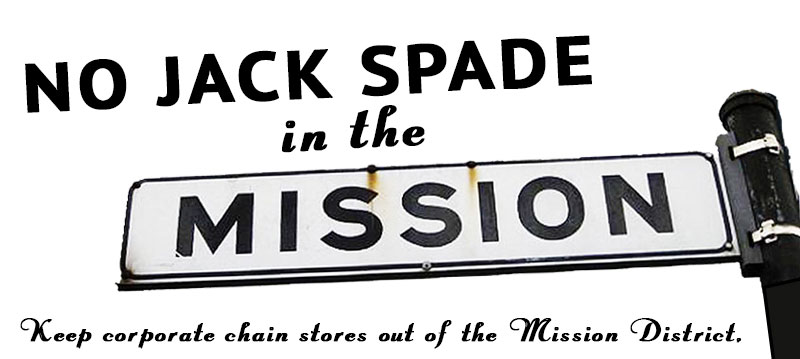
Score one for people power. Anti-gentrification activists in the Mission scored a major victory last night in their months-long battle to keep Jack Spade, an upscale men’s clothing chain, from opening a store on 16th Street — first by winning over the Board of Appeals, then by convincing the company to just give up.

So Jack Spade won’t be opening in the site of the old Adobe Book Store location near Valencia Street, an outcome engineered by the grassroots activism of the Stop Jack Spade Coalition, Valencia Corridor Merchants Association, and progressive politicians who supported the cause.

At issue at last night’s packed hearing was an appeal of the Planning Department’s ruling that Jack Spade didn’t fall under formula retail rules because it had one short of the 11 stores needed to meet the definition, even though it’s an expanding part of 5th and Pacific Co. and a brother brand to Kate Spade, which has dozens of stores around the country.

Activists considered it a long shot given the supermajority needed to overrule the decision and force a conditional use permit hearing before the store could open, particularly after falling short with the board in August. But this time, the activists won, with the board voting 4-1 to set a full rehearing for Dec. 11.

As representatives of the corporation left the hearing, they told a few activists and business owners that they “were done.” And when the Guardian reached 5th and Pacific CEO Bill McComb by email today, he confirmed that the company is giving up on this controversial location, where activists were concerned its deep-pocketed presence would accelerate gentrification of the neighborhood.

“[We’re] not going to war with the neighbors. We like those people and their neighborhood and we are not fighting the issue. There are many a fine location for Jack Spade. Peace to the city!” McComb wrote to us.

It was a thrilling surprise for the activists that have been organizing against the project for months, and it was reminiscent of the successful 2009 effort to stop American Apparel from opening up shop on Valencia, involving some of the same activists and organizing tactics.

“We’re very pleased about last night,” said Andy Blue, an activist working with local merchants. “We saw a significant shift in momentum and a tremendous community showing. It was clearly a victory for the neighborhood.”

It was a big turnaround from just a few weeks ago, when it looked like Jack Spade had won, and a sign of the rising importance of gentrification issues to San Franciscans who face rising residential and commercial rents fueled by the latest dot-com boom and Mayor Ed Lee’s corporate welfare policies.

“Six months ago, a lot of people in San Francisco felt powerless with the rapid displacement of residents,” said Blue. “It was like, ‘What can we do, you know?'”
But then, as Blue said, “the resistance started boiling up.”

The local merchants decided to appeal the Planning Department decision that would have allowed Jack Spade to simply open its doors with no public hearing. “So many people who were being affected by it started sharing their stories, and things started happening. People had had enough,” said Blue. “The San Francisco that we love is this diverse, unique place and we were watching  it transform into something totally different.”

Simply getting to yesterday’s hearing was a huge step for the activist population standing up against the retailer, Blue said. But after the rehearing request was granted, the local merchants still needed to prove that “manifest injustice” had taken place during Jack Spade’s permit acquisition process if the merchants wanted the actual rehearing. 

This presented a problem to the VCMA and others. To prove “manifest injustice” had taken place during the permit application process, the merchants needed to prove that Jack Spade not only applied for their permits under a dubious guise, but that they were well aware of just how dubious it was. To be manifestly unjust, the unfairness must be “direct, obvious and observable,” a list that isn’t always easy to satisfy. 

While the two sides can’t seem to come to a consensus on how much the rent will actually increase in the surrounding area due to Jack Spade’s arrival, this controversy arose at a time when neighborhoods throughout the city have been rising up against gentrification.

And this may not be the last time that this company is in the crosshairs of that concern. Asked whether its decision applies to the whole city or just this one location, McComb told us, “Just that spot. We have many brand fans in SF.” 

Activists try again to stop Jack Spade

67

The fight to keep suspected formula retailer Jack Spade out of the Mission resumes this evening (Wed/9) when The Stop Jack Spade Coalition lays out it’s case against the men’s clothing chain before the Board of Appeals in an attempt to force the business to go through a conditional use permit hearing. [UPDATE: Activists say they won a big victory last night, not just winning that vote but maybe convincing Jack Spade to withdraw its application completely. We’re working on confirming things now and we’ll have more details soon.]

The new push against Jack Spade comes less than two months after an original appeal found the retailer not to be in violation of the neighborhood’s formula retail ban, with the opposition campaign getting written support of Sups. Eric Mar, John Avalos, and David Campos. They join a growing list of those opposed to the retailer, one that currently features former Board of Supervisors presidents Matt Gonzalez and Aaron Peskin and Assemblymember Tom Ammiano.

If the coalition is granted a rehearing, it will be the second time an appeal is heard on the matter. On Aug. 21, the Board of Appeals ruled against the retailer in a 3-2 majority decision, but the decision still lacked the four votes required to revoke the building permits.

Jack Spade — currently slated to rent the former Adobe Bookshop storefront at 3166 16th Street — was originally granted its business and building permits sans conditional use hearing, an act that was supposed to be unheard of for a prospective national retailer inside a neighborhood with a formula retail ban.

The 2004 formula retail ordinance requires a businesses to get a conditional use permit before moving into certain San Francisco neighborhoods if they meet the “formula retail” criteria. Part of that criteria states that a store can have no more than 11 “retail sales establishments located in the United States.” Jack Spade, pre-Mission store, has just 10 unique stores, which allowed them to circumvent the hearing process.

But according to 5th & Pacific’s public records, the holding company (formerly known as Liz Claiborne) that owns Jack Spade, the high-end men’s clothing store is not an independent business but rather a sub-brand of Kate Spade; a women’s clothing store with 94 locations in the United States alone.

The coalition opposing Jack Spade’s now-imminent Mission migration is using this piece of information as Exhibit A in their fight against the retailer. The coalition is claiming that by not acknowledging the fact that Jack Spade itself was part of a far larger corporation, the retailer violated the formula retail ban by claiming “independent business” status.

As the move-in date for the Mission’s unwanted addition grows near, the coalition has taken up the cause once again, mustering support from nearly every constituency available.

It will be bringing its revamped case to the Board of Appeals, this time with testimony seemingly focused on the misleading nature of Jack Spade’s classification as an “independent business.” That should prove to be an effective move for the coalition, because Jack Spade isn’t an independent business, and they don’t try to classify themselves as such outside of San Francisco.

In fact, according to 5th & Pacific’s 10-K filings with the SEC, the “Kate Spade brand offers fashion accessories for women under the Kate Spade and Kate Spade Saturday trademarks, and for men under the Jack Spade trademark.” The two brands even share the same CEO: Craig Leavitt. Declaring that the two companies are independent of each other based on product offering is like saying beef and milk are independent of  other because they come from different parts of the cow.

Now, armed with an updated defense, the Coalition is taking a second stab at the appellate process, one they feel good about. In a letter to the Board, executive director of the Valencia Corridor Merchant Association (VCMA) Luis Granados said, “If the findings section were fully taken into account [last time], we believe the Board will see that Jack Spade is formula retail, as set forth under the law.”

Or as Gonzalez wrote in a letter to the Board of Appeals: “Issues of corporate ownership and/or corporate structure have been a matter of debate in previous hearings regarding Jack/Kate Spade’s permits.  While nowhere in the planning code does it require the consideration of corporate ownership/structure, neither does the ordinance forbid a consideration of corporate ownership/structure.  Indeed, in order to fulfill the clear intent of the law in a common sense manner, it will be necessary, in some cases, to consider corporate ownership/structure.

I urge you to grant the VCMA’s request for a rehearing of Jack/Kate Spade’s permits in order to prevent manifest injustice.”

And considering the momentum that the anti-Jack Spade movement is now gaining, the optimism isn’t unreasonable.

Activist Andy Blue, who helped organize the protest, acknowledged the high bar needed to overrule the flawed ruling by the Planning Department, telling us, “We’re cautiously optimistic, but it’s a long shot.”

Government shutdown puts thousands of SF veterans’ benefits at risk

69

More than 7,000 employees in Veterans Benefits Administration offices nationwide were furloughed today (Tues/8), the newest casualty of the federal government shutdown.

As the Republicans in Washington hold the nation hostage over President Obama’s Affordable Care Act, federal employees are leaving their offices in droves. Now the veterans who rely on the federal government for healthcare and education checks have nothing to do but wait on word of their uncertain futures. 

The furlough of veterans benefits workers comes at an especially awful time as they struggle to meet an enormous backlog of health benefit claims, revealed this year by the Berkeley-based Center for Investigative Reporting.

“VA’s ability to make significant progress reducing the disability claims backlog is hampered without the increased productivity gained from overtime for claims processors,” the Veterans Benefits Administration said in a statement released today. The agency has reduced the disability claims backlog by more than 190,000 claims over the last six months, it wrote.  

But even worse, it said that if the government shutdown persists into late October there would be no funding available to supply veterans with their November support checks — money many rely on for rent and food.

In the event of a prolonged shutdown, claims processing and payments in these programs would be suspended when available funding is exhausted,” the office wrote in a release.

San Francisco has veterans of many stripes who depend on federal benefits: Students paying tuition, ex-soldiers getting housing benefits, the disabled seeking health care, all would be left without support.

The loss can be felt keenly at City College of San Francisco, where the employees of its pioneering Veterans’ Resource Center wait in fear of Nov. 1. 

 “With the government shutdown we’re going to have a massive amount of people coming in asking questions,” said Adam Harris, a student worker at CCSF’s Veterans’ Resource Center. The 25-year-old is a veteran himself, and served in the Navy for six years as a petty officer second class in Iraq, Afghanistan, and Guantanamo Bay.  

“If people aren’t paid on the first when they’re expected to you get a wave of people asking ‘where’s my money at?’” he said. The GI Bill pays for full tuition for student veterans who have completed their service, and those still serving. But it’s not just tuition. 

“It’s pretty much a living allowance,” he said. In addition to tuition the the GI Bill pays for housing, food and living expenses. City College of San Francisco alone has over 1,200 student veterans according to their own data, many of whom attend full time. 

The state community college chancellor’s office, which oversees California’s 112 community colleges, said the loss of benefits would be dire for its student veterans.

“Should this come about, our student veterans would be left without education benefits and basic housing allowances,” said Paul Feist, a spokesperson for the Community College Chancellor’s office.  “It’s probably safe to assume that many student veterans would be forced to drop out of school should this occur.”

They noted that the VA’s educational benefits hotline is inaccessible during the government shutdown, cutting off a vital counseling service as student veterans navigate their tuition payments.

The CA Community College Chancellor’s Office most recent data shows that as of the 2011-12 school year, there were over 44,000 community college student veterans receiving benefits statewide, many of whom are in the Bay Area. All would be affected. 

Rachel Maddow announcing the shutdown of veteran benefits offices, which give advice and aid for veterans seeking help with their education, lhousing and health benefits.

Student at the state level colleges will fare no better, though, and there are just over 700 student veterans at San Francisco State University, according to their website. The head of SFSU’s veterans center, Rogelio Manaois, said that his office was sending regular updates to SFSU students and that they were prepared for the possible delay of benefits.

Notably not all veterans depend on the GI Bill to live. Some vets the Guardian spoke to at City College said that they had part time jobs and would not be in hardship if there were a drop in payments. Also, the VA Medical Center in the Outer Richmond announced on its website that it will not be affected by the government shutdown. Not all veterans are in the same boat, however.

Bobby Hollingsworth served as a Criminal Investigations Divisions investigator in the US Army from 1999 to 2010. Though he’s now a graduate of SFSU, he and his family depend on disability payments from the VA to live. 

Hollingsworth injured his his leg in basic training, and the repeated stress through the years required multiple surgeries that he never fully recovered from. His disability payments also cover PTSD, as through his decade of service he spent over a year listening to the explosions of mortar shells peppering his Containerized Housing Unit in Iraq. 

He remembers those days vividly.

“I heard commotion and opened my door and looked up and to the side of our CHU’s. The sky was lit up like a scene in Star Wars” he said. “We got hit with seven mortars that night and a few airmen were rushed to the hospital with unknown injuries. We just never really followed up on those things. At the time maybe we thought best not to know.”

To say he earned his benefits is an understatement, he said, and the same goes for all of his fellow Veterans. 

As a documentary filmmaker, he is investigating other Veterans who have been denied their education benefits. Now the government shutdown may delay Hollingsworth’s payments as well. 

His wife depends on them for college, he said, and without his disability payments he may be unable to make his first mortgage payment on their new house. His wife and four-year-old son will be fine for now, he said, but if the payments are delayed for long he’ll be worried.

“I can hold out for a month because of emergency savings and the food bank,” he said. “But by December, it will be a nightmare.”

Yesterday the VA posted their “Veterans Field Guide to Government Shutdown,” which can be read here.  

Cyclists testify to SFPD bias as supervisors call for reforms

66

The cyclists of San Francisco were angry. Sup. Jane Kim was skeptical. Sup. Scott Wiener was unconvinced. Sup. Eric Mar said bikers were “pissed.” Deputy Chief of Police Mike Biel said he was too, but his anger could have just as easily been attributed to the 35 minutes he spent at the stand, acting as a whipping post for frustrations with the SFPD, as it could be to the department’s mistreatment of San Francisco cyclists.

Either way, the cyclists ruled the day.

During Thursday’s (10/3) Board of Supervisors Neighborhood Services and Safety Committee, Sup. David Campos called for a joint Board of Supervisors-Police Commission hearing regarding SFPD investigation protocol for bike accidents, but no immediate timetable has been set for the matter.

Without Police Chief Greg Suhr in attendance — his chiefly presence was required “reading to the children,” as Biel noted multiple times — Biel was left to stand solo in front of both frustrated supervisors and an incensed public.

At one point, following a particularly ambiguous response from Biel regarding accident checklists, Wiener asked bluntly, “Do you think there’s enough traffic cops in San Francisco? I don’t see bike cops, personally.”

To which Biel responded, “I’d like to see more.”

In fact, there was little defense on the part of Biel — and by extension, the Police Department — when it came to the seemingly lax (at best, malicious at worst) approach the SFPD has taken toward bike accidents in the past four years.

He even echoed Mar’s “pissed” comment, saying, “I was pissed too,” in regards to both what Mar called the “supposed investigation” of the Aug. 14 death of 24-year-old Amelie Le Moullac and the flippant attitude some in the department had taken towards cyclists in the days and weeks following. But he also stated that he didn’t think there was a negative bias in the SFPD.

The board’s decision to continue the conversation was bolstered by nearly 40 often-horrific testimonials regarding police treatment of cyclists in the City. And nearly all the stories could make the average person cring with the frustration, anger, and outrage they had the power to illicit.

Leah Shahum, executive director for the San Francisco Bike Coalition, told a story of a woman who was unable to make it to the hearing due to the injuries sustained in an April accident.

The woman, whom she didn’t identify, was biking in Golden Gate Park with her husband and son — the son was on the back of the woman’s bike — when she was hit from behind by a car, while she was stopped in the designated bike lane.

Witnesses stated that the driver was at fault. Her husband said the same thing. The police insisted on questioning the two of them more about their helmet usage — “which they were wearing,” according to Shahum — than they did about the actual events of the accident. Incidentally, adults aren’t required to wear bike helmets in California.

Robin Levitt, a Hayes Valley resident, talked about the strange “culture of blaming the victim” that has seemingly been propagated in the City, and how “in Germany, it’s immediately assumed that the vehicle is at fault, so drivers are safer.”

(And for what it’s worth, when Biel denied that same sentiment’s existence earlier with the committee, supervisors didn’t seem too convinced either. Mar even asked Biel, “Is there a bias or blame-the-victim attitude in the San Francisco Police Department?” which Biel promptly denied.)

And then there was Edward Hasbrouk, a former professional cyclist who has “never owned a motor vehicle.” He was biking home from work one evening when his progress in a Valencia Street bike line was impeded by a double-parked car in line for a valet service.

(Wiener has called for increased police enforcement of laws against double-parking. During today’s (Tues/8) Board of Supervisors meeting, he asked Mayor Ed Lee to support the effort, noting that SFPD rarely issues tickets to double-parkers despite “its impacts on traffic, Muni, cycling, and pedestrians.”)

Hasbrouk said that after a somewhat heated back-and-forth between the valet drivers, he flagged down a police officer to help him resolve the dispute, but the officer instead made Hasbrouk “carry [his] bicycle to the sidewalk.” Hasbrouk then said, “What would I have to do to get you to ticket these cars double-parked?” That comment got him arrested for felony vandalism, according to Hasbrouk. Expunging the arrest cost him nearly $3,000 and a night in jail.

But given the SFPD’s lack of pragmatism when it comes to investigating these accidents (for instance, Biel said SFPD doesn’t require a continuing education for officers assigned to traffic enforcement, despite what Shahum says are complex issues surrounding a rapidly growing population of cyclists), and it’s boorish behavior following the Le Moullac tragedy in August, it’s high time for change.

And a joint hearing could be just the place to start.

BART negotiations continue as unions withhold strike threat UPDATED

105

With the 60-day cooling off period ordered by Gov. Jerry Brown coming to an end on Thursday, raising the specter of another Bay Area Rapid Transit shutdown, BART’s two main unions announced yesterday that they were holding off on calling a strike for now. [UPDATE 10/11: BART unions today issued a 72-hour strike notice, meaning they could strike on Monday].

“We’ve listened to the public and we share their concern about a disruption in service at the end of the cooling-off period.  We do not want to strike. That is why we’re not giving a 72-hour notice at this time, because we want to leave every opportunity open to try to get this deal done. Of course we are keeping all options on the table,” Service Employee International Union Local 1021 and Amalgamated Transit Union Local 1555 said in a joint statement.

Some media reports indicate that there has finally been some progress in the long-stalled negotiations, with a framework on pensions being agreed to, although the two sides still seem far apart on wages, benefits, and the length of the contract.

The unions cast it this way: “To this point of doing everything possible to avoid a strike: over the past 10 days, the unions have moved publicly three times, to BART’s zero times. If this were a score in the baseball playoffs – we, the Oakland A’s would be three and they, the Detroit Tigers would be zero. 

“At this point, if there is a disruption in service at the end of the cooling-off period, it will be for one reason and for one reason alone: our elected BART leadership has not shown leadership.”

BART Board President Tom Radulovich disputed that the concessions have been one-sided, but he said that, “They continue to want to negotiate in the media and we’re not really down with that.”

Asked to characterized where things stand and the prospects for resolving the impasse without another strike, Radulovich said, “We’re still cranking away and trying to get it done…It’s really not up to us whether there’s a strike or not. We just have to get this done.”

Meanwhile, while conservatives clamor to use the situation to get the Democrat-controlled Legislature to ban unions from striking (good luck with that one), Sup. John Avalos held a hearing yesterday at City Hall to examine some of the larger issues at play in the impasse, such as retirement security, that the Guardian covered in our July 9 issue.

Asked how the hearing went, Avalos told the Guardian, “We talked a lot about how BART has been villifying workers in the court of public opinion in an effort to weaken workers’ bargaining power.”


Ain’t nobody who can sing — or bring the progressive fire — like Billy Bragg

28

During his set yesterday at the Hardly Strictly Bluegrass Festival, iconic British singer/songwriter Billy Bragg said he doesn’t understand why he was booked for an event devoted to Americana, although he did note that it was Brits like the Beatles and Rolling Stones that first popularized African American roots music for white Americans.

Yet in the spirit of legendary American folk singer Woody Guthrie, whose songs Bragg covered with Wilco on the amazing Mermaid Avenue albums, Bragg yesterday unleashed a righteous lefty diatribe against US political powers who were willing to shut down the government and default on its debts rather than offer universal healthcare to its citizens.

“Health care is the Jim Crow issue of the 21st Century,” Bragg said, also calling healthcare reform the “civil rights issue of this time” and calling for “free health care for every American.”

After closing his set with a rousing rendition of Guthrie’s “All you Fascists Bound to Lose,” he implored the young audience to rise up and “just get true.” Apparently his messages resonated with both the audience and organizers, who allowed him back on stage for an encore and some more fearless truth-talking.

“Socialism is organized compassion,” Bragg said, urging Americans to drop their irrational fears of socialized medicine (not to mention the far more insurance-based Obamacare), before playing his anthem, “There is Power in a Union.”

Bragg closed by saying that our enemy in this struggle isn’t the right-wing crazies shutting down our government, it is our own apprehensions about what can be done in this country, and the fear of advocating for what needs to be done.

“The enemy is cynism,” Bragg said, “and the only antidote to your cyncism is your activism.”

I and others left the show with our political fires stirred, as Sup. John Avalos also confirmed when I ran into him after the show, traipsing through the woods of Golden Gate Park toward the next stage. And I thought about what Hardly Strictly founder Warren Hellmen told me about this festival and form of music when I interviewed him for a profile that ran as a Guardian cover story in 2007.

“I feel very strongly that an important part of our culture is built on the type of music and type of performance that goes on at Hardly Strictly Bluegrass,” Hellman told me. From parables set to music to songs of struggle and the old union standards, “that kind of music is the conscience of our country.”

He considered bluegrass a vital and historically important form of political communication, more so than many of the upscale art forms that he and other rich people have tended to sponsor in San Francisco.

“I’m glad that we have first-rate opera, but it’s equally important that we foster the kind of music, lyrics, etc., that support all this,” he said. “Somebody once said that most of the great Western philosophy is buried in the words of country songs. And that’s closer to the truth than most people think. A big passion of mine is to try to help — and people have defined it too narrowly — the kinds of music that I think have a hell of a lot to do with the good parts of our society.”

And that was something that it took a fiery Brit to remind of us of this weekend.

Chess-in defies SFPD crackdown

By Christina Aanestad

More than 50 people crowded Market Street with tables, chairs, chess and other board games Sunday for a “Chess-in,” a response to the San Francisco Police Department’s closure of a decades-long San Francisco tradition of sidewalk chess.

“We had no say in the decision,” said Marvin Boykins, a 35 year veteran chess player.

Last month, police ended the open and public chess games at Fifth and Market Streets, citing crime as the reason. A nearby shopkeeper, who declined to provide their name, told the Guardian that drug dealers sometimes use the chess tables to conceal their business dealings. There’s no doubt crime occurs around the neighborhood, which marks the intersection of the Tenderloin and SoMa. Just three doors down from the chess games, a woman stood in the doorway of a closed business holding a crack pipe. Nevertheless, chess players like Boykins say crime happens in all neighborhoods—and it’s no reason for the police to stop a decades-old tradition.

“SFPD made a very grave mistake in their administrative capacity not acknowledging the true problem—that we have nothing to do with nor do we condone [crime],” he said.

Other shopkeepers, like Phil Gatdula, manager of sustainable soul food restaurant Farmer Brown on Market Street, said he enjoyed the chess players, who encompass people from all walks of life including business owners, youth, and elders.

Many attendees of the Chess-in voiced concerns about gentrification in the city, pointing to sidewalk chess as its latest casualty. Activists with the Coalition on Homelessness said blaming the removal on crime is merely a cover for an underlying agenda.

“To suggest that a long-time community of elder chess players engaging in a fun, public event is creating a public safety issue is a thinly veiled move to push poor people from public space,” said Jennifer Friedenbach, Executive Director of the Coalition On Homelessness.

Just days after the police kicked the chess players off Market Street, a new rent-a-bike station with gleaming identical bikes took their place. Bay Area Bike Share is a newly launched program that rents out bicycles, with nearly three dozen locations in San Francisco. Having opened in August, it’s a partnership with San Francisco, San Mateo, and Santa Clara Valley transportation authorities, offering “access to shared bicycles 24 hours a day, 7 days a week, for use in the cities of San Francisco, Redwood City, Palo Alto, Mountain View and San Jose,” according to the company’s website.

Lisa Alatorre, another staff member with the Coalition on Homelessness, sees the chess crackdown as part of a larger plan to appeal to techies and tourists in the area. It’s also no coincidence that a new shopping mall and condo development are going in right across the street from where chess players gathered for decades before the recent displacement, she said.

Josh Shadlen, 28, moved to San Francisco a few years ago as part of the second dot-com wave. Despite working within the tech industry that critics like Alatorre say is the cause of high rents in San Francisco, Shadlen spent his day sitting on the sidewalk, playing chess in the sun to support reclaiming public space. He said that while 90 percent of his colleagues don’t care about impacts they are having on the local community, he does.

Josh Shadlen, a tech dude who’s siding with the chess players.

“It seemed basically like an attack on the residents of this neighborhood and part of a plan to turn this neighborhood into fancy office buildings where maybe I might work at some point, but I don’t want that to happen here or anywhere,” he said.

Shadlen said the police should do a better job at policing rather than throwing out chess players.

Organizers like Alatorre say it’s unlikely chess will return to Fifth and Market Streets. For now, the players have moved to Yerba Buena Park. Alatorre and others are still hopeful that things could change—but they believe the political will doesn’t exist among current members of the Board of Supervisors. Asked whether she thought people would continue to gather at Fifth and Market streets to play chess next Sunday, she said, “I hope so.”