• No categories

Politics Blog

PG&E’s history of blowups

4

By Noah Arroyo

We don’t yet know if the San Bruno fire is a horrific accident or an equally horrific mistake. But Pacific Gas and Electric Company, which owns and operates the gas line that ruptured, has a history of incidents that look a lot like this one. Some of these incidents have caused power outages. Others have blown things up, or injured people.

The company also has a history taking money that ought to go to maintenance and diverting it into fat corporate profits.

In December of 2003, a cable fire at the Mission Substation of the Golden Gate Control Center caused a more than 100,000 people to lose power. The California Public Utilities Commission inspected the incident and found that PG&E suffered from general procedural laziness, and that “PG&E failed to follow three recommendations made in its 1996 Root Cause Analysis Report following [a] 1996 fire.”


At the time, San Francisco City Attorney Dennis Herrera noted: “The evidence is clear that PG&E knew about problems that endangered public safety and threatened to cost San Francisco businesses millions—and yet did nothing to fix them.”

Then, in August 2005, something exploded underground the intersection of Kearny and Post. A manhole cover shot into the air and the escaping fire severely burned a passer by. The event’s catalyst was a failed transformer, owned and operated by PG&E.

In June last year, a fire peeked and then roared from a manhole with enough force to resemble an explosion to onlookers. The electrical fire, at O’Farrell and Polk, was coming from a PG&E vault. The impact? 8,600 customers lost power. This, like Thursday’s fire at San Bruno, was a fire bigger and more resilient than what emergency responders at first assumed. At least in 2009, nobody died.

Another difference: In 2009, leading up to the explosion, PG&E didn’t know about the problem beforehand.

Why hadn’t PG&E replaced this natural gas pipe (the San Bruno fire’s origin) since its installation in 1948? Was the problem one of cost? If so, would replacing such a pipe cost more than the $46 million the company spent trying to push Proposition 16 in June’s election?

Or could this be a replay of the Rough and Ready fire of 1994?

That year, an inferno raged through the small Nevada County town, destroying a dozen homes and causing $2 million in damage. The cause of the fire? Tree limbs that PG&E was supposed to trim brushing against the company’s power lines.

The local district attorney sued, and during the trial, evidence came to light that PG&E had taken $80 million from ratepayers — money that was supposed to be used for tree trimming — and diverted it to executive salaries and to pad the bottom line.

The company was found guilty of criminal negligence and fined $2 million.

So if PG&E in fact failed to maintain its facilities, at great cost to the public, it wouldn’t be the first time.

 

Steve Moss, carpetbagger

73

UPDATE: Read Steve Moss’s response to this story here.

Steve Moss portrays himself as a District 10 candidate who has spent the last decade raising his family on Potrero Hill, working as a non-profit energy guy and publisher and editor of the Potrero View.

But in fact, during 2008 and 2009, Moss wasn’t living on Potrero Hill at all. When he filed his intent to run in the D. 10 race in 2009, he was living near Dolores Park, in a 4-floor 4-unit $1.6 million building he owns, and sending his daughter to Brandeis Hillel Day School, a private establishment near Daly City.

And shortly before he filed his intent to seek office, his wife told friends that the family was only moving to District 10 so Moss could run for supervisor, and that if he lost, they would be moving back to the Dolores Park area.

In his declaration of intent to run, a legal document he signed under penalty of perjury Aug. 4, 2009, Moss listed his address as 2325 Third Street, with a 94107 zip code. That address is where the View and Moss’s nonprofit San Francisco Community Power have their offices, along with M.Cubed, a private company that Moss and two other people founded.
In other words, the building is not where Moss was living with his family.

In fact, evidence that came to light in a lawsuit between Moss and his wife, Debbie Findling, and a couple who co-own the property where Moss used to reside on Kansas Street, indicate that he was living at 296 Liberty St, in District 8, until February 2010.

In a July 8, 2009 email to friends, filed in court as evidence in the lawsuit Moss’s wife noted:

“Steven has decided to run for City Supervisor in District 10!!! (Sophie Maxwell’s term ends in November 2010) so we’ll be moving back to the Hill in early spring! If you hear of any lovely rentals let us know. Or—I know it’s a crazy idea—but if you’re interested in swapping houses with us for a year as an even trade—you can move into our place on Dolores Park! (We’re hedging our bets in case he doesn’t win we’d be moving back to Dolores Park after the elections- If he does win, we’ll find a long-term place to live…).”

A three-day notice to cure or quit that Moss and Findling filed against one of their tenants at the Liberty Street address, which is also listed on public records as 841-849 Church Street, shows that between January 2008 and April 2009, Moss and his wife lived at the Dolores Park address.

For instance, Moss and Findling’s nuisance notice against this tenant notes that on “April 8, 2009, 7:10 a.m.—you pounded on the ceiling of your bedroom for several minutes and cursed repeatedly, “Shut the fuck up!”, severely annoying your landlords and scaring their daughter.”

Moss’s wife subsequently sent out a email in February 2010, alerting folks that the couple had moved from Liberty Street to their current address at 2145 18th Street, SF, CA 94107.

Reached by phone, Moss told us that it was only his candidate intention statement — a form that allows a candidate to start to raise money — that he filed while living at Liberty St. in 2009, not his official declaration of candidacy form. The language on the two forms is slightly different; the intent form only asks for a “street address,” where as the actual declaration of candidacy asks for a “residence” address.

Moss said he filed his declaration of candidacy a few days before the deadline, this summer. That form requires that candidates must have resided in the district for which they are running, for not less than 30 days immediately preceding the date they file. Under city law, candidates must continue to reside, if elected, in the district during their incumbency.
“I’m planning to win,” Moss told us. “And we’re very much enjoying the house on Potrero Hill and hoping to stay there.”
He added: “I have lived, worked and raised my family on Potrero Hill consistently for the last ten years.”

Pressed, Moss acknowledged that he owns an apartment building near Dolores Park. But he said he did not actually evict the nuisance tenant and has since rented out his own family’s apartment in the building.

‘We have not occupied it recently, we have a tenant there,” Moss said. Asked where he is living now, Moss said he’s renting at 18th and Vermont.

Moss confirmed that Andrew Zacks, an Ellis Act eviction specialist, is his attorney in the court case against the co-owners of the Kansas Street property and in the notice to cure that he filed on May 13, 2009.

When we called the city’s Ethics Department, a spokesperson said that they can’t comment on a specific race.
“But if someone signs a candidate form under penalty of perjury and they give an incorrect address, where they do not reside, that would add up to perjury,” the spokesperson, Mabel Ng, said.

SFBG Radio: Korans, small business, and the next gov

1

In today’s episode, Johnny and Tim talk about the news of the day — the Florida Koran burning, the Senate and Obama’s small business bill, and the state of the next head of the state. You can listen after the jump.

sfbgradio9/9/2010 by endorsements2010

Court denies SF Weekly’s request for rehearing

0

The state Court of Appeal denied Sept 9th a request by SF Weekly and its chain parent for a rehearing in the Bay Guardian’s lawsuit. That allows the appelate decision affirming the Guardian’s trial court victory  to stand.

The court issued a few minor amendment to footnotes in the case, but denied the Weekly’s request that the evidence be reconsidered. That means the decision remains as precedent-setting case law in California.

The court decision was a major victory not just for the Bay Guardian but for small businesses across the state who are facing predatory chains that sell below cost with the goal of harming competition.


DCCC endorsements — how the hell did this happen?

35

Everyone knew that the DCCC, the endorsing arm of the San Francisco Democratic Party, would have trouble choosing candidates in the heavily contested D. 10 race. After all, the member decided at the August endorsement meeting to punt the D. 10 decision for four weeks.

But the DCCC’s September 8 endorsement of civil rights attorney Dewitt Lacy, former Newsom staffer Malia Cohen, and biodiesel activist Eric Smith, in that order, was somewhat mind-boggling. It left the San Francisco Democratic Party in the position of endorsing a candidate who is utterly unreliable on tenant issues and passing over perhaps the most progressive contender in the race.


D. 10 candidate Tony Kelly, who has a long history of progressive involvement in the district and who thought he had strong support on the DCCC, felt as if he’d been thrown under the endorsement bus. And it left fellow progressive Chris Jackson feeling that the DCCC endorsement process didn’t take the community’s wishes into consideration.

It’s common knowledge that DCCC members felt they had to endorse an African American in this district, since it contains the city’s largest remaining black community, and since it’s unlikely that a black candidate will get elected from any other district this fall, potentially leaving the board with no African American representation.

But that does not explain why the DCCC, after giving Lacy its first place endorsement, gave its second slot to Cohen, a moderate who told the Guardian in a recent endorsement interview that she doesn’t support further controls on evictions and condo conversions because that would infringe on property owners’ rights.


And in the end, you have to wonder: Does this end up helping Steve Moss, the candidate most progressives on the DCCC most fear?

Insiders point to two hidden plays that worked against Kelly, and for Cohen, in terms of getting the DCCC’s nod.

The first was a push by downtown interests to have their representatives on the DCCC make no endorsements in the race. The idea was to keep Kelly off the slate, so that downtown’s preferred D. 10 candidate Steve Moss would have a better chance of sewing up the vote on Potrero Hill, where Kelly is expected to do well.

The other play was a push among some DCCC members to put a black woman on the slate. This made Cohen, despite her moderate stance on some progressive issues, their choice, since she was born and raised in the district and has raised enough money to run a competitive campaign.

DCCC chair Aaron Peskin told the Guardian that he wanted Kelly to get one of the slots.


“My failure to do so proves that the DCCC isn’t a machine,” Peskin said. “I wanted Tony on there somewhere, and for a while it was looking like he might get second or third place.”

Kelly told the Guardian that he was surprised not to get the DCCC endorsement—and that he has received 8 phone calls from DCCC members apologizing for what happened.


“Nobody wanted those three candidates, except perhaps Scott Wiener,” Kelly said.


“At the same time, there have been so many gyrations around this in the last week. I’ve had more than half of the DCCC members tell me directly, ‘You’ll make the best supervisor—and I’m supporting someone else.’ But now they don’t even have three progressives in the slate.”

Kelly added: “This is a weak moment for the Democratic Party. This is not a machine, it’s not something that has strength or relevance to the district. This is the most clueless endorsement possible.”


Jackson believes that what happened last night was purely politics.


“This was a very political process and they made a political decision,” Jackson said. “But ultimately, it’ll be up to the neighborhoods and community to make their own choice.”

 “Unbelievable,” is how Smith described the DCCC’s D. 10 slate. “Right before this vote started, Eric Quezada told me, no matter what happens, there are better things in life than this. But now I feel great. It’s given my campaign a big boost.”

“I’m close to Tony Kelly, I consider him as a friend,” Smith added. “But in some ridiculous karmic way, the stars aligned, and I’m one lucky bro.”

Lacy for his part was clearly elated at getting the DCCC’s top slot.


“I’m really excited,” Lacy said.  “I believe this means D. 10 has a strong opportunity to get its fair share of good things and the Democratic Party will take part in making that happen.”


It also means Lacy — whose campaign has been a little slow and underfunded — is really going to have to ramp up his efforts in the next few weeks to take advantage of the DCCC nod. And it means Moss will get a boost, since Kelly could take Potrero Hill votes away from him. Kelly’s the only candidate who got the Potrero Hill Democratic Club endorsement.


Endorsement interviews: Eric Smith

10

Eric Smith’s passion is environmental justice. He’s the director of Green Depot, a coalition of biodiesel organizations, and has helped lead the city to switch its buses and official vehicles to the cleaner fuel. He’s working on ways to get the city to move its waste by train. And he talks about the important of green jobs (and not just green jobs for the top college graduates.)


Smith told us he’s not fond of the Lennar project, but he supports the Communit Benefits Agreement and would have voted for the project EIR. He’s concerned about the city’s plans to bring 40,000 more housing units, mostly high-end condos, to the neighborhood, particularly the threat to light-industrial jobs. He complains about the lack of centralization in city services and the sometimes overlapping jobs of nonprofits and public agencies. He’s an opponent of the gang injunctions and Sit-Lie.


You can listen to our interview here:


esmith by endorsements2010


Endorsement Interviews: Malia Cohen

7

Malia Cohen has three priorities: She wants to keep District 10 residents working, healthy and safe.

Healthy means expanding open space in the district, creating more pocket parks and turning McLaren Park into more of a destination. Safe means more community policing and using nonprofits like TURF to help monitor streets and buses. “I’m a believer in the broken windows theory,” she said, arguing for brighter lights on Third Stree and San Bruno Ave. She’s also calling for community clean-up days to “change the culture of Third Street.” But she opposes the city attorney’s gang injunctions. Working means more jobs for local people from development and better educational opportunities, particularly for people who might not go on to college.

Cohen took some strong progressive stands — she’s against Sit-Lie, and for public power (although she wasn’t too familiar with Community Choice Aggregation.) She supports the hotel tax, the real estate transfer tax and the vehicle license fee.

But she has a decidedly conservative streak, too: She wouldn’t support any further limits on condo conversions, Ellis Act evictions, or TICs, saying those regulations would infringe on the rights of property owners. You can listen to our interview here:


mcohen by endorsements2010

The Guardian 2010 election Endorsement Interviews

13

The Guardian is interviewing candidates for the fall elections, and to give everyone the broadest possible understanding of the issues and our endorsement process, we’re posting the sound files of all the interviews on the Politics blog. Our endorsements will be coming out Oct. 6th. Click here to listen — page will be updated as we publish more interviews.

The Nevius rumor mill

1

After defending Pet Food Express, a chain that worries local independent pet stores, the Chron’s C.W. Nevius has the latest rumor in the who-will-be-the-next-mayor game. Here’s how it goes: Newsom becomes lieutenant gov, the supes pick Dennis Herrera as mayor, Herrera appoints David Chiu city attorney, and David Campos becomes board prez.


I’m not buying it. Herrera is well short of six votes on the current board, and Chiu has sufficiently pissed off progressives that he can’t cut that deal and make it happen. Besides, Chiu doesn’t want to be city attorney, he wants to be D.A. Or mayor.


Matt Gonzalez, Tony Hall, and Ron Paul

26

If Luke Thomas didn’t have the pictures to prove it, I might never have believed this story, but there they are — the former supervisor and progressive candidate for SF mayor, Matt Gonzalez, hanging out with his old (odd) BFF Tony Hall — and libertarian Republican Ron Paul and John Dennis, a Republican running against Nancy Pelosi, at an “anti war and anti-incumbent” rally Sept. 4.

I guess they’re all against the wars in Iraq and Afghanistan. So am I. Dennis is also one of those “federal reserve is the devil” types who wants all of our currency once again backed by gold. I’m not defending the federal reserve here. I’m just saying — this is an odd crew.


SFBG Radio: Why voters should think like junkies

11

Today we talk about a different approach to politics: Why voters should think like junkies. Johnny’s got a good argument here — your typical junkie is a lot more cynical about people trying to sell him something than the typical voter who listens to Glenn Beck. Oh, and why is that preacher in Florida going to burn a stack of Korans? Any junkie could figure out that it’s all about making a fast buck. You can hear the discussion after the jump.

sfbgradio9/7/2010 by endorsements2010

Desperately seeking 2011 bee calendars

0

Since writing about this summer’s squash bee hunt, I’ve received a number of enquiries about how to view the 2011 North American bee calendar that was referenced in my article. The answer is fairly simple: visit the website for Dr. Gretchen LeBuhn’s Great Sunflower Project or for the Xerces Society for Invertebrate Conservation.
According to native bee advocate Celeste Ets-Hokin, who produced the first ever North American Native bee calendar in 2010 in collaboration with Dr. Lebuhn, an environmental science professor at San Francisco State University, the bee calendars are a fundraising effort for Lebuhn’s Great Sunflower Project. 
“The Great Sunflower project currently boasts an online membership of roughly 80,000 citizen scientists from across the United States and Canada who have joined Dr. LeBuhn in the hunt for bees,” Ets-Hokin said.”Members plant sunflowers in their garden and time how long it takes bees to visit, allowing Dr. Lebuhn to collect data on the health of the bee community across the continent.”
Sales of the 2011 North American Bee Calendar will continue to support the research of The Great Sunflower Project, as well as the pollinator conservation efforts of the Xerces Society of Portland, Oregon.  Calendars may purchased here and here.  Hope that clears up the mystery! (Apparently, the calendars only went on sale today September 7.) And enjoy learning more about the amazing lifestyles of North American bees!

Endorsement interview: Tony Kelly

7

Tony Kelly’s been involved in land-use and development battles in the district for more than a decade — and it shows. He talks about zoning, redevelopment, and urban finance with the ease of an expert. He complains that funding affordable housing just by asking developers to include a little bit in their market-rate units is “a sucker’s game.” He talks about the need for public-sector investment to handle the major influx of population projected for the district over the next 20 years. He’s also thought a lot about city finance, and suggests, among other things, that San Francisco demand that the University of California pay some sort of fee in lieu of the $60 million the giant institution doesn’t pay in local property taxes.


Kelly also talks about environmental justice in the district, and is willing to go as far as suggesting that the city look at ending I-280 at either Cesar Chavez or Alemany as part of a program to expand rail service along the corridor. You can listen to our interview here:


kelly by endorsements2010

SFBG Radio: Johnny’s had it with Obama

5

The economy’s not getting any better, we still have 50,000 troops in Iraq, and the Democrats are in serious trouble this fall — because they refuse to act like Democrats. That’s why Johnny’s had it with Barack Obama (though Tim says the Dems are still better than the alternative ….) Listen to the ranting and raving after the jump.


sfbgradio932010 by endorsements2010

Endorsement interview: DeWitt Lacy

0

DeWitt Lacy wants District 10 to get its fair share — of the city’s economic pie, of the programs that serve San Franciscans, of the parks and infrastructure that San Francisco pays for. He complains that the district has some of the worse environmental problems in the city “and we don’t even protect the parkland we have now.” He’s taking a generally progressive approach — he opposes sit-lie, is against the gang injunctions, and supports all the revenue measures on the fall ballot. He also thinks the city makes it too hard on the working class; in fact, he complained about the cost of parking tickets, saying they’re a real burden for people trying to support a family on moderate incomes. And he’s concerned that the emphasis on housing in the city’s Eastern Neighborhoods Plan could impact light industry.

You can listen to the interview here:


lacy by endorsements2010

Endorsement interviews: Steve Moss

1

Steve Moss sees the future of District 10 as a great opportunity — for all of California. “We are a solution to the state’s problem,” he told us. Development in D 10 can help solve suburban sprawl and reduce commuting time and build a more sustainable state. But that means the state and the region need to help pay for the infrastructure needed to accomodate some 40,000 new residences over the next 20 years.

Moss had plenty of ideas about how to pay the huge tab for public amenities, including tapping existing state and regional money for transit, wetlands restoration and port and waterfront use — as well as a substantial local infrastructure bond. He talks and thinks like the policy analyst and professor he’s been, saying that the way to address issues is to identify the problems then target resources to fix them.

But he’s still a little vague on some of the city’s pressing issues. He wouldn’t take a stand on sit-lie (although he’s leaning against it), wouldn’t take a stand on the Campos Sanctuary City measure (although he said the city should “stay away from interacting the the federal government) and didn’t seem to have any problems with gang injunctions, which he said “have calmed things down.”

You can listen to the entire interview here:


moss by endorsements2010

Lynette Sweet and the IRS: The strange story

3

Lots of people have trouble with the IRS. Almost everyone I know has run afoul of the tax man at some point in time, and the fact that BART Board member and District 10 candidate Lynette Sweet at one point owed the feds $14,500 isn’t exactly a major crime.


But there’s a part of her story, at least at Matier and Ross present it, that strikes me as odd:


Sweet says she thought the tax lien was cleared up years ago.


She said she cut a deal with the IRS in 2007 to pay $14,500 in back taxes plus interest, in return for additional fines being dropped.


Sweet said she sent the feds a cashier’s check and pretty much forgot about it.


The thing is, the IRS never cashed the cashier’s check – which, it turns out, was made out to Sweet herself, according to a copy of a 2007 check she provided to us.


IRS spokesman Jesse Weller declined to discuss details of the case, but said: “The IRS does not accept checks – personal or cashier – or money orders made out to individuals. We ask that the payment be made out to the United States Treasury.”


Sweet “sent a cashier’s check and pretty much forgot about it” — although the check was never cashed? And she didn’t notice? Here’s where it gets strange.


Sweet told me that she bought the cashier’s check from Wells Fargo, mistakenly made it out to herself and mailed it off to the IRS in 2007. At that point, the money had already come out of her account, so she assumed the debt was paid. But the IRS never cashed the check, since it wasn’t made out to the United States Treasury and, of course, the agency couldn’t cash a check made out to someone else.


And Wells, she said, never told her that the check hadn’t been cashed. (That makes sense, in an odd way; I just talked to a banker who couldn’t comment for the record but who comfirmed that cashier’s checks are like cash; once the bank issues one it doesn’t have any responsibility to call the buyer if the check is never cashed.)


“That’s why I don’t recommend the use of cashier’s checks for tax payments,” the banker said. “You want your own hard copy of your payment when it’s cashed.”


So how come the IRS didn’t contact Sweet for three years to tell her the check she sent was invalid? That’s not like the IRS I know. Sweet’s response: She was using a tax firm to help her with the account, and the notices must have gone there, and those people must never have told her.


And she never knew that she had an IRS lien on her house that had grown to $20,000.


Could be. But what a bizarre story. 


(By the way, I also invited Sweet to come down to the Guardian for an endorsement interview, and she had her campaign manager call to say she’d declined to talk to us. That’s pretty unusual behavior, esp. for an elected official. Even Gavin Newsom came to talk to us when he was running for re-election for mayor and we’d been blasting him for four years. Pretty weak.)


ICE suggests SF Secure-Comm opt-out possible

1

U.S. Immigration and Customs Enforcement (ICE) spokesperson Lori K. Haley sent the Guardian a statement today that suggests that ICE might change the city’s Secure-Communities activation status, after all.
“Once ICE receives the correspondence from the San Francisco County Sheriff, we will review the request and convene a meeting with the other agencies involved, including the California Department of Justice, to discuss the Sheriff’s specific issues and concerns.  Based upon those discussions, ICE and its partners will examine the options and seek a feasible resolution, which may include changing the jurisdiction’s activation status,” ICE stated.

ICE’s statement came in the wake of a conference call from SF Sheriff Mike Hennessey and SF Police Commissioner Angela Chan, who have been leading the charge to opt-out of a program that is supposed to be voluntary.

“Secure-Comm is not a federal law, it’s a program and it’s voluntary,” Chan told the Guardian.

Chan says she considers ICE’s statement a positive sign, but she insists that San Francisco be at the negotiating table, moving forward.
 “I think it’s important that ICE does not simply meet again with Attorney General Jerry Brown and not include San Francisco. Sheriff Mike Hennessey needs to be at the table,” Chan said.

ICE notes that since Secure-Comm’s activation in San Francisco in early June, the program has resulted in ICE taking custody of “89 potentially removable aliens, including 25 individuals with prior convictions for serious or violent offenses.”

“Secure Communities continues to be a vital tool for identifying potentially removable criminal aliens who’ve come into local law enforcement custody and expediting their removal from the United States,” ICE stated. “It’s a major step forward in ICE’s ongoing efforts to work with local law enforcement to prevent potentially dangerous criminal aliens from being released to our streets.”

But Chan points to an article in Bay City News, in which Hennessey clarifies that he does not have a problem with cooperating with ICE around serious criminal offenders.
“I am not unwilling to cooperate with ICE with regard to serious [offenders] charged with felonies,” Hennessey reportedly said  during today’s conference call with ICE. He also clarified that he had reported felony suspects believed to be in the country without paperwork before Secure-Comm was implemented and will continue to do so under SF’s sanctuary ordinance.

SecureComm is currently in effect in 35 California counties, including all nine Bay Area counties, Los Angeles and San Diego. Under the program, California Attorney General Jerry Brown’s Justice Department shares fingerprints of anyone booked into jail after an arrest, be it for felony or misdemeanor charges, with ICE’s databases to determine if that person is here legally.

In May, when Brown rejected Hennessey’s initial opt-out request, San Francisco Mayor Gavin Newsom backed Brown up, but police Chief George Gascon has reportedly indicated that he would like to see those arrested for minor crimes be exempted.

Today, Hennessey reminded reporters that he has already taken all the steps that ICE is recommending today to try to opt out, but that he was told in that previous go-around–by phone, no less–that opting-out was not an option.
“No meeting was held, no meeting was called, and they did not give me the courtesy of a written response,” Hennessey said.

ICE statistics’ also show that of the ten people already deported from San Francisco under Secure-Comm, only one had been convicted of a serious crime, and six had non-criminal backgrounds.
ICE’s Virginia Kice reportedly told BCN those with non-criminal histories may have had “extensive” histories of immigration-related arrests, which are typically handled administratively.

But Chan says that ICE’s latest statistics seem to prove that the program should be renamed Insecure Communities.
“This actually hurts public safety,” Chan said


Alioto-Pier’s campaign ends

0

District 2 candidates Janet Reilly, Mark Farrell, Kat Anderson, Vilma Guinto Peoro, Barbara Berwick and Abraham Simmons may be breaking out the champagne, right about now. That’s because incumbent D. 2 Sup. Michela Alioto-Pier just saw her bid to run for re-election squashed.

But bubbly likely won’t be flowing chez Michela.

As Fog City Journal reports, Alioto-Pier put out a statement expressing her disappointment in the outcome, but her respect for the judicial process.

“I believed and continued to believe that the intent of the voters as reflected in the plain language of our city charter allows me to run for second four year term,” Alioto-Pier said, as she pledged to keep working for her district until her terms ends in January.

Joanna Rees pole vaults into Mayor’s race

2

Matier & Ross have an interesting item about venture capitalist Joanna Rees running for mayor and declaring herself  “a progressive independent”.

What they don’t mention –- or don’t know — is that Rees has given $6,500 to Mayor Gavin Newsom’s Lt. Governor campaign.


That puts Rees on par with former Dreamworks co-founder David Geffen, Dreamworks’ Jeffrey Katzenberg, actress Kate Capshaw, film director Stephen Spielberg, and the three members of the Traina clan (Alexis, Todd and Trevor) who so far have each plunked down 6.5 K for Newsom’s latest political run.

Newsom’s campaign filings also record that Rees is with VSP Capital. So if you want to know more about Rees and her partner, you can read their official bios here.

But if you want the gossip on the VSP adultery scandal, read valleygawker’s piece here. And then there’s the piece on VSP’s website about the settlement that you can read here.


Endorsement Interviews: Rebecca Prozan

Rebecca Prozan, a candidate for Disctrict 8, has the endorsement of incumbent Sup. Bevan Dufty, and she and Dufty seem to have a lot in common. “I’m able to bring both sides together,” she told us, noting that D-8 constituents “like people who are independent thinkers, who are right up the middle.”

An assistant District Attorney, LGBT and District 8 liaison under former Mayor Willie Brown, and a Recreation & Parks Commissioner, Prozan is familiar with San Francisco government from a number of angles — but she’s also perceptive of the level of mistrust that exists. “There isn’t a San Franciscan in District 8 that actually thinks government is spending every dollar as it should,” she said.

Prozan said she is supportive of a hotel tax to boost revenues, a vehicle license fee to help improve MUNI, and a parcel tax to raise money for schools. She likes the idea of conducting audits as a way to tighten up spending, but rejected the idea of requiring nonprofit organizations to disclose how they spend city funds that are allocated to them. She doesn’t see any reason for split appointments on the SFMTA Board or the Redevelopment Agency, and she believes that while it’s “not a witch hunt,” part of the solution for MUNI should be targeting salaries. She’s against the proposed sit / lie ordinance, she’s a big fan of the Community Justice Center, and she thinks gang injunctions are a useful tool for law enforcement.

Prozan also told us she thinks the city should focus on building more rental housing, and she has been shopping around the idea of figuring out how to convert 1,100 foreclosed San Francisco properties into affordable housing for “teachers, cops, and firefighters.” Listen to the full interview below.

rprozan by endorsements2010

Hennessey to Brown and ICE (again): SF wants out of Secure-Comm

7

Sheriff Mike Hennessey has sent a letter to California Attorney General Jerry Brown and Department of Homeland Security officials David Venturella and Marc A. Rapp, reaffirming San Francisco’s desire to opt out of Secure-Communities, a program U.S. Immigration and Customs Enforcement (ICE) activated in San Francisco in June.

In his August 31 letter, Hennessey observes that on August 17, ICE issued a communication that suggests there is now a procedure to address opt-out requests.

‘The ICE communication, Secure Communities: Setting the Record Straight, specifies that, ‘If a jurisdiction does not wish to activate on its scheduled date in the Secure Communities deployment plan, it must formally notify its state identification and ICE in writing (email, letter of facsimile),” Hennessey states. “Upon receipt of that information, ICE will request a meeting with federal partners, the jurisdiction, and the state to discuss any issues and come to a resolution, which may include adjusting the jurisdiction’s activation date in, or removing the jurisdiction from, the deployment plan.”

Hennessey acknowledges that San Francisco County has already been activated in accordance with ICE’s Secure-Comm deployment plan.

“However, as you know, I sought to opt out, in writing, to both the California Department of Justice and Secure Communities,” Hennessey wrote. “I was told at that time in a telephone conversation with Mr. Rapp that there was no provision for a local jurisdiction to opt out. The information provided in Secure Communities: Setting the Record Straight would suggest that there is now a procedure in place to address such requests.”

Hennessey ends his letter by saying he is looking forward to meeting all parties and “coming to a mutually agreeable resolution.”

So, stay tuned….

Save the bees, save the planet

0

Native bee advocate Celeste Ets-Hokin didn’t just spend time this summer helping me find squash bees. She also spent months putting together a 2011 native bee calendar, and days writing letters to the US Food and Drug Administration (FDA) about upcoming food safety regulations that will affect all U.S. food growers.

“The FDA sets regulations on how they grow food,” Ets-Hokin explained. “And that could have a negative impact on organic and sustainable growers if the FDA creates regulations that conflict with conservation.”

Farmers are stewards of the majority of the world’s arable areas, Ets-Hokin observes.

“And as stewards of 90 percent of the planet’s arable land, it’s important that growers understand the need for bee habitat and conservation,” she said. “This can be done by restoring habitat, putting in insectary plantings and hedgerows, and other measures.”

Ets-Hokin rejects the notion that bee conservation efforts are elitist.
“If it were so elitist, you wouldn’t have all these preexisting federal programs like the National Resources Conservation Service,” Ets-Hokin said.

But most agriculture operations are run by huge corporations that are not physically present on the land they control, she observes.
“So, when the growers plough under thousands of acres of field, leaving only a patch of dirt, they don’t have to see how it looks,” Ets-Hokin said. “But when farmers put hedgerows and insectaries around farms, they see flowers that bloom all year. That’s refreshing to the spirit. It provides ecosystem services like pollination and beneficial pest control. But it also provides a spiritual uplifting. And I think that is under valued.”

Ets-Hokin worries about the negative impacts on native bees and other beneficial pollinators if the FDA develops a one-size-fits-all approach to food safety.

“If they develop a model that’s tailored to industrial operations, and force it on smaller operations that don’t pose the same risks as bigger operations, with lots of middle men and plastic packaging processes, you incur another risk,” she said, referring to outbreaks of E. coli (Escherichia coli) food poisoning, which are caused by the ingestion of E. coli bacteria.

“When you bring organics to the farmer’s market, there is not one recorded case of E.coli,” Ets-Hokin continued. “But if you impose the same testing protocols and fees on small growers, you disincentivize conservation. And that’s too bad. We need the mosaic.”

In an effort to spread awareness about the importance of bee habitat, Ets-Hokin focussed her newly published  2011 bee calendar on the central role that bees, including native bees, play in ensuring the safety of our food supply and the health of our ecosystem.

“Without native bees, many of the plants that anchor our terrestrial ecosystems would eventually disappear,” Ets-Hokin wrote in the introduction to her calendar.

“So, it’s not enough to say that we’ll put aside a little area for conservation on farms,” she told me, as we hung out in her bee-friendly yard. “It must be done in a regenerative cycle, in which we reuse waste on farms as input for the next round of crops.”

Ets-Hokin also told me how she got into the bee calendar business.

“Originally, I was going to try and produce flash cards, but it turned out that a someone had already done that,” she recalled. “So, then I thought, why not do something more visible and affordable to a broader audience. And so I stole Rollin for the project.”

Ets-Hokin is referring to entomologist and insect photographer Rollin Coville. His kick-ass images helped make Ets-Hokin’s 2010 native bee calendar an instant classic. 

“With insects, it’s important to focus on their eyes,” Coville told me in July, as we hunted for sthe elusive squash bee. And I think you’ll agree he’s right about bees’ eyes, when you check out the amazing images of these furry little vegetarians that illustrate Ets-Hokin’s 2011 bee calendar. Here’s hoping that her calendar will inspire growers and gardeners to include and conserve bee-friendly plants and habitat wherever they can. Save the bees, save the planet!

Steve Moss’ misleading ad

16

If you live in Potrero Hill, chances are you read the Potrero View, a neighborhood paper that’s been in existence for 40 years. Five years ago, Steve Moss took over as the View’s publisher and editor. And last year, when Moss filed papers in the D. 10 supervisor race, he stated in an editorial that “running for office and running a paper aren’t necessarily incompatible, but the two activities, undertaken simultaneously, prompts the need to adhere to ethical and legal standards.”

In that same editorial, Moss noted that, according to the Fair Political Practices Commission, a newspaper columnist seeking political office can continue to write columns.
“What they can’t do is advocate for their election, denigrate other candidates, or engage in direct politicking,” Moss wrote.

He also promised that, “The paper will not endorse any of the contenders. And we’ll offer all who’ve filed for the race a 50 percent discount on print and online advertisements—a fee my campaign committee will similarly have to pay.”

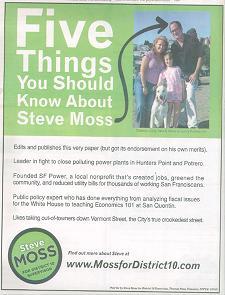
So, imagine this reporter’s surprise when I opened up the August 2010 special 40th anniversary issue of the View—and found an almost full-page advertisement, paid for the Steve Moss for D. 10 campaign, that claimed Moss got the View’s endorsement.

Titled ‘Five Things You Should Know About Steve Moss,” the advertisement features a photo of Moss and family. And the first thing that View readers should know, according to his ad, is that Moss “edits and publishes this very paper (but got its endorsement on his own merits).”

Reached by phone, Moss claimed that his ad was intended as a joke.
“It was meant tongue-in-cheek,” Moss said. “It was meant to be a joke.”

But nowhere in Moss’ ad is there any disclaimer that says that the View endorsement is a joke.

” Well, maybe it wasn’t funny,” Moss replied. “But you’re British. You should understand.”

Moss said so far the only call/complaint about his ad has come from me. But he added that perhaps in a future issue, he’d clarify that the View will not make any endorsements.

Moss followed up on my call with an email:

“I talked to my wife, Debbie, about the View advertisement, and she reminded me that she had warned me that some folks wouldn’t understand that the endorsement was a joke,” Moss wrote. “So, at minimum, you have made my wife correct.  Again. I think she’s still going to vote for me, though.”

While I appreciate Moss’ willingness to answer difficult questions from reporters, including those hailing from the British Isles, it seems that Moss is trying to argue that black is white. So, in the spirit of British humor, may I humbly suggest that Moss watch Monty Python’s “The Argument” skit. And then call me for a five-minute argument about his misleading ad.

http://www.youtube.com/watch?v=kQFKtI6gn9Y