• No categories

Pixel Vision

Quickies: Short Frameline reviews

0

Below are some reviews of films that intrigued us from the upcoming Frameline Film Festival. Check out more of our coverage here.

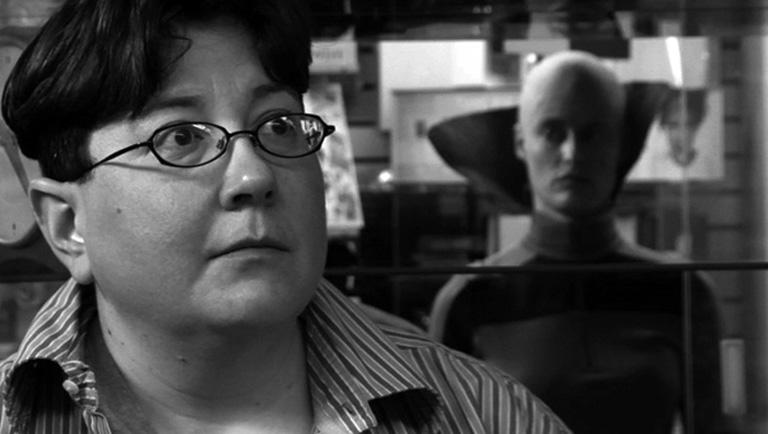
Codependent Lesbian Space Alien Seeks Same (Madeleine Olnek, U.S., 2011) Who can’t identify with that title? Metaphorically speaking, that is. Although Madeleine Olnek’s B&W feature insists on etaking it quite literally, to pretty hilarious results. Lonely stationery-store clerk Jane (Lisa Haas) tells her shrink she dreamed a close encounter in which a space ship dropped a note her way that read “What are you doing later?” Shortly thereafter, she finds herself the object of amorous pursuit by Zoinx (Susan Ziegler), one of several bald-pated, high Peter Pan-collared exiles from planet Zotz who’ve been dumped in Manhattan to seek “hot Earthling action” and get their hearts broken — because it is believed back home that “big feelings” of love are destroying the ozone. Ergo, guilty citizens must be rendered “numb and apathetic” by off-shore interspecies romance before safely returning. Meanwhile two badly mismatched government operatives (Dennis Davis, Alex Karpovsky) are spying upon the intergalactic love intrigue. Go Fish (1994) meets Plan 9 From Outer Space (1959), at last! June 25, 3:30 p.m., Castro. (Dennis Harvey)

The Evening Dress (Myriam Aziza, France, 2009) Everybody’s crushed on a teacher at some point, and indeed everybody in Helene Solenska’s (Lio) sixth grade French grammar class seems to have a crush on her. Why not: she’s attractive, wears sexy clothing (by classroom standards at least), and addresses the occasional sass with challenging provocation rather than simple discipline. But shy, studious Juliette (Alba Gaia Bellugi) has a crush bordering on obsession, particularly once she misinterprets teach’s attentions toward outgoing male student Antoine (Léo Legrand). You’re never too young to have a nervous breakdown, and our heroine’s increasingly reckless actions threaten to make her a pariah. Myriam Aziza’s feature is in that My Life as a Dog (1985) realm of movies about unpleasant childhoods that aren’t exploitative but at times grow truly discomfiting — it’s a worst case-scenario of pubescent imagination run amuck amid the usual teasing and bullying of peers. It’s a very good film if not an especially pleasant one. June 22, 4 p.m., Castro. (Harvey)

A Few Days of Respite (Amor Hakkar, Algeria and France, 2010) Quiet, bespectacled Moshen and his younger lover Hassan have fled Iran in the hopes of starting a new life together in Paris. They have only each other, and yet, because they lack visas, they must keep their distance while traveling to avoid arousing suspicion. While on a train in southern France, Moshen befriends Yolande, an older widow hungry for companionship who offers him a quick job painting her flat in a nearby small town. He agrees, forcing Hassan to continue hiding out, first in plain sight, and later, unknown to Yolande, in her attic, until tragedy drags everything out into the open. Algerian writer-director Amor Hakkar, who also plays Moshen, has crafted a sparse, intimate drama — emotionally enriched by its muted performances and minimal dialogue — about the lengths we are willing to go for love and the price we must pay in the process. Mon/20, 9:30 p.m., Elmwood; June 22, 9:30 p.m., Castro. (Matt Sussman)

How Are You? (Jannik Splidboel, Denmark, 2011) In the past few years Michael Elmgreen and Ingar Dragset, a Berlin-based artistic duo and romantic couple, have become international art world darlings known for their ambitious, playful, and critical large-scale installations, such as turning an exhibition space into a life-size replica of a New York City subway station or building a Prada pop-up shop in the Southwestern art mecca Marfa, Texas. At only 70 minutes, How Are You? can’t help but be a whirlwind tour, air kissing the bigger issues (commodity fetishism, identity politics, commercialism, and the vexed relationship the art world has to all three) Elmgreen and Dragset’s projects touch on while tracing the duo’s career trajectory all the way to their victory lap at the 2009 Venice Biennale. Brief but solid. Sun/19, 6:30 p.m., Roxie. (Sussman)

L.A. Zombie (Bruce LaBruce, Germany/U.S./France, 2010) If you’re going to see one Bruce LaBruce gay zombie erotic film, don’t make it L.A. Zombie. Alas, the latest from the queer Canadian auteur doesn’t hold up alongside its thematic predecessor, 2008’s Otto; or Up With Dead People. Lacking any of Otto‘s subtlety, L.A. Zombie is all sex, no substance. Sometimes that works: LaBruce’s The Raspberry Reich (2004) doesn’t go light on the porn, and that’s surely one of his best. But L.A. Zombie is lacking on all fronts. It stars noted gay porn actor Francois Sagat as a possible zombie (as in Otto, this is never made clear) who makes it his mission to fuck dead men back to life. Insert endless scenes of the zombie sticking his weird alien cock into gaping wounds and ejaculating blood onto corpses. If you can stomach that sentence, you can handle the film, but what’s the point? LaBruce’s past efforts have all the full-frontal male nudity without sacrificing the humor or cultural commentary. June 23, 9:30 p.m., Victoria. (Louis Peitzman)

Miwa: A Japanese Icon (Pascal-Alex Vincent, France, 2011) Chanteuse, star of stage and screen, outspoken champion of gay rights, drag queen: Akihiro Miwa has worn these many titles on her taxi-yellow, hair-like tiaras since she first rose to prominence as an androgynous torch singer at Tokyo jazz clubs in the 1950s. But it wasn’t until her dazzling star turn as the titular jewel thief in the camp classic Black Lizard (1968) that Miwa became a household name throughout Japan. Despite its clear admiration of its subject, Pascal Alex-Vincent’s documentary gives Miwa the Wikipedia treatment, resulting in a film that shares the unfortunate distinction of being both heartfelt and dull. Even his interviews with the lady herself come off as lusterless. Do yourself a favor, and track down a copy of Black Lizard instead. Mon/20, 1:30 p.m., Castro. (Sussman)

The Mouth of the Wolf (Pietro Marcello, Italy, 2009) This experimental narrative is a mix of archival footage and dramatic vignettes depicting the great love between two unlikely entwined souls who met in prison: ex-hood/longtime jailbird Enzo, a.k.a. Vincenzo Motta), and sometimes drug-addicted transsexual Mary Monaco (who died last year after filming). It’s also a lyrical appreciation of Genoa, the fabled northern Italian seaport that’s experienced tumultuous changes for over two millennia. Pietro Marcello’s unpinnable “docu-fiction” — Motta and Monaco apparently play themselves, a highlight being a 12-minute, nearly unbroken-shot dual interview — is frequently gorgeous cinematic poetry. If you seek the more conventional rewards of prose, you’ll probably be bored. However: anybody looking for Daddy should be informed that Enzo is pretty much the last word in unreconstructed macho-manliness. June 22, 9:30 p.m., Elmwood; June 24, 11 a.m., Castro. (Harvey)

Smut Capital of America (Michael Stabile, U.S., 2010) San Francisco. It’s smutty! You already know that, but do you know how deep-down and dirty it really is, in a historical sense? Basically we invented hardcore pornography in the 1960s (OMG, pubic hair!) and this lively local short, soon to expand to full-length, tells that story through fascinating archival footage, no-punch-pulled interviews with folks like John Waters and pornologist John Karr, and titillating naughty bits. Throughout there’s a feeling that a vital part of the story of sexual liberation, gay and straight, is being unearthed. And the raunchy tales of Polk Street hustlers, sticky-floored cinemas, and buck-wild hippie girls throwing open their golden gates will flood you with San Francisco pride. The short plays as part of the “Only in San Francisco” program with Running in Heels: The Glendon ‘Anna Conda’ Hyde Story and Making Christmas: The View From the Tom and Jerry Christmas Tree. Sun/19, 11 a.m., Victoria. (Marke B.)

Weekend (Andrew Haigh, U.K., 2011) The mumblecore-y movie many of us who lived through the 1990s wish was made back then: all that’s missing is the purposefully retro Cure soundtrack. Two scruffy, hipsterish, actually attractive Brit boys enjoy an ideal weekend fling. There is a fixie involved. Commitment-phobes each — one because he isn’t quite into the gay scene, one because he’s too full-on liberated for relationship gibberish — they gradually and adorably deal with their emotional attraction. By no means is this My Beautiful Launderette, and the melancholy self-regard might come a bit thick (Weekend was a big hit at the SXSW film fest, so … ), but it’s a well-acted, lovely film that examines the state of cute white skinny young bearded gay blokes today. Fri/17, 4:15, Castro. (Marke B.)

Without (Mark Jackson, U.S., 2011) This first feature by Seattle’s Mark Jackson (not to be confused with the Bay Area theater talent) is a stark reading of the psyche of 19-year-old Joslyn (Joslyn Jensen), newly arrived as temporarily caretaker to nearly-vegetative, wheelchair-bound Frank (Ron Carrier) while his kids and grandkids are on vacation. Left with this almost completely helpless charge — requiring butt-wiping, wheelchair-to-bed lifting, and regular transfusions of the Fishing Channel as stimulant — Joslyn seems to wallow in rather than escape her problems. Which appear to consist largely of a lesbian relationship whose gasping breaths we witness in occasional flashback. Isolated by no Internet or cellphone reception, not to mention her own powers of repression, Joslyn gradually looses grip as Jackson’s narrative grows more disturbing and ambiguous. Sat/18, 6:30 p.m., Victoria. (Harvey)

Frameline 35: San Francisco International LGBT Film Festival

June 16–26, most films $9–$15

Castro Theatre, 429 Castro, SF

Rialto Cinemas Elmwood, 2966 College, Berk.

Roxie Theater, 3117 16th St., SF

Victoria Theatre, 2961 16th St., SF

www.frameline.org


Chor Boogie’s curatorial vision… officially

0

The San Francisco spray art community loves a good collaboration. From the “Four Squared” aerosol collage, to our superlative mural alley collectives, to Otter’s 2010 tagfest over Banksy – creations can gain dimension with the addition of new cooks to the kitchen.

Maybe that’s the inspiration behind Chor Boogie’s first curatorial role in SF: “Art Official Truth,” which opens at Project One gallery on Fri/17. The SF muralist, whose stencil-defying spray-only pieces loop hypnotically across many of the city’s most photographed wall spaces, has selected over 25 artists in a variety of mediums whose works fit his vision of creativity.

Without getting hung up on the method to the madness, Friday’s reception is a chance to snag a sangria from Project One’s beautiful people-bartenders, shake around to DJ sets by Sake, and occupy a room filled with visuals pertaining to what one of the city’s most influential street artists thinks truly, officially, constitutes art these days. When you consider the midway that Boogie currently occupies between ecstatic street art love and major art world kudos, it’s interesting stuff indeed. 

You know how we love to get hung up on the analytics, and to make matters worse, we’re having a hard time waiting for the weekend, so in the pursuit of being nosy and over-literal, we hit Boogie up today for an email interview on what to expect from “Art Official Truth…” You’ll find the results below: a true-to-form blast of information-metaphor mix. Serves us right for trying to quantify so damn much.


San Francisco Bay Guardian: Is this the first show you’ve curated? 

Chor Boogie: Not really – I curated a show for the Museum of Contemporary Art of San Diego about street-spray paint art back in 2005 called “WriterzBlok on the Wall.” But it’s officially my first [time involving] many different mediums under one roof. 


SFBG: How did that concept come to be?

CB: The concept of curating basically came about [so I could] explore new avenues of the art world. The show is at Project One gallery, [and owner] Brooke Waterhouse asked me to do a solo show again. I felt I had [already done a] few shows of my own there, so why not give some other artists [whose] work I appreciate some shine? So I decided to curate. [It] has been a long journey to produce this show…

Faces of “Art Official Truth…”: works by Akira Beard, Chor Boogie, Aaron Nagel

SFBG: Once you decided you were going to give it a shot, how’d you make sense of the curating process? What’s the “Art Official” message — did it come from your grey matter, or was it inspired by a general zeitgeist?

CB: It took some time a few months to really decide on what I wanted to do. At first I was going to collaborate with each and every artist, but due to my schedule it could not possibly work out – but [it was] still a good idea, so during my artistic voyages across the great planes I compiled artists I met or was introduced to by others [whose work I was] really feeling. I asked all of them if they would like to do this show called the “Art Official Truth…” Originally it came from the concept of whether art is official, if it’s the truth. The title itself is an artistic creation, same with the flier for which I painted the snails, lol. There is significance with that as well: the snails represent artists and the long road on this “Art Official Truth…” to where we can live comfortably. Bringing all these truths-mediums under one roof is, officially, “art.” 


SFBG: How’d you select the artists that would be in the show with you?

CB: I was really connected to a lot of people whose work is in the show. I also had some help from some close art friends who told me ‘you need to see these artists work, they may be a good fit for your show.’ Once I saw those people, there was nothing but good feelings about their work. The main factor here was trusting what the artists create, rather than giving them a direction. Basically giving them their creative freedom. 

Mexico’s Alfredo “Libre” Guitierrez lends his party oxen to the affair

SFBG: Choose one piece from the show and tell me how it reflects your vision.

CB: That’s impossible. Every piece in the show reflects its own purpose and its own vision ..it’s ART, it’s OFFICIAL…it’s TRUTH.


SFBG: Can we get an update on the Berlin Wall piece? Are you totally sick of talking about that?

CB: Yes I am. Let’s just say a lot of balanced things happened in Berlin.  


SFBG: Are you looking for interns? I know some people who’d be interested…

CB: Possibly… soon enough. Building a dynasty is hard work, lots of dedication and discipline. 


“Art Official Truth…”

Through Aug. 6

Opening reception: Fri/17 7 p.m.-late, free

Project One gallery

251 Rhode Island, SF

(415) 938-7173

www.p1sf.com


Appetite: Sustainable seafood with Gaston Acurio

5

The average American still doesn’t know enough about sustainable fish. Most of us eat whatever is on the menu with little to regard to where it’s sourced, its health properties (or lack thereof) — totally unaware if the creature we’re eating is endangered or close to it. Consider this Appetite your 101 on the latest happenings in sustainable fish — and a primer on how to make sure your seafood dinner is safe for the waters of the world. 

I was privileged to attend a recent intimate round-table discussion with Peru’s leading chef Gaston Acurio and management from Monterey Bay Aquarium, the number one seafood source in the nation on what is or isn’t safe to eat at any given time.

Naturally, we met in the offices of La Mar Cebicheria, Acurio’s first stateside restaurant and my top spot in SF for Peruvian (New York is also about to get its first La Mar outpost). As San Francisco’s breezy, bayside location of La Mar just went fully sustainable, it was an ideal time to discuss the necessity of planet-minded dining.

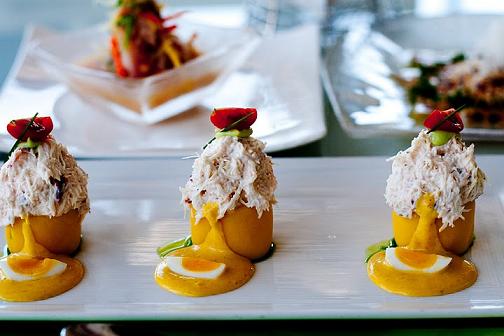
(Bait and) tackle these apps at Ki without fear of deprieving your grandkids of maritime meals

Acurio says chefs, cooks, and kitchen staff in general, are “the best weapons” in the struggle to change America’s fish-eating habits. While many say consumers should educate themselves, Acurio rightly pinpoints a need for education among restaurant staff. He shared a story of a Peruvian restaurant relaying to diners that their children would not know what their beloved local river shrimp tasted like if over-fishing in the area continued. With this kind of schooling, consumers themselves began asking every restaurant they dined at not to serve the shrimp. Locals changed habits – and may have saved the shrimp based on information learned on a night out.

The Peruvian’s commitment to sustainability is apparent. Acurio is working to take the message he’s spread throughout his home country worldwide. “Restaurants are instruments for sharing our culture with the world,” he says. He prefers to train his staff by inspiration, getting them involved in a mission — not just teaching them to perform a predetermined role.

Here are three things that restaurant staff and individual consumers can do to support sustainable seafood consumption, thus preserving the over-fished seafood we are at risk of losing like tuna and mahi mahi. (And remember, downloadable guides of what to eat and what to avoid avoid are available on the Monterey Aquarium website.)

1. Support local fisherman. Locally, buy sustainable fish at places like Royal Hawaiian in Potrero Hill or in the Ferry Plaza Building at San Francisco Fish Co.

2. Eat “down” the food chain – smaller fish need less time to mature, and make more sustainable catches. Try clams, anchovies, sardines, mussels, etc. 

3. Avoid aquaculture, farmed fish raised in controlled conditions.

Acurio believes more creativity happens when one cooks with what is fresh and available on a day-to-day basis. Rather than being limited by the diner who’s going to be upset that you didn’t serve tuna tartare, he challenges his chefs to “dream big”: to create dishes that will win customers over to a new way of looking at fish dinner. 

A few local restaurants serving only sustainable seafood:

1. Tataki and Tataki South, Pacific Heights and Noe Valley – The first fully-sustainable sushi restaurant in the US was Tataki, right here in our own backyard.

2. Ki, SoMa – Part of the funky, spacious “Zen Compound” that includes Temple Nightclub and a rooftop garden. Ki is an artsy new izakaya-sushi-drinks lounge.

3. Hecho, FiDi – Sustainable sushi sources called out by name – with tequila to accompany.

4. Pacific Catch, Marina – has elected June to be its sustainable shrimp month – it will be serving safe shrimp from various parts of the world.

And a little homework for those who’d like to learn more about keeping your sea meals safe for the ocean environment: don’t miss local resident Casson Trenor’s book, Sustainable Sushi (Trenor helped launch both Tataki and Ki). Also, the fabulous 18 Reasons is throwing a “Good Fish” event (cooking demo and lecture, $25-35) Sunday afternoon, June 12, sure to help you navigate the confusing terms that are involved in selecting a more sustainable fish.

— Subscribe to Virginia’s twice-monthly newsletter The Perfect Spot


Broke-Ass Stuart has a TV show!

0

Young, Broke & Beautiful (debuting June 24) plays like an odd hybrid of those cable reality shows best saved for long airplane flights: its jerky cinematography and self-satisfaction bring back memories of MTV Cribs, its title seems fit for an Oxygen drama, and it strives for the attitude of other irreverent travel shows like Insomniac
with Dave Attel
.

IFC’s new travel show chases writer Stuart Schuffman, a.k.a. “Broke-Ass Stuart,” around American cities (first up: San Diego; the episode provided for review was New Orleans; and future shows focus on Baltimore, Boston, Detroit, and Memphis) as he decrees certain things “broke-ass” ($32 swamp airboat-rides) and others “totally not” broke-ass (a $10,000 Jaguar pelt in a vintage shop). There isn’t a scene which doesn’t see Broke-Ass Stuart (a sometimes local who penned cult favorite Broke-Ass Stuart’s Guide to Living Cheaply in San Francisco, among others) branding a spot with some variation on the term “authentic local hangout,” and then promptly tagging a wall, bus pole, or even child’s face with his signature Young, Broke & Beautiful bumper sticker.

If you can get past the fingerless gloves and those moments when our host points at the camera and yells something about being a “bad mamajama,” his show does yield some interesting moments with city-dwellers that fulfill YBB’s mission statement of “uncovering hidden, cheap and carefully guarded gems.” It’s amusing to watch Broke-Ass Stuart roll up for drive-through daiquiris and then stop for a brief interview with New Orleans musicians Irma Thomas and George Porter, Jr. These conversations are the highlights of the show, though they’re packed so tightly together that none last longer than a few minutes.

Young, Broke & Beautiful is a whirlwind with a “throw everything at the wall and see what sticks” approach. As the credits roll and Broke-Ass Stuart is safely plain-old Stuart Schuffman again, it’s hard to ignore the feeling that a good number of the haunts showcased were worth vicarious attendance.

Young, Broke & Beautiful (pegged by its network as “a travel show for explorers and wanderers with a desire to celebrate everything weird and unique”) premieres Friday, June 24 at 11 p.m. on IFC.

The Performant: A pox upon’t

0


The Coen Brothers meet The Bard in Much Ado About Lebrowski

The best parodies are born from admiration for the targeted subject, be they the tortured plot twists of Spaceballs, the foppish mop-tops of The Rutles, or the beleaguered hero’s quest of Monty Python’s The Holy Grail. In a swoop guaranteed to appeal to worshippers of high and low culture alike, the Primitive Screwheads’ remount of last year’s hit mash-up Much Ado About Lebrowski manages to pay homage to one of the most-produced playwrights in the English language (ye olde Billy Shakespeare) and a pair of our most intriguing modern filmmakers (the Coen Brothers) in one borderline-blasphemous production, with enough in jokes and innuendo from both to keep aficionados of either on their toes. 

Lines from plays such as The Taming of the Shrew and Macbeth pepper the tortured syntax of the SoCal-meets-soliloquy text while characters from Raising Arizona and songs from Oh Brother, Where Art Thou mix effortlessly in with the endless “drinks of Russia White” and nihilist antics. 

Admittedly more closely calibrated to the many ludicrous tropes of the Coen Brothers’ film than those of Much Ado About Nothing, the Screwheads’ version begins with the appearance of three minstrels (John Carr, Paul Trask, and Sam Chase) who lead the room in a rousing rendition of “Ring of Fire” before launching into “Tumbling Tumbleweeds”, straight from the movie soundtrack. A fetching chorus line (Tara Navarro, Sarah Leight, Audra Wolfmann, and Suzanne Taylor) briefly set the scene before the Dude, henceforth dubbed “the Knave,” Geoffrey Lebowski (Alfred Muller) is hauled to the stage by two thugs (Karl Schackne and Omeid Far) who dunk his head in the commode — strategically located in the lap of a guy in the front row. From that point, no-one in the oddience is safe, the invasion of “space personal” a tried-and-true Primitive Screwheads tradition. 

Without a budget for much in the way of special effects (or props, or set…) the show very much relies on the merits of its actors, most of whom ably play multiple roles in the confused comedy of errors that transpires. Muller portrays “the Knave” with just the right blend of apathy and outrage, and his bowling buddies Sir Walter and Sir Daniel are hilariously inhabited by Steve Bologna and Omied Far (“Shut the firk up, Daniel!”). 

Inflatable beach balls rolled down the center aisle serving as the makeshift bowling lane, and a gigantic wooden sword as Sir Willaim’s weapon of choice. Dream sequences of giant bowling pins, Viking helmets, and an inexplicable pink unicorn are perhaps less visually psychedelic but no less hilarious than the ones from the movie, and the obvious willingness of the oddience to suspend disbelief and play along, partly assisted by rounds from the inexpensive bar, makes The Big Lebrowski as much a participatory event as spectator sport. And while “a knave by any other name would abide just as well,” you’d be hard-pressed to find any as up to the challenge as those who call the Primitive Screwheads family. Of course that’s just, forsooth, my opinion, man. 


Through June 25

 Fri-Sun 8 p.m., $20-25

Cellspace

2050 Bryant, SF

(415) 648-7562

www.primitivescrewheads.com/2011


The Performant: Bar Crawl

0

Burroughs and Shakespeare served neat, no chaser.

Stop me if you’ve heard this one before. A man walks into a bar. Ouch! Just kidding. A man walked into a bar. He idly scoped out a handsome youth leaning against the wall (Jorge Rodolfo De Hoyos Jr.) and began to sing: “I could use that, if the family jewels weren’t pawned to uncle junk…” Music swelled from the five-piece chamber orchestra in the corner of the stage: pizzicato on the violin, a bowed double bass, high-pitched urgent keys. An angular, haunting, sometimes dissonant music; just what you might expect the score for an operetta based on the semi-autobiographical William S. Burroughs II novel Queer to be.

The man onstage inhabited a familiar silhouette — rumpled suit jacket, a wide, silk tie, soft fedora — but rather than the reptilian demeanor of Burroughs’ legend, this representation of his protagonist Lee (Joe Wicht a.k.a. Trauma Flintstone) was both lusty and manic. He pursued the object of his desires, the diffident American Allerton (James Graham) with a single-minded frenzy, over-shadowed only by trembling bouts of junk-sickness and a burgeoning obsession with the psychotropic yage, or ayahuasca plant of South America.

Premiered in 2001, the Erling Wold operatic adaptation stuck to the text of the original pretty faithfully, the addition of Cid Pearlman’s silent balletic choreography lending the entire production the quality of an extended dream sequence. The show ended as it begins — in an expat bar somewhere in Mexico city—the slumped character of Lee as alone as in the opening sequence, older but not wiser, his longing for Allerton unabated, them usic underscoring his solitude in mournful adagio. 

Meanwhile, at the Café Royale, briefly transformed into The Boar’s Head Tavern of Shakespeare’s Henry IV and V by the ever-ambitious San Francisco Theatre Pub, an adaptation of both (called The Boar’s Head, natch) played to a full house on Monday night. Concentrating mainly on the scenes set in the infamous pub, The Boar’s Head tracked the coming-of-age of the king-to-be, Prince Hal (Bennett Fisher), and his relationships to the two men who shaped him most—his austere father, the king (Ted Barker), and the jocular, petty criminal, Falstaff (Paul Jennings).

With no clearly defined stage space, the actors roamed around the whole room as well as on the Mezzanine, giving their pub-set play an air of authenticity better than any spray-painted flat and borrowed barstools could ever hope to. Their inventive use of space included using the pool table as an erstwhile deathbed, and the end of the bar for, well, the end of the bar, where Falstaff called repeatedly for his cup of sack and the French princess Katherine (Larissa Archer) learned halting English, body part by body part.

At the play’s end, the newly coroneted Hal banished the lusty Falstaff from his presence for a distance of 10 miles. Despite the somewhat gloomy resonance with Lee’s downfall from the night before, it’s actually encouraging to note that the libertine spirit has been under attack for literally hundreds of years and has yet to succumb entirely to the guardians of dour morality. At the very least, we should toast its tenacity with a cup of sack.

Roccopura is back and wild as ever

0

I’ve been covering San Francisco’s indie circus scene for years, first for a Guardian cover story and then for my book The Tribes of Burning Man, and I’ve always loved the colorful chaos it injects into the city’s nightlife scene. And if you really want to see these creative and talented characters at their very best, in a show that brings all its myriad parts and beautiful pieces together into a big messy money shot, check out Roccopura tonight (Thu/2) or later this month at DNA Lounge.

Written by Gooferman frontman Boenobo the Klown, the creative force behind Bohemian Carnival and Burning Man’s Rednose District, Roccopura is a circus-inspired rock opera that spills from a stage packed with various indie circus troupes right out into the audience, which it jostles, gooses, and brings into the entire performance.

When I caught the show’s premiere on April 1, it was controlled chaos at its finest, a wild ride that had me alternatively laughing, dancing, mesmerized, and cheering throughout the show. And afterward, I felt like I’d been traveling right along with protagonist Sancho Panza during his bullfight, brawls, ocean voyage, mushroom trip, romance, and his other misadventures.

“We’ve spent the past few weeks honing stuff and doing fixes from the last show. It’s much improved now,” Boenobo told me by phone as he worked on final preparations, but I’m not sure that I believed him. Surely, it was a chaotic experience, but I’m not sure how they could improve it, although I’ll take this veteran showman’s word for it and happily pay them another visit.

In addition to a live soundtrack and other performances by Gooferman, the show features the Vau de Vire Society, Sisters of Honk, and the Burley Sisters, all of them bringing sex appeal, acrobatic talents, and a wild sartorial style to the show. Check it out.

Bliss Dance grooves on Treasure Island

0

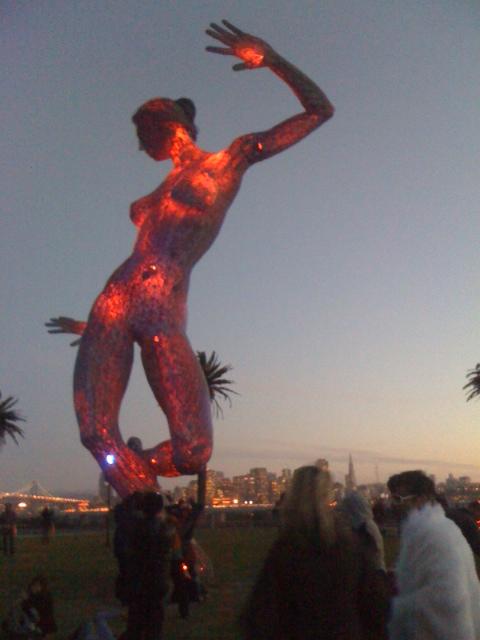
Dancing against the San Francisco skyline, perhaps looking even more vibrant and beautiful that she did at Burning Man last year, Bliss Dance – a 40-foot steel sculpture by Marco Cochrane and company of a nude woman feeling her musical bliss – was feted by city leaders and residents during a reception at its temporary new home on Treasure Island last night.

Mayor Ed Lee thanked the Black Rock Arts Foundation, a nonprofit offshoot of Burning Man that helps place art in San Francisco and other cities, for its work on this and other local projects. “You’re really helping us revitalize so many areas,” Lee said, adding, “I know there will be many more sculptures on this island.”

Lee pledged to extend the six-month temporary placement, telling the crowd of hundreds, “It will go beyond October out here,” And he even expressed an interest in visiting Black Rock City when he said, “Perhaps I will join you one day at Burning Man.”

Cochrane and his crew built Bliss Dance for Burning Man right there in a Treasure Island warehouse, where an increasing number of projects for the event have been built in recent years. His latest piece, Truth and Beauty, is now under construction on the island, as is artist Peter Hudson’s latest work, Charon, and many others.

After being introduced by Lee, Cochrane said he appreciated being raised in California by hippie parents who encouraged his “puppy-like optimism…And I was fortunate enough to be able to keep it.” They encouraged him to “follow your bliss to the fullest” and “to believe that you have an inherent nature and to believe that it’s good.”

Cochrane was drawn to express his artistic vision by conveying the mysterious beauty and fire of women because “their energy is difficult to quantify in this world.” It is also difficult to explain the impact this sculpture has on those who see it, particularly during an event like last night’s when it spectacular lighting effects were on full display, a vivid and inspiring image when set against our scenic city.

“Follow your bliss and it will open doors where you didn’t know doors existed,” Cochrane told the crowd before restarting the dance party with a musical performance by Deja Solis, the model for both Bliss Dance and Cochrane’s latest work, Truth and Beauty, in which the nude woman will be stretching her arms to the sky, 55-feet into the air.

Beating a fourth horse

0

Beat poet and Buddhist Allen Ginsberg inspires “The Worst Horse,” a Fri/27 program of multidisciplinary work at the San Francisco Zen Center curated by acclaimed SF author and RADAR founder Michelle Tea.

If Ginsberg’s definition of poetry as “making the private world public” is one starting point, the other is the Buddhist parable of the fourth horse, related by Zen Center founder Shunryu Suzuki Roshi in his famous Zen Mind, Beginner’s Mind. In the story, the mere shadow of the whip causes the first horse to run swiftly away, while it’s the first touch of the whip that induces the flight of the second, and the whip’s tearing of the flesh that provokes the third horse’s flight. But the fourth horse does not run until it’s repeatedly lashed.


 “If you think the aim of Zen practice is to train you to become one of the best horses,” writes Suzuki, “you will have a big problem. This is not the right understanding.” Considering the merciful nature of the Buddha, however, it becomes clear: “He will have more sympathy for the worst one than for the best one.”

The parable acts as the specific point of departure for the featured group of artists, some of whom are well-versed in Buddhism while others fall under the “beginner’s mind” rubric. The bill includes Philip Huang (writer, performer, agent provocateur and founder of the Home Theater Festival), acclaimed actress and Cultural Odyssey co–artistic director Rhodessa Jones, writer and artist Ali Liebegott, and poet-comedian and “reluctant self-help guru” Bucky Sinister. The evening also includes a screening of the 1960 award-winning short film Dream of the Wild Horses, a gorgeous and haunting cinematic rumination on the wild horses of France’s Camargue District, presented by Oddball Films.
 
“The Worst Horse”

Fri/27, 7:30 p.m., $10-$12 suggested donation

San Francisco Zen Center

300 Page, SF

http://news.sfzc.org/content/view/961/46/

Last train to Fuck Town: Rutger Hauer rides again in “Hobo With a Shotgun”

0

The course of an acting career can vividly illustrate the randomness of fate. Rutger Hauer spent some years in Dutch experimental theater of the 1960s — after pulling off that best way to terminate one’s military service, faking mental illness — then became a local heartthrob as a medieval knight in a hit TV series at that decade’s end.

He spent the 1970s primarily starring in Dutch movies, notably the striking early films of Paul Verhoeven — well before Showgirls (1995), Starship Troopers (1997), or even 1987’s RoboCop (the director wanted Hauer for the lead, but was overruled by the studio). In the 1980s, Hauer played the memorable villains of Blade Runner (1982), The Hitcher (1986), and 1981’s Nighthawks (inducing tough investigative cop Sylvester Stallone to don drag at the end to catch him), between runs at being an action hero and theoretically loftier assignments around the globe.

Then he settled into a multilingual journeyman’s potluck of low-budget genre features, TV projects, small parts in mainstream films (2005’s Sin City and Batman Begins), Guinness commercials, and a Kylie Minogue video. Apparently 67-year-old Dutch actors in Los Angeles can’t be choosy.

Then again, sometimes better opportunities might choose them. At Sundance this January, Hauer played lead roles in two diametrically opposed movies. One was as the 16th-century Flemish artist Pieter Bruegel the Elder in Polish director Lech Majewski’s extraordinary The Mill and the Cross (recently at the San Francisco International Film Festival), which brings one of that painter’s most epic canvases to cinematic life and will hopefully open on U.S. art house screens later this year. The other was Hobo With a Shotgun. Guess which one is opening theatrically here already.

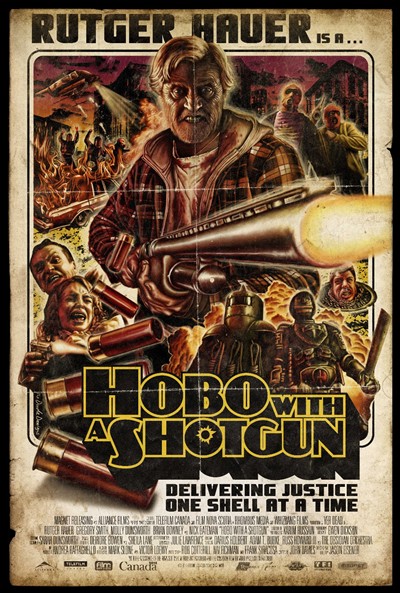
Hobo began as a $150 faux-trailer short that got considerable exposure online and off. The resulting long-form debut for director Jason Eisener and scenarist John Davies is doubtless the zenith in Halifax, Nova Scotia-shot retro ’ploitation splatter comedies to date. Which tells you nothing, of course. But it is pretty good — not great — insofar as spoofy gross-out nods to yesteryear’s exploitation cinema go. Better than Machete (2010), a whole lot better than the likes of Zombie Strippers! (2008) or 95 percent of what Troma puts out.

Grizzled Hauer stars as the titular character who rides rails into an equally nameless berg nicknamed “Fuck Town” because it’s so plagued by drugs ’n’ thugz. The hoodlums are led by crime kingpin “The Drake” (Brian Downey) and goon sons (Gregory Smith, Nick Bateman) whose violent perversities are Caligula-licious. With corrupt police force in pocket, they’re free to terrorize the populace via acts of degradation and violence pushed over the bad-taste top and then some.
When Hauer’s hobo rescues a prostitute (Molly Dunsworth) from this clan’s clutches, he trips his own mental wire from peaceably detached transient to pawnshop-armed streetsweeper of scum, à la 1980s vintage vigilante cheese like 1982’s Class of 1984 (Perry King vs. evil high school “punks”), 1985’s Death Wish 3 (Charles Bronson vs. evil gang “punks”), and 1984’s Savage Streets (Linda Blair versus … figure it out).

Hobo With a Shotgun faithfully apes exploitation conventions, from its lurid widescreen Technicolor hues to a score combining overproduced 1970s funky soundtrack kitsch with ’80s direct-to-video synth pulsing. (Complete with a closing-credits rock song that channels Pat Benatar.) Its ludicrously over-the-top violence is kinda funny, but also nastier than need be. Throughout, Hauer maintains a straight face. Maybe a tad more so than necessary — this movie could have used the wilder streak crazy-coot comedic streak shown by Jeff Bridges in last year’s True Grit or Kurt Russell in 2007’s Grindhouse.

Game Hauer retains his blue-eyed charisma and clearly relishes playing the gentle (when not lethal) giant in this artificially baroque scenario. He’s also an actor long on the world stage still seeking a role in a worthy film (or play) that may define him for posterity. He’s obviously got the talent — but at this point, would he take it? Would it even be offered? Did he take Hobo With a Shotgun because it seemed funny, or because it was the best he could get?

HOBO WITH A SHOTGUN opens Fri/27 in Bay Area theaters.


Appetite: Island bites, part five

0

Kauai: dreamy island respite, painfully beautiful, truly relaxing (other than east side traffic!) Last time, I covered restaurants and cheap eats, and killer cocktails on the island. This time, the final post in the series, I’ll focus on the best places to stay, and more on libations from coffee to rum.


HOTELS

Grand Hyatt Kauai, Poipu Beach:

Do yourself a favor and stay at Grand Hyatt Kauai. A resort in the full sense of the word, it is its own world unto itself. From lava rock waterways and multiple levels of pools (including a salt water-sand pool), to its world class spa, Anara, and open air couples cabanas, you leave here feeling as if you’ve truly had a vacation.

Dinner at Tidepools, features pina coladas sipped poolside, taking in the sunset from the deck of your room with a bottle of wine, conversing with the parrots in the massive open air atrium, live bands, and a scotch in Stevenson’s Library. It’s all unforgettable. Yes, it will cost you, but service is impeccable and the experience ranks up there with (or above) the best I’ve had, anywhere – and that includes the Ritz Carlton and the Four Seasons. The unreal setting, balmy by day, lit by tiki torches at night, is unbeatable.


Outrigger Waipoli Beach Resort, Kapaa:

My initial take on Outrigger Waipouli wasn’t strong. On a busy, strip mall-lined stretch of East Kauai in the town of Kapaa, its appears fairly generic from the outside, while kids swarm the lovely pool area (modeled loosely after Grand Hyatt’s incredible pools and waterways). At the time, the one spa for adults was overtaken by eight children.

But from a non-descript hallway, the door to our room opened onto what felt like our own private beach house. Two bedrooms, three bathrooms, a spacious living room and kitchen; each room had sliding doors opening onto the lawn than ran right down to the beach. Breezes flowed through the space, which felt private and removed from any of the hotel’s structure. Dishware, wine glasses, coffeemaker, everything we needed was in the kitchen, making it feel like a home away from home. It was the one part of the trip where we could cook and watch movies (Blue Hawaii, thank you very much) on flat screens in each room.

Though the location is not near as idyllic or removed as Grand Hyatt on Poipu Beach (it’s certainly more affordable), inside our room we felt secluded, rested and as if we could settle in for weeks.


DRINKS

Kauai Coffee Plantation, Eleele: 

The coast from the caffeinated climes of Kauai Coffee

Originally McBryde Sugar Plantation back in the 1880s, Kauai Coffee is Kauai’s one and only coffee plantation, encompassing over 3,000 acres set right on the ocean. A more striking setting I could hardly envision. A half day personal tour with its amazing sales manager, Marty Amaro, was a highlight in Kauai. We off-roaded in his truck over red dirt roads, through coffee fields, and next to ocean rocks where we watched sea turtles lolling.


Coffee plant at Kauai Coffee

They do everything locally themselves. I toured the factory, climbed atop a coffee harvesting tractor, witnessed bean roasting and bagging on a vertical form-fill-and-seal machine, and of course, sipped Kauai coffee. Amaro makes a mean iced mocha, let me tell you. I was envisioning a sweet, chocolate-y drink but it’s a bracing, coffee lover’s delight, refreshing and cool on a hot island day.

Kauai Coffee grows farm varietals of Arabic coffee: yellow catuai, red catuai (both with high levels of acidity for medium-bodied coffee), typica (medium acidity for medium-bodied coffee), Kauai Blue Mountain (medium acidity and full-bodied), and Mundo Novo (low acidity but full-bodied).

Coffee beans roasting

They run the largest drip-irrigated coffee estate in the world, sourcing waters from a nearby dam in the foothills, roasting over 600,000 pounds of coffee a year: an amazing feat when you see the size of the room it all happens in. Similar to wine, harvesting happens annually, around September through November, when staff double in size to get it all processed.

You can join the coffee club for a reasonable $15.25 to receive one 10 oz. bag, or $29 for two. Besides some of the elegant estate coffees, I find the newer Big Braddah a real representation of Kauai spirit: casual, familial, playful. I’m definitely not a flavored coffee type, but I am pleasantly embarrassed to admit I was taken with the Hawaiian coconut caramel crunch coffee. Each batch is painstakingly hand-flavored and the result is not so much sweet as integrated and nutty.

Kauai Coffee should be a stop on any visit to Kauai.


Koloa Rum, Lihue: 

I found Koloa Rum to be a bit of a mixed bag. The setting is memorably Hawaiian: a traditional sugar plantation-style tasting room on the grounds of the delightful Kilohana Plantation (a former sugar plantation preserved since its 1930s heyday). The distillery’s elegant packaging makes for a strong first impression.

Staff are gracious and aim to please. But complex Hawaii liquor laws are such that tastes remain exceptionally tiny, cannot be shared, and though they have created a mai tai mix, it’s illegal for them to mix alcohol – you won’t find cocktails of any kind here.

Using a 1,210 gallon copper pot still originally used for Kentucky bourbons post World War II, white, gold, and dark rums work best as entry points to the pleasures of rum. I know some who find them flat or not as nuanced as other rums, yet each one has won bronze or silver medals at esteemed rum tasting competitions like the Miami Rum Renaissance Festival.

I expected to find the gold ($30.95) and dark ($32.95) rums too sweet, given their somewhat unnatural coloring, which comes from crystallized sugar and molasses. But they were more balanced than I expected. But I’d be most inclined to drink the white ($29.95): clean and light, appropriate for cocktails. Another recent launch is the spiced rum.

If you’re in the area, it is a worthy stop: a local venture using the last of the little sugarcane left from the island, and pure mountain rainwater of nearby Mt. Wai’ale’ale.


Java Kai, Kapaa: 

The best coffee I had in Kauai, the bracing coffee at Java Kai is a local favorite for a strong cappuccino or espresso. It doesn’t have the friendliest staff (which is unusual in Hawaii), but that’s no matter when coffee is being prepared right. It was my regular morning stop on this side of the island (P.s. – it’s ideal iced, next door at Mermaids Cafe.


Kalaheo Cafe, Kalaheo: 

On the south shore of Kauai, this casual cafe would be at home in any hip, small town. Kalaheo Cafe has a healthy, locals vibe and is packed for breakfast. Eat-in or take-out, stand-outs include straight-from-the-oven baked goods (apple coffee cake is one). Using local coffees like Kauai Coffee, they serve robust espressos and cappuccinos. There may be no third wave, artful foam atop that capp, but rest assured it will wake you up. For one picky about coffee and how it is prepared, I didn’t feel like I had to suffer for good coffee on the sleepy island of Kauai.


— Subscribe to Virgina’s twice monthly newsletter, The Perfect Spot


The Performant 45: Oh Rapture, up yours!

1

Gearing up for the end times with Hoodslam

Well another Armageddon scare has come and gone and we’re all still here, as is my dirty laundry which I was letting pile up on the off chance that I wouldn’t need it again. Not that clean clothes were necessary to attend the Judgment Day edition of Oakland-based, amateur-wrestling-and-sideshow-freak extravaganza, Hoodslam

Housed in the strategically ramshackle Victory Warehouse, a couple of scenic blocks from the Oakland Greyhound station, the Hoodslam ring loomed large in the confines of what could be euphemistically referred to as the foyer. Cheerfully inebriated fans crowded in on three sides, a colorful wall of graffiti framed the fourth, a makeshift door led to the “dressing room,” and a chainlink barrier shielded the house band, Einstye, in classic “Blues Brothers at Bob’s Country Bunker” style. “You can cut the tension in this room with a knife,” wry match commentator Kevin Gill remarked. You could have cut the great cloud of cigarette-booze-and-blunt fumes with same.

In the best tradition of punk rock wrestling shows like the sorely-missed Incredibly Strange Wrestling, Hoodslam mixes costumed characters, fabricated grudge matches, aggro posturing, loud music, and theatrical bodyslamming with a healthy dose of humor and a pinch of what-the-fuck. But where the flamboyant weirdness of ISW was definitely a product of San Francisco’s love of themed masquerade parties and the slickly produced Lucha Va Voom is 100 percent LA, the scrappy phenomenon that is Hoodslam retains a thoroughly Oakland vibe. 

The sensation of being a first-time Hoodslam attendee is something akin to having a crack pipe in one hand and a spliff in the other, with a Steel Reserve going five rounds with a half bottle of NyQuil in the fight cage of your alimentary canal. It’s disorienting. It’s vaguely unsettling. And it’s a hell of a crazy ride.

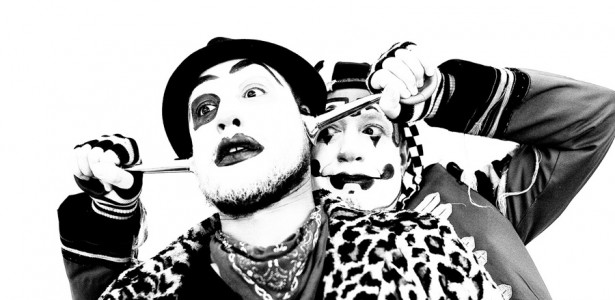
On Friday, in preparation for the end of the world, a good two dozen Hoodslam “legends” showed up to settle some scores and create new ones (just in case we’d all live to fight another day). Contestants included a bi-polar clown, a French mime, an invisible man, a stampeding rhinoceros, a Winnie-the-Pooh lookalike armed with a garbage can, an unusually tall leprechaun, an Al Bundy clone, ISW remnant Otis the Gimp, the demonic Reverend Hellfyre and his passle of Zombie slaves, and a fanged Mexican werewolf—the dreaded chupacabra! 

There were even some wrestlers who could really fight: the acrobatic, bare-chested Juiced Lee for one, and native son, the masked El Lucha Magnifico, “the most evenly-matched men in Hoodslam.” 

The unbridled feistiness of the combatants was matched only by the rowdiness of the fans (“fuck the fans,” cheerfully reminded ring announcer Ike Emelio Burner on several occasions), whose profane chanting, frenzied pounding on the mat, and blow-by-blow heckling gave the event a post-apocalyptic edge, though the apocalypse wasn’t scheduled to arrive until the next day.

“Wrestling is a form of theatre designed to generate mass hysteria,” former ISW wrestler and book author Count Dante remarked in his Wired magazine interview. At the smackdown between the mass hysteria of Hoodslam vs. the mass hysteria of the pending Rapture, the former definitely took the win.

Appetite: Napa’s affordable eats and surprising treats

10

After countless weekends in Napa over the years, I’m flush with recommendations for worthy restaurants and hotels. It’s not always the most affordable area, but my recent visits north have revealed a number of delightfully reasonable options within the bounds of Napa and Yountville, both new and established. 

They’ve also uncovered a few unexpected dishes – and in the case of one restaurant with a new chef, a whole range of them.

Napa Valley Marriott: Sleep… and a superior burger 

Breakfast, lunch, or dinner — don’t check your watch, just order the Knife and Fork burger at the Marriott

For those familiar with the hotel before its two years of multi-million dollar renovations, Napa Valley Marriott is a whole new ballgame. It now sports a warm, modern look with a soothing spa, an ultra-cool poolside patio with couches and firepits, and a new restaurant-bar. Though you may not be able to tell from the street outside, it’s really a dramatic revamp.

In the high season summer months, make a weekend of it with rooms in the low $200-300 range (or mid $200 range on weeknights). Rooms have also been completely redecorated with gentle colors and artwork, plasma screens, and comfy beds. The ones facing the courtyard are particularly tranquil. The only thing lacking? Free wi-fi. It’ll run you $4.95 a day.

Chef Brian Whitmer’s garden restaurant is a revelation. I’ve seen Napa restaurants with their own gardens, but nothing as lush as his. Spring peas are crispy and sweet right off the vine, and leafy greens make for abundant salads. Whether you stay in the hotel or not, it’s worth a detour to check out.

Cozy up in a chic booth, or a grab a stool at the curved bar and order the spicy Knife and Fork burger ($12) for breakfast, lunch, or dinner. It doesn’t matter when, just order it. This burger is made of Caggiano chorizo, which is savory and spicy, yet also delicate, melt-in-your-mouth, on a Model Bakery brioche. Layered with aged cheddar, watercress, the restaurant’s secret sauce, and a fried egg, it’s one of the better things I’ve eaten in Napa in awhile — an utterly unique burger. You won’t regret making a stop for this one.

3425 Solano, Napa. (707) 253-7433, www.napavalleymariott.com


Ubuntu: Vegetarian perfection

Chef Jeremy Fox brought nationwide fame to this eatery, often named among the best vegetarian restaurants in the country by publications like the New York Times. I’ve always enjoyed my previous visits.

But I’ll tell you now, with young chef Aaron London at the helm, it’s better than ever. The food has moved from winning vegetarian cuisine to work-of-art vegetarian cuisine. It’s gone from high quality to superb. As a non-vegetarian, I would say it has become possibly the best vegetarian restaurant I’ve been to anywhere and one of the best dining experiences in Napa.

What’s interesting about chef London is that he’s been at Ubuntu since the beginning, working as Fox’s sous chef. I hear he influenced a number of dishes in those lauded early days, though we did not hear much about him. Nominated for Rising Star Chef at this year’s James Beard Awards, we should be hearing a lot more about him.

He’s revamped the menu in such a way that each $10-19 dish is far more than the sum of its parts. You read of roasted and raw asparagus ($16) with burratta cheese coated in potato chip crumbs, but you really have no idea what you’re in for. A garden-fresh dish comes out, smeared with earthy potato skin puree, lavished with pine nut and currant soffrito, dotted with frisee, greens, and edible flowers. It’s an art piece that not only stuns visually but tantalizes the tongue with its range of flavors.

The two key words I’d use to describe London’s cooking outside of artistic? Texture and contrast. Every single dish of the six I recently had the pleasure of dining on were a study in layers and texture. Sweet complimented savory. Earthy and bright co-mingled. Crunchy partnered with creamy. Surprises came in every dish. Not a one was lackluster.

I could wax eloquent about the merits of each — some served on stone labs that kept them warm – but the menu changes frequently and this article would grow tedious. So I will simply say: go, and be prepared to be blown away.

1140 Main, Napa. (707) 251-5656, www.ubuntunapa.com


Bistro Sabor: Funky, fun Latin

Bistro Sabor‘s menu initially appears Mexican, but it’s really a mix of Latino cuisines in the new downtown Napa. The space is hip with brightly-painted, graffiti-bedecked walls, and the staff couldn’t be more helpful, particularly considering its order-at-the-counter casualness. 

On a Saturday night, tables were cleared for 10 p.m. salsa dancing, a hit with the local Latino community. Beer and wine keep it festive (wish they had a hard liquor license to serve tequila). The food? Fresh, satisfying, and all under $15. A two taco special of grilled sea bass ($11) is impeccably flaky, topped with scallion-cilantro slaw and a pineapple habanero salsa. Even accompanying rice and black beans are a notch above the rest. A rock crab quesadilla ($10) is less creative but still warm and cheesy, while pupusas, pozole, blood orange avocado salad, and lomo saltado exhibit a range from El Salvador to Peru. It’s playful Latin street food with quality ingredients. A win for Napa and cheap eats.

1126 First St., Napa. (707) 252-0555, www.bistrosabor.com


Dim Sum Charlie’s: Dim sum with a side of magic

I’ll tell you right now: you can get better, cheaper dim sum at dozens of places in SF. In fact, for the nearly $7 Dim Sum Charlie’s charges for a mere four dumplings, I can get at least twelve, and buns, at my favorite city spots. Why go? First off, there’s not much dim sum in Napa and Charlie’s is decent, though far from memorable. Warning: some have commented on menu listings that could be perceived as racist (“ten dolla make you holla”?).

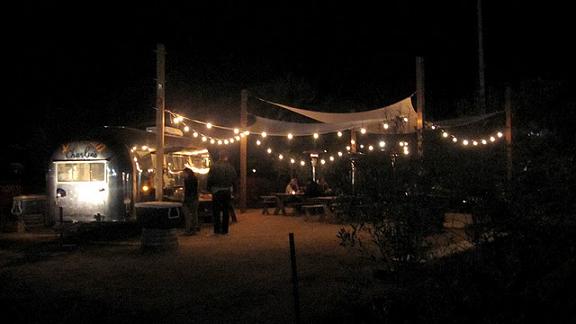
But the setting is still a reason to go. Dim sum and noodles are served out of a classic Airstream trailer. Sure I’ve seen it before, but lover of all things retro that I am, I still find it charming. And what’s different about this trailer setting is its canopy of lights and dirt lot strewn with picnic tables and a campfire. Rollicking tunes make it feel like a backyard party — a bit like camping in retro-kitsch style. With dim sum.

It doesn’t really matter what you order. Bring friends. Pull up to a picnic table or fireside with hot sauce and chopsticks, and sing along to the Beastie Boys as you slurp noodles and fill up on pork buns.

728 First St., Napa. (707) 815-2355, www.dimsumcharlies.com (look for the Airstream trailer)


Yountville Coffee Caboose: Coffee lovers

You’ll not go wrong with coffee and pastries at the original Bouchon Bakery across the street. But when that line is unbearable (or even if it isn’t), I’m delighted to hit up a locals coffee go-to: Yountville Coffee Caboose. Yes, it’s actually in a train caboose off Washington Street. It often features Bay Area coffees like Ritual, brewed strong, robust and with proper crema.

6523 Washington, Yountville


Grace’s Table: Local’s breakfast 

Grace’s Table has its minor missteps: its raved about skillet cornbread with lavender butter ($6) was dry and rather flavorless. And $10-18 entrees for breakfast pushes a little high for a casual neighborhood restaurant. But as an open air, corner space with sweet waitstaff and soothing decor, it’s a welcome brunch stop.

Quiche of the day ($12 with salad or soup – can also be had a la carte) was the stand-out, fluffy and light. The crust almost reminded me of Tartine in its buttery flakiness. Mini bagels with house-cured salmon and cream cheese ($10) are playful approach to morning food, though the bagels are not exceptional (but isn’t that ever the case outside of New York?) Grace’s is a pleasant place to start your day with coffee and a newspaper. 

1400 Second St., Napa. (707) 226-6200, www.gracestable.net


C Casa Taqueria: Breakfast to go 

C Casa, a worthy newer addition to Oxbow Public Market, works for a cheap breakfast. With grass-fed beef, free range chicken, sustainable fish, and local produce, it’s a forward-thinking taqueria, yet it maintains authenticity of flavor. A breakfast taco brimming with over-medium egg and chorizo ($4.50), is meaty and satisfying first thing in the morning. Also stuffed in there? Black beans, avocado, pico de gallo, garlic aioli, and cilantro.

Located within Oxbow Public Market, 610 First St., Napa. (707) 226-7700, www.myccasa.com


Ad Hoc: Ok, one splurge

Ad Hoc’s Liberty Farm duck breast: more than a mouthful

At $52 per person without anything to drink (its another $39 for wine pairings), Ad Hoc is quite expensive, even if it is the one and only Thomas Keller’s “casual” venture. Watch where you sit: I’d be annoyed eating inside where too many kids (at this price?) and a noisy din make make for a less than appealing ambiance. The few tables outside on the tiny patio, however, are idyllic. 

As is the food in the four-course dinner. One appetizer, a main, a cheese course, and dessert, all served family-style and impeccably prepared with ingredients from their cheery garden behind the restaurant. No substitutes — you eat whatever is on the daily menu. 

And that’s alright when you get a salad as a beautiful as a recent mix of lettuces, pickled haricots verts (green beans), toasted pine nuts, red radishes, and shaved asparagus. Dotted with green garlic buttermilk dressing and king trumpet mushrooms, it was far more gratifying than those ingredients may sound on paper. Ditto the added course of ivory salmon ($15 supplement) baked in phyllo pastry, drizzled with porcini cream, and accented with fresh, white corn. Liberty Farm duck breast was actually a little too much for two people, but deftly prepared and served with a bowl of chickpea stew gentle with curry. We finished with strawberry shortcake on biscuits, slathered in lemon curd.

At roughly $34 per person, the Sunday brunch is the way to do Ad Hoc from a slightly more affordable, angle.

6476 Washington, Yountville. (707) 944-2487, www.adhocrestaurant.com


— Subscribe to Virgina’s twice monthly newsletter, The Perfect Spot


“Unadulterated, uncensored kids”: Youth Speaks’ grand slam is back

0

When the then-17 year old Erica McMath-Sheppard became one of our Best of the Bay Local Heroes last year, she hadn’t just earned the distinction – she had taken it as her own. What else could we have done when we heard about her winning presence onstage at the Youth Speaks grand slam spoken word finals?

And from her firey performance sprang something greater – Erica, a foster child, was able to cast a light on a system that is royally messed-up but largely unseen, since the main people who have to deal with its fall-out are young, voiceless.

All this is to say that the Youth Speaks grand slam is taking place once again this Fri/30, and that you should be there if you really want to hear what’s up with today’s youth. Screw the evening news, turn off your MTV, get real.

“To me, it’s the voice of 21st century America. Unadulterated, uncensored kids.” Youth Speaks executive director James Kass was a Jewish kid from New York who was a little discouraged with the lack of diversity in his MFA program at SF State. And “I was sick of boring poetry readings.”

So he started a slam himself, featuring people who are many things, but never boring: high school kids. The first month, the slam attracted 70 people. With the help of spoken word artist Justin Chin, traditional competition rules were subverted to make them more kid-friendly – judges’ ratings of each contestant were done in private, rather than putting developing artists on blast in front of a crowd. It’s its second month of existence, the slam sold out. Kass realized that a place for kids to nuture their poetry skills just didn’t exist in San Francisco — and (roughly)that is the Youth Speaks school program was born. 

Now, the non-profit works with 30,000-40,000 Bay Area kids a year, by Kass’ count. Yep. Many of those kids are attendees of the group’s assembly programs, but narrow that down to the students who participate in the slams (including Queeriousity, YS’ popular queer slam series), afterschool programs, one-on-one partnerships with adult working artists, and in-house youth publishing label, First Word Press, and that number is still a solid 3,000-4,000.

Who are these kids? Kass says they come from the suburbs, the city, all socioeconomic levels, races, and represent the gamut of teenage sexualities. “It really is representative of the demographics of the Bay Area.”

Poetry slams reward the innate literacy in all of us, our fervent desire to be heard and share thoughts. You don’t need to be a Spellbound letter savant to spit a pentameter that’ll make people shift in their seats, or leave that night beaming. But performing can inspire those who have found success onstage to hone their craft off of it. “As a first step into literacy, spoken word removes barriers,” says Kass, who also points out that most world cultures have strong oral poetry traditions.

Plus, stand-up poetry fits the dramatic arch of the life of an adolescent today, their ability to believe two completely different things – passionately – from one day to the next. “The kids can, and literally do, write a poem on the bus on the way to [a slam.]. It’s super-fresh and they can get feedback on it right away. Sometimes that urgency translates to something a lot of people will relate to.”

Should you need more proof of the way kids take to spoken word, one need only look at the brief history of Brave New Voices, the national championship that Kass organized back in 1998, he says, “with one other teacher from Connecticut,” the only other place he found organized youth spoken word programs at the time.

It’s thrived. Recently, Brave New Voices was the subject of an HBO-Russell Simmons reality series (Kass comments: “we struggled with HBO at first about how they wanted to define the kids,” but that the finished product turned out pretty good).

This year, Brave New Voices will feature 550 kid champions from 53 parts of the world – including the brave new voices that win this weekend’s Bay Area slam. Those kids, incidentally, will be your home team. On July 20-23, the competition will be held in the Bay for the first time ever. Check them out this weekend at the YS grand slam to witness one step in their rise to glory – or just to hear what the young adults of the Bay Area have to say these days. 


Youth Speaks 15th annual Grand Slam Finals

Fri/20 7 p.m., $6-50

Davies Symphony Hall

201 Van Ness, SF

www.youthspeaks.org

www.cityboxoffice.com 


After-party featuring guest DJ will.i.am

Fri/20 10 p.m.-1 a.m., free with grand slam ticket purchase

Brick and Mortar Music Hall

1710 Mission, SF

www.brickandmortarmusic.com

Your summer guide to art escapes

0

Living in San Francisco means having the richness of art in a major city, and the natural beauty of California all in one fell swoop. Here’s your guide to enjoying urban escapes and art and live performance – at the same time! – this summer. Also, check out our guides to the season’s falls and festivals, movies, music, and best adventures you can go on without a car.


WITHIN THE CITY 

Yerba Buena Gardens Festival

With three stages of free performances, this festival is perfect for a dose of culture and fresh air during your lunch hour with music, dance, theater, and readings. There’s weekend concerts too: the SF Mime Troupe performs Aug. 21, SF’s local songbird Meklit Hadero on Aug. 27, and SF’s pluckiest free ring wraiths, Circus Bella return to the lawn for the weekend of July 1-2.

May through September, free. www.ybgf.org


Stern Grove Festival

Stern Grove’s eucalyptus tree surroundings create a pretty magical summer stage for free performances. The experience gets even better when you pack a tasty picnic spread to enjoy — but leave your umbrellas and high-back chairs at home to keep the peace with those who didn’t snag the primo front row spots. In addition to the annual appearances of the San Francisco Ballet, Opera and Symphony, the concert lineup features Sharon Jones and The Dap-Kings, the Jazz Mafia Symphony, Neko Case, Afrocubism, The English Beat, Aaron Neville, and Javier Limon and Buika.

Sundays, June 19-August 21, free. www.sterngrove.org


San Francisco Mime Troupe at Dolores Park 

Enjoy palm trees and revolutionary spirit with your Tecate: with this historic troupe of not-mimes – forget the pantomime, this is socially relevant theater in the park.

July 2, 3, 4, free. www.sfmt.org


San Francisco Symphony in the Park

This year’s concert, which will be performed in Sharon Meadow, features conductor Michael Francis and pianist Valentina Lisitsa on a program of Mussorgsky’s A Night on Bald Mountain, Rachmaninoff’s Piano Concerto No. 2, and Beethoven’s Symphony No. 5.  

July 10, 2 p.m., free. www.sfsymphony.org


Shakespeare in the Park, The Presidio

Bring the whole family for this year’s performance of  Cymbeline at the Presidio’s Main Post Parade Ground Lawn.

September 3, 4, 5, 10, 11, 17, 18, 24, 25, free. Sharon Meadow, Golden Gate Park, SF. www.sfshakes.org


Opera in the Park

This year’s annual concert, also in Sharon Meadow, features a special musical program commemorating the tenth anniversary of September 11, 2001.

September 11, 1:30 p.m., free. Sharon Meadow, Golden Gate Park, SF. www.sfopera.com


AND BEYOND…

Oliver Ranch

Seventy miles north of San Francisco in Sonoma County, Oliver Ranch boasts scenic acres and 18 site-specific installations by artists such as Bruce Nauman and Richard Serra, as well as Ann Hamilton’s distinct tower where commissioned dance, poetry, theater, and music performances unfold. The tower structure – defined by two staircases built in a double helix form that accommodate the audience on one staircase and the performers on the other — suits a range of sensory projects and performances hosting artists like Meredith Monk and the Kronos Quartet. Limited capacity allows for only 100 visitors, making this ticket a splurge — but it’s all good, each concert in the tower benefits a non-profit organization. June appearances include Pauline Oliveros and Terry and Jo Harvey Allen. Should you be lucky enough to get tickets, be sure to bring some water and sunscreen and make a day of it visiting all the nearby wineries.

Various dates in June, prices vary. 22205 River, Geyserville. (510) 412-9090, www.oliverranchfoundation.org


Headlands Center for the Arts open house 

Just across the bridge in the rugged Golden Gate National Recreation Area, the Headlands Center for the Arts synthesizes natural and urban environments in a cluster of historic, 1900s military buildings at Fort Barry among hills, cliffs, coves, and beaches. At the center’s summer open house, artists open their studios to the public to show their works-in-progress and talk with visitors about their creative process in a variety of disciplines. Catch one of the many performances and readings scheduled throughout the day and then head to the mess hall, which is transformed into a café serving delicious homemade snacks at down-home prices for the event. While you’re there, a hike through the windy Headland hills is a must-do.

July 24, 12-5 p.m., free. 944 Fort Barry, Sausalito. (415) 331-2787, www.headlands.org


Robert Mondavi Winery Summer Music Festival

One of the first wineries in the Napa Valley, the Robert Mondavi Winery offers much more than sipping, swilling, and spitting. A concert series scheduled for Saturday nights in July features music in an open-air setting and this summer’s lineup includes Gavin DeGraw, Colbie Caillat, David Foster, Chris Isaak, K.D. Lang, and the Siss Boom Bang. Mondavi’s grounds also include an art gallery open daily from 10 a.m. to 4 p.m., with artifacts and paintings as well as a sculpture collection focused on the work of San Francisco artist, Beniamino Bufano, displayed in the main courtyard surrounded by rows of vines. Head here for a fancy summer night of outdoor music and wind down after an afternoon of tastings.

Saturdays in July, $75-$105. 7801 St. Helena Hwy., Oakville. (888) 766-6328, www.robertmondavi.com


The Performant: Spank it!

0

Austin invades SF with Christeene Vale, Wammo, and Guy Forsyth

There’s glamour. Then there’s Glamour. And then there’s Glamour’s myriad permutations, like Drag Glamour. And Drug Glamour. And Diva Glamour. Glamour makes respectable what might otherwise be considered merely ostentatious, excessive, or gauche. Elusive but instantly recognizable, there’s no doubt that glamour can enthrall. But frankly, sometimes it bores. 

There’s nothing boring about Christeene Vale

One part Iggy Pop, one part New York Dolls, and one part complete mess, Vale is pure punk rock without the guitars. Headlining Some Thing at the Stud, appropriately on Friday the 13th, Vale stumbled onto the stage dressed in decidedly unglamorous rags, a shredded t-shirt, and a flesh-colored thong, bruises decorating her hairy thighs, lipstick smeared half across her face like a terrorist clown. 

Accompanied by a burst of driving electronica, Vale began gyrating suggestively, not in a softcore “come hither” kind of way, but in a down and (really) dirty way, tugging at her g-string, spreading her literally filthy cheeks. 

Rapping over the rhythm at breakneck speed, the tweeker-twitchy tranny demanded that the crowd “Fix My Dick”. Clever and gross, lyrics such as “I’ll let you chew on my crab cake the hell with the first date just slide me the beefsteak” fell from her lips as easily as the gobs of spittle she spat at the front row. 

The rest of her set was just as confrontational—and just as hilarious: “Workin’ on Granma,” “Slowly/Easy,” “Tears from My Pussy” (a downbeat little R & B ballad with a Casio-tone hook). Creatively fearless, Vale managed to be both explicitly offensive and unexpectedly romantic. “There’s room at the table for all of us,” could well have been the anti-glamour message being propagated, though there’s an equal chance it was something a little less precious like “let’s get drunk and fuck tonight”.

Austin darlings the Asylum Street Spankers may be no more, but musicians still have to eat, y’all. Even the Sex Pistols had their Filthy Lucre tour, though that calculated stadium spectacle was a far cry from this convivial parlor act of former Spankers Wammo and Guy Forsyth, who teamed up at the Red Devil Lounge to play a few favorites. 

Blessed with a wicked slide guitar, Forsyth killed on Blind Willie Johnson’s “God Moves on the Water,” and on his own rocking, talking tune “Long Long Time” (“we used to dream about heroes/but now it’s just how to beat the system”). Wammo alternated between playing percussion on a plastic suitcase and adding “horns” to the mix with his harmonica, a kazoo, a spot of Tuvan-style throat-singing, and a jump onto lead vocals for humorous tunes such as “Beer,” and my personal favorite “Leafblower,” which sounded like a parody of a Kurt Cobain song, a sort of nasal whine ruminating on the evil of the 8 a.m. leafblower outside one’s window (“good thing I don’t have a gun”). 

They might not have an official band name yet, but as a duo, Wammo and Forsyth still managed to provide a spanking good show. 


Appetite: Island bites, part four

0

I spent some brilliant days — and the first three of five installations in my Hawaiian series — exploring Oahu. But based on what every traveler I’d ever met had told me, I knew it could only get better with Kauai. This time around, let’s talk the restaurant scene on Kauai – next time, I’ll feature its hotels and drink. 

But first, the ugly: traffic jams are jarring shocks on the island’s east side near Lihue, particularly in Kapaa. One-lane roads at a dead stop along stetches of strip malls are downright irritating. I almost missed my flight home when it took one hour to go 10 miles from Kapaa to Lihue Airport (the day before the same route took 10 minutes).

But on the South and North shores there was little to no traffic. Even in Lihue, where the main airport is based, mountains and fields surround the tiny town. Kauai is imminently more laid back than the already relaxed Oahu — a distinction I savored, even if Honolulu is clearly the leader in food and dining.

A helicopter ride over the famed Napali Coast and around the entirety of Kauai is nothing short of magical. Though you will spend roughly $350 per person, it’s worth it. It cost $250 when we payed in cash at Inter-island Helicopters – whose friendly, fun staff and pilot gave us a wonderful, hour-long tour, just take note: those shiny, red copters on the website are not the ones we rode, ours was more like an old army helicopters, with open air, no doors — terrifying to take off in, but one quickly acclimates to the feeling.

You’ll need a helicopter ride to take in the Napali Coast, sans blisters

I can honestly say this was one of the best travel adventures of my life, and I’ve traveled to five continents. Views are breathtaking, yes, but getting up close and personal is the real thrill.

On a less windy day, our pilot flew close into craters and mountain niches, through the gorgeous Waimea Canyon, over blowholes and coffee plantations, and along the coastline. We covered the entire island, smelled rain from the highest peaks, and took in the pristine blue of the ocean.

Whatever you do on Kauai, do this. Next time I will try an ocean boat ride, the only other way to actually see the Napali Coast without hiking it (an arduous journey meant for the hardcore and even then, limited paths mean you can’t hike it in its entirety). I’m sure a boat ride can be full of thrills, but it can’t give the all-encompassing view of the entire island you can see via air.

But no matter how you see it, see Kauai at least once in your life. It’s incredible how a tiny island can enchant. Even for a big city girl like myself, Kauai had a way of wrapping my days up in its mellow spell.


CHEAP EATS

Mark’s Place, Lihue:

Mark’s Place musubi, for those who like their Hawaiian snacks authentic

My favorite plate lunch of the trip, Mark’s Place is a true local’s gem. It’s a clean hole-in-the-wall with creative daily specials and desserts and salads on top of traditional loco moco, beef stew, and chicken katsu.

Specials were not just ultra-fresh, they were gourmet. I loved a dish of blackened mahi mahi ($8.95) gently drizzled in a lilikoi (passion fruit) mustard sauce, served over quinoa and sauteed spinach. A green salad in papaya seed dressing accompanied the fish.

At that price, the dish was a steal, and you’d expect it to shine in any restaurant setting – only you order it as take-out in an industrial neighborhood frequented by blue collar workers, with whom you’ll be sharing one outdoor picnic table. Mark’s Place’s simple, fresh musubi ($2.25), particularly the teriyaki beef variety, makes a fine snack.


Kountry Kitchen, Kapaa: 

Kountry Kitchen was my top breakfast on Kauai. Packed with locals, my eyes widened at the sight of what must have been the most massive pancakes I’ve seen (and I’ve had some gigantic ones). Good thing I saw them before ordering two — it’s a mere $6-8 for two pancakes, which could feed a few tourist between them.

Macadamia nut pancakes are a popular pick at Kountry Kitchen, but I couldn’t resist the day’s special: Elvis pancakes. Yes, this means peanut butter and bananas, the King’s beloved combo. Accompanied with awesome housemade coconut syrup, they were perfection.


Shrimp Station, Waimea:

If you’re going to Waimea, don’t miss this classic shrimp window with outdoor picnic tables, reminiscent of the shrimp trucks and window fronts on Oahu’s North Shore. Shrimp Station serves killer coconut shrimp, plus beer-battered, garlic, or sweet chili garlic.

A basket of coconut shrimp was juicy and savory with ginger-papaya tartar sauce. Our pace was slow while we lingered at the picnic tables in this sleepy little town. Quintessential southern Kauai.


Koloa Fish Market, Koloa: 

An authentic, plate lunch take-out only shop, Koloa Fish Market is beloved in southern Kauai. It serves heaps of Kalua pork, lau lau (shredded pork wrapped in a taro leaf), and all kinds of poke, from raw ahi to octopus. Ordering food and taking it back to our Grand Hyatt porch with a bottle of wine was a pleasure.

Though cheap and plentiful, I found Koloa’s flavors not particularly impressive. I’m crazy about fish (raw, cooked, any which way), but this is no pristine poke experience. Fresh as it is, I find eating at similar hole-in-the-walls around Hawaii, authenticity seems to mean hunks of seafood drowning in oil — well-prepared but lacking that ultra-fresh, of-the-sea taste. I find plenty to love in local Hawaiian cooking, but personally find more flavor and finesse with raw fish in other culinary styles.

Salty, fall-apart pork (in lau lau or Kalua styles) was better than the seafood but not as satisfying for me as pulled pork barbecue from the South. 


Papalani Gelato, Koloa: 

It’s no Italian gelato or San Francisco ice cream (à la Humphry or Bi-Rite), but Papalani Gelato is organic, with straightforward island flavors like lilikoi, mango, papaya, and macadamia nut. It’s the go-to local ice cream shop (as opposed to sugary, lower quality cream at the shop a couple doors down – I tried both).


Mermaids Cafe, Kapaa:

Mermaids Cafe is about one thing: ahi nori wraps ($9.45). Basically a giant burrito made with a green tortilla with a layer of nori, or seawood, they come stuffed with seared ahi tuna tossed in wasabi cream, pickled ginger, and rice.

This hippie-spirited walk-up counter isn’t quite what I’d call gourmet – there is something slightly amateur about the food (are things cooked in burnt oil?) But the cafe does bring fresh, vegetarian-oriented food and hippie clientele to the island — and those factors hardly mask its Hawaiian spirit. Plus, you can fill up for $10.


MID-RANGE

22 North, Lihue: 

Maybe the best meal I had in Kauai, and certainly the most creative, 22 North is on the grounds of Kilohana Plantation. Kilohana, if you squint past the touristy jewelry shops and such, is among the last remaining glimpses of the sugar glory days of Hawaii. The 1930s spirit prevails, lazy breezes blowing through the original house (where a few rooms still showcase ’30s decor), while whiffs of whole pig roasting underground in expectation of a luau intoxicate.

Tourist trappings aside, I enjoyed an hour and a half ride on the plantation’s 1939 Whitcomb diesel engine train, taking in 50 varieties of fruits and vegetables growing alongside the tracks that ran through the working farm. The best part was stopping to feed bread to a herd of pigs.

Afterwards, I sat in the courtyard of the plantation house for a meal at 22 North. Farm fresh is no exaggeration here — many ingredients come straight from the surrounding fields. 

The playful, contemporary hand given to many a dish is reason enough to dine here. But 22 North’s cocktails were the best I had on Kauai. Intriguingly, one was unlike any other I’ve had before – a rare occurrence for me anywhere, much less in a region not known for cocktails. Blue Rhum ($8) impressed me with its light rum, home-grown Kilohana pineapple, lime, and a stunning frond of African blue basil – it was aromatic and sophisticated. 

The rest were a mixed bag. The Paloma Fresca ($8) was unable to find a harmony between its tequila and grapefruit, but it benefited from local citrus and Kiawe honey. Fried Green Tomatoes ($11) gave a nod to the Southern United States with tomatoes from the farm encrusted in cornmeal, served with a romaine salad in a Maui onion buttermilk chive dressing.

22 North’s burger ($11) was satisfyingly juicy, made with local meat (rotates between beef, lamb, and veal). The cubano sandwich ($9) was pulled pork and house-cured ham laden with homemade pickles and mustard. The restaurant serve gougères ($5) made with fennel honey butter, baccala fritters ($7) with macadamia nut romesco, and sesame-crusted tuna ($28) poached in carrot, ginger, and white wine with a “forbidden rice cake.”

Dessert (all $8) is another highlight here. Local fruit pie benefits from even more home-grown produce, served warm, enclosed in a surprisingly French pie crust that was flaky and buttery, and topped with a scoop of Kauai’s own Lappert’s vanilla ice cream.

22 North has four different “adult floats” ($12) all made with ice cream and beer or spirits — oddly delightful. Though I’ve had beer floats before, I’ve never had one with the refreshing tang of the coconut porter float made with Maui Brewing Co. coconut porter and toasted coconut.

All around, this meal was the most uniquely satisfying of my Kauai visit, and the one that best represents local bounty.


EXPENSIVE

Tidepools, Koloa:

Tidepools at the otherworldly Grand Hyatt captures the magic of its setting in a Disneyland-esque way. It almost feels fake: tiki torches light up a lagoon as you dine under open-air, thatched-roof huts listening to frogs croak. Idyllic.

Certainly the menu reads old school – and there is a dated air about the place, but there are culinary surprises that hold the spell of the setting. It’s $32-55 for entrees and a more reasonable $9-15 for appetizers. You’re right: in the scheme of fine restaurants, it’s not worth that high price tag. But you’re in Kauai and this is one of the best meals you’ll have there, in an environment that helps that cost go down more easily.

Salads (like $9 Manoa lettuce with a creamy Maui onion-garlic dressing and shaved manchego cheese) and sashimi starters (like $15 ahi with Hawaiian hearts of palm and shiso leaf) are fresh and pleasing. Brandt Farms organic prime NY strip steak ($48) is shockingly juicy when cooked medium-rare, and packed with flavor. The other surprise is the crowd-pleasing macadamia nut mahi mahi ($32): lightly encrusted in nuts over coconut jasmine rice in a tropical rum buerre blanc. It tastes of Hawaii: redolent of the sea, gently sweet, with a nutty goodness.


— Subscribe to Virgina’s twice monthly newsletter, The Perfect Spot


5 Things: May 12, 2011

0

>>SCOBY SNACKS Lest you think that only barbarians and Bear Grylls eat their food alive, consider the case of fermentation. Sauerkraut, kombucha, bleu cheese, and kim chee are all living foods whose microbial make-ups diversify the tiny critters that live inside you (and we all know diversity is a good thing!) If we didn’t just freak you out, this week is an optimal time to learn more about making and snarfing fermented foods. House Kombucha, Omnivore Books, Cafe Gratitude, and Happy Girl Kitchen are all hosting workshops to teach you the power of a biodiverse kitchen. But the kicker is the Ferment Change festival (May 14-22), a full week of East Bay bike tours to homebrewing abodes, cocktail parties, culture swaps, and appearances by the anointed god of Planet Fermenation, Sandor “Sandorkraut” Katz himself.

>>WHO’S IN CHARGE? We’re big-time boosters of Ride Your Bike to Work Day, so once again we rode, we schmoozed, we accumulated swag — most of it aimed at luring more of us onto the streets with the promise of bigger, better, safer, kinder, gentler bike lanes. Which is why we had to wonder at the cover of the Connecting the City pamphlet, a happy-talk scenario showing a smiling woman and two darling kiddies riding along a reimagined bike lane on Market Street. Sweet — until you notice that the woman (the mother?) isn’t wearing a helmet. And neither is the woman staring off into stage-left space behind her. And that group of huddled people in black hoodies — are they supposed to be chess players? With big plastic bags of garbage at their feet? And what about that guy who appears to be rifling through the garbage? Why do we feel like the sell just got harder.

>>ASSEMBLAGE Collage artist David King was awarded a grant from the Pollock-Krasner Foundation last year, and he’ll be showing new work later this month at the Visual Aid booth at the San Francisco Fine Art Fair, one of three different art showcases taking place in SF during the third weekend of May. He’s also showing work, along with Mark Faigenbaum, at Inclusions Gallery from Saturday, May 14 through June 19. The opening reception is this Saturday from 6 to 8 p.m.

>>CHUCK IT We are all well aware that our days are numbered, and that they are going to be pretty well filled up doing more loads of laundry, cleaning the cat box, working, etc. What we really don’t have time for are any more bucket lists taunting us with 100 more things we have to do, see, eat, and ponder before the old dust to dust thing takes place. That’s why we were disheartened to see that there’s a new bucket list just for Giants fans: Bill Chastain’s 100 Things … . We have nothing against Chastain, but we do wish his publisher had come up with a better marketing scheme than this tired, gimmicky genre. Besides, with post World Series prices what they are, we can barely even afford to cross off item 39, “Attend a Game at AT&T Park,” let alone item 40, “Attend a Spring Training Game in Scottsdale.”

>>THE OUT-OF-TOWNERS If there’s one thing that separates the rubes from the natives, it’s pronunciation. Only a rube-and-proud-of-it would risk the derisive sniggering of Manhattanites by asking directions to Houston Street, pronounced like that city in Texas, or the rolled eyeballs of Show-Me Staters by rhyming the last syllable of their great state with “misery.” That’s why we are mystified that Muni hired such a collection of rubes (who may even be robotic rubes) to announce pending stops on its bus lines. Who approved “Di-VEYE-sa-dero”? And who signed off on “Valen-CHA”? Yo, Muni, you never heard the phrase “hire local”?

Small Business Awards Ceremony wrap-up

2

The Bay Guardian’s annual Small Business Awards party packed the upper room at Public Works May 11, with the winners and assorted friends and allies (including Sup. Ross Mirkarimi) enjoying the celebration of entrepreneurship and community. The hit of the night was Virginia Ramos, the Tamale Lady, winner of the Spirit of the Streets Award, who had the room spellbound as she talked of her life and her love for San Francisco. And it was clear that the diverse group of individuals and businesses all shared a strong belief that small, locally owned businesses make San Francisco great.

Behind the scenes on this week’s Guardian cover

0

Regular SF Bay Guardian photo contributor Matt Reamer pulled a fast one for this week’s cover. Though the image seems to have been taken on any random sunny day in Dolores Park, it was actually shot in Reamer’s studio. You can see the behind the scenes action and further explanation on his blog.


Appetite: Our picks from Dry Creek

1

Last year’s Passport to Dry Creek festival (April 30-May 1) was quite the weekend of hops between wineries in Dry Creek Valley. How was it different than any of the dozens of events in wine country at any given time, you might ask?

Unlike barrel tasting weekends mobbed with drunken carousers and not-yet-mature wines, or smaller events where you gain merely a handful of tastes, Passport includes the majority of wineries in the Dry Creek valley and keeps the crowds regulated enough to be enjoyable. Each winery serves unlimited food and wine, often with live music and engrossing themes.

With a Passport ticket in hand, it’s like you’re invited to a private party at each winery. Some of the wines triumphed over the others, but then, many of the vineyard settings bested the rest during the weekend’s typically brilliant weather. After visiting 24 wineries, here’s my take on this year’s Passport highlights in the categories of ambiance, food, and of course, wine.


AMBIANCE

Bella Vineyards: 

Just like last year, Bella‘s African safari theme and moody, cool caves were a highlight of the entire weekend. Lingering here with a crisp rose is a joy every time.

Truett Hurst Vineyards:

Your drinking buddies at Truett Hurst

Another top spot from last year, Truett Hurst has a memorable zinfandel rose ($15) best enjoyed in the spot’s red Adirondack chairs alongside the river running through its property – after you’ve visited the goats and sheep on the back of the property. A dreamy respite, I always leave this winery relaxed.

Family Wineries: 

I don’t go to Family for the wine, nor for the cluster of non-descript tasting rooms situated off the parking lot, but I stop in annually here to spend a happy hour watching the California Cowboys play. A truly an awesome country band that keeps it real with tunes any classic country fan will love (from Waylon Jennings to Roger Miller), plus a few newer favorites. Vocals, musicianship, the Cowboys are top-notch.

Seghesio Family Vineyards:

A bowlful of steamin’ zydeco at Seghesio

With a raucous New Orleans theme based on the winery family’s NoLa roots, Seghesio boasted one of the top bands of the weekend: Andre Thierry & Zydeco Magic. Grilling Cajun ribs and spooning up bowlfuls of seafood gumbo, the spirit was festive and familial here, like one big backyard party.


FOOD

Frick Winery: 

I’m impressed every year by Frick‘s complicated bite-sized snacks offered by chef John Mitzewich and Michele Manfredi, a husband and wife dynamic duo. Chef John is known for his site Food Wishes (last year’s Saveur winner for best food video blog, nominated again this year).

Manfredi created SFQ sauce, our fair city’s first native BBQ sauce (try it if you haven’t!). Its East-meets-West flair appeared at this year’s Passport in their duck a la SFQ: duck confit in SFQ sauce on a cocoa corn chip, garnished with duck crackling remolata. Yum. 

My two favorites? Main line Philly cheesesteak: mini-baguettes topped with Snake River Farms Kobe-style steak over truffled “cheese whiz” (you read right — chef John is on the money with this one. I’ll take a jar?) Dotted with peppadew peppers and jalapeños, its perfection.

One of the ‘simplest’ bites was the best: the sausage luxe, Boccalone‘s sweet Italian sausage dusted with fennel pollen and skewered with a Luxardo maraschino cherry. Seductive and lush.


WINE

Quivara Vineyards: 

Quivara‘s high quality relies on hand-picked grapes and biodynamic farming methods. Its wines reflect care and attention, whether you’re sipping its 2008 grenache ($26) or 2008 mourvedre ($32).

Frick Winery: 

Frick is a Dry Creek favorite – from grenache blanc to C3 and C2 (Rhone blends), Bill Frick produces sophisticated wines that maintain Old World balance. This year, I’m really taking to his cinsaut and grenache.

Seghesio Family Vineyards: 

Seghesio‘s home ranch zinfandel has been an at-home go-to for a balanced zin, reflecting dark berries and the clay soil it’s grown in. At Passport, we tasted pre-releases of 2009 Home Ranch Zin ($38), a highlight of the 10 Seghesio wines sampled.

Unti Vineyards:

I’ve enjoyed Unti‘s wines the last couple years, and was reminded again last weekend that its 2007 grenache is a standout with blackberry, pepper, and even licorice notes.

Stephen & Walker: 

Besides appreciating their female winemaker, Nancy Walker, who I had the pleasure of meeting during Passport, there was a number of drinkable wines from Stephen & Walker‘s line-up of 10. The most celebrated is Walker’s 2006 Howell Mountain cabernet sauvignon ($65). Winner of multiple awards and the vineyard’s benchmark wine, it’s a fine showcase of the region’s cabs.

— Subscribe to Virgina’s twice monthly newsletter, The Perfect Spot


Bedbugs and pickpockets: a non-travelers tale

3

I am a hotel aficionado. I wrote my undergraduate thesis in a New Haven hotel lobby, watching the light fade from pink to orange to a deep purple-blue each night, sometimes not leaving until the floor-to-ceiling panes of glass began to brighten with the morning.


Some of my favorite places in San Francisco are hotels: I love their bars and cafes, awash at all hours with a tide of voices bubbling forth in languages I don’t understand. I love the scale and grandeur of the marble foyers and reams of upholstery. I love making up stories about the passers-by: this one with jetlagged eyes and too much eyeliner; that one walking an unwieldy assortment of shopping bags like too many dogs; the last, an anachronism with a cigar and seersucker.


Like the airport bar, hotels hold all the romance of a moment suspended: an alternate reality, set apart from the day-to-day. Of course, most people associate traveling with a whole set of very real hassles – from which, I found out yesterday, my little non-vacation vacations are not immune. I experienced some authenticity along with all that atmosphere: in the lush upholstery, bedbugs, and among the tides of travelers, at least one very skilled pickpocket.


Picture me: a steaming pot of Earl Grey, settling into a sofa, the sun slanting through the gauzy drapes. No sooner have I unfolded my laptop and set Pandora to supply the elevator music (embarrassing but true) than I feel a tickle on my neck. Absentmindedly, I brush it away, and there – sitting right there on my hand – is an impudent, shameless, full-grown bedbug.


I’d like to point out that I am not a paranoid person. But the bedbug’s reputation precedes him, and the tales of horror are too overwhelming to take lightly. Bedbugs, parasites that snack on human blood, can survive temperatures that dip below freezing and soar above 100 degrees. They can go months without feeding – some say more than a year. More than enough to warrant my jumping, yelping reaction.


I smushed the bug, heart racing, and looked for the nearest escape. But simply running away would not do. Instead, I needed to assess my situation.


I put Mr. Bug in a Ziploc bag (despite a thorough smashing, he waved jauntily as I sealed him shut) and began to examine the couch. Bedbugs particularly like seams, corners, rolls in the fabric, and cording. If an infestation is severe, piles of cast-off skins and small white eggs can be found in little caches. The bugs also leave dark brown droppings dotted over areas where they have recently fed.


My search didn’t reveal much, but adults – flat, rusty-brown, and about the size of a pencil-eraser – generally hide during the day. Nymphs range from .5-4mm – easily small enough to hitch a ride on clothing, shoes, luggage, or hair without arousing suspicion. Once they reach their new home, they will burrow into the cracks around baseboards, to say nothing of the raging party they will have in mattresses.


The thing about bed bugs is that they can come from anywhere. Even if a hotel is scrupulous about maintenance, any person who walks in and sits on a couch can bring them and transfer them to the next person. Females lay eggs continuously (300 in a lifetime) so a lone straggler is enough to start an infestation.


So, I did what any sane and sensible person in my position would: I politely informed the hotel staff that I had found the dreaded critter, and then I got the heck out. I had the urge to tear off my clothes and burn them, but I settled for locking myself in the bathroom of the hotel next door and performing a careful inspection. I would need to wash my clothes in hot water and dry on “high” when I got home – a good policy for all travelers, especially if they’ve received suspicious bites on their trip. Suitcases should also be thoroughly inspected and vacuumed.


I said good-bye to Mr. Bug and threw him out in his sealed Ziploc – never throw out infested items (such as vacuum bags used to clean buggy furniture) without sealing them first – and sighed, secure in the knowledge that I’d sufficient precautions.


I settled down with a new pot of Earl Grey in my new hotel, ready to regain my earlier calm. It was a bustling lobby of tiny tables overflowing with a tipsy happy-hour crowd. Hotel happy hours are another reason I love this city’s hospitality industry: the bartenders are less hassled than at the typical neighborhood watering hole, and the people-watching is far better.
After a happy few hours (during which I switched from plain tea to G&T), I had finished a pile of work and was ready to pack up. I bid adieu to the bartender and looked for my pocketbook to leave a tip.


It was gone.


For the second time that day, I found myself groveling on the floor, lifting up couch cushions, and sweeping through curtains. I wished I’d had enough to drink to call the whole thing a hallucination, but by the time I found myself riffling the leaves of the potted plants, I had to admit that my wallet was not going to reappear.


I dumped out my purse (which is really just a canvas shoulder bag) I realized my phone was gone, too. Both had been in the bag, which had spent the last couple hours hanging on the back of my chair. This, obviously, was a huge mistake.
In all that cheery hustle and bustle, I’d been totally hustled. I have to hand it to my assailant – who, I’ll deduce from the $800 Nordstrom splurge, was a woman. She managed to get both items out of my possession without my noticing a thing. Of course, I did her a huge favor by favoring an open-style bag without a zipper or other closure. I love that my laptop and other sundries fit in the loose sack, and Ms. X loved that it enabled her to take a quick trip to Saks.


In just a few hours, Ms. X loaded a total of $6,000 of charges onto my Merrill Lynch Visa. To their credit, the folks at Chase Bank didn’t let the same thing happen to my debit card – when I called the hotline, a representative read me a list of fraudulent charges they had denied. Five minutes and a few identifying security questions later, I was slated to receive a new card in the mail.


It may seem obvious, but if your wallet is stolen, the absolute first order of business is to cancel your cards – even if means spending, as I did, the hours of 12 a.m. to 3 a.m. on the phone with a series of outsourced Visa workers. Word to the wise: it’s far easier to call your bank directly than deal with your credit card company. Like most US banks, Merrill Lynch has a 24-hour customer support line, and if I’d dialed it rather than the number I found on the Visa website, I’d have bypassed a long painful process. Furthermore, only my bank was able to tell me what charges had been made, and what I will need to do to reverse them.


And then there’s the police report: it’s a pain, especially because fraudulent charges mean you must appear at the station in-person, rather than filing online or by phone. But it’s also crucial in case you have troubles down the road with your bank, credit card company, or someone who wants to pretend they’re you. Reports are kept on file, and copies may be requested at a later date.


Verizon received an A+ for swiftly cutting service to my cell phone, switching me back to my old dumb-as-a-brick phone, and automatically crediting charges for my no longer needed data plan. By then, it was 4:00 a.m. The next day, I would need to tackle the new driver’s license, the new student ID, and the new keys. But first, I needed a good night’s sleep – in my own non-vaction home, in my bed bug-free bed.

TED taps Flux to talk about building community through art

0

In the wake of its artistic and community-building success building the Temple of Flux at Burning Man last year, which I profiled in “Burners in Flux” following a five-month immersion journalism project, the nonprofit Flux Foundation has been selected as finalists to address TED2012: Full Spectrum. TED, which stands for Technology, Entertainment and Design, has become the country’s premier cutting edge speakers forum.

Principal artists Rebecca Anders, Jessica Hobbs, Catie Magee, and Peter Kimelman will travel to New York City to do a live presentation with three other Flux crew members to the TED selection panel on May 24. The opportunity was opened up by a great video the team produced, which accentuated the transcendent nature of this collaborative art project, closing with the line, “We built community through art and we’d like to show you how.”

That idea – big art as a catalyst to creating community – was a major theme in my article, as well as the conclusion of my book, The Tribes of Burning Man: How an Experimental City in the Desert is Shaping the New American Counterculture, which focused the Temple of Flux. And it’s something the Flux crew is continuing to do out in its American Steel workspace in West Oakland, where they are working on another ambitious new installation art piece.

Brollyflock, “a renegade flock of umbrellas,” was commissioned by event producer Insomniac for the Electric Daisy Carnival in Las Vegas and Noctural in San Bernardino, and which the crew hopes to display at TED2012. But to realize its ambitious goals, Flux Foundation has started a Kickstarter campaign with a $2,000 goal, so kick in if you want to see this homegrown success story continue to ascend.

5 Things: May 10, 2011

0

>>IF YOU WATCH ONE MOVIE THIS YEAR, DON’T LET IT BE THIS ONE Looking to revisit the magic that was 2009’s cinematic syrup of ipecac – and looking for a fix for idle hands? Princess Animal, SF’s sassiest eponymous yarn store owner, has lain down the gauntlet: whosoever shall craft the best human centipede shall receive a skein of locally-made Pigeonroof Studios “at only the cost of materials and your dignity.” 

>>FLOWER POWER Katie Bush makes digital and analog art, and this month she’s showing work at two sites, Spunk Salon and The Lexington Club. The advance writeup for her show at the Lexington, “Mesmerizing Lady Parts,” promises “a month-long detonation of flowering lady parts” and “militarized bouquets of church-resistant ovariangasms.” The show runs through mid-June, and the opening is from 7 to 9 p.m. tonight, May 10.

Live from the Cadillac… 

>>GROWN FOLKS TUNES Kids these days with their hippity-hoppity and their Lady Gaga – take a break from the Tweets of the week and hone in on three shows that pay homage to the days when people were smarter than their cell phones (that didn’t exist yet). Jazz Mafia will be playing their annual Stevie Wonder birthday tribute show not once, but twice, and over at the historic Cadillac Hotel, SF Recovery Theatre will be performing “A Night at the Black Hawk,” an original play that tells the story of artists at the Tenderloin’s famous jazz club. The historical beat drops at 12:30 p.m. on Friday, and the public is free to attend.

>>WE OLOVE BLACKBERRIES It takes very little (cold snaps aside) to get us to fire up the grill. That being said, We Olive (a local gourmet shop that’s one of our favorite stops when we make it over the Pac Heights hill to the Marina) has just given us the best reason of the season: a new, locally-produced balsamic blackberry vinegar fit to beat the band. Made from blackberry puree, the vinegar is light and tart and gets us in the mood for those purple-stained fingertips that are still a few months out. We Olive recommends it as a marinade for skate – we can see it dressing our arugula, or adding a sweet tang to some well-peppered grilled veggies. 

>>HERE’S HOPING THEY’RE KIND BUDS Spotted near AT&T Park. Apparently Budweiser has tapped into the Bay’s Giants game refreshment of choice and wants to add its products to the pairing menu: