Arts & Culture

Arts & Culture

Mission possibility

1

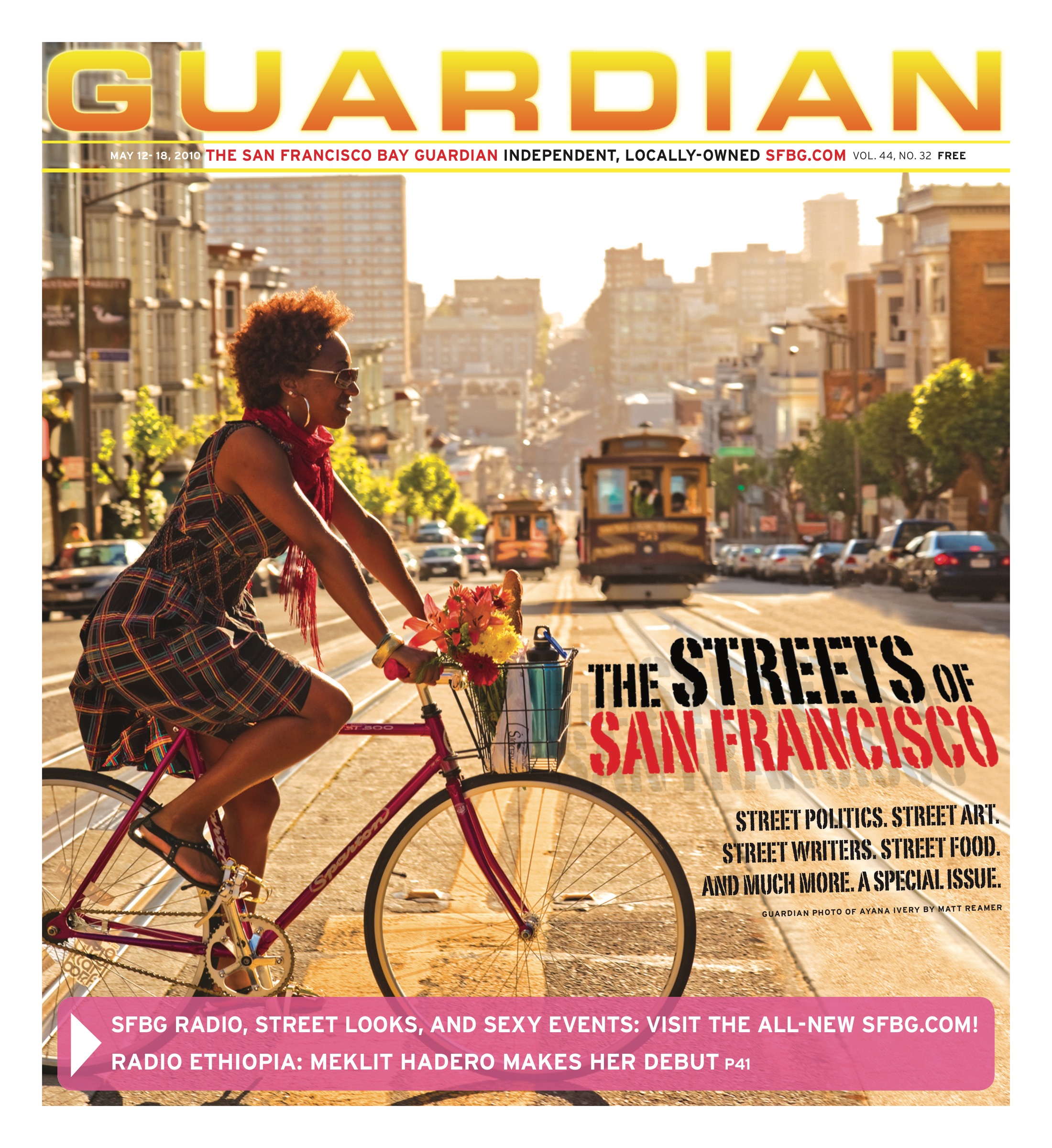
Meklit Hadero’s voice exudes music. A casual conversation over morning coffee can feel like an impromptu personal performance by the San Francisco jazz musician, because even her speaking voice has rhythm.

Assured with the spoken word, Hadero pauses at all the right times, naturally crafting an underlying melodic or poetic content to her dialogue. The intonation floats up and down like a line from one of her songs, as the buzz of the bean grinder, the clanking ceramic cups, and pings of a cash register replace traditional percussion. Opening and closing her eyes between thoughts, she carefully constructs each sentence.

“There is an art to not saying things too quickly,” she blushes when I call her out on this distinct way of speaking. “You have to be open to letting the words come. If there’s too much conversation in your head, the poetry runs away.”

Hadero is all about feeling out the right tempo. And whether it’s in regard to speech or daily duties, she’s established a beat. But as her musical career has grown in the past couple years due to residencies at both the Red Poppy Art House and the de Young Museum, her to-do list has simultaneously matured into a demanding beast, distracting her creative process and throwing off her internal metronome. When she does get a day off, it’s all about coffee and taking time to breathe.


“I’ll sleep in, enjoy the view from my apartment, and trick myself into not using my computer — I hide it in my car. Well, just kidding … but maybe I should do that.”

It’s on these days that Hadero is able to create music. Soul-filled vocals dance with jazzy, playful bass for a sound that references Nina Simone and suggests a more vibrant Norah Jones. This week she releases her debut album, On A Day Like This … (Porto Franco), a collection of plush, bright songs woven from the world of influences Hadero’s been collecting throughout her 30 years of life.

Hadero was born in Ethiopia, spent her childhood in Brooklyn, and has since lived in a dozen other places, including Germany; Washington, D.C.; Iowa City; Seattle; Miami; and New Haven, Conn., where she earned a degree from Yale. While she’s most comfortable in “nomad mode,” if there’s anywhere that’s home for her in this country, it’s here, Hadero says.

“The artistic community here is not something to take for granted. I’m coming on six years here in San Francisco — that’s the longest I’ve spent anywhere,” she pauses to reflect on this realization. “I will always be a person with multiple homes — because for me, home isn’t a physical place.”

For Hadero, home is made up of the people who inhabit a space and the rich exchanges that happen among them. It’s the diversity. The mountains. The water. The coffee shops and the music. On A Day Like This … is her ode to California.

“All the songs were written in San Francisco — they’re a culmination of my first period here. My Mission community of artists are all on this album, all the people I’ve been working and playing with for years. These are my moments in the Mission.”

MEKLIT HADERO CD RELEASE PARTY

With DJ Jeremiah Kpoh, and art by Great Tortilla Conspiracy

Thurs/13, 8 p.m., $15–$18

Bimbo’s 365 Club

365 Columbus, SF

1 (877) 4FL-YTIX

www.meklithadero.com


The sound of the city

3

STREETS OF SAN FRANCISCO Do you have a favorite musician who plays outside in San Francisco? I’d name many, if I knew their names. There’s the kid no older than 10 who led a two-piece rock band (himself on voice-guitar) through a great show to a growing crowd at Dolores Park, then played soccer immediately after. There’s the guy at 24th Street BART who sounds like Johnny Cash. There’s the man with the white guitar by San Francisco Center, and the guy who used to sing opera by Macy’s. It’s all too easy to miss the sound of life when your ears are plugged by little headphones. With that in mind, and with Heddy Honigmann’s great 1998 documentary The Underground Orchestra as one inspiration, it seemed right to talk to some of the people who make music for those who listen. Thanks to Elise-Marie Brown, Nicole Gluckstern, D. Scot Miller and Amber Schadewald for their contributions to this piece. (Johnny Ray Huston)


Name: Antone Lee

What styles of music do you play? I play a mix of folk and modern country on my guitar. Most of my music is original.

Where are your favorite places to play? I usually like to play down here (Civic Center BART station) because of the great sound and acoustics in the hallway.

How long have you been gigging on the streets or underground? I’ve been playing on the streets since I quit my job 3 years ago. This is what I do for a living. It’s pure joy.

What do you like about it and why do you do it? I like vibing off of people as they come and go. It’s nice to play whatever I’m feeling at the moment.

What don’t you like about it? Sometimes the people walking by can be sort of distracting. I usually just close my eyes and sink into the song.

Do you have recordings or a Web site? I have a MySpace (www.myspace.com/antoneleemusic) where some of my songs are, but I have about thirty songs that I’m waiting to record.

What street musicians and other musicians do you admire? I really like Fiddle Dave. He’s got a great original bluegrass sound. I also like Federico who plays more gypsy-styled café music.(Elise-Marie Brown)

Name: Ilya Kreymer

What styles of music do you play? I play eastern European music. A lot of Klezmer, Russian and Balkan music.

Where are your favorite sites to play? My favorite places to busk are the BART stations in the Mission, and also farmers’ markets. I usually like to busk two or three times a week.

How long have you been playing on the streets or underground? For five months.

What do you like about it, and why do you do it? I like the fact that it gives me a chance to practice and I get to see how people react to the music. The acoustics in the 16th and 24th BART stations are especially good. It’s also a good way to meet other musicians.

What don’t you like about it? Obviously there’s a lot of outside noise. You never know when you might be interrupted. Sometimes I might be doing really well and no one will be there to listen, but when I mess up more people might be around.

Do you have recordings or a Web site? I’ve actually got some recordings on reverbnation (www.reverbnation.com). But I’m hoping to update it soon with more songs. I’m also working on having a band that plays Russian music, too.

What street musicians or other musicians do you admire? There’s an accordion player that plays down at Civic Center. I think during morning rush hour. He also does magic tricks and wears outfits that match his accordion. He’s a longtime busker who I really admire.

What’s been your best experience playing? I had a really good experience at the Alemany market recently. A friend of mine was working at the farmers’ market. I was busking next to her booth while she danced. People were stopping by and taking notice, so that was really nice. (Brown)


Names: The Haight Street Vagabonds: Peter, Bucky, Crisp and Jack

Where do you play? Fisherman’s Wharf, on the sidewalk next to Cold Stone Creamery.

What styles of music do you play? Gypsy music, folk, Russian Folk. We jam. That’s like asking what kind of music the Grateful Dead play.

What are your usual instruments? Broken mandolin, harmonica, pots and pans, guitar, hand drums, children’s toys, hands, feet.

Why do you play? For fun, to entertain, and to keep our spirits up. I don’t want the money — then I feel like I’m whoring myself out to capitalism. I want food, beer, weed, cigarettes, and the best thing — instruments!

When do you play? Everyday. Sometimes the members change. Sometimes people walking by will join for a few minutes, hours or days.

How many years have you been playing on the street? Crisp has been playing for a year, Bucky since he left home four years ago at age 14.

What’s your philosophy about music? The best music has never been recorded. The best music is played for family and friends, at night, around a campfire. Or when you’re alone. (Amber Schadewald)

Name: Benjamin Barnes

What styles of music do you play? I play guitar and viola, but violin projects better and I know a lot of repertory. I’ve got maybe 3 hours of Bach memorized. It’s a meditative thing. There are six sonatas and six cello suites, and I play the cello suites on viola and violin. They’re nice profound pieces and sometimes people will stop and listen. I was playing Bach’s Chaconne and this guy stopped and listened to the whole piece and tipped me afterward.

Where are your favorite places to play? The Mission BART stations. The acoustics aren’t bad — you get a little reverb like you would in a hall. The first place I played was Powell Street station. It was 1989. I put my can down and basically practiced and made 15 dollars. I packed it all up and went home and threw the money on my bed and laughed. I was working at a coffee shop and putting myself through school.

I had a string quartet (the Rilke String Quartet) and we used to play at Montgomery and Embarcadero. We called it guerrilla musicianship.

What do you like about it, and why do you do it? It’s fulfilling to play these great pieces. I’ve been working on memorizing all these pieces and finding new ways to interpret them.

I was just in NY and saw people busking in Central Park and Greenwich Village. There’s a famous violinist, Joshua Bell, who played in the NY subway for a couple hours, and no one recognized him or that he was playing on a Stradivarius. Most people walked by or gave him a dollar, and one kid played air violin. He made 26 dollars.

Do you have recordings or a Web site? I have a lot of songs and string quartet and solo viola stuff that I’ve written and played on my website (www.benjaminbarnes.com). You can download it for free. There’s a spot where you can make a donation. I’ve gotten about 26 dollars. (Laughs)

I’m playing a free show at Caffeinated Comics on May 16th. We’re going to play an acoustic show, with songs I wrote and Bowie covers, Beatles covers, Led Zep and “The Devil Went Down to Georgia.” (Huston)

Name: Anthony

Where are your favorite places to play? Montgomery Bart Station, sometimes Fisherman’s Wharf.

What styles of music do you play? Love songs.

What are your favorite songs? “All The Woman I Need” by Luther Vandross, and anything Barry White.

How many years have you been playing on the street? 10.

What are your necessary accessories? Sparkly blue nail polish, mini Bible, Newports.

How long do you play? I stay until my dick gets hard and then probably longer.

Why do you do it? To entertain people and make some money. I don’t play for my health. (Schadewald)

Name: Brass Liberation Orchestra

When was the BLO founded? 2002-ish

How many members are there? Probably about 20 at the moment. 50 or more for the life of the band.

Where are your favorite spots to play? How do you get the word out? We play for change: picket lines, street marches, demonstrations. Wherever people want to dance in the street. We mostly play at events that other people are publicizing, (but) when we do our own shows, we use email and word of mouth.

What’s been your most memorable performance? Depends on who you ask! Demos at the start of the Iraq War where the band was arrested en masse? Oakland Oscar Grant marches? Whole Foods “Hey Mackey” pro-healthcare protest?

Are there other street bands you admire? There are many street bands whose music we admire. Some bands with similar political orientation include Rude Mechanical Orchestra (NYC), Chaotic Insurrection Ensemble (Montreal), Cackalack Thunder (Greensboro, NC). We also respect the youth work of Loco Bloco in the Mission, who are currently facing a budget crisis and could use some fundraising support.

What’s your favorite song to play together? A lot of us love New Orleans Second Line, and also Balkan brass music. One song we play at almost every gig is “Roma Rama,” a simplified Balkan-style tune written for us by Axel Hererra. (Nicole Gluckstern)

Name: Federico Petrozzino

What styles of music do you play? I play mostly folk and Beatles covers.

Where are your favorite places to play? I’ve played at Mills College and Ireland’s 32. But I make my living as a street musician playing around here (Powell BART station).

How long have you been playing on the streets or underground? I’ve been out here for about 3 months since I got in to town from Argentina.

What do you like about it, and why do you do it? It’s nice when you feeling like you’re doing good and people will walk by and smile or give you a wink.

What don’t you like about it? To be honest, I love the bums. But sometimes they can be crazy, which can turn some people away. It’s a distraction, but we try to be respectful.

Do you have recordings or a Web site? I have some of my stuff at purevolume (www.purevolume.com/fefon). The next step is to play at more places in the area.

What street musicians and other musicians do you admire? Frank Lynn. He’s been down here for over 30 years and is kind of a father to all of us street musicians. He’s an amazing musician and only plays on two strings. He has such a deep voice and everyone respects him.

What’s been your best experience playing? Just watching parents teach their children to appreciate music and give money. It’s great to see them learn how to be humble and respectful of the arts. (Brown)


Name: Larry “Bucketman” Hunt

How long have you been playing music? I’ve playing drums for 49 years. My first kit was a set of buckets when I was three years old.

I’m not from here. I’m from Kansas and I’ve had the chance to play with some of the greats all across the United States — Jimmy Smith, Pearl Bailey, The Drifters. I played with John Lee Hooker when he opened up the Boom Boom Room. This is what I do.

Where are your favorite places to play? 4th and Market, Powell and Geary (with New Funk Generation).

What don’t you like about playing music on the streets or underground? Old Navy, the Flood Building, their security is chasing me off now. I’ve been out here for fourteen years, was in Pursuit Of Happyness with Will Smith, and now they’re trying to get rid of me. They call the cops. The cops don’t want to do it, but they have to. (D. Scot Miller)


Eyes of the city

0

arts@sfbg.com

STREETS OF SAN FRANCISCO Two packs of beer, five cameras, and a ridiculous amount of camera equipment are hauled up the narrow staircase and onto the Guardian’s sunny rooftop on Potrero Hill. The four members of Caliber, a talented group of Bay Area photographers, immediately strap on their cameras and secure their lenses.

Running to the edge of the roof, spinning in circles, pointing up, down, and side to side, they take snapshots. The sunset, the traffic, the sidewalk below — Caliber shows that it’s possible to find a beautiful angle in every direction.

“It’s like we’ve never taken a picture before,” says Caliber member Julie Michelle, smirking after a series of shots. A couple of minutes of later, beer lures the rest of the pack — Stuart Dixon, Travis Jensen, Troy Holden, and his visiting brother, Dylan — around the picnic table to talk about their love for street photography.

Photo by Julie Michelle

The group met through Flickr in October 2009, after admiring each other’s varied styles. They decided to collaborate in an independent fashion, putting up a Web site filled with genuine San Francisco moments only residents can experience. When they aren’t lurking with a camera in alleyways or roaming along sidewalks and through parking lots, Caliber’s male members work 9-to-5’s, while Michelle races around the city photographing for her own Web site. Caliber’s images are a sheer labor of love.

Dixon is all about using “weird gear” and putting a new spin on classic shots of the bridge, Bay landmarks, and traffic. The group describes Jensen as a legit street photographer who captures kick-flips, drug trades, and intimate portraits of wizened or withered people. Holden “defaults to high buildings,” abandoned warehouses, and construction zones. Michelle loves architectural details and stumbling upon “lonely” timeless moments.

Photo by Travis Jensen

“As a group, we’re not taking Hallmark postcard pictures. This is the San Francisco we live in. It’s not a sunset at Crissy Field or the Painted Ladies,” Michelle says.

“It’s the nitty-gritty city stuff,” Jensen clarifies.

Every day, the Caliber Web site features a minimum of four new photos, a click from each member caught in their digital nets while walking to work, riding the bus, or on a Sunday morning stroll. From intimate portraits to the beautiful cityscapes, Caliber’s photos capture the real San Francisco from the dirty ground up.

Photo by Troy Holden

“Getting the perfect shot is very mathematical. And this is me being nerdy, but it’s recognizing when every element is in its right place,” says Troy, noting that sometimes it takes a hundred snaps of a single scene to get it right.

“It’s like panning for gold, finding the nugget,” adds Michelle. “And all you need is one.”

www.calibersf.com

Street stars

3

rebeccab@sfbg.com

A few crafty, courageous souls have learned to live off of San Francisco’s streets, supporting themselves with tips from random strangers at high-traffic destinations.

Fisherman’s Wharf is such a popular spot that the Port of San Francisco has a map dividing the sidewalk turf into specified performance locations. Between Piers 39 to 41, crowds may encounter break-dancers, spray-paint artists, musicians, or balloon sculptors. Then there are strutters and statues, clad in head-to-toe silver or gold, dancing to tunes blasting out of boom boxes, or frozen still until a tip lands in their tin.

Across the city, a writer has carved out his own street niche. Lynn Gentry pecks away at his Olivetti Lettera 22 typewriter, peering through cat-eyed spectacles at the unevenly inked text. A young black poet sporting an inch or two of vertical hair, seated upon a fold-up wooden chair before a makeshift miniature desk, his gig is summed up in a hand-written sign: “Pick a subject and price then get a poem.”

Gentry isn’t the city’s only busker hocking poems off an old-fashioned typewriter, but he is a regular fixture at the famous corner of Haight and Ashbury. Rather than tailoring his work to a specific style, he spins out spontaneous, lightly punctuated poems and prose, emulating the Beats. Tourists stop often and tip generously, but the locals seem to like him too. One has dubbed him “Professor.” Another seemed excited to pick up a poem he previously ordered, about Libras.

“I chose the Haight because you’ve got a lot of different things going on right here,” Gentry explains. “The longer you sit here, the more you meet the people who live right here, and who were part of the neighborhood’s history.” When not writing, he offers tales and odd historic tidbits. He talks about the 1966 Trips Festival, acid tests, the CIA, and the Summer of Love.

A trio of skinny young women approach, dressed as if they have stepped directly out of that era, and request a poem about “Supercute.” Turns out, it’s their band name.

Gentry first encountered a busking poet when he saw Jacqueline Suskin at the Oregon Country Fair. The son of a poet, he’d written mostly song lyrics before. Now, he says, he’s making ends meet with the street gig. The toughest customer request yet? “Ode to a Menstrual Cycle,” he admits. “It’s the only one that’s taken me three tries.”

Meanwhile, back at Fisherman’s Wharf, a crowd gathers to watch the masked street performer clad in head-to-toe gold. Poised atop a gold milk crate, he shimmies forward, hips swinging, shoulders rolling, and the milk crate shimmies too. He turns a 360-degree spin, and the milk crate spins too. He pauses for a photo with two wide-eyed blond children. Vacationers pause to snap pictures and tip. They might never guess that the man behind the mask is 51 years old.

At Fisherman’s Wharf, everybody sitting on the benches nearby seems to know Shaba, a spry black man who introduces himself as Shabadaba the Gold Man. He wears a gold top hat and an enormous gold clock around his neck. He does his street strutting right across the way from the Bubba Gump Shrimp Co., and says he’s been entertaining at Fisherman’s Wharf since 1977.

“I even beat the Bush Man out here,” he says. (The Bush Man may have the most bizarre self-made gig of all. He conceals himself behind a cluster of bush-like boughs, and then shakes them around, hollering, to scare unsuspecting passersby. It works every time.)

Shaba wasn’t always gold. He used to be silver, but too many others followed suit, so he switched colors. There’s another Gold Man, too, who rolls his tip can up and down his arms, and a few silver performers. One, who calls himself Silver Man, paints his entire head silver — except for an off-center star, which traces across his eyes and down his cheeks — and dances to Michael Jackson tunes wearing star-print pants, a red shirt with wings painted down the back, and one white glove.

“I’m kinda like Father Time out here,” Shaba says. He notes that things have changed over time, and that some performers are now paying the city for permits to be guaranteed a slot, though it isn’t mandated. He springs up suddenly, mumbling something about being unable to sit still.

Back at Haight and Ashbury, Gentry plucks a poem from the typewriter, proofreads it carefully, and hands it over. Here’s an excerpt: “San Francisco keeps trying as I hear the accents of the old neighborhoods that left them behind years ago to start a new life as writers still praise them from afar and the locals hold dying history confused to where they are….”

Vandalism Manifesto

1

Editor’s note: An earlier edition of this manifesto was scrawled onto the walls of an abandoned underground Muni tunnel somewhere in the Sunset District.

STREETS ISSUE The magic of the word — VANDALISM — is terribly offensive. Vandalism offends all the right people and launches an offensive against all the wrong people. Wait, vandalism converts our doublemoralspeak to honesty. Vandalism affirms a number of precarious values: freedom, justice, the art of unmediated living, etc.

Vandalism is not just a word. It’s a gaseous engine powering subversion, all saturated in viscous honey. A lifestyle set on boundless hope. A toy monkey you can buy on Haight Street. A self-imagined adventure ride in your Disneyland theme city of choice. A movement determined to strategically undermine deceptive imagery in favor of immediate experience — the sort of primitive amoebic goo that inspires the gorgeous muck of truthfulness. Vandalism lives in dirt and filth — the only organic material left unadulterated.

Vandalism has a healthy diet: iIt devours the monopoly on spectacle and excretes into the vast wastelands of intergalactic oil spills. Vandalism likes thrills: It’s a hyperdérive on the brink of the familiar, gathering as much intensity as possible before fluxing the rules of the game into a vortex of momentous vision. Vandalism wants to hold your hand. Vandalism is so charged that you might already feel an electric rage surging forth while reading this. If you don’t, you will. Does it burn and singe and bend and twist into the antennae of your fingertips? Channel that rage into acts of vandalism.

Vandalism is an awfully new phenomenon. It takes up arms all over the world: in big cities like New York and London, and in not-so-famous towns like Bakersfield and Danville. Well, maybe not Danville. Just wait, Danville.

Vandalism is an awfully old phenomenon. You can see nature desecrated, I mean subliminally mysticized, in the caves of Lascaux. Since we no longer live in pure nature but in concrete labyrinths built on top of iron cage islands, we must bring the caves of Lascaux and beaches of Eden and tornados of Jupiter to bear on today’s jungle city. We must subliminally mysticize the streets. Cue air horn.

Vandalism is so important that there are white wall guardians who repress it with nervous glances and waving arms. Byzantine policies regulate it. Laws have been established to punish transgressors. Yet vandalism doesn’t go away. Too many dreams fuel it. Too many imaginations keep it vital. Word on the street is that Werner Herzog is making a movie about it.

Vandalism doesn’t insist on art. It doesn’t get involved in arguments about whether something is or isn’t art. That conversation is terribly boring. Have you been to a modern museum lately? Didn’t you get the joke? OK, I admit, that conversation is irresistible. Here’s a clarification: Vandalism is an art form even if the graffiti itself is not artistic — a shrouded word meaning ultimately, technically savvy, or educated and properly executed. To this, I summon the ghost of a severe-faced vandal, Norman Mailer: Art is not peace but war! And war ain’t always pretty, or concerned with legality, soljah.

Vandalism would prefer to mark its ephemeral existence on the city skin, gushing down the fermented joys of unsanctioned life, mummifying itself in the cold caverns of a culture mausoleum. It would prefer to make you smile and laugh and wonder mercilessly to what happens in galleries: first confusion, then self-consciousness, and finally, the lingering pain of feeling slightly cheated. (Confession: I kinda stole that from Banksy. VANDALIZED!) No, vandalism doesn’t demand legitimacy in order to die in a sea of sterilized artifacts — all rotten fish skins and busted gall bladders in excessive frames. Museums sanctify the past. Vandalism prophesies the present.

History lesson: Street kids baptized vandalism in the slums, reconfiguring our country’s criminal policies of benign neglect into an acrobatic dance. They spun windmills into the future and set their gaze on the heavens. Among buildings reduced to rubble — a bombed out third world — they flipped the script and defined vandalism as bombing. The kids crucified monotony and sacrificed the crushing industrial rhythm of authority. They called themselves writers and painted their neon-tinted altar egos onto the shining armor of the behemoth subway trains and all over the walls. The names projected a faith in identity among the noise of polluted prayers.

Writers became pseudonymous in an abysmal well of city hustlers trying to make a legacy for themselves — billboard important and newsworthy. Writers preferred this life, fleeting and necessary and beautiful in the quixotic eternity of the now. The indifferent had no choice but to reckon with the writers.

Over 40 years strong, the writers still scour the marrow of their bones to re-enchant the lifeblood of the city. They craft enigmas out of the geometric lines and curves of the alphabet, making ferocious animals out of huge letters, feral and gunning in the jungle. The animals promulgate like bacteria, spawning writers-turned-shamans who cast spells of cryptic iconography wherever they go. Mummies, giraffes, and spaceships populate the jungle. An aura of prophecy emerges in the streets.

Writers wage war against the ubiquitous icons of worship mounted across the empire: those branded images manufacturing a spectacle of insurmountable desire and Sisyphean frustration. The marketers might have the money to buy permission to assault your eyes and make you feel bad about yourself; writers have the courage to forgo bureaucratic approval, stake claim on what rightfully belongs to all of us and conjure up a moveable feast. We believe in innocent pleasures, impulsive and vibrant, in order to dismantle the tyranny of monotony! More air horn, please.

Vandalism is degenerate. It’s not here to promote cleanliness and genteel manners of etiquette. Vandalism will replace honorifics with its own stamp of affirmation: Vandal Basquiat, Vandal Futura 2000, Vandal Taki 183, Vandal Debord, Haring, Burrows and Proudhon. But more than any of that, all the lower-case vandals on Muni set to burn their names on your retina.

Vandalism doesn’t care about rights to property. Vandalism stands by this ancient principle: property is theft. Vandalism doesn’t care about copyright. Copyright smacks of self-indulgence and greed. Quote me on that. Vandalism is universal and limitless, unwieldy and unbalanced, completely unhinged and frighteningly beautiful. It’s dangerous but welcoming. Come on. Give vandalism a try. Vandalism is the new gentrification; everyone’s doing it. It’s pushing emptiness and dullness out of the city and raising the quality of life to unpredictable heights of magnanimity. Your neutral walls do violence to our integrity. Whatcha got against color?

How does one live well and good? By doing vandalism. How does one become anonymously famous? By doing vandalism. With a flick of the wrists and a swagger of the step. Til’ one can’t stop and certainly won’t stop. It’s a terrible habit, an awfully time-consuming obsession. How can one get rid of everything grotesque and in bad taste? Vandalism. How do we reassert ourselves in the midst of corporate homogeny and increasing pressure to normalize? Vandalism. By what means do we establish our will to communicate freely and openly in the public sphere? Vandalism.

Vandalism cannot be bought or sold in your local Walgreens (maybe in Giant Robot, though). No no, vandalism is a nebulous thing, an utterly cosmic thing, dirty and scurrilous and always operating in the shadows, always slipping away from sterilization and appropriation like a rat with rabies on the run. What a charming nuisance. What a credible way to live! Street credible. The streets is a mother, and good ol’ vanguard vandalism — the first lesson.

Vandalism once brought down the Roman empire. We have yet to rebuild the world in its depths. (Wooley Van Dahl)

360-degrees “Muralismo”

0

caitlin@sfbg.com

STREETS OF SAN FRANCISCO In the late 1960s, when the muralismo movement began gaining strength among artists and community organizers in the Mission District, or in the 1970s when pioneer female street artists Mujeres Muralistas first picked up their brushes to trick out Balmy Alley, they probably weren’t thinking about the de Young Museum and slick coffee table books.

But, to appropriate Jay-Z, street art’s got a new bitch — the fine art world. With the 2009 release of Precita Eyes’ eye-popping Street Art San Francisco: Mission Muralismo (www.missionmuralismo.com) and the corresponding year-long event series the picture book of the storied mural hood has spawned at the de Young museum, neighborhood tags and tableaus are gaining a stronger foothold in the world of high art. That is to say, the world of art that people pay big money for.

Banksy’s recent film, Exit Through the Gift Shop, and the attendant media frenzy about several tie-in works appearing around town, is the hyped-out crest of spray-can crazy that’s got San Francisco in its grip. Galleries like Project One, White Walls, and 1AM are selling works for hundreds and thousands of dollars that you once saw on the wall of your neighborhood elementary school or liquor store. High class Union Square Hotel Des Arts offers visitors the chance to sleep in well-appointed rooms designed by “street” artists Apex, Shepard Fairey, and Chor Boogie. It’s hip to be street, stay up to get down, yadda yadda.

So what’s new? After all, Jean-Michel Basquiat zoomed from asphalt to canvas, sparking a meteoric career that collectors loved to cop a piece of in the 1980s. In graffiti’s early days, New York taggers struggled to retain control of their art in the face of soaring price tags, grasping middlemen, and ad execs who recognized the power of the bubble letter to sell. Past generations of SF artists like Twist and Mars One have graduated from the streets entirely. “You need money to do bigger and better things,” White Walls curator Justin Giarla told me. “Galleries are another possible venue to find yourself in history books, museums.”

Mission Muralismo offers a seductively jumbled history. Its pages, a nonlinear whirl of street art celebrated in situ, are perfect for a disparate neighborhood art movement that includes Latin American freedom songs, urban rustic neo-folk, and unapologetic civil disobedience. Editor Annice Jacoby says it took years of “digging through people’s closets” to create.

“You have to find a container that reflects the contradictions and surprises of the street,” Jacoby told me. “This whole place [the Mission] is like a gallery, proliferating and procreating.” To encapsulate the movement’s feel, she took images of temporal art — murals tend to last no more than 12 years before they start to deteriorate — and laid them alongside thoughtful essays by artists and other key Mission figures.

It would be easy to mistake the whirl surrounding Muralismo as another round of outsider art profiteering. Easy, that is, if you didn’t know Precita Eyes’ history of sponsoring social justice-based community murals. Easy, if you forget that the de Young events don’t directly commodify in the murals depicted in the book by swallowing them whole — those murals are pretty well stuck to their walls. Easy, if you’ve never seen the diverse crowds the events draw and the enthusiasm and respect shown by all sides.

“You mention Basquiat, and what happened there is that collectors started recognizing his work and showing it. This is different — we’re not bringing in the art,” de Young director of public programs Renee Baldocchi. Her museum’s First Fridays Mission Muralismo events, part of its Friday night “Cultural Encounters” series, are more than opportunistic book tie-ins. They aim to focus on the culture of the artists themselves. Key figures in the mural movement featured in the book like Juana Alicia, the Billboard Liberation Front, and Jet Martinez (muralist and artistic director of the Clarion Alley Mural Project), come in to lecture — street artists, lecturing? — to packed crowds on what they do, why it’s important, and how you can do it too. “We’re hoping that by inviting them in to talk about their art, it makes more people aware of them in the world,” Baldocchi says.

“The [de Young] events, I see them attracting a lot of young people,” says Jaime Cortez, an artist who coordinated the Galeria de la Raza digital billboard campaign in the 1990s and AIDS awareness mural projects. “I think that’s because of the big name graffiti artists the events draw.” Perhaps these functions are less about changing the meaning of the murals they celebrate than the high art venue they’re being celebrated in.

“It’s not like they’re having a show of muralists [at the de Young],” says Martinez, who has feet in both the street and gallery art worlds. Jet spoke at the Mission Muralismo event highlighting Clarion Alley. “They’re providing a forum where we can speak about this art,” he said.

Hopefully there are some lifted conversations going on, because the color and uniqueness of the Mission’s public art is pretty dope. “You’re dealing with a monumental subject,” Jacoby acknowledges. “You have to find a container that reflects the contradictions and surprises of the street.”

Debates don’t get much weirder than ones about where art “belongs.” But what’s certain is that with all the attention — the de Young events, the Banksy histrionics — more people are seeing the writing on the wall. “Oftentimes we’re in a hurry; we don’t stop to look at the murals,” Baldocchi says. “This is providing a forum so that when we do go down into the Mission, we can look at them and think about what’s being said — especially the social justice side.” *

MISSION MURALISMO

First Fridays, 5 p.m., free

de Young Museum

50 Hagiwara Tea Garden Dr., SF.

(415) 750-3600

www.famsf.org/deyoung


Beauty lies

0

MUSIC Let’s get this out of the way: Icelandic composer Jóhann Jóhannsson writes beautiful music. His string sections shiver and swell, his melodies alternately soar and ache, and the electronic textures that he often weaves in amid the more traditional orchestral instruments are unobtrusively massaged into the mix. This is music that doesn’t take warming up to, but rather cocoons you with its immediate approachability and occasional familial resemblances to members of the classical canon as well as more modern film composers such as Nino Rota and Elmer Bernstein. (In fact, many of Jóhannsson’s albums started as original soundtracks, or have been used as such.)

“Prettiness is not something I strive for, even though I know that most people’s initial reaction to my work is to say that it’s beautiful,” Jóhannsson counters bluntly over the phone when I ask for his feelings on the subject. “I don’t think beauty is the main goal. I think it’s more a certain emotional quality. I work in a very visceral way and I try to make music that affects you viscerally and that affects you physically.”

This has certainly been my experience of Jóhannsson’s music, starting with Englaborn, his 2002 debut on the Touch label, and up through his most recent release, last year’s And In the Endless Pause There Came the Sound of Bees (Type), in spite of — or perhaps because of — its beauty. Listening to these classical-not-classical albums, it is hard not to feel that familiar tug inside — the affective prelude to either laughing or crying — that often occurs when one encounters something beautiful.

Composer Benjamin Britten once wrote that “It’s cruel, you know, that music should be so beautiful.” Britten then cataloged the different types of cruel beauty music allows the listener to access: there is “the beauty of loneliness and of pain: of strength and freedom,” “the beauty of disappointment and never-satisfied love,” and “the cruel beauty of nature and the everlasting beauty of monotony.”

The kinds of beauty described by Britten — beauty attenuated by pain or loss — are present in Jóhannsson’s music, enriched by the context of its conception. Englaborn’s icy and delicate arrangements were conceived as a compliment to the violence and emotional ugliness of the play it originally scored. Fordlandia (4AD), Jóhannsson’s monumental 2008 album, was inspired in part by Henry Ford’s abandoned prefabricated industrial town built in the Amazonian rainforest in 1928, itself a monument to failure. And In the Endless Pause … is an expanded soundtrack to Marc Craste’s animated eco-parable Varmints, a critique of the environmental costs of unchecked urbanization told with a cast of rodents. When asked who his ultimate fantasy collaborator would be, Jóhannsson immediately names the late, great depressive Belgian chanson specialist Jacques Brel.

Despite the unabashed emotionality of his music, with its darker spells of sturm und drang , Jóhannsson discusses his work matter-of-factly. “I think what I’m interested in is the clash of culture and nature, or of technology and nature,” he says. “I don’t write ‘absolute music.’ It always starts with a nonmusical idea.” Better to leave the gushing to the critics, I suppose — a charge that could certainly be leveled at this particular profile. But I know I won’t be the only one reaching for a handkerchief when Jóhannsson and his six-piece ensemble take to the Great American Music Hall’s stage. Yes, it is cruel that music can be so beautiful. But hearing it is nonetheless sublime.

JÓHAN JÓHANNSSON

With Christopher Willits

Fri/14, 9 p.m. (doors at 8 p.m.), $21

Great American Music Hall

859 O’Farrell, SF

1(888) 233-0449

www.gamh.com


Secret agent “homme”

0

NEW-OLD MOVIE The Cold War heated up a public appetite for spy adventures well before James Bond became a pop phenomenon. In fact, Ian Fleming hadn’t yet created 007 in 1949, when Jean Bruce commenced writing novels about Hubert Bonisseur de La Bath, a.k.a. Agent OSS 117 — eventually more than 90 of them. When Bruce died (crashing his Jaguar — what a man!) in 1963, just as the screen Bond was taking off, his widow wrote another 143. Then her children wrote two dozen more, as recently as 1992.

Needless to say, this French superspy was ready-made to join the ranks of umpteen 007 wannabes, appearing in somewhere between six and 11 films (it’s unclear whether all involved de La Bath, or were just Bruce-based) through 1970, played by at least four actors. The series remained well-known enough to get a new life in 2006 when director Michel Hazanavicius and top French comedy star Jean Dujardin sought to spoof 1960s espionage flicks a la Austin Powers: International Man of Mystery (1997).

That was a big hit, so now we’ve got a sequel. OSS 117: Lost in Rio isn’t as fresh or funny as the preceding Cairo, Nest of Spies. But it’s still a whole lot fresher and funnier than Austin Powers Nos. two (1999) and three (2002). Dujardin’s de La Bath is the very model of jet-set masculinity, twisting the night away at a ski chalet with umpteen soon-to-be-machine gunned “Oriental” lovelies in the opening sequence, flashing a pearly, superconfident smirk at the neverending stream of multinational babes elsewhere, wowing them poolside with his top-of-the-mid-1960s-line male physique (nice, but don’t expect visible abs). Of course such pleasure pursuits take place strictly between car chases, shootouts, and karate fights.

Posing (badly) as a reporter to root out Hitlerites hiding in Brazil, our lone-gun hero is distressed to discover he has help from Israeli Mossad agents, one a mere chick. “Hunt down a Nazi with Jews?” he exclaims, complaining the target villain “will recognize them … their noses, obviously.” Beyond its pitch-perfect recreation of swinging ’60s cinema clichés (Naugahyde-lounge muzak, slightly feverish Technicolor, etc.), these films’ main joke is how cluelessly, casually racist, sexist, and xenophobic de La Bath is. The joke is on him, but his charm is remaining blissfully unaware.

Agreeably silly, Lost in Rio doesn’t go for Hollywood-style slapstick and grossout yuks. Instead, its biggest laughs are usually droll throwaways, as when 117 explains a shocking sudden costume change with the unlikely declaration “I sew,” or during an LSD-dosed hippie orgy proves quite willing to go with the flow — even when that involves another guy’s groovy finger breaching security up the pride of French intelligence’s derriere.

OSS 117: LOST IN RIO opens Fri/14 in Bay Area theaters.


Stage listings

0

Stage listings are compiled by Guardian staff. Performance times may change; call venues to confirm. Reviewers are Robert Avila, Rita Felciano, and Nicole Gluckstern. Submit items for the listings at listings@sfbg.com.

THEATER

OPENING

Giant Bones Exit Theatre, 156 Eddy; (650) 728-8098, www.brownpapertickets.com. $15-50. Thurs-Sat, 8pm. Through June 19. Fantasy author Peter S. Beagle (The Last Unicorn)  penned the source material for Stuart Bousel’s world-premiere play.

BAY AREA

In the Wake Berkeley Repertory Theatre, Roda Theatre, 2015 Addison, Berk; (510) 647-2949, www.berkeleyrep.org. $13.50-71. Previews Fri/14-Sat/15 and Tues/18, 8pm; Sun/16, 7pm. Opens May 19, 8pm. Runs Tues and Thurs-Sat, 8pm (also Thurs and Sat, 2pm; no matinees May 20, 29, June 3, 12, or 17; no show June 25); Wed and Sun, 7pm (also Sun, 2pm). Through June 27. Berkeley Rep and Center Theatre Group perform Lisa Kron and Leigh Silverman’s drama about a woman on the verge of a nervous breakdown after she begins to question her faith in country, relationships, and herself.

ONGOING

An Apology for the Course and Outcome of Certain Events Delivered by Doctor John Faustus on This His Final Evening Garage, 975 Howard; 585-1221, http://pustheatre.com. $15. Thurs-Sat, 8pm. Through May 22. This new, relatively short play with the long title, presented by Performers Under Stress, struts and frets a wearying hour upon the stage as actor Scott Baker’s haughty and high-strung Faust, knowing he is bound for hell at the end of the evening, pleads his case before the audience, shadowed all the while by a speechless but expressive Mephistopheles (played with sly showmanship and moody animal intelligence by Valerie Fachman). The case at hand revolves around a masterwork of nonsense over which Faust (its composer) and the devil compete: a set of journals filled entirely with hatch marks. Why exactly is difficult to understand for more than one reason, not the least being the tedium of the monologue itself, which is only temporarily relieved by the arrival of some cheap canned beer. Free brew aside, there’s little merit in playwright Mickle Maher’s self-conscious rambling, which more than anything chases its own tale — running in semantic circles without progressing anywhere or landing a bite. (Avila)

Andy Warhol: Good For the Jews? Jewish Theatre, 470 Florida; 292-1233, www.tjt-sf.org. $15-45. Thurs-Sat, 8pm; Sun, 2 and 7pm. Through June 20. Renowned monologist Josh Kornbluth is ready to admit his niche is a narrow one: he talks about himself, and more than that, he talks about his relationship to his beloved late father, the larger-than-life old-guard communist of Kornbluth’s breakthrough Red Diaper Baby. So it will not be surprising that in his current (and still evolving) work, created with director David Dower, the performer-playwright’s attempt to “enter” Warhol’s controversial ten portraits of famous 20th-century Jews (neatly illuminated at the back of the stage) stirs up memories of his father, along with a close family friend — an erudite bachelor and closeted homosexual who impressed the boyhood Josh with bedtime stories culled from his dissertation. The scenes in which Kornbluth recreates these childhood memories are among the show’s most effective, although throughout the narrative Kornbluth, never more confident in his capacities, remains a knowing charmer. But the story’s central conceit, concerning his ambivalence over presenting a showing of “Warhol’s Jews” at San Francisco’s Contemporary Jewish Museum, feels somehow artificial. It’s almost a stylized rendition of the secular-Jewish moral quandary and neurotic obsession driving Kornbluth works of the past — or in other words, all surface, not unlike the work of another shock-haired artist, but less meaningfully so. (Avila)

The Diary of Anne Frank Next Stage, 1620 Gough; 1-800-838-3006, www.custommade.org. $10-28. Thurs/13-Sat/14 8pm; Sun/15, 7pm. Custom Made performs Wendy Kesselman’s modern take on the classic. Eat, Pray, Laugh! Off-Market Theaters, 965 Mission; www.brownpapertickets.com. $20. Wed, 8pm. Through May 26. Off-Market Theaters presents stand up comic and solo artist Alicia Dattner in her award-winning solo show.

Echo’s Reach Brava Theater Center, 2781 24th St; 665-2275, www.citycircus.org. $14-35. Fri-Sat, 8pm (also Sat, 4pm); Sun, 4pm. Through May 30. City Circus premieres an urban fairytale by Tim Barsky.

Fishing Shotwell Studios, 3252 19th St; www.fishingtheplay.com. $25. Fri-Sat, 8pm. Through May 29. David Duman’s new play satirizes foodie culture.

Geezer Marsh MainStage, 1062 Valencia; 1-800-838-3006, www.themarsh.org. $20-50. Fri, 8pm; Sat, 8:30pm; Sun, 7pm (Sun/9 show at 8pm). Through May 23. Geoff Hoyle presents a workshop performance of his new solo show about aging.

*Hot Greeks Hypnodrome Theatre, 575 Tenth St; 1-800-838-3006, www.thrillpeddlers.com. $30-69. Thurs, 8pm; Sun, 7pm. Through June 27. See review at www.sfbg.com.

*Pearls Over Shanghai Hypnodrome, 575 Tenth St.; 1-800-838-3006, www.thrillpeddlers.com. $30-69. Fri-Sat, 8pm. Through June 26. Starting July 10, runs Sat, 8pm and Sun, 7pm. Through August 1. Thrillpeddlers presents this revival of the legendary Cockettes’ 1970 musical extravaganza.

Peter Pan Threesixty Theater, Ferry Park (on Embarcadero across from the Ferry Bldg); www.peterpantheshow.com. $30-125. Tues and Thurs, 7pm; Fri-Sat, 7:30pm (also Sat, 2pm); Wed, 2pm; Sun, 1 and 5pm. Through August 29. JM Barrie’s tale is performed in a specially-built 360-degree CGI theater.

The Real Americans The Marsh, 1062 Valencia; 826-5750, www.themarsh.org. $18-50. Wed-Thurs and May 28, 8pm; Sat, 5pm; Sun, 3pm. Through May 30. Starting July 8, runs Thurs-Fri, 8pm; Sat, 5pm; Sun, 3pm, through Aug 8. The Marsh presents the world premiere of Dan Hoyle’s new solo show.

*Round and Round the Garden American Conservatory Theater, 415 Geary; 749-2228, www.act-sf.org. $10-82. Tues-Sat, 8pm (also Wed and Sat, 2pm); Sun, 2pm. Through May 23. American Conservatory Theater offers a canny and contagious production of Alan Ayckbourn’s 1973 sex farce, one of the gems in the British playwright’s well-loved trilogy, “The Norman Conquests,” which variously lands on the same group of related characters — centered on the loveable and lovelorn reprobate Norman (a charmingly unstrung Manoel Felciano) — during the course of a single weekend spent in giddy, desperate, troubled infidelities. “Round and Round the Garden” takes place behind the ivy-covered walls of the house where the weekend unfolds, in the titular garden, as Tom (Dan Hiatt) and Annie (Delia MacDougall) meet in uncomfortable tension and bland civility, soon followed by Norman, Annie’s brother and Norman’s brother-in-law Reg (Anthony Fusco), Reg’s wife Sarah (Marcia Pizzo), and Norman’s own far-from-clueless wife Ruth (René Augesen). Stirring up these convoluted relationships is Norman’s fervent desire to seduce one or better yet both of his sisters-in-law, but plot details are really secondary to the chaotic spirit of the dance, not to mention the wonderful ensemble work underway. Director John Rando and a razor-sharp cast deliver a very entertaining evening effortlessly evoking the wandering, convention-flouting — but also still awkwardly conventional — 1970s, as seemingly sophisticated characters prowl (in some cases on all fours) amid the verdant Viagra of scenic designer Ralph Funicello’s magnificent backyard habitat. (Avila)

Sandy Hackett’s Rat Pack Show Marines’ Memorial Theater, 609 Sutter; 771-6900. $30-89. Thurs-Sat, 8pm (also Sat, 2pm); Sun, 2pm. Through May 23. Starting May 28, runs Fri-Sat, 8pm (also Sat, 2pm); Sun, 2pm. Through June 27. From somewhere before the Beatles and after Broadway “Beatlemania” comes this big band cigarettes-and-high-ball nightclub act, recreating the storied Vegas stage shenanigans of iconic actor-crooners Frank Sinatra (David DeCosta), Dean Martin (Tony Basile), and Sammy Davis Jr. (Doug Starks), and sidekick comedian Joey Bishop (Sandy Hackett). The excuse, if one were needed, is that god (voiced in mealy nasal slang by Buddy Hackett, appropriately enough) has deemed a Rat Pack encore of supreme importance to the continued unfurling of his inscrutable plan, and thus unto us a floorshow is given. The band is all-pro and the songs sound great — DeCosta’s singing as Sinatra is uncanny, but all do very presentable renditions of signature songs and standards. Meanwhile, a lot of mincing about the stage and the drink cart meets with more mixed success, and I don’t just mean scotch and soda. The Rat Pack is pre-PC, of course, but the off-color humor, while no doubt historically sound, can be dully moronic — and the time-warp didn’t prevent someone in opening night’s audience from laying into Hackett’s opening monologue for a glib reference to suicide. Though talk about killing: thanks to the heckler, the actor — son to Buddy and the show’s co-producer (alongside chanteuse Lisa Dawn Miller, who sings a cameo as Frank’s “One Love”) — got more life out of that joke over the rest of the evening than any other bit. (Avila)

Speed the Plow Royce Gallery, 2910 Mariposa; 1-866-811-4111, www.speedtheplowsf.com. $28. Thurs-Sat, 8pm. Through June 19. Expression Productions performs David Mamet’s black comedy.

Tartuffe Studio 205 at Off-Market Theater, 965 Mission; 377-5882, http://generationtheatre.com. $20-25. Fri/14-Sat/15, 8pm; Sun/16, 3pm. Generation Theatre performs a new English translation of Molière’s classic, in Alexandrine verse.

Tell It Slant Southside Theater, Fort Mason Center, Bldg D, Marina at Laguna; www.tixbayarea.com. $20-40. Fri/14-Sat/15, 8pm; Sun/16, 2pm. BootStrap Foundation presents Sharmon J. Hilfinger and Joan McMillen’s musical about Emily Dickinson.

Very Warm for May Eureka Theatre, 215 Jackson; 255-8207. $38-44. Wed, 7pm; Thurs-Fri, 8pm; Sat, 6pm; Sun, 3pm. Through May 24. 42nd Street Moon kicks off their Jerome Kern Celebration with this Oscar Hammerstein II script that features Kern’s final Broadway score.

What Mama Said About Down There Our Little Theater, 287 Ellis; 820-3250, www.theatrebayarea.org. $15-25. Thurs-Sun, 8pm. Through July 30. Writer-performer-activist Sia Amma presents this largely political, a bit clinical, inherently sexual, and utterly unforgettable performance piece.

BAY AREA

Girlfriend Berkeley Repertory Theatre, Thrust Stage, 2025 Addison, Berk; (510) 647-2949, www.berkeleyrep.org. $27-71. Wed/12, 7pm; Thurs/13-Sat/15, 8pm (also Sat/15, 2pm); Sun/16, 2 and 7pm. If you like Matthew Sweet’s songs you’ll probably like the spirited renditions in this new boy-meets-boy musical, which borrows its title from Sweet’s famous 1991 album. The songs, backed by a solid band in a recessed fake-wood-paneled den at the back of the stage, underscore the fraught but exhilarating emotional bond between two Nebraska teens at the end of their high school careers and the cusp of an anxious, ambiguous independence. The performances and chemistry generated by actors Ryder Bach and Jason Hite under Les Waters’ sharp direction are marvelous, delivering perfectly the inherent honesty and feeling in Todd Almond’s book, while Joe Goode’s beautifully understated choreography adds a fresh, youthful insouciance to the staging. But the story is a small one, not just a small town story, and its short, predictable arc makes for a slackness not altogether compensated for by the evocative tension between the lovers. (Avila)

Oliver! Julia Morgan Center for the Arts, 2640 College, Berk; www.berkeleyplayhouse.org. $24-33. Fri/14, 7:30pm; Sat/15, 2 and 7pm; Sun/16, 1 and 6pm. Berkeley Playhouse performs the Dickens-based musical.

Terroristka Berkeley City Club, 2315 Durant, Berk; (415) 891-7235, www.brownpapertickets.com. $12-20. Thurs/13-Sat/15, 8pm; Sun/16, 5pm. Threshold: Theatre on the Verge performs Rebecca Bella’s drama, based on the true story of a Chechen woman trained as a suicide bomber.

Twelfth Night La Val’s Subterranean, 1834 Euclid, Berk; www.impacttheatre.com. $10-20. Thurs-Sat, 8pm. Through June 12. You’ve got to hand it to Impact Theatre: they make reimagining Shakespeare look so darned easy. To set a crass comedy about class, obsession, and mistaken identity at “Illyria Studios” in the heart of tawdry Tinseltown seems like such an obvious take, you wonder why it took someone so long to get around to doing it. True, the execution is not as vivacious as last year’s A Midsummer Night’s Dream; there’s a lot of static standing around, particularly in the thus-rendered anti-climactic final act, and maybe a touch too much reliance on the karaoke machine prop (which is featured at its best during a stirring rendition of “Alone” courtesy of Cindy Im as Feste). But overall, the enthusiastic cast and timeless humor win the night. Especially strong comic performances are delivered by Valerie Weak and Jai Sahai as the troublesome twosome Toby Belch and Andrew Aguecheek while Seth Thygesen as Orsino maintains his now-familiar, yet thoroughly believable persona of oblivious yet jocular playboy. But it is Maria Giere as the cross-dressing, love-smitten Viola who displays the most range — from her ballsy attempts to fully inhabit her disguise as the page Cesario to her cringing attempts to have her beloved Orsino see through it. (Gluckstern)

What Just Happened? Cabaret at the Marsh Berkeley, 2120 Allston, Berk; 1-800-838-3006, www.themarsh.org. $20-50. Fri, 9pm; Sat, 8pm. Through May 27. Nina Wise’s show, an improvised work based on personal and political recent events, extends and re-opens at a new venue.

The World’s Funniest Bubble Show Marsh Berkeley, 2120 Allston, Berk; (415) 826-5750, www.themarsh.org. $10-50. Sun, 11am. Through June 27. The Amazing Bubble Man, a.k.a. Louis Pearl, performs his family-friendly show.

PERFORMANCE/DANCE

“Dis-Oriented” Mission Cultural Center, 2868 Mission; www.brownpapertickets.com. Fri, 8pm. $15-20. A trio of Asian American women (Zahra Noorbakhsh, Collenn “Coke” Nakamoto, and Thao P. Nguyen) performs solo works.

“Raw and Uncut Choreography Showcase” Garage, 975 Howard, SF; 518-1517, www.975howard.com. Tues, 8pm. $10-20. With guest choreographer Josh Beamish, plus locals Christine Cali, Andi Clegg, Shaunna Vella, and more.

*Smuin Ballet Yerba Buena Center for the Arts, 700 Howard; 978-ARTS, www.smuinballet.org. Fri-Sat, and May 11-14, 8pm (also Sat, 2pm); Sun, 2pm (also Sun/9, 7pm). Through May 16. $18-56. Smuin is gone, but under the leadership of Celia Fushille, the company has not yet strayed very far from his heritage. The rep is still heavy on the fast and the fun; audiences and dancers alike enjoy it. Fushille’s big addition — and it’s a good one — is Jiry Kylian’s Petite Mort, a marvelous piece of fluff with rolling hoop skirts and twirling foils, set to sublime Mozart. Since the name “little death” also refers to the result of what people do in private, you can read your own metaphor into it. Chinese-American Ma Cong’s French Twist is a hilarious dancing machine run at top speed. Tough to do, well done. Smuin’s Songs of Mahler opens a program that is balanced, fresh, and easy on the eyes. (Felciano)

“Super Hero Movies and Recycled Grooves” de Young Museum’s Koret Auditorium, 50 Hagiwara Tea Garden Dr, Golden Gate Park; 750-3600, www.stagewrite.org. Fri, 6:30pm; May 21, 11am. Free. Fifth graders (from Starr King Elementary) penned the plays, inspired by de Young artwork; professional actors (from StageWrite) perform them.


Event Listings

0

Event Listings are compiled by Paula Connelly. Submit items for the listings at listings@sfbg.com.

WEDNESDAY 12

Bike-In Movie Parking lot across from the Good Hotel, SF; www.disposablefilmfest.com. Good Hotel, 112 7th St, SF; (415) 621-7001. 4pm, free. Celebrate SF Bike Week starting at 4pm with Forage SF’s Underground Market, followed by a raffle at 7pm for cool bike gear, stays at the Good Hotel, and more, culminating in a screening of the Disposable Film Festival 2010 competitive shorts at 8pm. Valet bike parking available from the SFBC.

Write/Walk Meet at Mission High School, 3750 18th St., SF; (415) 252-4655. 6pm, free. Reading at Modern Times Bookstore, 888 Valencia, SF. 7pm, free. Enjoy a walking tour of poems by young poets from WritersCorps workshops at Mission High School that will be displayed in Mission storefronts for the month of May. Participating merchants include Candy Store Collective, Adobe Book Shop, Bombay Ice Cream, Borderlands Books, Dog Eared Bookstore, 826 Valencia, and more. Maps available at participating merchants.

Zhang Huan Sculpture Joseph L. Alioto Performing Arts Piazza, Civic Center Plaza, Larkin between the Main Library and the Asian Art Museum, SF; www.sfartscommission.org. 10am, free. Attend the dedication of internationally-acclaimed Chinese artist Zhang Huan’s Three Heads Six Arms copper sculpture that will be located in Civic Center Plaza through 2011.

THURSDAY 13

Bike Away From Work Party Rickshaw Stop, 155 Fell, SF; www.sfbike.org/btwd. 6pm; free for SFBC members, $10 for non-members. Get the skinny [jeans] on cycling fashion and style at this runway show and Bike to Work Day after party featuring tips on functional finery, complimentary bike valet, DJs, and raffle prizes.

Radical Women on Asian American Heritage New Valencia Hall, Suite 202, 625 Larkin, SF; (415) 864-1278. 7pm, free. Asian vegetarian buffet available at 6:15pm, $7.50. Hear artists Mia Nakano, Lenore Chinn and Nellie Wong discuss turning art into a collective voice for social change and the importance of the visibility of Asian American queers and women to the movements.

Rock the Bike California Academy of Sciences, 55 Music Concourse Dr., SF; www.calacademy.org. 7pm, $12. Celebrate one of San Francisco’s favorite method of transportation at this cycling themed NightLife featuring fun sustainable displays, including a bike-powered blender, a bike-powered DJ stage where you can take a turn pedaling, a performance by “the bike rapper” Fossil Fuel, bike-powered and inspired art, and more.

FRIDAY 14

BAY AREA

Ferment Change Humanist Hall, 390 27th St., Oak.; www.fermentchange.org. 7pm, $10-30 sliding scale. Support a more equitable food system at this fermented foods, culture, and urban agriculture series event where you can taste over a hundred different homemade fermented foods and beverages. Proceeds to benefit for urban agriculture heroes, City Slicker Farms. Bring your own fermented food to share and be entered in a raffle.

SATURDAY 15

Asian Heritage Street Celebration Larkin between Ellis and Grove, SF; www.asianfairsf.com. 11am-6pm, free. Celebrate Asian heritage at this street fair featuring two stages with over 100 music, dance, and other performance acts, an Anime area, a mah jong court, food and drink vendors, a cultural procession, an 8-foot high replica of a human colon, and much more.

Dawn Festival 2010 California Academy of Sciences, 55 Music Concourse Dr., Golden Gate Park, SF; www.dawnfestival.org. 7:30pm, $20. Reboot and Tablet Magazine host this celebration of the Jewish holiday of Shavuot, with Sandra Bernhard, Daniel Handler (aka Lemony Snicket), and more.

Inner Sunset Street Fair Irving at 10th Ave., SF; www.sfpix.com. 10am-8:30pm, free. Celebrate the Inner Sunset at this inaugural street fair set to feature sidewalk sales throughout the neighborhood, live music performances, dance lessons, art, crafts, food, yoga and tai chi lessons, and more.

MASS Good Vibrations Polk Street Gallery, 1620 Polk, SF; (415) 345-0400. 7pm, free. Enjoy this multimedia exhibit by poet and musician Kevin Simmonds called MASS (Making All Saints Sebastian), where he uses photographs, music, and poetry to recast male sexuality by having a diverse range of men pose as St. Sebastian.

SUNDAY 16

Alameda Backyard Chicken Coop Bicycling Tour Meet at 488 Lincoln, Alameda. 1pm, free. Take a self-guided bike tour of the many chicken coops of Alameda and check out a wide range of chicken coops while learning about urban chicken farming, ecological issues, and slow food on this 4.5 mile route. Maps will be provided at the start location and refreshment will be available along the route.

Bay to Breakers Start lines on Mission between Beale and Steuart, SF; (415) 359-2800, www.ingbaytobreakers.com. 8am; registration $48, group discounts available, free to be a spectator. Enjoy this authentic San Francisco marathon, complete with competitive runners and Mardi Gras style revelers, who follow athletes through the city in themed costumes and floats. Call or visit their website for rules and restrictions on alcohol consumption. Don’t forget to dispose of your own trash.


Rep Clock

0

Author and activist Cornel West appears in Justin Dillon’s doc about human trafficking, Call + Response. It screens Sun/16 at the Christopher B. Smith Rafael Film Center.

Schedules are for Wed/12–Tues/18 except where noted. Director and year are given when available. Double features are marked with a •. All times are p.m. unless otherwise specified.

ARTISTS’ TELEVISION ACCESS 992 Valencia, SF; www.atasite.org. $7. “Other Cinema:” Leslie Raymond and Jason Jay Stevens present a new A/V performance, Sat, 8:30.

CAFÉ OF THE DEAD 3208 Grand, Oakl; (510) 931-7945. Free. “Independent Filmmakers Screening Nite,” Wed, 6:30.

CASTRO 429 Castro, SF; (415) 621-6120, www.castrotheatre.com. $7.50-10. Iron Man 2 (Favreau, 2010), call for dates and times.

CERRITO 10070 San Pablo, El Cerrito; www.rialtocinemas.com. $7. “Cerrito Classics:” Chinatown (Polanski, 1974), Thurs, 7:15.

CHRISTOPHER B. SMITH RAFAEL FILM CENTER 1118 Fourth St, San Rafael; (415) 454-1222, www.cafilm.org. $6.50-10. Babies (Balmès, 2010), call for dates and times. Exit Through the Gift Shop (Banksy, 2010), call for dates and times. The Girl With the Dragon Tattoo (Oplev, 2009), call for dates and times. The Greatest (Feste, 2009), call for dates and times. Touching Home (Miller and Miller, 2009), call for dates and times. Vincere (Bellocchio, 2009), call for dates and times. Tenderloin (Anderson, 2009), Wed, 7. OSS 117: Lost in Rio (Hazanavicius, 2009), May 14-20, call for times. Call + Response (Dillon, 2008), Sun, 6:30.

GOOD HOTEL Parking lot, Seventh Street at Minna, SF; www.disposablefilmfest.com/events. Free. “Disposable Film Festival: Bike-In Screening,” short films, Wed, 8.

HUMANIST HALL 390 27th St, Oakl; www.humanisthall.org. $5. Destiny (Chahine, 1997), Wed, 7:30.

JACK LONDON SQUARE PAVILION THEATER 98 Broadway, Oakl; www.oakuff.org. Free. “Oakland Underground Film Festival: Remembering Playland (Wyrsch, 2010), Sat, 7:30.

MECHANICS’ INSTITUTE 57 Post, SF; (415) 393-0100, rsvp@milibrary.org. $10. “CinemaLit Film Series: Heroic Horizons: The View from Australia:” My Brilliant Career (Armstrong, 1979), Fri, 6.

PACIFIC FILM ARCHIVE 2575 Bancroft, Berk; (510) 642-5249, www.bampfa.berkeley.edu. $5.50-9.50. Theater closed through May 28.

PIEDMONT 4186 Piedmont, Oakl; (510) 464-5980. $5-8. “Cult Classics Attack 5:” Ghostbusters (Reitman, 1984), Fri-Sat, midnight; Sun, 10am.

RED VIC 1727 Haight, SF; (415) 668-3994. $6-10. The Last Station (Hoffman, 2009), Wed, 2, 7, 9:25. “Oscar Nominated Short Films 2010:” “Animation Program,” Thurs-Sat, 7:15 (also Sat, 2); “Live Action Program,” Thurs-Sat, 9:15 (also Sat, 4). It’s a Mad, Mad, Mad, Mad, World (Kramer, 1963), Sun-Mon, 5, 8 (also Sun, 2). Fish Tank (Arnold, 2009), May 18-19, 7, 9:20 (also May 19, 2). ROXIE 3117 and 3125 16th St, SF; (415) 863-1087, www.roxie.com. $5-9.75. October Country (Palmieri and Mosher, 2009), Wed-Thurs, call for times. “I Still Wake Up Dreaming! Noir is Dead/Long Live Noir:” •High Tide (Reinhardt, 1947), Fri, 6, 8:45, and Mysterious Intruder (Castle, 1946), Fri, 7:30, 10; •99 River Street (Karlson, 1953), Sat, 1:30, 4:45, 8, and Shield for Murder (O’Brien, 1954), Sat, 3:10, 6:20, 9:45; •Nightmare (Shane, 1956), Sun, 2, 5, 8, and The Mark of the Whistler (Castle, 1944), Sun, 3:45, 6:45, 9:45; •The Lady Confesses (Newfield, 1945), Mon, 6:40, 9:25, and Jealousy (Machaty, 1945), Mon, 8; •The Invisible Wall (Forde, 1947), Tues, 6:30, 9:30, and Treasure of Monte Cristo (Berke, 1949), Tues, 8.

VIZ CINEMA New People, 1746 Post, SF; www.newpeopleworld.com/films. $8-10. “Kaiju Shakedown: Godzillathon!:” Godzilla vs. Hedorah (Banno, 1971), Wed, 5; Godzilla vs. Gigan (Fukuda, 1972), Wed, 7; Godzilla vs. Megalon (Fukuda, 1973), Thurs, 5; Godzilla vs. Mechagodzilla (Fukuda, 1974), Thurs, 7.

YERBA BUENA CENTER FOR THE ARTS 701 Mission, SF; (415) 978-2787, www.ybca.org. $6-8. “To the Limit: Pina Bausch on Film:” The Complaint of the Empress (Bausch, 1989), Thurs, 7:30. Typeface (Nagan, 2009), Sat, 6, 8; Sun, 2, 4.

Music listings

0

Music listings are compiled by Paula Connelly and Cheryl Eddy. Since club life is unpredictable, it’s a good idea to call ahead to confirm bookings and hours. Prices are listed when provided to us. Submit items at listings@sfbg.com.

WEDNESDAY 12

ROCK/BLUES/HIP-HOP

Barrel Riders, Fusebox, Tentacle Hemlock Tavern. 9pm, $5.

Beehive Spirit, Common Loon, Alright Elbo Room. 9pm, $6.

Tia Carroll and Hard Work Bimbo’s 365 Club. 8 and 10pm, $15.

Jakob Dylan and Three Legs featuring Neko Case and Helly Hogan, Felice Brothers, Honeyhoney Regency Ballroom. 8pm, $28.

Fuck Buttons Great American Music Hall. 9pm, $16.

Lime Colony, Passenger and Pilot, Blood and Sunshine Bottom of the Hill. 9pm, $8.

Man/Miracle, Yellow Dress, Quite Polite Rickshaw Stop. 8pm, $10.

*MDC, Restarts, La Plebe, Dopecharge Thee Parkside. 8:30pm, $10.

Tender Few, Spidermeow, Rabbles Hotel Utah. 8:30pm, $6.

FOLK/WORLD/COUNTRY

Sang Matiz Red Devil Lounge. 8:30pm, $8.

Somerville and Keehan Plough and Stars. 9pm.

DANCE CLUBS

Booty Call Q-Bar, 456 Castro, SF; www.bootycallwednesdays.com. 9pm. Juanita Moore hosts this dance party, featuring DJ Robot Hustle.

Hands Down! Bar on Church. 9pm, free. With DJs Claksaarb, Mykill, and guests spinning indie, electro, house, and bangers.

Machine Sloane, 1525 Mission, SF; (415) 621-7007. 10pm, free. Warm beats for happy feet with DJs Sergio, Conor, and André Lucero.

Mary-Go-Round Lookout, 3600 16th St, SF; (415) 431-0306. 10pm, $5. A weekly drag show with hosts Cookie Dough, Pollo Del Mar, and Suppositori Spelling.

Open Mic Night 330 Ritch. 9pm, $7.

RedWine Social Dalva. 9pm-2am, free. DJ TophOne and guests spin outernational funk and get drunk.

Respect Wednesdays End Up. 10pm, $5. Rotating DJs Daddy Rolo, Young Fyah, Irie Dole, I-Vier, Sake One, Serg, and more spinning reggae, dancehall, roots, lovers rock, and mash ups.

Synchronize Il Pirata, 2007 16th St, SF; (415) 626-2626. 10pm, free. Psychedelic dance music with DJs Helios, Gatto Matto, Psy Lotus, Intergalactoid, and guests.

Yoruba Dance Sessions Bacano! Som., 2925 16th St, SF; (415) 558-8521. 9pm, free. With resident DJ Carlos Mena and guests spinning afro-deep-global-soulful-broken-techhouse.

THURSDAY 13

ROCK/BLUES/HIP-HOP

Acorn Project, Sourgrass Boom Boom Room. 9:30pm, $7.

Altars Knockout. 9:30pm, $4. With guest DJs Primo, Kat, Bertie, and Melanie Ann Berlin.

Roger Clyne and PH Naffah, Jason Boots Great American Music Hall. 8pm, $16.

Meklit Hadero, Quinn Deveaux and the Blue Beat Review Bimbo’s 365 Club. 8pm, $18.

Hydrophonic, Gas Mask Colony, Murkins Bottom of the Hill. 9pm, $8.

Jugtown Pirates, Tell-Tale Heartbreakers, Project Pimento, Franco Nero, Swamees Paradise Lounge. 9pm, $7. Proceeds benefit the Haight-Ashbury Street Fair.

Bill Ortiz Biscuits and Blues. 8 and 10pm, $15.

Roy G. Biv, Billy Schafer, Chi McClean, Alex Karweit Hotel Utah. 8:30pm, $10.

Whitechapel, Son of Aurelius, I Declare War, Fallujah Thee Parkside. 9:30pm, $15.

Zoo, Entropy Density, Didimao Hemlock Tavern. 9pm, $6.

FOLK/WORLD/COUNTRY

Big Possum Atlas Café. 8pm, free.

John Calloway, Loco Bloco with Claudinho Smile Roccapulco Supper Club, 3140 Mission, SF; www.locobloco.org. 8pm, $15.

Shannon Céilí Band Plough and Stars. 9pm.

DANCE CLUBS

Afrolicious Elbo Room. 9:30pm, $8-10. DJs Pleasuremaker and Señor Oz spin Afro-tropical, samba, and funk.

CakeMIX SF Wish, 1539 Folsom, SF; www.wishsf.com. 10pm, free. DJ Carey Kopp spinning funk, soul, and hip hop.

Caribbean Connection Little Baobab, 3388 19th St, SF; (415) 643-3558. 10pm, $3. DJ Stevie B and guests spin reggae, soca, zouk, reggaetón, and more.

Drop the Pressure Underground SF. 6-10pm, free. Electro, house, and datafunk highlight this weekly happy hour.

Good Foot Yoruba Dance Sessions Bacano! Som., 2925 16th St, SF; (415) 558-8521. 9pm, free. A James Brown tribute with resident DJs Haylow, A-Ron, and Prince Aries spinning R&B, Hip hop, funk, and soul.

Gymnasium Matador, 10 Sixth St, SF; (415) 863-4629. 9pm, free. With DJ Violent Vickie and guests spinning electro, hip hop, and disco.

Kissing Booth Make-Out Room. 9pm, free. DJs Jory, Commodore 69, and more spinning indie dance, disco, 80’s, and electro.

Koko Puffs Koko Cocktails, 1060 Geary, SF; (415) 885-4788. 10pm, free. Dubby roots reggae and Jamaican funk from rotating DJs.

Mestiza Bollywood Café, 3376 19th St, SF; (415) 970-0362. 10pm, free. Showcasing progressive Latin and global beats with DJ Juan Data.

Motion Sickness Vertigo, 1160 Polk, SF; (415) 674-1278. 10pm, free. Genre-bending dance party with DJs Sneaky P, Public Frenemy, and D_Ro Cyclist.

Peaches Skylark, 10pm, free. With an all female DJ line up featuring Deeandroid, Lady Fingaz, That Girl, and Umami spinning hip hop.

Popscene 330 Rich. 10pm, $10. Rotating DJs spinning indie, Britpop, electro, new wave, and post-punk.

Solid Thursdays Club Six. 9pm, free. With DJs Daddy Rolo and Tesfa spinning roots, reggae, dancehall, soca, and mashups.

FRIDAY 14

ROCK/BLUES/HIP-HOP

Annuals, Most Serene Republic, What Laura Says Bottom of the Hill. 10pm, $12.

Apache, Wrong Words, Midnight Snaxx, Off Campus Knockout. 9pm, $7.

Café R&B Biscuits and Blues. 8 and 10pm, $22.

Disastroid, Famous, Gentlemen Hemlock Tavern. 9:30pm, $7.

Front Street featuring Stu Allen, Jugtown Pirates Independent. 9pm, $15.

Fun., Audrye Sessions, Heartsounds Slim’s. 8:30pm, $16.

Johan Johannsson Great American Music Hall. 9pm, $21.

Michael McIntosh Rite Spot, 2099 Folsom, SF; www.myspace.com/ritespot. 9pm, free.

Freedy Johnston Café du Nord. 7:30pm, $15.

Starfucker, Butterfly Bones, Silver Swans, Fake Drugs Rickshaw Stop. 8pm, $12.

*Trombone Shorty and Orleans Avenue with Zigaboo Modeliste and Ivan Neville Bimbo’s 365 Club. 8pm, $75-150. Proceeds benefit Blue Bear’s youth music education programs.

Michael Zapruder, Grand Lake Dark Room, 2263 Mission, SF; http://snobtheater.tumblr.com. 10pm, $10. With comedians Bill Coladonato, Kelly McCarron, Kevin Munroe, and Brandon Lynch.

JAZZ/NEW MUSIC

Audium 9 1616 Bush, SF; (415) 771-1616. 8:30pm, $15.

Black Market Jazz Orchestra Top of the Mark. 9pm, $10.

Bruno P.B. Socha Café, 3235 Mission, SF; (415) 643-6848. 8:30pm, free.

Eric Kurtzrock Trio Ana Mandara, Ghirardelli Square, 891 Beach, SF; (415) 771-6800. 8pm, free.

Revolution All-Stars Revolution Café, 3248 22nd St, SF; (415) 642-0474. 8:45pm, free.

Scott Amendola Band Red Poppy Art House. 8 and 9pm, $12-20.

Stanley Clarke Band with Hiromi Yoshi’s San Francisco. 8 and 10pm, $26-32.

Terry Disley Experience Trio Vin Club, 515 Broadway, SF; (415) 277-7228. 7:30pm, free.

FOLK/WORLD/COUNTRY

Brother Lekas Plough and Stars. 9pm.

Lucha Vavoom Fillmore. 9pm, $32.50.

"That Night in Rio: A Samba Party" Café du Nord. 9pm, $15. With Grupo Samba Rio and DJ Fausto Sousa.

Wunmi Coda. 10pm, $15.

DANCE CLUBS

Activate! Lookout, 3600 16th St, SF; (415) 431-0306. 9pm, $3. Face your demigods and demons at this Red Bull-fueled party.

Beat Market Mighty. 7pm, $10. With DJs Gravity, Jonathan W, Spirit Catcher, eug, and Al Veilla.

Blow Up Rickshaw Stop. 10pm, $10. With rotating DJs.

Exhale, Fridays Project One Gallery, 251 Rhode Island, SF; (415) 465-2129. 5pm, $5. Happy hour with art, fine food, and music with Vin Sol, King Most, DJ Centipede, and Shane King.

Fat Stack Fridays Koko Cocktails, 1060 Geary, SF; (415) 885-4788. 10pm, free. With rotating DJs Romanowski, B-Love, Tomas, Toph One, and Vinnie Esparza.

Fo’ Sho! Fridays Madrone Art Bar. 10pm, $5. DJs Kung Fu Chris, Makossa, and Quickie Mart spin rare grooves, soul, funk, and hip-hop classics.

Fort Knox Five, Breakestra Mezzanine. 9pm, $15.

Gay Asian Paradise Club Eight, 1151 Folsom, SF; www.eightsf.com. 9pm, $8. Featuring two dance floors playing dance and hip hop, smoking patio, and 2 for 1 drinks before 10pm.

Good Life Fridays Apartment 24, 440 Broadway, SF; (415) 989-3434. 10pm, $10. With DJ Brian spinning hip hop, mashups, and top 40.

Gymnasium Stud. 10pm, $5. With DJs Violent Vickie and guests spinning electro, disco, rap, and 90s dance and featuring performers, gymnastics, jump rope, drink specials, and more.

Hot Chocolate Milk. 9pm, $5. With DJs Big Fat Frog, Chardmo, DuseRock, and more spinning old and new school funk.

Lawnchair Generals DNA Lounge. 9pm, $10. House, downtempo, and dub.

Look Out Weekend Bambuddha Lounge. 4pm, free. Drink specials, food menu and resident DJs White Girl Lust, Swayzee, Philie Ocean, and more.

M4M Fridays Underground SF. 10pm-2am. Joshua J and Frankie Sharp host this man-tastic party.

Rockabilly Fridays Jay N Bee Club, 2736 20th St, SF; (415) 824-4190. 9pm, free. With DJs Rockin’ Raul, Oakie Oran, Sergio Iglesias, and Tanoa "Samoa Boy" spinning 50s and 60s Doo Wop, Rockabilly, Bop, Jive, and more.

Strictly Video 111 Minna. 9pm, $10. With VDJs Shortkut, Swift Rock, GoldenChyld, and Satva spinning rap, 80s, R&B, and Dancehall.

Treat Em Right Elbo Room. 10pm, $5. Hip-hop, fun, Latin, and more with DJs Vinnie Esparza, B. Cause, and guest DJs Mr. E and Relly Rels.

SATURDAY 15

ROCK/BLUES/HIP-HOP

*Converge, Coalesce, Lewd Acts, Black Breath Slim’s. 8pm, $18.

Gil Mantera’s Party Dream, Triple Cobra, Go-Going-Gone Girls Bottom of the Hill. 9pm, $12.

Kali$$ian Coda. 10pm, $10.

Billy McLaughlin Marriott, Fisherman’s Wharf, 1250 Columbus, SF; www.billymacmusic.com. 7:30pm, $20.

1995 Forever, Aerosols, Ryan Pettigrew and the Ladyboys Hemlock Tavern. 9:30pm, $7. Also with comedians Brent Weinbach and Louis Katz.

Octomutt Rite Spot, 2099 Folsom, SF; www.myspace.com/ritespot. 9pm, free.

Pins of Light, Moses, Boar Hunter El Rio. 10pm, $7.

Portal, Morbosidad, Sanguis Imperem, Dispirit Thee Parkside. 9:30pm, $12.

Reaction Thee Parkside. 3pm, free.

Ruse, Honor By August, Johnny Hi-Fi Hotel Utah. 9pm, $8.

Lavay Smith and Her Red Hot Skillet Lickers Biscuits and Blues. 8 and 10pm, $20.

Vienna Teng and Alex Wong Yoshi’s San Francisco. 8 and 10pm, $28.

JAZZ/NEW MUSIC

Audium 9 1616 Bush, SF; (415) 771-1616. 8:30pm, $15.

Eric Kurtzrock Trio Ana Mandara, Ghirardelli Square, 891 Beach, SF; (415) 771-6800. 8pm, free.

Kathy Sanborn Borders Westfield Center, 845 Market, SF; (415) 243-4108. 2-4pm.

Sexmob with DJ Olive Yerba Buena Center for the Arts, 701 Mission, SF; www.sfjazz.org. 8pm, $25.

Tin Cup Serenade Revolution Café, 3248 22nd St, SF; (415) 642-0474. 8:45pm, free.

FOLK/WORLD/COUNTRY

Courtney Andrews and friends Socha Café, 3235 Mission, SF; (415) 643-6848. 8:30pm, free.

Bernal Hill Players Red Poppy Art House. 8pm, $10-$15.

Gas Men Plough and Stars. 9pm.

Sierra Leone’s Refugee All Stars, Black Nature, DJ Jeremiah Independent. 9pm, $20.

DANCE CLUBS

Bar on Church 9pm. Rotating DJs Foxxee, Joseph Lee, Zhaldee, Mark Andrus, and Niuxx.

Bassnectar, Jef and Odd Nosdam Mezzanine. 9pm, $30.

Bootie DNA Lounge. 9pm, $6-12. Mash-ups plus the Hubba Hubba Revue.

Booty Bassment Knockout. 10pm, $5. Hip-hop with DJs Ryan Poulsen and Dimitri Dickenson.

Club 1994 Paradise Lounge. 10pm, $10. With DJs Jeffrey Paradise and Richie Panic spinning like it’s 1994.

Cock Fight Underground SF. 9pm, $7. Locker room antics galore with electro-spinning DJs Earworm and Matt Hite.

Dead After Dark Knockout. 6-9pm, free. With DJ Touchy Feely.

Fire Corner Koko Cocktails, 1060 Geary, SF; (415) 885-4788. 9:30pm, free. Rare and outrageous ska, rocksteady, and reggae vinyl with Revival Sound System and guests.

Fringe Madrone Art Bar. 9pm, $5. With DJs Blondie K and subOctave spinning indie music videos.

Full House Gravity, 3505 Scott, SF; (415) 776-1928. 9pm, $10. With DJs Roost Uno and Pony P spinning dirty hip hop.

HYP Club Eight, 1151 Folsom, SF; www.eightsf.com. 10pm, free. Gay and lesbian hip hop party, featuring DJs spinning the newest in the top 40s hip hop and hyphy.

Non Stop Bhangra Rickshaw Stop. 9pm, $20. With Dholrythms and DJ Jimmy Love.

Prince vs. Michael Madrone Art Bar. 8pm, $5. With DJs Dave Paul and Jeff Harris battling it out on the turntables with album cuts, remixes, rare tracks, and classics.

Puma’s World House Music Tour Vessel, 85 Campton, SF; (415) 433-8585. 9:30pm, $10. With DJs Sultan and Jasonn.

Saturday Night Soul Party Elbo Room. 10pm, $10. Sixties soul with DJs Lucky, Phengren Oswald, and Paul Paul.

Social Club Lookout, 3600 16th St, SF; (415) 431-0306. 9pm. Shake your money maker with DJs Lee Decker and Luke Fry.

Spirit Fingers Sessions 330 Ritch. 9pm, free. With DJ Morse Code and live guest performances.

Xeno and Oaklander, Epee Du Bois, Soft Moon Milk. 10pm. With DJs Omar, Justin, and Josh.

SUNDAY 16

ROCK/BLUES/HIP-HOP

Bullet for My Valentine, Chiodos, Airborne, Arcanium Regency Ballroom. 6:30pm, $27.

Clipd Beaks, Vampire Hands, Shattered by the Sun Hemlock Tavern. 9pm, $6.

Crash Kings Independent. 8pm, $12.

Faun Fables, Charming Hostess, Siamese Sirens Café du Nord. 8pm, $12.

Ben Folds and a Piano, Kate Miller-Heidke Warfield. 8pm, $38.

*Hypocrisy, Scar Symmetry, Hate, Blackguard, Swashbuckle DNA Lounge. 6pm, $18.

Set Your Goals, Comeback Kid, Title Fight, Story So Far Slim’s. 7pm, $16.

*Shattered Faith, Harrington Saints, Stagger and Fall, Psychology of Genocide Thee Parkside. 8pm, $8.

Sippy Cups Yoshi’s San Francisco. 2pm, $5-16.

Vienna Teng and Alex Wong Yoshi’s San Francisco. 5 and 7pm, $5-28.

JAZZ/NEW MUSIC

Sheila Jordan with Steve Kuhn Yerba Buena Center for the Arts, 701 Mission, SF; www.sfjazz.org. 7pm, $25-40.

SF Jazz High School All-Stars Yerba Buena Center for the Arts, 701 Mission, SF; www.sfjazz.org. 2pm, $5-15.

Wayne Wallace Latin Jazz Quintet Coda. 8pm, $10.

FOLK/WORLD/COUNTRY

El Deora, Rich McCully Thee Parkside. 4pm, free.

Marla Fibish, Erin Shrader, Richard Mandel and friends Plough and Stars. 9pm.

DANCE CLUBS

Bay to Breakers Breather Madrone Art Bar. 2pm, free. With DJs Kap10 Harris and Shane King spinning electro, bootybass, crunk, hyphy, rap, and more.

Call In Sick Skylark. 9pm, free. DJs Animal and I Will spin danceable hip-hop.

DiscoFunk Mashups Cat Club. 10pm, free. House and 70’s music.

Dub Mission Elbo Room. 9pm, $6. Dub, roots, and classic dancehall with J Boogie and Vinnie Esparza.

Gloss Sundays Trigger, 2344 Market, SF; (415) 551-CLUB. 7pm. With DJ Hawthorne spinning house, funk, soul, retro, and disco.

Honey Soundsystem Paradise Lounge. 8pm-2am. "Dance floor for dancers – sound system for lovers." Got that?

Jock! Lookout, 3600 16th St, SF; (415) 431-0306. 3pm, $2. This high-energy party raises money for LGBT sports teams.

Kick It Bar on Church. 9pm. Hip-hop with DJ Zax.

Lowbrow Sunday Delirium. 1pm, free. DJ Roost Uno and guests spinning club hip hop, indie, and top 40s.

Religion Bar on Church. 3pm. With DJ Nikita.

Stag AsiaSF. 6pm, $5. Gay bachelor parties are the target demo of this weekly erotic tea dance.

MONDAY 17

ROCK/BLUES/HIP-HOP

Michael Burns Rite Spot, 2099 Folsom, SF; www.myspace.com/ritespot. 9pm, free.

Meta, Stirling Says, Burnt Thumbs Bottom of the Hill. 9pm, $8.

*Nashville Pussy, Dave Rude Band, Butlers Independent. 8pm, $15.

Unnatural Helpers, E-Zee Tiger Hemlock Tavern. 7pm, $5.

DANCE CLUBS

Bacano! Som., 2925 16th St, SF; (415) 558-8521. 9pm, free. With resident DJs El Kool Kyle and Santero spinning Latin music.

Black Gold Koko Cocktails, 1060 Geary, SF; (415) 885-4788. 10pm-2am, free. Senator Soul spins Detroit soul, Motown, New Orleans R&B, and more — all on 45!

Death Guild DNA Lounge. 9:30pm, $3-5. Gothic, industrial, and synthpop with Decay, Joe Radio, and Melting Girl.

Krazy Mondays Beauty Bar. 10pm, free. With DJs Ant-1, $ir-Tipp, Ruby Red I, Lo, and Gelo spinning hip hop.

M.O.M. Madrone Art Bar. 6pm, free. With DJ Gordo Cabeza and guests playing all Motown every Monday.

Manic Mondays Bar on Church. 9pm. Drink 80-cent cosmos with Djs Mark Andrus and Dangerous Dan.

Monster Show Underground SF. 10pm, $5. Cookie Dough and DJ MC2 make Mondays worth dancing about, with a killer drag show at 11pm.

Network Mondays Azul Lounge, One Tillman Pl, SF; www.inhousetalent.com. 9pm, $5. Hip-hop, R&B, and spoken word open mic, plus featured performers.

Skylarking Skylark. 10pm, free. With resident DJs I & I Vibration, Beatnok, and Mr. Lucky and weekly guest DJs.

Spliff Sessions Tunnel Top. 10pm, free. DJs MAKossa, Kung Fu Chris, and C. Moore spin funk, soul, reggae, hip-hop, and psychedelia on vinyl.

TUESDAY 18

ROCK/BLUES/HIP-HOP

Flood, Razorhoof, Asada Messiah Bottom of the Hill. 9pm, $8.

Groundation, Orgone, DJ Jeremiah Independent. 9pm, $27.

Inca Ore, Norman Conquest, Cartoon Justice, Strippers Amnesia. 9pm, $5.

Jackstraw, TV Mike and the Scarecrows, Forest Fire Café du Nord. 8:30pm, $14.

Shout Out Louds, Freelance Whales, Franks Great American Music Hall. 8pm, $17.

Terry Malts, Dirty Cupcakes, Sydney Ducks Hemlock Tavern. 9pm, $6.

*Toots and the Maytals, Rey Fresco Regency Ballroom. 8pm, $32.
FOLK/WORLD/COUNTRY
Brazilian Wax, DJs Carioca and Fausto Sousa Elbo Room. 9pm, $7.
Seisiún Plough and Stars. 9pm.
DANCE CLUBS
Alcoholocaust Presents Argus Lounge. 9pm, free. With DJ What’s His Fuck and DJ Chrome Dome.
Ceremony Presents "ICB" Knockout. 9pm, $5. Tribute to Ian Curtis and Factory Records with DJs Deadbeat, Yule Be Sorry, and Melanie Ann Berlin, with a live performance by Jealousy.
Eclectic Company Skylark, 9pm, free. DJs Tones and Jaybee spin old school hip hop, bass, dub, glitch, and electro.
La Escuelita Pisco Lounge, 1817 Market, SF; (415) 874-9951. 7pm, free. DJ Juan Data spinning gay-friendly, Latino sing-alongs but no salsa or reggaeton.
Rock Out Karaoke! Amnesia. 7:30pm. With Glenny Kravitz.
Share the Love Trigger, 2344 Market, SF; (415) 551-CLUB. 5pm, free. With DJ Pam Hubbuck spinning house.
Womanizer Bar on Church. 9pm. With DJ Nuxx.


Psychic Dream Astrology

0

May 12-18

ARIES

March 21-April 19

It takes balls to be vulnerable. You can scrutinize your feelings until they make sense to you, me, and everyone your know, but you’ll just end up creating stories to match your moods. Stop trying so hard, pal.

TAURUS

April 20-May 20

The key to your well-being this week is timing, Bully LaBull. Don’t focus on three steps ahead or you’ll miss what’s going on right now! Secure your foundations, and then tend to what’s in front of your purdy face.

GEMINI

May 21-June 21

Just as things are getting more secure in your world, they are changing deep within you. Allow for graceful transitions by letting go of some old crappy habits. Hold yourself accountable in all you do for best results this week.

CANCER

June 22-July 22

If you are willing to take the bad with the good, you’ll actually feel freer. By accepting the cost of things, you can make better decisions, too. Get real and stay real about your choices so you can feel good about your outcomes.

LEO

July 23-Aug. 22

One can act douchey and not actually be a douche. Don’t define yourself (or others) by the ripple effect of your/their actions. Prioritize understanding people’s motives to understand how things got where they are.

VIRGO

Aug. 23-Sept. 22

In the history of the world, few good decisions were ever made from the station of panic attacks, emo k-holes, and bad self-esteem spirals. Bolster your inner world before you tend to the outside one.

LIBRA

Sept. 23-Oct. 22

Your heart is a tender place, so when things get rough around the edges it’s easy to get overwhelmed. You know how you feel, but you may not know what that means or what to do about it — so don’t act like you do, Libra.

SCORPIO

Oct. 23-Nov. 21

You have to rely on yourself, Scorp. Are ya good for it? This week look into the depths of your secret self and take responsibility (without blame, guilt, or drama!) for who you have become.

SAGITTARIUS

Nov. 22-Dec. 21

Don’t shine your light everywhere just ’cause life is easier that way, Sag. Instead, turn your awesome energy onto the parts of your world you want more from. Only invest in your dreams this week!

CAPRICORN

Dec. 22-Jan. 19

In your quest for happiness, it’s important to have realistic expectations, Cap. Dream big and reach for the stars and all that, but be patient! The constellations might not be meeting you with open arms this week, but they will soon enough.

AQUARIUS

Jan. 20-Feb. 18

If you are unwilling to be the agent of change, the Universe in all her sugary kindness will be more than happy to provide such an agent for you. Don’t wait till you have to — improve your life right now!

PISCES

Feb. 19-March 20

Maintain your honor in the face of upsets this week. Dealing with stress is unavoidable, but will suck a lot less if you struggle to rise to the occasion instead of against bad vibes! Work with your situation to change it.

Jessica Lanyadoo has been a psychic dreamer for 15 years. Check out her Web site at www.lovelanyadoo.com or contact her for an astrology or intuitive reading at (415) 336-8354 or dreamyastrology@gmail.com

Pantheistic party

caitlin@sfbg.com

CULTURE “I get asked by friends and family constantly about what pagan means,” says JoHanna White, president of the Pagan Alliance’s board of directors and parade coordinator for Berkeley’s Paganfest. So, hey, what does pagan mean? “I always tell them the Alliance’s definition: earth-based, nature- and justice-centered, and observant of polytheistic faiths and traditions.”

That’s a lot to wrap one’s brain around. But be it Wicca, Hellenism, shamanism, or adherence to traditional indigenous faiths, more and more people are turning to paganism these days, evidenced by soaring attendance at events like Pantheacon, an annual gathering of rituals and healing circles that has regularly outgrown venues since its inception 16 years ago. White’s colleague, Alliance cofounder Arlynne Camire, attributes the growth to “people’s awareness of what’s happening to the Earth,” concerns over climate change, and other worrisome trends.

Camire helped start Paganfest in 2000 as a way to raise public awareness about the pagan faith, to render themselves visible. That first year involved a fair in People’s Park and a procession down Telegraph Avenue. These days the fair includes several pavilions (druid storytelling, green, arts and crafts) and a dazzling array of community altars. A ritual is usually conducted and there are prizes for best kids’ costumes and artworks. “There are pagans in every walk of life,” says Camire, a Hayward city planner. “Paganfest is essentially a pride festival.”

Public manifestations are important for any minority — especially one like paganism, a belief system that many come to in solitude, not knowing that a welcoming community of believers awaits. Festival organizers regularly provide masks to pagans who haven’t yet made the decision to share their faith publicly, a process the community has dubbed “coming out of the broom closet.”

As White tells me about the anxiety that can be associated with becoming an “out” pagan, I remark that it sounds a lot like coming to terms with one’s alternative sexuality. “You should talk to this year’s Keeper of the Light, Joi Wolfwomyn. She’s a radical faerie and knows a lot about this stuff,” she counsels. I take her up on the advice. Days later, I sit in a coffee shop in Oakland awaiting Paganfest 2010’s parade marshal, realizing I neglected to ask Joi what she looks like. I needn’t have worried. In walks a person with green dreadlocks down to the small of the back, piercings galore, and leaves tattooed over a bearded face, carrying a wooden staff and a fuzzy rainbow backpack. Joi, is that you?

It is. We talk for more than an hour and, by the end, the articulate trans person STET has taught me a lot about paganism: its inclusiveness (“To me, paganism just means you honor the earth.”), its presence in pop culture (“Avatar was a very pretty piece of paganism propaganda.”), and the advantages of embracing one’s beliefs and values publicly(“By creating myself as I have, all people have to do is be within 100 feet of me to think.”)

Of course, not all pagans have etched their faith on their epidermis. Wolfwomyn is emphatic about the community’s diversity in this respect. “There are pagan Republicans, there are pagan anarchists, there are pagan everything — but we all honor the earth.” It’s inspiring to meet a person so open to the possibilities of belief. In an instant, the possibilities of such an expansive faith dawn on me. A new kind of acceptance beckons. What has monotheism ever done for our society, anyway? 

PAGANFEST 2010

Sat/8 10 a.m.–5:30 p.m., free

Civic Center Park

Martin Luther King Jr. and Allston, Berk.

(510) 872-1188

www.thepaganalliance.org


Are you experienced?

THEATER José Sarria is many things: performer, activist, trailblazer, legend, Latino, diva, tenor … So just how many José Sarrias are there? In the latest meta-theatrical reclamation-and-floorshow from playwright-director John Fisher (Medea: The Musical, Combat; Ishi: The Last of the Yahi) you’ll meet several but get no strict count. That’s part of the point and much of the charm in SexRev: The José Sarria Experience, a production of Theatre Rhinoceros, currently ensconced in residency at queer performance incubator Mama Calizo’s Voice Factory.

First, there’s the Sarria of memory, in the mind of our ingenuous, ebullient narrator (Donald Currie), a gay man in middle age reminiscing about his precocious sexual awakening via “the Nightingale of Montgomery Street” in a certain storied postwar/Beat-era bar known as the Black Cat Café. At one point in this fourth-wall–smashing show, staged in the round as the invitingly sleazy Black Cat itself, audience members are invited to share their own first-hand impressions of the pioneering San Francisco drag performer and gay rights activist.

Then there are the Sarrias we meet on stage, played to the hilt by Tom Orr and Michael Vega. Each actor is responsible for an aspect of the Sarria “experience,” but in the insouciant critical consciousness of Fisher’s play, that doesn’t necessarily mean it will go unchallenged. “But José Sarria was brown!” shouts a “heckler” at Orr. “You’re not brown.” The contradiction and ensuing kerfuffle provide Fisher and the audience one way into the continuing political relevance and volatility of his subject matter, of course, and some productive laughs come out of it too. Add to this the real possibility of the “real” José Sarria showing up in the audience one night, and you get a sense of the tangled politics of art, and art of politics.

Frenetically staged, often very funny, endlessly self-referential, and indeed — as one character doesn’t hesitate to complain — a bit long, “SexRev” moves fitfully back and forth across the last several decades of San Francisco queer life and politics. But as a history lesson, a widening of horizons, and a spur to political vigilance on behalf of freedom for everyone, it’s a hell of a lively night out.

“Chronic” 2010

1

arts@sfbg.com

LIT/NCIBA Because poetic subjectivity is by and large an exclusive undertaking

in which the poet attempts to impress upon the reader, via the use of poetic conventions, his fundamentally unknowable immanence, it often results in complete discursive failure. Those who’ve ever experienced a poetry workshop surely recall the gentle "make it more concrete" euphemisms directed at those well-meaning but misdirected poets brave enough to tackle personal catastrophe with verse — the results of which are usually a mire of intimations, associations, and abstractions that in no way resemble poetry or even, on a basic level, communication.

"If it were that easy, we’d all be doing it" is, in this case, true. Few poets can convey complex interiority with such deftness, originality, and precision as D. A. Powell. He can rework what would otherwise be affective sentiment into a lucid and devastating articulation.

With his latest and fourth collection, Chronic (Graywolf Press, 64 pages, $20), Powell offers his best work to date, the winner of the Northern California Independent Booksellers Award in poetry. Its cavalcade of lyricism keeps tempo with phonic and syntactical playfulness (Powell is often compared to Gerard Manley Hopkins. Framing the poems in the collection is Powell’s epigraph, taken from Virgil’s Ecologues (itself a reworking of Theocritus’ Bucolica): Time robs us all, even of memory: of as a boy I recall/That with song I would lay the long summer days to rest./Now I have forgotten all my songs.

The result is a brilliant use of Virgilian source material as a formal element that provides a frame of reference for Powell’s own subjective experience. Among the book’s best pieces is a "redux" of Virgil’s second Ecologue, which tells of love and erotic longing between two male shepherds:

what was his name? I’d ask myself, that guy with the sideburns

and charming smile

the one I hoped that, as from a sip of hemlock, I’d expire with him

on my tongue

silly poet, silly man: thought I could master nature like a misguided

preacher

as if banishing love is a fix. as if the stars go out when we shut our

sleepy eyes

("corydon & alexis redux")

Even readers unaware of the fact that Powell is gay and living with HIV will not miss the dark subtext of the hemlock reference. The same themes, deeply personal to the author, are present in the book’s title poem. In "Chronic," Powell’s idiosyncratic verse structure — its syntactical breaks, lilting and elliptical sounds, lines that are unpunctuated yet entirely expressive — are employed to great effect in a lengthy, but quickly moving, rumination on ecological devastation:

and so the delicate, unfixed condition of love, the treacherous body
the unsettling state of creation and how we have damaged—
isn’t one a suitable lens through which to see another:
filter the body, filter the mind, filter the resilient land

and by resilient I mean which holds
which tolerates the inconstant lover, the pitiful treatment
the experiment, the untried & untrue, the last stab at wellness

("chronic")

No matter the overarching topic, each poem in Chronic is watermarked with Powell’s distinctive voice, one that his previous books Tea, Lunch, and Cocktails (things that, along with chronic, make for a satisfying afternoon) helped establish. The homoeroticism, pop culture references, adroitly inserted colloquialisms that lent charm and personality to past works are all present, but the scope has become more expansive and more complex. I am greatly looking forward to the next stopping points on Powell’s poetic horizons.


THE 2010 NORTHERN CALIFORNIA INDEPENDENT BOOKSELLER ASSOCIATION (NCIBA) BOOK OF THE YEAR WINNERS


FICTION

Cutting For Stone by Abraham Verghese (Knopf)


NONFICTION

Zeitoun by Dave Eggers (McSweeney’s)


POETRY

Chronic by D.A. Powell (Graywolf Press)


FOOD WRITING

Farm City: The Education of an Urban Farmer by Novella Carpenter (Penguin)


CHILDREN’S ILLUSTRATED (award to illustrator)

Zero is the Leaves on the Tree illustrated by Shino Arihara (Tricycle)


CHILDREN’S LITERATURE
Al Capone Shines My Shoes by Gennifer Choldenko (Penguin Young Readers)

TEEN LIT
Andromeda Klein by Frank Portman (Delacorte Young Readers)

REGIONAL
Tamalpais Walking by Tom Killion and Gary Snyder (Heyday Books) *

alt.sex.column: I deserve a buzz

Dear Andrea:

How is it humanly possible that I, a 42 year old man, talented, accomplished, tall, and fit, cannot get laid to save his life? I have gone out on literally hundreds of dates, but nothing ever seems to go my way. I try not to act desperate, but women seem to smell it on me or something.

I have spent 12 years in therapy, tried whatever advice is thrown my way, but nothing seems to work. WTF?

Love,

42-Year-Old Etc.

Dear Etc:

Yikes. OK, you have legitimately got a problem. But do try to remember that while it may seem reasonable to feel that the universe owes you a boinking, any individual female owes you nothing of the kind. Forget this at your peril.

I won’t tell you that there is someone out there for you, although there may be. I will tell you, though, that it appears that the problem is not them, it’s you. Really, I am sorry. But a record like yours, well, I suppose it is technically possible that you are suffering the world’s most protracted streak of bad luck, scoring-wise, but it is simply not very likely.

I wonder what it is about all those dates that is “not going your way.” You do know you have to actually do something, right? Just waiting for things to go your way is a good way to end up a 42-year-old virgin.

Still, 42 is way old to still be a virgin, so I suggest quitting that. Seriously. Hire a pro or run a Craig’s List ad, looking not for luv and certainly not for anything as apocryphal as a soul-mate, but for some floozy who thinks the idea of contributing to the delinquency of a major sounds like hot dirty fun. In other words, just do it. Getting past the virginity element will dispel the stink of desperation (along with the fear of having to make an embarrassing confession), which ought to take some of the pressure off the next date.

Also, since I cannot see you or smell you or hear you laugh, you need some data I cannot provide. Do you know any women? Do you have female friends? Could you ask them if you seem, well, doable? Like if she weren’t married or not into men or whatever, could she imagine hooking up with you? If not, why not, and is there anything you can do about it?

At this point I’m assuming that you are stuck in a cycle of defeat and despair and that your dates can, in fact, smell it on you. But on the off chance that there is something else, some mannerism or failure of personal hygiene at work here, you really need to find out more about how people are perceiving you. You may not believe me, but it isn’t too late. Get yourself a nice, expensive escort and at least get some practice. She may even have some pointers — if there’s anyone who knows a helluva lot about what makes a man sexually unappealing, it will be her.

Love,

Andrea

Email your questions to andrea@mail.altsexcolumn.com

Pigs in Oakland

0

arts@sfbg.com

LIT/NCIBA One gets the sense that Novella Carpenter can do anything. A girl from rural Idaho, she knows how to hack it in "scruffy, loud, and unkempt" Oakland, the murder capital of the United States, amid the drug deals, gun fights, and open prostitution on the urban fringe. She also maintains a healthy, active relationship with her auto mechanic boyfriend (described as "a love sponge"), her many friends, and her local community.

On top of these already impressive competencies, she probably knows as much as Laura Ingalls Wilder about farming: she can grow more types of vegetables than most of us have eaten or even heard of; harvest rainwater; keep bee colonies; make honey; and raise and slaughter chickens, geese, ducks, turkeys, rabbits, goats, and — Jesus Christ!pigs. You learn all this and more in Carpenter’s urban farming memoir, Farm City: The Education of an Urban Farmer (Penguin, 288 pages, $16), winner in the Food Writing category of this year’s Northern California Independent Bookseller Awards. Unlike many others who’ve published books on their stellar accomplishments, Carpenter is bitingly funny, an immensely gifted storyteller, and likeable throughout.

Carpenter always knew that farming made her happy. But recalling the solitude she felt as a child growing up on a farm in Idaho, "a place of isolation, full of beauty — maybe — but mostly loneliness," she "chose to live in the city." At first she couldn’t decide which city she wanted to live in, despite the dearth of progressive cities to choose from. Portland was out of the question for being "too perfect." Austin was "too in the middle of Texas," and in Brooklyn there was "too little recycling." San Francisco was "filled with successful, polished people." So she chose to move to Oakland, which was "just right." In Farm City, Carpenter points to Oakland’s "down-and-out qualities" — the music scene, the scruffy citizenry "who drove cars as old and beat-up as ours" — that made it feel most like home.

Moving to Oakland was the first leg of Carpenter’s journey. The next was to turn her small part of the city into a "modified, farm animal-populated version." Indeed, it is Carpenter’s relationship with her fellow animals that provides the biggest, most startling revelations in Farm City. If you’re an animal lover at heart, as Carpenter is, it seems nothing short of barbaric to raise your own animals, grow to love them, and then stoically kill them one day. But Carpenter thinks the matter through in philosopher’s terms, describing animal husbandry as "a dialogue with life." Raising her animals to be eaten is not a matter Carpenter takes lightly — she recalls the many hours spent Dumpster diving for enough food to feed her ravenous pigs — and, part and parcel, she assumes their slaughter as her responsibility. To render the experience is one of her duties as a writer.

But turning her Oakland habitat into a farm was not an easy process. Farm City, which begins with a cheeky nod to Isak Dinesen’s Out of Africa ("I have a farm on a dead-end street in the ghetto"), chronicles the obstacles, frustrations, fumbles, and profound satisfactions of achieving a major accomplishment through innumerable and successive trials and errors. Carpenter may have a clucking henhouse today, but at one point she had to use Q-Tips and, when they failed, her own fingers to remove backed-up fecal matter from the "blocked buttholes" of her baby chicks (when you have them shipped, they tend to develop digestion problems). In her learning process, Carpenter leaves no stone unturned and no detail — not even baby chicken butts — unexamined.

“Cell” out

Tom Clancy’s Splinter Cell: Conviction

(Ubisoft/Ubisoft Montreal) PC, Xbox360

GAMER Sometimes you play a game like Tom Clancy’s Splinter Cell: Conviction and think, “Did the people who made this even bother to play it?” Questions begin to boil over. Why would you make a game in which you can skip some cutscenes and not others? If it’s really necessary to include unskippable cutscenes, why must they precede the three parts of the game most likely to cause the player to die and reload? My fingers got tired while playing the game, but not from the controller — from scratching my head in angry confusion.

Conviction has its satisfying moments, to be sure, nice visuals, and a distinguished pedigree of stealth-based, third-person titles. But the overall impression it leaves is of a game that is frustrating, uneven, and short. For every ambitious step that Ubisoft Montreal takes forward, it takes two in the opposite direction, mimicking the actions of the game’s protagonist, grizzled superspy Sam Fisher as he tries to creep up on a unsuspecting henchman. Clever set-pieces, like the one in which Fisher must eavesdrop on two villains with a remote-control surveillance array, are quickly overshadowed by the game’s profusion of sour notes, including a truly wretched take on the timeless “dodge the laser beam of instant death” mechanic.

The Splinter Cell series has always been about sneaking around in the shadows, and Conviction mostly hews to this dogma. Except when it doesn’t, and you’re suddenly expected to gun down enemies by the bushel while running at a full sprint. The developers seem to take a perverse pride in forcing you to unlearn the lessons of completed gameplay. Getting used shooting enemies in the head? Wait until you come up against their magical, bulletproof helmets as the game limps toward a conclusion.

Michael Ironside is a gem as the voice of Fisher, and he growls his way doggedly through a plot full of Clancyite conspiracy gibberish. Another amusing touch is the Zombieland-style floating text that shows up on the walls when the game is trying to get you to do its bidding. Less appealing, as far as pop culture goes, are the creepy, 24-style “torture is cool” minigames. We all play video games to be empowered. But if your idea of fun is bashing an unarmed prisoner’s face into the wall using the B button, please, seek help. At the very least, I can hope to avoid partnering you in the Conviction‘s entertaining co-op modes.

Space is the place

0

LIT/FILM “I’m a lifelong space fan old enough to remember the Apollo era and grow up on Star Trek — when I was little, the Apollo missions and Star Trek merged in my mind,” says Megan Prelinger. “I lived my life, but kept one eye on space, watching and waiting to see what would happen. As I got older I realized that the general public is disenfranchised from having an opinion about or experience of space. I thought I could make an intervention — an intervention into space.”

Prelinger’s intervention has taken the form of Another Science Fiction: Advertising the Space Race 1957-1962 (Blast Books, 240 pages, $29.95) a flat-out awesome full-color collection of illustrations of American aerospace coupled with a historical critique of a time when the sky wasn’t definied by fear and terror and the outer reaches were aligned with ideas about potential. Prelinger’s book is a work of Bay Area dedication and intellectual independence, akin to everything from Jacques Boyreau’s and Jenni Olson’s published collections of movie poster art to Trevor Paglen’s books on the hidden machinations of U.S. forces. It couldn’t arrive at a better time, with Carl Sagan warning us that aliens won’t be friendly, and President Obama demonstrating a marked lack of faith in the space program.

“The Obama administration wants things both ways,” says Prelinger, when the President’s most recent statements on the subject are broached. “They want to be committed in the long run but cancel everything in the short run to reformulate. The plans he’s laid out are too general. They’re almost hard to interpret. In the short run, he wants to stop spending money, and I can understand that, but the long term plans are underfunded and underarticulated. The jury is out.”

The jury may be out, but for the time being, the curious are invited to see a space-related film program that includes vintage short films selected by Prelinger. This weekend, “Atomic Age Artifactuality” brings Prelinger’s-choice archival treats such as Birth of the Orbis Electronic Computer and All About Polymophics to the screen, along with Laura Harrison and Beth Federici’s new documentary Space, Land and Time: Underground Adventures with Ant Farm. The ideas in the program should ricochet interestingly off of the recent Cold War treatise Double Take, by another Other Cinema regular Johan Grimonprez. “There’s a really complex interaction between tech and society in the Cold War, where it’s used to express utopian and dystopian possibilities,” Prelinger observes. “Those two dissonant possibilities exist side by side through decades.”

As for today, Prelinger’s vision is clear. “Our space program belongs to all of us,” she says. “We should think about what we want from it, and ask for it.”

(Johnny Ray Huston)

ANT FARM AND MEGAN PRELINGER: “ATOMIC AGE ARTIFACTUALITY”

Sat/8, 8:30 p.m., $6

Other Cinema

992 Valencia, SF

(415) 824-3890 www.othercinema.com

New York story

0

FILM The central characters in Nicole Holofcener’s new film, Please Give, Manhattan couple Kate (Catherine Keener) and Alex (Oliver Platt), display a fluency in the language of large round numbers that is occasionally disturbed by bouts of self-inflicted sticker shock. The proprietors of an up-market vintage furniture store — the hunting ground of interior designers and affluent nesters with a taste for midcentury modern — they troll the apartments of the recently deceased, redistributing the contents at an astonishing markup that occasionally leads to soul-searching exchanges like this: “How come you feel OK about this?” “Because it’s OK.” “OK.” Whether or not it’s OK, clearly it’s a living, since the couple has purchased the entire apartment of their elderly next-door neighbor (Ann Guilbert). Waiting for her to expire so they can knock down a wall, they try not to loom in anticipation in front of her granddaughters, the softly melancholic Rebecca (Rebecca Hall) and the brittle pragmatist Mary (Amanda Peet).

Holofcener has entered this territory before, examining the interpersonal pressures that a sizable income gap can exert in 2006’s Friends with Money. Here she turns to the pangs and blunderings of the liberal existence burdened with the discomforts of being comfortable and the desire to do some good in the world. Kate’s hand-wringing, while reflexive, keeps her up at night, and as she ably acquires the furnishings of the dead, she suffers crises of conscience about preying on the ignorance of their bereaved but busy adult children. Unfortunately, her penance is often embarrassingly misdirected. While her teenage daughter (Sarah Steele) suffers the less-abstracted agonies of bad skin and low self-esteem, Kate offers her leftovers to a black man waiting outside a restaurant for a table, mistaking him for a homeless person, and presumptuously weeps over a group of developmentally disabled teenagers playing basketball.

In scenes such as this, the film capably explores the unexamined impulses of liberal guilt, though the conclusion it reaches is unsatisfying. Like Holofcener’s other work, Please Give is constructed from the episodic material of mundane, intimate encounters between characters whose complexity forces us to take them seriously, whether or not we like them. Here, though, it offers these private connections as the best one can hope for, a sort of domestic grace accrued by doing right, authentically, instinctively, by the people in your immediate orbit, leaving the larger world to muddle along on its axis as best it can. (Lynn Rapoport)

PLEASE GIVE opens Fri/7 in Bay Area theaters.

Seasonal, effective

0

johnny@sfbg.com

FILM In taking on the subject of family in the documentary October Country, co-directors Michael Palmieri and Donal Mosher face some imposing specters, and I’m not just talking about the varied stories of the Mosher family, who step in front of the camera. If there’s any micro-genre within documentary that has become embattled over the past decade, it’s the family portrait, thanks to controversial or contentious works such as Andrew Jarecki’s Capturing the Friedmans and Jonathan Caouette’s Tarnation (both from 2003), son-of-Gray Gardens freakouts which incited claims of exploitation and sensationalism on their paths to a larger public profile.

Palmieri’s and Mosher’s movie is a quieter work, yet it isn’t folksy in a complacent Sundance manner, either. (It’s worth noting that October Country has picked up its fest-circuit awards outside of Park City.) The list of the maladies plaguing the Mosher clan — physical abuse, drug abuse, war trauma, custody battles, and abortion, to name a handful — would provoke an ambulance-chasing impulse in some filmmakers, blood ties be damned. But Palmieri (who edited and did cinematography) and Mosher (a former San Francisco resident whose photo essays on his family were shown at Artists’ Television Access) realize these are common American problems, and their treatment of them is at once deeper and more ephemeral. They use the passage of a year from one Halloween to the next to reveal the changes wrought — or evident — on a person’s face, and when they can, a person’s life.

While volatile men have left a mark on the Mosher women, October Country makes a quiet case for the family as an enduring matriarchy by beginning with introductions of its female generations: grandmother Dottie, daughter Donna, granddaughters Daneal and Desi, and infant great-granddaughter Ruby. (Wiccan sister-in-law Deniece soon hovers at the fringes of the domestic drama, in semi-alignment with co-director Donal’s Halloween framework.) Tweenage Desi is the film’s chief scene-stealer, through gruff observation rather than cutesy antics. "Videogames don’t really make you smarter, but they make your hands move faster," she observes minutes into the film, describing the hobby as "education for your fingers." The stoic and sole father of the house is Vietnam vet Don. Foster son Chris deploys his callow charm while nursing penchants for pill popping, weed dealing, and shoplifting. By film’s end his masculine good looks show signs of giving way to gauntness and gender ambiguity.

October Country has a light touch, rarely giving way to easy associations, and avoiding the reality television ploy of inciting arguments in all but one scene. Its look at Daneal’s young motherhood is just a side of a many-sided die, yet more perceptive than whole hours devoted to the subject by MTV documentaries. Cigarettes in hand, Dottie, Donna, and Daneal hold forth on life, while the camera lights upon abandoned GED books and other forms of abandonment signified by clutter. If this sounds grim, the beauty of the cinematography — attuned to the colors of fall and winter and the beauty of these people and their home — offsets the futility and depression. The structure of the story is loose enough to allow the filmmakers to sync up with Desi’s playful creativity and droll truths ("Nobody is fighting for anything" in the war, she notes later on) and the harsh American irony within Don’s fear of 4th of July fireworks.

This is the kind of documentary that looks closely enough to notice the sensitivity on a person’s face after she has been forced to break one of her creeds. Yet Mosher and Palmieri are selective as to when they allow their point-of-view to merge with that of the person on camera, only allowing this to happen once the family has become more familiar to the viewer. The story comes to a close where it began, on another Halloween, but with most everyone dressed up in costumes that hint at their true spirits, some more repressed than others. The moment brings one back to the film’s beginning, and its dedication to the Mosher family. A movie that might help its subjects understand and appreciate one another better, October Country also manages to look good in the process. All praise queer sensibility.

OCTOBER COUNTRY

Opens Fri/7

Roxie Cinema

3117 16th St, SF

(415) 863-1087
www.roxie.com