Arts & Culture

Arts & Culture

Bless this mess

0

arts@sfbg.com

FILM One of the most famous Korean films of its era — and notorious for its near-horror catalog of shocking behaviors — Kim Ki-young’s original 1960 The Housemaid took a caustic view of the new middle class emerging in a nation still crawling out from under the wreckage of war.

Its titular figure is not the sole but the third in a series of young women who bedevil an imperious yet apparently irresistible music professor, this one a smoker (gasp!) and thief hired as a domestic. When she succeeds where the others failed by seducing her employer, all further hell breaks loose. This lurid, recently restored wonder can’t quite make up its mind which is worse: the coldly exploitative bourgeoisie (even their children are obnoxious), or the specimens of youthful femininity who forever seem a heartbeat away from romantic hysteria manifesting itself in blackmail or stab wounds.

By contrast, Im Sang-soo’s extremely loose new remake — more of a complete rethink — has no doubt which side to blame. Its sole titular figure Eun-yi (Jeon Do-yeon) is pure innocent victim, a simple soul who can’t believe her luck at first in finding employment at what might easily be mistaken for a royal palace. But it’s just the humble home for Hoon (Lee Jung-jae), hard-bodied captain of politics and industry, and trophy wife Hera (Seo Woo), who is heavily pregnant with their second child. This job is not unlike being asked to dust at the Louvre, but our awed heroine is relieved to discover that her bosses are cultured and kind; their first child is a little angel; and even the stern chief housekeeper (Yun Yeo-jong, who gets a hilarious drunk scene) is made of softer stuff than she initially lets on.

But all this changes when Eun-yi lets herself be seduced by the master and gets pregnant. This triggers a series of acts (encouraged by Hoon’s particularly fearsome mother-in-law) that grow to encompass near-fatal “accidents,” poisonings, and lines like “How could that bastard do this to me? With the bitch who washes my underwear?!?”

Even farther from genre horror that its predecessor, this Housemaid is a glacially reserved black comedy that regards its characters as figures in a gorgeously expensive Architectural Digest landscape. As such it’s witty and entertaining until the very end, when the urge to go overboard can no longer be resisted (apparently), and an unconvincing final atrocity is followed by some sort of dream sequence that simply, ham-fistedly underlines what we already knew: the filthy rich are, well, in need of a moral wash. *

THE HOUSEMAID opens Fri/2 in Bay Area theaters.


Short takes on Indiefest ’11

1

So much to see, independently! Below are some quick reviews of flicks that caught our attention …

SAN FRANCISCO INDEPENDENT FILM FESTIVAL Feb 3–17, most shows $11. Roxie Theater, 3117 16th St., SF. 1-800-838-3006, www.sfindie.com

Bloodied but Unbowed (Susanne Tabata, Canada, 2010) “Nobody tells you that by the time you’re 25 half your friends will be gone” is just one of the memorable lines in Bloodied but Unbowed, director-writer Susanne Tabata’s affectionate and probing doc on the Vancouver punk-hardcore scene. It could have been any scene from around the U.S. in the early 1980s — except most weren’t as politicized and didn’t birth bands like the perpetually touring D.O.A., with speed-demon-in-the-pocket drummer Chuck Biscuits, who the Clash called the best, and the Subhumans, who made an impact with such songs as “Slave to My Dick” and whose vocalist Gerry “Useless” Hannah ended up serving five years in the pen for his involvement in the anarchist group Direct Action. Culling telling quotes from the musicians, managers, and knowledgeable onlookers like Jello Biafra, Henry Rollins, and Duff McKagen, Tabata contextualizes the scene up north, while also capturing the moment with the still-vital music, genuine-article photos and footage from Dennis Hopper’s Out of the Blue (1980), and those ironclad anecdotes, ending with the images of a road-worn D.O.A. and an encounter with the vanquished hope of the punk scene, Art Bergmann. What came after hardcore? Heroin is the bittersweet, inevitable punch line. But as narrator Billy Hopeless of the Black Halos offers at Bloodied but Unbowed‘s close, the memories and the music survive — and continue to inspire others to write their own chapters. Feb. 11 and 14, 7 p.m. (Kimberly Chun)

We Are What We Are (Jorge Michel Grau, Mexico, 2010) Hewn from the same downbeat, horror-in-the-cruddy-apartment-next-door fabric as 2008’s Let the Right One In, Mexican import We Are What We Are is a disturbing, well-crafted peek into the grubby goings-on of a family of urban cannibals. In the opening minutes, the patriarch collapses and dies in a shopping center; the rest of writer-director Jorge Michel Grau’s film follows the frantic actions of his widow and three kids, notably oldest son and apparent heir-to-the-hunt Alfredo (Francisco Barreiro), who seems way to timid to become the resident Leatherface. With Lady MacBeth-ish sis Sabina (Paulina Gaitán) urging him on — and volatile younger brother Julián (Alan Chávez) doing his best to blow the family’s tenuously-held cover — Alfredo grapples with the gory task at hand. (And I do mean gory.) If you miss this must-see at IndieFest (it’s sure to be a hot ticket), stay tuned for a theatrical release later in 2011. Fri/4, 7 p.m. (Eddy)

The Drummond Will (Alan Butterworth, U.K., 2010) For a quirky, fast-paced comedy, The Drummond Will has a high body count. It’s a mystery in the vein of Edgar Wright’s Hot Fuzz (2007), but it’s a much more subtle enterprise overall. Straight-laced Marcus (Mark Oosterveen) and charming Danny (Phillip James) travel from the city to the country for their father’s funeral. They soon learn that they stand to inherit his house, which — as it turns out — comes with a set of bizarre complications. Shot in black-and-white, The Drummond Will transitions seamlessly from fish-out-of-water comedy to bloody whodunit. As the deaths escalate, so do the laughs. Because, yes, sometimes it’s funny when people keep dying. I don’t know why the English seem to have a particular talent for gallows humor — the aforementioned Hot Fuzz, 2008’s In Bruges, the original Death at a Funeral (2007) — but let’s be glad they do. And here’s hoping first-time director Alan Butterworth (who co-wrote the film with Sam Forster) has more farce up his sleeve. Fri/4, 7 p.m.; Sun/6, 2:30 p.m. (Louis Peitzman)

Food Stamped (Shira Potash and Yoav Potash, U.S., 2010) Indeed, this is a doc by and about a Berkeley couple who temporarily set aside their Whole Foods-y ways and take the “food stamp challenge,” spending no more than $50 on a week’s worth of groceries (roughly $1 per meal, they figure). And they’re gonna eat only healthy meals, dammit, if they have to dumpster-dive to do it. But Food Stamped is, thankfully, not a self-righteous yuppie safari into po’ town — the Potashs’ experiment provides the framework for an investigation into ways diets could be improved among lower-income families, including visits to farmers’ markets and a farm in Maryland where food is grown for an entire school system. At a slim 60 minutes, Food Stamped is the ideal length to make its point succinctly, without getting preachy — though (and the filmmakers acknowledge this) their food-stamp project is merely a temporary stunt designed to open the eyes of those who’ve never actually needed food stamps to survive. These IndieFest screenings are copresented by the San Francisco Food Bank, which will be accepting donations on-site. Feb. 13, 4:45 p.m.; Feb. 15, 7 p.m. (Cheryl Eddy)

Free Radicals (Pip Chodorov, France, 2010) There’s a paradox at the core of Pip Chodorov’s feature, in that it employs perhaps the most commonplace and programmatic form of contemporary commercial moviemaking — documentary — to explore perhaps the most unique and expressive manifestation of film: experimental cinema. Free Radicals takes its title from a film by Len Lye, and one of the best aspects of Chodorov’s approach is that it doesn’t mercilessly chop up avant-garde works in the service of generic contemporary montage. He’s willing to show a work such as Lye’s film in its entirety, without intrusive voice-over. Chodorov is the son of filmmaker Stephan Chodorov, and his familiar and familial “home movie” approach to presentation is both an asset and a liability. It’s helpful in terms of firsthand and sometimes casual access to his subjects — he largely draws from and focuses on a formidable, if orthodox male, canon: Stan Brakhage, Robert Breer, Peter Kubelka. But it also opens the door for a folksy first-person approach to narration that can err on the side of too-cute. It’s subtitle — A History of Experimental Cinema — to the contrary, Free Radicals functions best as a celebration or appreciation of some notable and vanguard filmmakers and their efforts, rather than as an overview of experimental film. Feb. 13, 8:30 p.m.; Feb. 17, 7 p.m. (Johnny Ray Huston)

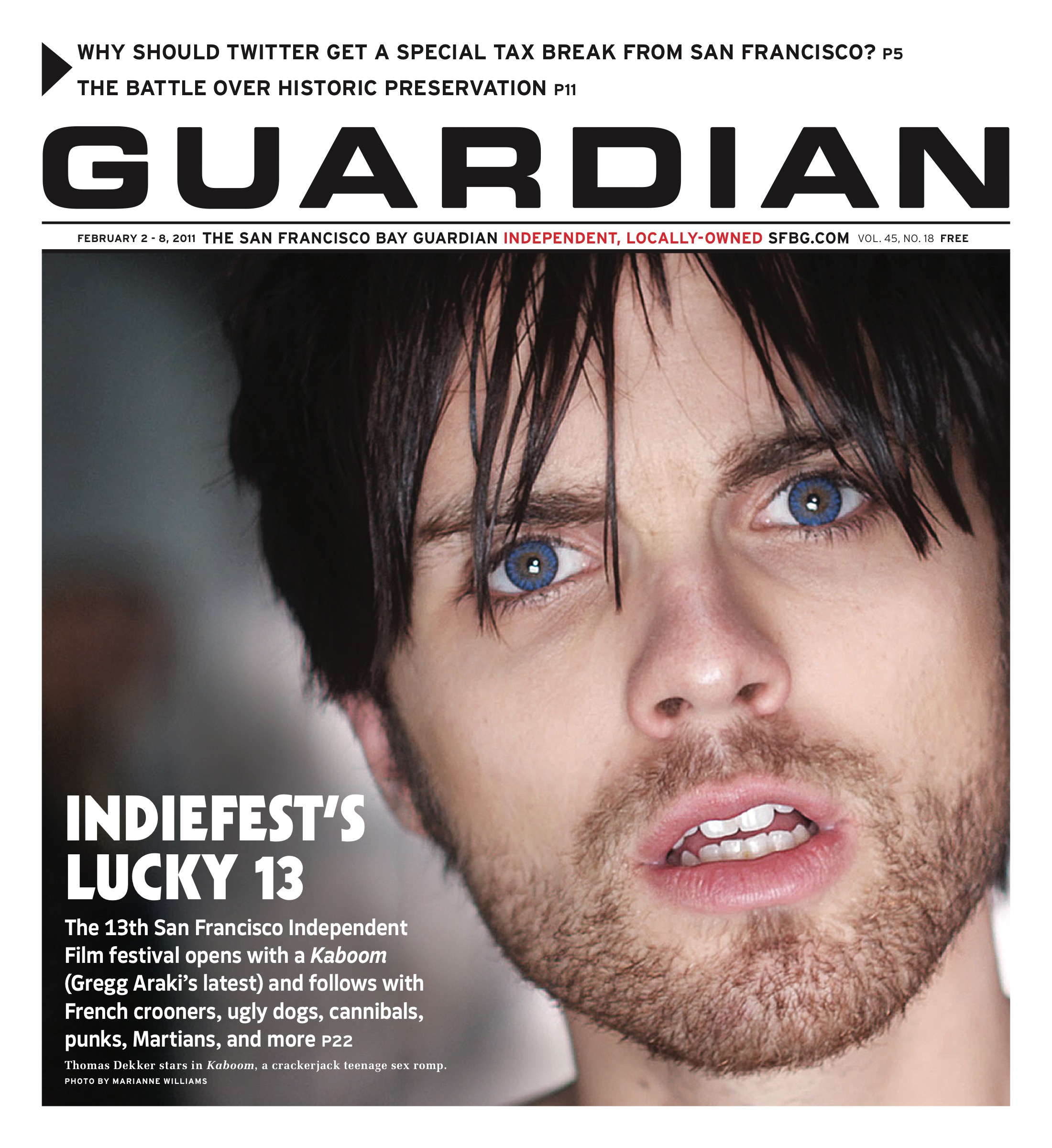
Kaboom (Gregg Araki, U.S.-France, 2010) Gregg Araki’s crackerjack teen sex romp is pure verve — a return to devil-may-care form for fans of The Doom Generation (1995) and Nowhere (1997). Kaboom is right: besides sneaking under the blue velvet rope for a classical mindfuck death trip (there’s even a good part for Jennifer Lynch), Araki and his winning cast let loose a fusillade of dorm-room chatter that runs metaphorical language to its limits. The cult-bidden mystery is too squarely accounted for, but then Kaboom is really as much The Palm Beach Story (1942) as Twin Peaks. Our coed heroes are Stella (Haley Bennett) and Smith (Thomas Dekker), and they’re the only platonic thing in the movie. Taken with Araki’s lasting affection for 1990s culture jamming, this rock-solid friendship is actually quite touching, but Kaboom works best when sliding up and down the Kinsey scale, huffing comic book paranoia for the fun of it. Thurs/3, 7 p.m. (Max Goldberg)

Mars (Geoff Marslett, U.S., 2010) Thanks to Mars, the question “Can mumblecore survive in outer space?” has been answered. (And it’s actually less annoying out there than it is on Earth!) Austin, Texas, writer-director Geoff Marslett’s rotoscope-animated tale follows three astronauts (including m-core heavy Mark Duplass) on a Mars mission, two of whom(Duplass and Zoe Simpson) spark romantically en route. Meanwhile, a solo robot delegation lands ahead of them, discovering new life forms and new emotions, as it sparks romantically, á la Wall-E (2008), with a Mars explorer thought lost a decade before. All the squee gets a little dippy toward the end, but the contrast between slacker and sci-fi genres mostly works. Added points for casting Texas hero Kinky Friedman as the POTUS; Giant Sand’s Howe Gelb did the film’s music and plays the sarcastic head of mission control. Fri/4, 9:15 p.m.; Mon/7, 7 p.m. (Eddy)

Special Treatment (Jeanne Labrune, France, 2010) Let’s get this out of the way first: Isabelle Huppert can do no wrong. That’s not to say she doesn’t occasionally pick terrible projects — she’s just never the thing that’s wrong with them. Special Treatment isn’t so much terrible as it is terribly misguided, contrasting the worlds of psychiatry and prostitution with broad, cartoonish strokes. Huppert plays Alice, a lady of the night who’s thinking about giving up the trade. I don’t blame her; the clients Special Treatment presents her with are the dullest of perverts. One wants her to dress up like a Japanese schoolgirl with a teddy bear and a giant lolly. Another goes the collar and dog bowl route. It’s 2011 — can’t we be a bit more creative with our fetishes? On the opposite end, there’s disenchanted therapist Xavier (Bouli Lanners). And wouldn’t you know it? His patients are photocopies from psychiatry textbooks. There’s a point to be made about the link between paying for sex and paying for someone to listen, but Special Treatment lacks the depth to drive it home. Sat/5 and Feb. 9, 7 p.m. (Peitzman)

Superstonic Sound: The Rebel Dread (Raphael Erichsen, U.K., 2010) “Everything I am came out of music,” says Don Letts — the second-generation Jamaican British DJ, director, and entrepreneur credited with turning punks on to reggae in the late 1970s — in this documentary about his life and work. Much like his contemporary, the late Malcolm McLaren, Letts was a cultural cross-pollinator, working in different mediums while encouraging subcultures to feedback into and off of each other to create something explosive and new. While this serviceable doc lets Letts himself retrace ground that’s been extensively covered elsewhere (it’s worth noting, though, that nearly all the archival footage used was shot by Letts himself), the scenes with his formerly estranged son, who’s also a DJ, are tender and unexpected. Feb. 12, 7 p.m.; Feb. 16, 9:15 p.m. (Matt Sussman)

Transformation: The Life and Legacy of Werner Erhard (Robyn Symon, U.S., 2010) The last thank you in the end credits of this documentary, in bold, is for Werner Erhard. The exiled former est leader and “personal growth” preacher or pioneer should thank director Robyn Symon — I think? – for Transformation, since it’s a 77-minute advertisement for him. Certainly, Erhard is a potentially rich choice in terms of subject matter, but very early on, it’s clear that Symon is out to paint a romantic, positive portrait: testimonials on his behalf are coupled with a low-volume acoustic guitar musical backdrop, and Erhard is even interviewed on the beach. Every once in a while an offhand moment — such as a brief mention of Scientology figurehead L. Ron Hubbard’s predatory view of Erhard — disrupts the soothing flow and opens the possibility of a broader, critical look at the “personal growth” phenomenon. (For the most part, it’s only been dramatized, usually through parody, in films such as 1999’s Magnolia and 1995’s Safe.) As a cultural and even historical figure, Erhard is worthy of an appraisal that’s neither enraptured nor utterly damning. This isn’t it. Thurs/3, 9:15 p.m.; Sat/5, 7 p.m.; Tues/8, 9:15 p.m. (Huston)

Worst in Show (Don Lewis, U.S., 2010) All films about animals in the competitive arena must acknowledge the fundamental truth that the animals themselves are nowhere near as entertaining as their owners. A dog just wants to play, eat, crap, sleep, and maybe have its belly rubbed. The dog’s owner, on the other hand, wants other things — titles, media attention, perhaps an endorsement deal — because they have convinced themselves (as they must convince the judges, and to some degree, the public) that their dog does not just want to play, eat, crap, sleep, and maybe have its belly rubbed. No! Their dog is special. Doc Worst in Show understands this basic drama and finds plenty of eager players in the canine and bipedal contenders, both new and returning, at Petaluma’s annual Ugliest Dog in the World Competition. Amid all the patchy fur, bad eyes, underbites, and malformed legs, it’s the big hearts and outsized egos that truly stand out in this portrait of pageant motherhood at its most extreme. Feb. 9, 9:15 p.m.; Feb. 13, 2:30 p.m. (Sussman)

Je T’aime, I Love You Terminal (Dani Mankin, Israel, 2010) It’s unfair to judge a film by its title, but Je t’aime, I Love You Terminal lets you know exactly what you’re in for. This twee indie romance is Before Sunrise (1995) meets Once (2006) meets every other twee indie romance you’ve ever seen. The film is more mediocre than it is bad, exploring the single-day love affair between two strangers stranded in Prague. Ben is moving from Israel to New York to marry the one that got away. Naturally, he also sings and plays guitar. Emily, an impulsive free spirit, teaches Ben a valuable lesson about living in the moment. Saying this story has been done before is an understatement: Je t’aime packs on indie cliché after indie cliché, without really bothering to develop Ben or Emily into interesting characters on their own. This is a retread without anything to distinguish it from the rest, dragging it down from shrug-worthy to eye-rolling. Feb. 12, 4:45 p.m.; Feb. 14, 9:15 p.m. (Louis Peitzman)

Every little star

0

HAIRY EYEBALL In 1979, the UC Berkeley Art Museum and Pacific Film Archive received a generous and somewhat unusual gift from the sister of the late German-born, pioneering American sculptor Eva Hesse: an assortment of small experimental works, made by Hesse herself, in materials such as latex, cloth, wax, fiberglass, wire mesh, and masking tape. What made these objects so unusual was their very indeterminacy. Should they be thought of as proper Hesse pieces? Were they studies for the large-scale sculptures that came to define Hesse’s output throughout the 1960s, or standalone technical experiments with different materials and processes? Alternately, were they intended to simply be as is — Hesse had given away similar objects as gifts and kept others arranged throughout her studio.

Hesse, who tragically died of a brain tumor in May 1970 at 34, left little to no indication. “Eva Hesse: Studiowork,” the stunner of an exhibit currently up at the Berkeley Art Museum, is then a homecoming of sorts for many of the pieces on display. Originally curated by Hesse scholar Briony Fer and Barry Rosen of the Hesse Estate for Edinburgh’s Fruit Market Gallery in 2009, this testament to the benefits of gutsy scholarship and cross-institutional support boldly embraces the precariousness of Hesse’s curious objects head-on and encourages us to see them on their own terms.

Entering the gallery space, you immediately encounter a group of previously unseen paper works arranged out in the open on a low plinth, like scattered autumn leaves. The forms vary in thicknesses and degrees of curvature: a worked shape of adhesive-enforced cheesecloth resembles a sunken pumpkin; a crinkled piece of tissue thin papier-mâché a bowl or shard of skull. The slightest breeze could send it flying. Hesse purposefully used fragile or impermanent substances — much to the bane of conservators — as a way to imbue her sculpture with a self-sustaining mutability, a means to continue the processes her initial crafting set into motion. In this sense, time is also one of her materials, as evinced by the caved-in latex bricks and box-like containers that have oxidized over the decades to a rich mahogany color.

The delicacy of the paper works is offset by the three large vitrines in the adjacent room each filled with a variety of objects that alternately read as: replicas of exotic coral or dried chili peppers; dirty jokes; rudimentary toy prototypes; or, more directly, obstinate lumps, variously crafted from latex, wax, painted wood and rubber tubing. The soft, round, protuberant forms of our bodies are evoked everywhere, and yet to call a fold of latex “vaginal” or a coil of tubing “intestinal” somehow feels inadequate to conveying the uncanny physicality of these pieces. It’s as if someone had made you a model of your own hand to hold.

“There is no wishing away the fact that it is hard to know what to make of these things because they are intractable in some way,” cautions Fer at the start of her warm and deeply perceptive catalog essay. Rather than function as a limitation, this interpretive resistance posed by the studio works invites us to un-see them as sculpture and to view Hesse’s careful making and undoing of material as posing a perhaps unnameable but immanently enriching possibility.


DOWN ON THE STREET

My first glimpse of Katy Grannan’s street photography was a startling color photo included in Fraenkel Gallery’s 30th anniversary show “Furthermore.” The picture was of an elderly woman wrapped in a mink stole, her face obscured by windswept gray hair as she walked down a sun-bleached street. When viewing it next to the other portraits in “Boulevard,” Grannan’s third solo show at Fraenkel, I realized it wasn’t so much the woman’s “odd” outward appearance that attracted the photographer, but the sense of purposefulness conveyed in her frozen stride.

It would be quite easy to dismiss the pictures in “Boulevard” on the grounds that Grannan is a latter-day Diane Arbus, inherently exploiting her “singular” subjects in the act of photographing them. Many appear to be regular denizens of the street — the homeless, addicts, hustlers — or are folks whose self-presentation defies established norms: an aging Marilyn Monroe impersonator, a trans woman with a 100-yard stare, an extremely hirsute biker-type.

Such a charge is unfair, and I suspect, likely the work of our own unease at looking at people who we would normally turn away from, or perhaps stare at furtively, if encountered on the street. Grannan, though, seems to want to give them their moment without overextending the encounter. Hence, a photograph. She doesn’t pose her subjects and none look directly at the camera. It’s as if, as with the fur-wrapped crone, she stopped them midstride, got her shot, and they went on their way. She respects their anonymity as well (each photo is titled after the city, Los Angeles or San Francisco, where it was taken). The discomfort in looking at Grannan’s work — she extends her gaze in The Believers, a related solo film installation at 1453 Valencia — partly comes from how technically accomplished and flawless it is: she shoots midday to capture her subject’s every wrinkle, blemish, and faded tattoo.

It feels off and disingenuous to call Grannan’s work “beautiful,” but it’s hard not to look and keep looking at the people in her neighborhood, some of whom are our neighbors as well.

EVA HESSE: STUDIOWORK

Through April 10, $5

Berkeley Art Museum

2626 Bancroft Way, Berk.

www.bampfa.berkeley.edu

KATY GRANNAN: BOULEVARD

Through Feb. 19, free

Fraenkel Galley

49 Geary, SF

www.fraenkelgallery.com

arts@sfbg.com

Landmark to loudness

0

MUSIC Happy Sanchez’s office is above the cafe, by the entrance. There are only a couple of windows. One opens onto the parking lot, where a car alarm blares during our interview. The other is dark; below it are the building’s two hourly rehearsal rooms. Aside from the vibration of a double bass revving, we’re cut off from the activity going on at Secret Studios. As the owner, Happy makes up for this isolation with a wall of closed-circuit TVs showing the hallways and common areas tying the Studio’s 130 monthly rehearsal spaces together.

“Mostly it’s just about dealing with the headaches of running a business,” Sanchez says. The headaches, when your clients are all musicians, can be numerous. Bands arrive at 2 a.m., fresh from a gig, and decide to toss utility carts down the stairs. People try to smoke inside, piss in the parking lot, live in their units. Watch out for speed freaks. Make sure women aren’t being harassed. “Sometimes I feel like I’m the principal of the school,” Sanchez says.

Sometimes it’s just plain traumatic. “The one thing that upset me the most, this fucking guy was pissed at his girlfriend, took her cat, put it in the [rehearsal] room, and left it for weeks. Fucking poor cat was skin and bones by the time the girlfriend came and asked me to look for it. Most I’ve ever been upset at anyone. He was banned.”

“But most of the time people are pretty cool,” Sanchez is quick to add. “The people who are on the lease are level-headed. It’s always the friend or the guy that’s just hanging out that makes problems.” There is reason for me to doubt this statement, having just heard Sanchez tell another story about being held up at gunpoint by a rapper who wants his demo tape. But I’m still inclined to believe him, given the sheer number of clients he’s come in contact with in the 25 years since he took a job as a studio manager at Secret Studios, back when it was a small two-room operation.

At the time, Secret, like most of the studios in town, was about hourly rehearsal and recording space. The two units of Secret Studios were originally at Third St., before a mid-1980s move to 215 Napoleon St. in a building with lots of neighbors. “Mostly we did a lot of punk rock recordings, back in ’87,” Sanchez remembers. “This guy David [Pollack], who I later bought the studio from, at the time I was just working for him and he set me up with all these gigs.” They’d rent the place out for parties, for extra money. “Metallica rented it, back in the days when I guess they were big in Europe but they weren’t really that big, yet. Before the Black Album [1991’s Metallica] came out, when they blew up.”

Those involved in Secret during the Napoleon Street era attempted to confine major sessions to nighttime, but it eventually became clear — as the neighbors bitched — that a different location was needed. After the owner sold the business to Sanchez (“Basically, he gave it to me at minimal cost”), he was able to expand and then move into 50 units at the current location on 2200 Cesar Chavez St. The large warehouse with a single floor of small rooms was previously the sound stage for the talk radio TV drama Midnight Caller.

Sanchez credits some of his success to timing. “I got in at the right time. It’s just more expensive to build nowadays. People have tried to build big studios like this and it’s just not affordable anymore. They see it as easy money, but it’s not easy to pull off.”

One person who tried — and succeeded — was Greg Koch, who developed the nearly 180-unit Downtown Rehearsal in 1992. Earlier, Sanchez had passed on its Third Street location. “It was shady at night when most of my clients would be around,” he says. “That building was cheap, though. They couldn’t give it away.”

Downtown was a major competitor until the summer of 2000, when Koch attempted to evict all of his tenants without notice in an attempt to flip the property for a huge profit. In the process, he instigated a musical community revolt, resulting in a large cash settlement and the formation of a then-hopeful, now apparently stagnant nonprofit, SoundSafe. At the time of the turmoil, Secret Studios was still expanding to its current size of 130 units. “I basically opened my units and saw a huge influx of bands,” Sanchez says.

Sanchez has had many models for what Secret Studios should — and shouldn’t — be. He recalls that Francisco Studios, a Turk Street basement space, had a bathroom out of Trainspotting. He’s quick to admit that since he’s taken over the business, there have been mistakes and failures. A plan to start the International DJ Academy in the front offices of the building, with a partner who managed Invisibl Skratch Piklz, fizzled. “They never could quite get it off the ground,” he says. “It was a good concept, but I think they needed someone to run it as a business.” Along with a rap studio that was going at the time, the academy devolved into something that included a barber shop and a night club before Sanchez had to shut it down.

Which, technically, makes two rap studios Sanchez had to end. Back in the late 1980s, at Secret’s old location, there was a lot of money to be made from hip-hop. “These rappers were coming in and you could pretty much just charge them anything,” Sanchez says. “I think there was always the drug dealer in the background financing it. I swear, we had like three clients over time that got murdered. The first time it was kind of a shock. They found the guy in a trunk in Oakland. The second guy got murdered on the night of the earthquake in 1989. The scene just got too crazy. Gangster rap came out, and the whole vibe changed. It got really hardcore.” After a hold-up occurred at the studio and an expensive keyboard was stolen, Sanchez stepped away from the rap game in 1991.

Many artists have come through Secret Studios, but it’s not something Sanchez brags about. In part this stems from his respect for overall security, a high priority when theft is a concern. But it also has to do with his respect for confidentiality. The music business exposed him to a lot of drugs in the ’80s, and he himself struggled with addiction. From 1989 until 1992, he hosted a Narcotics Anonymous gathering — the Straight Edge Rockers meeting — in the studio on Sunday nights. “There were a couple people there that you would definitely know their names,” he says. “I’m actually thinking about getting it going again. It’s not as easy to pull off, but I always thought that meeting was so cool. There are a lot of people in the music industry that need that.”

Sanchez is desensitized to stardom. He’ll say that no one really big has ever been at Secret Studios, then rattle off a long list of names: the Dead Kennedys, Michael Franti, the Go-Gos, EPMD, Romeo Void, Chris Isaak, Mike Pistel, Toots Hibbert. Some of these connections are long relationships, some are incidental. MC Hammer rehearsed at Secret before he was big (but had the parachute pants). Gene Simmons came down in a limo.

Sanchez is happy with his success so far and grateful for the freedom to be a musician with a stable business. With another 10 years on the lease (which he hopes to extend to when his two-and-a-half-year-old son reaches adulthood), he’s satisfied with assuming a more administrative role at Secret. He does the books, handles the day-to-day issues, and makes his own music, composing for movies and television as the Latin Soul Syndicate.

For a lot less drama, Sanchez is a little less in the know about his clients and their role in the scene of the moment. A while ago, for example, he needed to contact a band about a bill. But the band was on tour, and he was referred to its business manager. He went online to look it up. He had no idea who the band was until he Googled “The Dodos” and a video popped up showing the band playing on The Late Show with David Letterman.

www.secretstudios.com

arts@sfbg.com

Ollie beats

0

caitlin@sfbg.com

MUSIC Tommy Guerrero likes to skate down Potrero Hill. He’s been doing it since he was a young pup street boarder — one of the first to go pro, in fact — cruising down those steep residential declines that, looking south from SoMa, resemble like nothing so much as that scene from Inception where the dream city folds on top of itself. Guerrero skates smoothly from one legendary SF career to another, a shape-shift neatly illustrated by the release party for his eighth solo album Lifeboats and Follies at Cafe Du Nord Saturday, Feb. 5.

Despite the requests for autographs that he still gets; the occasional cravings his beat-up body experiences for skating (“It’s so raw and the energy is so fucking gnarly. Once you’ve had a taste of it, there’s no turning back.”); and a job that most ex-skate rats would kill for — he’s the art director for Krooked, a subset of Potrero Hill skate company Deluxe — he’s really more into music these days. “I would love to have all that time to work in the studio. I want to retire [from skate design] in a year,” he says, half-jokingly — but still longingly.

Maybe it’s a grass-is-always-greener thing, but until now he’s done a good job of balancing his various passions. Even in the 1980s and ’90s when Guerrero was grinding out his signature moves on the driveways and suicide hills of the city, back when he was popularizing Public Enemy in Japan by skating to the group’s tracks during competitions, music was always playing a supporting role. He and brother Tony played in punk bands, including Free Beer (a name that made for alluring concert flyers).

Nowadays Guerrero makes layered instrumental music that’s appropriately enough a mix of many different elements: chill jazz with electronic crescendos, a little Latin percussion, maybe a horn solo easefully inserted. Guerrero has a DJ-like impulse to play with genres. “I just hear so much shit in my head, this is what comes out.” Apparently his albums cause havoc in the Amoeba cataloging system. “I’ve seen it in electronic, rock, alternative, even experimental or some shit,” he laughs, sitting cross-legged in a patio booth at Thee Parkside, black leather Vans (his own signature design) on his feet.

He’s in the middle of doing some promotional work for Lifeboats and Follies, but like the rest of his projects, you get the feeling that Guerrero would be doing the same thing even if he never got paid a dime. After failing to resolve differences with his old label, Quannum, Guerrero bought the entire stock of his last album, From the Soul to the Soul, back from the company. He’s mulling over what to do with it — maybe give CDs away at Saturday’s show?

Guerrero never gained the Thrasher notoriety he got from skating in his musical career. But he casually mentions that he is, as the saying goes, big in Japan. He performs there a lot and gets off on being able to take risks with in his live performances that wouldn’t go over well with American audiences looking to hear the same old thing. “They can love J-pop and, at the same time, they can love John Zorn,” he says of his Japanese fans. It makes sense that Guerrero would gravitate toward an audience looking for a more diverse experience, one that trusts that whatever he’s popping off with — on the skateboard or mixing board — is gonna turn heads. 

TOMMY GUERRERO: LIFEBOATS AND FOLLIES RELEASE PARTY

Sat/5 9:30 p.m., $12

Cafe Du Nord

2170 Market, SF

(415) 861-5016

www.cafedunord.com>

The road, Thorrior

1

arts@sfbg.com

MUSIC There’s no easy way to describe Valient Thorr. Hailing from Chapel Hill, N.C., the quintet has labored throughout its career under the strain of countless casual characterizations, each less accurate than the one before it. Reached by phone in Raleigh, N.C., as he prepared for the band’s impending tour with Motorhead, singer Valient Himself gives the wry rundown.

“Forever, in The Onion, it said ‘Kiss-like band, biker band’ or some shit. None of us ride motorcycles!” he scoffs. Nor, for that matter, does the band wear elaborate makeup or sell branded coffins. The mistakes, however, continued. “People would say something like ‘Lynyrd Skynyrd-esque’ or some shit like that,” complains Valient. “We don’t play Southern rock. We have accents from the South because those are the colloquialisms that we have been accustomed to since we crash-landed here. Or they look at ‘Thorr’ and they say, ‘Oh, they’re Vikings.’ If you could pick three adjectives that we get called the most that are totally wrong, they’d be Southern, Viking, biker metal.”

Now, if you’ve been paying attention so far, you’ll have noticed that the singer goes by an outlandish pseudonym and makes offhand references to things like “crash landing.” By “here,” in the previous paragraph, he means “planet Earth.” This is because the band Valient Thorr claims, with a straight face, to be from the inside of the planet Venus. Valient Himself, a former sixth-grade teacher, sticks to his story throughout the interview, even when gently prodded to discourse on non-Venusian topics.

The band’s beginnings can be traced to East Carolina University, where the five Thorrs (Valient Himself, Eidan, Lucian, Sadat, and Dr. Professor Nitewolf Strangees Thorr) were masquerading as undergraduates. Nurtured by the college radio culture that defined their adopted home state for much of the 1990s, the band soon discovered the geographic advantages of hailing from the Tar Heel State, which features nine midsized cities along the axis of Highway 40, which neatly bisects it into northern and southern halves.

Before long, Valient Thorr was traveling nationwide, hitting 47 cities in 52 days on its first trip out. This relentless dedication to touring would come to define the band, which has effectively been on tour since Valient’s career in the classroom ended in 2005. That event also marked the last time he cut his beard, a fiery red thatch that has since attained truly epic proportions.

Though Valient Thorr’s music — a combination of the rabid, breakneck pace of punk rock and the precision guitar work of classic Thin Lizzy — produces some infectious, exultant tunes, the onstage charisma of the band in general and the singer in particular forms the most important part of its appeal. Clad in impossibly tight pants, cherry-red wrestling shoes, and little else, Valient prowls the stage soaked in sweat, striking mock-muscleman poses and exhorting the audience with the inexhaustible, manic energy of a true rock ‘n’ roll evangelist.

The power of Valient Thorr’s proselytizing can be seen at any show. A growing legion of die-hard fans, called Thorriors, pledge allegiance to the band above all others, often sporting customized jean jackets as emblems of their dedication. In that sense, at least, the band is like Kiss. One Thorrior, a Kansas City native, has even been granted an honorary Venusian surname; “Tim Thorr,” as he is known, “has more Thorrior tattoos than anyone else” explains Valient. “We call him the True Believer.”

Touring with a band as well-known as Motorhead, Valient Thorr is sure to win more converts to its cause. But whether people like it or not, or whether they believe it or not, the Thorrs will be out there. “I think performing is in your blood,” Valient says. “I think everyone was born to do something. We didn’t go to school to be rock ‘n’ rollers — it’s just something that came out of us. It’s an idea that started and it just had to happen.” *

VALIENT THORR with Motorhead, Clutch

Wed/2, 8 p.m.; $35

The Warfield

982 Market, SF

(415) 345-0900

www.thewarfieldtheatre.com


Dreadfully fun

0

Dead Space 2

(Visceral Games/Electronic Arts), Xbox 360, PS3, PC

GAMER Survival horror might be the game genre most affected by the environment it’s played in. You’ll see the best results when a player agrees to meet the title halfway: turning out the lights and turning up the volume. Then it’s up to the developers to deliver on their half of the equation. Though generally lauded when it released in 2008, the original Dead Space launched with promise but ultimately was content to repeat itself for the majority of its playtime.

Dead Space 2 delivers. An homage to movies like 1979’s Alien and 1997’s Event Horizon (which it most closely resembles), the Dead Space series is set in a future where space travel allows humans to embark on “planet cracking” missions, wherein all celestial bodies of the galaxy are prime meat for resource-exhausting expeditions. On one such expedition the shuttle finds an alien artifact, contagion, blah blah blah … zombies. A pretty first-rate “previously on” feature in the main menu will catch anyone up to speed.

As engineer Isaac Clarke, it’s up to you to survive this “necromorph” outbreak, this time aboard a space station named the Sprawl. Armed with a ton of weaponry and a little kinetic energy module, you’ll have to escape another apocalypse of the undead, as always by dismembering their arms and legs (and tentacles).

Perhaps taking a cue from last year’s Mass Effect 2‘s streamlining successes, Dead Space 2 is far more linear and cinematic than its predecessor. But unlike that other similarly space-themed sequel, the divide between what is lost and what is gained in the transition is far less apparent. In embracing the hallmarks of any good survival horror series — jump scares, the feeling of dread around each corner, and limited supplies — this sequel is less about innovation than it is about refinement.

Contrary to the drab shuttle hallways of the first game, the Sprawl was once a bustling metropolis and the environments you encounter are much more varied. From a church to a mall to zero-gravity space walks, the freshness in each area keeps it exciting. While the scares range from terrifyingly atmospheric (a bloodstained and deserted daycare center is especially eerie) to inelegant “monster closets” where enemies pop out of vents as you walk past, the game is never boring.

After a promising debut and a bit of a misstep with the God of War-aping Dante’s Inferno (2010), with Dead Space 2 developer Visceral Games has crafted an adventure that begs to be played more than once. Aspects remain overly familiar but, like the best franchises, the Sprawl provides players with a compelling setting and sense of dread that they’ll happily return to.

Stage Listings

0

THEATER

ONGOING

Audition – A Play Exit Theater, 156 Eddy; (800) 838-3006, www.brownpapertickets.com. Call for price. Thurs and Sat, 8pm; Sun, 3pm. Through Feb 13. GenerationTheatre presents a comedy of the absurd by Roland David Valayre.

Bone to Pick and Diadem Exit on Taylor, 277 Taylor; (800) 838-3006, www.cuttingball.com. $15-50. Thurs-Sat, 8pm; Sun, 5pm. Through Feb 13. Cutting Ball Theatre presents a pair of plays by Eugenie Chan.

Clue Boxcar Playhouse, 505 Natoma; 776-1747, www.boxcartheatre.org. $15-35. Wed-Fri, 8pm; Sat, 7 and 10pm. Through Feb 19. A play based on a film based on a board game is just the kind of tangled genealogy much goodtime theater is made of these days. So there’s nothing too new about Boxcar’s stage adaptation of the manic 1985 comedy derived from a once popular Parker Bros. diversion. In fact, it’s at least the second stage adaptation of same to be offered in San Francisco. (Impossible Productions remounted its version at the Dark Room just last year.) Nevertheless, led by adapter-director Nick A. Olivero, Boxcar’s production pursues its vision like a mad yen, with a loving fidelity and self-referential glee that are not so much inspired as just plain zealous (although Olivero’s scenic design does reach new heights: a TV-toned board-game set that the audience peers down on from six-feet-high balconies ringing the stage). Performances are dutiful and solid for the most part, with especially nice work from Brian Martin (as the butler) and J. Conrad Frank (as Mrs. Peacock). Although there’s something vaguely and not unpleasantly hypnotic about it all, groups of cult-film line-gleaners may be the best audience for this one. (Avila)

*The Companion Piece Z Space at Theatre Artaud, 450 Florida; (800) 838-3006, www.zspace.org. $20-$40. Thurs 7pm; Fri-Sat, 8pm; Sun, 5pm. Through Feb 13. Z Space presents the world premiere of a new play by Mark Jackson, with Beth Wilmurt and Christopher Kuckenbaker.

Next to Normal Curran Theatre, 445 Geary; (888) SHN-1799, www.shnsf.com. $30-99. Call for dates and times. Through Feb 20. Diana Goodman (Alice Ripley) is a woman too restlessly witty and big-souled to sit easy in the suburban home she shares with her husband (Asa Somers), 16-year-old daughter (Emma Hunton), and 18-year-old son (Curt Hansen). What’s worse, the 18-year-old died as a baby about 17 years ago, and has not been taking the news lying down. A mother’s grief winds through this sometimes clever, mostly sappy, and ultimately tedious Broadway rock musical about a bipolar woman and the impact of her illness on her family. Director Michael Greif’s (Rent) kinetic staging takes place across a three-level industrial-box set that houses musicians in its outer corners as well as the stereotypical family dwelling in its center. The set’s outer façade (moving panels featuring giant eyes and mouth) meanwhile suggests the whole thing as a model of the mind we’re witnessing come apart. The 2008 musical by Brian Yorkey (book and lyrics) and Tom Kitt (music) won a Pulitzer for its supposedly bold depiction of mental illness. But despite reasonable scoffing at the paternalistic, pharmacologically fueled regime of mainstream treatment (embodied by Jeremy Kushnier’s various doctors), neither Tony-winner Ripley’s jagged performance nor Yorkey’s book transcends a stultifying and finally grating set of narrative clichés, which the driving, mostly generic-sounding score only makes more obvious. A Woman Under the Influence this isn’t. (Avila)

Out of Sight The Marsh, 1062 Valencia; (800) 838-3006, www.themarsh.org. $15-35. Thurs and Sat, 8pm; Sun, 3pm. Through Feb 13. The Marsh presents a new solo show by Sara Felder.

Party of 2 – The New Mating Musical Shelton Theater, 533 Sutter; (800) 838-3006, www.partyof2themusical.com. $27-29. Sun, 3pm. Open-ended. A musical about relationships by Shopping! The Musical author Morris Bobrow.

*Pearls Over Shanghai Thrillpeddlers’ Hypnodrome, 575 Tenth St; 1-800-838-3006, www.brownpapertickets.com. $30-69. Sat, 8pm. Through April 9. Thrillpeddlers’ acclaimed production of the Cockettes musical continues its successful run.

Spalding Gray: Stories Left to Tell Gough Street Playhouse, 1620 Gough; (510) 207-5774, www.custommade.org. $10-25. Thurs-Sat, 8pm. Through Feb 19. Custom Made Theatre presents stories by the late writer and performer.

Treefall New Conservatory Theatre Center, 25 Van Ness; 861-8972, www.nctsf.org. $24-40. Call for dates and times. Through Feb 27. New Conservatory Theatre Center presents a tale of erotic attraction by Henry Murray.

BAY AREA

The Agony and the Ecstasy of Steve Jobs Berkeley Rep, Thrust Stage, 2025 Addison, Berk; (510) 647-2949, www.berkeleyrep.org. $14.50-73. Call for dates and times. Through Feb 27. Storyteller Mike Daisey spins a yarn about the Apple head.

Collapse Aurora Theatre, 2081 Addison, Berk; (510) 843-4822, www.auroratheatre.org. $34-55. Wed-Sat, 8pm; Sun, 2 and 7pm; Tues, 7pm (also Feb 19, 2pm). Through March 6. Aurora Theatre presents a comedy by Allison Moore.

East 14th – True Tales of a Reluctant Player The Marsh Berkeley, 2120 Allston Way, Berk; (800) 838-3006, www.themarsh.org. $20-50. Call for times. Through Feb 13. Don Reed’s one-man show continues its extended run.

Grapes of Wrath Marion E. Green Black Box Theater, 531 19th, Oakl; www.theatrefirst.com. $10-30. Thurs-Sat, 8pm; Sun, 2pm. TheatreFIRST presents Frank Galati’s stage adaptation of the John Steinbeck novel.

Heartbreak House Live Oak Theatre, 1301 Shattuck, Berk; (510) 649-0999, www.berkeleyrep.org. $12-15. Fri-Sat, 8pm (also Feb 13, 2pm; Feb, 17, 8pm). Through Feb 19. Actors Ensemble of Berkeley presents the George Bernard Shaw comedy set just before World War I.

The Last Cargo Cult Berkeley Repertory Theatre, Thrust Stage, 2025 Addison, Berk; (510) 647-2949, www.berkeleyrep.org. $14.50-73. Call for dates and times. Through Feb 20. As fans of J. Maarten Troost have learned, life on an island “paradise” is far less idyllic than the imagination yearns to believe. So it’s hardly surprising that Mike Daisey’s monologue The Last Cargo Cult begins with a white-knuckle ride in a prop plane piloted by a man with a milky eye. Daisey’s destination, the Pacific island of Tanna, is the location of one of the world’s last so-called “cargo cults”, and their big celebration “John Frum Day” is approaching. Daisey’s intention to hang out at the festivities smacks a little of entitled voyeurism, but the parallel he manages to draw between the complexities of a religion dedicated to a mythical cargo of “awesome shit”, and our own dedication to the acquisition of same, is a striking one. From our almost blind faith in the value of basically valueless currency, to our even blinder faith that indenturing ourselves by debt will enrich us, the foundations of our own “cargo cult” are revealed smartly by Daisey to be just as precarious as if built at the base of a volcano as in Tanna. Still, I found the most revealing thing about the evening to be the moment when the couple next to me took off with a $100 bill they’d acquired free-of-charge at the door, to which I can’t help but ask them: “Did you get your money’s worth?” (Gluckstern)

Not a Genuine Black Man The Marsh Berkeley, TheaterStage, 2120 Allston, Berk; 826-5750, www.themarsh.org. $20-50. Fri, 8pm. Through Feb 18. Brian Copeland brings back his long-running solo show.

Strange Travel Suggestions The Marsh Berkeley, Cabaret, 2120 Allston Way, Berk; (800) 838-3006, www.themarsh.org. $15-35. Thurs-Fri, 8pm; Sat, 5pm. Through Feb 19. Jeff Greenwald stars in a one-man show about the vagaries of wanderlust.

The 39 Steps TheatreWorks at the Mountain View Center for the Performing Arts, 500 Castro, Mtn View; (650) 463-1960, www.theatreworks.org. $24-79. Tues-Wed, 7:30pm; Thurs-Fri, 8pm; Sat, 2 and 8pm; Sun, 2 and 7pm. Through Feb 13. TheatreWorks presents Patrick Barlow’s comic adaptation of the book and movie of the same name.

World’s Funniest Bubble Show The Marsh Berkeley, 2120 Allston Way, Berk; (800) 838-3006, www.themarsh.org. $8-11. Sun, 11am. Through April 3. The Amazing Bubble Man extends the bubble-making celebration.

PERFORMANCE/DANCE

BAY AREA

Marga’s Funny Mondays The Cabaret at The Marsh Berkeley, 2120 Allston; (800) 838-3006, www.themarsh.org. Mon/7, 8pm. $10. Marga Gomez hosts a Monday night comedy series.


Stage listings are compiled by Guardian staff. Performance times may change; call venues to confirm. Reviewers are Robert Avila, Rita Felciano, and Nicole Gluckstern. Submit items for the listings at listings@sfbg.com. For further information on how to submit items for the listings, see Picks. For complete listings, see www.sfbg.com.

Rep Clock

0

Schedules are for Wed/2–Tues/8 except where noted. Director and year are given when available. Double and triple features are marked with a •. All times are p.m. unless otherwise specified.

ARTISTS’ TELEVISION ACCESS 992 Valencia, SF; www.atasite.org. $6-10. “Reagan’s 100th Birthday,” a collection of the former Prez’s finest and most ironic on-screen moments curated by Bryan Boyce, Sun, 7:30.

CASTRO 429 Castro, SF; (415) 621-6120, www.castrotheatre.com. $7.50-10. “SF Sketchfest Great Collaborators Series: Tribute to Murphy Brown,” with Candice Bergen and Diane English in person for a Q&A moderated by Connie Chung, Wed, 7. For more info on this event (tickets, $25), visit www.sfsketchfest.com. “Anne Francis: 1930-2011:” •Bad Day at Black Rock (Sturges, 1955), Fri, 1:30, 5:05, 8:55, and Forbidden Planet (Wilcox, 1956), Fri, 3:10, 7. “SF Sketchfest: True Stories 25th Anniversary: David Byrne in Conversation with Paul Myers:” True Stories (Byrne, 1986), Sat, 5. For more info on this event (tickets, $35), visit www.sfsketchfest.com. “SF Sketchfest and Midnight Mass present Idol Worship: An Evening with Cloris Leachman hosted by Peaches Christ:” High Anxiety (Brooks, 1977), Sat, 8:30. For more info on this event (tickets, $25), visit www.sfsketchfest.com.

CHRISTOPHER B. SMITH RAFAEL FILM CENTER 1118 Fourth St, San Rafael; (415) 454-1222, www.cafilm.org. $6.50-10.25. The Illusionist (Chomet, 2010), call for dates and times. Nuremberg: Its Lesson for Today (Schulberg, 1948/2010), call for dates and times. “Mostly British Film Festival:” Topp Twins: Untouchable Girls (Pooley, 2009), Mon, 7; The Ipcress File (Furie, 1965), Tues, 7.

COUNTERPULSE 1310 Mission, SF; www.counterpulse.org. $5-10. “50Faggots: How Gay Do You Want to Be Today,” Sat, 3. Screening of online documentary series followed by discussion with director Randall Jenson.

GRAY AREA FOUNDATION FOR THE ARTS 55 Taylor, SF; www.cinemaspeakeasy.com. $5. “Cinema Speakeasy: San Francisco Presents Shorts!”, Thurs, 8.

HUMANIST HALL 390 27th St, Oakl; www.humanisthall.org. $5. South of the Border (Stone, 2009), Wed, 7:30.

MECHANICS’ INSTITUTE 57 Post, SF; (415) 393-0100, rsvp@milibrary.org. $10. “CinemaLit Film Series: New Year’s Revolutions:” Libeled Lady (Conway, 1936), Fri, 6.

PACIFIC FILM ARCHIVE 2575 Bancroft, Berk; (510) 642-5249, www.bampfa.berkeley.edu. $5.50-9.50. “Film 50: History of Cinema: Fantasy Films and Realms of Enchantment:” The Cabinet of Dr. Caligari (Wiene, 1920), Wed, 3:10. “Radical Light: Alternative Film and Video in the San Francisco Bay Area:” “Found Footage Films,” Wed, 7:30; “Versions of Veracity: Video, the 1980s,” Sun, 5:30. “African Film Festival 2011:” Shirley Adams (Hermanus, 2009), Thurs, 7; Beyond the Ocean (de Latour, 2008), Sat, 6:30. “Suspicion: The Films of Claude Chabrol and Alfred Hitchcock:” La Femme Infidèle (Chabrol, 1969), Fri, 7; Violette Nozière (Chabrol, 1978), Fri, 9; Vertigo (Hitchcock, 1958), Sat, 8:35. “School Days:” “Screenagers: 13th Annual Bay Area High School Film and Video Festival,” Sat, 3:30. “Cruel Cinema: New Directions in Tamil Film:” Paruthiveeran (Sultan, 2007), Sun, 2.

RED VIC 1727 Haight, SF; (415) 668-3994; www.redvicmoviehouse.com. $6-10. Ziggy Stardust and the Spiders from Mars (Pennebaker, 1973), Wed-Thurs, 2, 7:15, 9:15. Unstoppable (Scott, 2010), Fri-Sat, 7:15, 9:20 (also Sat, 2, 4). Every Man For Himself (Godard, 1980), Sun-Mon, 7:15, 9:15 (also Sun, 2, 4). The Jerk (Reiner, 1979), Feb 8-9, 7:15, 9:20 (also Feb 9, 2).

ROXIE 3117 and 3125 16th St, SF; (415) 863-1087, www.roxie.com. $5-9.75. Lemmy (Olliver and Orshoski, 2010), Wed, 7, 9:30. San Francisco Independent Film Festival, Feb 3-17. See film listings or www.sfindie.com for more info.

WAR MEMORIAL VETERANS BUILDING 401 Van Ness, SF; www.upheavalproductions.com. Free. Occupation Has No Future: Militarism and Resistance in Israel/Palestine (Zlutnick, 2020), Thurs, 7:30. Screening followed by a discussion with director David Zlutnick and members of Dialogues Against Militarism. YERBA BUENA CENTER FOR THE ARTS 701 Mission, SF; (415) 978-2787, www.ybca.org. $6-8. “Volume 14: Middle East,” nine videos focusing on the Middle East compiled by ASPECT: The Chronicle of New Media Art, Jan 13-March 27 (gallery hours Thurs-Sat, noon-8; Sun, noon-6). Shoah (Lanzmann, 1985), Sat, 1 (first half); Sun, 1 (second half); Feb 13, 11am (complete film with one-hour break). 

Music Listings

0

WEDNESDAY 2

ROCK/BLUES/HIP-HOP

Corruptors, Heroine, Vanishing Breed Knockout. 9:30pm, $6.

Generalissimo, Blind Shake, Guitar vs. Gravity Hotel Utah. 9pm, $7.

Bobby Long Café Du Nord. 9:30pm, $15.

*Motorhead, Clutch, Valient Thorr Warfield. 8pm, $38.

Professor Burns and the Lilac Field, Eric Maskol, Maya Dorn Milk. 8:30pm, $5.

Das Racist, Hottub, DJ Vin Soi Independent. 8pm, $15.

Sweet Chariot, Victory and Associates, Calls Elbo Room. 9pm, $6.

Tristen, Billy and Dolly, Corner Laughers Rickshaw Stop. 8pm, $10.

Tunnel, Foolproof Four, Word Bottom of the Hill. 9pm, $8.

Wood Brothers Yoshi’s San Francisco. 8pm, $17.

JAZZ/NEW MUSIC

Dink Dink Dink, Gaucho, Michael Abraham Amnesia. 7pm, free.

Ben Marcato and the Mondo Combo Top of the Mark. 7:30pm, $10.

Michael Parsons Revolution Café, 3248 22nd St, SF; (415) 642-0474. 8:30pm, free.

Paula West and George Mesterhazy Quartet Rrazz Room. 8pm, $35.

DANCE CLUBS

Booty Call Q-Bar, 456 Castro, SF; www.bootycallwednesdays.com. 9pm. Juanita Moore hosts this dance party, featuring DJ Robot Hustle.

Cannonball Beauty Bar. 10pm, free. Rock, indie, and nu-disco with DJ White Mike.

Hands Down! Bar on Church. 9pm, free. With DJs Claksaarb, Mykill, and guests spinning indie, electro, house, and bangers.

Jam Fresh Wednesdays Vessel, 85 Campton, SF; (415) 433-8585. 9:30pm, free. With DJs Slick D, Chris Clouse, Rich Era, Don Lynch, and more spinning top40, mashups, hip hop, and remixes. Mary-Go-Round Lookout, 3600 16th St, SF; (415) 431-0306. 10pm, $5. A weekly drag show with hosts Cookie Dough, Pollo Del Mar, and Suppositori Spelling.

Respect Wednesdays End Up. 10pm, $5. Rotating DJs Daddy Rolo, Young Fyah, Irie Dole, I-Vier, Sake One, Serg, and more spinning reggae, dancehall, roots, lovers rock, and mash ups.

Synchronize Il Pirata, 2007 16th St, SF; (415) 626-2626. 10pm, free. Psychedelic dance music with DJs Helios, Gatto Matto, Psy Lotus, Intergalactoid, and guests.

THURSDAY 3

ROCK/BLUES/HIP-HOP

Ólafur Arnalds Great American Music Hall. 8pm, $17.

Shawn Colvin Yoshi’s San Francisco. 8pm, $34.

Leather Feather, Heart Touch, Dr. Madd Vibe, Sistas in the Pit, Punk Funk Mob Cellspace, 2050 Bryant, SF; www.sfindie.com. 9pm, $10. Part of SF Winter Music Festival.

Limousines, Aaron Axelsen, Miles the DJ Rickshaw Stop. 10pm, $12. Presented by Popscene.

Little Creatures, Casy and Brian El Rio. 10pm, free.

Mangled Bohemians, Lickets, Shores Hemlock Tavern. 9pm, $6.

Mercury Falls Kaleidoscope, 3109 24th St, SF; www.kaleidoscopefreespeechzone.com. 9pm, $8.

Midnight Snackers, Badugi, Late Night Drive Kimo’s. 9pm, $6.

Mofo Party Band Biscuits and Blues. 8 and 10pm, $16.

Nels Cline Singers with Yuka C. Honda, Paul Riola Independent. 8pm, $16.

Social Distortion, Aggrolites, Chuck Ragan Warfield. 9pm, $35.

Tennis, Lord Huron, Air Waves Bottom of the Hill. 9pm, $12.

That Ghost, Hymn for Her Amnesia. 9pm.

Toasters, Inciters Red Devil Lounge. 8pm, $12.

JAZZ/NEW MUSIC

Dastardly Revolution Café, 3248 22nd St, SF; (415) 642-0474. 8:30pm, free.

Stompy Jones Top of the Mark. 7:30pm, $10.

Paula West and George Mesterhazy Quartet Rrazz Room. 8pm, $40.

FOLK/WORLD/COUNTRY

Country Casanovas Atlas Café. 8pm, free.

DANCE CLUBS

Afrolicious Elbo Room. 9:30pm, $10. DJs Pleasuremaker and Señor Oz spin Afrobeat, tropicália, electro, samba, and funk.

Caribbean Connection Little Baobab, 3388 19th St, SF; (415) 643-3558. 10pm, $3. DJ Stevie B and guests spin reggae, soca, zouk, reggaetón, and more.

Club Jammies Edinburgh Castle. 10pm, free. DJs EBERrad and White Mice spinning reggae, punk, dub, and post punk.

Drop the Pressure Underground SF. 6-10pm, free. Electro, house, and datafunk highlight this weekly happy hour.

Electric Feel Lookout, 2600 16th St, SF; www.fringesf.com. 9pm, $2. Indie music video dance party with subOctave, Blondie K, and guest DJ Lifeline.

Good Foot Som., 2925 16th St, SF; (415) 558-8521. 10pm, free. With resident DJs Haylow, A-Ron, Prince Aries, Boogie Brown, Ammbush, plus food carts and community creativity.

Guilty Pleasures Gestalt, 3159 16th St, SF; (415) 560-0137. 9:30pm, free. DJ TophZilla, Rob Metal, DJ Stef, and Disco-D spin punk, metal, electro-funk, and 80s.

Holy Thursday Underground SF. 10pm, $5. Bay Area electronic hip hop producers showcase their cutting edge styles monthly.

JFK of MSTRKRFT, Nisus, Shane King Mighty. 9pm, $15.

Jivin’ Dirty Disco Butter, 354 11th St., SF; (415) 863-5964. 8pm, free. With DJs spinning disco, funk, and classics.

Koko Puffs Koko Cocktails, 1060 Geary, SF; (415) 885-4788. 10pm, free. Dubby roots reggae and Jamaican funk from rotating DJs.

Lacquer Beauty Bar. 10pm-2am, free. DJs Mario Muse and Miss Margo bring the electro.

Mestiza Bollywood Café, 3376 19th St, SF; (415) 970-0362. 10pm, free. Showcasing progressive Latin and global beats with DJ Juan Data.

Peaches Skylark, 10pm, free. With an all female DJ line up featuring Deeandroid, Lady Fingaz, That Girl, and Umami spinning hip hop.

FRIDAY 4

ROCK/BLUES/HIP-HOP

Seth Augustus Revolution Café, 3248 22nd St, SF; (415) 642-0474. 9pm, free.

Les Aus, Huan Hemlock Tavern. 9:30pm, $8.

“Battle of the Bands: Finals” DNA Lounge. 5:30pm, $12. With Handshake, Thy Winter Shadow, Boondock Squad, and more.

Blisses B, Acadia Collective, Ben Keeler Hotel Utah. 9pm, $8.

Ethan Bortnick and His Musical Time Machine Regency Ballroom. 8pm, $29-50-39.50.

Cat Power Fillmore. 9pm, $35.

Church Great American Music Hall. 8pm, $35.

Shawn Colvin Yoshi’s San Francisco. 8pm, $34.

Definite Articles, She Beards, Gems, Bryan McPherson Bottom of the Hill. 9:30pm, $10.

Exrays, Tim Cohen’s Magick Trick, Fiveng, DJ Cyclist Café Du Nord. 9pm, $12.

“14th Annual One Night Stand” Slim’s. 8pm, $13. Local bands perform cover songs.

Frail, Rykarda Parasol, Slpwlkrs Rickshaw Stop. 8pm, $10-15.

Hi-Rhythm Hustlers, Slim Jenkins Verdi Club, 2424 Mariposa, SF; www.oldtimey.net. 9pm, $10.

Claudette King Biscuits and Blues. 8 and 10pm, $20.

Los Shimmy Shakers, Foolproof Four, Taxes, Yoma Band, Shit Outta Luck, Thief, Nervous Energy Cellspace, 2050 Bryant, SF; www.sfindie.com. 8pm, $10. Part of SF Winter Music Festival.

Social Distortion, Lucero, Chuck Ragan Warfield. 9pm, $35.

FOLK/WORLD/COUNTRY

Forro Brazuca, DJ Alfie1Bateria Elbo Room. 10pm, $10.

Valerie Orth and friends Red Poppy Art House. 8pm, $10-15.

JAZZ/NEW MUSIC

Black Market Jazz Orchestra Top of the Mark. 9pm, $10.

Paula West and George Mesterhazy Quartet Rrazz Room. 8pm, $45.

DANCE CLUBS

Braza! Som.10pm, $10. With DJs Vanka, Elan, and Caasi.

Deeper 222 Hyde, 222 Hyde, SF; (415) 345-8222. 9pm, $10. With rotating DJs spinning dubstep and techno.

Dirty Rotten Dance Party Madrone Art Bar. 9pm, $5. With DJs Morale, Kap10 Harris, and Shane King spinning electro, bootybass, crunk, swampy breaks, hyphy, rap, and party classics.

Exhale, Fridays Project One Gallery, 251 Rhode Island, SF; (415) 465-2129. 5pm, $5. Happy hour with art, fine food, and music with Vin Sol, King Most, DJ Centipede, and Shane King.

Fubar Fridays Butter, 354 11th St., SF; (415) 863-5964. 6pm, $5. With DJs spinning retro mashup remixes.

Good Life Fridays Apartment 24, 440 Broadway, SF; (415) 989-3434. 10pm, $10. With DJ Brian spinning hip hop, mashups, and top 40.

Hot Chocolate Milk. 9pm, $5. With DJs Big Fat Frog, Chardmo, DuseRock, and more spinning old and new school funk.

Rockabilly Fridays Jay N Bee Club, 2736 20th St, SF; (415) 824-4190. 9pm, free. With DJs Rockin’ Raul, Oakie Oran, Sergio Iglesias, and Tanoa “Samoa Boy” spinning 50s and 60s Doo Wop, Rockabilly, Bop, Jive, and more.

Some Thing Stud. 10pm, $7. VivvyAnne Forevermore, Glamamore, and DJ Down-E give you fierce drag shows and afterhours dancing.

Strangelove Cat Club. 10pm, $6. Six-year anniversary featuring goth and industrial with DJs Tomas Diablo, Joe Radio, Xander, and Orko.

Vintage Orson, 508 Fourth St, SF; (415) 777-1508. 5:30-11pm, free. DJ TophOne and guest spin jazzy beats for cocktalians.

SATURDAY 5

ROCK/BLUES/HIP-HOP

Communist Kayte, Icekats and the Mengz Thee Parkside. 3pm, free.

Devil’s Brigade, Roger Miret and the Disasters Thee Parkside. 9pm, $12.

*400 Blows, Skinwalker, Longmont Potion Castle El Rio. 10pm, $8.

Tommy Guerrero Café Du Nord. 9:30pm, $12.

Hurry Up Shotgun, X-Ray Press, Third Victim of Abigail Rutledge Hemlock Tavern. 9:30pm, $6.

Lakeside Yoshi’s San Francisco. 8 and 10pm, $25-35.

Led Zeppelin 2 Slim’s. 9pm, $16.

Rod Piazza and the MIghty Flyers Biscuits and Blues. 8 and 10pm, $22.

Pollux, Pine and Battery, Lite Brite, Gentlemen Bottom of the Hill. 9pm, $12.

Grace Potter and the Nocturnals Fillmore. 9pm, $20.

Roy G. Biv and the Mnemonic Devices, Semi Feral, Aaron Lee and the Love Vigilantes, Sorry Mom and Dad Kimo’s 9pm, $8.

JAZZ/NEW MUSIC

Paula West and George Mesterhazy Quartet Rrazz Room. 8pm, $45.

FOLK/WORLD/COUNTRY

Brothers Comatose, Green String Farm Band Amnesia. 9pm, $7.

Rodney Crowell Great American Music Hall. 9pm, $26.

I.R.B. Revolution Café, 3248 22nd St, SF; (415) 642-0474. 9pm, free.

“Khaliji Night” Arab Cultural and Community Center, Two Plaza St., SF; www.arabculturalcenter.org. 7pm, $15. With singer-oud player Naser Musa and percussionist Faisal Zedan.

Mighty Mississippi Café Royale, 800 Post, SF; (415) 641-6033. 8pm, free.

Craig Ventresco and Meredith Axelrod Atlas Café. 4pm, free.

DANCE CLUBS

Bar on Church 9pm. Rotating DJs Foxxee, Joseph Lee, Zhaldee, Mark Andrus, and Nuxx.

Everlasting Bass 330 Ritch. 10pm, $5-10. Bay Area Sistah Sound presents this party, with DJs Zita and Pam the Funkstress spinning hip-hop, soul, funk, reggae, dancehall, and club classics. Foundation Som., 2925 16th St., SF; (415) 558-8521. 10pm.

Gemini Disco Underground SF. 10pm, $5. Disco with DJ Derrick Love and Nicky B. spinning deep disco.

HYP Club Eight, 1151 Folsom, SF; www.eightsf.com. 10pm, free. Gay and lesbian hip-hop party, featuring DJs spinning the newest in the top 40s hip hop and hyphy.

Kontrol Endup. 10pm, $20. With resident DJs Alland Byallo, Craig Kuna, Sammy D, and Nikola Baytala spinning minimal techno and avant house.

Leisure Paradise Lounge. 10pm, $7. DJs Omar, Aaron, and Jet Set James spinning classic britpop, mod, 60s soul, and 90s indie.

New Wave City: New Romantic Night DNA Lounge. 9pm, $7-12. DJs Skip and Shindog spin dreamy 80s.

Rock City Butter, 354 11th St., SF; (415) 863-5964. 6pm, $5 after 10pm. With DJs spinning party rock.

Saturday Night Soul Party Elbo Room. 10pm, $5-10. Sixties soul with DJs Lucky, Phengren Oswald, and Paul Paul.

Sensualite 111 Minna. 8pm, $20. Sexy party with burlesque, cookies, and the authors of Cockfidence: The Extraordinary Lover’s Guide to Being the Man You Want to Be and Driving Women Wild.

Souf Club Six. 9pm, $7. With DJs Jeanine Da Feen, Motive, and Bozak spinning southern crunk, bounce, hip hop, and reggaeton.

Soundscape Vortex Room, 1082 Howard, SF; www.myspace.com/thevortexroom. With DJs C3PLOS, Brighton Russ, and Nick Waterhouse spinning Soul jazz, boogaloo, hammond grooves, and more.

Spirit Fingers Sessions 330 Ritch. 9pm, free. With DJ Morse Code and live guest performances.

Three Kinds of Stupid Dance Party Rickshaw Stop. 9pm, $12. With Sugar and Gold, Yip Deceiver, and DJs BAS, Chris Baty, and Brother Grimm.

Twelves, White Mike, Nisus Mezzanine. 9pm, $16.

SUNDAY 6

ROCK/BLUES/HIP-HOP

Fracas, Kicker!, Bite, FUKM, Sad Boy Sinister Cellspace, 2050 Bryant, SF; www.sfindie.com. 6pm, $10. Part of SF Winter Music Festival.

Hymn for Her Hemlock Tavern. 9pm, $6.

Plain White Ts, Parachute, Miggs Fillmore. 8pm, $22.50.

JAZZ/NEW MUSIC

Jennifer Bryce and Josh Workman Bliss Bar, 4026 24th St, SF; www.blissbarsf.com. 4:30pm, $10.

Joe Warner Trio Revolution Café, 3248 22nd St, SF; (415) 642-0474. 8pm, free.

Paula West and George Mesterhazy Quartet Rrazz Room. 7pm, $40.

FOLK/WORLD/COUNTRY

John Meeks Thee Parkside. 4pm, free.

DANCE CLUBS

Afterglow Nickies, 466 Haight, SF; (415) 255-0300. An evening of mellow electronics with resident DJs Matt Wilder, Mike Perry, Greg Bird, and guests.

Call In Sick Skylark. 9pm, free. DJs Animal and I Will spin danceable hip-hop.

DiscoFunk Mashups Cat Club. 10pm, free. House and 70’s music.

Dub Mission Elbo Room. 9pm, $6. Dub, roots, and classic dancehall with DJs Sep, Vinnie Esparza, and J Boogie.

Gloss Sundays Trigger, 2344 Market, SF; (415) 551-CLUB. 7pm. With DJ Hawthorne spinning house, funk, soul, retro, and disco.

Honey Soundsystem Paradise Lounge. 8pm-2am. “Dance floor for dancers – sound system for lovers.” Got that?

Kick It Bar on Church. 9pm. Hip-hop with DJ Zax.

Religion Bar on Church. 3pm. With DJ Nikita.

Swing Out Sundays Rock-It Room. 7pm, free (dance lessons $15). DJ BeBop Burnie spins 20s through 50s swing, jive, and more.

MONDAY 7

ROCK/BLUES/HIP-HOP

Asada Messiah, Dimesland, Catacomb Creeps Elbo Room. 9pm, $6.

Atomic Tom, Maniac Café Du Nord. 9:30pm, $12.

Guitar Shorty Biscuits and Blues. 8 and 10pm, $20.

JAZZ/NEW MUSIC

Lavay Smith Swinget with Jules Broussard Enrico’s, 504 Broadway, SF; (415) 982-6223. 7pm, free.

Randy Weston Yoshi’s San Francisco. 8pm, $30.

DANCE CLUBS

Death Guild DNA Lounge. 9:30pm, $3-5. Gothic, industrial, and synthpop with Joe Radio, Decay, and Melting Girl.

Krazy Mondays Beauty Bar. 10pm, free. With DJs Ant-1, $ir-Tipp, Ruby Red I, Lo, and Gelo spinning hip hop.

M.O.M. Madrone Art Bar. 6pm, free. With DJ Gordo Cabeza and guests playing all Motown every Monday.

Manic Mondays Bar on Church. 9pm. Drink 80-cent cosmos with Djs Mark Andrus and Dangerous Dan.

Network Mondays Azul Lounge, One Tillman Pl, SF; www.inhousetalent.com. 9pm, $5. Hip-hop, R&B, and spoken word open mic, plus featured performers.

Sausage Party Rosamunde Sausage Grill, 2832 Mission, SF; (415) 970-9015. 6:30-9:30pm, free. DJ Dandy Dixon spins vintage rock, R&B, global beats, funk, and disco at this happy hour sausage-shack gig.

Skylarking Skylark. 10pm, free. With resident DJs I & I Vibration, Beatnok, and Mr. Lucky and weekly guest DJs.

TUESDAY 8

ROCK/BLUES/HIP-HOP

Assateague, Wooly Moon Amnesia. 9pm.

Tina Dico Swedish American Hall (upstairs from Café Du Nord). 8pm, $16.

Lazarus, Michael Beach, Colossal Yes Hemlock Tavern. 9pm, $6.

Dominique Leone, Sit Kitty Sit, Tzigane Society Bottom of the Hill. 9pm, $8.

Tony Lucca, Lauren Shera Café Du Nord. 9:30pm, $12.

Sebadoh, Quasi Great American Music Hall. 8pm, $20.

Guitar Shorty Biscuits and Blues. 8 and 10pm, $20. Lolita Sweet Yoshi’s San Francisco. 8pm, $20. JAZZ/NEW MUSIC Nick Culp Revolution Café, 3248 22nd St, SF; (415) 642-0474. 8:30pm, free. Ricardo Scales Top of the Mark. 6:30pm, $5. DANCE CLUBS Bombshell Betty and Her Burlesqueteers Elbo Room. 9pm, $10. Burlesque and live music with Fromagique. Eclectic Company Skylark, 9pm, free. DJs Tones and Jaybee spin old school hip hop, bass, dub, glitch, and electro. Extra Classic DJ Night Little Baobab, 3388 19th St, SF; www.bissapbaobab.com. 10pm. Dub, roots, rockers, and reggae from the 60s, 70s, and 80s. Share the Love Trigger, 2344 Market, SF; (415) 551-CLUB. 5pm, free. With DJ Pam Hubbuck spinning house. Womanizer Bar on Church. 9pm. With DJ Nuxx.


Music listings are compiled by Cheryl Eddy. Since club life is unpredictable, it’s a good idea to call ahead to confirm bookings and hours. Prices are listed when provided to us. Submit items for the listings at listings@sfbg.com. For further information on how to submit items for the listings, see Picks.


Psychic Dream Astrology

0

February 2-8

ARIES

March 21-April 19

Spontaneous change is awesome as long as it comes from the right place inside you. Movement from your intuitive, happy place is well-starred this week, while moody reactiveness will get you in a heap of trouble.

TAURUS

April 20-May 20

You are poised to make a deep, important change this week. Commit to moving forward and not letting habit or the fear of change dictate your future. Boldly make your own fortune!

GEMINI

May 21-June 21

This week, your intuition is infallible, Twin Star! The only way to screw it up is to do too much interpreting. Trust your gut and just go with it, and keep the analysis to a minimum. Let the future unfold.

CANCER

June 22-July 22

Be open-hearted and present this week, no matter the circumstances of your life. There are no certainties to cling to, just options to weigh. The more authentic you are, the better perspective you’ll have.

LEO

July 23-Aug. 22

This week’s frustrations can provide you with an excellent opportunity to become King of your Internal Castle, Leo. Make your world exactly as you want it to be — or at least moving in that direction. Stay in it to win it.

VIRGO

Aug. 23-Sept. 22

Passion, desire, and play need to have a place in your life, Virgo. Don’t let fear of consequences stop you from exploring the creative side of your life this week. Start something new, or go next level in the pursuit of pleasure.

LIBRA

Sept. 23-Oct. 22

Your integrity is in your emotions, but fear threatens to undo your emo clarity. Choose love over fear always, but especially this week. Adjust your behavior or expectations, but not your availability to amour.

SCORPIO

Oct. 23-Nov. 21

Reach out to the people and things that rejuvenate your harried heart, Scorpio. Your mind may be racing in circles that do you no good. Turn to friends and loved ones to give you some much-needed perspective.

SAGITTARIUS

Nov. 22-Dec. 21

Your sign has chronic karma with proportion: the question of how much is too much or not enough? continually plagues you! This week, be on the lookout for overdoing things. Tax yourself to the max and there’s nothing left to play with, Sag.

CAPRICORN

Dec. 22-Jan. 19

Loss and sadness are terrible, but their gift is that they bring you to the end of a cycle — and to a new opening. Own your need for closure and be bold in creating something new and better.

AQUARIUS

Jan. 20-Feb. 18

Let go of the stuff that seems like it’s keeping you together but is actually holding you back. Look to matters of the heart for where you need to change your own actions and reactions, and cultivate faith on the way.

PISCES

Feb. 19-March 20

You want to know, but you don’t — and it’s killing you. Knowing the answer is the wrong goal, Pisces. Let things develop and decisiveness will follow. You’re not in control, so strive toward creative healthiness this week. *

Jessica Lanyadoo has been a Psychic Dreamer for 16 years. Check out her website at www.lovelanyadoo.com or contact her for an astrology or intuitive reading at (415) 336-8354 or dreamyastrology@gmail.com.

Set the oven to blaze

0

caitlin@sfbg.com

CANNABIS Used to be when you wanted to eat your weed, you half-listened to that “more-stoner-than-you” friend, scrawled down a couple of vague butter-to-swag ratios, and got to messing up your kitchen with a box of store-bought Duncan Hines brownie mix and quarter bags. But here’s a news flash: stop doing that. You have no excuse for dorm-room shenanigans with the new crop of wholesome marijuana cookbooks, which will teach you the proper way to add buzz to your lemon bars, chicken wings, and Thanksgiving turkey.

Such are some sample offerings from a new cookbook by the Bay’s preeminent voice on weed cooking: Sandy Moriarty. Moriarty is a graduate of Oaksterdam University who felt that the school could benefit from her 20-plus years of experience in the kush kitchen. After doffing her cap and gown, she cooked up a batch of her high-potency weed treats for Oaksterdam staffers and was rewarded with her own cooking courses on the syllabus. “They said ‘wow! This lady’s got something going on,’ ” Moriarty recalled in a phone interview with the Guardian. She now hawks her much-lauded lemon bars in the school’s Blue Sky Cafe and recently released an anthology of her best-loved bud recipes, Aunt Sandy’s Medical Marijuana Cookbook (Quick American Publishing, 96 pages, $18.95).

The secret to pot cuisine, Moriarty says, is in the lipids. “My butter-making process is superior over all,” she told us. So enthusiastic was she on the subject of medicinal marijuana cooking that she launched from one kitchen triumph to the next — the Super Bowl party when she plied guests with THC-laced hot wings and hot sauce, the Thanksgiving when she treated a houseful of happy loved ones to bud-inflected stuffing and a turkey whose skin she had lubed with that fine butter of hers.

So why, when her Oaksterdam classes are regularly packed and her snacks fly off the cafe shelves quicker than you can say “tetrahydrocannabinol,” would Moriarty want to share the secrets of her skills with a wider, cookbook-reading audience? First of all, she’s not giving up the whole goat, or shall we say, gram. When it comes to her famous lemon bars, Moriarty tweaked the recipe in the final publication — the bars in the book won’t knock you on your ass quite as hard as the specimens you’ll find at Blue Sky.

But Aunt Sandy’s has enough of the doyenne’s secrets to get you started in the kitchen. For example: grade AA butter is a must-have and titrating, or eating your weed at intervals to avoid the dreaded edible pass-out (or freak-out), is a must for the budding pot chef. Which brings us to another reason that you’ll want to check out these cookbooks: screw up the flour or salt measurements on a standard apple pie, and you may have to trash it. Screw up your marijuana-laced apple pie, and you’ll just wind up trashed.

STONERS’ DELIGHT: SPACE CAKES, POT BROWNIES, AND OTHER TASTY CANNABIS CREATION

By Spruce, 64 pages, $9.99, Spruce Books

A lovely little guide to medicinal desserts, this book promises sweet satisfaction with a minimum of the kind of jokes only a stoner could delight in.

BAKED: 35 MARIJUANA MUNCHIES TO MAKE AND BAKE

By Chris Stone, 128 pages $12.99, Ten Speed Press

A silly-yet-instructive paperback that lets you take the easy way (e.g., store-bought puff pastry) or the hard way (make the dough your own damn self) with your THC treats.

Now and then

0

arts@sfbg.com

VISUAL ART “My ideal world [while making art] is to be on a comfortable chair by a sunny window listening to a baseball game,” says Lauren DiCioccio. For DiCioccio, such a setting is possible, because sewing is an integral part of her work, whether she’s hand embroidering The New York Times, creating cotton facsimiles of 35mm film slides and currency, or making organza replicas of plastic bags and bottles.

The new exhibition “Remember the Times” moves DiCioccio’s unique collection of handmade-readymade hybrids from the “wundercabinet” (to use DiCioccio’s term) of Jack Fischer Gallery to Yerba Buena Center for the Arts. On the second floor, she’s arranged a variety of objects on three shelves, adapting the acute vision and evocative perception of still-life painting, vanitas, and memento mori to today’s flurries of consumption and erasure. “Remember the Times” is the only current show at YBCA that can be photographed by visitors, and to be sure, adopting a photographer’s point is an ideal way of appreciating the individuality and interaction of DiCioccio’s pieces, and — especially — her attention to detail. I recently met with her at the museum.

SFBG What drew you to newspaper as a material? The ways in which you use it are unconventional — what are the challenges of working with it?

Lauren DiCioccio All of the work I’m making right now began with the newspaper. For about two years before I was showing my work or thought I could be an artist, I was making paintings. I began painting on newspaper as a material I felt comfortable about using, and that transformed into making sculptures with newspaper. At a certain point with the paintings, I realized I was more interested in the materials.

It hit me after college, when I traveled in Australia, and for six months lived in a town in the outback. It was 12 hours down a dirt road, with a 360-degree view of nothing, and 250 people, mostly aboriginal, lived there. It was a secluded world. We would get our mail twice a week, on Tuesday and Thursday, so we were one step up from the horse and buggy. The days the mail came, they would bring the newspapers, and even though they were two days old, people would just gather around and pore over them.

I became interested in the material as this trusted resource and definition of time and physical embodiment of a day. When I came home and unpacked all my paintings, I realized I was more interested in the way the newspaper itself located me in time and place.

When I moved to the Bay Area in 2004, I began working as the resident manager for the Djerassi Resident Artists Program in Woodside. I lived on site there, on a cattle ranch, pretty much isolated, and getting the newspaper delivered every day. Again, it was a situation where the newspaper was connected to how people would socialize and gather in the morning. People would really welcome it: “A newspaper! Let’s read that!”

I decided that painting wasn’t doing it for me — I wanted to do something more tactile and physical and also approachable. I set out this challenge to make a sculpture out of one newspaper every day for as long as I could. Then I made a quilt out of the newspaper, and that triggered my interest in the craft medium, which has always been a part of my life. It made me realize that craft and the newspaper have the same language, and I started to explore that more through sewing.

SFBG How did you come to select The New York Times as one subject? Also, the tactile emphasis you’re mentioning extends to the “Thank You” bags you’ve made.

LDC They are definitely specific materials — the plastic of a shopping bag, the soft paper of the newspaper are so unique to those objects, and are familiar feels and sounds and experiences for us. They’re disposable in nature, but they’re engrained in our human memory.

SFBG The “Thank You” bags are so commonplace, but they carry a lot of connotations.

LDC When I began making them, it started a divergent path in my work that I think I’m still in the fork of — I’m making these very loving recreations of both types of objects, and they both have disposable or waste aspects. The newspaper is more of a renewable resource, so the work is also about the loss of the form itself. But with the “Thank You” bags, in making them to talk about their obsolescence, I kind of think of them as ghosts of the actual object — I’m hoping for that.

I use bridal organza for the “Thank You” bag sculptures. When I first bought some, I expected it would fray and fall apart and be too delicate to embroider, but it actually stands up well. I just overlay the organza on the beg and draw with a waterproof pen on the surface before I embroider.

With the newspaper, the main series of works actually has a day’s newspaper in it. That introduces a sense of history or time. It’s important to me that the actual paper is in those pieces. It creates all these issues about conservation, and the newspaper not being acid-free, God forbid. The question would be asked, “What if 100 years the newspaper is just crumbly dust inside a bag?” — as if it that were a problem in terms of presenting it as art. But I actually think that it’s the most interesting thing about those pieces, how they’ll age and evolve.

SFBG Artists who work with paper today face those kinds of problems when dealing with those who view art primarily in economic terms.

LDC It’s so hard as an artist when you’re broached with that problem. When someone buys my work, that’s so special to me — I want them to have it as long as they want to have it, looking exactly like how they want it to look. But at the same time, conceptually, anyone who looks at [one of the newspaper pieces] should understand that it’s about decay and the life cycle and the way we all age — though now with plastic surgery, everyone wants to look as scary as possible [laughs].

SFBG How do you choose a particular page to spotlight? Is it the stories, the images, or both?

LDC It’s a combination. It’s an instinctive decision. I look for something that leaps off the page and speaks to me. At first I was only doing people who were communicating — politicians gesturing, or caught mid-speech. But I’ve loosened up the reins on that. I like sports images because they lend themselves to the way trailing thread can show the blur of time.

With all of my work I try to ride this line between precious and pathetic. There’s something somewhat pathetic about even creating these objects in such an obsessive way. It’s excessive, almost an overly tender act to sew this detailed work through functionless media.

SFBG It creates odd keepsakes.

LDC They’re happy and sad. I’m interested in the bittersweet, and nostalgia contains feelings of joy and sadness. With the images, I try to finish them up to the point where it looks like you could pull one of the threads and the whole thing would unravel.

LAUREN DICIOCCIO: REMEMBER THE TIMES

Through March 27, $5–$7

701 Mission, SF

(415) 978-2787

www.ybca.org

alt.sex.column: Get fit

1

Dear Readers:

The subject of size-discordant couples is a perennial favorite and will only get more so until such time as we Americans fulfill our apparent destiny and become a nation of like-size giants in height and girth. Until then, though, making a couple’s ends meet will continue to be an issue and a puzzlement. Pillows, ramps, and wedges sold expensively as sex pillows and less appealingly but more affordably at medical-device emporia will do but many couples would rather eschew such artifice and stick with the basics. First, short woman, tall man.

The woman can kneel on the bed, crouching forward a bit and stabilizing herself with her arms, ass toward the edge. Unless the guy is the Jolly Green Giant, he should be able to steer into her with just a little doing. She will be more comfortably positioned on the bed than if bending over while standing up, too.

Now, heavy woman, thin man. For this, I took the discussion to one of the invisible rooms full of invisible friends I frequent out on the interwebs. Here is what my favorite invisifriend said, in all her surprising, not to say shocking, candor. Say thank you!

I am very fat. My husband and I are both about the same height, and he’s slender. We both have joint problems. We also have awesome sex. Here are some things that work for us.

The best all-around position is what we call scissors. I lie on my left side, knees slightly bent, and raise my right leg. He kneels and enters me, and we roll over, me pushing off with my left leg so that he winds up lying on his side and I have my right leg over him. My left leg is between his two legs. I am almost, but not quite, lying on my back, and we’re at an angle to each other. This is great because it’s completely comfortable, he can reach to touch me, and we both have good access to me for hands or vibrator.

If you have the right furniture, cowgirl can be very easy. This position blows his mind. We line up a rectangular ottoman perpendicular to the sofa, and he lies back — propped up on big pillows — with his butt on the ottoman. He’s lying near one end of the sofa so that I can use the arm to help take my weight. All I do is straddle the ottoman and him (they’re almost the same width) and lower myself. Once down, I can rest my arms on the sofa, lean forward, or sit upright. He has a fantastic view and it’s perfect for kissing. Only drawback for me is that I can’t really get to my clit.

Three or four pillows also helps for doggy-style, so I don’t have to rest my entire weight on my arms. The sofa and ottoman are also handy for this. I put one knee on the sofa, one on the ottoman, and he stands behind me while I rest against the sofa arm, piled with cushions.

So get on that, readers, won’t you?  

Love, Andrea

Got a question? Email Andrea at andrea@mail.altsexcolumn.com


Working to dance, dancing to live

5

arts@sfbg.com

DANCE When people ask what I do, I tell them I dance. I don’t tell them I work as a receptionist part time, or that I work events in a restaurant. I tell them I dance because, although it’s more glorious-sounding than my odd jobs, it’s also more important. These side jobs exist merely to facilitate the dance. They are expendable; dancing is not. But while dance fuels me physically and emotionally, it fails me financially. For better or worse, there is a whole community of dancers and choreographers in the Bay Area who share this same conundrum to lesser or greater degrees.

So what do Pilates instructors, nannies, dog walkers, waitresses, and personal assistants have in common? They are all jobs with variability in work scheduling, and they are just a handful of the flexible jobs employing Bay Area freelance dancers. Over the past month I’ve interviewed about 20 of my fellow dancers and have been heartened at the abounding courage found in the local dance community to pursue alternate lifestyles to continue dancing.

Daria Kaufman has an MFA in Dance from Mills College. She teaches Gyrotonic, works as a receptionist at a yoga studio, and does administrative work for the Subterranean Art House. “One of the major challenges for dancers and choreographers is money — how to afford classes, rehearsal space, and theater rentals, to name a few,” Kaufman says. “I’ve done a lot of work-study over the years to combat the issue of affording dance classes. Most studios have a work-study program — clean for an hour and a half, get a free class, that sort of thing. Some studios offer a similar deal for renting out rehearsal space.”

Adaptability is necessary. Schedules vary day to day and month to month according to who’s teaching which classes, who’s working on what project, and what jobs will work around those opportunities. Often the most flexible jobs can be found in the food industry. Evening shifts allow dancers and choreographers to take morning classes and rehearse through the day, while variability in shifts provides flexibility when it comes to evening performances.

Angela Mazziotta, a dancer with Cali & Co., works at Squat and Gobble Cafe and Crepery in the Marina. “Although I don’t work enough to be considered full time, I make enough to pay rent, eat, and dance,” Mazziotta says. “There are days that I long to have a ‘big girl’ job for security, insurance, and more financial cushion. The reality is that those full-time jobs don’t offer a lot in terms of flexibility, and the hours of operation coincide with dance classes and rehearsals.”

The downside of the restaurant business is the relentless fatigue it piles on a body. Foundry dancer Joy Prendergast discovered that a café job was too taxing and now primarily teaches dance and baby-sits. Project Thrust choreographer Malinda LaVelle also found the strain to be too much. “I stopped working restaurants because the physical aches and pains of dancing were compounded by the strain of standing on my feet until 2 a.m. and then getting up the next morning and dancing again.” After working five nights a week, LaVell quit the restaurant scene to walk dogs and pursue receptionist work.

Fitness-related instruction jobs are another popular money-making source. Many dancers are certified in Pilates, Gyrotonic, or yoga as a way to subsidize their income. “Teaching’s a great way to make consistent money,” says Gyrotonic instructor Andi Clegg. “I’ve been able to constantly shift my teaching schedule around shows or other dance-related work I am involved in.” SF Conservatory of Dance student Emily Jones finds Pilates adaptable to her lifestyle: “I sometimes wish that I had a job where I could just turn off my brain and go on autopilot. But then I think about all the people I know who have café jobs and how they wish they could do something a little less numbing.”

Perhaps the most obvious way for a dancer to make money is to teach dance. Gretchen Garnett, director and choreographer of Gretchen Garnett and Dancers, taught dance 25 hours a week at three different studios around the Bay Area when she first moved here. Since getting married, she has been able to teach a more reasonable 14 hours a week at two dance studios and dedicate more time to her company. Whitney Stevenson, who moved to SF within the past year to dance, enjoys teaching gymnastics to children because she gets to be active.

Although an active job like teaching classes or working in a restaurant might seem perfect for someone physically inclined, many dancers find it essential to sit down and rest their bodies while working. Gabby Zucker does transcription and reads drafts for author and music critic Jeff Chang. “It may sound silly, but I prefer desk jobs to waiting tables or working retail because I feel it’s important to rest my body when I’m not dancing,” Zucker says.

A more common sedentary line of work for dancers is administration. Maggie Stack works as the administrative assistant for the San Francisco Conservatory of Dance, and for her, the support and promotion of dance goes hand-in-hand with the medium. But for Julia Hollas, dancer and administrator for Dandelion Dance Theater, the realm of arts administration also became a bane. “There is always too much work, not enough funding, and the incredibly good people who stay in the field consistently take on more than they can comfortably handle,” says Hollas, who is currently seeking Pilates certification. “There is something quite noble about that fact, and I will always feel admiration for anyone who works as an administrator in the dance world. But what I was beginning to see in myself was a consistent state of burnout that took away from the inspiration I needed to pursue my art as I wanted.”

There are also those who take on jobs that are out of the ordinary. Darya Chernova moved here from Russia and was amazed by all the dance opportunities and classes available. Luckily, she found a job to facilitate that interest. “I have been working at the farmers market for an apple orchard farm for five years,” Chernova says. “Farmers market work is great but tiring. It can be very physical and socially exhausting. But I love fruit and being outside.”

Kaitlin Parks, who worked as an EMT before the job became too overwhelming, is another example. “Lights, sirens, and the glory of helping fellow humans are great, but the 10-hour shifts and the physical and emotional demands were dipping into my energy and attention for dance,” she says. “I currently dance with Alyce Finwall Dance Theater, the courage group, baby-sit for six different families, teach young children’s dance classes, and teach both EMT skills and CPR.”

When it comes down to it, making a life in dance is often an act of creativity in itself. Rachel Dichter helps organize people’s closets. Tyson Miller works room service at the Mandarin Oriental. Ri Molnar models for art classes, gardens, and assists people with disabilities. Paul Laurey lives in a theater basement with low rent to redirect time and financial resources to dance. While some may respond to his living situation with pity or concern, for him the luxury of pursuing dance outweighs any sacrifice in creature comforts.

Of course, pursuing dance becomes a whole different story when a family is involved. InkBoat dancer Dana Iova-Koga found that having a life in dance took on new meaning with a daughter. “Now that I am a mother, I’ve had to get more intentional with dancing,” Iova-Koga says. “It’s much harder to find the time to do it, and it has to be very planned out. But now, when I get to perform, it feels more essential and I appreciate being there in a whole new way.”

“Until recently, the key to making dance possible in my life was seeking out alternative lifestyles that allowed me to step aside from the money equation for the most part,” she continued. “This was much simpler to do as a single person, before becoming a family. We are still figuring out how we can keep the dance growing and maintain a sense of stability for our daughter.”

Although it’s a difficult balance to maintain, Bay Area dancers are more than up to the challenge of cultivating a life around a physically demanding art form with few monetary payoffs. Though it may demand fortitude, creativity, and a willingness to diverge from a more conventional lifestyle, the personal rewards of a life filled with inspiration and love-filled work are indeed great.

Que tristeza

0

arts@sfbg.com

FILM Whether or not they planned it from the beginning — though there was certainly grandiosity there at the start — Alejandro González Iñárritu and Guillermo Arriaga have been interesting as probably the first major narrative filmmakers to make post-NAFTA globalization their ongoing subject. The three-part Amores Perros (2000), while set entirely in Mexico City, found within it layers of society as remote from one another (if united in a fatalism, brutality, and one “accidental” twist of fate) as if they were continents apart.

Moving north into Hollywood funding and movie stars, the effortfully bleak 21 Grams (2003) again mixed up chronology, crisscrossing multiple story threads, and with big issues — religion, recovery, mortality — crossing literal and figurative borders. Babel (2006) went whole-hog, leaping from sunny SoCal and merely baked Northern Mexico to frenetic Tokyo and the Moroccan desert, finding or manufacturing crises everywhere, hang-wringing out questions you might boil down to “Can’t we all get along?” Or perhaps, to use the name of onscreen director Joel McCrea’s proposed pretentious magnum opus in Sullivan’s Travels (1941), O Brother, Where Art Thou?

These movies played God way beyond the ken of average auteurism, deus ex machinizing all over the joint to place actors in award-worthy emotional extremis and give us extended doses of that feeling experienced by characters in movies who shake their fists at the unforgiving sky and shout “WHHHHYYYY!?!!!” They were fairly humorless, highly contrived, and eager that you appreciate both qualities. They were also structurally ingenious, and in extended passages — like Rinko Kikuchi’s night on ecstasy and the Mexican wedding in Babel — purely cinematically dazzling. All these films speak to social injustice, the rising desperation that turns problem-solving violent, to connectivity (and disconnectivity) across cultures and economies. But what exactly director Iñárritu and scenarist Arriaga were saying was often much less persuasive, or clear, than the sheer bravado of their ambitions.

It was certainly hard to imagine one — intricately mapped screenplays, showily accomplished filmmaking — without the other. But the two indeed had a falling out after Babel, reportedly in part because Iñárritu (whose films are now “A Film By Iñárritu”) was kinda hogging the glory, downplaying his creative partner’s contribution.

So Arriaga wrote and directed 2008’s The Burning Plain, another elaborate multistory miserabilist exercise, albeit one that critics and audiences were catastrophically cold toward. Now Iñárritu is flying solo with Biutiful — oh, you just know that title is hiding a cruel irony — and it, too, is a problem.

Instead of weaving multiple story arcs in different locations to encapsulate man’s inhumanity to man circa now, he (working as scenarist for the first time, with Nicolás Biacobone and the late Armando Bo credited as cowriters) simply unloads several characters and continents’ worth of woe onto one continuous story. Or rather, one sagging man: Uxbal (Javier Bardem), a wearily hustling dude of all trades who seems to be keeping half of Barcelona’s marginalia afloat, if barely. He mediates between corrupt police who require bribes (then still fuck him over), illegal Chinese immigrant sweatshop workers who make designer purse knockoffs, the illegal African immigrants who sell them, and the bosses who just want him to exploit everybody faster and harder. It’s all falling apart even as he keeps slapping fresh papier-mâché on the teetering gray-market apparatus.

Meanwhile, he’s dad to two adorable young children and failed (but still trying) savior to their mother, who is bipolar with a vengeance. He’s also got a fuckup brother and various other satellites revolving around his warm but ebbing sun. Plus Uxbal can talk to dead people. You heard me. They generally tell him to inform surviving friends and lovers “Don’t worry, be happy,” which incites grateful tears. (Though nobody here is ever, ever happy.) All this and bloody urine too — no wonder our hero, reluctantly consulting a doctor, can’t quite believe the news he gets. Cancer? Terminal? Like, soon?!? As if he doesn’t already have enough on his plate. Now they’re just going to take the plate.

Biutiful dumps all this grief on Bardem’s shoulders and danged if he doesn’t just about hold up the whole movie, refusing to ham, marching through this two-hour Passion of Uxbal with enough wry dignity and palpable exhaustion to almost achieve credibility. Still, he’s a movie star, and that becomes one more way in which Iñárritu turns harsh “realism” into excess. This director is at his best in primarily visual set pieces, but his script here provides few such opportunities: the film flickers alive during an early police chase and a shocking later sweatshop discovery (though we’ve seen it coming). The scenes with Maricel Álvarez as crazy ex-wife Marambra are also effective because her character is complicated in ways that go beyond mere schematic usefulness in the movie’s overall whatsit of suffering piled upon suffering.

Biutiful isn’t a bad movie, but it attempts to mean so much there’s something painful in the degree to which it doesn’t move us as planned. Rather than making a universal statement about humanity at millennial wit’s end — with Bardem as Incredible Shrinking Everyman — Iñárritu has made a high-end soap opera teetering on the verge of empathy porn. He was better with Guillermo Arriaga, and vice versa.

BIUTIFUL opens Fri/28 in Bay Area theaters.

Burn the Bay

0

Self-medicate and simmer? Hardly. A nice big toke deserves (another and) a trip out and about to see some of the Bay Area’s finest sites to be stoned in. Just don’t flash that bong around — we hear that shit’s still illegal (?). Here are the Guardian staff picks for places around town that your buzz will love.


GOOD MANG KOK BAKERY

Post-Mary munchies are no joking matter. Yeah, you laugh when your buddy eats sausages dipped in maple syrup, but when it’s your turn the joke’s on you. Fortunately, Good Mang Kok Bakery in Chinatown is there to get you through those funky hunger spells. It’s got it all: pork buns, shrimp dumplings, egg tarts, mochi, sesame balls, chow mein — more grease and sugar than you can shake a spliff at. The joint (ha!) smells like stoner heaven, but the best part about Good Mang Kok is that it won’t leave a dent in your wallet — three steamed pork buns cost only $1.50 and all the food a stoner can eat won’t ever cost more than a 10 spot. Peep the window sign that says “Dim Sum Nice Food” and you’ll know you’re at the right place.

1039 Stockton, SF. (415) 397-2688


KADAMPA BUDDHIST TEMPLE’S “MEDITATIONS ON WORLD PEACE”

It’s Sunday morning, you’re stoned, and your heart is full of love. Kumbaya friend, mosey down to the Mission’s Kadampa Buddhist Temple for its weekly group meditation on world peace — because we all know that war, violence, and suffering are huge mellow-harshers. Inside the small building you’ll find a meeting room lined with chairs, Buddhist art, and sculpture — take a seat and be on time. Class includes a guided prayer, a spiritual teaching (try not to space, because if you pay attention here you can learn a lot), and refreshments. Every level of experience is welcome and no stoner will be turned away for lack of funds.

Sundays, 10:30 a.m.–noon, $10 donation suggested. 3324 17th St., SF. (415) 503-1187, www.meditationinnortherncalifornia.org


REVOLUTION CAFE

We regard the Revolution Cafe as its own mythic country, one in which bearded men and dashing women from various cosmopolitan European, Latin-American, and African cities epically lounge, smoke from their spliffs still lingering in their leather jackets and hand-woven mountain sweaters. In this convivial company, there is no better vantage point to regard the Mission’s ragtag parade from behind the fog of (medicinal, surely) Humboldt fog, particularly with a glass of house red or cappuccino in hand. Languid inter-table conversation is a mandate on the Revolution porch — retreat inside to giggle at The Awl’s witticisms on your laptop or take in the piano-guitar duo occupying Rev’s tiny corner that is allotted to its live music offerings.

3248 22nd St., SF. (415) 642-0474


ZEUM

Who says you have to be a kid to get a kick out of this museum’s interactive art and technology exhibits? Twist one up and try your hand at photo manipulation, animation, and video-mixing geared toward the mini-mind. And while we’re feeding our heads here, why not go truly techno-psychedelic with the kids’ museum’s Z Dance — dance in front of a green screen and a computer will transfer your image to a trippy backdrop (see Jefferson Airplane’s Smothers Brothers Comedy Hour performance of “White Rabbit” for inspiration). For gizmo gear-heads to blasé Betties, some advice for truly groking the beauty of Zeum: nothing will awaken your childlike wonder like a little William’s Wonder.

221 Fourth St., SF. (415) 820-3320, www.zeum.org


SEWARD STREET SLIDES

In 1966, Seward Street minipark was the site of a neighborhood sit-in that saved the last remaining open space between Seward and Corwin streets from encroaching development. Honor the community protesters’ struggle in true ’60s spirit by lighting up, grabbing a cardboard box, and flying down the polished concrete flumes for freedom (you can also slide at the chutes in Children’s Playground and Bernal Heights). Getting blazed is a good way to mitigate small bruises and the burn of climbing to the top of the remarkably long chute. But if intoxication and high velocity isn’t your favorite mix, there are plenty of places to perch peacefully and watch the action.

Acme between Seward and Corwin, SF


BERKELEY BOWL

This locally-owned grocery chain is a stoner’s dream, whether you alight on the 40,000 square foot megastore or the sleek new western location complete with parking lot: an added convenience for pre-browse hot-boxing. From asparagus to zatar (a Lebanese spice related to mint), the Technicolor aisles tantalize tokers’ taste buds, and are the ideal playscape for customer antics — shopping cart drag races are not unheard of. Feeling peckish? Avoid being “that hippy” shoving patchouli-scented paws in the bulk bins. Try baking among the baked goods at the store café, where you’ll find plenty of fresh soups, sandwiches, and company to ponder universal truths with.

2020 Oregon, Berk. (510) 843-6929; 920 Heinz, Berk. (510) 898-9555, www.berkeleybowl.com


WESTFIELD MALL ESCALATORS

Try to accomplish anything at the Westfield Mall while sober and you will surely end up crying outside of Jamba Juice, then struggling for hours more just to find the first floor exit. A better way of approaching the shiny downtown consumerist behemoth is to get faded and ride the escalators for, like, a really long time. The inter-floor specimens at the Westfield are a sight to behold. Unlike boring linear escalators, these zigzag upward and downward in Escher-esque profundity, caged in the mall’s dome-like interior. Those seeking ascent or descent must navigate a loop of shiny retail spaces just to find their way to the next moving staircase. Keep your wits about you — if you know which way is up, you may just reach Century Theatres!

865 Market, SF. (415) 512-6776, www.westfield.com/sanfrancisco


AUDIUM

Seeing the sights while stoned is all well and good, but you can give your optic nerves the night off and still totally trip off of SF. The wonder that makes it all possible is the Audium, where synapse-stimulating sound sculptures are unleashed on listeners seated in a round auditorium that is darkened to blackness to further heighten the experience. This place was constructed to get you high off auditory fumes. Sayeth Stan Shaff, the composer who co-masterminded the Audium concept back in the 1950s: “As people walk into a work, they become part of its realization. From entrance to exit, Audium is a sound-space continuum.” Somehow we’ve made it through this entire paragraph without using the term “mind-blowing.” Shoulder pat.

Performances Fridays and Saturdays, 8:30 p.m. 1616 Bush, SF. (415) 771-1616, www.audium.org


NORTHERN CALIFORNIA COAST GALLERY AT THE STEINHART AQUARIUM

Look, for those riding the green hornet, buzziness doesn’t get much better done than at the California Academy of Sciences. The Morrison Planetarium sends not just cosmic gas and glistening stars whirling around your dome, but protozoan tendrils and glimmering ambient sounds as well, as part of the current “Life” show. Iridescent butterflies flit unfettered about the Buckyball-like “Rainforests of the World” structure. And of course there’s Claude the preening albino alligator and a clownish troupe of cavorting penguins. But for sheer shivery loveliness, we like to slip into the basement for the Steinhart Aquarium’s gorgeously curated exhibits of regional undersea habitats. The Philippine Coral Reef wastes our retinas with its neon delights and the generalist Water Planet Galleries include infinite otherworldly species. But it’s the Northern California Coast Gallery that keeps us rooted in a meditative pose with its hypnotically undulating anemones and sensuously intertwined towers of opalescent kelp. Think about it. That’s, like, right off Ocean Beach, dude. Your pipe is your snorkel.

55 Music Concourse Dr., Golden Gate Park, www.calacademy.org

List assembled by Emily Appelbaum, Marke B., Caitlin Donohue, and Hannah Tepper.

Gorgeous George

0

TRASH She’s an unstoppable force, that Sherri Frankenstein. As embodied by Linda Martinez in an anything-but-soggy serial by George Kuchar, Sherri is endlessly buffeted by life — shoved, mutilated, or worse by rapacious characters ever-eager to administer injections. She’s prone to oracular gestures so lengthy and dizzyingly impulse-driven that their conclusions directly contradict the reality around her. But whether she’s carousing at a go-go club or distractedly presiding over a Dracula’s castle-turned-home for wayward women, Sherri’s is a spirit that will not be snuffed.

Sherri’s odyssey begins in 2003’s Kiss of Frankenstein, a screen adaptation of a 2003 play’s torrid and torrential vomitous verbiage. Shot in three hours for $500 and post-dubbed in a bathroom, Kiss is an orgy of all that Kuchar in dramatic mode has to offer — a DayGlo video update of the old dark house scenario of his and Curt McDowell’s classic Thundercrack! (1975) with live action-meets-animation interiors that outdo Dario Argento’s Suspiria (1977) in terms of lurid décor. Martinez’s sheer organza negligee is only the raciest fabric in a dance of the 700 veils to rival Kenneth Anger’s Puce Moment (1949). The dreamy-eyed male lead’s hairy chest and right nipple peeks out from a torn pajama top. A maze of maniacal monologues and mythical machinations — listening to Kuchar’s characters rattle off narration, one can’t help but ponder the narcissistic nature of memoir — in the form of a hungry Hungarian “pilgrimage for the palate,” the first chapter in Kuchar’s monstrous equivalent to Wagner’s Ring includes a sudden ax attack rendered in the style of William Castle.

Fresh from an acid facial, Sherri is back and pig-biting mad in 2005’s The Fury of Frau Frankenstein, another of Kuchar’s collaborations with his students at San Francisco Art Institute. Abandoning Kiss‘s monologues for title cards and visual tale-spinning, Fury introduces Sherri’s buxom niece Leticia, whose fate is watched by a Ryan Gosling-like newspaper reporter named Bruce. (In a bit part, young filmmaker Sarah Hagey almost steals the movie while her man is stolen.) Kuchar unleashes a blitz of post-production video effects, placing party scenes within envelopes and sprinkling digital glitter on Sherri’s face. Shot for $100 less than its predecessor, Fury is pure cinematic gluttony on a budget: a stew is stirred with a dismembered hand, a glimmering spider web curtain from the previous movie returns as one character’s cape, and a bat scurries across a floor in a manner that evokes not just the ravenous killer brains of the 1958 British horror flick Fiend Without a Face, but also furry slippers.

Technical difficulties prevented a viewing of the climax of Kuchar’s Frankenstein Cycle, 2008’s Crypt of Frankenstein. But Sherri returns in a sequel to the series, 2010’s Jewel of Jeopardy, whose cast includes an M.D. A little weary and slurry and lost in the length and relentlessness of her monologues, she’s soon helpless — gleefully so — to stop a Dracula who “burns quite easily” as he feasts on the “nubile necks” of her female charges, administering “hellish hickeys.” Here, the prop-mad and pixelated fervor of Kuchar’s meta-montage reaches its apex: digital blood drapes the screen, hairdos morph into spider webs, a character is beaten with his own severed leg, a Santa Claus wall hanging beams green rays from its eyes, Martinez’s flesh is visually rhymed with a Frankenstein mask, and the cast is momentarily lost in a blizzard of animated hearts and stars that would bring a blush to the face of the Lucky Charms leprechaun.

It’ll end in puke, of course, but anyone with a hungry eye should welcome the Roxie’s decision to put three nights of movies by George Kuchar on its menu. Or a hungry heart: the cheerful gastric onslaughts of Kuchar’s Frankenstein cycle are countered by the disarmingly poignant mortal attention to digestion and bodily function in his recent diary films, Vintage Visits, The Nutrient Express, and Dribbles, all from 2010. The time is right to gorge with George. 

BY, FOR, AND ABOUT GEORGE KUCHAR

Fri/28–Sun/30, $6–$10 (Fri/28: The Frankenstein Cycle; Sat/29: It Came From Kuchar plus two Kuchar shorts; Sun/30: new video diaries by George Kuchar)

Roxie Theater

3117 16th St., SF

(415) 863-1087

www.roxie.com