Tim Redmond

Spanjian out in D-8

12

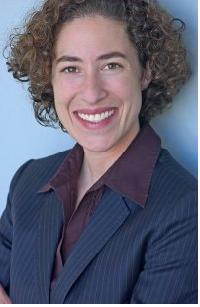
Laura Spanjian, a member of the Democratic County Central Committee and candidate for supervisor in District 8, is leaving town for a new job in Houston. That means she’s out of the hotly contested race to replace Sup. Bevan Dufty in the Castro.


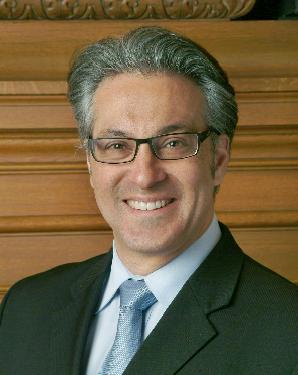
Spanjian was one of three leading candidates, and her withdrawal means that Rafael Mandelman and Scott Wiener are going to be slugging it out for the job. Rebecca Prozan, who also has Alice support, is also in the race, but I don’t see her coming in first.


In a press release sent out this morning, Spanjian said she’d taken a job as sustainability director for the city of Houston. “I am overjoyed to have the opportunity to work directly with Mayor Annise Parker and her staff and contribute to a cleaner environment which is, of course, not just a local issue,” Spanjian’s statement read.


Spanjian currently works for the San Francisco Public Utilities Commission, and will leave that job in April to move to Houston.


Before we get into the political calculus, let me stop for a moment and congratulate Laura, who’s a good person and will do a great job in Houston (although, Jesus — she’s going to have to live in Houston.)


Now then: With Spanjian out of the race, I think Mandelman is on track to come in first. That doesn’t mean he’s going to win an election decided by ranked-choice voting, but I think he comes in first.


“Clearly it’s a win for Rafael,” Jim Stearns, a political consultant who was working for Spanjian, told me today. “Laura was going to go after the more nonideological folks in the district, but she was also going to make a push with the progressives. And now Rafael has the solid progressive base in that district to himself.”


That base, though, isn’t enough alone to get Mandelman elected. It’s going to come down to the second and third votes. And Wiener and Prozan start off competing for a lot of the same voters, but in the end, Mandelman is going to have to get enough of the more centrist folks to at least put him second to finish in the money.


Mirkarimi’s a Democrat, Newsom’s a candidate

47

Supervisor Ross Mirkarimi has done what a lot of us have been expecting for months now: He left me a message tonight saying he’s changed his registration from Green to Democrat. I think that’s a recognition that the Green Party isn’t the functional political entity in San Francisco that it once could have been — and that the only way he’s going to get elected to higher office is as a Dem. He’s clearly looking at the mayor’s race, but I think he’s also looking at the state Legislature; if Mark Leno ran for mayor and won, and Assemblymember Tom Ammiano ran for Leno’s Senate seat and won, then the 13th Assembly District seat would be open. Besides, with term limits, Ammiano’s seat will open up pretty soon anyway. And it’s highly unlikely a Green could win that race right now.


So welcome to the party, Ross — now you get the fun of voting in the Democratic primaries, which are often the only real elections around here, and you can vote for Democratic County Central Committee (although I don’t think you can run; you have to be a Dem for 12 months to do that).


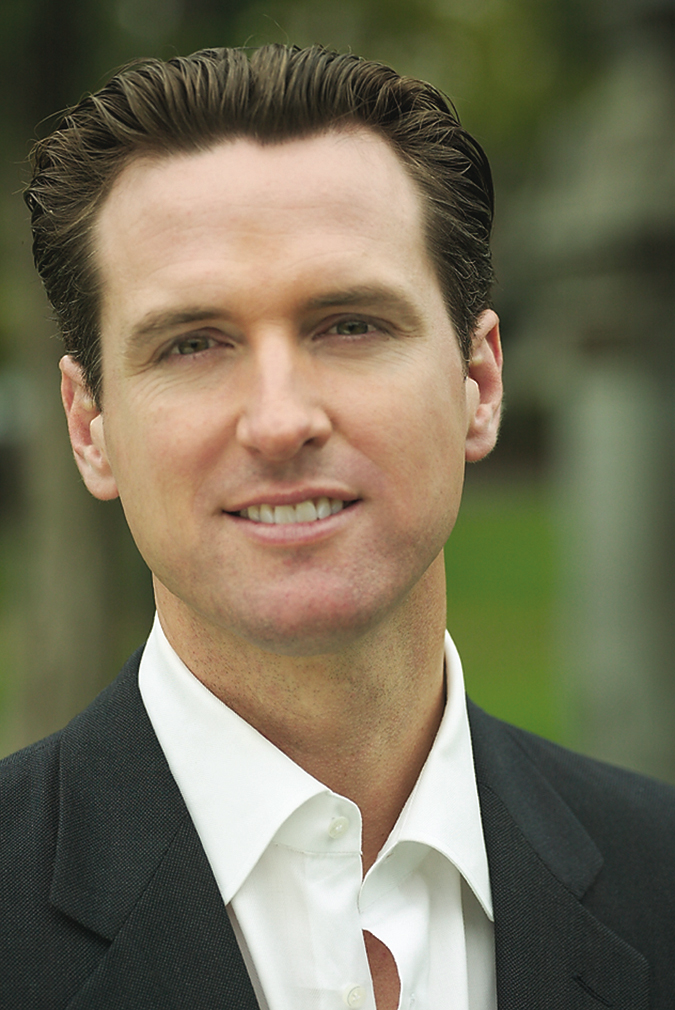
And Gavin Newsom pulled papers for. Lt. Gov.


It’s going to a wild year.


Newsom’s plan means service cuts

15

The San Francisco Controller’s Office says that Mayor Newsom’s plan to lay off 15,000 city employees then hire most of them back at a reduced workweek will save $110 million. The Examiner quotes the mayor:


“The 37½-hour idea was a way of equalizing,” Newsom said in an interview Tuesday. “I would have to go to every single labor union, open contracts that are closed and engage with those open contracts in collective bargaining for each and every local.
“Every labor union is in this together. We aren’t going to pick and choose. That being said, they are coming back Thursday with a set of alternatives, and I will keep an open mind.”


Actually, it’s not exactly equalizing — no police officers or firefighters will get what amounts to 6.25 percent pay cuts. But here’s the more important issue:


The mayor — and, to a great extent, the newspapers — present this as a simple way of saving money; sure, the workers take a little hit in their pay, but jobs are preserved. What nobody’s saying is that this will amount to more very significant service cuts.


Take 15,000 employees and cut 2.5 hours from each of their workweeks. That’s 37,500 hours of work a week, or the equivalent of 937 full-time jobs. So one of two things are going to happen: Either city employees are going to be working 40 hours for 37.5 hours pay — that is, taking a direct pay cut, which is what I think Newsom really wants — or the city’s going to lose the equivalent of 937 workers.


If you assume that it’s unfair to ask people to work 40 hours for 37.5 hours pay (and if you assume, as I do, that the unions won’t stand for that), we’re going to be talking about service cuts — work that doesn’t get done. And where will those cuts happen? Guess what — it’s the usual places.


Public health takes the biggest hit, with $35.5 million in “savings” (actually, cuts) over the next 14 months. Human Services gets $10 million cut, and Muni about $8 million.


That means longer lines and sicker people at SF General, and more broken buses with no mechanics to fix them, which means slower Muni service … you get the picture.


I’m not saying that we don’t need cuts, and you could argue that it’s more fair to cut everyone’s pay a little than to eliminate 937 jobs altogether. But let’s be honest about this — it’s not just “salary savings.” It’s service cuts. On top of last year’s service cuts, on top of the previous year’s service cuts … and it’s being done without any real overall plan for what services we need to provide and what takes priority.


And of course, it’s being done with no discussion at all of raising new revenue.  

SF Weekly owes us half its ad revenue

6


The San Francisco Superior Court ruled March 9th that SF Weekly must begin making payments on the Bay Guardian judgment by turning over half of the revenues it receives from advertising sales.


Commissioner Everett A. Hewlett, Jr., entered an Assignment Order that requires the SF Weekly and all of its advertisers to immediately begin remitting advertising revenues to the Bay Guardian. The Assignment Order also requires SF Weekly’s credit card processing company to remit 100% of the credit card payments directly to Bay Guardian rather than to SF Weekly.


The Assignment Order is effective immediately. Additionally, SF Weekly has until Wednesday to turn over to the Bay Guardian a list of all its advertisers and the amounts that they currently owe to SF Weekly.


At a hearing on February 11, attorneys for SF Weekly opposed the assignment by arguing that if the court were to enter the Bay Guardian’s proposed Assignment Order, it might cause the Bank of Montreal to declare a default on a $80 million loan balance that SF Weekly and its parent company have guaranteed. Bank of Montreal is the primary lender on a $120 million credit line available to the Village Voice chain. SF Weekly has repeatedly attempted to use the Bank of Montreal loan as a shield to defeat Bay Guardian, however, the Court has repeatedly rejected that argument.


“We consider this to be a very significant step towards the collection of our judgment,” said the Bay Guardian’s Bruce Brugmann. “The Village Voice folks first claimed that we would never collect anything, then they claimed that we would never collect more than a few thousand dollars, but the amount that we will now be collecting is certainly very significant.”


Since the Village Voice chain has refused to post an appellate bond which would guarantee payment if the judgment is upheld on appeal, the Bay Guardian has continued to actively pursue the collection of the amount due as permitted by law where no bond has been posted.  Extraordinary attempts by the Village Voice chain to avoid the judgment, including filing a  lawsuit in Delaware that sought to stop all California collection proceedings, have  been unsuccessful in blocking the Bay Guardian’s collection efforts.


In recent weeks, the Bay Guardian has succeeded in collection efforts that involved auctioning off two of the SF Weekly’s vans, seizing monthly income that the SF Weekly was receiving from its subtenants, and placing a lien on the approximately 14 newspapers owned by New Times Media LLC nationwide.  Additional collection proceedings will be heard by various courts during the next couple of months unless the judgment of more than $20 million is paid.


Editor’s Notes

0

Tredmond@sfbg.com

The crowd protesting at San Francisco’s Civic Center March 4 had a different demographic than we’re used to. There were families, moms and dads with their kids. A lot of the people there don’t demonstrate and protest on a regular basis; they have jobs and families and can barely keep up with their day-to-day responsibilities. I know the drill.

But they were out in the streets because they’re furious at what’s happening to public education in California — and they should be. It’s criminal. The state is headed for the very bottom, and at this rate we’ll soon have the worst-funded public schools in America. And a gem of a state higher education system is on its way to becoming a set of overpriced, second-rate institutions.

And now everyone who stood up to be counted last week needs to take the next step and support the only solution that will actually work. It’s called raising taxes.

California’s more than $20 billion in the hole. There’s money going to waste, plenty of it. We could release every prisoner doing time on drug charges and save a few billion. But even that wouldn’t be enough to save the education system.

We all knew, or should have known, back in 1978, when Proposition 13 passed, that this day was coming. When you cut off the main source of revenue for schools — local property taxes — and rely on state funding, and the state Legislature can’t raise new revenue without a two-thirds vote, which means a handful of troglodyte Republicans can prevent it, this kind of crisis is inevitable.

So some intense, ongoing political action has to come out of the exciting and wonderful Day of Action. And if it’s going to make a difference, the action has to take place on three fronts.

1. We’ve got to get rid of the two-thirds majority requirement. There’s a ballot initiative circulating now that would do that.

2. We’ve got to amend Prop. 13. Assembly Member Tom Ammiano is pushing for a split-roll, to tax commercial property at a higher rate. That’s an excellent start.

3. We’ve got to push local government to raise taxes — right here at home — to help fund schools and public services. That means pushing Mayor Gavin Newsom, who loves to crow about education, to work with the supervisors on some major new revenue measures.

Either that or we let the politicians point fingers and blame each other. And the schools fall apart.

Oil company profits vs. education

4

I like Darrell Steinberg’s idea: The people protesting cuts in education should sign on to the oil-severance tax bill, and then force the Republicans to decide whether they want to protect the oil companies or fund public education.


Not that the crazy no-new-taxes folks will come around and do the right thing, but the issue will be pretty clear; it’s not, as Gloria Romero argues, a Sophie’s Choice:


We don’t want to cut education. The thing you have to ask is, are you willing to yank the dentures out of the mouths of the elderly? Am I willing to take away that wheelchair?”


It’s oil company profits against the future of the state. Let’s let Meg Whitman run for governor on that platform.


Great piece on the fate of public education

3

There’s a great piece on Calitics about the fate of public education. It’s not alarminst or conspiratorial, just an accurate assessment of how the radical right wants to destroy public schools (and has ever since the 1950s and the era of desegregation) and how the other arm of the Republican Party, big business, is playing its role. A key passage:


Corporate interests want public education that they don’t have to pay for. They also would love to see the entire education sector privatized and paid for through tax revenue-the only way that supposedly anti-socialist entrepreneurs have made any money in the last decade, the way Blackwater made money, the way the banks made their money, the way private prisons have made theirs. Privatized and milked, yes, but not destroyed.


Therefore, we have reached the point where the interests will part between the two sides of the right. The grand strategy to destroy public education by making people hate it achieves a D-Day size victory every year the teachers’ unions are broken-those silly teachers paying money to lobby for actual good education policy while they’re at it! Because there is no one else that wants to make the public schools something worth saving in the public’s eyes. You’ve heard the criticisms. The teachers that can’t be fired for anything. No “God in school.” The assault on science, which both works to antagonize religious parents and the parents of children who want science education. They want to keep pushing it to the tipping point.


Pretty soon, parents start wanting to send their kids to the charter school funded by big corporate money or the private school that teaches that dinosaurs are 5,000 years old. A whole new segregation appears. The grand strategy succeeds.


Big Business has a choice. They can realize that public sector workers are no threat to them since they don’t employ them and they keep the infrastructure running that gives them a country where they can make money and live a big life, or they can watch it burn.


Worth reading. Check it out.

Guardian, ACLU, Asian Law Caucus seeks FBI surveillance records

0

The Guardian is joining the Northern California ACLU and the Asian Law Caucus in seeking records of the FBI’s investigation of Muslim communities.


We’re asking the federal government to turn over documents related to the FBI’s use of informants and infiltrators (reportedly used in gyms, community centers and mosques, investigations of Muslim leaders and imams in Northern California and attempts to recruit Muslim and Arab American children.


From a press release announcing our FOIA request:


According to civil rights organizations, community members, and media reports, the FBI has engaged in a deliberate plan to infiltrate Muslim communities through the use of informants and covert actions. Tensions are especially high between the FBI and Muslim groups following the death of Imam Luqman Ameen Abdullah, a Detroit cleric who was killed under questionable circumstances during an FBI raid in October 2009. 
“When there are repeated and widespread reports that the FBI is building a dragnet that is detrimental to the lives of innocent Americans, the ACLU and other civil rights organizations must step in,” said Julia Harumi Mass, staff attorney of the ACLU-NC. “The first step is to see all the records regarding the planning and implementation of any such spying and surveillance programs, including those that target children and have a potential chilling effect on free speech and religious practices.”


We’re asking for expedited processing so the public can see how taxpayer dollars are used on surveillance and other covert activities.


The response we get will be a good test of how seriously the Justice Department takes President Obama’s order to make government documents accessible unless there’s a very good reason not to.


We’ll keep you posted. You can read the FOIA letter here.(PDF)

Newsom’s silly trick

19

Gavin Newsom’s got a plan: He’s going to stop those damn district-elected progressives from appoining a new mayor even if it takes some wacky legal footwork. According to the Chron’s Matier and Ross:


For the past two weeks, Newsom’s political team has been combing the state Constitution to determine if the mayor, assuming he’s elected statewide, could legally push back his Jan. 3 swearing-in for the new job until after Jan. 8.


If he can, the job of naming his successor would go to the newly elected Board of Supervisors, which is sworn in Jan. 8, instead of the current lineup.


I don’t know where that team is looking in the state Constitution, but the language seems pretty clear to me. Article V, section 2, provides that the “Governor shall be elected every fourth year…and hold office from the Monday after January 1….” In 2011, that’s Jan. 3. It also says (article V, section 11) that “The Lieutenant Governor, Attorney General, Controller, Secretary of State, and Treasurer shall be elected at the same time and places and for the same term as the Governor.”


And since the mayor of San Francisco is, by Charter, a full-time job, Newsom can’t be both mayor and lt. governor. Which means, I think, that he’s got to start the new job Jan. 3, and the new Board of Supervisors doesn’t take office until a week later.


There’s another twist here: The City Charter discusses a “vacancy” in the office of mayor, and authorizes the Board of Supervisors to select someone to fill the remainder of a vacant term. If Newsom wins in November, it will be clear that a vacancy is looming — and there’s no reason why the supervisors can’t pass a motion right away designating the person who they intend to have fill that vacancy. In other words, this current board could select the next mayor even before Newsom officially resigns.


Now, it’s also true that the motion wouldn’t become effective until the mayor actually left office, and could be rescinded at any time up until that moment. But if the supervisors find six votes for a candidate, and designate that person as Newsom’s successor, it’s unlikely the board would decide to change its mind and rescind in just a few weeks.


And even if all that doesn’t fly, there’s a very good chance that progressives will still control the next board. Four progressive supes will carry over — Ross Mirkarimi, John Avalos, Eric Mar and David Campos. If progressive candidates win two of the three swing races — in districts 6, 8 and 10 — then the overall politics of the board won’t change dramatically.


So there’s actually a chance that a progressive mayor could take office next January. Whether Newsom likes it or not


Making the protests count

37

It was wonderful to see so many people all over the state taking to the streets to protest cuts in education and public services. The rally at San Francisco’s Civic Center wasn’t just young radical agitators, either — most of the people there were parents with kids, families, people who are just fed up with the threats to the future of this state and don’t want to take it any more.


And now that the press and public and maybe even the elected officials are focused on the issue, it’s time to move to the next step. Politicians can talk all they want about “standing with the families” and supporting education, but in the end, there’s only one way to adequately fund K-12 and higher education in California. And that’s to raise taxes.


You can talk about waste all you want, and there’s certainly waste at the University of California. But we’re looking at a need that runs into the billions, multiple billions, tens of billions — and eliminating a few million bucks of waste here and there isn’t going to solve the problem.


You’re not going to solve it by reallocating the state’s budget money, either, since there’s no single large pot of cash that can be taken and given to the schools without devastating another necessary public service. The only real possibility is the prison system, a financial sink hole if ever there were one — but again: You can’t just cut prison spending by eliminating services to prisoners. They get so little as it is — and the federal courts won’t allow any reductions in health care and the state’s already under court order to reduce overcrowding.


You could probably solve half of the schools’ fiscal problems by releasing from prison every single inmate serving time for a drug offense; that’s the kind of dramatic steps we’re talking about. And if anyone wants to launch a political campaign to let 30,000 prisoners free tomorrow, I’m with you.


But it’s not going to happen, not in this climate. So the only real option is to get more revenue. That means raising taxes at the state level, repealing Prop. 13 to allow local property tax hikes, or raising taxes at the city level.


And here’s who the protesters need to be targeting:


1. The governor. Arnold Schwarzenegger not only refuses to allow new taxes as part of the budget, he vetoed Sen. Mark Leno’s bill that would have allowed local government to raise its own car taxes. He’s at (916)-445-2841.


2. The Republican leadership of the state Legislature. These folks go into the budget talks with the power of a minority that can block the two-thirds vote required for tax hikes, and they’ve both signed “no new taxes” pledges. These two people are among the single largest reason that the California school are facing such huge cuts. Assemblymember Martin Garrick,  916-319-2074. Senator Dennis Hollingsworth, (916) 651-4036.


3. Attorney General Jerry Brown. He’s running for governor as the Democratic candidate, and he has already announced that he won’t raise taxes and that Prop. 13 is untouchable. He won’t even support Assemblymember Tom Ammiano’s bill to legalize and tax marijuana. He needs to hear from his constituents that those positions won’t fly. (916) 322-3360


4. The mayor of San Francisco. Gavin Newsom is happy to announce that he supports education funding, but he’s never come forward with a single significant new tax increase for the city. Local taxes could be split between the general fund and the schools, and the progressives on the Board of Supervisors are looking for revenue options. Call the mayor and tell him: If Sacramento won’t raise taxes to educate our kids, we’d like to do it at home, in San Francisco. 415-554-6141.


5. Any state or local official who claims to support the schools but won’t publicly endorse and work for higher taxes. Folks, there’s no other way out of this.


And at the next rally, let’s chant: Repeal Prop. 13, Now! Tax the rich in San Francisco — Now!

Trash Lit: Grafton’s craft in ‘U is for Undertow’

0

U is for Undertow
Sue Grafton
Putnam. 403 pages, $27.95

I love the Sue Grafton books. I bought A is for Alibi in 1983, when it came out, and I’ve read every one of them since. Unlike, say, Patricia Cornwell, whose characters age (and get crabbier) as time passes, Kinsey Milhone is eternal, always young, always living in a town called Santa Teresa that’s a lot like Santa Barbara, always living with her old (but never dying) landlord, Henry, always eating at the foul Hungarian restaurant down the street. Milhone is a comfortable protagonist, never deeply tortured, but never exactly adjusted either, and even her OCD habits (locking her car – and telling us she locked her car – about 50 times a book) are endearing.

This one’s set in 1988, where Milhone is quite at home, and in 1963-1967, where Sue Grafton is less so. Grafton’s got a problem with hippie chicks – one of the central villains in U is for Undertow is a girl named Shelly who later changes her name to Destiny. She’s an almost embarrassing parody of how middle America saw flower children in the late 1960s – except that she appears in 1963, before there were a lot of real hippies about in the land. To make matters worse, she brags that she was part of the beat scene in San Francisco and slept with both Ferlinghetti and Ginsberg – which is fairly unlikely, even in fiction; I don’t know who Allen Ginsberg, a proudly gay poet, was fucking in 1963, but I don’t think there were many hippie chicks on the list.

The horror of the dirty girl is almost too much to believe! Destiny is living in a bus with the son of a respectable family who dropped out of college to join her – and she has a child by another man who’s left the picture! And she’s raising her child (gasp) a vegan! And he runs around naked! And she’s preggers again, this time with his kid, and she insists on natural childbirth! She is, of course, also a total beyotch, who doesn’t respect the mother of the once-nice-young-boy loser who is under her hippie-chick spell.

There’s other stuff I didn’t love in here – one young character, who hates his stepmom, gets in trouble at his fancy private school and is forced to transfer to the horrors of a public school, where he of course meets awful bad kids who corrupt him entirely and turn him into a druggie.

In and around all this, though, is a fascinating mystery. It involves two kidnappings from the ’60s, a guy who might or might not have fabricated repressed memories, a dead dog in a dead girls’ grave, and a tangled tale across three decades that weaves the lives of the good and the bad (and it’s deliciously hard to tell which is which) into a first-rate detective story.

We also along the way learn some new clues about Milhone’s past (great trivia about Aunt Gin for serious fans of the series) and get a couple of excellent Grafton comments about the important things in life:

“At the time, I’d introduced [cancer patient] Stacey to junk food, which he’d never eaten in his life. Thereafter, I tagged along with him as he went from McDonald’s to Wendy’s to Arby’s to Jack in the Box. My crowning achievement was introducing him to the In-N-Out Burger. His appetite increased, he regained some of the weight he’d lost during the cancer treatments, and his enthusiasm for life returned. Doctors were still scratching their heads.”

Hippie-chick sex. Hippie chick seduction of a high school kid. Sweet Kinsey-shoots-murderer scene. (“It’s only in the movies the bad guys keep firing. In real life, they sit down and behave.”) I almost gagged on the ’60s stuff, but I stayed up way past my bedtime to get to the end.

Police Commission shoots down Tasers

4

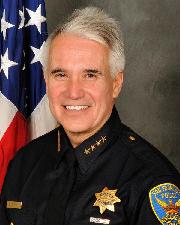
The San Francisco Police Commission came to its senses last night, and — after an immense amount of work by community activists and Commissioner Petra DeJesus — voted 4-3 not to move forward with a plan for giving the cops Tasers.


A lot of the discussion revolved around the safety of the stun guns; zapping someone with 50,000 volts can cause injury and sometimes death. But there’s another issue here, and the pres coverage only touched on it.


When, exactly, would Tasers be used?


From the Chron:


After becoming chief in July, Gascón commissioned a study of officer-involved shootings in San Francisco over five years that found that as many as one-third could have been avoided had police been able to use Tasers.


But 38-year SFPD veteran Vince Repetto, who joined a contingent of officers waiting to speak in favor of Tasers, said before the meeting that the Taser proposal is literally “a life-or-death decision.”
“It’s not if, but when, a Taser is used to stop a knife-wielding suspect and a life is saved,” he said. “Then you will see the results of your decision. Let us hope that same suspect is not shot dead because an officer lacked a valuable option to deadly force.”
Okay, so the idea here is that a Taser is a replacement for lethal force? That cops should use Tasers instead of their service pistol in an instance when a shooting would otherwise be justified?


Remember: Under police general orders, it’s only okay to draw and fire a gun when an officer’s life of the life of another person is in imminent danger. That means a suspect has a lethal weapon of his or her own, and is directly threatening someone with it.


Gascon says that there were five instances where a police shooting could have been prevented if the cops had Tasers. As he told my colleague Rebecca Bowe in an interview:


We just did a study of San Francisco police shootings in the last five years. We looked at 15 or 16 shootings, and of those we have determined at least five that, if the officer would’ve had a Taser available, they would have been able to control the situation without having to unload their firearm. And some of those shootings, by the way, resulted in the death of the other individuals. So we believe that even within the deadly force universe if you will, the Tasers sometimes have a very useful place in reducing violence.


What this says to me — since a Taser isn’t considered a substitute for a gun in a case where there’s a real threat — is that there were five cases where the cops shouldn’t have shot someone. Somehow, I can’t see the SF cops using Tasers on people they think are about to kill another person. 


What I do see is officers using their Tasers on people who are just a pain in the ass; it’s way easier to cuff a difficult suspect if you zap him immobile first.


The chief acknowledged to Bowe that Tasers could be misused:


Any time that you have human beings involved  there will be sometimes when they will be involved in aberrant behavior.


Do we have officers that overdrive? We do.


One of the deadliest weapons we have is an automobile, but I don’t hear people saying we should take their cars away and make them walk. It’s a tool, and it it’s a tool that has the potential for being misused. How do you reduce that misuse? Training, discipline and supervision.


The problem is that people in San Francisco — particularly people of color, low-income people and people in some neighborhoods — have had such a bad experience with the SFPD in the past that they aren’t going to trust the department to properly train, discipline and supervise its armed force. I think Gascon needs to rebuild that trust first — and one way to start is by demonstrating that the department is serious about internal discipline. Then we can talk about adding more firepower.


(Oh, and by the way: This entire episode demonstrates the value of having appointments to the Police Commission split between the mayor and the supervisors. The differing perspectives and opinions allowed for some real debate.

Homeowners for Prop. 13 reform

32

The Chron’s headline says “most want cuts, not taxes, to fix state budget.” The story cites a new Field poll, and the Chron’s not the only paper to spin it that way. The Sacramento Bee also claims that the poll shows widespread support for cuts instead of taxes.


But the folks at Calitics drew a different, more encouraging conclusion:


The responses, of statewide registered voters:
Cuts only: 31%
Mostly cuts: 19%
Equal mix of cuts and taxes: 29%
Mostly taxes: 9%
Taxes only: 4%
No opinion: 8%
So the way this is being reported in the media strikes me as being pretty flawed. The way I read this says 61% of voters want taxes to be some element of the solution to the budget mess, and only 31% want cuts-only.


And as people take to the streets March 4th to protest cuts to education and public services, I think that message will get reinforced. I certainly hope so — and I hope when protesters are interviewed, they don’t make the mistake of saying that “there’s plenty of waste in the budget” or that resources need to be better deployed.


The truth is that we need to raise taxes, particularly on the wealthy, to close this budget gap without destroying the state. I’m a homeowner who wants higher property taxes and better schools; anyone want to join me in Homeowners For Prop. 13 Reform?

Editor’s Notes

0

Tredmond@sfbg.com

Hundreds of parents packed the Marina Middle School auditorium last week to talk about cuts to public education — and Assembly Member Tom Ammiano, who spoke about reforming Proposition 13, said he thought the response to his suggestions was overwhelmingly positive. That’s not surprising — public school parents in San Francisco are not really the demographic you worry about when you talk about raising taxes to pay for education.

And until fairly recently, I thought it was impossible to do anything worthwhile about tax policy on a statewide level. I figured the state Legislature, with its obstinate Republicans, could never launch a tax reform movement, and that passing a ballot measure to alter Prop. 13 was a long shot at the very best. I was the one telling local officials that we had to look to our own resources, right here in San Francisco.

But when I see hundreds of parents organizing around school cuts, and hundreds of Muni riders organizing around transit cuts, and tens of thousands of students organizing around cuts to higher education, I start to think: maybe there’s hope.

Maybe the state has gotten so bad, the red ink so awful, that Californians will finally realize that they can’t have good public services for free. And maybe they’ll realize that Prop. 13 does a lot more for big commercial property owners than for homeowners, and that a split-roll measure like the one Ammiano is proposing could raise the kind of money we need for decent schools and public services.

I have to hope so.

Jerry Brown and the Rose Bird factor

16

Jerry Brown hadn’t even formally announced that he was running for governor when the San Francisco Chronicle brought up the name of Rose Bird.


It’s fine to talk about where Brown is vulnerable, and there’s no shortage of material. The guy has a long public record; anyone who served two terms as governor in the 1970s and early 1980s, and two terms as mayor of Oakland, and one term as chair of the state Democratic Party, and did a couple of years as a KPFA talk show host, is going to have baggage. He’s also got a wealth of experience.


But the Rose Bird stuff is a cheap shot.


Here’s how the Chron describes it:


Rose Bird: As governor, Brown appointed Bird to be chief justice of the state Supreme Court. After she invalidated the death sentence of every case she reviewed, voters in 1986 made her and two others the first judges unseated from the court. To voters older than 45, Bird’s name is shorthand for “liberal judges.”


Actually, voters ousted her after a savage campaign funded by big business interests who were mad at her pro-labor and pro-free speech rulings. The death penalty was their weapon, and even then it was pretty bogus: The Bird Court consistently upheld the constitutionality of the death penalty.


But in the early 1980s, death-penalty law was unsettled in the United States; the U.S. Supreme Court had in 1977 ruled that executions were legal in America, but set strict standards for states to follow. Most states were struggling to sort out what the ruling meant and to figure out how to comply. By 1986, when Bird was under assault, 38 states had adopted death-penalty laws, but only 13 had actually executed anyone. In conservative states like Arkansas, Kentucky, Mississippi and Tennessee, judges were trying to determine if the laws fit the Supreme Court’s standards — essentially what the Bird Court was doing in California.


And in California, the death-penalty statute had been written by John Briggs, the guy who wanted to keep gay people from teaching in the schools. The Briggs law was, by all accounts, poorly drafted, unclear and convoluted, and applying it under the federal standard was a challenge.


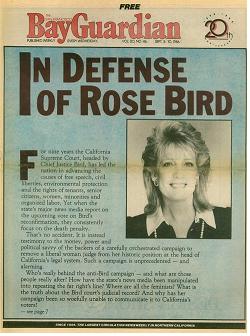
In other words, as we wrote at the time (In Defense of Rose Bird, Sept. 3, 1986):


The charge that the Bird court has refused to enforce the death penalty is simply inaccurate … the California Supreme Court has simply been doing what most state and federal courts have done over the past ten years: carefully scrutinizing death sentences to ensure that they are valid under the federal and state constitutions and complex and ever-changing standards of the U.S. Supreme Court.


The real issue didn’t make the press. Again, from our cover story at the time:


For nine years, the California Supreme Court, headed by Chief Justice Bird, has led the nation in advancing the causes of free speech, civil liberties, environmental protection and the rights of tenants, senior citizens, women, minorities and organized labor.


 Big-business interests organized and funded a massive campaign to get rid of Bird — not because of the death penalty but for purely economic reasons.


The Chronicle got it wrong back then, and is getting it wrong again today.

It’s so easy to go after public employees

4

The always-insightful Robert Cruickshank has a fascinating piece on Calitics today talking about the investigative reports showing that some state employees save up all their vacation time and get big payouts when they retire. It’s true that some state workers walk away with upwards of $100,000, and it’s true that it pisses people off, and it’s true that there probably ought to be some reforms that limit the amount of vacation time you can save and cash in.


But as Cruickshank notes, the payouts have cost the state $486 million since 2006, and:


$486 million sounds like a lot of money. But that is just 2.43% of the current $20 billion deficit. In other words, if we had eliminated that practice in 2006, or capped it, the budget deficit would not be meaningfully impacted. In fact, given that we’ve had about $60 billion in budget shortfalls since 2007, these vacation payouts are 0.81% of the overall deficit.


He explains:


Of course, these kinds of articles help build a larger narrative that the budget problem is in large part caused by greedy public sector workers who are paid too much. The actual numbers here indicate that the vacation payouts are not a meaningful part of the budget problem at all. Similarly, Meg Whitman’s desire to layoff 40,000 state workers would probably save about $2.5 billion (assuming those workers make the state average). That’s a bigger chunk of the projected $20 billion deficit, but it’s still only 12.5%. Whitman and other critics of public employees need to come up with solutions for the other 87.5% of the deficit.


Maybe one place to start is by looking at how the rich evade their tax obligations. Last week the LA Times’s Michael Hiltzik showed that Frank and Jamie McCourt paid no federal or state income tax between 2004 and 2009. Many wealthy Californians and large corporations have similarly evaded taxes.


So why do the relatively minor excesses by state employees get much more press attention that the vast cheating and looting of the public treasury by the rich and by big businness? Well, after 30 years in journalism, I can tell you one reason:


It’s easy.


State employee payrolls are public record. It’s easy to find out how much overtime Muni drivers make, or how many city workers earn more than $100,000 a year, or what the firefighters contract allows. Editors love these kinds of stories, because they always stir up populist indignation and outrage.


I’ve done it myself. We all do.


On the other hand, try to figure out how a big commercial property owner is using complicated stock transfers to hide a change in ownership and avoid tens of millions of dollars in property-tax liability. It’s a bitch. That kind of work takes weeks, months of investigation and requires some sophisticated legal and financial knowledge. See, the private sector — particularly the folks who are hiding behind tax shelters and scams — is big on secrecy, and the laws don’t help reporters.


Investigative reporting on the private sector is expensive. And in these days of diminished news budgets, not that much of it happens any more.


So the message you get in the press is that public employees are busting the budgets, and if we could just quit paying them so much money all would be fine. And the real budget busters, the real scam artists, the real crooks who are sucking the public treasury dry … they just keep right one going. And nobody’s paying attention.

The Chronicle’s dishonest hit on district elections

8

The move to get rid of district elections – which is based entirely on the fact that big business and more conservative voices (including the Chron) don’t like the progressive policy positions of the current board – is now well under way. The Chron devoted its Insight section to the issue Feb. 28, leading with a long editorial that wandered back and forth between points and never really made the case.


An example of the Chron’s logic:


But sitting atop the decision-making tree [in San Francisco] are small-time politicos, some elected with fewer than 10,000 votes in a city with a population of 808,976.


Horrifying! It’s as if the United States Congress – which has to decide issues like war and peace — was made up of local politicos who were elected with as few as 100,000 votes in a nation of 350 million.


Or as if the California Assembly – which has to deal with a $28 billion budget deficit – was made up of local politicos who were elected with as few as 50,000 votes in a state of more than 35 million.


A district supes votes could represent about 1.2 percent of the entire city. A state Assembly member could represent only 0.1 percent of the population of the state. And yet, I don’t hear the Chron calling for the state Assembly to be replaced with an at-large body.


More:


A town with sweeping plans to develop two empty Navy bases at Hunters Point and Treasure Island, fill vacant offices with new jobs, and cut its budget by more than a half billion dollars isn’t getting the thought, expertise – and citywide vision – it needs for these challenges.
This lack of broad leadership obstructs the city’s future. A major cause is the district election system that magnifies neighborhood and tight-knit interest groups to produce officeholders with little stake in citywide questions. If all politics is local, as former House Speaker Tip O’Neill famously declared, then San Francisco has pushed this dictum to the max. It’s all about me and my neighborhood.


That’s absolutely, factually untrue – the district elected board has done more to advance citywide issues – from minimum wage to health care to the rainy day fund to infrastructure planning – than any at-large board in the previous 20 years.


And the Chron’s own editorial contradicts that argument:


Supervisor David Campos (a winner with 9,440 votes) led a move to keep illegal immigrants who are juveniles accused of felonies from being turned over to federal authorities, despite a city legal opinion that the idea wouldn’t fly. Supervisor John Avalos (6,918 votes) dreamed up the “must spend” order directing the mayor to maintain expenditures in a record deficit year. Thankfully, he dropped the idea at the 11th hour


Okay, I get that the Chronicle editorial board doesn’t like the Campos sanctuary bill or the Avalos must-spend legislation – but that are both citywide issues. They have nothing to do with “me and my neighborhood.”


Which is really the entire point here. The Chron doesn’t like the outcome of district elections – because over the past ten years, the progressives have shown they can win district races. There’s a good reason for that; in district races, you don’t need to raise huge amounts of money.


As Assemblymember Tom Ammiano and Supervisor David Chiu point out in an opposing editorial:


Part of that increased accessibility to government is the result of the decrease in the cost of running a district versus a citywide election. In the 1994 citywide elections, the average winning candidate spent $456,000 in today’s dollars. That’s 225 percent greater than the amount spent today: In 2008, the winning candidates spent an average of $204,000. Candidates needing to raise money for a citywide race will inevitably turn to special interests for contributions. If you believe elected representatives should speak up for people, not just the special interests that donated to their campaigns, today’s district system serves you better.


They also note:


Before district elections were passed, under a citywide election system, many neighborhoods – the Excelsior, the Sunset, the Mission and Bayview-Hunters Point – had no supervisor of their own. Today, all residents can pick up the phone and reach an office responsible for their neighborhood and responsive to their concerns – a broken streetlight, a dangerous pothole or a consistently tardy Muni line.


A lot of people don’t like Chris Daly’s personality, and some don’t like his politics, but if you’re a person living on SSI in a grubby little hotel room in the Tenderloin and you need help, you can walk into his office and get a welcome reception and assistance with your needs. You won’t get that from the mayor.


On the other hand, do you think, Don Fisher ever needed to stand in line and try to make a 15-minute appointment to talk to Gavin Newsom? Seriously?


And while we’re on the personality stuff: Yeah, some of Daly’s antics have been over the top. But he’s no worse than some of the others who have served on citywide boards. Former Sup. Bill Maher once accused one of his opponents of having a small penis, and waved around two fingers spread about an inch apart to the press and public.


More important, we had supervisors who did nothing. We had supervisors who did exactly what the mayor said without any question. We had supervisors who were wholly-owned subsidiaries of major local corporations. I’ll take Chris Daly over those folks any day.


By any rational standard, the district board over the past ten years has been more productive, more accountable, more representative and more accessible than any at-large board I’ve seen in my almost 30 years of covering this city.


So the Chron needs to shut up about “citywide perspective”’ and personalities. If the paper wants to oppose district elections, it needs to drop the poll-tested downtown talking points and tell the truth:


The current board is too liberal for the Chron. The moderate candidates the paper prefers can’t win in districts. So they want to change the rules.


That’s the story, beginning, middle and end.



Marching on Sacramento

15

Angry parents, hundreds of them, met in Marina Middle School to demand an end to cuts in education.

Angry Muni riders, hundreds of them, jammed City Hall to oppose Muni fare hikes and service cuts.

Angry students from the University of California — thousands of them — will hold a huge event March 4th to push for better education funding and lower fees.

There’s something going on here — because in every case, grassroots activists in huge numbers (numbers that dwarf the so-called Tea Party events) want to force the state of California to change its budget priorities. And they are starting to talk seriously about taxes.

The Republicans are pretty intransigent up in Sacramento. But if these groups — the public school parents, the UC students, the transit users and the wide range of other middle-class folks who are sick to death of California’s budget mess and how it’s screwing them — could start working together, we could see a powerful coalition emerging.

And what that coalition needs to do, among other things, is push for Assemblyman Tom Ammiano’s legislation to change Prop. 13 and Sen. Mark Leno’s efforts to allow a local vehicle license fee, and a Constitutional amendment to get rid of the two-thirds majority for budget approval and tax hikes.

The Republicans have all signed this no-new-taxes pledge and it’s going to be hard to move them. Any attempt to change Prop. 13 will be met with huge opposition from big business. I used to think that it was hopeless even to talk about that … but maybe it’s not. Maybe if everyone who’s angry about government cuts understood that the only way to solve the problem in the end is to allow local government to raise money for the schools through property taxes, and allow state government to raise income taxes on the rich and impose taxes on big businesses, we’d be able to build a movement that could make some progress.

It’s worth thinking about.


Ethics for political consultants?

1

I got an email from Garry South today. He’s the guy who used to run Gavin Newsom’s campaign for governor. Now he’s turned on his previous client. And he’s sent out a message to political reporters explaining why Newsom — the guy he was pushing for governor of California — is actually a worthless hack.


Here’s the mail:


STATEMENT BY GARRY SOUTH


CHIEF STRATEGIST, JANICE HAHN FOR LT. GOVERNOR


FORMER SENIOR ADVISOR, GAVIN NEWSOM FOR GOVERNOR


I am surprised and perplexed that my friend and former client Mayor Gavin Newsom apparently has decided to jump into the lieutenant governor’s race at the last minute – especially against an already-announced candidate who would be the first woman lieutenant governor in California history.


In every one of several conversations we had about the job while he was running for governor, the Mayor expressed nothing but disinterest in and disdain for the office of lieutenant governor. In fact, he was derisively dismissive of Gray Davis’s decision to run for and serve as lieutenant governor prior to running for governor (“I’m not a Gray Davis,” he said). On a couple of occasions, he directed me to repudiate publicly in the strongest terms that he had any interest in ever running for lieutenant governor.


The Mayor himself told the Chronicle in October that rumors he may run for lieutenant governor were “absurd” and “a complete lie,” and angrily accused Jerry Brown of personally spreading false information to that effect. As recently as December, he himself said flatly “no” when asked directly on a San Francisco radio show whether he intended to run for lieutenant governor.


In addition, when he precipitously pulled out of the governor’s race in late October – against my advice – he said he couldn’t continue as a statewide candidate because he was a husband, a new father and the mayor of San Francisco. So far as I know, he’s still a husband, a new father and the mayor of San Francisco. So it’s pretty hard to see what’s changed over the last four months that would now allow him to run for another statewide office.


If the Mayor does run, it is his responsibility to explain why he now claims to want an elected office he summarily dismissed publicly numerous times over the last several months, and which just earlier this year he called “a largely ceremonial post” … “with no real authority and no real portfolio.”


Now, if Garry South were an attorney, I think he could be disbarred for that statement. Lawyers can’t discuss anything that transpired between them and their ckients.And it sounds to me like he’s taking confidential conversations between himself and his client — talks that occured during campaign strategy sessions — and passing them along to the world.


But since political consultants have no regulations, nothing will happen to him.


Now, there is a code of ethics of the American Association of Political Consultants, which you can read here. It says, in part:


  • I will treat my colleagues and clients with respect and never intentionally injure their professional or personal reputations.

  • I will respect the confidence of my clients and not reveal confidential or privileged information obtained during our professional relationship.

  • Of course, the AAPC is just a trade group, with no enforcement. (Just as journalism codes of ethics are not enforceable by anyone.) But if you ask me, it’s a little slimy.


    The progressive communist conspiracy

    5

    This city’s seen such heated discussions about what the word “progressive” means, it’s fun to watch Glenn Beck proclaim that progressives are a disease facing America, really just Communists who don’t have guns.

    Jon Stewart had a lot of fun with this on his show the other night. And it’s worth watching, just to remember what the progressives have done over the years.

    On Feb. 26, the cab industry changes, radically

    16

    The San Francisco taxi industry will undergo a major change starting Feb. 26, when the Municipal Transportation Agency is expected to adopt a complete transformation of how cab medallions — the permits needed to operate a taxi in the city — are allocated. You can read the proposal here. In essence, it would allow cab medallions — which are now allocated to individual drivers on the basis of seniority on a waiting list — to be sold on the open market.

    It’s a tricky proposition. But the mayor appoints the MTA board, and the mayor wants this — both to help with the city’s budget problems and because, well, he’s always supported privatization of some public assets, and that’s what this proposal amounts to.

    And here’s a little stinker that’s part of the deal: The MTA currently has 30 of the valuable medallions just sitting around in a desk. Those are permits that could be issued to the top 30 drivers on the waiting list — many of whom have been driving for 15 years or so while they slowly rose to the top of the list.

    Instead, if the proposal passes, those medallions — or at least some of them — will be sold off, over the counter, at prices that could reach $400,000.

    Judson True, the MTA’s spokesperson, confirmed that there were 30 unallocated permits on hand right now and that at least half would likely be sold at market rate. The MTA is budgeting $15 million for direct permit sales.

    So if you’re, say, number 16 on the waiting list, and 15 people ahead of you get permits that are currently available — and the next 15 are sold, and you can’t afford it — you’re SOL. Until someone else dies and another permit comes up — unless that permit is sold, too.


    Editor’s Notes

    0

    Tredmond@sfbg.com

    Gavin Newsom never got any traction in the race for governor, in part because he completely alienated the progressive base in his hometown. And when you have unionized city employees holding protests outside your campaign fundraisers — and you’re in a Democratic primary in California — you’ve got serious problems.

    And now, oddly enough, the progressives in San Francisco may be his biggest allies in the race for the second-place job of lieutenant governor.

    There are some good reasons for that.

    For starters, a lot of us thought that Newsom, whatever his positions on issues, wasn’t ready to run California — to deal with all of the massive problems the state faces and to take on the brutal politics of Sacramento. And I think his behavior during his brief gubernatorial campaign demonstrated that we were right.

    But the Lite Guv job is a lot different. You don’t have to balance a state budget that’s $20 billion in the red; you don’t have to solve water problems. It’s a place where you can learn about state politics on the job, without really screwing things up.

    And if his real goal is to run for U.S. Senate down the road, say, when Dianne Feinstein retires, he’ll be in a good place to launch that campaign.

    But let’s face it. A lot of this is practical politics. With either Jerry Brown or Meg Whitman in the Governor’s Office, the state will continue to be screwed up and it will be even more important that cities take on their own economic destinies. And Newsom, as a bitter lame duck, simply can’t do that.

    The progressive political community isn’t unanimous at all. But a lot of people are thinking that if Newsom’s ascension to Sacramento means that the district supervisors will have a chance to appoint a progressive mayor, it’s worth the trade-off.

    The attack on the SF left

    20

    If I were a political consultant hired by the San Francisco Chamber of Commerce and the big developers and the landlords and Mayor Newsom, and my job was to launch an effective attack on the progressive movement in the city and undermine progressive control of the Board of Supervisors, here’s what I’d do:


    1. I’d attack district elections. See, every time the downtown folks have tried to run candidates in swing districts under the existing system, they’ve lost. That’s in part because the business types can’t seem to find decent candidates, and part because money doesn’t rule in districts, so progressives who can mobilize at the grassroots level have a better chance.


    So when you can’t win the game you try to change the rules. You can’t do it too directly, because the polls show that people like having district supervisors, so I’d come up with a “hybrid” plan — say, seven districts and four at-large supervisors. Since anyone who runs at large in this city needs gobs of campaign cash, that would pretty much guarantee that four board members would be accountable to downtown. Then draw the districts to create two moderate-conservative seats, and the progressives have lost control.


    I’d launch this by planting stories in the San Francisco Chronicle about a “growing movement” to change the way the supervisors are elected — even thought there is no real grassroots movement.


    But that creates the appearance that’s needed to begin raising money and preparing for a ballot initiative. It’s not hard to get the Chron to bit on something like this; C.W. Nevius, the local columnist who lives in the East Bay suburbs, never liked district elections, so he’ll play along and the Chron’s corporate ownership, which is close to the Chamber folks, never liked the system either. You can expect an editorial from the Chronicle Feb. 28th calling for a partial repeal of district elections.


    The argument won’t have anything to do with the fact that the Chron doesn’t like the policies this particular board has passed; it will be all about the need for a “citywide perspective.” Now, that’s just horseshit, since the district boards have done an immense amount of work on citywide issues (like mininum wage and health care) that the at-large boards would never do.


    But “citywide perspective” is a term that’s been focus-group tested and sounds good.


    2. I’d look for a nice wedge issue for the November elections — something that could be used against progressives in swing districts. When Newsom ran for mayor the first time, he used “care Not Cash” — a well-funded attack on homeless people.


    And gee, guess what? There’s another nice anti-homeless measure that’s recently been floating around, and it comes from the media-savvy police chief, George Gascon. It’s called a “sit-lie” law — legislation that would criminize the act of sitting on the sidewalk. It’s got a lot of populist zing to is, particularly since Gascon is talking about the need to clean up Haight Street, where some ill-behaved young people have been bothering the merchants and shoppers.


    A November ballot initiative on a sit-lie law would allow downtown to raise a lot of money — and attack people like Rafael Mandelman and Debra Walker, candidates for supervisor in districts where a simplistic attack on the homeless might play. 


    3. I’d try to split the city’s labor movement and drive labor away from the progressives. The obvious tactic: Construction jobs. I’d get every construction trade union member to campaign in District 10 for a supervisor who will support Lennar Corp.’s redevelopment project, and I’d attack any supervisor or candidate who supports limits on, say, buildings that shadow the parks and call them anti-jobs.


    4. I’d launch a quiet effort to raise a big chunk of money to push pro-downtown candidates for the Democratic County Central Committee. The DCCC used to be something of a political backwater, but under progressive control, it’s become a significant force in local elections. The DCCC controls the local Democratic Party endorsements and money — which can be a big factor in district supervisorial races.


    Now: I have no evidence that any individual consultant has created any such plan — but it’s sure an interesting coincidence, isn’t it?


    What I see right now is a coordinated, orchestrated attack on the left — and I’m getting a little nervous that our current leadership on the Board of Supervisors isn’t doing enough about it.


    Sunday parking in the Mission

    15

    I’m not surprised that merchants in the Mission want to retain free parking on Sundays. Times are tough for neighborhood businesses, and anything that would seem to discourage customers is frightening.


    Of course, if the city doesn’t expand parking meter hours, it’s going to have to make even further cuts in Muni, which could impact the merchants even more.


    But the thing that always kills me about this discussion is all the illegal parking that goes on every Sunday all over the Mission. The entire center of Valencia Street is a big parking lot — and nobody ever gets a ticket. That’s because the cops have an unwritten, uncodified, long-standing policy of letting people park in the middle of the street if they’re going to church.


    If we’re going to turn the streets into parking lots, fine: Let’s allow people to park there and go to breakfast at a local restaurant, or go shopping at a local store, or go to yoga at a local studio. Ofrelse — much better, in my mind — let’s start charging the churchgoers for the right to clog up the streets. Then maybe we won’t have to extend meter hours.


    Nothing against churchgoers, of course. But if they don’t want to pay for parking, they can ride the bus to services. It’s far more holy to take the bus, anyway.


    Now, let’s see: Which San Francisco supervisor wants to take on THAT political nightmare?