Tim Redmond

Death and (estate) taxes

14

There’s an interesting story in the NY Times about a Texas billionaire whose entire estate will be passed along tax-free, thanks to a rather silly act of Congress. It’s obviously a bit of a scandal that a guy worth $9 billion will pay no estate tax at all, but the really interesting tidbit was deep in the story:


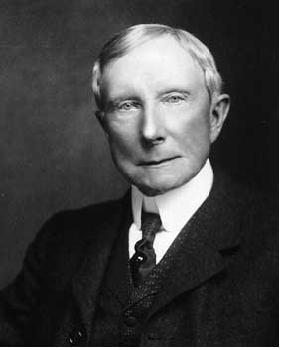
The United States enacted an estate tax in 1916, and when John D. Rockefeller, America’s first billionaire, died in 1937, his estate paid 70 percent. Since then, the rates have fluctuated, but this is the first time the tax has been repealed altogether.


John D. Rockefeller’s estate was taxed at 70 percent.


Of course, since the guy died with a couple of billion to his name, his kids had to make do with a paltry few hundred million — and oh, how it crimped their lifestyles. I grew up about five miles from the Rockefeller estate in Pocantico Hills, New York, and I can tell you: The family owned 7,000 acres of pristine, beautiful land only 30 miles north of New York City. Chauffers drove the brothers, Nelson and David, to their offices every day. Security guards armed with salt guns patrolled the property to keep kids like me out. Nelson managed to get elected governor of New York and became vice-president of the United States (before dying of a heart attack while having sex with his secretary). David was the chairman of Chase Manhattan Bank. The brothers donated an original Chagall window to their tiny church in the nearby town, and bought their wives brand new Rolls Royces every year.


Their kids have managed to survive on the tiny remants of that fortune, too. And their kids’ kids.


The point is, the 70 percent estate tax didn’t wipe out John D. Rockefeller’s wealth or harm his family’s future. There was plenty left. That’s the thing to remember when we talk about taxing the rich: They always wind up with plenty left.

Carly learns about open mikes

0

Carly Fiorina just learned a key lesson in modern politics: Be sure the mike is off when you’re saying something stupid.

In this case, it’s no big deal — she wonders why Meg Whitman would go on the Hannity show (“he’s not an easy interview”) — as if what GOP candidates want now is someone who will lob softballs. She jokes about her staffers “wolfing down cheesburgers.” And she makes a really silly comment about Barbara Boxer’s hair being “sooo yesterday” — suggesting that fashion ought to be an issue in the race for United States Senate.

No real harm done — except to show that she’s not really ready for prime time.

Goodbye, 49ers — and do we really care?

4

Tony Winnicker, the mayor’s press secretary, was chatting with a group of folks at the Newsom victory party on election night, and Steven T. Jones, the Guardian city editor, asked how the stadium vote was going down in Santa Clara. “Oh, it’s winning, but it’s never going to get built,” Winnicker said. “Cities building stadiums is an economic loser.”


He’s right, of course — although it’s an odd comment coming from a press staffer for a mayor who is still dead set on building a stadium for the 49ers at Candlestick Point. I agree with Randy Shaw: The loss of the 49ers would be a good thing for San Francisco — particularly if the alternative is to pour public money into another expensive boondoggle like Candlestick Park.


Here’s the thing: You can argue that urban baseball stadiums bring economic benefits to the community. You can argue that the (mostly) privately financed Giants stadium has spruced up that neighborhood, spurred the creation of new bars and restaurants, brought in new tax dollars and created jobs. (It also displaced some blue-collar jobs and some poor people, but that’s a different argument.)


In fact, with limited parking and good transit access, the Giants ballpark encourages foot traffic, which encourages people to patronize local businesses before and after the game.


Football stadiums are traditionally very different. Football fans are tailgaters — they drive cars, bring their food and drinks to the parking lot, set up grills and picnic tables, go to the game — and then go right home. Almost nobody who attends a 49ers game at Candlestick stays around in the neighborhood afterward; the people who live nearby get virtually zero economic benefits.


Even as part of a shiny new development package, that won’t change much. The plans for a 49ers stadium in the new redevelopment area include a new roadway and bridge to make it easier to drive in and out, and a parking garage with room for tailgating; the fan base is largely from the Peninsula anyway. And in nearly every city that’s put up public money for a football stadium, the taxpayers have gotten screwed.


I love football, I love the 49ers, but I never go to the games, anyway — way too expensive. The TV feed from Santa Clara will be just fine.


The Brown/Whitman debates

7

Jerry Brown’s the official frontrunner now, after Meg Whitman endured Steve Poizner’s assault and saw her positives knocked way back. And typically the frontrunner in a campaign tries to avoid direct debates; they can’t help and, with a mistake or two, they can wind up hurting.


But Jerry being Jerry, he’s already challenging Whitman to a series of ten debates, and Whitman is already ducking. That’s because Whitman wants this entire campaign to be about TV ads — the only area in which she has a clear, indisputable advantage.


Brown’s a little unpredictable in debates. He’s smart and can be charming and is certainly experienced — but he can also veer off on tangents and make some remarkable statements, not all of which are good sound bites. Whitman would be carefully, perfectly scripted. But in the end, it would force her to deal directly with journalists and her opponent — and she doesn’t want to do that.


What Whitman plans to do is start right away, tomorrow, airing a blizzard of ads attacking Brown — as too liberal, too flakey, too inconsistent — whatever she can get away with. She’s been knocked down in the polls, and now she wants to knock him down, too.


She can’t get too far with ads promoting herself — California has seen those ads, over and over, and people are getting sick of them. We know her line; she’s gotten about all the positive impressions she’s ever going to get. And she’s not breaking 50 percent in the polling.


The only way she can win is to tarnish Brown — and in the end, he’s going to have to swing back and attack her. It’s going to be a long, ugly summer.


SFBG Radio: Johnny and Tim on the election results

1

Today, Johnny and Tim talk about the stunning defeat of Props. 16 and 17, the future of Gavin Newsom and why the governor’s race is Jerry Brown’s to lose. You can listen after the jump.

sfbgradio6/9/2010 by sfbgradio

The NY Times discovers illegal church parking

7

The Bay Citizen-New York Times partnership is already jazzing up the quality of what was a very weak Northern California section in the Times. And now the pair have discovered one of the dirty little secrets of San Francisco Sundays — illegal parking by church-goers who just leave their cars in the middle of the street.


This is one of my favorite crusades, and I’ve been on it for quite a while. The Times/Bay Citizen story tries to sort out what the rules are and why this is allowed to happen. The SF Appeal tried to figure it out, too. But when you talk to the cops on the beat in the Mission, here’s what they’ll tell you: There are no rules. There is no law. The church-goers have no legal right to park in the middle of the damn street. It’s just a tradition that goes back so long that nobody wants to defy it.


And whatever the cops and the MTA say, it’s not a public service for community events. It’s about religious gatherings. If you want to go to a secular gathering — say, a Yoga class — and park in the streets Sunday morning, you get a ticket. In fact, I know somone who tried that; she said a cop on the scene asked where she was going, and she said yoga, and the cop said she couldn’t park there. It’s only “for church services.”


I’m all in favor of closing streets to traffic, but turning them into parking lots — and allowing private institutions to use city property, at no cost, to promote religious events is not only a violation of church and state. It’s wrong.

Everyone hates PG&E

5

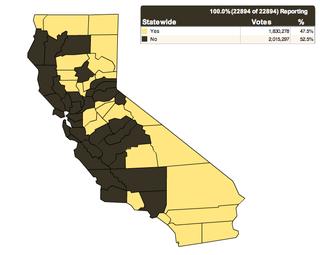
Well, maybe not everyone, but the results from last night’s election are fascinating. A $50 million campaign, with the opposition struggling to come up with $100,000 — and PG&E still lost. Calitics has a fun comparison that makes one of the key points: The company lost most heavily in its own service areas. People who have to deal with PG&E — and its high rates, poor service, blackouts, botched smart-meter program and financial greed — voted strongly against allowing the company to further entrench its monopoly power. In essence, PG&E lost at home.


A couple of other interesting factors: The results show, I think, that whatever you say about the decline of newspapers, their endorsements still matter. Every major newspaper in the state opposed Prop. 16, and that clearly had an impact. The No on 16 campaign didn’t have the money for any media buys; the press coverage and strong anti-PG&E endorsements had to carry the message.


TURN, Ross Mirkarmi, Mark Leno, Tom Ammiano and consultant Gail Kaufman deserve credit for raising what little money they could and leveraging it into a stunning statewide victory. Considering that the turnout skewed heavily Republican, the defeat of Prop. 16 will go down as one of the great progressive victories in California history.


The local numbers were astounding: In San Francisco, Prop. 16 went down 2-1, with 67 percent of the voters rejecting PG&E’s ploy. That’s the strongest mandate for public power I’ve ever seen. Same for the rest of the Bay Area: Alameda County, 64 percent No. San Mateo County, 60 percent No. Marin County, 61 percent No. Mayor Gavin Newsom ought to take a look at the map on the Secretary of State’s website; it shows that the voters he needs to get elected lieutenant governor have rejected PG&E and want a public-power option.


The collapse of PG&E’s attempt to buy democracy in California gives San Francisco some breathing room on its community choice aggregation contract, which is excellent news. The supervisors can now take some time to go over the details — and prepare for the next major battle, the marketing campaign to education local residents about the value of community-controlled green energy.


PG&E is clearly on the run — CEO Peter Darbee has driven the company to a point where it has no friends left. Could be a great era for public power efforts.

Editor’s Notes

1

Tredmond@sfbg.com

What’s the real price of a gallon of gas? Think about it — because it’s not $3.12, which is what I paid the last time I filled my tank. See, that price didn’t include the gulf oil spill.

Americans use about 130 billion gallons of gas a year. When all is said and done, the cash cost of cleaning up the spill and repairing the economic damage to the coastlines of several states is probably going to exceed $20 billion, whether BP pays it all or not (Florida alone could lose $10 billion a year in tourism if its Gulf Coast beaches are fouled.) That’s an additional 15 cents a gallon. Add in the long-term economic damages, and the incalculable environmental damages, and you’d have to kick up the price another dollar. Which doesn’t even begin to account for the costs of global climate change, the poisoning of the Niger basin, the destruction of large parts of the Amazon, and all the other damage that oil drilling does. Gas is pretty pricey; we just don’t pay for it at the pump.

So it’s infuriating to see Matier and Ross in the June 7 Chronicle saying that electricity from the city’s community choice aggregation program will be more expensive than what we pay now to Pacific Gas and Electric Co. (see editorial).

Sticker prices are a lie. That cheap plastic stuff from Walmart costs third world kids their childhood. The price of non-organic strawberries at Safeway doesn’t include the damage pesticides do to the soil, the damage water diversions do to the delta and the fisheries — or the damage nonunion farm workers suffer in the fields.

Economists have all kinds of words for this — externalities, spillover costs — but when I hear that coal energy and Walmart toys are cheaper, the only one I can think of is: bullshit.

“A righteous win.”

1

I just called Sup. Ross Mirkarimi, one of the leaders of the No on 16 campaign. He’s cautious; we’ve both seen PG&E steal elections before. But the numbers are looking good: $50 million later, PG&E is behind and losing ground. “If 16 goes down, this will be such a righteous win,” Mirkarimi said. “We will have defeated their scorched earth greed.”


From the Linda Colfax party

0

Alex Emslie reports from the Colfax party:


A wild cheer exploded from the crowd of 50 Linda Colfax supporters when the numbers appeared on the screen at Mars Bar. With 99 percent of the precincts counted, Colfax had 55 percent of the vote. “I fell thrilled, speechless,” she said, pausing to search for worlds. “I’m relived, thrilled and grateful.”


As a lesbian and public defender, Colfax will bring diversity to the bench not seen in decades. “The last time a lesbian was appointed to the the SF bench it was Mary Morgan in 1981, and I don’t know the last time a sitting public defender was appointed to the bench,” she said.


Whoa — we could actually win this thing

1

For the first time tonight, Prop. 16 is losing. As more results come in, PG&E’s lead has been slipping, and now the measure is in the loss column. Amazing.

Prop. 16 is getting very tight — PG&E’s only up by one point

0

Wow, the No on 16 campaign might just pull off a miracle. PG&E’s lead is cut to 50.3 to 49.7 as more results come in from Los Angeles, where a once-powerful lead is dwindling. If this trend keeps up — and I don’t know if it will — PG&E is going to lose. Amazing.

DCCC: The progressives are holding their majority

0

It came down to the wire, but the progressives appear to have held their majority on the DCCC. I can now count 18 progressives in the money, and while it’s still close, unless the election-day absentees are very different from the election-day votes, I think that lead will hold. And that was the result of a remarkable coalition effort. “It’s a beautiful thing when we all pull together, Gabriel Haaland just told me. “It was amazing what went into the last few days. We walked 120 precincts.”


More SF results: Colfax is in, Nava leading, DCCC very, very close

1

Linda Colfax is going to win the open judicial seat without a runoff. She’s got 52 percent of the vote, and her lead is growing. Michael Nava and Richard ulmer appear headed for a fall runoff. Right now, the progressives have 17 votes on the DCCC, one short of what they need for a majority. Veronese is out, Haaland is in …. and with 70 percent of the votes counted, this may come down to election-day absentees.

The impact of Prop. 14

5

Proposition 14 was the sleeper on the ballot; it’s only there because Abel Maldonado refused to vote for a state budget unless both parties agreed to put it before the voters. And it’s winning. The impact of open primaries could be dramatic; it could hurt progressive candidates, pretty much wipe out third parties and potentially change the shape of the state Legislature. Maldonado likes it because it shifts the balance of power toward “centrists” — which actually means people who can raise a lot of campaign money. It’s going to take a while to sort out the impacts of Prop. 14, but it doesn’t bode well.

Nail biters

0

Prop. 16 is going to be close. It’s wavering back and forth, with PG&E losing votes as Central Valley precincts report, but picking up votes in (gasp) L.A. That one’s going to go on a while. So will the San Francisco DCCC race — right now, some progressive incumbents, like Robert Gabriel Haaland, are missing the cut — but only very narrowly. Haaland has 5925 votes, and Joe Alioto Veronese has 5980. Eric Quezada, another progressive, has 5462. On such tiny margins does the future of the San Francisco Democratic Party hang.


An interesting note: If this race is a preview of the fall, District 8 is going to be very close. Scott Wiener and Rafael Mandelman, both incumbents, are going to get re-elected, and then run against each other for supervisor. Wiener has 7875 votes; Mandelman has 7216.

From the progressive DCCC party

2

Alex Emslie gives this report from the progressive DCCC victory party:


As of 9 p.m., close to 100 people have gathered at the Project 1 art gallery and DJ lounge to celebrate the progressive slate for Democratic County Central Committee.


At this point, candidates are beginning to trickle into the dimly lit gallery, chatting with the crowd over the quiet din from a DJ booth in the back.


“It’s a beautiful array of San Francisco progressives,” Assembly District 13 candidate Alix Rosenthal said of the partygoers. She said the most important part of her platform is getting more women elected locally. She also wants to preserve the nightlife culture in San Francisco.


“I’m getting distracted because I can’t believe I’m winning,” Rosenthal added after checking election results behind the DJ booth.


David Cutler, a San Francisco resident since 1987, stood by the bar waiting for more candidates to arrive. “It’s nice to have this much accessibility to our local politicians,” he said.


The real question on everyone’s mind, though, is how the election will turn out; the progressives currently control the commitee, but only narrowly. “Right now, we have about 16 or 17 votes, and we need 18,” Sup. John Avalos said. “I think we’re going to catch a couple more.”

The GOP’s Wall Street ticket

0

Steven T. Jones reports that the folks at the Newsom victory party aren’t just celebrating Gavin’s overwhelming win; they’re looking forward to the fall. The Republicans have nominated two big-business executives for governor and senate — and that’s not a good political position to be in these days. “I think it’s stunningly politically tone deaf to nominate two Wall Street CEOs at the top of the ticket,” noted Dan Newman, a Newsom communications advisor.

OMG Jerry Brown …

0

From Calitics:


Jerry Brown speaking now in LA. LA County Sheriff Lee Baca introduced him as the man who “implemented Prop 13.” Oh great. This campaign season is gonna suck. Back to the 1970s for Jerry Brown: we need “discipline, humility, live within our means.” Brown sounds like he’s going to run as the apostle of austerity.

A bit of good news from the East Bay

0

It appears at this point as if Victoria Kolakowski, who is leading with 46 percent of the vote, may become the first transgender trial-court judge in the United States.

Some scary stuff

0

The results on Prop. 14 — the open primaries law — are a bit alarming. This thing’s passing with 60 percent of the vote — and winning every single county that’s reported so far. And Prop. 15, the election-reform law, is losing big. I know that open primaries sound appealing (as long as you don’t stop to think about it), but why would people vote against a law that creates public financing for just one statewide office, at no cost to the taxpayers? I’m also a little disturbed that Prop. 16 is doing so well in Los Angeles. That’s where all of the Yes votes seem to be coming from. Cause for serious concern.

Kamala has won. So has Dave Jones

2

Kamala Harris is far ahead in the AG. primary, and we can call that one for her at this point. Chris Kelly spent a lot of money and got nowhere. Dave Jones is going to win the Dem insurance commish nod. The Supt. of Public Instruction is more interesting; Larry Acevas, a retired school superintendent who has the support of the L.A. Times but wasn’t much on the political radar in a race involving two high-profile Dems from the state Legislature, is actually in the lead statewide. Tom Torlakson, who has the support of the teachers union, is close behind him – -and Gloria Romero, the fan of school privatization, is way behind.

San Francisco results — the absentees

2

The first results are in from San Francisco, and the typically conservative absentee votes include a few surprises. Linda Colfax, a lesbian public defender, is well ahead in the open judicial seat, with 47 percent of the vote. The next closest challenger, Harry Dorfman, has just 33 percent; I think it’s safe to say Linda’s going to win this one, quite possibly without a November runoff. The other judicial race is much closer — the incumbent, Richard Ulmer, has 46 percent and Michael Nava 41 percent. The third major candidate, Dan Dean, has 11 percent — so a majority of the voters are siding with the challengers, and since the absentees are probably the strongest pro-Ulmer votes out there, this one’s heading for a runoff.


PG&E and Mercury insurance are both getting hammered in San Francisco. PG&E is also losing badly in Sacramento. And since vote-rich Los Angeles is a public power city, PG&E’s in trouble.


The DCCC is still way too close to call, and it’s way too early to say who’s going to emerge on top. Stay tuned.

Prop. 17 — a bit futher ahead

0

Mercury Insurance, sad to say, is doing a bit better than PG&E; Prop. 17 has a 55-45 lead. But other than Marin, these are all fairly conservative counties reporting. In Marin, both PG&E and Mercury are getting hammered. If that pattern stays true in San Francisco, Los Angeles, San Jose and Sacramento, then these corporate scams may be in trouble.