Tim Redmond

The politics of the last great depression

4

The American economy’s worse now than at any time since the Great Depression — and whatever the Republicans say in Congress (and the president signs on to) the private sector alone can’t possible pull us out. The only reason we’re not at 1930s levels of unemployment is that we’ve had some modest federal stimulus money over the past two years.


But we’ve got this dilemma: Although every smart economist agrees that it will take more massive federal spending to turn things around, all we’re getting out of Washington is the worst kind of spending — tax cuts for the rich, which will cost $900 billion and do very little to help the economy.


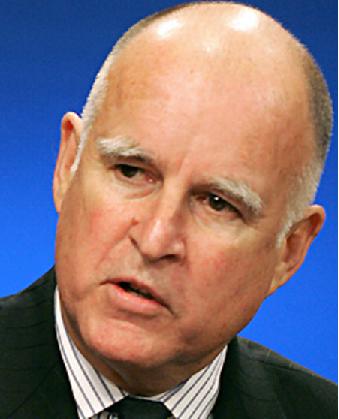
Part of what’s going on — and Jerry Brown talked about it at his education summit — is that the public doesn’t trust government to spend their money wisely. Brown cited a poll saying that nearly half of Californians still think we can solve most of the budget problems in the state by getting rid of government waste.


The Pew Research Center has put together a couple of fascinating papers on attitudes toward the public sector, and they’re worth a rad. (Thanks, Gabriel Metcalf at SPUR for tipping me off about this.) The first one is called “How a different America responded to the Great Depression.” Researcher Jodie Allen’s conclusion:


Quite unlike today’s public, what Depression-era Americans wanted from their government was, on many counts, more not less. And despite their far more dire economic straits, they remained more optimistic than today’s public. Nor did average Americans then turn their ire upon their Groton-Harvard-educated president — this despite his failure, over his first term in office, to bring a swift end to their hardship. FDR had his detractors but these tended to be fellow members of the social and economic elite.


More:


The most striking difference between the 1930s and the present day is that, by the standards of today’s political parlance, average Americans of the mid-1930s revealed downright “socialistic” tendencies in many of their views about the proper role of government.


True, when asked to describe their political position, fewer than 2% of those surveyed were ready to describe themselves as “socialist” rather than as Republican, Democratic or independent. But by a lopsided margin of 54% to 34%, they expressed the opinion that if there were another depression (and fears of one were mounting), the government should follow the same spending pattern as FDR’s administration had followed before.


And, those surveyed said they supported Roosevelt, the architect of the New Deal’s expansive programs, over his 1936 Republican opponent, Alfred Landon by more than two-to-one (62%-30%).


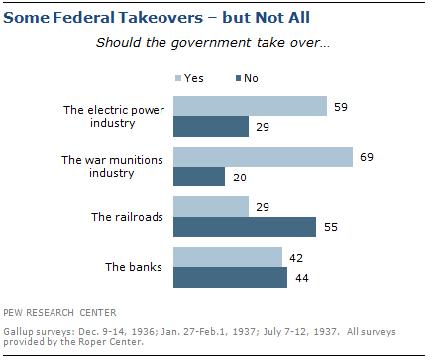
The charts are fascinating. A full 73 percent of Americans polled in 1936 thought government should provide free medical care to the poor. Sixty-four percent thought government should regulate and control war-time profits. In fact, 59 percent thought the government should take over the electric power industry and 69 percent favored nationalizing the wartime munitions industry.


And the people who were polled in these early surveys were overwhelmingly white, male and relatively well off. They were also socially conservative — 60 percent favored the death penalty and 67 percent wanted to deport all immigrants who were on public relief. Allen:


Is there a message in this for today’s America? Two possible lessons: First, it’s worth remembering that the social programs and banking controls that the New Deal era produced stood the nation in good stead over many decades of unprecedented prosperity. Second, Depression-era Americans’ faith in the country and its guiding institutions steeled them against the challenges of a double-dip recession and, years later, World War II. They had it worse, but they also expected it to get better, faster.


Compare that to a 1983 poll taken in the depth of the Reagan Recession, when 65 percent said that government had gone too far in regulating business, 62 percent rarely trusted the government in Washington and 78 percent opposed raising income taxes.


Fifty years, two generations, and the entire attitude of the American public toward government was turned on its head. It’s one of the fundamental dilemmas of American life, and one of the central reasons we’re in this mess.

More innocents in prison

3

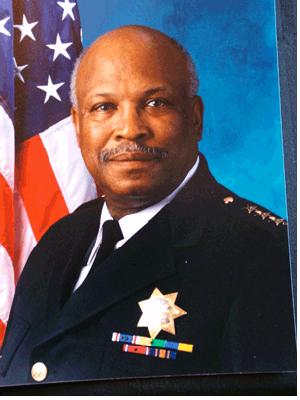
It sounds like the Tennison and Goff story all over again: An innocent man has been locked up for 18 years on the basis of highly flawed testimony from a police informant. I know, I know, Caramad Conley hasn’t been proven innocent — but a Superior Court judge thinks he hasn’t been proven guilty, either. And it all traces back to retired homicide inspector and later police chief Earl Sanders.


District Attorney Kamala Harris is still talking about retrying Conley, but I don’t think that’s going to go anywhere — the one key witness is dead and his testimony has been utterly impeached be revelations that he lied on the stand.


What’s interesting is that none of this would have ever come out it the lawyers at Keker and Van Nest, along with Public Defender Jeff Adachi, hadn’t pursued the Tennison and Goff cases — and even then, a lot of the evidence was (literally) buried. So this makes two cases — so far — in which Sander and his partner, the late Napolean Hendrix, were accused of framing a defendant. I suspect there have to be more.


“When something like this happens, it’s usually a pattern and practice,” Adachi told me.


Dan Purcell, the Keker attorney who represented Conley, told me he thinks the district attorney should go back and review some of the other similar cases involving Sanders and Hendrix. “The documents show that there are other cases where they paid witnesses,” Purcell said. “Now, that’s perfectly fine if you inform the defense, but in this case they clearly didn’t.”


Adachi complained that “nothing happens to the inspectors” — and he’s right. Sanders is comfortably retired on a nice pension and Hendrix died of cancer in 2009. And since the pair handled more than 500 murders, it’s hard to imagine reviewing all of their cases.


But the district attorney can certainly go back and review the other cases in which Sanders and Hendrix paid witnesses — and any others where the evidence was slim. That’s a matter of basic justice. 

SFBG Radio: Can Callifornia wake up?

0

In today’s episode, we talk about Jerry Brown’s challenge: Can the new old governor wake the state out of a California dream that has become utterly unconnected to reality? Check it out after the jump.

sfbgradio12/15/2010 by endorsements2010

80 billionaires — and California’s broke?

67

Jerry Brown’s message to educators was framed as bleak — but as I pointed out, there were some bright spots. At least the new gov mentioned that this is a rich state that ought to be able to afford education. Robert Cruickshank at Calitics has a nice post on the point:


A tax increase of about $20 billion would secure our public services for years to come with a very tiny impact on our economic activity. Surely 1% of our GDP can be harnessed to fund the services that we must have for broadly shared prosperity in this state.


Let me take it a step further. I just went through the Forbes 400 list of the richest Americans and started counting, and guess what? A full 80 of the 400 live in California. That’s one out of every five billionaires in America, living right here in a state that can’t afford to educate its kids.


Then I took out my calculator and added up a long row of numbers and got a big one: The total net worth of the billionaires in California is $231.8 billion. Ten percent of that wipes out the budget deficit. And that doesn’t even count the folks worth $900 million or less; they didn’t make the list.


Folks: This is a very, very rich state. A very modest tax increase on a very tiny number of people could solve our budget problems not just today but into the foreseeable future.


This is the message Brown needs to deliver to the people of the state — and if the antitax people (or my trolls) want to argue that all the rich people would leave if we taxed them just a little bit, let me say: That’s ridiculous. David Geffen is going to move out of Malibu because he has to pay a teeny bit more of his income, money he won’t miss, in taxes? Ain’t happening.


That’s it, Jerry. That’s your answer. Now get to work.

School kids and Muni

6

So SFUSD just decided to cut half of its school bus routes (including, I believe, one that my son sometimes takes to Aptos Middle School). I should be outraged — but I’m not. Jerry Brown has made it clear that even if he raises taxes, it’s going to be an ugly year for schools and everyone else, and I’d rather see cuts in transportation than in teachers and classes.


But if this is the approach, then the city and the school district need to do a better job coordinating around Muni.


Elementary school kids shouldn’t be on Muni; I’d save the school bus routes for them. But older kids can use the city system, and many do — and more would, if it were just a little easier.


My son often takes Muni after school — to the library, to his Tae Kwon Do class — and soon I’ll let him ride the bus home. But to buy him a youth pass, I have to take him personally to a Muni pass outlet, once every month, and it’s a pain. I understand why they won’t sell me a youth pass for my kid; I could cheat (well, nobody would really believe I was under 18, sigh; I don’t even get carded in bars). But why don’t they sell youth passes in the schools? 


It would be pretty simple: Muni issues a number of youth passes to each middle school and high school, the schools sell them out of the office and hand kids Muni maps with routes near the school marked off. I can use Nextbus to tell my son when to head out to the bus stop; there’s no reason the schools couldn’t do that, too. Post the schedules; sell the passes. Maybe even change a few Muni routes to make them more convenient for students.


It seems silly for a city as geographically small as San Francisco to have two parallel transportation systems. With a little creativity Muni could work for the schools, too. 

Mysteries of the death-drug scramble

0

news@sfbg.com

The California prison system finally released some documents on its efforts to procure the chemicals it needs to execute prisoners, and the 1,000 pages show the desperate lengths state officials have gone to procure the death drugs.

At one point, the California Department of Corrections and Rehabilitation looked at importing drugs from Pakistan. In October, prison officials sent agents on a secret midnight mission to Arizona to acquire sodium thiopental, one of the drugs used in executions, from that state’s supply.

In the end, CDCR wound up buying an extraordinary quantity of the stuff from a supplier in London — potentially putting California in the disturbing position of serving as the death-drug dealer to the rest of the country.

The protocol for lethal injections in California, and 33 other states, calls for three drugs — sodium thiopental to put the condemned inmate in a coma; pancurium bromide to paralyze the muscles; and potassium chloride to stop the heart.

But sodium thiopental, also known as Sodium Pentothal, has been in short supply in this country, in part because the one company that currently makes it, Hospira, has production backlogs. There’s not a whole lot of need for the drug in modern medicine — it’s largely been replaced with other anesthetics — and Hospira has made it clear in repeated press statements that it doesn’t want its product used in executions.

So when the last batch of the stuff in the state’s hands expired in October, California had to put executions on hold while prison officials scrambled to find some more.


HIDING THE TRUTH

The whole process was cloaked in secrecy. Nobody at CDCR would tell us where they were looking for the sodium thiopental, who would be procuring it, or how the supply chain might work. That, of course, is crucial, in a grisly way: If the anesthetic didn’t perform properly (that is, if the state got a bad batch from an unregulated supplier), a prisoner could go through unspeakable agony as the second batch of drugs made it impossible to breathe.

The Guardian filed a request in October under the California Public Records Act seeking details on the purchase attempts, but CDCR stonewalled. The American Civil Liberties Union, also seeking the documents, filed a lawsuit, and a judge ordered the release of a large volume of material.

Those documents, now available at aclunc.org, is heavily redacted, and much of the material we expected to see is missing. But the documents contain some remarkable revelations.

For starters, there’s an internal timeline going back to 2007 showing that CDCR officials knew back then, while the drug protocol was being developed, that there would be problems. The Drug Enforcement Administration will only allow a doctor to order the class III controlled substances. And the federal receiver overseeing the prison system wouldn’t allow any of the three doctors on staff at San Quentin State Prison to sign the order forms, although the documents didn’t say why.

In January 2007, CDCR tried to recruit outside doctors to order the drugs — but physicians in California have traditionally declined to assist in executions. Indeed, the American Medical Association policy bars doctors from participating in capital punishment in any way, including “prescribing or administering tranquilizers.”

It wasn’t until May 2010 that CDCR was able to find doctors willing to order the deadly drugs; the names of those physicians are not in the documents.

The timeline shows that in June 2010, CDCR became aware that there was a shortage of sodium thiopental, but there was no public discussion of the situation. Plans to execute Albert Greenwood Brown, a convicted murderer set to die in September 2010, went forward.

But the courts weren’t rushing the execution — and the last batch of sodium thiopental in CDCR’s possession expired Oct. 1.

As the clock ticked down toward that expiration date, the documents show, CDCR officials — all the way up to Corrections Secretary Matthew Cate — were involved in an all-out scramble to get more of the drug.

At one point, a Sept. 16 e-mail — from an official whose name is blacked out — notes that CDCR had contacted between 80 and 100 hospitals to try to buy some sodium thiopental, but “none of them have a drop.”

The documents note that CDCR officials even suggested that there were supplies of sodium thiopental in Pakistan. An Aug. 17 e-mail from John McAuliffe, a contract worker helping CDCR with executions, says the agency is trying to get federal government approval to import the drug.

One e-mail even suggests that an unnamed CDCR employee was in the area and could make a side trip to Pakistan to pick up the stuff.


THE LONDON CONNECTION

There are, of course, serious issues with importing controlled substances into the United States, and the documents show efforts by CDCR to get the DEA to approve imports. The Pakistan deal apparently went nowhere — but later e-mails show CDCR officials contacting a supplier in London. The name of the supplier is blacked out on all the documents, but CDCR’s deputy press secretary, Terry Thornton, later confirmed that the manufacturer was Archimedes Pharma.

Immediately after the California order for 521 grams of sodium thiopental went through, Britain’s secretary of state for business, Vince Cable, issued an order barring any further exports of the drug for use in executions.

Like most of the civilized world, the United Kingdom does not allow the death penalty.

In the meantime, Scott Kernan, CDCR’s undersecretary for operations, was trying to get enough of the death drug domestically to carry out at least one execution. A series of e-mails show contacts between California and Arizona, which recently had imported its own supply — and there are indications that Gov. Arnold Schwarzenegger was willing to call his counterpart in Arizona to help consummate the deal.

“I’m sure either the secretary or even the governor could make a call,” a Sept. 9 e-mail from Kernan to McAuliffe notes.

Then on Sept. 29, Kernan sent an e-mail to Assistant Secretary Anthony Chaus discussing a “secret and important mission.” Kernan wanted Chaus to send a team to a state prison complex in Florence, Ariz., a desert town about 40 miles southeast of Phoenix, to pick up 12 grams of the death drug.

At midnight Sept. 30, the warden in Florence gave the CDCD agents 24 vials, each containing half a gram of sodium thiopental. The agents drove it to Bakersfield, where another team picked up the vials and drove the rest of the way to San Quentin.

In a stomach-turning e-mail, Kernan sent a note Sept. 29 to an unnamed Arizona official saying “you guys in Arizona are life savers” and offering to “by [sic] you a beer next time I get that way.”

By then, a federal judge had delayed Brown’s execution until 2011.

Among the most startling revelation was the sheer quantity of sodium thiopental California eventually ordered from the firm in London. Even with training supplies and backup, it only takes between six and 12 grams of sodium thiopental to render a prisoner unconscious — meaning that the 521 grams that CDCR purchased for $36,413 are enough to kill between 43 and 86 people. The expiration date on the chemical is 2014.

It’s highly unlikely, given the legal hurdles and time involved in even one execution, that California would schedule more than three over the next three years. What possible use could the state have for so much death drug?

Thornton, CDCR’s press person, wouldn’t respond to our queries. But Natasha Minsker, the director of the ACLU’s Death Penalty Project, said she’s concerned that California will try to become a supplier for other prison systems. “It certainly raises questions,” she told us.

There’s a lot missing from the documents. In many instances, the names of the officials who sent and received e-mails are redacted. And there are obvious pieces of the puzzle missing from the files CDCR has released.

“There’s no e-mail from the DEA or the FDA,” Minsker said, “although CDCR was clearly contacting them. There’s nothing from the governor’s office, although it’s likely they were also involved.”

Overall, Minsker said, the documents “show how sneaky CDCR was trying to be about all of this.”

The ACLU filed another suit Dec. 13 seeking the release of some of the redacted material as well as records of CDCR’s efforts between October and December.

If those documents are ever released, they may address some of the looming questions about the material the state uses to kill people.

Ammiano wants to change bike laws

29

Assemblymember Tom Ammiano wants to change the way bicycles and cars are treated under state traffic laws.


He’s responding in part to the furor over the bike crackdowns in Berkeley, but it’s nothing new for Ammiano — he also tried to get bicycle traffic legislation through last year. This time, though, he told me, “I think we’re going to be able to pass something.” And incoming Gov. Jerry Brown ought to be willing to sign it.


Matt Bunch, an Ammiano staffer, told me that the bill isn’t final, but will certainly address the penalty for cars hitting bicycles. “A lot of these are preventable, but they’re treated as accidents,” he said. “They aren’t punished adequately.”


The measure could also address the wide disparity in traffic fines that bicyclists face in different cities and take on the Berkelely problem. “The fine you get depends on what they charge you with, and it’s all over the map,” Bunch said.


Bunch also suggested that Ammiano might be looking at the way some police officers in some jurisdictions charge bicyclists with vehicle-code violations that were written to apply to cars. “The vehicle code isn’t specific to bikes,” he said. “There’s a clear deficiency in law, and we’re going to look at it.”


One of the things they ought to be checking out: Why is it okay to make a biker get a point on his or her drivers license when he or she isn’t driving a motor vehicle?


Go, Tom. I’ll keep you posted when the bill is introduced.


Oooh, let’s have a border war

17

If San Francisco tries to enact a congestion management fee, San Mateo officials are going to fight back with their own. How fun; a border war. Since I’ve long suggested that our future may be in city-states, not nations, it strikes me as an interesting political moment.


But on a serious note: what would be wrong with a toll in both directions? What would be wrong with asking California motorists, who enjoy among the lowest gas tax rates in the western world and who for the past few years have had a dramatic reduction in annual registration fees, to pay a little more to local government? What’s wrong with making it cost more to drive your car during commute hours?


Yeah, that means it will cost more for a San Franciscan to go shop at Serramonte Mall (during rush hour; who shops then anyway?). So what? That might encourage San Franciscans to shop locally. Yeah, it will cost more to commute by car, in either direction; maybe more people will ride their bikes or take the bus. (Particularly if the money goes into improving transit.)


I’m not going all Smoot-Hawley here, but congestion-management fees — extra charges for driving in certain areas during certain times of day — are generally a good idea. And if San Mateo wants one, too, excellent.


Cities have been fighting for years over who can cut taxes more for big businesses. This seems a much more reasonable fight. So: Border war? Bring it on.


Brown’s education summit gives me hope

0

Most of what’s going on is just really, really disturbing — Brown is doing a good job of explaining just how bad the economy is, just how awful things are for education — and what that means for students. But he made one comment that struck me as critical (and that might, maybe, make Brown a great governor) came about an hour into the presentation.


Brown was talking about how the nation got into this crisis — about how people were forced to live on borrowing, and when the real estate market collapsed America became de-leveraged — when he took a slight sidetrack to say:


“Income redistribution upward from the middle class is comparable to the 1920s … it’s a societal crisis. We have to exercise discipline, but also fairness.”


A few points on this:


1. The incoming governor of California actually mentioned the words “income redistribution.” That’s a term almost entirely missing from the current debate. And he made it clear that part of the budget problem — part of the reason the state and the nation are in this crisis — is that the rich have gotten a larger and larger share of the pie.


2. Brown seems to think this is actually a problem, a “societal crisis.” Again: Obama doesn’t talk about that. Other than Bernie Sanders, most politicians in Washington are afraid of it. Just talking about wealth and income inequality (particularly in the context of education funding) is a huge step.


3. Brown talked about “fairness and discipline” together. Yes, we have to understand that resources right now are limited; but we also have to understand that part of the budget debate ought to be about the larger social issue of unfair distribution of wealth.


I know none of this seems like such a huge deal — it’s basic reality. But it’s so unusual that it’s refreshing.


Bikes are not cars

39

Okay, first of all, this is ridiculous. California cities are supposed to be encouraging people to ride bikes instead of cars. And bikes aren’t 3,000-pound metal devices propelled forward with internal combustion engines; yes, a bike can hit a pedestrian, but the likelihood of fatal injuries isn’t that high. Certainly not compared to cars.


Besides, and here’s the thing that really gets me: This kid gets a ticket for running a stop sign on his bicycle and “now he has to go to traffic school to keep a moving violation off his driver’s license.”


How is that possible? You don’t need a license to ride a bike. A bike isn’t a car; the skills are entirely different. The risks are entirely different. You can ride a bike before you turn 16. You can ride without proof of citizenship. You don’t have to give up a fingerprint or fill out forms or take a test to ride a bike.


So why should you face a violation on your license to drive a car when you’re not driving a car? Should I get a point on my driver’s license if I sit on the sidewalk, or walk against the light, or block traffic in a political protest? Those things aren’t remotely related to driving a motor vehicle.


I got stopped once by a cop for (allegedly) running a stop sign, and he asked to see my driver’s license, and I (politely) said: Why? I’m not driving a car. I’m happy to provide ID, but I don’t need to present a document from the California Department of MOTOR vehicles when I’m not operating a MOTOR vehicle. Especially when I’m making the world a cleaner, better place with my transportation choice.


Oddly enough, he agreed. We had a pleasant talk about bicycle safety and he let me go. You’d think the UC cops would have better things to do.

SFBG Radio: What will Jerry do?

0

When Jerry Brown goes to UCLA to talk about education, what’s he going to say? How’s he going to promote the UC system when he’s facing a $25 billion budget crisis? Johnny and Tim talk abou that (and the Obama health care law and a few other things) after the jump.

sfbgradio12132010 by endorsements2010

SFBG Radio: In praise of Pelosi

5

Not words you hear around here too often, but today we say: Pelosi’s doing exactly the right thing holding the line on tax cuts for the rich. So what happens next? We’ll fill you in after the break.

sfbgradio12/10/2010 by endorsements2010

The mayoral roulette

23

At the San Francisco Tomorrow holiday party Dec. 8th, David Chiu, Dennis Herrera, John Rizzo, Jake McGoldrick and a host of others who I’ve seen at these events for at least the past few years were doing their usual schmoozing — when Ross Mirkarimi, a former SFT board member, showed up with …. Art Agnos. I haven’t seen the former mayor at an SFT event since … I don’t know. Since a long long time ago.


Agnos made a short speech and talked about all of the rising stars in the San Francisco progressive movement — Mirkarimi, Chiu, Rizzo, David Campos, Eric Mar, John Avalos … and it was all very nice and low key. But there was a message in his appearance, in his connection with Mirkarimi, and even in the overall tone of his remarks, which amounts to this:


If the supervisors have trouble finding a progressive who can get six votes — and if they want an old hand, someone who has been through a brutal recession as mayor of San Francisco and dealt with awful budgets and nasty politics, someone who will serve for a year and then walk away — Agnos is open to being asked.


Well, maybe a little more than open to being asked. I wouldn’t say he’s actively, publicly campaiging for the job, but he has met with most of the supervisors, and dropped them all a 13-page memo listing all of his accomplishments, and his supporters (maybe his emissaries) are making the rounds and making the case for Agnos. Which amounts to this:


None of the progressives now more-or-less openly in the mix (Campos, Chiu, Mirkarimi, even Aaron Peskin) can realistically take on all the sacred cows (esp. police and fire), make a bunch of other cuts, and push for all sorts of revenue increases — and at the same time try to run for re-election in November (when the tax hikes would be on the ballot). The only way to do “what needs to be done” is to put in a progressive caretaker who can then take the political heat for the tough decisions — and help set up a campaign for another progressive in November.


I’m not sure I entirely agree — the right person, with the right leadership and agenda, could set up a five-year plan for fiscal stability, launch year one immediately and tell the public that he/she needs a full term to finish the job. But it’s true that it will be tough — and it’s also true that none of the obvious alternatives have ever run citywide.


If Tom Ammiano were interested, we wouldn’t be having this discussion. Tom has run citywide numerous times (for School Board, pre-district elections supervisor and mayor), has been elected by half the city (to the Assembly), and has the credibility to deal with the budget crisis and still win in November. But he’s not, and we have to respect that.


Right now, the progressives can’t seem to unite on a candidate. None of the current board members has six votes today. And Campos, Chiu, Mirkarimi and everyone else in the game knows full well how hard it will be to win in November, particularly against State Sen. Leland Yee, who will be a formidable candidate, and possibly City Attorney Dennis Herrera (who has won citywide), State Sen. Mark Leno (who is popular all over town) and others.


So if a couple rounds pass and there’s no winner, the “progressive caretaker” concept will be in play. It’s possible Mirkarimi would give up his seat two years early and take that job; it’s likely Peskin would agree to serve one year and then step down. But it’s also possible that neither scenario works out — at which point Sheriff Mike Hennessey and Agnos will be in play.


(I hear through the grapevine that Willie Brown is nosing around, too — and let’s remember that he became Assembly speaker by cutting a deal with the Republicans.)


Hennessey’s got a strong progressive record, but has never had to deal with anything remotely as awful as what the next mayor will face. So Agnos backers will make the case that their guy has the experience and gravitas to pull it off.


Given all of that, let me say a couple of things about Agnos, since I was around and watching City Hall when he was mayor (and some of the people who will be voting on this weren’t.)


Art’s a mixture. He was a great progressive member of the state Assembly. When he ran for mayor, we backed him strongly; he seemed to be the great progressive hope. Then his long list of wonderful promises ran into the buzz saw of a deep recession — and made things much worse with his arrogant, imperious style. His first major act in office was to sign a set of contracts that gave away the store to PG&E. He never lifted a finger for public power. And it quickly became clear that he wasn’t a fan of open government or public process. We were all supposed to “Trust in Art” and shut up if we didn’t like it.


That’s why — despite what was at the time and is in retrospect a pretty darn progressive record, a lot of solid accomplishments and absolutly no hint of corruption or scandal — the progressives just weren’t all that excited about his re-election. So he lost to Frank Jordan, who was way worse.


The thing is, Agnos these days is a lot more mellow. He’s 72, knows he’s not going anywhere else in politics, and has essentially admitted to me that he made a lot of mistakes, and his arrogance and closed-door attitude were top on the list. A reformed Agnos — willing to serve with a degree of humility and an acceptance that progressive politics in this town demands inclusiveness, and that even though he’s a former mayor, he’s not by definition the most important person in any room he walks into — would present an interesting option.


Of course, we still don’t know exactly where he would be on the issues, since, like Chiu, he hasn’t even publicly called himself a candidate for the job. I still think anyone who is a serious contender ought to be willing to appear before the supervisors and answer questions.


We all know where to start: What’s your plan for raising a quarter billion dollars in new revenue in 2011?    

SFBG Radio: The death drug, Obama’s failure and more

0

In today’s episode, we talk about California’s strange adventures with the death drug — and why the Obama presidency is at stake in the tax debate. Check it out after the jump.

sfbgradio12920109 by endorsements2010

An astonishing tax ripoff

0

Calitics alterted me to this amazing blog post by David Cay Johnston, one of the foremost tax experts in the country and one of the few reporters who understands and writes honestly about tax law. Turns out that the California Public Utilities Commission wants to allow regulated utilities to collect money from ratepayers for taxes that the utilities never have to pay.


That’s right — the utilities (in this case a gas pipeline company, but the policy could apply just as well to PG&E at some point) charge you for the money they are supposed to pay in corporate income taxes — except that they’re exempt from those taxes. So they just keep your money. Wow.

Newsom’s homeless policy failure

11

I have no reson to dispute the figures in the Chron this morning showing that Mayor Newsom has moved 12,210 people off the streets of San Francisco, 6,692 of them placed into supportive housing and 5,518 shipped out of town with a free bus ticket. Randy Shaw, who has a city contract to run some of the hotels that Newsom is using for formerly homeless people, says Newsom has the “best record [on the issue] of any mayor in the United States”


And still the Chron laments, there are still homeless people on the streets:


Yet many of San Francisco’s neighborhoods remain plagued with panhandlers, and residents and tourists alike complain of feeling scared or just plain disgusted.


Let me suggest one possible reason that there’s so much panhandling still going on: Even the formerly homeless who now have residential hotel rooms don’t have enough money to eat. That’s because Newsom’s signature “Care Not Cash” measure took money away from welfare payments and shifted it into housing. These days, general assistance pays just $59 a month. Try living on that. Even with food stamps (which don’t buy you meals if you don’t have a kitchen to cook in) the money the city pays out is too little. So people beg for more.


Yes, there are people who panhandle to buy money for drink and drugs. Reality check here: People — homeless or otherwise — are going to drink and do drugs in this city. Give them enough money in a monthly welfare check and they’ll use that instead of bothering the tourists. Panhandling isn’t easy or pleasant; people don’t do it because they want to. They do it because there’s no other way to get money.


(And please, my trolls: Don’t tell me that these folks should “get a job.” There are currently five unemployed people for every job opening in America, and it’s worse in San Francisco.)


Of course, now that Newsom has decided to evict the Haight Ashbury Neighborhood Council recycling center — a place where homeless people can legally make a little money without panhandling — the problem’s going to get worse.  

Editor’s Notes

0

tredmond@sfbg.com

In the grand scheme of things — the $400 million budget deficit, the pending selection of a new mayor, that sort of thing — the eviction of the Haight Ashbury Neighborhood Council Recycling Center doesn’t sound like an earthshaking issue. The San Francisco Chronicle’s C.W. Nevius (who is pretty much on the wrong side of everything these days) proclaimed last week that it was just a little neighborhood tiff, nothing to do with the soul of the city.

But it annoys me as much as anything that’s happened this fall — and it says a lot about the way Gavin Newsom governs San Francisco and explains why so many of us will be so happy when he leaves town.

Let me come right out and say it: the HANC eviction is class warfare. It’s not about the appropriate use of park land or the need for a community garden. It’s about the fact that the mayor doesn’t like poor people trundling through an upscale part of town with shopping carts full of recycling.

Let me quote what Rebecca Bowe wrote in a blog post at sfbg.com:

“In its current function, the HANC Recycling Center is empowering to many different kinds of people. Most aren’t homeless. Tough-as-nails Asian grandmas show up with bags full of cans that they can exchange for some extra spending money. Urban gardeners purchase native plants in hopes of pleasing native insects and birds. People on fixed incomes get a small financial boost by turning in recyclables.

“A small number of HANC Recycling Center patrons do sleep outside. In order to earn small amounts of cash for things like food, many of them have to go digging around in garbage cans, which is gross and humiliating. Why would someone paw through the garbage for hours, battling bees and germs, and then haul smelly bottles uphill in a shopping cart just to make a few bucks? My guess is that it’s to ward off desperation. They make their own work and they get to eat.”

Let me focus on that last sentence for a second. As my friend Tiny at Poor Magazine likes to point out, being poor or homeless is a lot of work. Collecting cans, cashing them in, finding a way to survive on that minuscule income … it’s not easy. It takes as much effort and as many hours as most traditional full-time occupations.

But Newsom doesn’t want poor people in his city. He doesn’t want anyone bothering the wealthy. And he doesn’t care about facts or the public sentiment.

City residents — those folks Nevius and Newsom love to celebrate — showed up in large numbers at the Recreation and Park Commission to oppose the closure. There’s no logic to it at all; the center pays rent and creates jobs. The community gardens will cost money — and in the shade (where the center is located), it will be hard to grow much produce.

But never mind: Newsom got what he wanted. A city that will spend millions in public money on yacht races while making life on the streets that much meaner. Good riddance, Gav.

Mayor? Ammiano says no thanks

4

Assemblymember Tom Ammiano made it official today, Dec. 7th — despite the efforts of Sup. Chris Daly and others to get him to serve as the city’s interim mayor, he’s declining. I just got the official statement:


I sincerely appreciate and understand the recent public efforts asking that I seek the nomination for interim mayor when Mayor Newsom steps down in January to become Lt. Governor but I must respectfully decline any nomination from the Board of Supervisors.


I was sworn in yesterday for my second term in the California State Assembly and I believe that the same strong progressive values that have inspired my twenty years as an elected official are needed now more than ever in the State Capitol.  One of the weaknesses of our current state government is a lack of true investment in the various elected offices due to the revolving door syndrome caused by term limits but I am committed to finishing the work that I have begun in Sacramento, including reforming our antiquated marijuana laws, closing the corporate loopholes in Proposition 13, ensuring adequate funding for the on-going battle against AIDS and continuing the struggle for equal rights for our LGBT community.


Since the board meets this afternoon to start the process of choosing a new mayor, Ammiano clearly wants to be sure that his name isn’t placed into nomination — a move that would force his many allies and supporters on the board either to vote against him (a potential show of disrespect for a man who many see as the father of the modern progressive movement in San Francisco) for vote for him (and push him toward a job he doesn’t want).


I don’t know if Daly will still nominate Ammiano; he was quoted today in the Bay Citizen saying that Ammiano “knows the gravity of the situation … I think if he has to opportunity to let that sink in a bit he might change his mind.” But I do know that Ammiano isn’t happy about being pushed by Daly, and would like to get his name out of the mix and move on.


So with all due respect to the many folks I know who want to encourage Tom (and I personally think he’d be a great mayor), he’s made his decision, and we have to respect that.

The end of Obama’s presidency?

6

The tax-cut deal with the Republicans is almost unfathomable. It’s the most dramatic sign of President Obama’s failure as a leader, his refusal to stand up for the platform he ran on — and it could mark the end of his presidency. I mean, he’ll still be in office for two more years — but now that he’s rolled over and given the Republicans everything they want, he has no moral or political authority left, no national constituency to back him up and he might as well be a lame duck. He’s certainly finished as far as most of the progressive movement is concerned. Kos:


This shouldn’t be worrisome to the White House because these people won’t vote for him in 2012. They probably will. But will they give money and knock on doors and make phone calls and drag their social circle to the polls? Nope. They didn’t in 2010. And at this rate, they sure as hell won’t in 2012.


Already, some Obama supporters are starting to ask whether we all should have backed Hillary Clinton.


So far, Nancy Pelosi is standing up to the “compromise,” which essentially gives the Republicans everything they want. And the House can still call the GOP bluff: Refuse to reauthorize tax cuts for the rich — and force the Republicans to vote to raise taxes on the middle class and deny unemployment benefits to a few million Americans. That’s the only way to salvage the situation.


The Dec. 7 press conference was terribly disappointing. Obama said, in effect, that he — the president of the United States — is powerless against a Republican minority in the Senate. “I have been unable to budge them,” he announced. He’s decided to negotiate with terrorists, to let a few right-wingers hold him and the millions of unemployed Americans hostage. The polls are on his side, the public sentiment is on his side — and he’s acting as if he’s being forced to negotiate from weakness.


The real-time Washington Post poll shows that 66 percent think Obama made a bad deal. 


The big problem here is that Obama looks shaken, doesn’t look tough, is on the defensive. A very sad moment.  


SFBG Radio: After the Prop. 8 hearing

1

Today our crack team of legal analysts (that is, Tim and Johnny) discuss the meaning of the Prop. 8 hearing, what comes next and why there’s really only one outcome for this debate. Listen up after the jump.

sfbgradio12/6/2010 by endorsements2010

The prop. 8 hearing

2

Watching the hearing was a couple of hours well spent; it’s not often that you get to see an actual live oral argument before a federal appeals court. And it’s not often that you get to see three judges, not all of them liberals by any stretch, take apart the fundamental claims of the anti-gay-marriage folks.


There’s a nice live-blog and analysis here.


One of the most interesting elements in this case is the possibility that the legality of same-sex marriage in California may hinge on whether a deputy clerk in Imperial County has the right to represent the people of California in a legal appeal. See, the governor and the attorney general usually defend state laws when they’re challenged in court, but in this case, both Arnold Schwarzenegger and Jerry Brown declined. In essence, they both said they thought Judge Vaugh Walker’s decision overturning Prop. 8 was just fine.


So the supporters of Prop. 8 have to make the case they have legal “standing” to appeal — and the judges seemed more than a little dubious about that. The political group that backed Prop. 8 was in trouble from the start, and couldn’t really demonstrate what legal authority it had to handle the appeal. The deputy clerk from Imperial County, which has a population of 166,000, argued through her lawyer that she would have to sign marriage certificates, and that Prop. 8 directly affects her job. That didn’t get very far, either. And if the appeals court tosses the case on the standing issue, nothing else matters. Walker’s ruling is affirmed and same-sex marriage is legal in California.


Then to the meat of the case. Judge Hawkins instantly asked Charles Cooper, attorney for the Prop. 8 proponents, if the voters of the state of California could legally amend the state Constitution to re-segregate the public schools. Cooper: No. The point was pretty clear: The voters have the right to amend the Constitution, but not in a way that violates fundamental rights.


Cooper went on with what rapidly devolved into lunacy, eg: “When a relationship between a man and a woman becomes sexual, society has a profound interest.” In other words, a man and a woman have sex; they might conceive a child, who might be born “out of wedlock” and raised by a single parent, which would be a bad thing. Judge Reinhardt: That’s a good argument for prohibiting divorce — but isn’t really on point here.


Theodore Olson, representing the plaintiffs, pretty much knocked it out of the park in his first few minutes, noting that California has effectively engineered discrimination into the Constitution by eliminating a right that the U.S. Supreme Court has said repeatedly (14 times, according to Olson) is fundamental. He pointed out that in Lawrence v. Texas, which overturned the sodomy laws, the U.S. Supremes determined that sexual conduct between consenting adults of any gender is protected. So how, he asked, can you take away marriage rights because of a Constitutionally protected activity?


Since the Prop. 8-ers have argued that same-sex marriage would force children to have “a premature interest in sexual activity,” Olson suggested that the court would have to “ban comic books, video games and conversations with other children.”


The judges, as is typical, interrupted all the lawyers to ask questions — until Theresa Stewart stood up, representing the San Francisco City Attorney’s Office. She was sharp, quick on her feet, perfectly prepared — and for most of her short presentation, the judges simply listened. Her point: When it comes to children, family law in California treats same-sex couples and opposite-sex couples precisely and exactly the same; why should marriage be any different?


In the end, what I saw was three judges struggling not with the outcome of the case — Walker’s decision seems likely to be upheld — but with how broad they want the final decision to be. Based on the questioning at the end, it seemed as if they’d rather uphold Walker’s ruling without making a sweeping statement that gay marriage is Constitutionally protected and must be the law of the land everywhere in the United States.


But unless they try to duck the real issues and rule only on standing, that’s going to be a stretch. Any honest, logical ruling can only come to one conclusion — that treating lesbians and gay men differently than straight people violates the Equal Protection provisions of the U.S. Constitution. And if the Supreme Court agrees, it will be the end of gay marriage bans, the end of Don’t Ask, Don’t Tell and the beginning of a new era in America.


UPDATE (thanks to Nichole Dial for research);


Lots of news media coverage on the some good, some lame. The Prop. 8 Trial Tracker website had some of the best breaking stuff. The Mercury News did a live blog by Howard Mintz that was full of details. SF Weekly covered the more amusing accounts such as the crowd outside the court room.  The Bay Citizen also had a live blog and analysis.


Brian at Calitics had one of the best quick analyses and the Chron’s Bob Egelko came out with a really fast story that touches on the major themes of the case.


The AP postings on the Huffington Post covered the highlights as well as an overview of the background of prop 8. The New York Times used the same article, then later added a short, fairly superficial piece by Jesse McKinley  (what, the Times had no live blogger on this?)


Can the U.S. be great again?

13

I know I’m getting a little obsessed with the NY Times and it’s sometimes amazing, sometimes utterly clueless analysis of what’s happening with tax policy and the American economy. But I had to comment on Matt Bai’s piece in the Sunday Times about the debt-reduction commission, also known as the cat-food commission. Bai’s thesis is that American’s don’t want to hear that they are going to have to sacrifice something because it runs against our national grain, our desire to be ever bigger and stronger and number one in the world:

What makes this case for sacrifice so much harder to embrace, perhaps, is that it goes to our national psyche, threatening our self-image as a land with limitless potential. While past generations have readily sacrificed for national greatness, debt reduction — at least in the gloomy way its advocates argue for it — feels like a call to sacrifice in the name of our national decline.

And, of course, like every writer who takes on this topic, he harkens back to the Good Old Days when America seemed to be on top of the world:

For much of the Industrial Age, and especially between World War II and the oil crises of the 1970s, this was, in fact, reality. Wages and profits rose, the social safety net and the nation’s military reach both expanded, and government lived largely within its means. College education, suburban lawns, good pensions and blissful security all became part of the pact with the middle class, as much a part of the constellation of entitlements as Medicare and Medicaid.

He says, of course, in the end, that by tighening its fiscal belt, America can pave the way for more greatness:

In fact, policy experts argue that steps along the lines of the commission’s recommendations could actually modernize outdated systems — making the country more competitive as a result — without profoundly affecting the American experience. A simpler, updated tax code for businesses might help spur entrepreneurship, while a hard line on inefficient spending (farm subsidies come to mind) might free up government to invest more in new technologies and infrastructure. A streamlined military of the kind championed by Robert Gates, the defense secretary, would probably be better prepared for the challenges ahead than a military burdened by the costs of obsolete weapons systems and bases left over from the cold war.

But he totally misses a key point: Between World War II and the 1970s (actually, until the election of Ronald Reagan in 1980) the American economy was driven in part by a stable middle class, created in part by trade unions but also — to a great degree — by a tax system built on socioeconomic equality. Rich people paid taxes in the good old days — in fact, the highest income earners paid around 60 percent or more of their income in taxes. and that money allowed the nation to build highways and watger systems and offer public education to all and to create the entitlements that kept old people out of dire poverty.

And because the public sector — the government — was largely able to live within its means, and offered quality public services, people were willing to pay taxes and not blame public employees for everything and demand that Santa Claus bring them goodies for free.

Yes, this country can be great again. It’s richer than ever. But as long as that wealth is so tightly controlled by such a small elite, we’re going to continue to slide down until we become another banana republic. There’s really no way around it.


Amazing data: How taxes used to be

3

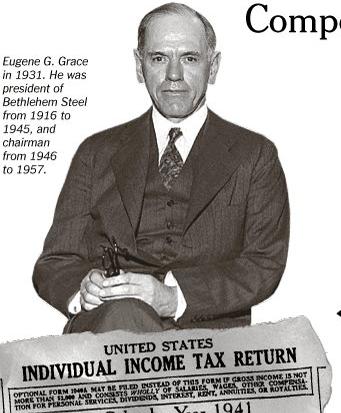
The New York Times has a truly amazing graphic presentation of how the rich used to pay taxes. Check out the image here. The data comes from old IRS filings, made public through the National Archives. They show, for example, that in 1941 — PRIOR to the WWII tax hikes — Eugene Grace, the president of Betehem Steel and one of the highest paid Americans, earned $522,637 (the equivalent of about $7.5 million today), had an adjusted gross income of $336,953 — and paid 66 percent of it, or $114,902, in federal income taxes. Thomas Watson, the president of IBM, paid 69 percent of his AGI in taxes.


Back then, the top marginal tax rate was 81 percent.


And guess what? Those folks were still very rich, still worked hard, still built big companies and created the most poweful economy in the world.


In fact, I could argue that it was precisely BECAUSE OF those high marginal rates that America grew so prosperous in what are now seen as the good old days.