Tim Redmond

SFBG Radio: From Wikileaks to class warfare

0

In today’s episode, we talk about Wikileaks, why there’s more outrage about embarassing leaks than about really dangerous leaks — and why everybody’s so afraid of talking about class warfare. Cuz we aren’t. Listen up after the jump.


sfbgradio12/3/2010 by endorsements2010

SF Weekly gets it all wrong

4

This is a few days late, but still worth noting. After the Supreme Court ruled in our favor and shot down SF’s Weekly’s final appeal in our predatory pricing lawsuit, the Weekly’s Andy Van De Voorde launched another of his notorious screeds aimed at dismissing all of the proven, factual assertions in our case. Fron day one, Van De Voorde’s been wrong about everything — he said the case was stupid and would be quickly dismissed, he said we’d lost at trial, he said we’d lose on appeal … and every step of the way, he’s been proven wrong. Now he’s going after the judges:


Brugmann certainly has been treated like royalty by the city’s elected judges, who function as the legal arm of the local Democratic machine.


But as Bob Egelko, the Chron’s widely respected court reporter, noted in a remarkable blog post, Van De Voorde is simply factually wrong:


The judge who presided over the trial in San Francisco Superior Court, and more than doubled the jury’s damage award against the Weekly, was Marla Miller — appointed by Republican Gov. Arnold Schwarzenegger. The appeals court justice who wrote the ruling upholding the verdict was Robert Dondero — first appointed to the bench by Republican Gov. Pete Wilson, and named to the appeals court by Schwarzenegger. And of the six Supreme Court justices who voted to deny a hearing on the Weekly’s appeal, five were appointed by Republican governors.


I can go even further. The first judge who handled the case, Richard Kramer — who refused to dismiss the suit and tossed most of the Weekly’s pre-trial motions out the door — was appointed by a Republican (Pete Wilson). Of the three judges on the Appeals panel, two — Dondero and James Marchiano — were appointed by Republicans. And while the third justice, Sandra Margulies, was elevated to the appelate bench by Gray Davis, her first judicial appointment to the Superior Court came from a Republican, George Deukmejian.


So there really weren’t any elected Democratic judges in the mix. (And the judges certainly aren’t part of any political machine; the entire local bench, including every single judge, Democrat, Republican or Independent, supported the re-election of Judge Richard Ulmer in November, while the Democratic Party, and the Bay Guardian, supported challenger Michael Nava.)


Sorry, Andy — as has been the case from day one, the facts speak louder than your ranting. The Guardian won this case on the evidence and the legal merits, all the way along.

Tax breaks we can’t afford

18

The big front-page headline on today’s Examiner: “Workers we can’t afford.” It’s a classic story of the Ex genre, a look at how much labor costs are increasing and eating a hole in the city budget. But what gets me is thal it’s not just the Ex; the Chron takes this line, too, and so do news outlets all over the state (and all over the country). The problem is always labor.


You never see a big headline telling the other side of the story: “Tax breaks we can’t afford.”


The thing is, tax cuts and tax breaks are expenses, just like labor costs. The impact the budget in the same way. And at least city workers DO something; a lot of the tax cuts don’t.


I was watching the City Channel last night (yes, Mr. Mayor, I was one of the “ten people” you joked about who were actually watching) and Newsom was giving a speech out at Mission Bay, welcoming a new biotech outfit to the city. And he went on and on about how his administration has attracted all these companies by giving them tax breaks.


He said that, unlike South San Francisco, this city “taxes jobs.” (That’s just silly; we have a payroll tax because you have to have some form of business tax, and the state won’t let us tax corporate income, and a gross receipts tax also has problems, and a payroll tax is at least an approximation of the size of a company. If we taxed gross receipts instead he’d complain that we were “taxing success.”)


And then when he was done with his prattle, the guy from UC who sets up the Mission Bay incubator space for biotech businesses spoke, and talked about all the reasons busineses want to move into the area, mainly the direct connection with UC researchers and experts in business development and the quality of the workforce. He didn’t say a word about taxes.


Because taxes, particularly the very modest payroll tax the city charges, are such a minor factor in business location decisions that tax breaks like Newsom’s don’t do much good in attracting employers. But they do cost the city money.


And those are expenses — yes, expenses — that we can’t afford.


Privatizing the parks

23

I’m not going all crazy on the idea of pretzel stands in Golden Gate Park, or even a lobster-roll place behind the bandshell. I’m kind of against the lease change at Stowe Lake because I hate to see an out-of-town operator take over a local concession (and I like the funky boats, and the popcorn, and the overall 1950s-era quality of the food stand, which — by the way — makes the best soda water anywhere in town, yumm, so extra fizzy and nice ….).


But it’s worth sounding the alarm about the direction that Phil Ginsberg and Mark Buell are taking the Recreation and Park Department. And it’s not just evicting the HANC recycling center.


I realize that the city’s broke, and Rec-park is broke, and if they can’t raise money by selling coffee and lobster rolls they might have to lay off even more recreation directors. I fell the pain. But there’s a dangerous road ahead, and it looks like this:


Once you decide that parks have to pay for themselves, you’ve destroyed the whole notion of public space.


Check out what happened at the Presidio, where a plan by Rep. Nancy Pelosi to tun the park into essentially a private outfit, with the mandate to reach financial self-sufficiency, led to all sorts of problems and set the stage for a debate over privatizing more parks.


This is, of course, part of a larger discussion, but parks are by their very nature supposed to be places that the community — the taxpayers — support and preserve for the good of all. They aren’t supposed to pay for themselves. You’re not supposed to charge admission. Any commercial activity ought to be designed to benefit the users (it’s nice to have a place to buy a bottle of water on a hot day or a snack for your kids) and not to pay the maintenance bills for the facility.


This is what annoys me more than anything else about Gavin Newsom. He talks about vision and sounds like an environmentalist and progressive, but he misses the whole point. You fund public services with tax dollars, not by auctioning them off to the private sector.


At least, you used to.

EDITORIAL: Save the HANC recycling center

11

The foes of the Haight Ashbury Neighborhood Council recycling center — including the mayor and Rec-Park Director Phil Ginsberg, who desperately want to get the low-income riff-raff who sell cans and bottles for a living out of the Haight and Inner Sunset — pulled out all the stops Dec 2, dragging good ol’ Chuck Nevius, who’s always ready to stand up for what isw clean and well-manicured and free of urban grit, into the fight. The Nevius column in the Chron is almost too perfect; he describes the center as “a noisy, ugly industrial plant” that doesn’t belong in Golden Gate Park. Well, the center is technically in the park, I suppose, but it’s not exactly smack amid Speedway Meadow or the Arboretum; it’s way off on the edge, in an area that most people don’t even think of as the park.

But see, here’s the real issue:

It is a magnet for the down and out, some of whom use the can and bottle payout as an ATM for booze and drugs, and even raid the neighborhood bins to fill their carts.

Imagine: A magnet for the “down and out” in the Haight. Imagine: A way for people to make some money without panhandling (which Nevius dislikes) or hassling tourists (which Nevius dislikes) or selling drugs (which Nevius dislikes) or stealing (which all of us dislike). Imagine: A community-run institution that actually creates green jobs for people who might otherwise be homeless (and doing things that Chuck Nevius dislikes).

The real issue is that the mayor never liked HANC (since he lives in the Haight, he ought to stop by a HANC meeting sometime; it’s really not that scary) and doesn’t like the idea of homeless people congregating around the recycling center, and would just as soon get rid of anything that doesn’t fit his vision of a squeaky clean, fully gentrified city.

And it’s not as if Ginsberg wants to restore that corner of the park to native flora; it will be, in his vision, a community gardening center. Nice, but not exactly a natural space. The new center would also attract small crowds — but of a very different demographic. Which, again, is what this is all about.

The HANC recycling center does everything that Gavin Newsom claims to support. It provides green jobs. It offers employment opportunities for people who are on the margins of society, and lets them get back on their feet — without a penny of taxpayer money. It promotes recycling and sound urban ecology.

The private company that collects our garbage and recycling, which is called Recology, doesn’t like the fact that poor people go around and collect cans and bottles from the blue bins on the sidewalk; the stuff is worth money, and the company would rather keep it. But in the end, the material goes to the same place and stays out of the landfills, which ought to be the point. And honestly, isn’t scavenging and recycling cans and bottles a better occupation than agressive panhandling and crime?

The center’s a bargain for San Francisco, and the personal peeves and suburban sensibilities of Newsom, Ginsberg and Nevius shouldn’t shut it down. The Recreation and Parks Commission should direct Ginsberg to back off on eviction proceedings and let the center stay.


SFBG Radio: He won’t be back — grading Arnold

5

In today’s episode, we talk about the outgoing governor, and how to grade his record. Hint: When you think of Arnold Schwarzenegger’s legacy, does anything of substance come to mind (except financial disaster)? Anything? Listen after the break

sfbgradio12/1/2010 by endorsements2010

Supreme Court confirms Guardian legal victory

0

The Bay Guardian won a decisive and final legal victory Nov. 23 in our lawsuit against SF Weekly and its chain parent when the California Supreme Court let stand a verdict now worth more than $22 million.

The ruling ends the Weekly’s appeals, which have stretched for more than two years, and confirms a landmark Aug. 11 ruling by the California Court of Appeal that protects small businesses in the state against predatory chains.

The Bay Guardian sued the Weekly and the New Times chain, now known as Village Voice Media, in 2004, charging that the Weekly had systematically sold ads below cost in an effort to harm the local, independent competitor. By taking advantage of the resources of a large company, the Weekly was able to stay in business despite losing money every year, and was using below-cost pricing as a way to take ads away from the Guardian.

“We have before us the case of an ongoing, comprehensive, below-cost pricing scheme,” the Appeals Court concluded. That sort of behavior is specifically barred by California’s Unfair Practices Act, which was designed to protect small business from big chains.

SF Weekly and VVM tried to argue in their appeals that the state law should be consistent with federal antitrust law, which sets a much higher standard for proving predatory pricing. But the Appeals Court and the Supreme Court disagreed. California, the ruling now says, has every right to provide greater protections for small business than the federal government does.

VVM is still trying to avoid paying the judgment, and the Guardian has been aggressively pursuing collection efforts.

The Guardian’s stellar legal team includes trial lawyers Ralph Alldredge, Rich Hill, and Craig Moody, appellate specialist Joseph Hearst, and collection expert Jay Adkisson.

The lawyers who represented VVM in its unsuccessful trial efforts were H. Sinclair Kerr Jr., Ivo Labar and James Wagstaffe of Kerr & Wagstaffe. The appellate lawers were Paul Fogel, Raymond Cardozo, and Dennis Peter Maio of Reed, Smith. VVM was also represented by Don Bennett Moon. 

Editor’s notes

2

Tredmond@sfbg.com

The New York Times, the old established voice of the liberal media elite, ran a piece on Sunday looking for answers to the nation’s persistent economic crisis. Reporter David Segal interviewed prominent economists on the left and right — the likes of John H. Cochrane at the University of Chicago, James K. Galbraith at the University of Texas, even Gar Alperowitz at the University of Maryland, who’s kind of (God help us) a socialist.

The right-wingers talked about the need to cut government, the left-wingers talked about community co-ops and green technology, and all sides agreed that the situation was dire and would probably get worse. But nobody even mentioned wealth inequality.

It’s kind of mind-boggling. It’s as if the entire subject is off the table, taboo, something that doesn’t get discussed in the company of polite economists. And that’s just crazy.

Look: the 400 richest Americans today have combined assets of about $1.5 trillion. Raise that number to 5,000 and you can about double the total wealth. This is a very rich country; our prospects aren’t bleak at all. With a bit of enlightened public policy, we could profoundly improve the economic situation in just a few months.

I have no PhD. I barely escaped Wesleyan University with an economics degree in 1980, squeaking out a D in my last class by promising the (very conservative) professor that if he failed me, I’d be back next year. But it doesn’t take econometric wizardry to add up the figures. They go like this: A one-time 20 percent wealth tax on the 5,000 richest Americans — including many people who have pledged to give away half their wealth anyway — would generate about $600 billion. Nobody would miss any meals; no families would lose their homes, or even their second or third homes, or their personal jets. Expand the pool a little and you could easily reach $1 trillion.

With that money, you could immediately create 7 million jobs (at an average of $50,000 a year) and fund them for three years. That would cut the unemployment rate in half. What would those people do? Plenty. They could rebuild the country’s roads and highways and bridges, and build high-speed rail systems, and work in health care clinics, and teach art and music and writing, and clean up environmental messes … there’s loads of work in this country. And even with a modest estimate of the economic multiplier, those 7 million public sector jobs would create another 3 million private sector jobs, and all of a sudden, the country’s booming again. And a lot of those people who were hired by the government could now transition to private business. (And those very rich people would do well in the boom, as they always do, and might even make most of their money back.)

Raise taxes on the top 5 percent of the nation’s wage earners and corporations and you would generate enough money to keep the program going until the private economy could pick up the slack. Then eliminate the Social Security tax on the first $25,000 of income and expand it to cover all income up to $250,000 and suddenly — a huge incentive for small businesses to hire new workers and a stable retirement system for the next two generations.

It’s not that hard. It’s not a socialist revolution. Nobody really gets hurt, and a lot of people benefit. I mean, it seems to me that it ought to be part of the discussion. Maybe that’s why I was such a lousy economics student.


Editor’s notes

0

Tredmond@sfbg.com

The pollsters like to call it the Santa Claus effect, and we’ve seen it over and over in surveys of California voters in the past few months. I think of it more as some sort of deep political pathology, a schizophrenia combined with delusions that underlies the state’s inability to get anything done.

Here’s what the data shows:

California voters don’t want cuts to higher education; in fact, they want to see more money spent on the University of California system, the California State University system, and local community colleges. They don’t want cuts to K-12 education either. Nor do they want to shut down state parks, release prisoners early, close public hospitals, stop building high-speed rail, reduce state support of local government … or do anything else that would save a significant amount of money.

And they don’t want tax increases.

If you ask people how they think the state should balance the budget, they talk about cutting waste — even though the current Republican governor admits there’s not that much waste left to cut.

I could spend hours talking about how we got here, how decades of corruption and bad governmental priorities soured people so much on the public sector that they don’t believe the state can be trusted to spend their money properly. But part of the issue is that the news media (which love to find a little waste here and there to trumpet) are very bad at presenting the choices.

Nobody in Sacramento’s going to do anything serious about the budget until Jerry Brown takes office; that’s just how it is. So this psycho-financial nightmare is going to fall in his lap — and I wonder sometimes if he ought to force us all to make the choices we want to avoid.

Maybe Brown ought to call a special election in February or March and put two — and exactly two — measures before the voters. Both would balance the state budget. One would do it almost entirely with cuts, and those cuts would be clearly defined: public schools would shut down all over the state. Class size would rise to 40 or more kids. UC would close half its campuses and admit half the number of qualified students it does today. At least 100,000 prisoners would be released as several prison are mothballed. The entire state park system would be shuttered. And that’s just the start. Consumer protection agencies would be abolished, public health devastated — there wouldn’t be a single thing that Californians take for granted that would survive.

Because that’s what a cuts-only, no borrowing budget would look like.

The other proposition would save those services by closing tax loopholes that benefit big business and raising income taxes on the wealthiest people in the state. Brown would have to travel up and down the state and make it clear: these are the choices we face. You can’t solve a $20 billion budget crisis without either tearing the state apart or raising taxes.

No more ducking. No more pretending. No more looking around for Santa Claus. Make the choice, folks: accept new taxes on a small percentage of the population, or give up on the state.

It’s a scary thought, but it may have to come to that.


Where the plastic bag ban started

8

Even Gov. Schwarzenegger is now supporting a ban on plastic bags in California, saying the measure, which narrowly failed in the state Senate last session, is a top environmental priority. But let’s remember:

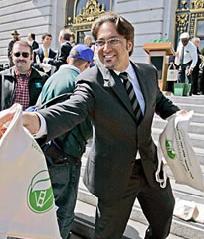
While Debra Saunders is making fun of those wacky supervisors in San Francisco who try all these crazy things, it was Sup. Ross Mirkarimi, who pushed the first ban on plastic bags, and the San Francisco supervisors who approved it.

Of course, when the rest of the country starts to realize that pushing high-fat, high-calorie foods to kids by hawking plastic toys is a bad public policy idea, Saunders will be making fun of something else.

SFBG Radio: No austerity for the rich

1

Everyone’s talking about austerity these days, from the prime minister of Ireland to the president of the United States, who wants to freeze wages for federal workers. But somehow, there’s one class of people who aren’t facing any austerity at all. Funny thing about that. Check out the discussion after the jump.

sfbgradio11/29/2010 by endorsements2010

There are no secrets

0

I see Hillary Clinton is all indignant about the latest Wikileaks release. And there will be no end of hand-wringing in journalistic and political circles about whether this material should have been leaked, released, published etc. (But you have to admit, it’s great stuff; I particularly like the comments about the the looney leader of North Korea is still “quite a good drinker.”) And there is, of course, important data that the public ought to have, and I think the NY Times did the right thing by publishing the material.


But there’s another side of this, something that Clinton and Obama and the whole CIA/national security/spy apparatus ought to already know: These days, it’s really hard to keep anything secret for long.


Daniel Ellsberg had to make clandestine photocopies of thousands of pages of Pentagon Papers docs, then smuggle them out of his office and slip them to a Times reporter in a hotel room. These days? Click of a mouse. Hard to trace, impossible to stop. Once documents of any sort have gone to more than one or two people, you might as well assume they’re going out to the whole world.


Anyone who uses email on a professional basis has been told that. Think of poor Brad the Cad. About time the secretary of state caught on.


Prison report: The madness of parole

10

By Just A Guy

Editors Note: For much of 2009, Just A Guy wrote reports for us from a California state prison (here’s an example). He was released last November, but continues to send us commentary every now and then.

 
So, it’s been some time since any of you have heard anything from me. Here’s a story for you about how poorly the parole system works.

As many of you will remember, I was released in November of last year, but paroled to a state out of California.


Since that time I have had no problems whatsoever, have been very successful on parole, worked and travelled for business all over the country, supported my family, and been an upstanding citizen.

Earlier this year, I met some people at an industry meeting, and the discussion resulted in my being offered a job that required my moving to a state different than where I was on parole. The transfer paperwork allowing me to move from the controlling state to the new state was initiated a short time after I accepted the position, but the paperwork that was submitted through the Interstate Compact Office was somehow lost.
 
Meanwhile, I moved to the new state in order to start my new position; though I was having to go back monthly to my old state to report for parole, as one isn’t allowed to be out of state on a travel permit for more than 30 days without reporting back to the controlling state. In the beginning of October — three months later — I found out that the transfer paperwork had been lost and had to be re-submitted; meanwhile I had to spend a minimum of $600 a month to go back to my controlling state and report in. Being proactive, I called the out-of-state parole office in California to find out what was going on and explained the situation. California “fast-tracked” my paperwork to get the out-of-state transfer done. Fortunately my parole officer at the time was very understanding and didn’t make me come in to report the last time I was supposed to since the paperwork was confirmed as being processed by California.

Ultimately, in the last week of October, my transfer paperwork came through and I am now officially under the supervision of the new state.

Why does any of this matter? It’s been a year since I left prison, and my parole should be ending. I would have been a “no brainer” to be discharged from supervision in the state I just transferred out of — but because I just moved to a new state, the California Parole Division has recommended I remain on parole because I don’t have a proven track record of success in the new state — even though I have been successfully employed here for four months, and was previously successfully employed in the old state for eight months.

Apparently, it doesn’t matter — because I’m in a new environment and they want to make sure I’m abiding by the rules and regulations of parole in the new environment, which, really are about the same as the old environment.

The irony of all of this is that I went above and beyond in trying to make sure I was doing things right and following the rules of California and the other two states. I even called the California Interstate Office to find out what the problems in facilitating my transfer were and got them resolved. Had I just gone back and forth between the state where I was residing and working (costing $600 a month in travel) and let the system do its slow meandering work, my transfer probably still wouldn’t have gone through — it would have shown I was successful in the “old state” and I would be recommended for discharge.
Now, because I tried to keep things on the up and up, I’m getting punished.

It’s very frustrating. I have to travel with some frequency for my job, but the new state is less permissive with business travel and that affects my ability to do my job and support my family and be successful. I have always been under the impression that parole was meant to help protect the public AND help the parolees make a successful transition back to society. I have done everything humanly possible to be successful, but the process just gets in the way.

I am being recommended to be retained on parole because I started a new job – crazy, since that makes our family’s life better.

Another crazy thing, the reason I had to call the California Interstate Office, is that parole agents are not allowed to contact each other directly. In other words, my parole agent in the state I transferred out of is not allowed to contact the parole office in California directly. I can do it but she can’t. EVERYTHING has to go through Interstate Compact; no direct interaction between agencies is allowed. How’s that for effective.

Bottom line, there’s still a chance the Board of Parole may grant my discharge against the recommendation of the California Parole Unit, but what’s the likelihood of that? After all, now that I’m not in California it doesn’t cost them any money to keep me on parole in the new state! I promise you if I were in California or the previous state it would be rubber stamped.

The worst part is, I don’t get an opportunity to argue my case in front of the board, I don’t get to see the recommendation, I don’t even know when the discharge hearing is going to be.
Result: stuck on parole for another year for doing things the right way, ability to affectively my business greatly disabled. Way to go California, keep up the good work.

Supreme Court rejects SF Weekly appeal

14

The California Supreme Court let stand Nov. 23rd a landmark ruling protecting small business from predatory chains, denying without comment an attempt by SF Weekly and its chain parent to get the high court to hear the case.


The decision brings to an end more than two years of appeals by the Weekly and Village Voice Media and effectively concludes the legal case.


The Bay Guardian sued the Weekly and the New Times chain, now known as Village Voice Media, in 2004, charging that the Weekly had systematically sold ads below cost in an effort to harm the local, independent competitor. By taking advantage of the resources of a large company, the Weekly was able to stay in business despite losing money every year, and was using below-cost pricing as a way to take ads away from the Guardian.


“We have before us the case of an ongoing, comprehensive, below-cost pricing scheme,” the Appeals Court concluded. You can read that ruling here (pdf)


The Appeals Court noted that shortly after New Times bought SF Weekly in 1995, New Times Executive Editor Mike Lacey announced that he would use the chain’s deep pockets to assault the Guardian. “The essence of Lacey’s message was that he wanted to ‘put the Guardian out of business,'”he ruling states. “The sales representatives were made aware that advertising could be ‘sold below cost’ if needed ‘in order to make a sale’ and the resources of New Times would cover the loses, even over a term of many years.”


That sort of behavior is specifically barred by California’s Unfair Practices Act, which was designed to protect small business from big chains.


SF Weekly and VVM tried to argue in their appeals that the state law should be consistent with federal antitrust law, which sets a much higher standard for proving predatory pricing. But the Appeals Court and the Supreme Court disagreed. California, the ruling now says, has every right to provide greater protections for small business than the federal government does.


There are 20 other states that have laws similar the the California Unfair Practices Act.


The ruling is a victory not just for the Bay Guardian but for small business across the state. The appellate courts have made it clear that predatory pricing is a violation of law — and the ruling can now be used by any independent merchant fighting big chains. As Ralph Alldredge, one of our laywers, noted after the Appeals Court ruling: “Think of what that means for big-box retailers, which have used below-cost selling on some products to attract customers away from small, independently owned grocery, hardware, drug, and department stores.”


Editorial: The screwy process for selecting a mayor

19

The clerk of the Board of Supervisors, at the request of Board President David Chiu, has released a proposal for the selection process for a new mayor, and it’s about as complicated and confusing as everyone expected. That’s in part the result of the vagueness of the City Charter, which simply specifies that a vacancy in the office of mayor shall be filled by a San Francisco registered voter chosen by a majority of the supervisors but offers no procedural clues on how to get there. And the Political Reform Act sets very strict limits on conflicts of interest for elected officials in California; a supervisor, for example, can’t vote for himself or herself or do anything to promote his or her candidacy for an office that comes with a pay raise.


In the end, the proposal leaves limited room for public input — and makes it very difficult for any sitting supervisor, particularly one of the progressives, to wind up winning the job.


The way the rules are laid out, the board would accept nominations — but any sitting supervisor who accepted the nomination would have to leave the room at once, cease all communication with his or her colleagues, and play no role in further deliberations or voting. Since it’s entirely possible that several supervisors — and possibly several progressives — could be nominated, the process would cripple the final outcome since the only ones allowed to vote would be the remaining board members whose names aren’t in the mix.


That skews the outcome heavily toward one of two options: the supervisors appoint someone who isn’t on the board — or Chiu winds up as both acting mayor and board president because nobody else can muster six votes. The only other option: The progressives all stick together, line up in advance behind a candidate who’s currently on the board, and find one more vote for that person.


The whole thing is so screwy that the supervisors ought to make some changes before they adopt it and try, to the extent that it’s legal, to inject some sanity into the process.


For example: Instead of opening the nominations, collecting a long list of names, sending all of the sitting supervisors on that list out of the room and then voting, the board could take the names one at a time. A supervisor gets nominated, leaves the room, and the votes are tallied; if he or she has fewer than six, the process starts again. (The problem: who goes first — because the first person eliminated can’t be nominated again. To be fair, there would have to be some sort of random drawing of which supervisor could make the first nomination — which alone might add too much random chance to the outcome.)


Then there’s the question of when this all takes place. If the process starts now and an interim mayor is chosen, the board will have to reconfirm that person Jan. 4 when Gavin Newsom actually resigns to take over as lieutenant governor. There’s a chance something could go wrong in the meantime and the board would have to change its vote, and there’s a chance that state law would prevent a supervisor who won from acting in any way to influence the final vote. But those are better risks than the option of leaving everything to the last day. And if the board decides that it can’t or shouldn’t act until Jan. 4, special meetings ought to be calendared for Jan. 5, 6, and 7 to give the current board more than one day to make the final decision.


And before anything happens, the board needs to schedule at lest one open hearing to get input from the public on the qualifications for the next mayor and on potential candidates.


The bottom line: any candidate who wants to get progressive support needs to be willing to do more than sign legislation and manage the city. He or she needs to be willing to use political capital and the mayor’s bully pulpit to make the case for progressive change — on taxes, services, the budget, and an overall civic vision. And the six board members on the left need to stick together, or that won’t happen.

The mayoral selection last time

3

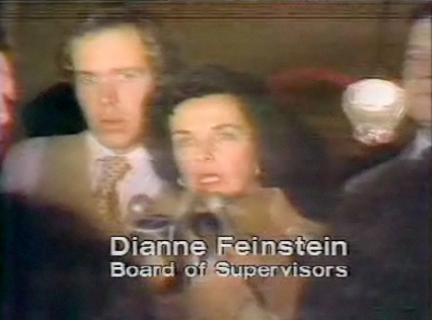
The last time the Board of Supervisors had to pick a mayor, things were very different. Former Sup. Dan White had just murdered Mayor George Moscone and Sup. Harvey Milk. The city was in shock. Board President Dianne Feinstein became acting mayor, and one week later, on Dec. 4, six of her colleagues — the narrowest possible margin — elected her to fill out Moscone’s term.

It’s worth looking back at what happened that week, not only because it’s a fascinating bit of political history, but because it gives some insights into how the current process should and shouldn’t go.
We’ve gone back and pulled not only the minutes of that meeting, but all of the relevant articles and editorials from the San Francisco Chronicle, the old San Francisco Examiner and the Bay Guardian, and while newspaper accounts are only the first, and often imperfect draft of history, the Chron had a good City Hall reporter, Jerry Burns, and you can get a lot from the day-by-day accounts.

For starters, everyone (even the Guardian) agreed that Feinstein did a good, almost uncanny job of keeping it together and managing the city in the week after the horrendous murders. But she was by no means the only, or consensus candidate for the job — Sup. Robert Gonzales announced his candidacy Dec. 1, and others were in the running until the end. The Guardian wrote at the time that Feinstein was fine as acting mayor – but shouldn’t be in office for the final 13 months of Moscone’s term.

Among the interesting elements of the drama:

— The process was riddled with Brown Act violations, and the selection of Feinstein was, in retrospect, almost certainly based on illegal meetings.  “Feinstein spent yesterday at her Pacific Heights home,where she talked with most of the supervisors,” a Dec. 4, 1978 Chronicle article by Burns noted. That would amount to an illegal meeting; under state law, then and now, meeting individually and serially in private with all or most of the members of a public board is a clear violation of the Brown Act.

At the time, however, nobody challenged Feinstein’s actions.

— Then, as now, there was a move to name a “caretaker” mayor who would fill out the remaining 13 months of Moscone’s term — and vow not to run again. But the conservative Examiner said that was a bad idea: In a Dec. 3 editorial, the paper, then owned by Hearst Corp., noted: “The City should not have to accept a “caretaker” mayor invested with only a thin veneer of authority.” The notion went nowhere.

— At least one name that was bandied around back then is in play again today: Then-Assembly Member Willie Brown.

— Feinstein got exactly six votes. Although in most casual historical accounts, she’s described as a clear, almost unanimous choice, that was far from true. In fact, Sup. Ron Gonzalez, who described himself as the board member most in synch with Moscone’s agenda, announced his candidacy Dec. 1, and as of Dec. 3, the day before the final vote, Russ Cone of the Examiner reported that “earnest and secretive negotiations among San Francisco’s nine supervisors to agree upon a mayor to replace the slain George Moscone today entered the final, feverish hours with no candidate ready to claim victory.”

At the Dec. 4th board meeting, Sup. Quentin Kopp moved to continue the decision for a week. Kopp – unlike most of his colleagues – had been avoiding the political furor in the days after the assassinations, saying it was unseemly to be making deals when city leaders ought to be in mourning. Feinstein and the six others who would ultimately elect her voted against the motion.

That would be a clear violation of law today; as a candidate, Feinstein would be unable to vote on anything that could promote her ascension to mayor. But no matter: The motion needed six votes, and only Kopp and Sup. Lee Dolson said Aye.

When the motion was made to name Feinstein as interim mayor, Kopp tried to ask her a few questions – particularly about her plans for various department heads. The city attorney quickly shut him down, saying Feinstein couldn’t legally answer or get involved in any debate.

Then six supervisors voted for Feinstein. Kopp and Dolson dissented. Feinstein by law had to abstain. And there were, of course, two empty seats; Dan White had just resigned and was in jail, and Harvey Milk was dead.

Why did Kopp vote no? There’s a back story, a key part of San Francisco political lore.

Feinstein had run for mayor twice before, in 1971 and 1975, both times finishing well out of the money. After her second defeat, she vowed she’d never do it again. In fact, the day before the assassinations, she had just returned from a trip to Nepal with her then-boyfriend (now husband) Richard Blum, and reporters asked her if she was going to run in 1979. “Not this time,” she said.

She and Kopp, longtime rivals, had cut a deal the year before. Feinstein wanted to be board president; Kopp wanted to be mayor. And Feinstein vowed that if Kopp would support her for board president, she’d stay out of the mayor’s race in 1979 and leave the field open for him.

And of course, immediately after the killings, she changed her mind. Kopp thought what was a bit slimly, and refused to vote for her for mayor. He challenged her in 1979, and narrowly lost, and her political career, so recently in the doldrums, was off and running again.


The next mayor: A very funny video

4

This is a truly enjoyable (if a little off-base) video about the selection process for the next mayor. I particularly like the part about the duties of the acting mayor. Check it out after the jump


SFBG Radio: Beyond body scans and patdowns

2

Today we talk about the anger over full-body scans and patdowns at airports — and why the critics are missing the point. Body scans are far less intrusive than the sort of data mining, wiretaps and assaults on personal privacy that go on every single day in both the public and private sector. Listen after the jump.

sfbgradio11/22/2010 by endorsements2010

About that “far left beating…”

61

Our old pal Chuck Nevius is gloating about how the “far left” (I guess that means the people who would have been called mainstream Democrats a generation ago, the ones who believe in the public sector and think economic equality matters) got beaten badly in the supervisors races. And he uses Aaron Peskin as the personification of the far left (amusing, because if you actually talk to Peskin, and look at his record, he’s hardly a crazy leftist. And I say that as someone who is. A crazy leftist, I mean.)

Anyway, here’s what Nevius missed:

Malia Cohen is on the Board of Supervisors because of Aaron Peskin.

Look at what happened in the ranked choice voting. Cohen came from back in the pack because of second-place votes — and a lot of that was because the Democratic County Central Commitee put her as its #2 choice, after DeWitt Lacy, who didn’t run much of an effective campaign.

How did she get the #2? How did a candidate who is bad on tenant issues beat out Tony Kelly, who was by far the most progressive contender, at the supposedly “far left” DCCC? That was the work of Peskin — who, to the chagrin of a lot of progressives (including me) decided to vote for and promote Cohen as the second choice on the slate.

First of all, that was hardly the move of a “far leftist,” since Cohen certainly ran as a more moderate candidate. Second, it showed that the “far left” isn’t some giant organized hippie commie bloc led by Commisar Peskin; it’s a sometimes-united, often-fractious coalition that shares some interests and agendas but doesn’t always have its shit together.

Then there’s this notion the moderates swept into power. Actually, by chance of the way lines are drawn, the even-numbered seats have always been more conservative than the odd-numbered ones. In this case, in many of the races, the progressives were (to quote Calvin Welch) “playing with the house’s money.” Check it out:

D2: Janet Reilly would have been much more reasonable than Michela Alioto-Pier, but Mark Farrell won’t be any worse. Almost by definition, he can’t be any worse than Alioto-Pier. That was a conservative seat, and still is.

D4: No change at all, still Carmen Chu, still a moderate-to-conservative seat.

D6: I supported Debra Walker, but by no stretch of the imagination is Jane Kim anything but a progressive. She’ll be more conciliatory than Chris Daly, but that’s not difficult; Walker would have been more conciliatory, too. Different people, different personalities. But in the end, Kim will be a progressive vote; I mean, she started out as a Green Party leader. The “far left” held that district.

 D8: Definitely the house’s money. Scott Wiener won’t be a whole lot different on the issues than Bevan Dufty. If Rafael Mandelman had won, it would have been a net pickup for the left, but as it is, I’d call it a wash. Sure, the DCCC endorsed Mandelman and he lost, but we all know that was an uphill battle; Wiener has been working that district for years, had plenty of money, was better-known, had the support of Mark Leno, who once held that seat and is immensely popular in the district.   

D10: Sophie Maxwell was never part of the progressive bloc on the board. Sometimes she voted with them; sometimes she didn’t. Tony Kelly would have increased the size of the progressive majority; Malia Cohen doesn’t change it.

In two years, five key progressive seats will be on the ballot — Eric Mar seeking re-election in D1, David Chiu in D3, Ross Mirkarimi termed out and an open race in D5, and David Campos and John Avalos running again in D9 and D11. That’s where the battle to hold the progressive majority will be fought — and those are districts where the DCCC has more influence anyway.

In other words, since the return of district election, the progressives — the “far left” if that’s what you want to call us — have only held one of the five even-numbered seats, and still do. That’s not spin, Chuck; that’s reality.

 PS: Just for fun, I went back four years and checked out our endorsements for supervisor the last time the even-numbered seats were up. W endorsed Sophie Maxwell for re-election in D10 (with reservations, and lacking a credible progressive alternative) and Daly was re-elected with our support in D6. But our candidates lost in D2, D4 and D8.  Nobody talked about the left getting destroyed.

Memo to Jerry: Yes, you can raise taxes

6

The students and professors at UC have come up with all sorts of creative ways to avoid or minimize tuition hikes, but there’s an option that the Regents (and so far, the new governor) haven’t put on the table: An income tax surchage on the irch and big corporations to pay for public education. Guees what? A majority of Californians are in favor of that approach. In fact, according to the Public Policy Institute, which generally produces some of the most accurate polls in the state, Californians are far more willing to see their own taxes go up than to see student fees raised.


And PPIC didn’t ask the direct question that I would have asked — would you favor a small tax increase for the wealthiest Californians to pay for reduced tuition at California’s public universities? — but based on the poll results in general, I think the response would be a resounding yes.


So there you go, Jerry — a chance to immediate take a stab at the budget crisis in a way that would be popular almost across the board.  

SFBG Radio: The matador and the bull

3

Today we talk about the American public, the bull that has been slashed and stuck with knives and abused by the matador that is the ruling class, and Johnny asks: When is the bull going to stop falling for that dumb red cape trick and start to fight back? You can listen after the jump.

sfbgradio11/17/2010 by endorsements2010

Editor’s Notes

0

tredmond@sfbg.com

Imagine if the next mayor of San Francisco was chosen in public. I don’t mean the supervisors voting in public — they’ll have to do that at some point anyway. I mean the various possible candidates going through a process that allows the public to see who’s on the short list — and where those candidates are on the issues.

Sup. John Avalos, with the backing of his colleagues Chris Daly and David Campos, have started the process by suggesting that the board nominate candidates, soon. The idea, Avalos says, is to get a new mayor chosen early so that person can start on the transition process and get up to speed on leading the city.

But there are further steps here. When the supervisors nominate candidates for less significant offices, the Rules Committee holds a hearing and discusses the nominees. What if the supervisors, meeting as a Committee of the Whole, nominated, say, a half-dozen people for the job of interim mayor — then asked each candidate to appear before the group and answer questions?

The voters just overwhelmingly approved a charter amendment that will require the next mayor to appear at a board meeting once a month. There’s no reason the candidates shouldn’t do the same.

The supervisors have every right to ask someone who wants to be mayor what his or her position is on a long list of policy issues. And the pubic has every right to hear the responses.

I know, I know — the candidates would hate it. Standing in front of 11 people, from Chris Daly to Sean Elsbernd, and submitting to the mother of all job interviews would be unpleasant, perhaps unsettling. Some of the top contenders might bow out at the prospect.

But let’s be serious: In a normal campaign, the voters get to see candidates for mayor speak, take stands on issues, and engage in debates. I can’t see the supervisors choosing a new mayor on good faith alone (well, I’d take Tom Ammiano on good faith, but he doesn’t want the job). And if there aren’t any public discussions or interviews, then the only screening process is going to happen privately, with individual board members contacting individual candidates and (most likely) cutting deals.

I think it’s perfectly fair to say to the potential candidates: You want to be mayor of San Francisco? Spend an hour making the case for yourself and fielding questions from the people who are about to hire you. And let the rest of us watch.

A word from the sheriff on the mayoral mix

0

One of the names that’s getting thrown around a lot in the discussions of the interim mayor is Sheriff Mike Hennessey, who’s been in his job longer than I’ve been in mine, and that’s a good while. The idea is that Hennessey — generally a good progressive, and lately very outspoken on Sanctuary City — would serve for the rest of Newsom’s term, but not run for re-election; he wold be the classic “caretaker” mayor.


I’m dubious about the caretaker idea. A short-termer would have to deal with massive budget problems — but without any real power to make long-term decisions. But as far as I can tell, nobody in the local press has bothered to call Hennessey and ask what he thinks, so I gave him a jingle today. As always, he called me right back and was friendly and spoke off the cuff with his usual sense of humor.


The bottom line: He’s fine with the job he has now. He’s never really wanted to be mayor. But if the supes wanted him, he wouldn’t say no.


“It’s realy not something I’m lusting after,” Hnnessey said. “But if the supervisors decide they need a steady hand, someone who has been before the voters, I’d be willing to do it.”


He would also be utterly uninterested in running for re-election. In fact, he’s not even sure he’s going to run for sheriff again; he’s still relatively young (early 60s) but has 32 years in the job and is probably looking forward to a nice semi-retirement. Serving out Newsom’s term would make that decision easy.


On the other hand, he was quick to point out that a caretaker mayor couldn’t do a lot. “The first five months you’d be working on the budget, then the election cycle would start up and you’d just have to try to stay out of the way,” he told me. “You can’t municipalize PG&E in one year.”


Which I think is about right. There are some key pieces of legislation that Newsom has vetoed that a short-termer like Hennessey might be willing to sign, but all the real major decisions would be put off for a year. And the progressives would be giving up the chance to put someone in the mayor’s office would could run for re-election on a progressive platform.


Mike’s not to fond of my bright idea of asking all the potential mayoral candidates to show up and answer questions at a public board hearing, either. “I think that’s a really bad idea,” he said with a laugh. “Because I wouldn’t want to do it.”


Gavin Newsom, Republican

1

I mean, isn’t this exactly what the Republicans have been saying in Sacramento, paralyzing the state by refusing to accept any new taxes? Is that the attitude Newsom wants to bring to his new job? What’s he going to do when Jerry Brown announces a package of tax hikes for the June ballot and wants his loyal Lt. to go around the state and campaign for them? Or is there a different standard for the state budget?


I don’t get it, Gav.