Tim Redmond

Editor’s notes

0

tredmond@sfbg.com

I say it over and over again, because some people clearly aren’t paying attention:

Corruption matters.

When the mayor of San Francisco surrounds himself with people who don’t show any respect for campaign finance or ethics regulations, who think it’s fine to skirt (and possibly break) election laws, it undermines faith in local government.

And at a time when conservatives at the national and state level are mounting a concerted campaign to shrink, weaken and ultimately burn down government, the last thing San Francisco needs is to give them fuel.

Listen: When Willie Brown was mayor, a tax lawyer named Ron Chun was running for assessor. Generally a good guy, generally progressive, full of creative ideas. But when I asked him about how to get more revenue into the city, he said:

“Why should we bring in more revenue? Willie Brown’s just going to waste it on his cronies anyway.”

He wasn’t alone. A lot of generally progressive people felt as if paying taxes was throwing money down the sewer. Because everyone knew that Brown was hiring unqualified people, pouring cash into contracts for his pals, handing out raises and benefits to city workers who supported him — and treating critics as if they were traitors to the nation.

Mayor Lee says he doesn’t approve of what looks an awful lot like voter fraud and doesn’t support what the independent expenditure committees are doing in his name. But anyone with any sense knows that the IE groups and the Lee campaign and the Lee administration are all parts of a permanent floating crap game where the players move around but everybody knows everybody else and there’s no way to keep communications completely shut off. If Lee wanted these “independent” groups to quit using stencils to make sure voters choose him for mayor, these operators would stop.

But he talks to people like Brown, people who have disdain for honest, open government, and they tell him not to worry. These things blow over. Once he wins the election, it won’t matter.

But when you have a mayor who invites corrupt actors into the house, it does matter. It matters a lot.

WTF, Chuck?

18

And now for a new installment in the ongoing saga of What the Fuck, Chuck?, our attempt to figure out the unfathomable positions of the Chron’s local columnist, C.W. Nevius. Today’s episode: Why is Nevius so determined to stir up a clash between the police and the OccupySF protesters?

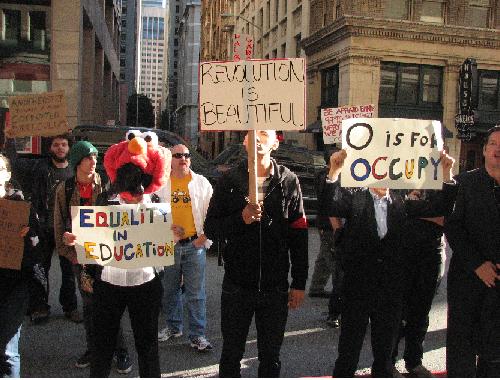
Although the Oakland cops have rousted Occupy Oakland — with a nightime raid, arrests, and the works — things have been pretty mellow in San Francisco for the past week. Police Chief Greg Suhr has tried to avoid sending riot troops in to evict the camp. The campers are working with city officials to get a permit for a stove. The camp is largely peaceful; nobody’s hurting anyone or anything.

Oh, but Chuck is nervous:

Many of the city’s homeless residents have gravitated there, the sanitation is a nightmare, there are rats, and car batteries are neither a safe nor ecological energy source.

Well, there were rats there before the protesters arrived. City officials have offered to set up portable toilets. Car batteries aren’t perfect, but if you charge them by riding a stationary bicycle, the energy is pretty darn ecological. And really, unless you knock the battery over and it cracks and spills, car batteries are pretty safe; the don’t explode or emit fumes. The acid and lead are toxic, but they’re pretty well contained. There are more than 300,000 car batteries on the streets of San Francisco already; every car has one.

And so what if “many of the the city’s homeless residents” have gone to join the protests? Some are eager for the free food and shelter, which is fine — putting the more middle-class radicals side by side with homeless people isn’t a bad thing at all. In fact, it’s about the most radical thing that OccupySF is doing. Homeless people are the most visible victims of the economic injustict that the occupyers are protesting; shouldn’t they be part of the action?

I realize that some homeless people have mental health and substance abuse issues, but those didn’t start with OccupySF. Instead of whining about the situation, the city ought to be taking advantage of it — here’s a group of hard-to-reach folks who social workers can probably connect with more easily in an environment and community that’s supportive.

But Nevius can’t imagine anything good coming of any of this:

As Occupy SF gets bigger and louder, the potential for trouble only increases.

I guess Nevius doesn’t believe it’s possible for an alternative community that includes a wide range of activists and homeless people to grow and make its voice heard without “trouble.” And the only way out is to send in the troops.

What the Fuck, Chuck?


Lee fraud bumped by Hammer

24

The San Francisco Chronicle finally — finally — put the story about voter fraud by Ed Lee’s supporters on the front page Oct. 25, and it was on the top of sfgate for a few hours. But by 11:30 a.m., the story was off the front page of the paper’s website, buried where it’s impossible to find without searching — and replaced by a big story about this bizarre Ed Lee rap video featuring Hammer, will.i.am and Brian Wilson. It’s almost a joke, the video, a cartoon version of a music video featuring young women chanting “Ed Leeeeee” and lyrics that just about left me speechless:

My my my, music hits me so hard,
Newsom left and they put him in charge,
Thank you, for blessing me,
and the rest of the city with Mayor Ed Lee
Got us all sayin’ “Run Lee Run”
Only five-foot-five but he gets (bleep) done
So tell them other candidates to find a bus pass,
Unless you ridin’ with us…FEAR THE MUSTACHE!

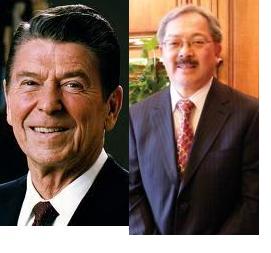
It’s almost like Rappin Ronald Reagan. Except that one was actually funny.

So: A real, serious story about the kind of dangerous sleaze that we can expect from an Ed Lee administration is bumped off the top of the city’s daily newspaper website to make room for a weak joke. Go Chronicle. Go sfgate.

A vote-fraud video primer

29

The Leland Yee campaign has produced a nice little video primer on the Ed Lee vote scandal. It’s short, to the point, and gives you a sense of what has been going on with volunteers who are supposedly independent from the official Lee campaign. Check it out after the jump.

WashPost gets the headline right

5

Somehow, you never see headlines like this in the Chron:

Former SF Mayor Newsom endorses hand-picked incumbent Ed Lee amid ballot tampering charges

Pretty much says it all.

Economic and social equality: WTF?

1

Fascinating oped piece in the Oct 23 New York Times by Alexander Stille about economic and social equality. He starts right out with the issue:

It’s a puzzle: one dispossessed group after another — blacks, women, Hispanics and gays — has been gradually accepted in the United States, granted equal rights and brought into the mainstream.

At the same time, in economic terms, the United States has gone from being a comparatively egalitarian society to one of the most unequal democracies in the world.

The two shifts are each huge and hugely important: one shows a steady march toward democratic inclusion, the other toward a tolerance of economic stratification that would have been unthinkable a generation ago.

More:

Europe has maintained much more economic equality but is struggling greatly with inclusiveness and discrimination, and is far less open to minorities than is the United States.

Now: You can argue (and make a good case) that the dispossessed groups Stille talks about really haven’t won mainstream acceptance. But the fact is that over the past 30 years, this country has made considerable progress on the civil rights and social equality front — and has lost just as much ground or more in economic equality.

I don’t buy the hidden argument in here that social and economic equality are tradeoffs, that you have to give up one to get another. That’s ridiculous. And I think there are still times when race matters more than class. When you look at patterns of environmental justice, for example, you find that African American communities face far more toxic contamination than white communities — and income doesn’t seem to be as much a determining factor. In other words, middle class black communities have been dumped on more than poor white communities.

But I do think he makes an excellent point about class-based organizing in the U.S. It hardly exists anymore. And that’s something we all need to worry about.

The city is famous for its identify politics, and much of that is good. When Harvey Milk said that gay people should have their own supervisor, when Asians and Latinos and African Americans say they need to be represented in government, that’s not only valid but an important progressive goal.

But when we leave class, poverty, equality and economic justice out of the picture, or when we fail to make it a priority, we get what we have — a godawful economic mess.

Another bad guy executed without trial

8

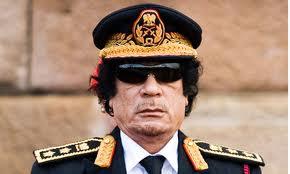
Moammar Gadafi was a tyrant and something of a nut job. I’m all for deposing dictators. But once again, the U.S. has participated in a summary execution — in this case, by an angry mob — that seems a little bit out of synch with international law.

I was one of the few people who didn’t like the idea that Osama Bin Laden was shot — apparently not during a fight but intentionally killed as part of a military action. OBL was a bad guy, and should have been tried as a criminal; the international court on the Hague doesn’t issue the death penalty, but he could have been locked up for life. Same with Anwar Al-Awlaki; he wasn’t my kind of guy, either (I’m not big on violent religious fundamentalists who kill people) but he was a U.S. citizen who was never arrested and charged with a crime.

In fact, it turns out the White House has a secret panel that can put U.S. citizens on a “kill list.”

Again: Not defending any of these creeps. But is it really okay to just kill them? Even in wartime, aren’t there rules of law?

Gee, thanks Kamala

3

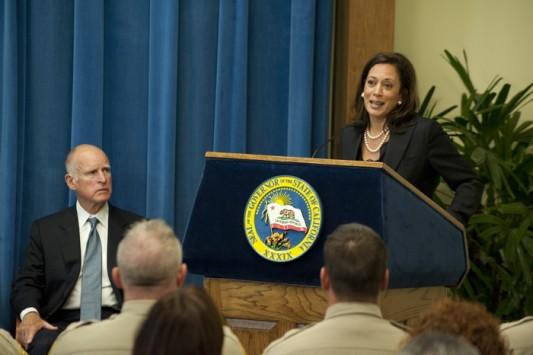
After ducking the issue for more than a week, Attorney General Kamala Harris has finally weighed in on the feds crackdown on medical marijuana. Just after Assemblymember Tom Ammiano and state Sen. Mark Leno denounced the bizarre move by the U.S. attorneys, Harris issued a weak, lame and overall pointless statement that shows she is unwilling to be a leader on this issue. The statement doesn’t even appear on the front page of her website.

Here’s what she has to say:

Harris said she was worried that “an overly broad federal enforcement campaign will make it more difficult for legitimate patients to access physician-recommended medicine in California.”

She urged federal authorities to make sure their enforcement efforts are focused on significant traffickers of illegal drugs.

Come on, Kamala. This is a blatant effort by the Obama Administration to overrule state law. It’s an attack on an industry that creates jobs, pays taxes and helps sick people. It’s another front in the failed War on (some) Drugs. And you’re the chief law enforcement officer in the state of California, charged by the Constitution to defend state statutes, including Prop. 215. You can do a lot better than this.

Harris should have joined Ammiano and Leno at their press conference. She should have pointed out that the state is trying to regulate dispensaries, but the federal government has made that almost impossible by pulling this kind of shit.

And the most frustrating this is that Harris could actually make a difference here. What, exactly, is she hiding from? Does she think fighting the U.S. attorneys will make her look soft on drugs or crime and hurt her changes to be elected governor? Doesn’t she realize that medical marijuana is really popular with the voters and that the anti-pot crowd is almost gone?

Dumb. Frustrating and dumb.


45 years of printing the news and raising hell

11


When the Bay Guardian produced its first issue in October, 1966, the paper described itself as “a fortnightly journal of news, analysis and opinion.” Circulation was soon running at 20,000 copies.

Over the past 45 years, the Guardian has become one of the preeminent alternative weeklies in the country. The selection of past covers here gives a hint of the broad range of political and cultural events that have been part of the city — and its alt-weekly — in four and half momentous decades.


The X Factor: Oh, the drama! Oh, the weeping!

0

Okay, I thought American Idol was getting bad. And I missed Simon Cowell. But the Next Big Thing, called The X Factor — featuring not just Simon but Paula Abdul, along with L.A. Reid (who discovered Rihanna!) and Nichole Sherzinger (from Pussycat Dolls, and she once won Dancing With the Stars) — is out of control.

Epic Fail Number One: The 32 semi-finalists are broken up into four categories — girls, boys, over 30 and (gasp) groups. Four from each category move forward. That means four groups, even though almost all of the groups totally suck, four boys (although at least six of the girls were better than all but two of the boys) and four over 30s (well, I guess people over 30 deserve special consideration, particularly women who were once married to Ike Turner).

Epic Fail Number Two: The semifinal round is set at the judges “houses” (although I can’t believe Simon, who appears only in his designer shades, actually lives full time in that glorious mansion in St. Tropez). L.A. Reid is a serious music dude, but his McMansion in the Hamptons is hideous. Paula is (of course) in Santa Barbara, and Nichole is (of course, maybe, if that’s really her house) in Malibu. It’s like Lifestyles of the Rich and Famous; I desperately wanted to hear Robin Leach introduce the scenery.

Epic Fail Number Three: The Oct 18 show had no music at all. No entertainment. Just two hours of people getting kicked off (and weeping) or getting sent through (and weeping). We watched contestant after contestant bawling as the judges tried to drag out the drama as long as possible by saying things like “the news I have for you isn’t good …. (weep, weep, sniff, my young life is ruined) … actually, it’s fantastic” (weep, weep, joy, hug Simon, I’m gonna be a contender). I’ve never seen so much mascara running down so many cheeks. Pepsi’s the wrong sponsor; should have been Kleenex.

It’s like Total Drama Mansions. I can’t believe anyone (other than Vivian and me) actually sat through that whole thing.

The good news is that the homeless guy (Dexter Haygood) and the burrito maker (Josh Krajcik) made it through to the live performances starting next week. So did Rachel Crow, the 13-year-old from Colorado. Viv would have been boycotting the rest of the season if Simon had kicked her out.

As it is, sigh, we’re still watching, and maybe next week someone will actually sing.

The bad old days

0

tredmond@sfbg.com

Willie L. Brown, according to the Chronicle’s John Cote, is “a tremendously popular figure in the city, viewed by many as an avuncular man-about-town, elder statesman and a uniquely San Franciscan character.” The Ed Lee Story, a hagiographic campaign book, refers to Brown’s “characteristic showmanship and hypnotic charm.” Even Randy Shaw, the housing activist who clashed with Brown over gentrification once upon a time, now says in BeyondChron that Brown’s first term “was the most progressive of any mayor in modern San Francisco history.”

I feel as if I’m living in some sort of strange parallel universe, something out of Orwell or North Korea or the Soviet Union of the 1950s. It’s as if history never happened, as if the years between 1996 and 2004 have just vanished, have been deleted from San Francisco’s collective memory. It’s crazy.

I wonder:

What about the thousands and thousands of people who lost their homes and were tossed out of the city like refugees from a war? What about the rampant corruption at City Hall? What about the legions of unqualified political cronies who got good jobs and commission posts? What about the iron-fisted machine rule that kept local politics closed to all but the loyal insiders? Doesn’t any of that count?

Here are some things that absolutely, undeniable, demonstrably happened while Willie Brown was mayor:

Rents on the East Side of town, particularly in the Mission, tripled and sometimes quadrupled between 1996, when Brown took office, and 2004, when he left. Evictions more than tripled, too, and at one point more than 100 people a month were losing their homes. Most of those people were low-income, long-term tenants. They were forced out because richer people were moving into town during the dot-com boom and could pay more for those apartments. We called it the “Economic Cleansing of San Francisco.”

Every day, it seemed, we’d be out at another rally as the Tenants Union and the Mission Antidisplacement Coalition tried to save another family from the forces of gentrification. Every week, it seemed, another group house full of artists would be served an eviction notice. Everywhere you looked, nonprofits and small businesses were losing space to high-tech companies with plenty of money.

I watched the wrecking crew tear down a studio complex on Bryant Street, forcing more than 100 painters and photographers to leave, to make way for a high-tech office project that was approved even though it violated the local zoning laws — and then was never built. For two years, I walked to get my lunch past the empty hole in the ground that had once been a thriving community.

That was typical. Every developer who waved money in front of the mayor got a building permit, no matter how crazy, illogical or illegal the project was. The Planning Department and the Bureau of Building Inspection were little more than fronts for the lobbyists and Brown cronies who determined development policy in the city.

In October, 1999, the author Paulina Borsook wrote a famous piece in Salon called “How the Internet Ruined San Francisco.” I agreed with the sentiment; the influx of the dot-commers was wrecking all that was cool and weird about the city. But she got one point wrong: The Internet didn’t ruin anything. The Internet was, and is, a technology, a tool, something that, like most technological advances, can be used for good or evil.

Mayor Brown didn’t create the dot-com boom. Although he took credit for an awful lot of things, even Willie didn’t claim to have invented the Internet.

But what he did — and what ruined many San Francisco neighborhoods, and ruined the lives of many San Franciscans — was to let the economic cleansing of the city happen, without raising a finger to slow it down or prevent the evictions or protect the most vulnerable people in the city. Over and over, he encouraged it — by appointing commissioners and supervisors and department heads who allowed evictions and development and displacement in the name of growth and prosperity.

In fact, when reporters from the zine Maximum Rock ‘n’ Roll asked Brown about the problems facing poor people, he told them that the city had become so expensive that poor people would be better off living somewhere else.

Because he didn’t care about poor people, or tenants, or artists, or anyone who lacked money and flash and dazzle and clout. He was the worst kind of imperial mayor.

Here’s how we put in it in our 33rd anniversary issue in 1998:

“Let’s say the next major earthquake that hits San Francisco is of roughly the same magnitude of the Loma Prieta quake of 1989, or maybe just a bit stronger. Let’s say it wipes out right 1,000 houses and leave some 5,000 people homeless … and lets say a few unscrupulous profiteers take advantage of the shortages of critical supplies and charge desperate residents triple the normal rate for food, blankets and drinking water….

“The profiteers, speculators and charlatans would be exposed in the press and roundly, loudly denounced by every political and community leader in the city. The ones who didn’t wind up in jail would be forced to leave town in disgrace.”

Or else they wouldn’t. Because when an economic earthquake ravaged San Francisco during his term, Brown — the most powerful mayor in modern history, a guy who could have had an immense impact on what was happening — went to meet the speculators and profiteers with outstretched arms, welcomed them to the city and partied with them at night.

And when he ran for re-election, they thanked him by funding an astonishing $5 million campaign.

Then there was the corruption. Not only did Brown raise pay-to-play to a new art form, he filled the city payroll and key commissions with campaign workers, former political allies, and cronies, subverting the civil service system and undermining both the function of city agencies and public respect for local government. At least seven Brown appointees were indicted or investigated for criminal misconduct. While sentencing a Housing Authority official to five years in prison, U.S. District Judge Charles Legge decried what he called Third World-style corruption at San Francisco City Hall.

When Mayor Ed Lee, who is now seeking a full four-year term, was asked to give Brown a grade for his eight years in Room 200, Lee said: A-Plus.

Which makes us a little nervous. To say the least.

I’ve been going back through the Guardian archives over the past couple of weeks, picking out some great covers to reproduce (see page 18) and looking at four and a half decades of alternative news coverage of San Francisco. And if there’s one theme that emerges from the stacks and stacks and stacks of papers, it’s that local government matters.

In the 1960s, when the underground press was talking about sex, drugs and dropping out, the Guardian was talking about the ways big corporations were stealing the taxpayers’ money at City Hall. (Okay, the Guardian wrote about sex and drugs too. But sex and drugs and political scandals.)

The difference between the independent alternative press and the underground papers of the era was more than just thematic. The underground publishers were having a great time and celebrating culture, but none of those publications was built to last. From the day they published their first issue in October, 1966, Guardian founders Bruce Brugmann and Jean Dibble intended their paper to become a permanent part of San Francisco.

The Guardian quickly demonstrated that it had a different approach than a lot of the “New Left” — particularly when it came to electoral politics. At a time when some were saying that it made no difference whether Ronald Reagan or Pat Brown won the 1966 governor’s race, the Guardian made the key point about Reagan.

“California cannot afford the luxury of this kind of conservatism,” a Nov. 7, 1966 editorial stated. “Because of the millions of people coming to California, because San Francisco and Los Angeles soon will have the greatest concentration of urban power in history, because farm land and open space is vanishing at a suicidal rate, because technology is putting vast populations out of work, because of the social neglect of our cities and the uglification of our countryside, because we now have the knowledge to bridge the gap between the rich and the poor.”

And while the paper devoted considerable space to reporting on and opposing the war in Vietnam, it was also developing a reputation for local investigative reporting. One June 7, 1971 story showed how the city had all of its short-term deposits in local banks that paid no interest at all. The story parked an investigation by the city’s budget analyst, the resignation of the city treasurer — and a new investment policy that brought the city at least $1 million more revenue a year. (Adjusted for inflation, that’s about $5 million a year, times 40 years is a lot of money that the Guardian brought into the city coffers).

And from the start, the Guardian was a nonpartisan, independent foe of corruption, secrecy and undue influence at City Hall. So while the paper eagerly endorsed Phil Burton (and later his brother, John) for Congress and lauded their antiwar and environmental policies, the Guardian also blasted the Burtons for exercising undue influence back home. The paper strongly endorsed George Moscone for mayor — then denounced him when he fired Harvey Milk from a commission post after Milk had the gall to challenge the Moscone/Burton candidate for state Assembly.

The 1999 Sunshine Ordinance, which dramatically opened up City Hall records, was sponsored and promoted by the Guardian. Willie Brown and his cronies hated it.

It’s probably a misnomer to say that the Burtons, who were a dominant force in local politics in the 1970s and 1980s, ran an old-fashioned machine. They didn’t have the iron control over local politics and the patronage jobs system that the word “machine” implies.

But when Brown became mayor of San Francisco, he had all of that. Brown controlled eight solid votes on the Board of Supervisors (and through various political machinations, had managed to appoint most of them). “He ruled the building,” Assemblymember Tom Ammiano, who was a supervisor during those years, recalled. “If you defied him, you were radioactive.”

And one of the people who rose through the ranks as a loyal Brown appointee was Ed Lee. Who to this day thinks things in that administration were just dandy.


The Lee campaign complains about “guilt by association,” and that’s a legitimate point. Ed Lee isn’t Willie Brown. He’s a lot more open, a lot (a lot) more humble, and as numerous progressives have pointed out to us, his door is open. He doesn’t have the history of sleaze that pretty much defined Brown’s political career.

There will be no “Ed Lee Machine.” In fact, with district elections of supervisors pretty much guaranteeing more diffuse political power in the city, there will never be another mayor able to rule the way Brown did.

And these days, Brown’s clout could easily be overstated. Until he engineered the selection of Ed Lee as mayor, his power seemed to be waning. And even Mayor Lee hasn’t done everything that Brown wanted.

Of course, the Chronicle, which he helped immensely when Hearst Corp. bought the paper and had trouble with federal regulators, has helped Brown by giving him a column that created a new, sanitized persona.

But the important thing about the Brown administration was not so much who was in charge but who benefited. The landlords, the developers, the big corporations got pretty much what they wanted from City Hall. The rest of us got screwed.

And now those same interests — in some cases, the exact same people — who supported, promoted and worked with Willie Brown are backing Lee for mayor. If they thought he was going to be an independent progressive, that money and support wouldn’t be coming in. There are people who miss the machine days — and if they think Ed Lee is their guy, it’s reason to worry.

Corruption matters. When people lose faith in local government because they see the kind of sleaze that was daily business under Brown, then they stop wanting to pay taxes for public services. After all, the mayor is wasting our money already. Lee may be a decent guy — but some of the people he hangs out with, some of the people who are supporting him, have a long and very unpleasant history in this town. And all the time he was sitting there at City Hall, while Brown was running a corrupt operation that did lasting damage, Lee never raised a public finger in protest. I hate to see all the history forgotten when people decide who to support for mayor in November, 2011.


Editor’s notes

0

tredmond@sfbg.com

I feel like was just getting over the 40th anniversary party, and now here comes 45. Guardian anniversaries are like birthday parties; they keep creeping up on you. Except that, in this case, getting older isn’t something to worry about. It’s a sign of strength that a weekly paper founded with a little money scraped together by two Midwesterners in 1966 has survived, grown, and become a standard-bearer for the alternative press in America.

I missed 15, but I was here for 16, and 20, and 25, and 30, and 40, and I’ve watched the Guardian — and San Francisco — emerge and change. And I can say, after almost 30 years as a reporter and editor here, that the demise of the old Brown Machine and the advent of district elections in 2000 were the most important advances in modern local political history.

District elections diffused power at City Hall. You didn’t need a huge downtown-funded campaign war chest to get elected supervisor. You didn’t need the support of the power brokers. And all parts of the city were represented.

By the time Willie Brown left office in 2004 — mostly in political disgrace — a long era of corrupt machine politics was ending. He had lost control of the Board of Supervisors. Almost none of the candidates he endorsed got elected. His approach to running the city was utterly repudiated by the voters. It was like the city drew a collective breath of very fresh air.

Yeah, we had to fight with Gavin Newsom. Yeah, we lost some critical battles. Yeah, the city’s till building housing just for millionaires. But at least with Brown gone and district supervisors calling the shots, I always thought we had a chance.

And maybe we will with Mayor Ed Lee, too, if, as projected, he wins in November. Maybe he can show some independence. Maybe the Ed Lee who started as a tenant lawyer will arise again in Room 200.

But Brown doesn’t think so. Neither do the billionaires and lobbyists and a cast of dozens from the old Brown Machine. They think they’re coming back into power.

And these folks are savvy, experienced and clever. They don’t put this sort of money and personal clout into candidates unless they’re pretty damn sure they’ll get a return on their investment. That’s how it works in Willie’s World.

Mormons and Republicans

12

CalBuzz, one of my favorite political sites, has an interesting essay on what the anti-Mormon sentiment in America means for Mitt Romney. Among the central points:

Gallup found that Democrats (27%) were more unlikely to support a Mormon than were Republicans (18%) – suggesting that in a general election, a Mormon’s hard-right views on gays, marriage, abortion and women’s rights might have more to do with resistance to an LDS candidate than religion itself.

Actually, not all politically active Mormons share that “hard right” approach — Stew Udall, the Arizona environmentalist, Congressmember and interior secretary under Kennedy and Johnson was a Mormon. So was his brother Mo, a liberal member of Congress who ran for president in 1976 as a left alternative to Jimmy Carter. But like evangelical Christians, Mormons in general tend to be conservative, especially on social issues.

The CalBuzzers are puzzled by the distrust of this particular religion:

It’s hard to determine what, exactly, drives anti-Mormon sentiments – whether it’s what people know, what they don’t know or what they think they know.

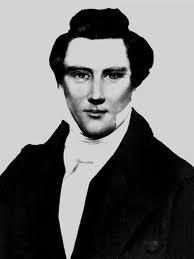
Are they familiar with Joseph Smith, Jr., the treasure digger from Palmyra, New York, who said he was visited by the angel Moroni in 1827 and guided to a box of golden plates which he said contained what is now known as the Book of Mormon, after he transcribed them from “reformed Egyptian”?

Are they thinking about the breakaway Mormons in HBO’s late great “Big Love” with Bill Paxton, Jeanne Tripplethorn, Chloe Sevigny, Ginnifer Goodwin, Bruce Dern, Mary Kay Place and Amanda Seyfried? Maybe they think Mormons are all like Roman Grant, the evil self-proclaimed prophet and leader of the Juniper Creek Compound played by Harry Dean Stanton.

Or are they like one wag we know who argues that the only difference between Mormonism and Scientology is the choir?

If you want to pounce on logical improbabilities in religions, you’ve got your parting of the Red Sea and the burning bush, the immaculate conception and the resurrection and that passel of virgins waiting for you in Heaven. Pick your myth.

The point, of course, is that the stuff Mormons believe is no odder than the teachings of most major religions. But there’s a big difference, and I find it fascinating.

The thing is, if you believe in Jesus or Abraham or Mohammed, you’re talking about people who lived a really long time ago, before there were accurate written records. Despite former Guardian writer Burton Wolfe’s best efforts, you can’t really prove that Jesus lived or didn’t live, or did or didn’t turn water into wine or cure lepers. The Bible has been translated so many times (and by many accounts, rewritten so many times) that it’s hard to know exactly what the original stories even were.

On the other hand, there are people alive today whose grandparents might have known Joseph Smith. Mormonism came to life in a time of newspapers and nearly-modern record keeping. Upstate New York in 1827 wasn’t exactly Manhattan today, but it wasn’t the Middle East in 44 B.C. either. There are still accounts of newspapers of the day denouncing Smith as a charlatan and fraud. Nobody can argue about whether he was into polygamy or not.

In the context of the 1800s, although there was plenty of strange religious stuff going on, the notion of a failed treasure hunter finding golden plates left by an angel (who then took the plates back after Smith made the one and only translation) seems pretty bizarre. That’s in part because the traditional religions all teach that the weird shit took place a really long time ago, which somehow makes it easier to justify.

If the son of a carpenter announced in 1827 that he was really the son of God, and that his mother was a virgin who had been impregnated by something called the Holy Spirit, who was also sorta, kinda part of God, isn’t it likely he might be called a nutjob? Ya think?

And the way the Mormon Church operates, with all of its official secrecy, just encourages people to think of it as a cult. But you ever tried really looking into the Vatican?

My point is that poor Mitt is going to face an uphill battle over his religion largely because the stuff that’s really, really hard to believe supposedly happened a couple millenia after stuff that’s really, really hard to believe was supposed to happen.

Not defending the Mormons here. (Although, if you stipulate that women have equal opportunity and gay people can get married, too, what IS wrong with polygamy?)

Just saying.


SFBG Radio: Has official SF lost its mind?

54

Today Johnny and Tim talk about the police raid on Occupy SF — and why San Francisco officials insist on making this the only large city in the nation that’s sending the cops to clear out Occupy Wall Street protesters. Listen after the jump.


RiotGoinOnCops by endorsements2011

To the wonderful folks at Occupy SF/Wall Street/Everywhere

122

First of all, don’t get depressed by this sort of stuff. During the occupation and blockade at Diablo Canyon, when about two thousand people managed to prevent the opening of the nuclear power plant, the mainstream news media kept reporting that the blockade was failing, that the protesters were getting tired, that everyone had given up and was going home. One person starting walking around with a poster that said “The media is getting tired and hungry and going home.”

Press accounts typically understate the numbers and dedication of protest movements. Instead of talking about how amazing it is that so many people have given up everything else in their lives to protest economic injustice, the press will say: Why aren’t there more?

So hang in — overall, the message is getting out. As we said in an editorial this week:

If the demonstrators don’t have all the solutions, at least they’ve identified the problem. And that’s more than Obama, Congress, or the mainstream news media have done.

But as someone who has watched, written about, worked on, joined and been otherwise involved in direct action and community organizing efforts for more than 30 years (yeah, I’m old), let me make a friendly suggestion.

Saul Alinsky, who pretty much invented modern community organizing, always said that building an effective organization and agitating for social change was as much about empowering the powerless as it was about winning a specific battle. He and his students learned quickly that nothing is worse for an organized movement than the frustration of constant failure. The movement that arose against the Iraq and Afghanistan wars suffered from that — when it was clear that nothing any of us did (including electing Obama) was going to bring the troops home and end hostilities, a lot of people gave up and stopped marching.

The people I learned from back at the Connecticut Citizens Action Group, which practiced Alinsky-style organizing, used to say that victories, even small victories, would prove to people that they really could fight City Hall. If a low-income neighborhood was worried about cars speeding down the streets where kids were playing, fine: Organize everyone and demand stop signs, speed bumps and police patrols. Once you’ve shown disenfranchised people that they can force the powers that be to listen and respond, you have the basis for something much more ambitious.

I guess what I’m saying here is that you might want to think about setting a goal that’s a little bit short of decentralizing all of society. When I worked with the Abalone Alliance, we were all about changing the way people related in the world; everything worked by consensus, we spent an immense amount of time discussing power relationships and we all had a radical model for rebuilding the United States (and the world). But we also wanted to stop a nuclear power plant from being built on an earthquake fault. And when that happened — the protests actually delayed the opening for several years — it gave tremendous life and energy not just to the movement but to all the people in it. It was radically empowering.

The Livermore Action Group, which emerged out of the Abalone Alliance, was dedicated to ending the threat of nuclear war (and all war), among other things. But it had as an immediate first step ending weapons reasearch at the Lawrence Livermore Lab.

Around the same time, the American Friends Service Committee came up with a campaign called the Nuclear Freeze. The bumper stickers read: “Step one: Freeze Nuclear Weapons.” The idea: When you’re in a hole, stop digging. Nuclear proliferation was threatening the world; as a first step, we ought to stop building more bombs. 

Since this is all about Wall Street, and you’ve got momentum on your side, maybe you want to start talking about something specific. How about “Step One: Tax Wall Street Transactions and Create A Million Jobs.” A transactions tax dedicated to public-sector job creation would do wonders for the economy. It’s the kind of campaign that a wide range of allies could join. It’s got simple, populist appeal. It’s not everything you want, but it’s not bad — and remember, it’s ony Step One.

Just a thought from a friend.


SFBG Radio: Jerry Brown, WTF?

4

In today’s episode, we try to figure out WTF is up with Jerry Brown — and what Californians can do about it. Listen after the jump.

RecallMoonbeam by endorsements2011

Two words Ed Lee doesn’t want to hear

13

There are two words no candidate wants to hear a month before Election Day:

“Criminal investigation.”

I give District Attorney George Gascon credit — I didn’t think he’d ever really go after municipal corruption, but he’s showing at least a bit of political spine here, launching an investigation into the dubious campaign contributions of Ed Lee. Lee’s campaign immediately said there would be full cooperation:

Last week, Mayor Lee’s campaign returned 23 contributions associated with Go Lorrie’s Shuttle company as a result of the campaign’s own concerns and compliance review. On Friday, the campaign reached out to the District Attorney’s Office, the U.S. Attorney’s Office, the Ethics Commission and the Fair Political Practices Commission to offer its full assistance in any investigation or review. It is important to note that there is nothing about the District Attorney’s statement or initiation of an investigation that suggests that Mayor Lee’s campaign is a target.

And at this point, there’s no way to know how far the investigation will go or what it will turn up. But the very fact that the D.A. is looking into all of this looks bad for Lee.

And if Gascon’s office scours not only the Go Lorrie’s money but the rest of Lee’s campaign contributions — and the independent expenditure committees that aren’t supposed to be coordinating with each other or the main campaign — he might find more.

Bill Barnes, who works with the Lee campaign, told me that he was doing everything possible to make sure the contributions were all on the up-and-up. “I can’t control the i.e.’s,” he said, “but we are very careful to follow the law.”

He also said that it’s possible there were mistakes, like the Go Lorrie’s money. “We’re raising a lot of money in a short period of time,” he said.

But you see, that’s part of the problem. You enter the race late, refuse to accept public financing (and abide by spending limits) and start trying to raise more than a million bucks in a few weeks, and it’s too easy to get sloppy. Add in the fact that people like Willie Brown, who never cared much for campaign contribution or ethics laws, are involved in the fundraising, and you have a recipe for real trouble.


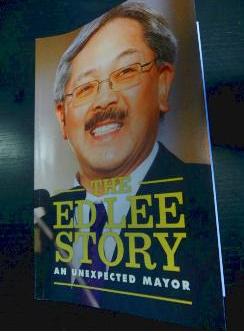
The Ed Lee Story: Gack!

4

I finally got a copy of The Ed Lee Story — a 132-page paperback hagiography written by campaign flak Enrique Pearce — and it’s way, way over the top. I shouldn’t even compare it to the lives of the saints — I read that stuff in Catholic School, and none of it was a sappy, drippy and utterly lacking in perspective as this. The Ed Lee Story reads like what it is — a giant, extended campaign flier, produced by a supposedly independent group backing Lee for mayor.

Willie Brown appears in the first chapter, speaking with “characteristic showmanship and hypnotic charm.” Pearce once worked for Matt Gonzalez — who ran for supervisor as a strong opponent of Brown’s administration and was such a critic of the City Hall corruption that the mayor represented that he didn’t even return Brown’s call congratulating him on winning a seat on the board. But he has either forgotten or utterly sanitized that era.

Rose Pak appears a page later, described as a “community leader and Ed’s longtime friend,” which is one way of putting it.

I haven’t been able to reach Pearce; if he calls me I’ll update this post. But in other news accounts, Pearce insists that Lee had no role in the great work — it’s described as an “unauthorized biography,” and Tony Winnicker, the press spokesperson for the official Ed Lee for Mayor campaign, told me his crew had nothing to do with it. Pearce must have gone to great lengths to get all those high school and college photos.

Most of the footnotes cite the San Francisco Examiner and BeyondChron, but Pearce interviewed a number of Lee’s old friends. This was a fair amount of work, including a lot of research.

But here’s the thing: Pearce (who’s had problems with keeping independent campaigns independent in the past) supposedly wrote this book without any help or support from any of the people who are involved in the Lee adminstration or in his campaign. I don’t know, maybe he did. But that’s the problem with these “independent expenditure” committees — it’s hard to believe that there’s truly zero coordination between the various groups that are working to get Lee elected.

The Chron notes at least one indication that it’s not all as independent as it seems:

Pearce said he never spoke with Lee or his family for the book. However, at a golf tournament at the Olympic Club on Monday to benefit the nonprofit Chinese Hospital, Lee’s wife, Anita, beamed as she signed copies.

Plus, he clearly worked with Pak on the book:

Pearce swears all those family photos in the book were gleaned from various websites and family friends. And where did Pearce get Lee’s favorite recipe for “No-longer secret Poongaloong” (basically spaghetti with frozen peas, corn and a half-bottle of Del Monte ketchup thrown in)?

“The recipe was from Rose,” he said. Of course it was.

And we know that Pak meets with the mayor regularly.

Independent expenditure committees have a huge advantage — they can raise unlimited money, in unlimited amounts. In San Francisco, candidates for mayor can only take money in $500 chunks, and can’t accept contributions from corporations or entities that have contracts with the city. The folks who funded this book — and we still don’t know who they are — were under no such regulations.

The trade off is that the “real” campaign — the one financed with regulated money — can’t have any contact at all with the “independent” campaign.

Meantime, Enrique Pearce wrote 132 pages about Ed Lee, complete with childhood anecdotes, pictures, interviews with old friends and testimonial statements — and the mayor’s office and campaign had no input, connection, information, coordination or anything? Geez. Maybe Kitty Kelley’s got some competition.


The odd twist to the Chron’s Chiu endorsement

18

The most obvious interpretation of the San Francisco Chronicle’s endorsement of David Chiu is that the Chron thinks Chiu has completely left the progressive camp and is now aligned with the political wing the daily paper calls “moderates:”

What is impressive about Chiu is that “change” and “jobs” are not just campaign slogans for him. He can go into detail about the redundancies and red tape at City Hall that are holding back economic development: the 15 departments that regulate the private sector, the hundreds of fees that burden businesses big and small, a payroll tax that is a disincentive to hire … If elected, he would have a mandate to make city government more efficient and effective.

(I don’t know how many times I have to say this, but the payroll tax is NOT a disincentive to hire.)

The Chron — which, on economic issues like taxes and development, is a very conservative paper — clearly thinks Chiu can be trusted, which ought to make progressives nervous.

But here’s the other interesting twist.

Hearst Corporation bought the San Francisco Chronicle in 2000, at the top of the market, for more than $500 million. I guarantee the paper isn’t worth more than a tiny fraction of that today. It’s still losing money, and has been for years, and nobody’s buying daily newspapers any more, and if Hearst wanted to unload the Chron, the New York publishing chain would be lucky to get $50 million. Hell, they’d be lucky to get $25 million.

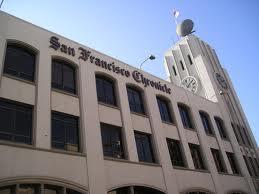
So the bean counters in New York have this nonperforming half-billion-dollar asset on their balance sheets, and there’s no way to recover that money — except for one thing: The Chron owns a bunch of land around Fifth and Mission, including its own historic building. And that property is potentially worth a whole lot of money. When the economy picks up, Hearst can develop the parking lots, old press facilities and even its HQ; turn it all into condos and office space, and suddenly there’s a real chance of recouping some of those deep losses.

The process is already underway — the Chron’s been moving tech firms into vacant space in its building, and is working with developers on the shape of what could be a major project still to come.

And guess what? In June, William Randolph Hearst III — heir to part of the Hearst fortune and a member of the Hearst Corp. board — made a rare campaign contribution to a San Francisco political candidate. He gave the maximum allowable $500 to … David Chiu. Around the same time, Michael Cohen and Jesse Blout, the partners in a firm called Strada that’s working on the redevelopment of the Chron’s property, also gave Chiu the maxiumum $500.

I figured the top people at the Chron would back Ed Lee because they figured he’d be down with whatever they wanted to do with that land — particularly since Lee’s good buddy Willie Brown is now a San Francisco Chronicle columnist. But it appears they’ve cast their lot with Chiu. As Mr. Spock would say, fascinating.

Editor’s notes

16

tredmond@sfbg.com

It’s nice to see that the days when you could get away with calling protesters commies are back. CNBC says that the Occupy Wall Street activists are “anarchists” who are “aligned with Lenin.” Actually, none of the anarchists I know are remotely Leninist. The communists of old were all for the creation of a powerful state. Lenin read Bakunin in his early years, but later declared that anarchists were “bourgeois revolutionaries.”

But I wouldn’t expect Larry Kudlow, Jim Cramer and Joe Kernan to be up on their radical history. They clearly haven’t spent much time with the people of the Occupy Wall Street movement, either. If they did, they’d realize that — like most of the left-wing movements that have sprung up with young people at the forefront in the United States over the past half century — the essential politics of Occupy Wall Street aren’t derived from Lenin, Marx, Castro, the Sandinistas, or Hugo Chavez. It’s about self-reliance, about community control and free expression, and in its purest form, it’s a rejection of the old role of leaders and authority. It would have driven Lenin mad.

I grew up on that side of politics. In college, the anti-apartheid and antinuclear movements were all about consensus process, all about the rejection of any sort of power relationships. We had no elected presidents or chairpeople. We didn’t vote on anything — voting disempowers the losing side. We took no action until we could reach consensus; everyone had to agree with everything.

What ultimately happened was that the people who could stick around for very long meetings, typically very late at night, where everybody had a lot to say and nobody got to tell anyone to cut it short, made the decisions. I never lasted.

When you’re all at an encampment with nowhere to go, it’s a thrilling exercise in real, direct democracy. When you’re trying to do organizing involving people who have jobs, kids, and lives that can’t fit three-hour (at best) meetings into the schedule, you leave a lot of your potential allies out.

The most interesting thing, though, is that the organizing principle of the protests, by its nature, involves distrusting government. That’s been part of the young left for a long time — and for those of us who believe in a strong public sector, it’s a bit, as they say, challenging.

Louise Renne’s confused history

6

Wow, the Chron found a way to take a swipe at Dennis Herrera for getting involved in politics — and guess who the expert source is? Former City Attorney Louise Renne — who politicized her office so dramatically that the voters approved a measure barring city attorneys from endorsing candidates.

The Chron piece goes back and forth on whether Ed Lee properly disclosed city contracts. Then it quotes Tony Winnicker from Lee’s campaign:

They must get exhausted over there at that campaign throwing stones out of their glass house all day long,” Winnicker said. ”What’s really too bad is we can’t actually look to our legal counsel to get guidance on this. .. because the mayor’s only legal counsel is too busy attacking him.

Which apparently disturbed Renne:

“I think the city attorney has to be particularly careful  in what he or she says and in what he or she does,” Renne said. “I don’t know if that line has been crossed here. I’m trying to stay out of the mayor’s race. I’m extremely troubled that these questions are even being raised.”

Please, Louise.

First, Renne ran for mayor herself while she was city attorney, in 1987, against Art Agnos and John Molinari (who, as a supervisor, was her client). She didn’t get far. Over the next few years, she regularly supported candidates and took stands on propositions, even when her office was involved in evaluating those measures or giving advice to elected officials. In 1995, she endorsed Willie Brown for mayor — even though he was running against her client, incumbent Mayor Frank Jordan.

It was exactly that sort of conflict that led to the city law that now prevents the elected city attorney from making endorsements in local elections. And now she’s worried about Dennis Herrera?

Ed Lee’s funny money

33

The break on the big campaign news of the week goes to the Bay Citizen’s Gerry Shih, who tracked down a couple of employees of GO Lorrie’s and got them to admit that they had no idea who Ed Lee was and had given him $500 because their boss had agreed to reimburse them in cash. Now the other candidates are making an issue of it — Dennis Herrera has called for a criminal investigation, David Chiu has issued a somewhat weaker statement and Jeff Adachi’s campaign is calling the whole thing sleazy.

What makes this so interesting is not just that someone at GO Lorrie’s may have been laundering contributions — the airport shuttle company has been lobbying the city to try to change the rules around where the shuttle vans get to park. So it’s not just a funky operation to push money to the mayor — it’s money from a company that has a big financial stake in a decision made by city officials (and by the way, the airport commissioners are appointed by the mayor).

Matt Dorsey, a spokesperon for Herrera’s campaign, told us that “there’s a point where campaign activities stop being cute and questionable and become illegal.” He noted that Mayor Lee, while vowing to return the tainted money, hasn’t called for a further inquiry.

“If laundered campaign contributions came to the attention of the Herrera campaign, the first person to call for an investigation would be Dennis Herrera,” Dorsey said.

Chiu’s statement: “These revelations raise deeply troubling questions that merit a full investigation by state authorities.  City Hall cannot be for sale.  Pay-to-play politics has no place in San Francisco, and will have no place in a Chiu administration – you can count on that.”

More: “Incidents like these are a reminder of the backroom deals and crony politics that San Franciscans are sick of,” said Colin Dyer, field director for Jeff Adachi. “This is just another in a long line of questionable activities surrounding Ed Lee and his powerful special interest backers. He promised to be a different sort of mayor, Ed Lee is just more of the same.

The big question, of course, is whether this will finally start to take the edge off the Ed Lee Teflon. And that depends in part on the San Francisco Chronicle — which put a far less relevant story about Dennis Herrera (one that didn’t involve illegal money laundering) right on the front page in the lead space above the fold.

The Chron, weakened as it is, still helps define the daily news cycle in this town. But guess what? The Chron didn’t break this story. The Bay Citizen did. And it there’s one thing I’ve found to be consistent about the ol’ Chron over the years is that the paper tends to ignore stories broken by the competition.

But this ought to be front-page news everywhere, not just because it’s a potential felony but because it represents the side of Ed Lee that we’re all worried about. In the Bad Old Days, Willie Brown’s operation did stuff like this all the time. Money went in and out of shadow committees and independent expenditure groups and it was almost impossible to keep track of who was giving how much to Brown — except that anyone who wanted to do business with the city had to pay up.

If Ed Lee’s folks are starting to play those same games, then it’s a very bad sign.

SFBG Radio: Abolish the sales tax?

21

Today Johnny offers a remarkable sensible economic proposal: What if California got rid of sales taxes entirely — putting almost 10 percent more money in the pockets of consumers — and replaced that revenue with higher income taxes on the wealthy? Now, why do you suppose this isn’t going to happen? Listen after the break.

AbolishTheSalesTax by endorsements2011