Tim Redmond

It’s all about turnout

0

Turnout in my Bernal Heights precinct tonight was pretty light, and that’s consistent with what I’ve been hearing all over town — except in Chinatown, where absentee turnout is high and the Ed Lee folks have done a great job of getting out the vote. This election may be a referendum on Ed Lee, it may be about whether any of the challengers can make a case for a change, it may be about how ranked-choice-voting works — but more than anything else, it’s going to be about who votes.

The flood of mailers was so overwhelming in the final days that I’m not sure how many people actually read them; the campaigns that put real resources into GOTV operations will probably fare better than the ones that relied on mail to reach the voters. And, of course, it’s likely that half the votes cast will be absentees.

So one of the numbers to watch tonight is total turnout. The lower that number, the better for Mayor Lee, who got a lot of votes in the bank early.

Another number to watch, and I’ll be running this for you as soon as I have data, is how the election-day votes contrast with the typically more conservative absentees. The absentees will be out soon, shortly after 8 p.m.; that will give us a sneak preview. But once the election-day votes come in about half an hour later, we’ll know where the trends are going.

The Department of Elections says the vote count will go quickly, since it’s a short ballot (only two cards).

Editor’s notes

0

tredmond@sfbg.com

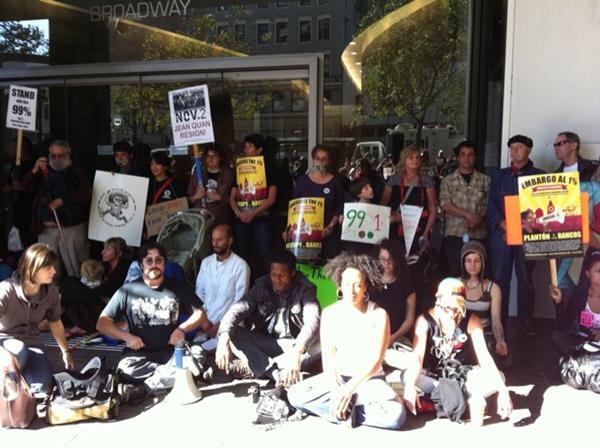
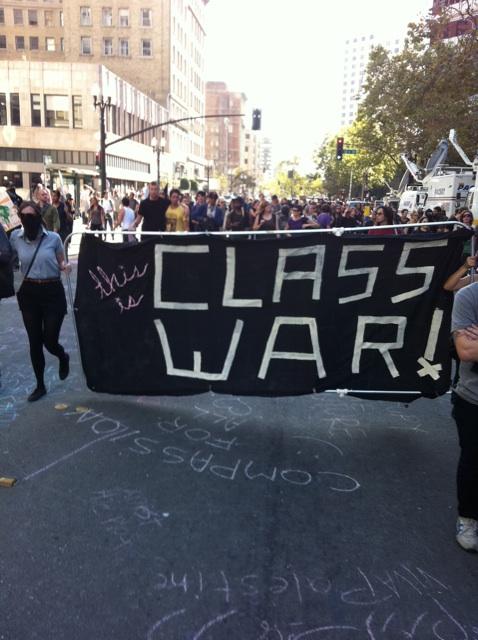
I really can’t get that upset about the broken bank windows in Oakland. This is minor stuff, a tiny part of what has been largely a peaceful Occupy movement. The windows have been replaced, the banks and their insurance companies have paid for it, the Occupy people helped clean up … whatever.

The problem was that the folks who went a bit Seattle ’99 on Oakland weren’t thinking too clearly — or else they didn’t care about the differences between then and now, and here and there, and why property destruction in downtown Oakland in the fall of 2011 is a bad strategic idea.

There are always folks at a big Bay Area demonstration who want to cause some mayhem. It happened during the protests against the Iraq War, and it happened during the Oscar Grant protests, and I figured it would happen when thousands of people convenened in the East Bay for what was dubbed a general strike. Sometimes it’s spontaneous anger (see: Oscar Grant), and it’s hard to argue with; sometimes it’s sparked by police riots and violence, and while it’s hard to blame protesters for fighting back.

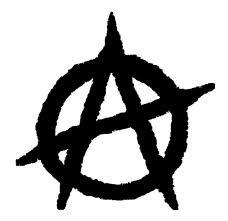
I’m not here to attack the black bloc or denounce anarchists or get into the whole battle over whether property destruction counts as violence. Been there, done that, got the circle-A t-shirt. I just want the Occupy movement, in Oakland and San Francisco and the rest of the country, to continue to grow and develop and become an agent of real change in a way that we haven’t seen in decades. The potential is there; this could really happen.

And that requires not just debate and discussion and theory and action; it requires political strategy.

I’m not talking about turning the refreshingly leaderless and nonhierarchical, consensus-based structure into something more traditional. I’m talking about the protesters considering the way their actions are portrayed in the news media, their ability to build crucial alliances — and frankly, their willingness to be good neighbors.

Folks: You now live in downtown Oakland and downtown San Francisco. You’ve turned empty public spaces into lively, exciting communities. That’s a positive thing.

There are other people who share downtown Oakland, and some of them are evil corporations but some are small local businesses who are hurting, just like the rest of the 99 percent. So make alliances, shop local, and don’t trash the place. That’s just smart politics.

Why Occupy? Here’s why

2

The Chron buried the story below an item about Chevron cutting its grants to PBS, but if you want to see the case for the Occupy movement, it’s laid out perfectly in a powerful new report by the California Budget Project. Read it here (PDF) The data is solid; the policy impacts are clear.

For starters, California’s 33,900 millionaire taxpayers (people reporting more than $1 million in income in 2010) — that’s two-tenths of the top one percent — earned $104 billion — 11 times the amount needed to lift every single California out of poverty. That’s right — a ten-percent surtax on incomes of more than $1 million could end poverty in California.

California, the report states, has the 7th worst income gap in the nation, between Alabama and Texas.

The San Francisco/Marin/Oakland metropolitan area has the 7th worst income disparity of any major urban area in America.

And it’s not the Invisible Hand of Adam Smith that caused the problem: “Public policy,” the report states, “narrow income gaps less today than they did a generation ago.”

San Francisco’s electing a new mayor today. When you go to the polls, think about economic justice. And when you hear complaints about Occupy SF, think about the fact that before the Occupy movement, the wealth and income gap was barely on the political agenda.


The Chron’s Willie Brown problem

5

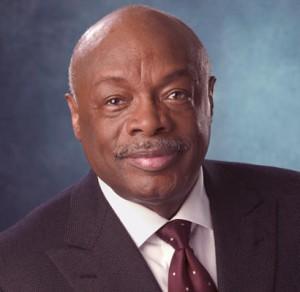
I’m glad someone else has noticed the problem with giving a political fixer his own newspaper column. I’ve been talking about this for years now, and the Chron doesn’t care. Brown is a walking conflict of interest — he represents clients who have business in the state and the city, and he can freely hype those clients in the Chronicle, and he can promote candidates who he is doing fundraisers for — and he never has to disclose anything.

Chronicle Editor Ward Bushee keeps saying that this is a celebrity, an-about-town column, but it’s really not. Brown mostly writes about politics, and he’s got a huge platform to help people who are paying him. It’s an embarassment.

I don’t expect the Chron to get rid of him, but at the very least, they ought to make him disclose when he has a financial interest in what he’s writing about.

Will all those mailers really work?

19

Political consultants love direct mail. It’s a perfect way to target your message. You buy an ad in the Chronicle, you have to pay to reach all of the readers — the ones outside of San Francisco, the ones who will never vote for your candidate anyway — and the ones who almost certainly won’t vote. With the Department of Elections database and a good computer, you can limit your mailings to people who vote regularly. You can mail only to Democrats, or you can mail only to women, or only to people in certain neighborhoods. “You want gay Lithuanians who are betwen 30 and 50 years old, voted in 4 of the last 5 local elections and live on the East side of town? I can give you that list,” one consultant told me a few years ago.

Direct mail not only ensures that your message goes to the people who matter — the actual voters — but it allows you to tell any population or demographic exactly what it wants to hear. A candidate for mayor may want to talk about liberal positions to voters in the Haight and more moderate stands to people West of Twin Peaks.

And unlike door hangers and hand-delivered pieces, things that arrive in the mail tend to get read. At least, they usually do.

Over the past few days, I’ve received about 30 mailers. Some people got even more. The stack has piled up so quickly that even someone like me, who loves all fo this stuff and pays close attention to all the messages, couldn’t get to it all. Most of my neighbors just chucked it all in the recycling.

When you have this many candidates, with this much money, and all of the independent expenditure groups, the mailers all start to look and sound the same. Nothing jumped out at me; nothing made me pay attention. There was just too much of it, total overload. So I fear that a lot of the money spent on mail this year wasn’t terribly effective.


The Black Bloc is always with us

23

I learned about how a handful of people could screw up a major demonstration back in 1984, when the Democratic National Convention was in San Francisco and a fairly large number of peace activists had arranged a protest called the “War Chest Tour.” The idea was to draw attention to the fact that Democrats as well as Republicans got big campaign donations from defense contractors whose business was making war. Back then, a bunch of the biggest war profiteers had offices in San Francisco, and the demonstration — which attracted hundreds of people — wound through the financial district with signs and banners. It was, generally, a great success — except in the national press.

The thing is, the protest (like occupy Oakland) was prety anarchic, which a small “a” — peaceful, but leaderless. There was no organization with an office and a phone that the press could call for comment, no easy way to identify the coalition that had put it together.

Oh, but there was one very organized group present: The Revolutionary Communist Party had maybe a dozen members marching (which may have been the entire local membership of that particular group, which has been on the margins of the American left for many years). The RCP members had T-Shirts, newspapers, people designated to speak to the media, handouts with an office phone number — all the stuff that made lazy reporters’ lives easier. So when the story broke, both locally and nationally, the first paragraph read:

“Revolutionary Communists protestested yesterday in San Francisco ….” And the whole point of the War Chest Tour, which my friends had worked on for months, was lost.

Those of us who have been around awhile knew, and know, that the RCP is always with us. There may only be a handful of them still around, but they show up for everything — and don’t seem to care if they undermine the message that event organizers are trying to put out.

The Black Bloc — the “big A” Anarchists who broke windows in Oakland —  are becoming part of the same tradition. It’s a relatively small group, but it’s always around. The marches against the War in Iraq were huge, with tens of thousands of people, and entirely peaceful — except for a few Black Bloc-ers who broke windows and set fires.

Now: I’m not here to blast the Anarchists, or even the RCP. The Maoist/Bob Avakian types have become almost a parody of themselves in recent years, but if that’s what you’re into, go for it. I’m not even going to get into the argument over whether property damage counts as violence; been there, done that, got the circle-A T-shirt. Destroying stuff and causing mayhem can be a powerful political statement, and there have certainly been times when it was appropriate, effective and considered more than acceptable.

But it’s not always the right strategy, and in Oakland in 2011, I think it wasn’t. I recognize that this is an emergency situation, that the class warfare has already begun, and that extreme tactics are necessary to fight back. And hell, I don’t think smashing a bank window is so awful; smash enough of them and you put a lot of unemployed glaziers back to work. But in downtown Oakland, that tactic can too quickly backfire and lead to stuff like this. (Here’s an idea — how about a Shop Local day at Occupy Oakland, where everyone agrees to patronize small local businesses downtown? It fits right into the plan to withdraw your money from the big banks and put it in local credit unions.)

The problem with the Black Bloc (which isn’t really a bloc at all, it’s just a loose group of people who (a) think their tactics are appropriate and (b) love this shit) is that it’s acting in direct conflict with the many, many people who worked really, really hard to organize what was supposed to be a peaceful event. Like the RCP, they’re too quick to piss in the well.

You want to get violent? You want to break stuff? Show up for the general assembly, make your case, and see if you can convince the rest of the group that this is a good idea, right now, one that sends the right message and promotes the cause. Maybe you can do that; maybe everyone agrees. But if the majority of the group says no — that respect for property (much as we may hate private property, particularly bank property, and all that) is a better way to go right now, today, in this situation — then back off, dudes, and get with the program.

Miyamoto and jail abuse

107

A new video produced by lawyer Ben Rosefeld includes disturbing footage of deputy sheriffs under the supervision of Paul Miyamoto using excessive force on peaceful protesters. It reflects charges in a 2007 lawsuit against the city — and evidence collected in that case shows that Miyamoto, now a captain in the department and a candidate for sheriff, was an active participant in the alleged misconduct.

The lawsuit is a result of a protest that took place in June, 2004, when activists were demonstrating against a biotech conference in the city. Protesters dressed as mutant animals marched through the streets, and 17 were arrested and taken to the county jail.

The protesters declined to give their names — and at some point, sheriff’s deputies were directed to remove them from a holding cell.
As the video — taken by the Sheriff’s Department and released as part of the lawsuit — shows, the deputies used physical force to pull the protesters out of the cell. The protesters were holding on to each other — and in some cases, the level of force used certainly appears excessive.

Remember: These were nonviolent activists who never threatened the deputies or gave any sign that they were dangerous.

Miyamoto, then a sergeant, both supervised and participated in the removal. In a legal document responding to questions from Rosenfeld, who represented the protesters, Miyamoto said that he, along with another sergeant, had developed the extraction plan and “became physically involved in the cell extractions on more than one occasion.”

I called Miyamoto and sent him a copy of the video. He told me that he was, indeed, involved and said the video was “a fair representation” of what happened.

“I stand by out decision that night,” he told me, saying he didn’t see anything in the video that bothered him or that was inappropriate.

“Our job was to get them out individually, and we took great pains not to harm anybody,” he said.

The lawsuit charged that some of the protesters were seriously injured during the extraction. It was settled when the city agreed to pay $25,000.

Sup. Ross Mirkarimi, who is running for sheriff, told me that the video was, indeed, disturbing. “I think it speaks for itself,” he said, adding that he didn’t think the tactics were appropriate.

“This is why we need an independent sheriff who isn’t connected to the Deputy Sheriff’s Association,” he said.

The X Factor: It’s all Paula

0

After an embarassing selection episode,  the Simon Cowell Show (excuse me, the X Factor) is actually allowing the contestants to sing. And while Simon is strutting around trying to steal the limelight and show how incredibly cool and smart he is (at one point telling one of the contestants to kiss him because he knew what kind of music was best for her) the real star was … Paula Abdul.

Not because she’s appears perfectly sober (amazing) and looks great in purple — but because she’s taken the people with by far the least talent and turned them into winners.

See, each judge gets to mentor one category. Simon, of course, has the girls (more on that later). L.A. Reid has the boys. Nichole Sherzinger has the over-30s … and Paula has the groups.

Frankly, the groups were the weakest entries. In the early rounds, some of them were train wrecks and none of them were terribly good. But somehow, Paula has turned three of them into real contenstants; she’s picked good music, helped with good dance moves, given them confidence … even Simon admits she’s done well. Not that any of her folks are going to win (first prize — you get to make a Pepsi ad!); they aren’t that good. But while the other judges, particularly Simon the Great, have made some awful mistakes, the spaced-out daffy Paula has kept it together.

So onto the show.

What’s up with the interplanetary opener? Like the folks on Saturn are really zipping through the Solar System at warp nine just to see the X Factor? If this is the random picture of life on Earth that reaches the Vulcans, they’re going to continue to believe that the third rock from the sun is still far too primitive for First Contact.

The host, Steve Jones (no, not THAT Steve Jones) is as dull as dishwater, and needs a personality implant.

Stereo Hogzz open the show; I wasn’t impressed last time, and the red vests gotta go — but man, Paula worked a miracle with these guys. They’re actually ready for prime time. Chris Rene tries to do a hip-hop version of Karen Carpenter, complete with flames shooting out of what looks like a giant barbecue. Ack. Leroy Bell is 59, does a decent job with a bad song.

Rachel Crow is Viv’s favorite, of course, since she’s 14. She does a tolerable “Walking on Sunshine,” except that Simon has changed the lyrics to “You are my Sunshine” and the rythm is all wrong. Oh, and the bad psychedelic graphics in the background made the whole thing hard to follow.

Lakoda Rayne. Paula’s girls. They’re all dressed up like colored crayons, and they all look exactly the same. They have very little talent among them. But they managed to make a Fleetwood Mac song sound okay. A little less sexy than Stevie Nicks, but what are you going to do.

I hope Joch Krajcik wins, if only because he looks so much like Jack Black in School of Rock, complete with a girlfriend who clearly has been supporting him all these years while he makes an occasional burrito and sings in unsuccessful bands. I like the girlfriend; she better get half the money. And the guy can sing, he really can.

Melanie Amaro does “Desperado.” Jean hates the Eagles and always has, but not me, and that’s a great song for the right singer, and Melanie is the right singer. Something Simon did right. She’s got as much vocal talent as anyone in the show.

Astro — man, you have to love Astro. He’s 14, he writes his own raps, and even when he’s a little shaky, he’s awesome. He just is.

Marcus Canty is L.A. Reid’s guy, and Reid has him sing a song by … L.A. Reid. But it’s good, and he’s good, and L.A. gets a good one on Sir Simon, to wit:

Simon: It’s a little bit narcissistic to have your artist sing one of your own songs, but …

L.A.: Well, Simon, we were going to do one of yours, but …

Stacy Francis. Girl has pipes. Not my kind of singer. Amazing voice, though.

InTENsity. Some shit about America. Drew: Cute but predictable.

Tonight someone goes home. I predict weeping.


The problem with the Lee investigations

55

Six major mayoral candidates, including John Avalos, Dennis Herrera and Leland Yee, have once again called on the Fair Political Practices Commission to investigate the Ed Lee voter-fraud charges. That’s what needs to happen, of course. And the district attorney should do a thorough investigation and file criminal charges if warranted.

But there’s a basic problem here, and it goes to the heart of what’s wrong with the Lee campaign and with his whole approach to running for office. See, even if the FPPC finds a problem, what’s going to happen? The campaign will have to pay a fine (which, given all of the rich supporters of Lee, will be easy to pay).  If the D.A. finds that laws have been broken, some low-level folks or people who solicited contributions improperly will face prosecution — and most likely cut a deal and pay a fine and get probation.

By then, of course, if all goes as predicted, Lee will have won the election. So as far as he and his key allies are concerned, none of this really matters.

Once he’s elected mayor, he figures (probably correctly) that this will all blow over. The FPPC investigation won’t be concluded for months. The D.A. clearly isn’t going to file charges against anyone before Election Day. Besides, according to the Department of Elections, 44,000 people had already voted by the time the latest stories broke Nov. 2. Many of them are Lee votes.

No matter how flawed the election, how much sleazy, inappropriate or criminal activity was involved, there’s no way the results will be thrown out. There’s no way the election of Ed Lee will be voided. If all of the tactics of Lee supporters work and he comes out on top, there will be no consequences for him. When it comes to San Francisco elections, cheating works — Willie Brown learned that long ago.

That’s why Ed Lee scares me: He’s allowing his supporters to use a corrupt playbook that assumes that the rules don’t matter, that winning at all costs is the only issue, that ethics and clean government can be dismissed as side issues. Once you start down that road, there’s no going back. Once you set that tone at City Hall, every half-assed crook and con artist will be convinced it’s open season. And I just don’t see Lee as strong enough to stop it.

UPDATE: Avalos just called and told me he wasn’t aware that the other candidates were calling on the FPPC to investigate and wasn’t at the press conference where that announcement was made. Sorry ’bout that, a miscommunication.


Sharmin Bock’s family IE

2

Plenty of (rich) candidates fund their own campaigns. And (sadly) plenty of candidates in San Francisco are getting help from outside independent expenditure committees that can raise unlimited funds.

But here’s a new one: District attorney candidate Sharmin Bock is supported by an IE that is funded almost entirely by her family.

Ethics Commission records show that the Committee for a Safer San Francisco has raised $89,000 from Farideh Mehran, Bock’s mother, who lives in Atherton. Another $30,000 came from Reza Merhan, a relative who is a surgeon in Texas. A few people who don’t appear to be related tossed in a few thousand more, but for the most part, this is a Bock family committee.

The commitee is based in Sacramento, and the treasurer is Charles H. Bell, Jr., a lawyer who specializes in campaign work and is general counsel to the California Republican Party. Audrey Martin, also a lawyer in Bell’s office and the assistant treasurer, told me the firm had been hired to handle the campaign financial reporting, but she couldn’t tell me anything else about it.

The person who formed the commitee, according to campaign filings, is Natalie LeBlanc, a communications professional in the East Bay who is on the board of Emerge California. I’ve tried to contact her through the phone number on the campaign filings and by email, but she hasn’t responded.

I’m wonder: Was this set up entirely (or primarily) as a vehicle for family money, a way for Bock’s wealthy relatives to legally pour unlimited funds into helping her win? It raises an interesting question: By law, an IE has to operate completely independent of the official campaign. Bock told me she talks to her mother regularly (“I mean, she IS my mother”) but insisted they never discussed campaign strategy or the IE.

John St. Croix, director of the Ethics Commission, told me this all appears to be perfectly legal — if unusual. He said he’s never seen anything like it before.

Personally, I’d rather see Bock use her family money than get money from big corporations that might have an interest in how the next district attorney operates in San Francisco. And there are all kinds of corrupt IEs out there; this one is at least pretty straightforward. Still, it strikes me as a little curious.

I

The latest Lee voter fraud charges

18

The Ed Lee campaign is, of course, distancing itself from the latest voter fraud allegations. Spokesperson Tony Winnicker says nobody on the Lee team knew anything about it, that the idea of eight low-level associates at a property firm each giving the maximum $500 didn’t ring any alarm bells:

“If this is true, then these people have perjured themselves,” Lee campaign spokesman Tony Winnicker said when The Chronicle informed him about the donations. “They looked directly into the eyes of our campaign staff and lied, and they should be held accountable.

And honestly, I don’t think anyone on Lee’s team directly solicited the illegal contributions. I could be wrong, but let’s give them the benefit of the doubt. But the notion that Winnicker is shocked — shocked — that this sort of behavior was going on doens’t quite pass the sniff test. The problem is that Lee refused to take public financing, got in the race late and decided to raise a buttload of money really fast — and when you do that, and you take cash from the likes of Andrew Hawkins, you’re almost guaranteed to run into trouble.

I think Dennis Herrera has it right; his press statement makes the point:

“Too many of Ed Lee’s supporters act as though they’re above the law — on money laundering, on ballot tampering, and more — and Ed Lee isn’t strong enough to stop it.  If this is how they behave before an election, just imagine how they’ll behave after the election, if Ed Lee wins.

This has always been the danger with Mayor Lee — he’s surrounded by some very bad actors, he can’t keep them under control — and if he wins, they’ll have the run of City Hall.

Is this enough — or the cumulative impacts of this enough — to allow someone else to win the election? I don’t know. Around 30,000 people have already voted. Some of Lee’s hard-core supporters will ignore the problems and vote for him anyway. But maybe, just maybe, the stench surrounding the campaign will convince a lot of the people who were considering putting Lee second or third to vote for someone else. That’s what would turn the tide in the Nov. 8 election.

UPDATE: Bill Barnes, who reviews the contributions for the Lee campaign, told me that since Hawkins had used a different name (Dr. Andrew Hawkins-Cohen) and since the eight donors all listed occupations that seemed plausible for a large donation and all signed the document saying it was their own money, nothing set off any alarms. “We’ve gotten about 4,000 checks,” he said.

But still: If Andrew Hawkins wants Lee to be mayor that badly, there’s plenty to worry about.

Anyone but Lee

198

tredmond@sfbg.com

Two weeks ago, the race for mayor of San Francisco seemed in the bag. Mayor Ed Lee was so far ahead in most polls that everyone else looked like an also-ran. A Bay Citizen simulation of ranked-choice voting showed Lee getting enough seconds and thirds to emerge easily as the winner. His approval rating with voters was above 70 percent. The money was pouring in to his campaign and to the coffers of independent expenditure committees promoting him.

But that was before the voter-fraud scandals, OccupySF, Sup. John Avalos appearing on national TV, a controversial veto, Sup. David Chiu getting the endorsement of the San Francisco Chronicle, and an attack on City Attorney Dennis Herrera backfiring.

“It’s changing,” Corey Cook, a political scientist at the University of San Francisco, told us. “I don’t know whether it’s tightening up, but it’s certainly changing.”

One campaign consultant, who asked not to be named, was more blunt: “The Lee campaign is one bad news story away from free-fall.”

That’s not to say Lee is going to lose, or even that he’s anything but the clear front-runner. But over the past week, as Lee has taken a series of hits, supporters of the other candidates — particularly Herrera and Avalos — are starting to wonder: Could somebody else really win?

The answer, of course, is yes — anything can happen in the week before an election. But defeating Mayor Lee will take a confluence of events and strategies that starts with a big progressive turnout — and with voters who don’t like the idea of an incumbent with ties to a corrupt old political machine carefully allocating their three ranked choices.


NO SURPRISE

So far, there’s been no crushing “October surprise” — no single event or revelation that can change the course of the election. And the impact of anything that happens in the next few days will be blunted by the fact that 27,000 absentee ballots have already arrived at the Department of Elections.

By all accounts, Lee’s campaign and the somewhat sketchy independent expenditure groups that are working in parallel, if not in concert, have done an impressive job of identifying and turning out absentee voters. Local consultants from most of the campaigns agree that at least 20 percent of the final turnout will be Chinese voters — and Lee will get at least 75 and as much of 90 percent of that vote.

But as Cook notes, there are still “huge undecideds” for this late in a race. And while Lee was polling above 30 percent a few weeks ago, by most accounts his numbers have been dropping steadily. One recent poll shows him falling 10 points in the past two weeks, leaving him closer to 20 percent than 30 percent.

“If the election were held three weeks from now, he’d lose,” said one consultant who asked not to be identified by name.

What’s happened? A confluence of factors have put the incumbent in a bad light.

The voter-fraud allegations have made headlines and the district attorney is discussing a criminal investigation. Although Lee and his campaign weren’t directly involved — the possibly illegal efforts to steer voters to Lee were run by one of the IEs — the last thing a politician wants to see in the waning days before an election are the words “voter fraud” and “criminal investigation.”

And the allegation — that Lee supporters in Chinatown filled out ballots for absentee voters then collected them for later delivery — play right into Lee’s weakness. While voters generally have good impressions of his work at City Hall, the fact that he’s connected to sleazy operators and tied to the old discredited Brown machine continues to haunt him. And this sort of activity simply re-enforces that perception.

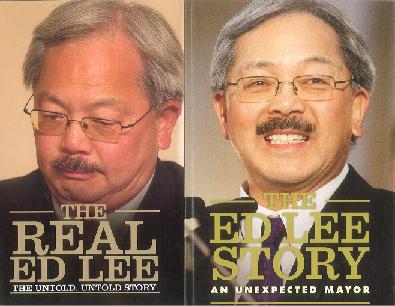
The Leland Yee campaign has taken direct advantage of that perception, releasing a parody of the hagiographic Lee biography written by political consultant Enrique Pearce. “The Real Ed Lee story,” which repeatedly talks of his connections to unethical power brokers, hit the streets this past weekend.

Lee also sided with the San Francisco Chamber of Commerce over a coalition of labor and consumer groups with his veto of legislation by Sup. David Campos that would have prevented employers from draining $50 million per year from health savings accounts set up to comply with city law. Many restaurants even tack a 3-5 percent surcharge onto customers’ bills, making it essentially consumer fraud.

“It’s important for us to take a stance on the issue and say that what the mayor did was wrong,” Campos told us. “It’s a defining issue for us in City Hall.”

Then there’s OccupySF. Nobody knows for sure, but it’s likely that a majority of San Franciscans are at least somewhat sympathetic to the group’s message. And Lee has so far avoided the public relations disaster of Oakland’s crackdown.

But the left is unhappy with Lee’s constant threats to clear out the encampment, and the right is unhappy that he hasn’t sent in the cops already — and even the San Francisco Chronicle has denounced his lack of decisiveness.

Lee put the police on high alert and had them moving around in buses, ready to move in — than at the last minute changed his mind. “What this shows,” said former Supervisor Aaron Peskin, “is that we don’t have a mayor with a firm hand on the tiller.”

Most observers expected that the Chronicle would join the San Francisco Examiner and endorse Lee. But the paper came down on the side of Supervisor David Chiu. Chiu is still running well behind in the polls, and not that many voters follow the Chron’s advice, but the endorsement was a huge boost to his campaign.

“Ed Lee’s had a bad couple of weeks, and some of the others have had a good couple of weeks,” Cooks said.


RANKED CHOICE

Ranked-choice voting puts an interesting twist into all of this. Several consultants and election experts I talked to this week said that Lee would be far more vulnerable in a traditional election. “He would lose a runoff against almost any of the top challengers,” one person said.

But every poll that’s tested the ranked-choice scenario — even recent polls that show Lee faltering — still put him on top after the votes are all tallied and allocated. That’s in part because supporters of candidates who are lower in the pack — Chiu, for example — tend to put Lee as a second or third choice. The Bay Citizen/USF poll showed that when Chiu was eliminated, most of his votes wound up going to Lee.

“Ranked-choice voting clearly favors incumbents,” Cook told me.

And, people walking precincts say, there are still some Herrera and even Avalos voters who put Lee second or third. And the only way Avalos — or anyone other than Lee — can win the election is if progressive and independent voters stick to a clear “anyone but Lee” voting strategy.

Avalos is doing well in recent polls; in fact, one shows him ahead of Herrera in first-place votes. Herrera does better when seconds and thirds are counted. Michela Alioto-Pier gets a fair number of first-place votes, which isn’t surprising since she’s one of only three women in the race, the only woman with citywide name recognition — and the only real credible conservative.

Yee and Chiu are both in the running, and Yee has come out strong attacking Lee and is running hard for progressive votes. He showed up at OccupySF the night a police raid was threatened and has been the leading critic of the alleged voter fraud.

Cook says a scenario where somebody beats Lee is still “an inside straight” — but it’s not at all impossible.

If Lee gets 30 percent of the first-place votes, most observers (including his opponents) agree that he’s going to cruise to victory. But if his first-place total is closer to 20 percent, and one or more of the other candidates are within five points, it’s going to be a lot closer.

Here’s the bottom line: If you don’t want to see a repeat of the late 1990s, when Willie Brown was mayor and City Hall was for sale to the highest bidder, vote for anyone but Lee — and use your three votes strategically. If you like John Avalos, put him first — but give your second-place vote to Herrera, who seems positioned right now to be the other strongest challenger. If you like Herrera, give your second to Avalos. If you like Leland Yee or David Chiu, make sure that Avalos and Herrera are also on your slate.

Fill out all three votes. And get your friends and family to the polls. Because turnout is projected to be low, which helps Lee — and the race may well be decided on the basis of who shows up November 8th.


Adachi video attacks public financing

180

This is odd: An eight-minute video narrated by Matt Gonzalez in support of Jeff Adachi devotes a considerable amount of time to attacking public campaign financing — something Gonzalez always supported as a supervisor.

The video claims that the $4 million that “politicians” are taking to pay for their mayoral campaigns could have helped the city avoid cancelling summer school and cutting school bus routes.

Actually, the city doesn’t pay for summer school or for school buses; the school district does. But I suppose the city could have scrapped public financing and given the money to SFUSD. Unlikely, but possible. (The city actually does share some money with SFUDS, under a measure that Gonzalez opposed.)

The thing about public financing, of course, is that it allows candidates like John Avalos, who won’t get big business support, to run a competitive campaign. If it prevents special interests from buying elections, it saves the city far more than it costs. Public financing has always been a central part of the progressive agenda, nationally and locally.

The rest of the message is about what you’d expect — pension reform, Recology’s franchise fee, giveaways to the police and fire unions. All stuff that Adachi has made part of his campaign. It’s nicely (if inexpensively) produced, and, as always, Gonzalez is a great presenter.

But what’s up with the attack on public finance?

(UPDATE: Gonzalez emailed me to say that Adachi doesn’t oppose public financing but thinks this is a bad year to accept it. He also said when he chaired the Budget Commitee the city sent a lot of money to the schools. But he did oppose the measure that guarantees some city funding to SFUSD.)

Editor’s notes

0

tredmond@sfbg.com

One cool October day in 1985, when I was a young reporter at the Guardian, a friend who was visiting from New York where she was working with Gay Men’s Health Crisis, called me with an urgent message:

City employees were out with water hoses, trying to force a couple of HIV-positive men from camping in front of a federal office building at U.N. Plaza. I ran down there; she had photos. I talked to the men, who were tired and wet, but determined not to leave — and within a few days after my story ran (“AIDS vigil under attack,” 11/6/85), they were joined by dozens more.

And as the months passed, the AIDS vigil grew and grew. It raised awareness of the federal government’s criminal lack of attention to the epidemic. It became a tent city, a small community in the middle of San Francisco with donated food and supplies. Every once in a while, a politician or a media celebrity would spend a night there.

The feds backed off with the hoses and the city figured out that the encampment was no danger to anyone and was making an important political statement. And it remained there — with tents and tarps — for ten years.

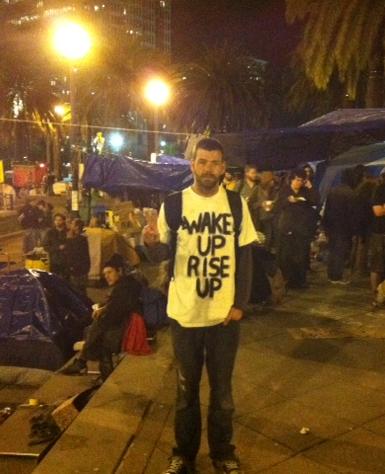
I was at the OccupySF camp Oct. 3rd to do a live KPFA broadcast with Mitch Jeserich, and the place was clean, peaceful and well-organized. A couple of cops walked through while we were on the air; they were smiling and chatting with the protesters, who were negotiation with the Department of Public Works about vacating the grassy areas to allow watering. I saw none of the filth that the daily newspapers have talked about.

The only real health and safety problem was the lack of portable toilets — the seven on site weren’t enough for the number of people there. So if the city wants to keep things sanitary, Mayor Ed Lee ought to send in some more. Oh, and the medical tent needs supplies, particularly ice packs and sterile gauze.

A woman from Occupy Vancouver was down visiting and showing solidarity; she said that protesters all over the continent were looking to San Francisco and Oakland for inspiration.

This is a good thing. The protests may not have an agenda, but they have a message, and it’s getting to big and too loud to ignore. I hope it doesn’t take ten years for politicians at the local, state and federal level to respond — but as long as nobody’s addressing economic inequality, OccupySF is and ought to be here to stay.

David Chiu, the fashion mayor

22

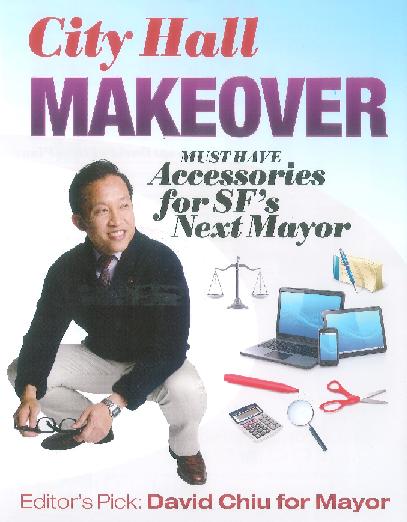
There’s a new fashion in the mayor’s race, and it’s … accessories! This new mailer says to vote for Sup. David Chiu because he knows how to accessorize — check out the cool glasses, and the sensible yet snazzy shoes and the high-tech wristwatch. Oh, and there’s a laptop/cell phone/ipad, a checkbook, a scissors, a red pen, a calculator and a set of scales, which I assume are to measure out justice and not medical marijuana. Although that’s fashionable, too. On the back of the mailer a nicely-dressed line of people stands out in front of City Hall in some sort of synchronized dance step; they all have their left hands pointed up. Cute.

The Real Ed Lee story

14

The Ed Lee Story has some much-needed competition. The boring, patronizing (to readers) and over-the-top hagiography of the interim mayor was just sitting there waiting for a parody, and now the Leland Yee campaign has obliged.

The Real Ed Lee, written by the Yee team, has a serious political point, but it’s actually funny, sometimes really funny, and it’s much easier to read than the plodding “Ed-Is-Greater-Than-God” prose of the original. A section titled “San Francisco’s Future, Ed Lee Style” notes that if the incumbent is elected to a full term

The Golden Gate Bridge will be now called the PG&E/Recology Golden Gateway to Corruptville. Make sure to show your employee badge at the the toll botth for your discounted rate (wink, wink).

HealthySF will be renamed the Endangered Restaurant Protection Act. You will be charged an additional 42 % on your bill. Please note — no health care will be provided.

Muni buses will now be operated by GO Lorries. Surprisingly, service will remain generally the same.

David Chiu is now District Attorney. Oh, wait ….

The book goes through the details of how Lee rose through the ranks at City Hall, along the way approving a couple of fraudulent vendors and getting caught up in Willie Brown’s sleaze. It discusses how his campaign is taking credit for other people’s work and ideas. It describes how he promised over an over not to run, then went ahead and did it anyway. It’s got a great picture of him steering a 139-foot yacht with the caption “I’m on a boat.”

I don’t know how well this will work, but it’s clear that Lee is falling in the polls and the cumulative impact of his mistakes and the attacks on him by the other campaigns is taking its toll. And for once, we have a campaign piece that made me laugh instead of crying.


The end of the death penalty?

9

Could 2012 be the year when we finally end the death penalty in California? It’s entirely possible. The polls now show a majority of people in the state support replacing the death penalty with life without parole. There’s a growing movement against executions (in part because of the cost , in part because it doesn’t work (most death-row inmates die of old age before they are killed) in part because it’s so grisly — and, of course, in part because it’s barbaric and has been outlawed in most of the civilized worle.

And the ACLU and a wide range of allies are now starting to gather signatures for what will be a well-funded, well-organized ballot initiative campaign next November.

It’s the right time (a presidential election year), the right coalition (including law-enforcement folks, wrongfully incarcerated people and victims’ families), and the right message. The first step is to gather signatures; go the the web site here and sign up to help.

Guardian editorial: Let OccupySF and Oakland stay

18

With all of the police raids and arguments over messages and demands and tactics, it’s easy to forget that the Occupy Wall Street movement has a clear political point — and it’s right.

The movement is about the devastating and unsustainable direction of the American economy, about the fact that a tiny elite controls much of the nation’s wealth, that virtually all of the income growth over the past 20 years has gone to the very top, about the collapse of the middle class and the rise of economic inequality that would have been unthinkable a generation ago. Those are the central issues facing the United States, the state of California and the cities of San Francisco and Oakland today — and instead of trying to crack down on the protests, city officials ought to be endorsing the occupy movement and talking about cracking down on the financial institutions and the wealthy.

A few things worth noting:

1. The protesters are almost entirely nonviolent. Although there have been a few isolated incidents in Oakland and SF, the overwhelming majority of the thousands of people at Justin Herman Plaza and Frank Ogawa Plaza are actively promoting and insisting on nonviolence. This is not a crowd that is a threat to anyone.

2. The city of San Francisco’s citations — reported without question in the daily newspapers — about health and sanitation problems are way overblown. The OccupySF protesters are making extraordinary efforts to keep the place clean. When the city failed to live up to its promise to provide portable toilets, the protesters ordered (and paid for) their own. As state Sen. Leland Yee (not known as a crazy radical) noted after a visit Oct. 26: “While hundreds gathered, there was not one incident of violence. If the interim mayor thinks there are health issues, I certainly didn’t see them.”

3. The SF Mayor’s Office and the police have made no serious effort to work with or negotiate with the protesters. Even the five supervisors who arrived Oct. 26 (and good for them) when there were rumors of a police action, had no idea what the cops were up to — and Police Chief Greg Suhr wasn’t responding to their phone calls. It’s the equivalent of psychological warfare; protesters have to be on edge at all times for fear of a crackdown that may or may not come.

4. Mayor Jean Quan made a bad mistake sending in the cops to roust Occupy Oakland. Nothing good at all can come of any further police eviction action.

Frankly, we don’t see why the protesters — who are well-behaved, represent no threat to anyone, and are doing a huge civic and national service by bringing attention to an issue that the powers that be in Washington, Sacramento and (sadly) San Francisco have largely ignored — can’t stay where they are. If there are health issues, let the Department of Public Health work with the occupiers. If there’s a problem with a portable kitchen, let the Fire Department show the protesters how to run it safely and legally (there are portable cooking devices at every street fair, in dozens of food trucks and in probably 100 other places around town).

The people at OccupySF and Occupy Oakland have done an amazing job of building a safe, respectful and inclusive community. They are the political heros of 2011. If there’s anyplace in America where the movement ought to be allowed to grow and thrive, it’s here in the Bay Area.
 

How about Scott Olsen Plaza?

14

Occupy Oakland changed the name of Frank Ogawa Plaza; it’s time for OccupySF to do the same.

The place where the protesters are gathered is named for Justin Herman, the notorious director of San Francisco’s Redevelopment Agency in the terrible days of the 1950s and 1960s, when “redevelopment” meant removing black people from the Western Addition and removing poor people, particularly Filipinos, from South of Market and later the International Hotel. Herman once famously said that the SOMA land where he wanted to build hotels was “too valuable to permit poor people to park on it.”

In the 1960s, the battle against redevelopment was one of the defining political struggles in San Francisco, bringing Asians, African Americans, white progressives, young community organizers, affordable housing and tenant activists, poverty and civil rights lawyers … just about the whole spectrum of the city’s left. It’s been the subject of books and movies. The people who fought Justin Herman are part of a long political thread in San Francisco — as is OccupySF today.

I’ve always thought it was an abomination to have a downtown plaza named after a guy who did so much to destroy San Francisco. Maybe from now on we should all call it Scott Olsen Plaza.

The new attack on Herrera

25

Well, the salvo coming from the Lee campaign trying to smear Dennis Herrera for not being a strong enough supporter of same-sex marraige shows at least one thing: The race is closer than the polls are reporting.

For the former staffers of Gavin Newsom — and everyone knows who they are, because there weren’t that many people in those meetings — to come forward two weeks before the election with these allegations was a serious political risk. For starters, Herrera is really popular in the LGBT community, and already, much of the city’s queer leadership (including Tom Ammiano, Mark Leno and Scott Wiener) has responded by denouncing the attack. The three, along with Phyllis Lyon and representatives of both major clubs, Harvey and Alice, will be holding a press conference Oct. 27 in the Castro. A letter that went out today under Lyon’s name notes:

A petty smear campaign is underway to personally discredit City Attorney Dennis Herrera over his years of work for marriage equality.  Incredibly, despite all the heroic efforts of Dennis and his office right from the start, anonymous sources have pushed a story in the San Francisco Chronicle that Dennis wasn’t “supportive” of Mayor Newsom’s decision to issue same-sex marriage licenses back in February 2004.  It’s not true.  These politically motivated attackers are hoping we’ll forget the years of hard work Dennis and his deputies invested — and continue to invest even now, in the federal challenge to Prop 8 — for LGBT equality.

So this could easily backfire and wind up focusing attention on all of Herrera’s LGBT support.

It’s also a risk for Lee. Although his name isn’t on any of this, his people are clearly behind it; Newsom (who just endorsed Lee) and his former staffers (some of whom are now Lee’s staffers) wouldn’t have contacted the Chronicle and pushed this story without the knowledge and permission of the mayor and his senior campaign people. Wiener, who is often one of Lee’s allies on the board, is clearly unhappy about the blast at his former boss. Leno, who isn’t involved in the election all, is now going to be pissed at the mayor. And if this winds up looking like a Lee-sponsored political swipe at an LGBT community ally, Lee’s going to lose votes and support.

So why do it? It makes no sense — Lee has tried to appear as the candidate of civility and reason, above the mudslinging fray. He’s trying to act so much like the inevitable winner that he doesn’t even show up for a lot of the debates and forums. There’s no point in dishing this kind of story up — unless the Lee camp has polling data showing the race tightenting and Herrera emerging as a serious challenger.

It’s a pretty basic rule in campaigns: You don’t risk political capital attacking candidates who are no threat to you. So if I were Herrera, I’d be mad — but also encouraged. They’re obviously worried.