youth

Fighting for juvenile justice

0

sarah@sfbg.com

Sup. David Campos’ proposal to amend San Francisco’s sanctuary policy so that the city guarantees due process to juvenile immigrants heads for a full vote of the board next week with the support of a veto-proof majority of supervisors.

Board President David Chiu and Sups. John Avalos, Chris Daly, Bevan Dufty, Eric Mar, Sophie Maxwell, and Ross Mirkarimi have signed on as cosponsors of the amendment, which also has the support of a broad coalition of civil and immigrants’ rights organizations.

But with the mayor opposed to the bill and the daily newspapers agitating against reform, it’s important to remember what’s really at stake here.

As a team of civil rights experts notes, the Campos bill "will ensure that families are not torn apart because a youth is mistakenly referred for deportation and will encourage cooperation between law enforcement and immigrant communities by reestablishing a relationship based on trust, therefore increasing public safety."

Campos, who came to this country as an undocumented youth from Guatemala and represents San Francisco’s heavily immigrant Mission District, says his proposal is a balanced solution to the draconian policy Newsom ordered last summer, without public input, the day after the mayor launched his 2010 gubernatorial bid.

When Campos introduced his amendment this summer, after months of public conversations with law enforcement agencies and the immigrant community, Newsom responded by leaking a confidential legal memo that outlined possible challenges to the proposal.

Angered but undaunted, a group of civil rights organizations responded by issuing their own brief explaining why Campos’ proposal is legally tenable and defensible.

As Angie Junck of the Immigrant Legal Resources Center, Robert Rubin of the Lawyer’s Committee for Civil Rights, Julia Mass of the American Civil Liberties Union of Northern California, professor Bill Ong Hing of UC Davis Law School, and Angela Chan of the Asian Law Caucus explained, Campos’ proposal "will allow immigrant youths to have their day in court and be heard by an impartial judge, ensuring due process is upheld for all of San Francisco’s youth."

They argue that Campos’ legislation seeks to "lessen the risk that the city will be liable for racial profiling, unlawful detention, and mistaken referrals of U.S. citizens and lawful immigrants for deportation while bringing the city’s juvenile probation practices into compliance with state confidentiality laws for youth."

And as they point out, Campos’ proposal won’t prevent youths who have been found by a court to have committed a felony from being referred to ICE.

"The sanctuary ordinance has stood strong for 20 years, and the proposed amendment strengthens the ordinance by taking steps to bring the city’s practices more into compliance with state juvenile justice law," the brief states. "The legislation is a measured step in the right direction that will help restore accountability and fairness in the city’s treatment of immigrant youth."

Or as Campos put it: "It’s something we drafted very carefully in close consultation with the City Attorney’s Office."

ARRESTED OR CONVICTED?


Campos’ amendment seeks to shift the point at which immigrant kids get referred to ICE agents for possible deportation. Newsom’s policy allows the police to refer kids to ICE the moment they’re arrested. That means someone who turns out to be innocent and was arrested in error can still be deported. Campos wants the cops to wait until the felony charge is upheld in juvenile court.

Since July 2008, when Newsom ordered the city’s current policy shift, 160 youths have been referred to ICE, increasing the risk they will be sent to detention facilities across the country, far from their families, without access to immigration legal services, based on accusations and racial profiling.

Abigail Trillin, staff attorney with the Legal Services for Children, told us that the Newsom policy makes San Francisco bedfellows with Texas and Orange County.

"A bunch of our kids go to Yolo County and Oregon, a lot to Los Angeles, others to Miami, Virginia, and Indiana, and some have already been deported," Trillin said.

Trillin noted that Newsom’s policy is destroying families by allowing innocent kids to be reported for deportation without the basic right to due process — often for minor offenses. She has already seen youth who are documented or innocent erroneously referred to ICE by juvenile probation officers, who often lack expertise in immigration law.

She also fears this miscarriage of justice could result in abuse and even death — especially if kids try to return to their homes and families by crossing the border, which has became increasingly militarized and perilous in the aftermath of the Bush administration’s decision to spend billions to build a fence along the border.

Last week, the battle for juvenile justice took a fresh twist locally when Newsom’s newly appointed Police Chief George Gascón said he hoped for a compromise involving third party review by the District Attorney’s Office.

"I fully understand the concerns Campos brings to the table," Gascón said, referring to his previous job as chief of police in Mesa, Ariz., where he saw the anti-immigrant excesses of Maricopa County sheriff Joe Arpaio.

"I have the benefit of seeing the other side, where you have police agencies aggressively engaged in immigration enforcement, where people that were frankly not engaged in any criminal activity other than that of being here without authority, are being deported," Gascón said. He noted that being here without papers often is not a crime; it’s just an administrative violation.

"I’ve seen very young people, people that basically came to this country when they were three or four years old and are staying clean and going to school, get stopped for a traffic violation at age 17 or 18, and now all of a sudden they’re getting deported to a country where they have no roots," he said.

But the chief remains convinced that the criminal justice system needs to be able to use all legally available tools to deal with violent criminal juveniles.

"I’m not saying the district attorney needs to make the reporting. The triggering event could be the determination to file the case," Gascón said. "Frankly, I wish I’d been here a year earlier to deal with this issue," he added, noting that federal immigration hearings are "a kangaroo court."

"It’s not a beyond-reasonable-doubt standard for people to get deported," he said.

"The other side of the coin is that this would be putting people in situations where they could be federally indicted for violations of law. And you also have problems at state," he continued, noting that two federal grand juries are currently reviewing the behavior of the Juvenile Probation Department.

DUE PROCESS


Campos, a lawyer, appreciates that the new police chief is "genuinely trying to see if there is something he can do to resolve the situation. I believe if he had been in place where this discussion was going on a year ago, the mayor would have received better advice."

"The chief’s comments reflect that what is happening here is pretty extreme," Campos added. "I recognize that changing the reporting process to a third party would definitely be better than what we have now, where the final decision rests with a police officer. But while it’s better, it’s not sufficient. Due process necessarily entails giving people their day in court, and letting a judge decide what actually happens."

Sup. Chiu, a former prosecutor, also said he appreciates Gascón’s resolution attempt. "But the point of our system is that once you are arrested and charged, there are due process rights so you can respond to those charges."

Sup. Dufty, a mayoral candidate, said he expects that when the board passes laws, those laws will be implemented by Newsom. "As CEO of San Francisco, he has to comply with all legislation, including local laws the legislative body passes that he may not like," Dufty said.

"My mother was born in Czechoslovakia and was stateless when I was a boy," he added. "She had to register every year as an alien, so this is very visceral for me. If we are to be a sanctuary city, it’s because everyone has due process. It’s denying people’s humanity and dignity and creating a two-tiered system for justice."

But mayoral spokesperson Nathan Ballard continued to assert that Newsom’s current policy is balanced. "While he remains open to argument, the mayor believes the current policy strikes the right balance between protecting public safety and safeguarding the rights of accused criminals," Ballard, who had not replied to the Guardian‘s questions as of press time, told the Examiner last week.

But Trillin says she can’t stand to hear Ballard falsely claim, one more time, that the city is going to shield criminals. "Ballard keeps repeating a completely false position, because Newsom’s actual position is morally indefensible," Trillin said. "You can’t have the mayor publicly say that young people don’t deserve due process, so you have to make up stuff like this instead."

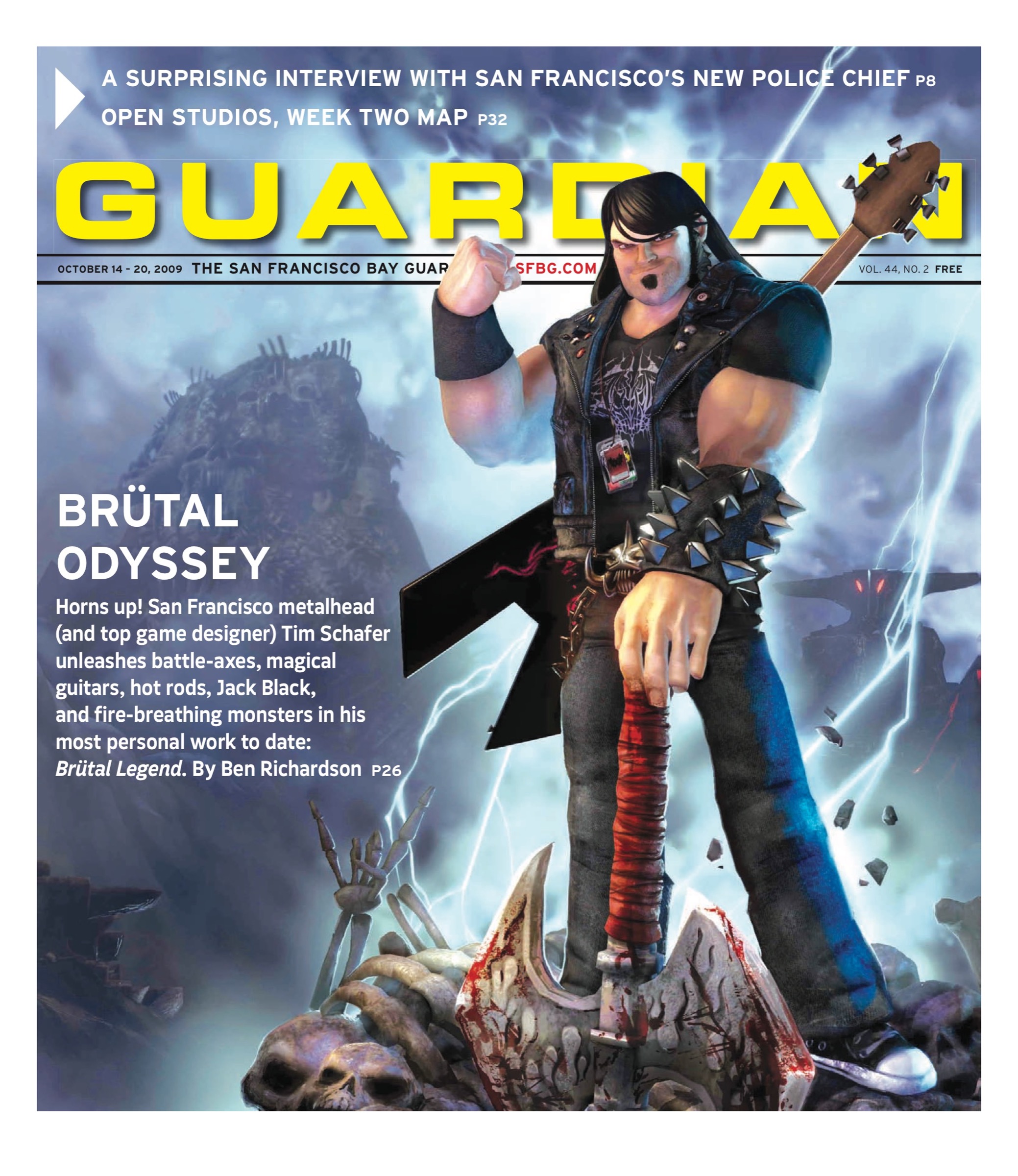
Brütal odyssey

0

>>Read Ben Richardson’s full interview with Tim Schafer here

arts@sfbg.com

GAMER "The first time we pitched it, they wanted us to change the genre, to make it about country or hip-hop or something."

Game designer Tim Schafer is sitting in his SoMa office, in his favorite chair — appropriately, a rocking chair — and talking about his masterpiece. "They were saying, ‘Why don’t you open it to all music?’ We said, ‘Look — this is a game about epic battles, good vs. evil, Braveheart-type moments. And heavy metal is the musical genre that focuses heavily on folklore. It sings about medieval combat. It’s really the only genre that makes sense for it.’"

The game is Brütal Legend (Double Fine/EA), and in the end, Schafer got his way. Taking control of Eddie Riggs, a grizzled roadie voiced by Jack Black, the player journeys through a metal landscape inspired by the album covers the designer studied in his youth. Wielding a massive battle-ax and a magical guitar, Riggs encounters righteous friends and fiendish foes, including characters voiced by luminaries like Lemmy Kilmister, Ozzy Osbourne, Rob Halford, and Lita Ford. The soundtrack is a carefully compiled list of headbang-inducing classics.

Schafer agrees that the game is his most personal creation to date. "All games are wish fulfillments. All games are about fantasy. This is a game where I’ve been able to make my own wish fulfillment. I would like to go back in time with a cool car and a battle-axe while listening to heavy metal."

THE TROOPER

Growing up in Sonoma, the designer escaped his suburban life by rocking out to Ozzy Osbourne, Black Sabbath, Judas Priest, and Iron Maiden. He would drive down to San Francisco for shows, catching sets at Mabuhay Gardens or the Stone. The music introduced him to a mythic world of horned hell-monsters, glistening chrome, and mortal combat, a world he never quite left behind.

He attended both UC Santa Cruz and UC Berkeley, dividing his attention between computer programming and creative writing, two talents he would later fuse. At Berkeley, he took a class on folklore from Alan Dundes, a provocative professor whose belief in the power of folklore influenced Schafer’s work tremendously. In 1989, he got a job in San Rafael at Lucasfilm Games, now LucasArts. He was assigned to The Secret of Monkey Island, a comedic adventure game by designer Ron Gilbert. Monkey Island was the perfect vehicle for Schafer’s talents, taking full advantage of his boundless imagination, storytelling sense, and biting wit. It is best remembered for its "insult sword fighting" section, in which dueling buccaneers trade verbal jabs in lieu of physical ones.

Mitch Krpata, game critic for the Boston Phoenix and author of the blog Insult Swordfighting, identified the defining quality of Schafer’s LucasArts output via e-mail: "Character. There are a few archetypes that most games go to again and again: silent man of action, easygoing everyman, tormented soul out for revenge. Schafer’s protagonists aren’t like that. They’re individuals. They’re good guys, but they have flaws, and their flaws aren’t things like they just care too much, dammit."

BE QUICK OR BE DEAD

After finishing the biker-themed Full Throttle in 1995, Schafer hunted inspiration. It came to him as an unlikely combination of themes, both closely tied to his San Francisco home. Initially, he was devouring classic noir films at the Lark and Castro theatres. A trip to the Day of the Dead parade in the city’s Mission District delivered the epiphany. The higher-ups at LucasArts had been agitating for a game with 3-D graphics, a prospect he did not relish. "I really hated the look of 3-D art back then, because it looked like a nylon stretched over a cardboard box," he remembers.

Picking through a table of Day of the Dead ephemera, the idea came: "I saw those calavera statues. Instead of modeling all of the bones in papier-mâché, they’ll just make a tube and paint the bones on the outside. I was like, ‘This is just like bad 3-D art. This is great!’"

Additional fodder was provided by doctor visits to 450 Sutter — a building that combines Art Deco architecture with Mayan motifs — and Schafer began work on his most ambitious project to date. Drawing on his collegiate folklore training, he and his team wove together elements of Day of the Dead tradition, Aztec folk tales, and noir cinema to create 1998’s Grim Fandango (LucasArts), a sprawling epic of crime and love in which all the characters were stylized, calavera-style skeletons "living" in the Land of the Dead. Featuring a labyrinthine, affecting story, delectable hard-boiled dialogue, and stunning art direction, it is still ranked among the best games of all time.

RUNNING FREE

Schafer left LucasArts in 1999, concerned that the company would exercise its ownership of his beloved characters without his participation. He wanted to found his own studio in San Francisco. As he told me over the phone, "Working at a company where you can look out the window and see the city outside is just so inspiring. It’s not just about having great restaurants at lunch, though that’s part of it." Starting in his living room "in a bathrobe and flip-flops," the nascent Double Fine Productions — named after a "double fine zone" sign on the Golden Gate bridge — jumped from location to location, including an unheated warehouse with a rodent problem and a toilet that often unleashed an "ocean of human waste" into the office.

The first Double Fine game was 2005’s Psychonauts, an ambitious project about a summer camp for psychic kids that failed to reach the wide audience it deserved. Even in this rarefied setting, Schafer included bits of the city’s lore. A character named Boyd was based on a homeless man who hung out near the team’s offices, doing odd jobs and enlightening the Double Fine crew with his extensive conspiracy theories.

"Sometimes he would just be on a rant about [how] the government would be trying to read his mind using satellites, or using the broken glass in the streets to bend their optics around," Schafer recalls. "He just produced great quotes: ‘I don’t want to be liquid, I want to be a turtle with rockets strapped to my back!’" Deciding to include him in the game, the designer painstakingly created a flow-chart that would procedurally generate conspiracy theories for Boyd to spout onscreen. "He constructs it by coming up with a conspirator, what their plan is, what the victim of it is, and strings it all together with a bunch of coughing and stuff."

FROM HERE TO ETERNITY

Brütal Legend, Double Fine’s latest game, was released Oct. 13, and gamers across the country will have the opportunity to play through the piece of San Francisco folklore most familiar to Schafer: the one based on himself. By making a game about a character transported from our familiar world into an ax-happy metal battleground, the designer has turned his story, the story of a misfit headbanger from a city steeped in metal history, into a new kind of 21st century myth.

Magnolia

0

paulr@sfbg.com

Imagine a casting call for a beer commercial — a beer, I should add, marketed toward cool young people and not geezers or swollen couch slugs — and you’ll have some idea of the scene at Magnolia Gastropub & Brewery on any given night. Loose halter tops, soccer butts, and headsful of tousled hair dot the Rathskeller-scape, while the human noise (let’s call it the roar of youth) is so loud and steady as to achieve a transcendence. The noise is beyond noise; it warps reality and becomes another dimension. As a confirmed hater of noise, I should have hated it passionately, but it’s hard to sustain that kind of energy when you are engulfed in a sea of jubilant 20-somethings. Like all human moods, exuberance is communicable, and you won’t see many long faces coming out of Magnolia. On the other hand, you might well see some people, probably older than 40, gingerly checking to make sure their ears are still attached to their skulls as they regain the (comparatively) tranquil street.

Magnolia has been a beacon-like presence at the corner of Haight and Masonic for 15 years. In part, and in true pub fashion, it’s a neighborhood joint, but from the beginning the microbrewed beers have provided a broader draw. Magnolia was among the first of the city’s modern brewpubs — places that brewed their own beer and matched good food to go with it. And while the kitchen has recently undergone a change of chef, with Ronnie New now in charge, the food retains its gastro-pubby, beer-friendly edge. There’s a daily pizza, a burger made with Prather Ranch beef, and (at lunch) a meatloaf sandwich. But New has Louisiana roots, and he’s infused Magnolia’s new menu with various Cajun and Creole touches.

You’ll find quite a few of these among the side dishes ($5), which include collard greens, dirty rice, cheese grits, and black-eyed peas simmered with ham hocks. I love black-eyed peas and consider them a real delicacy, and how could you go wrong simmering them with ham hocks? But something did go wrong — maybe a total dearth of salt — and the result was lifelessness. There was considerably more kick in the vinegary (though non-bayou) sauerkraut, but when we asked whether it was house-made, our server shook her head. (Service is surprisingly good, by the way, considering the intensity of the evening rush, but the service staff’s manner is Parisian in its emphasis on efficiency rather than fawning.)

Okra, a staple of bayou cooking, makes its presence felt in ways subtle and not. You can have it more or less straight up, as a buttermilk-battered and deep-fried appetizer, but it also appears in the succotash that accompanies a slab of pan-seared halibut ($19). The fish, topped by a beret of basil aioli, is nicely cooked, moist and flaky, but the plate is dominated by the colorful succotash, a gravelly mat of corn kernels, halved cherry tomatoes, and okra splinters.

Not all the food is Louisiana-inflected or even pubby. We were especially impressed by a watermelon salad ($7), which managed to give the late-summer bounty of California a sly Saharan aura. The cubes of melon were tossed with slices of peeled, seeded cucumber and chunks of goat cheese and then dressed with a saba vinaigrette and shreds of mint. Some sweetness, some tang; a bit of creaminess, a bit of crunch. (The watermelon, incidentally, is thought to be native to Egypt and was cultivated as a means of carrying water in the desert.)

And a summer tomato soup ($7) could have been on the menu at many a California-cuisine spot. The (hot) soup had a pleasant coarseness, but the real treat was the archipelago of croutons, coated with melted Gruyère, bobbing in the middle of the bowl.

In a surprising development, desserts are quite good — neither overwrought nor (as is so often the case at pub-style establishments) ordinary and perfunctory. A plum crisp ($7) was deftly enlivened by the addition of tomatoes; their texture was difficult to distinguish from that of the plums, but their earthy acidity helped damp the sweetness. I would have called this dish a crumble, since it was in effect a shallow dish of stewed fruit with the pastry bits scattered over the top like sprinkles on a doughnut. There was no proper crust.

A pair of tiny ice-cream sandwiches ($7), like sliders, reached the table in a supercooled condition, and we were told to let them stand for five minutes so they could relax. The crisp, alas, didn’t last that long, so when we turned to the sandwiches, they were still slightly gelid. But the flavor of the Bi-Rite roasted banana ice cream glowed through the cold, and the graham-cracker cookies were like un-lemony madeleines. (Perhaps to compensate for the lack of lemon, the inner faces of the cookies were smeared with white chocolate.) The bite- (or two-bite-) size of the sandwiches was also a bit of caloric discipline for those of us no longer in our 20s. A diamond might be forever, but not a soccer butt. *

MAGNOLIA GASTROPUB & BREWERY

Mon.–Thurs., noon–midnight; Fri., noon–1 a.m.;

Sat., 10–1 a.m.; Sun., 10 a.m.–midnight

1398 Haight, SF

(415) 864-7468

www.magnoliapub.com

Beer and wine

AE/DS/MC/V

Deafening

Wheelchair accessible

Film listings

0

Film listings are edited by Cheryl Eddy. Reviewers are Kimberly Chun, Michelle Devereaux, Max Goldberg, Dennis Harvey, Johnny Ray Huston, Louis Peitzman, Lynn Rapoport, Ben Richardson, Matt Sussman, and Laura Swanbeck. The film intern is Fernando F. Croce. For rep house showtimes, see Rep Clock. For first-run showtimes, see Movie Guide.

SF DOCFEST

The eighth annual San Francisco Documentary Film Festival runs Oct 16-29 at the Roxie, 3117 16th St, SF. Tickets ($11) are available by visiting www.sfindie.com. For commentary, see "Is the Truth Out There?" All times p.m.

FRI/16

The Entrepreneur 7. Shooting Robert King 7. Drums Inside Your Chest 9:15. Houston We Have a Problem 9:15.

SAT/17

Drums Inside Your Chest 2:30. Waiting for Hockney 2:30. Between the Folds 4:45. Finding Face 4:45. HomeGrown 7. The Wild and Wonderful Whites of West Virginia 7. Dust and Illusions 9:15. The Earth Is Young 9:15.

SUN/18

"Bay Area Shorts" (shorts program) 2:30. We Said, No Crying 2:30. Another Planet 4:45. I Need That Record: The Death (or Possible Survival) of the Independent Record Store 4:45. Cat Ladies 7. Off and Running 7. Vampiro 9:15. What’s the Matter with Kansas? 9:15.

MON/19

Between the Folds 7. We Said, No Crying 7. October Country 9:15. Waiting for Hockney 9:15.

TUES/20

The Earth Is Young 7. I Need That Record: The Death (or Possible Survival) of the Independent Record Store 7. Another Planet 9:15. The Wild and Wonderful Whites of West Virginia 9:15.

MILL VALLEY FILM FESTIVAL

The 32nd Mill Valley Film Festival runs through Sun/18 at the Century Cinema, 41 Tamal Vista, Corte Madera; CinéArts@Sequoia, 25 Throckmorton, Mill Valley; 142 Throckmorton Theatre, 142 Throckmorton, Mill Valley; and Smith Rafael Film Center, 1118 Fourth St, San Rafael. Tickets (most shows $12.50) available by calling 1-877-874-MVFF or visiting www.mvff.org. All times p.m. unless otherwise noted.

WED/14

Rafael The Horse Boy 4:30. "5@5: America Is Not the World" (shorts program) 5. "Spotlight on Jason Reitman:" Up in the Air 6:30. White Wedding 7. Linoleum 7:15. Tapped 9. The Eclipse 9:15. Up in the Air 9:40.

Sequoia The Swimsuit Issue 4:15. "5@5: Oscillate Wildly" (shorts program) 5. Trimpin: The Sound of Invention 6:30. Surrogate 7. Elevator 8:45. Hellsinki 9.

Throck "Insight: The Cassel Touch" (interview and discussion) 8.

THURS/15

Rafael The Girl on the Train 4. Reach for Me 4:30. "5@5: The More You Ignore Me, the Closer I Get" (shorts program) 5. Icons Among Us: jazz in the present tense 6:30. Meredith Monk: Inner Voice 6:45. "Tribute to Woody Harrelson:" The Messenger 7. Hipsters 9. Barking Water 9:15.

Sequoia "5@5: Sister I’m a Poet" (shorts program) 5. Jim Thorpe: The World’s Greatest Athlete 5:15. Apron Strings 6:45. The Missing Person 7:30. This Is the Husband I Want! 9. Winnebago Man 9:30.

Throck Storm 7.

FRI/16

Rafael Sweet Rush 4. "5@5: The Edges Are No Longer Parallel" (shorts program) 5. Stalin Thought of You 6. "Tribute to Anna Karina:" Victoria 6:30. Zombie Girl: The Movie 7. Jermal 8:15. Trimpin: The Sound of Invention 9. Red Cliff 9:30.

Sequoia Shylock 4. Shameless 5. Tenderloin 6:45. A Thousand Suns and Mustang: Journey of Transformation 7. One Crazy Ride 8:45. Happy Tears 9:15.

Throck Troupers: 50 Years of the San Francisco Mime Troupe 7:30.

SAT/17

Rafael [Blank.] 11am. A Thousand Suns and Mustang: Journey of Transformation noon. Ricky Rapper 1. The Girl on the Train 1:45. Hellsinki 2. Oh My God 3. The Strength of Water 4:15. Awakening from Sorrow 4:45. The Missing Person 5:30. The Most Dangerous Man in America: Daniel Ellsberg 6:45. The Swimsuit Issue 6:45. Surrogate 7:45. Tenderloin 9. Hipsters 9:15.

Sequoia The Letter for the King 10:30am. Eat the Sun noon. White Wedding 1:30. Miracle in a Box: A Piano Reborn 2:30. Dark and Stormy Night 3:45. Mine 5. A Year Ago in Winter 6:15. Reach for Me 7:15. "Hi De Ho Show" (shorts and music) 9:15. Winnebago Man 9:45.

Throck "New Movie Labs: Distribution of Specialty Film" (seminar) 12:30. Project Happiness 3. "5@5: The Edges Are No Longer Parallel" (shorts program) 5. "Cinemasports" (shorts program of films made in one day) 7:30.

SUN/18

Rafael Stella and the Star of the Orient noon. This Is the Husband I Want! noon. Mine 12:30. Apron Strings 2:30. Soundtrack for a Revolution 2:45. One Crazy Ride 3. Project Happiness 5. The Young Victoria 5:15. Race to Nowhere 5:45. Skin 7:30. Bomber 7:45.

Sequoia The Ten Lives of Titanic the Cat 12:30. Meredith Monk: Inner Voice 1. Oh My God 2:30. The Most Dangerous Man in America: Daniel Ellsberg 3:15. Looking for Eric 5:15. The Strength of Water 5:45.

Throck "New Movies Lab: Active Cinema" 12:30. "A Sweeter Music: Live Concert with Sarah Cahill and John Sanborn" 3:30.

OPENING

Birdwatchers War-painted natives don bows and arrows and watch from the Amazon riverbank as a boat of tourists passes by. Away from white eyes, they slip back into their modern clothes and are paid by the tour guide for a job well done. Had it sustained the evocative wryness of its opening scene throughout its running time, Marco Bechi’s film would have been more than a frequently striking culture-clash tract. As it is, there’s much to admire in this Brazil-set account of a disbanded Guarani-Kaiowà tribe struggling to hang on to their expiring heritage, from its clear-eyed view of the lingering human toll of colonialism to its uncondescending portrait of indigenous mysticism. Unfortunately, Bechi’s penchant for underlined contrasts and clumsy staging often threaten to sabotage his evocative mix of ethnography, satire, and social critique. While far from being as complacent as the titular sightseers, in the end the film is similarly content to merely skim over an ongoing cultural genocide. (1:40) Sundance Kabuki. (Croce)

*An Education See "Culture Class." (1:35) Albany, Embarcadero.

The Horse Boy Rupert Isaacson and Kristin Neff are a Texas couple struggling to raise their five-year-old autistic son Rowan. When they discover that the boy’s tantrums are soothed by contact with horses, they set out on a journey to Mongolia, where horseback riding is the preferred mode of traveling across the steppe and sacred shamans hold the promise of healing. Michael Orion Scott’s documentary is many things — lecture on autism, home video collage, family therapy session, and exotic travelogue. Above all, unfortunately, it’s a star vehicle for Isaacson, whose affecting concern for his son is constantly eclipsed by his screen-hogging concern for his own paternal image (more than once he declares that he’s a better father thanks to Rowan’s condition). The contradiction brings to mind doomed activist Timothy Treadwell in Grizzly Man (2005), and indeed the film could have used some of Werner Herzog’s inquisitive touch, if only to question the artistic merits of showing your son going "poopie." Twice. (1:33) Embarcadero, Shattuck. (Croce)

Law Abiding Citizen "Spike Lee’s Inside Man (2006) as re-imagined by the Saw franchise folks" apparently sounded like a sweet pitch to someone, because here we are, stuck with Jamie Foxx and Gerard Butler playing bloody and increasingly ludicrous cat-and-mouse games. Foxx stars as a slick Philadelphia prosecutor whose deal-cutting careerist ways go easy on the scummy criminals responsible for murdering the wife and daughter of a local inventor (Butler). Cut to a decade later, and the doleful widower has become a vengeful mastermind with a yen for Hannibal Lecter-like skills, gruesome contraptions, and lines like "Lessons not learned in blood are soon forgotten." Butler metes out punishment to his family’s killers as well as to the bureocratic minions who let them off the hook. But the talk of moral consequences is less a critique of a faulty judicial system than mere white noise, vainly used by director F. Gary Gray and writer Kurt Wimmer in hopes of classing up a grinding exploitation drama. (1:48) Presidio. (Croce)

*More Than a Game In the late 1990s, armed with a camera and a certain amount of tenacity, Kristopher Belman set out to capture the glory that was regularly manifesting itself on a certain Akron, Ohio basketball court. The main reason: a future superstar named LeBron James. But James’ remarkable teenage career (at least until the age of 18, when the St. Vincent-St. Mary High School grad became the number one NBA draft pick) wasn’t completely a solo act; his core group of friends, the team’s starting line-up, was so tight they were called "the Fab Five." Despite Belman’s determination to equally divide the spotlight, James was clearly a star then as he is now, slam-dunking on hapless opponents even as he grappled with his burgeoning celebrity status. I’ll never tire of the tale of how James raised eyebrows when he started driving a brand-new Hummer — only to quash whispers of misconduct when it was revealed that his mother, Gloria, was able to secure a loan for the gift based solely on the understanding (shared by all) that her son’s skills would make him a zillionaire before his next birthday. (1:45) (Eddy)

New York, I Love You A variety of filmmakers (including Fatih Akin, Shekhar Kapur, Mira Nair, and Brett Ratner) directed segments of this stateside answer to 2006’s Paris, je t’aime. (1:43) Bridge, Shattuck.

The Providence Effect Located in Chicago’s gang-infested West side, the illustrious Providence St. Mel School rises above its surroundings like a flower in a swamp. Or at least it does in Rollin Binzer’s documentary, where analysis of the institution’s great achievements at times edges into a virtual pamphlet for enrollment. Focusing mainly on affable school president Paul J. Adams III, a veteran of the civil rights movement whose "impossible dream" made Providence possible, the film chronicles the daily activities of teachers and students vying for success in the face of poverty and crime. Given the school’s notoriously unwholesome environment, it’s a bit disappointing that the film chooses to exclusively follow the trajectory of model pupils, trading grittier tales of struggle in favor of a smoother ride of feel-god buzzwords and uplifting anecdotes. The documentary isn’t free of scholarly platitudes straight out of Goodbye, Mr. Chips (1939), but, in times when teachers get as much respect as Rodney Dangerfield, its celebration of the importance of education is valuable. (1:32) Lumiere, Shattuck. (Croce)

The Stepfather Dylan Walsh: as scary as Terry O’Quinn? Discuss. (1:41)

Where the Wild Things Are Spike Jonze directs a live-action version of Maurice Sendak’s classic children’s tale. (1:48) Four Star, Grand Lake, Marina.

ONGOING

*Bright Star Is beauty truth; truth, beauty? John Keats, the poet famed for such works as "Ode on a Grecian Urn," and Jane Campion, the filmmaker intent on encapsuutf8g the last romance of the archetypal Romantic, would have undoubtedly bonded over a love of sensual details — and the way a certain vellum-like light can transport its viewer into elevated reverie. In truth, Campion doesn’t quite achieve the level of Keats’ verse with this somber glimpse at the tubercular writer and his final love, neighbor Fanny Brawne. But she does bottle some of their pale beauty. Less-educated than the already respected young scribe, Brawne nonetheless may have been his equal in imagination as a seamstress, judging from the petal-bonneted, ruffled-collar ensembles Campion outfits her in. As portrayed by the soulful-eyed Abbie Cornish, the otherwise-enigmatic, plucky Brawne is the singularly bright blossom ready to be wrapped in a poet’s adoration, worthy of rhapsody by Ben Whishaw’s shaggily, shabbily puppy-dog Keats, who snatches the preternaturally serene focus of a fine mind cut short by illness, with the gravitational pull of a serious indie-rock hottie. The two are drawn to each other like the butterflies flittering in Brawne’s bedroom/farm, one of the most memorable scenes in the dark yet sweetly glimmering Bright Star. Bathing her scenes in lengthy silence, shot through with far-from-flowery dialogue, Campion is at odds with this love story, so unlike her joyful 1990 ode to author Janet Frame, An Angel at My Table (Kerry Fox appears here, too, as Fanny’s mother): the filmmaker refuses to overplay it, sidestepping Austenian sprightliness. Instead she embraces the dark differences, the negative inevitability, of this death-steeped coupling, welcoming the odd glance at the era’s intellectual life, the interplay of light and shadow. (1:59) Empire, Piedmont, Presidio, Sundance Kabuki. (Chun)

*Capitalism: A Love Story Gun control. The Bush administration. Healthcare. Over the past decade, Michael Moore has tackled some of the most contentious issues with his trademark blend of humor and liberal rage. In Capitalism: A Love Story, he sets his sights on an even grander subject. Where to begin when you’re talking about an economic system that has defined this nation? Predictably, Moore’s focus is on all those times capitalism has failed. By this point, his tactics are familiar, but he still has a few tricks up his sleeve. As with Sicko (2007), Moore proves he can restrain himself — he gets plenty of screen time, but he spends more time than ever behind the camera. This isn’t about Moore; it’s about the United States. When he steps out of the limelight, he’s ultimately more effective, crafting a film that’s bipartisan in nature, not just in name. No, he’s not likely to please all, but for every Glenn Beck, there’s a sane moderate wondering where all the money has gone. (2:07) California, Empire, Grand Lake, 1000 Van Ness, Presidio, SF Center, Sundance Kabuki. (Peitzman)

Cloudy With a Chance of Meatballs (1:21) Oaks, 1000 Van Ness.

Coco Before Chanel Like her designs, Gabrielle "Coco" Chanel was elegant, très chic, and utterly original. Director Anne Fontaine’s French biopic traces Coco (Audrey Tautou) from her childhood as a struggling orphan to one of the most influential designers of the 20th century. You’ll be disappointed if you expect a fashionista’s up close and personal look at the House of Chanel, as Fontaine keeps her story firmly rooted in Coco’s past, including her destructive relationship with French playboy Etienne Balsar (Benoît Poelvoorde) and her ill-fated love affair with dashing Englishman Arthur "Boy" Capel (Alessandro Nivola). The film functions best in scenes that display Coco’s imagination and aesthetic magnetism, like when she dances with Capel in her now famous "little black dress" amidst a sea of stiff, white meringues. Tautou imparts a quiet courage and quick wit as the trailblazing designer, and Nivola is unmistakably charming and compassionate as Boy. Nevertheless, Fontaine rushes the ending and never truly seizes the opportunity to explore how Coco’s personal life seeped into her timeless designs that were, in the end, an extension of herself. (1:50) Albany, SF Center. (Swanbeck)

Couples Retreat You could call Couples Retreat a romantic comedy, but that would imply that it was romantic and funny instead of an insipid, overlong waste of time. This story of a group of married friends trying to bond with their spouses in an exotic island locale is a failure on every level. Romantic? The titular couples — four total — represent eight of the most obnoxious characters in recent memory. Sure, you’re rooting for them to work out their issues, but that’s only because awful people deserve one another. (And in a scene with an almost-shark attack, you’re rooting for the shark.) Funny? The jokes are, at best, juvenile (boners are silly!) and, at worse, offensive (sexism and homophobia once more reign supreme). There is an impressive array of talent here: Vince Vaugh, Jason Bateman, Kristen Bell, Jean Reno, etc. Alas, there’s no excusing the script, which puts these otherwise solid actors into exceedingly unlikable roles. Even the gorgeous island scenery — Couples Retreat was filmed on location in Bora-Bora — can’t make up for this waterlogged mess. (1:47) Grand Lake, Marina, 1000 Van Ness, SF Center, Shattuck. (Peitzman)

*District 9 As allegories go, District 9 is not all that subtle. This is a sci-fi action flick that’s really all about racial intolerance — and to drive the point home, they went and set it in South Africa. Here’s the set-up: 20 years ago, an alien ship arrived and got stuck, hovering above the Earth. Faster than you can say "apartheid," the alien refugees were confined to a camp — the titular District 9 — where they have remained in slum-level conditions. As science fiction, it’s creative; as a metaphor, it’s effective. What’s most surprising about District 9 is the way everything comes together. This is a big, bloody summer blockbuster with feelings: for every viscera-filled splatter, there’s a moment of poignant social commentary, and nothing ever feels forced or overdone. Writer-director Neill Blomkamp has found the perfect balance and created a film that doesn’t have to compromise. District 9 is a profoundly distressing look at the human condition. It’s also one hell of a good time. (1:52) Four Star. (Peitzman)

Eating Out 3: All You Can Eat A third entry in the low-budget gay franchise that goes mano-a-mano for crassness with mainstream teen sex comedies, this latest ages past even collegiate youth. That’s doubtless due to the expired jeune-fille status of series fave Rebekah Kochan, whose character Tiffani is a bitchy, potty-mouthed, horndoggie drag queen improbably inhabiting the person of an actual heterosexual born-female. Who operates a nail shop in West Hollywood, yet. That she bears no resemblance to credible real-world womanhood doesn’t entirely erase the line-snapping panache of Kochan herself, a gifted comedienne. If only she had better material to work with. After a truly horrific opening reel — duly tasteless but so, so unfunny — director Glenn Gaylord (is that really his name?) and scenarist Phillip J. Bartell’s sequel mercifully goes from rancid to semisweet. There’s little surprise in the Tiffani-assisted pursuit of slightly nelly dreamboat Zack (Chris Salvatore) by pseudo-nerdy, equally bodyfat-deprived new kid in town Casey (Daniel Skelton). But there is a pretty amusing climax involving a three-way (theoretically four) recalling the original’s hilarious phone-sex-coaching highlight. (1:23) Roxie. (Harvey)

Fame Note to filmmakers: throwing a bunch of talented young people together does not a good film make. And that’s putting it mildly. Fame is an overstuffed mess, a waste of teenage performers, veteran actors, and, of course, the audience’s time. Conceptually, it’s sound: it makes sense to update the 1980 classic for a new, post-High School Musical generation. But High School Musical this ain’t. Say what you will about the Disney franchise — but those films have (at the very least) some semblance of cohesion and catchy tunes. Fame is music video erratic, with characters who pop up, do a little dance, then disappear for a while. The idea that we should remember them is absurd — that we should care about their plights even stranger. It doesn’t help that said plights are leftovers from every other teen song-and-dance movie ever: unsupportive parents, tough-love teachers, doomed romance. "Fame" may mean living forever, but I give this movie two weeks. (1:45) 1000 Van Ness. (Peitzman)

(500) Days of Summer There’s a warning at the tender, bruised heart of (500) Days of Summer, kind of like an alarm on a clock-radio set to MOPEROCK-FM, going off somewhere in another room. Tom (Joseph Gordon-Levitt), a student of architecture turned architect of sappy greeting card messages, opts to press snooze and remain in the dream world of "I’m the guy who can make this lovely girl believe in love." The agnostic in question is a luminous, whimsical creature named Summer (Zooey eschanel), who’s sharp enough to flirtatiously refer to Tom as "Young Werther" but soft enough to seem capable of reshaping into a true believer. Her semi-mysterious actions throughout (500) Days raise the following question, though: is a mutual affinity for Morrissey and Magritte sufficient predetermining evidence of what is and is not meant to be? Over the course of an impressionistic film that flips back and forth and back again through the title’s 500 days, mimicking the darting, perilous maneuvers of ungovernable memory, first-time feature director Marc Webb and screenwriters Scott Neustadter and Michael H. Weber answer this and related questions in a circuitous fashion, while gently querying our tendency to edit and manufacture perceptions. (1:36) Shattuck. (Rapoport)

*In the Loop A typically fumbling remark by U.K. Minister of International Development Simon Foster (Tom Hollander) ignites a media firestorm, since it seems to suggest war is imminent even though Brit and U.S. governments are downplaying the likelihood of the Iraq invasion they’re simultaneously preparing for. Suddenly cast as an important arbiter of global affairs — a role he’s perhaps less suited for than playing the Easter Bunny — Simon becomes one chess piece in a cutthroat game whose participants on both sides of the Atlantic include his own subordinates, the prime minister’s rageaholic communications chief, major Pentagon and State Department honchos, crazy constituents, and more. Writer-director Armando Iannucci’s frenetic comedy of behind-the-scenes backstabbing and its direct influence on the highest-level diplomatic and military policies is scabrously funny in the best tradition of English television, which is (naturally) just where its creators hail from. (1:49) Shattuck. (Harvey)

Inglourious Basterds With Inglourious Basterds Quentin Tarantino pulls off something that seemed not only impossible, but undesirable, and surely unnecessary: making yet another of his in-jokey movies about other movies, albeit one that also happens to be kinda about the Holocaust — or at least Jews getting their own back on the Nazis during World War II — and (the kicker) is not inherently repulsive. As Rube Goldbergian achievements go, this is up there. Nonetheless, Basterds is more fun, with less guilt, than it has any right to be. The "basterds" are Tennessee moonshiner Pvt. Brad Pitt’s unit of Jewish soldiers committed to infuriating Der Fuhrer by literally scalping all the uniformed Nazis they can bag. Meanwhile a survivor (Mélanie Laurent) of one of insidious SS "Jew Hunter" Christoph Waltz’s raids, now passing as racially "pure" and operating a Paris cinema (imagine the cineaste name-dropping possibilities!) finds her venue hosting a Third Reich hoedown that provides an opportunity to nuke Hitler, Himmler, Goebbels, and Goering in one swoop. Tactically, Tarantino’s movies have always been about the ventriloquizing of that yadadada-yadadada whose self-consciousness is bearable because the cleverness is actual; brief eruptions of lasciviously enjoyed violence aside, Basterds too almost entirely consists of lengthy dialogues or near-monologues in which characters pitch and receive tasty palaver amid lethal danger. Still, even if he’s practically writing theatre now, Tarantino does understand the language of cinema. There isn’t a pin-sharp edit, actor’s raised eyebrow, artful design excess, or musical incongruity here that isn’t just the business. (2:30) 1000 Van Ness, SF Center, Shattuck. (Harvey)

*The Informant! The best satire makes you uncomfortable, but nothing will make you squirm in your seat like a true story that feels like satire. Director Steven Soderbergh introduces the exploits of real-life agribusiness whistleblower Mark Whitacre with whimsical fonts and campy music — just enough to get the audience’s guard down. As the pitch-perfect Matt Damon — laden with 30 extra pounds and a fright-wig toupee — gee-whizzes his way through an increasingly complicated role, Soderbergh doles out subtle doses of torturous reality, peeling back the curtain to reveal a different, unexpected curtain behind it. Informant!’s tale of board-room malfeasance is filled with mis-directing cameos, jokes, and devices, and its ingenious, layered narrative will provoke both anti-capitalist outrage and a more chimerical feeling of satisfied frustration. Above all, it’s disquietingly great. (1:48) Empire, Four Star, Oaks, 1000 Van Ness, SF Center. (Richardson)

The Invention of Lying Great concept. Great cast. All The Invention of Lying needed was a great script editor and it might have reached classic comedy territory. As it stands, it’s dragged down to mediocrity by a weak third act. This is the story of a world where no one can lie — and we’re not just talking about big lies either. The Invention of Lying presents a vision of no sarcasm, no white lies, no — gasp —creative fiction. All that changes when Mark Bellison (Ricky Gervais) realizes he can bend the truth. And because no one else can, everything Mark makes up becomes fact to the rubes around him. If you guessed that hilarity ensues, you’re right on the money! Watching Mark use his powers for evil (robbing the bank! seducing women!) makes for a very funny first hour. Then things take a turn for the heavy when Mark becomes a prophet by letting slip his vision of the afterlife. Faster than you can say "Jesus beard," he’s rocking a God complex and the audience is longing for the simpler laughs, like Jennifer Garner admitting to some pre-date masturbation. (1:40) 1000 Van Ness, Piedmont, Shattuck. (Peitzman)

Julie and Julia As Julie Powell, disillusioned secretary by day and culinary novice by night, Amy Adams stars as a woman who decides to cook and blog her way through 524 of Julia Child’s recipes in 365 days. Nora Ephron oscillates between Julie’s drab existence in modern-day New York and the exciting life of culinary icon and expatriate, Julia Child (Meryl Streep), in 1950s Paris. As Julia gains confidence in the kitchen by besting all the men at the Cordon Bleu, Julie follows suit, despite strains on both her marriage and job. While Streep’s Julia borders on caricature at first, her performance eventually becomes more nuanced as the character’s insecurities about cooking, infertility, and getting published slowly emerge. Although a feast for the eyes and a rare portrait of a female over 40, Ephron’s cinematic concoction leaves you longing for less Julie with her predictable empowerment storyline and more of Julia and Streep’s exuberance and infectious joie de vivre. (2:03) Oaks, Sundance Kabuki. (Swanbeck)

*9 American animation rarely gets as dark and dystopian as the PG-13-rated 9, the first feature by Shane Acker, who dreamed up the original short. The end of the world has arrived, the cities are wastelands of rubble, and the machines — robots that once functioned as the War of the Worlds-like weapons of an evil dictator — have triumphed. Humans have been eradicated — or maybe not. Some other, more vulnerable, sock-puppet-like machines, concocted with a combination of alchemy and engineering, have been created to counter their scary toaster brethren, like 9 (voiced by Elijah Wood), who stumbles off his worktable like a miniature Pinocchio, a so-called stitch-punk. He’s big-eyed, bumbling, and vulnerable in his soft knitted skin and deprived of his guiding Geppetto. But he quickly encounters 2 (Martin Landau), who helps him jump start his nerves and fine-tune his voice box before a nasty, spidery ‘bot snatches his new friend up, as well a mysterious object 9 found at his creator’s lab. Too much knowledge in this ugly new world is something to be feared, as he learns from the other surviving models. The crotchety would-be leader 1 (Christopher Plummer), the one-eyed timid 5 (John C. Reilly), and the brave 7 (Jennifer Connelly) have very mixed feelings about stirring up more trouble. Who can blame them? People — and machines and even little dolls with the spark of life in their innocent, round eyes — die. Still, 9 manages to sidestep easy consolation and simple answers — delivering the always instructive lesson that argument and dialogue is just as vital and human as blowing stuff up real good — while offering heroic, relatively complicated thrills. And yes, our heros do get to run for their little AI-enhanced lives from a massive fireball. (1:19) SF Center. (Chun)

*Paranormal Activity In this ostensible found-footage exercise, Katie (Katie Featherson) and Micah (Micah Sloat) are a young San Diego couple whose first home together has a problem: someone, or something, is making things go bump in the night. In fact, Katie has sporadically suffered these disturbances since childhood, when an amorphous, not-at-reassuring entity would appear at the foot of her bed. Skeptical technophile Micah’s solution is to record everything on his primo new video camera, including a setup to shoot their bedroom while they sleep — surveillance footage sequences that grow steadily more terrifying as incidents grow more and more invasive. Like 1999’s The Blair Witch Project, Oren Peli’s no-budget first feature may underwhelm mainstream genre fans who only like their horror slick and slasher-gory. But everybody else should appreciate how convincingly the film’s very ordinary, at times annoying protagonists (you’ll eventually want to throttle Micah, whose efforts are clearly making things worse) fall prey to a hostile presence that manifests itself in increments no less alarming for being (at first) very small. When this hits DVD, you’ll get to see the original, more low-key ending (the film has also been tightened up since its festival debut two years ago). But don’t wait — Paranormal‘s subtler effects will be lost on the small screen. Not to mention that it’s a great collective screaming-audience experience. (1:39) Metreon. (Harvey)

*Paris Cédric Klapisch’s latest offers a series of interconnected stories with Paris as the backdrop, designed — if you’ll pardon the cliché — as a love letter to the city. On the surface, the plot of Paris sounds an awful lot like Paris, je t’aime (2006). But while the latter was composed entirely of vignettes, Paris has an actual, overarching plot. Perhaps that’s why it’s so much more effective. Juliette Binoche stars as Élise, whose brother Pierre (Romain Duris) is in dire need of a heart transplant. A dancer by trade, Pierre is also a world-class people watcher, and it’s his fascination with those around him that serves as Paris‘ wraparound device. He sees snippets of these people’s lives, but we get the full picture — or at least, something close to it. The strength of Paris is in the depth of its characters: every one we meet is more complex than you’d guess at first glance. The more they play off one another, the more we understand. Of course, the siblings remain at the film’s heart: sympathetic but not pitiable, moving but not maudlin. Both Binoche and Duris turn in strong performances, aided by a supporting cast of French actors who impress in even the smallest of roles. (2:04) Shattuck. (Peitzman)

*The September Issue The Lioness D’Wintour, the Devil Who Wears Prada, or the High Priestess of Condé Nasty — it doesn’t matter what you choose to call Vogue editor-in-chief Anna Wintour. If you’re in the fashion industry, you will call her — or at least be amused by the power she wields as the overseer of style’s luxury bible, then 700-plus pages strong for its legendary September fall fashion issue back in the heady days of ’07, pre-Great Recession. But you don’t have to be a publishing insider to be fascinated by director R.J. Cutler’s frisky, sharp-eyed look at the making of fashion’s fave editorial doorstop. Wintour’s laser-gazed facade is humanized, as Cutler opens with footage of a sparkling-eyed editor breaking down fashion’s fluffy reputation. He then follows her as she assumes the warrior pose in, say, the studio of Yves St. Laurent, where she has designer Stefano Pilati fluttering over his morose color choices, and in the offices of the magazine, where she slices, dices, and kills photo shoots like a sartorial samurai. Many of the other characters at Vogue (like OTT columnist André Leon Talley) are given mere cameos, but Wintour finds a worthy adversary-compatriot in creative director Grace Coddington, another Englishwoman and ex-model — the red-tressed, pale-as-a-wraith Pre-Raphaelite dreamer to Wintour’s well-armored knight. The two keep each other honest and craftily ingenious, and both the magazine and this doc benefit. (1:28) Presidio, Shattuck, Sundance Kabuki. (Chun)

*A Serious Man You don’t have to be Jewish to like A Serious Man — or to identify with beleaguered physics professor Larry Gopnik (the grandly aggrieved Michael Stuhlbarg), the well-meaning nebbishly center unable to hold onto a world quickly falling apart and looking for spiritual answers. It’s a coming of age for father and son, spurred by the small loss of a radio and a 20-dollar bill. Larry’s about-to-be-bar-mitzvahed son is listening to Jefferson Airplane instead of his Hebrew school teachers and beginning to chafe against authority. His daughter has commandeered the family bathroom for epic hair-washing sessions. His wife is leaving him for a silkily presumptuous family friend and has exiled Larry to the Jolly Roger Motel. His failure-to-launch brother is a closeted mathematical genius and has set up housekeeping on his couch. Larry’s chances of tenure could be spoiled by either an anonymous poison-pen writer or a disgruntled student intent on bribing him into a passing grade. One gun-toting neighbor vaguely menaces the borders of his property; the other sultry nude sunbather tempts with "new freedoms" and high times. What’s a mild-mannered prof to do, except envy Schrodinger’s Cat and approach three rungs of rabbis in his quest for answers to life’s most befuddling proofs? Reaching for a heightened, touched-by-advertising style that recalls Mad Men in look and Barton Fink (1991) in narrative — and stooping for the subtle jokes as well as the ones branded "wide load" — the Coen Brothers seem to be turning over, examining, and flirting with personally meaningful, serious narrative, though their Looney Tunes sense of humor can’t help but throw a surrealistic wrench into the works. (1:45) California, Piedmont. (Chun)

*Still Walking Hirokazu Kore-eda’s 1998 After Life stepped into a bureaucratic beyond. His 2001 Distance probed the aftermath of a religious cult’s mass suicide. Likewise loosely inspired by fact, Nobody Knows (2004) charted the survival of an abandoning mother’s practically feral children in a Tokyo apartment. 2006’s Hana was a splashy samurai story — albeit one atypically resistant to conventional action. Despite their shared character nuance, these prior features don’t quite prepare one for the very ordinary milieu and domestic dramatics of Still Walking. Kore-eda’s latest recalls no less than Ozu in its seemingly casual yet meticulous dissection of a broken family still awkwardly bound — if just for one last visit — by the onerous traditions and institution of "family" itself. There’s no conceptually hooky lure here. Yet Walking is arguably both Kore-eda’s finest hour so far, and as emotionally rich a movie experience as 2009 has yet afforded. One day every summer the entire Yokohama clan assembles to commemorate an eldest son’s accidental death 15 years earlier. This duty calls, even if art restorer Ryota (Hiroshi Abe) chafes at retired M.D. dad’s (Yoshio Harada) obvious disappointment over his career choice, at the insensitivity of his chatterbox mum (Kiri Kirin), and at being eternally compared to a retroactively sainted sibling. Not subject to such evaluative harshness, simply because she’s a girl, is many-foibled sole Yokohama daughter Chinami (Nobody Knows‘ oblivious, helium-voiced mum You). Small crises, subtle tensions, the routines of food preparation, and other minutae ghost-drive a narrative whose warm, familiar, pained, touching, and sometimes hilarious progress seldom leaves the small-town parental home interior — yet never feels claustrophobic in the least. (1:54) Roxie. (Harvey)

Surrogates In a world where cops don’t even leave the house to eat doughnuts, Bruce Willis plays a police detective wrestling with life’s big questions while wearing a very disconcerting blond wig. For example, does it count as living if you’re holed up in your room in the dark 24/7 wearing a VR helmet while a younger, svelter, pore-free, kind of creepy-looking version of yourself handles — with the help of a motherboard — the daily tasks of walking, talking, working, and playing? James Cromwell reprises his I, Robot (2004) I-may-have-created-a-monster role (in this case, a society in which human "operators" live vicariously through so-called surrogates from the safe, hygienic confines of their homes). Willis, with and sans wig, and with the help of his partner (Radha Mitchell), attempts to track down the unfriendly individual who’s running around town frying the circuits of surrogates and operators alike. (While he’s at it, perhaps he could also answer this question: how is it that all these people lying in the dark twitching their eyeballs haven’t turned into bed-sore-ridden piles of atrophied-muscle mush?) Director Jonathan Mostow (2003’s Terminator 3) takes viewers through the twists and turns at cynically high velocity, hoping we won’t notice the unsatisfying story line or when things stop making very much sense. (1:44) 1000 Van Ness. (Rapoport)

Toy Story and Toy Story 2 Castro, Grand Lake, 1000 Van Ness, SF Center, Sundance Kabuki.

*We Live in Public Documentarian Ondi Timoner (2004’s DiG!) turns her camera on a longtime acquaintance, internet pioneer Josh Harris, as talented and maddening a subject as DiG! trainwreck Anton Newcombe. From the internet’s infancy, Harris exhibited a creative and forward-thinking outlook that seized upon the medium’s ability to allow people to interact virtually (via chat rooms) and also to broadcast themselves (via one of the internet’s first "television" stations). Though he had an off-putting personality — which sometimes manifested itself in his clown character, "Luvvy" (drawn from the TV-obsessed Harris’ love for Gilligan’s Island) — he racked up $80 million. Some of those new-media bucks went into his art project, "Quiet," an underground bunker stuffed full of eccentrics who allowed themselves to be filmed 24/7. Later, he and his girlfriend moved into a Big Brother-style apartment that was outfitted with dozens of cameras; unsurprisingly, the relationship crumbled under such constant surveillance. His path since then has been just as bizarre, though decidedly more low-tech (and far less well-funded). Though I’m not entirely sold on Timoner’s thesis that Harris’ experiments predicted the current social-networking obsession, her latest film is fascinating, and crafted with footage that only someone who was watching events unfurl first-hand could have captured. (1:30) Roxie. (Eddy)

The Wedding Song Continuing the examination of Muslim-Jewish tensions and female sexuality that she started in La Petit Jerusalem (2005), writer-director Karin Albou’s sophomore feature places the already volatile elements in the literally explosive terrain of World War II. Set in Tunis in 1942, it charts the relationship between Nour (Olympe Borval), a young Arab woman engaged to her handsome cousin, and Myriam (Lizzie Brocheré), the outspoken Jew she’s known since childhood. Bombs rain down from the sky and toxic Nazi propaganda fills the air, but to Albou the most trenchant conflict lies between the two heroines, who bond over their place in an oppressive society while secretly pining for each other’s lives and loves. Jettisoning much of the didacticism that weighted down her previous film, Albou surveys the mores, rituals, and connections informing the thorny politics of female identity with an assured eye worthy of veteran feminist filmmaker Margarethe von Trotta (1986’s Rosa Luxemburg). (1:40) Sundance Kabuki. (Croce)

Whip It What’s a girl to do? Stuck in small town hell, Bliss Cavendar (Ellen Page), the gawky teen heroine of Drew Barrymore’s directorial debut, Whip It, faces a pressing dilemma — conform to the standards of stifling beauty pageantry to appease her mother or rebel and enter the rough-and tumble world of roller derby. Shockingly enough, Bliss chooses to escape to Austin and join the Hurl Scouts, a rowdy band of misfits led by the maternal Maggie Mayhem (Kristin Wiig) and the accident-prone Smashley Simpson (Barrymore). Making a bid for grrrl empowerment, Bliss dawns a pair of skates, assumes the moniker Babe Ruthless, and is suddenly throwing her weight around not only in the rink, but also in school where she’s bullied. Painfully predictable, the action comes to a head when, lo and behold, the dates for the Bluebonnet Pageant and the roller derby championship coincide. At times funny and charming with understated performances by Page and Alia Shawcat as Bliss’ best friend, Whip It can’t overcome its paper-thin characters, plot contrivances, and requisite scenery chewing by Jimmy Fallon as a cheesy announcer and Juliette Lewis as a cutthroat competitor. (1:51) 1000 Van Ness, SF Center, Sundance Kabuki. (Swanbeck)

*Zombieland First things first: it’s clever, but it ain’t no Shaun of the Dead (2004). That said, Zombieland is an outstanding zombie comedy, largely thanks to Woody Harrelson’s performance as Tallahassee, a tough guy whose passion for offing the undead is rivaled only by his raging Twinkie jones. Set in a world where zombies have already taken over (the beginning stages of the outbreak are glimpsed only in flashback), Zombieland presents the creatures as yet another annoyance for Columbus (Jesse Eisenberg, who’s nearly finished morphing into Michael Cera), a onetime antisocial shut-in who has survived only by sticking to a strict set of rules (the "double tap," or always shooting each zombie twice, etc.) This odd couple meets a sister team (Emma Stone, Abigail Breslin), who eventually lay off their grifting ways so that Columbus can have a love interest (in Stone) and Tallahassee, still smarting from losing a loved one to zombies, can soften up a scoch by schooling the erstwhile Little Miss Sunshine in target practice. Sure, it’s a little heavy on the nerd-boy voiceover, but Zombieland has just enough goofiness and gushing guts to counteract all them brrraiiinss. (1:23) 1000 Van Ness, Shattuck, Sundance Kabuki. (Eddy)

REP PICKS

*"Robert Beavers: My Hand Outstretched to the Winged Distance and Sightless Measure" See "Camera Lucida." Pacific Film Archive.

Endorsements

0

San Francisco is facing the worst budget crisis in modern history. More than 1,000 employees, mostly front-line workers in the Department of Public Health, have been laid off, and the red ink continues. Yet the only measure on the November ballot that would raise any money for the city is Sup. Bevan Dufty’s plan to sell off naming rights for Candlestick Park.

That’s pathetic. During the summer budget discussions, Mayor Newsom vowed to work with business, labor, and the supervisors to come up with a reasonable plan to bring in some new cash for the city. But that collapsed — largely because state law would have made it hard to raise taxes this fall without a unanimous vote of the supervisors. And while eight members were willing to put a revenue measure on the ballot, the three supervisors closest to the mayor — Sean Elsbernd, Carmen Chu, and Michela Alioto-Pier, all Newsom appointees — refused to go along. And the mayor made only a weak effort to change their minds.

So while Democrats everywhere decry Gov. Arnold Schwarzenegger’s insistence on a cuts-only budget, the Democratic mayor of San Francisco has forced essentially the same approach on this city. The only revenue increases we’re seeing are fees, like Muni fare hikes, that amount to taxes on the poor.

That’s the state of San Francisco as we head into what will almost certainly be a low-turnout election. Only two elected officials are on the ballot, and both are unopposed. Five ballot measures — several fairly significant — round out the local ballot. And with no big-name races at the top, they will win or lose on the votes of a small majority.

That’s too bad, because the issues matter. Vote Nov. 3 — and let’s hope next year’s ballot actually includes some new, progressive taxes.

OUR RECOMMENDATIONS


City Attorney

Dennis Herrera

San Francisco hasn’t always had a good track record with city attorneys. George Agnost, who ran the office in the 1970s and 1980s, was a dour, secretive, conservative lawyer who let downtown call all the shots. Louise Renne, who took over from Agnost, ran the office in the 1990s as if it was a wholly-owned subsidiary of Pacific Gas and Electric Co. Herrera, who took over in 2001, has been a major improvement. He’s turned the office into a modern operation, professionalized the administration, and taken on an activist role on consumer, environmental, and public-interest issues. He’s been a big supporter of marriage equality and of the city’s landmark health-care legislation. On his own initiative, he sued to end gender rating in health insurance and crack down on predatory payday lenders. He also moved to enforce health codes in housing and has been out front going after corrupt landlords like Skyline Realty.

We have some concerns about Herrera. Although he’s been far more sunshine-friendly than his predecessors, open-government activists are still sometimes forced to sue the city to get access to records. He won’t use his power as city attorney to enforce the Raker Act and bring public power to San Francisco. And during the current budget crisis, he cut the number of city attorney hours the supervisors can use to draft legislation.

And if, as rumored, he wants to run for mayor, Herrera needs to start taking public stands on major issues — like the unfairness of the local tax code and the need for new revenue.

But we’re happy to endorse him for another term.

Treasurer

Jose Cisneros

The incumbent treasurer is running unopposed, and we see no reason not to endorse him. He’s done some very positive things: Cisneros worked to get the big downtown law firms and other partnerships to pay their fair share of city taxes. He closed a tax loophole exploited by the big airlines that put up flight crews in local hotels.

He also convinced local banks and credit unions to accept consular identification cards to allow immigrants to open accounts and has pushed those institutions to offer "second-chance banking" to people with past credit problems. During his tenure, more than half of the 50,000 households in the city that lacked bank accounts have been able to get away from predatory check-cashing outfits and open legitimate accounts.

As an elected official, however, he could be doing a lot more. The city still keeps all its short-term accounts in one bank — Bank of America, which isn’t even local. Cisneros has promised to open that deal up to competitive bidding, but doesn’t have a timeline. And although nobody knows better than the treasurer how unfair and regressive the city’s tax codes are, he has never spoken out or offered any solutions. Cisneros says he wants his office to be apolitical, but city money is, by its nature, a political issue, and we’d like to see a little more leadership from the person who handles it. But overall, he’s a professional money manager who’s done a decent job and deserves another term.

Proposition A

Budget process

YES

We’re a little nervous about Prop. A, which would institute a two-year budget cycle for the city. Sup. Chris Daly, who opposes it, points out that the city controller’s budget projections are often wrong — badly wrong — and trying to plan 24 months ahead when economic conditions (and thus the city’s revenue stream) can change so quickly and unpredictably is a dangerous game.

But on balance, the approach in Prop. A makes sense. The budget debates would still take place every year, and the supervisors would still have to approve an annual budget — although the budget would be a rolling two-year projection. So next year, the board would approve a budget for 2010 and 2011, the following year for 2011 and 2012, and so on — leaving plenty of room for adjusting to meet economic changes. And two-year cycles might make it easier for nonprofits that rely on city funding to do some serious long-term planning.

Equally important, Prop. A requires the police and firefighters to negotiate their union contracts the same time the other unions do — before the budget deadline. The current system allows those unions to make demands that are unrelated to — and often outside — the current year’s budget realities.

Every progressive on the board except Daly supports this, and Sups. Alioto-Pier, Elsbernd and Chu oppose it.

Proposition B

Board of Supervisors aides

YES

This one’s a no-brainer. The City Charter mandates that each supervisor be allowed to hire two aides. The requirement dates back to a long-ago era when city budgets were far smaller, problems were less pressing and complex, and the supervisors worked part-time. It makes perfect sense to take such an archaic law out of the City Charter and allow the supervisors to set their own budgets — and staffing levels — the same way the mayor does. Vote yes.

Proposition C

Candlestick Park Naming Rights

NO

You have to give Sup. Bevan Dufty, the author of Prop. C, credit for trying. He’s looking for any angle he can use to help keep the 49ers in town, and allowing a corporate sponsor to pay for naming rights might possibly help cover the immense cost of substantially renovating aging Candlestick Park. And, like Prop. D (see below), this measure has a nice beneficiary: part of the money from naming rights would go to save the jobs of recreation directors, many of whom have faced budget-driven layoffs.

We agree that rec directors play a crucial role, particularly in neighborhoods with large numbers of at-risk youth. And we wish the Chamber of Commerce, Sup. Elsbernd, and other supporters of Prop. C were willing to accept some progressive tax hikes to fund those jobs.

But this isn’t a good deal. The city owns the stadium; the taxpayers financed its construction and spent 30 years paying off the bonds. But the 49ers, a private outfit owned by a very wealthy family, would get half the money from any naming deal. And the money that would come in would be radically short of what the team would need to rebuild the ‘Stick. Vote no.

Proposition D

Mid-Market special sign district

NO

Again: credit for the effort. David Addington, who owns the Warfield Theater and several other properties on mid-Market Street, accurately notes that the city’s main thoroughfare, between Fifth and Seventh streets, is rundown, ignored, and badly in need of an economic boost. He argues that allowing new digital billboards would create something of a Times Square in San Francisco, attracting tourists and turning mid-Market into a thriving theater district. Nothing else the city has done has worked — why not give this a try?

We aren’t necessarily opposed to digital billboards and we’d love to see mid-Market reinvigorated. But Prop. D would give too much authority to an unelected, unrepresentative group. It would amount to privatizing city planning and set a terrible precedent.

Under the measure, the Central Market Community Benefits District, a private group of property owners, organizations, and residents, would be authorized to approve new general advertising billboards as large as 500 square feet. The ads would have to meet city codes, but the Planning Department and supervisors would have no ability to block new installations. And the money — potentially millions of dollars a year — would go entirely to the property owners and the CBD, which would decide how to distribute it.

Yes, like Prop. C, this measure would help a worthy group: some of the new money would go to youth programs in the Tenderloin. But the process this measure describes isn’t at all democratic. The CBD board selects its own members, and the only oversight the city has is the ability of the Board of Supervisors to abolish the agency and start over.

We’re open to new ideas for central Market Street. We’re open to lights and ads and maybe even billboards. But we’re not willing to turn over zoning and public finance decisions to a private group. Vote no.

Proposition E

Advertisements on city property

YES

Proposition E, written by former Sup. Jake McGoldrick, would freeze new commercial billboards and ads on street furniture at 2008 levels and outlaw advertising on public buildings. It’s an extension of existing city policy, which seeks to limit the increasing blight of commercial ads in public space. Vote yes.

Word alive

0

WRITERS The Eighth Annual Living Word Festival focuses on fresh young voices and includes readings, musical performances, art and fashion workshops, a youth town hall on healthcare reform, and live graffiti and B-boy battles. Below are two selections from the festival, which takes place Oct. 8-18 in San Francisco and Oakland.

UNTITLED


By Dennis Kim


… and I saw a shorty swimming in a white shirt baked brown by degrees and the air before him was bent by the lashes of the sun on the ground and there was no water to speak of. He was standing on a pile of crumpled mattresses behind our building. I recognized the bed on top, ravaged and stained by my childhood. Shorty wobbled with the thick air and he had no strength to jump. "Sun," I said, and he shielded his eyes. "Son, why are you standing there with no strength? Go inside." He lowered his hand and his eyes were like dried out lakes, gardens ground under the knees of a monstrous thirst, a treeless landscape, a toothless Eden. He said, "Water."

And my eyes died of thirst and I repented of my vengeance. I had made desolate the mansion and the alley and felled the seed for it laid in rotten fruit. The pure and the assassin stumble over the same stones and lie facedown in the same ditch.

I crave living water more than I do dead blood. Father above, let it rain.

Let it rain for the brother who cried facedown into the train platform, "Don’t shoot — "

And the ancestor who met the police with fingertips touching the sky and caught the bullets where he would carry a child …

Let it rain for soldiers draped on streetlamps and mailboxes, kicking at blank spaces the disappeared leave with curses that turn to dust in their mouths.

Let it rain for the thief and the man he robs when both discover they have nothing. They exchange greetings and go their way to new poverties.

Let it rain to wash the blood of the murdered into the gutters and the sea, where it meets the blood of ancestors turned to shark and anemone.

Let it rain to absolve all mothers …

Let it rain for the restless who twist into impossible signs on their beds, afflicted by the sickness of penitence …

But let it rain most of all for the child who opens his mouth to cry but cannot, for the city collapsing inside him. Let it rain because my children are thirsty and they can do nothing but cover their eyes.

Father above, break the sky in two.

Let it rain.

Dennis Kim at Living Water: Youth Speaks to Spirit (Oct. 18, 2 p.m., free. Glide Memorial Church Sanctuary, 300 Ellis, SF. www.youthspeaks.org).

PROLOGUE FROM MIRRORS IN EVERY CORNER: A PLAY


By Chinaka Hodge


I thought he was out of my league. Real tall, well put together. Big palms. Pretty, almost. This metered way with words. Had a steady job. Was wearing ties to work at the time. Built around rigor, and routine. That man loved to make a list. Checklists and to-do lists and have-done lists. Ought-to-do lists.

He sets the alarm for seven. Hits snooze once. Up for real at 7:30. Leans at the edge of the bed for two and a half minutes. Clears his throat through his nose. Turns the shower on. Forgets something in the bedroom. Back to the bathroom. Showers for ten minutes. Out the door by 8:13. Evening is the same. Asleep five nights a week by 10:56. Fifty-six. Clockwork with him.

And for him, there’s an honesty in that. To say I was drawn to that stability doesn’t really do the feeling justice. More like the compulsion we have as children to metronomes and see-saws. There is something absolutely mesmerizing about the rhythm of his predictability. Science. Like how you know how fast honey will dissolve in hot water. He sweetens me on time. Budgets the exact minutes it will take him to love me. Don’t know how he does that. Did that. When even I didn’t know what I needed.

Plus we were proportioned right. Nice heights for walking places, and for lying down inside each other. For talking copious amounts of shit. He was a good card partner. Conservative in his bids, leading with the suit he’d like me to return in. Not a stellar dancer, but better than me by far. And so we stuck fast to each other.

We had fun. Before Watts came and the wedding even, just sitting watching our shows. I remember the Cosby premiere with him. How on the weekends he’d stay up late late with me, cause I’d guilt him off his schedule, and he’d make jokes all in my hair. Push the laughs right through me. And I’d hug him in the mirror, make him watch how happy we were. To remind us both of the enchanted nature of what we were doing. In the time we were doing it. A fearless act: Black family in the middle of an epidemic. Intellectuals at play. The ease of our engagement.

So imagine our surprise when they told me the baby was white. White.

Whose child?

Chinaka Hodge and Universes at the Living Word Festival (Thurs/8-Fri/9, 8 p.m., $10–$20. CounterPULSE, 1310 Mission, SF. www.counterpulse.org).

Events listings

0

Events listings are compiled by Paula Connelly. Submit items for the listings at listings@sfbg.com.

WEDNESDAY 7

Dead-ication Booksmith, 1644 Haight, SF; (415) 863-8688. 7:30pm, free. Join well-known author Ben Fong-Torres as he presents his new book, The Grateful Dead Scrapbook: The Long, Strange Trip in Stories, Photos, and Memorabilia. The book is a collection of never-before published photos, flyers, fan letters, and other ephemera, accompanied by Fong-Torres’ personal experience of the San Francisco music scene at that time, as a writer for Rolling Stone magazine.

FRIDAY 9

HPV: The Silent Killer Commonwealth Club, 2nd floor, 595 Market, SF; (415) 869-5930. Noon, $15. Hear from health care professionals about the future of HPV prevention and treatment and the controversy surrounding the current vaccine.

Litquake Various venues across Bay Area; www.litquake.org. Oct. 9-17, $0-30. Join in on this inclusive celebration of San Francisco’s unique contemporary literary scene by attending lectures, readings, workshops, panel discussions, and, best of all, parties. Attend the Porchlight Storytelling Series, where authors take the stage to tell true takes of punk rock excess (Mon/12). See Amy Tan be roasted by her peers including, Dave Eggers, Andrew Sean Greer, and Armistead Maupin at the Barbary Coast Award ceremony (Wed/14). Witness a Literary Death Match where writers compete for bragging rights (Thurs/15).

Litquake’s Book Ball Herbst Theater, Green Room, 401 Van Ness, SF; www.litquake.org. 8pm; $19.99, includes one drink and snacks. Kick off this years litquake at a Black, White, and Read harlequin ball where attendees don masks inspired by their favorite books or writers. Live music, dancing, and plenty of authors guaranteed.

SATURDAY 10

Chinese-American Art Chinese Culture Center of San Francisco, 3rd floor, 750 Kearny, SF; (415) 986-1822, ext. 21. 1pm, free. Attend this lecture by Stanford University Professor Gordon H. Chang on Chinese-American art followed by a guided tour of the current exhibition Chromatic Constructions: Contemporary Fiber Art by Dora Hsiung.

Hip Hop Chess Federation John O’Connell High School, 2355 Folsom, SF; www.bayareachess.com. 9am-6pm, free. This all day youth empowerment program includes a chess tournament, music, chess lessons, graffiti art battles, martial arts, and more to promote unity, strategy, and non-violence. Hip hop celebrity guests include Rakaa Iriscience, Ray Luv, Traxamillion, Casual, Conscious Daughters, and more. All ages welcome.

Morbid Curiosity Borderland Books, 866 Valencia, SF; (415) 824-8203. 3pm, free. Celebrate the release of a new book drawn from the pages of Morbid Curiosity magazine called, Morbid Curiosity Cures the Blues: True Stories of the Unsavory, Unwise, Unorthodox, and Unusual, with readings by Simon Wood crashes his car, Katrina James drinks blood, A.M. Muffaz endures an exorcism, and more.

Open Studios Various studios around neighborhoods Bernal Heights, Castro, Duboce, Eureka Valley, Glen Park, Mission, Noe Valley, and Portola. Sat-Sun 11am-6pm.

Writing about Art The Lab, 2948 16th St., SF; (415) 864-8855. 3pm, $5-10 sliding scale. Attend the first installment of a three part series, Critical Sources: Writing about Art in the Bay Area, featuring speakers Glen Helfand, Tirza True Latimer, Matt Sussman, and David Cunningham.

Yoga Tree Anniversary Yoga Tree Castro Studio, 97 Collingwood, SF; (415) 701-YOGA. 7pm, free. As a thank you to the community in honor of Yoga Tree’s ten year anniversary, owners Tim and Tara are offering a night of free yoga, Kirtan, dance, entertainment, and goodies.

BAY AREA

Indigenous Peoples Day Berkeley Farmers’ Market, Center at Martin Luther King, Jr., Berk.; (510) 595-5520. 10am, free. Celebrate Indigenous Peoples Day with a Pow Wow and Indian Market featuring Native American dancing, drumming, and singing, and a Native American crafts sale. The farmers’ market will also be holding a free fall fruit tasting with a whole range of Fall varieties you can find at the Berkeley Farmers’ Market.

SUNDAY 11

Arab Cultural Festival County Fair Building, Golden Gate Park, 9th Ave. at Lincoln, SF; (415) 664-2200. Noon, $6. Celebrate the contributions of the Arab-American community to San Francisco at this day-long showcase of the art, entertainment, food and traditions of Arab and Arab-American people that have contributed to the Bay Area’s cultural landscape.

Japanese Confinement in North America National Japanese American Historical Society, 1684 Post, SF; (415) 921-5007. Hear Greg Robinson read and discuss his book, A Tragedy of Democracy: Japanese Confinement in North America, which analyses the confinement of 120,000 people of Japanese descent in the United States during World War II.

Philosophy Talk Marsh Theater, 1062 Valencia, SF; (415) 826-5750. Noon, $20. Be part of a live studio audience at this recording of Philosophy Talk, a public radio show hosted by two Stanford philosophy professors and broadcast locally on KALW 91.7 and nationally on other public radio stations. The show’s topics will be "The Minds of Babies" with guest Alison Gopnick and "Nihilism and Meaning" with guest Hubert Dreyfus.

WhiskyWeek Seminars Elixir, 3200 16th St., (415) 552-1633. From Sun/11-Thrus/15, various times; $35 per seminar, www.elixirSF.com to sign up. In honor of WhiskeyWeek, learn about five different approaches to whiskey making from experts from whiskey makers around the world, like Glenmorangie, St. George, Yamazaki, and more.

BAY AREA

Radical Love Long Haul Infoshop, 3124 Shattuck, Berk.; (510) 540-0751. 7pm, $10-15 sliding scale. Attend this workshop and discussion with Wendy-O Matik on how to re-invent your relationships outside the dominant social paradigm, focusing on love and intimacy, not sex. The components at the heart of this non-judgmental workshop are feminism, social activism, and revolution.

MONDAY 12

Meet the Programmers Mezzanine, 444 Jessie, SF; (415) 625-8880. 7pm, $8. Attend this SFFS Film Arts forum starting with a preview of the Film Society’s fall festival lineup, followed by a panel discussion featuring programmers from various San Francisco film festivals, followed by peer-to-peer screenings, review, and feedback on works in progress, leading into an open networking forum.

TUESDAY 13

Jew Tube Congregation Sherith Israel, 2266 California, SF; (415) 346-1720. 7pm; $48, for five part series. Every Tuesday for 5 weeks David Perlstein will show two episodes that demonstrate the evolution of Jewish identity and issues throughout the past 60 years of television situation comedies at this series titled, Jew Tube: TV Sitcoms’ Jewish Family Portraits.

On Print Journalism Herbst Theater, 401 Van Ness, SF; (415) 392-4400. 8pm, $20. Hear Jill Abramson, Managing Editor, The New York Times, and Jane Mayer, Staff Writer, The New Yorker, discuss the current state of print journalism, the impact of the shift toward a more digital world, and the future of print media.

Film listings

0

Film listings are edited by Cheryl Eddy. Reviewers are Kimberly Chun, Michelle Devereaux, Max Goldberg, Dennis Harvey, Johnny Ray Huston, Louis Peitzman, Lynn Rapoport, Ben Richardson, Matt Sussman, and Laura Swanbeck. The film intern is Fernando F. Croce. For rep house showtimes, see Rep Clock. For first-run showtimes, see Movie Guide.

MILL VALLEY FILM FESTIVAL

The 32nd Mill Valley Film Festival runs October 8-18 at the Century Cinema, 41 Tamal Vista, Corte Madera; CinéArts@Sequoia, 25 Throckmorton, Mill Valley; 142 Throckmorton Theatre, 142 Throckmorton, Mill Valley; and Smith Rafael Film Center, 1118 Fourth St, San Rafael. Tickets (most shows $12.50) available by calling 1-877-874-MVFF or visiting www.mvff.org. For commentary, see article at www.sfbg.com. All times p.m. unless otherwise noted.

THURS/8

Sequoia The Boys Are Back 7 and 7:15. The Road 9:40.

Smith Rafael Precious: Based on the Novel Push By Sapphire 7.

FRI/9

Sequoia An Education 6:30. Saint Misbehavin’: The Wavy Gravy Movie 6:45. The Bass Player: A Song for Dad 9. Ricky 9:15.

Smith Rafael Aching Hearts 6. Bomber 6:30. "Spotlight on Clive Owen: Croupier" 7. Eat the Sun 8:30. Original 8:45.

SAT/10

Sequoia Ricky Rapper 1:30. Breath Made Visible 2. Race to Nowhere 3:30. Awakening from Sorrow 4:30. Here and There 6. Soundtrack for a Revolution 7. Fish Tank 8:30. Guy and Madeline on a Park Bench 9:30.

Smith Rafael The Ten Lives of Titanic the Cat 1. Stalin Thought of You 1:15. Miracle in a Box: A Piano Reborn 3. Four of a Kind 3:30. Aching Hearts 3:45. "Tribute to Uma Thurman: Motherhood" 6. Original 6:15. Passengers 6:30. Superstar 8:30. Imbued 9. Dark and Stormy Night 9:15.

Throck Zombie Girl: The Movie 1. Concert for a Revolution 9:30.

SUN/11

Sequoia Stella and the Star of the Orient 10:30am. Homegrown 1. Jim Thorpe, the World’s Greatest Athlete 1:15. Ricky 3:30. Icons Among Us: jazz in the present tense 4. Tapped 6. Motherhood 6:30. The Maid 8:15. Sorry, Thanks 9.

Smith Rafael The Letter for the King 12:30. Shylock 1:15. "New Movies Lab: Girl Geeks" 1. "Insight: Henry Selick and the Art of Coraline" 3:15. Guy and Madeline on a Park Bench 3:30. The Red Machine 3:45. Elevator 5:30. The Private Lives of Pippa Lee 5:45. Room and a Half 6. The Bass Player: A Song for Dad 7:30. The Eclipse 8:15. Imbued 9.

Throck "Children’s FilmFest Party" 12:30. "Live Show: Jazz Icons Among Us" 8.

MON/12

Sequoia "5@5: America is Not the World" (shorts program) 5. Barking Water 6. Storm 6:45. The Private Lives of Pippa Lee 7. Four of a Kind 8. Sparrow 9:30.

Smith Rafael Room and a Half 4. The Red Machine 4:30. "5@5: Oscillate Wildly" (shorts program) 5. Breath Made Visible 6:45. Linoleum 7. Jermal 7:15. A Year Ago in Winter 9. Here and There 9:15. Sorry, Thanks 9:30.

TUES/13

Cinema Youth in Revolt 7.

Sequoia "5@5: The More You Ignore Me, the Closer I Get" (shorts program) 5. The Horse Boy 6:30. Skin 6:45. Fish Tank 9. Passengers 9:15.

Smith Rafael "5@5: Sister I’m a Poet" 5. Pierrot le fou 6. HomeGrown 6:45. Saint Misbehavin’: The Wavy Gravy Movie 7. Shameless 8:45. Superstar 9. The Maid 9:15.

OPENING

The Boys Are Back "Inspired by a true story," as its poster trumpets, The Boys Are Back is truly all about inspiration. It hopes to propel its parenting-age demographic to be their better selves, wooing them with elusive shots of adorable, floppy-haired youngsters whooping it up — or at least to make them feel good about their own attempts at child-rearing. Director Scott Hicks (1996’s Shine) positively luxuriates in Australia’s countryside — its rippling, golden waves of grass, dazzling vistas of ocean — in way that seems to simulate the honey-hued memories of an adult looking back fondly on his or her own childhood. But alas, despite some lyrical cinematography, The Boys Are Back doesn’t rise far beyond its heart-tugging TV movie material. Clive Owen is a sports writer who finds his life torn asunder when his wife dies of cancer: like a true sportsman, he’s game to the task of learning to care, solo, for the scrumptiously shaggy 7-year-old Arthur (Nicholas McAnulty) as best he can — all is permissible in his household except swearing and do whatever dad says. And when his guarded older son Harry (George MacKay) jets in from boarding school in England, it’s as if The Dangerous Book for Boys has come to cinematic fruition, with a few mildly tough lessons to boot. Owen does his best to transfigure that scary, albeit sexy, rage lurking behind blue eyes into the stuff of parental panic, but for half the audience at least, that can’t save this feel-gooder designed for women about a man among boys. The gender breakdown at my screening could be encapsulated by the woman quietly sobbing at the start and the man gently snoring through two-thirds. (1:45) California, Embarcadero. (Chun)

Chelsea on the Rocks Abel Ferrara’s first documentary should be a sure thing: a storied New York extremist contemplates the place where others before him went to push the edge in a kind of ritualized bohemia. The Chelsea Hotel is a long poem of death at an early age, with a registry that includes Dylan Thomas’s chasers, Harry Smith’s debts, Warhol’s superstars, Leonard Cohen and Janis Joplin in a room, and Sid and Nancy at the end. One doesn’t expect a straight-laced historical record from the prowling Ferrara; what disappoints about Chelsea on the Rocks isn’t the film’s loose, marinating narration, but rather Ferrara’s refusal to pursue any conversational threads past a convivial but stultifying, "No fucking way." One wants more of the longtime residents’ molasses-slow anecdotes and further investigation of their own private Xanadus. The film is a fount of New York conversation, but it’s also teeming with irritating "wish you were here" postcards from a bygone underground. The question isn’t one of self-regard — the Chelsea wouldn’t exist without it — so much as editing. Milos Foreman’s Cheshire grin is fun, but do we really need to watch him network with Julian Schnabel’s daughter? At the heart of Chelsea on the Rocks is a fairly conventional underdog story: longtime manager and patron Stanley Bard has been cut out by a new board looking to cash in on the Chelsea’s legend, leaving the "real" bohemians in the lurch. But then, pace Ethan Hawke, hasn’t this hipster haunted house been cannibalizing its own past all along? (1:28) Lumiere, Shattuck. (Goldberg)

Couples Retreat Vince Vaughn heads up an ensemble cast in this comedy about four couples who unwittingly vacation at a resort for couples who need relationship therapy. (1:47) Grand Lake, Marina.

Eating Out 3: All You Can Eat A third entry in the low-budget gay franchise that goes mano-a-mano for crassness with mainstream teen sex comedies, this latest ages past even collegiate youth. That’s doubtless due to the expired jeune-fille status of series fave Rebekah Kochan, whose character Tiffani is a bitchy, potty-mouthed, horndoggie drag queen improbably inhabiting the person of an actual heterosexual born-female. Who operates a nail shop in West Hollywood, yet. That she bears no resemblance to credible real-world womanhood doesn’t entirely erase the line-snapping panache of Kochan herself, a gifted comedienne. If only she had better material to work with. After a truly horrific opening reel — duly tasteless but so, so unfunny — director Glenn Gaylord (is that really his name?) and scenarist Phillip J. Bartell’s sequel mercifully goes from rancid to semisweet. There’s little surprise in the Tiffani-assisted pursuit of slightly nelly dreamboat Zack (Chris Salvatore) by pseudo-nerdy, equally bodyfat-deprived new kid in town Casey (Daniel Skelton). But there is a pretty amusing climax involving a three-way (theoretically four) recalling the original’s hilarious phone-sex-coaching highlight. (1:23) Roxie. (Harvey)

*Paranormal Activity In this ostensible found-footage exercise, Katie (Katie Featherson) and Micah (Micah Sloat) are a young San Diego couple whose first home together has a problem: someone, or something, is making things go bump in the night. In fact, Katie has sporadically suffered these disturbances since childhood, when an amorphous, not-at-reassuring entity would appear at the foot of her bed. Skeptical technophile Micah’s solution is to record everything on his primo new video camera, including a setup to shoot their bedroom while they sleep — surveillance footage sequences that grow steadily more terrifying as incidents grow more and more invasive. Like 1999’s The Blair Witch Project, Oren Peli’s no-budget first feature may underwhelm mainstream genre fans who only like their horror slick and slasher-gory. But everybody else should appreciate how convincingly the film’s very ordinary, at times annoying protagonists (you’ll eventually want to throttle Micah, whose efforts are clearly making things worse) fall prey to a hostile presence that manifests itself in increments no less alarming for being (at first) very small. When this hits DVD, you’ll get to see the original, more low-key ending (the film has also been tightened up since its festival debut two years ago). But don’t wait — Paranormal‘s subtler effects will be lost on the small screen. Not to mention that it’s a great collective screaming-audience experience. (1:39) Metreon. (Harvey)

*A Serious Man You don’t have to be Jewish to like A Serious Man — or to identify with beleaguered physics professor Larry Gopnik (the grandly aggrieved Michael Stuhlbarg), the well-meaning nebbishly center unable to hold onto a world quickly falling apart and looking for spiritual answers. It’s a coming of age for father and son, spurred by the small loss of a radio and a 20-dollar bill. Larry’s about-to-be-bar-mitzvahed son is listening to Jefferson Airplane instead of his Hebrew school teachers and beginning to chafe against authority. His daughter has commandeered the family bathroom for epic hair-washing sessions. His wife is leaving him for a silkily presumptuous family friend and has exiled Larry to the Jolly Roger Motel. His failure-to-launch brother is a closeted mathematical genius and has set up housekeeping on his couch. Larry’s chances of tenure could be spoiled by either an anonymous poison-pen writer or a disgruntled student intent on bribing him into a passing grade. One gun-toting neighbor vaguely menaces the borders of his property; the other sultry nude sunbather tempts with "new freedoms" and high times. What’s a mild-mannered prof to do, except envy Schrodinger’s Cat and approach three rungs of rabbis in his quest for answers to life’s most befuddling proofs? Reaching for a heightened, touched-by-advertising style that recalls Mad Men in look and Barton Fink (1991) in narrative — and stooping for the subtle jokes as well as the ones branded "wide load" — the Coen Brothers seem to be turning over, examining, and flirting with personally meaningful, serious narrative, though their Looney Tunes sense of humor can’t help but throw a surrealistic wrench into the works. (1:45) Embarcadero. (Chun)

The Wedding Song Continuing the examination of Muslim-Jewish tensions and female sexuality that she started in La Petit Jerusalem (2005), writer-director Karin Albou’s sophomore feature places the already volatile elements in the literally explosive terrain of World War II. Set in Tunis in 1942, it charts the relationship between Nour (Olympe Borval), a young Arab woman engaged to her handsome cousin, and Myriam (Lizzie Brocheré), the outspoken Jew she’s known since childhood. Bombs rain down from the sky and toxic Nazi propaganda fills the air, but to Albou the most trenchant conflict lies between the two heroines, who bond over their place in an oppressive society while secretly pining for each other’s lives and loves. Jettisoning much of the didacticism that weighted down her previous film, Albou surveys the mores, rituals, and connections informing the thorny politics of female identity with an assured eye worthy of veteran feminist filmmaker Margarethe von Trotta (1986’s Rosa Luxemburg). (1:40) Smith Rafael. (Croce)

ONGOING

Amreeka Dreaming of freedom and white picket fences in the US, West Bank transplants Muna (Nisreen Faour) and son Fadi (Melkar Muallem) instead get racist slurs and White Castle. Despite being overqualified with previous experience as a banker, Muna must work at the restaurant chain to make ends meet while Fadi struggles with bigotry and culture shock in school. Set in the days following September 11, Amreeka (the Arabic word for "America") details the backlash against innocent, unsuspecting minorities who many labeled as terrorists. Cherien Dabis’ feature film debut is smart and enticing (a sign outside White Castle meant to spell "Support Our Troops" drops the "tr" to display a clever preternatural clairvoyance) and creates a lively debate on immigration and discrimination. Ending with a symbolic dance between two nationalities, Dabis recognizes that while people may be bombarded with empty promises of freedom and hope on the Internet, the real American Dream doesn’t exist online but, instead, in small pockets of the community where a Palestinian and a Polish Jew can dance side by side. (1:37) Opera Plaza. (Swanbeck)

*The Baader Meinhof Complex "The Baader Meinhof gang? Those spoiled, hipster terrorists?" That was the response of one knowledgeable pop watcher when I told her about The Baader Meinhof Complex, the new feature from Uli Edel (1989’s Last Exit to Brooklyn). The violence-prone West German anarchist group, otherwise known as the Red Army Faction (RAF), still inspires both venomous spew and starry-eyed fascinatio; Edel’s sober, clear-eyed view of the youthful and sexy yet arrogant and murderous, gun-toting radicals at the center of Baader-Meinhof’s mythology — a complex construct, indeed — manages to do justice to the core of their sprawling chronology, while never overstating their narrative’s obvious post-9/11 relevance. The director’s far from sympathetic when it comes to these self-absorbed, smug rebels, yet he’s not immune to their cocky, idealistic charms. Cool-headed yet fully capable of thrilling to his subjects’ eye-popping audacity, the filmmaker does an admirable job of contextualizing the group within the global student and activist movements and bringing the viewer, authentically, to the still timely question: how does one best (i.e., morally) respond to terrorism? (2:24) Opera Plaza. (Chun)

*Bright Star Is beauty truth; truth, beauty? John Keats, the poet famed for such works as "Ode on a Grecian Urn," and Jane Campion, the filmmaker intent on encapsuutf8g the last romance of the archetypal Romantic, would have undoubtedly bonded over a love of sensual details — and the way a certain vellum-like light can transport its viewer into elevated reverie. In truth, Campion doesn’t quite achieve the level of Keats’ verse with this somber glimpse at the tubercular writer and his final love, neighbor Fanny Brawne. But she does bottle some of their pale beauty. Less-educated than the already respected young scribe, Brawne nonetheless may have been his equal in imagination as a seamstress, judging from the petal-bonneted, ruffled-collar ensembles Campion outfits her in. As portrayed by the soulful-eyed Abbie Cornish, the otherwise-enigmatic, plucky Brawne is the singularly bright blossom ready to be wrapped in a poet’s adoration, worthy of rhapsody by Ben Whishaw’s shaggily, shabbily puppy-dog Keats, who snatches the preternaturally serene focus of a fine mind cut short by illness, with the gravitational pull of a serious indie-rock hottie. The two are drawn to each other like the butterflies flittering in Brawne’s bedroom/farm, one of the most memorable scenes in the dark yet sweetly glimmering Bright Star. Bathing her scenes in lengthy silence, shot through with far-from-flowery dialogue, Campion is at odds with this love story, so unlike her joyful 1990 ode to author Janet Frame, An Angel at My Table (Kerry Fox appears here, too, as Fanny’s mother): the filmmaker refuses to overplay it, sidestepping Austenian sprightliness. Instead she embraces the dark differences, the negative inevitability, of this death-steeped coupling, welcoming the odd glance at the era’s intellectual life, the interplay of light and shadow. (1:59) Marina, Piedmont, Sundance Kabuki. (Chun)

*Capitalism: A Love Story Gun control. The Bush administration. Healthcare. Over the past decade, Michael Moore has tackled some of the most contentious issues with his trademark blend of humor and liberal rage. In Capitalism: A Love Story, he sets his sights on an even grander subject. Where to begin when you’re talking about an economic system that has defined this nation? Predictably, Moore’s focus is on all those times capitalism has failed. By this point, his tactics are familiar, but he still has a few tricks up his sleeve. As with Sicko (2007), Moore proves he can restrain himself — he gets plenty of screen time, but he spends more time than ever behind the camera. This isn’t about Moore; it’s about the United States. When he steps out of the limelight, he’s ultimately more effective, crafting a film that’s bipartisan in nature, not just in name. No, he’s not likely to please all, but for every Glenn Beck, there’s a sane moderate wondering where all the money has gone. (2:07) California, Empire, Grand Lake, Marina, 1000 Van Ness, SF Center, Sundance Kabuki. (Peitzman)

Cloudy With a Chance of Meatballs (1:21) Grand Lake, 1000 Van Ness.

Coco Before Chanel Like her designs, Gabrielle "Coco" Chanel was elegant, très chic, and utterly original. Director Anne Fontaine’s French biopic traces Coco (Audrey Tautou) from her childhood as a struggling orphan to one of the most influential designers of the 20th century. You’ll be disappointed if you expect a fashionista’s up close and personal look at the House of Chanel, as Fontaine keeps her story firmly rooted in Coco’s past, including her destructive relationship with French playboy Etienne Balsar (Benoît Poelvoorde) and her ill-fated love affair with dashing Englishman Arthur "Boy" Capel (Alessandro Nivola). The film functions best in scenes that display Coco’s imagination and aesthetic magnetism, like when she dances with Capel in her now famous "little black dress" amidst a sea of stiff, white meringues. Tautou imparts a quiet courage and quick wit as the trailblazing designer, and Nivola is unmistakably charming and compassionate as Boy. Nevertheless, Fontaine rushes the ending and never truly seizes the opportunity to explore how Coco’s personal life seeped into her timeless designs that were, in the end, an extension of herself. (1:50) Albany, Clay, SF Center. (Swanbeck)

*District 9 As allegories go, District 9 is not all that subtle. This is a sci-fi action flick that’s really all about racial intolerance — and to drive the point home, they went and set it in South Africa. Here’s the set-up: 20 years ago, an alien ship arrived and got stuck, hovering above the Earth. Faster than you can say "apartheid," the alien refugees were confined to a camp — the titular District 9 — where they have remained in slum-level conditions. As science fiction, it’s creative; as a metaphor, it’s effective. What’s most surprising about District 9 is the way everything comes together. This is a big, bloody summer blockbuster with feelings: for every viscera-filled splatter, there’s a moment of poignant social commentary, and nothing ever feels forced or overdone. Writer-director Neill Blomkamp has found the perfect balance and created a film that doesn’t have to compromise. District 9 is a profoundly distressing look at the human condition. It’s also one hell of a good time. (1:52) Four Star, 1000 Van Ness, Sundance Kabuki. (Peitzman)

Fame Note to filmmakers: throwing a bunch of talented young people together does not a good film make. And that’s putting it mildly. Fame is an overstuffed mess, a waste of teenage performers, veteran actors, and, of course, the audience’s time. Conceptually, it’s sound: it makes sense to update the 1980 classic for a new, post-High School Musical generation. But High School Musical this ain’t. Say what you will about the Disney franchise — but those films have (at the very least) some semblance of cohesion and catchy tunes. Fame is music video erratic, with characters who pop up, do a little dance, then disappear for a while. The idea that we should remember them is absurd — that we should care about their plights even stranger. It doesn’t help that said plights are leftovers from every other teen song-and-dance movie ever: unsupportive parents, tough-love teachers, doomed romance. "Fame" may mean living forever, but I give this movie two weeks. (1:45) 1000 Van Ness. (Peitzman)

(500) Days of Summer There’s a warning at the tender, bruised heart of (500) Days of Summer, kind of like an alarm on a clock-radio set to MOPEROCK-FM, going off somewhere in another room. Tom (Joseph Gordon-Levitt), a student of architecture turned architect of sappy greeting card messages, opts to press snooze and remain in the dream world of "I’m the guy who can make this lovely girl believe in love." The agnostic in question is a luminous, whimsical creature named Summer (Zooey eschanel), who’s sharp enough to flirtatiously refer to Tom as "Young Werther" but soft enough to seem capable of reshaping into a true believer. Her semi-mysterious actions throughout (500) Days raise the following question, though: is a mutual affinity for Morrissey and Magritte sufficient predetermining evidence of what is and is not meant to be? Over the course of an impressionistic film that flips back and forth and back again through the title’s 500 days, mimicking the darting, perilous maneuvers of ungovernable memory, first-time feature director Marc Webb and screenwriters Scott Neustadter and Michael H. Weber answer this and related questions in a circuitous fashion, while gently querying our tendency to edit and manufacture perceptions. (1:36) Shattuck. (Rapoport)

*Five Minutes of Heaven Most bad guys were good guys once — it’s a process, not a natal condition. It’s unpleasant but valuable work to imagine exactly how fanaticism can create a sense of righteousness in violence. Who really knows what we’re be capable of after a few weeks, months, years of deprivation or indoctrination? It took Patty Hearst just 71 days to become machine-gun-wielding Tania. Who can blame her if she chose a life of John Waters cameos and never discussed the matter afterward? Alistair, the character played by Liam Neeson in Five Minutes of Heaven, deals with his terroristic youth in precisely the opposite fashion — it’s become both penitentiary cause and ruination of his life. At age 17, he assassinated a young Catholic local to prove mettle within a midsize Irish city’s pro-England, Protestant guerrilla sect. He served 12 years for that crime. But in mind’s eye he keeps seeing his young self committing murder — as witnessed by the victim’s little brother, Joe. Directed by Oliver Hirschbiegel, German director of 2004’s Downfall, Five Minutes of Heaven — the ecstatic timespan James Nesbitt’s flop-sweating adult Joe figures he’d experience upon killing Alistair — is divided into three acts. The first is a vivid, gritty flashback. The second finds our anxious protagonists preparing for a "reconciliation" TV show taping that doesn’t go as planned. Finally the two men face each other in an off-camera meeting that vents Joe’s pent-up lifetime of rage. Heaven has been labeled too theatrical, with its emphasis on two actors and a great deal of dialogue. But there’s nothing stagy in the skillful way both rivet attention. This very good movie asks a very human question: how do you live with yourself after experiencing the harm fanaticism can wreak, as perp or surviving victim? (1:30) Opera Plaza, Smith Rafael. (Harvey)

*Food, Inc. Providing a broader survey of topics already covered in prior documentaries like 2004’s Super Size Me and 2007’s King Corn, Robert Kenner’s feature taps the expertise of authors Eric Schlosser (Fast Food Nation), Michael Pollan (The Omnivore’s Dilemma), and others to explore how agribusiness’ trend toward "faster, fatter, bigger, cheaper" is bad news for your health, and that of the planet. Corporations have monopolized factory farming, slaughterhouses, and processing plants — and made themselves largely immune from regulatory agencies while creating more risks of food poisoning and diabetes through the use of food engineering, antibiotics, pesticides, and even ammonia. Lobbyists, in-pocket legislators (Clarence Thomas is just one of the many policy-setters still loyal to their behemoth ex-employer Monsanto), immigrant worker exploitation, grotesque livestock conditions, and much more figure among the appetite-suppressing news spread here. This informative, entertaining documentary with slick graphics ends on an upbeat note, stressing that your own consumer choices remain the most powerful tool for changing this juggernaut of bad culinary capitalism. (1:34) Roxie. (Harvey)

*In the Loop A typically fumbling remark by U.K. Minister of International Development Simon Foster (Tom Hollander) ignites a media firestorm, since it seems to suggest war is imminent even though Brit and U.S. governments are downplaying the likelihood of the Iraq invasion they’re simultaneously preparing for. Suddenly cast as an important arbiter of global affairs — a role he’s perhaps less suited for than playing the Easter Bunny — Simon becomes one chess piece in a cutthroat game whose participants on both sides of the Atlantic include his own subordinates, the prime minister’s rageaholic communications chief, major Pentagon and State Department honchos, crazy constituents, and more. Writer-director Armando Iannucci’s frenetic comedy of behind-the-scenes backstabbing and its direct influence on the highest-level diplomatic and military policies is scabrously funny in the best tradition of English television, which is (naturally) just where its creators hail from. (1:49) Lumiere, Shattuck. (Harvey)

Inglourious Basterds With Inglourious Basterds Quentin Tarantino pulls off something that seemed not only impossible, but undesirable, and surely unnecessary: making yet another of his in-jokey movies about other movies, albeit one that also happens to be kinda about the Holocaust — or at least Jews getting their own back on the Nazis during World War II — and (the kicker) is not inherently repulsive. As Rube Goldbergian achievements go, this is up there. Nonetheless, Basterds is more fun, with less guilt, than it has any right to be. The "basterds" are Tennessee moonshiner Pvt. Brad Pitt’s unit of Jewish soldiers committed to infuriating Der Fuhrer by literally scalping all the uniformed Nazis they can bag. Meanwhile a survivor (Mélanie Laurent) of one of insidious SS "Jew Hunter" Christoph Waltz’s raids, now passing as racially "pure" and operating a Paris cinema (imagine the cineaste name-dropping possibilities!) finds her venue hosting a Third Reich hoedown that provides an opportunity to nuke Hitler, Himmler, Goebbels, and Goering in one swoop. Tactically, Tarantino’s movies have always been about the ventriloquizing of that yadadada-yadadada whose self-consciousness is bearable because the cleverness is actual; brief eruptions of lasciviously enjoyed violence aside, Basterds too almost entirely consists of lengthy dialogues or near-monologues in which characters pitch and receive tasty palaver amid lethal danger. Still, even if he’s practically writing theatre now, Tarantino does understand the language of cinema. There isn’t a pin-sharp edit, actor’s raised eyebrow, artful design excess, or musical incongruity here that isn’t just the business. (2:30) Lumiere, 1000 Van Ness, SF Center, Shattuck. (Harvey)

*The Informant! The best satire makes you uncomfortable, but nothing will make you squirm in your seat like a true story that feels like satire. Director Steven Soderbergh introduces the exploits of real-life agribusiness whistleblower Mark Whitacre with whimsical fonts and campy music — just enough to get the audience’s guard down. As the pitch-perfect Matt Damon — laden with 30 extra pounds and a fright-wig toupee — gee-whizzes his way through an increasingly complicated role, Soderbergh doles out subtle doses of torturous reality, peeling back the curtain to reveal a different, unexpected curtain behind it. Informant!’s tale of board-room malfeasance is filled with mis-directing cameos, jokes, and devices, and its ingenious, layered narrative will provoke both anti-capitalist outrage and a more chimerical feeling of satisfied frustration. Above all, it’s disquietingly great. (1:48) Bridge, Empire, Four Star, Marina, Oaks, 1000 Van Ness, SF Center. (Richardson)

The Invention of Lying Great concept. Great cast. All The Invention of Lying needed was a great script editor and it might have reached classic comedy territory. As it stands, it’s dragged down to mediocrity by a weak third act. This is the story of a world where no one can lie — and we’re not just talking about big lies either. The Invention of Lying presents a vision of no sarcasm, no white lies, no — gasp —creative fiction. All that changes when Mark Bellison (Ricky Gervais) realizes he can bend the truth. And because no one else can, everything Mark makes up becomes fact to the rubes around him. If you guessed that hilarity ensues, you’re right on the money! Watching Mark use his powers for evil (robbing the bank! seducing women!) makes for a very funny first hour. Then things take a turn for the heavy when Mark becomes a prophet by letting slip his vision of the afterlife. Faster than you can say "Jesus beard," he’s rocking a God complex and the audience is longing for the simpler laughs, like Jennifer Garner admitting to some pre-date masturbation. (1:40) 1000 Van Ness, Piedmont, Shattuck. (Peitzman)

Irene in Time With a scheduled limited release following Father’s Day, Irene in Time no doubt hoped to capitalize on its father/daughter sob stories of altruism and abandonment alike. Set in modern-day L.A., the film opens with Irene, a neurotic, self-absorbed singer, listening eagerly to recollections of her late father, a compulsive gambler and philanderer whom she nonetheless idealizes. Plagued by "daddy issues," Irene believes that her father’s inconsistent presence has left her unable to form a mature and lasting relationship. When not strung along by a procession of two-timing suitors, she is scaring them away with her manic bravado. Additionally, her fundamental need to recapture her father in the form of a lover (can you say "Electra complex"?) comes across as creepy and borderline incestuous. This self-indulgent endeavor of epic proportions finally descends into soap-opera kitsch when a family secret surfaces (explaining Irene’s pipes but not her grating personality) and sinks further still with a slow-mo musical montage using old footage of Irene and her father frolicking in the surf. (1:35) Opera Plaza. (Swanbeck)

Julie and Julia As Julie Powell, disillusioned secretary by day and culinary novice by night, Amy Adams stars as a woman who decides to cook and blog her way through 524 of Julia Child’s recipes in 365 days. Nora Ephron oscillates between Julie’s drab existence in modern-day New York and the exciting life of culinary icon and expatriate, Julia Child (Meryl Streep), in 1950s Paris. As Julia gains confidence in the kitchen by besting all the men at the Cordon Bleu, Julie follows suit, despite strains on both her marriage and job. While Streep’s Julia borders on caricature at first, her performance eventually becomes more nuanced as the character’s insecurities about cooking, infertility, and getting published slowly emerge. Although a feast for the eyes and a rare portrait of a female over 40, Ephron’s cinematic concoction leaves you longing for less Julie with her predictable empowerment storyline and more of Julia and Streep’s exuberance and infectious joie de vivre. (2:03) Oaks, Piedmont. (Swanbeck)

My One and Only (1:48) Opera Plaza, Shattuck.

*9 American animation rarely gets as dark and dystopian as the PG-13-rated 9, the first feature by Shane Acker, who dreamed up the original short. The end of the world has arrived, the cities are wastelands of rubble, and the machines — robots that once functioned as the War of the Worlds-like weapons of an evil dictator — have triumphed. Humans have been eradicated — or maybe not. Some other, more vulnerable, sock-puppet-like machines, concocted with a combination of alchemy and engineering, have been created to counter their scary toaster brethren, like 9 (voiced by Elijah Wood), who stumbles off his worktable like a miniature Pinocchio, a so-called stitch-punk. He’s big-eyed, bumbling, and vulnerable in his soft knitted skin and deprived of his guiding Geppetto. But he quickly encounters 2 (Martin Landau), who helps him jump start his nerves and fine-tune his voice box before a nasty, spidery ‘bot snatches his new friend up, as well a mysterious object 9 found at his creator’s lab. Too much knowledge in this ugly new world is something to be feared, as he learns from the other surviving models. The crotchety would-be leader 1 (Christopher Plummer), the one-eyed timid 5 (John C. Reilly), and the brave 7 (Jennifer Connelly) have very mixed feelings about stirring up more trouble. Who can blame them? People — and machines and even little dolls with the spark of life in their innocent, round eyes — die. Still, 9 manages to sidestep easy consolation and simple answers — delivering the always instructive lesson that argument and dialogue is just as vital and human as blowing stuff up real good — while offering heroic, relatively complicated thrills. And yes, our heros do get to run for their little AI-enhanced lives from a massive fireball. (1:19) Four Star, 1000 Van Ness, SF Center. (Chun)

*Oblivion We go to documentaries to learn about the lives of others, but rarely are we put in touch with the patience, sensitivity, and grit required of listening. Heddy Honigmann’s films privilege the social aspect of these encounters and are the emotionally richer for it — I’d bet her hard-earned humanism would appeal to a wide cross-section of audiences if given the chance, but her documentaries remain woefully under-distributed. Oblivion is her first set in Lima since 1992’s Metal and Melancholy, still my favorite film of hers. Honigmann, who was born in Lima to Holocaust survivors but left the city to study and work in Europe, made that first film to clarify the everyday reality of Peru’s economic ruin. In Oblivion, Honigmann reverses angle, following children and adolescents as they flip cartwheels for stopped traffic, the crosswalk their stage. She also zeroes in on the more established service class, from a stunned shoeshine boy up to a dexterous master of the pisco sour. Slowly, we realize Honigmann’s interviews are an exercise in political geography: she talks to people in the near proximity of the presidential palace, the long shadow of Peru’s ignominious political history framing their discreet stories. Oblivion exhibits both class consciousness and formal virtuosity in its coterminous realizations of an Altman-numbered array of characters. As ever, Honigmann’s ability to transform the normally airless interview format into a cohesive band of intimate encounters is simply stunning. History consigned them to oblivion, but as Honigmann adroitly shows by periodic cut-aways to past presidential inaugurations, personal memory often outlasts the official record. (1:33) Sundance Kabuki. (Goldberg)

Pandorum (1:48) 1000 Van Ness.

*Paris Cédric Klapisch’s latest offers a series of interconnected stories with Paris as the backdrop, designed — if you’ll pardon the cliché — as a love letter to the city. On the surface, the plot of Paris sounds an awful lot like Paris, je t’aime (2006). But while the latter was composed entirely of vignettes, Paris has an actual, overarching plot. Perhaps that’s why it’s so much more effective. Juliette Binoche stars as Élise, whose brother Pierre (Romain Duris) is in dire need of a heart transplant. A dancer by trade, Pierre is also a world-class people watcher, and it’s his fascination with those around him that serves as Paris‘ wraparound device. He sees snippets of these people’s lives, but we get the full picture — or at least, something close to it. The strength of Paris is in the depth of its characters: every one we meet is more complex than you’d guess at first glance. The more they play off one another, the more we understand. Of course, the siblings remain at the film’s heart: sympathetic but not pitiable, moving but not maudlin. Both Binoche and Duris turn in strong performances, aided by a supporting cast of French actors who impress in even the smallest of roles. (2:04) Albany, Embarcadero. (Peitzman)

*Passing Strange: The Movie Spike Lee should do more concert films. His records of theatrical events like the all-star stand-up gathering in The Original Kings of Comedy (2000) or Roger Guenveur Smith’s one-man show in A Huey P. Newton Story (2001) are not without the director’s trademark stylistic bombast, yet they show how, when serving the material, Lee’s overheated camera tricks become rollicking rather than overbearing. So it goes with this kinetic filmed performance of the Tony-winning Broadway rock musical, shot during its last two nights at New York’s Belasco Theater. Starting slow but building to a cheering frenzy, the show takes its timbre from the rich rumble of writer-composer-narrator Stew (nee Mark Stewart), who regales the audience with an autobiographical tale of restless youth (energetically embodied by Daniel Breaker), clinging motherhood (Eisa Davis), and burgeoning artistic identity. Performed and directed with celebratory vigor, this is Lee’s most purely enjoyable work in nearly a decade. (2:15) Shattuck. (Croce)

*The September Issue The Lioness D’Wintour, the Devil Who Wears Prada, or the High Priestess of Condé Nasty — it doesn’t matter what you choose to call Vogue editor-in-chief Anna Wintour. If you’re in the fashion industry, you will call her — or at least be amused by the power she wields as the overseer of style’s luxury bible, then 700-plus pages strong for its legendary September fall fashion issue back in the heady days of ’07, pre-Great Recession. But you don’t have to be a publishing insider to be fascinated by director R.J. Cutler’s frisky, sharp-eyed look at the making of fashion’s fave editorial doorstop. Wintour’s laser-gazed facade is humanized, as Cutler opens with footage of a sparkling-eyed editor breaking down fashion’s fluffy reputation. He then follows her as she assumes the warrior pose in, say, the studio of Yves St. Laurent, where she has designer Stefano Pilati fluttering over his morose color choices, and in the offices of the magazine, where she slices, dices, and kills photo shoots like a sartorial samurai. Many of the other characters at Vogue (like OTT columnist André Leon Talley) are given mere cameos, but Wintour finds a worthy adversary-compatriot in creative director Grace Coddington, another Englishwoman and ex-model — the red-tressed, pale-as-a-wraith Pre-Raphaelite dreamer to Wintour’s well-armored knight. The two keep each other honest and craftily ingenious, and both the magazine and this doc benefit. (1:28) Presidio, Shattuck, Sundance Kabuki. (Chun)

*Still Walking Hirokazu Kore-eda’s 1998 After Life stepped into a bureaucratic beyond. His 2001 Distance probed the aftermath of a religious cult’s mass suicide. Likewise loosely inspired by fact, Nobody Knows (2004) charted the survival of an abandoning mother’s practically feral children in a Tokyo apartment. 2006’s Hana was a splashy samurai story — albeit one atypically resistant to conventional action. Despite their shared character nuance, these prior features don’t quite prepare one for the very ordinary milieu and domestic dramatics of Still Walking. Kore-eda’s latest recalls no less than Ozu in its seemingly casual yet meticulous dissection of a broken family still awkwardly bound — if just for one last visit — by the onerous traditions and institution of "family" itself. There’s no conceptually hooky lure here. Yet Walking is arguably both Kore-eda’s finest hour so far, and as emotionally rich a movie experience as 2009 has yet afforded. One day every summer the entire Yokohama clan assembles to commemorate an eldest son’s accidental death 15 years earlier. This duty calls, even if art restorer Ryota (Hiroshi Abe) chafes at retired M.D. dad’s (Yoshio Harada) obvious disappointment over his career choice, at the insensitivity of his chatterbox mum (Kiri Kirin), and at being eternally compared to a retroactively sainted sibling. Not subject to such evaluative harshness, simply because she’s a girl, is many-foibled sole Yokohama daughter Chinami (Nobody Knows‘ oblivious, helium-voiced mum You). Small crises, subtle tensions, the routines of food preparation, and other minutae ghost-drive a narrative whose warm, familiar, pained, touching, and sometimes hilarious progress seldom leaves the small-town parental home interior — yet never feels claustrophobic in the least. (1:54) Roxie. (Harvey)

Surrogates In a world where cops don’t even leave the house to eat doughnuts, Bruce Willis plays a police detective wrestling with life’s big questions while wearing a very disconcerting blond wig. For example, does it count as living if you’re holed up in your room in the dark 24/7 wearing a VR helmet while a younger, svelter, pore-free, kind of creepy-looking version of yourself handles — with the help of a motherboard — the daily tasks of walking, talking, working, and playing? James Cromwell reprises his I, Robot (2004) I-may-have-created-a-monster role (in this case, a society in which human "operators" live vicariously through so-called surrogates from the safe, hygienic confines of their homes). Willis, with and sans wig, and with the help of his partner (Radha Mitchell), attempts to track down the unfriendly individual who’s running around town frying the circuits of surrogates and operators alike. (While he’s at it, perhaps he could also answer this question: how is it that all these people lying in the dark twitching their eyeballs haven’t turned into bed-sore-ridden piles of atrophied-muscle mush?) Director Jonathan Mostow (2003’s Terminator 3) takes viewers through the twists and turns at cynically high velocity, hoping we won’t notice the unsatisfying story line or when things stop making very much sense. (1:44) Empire, 1000 Van Ness, Sundance Kabuki. (Rapoport)

Toy Story and Toy Story 2 Castro, Grand Lake, 1000 Van Ness, SF Center, Sundance Kabuki.

*We Live in Public Documentarian Ondi Timoner (2004’s DiG!) turns her camera on a longtime acquaintance, internet pioneer Josh Harris, as talented and maddening a subject as DiG! trainwreck Anton Newcombe. From the internet’s infancy, Harris exhibited a creative and forward-thinking outlook that seized upon the medium’s ability to allow people to interact virtually (via chat rooms) and also to broadcast themselves (via one of the internet’s first "television" stations). Though he had an off-putting personality — which sometimes manifested itself in his clown character, "Luvvy" (drawn from the TV-obsessed Harris’ love for Gilligan’s Island) — he racked up $80 million. Some of those new-media bucks went into his art project, "Quiet," an underground bunker stuffed full of eccentrics who allowed themselves to be filmed 24/7. Later, he and his girlfriend moved into a Big Brother-style apartment that was outfitted with dozens of cameras; unsurprisingly, the relationship crumbled under such constant surveillance. His path since then has been just as bizarre, though decidedly more low-tech (and far less well-funded). Though I’m not entirely sold on Timoner’s thesis that Harris’ experiments predicted the current social-networking obsession, her latest film is fascinating, and crafted with footage that only someone who was watching events unfurl first-hand could have captured. (1:30) Roxie. (Eddy)

Whip It What’s a girl to do? Stuck in small town hell, Bliss Cavendar (Ellen Page), the gawky teen heroine of Drew Barrymore’s directorial debut, Whip It, faces a pressing dilemma — conform to the standards of stifling beauty pageantry to appease her mother or rebel and enter the rough-and tumble world of roller derby. Shockingly enough, Bliss chooses to escape to Austin and join the Hurl Scouts, a rowdy band of misfits led by the maternal Maggie Mayhem (Kristin Wiig) and the accident-prone Smashley Simpson (Barrymore). Making a bid for grrrl empowerment, Bliss dawns a pair of skates, assumes the moniker Babe Ruthless, and is suddenly throwing her weight around not only in the rink, but also in school where she’s bullied. Painfully predictable, the action comes to a head when, lo and behold, the dates for the Bluebonnet Pageant and the roller derby championship coincide. At times funny and charming with understated performances by Page and Alia Shawcat as Bliss’ best friend, Whip It can’t overcome its paper-thin characters, plot contrivances, and requisite scenery chewing by Jimmy Fallon as a cheesy announcer and Juliette Lewis as a cutthroat competitor. (1:51) 1000 Van Ness, Presidio, SF Center, Sundance Kabuki. (Swanbeck)

A Woman in Berlin As titles go, A Woman in Berlin is rather vague. A clearer option, to borrow from a popular children’s books series, would be A Series of Unfortunate Events. Based on a true story published anonymously by, well, a woman in Berlin, the film recounts the tribulations faced by German women at the end of World War II. As the Russian army occupies Berlin, these ladies must defend themselves against rape and domination while they await their husbands’ return. It’s a dark chapter in history—and a frequently forgotten one at that. But though A Woman in Berlin may be an important film, it’s not a good one. Without the cinematic flair required to handle a story of this magnitude, writer-director Max Färberböck turns the movie into something monotonous and draining. The characters are morally ambiguous but not interesting; the plot is depressing but tedious. I’m reminded of a quote from The History Boys (2006), another film that touches on (albeit briefly) the atrocities of the second world war: "How do I define history? It’s just one fuckin’ thing after another." (2:11) Four Star. (Peitzman)

*Zombieland First things first: it’s clever, but it ain’t no Shaun of the Dead (2004). That said, Zombieland is an outstanding zombie comedy, largely thanks to Woody Harrelson’s performance as Tallahassee, a tough guy whose passion for offing the undead is rivaled only by his raging Twinkie jones. Set in a world where zombies have already taken over (the beginning stages of the outbreak are glimpsed only in flashback), Zombieland presents the creatures as yet another annoyance for Columbus (Jesse Eisenberg, who’s nearly finished morphing into Michael Cera), a onetime antisocial shut-in who has survived only by sticking to a strict set of rules (the "double tap," or always shooting each zombie twice, etc.) This odd couple meets a sister team (Emma Stone, Abigail Breslin), who eventually lay off their grifting ways so that Columbus can have a love interest (in Stone) and Tallahassee, still smarting from losing a loved one to zombies, can soften up a scoch by schooling the erstwhile Little Miss Sunshine in target practice. Sure, it’s a little heavy on the nerd-boy voiceover, but Zombieland has just enough goofiness and gushing guts to counteract all them brrraiiinss. (1:23) 1000 Van Ness, Shattuck, Sundance Kabuki. (Eddy)

REP PICKS

*"Pink Cinema Revolution: The Radical Films of Koji Wakamatsu" See article at www.sfbg.com. Yerba Buena Center for the Arts.

Now read this

0

From Jack London Square to Jack Kerouac Alley, Dashiell Hammett Street to Armistead Maupin backroom, the Bay’s geography is dotted with ready reminders of its old-school literary heritage. (Meet us on your hover bike at the intersection of Violet Blue Way and Calle Mission Mission in the bloggable future.)

And yet — movie trailer narrator voice here — in a silicon age of textual blah-blah and publisher hype, of writers with a capital "W" and writers with basic HTML, of our virtual reality’s underlying coders and an invigorated zine interest in for-your-eyes-only … well, whatever, word. The pleasures of the text surround us, and a flock of new voices is always chirping in the wings.

We wanted to take advantage of the happy confluence of two major Bay literary events — celebrity-studded reading avalanche LitQuake (Oct. 9-17, www.litquake.org) and the thrilling, youth-oriented showcase Living Word Festival (Oct. 8-18, www.youthspeaks.org) — to highlight some writers participating in each, and a few local others we dig, like poet Arisa White, comics artist Eric Haven, and the cheeky Peter magazinesters. We also toss in the winners of our LIT123 contest. Garnishing our locavore word salad is our cover image from Steve Rotman’s excellent new San Francisco Street Art (Prestel Publishing, 91 pages, $14.95). Grab your silver metafork and dig in.

>The monster: An excerpt from El Monstruo by John Ross

>>Bon voyage! An excerpt from Termite Parade by Joshua Mohr

>>Bay writes: Winners of our first LIT123 contest

>>Word alive: Selections from fresh young voices

>>A poem by Arisa White

>>Fine quintet: Four provocative haikus and a tanaka

>>An interview with comics artist Eric Haven

>>An interview with street art photographer Steve Rotman

>>The men behind Peter magazine

Who’s afraid of the angry nativists?

4

Text and photos by Sarah Phelan

Mickeymouse.jpg
Is this man the true face of those who want immigrant kids deported without a chance to prove their innocence?

Yesterday, hundreds showed up to support Sup. David Campos proposal that the city’s sanctuary policy be amended so that only immigrant youth who have actually committed a felony be referred to the feds for deportation. And during the four-hour hearing that ensued, only two people showed up to oppose the Campos amendment.

One of these two opponents is pictured above (forgive the ochre hue, but lighting in the Board chambers is tricky) and he seemed to be slurring his words.

The other described himself as an “openly gay person” and asserted that his sexual orientation is “not a choice.”

“But coming here is in violation of federal law,” this gentleman continued. “As a tax paying resident, I resent my tax dollars being used to settle a claim of the Bologna family, because the city failed to deport Edwin Ramos.”

Kudos to this gentleman, who didn’t share his name, for laying out the nativist argument against giving immigrant kids a chance to prove their innocence. (Especially since no one from the Mayor’s Office showed up to defend Newsom’s policy, which he implemented last July without any public input or notice.)

But as Campos politely pointed out to this gay, tax-paying resident, if the amendment which Campos is proposing was already in place, Ramos would have been deported while he was a youth.

And as others pointed out during yesterday’s hearing, some youth come here to escape persecution for their sexual orientation, others come because their parents brought them when they were very young, others come to send money to their cash-strapped families, and others were born here to undocumented parents and have never set foot in Latin America, even though some folks assume they are undocumented just because they are brown.

But let’s face it, those on the right who oppose the Campos amendment aren’t going to be swayed by reason, not when it comes to banging the drum for a good ol’ wedge issue like immigration, just before the 2010 elections.

Campos’ civil rights legislation heads to Board

4

Text and photos by Sarah Phelan

Sup. David Campos’ proposal to amend the city’s sanctuary ordinance so that it extends due process to youth inched one step closer to becoming law, today.

During the Oct. 5 meeting of the Board’s Public Safety Committee, Board President David Chiu and Sup. Ross Mirkarimi recommended that the Campos proposal be sent to the full Board for consideration later this month.

Sup. Michela Alioto-Pier, who said she wanted the Campos proposal to be first heard in a closed session of the Board, voted against Chiu and Mirkarimi’s recommendation.

But as Campos noted, the legal implications of his proposal have already been publicly aired, thanks to Mayor Gavin Newsom’s decision to leak a confidential City Attorney memo to the Chronicle—a memo now posted at the Mayor’s website.

“I know a lot has been said about this piece of civil rights legislation,” Campos said at today’s hearing “And this is a piece of civil rights legislation that deals with the specifics of the city’s sanctuary ordinance and more precisely a very narrow and measured amendment to that legislation.”

“And I understand the very important role that the supervisors play in a number of issues involving civil rights,” added Campos, noting that he was sitting in the seat once occupied by Sup. Harvey Milk, the now legendary gay rights activist.

Campos also thanked the dozens of civil and human rights organizations that support his legislation, including several LGBTQ groups, and his seven co-sponsors on the Board—Board President David Chiu and Sups. John Avalos, Bevan Dufty, Eric Mar, Sophie Maxwell, Ross Mirkarimi and Chris Daly.

Together, these colleagues have given Campos a veto-proof majority in face of Mayor Gavin Newsom’s ongoing opposition towards Campos’ proposed changes.

That opposition crystallized in August, when Newsom leaked a confidential memo to the Chronicle, in an apparent effort to deal the Campos legislation a preemptive strike.

Pushing back against Newsom’s leaked memo war

3

Text and photos by Sarah Phelan

Remember how Mayor Gavin Newsom leaked a confidential City Attorney memo about the implications of Sup. David Campos’ proposal to extend due process to undocumented youth?

And how Newsom made everyone else wait two weeks before deigning to release said memo, even though he told the Guardian that he had every right to waive his attorney-client privilege and distribute the Campos memo to whomsoever he pleased?

Well, this week a number of folks are preparing to file complaints with the Sunshine Taskforce a) about the Mayor’s Office’s selective release of this memo and b) his office’s subsequent refusal to release any other communications related to the leak.

And today, a group of civil rights organizations released a legal brief that responds to City Attorney Dennis Herrera’s leaked memo on the city’s immigrant youth policy. (You can read the brief in full here.)

Also today, Sup. David Campos participated in a tele-press conference in which legal experts and professors explained why Campos’ proposed amendment, which has an Oct. 5 hearing before the Board of Supervisors’ Public Safety Committee, is legally tenable and defensible.

And along the way, Campos and these experts, who included Angie Junck of the Immigrant Legal Resources Center, Robert Rubin of the Lawyer’s Committee for Civil Rights, Julia Mass of the American Civil Liberties Union (ACLU) of Northern California, Professor Bill Ong Hing of UC Davis Law School and Angela Chan of the Asian Law Caucus, succeeded in debunking a number of myths about the Campos amendment.

As the brief explains, the Campos’ proposal, “will allow immigrant youth to have their day in court and be heard by an impartial judge, ensuring due process is upheld for all of San Frnacisco’s youth,” “ensure that families are not torn apart because a youth is mistakenly referred for deportation,” “encourage cooperation between law enforcement and immigrant communities by reestablishing a relationship based on trust and therefore increasing public safety,” “lessen the risk that the city will be liable for racial profiling, unlawful detention and mistaken referrals of U.S. citizens and lawful immigrants for deportation,” and “bring the city’s juvenile probation practices into compliance with state confidentiality laws for youth.”

And as today’s brief further explains, the Campos proposal won’t prevent referral to ICE of youth who have sustained felony charges and won’t put the sanctuary ordinance at risk.

“The sanctuary ordinance has stood strong for twenty years, and the proposed amendment strengthens the ordinance by taking steps to bring the city’s practices more into compliance with state juvenile justice law,” states the civil rights brief, which was prepared by the Asian Law Caucus, Legal Services for Children, Lawyer’s Committee for Civil Rights of the San Francisco Bay Area, Immigrant Legal Resource Center, San Francisco Immigrant Legal & Education Network, and the San Francisco Immigrant Rights Defense Committee.

“In short, the legislation is a measured step in the right direction that will help restore accountability and fairness in the City’s treatment of immigrant youth.”

And as Campos told reporters today, his proposed amendment, “ is something we drafted very carefully in close consultation with the City Attorney’s office.”

No resolve

0

arts@sfbg.com

FILM It was the last Bush administration’s master PR stroke to render terrorism completely abstract while appearing to frame it in layman’s terms. There’s no real choosing sides when the choices are "evil" and "freedom" — who’s going to say slow down there, pardner, when the cause is painted as humanity against the inhuman? That equation bought carte blanche approval for a lot of dumb subsequent moves, with the world arguably no safer as a consequence.

Most Americans have an absolute faith that we’re the good guys. But most bad guys were good guys once — it’s a process, not a natal condition. It’s unpleasant but valuable work to imagine exactly how fanaticism can create a sense of righteousness in violence, as opposed to the zero brain power required to think an entire country or religion might wake up one day and say "Let’s be evildoers!"

We’d like to think our principles would withstand hunger, torture, propaganda, Rolfing, whatever. But who really knows what we’re be capable of after a few weeks, months, years of deprivation or indoctrination? It took Patty Hearst just 71 days to become machine-gun-wielding Tania. Who can blame her if she chose a life of John Waters cameos and never discussed the matter afterward? The woman who robbed a Hibernia Bank must seem like a stranger — the kind who nonetheless can shame you by association, like an embarrassing relative or something said while very drunk. Her personality was bent against her will. Luckily, it sprang back.

The character played by Liam Neeson in Five Minutes of Heaven deals with his terroristic youth in precisely the opposite fashion — it’s become both penitentiary cause and ruination of his life. Neeson is an actor who carries his looks and towering stature like a burden — few stars are so at home communicating guilt, masochism, and rueful sacrifice. His Alistair is an esteemed present-day lecturer, activist, and conflict-resolution mediator of violent group behavior.

His qualifying original sin: in 1974, at age 17, he assassinated a young Catholic local to prove mettle within a midsize Irish city’s pro-England, Protestant guerrilla sect. He served 12 years for that crime. But Neeson’s face knows Alistair’s punishment is neverending. In mind’s eye he keeps seeing his young self (Mark Davison) committing murder — as witnessed by the victim’s little brother, Joe (Kevin O’Neill).

Directed by Oliver Hirschbiegel, German director of 2004’s Downfall, Five Minutes of Heaven — the ecstatic timespan James Nesbitt’s flop-sweating adult Joe figures he’d experience upon killing Alistair — is divided into three acts. The first is a vivid, gritty flashback. The second finds our anxious protagonists preparing for a "reconciliation" TV show taping that doesn’t go as planned. Finally the two men face each other in an off-camera meeting that vents Joe’s pent-up lifetime of rage.

Heaven has been labeled too theatrical, with its emphasis on two actors and a great deal of dialogue. But the actors are fantastic, the dialogue searing. There’s nothing stagy in the skillful way both rivet attention. This very good movie asks a very human question: how do you live with yourself after experiencing the harm fanaticism can wreak, as perp or surviving victim? Surely we’re better off for understanding what shapes terrorism. The alternative is psychological non-insight as blunt as the concept "evildoer."

FIVE MINUTES OF HEAVEN opens Fri/2 in Bay Area theaters.

Funny face

0

superego@sfbg.com

SUPER EGO How could anyone say no to Joan Rivers? The turbulent past, the red-carpet gushes, the petrified visage? Sure, we could blame her for Kathy Griffin and the rise of celebrity culture, but she also created the one true tagline of our time in a Geico commercial that defined a generation: “I can’t feel my face!” Recently roasted, the hysterically hysterical comedian is gracing us with her presence in early October, and the only time she could talk to me was smack dab in the middle of Folsom Street Fair. So I unhooked myself and ducked in to a Porta-Potty to call her in New York.

SFBG Hi Joan, please forgive any background noise. I’m calling you from a Porta-Potty at our giant leather fetish festival, the Folsom Street Fair.

Joan Rivers Fantastic! I’m there with you in my heart.

SFBG I remember you were here in San Francisco this time last year. The gay press published the screaming headline, “Leather Fair a huge success!” with a big picture of your face underneath it.

JR I really couldn’t ask for much more.

SFBG This year’s fair falls on Yom Kippur, so you get the beatings and the atonement all in one. Do you observe Yom Kippur?

JR I do observe it. I’m the matron of my family, so I have a huge dinner to prepare!

SFBG I’ll keep it short and sweet, then. I adore your signature line of jewelry that you sell on QVC. Lately, I’ve seen many up-and-coming drag queens wearing your items.

JR It’s such an absolutely gorgeous collection, and I’m not just saying that because it’s mine. It’s truly exquisite, and I’m sure it looks lovely on the girls.

SFBG It really does. And congratulations on your hard-fought win on this year’s Celebrity Apprentice. You went tooth and nail!

JR The best part was donating my winnings to [meal-delivery service to AIDS patients] God’s Love We Deliver, a charity I’ve been supporting for years. Let me tell you, Marke, it was such a thrilling experience. Would I do it all again? No.

SFBG At 76, you’re still doing standup. You’re doing four shows in two nights at Cobb’s. Good lord! What are the crowds like here?

JR I love San Francisco. I once lived there for a month when I was in residence at the Magic Theater and it was a beautiful time. San Francisco is smart and it’s gay. What more do you need as a performer?

JOAN RIVERS Fri/2 and Sat/3, 7:30 p.m. and 9:30 p.m., $53.50–$55. Cobb’s Comedy Club, 915 Columbus, SF. www.cobbscomedy.com ———-

FEEL THE LOVE

“Our club is for young people,” the promoter of a popular electro club responded cooly when I asked if her tribe would have a presence at LovEvolution, formerly Lovefest, formerly Love Parade, on Saturday, Oct. 3. It’s true that the programming of the massive outdoor raveathon can seem a bit, er, mature. But the all-ages party is bursting with eager youth, with a youthful outlook to match, even as it seems more and more panicky about reeling in out-of-town Big Names. The true local and new will be found on the smaller parade floats, with California Dubstep Republic, Homochic, and the “Janky Barge” looking especially twisty. And this time around, at the satellite parties, the kids are in for one holy cow of a house education. DJ Frankie Knuckles will show them why he’s the godfather of house at Temple (www.templesf.com) and the awesomely gifted and underage Martinez Brothers will represent the next soulful wave at Mighty (www.mighty119.com), both on Fri/2. Also at Mighty, on Sunday, Oct.4, is an event that everyone in Clubland is wetting their drawers for. One of the best parties I’ve ever been to (and spent a ton of frequent flyer miles on), New York City’s Body and Soul, is popping up for one night here in San Francisco, reuniting founding DJs Francois K., Danny Krivit, and Joe Clausell. It’s all too much, and that’s quite a bit of the point.

www.sflovevolution.com

Microfinance for radicals

0

news@sfbg.com

In 1969, 11 antiwar protesters loced up at the Santa Rita County Jail began questioning each other about the future of the movement. By the time they were released, they’d decided that the creative nonviolent projects that were emerging would all need funding — and the Agape Foundation was born.

Agape, which celebrates its 40th anniversary Sept. 24, is not the only progressive foundation in San Francisco, and not the only source of money for small progressive groups. But it is, in many ways, the boldest, the one most willing to take risks on organizations that are new, small, and doing things far out on the political edge.

Nina Dessart, Agape’s administrative director, says the group is "unusual for funding only social justice or change." And unlike other foundations that look for long track records, Agape funds startups. Indeed, an organization must be less than five years old to be eligible for Agape’s funding options.

"We love to be the first ones [to give aid to an emerging cause,]" Dessart said. "It is hard to get grants to organizations without track records."

Some big, nationally prominent organizations also have benefited from Agape’s money, including Amnesty International, the National Farm worker Ministry, and Bread and Roses.

Agape — the name comes from the Greek word for altruism — also prides itself on helping the likes of People’s Grocery in West Oakland, a small operation that promotes food and health awareness in an economically depressed community.

And long before microloans became popular, the folks at Agape realized that a little money could go a long way. For example, the National Farmworkers Ministry "used [a] 1959 Plymouth station wagon [purchased with Agape funds] continuously until its demise in the autumn," according to Agape records. The group used the station wagon to bring food and relief to families whose families members had been jailed for picketing, to carry protesters to picket lines from jail, and to map out the picket lines.

Agape funds have supplied portable toilets for antinuclear protests. The group has been funding gay military counseling since 1972. That same year, Agape underwrote a four-day "consciousness raising" conference for ex-prisoners and their families. In 1975, Agape paid for the construction of the Trident Monster — a submarine-like sculpture used to raise awareness of nuclear weapons.

In the 1970s and 1980s, Agape gave money and support to antinuclear organizations such as the Honeywell Project and the Abalone Alliance — a time when groups that were constantly engaged in civil disobedience and defying federal and state authorities would have had trouble getting tax-exempt status.

Indeed, tax-status assistance has been one of Agape’s most powerful tools — groups can use the foundation as a fiscal sponsor and not have to worry about wrangling with tax documents.

Women for Genuine Security, a Bay Area advocacy group, uses Agape to process contributions to "minimize administrative aspects of getting a tax-exempt status," coordinator Gwen Kirk told us.

Five years ago Agape broadened its focus from fundraising by starting an annual awards program to spotlight the people and groups that are creatively and actively working toward peace. Nicole Hsiang, an Agape board member, explains that around the initiation of the Iraq War, Agape started giving out peace awards "to the real heroes."

Last year the Agape Peace Prize went to Nancy Hernandez, youth program coordinator of H.O.M.E.Y. (Homies Organizing to Empower Mission Youth). Hernandez used the money from the prize to take rival Mission District gang members camping. These youth — and those helped by Youth Together and other organizations funded, aided, and spotlighted by Agape — are "the next 40," Hernandez says, the ones at the forefront of social change for the next 40 years in San Francisco.

Jacqueline Cabasso, this year’s recipient of the Enduring Visionary Prize, is executive director of Western States Legal Foundation, which helped form the nation’s largest antiwar coalition, US Abolition 2000 and the People’s Nonviolent Response Coalition after 9/11.

Eileen Hansen, acting director of Agape, puts it simply: "We fund new, struggling, barely formed groups that can hardly call themselves an organization — and nobody else will take a chance on them," she said. "When you look back at the social justice movement over the past 40 years and all the groups we’ve helped, you have to wonder where that movement would have been without Agape."

Agape’s awards ceremony and anniversary party is Sept. 24, 7 p.m. to 9 p.m. in the Green Room, San Francisco War Memorial, 401 Van Ness. $50 donation. www.agapepeaceprize.org.

Too clever by half

0

“>THEATER REVIEW With a notable streak of successful New York–bound liftoffs and landings — for everything from solo shows (Bridge & Tunnel) to unconventional musicals (Passing Strange) — it’s fair to call Berkeley Rep the regional NASA to Broadway’s firmament. It therefore seemed more savvy than surprising that the Rep took on staging Green Day’s humongous hit concept album, American Idiot, as a musical. Given the attention-grabbing concept-squared, the built-in youth market, the local angle, and the precedent (and writer-director Michael Mayer) borrowed from Spring Awakening — the faux-punk teen-angst Tony-winner of 2007 — American Idiot the musical must have been something of a no-brainer.

And sure enough, there are no brains in this show, just lots of songs and outfits and group dancing and mild thrashing and writhing around amid high-grade eye candy. It lasts 85 minutes, or an eternity, I’m not sure which came first. I wasn’t expecting much, having not cared for the hollow gestures in Spring Awakening, but I got even less. Shot out of the circus canon of commercial instinct, the stage version of Green Day’s album is as tarted up and vapid as they come. It will do the band and the Rep no harm, but anyone who actually takes their theater seriously or, yeah, even rebellion against a body-and-soul–smashing capitalist machine will be, uh, let’s say, disappointed. The gestures of rebellion here — thoroughly watered down and washed away by a flood of sentimentality, admittedly derived largely from the album itself — are worthy of any of the more slick corporate advertising campaigns. Meanwhile, a vague storyline of redemptive dissolution and lost love preens around a loser-hero and two distant and less central buddies, but it’s all faded imprints of a million things you’ve seen before.

AMERICAN IDIOT

Through Nov. 1

Check Web site for schedule, $16-$95

Roda Theatre, 2015 Addison, Berk

1-888-4-BRT-Tix, www.berkeleyrep.org

DanceWright Project enlivens every turn

0

By Rita Felciano

519-stagebox.jpg

"Jamie Ray Wright came to dance later than most," the choreographer and artistic director of the DanceWright Project says of himself — an understatement if there ever was one. At Stanford, Wright was a pop musician who then embarked on a career in marketing. For 20 years he watched dance from the audience’s perspective but finally "could stand it no longer" and started to study ballet 24/7, three hours a day. No, he didn’t become even a second-rate Barishnikov — but he did become a choreographer whose work has been floating around the Bay Area for the last half dozen years or so, most prominently at the Black Choreographers Festival. Neither are his dancers virtuosi. But what he and they have in common is a sense for craft, a lack of pretense, and a love for ballet that enlivens every turn, every gesture and every encounter. In addition to pieces from the rep, the evening will feature a world premiere, Bella Donna, performed to the live playing by jazz guitarist Chris Tozzi. This is the DanceWright’s first self-produced evening, and it has invited some other "newcomers" to share the program. Enrico Labayen, who used to be very active in the Bay Area a decade ago, is resurrecting his Labayen Dance/SF; Kat Worthington, a dancer with Wright, is introducing her own group; and the locally little-known Dac Pac, a youth company from Santa Clara.

DANCEWRIGHT PROJECT AND SPECIAL GUESTS Fri/18–Sat/19, 8 p.m., $15–$18, Dance Mission, 3316 24th St., SF, (415) 826-4441, www.brownpapertickets.com/event/76954

The revolution will not be regionalized

0

a&eletters@sfbg.com

It’s safe to say that Achim Bergmann of Trikont, Germany’s oldest independent record label, has an affinity for the underdog. From his favorite soccer team (Munich’s best-loved losers, the 1860 Löwen) to his favorite musicians, it is outsiders who attract Bergmann’s attentions, personal and professional, rather than the heroes of the mainstream. Of course, outsider music comes in many variations, and somehow Trikont manages to embrace them all. From Finnish Tango to American yodeling, German-language reggae to Turkish techno, British punk to Black Panther soul, the label’s eclectic catalog has been transcending language boundaries and international borders long before "world music" became a Billboard buzzword.

First founded in 1967 as a radical publishing arm of the SDS, Trikont started publishing books of political and philosophical ideology collected mainly from the so-called "third world" (Trikont, short for trikontinentale, is a colloquial expression for same), including the Bolivian diaries of Che Guevera, the incendiary Revolution in the Revolution by Régis Debray, and the ubiquitous Little Red Book or Quotations from Chairman Mao. In 1971, Trikont released its first record album — a compilation of neoprimitive folk and radical "self-made music" titled Wir Befreien Uns Selbst or We Free Ourselves, a phrase that could stand as the label’s unofficial motto even today.

"It was very simple, very rough, not polished at all," Bergmann tells me as we sit at a wobbly kitchen table in Trikont’s Munich-Obergiesing headquarters. His youthful exuberance belies his bushy, white Ernest Hemingway beard. When Wir Befreien Uns Selbst sold 20,000 copies, for Bergmann it sparked the realization that "music was the non-dogmatic part of left-radicalism, a way to connect with the working class." It also provided the radicals with music — beyond the endlessly circuutf8g MC5 and Rolling Stones albums — they could call their own. Trikont’s official motto, "our own voice," reflects this ideal to this day.

And what a range of voices call the label home. After splitting from the book publishing side of the business in 1980, Trikont’s focus shifted from being a mouthpiece for the radical German left to being a conduit for what Bergmann terms "popular music" from all over the world. Not popular in the MTV hit-parade sense, but popular as in sphere-of-influence: from the emblematic zydeco of the Louisiana Bayou to the dramatic excesses of Mexican bolero, the label excels at tapping into that particular cultural zeitgeist expressible only through music. It does so through exactingly executed compilations curated by DJs, music journalists, and fellow aficionados of the slightly askew. Their ranks include a veritable who’s who of luminaries from the European music scene — John Peel, Jon Savage, Jonathan Fischer, Thomas Meineke, Bernadette La Hengst — while from our side of the pond, Greil Marcus provided the liner notes for Christoph Wagner’s harrowing 2002 compilation Prayers from Hell: White Gospel and Sinner’s Blues

Like the best mixed tapes, Trikont’s compilations are elegantly cohesive while still retaining the essential element of surprise. My first Trikont album, 1997’s Dead and Gone #2: Songs of Death — which I scored from a department store bargain bin while living in Munich — is an unlikely amalgamation of Serbian requiems, chilling soul tracks, avant-garde moaning provided by Lydia Lunch, Lou Reed, Nico, and Diamanda Galás, a suicidal lament by Bushwick Bill and the Geto Boyz, and an astonishingly moving funeral hymn from South Africa. Not exactly the stock-in-trade set list of goth clubs and vampire movies, yet as suitable a soundtrack for reflection on mortality as any Rosetta Stone album could aspire to be.

A current favorite, last year’s Roll Your Moneymaker: Early Black Rock ‘n’ Roll 1948-1958, plumbs the earliest incarnations of rock music. It includes the first recording of the Preston Foster song "Got My Mojo Working" (sung by the enigmatic Ann Cole), two classic Ike Turner tracks, the powerhouse Etta James anthem "W-O-M-A-N," and the hilariously snarky "Pneumonia" by Joe Tex. Trikont’s acclaimed swamp music series — nine albums’ worth of forgotten zydeco and Cajun gems — evolved from a crash course in music appreciation. Bergmann reminisces: "We came to Floyd Soileau of Flat Town Music … and told him to go to the cellar where the music that he couldn’t sell anymore was stored … [afterward] we were sitting here for weeks, reading things, listening to big boxes of it without any knowledge [of the genre] and ended up with the first three compilations, which were an incredible success."

One of the most outré of Trikont’s compilations is also perhaps one of its most universal: the "La Paloma" series — an audacious collection of 141 versions of one song. Originally penned around 1863 by a Basque national called Sebastian Iraider, the stately habanera spread from continent to continent, insinuating itself into the collective musical consciousness. In Mexico, it’s a call to arms (or to amor). In Romania, it’s a funeral march. In Tanzania, it’s chanted at weddings. In Germany, it’s a seafarer’s anthem. In Hawaii, it’s plucked out on the slack key guitar first introduced to the island by Spanish-speaking vaqueros. In fact, series curator Kalle Laar estimates that "La Paloma" has been recorded well over 2,000 times, in every possible language and style.

Even though his label is open to experimentation and quirk, Bergmann admits that when the "La Paloma" project was first pitched by Laar — a prominent sound artist and "a collector of very strange music" — Trikont’s first reaction was unequivocal: "We said, hey, Kalle Laar, we are crazy, but not that crazy." But Laar persisted, bringing mixed tapes of the song, presenting the history of the tune, and expounding on its worldwide popularity. "It was very interesting to hear," Bergmann recalls. "It was the same song each time, but it wasn’t. You could listen to all these versions at one time and it wasn’t boring or repetitive."

In 1995, the first volume of La Paloma: One Song for All Worlds was released. With versions recorded by Amon Duul II, Hans Albers, Carla Bley, Jelly Roll Morton, and Szedo Miklos, it documents a full 100 years’ worth of "La Palomania," and has since led to the eventual release of five more volumes. In turn Laar’s project inspired Sigrid Faltin’s 2008 documentary La Paloma. Sehnsucht. Weltwide (a.k.a. La Paloma. Longing, Worldwide) which screened at San Francisco’s Berlin and Beyond festival last January.

In addition to genre-crossing compilations, Trikont’s lineup of German-language folk, jazz, and avant-garde pop musicians keeps the label connected to its original mission. Collectively, the label’s single-artist albums are as varied as its compilations: they include recordings by Bayrische Rastafarian Hans Söllner, Berlin-based jazzman Coco Schumann, and Bavaria’s contribution to the anarchist brass band genre, La Brass Banda.

Though Trikont’s desire to free music from the narrow confines of regionalism applies to its German-language artists, the label is best recognized for its compilations of obscure Americana. American music, Bergmann points out, has long been the preferred music of German youth in regions occupied by the U.S. Armed Forces. Alien yet electrifying, the music broadcast on the AFN (Armed Forces Network) during the occupation and through the 1960s inspired a whole generation of young Germans searching for individuality and self-determination. It did so with more success than German volksmusik. "In Germany, we had never really had a revolution, so we didn’t have the music for it," Bergmann muses. "It’s hard for an old leftist like me to say it, but it was the American soldiers who brought freedom. But in the cultural sense, it was true."

On its unexamined surface, Munich seems like an unlikely place for a revolutionary underground music scene. Unlike its edgier northern counterparts, the city has enviably low unemployment and a relatively stable middle-class. It manages — somewhat tenuously — to strike a balance between being the capital of traditionally conservative Bavaria and the southernmost stronghold of the left-leaning Social Democrats. But scrape beneath and you’ll find that the same stubborn spirit that compels Bavaria to retain its status as a "Freistaat" within the German Bundesrepublik, and which has also fueled a streak of hard-left radicalism since the 1960s. Observe Trikont: with limited resources and anticapital ideologies considered counterintuitive by the so-called big players in a slumping music industry, the label nonetheless has created a stable home and well-deserved audience for the previously unheard music from every continent and classification.

What, then, is the key to Trikont’s longevity? "We never really had an agenda," Bergmann reflects. "We just wanted to say, ‘We will tell you a story in music, so you can see how good and how strong music can be.’ People have got an innate sense for it. If they listen to good music, they want good music." No matter what your definition of good music is, chances are, Trikont has it.

www.trikont.com

Events listings

0

Events listings are compiled by Paula Connelly. Submit items for the listings at listings@sfbg.com.

THURSDAY 17

Crafty Hour Element Lounge, 1028 Geary, SF; (415) 440-0111. 5pm, free. Check out new work from 16 emerging local artists, working in varying mediums at this Lightbox happy hour Lightbox is a support system for emerging artists and proceeds from the event will go toward creating a permanent workspace and gallery.

Curry Contest a.Muse Art Gallery, 614 Alabama, SF; www.yourmusegallery.com. 6pm, $10 suggested donation. Sample vegetarian curry made by both professional and non-professional chefs and vote for your favorite by putting a tip in their jar. The chef with the most tips wins! All tips go to the International Campaign for Justice in Bhopal (ICJB).

"Darkness is Your Candle" First Unitarian Universalist Church, 1187 Franklin, SF; 1-800-233-6984. 7pm, $15. Enjoy an evening of poetry and music with mythologist and storyteller Michael Meade, mystical poets Rumi and Hafiz, and devotional music by the Qadim Ensemble to benefit at risk youth and intercultural projects.

Fetish Photography Blue Sky Studios, 2325 3rd St., SF; www.blueskysf.com. 6pm, $10. Join renowned fetish photographer Eric Kroll for a presentation and discussion of his Fetish Photography Art from his early days to the present.

Internet Bookburning Books Inc., 601 Van Ness, SF; (415) 776-1111. 7pm, free. Learn more about the problems that the internet poses for the book business with a panel of outlaw thinkers including, Peter Maraveilis, Peter Plate, Herbert Gold, Ethan Watters, and Brenda Knight.

FRIDAY 18

Round 2 111 Minna Gallery, 111 Minna, SF; (415) 974-1719. 5pm. Help raise funds and awareness for The Leukemia and Lymphoma Society at his benefit and art auction featuring artists Brett Amory, Kevin E. Taylor, Regino Gonzales, Ferris Plock, and more, and live painting, drawing, and music.

SATURDAY 19

West Coast Live Ferry Building, Port Commission Room, 2nd floor, 1 Ferry Plaza, SF; (415) 433-9500. 10am, $18. Attend a live broadcast of the West Coast Live radio show moderated by Sedge Thomson featuring music by Sarah Lee Guthrie and Johnnie Irion, and authors Gennifer Choldenko, Sue Monk Kidd, and Ann Kidd Taylor.

Roadworks Steamroller Prints SF Center for the Book, Rhode Island between 16th and 17th St., SF; (415) 565-0545. Noon – 5pm, free. Check out this street fair where featured artists and community members can have their work printed by a steamroller. Also featuring vendors, music, food, and activities.

SUNDAY 20

Rock For MS Boom Boom Room, 1601 Fillmore, SF; (415) 673-8000. 7:30pm, $25. Enjoy a smokin’ hot show with Roy Rogers at this benefit for the MS Friends foundation, featuring author Deborah Grabien signing copies of her new JP Kinkaid mystery series books.

TUESDAY 22

Digital Publishing Revolution Mechanics Institute Library, 57 Post, SF; (415) 393-0101. 7pm, $10. Hear more about how digital publishing is changing the lives of writers at this American Society of Journalists and Authors (ASJA) meeting, featuring a panel of local experts with Bob Cauthorn, Mark Coker, and Ivory Madison.


Music listings

0

Music listings are compiled by Paula Connelly and Cheryl Eddy. Since club life is unpredictable, it’s a good idea to call ahead to confirm bookings and hours. Prices are listed when provided to us. Submit items at listings@sfbg.com.

WEDNESDAY 16

ROCK/BLUES/HIP-HOP

Altarboys, Midnight Bombers, Inferno of Joy Annie’s Social Club. 9pm, $7.

*Bad Brains, P.O.S., Trouble Andrew Slim’s. 8pm, $26.

Pete Bernhard, Leopold and His Fiction, Erin Brazil Rickshaw Stop. 8pm, $8.

Dave the Pastor Dalton, Mike and Ruthy, Meri St. Mary, Virgil Shaw Hotel Utah. 8pm, $6.

Disastroid, Solid, Sticks and Stones Elbo Room. 9pm, $6.

Every Time I Die, Bring Me the Horizon, Oh Sleeper, Architects Regency Ballroom. 8pm, $20.

Global Noize Boom Boom Room. 9:30pm, $15.

Joshua James and Cory Chisel Independent. 9pm, $12.

Jinx and Jezzebelle Simple Pleasures, 3434 Balboa, SF; (415) 387-4022. 8pm, free.

Light Machine, Charlie Gone Mad, Black Eagle Trust Red Devil Lounge. 8pm, $5.

Love Language, All Smiles Café du Nord. 8:30pm, $10.

Oh My God, Highway Patrol, Wave Array Hemlock Tavern. 9pm, $7.

Okmoniks, Magnetix, Wau y Los Arrgghs, Rantouls Knockout. 9pm, $9.

Tip of the Top Rasselas Jazz. 8pm, free.

Todd Wolfe Biscuits and Blues. 8pm, $15.

Yourself and the Air, Excuses for Skipping, Mister Loveless Bottom of the Hill. 9pm, $10.

BAY AREA

Bonnie Raitt and Taj Mahal Paramount Theatre. 8pm, $39.75-59.75.

JAZZ/NEW MUSIC

"B3 Wednesdays" Coda. 9pm, $7. With Sylvia Cuenca Organ Trio.

Cat’s Corner Savanna Jazz. 7pm, $5-10.

Dr. Lonnie Smith Trio Yoshi’s San Francisco. 8 and 10pm, $22.

Leigh Gregory Plough and Stars. 9pm, free.

Ben Marcato and the Mondo Combo Top of the Mark. 7:30pm, $10.

"San Francisco Electronic Music Festival" Brava Theater, 2781 24th St, SF; www.sfemf.org. 7pm, $10-17. With Miya Masaoka, Lukas Ligeti, and Amy X Neuburg.

Tin Cup Serenade Le Colonial, 20 Cosmo Place, SF; (415) 931-3600. 7pm, free.

FOLK/WORLD/COUNTRY

Freddy Clarke Peña Pachamama, 1630 Powell, SF; (415) 646-0018. 8pm, $12. Latin, Middle Eastern funk.

DANCE CLUBS

Booty Call Q-Bar, 456 Castro; www.bootycallwednesdays.com. 9pm. Juanita Moore hosts this dance party, featuring DJ Robot Hustle.

Fringe Madrone Lounge. 9pm, free. With DJs subOctave and Blondie K spinning the best of indie rock and classic new wave.

Hands Down! Bar on Church. 9pm, free. With DJs Claksaarb, Mykill, and guests spinning indie, electro, house, and bangers.

Jam Wednesday Infusion Lounge. 9pm, free. With DJ Slick D.

Qoöl 111 Minna Gallery. 5-10pm, $5. Pan-techno lounge with DJs Spesh, Gil, Hyper D, and Jondi.

RedWine Social Dalva. 9pm-2am, free. DJ TophOne and guests spin outernational funk and get drunk.

Respect Wednesdays End Up. 10pm, $5. Rotating DJs Lonestar Sound, Young Fyah, Sake One, Serg, and more spinning reggae, dancehall, roots, lovers rock, and mash ups.

Synchronize Il Pirata, 2007 16th St.; (415) 626-2626. 10pm, free. Psychedelic dance music with DJs Helios, Gatto Matto, Psy Lotus, Intergalactoid, and guests.

THURSDAY 17

ROCK/BLUES/HIP-HOP

Blank Slates, Jank, Warren Teagarden Hotel Utah. 9pm, $8.

Blues Traveler Fillmore. 8pm, $27.50.

Buxter Hoot’n, David and Joanna, Nathan Hughes El Rio. 10pm, $5.

Chairlift, Magic Bullets, El Ten Eleven Bottom of the Hill. 9pm, $15.

Terry Hanck Biscuits and Blues. 8pm, $15.

Happy Mondays, Psychedelic Furs, Amusement Parks on Fire Regency Ballroom. 8pm, $35.

Hundred Days, Trophy Fire, Atlantic Line Knockout. 9:30pm, $5.

Jahlectrik, Big Lion, Erica Sunshine Lee Red Devil Lounge. 8pm, $8.

Monotonix, Triclops, Anavan Independent. 8pm, $15.

Phoenix, Soft Pack Warfield. 8pm, $32.

Rademacher, Young Hunting, Gold Medalists Hemlock Tavern. 9pm, $6.

*Tarrakian, Christian Mistress, Meow Annie’s Social Club. 9pm, $7.

Telepath and Big Gigantic Boom Boom Room. 9:30pm, $10.

Throw Me the Statue, Brunettes, My First Earthquake Rickshaw Stop. 8pm, $12.

Turbonegra, Switchblade Riot, My Parade, DJ Squid Thee Parkside. 9pm, $6.

World/Inferno Friendship Society Great American Music Hall. 9pm, $15.

BAY AREA

*Avengers, Pansy Division, Paul Collins Beat Uptown. 9pm, $12.

Ben Harper and Relentless7 Fox Theater. 8pm, $35.

JAZZ/NEW MUSIC

Al Coster Trio Savanna Jazz. 8pm, $5.

Duuy Quintet Coda. 9pm, $7.

Eric Kurtzrock Trio Ana Mandara, Ghirardelli Square, 891 Beach, SF; (415) 771-6800. 7:30pm, free.

Mads Tolling Trio Shanghai 1930. 7pm, free.

Marlina Teich Trio Brickhouse, 426 Brannan, SF; (415) 820-1595. 7-10pm, free.

Stephen Merriman Simple Pleasures, 3434 Balboa, SF; (415) 387-4022. 8pm, free.

Sakai Yoshi’s San Francisco. 8pm, $14.

"San Francisco Electronic Music Festival" Brava Theater, 2781 24th St, SF; www.sfemf.org. 7pm, $10-17. With Mark Trayle, Donald Swearington, Maria Chavez, and Mason Bates.

Scott Amendola Trio with Jeff Parker and John Shifflet Café du Nord. 8pm, $15.

Stompy Jones Top of the Mark. 7:30pm, $10.

Bernie Worrell, Broun Fellinis Yoshi’s San Francisco. 10:30pm, $15.

FOLK/WORLD/COUNTRY

Rebecca Cross and the Saints, Stella Royale, New Map of the West Bollyhood Café. 9pm, free.

Flamenco Thursdays Peña Pachamama, 1630 Powell, SF; (415) 646-0018. 8pm, 9:30pm; $12.

Robyn Harris, Chris Trapper Dolores Park Café. 7:30pm, free.

Belle Monroe and Her Brewglass Boys Atlas Café. 8pm, free.

Tipsy House Plough and Stars. 9pm, free.

DANCE CLUBS

Afrolicious Elbo Room. 9:30pm, $5-6. DJs Pleasuremaker, Señor Oz, J Elrod, and B Lee spin Afrobeat, Tropicália, electro, samba, and funk.

Bingotopia Knockout. 7:30-9:30pm, free. Play for drinks and dignity with Lady Stacy Pants.

Caribbean Connection Little Baobab, 3388 19th St; 643-3558. 10pm, $3. DJ Stevie B and guests spin reggae, soca, zouk, reggaetón, and more.

Club Jammies Edinburgh Castle. 10pm, free. DJs EBERrad and White Mice spinning reggae, punk, dub, and post punk.

Drop the Pressure Underground SF. 6-10pm, free. Electro, house, and datafunk highlight this weekly happy hour.

Funky Rewind Skylark. 9pm, free. DJ Kung Fu Chris, MAKossa, and rotating guest DJs spin heavy funk breaks, early hip-hop, boogie, and classic Jamaican riddims.

Heat Icon Ultra Lounge. 10pm, free. Hip-hop, R&B, reggae, and soul.

Kick It Bar on Church. 9pm. Hip-hop with DJ Jorge Terez.

Koko Puffs Koko Cocktails, 1060 Geary; 885-4788. 10pm, free. Dubby roots reggae and Jamaican funk from rotating DJs.

Mestiza Bollywood Café, 3376 19th St., SF; (415) 970-0362. 10pm, free. Showcasing progressive Latin and global beats with DJ Juan Data.

Mirza Party and Soul Movers Infusion Lounge. 9pm, free. With DJ E Rock.

Popscene 330 Rich. 10pm, $10. Rotating DJs spinning indie, Britpop, electro, new wave, and post-punk.

Represent Icon Lounge. 10pm, $5. With Resident DJ Ren the Vinyl Archaeologist and DJs Green B, Daneekah, and Smoke 1.

Rock Candy Stud. 9pm-2am, $5. Luscious Lucy Lipps hosts this electro-punk-pop party with music by ReXick.

Toppa Top Thursdays Club Six. 9pm, $5. Jah Warrior, Jah Yzer, I-Vier, and Irie Dole spin the reggae jams for your maximum irie-ness.

FRIDAY 18

ROCK/BLUES/HIP-HOP

*Avengers, Pansy Division, Paul Collins Beat Bottom of the Hill. 10pm, $12.

Blue Rabbit, Marcus Very Ordinary, Gregg Tillery, Hoof and the Heel Hotel Utah. 9pm, $8.

Citizen Cope Fillmore. 9pm, $27.50.

Dead Guise Connecticut Yankee, 100 Connecticut, SF; www.theyankee.com. 9pm.

Drones, Model/Actress, Spyrals, DJ Duke of Windsor Café du Nord. 9:30pm, $10.

Grand Lake, White Cloud, Rad Cloud Hemlock Tavern. 9:30pm, $6.

Ice Cream Socialites Thee Parkside. 9pm, $6.

Illness, Sideshow Fiasco, Groundskeeper Kimo’s. 9pm, $6.

Pains of Being Pure at Heart, Depreciation Guild, Cymbals Eat Guitars Great American Music Hall. 9pm, $15.

Porcupine Tree, That 1 Guy Warfield. 9pm, $27.50-32.50.

Sea Wolf, Old-Fashioned Way, Sara Lov Bimbo’s 365 Club. 9pm, $15.

Shotty, Lipstick Conspiracy, Richie and the Curious Proclivities El Rio. 10pm, $5.

Timber Timbre, Harbours Rickshaw Stop. 6pm, $10.

"Your Music Magazine Band Olympicks" Red Devil Lounge. 9pm, $10.

BAY AREA

Miley Cyrus, Metro Station Oracle Arena, 7000 Coliseum Wy, Oakl; www.ticketmaster.com. 7pm, $39.50-79.50.

Furthur Fox Theater. 7:30pm, $49.50.

White Witch Canyon, 3rd Rail, 667 Uptown. 9pm, $10.

JAZZ/NEW MUSIC

Audium 9 1616 Bush, SF; (415) 771-1616. 8:30pm, $15.

Black Market Jazz Orchestra Top of the Mark. 9pm, $10.

"Cultural Encounters: Friday Nights at the deYoung presents Jazz at Intersection" Wilsey Court, de Young Museum, 50 Hagiwara Tea Garden Dr, SF; www.deyoungmuseum.org. 6:30pm, free. With Crushing Spiral Ensemble.

Eric Kurtzrock Trio Ana Mandara, Ghirardelli Square, 891 Beach, SF; 771-6800. 8pm, free.

Barry Finnerty and trio Savanna Jazz. 8pm, $5.

"Idle Warship: Talib Kweli, Res, and Graph Nobel" Yoshi’s San Francisco. 8 and 10pm, $16.

Jessica Johnson Shanghai 1930. 7:30pm, free.

Lucid Lovers Rex Hotel, 562 Sutter, SF; (415) 433-4434. 6-8pm.

"San Francisco Electronic Music Festival" Brava Theater, 2781 24th St, SF; www.sfemf.org. 7pm, $10-17. With Ed Osborn, Preshish Moments, Frank Bretschneider, and Joan La Barbara.

Lavay Smith and Her Red Hot Skillet Lickers Biscuits and Blues. 8 and 10pm, $20.

David Tranchina Simple Pleasures, 3434 Balboa, SF; (415) 387-4022. 8pm, free.

Will Bernard Band, Skerik Boom Boom Room. 9:30pm, $15.

FOLK/WORLD/COUNTRY

Bluegrass Bonanza Plough and Stars. 9pm. Presented by Shelby Ash.

Boca Do Rio Coda. 10pm, $10.

Brownout, Manicato, DJs Pleasuremaker and Señor Oz Elbo Room. 10pm, $10.

Crushing Spiral Ensemble deYoung Museum, Golden Gate Park, 50 Hagiwara Tea Garden Drive, SF; (415) 750-3600. 6:30pm, free.

Cuban Nights Peña Pachamama, 1630 Powell, SF; (415) 646-0018. 8:30pm, $15.

Shayle Matuda Dolores Park Café. 7:30pm, free.

Mestizo, Caravanserai: The Santana Tribute, Vortex Tribe feat. Mingo Lewis Slim’s. 8pm, $13.

"Methods of Defiance" Regency Ballroom. 9pm, $25-37.50. With Dr. Israel, Bernie Worrell, Toshinori Kondo, Hawkman, Guy Licata, and Bill Laswell.

Julia Nunes Swedish American Hall (upstairs from Café du Nord). 7:30pm, $15.

DANCE CLUBS

Activate! Lookout, 3600 16th St; (415) 431-0306. 9pm, $3. Face your demigods and demons at this Red Bull-fueled party.

Bar on Church 9pm. Rotating DJs Zax, Zhaldee, and Nuxx.

Blow Up Rickshaw Stop. 10pm, $10-15. With DJ Jefrodisiac and Ava Berlin.

Boombox Saints Club Six. 9pm, $10. With DJs Pep Love, Amp Live, Xein How, and more spinning hip hop.

Deep Fried Butter, 354 11th St., SF; (415) 863-5964. DJs jaybee, David Justin, and Dean Manning spinning indie, dance rock, electronica, funk, hip hop, and more.

Exhale, Fridays Project One Gallery, 251 Rhode Island; (415) 465-2129. 5pm, $5. Happy hour with art, fine food, and music with Vin Sol, King Most, DJ Centipede, and Shane King.

Fat Stack Fridays Koko Cocktails, 1060 Geary, SF; (415) 885-4788. 10pm, free. With rotating DJs Romanowski, B-Love, Tomas, Toph One, and Vinnie Esparza.

Gay Asian Paradise Club Eight, 1151 Folsom, SF; www.eightsf.com. 9pm, $8. Featuring two dance floors playing dance and hip hop, smoking patio, and 2 for 1 drinks before 10pm.

Jump Off Club Six. 9pm, $10. With DJs Eddie Leader, Hector Moralez, and Oscar Miranda spinning house.

Look Out Weekend Bambuddha Lounge. 4pm, free. Drink specials, food menu and resident DJs White Girl Lust, Swayzee, Philie Ocean, and more.

Loose Stud. 10pm-3am, $5. DJs Domino and Six spin electro and indie, with vintage porn visual projections to get you in the mood.

M4M Fridays Underground SF. 10pm-2am. Joshua J and Frankie Sharp host this man-tastic party.

Oldies Night Knockout. 9pm, $2-4. DJs Primo, Daniel, and Lost Cat spin doo-wop, one-hit wonders, and soul.

Punk Rock and Shlock Karaoke Annie’s Social Club. 9pm-2am, $5. Eileen and Jody bring you songs from multiple genres to butcher: punk, new wave, alternative, classic rock, and more.

David Savior and Don Lynch Infusion Lounge. 9pm, $20.

SATURDAY 19

ROCK/BLUES/HIP-HOP

Agent Ribbons, Splinters, Sarees Thee Parkside. 9pm, $6.

Amazing Baby, Entrance Band, Total Hound Bottom of the Hill. 10pm, $12.

Citizen Cope Fillmore. 9pm, $27.50.

*Dirty Three, Faun Fables Great American Music Hall. 9pm, $19.

Dragonforce, Sonata Arctica, Taking Dawn Regency Ballroom. 8pm, $28.

Fleeting Trance, Foreign Cinema, Boatclub Li Po Lounge. 8:30pm, $7.

Mark Hummel and Rusty Zinn Biscuits and Blues. 8 and 10pm, $20.

Little Boots, Music Go Music, Yes Giantess, DJ Aaron Axelsen Independent. 9pm, $17.

Loretta Lynch, Hollyhocks, Yard Sale Hotel Utah. 9pm, $7.

Lou Dog Trio, Audiodub, Search Party Red Devil Lounge. 9pm, $15.

*Meat Puppets, Dead Confederate, Ume Slim’s. 8pm, $13.

Middle Class Murder, Tomorrowmen, Hi-Watters Thee Parkside. 3pm, free.

No Alternative, Druglords of the Avenues, Downtown Struts El Rio. 9pm, $8.

Sex Vid, Corpus, Milk Music Hemlock Tavern. 9:30pm, $7.

Starving Weirdos, William Fowler Collins, Metal Rouge, Darwinsbitch, Jim Haynes, John Davis, Danny Paul Grody Swedish American Hall (upstairs from Café du Nord). 2pm, $10.

Tarentel, Keith Fullerton Whitman, Alps, Ducktails, Pete Swanson, Joe Grimm, Operative Café du Nord. 8pm, $15.

Will Bernard Band with Skerik Boom Boom Room. 10pm, $15.

BAY AREA

Dave Rude Band Uptown. 9pm, $10.

Furthur, Vice Fox Theater. 6:15pm, $49.50.

JAZZ/NEW MUSIC

Audium 9 1616 Bush, SF; (415) 771-1616. 8:30pm, $15.

Bop City Coda. 10pm, $10.

Terrence Brewer Shanghai 1930. 7:30pm, free.

Eric Kurtzrock Trio Ana Mandara, Ghirardelli Square, 891 Beach, SF; (415) 771-6800. 8pm, free.

Groove Rebellion Simple Pleasures, 3434 Balboa, SF; (415) 387-4022. 8pm, free.

"Idle Warship: Talib Kweli, Res, and Graph Nobel" Yoshi’s San Francisco. 8 and 10pm, $16.

"San Francisco Electronic Music Festival" Brava Theater, 2781 24th St, SF; www.sfemf.org. 7pm, $10-17. With Jorge Bachmann, Gino Robair, and Pamela Z.

Savanna Jazz Trio Savanna Jazz. 8pm, $5. With jazz harpist Motoshi Kosako.

Ricardo Scales Top of the Mark. 9pm, $10.

"Sounds of Unity Jazz Concert" Unity Church of San Francisco, 2222 Bush, SF; www.unitysf.com. 7:30pm, free.

Will Bernard Band, Skerik Boom Boom Room. 9:30pm, $15.

FOLK/WORLD/COUNTRY

Rahim AlHaj and Alam Khan Herbst Theater, 401 Van Ness, SF; (415) 621-6600. Music from Iraq and India.

Bajofondo Bimbo’s 365 Club. 9pm, $25.

Carnaval Del Sur Peña Pachamama, 1630 Powell, SF; (415) 646-0018. 8pm, $15.

Plucked Seventh Avenue Performances, 1329 7th Ave., SF; (415) 664-2543. 7:30pm, $18. With Diane Rowan, Celtic harp and Dominic Schaner, lute and vihuela.

Whiskey Richards, Amanda Duncan Plough and Stars. 9pm.

DANCE CLUBS

Bar on Church 9pm. Rotating DJs Foxxee, Joseph Lee, Zhaldee, Mark Andrus, and Niuxx.

Booty Bassment Knockout. 10pm, $5. Hip-hop with DJs Ryan Poulsen and Dimitri Dickenson.

Cock Fight Underground SF. 9pm, $6. Locker room antics galore with electro-spinning DJ Earworm and hostess Felicia Fellatio.

Doherty’s Birthday Bash EndUp. Late Show 10pm-5am, Early Show 5am-Noon; $15. With Late Show DJs spinning breakbeats, electro, hip hop hybrids, and more and Early Show DJs spinning house, tech house, and progressive house.

Fire Corner Koko Cocktails, 1060 Geary; 885-4788. 9:30pm, free. Rare and outrageous ska, rocksteady, and reggae vinyl with Revival Sound System and guests.

HYP Club Eight, 1151 Folsom, SF; www.eightsf.com. 10pm, free. Gay and lesbian hip hop party, featuring DJs spinning the newest in the top 40s hip hop and hyphy.

Juakali Triple Crown. 10pm, $7.

Knocked Up Knockout. 6-9pm, free. With DJ Touchy Feely.

Let’s Blaze Club Six. 9pm, $10. With live performances by C U Next Weekend, Jeanine Da Feen, and more.

Life S.F. Infusion Lounge. 9pm, $20. With DJ J Espinosa and Designer DJs.

NonStop Bhangra Rickshaw Stop. 9pm, $15. Dholrhythms and DJ Jimmy Love present the latest Bhangra grooves.

Saturday Night Live Fat City, 314 11th St; selfmade2c@yahoo.com. 10:30pm.Saturday Night Soul Party Elbo Room. 10pm, $10. DJs Lucky, Phengren Oswald, and Paul Paul spin 60s soul 45s.

Soul Slam IV: Prince and Michael Jackson Mezzanine. 9pm, $25.

Spirit Fingers Sessions 330 Ritch. 9pm, free. With DJ Morse Code and live guest performances.

Summer Saturdays Bar On Church. 9pm, free. With DJ Mark Andrus spinning top 40, mashups, hip hop, and electro.

SUNDAY 20

ROCK/BLUES/HIP-HOP

Daikaiju, Pollo Del Mar, Secret Samurai, TomorrowMen Hotel Utah. 2pm, $10.

*Flood, Emeralds, Early Graves Hemlock Tavern. 9pm, $6.

Gaslight Anthem, Murder By Death, Loved Ones, Frank Turner Fillmore. 8pm, $20.

Grouper, Christina Carter, Ilayas Ahmed, Barn Owl, Sun Circle, Common Eider King Eider,

Austin Lucas, Two Cow Garage, Mike Hale Thee Parkside. 8pm, $8.

Ming and Ping, Miss Derringer, Wooden Ponies Slim’s. 8pm, $15.

Brendon Murray Swedish American Hall (upstairs from Café du Nord). 6:30pm, $20.

Pink Mountaintops, Pack AD Independent. 8pm, $12.

"Rock for MS presents Roy Rogers" Boom Boom Room. 8:30pm, $25-100.

"Sunset Youth Services presents: Top Performers from Upstar Records" Bottom of the Hill. 1:30pm, $10.

These United States Café du Nord. 8pm, $10.

Tigercity, Royal Bangs, Actors Bottom of the Hill. 8pm, $10.

BAY AREA

Furthur Fox Theater. 7:30pm, $49.50.

JAZZ/NEW MUSIC

Rob Modica and friends Simple Pleasures, 3434 Balboa, SF; (415) 387-4022. 3pm, free.

Moped Mojito, 1337 Grant; www.mojitosf.com. 8pm.

Savanna Jazz Trio Savanna Jazz. 7:30pm, $5.

Tony Lindsay Band Yoshi’s San Francisco. 7pm, $18.

FOLK/WORLD/COUNTRY

Bajofondo Bimbo’s 365 Club. 8pm, $25.

Marla Fibish and friends Plough and Stars. 9pm, free.

Fiesta Adina! Peña Pachamama, 1630 Powell, SF; (415) 646-0018. 7pm, $12. With Eddy Navia and Sukay.

King Cab Thee Parkside. 4pm, free.

Maria Volonte: Tango Dance Party Coda. 8pm, $10.

Hank Williams Birthday Tribute Amnesia. 10pm, $5. Live-band country karaoke.

DANCE CLUBS

DiscoFunk Mashups Cat Club. 10pm, free. House and 70’s music.

Dub Mission Elbo Room. 9pm, $6. Dub, roots, and classic dancehall with DJs Sep, Maneesh the Twister, and Ludichris.

Gloss Sundays Trigger, 2344 Market, SF; (415) 551-CLUB. 7pm. With DJ Hawthorne spinning house, funk, soul, retro, and disco.

Honey Soundsystem Paradise Lounge. 8pm-2am. "Dance floor for dancers – sound system for lovers." Got that?

Jock! Lookout, 3600 16th; 431-0306. 3pm, $2. This high-energy party raises money for LGBT sports teams.

Kick It Bar on Church. 9pm. Hip-hop with DJ Zax.

Religion Bar on Church. 3pm. With DJ Nikita.

Stag AsiaSF. 6pm, $5. Gay bachelor parties are the target demo of this weekly erotic tea dance.

T-Dance Deco Lounge, 510 Larkin, SF; (415) 346-2025. 4pm, $5 suggested donation. Positive guys and their friends are welcome at this benefit for Positive Force featuring DJ Robbie Martin.

MONDAY 21

ROCK/BLUES/HIP-HOP

Buffalo Collision Independent. 8pm, $20.

Get Up Kids, Youth Group, Pretty and Nice Fillmore. 8pm, $23.50.

In Flames, Between the Buried and Me, 3 Inches of Blood, Faceless Regency Ballroom. 7:30pm, $26.

Qwel and Maker, Denizen Kane, Rock Bottom, Influence and Ro Knew, Bwan Elbo Room. 9pm, $5.

Titus Andronicus, So So Glos, Relatives Bottom of the Hill. 9pm, $8.

JAZZ/NEW MUSIC

"Jazz at the Rrazz" Rrazz Room, Hotel Nikko, 222 Mason, SF; www.therrazzroom.com. 8pm, $25. With Jeremy Cohen.

John Patitucci Trio Yoshi’s San Francisco. 8 and 10pm, $14-18.

Lavay Smith Trio Enrico’s, 504 Broadway, SF; www.enricossf.com. 7pm, free.

DANCE CLUBS

Black Gold Koko Cocktails, 1060 Geary; 885-4788. 10pm-2am, free. Senator Soul spins Detroit soul, Motown, New Orleans R&B, and more — all on 45!

Ceremony Knockout. 10m, free. Dark pop, goth, industrial, and new wave with DJs Deadbeat and Yule Be Sorry.

Going Steady Dalva. 10pm, free. DJs Amy and Troy spinning 60’s girl groups, soul, garage, and more.

King of Beats Tunnel Top. 10pm. DJs J-Roca and Kool Karlo spinning reggae, electro, boogie, funk, 90’s hip hop, and more.

Krazy for Karaoke Happy Hour Knockout. 5-10pm, free. Belt it out with host Deadbeat.

Mainroom Mondays Annie’s Social Club. 9pm, free. Live the dream: karaoke on Annie’s stage and pretend you’re Jello Biafra.

Manic Mondays Bar on Church. 9pm. Drink 80-cent cosmos with Djs Mark Andrus and Dangerous Dan.

Monster Show Underground SF. 10pm, $5. Cookie Dough and DJ MC2 make Mondays worth dancing about, with a killer drag show at 11pm.

Network Mondays Azul Lounge, One Tillman Pl; www.inhousetalent.com. 9pm, $5. Hip-hop, R&B, and spoken word open mic, plus featured performers.

Spliff Sessions Tunnel Top. 10pm, free. DJs MAKossa, Kung Fu Chris, and C. Moore spin funk, soul, reggae, hip-hop, and psychedelia on vinyl.

TUESDAY 22

ROCK/BLUES/HIP-HOP

Bon Iver Fillmore. 8pm, $25.

Complaints, Sharp Objects, High and Tight Knockout. 10pm, free.

Fat Tuesday Band Biscuits and Blues. 8pm, $15.

Five Finger Death Punch, Shadows Fall, Otep, 2Cents Regency Ballroom. 7:30pm, $22.

Erin McCarley, Landon Pigg Independent. 8pm, $15.

Moneybrother, Farewell Typewriter Red Devil Lounge. 8pm, $8.

Most Serene Republic, Grand Archives, Lonely Forest Bottom of the Hill. 9pm, $12.

One Eskimo, Haley Bonar Hotel Utah. 9pm, $10.

Pet Shop Boys Warfield. 9pm, $55-89.50.

Prizehog, Rabbits, Iron Witch Hemlock Tavern. 9pm, $6.

Jill Tracy, Eli August, Vernian Process Elbo Room. 9pm, $5.

BAY AREA

Australian Pink Floyd Show Fox Theater. 8pm, $32.50-39.50.

JAZZ/NEW MUSIC

Toshiko Akiyoshi, Lew Tabakin Quartet Yoshi’s San Francisco. 8 and 19pm, $16-20.

Dave Parker Quintet Rasselas Jazz. 8pm.

"Jazz Mafia Tuesdays" Coda. 9pm, $7. With the Park and special guests.

Dame Cleo Laine and Sir John Dankworth Rrazz Room, Hotel Nikko, 222 Mason, SF; www.therrazzroom.com. 8pm, $50-65.

MO Jazz Simple Pleasures, 3434 Balboa, SF; (415) 387-4022. 8pm, free.

Ricardo Scales Top of the Mark. 6:30pm, $5.

DANCE CLUBS

Alcoholocaust Presents Argus Lounge. 9pm, free. With DJs What’s His Fuck, Deadbeat, and Big Nate.

Drunken Monkey Annie’s Social Club. 9pm, free. Weekly guest DJs and shot specials.

Eclectic Company Skylark, 9pm, free. DJs Tones and Jaybee spin old school hip hop, bass, dub, glitch, and electro.

POSH Infusion Lounge. 5pm, $20. Featuring a live band.

Rock Out Karaoke! Amnesia. 7:30pm. With Glenny Kravitz.

Share the Love Trigger, 2344 Market, SF; (415) 551-CLUB. 5pm, free. With DJ Pam Hubbuck spinning house.

Womanizer Bar on Church. 9pm. With DJ Nuxx.


DanceWright Project and special guests

0

PREVIEW "Jamie Ray Wright came to dance later than most," the choreographer and artistic director of the DanceWright Project says of himself — an understatement if there ever was one. At Stanford, Wright was a pop musician who then embarked on a career in marketing. For 20 years he watched dance from the audience’s perspective but finally "could stand it no longer" and started to study ballet 24/7, three hours a day. No, he didn’t become even a second-rate Barishnikov — but he did become a choreographer whose work has been floating around the Bay Area for the last half dozen years or so, most prominently at the Black Choreographers Festival. Neither are his dancers virtuosi. But what he and they have in common is a sense for craft, a lack of pretense, and a love for ballet that enlivens every turn, every gesture and every encounter. In addition to pieces from the rep, the evening will feature a world premiere, Bella Donna, performed to the live playing by jazz guitarist Chris Tozzi. This is the DanceWright’s first self-produced evening, and it has invited some other "newcomers" to share the program. Enrico Labayen, who used to be very active in the Bay Area a decade ago, is resurrecting his Labayen Dance/SF; Kat Worthington, a dancer with Wright, is introducing her own group; and the locally little-known Dac Pac, a youth company from Santa Clara.

DANCEWRIGHT PROJECT AND SPECIAL GUESTS Fri/18–Sat/19, 8 p.m., $15–$18, Dance Mission, 3316 24th St., SF, (415) 826-4441, www.brownpapertickets.com/event/76954

The searchers

0

a&eletters@sfbg.com
When there is no firm ground, the only sensible thing to do is to keep moving. Lester Bangs wrote that, but countless wandering souls have lived it since the first humans stumbled across the continents. Long after land bridges dissolved and the great cities of the world were mapped, San Francisco — the legendary land’s-end haven for dreamers, kooks, and hedonists — became a butterfly net for the world’s drifters. Prismatic crowds have come and gone through the decades, helping to grow one of the world’s great music scenes.

"There’s just a certain point where you realize that nothing is going to satisfy you all the time," muses Christopher Owens, one of two masterminds behind the SF band Girls. "The solution is to be a person who’s always looking for the next thing. Oscar Wilde said that the meaning of life is the search for meaning of life. But there is no meaning to life — it’s just never laying down and accepting your surroundings, even if they’re comfortable. It’s like the Rolling Stones song, "(I Can’t Get No) Satisfaction." I think I’ve always felt like that, and always will be like that."

Girls, “Lust for Life”

Looking up from peeling the label off a kombucha bottle and blinking his big eyes, Chet "JR" White nonchalantly nods: "I’m really never content, hardly ever happy, but every once in a while I’m both. Everything’s about getting somewhere else, I think."

While most bands fade slowly or implode, ever so rarely one explodes into something transcendent because it’s hit a nerve or two and tapped into the human experience in a profound way. Girls is that kind of band. Owens and White have been around for years, playing raucous live shows while quietly perfecting their imminent debut LP, Album (True Panther/Matador). A collection of glam-pop with that genre’s flair for artifice, it also — unlike traditional glam pop — possesses an emotional authenticity absent from so much music being churned out today.

Owens and White first united as roommates in San Francisco, but their lives couldn’t have started out more differently. While White was playing in punk bands in his parents’ Santa Cruz garage and going to recording school, Owens was growing up as part of the Slovenian sect of the Children of God cult, where secular music was forbidden unless one of the cult’s adults decided to indulge the younger members’ desire to learn the occasional Beatles or 1960s folk tune.

Owens broke away from the Children of God at 16 to live with his sister in Amarillo, Texas. Everything the rest of us had heard a thousand times before we were teenagers was a revelation to him. "When I learned to play the guitar, I was still in the cult and I didn’t really know anything but their music," he says. "When I turned 16 and left the group, it was like the whole world was in front of me. I got the Cranberries, the Cure, Black Sabbath, Sinead O’Connor, Michael Jackson, and the Romeo + Juliet movie soundtrack, and I’d play them on my stereo in my room and learn them and play guitar. The next wave was pop music. When I turned 18, I had become an American teen."

Owens was quickly engulfed by the small town’s punk scene: "I threw away seven years of my life there. All I have is tattoos from Amarillo." He played in a few punk bands, the music drawing him in because it was "really angsty." But after a few years, he felt the itch to do something new. "There wasn’t really anything in particular that drew me to San Francisco," he says. "I made a commitment that I was gonna leave Amarillo on New Year’s Day in 2005. All my friends moved to Austin, which I thought was the lamest thing in the world. I wanted absolute change. I wanted to totally reinvent myself and leave all those people behind."

Shortly after he landed in the Bay Area, Owens was asked to join the L.A. band Holy Shit. "I only played in the band because I was totally obsessed with Ariel Pink and Matt Fishbeck," he says, referring to the band’s underground-hero founders. "I started to write these songs to impress them and to vent my feelings, but the main driving force was that I wanted to be like them so much. I kept thinking I’m gonna make something that’s gonna blow their minds. I wanted to make something really classic that everyone could say they liked."

And that’s what he did. Owens wrote dozens of songs inspired by his friends, ex-lovers, and San Francisco itself, and recorded them, guided by White’s keen ear for grandeur. After scrapping song takes recorded on a four-track, the pair spent money on a proper tape machine and used only a few microphones to keep Album crisp and clear.

"I like big, amazing sounding records," says engineering wizard and bassist White, who counts Wrecking Crew bassist Carol Kaye as an influence. "I hate lo-fi music. Early on, people would call us lo-fi and I would take it kind of hard. We were just attempting to make the best-sounding thing we could with what we had — as good as any big record that had a lot of money put into it. I always like records that are made under some sort of duress. I think those records are great, if you can hear it. When I hear ours, I can hear the moments that go along with the music."

With Album, Owens and White edge closer to timelessness than any of their San Francisco contemporaries. While much of the city’s rock scene is embroiled in a hot and noisy love affair with psychedelic garage music, the boys of Girls have come up with something different: classic melodic songs for a restless soul in search of freedom and purpose in this whirlwind world. It doesn’t hurt that behind Owens’ lyrical pearls one discovers lush and unadulterated arrangements and majestic Wall of Sound-esque moments.

Album‘s magnum opus, "Hellhole Ratrace," is a plaintive hymn about the urge to cut loose and live. It starts off with simple guitar strumming, which in turn is soon immersed in a mesmerizing swell of buried organ work, slow hand claps, and trilling guitars that elevates it into an anthem. "I don’t wanna die without shaking up a leg or two /I wanna do some dancin’ too," sings Owens. "I don’t wanna cry /my whole life through /Yeah I wanna do some laughin’ too / So come on, come on, come on, come on and dance with me."

This year has already been one hell of a ride for Girls, which now includes guitarist John Anderson ("He’s the best guitar player I’ve ever played with in my life," says Owens) and drummer Garett Godard. The group has been on tour nearly constantly for several months across America and Europe. For a pair of nomads like Owens and White, it seems like the perfect gig, at least for now. Both harbor dreams of being thrust into the canon with the rest of the greats, and that reality may not be so far off.

"I want to write a song that’s as good as "Let It Be" or "I Will Always Love You." I want to write a song that everybody in the world knows," says Owens, glancing at his bandmate.

"I just want to be one of those bands that becomes culturally ingrained, one of those bands that’s unavoidable," echoes White. "One of those bands that is larger than music itself."

Impassioned youth, existential wisdom, and stories of aching romance weave together to make Album a slice of true Californian pop that never stops hitting home. When you hear Owens’ voice, unshackled by fuzz or distortion, crooning about the fear of dying before ever accomplishing anything, you remember that you’ve felt the same way dozens of times too. And when he starts chirping, "I wish I had a suntan /I wish I had a pizza and a bottle of wine," on the sarcastic, ecstatic opener "Lust for Life," you want to drop everything and run through the streets to join him.

GIRLS

With Papercuts, Cass McCombs

Wed/9, 9 p.m., $14–$16

Great American Music Hall

859 O’Farrell, SF

(888) 233-0449

www.gamh.com

Events listings

0

Events listings are compiled by Paula Connelly. Submit items for the listings at listings@sfbg.com.

WEDNESDAY 9

Beatles Day Amoeba Music, 1855 Haight, SF; (415) 831-1200. 11am-8pm, free. Celebrate the release of the newly remastered Beatles CDs with Beatles DJ sets, fab four trivia and giveaways, a Beatles cover band, and a Beatles look-like contest.

THURSDAY 10

Red Vic Benefit Mercury Café, 201 Octavia, SF; (415) 252-7855. 7pm, $10-30 sliding scale. Help out your favorite local rep house while having a good time at this benefit featuring live music by Tango No.9 and Toshio Hirano, silent auction with art and film-related items, and a raffle.

Supergirls Cartoon Art Museum, 655 Mission, SF; (415) CAR-TOON. 7pm, free. Hear Mike Madrid, author of The Supergirls, discuss the cultural history of the superheroine, like how their search for identity, battle for equality, and juggling the dual roles of career and motherhood mirrors real life. Wine tasting hosted by Small Vines Wines.

FRIDAY 11

Neighborhood Free Days California Academy of Sciences, 55 Music Concourse, Golden Gate Park, SF; (415) 379-8000. 9:30am-5pm, Friday – Sunday; free for select zip codes. Visit www.calacademy.org to find out which weekend your SF zip code will gain you free admission to the museum. This weekend’s lucky residents are from Sunset, Parkside, Stonestown, Lakeshore, and St. Francis Woods.

Party for the People SubMission, 2183 Mission, SF; (415) 431-4210. 8:30pm, $5-20 sliding scale. Enjoy live Latin music, DJs, raffles, fresh Mexican juices, and veggie tacos at this event where all proceeds will benefit PODER, a Mission/Excelsior District community organization where local youth lead environmental justice projects.

SATURDAY 12

Babylon Salon Cantina, 580 Sutter, SF; (415) 398-0195. 8pm, free. This literary night features performances by well known authors Pamela Uschuk and Daniel Alarcon and emerging writers Anthony Gonzales, K.G. Schneider, and Michela Martini.

IXFF Kick-off Party El Rio, 3158 Mission, SF; (415) 282-3325. 9pm, $7. Celebrate Good Vibrations’ Fourth Annual Independent Erotic Film Festival with a special screening of Courtney Trouble’s new film, Speakeasy, music with DJ Justin Credible, prizes, and more.

Power to the Peaceful Speedway Meadow, Golden Gate Park, SF; www.powertothepeaceful.org. 9am-5pm; free, donations accepted. This music, arts, action, and yoga festival featuring performances by Michael Franti and Spearhead, Alanis Morissette, Sellassie, and more is dedicated to issues of social justice, non-violence, cultural co-existence, and environmental sustainability.

BAY AREA

Crossword Puzzle Tournament Alameda High School Cafeteria, 2250 Central, Alameda; www.bayareacrosswords.org. 10:30am, $30. Challenge yourself with some crossword competition at the second annual Bay Area Crossword Puzzle Tournament, featuring three unpublished New York Times puzzles donated by the legendary Will Shortz.

SUNDAY 13

BAY AREA

Dash for a Cure Oakland Aviation Museum, 8252 Earhart Rd., Bldg 621, Oakland International Airport, Oak.; (510) 638-7100. 2pm, free. Experience, through video clips, photos and PowerPoint, the thrilling account of CarolAnn Garratt ‘s World Record breaking flight around the world to raise money and awareness for ALS, or Lou Gehrig’s Disease.

MONDAY 14

Fixing U.S. Healthcare Commonwealth Club, 2nd floor, 595 Market, SF; (415) 597-6700. Noon, $15. Hear T.R. Reid, correspondent for the Washington Post, commentator for NPR, and author of The Healing of America, weigh in on whether or not the U.S. can really fix healthcare and how we can learn from health-care models across the globe.

*