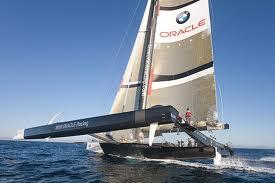
Waterfront

The America’s cup confusion

19

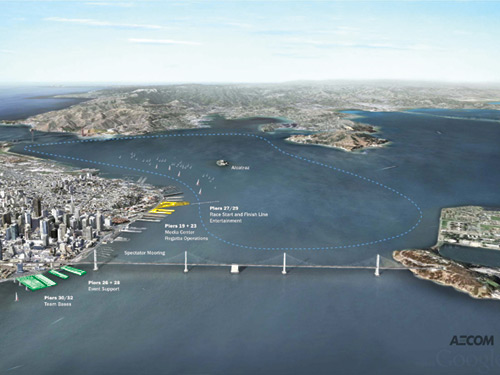
If the sponsors (and city officials) are right, the America’s Cup is going to be a huge event, attracting hundreds of thousands of spectators, many of whom will want to be on the San Francisco waterfront to watch. But it’s never been clear to me exactly how that’s going to work — how are all those (rich) people who are used to getting around in limos going to travel from their downtown hotels to the viewing areas? If the city wanted to do this right, we should close down the Embarcadero and some of the feeder streets to all vehicles (except ambulances — always needed when rich old people get excited) and force everyone to travel by pedicab. Buy up a fleet of several hundred of the human-powered vehicles and let all the unemployed teenagers get a shot at driving them. Job creation for youth; environmentally sound transportation; potentially fun bumper-car action with well-heeled patrons screaming in fear.


Remember: The f-line, even with improvements, can’t possibly handle the necessary traffic. And the AC types aren’t going to ride the train anyway. No way private cars can all fit without massive gridlock.


So: Pedicabs. My suggestion.


In the meantime, there’s this little problem of 8 Washington.


See, the developer of what would be the city’s most expensive condos ever is planning on excavating 110,000 cubic yards of soil for a massive underground parking garage — right along the Embarcadero, and right during the America’s Cup events. The Draft Environmental Impact Report for 8 Washington indicates that the dump trucks (about 20 big trucks per day, and possibly a lot more) would be using that roadway to get to 101 or 280.


Actually, if activist Brad Paul is correct, there’s no way the developer can excavate that much dirt in the time frame that it’s supposed to happen unless the number of trucks is closer to 300 a day. Imagine all of that happening while 100,000 people are trying to get to the waterfront to watch the show. Oh, and according to the DEIR for the America’s Cup, the Embarcadero will be CLOSED during that period.


The fact is, the 8 Washington project is not only a terrible idea (just what the city needs — more condos for mega-millionaires) but would directly screw up the whole America’s Cup effort. And the amazing thing is that the AC people and the Mayor’s Office don’t seem to be paying attention.


Paul has put together a lengthy critique of the whole mess that makes great reading if you’re into this sort of thing. So I thought I’d just post it all here. Warning: It’s long. Enjoy.


August 15, 2011                                                                                                         


Bill Wycko
Environmental Review Officer
San Francisco Planning Department
1650 Mission Street, Suite 400
San Francisco, CA  94103


Re: COMMENTS ON DRAFT EIR FOR 8 WASHINGTON STREET/
SEAWALL LOT 351 PROJECT    
Case No. 2007.0030E


Dear Mr. Wycko:


I am writing to my provide my comments on the Draft Environmental Impact Report (“DEIR”) for this project, a document that is incomplete, inadequate and in places quite misleading. I’ve organized my comments in sections beginning with a detailed discussion of how the project’s construction schedule has been greatly underestimated. This is followed by discussions of the DEIR’s failure to address key Housing and Population issues, misstatements regarding historic obligations related to Golden Gateway, comments on recreation issues, and more.  In general, I believe the DEIR fails to present objective information and analysis, it omits a number of relevant issues that are critical to the ability of public officials to make objective and informed decisions about the project and it is filled with judgments and assertions that are not supported by facts.


The DEIR is incomplete and inadequate in the following areas:


I. THE DEIR CONSTRUCTION SCHEDULE FOR 8 WASHINGTON IS BOTH INACCURATE AND MISLEADING.


The DEIR construction schedule is based on overly optimistic assumptions that are totally unrealistic; the ramifications of these erroneous assumptions need to be carefully considered as they will cascade throughout the project requiring major revisions to the DEIR before it can be considered accurate and complete.


At the bottom of page II.19 it states:
 
      Project construction, including demolitions, site and foundation work,
      construction of the parking garage, and construction of the buildings,
      would take 27-29 months. Assuming that construction would begin in 2012,   
      the buildings would be ready for occupancy in 2014. The first phase of the
      construction would take about 16 months and would include demolition       
     (2 months), excavation and shoring (7 months), and foundation and below
      grade construction work (7 months).


While the DEIR unequivocally states the project will take 27-29 months to construct, from 2012 to 2014, facts provided elsewhere in the DEIR together with current city policies,  the City’s America’s Cup Host and Venue Agreement and basic math indicate that this schedule is not tenable. The remainder of this section provides the data and analysis that lead to the conclusion that construction of 8 Washington will take much longer than 27-29 months, almost TWICE AS LONG, with excavation taking 2.5 to 3 TIMES longer.  


Table 1: Requested Changes to the overall DEIR construction schedule


          ACTIVITY             MINIMUM           MAXIMUM


    DEIR’s construction schedule: 27 months    to    29 months  


    Actual excavation schedule:  18 months           22 months
    — DEIR estimate for excavation – 7 months            – 7 months
    + Increased excavation time  11 months      to       15 months 
    + Archeology delays                .5 months      to         2 months
    +  America’s Cup delays                  2.5 months       to         5 months
    +  Weather delays                        .25 months      to         1 months


   ACTUAL CONSTRUCTION TIME 41 months       to      52 months


To refute the numbers in Table 1, project sponsors must present additional, verifiable data supporting their unrealistic assumptions, beginning with the claim that the first phase of construction takes 16 months with a mere seven months allocated for excavation/shoring.


A. The DEIR fails to accurately ascertain and analyze the excavation/shoring schedule.


The DEIR states on page II.20 that “approximately 110,000 cubic yards of soil” will be excavated from the site for an underground garage (approximately 90,000 cubic yards) and other foundation work during the seven (7) month “excavation” portion of the projected timeline. It later states excavation will take place 6.5 hours per day with an average of 20 truck trips per day (pg.IV.D.31). Assuming the average dump truck holds 12 cubic yards of dirt (typical payload for a dump truck), that would mean:


      · 110,000 cu. yards/12 cubic yards per truck = 9,166 truck trips


      · 20 trucks/day X 12 cubic yards/trip = an average of 240 cu. yards/day


      · 110,000 cu. yards/240 cu. yards per day = 458 working days for this task


Could this task be completed in seven (7) months as claimed in the DEIR?  NO.


     ·5 working days per week X 52 weeks = 260 working days per year
             – 11 holidays per year
                   249  total working days/year


     ·458 days to finish task/249 working days per year = 22 months  (not 7)
     
For this to take 7 months as the DEIR asserts, the following would have to be true:


   · 20 trucks/day X 7 months (145 working days ) = 2,900 total truck trips


   · 110,000 cu. yards/2,900 trucks = each truck must average 38 cubic yards/trip
Empirical evidence exists, however, proving the DEIR’s claim that the excavation portion of the schedule will take seven months is inaccurate and misleading:


        CASE STUDY #1: San Francisco General Hospital Rebuild Project


A recent SF General Hospital (SFGH) Newsletter reports the hospital’s contractor just finished hauling 120,000 cu. yards of dirt from the 45’ deep hole that was dug to build two basement levels and the foundation for a new hospital building. This is as close as anyone is likely to get to replicating what 8 Washington proposes, a three level 40’ deep underground garage accounting for most of the 110,000 cubic yards of dirt that must be removed from the site. 


A call to the SFGH Rebuild office revealed their excavation process took seven (7) months with an average truck load of 13 cu. yards per trip. How was that possible?


“The average truck load was 13 cubic yards. Some days we had
over 300 truck loads hauled in one day. This volume was possible
through use of a paved drive that allowed trucks to enter the side, be
loaded up then tires washed to prevent dirt on road causing storm-            
water pollution and dust.”


The SF General site is just a few blocks from U.S. 101 with direct access via Potrero Ave., thus minimizing potential traffic conflicts. The 8 Washington site will require driving long distances on city streets including “The Embarcadero, Harrison Street, and King Street… likely the primary haul and access routes to and from I-80, U.S. 101, and I-280 (pg. IV.D.31).” Imagine 300 trips a day on one of these streets.


               CASE STUDY #2: SF PUC’s New Hetch Hetchy Reservoir Tunnel


A recent Oakland Tribune story (4/8/11) describes construction of a new 3.5-mile tunnel designed to protect the water supply from SF’s Hetch Hetchy reservoir from major earthquakes by boring a 2nd, state-of-the-art tunnel from Sunol to Fremont alongside the existing 81-year-old Irvington Tunnel. The article states:


      “By the time the New Irvington Tunnel is completed in 2014, crews will have
        excavated about 734,000 cubic yards of material—the equivalent of 61,000
        dump-truck trips, said officials with the SF Public Utilities Commission.”


Dividing 734,000 cubic yards of soil by the 61,000 dump truck trips that the PUC says are necessary equals 12 cubic yards per truck trip. Given this job’s overall size and $227 million budget, it would seem to confirm the fact that the most efficient excavation equipment for the 8 Washington site will be 12 cubic yard dump trucks.


In light of these facts and the analysis provided above, the only way 8 Washington could meet its proposed seven (7) month excavation schedule would be to:


a) schedule up to 300 TRUCK TRIPS A DAY, over 10 TIMES the average number of trips per day (20) stated in the DEIR and 3 TIMES the absolute maximum of 100 truck trips per day (pg. IV.D.31)  along the Northeast Embarcadero during a period of time that directly overlaps with the major America’s Cup events and activities, something specifically prohibited by the City’s America’s Cup Host and Venue Agreement ,        


         OR


b) average 38 cubic yards of dirt per truck trip, 3 TIMES the average truck payload of both the PUC’s Irvington Tunnel project and SF General Hospital’s 120,000 cubic yard excavation project—assuming that 38 cubic yard trucks:  a) exist in sufficient quantity in   the Bay Area, b) would be available during that period of time described and c) would be allowed on The Embarcadero, Harrison St., King St., Washington St. and Drumm St. by     the City. [see photo comparison of 12 cubic yard vs. 30 cubic yard trucks below]


Unless the project sponsor can demonstrate that one of these two highly unlikely scenarios is possible, then the EIR must reanalyze a number of impacts (e.g. Land Use, Air Quality, Greenhouse Gases) based on a revised excavation schedule, one that takes 2.5 to 3 TIMES as long as the one described in DEIR to complete excavation work, and this 22 month timeline assumes NO archeological remains are found on site and the City imposes NO stop work orders related to America’s Cup (see below).


This 15-month difference between the excavation period analyzed in the DEIR and the ACTUAL time it will take to complete the excavation (22 months vs. 7 months) is a major deficiency in the DEIR with profound impacts.  For instance, some of the most significant unavoidable negative impacts described in the DEIR involve degraded air quality both during and after construction. Adjusting the environmental analysis to reflect how long excavation will actually take means significant air quality impacts related to excavation (with the greatest detrimental effect on seniors, children and people exercising) will persist for 2.5 to 3 TIMES LONGER than described in the DEIR.  This flaw also requires significant revisions to other sections of the DEIR.


In light of this new information, the next draft of the EIR must contain an analysis of    this longer overall construction period—two months for demolition; a range of 18 to 22 months for excavation (not seven months); a built-in range of time for the shutting down of the site when archeological artifacts are uncovered, documented and extracted (something the DEIR’s archeology consultant states is “likely” ); and the building construction period. Finally, given these overly aggressive excavation schedule estimates, all other estimates for later construction phases must now to be cross checked for accuracy by independent contractors (e.g. not working for 8 Washington developer    or the source of the prior DEIR excavation estimate).


B. The actual construction timeline for 8 Washington will be 41-52 MONTHS. 
If the project sponsors disagree with this assessment, they must provide the Planning Department with much more detailed information on how they expect to achieve a shorter construction period given the restrictions described in the DEIR itself as well as mathematical analysis described above. For instance,


– Did the developers err when they reported that the average number of truck
   trips per day would be 20 as analyzed in the DEIR?  If so, what number do they 
   choose to use now and how does that impact various aspects of the DEIR analysis
   such as air quality, conflicts with pedestrians, MUNI and America’s Cup, etc.. 


– Does the developer plan to raise the limit of truck trips per day from 100 (as
   per the DEIR) to 300 truck trips per day? If so, how often will this happen and 
   how will these changes impact various aspects of the previous EIR analysis (e.g. air
   quality, traffic/transit/pedestrian conflicts, America’s Cup)?


– Does the developer plan to lengthen the average workday or work six days a
   week? If so, how often and how would this impact the previous DEIR analysis?
   NOTE: The DEIR construction schedule (27-29 months) was not predicated on the
   trucks operating 6 days a week EVERY WEEK. But even if the developer ran dump  
   trucks 6 days a week for the ENTIRE excavation period it would still take TWICE AS
   LONG as the DEIR states to remove 110,000 cubic yards of dirt .


– Where is the project sponsor planning to route 100 to 300 trucks a day as they
   leave the site, particularly during the various America’s Cup trials (2012) and
   finals (2013) when vehicular traffic will be severely limited or prohibited?
   Washington Street? The Embarcadero? Drumm Street? Clay Street?, where exactly?


– Have the developers located a source of 30+ cubic yard trucks and secured
   city permission to use them on the specific streets described in the DEIR?
   It seems fair to assume the SF General Hospital’s excavation contractor would have
   done this if it were possible (and the SF PUC’s Irvington Tunnel contractor). See the  
   three photos below to get a sense of the size difference between a typical 12 cubic yard
   dump truck and the type of tractor-trailer rig required to carry 30 cubic yards or more.


As the questions and examples (SF General Hospital) above demonstrate, the DEIR’s claim that 110,000 cubic yards can be excavated in seven months defies the laws of physics and math, not to mention the America’s Cup Host & Venue Agreement between the City and Larry Ellison’s Oracle BMW Racing Team 


 A thorough reading of the DEIR’s Archeology section and the America’s Cup Host and Venue Agreement indicate that additional time must be built into the construction schedule for predictable work stoppages related to both issues.


KNOWN ARCHEOLOGICAL RESOURCES IDENTIFIED ON THIS SITE IN THE DEIR


On page IV.C.12, the DEIR’s archeology consultant, Archeo-Tec, identifies the Gold Rush ship Bethel as located under a portion of the site and states that “If discovered, the Bethel would be the oldest known (and perhaps most intact) archeological example of an early Canadian built ship (Pg. IV.C.3)”. On page IV.C.11, the archeology consultant states “Significant archeological resources are likely to exist at this site”.  The DEIR, goes on to state the proposed project will destroy a portion of city’s original Seawall causing “the largest disturbance of the Old Seawall to date”.


As a result of these DEIR findings, the archeology consultant should now be asked for an estimate of the time required to mitigate the discovery of the Bethel and other likely finds (e.g. original Seawall, other Gold Rush ships, original Chinatown). This “likely” work delay should be built into the construction schedule and stated as a range. For purposes of the matrix below (Table 1) we chose a time of two weeks to two months based on anecdotal information from other similar sites. Archeo-Tec, the archeology consultant, should be able to come up with a more precise estimate.


KNOWN AMERICA’S CUP SCHEDULING CONFLICTS


Based on recent MTA staff presentations on protocols for the America’s Cup, it seems clear that traffic, particularly construction dump trucks, will be banned from Washington Street, Drumm Street and The Embarcadero during major America’s Cup events that include, at a minimum, the America’s Cup World Series warm-up races (July/Sept. 2012), the penultimate Louis Vuitton Cup Series (July/August 2013) and the America’s Cup finals (Sept. 2013).  


This represents a minimum of 2.5 months that must be added to the construction schedule, something the DEIR authors should have included if they had read the America’s Cup DEIR which states there are 9+ weeks of races associated with this event in 2012/2013. The extra few weeks added to the low end range in Table 1 (below) are there to accommodate last minute weather delays and various large non-racing events held along the waterfront that will require closure of The Embarcadero, Washington Street, Drumm Street, etc.


Table 1 below lays out a more credible and realistic construction schedule based on the factors described at length above, taken directly from the DEIR or readily available from the city (e.g. America’s Cup DEIR) and the America’s Cup Host and Venue Agreement.


Table 1: Requested Changes to the overall DEIR construction schedule


          ACTIVITY             MINIMUM           MAXIMUM 


    DEIR’s construction schedule: 27 months    to    29 months  


    Actual excavation schedule:  18 months           22 months
    — DEIR estimate for excavation – 7 months            – 7 months
    + Increased excavation time  11 months      to       15 months 
    + Archeology delays                .5 months      to         2 months
    + America’s Cup delays                   2.5 months        to         5 months
    + Weather delays                        .25 months      to         1 months


   ACTUAL CONSTRUCTION TIME 41 months       to      52 months


To refute these numbers, the project sponsors must not only present a verifiable and detailed plan to remove 110,000 cubic yards (9,167 truck trips) in seven months that the City has signed off on but also produce a letter from the City and Oracle BMW Racing granting a waiver from Section 10.4 of the America’s Cup Host and Venue Agreement that would allow 20 to 300 trucks a day to drive along The Embarcadero, Washington Street   or Drumm Street during major America’s Cup events in 2012 and 2013.


D. Significant Transportation and Energy issues that were not addressed in DEIR.


More specific information related to the construction process needs to be provided and analyzed in the EIR, particularly regarding the far reaching impacts of those 9,166 dump truck trips, impacts that go beyond the immediate Northeast Waterfront.


The DEIR states “While the exact routes that construction trucks would use would depend on the location of the available disposal sites, The Embarcadero, Harrison Street, and King Street would likely be the primary haul and access routes to and from I-80, U.S. 101, and I-280”. At a minimum, The EIR needs to include information on where the two or three most likely disposal sites are located, based on recent experience (SF General Hospital excavation) so that one can analyze the extent of potential conflicts on the Bay Bridge or 101 South where other trucks will be transporting dirt to and/or from the Transbay Terminal project, Hunters Point Shipyard, Mission Bay, Treasure Island, etc. Without this information, the City could find itself creating significant traffic conflicts on the Bay Bridge or highway 101 that greatly increase air quality, traffic and transit problems without having analyzed these potential impacts in a flawed EIR.


Simply saying “While the exact routes that construction trucks would use would depend on the location of the available disposal sites” isn’t adequate or acceptable. Assumptions must be made regarding most likely disposal sites and routes to those sites and what additional cumulative impacts these routes (and 9,166 trucks) will create. The EIR must provide a MAP of the route to be used for hauling soil, all the way from the departure point at 8 Washington to the final destination(s) with an explanation of where trucks will drive and what restrictions there are on hours, size of payload, safety, etc. for the various streets, highways and bridges they will travel on. If the options include trucking the soil to San Francisco’s southern waterfront to transfer it to barges, then this needs to be disclosed and analyzed, including the potential routes and destinations of those barges.
In addition, to accurately compare the environmental impacts of the project sponsor’s ‘Preferred Project’ to the “No Project” alternative (energy consumption, traffic impacts, air quality degradation, etc.), one needs to know not only the destination of the approximately 9,166 dump truck trips but also the average miles per gallon of a typical dump truck. For instance, if the final destination for the soil was 100 miles away and a typical dump truck averages 8 miles per gallon of diesel fuel, then:


      9,166 truck trips X 200 miles per round trip = 1,833,200 miles for all dump trucks;


      1,833,200 gallons/8 MPG = 229,150 gallons of diesel fuel that would be burned. 


In other words, the city’s choices would be:


     229,150 gallons of diesel fuel used to transfer 110,000 cubic yards 1,833,200 miles


VS.


    ZERO (O) gallons of diesel fuel used if the NO PROJECT alternative were approved.


E. Importance of accurate, detailed information re: the construction process.


Given the above discussion, it is clear that the construction schedule set forth in the DEIR is inaccurate at best and has led, in many cases, to the significant understating of major negative impacts associated with this project. The lack of a detailed discussion of some of the key aspects of the construction process, e.g. the route and destination of 9,166 dump trucks, is also highly problematic.


Without a complete and thorough analysis of the impacts of a of an overall construction schedule that is TWICE AS LONG as the one analyzed in this DEIR, city officials will be missing much of the critical information they need to determine whether or not the developer’s ‘Preferred Project’ is necessary, desirable or feasible. A complete and factual analysis of this issue must be included in the next draft of the EIR which, given this and  other major inaccuracies and omissions (see below), should be recirculated in draft form.


II. THE DEIR FAILS TO DISCUSS OR ANALYZE ANY CRITICAL HOUSING ISSUES RELEVANT TO 8 WASHINGTON OR UNIQUE ENVIRONMENTAL AND ENERGY IMPACTS THOSE HOUSING ISSUES CREATE. 


A. Impacts of the project on the City’s Housing Needs were Not Analyzed in DEIR.  The DEIR states that potentially significant impacts to Population and Housing will not be discussed because the 2007 NOP/Initial Study found that the proposed project would not adversely affect them. Unfortunately the DEIR lacks the basic information needed to reach such a conclusion and, as we will demonstrate, an objective review of relevant 2008-2011 housing data contradicts this conclusion.


The world, particularly regarding housing, has changed radically since 2007. Relying   on housing and population information from 2007 ignores the financial and housing meltdown of 2008 and is simply indefensible. In addition, back in 2007, the EIR consultants were relying on stale, seven-year-old census data while today they have access to a multitude of fresh 2010 census data. No one can dispute that the housing environment today could not be more unlike the housing environment in 2007.
By relying solely on pre-2008 housing data from the 2007 NOP/Initial Study, this DEIR    lacks any of the basic information needed to conclude that this project would not have adverse effects on Population and Housing and must now revisit and thoroughly analyze these issues.


B. The DEIR fails to analyze how the type and price of housing proposed for
8 Washington determines whether or not it meets the city’s housing needs.


One of the project objectives (Pg II.14) is to “help meet projected City housing
needs.” How is that possible, given the fact that the developer has publicly stated
that these will be “the most expensive condominiums in the history of SF” ? With a
$345,000,000 project cost , 8 Washington’s 165 units will cost $2.0 million a unit
just to build . To secure financing and a ‘reasonable’ profit, each unit will have to
sell for $2.5-$5 million with penthouses selling for $8-$10 million.


Nowhere in the DEIR is ANY of this discussed. There is no analysis of how these
very high sales prices will determine who lives at 8 Washington (e.g. how many San
Francisco families could afford these prices?) and how the incomes of these new
residents ($250,000 to over $1 million/year) will dramatically change a number of
the environmental impacts of the project, with major implications for sustainability
and energy use, among other things.


The final EIR must state the average cost to build each unit and the range of
sales prices expected so that public officials can assess for themselves whether
the proposed condos will or will not  “help meet projected City housing needs.” 


The 2009 Housing Element, signed into law by Mayor Ed Lee on June 29, 2011, states that 61% of the housing need in San Francisco is for below-market-rate housing—serving families making 30-120% of Area Median Income (AMI), and only 39% of the city’s housing need is for market rate housing (120% to 500+% AMI).


As Planning staff and Commissioners know from their Housing Element discussions, the luxury condos proposed for this project are so expensive they will not help the city meet its current unmet housing needs. If this project objective (Pg II.14) is left in the final EIR, it should include a note explaining that the project, as proposed, is unlikely to meet this objective for the following reasons:


Condominiums selling for $2.5 million and more fall into the one segment of the city’s housing market that is currently overbuilt and has historically been over represented in relation to the state’s Regional Housing Needs Allocation (RHNA) goals that underpin the updated 2009 Housing Element of the city’s General Plan. An ABAG report on housing needs vs. housing production in SF (1999-2006) that came out in 2007—a report that should have informed the 2007 NOP/Initial Study for 8 Washington—states RHNA Allocations (Goal), Permits Issued (Permitted) and % of Allocation Permitted (% of RHNA Goal) by income category as follows:


Table 2: SF Housing Production (1999-2006)*


Housing Type  Very Low    Low              Moderate       Market Rate 
by Income    Income Income  Income           Housing
____________________________________________________________________________________________________________
  % of AMI:    21-50%  51-80%  81-120%         120-500+%
  Annual income: [21-50K] [57-81K] [85-123K]   [123K-$1million+]
———————————————————————————————————-
·RHNA Goal (units)   5,244       2,126   5,639                7,363


·Permitted    4,203       1,101      661                        11,474


·% of RHNA Goal     80%      52%       12%             156%


        * from a 2007 ABAG report entitled: A Place to Call Home


A chart like this, showing housing goals by income group (based on RHNA numbers from the State Office of Housing and Community Development), must be included in the DEIR so public officials can analyze what portion of the city’s unmet affordable and middle income housing needs, if any, the proposed project would meet. It illustrates something local housing experts have long known, that the city consistently comes in well above its RHNA goals for market rate condos, and has historically fallen short of its goals in all other categories for affordable housing, the housing that serves the 61% of San Franciscans that cannot afford ‘market rate’ housing.
C. Dramatic changes to the San Francisco housing market since the 2007 NOP/ Initial Study were not acknowledged and analyzed in the DEIR. All the traditional (pre-2007) sources of funding for the city’s affordable housing programs have dried up since the 2008 housing crash. Redevelopment tax increment funds will either be significantly reduced to pay the state to avoid closure of the SF Redevelopment Agency, or they will be eliminated altogether. Proceeds from the state’s $2.8 billion Affordable Housing Bond (Prop. 1C) are all spent. The federal Low Income Housing Tax Credit, a major source of funding for affordable housing, is under attack by House and Senate Republicans and may not survive.


This indicates that San Francisco won’t come close to meeting its pre-2007 affordable housing production levels  until we find a new permanent local source of funding for affordable housing. How long will that take? The DEIR must address this issue.


Another chart that must be included in the DEIR shows the city’s RHNA goals by income category combined with a summary of a recent SF Business Times (6/24/2011) chart showing all San Francisco residential projects under construction, permitted or  in the planning pipeline . Such a chart would look something like Table 3 below:


Table 3: Where does the city need help in meeting its RHNA goals?


          Extremely Low       Very Low            Low             Moderate          Market Rate   
                 Income          Income           Income            Income               Housing
         Below 30% AMI          31-50%            51-80%           81-120%              120-500+% 
      [21K-30K]         [35K-50]        [57K-81K]      [85K-120K]        [120K-$1M+]
____________________________________________________________________________________________________________


RHNA      439/yr.                   439/yr.           738/yr.            901/yr.                    1,632/yr.
Goals:      10.5%        +          10.5%      +      18%        +     22%  =  61%           39%
# of units                    of total        of total
% of goal
                             All Affordable Categories Combined            Market Rate_


Underway:          470 units                 1,557 units


Approved:                  8,751 units             30,878 units


In Pipeline:                   780 units                     4,184 units 
________________________________________________________________________
                          10,000 units             36,619 units 
            or                     or
          21.5% of all units                 78.5% of all units


                        56% of RHNA goals                                300% of RHNA goal
                in all affordable categories                        in market rate category
Some version of Table 3 must be included in the revised DEIR to help public officials determine whether the significant negative environmental impacts this project creates are outweighed by the ‘need’ for the type of housing that 8 Washington provides given the priorities set forth in the Housing Element of the General Plan and what the above-mentioned SF Business Times chart tells us about likely housing production for each segment of the city’s housing needs (from 2011-2014). 


Table 3 demonstrates that in a few years, if nothing changes, the city will have approved and built out 300% of its RHNA goal for Market Rate projects (such as 8 Washington) but only 56% of its RHNA goals for all other housing that serves San Franciscans making 30% AMI to 120% AMI. But given what we now know about the current lack of funding for affordable housing, the exact opposite of what was true in 2007 (when the city had significant amounts of Redevelopment tax increment and other affordable housing funds), many of the affordable housing projects listed by the Business Times are now on hold and unlikely to come on line by 2014. This means the mismatch between market rate (39% of need but 300% of production) and all categories of affordable will be even greater than Table 3 indicates.


To be fair, one could argue that some of the market rate housing on the Business Times chart may not be built soon either given that banks have been reluctant to lend money lately. However, a recent article in the SF Chronicle (8/11/11) entitled “Rents Go Through Roof” indicates that the city’s housing market is roaring back; Dennis Robal, property manager with Chandler Properties, reports “Noe Valley apartments that were $2,000 a month a year ago are now going for $2,400”. These kinds of increases, driven by new renters from the tech sector, are prompting major increases in investments by financial institutions in new rental housing.


Regarding the condo market, the one group of potential condominium buyers that
have not suffered financially from the economic meltdown are the very people who
caused it, the Wall Street investors, derivatives specialists, hedge fund managers,
etc. who are now making record salaries and bonuses. These are some of the people
8 Washington will be marketing to because they have the cash to spend $2.5-$10
million on a second, third or fourth home in San Francisco.


NONE of this housing analysis appears in the DEIR yet including it in the DEIR is
critical to the ability of public officials to make informed, rational decisions on this
project, particularly claims by the developer that this project will “help meet
projected City housing needs”. The information and analysis described above is
necessary to allow city officials and all readers to determine accurately and
objectively what portion of San Francisco’s unmet affordable and middle income
housing needs, if any, 8 Washington would meet.


Each year, as the City assesses how well it is meeting its RHNA (state) housing goals, the one area that has consistently over produced is high-end market rate housing affordable to people making $250,000 to $1 million+ a year.
How does building second, third and fourth homes for this demographic “help the city meet its housing needs?”


The unmet housing needs in San Francisco are for people making from 30%-50% of median income all the way up to 100-120%, not people making $250,000 to $1,000,000+ a year (200-500% or more of area median income). The DEIR needs to discuss the following questions to be considered complete, adequate and accurate, questions such as:


How does this project relate to the objectives, policies and goals of San Francisco’s recently enacted 2009 Housing Element of the General Plan?


What portion of San Francisco’s affordable and middle-income housing needs will this proposed project actually meet?


How many other projects under construction, approved or in the pipeline (see June 24,
2011 SF Business Times chart) will meet the needs of San Franciscans who can afford market rate housing vs. those that meet the needs of  the 61% of SF residents needing below market housing?


What percentage of “residents” of these condos will be using this housing as their primary residence vs. as second, third and fourth vacation homes?


Given that numerous studies show transit use goes down as income goes up,
how likely is it that these new owners will use public transit?


Again, the answer to each of these questions provides critical information that public
officials need to assess for themselves whether the proposed condos will or will
not “help meet the projected City housing needs.” 


Everything that’s happened since the 2008 economic/housing meltdown has made our housing problems worse, something the DEIR doesn’t attempt to analyze, arguing instead that a 2007 NOP/Initial Study—competed a year before the housing bubble burst—absolves it of all such responsibility, an argument that is factually absurd.


D. The DEIR fails to acknowledge, measure or analyze the unique environmental impacts generated by owners who can pay $2.5 to $10 million for luxury condos.


Building housing for this demographic has measurable impacts on transit and energy use that were not included in the DEIR. We know from national studies that low-and middle- income residents are far greater consumers of public transit than people with higher incomes. Imagine how much different public transit use will be when this inverse relationship includes people who can afford $2.5-10 million condos that come with             1-for-1 parking (costing almost $100,000 a space to build).


But a far greater environmental impact than driving private cars was not addressed in this DEIR, an impact resulting from lifestyle differences one can anticipate with some members of this highest of high-end demographics: owning and/or using private jets.


It’s reasonable to assume that five of the 165 condo buyers at 8 Washington (just 3% of   all buyers) are Wall Street hedge fund managers, derivatives traders or venture capitalists using these condos as second, third or fourth homes. It’s also reasonable to assume that these five buyers will use their condos 1.5 times a month on average and commute to and from SF aboard private business jets, a perfectly rational assumption for Wall Street executives making tens of millions in salary and bonuses each year. Why would they fly private jets rather than take Southwest…because they can. The fact that a handful of  people that are this wealthy will buy units at 8 Washington must be factored into any environmental analysis of a project that will explicitly market to this high-end demographic. That analysis must include, among others, the following:


                           Table 4: The Jet Fuel Burn Rate for Luxury Condominiums
___________________________________________________________________________
Mid to large size business jets used to fly cross country (e.g. Hawker 800XP, Gulfstream G2/G3, Bombardier Global Express) average 400 gallons of jet fuel per hour and take six hours to fly New York to SF and five hours to fly back for an 11 hour round trip  :


     · 11 hours X 400 gallons per hour = 4,400 gallons of jet fuel per trip
          a typical family car burns 1,200 gallons of gas per year so one flight from
          NYC to SF equals almost four years of driving a typical family car.
               ————————————————————————————————————————————————————————————————————-
       
        ·  1.5 trips/mo. = 6,600 gallons/mo. X 12 mo. = 79,200 gallons of jet fuel/year


        ————————————————————————————————————————————————————————————————————-
Using our example of 5 residents, the numbers over one year and 20 years are:


        ·  5 X 79,200 gallons/per year = 396,000 GALLONS OF JET FUEL A YEAR or
         equivalent to driving a family car 330 years, A THIRD OF A MILENNIUM, per year.


        ·  396,000 gallons/year X 20 years = 7,920,000 GALLONS of jet fuel in 20 years
         equivalent to driving family car 6,600 years, OVER 6 MILLENIUM, in 20 years.


Given these condos cost $2+ million to build and will sell for $2.5 to $8 million or more,    it seems quite reasonable to assume a mere 3% of these buyers—just five (5) buyers out of 165 —will be part-time residents wealthy enough to commute to San Francisco by business jet. If this is a reasonable assumption , then the DEIR must include the mathematical calculations above to show the true energy costs of this project. In fact, it would also be reasonable to assume a few other buyers will use private business jets to commute from LA, San Diego, Denver, etc. The only way to prevent this, forbidding buyers to own or use corporate jets, is of course impossible.
This is just one example of how housing prices—and who lives in that housing—greatly changes environmental impacts and why this analysis must be included in the DEIR for    8 Washington. As condo prices reach $2.5-10 million, it’s reasonable to assume a number of buyers will use them as a second, third or fourth homes and that some of those buyers will travel here by jet, not car or public transit. On the other hand, if units at 8 Washington were affordable or market rate rental or affordable-by-design condos (80%-150% AMI), it’s very unlikely any of its residents would own or use business jets. Price does matter with regard to energy consumption and transit use.


Given these facts, the 8 Washington DEIR must analyze such questions as:


How many solar panels do you need to make up for 396,000 gallons of jet fuel per year?


How many low flow toilets make up for 396,000 gallons of jet fuel per year?


How many double pane windows make up for 396,000 gallons of jet fuel per year?


How many on-demand hot water heaters make up for 396,000 gallons of jet fuel per year?


Looking at the longer term impacts of this excessive consumption of energy resources:


How many solar panels compensate for 7,920,000  gallons of jet fuel over 20 years?


How many low flow toilets make up for 7,920,000 gallons of jet fuel over 20 years?


How many double pane windows make up for 7,920,000 gallons of jet fuel over 20 years?


How many on demand water heaters make up for 7,920,000 gallons of jet fuel over 20 years?


Having this information in the DEIR is necessary for the Planning Commissioners or Board of Supervisors to make informed decisions about 8 Washington, especially when the project sponsor keeps touting it as state-of-the-art, sustainable, LEED certified (at Gold or Platinum level), etc. When added to the project sponsor’s insistence on building a 420-car underground (below sea level) garage, one has to question how one can call this a model of sustainable development or let the DEIR include sustainability as a project objective.


Unless the DEIR seriously and objectively addresses questions of how the price of housing and who lives in that housing impacts environmental sustainability, we risk creating a backlash against things like LEED certification and terms like “sustainability”. They could easily become just another example of slick marketing and “greenwashing”. Everyone agrees that building 10,000 s.f. McMansions in the Sierra Foothills on 2-acre lots—even if they’re LEED certified at the highest level—is NOT sustainable development. Why is it any less absurd to use “green” and “sustainable” to describe $2.5-$10 million condos built as second and third homes for extremely wealthy part-time residents, some of whom commute from their primary residence by private jet?


The DEIR must provide public officials with the data and information they need to analyze all the significant impacts that units this expensive have on the environment. With this information, decision makers might choose to require a much smaller garage or no garage at all (insisting on more efficient use of nearby existing garages). They might also choose to support a much smaller project or no project at all, based on the lack of demonstrable need for this housing type and all the other negative impacts described above. But they cannot make any of these decisions in a rational and objective manner without all the facts, many of which are missing from this DEIR.


E. The DEIR confuses project “objectives” with city mandated requirements with regard to Inclusionary Housing, then fails to discuss any of the relevant issues around this city policy.


The project objective (Pg II.14) that talks about the project’s ability “to help meet
projected City housing needs” reads in full:


 “To develop a high-quality, sustainable and economically feasible
   high-density, primarily residential, project within the existing
   density designation for the site, in order to help meet projected
   City housing needs and satisfy the City’s inclusionary affordable
         housing requirement;” 


Satisfying the city’s inclusionary affordable housing requirement, for this or any market  rate housing development, IS NOT an Objective, and stating it as such is misleading. It is,  in fact, legally mandated by city ordinance. The developer doesn’t have a choice in the matter and it should be stricken from this Objective. However, this reference to inclusionary housing leads one to ask several questions that are never addressed in the DEIR but should be. An Inclusionary Housing section must be added that answers questions such as:


What are the specific requirements for including permanent below market rate (BMR) units in all market rate projects and how many would be required on-site for this one?


Did the developer ever consider building on-site BMR units and if not, why not?


If the developer did consider and reject on-site BMR units, why?


If the developer has decided to pay the in-lieu affordable housing fee, what would it be and how and where (e.g. within a 1-mile radius of the project) would it be spent?


Given that the in-lieu fee charged developers to buy out of providing BMR units on-site is based on construction costs and sales prices for “average” condos, how will the extraordinarily high construction costs and sales prices for these condos impact the in-lieu fee? If it doesn’t impact the fee, would an appropriate mitigation measure be amending the Inclusionary Housing policy so that it does?


Mentioning the inclusionary requirement as part of an objective stating that the project seeks to “help meet projected City housing needs” is misleading and inaccurate. It tries to infer that the funding for 30 affordable units provided by the developer’s inclusionary requirement is helping to meet this objective when, in fact, relying on inclusionary payments to advance the city’s affordable housing goals will only drive the city further   out of compliance with its state mandated RHNA goals. The following example clearly demonstrates the validity of this claim:


TNDC’s proposed affordable family apartment project at Eddy and Taylor Streets is typical of the projects now stalled in the city’s affordable housing pipeline due to the lack of affordable housing funding from traditional sources. But the Eddy and Taylor project is a 150 unit development, not 30 units. For it to go forward, you would need the inclusionary housing funds from FIVE market rate projects like 8 Washington. What would that do to San Francisco’s RHNA goals:


         If:  165 market rate units are needed to fund 30 affordable units,
  Then:   825 market units (5X) are needed to fund 150 affordable units (975 total units).
      
         If:  out of a every 975 new housing units, 825 are market rate & 150 are affordable,
   Then:  for each new 975 units built in SF: 85% are market rate, 15% affordable.


But the 2009 Housing Element of San Francisco’s General Plan (based on the state RHNA goals) calls for 39% OF NEW HOUSING TO BE MARKET RATE (NOT 85%). Relying on Inclusionary Housing off-site payments to fund affordable housing clearly runs counter to the housing production goals set forth in the 2009 Housing Element in the General Plan as well as the RHNA goals for San Francisco established by the state of California. Furthermore, as SB375 Sustainable Development funding criteria begins influencing state funding decisions, by driving our RHNA numbers toward 85% market rate, projects like 8 Washington could jeopardize San Francisco’s ability to apply for and receive state and federal infrastructure and transit funding.


The only way to bring San Francisco’s housing production numbers back into line with the goals in the Housing Element (and RHNA numbers) is to create a new local permanent and dedicated source of funding for affordable housing. These relevant facts regarding the impacts of inclusionary housing must be included in the DEIR.


III. THE DEIR IGNORES THE GENTRIFICATION/DISPLACEMENT IMPACTS OF THIS PROJECT THAT WILL RESULT IN THE LOSS OF HUNDREDS OF RENT CONTROLLED UNITS IN THE GOLDEN GATEWAY BY ENCOURAGING THE FURTHER HOTELIZATION OF ITS 1,200 RENTAL APARTMENTS


The other ‘partner’ in this project is Timothy Foo, who bought Golden Gateway from Perini Corp. about 20 years ago. Only 20% of the 8 Washington site is on Port land, while 80% of the site is on land owned by Mr. Foo and currently occupied by Golden Gateway’s community recreation center. However, Mr. Foo’s only mention in the DEIR is in a footnote to the first sentence of the Introduction which states: “On January 3, 2007, an environmental evaluation application (EE application) was filed by San Francisco Waterfront Partners II (the “project sponsor”) on behalf of the Golden Gateway Center*”. That footnote says “*Golden Gateway Center, Authorization Letter from Timothy Foo, December 27, 2006”).


In addition to violating the original Golden Gateway development agreement that required Perini (and future owners) to preserve the recreation center in exchange for deep discounts in land prices charged by Redevelopment, for some time now Mr. Foo has also been converting rent controlled apartments in the Golden Gateway to short term rental use (e.g. on one floor of a high-rise tower, a third of the units are rented this way). These conversions have been documented by the Golden Gateway Tenants Association, the Affordable Housing Alliance and the San Francisco Tenants Union. While such conversions are not unique to the Golden Gateway Center (see attached Bay Citizen article), they are illegal and violate city zoning, rent control and apartment conversion ordinances.


The DEIR must address this issue by posing the following questions to Mr. Foo and incorporating his answers into the DEIR. He must provide this information because as the owner of 80% of the underlying land that comprises the 8 Washington site, he has had and continues to have a direct financial stake in this project. He must be asked the following questions:


How many of Golden Gateway’s 1,200 rental apartments are currently being used as hotel rooms and/or short-term rentals and/or rented to persons other than those using them as primary residences or directly related to the person residing there (e.g. corporations, business organizations, apartment brokers).


Has Mr. Foo consulted with either the Rent Board or the Planning Department as to the legality of his use of apartments in Golden Gateway as hotel rooms or short-term rentals under applicable city zoning codes, the San Francisco Rent Control ordinance or the city’s Apartment Conversion Ordinance?


Upon receiving and analyzing this information from Mr. Foo, the DEIR must then answer the following questions:


Is the ‘hotelization’ of Golden Gateway and other large apartment complexes likely to increase with the approval of 8 Washington, a development that:


a) builds 165 high-end luxury condos ($2.5 – $10 million each)
 on Mr. Foo’s property—creating a much more upscale
environment adjacent to his Golden Gateway apartments;


b) provides Mr. Foo with $10-15 million (what he’s likely to
be paid for his 80% of the site) that can be used to upgrade
his rent controlled apartments at Golden Gateway in order                             to attract even more higher paying hotel users; and


c) if no mention of these conversions is made in the DEIR, after                     these written comments have been submitted, will send a clear
message to Mr. Foo and others that the City has no intention of
enforcing its own zoning, rent control and apartment conversion
ordinances, thereby encouraging even more conversions.


If conversions like those at Golden Gateway are not stopped soon, the city is at risk of losing thousands of residential apartments in its downtown neighborhoods.


What kind of mitigations would prevent the further hotelization of the Golden Gateway’s 1,200 rent controlled apartments?


With larger apartment complexes such as Golden Gateway, Parkmerced and Fox Plaza, owners get around the current prohibition on renting residential apartments for less than 30 days as hotel rooms (an action that is legally prohibited by the San Francisco Apartment Conversion Ordinance) by leasing them for more than 30 days to third parties (e.g. corporations, apartment brokers). These intermediaries then rent the apartments for anywhere from a day or two to a few weeks to a month or two.


A simple amendment to the Apartment Conversion Ordinance that changes “you cannot rent an apartment for less than 30 days” to “you cannot rent or occupy an apartment for less than 30 days” would prevent Golden Gateway and others from renting apartments for anywhere from a few days to up to four weeks. Preventing 30-60 day rentals would be a more complicated matter.


The DEIR must address how constructing 8 Washington could encourage, help fund and accelerate Mr. Foo’s conversion of the 1,200 units at Golden Gateway from rent controlled apartments to hotel use as well as the impacts this would have on the city’s housing goals as set forth in the San Francisco’s 2009 Housing Element and its RHNA goals. For instance, if we’re converting housing to non-housing (hotel) uses as fast or faster than we are creating new housing units, we will never dig ourselves out of our current housing crisis and that outcome would have catastrophic impacts on the environmental and economic sustainability of San Francisco as a city.


The DEIR must also describe, in detail, the kind of mitigations (see above) that, if enacted, could mitigate the potential impact of losing more that 165 rent controlled apartments at the Golden Gateway, erasing the gain, on paper, of 165 luxury condos.


IV. FREQUENT USE OF THE WORD “PRIVATE” AS A MODIFIER OF THE GOLDEN GATEWAY RECREATION FACILITIES THROUGHOUT THE DEIR  IS BOTH MISLEADING AND INNACCURATE IN LIGHT OF THE RECENT PRIVITIZATION AND FEE STRUCTURES IMPOSED ON THE CITY’S “PUBLIC’ RECREATION FACILITIES AND SWIMMING POOLS.


The current fee structure for public recreation facilities in San Francisco results in situations where the cost of attending ‘public’ pools can often exceed fees charged by    the “private” Golden Gate Tennis & Swim Center (GGTSC).


The use of the term “private” in this context throughout the DEIR appears to be an attempt to justify the loss of GGTSC facilities for the 3-4 years that it would be shut down if the “preferred project” were approved (see section I.A for actual construction schedule) as well as the permanent loss of five of nine tennis courts, the basketball court and the current, family-friendly ground level swimming pools, Jacuzzi and open space.


In the past, the city’s public recreation facilities, including its swimming pools, were  “public” in every sense of the word—open long-hours, open 6-7 days a week and “free” to residents. In recent years, however, the San Francisco Recreation & Parks Department has increased resident user fees, reduced hours and increased the privatization of its facilities in response to ongoing budget deficits. Today, both the ‘private’ Golden Gateway facility and ‘public’ pools are open to anyone, anyone who is willing to pay   the fees that they charge. Neither is free.


A. The DEIR fails to discuss the privatization of the City’s  recreation centers: According to a 7/9/11 SF Chronicle article, the city is now leasing 23 of its 47 recreation centers to outside interests (e.g. nursery schools, private classes) with the city staffing only a dozen (12) of the 47 former “public” recreation centers. Seven (7) of the remaining recreation centers are under renovation and five (5) are vacant, unavailable for any kind of use “because no one has leased them and there is no money for city workers to run them”. Out of a total of 47 city recreation centers, only 12 are staffed by city workers who run programs for residents, many of them for a fee, during reduced days and hours.


The City also runs nine “public” swimming pools in neighborhoods such as North Beach, the Mission, Bayview, Visitacion Valley, etc. These pools used to be open five or six days a week and were free for residents. Today, residents pay $5 for each swim and $7 for adult swim lessons/water exercise. Children under 17 pay $1 per swim and $2 for swim lessons/water exercise ($3 for a swim & a class together).


Active Recreation Facilities: Public vs. Private… is there a difference anymore?


Each time a family of two adults goes to a city pool it costs $10 per visit to swim and up to $14 per visit if they participate in swim lessons or water exercise. If that family went three times a week, it would cost them $120-$168 per month depending upon how many times they took a swim vs. participated in swim lessons/water exercise. That comes to at least $1,440 dollars per year. Additional swim lessons/water exercise classes drive costs of using a “public” pool even higher.


Now imagine a family of two adults living at the Golden Gateway who currently       swim every day at the Golden Gate Tennis and Swim Center. At the city’s North Beach (public) pool, it would cost them $200 a month ($10/swim X 20 days) to swim Tuesday through Saturday (the pool is closed Sunday/Monday) and their schedules would have to match specific windows each day when the pool is available for adult lap swimming. Compare that to the two pools at the Golden Gateway Tennis and Swim Center—one just for swimming laps; one for kids, families and seniors that are open seven days a week for longer hours.


B. Comparative Costs. Because our hypothetical couple live at the Golden Gateway Apartments they automatically receive a discounted membership of about $170  per month ($85 each) to use the two pools, full gym across the street and have the ability to reserve tennis courts at $20 per use. Since the Golden Gateway was built (1960’s), residents have always received discounted membership at this facility, one of two community benefits Redevelopment required, along with Sidney Walton Square, in exchange for entitlements to build both the Golden Gateway (1,150 rental units) and the adjacent Gateway Commons (condominiums). Redevelopment felt both amenities were needed to meet the open space and active recreation needs of what was to become one of the densest residential communities in San Francisco and discounted the land for the GGTSC and Gateway Commons in exchange for the owner maintaining an active recreation facility at the GGTSC in perpetuity.


Even for those who don’t get the Golden Gateway resident discount, memberships to the Tennis and Swim Center that don’t include automatic access to the tennis courts cost about $220 a month to swim 30 days a month, the same price two adults would pay to swim only 20 days a month at the North Beach pool, a facility with no gym and only   one pool and therefore greater restrictions on when they could swim laps. It should also be noted that over 300 “guests” are admitted free to the Golden Gateway recreation facility each month, a total of 3,000 to 4,000 guests each year. We are not familiar with   a similar policy for free guests at the North Beach pool (or any other city pools).


Clearly, the recent privatization and escalating fee structures at the city’s “public” recreation centers/swimming pools have erased any real distinctions between public facilities and private facilities as viewed by local families and residents. But one of          8 Washington’s main justifications for closing the Golden Gateway Tennis and Swim Center for 3-4 years during construction—and downsizing the replacement facility—
is that it is a “private” club maintained for the selfish interests of the few.


Putting aside the fact that 8 Washington’s condos will cost $2 million each to build  and will sell for $2.5 to $5 million each and up (for upper floors), making them unaffordable to 97% of all San Franciscans (talk about catering to “the few”), the issue of who uses the current recreation facilities on this site is an important one that the DEIR must address. The similarities outlined above between today’s Golden Gateway recreation facilities and the City’s current “public” recreation centers/swimming pools contradicts the impression created by the DEIR in its current form with so many derogatory references to GGTSC as a ‘private’ club.


It is imperative that public officials have the information outlined above regarding the current costs of “public” recreation in front of them so they can decide for themselves what distinctions, if any, exist in today’s world between this ‘private’ club and so called “public” alternatives. This information is precisely what an EIR is suppose to provide to officials charged with making these kinds of decisions.


For these reasons, we must insist that you provide—in the Comments and Responses document—a clear, complete explanation of this issue, with a chart (see attached for potential template) that compares the facilities, hours, programs and costs to San Francisco residents of the city’s nine (9) “public” swimming pools with the current Golden Gateway recreation facility fee structure. Without such an analysis critical information will be lacking, information that Planning Commissioners, Park and Recreation Commissioners, Port Commissioners and the Board of Supervisors will clearly need as they assess the validity of the developer’s claims about who is served by the current facilities (and what environmental impacts they have) versus those who’ll be served by the proposed project (and its environmental impacts).


Without this information, it will be difficult for these public bodies to make informed decisions as to whether to grant or not grant the conditional use authorizations, upzonings and dozens of separate approvals and permits needed for this complicated and controversial project to proceed.


V. THE DEIR FAILS TO ADDRESS OR ANALYZE ANY OF THE MAJOR ECONOMIC ISSUES RELATED TO THIS PROJECT, ISSUES THAT HAVE SIGNIFICANT ENVIRONMENTAL AND FINANCIAL IMPACTS ON THE NEIGHBORHOOD AND THE CITY.


Several of the project sponsor’s and the Port’s objectives for this project speak to the “economic” benefits of the project for the developers, the Port and the City. The DEIR and other Port documents talk about the need to develop SWL 351 in order to generate revenue for badly needed Port infrastructure work. But the Port’s financial term sheet for this project is unrealistic, misleading and relies on depriving the city of $32 million in general fund dollars as part of a proposed Infrastructure Financing District.


This section addresses the DEIR’s lack of analysis or scrutiny regarding the ‘alleged’ financial benefits of the project as described in the Port’s Term Sheet for Seawall Lot 351 with San Francisco Waterfront Partners (“Term Sheet”) and how that Term Sheet, if executed, would have very real environmental impacts with regard to transit, open space, recreation, housing and population.  An examination of the Term Sheet demonstrates that the stream of income on which the term sheet’s finances rely cannot be achieved.  An objective analysis of “payments” described in this Term Sheet leads one to a much more pessimistic set of income projections than those presented in the September 23, 2010 Director’s Recommendation to the Port Commission. That report describes three payment sources as follows:


(1)  a land lease with annual payments of $120,000 per year;
(2)  future payments triggered by resale of condos created by the Project;
(3)  a to-be-established Infrastructure Financing District (IFD) that allows
              a portion of growth in property taxes to be reinvested in public facilities;  
 
That third source of funding is particularly troubling since it requires a sizeable appropriation of City General Fund revenues ($32 million) by the Port for its own purposes. We will now examine each of these proposed “payment” schemes to determine how realistic they are as well as the potential environmental and economic consequences they create for San Francisco’s residents and taxpayers:
1.  Lease Payments. It is easy to refute the likelihood of the $120,000/year lease payment for parcels to be used as open space with related facilities.  The second paragraph of Director’s Recommendation (page 5) states: “If engineering and cost analyses deem additional funding is needed to finance agreed upon public improve- ments, the Port agrees to designate some or all of the $120,000 per year park rent to augment financing of these public improvements.”  If the developer produces “engineering and cost analyses” showing “additional funding is needed to finance agreed upon public improvements,” the Port will “designate some or all of the $120,000/year in park rent to finance public improvements,” improvements that the developer is responsible for.  Suddenly this $120,000 of alleged “rent” could become no rent. Is that likely to happen? You be the judge:


A Little Recent History


The developer of 8 Washington is San Francisco Waterfront Partners, a partnership between Pacific Waterfront Partners and CALSTRS, the same partnership that  developed Piers 1½, 3 and 5 across the street. According to the Port’s rent rolls, San Francisco Waterfront Partners makes rent payments for Piers 1½, 3  and 5 of  $41,666.67 per month or $500,000 annually. But 90% of this is wiped out by a rent credit of a $450,000 annual rent credit ($37,500.00 per month). This means that the actual rent for Piers 1½, 3 and 5 paid by San Francisco Waterfront Partners isn’t $500,000/year, but $50,000/year or 1/10 of the original rent. Knowing this, it seems highly likely that the Port will grant a similar rent credit to 8 Washington, a credit that it has already offered in the Term Sheet approved last year.


The DEIR needs to discuss this and ask the following questions to help establish for public officials whether or not 8 Washington has the possibility of generating resources to fix up the Port’s historic infrastructure.


Was the $450,000 rent rebate given Piers 1½, 3 and 5 given for “public improvements” in the same way the 8 Washington Term Sheet proposes to give      8 Washington an up-to-$120,000/year (100%) rebate for “public improvements?


How much of this $120,000/year lease payment to the Port is guaranteed?


Based on recent history with this developer (see above box), it would appear that claiming a $120,000 per year lease payment is, at best, a gross overestimate.


2.  Future payments triggered by resale of condos (aka increased transfer tax). The second source of payments (around $25 MILLION over life of the lease) involves the developer recording covenants “committing all owners to transfer payments to the Port of ½ percent of sale value for all sales of the residential condominiums and all re-sales of commercial condominiums” (from Director’s Report, Page 4), in other words, a ‘voluntary’ increase in the transfer tax.  


This idea of obligating future owners to a special transfer “fee” was already tried, unsuccessfully, several years ago by then Mayor Gavin Newsom’s office as a way to provide ‘stimulus’ for large condo developers with approved projects who were trying to get financing. In exchange for agreeing to binding future condo owners to ‘voluntarily’ pay a 1% increase in the real estate transfer tax (but not calling it a “tax”), the Mayor’s Office proposed relieving the developers of 1/3 of their affordable housing requirement. That idea failed to get off the ground for both legal and political reasons. Regarding this proposal:


How does the Port plan to argue this increase in the real estate transfer TAX is not really a tax and do so in a way that convinces the Pacific Legal Foundation, Howard Jarvis Taxpayers Association and SF Board of Realtors not to sue?
Mayor Newsom’s failed proposal did trigger an multi-stakeholder discussion of a broader, legally defensible strategy, going to the voters for a permanent, across the board increase in the transfer tax on ALL real estate transactions (above the median home price) generating tens of millions of dollars a year for affordable housing. A portion of this new money would fund traditional affordable housing built by non- profit housing development corporations, but a portion would also be available to for-profit housing developers to buy down their affordable housing obligations. All sides agreed to this compromise and to place it on the November 2010 ballot, because it HAD to go to the voters, just as the ½% transfer tax increase proposed     in this Term Sheet would need voter approval.


NOTE: The reason that this proposal was not on the ballot that November, as reported in the New York Times, was because Mayor Newsom refused to support it or ANY tax increase, no matter how much support it had, for fear of giving his Republican opponent in the Lt. Governor’s race an issue to use against him in the 2010 election.


If the best legal and political minds in the city couldn’t figure out a way to “voluntarily” increase the real estate transfer tax without going to the voters then, how does the Port propose to do the same thing for 8 Washington now?


3.  New IFD Funding Mechanism. The third weak link in this financing plan is the as yet “to-be-established Infrastructure Financing District (IFD) that will allow a portion of growth in property taxes to be reinvested in public facilities.”  Port Director’s Recommendation, page 2.   While the concept is an interesting one, it is in its infancy in San Francisco. The Board of Supervisors is in the process of setting up a pilot IFD with seven or eight property owners on Rincon Hill to test this model.


To date, citywide discussions about the use of tax increment financing tools, such as the IFD, have linked their use to funding a larger set of neighborhood infrastructure needs and public benefits previously identified through adopted Area Plans such as Eastern Neighborhoods, Market Octavia and Rincon Hill and not for the specific needs of individual projects or developers (e.g. 8 Washington).


Looking ahead, it isn’t hard to imagine the kind of criteria the Board of Supervisors might adopt to determine what developments could avail themselves of IFDs. Those with significant legal, political and financial challenges, such as 8 Washington, would not score well.  Nor would projects that dramatically reduce and eliminate active recreation facilities serving middle-income families and seniors for over 45 years.  Finally, projects that undo decades old community benefits agreements, provided as part of a Redevelopment plan (e.g. Golden Gateway’s permanent active recreation center), probably wouldn’t pass muster .


Assuming the city eventually creates IFDs in certain circumstances, how does the Port make the case for THIS project, given the growing political and legal opposition to it, the long standing community resource that it destroys and the fact that the Board of Supervisors won’t give up $32 million for it (see below).


 4. Diversion of property taxes from the General Fund to the Port. The majority of the 8 Washington/SWL 351 site is NOT Port property, but under the jurisdiction of the City and County of San Francisco. Exhibit A of the Term Sheet shows the boundary of the 0.64 acre under Port control (SWL 351) and the 2.51 acres portion currently privately owned by Golden Gateway on AB168, 171, 291 (80% of the site). SWL 351 (the Port land) is only 20% of the total development site.


While these blocks were under the jurisdiction of the Redevelopment Agency, the property tax increment was diverted from the City’s General Fund to that Agency.  Following termination of the Redevelopment project area several years ago, however, ALL property tax revenue from this land flows to the General Fund.  The Port now proposes to divert the property tax increment from the portion of this site NOT UNDER PORT JURISDICTION away from the General Fund and to the Port.


The Port Director’s Term Sheet Recommendation on page 6 proposes “a new Port IFD” covering both SWL 351 and the Golden Gate Tennis and Swim Club (WHICH IS NOW ENTIRELY UNDER THE CITY’S JURISDICTION AND TAXING AUTHORITY).  Under the “new Port IFD” all the property tax increment from development on non-Port property would be diverted FROM the General Fund TO the Port.  Toward the end of the Term Sheet recommendation the Port Director does state that the Board of Supervisors would have to agree to this arrangement, which prompts several questions that should have been asked and answered in the DEIR:


Who from the city, not the Port, agreed to including these IFD financial terms in the Term Sheet?


Which members of the Board of Supervisors were consulted regarding this planned appropriation of property tax revenue from the city’s general fund?


What would lead the Port to think ANY current or future Board of Supervisors would  ‘voluntarily’ turn over $32 million in General Fund dollars to the Port, providing a $32 MILLION CITY SUBSIDY FOR LUXURY CONDOS when the Board is struggling with massive budget deficits, layoffs and cuts to vital city programs?


The DEIR must address whether or not this project is financially viable because if it is not, then the public facilities and infrastructure the project has promised to provide cannot be built. The DEIR must also assess the likelihood of the Board of Supervisors turning over $32 million in General Fund monies as a subsidy to the Port for this and other Port projects and analyze what environmental impacts this loss of $32 million to the city would create over time: what parks wouldn’t be maintained, which parks and recreation centers closed, what transit lines discontinued or run less frequently, etc.; actions that would not have been necessary had the city kept that $32 million. Specifically, the DEIR must answer the following questions:


Can 8 Washington’s public facilities (e. g. Jackson Commons, other open space) ever  be built with IFD funding, given that:


a) the IFD is predicated on the Port capturing 100% of the tax increment generated by 8 Washington even though the Port only owns 20% of the site, and


b) according to recent testimony before the Planning Commission by Michael Yarne (OEWD), under state law IFD’s are prohibited on land that “is currently,  or was previously part of a redevelopment area”?
 
Under what circumstances does the Port anticipate that the current (or a future) 
Board of Supervisors would voluntarily give up its 80% of this tax increment
($32 million out of $40 projected by the Port) to fund public improvements for   
LUXURY CONDOS at 8 Washington or other Port projects?


Has the Port had any discussions with the Board of Supervisors regarding this?


If so, what was the Board’s reaction?
    
Has the Port or project sponsor had state legislation passed (or introduced) that
provides the necessary waivers from the current state prohibition against
setting up IFD’s in former redevelopment areas?


Again, this is information that public officials must have to make informed, objective
decisions about the impacts of this project.


VI. THE DEIR FAILS TO DISCLOSE THAT 8 WASHINGTON IS THE FOURTH ATTEMPT TO CONVERT THE GOLDEN GATEWAY TENNIS & SWIM CLUB FROM CITY MANDATED ACTIVE RECREATION USE TO CONDOMINIUMS. IT PRESENTS VERY BRIEF AND MISLEADING INFORMATION REGARDING THE HISTORIC RECORD SUPPORTING THE REQUIREMENT TO PRESERVE THE CURRENT ACTIVE RECREATION FACILITIES ON SITE IN PERPETUITY.


The DEIR addresses this issue very briefly in a footnote on page II.3 that states:


2 The original development agreement governing the Golden Gateway Center Lots required the developer to provide non-profit community facilities as part of the overall development with the Golden Gateway Center. In Section 4 (a) of the Agreement for Disposition of Land for Private Development (“Agreement”) between Perini-San Francisco Associates (the “Developer’) and the Redevelopment Agency, dated August 27, 1962, the Developer agreed to maintain “community facilities of  a permanent nature… designed primarily for use on a nonprofit basis” (page 25 of the Agreement). Subsequent to the Agreement, the Agency and Golden Gateway Center (the successor to the Developer) entered into a Second Supplement and Amendment to the Agreement (“Second Supplement”) on March 14, 1976. Section 1(d) of the Second Supplement deleted Section 4(a) of the agreement (page 12 of Second Supplement) and thereby removed the requirement to maintain community facilities on the property in exchange for the dedication of Sydney Walton Park for perpetual use as a public park.


This interpretation of those documents contradicts evidence previously by individuals with intimate, first hand knowledge of those Golden Gateway redevelopment agreements. Those comments are attached as:


Exhibit A: A May 9, 1984 letter from then Mayor Dianne Feinstein that begins:“As a supervisor and as mayor, I have a long history with the redevelopment plan and agree with those who maintain that this site has always been considered set aside for recreation and open space.”


Exhibit B: An August 8, 1990 letter from Robert Rumsey to then redevelopment director Ed Helfeld that states:


  “I happened to be Deputy Director of Redevelopment in the late 1950’s and early  
    1960’s when the Golden Gateway redevelopment plan was adopted by the city and
    when Perini Corp. was subsequently selected as the developer of the Golden Gateway
    over eight other competitors… I feel it is important to place on the record the view of  
    the staff and commissioners of the agency at the time of selection: The provision of that
    open space and recreational space was a significant factor in the selection of the
    Perini proposal. And clearly, the space was presumed to be kept that way in
    perpetuity” (underlining Mr. Rumsey’s).


Exhibit C: A January 24, 2003 letter from Senator Dianne Feinstein reiterating that: 
  
   “I have a long history with the redevelopment area at Washington and Drumm Streets     
    and concur with those who believe this space was intended for recreation and open
    space. Please oppose further development of the Golden Gateway Tennis & Swim Club.”


These letters came in reaction to THREE previous unsuccessful attempts to develop the Golden Gateway Recreation Center as condominiums. Those attempts included:


1. Perini Corp. (early 80’s). The original developer of the Golden Gateway project proposed replacing the Golden Gate Tennis & Swim Club (GGT&SC) with a 9-story condominium project, in violation of its original approvals for the larger project that called for the GGTSC to serve as one of two major community benefits (along with Sidney Walton Sq.) in perpetuity. NOTE: This took place after the Second Supplement and Amendment to the Agreement referenced in Footnote 2 (above) was executed. Clearly, then Mayor Feinstein, had a very different interpretation of the Second Supplement than that of the author of Footnote 2 when she says in her letter that  “I agree with those who maintain that this site has always been considered set aside for recreation and open space.”


2. Perini Corp. (early 90’s). Again the owners of the Golden Gateway proposed replacing the project’s active recreation center with a condo project. This time, a letter from former Redevelopment Director Robert Rumsey date 8/8/90 provides extensive evidence that the interpretation of events contained in Footnote 2 is neither complete nor accurate. His detailed first hand description of that transaction which took place in the 1970’s is quite instructive. In addition to his comment that:


     “I feel it is important to place on the record the view of the staff and commissioners  
      of the agency at the time of selection: The provision of that open space and
      recreational space was a significant factor in the selection of the Perini proposal.
      And clearly, the space was presumed to be kept that way in perpetuity”


his letter states that “if it is now proposed that there is a loophole permitting that space to be invaded by condominiums, I would consider that to be most unfortunate for the city” and describes the land use negotiations that allowed Perini to substitute 155 low-rise condos for the four remaining high-rise rental towers that were suppose to be built as Phase III of the redevelopment plan. According to Rumsey, the agency finally, “albeit reluctantly” agreed to let Perini make this change “because some seven years had elapsed since completion of Phase II and there was otherwise no prospect for building on those long-barren blocks”.


Rumsey then states that the Agency’s October 28, 1975 minutes show the debate over what the Agency should charge Perini for the land that made up Phase III (now Gateway Commons condominiums) focused on “whether it should be $8.45 a square foot, the price established 15 years earlier, or a more realistic 1975 price of $15-$20 a square foot”. He then states:


      “My new successor, Arthur F. Evans, said he might agree with the higher number if
      the land was offered without restrictions, such as requirements of open space. And
      he added: Amenities such as Sidney Walton Square and the Golden Gateway tennis
      courts were on land that was not income producing, and since no one could build
      highrise buildings on this area, its value could be considered zero.”


As a result of this discussion, according to Rumsey, “Evans and the commission agreed to hold the land sales price to the original $8.45 a square foot, as the agency continued to view the open and recreation space to be in perpetuity.”


Based on Rumsey’s letter and substantial community opposition, this second attempt to replace the GGT&SC was defeated.


3. John Hamilton, developer (2003-04). In the mid-90’s Perini sold Golden Gateway to Timothy Foo and a group of investors. In 2003, developer John Hamilton proposed another condo tower on the site. Senator Feinstein’s January 24, 2003 letter was responding to that proposal. After reiterating her conclusion that “this space was intended for recreation and open space”,  she goes on to say, “increasing the height of the Club would drastically change the picturesque panorama of the Bay and would create shadow effects on the newly constructed Embarcadero. Further, development of more residential units would increase traffic noise and pollution, and disregard the original understanding between City officials and area residents that open space and recreational amenities should be preserved.”


4. Current 8 Washington Street/SWL 351 proposal is the 4th Attempt (2006-present) to develop condos on this site and demolish the Golden Gateway’s active recreation center, a facility that’s successfully fulfilled its intended purpose for almost 50 years.


In his written comments on 8 Washington’s DEIR dated August 11, 2010, Mr. Edward Helfeld, Director of the Redevelopment during the second attempt to demolish the Golden Gateway Tennis and Swim Club speaks to the original purpose of the facility, how it has successfully served San Francisco’s recreation needs for over four decades and how relatively inexpensive it is compared to other tennis facilities in the city. He also writes that “As Executive Director (1987-1994) I was in total support of retaining Golden Gateway Tennis and Swim Club”.


Any public official or member of the general public reading the current DEIR would have no knowledge of these three previous attempts to build on this site, their outcome and the role former city officials have played in confirming that the Golden Gateway active recreation center was meant to be preserved as an active recreation center in perpetuity. The Comments and Responses to the 8 Washington Street/SWL 351 DEIR must include this historic information in order to be considered accurate, complete and objective.


VII. ADDITIONAL COMMENTS ON THE 8 WASHINGTON DEIR


A.  The DEIR’s Introduction presents confusing and conflicting information regarding how, when and by whom environmental review for this project was initiated. The first two paragraphs of the DEIR’s Introduction (pg. Intro.1) raise some troubling questions about how environmental review for 8 Washington was carried out that need to be addressed more completely and forthrightly. The timeline for environmental review is described as follows (quoting from the DEIR):


1. “On January 3, 2007, an environmental evaluation application (EE application) was filed by San Francisco Waterfront Partners II (the “project sponsor”) on behalf of the Golden Gateway Center for a project at 8 Washington Street and the adjacent Seawall Lot 351, which is owned by the Port….(the Port is not a co-sponsor of the proposed project, but has authorized San Francisco Waterfront Partners II to submit an EE application that includes Seawall Lot 351).”


2. “On August 15, 2008, the Port issued a Request for Proposals (RFP) for the development of Seawall Lot 351. Two parties submitted timely proposals: SF Waterfront Partners II and a development group led by Dhaval Panchal (which later withdrew its proposal).”


3. “On November 10, 2008, the Port reissued the RFP for this project.”


4. “On February 24, 2009, the Port Commission authorized Port staff to enter into an exclusive negotiating agreement with SF Waterfront Partners II, finding that the proposal submitted by SF Waterfront Partners II meets the requirements of the RFP and meets the Port’s objectives for Seawall Lot 351.”


It appears from this timeline that the ‘project sponsor’, SF Waterfront Partners, was selected to carry out the 8 Washington project on January 3, 2007 when they were “authorized” (by the Port) to submit an Environmental Evaluation (EE) application officially beginning environmental review. However, there’s no explanation in the DEIR as to why, 18 months later (August 2008), the Port decided to issue an official RFP to select a developer for Seawall Lot 351.


This makes no sense given that Seawall Lot 351 was included in the January 3rd EE application submitted by SF Waterfront Partners (if not as designated developer, then in what capacity?). Then three months later (November 2008), we’re told the Port reissued the RFP with no explanation as to why. Finally, on Feb. 24, 2009, twenty five months after SF Waterfront Partners filed the EE application and began the environmental review process, the Port Commission authorizes staff to enter into an exclusive negotiating agreement with SF Waterfront Partners (SFWP) to develop  SWL 351. This raises troubling questions that need to be addressed in the DEIR to give public officials (and the general public) a clearer sense of the appropriateness, completeness and legality of the current environmental review process.


The DEIR must explain:


1. Is this how environmental review is normally sequenced? Is it routine for a developer that has not yet been selected by the Port to undertake a specific project, let alone negotiated an Exclusive Negotiating Agreement (ENA) with the Port for said project, to submit an EE application to Planning for this project that they haven’t yet been selected to develop and then for the Port, eighteen months later, to issue the first RFP to select a developer for the project and have a developer other than the one who submitted the EE respond to the RFP—then drop out (with     no explanation why in the DEIR), then have the RFP reissued six months later and then finally,
25 months after the current developer of 8 Washington submitted the EE, the Port finally selects said developer (SFWP) as the official developer of 8 Washington and begins negotiating an ENA? Is this NORMAL procedure?


2. How could the Port authorize SFWP’s EE application without a written agreement designating SFWP as the approved developer of SWL351? Is this standard procedure in these matters?


3. If this EE process was, in fact, legal prior to August 2008, why did the Port reverse course on August 15, 2008 and issue an RFP for SWL 351 (a site already included in the EE application filed 18 months earlier)? Doesn’t the initial applicant in the EE process have to be either the property owner or his designated developer and be able to demonstrate site control? How would that have been possible back in January 3, 2007 for SWL 351?


4. What role did SFWP play in drafting the RFP (and Port’s objectives for SWL351)?


5. What reasons did the second respondent to RFP give for “withdrawing his proposal?”


6. Why was the RFP reissued on November 10, 2008?


7. When on January 3, 2007, the Planning Department accepted an environmental evaluation application (EE) “filed by San Francisco Waterfront Partners II (the “project sponsor”) on behalf of Golden Gateway Center for a project at 8 Washington Street and the adjacent Seawall Lot 351”, was Planning aware that San Francisco Waterfront Partners had not been and could not be legally designated as “project sponsor” for SWL 351 at that time?


8. Why didn’t the fact that SFWP had no legal basis to claim that it was the “project sponsor” for SWL 351 invalidate the EE application? The DEIR states that the Port “authorized San Francisco Waterfront Partners II to submit an EE application that includes Seawall Lot 351” but wouldn’t that imply SFWP would eventually be selected as the developer and discourage other developers from submitting responses to the Port’s August 15, 2008 RFP given that SFWP had been working with Planning staff on the environmental evaluation for 18 months already?


9. Is what happened in January 2007 legal? If not, when did the Planning Department become aware of this problem and what did it do about it?


10. Having now publicly described this chronology in the DEIR, what legal impact does this have today on the environmental and project review process?


11. Would any other developer be allowed to begin the environmental review process on a project for which they had neither been designated developer nor had site control?


These questions MUST be answered in the DEIR given the bizarre and confusing chronology that now appears in it regarding how environmental review was initiated for this project.


B. In other Port documents related to 8 Washington, San Francisco Waterfront Partners II is described as a partnership between Pacific Waterfront Partners (PWP) and California State Teachers Retirement System (CalSTRS). However, the involvement of CalSTRS in this project appears nowhere in the DEIR. Given that CalSTRS has already spent over $23 million dollars in predevelopment funds for 8 Washington, the DEIR must contain some mention of CalSTRS as a member of this partnership and the fact that the same partnership (PWP and CalSTRS) developed Piers 1½, 3 and 5 across The Embarcadero from this site.


Finally, the first sentence of the Introduction to the DEIR refers to the fact that “on January 3, 2007 an environmental evaluation application (EE) was filed by SF Waterfront Partners on behalf of the Golden Gateway Center   for a project at 8 Washington”. That footnote references “Golden Gateway Center, Authorization Letter from Timothy Foo dated Dec. 27, 2006.”


For this DEIR to be complete and accurate it must address several key questions including:


1. Who is developing this project? Pacific Waterfront Partners?  CalSTRS? Golden Gateway Center (Timothy Foo)? What are their relationships to each other and the proposed project?


2. What precisely is the relationship between these three entities and the Port?


3. What was the understanding between SFWP, Timothy Foo and the Port when SFWP submitted its EE application on behalf of Golden Gateway Center? All three are mentioned in the relevant discussion in the DEIR.


C. The DEIR is inadequate and incomplete due to its failure to include A Community Vision for San Francisco’s Northeast Waterfront. The DEIR is inadequate and biased in discussing the Planning Department’s Northeast Embarcadero Study (NES), while failing to include an equally detailed discussion of the background and recommendations of the study prepared by Asian Neighborhood Design entitled A Community Vision for San Francisco’s Northeast Waterfront, dated February 2011, which was presented to the Planning Commission on July 7, 2011. 


The second sentence in the third paragraph of the Introduction states that the purpose of the Northeast Embarcadero Study (NES) was “to foster consensus on the future of Seawall Lot 351 and at other seawall lot properties on the northern waterfront” and leaves the reader with the impression that it succeeded in this goal by stating how many public workshops were held (five) and “on July 8, 2010, the San Francisco Planning Commission adopted a resolution that it ‘recognizes the design principles and recommendations of the Study’ and urges the Port of San Francisco to consider the recommendations of the NES when considering proposals for new development in this area”.


To be accurate and truthful, the DEIR should mention the level of anger and frustration expressed by the majority of the public that attended these five workshops who felt the Port, who was paying for the NES, was dictating its conclusions in order to facilitate the approval of the
8 Washington. For example, when 30-40 people at a workshop opposed the notion advanced by Planning staff that The Embarcadero needed a “hard edge” and that “higher heights” were appropriate for the 8 Washington site and only 6-8 people expressed support for these ideas, the notes from that meeting would later say that opinion was divided on these matters. To its credit, the Planning Department states clearly in the final draft of the NES that they failed in their goal   of achieving consensus on the future of SWL 351.


The DEIR needs to include this information to provide a more accurate representation of the outcome of the NES process.


People were so upset by what they perceived as a transparent attempt to ‘justify’ 8 Washington, that they began their own community-based planning process to address the larger issues of reconnecting Chinatown, North Beach, Russian Hill and Telegraph Hill to the Waterfront; healing the wounds left by the ramps to the Embarcadero Freeway by making Broadway, Washington and Clay Streets more pedestrian, bicycle and transit friendly; and fostering consensus on the future of Seawall Lot 351 and at other seawall lot properties on the northern waterfront.


Four major community organizations representing thousands of local residents, small businesses        and property owners became the primary sponsors/organizers of this “Community Vision for the Northeast Waterfront” and hired Asian Neighborhood Design to assist them in developing it.    These organizations included: Friends of Golden Gateway; Golden Gateway Tenants Association; Telegraph Hill Dwellers and Barbary Coast Neighborhood Association. Stakeholders from Chinatown, Russian Hill, Nob Hill, Fisherman’s Wharf and other neighborhoods also participated.


On July 7, 2010, when the Planning Department staff presented the NES to the Planning Commission, AND and the four sponsors of the “Community Vision for the Northeast Waterfront” were invited to present a summary of their planning work to date.


The DEIR fails to make any mention of the alternative plan created by these four community groups with AND’s help. It needs to describe this study, how it differs from Planning’s NES and include it in the final EIR so public officials can evaluate the merits of both studies for themselves.
 
The DEIR must describe the reasons why this alternative community planning process was undertaken and include a detailed discussion how the proposed project would or would not conform to each of the recommendations contained in A Community Vision for San Francisco’s Northeast Waterfront?


I am attaching a copy of the AND Study: A Community Vision for San Francisco’s Northeast Waterfront to these comments and ask that it be included in the EIR so that readers and public officials can gauge for themselves if it was more successful in “fostering consensus on the future of Seawall Lot 351 and at other seawall lot properties on the northern waterfront” than the Planning Department’s Northeast Embarcadero Study (NES).


D. The DEIR tries, unsuccessfully, to minimize the loss of iconic views of Coit Tower and Telegraph Hill from in front of the Ferry Building with its argument about ‘episodic’ views and a new claim that “trees” already obscure the views of Coit Tower from in front of the Ferry Building, views enjoyed by millions of tourists, residents and office workers each year.  As demonstrated in Figure IV.B-3: View B (page IV.B.7), the height and mass of the proposed project would completely obstruct views of Coit Tower and Telegraph Hill currently seen from the Embarcadero Promenade at the northern end of the Ferry Building. This significant adverse effect on the visual quality and scenic vistas enjoyed by the public puts the project in direct conflict with a number of city and Port planning policies. The DEIR’s conclusion that this would not create a substantial adverse effect on a scenic vista because “Coit Tower and Telegraph Hill would continue to be visible from numerous vantage pointes in the vicinity of the Project site and the City” is a biased and subjective judgment that is not based on fact. This ‘episodic’ argument could be used to claim that NO building ever blocks an important view because if you walk far enough past the offending structure, you might get the view back.
The comment about trees blocking the view of Coit Tower from in front of the Ferry Building must be stricken from the document. I just came from standing at the main entrance of the Ferry Building and I could clearly see Coit Tower and most of Telegraph Hill. While several trees in front of the F-line stop across the street did impede the view around the edges, these trees could easily be pruned to eliminate the problem.


E. The DEIR’s Traffic and Transit Data is Seriously Out of Date.


The traffic data relied upon by the DEIR in reaching its conclusions is incredibly stale, having been based on surveys done in 2006-2007 and with 2000 census data (page IV.D.5 of the DEIR).  These studies must be updated.  For example, the assumptions made in the DEIR that the existing conditions at the Embarcadero/Broadway and Embarcadero/Washington intersections are “satisfactory” (at LOS D) defy logic.  Anyone familiar with the real time conditions at these intersections knows that this assessment could not be based on a factual analysis of current conditions at peak periods which, by the way, often occur on weekends (not studied in DEIR).


Also out of date is the transit information relied upon by the DEIR in reaching its conclusion that the project would not result in significant transportation impacts to transit systems (Impact TR-2), having been based upon data on capacity and utilization of individual MUNI lines from 2007 (page IV.D.9 of the DEIR).  This data should also be updated. For example, whoever was responsible for the assumption in the DEIR that the F-Line is not at capacity during peak periods has never ridden the F-line at peak periods. The America’s Cup will only make this worse.


F. The DIER belittles Pedestrian Safety Issues. The DEIR states that: “Conflicts between pedestrians and vehicles could occur at the project garage driveway, which could cause the potential inbound vehicles to queue onto Washington Street. Outbound vehicles would queue inside the garage and would not affect street traffic. Conflicts between outbound vehicles and pedestrians could still occur, but their effect on pedestrians would be reduced because pedestrians on the sidewalk have the right-of-way.” (page IV.D.25). I’m sure the fact that pedestrians have the right-of-way is of great comfort to families of children and seniors who’ve been struck and killed by cars. This statement is insulting and MUST be stricken from the DEIR. It’s also not true.


In the very next paragraph the DEIR makes the following statement about these potential vehicular and pedestrian conflicts at the garage driveway:


“The number of vehicles and pedestrians per minute are relatively small (about one vehicle and three pedestrians every 30 seconds on average) and it is therefore not anticipated that the proposed project would cause any major conflict or interfere with pedestrian movements in the area.” (page IV.D.25)


These numbers translate to 2 cars and 6 pedestrians every minute or 120 cars and 360 pedestrians an hour (or approximately 1,440 cars and 4,320 pedestrians coming into potential conflict in any given 7 am to 7 pm period).  The DEIR’s conclusion that such conflict between vehicles and pedestrian movement would be “less than significant” makes no logical sense and is simply not supported by the facts presented in the DEIR. 


G. The DEIR must include a new fence around the Golden Gateway Tennis and Swim Club in its NO PROJECT Alternative. Finally, the comments often heard about the “ugly green fence” around the GGTSC reminds us that the DEIR must let the reader know that it is the owner of the property, Mr. Timothy Foo, who is responsible for the ugly “green fence”. First, he has put the GGTSC operator on a month-to-month lease making it difficult for them to make a substantial investment in a nicer fence. Second, Mr. Foo himself stands to gain financially if 8 Washington is approved, so he has no incentive to fix the fence since its unsightliness is being used as an argument for demolishing the current facility. This simplest way to correct this bias would be to:


Include a rendering of the site with a new, attractive fence in the NO PROJECT alternative .


For the reasons stated in this letter, I believe this DEIR is seriously incomplete and inadequate to address the potentially significant impacts of this project.  I urge you to revise the document and re-circulate it in draft form.


Sincerely,


Brad Paul


Rep Clock

0

Schedules are for Wed/31-Tues/6 except where noted. Director and year are given when available. Double features are marked with a •. All times are p.m. unless otherwise noted.

BALBOA 3620 Balboa, SF; www.balboamovies.com. $17.50-20. Nabucco, from Teatro Antico, Taormina, Wed, 7:30.

“BERNAL HEIGHTS OUTDOOR CINEMA” Old Clam House, 299 Bayshore, SF; (415) 641-0324, www.bhoutdoorcine.org. Suggested donation $15 (includes two drink tickets; benefits Bernal History Project). “Opening Night Party and Preview,” films and live music by Stoo Odom and the Odom Poles, Wed, 6:30. Tiffany and 29th St, SF; same contact. Free. Block party with films and live music by the Patsy Chords, Thurs, 6:30. Red Hill Books, 401 Cortland, SF; same contact. Free. “Film Crawl on Cortland Ave,” Sat, 6:30. Precita Park, Folsom at Precita, SF; same contact. Free. “Outdoor Cinema Under the Stars,” Sat, 6:30. El Rio, 3158 Mission, SF; same contact. Suggested donation $10. “Closing Night and Season Finale,” Sun, 7:30.

CASTRO 429 Castro, SF; (415) 621-6120, www.castrotheatre.com. $7.50-13. “Cary Grant: Definitive Star” •The Philadelphia Story (Cukor, 1940), Wed, 2:50, 7, and Holiday (Cukor, 1938), Wed, 5, 9:05; •Arsenic and Old Lace (Capra, 1944), Thurs, 3, 7, and The Awful Truth (McCarey, 1937), Thurs, 5:10, 9:15; •North By Northwest (Hitchcock, 1959), Fri, 2:20, 7, and Charade (Donen, 1963), Fri, 4:45, 9:25; •Bringing Up Baby (Hawks, 1938), Sat, 3, 7, and Monkey Business (Hawks, 1952), Sat, 4:55, 8:55; •Bringing Up Baby (Hawks, 1938), Sun, 7, and I Was a Male War Bride (Hawks, 1949), Sun, 8:55; •His Girl Friday (Hawks, 1940), Mon, 2:50, 7, and Only Angels Have Wings (Hawks, 1939), Mon, 4:35, 8:45; •Notorious (Hitchcock, 1946), Tues, 3, 7, and Suspicion (Hitchcock, 1941), Tues, 4:55, 8:55.

CHRISTOPHER B. SMITH RAFAEL FILM CENTER 1118 Fourth St, San Rafael; (415) 454-1222, www.cafilm.org. $10.25. The Hedgehog (Achache, 2010), call for dates and times. The Names of Love (Leclerc, 2010), call for dates and times. Senna (Kapadia, 2011), call for dates and times. The Whistleblower (Kondracki, 2010), call for dates and times. Third Star (Dalton, 2010), Thurs and Sun, 7.

“CONVERGENCE MMXI FILM SERIES” Artists’ Television Access, 992 Valencia, SF; www.convergencefest.com. $7. Naco es Chido (Arau, 2010), Wed, 7. SF Film Society-New People Cinema, 1746 Post, SF; same contact. $12. The Holy Mountain (Jodorowsky, 1973), Thurs, 8. Mission Cultural Center for Latino Arts, 2868 Mission, SF; same contact. $8-10. Everybody’s Dying Here (Gardoki, 2002), Fri, 7:30.

“FILM NIGHT IN THE PARK” This week: Creek Park, 451 Sir Francis Drake, San Anselmo; (415) 272-2756, www.filmnight.org. Donations accepted. Young Frankenstein (Brooks, 1974), Fri, 8; Harry Potter and the Deathly Hallows: Part One (Yates, 2010), Sat, 8; North By Northwest (Hitchcock, 1959), Sun, 8.

JACK LONDON SQUARE 66 Franklin, Oakl; www.jacklondonsquare.com. Free. “Waterfront Flicks:” Who Is Killing the Great Chefs of Europe? (Kotcheff, 1978), Thurs, sunset.

MANDELA VILLAGE ARTS CENTER 1357 Fifth St, Oakl; www.brainwashm.com. $10. “17th Annual Brainwash Drive-In/Bike-In/Walk-In Movie Festival,” unique independent movies from around the world, Sat/3, 8pm; Sept 9-10, 9pm.

PACIFIC FILM ARCHIVE 2575 Bancroft, Berk; (510) 642-5249, www.bampfa.berkeley.edu. $5.50-9.50. “The Timeless Cinema of Marcel Pagnol:” The Well-Digger’s Daughter (1940), Wed, 7. “UCLA Festival of Preservation:” The Crusades (DeMille, 1935), Thurs, 7. “The Outsiders: New Hollywood Cinema in the Seventies:” The Heartbreak Kid (May, 1972), Fri, 7; Wanda (Loden, 1970), Sat, 8:50. The Landlord (Ashby, 1970), Fri, 9:10; “Sounding Off: Portraits of Unusual Music:” The Reach of Resonance (Elkins, 2010), Sat, 6. ROXIE 3117 and 3125 16th St, SF; (415) 863-1087, www.roxie.com. $5-9.75. Shut Up Little Man! An Audio Misadventure (Bate, 2011), Wed-Thurs, 7, 9. Love Exposure (Sono, 2008), Sept 2-8, 7:30 (also Sat-Sun, 2:30)

The super-wealthy want our waterfront

13

We are at the Guardian have been raising questions about the deal that the city cut to bring the America’s Cup here – which involves turning prime waterfront property over to wealthy developers with long-term leases – since it was first proposed. But our valid concerns have been largely drowned out by economic development boosterism and the view that we need to simply accept whatever billionaire CEO/sailor Larry Ellison and his partners say they want.

So we were as cheered as we were dismayed to read writer John King’s article in this week’s San Francisco Chronicle about how race organizers are trying to build a harbor for the super-rich to park their yachts so they can watch the races right in the middle of the Embarcadero’s longest stretch of open water and unobstructed bay views, a harbor that would likely be permanent.

King supports the race and its economic benefits. “But we also need to remember that it never hurts to look a gift horse in the mouth. And the open water along Rincon Park is not a cavity that needs to be filled,” he writes. This proposal is so appalling that even Chronicle readers and blog commenters – usually a conservative and curmudgeonly lot that bristles at the idea of asking anything of capital – have overwhelmingly criticized the idea, filling most of today’s Letters the Editor section.

Hopefully, that’s a sign that this idea – which the EIR on the America’s Cup incomprehensibly concluded was not a “significant impact” – is dead in the water. But given how far city leaders like Mayor Ed Lee and Board President David Chiu have been willing to bend over backward to give race organizers what they want, I wouldn’t be so sure.

At its best, the America’s Cup could be a great opportunity to showcase San Francisco and bring in much-needed tax revenues. But if journalists, citizens, and city leaders don’t remain vigilant and skeptical, this race might be remembered most as the ruse that the greedy rich used to sully and exploit one of San Francisco’s most valuable public resources.

Rep Clock

0

Schedules are for Wed/17–Tues/23 except where noted. Director and year are given when available. Double features are marked with a •. All times are p.m. unless otherwise specified.

ARTISTS’ TELEVISION ACCESS 992 Valencia, SF; www.atasite.org. $10. Face of a Stranger (Michalak, 1977), Fri, 8.

BALBOA 3620 Balboa, SF; www.balboamovies.com. $17.50-20. “Opera and Ballet at the Balboa:” Macbeth, from the Royal Opera house, London, Wed, 7:30; Swan Lake, from the Bolshoi Ballet, Moscow, Sat-Sun, 10am.

CASTRO 429 Castro, SF; (415) 621-6120, www.castrotheatre.com. $7.50-13. “Viva Pedro:” •Bad Education (Almodóvar, 2004), Wed, 2:50, 7, and Law of Desire (Almodóvar, 1987), Wed, 2:45, 7; •Talk to Her (Almodóvar, 2002), Thurs, 2:45, 7, and All About My Mother (Almodóvar, 1999), Thurs, 4:55, 9:10; •The Flower of My Secret (Almodóvar, 1995), Fri, 3:05, 7, and Women on the Verge of a Nervous Breakdown (Almodóvar, 1988), Fri, 5, 8:55. “SF Sketchfest presents: 25th Anniversary Celebration: Labyrinth (Henson, 1986), Sat, 5. This event, featuring Jim Henson Company puppeteers in person, $15 at www.sfsketchfest.com. “SF Sketchfest: Rifftrax Presents:” “Night of the Shorts II: Electric Riffaloo,” Sat, 8:30. This event, $25 at www.sfsketchfest.com. •2001: A Space Odyssey (Kubrick, 1968), Sun, 2, 7, and 2010: The Year We Make Contact (Hyams, 1984), Sun, 4:35, 9:35.

“CENTER STREET SUMMER CINEMA” 2219 Center, Berk; (510) 548-5335, www.downtownberkeley.org. Free (bring your own chair, or $5 to rent a chair). Raiders of the Lost Ark (Spielberg, 1981), Sat, 7:30.

CHRISTOPHER B. SMITH RAFAEL FILM CENTER 1118 Fourth St, San Rafael; (415) 454-1222, www.cafilm.org. $10.25. Crime After Crime (Potash, 2011), call for dates and times. The Names of Love (Leclerc, 2010), call for dates and times. The Whistleblower (Kondracki, 2010), call for dates and times. Senna (Kapadia, 2011), Aug 19-25, call for times.

“FILM NIGHT IN THE PARK” This week: Creek Park, 451 Sir Francis Drake, San Anselmo; (415) 272-2756, www.filmnight.org. Donations accepted. Cinema Paradiso (Tornatore, 1988), Fri, 8; To Kill a Mockingbird (Mulligan, 1962), Sat, 8.

JACK LONDON SQUARE 66 Franklin, Oakl; www.jacklondonsquare.com. Free. “Waterfront Flicks:” Dinner for Schmucks (Roach, 2010), Thurs, sunset.

PACIFIC FILM ARCHIVE 2575 Bancroft, Berk; (510) 642-5249, www.bampfa.berkeley.edu. $5.50-9.50. The Makioka Sisters (Ichikawa, 1983), Wed, 7. “Bernardo Bertolucci: In Search of Mystery:” The Dreamers (2003), Thurs, 7. “Hands Up: Essential Skolimowski:” Essential Killing (2010), Fri, 7 and Sat, 9; Moonlighting (1982), Fri, 8:45. “Japanese Divas:” Late Autumn (Ozu, 1960), Sat, 6:30. “The Timeless Cinema of Marcel Pagnol:” Fanny (Allégret, 1932), Sun, 5.

PIEDMONT 4186 Piedmont, Oakl; www.landmartheatres.com. $8. The Room (Wiseau, 2003), Sat, midnight.

ROXIE 3117 and 3125 16th St, SF; (415) 863-1087, www.roxie.com. $5-9.75. Jay Reatard: Better Than Something (Hammond and Markiewicz, 2011), Wed, 7:30, 9:30. Vigilante Vigilante (Good, 2011), Wed-Thurs, 7, 8:45. The Arbor (Barnard, 2010), Aug 19-25, 7, 9 (also Sat, 5). “Atheist Film Festival,” Sun, 11am. Single films, $12; fest pass, $20; more info at www.sfatheistfilmfestival.org. Rita, Sue, and Bob Too! (Clarke, 1986), Mon, 9:30. YERBA BUENA CENTER FOR THE ARTS 701 Mission, SF; (415) 978-2787, www.ybca.org. Free. “Smut Capital of America: San Francisco’s Sex Cinema Revolution:” “Wildcard Film Night,” Thurs, 7:30. Film title TBA.

Ecological rewind

25

rebeccab@sfbg.com

Follow the trail from Yosemite National Park’s Rancheria Falls up along dusty switchbacks and down through a canopy of pines and madrones for roughly three miles, and you will reach Tiltill Valley.

Accessible only to hikers and horseback riders, the backwoods meadow hums with the chatter of birds, bees, and the distant rush of water spilling over rocks. Butterflies dart among wild orchids, lilies, yarrow, and other kinds of flowering plants that thrive there, and a lone sequoia stands along the perimeter. The valley floor is lush and boggy, with the forested hills of the High Sierra as its backdrop.

Tiltill Valley is a real-life example of what Yosemite’s Hetch Hetchy Valley might look like if the reservoir that holds San Francisco’s water supply were drained and the terrain allowed to return to its natural state, according to Mike Marshall, executive director of Restore Hetch Hetchy.

His nonprofit group has a singular mission, as the title suggests. The upbeat, 50-year-old former political consultant wants to place a charter amendment on the November 2012 ballot to ask San Francisco voters if Hetch Hetchy Reservoir should be drained so that the valley, which has been underwater since 1923, can be ecologically restored and turned into an attraction for park visitors.

Yet that simply stated goal belies an extraordinarily difficult and expensive task, one that would fundamentally alter San Francisco’s water delivery system and diminish a city-owned source of inexpensive, green energy.

“The destruction of Hetch Hetchy Valley in the 1920s was the worst environmental disaster to ever besiege the national park system,” Marshall says. “And today, it is completely out of whack with the values of the vast majority of people who live here.”

But most city officials think this idea is just plain crazy. Whether or not it was a good idea to build the dam originally, they say it’s unwise and unrealistic to spend scarce resources to destroy one of city’s most valuable assets.

“While it is an interesting idea, I don’t think that there is yet a credible plan to move forward and actually restore Hetch Hetchy that will ensure that within our budget, we’ll be able to get the water that 2.5 million Bay Area customers need, as well as do everything else that the current Hetch Hetchy system does,” Board President David Chiu told the Guardian.

Based in San Francisco, Restore Hetch Hetchy worked in tandem with the Environmental Defense Fund and a consulting firm to craft a technical analysis describing how the city could continue receiving reliable freshwater deliveries without the reservoir, although it would require filtration because of its lower quality and be less abundant in drought years.

While restoring the valley would be an ecological win in a perfect world, cost estimates range in the billions of dollars at a time when budgets are shrinking and economic turbulence rocks the public and private sectors.

Draining Hetch Hetchy Reservoir and replacing it with other water and power projects would punch holes in an already cash-strapped city budget, first with the high capital costs and then with higher long-term annual costs. The hydro-electric system provides carbon-free electricity to city agencies at basement rates and helps fund local renewable-energy projects, so relinquishing some of that generation capacity would be a step backward when it comes to addressing climate change.

“The loss of Hetch Hetchy Reservoir would fly in the face of every effort San Francisco has made to replace fossil-fuel power generation with renewable energy sources,” City Attorney Dennis Herrera wrote in a 2004 editorial in the Guardian. Losing hydropower from the dam, he wrote, “would force greater dependence on fossil-fuel electricity and impair low-cost hydropower with higher-cost renewables, making San Francisco’s efforts to create a sustainable energy future virtually impractical. And it would devastate our efforts to enact a public power system in San Francisco. Hetch Hetchy was built by people who envisioned a public power system to serve all of San Francisco. We should finish that system before we start tearing it down.”

But when a round of invitations went out to Bay Area journalists to join a three-day backpacking trip in Yosemite and learn about Restore Hetch Hetchy’s vision, I signed up to attend. After all, here was a chance to go backpacking in beautiful terrain and assess one of the most controversial and impactful proposals facing San Francisco.


WATER

Our first stop within park boundaries was a chocolate-colored chalet with a spacious deck overlooking the waterfront. Owned by the San Francisco Public Utilities Commission (SFPUC), it’s notorious in San Francisco politics as a weekend getaway for local elected officials, city commissioners, and favored staffers. Stories of the chalet abound, as it’s rumored to have been the site of private soirees for powerful players and a rendezvous for lovers in extramarital affairs.

The eight-mile long, 300-foot deep Hetch Hetchy Reservoir holds 360,000 acre-feet of water, and the dam itself is an impressive structure, although Marshall scoffs at the popular wisdom casting it as “a marvel of engineering,” and dryly quips, “so was the Titanic.”

Native American remains were buried underwater when it was built, Marshall told us as we peered out over the towering dam wall, and 67 lives were lost during construction. As we rounded the perimeter of the man-made water body, sweating in the summer heat and saddled with gear, he asked us to imagine peering down into a dramatic sloping valley instead of what it looks like in its current state, which is a lake.

“Don’t call it a lake,” he insisted. Restore Hetch Hetchy regards the reservoir as an unnatural blemish that should never have been imposed upon a scenic and biodiverse environment in a national park. According to Mark Cedorborg, an ecological restoration expert with Hanford ARC and a Restore Hetch Hetchy board member who joined the trip, it wouldn’t take long for the natural ecosystem to bounce back if the water were removed, recreating a rare wildlife habitat that would mirror Yosemite Valley.

Sierra Club founding president John Muir would have sided with them, of course. The famous ecologist wrote passionately about the valley and vehemently fought the effort to submerge it. At the time, a chorus of opposition arose against flooding Hetch Hetchy — and that was before modern science documenting the impacts dams have wrought on the environment.

A black-and-white image of Michael O’Shaughnessy, the civil engineer behind the project, is posted on an info kiosk beside the dam, his eyebrows arched in a wizard-like, calculating gaze as he uses a pointer to mark the spot on a map of San Francisco’s watershed.

As things stand today, Hetch Hetchy Reservoir is a crucial storage facility for drinking water. Freshwater flowing from the Tuolumne River through the glacial formation accounts for 85 percent of SFPUC deliveries to about 2.5 million customers in the city and on the peninsula.

Hetch Hetchy is unique in that it’s just one of a handful of water systems nationwide that uses chemical treatment and ultraviolet disinfection, but no filtration, to purify fresh water that is transported along a gravity-fed system down to the city.

SFPUC spokesperson Tyrone Jue said Hetch Hetchy water does not require filtration “because basically, it’s a giant granite basin there in the reservoir, so there’s no sedimentation.” He added that the water quality is exceptionally high. “It’s high up in the watershed. The higher up in the watershed, the better it is.”

Restore Hetch Hetchy has submitted a number of proposals to ensure that San Francisco could still receive adequate supplies without the reservoir, including constructing a new intertie at Don Pedro Reservoir, which lies downstream from Hetch Hetchy, to get drinking water supplies from there instead.

Under this scenario, the SFPUC would continue to get its water from the Tuolumne River — but it would have to build a new filtration system to treat it because the water quality would be worse and the city would lose its federal waiver.

That’s an expensive consideration, particularly at a time when city coffers are depleted, critical services for vulnerable populations have been gutted, and taxpayers are wary of authorizing costly new endeavors.

Marshall defends the cost by asserting that the current system is flawed; the lack of filtration makes San Francisco’s water more susceptible to contamination from nasty microorganisms like cryptosporidium and giardia, he says.

“San Francisco has a unique health demographic in that over 5 percent of the people that live in the city have compromised immune systems, if you just look at people who are HIV positive,” he said. “Ultimately, San Francisco is going to be forced to filter its water, so why are we kicking this can down the road?”

But filtering water at the residential level would be far cheaper than tearing down the dam. Jue pegs the cost of a new filtration system at somewhere between $3 billion and $10 billion, but Marshall rejects that estimate as “just crazy.”

So we called Xavier Irias, director of engineering at the East Bay Municipal Utility District. “Ten looks a little high, but the three sounds very credible,” Irias said, acknowledging that there were many complicating factors that could affect cost. Ultimately, he said, the cost range could be anywhere from half a billion to the single-digit billions of dollars.

“With the filtration costs, not only are you talking about building a facility to filter the water, you’re now talking about increased power consumption to basically power those filtration plants,” Jue noted. “You’d have to start pumping water, which would require additional energy. And then on top of that, there’s the long-term operation.”

What’s more is that the quantity of water that San Francisco now depends on wouldn’t be guaranteed every year. According to an analysis done in partnership with the Environmental Defense Fund, reconfiguring the system to tap Don Pedro would result in 19 percent less water delivered from the Tuolumne in critically dry years, and similar losses would result from alternative proposals like tapping Cherry Reservoir, another storage facility in the SFPUC system.

Restore Hetch Hetchy has suggested that the shortfall could be made up in part with new water-conservation measures, something that cities arguably ought to be practicing anyhow since climate change threatens to bring about drier conditions in California’s watershed. It could also place the city in the position of having to go to the open market to purchase water for customers — just as dwindling water supplies raise the temperature between cities and counties scrambling to secure reliable deliveries.

“The Hetch Hetchy water system is a fully owned public asset,” Jue notes. “At a time when state and federal governments are struggling with even being able to close our budget deficits, to even look at dismantling an environmentally sound, cost-efficient water system that delivers water to 2.5 million people is sort of outrageous.”


POWER

In addition to capturing the flow of pristine Tuolumne River water that eventually makes its way into the city’s plumbing network, O’Shaughnessy Dam is a key component of the SFPUC-owned hydro-electric system, which produced 1.7 billion kilowatt hours of power last year with no greenhouse gas emissions.

If efforts to advance the cause of a public power system resurfaced in San Francisco, having the full capacity of the Hetch Hetchy hydro-electric generation in place would be vital. Juice for city streetlights, Muni’s light rail cars, the chandeliers adorning the Board Chambers in City Hall, and countless other municipal uses are derived from this gravity-fed system, which provides roughly one-fifth of San Francisco’s overall energy needs.

City departments pay three or four cents per kilowatt-hour, less than what it costs to generate the power. If all the hydro-electric power were eliminated and substituted with PG&E power, the city would get pinned with $32 million in additional costs annually, and its carbon footprint would expand by more than 900 million pounds of greenhouse-gas emissions, according to the SFPUC. However, a technical report produced by the Environmental Defense Fund suggests the city would only suffer a 20 percent decline in the hydro-electric output, since operations at other SFPUC reservoirs would continue.

The hydro-electric system also generates revenue through the sale of excess power to Turlock and Modesto irrigation districts, but that would come to an end if the generation capacity fell by 20 percent. Restore Hetch Hetchy estimates this loss to be around $10 million annually.

“Whenever we sell the power to Modesto and Turlock, that revenue then goes to fund programs like GoSolarSF, and all of our energy-efficiency retrofits of municipal facilities,” Jue explains. If the city lost its ability to sell off this excess supply, “We would no longer be getting power revenue at all, which we’re using to help fund community choice aggregation.”

Fraught with problems as it is, the city’s effort to launch a community choice aggregation program offering residential customers an alternative to PG&E nevertheless holds promise as a powerful green shift for a major metropolitan hub. For all the ecological benefits to Yosemite, restoring Hetch Hetchy could wind up undercutting the fledgling green power initiative, and the upshot would be a boon for PG&E. Coupled with the fact that ceding control of the valley back to the National Park Service could strip the city of its mandate for public power, the utility giant would benefit tremendously from this plan.

All of this makes it somewhat surprising that District 5 Sup. Ross Mirkarimi, a longtime champion of the cause of public power, appointed Marshall to serve on the SFPUC Citizens Advisory Committee, a move that rankled SFPUC staff.

“I’ve known Mike many years and have found him to be whip smart when it comes to complicated policy issues,” Mirkarimi told the Guardian when asked about this. “He knows that I am an unwavering supporter for public power and that I’d hope his advocacy on the SFPUC continues to advance and innovate our locally-driven clean energy objectives.”


POLITICS

The concept of bringing back Hetch Hetchy Valley originated with the Sierra Club in 1999, and several mainstream environmental organizations have lent support for the cause although few have made it a high priority. Nevertheless, there’s plenty of financial backing and support from key political players to keep the vision alive.

Democratic County Central Committee Chair Aaron Peskin, a member of Restore Hetch Hetchy’s national advisory board, told me he’s been active with the group for at least a decade, making him a rare exception among the city’s political leaders.

“San Francisco is a remarkably sophisticated town that is technologically advanced and environmentally advanced, and this is an opportunity to right one of the most destructive environmental wrongs,” he said. “It’s time to start a local and national conversation.”

He acknowledged that there were a lot of technical issues to contend with, saying, “It should only be done in a way that makes sure San Francisco and communities that rely on the system are taken care of.”

Major funders backing Restore Hetch Hetchy include retired businesspeople from the financial sector, Patagonia founder Yvon Chouinard, council members of the Yosemite Conservancy, and Lance Olson, a Restore Hetch Hetchy board member and partner in Olson Hagel & Fishburn, LLP, a prominent Sacramento legal firm that represents the California Democratic Party and elected officials.

Other influential and politically connected individuals have joined the effort as well. Marshall assured me that “no one from PG&E has given us a dime.” Yet the project still faces some powerful opponents. “I have opposed removing the O’Shaughnessy Dam in Hetch Hetchy Valley for decades and I remain opposed,” U.S. Sen. Dianne Feinstein told the Guardian. “Draining the reservoir would endanger San Francisco’s water supply, further jeopardize California’s water infrastructure and impose a huge financial burden on the state.”

Replacing the Concourse

4

news@sfbg.com

In one of the few remaining San Francisco neighborhoods untouched by gentrification, there is a proposal to demolish the Concourse Exhibition Center and replace the quintessential Showplace Square building with a market-rate residential project, which the developer says will be rental apartments.

This is the first major project in the new Eastern Neighborhoods Plan that will change the light industrial neighborhood where brick and mortar meet interior design, raising questions about whether the development would be sustainable, transit-oriented, and family-friendly.

Home to annual events like the Green Festival and the KPFA Craft Fair, the Concourse is where mom and pop vendors share their wares in an affordable venue — one of the few remaining in the city.

“Since ’96,” recounted Alan Van De Kamp, director of sales for the Green Festival, “they’ve been trying to sell it, to tear it down. You never know from year to year … You imagine at some point, somebody’s gonna say it’s time.”

Though nothing has been approved, the current proposal by developer and Concourse owner Bay West Development, first introduced in 2000, has come the farthest yet. The project will be considered for approval by the Planning Commission once the environmental review process is complete, which could take up to six months. Public comments on the project will be accepted until August 8.

The proposed project contains two sites, one at 801 Brannan Street and one at 1 Henry Adams Street, which would result in a total development of up to 674 residential units, 43,037 square feet of retail space, and 673 parking spaces. Under the city’s inclusionary housing laws, 221 of those units would be affordable (71 to be built on site and 150 dedicated to the city for development). Of the total parking spaces, 166 spaces would replace existing parking spots at the site.

Bay West, developer of the San Francisco Design Center, has owned the Concourse building for 30 years and wants to demolish and rebuild as part of the Eastern Neighborhoods Rezoning and Area Plans, the blueprint for development in a part of the city dominated by working class residents.

That controversial plan was in development for years, during which there was a moratorium on approval of large projects, and it was finally adopted in 2008. It was created to redevelop The Mission, Showplace Square/Potrero Hill, East SoMa, and the Central Waterfront — 7 percent of the city’s 47 square miles — over 20 years.

“It’s our feeling that the building itself is beyond its use as an exhibit hall and we’re replacing it with housing units,” said Sean Murphy, a partner at Bay West.

The Planning Commission heard the draft Environmental Impact Report for the proposal on July 28. At the hearing, the commissioners expressed interest in seeing the progression of the development, but not all were convinced.

“There is a certain amount of vagueness,” said Commissioner Kathrin Moore. “This EIR is ultimately tempered by the strong policy issues that underlie building in the Eastern Neighborhoods and at this moment I don’t quite see that.”

The proposal has left some questions unanswered, such as, where will the small vendors go to sell their wares? Bay West has suggested exhibition halls like the Cow Palace or Moscone Center, but Green Festival organizers say that isn’t realistic for everyone. “We would lose some of our vendors if we went to Moscone,” said Van De Kamp. “There’s some people that can’t come. A lot of the green economy is about mom and pops. They can’t afford it.”

Sue Hestor, a land-use attorney who opposes the development, asked vendors who use the Concourse how important leaving the center would be. “For a lot of people,” she said, “it meant the difference for them being viable or not.”

It would be a major challenge to move, said Robbie Kowal, the co-director of Sea of Dreams, a huge party and concert that will hold its seventh annual celebration this New Years Eve at the Concourse. “There’s the Cow Palace, and the Design Center, but it’s not that big, not a place where you can put a proper concert on one side and a multitude of different kinds of spaces [on the other]. The Sea of Dreams’ success is attributable to the proper use of the Concourse.”

With 125,000 square feet of space that can be split into its west and east halls and a mezzanine, the Concourse building has catered to annual festivals and events for more than 20 years, holding as many as 6,800 people at once.

“There’s room for so many different communities in there. We love our home,” said Kowal. “It’s a really unique and wonderful space.”

The redwood frame of the Concourse, accented by glass fronts that allow for natural lighting, used to be a furniture mart and then a fashion and jewelry mart before it was an event center. The project proposal’s architect, David Baker and Partners, has already designed many of the new buildings in Showplace Square.

Bay West isn’t worried about where the Concourse shows will go. “Most of our shows use less than 20,000 square feet,” said Murphy. “The larger shows would go to the 100,000 square foot San Mateo County Event Center.”

Tony Kelly of the Potrero Boosters Neighborhood Association says the intention of the plan is to reduce the light industrial area by zoning more of it for residential uses, protecting only about half of it and converting the remainder.

“This is an area where we don’t have enough parks, or transit. The project would double the population, and we don’t have enough new infrastructure to handle it,” he said. “It’s essentially a ticking time bomb that the city’s going to have to get a handle on at some point, or these residents are going to be miserable.”

Though the project would create at least an acre of publicly accessible open space, some residents wonder if it’s enough, and the concern about insufficient transit remains.

“It seems to me that once again there is too much parking near a freeway entrance, inadequate transit that is not likely to improve significantly once the Transit Effectiveness Project [a city plan for improving Muni service] is implemented,” said activist Sue Vaughan, who rides her bike at least part way during her commute from the Richmond District to REI at 840 Brannan Street for work.

“This is exactly the kind of place that attracts (commuters),” said Hestor. “There’s too much parking. There’s crappy transit. It totally undermines any idea of sustainable development.”

But at the commission hearing, Commissioner Hisashi Sugaya didn’t think Hestor’s argument had merit. “Parking is not an environmental impact as far as the city is concerned,” he said.

Vaughan says that Muni managers have been absent from several development meetings in the Eastern Neighborhoods area. “No one from Muni was represented on this panel discussion about the Sustainable Communities Strategy,” she said, referring to a July 6 meeting convened by the Planning Department to discuss the importance of building housing next to accessible transit.

The Concourse is scarcely accessible by bus lines 10 and 19, but with a growing population in Showplace Square, it wouldn’t be enough, says Vaughan. “We’re moving forward with all these projects with lots of parking near freeway entrances, which makes it seems like SF is becoming a bedroom community for Silicon Valley. You have an impact on Muni when that happens. With more cars, there’s more congestion for buses.”

Bay West argues that the apartments it plans to build at the Concourse site would be “workforce housing” with less than 1:1 parking (actual parking would work out to .79:1 at the 801 Brannan site and .64:1 at the One Henry Adams site). More than 40 percent of the units would be larger two-bedroom units intended for families.

Yet Kelly says that that by offering the apartments at market rates, none are appropriate for new families. “For all the talk about keeping families here, then how come we’re not building family housing?”

It’s a max-out project, says San Francisco architect Dick Millet, of the Potrero Boosters Neighborhood Association. “In the end, under their breath, they’re all going to say, I wouldn’t live there myself.”

Rep Clock

0

Schedules are for Wed/3–Tues/9 except where noted. Director and year are given when available. Double features are marked with a •. All times are p.m. unless otherwise specified.

BALBOA 3620 Balboa, SF; www.balboamovies.com. $7.50-20. Cameraman: The Life and Work of Jack Cardiff (McCall, 2010), Wed, 2; Thurs, 4:30, 7. “From Britain with Love:” In Our Name (Welsh, 2010), Wed, 4:30; Africa United (Gardner-Paterson, 2010), Wed, 7; Third Star (Dalton, 2010), Wed, 9; A Boy Called Dad (Percival, 2009), Thurs, 2; Neds (Mullan, 2010), Thurs, 9.

CASTRO 429 Castro, SF; (415) 621-6120, www.castrotheatre.com. $7.50-13. “Legendary Composer Max Steiner (1888-1971):” •The Big Sleep (Hawks, 1946), Wed, 2:50, 7, and Key Largo (Huston, 1948), Wed, 4:55, 9:05; •King Kong (Cooper and Schoedsack, 1933), Thurs, 2:40, 7, and The Searchers (Ford, 1956), Thurs, 4:35, 9. “Midnites for Maniacs: Dance Till the Cows Come Home Triple Feature:” Flashdance (Lyne, 1983), Fri, 7:30; Dirty Dancing (Ardolino, 1987), Fri, 9:30; The Apple (Golan, 1979), Fri, 11:45. Moulin Rouge! (Luhrmann, 2001), Sat, 2, 4:30, 7, 9:30.

CHRISTOPHER B. SMITH RAFAEL FILM CENTER 1118 Fourth St, San Rafael; (415) 454-1222, www.cafilm.org. $10.25. The Names of Love (Leclerc, 2010), call for dates and times. Cameraman: The Life and Work of Jack Cardiff (McCall, 2010), Wed-Thurs, 7. Crime After Crime (Potash, 2011), Aug 5-11, call for times.

“FILM NIGHT IN THE PARK” This week: Creek Park, 451 Sir Francis Drake, San Anselmo; (415) 272-2756, www.filmnight.org. Donations accepted. Gasland (Fox, 2010), Fri, 8; Toy Story 3 (Unkrich, 2010), Sat, 8.

JACK LONDON SQUARE 66 Franklin, Oakl; www.jacklondonsquare.com. Free. “Waterfront Flicks:” Ratatoullie (Bird and Pinkava, 2007), Thurs, sunset.

PACIFIC FILM ARCHIVE 2575 Bancroft, Berk; (510) 642-5249, www.bampfa.berkeley.edu. $5.50-9.50. “John Musker on the Art of Animation:” “The Animator’s Art: Lecture and Clips,” Wed, 6:30; The Princess and the Frog (Musker and Clements, 2009), Thurs, 6:30; Pinocchio (Ferguson, Hee, Jackson, Kinney, Luske, Roberts, and Sharpsteen, 1940), Sun, 3. “Hands Up: Essential Skolimowski:” Four Nights With Anna (2008), Fri, 7 and Sun, 5; King Queen Knave (1972), Fri, 8:50. “Japanese Divas:” Equinox Flower (Ozu, 1958), Sat, 6:30. “Bernardo Bertolucci: In Search of Mystery:” Besieged (1998), Sat, 8:55.

PARAMOUNT 2025 Broadway, Oakl; 1-800-745-3000, www.ticketmaster.com. $5. Back to the Future (Zemeckis, 1985), Fri, 8.

ROXIE 3117 and 3125 16th St, SF; (415) 863-1087, www.roxie.com. $5-9.75. World on a Wire (Fassbinder, 1973), Wed-Thurs, 7. Crime After Crime (Potash, 2010), Aug 5-11, 7, 9 (also Sat-Sun, 3, 5).

2969 MISSION 2969 Mission, SF; (415) 8*1-6545, www.answersf.org. $5-10 (no one turned away for lack of funds). The End of Poverty? (Diaz, 2009), Thurs, 7.

YERBA BUENA CENTER FOR THE ARTS 701 Mission, SF; (415) 978-2787, www.ybca.org. $6-8. “Smut Capital of America: San Francisco’s Sex Cinema Revolution:” “Hard Shorts,” introduced by pre-1986 American hardcore cinema expert Joe Rubin, Thurs, 7:30; The Meatrack (Stockton, 1968), Fri, 7:30.

Rep Clock

0

Schedules are for Wed/20–Tues/26 except where noted. Director and year are given when available. Double and triple features are marked with a •. All times are p.m. unless otherwise specified.

AFRICAN AMERICAN ART AND CULTURE COMPLEX 762 Fulton, SF; (415) 922-2049. Free. Crisis in the Congo: Uncovering the Truth, Wed, 6.

BALBOA 3620 Balboa, SF; www.balboamovies.com. $7.50-20. “Opera, Ballet, and Shakespeare in Cinema:” Giselle, performed by the Royal Ballet, London, Wed, 7:30. Make Believe (Tweel, 2011), July 22-28, call for times. Idiots and Angels (Plympton, 2011), Mon-Tues, 9. With shorts and animator Bill Plympton in person.

CASTRO 429 Castro, SF; (415) 621-6120, www.castrotheatre.com. $7.50-13. •Poison (Haynes, 1991), Wed, 3, 7, and Safe (Haynes, 1995), Wed, 4:35, 8:40. San Francisco Jewish Film Festival, Thurs and July 23-28. Check www.sfjff.org for complete schedule and ticket info. •Wild at Heart (Lynch, 1990), Fri, 7, and Vampire’s Kiss (Bierman, 1988), Fri, 9:20.

CHRISTOPHER B. SMITH RAFAEL FILM CENTER 1118 Fourth St, San Rafael; (415) 454-1222, www.cafilm.org. $10.25. Buck (Meehl, 2011), call for dates and times. Page One (Rossi, 2011), call for dates and times. The Tree of Life (Malick, 2011), call for dates and times. The Trip (Winterbottom, 2010), call for dates and times. Road to Nowhere (Hellman, 2010), July 22-28, call for times.

“FILM NIGHT IN THE PARK” This week: Creek Park, 451 Sir Francis Drake, San Anselmo; (415) 272-2756, www.filmnight.org. Donations accepted. Double Indemnity (Wilder, 1944), Fri, 8. True Grit (Coen, 2010), Sat, 8.

FOUR STAR 2200 Clement, SF; www.lntsf.com. $10. “Asian Movie Madness” •Red Cliff Part I (Woo, 2008), and Red Cliff Part II (Woo, 2009), Thurs, call for times.

JACK LONDON SQUARE 66 Franklin, Oakl; www.jacklondonsquare.com. Free. “Waterfront Flicks:” Big Night (Scott and Tucci, 1966), Thurs, sunset.

JAPANESE CULTURAL CENTER AND COMMUNITY CENTER OF NORTHERN CALIFORNIA 1840 Sutter, SF; www.jetaanc.org. Free. The Five Bandits, Sun, 2.

MECHANICS’ INSTITUTE 57 Post, SF; (415) 393-0100, rsvp@milibrary.org. $10. “CinemaLit Film Series: Music and Nostalgia:” The Night They Raided Minsky’s (Friedkin, 1968), Fri, 6.

PACIFIC FILM ARCHIVE 2575 Bancroft, Berk; (510) 642-5249, www.bampfa.berkeley.edu. $5.50-9.50. “Bernardo Bertolucci: In Search of Mystery:” Partner (1968), Wed, 7; Last Tango in Paris (1972), Sat, 8:10. “Japanese Divas:” Late Spring (Ozu, 1949), Thurs, 7; Early Summer (Ozu, 1951), Sun, 5. “Hands Up: Essential Skolimowski:” Deep End (1970), Fri, 7; The Shout (1978), Fri, 8:50; Identification Marks: None (1964), Sun, 7:30. “Going South: American Noir in Mexico:” The Great Flamarion (Mann, 1945), Sat, 6:30.

PARAMOUNT 2025 Broadway, Oakl; 1-800-745-3000, www.ticketmaster.com. $5. Jaws (Spielberg, 1975), Fri, 8.

RED VIC 1727 Haight, SF; (415) 668-3994; www.redvicmoviehouse.com. $6-10. The Last Waltz (Scorsese, 1978), Wed, 2, 7, 9:25. Harold and Maude (Ashby, 1971), Fri-Mon, 7:15, 9:15 (also Sat-Sun, 2, 4).

ROXIE 3117 and 3125 16th St, SF; (415) 863-1087, www.roxie.com. $5-9.75. Enforcing the Silence (Nguyen, 2011), Thurs, 7. Road to Nowhere (Hellman, 2011), July 22-28, 7 (also Fri, 9:30; Sat-Sun, 2). Monte Hellman in person Fri/22. Ride in the Whirlwind (Hellman, 1965), Sat, 4:30, 9:20. The Shooting (Hellman, 1966), Sun, 4:30, 9:20. Two-Lane Blacktop (Hellman, 1971), Mon, 9:15 and July 27, 7. Cockfighter (Hellman, 1974), Tues and July 27, 9:20.

VORTEX ROOM 1082 Howard, SF; www.myspace.com/thevortexroom. $5 donation. “The United States of Vortex:” •Death Race 2000 (Bartel, 1975), Thurs, 9, and Mr. Freedom (Klein, 1969), Thurs, 11. YERBA BUENA CENTER FOR THE ARTS 701 Mission, SF; (415) 978-2787, www.ybca.org. $6-8. Pornography in Denmark (de Renzy, 1969),Thurs, 7:30.

Great Bay escapes

0

culture@sfbg.com


AÑO NUEVO STATE PARK

Due to their penis-noses and penchant for lazing about, no animal invites as much tittering as the male elephant seal. We are currently in the thick of their molting season (older males nap and shed on the beach from July until the end of August), the perfect time to hike out to their hangout on the tip of Año Nuevo. Be sure you snag your visitor’s permit — you’ll need one to enter from April-August — from the entrance station.

Open March–Sept., 8 a.m.–6 p.m. 1 New Year’s Creek, Pescadero. (Off Highway 1) (650) 879-2025, www.parks.ca.gov


ALAMEDA BOOZE DISTRICT

On the western edge of the island of Alameda, a one-time naval station has been repurposed into the discerning boozehound’s day trip of choice. Located within a easy block’s stumble of one another lie the tasting rooms of St. George Spirits (boasting absinthe, flavored vodkas, and coffee liqueur on the shelves) and Rock Wall Wine Company, a co-op of local wineries. They’re both a sunny walk from the ferry terminal — stroll by the massive aircraft carriers docked farther down the shore if you need to sober up after, or west to Rosenblum Cellars (2900 Main, Alameda) if you need more tastes.

St. George Spirits, 2601 Monarch, Alameda. (510) 769-1601, www.stgeorgespirits.com; Rock Wall Wine Company, 2301 Monarch, Alameda. (510) 522-5700, www.rockwallwines.com


CANDLESTICK POINT STATE RECREATION AREA

Candlestick Point has gone through a lot of changes in its varied history — but its current incarnation as a well-tended, if sometimes landscaped-feeling, urban refuge perfectly jibes with our times. Refreshing views of the bay, some fantastic hiking trails, and a sense of seclusion (despite the nearness of Highway 101 and the stadium) make this a neato spot to picnic, bird watch, or fish. Don’t forget to bring those layers though becuase sometimes the wind attempts to rifle gently through you.

Candlestick Park exit off Highway 101, SF


CHINA CAMP STATE PARK

Historically this waterfront slice on San Pablo Bay is important as the site of a Cantonese immigrant shrimp-fishing village in the 1800s (there’s a wee museum). For nature, there’s a delightful salt marsh and lazy-day winding paths drenched in sunlight and the calls of waterfowl. But — why hide it? — this is one of the best make-out places on the bay, with couples gladly making hay in the grasses. After the picnic, of course. Wet your whistle for the Annual Heritage Day Celebration on Aug. 27, 11:30 a.m.–4 p.m.

101 Peacock Gap Trail, San Rafael. www.parks.ca.gov


INK WELLS

Damn this SF summer fog! Escape north to Marin, where just past Boonville and just inside the border of Samuel P. Taylor State Park lie these cool pools. The rocky, clothing-optional swimming holes cascade into each other and feature prime jump-off spots for the daredevils among us who can’t be satisfied with a shady forest and some cold water on a hot day. Park your car just past Shafter Bridge (coming from Lagunitas) and walk underneath the copper-colored bridge to arrive. Samuel P. Taylor Park, Sir Francis Drake, Lagunitas


SLACKER HILL

Don’t freak, you don’t have to go far for nature adventures. This inappropriately-named Marin Headlands summit is just a 15 minute — albeit gnarly — hike up a gorgeous trail from a stop on the No. 76 Muni line. Once you’ve peaked, rest in the tall grass with a phenomenal 180 degree view of Sausalito, the bay, the bridges, and the city from downtown to the avenues. It’s like you’re inside one of those awesome Panoramio pics, but it’s not freezing your computer.

Trailhead begins on the right, 100 feet downhill on McCollough from the Conzelman intersection, Marin County.


UPCOMING FESTIVALS

SUNSET CAMPOUT

Three-day dancing and frolicking to superlative house music with thousands of others. With DJ Larry Heard, a.k.a. Mr. Fingers.

Fri/15-Sun/17, $125–>$150, Belden. www.sunsetcampout.com


PAL BLUES FESTIVAL

A smokin’ BBQ competition will satisfy, as will roots and blues music from dozens of performers.

Friday, July 22, 6 p.m.–8 p.m. and Saturday, July 23, 11 a.m.–8 p.m., free.

Courthouse Square, 2200 Broadway, Redwood City. www.palbluesfestival.com


SONOMA COUNTY FAIR

It’s the 75th year for this bonanza of California country living, with carnival rides, turkey races, vaudeville performances, wine tasting, and live music.

July 27–Aug. 14, various times, $9, kids under six and seniors free. Sonoma County Fairgrounds, www.sonomacountyfair.com


WANDERLUST

Bend over backward, outdoors, as yoga meets music with Michael Franti and Spearhead, Girl Talk, Cornflower, MC Yogi, and more.

July 28–31, $24.50–$450, Squaw Valley. squaw.wanderlustfestival.com


GAIA FESTIVAL

Celebrate the earth by getting down (and dirty?) with India.Arie and Idan Raichel, Aaron Neville, the Wailers, Funky Meters, and dozens more.

Aug. 5-7, $5–$180. Black Oak Ranch, Laytonville. www.thegaiafestival.com


GOOD OLD FASHIONED BLUEGRASS FESTIVAL

The Northern California Bluegrass Society goes all out with three days of pickin’ and pluckin’ campground jams and family fun.

Aug. 12–14, $8.50–$65. Bolado Park, Tres Piños. www.scbs.org/events/gov


OUTSIDE LANDS

A revamped food and wine aspect refreshes the massive SF music fest, whose star power includes Muse, Phish, and Arcade Fire.

Aug. 12–14, times and prices vary. Golden Gate Park, www.sfoutsidelands.com


BODEGA SEAFOOD ART AND WINE FESTIVAL

Drink, dine, and shop to your heart’s content. Also: Bodega Seafood Festival rubber duck races!

Saturday, Aug. 27, 10 a.m.–6 p.m. and Sunday, Aug. 28, 10 a .m.–5 p.m., $8–$15. children under 12 free. 16855 Bodega Hwy, Bodega. www.winecountryfestivals.com


LOVEVOLUTION

The Bay’s hugest legal outdoor rave returns, now in Oakland for your fun-fur, hands-in-the-air pleasure. There will be a million DJs.

Sept. 24, price and time TBD. Oakland Coliseum Grounds, Oakl. www.sflovevolution.com


For more summer fairs and festival fun, visit www.sfbg.com/summerfests.


Alerts

0

alert@sfbg.com

WEDNESDAY 13

“Community Organizing in Radical Times”

James Tracy and Amy Sonnie discuss the forthcoming book Hillbilly Nationalists, Urban Race Rebels, and Black Power: Community Organizing in Radical Times, following the trend of young activists reflecting on and writing about U.S. activist history. Also, Roxanne Dunbar-Ortiz speaks on the extraordinary Rainbow Coalitions built in Chicago and other cities in the late 1960s.

7–9 p.m., free

Modern Times Bookstore

2919 24th St., SF

www.laborfest.net


FRIDAY 15

Art of Fumiaki Hoshino

In 1971 Tokyo, Fumiaki Hoshino led the demonstration against Japan hosting and maintaining U.S. bases with nuclear arsenals. As the leader of the movement, he was blamed and given a life sentence for the deaths of a trade unionist and a policeman there, making him the longest-held political prisoner in Japanese history. His wife, Akiko, whom he met during his imprisonment, has been fighting for his release. She will present the watercolors he painted in prison and speak about their international solidarity campaign.

1–6 p.m., free

518 Valencia

518 Valencia, SF

www.laborfest.net


Geronimo Ji-Jaga memorial

Honor and celebrate the extraordinary life of Elmer “Geronimo Ji-Jaga” Pratt — a Black Panther, political prisoner, human rights activist, revolutionary, and godfather to Tupac Shakur — who died of a heart attack in Tanzania June 3. Pratt was the target of the FBI in numerous COINTELPRO investigations and was wrongfully accused and convicted of kidnap and murder in 1972. He spent 27 years in prison, eight of them in solitary confinement before his conviction was vacated and he was released in 1997.

6–11 p.m., free

East Side Arts Alliance

2277 International Blvd., Oakl.

(510) 533-6629

www.itsabouttimebpp.com


SUNDAY 17

Irish labor walk

Many Irish people immigrated to the U.S. in the early years of the 20th century due to political unrest in Ireland at the time, and many early Irish settlers made the Bay Area their home. This walking tour focuses on the role of Irish workers in the history of San Francisco’s waterfront and includes a discussion of the labor frame-up of Tom Mooney and Warren Billings in 1916 and other historic markers.

12–2 p.m., free

Marine Fireman’s Hall

420 2nd St., SF

www.laborfest.net


Mail items for Alerts to the Guardian Building, 135 Mississippi St., SF, CA 94107; fax to (415) 437-3658; or e-mail alert@sfbg.com. Please include a contact telephone number. Items must be received at least one week prior to the publication date.

One month to read a 1,600-page DEIR on the America’s Cup: Ready, set, go!

Members of the public will have a chance to offer feedback on the massive draft environmental impact report (DEIR) for the America’s Cup at the Planning Commision on August 11 — one month from the date of the DEIR release, July 11. Anyone interested in weighing in on far-reaching plans for the Northern Waterfront during the world-famous sailing matches in 2012, 2013, and beyond ought to download the report now and start diving in. To absorb the whole thing, you’d have to read 53 pages a day.

Representatives from the Port of San Francisco, the Office of Economic and Workforce Development, and America’s Cup Race Management gathered in San Francisco City Hall July 11 for a briefing on the landmark document. Race organizers are aiming to wrap up the environmental review process by the end of the year.

Iain Murray, CEO of America’s Cup Race Management, spoke about the history of the regatta, the sailing events planned around the globe from now until the 2013 match, and the challenges even the world’s most skilled sailors will encounter while learning to pilot the specialized America’s Cup vessels.

Brad Benson of the Port of San Francisco explained that Pier 27 would serve as a primary public viewing area during the event and a focal point for city activities during the match, complete with spectator vessels. He also noted that preparations for the race would involve dredging and sub-structure improvements at Piers 30-32, which would house cranes for lifting the giant boats in and out of the water.

Yet none of the speakers spoke directly about the findings of the DEIR.

“What we’d like to do is let the document speak for itself,” said Michael Martin, America’s Cup Project Director, after a reporter asked him to provide a summary. Martin also noted that a number of locations were being studied as areas where members of the public could congregate during the races, including Crissy Field, Aquatic Park, and Fort Mason. Alcatraz would likely be used for private events, he added.

The DEIR is a hefty document which we’ve barely begun to peek at. It encompasses plans not only for the America’s Cup, but a two-story, 91,000-square foot cruise terminal at Pier 27 that would serve ships carrying as many as 4,000 passengers. (The green shoreside power hookup there, as we reported last week, will be temporarily disabled, negatively impacting air quality.)

If the proposal is approved as written, the core and shell of the cruise terminal would be built to house the America’s Cup operations as part of the America’s Cup Village at Piers 27-29. After the 2013 events, the rest of the facility would be completed.

Meanwhile, a coalition of environmental organizations that have been involved in the planning process released a statement expressing “guarded optimism” about the DEIR. Made up of representatives from San Francisco Baykeeper, San Francisco Tomorrow, and the Turtle Island Restoration Network, the groups signalled that they would be keeping a close eye on issues such as traffic congestion, the impacts of crowding near sensitive habitats in the Presidio and other viewing areas, carbon-reduction plans, and impacts to Bay water quality and marine life.

“Our organizations are committed to a green and carbon negative event and this is just the first step in ensuring that we get that,” said Teri Shore, Program Director of Turtle Island Restoration Network. “We need to have a thorough understanding of the impacts of the event, how they will be mitigated, and who will pay.” 

During America’s Cup, clean-air program takes a step backward

A $5 million clean-air program along the San Francisco waterfront will be temporarily halted to accommodate the America’s Cup, prompting criticism from environmental advocates.

In October of 2010, representatives from the Port of San Francisco joined former Mayor Gavin Newsom and Princess Cruises to unveil a shoreside power installation at San Francisco’s Pier 27 for cruise ships transporting tourists to the city. The fourth system of its kind ever installed, the shoreside power hookup was touted as a way to improve local air quality by supplying passenger vessels with municipal power, making it unecessary for ships to run large diesel generators while at dock.

The U.S. Environmental Protection Agency provided $1 million to finance the emissions-reduction project. Additional financing came from the San Francisco Public Utilities Commission, the Bay Area Air Quality Management District, and Port capital funds.

Modern cruise ships use between 6 and 12 megawatts of power. The Port estimated that 19.7 tons of carbon dioxide would be reduced for every 10-hour ship call, while harmful air pollutants such as particulate matter, nitrogen oxides, and sulfur oxides would be cleared while diesel generators were shut down. The shoreside power was fed by San Francisco’s gravity-based Hetch Hetchy Water System, a relatively green energy source.

The environmental gains from shoreside power could be temporarily lost, however, when America’s Cup racing teams take over Pier 27 in 2012 and 2013 during the high-profile sailing events.

“With just one stroke of a pen, it’s gone,” said Teri Shore, program director at the Turtle Island Restoration Network (TIRN), based in Marin County. While the shoreside power hookup is disabled, “The ships will be coming in and parking, and running their diesel engines” at other waterfront piers.

The Port had already anticipated temporarily halting the shoreside power for a year during construction of a Pier 27 cruise terminal, Brad Benson of the Port of San Francisco told the Guardian. “Assuming there were no America’s Cup, it would already not be in operation … for approximately one year,” he explained. After a year of construction that will mark the first phase of the cruise terminal project, the America’s Cup will move onto the site, he said. “As a result of the America’s Cup, shoreside power is not going to be available for one year.”

By 2014, when cruise ships will be required by state law to have the ability to plug in at the shore rather than run polluting generators, the shoreside power will be in operation again, Benson added. The America’s Cup Event Authority — the primary race organizing team — has agreed to finance a $2 million relocation cost.

Shore, who is working with a coalition of environmental advocates that’s closely watching America’s Cup plans, said she hopes to see the city find some way to offset the impacts from the lost air-quality improvements. As long as ships’ generators are running, “there’s an exposure level,” she pointed out.

Benson said the port is starting to look at how it could offset the impacts, saying there might be ways of reducing carbon outputs during the event in order to make up for the lost emissions reductions. “I can’t tell you whether we could achieve the same level of emissions reductions that shoreside power would provide,” he said. “It’s very effective.”

On Monday, July 11, the city is expected to release a draft environmental impact review for the America’s Cup project.

Is LEED really green?

news@sfbg.com


The archangel of sustainable development has arrived, promising much needed city housing that will add to the “social fabric of the waterfront community” with its glamorous green rooftops and unheard-of bay views. This is going to be the greenest building of them all, or so we’ve been told, but the truth is a bit more complicated.


A condominium development 25-plus years in the making, 8 Washington would transform the site of the Golden Gateway Tennis and Swim Club near Pier 39. The developer plans to renovate the recreation center with a larger fitness facility, provide two new waterfront parks with public access, and supply 30,000 feet of ground-floor retail stores and restaurants beneath its 165 new luxury apartments.


Sounds nice, doesn’t it? The problem with this $345 million project is that it’s being touted, with its “green building” LEED certification, as the most sustainable structure it can possibly be.


But there’s nothing sustainable about building high-end condos in San Francisco, a city with too many high-end condos and not enough affordable housing. And LEED (Leadership in Energy and Environmental Design), the most popular sustainable development certification system in the country, is a lie — at least as your friendly neighborhood building developer is marketing it.


LEED, the baby of the U.S. Green Building Council (USGBC) is a great marketing tool for developers in San Francisco, the city with the single most LEED certified buildings in the United States. San Francisco was just named the “greenest” city in North America at the 2011 Aspen Ideas Festival, largely due to its extensive representation of green buildings — which normally means structures built with recycled materials, near a transportation hub, featuring some solar panels or other renewable energy sources.


“LEED is certainly a positive thing,” Planning Commission President Christina Olague told us. “There’s this whole push toward green sustainability.”


The project’s “platinum” LEED status is all a San Francisco developer could hope for to attract the green — and more important, the city’s approval.


“LEED certification is part and parcel to the vision for the project,” said PJ Johnston of PJ Johnston Communications, speaking for the developer. “The city, neighborhood, and waterfront deserve healthy, sustainable structures, living spaces, public spaces, and amenities. That’s exactly what 8 Washington will bring.”


LEED has become the final word in green building — if your building is LEED certified, you’re golden. But all this green they’ve been feeding us is really a misleading, incomplete rating system.


The first thing to consider is that sustainable development, even if it uses recycled materials and 10 percent sun-powered electricity, is still development. Any time a structure is torn down, “the energy and materials in that [original structure] are going to get sent to landfills somewhere. You gotta calculate all that,” said sustainable development activist Brad Paul, a former SF deputy mayor, who believes in considering the entire “life cycle of a building” in determining its sustainability.


Even the Environmental Protection Agency sometimes discounts essential considerations of sustainable building. When it sought a new SF office space in 2009, its intention was to find a home that was “a model of sustainable development,” the SF Biz Times reported. But its first choice was to build new development, at the site at 350 Bush Street — with its environmental costs of demolition, throwing out old materials, and starting from scratch.


Last month, the EPA decided to remain at 75-95 Hawthorne Street instead of moving to a new building, but not because it was the sustainable choice. No deal was reached for 350 Bush, and as Regional Public Affairs Officer Traci Madison said, “There was no other option to choose from.”


Although it’s a measure of a structure’s material sustainability, LEED does not consider a building’s life cycle, or even its use. Consider 8 Washington. The developer has boasted that it’s the most expensive housing project in San Francisco history, with a hefty price tag of $3 million to $10 million per apartment.


“Who can afford these luxury condos, and what do they use them for?” Paul asks. “These guys who work for hedge funds on Wall Street,” who use the condo as a second or third home and commute on their private jets to get there.


Johnston said 8 Washington will be marketed to a “mix of buyers, including young professionals, empty-nesters looking to move back to San Francisco, and families … The project has many two- and three-bedroom units, encouraging family living,” he said. But it’s unlikely that those who can afford a condo of this luxury will make it their only home.


“[Board President] David Chiu says he’s worried about SF becoming a bedroom community for Silicon Valley,” said Paul. “I’m more worried about this being a bedroom community for New York, Boston, L.A.”


Instead of providing the affordable housing that San Francisco so needs, projects like 8 Washington attract the wealthy, who aren’t using public transportation. Instead, Paul said, they burn tons of fossil fuels using their new condos as weekend getaways.


LEED FOR THE RICH


LEED certifies buildings as “sustainable developments” based on the following categories: sustainable sites, water efficiency, energy and atmosphere, materials and resources, indoor environmental quality, and innovation in design and regional priority.


Earning points in each category brings a building closer to LEED certification, which requires at least 40 points. Above “silver” and “gold” status, a “platinum” LEED certification requires 80 points. But how builders get the points is what matters. For example, a developer might skimp on the insulation to install extra solar panels and get more points for a less efficient building.


Does LEED consider a building’s actual use? “The short answer is no,” said Jennifer Easton, a communications associate at the USGBC who added, “We want [LEED] to be used by every type of project.” But despite its billing, LEED tells an incomplete story.


“It’s just green drapery,” said SF attorney Sue Hestor, a slow growth advocate. “They’ve really had a PR machine. They keep touting all this greenness.”


LEED certification has value, Paul said, but it doesn’t turn multimillion dollar condos green. “There is absolutely no need for high-end luxury housing in the city right now,” he said.


Building luxury condos in place of affordable housing encourages the “Manhattanization” phenomenon, attracting wealthy out-of-towners to expend fuel on their private jets to get to their new crash pads.


“They aren’t gonna be living there all year,” Olague said of residents of luxury housing. “We hear a lot of, ‘We need more housing.’ If you keep building housing for the top 2 percent, how does it lessen the demand on your average workforce?”


But not everyone sees luxury condo-building as counterproductive. “Building that project actually allows for more affordable housing,” said Gabriel Metcalf, executive director of SPUR (San Francisco Planning + Urban Research Association). “It’ll provide housing for some people, and that can only be helpful to the housing market. If you don’t build new condos, then people just compete for the crumbs, and that means people who are rich push the rest of us out.”


In other words, if you give the rich housing, then they won’t take over your flat in the Mission — if they ever really wanted it in the first place. “I don’t think we can impose some kind of hipster elitism that they’re not our kind of people so they’re not allowed in,” Metcalf said of the wealthy out-of-towners.


LEED agrees. “We don’t want [LEED] to be for one specific group of people,” Easton said. “We have LEED-certified homeless shelters, but having a LEED certified luxury condo building is an advantage. We can’t control if someone is flying across the country in a jumbo jet every day — but we can control their energy efficiency in a building.”


WHO RIDES BUSES?


For the typical working class San Franciscan, living modestly is a must and public transportation is essential. So there’s an inherent environmental advantage to attracting residents who don’t rely on polluting planes and cars.


“There’s a definite need for workforce housing, middle class housing in San Francisco,” Paul says. “I guarantee you none of those people get there by private jet. The less income people have, the more likely they’re going to be to use public transit.”


But 8 Washington and luxury developments like it don’t foster public transit. The more wealthy people who move in, the more low-income residents get displaced — to the East Bay or other areas with more affordable housing. It’s another strike against sustainability when these workers opt to drive back into the city for work instead paying for BART, says Paul, particularly when they drive older, less-efficient cars.


“LEED was a way to spell an environmentally friendly product, but you have to figure in the extra driving,” said Paul.


But 8 Washington gets LEED points for building on a site close to public transit in an attempt to discourage individual car pollution. But will wealthy condo owner actually take the infrequent F-line with all the tourists instead of parking their $150,000 car in the underground parking garage right below their feet?


“When you’re talking about sustainable practices and reducing greenhouse gas emissions and how it relates to land use planning, it makes you wonder if that’s supposed to [solely] relate to housing people near transit corridors,” said Olague. “It seems to me you have to look at equity.”


The garage at 8 Washington, to be built below sea level under the condos, will house 415-plus parking spaces. The developer says that 250 of the spaces will be offered as public parking for the busy Ferry Building down the street, but the 165 additional spaces guarantee one parking space for each residential unit.


“Given the larger size of the residential units and the fact that the majority of the units are two to three bedrooms, we believe that one parking space per dwelling is appropriate,” said Johnston. Appropriate, maybe, but not environmentally friendly.


PROMISES AND REALITY


Wealthy people and affordable housing aside, LEED doesn’t actually measure the energy used in a building, says New York City-based architectural associate Henry Gifford. He filed a $100 million class action lawsuit against LEED last October for gaining a monopoly on the sustainable development market by making false claims about buildings’ energy savings.


“They say that the building is required to be energy efficient. But the building doesn’t have to be energy efficient — it just has to earn points, to promise it’s going to be energy efficient,” Gifford said.


It’s up to the developer what computer software is used to predict a building’s energy efficiency, and Gifford says that computer diagrams can easily be manipulated and do not consider inconsistent factors, like weather.


“California is the promise land,” said Gifford. “All you’re required to do is provide a promise. The sad thing is that it removes all the integrity from the process — it encourages lying.”


Furthermore, once the building is built and has achieved LEED certification, the building’s actual energy use in its life cycle isn’t considered. The only way you can truly know if a building is energy efficient is by looking at the utility bills, says Gifford. But once it’s LEED-certified, who cares?


There is a voluntary program called Building Performance Partnership (BPP) that tracks a building’s energy and water use over time. “The idea is we want LEED to be a system where it enacts change in the actual building,” said Easton. But the problem is the building has already gained LEED certification before the first utility bill is even mailed.


“We publish baseball scores. With everything in life, people get scored,” said Gifford, who operates with transparency in developing energy efficient buildings in New York, hosting open houses after buildings are built with printouts of their recent utility bill history.


LEED was never intended to have the final say on sustainable building, to be a seal of green approval, according to a New York Times op-ed by Alec Appelbaum last year (“Don’t LEED us astray,” 5/19/10). “Rather it was to be a set of guidelines for architects, engineers, and others who want to make buildings less wasteful. However, developers quickly realized that its ratings — certified, silver, gold, or platinum — were great marketing tools, allowing them to charge a premium on rents.”


Therein lies the issue. Yes, 8 Washington will “allow for more ‘eyes on the street’ at all hours of the day” and provide two or three-bedroom units for families who can afford them, as it promises. But a sustainable structure is far different than the promise of a sustainable life cycle of a building. And a promise is just that. *


UPDATE: Jennifer Easton at LEED wrote to inform us that, although the 8 Washington website clearly states that the project will include LEED certified buidlings, “We would like to clarify that 8 Washington is not a LEED-certified project, nor a LEED-registered project.”


PLANNING COMMISSION HEARINGS


July 7: Community Vision for San Francisco’s Northeast Waterfront


July 14: City demographics and sustainability; the need for low-income housing; presentation of “jet fuel burn rate” argument.


July 21: 8 Washington’s EIR approval hearing


All hearings to be held at 12 p.m. in the Commission Chambers, Room 400, City Hall, 1 Dr. Carlton B. Goodlett Place.


JET FUEL BURN RATE FOR LUXURY CONDOS


Let’s assume that just five of the 165 condo buyers at 8 Washington (3 percent) are Wall Street hedge fund traders or venture capitalists using them as second or third homes. Let’s also assume they’ll use them 1.5 times a month and commute to SF aboard their business jet, a reasonable assumption for Wall Street execs making tens of millions in salary and bonuses. Why would they fly by private jet rather than take Southwest or Amtrak? Because they can. This must be factored into any environmental analysis of a project that explicitly markets to this demographic and include the following:


Mid to large size business jets used to fly cross country (Hawker 800XP, Gulfstream G2/ G3, Bombardier Global Express) on average burn 400 gallons of jet fuel/hour, take 6 hours to fly New York to SFO and 5 hours for return trip. Therefore, a single round trip burns:


11 hours X 400 gallons per hour = 4,400 gallons of jet fuel per trip. A typical family car uses 1,200 gallons of gas per year, so one flight from NYC to 8 Washington equals almost four years of driving a family car.


1.5 trips/mo. = 6,600 gallons X 12 months = 79,200 gallons of jet fuel/year or the equivalent of driving a family car for 66 YEARS each month.


Using our example of five residents, the numbers over one year and 20 years are:


5 X 79,200 gallons/per year = 396,000 GALLONS OF JET FUEL A YEAR or equal to driving a family car 330 years, A THIRD OF A MILLENNIUM, each year.


396,000 gal. X 20 yrs. = 7,920,000 gallons of jet fuel, equivalent of driving family car 6,600 years, OVER 6 MILLENNIUM, in 20 years.


Given this reality, the 8 Washington environmental impact report must analyze such questions as:


How many solar panels are needed compensate for burning 396,000 gallons of jet fuel/year? How many low flow toilets would make up for burning 396,000 gallons of jet fuel/year? Etc.

The Fourth of July in Rock Rapids, Iowa, 1940-53

5

(Note: In July of l972, when the Guardian was short a Fourth of July story, I sat down and cranked out this one for the front page on my trusty Royal Typewriter. I now reprint it each year on the Bruce blog (by popular demand, of course), with some San Francisco updates and postscripts. My update for  this year’s Fourth  is the story on  today’s Chronicle front page that reports sadly, “Leaner budgets douse fireworks shows.” But, if you read to the end of this piece, I will point you to a little known spot in town where the amateurs and semi-pros  and parents with children will go to fire off their cherry bombs and Roman candles.

Back where I come from, a small town beneath a tall standpipe in northwestern Iowa, the Fourth of July was the best day of a long, hot summer.

The Fourth came after YMCA camp and Scout camp and church camp, but before the older boys had to worry about getting into shape for football. It was welcome relief from the scalding, 100-degree heat in a town without a swimming pool and whose swimming holes at Scout Island were usually dried up by early July. But best of all, it had the kind of excitement that began building weeks in advance.
The calm of the summer dawn and the cooing of the mourning doves on the telephone wires would be broken early on July Fourth: The Creglow boys would be up by 7 a.m. and out on the lawn shooting off their arsenal of firecrackers. They were older and had somehow sent their agents by car across the state line and into South Dakota where, not far above the highway curves of Larchwood, you could legally buy fireworks at roadside stands.

Ted Fisch, Jim Ramsey, Wiener Winters, the Cook boys, Hermie Casjens, Jerry Prahl, and the rest of the neighborhood would race out of their houses to catch the action. Some of them had cajoled firecrackers from their parents or bartered from the older boys in the neighborhood: some torpedoes (the kind you smashed against the sidewalk); lots of 2 and 3-inchers, occasionally the granddaddy of them all, the cherry bomb (the really explosive firecracker, stubby, cherry red, with a wick sticking up menacingly from its middle; the kind of firecracker you’d gladly trade away your best set of Submariner comics for).

Ah, the cherry bomb. It was a microcosm of excitement and mischief and good fun. Bob Creglow, the most resourceful of the Creglow boys who lived next door,  would take a cherry bomb, set it beneath a tin can on a porch, light the fuse, then head for the lilac bushes behind the barn.

“The trick,” he would say, imparting wisdom of the highest order, “is to place the can on a wood porch with a wood roof. Then it will hit the top of the porch, bang, then the bottom of the porch, bang. That’s how you get the biggest clatter.”

So I trudged off to the Linkenheil house, the nearest front porch suitable for cherry bombing, to try my hand at small-town demolition. Bang went the firecracker. Bang went the can on the roof. Bang went the can on the floor. Bang went the screen door as Karl Linkenheil roared out in a sweat, and I lit out for the lilacs behind the barn with my dog, Oscar.

It was glorious stuff – not to be outdone for years, I found out later, until the Halloween eve in high school when Dave Dietz, Ted Fisch, Ken Roach, Bob Babl, and rest of the Hermie Casjens gang and I made the big time and twice pushed a boxcar loaded with lumber across Main Street and blocked it for hours. But that’s another story in my annual  Halloween blog.

Shooting off fireworks was, of course, illegal in Rock Rapids, but Chief of Police Del Woodburn and later Elmer “Shinny” Sheneberger used to lay low on the Fourth. I don’t recall ever seeing them about in our neighborhood and I don’t think they ever arrested anybody, although each year the Rock Rapids Reporter would carry vague warnings about everybody cooperating to have “a safe and sane Fourth of July.” My father, a bit of a law and order sort, would take Jimmy DeYoung and me  five miles north of town and across the state line to Minnesota where it was legal to shoot off fireworks. 

Perhaps it was just too dangerous for them to start making firecracker arrests on the Fourth – on the same principle, I guess, that it was dangerous to do too much about the swashbuckling on Halloween or start running down dogs without leashes (Mayor Earl Fisher used to run on the platform that, as long as he was in office, no dog in town would have to be leashed. The neighborhood consensus was that Fisher’s dog, a big, boisterous boxer, was one of the few that ought to be leashed).

We handled the cherry bombs and other fireworks in our possession with extreme care and cultivation; I can’t remember a single mishap. Yet, even then, the handwriting was on the wall. There was talk of cutting off the fireworks supply in South Dakota because it was dangerous for young boys. Pretty soon, they did cut off the cherry bomb traffic and about all that was left, when I came back from college and the Roger boys had replaced the Creglow boys next door, was little stuff appropriately called ladyfingers.

Fireworks are dangerous, our parents would say, and each year they would dust off the old chestnut about the drugstore in Spencer that had a big stock of fireworks and they caught fire one night and much of the downtown went up in a spectacular shower of roman candles and sparkling fountains.

The story was hard to pin down, and seemed to get more gruesome every year – but, we were told, this was why Iowa banned fireworks years before, why they were so dangerous and why little boys shouldn’t be setting them off. The story, of course, never made quite the intended impression; we just wished we’d been on the scene.
My grandfather was the town druggist (Brugmann’s Drugstore, “where drugs and gold are fairly sold,” since 1902) and he said he knew the Spencer druggist personally. Fireworks put him out of business and into the poorhouse, he’d say, and walk away shaking his head.

In any event, firecrackers weren’t much of an issue past noon – the Fourth celebration at the fairgrounds was getting underway and there was too much else to do. Appropriately, the celebration was sponsored by the Rex Strait post of the American Legion (Strait, so the story went, was the first boy from Rock Rapids to die on foreign soil during World War I); the legionnaires were a bunch of good guys from the cleaners and the feed store and the bank who sponsored the American Legion baseball team each summer.

There was always a big carnival, with a ferris wheel somewhere in the center for the kids, a bingo stand for the elders, a booth where the ladies from the Methodist Church sold homemade baked goods, sometimes a hootchy dancer or two, and a couple of dank watering holes beneath the grandstand where the VFW and the Legion sold Grainbelt and Hamms beer  at 30¢ a bottle to anybody who looked of age.

Later on, when the farmboys came in from George and Alvord, there was lots of pushing and shoving, and a fist fight or two.

In front of the grandstand, out in the dust and the sun, would come a succession of shows that made the summer rounds of the little towns. One year it would be Joey Chitwood and his daredevil drivers. (The announcer always fascinated me: “Here he comes, folks, rounding the far turn…he is doing a great job out there tonight…let’s give him a big, big hand as he pulls up in front on the grandstand…”)

Another year it would be harness racing and Mr. Hardy, our local horse trainer from nearby  Doon, would be in his moment of glory. Another year it was tag team wrestling and a couple of barrel-chested goons from Omaha, playing the mean heavies and rabbit-punching their opponents from the back, would provoke roars of disgust from the grandstand. ( The biggest barrel-chest would lean back on the ropes, looking menacingly at the crowd and yell, “ Aw, you dumb farmers. What the hell do you know anyway?” And the grandstand would roar back in glee.)

One year, Cedric Adams, the Herb Caen of Minneapolis and the Star-Tribune, would tour the provinces as the emcee of a variety show. “It’s great to be in Rock Rapids,” he would say expansively, “because it’s always been known as the ‘Gateway to Magnolia.” (Magnolia, he didn’t need to say, was a little town just over the state line in Minnesota which was known throughout the territory for its liquor-by-the-drink roadhouses. It was also Cedric Adams’ hometown: his “Sackamenna.”) Adams kissed each girl (soundly) who came on the platform to perform and, at the end, hushed the crowd for his radio broadcast to the big city “direct from the stage of the Lyon County Fairgrounds in Rock Rapids, Iowa.”

For a couple of years, when Rock Rapids had a “town team,” and a couple of imported left-handed pitchers named Peewee Wenger and Karl Kletschke, we would have some rousing baseball games with the best semi-pro team around, Larchwood and its gang of Snyder brothers: Barney the eldest at shortstop, Jimmy the youngest at third base, John in center field, Paul in left field, another Snyder behind the plate and a couple on the bench. They were as tough as they came in Iowa baseball.

I can remember it as if it were yesterday at Candlestick, the 1948 game with the Snyders of Larchwood. Peewee Wenger, a gawky, 17-year-old kid right off a high school team, was pitching for Rock Rapids and holding down the Snyder artillery in splendid fashion. Inning after inning he went on, nursing a small lead, mastering one tough Larchwood batter after another, with a blistering fastball and a curve that sliced wickedly into the bat handles of the right-handed Larchwood line-up.

Then the cagey Barney Snyder laid a slow bunt down the third base line. Wenger stumbled, lurched, almost fell getting to the ball, then toppled off balance again, stood helplessly holding the ball. He couldn’t make the throw to first. Barney was safe, cocky and firing insults like machine gun bullets at Peewee from first base.

Peewee, visibly shaken, went back to the mound. He pitched, the next Larchwood batter bunted, this time down the first base line. Peewee lurched for the ball, but couldn’t come up with it. A couple more bunts, a shot through the pitcher’s mound, more bunts and Peewee was out. He could pitch, but, alas, he was too clumsy to field. In came Bill Jammer, now in his late 30’s, but in his day the man who beat the University of Iowa while pitching at a small college called Simpson.

Now he was pitching on guts and beer, a combination good enough for many teams and on good days even to take on the Snyders. Jammer did well for a couple of innings, then he let two men on base, then came a close call at the plate. Jammer got mad. Both teams were off the bench and onto the field and, as Fred Roach wrote in the Rock Rapids Reporter, “fisticuffs erupted at home plate.” When the dust cleared, Jammer has a broken jaw, and for the next two weeks had to drink his soup through a straw at the Joy Lunch. John Snyder, it was said later, came all the way in from center field to throw the punch, but nobody knew for sure and he stayed in the game. I can’t remember the score or who won the game, but I remember it as the best Fourth ever.

At dusk, the people moved out on their porches or put up folding chairs on the lawn. Those who didn’t have a good view drove out to the New Addition or parked out near Mark Curtis’ place or along the river roads that snaked out to the five-mile bridge and Virgil Hasche’s place.

A hush came over the town. Fireflies started flickering in the river bottom and, along about 8:30, the first puff of smoke rose above the fairgrounds and an aerial bomb whistled into the heavens. BOOM! And the town shook as if hit by a clap of thunder.

Then the three-tiered sky bombs – pink, yellow, white, puff, puff, puff. The Niagara Falls and a gush of white sparks.

Then, in sudden fury, a dazzling display of sizzling comets and aerial bombs and star clusters that arched high, hung for a full breath and descended in a cascade of sparks that floated harmlessly over the meadows and cornfields. At the end, the flag – red, white and blue – would burst forth on the ground as the All-American finale in the darkest of the dark summer nights. On cue, the cheers rolled out from the grandstand and the cars honked from the high ground and the people trundled up their lawn chairs and everybody headed for home.

Well, I live in San Francisco now, and I drive to Daly City with my son, Danny, to buy some anemic stuff in gaudy yellow and blue wrapping and I try unsuccessfully each year to get through the fog or the traffic to see the fireworks at Candlestick. But I feel better knowing that, back where I come from, everybody in town will be on their porches and on the backroads on the evening of the Fourth to watch the fireworks and that, somewhere in town, a little boy will put a big firecracker under a tin can on a wood porch, then light out for the lilacs behind the barn.

P.S. Our family moved in l965 from Daly City to a house in the West Portal area of San Francisco. There are, I assure you, few visible fireworks in that neighborhood. However, down where we work at the Guardian building at the bottom of Potrero Hill, the professional and amateur action is spectacular.

From the roof of the Guardian building at 135 Mississippi, and from any Potrero Hill height, you can see the fireworks in several directions: the waterfront fireworks in the city, fireworks on the Marin side of the Golden Gate bridge, fireworks at several points in the East Bay, fireworks along the Peninsula coast line.

And for the amateur action, parents with kids, kids of all ages, spectators in cars and on foot, congregate after dusk along Terry Francois Boulevard in San Francisco along the shoreline between the Giants ballpark and Kellys Mission Rock restaurant.

The action is informal but fiery and furious: cherry bombs, clusters, spinning wheels, high flying arcs, whizzers of all shapes and sizes. The cops are quite civilized and patrol the perimeter but don’t bother anybody. I go every year. I think it’s the best show in town. B3.

Burner artists go bigger and wider

66

I’ve been covering Burning Man for many years, both for the Guardian and my book, so it’s easy to feel a little jaded about another year of preparing for that annual pilgrimage to the playa. But then I plug into the innovative projects that people are pursuing – as I did last week for the annual Desert Arts Preview – and I find myself as amazed and wide-eyed as a Burning Man virgin.
And when the weekend came, I watched my old camps go bigger than ever – with Opulent Temple throwing a rocking Rites of Massive six-stage dance party on Treasure Island, and the Flux Foundation lighting up the Electric Daisy Carnival in Las Vegas with its newest installation, BrollyFlock – demonstrating the ambitious scale at which veteran burners are now operating.
Increasingly, burners are putting their energies into real world projects not bound for Burning Man, often with the help of Black Rock Arts Foundation, the nonprofit spinoff of Black Rock City LLC that funds and facilitates public art projects. BRAF’s latest, a project that is also receiving a grant from the National Endowment for the Arts, is The Bike Bridge, which pairs noted burner artist Michael Christian with 12 young women from Oakland to turn old bicycles and bike parts into sculptures that will be built at The Crucible and placed throughout Oakland.
“The Bike Bridge is the next evolution of our community-focused public art projects,” BRAF Executive Director Tomas McCabe said in a June 23 press release. “This educational and creative project is designed specifically to engage Oakland’s youth.”
Later that evening, McCabe and other burners gathered on the waterfront in Kelly’s Mission Cafe for the Desert Arts Preview, where he ticked off a long list of projects that BRAF was working on around the world, from the conversion of a bridge in Portland, Ore. into an elaborate artwork to a sculpture made of sails for next year’s Figment festival in New York City to a bus opera (written about bus culture and performed aboard buses) in Santa Fe to a cool interactive floating eyeball artwork that will tour Paris, London, Barcelona, and San Francisco to the BOOM Parade (combining bicycles and boom boxes) that will roll through Bayview Hunters Point in October.
But the most ambitious artworks are still being planned for that limitless canvas of the Black Rock Desert, where Burning Man will be staged in late August. This year’s temple, The Temple of Transition, is being built out of Reno by a huge international crew from 20 countries headed by a pair of artists known simply by their nationalities, Irish and Kiwi, who built Megatropolis at last year’s event.
“We built a city block of buildings and burned it to the ground,” Kiwi told the gathering, noting how impressed he’s been by a number of recent projects he’s watched. “When you start doing that, you feel challenged and wonder what you can do next.”
Irish said they were particularly inspired by watching the Temple of Flux go up last year, a project involving more than 200 volunteers that I worked on and chronicled for the Guardian, and said it made them want to bid to build this year’s temple. “That’s what inspired us,” Irish said.
The project includes a series of towers and altars, the tallest one in the center reaching about 120-feet into the air, a phenomenal height against the vast flatness of the playa. They said volunteers have been plentiful and the city of Reno has actively facilitated their work, “but our main concern is having enough finances,” Kiwi said.
The project got a grant from the company that stages Burning Man, Black Rock City LLC, which gave almost $500,000 to 44 different projects this year, but most didn’t come anywhere close to covering the full project costs. The Temple of Transition bridged its gap by raising almost $25,000 in a campaign on Kickstarter, which many projects are now using.  
“It’s a great way to cut out the middle man. You guys are funding art directly,” longtime artist Jon Sarriugarte, who got a BRC art grant this year to build the Serpent Twins (with his partner, Kyrsten Mate), said of Kickstarter, where he was about three-quarters of the way to meeting his goal of the $10,000 he needs to cover his remaining project costs.
Serpent Twins is a pair of Nordic serpents crafted from a train of 55-gallon containers and illuminated with fire and LED effects that will snake their way around the playa this year, one of many mobile artworks that have been getting ever more ambitious each year.
“I love the playa. It’s a beautiful canvas, but it’s also a beautiful road,” Sarriugarte told the group, conveying his excitement at driving his art into groups of desert wanderers: “I can’t wait to split the crowds and then contain them.”
Another cool project that is in the final days of a much-needed Kickstarter campaign is Otic Oasis, whose artists (including longtime Burning Man attorney Lightning Clearwater) brought a scale model to the event. It’s a slotted wood structure made up of comfy lounging pods stacked into a 35-foot pyramid design that will be placed in the quietest corner of the playa: deep in the walk-in camping area, inaccessible to art cars and other distractions.
That and other projects that are doing Kickstarter campaign are listed on the Burning Man website, where visitors can get a nice overview of what’s in store.  
One project that didn’t meet its ambitious Kickstarter goal was Truth & Beauty, artist Marco Cochrane’s follow-up to last year’s amazing Blissdance, a 40-sculpture of a dancing nude woman that has temporarily been placed on Treasure Island. But the crew has already made significant progress on the new project, a 55-foot sculpture of the same model in a different pose (stretching her arms skyward), and Cochrane told me they will be bringing a section of her from her knees to shoulders as a climbable artwork.

The Flux crew has been working for months on BrollyFrock, a renegade flock of flaming, illuminated, and shade-producing umbrellas that was commissioned by Imsomniac for its Nocturnal and Electric Daily Carnival music festivals, and it was placed at the latter festival near Wish, large dandelions that were built near the Temple of Flux at Burning Man last year, as well as new artworks by Michael Christian. Flux’s Jessica Hobbs said burners artists have become much sought-after by the large festivals that have begun to proliferate.

“I really think a lot of these music festivals are looking at how our pieces make an experience,” Hobbs said, citing both the spectacularity and interactivity that are the hallmarks of Burning Man artworks of the modern era. The Flux crew was pushed to meet a tight deadline for the project, preventing them from doing a big project for Burning Man this year, but that’s just part of the diversification being experienced by burner artists these days. “We challenged ourselves and we came away with another great project.”


Zero Zero

0

paulr@sfbg.com

DINE Our recent bout of pizza chic was bound to reach some sort of apex sooner or later, like all fevers, and it now appears to have done so at Zero Zero, the Bruce Hill endeavor that opened last summer in the old Azie space adjoining LuLu. The name refers to a vaunted Neapolitan flour used to make pizza dough, but it also seems to suggest the turn of the millennium, with its near-5,000 Nasdaq and the reinvention of SoMa as the urban version of Silicon Valley. If you’d gone to sleep about 10 years ago and were just now waking up, you probably wouldn’t think much had changed, except that pizza had become very grand indeed during your little nap.

As a pizza master, Hill has a formidable pedigree. He was the longtime chef at Oritalia, one of the city’s most interesting and innovative restaurants of the 1980s and 1990s before moving on to reinvigorate the cooking at both the Waterfront and Bix. The Zero Zero gamble is to open a pizzentric restaurant in the heart of the city’s new restaurantland instead of at its fringes, in the lower Haight (Ragazza), Dogpatch (Piccino), or Glen Park (Gialina). A major plus of the location is that a rich lode of clientele is near at hand; being upstairs at Zero Zero on a busy weekend night is a little like trying to work your way through the break room of the Abercrombie and Fitch catalog. Clearly pizza is familiar and reassuring to people who aren’t too many years past their college graduations and who are now living in SoMa’s innumerable new luxury lofts. But is pizza enough to carry a serious restaurant?

Hill has gracefully hedged his bets by laying out a menu that’s considerably broader and more sophisticated than a few tomato-red pies to be washed down with steinfuls of brew. The kitchen turns out an assortment of crudo, antipasti, and pasta plates to keep things interesting. And if you don’t want pizza at all, you can certainly get by — although you won’t find so much as a single conventional large dish. It’s little dishes, with or without pizza. Or bupkes.

We found the food beautifully conceived and presented, although several dishes struck me as being on the verge of too salty. This is odd, considering that so much restaurant food has struck me as underseasoned over the years. Whenever I come upon oversalted food in a restaurant, I find myself thinking of the young chefs-in-waiting who can often be seen in clusters on the sidewalks in front of culinary academies, puffing away at their ciggies. It is well known that smoking cigarettes dulls the sense of taste and affects the way a chef is seasoning things.

A crudo of California halibut flaps ($12.95) was presented on a narrow sushi platter, as if subtly to enhance our sense of its freshness. And it was glisteningly tender, its butteriness deepened by Fiordolio EVOO. But the promised “panzanella” was just golden-crisp croutons with salt sprinkled over the top. It is surprising how much damage even a little salt can do to delicate food. I also found too salty an otherwise marvelous salad of wild arugula ($9.50) with quarters of ultra-ripe yellow nectarine and marcona almonds. The greens, with their almost prickly freshness, could have been picked five minutes before. But the lemon vinaigrette tended toward briny. One dish we did find in good tune was expertly braised octopus ($13.95), cubed and tender and plated with Sicilian chickpea fritters that could have passed for polenta triangles, along with the wondrous weed purslane and an agrodolce (sweet-sour) sauce. There was an important clue in this dish — that saltiness is a relative phenomenon. It can be balanced.

The pizzas buck the local trend by using a slightly thicker, puffier crust. One nice feature of puffs: they blister well. Blisters suggest that the pie has been rushed to you straight from the oven, like a popover. The topping combinations are elegant and restrained; even a relatively lavish pie, the Fillmore ($15.95), with leeks, mozzarella, hen-of-the-wood mushrooms, garlic, thyme, and three cheeses (parmesan, pecorino, fontina), remained coherent, with fresh herb breath.

But Zero Zero’s best feature is probably its build-your-own-dessert option. You choose your base ($4), your ice cream ($4.95) — simple flavors but housemade — and your toppings ($1 each). Olive oil and sea salt are among them, but so is chocolate hazelnut crunch. Which would you rather have? 

ZERO ZERO

Dinner: Sun.–Thurs., 5:30-10 p.m.;

Fri.–Sat., 5:30–11 p.m.

Lunch: Mon.–-Fri., noon–-2:30 p.m.

Brunch: Sat.–Sun., 11:30 a.m.–2:30 p.m.

826 Folsom, SF

(415) 348-8800

www.zerozerosf.com

Full bar

AE/DS/MC/V

Noisy

Wheelchair accessible


Smooth sailing for developers

3

rebeccab@sfbg.com

It’s a mad dash at San Francisco City Hall to put all the pieces together in preparation for the America’s Cup, the prestigious regatta that will culminate in the summer of 2013 along the city’s northern waterfront. But once that spectacle is over, the biggest impact of the event will be a massive, lasting, and quite lucrative transformation of the city’s waterfront by a few powerful players, a deal that has been modified significantly since it was approved by the Board of Supervisors.

As negotiations on the fine terms of the development agreements continue to unfold, the future landscape of a huge section of the San Francisco waterfront is in play. If the America’s Cup Event Authority (ACEA) — the race management team controlled by billionaire Oracle CEO Larry Ellison — aims high in its investments into port-owned infrastructure, it has the potential to lock-in leases and long-term development rights for up to nine piers for 66 years, with properties ranging from as far south as Pier 80 at Islais Creek to as far north as Pier 29, home of the popular dinner theater Teatro ZinZanni.

The possibility of securing long-term leases and development rights to Piers 19, 23, and 29 — provided race organizers sink more money into infrastructure improvements — was added to the deal in the last two weeks of 2010, just before San Francisco won its bid to host the world-famous sailing match. The possibility of obtaining rights to portions of two additional piers, 27 and 80, were also added at the last minute. Race organizers and city officials negotiated the final modifications after the Board of Supervisors signed off on the Host City Agreement on Dec. 14, 2010.

Not all board members knew that three additional city-owned piers were being added as possible extensions of the land deal, and those properties weren’t mentioned in any of the earlier documents that went through a public review process in the months leading up to the approval of the agreement. Yet Board President David Chiu was evidently appraised of how the last-minute negotiations were unfolding and he quietly offered his support.

On Dec. 22, 2010, Chiu sent a letter to Russell Coutts, CEO of Oracle Racing, the team that won the 33rd America’s Cup and is an integral player in laying plans for the 34th. “I understand that Mayor Newsom and the city’s team have been working directly with you since the board’s approval of the Host City Agreement to make the necessary adjustments and clarifications to the agreement to ensure it meets your needs. I am aware of these changes and support them,” Chiu wrote in a letter that was not shared with his fellow supervisors.

Quoting from a section of the agreement that explains that ACEA is ensured long-term development opportunities in exchange for funding improvements and upgrades, Chiu’s letter went on, “This section specifically applies to … Piers 30-32 and Seawall Lot 330, as well as Piers 26 and 28, and if mutually agreeable could apply to Piers 19, 23, and 29. To obtain the community’s support and agreement for future development rights to piers on the northern waterfront, you will need to invest in a strong partnership with the community … I am prepared to help facilitate that relationship.”

Former Board President and Democratic County Central Committee Chair Aaron Peskin, who has closely followed the America’s Cup land deal and has for decades been actively involved in land-use issues along the northern waterfront, interpreted Chiu’s letter to Coutts as a backroom deal.

“There is no question that the president of the board, without the authorization of the majority of the Board of Supervisors, went behind closed doors, out of view of the public, and committed to [long-term development] for three piers,” Peskin said, highlighting the fact that no other supervisors were copied on Chiu’s letter. “That he has done this unilaterally, without the consent of a board’s vote at a board meeting, is not good governance. If there’s one body that’s supposed to do all of its work for the public, it’s the Board of Supervisors.”

Chiu defended the letter by emphasizing the part that asked for a partnership with the community. “This was all within the broader framework of the Host City Agreement that we signed in the middle of December,” he told the Guardian when presented with the letter during an interview and asked to comment. “They had questions about, well, can we develop on these other piers? And what I said was, ‘Well, as I think the language here specifically says if mutually agreed upon … you could possibly do this.’ And we specifically said you’ll need to invest in a strong partnership with the community.”

He added that specific development plans would still have to be approved by the Board of Supervisors. Proposals for each parcel will be made in separate Disposition and Development Agreements, subject to board approval.

On hearing Chiu’s response, Peskin was still critical of the lack of transparency in this deal: “My position is, if it walks like a duck and quacks like a duck, it’s a duck.”

Meanwhile, an analysis prepared by Budget Analyst Harvey Rose in mid-March suggests that the final amendments did reflect new commitments for the city that go well beyond what was discussed publicly. “No city approval of the Event Authority’s selection of Pier 29 for a long-term lease is required in the agreement, as modified by the Mayor’s Office and other city officials,” the Budget Analyst’s report notes. “This entire provision … was not included in the agreement of Dec. 14, 2010 as previously approved by the Board of Supervisors.”

Brad Benson, special projects manager at the Port of San Francisco, explained the Pier 29 provision slightly differently. “The city would have to be acting in its reasonable discretion to say no,” he said, emphasizing that ACEA would have to invest well above the $55 million threshold to obtain rights to Pier 29.

At a time when a new era of civility is being hailed at City Hall, two elements of the city family are essentially agreeing to disagree on the broader question of whether the 11th-hour modifications to the deal resulted in a greater hit to city coffers than supervisors approved. While Rose stated in public hearings that the modifications would deal a greater blow to city revenues, City Attorney Dennis Herrera, a mayoral candidate, has stood with the Office of Economic and Workforce Development in his assessment that the changes did not significantly exceed the scope of what was approved by the board. Fred Brousseau of the Budget & Legislative Analyst chalked it up to “a difference in opinion,” reflecting “the auditor’s standard for materiality versus the city attorney’s.”

Legalese aside, it’s clear that the race organizers stand to gain some highly desirable waterfront property in exchange for investing in the piers and bringing an event to the city that is expected to generate substantial economic activity. If ACEA invests a minimum threshold of $55 million for infrastructure improvements, it can likely secure long-term development rights for Piers 30-32, a 13-acre waterfront parking lot where Red’s Java House is located, plus win the title to Seawall Lot 330, a two-acre triangular parcel along the Embarcadero that has been discussed as the site of a future luxury condo tower that has already cleared city approval for that use.

A high-rise next door to Seawall Lot 330, called the Watermark, currently has condos going for $1.2 million apiece on average, according to a calculation of online listings. Under the America’s Cup deal approved by the board, the port would have received 1 percent of each condo sale plus 15 percent of transfers or subleases made by ACEA. “Such required payments … have been entirely removed from the agreement as modified by the Mayor’s Office and other city officials,” the budget analyst’s report points out.

Waterfront real estate in San Francisco, always expensive, has recently soared to even higher values. According to a June 22 article in the San Francisco Business Times, Farallon Capital Management recently put up for sale a 3.36-acre parcel in Mission Bay zoned for life science and tech office space — and it’s expected to fetch around $90 million. This past April, BRE Properties shelled out $41.4 million for two Mission Bay residential development sites entitled for 360 residential units, and last year, Salesforce.com acquired a 14-acre Mission Bay property for $278 million, or $140 per buildable square foot.

By comparison, the $55 million that ACEA must invest to be granted a two-acre waterfront parcel on the Embarcadero, plus long-term rights to lease and develop an additional 13 acres across the street, sounds like a good deal. “We’re using an appraisal approach. It’s not going to ridiculously undervalue the property,” Benson said. Under changes made to the deal after the board signed off, base rent for Piers 30-32 will be $4 per square foot of building area. Rent for all other possible piers will be $6 per square foot of building area.

The ability to transfer city-owned Seawall Lot 330 outright to the ACEA is predicated on the approval by the State Lands Commission to strip that property of constraints placing it, like all coastal properties, in the public trust. Lt. Gov. Gavin Newsom, who pushed the deal as mayor, is one of the three members of that commission.

Under a provision in the agreement, the ACEA’s $55 million investment will be applied toward rent credits on city-owned parcels — and depending on how much the company puts in, that credit balance can increase by 11 percent every year. Benson described this as a typical arrangement, saying, “It’s not out of the line with other rent-credit deals the port has done.”

Two former mayoral advisors from OEWD, Kyri McClellan and Alexandra Lonne, have since gone to work for the America’s Cup Organizing Committee (ACOC), a nonprofit entity working in tandem with the city and the ACEA to secure financial commitments for hosting the race. Newsom has also been named ambassador at large for the America’s Cup effort.

Meanwhile, an OEWD budget proposal includes $819,000 in staffing costs for four management-level positions relating to America’s Cup planning. A refund is expected in the form of $12 million that the ACOC has committed to fundraise by the end of 2011, with an ultimate target of $32 million by 2013. So far, ACOC has only raised $2 million, but plans to seek higher donations once it gains tax-exempt status. “I think the $2 million is a really good start,” said Mike Martin, who transferred in February from the San Francisco Public Utilities Commission to OEWD to direct the America’s Cup effort. “They’re building a foundation for an effective pitch.”

For now, city departments are scrambling toward completing the environmental review process for the infrastructure improvements, expected to be complete sometime in November. “It’s incredibly compressed,” Martin said. “There’s a lot to be done in a very short time.”

Peskin, for his part, seemed be keeping a watchful eye on the unfolding America’s Cup plans. “What we, the citizens of San Francisco, have to watch out for is that we’re not being taken advantage of,” he said. “We’ve got to be vigilant that we don’t get taken to the cleaners.”

Our Weekly Picks: June 15-21, 2011

0

WEDNESDAY 15

EVENT

“Snakes and Lizards: The Summer of Slither”

“It is I; be not afraid.” Such were the comforting words, according to the Gospel of John, spoketh by Jesus C. unto his disciples after he reportedly walked across the sea. Now imagine another creature — right here, right now — capable of sprinting across the water: the neon-emerald mini-pterodactyl “green basilisk lizard,” expressing the same sentiment through its namesake stare. Need you be afraid of the 60 snakes and lizards — collectively known as “squamates” — visiting the California Academy of Sciences till September? Maybe. But these scaly species, along with their academy interpreters, have an important role this summer as live ambassadors from the reptilian realm. You just might find God, the devil, Darwin, or all three. (Kat Renz) Through Sept. 5

Mon.–Sat., 9:30 a.m.–5 p.m.;

Sun., 11 a.m.–-5 p.m., $19.95–$29.95

California Academy of Sciences

55 Music Concourse, Golden Gate Park, SF

(415) 379-8000

www.calacademy.org


THURSDAY 16

PERFORMANCE

Fresh Meat Festival

Fresh Meat, the transgender and queer performance festival, is 10 years fresh this year. And to celebrate, the festival offers its most ambitious program to date, four full nights’ worth of work, including Vogue Evolution, the New York City LGBT street dance group featured on the reality competition America’s Best Dance Crew. Also fleshing out this year’s roster: Los Angeles–based Robbie Tristan and Willem DeVries (same-sex ballroom world champions), New Mexico’s Cohdi Harrell (world-class trapeze artist), Sean Dorsey Dance, Na Lei Hulu I Ka Wekiu (an all-male hula company), the Gay Asian Pacific Alliance Men’s Chorus, glamourpuss singer-songwriter Shawna Virago, and comedian Natasha Muse. (Robert Avila)

Thurs/16–Sat/18, 8 p.m.;

Sun/19, 7 p.m., $15–$20

Z Space at Theater Artaud

450 Florida, SF

www.freshmeatproductions.org


FRIDAY 17

DANCE

Epiphany Productions Sonic Dance Theater

Recently returned from Mexicali, Mexico, the globetrotting choreographer Kim Epifano brings her art and travels back to SF with a home season work at the ODC Theater. Solo Lo Que Fue, a dance film shot at Cantina El Norteño, a historic bar in Mexicali, features a site-specific dance with performers from the region. The program also includes Heelomali, a multimedia piece created with composer and didgeridoo master Stephen Kent and Burmese harp player Su Wai, as well as Alonesome/Twosome, a duet inspired by an airmail drawing sent to Epifano by acclaimed artist Remy Charlip with live music by Epifano and Kent. Enjoy this armchair travel from the theater. (Julie Potter)

Fri/17–Sun/19, 8 p.m.; Sun/19, 7 p.m., $16–$20

ODC Theater

3153 17th St., SF

(415) 863-9834

www.odcdance.org


MUSIC

Horrid Red

Imagine an almost ludicrously compact car of obscure design speeding through the Teutonic countryside. It’s the early to mid-1980s. Driver and passenger, both with shaved heads and dressed entirely in black, are leaving their usual neon-soaked haunts in Berlin for a weekend in the mountains. They are very much in love, and Horrid Red is the soundtrack to their affections. Featuring three-fourths of shitgaze pioneers Teenage Panzerkorps, Horrid Red eschews the aggression of this other incarnation and opts instead for a near-perfect and haunting blend of krautrock, new wave, and early minimalist punk. Split between two continents (vocalist Bunker Wolf lives in Germany while the rest of the band resides right here in San Francisco), Horrid Red is a collaborative effort that only rarely allows for live performance. In other words, don’t miss them. (Cooper Berkmoyer)

With Burial Hex and Brute Heart

9:30 p.m., $8

Hemlock

1131 Polk, SF

(415) 923-0923

www.hemlocktavern.com


SATURDAY 18

DANCE

Patricia Bulitt

Patricia Bulitt is for the birds. Literally. She has been making dances about them for more than 30 years, first in Alaska, most recently in New Zealand and Japan. To her they are harbingers of peace and beauty, qualities she finds woefully absent in our humdrum existence, and her dances honor them. One piece was dedicated to the native birds of Lake Merritt in an Oakland refuge, another to a blackbird residing in grove on the UC Berkeley campus. But her biggest love is the majestic egret. Her Egretfully, performed on the lawn below the nesting couples at the Audubon Canyon Ranch, has become an annual event. (Rita Felciano)

2–4 p.m., free (contributions requested)

Audubon Canyon Ranch

4900 Shoreline Hwy., Stinson Beach

415-868-9244

www.egret.org


MUSIC

Pete Rock

Pete Rock recently tweeted about “dat Montel Williams blender, the fucking truth. Watch ur fingers, dat shit will blend ur joints up nicely lol.” A mainstay of classic 1990s hip-hop, Pete Rock isn’t new to blending, plucking from the depths of R&B, funk, and jazz records for his signature fusion of music styles. With his kitchen blender, Rock concocted an “apple, celery, parsley drink” and declared that “man dis shit is good.” Tonight is the chance to see what he’ll cook up outside the kitchen, as the legendary producer performs a two-hour set. In the spirit of remixes, Yoshi’s offers Japanese delicacies to sample alongside the music. (David Getman)

10:30 p.m., $25

Yoshi’s San Francisco

1330 Fillmore, SF

(415) 655-5600

www.yoshis.com


EVENT

Northern California Pirate Festival

Arrr! Forget about all other expeditions ye may have plotted for this here comin’ weekend, ya lousy bilge rats! Ye best be settin’ sail for swashbuckling adventures of all manner at the fifth annual Northern California Pirate Festival, a true buccaneer’s dream come true. Costumed revelry, sword-fighting, sailing ships, canon firings, music, food, grog, wenches, treasure, and more be in store, whether ye be a seasoned deck hand or a curious landlubber. What better way to spend Father’s Day weekend than to take Dad to see the new Pirates of the Caribbean flick — be warned, ye may want to bring along a healthy ration of rum — and then make way for a festival where you may actually walk away with $5,000 in gold coins and treasure? (Sean McCourt)

10 a.m.–6 p.m., free

Vallejo Waterfront Park

Adjacent to Vallejo Ferry Terminal

298 Mare Island Way, Vallejo

1-800-921-YARR

www.norcalpiratefestival.com


MUSIC

Bill Callahan

Apocalypse, Bill Callahan’s follow-up to 2009’s beautiful Sometimes I Wish We Were an Eagle, is a striking left turn from the lush production and personal reflection that populated much of that album. Instead, with his deeply rich baritone always front and center in the mix, Callahan has created a song cycle more in line with the fractured folk and wry humor of Smog, the alias he worked under for nearly 20 years. Apocalypse stretches eight songs over the course of 40 minutes, each full of stark takes on American roots music and wrapped in simple, haunting arrangements. It’s another example of Callahan’s slow, steady climb to the upper echelon of modern American songwriters. (Landon Moblad)

With Michael Chapman

9 p.m., $20

Independent

628 Divisadero, SF

(415) 771-1421

www.theindependentsf.com


SUNDAY 19

MUSIC

Sharon Jones and the Dap Kings

To ring in its 74th season of free summer performances, organizers of the Stern Grove Festival enlist Motown-revivalist masters Sharon Jones and the Dap Kings. With a massive voice in the lead and instruments authentic to the period, the band is tailor-made for the festival circuit and outdoor arenas. Today’s concert is the first of many to come this summer, including performances by Neko Case, Aaron Neville, and the trifecta that is the SF Symphony, Ballet, and Opera. Nothing beats listening to Sharon Jones and Co. jam — other than listening to Sharon Jones while picnicking on rolling hills.Beer and wine welcome. (Getman)

With Ben L’Oncle Soul

2 p.m., free

Sigmund Stern Grove

19th Ave. at Sloat, SF

(415) 252-6252

www.sterngrove.org


FILM

Wings of Desire

Before there was City of Angels (1998), and before there was “Stillness Is the Move,” there was 1987’s Wings of Desire. Three years after Paris, Texas, German New Wave director Wim Wenders made this art film that went on to inspire that insipid remake, as well as the Dirty Projectors’ pop song. An angel falls for a mortal trapeze artist amid the graffitied wasteland of West Berlin and sheds his wings in exchange for love, mortality, and coffee. With music from Nick Cave and Crime and the City Solution, it’s essential viewing for all the hopeless romantics hopelessly trapped in the ’80s, before being so was hip or ironic. Wenders just knows. (Ryan Lattanzio)

Sun/19–Mon/20, 7:30 p.m.

Also Sun/19, 2 and 4:45 p.m., $6–$9

Red Vic Movie House

1727 Haight, SF

(415) 668-3994

www.redvicmoviehouse.com


PERFORMANCE

“Hubba Hubba Revue: Flying Saucer Beach Party”

In the vein of classic B-movies from the 1950s and ’60s like Horror of Party Beach (1964), Hubba Hubba Revue’s Flying Saucer Beach Party promises to be a sci-fi summer kick off that will deliver a ghoulishly good time. In addition to a bevy of burlesque beauties from the Bay Area and the greater known universe, the afternoon will feature live surf rock from the Deadlies and Pollo Del Mar, special guests Balrok and the Cave Girls from Creepy KOFY Movie Time, a “Martians, Maidens, and Monsters” swimsuit and costume contest, and much more monstrous fun! (Sean McCourt)

2–8 p.m., $10–$12

DNA Lounge

375 11th St., SF

(415) 626-1409

www.dnalounge.com


TUESDAY 21

MUSIC

Martyrdod

When you describe a band as blackened crustcore from Sweden, you’re bound to raise a few eyebrows. Blackened crustcore? Why not just crustcore? Wait … what the hell is crustcore? Martyrdod has been around since 2001 and has consistently carried the banner high for heaviness in punk. What sets it apart from contemporaries, besides how utterly crushing it is, is the subtle way a black metal influence has worked itself into Martyrdod’s records; it’s punk and it’s heavy, but its also gloomy and terse. It’s filled with despair and anger and totally without hope. Think Motorhead if Lemmy was really into Crass and Darkthrone. The atmospheric considerations don’t diminish the intensity of the assault, and Martyrdod emerges on this, its West Coast tour, as a punishing force in punk. (Berkmoyer)

With No Statik and Yadokai

9:30 p.m., $7

Knockout

3223 Mission, SF

(415) 550-6994

www.theknockoutsf.com 


The Guardian listings deadline is two weeks prior to our Wednesday publication date. To submit an item for consideration, please include the title of the event, a brief description of the event, date and time, venue name, street address (listing cross streets only isn’t sufficient), city, telephone number readers can call for more information, telephone number for media, and admission costs. Send information to Listings, the Guardian Building, 135 Mississippi St., SF, CA 94107; fax to (415) 487-2506; or e-mail (paste press release into e-mail body — no text attachments, please) to listings@sfbg.com. Digital photos may be submitted in jpeg format; the image must be at least 240 dpi and four inches by six inches in size. We regret we cannot accept listings over the phone.


A fountain of Penn

0

When Arthur Penn died at 88 last September, obituaries listing career highlights reinforced the notion that he was one of those directors — others include Mike Nichols and George Roy Hill — who were BFDs in the 1960s and ’70s yet rapidly faded from prominence thereafter. In Penn’s case the decline was especially steep, particularly given that during arguably the single most roiling period of change in mainstream American filmmaking, he was at the top of the heap in terms of prestige and thematic adventure.

Did he simply lose interest? Did some significant flops dishearten him? Whatever the cause, post-1976 his occasional films — he was never very prolific — became those of any competent journeyman whose projects seemingly picked him rather than vice versa. (Particularly dismaying was 1981 “turbulent ’60s” drama Four Friends, in which he reduced that era of his own greatest impact to stereotype-ridden soap opera.) After the respectable 1996 TV movie Inside, about apartheid, he never directed another feature.

The Pacific Film Archive’s June retrospective is titled “Arthur Penn: A Liberal Helping.” That moniker pays tribute to his lefty conscience, yet in another sense this assortment isn’t so liberal: there’s nothing here dating from after the 1976 Bicentennial Year, when both he made his last identifiably personal film and saw it widely trashed. (That would be The Missouri Breaks, a Jack Nicholson-Marlon Brando revisionist western that deserved better than it got but was doomed to ridicule by one of Brando’s deliberately bizarre later performances. Now, of course, that’s its major attraction.)

What we’ve got here is an extraordinary run: encompassing 1967’s Bonnie and Clyde, one of those movies that changed the movies in general; 1969’s counterculture pulse-taking Alice’s Restaurant; Little Big Man, the big-noise historical black-comedy literary adaptation (along with Nichols’ Catch-22) of 1970; and 1962’s The Miracle Worker, a joltingly good translation of the play he directed on Broadway. Even his commercial failures were exceptionally interesting, from 1958 film debut The Left Handed Gun (Paul Newman as Gore Vidal’s neurotic Billy the Kid) to 1965’s Mickey One (a dazzling, pretentious expressionist nightmare with Warren Beatty at its bewildered center) and 1975’s Night Moves (private eye Gene Hackman wading into a morass of Florida Keys corruption).

But there was a blot even during those glory days. In the mid-1960s the country was in thrall to civil rights struggles, and them “Hollywood liberals” duly responded. Penn’s 1966 The Chase was arguably the worst, most artificial “prestige” effort to deal with the issue this side of Otto Preminger’s 1967 Hurry Sundown, which humiliated Jane Fonda even more. (It has a scene in which she tries to arouse probably-gay Southern tycoon husband Michael Caine by fellating his saxophone.)

Hopes were high for a while, though. Adapting The Chase, Horton Foote’s 1952 Broadway failure about an escaped con settling a score with a Texas sheriff was no less than literary lioness Lillian Hellman, penning her first (and as it turned out, last) screenplay since being blacklisted as an alleged commie threat.

Everybody was excited about their involvement in the prestigious project, packed as it was with high-profile talent on and off-screen. (Besides Brando’s sheriff, Robert Redford’s fugitive, and Fonda as his pining ex-wife, the cast included E.G. Marshall, Angie Dickinson, Janice Rule, Miriam Hopkins, Robert Duvall, and James Fox.) Penn wanted to prove he could direct a large-scale commercial picture; Fonda to break away from sex-kitten roles; Redford to establish himself as a movie star; etc. All were thrilled about working with the exalted Brando, who badly needed a hit. He also strongly identified with the (initial) script’s potent commentary on civil rights struggles.

Like Foote before her, Hellman envisioned a taut, intimate drama about small-town tensions boiling over during one long night of drunkenness, bigotry, and violence. But this was, above all, a “Sam Spiegel Production.” And the notoriously egomaniacal, controlling, duplicitous producer (one colleague called him “a corkscrew … very effective … but twisted and bent”), hungry for more Oscar gold after a major roll encompassing The African Queen (1951), On the Waterfront (1954), The Bridge on the River Kwai (1957), Suddenly, Last Summer (1959), and Lawrence of Arabia (1962), kept pressing her to make it “larger.” He eventually brought other writers in to further tart things up.

As detailed in James Robert Parish’s book Fiasco: A History of Hollywood’s Iconic Flops, the steadily cheapening rewrites continued daily even after shooting commenced. Morale sank, with Brando the most conspicuous malcontent. (One scene he remained enthused about was his sheriff being badly beaten by local bigots — onscreen it’s as if the sleepwalking actor suddenly wakes up for a couple vivid minutes.) Penn clashed with the old-school cinematographer he hadn’t chosen. Adding insult to injury, Spiegel managed to exclude the director from the editorial process, insisting that the film be cut in London or Los Angeles while fully aware that Penn was stuck in New York City on a Broadway assignment.

The result was crude, inauthentic (it was shot in SoCal), stagey-looking, with variably laughable Texas accents and barn-door-broad sexual innuendos. Aiming for importance in the worst way imaginable, it instead recalls the lurid finger-waggling Southsploitation of such later non-triumphs as Shanty Tramp (1967), The Klansman (1974), Scum of the Earth (1963), Mandingo (1975), and (more recently) Hounddog (2007), albeit on a more grandiose scale. Embarrassingly, this movie about Southern prejudice and injustice kept any people of color waaaay in the background: its lone “noble Negro” was played by Joel Fluellen, billed 21st.

Reviews were scathing (“witless and preposterous drivel,” “a phony, tasteless movie”) and the expensive project tanked commercially as well. It also turned Spiegel’s luck for keeps: all his subsequent films were ambitious disappointments. Penn recovered, and then some — next stop, Bonnie and Clyde — but one suspects that he (or Foote, or Hellman, or Brando) never quite got over being so callously undermined and pushed around. For the next decade, at least, he made sure he’d never be in that kind of compromised position again.

ARTHUR PENN: A LIBERAL HELPING

June 10–29, $5.50–$9.50

Pacific Film Archive

2575 Bancroft, Berk.

(510) 642-5249

www.bampfa.berkeley.edu


Summer fairs and festivals

0

ONGOING

Young At Art Festival de Young Museum, Golden Gate Park, SF. (415) 695-2441, www.youngatartsf.com. Through May 22, free. The creative achievements of our city’s youth are celebrated in this eight day event curated and hosted by the de Young Museum.

* Oakland Asian Cultural Center Asian Pacific Heritage Festival Oakland Asian Cultural Center, 388 Ninth St., Oakl. (510) 637-0462, www.oacc.cc. Through May 26. Times and prices vary. Music, lectures, performances, family-friendly events in honor of Asian and Pacific American culture and traditions.

DIVAfest Exit Theatre, 156 Eddy, SF. (415) 931-2699, www.theexit.org. Through May 28. Times and prices vary. Bastion of the alternative, EXIT Theatre showcases its 10th annual buffet of fierce women writers, performers, and directors. This year features two plays, beat poetry, musical exploration, and more.

* Yerba Buena Gardens Festival Yerba Buena Gardens, Mission and Third St., SF. (415) 543-1718, www.ybgf.org. Through Oct. 31. Times vary, free. A series of cultural events, performances, activities, music, and children and family programs to highlight the green goodness of SoMa’s landscaped oasis.


May 18-June 5

San Francisco International Arts Festival Various venues. (415) 399-9554, www.sfiaf.org. Times and prices vary. Celebrate the arts through with this mish-mash of artistic collaborations dedicated to increasing human awareness. Artists included hail from around the world and right here in the Bay Area.


May 21

* A La Carte & Art Castro St. between Church and Evelyn, Mountain View. (650) 964-3395, www.miramarevents.com. 10am-6pm, free. With vendors selling handmade crafts, microbrewed beers, fresh foods, a farmers market, and even a fun zone for kids, there’s little you won’t find at this all-in-one fun fair. Asian Heritage Street Celebration Larkin and McAllister, SF. www.asianfairsf.com. 11am-6pm, free. This year’s at the country’s largest gathering of APA’s promises a Muay Thai kickboxing ring, DJs, and the latest in Asian pop culture fanfare — as well as tasty bites to keep your strength up.

Freestone Fermentation Festival Salmon Creek School, 1935 Bohemian Hwy, Sonoma. (707) 479-3557, www.freestonefermentationfestival.com. Noon-5pm, $12. Learn about the magical wonders of fermentation with hands-on and mouth-on demonstrations, exhibits, and tasty live food nibbles.

Uncorked! San Francisco Wine Festival Ghirardelli Square, SF. (415) 775-5500, www.ghirardellisq.com. 1-6pm, $45-50 for tasting tickets, free for other activities. Uncorked! brings you the real California wine experience with tastings, cooking demonstrations, and even a wine 101 class for those who are feeling not quite wine-refined.


May 20-29

SF Sex Worker Film and Art Festival Various venues, SF. (415) 751-1659, www.sexworkerfest.com. Times and prices vary. Webcam workshops, empowering film screenings, shared dialogues on plant healing to sex work in the age of HIV: this fest has everything to offer sex workers and the people who love ’em.


May 22

Lagunitas Beer Circus Lagunitas Brewing Co., 1280 N McDowell, Petaluma. (303) 447-0816, www.craftbeer.com. Noon-6pm, $40. All the wonders of a live circus — snake charmers, plate spinners, and sword swallowers — doing their thing inside of a brewery!


May 21-22

* Maker Faire San Mateo County Event Center, 2495 South Delaware, San Mateo. www.makerfaire.com. Sat, 10am- 8pm; Sun, 10am-6pm, $5-25. Make Magazine’s annual showcase of all things DIY is a tribute to human craftiness. This is where the making minds meet. Castroville Artichoke Festival Castroville, Calif. (831) 633-0485, www.artichokefestival.org. Sat., 10am- 6pm; Sun., 11 am- 4:30 p.m., free. Pay homage to the only vegetable with a heart: the artichoke. This fest does just that, with music, parades, and camping.


May 28-29 

San Francisco Carnaval Harrison between 16th and 22nd St., SF. 10am-6pm, free. The theme of this year’s showcase of Latin and Caribbean culture is “Live Your Fantasy” — bound to bring dreams alive on the streets of the Mission.


June 3-12

Healdsburg Jazz Festival Various venues, Healdsburg. (707) 433-463, www.healdsburgjazzfestival.org. Times and prices vary. Bask in the lounge-lit glow of all things jazz-related at this celebration in Sonoma’s wine county.


June 3-July 3 

SF Ethnic Dance Festival Zellerbach Hall, Berk. and Yerba Buena Center for the Arts, SF. www.worldartswest.org. Times and prices vary. A powerful display of world dance and music taking to the stage over the course of five weekends.


June 4

* Berkeley World Music Festival Telegraph, Berk. www.berkeleyworldmusicfestival.org. Noon-9pm, free. Fourteen world music artists serenade the streets and stores of Telegraph Avenue and al fresco admirers in People’s Park.

Huicha Music Festival Gundlach Bundschu Winery, 2000 Denmark St., Sonoma. (707) 938-5277, www.gunbun.com/hmfevent. 2-11pm, $55. Indie music in the fields of a wine country: Fruit Bats, J Mascis of Dinosaur Jr, Sonny and the Sunsets, and more.


June 4-5

Union Street Eco-Urban Festival Union from Gough to Steiner and parts of Octavia, SF. (800) 310-6563, www.unionstreetfestival.com. 10am-6pm, free. Festival goers will have traffic-free access to Cow Hollow merchants and restaurant booths. The eco-urban theme highlights progressive, green-minded advocates and products.

The Great San Francisco Crystal Fair Fort Mason Center, Building A., SF. (415) 383-7837, home.earthlink.net/~sfxtl/index.html. Sat., 10am-6pm; Sun., 10am-4pm, $6. Gems and all they have to offer: beauty, fashion, and mysterious healing powers.


June 5

* Israel in the Gardens Yerba Buena Gardens, SF. (415) 512-6420, www.sfjcf.org. 11am-5pm, free. One full day of food, music, film, family activities, and ceremonies celebrating the Bay Area’s Jewish community and Israel’s 63rd birthday.


June 10-12

Harmony Festival Sonoma County Fairgrounds, 1350 Bennett Valley, Santa Rosa. www.harmonyfestival.com. 10am-10pm, $45 one day, $120 for three day passes. This is where your love for tea, The Flaming Lips, goddess culture, techno, eco-living, spirituality, and getting drunk with your fellow hippies come together in one wild weekend.

Queer Women of Color Film Festival Brava Theater. 2789 24th St., SF. (415) 752-0868, www.qwocmap.org. Times vary, free. A panel discussion called “Thinkers and Trouble Makers,” bisects three days of screenings from up-and-coming filmmakers with stories all their own.


June 11-12

* Live Oak Park Fair 1301 Shattuck, Berk. (510) 227-7110, www.liveoakparkfair.com. 10am-6pm, free. This festival’s 41st year brings the latest handmade treasures from Berkeley’s vibrant arts and crafts community. With food, face-paint, and entertainment, this fair is perfect for a weekend activity with the family.


June 11-19 

San Mateo County Fair San Mateo County Fairgrounds. 2495 S. Delaware, San Mateo. www.sanmateocountyfair.com. June 11, 14, 18, and 19, 11am-10pm; all other days, noon-10pm, $10 for adults. It features competitive exhibits from farmers, foodies, and even technological developers — but let’s face it, we’re going to see the pig races.


June 12

Haight Ashbury Street Fair Haight between Stanyan and Ashbury, SF. www.haightashburystreetfair.org. 11am-5:30pm, free. Make your way down to the grooviest corner in history and celebrate the long-standing diversity and color of the Haight Ashbury neighborhood, featuring the annual battle of the bands.


June 16-26

Frameline Film Festival Various venues, SF. www.frameline.org. Times and prices vary. This unique LGBT film festival comes back for its 35th year showcasing queer documentaries, shorts, and features.


June 17-19 Sierra Nevada World Music Festival Mendocino County Fairgrounds. 14400 CA-128, Boonville. (916) 777-5550, www.snwmf.com. Fri, 6pm-midnight; Sat, 11am-midnight; Sun, 11am-10pm, $60 for Friday and Sunday day pass; $70 for Saturday day pass, $150 three day pass. Featuring Rebulution, Toots and the Maytals, and Jah Love Sound System, this fest comes with a message of peace, unity, and love through music.


June 18 

Summer SAILstice Encinal Yacht Club, 1251 Pacific Marina, Alameda. (415) 412-6961, www.summersailstice.com. 8am-8pm, free. Boat building, sailboat rides, sailing seminars, informational booths, music, a kid zone, and of course, wind, sun, and water.

Pinot Days Festival Pavilion, Fort Mason Center, SF. (415) 382-8663, www.pinotdays.com. 1-5pm, $50. Break out your corkscrews and head over to this unique event. With 220 artisan winemakers pouring up tastes of their one-of-a-kind vino, you better make sure you’ve got a DD for the ride home.


June 18-19

North Beach Festival Washington Square Park, SF. (800) 310-6563, www.northbeachchamber.com. Sat, 10am-6pm; Sun, 10am-6pm, free. Make your way down to the spaghetti capital of SF and enjoy food, music, arts and crafts booths, and the traditional blessing of the animals.

Marin Art Festival Marin Civic Center, San Rafael. (415) 388-0151, www.marinartfestival.com. 10am-6pm, $10. A city center designed by Frank Lloyd Wright plays host to this idyllic art festival. Strolling through pavilions, sampling wines, eating grilled oysters, and viewing the work of hundreds of creative types.


June 20-Aug 21

Stern Grove Music Festival Stern Grove. Sloat and 19th Ave., SF. (415) 252-6252, www.sterngrove.org. Sundays 2pm, free. This free outdoor concert series is a must-do for San Francisco summers. This year’s lineup includes Neko Case, the SF Symphony, Sharon Jones, and much more.


June 25-26

San Francisco Pride Celebration Civic Center Plaza, SF; Parade starts at Market and Beale. (415) 864-FREE, www.sfpride.org. Parade starts at 10:30am, free. Gays, trannies, queers, and the rest of the rainbow waits all year for this grand-scale celebration of diversity, love, and being fabulous. San Francisco Free Folk Festival Presidio Middle School. 450 30th Ave., SF. (415) 661-2217, www.sffolkfest.org. Noon-10pm, free. Folk-y times for the whole family — not just music but crafts, dance workshops, crafts, and food vendors too.


June 29-July 3

International Queer Tango Festival La Pista. 768 Brannan, SF. www.queertango.freehosting.net. Times vary, $10-35. Spice up your Pride (and Frameline film fest) week with some queer positive tango lessons in culturally diverse, welcoming groups of same sex couples.


June 30-July 3

High Sierra Music Festival Plumas-Sierra Fairgrounds, Quincy. www.highsierramusic.com. Gates open at 8am Thursday. $205 weekend pass, $90 parking fee. Yonder Mountain String Band, My Morning Jacket, and most importantly, Ween. Bring out your sleeping bags for this four day mountaintop grassroots festival.


July 2

Vans Warped Tour Shoreline Amphitheatre, Mountain View. www.vanswarpedtour.com. 11am, $46-72. Skating, pop punk, hardcore, screamo, and a whole lot of emo fun.


July 2-3

Fillmore Jazz Festival Fillmore between Jackson and Eddy, SF, 1-800-310-6563, www.fillmorejazzfestival.com. 10am-6pm, free. Thousands of people get jazzed-up every year for this musical feast in a historically soulful neighborhood.


July 4

City of San Francisco Fourth of July waterfront celebration Pier 39, Embarcadero and Beach, SF. (415) 709-5500, www.pier39.com. Noon-9:30pm, free. Ring in the USA’s birthday on the water, with a day full of music and end up at in the city’s front row when the fireworks take to the sky.


July 9-10

Renegade Craft Fair Fort Mason Festival Pavilion. Buchanan and Marina, SF. (312) 496-3215, www.renegadecraft.com. 11am-7pm, free. Put a bird on it at this craft fair for the particularly indie at heart.


July 14-24

Midsummer Mozart Festival Various Bay Area venues. (415) 627-9141, www.midsummermozart.org. Prices vary. You won’t be hearing any Beethoven or Schubert at this midsummer series — the name of the day is Mr. Mozart alone.


July 16-17

Connoisseur’s Marketplace Santa Cruz between Camino and Johnson, Menlo Park. (650) 325-2818, www.miramarevents.com. 10am-6pm, free. Let the artisans do what they do best — you’ll polish off the fruits of their labor at this outdoor expo of artisan food, wine, and craft.


July 21-Aug 8

SF Jewish Film Festival Various Bay Area venues. www.sfjff.org. Times and prices vary. A three week smorgasbord of world premiere Jewish films at theaters in SF, Berkeley, the Peninsula, and Marin County.


July 22-Aug 13

Music@Menlo Chamber Music Festival Menlo School, 50 Valparaiso, Atherton. (650) 330-2030, www.musicatmenlo.org. Classical chamber music at its best: this year’s theme “Through Brahms,” will take you on a journey through Johannes’ most notable works.


July 23-Sept 25

 SF Shakespeare Festival Various Bay Area venues. www.sfshakes.org. Various times, free. Picnic with Princess Innogen and her crew with dropping a dime at this year’s production of Cymbeline. It’s by that playwriter guy… what’s his name again?


July 30

Oakland A’s Beer Festival Eastside Club at the Oakland-Alameda Coliseum, 7000 Coliseum Way, Oakl. www.oakland.athletics.mlb.com. 4:05-6:05pm, free with game ticket. Booze your way through the Oakland A’s vs. Minnesota Twins game while the coliseum is filled with brewskies from over 30 microbreweries, there for the chugging in your souvenir A’s beer mug.


July 30-31

 Berkeley Kite Festival Cesar Chavez Park, 11 Spinnaker, Berk. www.highlinekites.com. 10am-5pm, free. A joyous selection of Berkeley’s coolest kites, all in one easy location.


July 31

Up Your Alley Dore between Folsom and Howard, SF. www.folsomstreetfair.com. 11am-6pm, $7-10 suggested donation. Whether you are into BDSM, leather, paddles, nipple clamps, hardcore — or don’t know what any of the above means, this Dore Alley stroll is surprisingly friendly and cute once you get past all the whips!


Aug 1-7

SF Chefs Various venues, SF. www.sfchefs2011.com. Times and prices vary. Those that love to taste test will rejoice during this foodie’s paradise of culinary stars sharing their latest bites. Best of all, the goal for 2011’s event is tons of taste with zero waste.


Aug 7

SF Theater Festival Fort Mason Center. Buchanan and Marina, SF. www.sftheaterfestival.org. 11am-5pm, free. Think you can face about 100 live theater acts in one day? Set a personal record at this indoor and outdoor celebration of thespians.


Aug 13

San Rafael Food and Wine Festival Falkirk Cultural Center, 1408 Mission, San Rafael. 1-800-310-6563, www.sresproductions.com. Noon-6pm, $25 food and wine tasting, $15 food tasting only. A sampler’s paradise, this festival features an array of tastes from the Bay’s best wineries and restaurants.


Aug 13-14

Nihonmachi Street Fair Post and Webster, SF. www.nihonmachistreetfair.org. 11am-6pm, free. Founded by Asian Pacific American youths, this Japantown tradition is a yearly tribute to the difficult history and prevailing spirit of Asian American culture in this SF neighborhood.


Aug 20-21

Oakland Art and Soul Festival Entrances at 14th St. and Broadway, 16th St. and San Pablo, Oakl. (510) 444-CITY, www.artandsouloakland.com. $15. A musical entertainment tribute to downtown Oakland’s art and soul, this festival features nationally-known R&B, jazz, gospel, and rock artists.


Aug 20-22

* SF Street Food Festival Folsom St from Twenty Sixth to Twenty Second, SF. www.sfstreetfoodfest.com. 11am-7pm, free. All of the city’s best food, available without having to go indoors — or sit down. 2011 brings a bigger and better Street Food Fest, perfect for SF’s burgeoning addiction to pavement meals.


Aug 29-Sept 5

Burning Man Black Rock City, Nev. (415) TO-FLAME, www.burningman.com. $320. This year’s theme, “Rites of Passage,” is set to explore transitional spaces and feelings. Gather with the best of the burned-out at one of the world’s weirdest, most renowned parties.


Sep 10-11

* Autumn Moon Festival Street Fair Grant between California and Broadway, SF. (415) 982-6306, www.moonfestival.org. 11am-6pm, free. A time to celebrate the summer harvest and the end of summer full-moon, rejoice in bounty with the moon goddess.


Sept 17-18

SF International Dragon Boat Festival California and Avenue D, Treasure Island. www.sfdragonboat.com. 10am-5pm, free. The country’s largest dragon boat festival sees beautiful man-powered boats take to the water in 300 and 500 meter competitive races.


Sept 23-25

SF Greek Food Festival Annunciation Cathedral. 245 Valencia, SF. www.sfgreekfoodfestival.org. Fri.-Sat., 11am-10pm; Sun., noon-9pm, free with advance ticket. Get your baba ghanoush on during this late summer festival, complete with traditional Greek dancing, music, and wine.


Sept 25

Folsom Street Fair Folsom between 7th and 12th St., SF. www.folsomstreetfair.org. 11am-6pm, free. The urban Burning Man equivalent for leather enthusiasts, going to this expansive SoMa celebration of kink and fetish culture is the surest way to see a penis in public (you dirty dog!).


Sept 30-Oct 2

Hardly Strictly Bluegrass Speedway Meadows, Golden Gate Park, SF. www.strictlybluegrass.com. 11am-7pm, free. Pack some whiskey and shoulder your banjo: this free three day festival draws record-breaking crowds — and top names in a variety of twangy genres — each year.


Items with asterisks note family-fun activities.


City officials pedal and praise on Bike to Work Day

6

photos by Luke Thomas/Fog City Journal

Almost every top city official pedaled up to City Hall this morning for the 17th annual Bike to Work Day, all pledging their support for expanding safe cycling opportunities in San Francisco and declaring the bike to be a vital part of the city’s transportation infrastructure that will only grow in importance in the coming years.

“We should all feel proud that we have more to celebrate than ever in the history of Bike to Work Day,” said Leah Shahum, executive director of the San Francisco Bicycle Coalition, which sponsored the event and facilitated the rides by city officials, including riding Sups. Jane Kim and Carmen Chu to work on tandem bikes. Shahum praised the city for rapidly expanding the network of bike lanes and facilities over the last year.

Shahum accompanied Mayor Ed Lee on a ride along JFK Drive in Golden Gate Park (which Lee announced will soon get the city’s next separated green bikeway), along car-clogged Fell and Oak streets, through the Wiggle, and along Market Street toward City Hall.

Lee told us, “I feel good, exhilarated,” as he neared City Hall, where he and officials gave speeches praising bikes and calling for improvements to the system. “I want to experiment with ways to have detached bike lanes on Fell and Oak,” Lee said to the applause of cyclists familiar with competing with cars on those fast-moving streets.

Lee also declared his support for the goals of SFBC’s Connecting the City initiative, which calls for a system of safe, crosstown bikeways, connecting the bay to the ocean and the northern waterfront to the south side of the city. He also called for continuing the green bike lanes on Market Street all the way to the Ferry Building and said, “I’m dedicated to it.”

Board President David Chiu, who sponsored the legislation that set the goal of achieving 20 percent of all vehicle trips by bicycle by the year 2020, said he was proud to see so many bikes on the streets today. “Thank you for showing the world how we roll,” he told the crowd, also voicing his support for the crosstown bike route plan. “We have to imagine safe enough conditions for 8- and 80-year-olds to bike.”

“It makes us a healthier, happier, and more vibrant city when we bike together,” Sup. Eric Mar told the gathering.

Sup. Sean Elsbernd was the only member of the board not to bike today, but his fellow fiscal conservative Sup. Mark Farrell biked in from District 2 and told the gathering that improving the city’s bicycling infrastructure “is critical to our future.”

Chu doesn’t ride a bike, but she hoped on a tandem bike with SFBC board member Amandeep Jawa and told him, “Thanks for helping me see San Francisco in a new way,” noting her new appreciation for the sights, smells, and small details that opened up along a route to work that she usually drives.

Sup. Ross Mirkarimi called his District 5 the “epicenter” for cycling in the city and declared, “It’s time that we take back Masonic Boulevard…to make sure it’s safe for bicyclists and pedestrians.”

Sup. Jane Kim told the crowd, “I grew up a city girl and I never learned how to ride a bike,” but said that former SFBC director Dave Snyder and others have been trying to teach her recently. In her ride in on the back of a tandem bike, “I got to feel how unsafe it is to have cars and buses jostle around you.”

Sup. Scott Wiener told the gathering, “This was my first Bike to Work Day and it’s not going to be my last.”

Sup. David Campos told us he really enjoyed his ride up Valencia Street, where the stoplights are timed to the pace of bicyclists. “It’s the best ride in the city. If we can make more streets like Valencia we’d be in better shape,” Campos told us.

In his speech, Campos said, “We have so much happening around bicycling, bu we also have a long way to go.”

Sup. Malia Cohen said she biked the longest way in to City Hall, all the way from 3rd Street and Thomas, and that she was happy about both the bike infrastructure improvements and carfree events like Sunday Streets. “I want to encourage you all to come out to the Bayview for Sunday Streets [on June 12],” she said.

For all the celebration and improvements to the system, Sup. John Avalos said it’s important to continue establishing respect on the roads for bicyclists. “We have to change many minds about biking in San Francisco,” he said.

To illustrate the increasingly important role that bicycling is playing in San Francisco, SFMTA Commissioner Cheryl Brinkman cited city studies showing a 58 percent increasing in the number of cyclists on the streets of San Francisco over the last four years, noting a comparable increase in Muni ridership or in motorists on the roads would have resulted in gridlock in those systems.

“It’s a good lesson for us,” Brinkman said, voicing support for the goal to creating 100 miles of dedicated bikeways throughout the city in order to promote safe cycling.