Waterfront

Super yachts are hard to move

The Guardian spotted a colossal sailboat mast getting wheeled down Illinois Street yesterday, as it was being transported from a warehouse on Pier 80 to SF Boat Works, a boat yard beside The Ramp restaurant on Terry Francois Boulevard.

It was quite a job – the mast was more than 100 feet in length, encased in protective material, and set up on metal boxes with casters for transport. Instead of being loaded on a big rig, it was simply secured to the back of a pickup truck and towed down Illinois Street, with a team of about half a dozen guys running alongside to make sure it didn’t fishtail into any parked cars. They didn’t use flags or lights or anything, but an SUV followed from behind. Traffic was stopped coming from either direction, but they managed to get it out of the gate at Pier 80 and into the gate at SF Boatworks without any mishaps. It was quite a site to behold. 

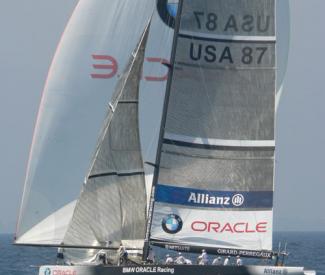
Pier 80 will serve as the base for the BMW Oracle racing team during the 34th America’s Cup. Billionaire Larry Ellison’s super yacht, the USA 17 — the winning boat in the last America’s Cup off the coast of Spain — is being stored at Pier 80, according to news reports. So we naturally assumed that this mast was from that world-famous sailing vessel. When we asked one of the movers if this mast was from the USA 17, they confirmed that it was. But then another member of the moving crew gave a different answer, saying this had nothing to do with the America’s Cup.

It seems that it may have been a mast from a different super yacht, the Cheyenne, which was previously named the Play Station. That boat once belonged to the late Steve Fosset, who, in addition to being a sailor, was the first person to fly solo around the world in a hot-air balloon. The Cheyenne was sold to adventurer Chris Welsh, who announced in Los Angeles last month along with billionaire Sir Richard Branson that they will co-pilot a Virgin Oceanic submarine expedition to the greatest depths of the ocean.

The Cheyenne — which recently sailed from San Francisco to Newport Beach — will serve as a “mother ship” for the submarine expedition, and won’t be used for competitive sailing anymore. We’ve contacted the America’s Cup Event Authority, Virgin Oceanic and SF Boatworks to try to get some clarity on whether the mast we saw getting towed along the waterfront belonged to the Cheyenne or the USA 17, but haven’t heard back from anyone yet.

The Virgin Oceanic submarine is expected to descend later this year into the Mariana Trench in the Pacific, a journey that will take the explorers deeper than anyone else has ever gone.

Meanwhile, it seems that when the America’s Cup comes to the city, San Franciscans probably won’t get the chance to see the USA 17 sail on the bay, even though it is being stored here. “The trimaran may not sail again,” noted a February press release from Oracle Racing. “Oracle Racing’s focus is on the next Cup.”

**UPDATE** No sooner had we posted this than we received a call from Ruby Esparrago at SF Boat Works, who said, “Yes, that was the mast for the boat from the America’s Cup.” But then we got an email from someone from Virgin Oceanic who said it was theirs.

Earth Day in City Hall … on Wells Fargo’s dime

Who was lucky enough to get treated to Mayor Ed Lee’s Earth Day Breakfast in City Hall, with the city’s top politicos and a smattering of high-profile San Franciscans? After noticing that the Board of Supervisors had approved a grant of $12,000 from Wells Fargo a few weeks ago to sponsor the event, the Guardian contacted the Mayor’s Office to ask for the guest list. The response came from the city’s Department of the Environment, which accepted the donation and organized the affair.

The 472-person invite list (we don’t know how many actually attended) included prominent figures such as Sens. Barbara Boxer and Dianne Feinstein, Rep. Nancy Pelosi, billionaire investor Warren Hellman, and former San Francisco Mayor Willie Brown. All 11 members of the Board of Supervisors were invited, too, as were mayoral hopefuls City Attorney Dennis Herrera, Assessor-Recorder Phil Ting, and state Sen. Leland Yee.
 
Invitations were extended to some truly green organizations, too, such as Green for All, Save the Bay, Rainforest Action Network, the Ella Baker Center for Human Rights, the Sierra Club, the Apollo Alliance, Greenaction, and others.

And many seats were reserved for the corporate sector. A total of nine representatives of Pacific Gas & Electric Co. were on the list. There were seven from Cisco, several from consulting and design firm CH2MHill, and a couple representatives from Skidmore, Owings & Merrill — the firm that’s doing the Parkmerced overhaul and which was tapped to envision waterfront venues for the America’s Cup. 

Seven representatives — including the CEO — were invited from Recology, which is in the midst of a debate over its high-stakes, $275 million no-bid garbage contract with the city.

According to Mark Westlund of the Department of the Environment, only half of the Wells Fargo grant went toward the mayor’s Earth Day Breakfast, “the remainder to a series of community events held in the Department’s EcoCenter lobby.” The other sponsors included Blue Shield of California ($2,000); CH2MHill; Skidmore, Owings & Merrill; United Airlines; Environmental Science Associates ($4,000); Levi Strauss & Co.; Cisco ($6,000) and Starbucks — which provided BPA-free travel mugs (double green points!).

It’s nice that San Francisco taxpayers didn’t have to shell out the $18,000 for all these people to celebrate Earth Day together. But at an event such as this, with so many millions of dollars in city contracts and major development projects flying around (not to mention the half a dozen or so people in need of campaign contributions), you can bet they weren’t all talking to one another about saving the planet.

Our Weekly Picks: April 20-26

0

WEDNESDAY 20

DANCE

“MOVE(MEN)T4”

The “MOVE(MEN)T” concerts plug into a men-only choreography tradition from the 1980s (although women do perform in them. Joe Landini revived the idea four years ago because the guys so clearly enjoyed the camaraderie that comes from working together. The artists for the second week’s program include Tim Rubel, who creates text-heavy pieces notable for their humor, and Honey McMoney and Kowal in what Landini calls “very queer” work. Jesse Bie has been dancing with and choreographing for Steamroller for more than 10 years while Michael Velez, a stunningly beautiful dancer, is a still-young choreographer. Todd McQuade is creating an installation in the basement; he will later perform it with Sasha Waltz and Guests in Berlin. (Rita Feliciano)

Wed/20-Thurs/21 8 p.m., $10-20

Garage

957 Howard, SF

(415) 518-1517

www.brownpapertickets.com


MUSIC

Dengue Fever

In trying to deal with the challenge Dengue Fever poses — singer Chhom Nimol belting out 1960s-style Cambodian pop played by L.A.-based musicians — critics have appealed to a unifying element: funk. Whether you’re Sharon Jones and the Dap-Kings, Antibalas Afrobeat Orchestra, or Dengue Fever, anachronism doesn’t matter, if you make the beat move. On its newest album, Cannibal Courtship, Dengue Fever twists the cultural novelty out of their lyrics, turning songs unexpectedly strange. (In the first track, Nimol shakes up the bored, hand-clapping back-up singers, transitioning from “you wouldn’t understand” to “be my sacrificial lamb.”) Funk is universal, and makes for a hell of a party. Just like LSD. (Ryan Prendiville)

With Maus Haus and DJ Felina

8 p.m., $22.50

Fillmore 

1850 Geary, SF

(415) 346-6000

www.livenation.com


THURSDAY 21

EVENT

“Salmon in the Trees”

What are fish doing up in the leafy branches of trees? The punch line (spoiler alert!) requires thinking web-of-life style. Salmon swim upstream from the ocean to spawn and then die, having successfully laid the next generation. In the process, some are hunted by hungry bears — among 50 other salmon-eating animals, including us — who consequently spread carcasses and salmon-fortified poop far and wide on the forest floor. Nutrients are absorbed, reaching the tops of even the oldest-growth trees. Learn about this phenomenon and more with award-winning conservation photographer and author Amy Gulick, who talks about her adventures documenting this wild interconnectivity in Alaska’s Tongass National Forest, one of the rarest ecosystems on the planet. (Kat Renz)

5:30 p.m., $20

Commonwealth Club

595 Market, SF

(415) 597-6700

www.commonwealthclub.org


PERFORMANCE

The Lily’s Revenge

What happens when a flower goes on a quest to become a man in order to wed his beloved bride? Or rather, what doesn’t happen, during this five-hour theater extravaganza in which playwright and burlesque performer Taylor Mac — along with dozens of local Bay Area artists — tackles love, marriage, and Prop. 8 using vaudeville, haiku, drag queens, ukuleles, feminist theories, dream ballets, and public dressing rooms, culminating in an interactive town hall. You heard right. Five hours. The first of three intermissions serves as a communal dinner, and wine and snacks are available for the long journey. Get ready for a spectacular adventure. (Julie Potter)

Through May 22

Tues-Sat 7 p.m.; Sun 2:30 p.m., $20-150

Magic Theatre

Fort Mason Center, SF

(415) 441-8822

www.magictheatre.org


FRIDAY 22

FILM

“John Waters’ Birthday Weekend”

John Samuel Waters was born April 22, 1946, which means he’s 65 today — but let’s hope one of America’s most daringly creative, bitingly hilarious, boundary-pushing filmmakers (not to mention authors, visual artists, and stand-up performers) has no intention of retiring anytime soon. The Castro pays tribute to “the Pope of Trash” with a quartet of essential early films (1972’s Pink Flamingos, 1974’s Female Trouble, 1981’s Polyester, and 1977’s Desperate Living), plus the (slightly) more mainstream 1994 Serial Mom and the movie that spawned the musical that spawned the movie musical, 1988’s Hairspray. True fiends will want to rush home post-weekend to watch all the movies not contained here, plus the DVD edition of 1981’s Mommie Dearest that contains Waters’ brilliant commentary, “Filth is my life!” (Cheryl Eddy)

Fri/22-Sun/24 $7.50-$10 

Castro Theatre

429 Castro, SF

(415) 621-6120

www.castrotheatre.com


MUSIC

Amon Amarth

Though they’ve been a band since 1992, the five burly Vikings in Sweden’s Amon Amarth didn’t really hit their stride for a decade. While headlining a U.S. tour in 2002, the quintet introduced stateside death metal maniacs to its untrammeled beards, overflowing, belt-mounted drinking horns, and soaring, harmonized riffs. With Oden on Our Side (2006) cemented the band’s status as standard bearers for the now-burgeoning Viking metal subgenre, partially on the strength of two hair-whipping music videos. New release Surtur Rising marks a historic chapter in the band’s career — one without headliners. This year’s “An Evening with Amon Amarth” tour features the band playing the new platter in its entirety, before launching into another set’s worth of old favorites. (Ben Richardson)

9 p.m., $22.50

Regency Ballroom

1300 Van Ness, SF

(415) 673-5716

www.theregencyballroom.com


DANCE

Bay Area National Dance Week

Free. Dance. Everywhere. Kicking off with the participatory “One Dance” in Union Square Plaza at noon today, Bay Area National Dance Week, presented by Dancers’ Group, encourages everyone to bust a move with classes, workshops, performances, and events across the region. Head to ODC Dance Commons for free classes from bhangra and ballet to the Rhythm and Motion dance workout. Impress your friends with new fire dancing skills learned at Temple of Poi. Or get close to your favorite performers during an open rehearsal. Whatever your style, be sure to enjoy some of the more than 400 events taking place as part of this dance celebration. (Potter)

Through May 1, free

Various Bay Area locations

(415) 920-9181

www.bayareandw.org


MUSIC

Questlove

From busking on the streets of Philadelphia in the late 1980s to a nightly gig on Late Night With Jimmy Fallon (with more than 12 albums in between), the Roots have never slowed down. It’s no blind guess that Ahmir Thompson, a.k.a. Questlove (a.k.a. ?uestlove), is a driving force behind its success (particularly if you’ve ever seen the look on his face when someone dropped the beat). A talented drummer with few peers, Questlove is the major reason the band is credited with not using recorded samples; he keeps them in his head and plays them with his hands. His deep knowledge of music, hip-hop, and beyond will be on display in an extensive four-hour DJ set. (Prendiville)

9 p.m., $20

Mezzanine

444 Jessie, SF

(415) 625-8880

www.mezzaninesf.com


SATURDAY 23

EVENT

“Cycles of History: Ecological Tour”

Feel the shape of San Francisco imprinted on your ass during a four-hour bike tour pedaling through the ecological past and present of the city’s northern neighborhoods. Sponsored by Shaping San Francisco, a living archive of lost local history, the two-wheeled trip explores the nature currently occupied by the towers of downtown, the landfilled waterfront, and the Presidio’s culturally-constructed forest, among other buried treasures. The tour is one of several offered throughout the year on everything from dissent to cemeteries, organized and led by the excessively knowledgeable and accessible Chris Carlsson, one of San Francisco’s premier activists and visionaries. An afternoon that’s good for the brain and the butt. (Renz)

Noon, $15-$50 sliding scale

Meet at CounterPULSE

1310 Mission, SF

(415) 608-9035

www.shapingsf.org


TUESDAY 26

MUSIC

tUnE-YarDs

It should be clear by now, given that name, its punctuation, the previous album (BiRd-BrAiNs) and the new one (w h o k i l l), plus the cover art, that Merrill Garbus has a thing for collage. Without hearing the music, you see it’s going to be a strange assembly. Sure as hell isn’t going to fit set styles in any easy way. But. Oh, she put that there? Kind of works. And those clippings on top of that image? It’s actually a little inspired (the glitter in particular.) Is she one of these crazy bedroom producers? Would explain the uncanny intimacy. The live show should explain how she puts it all together. (Prendiville)

With Buke and Gass, Man/Miracle

8 p.m., $15

Great American Music Hall

859 O’Farrell, SF

(415) 885-0750

www.gamh.com


FILM

Valley Girl

OK, so Nicolas Cage’s career of late has taken a strange turn. Bad Lieutenant: Port of Call New Orleans (2009) showed that under the right conditions, he can still contain his spiraling zaniness, but films like Season of the Witch, The Sorcerer’s Apprentice (2010), Knowing (2009), and Next (2007) — not to mention 2006’s remake of The Wicker Man — show that often he’d simply prefer not to. With Drive Angry 3-D and, Lord help us, an upcoming Ghost Rider (2007) sequel hinting that won’t be changing soon, take the time to revisit 1983’s Valley Girl, featuring a teenage Cage as a Hollywood demi-punk wooing adorable, mall-fixated Valley gal Deborah Foreman. The “I Melt With You” sequence is the gold standard for teen-dream falling-in-love montages; the dialogue, as always, remains totally tripendicular. (Eddy)

Tues/26-Weds/27 7:15 p.m., 9:25 p.m. (also April 27, 2 p.m.), $6-$10

Red Vic Movie House

1727 Haight, SF

(415) 668-3994

www.redvicmoviehouse.com


The Guardian listings deadline is two weeks prior to our Wednesday publication date. To submit an item for consideration, please include the title of the event, a brief description of the event, date and time, venue name, street address (listing cross streets only isn’t sufficient), city, telephone number readers can call for more information, telephone number for media, and admission costs. Send information to Listings, the Guardian Building, 135 Mississippi St., SF, CA 94107; fax to (415) 487-2506; or e-mail (paste press release into e-mail body — no text attachments, please) to listings@sfbg.com. Digital photos may be submitted in jpeg format; the image must be at least 240 dpi and four inches by six inches in size. We regret we cannot accept listings over the phone.

Hey Nikki! Sixx heads to SF to sign his new book, “This Is Gonna Hurt”

0

Known not only for his fiery stage presence and key songwriting contributions as bassist for Mötley Crüe, Nikki Sixx gained a notorious reputation for his off-stage antics as well, particularly his legendary appetite for drugs and debauchery. Sober now for several years, Sixx detailed many of these early escapades and horrors in his 2007 book The Heroin Diaries.

He returns — just in time before a major summer tour featuring Mötley Crüe, Poison, and the New York Dolls, which hits San Francisco June 15 — with the follow up, This Is Gonna Hurt: Music, Photography and Life Through The Distorted Lens of Nikki Sixx (William Morrow), a look at his post-addiction life that finds him a successful author, radio host, and of course, still rocking the stage as a member of the Crüe and Sixx: A.M.

The new book, which Sixx signs tonight (Thurs/14) at Book Passage in the Ferry Building, is a strikingly designed collection of attention grabbing and thought-provoking photos and essays, a body of work that covers a wide variety of subjects. When he came up with his first draft of the project, Sixx says that it wound up being 500 pages long — his passions for the book and subjects inspiring a flurry of writing that he eventually streamlined into the 200 page tome that was released earlier this week.

“I had this body of work from the last ten years as a photographer, and once I started talking about photography, it was really like peeling an onion; I started looking at a lot of social issues, a lot of issues of my own, where I came from, where I’m at and where I’m going,” says Sixx.

“It took a lot of trimming down and finding that thread — when I write I kind of just do this stream of consciousness writing, I’m really influenced by Beat Generation writers. I can really get lost in words, and sometimes that’s hard for a reader to follow, so it really took an editor to help me figure out the best way to deliver the message.”

That main message, which Sixx touches on throughout the book, is that he hopes to show people a different way of looking at life, that where mainstream society sees freaks and deformities, he sees through to the inner beauty.

Some of the images he captured while travelling the world on tour with Mötley Crüe; there are pictures of the band included, but the collection mainly focuses on his adventures offstage: exploring brothels in Germany, drug-infested alleys in Vancouver, gothic churches in St. Petersburg, Russia. Several images featured in the book were shot in his private photography studio, with models running the gamut from women who could be called obese to men with a variety of birth defects to a double amputee.

“For me, it’s all about seeing something and going for it, I wanted to push myself to the next level as a photographer,” says Sixx, who says that after working with the models, he often felt that they were the type of person that he — and others — should aspire to be.

In one passage of the book, he relates a story of visiting San Francisco a few years ago; while walking down by the waterfront and piers, he was approached by a large, African American homeless man, who said, “Hey Tattoo Man…you have any money?”

Sixx replied, “I’ll do you a favor if you do me one…don’t judge me by the color of my skin, ok?”

The man apologized, Sixx smiled and told him “It’s ok, happens all the time.”

The man’s response: “Yeah, me too.”

“That fit with what the overall message of This Is Gonna Hurt is all about, it really is in a nutshell what we do to each other as people, and this man who has been judged is whole life is judging another man. And I’m guilty of it too, it’s something I have to work on,” says Sixx.

With several book signings in the near future, the release of the book’s companion CD from Sixx: A.M., the summer Mötley Crüe tour, his radio show and new clothing line, Sixx certainly has his plate full; he admits to being a workaholic in the book, but it clearly brings him satisfaction and inspiration.

“I’m just so excited to get out there and see what kind of reaction that it raises in people,” says Sixx, who hopes that the book will inspire his fans to do something creative and fulfilling in their own lives. “Music will always be there, along with other creative outlets, whether its clothing design, or photography, or writing. For me, creativity is something anybody can do at any age — not have, do. Some people say, ‘Well I’m not a creative person’ — that’s not true. If you want to be creative you can be, you can pick up a guitar or a pen or whatever, and it’s sort of like being a magician — you just make stuff appear, it can come out of thin air. It’s amazing.”

Thurs/14
6 p.m., purchase of book ($29.99) is required for admission.
Book Passage
1 Ferry Building, SF
(415) 835-1020
www.bookpassage.com

The Performant: Here be pirates

0

Joining the saltwater chorus at the monthly Chantey Sing at Fisherman’s Wharf

Landlubbers arise. San Franciscans of the not long-distant past were a sea-faring folk, and you don’t have to scratch the surface very far to dig up old salt. Sailboats, houseboats, fishing boats, and ferries all still have their place in the bay, churning in the wake of container ships and visiting cruise lines, and the waterfront pubs are still prime locations to be regaled by gusty tall (ship) tales by grizzled old-school longshoremen and maritime amateurs alike.

One of the most unexpected legacies of our boating heritage is the monthly Chantey Sing aboard The Balclutha, a historic square rig docked at the end of the Hyde Street Pier. Six months shy of its 30-year anniversary, the Chantey Sing is one of those wonderfully hidden-in-plain-view pockets of locals-only camaraderie that you could spend years of urban assimilation hoping to stumble upon.

That singing in public is one of the top-rated social anxieties in America is a statistic that has blissfully passed the Balclutha by, and on the first Saturday of every month its shelter deck fills up with as mixed a group in terms of age, background, musical ability, and general sea-worthiness as any 120 year-old square-rigger could possibly hope to attract. Anchored at the end of Hyde Street pier and maintained by the National Park Service, the Balclutha sails no more, but when night falls and the tourist dives on Fisherman’s Wharf become flatlander-infested, the comfortable embrace of the historic ship welcomes Chantey novices and old hands alike.

Like any style of call-and-response work song, the typical sea chantey takes its rhythm from the work involved, in this case a slowly rolling pace punctuated by rollicking bursts of chorus, meant to be sung while heaving to or hoisting sails. Themes revolve predominantly around certain bodies of land or water, ladies left behind, dangerous capes, and rough seas, with songs of a salacious nature given a deserved airing after the 11 p.m. mark. Anyone is free to lead a song, and although some chanteys are certainly more immediately recognizable than others – the Pogues-immortalized “South Australia” for instance — the wealth of material ensures a comfortable four-hour singalong with no repeats. 

There’s a certain campfire chumminess about the event, right down to the marshmallows in the hot chocolate (bring your own mug!) but instead of wandering off to get lost  in the woods, the restless patron of the Chantey Sing can wander off to explore the ship itself: the captain’s close quarters, the vast cargo hold, the galley, the poop deck. And though the proceedings are considerably less rum-soaked and catastrophic than the typical night-out-at-sea in 1886 might have been, the experience does provide a bracing injection of salt-sea mystique to even the most landlocked veins. 


Chantey Sing

First Saturdays of the month 8 p.m., free

The Balclutha, Hyde Street Pier

2905 Hyde, SF

(415) 561-7171

www.nps.gov/safr/historyculture/chantey-sing.htm


How to move 200,000 people around America’s Cup

3

I’ve been wondering how the city plans to move the thousands of spectators expected to show up for a series of regattas in 2012 and 2013, leading up to and including the 34th America’s Cup Final.

And today I had a chance to start perusing the city’s draft People Plan which aims to move up to 200,000 residents and visitors daily to the city’s waterfront and is promising to be “the most transit, bicycle and pedestrian-friendly major sporting event in history.”

(Note to compulsive printers of online government documents: thanks to some nifty maps in this document, your printer may experience replication difficulties. For instance, I had to print everything but the maps on pages 13 and 14 of the document.)

Anyways, my preliminary review revealed that there is a special section in the draft dedicated to the “special transportation needs” of America’s Cup “participants” and that these participants include teams, event staff and, ta da!, accredited media.

“Special transportation needs for the ‘participant” group include but are not limited to staff access to race-related areas and other constricted waterfront areas,” states the plan. “These activities may require unique and frequent vehicle access to various sites.”

[Note to self: Remember to check out what is required to qualify as “accredited media” for a seat in one of the vehicles frequently accessing the area.]

Just kidding, and now, back to the needs of regular people who want to see the event.

“Part of the appeal that brought the Events to San Francisco Bay was the opportunity to create a new kind of viewing experience for the highest level of competitive sailing, with races held in close proximity to urban areas and accessible shoreline instead of open seas,” states the plan’s “Strategic Adaptability” section.

“The novelty of this concept creates excitement but it also creates uncertainty, in that there are few instructive examples of how spectators will choose to attend an America’s Cup Final-level sailing event in the middle of a weekend day, or how a large event in San Francisco Bay during a weekday will affect the ability of Bay Area residents to commute to work or their other daytime destinations,” the section notes.

{This sounds like the city is trying to figure out how many of us will choose to be anywhere but San Francisco on the weekends in question, how many of us who work in San Francisco are planning to play hookey to attend week day events, and how many will show up even if the Bay is swathed in fog.]

Un its draft plan,  the city promises  “to seed the strategies set forth in the People Plan with a measure of adaptability to allow for the strategic deployment of a finite amount of transportation resources across the spectrum of transportation demands associated with the Events in accordance with the expected demands of each day.”

Beyond that, the document is divided into three main parts. One itemizes likely destinations, the next describes transportation strategies to serve these key destinations, and the final section describes “additional considerations and strategies.”

To learn a) which race facilities, waterfront locations, and race viewing locations will be accessible to the public, b) which bus, rail, cable car, bike, automobile and ferry routes will be modified, and c) which parking and special locations will be added, be sure to check out the plan. And then eave your comments at the city’s feedback site here.

For, as the city’s website warns, “The early draft of the People Plan is the product of analysis by city and SFMTA staff, with early input from stakeholder groups. The draft People Plan announced today will also undergo significant and further revisions, following input from members of the public, advocates, city and agency staff, the environmental community and other stakeholders in the coming months. Final approval and consideration will occur following the completion of environmental review.”

In other words, review the documents now and speak your piece soon, otherwise your ideas won’t have any chance of making it into the final plan.

Or at Mayor Ed Lee put it in a press release, “We are moving rapidly to meet our commitments to host a spectacular 34th America’s Cup in 2013 and set a new standard for sustainable event-planning. The America’s Cup is a unique opportunity to leverage our region’s transportation resources and our enthusiasm to deliver the most transit, bicycle and pedestrian-friendly international major sporting event in history for residents and visitors alike.”

And here’s hoping that we will all be “moving rapidly” when the regatta finally rolls into town…

Out with the old

6

On the chilly morning of Dec. 21, a crowd of prominent local and state figures huddled in an industrial parking lot overlooking the brick smokestack of the Potrero power plant, which has been in operation for more than 40 years. It was the winter solstice, the morning after a lunar eclipse, and an historic environmental moment for San Francisco.

A longstanding battle to shut down the aging, polluting power plant was finally coming to an end, and it would be effectively shuttered as the calendar flipped to the new year. Although the past decade had been marked by political infighting and a relentless push to persuade the California Independent System Operator (CAISO) to shut it down sooner, the tone that day was buoyant as people made the rounds, embracing one another and offering congratulations and thanks.

Among those who lined up before the media were Mayor Gavin Newsom, who will be sworn in as lieutenant governor in early 2011; Sup. Sophie Maxwell, whose 10 years on the Board of Supervisors is coming to a close; City Attorney Dennis Herrera, who’s thrown his hat into the mayoral race; and San Francisco Public Utilities Commission General Manager Ed Harrington, whose name has been floated as a contender for interim mayor.

Each of these local politicians played a role in the contentious battle to close the plant, and each candidly admitted that shouting matches on the subject had erupted over the years. Yet they all expressed thanks to one another and to community members in the Potrero Hill, Dogpatch, and Bayview/Hunters Point neighborhoods, where residents were most directly affected by the noxious air pollution generated by the plant.

“They say it takes a village to raise a child. Well, it takes a state and a city to close this power plant,” said Maxwell, whose District 10 includes the neighborhoods affected by the power plant. “I started working on these plants when I took office, and now the plants are leaving with me.” Maxwell was credited with displaying dogged persistence and playing an instrumental role in pushing for the shutdown the plant.

“There were a lot of phone calls, there were a lot of arguments, there were a lot of disputes. But the fact of the matter is that everybody was focused on the same goal — and that was getting this plant shut down,” said Herrera, who has also been a key player in the decade-long fight to shut down the plant.

Newsom sounded a similar note. “I want to compliment everybody for their steadfastness and their devotion to this process,” the mayor said. “We didn’t always necessarily agree.”

Joshua Arce, who worked with community members to shut down the plant as part of his work with the Brightline Defense Project, was clearly pleased by the announcement. “It’s a fantastic day. We’re at last going to see the billowing smokestack come down, and for good,” Arce said.

The shutdown finally came to pass because the CalISO, which regulates the state power grid, was willing to accept new energy system upgrades as sufficiently reliable. For years, despite the community’s insistence that the plant was having an unacceptable impact on public health and disproportionately affected low-income communities of color, CalISO refused to terminate a contract requiring the plant to stay in operation for grid-reliability purposes.

However, new pieces to the city’s energy puzzle were recently fitted into place. The Trans Bay Cable, a 53-mile submarine power line that can transmit 400 megawatts of electricity from a Pittsburg generating station to San Francisco, became fully operational Nov. 23, months behind schedule. Meanwhile, a Pacific Gas & Electric Co. re-cabling project deemed important to San Francisco’s electricity reliability was completed Dec. 5.

“This plant has been part of the reliable supply for San Francisco … for a long time. And more recently, it actually provided the security for San Francisco should anything happen outside of San Francisco,” Yakout Mansour, president and CEO of the CalISO said during the shutdown ceremony. “But the time is here to replace the plant with an alternative to make the city more secure and reliable with much less polluting options.”

The CalISO issued a letter to the plant owner, which recently merged with another company and changed its name from Mirant to GenOn, stating that the must-run agreement would be terminated effective Jan. 1. The date of the final termination is Feb. 28, pending approval from the Federal Energy Regulatory Commission (FERC).

Now the major question is what will become of the power plant site, a vast strip of industrial real estate wedged between Illinois Street and the waterfront. “Many ideas have been thrown out there. People have come to us and said everything from office and industrial and research and development, to wind turbines,” noted Sam Lauter, a local spokesperson for GenOn. Lauter noted that community meetings would be held soon to discuss the future site use.

The site was previously owned by PG&E, and the utility is responsible for cleaning up lingering toxic residue including lampblack, a byproduct of coal processing, left behind when PG&E sold the site. Because of the pollution, residential units cannot legally be constructed on the site, even after cleanup.

There is one unfortunate consequence to shuttering the plant. According to plant manager Mike Montany, five or six of the 28 employees of the plant will lose their jobs. The rest will either retire or go to work at a new facility, he said.

While San Francisco will be poised to ring in the new year with improved air quality thanks to the elimination of its last polluting energy facility, residents of the area where the city’s power will now be sourced from won’t be so lucky. They are faced with the construction of two new power plants. The undersea Trans Bay Cable will run from the PG&E’s substation in San Francisco — a humming network of cables and transformers located beside the power plant that will stay put after the shutdown — to a generating station in Pittsburg, located in the delta near the confluence of the Sacramento and San Joaquin rivers.

GenOn owns the Pittsburg power plant, and it recently held a groundbreaking ceremony for a new power plant in neighboring Antioch, called Marsh Landing. At the same time, the California Public Utilities Commission (CPUC) recently gave the green light for another new power plant in that area. The $1.5 billion PG&E facility would be located in Oakley, which borders Antioch. It won commission approval Dec. 16, despite an earlier decision rejecting the proposal.

The plans for new power plants were approved just after the conclusion of an important United Nations convention on Climate Change in Cancún, Mexico, and amid news reports highlighting scientists’ conclusion that polar bears have a shot at survival only if serious efforts are taken to reduce greenhouse gas emissions. While the cheerful ceremony to shut down the Potrero power plant was a satisfying conclusion to a long battle, there’s a long road yet ahead in the overarching struggle against climate change.

Race against the clock

1

rebeccab@sfbg.com

City officials were poised to finalize an offer to host the 34th America’s Cup after amending a sweetheart deal that had city taxpayers heavily subsidizing Oracle billionaire Larry Ellison’s yacht race. But the question now is whether Ellison will accept the new proposal.

The original deal negotiated between representatives for Ellison and Mayor Gavin Newsom called for ceding 35 acres of city-owned waterfront property to Ellison’s America’s Cup Event Authority (ACEA) rent-free, but it was criticized as too expensive for a city facing massive budget deficits (see "The biggest fish," Nov. 30).

So at the Dec. 8 meeting of the Board of Supervisors’ Budget & Finance Committee, that deal was jettisoned in favor of a cheaper alternative that shifted the race venue to the city’s Northern Waterfront and promised long-term leases on commercially reasonable terms. The new agreement appeared on track for approval at the Dec. 14 Board of Supervisors meeting, after Guardian press time.

At the same time, new doubts arose at the last minute when race organizers stated publicly that they were more likely to reject the new option than the original plan because the financial terms were not as attractive. Although expectations have been high all along that San Francisco would be selected to host the next Cup, the team cast doubt on the outcome by publicly criticizing the new plan. According to a source familiar with negotiations, that move came as a jarring surprise to city officials. Nonetheless, supervisors approved the proposal at a Dec. 13 special meeting and sent it on to the full board.

Newsom’s Office of Economic and Workforce Development (OEWD) spent about four months in negotiations with Ellison’s BMW Oracle Racing Team and the ACEA to hash out a host city agreement. The Northern Waterfront scenario emerged in late November after Budget & Legislative Analyst Harvey Rose cautioned in a fiscal impact assessment that the original deal would have cost the city an estimated $128 million, including impacts to the general fund and losses from entering into rent-free leases.

The fundamental shift in the plan at this late stage, less than three weeks before the deadline for a final decision, reflected some deft maneuvering on the part of the board even in the face of intense pressure to approve a binding long-term agreement on an unusually short timeline. Sup. Ross Mirkarimi and Board President David Chiu, who expressed reservations about the original proposal but strongly favored the idea of bringing the race to San Francisco, were able to deflect a deal that would have harmed the city in favor of a wiser alternative by reshaping the proposal at the 11th hour.

"I was a little bit surprised by some of the recent press," Mirkarimi noted at the Dec. 13 meeting, referencing reports that the team was considering rejecting the bid. He asked everyone to keep in mind that "we’re working with public dollars and purse strings."

But the Mayor’s Office supported the modified deal. Press Secretary Tony Winnicker told the Guardian: "The Northern Waterfront bid is good for the city, great for the port, and will provide a spectacular experience for the America’s Cup. Hosting the America’s Cup will bring more than $1 billion in economic activity and thousands of jobs to San Francisco and showcase the city unlike almost any other event."

Speaking at the Dec. 8 committee meeting, Chiu also voiced his support for hosting the Cup. "Obviously this will have enormous benefits," Chiu said. "If this were to come to San Francisco, this will mean $1 billion and likely $1.2 billion in economic activity during the greatest recession since the Great Depression. We cannot ignore this opportunity."

The difference in the two scenarios amounts to tens of millions of dollars in savings. According to a fiscal feasibility analysis released Dec. 13 by the Budget Analyst, the net loss to the city under the Northern Waterfront alternative would be $11.9 million, compared to $57.8 million under the prior agreement (not including costs relating to the rent-free leases proposed earlier). However, that impact doesn’t account for a $32 million contribution that the America’s Cup Organizing Committee is expected to provide to the city to defray municipal costs.

Under the Northern Waterfront plan, Piers 30-32 and Seawall Lot 330 would be leased to race organizers for 66 and 75 years, respectively, on "commercially reasonable terms" with development rights included. The race organizers would receive a rent credit in exchange for investing an estimated $55 million for infrastructure improvements.

Rose’s office also found that the city would realize a net gain by transferring development rights for Piers 30-32 and Seawall Lot 330 with commercially reasonable rents, generating a net $12.3 million in new tax and lease revenues.

"This deal has significantly improved from the prior deal that went before you," Rose noted at the Dec. 13 Budget & Finance Committee meeting. The main reason for the reduction in costs was that under the original plan, ACEA would have been granted rent-free development rights to Pier 50, a 20-acre waterfront parcel needing costly renovations, for 66 years. Removing that costly improvement and shifting dredging costs from the city to race organizers made the prospect more feasible for San Francisco.

Piers 26 and 28 were added to the equation late in the game, too. Under the new plan, ACEA has the option to spend an additional $25 million renovating those piers in exchange for leasing them for 66 years with rent credits. Ted Egan, an economic analyst with the City Controller’s office, noted that the piers were expected to last for only 15 years if they weren’t renovated.

"Without the America’s Cup stepping forward, we lose them, and we lose any potential development that could take place at those piers," he noted. Port Director Monique Moyer also praised the plan at the Dec. 8 meeting, saying piers that would have continued to deteriorate could now be revitalized.

Chiu amended the agreement to secure greater assurance that the city would receive a $32 million contribution from the America’s Cup Organizing Committee (ACOC), the fund-raising arm of the race organizing team, to defray municipal costs. Prior to Chiu’s amendment, there was no guarantee that the city and county would receive that money, Rose pointed out.

Jennifer Matz, director of OEWD, noted that ACOC was "committed to using best efforts" to raise $32 million over the course of three years. Under the agreement, if the committee hasn’t successfully raised $12 million by one week after the environmental review has been completed, the city reserves the right to call off the deal.

The new plan seemed likely to pass muster even with Sup. Chris Daly, the most vocal opponent of the original plan. "One thing that’s clear is that it’s a whole lot better than the previous proposal," Daly said.

Ellison, who captured the 33rd America’s Cup off the coast of Spain and holds exclusive power to choose which city will host the next sailing match, has set Dec. 31 as the deadline for his final decision. But a source familiar with the negotiations told the Guardian an announcement was expected even sooner.

Ironically, there was little doubt that Ellison would select San Francisco until the very end of the process, when the city finally reached an agreement that seemed to satisfy the Mayor’s Office, the Board of Supervisors, and the economic analysts. At press time, it was still an open question whether Ellison will go for it.

"With this latest bit of vetting by us, I think the city has done the utmost it possibly could do in putting forth the best plan it possibly could craft in such a short period of time," Mirkarimi said at the close of the Dec. 13 meeting. "I think that San Francisco stands to be the best contender for hosting America’s Cup, and let that message ring well toward Mr. Ellison, and around the country, and abroad."

Supes OK America’s Cup deal

1

At its meeting today, Dec. 14, the Board of Supervisors unanimously approved a host city agreement for bringing the 34th America’s Cup to San Francisco. However, it’s still unclear whether billionaire yachtsman Larry Ellison and the BMW Oracle Racing Team will select San Francisco as the host city for the next world-famous sailing match.

The agreement solidified a less costly plan and a dramatic improvement over a prior proposal, which the Guardian covered in-depth in a recent cover story. Under the new terms, the America’s Cup Event Authority (ACEA) would be granted long-term leases on commercially reasonable terms for Piers 30-32, Seawall Lot 330, and possibly Piers 26 and 28.

The ACEA would receive rent credits in exchange for investing $55 to $80 million in infrastructure improvements for San Francisco port properties, and San Francisco would benefit from an estimated $20 million boost in revenues from the event. The America’s Cup Organizing Committee would also raise $32 million to help defray municipal costs. The major difference from the prior plan is that Pier 50, a 20-acre waterfront parcel requiring costly renovations that would have been ceded rent-free to the ACEA with development rights for 66 years, was removed from the equation. The America’s Cup is expected to generate more than $1 billion in economic activity, plus create the equivalent of more than 8,000 jobs.

Board president David Chiu called the new plan, which shifts the race venue to the Northern Waterfront instead of the Central Waterfront, “much better, from a business perspective, for the city.”

Sup. Ross Mirkarimi, who supported early efforts to bring the Cup to San Francisco but expressed reservations about the original plan, commended city officials for working around the clock to hammer out a deal on an unusually short timeline.

While doubts arose over the weekend concerning whether or not the BMW Oracle Racing Team and billionaire yachtsman Larry Ellison would accept the latest plan, Port staff member Brad Benson told the Board that he’d met with Stephen Barclay, a representative of the race organizing team, for hours following a Dec. 13 special meeting of the Budget & Finance Committee held to consider the financial impacts of the latest draft.  “They would like to enter into an agreement by the end of this week,” Benson reported.

Sup. Chris Daly, who emerged as the most vocal opponent of the Cup in the early stages of the process, acknowledged that he had used “exciting language” to criticize the initial scheme. “The reason why I amplified the language is because I knew the city just could not afford that kind of financial outlay and cost,” he explained. Daly voted in favor of the revised deal because he said it would grant a “fair return for this city.”

Just before the vote, Daly likely caused representatives from the mayor’s office to groan when he announced that he wanted to propose one last amendment. “I need to borrow the Cup on Jan. 5,” he said. “I need a cup. To drink out of.” His joke elicited laughter. Daly will be the star of a roast scheduled for that date.

For more details on the improved America’s Cup agreement, see tomorrow’s issue of the Guardian.

The America’s Cup rip-off

10

EDITORIAL Gigantic international sporting events tend to be great fun for the people who attend. They make great promotional videos for the host city. They can generate big revenue and profits for some private businesses.

But when the party’s over and the bills come due, these extravaganzas aren’t always a boon to the municipal treasury. And at a time when San Francisco can’t afford to pay for teachers and nurses and recreation directors, the supervisors ought to be giving much greater scrutiny to the deal that could bring the America’s Cup yacht races to the bay.

In 2009, as the city of Chicago was preparing an unsuccessful bid for the 2016 Olympics, the Chicago Tribune took a look at what the 1996 games had meant to another U.S. city, Atlanta. The Trib’s conclusion: lots of private outfits and big institutions did well — the Atlanta Braves got a new baseball stadium and the Georgia Institute of Techology got a new swimming and diving center — but the city itself didn’t get much money at all.

That’s exactly the way the deal that Mayor Gavin Newsom negotiated with Larry Ellison, the multibillionaire database mogul and yachtsman, is shaping up. A shadowy new corporation controlled by Ellison would get control of more than 30 acres of prime waterfront land worth hundreds of millions of dollars. The city could lose $42 million, and possibly as much as $128 million.

We don’t dispute the huge economic impact of holding an event that could attract more than 1 million visitors to the Bay Area. Those people will spend money in bars, restaurants, shops, and hotels. The waterfront improvements and increased tourism will create, according to economic reports, 8,840 jobs.

But as the Board of Supervisors budget analyst points out, those are not permanent, full-time jobs; much of the increased employment needs would be met by increased productivity (bartenders and waiters handling more customers than usual), overtime, and temporary jobs. And again: Most of the benefits will go to the private businesses in the tourist industry. The city’s increased tax revenue won’t be nearly enough to cover the expenses. Even if the America’s Cup group raises $32 million — and that’s not guaranteed in the deal — the city would still be down $10 million.

So in effect, San Francisco is preparing to spend $42 million of taxpayer money (and to forego as much as $86 million more by giving away waterfront land that could be developed) to benefit the sixth-richest person in the world, a new company he’s going to create and control, and the tourist-related businesses in town.

Oh, and to make it even juicier: the city is promising to seek state approval for Ellison to build condos or a hotel on the waterfront — something nobody else can legally do.

This doesn’t strike us as a terribly good deal.

It looks worse when you consider how the negotiations proceeded: The mayor and other city officials insisted they were scrambling to give Ellison everything he wanted to make sure that San Francisco beat out two other competitors. But as Rebecca Bowe reports on page 12, there were no other formal bids; Ellison’s team, based at the Golden Gate Yacht Club, was only negotiating with one city, San Francisco.

There are alternative proposals. The Telegraph Hill Dwellers Association wants to see the race complex moved from the Central Waterfront to the Northern Waterfront, and there may be ways of saving money. And Sup. Ross Mirkarimi points out that if Ellison wins the races in 2013 and comes back again the next time around, San Francisco could become what Newport, R.I., once was: a repeat host to an event that will bring more and more benefits as time goes on. That, however, involves a number of risks and variables that are far from certain at this point.

We’d like to know a lot more about what Ellison’s development plans are. We’d like to know who, exactly, will be running his new corporation that will get development rights for a couple of nice waterfront parcels.

But before the supervisors sign off on any deal, they need to set a bottom line: this can’t cost the city any net revenue. The San Francisco city treasury and local taxpayers shouldn’t be subsidizing an event created by and for the very wealthy.


The biggest fish

6

rebeccab@sfbg.com

Shortly after Larry Ellison, the billionaire CEO of Oracle Corp. and owner of the BMW Oracle Racing Team, won the 33rd America’s Cup off the coast of Valencia, Spain, in February 2010, a reception was held in his honor in the rotunda at San Francisco City Hall.

The event drew members of Ellison’s sailing crew, business and political heavyweights such as former Secretary of State George Schultz, and other VIPs. Attendees posed for photographs with the tall, glittering silver trophy at the base of the grand staircase.

As part of the celebration, Ellison helped Mayor Gavin Newsom into an official BMW Oracle Racing Team jacket, and Newsom granted Ellison a key to the city, a symbolic honor usually reserved for heads of state and the San Francisco Giants after they won the World Series. Shortly after, the mayor and the guest of honor, whom Forbes magazine ranked as the sixth-richest person in the world, sat down for a face-to-face.

That meeting marked the beginning of the city’s bid to host the 34th America’s Cup in San Francisco in 2013. Since securing the Cup, Ellison has made no secret of his desire to stage the 159-year-old sailing match against the iconic backdrop of the San Francisco Bay, a natural amphitheater that could be ringed with spectators gathered ashore while media images of the stunningly expensive yachts are broadcast internationally.

Newsom and other elected officials have feverishly championed the idea, touting it as an opportunity for a boost to the region’s anemic economy. The city’s Budget & Legislative Analyst projects roughly $1.2 billion in economic activity associated with the event — the real prize, as far as business interests are concerned. It would also create the equivalent of 8,840 jobs, mostly in the form of overtime for city workers and short-term gigs for the private sector.

While the idea has won preliminary support from most members of the Board of Supervisors, serious questions are beginning to arise as the finer details of the agreement emerge and the date for a final decision draws near.

Ellison and the race organizers would be granted control of 35 acres of prime waterfront property in exchange for selecting San Francisco as the venue for the Cup and investing $150 million into Port of San Francisco infrastructure. But the event would result in a negative net impact to city coffers.

Hosting the event and meeting Ellison’s demands for property would cost the city about $128 million, according the Budget & Legislative Analyst, just as city leaders grapple with closing a projected $712 million deficit in the budget cycle spanning 2011 and 2012.

Part of the impact is an estimated $86 million in lost revenue associated with rent-free leases the city would enter into with Ellison’s LLC, the America’s Cup Event Authority (ACEA). In exchange for selecting San Francisco as a venue and investing in port infrastructure, ACEA would win long-term control of Piers 30-32, Pier 50, and Seawall Lot 330 — waterfront real estate owned by the Port of San Francisco, with development rights included. Seawall Lot 330, a 2.5-acre triangular parcel bordered by the Embarcadero at the base of Bryant Street, would either be leased long-term or transferred outright to ACEA.

The most vociferous opponent of the America’s Cup plan is Sup. Chris Daly, who has voiced scathing criticism of the notion that the city would subsidize a billionaire’s yacht race at a time of fiscal instability. “The question is whether or not the package that San Francisco’s putting together is good or bad for the city,” Daly told the Guardian, “and whether or not it’s the best deal the city can get.”


THE CREW

According to a Forbes calculation from September 2010, Ellison’s net worth is $27 billion, making him several times wealthier than the City and County of San Francisco, which has a total annual budget of about $6 billion. Ellison reportedly spent $100 million and a decade pursuing the Cup.

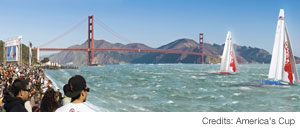
As soon as Ellison expressed interest in bringing the Cup to San Francisco, Newsom began charting a course. Park Merced architect and Newsom campaign contributor Craig Hartman of the firm Skidmore, Owings & Merrill was tapped to reimagine the piers south of the Bay Bridge as the central hub for the event, and soon Hartman’s vision for a viewing area beneath a whimsical sail-like canopy was forwarded to the media.

The mayor also issued letters of invitation to form the America’s Cup Organizing Committee (ACOC), a group that would be tasked with soliciting corporate funding for the event. ACOC was convened as a nonprofit corporation, and it’s a powerhouse of wealthy, politically connected, and influential members.

Hollywood mogul Steve Bing, who’s donated millions to the Democratic Party and funded former President Bill Clinton’s 2009 trip to North Korea to rescue two imprisoned American journalists, is on the committee. So is Tom Perkins, a Silicon Valley venture capitalist, billionaire, and former mega-yacht owner who was once dubbed “the Captain of Capitalism” by 60 Minutes. George Schultz and his wife, Charlotte, are members. Thomas J. Coates, a powerful San Francisco real estate investor who dumped $1 million into a 2008 California ballot initiative to eliminate rent control, also has a seat. Coates resurfaced in the November 2010 election when he poured $200,000 into local anti-progressive ballot measures and the campaigns of economically conservative supervisorial candidates.

Billionaire Warren Hellman, San Francisco socialite Dede Wilsey, and former Newsom press secretary Peter Ragone are also on ACOC. There are representatives from Wells Fargo, AT&T, and United Airlines. One ACOC member directs a real estate firm that generated $2.5 billion in revenue in 2009. Another is Martin Koffel, CEO of URS Corp., an energy industry heavyweight that made $9.2 billion in revenue in 2009. There’s Richard Kramlich, a cofounder of a Menlo Park venture capital firm that controls $11 billion in “committed capital.” And then there’s Mike Latham, CEO of iShares, which traffics in pooled investment funds worth about $509 billion, according to a BusinessWeek article.

There’s also an honorary branch of ACOC composed of elected officials including House Minority Leader Nancy Pelosi, Gov. Arnold Schwarzenegger, Sen. Dianne Feinstein, and others. Their role is to help the Cup interface with various governmental agencies to control air space, secure areas of the bay exclusively for the event, set up international broadcasts, and bring foreign crew members and fancy sailboats into the United States without a hassle from immigration authorities.

ACOC is expected to raise $270 million in corporate sponsorships for the America’s Cup. That money will be funneled into the budget for ACEA. It’s unclear whether the $150 million ACEA is required to invest in city piers will be derived from ACOC’s fund drive.

The city also anticipates that ACOC would raise $32 million to help defray municipal costs. “However,” the Budget & Legislative Analyst report cautions, “there is no guarantee that any of the anticipated $32 million in private contributions will be raised.”

A seven-member board, chaired by sports management executive Richard Worth, will direct the ACEA, according to Newsom’s economic advisors, but the other six seats have yet to be filled. ACEA’s newly minted CEO is Craig Thompson, a native Californian who previously worked with a governing body for the Olympics and has helped coordinate major sporting events internationally. In an interview with sports blog Valencia Sailing, Thompson provided some insight on why major corporations might be inspired to donate to the cause. Basically, the Cup is the holy grail of networking events.

“It’s a very difficult economic situation we are going through, and it’s not the best time to be looking for sponsors for a major event,” Thompson acknowledged. “On the other hand, the America’s Cup is one of the very few activities … that offer access to really top-level individuals in terms of education or economic situation. The America’s Cup is a unique platform for a lot of companies that want access to those individuals that are very difficult to reach under normal circumstances. I can tell you for example that Oracle is very pleased with the marketing opportunity the America’s Cup has presented to them. They invite their best customers and are very successful in turning the America’s Cup into a platform for generating business. The same thing can be true for a lot of different companies that need access to wealthy individuals.”

But should San Francisco taxpayers really be subsidizing a networking event for the some of the business world’s richest and most powerful players?


TRANSFORMING THE WATERFRONT

Over the past four months, Newsom’s Office of Economic and Workforce Development (OEWD) has been negotiating with race organizers to hash out a Host City Agreement outlining the terms of bringing the America’s Cup to San Francisco.

The proposal will go before the Board of Supervisor’s Budget & Finance Committee on Dec. 8, and to the full board Dec. 14. A final decision on whether San Francisco will host the race is expected by Dec. 31. ACEA and ACOC will each sign onto the agreement with the City and County of San Francisco.

From the beginning, the event was envisioned as “the twin transformation,” according to OEWD — the America’s Cup would be transformed by attracting greater crowds and heightened commercial interest while San Francisco’s crumbling piers would be revitalized through ACEA’s $150 million investment in port infrastructure.

The plan paints downtown San Francisco as the “America’s Cup Village” during the sailing events, and a study produced by Beacon Economics estimates that the financial boost would come primarily from hordes of visitors flocking to the event — more than 500,000 are expected to attend. The city expects a minimum of 45 race days, including one pre regatta in 2011 and one in 2012 (or two in 2012 if the one in 2011 doesn’t happen), a challenger series in 2013, and a final match in 2013.

The transformation of the city’s waterfront would be dramatic. In addition to the rent-free leases for Piers 30-32, 50, and Seawall Lot 330, ACEA would be granted exclusive use of much of the central waterfront, water, and piers around Mission Bay, and water and land near Islais Creek during the course of the event. Under the Host City Agreement, race organizers would have use of water space spanning Piers 14 to 22 ½; Piers 28, 38, 40, 48, and 54, a portion of Seawall Lot 337, and Pier 80, where a temporary heliport would be sited.

Seawall Lot 330, a 2.5-acre parcel valued by the Port at $33 million, lies at the base of Bryant Street along the Embarcadero and has a nice unimpeded view of the bay. Piers 30-32 span 12.5 acres, and Pier 50 is 20 acres.

The Budget & Legislative Analyst’s study predicts that the ACEA could opt to build a 250-unit condo high-rise on Seawall Lot 330, deemed the most lucrative use. Under the Host City Agreement, the city would be obligated to remove Tidelands Trust provisions from Seawall Lot 330, which guarantee under state law that waterfront property is used for maritime functions or public benefit. Tweaking the law for a single deal would require approval from the State Lands Commission, but Newsom, in his new capacity as lieutenant governor, would cast one of the three votes on that body.

The combination of construction, demolition, lost rent revenue, police and transit, environmental analysis, and other event costs would hit the city with a bill totaling around $64 million, according to the Budget & Legislative Analyst study. Since city government would recoup around $22 million in revenue from hosting the Cup, the net impact would be around $42 million. That doesn’t include the potential $32 million assistance from ACOC.

At the same time, the city would stand to lose another $86.2 million by granting long-term development rights to 35 acres of Port property for 66 to 75 years without charging rent, bringing the total cost to $128 million. OEWD representatives played down that loss in potential revenue, saying past attempts to redevelop piers hadn’t been successful because none could handle the upfront investment to revitalize the crumbling piers.

The Host City Agreement has raised skepticism among Port staff and the Budget Analyst that tempered initial enthusiasm for the event. “The terms of the Host City Agreement will require significant city capital investment and will result in substantial lost revenue to the Port,” a Port study determined. Faith in that plan seems to be eroding and it may be scrapped for an alternative plan that’s cheaper for the city.

The Northern Waterfront alternative substitutes Piers 19-29 as the primary location for the event and eliminates the Mission Bay piers from the equation. Under this scenario, ACEA would invest an estimated $55 million, instead of $150 million. In exchange, it would receive long-term development rights to Piers 30-32 and Seawall 330 on “commercially reasonable terms,” according to a Port staff report.

Board of Supervisors President David Chiu requested that the Port explore that second option more fully, and the Port report notes that it would reduce the strain on Port revenue. The Northern Waterfront plan would cost the Port a total of $15.8 million, instead of $43 million, the report notes. Port staff recommended in its report that both the original agreement and the alternative be forwarded to the full board for consideration.


PHANTOM BIDS?

Under the competition’s official protocol, Ellison, as defender of the Cup, has unilateral power to decide where the next regatta will be held. Race organizers have said it’s a toss-up between San Francisco and an unnamed port in Italy — though it’s anyone’s guess how seriously a European site is being considered by a team headquartered at the Golden Gate Yacht Club, a stone’s throw from the Golden Gate Bridge.

According to a San Francisco Chronicle article published in early September, Newsom issued a memo stating that San Francisco was competing against Spain and Italy to become the chosen venue. Valencia was said to be offering a “generous financial bid,” and a group in Rome was rumored to have offered some $645 million to bring the Cup to Italian shores, the memo noted. It was a call for the city to present Ellison with the most attractive deal possible to compel him to pick San Francisco.

Speaking at an Oct. 4 Land Use Committee hearing, OEWD director Jennifer Matz told supervisors: “San Francisco was designated the only city under consideration back in July. Now we are competing against the prime minister of Italy and the king of Spain.”

However, the veracity of those claims came into question in mid-November. Daly, incensed that the Mayor’s Office never communicated with him about the Cup despite wanting to hold it in his sixth supervisorial district, launched his own personal investigation. He fired off an e-mail to Team Alinghi, a prior America’s Cup winner, and began communicating with other European contacts until he got in touch with someone in Valencia’s municipal government.

“I got a call back from a representative who basically said I should know something,” Daly recounted. Valencia, his source said, never submitted a bid to host the Cup. At a Nov. 13 press conference, Valencia’s mayor Rita Barbera confirmed this claim, according to a Spanish press report, expressing disappointment that the city had been eliminated from consideration as a host venue. “There was no formal bidding process,” she charged. She also denied reports that any money had been offered.

Meanwhile, the Budget Analyst was unable to find any concrete evidence that other host city bids had been submitted. “We have nothing to confirm that other offers have been made,” Fred Brousseau of the Budget Analyst’s office told the Guardian.

In response to Guardian queries about whether the Mayor’s Office had evidence that Italy had indeed submitted a bid, Project Manager Kyri McClellan of the OEWD forwarded a one-page resolution from the Italian prime minister assuring race organizers that there would be tax breaks, accelerated approvals, and other perks guaranteed if the Cup came to Italy. However, an Italian journalist who looked over the resolution told the Guardian that the document didn’t appear to be a formal bid, merely a response to a query from race organizers.

Daly has his doubts that either Valencia or the Italian port were ever seriously considered. “I think they were phantom bids,” he said, “created by either Larry Ellison or the Newsom administration … to place pressure on the Board of Supervisors.”

A representative from OEWD told the Guardian that officials have no reason to doubt that the European bids, and accompanying offers of money, were real. However, the city wasn’t privy to race organizer’s discussions about possible European venues. A final decision is expected before the end of the year.

Daly hasn’t held back in voicing opposition to the America’s Cup and blasted it at an Oct. 5 Board meeting. “This tacking around Sup. Daly will not get you in calmer waters,” Daly said. “I told myself I was not going to make a yachting reference. But I will bring a white squall onto this race and onto this Cup, and I will do everything in my power starting on Jan. 8 to make sure these boats never see that water.”


WIND IN WHOSE SAILS?

The America’s Cup would undoubtedly bring economic benefit to the area and create work at a time when jobs are scarce. Police officers would get overtime. Restaurant servers would be scrambling to keep up with demand. Construction workers seeking temporary employment would get gigs. Hotels would rake it in. Pier 39 would be booming. However, the Budget Analyst report cautioned: “It is unlikely that any labor benefits would remain in the years after the America’s Cup event is completed.”

Certain small businesses would catch a windfall. John Caine, owner the Hi Dive bar at Pier 28, didn’t hesitate when asked about his opinion on the city hosting the Cup. “Please come fix our piers. It’s a shout-out to Larry Ellison,” he said. Caine said he supports the America’s Cup bid 100 percent, and is excited about the boost it could give his business. The Hi Dive would not be required to relocate under the proposal, he added.

At the same time, other small business would be negatively affected, particularly those among the 87 Port tenants who would be forced to relocate to make way for the America’s Cup. The Budget Analyst’s report also notes that retail businesses in the area whose services had no appeal to race-goers might suffer from reduced access to their stores, since crowding and street closures would shut out their customers.

The sailing community has rallied in support of the Cup, and Newsom has received hundreds of e-mails from yachting enthusiasts from as far away as Hawaii and Florida promising to travel to San Francisco with all their sailing friends to watch the world-famous vessels compete.

Ariane Paul, commodore of a classic wooden boat club called the Master Mariners Benevolent Association, told the Guardian that she was excited about the opportunity for the America’s Cup to showcase sailing on the bay. “In the long term, it’s a win-win,” Paul said. “It would be great to have that boost.” As for the financial terms of the deal, she remained confident, saying, “I don’t think that the city is going to let Larry Ellison walk all over them.”

Sup. Ross Mirkarimi is often politically aligned with Daly, but not when it comes to the issue of the America’s Cup. As a kid growing up on the island of Jamestown, a tiny blue-collar community located off the coast of Rhode Island, Mirkarimi learned to sail and occasionally spent summers working as a deckhand. Every few years, the America’s Cup would come to nearby Newport, transforming the area into a bustling hub and bringing the locals into contact with famous sailors. It left an everlasting impression. When the BMW Oracle Racing Team secured the 33rd Cup off the coast of Valencia, Mirkarimi did a double-take when he saw a photograph of the winning team — his childhood friend from Rhode Island was on the crew.

Mirkarimi told the Guardian he supports bringing the Cup to San Francisco because of the economic boost the area will receive — if the Cup continues to return to San Francisco as it did for 53 years in Newport, he said, the city could look forward to a free gift in improved revenue associated with the event, and that could help quiet the tired annual debates over painful budget cuts.

At the same time, he acknowledged that the Budget Analyst report had prompted what he called healthy skepticism. “I think the onus is on the city and Cup organizers to make sure the benefits far, far outweigh the investment,” Mirkarimi said. “This effort is not just about making one of the wealthiest men in the United States that much more wealthy … That can’t be the case,” he said. “It has to be about what will the Cup do in order to be a win-win for the people of San Francisco.” Mirkarimi said he expected scrutiny of the details of the agreement at the Dec. 8 Budget and Finance Committee hearing: “Naturally, in this time of economic downturn … people want to know, what’s the outlay of cost, and what are we going to get in return?” 

Down on the farm

0

rebeccab@sfbg.com

Sherman Island may barely register for motorists traveling over the Antioch Bridge and through the delta on Highway 160. Almost wholly owned by the Department of Water Resources, the roughly 10,000-acre patch of Sacramento-San Joaquin Delta flatland is barely developed, and probably home to more cows than people. It lies at the confluence of the Sacramento and San Joaquin rivers, where freshwater mixes with the salty seawater of the San Francisco Bay.

What isn’t obvious at first glance is that Sherman Island was once host to highly productive agriculture — but as delta water quality diminished, farmers saw their crop yields plummet. Larry Del Chiaro, who formerly headed the Sherman Island Landowners Association, used to grow asparagus, wheat, barley, safflower, milo, hay, and other crops on the island. But today, like nearly all the others who previously raised crops there, he no longer has property there and has moved on. His story illustrates how California water policies have benefited one group while affecting the livelihoods of the people who live in the state’s central water hub, the delta.

“I was a third-generation farmer on the island,” Del Chiaro told the Guardian on a hot August day in the city of Pittsburg. “My grandfather started it. My father, his brothers, my cousins were all on the island farming.” Del Chiaro majored in soil science in the 1970s and was interested in increasing crop yields, so he set up test plots and was closely monitoring their progress.

But by 1987, the yields were plummeting dramatically — a drought had hit the state, and Sherman Island farmers weren’t getting enough fresh water to sustain their crops. Instead of going to irrigate farmland in the delta, much of the scarce freshwater was being pumped south through the State Water Project to agricultural lands in the arid San Joaquin Valley, causing the delta water to get saltier and saltier.

It presented a problem that was particularly acute in that location. “Sherman Island, to use a cliché, is the plug for the Sacramento Delta,” Del Chiaro said. “We’re the last one to get the freshwater, and the first one to get the saltwater intrusion.”

The North Delta Water Agency, a regional water body, had a contract on behalf of the island’s landowners with the Department of Water Resources (DWR) that guaranteed a certain level of water quality. But DWR’s contractual obligations weren’t met that year. “As the drought continued, our water quality diminished, and diminished, and diminished, till it got to the point where we had to rely on Mother Nature for rainfall,” Del Chiaro said. “And when we didn’t get rainfall, our crops suffered.”

Under state water law, Sherman Island landowners had riparian water rights, which allowed them use of the freshwater that flowed past their land. The overarching problem, he said, was that DWR couldn’t meet contractual obligations to both the delta farmers and the San Joaquin Valley farmers in a dry year because it had over-promised water deliveries through the State Water Project. “We have no control over what Mother Nature gives us in terms of rainfall and the snow pack,” he said. “So they were being overly optimistic in terms of all those contracts.”

With the help of consultant Patrick Porgans and a San Francisco attorney, Del Chiaro and the 26 other Sherman Island landowners sued DWR for damages. In 1991, the state settled for $3.6 million, and the farmers were paid for not drawing water out of the delta. Soon after, DWR bought up the island. Once the water agency took control, it eliminated the need for DWR to satisfy contractual obligations to provide freshwater to the Sherman Island farmers. The farmers had cleared out, and the agency’s problem was solved.

“Compared to the San Joaquin Valley, the vast amount of acreage out there, the people that they employ, and the business compared to the delta, we’re kind of a drop in the bucket,” Del Chiaro noted. “Still, there are the businesses in the delta that basically survive off of our farming operation.”

Sherman Island is more well-known to recreational boaters and travelers, and Chris and Dawn Gulick provide a place for delta vacationers at Eddo’s Harbor & RV Park, located on Gallagher Slough on the east side of the island. Eddo’s wasn’t always a harbor and RV park — when Chris Gulick’s father started the business in 1967, fishing was the primary attraction and the small harbor maintained a fleet of fishing boats for rent. The State Water Project came online around the same time, marking the beginning of freshwater pumping out of the delta.

As delta water quality worsened over the years, there were fewer fish to be caught, so over the decades it became less practical to maintain the fishing vessels. Today, the fishing boats have been sold, and Eddo’s primarily gets its business from recreational boaters looking for guest slips or travelers who find their way to the quiet waterfront park to stay in their RVs.

Chris Gulick emphasized the larger picture during an interview about water issues in the delta, but he acknowledged that his business had been affected by what he saw as the state’s misguided water policies. “When we got here, the striped bass fishery was robust,” he said, “and it slowly has declined, and it steadily has declined.”

Gulick said countless experts and researchers had been in and out of the delta over the years, but he felt that the core problem had to do with governance of the system and the fact that water agencies had over-promised the water.

“The problem with the delta, or the water situation, is that the people that are in policy and are writing these guidelines don’t have a vested interest,” he said. “A lot of them don’t know a whole lot about this, but they’re the experts. They’re the ones who are supposed to be writing the plans. They don’t have a clue — and that is a prevalent attitude to the experts who come out and talk to us.”

Rep Clock

0


Schedules are for Wed/27-Tues/2 except where noted. Director and year are given when available. Double and triple features are marked with a •. All times are p.m. unless otherwise specified.

 ARTISTS’ TELEVISION ACCESS 992 Valencia, SF; www.atasite.org. $6. “Deep Leap Microcinema:” “Zaum/Beyonsense” and work by Jesse Malmed, Fri, 8. “Other Cinema:” War of the Gargantuas (Honda, 1966), Ishiro Honda tribute with Japanese monster movie clips, Sat, 8.

CASTRO 429 Castro, SF; (415) 621-6120, www.castrotheatre.com. $7.50-10. “15th Berlin and Beyond Film Festival,” Wed-Thurs. Visitwww.berlinbeyond.com for complete schedule and tickets ($10-11.50). •Fahrenheit 451 (Truffaut, 1966), Fri, 3:10, 7, and The Beast From 20,000 Fathoms (Lourie, 1953), Fri, 5:20, 9:10. “Mark Huestis Presents:” Poltergeist (Hooper, 1982), noon, 7:30, 9. With star JoBeth Williams in person at first two shows; 7:30pm show also features a pre-show performance. “Matinees for Maniacs: Monsters Are Coming to Town!:” •Something Wicked This Way Comes (Clayton, 1983), Sun, 2:30, and Escape to Witch Mountain (Hough, 1975), Sun, 4:30.

CELLSPACE 2050 Bryant, SF; www.sfindie.com. Free (donations to benefit CellSpace appreciated). “Eli Roth’s Midnight Movie Marathon:” The Thing(Carpenter, 1982), Sat, noon; Zombie (Fulci, 1979), Sat, 2; The Vanishing (Sluizer, 1988), Sat, 3:45; Pieces (Simon, 1982), Sat, 6; The Wicker Man(Hardy, 1973), Sat, 7:45; Who Can Kill a Child? (Serrador, 1976), Sat, 9:30; Eraserhead (Lynch, 1977), Sat, 11:45; Suspiria (Argento, 1977), Sun, 1:30am; Cannibal Holocaust (Deodato, 1980), Sun, 3:15am; Evil Dead (Raimi, 1981), Sun, 5:15am; Audition (Miike, 1999), Sun, 7am; Torso (Martino, 1973), Sun, 9am.

CHRISTOPHER B. SMITH RAFAEL FILM CENTER 1118 Fourth St, San Rafael; (415) 454-1222, www.cafilm.org. $6.50-10.25. The Girl Who Kicked the Hornet’s Nest (Alfredson, 2009), Oct 29-Nov 2, call for times. “Global Lens 2010:” Becloud (Bicecci, 2010), Wed, 6:45; The Night of Truth(Nacro, 2004), Wed, 9; Masquerades (Salem, 2008), Thurs, 6:45; The Shaft (Zhang, 2008), Thurs, 8:45. Inside Job (Ferguson, 2010), call for dates and times. Leaving (Corsini, 2009), Oct 29-Nov 3, call for times. My Dog Tulip (Fierlinger and Fierlinger, 2009), Wed-Thurs, call for times. Straight to Hell Returns (Cox, 2010), Mon, 7:15. With Alex Cox in person.

EMBARCADERO One Embarcadero Center, Promenade Level, SF; www.sffs.org. $12.50. “French Cinema Now:” Copacabana (Fitoussi, 2010), Thurs, 6:45 and Fri, 9:30; Rapt (Belvaux, 2009), Thurs, 9:30 and Mon, 9:15; Irène (Cavalier, 2009), Fri, 5 and Sat, 1:45; Love Like Poison (Quillévéré, 2010), Fri, 7 and Sun, 9:15; Sisters (Faucher, 2009), Sat, 3:45 and Sun, 6:45; The Princess of Montpensier (Tavernier, 2010), Sat, 6:30 and Sun, 3:45; A Real Life (Leonor, 2009), Sat, 9:30 and Tues, 6:30; Two in the Wave (Laurent, 2009), Sun, 1:30; Hidden Diary (Lopes-Curval, 2009), Mon, 6:30 and Tues, 9:15; Certified Copy (Kiarostami, 2010), Nov 3, 7, 9:15.

HUMANIST HALL 390 27th St, Oakl; www.humanisthall.org. $5. The Cove (Psihoyos, 2009), Wed, 7:30.

JACK LONDON SQUARE East lawn, Oakl; www.jacklondonsquare.com. Free. “Waterfront Flicks:” Twilight (Hardwicke, 2008), Thurs, 7:30.

MECHANICS’ INSTITUTE 57 Post, SF; (415) 393-0100 (reservations required). $10. “CinemaLit: Apocalypse Noir:” Night of the Demon (Tourneur, 1958), Fri, 6.

PACIFIC FILM ARCHIVE 2575 Bancroft, Berk; (510) 642-5249, www.bampfa.berkeley.edu. $5.50-9.50. “Alternative Visions:” “Photographic Memory: Bay Area Student Experimental Film Festival 2010,” Wed, 7:30. “Readings on Cinema:” Safety Last (Newmeyer and Taylor, 1923), Thurs, 7. “Days of Glory: Revisiting Italian Neorealism:” Chronicle of Poor Lovers (Lizzani, 1954), Fri, 7; La Terra Trema (Visconti, 1948), Sat, 7; Miracle in Milan (De Sica, 1951), Sun, 4. “Shakespeare on Screen:” Macbeth (Welles, 1948), Fri, 9:05. “Left in the Dark: Portraits of San Francisco Movie Theatres,” slide show presentation with photographer R.A. McBride and readings with contributors to Left in the Dark, Sat, 5. “Drawn From Life: Comic Books and Graphic Novels Adapted:” Swamp Thing (Craven, 1982), Sun, 7:30.

RED VIC 1727 Haight, SF; (415) 668-3994. $6-10. Scott Pilgrim vs. the World (Wright, 2010), Wed-Thurs, 7, 9:20 (also Wed, 2). Winnebago Man(Steinbauer, 2010), Fri-Sat, 7:15, 9:15 (also Sat, 2, 4). The Room (Wiseau, 2003), Sat, midnight. Planet Terror (Rodriguez, 2007), Sun-Mon, 7:15, 9:15 (also Sun, 2, 4). The Kids Are All Right (Cholodenko, 2010), Nov 2-3, 7:15, 9:30 (also Nov 3, 2).

“ROCKY HORROR PICTURE SHOW” Clay, 2261 Fillmore, SF and Albany, 1115 Solano, Albany; www.landmarktheatres.com. $9.50-10. The 1975 Jim Sharman musical plays at both theaters Fri, midnight (also Sat, midnight at the Clay).

ROXIE 3117 and 3125 16th St, SF; (415) 863-1087, www.roxie.com. $5-9.75. “SF DocFest,” Wed-Thurs. Program information at www.sfindie.com.Larry Wessel’s Iconoclast: Boyd Rice (Wessel, 2010), Mon, 7. “Halloween Spooktacular:” •The Man From Planet X (Ulmer, 1951), Fri, 6:35, 9:30, and The Creature With the Atom Brain (Cahn, 1955), Fri, 8; •Corruption (Hartford-Davis, 1968), Sat, 2:30, 6:15, 9:45, and The Brood (Cronenberg, 1979), Sat, 4:15, 8; •Straight to Hell Returns (Cox, 2010), Sun, 3:15, 7, 9, and Searchers 2.0 (Cox, 2004), Sun, 5. Alex Cox in person at Sunday shows.

SAN FRANCISCO MUSEUM OF MODERN ART 151 Third St, SF; www.sfmoma.org. $5. “Witches!”: •Season of the Witch (Romero, 1973) andSuspiria (Argento, 1977), Thurs, 7.

VARIETY SCREENING ROOM 582 Market, SF; (650) 724-5544, www.unaff.org. Free. “United Nations Association Film Festival:” Strange Birds in Paradise: A West Papuan Story (Hill-Smith), Wed, 4; Kites (Dzianowicz), Wed, 5:25; “Panel Discussion: Images That Provoke,” Wed, 6:45; Secrets of the Tribes (Padilha), Wed, 8; The Rage of Images (Scharf and Duregger), Wed, 9:40.

VIZ CINEMA New People, 1746 Post, SF; www.vizcinema.com. $10. “Mizoguchi and His Muse: Kinuyo Tanaka,” Wed-Tues, check website for schedule.

VORTEX ROOM 2961 16th Sf, SF; www.sfcinema.org. $10. “Remembering Dennis Hopper:” Night Tide (Harrington, 1961) with “The Wormwood Star” (Harrington, 1955), Wed, 7:30. YERBA BUENA CENTER FOR THE ARTS 701 Mission, SF; (415) 978-2787, www.ybca.org. $6-8. “Muppet History 201: Rarities from the Henson Vault,” Thurs, 7:30 and Sat, 2.


Our Weekly Picks: September 22-28, 2010

0

WEDNESDAY 22

MUSIC

Mary Wilson

As one of the founding members of the Supremes, Mary Wilson sang on countless classic rock, R&B, soul, and doo-wop hits, including “Baby Love,” “Come See About Me,” “Stop! In The Name Of Love,” “Back In My Arms Again,” and many, many more. While that legendary group’s rise to fame has been celebrated in fictionalized form with the hit film and stage production Dreamgirls, Wilson has continued to perform and record, wowing fans with her outstanding voice that still powerfully belts out her hits, along with her interpretations of jazz standards. Fans can expect a bit of both when she comes to the city for a series of special, intimate shows. (Sean McCourt)

Wed/22-Sat/25, 8 p.m.; Sun/26, 7 p.m., $40–$55

Rrazz Room

Hotel Nikko

222 Mason, SF

1-866-468-3399

www.therrazzroom.com


EVENT

Jonathan Safran Foer

Every once in a while, a nonfiction book arrives that makes my head hurt, my tear ducts blow, and my appetite long for more discerning times ahead. Last time it was The Omnivore’s Dilemma. This time it’s Eating Animals, the author of loss literature Everything is Illuminated and Extremely Loud and Incredibly Close Jonathan Safran Foer’s voyage into the depraved bowels of our country’s factory farms. Since I lack the power of Safran Foer’s elegant prose, lemme summarize his findings: they are a stain upon our earth. Let him tell you himself at this benefit for the ever-fantastic 826 Valencia. (Caitlin Donohue)

8 p.m., $20

Herbst Theater

401 Van Ness, SF

(415) 392-4400

www.cityarts.net


DANCE

Alyce Finwall Dance Theater and PunkkiCo Dance

From the outside, a red door is all that distinguishes performing arts venue the Garage from other warehouse-like SoMa buildings. Once inside, the intimate space seems too small to function as a theater. Yet the diverse range of upcoming and established choreographers that RAW (the venue’s resident artist workshop) hosts always manages to bring explosive dance to the small, box-like space. This week RAW hosts PunkkiCo Dance and Alyce Finwall Dance Theater. Using the Garage’s interior space for inspiration, choreographer Raisa Punkki and her company present End Trance, a piece exploring large movement within claustrophobic spaces. Similarly, Alyce Finwall Dance Theater (directed by choreographer-dancer Finwall) explores explosive and raw movement in a piece that investigates femininity, beauty, and identity, to name a few. (Katie Gaydos)

Through Thurs/23

8 p.m., $15

Garage

975 Howard, SF

(415) 518-1517

www.975howard.com


THURSDAY 23

MUSIC

Big Boi

When is Outkast dropping its next album? When it damn well feels like it, that’s when. In the meantime, get up with the more elegant side of the ATL hip-hop duo — the checkered space-ghetto luxe of André 3000’s “Hey Ya!” partied hard, but when you found your dance partner and were ready to really get down, where’d you turn? “The Way You Move,” that’s where. Big Boi’s double time flows fill in languorous beats on new solo album Sir Lucious Leftfoot: The Son of Dusty Chico, which Jive demurred on because it was too much “a piece of art.” Their loss, and when Def Jam picked it up again, our gain. (Donohue)

8 p.m., $35

Regency Ballroom

1300 Van Ness, SF

www.theregencyballroom.com


EVENT

Oktoberfest by the Bay

Can’t make it all the way to Munich this year to mark the 200th anniversary of Oktoberfest? Then throw on your lederhosen and dirndls and bring your appetite for beer, bratwurst, and Bavarian-themed good times and head down to our own San Francisco waterfront for the 11th annual Oktoberfest by the Bay. A smorgasbord of food awaits to soak up the specialty suds being offered up by Spaten, as will a host of bands playing traditional music for all the partygangers raising their steins and dancing the schuhplattln. Prost! (McCourt)

Thurs/23–Fri/24, 5 p.m.–midnight; Sat/25, 11 a.m.–midnight;

Sun/26, 11 a.m.–6 p.m., $25–$30

Pier 48 (across from AT&T Park), SF

1-888-746-7522

www.oktoberfestbythebay.com


FRIDAY 24

PERFORMANCE

3 For All

Some veteran performers think they know it all already, feeling sufficient unto themselves. But despite the dizzying level of expertise evinced by 3 For All’s Rafe Chase, Stephen Kearin, and Tim Orr, these guys still take suggestions. In fact, they don’t do what they do without a little help from the audience, by way of nouns, adjectives, and odd phrases shouted out in eager expectation that these three improv masters will take their idea and transform it into a breathless and hysterical wonder of theatrical spontaneity. Really, if you haven’t seen 3 For All do its thing, you haven’t seen all that improv has to offer. These are the troupe’s last San Francisco performances of 2010. (Robert Avila)

Through Sat/25

8 p.m., $22–$25

Bayfront Theater

Fort Mason Center, Bldg. B

Marina at Laguna, SF

www.improv.org


FILM

“Radical Light: Return to Canyon, Program II”

Filmmaker Bruce Baillie first conceived of Canyon Cinema as a communal gathering in the redwood groves between Oakland and Moraga. The screenings showcased fresh, avant-garde work and self-produced newsreels, along with classic serials and government films. “We’d sit under the trees in the summer with all the dogs and people and watch,” Baillie once reminisced to interviewer Scott MacDonald. Canyon came down the mountain soon enough, but this special 50th anniversary event revives its original al fresco spirit. The show features many fine Canyon films new and old, as well as a newsreel produced by the kids of the Canyon School with help from USF’s film students. Baillie will be there too, still tossing the seeds of creative growth. (Max Goldberg)

6 p.m., free

Canyon School

187 Pinehurst, Canyon

www.sfcinematheque.org


EVENT

“24 Days of Central Market Arts: Kick-off Event”

In an area known for its uninviting sights and smells, visitors to the central Market Street area can instead treat themselves to the sights and sounds of art during 24 Days of Central Market Arts. The three-week festival kicks off today with LEVYdance, Robert Moses’ Kin, and Kunst-Stoff, followed by Cali & Co & The Welcome Matt, and vocalist Joshua Klipp with Sarah Bush Dance Project. Saturday continues with performers including La Alternativa and Hope Mohr Dance. The event culminates Sunday with more performances, belly dance classes, an improv dance jam, and indie rockers Handshake. (Emmaly Wiederholt)

Through Oct. 17

Kick-off: Fri/24, 1–2 p.m. and 5–7 p.m.;

Sat/25-Sun/26, 1–-5 p.m., free

Mint Plaza

Fifth St. between Market and Mission, SF

www.centralmarketarts.org


DANCE

Lenora Lee

In Lenora Lee’s Passages, politics and art work in tandem to tell the story of one person. Yet the piece also speaks for the courage and determination of thousands of others who left — and still leave — everything behind to make a better life for themselves, their children, and in Lee’s case, a grandchild. Lee’s grandmother was married in China and spent 10 years waiting to reunite with her husband on Gold Mountain, as California was called. She became an anchor in the little girl’s life, one in which dance lessons and visits with Grandma fused. The interdisciplinary Passages — with media design by Olivia Ting and a score by Francis Wong — commemorates the centennial of the Angel Island Immigration Station. (Rita Felciano)

Fri/24–Sat/25, 8 p.m.; Sun/26, 2:30 p.m., $20

Dance Mission Theater

3316 24th St., SF

1-800-838-3006

www.asianimprov.org


SUNDAY 26

MUSIC

Git Some

Gotta love hard rockers — and even harder livers — like those in Denver’s Git Some. Mixing hardcore maximalism with post-punkin’ Jesus Lizard freewheelery, the foursome — founded by ex-Planes Mistaken for Stars members Chuck French and Neil Keener — tear through bulldozers à la “There Is So Much Blood” and thrashers such as “Entrails for the Altar” on the new Loose Control with the barely harnessed ferocity of zombies served a groaning sideboard of fresh body parts. Translation: meaty satisfaction — the added wrinkle being the occasional butt-wiggling, cheese-gobblin’ guitar-god flourish found on, say, “Broken Bodies Glisten.” Taste the glove — and Git Some love? (Kimberly Chun)

With Pins of Light and Hazzard’s Cure

8 p.m., $6

Knockout

3223 Mission, SF

(415) 550-6994

www.theknockoutsf.com


TUESDAY 28

MUSIC

Odd Nosdam

Get your cerebral and head-bopping fix at this show featuring two all-star experimental electronic artists. The Bay Area’s Odd Nosdam makes sound collages with ideas and samples pulled from the worlds of hip-hop, ambient music, drone, and indie-rock, often set among creative drum patterns you can still tap your foot to. Austria-based musician Christian Fennesz (see music feature) combines spacey, manipulated electric guitar with dissonant textures and glitchy beats. Either of these guys playing on their own would make for a fantastic show. Together, for $10 per set, you’d be a fool to miss it. (Landon Moblad)

With Fennesz

8 p.m., $20

Swedish American Hall (above Café Du Nord)

2170 Market, SF

(415) 861-5016

www.cafedunord.com


EVENT

Guillermo del Toro

In addition to directing superbly haunting, dark, atmospheric films like Hellboy (2004) and Pan’s Labyrinth (2006), Guillermo del Toro also pens novels (with cowriter Chuck Hogan), the second of which, The Fall, hits stores this week. Though the topic of vampires may seem worn out to some, with the teenybopper Twilight series driving some genre fans to swear they’ll stake themselves at the mention of one more fang-based outing, del Toro brings the bite back into the fold with this second part of a planned trilogy of tales. Join the talented artist for a special evening of discussion about his work on the written page and silver screen. (McCourt)

7:30 p.m., $12–$75

Sundance Kabuki Theater

1881 Post, SF

1-800-838-3006

www.booksmith.com 


The Guardian listings deadline is two weeks prior to our Wednesday publication date. To submit an item for consideration, please include the title of the event, a brief description of the event, date and time, venue name, street address (listing cross streets only isn’t sufficient), city, telephone number readers can call for more information, telephone number for media, and admission costs. Send information to Listings, the Guardian Building, 135 Mississippi St., SF, CA 94107; fax to (415) 487-2506; or e-mail (paste press release into e-mail body — no text attachments, please) to listings@sfbg.com. We cannot guarantee the return of photos, but enclosing an SASE helps. Digital photos may be submitted in jpeg format; the image must be at least 240 dpi and four inches by six inches in size. We regret we cannot accept listings over the phone.

King of the beach

0

arts@sfbg.com

MUSIC That old saw about how the Velvet Underground’s first record may not have sold well but everyone who heard it went on to form their own band could also be said of Austrian composer/producer Christian Fennesz’s 2001 release Endless Summer (Mego).

Although I can’t speak to Endless Summer‘s sales numbers — surely the deluxe reissue treatment it received in 2007 must have helped it reach new ears — the influence of its honeyed guitar strums submerged in swells of digital glitch and distortion is clearly discernible in many contemporary MP3 blog favorites, from the laptop shoegaze of M83, to the muscular, ambient miasmas of Oneohtrix Point Never (who Fennesz recently remixed on the superb “Returnal” 7″ with Antony Haggerty), and even to the nostalgia-coddled, analog warmth of any number of “glo-fi” artists. And while indie’s seemingly endless succession of poppier “beach” bands may have only recently declared endless summers of their own, Fennesz had already been at the waterfront long before, summoning the ghosts of the Sandals and bending their essence into something strange and new without losing it entirely.

Of course, extolling the virtues and influence of a “classic” can inadvertently pigeonhole its creator. In the near decade since Endless Summer came out, many others have made bedfellows of their computers and guitars or slurred melody six ways through an effects chain, but few have consistently done so with as fine an ear for composition and as much conceptual care as Fennesz. Lest we forget, the man is a working musician, and his subsequent output — two solo albums for Touch, Venice (2004) and Black Sea (2008), as well as a slew of collaborative releases, remixes, 7-inch singles, and compilation cameos — has been as steady as it has been frequently stellar, often venturing further away from Endless Summer‘s sun-dappled shallows and into darker waters.

Take the recent live document Knoxville (Thrill Jockey), an improvised set recorded in early 2009 with experimental guitarist David Daniell and Necks’ drummer Tony Buck, which is perhaps as good a preview as any for Fennesz’s upcoming rare headlining set at the Swedish American Hall. Although billed as a trio, Daniell and Buck seem to take a backseat to Fennesz’s guitar and electronics, subtly augmenting his digitally processed guitar scrapes and chord fragments until everyone’s contributions become layered into a thickly textured undertow of noise. Like the best of Fennesz’s music, there is a strongly romantic kernel in Knoxville‘s walls of sound, an emotional tether that tightens as Buck’s rolls and scrapes, Daniell’s feedback, and Fennesz’s signal processing become more densely crosshatched. Simply put, it’s exhilarating. Much like a stolen kiss at sunset or catching your first wave.

FENNESZ

With Odd Nosdam

Tues/28, 8 p.m., $20

Swedish American Hall

2170 Market, SF

(415) 861-5016

www.cafedunord.com

Rep Clock

0

Schedules are for Wed/22–Tues/28 except where noted. Director and year are given when available. Double and triple features are marked with a •. All times are p.m. unless otherwise specified.

ARTISTS’ TELEVISION ACCESS 992 Valencia, SF; www.atasite.org. $6-10. "What is Life Without the Living?", experimental queer works by Luther Price and David Scheid, Thurs, 8. "Electronic Cinema," sound artists perform scores for films by experimental filmmakers, Fri, 8. "Other Cinema: The Land of the Rising Fastball," films about Japanese baseball, Sat, 8:30.

CASTRO 429 Castro, SF; (415) 621-6120, www.castrotheatre.com. $7.50-10. "Janus Films Presents: Charlie Chaplin:" •Limelight (1952) with "Shoulder Arms" (1918), Wed, 1:30, 4:45, 8. "Good Vibrations Fifth Annual Indie Erotic Film Festival," film competition hosted by Peaches Christ and Dr. Carol Queen, Thurs, 8 (pre-party, 7). For additional info, visit www.gv-ixff.org. "Gavyn Awards," also known as "the Oscars of gay adult entertainment," Fri, 7. For tickets, visit www.gayvnawards.com. Metropolis: The Complete Restoration (Lang, 1927), Sat, 1:30; Sun-Tues and Sept 29, 8 (also Sept 29, 2, 5). "The Twilight Saga Marathon": •Twilight (Hardwicke, 2008), Sat, 5; New Moon (Weitz, 2009), Sat, 7:20; and Eclipse (Slade, 2010), Sat, 9:45. "The Mighty Uke Roadshow:" Mighty Uke (Coleman, 2010), Sun, 3. Also featuring a live ukelele concert (this event, $12).

CHRISTOPHER B. SMITH RAFAEL FILM CENTER 1118 Fourth St, San Rafael; (415) 454-1222, www.cafilm.org. $6.50-10.25. The Agony and the Ecstasy of Phil Spector (Jayanti, 2009), call for dates and times. Cairo Time (Nadda, 2009), call for dates and times. The Girl Who Played With Fire (Alfredson, 2009), call for dates and times. The Sicilian Girl (Amenta, 2008), call for dates and times. Howl (Epstein and Friedman, 2010), Sept 24-30, call for times. "The Films of My Life:" Stranger Than Paradise (Jarmusch, 1984), Thurs, 7. Presented by musician Jerry Harrison.

EMBARCADERO One Embarcadero Center, promenade level, SF; www.sffs.org. $8-20. "NY/SF International Children’s Film Festival," films for kids ages 3-18 and their families, Fri-Sun.

"FILM NIGHT IN THE PARK" This week: Creek Park, 451 Sir Francis Drake, San Anselmo; (415) 272- 2756, www.filmnight.org. Donations accepted. Wall-E (Stanton, 2008), Fri, 8. Dolores Park, Dolores at 19th St, SF; same contact and price info. The Big Lebowski (Coen, 1998), Sat, 8.

HUMANIST HALL 390 27th St, Oakl; www.humanisthall.org. $5. Six Degrees Could Change the World, Wed, 7:30.

JACK LONDON SQUARE East lawn, Oakl; www.jacklondonsquare.com. Free. "Waterfront Flicks:" Land of the Lost (Silberling, 2009), Thurs, 7:30.

MECHANICS’ INSTITUTE 57 Post, SF; (415) 393-0100 (reservations required). $10. "CinemaLit: Loves Labours: Leo McCarey Revisited:" Going My Way (McCarey, 1944), Fri, 6.

"OAKLAND UNDERGROUND FILM FESTIVAL" Various venues, Oakl; www.oakuff.org. $10. Independent and DIY films, video, and video art made in Oakland. Thurs-Fri, 5; Sat, 10am.

PACIFIC FILM ARCHIVE 2575 Bancroft, Berk; (510) 642-5249, www.bampfa.berkeley.edu. $5.50-9.50. "Alternative Visions:" L’Age d’or (Buñuel, 1930) with "Un Chant d’amour" (Genet, 1950), Wed, 7:30. "Behind the Scenes: The Art and Craft of Cinema:" Akeelah and the Bee (Atchison, 2006), Thurs, 7:30; Hud (Ritt, 1963). With special guests in person discussing the making of each film. "Elegant Perversions: The Cinema of João César Monteiro:" Trails (1978), Fri, 7; God’s Comedy (1995), Sat, 8. "Drawn From Life: Comic Books and Graphic Novels Adapted:" Tank Girl (Talalay, 1995), Fri, 9:15; Who Framed Roger Rabbit (Zemeckis, 1988), Sun, 6:45. "Swoon: Great Leading Men in Gorgeous 35mm Prints:" Jubal (Daves, 1956), Sat, 6.

RED VIC 1727 Haight, SF; (415) 668-3994. $6-10. "Isle of Wight 40th Anniversary Film Festival: Shot and Directed By Murray Lerner:" Leonard Cohen (1970), Wed, 2, 7:15; Listening to You: The Who at the Isle of Wight (1970), Wed, 9:15; Jethro Tull: Nothing Is Easy: Live at the Isle of Wight (1970), Thurs, 7:15; The Moody Blues (1970), Thurs, 9:15; Miles Electric: A Different Kind of Blue (1970), Fri, 7; Message to Love: The Isle of Wight Festival (1970), Fri, 9:35 and Sat, 2, 7; Jimi Hendrix (1970), Sat, 4:30, 9:35. The Room (Wiseau, 2003), Sat, midnight. 8 1/2 (Fellini, 1963), Sun, 2, 5, 8; Mon, 7:30. I Am Love (Guadagnino, 2009), Sept 28-29, 7, 9:30 (also Sept 29, 2).

ROGUE ALES PUBLIC HOUSE 673 Union, SF; www.rogue.com. Free. "Barbary Coast Film Festival," original films under 15 minutes, Sun, 7:30.

ROXIE 3117 and 3125 16th St, SF; (415) 863-1087, www.roxie.com. $5-9.75. The Agony and the Ecstasy of Phil Spector (Jayanti, 2008), Wed-Thurs, Wed, 7; Thurs, 7:45. Exit Through the Gift Shop (Banksy, 2010), Wed-Thurs, 9 (also Thurs, 7). •The Long Goodbye (Altman, 1972), Wed, 7; Thieves Like Us (Altman, 1974), Wed, 9. "SF Irish Film Festival," Thurs-Sat. For program info, visit www.sfirishfilm.com. "PFFR September Sexclusive," Sun, 7. •Surviving Desire (Hartley, 1991), Mon-Tues, 7, 9:40, and Book of Life (Hartley, 1998), Mon-Tues, 8:15.

"SAN FRANCISCO LATINO FILM FESTIVAL" University of San Francisco, 130 Fulton, SF; (415) 826-7057, www.sflatinofilmfestival.org. $8-10. Lula, Son of Brazil, Sat, 7. Ichthus Gallery, 1769 15th St, SF. Same contact info and price. "Shorts Program," Sun, 6.

SAN FRANCISCO MUSEUM OF MODERN ART 151 Third St, SF; www.sfmoma.org. $10. "Return to Canyon," presented by San Francisco Cinematheque in association with the Pacific Film Archive, Thurs, 7.

SAN FRANCISCO PUBLIC LIBRARY Koret Auditorium, 100 Larkin, SF; www.sfpl.org. Free. "Amandla! South Africa During and After Apartheid:" Invictus (Eastwood, 2009), Thurs, noon.
VIZ CINEMA New People, 1746 Post, SF; www.vizcinema.com. $10-15. Detroit Metal City (Lee, 2008), Wed-Tues, 7:15 (also Wed-Fri and Mon-Tues, 5).
YERBA BUENA CENTER FOR THE ARTS 701 Mission, SF; (415) 978-2787, www.ybca.org. $6-8. "Others/Ourselves: The Cinema of Robert Gardner:" Dead Birds (1964), Thurs, 7:30; Rivers of Sand (1974), Sun, 2. "Totally Ridiculous: The Lost Films of Charles Ludlam:" The Sorrows of Dolores (Ludlam, late 70s-1987) with "Museum of Wax," Fri-Sat, 7:30; The Imposters (Rappaport, 1980), Sun, 4:30.

Play at work, or more at play?

8

rebeccab@sfbg.com

There’s a long-standing perception in San Francisco that certain development firms are treated more favorably than others thanks to insider politics. And while supporters of Mayor Gavin Newsom say he’s cleaned up the pay-to-play culture, a look at the list of contributors to Newsom’s run for lieutenant governor at the very least raises questions.

For example, according to campaign filings, Newsom received $6,500 from a business called 706 Mission Street Co. LLC, which was formed to construct a condo high-rise at Yerba Buena Center. The building would also be a new permanent home for the city’s Mexican Museum. The 706 Mission project, which has been in the works for several years, is a joint venture between developer Millennium Partners and JMA Ventures, a San Francisco-based real estate investment firm. JMA Ventures contributed $5,000 to Newsom, campaign finance records show, and the firm’s president and CEO, Todd Chapman, also made a generous donation of $1,000. Effectively, Newsom’s campaign received a total of $12,500 from individuals or firms associated with 706 Mission.

The project has been under the jurisdiction of the San Francisco Redevelopment Agency since 2008, when the Redevelopment Commission authorized an exclusive negotiations agreement with the developer for the mixed-use high-rise and museum, to be partially constructed on a parcel owned by Redevelopment and later included plans to integrate the landmark Mercantile Building. The project went dormant in the face of the economic downturn, but it’s now moving forward again, and the environmental review of the proposed 600-foot tower falls under the purview of the city’s Planning Department. On Sept. 1, Newsom mentioned 706 Mission, a “new, world-class facility,” in a press release announcing a new director for the Mexican Museum.

“The Redevelopment Agency and the city are fully committed to the public/private/nonprofit partnership that will eventually bring the Mexican Museum to a new home in the heart of Yerba Buena Center, San Francisco’s premier cultural district,” Redevelopment Agency executive director Fred Blackwell proclaimed.

Another contributor that demonstrated strong financial support for Newsom’s bid is a global technical firm that has a hand in several major infrastructure and development projects throughout San Francisco. AECOM contributed $13,000 to Newsom’s campaign, and a handful of people who work for AECOM chipped in smaller amounts totaling $3,600, according to campaign-finance records. In an April 15 news release for investors, AECOM noted that it had been awarded a $26 million contract for construction management of the San Francisco Public Utilities Commission’s Water Improvement Infrastructure Project. As the San Francisco Chronicle reported in May, the firm was also awarded a five-year, $147 million contract with the San Francisco Metropolitan Transportation Agency for construction management on the Central Subway project. AECOM is also playing a role in a number of major developments currently under review in city planning. It is the prime environmental impact report consultant for the California Pacific Medical Center proposal for a giant new hospital on Van Ness Avenue. It’s also completing a traffic corridor analysis for 19th Avenue on behalf of the developers of Parkmerced, a renovation and in-fill project on track to be one of the largest new residential developments in the city.


A $2 MILLION BONUS

The Parkmerced developers have helped Newsom’s campaign along too. Craig Hartman, an internationally renowned architect with Skidmore, Owings & Merrill who is a design partner for the project, dropped $1,000 into Newsom’s hat. Two executives associated with Parkmerced each pitched in another $1,000.

A smaller project that has been in the works for years also seems close to home for Newsom. Michael Yarne, of the Mayor’s Office of Economic and Workforce Development, is a former director of development of the Martin Building Co., the lead developer on mixed-use residential project located in Central Waterfront at 2235 Third St. The project has commendable features such as a reuse of an existing industrial building, proximity to transit, and 39 below-market-rate units — and the project developer managed to secure an incredible deal with the city.

This past April, the Planning Commission approved an unprecedented in-kind agreement with Martin Building Co. that waived nearly $2 million in development fees, including about $1.2 million for 2235 Third St. and the rest for a second Martin Building Co. project on Townsend Street, in exchange for the developer’s commitment to construct a space for a day-care facility on the Third Street site and lease that portion of the property to a childcare provider for free for 55 years. The provider would have to operate the facility without profit and would be required to have low-income child-care slots, so this bargain would serve to create affordable day care.

Yarne’s close ties to the mayor and the developer — plus a $2,000 campaign contribution to Newsom from the head of the project’s general contractor, a building company called Nibbi Bros. — could raise a few eyebrows in light of this unprecedented deal, especially given the city’s gaping deficit and the question of how else that $2 million might have been put to use. The project was also awarded more than $1.6 million in American Recovery and Reinvestment Act funds to excavate lead-contaminated soil from the property and transport it away for off-site disposal. The project, which has already been approved and moved to the Department of Building Inspection phase, also incorporates a City CarShare space. Yarne’s on the board of City CarShare, too.

It’s always possible that there is no connection between Newsom’s campaign contributions, his personal staff, and contributors’ connections to the myriad development projects in the hopper — but that doesn’t stop observers from asking questions. Developers who are anxious about the economic downturn may be motivated do everything in their power to speed a project along, and it’s possible that throwing money at a political campaign is just one tool among many.

Or maybe they just think Newsom would make a great lieutenant governor.


PLANNERS COMPLAIN

Nonetheless, the perception that certain developers get special treatment is shared by at least two former planners in the city’s Planning Department — one of whom is facing termination in the wake of a recent investigation surrounding porn email.

Following an internal shake-up at the planning department triggered by the discovery that some staffers shared pornographic e-mails, messages started flying about what was behind the crackdown. “Porn is not the real story,” Lois Scott, a retired planner and former president of International Federation of Professional and Technical Engineers Local 21 wrote in an e-mail to the Guardian.

After the porn scandal broke, the hammer came down. Five people were terminated effective this past May, and another 20 or more reportedly faced some form of disciplinary action.

Some have interpreted the move as a signal that Planning Director John Rahaim, a Newsom appointee, won’t stand for inappropriate conduct on his watch. At the same time, others have contacted the Guardian to voice concerns that the firings and internal shakeup were connected to something deeper than dirty emails.

Although speculative theories abound and there is a paucity of official comments on the firings due to privacy laws, one point is abundantly clear. In a city where powerful developers will go to great lengths to secure approval for lucrative projects, there’s a great deal of wariness surrounding city planning. San Francisco is host to leagues of developers, real estate investment groups, prestigious law firms specializing in land use, technical consultants, and politically powerful associations of residential builders, building owners, and building-trade unions — all with a huge financial stake in seeing projects make it past the approval finish line and onto groundbreaking.

When it comes to a major project that will transform a city block in San Francisco, the planning department (which relies on development fees to pay the bills) inevitably encounters pressure from two sides: well-connected development teams with economic interests on the one hand, and neighborhood groups or historic preservationists who aren’t shy about hurling criticism on the other.

So it’s no surprise than anything affecting the planning staff in a major way would not pass quietly.

One of the planners affected by the firings told the Guardian that the porn investigation went on for months. There were one-on-one interviews, and some 70 staff members were called in and questioned, some two or three times. Contents of computer hard drives and city e-mail accounts were analyzed. Later, huge posters went up, displaying questions like, “How Are You Going to Make a Better Planning Department?”

“It was bizarre,” the former planner said.

According to Leigh Kienker — a former planner who recently retired and was not implicated in the computer misuse investigation — the result of all this was to create a sort of chilling effect on the planning staff, especially since she said two of the five individuals who lost their jobs had been more likely to question management and speak up when they didn’t think a project was being handled properly. When it comes to ensuring that projects conform to the planning code, “We need to be able to speak up,” she said. “This is our expertise.”

Jim Miller, who had been with the department for more than 32 years and is regarded by his peers as very outspoken, discussed his own termination in an e-mail to a number of supporters. “I was given a loose-leaf binder indicating the reasons for the firing,” he wrote. “The information contained therein was decidedly very thin. This, plus the fact that others who had a greater role in the ‘wrongdoing’ received job suspension rather than termination, leads me to believe that there is some other reason for the action taken. This reason is heretofore unbeknownst to me.”

Cynthia Servetnick, shop steward for IFPTE Local 21 planner’s chapter and a historic preservation advocate, voiced concerns about how the department dealt with the porn problem in an e-mail to Rahaim. “Frankly, the firing of so many senior Planning Department staff members not only seems like a ‘witch hunt,’ but smacks of age discrimination against a class of union-represented employees for the purpose of shoring-up budget deficits and intimidating less senior employees,” she charged. In response, Rahaim dismissed her comments as baseless accusations.


BADINER GETS $82,500

At a Feb. 18 Planning Commission meeting, when the department’s proposed budget came under review, commissioners noted that Rahaim was in the unenviable position of having to lay off four to six staffers in order to balance the budget. Noting that a great deal of effort had gone into attracting fresh talent and hiring younger planners, several commissioners expressed hope that they wouldn’t be the first to go. Rahaim responded that, given the union’s seniority rules, his hands were tied to an extent. In light of that conversation, Servetnick suggested that the porn e-mails presented a convenient solution for a director faced with a thinly stretched budget. All of the five who were fired were 50 or older.

At the same time, others who closely follow city planning rejected the idea of any ulterior motive. Sue Hestor, a land-use attorney who seems to have her finger firmly on the pulse of San Francisco development, told the Guardian that she’d heard plenty of rumors, but wasn’t necessarily buying the hype. Charles Marsteller, a former director of Common Cause and a keen observer of the planning process, said he had little reason to suspect that what had happened was anything more than responding to inappropriate conduct.

Zoning Administrator Larry Badiner, a 28-year veteran of the department who critics say was friendly to high-end developers, was fired in the wake of the porn investigation along with three lower-level staffers — but he appeared to walk away with a better deal than his subordinates.

A Guardian sunshine request revealed that Badiner received a six-month severance package amounting to $82,500, plus benefits he was eligible for that could have amounted to more than $57,000 (but may be significantly less). In exchange, he agreed not to sue the city. None of the other planning staffers who were terminated appear to have received such a payout.

Meanwhile, Badiner may not have been the highest-ranking city employee to be snagged in the porn investigation. An e-mail address of dlmacris[at]aol.com was included on an e-mail provided to the Guardian that contained a rather tame pornographic image.

The planner who sent the e-mail was fired after the porn investigation, and so were three of the recipients. Former Planning Director Dean Macris, who more recently served as a special advisor to Newsom, stopped working for the city around the same time Badiner and the others were terminated. Mayoral spokesperson Tony Winnicker told the Guardian he could not discuss anything related to how or why Macris left city service.

Rahaim said he had no choice in the Badiner severance. “The issue with Larry Badiner was required as part of a MEA labor contract. It requires a payout in any situation where a person is terminated or laid off.” He added that the firings were “strictly because of inappropriate use of city resources and also because of the type of material” that was being viewed. There was “absolutely no other reason.”

And he insisted that no developers get favoritism: “I have no idea who’s contributing to whose campaign.”

At least one response to the rash of firings commended the planning director for taking action. “I applaud your efforts to address hostile working conditions related to gender and sexual preference, which have long existed in the Planning Department,” a retired senior planner wrote to Rahaim shortly after the firings. “There is, perhaps as you have realized, a deep undercurrent of unresolved and unpleasant practices which perhaps finally led to the present complaints.”

Does the planning department shake-up indicate a move away from the bad old days of quid pro quo dealings and hostile working conditions, thanks to a director who’s standing strong against inappropriate conduct — or is it a move to consolidate power in a department led by a mayoral appointee at a time when the development community is particularly hungry to move new projects forward? Given the knock-down, drag-out fights that have unfolded over planning in the city’s history, and the high sums of money that are gushing into project proposals and campaign coffers, it’s no wonder the question is being posed.

“The bottom line is, the public is not being served,” Servetnick said. “Developers shouldn’t be able to come in and say, ‘Just for me!’ If everybody who pays to play gets away with that, we’re going to end up with a really ugly city.”

Rep Clock

0

Schedules are for Wed/8–Tues/14 except where noted. Director and year are given when available. Double and triple features are marked with a •. All times are p.m. unless otherwise specified.

ARTISTS’ TELEVISION ACCESS 992 Valencia, SF; www.atasite.org. $6. "ANSWER Coalition:" Faubourg Tremé: The Untold Story of Black New Orleans (Logsdon, 2008), Thurs, 7:30. The Invisible Forest (Alli, 2008), Fri, 8.

CASTRO 429 Castro, SF; (415) 621-6120, www.castrotheatre.com. $7.50-10. The Bridge on the River Kwai (Lean, 1957), Sept 10-16, 7:30 (also Sat-Sun, Wed, 1, 4:15).

CHRISTOPHER B. SMITH RAFAEL FILM CENTER 1118 Fourth St, San Rafael; (415) 454-1222, www.cafilm.org. $6.50-10.25. Cairo Time (Nadda, 2009), call for dates and times. The Girl Who Played With Fire (Alfredson, 2009), call for dates and times. Lebanon (Maoz, 2009), call for dates and times. Soul Kitchen (Akin, 2009), call for dates and times. The Agony and the Ecstasy of Phil Spector (Jayanti, 2009), Sept 10-16, call for times. It Came From Kuchar (Kroot, 2009), Sun, 6:30.

"FILM NIGHT IN THE PARK" This week: Old Mill Park, 300 block of Throckmorton, Mill Valley; (415) 272- 2756, www.filmnight.org. Donations accepted. Alice in Wonderland (Burton, 2010), Fri, 8. Washington Square Park, Union and Columbus, SF; same contact and price info. Amélie (Jeunet, 2001), Sat, 8.

HERBST THEATER 401 Van Ness, SF; www.groundspark.org. $10-25. Choosing Children (Chasnoff and Klausner, 1985), Tues, 6:30. Twenty-fifth anniversary screening.

HUMANIST HALL 390 27th St, Oakl; www.humanisthall.org. $5. World in the Balance: The Population Paradox, Wed, 7:30.

JACK LONDON SQUARE East lawn, Oakl; www.jacklondonsquare.com. Free. "Waterfront Flicks:" Dreamgirls (Condon, 2006), Thurs, 7:30.

MECHANICS’ INSTITUTE 57 Post, SF; (415) 393-0100 (reservations required). $10. "CinemaLit: Loves Labours: Leo McCarey Revisited:" The Awful Truth (McCarey, 1937), Fri, 6.

"9/11 TRUTH FILM FESTIVAL" Various venues; www.sf911truth.org. Sponsored by the Northern California 9/11 Truth Alliance; go to website for complete schedule. Thurs-Sun.

PACIFIC FILM ARCHIVE 2575 Bancroft, Berk; (510) 642-5249, www.bampfa.berkeley.edu. $5.50-9.50. "Unseen Cinema:" "Revolutions in Technique and Form," Wed, 7:30. "Shakespeare on Film:" Henry V (Olivier, 1945), Thurs, 7; A Midsummer Night’s Dream (Dieterle and Reinhardt, 1935), Sun, 4. "Swoon: Great Leading Men in Gorgeous 35mm Prints:" House of Bamboo (Fuller, 1952), Fri, 7; The Hustler (Rosen, 1961), Sun, 6:30. "Drawn From Life: Comic Books and Graphic Novels Adapted:" Flash Gordon (Hodges, 1980), Fri, 9; Hellboy (del Toro, 2004), Sat, 8:45. "Berkeley Old Time Music Convention:" •I Hear What You See: The Old-Time World of Kenny Hall (Simon, 2010), and Sprout Wings and Fly (Blank, Gerrard, and Conway, 1983), Sat, 4. "Dance and the State in East Asia Conference:" Yang Bang Xi: The Eight Model Works (Yan, 2006), Sat, 6:30.

RED VIC 1727 Haight, SF; (415) 668-3994. $6-9. "SF Shorts: The San Francisco International Festival of Short Films," Wed-Sat, 7:30, 9:30 (also Fri, 5:30; Sat, 3:30, 5:30). The Karate Kid (Zwart, 2010), Sun, 2, 5, 8; Mon, 7:30. Cyrus (Duplass and Duplass, 2010), Sept 14-16, 7:15, 9:15 (also Sept 15, 2).

ROXIE 3117 and 3125 16th St, SF; (415) 863-1087, www.roxie.com. $5-11.50. The Cockettes (Weissman and Weber, 2002), Wed-Thurs, 7, 9:15. With live performances from the Thrillpeddlers’ production of the Cockettes musical Pearls Over Shanghai. The Life and Times of Allen Ginsberg (Aronson, 1984), Wed-Thurs, 7:15, 9. Agony and the Ecstasy of Phil Spector (Jayanti, 2008), Sept 10-16, 7, 9:15 (also Sat-Sun, 2:30, 4:45). Pickup’s Tricks (Pickup, 1973), Sat, 6. Part of SFMOMA’s "Cinema City" film crawl.
SAN FRANCISCO MUSEUM OF MODERN ART 151 Third St, SF; www.sfmoma.org. Prices vary. "Infinite City: Cinema City:" "Housing Shadows and Projecting Fog," work-in-progress screening, Thurs, 7. "Cinema City" continues with screenings at various SF venues. Check website for info.
SAN FRANCISCO PUBLIC LIBRARY Koret Auditorium, 100 Larkin, SF; www.sfpl.org. Free. "Amandla! South Africa During and After Apartheid:" Tsotsi (Hood, 2005), Thurs, noon.

Endorsement interviews: Steve Moss

1

Steve Moss sees the future of District 10 as a great opportunity — for all of California. “We are a solution to the state’s problem,” he told us. Development in D 10 can help solve suburban sprawl and reduce commuting time and build a more sustainable state. But that means the state and the region need to help pay for the infrastructure needed to accomodate some 40,000 new residences over the next 20 years.

Moss had plenty of ideas about how to pay the huge tab for public amenities, including tapping existing state and regional money for transit, wetlands restoration and port and waterfront use — as well as a substantial local infrastructure bond. He talks and thinks like the policy analyst and professor he’s been, saying that the way to address issues is to identify the problems then target resources to fix them.

But he’s still a little vague on some of the city’s pressing issues. He wouldn’t take a stand on sit-lie (although he’s leaning against it), wouldn’t take a stand on the Campos Sanctuary City measure (although he said the city should “stay away from interacting the the federal government) and didn’t seem to have any problems with gang injunctions, which he said “have calmed things down.”

You can listen to the entire interview here:


moss by endorsements2010

Appetite: Wine Country’s new hot spots

0

SPOONBAR, Healdsburg – I could write a piece on the cocktails alone at brand new Spoonbar in the h2hotel off of Healdsburg’s town square. You’ve already heard me mention Scott Beattie over the years, who is truly one of our country’s great bartenders. His cocktail menu at Spoonbar is a revelation.

Yes, you’ll get waylaid by the initial cocktail list, but don’t let that stop you from asking for the additional one. It’s a glory of new creations, featuring edible flowers and the herbal, produce-driven beauties Beattie has perfected since his Cyrus days. But there’s the added bonus of classics done with a Beattie sensibility. I get giddy at the site of three versions each of Old-Fashioneds, Negronis, Manhattans, and Sazeracs, the holy foursome of cocktails. I sampled five, each exquisite. It feels right seeing Beattie behind the bar again.

I chose the Tempus Fugit Negroni ($8.50). How could I not? Made with Ransom‘s impeccable Old Tom Gin, Dolin Rouge Vermouth, orange zest and Tempus Fugit’s brilliant Gran Classico Bitter, it’s a musky, full revelation. As I mentioned in my last Appetite, I’m beginning to see a whole new possibility when it comes to Negronis, thanks to Gran Classico and bartenders willing to experiment with it.

On the classics front, Beattie’s Dark ‘n Stormy trumps all others. There’s a lovely Appleton Reserve version for $7.50 (or pitcher for five at $37.50). I’ll put my money on the version with Ron Zacapa Solera 23 (a rum I’ve long been a fan of already) for $9/$45. With fresh lime juice and Angostura bitters, Beattie adds drops of essential oil of ginger for a more pure, round taste. Locally grown sunflower leaves are a vivid garnish.

Going the creative Beattie route is equally thrilling. John Chapman ($10.5) is a taste of fall. When you take St. George Whiskey and Pear Eau de Vie, then mix it with lemon, apple, ginger and a Thai coconut foam, you get magic. Ditto, on the other side of the spectrum, for the Summery taste of  Siddartha ($9.5). I normally wouldn’t choose a vodka drink, but this one utilizes Hangar One Buddha’s Hand Citron with Beefeater Gin, St. Germain Elderflower, lemon, Thai coconut milk and lemon verbena. It’s silky, seductively bright and garden fresh.

But the joys at Spoonbar are many as the food and wine list are likewise robust, the space open and airy (playful with hints of mid-century modern), the price point a nice mid-range. In early opening weeks, this has automatically become my # 1 Healdsburg spot for drink or food (since I can only afford Cyrus for a special occasion), and one of my tops in all of Wine Country.

Where to start? There’s wines on tap, a trend I am happy to see growing from an environmental and casual accessibility standpoint. Let wine director Ross Hallett, choose and you’ll likely get a nice range of local and international wines. With dinner, he paired a dry 2000 Villa Claudia Gattinara and a full  ‘05 Savuto Odoardi that yielded spice notes when paired with the Spoonbar Burger. For dessert, he poured thoughtful choices like Rare Wine Co.’s New York Malmsey Special Reserve Madeira, rich with earthy, coffee notes, and Ratafia de Bourgogne, a sweet but balanced liqueur.

The food? With Moroccan and Mediterranean influences, Chef Rudy Mihal’s menu shines as fine bar food with cocktails or as multi-course dinner. Appetizers offer all kinds of goodness, like addictive little Fried Smelt Fish ($8) dipped in a caper aioli. Or how about skewers of plump, grilled Calamari ($12) in a preserved lemon vinaigrette? You’ll find me equally hyped over imported Burrata ($13), creamy heaven in a pool of fine olive oil with meltingly soft brioche and a finely diced beet tartare.

On the entree front, the lamb/beef mix is right in the Spoonbar Burger ($15), albeit small, on a house-sesame bun with a mini-bucket of fries. Kudos for a restrained but permeating burger topping of sweet tomato confit, cucumber chutney and spiced yogurt.

Though I am easily bored with chicken, their signature Moorish-style Brick Chicken ($24) is rife with flavor from herbs and spices, tender over grilled lemon couscous. Definitely a highlight.

Restaurant Manager, Darren Abel, runs a relaxed, festive restaurant that truly is the whole package. I’ll be plotting my next chance to get to Spoonbar when up that way – at the very least for cocktails and apps. If only this place was in the city…

MORIMOTO NAPA, Napa – Despite the celebrity chef status of the one and only Masaharu Morimoto (yes, I love the original Iron Chef), and the high price tag, the brand new Morimoto Napa restaurant is an experience and a welcome addition to Wine Country.

The space is huge, with a sea of greys enlivened by bright, yellow chairs. There’s patio waterfront seating and an ultra-cool touch of grape vines dramatically running the wall over the bar and in the lobby, as if to say, “Morimoto is now in Wine Country.”

As for the food, it adds up fast, but thankfully there’s beyond-the-norm presentations lending excitement to the expensive meal. Like me, you may have eaten a thousand tartares, but you haven’t had one quite like this: Toro Tartare ($25) comes on a little wood tray you scrape with a mini paddle, then dip in nori paste, wasabi, sour cream, chives, or a house dashi soy, smoky with a hint of bonito. Finish with a bright palate cleanser of Japanese plum.

Green Fig Tempura ($16) is a playful change of pace on the tempura front, but the real clincher is a creamy peanut butter foie gras sauce underneath, dotted with pomegranate reduction. Again, as a big beef tartare fan, I’ve had many a version. This one stands out. Beef Tartare ($18) Morimoto-style comes with asparagus flan hiding an egg in the center. As you slice through it, it oozes over the beef, asparagus slivers, lotus chips and teriyaki sauce. Morimoto Bone Marrow ($16) is an intriguing version: one giant bone loaded with gloppy, warm marrow, perked up with caramelized onions, teriyaki and spices on top.

Entrees continued in this creative vein, though Whole Roasted Lobster “Espice” ($35) had its flaws. It’s a generous portion but the lobster meat is lost in too much garam masala spice, coriander, peppercorn, and cayenne, even though that was what sold me on the dish initially. It was over-spiced but the saving grace was a divine, whipped lemon creme fraiche, contrasting the blackened spice aspect with airy tart.

Duck Duck Goose ($36) was my preferred entree – essentially duck in four parts, from a bowl of duck confit fried rice with frozen foie gras shavings topped with duck egg, to duck soup, duck confit leg, and slices of duck meat with gooseberries. Tofu Cheesecake ($12) in coffee maple syrup with maple ice cream is a signature dish for Morimoto, but though I liked the light texture of the tofu cheesecake, it was overwhelmed by thick maple syrup. A Raspberry Wasabi Sorbet was a better finish for me, hitting strong on both key ingredients.

Morimoto sat at the table next to us with friends, surveying the expansion of his growing restaurant empire. The GM stopped by our table to see how things were going and mentioned that Morimoto loved it so much here he was staying for a couple months. Even when the novelty of his first West Coast venture wears off (he’s opening in LA next – http://eater.com/archives/2010/07/23/morimoto-hits-la.php), my initial visit, merely a week after opening, suggests that this restaurant will long remain one of downtown Napa’s destinations.

Rep Clock

0

Schedules are for Wed/25–Tues/31 except where noted. Director and year are given when available. Double and triple features are marked with a •. All times are p.m. unless otherwise specified.

ARTISTS’ TELEVISION ACCESS 992 Valencia, SF; www.atasite.org. $3-6. "Animated Art," short films, Fri, 8. "Other Cinema Digital and Alternative Digital Domain: Kwik Gigs 66," short films, videos, and live performance, Sat, 9.

BERKELEY FELLOWSHIP OF UNITARIAN UNIVERSALISTS 1924 Cedar, Berk; (510) 841-4824, www.bfuu.org. Free. King Corn (Woolf, 2007), Thurs, 7:30.

CANNERY 2801 Leavenworth, SF; (415) 771-3112, www.thecannery.com. Free. Nine Months (Columbus, 1995), Sun, 8.

CASTRO 429 Castro, SF; (415) 621-6120, www.castrotheatre.com. $7.50-10. •Kick Ass (Vaughn, 2010), Wed, 2:35, 7, and Splice (Natali, 2009), Wed, 4:35, 9:15. •The Thing (Carpenter, 1982), Thurs, 7, and Videodrome (Cronenberg, 1982), Thurs, 9:10. "Blonde Bombshells:" •Gentlemen Prefer Blondes (Hawks, 1953), Fri, 3, 7, and The Seven Year Itch (Wilder, 1955), Fri, 4:50, 8:50; •Gentlemen Prefer Blondes (Hawks, 1953), Sat, 3:20, 7:10, and How To Marry a Millionaire (Negulesco, 1953), Sat, 1:30, 5:10, 9; •The Girl Can’t Help It (Tashlin, 1956), Sun, 1, 4:50, 8:30, and Gentlemen Prefer Blondes (Hawks, 1953), Sun, 3, 6:45; •The Big Heat (Lang, 1953), Mon, 1:30, 5:10, 8:55, and Bus Stop (Logan, 1956), Mon, 3:20, 7; •The Burglar (Wendkos, 1957), Tues, 1:35, 5:05, 8:45, and The Public Enemy (Wellman, 1931), Tues, 3:25, 7.

CHRISTOPHER B. SMITH RAFAEL FILM CENTER 1118 Fourth St, San Rafael; (415) 454-1222, www.cafilm.org. $6.50-10.25. The Girl Who Played With Fire (Alfredson, 2009), call for dates and times. Lebanon (Maoz, 2009), call for dates and times. Cairo Time (Nadda, 2009), Aug 27-Sept 2, call for times.

"FILM NIGHT IN THE PARK" This week: Union Square, Geary at Powell, San Francisco; (415) 272- 2756, www.filmnight.org. Donations accepted. Rear Window (Hitchcock, 1954), Sat, 8.

HUMANIST HALL 390 27th St, Oakl; www.humanisthall.org. $5. 2001: A Space Odyssey (Kubrick, 1968), Wed, 7:30.

JACK LONDON SQUARE East lawn, Oakl; www.jacklondonsquare.com. Free. "Waterfront Flicks:" Quantum of Solace (Forster, 2008), Thurs, 7:30.

PACIFIC FILM ARCHIVE 2575 Bancroft, Berk; (510) 642-5249, www.bampfa.berkeley.edu. $5.50-9.50. "Akira Kurosawa Centennial:" Rhapsody in August (1991), Wed, 7; Dreams (1990), Sat, 5:30; Madadayo (1993), Sun, 7. "Modernist Master: The Cinema of Francesco Rosi:" Neapolitan Diary (1992), Thurs, 7; The Moment of Truth (1965), Sat, 8:30. "Viva La Revolución: Celebrating the Hundredth Anniversary of Mexico’s Revolution:" Reed: Insurgent Mexico (Leduc, 1971), Fri, 7. "Free Outdoor Screening:" "Shelf Life: Weird and Wonderful Shorts from the PFA Collection," Fri, 8:30.

RED VIC 1727 Haight, SF; (415) 668-3994. $6-9. Micmacs (Jeunet, 2009), Wed-Thurs, 7, 9:15 (also Wed, 2). Best Worst Movie (Stephenson, 2010), Fri-Sat, 7:15, 9:15 (also Sat, 2, 4). 2Everything2Terrible2: Tokyo Drift Sun-Mon, 7:15, 9:15. Reefer Madness (Gasnier, 1936), Tues, 7:15, 9:15.

ROXIE 3117 and 3125 16th St, SF; (415) 863-1087, www.roxie.com. $5-11.50. "Not Necessarily Noir:" •A Town Has Turned to Dust (Frankenheimer, 1958), Wed, 6:15, 9:45, and The Sadist (Landis, 1963), Wed, 8; •House of Horrors (Yarbrough, 1946), Thurs, 5:30, 8:30, and The Face Behind the Mask (Florey, 1941), Thurs, 7, 9:50; •Obsession (De Palma, 1976), Fri, 6, 10, and Last Embrace (Demme, 1979), Fri, 8; •Romeo is Bleeding (Medak, 1993), Sat, 2, 6, 10, and Breathless (McBride, 1983), Sat, 4, 8; •Blue Collar (Schrader, 1978), Sun-Mon, 5:45, 9:50 (also Sun, 1:30), and Bad Lieutenant (Ferrara, 1992), Sun-Mon, 8 (also Sun, 3:45); •Cutter’s Way (Passer, 1981), Tues, 5:30, 9:45, and Thief (Mann, 1981), Tues, 7:30.

VICTORIA THEATRE 2961 16th St, SF; www.threeminutepictureshow.com. $5-10. "Three-Minute Picture Show Presents:" "The Twinking To-Do," films for kids, Sat, 4; "Black Tie Gala and Film Screening," short films, Sat, 8.

VIZ CINEMA New People, 1746 Post, SF; www.vizcinema.com. $10. "Kurosawa On Sword Battles: Samurai Saga Vol. 2:" Rashomon (1950), Wed, 5; Sanjuro (1962), Wed, Fri, and Sun, 7; Thurs and Mon, 4:45; Yojimbo (1961), Thurs, 7; Fri and Tues, 4:30; Sat, 1:30; Throne of Blood (1957), Sat-Sun, 4; Tues and Sept 2, 7; Sept 1, 4:30; The Hidden Fortress (1958), Sat, Mon, and Sept 1, 7; Sun, 1; Sept 2, 4.

YERBA BUENA CENTER FOR THE ARTS 701 Mission, SF; (415) 978-2787, www.ybca.org. $6-8. "Dark in August: Rare Vampire Films:" Near Dark (Bigelow, 1987), Thurs, 7:30; Vampire Hookers (Santiago, 1978), Fri, 7:30; Vampyr (Dreyer, 1932), Sat, 7:30 and Sun, 4:30. "Something From Nothing: Films on Design and Architecture:" The Visual Language of Herbert Matter (Caduff, 2010), Sun, 2.

The Photo Issue: Parker Tilghman

0

SFBG Your website is more cunningly organized than a lot of photographer’s or artist’s sites. How does it relate to your photography?
Parker Tilghman I feel like my site isn’t fully representative of what I’m doing now. I’m in this weird exploration phase. I’m enjoying the medium as much as possible while I have access to tools at CCA. My website began as a creative outlet and a place to show my photography. It started with nightlife photography, but I got over it quickly. Once school started I didn’t have time to go out and I stopped working in that way to focus on my studies.

SFBG One of my favorite photos from the “night.” series on your site is of Fauxnique.
PT That was from [her show] Faux Real. It was such a cool number. I took that the last or second to last night [of the run]. I just happened to be in the front of the stage, and I was really excited when I got it. I showed it to Marc [Kate], her husband, and he was all about it. She’s so talented and I’m really thrilled about the success she has been achieving. 

SFBG “night.” also includes a photo of Veronica Klaus.
PT Veronica is probably one of my favorite women in SF. She’s amazing – so sweet and full of life and energy. One photo of her is from a big gay wedding that I shot shortly after Prop 8 passed. The other is of her and Joey Arias. Joey and Veronica were co-hosting Tingel Tangel that month. We did it really quick and dirty in the downstairs basement of The Great American Music Hall. The people behind the event wanted it to be done that night and I said if I was going to do it I wanted to take the time to do it right. I chose a spot and I set up all of my lights, but didn’t realize I was in front of the bathroom – someone took a major shit and it smelled really bad. Joey had to go on in about 15 minutes. I shot a few rolls and prayed for the best. It was classic.

SFBG Some of the bedroom and intimate interior shots from “lover no longer.” remind me a bit of the Boston School – Mark Morrisroe, David Armstrong, Nan Goldin – but they are mixed with outdoor scenes. Can you tell me a bit about that series and its subject?
PT He was this boy I was absolutely in love with. One of the first I felt I was actually in love with. He was living in NY and in graduate school at Columbia getting his MFA. Our time together was intense and very in the moment. He was here this time last year visiting me for a few weeks. The interior shots were taken in my apartment with a Polaroid Spectra. I would shoot without the flash in order to get these blurry, creepy images. I realized after we broke up that I never had a full head-on shot of him. It made sense because he was so far away both literally and emotionally. I was totally heartbroken but I  didn’t want to be a bitchy queen about it. I wanted to honor him in some way.
There are a lot of nude portraits of boys I don’t have on my site because everyone does that now. I have a beautiful collection of images of boys that I’ve encountered throughout my life. The images are a reminder of those relationships, sexual and otherwise.

SFBG You’ve made triptychs, and also series’ of related but varying images. What attracts you to that approach?
PT I’m obsessed with repetition – and how it can express obsession. People are drawn to form connections when they are confronted with multiple images in the same work. I’m interested in forming a communication between the images, whether they have something visually in common or not. In life I tend do the same stupid things over and over again. The repetition is an aesthetic choice, but it also forms a rhythm I become comfortable with and great things happen in that cycle.

SFBG What was it like to photograph Daniel Nicoletta?
PT I love Danny. He is such an idol to me and when I met him I was starstruck in a way. I think about it now and it seems silly because he is such a sweet man. I grew up queer in a small town in South Carolina. He was one of the first gay photographers I learned about through reading about Harvey Milk. He doesn’t have the recognition as a photographer that he deserves outside of SF. I feel that he has that potential now and I am very excited for him.
We spent a wonderful day together at Danny’s house when I photographed him. Danny was a bit of a bossy bottom — he tried to tell me what to do, but soon realized what he was doing and said, “I’m sorry, I’ll stop.” That image was the one moment where he let his guard down. He was fantastic and I still remain in close contact with him.
Recently, I’ve been spending some time with Arthur Tress. I photographed him last week. These photographers are coming into my life and I feel I can learn so much from them. They were there through the AIDS crisis and the Stonewall riots. They paved the way for me to make the work I am doing now.

SFBG “RGB” might be the most striking series on your site, both because of the colors and the sudden bursts of motion.
PT The original installation is on three separate televisions screens turned on their sides.  It’s fully dimensional and takes on aspects of 2-D, 3-D, and 4-D based mediums. They’re animated GIFS. I took the photographs with a stereoscopic lens and compiled the images in Photoshop to make them 3-D.
Stereoscopic imagery has been around since photography’s inception and you can still get these cheap stereoscopic lenses from Japan for about $100. At the time that I was heavily immersed in color theory- and constantly thinking about red, green, and blue. I wanted to play with those ideas on top of underlying notion of digital identity.

SFBG “marshall’s beach.” is different from some of the other series’ on your site in that it isn’t populated. Instead, you photograph detritus. It made me think of a time when I was on a beach with friends in Bolinas, and everyone was shell collecting, and I was most attracted to this bright yellow plastic bottle of Joy dishwashing liquid.
PT That series is more or less a placeholder for my site, although I do find the images to be beautiful. I was out at the beach on my birthday. The best thing I found in the sand that day was a deflated Mylar “Happy Birthday” balloon. I came back three days later and it was still there, so I kept it.
I saw this shirt on the pathway down to the water and thought, “Oh, someone’s cruising.” I walked through the bushes, but they were gone. All that was left were their condoms and lube on the ground. I began noticing that all the trash was in pairs around the area. I don’t think I’m the kind of photographer who just goes out and shoots rolls of film in hopes of finding something. That’s a boring task to me, but I like the idea of queer documentation in whatever form that takes.

SFBG That story makes me think about the waterfront and different photographers who’ve used it either to create gay photography, or documented gay life in that kind of zone. Alvin Baltrop did so in the Piers in New York, and his photos are also now a record of a Manhattan that doesn’t exist anymore. The other night I met an artist, Doug Ischar, who has a book of mid-1980s photos [Marginal Waters] of a sunbathing and cruising space in Chicago that also is no longer around. SF Camerawork had a show devoted to Alan B.Stone, who took pre-Stonewall photos of the Montreal coastline. And here in SF Denny Denfield was doing 3-D physique photography on the beaches.
PT Have you see Arthur Tress’s images from the New York piers in the ’70s? They’re fucking stunning – beautiful and violently sexual. He wouldn’t have sex with his subjects. The way he got off was by photographing these beautiful men in sexy, compromising spaces.
I like work like that because, while I’m a pervy gay boy at heart, I don’t want sex to be the overwhelming projection. I love Mapplethorpe, but more for the technical perfection and beautiful tones achieved in his prints than the blatantly sexual subject matter. I don’t want overwhelming sexuality to be present in my work because some people can’t get past it and it hinders further exploration.
For me, it’s more about having subtle undertones that are a little uncomfortable. You can feel its presence, but aren’t quite sure what is off. I think the magenta in the “Untitled.” color series is a good example of that. It has this underlying tone of strange eroticism that isn’t immediately recognizable.

SFBG There’s a specific alphabet on your main page, and around half of the letters aren’t attached to images yet. What’s to come?
PT I’m going to fill them up eventually. Knowing me, in a year’s time the entire site will be completely different. I like the format – if you get it, you get it. I live in the Tenderloin and within two days I got called a faggot twice walking down the street. I’ve been called a faggot my whole life, but I was in my own fucking neighborhood and I was just wearing boots and flannel! I didn’t even look that gay. I wanted to do something with the word ‘faggot’ and liked the idea of removing it from the alphabet completely. I like making people confused.

SFBG The image in the Guardian’s Photo Issue comes from “untitled (transparencies).” Can you tell me a bit about that series?
PT For this project I spent hours in the darkroom and sometimes forgot to eat or sleep. For me, it always starts as an aesthetic choice. I know a lot of people don’t like that idea, but I need something beautiful to work from as a point of departure. I wanted to play with pure color and investigate it was much as could within the photographic medium. I knew I wanted deep, rich color. I tried a bunch of crazy experiments with my film like pushing and pulling 5 or 6 stops at a time. I began using positive transparency film and printing it on normal color paper in order to produce a negative image. They’re double-exposed and manipulated in-camera. I can’t give away all my secrets.  There were tons of problem solving moments where I thought I would have a nervous breakdown, but it was fun to run with and work through.
The images themselves are horrific if you really look at them. I was reading a lot of Julia Kristeva, especially her writings about abjection and the duality of horror. She really defined what I was doing. I think in terms of queer art and culture she has so much to say, without even realizing it. There are so many connecting channels, even though her writing can be excruciatingly painful to read.
I was excited about making something beautiful and ugly at the same time by mutilating the figures. It’s something I’m proud enough to show, which is a big thing for me.

SFBG Your portraits of women have a mix of directness and depth.
PT Nude female portraiture is something straight male photographers do all the time. Being a gay male, the sexual tension was completely removed, which makes the gaze and the pose of the women very different.
A portrait shoot with me is like a two hour-long conversation. People ask about my camera because it’s big and imposing and it freaks them out sometimes.
I was interested in showcasing these queer women and normalizing them in a way. One person told me it’s like Cathy Opie without everything that makes them who they are. She’s concerned with all the surroundings that make them queer, while I’m interested in them when they are most vulnerable.

SFBG You’ve combined photography with different forms, from installation to bookmaking. What do you like about changing formats?
PT This is going to sound arrogant, but I don’t want to be just a photographer. I’m excited by having the opportunity to change and explore other mediums to achieve what I want. I don’t even really foresee that stopping in the near future. At the same time I’m interested in refining and focusing on what I’m trying to say and getting past making things just because they’re pretty.

SFBG What’s next?
PT I’m still playing with processes and have recently begun shooting directly onto color paper with an 8×10 camera to make paper negatives. I’m creating large wall installations of several small images. The color and detail I have been achieving is simply out of this world.

Rep Clock

0

Schedules are for Wed/11–Tues/17 except where noted. Director and year are given when available. Double and triple features are marked with a •. All times are p.m. unless otherwise specified.

ARTISTS’ TELEVISION ACCESS 992 Valencia, SF; www.atasite.org. $6. “Other Cinema and Alternative Digital Domain present: A Mid-Summer Night’s Delirium,” Other Cinema fundraiser with works by Omori, Craig Baldwin, and more, Sat, 9.

BERKELEY FELLOWSHIP OF UNITARIAN UNIVERSALISTS 1924 Cedar, Berk; (510) 841-4824, www.bfuu.org. Free. Inner Tour (Alexandrowicz, 2001), Thurs, 7:30.

CASTRO 429 Castro, SF; (415) 621-6120, www.castrotheatre.com. $7.50-10. Fruit Fly (Mendoza, 2009), Wed-Thurs, 2:30, 4:45, 7, 9:30. Metropolis (1927), Fri-Sun, 2, 5, 8. Restored version.

CAVALLO POINT Fort Baker, 601 Murray Circle, Sausalito; www.sausalitofilmfestival.com. Most shows $12. “Sausalito Film Festival,” indie films, Fri-Sun.

CERRITO 10070 San Pablo, El Cerrito; www.rialtocinemas.com. $7. “Cerrito Classics:” To Catch a Thief (Hitchcock, 1955), Thurs, 7:15.

CHRISTOPHER B. SMITH RAFAEL FILM CENTER 1118 Fourth St, San Rafael; (415) 454-1222, www.cafilm.org. $6.50-10.25. Anton Chekhov’s The Duel (Koshashvili, 2010), call for dates and times. The Girl Who Played With Fire (Alfredson, 2009), call for dates and times. The Girl With the Dragon Tattoo (Oplev, 2009), call for dates and times. Joan Rivers: A Piece of Work (Stern and Sundberg, 2010), Wed-Thurs, call for times. Lourdes (Hausner, 2009), Aug 13-19, call for times.

“FILM NIGHT IN THE PARK” This week: Creek Park, 451 Sir Francis Drake Blvd, San Anselmo; (415) 272-2756, www.filmnight.org. Donations accepted. The World’s Fastest Indian (Donaldson, 2005), Fri, 8; Mamma Mia! (Lloyd, 2008), Sat, 8.

FORBIDDEN ISLAND TIKI LOUNGE 1304 Lincoln, Alameda; www.forbiddenislandalameda.com. Free. “Forbidden Thrills: Elvis D-Day Tiki Party!”, clips of the King and drink specials, Mon, 9:15.

HUMANIST HALL 390 27th St, Oakl; www.humanisthall.org. $5. Destination Moon (Pichel, 1950), Wed, 7:30.

JACK LONDON SQUARE East lawn, Oakl; www.jacklondonsquare.com. Free. “Waterfront Flicks:” Monsters vs. Aliens (Letterman and Vernon, 2009), Thurs, 7:30.

PACIFIC FILM ARCHIVE 2575 Bancroft, Berk; (510) 642-5249, www.bampfa.berkeley.edu. $5.50-9.50. “Akira Kurosawa Centennial:” Dodes’ ka-den (1970), Wed, 7; Kagemusha (1980), Sun, 7; Seven Samurai (1954), Tues, 7. “Modernist Master: The Cinema of Francesco Rosi:” Chronicle of a Death Foretold (1987), Thurs, 7. “Criminal Minds: True Crime Cinema:” The Rise and Fall of Legs Diamond (Boetticher, 1960), Fri, 7; Al Capone (Wilson, 1959), Fri, 9. “Viva La Revolución: Celebrating the Hundredth Anniversary of Mexico’s Revolution:” Prisoner Number 13 (de Fuentes, 1933), Sat, 6:30; El Compadre Mendoza (de Fuentes, 1933), Sat, 8:15.

RED VIC 1727 Haight, SF; (415) 668-3994. $6-9. The Human Centipede (Six, 2009), Wed-Fri, 7:15, 9:20 (also Wed, 2). “Atheist Film Festival,” Sat, 10am-midnight. Visit www.atheistfilmfestival.org for details. All screenings free. Babies (Balmès, 2010), Sun-Mon, 7:15, 9:15 (also Sun, 2, 4). The Killer Inside Me (Winterbottom, 2010), Aug 17-19, 7, 9:20 (also Aug 18, 2).

REDWOOD GARDENS 2951 Derby, Berk; (510) 684-1787. $7-20. Cuba feliz (Dridi, 2000), Sun, 6. Benefit for Berkeley Palma Soriano Sister Cities Association.

ROXIE 3117 and 3125 16th St, SF; (415) 863-1087, www.roxie.com. $5-11.50. “Summer in Italy:” Swept Away (Wertmuller, 1974), Wed, 6:30, 8:45; Death in Venice (Visconti, 1971), Thurs, 6:15, 8:45. Lourdes (Hausner, 2009), Aug 13-19, 7, 9 (also Aug 14-15, 3, 5).

VIZ CINEMA New People, 1746 Post, SF; www.vizcinema.com. $10. “Winding Road to Peace: Three War Films by Kon Ichikawa and Nagisa Oshima:” Fires on the Plain (Ichikawa, 1959), Wed, 7; Merry Christmas, Mr. Lawrence (Oshima, 1983), Wed, 4:30 and Thurs, 7; The Burmese Harp (Ichikawa, 1956), Thurs, 4:30. “Bay Area Filmmakers Series Vol. 2: Junichi Suzuki War Documentaries:” Toyo’s Camera (2008), Aug 13-19, 12:50 and 5; 442: Live With Honor, Die With Dignity (2010), Aug 13-19, 2:50 and 7.

YERBA BUENA CENTER FOR THE ARTS 701 Mission, SF; (415) 978-2787, www.ybca.org. $6-8. “Something From Nothing: Films on Design and Architecture:” Infinite Space: The Architecture of John Lautner (Grigor, 2009), Sun, 2.