Water

Appetite: Last minute foodie gifts

0

I’ve shared with you come of my recommended gifts for foodies and for cocktailians, but for those still searching for presents that appeal to the palate, here are some more.

SAM ADAMS INFINIUM:  There are many who would be more jazzed to toast in the new year with a fine beer rather than champagne. What if there was a drink that combined the best elements of both? Venerable Sam Adams comes out with a special holiday brew every year, but this year’s is unique. Infinium ($19.99) released this month as a two-year collaboration between Sam Adams brewer/founder Jim Koch and Dr. Josef Schrädler of Weihenstephan Brewery in Germany. It’s the first new German beer style created under the Reinheitsgebot in over a hundred years (sometimes called the German Beer Purity Law, limiting the production of beer to four ingredients – water, barely, hops, yeast). While this beer sticks to Reinheitsgebot standards, it pushes boundaries with an acidic, bubbly profile. It’s dry and tart like a champagne, malty, rich as a beer, bracing at 10.3% alcohol by volume. You can find it at many local specialty beer stores.

PURE DARK CHOCOLATE POP-UP SHOP: In the true spirit of last minute gifts, Pure Dark, a popular new New York artisan chocolate line, heads West for the first time with a pop-up shop opening December 22nd at 1775 Union Street (at the corner of Octavia). With plans to remain open until at least March 2011, they’ll sell their chocolates (slabs, bark, rounds), chocolate-dipped fruits and nuts, cocoa nibs for cooking, and holiday gift sets, including samplers. Their product has a global/roots feel, whether in gift packaging of burlap sacks or hand-woven African baskets, or in three cacao “levels”: Striking (level 1 – 60% cacao), Serious (level 2 – 70%), Stunning (level three – 80%). Opt for plain dark or go for chocolate laced with the likes of caramelized nibs, mango, cherries, macadamia nuts. This is chocolate for the hardcore: earthy, intense, robust in flavor, rustically modern in it’s rugged slabs.

HAPPY GIRL KITCHEN: Central Coast-based Happy Girl Kitchen is one of those special, family-run companies both current and vintage in their approach to canning and preserving foods from their farm. Simple packaging appeals but the real joy is the quality and taste of products from owners Todd and Jordan Champagne. A jar of Happy Girl ($5-10) is a fine representation of the boundless wealth of California produce for family or friends further afield. Happy Girl’s pickles please the pickle-obsessed. But venture beyond with spicy carrots or pickled beets, lush jams, crushed heirloom tomatoes, and seasonal offerings like preserved Bing cherries. There’s convenient samplers ($37-$43) to give a range. Find Happy Girl at the Ferry Plaza Farmers Market or order online.

ZAGAT’S SMARTBOX: TABLE FOR TWO: I’ve been a Zagat member for years. Though some bemoan their lists not being the most up-to-date, paid memberships weed out some of the yahoos you get posting “reviews” on free-for-all sites (plus I like to feverishly mark up their books with my own notes). Recently landed on my desk? Zagat Smartbox, which operates as choose-your-own-dining experience or a $99 gift card in a box. A booklet details 39 eligible Bay Area restaurants and what each offers with the card: all include at least three courses for two people, some offer four or add on drinks. For one who dines out as much as I do, I’d prefer more restaurants and no menu limitations (some have them, some do not). But for the indecisive, or to give your recipient a range of options, Smartbox narrows down and even highlights under-the-radar gems locals would do well to visit, like Saha, Albona Ristorante, Matterhorn, or Lolo. There’s also Bay Area restaurants such as the winning Central Market in Petaluma, or Camino and Mezze in Oakland. P.S. There’s a Smartbox for NY, LA, Chicago and DC.

–Subscribe to Virgina’s twice monthly newsletter, The Perfect Spot

The Performant: Child’s play

0

The Mission gets a lot of ink these days for being a nexus of youthful, responsibility-free hipsterdom — but despite the skinny jeans and thick mustaches, the neighborhood still retains a surprisingly family-friendly vibe. For one, it’s still rife with community arts spaces, so it’s a good place for kids to get involved creatively: from Loco Bloco percussion classes, to brass band and capoeira courses at the Mission Cultural Center and Precita Eyes‘ lessons in mural installation.

Thanks in large part to the winter holidays, December is a great time to explore the youth arts scene as next wave performers strengthen their stage chops and strut their stuff and this last weekend played host to some of the best and brightest of these stage openings.

First up: the Community Music Center held their annual La Posarela at the Victoria Theatre. The production was a combination of Mexico’s traditional December plays, the posadas and pastorelas, which are both Catholic theatrical rites meant to re-enact the story of the birth of the baby Jesus. CMC’s starred members of its various classes and groups, including its children’s chorus, Latin vocal workshop, Coro del Pueblo, and Mission District young musicians programs.

In the flower of their youthitude: Revolutionary Nutcracker Sweetie plays Brava

Other youth openings included the Marsh Youth Theatre‘s relaunch of its now-perennial Siddhartha: The Bright Path and Krissy Keefer’s revamped Revolutionary Nutcracker Sweetie, which took the stage at the Brava Theater Center and was adapted for Dance Brigade’s various youth dance programs: beginning ballet was represented, as was hip-hop, belly dance, and taiko drumming.

A note on this last show: there’s something strangely inspiring about watching a group of determined girls wallop the heck out of a sturdy row of giant drums, fight off the annoying machinations of a pack of devious rats, overcome racial innuendo and classism, and dress up as jellyfish all in one production — and though pop culture references abounded throughout the production (party guests included Lady Gaga and the Jersey Shore kids), the delicate snowflake core of The Nutcracker did not melt under their onslaught. 

Like Waters for (hot) chocolate: the infamous film knave plays a holiday show at the Roxie. Photo by David Magnusson

But of course the Mission would not be the Mission if there weren’t holiday treats for big kids too, and John Waters’ appearance at the Roxie Theatre‘s 101st anniversary fundraiser was definitely one of those. After waxing rhapsodic about the possibility of receiving sticks and stones curated by artists such as Richard Serra, pulp fiction bookstore KAYO Books, and Alvin and the Chipmunks, he moved on to sharing his holiday wishlist of big ideas. This included opening a movie theater with gay and straight water fountains just to watch the fur fly, hosting an abortion film festival, going on a “Don’t Ask, Don’t Tell” USO Tour with Beth Ditto, Pee Wee Herman, and Iggy Pop, and having a nervous breakdown onstage.

As it was, no-one had a nervous breakdown at all — but here’s hoping at the very least Waters’ less comedic desire to see the Roxie thrive for another 101 years will be fulfilled.

Appetite: Holiday spirits

0

culture@sfbg.com

Nothing warms on cold and rainy winter nights like a good bottle of liquor — better yet, one given by (and possibly shared with) a good friend. Allow me to recommend some of my top quality favorites, including a few cocktail mixers, many of which can be found at K&L, the Jug Shop, D&M, John Walker & Company, Cask, and other local stores and suppliers.


FOR THE HIP COCKTAILIAN:


GRAHAM’S 10-YEAR TAWNY PORT ($30)

A port is really just fortified (spirits-enhanced) wine: sometimes sweet, sometimes dry, ideal for after-dinner sipping. For those who might tire of another bottle of wine, this gift travels a slightly different path. Graham’s 10-year Tawny Port is one of the more common ports but packs plenty of flavor for the price, making it a fine intro for the uninitiated. It carries floral, sweet currant, and spiced apple notes, with a whisper of creamy chocolate.


BITTER TRUTH TRAVEL PACK ($20)

For the cocktailian on-the-go, what could be better than a retro travel box of five of the best bitters in existence from German wonder duo, Stephan Berg and Alexander Hauck? The Bitter Truth travel box (www.the-bitter-truth.com) includes three mini-bottles of the gents’ Creole, Orange, Chocolate, Old Time Aromatic, and award-winning Celery Bitters. It’s an affordable, quirky gift that (bonus) showcases your savvy and panache.


SMALL HAND FOODS SYRUPS ($10–$12 EACH)

From local bartender Jennifer Colliau, this line of artisan syrups for cocktails eliminates resorting to crappy, generic grenadine — Colliau’s grenadine remains the best I’ve tasted — or attempting your own gum syrup. Small Hand products (www.smallhandfoods.com) are made with organic cane sugar, gum arabic, and fruits. There’s regular, pineapple, or raspberry gum syrups, for everything from pisco punch to tiki drinks, and an orgeat (almond syrup most commonly known as a Mai Tai ingredient) made with California almonds.


BOLS GENEVER DUTCH COURAGE GIFT SET ($38.99)

Go Dutch by giving the gift of Bols Genever, genever being the original Dutch gin. A bottle normally retails for the price of an entire Dutch Courage set, which includes a bottle and two tulip glasses for the traditional Dutch ritual of kopstootje (pronounced kop-stow-che). Translated as “little head butt,” it’s essentially a glass of beer, traditionally a lager, mixed with a shot of genever. Proost!


FOR THE DRINK AFICIONADO:


PARKER’S HERITAGE WHEATED BOURBON ($80)

I adore legendary distiller Parker Beam, whose Parker’s Heritage Collection remains a thrilling pinnacle of what bourbon can be. Though many will never forget his profound Golden Anniversary bourbon, this year’s release is truly unique. Instead of the corn-dominant notes of typical bourbon, this 10-year aged, cask-strength edition combines winter wheat and corn, bottled at 63.9 percent straight from the barrel. Open it up with a splash of water or sip neat. Either way, whiskey fans will marvel at bracing, rich layers of caramel, maple, and, yes, wheat … but also at the incredible smoothness for a spirit of this proof.


CRAFT DISTILLERS’ LOW GAP WHISKEY ($45) AND LOS NAHUALES MEZCALERO ($65)

You won’t go wrong giving any Craft spirits (www.craftdistillers.com) to an aficionado. If she isn’t already a fan of this incredible Ukiah distillery, she’ll fall in love with Craft’s brilliant brandies and grappas or exquisite bottlings like Crispin’s Rose Liqueur. Consider newer releases such as Low Gap Craft-Method Whiskey made with malted Bavarian hard wheat. Where many white whiskeys are harsh and bracing, at 90 proof, it’s intense yet balanced. Or try the recently acquired Los Nahuales Mezcalero (mezcal fans will know it as the former Los Danzantes). As with all Craft products, small production and artisanal techniques are behind this smoky-but-clean, Oaxacan-grown mezcal.


LAPHROAIG 18-YEAR SINGLE MALT ($99)

For the peat monsters among you … or rather, for those who don’t fancy the standard Laphroaig 10-year, which, like many in the line, hits hard with that peat. Extra aging has mellowed this Islay single malt to a robust but roundly balanced pour. Alongside peat smoke, enter honey, vanilla, hay, anise, and toffee nuttiness, minus the medicinal properties some tell me they get on the nose in other Laphroaig expressions. This one changes the game, and, in my opinion, best exemplifies Laphroaig’s possibilities.


TASTING ROOM SAMPLER KITS ($19.99–$29.99)

New to the market is a sampling experience a California wine fan can enjoy from home: Tasting Room (www.tastingroom.com). Discover new favorites or taste a winery line side by side (all samples are also available as full-sized bottles). Choose from six-pack sets of 50 ml bottles in groupings by winery, region, or type (for example, California cabs). Nicely packaged in a slim black box with winemaker’s tasting notes, consider it a home wine tasting for the cost of tasting at the winery itself.

Live Shots: Roger Waters’ epic “The Wall,” HP Pavilion, 12/08/2010

4

In the minutes before Pink Floyd mastermind Roger Waters took to the stage at HP Pavilion earlier this week to perform the band’s epic 1979 double album The Wall, the playlist coming through the house speakers gave way to Billie Holiday’s “Strange Fruit,” a song that seemed well-matched for the impending performance. For an artist that is commonly known for romantic jazz ballads, Holiday’s “Strange Fruit” was a defining moment in her career, a point in which she ascended beyond the simplest manifestations of her identity and delved into the  darkest corners of her times.

In a similar sense, there is no easy way around The Wall. Pink Floyd’s last album during their monumental run in the ’70s — Dark Side of the Moon, Wish You Were Here, Animals — was not only their most artistically ambitious, but a lingering challenge to the nature of the band’s legacy. Longview attempts to define Pink Floyd in the realm of blacklight posters, spacey sounds, or a Dazed and Confused mindset, will inevitably get stuck at The Wall: a dark and confrontational album that is ultimately the most emblematic of Pink Floyd’s greatest characteristics.

So, with Waters (at age 67) suggesting that this will be his last tour, it is appropriate that he would finish with his masterpiece. And make no mistake – this was a concert for the ages.

Playing before an enthralled sold-out crowd, Waters put on a spectacle of acid-casualty-inflicting-potential that seemed peerless on numerous fronts. Musically, the material was as dynamic as it was seamless, deftly rendered by a world-class band of musicians over a juggernaut of a sound system. Visually, the staging seemed calibrated past “entertain” and set on “assault”, showcasing a sensory barrage of giant puppets, crashing airplanes, and flying pigs all amidst the construction (and eventual toppling) of a 40ft wall that also served as a towering projection screen for a dizzying array of images and video.

Yet the most notable aspect of the performance was the sheer relevance of the material. This was really an amazing feature, considering that Waters wrote The Wall in the run up to the Reagan-Thatcher era and was now performing it in the aftermath of Bush-Cheney. In this regard, Waters delved deeply into the confrontational aspect of the album’s material, challenging the audience with all-too-timely themes of war, ideology, government surveillance, and the general estrangement of modern human relations. During “Run Like Hell” the projections on the wall at one point showed the Wikileaks-released video of the 2007 Apache Helicopter massacre in Baghdad; not exactly light viewing material to accompany one of Floyd’s classic radio hits.

Waters looked and sounded formidable throughout the concert, stalking the stage with good-humored authority as the wall was erected in front of the band throughout the beginning half of the album. This first set was packed with striking moments, such as the ominous acoustic beauty of “Goodbye Blue Sky” beset by visuals of bomber planes dropping their payloads of -isms  (dollar signs, religious symbols, and corporate logos) on those below. “Another Brick in the Wall (Part 2),” with its re-occurring mantra – “We Don’t Need No Education” – was already a staggering spectacle as a three-story marionette school teacher with laser eyes dwarfed the musicians below, only to then be embellished by a choir of  local school kids filling the stage to sing the later verses.

However, the most poignant moment of the show came during the second set as Waters – who had lost his father as a boy during World War II – performed “Vera” and “Bring the Boys Back Home” beneath video spots of children reuniting with their fathers returning home from war. The final clip – of a young girl going from surprise to gut-wrenching emotion as she first sees her father – left audience members wiping back tears as Water’s sang the line, “Does anybody else in here/feel the way I do?”

The wall came toppling down after the more theatrical rock-opera moments of the second album, culminating with “The Trial” performed  beneath Gerald Scarfe’s hallucinatory animation from the 1982 film adaptation of the album. Waters and company finished the concert amongst the rubble, playing a wonderfully serene and hopeful version of “Outside the Wall.”

Much has been made of the fact that the original staging of this album was a logistical debacle when it was performed in only four cities some 30 years ago, and that the evolution of technology has now made it feasible. Yet, in a similar sense, the album’s material has matured in its own way in this time. Writing during a time of personal crisis in the late 70s, Waters conceived the album as an exploration of human relationships and the many obstacles that hinder them. The timeliness of these themes then — especially after a decade marred by war and a divided population – makes this tour less of a nostalgic throwback and more of manifested vision. Pink Floyd had always been far ahead their time, so there is a fitting logic that it would take three decades for The Wall to be properly realized in concert.

Of course, it’ll be interesting to see if this tour is in fact the last call on an original Pink Floyd experience. Altough the surviving band members are getting on in years (keyboardist Richard Wright died in 2008), they have made some steps at amends recently, and even expressed interest in collaborating again. Perhaps then, there is still time for those walls to come down. After all….when it comes to Pink Floyd, it’s well known that pigs will fly

John Lennon, whirled peas, and the British art of tea making

2

Yoko Ono’s op-ed tribute to John Lennon in the New York Times today got me tearing up, as I remembered that horrible day, thirty years ago, when I heard that Lennon had been assassinated. I was in my early twenties and still living in England at the time, working in an inner-city school in Birmingham, and I remember feeling that his murder marked the death of my own generation’s innocence.

But as Ono points out in her sweet and funny tribute, Lennon’s untimely demise did not result in him being erased from the collective consciousness.
“People are not questioning if he is here or not,” Ono writes. “They just love him and are keeping him alive with love.”

Ono begins her tribute by revealing that Lennon was the tea maker in their relationship, a role he apparently assumed by dint of his being British.
“Yoko, Yoko, you’re supposed to first put the tea bags in, and then the hot water,” Lennon advised Ono, only to admit later that he had been doing it all wrong.
“I was talking to Aunt Mimi this afternoon and she says you are supposed to put the hot water in first. Then the tea bag,” Lennon said, a revelation that made them both crack up.

Ono’s account reminded me of my father, who was the official tea maker in my family and died overnight of a brain hemorrhage, 33 Christmases ago. A veteran of World War 11 who sailed on a miner sweeper with the Royal Navy, Daddy polished his shoes and made the tea each morning, before walking to the station at a brisk clip to catch the train to London, where he worked as an advertising executive, one of Britain’s original “mad men.”

I remember his morning tea-making ritual, because I was required to skip and do press-ups before breakfast, as part of Daddy’s training of his daughters as up and coming young tennis players. (My older sister was the real athlete, a tom boy who grew up playing rugby, I was the overweight book worm, and we both got forced to play tennis, a sport we became proficient in, but ditched at the end of high school, sick of the endless competition and parental pressure.)

I knew each morning that it was time to grab my skipping rope, when I’d hear the tea kettle whistling. According to Daddy, the proper way to make tea began with heating the water to an extended boil, then pouring it into empty tea cups and tea pot so as to warm them. Next, Daddy would place the water back on the burner to boil again, and spoon tea leaves (one spoon per person, plus one for the pot) into the warmed, but now emptied of water, pot.

Next, Daddy would pour boiling water over the tea leaves, cover the pot with a tea cozy (a little woollen hat with holes for the pot’s spout and handle) and let it stand for three minutes for a weak cuppa, longer for a stronger brew. Then he’d empty water from the warming tea cups, pour in the tea, and add milk and sugar. His method made a great cup of cha—and Daddy would often torment us by standing there and drinking it, in gutsy lip-smacking sips, in between telling us that we needed to skip faster and do an extra twenty push-ups, and perhaps some sit-ups, if he thought we were slacking.

I didn’t always appreciate my father while he was alive, but I loved him. And I still miss him to this day and I’m thankful for the things he taught me, including tea making. The same goes for Lennon. I didn’t always like everything he did, but I loved his music and what he stood for and I still miss him to this day, and I’m thankful for the message he brought to the world. Even though, according to Ono, he didn’t really know how to make tea.

Miss SaiGon

0

paulr@sfbg.com

DINE There really is a Miss Saigon inside of Miss SaiGon, but she seems to be made of plastic, if — to quote Groucho Marx — I’m any judge of horseflesh. With her motionless good cheer, the big doll looks like salvage from some airline’s marketing campaign, circa 1968. Next to her stands a kind of aqueous sculpture, with sheets of water rippling down a long glass panel.

Such kitschy drama, and we’re barely inside this Vietnamese restaurant (not to be confused with the musical of the same name). The semi-cavernous dining room — weirdly reminiscent of a dance floor in some mid-list gay bar — is screened from the street by a barricade of translucent draperies that hang from floor to ceiling with lacey, lingerie-like suggestiveness. It feels like an after-hours, members-only sale at a Victoria’s Secret warehouse.

Yet behind the bar, the wall is painted a nervy lime green — a hue that will be powerfully reminiscent (to the restaurant-minded) of Mangosteen. Mangosteen is part of the new wave of Vietnamese and Southeast Asian restaurants that have opened along Larkin Street, on the north side of Market, in recent years, while Miss SaiGon stands just steps away from old-guarder Tu Lan, which Julia Child is said to have admired. One evening, on my way to Miss Saigon, I peeked inside Tu Lan and wondered how Child even fit inside, let alone enjoyed herself, and whether the oft-told tale of her admiration might be apocryphal.

Miss SaiGon, slightly more two years old, belongs to the post-Child era, but I would guess the old doyenne would find the newer place eminently acceptable. The interior is attractive without being overbearing, the social tone is comfortable, with lots of younger people among the clientele (laptops glowing on tabletops in front of them — but aren’t laptops quaint now?), and the extensive menu is mostly excellent.

If brevity is the soul of wit as well as menu-writing, then a vast menu like Miss SaiGon’s, with so many items that they have to be numbered (including No. 4, kimchee, a ringer from Korea), is generally best approached with caution. The more dishes a kitchen has to master, the more likely it is the chefs’ attention will be diluted or that ingredients for the less-loved dishes will sit around too long — that something will go awry, in other words.

But the execution at Miss SaiGon is sharp and assured, the flavors properly balanced and amplified, like rich sound. The only exception, to my mind, was an unlikely one: slices of pork stir-fried with lemon sauce and vegetables ($9.50). The vegetables were ordinary — celery and carrots, mainly — and the lemon sauce was MIA. Instead, the dish was dominated by an unannounced walk-on: pineapple, in chunks. Pineapple is fine in piña coladas and as a supplement to lubricious activity, but as an accompaniment to pork here it was too sweet, too overwhelming, and too obvious.

Neither too sweet nor too obvious was the papaya salad ($6.50), which resembled a nest of glass shards and was fortified with shrimp and ground pork. Ground peanuts added texture, leaves of fresh mint brought their bewitching breath, and — best of all — the salad was dressed with some version of nuoc mam, the salty-tangy-sweet blend of fish sauce and vinegar that is one of Vietnamese cuisine’s signature condiments.

The prospect of cold noodles — sesame ($3.95) — on a cold night caused some consternation around the table, but there turned out to be something sufficiently warming, or at least sustaining, in the fatness of the noodles to muffle the disquiet. Sesame can have a sharpness that verges on the unpleasant, but the potentially harsh edge was blunted by the plush saltiness of fish sauce.

Even better were garlic noodles ($8.95), stir-fried with bits of boneless chicken, basil, and lemongrass — a lovely little symphony of melody and harmony, and hot to boot. Bun cha gio ($7.50) — a huge bowl filled with vermicelli noodles, egg rolls, and lettuce, with a side of nuoc mam sauce laced with carrot threads and crushed peanut — was a duet of hot (the egg rolls) and cold (everything else). And that was just fine. When it’s chilly out, you don’t quibble about whatever form warmth chooses to take, even if it’s the eternal smile on the face of a life-sized plastic doll, waving hello and goodbye to all and sundry.

MISS SAIGON

Mon.–Sat., 11 a.m.–9:30 p.m.

100 Sixth St., SF

(415) 522-0332

www.misssaigonsf.com

Beer and wine

MC/V

Somewhat noisy

Wheelchair accessible


Killing Casiotone: Owen Ashworth says goodbye — and looks ahead

1

Owen Ashworth is on the phone with me, explaining his decision to retire Casiotone for the Painfully Alone:

“Definitely something has changed in me the last six or seven months where I haven’t enjoyed a lot of the things about making music the way I had. I feel like I haven’t been as nice of a person as I’m used to being. For the sake of my sanity I need to stop for a while. It’s been an insane couple of months doing these last tours, emotionally draining in ways that I didn’t anticipate. So I’m just really looking forward to being done for a while and coming back to it when I’m excited to come back to it.”

He pauses briefly, and adds, “There are a handful of songs I’ve already written for the next album, and a lot of half-finished ideas, which is usually how I work, with a lot of small skeletons for songs floating around until I figure out what to do with them.”

If this seems like a glaring contradiction, remind yourself of one simple fact: musicians never retire. Even an attempt to do so is usually greeted by confusion and misunderstanding. Earlier this year Ted Leo had to address misquotes that made it seem like he was hanging up his guitar. When musicians make the claim outright, it usually turns out to be hot air, as is the case with Jay-Z, who in 2003 made leaving the rap game a frequent subject of interviews and lyrics, and was never heard from again.

Ashworth isn’t oblivious. In September, he broke the relative silence of cftpaforever.livejournal.com/, usually reserved for tour info, to say, “I’d just like to clarify that this doesn’t mean that I’m quitting music. I love writing & recording songs, & I hope to make lots more records in my lifetime. But, after nearly thirteen years of being the dude from Casiotone for the Painfully Alone, I’m ready for a fresh start & a new challenge. So, after December 5, 2010 (the thirteen year anniversary of my first show), I’m throwing out the old songs & I’m trying something new. I’ll have more news about new projects & plans in the coming months.”

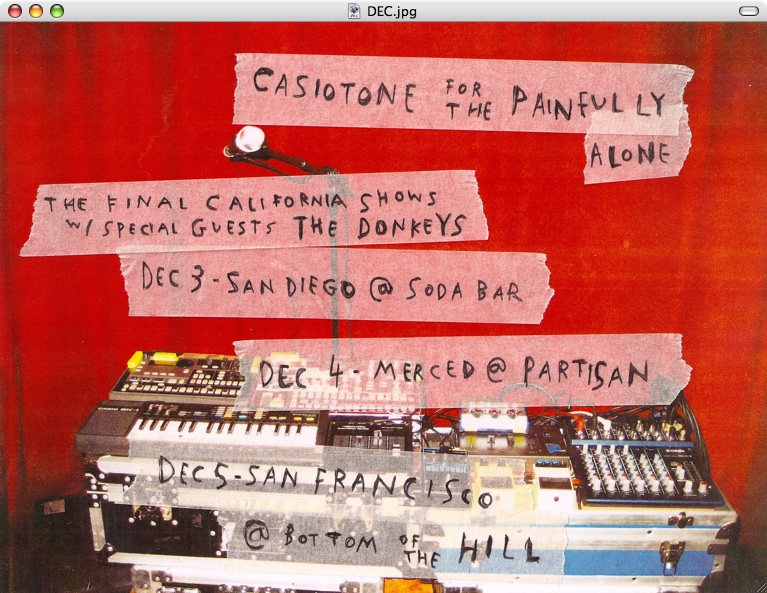
So far, Ashworth’s committed to the plan. On Sunday, Dec. 5, he’ll be back in the city where he started making music, for a final show as Casiotone for the Painfully Alone at Bottom of the Hill.

In a way it’s been a long time coming. Truth is, Owen Ashworth never intended to be Casiotone for the Painfully Alone at all. It was a much of a fluke as his first show in 1997, at a warehouse space at 17th and Capp. “I played that show at the request of a friend of mine who booked it. I had just made tapes and she liked the sound of the tape so she kind of tricked me — she made fliers without asking me to play the show. She thought I wouldn’t say no that way. So I played the show with the idea that this is probably never gonna happen again, I’m gonna get this over with. I remember that I was very nervous, very shaky. I had one keyboard through a really tiny amp.” The next week he had another show booked, under the name of the mixtape he had given his friend: Casiotone for the Painfully Alone.

“It was just the name of a tape I had given her. I didn’t realize it was going to refer to me, you know. Seriously, from the first show to when I decided to quit Casiotone, I considered changing the name the entire time, but having it already done, it seemed like so much work to try and call it someone else. I decided it didn’t really matter, it was just the name and it was kind of catchy and stupid enough for people to remember it. At least in the beginning it described the music pretty well.”

Arguably, the name has mattered. As descriptive as the name was, particularly in the early days, for Ashworth’s distinctive style of indie pop, with consumately pathetic lyrics layered on top of cheap keyboards and electronic samples, it prefigured an audience’s response. The press around each album has been centered around two poles.

First, how closely the music sticks to the sound of a suburban child’s first piano. With each Casiotone for the Painfully Alone album, there has been an incremental departure from the titular keyboard, adding in instruments and collaborators, particularly since 2006’s Etiquette (Tomlab). Ashworth, who in a typically self-effacing fashion describes Casiotone as “an insane, slow learning process, learning how to tour and write and record, doing all of these things and kind of just falling on my face in front of people for the last thirteen years,” sees the development of his instrumental side driving him in separate directions.

“The way I make music is kind of getting fragmented between recording and performance. I’ve been producing for a Chicago rapper, Serengeti, and that’s been my project over the summer. He has a new album coming out on anticon and it’s half stuff he did with me and half with Yoni from WHY? That’s sort of the more electronic side of the music. I enjoy recording that, but it’s not what I’m interested in doing live, so I think it works really well that I’ve been moving into production more. I can fuck with samplers and drum machines in my house and then just sort of give that music to other vocalists. Then for the music that I’ll be taking on the road and being accountable for and presenting over and over again in live settings, I’m more interested in playing with other people and real instruments.”

The Casiotone as an instrument may be easier to move past than the loneliness that Ashworth’s band name invokes and the lyrics bring to life. Simple, sad words that screw in as you listen, about regular people with typical lives. They’ve brought the musician a following, they’ve been his brand. But the association that the audience has for Ashworth and his emotional resonance has also been a nagging burden. “There’s generally a lot of assumption that I’m writing about myself, which is something that when I’m actually writing songs doesn’t occur to me much. I mean it’s fiction. Like any writer I’m inspired by real things that happen to me and my friends but it never occurs to me that it comes off as autobiographical.”

“With the name Casiotone for the Painfully Alone, the original idea was that the Painfully Alone was meant to refer to the listener and the idea of music as comfort music. It didn’t occur to me at the time that people would think that I was referring to myself as the painfully alone person.”

Casiotone records are galleries of character. A pedestrian world populated with eerily familiar people: high school teachers, Scrabble players, cellists, petty thieves, bedroom killers, landlords, and neighbors. Half of them you know by name. Half of them you’ve met before in real life. Sitting down to listen to a Casiotone record, you can relate to the situations. You’ve been in them, or know someone who has. The music engenders an emotional intimacy, it draws you in. “The way I make music is totally a tribute to the music I love and that claustrophobic, really intimate sense, I’m trying to create that because that’s a quality that I have an emotional reaction to in other music,” Owen says.

But the imagined intimacy that the fans has with the music, a sense of something real isn’t what drives Ashworth. “Genuineness isn’t even a factor to me. When I listen to Willie Nelson’s song “Crazy,” it doesn’t occur to me as, ‘Holy shit, Willie Nelson is going through the most intense stuff, I cant believe he’s singing about this.’ I think ‘That’s such a well-written song and he creates such a great atmosphere.’ I want to know how to write songs like that. I admire Willie Nelson as a songwriter, not as this survivor of all kinds of emotional problems.”

Ashworth has the remove of fiction writer for whom characters have there own will. When he talks about his characters, it’s not as a doting mother in whose eyes they can do no wrong, but as a friend who’s seen them make one too many mistakes. “I got really self conscious about what kind of people I was writing about, and I wanted them to start owning up to some of their own problems and take responsibility for the stupid things they did.” This culminated with 2009’s Vs. Children (Tomlab), an album he envisioned even before Etiquette as the end of Casiotone, with “a lot of more family-type relationships where people are having to consider their older relatives, having children and the young people they’re responsible for in their lives. I guess just showing more consequences of irresponsible living.”

It’s not uncommon for fiction writers to look back on old stories, and feel estranged, as if they were written by someone else. Ashworth has felt a similar distancing from his early work. “There are songs I wrote when I was twenty that don’t really mean the same thing to me as at the time that I wrote them. I feel like I’m covering those songs when people request them and it doesn’t feel relevant to me and I think that it would serve the material much better to be sort of left alone in the context of itself than for a man well into his thirties to continue performing these songs written by someone much younger.”

As Ashworth feels more alienated from his work over time, fans feel closer to it, and if they don’t, there’s always the potential for people to discover his early material for the first time, making it brand new all over again. (For better and worse.)

Of course, Ashworth’s not alone in the situation. All artists fight against their early successes, in an attempt to stay relevant, and practically, to stay financially above water. (Ashworth admits at one point, “Casiotone has been my source of income for a good while now and to cut off that source of income is a bit scary, but I can’t be proud of just doing this as a job, there’s gotta be more to it than that.”) For bands, this trend can result in fans demanding to hear “Free Bird” while they’re starting to intro “All I Can Do Is Write About It.” Eventually, almost everyone becomes a cover band of themselves, jamming at the County Fair or playing full albums for a new generation.

There’s always a break between artists and fans. The fans can romanticize the life, not seeing the physical and mental fatigue that can set in after playing the same material over and over, particularly when you damaged your hearing after too many nights being responsible for the full sound mix (as Ashworth has). They might not realize that the nostalgia for an old song never sets in when you play it every night. Or that, like an old marriage, the excitement is gone.

“It was really scary when I started Casiotone, and it felt so great to write a new song and be like ‘I have a new song I can play, my shows can be three minutes longer now.’ Whereas at this point, I feel like at my shows the priority for me is playing new material — [that’s] the stuff that I feel [is] most representative of me now, and that I’m most excited to share and excited to get better playing. But after thirteen years, there are so many songs that people want to hear I feel like I can’t get out of a show without playing — this list of songs that are expected as people;s favorites. I mean it’s super flattering and great,
but it’s really hard to move forward with new work when there’s this expectation for what you’ve done before.”

Ashworth already has an album in mind for the future, called Advance Base, the name of his studio, after the Antarctic meteorological station where Richard E. Byrd spent five months alone, even though it was built for three. Clearly, there are common themes and and interests that will persist in Ashworth’s music. But he’ll take his time and it won’t be under the exhausted banner of Casiotone.

“I’m killing Casiotone. I’m glad you enjoyed it, the records will be forever available, this is the new thing I’m gonna do now. I’m fully aware that there will probably be a smaller audience for the next thing I do. At the very least a different audience, and I’m sure there will be people who are super not on board with the idea that I’m not making what sounds like video game music anymore. That’s fine, and I’m glad Casiotone is still there for those people, but I’m gonna make myself crazy if I keep playing those songs for the rest of my life. I really love writing and recording songs and I just want to concentrate on continuing to do that. Just trotting out a greatest hits set for as long as I make music does not feel like a challenge.”

This may sound a little harsh for the tender-hearted lovers of Casiotone. But Sunday’s show, with accompaniment by the Donkeys and other SF musicians, is likely to be “a longer set, with some older songs I haven’t been playing that much lately. And just some stuff I don’t play usually.” So there you have it. Last chance. For now.

“I’m welcoming the chance to miss those songs.”

Appetite: Delicious giving

0

FOR THE WINO Secrets of the Sommeliers by Rajat Parr and Jordan Mackay — Secrets of the Sommeliers, a new book from local SF treasures (sommelier extraordinaire Rajat Parr and drink writer Jordan Mackay is the best wine book to come across my desk in awhile. Stories from a range of the world’s best somms and winemakers stand alongside insights on tasting, purchasing, storing, pairing, ordering and serving wine. Sections “Thinking Like A Sommelier” and “The Wine List” deliver a true insider’s perspective and expertise. This intelligent, understated book is a must for any wine lover, budding or educated.

FOR THE TIKI FANATIC Beachbum Berry Remixed by Jeff Berry — Whether a retro tiki fanatic or one who prefers drinks reminiscent of an island getaway, this book from modern-day master of tropical cocktails, Jeff Berry (aka Beachbum Berry), satiates. Colorful vintage photos and graphics illumine mid-century history and tiki culture. I’ve tried out a number of the recipes on friends, some from top bartenders, many classic, never-before-published or “lost” exotic drink recipes. I have not run across one yet that is less than crowd-pleasing. Remixed combines Berry’s first two books, Grog Log and Intoxica!, adding 107 recipes for one comprehensive collection.

FOR THE CONSCIENTIOUS COOK Miss Dahl’s Voluptuous Delights: Recipes for Every Season, Mood, and Appetite by Sophie Dahl — A cookbook by a famous model is among the last places I’d look to as a cooking inspiration (I’m skeptical enough of ultra-skinny cooks like Giada). But Dahl is no typical model, having written three books and as a self-professed, avid eater. She’s the daughter of brilliant writer Roald Dahl and actress Patricia Neal. Her oft-discussed weight, modeling at real world sizes (like 10), convinces me she understands “voluptuous”. Her recipes may not be the most challenging on the shelf, rather they are approachable as the book’s layout is charming. Dahl she does not eat red meat: there’s plenty here for a vegetarian. Whether you’re making brown rice risotto with pumpkin or something as simple as flapjacks, Dahl’s personable approach draws you in while her seasonal recipes comfort.

FOR THE DRINK AFICIONADO Boozehound: On the Trail of the Rare, the Obscure, and the Overrated in Spirits by Jason Wilson — Though Boozehound by Washington Post’s spirits columnist Jason Wilson contains over 50 drink recipes, it is more a study on a range of spirits, history mixed with personal experience. His journeys to distilleries around the globe play as engaging travelogue, with breakthrough moments sipping an unusual liqueur or uncovering hype around others. It’s like reading a food memoir but with drink as the backdrop and instigator. The chapter “Bitter is Bella” made me miss Italy’s fabulously bitter palate; I began craving aquavit and bacalao reading Water of Life. His stories of researching tequila in Jalisco, Mexico, or chatting with Borje Karlsson (Karlsson’s Gold Vodka) rekindle my own memories. He explores sips as far-ranging as bianco vermouth, sloe gin, Barolo Chinato and pisco. There is education here, certainly, but via a pleasurable, relaxing read. Like a fine drink, at its finish, I found myself thirsty for more.

FOR THE COCKTAILIAN Speakeasy: The Employees Only Guide to Classic Cocktails Re-Imagined by Jason Kosmas & Dushan Zaric – An elegant book from bartenders behind Employees Only (http://www.employeesonlynyc.com/) in NYC’s West Village, this book lists a range of recipes from classics (e.g. the Martinez) to new drinks that play like classics, such as the Provencal. We have seen compendiums of classic recipes before, but this one ups the game with thoughtful directions and NY flair. Four sections cover categories like aperitifs, punches, cordials and homemade syrups. Inspired by Prohibition-era speakeasies, these two were doing “speakeasy” long before it became a trend. As they state in the section Mastering the Perfect Cocktail: “Every Cocktail Has A Story.” Speakeasy helps you tell stories through the preparation of a drink.

–Subscribe to Virgina’s twice monthly newsletter, The Perfect Spot

Privatizing the parks

23

I’m not going all crazy on the idea of pretzel stands in Golden Gate Park, or even a lobster-roll place behind the bandshell. I’m kind of against the lease change at Stowe Lake because I hate to see an out-of-town operator take over a local concession (and I like the funky boats, and the popcorn, and the overall 1950s-era quality of the food stand, which — by the way — makes the best soda water anywhere in town, yumm, so extra fizzy and nice ….).


But it’s worth sounding the alarm about the direction that Phil Ginsberg and Mark Buell are taking the Recreation and Park Department. And it’s not just evicting the HANC recycling center.


I realize that the city’s broke, and Rec-park is broke, and if they can’t raise money by selling coffee and lobster rolls they might have to lay off even more recreation directors. I fell the pain. But there’s a dangerous road ahead, and it looks like this:


Once you decide that parks have to pay for themselves, you’ve destroyed the whole notion of public space.


Check out what happened at the Presidio, where a plan by Rep. Nancy Pelosi to tun the park into essentially a private outfit, with the mandate to reach financial self-sufficiency, led to all sorts of problems and set the stage for a debate over privatizing more parks.


This is, of course, part of a larger discussion, but parks are by their very nature supposed to be places that the community — the taxpayers — support and preserve for the good of all. They aren’t supposed to pay for themselves. You’re not supposed to charge admission. Any commercial activity ought to be designed to benefit the users (it’s nice to have a place to buy a bottle of water on a hot day or a snack for your kids) and not to pay the maintenance bills for the facility.


This is what annoys me more than anything else about Gavin Newsom. He talks about vision and sounds like an environmentalist and progressive, but he misses the whole point. You fund public services with tax dollars, not by auctioning them off to the private sector.


At least, you used to.

Sip Snack and Shop on Chestnut Street

0

The Marina Merchants Association & The San Francisco Bay Guardian Present:

Sip Snack & Shop on Chestnut Street

Thursday, December 2nd from 6-9PM — Start your holiday shopping this season in the Marina, woo! There’ll be great deals and yummy treats all evening.

Ticket includes:
Tastings from over 20 restaurants and more than 25 beverage sponsors! Raffles & discounts of 15% or more at all participating businesses. Live Entertainment!


$30 Tickets available at http://sipsnackshop.eventbrite.com

Ticketed guests may pick up your wristbands, wine glass, and program guide at either of these locations on Dec. 2nd starting at 6PM:
Eastside West – 3154 Fillmore Street (at Greenwich)
Wells Fargo – 2197 Chestnut Street
Kelly Keiser Splendid Interiors – 2381 Chestnut St.

*All proceeds benefit the Marina Merchants Association.

Participating Businesses
The Animal Connection II | Arbonne International | Benefit | Bin 38 | Books Inc. | Circa | City Optix | Crunch Fitness | E’Angleo | Eastside West | eCosway | GAP | Heritage Row | Isa |J’s Galleria | Jack’s | Judy’s Café | Kara’s Cupcakes | Kelly Keiser Splendid Interiors | Marina & Kebab | Marine Layer | Mezes | Monkey on Chestnut | Pacific Catch | Paper Source | Patxi’s Chicago Pizza | The Plant | Pluto’s | Pottery Barn | Pure Beauty | Rabat | The Republic | Ristorante Parma | San Francisco Optics on Chestnut | SusieCakes | Toss Designs | Two Skirts | Wandering Vet | We Olive | Wells Fargo | Y&I Clothing Boutique

Sponsors
Artesa | Bear Flag | Black Star | Blue Moon | Brugal Rum | Chateau Potelle | DeLoach | Don Pilar | FIJI Water | Haamonii | Honest Tea | Hope & Grace | Hotel Del Sol | Long Meadow Ranch | M Squared | Magners | Millesime Cellars | Pale Moon | Peroni | Pretzel Crisps | Red Bull | Rock Sake | Solerno | Spring Mountain Vineyard | St. Supery | Svedka | Tres Agaves | Trumer | Vivid Bliss | Y. Rousseau

Partners
The Bachelors of San Francisco | Crawl SF | Marina Community Association | PinchIT | San Francisco Ballet | SF City Dish | Spinsters of San Francisco | Urbanis | Yelp

Entertainment
The Clef Divers | The Lollipop Guild, a San Francisco Gay Men’s Chorus ensemble | Marina Middle School Band

For a family-friendly affair on the next night check out Chestnuts on Chestnut: http://www.face

DREAM on

2

sarah@sfbg.com

Spurred by congressional Democratic leaders’ promises to hold a vote on the DREAM (Development, Relief, and Education for Alien Minors) Act before the end of Congress’ lame-duck session this month, immigrant and civil rights advocates are pushing for the passage of bipartisan legislation that would give undocumented youth a shot at citizenship if they go to college or serve in the military for two years.

On Nov. 29 in San Francisco, several undocumented young people joined members of the Bay Area Coalition for Immigration Reform outside Mission High School — where as much as 20 percent of the student population may be undocumented, according to principal Eric Guthertz — to explain why it makes sense to give youth who grew up in the United States a shot at legal status.

“We are not asking you to give us a green card,” Anna, a student from Guatemala, said at the event. “All we want is a chance to succeed and give back to this country. We live here, we pay taxes, we’re smart, we go to college, but afterward we can’t work and give back.”

Mario, a 22-year-old gay student who was born in Peru to a Chinese father and Peruvian mother, graduated from UC Berkeley with a civil engineering degree. He explained that because of his lack of documentation, he can’t get a job to pay his bills or save up to pursue a master’s degree, and fears being deported to a homophobic country.

“It would be a waste of talent because I’ve learned California-specific engineering rules and the U.S. building code,” Mario said. “Sometimes I wake up from a nightmare about being detained. I came out here, but in Peru, I’d probably be back in the closet.

Joining Anna and Mario was Shing Ma “Steve” Li, a nursing student at City College, who was released Nov. 19 after two months in federal detention, shortly before he was to be deported to Peru. San Francisco Democrat Sen. Dianne Feinstein introduced legislation to halt his removal, saying it would be “unjust” to deport Li before a DREAM Act vote takes place.

Li, who speaks Cantonese, English, French, and Spanish, grew up reciting the Pledge of Allegiance and dreams of opening a clinic to serve low-income San Franciscans. But recently, federal immigration authorities flew him 800 miles to a jail in Arizona, all because his parents brought him here when he was 12 and he lacks documentation.

“We were handcuffed and shackled to our seats, and I wondered what would happen if the plane went down,” Li recalled.

Li believes the main barriers to the legislation’s passage is lack of accurate information. “People need to know the facts, see the people, and hear their stories,” Li said. “Then they’ll know it is a human rights issue.”

Guthertz said that as principal of Mission High, every year he sees undocumented youth who have great grades and lots of advanced placement classes “hit the wall” of their status. “Over and over, I’ve seen the heartbreaking effect of their situation,” Guthertz said. “The DREAM Act is yet another avenue to help these students.”

Eric Quezada, executive director of Dolores Street Community Services, noted that congressional leaders did not agree to the DREAM Act vote “out of the goodness of their heart — it’s because of the hard work of immigrant advocates.”

Quezada said the push to force a DREAM Act vote in Congress this year began when undocumented youth staged a sit-in in Sen. John McCain’s (R-Ariz.) office in May. “And the vote of Latinos saved the Senate from a Republican takeover on Nov. 2,” he said.

“But we understand this window is closing,” Quezada added, referring to the reality that Republicans will take control of the House in January. “So we’re not taking one vote for granted. And this is the first step. If we are able to pass the DREAM Act, it will be a downpayment for comprehensive immigration reform.”

Sup. John Avalos says the DREAM Act recognizes the contribution immigrants make to the community, and to the creation of economic opportunities for everybody. “Immigrants here support themselves and their families across the water, so it makes sense that we make proper investments and support,” Avalos said. “Education is one way to make the world a more stable place.”

Sup. David Campos, who came to the U.S. from Guatemala as an undocumented teenager, sees the DREAM Act as a piece of commonsense legislation.

“It’s so modest,” Campos said. “Even those who are against comprehensive immigration reform should be for something that recognizes that young people, who came here not by choice but because of their parents’ issues, should be given a chance to give back.”

Campos said his father was able to gain legal status for his whole family because of his employment, but that many undocumented youth aren’t so lucky.

“We open the doors to our public schools, we invest in their education, and then, when they are ready to give back to us, we say, ‘No, we don’t want you here,'” Campos said. “The best and brightest, the risk-takers, come here. As a country, we cannot go forward unless we realize that this influx of creativity and entrepreneurship made this country what it is.”

The biggest fish

6

rebeccab@sfbg.com

Shortly after Larry Ellison, the billionaire CEO of Oracle Corp. and owner of the BMW Oracle Racing Team, won the 33rd America’s Cup off the coast of Valencia, Spain, in February 2010, a reception was held in his honor in the rotunda at San Francisco City Hall.

The event drew members of Ellison’s sailing crew, business and political heavyweights such as former Secretary of State George Schultz, and other VIPs. Attendees posed for photographs with the tall, glittering silver trophy at the base of the grand staircase.

As part of the celebration, Ellison helped Mayor Gavin Newsom into an official BMW Oracle Racing Team jacket, and Newsom granted Ellison a key to the city, a symbolic honor usually reserved for heads of state and the San Francisco Giants after they won the World Series. Shortly after, the mayor and the guest of honor, whom Forbes magazine ranked as the sixth-richest person in the world, sat down for a face-to-face.

That meeting marked the beginning of the city’s bid to host the 34th America’s Cup in San Francisco in 2013. Since securing the Cup, Ellison has made no secret of his desire to stage the 159-year-old sailing match against the iconic backdrop of the San Francisco Bay, a natural amphitheater that could be ringed with spectators gathered ashore while media images of the stunningly expensive yachts are broadcast internationally.

Newsom and other elected officials have feverishly championed the idea, touting it as an opportunity for a boost to the region’s anemic economy. The city’s Budget & Legislative Analyst projects roughly $1.2 billion in economic activity associated with the event — the real prize, as far as business interests are concerned. It would also create the equivalent of 8,840 jobs, mostly in the form of overtime for city workers and short-term gigs for the private sector.

While the idea has won preliminary support from most members of the Board of Supervisors, serious questions are beginning to arise as the finer details of the agreement emerge and the date for a final decision draws near.

Ellison and the race organizers would be granted control of 35 acres of prime waterfront property in exchange for selecting San Francisco as the venue for the Cup and investing $150 million into Port of San Francisco infrastructure. But the event would result in a negative net impact to city coffers.

Hosting the event and meeting Ellison’s demands for property would cost the city about $128 million, according the Budget & Legislative Analyst, just as city leaders grapple with closing a projected $712 million deficit in the budget cycle spanning 2011 and 2012.

Part of the impact is an estimated $86 million in lost revenue associated with rent-free leases the city would enter into with Ellison’s LLC, the America’s Cup Event Authority (ACEA). In exchange for selecting San Francisco as a venue and investing in port infrastructure, ACEA would win long-term control of Piers 30-32, Pier 50, and Seawall Lot 330 — waterfront real estate owned by the Port of San Francisco, with development rights included. Seawall Lot 330, a 2.5-acre triangular parcel bordered by the Embarcadero at the base of Bryant Street, would either be leased long-term or transferred outright to ACEA.

The most vociferous opponent of the America’s Cup plan is Sup. Chris Daly, who has voiced scathing criticism of the notion that the city would subsidize a billionaire’s yacht race at a time of fiscal instability. “The question is whether or not the package that San Francisco’s putting together is good or bad for the city,” Daly told the Guardian, “and whether or not it’s the best deal the city can get.”


THE CREW

According to a Forbes calculation from September 2010, Ellison’s net worth is $27 billion, making him several times wealthier than the City and County of San Francisco, which has a total annual budget of about $6 billion. Ellison reportedly spent $100 million and a decade pursuing the Cup.

As soon as Ellison expressed interest in bringing the Cup to San Francisco, Newsom began charting a course. Park Merced architect and Newsom campaign contributor Craig Hartman of the firm Skidmore, Owings & Merrill was tapped to reimagine the piers south of the Bay Bridge as the central hub for the event, and soon Hartman’s vision for a viewing area beneath a whimsical sail-like canopy was forwarded to the media.

The mayor also issued letters of invitation to form the America’s Cup Organizing Committee (ACOC), a group that would be tasked with soliciting corporate funding for the event. ACOC was convened as a nonprofit corporation, and it’s a powerhouse of wealthy, politically connected, and influential members.

Hollywood mogul Steve Bing, who’s donated millions to the Democratic Party and funded former President Bill Clinton’s 2009 trip to North Korea to rescue two imprisoned American journalists, is on the committee. So is Tom Perkins, a Silicon Valley venture capitalist, billionaire, and former mega-yacht owner who was once dubbed “the Captain of Capitalism” by 60 Minutes. George Schultz and his wife, Charlotte, are members. Thomas J. Coates, a powerful San Francisco real estate investor who dumped $1 million into a 2008 California ballot initiative to eliminate rent control, also has a seat. Coates resurfaced in the November 2010 election when he poured $200,000 into local anti-progressive ballot measures and the campaigns of economically conservative supervisorial candidates.

Billionaire Warren Hellman, San Francisco socialite Dede Wilsey, and former Newsom press secretary Peter Ragone are also on ACOC. There are representatives from Wells Fargo, AT&T, and United Airlines. One ACOC member directs a real estate firm that generated $2.5 billion in revenue in 2009. Another is Martin Koffel, CEO of URS Corp., an energy industry heavyweight that made $9.2 billion in revenue in 2009. There’s Richard Kramlich, a cofounder of a Menlo Park venture capital firm that controls $11 billion in “committed capital.” And then there’s Mike Latham, CEO of iShares, which traffics in pooled investment funds worth about $509 billion, according to a BusinessWeek article.

There’s also an honorary branch of ACOC composed of elected officials including House Minority Leader Nancy Pelosi, Gov. Arnold Schwarzenegger, Sen. Dianne Feinstein, and others. Their role is to help the Cup interface with various governmental agencies to control air space, secure areas of the bay exclusively for the event, set up international broadcasts, and bring foreign crew members and fancy sailboats into the United States without a hassle from immigration authorities.

ACOC is expected to raise $270 million in corporate sponsorships for the America’s Cup. That money will be funneled into the budget for ACEA. It’s unclear whether the $150 million ACEA is required to invest in city piers will be derived from ACOC’s fund drive.

The city also anticipates that ACOC would raise $32 million to help defray municipal costs. “However,” the Budget & Legislative Analyst report cautions, “there is no guarantee that any of the anticipated $32 million in private contributions will be raised.”

A seven-member board, chaired by sports management executive Richard Worth, will direct the ACEA, according to Newsom’s economic advisors, but the other six seats have yet to be filled. ACEA’s newly minted CEO is Craig Thompson, a native Californian who previously worked with a governing body for the Olympics and has helped coordinate major sporting events internationally. In an interview with sports blog Valencia Sailing, Thompson provided some insight on why major corporations might be inspired to donate to the cause. Basically, the Cup is the holy grail of networking events.

“It’s a very difficult economic situation we are going through, and it’s not the best time to be looking for sponsors for a major event,” Thompson acknowledged. “On the other hand, the America’s Cup is one of the very few activities … that offer access to really top-level individuals in terms of education or economic situation. The America’s Cup is a unique platform for a lot of companies that want access to those individuals that are very difficult to reach under normal circumstances. I can tell you for example that Oracle is very pleased with the marketing opportunity the America’s Cup has presented to them. They invite their best customers and are very successful in turning the America’s Cup into a platform for generating business. The same thing can be true for a lot of different companies that need access to wealthy individuals.”

But should San Francisco taxpayers really be subsidizing a networking event for the some of the business world’s richest and most powerful players?


TRANSFORMING THE WATERFRONT

Over the past four months, Newsom’s Office of Economic and Workforce Development (OEWD) has been negotiating with race organizers to hash out a Host City Agreement outlining the terms of bringing the America’s Cup to San Francisco.

The proposal will go before the Board of Supervisor’s Budget & Finance Committee on Dec. 8, and to the full board Dec. 14. A final decision on whether San Francisco will host the race is expected by Dec. 31. ACEA and ACOC will each sign onto the agreement with the City and County of San Francisco.

From the beginning, the event was envisioned as “the twin transformation,” according to OEWD — the America’s Cup would be transformed by attracting greater crowds and heightened commercial interest while San Francisco’s crumbling piers would be revitalized through ACEA’s $150 million investment in port infrastructure.

The plan paints downtown San Francisco as the “America’s Cup Village” during the sailing events, and a study produced by Beacon Economics estimates that the financial boost would come primarily from hordes of visitors flocking to the event — more than 500,000 are expected to attend. The city expects a minimum of 45 race days, including one pre regatta in 2011 and one in 2012 (or two in 2012 if the one in 2011 doesn’t happen), a challenger series in 2013, and a final match in 2013.

The transformation of the city’s waterfront would be dramatic. In addition to the rent-free leases for Piers 30-32, 50, and Seawall Lot 330, ACEA would be granted exclusive use of much of the central waterfront, water, and piers around Mission Bay, and water and land near Islais Creek during the course of the event. Under the Host City Agreement, race organizers would have use of water space spanning Piers 14 to 22 ½; Piers 28, 38, 40, 48, and 54, a portion of Seawall Lot 337, and Pier 80, where a temporary heliport would be sited.

Seawall Lot 330, a 2.5-acre parcel valued by the Port at $33 million, lies at the base of Bryant Street along the Embarcadero and has a nice unimpeded view of the bay. Piers 30-32 span 12.5 acres, and Pier 50 is 20 acres.

The Budget & Legislative Analyst’s study predicts that the ACEA could opt to build a 250-unit condo high-rise on Seawall Lot 330, deemed the most lucrative use. Under the Host City Agreement, the city would be obligated to remove Tidelands Trust provisions from Seawall Lot 330, which guarantee under state law that waterfront property is used for maritime functions or public benefit. Tweaking the law for a single deal would require approval from the State Lands Commission, but Newsom, in his new capacity as lieutenant governor, would cast one of the three votes on that body.

The combination of construction, demolition, lost rent revenue, police and transit, environmental analysis, and other event costs would hit the city with a bill totaling around $64 million, according to the Budget & Legislative Analyst study. Since city government would recoup around $22 million in revenue from hosting the Cup, the net impact would be around $42 million. That doesn’t include the potential $32 million assistance from ACOC.

At the same time, the city would stand to lose another $86.2 million by granting long-term development rights to 35 acres of Port property for 66 to 75 years without charging rent, bringing the total cost to $128 million. OEWD representatives played down that loss in potential revenue, saying past attempts to redevelop piers hadn’t been successful because none could handle the upfront investment to revitalize the crumbling piers.

The Host City Agreement has raised skepticism among Port staff and the Budget Analyst that tempered initial enthusiasm for the event. “The terms of the Host City Agreement will require significant city capital investment and will result in substantial lost revenue to the Port,” a Port study determined. Faith in that plan seems to be eroding and it may be scrapped for an alternative plan that’s cheaper for the city.

The Northern Waterfront alternative substitutes Piers 19-29 as the primary location for the event and eliminates the Mission Bay piers from the equation. Under this scenario, ACEA would invest an estimated $55 million, instead of $150 million. In exchange, it would receive long-term development rights to Piers 30-32 and Seawall 330 on “commercially reasonable terms,” according to a Port staff report.

Board of Supervisors President David Chiu requested that the Port explore that second option more fully, and the Port report notes that it would reduce the strain on Port revenue. The Northern Waterfront plan would cost the Port a total of $15.8 million, instead of $43 million, the report notes. Port staff recommended in its report that both the original agreement and the alternative be forwarded to the full board for consideration.


PHANTOM BIDS?

Under the competition’s official protocol, Ellison, as defender of the Cup, has unilateral power to decide where the next regatta will be held. Race organizers have said it’s a toss-up between San Francisco and an unnamed port in Italy — though it’s anyone’s guess how seriously a European site is being considered by a team headquartered at the Golden Gate Yacht Club, a stone’s throw from the Golden Gate Bridge.

According to a San Francisco Chronicle article published in early September, Newsom issued a memo stating that San Francisco was competing against Spain and Italy to become the chosen venue. Valencia was said to be offering a “generous financial bid,” and a group in Rome was rumored to have offered some $645 million to bring the Cup to Italian shores, the memo noted. It was a call for the city to present Ellison with the most attractive deal possible to compel him to pick San Francisco.

Speaking at an Oct. 4 Land Use Committee hearing, OEWD director Jennifer Matz told supervisors: “San Francisco was designated the only city under consideration back in July. Now we are competing against the prime minister of Italy and the king of Spain.”

However, the veracity of those claims came into question in mid-November. Daly, incensed that the Mayor’s Office never communicated with him about the Cup despite wanting to hold it in his sixth supervisorial district, launched his own personal investigation. He fired off an e-mail to Team Alinghi, a prior America’s Cup winner, and began communicating with other European contacts until he got in touch with someone in Valencia’s municipal government.

“I got a call back from a representative who basically said I should know something,” Daly recounted. Valencia, his source said, never submitted a bid to host the Cup. At a Nov. 13 press conference, Valencia’s mayor Rita Barbera confirmed this claim, according to a Spanish press report, expressing disappointment that the city had been eliminated from consideration as a host venue. “There was no formal bidding process,” she charged. She also denied reports that any money had been offered.

Meanwhile, the Budget Analyst was unable to find any concrete evidence that other host city bids had been submitted. “We have nothing to confirm that other offers have been made,” Fred Brousseau of the Budget Analyst’s office told the Guardian.

In response to Guardian queries about whether the Mayor’s Office had evidence that Italy had indeed submitted a bid, Project Manager Kyri McClellan of the OEWD forwarded a one-page resolution from the Italian prime minister assuring race organizers that there would be tax breaks, accelerated approvals, and other perks guaranteed if the Cup came to Italy. However, an Italian journalist who looked over the resolution told the Guardian that the document didn’t appear to be a formal bid, merely a response to a query from race organizers.

Daly has his doubts that either Valencia or the Italian port were ever seriously considered. “I think they were phantom bids,” he said, “created by either Larry Ellison or the Newsom administration … to place pressure on the Board of Supervisors.”

A representative from OEWD told the Guardian that officials have no reason to doubt that the European bids, and accompanying offers of money, were real. However, the city wasn’t privy to race organizer’s discussions about possible European venues. A final decision is expected before the end of the year.

Daly hasn’t held back in voicing opposition to the America’s Cup and blasted it at an Oct. 5 Board meeting. “This tacking around Sup. Daly will not get you in calmer waters,” Daly said. “I told myself I was not going to make a yachting reference. But I will bring a white squall onto this race and onto this Cup, and I will do everything in my power starting on Jan. 8 to make sure these boats never see that water.”


WIND IN WHOSE SAILS?

The America’s Cup would undoubtedly bring economic benefit to the area and create work at a time when jobs are scarce. Police officers would get overtime. Restaurant servers would be scrambling to keep up with demand. Construction workers seeking temporary employment would get gigs. Hotels would rake it in. Pier 39 would be booming. However, the Budget Analyst report cautioned: “It is unlikely that any labor benefits would remain in the years after the America’s Cup event is completed.”

Certain small businesses would catch a windfall. John Caine, owner the Hi Dive bar at Pier 28, didn’t hesitate when asked about his opinion on the city hosting the Cup. “Please come fix our piers. It’s a shout-out to Larry Ellison,” he said. Caine said he supports the America’s Cup bid 100 percent, and is excited about the boost it could give his business. The Hi Dive would not be required to relocate under the proposal, he added.

At the same time, other small business would be negatively affected, particularly those among the 87 Port tenants who would be forced to relocate to make way for the America’s Cup. The Budget Analyst’s report also notes that retail businesses in the area whose services had no appeal to race-goers might suffer from reduced access to their stores, since crowding and street closures would shut out their customers.

The sailing community has rallied in support of the Cup, and Newsom has received hundreds of e-mails from yachting enthusiasts from as far away as Hawaii and Florida promising to travel to San Francisco with all their sailing friends to watch the world-famous vessels compete.

Ariane Paul, commodore of a classic wooden boat club called the Master Mariners Benevolent Association, told the Guardian that she was excited about the opportunity for the America’s Cup to showcase sailing on the bay. “In the long term, it’s a win-win,” Paul said. “It would be great to have that boost.” As for the financial terms of the deal, she remained confident, saying, “I don’t think that the city is going to let Larry Ellison walk all over them.”

Sup. Ross Mirkarimi is often politically aligned with Daly, but not when it comes to the issue of the America’s Cup. As a kid growing up on the island of Jamestown, a tiny blue-collar community located off the coast of Rhode Island, Mirkarimi learned to sail and occasionally spent summers working as a deckhand. Every few years, the America’s Cup would come to nearby Newport, transforming the area into a bustling hub and bringing the locals into contact with famous sailors. It left an everlasting impression. When the BMW Oracle Racing Team secured the 33rd Cup off the coast of Valencia, Mirkarimi did a double-take when he saw a photograph of the winning team — his childhood friend from Rhode Island was on the crew.

Mirkarimi told the Guardian he supports bringing the Cup to San Francisco because of the economic boost the area will receive — if the Cup continues to return to San Francisco as it did for 53 years in Newport, he said, the city could look forward to a free gift in improved revenue associated with the event, and that could help quiet the tired annual debates over painful budget cuts.

At the same time, he acknowledged that the Budget Analyst report had prompted what he called healthy skepticism. “I think the onus is on the city and Cup organizers to make sure the benefits far, far outweigh the investment,” Mirkarimi said. “This effort is not just about making one of the wealthiest men in the United States that much more wealthy … That can’t be the case,” he said. “It has to be about what will the Cup do in order to be a win-win for the people of San Francisco.” Mirkarimi said he expected scrutiny of the details of the agreement at the Dec. 8 Budget and Finance Committee hearing: “Naturally, in this time of economic downturn … people want to know, what’s the outlay of cost, and what are we going to get in return?” 

The high harvest

0

caitlin@sfbg.com

CULTURE “There was some sweet in there and some spice — it was like finger food, you could eat it like chips.” Larry Medders, 11-year resident of the Cecil Williams Glide Community House, is showing off the new rooftop garden, installed by the San Francisco Zen Center, on top of his nine-story supportive housing complex. He’s talking about his introduction to kale.

Medders cooks for himself in his studio apartment and used to stick to the same meals. He likes pasta and herbal teas, which he now brews with the mint and chamomile growing upstairs. An older man from the South endowed with a becoming drawl, he comes up once a day “to water and make sure everything’s in its place.” At the opening ceremony for the new green space, Medders tried the iron-rich greens for the first time. “Now I’m hooked,” he says.

If a once-bare Tenderloin rooftop seems like an incongruous spot to grow spinach, carrots, lemons, blueberries, parsley, onions, and tomatoes (a few of the nascent crops at the Community House), it shouldn’t. The buzzing streets below Medders’ feet offer sparse play areas for children, occasional safety risks, and few places to buy fresh veggies.

The city has tried to attract grocery stores to the area, so far unsuccessfully. “Grocery store operators and other retailers perceive that the area is unsafe and have expressed concerns about the safety of their employees and customers,” says Amy Cohen, director of neighborhood business development. TL residents largely must content themselves with corner stores for neighborhood shopping trips — a bummer for low-income seniors who live in the area.

For the residents of Community House’s 55 units — many dealing with life post-addiction and homelessness and all low income — the roof was already a place to gather. Building barbeques were common. But they knew the rooftop could be much more. “I just wanted to see more greenery, because it really is beautiful,” Medders says.

Enter the San Francisco Zen Center (www.sfzc.org). The center has operated in tandem with Muir Beach’s Green Gulch Farm since the early 1970s, providing a green dojo for meditation students and producing organic produce for restaurants such as Greens in Fort Mason. Says Zen Center vice president Susan O’Connell, “the color green alone is calming, the oxygen and the sense of being surrounded by life.” Gardening can aid in one’s quest for enlightenment, she says. “Zen takes a lot of different forms, it’s not just sitting down.”

Taking inspiration from a garden next door on top of Glide Church, the Zen Center pledged to fill Community House’s communal space with veggies. Now 15 planter boxes built by construction training nonprofit Youth Builds stand at different heights so children and residents in wheelchairs can work them. There are compost bins, shaded tables, chairs, a sink where cooking classes will be held once a local artist finishes painting a mural on the surrounding wall.

The roof’s design, plotted by ex-Green Gulch apprentice Jamie Morf, is laid out so residents can socialize (when Medders and I toured the roof, three children were eating a late lunch on one of the round tables) as well as sit and be thoughtful in nooks designed with peace in mind. “One of the most important precursors to being able to meditate is called taking refuge. But that’s really hard for people in the Tenderloin,” O’Connell says.

We are joined by Patty Rose and Arlinda Van Brunt, two other long-term residents who, with Medders, have stepped up to form the core gardening group. The three teach me about the challenges of running a plot that belongs to every one of the residents living in a nine-story building, including many who have never tended a kitchen garden before. The learning curve can include beginner’s missteps, like overpicking a hardy green onion plant that the trio laments.

“Look at this,” Van Brunt, an energetic woman whose father’s landscaping career left her with a severe aversion to seeing mistreated plants, is pointing at a vertical potato cage that doesn’t seem to be producing the same bushy green leafs as its neighbor. “They overwatered it! It’s our first year, we’re still finding a lot of things out.”

But these kinds of small setbacks show that the garden is being used — and often, they lead to new discoveries in and of themselves. The aforementioned rotting potato cage attracted the notice of the roof’s nightcrawlers, which must have scooted the 10 feet between their two massive bins to the cage, where they were discovered by Van Brunt.

The composting process in the worm bins is now one of her favorite parts of the garden. With the aid of Medders, she lifts the heavy metal lid of one of the bins and pulls aside the shredded newspaper piled on top of the composting material. Underneath, there is a teeming, squirming mass of pink worms. Van Brunt tenderly fingers a handful of them. “Look at that, are they really breeding in there? The nastier it is, the more they like it,” she says, exhibiting the satisfaction of a woman who has taken charge of her food system.

Tofurky no! 3 veggie vittles for your day of thanks

1

Hello vegetarians. I’m checking in for quick sec – are we braving the snarky Tofurky asides and dietary litigation with the extended fam well this year? I hopes. 

The holidays can be a trickily-navigated time for the meatless maverick – but they also present a sweet opportunity to show your loved ones that this whole rejection of the agro-business line can be both heart and belly-warming. Call it culinary evangelism if you must. Read on for some gems from the newest crop of vegan and vegetarian cookbooks that’ll have everyone at the table giving thanks.


Cranberry–cashew biryani 

From Isa Chandra Moskowitz’s Appetite For Reduction (Da Capo, 336 pages, $19.95)

Moskowitz is royalty in the vegan punk cupcake world, and her knack for the realm of savory snacks seems to have hit a nerve with her last popular release, Veganomicon. Appetite For Reduction (set for release Dec. 7) follows the same straight-forward format, this time focusing on vegan foods that are exceptionally good for the old waist line for all you double-time health nuts. This Indian-inflected rice dish will be the perfect substantial side to impress on your parents that you’ve learned to cook, suddenly, somehow. Throwing your own pilgrim party? Moskowitz’s excellent food blog, Post Punk Kitchen has a mega-recipe for vegan Thanksgiving in an hour. AN HOUR. Rock. For the purpose of this biriyani, by the way, cashew pieces equals roughly chopped nuts. 

Serves 4 

1 teaspoon vegetable oil

1 teaspoon cumin seeds

1 teaspoon mustard seeds

3 cloves garlic, minced

1 cup small-diced carrots

1 cup brown jasmine or basmati rice

1 teaspoon garam masala

1/4 teaspoon turmeric

1/4 teaspoon red pepper flakes

1/2 teaspoon salt

2-1/2 cups water

1 tablespoon tomato paste

1/4 cup dried cranberries

1/4 cup roasted cashew pieces

1/2 cup frozen peas

chopped fresh cilantro, for garnish (optional)

Preheat a 2-quart pot over medium heat. Pour the oil into the pot and mix in the cumin and mustard seeds. Cover the pot and let the seeds pop for about a minute, or until the popping slows down, mixing once. If the seeds don’t pop, turn up the heat a bit until they do.

Add the garlic and sauté for about a minute. Add the carrots, rice, garam masala, turmeric, red pepper flakes, and salt, and stir constantly for about a minute. Add the water and tomato paste. Cover and bring to a boil. Once boiling, lower the heat as low as it will go and cook, covered, for about 40 minutes.

After 40 minutes the water should be mostly absorbed. Stir in the cranberries, cashews, and peas. Cook for another 15 minutes or so, until the water is completely absorbed. Fluff the rice with a fork and serve topped with the cilantro, if using.


Shepard’s pie with chard-lentil filling and onion gravy

From Kim O’Donnel’s The Meat Lover’s Meatless Cookbook (Da Capo, 264 pages, $16.95)

A pie plate of power – even if the stuffing’s got pork and the carrots came into an unholy alliance with chicken stock, this shepard’s pie will be at the ready to guide you into fields of fullness at your family’s table. O’Donnel, a one-time writer for the Washington Post, has put together a satisfying bunch of recipes in this book, which empowers the reader to make cruelty-free concotions that mimic even the most traditional of comfort foods. The recipe bellow has got a lot going on, stove-top acreage requirement wise – O’Donnel recommends starting the lentils first, then working on the gravy while they simmer.

Serves 6

Wine-braised lentils

1 tablespoon vegetable oil

1/2 cup onion, diced

1/4 cup carrot, peeled and diced

1 sprig fresh thyme, or

1/2 teaspoon dried

1/2 cup dried brown or green lentils, rinsed (the smaller French lentilles du Puy, with a more refined texture, are my preference, but they’re not always available. Use what you can find in your local market.)

2 tablespoons red wine you enjoy drinking

3/4 to 1 cup water

1/4 to 1/2 teaspoon salt

In a small saucepan, heat the oil over medium heat and add the onion, carrot, and thyme. Cook for about 5 minutes, until slightly softened. Add the lentils and stir to coat. Add the red wine (if using) and bring to a lively simmer. The wine will reduce a bit. Add 3/4 cup of thewater, return to a lively simmer, then lower the heat, cover and cook until fork tender, about 40 minutes. Check and add a little extra water if need be, to keep the lentils from drying out completely. Stir in ¼ teaspoon of the salt, taste, and add the remaining salt, if needed.

Makes 11/2 cups. If you love these lentils, amounts may be doubled for a big pot that will keep for days and pair up seamlessly with your favorite grain.


Onion gravy

3 tablespoons butter

2 cups onions, sliced thinly into half-moons

1 or 2 sprigs fresh thyme

1 tablespoon balsamic vinegar

2 cups water

1 tablespoon cornstarch dissolved in 1 tablespoon water

1/2 teaspoon salt

Pinch of sugar

1 teaspoon soy sauce

In a deep skillet, melt the butter over medium heat and add the onions and thyme. With tongs, toss to coat the onions with the butter and cook over medium-low heat, until softened, reduced, and jamlike, about 25 minutes.

Add the balsamic vinegar, stir, and cook for an additional 5 minutes.

Add the water and bring to a lively simmer. Reduce by half, about 15 minutes. Stir in the cornstarch mixture and cook for an additional 5 minutes; the gravy will continue to reduce. Stir in the salt and sugar, and taste. Finish off with the soy sauce.

Turn off the heat, cover, and gently reheat at a simmer, just before serving with pie.

Makes approximately 11/2 cups


Shepard’s pie

1 cup wine-braised lentils

11/2 cups onion gravy 

2 pounds medium-size potatoes

(4 to 5 potatoes; my favorites are Yukon Gold or Yellow Finn), washed, trimmed/peeled as needed, and cut into quarters

2 teaspoons salt

3 cloves garlic, peeled but left whole

5 tablespoons olive oil

Ground black pepper

3 to 4 cups chard (from 1 bunch), washed, stemmed, and chopped finely into “ribbons”

1 clove garlic, chopped roughly

1/4 teaspoon freshly grated nutmeg

1/4 cup grated Parmigiano-Reggiano cheese

Grease a 9-inch pie plate.

Fill a medium-size saucepan with 4 cups of water, and add the potatoes and salt. The water should just barely cover the potatoes. This is important.

Cover and bring to a boil. Add the whole garlic. Return the lid and cook until fork tender, about 30 minutes.

Preheat the oven to 350°F.

With a slotted spoon or skimmer, transfer the potatoes and garlic to a large mixing bowl and mash with a hand masher. Stir in the reserved cooking liquid as necessary to moisten the potatoes. Add 3 tablespoons of the olive oil and stir in vigorously with a wooden spoon. Taste for salt, pepper, and texture and season and stir accordingly; mashed potatoes should be smooth and well seasoned.

In a large skillet, heat the remaining olive oil over medium heat and cook the chard with the chopped garlic, until wilted, 3 to 5 minutes, regularly tossing with tongs to cook evenly. Stir in the nutmeg and season with more salt to taste, if needed. Transfer to a medium-size bowl.

Portion out 1 cup of the lentils (the rest is cook’s treat) and stir into the chard until well combined.

Assemble the pie: Transfer the chard mixture to the greased pie plate. Top with the mashed potatoes, and with a rubber spatula,

smooth the mash so that it’s evenly distributed and completely covers the surface. Top off with grated Parmigiano-Reggiano.

Place the dish in the oven and heat through, 20 to 25 minutes. During the final 2 minutes of cooking, set the oven to the broil setting to brown the cheesy-mashed top.

Remove from the oven, slice into wedges, and eat hot with a ladleful of onion gravy.


Butternut squash and vanilla bean risotto

From Jenn Shagrin’s Veganize This! (Da Capo, 256 pages, $19)

True to its name, Veganize This! takes on the challenge of de-meatifying things that you never knew could be made animal-free (sea bass and beef ragu, anyone?) Sadly, this means it relies a lot on processed meat substitutes, but the end result of all the Mimicreme and soy products does tend to be delicious. The book includes an entire chapter on surviving the holidays, veganism intact — from whence sprang this recipe. Originally seen on Giada De Laurentiis’ Italian cooking show, this risotto is raring to go for Turkey Day. You gotta check out the book’s Jewish treats, too: vegan matzo ball soup and kugel! 

Serves 6

4 cups vegan vegetable broth

1 large vanilla bean

12 ounces butternut squash, peeled and cubed

3 tablespoons vegan margarine

3⁄4 cup onion, chopped finely

11⁄2 cups arborio rice

1⁄2 cup dry white wine

1⁄2 cup nut cheese (any flavor), grated finely, or 1⁄4 cup vegan parmesan blend plus 1⁄4 cup vegan mozzarella, grated finely

1⁄2 teaspoon salt

Cracked white peppercorns

2 tablespoons chives, chopped finely (for garnish)

Warm the vegetable broth in a saucepan over medium-high heat. Split the vanilla bean in half lengthwise, scrape out the seeds, and add, along with the empty bean pod, to the broth.

Bring to a simmer, then lower the heat to low. Add the squash to the simmering broth, and cook until desired tenderness, about 10 minutes. Remove the squash with a slotted spoon and set aside. Lower the heat to low and cover the pot.

While the broth is covered and simmering, take a large, heavy saucepan and melt 2 tablespoons of the margarine over medium heat. Add the onion and sauté until tender, about 3 minutes. Add the rice and stir well with the margarine.

Add the wine and simmer until it has almost completely evaporated, about 3 minutes. Add 1⁄2 cup of the simmering broth and stir until almost completely absorbed, about 2 minutes. Continue cooking the rice, adding the broth 1⁄2 cup at a time, stirring constantly. Allow each addition of the broth to absorb before adding the next, until the rice is tender but still firm to the bite and the mixture is creamy, about 20 minutes total.

Discard the vanilla bean pod. Turn off the heat. Gently stir in the butternut squash, cheese, the remaining tablespoon of margarine, and the salt.

Transfer the risotto to a serving bowl and sprinkle with chives. Serve!


Whip your hair back: Disney’s “Tangled” stars speak

0

Walt Disney was right all along: dreams do come true. That is, if you’re Zachary Levi and Mandy Moore, and your dream is to be in an animated Disney movie. Levi and Moore star as Flynn and Rapunzel in Tangled, a fresh adaptation of the fairy tale about the princess with way too much hair. While Levi admits an affinity for Aladdin, Moore was always an Ariel fan.

“For our generation, I feel like that’s what every girl wanted to be,” Moore says. “What little girl doesn’t dream of being a Disney princess?” Both actors were also thrilled to be working with noted (and Academy Award-winning) Disney composer Alan Menken. Levi expressed a lifelong devotion to 1992’s Newsies, though he’s a fan of Menken’s other work as well.

“[Working with Alan Menken] is bucket list,” Levi says. “It’s crazy, crazy bucket list. We both grew up knowing and singing all the songs to Little Mermaid, Beauty and the Beast, Aladdin.”

Moore continues, “I just found out he did Little Shop of Horrors last night, and I about lost it.”

According to the actors, one of the strangest aspects of the voiceover experience was not working directly with co-stars. While Levi and Moore did collaborate on their duet, most of their acting was done separately and pieced together after they were finished.

“We never worked with each other at all on the movie, except for the duet,” Moore notes. “That is a total testament to the directors for cobbling these performances and creating the chemistry.” In some ways, that made things easier — especially for Moore, who admits to being shy.

“There was a whole session when it was like, ‘And now you’re running from the water that’s chasing you, and now you have to jump and leap and cry and eek,’” she recalls. “I was definitely sort of like, ‘Phew, I’m glad no one’s here to see me make a fool of myself.’”

Because Levi and Moore were somewhat removed from the filmmaking process, neither was sure what Tangled would look like as a finished product. Once they did get to see it in its entirety, they were pleased by how it all came together.

“I’m a dude,” Levi says. “I really liked all the action and the comedy. I loved [the supporting characters] Maximus and Pascal — they steal the movie.”

Moore enjoys the unique perspective voiceover work affords. “It was a treat to kind of feel like a real audience member and get to participate in watching the film unfold,” she explains.

These actors are genuinely excited about their work—and who can blame them as Disney fans? They’re also two people with vivid, Mouseketeer-approved imaginations, as evidenced when they were asked where Rapunzel and Flynn would be now.

“I feel like perhaps she would be doing something involved in the beauty world, since she has so much experience with hair,” Moore suggests. “Princess is sort of the ultimate job, but perhaps that’s just something she does on the side as a hobby.”

For reformed thief Flynn, Levi has something different in mind. “I think Flynn would be in security,” he says. “He would be helping companies learn how to safeguard their goods. He’d be that guy who goes and intentionally breaks into a place and says, ‘This is what your problems are.’”

Tangled opens Wed/24 in Bay Area theaters.

Investing in the future

0

Dick Meister, former labor editor of the SF Chronicle and KQED-TV Newsroom has covered labor and politics for a half-century. Contact him through his website, www.dickmeister.com, which includes more than 250 of his columns.

The nation’s crumbling infrastructure is in very serious need of rebuilding. There’s absolutely no doubt about that.

Miles and miles of roads, highways and airport runways need to be repaired or replaced, as do miles and miles of railroad track. Many bridges and other public structures need to be fixed. So do many streets and many street lights, many water and flood control systems, many park and recreation and port facilities’ high speed train systems need developing and so does very much more that’s vital to our daily lives.

Look around you. You can’t possibly miss examples of crumbling infrastructure.

The AFL-CIO and its affiliated unions have been pointing that out for many years, and noting that the obviously needed repair and replacement work would provide jobs for many thousands, if not millions, of the unemployed, who need work as badly as the infrastructure needs it. Those jobs are good, relatively well-paying jobs – exactly what we need to escape the Great Recession that’s continuing to plague the nation.

It’s pretty much what was done during the Great Depression of the 1930s, when President Franklin Roosevelt, with the support of Congress, put together the Works Projects Administration, or WPA, to put millions of jobless Americans to work on building and repairing the infrastructure. It worked then, and it would work now.

Last month, President Obama’s Council of Economic Advisers and the Treasury Department issued a report detailing the benefits of doing the needed infrastructure work, including the “long term economic benefits.” The report also noted that a huge majority of Americans support spending tax money on infrastructure improvement.

President Obama’s labor-endorsed plan for infrastructure improvements over the next six years calls rebuilding 150,000 miles of roads, laying and maintaining 4,000 miles of  railroad tracks, and creating a new air traffic control system that would reduce delays.

President Edward Wytkind of the AFL-CIO’s Transportation Trades Department hailed the president’s plan for its promise of “putting millions of Americans to work in the type of good jobs that transportation investments have supported for more than a century.”

Laborers Union President Terry O’Sullivan noted that “time is running out.” He said, “We need to invest in our country, and we need to create jobs as soon as possible. It’s a no-brainer – let’s build our country, create jobs, keep America competitive in the 21st century and leave behind real assets  for future generations.”

Author Ezra Klein, writing in the Washington Post, put it this way:  “infrastructure investment creates the right jobs, for the right people, doing the right things – and at the right time. Or, to say it more clearly, infrastructure investment creates middle-class jobs for workers in a sector with high unemployment and it puts them to work doing something that we actually need done at a moment when doing it is cheaper than it ever will be again.”

He’s right. Boy, is he right.  Yet there’s a considerable body of naysayers in Congress – most of them Republicans, as you might expect – who threaten to block the bills necessary for implementing Obama’s ambitious infrastructure plans.

We need those bills passed in a hurry. We need the millions of jobs they’ll provide. We need to carry out the long delayed modernization of our crumbling infrastructure.

50 cute-as-heck gifts for $10 and under

3

Our official metaphor for holiday shopping this season is just going to have to be Tron. Not just because Tron: Legacy opens Dec. 17 or because some of us are forever stuck in totally awesome adolescent ’80s video game world. We also must zip across the alien landscape of holiday commercialism, snatching up neon-fantasy presents (and possibly exploding). Go! Go! Go!

Or, you know, use this guide and pick up some killer giftos all in one easy trip. We scoured the city for cool items ringing in at 10 ducats and under. Yes, you can still wear an electric blue bodysuit. (Marke B.)


JESUS FLASHLIGHT, $4.99

Tutti Frutti

With the exception of millions of Jews, Buddhists, Muslims, Hindis, and Zoroastrians, Jesus is lighting up the world these days. And what better way for your Xian friends to keep His light flowing than this Jesus flashlight. Pair it with a Jesus pen; we’re pretty sure this is the pen Jesus would have used.

718 Irving, Inner Sunset, SF. (415) 661-8504


DYNA GRO PLANT FOOD, $5.95

Plant’It Earth

Since Prop. 19 flopped at the polls, it’s back to dealer-only cell phones and GIY smokes. Give your dealer or favorite organic grower this perfect 7-9-5 blend of plant food and help nourish the next crop (you’ll be paying for it anyway). Plant’It Earth also has grow lights, soil, and other no-Prop. 19 essentials.

661 Divisadero, Panhandle, SF. (415) 626-5082, wwwplantitearth.com


SQUEAKY TOY SQUIRREL, $3.99

The Animal House Pet Mercantile

As the movie “Up” taught us, if dogs could talk, their conversation would go something like this: “Squirrel!” Give Bowser this plush toy Squirrel!, which will last way longer than a real Squirrel! and not stink up your house. Animal House also has cat toys, but your cat won’t give a shit.

157 Fillmore, Lower Haight, SF. (415) 552-0233, www.theanimalhouse.com


“MEDITATING” SIGN, $7

San Francisco Zen Center Bookstore

Tired of hearing your beloved shriek “Shut the #$%@* up, I’m meditating!” when you inadvertently stumble onto your deck at 6:30 a.m.? End it with this calligraphy sign, which can be hung from a doorknob or from the back of your beloved’s neck. Back it up with a book on Zen.

300 Page, Hayes Valley, SF. (415) 863-3136, www.sfzc.org


HOT DOG TOTE, $4.99

Arch Art Supplies

The sandwich rectangle, the pizza triangle, the hamburger round — all are inadequate for toting le hot dog. End the long-standing and justifiable frustration of your frankfurtin’ friends with this washable, reusable, hot dog-specific tote. Pick up the chips bag to go with it, or maybe some drafting or graphics supplies.

99 Missouri, Potrero Hill, SF. (415) 433-2724, www.archsupplies.com


BRANCH 3-WAY SPLITTER, $10

Zinc Details

‘Tis the season for sharing — but only if you want to and only if you have the technology. To make others share with you, give your BFF (or No. 1 frenemy) this 3-way music splitter and put an end to the nasty talk about how 3-ways don’t work. Zinc Details has plenty of other nifty stuff that can be done as a two-way or one-way.

1905 Fillmore, Pacific Heights, SF. (415) 776-2100, www.zincdetails.com


FROMAGE BLANC, $4.50

Cowgirl Creamery

So “some of your best friends are Jews” and you feel bad because you know Santa won’t go there. Make amends for years of no Santa with this fromage blanc, which is way better than regular cream cheese and not from Philly. Add a tub of hand-clabbered cottage cheese for their blintzes, kugels, and whatever else it is Jews eat.

1 Ferry Building, #17, Embarcadero, SF. (415) 362-9354, www.cowgirlcreamery.com


“STUBBY” HAMMER, $4.99

Cole Hardware

We believe that, like hemlines in other realms, a mini or micro version of the Utilikilt is due out any day now. And when that happens, utilidudes will need scaled-down, “stubby” versions of their tools to make it all work (and boy do these tools work). Cole Hardware also has stubby pliers and wrenches.

956 Cole, Cole Valley, SF. (415) 753-2653, wwwcolehardware.com


FELT FLOWERS, $7

Samsara

Why buy blooms destined for the dustbin for your loved ones when you can score them these long-lasting buds? Samsara’s small sales floor is packed with small treasures imported from the Far East. Pick up a colorful woven headband or Indian lotus wooden stamp for the yogi on your list.

2035 Union, Marina, SF. (415) 563-5485


BOBINO CABLE BUDDY, $3.99

Under One Roof

Many a hook-up mood has been ruined waiting for the hookee to disentangle three feet of earphone wire from a fly or brassiere. Stop the madness with the Cable Buddy, which keeps cords neatly wrapped and out of the way. And get few extra for those cords you know you’ll get ensnared in at the hook’s house.

518 Castro, Castro District, SF. (415) 503-2300, www.underoneroof.org


ECO-BAG, $1.75

Ichiban Kan

It’s not a competition, but your my-eco-bag-is-more-eco-than-your-ego-bag pals will love this Japanese-made eco bag. The bag comes in six different patterns, all groovy enough to go with all their hemp outfits. Ichiban Kan also has bento boxes, lunch bags, and knit panda hats.

22 Peace Plaza #540, Japantown, SF. (415) 409-0472, www.ichibankanusa.com


SPORK, $4

Flight 001

Your peripatetic pals can’t help it if they find themselves casting off plastic utensils everywhere they go. Detox them with the Spork, a durable, washable spoon-fork-knife in one. The brightly-colored utensil is guaranteed to make fellow travelers say “go Spork yourself” to disposables. Flight 001 also has clocks, bags, and bagatelle for the traveler.

525 Hayes, Hayes Valley, SF. (415) 487-1001, www.flight101.com


NOE VALLEY APIARIES, $7.95

The Green Arcade

Give your honey bun some fresh-baked honey buns made with honey from Noe Valley Apiaries. Better yet, give your honey bun the whole jar and she can drink it herself. The limited-edition honey is unfiltered and antibiotic-free. Or get a book on beekeeping while you’re at this perfectly curated, eco-centric store so you can give your honey bun her own hive someday.

1680 Market, Hayes Valley, SF. (415) 431-6800, www.thegreenarcade.com


CERAMIC ROSE, $5

Xapno

Put an end to the chronic “Yes, I loved the roses you gave me last week but now they’re DEAD” statements with this ceramic rose. Baked by a local ceramics artist and available with or without a stem, the roses come in lovely shades of pink, ivory, peach, and lavender. Xapno can also set you up with a vase or ribbon to set it off.

678 Haight, Lower Haight, SF. (415) 863-8199, www.xapno.com


GLASS STRAW, $9

GlassDharma

The glamour girls and boys who won’t drink coffee or red wine with you anymore because it stains their teeth need to get back to reality with one of these glass straws. (Buh-bye, BriteSmile.) Ensure that they bring it with them to your next drinking game by getting them bamboo carrying case as well.

Online only. (707) 964-9350, www.glassdharma.com/straws


CLASSIC SOUL AND R&B MIX CDS, $10

Rooky Ricardo’s Records

Diehard record collectors love to dig through crates of dust-covered vinyl searching for elusive, long-out-of-print song 45s. Rooky Ricardo’s is perfect for them (cool old singles for around $3!) — and for those of us who just want to hear some awesome music without the stiff back and neck (or record player). A sweet selection of classic soul, pop, and R&B mix CDs culled from Rooky’s collection will get your sweet ones humming.

448 Haight St., Lower Haight, SF. (415) 864-7526, www.rookyricardos.com


TOPOGRAPHIC TRAIL MAPS, $8–$9.50

Sports Basement

This holiday season, tell your loved ones to take a hike. A handy trail map of southern Marin ($9.50) combined with the 76 Marin Headlands bus can easily help them rediscover the glorious nature beckoning just outside the Golden Gate. Also at Sports Basement: Nalgene PBA-free water bottles start at $8.50.

1590 Bryant St., SoMa, SF. (415) 575-3000;

610 Old Mason St., Presidio, SF. (800) 869-6670, www.sportsbasement.com


SWEETIE PIE PRESS BUTTONS PACK, $6 FOR 3

Rare Device

Who doesn’t love buttons? No one. They’re a quick, easy way to customize your backpack, hat, coat, scarf, whatever. And even when they’re designed by artists, they’re still cheap. Sweetie Pie buttons are produced as series by designers using security envelopes, reclaimed silk-screened posters, and other recycled materials. There’s a ton of individuality in each pack, so grab more than one.

1845 Market St., Hayes Valley, SF. (415) 863-3969, www.raredevice.net


ICE CREAM GIFT CERTIFICATE, $5

Three Twins Organic Ice Cream

Give a special gift of sweet, sweet empty(ish) calories. Using only organic ingredients, Three Twins scoops up incredible flavors like milk and honey, lemon cookie, chocolate peanutbutter cookie, or the exotic Dad’s Cardamom. With a $5 certificate, your giftee can choose between two teensy ice cream cones or a pint to munch on at home while watching 30 Rock on Hulu.

254 Fillmore St. Lower Haight, SF. (415) 487-8946, www.threetwinsicecream.com


THE WALKING DEAD COMIC, $2.99

Al’s Comics

Do you have a friend literally salivating and moaning for next week’s The Walking Dead episode on AMC? Satisfy their zombie craving with an issue of the original comic book series (now at issue #78). And since comic books are Hollywood’s favorite source material for summer blockbusters these days, Al’s Comics is probably going to have 2013’s summer action blockbuster of the year… right now!

1803 Market St., Hayes Valley, SF. (415) 861-1220, www.alscomicssf.com


FAKE MUSTACHE, $9.95

Costumes on Haight

If there’s one thing everyone should own, it’s a mustache. It might just be the most useful gift you could ever give. Who knows when your recipients may need to change identities quickly, appear as an authority figure, or even just get really really handsome instantly. Costumes on Haight provides ‘staches for any need or hair color. Spirit gum’s an extra $2, but you’ll earn that back quickly at 10 cents per ride.

735 Haight St, Lower Haight, SF. (415) 621-1356. www.costumesonhaight.com


LONELY PLANET PHRASEBOOK $8.99

Get Lost Books

Your perennially-traveling friend always seems to have the most fabulous stories to recount. But the on-the-ground truth is probably a lot less romantic, with miscommunications, bad directions, and an unintentional slur or two. Swing by Get Lost Books for a handy Lonely Planet phrasebook they can take with them when they do. No more ignorant American oopsies for them (and possibly a lot more sex).

1825 Market St., Hayes Valley, SF. (415) 437-0529. www.getlostbooks.com


ZING! LAUNCHING SPOON, $5 and SOUPER! SPOON ACTION FIGURE, $10

New People

Naughty uncle gifts alert: New People’s got the goods for meal avoidance — a spoon that doubles as a superhero and another that spring-launches broccoli. Hand off to the nearest tyke, then duck (the wrath of the li’l ones’ parents). Tokyo pop culture mall New People is an amazing one-stop source for quirky, beautiful lifestyle accessories like dope headphones and separated toe socks.

1746 Post, Japantown, SF. (415) 525-8600, www.newpeopleworld.com


MINI BURRO PIÑATA, $7.99

SF Party

This party donkey’s cool to get behind — the recipient will be stoked by his party-pumping bustability. (Hint: stuff with mini bottles.) SF Party’s got what you need for instacheer — peep the local store’s decorations and holiday flair for ways to trick everyone into thinking you’re festive.

939 Post, Tenderloin, SF. (415) 931-9393, www.sfparty.com


IGNITE ME MASSAGE CANDLE, $10

Good Vibrations

You already know that Good Vibes is the top spot for fun, sexy, and horizon-expanding gifts for your sweetie (or prospective sweetie). These two ounces of scented soy wax set the mood for a little post-mistletoe vida loca. Just light the candle and it melts into massage oil.

Various locations, SF. www.goodvibes.com


HOT CHOCOLATE SET, $10

Sweetdish

Looking for a wintertime wonder amid Sweetdish’s happy racks of rare and delicious candies? Try their hot chocolate sets, packaged here in San Francisco: Taza drinkable chocolate disks and a Japanese ceramic mug and spoon are included in this power punch for the holiday sweet tooth. While you’re there, pick up some locally made Poco Dolce chocolate — the burnt toffee ($6.50 per pack) is to die for.

2144 Chesnut, Marina, SF. (415) 563-2144, www.thesweetdish.com


TRAVEL-SIZE BUTCH BODY SPRAY, $8

This one’s fun for sending a pleasant mixed message: “They want me to butch it up when I’m on the go, but with a body spray?” Forunately, one sniff of this enticingly spicy scent will ax all doubts, and the travel-spritzing will begin in earnest. (Also available: floral Femme and tangy Original scents.) Local-centric beauty product makers Nancy Boy provides line after line of scrumptious freshness.

347 Hayes, Hayes Valley, SF. (415) 552-3802, www.nancyboy.com


LASER MONEY DEVICE, $7

Misdirections Magic Shop

When your teenager wants to expand his trick repertoire beyond lighting farts, it’s time for a magic laser money device. With practice, your teenager can create money out of nothing, just like the Fed! It’s also the perfect comeback to “You can stop washing the dishes when you start making money.” Misdirections has other magic galore.

1236 Ninth Ave., Inner Sunset, SF. (415) 566-2190, www.misdirections.com


PERSONALIZED INITIAL STICKERS, $5

Toss

Toss designs its own classy prep looks, which will hit the spot for any beachy babes within striking distance of your gift list. But if the pretty handbags and frothy dresses are too spendy, cop the store’s style with embroidered stickers that’ll customize any existing satchels your bronzed beauty swings over their shoulder.

2185 Chestnut, Marina, SF. (415) 440-8677, www.tossdesigns.com


ORIGAMI FAST FOOD SET, $3.95

Paper Tree

Fold-your-own hamburger, shake, and fries for … what, your vegetarian sister? Meat-loving Uncle Mark? Paper Tree’s aisles of origami kits — paper and laughably cryptic Japanese instructions included — range from make-your-own meals to puppy dogs and finger puppets, and make a fantastic offering for any of your friends who dream of creating their own world.

1743 Buchanan, Japantown, SF. (415) 921-1700, www.paper-tree.com


HAMBURGER KITCHEN TIMER, $8

Park Life

Too bad hamburgers don’t go in the oven, ’cause that would be the funniest thing ever with this plump, juicy-looking thing! (The joke might work with Hanukkah sufanganiyot, too.) Park Life’s a neato outpost of cleverly designed artifacts and nom-nom art, with something for everyone, but mostly really cool everyones.

220 Clement, Richmond, SF. (415) 386-7275, www.parklifestore.com


SOURCE ZINE, $3

Needles & Pens

Locally published advice on fermenting, planting, and all kinds of other stuff makes a swell gift for your favorite urbanite interested in sustainably downsizing for 2011. Needles & Pens stocks indie clothes and jewelery designs, as well as racks of zines from fresh local artists and doodlers.

3253 16th St., Mission, SF. (415) 255-1534, www.needles-pens.com


EYE-MELTING WALL CALENDAR, $3

Little Otsu

Calendars can be so … quantifying. Leave it to craft wonderland Little Otsu to make date-finding creative again. Pick up this cheaply had bit of creativity designed by Ron Regé Jr., for the nonlinear thinker on your list, or browse the racks of Otsu’s recycled material stationary and precious T-shirt designs.

849 Valencia, Mission, SF. (415) 255-7900, www.littleotsu.com


CANTAINER BICYCLE CUP HOLDER, $10

Gravel and Gold

Because nothing goes better than bikes and bevvies — they’ll cruise into golden, road soda (we mean coffee, of course!) glory with an American-made bike cup holder masterpiece from this beautiful, sunny Mission store, whose shelves of hip handmade treasures take the crass consumerism straight out of your holiday shopping.

3266 19th St., Mission, SF. (415) 552-0112, www.gravelandgold.com


PISTACHIO BAKLAVA, $7.95

Sumiramis Middle Eastern Imports

Score flaky, made-in-the-Bay filo dough holiday meal or gathering treats at this fantastical, low-key grocery store, which stocks all things Mediterranean from hookahs to halvah. Your lucky guests will wonder where you got it. (Make like you had to go further than 26th Street and Mission.)

2990 Mission, Mission, SF. (415) 824-6555


DE LA ROSA CANDY, $3.69

Casa Guadalupe

These crumbly peanut marzipan gems are a recognizable staple of Latino bodegas, but the red rose on their 30-pack carton wouldn’t look out of place alongside brightly wrapped presents under a Hanukkah bush.

2999 Mission, Mission, SF. (415) 824-2043


RHINESTONE INITIAL EARRINGS, $10

Good Fellows

Reward those who’ve been nice through 2010 with this customizable bling — they can wear their sparkly identities on their lobes! Because you know you have a friend who will be more impressed if you tell them you got their present from a head shop. And Good Fellows has a dispensary in the back if your giftee’s on the very, very good list.

473 Haight, Lower Haight, SF. (415) 255-1323


YUMMYPOCKETS PB&J ITEM HOLDER, $9.50

Therapy

Stuff the mouth of their wallet — money tastes good again with this disturbingly realistic peanut butter and jelly sandwich billfold. Therapy’s got the goods when it comes to gifts for the young fashionista on your list — another great choice is their faux-Guate coin purses ($10), decorated with colorful embroidered patterns that call up your trip last year to Lake Antigua.

Various location, SF. www.shopattherapy.com


THE SNOWY DAY, $6.99

Lola of North Beach

Lit love for the soon-to-be-bundled little one. The illustrations in this new board edition are as stunning as they were when Caldecott winner Ezra Jack Keats published the original book in 1962. Lola’s is a great gift stop for chic families — Mom and Dad included — on your list.

1415 Grant, North Beach, SF. (415) 781-1817, www.lolaofnorthbeach.com


HOMEMADE SPINACH PASTA, $2.95 PER POUND

Molinari Deli

Step around the display arrays of Italian fruitcakes and brightly-wrapped candies up to this old school neighborhood joint’s deli case. You can buy the hostess with the mostest a peck of that finest green — a skein of house-made spinach noodles. Maybe she’ll even invite you back for a holiday-themed pasta feed.

373 Columbus, North Beach, SF. (415) 421-2337


TRAVELS WITH GINSBERG: A POSTCARD BOOK, $9.95

City Lights Books

Ginsberg in Benares, Ginsberg in Venice, Ferlinghetti in SF — this book of postcards is the perfect bon voyage present for your favorite wanderlustful loved one. Include a card urging that one of the notes makes it back to you when the L.O. has a spare moment. City Lights, as well all know, has the best and brightest in O.G. Beat lit as well as today’s hottest book titles.

261 Columbus, North Beach, SF. (415) 362-8193, www.citylights.com


CHOPSTICK KIDS CHOPSTICK HELPER, $10

Aldea Niños

Get ’em going on noodle bowls young with these playful pinchers. Soon enough, your tyke will be ready to slurp udon with the best of them. Aldea’s newly opened children store stocks all the finest in sustainably made baby products. For another cheap, fun gift, try the wooden fish castanets, whose clacking teeth with make a flamenco fiend of any toddler.

1017 Valencia, Mission, SF. (415) 874-9520, www.aldeababy.com


SUCCULENT CANDLES, $6

Current

Oof — they couldn’t even keep last year’s astrophytum kicking? Lower the ante and reignite the light with this cacti candle. Current also stocks natural beauty products and small vases made to be tied up in a beautifully wrapped, color coordinating gift box. Indeed, many of its offerings already are, perfect for the gift-and-go.

911 Valencia, Mission, SF. (415) 648-2015


MR. LACY SHOELACES, $2.50

Shoe Biz

Sure, your buddy’s got style — but are their Technicolor kicks looking technically mussed and scuffed? You can brighten the load for any sneaker kid with these ties, which sit alongside Shoe Biz’s fantastic selection of boots and slippers and are available in a lacy rainbow of shades.

Various location, SF. www.shoebizsf.com


CHARDONNAY ANCHOVY STUFFED OLIVES, $6.95

We Olive

Does it get more posh than Chardonnay anchovy-stuffed Californian olives? No. And they taste good too! We Olive’s racks of California olive products, from tapenade to lip balm, will tickle the palate of any gourmand on your list. Plus, the store has samples that will sate you for hours. Squirt a dab of their transcendent olive oils on a bread cube and get shopping.

2379 Chestnut, Marina, SF. (415) 673-3669, www.weolive.com


ALBUM COVER NOTEBOOKS, $9.95

Green Apple Books

Giving new meaning to the words “liner notes,” these repurposed record sleeves have been transformed into the keepers of your giftee’s nascent raps and lovelorn lyrics. Green Apple has three floors of books and an annex of every stripe and flavor, so plan on getting lost for a few days — and emerging with an armful of amazing finds for everyone on your gift list.

506 Clement, Richmond, SF. (415) 387-2272, www.greenapplebooks.com


FOUR-INCH SUCCULENTS, $7

Succulence

Haworthia, aeonium, echeveria, oh my! Snag one of these flower-producing enduring plants from this cacti shop — it even stocks two-inchers for the true budget gifty. Succulence also sells unique pots and frames, so your loved one’s new plant buddy will be looking dapper indeed.

402 Cortland, Bernal Heights, SF. (415) 282-2212


MAGIC WAND $6

Fiddlesticks

Yes, this is really just a smallish wooden star at the end of a thinnish wooden rod. We will not argue! But the star comes in such pretty colors, and the simple wooden-toyness of it conjures up childhood loveliness. Plus, hello — instantly anyone becomes a fairy princess or Harry Potter! Cool tyke hotspot Fiddlesticks has an array of neat matching outfits and other magical doo-dads.

508 Hayes, Hayes Valley, SF. (415) 565-0508, www.shopfiddlesticks.com


CHOCOLATE BAR WITH POPPING ROCKS

Oh, Christopher Elbow, chocolatier to the stars! Your gem-colored, bite-sized, often Bucky Dome-shaped chocolates tend toward adventurous flavors like Venezuelan spice, rosemary caramel, and spiced pear. But you keep it real with our favorite quick trip back to childhood: the Christopher Elbow chocolate bar No. 6. A thick slab of dark chocolate bursting with popping candy rocks? Chocolate plus fun equals win.

401 Hayes, Hayes Valley, SF. (415) 355-1105, www.elbowchocolates.com


OWL-SHAPED MUG, $8.99

Kamei Housewares and Restaurant Supply

Who-who can’t resist a cup of joe from a lovable owl? Kamei’s got what you need in terms of high class, unique kitchenware on the cheap. It also has out-of-the-kitchen objects — check by the front door for a stack of beautiful paper parasols for the promenading perambulator on your list.

525-547 Clement, Richmond, SF. (415) 666-3699


FELT MUSHROOM, $6 AND $8

Lotus Bleu

Let’s spend the holidays shrooming! For your most cherished permagrinner (or possibly Smurf) come these beauties, small and large, in orange, gray, brown, and blue combinations. Made of sustainable wool by a couple in Nepal, these squishy caps fit perfectly in your hand — and also fit right in with Lotus Bleu’s dazzlingly patterned, natural fabric goods aesthetic.

325 Hayes, Hayes Valley, SF. (415) 861-2700, www.lotusbleudesign.com


TAKENOTSUYU YUKI HONOKA “SILENT SNOW” SAKE, $8

True Sake

True Sake was recently anointed by The New York Times as a true original, a gem of a space specializing in nothing but sakes. Seriously, dozens of gorgeous bottles and wildly diverse flavors await you here. Our pick is this super-cute, super-fresh, super-smooth sake. Wine is so passé — put a little bow on one of these beauties and come off sophisticated.

560 Hayes, Hayes Valley, SF. (415) 355-9555, www.truesake.com

Appetite: Highlights from the Single Malt Extravaganza

0

I wasn’t sure what to expect at Tuesday night’s Single Malt Extravaganza at the Intercontinental Hotel, with the welcome giveaway of Romeo y Julieta and Monte Cristo cigars as take-home treats. Despite the lack of rare pours and the absence of master distillers — like the experience at Whiskyfest or Whiskies of the World Expo, you also (thankfully) get civilized, minimal crowds at Single Malt Extravaganza. I was able to flow, take my time with sips, and cover the whole room easily in two hours.

Although most pours were merely re-visits for me, as there wasn’t a lot I hadn’t tasted before, there were a couple special pours that truly wowed.

The highlight came in the members-only line of whiskies from the Scotch Malt Whisky Society (the co-host of the event along with Robb Report). Mostly from single casks and at cask strength, the rare bottlings are truly unique. I was relishing all five they had on offer this event. Cask No. 123.5 is an 8yr Southwest Highlands scotch described as “feisty but fun”. I loved the heavy marmalade, cinnamon toast overtones, rounded out with salty caramel and rich woods. But the one I couldn’t stop thinking about and returned to during the evening was Cask No. 25.51. A Lowlands malt described as “cherry lips and bitter nuts”, this bright wonder unfolds with passion fruit, spiced honey, and layers of aromatic rose petals. A hint of smoke, grass and tobacco round out cherry, banana leaf notes. I’ve never tasted a scotch like it and could sip it all night. Though they recommended a splash of water since it’s cask strength, I preferred it neat. I like the Society’s playful bottling descriptors (like “Gateway to Narnia” or “Apples and Hallowe’en”) and singular taste profiles. It’s tempting to become a member.

Spirit Imports/Classic Cask has not much more than 200 bottles left in the world of a brilliant 35-yr Classic Cask Rare Scotch Whisky. I lingered over this beauty awhile. A special millennium release in 2000, it blends 30 different scotches, aged 25 years each, then aged together for another 10 years. While the nose is rich with a buttery sherry from the Oloroso sherry casks it was aged in, the taste covers the gamut from rich butterscotch and oak, to dark chocolate and almonds.

Balvenie’s 21yr PortWood is an ideal after dinner imbibement. Fruity and dry on the nose, it tastes like a Highlands single malt until you get to the long finish of spiced vanilla and nuts, reminiscent of a cognac.

Value sip of the night was Glen Garioch, a small distiller from Eastern Highlands, whose Founder’s Reserve whisky retails around $45 and their 12yr around $60. The first is young, not a showstopper, but fruity with tart green apple and rhubarb, finished with butter cream. The latter hints of floral pears, sweet malt and banana with plenty of oaky notes.


–Subscribe to Virgina’s twice monthly newsletter, The Perfect Spot: www.theperfectspotsf.com

Jail bait

0

le.chicken.farmer@gmail.com

CHEAP EATS On a day when I felt really very much like oiling a countertop with my elbows, I oiled a countertop with my elbows! This proves that such a thing as free will exists, I think.

Proving that I’m not a very great thinker, because maybe I was predetermined to want what I wanted, or maybe we all want the same thing: barbecued pork ramen.

Other evidence of my not-greatness, brainwise, includes knocking over the popcorn, letting my bike basket get moldy, and locking myself out of my apartment seven or eight times a day. I’m exaggerating.

The good news is, I have managed to live my life so far entirely in and occasionally locked out of apartments. Or at least vans. I have never been homeless, or, worse, incarcerated against my will. Every time I see a mental institution I think: there, but for the grace of God, go I. Same with jails.

My poor mom, who has been in both of those places, kicking and screaming, is also in me. See? I believe in genetics. I don’t believe in God, but I do believe in “the grace of God,” I guess, because so far I have managed to pass as merely kooky. And in this people tend to humor me and keep spare keys to my apartment.

Still, there’s a certain moodiness with which one walks or bicycles past the Hall of Justice, if one is me. I mean, if I’m driving a car I’m okay, because the sight of all those police just scares me into closing my eyes, thinking about ponies, and stepping on the gas.

Pedically speaking, I stick to the other side of the street, basking in the barrage of bail bondage. It’s San Francisco’s most alliterative block of businesses, you know: Bail Bonds, Bail Bonds, Bail Bonds, Bail Bonds, Sushi, Bail Bonds, Bail Bonds, Bail —

What the? Did I just say sushi?

Yep. Believe it, jurors and judges. Oh, and bad guys, you no longer have to go to jail without first having one last California roll, or meet with your friendly neighborhood bail bondsmanperson over McDonalds. God damn, what a great city this is! What a wonderful and humane criminal justice system we have here, now that Live Sushi is on the block.

Good luck finding the entrance.

I took the trouble because a) they had a counter, although it wasn’t exactly what my elbows had had in mind. On the other hand, there was a cooking show on TV, and b) they had ramen. And soba and udon. For like, $8 or $9 at lunch time. Which it was.

I wished I could afford some sushi too, but, nah. This is not no criminal justice system sushi, pricewise. It’s Potrero Hill, only crammed between a bunch of bail bonds boutiques. So alls I could afford was a bowl of barbecue pork ramen and a glass of ice water.

Gotta say: the water was very very good, and cold, and came with free refills, and the soup was excellent. The pork could have been a bit less cooked, but the broth was delicious, and I loved the little curly pickles and the ginger. And the ramen. Great bowl of soup, new favorite restaurant. And I think I learned something from watching TV, but I forget what it was. Something about chicken bones.

Anyway, I stopped at Trader Joe’s and bought me their cheapest chicken on the way home, because Mr. Wong was coming over for his own private, personal cooking show, his first, and I wanted to show him how to make five meals from one chicken … a trick I learned by listening to Spot 1019 in the old days.

I didn’t want to start cooking dinner without him, although that’s usually what I do as soon as I’m done with lunch. So, to kill time, I decided to clean the mold off of my super cool Toto Too bike basket.

I went upstairs to borrow some bleach off Earl Butter and, of course, locked myself out of my apartment. There’s a couch in the lobby. And a magazine rack. For the rest of the afternoon, I didn’t get anything done.

LIVE SUSHI BISTRO

Mon.–Fri.: 11 a.m.–10 p.m.;

Sat.–Sun.: 4:30 p.m.–10 p.m.

1 Gilbert, SF

(415) 558-8778

D,MC,V

Beer and wine

Delta death

5

By Patrick Porgans and Lloyd Carter

news@sfbg.com

While Californians were held captive waiting for Gov. Arnold Schwarzenegger and the Legislature to agree on spending cuts and adopt a budget, state officials were throwing hundreds of millions of dollars down the drain and compounding California’s water crisis.

Water officials have wasted more than $10 billion and 35 years in extended delays in their failed attempt to carry out their legal mandates to protect the waters of the state and restore the San Francisco Bay-Delta Estuary. The result: water quality in the estuary is rapidly declining; fisheries are in crisis; and the proposed solution, an $11 billion bond act set for the ballot in 2012, will only make things worse.

The primary source of the water-quality crisis is a toxic mix of salt and chemicals discharged from lands irrigated by subsidized water delivered by the federal Central Valley Project to contractors farming on the arid west side of the San Joaquin Valley.

The salt comes from several sources. Irrigation water — particularly from the delta, where the water is somewhat brackish — contains salt. There also is salt and traces of much more toxic selenium in the soil. Industrial fertilizers add more dangerous chemicals to the mix. And since crops grown in the Central Valley don’t absorb much salt and the constant flushing with irrigation water leaches the selenium out of the soil, a nasty stew starts to build up.

This U.S. Geological Survey map shows a plan by federal and state regulators to divert toxic water more directly into the Sacramento Delta. All these diversion plans ignore the fact that poorly drained land isn’t suitable for farming.

If the irrigation water isn’t drained off, the salt buildup in the groundwater renders the land unusable to farming. In essence, farmers have been dumping the runoff water — laden with salt and selenium, along with mercury and boron — into the San Joaquin River, which carries it back into the delta and the bay.

All this is being done as the government declares its intent to save the San Francisco Bay-Delta Estuary.

How much salt are we talking about? According to a 2006 U.S. Geological Survey report, it amounts to about 17 railroad cars a day, each capable of carrying 100 tons of salt, as well as selenium and mercury. That’s 3.4 million pounds of salt a day being dumped in the lower San Joaquin River.

Of course, the river is a freshwater habitat, so all that salt damages plant and fish life.

Some experts say that part of the toxic stew is ultimately flushed out to sea, and the rest perhaps enters the aquatic food chain or at least degrades cleaner delta water.

As far back as the 1998, the state Water Board staff reported that salt loads in the valley were doubling every five years. Toxic salt-loading is not only taking its toll on the river and Bay-Delta Estuary, it’s draining the state treasury since myriad publicly funded programs for drainage, water quality improvement, fisheries restoration, and others continue to be financed with borrowed money from the deficit-ridden General Fund.

The water quality problem was identified as a potential crisis in the 1950s and has contributed to the pollution of a significant length of the 330-mile San Joaquin River. According to the U.S. Environmental Protection Agency, 215.4 miles of the river are on the list of waterways so polluted they’re unfit to swim in. And some species of fish from the river aren’t safe to eat.

On a 1999 EPA map, the valley is the single largest “more serious water quality problem — high vulnerability” area in the nation.

Water officials, drainers, and the major environmental groups forged a deal in 1995 to permit the toxic drainage to continue until October 2010, at which time the discharges were to end. But that hasn’t happened; the water boards have approved a new target date for compliance (2019) and sanctioned continued dumping of toxic drainage. The train wreck in the making will be allowed to continue dumping and pumping toxic salts every day into the waters of the state for the rest of this decade.

The tons of toxics salts being discharged into the waters of the state are only the tip of the iceberg. An unfathomable amount of toxic salts are also being stored in the soil underground, contaminating groundwater basins throughout the valley.

State and federal officials have put a lot of faith in a federal Bureau of Reclamation project known as the Grasslands Bypass, which is designed to send contaminated agricultural water through a part of the old San Luis Drain (that once led to the contamination of the Kesterson Wildlife Refuge) into a San Joaquin tributary known as Mud Slough.

The Grasslands Bypass Project, begun in 1995, is operated by the Department of the Interior’s Bureau of Reclamation. It reroutes subsurface agricultural drainage water around wetlands on its way eastward to the San Joaquin River.

Originally the agricultural runoff traveled through Salt Slough (a San Joaquin River tributary), which passed through wetlands on the way to the river. The Grasslands Bypass Project uses the San Luis Drain to reroute that runoff around approximately 100,000 acres of land between Firebaugh and Los Banos and into Mud Slough (another tributary of the San Joaquin River).

Carolee Krieger, president of the California Water Impact Network (C-WIN), says the Grasslands Bypass Project misses the point. The best solution, she said, is to stop farming altogether on the poorly-draining western valley along the San Joaquin River.

The project protects the wetlands but hurts the river itself. Dennis Lemly, research professor of biology at Wake Forest University in Winston/Salem, N.C., confirmed in December 2009 that the continuation of the Grasslands Bypass Project will cause a 50 percent mortality among juvenile Chinook salmon and Central Valley Steelhead in the San Joaquin River. Furthermore, the state water board lists both the Carquinez Strait and Suisun Bay, both downstream from the San Joaquin River, as “impaired” for their excessive selenium content.

At best, the bypass project can only slightly mitigate the damage. The only real way to resolve the discharge of the tons of toxic salts is to stop irrigating land that has known drainage problems.

In the early 1980s, the discharge of the toxic salts into the now-closed Kesterson National Wildlife Refuge, located in the San Joaquin Valley, was the site of one of the worst government-induced wildlife crises in American history. Several studies have since been conducted and numerous Band-Aid-type fixes have been implemented, costing taxpayers hundreds of millions of dollars. So far officials have failed to identify a viable cost-effective solution to the toxic agricultural drainage crisis and estimate a pilot program will cost at least $2 billion.

Meanwhile, the Legislative Analyst reported in 2008 that the state and federal government have spent $5 billion on projects to improve the Delta.

This is one of the ways your tax dollars fund the destruction of the San Francisco Bay-Delta ecosystem.

Patrick Porgans is a Sacramento-based water-policy consultant. Lloyd Carter, a former UPI and Fresno Bee reporter, has covered water issues in California for more than 30 years. For more information, go to www.lloydgcarter.com and www.planetarysolutions.org. Additional research was done by Noah Arroyo.

Down on the farm

0

rebeccab@sfbg.com

Sherman Island may barely register for motorists traveling over the Antioch Bridge and through the delta on Highway 160. Almost wholly owned by the Department of Water Resources, the roughly 10,000-acre patch of Sacramento-San Joaquin Delta flatland is barely developed, and probably home to more cows than people. It lies at the confluence of the Sacramento and San Joaquin rivers, where freshwater mixes with the salty seawater of the San Francisco Bay.

What isn’t obvious at first glance is that Sherman Island was once host to highly productive agriculture — but as delta water quality diminished, farmers saw their crop yields plummet. Larry Del Chiaro, who formerly headed the Sherman Island Landowners Association, used to grow asparagus, wheat, barley, safflower, milo, hay, and other crops on the island. But today, like nearly all the others who previously raised crops there, he no longer has property there and has moved on. His story illustrates how California water policies have benefited one group while affecting the livelihoods of the people who live in the state’s central water hub, the delta.

“I was a third-generation farmer on the island,” Del Chiaro told the Guardian on a hot August day in the city of Pittsburg. “My grandfather started it. My father, his brothers, my cousins were all on the island farming.” Del Chiaro majored in soil science in the 1970s and was interested in increasing crop yields, so he set up test plots and was closely monitoring their progress.

But by 1987, the yields were plummeting dramatically — a drought had hit the state, and Sherman Island farmers weren’t getting enough fresh water to sustain their crops. Instead of going to irrigate farmland in the delta, much of the scarce freshwater was being pumped south through the State Water Project to agricultural lands in the arid San Joaquin Valley, causing the delta water to get saltier and saltier.

It presented a problem that was particularly acute in that location. “Sherman Island, to use a cliché, is the plug for the Sacramento Delta,” Del Chiaro said. “We’re the last one to get the freshwater, and the first one to get the saltwater intrusion.”

The North Delta Water Agency, a regional water body, had a contract on behalf of the island’s landowners with the Department of Water Resources (DWR) that guaranteed a certain level of water quality. But DWR’s contractual obligations weren’t met that year. “As the drought continued, our water quality diminished, and diminished, and diminished, till it got to the point where we had to rely on Mother Nature for rainfall,” Del Chiaro said. “And when we didn’t get rainfall, our crops suffered.”

Under state water law, Sherman Island landowners had riparian water rights, which allowed them use of the freshwater that flowed past their land. The overarching problem, he said, was that DWR couldn’t meet contractual obligations to both the delta farmers and the San Joaquin Valley farmers in a dry year because it had over-promised water deliveries through the State Water Project. “We have no control over what Mother Nature gives us in terms of rainfall and the snow pack,” he said. “So they were being overly optimistic in terms of all those contracts.”

With the help of consultant Patrick Porgans and a San Francisco attorney, Del Chiaro and the 26 other Sherman Island landowners sued DWR for damages. In 1991, the state settled for $3.6 million, and the farmers were paid for not drawing water out of the delta. Soon after, DWR bought up the island. Once the water agency took control, it eliminated the need for DWR to satisfy contractual obligations to provide freshwater to the Sherman Island farmers. The farmers had cleared out, and the agency’s problem was solved.

“Compared to the San Joaquin Valley, the vast amount of acreage out there, the people that they employ, and the business compared to the delta, we’re kind of a drop in the bucket,” Del Chiaro noted. “Still, there are the businesses in the delta that basically survive off of our farming operation.”

Sherman Island is more well-known to recreational boaters and travelers, and Chris and Dawn Gulick provide a place for delta vacationers at Eddo’s Harbor & RV Park, located on Gallagher Slough on the east side of the island. Eddo’s wasn’t always a harbor and RV park — when Chris Gulick’s father started the business in 1967, fishing was the primary attraction and the small harbor maintained a fleet of fishing boats for rent. The State Water Project came online around the same time, marking the beginning of freshwater pumping out of the delta.

As delta water quality worsened over the years, there were fewer fish to be caught, so over the decades it became less practical to maintain the fishing vessels. Today, the fishing boats have been sold, and Eddo’s primarily gets its business from recreational boaters looking for guest slips or travelers who find their way to the quiet waterfront park to stay in their RVs.

Chris Gulick emphasized the larger picture during an interview about water issues in the delta, but he acknowledged that his business had been affected by what he saw as the state’s misguided water policies. “When we got here, the striped bass fishery was robust,” he said, “and it slowly has declined, and it steadily has declined.”

Gulick said countless experts and researchers had been in and out of the delta over the years, but he felt that the core problem had to do with governance of the system and the fact that water agencies had over-promised the water.

“The problem with the delta, or the water situation, is that the people that are in policy and are writing these guidelines don’t have a vested interest,” he said. “A lot of them don’t know a whole lot about this, but they’re the experts. They’re the ones who are supposed to be writing the plans. They don’t have a clue — and that is a prevalent attitude to the experts who come out and talk to us.”