Video

Locals shine at the Slumberland Showcase

0

This year’s SF Popfest culminated in last Saturday’s doozy of a Slumberland Showcase, boasting 10 bands in eight hours’ time for a day-to-night festival of jangly art-pop for the twinkle-toes in all of us. Despite the draw of bigger names like 14 Iced Bears and the June Brides’ Phil Wilson — both of 1980s UK pop and C86 fame — it’s safe to say that a few local bands truly represented and made us all proud, possibly even stealing the show.


Oakland’s Kids on a Crime Spree features Mario Hernandez of Ciao Bella and From Bubblegum to Sky, writing in his usual style of layered and lush melodies with vocal harmonies — and handclaps! Also noteworthy is righteous drummer babe, Becky Barron, who has apparently mastered the art of dancing and drumming at the same time, and doing a pretty good job at it.

Here’s a video for “Sweet Tooth,” a catchy track off of their brand new LP “We Love You So Much” on, you guessed it, Slumberland. Children, the elderly, and those prone to epileptic seizures beware — it’s super stroboscopic.


Not quite local, but close enough, Oxnard’s Sea Lions delivered an amazing follow-up performance to their January 22 show and San Francisco debut at the Knockout. Those of us in attendance earlier this year have been waiting with bated breath for this eclectic bunch to grace the stage once again, and it was well worth the wait. Adrian Pillado’s reverb-y Calvin Johnson-esque voice juxtoposed with the band’s nerdy and jangly pop numbers is unexpected, yet works really well.  

Check out the vintage celluloid artifacts of old Oxnard in the 1960s and 70s in the band’s music video for the tunes “I Loved Her So Much” and “I Wish I Was Lou Reed”:


What the hell is a Terry Malts and why is it so amazing?

Jokes aside, the band plowed through a perfect set of expertly crafted pop songs, this time amping up the volume and speed, as well as their signature crunchy fuzz that left the croud unaware of what hit them. Many say this local trio stole the show.

Behold, the music, but beware — you will have these catchy tunes stuck in your head for days:


Tumble Down by corey_lee Terry Malts – Distracted by Slumberland Records


Art Musems are always a delight! This band’s resemlance to the Clean and other Flying Nun acts is unmistakable. Their unconventional set-up on stage and their slightly folky flavor set them apart from the rest of the evening’s line up, and the electronic stylings of Virginia Weatherby is mezmerizing to watch. With releases on both Slumberland and Woodsist, we will certainly be seeing more of these guys soon.


Unfortunately I missed Brilliant Colors while, um, running an errand — the performance turnaround was so speedy!– but I’m sure they were fabulous as always with their disjointed-yet-lovely Raincoats-y melodies, like these numbers:

Brilliant Colors – How Much Younger by Slumberland Records Never Mine by brilliantcolorsinfo

Through the lens of hip-hop

1

Photographer/filmmaker Brian Cross charts a musical map of the African diaspora in the Americas — and opens new Summit Peek Gallery show tonight (6/2), “If It Fits in the Backpack: 10 Years on the Road with Mochilla”

Last year, Los Angeles-based production group Mochilla released Timeless,a trilogy film series documenting three concerts performed in L.A., early 2009. For these concerts, the photographer/filmmaker/DJ duo behind Mochilla, Brian Cross and Eric Coleman, shined light on three composers who have helped influence and shape hip-hop in different ways: the originator of Ethio-jazz, Mulatu Astatke; leftfield Brazilian arranger, Arthur Verocai; and a gutsy rendition of J Dilla’s beats crafted by Miguel Atwood-Ferguson with 60-piece orchestra. The films paint intimate portraits of musical exchange and live performance while paying tribute to some of the overlooked giants of the sprawling African musical diaspora.

In many ways Timeless is a culmination of themes explored in Mochilla’s films from the past decade. Their first project, Keepintime: Talking Drums and Whispering Vinyl (2001), and the follow-up live recording and DVD release in 2004, captured improvisational collaboration between L.A. hiphop producers and DJs, such as Madlib and J.Rocc, among others, with some of the powerhouse session drummers who inspired their sample-based work. Brasilintime: Batucada Com Discos (2007) also navigated the dynamic tension between an older generation of drummers, this time including legendary Brazilian percussionists, and the new school of analog producer/turntablists.


But not only did Mochilla depict creative partnership between these two forms of percussionists, they also translated the cut-up aesthetic of the DJ and rhythmic momentum of the drummer to the inner workings of the films themselves. A pastiche of words, music, and imagery composed of still shots and footage drive forward the fragmented stories, and striking moments of reconciliation, which unfold on screen.

More recently, Cross (known more familiarly as B+) set off to Columbia to document the Petronio Alvarez music festival as well as collaborative work between Will Holland (a.k.a. Quantic) and Ernesto “Fruko” Estrada, who could be credited with forging the rootsy, Afro-Columbian take on salsa. Mochilla also shot a good deal of the footage for Banksy’s street art disaster film from last year, Exit Through the Gift Shop, caught wayward rapper Jay Electronica at the Pyramids in Egypt and recording in South Africa, and documented Nas and Damian Marley on tour. To put it short, the dudes put in work.

“I look more for the off-handed moments that can be sustained as photos in themselves,” Cross tells me over the phone, while working in the dark room basement of his home in Los Angeles. He says that he’s excited to see how the large hand-printed photos will look in the upcoming Mochilla showcase at the new Peek Gallery in the Mission, this Thursday. “I’m trying to be iconic, but at the same time I don’t want to make publicity photos for record companies,” Cross says. “The videos, in a way, can be much more interesting because the fluidity allows for a certain kind of candidness.”

Cross, 44, has quite a history with such candidness in his work. Born in Limerick, Ireland, Cross moved to San Francisco’s Mission district in 1990 before attending CalArts in Southern California to study photography. While still completing his degree, Cross started writing what would become a landmark book on the emergence and socio-political implications of hiphop in L.A., It’s Not About a Salary: Rap, Race, and Resistance in Los Angeles (Verso Books, 1993). He is responsible for a number of iconic album covers of underground hiphop acts, from Freestyle Fellowship to Ras Kass and Mos Def. And Cross also made headway with more than a few magazine photo spreads and music videos throughout the past couple decades, notably including an arresting multi-textured piece for DJ Shadow’s “Midnight in a Perfect World” off Entroducing….. (Mo’ Wax Records, 1996).


Looking over Cross’ ever-growing body of work, some primary themes consistently arise: Through the lens of hiphop, Cross orients a number of conversations, multi-generational interchanges, rhythmic confluences, and resistant divergences that weave through the diaspora of African musical traditions in the Americas. “There’s an anthropological side as well as an ethnomusicologist side to it—an attempt to make a map of the diaspora in terms of the music set by the present,” Cross explains. “The goal is ultimately to document in a way that is not strictly historical, but to let the past speak to now rather than the other way round.”

SFBG I find an interesting dynamic in your film work and the documented live performances. On the one hand, you’ll take hiphop producers and DJs and pair them with percussionists, so as to put the contemporary in tension with the recent past that informed those contemporaries. On the other hand, there’s another element of featuring the music of those composers themselves. In what way do you think the past speaks to the present, as you put it, in both those approaches?

Brian Cross The idea is that somehow you don’t want to frame it off. In other words, for Keepintime, we didn’t want to get Paul Humphrey or Earl Palmer involved in something and frame off the dialogue in terms of, ‘Ok Paul, we want you to play the classic break on “One Man Band (Plays all Alone),” and now we’re going to layer something on top of it and develop a routine.’ But that’s not what’s interesting about Paul Humphrey. Yeah, it’s amazing he did that, and that’s why we’re choosing to work with him. But Paul Humphrey is somebody living and breathing; he’s our past, but he’s also our present. We want to open up a space of dialogue that is open to this series of works but isn’t limited to it.

For the Brasilintime project, we could have gone to Brazil and found obscure musicians who made amazing recordings and complete the narrative in the way that normal Eurocentric or Western versions of the story go: We bring them to Carnegie Hall, we do a concert, venerate them, and show them that Carnegie Hall is in fact the best venue in the world and is the most important place to see music. Whoa whoa whoa, back it up, we’re not going to do that. We’re going to go to there and engage, and try to actually build a bridge to the music. Let’s not have this as a one-sided sentence that leads in a single direction. Generally, what we try to do is to de-center, to find ways in which we can open up, because, invariably, when you do these things, that’s when you make discoveries. Oh, Mamao and Wilson das Neves played on the Jose Mauro record, he died before the record came out, and then Dilla sampled it … that’s when you make these discoveries.

You know I don’t mind the Buena Vista Social Club [1997] record. Ry Cooder is a great producer and a great musician, but the film is fucking awful. It’s so fucking wrongheaded. And that director, Wim Wenders, is smarter than that, man. We’re people of the left, he knows better than that. Of course, everybody got involved and was super happy that these guys were finally discovered, and we can fully appreciate how beautiful their music is and the contributions they’ve made. But then Carnegie Hall is put into the equation; we don’t need to reaffirm the same set of cultural values. We don’t need that. Maybe that’s kind of a trite example, but I’m interested in trying to forge ways to talk about music, or to explore possibilities of music, that don’t fall into the same set of traps that most writing and television and documentaries about music fall into.

SFBG Yeah, there are standard methods for placing outsider music, or the marginal narratives of musical traditions and musicianship, into the mainstream narrative, one of validation internal to our own frameworks of understanding. As a photography and filmmaker, how do you approach a sense of the outsider, or the musician who is resistant, or peripheral to the grand narratives? What techniques do you take up in order to engage these musicians and traditions and make them visible for a broader audience?

BC Well, when it comes to Brazilian music, I’m pretty serious about my shit. I do my research thoroughly. I try to put my best foot into it. But other than that, it’s pure human relationships, man. For me, here’s my pet peeve: Too much of the stuff happening right now is done without real social engagement. It’s through the Internet, whether it’s digital digging, or people paying 800 dollars for an obscure record from Ethiopia or Angola, when you could buy a ticket to go there for the same amount. You should be going. That’s the responsibility. The responsibility is to go there, actually experience it, and see what works on the ground.

To go back to Ry Cooder, when he went to Cuba to make Buena Vista, that wasn’t the music people were listening to in Cuba. People were listening to Timba, and Timba is a completely different thing. I just think there’s a lot more to be gained from actually going to say, Baranquilla, and spending time there in the town—meeting people, buying records, meeting musicians—than there is from surfing the Internet and finding the latest hot cumbia re-groove from Argentina or whatever. If you’re serious about your shit you have to go there, engage on the ground, and see what makes sense. You like Wu-Tang? Go to Staten Island. Go for a walk around the projects. Go visit P.L.O. Liquors where all those songs came from. That’s the kind of compliment you need to be paying people. And there’s ways to do this that aren’t touristic. You can go and feel the vibe there. It might seem obvious, but it gets lost in these discussions.

SFBG Do you see that as your primary motivational force? That your projects are prefaced on this desire to travel, meet these musicians that inspire you where they live and make music; find out what they’re doing, why they’re doing it, and be a part of it?

BC Well, the two things are kind of contingent. It’s cyclical somehow. I’m there, experiencing, helping to build bridges as best as I can, and I’m also thinking about photographs because that’s what I do.

SFBG How do you think this approach fits back into your earlier photo work in Los Angeles and your book, ‘It’s Not about a Salary?’

BC It’s an extension of it, really. You know the book is a very primitive thing, if you actually sit there and read it from cover to cover, which I did for a project a couple years ago, and I was highly embarrassed (laughs). But there was no model. It’s not like Can’t Stop Won’t Stop [Picador, 2005] existed, and someone had put that work down. I was 26, I had been into hiphop since I was 17, and I gave it a stab. And, of course, I put myself into a cultural debate that I didn’t know much about, for my own peril.

Ostensibly, the work isn’t much different. In that book, yeah, it’s about hiphop in Los Angeles, but I also managed to talk to Roy Porter, The Watts Prophets, Kamau Daaoood, Horace Tapscott, and a whole slew of other people who didn’t straightforwardly have anything to do with hiphop in Los Angeles. But in another way, they had everything to do with it. What has always been interesting for me with hiphop is that it has this historical reach. That’s what I tried to bring into the book. There’s definitely things which I don’t agree with now, and suppositions that I made or thought what would happen which didn’t. But it was a critical moment, right before The Chronic [Death Row, 1992], which I think was really a world changer.

The amazing thing about the golden era of hiphop, as they call it now, that era up to ‘95 or ’96, is that it was incredibly inclusive music. There was Japanese Koto, all sorts of rhythms from the Caribbean, rock, jazz, funk, you name it. That sourced people into record stores in different ways. The categories didn’t make sense as they did previously. That’s the magnetic lure of it. Somehow, hiphop allowed this extraordinary ability to look at previously recorded things and make them work in the present. For me, that was a critical modernist moment, or as the prevailing discourse has it a post-modernist moment—the collage and montage.

SFBG That brings up another interesting point in your work in the idea that when listening to hiphop not only is the origin of the break or the sample concealed, but also the artist’s background is concealed. The identity of the artist is mystified. Would you say that your projects aim towards making visible the musician as a person rooted in an environment or social setting?

BC The two-sided sword of the invention of youth culture is that it posits a kind of energy and dynamism to what we call youth. The problem is that the way it’s commodified is made contingent on the exclusion of anything outside youthful values or youthful thinking. I don’t agree with that. And if you look at the music of the diaspora, it’s not there. These kind of generational fishers don’t exist in other traditions of music: not in Latin, not in African-oriented music, and in my understanding of European folk traditions, they’re not there either.

While I find aspects of youth admirable, it shouldn’t ever be considered an exclusive category. For instance, David Axelrod is in his late 70s, and he has as much to contribute, and as many interesting things to say now as he did when he was 30. The thing is we’ve consigned him off to a category as if he doesn’t exist. And that seems ridiculous to me. I mean James Gadson still has fire now as a drummer just as he did when he played with Bill Withers. Why would we decide that he no longer has importance? It’s not like people have stopped listening to Bill Withers. But that’s how our music culture works. We fetishize the appearance of youth, but we’re not entirely clear on the implications of that. So, I like the idea of putting the person in the room if I can. For inclusivity, it has to be that.

And we have to get past the old ways of thinking, too. When I was first doing this, it was all super secretive. No one was supposed to know what your samples were or where your drums came from, because that was your tool kit, and if everyone had the same tool kit, it wouldn’t be interesting anymore. But I don’t buy that. In the end, there’s a deluge of information out there, it’s what you do with it that’s important. Your understanding and ability to manipulate the history is what’s important.

SFBG Even when you put out ‘Keepintime,’ I imagine that people worried that you would unveil the alchemic creative process, otherwise covered up, behind a hiphop record.

BC It goes back even before that. Take the video I did for DJ Shadow’s “Midnight In A Perfect World.” It plots out a series of concerns that I’m still interested in. You know, Earl Palmer is in there, and the sample is from a David Axelrod record. And they didn’t clear the sample. Shadow was terrified that Earl was going to recognize the song. But Earl didn’t even remember David Axelrod the person, let alone the record (laughs). They weren’t hits! Earl wasn’t sitting around listening to Axelrod records. But if you’re going to be too scared to talk to him, we’ll never learn anything from the guy. And then he shows up, and we’re transported to a whole different world: New Orleans before World War II.

You could say rock n’ roll came from the soles of Earl Palmer’s shoes. He was a child vaudeville performer, a tap dancer, and he battled against Sammy Davis Junior, and a lot of cats from that era. But he was never the best dude, and he was always interested in drums, so he taught himself how to play drums. So, that shuffle beat, that swamp beat as they call it, which became the foundation of rock n’ roll drumming, came from a guy who’s a tap dancer in black vaudeville as a child, who figured out a way to transform his tap dancing onto a drum kit. Think of the multi-billion dollar industry that rock n’ roll has become, and we still don’t know these things. We have to sit down and talk to these guys to find out these stories.

If It Fits in the Backpack: 10 Years on the Road with Mochilla
Opening photo exhibition w/ film screenings and Q&A
With Brian Cross and Eric Coleman
Thurs./02, 7p.m.-11p.m., free (thru 06/30)
Peek Gallery (Summit SF)
780 Valencia Ave. @19th St., SF
(415) 861-5330
www.thesummit-sf.com/peekgallery.html

Phantom menaces

cheryl@sfbg.com

FILM Does anyone actually believe Ghost Adventures is real? Including its hosts? For the uninitiated, this is the Travel Channel show that locks a trio of doucheba — er, paranormal investigators inside an allegedly haunted location overnight, leaving them with an arsenal of high-tech gadgets to record any paranormal happenings.

Inevitably, these goings-on include supernatural “voices” captured by one of their doohickeys (the voice always sounds exactly like garbled static, but is subtitled into meaning — usually a variation of “Get out!”) Main host Zak Bagans employs obnoxious tactics to goad the spirits into responding. Did you see that one where he decided he needed to bare his telegenically pumped-up chest to provoke the phantom that hated tattoos? It was fully necessary, people. For science. Also, it was 24-karat unintentional comedy gold.

Ghost Adventures and similar shows (main ingredient: shaky, sickly-green night vision) are ripe for parody, but they’re also au courant. As anyone with a pair of eyes and a thirst for blood can attest, there’s been a trend in “I am filming myself at all times” horror since ye olden days of The Blair Witch Project (1999), sure to be buoyed along for another decade-plus thanks to the monster success of 2007’s Paranormal Activity. (Last year’s The Last Exorcism being a prime example.) If these films are fake-real, then shows like Ghost Adventures, which follow regular people through actual abandoned prisons, sanitariums, and the like, are real-fake.

Which brings us to Grave Encounters, a fake-real movie that does a number on Zak Bagans types and delivers some pretty decent scares in the process. (Don’t be put off by the directors’ corny nom de screen, “the Vicious Brothers.” Although, dudes — really?) The film, which closes out the 2011 Another Hole in the Head Film Festival, is introduced by a slick production-company type who assures us that what we are about to see is undoctored video from a ghost-hunting reality show. Seems the crew of Grave Encounters, including lead investigator Lance Preston (Sean Rogerson), have vanished from the crumbling confines of their latest filming location, a decrepit mental hospital with a sinister past.

With this Blair Witch-y setup, the found footage rolls, including outtakes that let us know Lance and company are skeptics not above manipulating circumstances to get the shots they need. The faux-show apes Ghost Adventures‘ title sequence, low-angle shots, and jumpy editing. There’s even a slightly unhinged caretaker on hand to lock the Grave Encounters folks in for the night. And this wouldn’t be a horror movie (as opposed to a highly questionable reality show) if creepy critters didn’t end up coming out to play. It’s not a spoiler to disclose that once doors start slamming by themselves, full-scale shit-hitting-fannage (shades of 2001’s excellent Session 9) is not far behind.

In a similar vein, but with a more succinct running time and more likeable characters, is Haunted Changi, one of HoleHead’s opening-night films. A group of young filmmakers (portrayed by actors who have the same names as their characters) set out to make a documentary about Singapore’s Old Changi Hospital, a vacant structure troubled by the lingering fragments of World War II-era prisoners of war and their decapitation-happy Japanese captors. Plus, the occasional vampire. Old Changi Hospital is apparently a bona fide ghost-hunting hotspot, which makes the fake-real Haunted Changi a little more real than it probably ought to be.

After the four-person crew’s initial visit to the hospital, director Andrew (Andrew Lau, also credited as Haunted Changi‘s director) becomes obsessed with the place, returning again and again to shoot more footage and hang out with a mysterious woman he encounters there. Meanwhile, uptight producer Sheena (Sheena Chung), dreadlocked sound guy Farid (Farid Azlam), and “I am filming myself at all times” camera guy Audi (Audi Khalis) feel the after-effects in different ways — all of them bad.

Haunted Changi features a scene where a group of paranormal investigators use a little kid as their supernatural-activity barometer, like a canary in a coal mine. Way creepy, and one of the few novel ideas in a film that’s solid without being particularly original. Still, Old Changi Hospital has plenty of built-in atmosphere; a real-real documentary on its history would probably be just as scary as Haunted Changi‘s paranormal fantasy.

ANOTHER HOLE IN THE HEAD FILM FESTIVAL

June 2–17, $11

Roxie Theater

3117 16th St., SF

www.sfindie.com


NUGGETS OF GUTS: SHORT TAKES ON ANOTHER HOLE IN THE HEAD 2011

Absentia (Mike Flanagan, U.S., 2010) Daniel has been missing for seven years. His wife, Tricia (Courtney Bell), has dutifully done all the right things, distributing missing-person posters, mourning, seeking therapy, and filling out the paperwork to have him declared dead in absentia. But — heavily pregnant by a new suitor — she’s more than ready to move on with her life. In town to help with this task is her younger sister, Callie (Katie Parker), a former drug addict who nudges Tricia to look for new apartments and work on her social life. But is Daniel really dead? Tricia’s been having freaky visions that suggest he’s still … somewhere. And what, exactly, is haunting that tunnel down the block from Tricia’s front door? Absentia is an indie-horror find: Bell and Parker are totally believable as sisters who stick together despite their complicated relationship, and writer-director Mike Flanagan conjures serious menace from a benign suburban streetscape. Mon/6, 9:20 p.m.; June 12, 5:20 p.m. (Cheryl Eddy)

Apocrypha (Michael Fredianelli, U.S., 2011) Vampires are about as ubiquitous and tired a pop cultural fixture as the Kardashians and it’s getting harder and harder to come up with an original twist on such a shopworn staple. That’s all the more reason why I wanted Apocrypha, a modestly-budgeted, locally-made indie premiering at HoleHead, to make good on its promising premise that vampires aren’t just bloodsuckers, they’re also amnesiacs. Unfortunately, director Michael Fredianelli (who also coproduced, edited, cowrote, and stars in the film) makes a hot mess out of this neat idea thanks to weak dialogue, inept direction, lackluster performances, and a virulent misogynistic streak that’s far more unsettling than the inevitable torrents of blood. Fredianelli plays Griffith Townsend, a man at wit’s end to understand his growing compulsion to bite the women he takes home. Eventually, his path crosses with Maggie (cowriter and coproducer Kat Reichmuth) — an equally confused woman trying to find out how she woke up in Golden Gate Park — with whom he shares a dark, and somewhat obvious, connection. When Townsend’s job as a senior editor at the San Francisco Chronicle, rather than all the neck-biting, requires the greatest suspension of audience disbelief, you know it’s time to go back to the drawing board. June 11, 3:20 p.m. (Matt Sussman)

Auschwitz (Uwe Boll, Germany, 2010) It takes serious cojones or at least a healthy dose of self-delusion, for Uwe Boll to decide he’s the one to give us a realistic depiction of Auschwitz. Boll is often considered cinema’s most reviled director, known more for his schlocky video game adaptations than for his sense of morality. But in Auschwitz, he does his best to reflect on a horrific atrocity, bookending his portrayal of the death camp with a short documentary in which he questions German youth about the Holocaust. The mind-boggling ignorance on display is somewhat effective, but these teenagers likely know about as much as most American high schoolers — if not more. And Boll’s gritty Auschwitz isn’t the answer: it’s hard to watch at times, and it’s certainly more to the point than Spielberg’s Schindler’s List (1993). But Boll shows his trademark lack of restraint, and the legitimately stirring moments are undercut by shock value violence. June 10, 9:20 p.m.; June 13, 7:20 p.m. (Louis Peitzman)

Helldriver (Yoshihiro Nishimura, Japan, 2010) Leave it to Japanese director Yoshihiro Nishimura (2008’s Tokyo Gore Police) to give us a joyous, blood-soaked twist on zombies. Helldriver‘s living dead are distinguished by the antlers growing out of their foreheads — antlers that can be removed and ground into powder for use as a popular street drug. There’s more of a plot to Helldriver than the set-up, but it’s admittedly a little tough to make sense of it with body parts and buckets of blood flying in all directions. Short version: Kika (Yumiko Hara) has to take down her evil stepmother, who has become the Zombie Queen. To say there are casualties along the way is an understatement — nearly every character is flayed, decapitated, or torn into pieces, all with gleeful abandon. However gross Helldriver may be, it’s an awful lot of fun, an over-the-top, distinctly Japanese reinvention of the genre. Fri/3 and June 13, 9:20 p.m. (Peitzman)

The Mole Man of Belmont Avenue (Mike Bradecich and John LaFlamboy, U.S., 2010) What happens when a pair of slacker brothers (writers-directors-stars Mike Bradecich and John LaFlamboy) inherit a dilapidated apartment building with a perilously low occupancy rate? What if that building also has a pet-eating monster scrambling between its walls? And what’s that ever-hungry monster gonna eat once all the pets are gone? Dilemmas — all of them absurd, some of them gory, and most of them hilarious — abound in this clever, fast-paced cracker featuring Robert “Freddy Krueger” Englund in a cameo as a cranky, horny tenant. Chicago-bred comedians Bradecich and LaFlamboy have Simon Pegg-Nick Frost levels of chemistry. Is it too much to hope that the dreaded Mole Man will return so there’ll be a sequel? Sun/5, 7:20 p.m.; Tues/7, 9:20 p.m. (Eddy)

The Oregonian (Calvin Lee Reeder, U.S., 2010) More an experiment in tedium than terror, Calvin Lee Reeder’s The Oregonian will look familiar to anyone who has seen their share of David Lynch movies. Only unlike Lynch, Reeder offers little in the way of narrative or structure to counterbalance all the creepy randomness he throws at us. One can truly sympathize with the film’s nameless heroine — a frightened young woman who, upon waking up in a station wagon covered in blood, embarks on a hellish journey through the Oregon countryside — for in watching The Oregonian in its entirety the audience also undergoes a seemingly endless slog, only the succession of borrowed gestures merely exhausts rather than frightens. If you really want some good backwoods scares, watch Gummo (1997) or the Texas Chainsaw Massacre (1974) instead. Sat/4, 9:20 p.m.; June 16, 7:20 p.m. (Sussman)

Our Weekly Picks: June 1-7, 2011

0

THURSDAY 2


MUSIC

Architecture in Helsinki

Some bands like to have fun. Not in trashing hotel rooms or humiliating groupies with fish, but actually in the music. OK Go, Los Campesinos!, and Of Montreal: different tones, different levels of schizophrenia, but always a pervasive sense of enjoyment in making music. Australia’s Architecture in Helsinki has always had a random streak: shifting vocal harmonies of its members atop music that might emerge from a glockenspiel one second, an mbira the next. The latest album, Moment Bends, finds the group embracing a more polished, electronic sound. But one thing remains true: no matter what adjective precedes it, any description of the band is still going to contain the word “pop.” (Ryan Prendiville)

With Hooray For Earth

9 p.m., $21

Great American Music Hall

859 O’Farrell, SF

(415) 885-0750

www.gamh.com

9 p.m., $21

Slim’s

333 11th St., SF

(415) 255-0333

www.slims-sf.com


EVENT

Fred Armisen

One of the brightest stars on the roster of players on Saturday Night Live, Fred Armisen has created a host of hilarious characters and is a master of side-splitting celebrity impersonations, channeling people such as President Obama, Larry King, and former New York governor David Paterson. Armisen’s latest project is the outstanding Portlandia, which he cocreated and costars in with former Sleater-Kinney guitarist Carrie Brownstein. Fans won’t want to miss tonight’s special event, where Armisen will engage in an on stage conversation with Mythbusters host Adam Savage about his career and life. (Sean McCourt)

8 p.m., $23

Herbst Theatre

401 Van Ness, SF

(415) 392-4400

www.cityarts.net


DANCE

Zeropoint

Choreographer Sara Shelton Mann and media artist David Szlasa join forces for Zeropoint, a multimedia performance event presented by Z Space and Mixed Bag Productions, tackling nuclear meltdown, perception, and world healing. Composed of dance, video, and social experiment, this world premiere rises on the heels of the team’s powerful recent production, Tribes/Dominion. Shelton Mann, the longtime leader of Contraband (a group of artists working together during the 1980s and ’90s who profoundly influenced Bay Area dance), continues to employ cross-disciplinary work addressing human potential in a time of global change. Don’t miss the latest creation by this dynamic duo layering video and contemporary performance. (Julie Potter)

Thurs/2–Sat/4, 8 p.m., $25

Z Space

450 Florida, SF

(415) 626-0453

www.zspace.org


FRIDAY 3


DANCE

Embodiment Project

Nicole Klaymoon’s Embodiment Project bridges modern dance with the longstanding cultural tradition of street dance in Of Her Rib, a hip-hop drama. Singer-songwriter Valerie Troutt performs live vocals and special guest performances include L.A. funk and hip-hop band, the Elevaters as well as Bay Area hip-hop dance company, Mix’d Ingrdnts to open the evening. Having worked with Rennie Harris and Marc Bamuthi Joseph, Klaymoon is among a growing number of artists folding street dance into theatrical contexts. Through song, movement, and spoken word, the Embodiment Project initiates a conversation about unity, action, and strength. (Potter)

Fri/3–Sun/5, 8 p.m., $20–$28

Dance Mission Theater

3316 24th St., SF

(415) 826-4441

www.dancemission.com


DANCE

Anne Bluethenthal and Dancers

Anne Bluethenthal’s work is so embedded in San Francisco’s dance culture that we tend to take it for granted. Not a good idea. She started out as a gorgeous dancer making exquisite solos for herself and expanded into choreography grounded in the vulnerable human heart. A few years ago, producing had become financially so onerous that she almost gave up. Fortunately, she didn’t. Somewhere she picked up more energy and has been as productive as ever. In its 26th year, her company is presenting a triple bill, Goin’ Gaga, which looks at generational differences between queer women; ABD’s Year of Guerrilla Art, a documentation of weekly public dance making; and excerpts from Daughters Untold, a work that examines violence and sexual exploitation. A rich program by a rich artist. (Rita Felciano)

Fri/3–Sat/4, 8 p.m.; Sun/5, 6 p.m., $15–$20

CounterPULSE

1310 Mission, SF

1-800-838-3006

www.counterpulse.org


DANCE

Rotunda Dance Series

Long before the gold rush settlers and Spanish missionaries descended on the Bay Area, the Ohlone people populated the region, living in a hunter-gatherer society with a culture of sweat lodges, talking circles, and healing ceremonies. The tribe shares their traditions with a free Rotunda Dance Series performance by Rumsen Ohlone Tribe’s Humaya Singers and Dancers presented by Dancers’ Group and World Arts West. As the kickoff for the 2011 Ethnic Dance Festival, this special opening ceremony illustrates an important part of Bay Area history and the Ohlone’s enduring heritage, presence, and cultural life. (Potter)

Noon, free

San Francisco City Hall Rotunda

1 Dr. Carlton B. Goodlett, SF

(415) 920-9181

www.dancersgroup.org


SATURDAY 4


FILM

The Love Bug

Featuring the wacky adventures of Herbie, the beloved Volkswagen Beetle with a mind of its own, Walt Disney’s 1968 movie The Love Bug remains an endearing family favorite. Set in San Francisco and boasting shots of a variety of local landmarks and locations, the film is a great selection for an afternoon matinee to help celebrate the 75th anniversary of Cliff’s Variety, the neighborhood store that stands in the Castro Theatre’s original location. Tickets, soda, and popcorn are all 75 cents, and as an added treat, kids and kids at heart will be able to have their pictures taken with ol’ No. 53 himself. (McCourt)

Noon, 75 cents

Castro Theatre

429 Castro, SF

(415) 621-6120

www.castrotheatre.com


MUSIC

Saturn Returns

Unlike our frantic Earth, with its 365- day orbit, the ringed planet Saturn moseys through the cosmos, revolving around the sun only once every 29 years. Some say this three-decade cycle symbolizes a person saying astrological sayonara to one major phase of existence and entering another, a.k.a. your “Saturn return.” Saturn Returns — a localized super group made up of members of Old Grandad, Acid King, and Night After Night, all bands with various metallic tendencies — might be melodically embodying this starry maxim. With a softness unlike any of their other projects, it’s almost as though they’ve rocked across some fiery threshold and into a focused, dare I say, pretty, melancholy on the other side. Heavy mellow. (Kat Renz)

With Walken and Aerial Ruin

9:30 p.m., $7

Thee Parkside

1600 17th St., SF

(415) 252-1330

www.theeparkside.com


SUNDAY 5


VISUAL ART

“Court Sketches From the New Frontier”

Best known ’round these parts as a David Lynch-inspired singer-songwriter after her critically-acclaimed 2008 album The Ideal Hunter, Kira Lynn Cain originally trained as a fine artist at the San Francisco Art Institute. Her first solo art show hangs in the site that hosted her first musical performance, the appropriately noir-ish Rite Spot. The highly detailed pen-and-ink drawings in “Court Sketches From the New Frontier” are indeed inspired by a new frontier — Cain’s recent move from the Mission District to the historic town of Nevada City, a gold rush-meets-New Age hideout in the Sierra foothills. Cain’s surreal, playfully grim works incorporate strange creatures, even stranger landscapes, and a distinctively dreamlike sensibility. Come out, and be enchanted. (Cheryl Eddy)

Through Aug. 6 (reception tonight, 6–8 p.m., free)

Rite Spot

2099 Folsom, SF

(415) 552-6066

www.ritespotcafe.net


MONDAY 6


MUSIC

Winter’s Bone: The Complete Musical Score”

Get ready for a musical journey deep into the Ozarks, steeped in the rich traditions of classic Americana as the musicians behind the stellar soundtrack to the Oscar-nominated 2010 movie Winter’s Bone come to the city tonight as part of their first-ever national tour. Marideth Sisco, Blackberry Winter, Bo Brown, Van Colbert, Dennis Crider, Tedi May, and Linda Stoffel will all perform the songs — including “Missouri Waltz” and “High On A Mountain” — that helped set the stark tone and created a rich backdrop for the excellent film. (McCourt)

8 p.m., $20

Great American Music Hall

859 O’Farrell, SF

(415) 885-0750

www.gamh.com


TUESDAY 7


MUSIC

Gates of Slumber

It may have taken bruising Indianapolis power trio Gates of Slumber awhile to unleash its full potential, but now that it’s untrammeled, nothing can stand in its way. New platter The Wretch features a new, more thunderous drummer, improved production, and a stripped-down, somber songwriting style that showcases singer-guitarist Karl Simon’s haunting vocals. Lyrics about barbarians with battle-axes — a staple of the band’s previous offerings — make way for tortured, introspective ruminations on life’s many vicissitudes. Also augmented is the presence of bassist Jason McCash’s languid, groovy low-end. Touring in support of UK legends Orange Goblin, these mournful Midwesterners are a must-see. (Ben Richardson)

With Naam and DJ Rob Metal

9 p.m., $14

Bottom of the Hill

1233 17th St., SF

(415) 621-4455

www.bottomofthehill.com 


The Guardian listings deadline is two weeks prior to our Wednesday publication date. To submit an item for consideration, please include the title of the event, a brief description of the event, date and time, venue name, street address (listing cross streets only isn’t sufficient), city, telephone number readers can call for more information, telephone number for media, and admission costs. Send information to Listings, the Guardian Building, 135 Mississippi St., SF, CA 94107; fax to (415) 487-2506; or e-mail (paste press release into e-mail body — no text attachments, please) to listings@sfbg.com. Digital photos may be submitted in jpeg format; the image must be at least 240 dpi and four inches by six inches in size. We regret we cannot accept listings over the phone.

Rep Clock

0

Schedules are for Wed/1–Tues/7 except where noted. Director and year are given when available. Double and triple features are marked with a •. All times are p.m. unless otherwise specified.

ARTISTS’ TELEVISION ACCESS 992 Valencia, SF; www.atasite.org. $8-10. “Mission Eye and Ear,” new film/video and music collaborations by Paul Clipson and Darren Johnston, Kerry Laitala and Aaron Novik, and Konrad Steiner and Matt Ingalls, Fri, 8.

BALBOA 3620 Balboa, SF; www.balboamovies.com. $20. “Opera, Ballet, and Shakespeare in Cinema:” Aida, performed by Maggio Musicale Fiorentino, Wed, 7:30; Romeo and Juliet, performed at the Globe Theater, Sat-Sun, 10am.

BRIDGE 3010 Geary, SF: www.peacheschrist.com. $17. “Midnight Mass:” Sleepaway Camp (Hiltzik, 1982), Sat, midnight.

CASTRO 429 Castro, SF; (415) 621-6120, www.castrotheatre.com. Regular programming $7.50-10. “The Castro Remembers Elizabeth Taylor (1932-2011):” •Who’s Afraid of Virginia Woolf? (Nichols, 1966), Wed, 2:15, 7, and Boom! (Losey, 1968), Wed, 4:40, 9:25. “Sidney Lumet (1924-2011):” •Network (1976), Thurs, 2:45, 7, and 12 Angry Men (1957), Thurs, 5, 9:15. “Midnites for Maniacs: Debutantes Triple Feature:” •Cruel Intentions (Kumble, 1999), Fri, 7:20; The Virgin Suicides (Coppola, 1999), Fri, 9:30; Buffalo 66 (Gallo, 1998), Fri, 11:45. All three films, $12. “70mm Festival:” It’s a Mad Mad Mad Mad World (Kramer, 1963), Sat-Sun, call for times; Play Time (Tati, 1967), Mon-Tues, call for times.

CHRISTOPHER B. SMITH RAFAEL FILM CENTER 1118 Fourth St, San Rafael; (415) 454-1222, www.cafilm.org. $10.25. The Double Hour (Capotondi, 2010), call for dates and times. The First Grader (Chadwick, 2010), call for dates and times. Queen to Play (Bottaro, 2009), call for dates and times. La Traviata, performed by the Royal Opera House London, Thurs, 7; Sun, 1. This event, $18.

FOUR STAR 2200 Clement, SF; www.lntsf.com. $10. “Asian Movie Madness: Jet Li Now and Then” •The Warlords (Chan and Wai, 2007), and The Shaolin Temple (Zhang, 1982), Thurs, call for times.

LUMIERE 1572 California, SF; www.contractorsroutine.com. $8-10.50. Contractor’s Routine (Tsapayev, 2010), June 3-9, 7.

PACIFIC FILM ARCHIVE 2575 Bancroft, Berk; (510) 642-5249, www.bampfa.berkeley.edu. $5.50-9.50. Programming resumes June 10.

RED VIC 1727 Haight, SF; (415) 668-3994; www.redvicmoviehouse.com. $6-10. Kill the Irishman (Hensleigh, 2011), Wed, 2, 7:15, 9:30. Paperback Dreams (Beckstead, 2008), Thurs, 7:30. Repo Man (Cox, 1984), Fri-Sat, 7:15, 9:15 (also Sat, 2, 4). The Great Muppet Caper (Henson, 1981), Sun-Mon, 7:15, 9:20 (also Sun, 2, 4). Wayne’s World (Spheeris, 1992), June 7-8, 7:15, 9:20 (also June 8, 2).

ROXIE 3117 and 3125 16th St, SF; (415) 863-1087, www.roxie.com. $5-9.75. “Another Hole in the Head Film Festival,” June 2-16. Horror, sci-fi, and fantasy films; visit www.sfindie.com for complete schedule. YERBA BUENA CENTER FOR THE ARTS 701 Mission, SF; (415) 978-2787, www.ybca.org. $6-8. Mamma Roma (Pasolini, 1962), Thurs and Sat, 7:30; Sun, 2.

Film Listings

0

Film listings are edited by Cheryl Eddy. Reviewers are Kimberly Chun, Michelle Devereaux, Peter Galvin, Max Goldberg, Dennis Harvey, Johnny Ray Huston, Louis Peitzman, Lynn Rapoport, Ben Richardson, and Matt Sussman. For rep house showtimes, see Rep Clock. For first-run showtimes, see Movie Guide. Due to the Memorial Day holiday, theater information was incomplete at presstime.

ANOTHER HOLE IN THE HEAD

The eighth Another Hole in the Head Film Festival runs June 2-17 at the Roxie Theater, 3117 16th St., SF. For tickets ($11) and complete schedule, visit www.sfindie.com.

OPENING

*Blank City “No one was doing what they were trained to do” — key to the explosion in Super-8 movie-making in late ’70s and mid-’80s New York City, according to John Lurie, star of 1984’s Stranger Than Paradise. Filling in the blanks of a burnt-out city-turned-artistic playground, musicians like Lurie and Jim Jarmusch made films, and artists such as Jean-Michel Basquiat and Richard Kern plopped themselves in front of the camera or behind it. Those grainy artifacts were populated by performers oozing with character and charisma, à la Steve Buscemi and Debbie Harry, while combos that ran the generational gamut, from Patti Smith to the Contortions to Sonic Youth, provided the soundtracks as well as the vivid onstage visuals. French filmmaker Celine Danhier does the noble work of trying to encapsulate and couple the disparate No Wave and Transgressive cinemas under the umbrella of shared geography — the squatter-friendly, pre-Times Square-cleanup New York — though organizationally and conceptually Blank City has a tough time surmounting flaws like choppy chronology and uneven allotments of screen time. The No Wave years get short shrift — you’re yearning to see more of the actual films. Should these two movements be paired in the first place — and where does the wildly successful 1983 hip-hop document Wild Style fall (and why isn’t the same year’s Style Wars included)? Danhier fails to make convincing connections, though the snippets of interviews with provocateurs like Amos Poe and Lydia Lunch almost make up for it (who knew, say, that late Dreamlander Cookie Mueller was Rainer Werner Fassbinder’s dealer, as John Waters gossips?), and snippets of movies such as the vibrant Downtown 81 (1981) transmit the scene’s energy — loud, clear, and cacophonous. (1:35) (Chun)

*Dumbstruck Don’t get it twisted and splintered, Charlie McCarthy: this almost-earnest doc devoted to one of the world’s geekiest forms of entertainment, ventriloquism, knows its subject comes cloaked in cheese and then some. But despite a slightly clunky, by-the-book structure — writer-director Mark Goffman (The West Wing, Law & Order: SVU) never quite takes the potentially loaded material beyond its certain safe, linear confines — Dumbstruck surprises with its profiles of the very eccentric people who are driven to spiel through dummies. Kim, a former Miss Ohio beauty queen, is trying to rise above kiddie shows and hit the coveted cruise circuit, as her mother wrings her hands at home, worrying that her daughter will never stop playing with dolls and start popping out some real children. Wilma has hit rock bottom, ostracized by her family because of her love of ventriloquism and on the verge of eviction, and Terry has made it to the top after years of struggle, winning America’s Got Talent and ultimately a $100 million contract at a Vegas Casino. Goffman obviously put in the hours with his subjects — you just wish he had dug deeper into the interior life of his ventriloquists: why does Kim, who resembles a human Barbie doll, feel compelled to perform through her grotesque floozy puppet, and why did the waifish tween Dylan choose the smooth-talking black doll as his counterpart? I’ll be waiting for answers in the Waiting for Guffman-style feature that just might come in Dumbstruck‘s wake. (1:24) (Chun)

Empire of Silver Love, not money, is at the core of Empire of Silver — that’s the M.O. of a Shanxi banking family’s libertine third son, or “Third Master” (Aaron Kwok) in this epic tug-of-war between Confucian duty and free will. The Third Master pines for his true love, his stepmother (Hao Lei), yet change is going off all around the star-crossed couple in China at the end of the 19th century and the start of the 20th, and the youthful scion ends up pouring his passion into the family business, attempting to tread his own path, apart from his Machiavellian father (Tielin Zhang). Much like her protagonist, however, director (and Stanford alum) Christina Yao seems more besotted with romance than finance, bathing those scenes with the love light and sensual hues reminiscent of Zhang Yimou’s early movies. Though Yao handles the widescreen crowd scenes with aplomb, her chosen focus on money, rather than honey, leaches the action of its emotional charge. It doesn’t help that, on the heels of the Great Recession, it’s unlikely that anyone buys the idea of a financial industry with ironclad integrity — or gives a flying yuan about the lives of bankers. (1:52) (Chun)

Mia and the Migoo A young girl fights to protect the planet in this traditionally-animated French import. (1:32)

The Tree of Life See “The Importance of Being Self-Important.” (2:18)

X-Men: First Class Matthew Vaughn (2010’s Kick-Ass) helms this reboot of the comic-book series, with a new cast headed up by James McAvoy, Michael Fassbender, and January Jones. (2:20)

ONGOING

*L’Amour Fou Pierre Thoretton’s documentary L’amour fou opens with two clips of men bidding farewell. The first, from 2002, is of the French-Algerian couturier Yves Saint Laurent announcing his retirement in a moving and emotional speech worthy of his favorite writer Marcel Proust. The second is of Pierre Bergé, Saint Laurent’s longtime business partner and former lover, eulogizing his departed friend at the designer’s memorial service six years later. Thoretton’s film is suffused with goodbyes, many tender and candid, some portentous and rehearsed. To be sure, L’amour fou is a touching portrait of the powerful and tempestuous bond between Saint Laurent and Bergé, a bond that lasted close to five decades and resulted in one of the great empires of 20th century fashion. But it is also, alongside David Teboud’s two 2002 YSL documentaries, another entry in the hagiography of Saint Laurent, one cannily steered by Bergé as much as by Thoretton. Well-spoken and charming, Bergé still comes off as the punchy entrepreneurial foil to Saint Laurent’s dazzling but fragile genius. He can be both hyperbolic (praising Saint Laurent’s gifts) but also forthcoming (discussing the designer’s demons). Former muses Loulou de la Falaise and Betty Catroux are also interviewed, but this is clearly Bergé’s show. (1:43) (Sussman)

The Beaver It’s been more than 15 years since Jodie Foster sat in the director’s chair; she’s back with The Beaver, which tells the unique story of Walter Black (Mel Gibson), a clinically depressed man who struggles through his suicidal desires with the help of a beaver puppet. Walter uses the puppet — which he also voices — as a way of connecting with his family and the outside world. The film examines both the comedic aspects and the devastating reality of mental illness, and the script walks the line between dark and light — it’s the first feature from Kyle Killen, who created the critically adored but short-lived TV series Lone Star. The Beaver gets points for ambition, but it’s ultimately too all over the place to come together in the end. The moments of humanity are undercut by scenes of Walter and his wife Meredith (Foster) having sex with the puppet in the bed — intentionally funny, but jarring nonetheless. Still, Foster’s direction is solid and, for all its faults, The Beaver is a great reminder of Gibson’s legitimate talent. (1:31) (Peitzman)

*Bill Cunningham New York To say that Bill Cunningham, the 82-year old New York Times photographer, has made documenting how New Yorkers dress his life’s work would be an understatement. To be sure, Cunningham’s two decades-old Sunday Times columns — “On the Street,” which tracks street-fashion, and “Evening Hours,” which covers the charity gala circuit — are about the clothes. And, my, what clothes they are. But Cunningham is a sartorial anthropologist, and his pictures always tell the bigger story behind the changing hemlines, which socialite wore what designer, or the latest trend in footwear. Whether tracking the near-infinite variations of a particular hue, a sudden bumper-crop of cropped blazers, or the fanciful leaps of well-heeled pedestrians dodging February slush puddles, Cunningham’s talent lies in his ability to recognize fleeting moments of beauty, creativity, humor, and joy. That last quality courses through Bill Cunningham New York, Richard Press’ captivating and moving portrait of a man whose reticence and personal asceticism are proportional to his total devotion to documenting what Harold Koda, chief curator at the Costume Institute at the Metropolitan Museum of Art, describes in the film as “ordinary people going about their lives, dressed in fascinating ways.” (1:24) (Sussman)

*Bridesmaids For anyone burned out on bad romantic comedies, Bridesmaids can teach you how to love again. This film is an answer to those who have lamented the lack of strong female roles in comedy, of good vehicles for Saturday Night Live cast members, of an appropriate showcase for Melissa McCarthy. The hilarious but grounded Kristen Wiig stars as Annie, whose best friend Lillian (Maya Rudolph) is getting hitched. Financially and romantically unstable, Annie tries to throw herself into her maid of honor duties — all while competing with the far more refined Helen (Rose Byrne). Bridesmaids is one of the best comedies in recent memory, treating its relatable female characters with sympathy. It’s also damn funny from start to finish, which is more than can be said for most of the comedies Hollywood continues to churn out. Here’s your choice: let Bridesmaids work its charm on you, or never allow yourself to complain about an Adam Sandler flick again. (2:04) (Peitzman)

*Cave of Forgotten Dreams The latest documentary from Werner Herzog once again goes where no filmmaker — or many human beings, for that matter — has gone before: the Chauvet-Pont-d’Arc Cave, a heavily-guarded cavern in Southern France containing the oldest prehistoric artwork on record. Access is highly restricted, but Herzog’s 3D study is surely the next best thing to an in-person visit. The eerie beauty of the works leads to a typically Herzog-ian quest to learn more about the primitive culture that produced the paintings; as usual, Herzog’s experts have their own quirks (like a circus performer-turned-scientist), and the director’s own wry narration is peppered with random pop culture references and existential ponderings. It’s all interwoven with footage of crude yet beautiful renderings of horses and rhinos, calcified cave-bear skulls, and other time-capsule peeks at life tens of thousands of years ago. The end result is awe-inspiring. (1:35) (Eddy)

The Conspirator It may not be your standard legal drama, but The Conspirator is a lot more enjoyable when you think of it as an extended episode of Law & Order. The film chronicles the trial of Mary Surratt (Robin Wright), the lone woman charged in the conspiracy to assassinate Abraham Lincoln. It’s a fascinating story, especially for those who don’t know much of the history past John Wilkes Booth. But while the subject matter is compelling, the execution is hit-or-miss. Wright is sympathetic as Surratt, but the usually great James McAvoy is somewhat forgettable in the pivotal role of Frederick Aiken, Surratt’s conflicted lawyer. It’s hard to say what it is that’s missing from The Conspirator: the cast — which also includes Evan Rachel Wood and Tom Wilkinson — is great, and this is a story that’s long overdue to be told. Still, something is lacking. Could it be the presence of everyone’s favorite detective, the late Lennie Briscoe? (2:02) (Peitzman)

*The Double Hour Slovenian hotel maid Sonia (Ksenia Rappoport) and security guard Guido (Filippo Timi) are two lonely people in the Italian city of Turin. They find one another (via a speed-dating service) and things are seriously looking up for the fledgling couple when calamity strikes. This first feature by music video director Giuseppe Capotondi takes a spare, somber approach to a screenplay (by Alessandro Fabbri, Ludovica Rampoldi, and Stefano Sardo) that strikingly keeps raising, then resisting genre categorization. Suffice it to say their story goes from lonely-hearts romance to violent thriller, ghost story, criminal intrigue, and yet more. It doesn’t all work seamlessly, but such narrative unpredictability is so rare at the movies these days that The Double Hour is worth seeing simply for the satisfying feeling of never being sure where it’s headed. (1:35) Smith Rafael. (Harvey)

*Everything Must Go Just skirting the edge of sentimentality and banality, Everything Must Go aims to do justice by its source material: Raymond Carver’s rueful, characteristically spare short story, “Why Don’t You Dance?,” from the 1988 collection Where I’m Calling From. And it mostly succeeds with some restraint from its director-writer Dan Rush, who mainly helmed commercials in the past. Everything Must Go gropes toward a cinematic search for meaning for the Willy Lomans on both sides of the camera — it’s been a while since Will Ferrell attempted to stretch beyond selling a joke, albeit often extended ones about masculinity, and go further as an actor than 2006’s Stranger Than Fiction. The focus here turns to the despairing, voyeuristic whiskey drinker of Carver’s highly-charged short story, fills in the blanks that the writer always carefully threaded into his work, and essentially pushes him down a crevasse into the worst day of his life: Ferrell’s Nick has been fired and his wife has left him, changing the locks, putting a hold on all his bank accounts, and depositing his worldly possessions on the lawn of their house. Nick’s car has been reclaimed, his neighbors are miffed that he’s sleeping on his lawn, the cops are doing drive-bys, and he’s fallen off the wagon. His only reprieve, says his sponsor Frank (Michael Pena), is to pretend to hold a yard sale; his only help, a neighborhood boy Kenny who’s searching for a father figure (Christopher Jordan Wallace, who played his dad Notorious B.I.G. as a child in 2009’s Notorious) and the new neighbor across the street (Rebecca Hall). Though Rush expands the characters way beyond the narrow, brilliant scope of Carver’s original narrative, the urge to stay with those fallible people — as well as the details of their life and the way suburban detritus defines them, even as those possessions are forcibly stripped away — remains. It makes for an interesting animal of a dramedy, though in Everything Must Go‘s search for bright spots and moments of hope, it’s nowhere near as raw, uncompromising, and tautly loaded as Carver’s work can be. (1:36) (Chun)

Fast Five There are plenty of laugh-out-loud moments in Fast Five, in addition to a much demolition derby-style crunch — instances that stretch credulity and simultaneously trigger a chuckle at the OTT fantasy of the entire enterprise. Two unarmed men chained to the ceiling kick their way out of a torture cell, jump favela rooftops to freedom with nary a bullet wound in sight, and, in the movie’s smash-’em-up tour de force, use a bank vault as a hulking pair of not-so-fuzzy dice to pulverize an unsuspecting Rio de Janeiro. Not for nothing is rapper Ludacris attached to this franchise — his name says it all (why not go further than his simple closing track, director Justin Lin, now designated the keeper of Fast flame, and have him providing the rap-eratic score/running commentary throughout?) In this installment, shady hero Dominic (Vin Diesel) needs busting out of jail — check, thanks to undercover-cop-turned-pal Brian (Paul Walker) and Dominic’s sis Mia (Jordana Brewster). Time to go on the lam in Brazil and to bring bossa nova culture down to level of thieving L.A. gearheads, as the gearhead threesome assemble their dream team of thieves to undertake a last big heist that will set ’em up for life. Still, despite the predictable pseudo-twists — can’t we all see the bromance-bonding between testosteroni boys Diesel and Dwayne Johnson coming from miles of blacktop away? — there’s enough genre fun, stunt driving marvels, and action choreography here (Lin, who made his name in ambitious indies like 2002’s Better Luck Tomorrow, has developed a knack for harnessing/shooting the seeming chaos) — to please fans looking for a bigger, louder kick. (1:41) (Chun)

The First Grader After a government announcement offering free elementary school educations to all Kenyans, an elderly man, Maruge (Oliver Litondo), shuffles to the nearest rural classroom in search of reading lessons. Though school officials (and parents, miffed that the man would take a child’s place in the already overcrowded system) protest, open-minded head teacher Jane (Naomie Harris) allows him to stay and study. Maruge’s freedom-fighter past, which cost him his family at the brutal hands of the British, is an important part of this true story, which otherwise would’ve felt a bit too heavy on the heartwarming tip. (His classmates, actual students at the school used for filming, are pretty unavoidably adorable.) As directed by Justin Chadwick (2008’s The Other Boleyn Girl ), Harris and Litondo turn in passionate performances, but the film unfolds like a heavy-handed TV movie. The facts of this story are inspiring enough — the film shouldn’t have to try so hard. (1:43) Smith Rafael. (Eddy)

Forks Over Knives Lee Fulkerson steps up as the latest filmmaker-turned-guinea-pig to appear in his own documentary about nutrition. As he makes progress on his 12-week plan to adopt a “whole foods, plant-based diet” (and curb his Red Bull addiction), he meets with other former junk food junkies, as well as health professionals who’ve made it their mission to prevent or even reverse diseases strictly through dietary changes. Along the way, Forks Over Knives dishes out scientific factoids both enlightening and alarming about the way people (mostly us fatty Americans, though the film investigates a groundbreaking cancer study in China) have steadily gotten unhealthier as a direct result of what they are (or in some cases, are not) eating. Fulkerson isn’t as entertaining as Morgan Spurlock (and it’s unlikely his movie will have the mainstream appeal of 2004’s Super Size Me), but the staunchly pro-vegan Forks Over Knives certainly offers some interesting, ahem, food for thought. (1:36) (Eddy)

The Hangover Part II What do you do with a problematic mess like Hangover Part II? I was a fan of The Hangover (2009), as well as director-cowriter Todd Phillips’ 1994 GG Allin doc, Hated, so I was rooting for II, this time set in the East’s Sin City of Bangkok, while simultaneously dreading the inevitable Asian/”ching-chang-chong” jokes. Would this would-be hit sequel be funnier if they packed in more of those? Doubtful. The problem is that most of II‘s so-called humor, Asian or no, falls completely flat — and any gross-out yuks regarding wicked, wicked Bangkok are fairly old hat at this point, long after Shocking Asia (1976) and innumerable episodes of No Reservations and other extreme travel offerings. This Hangover around, mild-ish dentist Stu (Ed Helms) is heading to the altar with Lauren (The Real World: San Diego‘s Jamie Chung), with buds Phil (Bradley Cooper) and Doug (Justin Bartha) in tow. Alan (Zach Galifianakis) has completely broken with reality — he’s the pity invite who somehow ropes in the gangster wild-card Mr. Chow (Ken Jeong). Blackouts, natch, and not-very-funny high jinks ensue, with Jeong, surprisingly, pulling small sections of II out of the crapper. Phillips obviously specializes in men-behaving-badly, but II‘s most recent character tweaks, turning Phil into an arrogant, delusional creep and Alan into an arrogant, delusional kook, seem beside the point. Because almost none of the jokes work, and that includes the tired jabs at tranny strippers because we all know how supposedly straight white guys get hella grossed out by brown chicks with dicks. Lame. (1:42) (Chun)

*Hesher Young teen TJ (Devin Brochu) has lost his mom, and her shockingly sudden passing has sent his entire family into a tailspin. His father (Rainn Wilson) can barely rouse himself from his heavily medicated stupor, while his lonely grandmother (Piper Laurie) is left to care for the wrecked men folk as best she can. All TJ can do is to try to desperately hang onto the smashed car that has been sold to the used car salesman and then the junkyard. So it almost seems like a dream when he catches the attention of an aloof, threatening metalhead named Hesher (a typecast-squashing, perfectly on-point Joseph Gordon-Levitt), squatting in an empty suburban model home. Hesher threatens to kill him, then moves in, becoming his so-called “friend” and brand-new, unwanted shadow. What’s a grieving family lost in its own tragic inertia supposed to do with a home invasion staged by an angry, malevolent spirit? Coming to terms with Hesher’s presence becomes a lot like going through Kubler-Ross’s five stages of grief: there’s the denial that he’s taken over the living-room TV and rejiggered the cable to get a free porn channel, the anger that he’s set fire to your enemy’s hot rod and left you at the scene of the crime, and lastly the acceptance that there’s no good, right, or unmessy way to say goodbye. Director Spencer Susser (with co-writer David Michod of 2010’s Animal Kingdom) modeled the character of Hesher after late Metallica bassist Cliff Burton, and that fact, along with the film’s independent-minded spirit, is probably one of the reasons why Metallica allowed more than one of their songs to be used in the film. Hesher itself also likely had something to do with it: if the intrigue with heavy-metal-parking-lot culture doesn’t do donuts in your cul-de-sac, then the sobering story might. (1:45) (Chun)

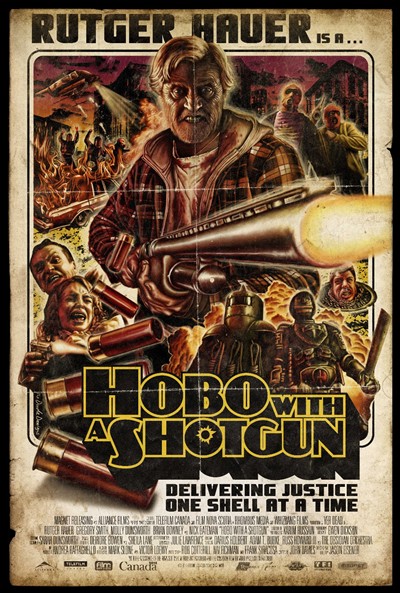
Hobo With a Shotgun Hobo With a Shotgun began as a $150 faux-trailer short that got considerable exposure online and off. The resulting long-form debut for director Jason Eisener and scenarist John Davies is doubtless the zenith in Halifax, Nova Scotia-shot retro ‘ploitation splatter comedies to date. Which tells you nothing, of course. But it is pretty good — not great — insofar as spoofy gross-out nods to yesteryear’s exploitation cinema go. Better than Machete (2010), a whole lot better than the likes of Zombie Strippers! (2008) or 95 percent of what Troma puts out. Grizzled Rutger Hauer stars as the titular character who rides rails into an equally nameless berg nicknamed “Fuck Town” because it’s so plagued by drugs ‘n’ thugz. The hoodlums are led by crime kingpin “The Drake” (Brian Downey) and goon sons (Gregory Smith, Nick Bateman) whose violent perversities are Caligula-licious. With corrupt police force in pocket, they’re free to terrorize the populace via acts of degradation and violence pushed over the bad-taste top and then some. When Hauer’s hobo rescues a prostitute (Molly Dunsworth) from this clan’s clutches, he trips his own mental wire from peaceably detached transient to pawnshop-armed streetsweeper of scum, à la 1980s vintage vigilante cheese. Hobo With a Shotgun faithfully apes exploitation conventions, from its lurid widescreen Technicolor hues to a score combining overproduced 1970s funky soundtrack kitsch with ’80s direct-to-video synth pulsing. Throughout, Hauer maintains a straight face. Maybe a tad more so than necessary — this movie could have used the wilder streak crazy-coot comedic streak shown by Jeff Bridges in last year’s True Grit or Kurt Russell in 2007’s Grindhouse. (1:26) Lumiere. (Harvey)

*Incendies When tightly wound émigré Nawal (Luba Azabal) dies, she leaves behind adult twins Jeanne (Mélissa Désormeaux-Poulin) and Simon (Maxim Gaudette) — and leaves them documents that only compound their feelings of grief and anger, suggesting that what little they thought they knew about their background might have been a lie. While resentful Simon at first stays home in Montreal, Jeanne travels to fictive “Fuad” (a stand-in for source-material playwright Wajdi Mouawad’s native Lebanon), playing detective to piece together decades later the truth of why their mother fled her homeland at the height of its long, brutal civil war. Alternating between present-day and flashback sequences, this latest by Canadian director Denis Villeneuve (2000’s Maelstrom) achieves an urgent sweep punctuated by moments of shocking violence. Resembling The Kite Runner in some respects as a portrait of the civilian victimization excused by war, it also resembles that work in arguably piling on more traumatic incidences and revelations than one story can bear — though so much here has great impact that a sense of over-contrivance toward the very end only slightly mars the whole. (2:10) (Harvey)

*Into Eternity Danish artist Michael Madsen (no, not that Michael Madsen) sneaks into Werner Herzog territory with this rather existential documentary about nuclear waste storage. Though he lacks Herzog’s distinctive, delightful style (his narration is way too corny, and his interview subjects lack any discernable quirks), Madsen is onto something here. Ostensibly, his film is an exploration of Finland’s Onkalo, an enormous underground facility built to store highly dangerous waste until it is no longer radioactive. Ho-hum, until you realize the facility must remain intact and functional for 100,000 years. How, Into Eternity asks, can we plan that far in the future? We can anticipate most natural-disaster scenarios, but what about human intrusion? How can we prevent future civilizations from drilling into the deadly cache, either accidentally or deliberately? How do we warn them? Should we warn them? Will humans even be around that far in the future? All we are is dust in the wind? Needless to say, this quiet, stylistically unassuming doc goes way, way deeper than 500 meters below Finland’s ancient bedrock. (1:15) Roxie. (Eddy)

Kung Fu Panda 2 The affable affirmations of 2008’s Kung Fu Panda take a back seat to relentlessly elaborate, gag-filled action sequences in this DreamWorks Animation sequel, which ought to satisfy kids but not entertain their parents as much as its predecessor. Po (voiced by Jack Black), the overeating panda and ordained Dragon Warrior of the title, joins forces with a cavalcade of other sparring wildlife to battle Lord Shen (Gary Oldman), a petulant peacock whose arsenal of cannons threatens to overwhelm kung fu. But Shen is also part of Po’s hazy past, so the panda’s quest to save China is also a quest for self-fulfillment and “inner peace.” There’s less character development in this installment, though the growing friendship between Po and the “hardcore” Tigress (Angelina Jolie) is occasionally touching. The 3-D visuals are rarely more than a gimmick, save for a series of eye-catching flashbacks in the style of cel-shaded animation. (1:30) (Sam Stander)

*Meek’s Cutoff After three broke down road movies (1994’s River of Grass, 2006’s Old Joy, 2008’s Wendy and Lucy), Kelly Reichardt’s new frontier story tilts decisively towards socially-minded existentialism. It’s 1845 on the choked plains of Oregon, miles from the fertile valley where a wagon train of three families is headed. They’ve hired the rogue guide Meek to show them the way, but he’s got them lost and low on water. When the group captures a Cayeuse Indian, Solomon proposes they keep him on as a compass; Meek thinks it better to hang him and be done with it. The periodic shots of the men deliberating are filmed from a distance — the earshot range of the three women (Michelle Williams, Zoe Kazan, and Shirley Henderson) who set up camp each night. It’s through subtle moves like these that Meek’s Cutoff gives a vivid taste of being subject to fate and, worse still, the likes of Meek. Reichardt winnows away the close-ups, small talk, and music that provided the simple gifts of her earlier work, and the overall effect is suitably austere. (1:44) (Goldberg)

Midnight in Paris Owen Wilson plays Gil, a self-confessed “Hollywood hack” visiting the City of Light with his conservative future in-laws and crassly materialistic fiancée Inez (Rachel McAdams). A romantic obviously at odds with their selfish pragmatism (somehow he hasn’t realized that yet), he’s in love with Paris and particularly its fabled artistic past. Walking back to his hotel alone one night, he’s beckoned into an antique vehicle and finds himself transported to the 1920s, at every turn meeting the Fitzgeralds, Gertrude Stein (Kathy Bates), Dali (Adrien Brody), etc. He also meets Adriana (Marion Cotillard), a woman alluring enough to be fought over by Hemingway (Corey Stoll) and Picasso (Marcial di Fonzo Bo) — though she fancies aspiring literary novelist Gil. Woody Allen’s latest is a pleasant trifle, no more, no less. Its toying with a form of magical escapism from the dreary present recalls The Purple Rose of Cairo (1985), albeit without that film’s greater structural ingeniousness and considerable heart. None of the actors are at their best, though Cotillard is indeed beguiling and Wilson dithers charmingly as usual. Still — it’s pleasant. (1:34) (Harvey)

Pirates of the Caribbean: On Stranger Tides The last time we saw rascally Captain Jack Sparrow (Johnny Depp), he was fighting his most formidable enemy yet: the potentially franchise-ending Pirates of the Caribbean: At World’s End (2007). The first Pirates movie (2003) was a surprise critical success, earning Depp his first-ever Oscar nomination; subsequent entries, though no less moneymaking, suffered from a detectable case of sequel-itis. Overseeing this reboot of sorts is director Rob Marshall (2002’s Chicago), who keeps the World’s End notion of sending Jack to find the Fountain of Youth, but adds in a raft of new faces, including Deadwood‘s Ian McShane (as Blackbeard) and lady pirate Penélope Cruz. The story is predictably over-the-top, with the expected supernatural elements mingling with sparring both sword-driven and verbal — as well as an underlying theme about faith that’s nowhere near as fun as the film’s lesser motifs (revenge, for one). It’s basically a big swirl of silly swashbuckling, nothing more or less. And speaking of Depp, the fact that the oft-ridiculous Sparrow is still an amusing character can only be chalked up to the actor’s own brand of untouchable cool. If it was anyone else, Sparrow’d be in Austin Powers territory by now. (2:05) (Eddy)

Potiche When we first meet Catherine Deneuve’s Suzanne — the titular trophy wife (or potiche) of Francois Ozon’s new airspun comedy — she is on her morning jog, barely breaking a sweat as she huffs and puffs in her maroon Adidas tracksuit, her hair still in curlers. It’s 1977 and Suzanne’s life as a bourgeois homemaker in a small provincial French town has played out as smoothly as one of her many poly-blend skirt suits: a devoted mother to two grown children and loving wife who turns a blind eye to the philandering of husband Robert (Fabrice Luchini), Suzanne is on the fast track to comfortable irrelevance. All that changes when the workers at Robert’s umbrella factory strike and take him hostage. Suzanne, with the help of union leader and old flame Babin (Gerard Depardieu, as big as a house), negotiates a peace, and soon turns around the company’s fortunes with her new-found confidence and business savvy. But when Robert wrests back control with the help of a duped Babin, Suzanne does an Elle Woods and takes them both on in a surprise run for political office. True to the film’s light théâtre de boulevard source material, Ozon keeps things brisk and cheeky (Suzanne sings with as much ease as she spouts off Women’s Lib boilerplate) to the point where his cast’s hammy performances start blending into the cheery production design. Satire needs an edge that Potiche, for all its charm, never provides. (1:43) (Sussman)

Queen to Play From first-time feature director Caroline Bottaro comes this drama about … chess. Wait! Before your eyes glaze over, here are a few more fast facts: it’s set in idyllic Corsica and features, as an American expat, Kevin Kline in his first French-speaking role. (Side note: is there a Kline comeback afoot? First No Strings Attached, then The Conspirator, and now Queen to Play. All within a few short months.) Lovely French superstar Sandrine Bonnaire plays Héléne, a hotel maid who has more or less accepted her unremarkable life — until she happens to catch a couple (one half of which is played by Jennifer Beals, cast because Bottaro is a longtime fan of 1983’s Flashdance!) playing chess. An unlikely obsession soon follows, and she asks Kline’s character, a reclusive doctor who’s on her freelance house-cleaning route, to help her up her game. None too pleased with this new friendship are Héléne’s husband and nosy neighbors, who are both suspicious of the doctor and unsure of how to treat the formerly complacent Héléne’s newfound, chess-inspired confidence. Queen to Play can get a little corny (we’re reminded over and over that the queen is “the most powerful piece”), and chess is by nature not very cinematic (slightly more fascinating than watching someone type, say). But Bonnaire’s quietly powerful performance is worth sticking around for, even when the novelty of whiskery, cardigan-wearing, French-spouting Kline wears off. (1:36) Smith Rafael. (Eddy)

Rio (1:32)

Something Borrowed (1:53)

*13 Assassins 13 Assassins is clearly destined to be prolific director Takashi Miike’s greatest success outside Japan yet. It’s another departure for the multi-genre-conquering Miike, doubtless one of the most conventional movies he’s made in theme and execution. That’s key to its appeal — rigorously traditional, taking its sweet time getting to samurai action that is pointedly not heightened by wire work or CGI, it arrives at the kind of slam-dunk prolonged battle climax that only a measured buildup can let you properly appreciate. In the 1840s, samurai are in decline but feudalism is still hale. It’s a time of peace, though not for the unfortunates who live under regional tyrant Lord Naritsugu (Goro Inagaki), a li’l Nippon Caligula who taxes and oppresses his people to the point of starvation. Alas, the current Shogun is his sibling, and plans to make little bro his chief adviser — so a concerned Shogun official secretly hires veteran samurai Shinzaemon (Koji Yakusho) to assassinate the Lord. Fully an hour is spent on our hero doing “assembling the team” stuff, recruiting other unemployed, retired, or wannabe samurai. When the protagonists finally commence their mission, their target is already aware he’s being pursued, and he’s surrounded by some 200 soldiers by the time Miike arrives at the film’s sustained, spectacular climax: a small village which Shinzaemon and co. have turned into a giant boobytrap so that 13 men can divide and destroy an ogre-guarding army. A major reason why mainstream Hollywood fantasy and straight action movies have gotten so depressingly interchangeable is that digital FX and stunt work can (and does) visualize any stupid idea — heroes who get thrown 200 feet into walls by monsters then getting up to fight some more, etc. 13 Assassins is thrilling because its action, while sporting against-the-odds ingeniousness and sheer luck by our heroes as in any trad genre film, is still vividly, bloodily, credibly physical. (2:06) (Harvey)

*Thor When it comes to superhero movies, I’m not easily impressed. Couple that with my complete disinterest in the character of Thor, and I didn’t go into his big-screen debut with any level of excitement. Turns out Kenneth Branagh’s Thor is a genre standout — the best I’ve seen since 2008’s Iron Man. For those who don’t know the mythology, the film follows Thor (Chris Hemsworth) as he’s exiled from the realm of Asgard to Earth. Once there, he must reclaim his mighty hammer — along with his powers — in order to save the world and win the heart of astrophysicist Jane Foster (Natalie Portman). Hemsworth is perfectly cast as the titular hero: he’s adept at bringing charm to a larger-than-life god. The script is a huge help, striking the ideal balance between action, drama, and humor. That’s right, Thor is seriously funny. On top of that, the effects are sensational. Sure, the 3D is once again unnecessary, but it’s admittedly kind of fun when you’re zooming through space. (2:03) (Peitzman)

The Topp Twins: Untouchable Girls It’s hard to name an American equivalent of New Zealand’s Topp Twins — a folk-singing, comedy-slinging, cross-dressing duo who’re the biggest Kiwi stars you’ve never heard of (but may be just as beloved as, say, Peter Jackson in their homeland). Recent inductees in the New Zealand Music Hall of Fame, the fiftysomething Jools and Lynda, both lesbians, sing country-tinged tunes that slide easily from broad and goofy (with an array of costumed personas) to extremely political, sounding off on LGBT and Maori rights, among other topics. Even if you’re not a fan of their musical style, it’s undeniable that their identical voices make for some stirring harmonies, and their optimism, even when a serious illness strikes, is inspiring. This doc — which combines interviews, home movies, and performance footage — will surely earn them scores of new stateside fans. (1:24) (Eddy)

Water for Elephants A young man named Jacob Jankowski (Robert Pattinson) turns his back on catastrophe and runs off to join the circus. It sounds like a fantasy, but this was never Jacob’s dream, and the circus world of Water for Elephants isn’t all death-defying feats and pretty women on horses. Or rather, the pretty woman also rides an elephant named Rosie and the casualties tend to occur outside the big top, after the rubes have gone home. Stumbling onto a train and into this world by chance, Jacob manages to charm the sadistic sociopath who runs the show, August (Christophe Waltz), and is charmed in turn by August’s wife, Marlena (Reese Witherspoon), a star performer and the object of August’s abusive, obsessive affections. Director Francis Lawrence’s film, an adaptation of Sarah Gruen’s 2006 novel, depicts a harsh Depression-era landscape in which troupes founder in small towns across America, waiting to be scavenged for parts — performers and animals — by other circuses passing through. Waltz’s August is a frightening man who defines a layoff as throwing workers off a moving train, and the anxiety of anticipating his moods and moves supplies most of the movie’s dramatic tension; Jacob and Marlena’s pallid love story feeds off it rather than adding its own. The film also suffers from a frame tale that feels awkward and forced, though Hal Holbrook makes heroic efforts as the elderly Jacob, surfacing on the grounds of — what else? — a modern-day circus to recount his tale of tragedy and romance. (2:00) (Rapoport)

*Win Win Is Tom McCarthy the most versatile guy in Hollywood? He’s a successful character actor (in big-budget movies like 2009’s 2012; smaller-scale pictures like 2005’s Good Night, and Good Luck; and the final season of The Wire). He’s an Oscar-nominated screenwriter (2009’s Up). And he’s the writer-director of two highly acclaimed indie dramas, The Station Agent (2003) and The Visitor (2007). Clearly, McCarthy must not sleep much. His latest, Win Win, is a comedy set in his hometown of New Providence, N.J. Paul Giamatti stars as Mike Flaherty, a lawyer who’s feeling the economic pinch. Betraying his own basic good-guy-ness, he takes advantage of a senile client, Leo (Burt Young), when he spots the opportunity to pull in some badly-needed extra cash. Matters complicate with the appearance of Leo’s grandson, Kyle (newcomer Alex Shaffer), a runaway from Ohio. Though Mike’s wife, Jackie (Amy Ryan), is suspicious of the taciturn teen, she allows Kyle to crash with the Flaherty family. As luck would have it, Kyle is a superstar wrestler — and Mike happens to coach the local high school team. Things are going well until Kyle’s greedy mother (Melanie Lynskey) turns up and starts sniffing around her father’s finances. Lessons are learned, sure, and there are no big plot twists beyond typical indie-comedy turf. But the script delivers more genuine laughs than you’d expect from a movie that’s essentially about the recession. (1:46) (Eddy)


The funny side of sit/lie

64

Nato Green, a local comedian, has a funny rant on sit-lie. His basic point: Nearly 100 percent of all crime is caused by people who are not lying down. In fact, getting people to lie down is a good way to prevent crime. And if you don’t want to look at freaky people on the streets, there’s a train to Walnut Creek every 20 minutes. Check out the video after the jump.

Activists speak out at Chevron’s shareholder meeting

2

Police and security guards were out in full force in San Ramon yesterday, (Wed/25) where activists and shareholders of Chevron’s valuable stock converged at the company’s annual shareholders meeting at its headquarters.

Inside, the meeting, Chevron Board Chairman John Watson touted the oil corporation’s “community engagement” and market growth. Outside, around 140 activists from all over the world held signs to the speedy traffic on Bollinger Canyon Way, beseeching the general public to understand the costs of Chevron’s high profits. Some even made it inside.

“Our people have been dying,” said Tom Evans of the Sugpiat People of the Alutitiq Tribe in the native village of Nanwalek, Alaska, choking back tears during the 45-minute Q&A session with Watson.

“You are all a bunch of liars and thieves,” said Rev. Kenneth Davis, a Richmond resident who was arrested last year at Chevron’s shareholders meeting in Houston, Texas. He claimed he could see Chevron’s refinery from a window in his home. “People are dying, you steal from all over the world and process it in Richmond,” he said.

“When will Chevron embody in its operations environmental and social justice?” Elias Isaac of Open Society Initiative for Southern Africa asked the chairman.

After giving one of his canned responses of “we are a force for good everywhere we operate,” Watson conceded, “Perhaps it’s not enough, and we could always do more.”

Chevron just came out of a record-breaking year with $20 billion in profits, making it the largest corporation in California and the 11th in the world, with expectations of more growth in the years to come. It has nine new exploration projects it hopes to start in the next decade that will make Poland, Romania, Western Australia, China and other countries a part of the at-risk catalog of nations where Chevron chooses to do business.

It has claimed over 14 million acres of land for “exploration activities.” It’s also planning the world’s largest carbon sequestration project in Australia on a nature reserve and turtle habitat. If all this information isn’t scary enough, Chevron also makes huge messes and ducks out of cleaning them up.

Recently, the corporation appealed a guilty verdict from an Ecuadorian court for $8.6 billion in damages because of massive environmental degradation. The 18-year lawsuit stems from the destruction and mismanagement of the diseased Amazonian land that Chevron acquired when it bought Texaco in 2001. Ecuadorian Servio Curipoma lost his mother due to Chevron’s toxic sludge and was present at the meeting with other indigenous community members pleading with Watson and Chevron’s shareholders to change its policies in Ecuador.

“Take it up with your government,” Watson said to the speakers. “Petroecuador has not been a good partner,” he added, passing the blame onto Ecuador’s state-owned oil company. Chevron execs decided that was a good time to roll a video about the lawsuit and smeared the plaintiff’s lawyer, Steven Donziger, showing outtakes of the documentary “Crude,” emails and other private meetings, displaying Donziger to be haughty about the case. As the film rolled, most of the stockholders applauded Chevron’s PR efforts.

Seven items on the meeting’s agenda pertained to stockholders’ proposals on various subjects, including hiring a third party director with environmental expertise, creating a human rights committee, and disclosing the guidelines for Chevron’s country selection. None of the stockholders proposals passed, including one on the controversial process of “fracking,” which extracts natural gas from rock, that obtained 41 percent of the preliminary votes.

Once the meeting ended, the activists in attendance were met with a hero’s welcome out on the streets. Gitz Crazyboy of the First Nation Dene/Pikini in Alberta, Canada told the crowd he didn’t buy Chevron’s excuses that they were just following government mandates.

“If that were true we wouldn’t be here right now,” he said.

Antonia Juhasz of Global Exchange and the co-editor of the recently released The True Cost of Chevron: An Alternative Annual Report, said that although Chevron wasn’t as responsive as they hoped it was a victory nonetheless for the protesters.

“What was spit back at us was spin,” she said to the crowd. “We didn’t hear a truly substantive response to the damning human rights abuses that Chevron has caused.”

Last train to Fuck Town

0

arts@sfbg.com

The course of an acting career can vividly illustrate the randomness of fate. Rutger Hauer spent some years in Dutch experimental theater of the 1960s — after pulling off that best way to terminate one’s military service, faking mental illness — then became a local heartthrob as a medieval knight in a hit TV series at that decade’s end.

He spent the 1970s primarily starring in Dutch movies, notably the striking early films of Paul Verhoeven — well before Showgirls (1995), Starship Troopers (1997), or even 1987’s RoboCop (the director wanted Hauer for the lead, but was overruled by the studio). In the 1980s, Hauer played the memorable villains of Blade Runner (1982), The Hitcher (1986), and 1981’s Nighthawks (inducing tough investigative cop Sylvester Stallone to don drag at the end to catch him), between runs at being an action hero and theoretically loftier assignments around the globe.

Then he settled into a multilingual journeyman’s potluck of low-budget genre features, TV projects, small parts in mainstream films (2005’s Sin City and Batman Begins), Guinness commercials, and a Kylie Minogue video. Apparently 67-year-old Dutch actors in Los Angeles can’t be choosy.

Then again, sometimes better opportunities might choose them. At Sundance this January, Hauer played lead roles in two diametrically opposed movies. One was as the 16th-century Flemish artist Pieter Bruegel the Elder in Polish director Lech Majewski’s extraordinary The Mill and the Cross (recently at the San Francisco International Film Festival), which brings one of that painter’s most epic canvases to cinematic life and will hopefully open on U.S. art house screens later this year. The other was Hobo With a Shotgun. Guess which one is opening theatrically here already.

Hobo began as a $150 faux-trailer short that got considerable exposure online and off. The resulting long-form debut for director Jason Eisener and scenarist John Davies is doubtless the zenith in Halifax, Nova Scotia-shot retro ‘ploitation splatter comedies to date. Which tells you nothing, of course. But it is pretty good — not great — insofar as spoofy gross-out nods to yesteryear’s exploitation cinema go. Better than Machete (2010), a whole lot better than the likes of Zombie Strippers! (2008) or 95 percent of what Troma puts out.

Grizzled Hauer stars as the titular character who rides rails into an equally nameless berg nicknamed “Fuck Town” because it’s so plagued by drugs ‘n’ thugz. The hoodlums are led by crime kingpin “The Drake” (Brian Downey) and goon sons (Gregory Smith, Nick Bateman) whose violent perversities are Caligula-licious. With corrupt police force in pocket, they’re free to terrorize the populace via acts of degradation and violence pushed over the bad-taste top and then some.

When Hauer’s hobo rescues a prostitute (Molly Dunsworth) from this clan’s clutches, he trips his own mental wire from peaceably detached transient to pawnshop-armed streetsweeper of scum, à la 1980s vintage vigilante cheese like 1982’s Class of 1984 (Perry King vs. evil high school “punks”), 1985’s Death Wish 3 (Charles Bronson vs. evil gang “punks”), and 1984’s Savage Streets (Linda Blair versus … figure it out).

Hobo With a Shotgun faithfully apes exploitation conventions, from its lurid widescreen Technicolor hues to a score combining overproduced 1970s funky soundtrack kitsch with ’80s direct-to-video synth pulsing. (Complete with a closing-credits rock song that channels Pat Benatar.) Its ludicrously over-the-top violence is kinda funny, but also nastier than need be.

Throughout, Hauer maintains a straight face. Maybe a tad more so than necessary — this movie could have used the wilder streak crazy-coot comedic streak shown by Jeff Bridges in last year’s True Grit or Kurt Russell in 2007’s Grindhouse.

Game Rutger Hauer retains his blue-eyed charisma and clearly relishes playing the gentle (when not lethal) giant in this artificially baroque scenario. He’s also an actor long on the world stage still seeking a role in a worthy film (or play) that may define him for posterity. He’s obviously got the talent — but at this point, would he take it? Would it even be offered? Did he take Hobo With a Shotgun because it seemed funny, or because it was the best he could get? 

HOBO WITH A SHOTGUN opens Fri/27 in Bay Area theaters.

Dick Meister: A Memorial Day Massacre

1


It’s a dramatic, shocking and violent film. Some 200 uniformed policemen armed with billy clubs, revolvers and tear gas angrily charge an unarmed crowd of several hundred striking steelworkers and their wives and children who are desperately running away. The police club those they can reach, shoving them to the ground and ignoring their pleas as they batter them with further blows. They stand above the fallen to fire at the backs of those who’ve outraced them.

Police drag the injured along the ground and into patrol wagons, where they are jammed in with dozens of others who were also arrested. Four are already dead from police bullets, six others are to die shortly. Eighty are wounded, two-dozen others so badly beaten that they, too, must be hospitalized.

The close-ups are particularly brutal. As one newspaper reviewer noted, “In several instances from two to four policemen are seen beating one man. One strikes him horizontally across the face, using his club as he would a baseball bat. Another crashes it down on top of his head and still another is whipping him across the back.”

The film ends with a sweaty, fatigued policeman looking into the camera, grinning, and motioning as if dusting off his hands.

The film was made in 1937. It was not, however, one of those popular cops and robbers features of the thirties. It was not fictional. It was an on-the-scene report of what historians call “The Memorial Day Massacre,” a newsreel segment filmed by Paramount Pictures as it was happening on the south side of Chicago on May 30, 1937.

We’re accustomed these days to the use of videotaped evidence to show wrongdoing by abusive law enforcement officers. Video technology was unknown in 1937, of course, and though film was available, it had rarely – if ever – been used for that purpose. The 1937 film, in fact, was initially kept from the general public by Paramount’s executives. Fearful of “inciting riots,” they refused to include it in any of their newsreels that were shown regularly in movie theaters nationwide.

But the film was shown to a closed session of a Senate investigating committee chaired by Robert LaFollette Jr. of Wisconsin. The committee, concerned primarily with civil liberties, was outraged – particularly since the Chicago police had acted in violation of the two-year-old federal law that guaranteed workers the right to strike and engage in other peaceful union activities.

The committee found that strikers and their families, while noisily demanding collective bargaining rights as they massed in front of the South Chicago plant operated by Republic Steel, had indeed been generally peaceful.

But that was beside the point to the police in Chicago and other cities with plants operated by Republic and two other members of the “Little Steel” alliance that also were struck.  For, as the committee concluded, the police had been “loosed … to shoot down citizens on the streets and highways” at the companies’ behest. The companies even supplied them with weapons and ammunition from their own stockpiles.

The committee said the companies had spent more than $40,000 on machine guns, rifles, shotguns, revolvers, tear gas canisters and launchers and 10,000 rounds of ammunition to use against strikers. Republic alone had more supplies than any law enforcement agency in the entire country.

The companies were prepared to go to any extreme to remain non-union. Two closed their plants temporarily, anticipating that most of the 85,000 strikers would soon be forced to return to work because they had little – if any – savings. But though Republic Steel closed most of its plants, it continued to operate the Chicago plant and a few others.

Republic fired union members at the plants that remained open and, with police help, cleared out union sympathizers and brought in strikebreakers to replace them. The strikebreakers, guarded by police day and night, ate and slept in the plants to avoid confronting the pickets outside.

Municipal police, company police and National Guardsmen harassed and often arrested pickets for doing little more than lawfully picketing. Six strikers were killed outside Republic’s Ohio plants in Cleveland, Youngstown, Canton and Massillon.

The killings and other violence, the steadily increasing financial pressures on strikers, unceasing anti-union propaganda – all that and more combined to end the strike in mid-July, two months after it had begun.

But the steelworkers didn’t give up.  Determined to not have made such great sacrifices in vain, they turned to the labor-friendly administration of President Franklin D. Roosevelt for help. They got it in 1941, when heavy pressures from the administration finally forced the steel companies to recognize their employees’ legal right to unionization and the many benefits, financial and otherwise, that it brought them and the many other industrial union members who followed their lead.

Dick Meister, former labor editor of the SF Chronicle and KQED-TV Newsroom, has covered labor and politics for more than a half-century. Contact him through his website, dickmeister.com, which includes more than 300 of his columns.


Last train to Fuck Town: Rutger Hauer rides again in “Hobo With a Shotgun”

0

The course of an acting career can vividly illustrate the randomness of fate. Rutger Hauer spent some years in Dutch experimental theater of the 1960s — after pulling off that best way to terminate one’s military service, faking mental illness — then became a local heartthrob as a medieval knight in a hit TV series at that decade’s end.

He spent the 1970s primarily starring in Dutch movies, notably the striking early films of Paul Verhoeven — well before Showgirls (1995), Starship Troopers (1997), or even 1987’s RoboCop (the director wanted Hauer for the lead, but was overruled by the studio). In the 1980s, Hauer played the memorable villains of Blade Runner (1982), The Hitcher (1986), and 1981’s Nighthawks (inducing tough investigative cop Sylvester Stallone to don drag at the end to catch him), between runs at being an action hero and theoretically loftier assignments around the globe.

Then he settled into a multilingual journeyman’s potluck of low-budget genre features, TV projects, small parts in mainstream films (2005’s Sin City and Batman Begins), Guinness commercials, and a Kylie Minogue video. Apparently 67-year-old Dutch actors in Los Angeles can’t be choosy.

Then again, sometimes better opportunities might choose them. At Sundance this January, Hauer played lead roles in two diametrically opposed movies. One was as the 16th-century Flemish artist Pieter Bruegel the Elder in Polish director Lech Majewski’s extraordinary The Mill and the Cross (recently at the San Francisco International Film Festival), which brings one of that painter’s most epic canvases to cinematic life and will hopefully open on U.S. art house screens later this year. The other was Hobo With a Shotgun. Guess which one is opening theatrically here already.

Hobo began as a $150 faux-trailer short that got considerable exposure online and off. The resulting long-form debut for director Jason Eisener and scenarist John Davies is doubtless the zenith in Halifax, Nova Scotia-shot retro ’ploitation splatter comedies to date. Which tells you nothing, of course. But it is pretty good — not great — insofar as spoofy gross-out nods to yesteryear’s exploitation cinema go. Better than Machete (2010), a whole lot better than the likes of Zombie Strippers! (2008) or 95 percent of what Troma puts out.

Grizzled Hauer stars as the titular character who rides rails into an equally nameless berg nicknamed “Fuck Town” because it’s so plagued by drugs ’n’ thugz. The hoodlums are led by crime kingpin “The Drake” (Brian Downey) and goon sons (Gregory Smith, Nick Bateman) whose violent perversities are Caligula-licious. With corrupt police force in pocket, they’re free to terrorize the populace via acts of degradation and violence pushed over the bad-taste top and then some.
When Hauer’s hobo rescues a prostitute (Molly Dunsworth) from this clan’s clutches, he trips his own mental wire from peaceably detached transient to pawnshop-armed streetsweeper of scum, à la 1980s vintage vigilante cheese like 1982’s Class of 1984 (Perry King vs. evil high school “punks”), 1985’s Death Wish 3 (Charles Bronson vs. evil gang “punks”), and 1984’s Savage Streets (Linda Blair versus … figure it out).

Hobo With a Shotgun faithfully apes exploitation conventions, from its lurid widescreen Technicolor hues to a score combining overproduced 1970s funky soundtrack kitsch with ’80s direct-to-video synth pulsing. (Complete with a closing-credits rock song that channels Pat Benatar.) Its ludicrously over-the-top violence is kinda funny, but also nastier than need be. Throughout, Hauer maintains a straight face. Maybe a tad more so than necessary — this movie could have used the wilder streak crazy-coot comedic streak shown by Jeff Bridges in last year’s True Grit or Kurt Russell in 2007’s Grindhouse.

Game Hauer retains his blue-eyed charisma and clearly relishes playing the gentle (when not lethal) giant in this artificially baroque scenario. He’s also an actor long on the world stage still seeking a role in a worthy film (or play) that may define him for posterity. He’s obviously got the talent — but at this point, would he take it? Would it even be offered? Did he take Hobo With a Shotgun because it seemed funny, or because it was the best he could get?

HOBO WITH A SHOTGUN opens Fri/27 in Bay Area theaters.


Four for Popfest

0

arts@sfbg.com

 The third annual San Francisco Popfest kicks off Wednesday, May 25 at Rickshaw Stop. The good news is that this year’s festival has been expanded to five days, transforming Memorial Weekend into a music extravaganza. There are shows at Rickshaw, Cafe Du Nord, and Hemlock Tavern, as well as a secret Sunday show at Dolores Park. The bad news is that you can only be in one place at a time. Here are four must-see Bay Area groups.

The opening night headliner Blackbird Blackbird is spearheaded by vocalist, producer, and multi-instrumentalist Mikey Sanders. He released his debut album Summer Heart in late 2010 through Bandcamp on a “pay what you wish” system and followed it up in 2001 with Halo, which is a collection of new songs, B-sides, and unreleased tracks. With the aid of the blogosphere, Blackbird Blackbird quickly amassed a following.

Blackbird Blackbird’s music is electronic-based, although when performing live, Sanders plays with Cade Weidenhaft on drums. Sanders creates a rich, textured synthscape, as on “Sunspray,” where bubble sounds and an overall feeling of swirling makes the song seem as if it’s being sung from underwater. Other tracks, like “Ups and Down” with its heavy bass, sound dance party-ready.

Also on the Wednesday, May 25 bill is Sanders’ project Wolf Feet, which he started with Austin Wood. The pair recorded tracks while living in a “Hobbit-like apartment in Santa Cruz,” explains Sanders, who grew up in San Francisco but went to school in Santa Cruz. It’s a decidedly less electronic project than Blackbird Blackbird, and garage-rock influenced, with upbeat tempos, handclapping, twinkling guitars, and howling vocals.

Sanders is promoting Wolf Feet similarly to Blackbird Blackbird, self-releasing an EP in January via UFOLK Records and running a cute and informative Tumblr. The band’s homemade video for “Dead Hand,” a montage of vintage films such as Thunderbirds Are Go and Gamera vs. Zigra, was already featured on Pitchfork.

The Friday, May 27 Popfest show includes San Francisco’s beloved the Mantles. After a slew of singles, a self-titled LP, and the Pink Information EP, the group recently released the “Raspberry Thighs/Roman Hat” seven-inch single via SDZ Records. The song reveals a darker side to the band.

The Mantles have always been high on melodies, which they coat in reverb, but the sunny sounds are sometimes meant to distract from the truth. “Raspberry Thighs” starts with buoyant guitars, and Michael Olivares’ vocals are more spoken than sung as he says, “Hey there unassuming eyes/ What on earth can alarm you/ You’re too ready to derail/ You’re too ready to say goodbye.” It’s hard to discern all the lyrics, but there’s a sadness to Olivares’ farewell and description of the ephemeral summer.

The Saturday, May 28 show at Rickshaw Stop is a showcase for Slumberland Records. To put it simply, the entire lineup is awesome. San Francisco’s the Art Museums, formed by Josh Alper (Whysp) and Glenn Donaldson (Skygreen Leopards) in the summer of 2009, sing tales of artists, lovers, and imposters that read like mantras for the aught generation. The band released its debut record Rough Trade on Woodsist last year and will put out an EP called Dancing this summer.

From tales of bike-based dates and descriptions of art happenings to details of Sta-Prest trousers and even the band’s name, the Art Museums’ music is meant to be absurdly funny, and true. Alper and Donaldson craft hooks and sing in faux-British accents — their heroes include the Kinks, Swell Maps, and the Television Personalities. The band records on a Tascam 388 eight-track for its snap, crackle, and pop, and performs with Carly Putnam (Green Flash) and Virginia Weatherby (the Mantles) to fill out its live sound. 


SAN FRANCISCO POPFEST


Blackbird Blackbird, Wolf Feet

Wed/25, 8 p.m.; $12

Rickshaw Stop

155 Fell, SF

(415) 861-2011


The Mantles

Fri/27, 8 p.m.; $15–$17

Rickshaw Stop

Slumberland Recods Showcase

Sat/28, 5 p.m., $17

Rickshaw Stop


www.sfpopfest.com


Facing the right way

0

It has been roughly two decades since the arrival of 3-D graphics changed video games forever. Visual fidelity and realism have increased geometrically. But though the ability of designers to render convincing buildings and 800-ton interstellar battlecruisers is at a zenith, one aspect of their games falls consistently behind: the people.

Sure, glistening muscles have long been perfected, and the hair looks better every year. Stare into the lifeless, glassy eyes of a cartoonishly-breasted video game sexpot, however, and there’s no mistaking where you are: the uncanny valley, a metaphorical location coined to describe the sudden onset of revulsion we experience when exposed to simulated humans that approach but do not attain realism (think Tom Hanks in 2004’s The Polar Express).

L.A. Noire, at long last, has built a giant suspension bridge over the gap. Team Bondi, the game’s Australian developers, relied on a new technology called MotionScan, which entails filming actors in a special room using 32 synchronized high-definition cameras that shoot from every angle, but focus on the head. The data from the cameras is then combined to create a stunningly accurate 3-D model of an actor’s face, right down to the laugh lines and the slicked-back, 1940s hairstyle. The model is then grafted onto a body rendered using conventional motion capture, resulting in the most believable human beings ever seen in a video game.

This technological innovation was crucial to L.A. Noire‘s design. As a police procedural, the game makes interrogating suspects the player’s most important challenge. Team Bondi turned to MotionScan in order to create a game that allows sharp-eyed, controller-clutching gumshoes to scrutinize the faces of potential perps, hoping to spot the telltale hard swallows, sidelong glances, and spastic blinking of a liar.

The success of MotionScan reaches far beyond the interrogation sequences, however, or even the game itself. There are important scientific findings suggesting that the interpretation of facial expressions is crucial to the way we experience empathy and understand emotions. The introduction of believable human faces into video games will have a seismic effect on the medium, revolutionizing the creation and efficacy of story and character.

L.A. Noire, like any good detective, provides elegant proof. It may be a game about arresting criminals and identifying their lies, but it is also a game whose strength lies in its tragedy. Lives are ruined, children are orphaned, and a generation of soldiers struggles to cope with the horrors it experienced on the killing fields of World War II. Though they all refuse to talk about it, you can see it in their faces. 


Earthly creations, unearthly longings

0

arts@sfbg.com

The San Francisco International Arts Festival’s model of presenting guest and local dancers side by side was initially designed to alleviate Bay Area artists’ concern that SFIAF might siphon off funding for their own work. Yet the format works artistically. The 2011 festival’s first week’s lineup of local and imported dance proved it. One-night stands at the Marines Memorial Theatre came from Israel’s Barak Marshall Company and Santa Fe’s Dancing Earth. From San Francisco, Hope Mohr Dance and FACT/SF shared evenings at Fort Mason.

Marshall is a Yemeni-Israeli American now primarily living in Israel. Apparently the 2010 Monger was influenced by servant-master dichotomies like those portrayed, most prominently, in the evergreen British TV show Upstairs, Downstairs. The work turned out to be a Kafkaesque film noir comedy that wore its desperation just barely covered by maids’ aprons and grooms’ suspenders. That the despot, a mysterious Mrs. Margaret, is a woman — Marshall calls her the Whore of Babylon — only heightened its impact. After the recent Middle East (and elsewhere) turmoil, it’s impossible not to see Monger as deeply political. Marshall first presents his 10 dancers wrapped in black, anxiously scanning the sky. He ends on the same pessimistic note.

Marshall’s variety show format separates Monger‘s acts with blackouts and punctuates them with the tinkling service bell. Both provided a welcome continuum, though most of the sections work individually. The servants scurried like road-runners; the emotionally temperature between them steadily increased like a boiler about to explode. Attempts at self-assertion, whether through love or violence, failed repeatedly. I saw a touch of Ohad Naharin — Marshall cut some of his teeth in Naharin’s Batsheva Dance Company — in the hilarious hate- and gossip-mongering “upstairs” ladies. Spitting venom, they bobbed up like corks in the sea. Monger gained valuable support from the choreographer’s own exceptionally imaginative patchwork score.

I have, however, major concerns with the choreography. Although the extensive use of unisons, punctuated by gestural language, made intellectual sense, they pulled the piece down toward monotony.

What’s your idea of “Native American dance?” Stomping feet, flying fringe, and pounding drums? Not a trace of a powwow could be found in the excellently danced Of Bodies Of Elements by Dancing Earth’s 10 dancers (plus two babies).

Choreographed by Rulan Tangen and performed by members from diverse North American tribal cultures, Bodies included contributions from traditional practices, including a “Deer Dance” (by guest artist Jesus “Jacoh” Cortes) and a “Prayer Dance” (by Deollo Johnson), suspiciously looking like an Eagle Dance with strong elements from women’s fancy dances. But this is a thoroughly contemporary work with performers — men and women alike — whose athleticism and multifarious talents and training acknowledge the air as much as the ground under their feet.

Bodies is presented as a creation myth whose believers become alienated from the natural order but find their way back into it. The choreography sometimes doesn’t spell out the narrative that clearly, so the program notes help for those unfamiliar with indigenous American beliefs.

A small ritual sets the tone. A member of the local Ohlone tribe blessed the space the company had asked permission to perform in.

At 90 minutes, the two-act Bodies could be tightened, though I wouldn’t give up a second of the opening, which imagines the natural world — including a splendid tree — emerging from an inchoate mass. Moving from hunter-gatherers to agricultural life was economically and clearly presented, though the water choreography for the women felt vapid. But Raul Trujillo’s “Cage Dance,” which used an elaborate double contraption (one part of it a hoop skirt) to indicate various forms of imprisonment, missed its target. The dancers physically struggled to get in and out of it — surely not the intent.

The second act included a haunting Ghost Dance. It was danced with traditional bobbing steps against a wailing wall (video by Alejandro Quintana) that documented the destruction humankind manages to inflict on itself. Perhaps Tangen’s idea that a deracinated people experiencing degradation can still hear Earth’s heartbeat in contemporary urban rhythms is overly romantic. But it’s a lovely idea to consider and made for some impressive hip-hop dancing.

Putting Hope Mohr and Charles Slender on the same double bill paired two artists who are relatively new in town — Mohr since 2007, Slender since 2008. They have nothing in common except that they clothe their formal concerns with clear expressive intent. For Mohr, this has sometimes meant working in tandem with community and professional dancers. Slender has elaborate theatrical trappings that he seems to be constantly reworking at his disposal.

Mohr’s world premiere, the deep-ringing Plainsong, was a fragile mediation for a sturdy performer, the renowned Aleta Hayes. The subject is the mythic Penelope, waiting for Odysseus to return. Katrina Rodabaugh wove-unraveled Plainsong‘s exquisite backdrop. Every meaning, every gesture of this 20-minute solo was suspended in ambiguity. In Hayes’ touch, the pile of wool became bloody entrails. She enclosed her space with a fragile thread — to imprison or to protect herself? With vigorously shoveling hands, she could have been unearthing or burying something. Her deep, almost masculine voice surged from inside her guts. The full-of-potential Plainsong is one of Hope’s finest works yet; she may want to consider refining it in the future.

Slender’s mildly witty Consumption Series is a chameleon that adapts to wherever his intrepid FACT/SF troupers take it. It’s a piece — this is the third time I’ve seen it — that looks at obsessions (food, sex, power) and envelops them with pseudo-baroque accoutrements and a slyly ballet-based vocabulary and its aberrations. The costumes and the ideas are beginning to look ragged; it’s time to retire both. 

SAN FRANCISCO INTERNATIONAL ARTS FESTIVAL

Through June 5

Various venues

www.sfiaf.org


Film Listings

0

Film listings are edited by Cheryl Eddy. Reviewers are Kimberly Chun, Michelle Devereaux, Peter Galvin, Max Goldberg, Dennis Harvey, Johnny Ray Huston, Louis Peitzman, Lynn Rapoport, Ben Richardson, and Matt Sussman. For rep house showtimes, see Rep Clock. For first-run showtimes, see Movie Guide.

OPENING

The Hangover Part II What could possibly go wrong this time? (1:42) Four Star, Marina, Presidio, Shattuck.

Hobo With a Shotgun See “Last Train to Fuck Town.” (1:26) Lumiere.

*Into Eternity Danish artist Michael Madsen (no, not that Michael Madsen) sneaks into Werner Herzog territory with this rather existential documentary about nuclear waste storage. Though he lacks Herzog’s distinctive, delightful style (his narration is way too corny, and his interview subjects lack any discernable quirks), Madsen is onto something here. Ostensibly, his film is an exploration of Finland’s Onkalo, an enormous underground facility built to store highly dangerous waste until it is no longer radioactive. Ho-hum, until you realize the facility must remain intact and functional for 100,000 years. How, Into Eternity asks, can we plan that far in the future? We can anticipate most natural-disaster scenarios, but what about human intrusion? How can we prevent future civilizations from drilling into the deadly cache, either accidentally or deliberately? How do we warn them? Should we warn them? Will humans even be around that far in the future? All we are is dust in the wind? Needless to say, this quiet, stylistically unassuming doc goes way, way deeper than 500 meters below Finland’s ancient bedrock. (1:15) Roxie. (Eddy)

Kung Fu Panda 2 Po (Jack Black) and company return for 3D martial-arts misadventures. (1:30) Cerrito, Four Star, Presidio.

Midnight in Paris Owen Wilson plays Gil, a self-confessed “Hollywood hack” visiting the City of Light with his conservative future in-laws and crassly materialistic fiancée Inez (Rachel McAdams). A romantic obviously at odds with their selfish pragmatism (somehow he hasn’t realized that yet), he’s in love with Paris and particularly its fabled artistic past. Walking back to his hotel alone one night, he’s beckoned into an antique vehicle and finds himself transported to the 1920s, at every turn meeting the Fitzgeralds, Gertrude Stein (Kathy Bates), Dali (Adrien Brody), etc. He also meets Adriana (Marion Cotillard), a woman alluring enough to be fought over by Hemingway (Corey Stoll) and Picasso (Marcial di Fonzo Bo) — though she fancies aspiring literary novelist Gil. Woody Allen’s latest is a pleasant trifle, no more, no less. Its toying with a form of magical escapism from the dreary present recalls The Purple Rose of Cairo (1985), albeit without that film’s greater structural ingeniousness and considerable heart. None of the actors are at their best, though Cotillard is indeed beguiling and Wilson dithers charmingly as usual. Still — it’s pleasant. (1:34) Embarcadero. (Harvey)

ONGOING

American: The Bill Hicks Story (1:41) Sundance Kabuki.

*L’Amour Fou Pierre Thoretton’s documentary L’amour fou opens with two clips of men bidding farewell. The first, from 2002, is of the French-Algerian couturier Yves Saint Laurent announcing his retirement in a moving and emotional speech worthy of his favorite writer Marcel Proust. The second is of Pierre Bergé, Saint Laurent’s longtime business partner and former lover, eulogizing his departed friend at the designer’s memorial service six years later. Thoretton’s film is suffused with goodbyes, many tender and candid, some portentous and rehearsed. To be sure, L’amour fou is a touching portrait of the powerful and tempestuous bond between Saint Laurent and Bergé, a bond that lasted close to five decades and resulted in one of the great empires of 20th century fashion. But it is also, alongside David Teboud’s two 2002 YSL documentaries, another entry in the hagiography of Saint Laurent, one cannily steered by Bergé as much as by Thoretton. Well-spoken and charming, Bergé still comes off as the punchy entrepreneurial foil to Saint Laurent’s dazzling but fragile genius. He can be both hyperbolic (praising Saint Laurent’s gifts) but also forthcoming (discussing the designer’s demons). Former muses Loulou de la Falaise and Betty Catroux are also interviewed, but this is clearly Bergé’s show. (1:43) Albany, Embarcadero. (Sussman)

The Beaver It’s been more than 15 years since Jodie Foster sat in the director’s chair; she’s back with The Beaver, which tells the unique story of Walter Black (Mel Gibson), a clinically depressed man who struggles through his suicidal desires with the help of a beaver puppet. Walter uses the puppet — which he also voices — as a way of connecting with his family and the outside world. The film examines both the comedic aspects and the devastating reality of mental illness, and the script walks the line between dark and light — it’s the first feature from Kyle Killen, who created the critically adored but short-lived TV series Lone Star. The Beaver gets points for ambition, but it’s ultimately too all over the place to come together in the end. The moments of humanity are undercut by scenes of Walter and his wife Meredith (Foster) having sex with the puppet in the bed — intentionally funny, but jarring nonetheless. Still, Foster’s direction is solid and, for all its faults, The Beaver is a great reminder of Gibson’s legitimate talent. (1:31) Elmwood, SF Center, Shattuck, Sundance Kabuki. (Peitzman)

*Bill Cunningham New York To say that Bill Cunningham, the 82-year old New York Times photographer, has made documenting how New Yorkers dress his life’s work would be an understatement. To be sure, Cunningham’s two decades-old Sunday Times columns — “On the Street,” which tracks street-fashion, and “Evening Hours,” which covers the charity gala circuit — are about the clothes. And, my, what clothes they are. But Cunningham is a sartorial anthropologist, and his pictures always tell the bigger story behind the changing hemlines, which socialite wore what designer, or the latest trend in footwear. Whether tracking the near-infinite variations of a particular hue, a sudden bumper-crop of cropped blazers, or the fanciful leaps of well-heeled pedestrians dodging February slush puddles, Cunningham’s talent lies in his ability to recognize fleeting moments of beauty, creativity, humor, and joy. That last quality courses through Bill Cunningham New York, Richard Press’ captivating and moving portrait of a man whose reticence and personal asceticism are proportional to his total devotion to documenting what Harold Koda, chief curator at the Costume Institute at the Metropolitan Museum of Art, describes in the film as “ordinary people going about their lives, dressed in fascinating ways.” (1:24) Bridge, Elmwood. (Sussman)

*Bridesmaids For anyone burned out on bad romantic comedies, Bridesmaids can teach you how to love again. This film is an answer to those who have lamented the lack of strong female roles in comedy, of good vehicles for Saturday Night Live cast members, of an appropriate showcase for Melissa McCarthy. The hilarious but grounded Kristen Wiig stars as Annie, whose best friend Lillian (Maya Rudolph) is getting hitched. Financially and romantically unstable, Annie tries to throw herself into her maid of honor duties — all while competing with the far more refined Helen (Rose Byrne). Bridesmaids is one of the best comedies in recent memory, treating its relatable female characters with sympathy. It’s also damn funny from start to finish, which is more than can be said for most of the comedies Hollywood continues to churn out. Here’s your choice: let Bridesmaids work its charm on you, or never allow yourself to complain about an Adam Sandler flick again. (2:04) Balboa, Empire, Marina, 1000 Van Ness, Shattuck, Sundance Kabuki. (Peitzman)

*Cave of Forgotten Dreams The latest documentary from Werner Herzog once again goes where no filmmaker — or many human beings, for that matter — has gone before: the Chauvet-Pont-d’Arc Cave, a heavily-guarded cavern in Southern France containing the oldest prehistoric artwork on record. Access is highly restricted, but Herzog’s 3D study is surely the next best thing to an in-person visit. The eerie beauty of the works leads to a typically Herzog-ian quest to learn more about the primitive culture that produced the paintings; as usual, Herzog’s experts have their own quirks (like a circus performer-turned-scientist), and the director’s own wry narration is peppered with random pop culture references and existential ponderings. It’s all interwoven with footage of crude yet beautiful renderings of horses and rhinos, calcified cave-bear skulls, and other time-capsule peeks at life tens of thousands of years ago. The end result is awe-inspiring. (1:35) SF Center, Shattuck, Sundance Kabuki. (Eddy)

The Conspirator It may not be your standard legal drama, but The Conspirator is a lot more enjoyable when you think of it as an extended episode of Law & Order. The film chronicles the trial of Mary Surratt (Robin Wright), the lone woman charged in the conspiracy to assassinate Abraham Lincoln. It’s a fascinating story, especially for those who don’t know much of the history past John Wilkes Booth. But while the subject matter is compelling, the execution is hit-or-miss. Wright is sympathetic as Surratt, but the usually great James McAvoy is somewhat forgettable in the pivotal role of Frederick Aiken, Surratt’s conflicted lawyer. It’s hard to say what it is that’s missing from The Conspirator: the cast — which also includes Evan Rachel Wood and Tom Wilkinson — is great, and this is a story that’s long overdue to be told. Still, something is lacking. Could it be the presence of everyone’s favorite detective, the late Lennie Briscoe? (2:02) Opera Plaza. (Peitzman)

*The Double Hour Slovenian hotel maid Sonia (Ksenia Rappoport) and security guard Guido (Filippo Timi) are two lonely people in the Italian city of Turin. They find one another (via a speed-dating service) and things are seriously looking up for the fledgling couple when calamity strikes. This first feature by music video director Giuseppe Capotondi takes a spare, somber approach to a screenplay (by Alessandro Fabbri, Ludovica Rampoldi, and Stefano Sardo) that strikingly keeps raising, then resisting genre categorization. Suffice it to say their story goes from lonely-hearts romance to violent thriller, ghost story, criminal intrigue, and yet more. It doesn’t all work seamlessly, but such narrative unpredictability is so rare at the movies these days that The Double Hour is worth seeing simply for the satisfying feeling of never being sure where it’s headed. (1:35) Albany, Clay, Piedmont, Smith Rafael. (Harvey)

*Everything Must Go Just skirting the edge of sentimentality and banality, Everything Must Go aims to do justice by its source material: Raymond Carver’s rueful, characteristically spare short story, “Why Don’t You Dance?,” from the 1988 collection Where I’m Calling From. And it mostly succeeds with some restraint from its director-writer Dan Rush, who mainly helmed commercials in the past. Everything Must Go gropes toward a cinematic search for meaning for the Willy Lomans on both sides of the camera — it’s been a while since Will Ferrell attempted to stretch beyond selling a joke, albeit often extended ones about masculinity, and go further as an actor than 2006’s Stranger Than Fiction. The focus here turns to the despairing, voyeuristic whiskey drinker of Carver’s highly-charged short story, fills in the blanks that the writer always carefully threaded into his work, and essentially pushes him down a crevasse into the worst day of his life: Ferrell’s Nick has been fired and his wife has left him, changing the locks, putting a hold on all his bank accounts, and depositing his worldly possessions on the lawn of their house. Nick’s car has been reclaimed, his neighbors are miffed that he’s sleeping on his lawn, the cops are doing drive-bys, and he’s fallen off the wagon. His only reprieve, says his sponsor Frank (Michael Pena), is to pretend to hold a yard sale; his only help, a neighborhood boy Kenny who’s searching for a father figure (Christopher Jordan Wallace, who played his dad Notorious B.I.G. as a child in 2009’s Notorious) and the new neighbor across the street (Rebecca Hall). Though Rush expands the characters way beyond the narrow, brilliant scope of Carver’s original narrative, the urge to stay with those fallible people — as well as the details of their life and the way suburban detritus defines them, even as those possessions are forcibly stripped away — remains. It makes for an interesting animal of a dramedy, though in Everything Must Go‘s search for bright spots and moments of hope, it’s nowhere near as raw, uncompromising, and tautly loaded as Carver’s work can be. (1:36) Piedmont, Sundance Kabuki. (Chun)

Fast Five There are plenty of laugh-out-loud moments in Fast Five, in addition to a much demolition derby-style crunch — instances that stretch credulity and simultaneously trigger a chuckle at the OTT fantasy of the entire enterprise. Two unarmed men chained to the ceiling kick their way out of a torture cell, jump favela rooftops to freedom with nary a bullet wound in sight, and, in the movie’s smash-’em-up tour de force, use a bank vault as a hulking pair of not-so-fuzzy dice to pulverize an unsuspecting Rio de Janeiro. Not for nothing is rapper Ludacris attached to this franchise — his name says it all (why not go further than his simple closing track, director Justin Lin, now designated the keeper of Fast flame, and have him providing the rap-eratic score/running commentary throughout?) In this installment, shady hero Dominic (Vin Diesel) needs busting out of jail — check, thanks to undercover-cop-turned-pal Brian (Paul Walker) and Dominic’s sis Mia (Jordana Brewster). Time to go on the lam in Brazil and to bring bossa nova culture down to level of thieving L.A. gearheads, as the gearhead threesome assemble their dream team of thieves to undertake a last big heist that will set ’em up for life. Still, despite the predictable pseudo-twists — can’t we all see the bromance-bonding between testosteroni boys Diesel and Dwayne Johnson coming from miles of blacktop away? — there’s enough genre fun, stunt driving marvels, and action choreography here (Lin, who made his name in ambitious indies like 2002’s Better Luck Tomorrow, has developed a knack for harnessing/shooting the seeming chaos) — to please fans looking for a bigger, louder kick. (1:41) 1000 Van Ness. (Chun)

The First Grader After a government announcement offering free elementary school educations to all Kenyans, an elderly man, Maruge (Oliver Litondo), shuffles to the nearest rural classroom in search of reading lessons. Though school officials (and parents, miffed that the man would take a child’s place in the already overcrowded system) protest, open-minded head teacher Jane (Naomie Harris) allows him to stay and study. Maruge’s freedom-fighter past, which cost him his family at the brutal hands of the British, is an important part of this true story, which otherwise would’ve felt a bit too heavy on the heartwarming tip. (His classmates, actual students at the school used for filming, are pretty unavoidably adorable.) As directed by Justin Chadwick (2008’s The Other Boleyn Girl ), Harris and Litondo turn in passionate performances, but the film unfolds like a heavy-handed TV movie. The facts of this story are inspiring enough — the film shouldn’t have to try so hard. (1:43) Opera Plaza, Smith Rafael. (Eddy)

Forks Over Knives Lee Fulkerson steps up as the latest filmmaker-turned-guinea-pig to appear in his own documentary about nutrition. As he makes progress on his 12-week plan to adopt a “whole foods, plant-based diet” (and curb his Red Bull addiction), he meets with other former junk food junkies, as well as health professionals who’ve made it their mission to prevent or even reverse diseases strictly through dietary changes. Along the way, Forks Over Knives dishes out scientific factoids both enlightening and alarming about the way people (mostly us fatty Americans, though the film investigates a groundbreaking cancer study in China) have steadily gotten unhealthier as a direct result of what they are (or in some cases, are not) eating. Fulkerson isn’t as entertaining as Morgan Spurlock (and it’s unlikely his movie will have the mainstream appeal of 2004’s Super Size Me), but the staunchly pro-vegan Forks Over Knives certainly offers some interesting, ahem, food for thought. (1:36) Opera Plaza. (Eddy)

*Hanna The title character of Hanna falls perfectly into the lately very popular Hit-Girl mold. Add a dash of The Boys from Brazil-style genetic engineering — Hanna has the unfair advantage, you see, when it comes to squashing other kids on the soccer field or maiming thugs with her bare hands — and you have an ethereal killing/survival machine, played with impassive confidence by Atonement (2007) shit-starter Saoirse Ronan. She’s been fine-tuned by her father, Erik (Eric Bana), a spy who went out into the cold and off the grid, disappearing into the wilds of Scandinavia where he home-schooled his charge with an encyclopedia and brutal self-defense and hunting tests. Atonement director Joe Wright plays with a snowy palette associated with innocence, purity, and death — this could be any time or place, though far from the touch of modern childhood stresses: that other Hannah (Montana), consumerism, suburban blight, and academic competition. The 16-year-old Hanna, however, isn’t immune from that desire to succeed. Her game mission: go from a feral, lonely existence into the modern world, run for her life, and avenge the death of her mother by killing Erik’s CIA handler, Marissa (Cate Blanchett). The nagging doubt: was she born free, or Bourne to be a killer? Much like the illustrated Brothers Grimm storybook that she studies, Hanna is caught in an evil death trap of fairytale allegories. One wonders if the super-soldier apple didn’t fall far from the tree, since evil stepmonster Marissa oversaw the program that produced Hanna — the older woman and the young girl have the same cold-blooded talent for destruction and the same steely determination. Yet there’s hope for the young ‘un. After learning that even her beloved father hid some basic truths from her, this natural-born killer seems less likely to go along with the predetermined ending, happy or no, further along in her storybook life. (1:51) SF Center. (Chun)

*Hesher Young teen TJ (Devin Brochu) has lost his mom, and her shockingly sudden passing has sent his entire family into a tailspin. His father (Rainn Wilson) can barely rouse himself from his heavily medicated stupor, while his lonely grandmother (Piper Laurie) is left to care for the wrecked men folk as best she can. All TJ can do is to try to desperately hang onto the smashed car that has been sold to the used car salesman and then the junkyard. So it almost seems like a dream when he catches the attention of an aloof, threatening metalhead named Hesher (a typecast-squashing, perfectly on-point Joseph Gordon-Levitt), squatting in an empty suburban model home. Hesher threatens to kill him, then moves in, becoming his so-called “friend” and brand-new, unwanted shadow. What’s a grieving family lost in its own tragic inertia supposed to do with a home invasion staged by an angry, malevolent spirit? Coming to terms with Hesher’s presence becomes a lot like going through Kubler-Ross’s five stages of grief: there’s the denial that he’s taken over the living-room TV and rejiggered the cable to get a free porn channel, the anger that he’s set fire to your enemy’s hot rod and left you at the scene of the crime, and lastly the acceptance that there’s no good, right, or unmessy way to say goodbye. Director Spencer Susser (with co-writer David Michod of 2010’s Animal Kingdom) modeled the character of Hesher after late Metallica bassist Cliff Burton, and that fact, along with the film’s independent-minded spirit, is probably one of the reasons why Metallica allowed more than one of their songs to be used in the film. Hesher itself also likely had something to do with it: if the intrigue with heavy-metal-parking-lot culture doesn’t do donuts in your cul-de-sac, then the sobering story might. (1:45) California, Lumiere. (Chun)

*Incendies When tightly wound émigré Nawal (Luba Azabal) dies, she leaves behind adult twins Jeanne (Mélissa Désormeaux-Poulin) and Simon (Maxim Gaudette) — and leaves them documents that only compound their feelings of grief and anger, suggesting that what little they thought they knew about their background might have been a lie. While resentful Simon at first stays home in Montreal, Jeanne travels to fictive “Fuad” (a stand-in for source-material playwright Wajdi Mouawad’s native Lebanon), playing detective to piece together decades later the truth of why their mother fled her homeland at the height of its long, brutal civil war. Alternating between present-day and flashback sequences, this latest by Canadian director Denis Villeneuve (2000’s Maelstrom) achieves an urgent sweep punctuated by moments of shocking violence. Resembling The Kite Runner in some respects as a portrait of the civilian victimization excused by war, it also resembles that work in arguably piling on more traumatic incidences and revelations than one story can bear — though so much here has great impact that a sense of over-contrivance toward the very end only slightly mars the whole. (2:10) Opera Plaza, Shattuck. (Harvey)

Jumping the Broom (1:48) SF Center.

*Meek’s Cutoff After three broke down road movies (1994’s River of Grass, 2006’s Old Joy, 2008’s Wendy and Lucy), Kelly Reichardt’s new frontier story tilts decisively towards socially-minded existentialism. It’s 1845 on the choked plains of Oregon, miles from the fertile valley where a wagon train of three families is headed. They’ve hired the rogue guide Meek to show them the way, but he’s got them lost and low on water. When the group captures a Cayeuse Indian, Solomon proposes they keep him on as a compass; Meek thinks it better to hang him and be done with it. The periodic shots of the men deliberating are filmed from a distance — the earshot range of the three women (Michelle Williams, Zoe Kazan, and Shirley Henderson) who set up camp each night. It’s through subtle moves like these that Meek’s Cutoff gives a vivid taste of being subject to fate and, worse still, the likes of Meek. Reichardt winnows away the close-ups, small talk, and music that provided the simple gifts of her earlier work, and the overall effect is suitably austere. (1:44) Roxie, Shattuck. (Goldberg)

*My Perestroika Robin Hessman’s very engaging documentary takes one very relatable look at how changes since glasnost have affected some average Russians. The subjects here are five thirtysomethings who, growing up in Moscow in the 70s and 80s, were the last generation to experience full-on Communist Party indoctrination. But just as they reached adulthood, the whole system dissolved, confusing long-held beliefs and variably impacting their futures. Andrei has ridden the capitalist choo-choo to considerable enrichment as the proprietor of luxury Western menswear shops. But single mother Olga, unlucky in love, just scrapes by, while married schoolteachers Lyuba and Boris are lucky to have inherited an apartment (cramped as it is) they could otherwise ill afford. Meanwhile Ruslan, once member of a famous punk band (which he abandoned on principal because it was getting “too commercial”), both disdains and resents the new order just as he did the old one. Home movies and old footage of pageantry celebrating Soviet socialist glory make a whole ‘nother era come to life in this intimate, unexpectedly charming portrait of its long-term aftermath. (1:27) Balboa. (Harvey)

*Nostalgia for the Light Chile’s Atacama Desert, the setting for Patricio Guzmán’s lyrically haunting and meditative documentary, is supposedly the driest place on earth. As a result, it’s also the most ideal place to study the stars. Here, in this most Mars-like of earthly landscapes, astronomers look to the heavens in an attempt to decode the origins of the universe. Guzmán superimposes images from the world’s most powerful telescopes — effluent, gaseous nebulas, clusters of constellations rendered in 3-D brilliance — over the night sky of Atacama for an even more otherworldly effect, but it’s the film’s terrestrial preoccupations that resonate most. For decades, a small, ever dwindling group of women have scoured the cracked clay of Atacama searching for loved ones who disappeared early in Augusto Pinochet’s regime. They take their tiny, toy-like spades and sift through the dirt, finding a partial jawbone here, an entire mummified corpse there. Guzmán’s attempt through voice-over to make these “architects of memory,” both astronomers and excavators alike, a metaphor for Chile’s reluctance to deal with its past atrocities is only marginally successful. Here, it’s the images that do all the talking — if “memory has a gravitational force,” their emotional weight is as inescapable as a black hole. (1:30) Lumiere, Smith Rafael. (Devereaux)

Pirates of the Caribbean: On Stranger Tides The last time we saw rascally Captain Jack Sparrow (Johnny Depp), he was fighting his most formidable enemy yet: the potentially franchise-ending Pirates of the Caribbean: At World’s End (2007). The first Pirates movie (2003) was a surprise critical success, earning Depp his first-ever Oscar nomination; subsequent entries, though no less moneymaking, suffered from a detectable case of sequel-itis. Overseeing this reboot of sorts is director Rob Marshall (2002’s Chicago), who keeps the World’s End notion of sending Jack to find the Fountain of Youth, but adds in a raft of new faces, including Deadwood‘s Ian McShane (as Blackbeard) and lady pirate Penélope Cruz. The story is predictably over-the-top, with the expected supernatural elements mingling with sparring both sword-driven and verbal — as well as an underlying theme about faith that’s nowhere near as fun as the film’s lesser motifs (revenge, for one). It’s basically a big swirl of silly swashbuckling, nothing more or less. And speaking of Depp, the fact that the oft-ridiculous Sparrow is still an amusing character can only be chalked up to the actor’s own brand of untouchable cool. If it was anyone else, Sparrow’d be in Austin Powers territory by now. (2:05) Balboa, Castro, Cerrito, Empire, 1000 Van Ness, Presidio, Sundance Kabuki. (Eddy)

Priest (1:27) 1000 Van Ness, SF Center.

*The Princess of Montpensier Marie (Mélanie Thierry), the titular figure in French director Bertrand Tavernier’s latest, is a young 16th century noblewoman married off to a Prince (Grégoire Leprince-Ringuet) of great wealth and property. But they’ve barely met when he’s called off to war — leaving her alone on his enormous estate, vulnerable to myriad suitors who seem to be forever throwing themselves at her nubile, neglected body. Lambert Wilson (2010’s Of Gods and Men) is touching as the older soldier appointed her protector; he comes to love her, yet is the one man upstanding enough to resist compromising her. If you’ve been jonesing for the kind of lush arthouse period epic that feels like a big fat classic novel, this engrossing saga from a 70-year-old Gallic cinema veteran in top form will scratch that itch for nearly two and a half satisfyingly tragic-romantic hours. (2:19) Smith Rafael. (Harvey)

Potiche When we first meet Catherine Deneuve’s Suzanne — the titular trophy wife (or potiche) of Francois Ozon’s new airspun comedy — she is on her morning jog, barely breaking a sweat as she huffs and puffs in her maroon Adidas tracksuit, her hair still in curlers. It’s 1977 and Suzanne’s life as a bourgeois homemaker in a small provincial French town has played out as smoothly as one of her many poly-blend skirt suits: a devoted mother to two grown children and loving wife who turns a blind eye to the philandering of husband Robert (Fabrice Luchini), Suzanne is on the fast track to comfortable irrelevance. All that changes when the workers at Robert’s umbrella factory strike and take him hostage. Suzanne, with the help of union leader and old flame Babin (Gerard Depardieu, as big as a house), negotiates a peace, and soon turns around the company’s fortunes with her new-found confidence and business savvy. But when Robert wrests back control with the help of a duped Babin, Suzanne does an Elle Woods and takes them both on in a surprise run for political office. True to the film’s light théâtre de boulevard source material, Ozon keeps things brisk and cheeky (Suzanne sings with as much ease as she spouts off Women’s Lib boilerplate) to the point where his cast’s hammy performances start blending into the cheery production design. Satire needs an edge that Potiche, for all its charm, never provides. (1:43) Elmwood, Opera Plaza. (Sussman)

Queen to Play From first-time feature director Caroline Bottaro comes this drama about … chess. Wait! Before your eyes glaze over, here are a few more fast facts: it’s set in idyllic Corsica and features, as an American expat, Kevin Kline in his first French-speaking role. (Side note: is there a Kline comeback afoot? First No Strings Attached, then The Conspirator, and now Queen to Play. All within a few short months.) Lovely French superstar Sandrine Bonnaire plays Héléne, a hotel maid who has more or less accepted her unremarkable life — until she happens to catch a couple (one half of which is played by Jennifer Beals, cast because Bottaro is a longtime fan of 1983’s Flashdance!) playing chess. An unlikely obsession soon follows, and she asks Kline’s character, a reclusive doctor who’s on her freelance house-cleaning route, to help her up her game. None too pleased with this new friendship are Héléne’s husband and nosy neighbors, who are both suspicious of the doctor and unsure of how to treat the formerly complacent Héléne’s newfound, chess-inspired confidence. Queen to Play can get a little corny (we’re reminded over and over that the queen is “the most powerful piece”), and chess is by nature not very cinematic (slightly more fascinating than watching someone type, say). But Bonnaire’s quietly powerful performance is worth sticking around for, even when the novelty of whiskery, cardigan-wearing, French-spouting Kline wears off. (1:36) Shattuck, Smith Rafael. (Eddy)

Rio (1:32) Elmwood, 1000 Van Ness, SF Center.

Something Borrowed (1:53) 1000 Van Ness, Presidio.

*Source Code A post-9/11 Groundhog Day (1993) with explosions, Inception (2010) with a heart, or Avatar (2009) taken down a notch or dozen in Chicago —whatever you choose to call it, Source Code manages to stand up on its own wobbly Philip K. Dick-inspired legs, damn the science, and take off on the wings of wish fulfillment. ‘Cause who hasn’t yearned for a do-over — and then a do-over of that do-over, etc. We could all be as lucky — or as cursed — as soldier Colter Stevens (Jake Gyllenhaal), who gets to tumble down that time-space rabbit hole again and again, his consciousness hitching a ride in another man’s body, while in search of the bomber of a Chicago commuter train. On the upside, he gets to meet the girl of his dreams (Michelle Monaghan) — and see her getting blown to smithereens again and again, all in the service of his country, his commander-cum-link to the outside world (Vera Farmiga), and the scientist masterminding this secret military project (Jeffrey Wright). On the downside, well, he gets to do it over and over again, like a good little test bunny in pinball purgatory. Fortunately, director Duncan Jones (2009’s Moon) makes compelling work out of the potentially ludicrous material, while his cast lends the tale a glossed yet likable humanity, the kind that was all too absent in 2010’s Inception. (1:33) 1000 Van Ness. (Chun)

*13 Assassins 13 Assassins is clearly destined to be prolific director Takashi Miike’s greatest success outside Japan yet. It’s another departure for the multi-genre-conquering Miike, doubtless one of the most conventional movies he’s made in theme and execution. That’s key to its appeal — rigorously traditional, taking its sweet time getting to samurai action that is pointedly not heightened by wire work or CGI, it arrives at the kind of slam-dunk prolonged battle climax that only a measured buildup can let you properly appreciate. In the 1840s, samurai are in decline but feudalism is still hale. It’s a time of peace, though not for the unfortunates who live under regional tyrant Lord Naritsugu (Goro Inagaki), a li’l Nippon Caligula who taxes and oppresses his people to the point of starvation. Alas, the current Shogun is his sibling, and plans to make little bro his chief adviser — so a concerned Shogun official secretly hires veteran samurai Shinzaemon (Koji Yakusho) to assassinate the Lord. Fully an hour is spent on our hero doing “assembling the team” stuff, recruiting other unemployed, retired, or wannabe samurai. When the protagonists finally commence their mission, their target is already aware he’s being pursued, and he’s surrounded by some 200 soldiers by the time Miike arrives at the film’s sustained, spectacular climax: a small village which Shinzaemon and co. have turned into a giant boobytrap so that 13 men can divide and destroy an ogre-guarding army. A major reason why mainstream Hollywood fantasy and straight action movies have gotten so depressingly interchangeable is that digital FX and stunt work can (and does) visualize any stupid idea — heroes who get thrown 200 feet into walls by monsters then getting up to fight some more, etc. 13 Assassins is thrilling because its action, while sporting against-the-odds ingeniousness and sheer luck by our heroes as in any trad genre film, is still vividly, bloodily, credibly physical. (2:06) California, Embarcadero, Smith Rafael. (Harvey)

*Thor When it comes to superhero movies, I’m not easily impressed. Couple that with my complete disinterest in the character of Thor, and I didn’t go into his big-screen debut with any level of excitement. Turns out Kenneth Branagh’s Thor is a genre standout — the best I’ve seen since 2008’s Iron Man. For those who don’t know the mythology, the film follows Thor (Chris Hemsworth) as he’s exiled from the realm of Asgard to Earth. Once there, he must reclaim his mighty hammer — along with his powers — in order to save the world and win the heart of astrophysicist Jane Foster (Natalie Portman). Hemsworth is perfectly cast as the titular hero: he’s adept at bringing charm to a larger-than-life god. The script is a huge help, striking the ideal balance between action, drama, and humor. That’s right, Thor is seriously funny. On top of that, the effects are sensational. Sure, the 3D is once again unnecessary, but it’s admittedly kind of fun when you’re zooming through space. (2:03) Empire, 1000 Van Ness, Sundance Kabuki. (Peitzman)

The Topp Twins: Untouchable Girls It’s hard to name an American equivalent of New Zealand’s Topp Twins — a folk-singing, comedy-slinging, cross-dressing duo who’re the biggest Kiwi stars you’ve never heard of (but may be just as beloved as, say, Peter Jackson in their homeland). Recent inductees in the New Zealand Music Hall of Fame, the fiftysomething Jools and Lynda, both lesbians, sing country-tinged tunes that slide easily from broad and goofy (with an array of costumed personas) to extremely political, sounding off on LGBT and Maori rights, among other topics. Even if you’re not a fan of their musical style, it’s undeniable that their identical voices make for some stirring harmonies, and their optimism, even when a serious illness strikes, is inspiring. This doc — which combines interviews, home movies, and performance footage — will surely earn them scores of new stateside fans. (1:24) Shattuck. (Eddy)

Water for Elephants A young man named Jacob Jankowski (Robert Pattinson) turns his back on catastrophe and runs off to join the circus. It sounds like a fantasy, but this was never Jacob’s dream, and the circus world of Water for Elephants isn’t all death-defying feats and pretty women on horses. Or rather, the pretty woman also rides an elephant named Rosie and the casualties tend to occur outside the big top, after the rubes have gone home. Stumbling onto a train and into this world by chance, Jacob manages to charm the sadistic sociopath who runs the show, August (Christophe Waltz), and is charmed in turn by August’s wife, Marlena (Reese Witherspoon), a star performer and the object of August’s abusive, obsessive affections. Director Francis Lawrence’s film, an adaptation of Sarah Gruen’s 2006 novel, depicts a harsh Depression-era landscape in which troupes founder in small towns across America, waiting to be scavenged for parts — performers and animals — by other circuses passing through. Waltz’s August is a frightening man who defines a layoff as throwing workers off a moving train, and the anxiety of anticipating his moods and moves supplies most of the movie’s dramatic tension; Jacob and Marlena’s pallid love story feeds off it rather than adding its own. The film also suffers from a frame tale that feels awkward and forced, though Hal Holbrook makes heroic efforts as the elderly Jacob, surfacing on the grounds of — what else? — a modern-day circus to recount his tale of tragedy and romance. (2:00) 1000 Van Ness, SF Center, Sundance Kabuki. (Rapoport)

*Win Win Is Tom McCarthy the most versatile guy in Hollywood? He’s a successful character actor (in big-budget movies like 2009’s 2012; smaller-scale pictures like 2005’s Good Night, and Good Luck; and the final season of The Wire). He’s an Oscar-nominated screenwriter (2009’s Up). And he’s the writer-director of two highly acclaimed indie dramas, The Station Agent (2003) and The Visitor (2007). Clearly, McCarthy must not sleep much. His latest, Win Win, is a comedy set in his hometown of New Providence, N.J. Paul Giamatti stars as Mike Flaherty, a lawyer who’s feeling the economic pinch. Betraying his own basic good-guy-ness, he takes advantage of a senile client, Leo (Burt Young), when he spots the opportunity to pull in some badly-needed extra cash. Matters complicate with the appearance of Leo’s grandson, Kyle (newcomer Alex Shaffer), a runaway from Ohio. Though Mike’s wife, Jackie (Amy Ryan), is suspicious of the taciturn teen, she allows Kyle to crash with the Flaherty family. As luck would have it, Kyle is a superstar wrestler — and Mike happens to coach the local high school team. Things are going well until Kyle’s greedy mother (Melanie Lynskey) turns up and starts sniffing around her father’s finances. Lessons are learned, sure, and there are no big plot twists beyond typical indie-comedy turf. But the script delivers more genuine laughs than you’d expect from a movie that’s essentially about the recession. (1:46) California, Piedmont. (Eddy)


American Idol: The weeping edition

12

Six weeks ago, who could have imagined — the American Idol final is Scotty and Lauren? Please. So many talented people gone, so little talent left ….


I like Scotty, I really do, despite the religion and the aw-shucks sheepishness. I think he’s a sincere kid who will have a great career as a country music singer. But AI is supposed to showcase broad-based talent, and that’s not him.


Lauren is also a nice kid, and the scene with her crying as she viewed the flood wreckage was way, way over the top, but sincere. (In fact, there was an awful lot of weeping this week. Scotty wept all the way home. The only one who didn’t seem overcome by emotion was Haley, who was also the best performer. But I guess it’s all about the televised tears. You cry and you love God and you get a recording contract. What a great country.)


A few noteworthy moments in the penultimate week:


Ryan reports 95 million votes. Somebody’s got an app out there.


Steven once again has gold glittery pants. It goes with the feathers in his hair, I guess.


Shameless huckerism just gets worse: The three finalists get to go to the special showing of “Super 8” — followed immediately by an ad for “Super 8.” The kids all look miserable doing their final Ford music video.


Then on comes — ready? — Il Volo, a group of three young Italian opera singers who sing “O Sole Mio” in Italian. They’re totally talented, no complaints, but it’s really odd and the three finalists are kind of dumbfounded.


There’s a six-second appearance by 50 Cent, who looks as if he’d rather be anywhere else in the world.


The videos of the carefully orchestrated “home visits” are long, dumb and about as sappy as it gets. Lauren’s bodyguard is gigantic. Then we go on to the results — and it’s clear that the voters have been so wrong for so long that the show is becoming a farce. Good people gone? Pia. Casey. James. Now Haley. Any of them could have been legitimate finalists. But it’s all about the cuteness and the emotion, and I’m over it.


Final prediction: Viv wants Lauren, because she says (and it’s a good point) that Scotty and James will wind up with great careers anyway, but if Lauren finishes second and doesn’t get the Idol contracts, she’s never going anywhere on her own. But come on — it has to be Scotty. It’s not even a choice. At least he’s good at something.

Perception of lost integrity costs police

1

Reporting by Sarah Phelan. Photograhy by Luke Thomas.

At the San Francisco Public Defender’s Office’s May 18 Justice Summit, the ethics of law enforcement were a central topic. And not surprisingly, the latest incidents of alleged police conduct in which SFPD officers are caught on surveillance video, which the Public Defender’s Office released, as they apparently steal personal property from suspects whose homes in the Julian Hotel they searched for drugs under possibly illegal circumstances, were on everyone’s minds, along with the crime lab and Henry Hotel scandals.

Asked if District Attorney George Gascón, who was Chief of Police until January, is considering a special prosecutor to look into these latest incidents, Sharon Woo, the D.A.’s Chief Assistant of Operations, said the D.A. looks into each case as it comes in. “We are trying to enhance the videos that came in from the Public Defender’s Office,” Woo said in a pre-summit interview. “Some are not as clear as we’d like.”

Earlier this year, when Gascón first became aware of the allegations against officers at the Henry Hotel, he directed the D.A.’s office to open an investigation into the officers and their alleged conduct. The move got David Onek, who is running against Gascón in the D.A.’s race, urging Gascón to turn the investigation over to an independent prosecutor.

But for a week, Gascón maintained that there was no conflict, and when he did finally announce that he was turning the investigation over to the to the U.S. Attorney’s Office – he claimed it was about “resources”. “New information has come to light that indicates it is better to turn over this investigation to the FBI,” Gascón said. “I have spoken to the U.S. Attorney, Melinda Haag, and she has agreed to take over the full investigation. We will of course cooperate fully with the FBI, and provide whatever assistance they need from us.”

At the time, Onek noted that Gascón’s decision was correct step. But he criticized Gascón for not making it his policy to recuse himself from any investigations that relate to his own tenure as chief. And Alameda Assistant D.A. Sharmin Bock, who recently sprung into the D.A.’ race, described Gascón’s situation on this matter as being “between a rock and a hard place.”

But yesterday, Woo noted that while it’s true that Gascón was SFPD Chief when many of the recent misconduct scandals occurred, Mayor Gavin Newsom had already appointed him D.A. when the Julian Hotel incidents occurred in February.

And Peter Herley, former chief of the Tiburon Police Department, told the Guardian that there “is always the Attorney General” to refer cases if D.A.’s feel conflicted. “George Gascón is a very upstanding individual who has also worked for the Los Angeles Police Department and was Chief of Meza, Arizona, and has done a good job in every place he’s been,” Herley said during a pre-summit interview. “So, if he sees a conflict arise, he’d probably recuse himself. It’s the public perception that’s key, that’s paramount.”

During the summit’s panel on ethics, retired San Francisco Superior Court judge Lee Baxter grilled panelists with incisive questions—as befits any self-respecting judge, retired or otherwise–on whether police misconduct is the product of a departmental culture. Noting that there had been a seemingly non-stop string of alleged police misconduct scandals in the Bay Area from drug thefts, dirty D.U.I cases, stolen drugs and setting up a brothel, Baxter observed, “If I saw a movie that included all those things, I’d think that this is not realistic.”

And there was a perhaps surprising amount of stated consensus about what needs to happen next from panelists Woo, Herley, defense attorney Stuart Hanlon, newly sworn-in SFPD Chief Greg Suhr, Anne Irwin, an attorney at the Public Defender’s Office, and John Burris, an Oakland-based civil rights attorney who is renowned for representing plaintiffs in police brutality cases.

Baxter asked the panelists why abuse of power happens, and whether, when we see media accounts of alleged police misconduct, we see the most extreme cases.

Hanlon kicked off by referring to the case of Elmer “Geronimo” Pratt, a former high ranking member of the Black Panther Party, who was tried and convicted of the kidnap and murder of Caroline Olsen in 1972, and spent 27 years in prison, eight in solitary confinement, until 1997 when his conviction was vacated on the grounds that the prosecution concealed evidence that might have exonerated him. In particular, the government had not disclosed that a key witness against Pratt, Julius Butler, was an informant for both the FBI and the LAPD. Pratt eventually received $4.5 million as settlement for false imprisonment—the city of L.A. paid $2.75 million, the U.S. Department of Justice paid $1.75 million.

“We learned that law enforcement officers had hidden evidence, let people commit perjury, and destroyed evidence to convict someone who was innocent, “ Hanlon recalled, noting how when he first worked on the case, folks wondered if Pratt’s claim of innocence was simply part of a big conspiracy theory. “But it was not, it was men and women who thought the ends justified the means” Hanlon said, noting that the “bad apples” theory is typically trotted out during investigations into alleged police misconduct. “But officers see people who they think are bad people, and they feel they must whatever it takes,” Hanlon continued. “Primarily, most law enforcement people are good, but sometimes you get good cops lying to protect bad cops. It’s a dilemma, this concept of ‘what we do we need to do, this ‘us versus them’ concept.”

Hanlon claimed that officers don’t think citizens who live in SROs (single room occupancy hotels) have the same rights as folks in Pacific Heights.
“They think it’s OK to break down doors because these are drug dealers,” he said. And he noted that the recent string of back-to-back scandals are unusual in their proximity but are not unusual, generally speaking. “I’m not an apologist for (Chief) Suhr or the D.A., but I’ve seen these problems forever, and without trust law enforcement doesn’t work,” Hanlon concluded.

Next, Baxter put Suhr in the hot seat by asking him what to do about the “ends justify the means concept”. At which point Suhr, who has been Chief for less than two weeks, observed that the summit, which was packed to the gills with defense and civil rights attorneys, was “a bit of an away game for me, but it’s O.K., I can handle it.” He noted that only 1 in 11 applicants make it through the SFPD Police Academy, where folks undergo 1,100 hours of training, including sessions on abuse of power and responsibilities. “But if something is proven, it’s my intention not to have those officers in the SFPD any more,” Suhr said.

Retired Tiburon Chief Pete Herley revealed that during his decades-long police career, he blew the whistle when three officers nearly beat a gay man to death. “I suffered the consequences for many years,” he said. “It’s very lonely getting death threats, it’s very lonely when you don’t get the backing of fellow officers.”

Herley claimed times have changed a lot. “Change starts in the Academy and the selection of officers, and you have no other law enforcement officers that get more scrutiny, background checks m psychological checks and an 18-month probation period,” he said.

He noted that police chiefs inherit a departmental culture, whether they come into the post from the inside or the outside of the department. And that while the number of officers involved in misconduct is small, “it makes good press.” 

“I really feel one needs to be more loyal to integrity than to people,” Herley continued, noting that his parents were Holocaust survivors, and that his father was aghast when he decided to become a police officer. “But I had certain values and I don’t expect anything less from other people. I expect that every department has something in their rules and regulations that directs their officers that if they see misconduct, it’ll be stopped and the action will be reported immediately to the Chief.

Baxter asked Woo what the D.A. should do, if there is a problem.“All we are is our integrity, our ability to communicate and put forth evidence to juries “ Woo observed, noting that she has been on the frontlines as allegations about the crime lab, the Henri Hotel, and now potential theft, surfaced. “We find ourselves very reactive,” Woo observed, noting that if officers are not being truthful, the D.A.’s office has to look at all the cases they were involved in. “So it really impacts public safety and how all of us view the criminal justice system,” Woo said, noting that officers involved in the Henri Hotel allegations taken off the street.“But we have no interest in prosecuting individuals if it’s not based on solid evidence,” Woo said.

She recommended proactive steps like getting involved in Police Academy training on the law, and what officers can and cannot do, and giving officers tools to make good decisions and arrests, so there is integrity in the system. “If there isn’t, we all lose, not just the criminal justice system, but the entire community,” Woo observed, noting that as SFPD Chief, “Gascón instituted lots of policies to make sure people are doing an appropriate level of review.”

Baxter asked Anne Irwin, an attorney in the Public Defender’s Office, about their office’s role in bringing abuse of power to the attention of the public. “The Public Defender has a unique and natural role as a messenger,” Irwin replied. “We have more meaningful interaction with the victims of police misconduct than anyone else in the criminal justice system. We get into the intimate details of their lives, we develop a relationship of trust, so they confide their stories about police misconduct. And those stories are commonplace.”

Irwin noted that these stories include a disrespect for the Fourth Amendment, perjury and theft. “When you hear those stories over and over, there’s a ring of truth, a consistency,” Irwin said, noting that this is not the first time officers have been captured on camera. “We didn’t say, let’s amass a bunch of evidence. We just basically did our job. Residents told us what someone said in a report is not what happened, so we got videos from Dec. 23 and Jan. 5, and lo and behold, every word was true, two for two.”

Irwin noted that there are many good officers in the SFPD, but questioned whether a culture develops in certain departments, including the plain-clothes units, that allows misconduct to happen. “Without the videos officers would not have had to answer for their conduct,” she observed.

Baxter asked Suhr what it is about the culture that makes some cops go rogue. “Did they work there too long, were the temptations too much?” she asked.

Suhr replied that he worked in narcotics for a long time, and recovered $1.4 million in cash from an apartment in the Western Addition. “I never took a dime, and I am confident that the officers I worked with were of the highest caliber,” he said. “To paint a 2,000-person organization with a broad brush is unfair,” he added. “In the legal profession, every once in a while, you see ugly stories there too.”

Burris, who filed a $25 million wrongful death claim against BART on behalf of Oscar Grant’s family, noted that he has been involved in about 1,000 police misconduct cases in the Bay Area. “A culture exists about how you treat minority communities, “ he said, noting that he had represented black and brown clients for over 20 years. “A culture where you beat people and nothing is done, and you get away with it.”

Burris believes the problem lies in how policies are imposed, as he claimed that when officers join departments they are told to forget what they were taught in the Academy.“This is what you do on the streets,” he said.

Baxter observed that she has seen movies about the code of silence and wondered if it actually exists in police departments. “I don’t think so generally,” Suhr said. “There’s peer pressure to be sure. A regular citizen has a right not to self incriminate, and in the Police Department you can say that, but you are immediately sent to Internal Affairs, where you are told, tell me what happened or you are fired. So, today, the light is shining on us 100 percent of the time.”

Herley noted that his concern lay with situations in which officers see something, but don’t say anything. “I never thought I’d sit here and agree with every word John Burris says, but it starts at the top, and has to be enforced throughout the organization.”

Herley said the two best tools to prevent indiscretions and ensure responsibility are tape recorders and video cameras. “There’s certification of exactly what happened.” As for questions of how much it would cost to outfit officers with this recording equipment, Herley said, “ What is the cost of a lawsuit, the cost the perception of a loss of integrity to a department?”

American Idol: Boooring

0

We’re now into the post-James endgame, and as I predicted, things have gone way downhill. Frankly, none of the three finalists deserves to win. At this point, the whole thing is a sham. But we soldier on, slogging through a two-hour special featuring Steven in some sort of tight gold pants and Beyonce’s new music video. Beyonce also gets cameo shot hugging each contestant. (I could live with that. Beyonce’s way hotter than J-Lo. Just is. Just saying.)


On to the action, such as it was. Three songs apiece — the contestant picks one, Jimmy picks one and the judges pick one. Scotty goes with “Amazed.” Easy song for him, nothing to it. Lauren does Faith Hill; whatever. She looked like Glynda the Good Witch of the North in a light blue dress.


But Haley — man, Led Zeppelin on Idol? A tough song, too. And she actually pulled it off. And her dad played guitar, and the guy can play. Hit of the night.


Jimmy’s picks? Meah. All easy, all right in the lumberyard. I kinda liked Haley doing Fleetwood Mac, but what’s up with the artificial breeze blowing on her face? (Oh, right — “Rhiannon” has a line about “taken by the wind.” So they have to have wind. Along with, once again, artificial smoke on the ground. This is a huge enterprise with hundreds of millions of dollars involved; is that the best production these folks can do?


The judges asked Scotty to do “She Believes in Me,” and they all loved it, but I cringed when he tried to hit the notes in the chorus. Not his thing. Sounded like Bob Dylan on roofies. Lauren? “I Hope You Dance?” Sure, she can sing like a 16-year-old at a high school graduation, and she’s got some talent, but a national stage? Nope.


Haley. Alanis Morissette. Nice choice for her, good job, she’s actually peaking at the right moment.


It’s odd — Haley got rejected the first time she tried out, was in the bottom three a couple of times — and now is the only contestant who might even a little tiny bit be worthy of the title. I’ve never particularly liked her, but she’s at least showing up in the final days.


Viv and Michael think Lauren makes the final. I think it’s Haley and Scotty. Scotty’s the only guy left, he’s cute, he’s country (although that’s all he is), he loves Jesus … America’s not sending him home.


And I hate to say it, but I’ll be glad when this is over and I can get back to watching the Giants games on Wednesday night.   

Slick

0

“Surface, surface, surface.” Patrick Bateman’ pithy summation of the dominant aesthetic of his times in American Psycho could easily serve as a subtitle for Takeshi Murata’s colorful still lifes currently hanging at Ratio 3 (Murata’s computer animated short, I, Popeye, which plays in the gallery’s backroom, merits less discussion despite its gallows humor).

Seemingly random groups of objects — fruit, knickknacks, VHS cassette tapes of cult films such as Dario Argento’s Opera or Dawn of the Dead, a cow skull, cans of Coors, and what appear to be forlorn, soft-sculpture likenesses of brass instruments and a tea kettle — are arranged against neutral backgrounds and dramatically lit from a variety of angles.

Murata’s images are large and crisp. Their flawless, hermetically sealed perfection recalls certain advertising photography from (to return to American Psycho) the 1980s. Or, to go back a few years earlier, some of the album art created by British design firm Hipgnosis. The catch is that these images aren’t actually photographs of anything; they aren’t even photographs. Murata created these pigment prints — to call them by their proper name — with a computer, individually rendering each object, light source, shadow, and reflection.

The fact that there’s no there there shouldn’t be alarming. Open any lifestyle magazine and you’ll find countless examples of pictorial illusion promising the world. Murata’s images replicate the logic behind the shell game that advertising firms call doing business and Marxists call commodity fetishism. None of the objects in his compositions really make sense together syntactically, but bathed in the glow of a nonexistent photo studio each thing appears as strangely covetable as it does out of place.

This is not say that Murata’s compositions can’t simply be enjoyed for their pleasing arrangements of shape and color, or for the ways the objects play off each other (in Art and the Future, a replica of the Terminator’s chrome skull is paired with a copy of Douglas Davis’ 1975 treatise of the same name). Rather, these carefully orchestrated moments out of time complicate that enjoyment, asking us to reconsider the pleasures we take in looking at and staging displays of taste.


TAKE ME TO THE FAIR

Starting tomorrow through the rest of the weekend, San Francisco will become home to not one, not two, but three — count ’em, three — art fairs. The largest is the San Francisco Fine Art Fair, which returns to Fort Mason’s cavernous Festival Pavilion after its inaugural run last year. Then there are the two newcomers: ArtMRKT San Francisco at the Concourse Exhibition Center, the first Bay Area event put on by the Brooklyn-based art fair organizers of the same name, and the smaller scale, locally-based ArtPad SF, which takes over the rooms, patio, and even the pool of the Phoenix Hotel.

Art fairs are many things: commercial ventures, networking hubs, forums for and targets of critique, and socio-aesthetic petri dishes in which artists, dealers, gallerists, curators, critics, collectors, and gawkers all rub shoulders and share drinks. This kind of close proximity can be rare in San Francisco, which given its size, has a lot of different places to see art and a lot of different kinds of art to see. Sure, individual openings are their own kind of mixers, but not on the scale or with as diverse an audience as an art fair.

Almost every local gallery worth its salt, along with plenty of out-of-town exhibitors, will have a presence at one of the fairs (and to make taking it all in that much easier ArtMRKT and ArtPadSF will be sharing a shuttle service between venues on Saturday and Sunday). ArtMRKT and ArtPad SF, in particular, have also made it a point to involve community arts orgs and nonprofits. Black Rock Arts Foundation is ArtPad SF’s opening night beneficiary and ArtMRKT is hosting MRKTworks, an online and live auction set to benefit several other local arts nonprofits. ArtPAD SF will also host panel discussions on California art and collecting street art with a who’s who of notable locals and feature live performances and video pieces throughout the weekend.

What this confluence of big events means for the state of art-making and consuming in San Francisco remains up for discussion. Art fairs are one indicator of market growth — or at least of the organizer’s belief in a market’s potential, which in San Francisco’s case would mean having to address the fact that local artists have historically outnumbered local collectors. The proof, I suppose, will be in the attendance records and sales figures.

On the other hand, you can view these fairs as a sign of evolutionary development within the larger ecosystem of San Francisco’s art scene. Before last year’s SF Fine Art Fair, there hadn’t been a comparable event in the city for close to two decades. Maybe these are the sort of events SF needs to slough off of the self-deprecatory framework that regards what is made and what goes on here as “provincial” compared to Los Angeles or New York City. After all, “boosterism” needn’t be a dirty word.

I hope to expand on these issues in the next Eyeball, after I’ve had a chance to make the rounds and cool my feet in the Phoenix’s pool. 


TAKESHI MURATA: GET YOUR ASS TO MARS

Through June 11; free

Ratio 3

1447 Stevenson

(415) 821-3371

www.ratio3.org


ARTMRKT SAN FRANCISCO

Thurs/19– Sun/22; $25 (single day), $45 (3-day)

Concourse Exhibition Center

620 Seventh St., SF

(212) 518-6912

www.art-MRKT.com/sf


ARTPAD SF

May 19–May 22

Phoenix Hotel; $10

601 Eddy, SF

(415) 364-5465

www.artpadsf.com/


SAN FRANCISCO FINE ART FAIR

May 20 –22; $20 (single day), $30 (3-day)

Festival Pavilion

Fort Mason Center, SF

(800) 211-0640

www.sffineartfair.com


Bastard samurai

0

arts@sfbg.com

Takashi Miike is 50 years old, has only been active in film since 1991, and since then has directed approximately 80 features for TV, video, and theatres. Eight-zero. Even Rainer Werner Fassbinder on every puppy-upper in the world achieved nothing like that volume (and was dead at 37). It’s not like Miike’s films are cheap knockoffs assembled by a stock company à la the prolific Ulli Lommel or your average pornographer. Though they started off on the low end of the Japanese industry’s budgetary scale — and one suspects he’s still a producer’s wet dream of bang for buck — from early on his projects were busy, elaborate, even frantic with highly cinematic ideas. Not to mention frequently insane.

Miike’s trademark cinema is the gonzo genre mashup as first significantly noted abroad via cult hits like Ichi the Killer (2001) and Dead or Alive (1999) — movies so crazed with jaw-dropping, often hilarious splattersome outrageousness and relentless high energy that they could be both unforgettable and exhausting. (It is perhaps Miike’s only major fault that he often gives us too much of a good thing.) But the breadth of his imagination and stylistic adaptability is amazing. He’s made children’s fantasies, teen musicals, blackest domestic satire, a low-key rural whimsy (1998’s The Bird People in China), formulaic J-horror (2003’s One Missed Call), and one languorous all-boy lockup saga suffused with the homoerotic surrealism of Fassbinder’s 1982 Querelle (2006’s Big Bang Love, Juvenile A).

Miike’s first significant hit here was another stylistic departure, 1999’s Audition — a May-December romance of Ozu-like restraint that only revealed its true agenda in a last few minutes of harrowing violence. Since then the odd Miike film has gotten modest U.S. theatrical release, like 2007’s gonzo mode Sukiyaki Western Django.

But the new 13 Assassins is clearly destined to be his greatest success yet outside Japan. (One just hopes success doesn’t do what it frequently does to hitherto fast, almost impulsive artists — i.e., slow down their future output because the decisions are now more commercially and prestigiously “important.”) It’s another departure, doubtless one of the most conventional movies he’s made in theme and execution. That’s key to its appeal — rigorously traditional, taking its sweet time getting to samurai action that is pointedly not heightened by wire work or CGI, it arrives at the kind of slam-dunk prolonged battle climax that only a measured buildup can let you properly appreciate.

That buildup is long, though, so ADD-addled mall rats should be forewarned. In the 1840s, samurai are in decline but feudalism is still hale. It’s a time of peace, though not for the unfortunates who live under regional tyrant Lord Naritsugu (Goro Inagaki), a li’l Nippon Caligula who taxes and oppresses his people to the point of starvation. Alas, the current shogun is his sibling, and plans to make little bro his chief adviser — which could throw the entire nation into chaos.

Ergo a concerned Shogun official secretly hires veteran samurai Shinzaemon (Koji Yakusho) to assassinate the Lord at one of the rare times he’s vulnerable to attack, during his annual trip home from the capital court. Fully an hour is spent on our hero doing “assembling the team” stuff, recruiting other unemployed, retired, or wannabe samurai for a lean-mean total of 12 (eventually joined by Takayuki Yamada’s comedy-relief rube). This slow, sober initial progress is tweaked by glimpses of Naritsugu’s extreme cruelty, which encompasses rape, murder, and dismemberment just for the hell of it.

When the protagonists finally commence their mission, their target is already aware he’s being pursued. He’s surrounded by some 200 soldiers by the time Miike arrives at the film’s sustained, spectacular climax: a small village his retinue must pass through, and which Shinzaemon and co. have turned into a giant booby trap so that 13 men can divide and destroy an ogre guarding army.

A major reason why mainstream Hollywood fantasy and straight action movies have gotten so depressingly interchangeable is that digital FX and stunt work can (and does) visualize any stupid idea — heroes who get thrown 200 feet into walls by monsters then getting up to fight some more, etc. 13 Assassins is thrilling because its action, while sporting against-the-odds ingeniousness and sheer luck by our heroes as in any trad genre film, is still vividly, bloodily, credibly physical. 

13 ASSASSINS opens Fri/20 in Bay Area theaters.


Police officers accused of theft in videotaped incidents

4

In the two such incidents exposed in less than a week by the San Francisco Public Defenders Office, San Francisco Police officers have been caught on surveillance videotape appearing to steal personal property from suspects whose homes were searched for drugs, searches that were also likely to be considered illegal.
“We’re very concerned that these officers are still active, still on the streets, and still testifying in court,” Public Defender Jeff Adachi said during a press conference today, later adding, “We have a pattern of illegal searches and seizures that are occurring.” He called the undocumented property nabs “thefts” and raised doubts about whether officers were actually given permission by the suspects to enter the rooms, as they claimed in their reports.
During Adachi’s press conference, Police Chief Greg Suhr – who was shown the latest video footage on Friday – issued a statement saying the charges were being investigated and the officers involved were being taken off plainclothed duty pending the outcome.
Two officers, Ronaldo Vargas and Richard Guerrero, were involved in both of the videotaped incidents that Adachi released in the last week. In the latest — from a Feb. 25 incident involving 65-year-old Jesus Reyes in which he was stopped in a van and police then searched his apartment at the Julian Hotel, where officers say they found a small amount of methamphetamines – the pair can be seen entering empty-handed and leaving with bags that Reyes says contained his video camera and his nephew’s laptop computer. Neither item was booked into evidence and they remain missing.
In the earlier incident, the officers were accused of stealing a duffel bag during a Dec. 30 raid on a room at the Jefferson Hotel. Adachi has also released four other videotaped police raids in recent months that all seem to show officer misconduct and false statements in their subsequent police reports. And the recent spate of revelations follows a scandal last year in which police and prosecutors withheld information on officer misconduct from the Public Defenders Office and other defense attorneys, despite legal requirements that they share that information. Judges have now dismissed hundreds of criminal cases because of the misconduct by police and prosecutors, and Adachi said the FBI is also investigating the pattern of behavior by SFPD officers.
The drug charges against Reyes were dropped when Guerrero failed to show at the hearing despite being subpoenaed by defense attorneys. But Guerrero was actually on the stand yesterday testifying as a prosecution witness in an unrelated case, raising question about why the DA’s office and SFPD would allow the testimony of someone whose credibility has now been called into serious question.
Reyes said it was his first arrest and that he has no criminal background, but Adachi said that a couple years ago, Vargas was disciplined by the Police Commission after slashing a suspect’s face with a broken pipe.