

Unions

Dick Meister: Celebrating the Farmworkers’ Filipino American Champion

1

By Dick Meister

Dick Meister, former Labor Editor of SF Chronicle and KQED-TV Newsroom, has covered labor and politics for more than a half-century. He’s co-author of “A Long Time Coming: The Struggle To Unionize America’s Farm Workers.” Contact him through his website, www.dickmeister.com, which includes more than 350 of his columns.


The birth date of Cesar Chavez, the late farm workers’ leader, will be celebrated next month, and rightly so.  But it’s well past time we also celebrated the life of probably the most important of the other leaders who played a major role in winning union rights for farm workers and otherwise helping them combat serious exploitation.

That’s Larry Itliong. He died 35 years ago this month at age 63. Itliong got involved in the farm workers’ struggle very early in life, not long after he arrived as a 15-year-old immigrant from the Philippine Islands. He was among some 31,000 Filipino men who came to California in the late 1920s.

They migrated throughout the state doing low-paying farm work, isolated from the rest of society and discriminated against because of their race.  They were prohibited from marrying Caucasians, from buying land and otherwise integrating into the community at large.

The Filipinos were perhaps the most isolated of the groups of penniless workers that growers imported from abroad. That, however, caused the Filipinos to band closely together. They formed extremely efficient work crews to travel the state under the direction of their own leaders, at times even forming their own unions.

They actually struck – a rarity for farm workers at the time – when grape growers in Southern California’s Coachella Valley rejected their pay demands in 1965. The strike was led by Itliong, who was then working for the AFL-CIO’s recently-formed Agricultural Workers Organizing Committee. The strikers got what they wanted in just ten days.

Elsewhere, however, the Filipinos were forced to accept growers’ terms, initially after brief strikes at several vineyards to the north.  But their fortunes changed after they struck grape growers in the Delano area of Kern County, where many Filipinos lived.

Again, they called on Itliong to lead them.  He clearly understood the deep anger and frustration that motivated his fellow Filipinos – an understanding based on his own long experience. Soon after he came to California from the Philippines, he turned to farm work and, while still in his teens, was involved in an unsuccessful tomato pickers strike in Washington State.

After that, Itliong traveled up and down California, trying, as he said,  “to get a job I could make money on . . . Whatever money I made from one job was not enough for me to live on until I got to the next job.” He barely made enough to pay for food and the cigars he seemed to be endlessly chomping. School was out of the question. But Itliong did learn plenty.

Like Chavez, he said he learned that farm workers could not improve their wretched working and living conditions, could not win any rights, if they did not band together to demand decent treatment.

Itliong did not have the intellectual and philosophical bent of Chavez. Nor did he share Chavez’ deep distrust of outside unions and their orthodox tactics. But Itliong was as convinced as Chavez of the need for unionization. And the depth of his conviction made Itliong a natural leader among the Filipinos.

He was readily hired as a full-time organizer by the AFL-CIO’s Agricultural Workers Organizing Committee, eventually leading the strike against Delano grape growers that drew worldwide attention, much of it focused on Chavez.

The vineyard strikers were seeking no more than a pay raise of 15 to 20 cents an hour. But growers refused to negotiate with Itliong and meanwhile evicted strikers from the grower-owned camps where they lived.

Growers relied on animosity between Mexican-American and Filipino workers, caused in large part by the growers’ practice of setting up separate camps and work crews for various racial and ethnic groups.

But Chavez, who was then forming a union in Delano for Mexican American workers, did not hesitate when Itliong asked him for help.  Chavez felt that his group, then called the National Farm Workers Association, wasn’t ready to strike itself, but would honor the picket lines of the striking Filipinos.

Yet if they were to honor the picket lines of Itliong’s group, Chavez’ members asked, Why not strike themselves? Why not? And so they did.

That became the grape strike of 1965 that drew worldwide attention and support and ultimately led to the unionization, at long last, of California’s farm workers. It was Larry Itliong and his Filipino members who started it all, and who played an indispensable role throughout the struggle.

Without them there could not have been a strike. Without them, there could not have been the victory of unionization, without them no right for the incredibly oppressed farm workers to bargain with their employers

Within a year of the strike’s launching, Chavez and Itliong’s organizations merged to form what became the widely acclaimed United Farm Workers union – the UFW. Chavez was president, Itliong vice president. Chavez and the UFW’s far more numerous Mexican American members were in firm control.

Itliong never really accepted this situation. He finally resigned from the UFW’s executive board in 1971. He complained that the union’s outnumbered Filipinos “were getting the short end of the stick” from the Anglo lawyers, clergymen and other activists who were Chavez’ chief advisors.

Itliong preferred the more orthodox tactics of the AFL-CIO organizing committee, apparently not realizing it was the unorthodox tactics of Chavez’ group that finally led to unionization – boycotts, non-violence, use of religious and student groups and all manner of other help from outside the labor movement.

But this is not to detract from the extremely important role Itliong played in bringing farm workers a union of their own. He may not have clearly understood the need for new tactics, but he most certainly understood the paramount need of farm workers for unionization, and the great needs of Filipino Americans generally.

Larry Itliong devoted most of his life to seeing that they got much of what they badly needed.

After resigning from the UFW’s executive board, Itliong joined a project to develop desperately needed low-cost housing for the union’s retired Filipino members. Most of them were aging bachelors who had been unable to save much from the pittance growers had paid them for their years of sweating in the fields of California.

Few had families to shelter them now that they could no longer work and so were no longer welcome in the grower-owned labor camps that had been their only homes for decades. They faced living in squalid little rooms on Skid Row, lucky if they got enough to eat, far away from the fellow farm workers who had been their only family.

Itliong was determined that they would have decent housing and helped them get it by playing a key role in construction of a retirement village on union-owned land in Delano. Here they could live among their friends in clean, comfortable rooms, with plenty of food, recreational facilities and medical care.

Dick Meister, former Labor Editor of SF Chronicle and KQED-TV Newsroom, has covered labor and politics for more than a half-century. He’s co-author of “A Long Time Coming: The Struggle To Unionize America’s Farm Workers.” Contact him through his website, www.dickmeister.com, which includes more than 350 of his columns.

The sex worker struggle

3

yael@sfbg.com

Google has come under fire in the past year for everything from privacy policies to censorship. But in December, some Bay Area residents were protesting the tech giant for a very different reason. The group that marched in front of the company’s San Francisco office was angry over the company’s donation to organizations fighting human trafficking.

The flyers declared, “Google: Please fund non-judgmental services for sex workers, NOT the morality crusaders that dehumanize us!”

Google had donated a whopping $11.5 million to organizations that “fight slavery” last December, including the anti-sex trafficking groups International Justice Mission, Polaris Project, and Not For Sale.

But the activists said that these are religious organizations that ignored the rights of consensual sex workers.

According to a press release from Sex Worker Activists, Allies, and You (SWAAY), “As frontline sex-worker support services struggle for funding to serve their communities, it is offensive to watch Google shower money upon a wealthy faith-based group like the International Justice Mission, which took in nearly $22 million in 2009 alone.”

“I appreciate what they’re trying to do, but I wish that they had done more research,” Kitty Stryker, a local performer, sex worker and activist, of Google’s choice to fund the organizations.

In a society where the term “sex worker” — coined to describe those who consensually engage in commercial sex and consider it legitimate labor — is still new to most people, this sex workers rights struggle can be an uphill battle. But it rages on, and San Francisco remains one of its most important front lines.


FREE SEX FOR HIRE

The heart of the struggle is, and or years has been, fighting the prohibition of prostitution, and the ultimate goal of the sex workers movement is the repeal of the laws that criminalize sex for hire. Decriminalization would be a vital safety measure for escorts, people working on the street, phone-sex operators, exotic dancers, porn actors, and other occupations that fall under the umbrella category of sex work.

Sex workers held worldwide conferences in the 1980s, meeting in Amsterdam and Brussels. Sex work was legalized and decriminalized in several countries around the world, including New Zealand, the Netherlands and Germany. The Sex Workers Outreach Project (SWOP) became one of the most important organizations fighting for the cause, with chapters around the world.

Here in San Francisco, the city remains a hub for sex-workers rights advocates, who raise awareness about issues ranging from STD prevention to consent in BDSM contexts. The Saint James Infirmary supports and treats sex workers when they need medical assistance, and the Center for Sex and Culture is a resource and community center that embraces all San Franciscan’s with their minds in the gutter, sex industry workers included.

San Francisco’s sex workers rights history includes two unions. Workers at the North Beach strip club the Lusty Lady formed the Exotic Dancers Union in 1997. The union became part of the Service Employees International Union, and the Lusty Lady remains the only collectively run, sex-worker-owned strip club in the United States.

Maxine Doogan founded the Erotic Service Providers Union (ESPU) in 2004 as an umbrella organization for sex workers in various industries. The ESPU has been active in opposing regulations of the massage industry and sponsoring Proposition K, a 2008 ballot measure that would have decriminalized sex work in San Francisco.

I spoke to a handful of Bay Area sex-workers rights activists to get a sense of the major issues and priorities for the next year.

NO VISAS

Activists are currently planning for the July, 2012 International AIDS Conference in Washington, D.C.

Many international sex workers rights advocates have been denied visas to get to the conference. The U.S. typically bars convicted felons — but there’s a special exception for people guilty of misdemeanor prostitution charges.

“SWOP has an idea of getting in touch with some of the people denied entrance and asking them what they were going to present on and to try and present their papers in their place, to make sure these organizers voices are heard,” said SWOP-Bay Area spokesperson Shannon Williams.

But that’s not where the government’s weird exclusion of sex workers from its efforts to fight AIDS ends.

The Presidents Emergency Plan for AIDS Relief (PEPFAR) fund allocates $48 billion to organizations around the world engaged in AIDS treatment and prevention. But thanks to the religious right, the law, approved in 2003, includes a stipulation that all recipient groups must make a pledge decrying prostitution. It’s known as the “anti-prostitution loyalty oath.”

A court ruling July 6, 2011 declared the oath a violation of the free-speech rights of organizations in the United States, but the U.S. still blocks PEPFAR funding for international organizations based on the “loyalty oath.”

“Sex worker activists are going to converge in D.C. for the AIDS conference and talk about the loyalty oath. The US is exporting its ideology through this funding requirement” said Carol Leigh, a longtime activist who curates the annual San Francisco Sex Worker Film and Art Festival.


EMPHASIZING CONSENT

Sex workers rights activists continue to be engaged in their complex, decades-long struggle with anti-sex trafficking organizations.

People who want safer working conditions say that decriminalization would make it easier for police to distinguish between coerced and consensual prostitution and encourage those with knowledge of crimes perpetuated against sex workers to come forward without risking prosecution for their own illegal work.

But many anti-trafficking advocates dismiss the distinction between forced and consensual prostitution in their efforts. According to a document called “Ten reasons for not legalizing prostitution,” on the website of the Coalition Against Trafficking in Women, “There is no doubt that a small number of women say they choose to be in prostitution, especially in public contexts orchestrated by the sex industry… In this situation, it is harm to the person, not the consent of the person that is the governing standard (emphasis theirs).”

It’s this refusal to acknowledge the importance of consent that really pisses off advocates —and has a powerful effect on the policy that governs them.

The federal definition of sex trafficking includes consensual prostitution, and defines coerced prostitution as “severe sex trafficking.” “Law enforcement agencies can use anti-trafficking funds to arrest sex workers in prostitution, on the grounds that the feds define all prostitution as trafficking, even though the government distinguishes between trafficking and severe trafficking,” said one sex workers rights activist.

According to Leigh, anti-trafficking organizations are not all bad; she named the Global Alliance Against Traffic in Women as an organization that “has been allied with sex workers rights movement and takes rights-based approach.”

But organizations that conflate consensual and coerced commercial sex are often big-time recipients of public and private funding.

Doogan is wary of any attempt to further regulate or criminalize sex work. She says that often, laws meant to deter prostitution trap people who may want to change occupations.  “Women have to continue working in the industry because no one else will take them for work when they have those convictions on their record,” said Doogan.

That may be the case with Lola, an occasional Erotic Service Providers Union volunteer who was arrested on prostitution-related charges outside California earlier this year. She moved to the Bay Area and is looking for a job, but after a promising interview last week, she’s nervous that a background check will reveal her arrest.

“I’m waiting to hear whether that’s going to be an issue or not. They could tell my landlord, and then I could lose my house too…all I’m trying to do is get a job,” Lola told the Guardian.


THE WORK GOES ON

For most sex-workers rights activists, the long-term goal remains decriminalization. For now education, creative projects, and protest in service of that goal continue.

Members of SWOP-Bay Area have a program called Whorespeak that does outreach at colleges, and “we’ve also been speaking in classes for therapists about how to work with current and former sex workers and not pathologize them,” said Williams.

According to Stryker, one of the most exciting projects happening now is Karma Pervs. The website, run by local queer porn star Jiz Lee, sells unique sex-positive porn and donates the proceeds to organizations like the Saint James Infirmary.

Then, of course, there’s the International Day to End Violence Against Sex Workers, when sex workers and allies gather to commemorate sex workers who have been assaulted and killed.

Sex workers often can’t go to police to report crimes for fear of being locked up themselves, society retains a huge stigma surrounding sex work, and there is an insidious cultural myth that “you can’t rape a prostitute.” These all add up to put sex workers at high risk for assault and murder; serial killers, such as the Green River Killer in Seattle and a murdered in Long Island-area this past summer, are disproportionately likely to target prostitutes.

That’s why, for Williams, “Our long-term goal is to decriminalize prostitution. But the real goal is to end violence against sex workers.”

Some reality about the jobs report

6

The Obama Administration is thrilled with the new employment figures, and it’s clear the president will use this as a key part of his campaign (as long as the recovery keeps going and doesn’t sputter again). The Republicans, of course, are complaining that it’s not enough, that “we could do better,” but that sounds awfully hollow and fits into the narrative that the GOP doesn’t want anything to improve this year because the entire goal of the party is to defeat Obama in the fall.

But really, while it’s encouraging, the new unemployment figures are still bogged down by two things: The labor force is growing faster than the nation is creating jobs — and layoffs in the public sector are still a drag on the recovery.

There’s a pretty good analysis on DailyKos, talking about the labor force issue. But there’s more: Among people without a college education, the jobs picture is still really bleak. Same for people who have been unemployed for a while now and for youth. I could go on and on about the failure of trickle-down spending, but the reality is that the economy is still far too top heavy to all for a real recovery. Income inequality isn’t just a political and moral issue; it’s an economic downer. The U.S. economy depends overwhelmingly on consumer spending, and since all of the new new wealth of the past 20 years has gone to the very rich, most consumers don’t have enough money to spend enough to keep the economy buzzing. And a few new IPOs that make a few more people rich isn’t going to solve the problem.

Note that the one sector of the economy that is still losing jobs is government. That’s a result of low taxes that can’t fund public services (and can’t provide the generally decent unionized jobs, including jobs for people without college degrees, that exist in the public sector).

I was intrigued by the Congressional Budget Office report comparing federal and private-sector workers, which the Republicans (and, I’m sure, some of my beloved trolls on this blog) will use as evidence that government is bloated and public-sector workers are overpaid. But that’s not exactly what the report says:

CBO found that those without a college degree fared better as federal employees, since their pay was 36% higher than that of private-sector employees–particularly when it came to benefits. Those with advanced degrees such as doctorates, however, were generally better off in private industry, strictly from a monetary viewpoint–government pay was 18% lower than that of comparable individuals in the private sector.

In other words, federal pay is a lot more like the private sector used to be, back before the United States became one of the most socially stratifed societies in the developed world. The folks at the bottom do better, and the folks at the top don’t get as rich, and the gap between the highest paid and the lowest paid is a lot smaller.

Which is one reason that Republicans hate public-sector unions and government employment — it’s better for the 99 percent.

Meister: So, what about the state of the unions, Mr. President?

2

By Dick Meister

Dick Meister, former labor editor of the SF Chronicle and KQED-TV Newsroom, has covered labor and politics for more than a half-century. Contact him through his website, www.dickmeister.com, which includes more than 350 of his columns.

Unions? Organized labor? The AFL-CIO? Those words were nowhere to be heard in President Obama’s State of the Union address, despite labor’s vital role in the economy and strong support for Obama. The continued support of the labor movement is essential if the president is to carry out the bold plans he outlined and if he is to be re-elected.

The president’s failure to mention one of the country’s most important economic and political institutions was unfortunate. It was perhaps understandable, however, given the anti-union climate stirred up by attacks on public employee unions and their allies.

Obama’s failure to mention unions and their leaders was ignored in the post-speech pronouncements of AFL-CIO President Richard Trumka and other major unionists. They in fact proclaimed the speech a victory because of its endorsement of policies widely supported by labor.

“It was clear throughout the president’s speech that the era of the one percent is over,” Trumka declared. “We demanded a strong stand on behalf of working families – and the president delivered.”

Trumka cited, in particular, Obama’s promise to thoroughly investigate “misconduct in the mortgage industry that wrecked our economy,” his promise to invest in jobs and infrastructure, and his proposed tax rules that would help the 99 percent.

President Randi Weingarten of the American Federation of Teachers praised Obama for making it clear “that children and our future must be priorities,” and for noting “what America’s teachers have long understood. We can’t test our way to a middle class, we must educate our way to a middle class.”

Praise, too, from President Leo Gerard of the United Steelworkers Union. He singled out Obama’s promise to work “to bring manufacturing back to America.” Gerard said, “The president’s commitment to discourage job outsourcing and promote insourcing is a ticket to a better economy.” It was most welcome news, added Trumka, to the millions of Americans who are unemployed.

President Gerald McEntee of the American Federation of State, County and Municipal Employees described the president’s speech as “a comprehensive plan to move our country forward, bolster job creation and find real solutions for the problems confronting our country.”

McEntee noted that “in today’s political environment, it takes guts to stand strong with working families – even when we make our voices heard, loud and clear, because the toxic influence of money in politics – which the president spoke out against – is powerful.”

So, although Obama made no mention of organized labor in his address, he said much that greatly pleased labor, and made promises to carry out measures high on labor’s economic and political agendas.

As the AFL-CIO’s Trumka declared, Obama showed he “listened to the single mom working two jobs to get by, to the out-of-work construction worker, to the retired factory worker, to the student serving coffee to help pay for college.” The president, in short, “voiced the aspirations and concerns of those who are too often ignored.”

Trumka cited the similarities between Obama’s approach and that of the Occupy Wall Street movement. Like the occupiers, the president is “speaking out forcefully against the staggering increase in inequality” between the one percent and the 99 percent. The president’s speech, Trumka added, demonstrated “a focus on job creation Republican House and Senate leaders should follow.”

It’s clear, certainly, that as long as Obama continues on his current path, he’ll have strong labor support. But should he stray, it’s clear that labor will forcefully remind him of his promises and of the needs of those who work for a living – or who are attempting to work for a living.

Whatever Obama does is certain to be in startling contrast to his Republican predecessor, George W. Bush, one of the most virulently anti-labor presidents in U.S. history. Obama has already rescinded several of Bush’s executive orders that limited the union rights of some workers and has replaced openly anti-labor Bush appointees to labor-related federal agencies, boards and commissions with his openly pro-labor appointees, including Secretary of Labor Hilda Solis.

Imagine Bush, or any of his GOP allies, actually saying, as Obama did, that “we need to level the playing field for workers and the unions that represent their interests because we know you cannot have a strong middle class without a strong labor movement.”

Important words. But they need to be heard – and acted on – by the millions of Americans who know little or nothing of unions and their important position in our economic and political lives.

President Obama failed to take advantage of a great opportunity to explain the true nature of unions and their importance to the country-at-large and make clear the often vicious anti-unionism of his political enemies. He missed a chance to explain the crucial role labor is certain to play in attempts to carry out essential reforms.

Obama needed to speak out forcefully to try to counter the anti-unionism that is limiting the chances of many Americans to find decent jobs at decent pay and a strong voice in workplace and community matters.

Obama missed an important opportunity. But if he stays true to his promises, the president will have plenty of other chances to show the country the true nature of the labor movement and its opponents, to speak out in favor of unions and the importance of their members, leaders and supporters, and to carry out his proposed and much needed reforms designed to help the nation’s working people.

Dick Meister, former labor editor of the SF Chronicle and KQED-TV Newsroom, has covered labor and politics for more than a half-century. Contact him through his website, www.dickmeister.com, which includes more than 350 of his columns.
 

Occupy is back — with horns and glitter

8

yael@sfbg.com

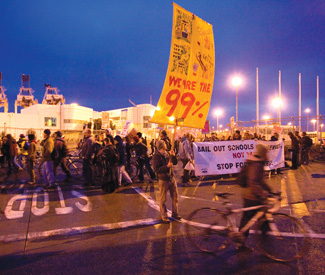
On Jan. 20, hundreds of activists converged on the Financial District in a day that showed a reinvigorated and energized Occupy movement.

The day of action was deemed “Occupy Wall Street West.” Despite pouring rain, the numbers swelled to 1,200 by early evening.

Critics have said that the Occupy movement is disorganized and lacks a clear message. Some have decried its supposed lack of unity. Others have even declared it dead.

But the broad coalition of community organizations that came together to send a message focused on the abuses of housing rights by corporations and the 1 percent sent a clear message:

The movement is very much alive.


A FULL SCHEDULE

Protesters packed the day with an impressive line-up of marches, pickets, flash mobs, blockades, and everything in between.

The action began at 6:30 a.m., when dozens chained and locked themselves together, blocking every entrance to Wells Fargo’s West Coast headquarters at 420 Montgomery Street. The bank didn’t open for business that morning.

Another group of protesters did the same thing at the Bank of America Building around the corner. A dozen blockaded one of the bank’s entrances from 8:30 a.m. to 6 p.m., preventing its opening. A group organized by Act Now to Stop War and End Racism (ANSWER) closed down the Bank of America branch at Powell and Market for several hours.

The Bank of America branch at Market and Main was also closed when activists turned it into “the Food Bank of America.” Several chained themselves for the door, while others set up a table serving donated food to hundreds of people.

Meanwhile, activists with the SF Housing Rights Coalition and Tenants Union occupied the offices of Fortress Investments, a hedge fund that has overseen the destruction of thousands of rent controlled apartments at Parkmerced. Direct actions also took place at the offices of Bechtel, Goldman Sachs, and Citicorp.

Hundreds picketed the Grand Hyatt at Union Square in solidarity with UNITE HERE Local 2 hotel workers.

A group of about 600 left from Justin Herman Plaza at noon and marched to offices of Fannie Mae, Wells Fargo, and the Immigration and Customs Enforcement Agency (ICE) in a protest meant to draw attention to housing and immigrant-rights issues.

“It’s not just a corporate problem. The government has been complicit in these abuses as well,” said Diana Masaca, one of the protest’s organizers.

More than 100 activists from People Organized to Win Employment Rights (POWER) and the Progressive Workers Alliance “occupied Muni,” riding Muni buses on Market Street with signs and chants demanding free transit for youth in San Francisco.

Another 200 participated in an “Occupy the Courts” action at the Ninth Circuit Court of Appeals, in protest of the Citizens United Supreme Court decision and corporate personhood.


GLITTER AND BRASS

Exhausted, soaked protesters managed to keep a festive spirit throughout the day, with colorful costumes, loud music, and glitter — lots of glitter.

The Horizontal Alliance of Very Organized Queers (HAVOQ) and Pride at Work brought the sparkly stuff, along with streamers and brightly colored umbrellas, to several different actions. Many painted protest slogans onto their umbrellas, proclaiming such sentiments as “I’ll show you trickle down” and “Not gay as in happy, queer as in fuck capitalism.”

According to protester Beja Alisheva, “HAVOQ is about bringing fabulosity to the movement with glitter, queerness, and pride. All day we’ve been showing solidarity between a lot of different types of oppression.”

There was also the Occupy Oakland party bus — a decked-out former AC transit bus — and carnival, a roving party that shut down intersections and bank entrances in its path while providing passengers a temporary respite from rain.

The Brass Liberation Orchestra, a radical marching band that has been energizing Bay Area protests for a decade, showed up in full force with trumpets, drums, trombones, and a weathered sousaphone.

The Interfaith Allies of Occupy also used horns to declare their message. About 30 participated in a mobile service, sounding traditional rams’ horns and declaring the need to “lift up human need and bring down corporate greed.”

Said Rabbi David J. Cooper of Kehela Community Synagogue in Oakland: “Leviticus 19 says, do not stand idly by in the face of your neighbor’s suffering. Well, we’re all neighbors here. Ninety-nine percent of us are suffering in some way, economically or spiritually. And maybe that number is 100 percent.”


FOCUS ON HOUSING

A coalition called Occupy SF Housing called for and organized the day of action, but the messages ranged from environmental to anti-war to immigrant rights.

Many groups did focus in on housing-related issues — and a takeover of a vacant hotel building stressed the urgency and need to house homeless San Francisco residents.

Housing protests included an anti wage-theft occupation led by the Filipino Community Center and the National Alliance for Filipino Concerns at the offices of CitiApartments, an action at the offices of Fortress Investments to demand a halt to predatory equity, and an “Occupy the Auction” demonstration in which protesters with Occupy Bernal stopped the day’s housing auction (at which foreclosed homes are sold) at City Hall.

“A lot of the displacement in this city is happening because of banks and because of things that are out of peoples’ control,” said Amitai Heller, a counselor with the San Francisco Tenants Union. “People will live in a rent controlled apartment for 20 years thinking that they have their retirement planned. A lot of the critiques of the movement are, if you couldn’t afford it you should move. But these people moved here knowing they could afford it because of our rent controls.”


LIBERATE THE COMMONS

Most of the early protests drew a few hundred people. But when the 5 p.m. convergence time rolled around, many people got off work and joined the march. A rally at Justin Herman Plaza brought about 600; by the time the march joined up with others at Bank of America on Montgomery and California, the numbers had doubled.

The evening’s demonstration, deemed “liberate the commons,” was also more radical than other tactics throughout the day; organizers hoped to break into and hold a vacant building, the 600-unit former Cathedral Hill Hotel at 1101 Van Ness.

When protesters arrived at the site, police were waiting for them. Wearing riot gear and reinforced by barricades, the cops successfully blocked the Geary entrance to the former hotel.

The darkness, rain, and uncertainty created a chaotic environment as protesters decided how to proceed. Some attempted to remove barricades; others chanted anti-police slogans.

Soon, cries of “Medic! We need a medic!” pierced the air. A dozen or so protesters had been pepper sprayed.

Police Information Officer Carlos Manfredi later claimed that the pepper spray was in response to “rocks, bottles and bricks” thrown by protesters. He also claimed that one officer was struck in the chest by a brick, and another “may have broken his hand.”

But I witnessed the entire incident, and I can say that no rocks, bottles or bricks were thrown at police.

When protesters opted to march down Van Ness, apparently towards City hall, several broke windows at a Bentley dealership at 999 Van Ness.

The march then turned around and headed back up Franklin, ending at the former hotel’s back entrance. There, it became clear that some protesters had successfully entered the building; they unfurled a banner from the roof reading “liberate the commons.”

Soon, many other protesters streamed into the building. They held it, with no police interference, for several hours.

Around 9:30, police entered the building and arrested three protesters for trespassing. About 15 others remained in the building, but left voluntarily by midnight.

This building has been a target of protest campaigns in San Francisco since it was purchased by California Pacific Medical Center, which closed the hotel in 2009. There are plans underway for a hospital to open at the site in 2015.

The project has been met with opposition from unions such as SEIU United Healthcare Workers West and UNITE HERE Local 2. The California Nurses Association (CNA) has also come out against the hospital proposal. In fact, it was the target of a CNA protest earlier in the day Jan. 20, when protesters created a “human billboard” reading “CPMC for the 1 percent.”

At a Jan.18 press conference, CNA member Pilar Schiavo said that at the former Cathedral Hill Hotel site, “A huge hospital is being planned with is being likened by Sutter to a five-star hotel. At the same time, Sutter is gutting St. Lukes Hospital, which is essential to providing healthcare for residents in the Mission, the Excelsior and Bayview- Hunter’s Point.”

Homes Not Jails, a group that finds housing for the homeless, often without regard to property rights, was crucial to planning the “Liberate the Commons’ protest. The group insists that the 30,000 vacant housing units in San Francisco should be used to shelter the city’s homeless, which they estimate at 10,000.


RAINY REBIRTH

Wet and cold conditions were not what Occupy SF Housing Coalition organizers had in mind they spent weeks planning Occupy Wall Street West, which was billed as the reemergence of the Occupy Movement in San Francisco for 2012.

Yet for many, the day was still a success.

“The rain’s a downer. But I think it speaks to the power of the movement, the fact that all these people are still out getting soaked,” said Heller on Jan. 20.

Perhaps hundreds of “fair-whether activists” did forgo the day’s events to stay out of the cold. If that’s the case, then occupy protesters with big plans for the spring should be pleased.

At this rate, it seems that Occupy will survive the winter- and emerge with renewed energy in 2012.


This article has been to corrected. We originally reported that a demonstration at the offices of Citi Apartments was led by the Chinese Progressive Association (CPA). In fact, it was led by the Filipino Community Center and the National Alliance for Filipino Concerns, and supported by a number of organizations including the Progressive Workers Alliance, of which CPA is a member organization. We regret the error.

“Occupy Wall Street West” hopes to see massive protest

14

A coalition from across San Francisco is hoping to make tomorrow – Friday, Jan. 20 – a monumental day in the history of Bay Area activism, the Occupy movement, and the fight against home foreclosures and other manifestations of corporate greed.Organizers call the day of protests, marches, street theater, pickets, and more “Occupy Wall Street West.”

Those that urged Occupy protesters to focus in on a list of demands should be pleased, as the day includes a list of demands on banks, including a moratorium on foreclosures and an end to predatory and speculative loans.


Organizers note that Occupy SF Housing, the coalition that planned the day, is separate from OccupySF. In fact, a subset of the group known best for its months-long tent city at Justin Herman Plaza was only one part of a substantial coalition that planned this day of action. Among others, the coalition includes the SF Housing Rights Committee, Homes Not Jails, Alliance of Californians for Community Empowerment (ACCE), and Occupy Bernal, a neighborhood-focused Occupy group specifically aimed at preventing evictions and foreclosures.

Justin Herman Plaza – or Bradley Manning Plaza, as many in OccupySF like to refer to the park just across from the Ferry Building – will be a crucial meeting point. A press spokesperson said that “down at Bradley Manning Plaza at 6 a.m.,12 p.m., and 5 p.m., we’re going to be launching various segments of the protests, and there will be information desks and education all for those who are interested.”

Organizers hope to culminate the day with a mass march at 5 p.m. A map of the planned actions can also be found here.

Many of the groups in the coalition have focused on specific cases of homeowners and tenants facing eviction and foreclosure; tomorrow, they bring their power to the Financial District.

Vivian Richardson, a member of the coalition who has also worked with ACCE and the newer Foreclosure Fighters group in Bayview, says that she remains in her home after being threatened with foreclosure due to community support.

“On my own, I tried everything to get out of this bad loan… I fought for two years on my own, only to have my home foreclosed on and taken away,” Richardson said at a press conference held yesterday.

“With the help of my community, unions, and ACCE members throughout the state, we generated over 1,400 emails and a few hundred calls to the CEO of [lender] Aurora Bank, and within one hour they called me to reopen my case,” she said. “As of today, the bank has voided the sale of my home and rescinded the foreclosure.”

Groups hoping to prevent foreclosures have had many success stories like Richardson’s. But tomorrow, they will put pressure on large corporate banks.

As SF Housing Rights Committee Executive Director Sarah Shortt said at the rally, “What we’re trying to do here is draw connections between some of those issues and the banking industry… I think that’s one of the most important pieces of the Occupy movement: starting to educate ourselves and each other about how ubiquitous the toll that’s been taken on cities, neighborhoods, communities by banking industry and the one percent.”

The focus is on housing, but in typical Occupy fashion, protesters will draw connections between all kinds of concerns that they see as abuses by banks and corporations.

According to OccupySF member Lisa Guide, the day is about “war profiteering, unjust foreclosures and evictions for profits by the big banks, exploitation of labor and union workers, and liberation of the commons for public good, among many other [issues].”

Guide also mentioned that Jan. 20 is “the eve of the Citizens United Supreme Court case, the court case that gave corporations the power to buy our government.” Simultaneous actions are planned to protest Citizens United, including an Occupy the Courts action at the Ninth District Court of Appeals at noon, to coincide with a national call to “Occupy the Courts

More than 55 organizations are involved in the day of action, and their focuses go beyond housing rights. These include students from Occupy SF State, Occupy Modesto Junior College, and other campus Occupy groups; anti-war organizations such as Iraq Veterans Against the War; environmental organizations such as the Rainforest Action Network; several unions, including UNITE HERE Local 2 and the California Nurses Association; the Chinese Progressive Alliance; and the Interfaith Allies of Occupy, which will be hosting an all-day “respite area” at Saint Patrick’s Roman Catholic Church at 756 Mission.

The array of events planned for Friday is overwhelming. There are demonstrations, pickets, and occupations planned at dozens of banks and corporations throughout the Financial District. Street theater is planned in several places, including an adaptation of A Christmas Carol by the San Francisco Mime Troupe at Justin Herman Plaza at noon and a show from Iraq Veterans Against the War that, according to IVAW member Jason Matherne, a Navy veteran who served in Qatar, “is called Operation First Casualty, because the first casualty of war is the truth.”

Matherne said, “corporations are profiting off the war at the expense of the 99 percent. Specifically, the Bechtel Corporation is using–misusing–billions of dollars to rebuild the infrastructure in Iraq.”

Tomorrow should be big. In a press release, organizers claim that “this is predicted to be the largest street protest of the Financial District since anti-war protests in 2003.”

Whatever the turnout, the Saint Patrick’s “respite” should be a boon, as weather reports indicate rain for tomorrow. Luckily, as Vicki Gray, a Deacon in the Episcopal Diocese of California, Occupy supporter and Interfaith Organizer, said of the sanctuary: “All are welcome. It will be warm, it will be quiet, and you will be loved.”

Dick Meister: Walter Johnson did what needed to be done

4

BY Dick Meister

Dick Meister, former labor editor of the SF Chronicle and KQED-TV, has covered labor and politics for more than a half-century, Contact him through his website, www.dickmeister.com, which includes more than 350 of his columns,

Walter Johnson was everything a labor leader should be – a dedicated, unflinching, champion of working people and their unions. But more than that, Walter was also an unyielding advocate of all those  inside and outside the labor movement who wanted – and badly needed – a decent living , or who were in any way oppressed.

Johnson, who died in San Francisco of a heart attack on Jan. 12 at age 87, devoted his life to that noble – yes, noble – task as head of the Department Store and Retail Clerks unions in San Francisco. He also later headed the SF Labor Council for nearly 20 years, from 1985 until his retirement in 2004.

 Walter was a genuine humanitarian, a kind, thoughtful man who very much liked and sincerely wanted to help people, who freely acknowledged the contributions of others who joined him in his efforts for social, political and economic justice, who seemed always ready and eager to do what needed to be done.

He was a man of great good humor, an outgoing man who seemed to get along with just about everybody, even some of his toughest adversaries. I know, I know. That surely does sound like pure hyperbole. But, believe me, it’s not, as many others who knew Walter Johnson could tell you.

Listen to Art Pulaski, who heads the California State AFL-CIO. He declared that Johnson “was a big and fearless advocate for everyone and anyone who was wronged, mistreated, put down, left out, pushed aside or just down on their luck.  He was fearless because he always followed his faith, his values and his heart.”

Despite the seriousness of his undertakings and his militancy, Johnson was no grim advocate. Whatever the situation, there was always lots of good-natured teasing, and jibes to be traded with friends. And jokes, always jokes – always! Corny, make-you-groan jokes usually, but effective at lessening the tensions that invariably came with the struggles he helped lead.

One look at Johnson’s face made clear his Scandinavian background, a mixture of Norwegian and Swedish. But you wouldn’t necessarily recognize him as a labor leader. He didn’t fit the stereotype. He almost invariably dressed in coat and tie and otherwise looked more like the public image of a business leader, more like management than labor.

Many union leaders spend most of their time in their offices, but Walter was out on the picket lines, or marching or otherwise demonstrating in support of the demands of his union and others, as well as those of other organizations also demanding justice. He was arrested several times for joining in sit-ins and other demonstrations that the authorities wanted to halt. And Johnson kept that up, despite his retirement.

I met Walter thanks to my job as the Chronicle’s labor editor. That was in the early 1960s, a few years after he had arrived in San Francisco from his native North Dakota to work as a Sears appliance salesman.

Dave Selvin, the labor historian and former public information officer for the Labor Council, had told me I should be sure to check out “a young guy” who’d just been elected president of the Department Store Employees. Walter Johnson, of course.

Selvin predicted good things for Johnson, and he was right.

Under Johnson’s leadership, San Francisco store clerks, department store employees and others won labor contacts at least as rewarding as the contracts as those who held similar jobs elsewhere.

Johnson was a key leader in winning strong, virtually unprecedented support for labor from City Hall and the Board of Supervisors – especially from Mayor Joseph Alioto.

Union representatives were appointed to many city commissions, major job creating construction projects were approved, and Alioto stepped in to mediate settlements of major strikes. Picketing strikers could be pretty certain police wouldn’t interfere. New businesses unfriendly to labor found it difficult to get the necessary city permits. Thanks to Johnson and other leaders, labor had gained considerable political clout to go with its considerable economic clout.

Johnson didn’t fear clashing with the AFL-CIO and its other affiliated unions as long as he felt he was right. He was one of the few labor leaders to speak out against the Vietnam War, which was wholeheartedly supported by the AFL-CIO’s national leadership and most of its affiliates.

Johnson was a leader in the growing global union movement that aims to create a powerful international labor federation that would bring the world’s unions close together to deal with “global capitalism” and thus improve the often deplorable conditions of many workers in many countries.

Closer to home, Johnson was one of the first labor leaders to give unconditional support to the LGBT movement. He was an important supporter of proposals to create a gay organization within the labor movement, despite the homophobic nature of most unions at that time. Johnson played a key role in the founding of the LGBT group that became Pride at Work in 2004.

Nancy Wohlforth, the current president of Pride at Work and now an AFL-CIO Executive Council member, had approached Johnson with the idea of such a group in 1979 and was shocked when he readily agreed it was a great idea. Wohlforth was so thankful for his help she dubbed him “an honorary lesbian.”

“Walter was thrilled,” Wohlforth said.

She later was the new business manager of a San Francisco secretarial union that was on strike against a union group that employed its members. Wohlforth noted that Johnson could very easily have avoided being involved, but “he dove right in.”

“He walked the picket line on rainy days and led a toy drive for the strikers during the Christmas holiday. He was, as always, so concerned that workers would know that they were supported at that difficult time.

“Working people’s struggles were always on his mind. I’m sure he dreamed of them every night – and he constantly was coming up with ways to make people’s lives better. He truly was my hero and he will be missed so much by all who were fortunate enough to know him.”

Amen to that.

Dick Meister, former labor editor of the SF Chronicle and KQED-TV, has covered labor and politics for more than a half-century, Contact him through his website, www.dickmeister.com, which includes more than 350 of his columns,

Dick Meister: It’s do or die for the United Auto Workers

3

By Dick Meister

Dick Meister, former labor editor of the SF Chronicle and KQED-TV Newsroom, has covered labor and politics for more than a half-century. Contact him through his website, www.dickmeister.com, which includes more than 350 of his columns.
Historians invariably cite the sit-down strikes at the country’s auto plants in the 1930s as a key to the spread of unionization throughout the automobile industry and throughout American industry generally.

The strikes helped establish the United Auto Workers Union – the UAW – as one of the country’s most economically and politically powerful, progressive and influential organizations, and its president, Walter Reuther, as one of the country’s important leaders.

But that was then, when the American automobile industry was virtually unchallenged by foreign automakers. Now U.S. automakers face heavy competition from Asian and German firms, especially from the firms that have opened plants in the United States. The steady growth of the non-union plants has been accompanied by a steady weakening of the UAW. The union’s membership, once in the millions, has declined to 350,000.

There are 14 foreign-owned assembly plants and several dozen parts factories now operating in the American South and Midwest – “transplants,” as the UAW calls the foreign-owned facilities. The transplants have become a major part of the U.S. auto industry, accounting for the industry’s only growth in the past 30 years. They employ about 50,000 workers, and as Jane Slaughter of Labor Notes reports, the workers produced more than 40 percent of all vehicles made in the United States last year.

If the UAW is to regain its power and influence and standing as a cornerstone of the labor movement, it will have to organize the transplants, whose owners are generally as hostile to unions as their American predecessors were in the thirties.

Organizing the transplants could very well be as tough – or tougher – as organizing U.S. plants was eight decades ago. In the thirties, many auto workers were already organized and able to act as a strong unified body to demand union contracts – and get them. But today, the UAW is faced with having to first convince workers to join the union and then make a unified demand for contracts from their staunchly anti-union employers, most of them based in the heavily anti-union South.

As a recent report from Reuters News Service noted, workers in the transplants “have rebuffed the union repeatedly,” in large part because of heavy employer pressures on them, including not-so-veiled threats of moving their plants elsewhere.

The UAW is initially seeking union rights for workers at the facilities owned and operated by the German companies Volkswagen and Daimler. The union sees the German companies as relatively easier targets than the Japanese and South Korean manufacturers who also operate U.S. plants.

Reuters found that the UAW’s failure to organize workers at the foreign-owned facilities has put the union in a financial bind. It has forced the UAW to sell some of its assets and shift money from its fund for financing strikes in order to pay for its operations. That includes trying to organize workers in the foreign-owned plants at the same time that the decline in the union’s membership has greatly lessened its dues income.

Despite its financial problems, the union is planning a worldwide $60 million campaign aimed at pressuring the transplants into agreeing to elections in which their workers could freely vote for or against unionization. The UAW is hoping to get strong support for elections from other unions and its Democratic political allies.

The UAW will also need broad public support, and that may not be easy to get, given the widespread popular opinion that the automobile industry’s problems stem at least in part from the relatively high pay and benefits the union has won from auto makers. The union is trying to overcome that by promising that contracts resulting from the voting would commit the UAW to sharing responsibility with employers for “quality, innovation, flexibility and value.” But if the union concedes what workers perceive as too much, it may lose many potential new members.

The situation facing the United Auto Workers, long one of America’s most important institutions, is indeed drastic – so drastic, says UAW President Bob King, that if the union fails to effectively organize the foreign-owned plants, the union will have no future.

 King insists he is not exaggerating. “I have said that repeatedly,” he declared, “and I believe it.”

Dick Meister, former labor editor of the SF Chronicle and KQED-TV Newsroom, has covered labor and politics for more than a half-century. Contact him through his website, www.dickmeister.com, which includes more than 350 of his columns.
Daly is back in a progressive leadership role

45

Chris Daly, a pivotal organizer of progressive politics during his decade on the San Francisco Board of Supervisors, has returned to a high-profile role in the movement. Last month, he went to work for Service Employees International Union Local 1021, the city’s largest public employee year. And today, he was named its interim political director.

“I’m excited and I think everyone here is excited to have Chris’s talent and experience and energy on this team,” local President Roxanne Sanchez, who was elected as part of a progressive reform slate in 2010, told the Guardian. “Part of the vision of the executive board, and the mandate that we were elected on, is to build a long-lasting sense of power at the rank-and-file level.”

Even before lending support to the Occupy movement and its challenge to the power of the richest 1 percent of society, Local 1021 was targeting banks and other downtown financial institutions with its Fight for a Fair Economy campaign. Now Daly can continue pushing that agenda and connecting the dots between the consolidation of wealth and the hardships faced by workers and local government.

“The spark has been the Occupy movement, but it’s been 1021 that has been helping to instigate some of these possible next steps…It has an opportunity to be successful if there’s some institutional support for it,” Daly said of San Francisco’s progressive movement, which suffered a setback when he and other board progressives were termed out, and a bit of a revival in the fall with the emergence of OccupySF.

“Occupy is going to need some foundation to continue its work,” Daly said. “Without organizational or structural support, that could have been a one-time thing.”

But now, during an important election year when the union’s contracts with the city expire, Daly sees an opportunity to forward the interests of both union members and the broader progressive movement. Both Daly and Sanchez say educating their members and the general public about the importance of progressive issues is essential to advocating for their members, who are among the city’s lowest paid workers and those who have suffered the most layoffs in recent years.

“If there’s not a notion of the distribution of wealth and the 99 percent, we won’t be successful,” Daly said. “Downtown is powerful, and labor needs to be here to offset the power of downtown. Without that, we’re stuck.”

Sanchez said the reorganization now underway in her union, of which hiring Daly is a key component, is about turning the clock back on the labor movement and returning to an agenda of broadly building working class power, as unions did in the ’30s and ’40s before becoming more bureaucratic institutions in the ’50s.

“Chris, and his perspective of building community strength, is our focus,” Sanchez said. “This is the time when unions have to help move a working family agenda and to push back on the opportunistic wealthy interests in this society.”

In the year since he left the board, Daly has been running the bar he purchased, The Buck (formerly Buck Tavern) – which became like a progressive clubhouse and gathering spot – as well as helping John Avalos’s mayoral run and other campaigns. Daly says he wants to maintain that role by continuing to tend bar on Friday nights, but he plans to pour most of his energies into a new role that is really a continuation of his old role.

“For me, it was never about being on the Board of Supervisors. It was about trying to make the progressive movement strong and more effective…In some ways, I was one of the unofficial political directors of progressive San Francisco,” Daly told us. “I have a strong motivation to build a progressive political program, and now I have the opportunity to do that.”

Dick Meister: A decent living for all?

11

Dick Meister, former labor editor of the SF Chronicle and KQED-TV Newsoom, has covered labor and politics for more than a half-century. Contact him through his website, www.dickmeister.com, which includes more than 350 of his columns.
Finally there’s some good news for the millions of Americans who must to live on pay at or close to the legal minimum wage. Eight states are raising their minimum wage on January First, in line with state laws requiring the minimum to keep pace with inflation.

The raises to come are modest by any measurement. But any increase must be welcomed as desperately needed and hopefully as a major start toward increasing the minimum wage everywhere to a level that will provide a decent living to all working Americans, many of them living in poverty or near-poverty.

The minimum wage is just as important now as it was in 1938, when the wage law was enacted as part of the Fair Labor Standards Act, with a promise of guaranteeing workers “a standard of living necessary for health, efficiency and general wellbeing.”

The federal rate was set at 25 cents an hour, with states and local governments free to set their own minimums, as long as they are above the federal rate.

Today’s rates are much higher, of course, although barely adequate. The federal rate is $7.25 an hour, only about $15,000 a year for full-time workers before taxes and other deductions. Eighteen states, more than 100 cities and counties and the District of Columbia have higher rates, but their rates also are clearly inadequate.

During his 2008 election campaign, President Obama proposed raising the minimum to  $9.50 an hour by 2011. But even though that would merely adjust the minimum wage for inflation, Congress and the White House have done little to make it happen.

Some of Obama’s Republican opponents in Congress actually have called for the minimum wage to be abolished, largely because their big money backers in the restaurant business, who employ about 60 percent of all minimum wage workers, are against it, as are many other business and corporate interests.

Congress’ failure to act has left it up to the states. The eight that are raising their rates on New Year’s Day include Arizona, Colorado, Florida, Montana, Ohio, Oregon, Vermont and Washington.  Their rates will increase by 28 to 37 cents an hour to between $7.64 and $9.04. The National Employment Law Project (NELP) calculates that will bring nearly 1.4 million full-time minimum wage workers an extra $582 to $770 per year.

Another 400,000 will get raises as pay rates are adjusted upward to reflect new minimum wage rates. It’s not just individual workers who will benefit from the raises. Like all low-wage workers, they must spend virtually every cent they earn, thus raising the overall demand for goods and services and the hiring of new employees to help provide them.

NELP estimates that the increased consumer spending generated by the raises will add $366 million to the gross domestic product and create the equivalent of more than 3,000 full-time jobs. Other estimates indicate that every dollar increase in wages for workers at the minimum creates more than $3,000 in new spending after a single year.

And we shouldn’t forget that those earning the minimum include many of our most valuable yet needy and exploited workers.  Most work in the service or retail fields, as domestics providing home health care for the elderly and other household services or caring for the children of working mothers, for example. Others work in agriculture.

Many can’t find full-time jobs even at the bare minimum.  More than one-third are the main or sole support of their families. Almost two-thirds are women, many of them single mothers. One-third are African-American, Latino or Asian. Many are recently arrived immigrants. Only a few belong to unions or have other protections aside from the law.

But wouldn’t a minimum wage increase cause businesses to cut back their hiring, as opponents of minimum wage raises claim? No. Studies show that even during times of high unemployment, raising the minimum does not lead to a loss of jobs. Actually, the number of jobs has grown after each of the 19 times the federal minimum has increased over the past 73 years.

Consider this, too: Taxpayers are providing billions of dollars in subsidies to employers of minimum wage workers, since much of the money paid out in public assistance goes to families whose working mothers do not earn enough to be self-supporting. Private charities provide additional millions in aid.

There’s no doubt employers are shifting a significant part of their labor costs to the general public, and no doubt that welfare costs could be reduced substantially if the minimum wage they had to pay was raised to a decent level.

Think of the benefits to society generally if the minimum wage workers who now must depend on government assistance could earn enough to make it on their own.

Think of the benefits to employers. As several studies have shown, raising workers’ pay raises workers’ morale and with it, their productivity, while decreasing absenteeism and replacement costs.

Think of the benefits to small retail businesses. Opponents of a minimum wage increase say they’d be hurt the most by a higher minimum wage, but it’s far more likely they’d be among the greatest beneficiaries. For minimum wage workers have no choice but to spend most of their meager earnings in neighborhood stores for food and other necessities.

Tiffany Williams of the Institute for Policy Studies says raising the minimum wage “would be a step toward restoring dignity for millions of workers, enabling many ordinary working Americans to become part of the economic recovery rather than its collateral damage.”

Hard to argue with that, or with Christine Owens, NELP’s executive director,  who says the minimum wage increases “represent bright spots on an otherwise bleak economic horizon. Workers’ buying power is the secret weapon in the fight to get our economy back on track. States are taking action to protect that critical buying power. Congress should follow their example to realize those benefits for the national economy.”

Let the minimum wage raises in eight states be just the beginning of raises in all states.  Let all Americans have the right to a decent living

Dick Meister, former labor editor of the SF Chronicle and KQED-TV Newsoom, has covered labor and politics for more than a half-century. Contact him through his website, www.dickmeister.com, which includes more than 350 of his columns.

The right way to rebuild CPMC

9

OPINION As 2011 comes to an end, San Francisco witnesses yet another year with community stakeholders and city officials mired in conflict over Sutter Health’s plans to rebuild its massive CPMC hospital system. In what has proven over the years to be an intensely complicated, politicized, and polarizing issue, one important point has been left out of the public dialogue — this conflict is entirely resolvable.

Very few parties have stated outright opposition to Sutter’s CPMC project. In fact, the unifying demand of a city-wide coalition with nearly 60 community and labor organizations is to “Rebuild CPMC, the Right Way.”

What exactly is the “right way?”

It’s simple: There’s a proven tool used in cities across America known to resolve complex standoffs such as this one — a community benefits agreement (CBA).

A CBA would bring this project to a resolution in two ways. First, it would provide direct accountability between the community and CPMC. A CBA is a legally binding contract between a developer and community and labor organizations that can be enforced on an ongoing basis without city involvement. And a CBA gives valuable assurances to developers that community and labor organizations will not politically or legally oppose the project — and in many cases, results in these groups providing public support.

Community stakeholders are often positioned to negotiate a stronger agreement than the city. They best understand the needs that have to be met in their neighborhoods and the adverse consequences that have to be avoided. And the city isn’t legally allowed to address any labor issue subject to a collective bargaining agreement — but a CBA is an independent agreement that can bring unions to the table in a meaningful way to resolve basic workers’ rights issues.

A recently released study by Hastings College of the Law cites the enormous profits made by CPMC ($744 million from 2006 to 2010), yet points out that the organization spends proportionally far less on charity care for poor residents than other private nonprofit hospitals. At a time when the 99 percent are standing up to corporate profiteering, a strong CBA can be a tool to help address the growing inequality in this city.

Among other things, a strong CBA should include:

Appropriate mitigation fees to address the full impact CPMC’s new workforce will have on one of the nation’s most expensive housing markets. CPMC estimates the project will increase demand for San Francisco housing by 1,440 new households.

More job opportunities for San Franciscans. CPMC is projecting an increase of over 4,100 new jobs by 2030, but the city has only negotiated a promise that 40 permanent jobs a year for the first five years will go to San Francisco residents.

Basic worker’s rights, including the right for current CPMC employees who are displaced to transfer to comparable jobs at new facilities and the right for workers at the new Cathedral Hill campus to join a union of their choosing without management intimidation.

Stipulation of key community clinics for CPMC to partner with. Although CPMC says it will increase its Medi-Cal service, it currently refuses to link its new hospital to any of the major clinics Medi-Cal patients use to access services.

A stronger guarantee to operate St. Luke’s Hospital over the long term. CPMC has agreed to a 20-year guarantee but has insisted on a “trigger” clause that will release it from this obligation, of which the details are unknown right now.

Without a CBA, the ongoing struggle between CPMC and affected communities across San Francisco will continue to delay this project. CPMC should meet with community stakeholders before any development agreement is approved and negotiate a community benefits agreement.

Steve Woo is a Community Organizer with Tenderloin Neighborhood Development, Emily Lee is a Lead Organizer at Chinese Progressive Association, and Gordon Mar is Executive Director of Jobs with Justice.

Dick Meister: Stamp out sexual harassment

1

By Dick Meister

Dick Meister, former labor editor of the SF Chronicle and KQED-TV Newsroom, has covered labor and politics for more than a half-century. Contact him through his website, www.dickmeister.com, which includes more than 350 of his columns.

Thanks to the recent widely publicized reports of alleged sexual harassment by some highly prominent men, the serious problem of sexual harassment on the job has drawn lots of attention from unions and other advocates of working women. And for good reason.

A recent Washington Post-ABC News poll indicated that nearly two-thirds of Americans now consider sexual harassment a problem. The poll also showed that about one-fourth of the country’s working women report having been sexually harassed on the job.

The increasing concern about harassment may very well explain the withdrawal of Republican Herman Cain from the presidential race amid allegations that he made unwanted sexual advances while heading the National Restaurant Association in the 1990s.

Cain, of course, denied the accusations. But the Post says that by a ratio of more than two to one, women who said they had been harassed at work had unfavorable views of Cain. By an even larger margin of nearly three to one, they said they were apt to believe Cain’s accusers.

Quite apart from the question of Cain’s guilt or innocence, 25 percent of the men polled said they worried that they might be unfairly accused of sexual harassment.

The Post reported that about 10 percent of the men said “they may at one time done something, even inadvertently, that a colleague may have considered an unwanted sexual advance.” But the percentage of men saying that is lower than it was in the past. Undoubtedly that percentage will rise, in part because of the heightened concern prompted by the charges against Cain and other prominent men.

Previously, the level of concern was even lower. A 1994 ABC News poll, for instance, showed that 32 percent of working women said they had been sexually harassed on the job. Reports of harassment have deceased steadily since then, with fewer women younger than 50 currently claiming to have been victims.

Overall, about one in six Americans now say they’ve been sexually harassed at work. That includes 24 percent of women workers, 9 percent of men. The 1994 survey showed that nearly one-third of women 18 to 49 said they had been sexually harassed, as compared with today’s lower figure of one-fourth of such women.

The percentage of workers who’ve reported to their employer that they’ve been harassed has meanwhile increased, although not nearly enough. Despite the generally heightened concern about harassment, about half of those charging harassment at work told pollsters they never reported it.

About one-third said they didn’t think it serious enough to report, and about one-fifth were worried about the possible consequences – or thought it wouldn’t do any good to report harassment.

Major steps have been taken to combat discrimination against workers because of their race, gender, age or other factors. Now it’s time to pay increased attention to combating sexual harassment, still one of the most serious forms of workplace discrimination.


Dick Meister, former labor editor of the SF Chronicle and KQED-TV Newsroom, has covered labor and politics for more than a half-century. Contact him through his website, www.dickmeister.com, which includes more than 350 of his columns.


Path: p » strong


Plugging the flow

0

rebeccab@sfbg.com

When significant events related to the Occupy movement occur in the pre-dawn hours, it usually means a protest encampment has been raided. But on Dec. 12, Occupy protesters were the ones carrying out a strategic plan before sun up.

Activists organized by OccupyOakland effectively blocked cargo shipments from moving through several Port of Oakland terminals that day, as part of a coordinated West Coast Port Blockade that featured similar actions in other cities including San Diego, Portland, Seattle, and Longview, Washington.

About 150 longshore workers were sent home from their morning shifts at Oakland shipping terminals because protesters were marching in circular picket lines outside the gates.

The day began when more than 1,000 protesters met up at the West Oakland BART station at 5:30 a.m., sleepily raising signs and banners in the chilly morning air as they proceeded down 7th Street toward the port. Once they reached the sprawling shipping hub, they formed picket lines outside terminal entrances. Police were on the scene and clad in riot gear, but no clashes with protesters occurred early in the day.

Around 7 a.m., when the morning shift would have typically started, two International Longshore & Warehouse Union (ILWU) dockworkers — who declined to give their names — stood near the Hanjin Shipping gate at berths 55 and 56. Past the gate, a cargo vessel which had likely come from Japan was berthed and waiting to unload.

The men calmly surveyed the roughly 200 chanting Occupy activists as they marched around and around in a circular picket. “Ain’t nobody going to cross it,” one offered. The other gestured toward the protesters. “These are Americans wanting American jobs,” he said.

Around 10 a.m. outside the same terminal, protest organizer and Oakland hip-hop artist Boots Riley declared the first part of the port shutdown to be a victory. “Longshoremen are going home now,” he said. “Effectively, the Port of Oakland is shut down.” Later in the afternoon, protesters returned to prevent the start of an evening shift.

Until recently, the nationwide Occupy movement manifested as tent cities springing up everywhere in rebellion against the lopsided economic conditions. After a series of police raids cleared the tents away, however, organizers in the Bay Area and beyond took a different tack with the port blockade.

Working in tandem with allies from labor, occupiers from San Diego all the way up to Anchorage directed their gaze at international shipping hubs, critical infrastructure for multinational businesses importing and exporting goods between Asia and North America.

Cargo terminals make for heavyweight targets, as five of the nation’s 10 largest ports are located along the West Coast. The value of annually traded goods flowing in and out of Oakland alone is $34 billion, and authorities there estimate some $8 million could be lost if business were to be halted for a full day.


MAKING HISTORY

OccupyOakland unanimously approved the call for a coordinated West Coast port blockade at a Nov. 18 General Assembly.

“The ports play a pivotal role in the flow and growth of capital for the 1 percent in this country and internationally,” occupiers explained on a website announcing the port shutdown. “For that reason alone it is the ideal place to disrupt their profit machine.”

The ports weren’t selected as a target for that reason alone, but rather as an affront to specific corporations whose labor practices have sparked the ire of port workers. Export Grain Terminal (EGT) and its parent company, Bunge, Ltd., came into Occupy’s crosshairs because of their ongoing dispute with ILWU Local 21 in Longview, Wash., stemming from what longshoremen characterize as union-busting practices.

Port terminal operator Stevedoring Services of America (SSA Marine) and its parent company’s primary shareholder, Goldman Sachs, were also singled out in support of low-wage port truckers whose employment classification as independent contractors bars them from unionizing.

The third objective of the blockade, according to organizers, was to strike back against a series of police raids that dismantled Occupy encampments nationwide.

It wasn’t the first time cargo ships traversing the Pacific would be stalled by a politically motivated coast-wide port blockade. In 2008, ILWU members coordinated a West Coast port shutdown in dissent of the Iraq War.

In 1984, longshoremen and anti-apartheid activists blocked South African cargo to boycott the apartheid regime, noted ILWU member Stan Woods. Similar shutdowns, carried out in response to politically explosive issues going back to 1934, have been led by community activists forming picket lines at port entrances to prevent dockworkers from beginning their shifts.

Occupy’s call for a coordinated blockade brought an unprecedented twist to this historic trend, representing the first time a group unaffiliated with dockworkers had called for a shutdown spanning the entire West Coast. It left some seasoned organizers wondering anxiously how things would unfold, while others saw it as a gust of wind in the sails of the labor movement.

“One of the good things about the Occupy movement is that it’s challenging leaders of progressive institutions,” Woods said. “The old way … isn’t working. There’s been a one-sided class war, and there has to be a two-sided class war.”

Organizer Barucha Peller noted that the Occupy movement could be galvanizing for non-unionized workers, too. “Our movement is giving a framework for the 89 percent of workers who are not in unions,” she said.

For occupiers up and down the West Coast, the port shutdown also seemed to present a kind of test as to whether their young movement could successfully “exert its collective muscle,” as an OccupyOakland press statement put it, and effectuate a mass mobilization even after police raids flattened their encampments.


A ROUGH VOYAGE

In the weeks leading up to Dec. 12, even as Bay Area Occupy organizers plastered fliers about the blockade everywhere, met with union members, and organized outreach events to garner community support, they stumbled into challenges. Robert McEllrath, the president of the ILWU, publicly criticized the blockade plan, saying organizers had failed to reach out to union officials before unanimously approving the call to action.

“Any decisions made by groups outside of the union’s democratic process do not hold water, regardless of the intent,” McEllrath wrote. He seemed troubled that Occupy had attached itself to a union struggle without adequate communication, but an official endorsement of a third-party blockade by the ILWU would have landed the union in legal trouble.

“Whenever a group of people decide to march into a workplace in an effort to shut it without respecting the democratic decision-making process, it’s not an ideal situation,” ILWU spokesperson Craig Merrilees told the Guardian.

Some rank-and-file ILWU members saw things differently. “The rank and file do support the principles of the community, and Occupy,” said Anthony Lavierge, an ILWU steward. “Longshoremen had a good response to [the Nov. 2 port blockade]. It was empowering to a lot of people that so many came out.”

Another rank-and-file union member said, “the majority of ILWU workers are supportive of what’s going on, definitely.”

One rank-and-file ILWU member and self-described anarchist published a critique online raising concerns that OccupyOakland had failed to bring local union officials on board before approving the call to action.

In response, OccupyOakland organizer Mike King said, “We never brought it to them, because it’s not something they could endorse.” Yet he added that they had sought to include the rank-and-file from the start.

“We have done far more outreach for Dec. 12,” than in the days prior to the Nov. 2 port shutdown, which brought tens of thousands of activists to the street, King said. “Leading up to Nov. 2, we never expected half that many people would show up.”

Occupiers in San Diego, Los Angeles, Portland, Vancouver, Anchorage, and other cities all signed up to participate, and the idea drew support from activist groups as far away as Japan who vowed to perform solidarity actions in their own communities.

Nevertheless, the international union president’s statement prompted a flurry of mainstream news articles — along with some downright derisive columns — casting occupiers as out of sync with the very workers they claimed to stand with.

In Oakland, authorities of the targeted facility posed another obstacle. The Port of Oakland took out full-page ads in local daily newspapers and the New York Times urging the community to “Keep the Port Open.” The ads borrowed the language of the movement by proclaiming that the port “employs the 99 percent.” Port spokesperson Robert Bernardo emphasized this message in an interview with the Guardian. “When you shut down a port, you lose jobs,” he said. “Local jobs.”

Sue Piper, special assistant to Oakland Mayor Jean Quan, noted prior to Dec. 12 that the mayor was working with police and port officials to ensure that the port remained open for business. On the morning of the port blockade, however, police stood down and did not prevent protesters from circling up in front of terminal entrances.


BIG FISH TO FRY

Lost in much of the mainstream coverage of the port blockade were Occupy Oakland’s three main objectives. The protesters aimed to demonstrate solidarity with low-income port truckers laboring in service of the powerful SSA Marine; stand with ILWU Local 21 members in their face-off against EGT; and deliver a show of resistance against coordinated police raids of Occupy encampments nationwide.

In October, 26 Los Angeles truckers working for a port company called Toll Group were fired after wearing Teamsters truckers’ union jerseys to their shifts to demonstrate their wish to unionize. Because they’re classified as independent contractors instead of employees, it’s illegal for the truckers to join unions. They’re paid per shipment rather than per hour, which translates to hours of unpaid labor spent in the queue, and must cover their own job-related costs.

Occupy Los Angeles caught wind of the incident and began to talk about doing an action in solidarity with the truckers.

“The date of Dec. 12 was originally suggested by people in Los Angeles,” explained Dave Welsh, a delegate of the San Francisco Labor Council and secretary of the Committee to Defend the ILWU. “It’s also Our Lady of Guadalupe feast day, a Mexican holiday. Since many truckers of the Port of LA are Mexican, they picked that date. One focus [of the blockade] is support for truckers and their demand for better wages, working conditions, etc.”

On the day of the blockade, an open letter from port truckers was published on the website of the Coalition for Clean and Safe Ports, an advocacy group. “We are inspired that a non-violent democratic movement that insists on basic economic fairness is capturing the hearts and minds of so many working people,” the message read. “Thank you ’99 Percenters’ for hearing our call for justice. We are humbled and overwhelmed by recent attention. Normally we are invisible.”

The second major target of the blockade was EGT, which constructed a new grain terminal on Port of Longview property at the edge of the Columbia River in southern Washington, about an hour’s drive from Portland, Ore.

EGT’s parent company is Bunge, Ltd., a major agribusiness firm that has come under fire for everything from tax evasion, to rampant clearing of Amazon rainforest lands for soybean cultivation, to the use of slave labor in Brazil.

Although the terminal construction first brought hope to a small community inflicted with 15 percent unemployment , ILWU Local 21 President Dan Coffman says things soured when EGT brought in out-of-state laborers to build the facility, then refused to hire members of his union.

Coffman contends that EGT’s lease with the port means the company is required to hire Local 21 workers, but EGT disputes this, and has been locked in a federal court battle with the port. The dispute has prompted union members to stage port blockades of their own, resulting in some arrests.

Peller, the Occupy Oakland organizer, announced on a megaphone Dec. 12 that occupiers in southern Washington had shut down the Port of Longview, according to a text message from ILWU Local 21. Union members wanted to thank the movement for the show of support, she added.

“They thought they could just run over a small local,” Coffman told the Guardian, referencing EGT. “Well, David met Goliath. We’re going to fight them till the bitter end.”

OccupyOakland extends Port blockade into second day

0

Early this morning, the protesters carrying out Oakland’s part in yesterday’s national “West Coast Port Shutdown” declared victory after 24 hours of demonstrations. After picketing during both the 8am and 6pm shifts at the Port of Oakland yesterday, protesters decided to extend the day of action to the 3 am shift today (Tues/13). 

Occupy Oakland’s General Assembly had voted to extend the shut-down if there was police violence against Occupy protesters in other participating cities; Occupy groups from Anchorage to San Diego participated, and protesters were tear-gassed in Houston and Seattle.

After a successful morning action, thousands of protesters arriving on a march to picket the 6pm shift were surprised to find that it had already been canceled. In an emergency General Assembly, protesters exchanged information about solidarity actions across the country and chose to continue the shutdown.

Protesters marched to Gate 60, where they commenced what one long-time OccupySF protester called a “festival in the streets.” Sound trucks with live music and DJs entertained the crowd while others played live music; a handful of tents were pitched.
At 1:20 am, the picket began again. Demonstrators circled in front of the gate entrance, chanting “Oakand is a union town!” and slogans against Export Grain Terminal (EGT), a grain elevator operator with which the ILWU has been in dispute since 2009.

Port workers began to arrive around 1:30 am, and many were surprised to see that the picket had been extended. One man, one of the earliest to arrive, seemed exasperated, saying “This is still going on? I didn’t show up yesterday, but I drove here from Fairview today.”
Others reacted differently. When a protester greeted one man and explained the reason for the continued protest, he responded, “Listen, I’m from (ILWU) Local 10. We’re a militant union. I’m used to this kind of thing.”

Clarence Thomas, past secretary-treasurer of ILWU Local 10 and third generation Oakland longshoreman, expressed a similar sentiment of solidarity in a recent interview with Workers World, saying, “If ILWU members don’t honor the community picket lines, it will cause an irreparable breach with the community. If the ILWU can’t support the community, why should the community support the ILWU in 2014 contract negotiations or when the new grain agreement is up next year?”

At 1:45 am, dozens of Occupy supporters, many of whom had left the “port shutdown” action to get some rest with plans to return in the early hours of the morning, began marching to the port from 7th and Adeline streets to join the picket lines.

By 2:30 am, protesters were marching in community picket lines at gates 60, 63, 67 and 68, with over 100 at the first three locations and about 20 in an all-bike picket line at the fourth. A handful of workers crossed the picket line and went to work. The majority who arrived for work – a light turnout, as news of the picket traveled quickly – did not cross the picket line. Many did stay, however, and engage in political conversations with Occupy protesters.

By 3:15 am, the shift had been officially canceled. A general assembly of Occupy protesters and representatives from the ILWU met to discuss next steps.  ILWU steward Anthony Lavierge addressed the group, saying, “This was called in solidarity with the Longshoremen, and in my opinion another day would harm that relationship. However, this is a community picket, and in the end it’s up to you what you decide to do.

Though some protesters wanted to continue to extent the blockade, they were overwhelmingly voted down by those who felt the time was right to declare victory. Samantha Levins, an Alameda/Oakland ferry worker and organizer with the Inland Boatmans Union/ILWU, stayed until the protest dispersed at 3:45am. She told the Guardian, “Today was great. It was extremely well organized and everybody was really respectful.”

Levins saw the day of action as a step forward for Occupy in the direction of working more closely with unions. She said, “It really opens up possibilities (for Occupy) to work more with unions. They’ve proven they can do it in a respectful way. ”

Dick Meister: Unemployment is slamming public employees

18


By Dick Meister

Dick Meister, former labor editor of the SF Chronicle and KQED-TV Newsroom, has covered labor and politics for more than a half-century. Contact him through his website, www.dickmeister.com, which includes more than 350 of his columns.

The latest job reports show that public employees, those favorite targets of Republicans and other government budget slashers, are being hit particularly hard by the country’s severe unemployment problems.

As the New York Times reported, 20,000 government workers were laid off in November alone, most of them state, county and city employees.

The public workers’ unemployment numbers have been steadily increasing for the past several years, at the same time that the jobless figures for workers in private employment actually have been decreasing.

In fact, private employers have been adding jobs since the end of 2009, a year after the beginning of the Great Recession. More than a half-million government jobs have been lost since the recession began.

The Times noted that in most cases, the layoffs were made because of declining tax revenues, or reduced federal aid “because of Washington’s inexplicable decision to focus more on the deficit in the near term than on jobs.”

The layoffs mean “a lower quality of life . . . fewer teachers, pothole repair crews and nurses.” It’s been happening all over the country, of course. The Times cited as a typical example what’s been happening in the Indiana city of Marion, population 30,000.

Marion city officials recently announced what they called a “radical reorganization” of city services that will mean laying off 15 of the city’s 58 police officers and 12 of its 50 firefighters. Radical, indeed. That’s more than 25 percent of Marion’s police and firefighters.

As elsewhere, the layoffs of course reduce vital public services, but it’s important to note that they also of course have a serious impact on those who lose their jobs. The impact has been especially harsh on African- American workers.

The Times’ Timothy Williams reported that one-fifth of the nation’s millions of black workers “have entered the middle class through government employment” and tend to make 25 percent more than other African-American workers. But now tens of thousands are being forced to leave both their jobs and the middle class.

The Times cited as a prime example the city of Chicago, which is scheduled to lay off more than 200 employees in the next fiscal year, two-thirds of them African-Americans.

It shouldn’t be surprising, then, that the African-American jobless rate has risen to more than 15 percent nationwide, almost double the rate for other workers.

As the Times said, the effect has been severe – “destabilizing black neighborhoods and making it harder for young people to replicate their parents’ climb up the economic ladder.” Their rise was made largely by the government jobs that they’re now losing without much hope of finding other jobs, given the current tattered state of the economy and continued job discrimination against African-American workers generally.

It certainly would be hard to disagree with the Times’ conclusion that much of the public job losses and consequent cutbacks in public services stem from the fact that many Republicans “don’t regard government jobs as actual jobs, and are eager to see them disappear. Republican governors around the Midwest have aggressively tried to break the power of public unions while slashing their workforces, and Congressional Republicans have proposed paying for a payroll tax cut by reducing federal employment rolls by 10 percent through attrition.”

That 10 percent, the Times pointed out, is 200,000 jobs. And, surprise! Many of those jobs “would be filled by blacks and Hispanics and others who tend to vote Democratic.” So, said the Times, those workers “are considered politically superfluous” by the GOP.

But, the Times concluded, “every layoff, whether public or private, is a life, and a livelihood, and a family. And too many of them are getting battered by the economic storm.”

Dick Meister, former labor editor of the SF Chronicle and KQED-TV Newsroom, has covered labor and politics for more than a half-century. Contact him through his website, www.dickmeister.com, which includes more than 350 of his columns.


Editor’s notes

0

tredmond@sfbg.com

The private sector that Republicans see as our economic savior has been creating jobs. Not a lot, a few hundred thousand a month, but some. And yet the unemployment rate remains stubbornly high.

There’s a reason for that, one politicians from San Francisco to Washington D.C. don’t want to talk about. But the New York Times put it nicely in a Dec. 5 editorial:

“While the private sector has been adding jobs since the end of 2009, more than half a million government positions have been lost since the recession…”

“The cutbacks hurt more than just services. As Timothy Williams of the Times reported last week, they hit black workers particularly hard. Millions of African Americans — one in five who are employed — have entered the middle class through government employment, and they tend to make 25 percent more than other black workers. Now tens of thousands are leaving both their jobs and the middle class.”

Remember: Most of the biggest employers in this city are not corporations; they’re government agencies. The City and County of San Francisco, the University of California, the State of California, the United States Postal Service, City College and the San Francisco Unified School District drive the local economy more than any one private company. Between them, those public-sector operations employ more than 60,000 people. The largest single private employer, Wells Fargo, has fewer than one sixth of that number.

Most of the those public-sector jobs are unionized and offer decent benefits. They are such an important part of the city’s economic development future that it’s impossible to talk about jobs in San Francisco unless you start the conversation with the public sector.

Mayor Ed Lee is about to enter negotiations with unions representing 24,000 city employees. His office is already indicating that cost savings will be a big part of the discussion. I know there are cost savings out there — you can’t spend $2 billion on payroll and not have some waste somewhere in the package.

But if he’s serious about his campaign mantra — jobs, jobs, jobs — I hope he remembers what the Republicans don’t: Government jobs count, too.

Government jobs are jobs, too

81

The New York Times weighed in Dec. 4 on an economic fact of life that I’ve been harping about for years now: Jobs in the public sector are … jobs. In many cases, they’re good jobs. And when conservatives and business leaders talk about reducing the size of government — and then complain about the unemployment rate — they’re stuck in doublespeak.

I know the Times has a paywall now, so if you can’t get in from that link I’ll give you the main points of the editorial:

While the private sector has been adding jobs since the end of 2009, more than half a million government positions have been lost since the recession. … The cutbacks hurt more than just services. As Timothy Williams of The Times reported last week, they hit black workers particularly hard. Millions of African-Americans — one in five who are employed — have entered the middle class through government employment, and they tend to make 25 percent more than other black workers. Now tens of thousands are leaving both their jobs and the middle class. Chicago, for example, is laying off 212 employees in the upcoming fiscal year, two-thirds of whom are black.

That’s one reason the black unemployment rate went up last month, to 15.5 percent from 15.1. The effect is severe, destabilizing black neighborhoods and making it harder for young people to replicate their parents’ climb up the economic ladder. …

Many Republicans, however, don’t regard government jobs as actual jobs, and are eager to see them disappear. Republican governors around the Midwest have aggressively tried to break the power of public unions while slashing their work forces, and Congressional Republicans have proposed paying for a payroll tax cut by reducing federal employment rolls by 10 percent through attrition. That’s 200,000 jobs, many of which would be filled by blacks and Hispanics and others who tend to vote Democratic, and thus are considered politically superfluous.

But every layoff, whether public or private, is a life, and a livelihood, and a family. And too many of them are getting battered by the economic storm.

Something to think about as city officials try to eliminate the latest defict and negotiate new union contracts. Because Repbulicans aren’t the only ones who don’t regard government jobs as actual jobs; a lot of Democratic officials and business leaders in liberal San Francisco seem to feel the same way.J


About that “acrimonious fall”

Catch this. Mayor Ed Lee’s mayoral victory had nothing to do with millions of dollars in campaign contributions from private interests, a sophisticated get-out-the vote effort targeting Lee supporters, the advantage of incumbency, some funny business, or a calculated campaign strategy concentrating efforts on absentee ballots.

Instead, the fact that Lee triumphed over voters’ second pick, the significantly less well-funded progressive candidate Sup. John Avalos, is proof that the left in San Francisco has plummeted into a dark abyss. In fact, the progressive movement has descended so far into disarray and become so irrelevant that its condition warrants front page news.

That’s essentially the narrative that Benjamin Wachs and Joe Eskenazi of the San Francisco Weekly offer in their cover article, “Progressively Worse: The Tumultuous Rise and Acrimonious Fall of the City’s Left,” in which they refer to the Guardian as “the movement’s cajoling ward boss, kingmaker, and sounding board.” Gosh, I feel so goddamn important right now.

Once the blood pressure returned to normal, my initial reaction to this piece was that Wachs and Eskenazi seem to misunderstand who and what progressives actually are. They portray the city’s left as a caricature, a brash bunch of power mongers now on the losing end that can be easily summed up with pithy video game references, Happy Meal toy bans, and bikes.

Witness the contrast between the Weekly’s portrayal of progressives (helped along by former Newsomite Eric Jaye), and the portrait of the left the Guardian offers this week with an Op-Ed written by NTanya Lee — an actual progressive who volunteered for the Avalos for Mayor campaign.

Here’s the Weekly on the left:

“This is an eclectic group, one often bound not by mutual interests as much as mutual enmity — toward Brown, his successors, and the corporate interests of ‘downtown.’ As a result, progressive principles are often wildly inconsistent. Progressives favor more government control over people’s lives for their own good, as when they effectively banned McDonald’s Happy Meals. But sometimes progressives say the government needs to let people make their own choices … Progressives believe government should subsidize homeless people who choose to drink themselves to death, while forbidding parents from buying McNuggets because fast food is bad for us. … Without consistent principles, it’s easy to associate progressives with the craziest ideas to come out of City Hall, and the movement’s bad ideas are memorable. … Daly’s pledge to say ‘Fuck’ at every public meeting makes a killer Internet meme. Hey, let’s legalize prostitution and outlaw plastic bags!”

Here’s Lee on the left:

“The Avalos coalition was largely community forces: SF Rising’s base in working class Black, Latino, Filipino and Chinese communities; the Bike Coalition’s growing base of mostly white bike riders; affinity groups like Filipinos, Queers, Latinos and Arabs for Avalos; progressive Democrats; social networks of creative, young progressive activists affiliated with the League of Young Voters; and loyal families and neighborhood leaders from John’s own District 11. The campaign prioritized communicating to voters in four languages, and according to the Chinese press, John Avalos was the only non-Chinese candidate with a significant Chinese outreach program. There were stalwarts from progressive labor unions (most notably SEIU 1021 and USWW) who threw down — but overall, labor played it safe and invested resources in other guys. And then, in the great surprise development of the race, supporters of the new national occupy movement came to be a strong part of the Team Avalos base because the campaign was so well positioned to resonate with the call to take on the one percent.”

When it comes to takeaways from the November election, the Weekly’s conclusion is essentially opposite that of progressives. While many on the left see themselves as regaining momentum and building the power to rise even in the face of defeat by the established powers-that-be, the Weekly casts San Francisco’s left as deflated and out-of-touch.

Speaking of out-of-touch, the SF Weekly refers to San Francisco’s “increasingly imaginary working class.”  But in reality, 61 percent of students attending public schools in S.F. Unified School District qualify for free or reduced lunch, and a majority of San Franciscans cannot afford market-rate housing.

However, the Weekly is correct in pointing out that shifting demographics have dealt a blow to the progressive base.

“Between 2000 and 2010, the city grew older (every age group over 50 increased), wealthier (there are now 58 percent more households earning $125,000 or more), and more heavily Asian (up from around 30 to nearly 35 percent of the city’s population): exactly the groups progressives don’t win with. These voters don’t respond well to campaigns against developments or for city services, because they’re often living in those developments and don’t need city services.”

I take issue with the Asian part of that statement as a sweeping generalization, however, having witnessed the solid organizing work of the Chinese Progressive Association, for example.

The Weekly also says progressives and the Guardian never called out former Mayor Gavin Newsom for ripping off their best ideas. Oh, they didn’t?  That’s news to me.

The Weekly article implies that progressives got trounced by moderates because jobs are priority No. 1 for voters, and the left has no feasible economic plan — but at the same time, the article completely dismisses ideas that the Guardian has put forth, like creating a municipal bank, implementing Avalos’ Local Hire legislation, or taxing the rich.

Taxing the rich is precisely the kind of economic solution the international Occupy movement is clamoring for, and the concept has even attracted a few unlikely supporters, like billionaires Warren Buffet and Sean Parker, who is not some conservative a*hole by the way.

“The Guardian … stays on the progressive agenda because they put it there, along with taxing the rich, tapping downtown to subsidize Muni, and other measures … Proposing the same old solutions to every new problem turns policies into punch lines.”

Speaking of predictable, no profile authored by the Weekly mentioning the Guardian would be complete without some dig about public power. “The Guardian has been flogging public power since Tesla invented the alternating-current generator,” the S.F. Weekly squawks. Those clever reporters, turning policies into punch lines.

But wait, I thought the problem was that progressives couldn’t get it together on the job creation thing. Consider the CleanPower SF program, which has been strongly advocated for by progressive Sup. and Sheriff-elect Ross Mirkarimi (who it turns out is “not toxic,” according to the Weekly, since he was elected citywide and all). According to an analysis by the Local Clean Energy Alliance, CleanPowerSF will create 983 jobs — 4,357 jobs when indirect job creation is factored in — over the course of three years, assuming the 51 percent renewable energy target is met. Presented with this kind of information, the Weekly will only yawn and say, “Are we on that again?”

That being said, our friends’ article might actually have a pearl of wisdom or two buried somewhere in that nauseating sea of sarcasm. Everyone needs to engage in self-reflection. So right after you’re done throwing up, think about how to take advantage of the opportunity this article presents for a citywide dialogue about progressivism in San Francisco.

Lessons of the Avalos campaign

157

By N’Tanya Lee

It’s the middle of the night. His two kids and wife are home in bed. Supervisor John Avalos, candidate for mayor, heads downtown in his beat-up family car. He parks and walks over to 101 Market Street, and casually starts talking to members of OccupySF. He’s a city official, but folks camped out are appreciative when they see he’s there to stand with them, to try to stop the cops from harassing them, even though its 1 a.m. and he should be in bed.

John Avalos was the first elected official to personally visit Occupy SF. It wasn’t a publicity stunt — his campaign staff didn’t even know he was going until it was over. He arrived and left without an entourage or TV cameras. This kind of moment — defined by John’s personal integrity and the strength of his personal convictions — was repeated week after week, and provides a much-needed model of progressive political leadership in the city.

John Avalos is more than “a progressive standard bearer,” as the Chronicle likes to call him. He’s also a Spanish-speaking progressive Latino, rooted in community and labor organizing, with a racial justice analysis and real relationships with hundreds of organizers and everyday people outside of City Hall. He’s demonstrated an authentic accountability to the disenfranchised of the city, to communities of color and working people, and he knows that ultimately the future of the city is in our hands.

Some accomplishments of John’s campaign for mayor are already clear: He consolidated the progressive-left with 19%, or nearly 40,000, first-place votes, despite the confusion of a crowded field; he came in a strong second to incumbent Ed Lee despite being considered a long shot even weeks before the election; after RCV tallies, he finished with an incredible 40% of the vote, demonstrating a much wider base of support across the city than he began with, and much broader than former frontrunners Leland Yee and David Chiu, who outspent him 3-1. He won the Castro, placed third in Chinatown (ahead of Yee), and actually won the election-day citywide vote. Not bad. In fact, remarkable, for a progressive Latino from a working class district in the southern part of town, running in his first citywide race.

I believe John Avalos demonstrated what can be accomplished with a new kind of progressive leadership — and suggests the elements of a new progressive coalition that can be created to win races in 2012, and again, in 2015.

It’s Monday afternoon, 1:35pm, time for our weekly Campaign Board meeting. John rushes in, after a dozen appointments already that day. The rest of us file into the ‘cave’ — the one private room in Campaign headquarters, with no windows, a makeshift wall and furniture that looks to be third-hand. The board makes the key strategy, message, and financial decisions. There are no high paid political consultants here. Most of us are, or have been, organizers. Today, we need to approve the campaign platform. Finally. We’ve decided to get people excited about our ideas, an agenda for change. We leave the meeting excited and nervous, wondering if anyone will get excited about the city creating its own Municipal Bank.

We were an unlikely crew to lead a candidate campaign — even a progressive one in San Francisco. We come from membership based community and labor organizations, and share a critique of white progressive political players and electeds who spend too few resources on building power through organizing and operate without accountability to any base. We are policy and politics nerds, but we hate traditional politics. Seventy percent of us are people of color — Black, Filipina, Latino, and Chinese. We are all women except John, the candidate, and nearly half of us are balancing politics with parenting.

The campaign board — including John himself—shared a vision for building progressive power. The campaign plan was explicit and specific about achieving outcomes that included winning room 200 but went beyond that central goal. We set out to strengthen progressive forces, to build towards the 2012 Supervisor races, and increase the capacity of the community-based progressive electoral infrastructure so we can keep building our collective power year-round, for the long-term.

We hope these victories will shape progressive strategy moving forward:

1. In just a few months, Team Avalos consolidated a new and unique progressive bloc. We brought together people and organizations who’d never worked together before — white bike riders and Latino anti-gentrification organizers, queer activists and African American advocates for Local Hire. The Avalos coalition was largely community forces: SF Rising’s base in working class Black, Latino, Filipino and Chinese communities; the Bike Coalition’s growing base of mostly white bike riders; affinity groups like Filipinos, Queers, Latinos and Arabs for Avalos; progressive Democrats; social networks of creative, young progressive activists affiliated with the League of Young Voters; and loyal families and neighborhood leaders from John’s own District 11. The campaign prioritized communicating to voters in four languages, and according to the Chinese press, John Avalos was the only non-Chinese candidate with a significant Chinese outreach program. There were stalwarts from progressive labor unions (most notably SEIU 1021 and USWW) who threw down — but overall, labor played it safe and invested resources in other guys. And then, in the great surprise development of the race, supporters of the new national occupy movement came to be a strong part of the Team Avalos base because the campaign was so well positioned to resonate with the call to take on the one percent.

2) Team Avalos built popular support for key progressive ideas. We used the campaign to build popular support for a citywide progressive agenda. Instead of leading with our candidate we led with bold, distinctive issues that provided a positive alternative vision to the economic crisis: Progressive taxation, municipal banking, and corporate accountability for living wage jobs instead of corporate tax breaks. By the end of the campaign, at least three other candidates came to support the creation of a city-owned bank, and the idea had enough traction that even the San Francisco Business Times was forced to take a position against it.

3) Team Avalos built the electoral capacity of grassroots organizations whose members have the most at stake if progressives gain or lose power in SF: poor and working-class communities of color. We developed the electoral organizing skills of a large new cohort of grassroots leaders and organizers of color with no previous leadership experience in a candidate campaign. They are ready for the next election.

For the last few months, I had the privilege of working with an unusual but extraordinary Avalos campaign team, who were exactly the right people for the right moment in history, to lead a long shot campaign to an unlikely, remarkable and inspiring outcome. Let’s build on these gains. In the coming weeks and months, we must be thorough in our analysis of this election, engage and expand the Avalos coalition base, and build unity around one or more collective demands of Mayor Lee from the left. And in time, we will have a progressive voting majority and a governing bloc in City Hall. We will win, with the mass base necessary to defend gains, hold our own electeds accountable, and truly take on the city’s one percent.

NTanya Lee was the Executive Director of Coleman Advocates for Children & Youth, and served as a volunteer chair of the Avalos for Mayor campaign board. You can find her now at USF or working on her new project about a long-term vision for left governance called Project 2040.


Dick Meister: The lessons of Ohio

0

By Dick Meister

Dick Meister, former labor editor of the SF Chronicle and KQED-TV Newsroom, has covered labor and politics for more than a half-century. Contact him through his website, www.dickmeister.com, which includes more than 350 of his columns.

AFL-CIO President Richard Trumka has drawn some important lessons from last week’s election in Ohio that repealed a state law severely limiting the collective bargaining rights of public employees. Worse, it threatened to inspire passage of similar anti-bargaining laws elsewhere.

Listen to Trumka, a man who obviously knows what he’s talking about. In an article he wrote for Reader Supported News, he cites post-election polls showing that more than half of Ohio’s voters correctly “perceived the law as a political maneuver by Gov. John Kasich and state Republicans to weaken labor unions, rather than a genuine effort to make state government more efficient.”

Another poll, done for the AFL-CIO, showed that more than half the voters also found that Kasich and his allies “are putting the interests of big corporations ahead of average working people.”<–break->

Voters everywhere in the mid-term elections clearly wanted change. But, as Trumpka says, they did not want “political maneuvers and overreach” like those of Kasich and Republican legislators. They want effective action to curb unemployment, create jobs and deal with the other severe economic problems facing the country.

As Trumka notes, public employees, union members, Democrats and liberals voted overwhelmingly to repeal the Ohio law, but so did a majority of voters “from households with no public employee, workers without union representation and independents – as well as 30 percent of Republicans and 36 percent of conservatives.”

One of the key lessons Trumka draws from Ohio’s election is that “the myth of the pampered public employee has been busted. Public employees didn’t cause the economic crisis and they’re not the enemy. Demonization of public employees is neither a strategy nor a solution and the heartland Americans who voted to restore rights for public employees understood that.”

The election also reinforced the continued need for working people, public and private employees alike, to join closely together. That’s what happened in Ohio. There, as Trumka notes, “firefighters, teachers and other public employees were joined by plumbers, pilots and all kinds of private sector employees to win. Worker to worker, neighbor to neighbor, the message spread, and what began as an attempt to divide workers flopped famously. In the end, working people’s solidarity was the message.”

Politicians could also learn important lessons – if they will. For the Ohio voters “showed that when fundamental rights and livelihoods are targeted, working people will not only defend themselves, but come back stronger.”

The outcome of the Ohio vote should show politicians seeking office that it would be wise for them to pay much more attention to the wishes of working and middle class voters than to those of the wealthy and privileged. Says Trumka:

“Cutting taxes for millionaires and billionaires, scapegoating working Americans and their unions and downsizing Social Security and Medicare may get you a standing ovation from the 1%, but the voters who decide elections will not be fooled – and you may just get more than you bargained for.”

Trumka’s correct. But despite the results in Ohio and the lessons they hold for the anti-labor political right, many undoubtedly will continue what the AFL-CIO sees as “part of Wall Street’s strategy to chip away at collective bargaining rights, piece by piece, law by law, until unions and collective bargaining rights are destroyed.”

Working people and their unions can be reasonably certain, at least, that they’ll have strong support in trying to withstand the attack – including support from the Occupy Wall Street movement, which Trumka credits with “redefining the political narrative.”

The next major test will come in the presidential and congressional elections in 2012. They’re especially looking for support from the swing voters who supported President Obama in the 2008 election and generally have the same political views as the majority of Ohio voters.

Trumka describes the swing voters as “working Americans with modest incomes, moderate views and little patience for polices that aren’t fair and don’t work.”

He says politicians seeking election or re-election next year must heed them and “support public policies for the 99 percent – policies that create jobs, invest in America’s future, safeguard Social Security, Medicare and Medicaid, and promote fiscal sanity by requiring millionaires and billionaires to pay their fair share.”

OK, that’s asking for much more than we’ve been getting. But the Ohio vote demonstrated that it is possible to garner the votes necessary to overcome the forces that would deny us vital economic and political rights.

Dick Meister, former labor editor of the SF Chronicle and KQED-TV Newsroom, has covered labor and politics for more than a half-century. Contact him through his website, www.dickmeister.com, which includes more than 350 of his columns.

Dick Meister: Strange bedfellows: Labor’s Tim Paulson and the Chamber’s Steve Falk

5

By Dick Meister

Dick Meister, former labor editor of the SF Chronicle and KQED-TV Newsroom and a former city editor of the Oakland Tribune, has covered labor and politics for a half-century as a reporter, editor, author and commentator. Contact him through his website, dickmeister.com, which includes more than 300 of his columns.

It’s hard to imagine organized labor and the thoroughly anti-labor Chamber of Commerce on the same side, especially in a city like San Francisco with a major union presence.

It’s especially hard to imagine it at a time when unions everywhere are joining with Occupy Wall Streeters to demand justice from anti-labor business and corporate leaders like those who control the Chamber.

But consider what Tim Paulson, executive director of SF’s Labor Council, and President Steve Falk of the SF Chamber of Commerce had to say in a joint statement about the results of Tuesday’s election.

They were downright overjoyed about the passage of Proposition C, which will raise the amounts city employees must pay toward their less-than lucrative pensions and limit future cost-of-living raises. That’s a way to avoid raising business taxes to maintain city services in these recessionary times.

Perhaps most distressing, the passage of Prop C shifted control of the City Health Service System from the employees who are covered by the system to City Hall appointees who won’t have to demonstrate any particular experience in health care matters.

At least Paulson and Falk said they were pleased with the defeat of Public Defender Jeff Adachi’s outrageous Prop D – even though it would have changed the city pension system in almost exactly the same ways as Prop C.

In any case, the difference between C and D was not necessarily their content, but how they got on to the ballot.

Why, exclaimed Paulson in a separate, self-congratulatory statement, the results “sent new shock waves across San Francisco and America as workers demonstrated that collaborative democracy is the best way to set public policy.”

Collaborative democracy? By that I guess Tim was referring to the joining together of labor leaders and public employee unions and Chamber of Commerce members in a coalition with city officials, non-profit social agencies and community groups to put Prop C on the ballot.

The collaborators didn’t even include representatives of the retired employees whose health care would be seriously affected and who were quite active in helping elect labor-friendly candidates.

Paulson, a generally ineffective leader who always seems to be seeking approval of the City establishment, singled out billionaire Warren Hellman for being one of the principal collaborators.

Paulson boasted that every city employee union joined in what he actually described as “a real San Francisco way of doing things.” Hardly. If there really were such a thing, it would be a far cry from the “collaborative” approach that involved labor giving in to the wishes of its anti-labor corporate and business opponents.

Paulson and Falk claimed the approach will be “a model for the rest of the country.” Thankfully for the rest of the country, that seems highly unlikely given the widespread demands for actual reform triggered by the Occupy Wall Street protests.

Negotiations between labor and management eventually reach agreements that both can live with, albeit often uncomfortably. But no agreement can be reached, or should be reached, when one party – the Chamber of Commerce in this case – is not seeking real compromise with an enemy – namely unions – that it would like to put out of business, or at least seriously weaken. Unions, of course, have the same feelings about union foes like the Chamber.

Tim Paulson actually declared the election results “a great victory during difficult times.”

Dick Meister, former labor editor of the SF Chronicle and KQED-TV Newsroom and a former city editor of the Oakland Tribune, has covered labor and politics for a half-century as a reporter, editor, author and commentator. Contact him through his website, dickmeister.com, which includes more than 300 of his columns.


Dick Meister: Labor and the occupiers: a natural fit

0

LABOR & THE OCCUPIERS: A NATURAL FIT

By Dick Meister

Dick Meister, former labor editor of the SF Chronicle and KQED-TV Newsroom and a former city editor of the Oakland Tribune, has covered labor and politics for a half-century as a reporter, editor, author and commentator. Contact him through his website, dickmeister.com, which includes more than 300 of his columns.

Think of what a combined effort by unions and the Occupy Wall Street movement could do to weaken the tight grip of corporate greed on the economy. Think of how it could greatly strengthen both the labor movement and the occupiers.

OWS and labor have worked together in some locations. But many occupiers consider labor a part of the economic and political establishment that they’re protesting, and fear that union leaders might try to take control of their movement, which, unlike unions, is based on direct rather than representative democracy.

And labor is not happy that OWS has no clearly identified leaders or formal demands, which of course is how unions operate.

Unions and the occupiers, however, have the same powerful enemies. They need each other if they are to overcome them. It seems to me that unions are in the best position to bring the two much closer together.

So, how to go about it? Unions need to make clear, in words and deeds, that they are indeed facing the same problems and opponents as the occupiers and that they need to join together so as to act as forcefully as possible to overcome their mutual enemies. They must make clear as well that union leaders do not want to take over their movement, but seek to strengthen it.

There’s an old, but still highly effective tactic that labor must stress to its potential OWS friends. It’s called solidarity.

Clearly identified unionists must march and otherwise demonstrate with occupiers, join them in their rallies and in their tent cities and elsewhere. They should provide them with food, blankets, medical care and other necessities. They should organize joint actions and show that labor leaders are doing important work in the occupiers’ behalf.

At the same time, unions should make clear that they do not support the destructive vandals who’ve tried to attach themselves to the OWS movement.

If necessary, labor should also take dramatic actions such as were taken November 2nd by Occupy Oakland protestors who had been camped in front of Oakland’s City Hall for close to a month. They led a rally and then a march of some 7,000 people through downtown Oakland to the city’s port, one of the most important on the West Coast.

Occupiers and their supporters forced the port to close by blocking delivery trucks from loading or unloading cargo on the docks. At any rate, many dock workers, union members all, didn’t show up for work.

The march and port closure were planned as part of a citywide general strike that, while drawing many words of support from Oaklanders and others, was not widely supported otherwise.

Most notable among those who showed their support physically as well as verbally were more than 300 teachers who did not report to school. Some other teachers used the day to explain the nature of such protests to their students.

Unions certainly have had a long experience in doing what needs to be done to build the strength for battling powerful economic and political enemies. During the Great Depression, for instance, unions waged massive organizing drives to recruit workers and give them the strength they needed to overcome the greedy oppressors of the 1930s. That led to the laws that guarantee workers the right to unionization and regulate their hours and other working conditions.

Like the union activists of the thirties, occupiers have helped focus widespread attention on the financial interests which are responsible for battering the economy and on what the financial interests must do to make it right.

That has helped OWS gain support from the AFL-CIO, and from more than two dozen national unions and many of their local affiliates. Some of the unions have made participation in the occupy movement a major activity.

Unions already have spent lots of money and put lots of members into the occupiers battles to win much better treatment for workers from the same forces that are denying decent treatment to unionists.

A partnership of labor and the Occupy Wall Street movement could very well lead to reforms as far-reaching and vital as those won by activists eight decades ago.

Dick Meister, former labor editor of the SF Chronicle and KQED-TV Newsroom and a former city editor of the Oakland Tribune, has covered labor and politics for a half-century as a reporter, editor, author and commentator. Contact him through his website, dickmeister.com, which includes more than 300 of his columns.

The Black Bloc is always with us

23

I learned about how a handful of people could screw up a major demonstration back in 1984, when the Democratic National Convention was in San Francisco and a fairly large number of peace activists had arranged a protest called the “War Chest Tour.” The idea was to draw attention to the fact that Democrats as well as Republicans got big campaign donations from defense contractors whose business was making war. Back then, a bunch of the biggest war profiteers had offices in San Francisco, and the demonstration — which attracted hundreds of people — wound through the financial district with signs and banners. It was, generally, a great success — except in the national press.

The thing is, the protest (like occupy Oakland) was prety anarchic, which a small “a” — peaceful, but leaderless. There was no organization with an office and a phone that the press could call for comment, no easy way to identify the coalition that had put it together.

Oh, but there was one very organized group present: The Revolutionary Communist Party had maybe a dozen members marching (which may have been the entire local membership of that particular group, which has been on the margins of the American left for many years). The RCP members had T-Shirts, newspapers, people designated to speak to the media, handouts with an office phone number — all the stuff that made lazy reporters’ lives easier. So when the story broke, both locally and nationally, the first paragraph read:

“Revolutionary Communists protestested yesterday in San Francisco ….” And the whole point of the War Chest Tour, which my friends had worked on for months, was lost.

Those of us who have been around awhile knew, and know, that the RCP is always with us. There may only be a handful of them still around, but they show up for everything — and don’t seem to care if they undermine the message that event organizers are trying to put out.

The Black Bloc — the “big A” Anarchists who broke windows in Oakland —  are becoming part of the same tradition. It’s a relatively small group, but it’s always around. The marches against the War in Iraq were huge, with tens of thousands of people, and entirely peaceful — except for a few Black Bloc-ers who broke windows and set fires.

Now: I’m not here to blast the Anarchists, or even the RCP. The Maoist/Bob Avakian types have become almost a parody of themselves in recent years, but if that’s what you’re into, go for it. I’m not even going to get into the argument over whether property damage counts as violence; been there, done that, got the circle-A T-shirt. Destroying stuff and causing mayhem can be a powerful political statement, and there have certainly been times when it was appropriate, effective and considered more than acceptable.

But it’s not always the right strategy, and in Oakland in 2011, I think it wasn’t. I recognize that this is an emergency situation, that the class warfare has already begun, and that extreme tactics are necessary to fight back. And hell, I don’t think smashing a bank window is so awful; smash enough of them and you put a lot of unemployed glaziers back to work. But in downtown Oakland, that tactic can too quickly backfire and lead to stuff like this. (Here’s an idea — how about a Shop Local day at Occupy Oakland, where everyone agrees to patronize small local businesses downtown? It fits right into the plan to withdraw your money from the big banks and put it in local credit unions.)

The problem with the Black Bloc (which isn’t really a bloc at all, it’s just a loose group of people who (a) think their tactics are appropriate and (b) love this shit) is that it’s acting in direct conflict with the many, many people who worked really, really hard to organize what was supposed to be a peaceful event. Like the RCP, they’re too quick to piss in the well.

You want to get violent? You want to break stuff? Show up for the general assembly, make your case, and see if you can convince the rest of the group that this is a good idea, right now, one that sends the right message and promotes the cause. Maybe you can do that; maybe everyone agrees. But if the majority of the group says no — that respect for property (much as we may hate private property, particularly bank property, and all that) is a better way to go right now, today, in this situation — then back off, dudes, and get with the program.