Unions

An inconvenient war

4

By Christopher D. Cook

news@sfbg.com

For two weeks, in the marble-walled modernist grandeur of the Ninth Circuit U.S. District court in San Francisco, I watched nearly a dozen well-dressed lawyers for the Service Employees International Union — long my favorite union and one I’ve written about and marched with over the years — sue the bejeezus out of two-dozen former SEIU comrades-in-arms, some of labor’s most committed soldiers.

Judge William Alsup’s courtroom was packed and tense every day for two weeks, patrolled watchfully by U.S. marshals as former coworkers shot glares across the aisle and rushed by each other in the hallway outside. “This is like a bad family reunion,” one told me. Indeed, there’s a painful, often quite personal fight inside the family of labor — a fight one can only hope will lead to strong, deep democratic unionism down the road.

In the latest chapter of a saga that’s simmered to a boil over four years, SEIU sued 24 former staffers of its powerful 150,000-member Bay Area local, United Healthcare Workers West (UHW), alleging they used the union’s money and resources to create a rival organization. Since SEIU took over the old local in a bitter trusteeship fight in January 2009, the National Union of Healthcare Workers (NUHW), led by former UHW president Sal Rosselli, has been organizing workers in droves, challenging SEIU’s hold on health care workers in California.

In the end, following grueling testimonies and cross-examinations, it came to this: on April 9, the jury hit NUHW and 16 of its leaders with a $1.5 million penalty (which might be reduced to $737,850 depending on Alsup’s interpretation of the jury’s intent). It’s a lot of money, but far less than SEIU’s original claim seeking $25 million, and the appeals are likely to drag on into next year.

After dozens of interviews and whispered conversations in the hallways outside Alsup’s courtroom, I was left wondering: how could this be happening? At a time of historic lows in union membership (7.2 percent in the private sector last year) and a recession that may never end for workers, how could SEIU, once the darling of the progressive labor movement, be embroiled in a brutal war with one of its flagship former locals? How could these two unions be tearing each other apart, exchanging ugly accusations that threaten to further tarnish labor’s tenuous reputation? All at a time when California unemployment sits stubbornly at 12.5 percent and more than 90 percent of workers remain unorganized. Hospital executives who are accustomed to tangling with a unified labor front must be thanking their lucky stars.

But this isn’t some union corruption story or simply a scuffle for personal power. Beyond the name-calling lie crucial questions about how unions function, about whose voices are heard both in union offices and on the shop floor. How much voice will workers have in union decisions, not just about break rooms and arguments with the boss, but in the shape and direction of the labor movement?

Ultimately this fight won’t be decided by any jury or judge: despite the verdict, NUHW and its volunteer organizers are pressing on with SEIU for the right to represent California’s health care workers, 400,000 of whom currently pay dues to SEIU. Over the past year, more than 80,000 of those dues-payers have signed petitions to join NUHW, which has won seven of nine elections of health care workers called so far. With more big elections coming soon, most notably among 47,000 Kaiser Permanente workers this June, the stakes are only getting higher.

In a nutshell, the two sides argue thus: SEIU contends that Rosselli and company flouted the will of President Andy Stern, and ultimately its members, by refusing to abide by Stern’s decisions on a union consolidation. That led to a trusteeship of Rosselli’s local, with its leaders allegedly using SEIU resources to form their own union. Rosselli and NUHW insist they were boxed into an untenable corner by Stern’s centralization of power in Washington, D.C., at the expense of locals and workers and that they tried many times to resolve disputes internally, and only broke away to form a new union after they were forced out by Stern.

To convince a jury of its claims, SEIU amassed a formidable legal team drawing from four firms at a cost of roughly $5 million, according to SEIU spokesman Steve Trossman. (An expert witness hired by SEIU testified the union paid him roughly $300,000 just to prepare testimony for the case; defendants say the trial cost SEIU closer to $10 million.) Whatever the number, it’s an awful lot of time and money that could be spent organizing new workers and winning strong contracts instead.

Asked if he thinks the trial is worth the expense, Trossman said, “I think members of the union, when this is over, are going to get the truth of what happened — that they directly used union resources … to hold onto personal power.”

Dan Siegel, NUHW’s chief attorney, casts it differently: “This case is about punishing the defendants and sending a message” to other union dissidents across the country.


A LONG-TERM BATTLE

The rift that ended up in federal court has its roots in a 2006 move by Stern to consolidate California’s long-term health care workers, such as home care and nursing home employees, into a single statewide local — a move that would peel away 65,000 long-term care workers from Rosselli’s union.

The most likely beneficiary of the consolidation was the Los Angeles-based Long-Term Care Workers Union, local 6434, headed by Tyrone Freeman, who had been fending off corruption charges (allegedly stealing more than $1 million in union funds for personal gain) since 2002, according to the Los Angeles Times.

“Nowhere else but in California did SEIU attempt splitting long-term care and acute care workers into different unions,” said John Marshall, an SEIU strategic researcher who resigned in protest of UHW’s trusteeship, but who remains active in the labor movement. “But it’s worse than that — here SEIU proposed forcing long-term care workers into a local that was widely known to be corrupt, that had contracts with substandard wages and benefits. And on top of it all Stern and SEIU refused to allow those workers to vote on whether or not the transfer should occur.”

When Freeman’s alleged corruption became front-page news in the Times in 2008, and even after SEIU put the L.A. local in trusteeship later that year, Stern continued to push the consolidation. Rosselli resisted, arguing the shift would weaken workers’ voice and standards; wages for workers in Local 6434 were often far lower than those for their counterparts up north, and the mounting corruption charges didn’t bode well for union bargaining power or democracy.

SEIU’s Trossman insists union leaders were not aware of the Freeman allegations until they appeared in the L.A. Times, though one of those stories quotes an unnamed inside source saying Trossman knew of the charges as early as 2002. But Trossman said the issue was not Freeman. “The proposal was to create a new long-term care local in California, and by the time that decision was made in January 2009, Tyrone Freeman was already long out of the picture,” he told us, insisting the long-term care decision was made after hearings and an “advisory member vote.”

Yet 15 months after the takeover of UHW, the consolidation of long-term care workers remains on hold.

Friction between Stern and Rosselli — over the merger, leadership, and labor movement strategy — heated up throughout 2007 and 2008; Rosselli was unanimously booted off of Stern’s “kitchen cabinet” of labor leaders, and removed from his post as president of SEIU’s California State Council.

Then on Jan. 22, 2009, an SEIU-commissioned report by former Labor Secretary Ray Marshall recommended trusteeship — if Rosselli’s union didn’t abide by the transfer of its long-term care workers. A few days later Rosselli and the UHW executive board sent Stern a letter saying they would abide by the merger — if the UHW rank and file could vote on it first. No deal: on Jan. 27, UHW was put into trusteeship: its buildings were locked up, security guards patrolled the perimeters, and many of the deposed union staff camped out on the floors of their old offices.

On the afternoon of the 27th, Rosselli, who had been reelected UHW president earlier that month, spoke to cheering supporters: “[It’s] your right to determine what union you want to be in!”

NUHW members insist it’s never been about Rosselli or the other defendants. “We are not just a bunch of lemmings — we do what we believe,” said Tonya Britton, a Fremont convalescent home worker. “They couldn’t make it this far if there weren’t all of us members … When I heard about the trusteeship, I wanted a union that was for members, not top-down. We were making gains. Now it seems we’re doing nothing but fighting.”


Christopher D. Cook is a former Bay Guardian city editor. He has written on labor for Mother Jones, Harper’s, The Economist and others. This story was funded in part by spot.us.

The dawn of Earth Day

2

tredmond@sfbg.com

GREEN ISSUE The heavens welcomed Earth Day to America. All over the country, April 22, 1970 dawned clear and sunny; mild weather made it even easier to bring people into the streets. The Capitol Mall was packed, and so many members of Congress were making speeches and appearing at events that both houses adjourned for the day.

Mayors, governors, aldermen, village trustees, elementary school kids, Boy Scout troops, labor unions, college radicals, and even business groups participated. In fact, the only organization in the nation that actively opposed Earth Day was the Daughters of the American Revolution, which warned ominously that "subversive elements plan to make American children live in an environment that is good for them."

By nightfall, more than 20 million people had participated in the First National Environmental Teach-In, as the event was formally known. It established the environmental movement in the United States and helped spur the passage of numerous laws and the creation of hundreds of activist groups.

It was, by almost all accounts, a phenomenal success, an event that dwarfed the largest single-day civil rights and antiwar demonstrations of the era — and the person who ran it, 25-year-old Denis Hayes, wasn’t happy.

His concern with the nascent movement back then says a lot about where environmentalism is 40 years later.

Gaylord Nelson, a mild-mannered U.S. senator from Wisconsin, came up with the idea of Earth Day on a flight from Santa Barbara to Oakland. Nelson was the kind of guy who doesn’t get elected to the Senate these days — a polite, friendly small-town guy who was anything but a firebrand.

A balding, 52-year-old World War II veteran who survived Okinawa, Nelson was a Democrat and generally a liberal vote, but he got along fine with the die-hard conservatives. He kept a fairly low profile, and did a lot of his work behind the scenes.

But long before it was popular, Nelson was an ardent environmentalist — and he was always looking for ways to bring the future of the planet into the popular consciousness.

In August 1969, Nelson was on a West Coast speaking tour — and one of his mandatory stops was the small coastal city that seven months earlier had become ground zero for the environmental movement. Indeed, a lot of historians say that Earth Day 1970 was the coming out party for modern environmentalism — but the spark that made it possible, the event that turned observers into activists, took place Jan. 28, 1969 in Santa Barbara.

About 3:30 on a Tuesday afternoon, a photographer from the Santa Barbara News Press got the word that something had gone wrong on one of the Union Oil drilling platforms in the channel just offshore. The platforms were fairly new — the federal government had sold drilling rights in the area in February 1968 for $603 million, and Union was in the process of drilling its fourth offshore well. The company had convinced the U.S. Geological Survey to relax the safety rules for underwater rigs, saying there was no threat of a spill.

But shortly after the drill bit struck oil 3,478 feet beneath the surface, the rig hit a snag — and when the workers got the equipment free, oil began exploding out. Within two weeks, more than 3 million gallons of California crude was on the surface of the Pacific Ocean, and a lot of it had washed ashore, fouling the pristine beaches of Santa Barbara and fueling an angry popular backlash nationwide.

Nelson received an overwhelming reception at his Santa Barbara talk — and horrified as he was by the spill, he was glad that an environmental concern was suddenly big news. But, as he told me in an interview years ago, he still wasn’t sure what the next steps ought to be — until, bored on an hour-long flight to his next speech in Berkeley, he picked up a copy of Ramparts magazine.

The radical left publication, once described as having "a bomb in every issue," wasn’t Nelson’s typical reading material. But this particular issue was devoted to a new trend on college campuses — day-long "teach-ins" on the Vietnam War.

Huh, Nelson thought. A teach-in. That’s an intriguing idea.

Hayes was a student in the prestigious joint program in law and public policy at Harvard. He’d been something of a campus activist, protesting against the war, but hadn’t paid much attention to environmental issues. He needed a public-interest job of some sort for a class project, though, so when he read a newspaper article about the senator who was planning a national environmental teach-in, he called and offered to organize the effort in Boston. Nelson invited him to Washington, was impressed by his Harvard education and enthusiasm, and hired him to run the whole show.

The senator was very clear from the start: the National Environmental Teach-In would not be a radical Vietnam-style protest. The event would be nonpartisan, polite, and entirely legal. Hayes and his staffers chafed a bit at the rules (and the two Senate staffers Nelson placed in the Earth Day office to keep an eye on things), and they ultimately set up a separate nonprofit called the Environmental Action Foundation to take more aggressive stands on issues.

Meanwhile, Hayes did the job he was hired to do — and did it well. Everywhere he turned, from small towns to big corporations, people wanted to plug in, to be a part of the first Earth Day. Many wanted to do nice, noncontroversial projects: In Knoxville, Tenn., students decided to scour rivers and streams for trash to see if they could each clean up the five pounds of garbage the average American threw away each day. In dozens of communities, people organized tree-plantings. In New York, Mayor John Lindsay led a parade down Fifth Avenue.

A few of the actions were more dramatic. A few protesters smashed a car to bits, and in Boston, 200 people carried coffins into Logan International Airport in a symbolic "die-in" against airport expansion. In Omaha, Neb., so many college students walked around in gas masks that the stores ran out. But it was, Hayes realized, an awful lot of talk and not a lot of action. The participants were also overwhelmingly white and middle-class.

Hayes wasn’t the only one feeling that way. In New York, author Kurt Vonnegut, speaking from a platform decorated with a giant paper sunflower, added a note of cynicism.

"Here we are again, the peaceful demonstrators," he said, "mostly young and mostly white. Good luck to us, for I don’t know what sporting event the president [Richard Nixon] may be watching at the moment. He should help us make a fit place for human beings to live. Will he do it? No. So the war will go on. Meanwhile, we go up and down Fifth Avenue, picking up trash."

Hayes finally broke with the politics of his mentor early on Earth Day morning when it was too late to fire him. The next day, the National Environmental Teach-In office would close and the organization would shut down. From that moment on, he could say what he liked and not worry who he offended.

"I suspect," he told a crowd gathered at the Capitol Mall, "that the politicians and businessmen who are jumping on the environmental bandwagon don’t have the slightest idea what they are getting into. They are talking about filters on smokestacks while we are challenging corporate irresponsibility. They are bursting with pride about plans for totally inadequate municipal sewage plants. We are challenging the ethics of a society that, with only 6 percent of the world’s population, accounts for more than half the world’s annual consumption of raw materials.

"We are building a movement," he continued, "a movement with a broad base, a movement that transcends traditional political boundaries. It is a movement that values people more than technology and political ideologies, people more than profit.

"It will be a difficult fight. Earth Day is the beginning."

I first met Hayes in 1990, near the office in Palo Alto where he was planning the 20th anniversary of Earth Day. He’d continued his environmental work inside and outside government, at one point running the National Energy Laboratory under President Jimmy Carter. Earth Day 20 was shaping up as a gigantic event, one that would ultimately involve 200 million people around the globe. Earth Day was becoming the largest secular holiday on the planet.

Hayes was excited about the event, which he was running this time without the moderating influence of a U.S. senator. And he was aiming for a much more activist message — in fact, at that point, he was pretty clear that the U.S. environmental movement was running out of time.

"Twenty years ago, Earth Day was a protest movement," he told a crowd of more than 300,000 in Washington, D.C. "We no longer have time to protest. The most important problems facing our generation will be won or lost in the next 10 years. We cannot protest our losses. We have to win."

And now another 20 years have passed — and by many accounts, we are not winning. Climate change continues, and even accelerates; an attempt at a global accord just failed; and Congress can’t even pass a mild, watered-down bill to limit carbon emissions.

And Hayes, now president of the Bullitt Foundation, a sustainability organization in Seattle, thinks the movement has a serious problem. "Earth Day has succeeded in being the ultimate big tent," he told me by phone recently. "To some rather great extent, is had some measure of success."

But he noted that "in American politics these days, it’s not the breadth of support, it’s the intensity that matters. Environmentalists tend to be broadly progressive people who care about war and the economy and health care. They aren’t single-issue voters. And somehow, the political intensity is missing."

Hayes isn’t advocating that environmentalists forget about everything else and ignore all the other issues — or that the movement lose its broad-based appeal — but he said it’s time to bring political leaders and policies under much, much sharper scrutiny and to "stop accepting a voting record of 80 percent."

It’s hard today to be bipartisan, and compromise is unacceptable, Hayes told me. "I was probably right [in 1990]," he said. "If what you’re aspiring to do is stop the greenhouse gases before they do significant damage to the environment, it’s too late." At this point, he said, it’s all about keeping the damage from turning into a widespread ecological disaster.

"I would like to see Earth Day 50 be a celebration," he said. "I would like to see by then a real price on carbon, nuclear power not proliferating, and a profound, stable investment in cost-effective, distributed renewable energy." But for that to happen, "we need to have a very intense core of environmental voters who realize that these threats to life on the planet are more important than a lot of other things."

Tim Redmond is the author, with Marc Mowrey, of Not In Our Back Yard: The People and Events that Shaped America’s Modern Environmental Movement (William Morrow, 1993) which can still be found in the remainder bins of a few used book stores.

Verdict leaves SEIU-NUHW fight unresolved

44

By Christopher D. Cook

In a mixed ruling this morning (April 9), a nine-member U.S. District Court jury awarded $1.5 million to the Service Employees International Union in its ongoing campaign to stymie a rival union created by former SEIU staffers, in a mixed ruling that’s unlikely to resolve the unions’ protracted battle over members and leadership in the labor movement. 

Coming after a tense and bruising two-week trial and several days of jury deliberations, the verdict includes a $724,000 penalty against the insurgent National Union of Healthcare Workers, led by Sal Rosselli, former long-time president of SEIU’s United Healthcare Workers West (UHW). Rosselli and 15 of his NUHW colleagues were also hit with smaller penalties ranging from $30,000 to $74,000.

The SEIU lawsuit originally sought $25 million in damages for an array of allegations that its former staffers, who launched NUHW a day after the local was put in trusteeship, had stolen union funds and used SEIU resources and staff time to build their rival organization.

In the process of litigating the case, SEIU deployed four law firms at an expense of $5 million, according to SEIU-UHW communications director Steve Trossman (NUHW’s attorneys estimate the figure at closer to $10 million)—so if the award is upheld, SEIU stands to lose at least $3.5 million on the case. 

“It’s absolutely worth it,” said Michelle Ringuette, SEIU’s strategic affairs director.  “There’s no price tag on justice.”  She called the verdict “an enormous slam-dunk victory for SEIU members, who wanted to hold [NUHW] accountable…they are exhilarated today.”

But in an interview a few hours after the verdict, Rosselli said he and NUHW are undaunted by the ruling.  “Their goal was to destroy NUHW, and they failed,” he said.  “They wanted us to walk away from NUHW, that’s what this is all about…This will go on for more than a year before they can try to see a dime” of NUHW money, Rosselli added, noting NUHW’s attorneys will ask Judge William Alsup to set aside the verdict, and if he doesn’t they’ll press on to the U.S. Court of Appeals.

According to Rosselli, SEIU “said I was in jail, they said that I stole $3 million, and it hasn’t resonated…This has the potential to backfire on them—what we got dinged for is fighting the trusteeship, fighting for democracy, and fighting for a voice.”

Meanwhile, on the ground, where the two unions are locked in a tough fight for members, a different verdict is playing out.  In nine hospital elections over the past year, NUHW has won seven, mostly by resounding margins. The new union has won elections for more than 3,000 workers so far, while more than 100,000 have signed petitions requesting NUHW representation. The biggest organizing prize is Kaiser, where 50,000 workers will decide which union they want in an election this June.  “Once we win the Kaiser election, it’s going to be all over for SEIU healthcare,” Roselli said.

Rosselli said there are 100 union elections pending, and SEIU has moved to block all but 30 elections at nursing homes where staff turnover has been nearly 100 percent in the past year.  “The only reason they’re blocking is because they think they’re going to lose,” he said.

As the ruling came down, prominent California leaders such as United Farm Workers co-founder Dolores Huerta and former California State Senate pro tem John Burton issued statements supporting NUHW. “Tens of thousands of healthcare workers are organizing with NUHW for a real voice at work and a democratic voice in their union, and that will continue in spite of this verdict,” Huerta said. “These reformers stood up for workers’ right to vote when SEIU tried to take it away, and that’s the only thing they’re guilty of.”

Revenue for all

2

OPINION Cut, cut, cut, cut, cut: this is the sound of your government — parks, schools, playgrounds, hospitals, clinics, public transportation, programs for youth and seniors, arts, social services, the whole fabric that makes San Francisco what it is — fading away as state and local politicians refuse to raise revenue to revitalize our economy.

Mayor Gavin Newsom and big business groups have promoted a defeatist politics of low expectations, cutting spending, laying off city workers by the thousands, and offering tax breaks to businesses and developers rather than tapping San Francisco’s deep pockets of wealth to generate economic opportunities citywide.

It’s time for a new path: a fiscal politics of optimism, opportunity, and addition rather than subtraction. It’s time for an unapologetic progressive taxation movement for this November’s ballot and beyond, to make the city’s great wealth — individual and corporate, often badly undertaxed — work for all San Franciscans.

As California crumbles, local revenue movements could fuel a statewide campaign of towns, cities, and counties to overturn Proposition 13. San Francisco can take the lead with progressive taxation to create jobs, promote small neighborhood businesses, expand affordable housing and public transit, save public health, and more.

A citywide campaign for progressive taxes is building, including leaders from community-based nonprofits, grassroots organizing and neighborhood groups, labor unions, and some corners of City Hall. There are many promising ideas; with the right political will and organizing, the city could, for instance, tax large-scale real estate and levy profits from large firms. Progressive taxes could, at minimum, bring in close to $100 million and help save critical city services.

To win this campaign, a strong coalition must educate and mobilize the public about the vital importance — and citywide benefit — of raising revenue through targeted taxes on large firms and wealthy individuals. The city’s political leaders will need prodding, pressure, and support to get this done.

Progressive taxation will benefit all of San Francisco, not just some — working-class people of color and immigrants who endure the cuts’ harshest effects, everyone from youths to seniors, and vitally needed city employees like social workers, nurses, librarians, park workers, and firefighters.

The politics of austerity poses false choices between public safety and public health — as if health isn’t a safety issue. San Franciscans of all stripes must reject the pitting of services and "constituencies" against each other, reject the wedge politics that pit labor against nonprofits (both of which work to uplift working-class and poor residents), and unify around progressive revenue.

Nobody likes taxes, least of all the middle class, working class, and poor (the vast majority of us) who shoulder the bulk of the burden. But wealthy individuals and corporations can and must pay their fair share. According to a 2007 World Wealth Report produced by Merrill Lynch, 123,621 households in the Bay Area — many of them in San Francisco — "had $1 million or more in financial assets in 2007, up 10.8 percent from the year before," the San Francisco Chronicle reported.

At a Feb. 14, 2007 Town Hall on Poverty in Bayview-Hunters Point, Newsom asserted, "we haven’t addressed the wealth divide; we haven’t addressed the health divide; we haven’t addressed the economic divide … why in a city like San Francisco has income inequality grown like it has?"

Yet Newsom and others continue to avoid progressive taxation — despite polls suggesting such measures can win. Tell Mayor Newsom, and your district supervisor, to make San Francisco’s wealth work for everyone. Now. *

Christopher Cook, an award-winning journalist and former Bay Guardian city editor, is communications director for the Revenue for All campaign of Budget Justice, a coalition of members from dozens of community organizations, labor unions and their allies working to raise revenue and protect the most vulnerable San Franciscans from budget cuts.

A good, stubborn Irishman

0

He was one of the last of the old-line labor leaders who once had great influence in many cities. He was Irish-Catholic, of course, a resident of the city’s principal working class district, and from one of the blue-collar trades.

 His name was Joseph Michael O’Sullivan. He had been president of the San Francisco Building and Construction Trades Council and for four decades head of its main carpenters union local.
 
Those who would truly understand the history of San Francisco and in  particular the key role organized labor has played in the city’s development, as in that of so many other cities, must pay attention to the memory of Joe O’Sullivan.

 He was a very good man. He also was a very stubborn man. I remember, for instance, that time in 1976 when he insisted on going to jail.

 O’Sullivan and three other construction union officials had been sentenced to jail for having led a strike by municipal craftsmen — who, as public employees, supposedly did not have the legal right to strike. O’Sullivan — then aged 74 and ailing — didn’t have to go to jail, since union lawyers were certain they could overturn the sentences, as they ultimately did.

The other union officials were content to have the lawyers handle the matter through court appeals, but O’Sullivan refused to be “a damned labor bureaucrat.” He preferred to be a labor activist, and so turned himself over to the San Francisco County sheriff for a five-day stay behind bars.

 O’Sullivan thought that was a small price to pay for the badly needed opportunity it would give the city’s unions to bounce back from the severe beating they had suffered in the craftsmen’s strike. Surely, he thought, the unions would mount a major campaign to protest the jailing of one of their best known and most respected leaders over one of the most fundamental of labor rights.

 That would draw maximum attention to the injustice of a court ruling which had denied that fundamental right to thousands of working people. It would show that the unions still were capable of the militancy that had earned San Francisco a reputation as one of the country’s premier “union towns.”

And it would be an ideal way for the unions to seek the support essential to restoring their former influence — the support of public employees and others in the heavily non-union white collar occupations that had come to dominate the city’s economy and that of so many other cities as unionized blue collar occupations once did.

 But the unions allowed Joe O’Sullivan to enter jail, and to leave jail, quietly and alone.  There were no protest rallies. no demonstrations, no marches, no angry speeches, no picketing, no sympathy strikes, none of the militant actions that had marked labor’s rise to economic, political and social prominence.
 There was only grumbling, among most of the city’s other labor leaders, that O’Sullivan was “grandstanding” in trying to get them top rely on more than just largely unpublicized courtroom arguments.

 But the arguments won the unions very little. About all they got was a narrow court ruling that, although indeed overturning the decision which had ordered the strike leaders to jail, did so on purely technical grounds. The ruling did not upset the previous finding that city employees could not legally strike.

Union strategists argue to this day whether activist tactics would have countered that anti-unionism of the 1970s, as they argue whether such tactics would be the best way to counter the anti-unionism that has plagued the labor movement of San Francisco and other cities ever since.
 
Such questions rarely even occurred to O’Sullivan. Activism was virtually the only tactic he knew. He learned it very early in life, as an 11-year-old telegraph messenger working with the Irish Republican Army in 1913, against the British forces occupying his native village of Tralle, County Kerry.

 Young O’Sullivan, entrusted by the British authorities to deliver messages to the occupying British troops, showed the messages first to local IRA leaders — despite the leaders’ warnings “that if I was caught, it would be the finish for me.”
 
 So why did he do it? “The messages were very important, they wanted them, and I felt that whatever I could do for Ireland … well, I would do it.”
 
 O’Sullivan left the messenger’s job to work with his father, a master carpenter and secretary of the carpenters union in Tralle, but continued his IRA activities.
 
“Whenever they were going to ambush a British lorry,” he recalled, “the IRA had to know when it was leaving to come out in the country. So I would put out a gas lamp, then another boy a mile away would see that and he would put out another one.  That would be the signal. The IRA would did a trench in the road and the lorry would fall into it. Our guys would call on them to surrender. We’d take the rifles and ammunition, and their shoes, and then make them walk back into town. . .
 “We never went to kill them — though people were killed, that was for sure . . . But there was more caskets going back to England than were being lowered in the ground in Ireland.”

 O’Sullivan’s IRA activities ended abruptly one night when two British soldiers burst into the cottage where he lived and dragged him away at gun point after O’Sullivan’s mother, certain he was to be killed, “started throwing holy water on me.”  Once outside the cottage, O’Sullivan knocked away the rifle of one of the soldiers and ran. Although wounded by the other soldier, he escaped, eventually making his way to the United States.

 O’Sullivan arrived in San Francisco in 1925, seeking work through the carpenters union local he eventually would head. At the time, the local was leading a major strike aimed at forcing contractors to bargain with construction unions on pay and working conditions.  Contractors had brought in more than 1,000 non-union strikebreakers from Southern California to replace the strikers, and they became the striking union’s main targets.

 “We formed ‘wrecking crews’ — ‘thugs,’ they used to call us in the newspapers — and got $1.50 a day from the union to get into a job, roust the scabs, break their tools,” O’Sullivan remembered. “When we shut a job down, nobody worked — they got out fast. We just used our hands, but we worked the scabs over good …. Maybe it was the right thing to do, maybe it was wrong — but that’s the way it got done.”

 At one point, O’Sullivan and the six other members of his “wrecking crew” were arrested for the murder of a strikebreaker. They were held three weeks, until two other men confessed to the killing.

 The construction unions lost the strike after a year of fierce struggle and O’Sullivan, blacklisted by employers, had to move to the  city of Vallejo across San Francisco Bay to find work. But he later returned to San Francisco and, in 1935, was elected to head Carpenters Local No. 22.  O’Sullivan held that job until 1977, helping lead carpenters and other building tradesmen in the struggles that finally won them the right to effective union representation.

 The relatively high pay and benefits and decent working conditions of the tradesmen today are taken for granted. But the workers wouldn’t have them if it wasn’t for their unions, which had to fight hard to get employers to grant even the simplest amenities.  O’Sullivan’s nephew James vividly recalled his uncle’s great pride in getting “fresh water and toilets on the job for the carpenters and a pension plan to take care of them when they grew old.”

O’Sullivan was stubborn to the end. He left union office only because of the adoption, over the strong objections of O’Sullivan and many of his local’s members, of an amendment to the carpenters’ national constitution that prohibited anyone over 70 — O’Sullivan included — from seeking union office.

But he was no grim advocate, despite his stubbornness, dedication and determination. I recall watching him turn on his considerable Gaelic charm in Israel, where he had gone with a delegation of touring labor leaders in 1973. The most important day of the tour was March 17, when the leaders were to confer with David Ben-Gurion.

As the senior member of the delegation, O’Sullivan greeted the legendary former prime minister, who stood before the visitors with an air of immense and almost forbidding dignity.  Joseph Michael O’Sullivan, looking and sounding only as someone who had been baptized in Ireland with such a name could look and sound, quickly broke the ice.

 “Mr. Ben-Gurion,” he said, “let me be the first to wish you a happy St. Patrick’s Day.”

Dick Meister, formerly labor editor of the SF Chronicle and KQED-TV Newsroom, has covered labor and politics fror a half-century. Contact him through his website, www.dickmeister.com, which includes more than 250 of his recent columns.

Workers rally against Newsom’s layoff scheme

8

By Jobert Poblete

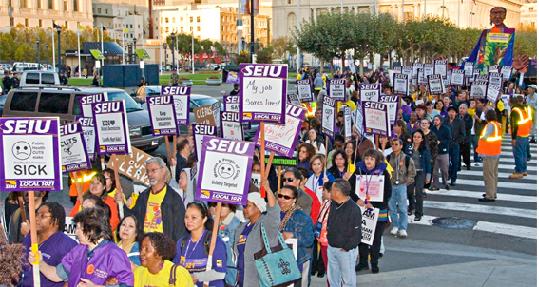
Dozens of workers at San Francisco General Hospital rallied March 25 to protest layoffs there and throughout the city as ordered by Mayor Gavin Newsom. More than 17,000 city workers received layoff notices in the last few weeks, including hundreds at the hospital. The protest was organized by SEIU Local 1021, which represents around 12,000 city employees, 9,000 of whom have received pink slips. 

Many of these workers are expected to be re-hired as part-time employees, working 37.5 hours a week or less. The move is expected to shave $50 million from a more than $500 million budget deficit. The Mayor’s Office is calling this a “reorganization” that will minimize the impact on services and maintain employment. But the plan, which was proposed by Newsom last month without first consulting with the city’s unions, has met fierce resistance from employees and their labor representatives and is now the subject of negotiations between the mayor and 41 city employee unions.

SEIU acknowledged the city’s fiscal troubles but is upset about what it calls a unilateral change in its members’ wages and benefits. “Essentially what they’re doing is unilaterally cutting wages and benefits without negotiating it,” SEIU organizer Gabriel Haaland told us. “It’s not a question of whether we’re willing to sacrifice, but that choice has been taken away.”

Hospital workers, carrying signs that read “Patient Care is Not Part Time,” also raised concerns about the layoff-rehire scheme’s potential effects on the quality of services at the hospital. “It can’t work in the emergency room and it can’t work in the rest of the hospital,” said Ed Kinchley, a social worker who works in the hospital’s emergency room.

Shari Zinn, an X-ray technician in the hospital, said her department already runs below minimum staffing levels, forcing patients to wait two to four hours for X-rays. Since X-ray technicians are hard to retain, she is not being laid off, but clerks and aids in her department are. “If there isn’t a clerk or aid,” Zinn said, “then an X-ray tech has to stop what they’re doing. Fewer patients can be served.”

Hospital officials would not comment on the layoffs.

At the rally, speakers called on the city to come up with revenue measures and other ways to balance the budget. “The city has really pushed us too far,” Sin Yee Poon, SEIU’s chief elected officer, told the assembled workers. “They’re balancing they’re budget on us, just us.”

Harry Bridges: Working class hero

0

He died 20 years ago this month, but I can still see him, a tall, wiry, gray-haired, hawk-nosed man. I can hear him.

I see him pacing restlessly back and forth behind the podium at union meetings, nervously twirling a gavel, puffing incessantly on a cigarette. I hear him calling on members, white, black, Asian, Latino, in the broad accent of his native Australia, actually encouraging debate and dissent.

He died in San Francisco at the age of 88 — Harry Bridges, co-founder and for 40 years president of one of the most influential organizations in this or any other country, the International Longshore and Warehouse Union.

Bridges often was irritating to the ILWU’s friends and foes alike. He was irascible and obstinate. But he was unquestionably one of the past century’s greatest leaders.

Bridges was not in it for money. His salary as union president was far less than he would have made had he remained a working longshoreman. Bridges was in it because of his unswerving belief in “the rank-and-file,” as he once told me, a naive and inquisitive young Chronicle reporter — “the working stiff, that’s who! Can you understand that?”

I understood, eventually. And though I and others sometimes harshly questioned Bridges’ specific notions of what was needed by working people, none could legitimately question his incredible commitment, skill and integrity.

“The basic thing about this lousy capitalist system,” Bridges declared, “is that the workers create the wealth, but those who own it, the rich, keep getting richer and the poor get poorer.”

Harry Bridges’ lifelong task, then, was to shift wealth from those who owned it to those who created it – a task he began in 1934, when he led his fellow longshoremen in a strike aimed at winning true collective bargaining rights from West Coast shipowners.

As Bridges’ biographer Charles Larrowe recalled, “The shipowners said ‘no,’ said it with tear gas vigilantes and billy clubs wielded by cops who thought they were in the front lines against a communist takeover. Up and down the coast, the waterfront was turned into a battlefield.”

Police bullets killed 10 men during the three-month-long strike that also prompted a four-day general strike in San Francisco. But the longshoremen ultimately got what they had demanded, most importantly, an end to the notorious system of job allocation known as the “shape-up. “

Previously, jobs were parceled out by hiring bosses in exchange for kickbacks from the longshoremen who lined up on the docks every morning clamoring for work. But after the strike, job assignments were made by an elected union dispatcher at a union-controlled hiring hall, using a rotation system that spread the work evenly among longshoremen. The victory was downright revolutionary, and had a profound impact on workers and employers nationwide.

Within two years, Bridges joined with Lou Goldblatt, the brilliant young leader of the warehousemen who worked closely with longshoremen on the docks. They brought the two groups together into a single powerful union. the ILWU, under the banner of the newly established Congress of Industrial Organizations — the CIO.

The union ultimately extended its jurisdiction to virtually all waterfront workers on the Pacific coasts of the United States and Canada and to workers in a wide variety of occupations in Hawaii.

Bridges and Goldblatt used their potent base to help lead drives by other CIO unions that spread unionization from the waterfront to many other industries throughout the West at a time when employers treated workers as chattel, giving them little choice but to accept near-starvation wages and whatever else the employers demanded.

For the ILWU, Bridges and Goldblatt drafted a union constitution that still is unique in the control it grants members. Many union constitutions give members very little beyond the right of paying dues in exchange for the services provided them by the union’s securely entrenched bureaucrats. But the ILWU constitution guarantees that nothing of importance can be done without direct vote of the rank-and-file.

No one can take ILWU office except through a vote of the entire membership; no agreement with employers can be approved except by a vote of all members; the union cannot take a position on anything without membership approval.

The ILWU helped set important precedents that enhanced the civil liberties of everyone through its strong opposition to those who tried to deny constitutional rights to Bridges and others by labeling them Communists. The union’s efforts included an eight-year-battle against attempts to deport Bridges to Australia that ended with a Supreme Court ruling that enabled him to become a U.S. citizen in 1945.

The ILWU under Bridges was an outspoken foe of U.S. involvement in Vietnam, even at a time when most other unions enthusiastically supported involvement. And members backed their opposition to oppressive regimes abroad by refusing to handle cargo bound for or coming from their countries.

Thanks in large part to Bridges, the ILWU also was one of the first unions to be thoroughly integrated racially, and otherwise has always been probably the country’s most socially conscious union. And its members, now including women, have long been among the most highly compensated workers in any field, while at the same time benefitting from labor-saving equipment that makes their work easier. The new equipment and methods on the docks have brought employers higher profits, which union negotiators have made certain they share with dock workers.
The ILWU used its employer-provided pension funds to finance construction of low-rent apartments in San Francisco’s St. Francis Square, an extremely rare example of what the union calls “cooperative, affordable, integrated working-class housing.”

Harry Bridges led the way to that and much more which benefited the working stiffs to whom he devoted his life — and many, many others. As a newspaper that once reviled him as a dangerous radical said on his death, “He sought the best of all possible worlds. This one is much better due to his efforts.” Boy, is it.

Dick Meister, formerly labor editor of the SF Chronicle and KQED-TV Newsroom, has covered labor and politics for a half-century. Contact him through his website, www.dickmeister.com, which includes more than 250 of his recent columns.

Can Newsom save SF parties?

11

Why won’t Mayor Gavin Newsom save San Francisco’s nightlife and culture? That question was raised toward the end of this week’s cover story on party-crashing cops, but it’s worth highlighting here because Newsom seem uniquely suited to the task of mediating this damaging dispute.

Newsom owned a restaurant and bar before being elected mayor with the strong support of the San Francisco Police Officers Association. The business community is one of his key constituencies, and he constantly talking about the need to promote tourism, which relies on our cultural vitality. He’s the most natural, logical bridge for this divide.

That’s why attorney Mark Webb, who represents several clubs and individuals who have been harassed by SFPD Officer Larry Bertrand, has explicitly been calling for Newsom to get involved.

“I really believe his involvement could help us get to a place of calm,” Webb said. “We have to stop this petty infighting and we have to embrace the cause, which is to make San Francisco’s nightlife an inviting environment.”

DNA Lounge, which is not part of Webb’s lawsuit but has been fighting against harassment by Bertrand and the ABC, also wants to see Newsom broker some peace talks. 

“Absolutely, Gavin certainly has the juice to deal with this problem and we would welcome his involvement,” DNA general manager Barry Synoground told us. “We don’t know why there is such vehemence against nightlife and entertainment…What kills me is we have a large group of responsible purveyors, but we’re not being treated as such. We’re being treated like criminals.”

But Newsom has resisted the call, with his press secretary Tony Winnicker telling us, “I wouldn’t rule it out, but the mayor has department heads for that reason,” saying he preferred for Police Chief George Gascon to tell with it. But the problem is this isn’t a police issue, it’s a political one.

DNA Lounge (which has reguarly blogged the crackdown) has highlighted how SFPD Commander James Dudley sees nightlife in the city: as a nuisance to be abated, rather than an important culture to be embraced and celebrated. Winnicker claims that Newsom understands this: “The mayor understands the importance of a vibrant nightlife.”

But that understanding hasn’t translated into official city policy. Attorney Mark Rennie, who handles permitting and compliance issues for about 40 nightlife and culture clients, said that San Francisco has become notorious for making life difficult for club owners and other purveyors of fun. 

“The city has always had this love-hate relationship with nightclubs. But it’s really bad now,” Rennie said, noting how welcoming other local cities are toward nightclubs, which are important economic drivers. “Berkeley gets it. Oakland gets it. I don’t know why San Francisco doesn’t get it.”

Which is strange because, of all people, Newsom should get it. He should understand the natural tension between certain elements of both the police and nightlife communities and, valuing them both, try to find a way to solve this problem. So whatdaya say, Gavin? After you’re done try to clean up the mess you created with the labor unions, how about stepping in to address a problem that is closer to your sweet spot?


Image by Luke Thomas/Fog City Journal

Newsom’s plan means service cuts

15

The San Francisco Controller’s Office says that Mayor Newsom’s plan to lay off 15,000 city employees then hire most of them back at a reduced workweek will save $110 million. The Examiner quotes the mayor:


“The 37½-hour idea was a way of equalizing,” Newsom said in an interview Tuesday. “I would have to go to every single labor union, open contracts that are closed and engage with those open contracts in collective bargaining for each and every local.
“Every labor union is in this together. We aren’t going to pick and choose. That being said, they are coming back Thursday with a set of alternatives, and I will keep an open mind.”


Actually, it’s not exactly equalizing — no police officers or firefighters will get what amounts to 6.25 percent pay cuts. But here’s the more important issue:


The mayor — and, to a great extent, the newspapers — present this as a simple way of saving money; sure, the workers take a little hit in their pay, but jobs are preserved. What nobody’s saying is that this will amount to more very significant service cuts.


Take 15,000 employees and cut 2.5 hours from each of their workweeks. That’s 37,500 hours of work a week, or the equivalent of 937 full-time jobs. So one of two things are going to happen: Either city employees are going to be working 40 hours for 37.5 hours pay — that is, taking a direct pay cut, which is what I think Newsom really wants — or the city’s going to lose the equivalent of 937 workers.


If you assume that it’s unfair to ask people to work 40 hours for 37.5 hours pay (and if you assume, as I do, that the unions won’t stand for that), we’re going to be talking about service cuts — work that doesn’t get done. And where will those cuts happen? Guess what — it’s the usual places.


Public health takes the biggest hit, with $35.5 million in “savings” (actually, cuts) over the next 14 months. Human Services gets $10 million cut, and Muni about $8 million.


That means longer lines and sicker people at SF General, and more broken buses with no mechanics to fix them, which means slower Muni service … you get the picture.


I’m not saying that we don’t need cuts, and you could argue that it’s more fair to cut everyone’s pay a little than to eliminate 937 jobs altogether. But let’s be honest about this — it’s not just “salary savings.” It’s service cuts. On top of last year’s service cuts, on top of the previous year’s service cuts … and it’s being done without any real overall plan for what services we need to provide and what takes priority.


And of course, it’s being done with no discussion at all of raising new revenue.  

Great piece on the fate of public education

3

There’s a great piece on Calitics about the fate of public education. It’s not alarminst or conspiratorial, just an accurate assessment of how the radical right wants to destroy public schools (and has ever since the 1950s and the era of desegregation) and how the other arm of the Republican Party, big business, is playing its role. A key passage:


Corporate interests want public education that they don’t have to pay for. They also would love to see the entire education sector privatized and paid for through tax revenue-the only way that supposedly anti-socialist entrepreneurs have made any money in the last decade, the way Blackwater made money, the way the banks made their money, the way private prisons have made theirs. Privatized and milked, yes, but not destroyed.


Therefore, we have reached the point where the interests will part between the two sides of the right. The grand strategy to destroy public education by making people hate it achieves a D-Day size victory every year the teachers’ unions are broken-those silly teachers paying money to lobby for actual good education policy while they’re at it! Because there is no one else that wants to make the public schools something worth saving in the public’s eyes. You’ve heard the criticisms. The teachers that can’t be fired for anything. No “God in school.” The assault on science, which both works to antagonize religious parents and the parents of children who want science education. They want to keep pushing it to the tipping point.


Pretty soon, parents start wanting to send their kids to the charter school funded by big corporate money or the private school that teaches that dinosaurs are 5,000 years old. A whole new segregation appears. The grand strategy succeeds.


Big Business has a choice. They can realize that public sector workers are no threat to them since they don’t employ them and they keep the infrastructure running that gives them a country where they can make money and live a big life, or they can watch it burn.


Worth reading. Check it out.

Newsom’s Orwellian doublespeak on city layoffs

1

One of the things that irritates people most about Mayor Gavin Newsom is his Orwellian doublespeak, in which he makes claims that conflict with his actions, and that was on vivid display with his recent decision to lay off 15,000 city workers and then hire most of them back for shorter workweeks.

These are frontline workers (managers, cops, and firefighters were excluded) who will either be fired or take a 6.25 percent pay cut – while the public will see a rollback in the hours devoted to providing city services – but Newsom’s press release claims that he’s actually helping both the workers and the public.

“Mayor Newsom used his YouTube update this week to discuss the City’s budget and his plan to save thousands of city jobs and services by offering 37.5 hour part time positions to most city employees. This proposal will allow the City to maintain services for residents, while saving the City an estimated $50 million. San Francisco faces a projected $522 million budget deficit for the 2010-11 fiscal year.” the press release, which was sent out on Saturday (presumably so the media ignores it), begins.

As the Chronicle reported that day, none of the affected employees are happy about this “offer” they can’t refuse, and their unions are even talking about suing the city. As for this plan to “maintain services,” that’s based simply on Newsom’s demand that city employees – who, because of the layoffs in previous years, are often already doing several people’s jobs – do 40 hours of work in 37.5 hours.

Now, this reduced workweek plan might not be so terrible if Newsom had worked on it with the unions, made deeper cuts to senior management and his taxpayer-paid political team in recent years, coupled it with a push to try to increase local taxes, and been honest about its impact to city services and the local economy.

Instead, we hear that we must burn the village in order to save it, which was dubbed the “enlightened approach” in the press release (which failed to mention that Newsom plans to not rehire an unspecified number of the employees he’s firing). “The point is to keep people employed and to keep their benefits,” Big Brother Newsom said in the press release.

Later in the release, Newsom goes on to laud Thursday’s Day of Action events, in which speaker after speaker called for increased taxes on wealthy corporations and individuals in order to prevent continued cuts to the public education system – despite the fact that Newsom has been the single biggest obstacle in San Francisco to such tax increases. “They’re shutting down opportunities. Its [sic] impacted faculty, its [sic] impacted morale, and it’s going to devastate the economy of the state unless we wake up and say enough’s enough,” Newsom said, sounding like the sympathetic populist instead the mayor who has proudly touted the fact that his budgets haven’t raised taxes, relying entirely on cuts.

Big Brother couldn’t have said it better himself.

Safe at last?

0

Dick Meister, former labor editor of the SF Chronicle and KQED-TV Newsroom, has covered labor and politics for a half-century. Contact him through his website, www.dickmeister.com, which includes more than 250 of his recent columns.

It’s called musculoskeletal disorder or MSD, the most common of the serious injuries suffered by U.S. workers. But because corporate employers fear that greater public awareness would force them to spend more on job safety, MSD has remained one of the least understood of injuries.

The latest government figures show that more than 60 percent of the million or more on-the-job injuries reported annually are MSD-related. Some of the victims are permanently disabled, and many more have to take time off from work while their injuries heal.

The victims include computer operators, factory and construction workers, meat and poultry processors, hospital and restaurant employees, supermarket clerks and many others.  They suffer serious neck, shoulder and back problems, chronically sore arms and wrists and other repetitive motion injuries resulting from work that requires them to be in almost constant motion, bending, reaching, typing, or frequently lifting heavy objects.

The first serious government efforts to combat the rapidly growing problem of MSD came ten years ago, in the final days of the Clinton administration. The Occupational Safety and Health Administration (OSHA) issued a lengthy set of so-called ergonomic regulations that were designed to lessen the dangers of MSD.

The regulations, which had taken three years to draft, covered such things as how long and how many breaks workers in particular occupations should get, what protective equipment should be issued to them, how their work stations should be designed and hundreds of related matters.

That was way too much for the U.S. Chamber of Commerce and other corporate employer representatives. They got their Republican allies, who controlled Congress, to repeal OSHA’s regulations just before the decidedly anti-labor George W. Bush succeeded Clinton.

Certainly neither Bush nor his OSHA appointees would even consider such impingements on their corporate friends. Signing the legislation that repealed the ergonomic regulations was one of Bush’s first acts as president. He followed that quickly by revoking 19 previously approved grants that were to go to unions, universities and labor-management groups to finance safety and health training programs for small business employers and particularly vulnerable groups such as construction workers and immigrants.

Bush’s OSHA appointees, many of them former executives of the industries they were supposed to regulate, blocked, withdrew or weakened dozens of other safety regulations in addition to those covering MSD. They discontinued safety education and training programs, worked with Congress to cut their own barely adequate budgets and instead of enforcing the safety laws, stressed  “voluntary compliance” by employers.

But now comes Barack Obama and his labor and Democratic Party allies to resume the fight for the ergonomic regulations President Clinton had been forced to abandon.

The initial proposals of President Obama’s OSHA appointees are modest. They’re asking merely that employers note, on the accident reports they are required to file, whether the injury was MSD-related. No such designation is currently required, which makes it difficult – if not impossible – for OSHA to collect the accurate data required to develop a program for effectively dealing with MSD, the most serious safety problem faced by American workers.

Corporate employers headed by the Chamber of Commerce oppose even that simple reform. They fear it would be a first step toward development of an ergonomic safety program that could cost employers millions of dollars to implement.

It also could bring badly needed protections to U.S. workers. But workers’ concerns are, of course, of secondary interest to the Chamber of Commerce and its Republican friends. They’re not much interested in helping working people. Their role is to further the profit-seeking of employers, even if that should come at the expense of the men and women who do the nation’s work.

Dick Meister, former labor editor of the SF Chronicle and KQED-TV Newsroom, has covered labor and politics for a half-century. Contact him through his website, www.dickmeister.com, which includes more than 250 of his recent columns.

SF leaders condemn SEIU tactics

104

San Franciscans seem to be turning against Service Employee International Union and its national President Andy Stern this week, first with the vote by SEIU Local 1021 members to oust Stern’s leadership team, and now with a letter signed by a broad array of top political officials condemning SEIU tactics against the National Union of Healthcare Workers.

As the Guardian reported last year, NUHW President Sal Rosselli and his management team broke away from SEIU’s United Healthcare Workers after a protracted conflict that culminated in a hostile SEIU takeover of the local, placing it under a Stern-controlled trusteeship. NUHW had criticized Stern’s autocratic leadership style and undemocratic methods while SEIU accused Rosselli of using union funds to undermine Stern’s decisions.

Since then, a majority of SEIU-UHW workers statewide has filed petitions asking to decertify with SEIU-UHW and affiliate with NUHW, which has won seven of the nine elections that have been held so far. So SEIU filed various complaints with the National Labor Relations Board to try to block those elections, while NUHW has complained of worker harassment and ballot meddling by SEIU.

Earlier today, SEIU-UHW sent out a press release touting an NLRB ruling that clears the way for elections at 51 facilities around the state covering 6,845 voters, blaming NUHW for “violating members’ democratic rights” in opposing those elections.

But NUHW leaders say SEIU-UHW has been “cherry-picking” selected sites where they think their chances of winning are good and keeping their NLRB complaints in place to block other sites, often dividing up bargaining units in the process to raise fears in workers that they might lose bargaining clout if they switch unions. NUHW is a relatively small organization compared to the massive SEIU.

NUHW leaders say they want a fair, up-or-down vote among all of the SEIU-UHW members statewide who have asked for elections, and they’ve asked SEIU to sign a Fair Election Agreement to prevent harassment and intimidation, something that SEIU often asks employers to sign.

Supporting that request is an open letter signed by 116 San Francisco political leaders from across the spectrum, including every member of the Board of Supervisors except Sup. Carmen Chu, Assembly members Tom Ammiano and Fiona Ma, Sen. Mark Leno, Democrat Party chair Aaron Peskin and nine other members of the DCCC, all four major candidates for the Dist. 8 Board of Supervisors seat, United Educators of San Francisco President Dennis Kelly, and representatives from a board array of unions and grassroots organizations, including UNITE-HERE, POWER, Young Workers United, Chinese Progressive Association, Coleman Advocates, and many others.

Interestingly, in addition to his critics on the left within the labor movement, Stern is also being criticized by conservatives right now after President Barack Obama appointed him to his National Commission on Fiscal Responsibility and Reform.

The Guardian has forwarded the letter and allegations to SEIU-UHW officials and is awaiting a response, which I’ll post in the comments section when I hear back.


The letter reads:

WE, THE UNDERSIGNED community leaders of San Francisco, are deeply troubled by allegations that the Service Employees International Union (SEIU) committed multiple, serious violations of state labor law during the union representation election between SEIU United Healthcare Workers – West (SEIU-UHW) and the National Union of Healthcare Workers (NUHW) for 10,000 Fresno County homecare workers this June.

These allegations, made in sworn testimony before the California Public Employment Relations Board, include that SEIU officials directed staff to open, mark, and alter workers’ ballots; threaten the deportation of immigrants; and tell workers they would suffer the loss of wages, benefits and hours to scare them into voting for SEIU. The complaint alleges further that SEIU organizers physically removed ballots from workers’ mailboxes and homes.

Caregivers in San Francisco have complained of similar intimidation and harassment at the hands of SEIU officials trying to block union representation elections requested by them and tens of thousands of other California healthcare workers who have petitioned to join NUHW.

Over the next year, as thousands of San Francisco homecare workers, private sector nursing home workers, and private sector hospital workers make their choice for union representation between SEIUUHW and NUHW, we are committed to see that these workers can make their decision democratically, without intimidation, harassment, threats or coercion of any kind, from any party.

NUHW officials have communicated to us their willingness to enter into Fair Election Agreements, which are common in California’s healthcare industry, and which SEIU officials have long championed throughout the nation, to govern their campaign conduct and protect caregivers’ freedom of choice in their upcoming union representation elections.

Therefore, we are asking that you and San Francisco’s healthcare employers join NUHW in negotiating Fair Election Agreements to establish ground rules for these elections and guarantee that workers can choose their representatives for themselves. Please know that regardless of your decision, we will stand united to ensure that San Francisco’s healthcare workers have the fair elections they deserve.

Taxi turbulence

13

By Skyler Swezy

news@sfbg.com

It’s 10:20 p.m. on a recent Saturday night. Cab driver Dorian Lavender picks up a middle-aged couple outside the Gold Club, a strip joint in SoMa.

The couple is sharply dressed for a night out. After requesting the Mitchell Brothers’ O’Farrell Theatre as their destination, the man brags to Lavender about having had sex with a stripper in one of the club’s private rooms. His female companion smiles and says nothing.

“This is before I met her,” the man explains. “We’re swingers.”

Minutes later, beneath the theater’s flashing marquee, the man hands the driver a $20 bill for the $10 fare. “Keep the change,” he says.

A few blocks away, a young couple flags the cab from the corner of Bush and Polk streets. They are talkative and entertained as Lavender tells them about the swingers. Ten minutes later, the meter reads $9.86. Apologizing, the young man hands him $11.

Lavender folds the bills into the cash-wad kept in his pocket.

“That’s how it goes with cab driving,” he says. “The nice couple tips 10 percent, the weird swingers tip 100 percent — and they were more interesting to talk to.”

At 25, Lavender considers cab driving a great gig and survives working only three shifts a week. He enjoys the cash, freedom, and unpredictable encounters. He’s even landed a few dates. A lot of career cabbies start driving for the same reasons. But after the excitement wears off, it turns out to be a tough job.

A typical cab driver in San Francisco makes less than $30,000 a year. Before drivers even start a shift, gate fees (covering the rental on the cab and the use of its permit, known here as a medallion), gas, and graft have already set them back close to $100. Bribes are commonplace in the industry, used to ensure weekend shifts, airport fares, and newer cars.

The industry offers no retirement plan or health coverage. In fact, the primary reason some people stay behind the wheel long after the thrill is gone is the promise that at some point, after maybe 15 years, an active driver becomes eligible for his or her own medallion. It costs almost nothing, and offers a tremendous benefit: drivers with medallions no longer pay high gate fees, get better shifts — and can lease out the permit when they’re not working. The lease revenue alone can nearly double a driver’s income.

Since 1978, medallions have been issued only to working drivers, and entirely on the basis of a waiting list that now numbers 3,200 names. New medallions become available when permit-holders retire, die, or are forced by disability to stop driving.

That system — and the entire cab industry — is about to change, profoundly. On Feb. 26, the San Francisco Municipal Transportation Agency agreed to allow some permits to be sold on the open market to help close its huge budget deficit. When the dust settles and the implications of that decision become clear, life for cab drivers and passengers will be very different.

Some say the industry will be better; some say it will be much worse — but the truth is, nobody really knows.


PRIVATIZING PERMITS

Mayor Gavin Newsom’s adminstration has talked about allowing the sale of permits for several years, but only in the past few months has Christine Hayashi, SFMTA’s deputy director of taxi services, come up with a detailed plan.

It’s aimed at addressing what some drivers call an unfair and flawed system. Permit-holders by law must drive a minimum number of shifts, and it they get hurt or just get too old to drive, they have to surrender their medallions, leaving them with no source of income.

It will also help SFMTA’s budget — the city could sell unclaimed permits for big money and would get a cut of every other sale.

But critics, including Judge Quentin Kopp, the former San Francisco supervisor who wrote the 1978 law that created the old system, say the medallion holders just want to cash in on something that has always been city property.

The pilot project approved by the SFMTA board allows the city to sell up to 60 medallions directly to drivers and allow about 300 drivers over the age of 70 to sell their medallions to any qualified driver who can come up with the cash. The program aims to set a fixed selling price, but has yet to do so, instead setting a $400,000 limit. It is estimated that medallions will sell for no less than $200,000.

That, of course, will be a huge windfall to the sellers, who paid nothing for their permits.

The pilot program was essentially a done deal even before the Feb. 26 vote. In an e-mail to the Guardian, agency spokesperson Judson True confirmed that $11 million in taxi revenue had been added into the MTA budget before the vote took place.


THE GREED FACTOR

Kopp sat behind the desk in his West Portal neighborhood office a week before the MTA vote, bitterly condemning the medallion sales program. “It’s based on greed. It’s based on City Hall greed,” he said. The stentorian 82-year-old occasionally thumped the desk with his fist for emphasis as he launched into the history of Proposition K. Then-Sup. Kopp authored that landmark legislation prohibiting private companies from owning driving permits, instead granting control to drivers.

“This will reverse a system that gave a genuine cab driver the opportunity to obtain a permit and replace it with a system that restores the ability of people with lots of money to buy a permit,” he said.

But Kopp’s bill had some unforeseen consequences. The list has become so long that medallions are being issued to people in their 60s and 70s — and some of those people are driving passengers around town despite failing reflexes, eyesight, and motor skills.

Carl Macmurdo, president of the Medallion Holders Association (MHA), believes that selling medallions will provide an exit plan for geriatric drivers while giving younger cabbies an entry opportunity. At 59, Macmurdo is still a full-time driver and has been in the industry 27 years.

It makes sense that MHA members are generally in favor of the pilot program — they could potentially make a mountain of money. Although only those over the age of 70 are now eligible to sell them, the age limit could be lowered in the future.


INDENTURED SERVANTS

The United Taxi Workers (UTW) headquarters consists of a few cramped offices on the fourth floor of an old office building in the Mission District. All the interior trim is painted taxi-yellow. In late January, UTW spokespersons Mark Gruberg and Rua Graffis sat at a large table, fearing the worst.

They predict the sale of medallions will provide large cab companies with the equivalent of indentured servants. They say drivers will need upwards of a $200,000 loan to purchase a medallion, requiring a hefty downpayment.

Few drivers will be able to pay for a permit with savings, so the system will only work if someone is willing to finance those purchases. And drivers who are recent immigrants or have bad credit may not be able to get traditional loans. So they could wind up borrowing from their employers, the cab companies, UTW activists say — and by owning the debt the companies will essentially own the medallion.

“Supposedly there’s going to be a provision that says a cab company can’t lend money to a driver toward purchasing a medallion. But it would be so easy to get around that by hooking up with an outside lender,” Gruberg said.

Another fear is that the pilot program will favor young drivers and punish veterans. “Suppose a 27 year-old is on the list and I’m 63. Which one of us is the bank more likely to lend money to?” Graffis asked.

Under the pilot program, drivers will have the option to purchase according to seniority on the list. But without a lender, that’s little help.


WHO’S GETTING SCREWED

At 1 p.m. the day of the SFMTA vote, Bill Mounsey and David Barlow were sitting on a bench outside the hearing room. Both are members of UTW and planned to speak in protest of the pilot program.

Mounsey is 63. He’s been on the list for 13 years and is No. 200. He is part of the group most vulnerable in the medallion reform process — drivers who have already waited more than a decade but still have years to go.

If at any point the board decides to eradicate the list before he receives a medallion, Mounsey’s years of waiting will be wasted. “I would never buy one. I’m 63 years-old, no one would ever give me a loan,” he said.

For now, the wait list survives. Under the pilot program, one medallion will be given away for every one sold until the list is exhausted. However, with only half as many medallions being given out, Mounsey fears the list will move half as fast.

Around 50 people attended the meeting, a small fraction of the city’s cab drivers. At 3:56 p.m. the board passed the pilot program and Prop. K moved a little closer toward death.

Hayashi spent more than 175 hours trying to create a pilot program that provides the city with revenue and benefits the taxi drivers. She has made an effort to engage the taxi community and worked with a group of drivers to draft the proposal. She even plans on getting a taxi license.

After the City Hall meeting, Hayashi explained the challenges facing the pilot program over coffee in a downtown cafe. Before March 30, when the proposal is set for a final SFMTA vote, Hayashi must lock down lenders, create lending programs feasible for drivers, and set a fixed selling price for the medallions.

The blaring problem with the pilot program is a lack of committed lenders ready to finance cab drivers’ loans. Bank of the West has expressed interest, as well as two New York credit unions experienced in medallion loans and two San Francisco credit unions.

But how will those loans be structured? Who will qualify? How much of a downpayment will drivers need? And how, in the end, will this change the experience and qualifications of the drivers — and the quality of cab service in the city?

Hayashi sounds confident. “Good service depends on happy drivers. Our goal is to restore professional pride for the drivers, allow them to feel that taxi driving is a career and a respected profession,” she said.

But a lot — a whole lot — can go wrong with this major change in a complex industry that provides essential service to residents and tourists alike. And once the city moves down the path to private medallions, it’s going to be hard to go back.

SEIU members oust the old guard

0

In a stunning repudiation of the union leadership installed by Service Employees International Union President Andy Stern – whose autocratic style, aggressive expansion, and friendly relationships with big employers has caused a rift in the national labor movement – members of SEIU Local 1021 have voted overwhelmingly for a reform slate of new leaders.

As we wrote recently, the stakes were high here in San Francisco, where the old guard leaders threatened to undermine the union’s progressive tendencies just as Mayor Gavin Newsom is threatening mass layoffs and pay cuts for city employees, and the San Francisco Labor Council’s ideological balance was being tipped by the pro-development push of the building trades.

But the results couldn’t have been more clear in the first local election since Stern installed the Local 1021 after merging 10 union locals together, including the former Local 790, which represents most city employees. Stern’s whole slate was voted out by a substantial margin, including current President Damita Davis-Howard, who had 1445 votes to the 2141 votes garnered by Sin Yee Poon, who now takes over the top spot after having led SF Human Services Agency workers.

Also pushed out was James Bryant, a political ally of Newsom and enabler of Pacific Gas & Electric and other downtown power brokers, who was defeated in his run for Political Action Committee Chair. Alysabeth Alexander, who is in her 20s, beat him by a vote of 2552-1506.

The vote will certainly strengthen the hand of progressives in San Francisco going into what’s expected to be a tough budget fight with Newsom, as well as helping progressive supervisorial candidates in the November election against what is expected to be a strong push by downtown to break the progressive majority on the Board of Supervisors.

In addition, it could roil SEIU’s internal politics after a turbulent year, in which Stern created divisive clashes with his own local health care workers (causing Sal Rosselli to create the rival National Union of Healthcare Workers), UNITE-HERE, and the California Nurses Association.


The press release from the winning reform slate follows: 

Reformers Sweep in SEIU 1021 Election; Members Vote for Transparency and Democracy for Northern California’s Largest Public Sector Union 

On Friday, thousands of public sector votes were counted to determine the future leadership of one of the largest unions in Northern California.  This is the first election for SEIU 1021, formed only three years ago after the merging of 10 locals.

The reform slate, Change 1021, swept the elections taking a clear majority of the executive leadership seats. This all-member slate easily defeated the former administration-appointees by the International SEIU.  Some candidates won by a 3 to 1 margin while others enjoyed a comfortable 2 to 1 lead on their opponents. See attached list of election results.

“We are excited about the opportunity to give the leadership of this Union back to the membership,” stated Karen Bishop, the San Francisco County Area Representative Elect.  Former San Francisco Board of Supervisors President and current Chair of the San Francisco Democratic Party  Aaron Peskin agreed, affirming, “It is very heartening to see that real democracy has prevailed.”

Change 1021 campaigned on a platform for reform, seeking a stronger union that would prioritize member representation at work sites; fiscal transparency; and an internal democratic structure. “Members spoke with their votes, sending a clear message about priorities,” said Roxanne Sanchez, President Elect.

The challenges for the new board are daunting-they must reunite and reinvigorate a membership hit hard by the economic downturn, with thousands to receive lay-off notices this week.  The Board Elect is ready to make the budget fight a priority to fight layoffs and preserve important public and non-profit services for our communities.

 “Our members have spoken, loudly and clearly, that business as usual is absolutely no longer tolerable and that a fundamental change in the focus of our union towards the needs and priorities of our members are in prompt order,” says Sin Yee Poon, Chief Elected Officer Elect. For now, there is cause for celebration as the congratulatory calls have been flooding across California from members, elected officials, labor leaders, and community partners.

Newly  elected members will assume office at the next Executive Board meeting, March 9th.   International Union leaders are expected to be in attendance.           

Change 1021 Candidates who were elected are: Chief Elected Officer, Sin Yee Poon; President, Roxanne Sanchez; First Vice President, Gary Jimenez; Second Vice President, Crawford Johnson; Third Vice President, Larry Bradshaw; Secretary, Pamela Morton; Treasurer, Kathy O’Neil; Political Action Comm. Chair, Alysabeth Alexander; Social & Economic Justice Comm. Chair, Gladys Gray; Capital Stewardship Comm. Chair, Harry Baker; Cities Industry Chair, Renita Terry; Counties Industry Chair, Ken Tam; Special Districts Industry Chair, Saul Almanza; Schools Industry Chair, Mynette Theard; Sacramento County Rep, Ken Bloomberg; Registered Nurses Industry Chair, David Fleming; City & County of SF Industry Chair, Kathy Basconcillo; San Francisco Area Reps- Karen Bishop, David Turner, Jacqueline Sowers; Alameda County Area Reps,- Amy Dooha, Eric Stern, Gregory Correa; Sonoma County Area Rep, Nancy Atwell; Budget & Finance Comm Region 3, Michael Tong; and Budget & Finance Comm. Region 4, Mary Jane Logan.

Is Chevron lying about its crude plans?

1

By Adam Lesser

William Rostov, the Earthjustice lawyer who represents three Bay Area environmental groups, broke it down: “The question is: will it be heavier and will that result in more pollution?” He was speaking about crude oil refining at Chevron’s Richmond refinery as he addressed California’s First Appellate Court in San Francisco this morning. Heavier crude oil is usually less expensive for oil companies to purchase but generates more pollution during the refining process.

Environmentalists, labor unions, lawyers and Chevron representatives packed the courtroom to hear opposing counsel spar over the project’s environmental impact report, which was invalidated by a Contra Costa Superior Court judge last June. The ruling stopped the refinery expansion that Richmond has approved.

Chevron attorney Ronald Van Buskirk hammered the point that “the project didn’t propose a crude switch.” When pressed on why Chevron declined to disclose the data behind the conclusion that there would be no switch to heavier grade crude, Van Buskirk countered that the data constituted “trade secrets” that are protected under law.

Rostov argued that “refinery experts showed this project allows the use of heavier crude” and that Chevron “misled the public” in its EIR. A key component of the environmentalists’ argument rests on the 2007 Chevron annual report to the U.S. Securities and Exchange Commission, which specifies that “design and engineering for a project to increase the flexibility to process lower API-gravity crude oils at the company’s Richmond, California, refinery continued in 2007.” API gravity is a measure of how heavy or light petroleum is. Lower API gravity corresponds to a heavier crude oil. But Van Buskirk countered that the plaintiff’s evidence amounted to “one sentence in a 10K report.”

Justice Patricia Sepulveda questioned Van Buskirk about whether the $61 million Community Benefits Agreement that Chevron offered to contribute to the city of Richmond gave the city “bias to approve the project.” But Van Buskirk said, “It wasn’t a quid pro quo, if that’s what you’re suggesting,” before ultimately conceding that it was fair suggest to that the gift had played a role in the approval.

Judge Ignacio Ruvolo presided over Chevron’s appeal. At the end of oral arguments, he spoke to the efforts the court has taken to expedite the case, pressing attorneys on whether there was any chance of a settlement.

“The parties are still very far apart,” said Van Buskirk, and Rostov nodded the same. For the first time all morning, everyone was in agreement.

The court will rule within 90 days.

An open letter to the Transit Workers Union

18


By Gabriel Metcalf

OPINION Last week, the Transit Workers Union refused to accept a deal with San Francisco that would have modestly reduced major service cuts and eliminated another increase in discount fares at least for this year. The proposal would have involved two things: first, a one-time contribution by drivers to their own pension plans (worth $8.9 million for next year, almost precisely cancelled by the automatic raise of $8 million the drivers will receive next year); and second, a change in work rules that would have required drivers to actually work 40 hours in a week before earning overtime, which would have saved $3.8 million over the next 14 months.

Muni is facing a deficit of at least $17 million in the current fiscal year and around $55 million next year. Future years will be worse. Given these pressures, the TWU is getting ready to re-vote. I presume that, eventually, union members will accept the deal. But either way, given how utterly marginal this deal is for the riders, progressives need to begin a public conversation about what responsibility the union has for making Muni work better.

The problem is not that TWU salaries are too high. The problem is the work rules. These include: drivers not having to let their managers know how long they will be absent from work, making it impossible to set schedules; drivers earning overtime pay before actually working 40 hours a week; and perhaps most significantly, a set of rules that makes it virtually impossible to hire part time drivers. Currently, Muni is forced by the work rules to pay drivers at full hourly rates to sit around between the morning and afternoon peaks. That rule costs MTA about $11 million each year.

If the TWU is willing to give on just the overtime and part-time driver rules, MTA would save $12.4 million in next year’s budget — and this savings would grow in the future. Other work rule changes could save much, much more, while dramatically increasing service to riders.

Probably the underlying cause of Muni’s work rules is the fact that the TWU, unlike other bargaining units in the city, has its salary and benefits set by formula in the City Charter — which means that management has nothing to offer during labor negotiations. Friends of mine in the labor movement argue that TWU is just doing its job in trying to get a good deal for members. I would argue that TWU needs to do more than that, and needs to begin taking responsibility for building a transit system that works well and can grow over time.

Maybe this public sector union needs to take a page from the Swedish labor movement.

Early into the post World War II economic boom, the Swedish unions learned that, since they controlled the government and increasingly controlled the boards of directors of the corporations they had organized, they were essentially always going to get their major demands met. This forced a big shift in their culture, causing them to have to take responsibility not just for cutting a good deal for their members, but for ensuring the profitability of the companies. Labor could easily “win too much” and drive the companies out of business, thereby returning its members to unemployment. Once labor controlled the businesses, it had to come up with a proactive agenda for how to run them successfully.

Closer to home, we’ve seen the teachers union accept cuts and changes to their equivalent of work rules in order to prevent teacher layoffs. And we’ve seen the Service Employees International Union at the national level put immense resources into passing health care reform — something that will benefit all Americans, not just SEIU members.

Something similar needs to happen now at Muni.

Muni workers deserve a good wage. It’s a hard job under the best of circumstances. And as Muni tries to keep service on the streets without enough money for equipment and maintenance, workers on the front lines will bear the brunt of the bigger problems. But a lot of people resent the things the union has chosen to ask for in addition to a good wage.

Muni’s troubles are multifaceted. They involve bad management, bad street design, bad land use planning, and certainly insufficient funding. But work rules are undeniably part of the issue as well. It cannot be progressive for the TWU, in the middle of the worst financial crisis to hit our country since the Great Depression, to cling to the same work rules it has had in the past. Muni needs TWU to help it be successful.

Gabriel Metcalf is executive director of the San Francisco Planning and Urban Research Association (SPUR).

SF Weekly mangles Mexican politics

1

The SF Weekly, in its continuing effort to make everything the progressives in San Francisco do look stupid, just stepped in a major turd. A piece by Matt Smith seeks to trash the supes for passing a resolution supporting Mexican electricity workers against an effort by the Mexican government to privatize the nation’s electricity system.

He notes:

However, the government of Mexico felt this one to be so egregious as to warrant fact-checking. As it happens there was no privatization. The government transferred Luz y Fuerza del Centro to a much larger power utility called the Comision Federal de Electricidad — which is, you guessed it, also government-run.

 His single source for that information? The (utterly unbiased, of course) Mexican consulate.

Well, John Ross, our Mexico City correspondent, who has lived there more more than 25 years, has written several books on Mexican politics and is nationally known an expert in the area, has written about this issue extensively. I just sent him Smith’s blog post, and here’s how he responded:

Consul general Carlos Felix Corona’s response to the Board of Supervisors resolution re Felipe Calderon’s efforts to break the mexican electricity workers union (SME) is disingenuous. The Luz y Fuerza Company was forced to buy electricity from the federal electicity commission (CFE) at an exorbitant price, with the costs then passed along to the consumer by presidential fiat. The CFE itself now buys a third of the electricity it generates from private corporations — in violation of the Mexican Constitutionl, which ascribes electricity generation as a state function, thus privatizing electricity generation in Mexico City and five other states in the center of the country. According to the SME, whose workers were forced out of the generating plants and which the Mexican Labor Commission has now stripped of its authority to represent the workers, Luz y Fuerza lines will now be sold off to W Communications, a Madrid-based transnational represented in Mexico by two ex-energy secretaries (Calderon himself is an ex energy secretary). W Communications is expected to install fiber optic cables on the old Luz y Fuerza lines. The Calderon administration will no doubt wait several months to seal this deal until the clamor about priviatization recedes. But the contracts have been signed, so don’t be fooled by the consul’s disingenuous response that Luz y Fuerza has not yet been privatized. Now that US unions and the SF Board of Supes have expressed their solidarity with the electricity workers, Felix Corona, a shill for calderon, seeks to bamboozle San Franciscans that all is honky dory South of the border and that protest marches that regularly turn out a quarter of a million Mexicans are just the work of a few malcontents  

So there’s another side to this story, Matt, and the consulate is hardly a trustworthy source.


State by state, unions matter

0

Dick Meister, former labor editor of the SF Chronicle and KQED-TV Newsroom, has covered labor and politics for a half-century. Contact him through his website, www.dickmeister.com, which includes more than 250 of his recent columns.

Union members invariably have better pay and benefits than non-union workers. But, as a new study shows, the number of workers who’ve joined unions varies widely from state to state.

Even in some states with a relatively high number of union members, the number is only a small percentage of the state’s overall workforce, according to the study by the Center for Economic and Policy Research.

For example: Texas , the country’s second largest state, has the eighth highest number of union members — 615,000. But that’s only 6 percent of the Texas workforce. It is, in fact, the country’s fourth lowest rate of unionization and less than half the national average of 13.6 percent.

It’s no coincidence that Texas is a so-called right-to-work state that prohibits unions from negotiating contracts that include union shop provisions which require workers to join the union that represents them in dealing with employers. So why should workers in those states join the union when they can get the union’s services and the pay and benefits it negotiates without even paying dues?

Twenty-one other states have right-to-work laws, most in the South, Southwest and Midwest. They include North and South Carolina, where the percentage of workers in unions is at a national low of less than five percent.  It’s at a national high of more than 25 percent in New York and Hawaii.

California, the nation’s largest state, has the most union members — 2.6 million or 18 percent of its workers.  At the other end of the national scale, the numbers drop way down to Wyoming’s total of less than 20,000 unionized workers, only 9 percent of that right-to-work state’s workforce.

Public employees, who make up 10 to 20 percent of the states’ workforces, have unionization rates ranging from below 30 percent to more than 60 percent.
But what, specifically, do they and the 17 million other U.S. workers who’ve unionized get that other workers don’t get?

 The Center’s study found that union members’ pay is generally about 15 percent higher than that of non-union workers — roughly $2.50 or 15 percent more an hour for an average hourly rate of $6.25.  Union members also typically get benefits that many, if not most, non-union workers lack, such as employer-financed health insurance and pensions.

The conclusion should be obvious. The study’ s author, John Schmitt, noted that the findings show clearly that “unions substantially improved the pay and benefits of workers in every state.”

Beyond that, unionized workers have a greater say, not only about their working conditions, but also in political affairs and community activities, given organized labor’s prominence in such matters.

A large part of the reason many workers nevertheless remain outside of unions is the notoriously lax enforcement of the laws that were designed to guarantee working Americans the unfettered right to unionization. 

His findings, said Schmitt, “strongly suggest that better protection of workers right to unionize would have a substantial positive impact on the pay and benefits of workers in every state.”

The Employee Free Choice Act that’s long been stalled in Congress would provide the needed protection by cracking down on the widespread violation of labor laws. Many employers illegally interfere in unionization drives by disciplining, firing or otherwise intimidating union organizers and supporters.  Even those employers who recognize a union as their employees’ representative often refuse to bargain with the union and discipline employees who protest.

Until the Free Choice Act or something much like it is enacted, the growth of unions in California and every other state will be stunted.
                                         
Dick Meister, former labor editor of the SF Chronicle and KQED-TV Newsroom, has covered labor and politics for a half-century. Contact him through his website, www.dickmeister.com, which includes more than 250 of his recent columns.

Labor’s love lost

4

Note: This file has been corrected from an earlier version.

rebeccab@sfbg.com

Two recent events could have major implications for Service Employees International Union Local 1021 — San Francisco’s largest public-sector union and an important ally for progressives — for better or for worse. And this union’s fate seems closely tied to that of the progressive movement in San Francisco.

The first event was likened to a “nuclear bomb in the morning paper” by one observer, and might be interpreted as the kickoff to a fierce budget battle. Mayor Gavin Newsom announced that he is considering a plan to help solve next year’s budget deficit by laying off 10,000 full-time city workers and rehiring them at 37.5 hours, which would amount to a sweeping 6.25 percent pay cut for workers and an estimated $50 million in savings for a fiscally impaired city.

Though it was framed by Newsom spokesperson Tony Winnicker as one preliminary cost-saving option among many, the proposal received prominent front-page coverage in the San Francisco Chronicle, even before official discussions were called between the mayor and public sector unions. Since SEIU Local 1021 represents 17,000 members in San Francisco and a majority of the city’s 26,000 total employees, it would likely absorb the greatest impact if such a plan went through.

At the same time the mayor’s startling announcement hit newsstands, SEIU was in the midst of mailing out ballots to its membership for union elections. “I don’t know whether it’s a coincidence, or if the city is taking advantage of the fact that SEIU is absorbed in its elections,” Sin Yee Poon, an SEIU chapter president for Human Services Agency workers, told us while pointing out that the events happened simultaneously.

With three separate slates of candidates vying for control of SEIU Local 1021, grudges between warring internal factions have intensified into bitter sparring matches. The timing is unfortunate — just as SEIU’s internal turmoil is coming to a head, one of its greatest battles is pending over an unprecedented $522 million budget shortfall that looms like a dark cloud over the city. The deficit will surely result in job losses, and the public sector union’s ability to mount resistance even as it wrestles with internal strife is shaping up to be a key question.

This pivotal moment carries wider political implications considering that the progressive organization has in the past helped seal an alliance between San Francisco’s left-leaning leaders and organized labor through the San Francisco Labor Council.

With SEIU besieged by infighting and soon to be hurting from wage slashes and layoffs, more conservative factions of the labor community, such as the San Francisco Firefighters Union and the Building and Construction Trades Council, have recently been butting heads with progressive members of the Board of Supervisors.

At the same time, forces on all sides are beginning to eye the coveted seats up for election in June at the Democratic County Central Committee, a Democratic Party hub that is a cornerstone of local political influence, as well as the seats that will open up on the Board of Supervisors in November. Negotiations between unions and the mayor are ongoing, and mayoral spokesperson Tony Winnicker was quick to note that Newsom is open to options, other than reconfiguring 10,000 city jobs, that organized labor brings to the table. At the same time, the Guardian heard from numerous sources that city workers felt outraged and blindsided by Newsom’s decision to air the plan in the Chronicle instead of bringing stakeholders to the table.

SEIU Local 1021 President Damita Davis-Howard told us she thinks the idea of taking $50 million out of the pockets of working people in a rocky economy is wrong-headed.

“This was devastating,” said Davis-Howard, who is running for a newly created union position called chief elected officer, which is different from the union president, and similar to an executive-director post. “The mayor might as well have raised their taxes, because if you decrease their pay by 6.25 percent, they will still have the same amount of work, they will still have to pay the same mortgage, they will still have to buy the same food, the same PG&E, and they’ll be doing it with a lot less money. If any idea like this were to go through, it would actually remove the very fabric or fiber of San Francisco. It would really cut to the core of the very being of San Francisco. … I don’t see how anybody could believe that we could continue being the city that we love being with this kind of action.”

Winnicker, the mayoral spokesperson, cast it as a plan that could avert hundreds or even thousands of layoffs. “This year the easy decisions are behind us,” he noted in a recent discussion with the Guardian.

Solving last year’s fiscal shortfall was far from easy — budget tussles between frontline city workers and the mayor got ugly, and even then, the city received millions in federal stimulus dollars to cushion the blow. A similar plan of sweeping hourly cuts was floated then too, but it didn’t gain enough traction to move forward.

“The mayor is facing a huge budget deficit, there’s no question about it — but he has not lifted one finger to raise a dime in revenue,” charged SEIU member Ed Kinchley, who works at San Francisco General Hospital. As for how the union might respond if such a proposal went through, he speculated, “I think it’s the kind of thing that could lead to a strike. A big fight.”

While the city charter bars strikes by public employees, Kinchley’s comment indicates the level of frustration among SEIU’s rank-and-file.


The proposal could present a common enemy and a rallying point for a union in disarray. Internal jockeying for elected positions can be fierce in any organization, but for San Francisco’s service-workers union, the rifts are particularly deep.

The elections, which will be decided Feb. 28, mark the first time since a radical restructuring in 2007 that members will collectively decide who should lead. In 2007, the face of SEIU was changed across California when the international president, Andy Stern, began consolidating dozens of far-flung locals into centralized, beefier entities in a bid to maximize political effectiveness (California comprises roughly one-third of the entire union’s membership).

Local 1021 came into existence when 10 locals were conglomerated into one 54,000-member giant — hence the “10-to-one” label — representing health care and frontline service workers from the Bay Area to the Oregon border. 

In San Francisco, where a large segment of its members are based, the shift was interpreted by some as a power grab, and it triggered a period of ongoing strife between those allied with Stern and the international wing on one side, and those dissatisfied with changes they saw as antithetical to the democratic ideals championed by Local 790, its predecessor, on the other.

In the years following the reorganization, Stern began trying to aggregate members by raiding other unions to consolidate power. But campaigns to bring in members from United Healthcare Workers (UHW) and fend off membership losses to the newly created National Union of Healthcare Workers (NUHW) have consumed money and resources that some members told the Guardian would’ve been better spent bolstering national support for health-care reform and the Employee Free Choice Act. According to one source, SEIU spent $10 million on a Fresno battle against NUHW.*

A fight waged between SEIU Local 1021 and UNITE HERE Local 2, a hotel-workers union that was historically allied with Local 1021’s predecessor, left some members especially stung because it marred a longstanding relationship between two groups of frontline workers.

“Andy Stern has concentrated more and more power into the hands of a group of so-called elite members of the union,” Kinchley told the Guardian. Stern’s top-down leadership style and growth-oriented objectives “run pretty harshly against what many of us believe is in the best interest of our workers locally,” he added.

In recent weeks, divisions have deepened further. A staff person who preferred not to be identified for fear of retribution filed charges with the U.S. Department of Labor against a supervisor, who is aligned with the international faction, for alleged harassment and bullying. Another complaint was filed with union leadership alleging that union bylaws were violated when membership money was authorized, but not spent, to conduct a poll without proper approval.*

“There’s a fiscal rogue-ness about it. [Davis-Howard] does whatever she wants, and she spends our dues money without authorization from anybody,” Kinchley charged.

Stern appointed Davis-Howard, and now she is running for election on a slate aligned with the international wing. When the Guardian tried to reach her to discuss union elections, spokesperson Carlos Rivera told us that Davis-Howard found it inappropriate to publicly discuss internal divisions.

Sin Yee Poon is running as her opponent on a reform slate, formed by members disaffected by the international’s modus operandi. “For the whole reform group, we’re disappointed with the general direction of corporate unionism,” Poon told the Guardian. Stressing that she believes grassroots, democratic ideals have eroded since the restructuring, she said members in her camp are agitated when they see resources siphoned into raids on other unions such as UNITE HERE and UHW. “We want it to be member-driven,” she said. “The raiding of other unions is absolutely not OK.”


The internal strife could have a wider ripple effect. SEIU Local 1021 has historically been influential in securing an alliance between the city’s labor community and San Francisco’s progressive leadership. During the last round of elections for San Francisco’s Board of Supervisors, Sups. John Avalos and Eric Mar campaigned and ultimately were elected with strong fundraising support from the labor council.

Yet in recent weeks, several skirmishes pitted certain factions of the labor community against progressive members of the Board of Supervisors. Outrage bubbled up from the firefighters — and ultimately the labor council as a whole — against a charter amendment proposed by Sup. John Avalos that would have extended the minimum number of work hours for firefighters.

Billed as a cost-saving measure, the proposal might have ultimately resulted in fewer firefighter jobs, but it was designed to spread the pain of budget cuts more equitably by grazing public safety departments instead of just inflicting blows on frontline and healthcare workers.

After Labor Council Executive Director Tim Paulson came out strongly against it, Avalos abandoned the idea. A source from within the labor council, who spoke on background only, described it as an opportunity for the labor council to come together and unite on class interests.

The political posturing that came out of that fight shook even Sup. David Campos, who vocally called for equitably sharing the pain during last year’s budget debacle. “This isn’t the way to do it,” Campos said when asked about Avalos’ failed charter amendment. “And I worry about the negative impact on labor and the progressive board. There are larger issues at play here. The entire progressive agenda is at stake. We need to think long-term about the specific issues plus the future of the progressive movement.”

Sup. Sean Elsbernd’s bid to reform the pension system to save money has provoked yet another fight with SEIU Local 1021. Union members argue that if they are asked to contribute to their own retirement funds, which would become mandatory under this proposal, then they should be given the same wage increase that other unions were granted when they agreed to similar terms.

But when Sup. Eric Mar tried to amend Elsbernd’s proposal by inserting language guaranteeing that pay increase, Elsbernd said it would cost the city millions more. If Mar’s amended version goes forward, “you’ll be going to the voters by yourself,” Elsbernd told the progressive-leaning supervisor at a Feb. 9 board meeting.


Another fight has erupted over 555 Washington, a tower proposed to go up beside the TransAmerica Pyramid, which was debated at a joint hearing Feb. 11 between the Planning Commission and the Recreation and Park Commission. For members of the Building & Construction Trades Council, which represents unionized carpenters, plumbers, and other workers in development-related trades, the project represented jobs — the screaming priority in an economy where funding for new construction has trickled to almost nil.

“There is, in general in San Francisco progressive politicians, a knee-jerk reaction to development projects,” Building & Trades Council Secretary Treasurer Michael Theriault told us. As a council representing people whose livelihoods depend on private sector construction, “We have a particular quandary,” he said. “We need politicians who at the same time are friendly to labor and understand that development is an economic tool that can help the city.”

The arm of labor representing Theriault’s council has been slammed with job losses due to the economic downturn, and he’s publicly expressed frustration when projects of this scale are shot down.

“What the mayor did, what Elsbernd did, and what Avalos did are all the same thing: They all staked out a position, put a provocative idea on the table, and forced unions to have a discussion with a gun to their head in a non-constructive way,” Mike Casey, president of UNITE HERE Local 2 and a member of the labor council’s Executive Committee.

A source familiar with the inner workings of the labor council said the tension between building trades and firefighters versus more left-leaning members of the labor community has been in existence for decades, and it isn’t anything new — particularly in the months preceding election season.

Casey challenged the very notion that there is a subculture of the labor council that isn’t progressive, pointing out that labor came together as whole to support Sups. Avalos, Mar, and David Chiu — “and I personally would do it again in a heartbeat,” he added. Internal catfights and struggles for control come with the territory in a democratic, diverse organization, he said. “As a group of working people, I have great regard for the membership [of SEIU Local 1021],” he said. “Occasionally there’s a dustup. In my experience, after the dust settles, more often that not, unions come out stronger for it.”.

*Corrections made to the original file.

A union that made black history

0

The Brotherhood of Sleeping Car Porters was a pioneering union that led the battle from the l930s to l950s against racial discrimination that laid the groundwork for the civil rights movement of the l960s. 

Few of the groups that we should honor during Black History Month are more deserving than the Brotherhood of Sleeping Car Porters, a pioneering union that played a key role in the winning of equal rights by African Americans. The union, the first to be founded by African Americans, was involved as much in political as in economic activity, joining with the NAACP to serve as the major political vehicle of African Americans from the late 1930s through the 1950s. It led the drives in those years against racial discrimination in employment, housing, education and other areas that laid the groundwork for the civil rights movement of the 1960s.

The need for a porters’ union was distressingly obvious. Porters commonly worked 12 or more hours a day, six or even seven days a week, on the Pullman Company’s luxurious sleeping car coaches for a mere $72.50 a month. And out of that, they had to pay for their meals, uniforms, even the polish they used to shine passengers’ shoes. They got no fringe benefits, although they could ride the trains for half-fare on their days off – providing they were among the very few with the time and money to do so. And providing they didn’t ride a Pullman coach. Pay was so low porters often had to draw on the equally meager earnings of their wives, almost invariably employed as domestics, to pay the rent at month’s end. It was a marginal and humiliating experience.

Porters were rightly proud of their work, a pride that showed in their smiling, dignified bearing. But they knew that no matter how well they performed, they would never be promoted. They could never be conductors. Those jobs were reserved for white men. Porters knew most of all that their white passengers and white employers controlled everything. It was they alone who decided what the porters must do and what they’d get for doing it. No point in arguing. No point in even correcting the many passengers who called all porters “George” — as in George Pullman, their boss — whatever their actual names, just as slaves had been called by their masters’ given names. When a passenger pulled the bell cord, porters were to answer swiftly and cheerfully. Just do what the passengers asked – or demanded. Shine their shoes, fetch them drinks, make their beds, empty their cuspidors. No questions, no complaints, no protests. No rights. Nothing better epitomized the huge distance between black and white in American society. Hundreds of porters who challenged the status quo by daring to engage in union activity or other concerted action were fired.

But finally, the administration of President Franklin D. Roosevelt granted workers, black and white, the legal right to unionize, and finally, in 1937, the Brotherhood of Sleeping Car Porters won a union contract from Pullman. The contract was signed precisely 12 years after union founder and president A. Philip Randolph had called the union’s first organizing meeting in New York City. But the long struggle was well worth it. The contract pulled the porters out of poverty. It brought them pay at least equal to that of unionized workers in many other fields, a standard work week, full range of fringe benefits and, most important, the right to continue to bargain collectively with Pullman on those and other vital matters. Union President Randolph and Vice President C.L. Dellums, who succeeded him in 1968, led the drive that pressured President Roosevelt into creating a Fair Employment Practices Commission aimed at combating discrimination in housing as well as employment. FDR agreed to set up the commission — a model for several state commissions – only after Randolph and Dellums threatened to lead a march on Washington by more than 100,000 black workers and others who were demanding federal action against discrimination.

Dellums and Randolph struggled as hard against discrimination inside the labor movement, particularly against the practice of unions setting up segregated locals, one for white members, one for black members. Randolph, elected in 1957 as the AFL-CIO’s first black vice president, long was known as the civil rights conscience of the labor movement, often prodding federation President George Meany and other conservative AFL-CIO leaders to take stands against racial discrimination.

The sleeping car coaches that once were the height of travel luxury have long since disappeared, and there are very few sleeping car porters in this era of less-than-luxurious train travel. The Brotherhood of Sleeping Car Porters is gone, too. But before the union disappeared, it had reached goals as important as any ever sought by an American union – or any other organization. Dick Meister, formerly labor editor of the SF Chronicle and KQED-TV Newsroom, has covered labor and politics for a half-century. Contact him through his website, www.dickmeister.com, which includes more than 250 of his recent columns.

(Dick Meister, formerly labor editor of the SF Chronicle and KQED-TV Newsroom, has covered labor and politics for a half-century.)

Dick Meister: Combating workplace violence

0

Organized labor and its allies are rightly alarmed over the high incidence of on-the-job accidents that have killed or maimed many thousands of workers. But they haven’t forgotten – nor should we forget – the on-the-job violence that also afflicts many thousands.

Consider this: Every year, almost two million American men and women are the victims of violent crime at their workplaces. That often forces the victims to stay off work for a week or more and costs their employers more than $60 billion a year in lost productivity.

The crimes are the tenth leading cause of all workplace injuries. They range from murder to verbal or written abuse and threatening behavior and harassment, including bullying by employers and supervisors.

Women have been particularly victimized. At least 30,000 a year are raped or otherwise sexually assaulted while on the job. The actual total is undoubtedly much higher, since it’s estimated that only about one-fourth of such crimes are reported to the police.

Estimates are that more than 900,000 of all on-the-job crimes go unreported yearly, including a large percentage of what’s thought to be some 13,000 cases annually that involve boyfriends or husbands attacking women at their workplaces.

The Retail, Wholesale & Department Store Union (RWDSU), which represents many of the victimized workers, cites that as an example of the job violence problem that is often distorted by media coverage that “would lead us to believe that most workplace violence involves worker against worker situations.”

The union says that has focused many employers “on identifying troubled employees or disgruntled workers who might turn into violent predators at a moment’s notice. But in fact, 62 percent of all violence at worksites is caused by outsiders.”

As you might expect, those most vulnerable to the violence are workers who exchange money with the public, deliver passengers, goods or services, work alone or in small groups during late night or early morning hours in high-crime areas or wherever they have extensive contact with the public.

That includes police, security guards, water meter readers and other utility workers, telephone and cable TV installers, letter carriers, taxi drivers, flight attendants, probation officers and teachers. Convenience store clerks and other retail workers account for fully one-fifth of the victims.

The American Federation of Teachers is so concerned that it has provided each of its 1.4 million members a $100,000 life insurance policy payable if the teacher dies as the result of workplace violence.

The major violence victims also include health care and social service workers such as visiting nurses, and employees of nursing homes, psychiatric facilities and prisons. They suffer two-thirds of all physical assaults. Many of the victims regularly deal with volatile, abusive and dangerous clients, often alone because of the understaffing that’s become all too common.

It could get even worse, at least for some workers. The RWDSU warns that today’s troubled economic times create additional threats. The danger is especially great for retail workers whose stores are likely to face increased incidents of theft, some involving gun-wielding robbers.

The RWDSU and other unions have been pushing for recognition of workplace violence as an occupational as well as criminal justice issue. That would put it under the purview of the federal Occupational Safety and Health Administration (OSHA) and state job safety agencies.

The federal and state agencies could then issue enforceable regulations designed to lessen the on-the-job dangers of violence, as they do for other hazardous working conditions. A few states do that already, but only for a very limited number of industries.

OSHA has issued guidelines for workers in late-night retail jobs, cab drivers and some healthcare workers, but the guidelines are strictly voluntary. Although the unions’ top priority is for legally binding regulations, they also are pressing employers to meanwhile voluntarily implement violence prevention programs.

Currently, only about one-fourth of them have such programs or any guidelines at all. The RWDSU ‘s Health and Safety Department is offering to help the other employers develop programs.

We have federal and state standards, laws and regulations designed to protect working Americans from many of the serious on-the-job hazards they face daily. Yet we have generally failed to lay down firm guidelines for protecting workers from the workplace violence that’s one of the most dangerous hazards of all.

Dick Meister, former labor editor of the SF Chronicle and KQED-TV Newsroom, has covered labor and politics for a half-century. Contact him through his website, www.dickmeister.com, which includes more than 250 of his recent columns.

Building the movement

2

Frustrated by deep cuts to education spending and quality, momentum is building across California in support of the “Strike and Day of Action to Defend Public Education” on March 4.

Students, laborers, and faculty throughout the University of California system are trying to expand on last semester’s organizing efforts by strengthening ties to groups from all tiers of the public education system. But questions linger about the best way to proceed and what exactly the event should look like.

“I think that the regents and [UC President Mark] Yudof are very fearful of what would happen if the students and workers united. They could be unstoppable,” said Bob Samuels, president of the University Council-American Federation of Teachers (UC-AFT).

That collaboration is exactly what many grassroots organizers are hoping to achieve, although their central message is not limited to participants in the UC system alone. They argue that fee increases and cutbacks at the universities are symptomatic of a greater problem, namely the denigration of free and low-cost public education.

“This emerged as a movement of students and workers at the university level. What we’re doing now is going beyond the UCs,” said Blanca Misse, a graduate student and member of the Student Worker Action Team (SWAT).

By reaching out to members of preschool, K-12 public school, community college, and California State University communities, organizers hope to turn March 4 into a rallying moment for the entire public education system in the state. Organizers also want to ensure that the UC system isn’t funded at the expense of other institutions of public learning.

“We need to be fighting for money and political power,” Misse added. “The committees need to mobilize all of the fighting sectors and show them our strength.”

At the Jan. 17 meeting of the Berkeley March 4 organizing committee, one of many ad hoc groups set up across the state, a gathering of about 35 union members, graduate students, community activists, and undergraduates discussed what the day should look like locally. They also reported back on their attempts at organizing the local community, including garnering union support and reaching out to high school students.

Javier Garay noted that at a meeting of the Oakland Education Association, a union of public school workers, “89 percent of the nearly 800 attendees voted in solidarity with the March 4 Day of Action, possibly including a strike.”

Yet the most heated discussions centered on how to unite the interests and power of the university population behind the broader fight for public education funding.

During the meeting, Tanya Smith, president of the local chapter of the University Professional and Technical Employees union (UPTE), stressed the importance of “not being an ivory tower” by extending activism “beyond Berkeley’s campus and reaching out to the political center in Oakland.”

Student activist Nick Palmquist, a fourth-year development studies student at UC Berkeley, admitted that the “tuition issue” is a big motivating factor for college students. At the same time, he noted, “Students have a lot of potential to see the bigger picture. We’re trying to expand the consciousness of the movement.”

That movement stretches back to the beginning of the school year, when students realized that Yudof and the Board of Regents were planning on making up for the $814 million budget cut from 2008-09 and the additional $637 million cut in 2009-10 with layoffs, furloughs, and a possible fee hike.

On Sept. 24, 2009, groups organized strikes and walkouts across the University of California system, including an estimated 5,000-person protest in the legendary Sproul Plaza at UC Berkeley.

Exactly one month later, several hundred people gathered on the Berkeley campus for the Mobilizing Conference to Save Public Education. According to the invitation, the purpose of the conference was “to democratically decide on a statewide action plan capable of winning this struggle, which will define the future of public education in this state, particularly for the working-class and communities of color.”

After an intense day of discussion, the body voted to establish March 4 as a “statewide strike and day of action.” Though it remains unclear how the different interests would come together (the call left demands and tactics open for debate), the message was clear: to save public education, diverse groups need to stand together cohesively.

Tensions escalated dramatically in November when the regents approved a 32 percent fee increase. At UCLA, where the regents held the meeting, an estimated 2,000 students gathered in demonstration and protest.

UC Berkeley student Isaac Miller told the Guardian, “I think we left there feeling like even though the fee increase went through, this is a long-term fight. It was really empowering to connect to students from all over the UC community.”

Meanwhile, a three-day protest at UC Berkeley culminated in a day-long occupation of Wheeler Hall on Nov. 20. As the protesters outside multiplied in support of the occupiers, they expressed solidarity with their causes as well as anger at the fee hike.

Callie Maidhof, a graduate student and spokesperson for the occupiers, said at the time, “One of the reasons behind this particular action is that students realized that not only is the state an unreliable partner, so is the administration. The only thing students can do at this point is reach out to each other.”

Maidhof was referring to a frequently repeated refrain from the regents and Yudof: “The state is an unreliable partner.” They argue that their hands are tied by the budget shortfall and the UC system has to figure out ways to sustain itself apart from increasingly erratic state funding. “The message is if the state fixes the budget, all our problems will be over,” said Mike Rotkin, mayor of Santa Cruz and a former lecturer at UC Santa Cruz.

So when a Jan. 21 San Francisco Chronicle article (“Regents to Back UC Students’ Protest at Capitol”) reported that the regents and Yudof agreed to stand alongside the students in Sacramento on the March 4 Day of Action, many were shocked and angered. “This is a complete turn-around for them,” Palmquist said. “They were never in support of our efforts. But now they feel threatened and they also feel like they can capitalize on them.”

In an open-letter response, several unions wrote back: “This is a cynical publicity stunt, and we do not buy it.”

Victor Sanchez, president of the UC Students Association (UCSA), said the article misrepresented what Yudof and the Regents said. “The regents and Yudof agreed to participate with students on a separate March 1 day of activism, not March 4,” he said. Calls and e-mail to Yudof’s office to confirm were unreturned at press time.

Sanchez explained that the March 1 activities are the culmination of UCSA’s annual Student Lobbying Conference, which takes place in Sacramento from Feb. 28–March 1. Its actions focus primarily on lobbying the Legislature. That approach is more in tune with the administration’s message that the problem lies in Sacramento.

UCSA’s demands include increasing funding for higher education by $1 billion, creating alternative sources of revenue through comprehensive prison reform, preserving the California grant program, and passing Assembly Bill 656.

Sponsored by Assembly Majority Leader Alberto Torrico (D-Fremont), AB 656 would place a severance tax on oil companies and divert revenues toward higher education. “It is strategic for us to focus resources in Sacramento, because that’s where the negotiations are happening,” Sanchez said. “But we also understand that we’re fighting a two-front war and need to hold both the Legislature and the administration responsible.

“At the end of the day, it is our event and our day of action,” he continued. “We made it clear we aren’t going to change our demands. We stand in solidarity with the March 4 organizers. We’re all advocating a common goal, and folks are going to apply complementary pressure. Our end goal is prioritizing education, and we need to move forward with that collective mentality.”

If all this seems confusing, that’s because it is. The groups that have formed in reaction to cuts to public education are numerous, amorphous, and have slightly different agendas. Some subscribe to the position that the fault and solution primarily rests in Sacramento, while others argue that the administration and appointed, rather than elected, regents are to blame. Most agree with Sanchez that both are part of the problem.

As community organizers build toward March 4, it is clear that the day will be significant. The real question is, if students can maintain their momentum and their newfound network with other sectors of public education, what will happen on March 5 and beyond?

alt.sex.column: The old triangle

0

By Andrea Nemerson. Email your questions to andrea@mail.altsexcolumn.com. Read more of Andrea’s columns here.

AltSex_Icon.jpg


Dear Andrea:

I seem to find myself being one-third of a long-term, stable threesome. Or is there no such thing?

I was dating “Jill,” who is bi but was only dating me. We decided to try a threesome just for fun and invited her friend “Jen.” It turned out not to be one-time thing. Jen came back, and came back again, and she and Jill started to fall in love, and so did we (Jen and me), and before you knew it, we had this thing that looks weird from the outside but feels very normal and even simple to us. Only a few close friends know, and we are worried about what parents and others would say if they knew. Jill and I were planning on getting married and having a kid, and we still want to, but now Jen would be part of our family too. And we’d like to get a house together, but wouldn’t people know then?

I know “one guy, two girls” sounds like a porno fantasy, but it isn’t like that really. We all have jobs and lives, and it’s not like we hang around the pool having crazy three-way sex all the time. But we do want to stay together. What do you think? Is such a thing possible?

Love,

Equilateral

Dear Equ:

Clearly so, since you are doing it. As for the future, who can tell?


An equilateral triangle is about as stable a shape as you can find, but even triangles suffer stresses. You are still in the two-honeysmoon phase and everyone is, I am sure, on his or her best behavior. This is certain not to last. Sooner or later someone will feel neglected or insufficiently supported and will not repress the urge to make that snappish comment, and somebody else will come back with a “Yeah? If you’re so ____ing _____ why don’t you ______instead of ______ing?” and somebody else will roll his or her eyes and somebody will yell at the eye-roller for eye-rolling. It is inevitable. And soothing three egos and salving three sets of hurt feelings is exponentially more complicated.

I would also not discount the lack of societal support for nontraditional unions as a source of yet more stress. I hesitate to draw a direct parallel to gay couples, but not having people beam at you when you announce your intentions and not having all the aunts tear up at the sight of the lovely bride (groom) and not having the chair dance and the “mazel tov and siman tov” can be a real loss. It isn’t all about the health insurance and the tax breaks or even about commitment — marriage is also about societal support and approval, and that support and approval does help solidify a union. As I said, not exactly the same thing, though. Your situation is worse.

What? No. I don’t disapprove. But other people will, so strenuously that you will feel obligated to keep it a secret. And while secrets can be sexy and sharing them can be bonding, living in hiding (or in a situation generally misunderstood or despised) is ultimately pretty destructive. Which is certainly no reason not to do it.

The complications of a multiple marriage (equivalent) go far beyond potential threats to peace on the home front like jealousy, possessiveness, and schedule difficulties. (Have you never watched Big Love? Even if you’re not planning on founding your own splinter sect, you might want to.) Spouses are family, but what are second spouses? What happens if Jen has a family emergency, is ill herself, or otherwise in need of immediate succor? Your boss understands “My wife’s mother died, I’ll be out this week.” She doesn’t give a damn about your wife’s girlfriend’s mother. What if Jen wants to have a baby too? The three of you may fall easily into a family pattern that works for you, with one mommy and one mama, or whatever — children never seem to find unusual arrangements the least bit troublesome, since they have no idea what “usual” is and what’s normal is what’s normal for them. Schools and soccer coaches and other authorities, however, will have Opinions.

In other, fewer words, sure, you can do this. Jill can do it. Jen can do it. But living a life that sounds like somebody else’s dirty joke is not going to be easy. If I’m sick of hearing “You’ve really got your hands full!” when I walk by with my twins — imagine how tired of it you’re going to get. You might want to get in practice now: “How do you figure out which one to do first?” sniggers the office wit when you let slip that you’re finding your home life complicated, “I wish I had your problems.”

“Dude,” you’ll sigh, as you attempt to side-step him to get to the copier, “You have noidea.” And he won’t.

Love,

Andrea