Unions

Who will fight corporate America?

0

By Steven T. Jones
corpflag.jpg
This morning’s U.S. Supreme Court landmark decision overturning a 103-year-old law limiting corporate spending on elections is a huge setback for the people’s ability to counter the power of Wall Street and multi-national corporations, a development exacerbated by signals that the Democratic Party is retreating from even its nominally left-of-center initiatives in the wake of Tuesday’s loss of its Massachusetts seat in the U.S. Senate.

If this morning’s front page San Francisco Chronicle story is to be believed, Democratic congressional leaders are essentially abandoning health care reform and climate change legislation, shifting instead to focus on “creating jobs and cutting the enormous federal deficit.”

And if Mayor Gavin Newsom’s recent initiatives here are any indication, job creation is synonymous with corporate tax breaks, while deficit reduction probably means the elimination of even more government jobs, further enabling private sector excesses. Yes, the political climate in this country is turning as bleak and stormy as the California weather this week.

But at least downpours provide needed water. With progressive institutions from the anti-war movement to minor political parties at their weakest point in many years, it’s unclear who will unite and lead a public that is growing increasingly frustrated with this country’s political dysfunction and uneven economic recovery (that is, corporations are recovering but most people aren’t).

There are a few faint glimmers of hope. The Chron reports on an alliance between UC students and administrators to push for a reversal of deep cuts to education spending. And spending by labor unions was also unshackled by today’s court decision, which could be helpful if that movement wasn’t in such disarray right now and was willing and able to help lead a broad people’s movement.

But the question facing the country right now is this: who can effectively fight corporate America, and who is willing to do so?

Restoring majority rule

0

Gov. Arnold Schwarzenegger’s lame duck response to California’s projected $20 billion state deficit has given supporters of more than 30 budget and revenue-related state initiatives now in circulation a renewed sense of urgency as they scramble to gather signatures and qualify proposed solutions to the state’s ongoing financial emergency for the November ballot.

But while this plethora of initiatives reflects widespread frustration over the state’s broken system of governance, disagreement rages over how to fix it and how best to restore majority rule to California.

“These are the hardest decisions a government must make, yet there is simply no conceivable way to avoid more cuts and more pain,” the governor told reporters Jan. 8 as he released a new budget proposal calling for $8.5 billion in cuts to state workers’ wages, health and human services, and prisons; a legally questionable $4.5 billion shift in other funds; and $6.9 billion in federal reimbursements that have yet to be approved.

Even steeper social services cuts are in the works, Schwarzenegger warned, if the feds don’t comply with this request for a bailout. But he refused to target corporations and millionaires as revenue sources, clinging instead to the standard Republican pledge not to raise taxes.

“We didn’t hear him say, ‘We are going to pinch the wealthy and the corporate,'<0x2009>” State Sen. Mark Leno observed. “He is definitely setting his sights on the social safety net.”

Recent revolts within the public university system, including the November takeover of UC Berkeley’s Wheeler Hall, suggest that tuition hikes, layoffs, and reduced study options have brought students to the tipping point.

But UC Berkeley linguistics professor George Lakoff fears that without restoring majority rule to the state’s budget and revenue-related measures, such revolts only address symptoms, not causes, of the impasse.

So Lakoff decided to author the California Democracy Act, an initiative that would replace the state’s two-thirds requirement on budget and revenue bills with a simple majority vote, after Sen. Loni Hancock invited him to meet with a group of Democratic state senators last spring.

“She said the Democrats were having problems getting anything done, and I went away saying, ‘this is ridiculous,'<0x2009>” Lakoff said. “It occurred to me that since the problem came by way of the initiative process, then it was possible to rectify it that way.”

Proposition 13, approved by voters in 1978, limited property tax increases and required a two-thirds supermajority in the Legislature to approve most new tax increase, measures that contributed mightily to the state’s bleak financial situation.

California also requires a two-thirds vote for the Legislature to approve the annual budget, along with only Arkansas and Delaware. On Jan. 5, Sonoma State philosophy professor Teed Rockwell told the Potrero Hill Democratic Club to endorse Lakoff’s initiative, noting that California is the only state to require two-thirds vote on budget and revenue bills.

“I have learned that essentially everything that is uniquely wrong with California results from this one fact,” Rockwell said.

California has the largest number of millionaires in the U.S., but as Rockwell observed, thanks to the fiscal stranglehold of the Republican minority, “We do not have enough money to keep our parks open or maintain affordable tuition at our public colleges. And the extremists in Sacramento want to solve this problem by decreasing taxes on millionaires and increasing taxes on the middle class.”

Rockwell noted that of the 22 states that produce oil in the U.S., all have oil severance taxes, including Sarah Palin’s Alaska and George W. Bush’s Texas — except California.

But while the California Democracy Act simply resolves that “all legislative actions on revenue and budget must be determined by a majority vote,” neither the state Democratic Party nor the major unions are willing to support Lakoff’s measure, citing its bad results in the polls.

Instead, veteran legislator and California Democratic Party Chair John Burton is backing a Hancock proposal that seeks to reduce to a simple majority the Legislature’s voting requirement on budget bills.

Lakoff warns that budget bills merely determine how to slice the pie, while revenue bills determine the size of the pie. This means that if Democrats succeed in only reforming the state’s budget voting requirements, they’ll still be stuck with having to make painful cuts.

But Hancock, who has been living with the results of this fiscal gridlock since she was elected to the state Assembly six years ago and helped sponsor the failed oil severance tax initiative in 2006, believes decisions to cut prison or education spending are not trivial.

“Last year Democrats gave $2 billion in tax breaks just to get one desperately needed Republican vote on the budget,” Hancock told the Guardian. “And now the Republicans are asking for takeaways on environmental and labor protections that they otherwise wouldn’t have any power to negotiate.”

“I am a realistic idealist,” Hancock continued. “I believe we are better off to get the majority vote to pass the budget. That way, the minority might begin to negotiate and have a more rational conversation. I’m very pleased that throughout the state, folks are recognizing that state governance is broken.”

California Tax Reform Association executive director Lenny Goldberg told us it’s hard to choose between the Lakoff and Hancock initiatives.

“It’s a question of what’s achievable, of how to focus energy,” Goldberg said. “Lowering the vote requirement for the budget would eliminate some of the hostage-taking and help reverse the corporate loopholes that the Democrats were forced to accept to get a budget passed. So at least it would make the budget process better.”

But he agrees that budget reform only makes the Democrats solely responsible for the budget, while preventing them from raising revenue.

“So there is some disagreement whether it’s better to do one, if you can’t do tax reform,” he said. “In the end, it’s a strategic, not substantive, question. Is it better to do budget alone, or not at all? Personally, I think we’re better off doing budget reform than nothing — but it’s a close call.”

Hancock and Lakoff both believe that a competing initiative, endorsed by Schwarzenegger and funded by the group California Forward, is the poison pill in the upcoming fiscal equation.

“Unfortunately, it’ll make it harder to raise fees,” Hancock said.

“It should be renamed California Backward,” Lakoff quipped, noting that while the California Forward initiative supports a simple majority on budget bills, it seeks to raise to two-thirds the voting threshold on new fees.

California Forward executive director Jim Mayer said his organization supported Prop. 11, the redistricting measure that passed in November 2008, “as a start to melt the political gridlock.

“And our two initiatives will help legislators do a better job of spending the pie,” Mayer added, noting that his group is talking to Democrats and Republicans as well as counties, cities, and branches of the Chamber of Commerce.

One of California Forward’s initiatives seeks to change the budget vote requirement to a simple majority and create a two-year budget cycle. It also forces the Legislature to use one-time revenues for one-time expenditures — and requires a two-thirds vote on fee increases, raising Democrat hackles.

“When the Legislature attempts to replace what’s currently a tax on utilities with a fee, currently they can do that with a simple majority. But people on the right tend to worry that if you eliminate a tax and call it a fee, it’s illegal,” California Forward spokesperson Ryan Rauzon explained.

The other initiative would allow county governments to identify priorities and raise revenue with a simple majority vote, Mayer said, a plan he claims is about “empowering local governments.”

The truth about San Francisco’s budget

0

“San Francisco,” SF Weekly recently proclaimed, “is arguably the worst-run big city in America.” That’s a hell of a claim — the levels of corruption and mismanagement in urban America are legendary. But the Weekly’s Benjamin Wachs and Joe Eskenazi set out to prove their case — with a series of mostly anecdotal points that looked at the usual targets: Nonprofits. Unions. And one senior Newsom administration staffer who pretty much everyone agrees was a horrible manager.

We were tempted to just let it go. Sure, there’s plenty of incompetence and waste in the Newsom administration. There’s a need for more accountability in some of the nonprofits that get city money. The police union got too big a raise in 2007.

That pattern also exists in a lot of other big cities. You wanna make a big headline by claiming SF is the very worst? Whatever.
But the heart of the Weekly’s factual analysis was a chart that purports to show that San Francisco spends vastly more per capita than other “comparable” cities. That’s a claim we hear all the time, one that the more conservative political forces constantly use to argue against higher taxes (and in favor of big spending cuts).

So it’s worth exploring a little further. Because when you look at all the facts, the Weekly analysis is just wrong.

Comparing cities is a complex task — urban areas in America are governed in very different ways. You can’t, for example, compare San Francisco to any other city in California because San Francisco is the only combined city and county. Get arrested in Berkeley, and the Alameda County sheriff locks you up, the Alameda County district attorney prosecutes you, the Alameda County public defender takes your case, and the Alameda County courts adjudicate it. And if you win, you ride home on AC Transit — a separate system that isn’t in the budget of either the city or the county.

In San Francisco, all those things are in the same city budget.

But Wachs and Eskenazi decided to get beyond that. “Any time someone tries to point out that San Francisco has serious systemic problems, the response (from the Mayor’s Office, from city bureaucrats, and sometimes even from city activists) is that ‘San Francisco is both a city and a county,’ as if that explained everything,” Wachs told us in an e-mail. “So the comparison was already being made as part of the city’s defense: San Francisco is a city-county, and what appear to be systemic problems are actually just features of being a city-county.

“We proved that isn’t the case: San Francisco’s per capita spending is significantly out of line even when compared to other large city-counties.”
Actually, it’s more than just the city-county distinction. The large cities-counties SF Weekly chose are so dramatically different in the services they do — and don’t — provide that the comparison comes close to being meaningless. Ken Bruce, a partner in the Harvey Rose Accountancy Firm, which serves as San Francisco’s budget analyst and does similar work in other cities, is no fan of wasteful spending. But he told us he wasn’t impressed with the Weekly chart: “I have yet to see a rigorous analysis done comparing San Francisco to other cities,” he said.

And the way the Weekly added up the numbers was, at best, misleading.

For starters, San Francisco runs (and includes in its city budget) an airport, port, public transit system, county hospital, and skilled nursing facility (Laguna Honda), for a total of more than $2 billion. None of the comparison cities do all those things. Or rather, some do those same things — but they aren’t in the local budget.

In Philadelphia, for example, the public transit system is a regional agency. Philly chips in $63 million from its general fund to help the Southeast Pennsylvania Transit Authority (SEPTA). SF pays almost three times that much to run its own Muni, because the overhead costs are included in the local budget. Philly taxpayers spend much more than $63 million on SEPTA — it just comes out of a different budget and funding stream, so it isn’t in the figures the Weekly used. Denver’s transit system is regional too, and thus not in the city-county budget.

In Indianapolis, the city transit system, Indygo, is far less complicated than ours. Jenny Brown, a spokesperson for Indygo, told us she was amazed her city was being compared to San Francisco: “Our transit system is not in the same league as yours,” she said.

Philadelphia also does not pay for a county hospital or include its port or airport in its budget. Neither does Denver.

There’s also a difference in most municipalities between the general fund (locally allocated spending) and the total budget, which includes federal and state money, self-sustaining departments, etc. In Philadelphia that’s a big distinction — more than $3 billion a year — but the Weekly compared Philly’s general fund to SF’s total budget (something Wachs admitted to us was his mistake).

So we took this a step further. First, in Chart A, we compare apples to apples — general funds to general funds. It turns out SF and Philly are relatively close in per capita spending. Then we adjusted the budgets to account for the fact that SF includes in its budget a lot of services other cities and counties budget somewhere else. That makes all the comparison cities a lot closer.

But can you really compare San Francisco — with its diverse and complex population and urban problems — to Indianapolis or Nashville? Even Denver? If even the folks in Indianapolis think that’s kind of bogus, we figured we could do better. So we set out to find some cities that make a more fair comparison. We included Philadelphia, but added Los Angeles and Chicago (New York, by the way, is so big, so complex, and has so many counties, boroughs, and budget items, that it’s not fair to compare that city to any other — even though is would help our case). To account for the city-county issue, we added to the L.A. and Chicago city budgets a percentage of the L.A. County and Cook County, Ill. spending equal to each city’s percentage of the county population. (Not a perfect yardstick, but pretty close).

As Chart C shows, all four big cities are within about 30 percent of each other in terms of per capita spending.

But there’s another big factor — cost of living. The vast majority of the budgets of these cities goes to employee pay and benefits — and it stands to reason that a city with a higher cost of living would have to pay its employees more. And San Francisco has by far the highest cost of living (according to the latest figures from the Council for Community and Economic Research’s ACCRA Cost of Living Index) of all the cities in this chart.

So we adjusted per capita spending by the cost of living index (SF = 169, L.A. 145.4; Philadelphia, 124.1; and Chicago, 110.8) and discovered that in fact all four big cities spend roughly the same per capita — although San Francisco spends the least.

So is San Francisco a service-rich city (like L.A., Philadelphia, and Chicago)? Absolutely. Is SF’s spending far out of whack with what other similar municipalities spend? No, not at all. All things considered, it’s a little low.

PS: The Weekly spent much of its article attacking the lack of accountability in the city’s $500 million’ worth of nonprofit spending. That’s a huge issue, but oddly, the Weekly didn’t quote a single person who supports the system San Francisco uses to distribute services through nonprofits.

We’ve been critical of many individual nonprofits, and some are over-funded, wasteful, and of dubious value. But overall, as labor activist Robert Haaland told us: “The fact that an individual nonprofit isn’t performing up to standard doesn’t mean that the services aren’t needed.”

And there are many who say the San Francisco model is, in fact, a national standard. Margaret Brodkin, former director of the Mayor’s Office for Children, Youth, and Families, helped develop the current system of nonprofit accountability in that office. She has been invited to speak all over the country about the standards and data system they developed. “Others have replicated the data system we had in place. It’s held up as a national model, the data system as well as the standards,” she explained.

So it’s not so simple — and to use a few anecdotes and some inaccurate and misleading figures to call San Francisco the worst managed city in the nation is, well, a bit of a stretch. To say the least.

Know Your Class

0

(Dick Meister, former labor editor of the SF Chronicle and KQED-TV Newsroom, has covered labor, politics and other matters for a half-century.)

When Jack Hall died, flags were flown at half-staff throughout Hawaii, longshoremen closed the ports of San Francisco, Los Angeles and San Diego for 24 hours, and thousands of other workers in Hawaii and all along the west coasts of the United States and Canada also stopped work to show their respect.

That was 40 years ago. Yet Jack Hall, one of America’s greatest labor leaders, is still remembered fondly by many working people. In Hawaii, where he was regional director of the International Longshoremen’s and Warehousemen’s Union, many ILWU members had a paid holiday on Jan. 2, the date of his death. Others will have a holiday on the Feb. 28th anniversary of Hall’s birth.

It would be hard to exaggerate Jack Hall’s importance. He was director of organization for the ILWU and one of its two vice presidents when a stroke killed him in 1971 at age 55 in San Francisco. But it was not what he had done during the previous 18 months in the drafty, run-down headquarters presided over by the legendary Harry Bridges that made Hall extraordinary.

Rather, it was what Hall had done before then in Hawaii, where he served for more than a quarter-century as the ILWU’s regional director. He was the key leader in bringing industrial democracy to Hawaii, transforming Hawaii from virtually a feudalistic territory controlled by a few huge financial interests into a modern pluralistic state in which workers and their unions have a major voice.

As former Gov. John Burns of Hawaii said, Hall Brought about “the full flowering of democracy in our islands.”

Hall’s first job was as a sailor in 1932. He sailed to the Far East, where he saw grinding poverty that sickened and angered him and, he later recalled, “determined which side of the fence I was on.” Hall landed in Hawaii four years later, a tall, skinny 26-year-old sent by the Sailors Union to help striking longshoremen win union recognition. Hall soon emerged as a leader of the longshoremen and later as a principal leader in organizing sugar and pineapple plantations.

Virtually all phases of life in the islands were controlled by five extremely powerful holding companies, popularly known as “the Big Five,” that owned the plantations. The workers, Japanese, Filipino, Chinese, Portuguese, Spanish, Puerto Rican and others, were purposely segregated by race and ethnicity to keep them from acting jointly. They lived in company housing on the plantations where they worked, bought their food and clothing in company stores there, and had little choice but to do exactly what the bosses told them to do, at pay of less than 50 cents an hour.
The battles waged by Hall and his fellow organizers to overcome the employers’ absolute domination of their workers’ lives often got brutal. There were beatings, an attempt on Hall’s life, and a great furor over Hall’s admitted political radicalism.

The strike was the only weapon available to the workers. But when workers of a particular nationality struck to demand union rights, they’d be replaced immediately with workers of another nationality.

Hall, a tough, plainspoken, hard-drinking man, talked with the workers endlessly about the obvious need to bring them together in a single union. He spoke to them individually and often in meetings that were held in secret, outside the closely guarded plantations. He told the workers over and over that they could not achieve the unified strength necessary to overcome exploitation if they continued to remain apart because of racial and ethnic differences.

“Know your class,” Hall told them, “and be loyal to it.”

Finally, by the mid-1940s, the ILWU managed to organize workers on the plantations, as well as on Hawaii’s waterfronts. That gave the ILWU a powerful role in Hawaii’s economy that led the union quickly to a major role in Hawaii’s political life as well.

Hall helped put together a political league that became one of the most important political forces in Hawaii and the most racially and ethnically mixed such group anywhere. The union league helped break 50 consecutive years of Republican control of the State Legislature, which in turn led to passage of the most progressive laws of any state and helped make the ILWU as dominant in Hawaiian life as were the Big Five plantation owners before the coming of the union.

Plantation and longshore workers still are the backbone of the ILWU in Hawaii, but Hall long ago led the union into just about every other industry in the islands. Bakers, factory workers, automobile salesmen, supermarket clerks and a wide variety of other workers, especially including hotel workers and others in Hawaii’s ever-expanding tourist industry – all carry union cards.

Union membership is their guarantee of economic and political rights and rewards, of dignity and self-respect and the chance to determine their own destinies, of an effective voice on the job and in their communities, of fair and equal treatment their forebears could only dream of.

Jack Hall left a truly remarkable legacy.

Dick Meister, former labor editor of the SF Chronicle and KQED-TV Newsroom, has covered labor, politics and other matters for a half-century. Contact him through his website, www.dickmeister.com, which includes more than 250 of his recent columns.

Editorial: The mayor’s race starts now

2

Ross and Jeff and any other progressive candidates need to decide soon if they are serious about running for mayor and either announce that they are running or step out of the way so someone else can step forward

EDITORIAL Back in 2007, when no leading progressive stepped in to run against Gavin Newsom, Sup. Chris Daly called a convention in the hope that someone would come forward and take up the challenge. All the major potential candidates showed up and spoke, but none announced a campaign.

Let’s not go there again.

We’re two years into Newsom’s second term, and the city’s a mess. After absorbing a round of brutal cuts last year, the budget’s still half a billion dollars out of whack. The mayor’s only answer at this point is to cut more (then raffle off to landlords the right to get rich by evicting tenants and turning apartments into condos). The Newsom agenda hasn’t created jobs or addressed the housing crisis or resolved the unfairness of the tax code or taken even the first steps toward energy self-sufficiency. Over the past year, he’s been largely inaccessible and hostile to the press, a mayor who won’t even tell the public where he is and what he does all day.

A candidate who wants to change the direction at City Hall should have no problem getting political traction in 2011. But the progressives are still floundering. And while the race is two years away, the more centrist candidates are already out the door. Sup. Bevan Dufty has announced he’s in the race, and state Sen. Leland Yee might as well have announced since everyone knows he’s running. Same for City Attorney Dennis Herrera. And at a certain point — in the not-too-distant future — those candidates will be starting to line up endorsers and making promises to major financial backers and constituency groups, which aren’t going to wait around forever for the progressives to settle on someone willing to make the immense effort to mount a serious campaign for mayor.

So the potential candidates — starting with Sup. Ross Mirkarimi and Public Defender Jeff Adachi — need to decide, soon, whether they’re serious about this or not, and either announce that they’re running or step out of the way so someone else can step forward.

With public financing, a candidate in San Francisco doesn’t have to be as well-heeled as Newsom was his first time around. It won’t take $6 million in contributions to win. But a progressive who wants to be the next mayor needs to demonstrate he or she can do a few key things, including:

<\!s>Motivate and unite the base. Labor (or at least the progressive unions), the tenants, the left wing of the queer community (represented to a great extent by the Harvey Milk LGBT club), the environmentalists, and the progressive elected officials have to be fairly consistent in backing a candidate or downtown’s money will carry the day. So Mirkarimi and Adachi (and anyone else who’s interested) ought to be making the rounds, now. If that critical mass isn’t there, the campaign isn’t going to work.

<\!s>Develop and promote a signature issue. Newsom won in part because he came up with the catchy “care not cash” initiative. Voters frustrated with years of failed homeless policies (and an incumbent, Willie Brown, who said the problem could never be solved) were willing to try something new (however bogus it turned out to be). Nobody’s developed a populist way to approach city finance. Nobody’s got a workable housing or jobs plan. What’s the central issue, or set of issues, that’s going to define the next progressive mayoral campaign?

<\!s>Put together a central brain trust. This city’s full of smart progressives who have experience and ideas and can help put together a winning platform and campaign strategy. A good candidate will have them on board, early.

<\!s>Herrera, Yee, Dufty, and others who might run (including Assessor-Recorder Phil Ting) are already out there looking for progressive supporters and allies, but none has yet offered an agenda the city’s left can support. Dufty pissed off the tenants by refusing to back stronger eviction protections. Herrera pissed off immigrant advocates by refusing to be as aggressive in supporting the city’s sanctuary law as he was in defending same-sex marriage (and because he hasn’t officially announced yet, he’s still not taking stands on political issues). Yee tried to sell off the Cow Palace. Ting has taken some great initiatives (forcing the Catholic Church to pay its fair share of property transfer taxes), but hasn’t developed or spoken out on the broader issues of city revenue. More of those candidates have been leaders in the public power movement.

It would be inexcusable if the progressives, who control the Board of Supervisors, are forced to pick a mayoral candidate by default. It’s time to end the speculation and dancing and find a candidate who can carry the progressive standard in 2011.

The next budget battle

0

EDITORIAL There is some good news — in a manner of speaking — about Mayor Gavin Newsom’s proposed midyear budget cuts: they don’t just affect Muni, recreation and parks, human services, and public health. The departments that have been hammered hardest in the past year still face spending reductions — but so do police and fire. The $6 million in Police Department cuts and $1.7 million in Fire Department cuts actually exceed the $7.4 million that the Department of Public Health will have to absorb.

That, of course, requires some context — over the past few budget cycles, DPH has lost far more money than public safety. And the Fire Department has far more fat than its modest cut reflects. And the Human Services Agency is still taking a $3.3 million hit. And the mayor is still keeping five press secretaries. And it’s not at all clear how much of the cuts will involve paring the bloated management ranks, and how much will be the further elimination of front-line services.

And this is just the start — the budget deficit for next year is more than $400 million, and the blood on the floor by the time that’s resolved will make this round look easy.

But the very fact that some of the sacred cows of San Francisco are facing their own financial pain sends an important message: this budget crisis won’t be solved just by screwing the poor — and the unions representing the cops and firefighters are going to have to step up and work with the rest of organized labor to push for some new revenue. And they’ll need to put up some money and reach out to the more conservative voters to promote the tax increases San Francisco desperately needs.

Now it’s up to the supervisors to put in motion the process to take substantial changes in the way the city is funded out of the discussion stage and into the policy arena.

When Newsom was running for governor, it was almost impossible to get him to talk seriously about raising revenue; he clearly wanted to be the candidate who could talk about balancing a city’s budget without raising taxes. Now that he’s not looking for votes in the Central Valley, he’s been a little more open to the idea that a cuts-only budget won’t work the next time around.

Unfortunately, the two main ways he wants to raise money are both terrible ideas. Newsom is talking about gutting the condominium conversion limits and allowing anyone who pays a fee to get a permit to turn an apartment into a condo. That would have a devastating impact on the city’s rental housing stock. He also wants to sell off taxicab permits — a plan that would undermine the city’s longstanding policy of allowing working cab drivers to use the permits at a modest fee and create a structure where the right to drive a cab would be determined at auction and given to the highest bidder.

The condo conversion plan is unlikely to get six votes, and the progressive supervisors should make it clear that a taxi privatization proposal isn’t the best way to solve the budget crisis, either. Then the mayor and the board can start working on a progressive tax plan to put before the voters next year.

The Budget Committee will be ground zero for the debate. Sup. John Avalos chaired that committee through last year’s harrowing budget battles, but in the past the job has rotated. If Board President David Chiu intends to appoint a new chair for next year, he should name one of the two qualified progressives with background on the committee. Either Sup. Ross Mirkarimi or Sup. David Campos would be an excellent choice.

Meister: Union rights for airport screeners

0

Airport screeners and other vital employees of the
Transportation Safety Agency should finally have the basic rights and protections they have so long needed and deserved

(Dick Meister, former labor editor of the SF Chronicle and KQED-TV Newsroom, has covered labor, politics and other matters for a half-century.)

The underpaid, overworked and otherwise poorly treated airport screeners who are essential to air passenger safety may finally be winning their long struggle for the badly needed union rights guaranteed other federal employees.

There are more than 40,000 screeners –- a first line of defense against terrorism — posted at X-ray machines, checkpoints and elsewhere in air terminals throughout the country. They work for the Transportation Safety Agency (TSA) that was set up in the wake of the terrorist attacks of Sept. 1, 2001.

Such related workers as federal border guards and immigration and Custom Service employees are unionized. But in 2003, President Bush denied union rights to screeners and other TSA employees on grounds that their unionization would somehow “threaten national security.”

A majority in the House and Senate voted in 2007 to restore the screeners’ union rights. But the congressional majority wasn’t large enough to overturn a veto threatened by the president, and the attempt was abandoned.

Denying the fundamental right of unionization to the screeners, as the United Nations’ International Labor Organization ruled, violates “core labor standards.”

The screeners’ need for unionization should be as obvious as the nation’s need for their invaluable service. Their complaints are widespread and numerous. They cite, for instance, inadequate pay, low morale, a high rate of workplace injuries, unfair promotion and scheduling policies, arbitrary work rules and high turnover rates.

The screeners’ hope for wining union rights rests primarily with President Obama, who voted as a senator to grant screeners union rights and promised during his presidential campaign to make granting them the rights “a priority for my administration.”

Winning congressional approval won’t be easy, but is also expected, despite stiff opposition expected to be led by a notably anti-labor Republican senator, John DeMint of South Carolina. He argues, much as George Bush had argued, that unionizing TSA employees would amount to putting air security and safety in the hands of those old right-wing bugaboos, “union bosses.”

Senator DeMint and his reactionary colleagues probably will lose their attempt to deprive some of our most deserving workers their basic rights. But they undoubtedly will cause some damage along the way to their ultimate defeat.

DeMint already has managed to stall Senate confirmation of Obama’s nominee to head the Transportation Safety Agency and carry out the reforms sought by Obama and TSA‘s employees. He’s invoked Senate rules to postpone the vote on whether to confirm the president’s appointment of a well-regarded former FBI agent and assistant chief of the Los Angeles Airport Police, Erroll Southers, to run the agency.

In the meantime, two government employee unions are competing for the right to represent TSA employees once they are granted union rights. The competition undoubtedly will result in more and stronger employee demands for improved conditions as the two unions vie vigorously to represent them.

One of the unions is the largest of federal employee unions, the 600,000-member American Federation of Government Employees, the other the 150,000-member National Treasury Union. But despite its much smaller size, the Treasury Union won three years ago in competing with the Federation of Government Employees to represent airport Customs and border protection officers.

The unions have been waging a vigorous campaign , signing up members, establishing union locals at airports nationwide, helping workers appeal unfair disciplinary actions, filing grievances against employer mistreatment and other actions. Both unions have promised to press hard for pay raises, better promotion policies and work rules and other matters important to TSA employees.

No matter which union wins, it’s certain that the airport screeners and other vital employees of the Transportation Safety Agency should finally have the important basic rights and protections they have so long needed and so long deserved.

Dick Meister, former labor editor of the SF Chronicle and KQED-TV Newsroom, has covered labor, politics and other matters for a half-century. Contact him through his website, www.dickmeister,com, which includes more than 250 of his recent columns.

Meister: A lesson too long unlearned

0

Wisconsin has enacted a law that makes the teaching of labor history and collective bargaining part of the state’s model standards for social studies classes in the state’s public schools

(Dick Meister, former labor editor of the SF Chronicle and KQED-TV Newsroom, has covered labor, politics and other matters for half-century)

Despite the importance of unions in our lives, our schools pay only
slight attention to their importance – or even to their existence.

Little is done in the classroom to overcome the negative view of organized labor held by many Americans, little done to explain the true nature of organized labor.

There have been many attempts to remedy that situation, none more promising than the steps taken recently in Wisconsin with enactment of a law that makes the teaching of labor history and collective bargaining part of the state’s model standards for social studies classes in the state’s public schools.

The law does not mandate the teaching of labor history and collective bargaining, as its sponsors had wanted. But it amounts to just about the same thing, by requiring the state superintendent of public instruction to make the subjects part of the state’s educational standards and to provide schools and teachers assistance in teaching labor subjects.

The Wisconsin Labor History Society, the state AFL-CIO and other labor and educational groups worked a dozen years to finally win enactment of the law, the first such state law anywhere. But the History Society fully expects other states to follow Wisconsin’s example.

The importance of including labor history in the classroom was underscored effectively in the latest issue of the American Federation of Teachers journal,

American Educator.

“With the key protections for workers that unions have gained under attack,” said a journal article, “there is a greater need for the next generation to understand the real role of working men and women in building the nation and making it a better place.”

James Green, a professor at the University of Massachusetts-Boston, explains that, in studying labor, students learn important lessons – above all “the contributions that generations of union activists have made to building a nation and democratizing and humanizing its often brutal workplaces.”

Fred Glass, communications director of the California Federation of Teachers,

provides an ideal primer for students studying labor. His summary is an excellent guide to what they should know about labor – a guide to what we should all know.

“Some people,” said Glass, “interpret the decline of organized labor as if unions belong to the past, and have no role to play in the global economy of the 21st century. They point to the numbers and say that workers are choosing not to join unions anymore.

“The real picture is more complex and contradicts this view. Most workers would prefer to belong to unions if they could. But many are being prevented from joining, rather than choosing not to join.”

Unions, Glass concludes, “remain the best guarantee of economic protection and political advocacy for workers. But as unions shrink, fewer people know what unions are, and do. And fewer remember what unions have to do with the prosperity of working people.”

That’s what our schools should be teaching, and presumably what they’ll be teaching in Wisconsin shortly, thanks to the new law there. If we’re fortunate, more states will soon follow suit.

Dick Meister, former labor editor of the SF Chronicle and KQED-TV Newsroom, has covered labor, politics and other matters for half-century. Contact him through his website, www.dickmeister.com, which includes more than 250 of his recent columns.

Big changes for cab industry

4

By Tim Redmond

The San Francisco taxi industry may be headed for a major shakeup that could change the way the city distributes the medallions that allow driver to legally operate cabs.

There’s no formal proposal on the table right now, but over the past few months, the director of the Municipal Transportation Agency’s taxi division, Christine Hayashi, has been meeting with drivers, cab companies and other stakeholders to discuss what could be sweeping changes in Proposition K, the 1978 measure that set the rules for cab permits in San Francisco.

She plans to issue a report on her proposals to the MTA Jan. 5th, but she’s been presenting talking points that give a suggestion of where the proposals might go — and it involves the sticky issue of allowing some medallion holders to sell their city permits for cash.

Prop. K, authored by then-Sup Quentin Kopp, was based on the premise that cab permits are valuable, belong to the city and should only be issued to people who are actually driving taxis. Under the current rules, only active drivers can hold permits, for which they pay a nominal annual fee. The only way to get a permit is to put your name on a list and wait for one of the 1,500 medallions to become available, which happens when a permit holder retires from driving or dies.

The wait is now more than 10 years.

Permits are worth a lot. You not only get to drive a cab, you can least the permit to other drivers when you’re off duty — and since cabs are in use 24 hours a day, the lease revenue alone amounts to about $30,000 a year.
Prop. K put an end to the concentration of ownership in the industry, taking control of the lucrative permits away from the few big companies that dominated the business in the early 1970s. And it ensured that working drivers got the benefits of permits.

It’s also created a complex industry system: Most drivers are independent contractors who lease both vehicles and medallions from cab companies. They pay more than $100 a shift in lease fees — known as “gates” — then pay for their own gas and try to bring in enough fare revenue over the course of a 12-hour shift to cover costs, and keep whatever is left over as their income.

They get no health insurance from the cab companies, no retirement plans, and no disability. The medallion holders do a little better — they get the best shifts, pay lower gates and keep the outside lease income — but they lack benefits, too.

A lot of the drivers like the independent contractor system — the harder they hustle, the more money they make. But once drivers get the valuable medallions, they don’t ever want to relinquish them.

That’s left a potentially dangerous situation: A significant percentage of medallion holders — perhaps as many as a third, by preliminary city estimates — are more than 60 years old, and quite a few are over 70. Some have vision problems. At a certain point, it’s not safe to have them carrying passengers in cabs; that’s not ageism, it’s a basic medical fact. Most transportation systems have mandatory retirement ages; airline pilots typically have to get out of the cockpit at 60.

But the aging medallion holders have gotten used to that $30,000 a year in income, and refuse to retire — because once they stop driving, they have to turn the permit back to the city.

In some places — New York City, for example — cab medallions are sold on the open market, and go for anywhere from $250,000 to more than $500,000. Drivers take out bank loans similar to mortgages to buy the permits, then sell them when they get out of the business. Speculators also buy and sell them, like pork belly futures.
Mayor Gavin Newsom last year suggested a similar system
for San Francisco.

That’s not what Hayashi is suggesting. Both she and MTA spokesperson Judson True told me that it’s too early to talk about a specific set of proposals. But in a taxi town hall meeting she held Dec. 15th, Hayashi put out some talking points that show what could be the outlines of a plan to overhaul the industry.

The goals she outlined are pretty basic — and laudable. Driver quality of life (the better things are for drivers, the better drivers we’ll get), public service and safety, “entry strategy” — that is, who gets medallions and how do you encourage good drivers to stay in the business — and “exit strategy” — how do you deal with drivers who want to, and ought to, retire.

But then it gets tricky.

Hayashi suggested that some percentage of the permits — say, 40 percent, which would be 600 medallions — would be designated as “retirement eligible.” Those medallions could be sold when a driver retires, and the driver could keep most of the money (after a sizable cut goes to the city). Instead of auctions, though, Hayashi wants the city to set the sale price — at a level that drivers could afford. That price would depend in part on what sort of loans local banks and credit unions would be willing to make, and at what rates.

The people currently on the waiting list would have first shot at buying the medallions.

The other thing she talked about was winnowing down the current seniority list. It’s no secret that a lot of the people on the list have been out of the industry for years. Her presentation jokingly talked about getting rid of the “pets and unborn children” on the list, and I think a serious review would probably knock out a third of the names.

The whole idea of selling medallions — any medallions — or allowing drivers to keep them and earn income from them after they retire run directly counter to what Kopp had in mind with Prop. K. And while I couldn’t reach him today, he’s told me in the past that he will put his formidable political capital on the line to block any attempt to change one of his signature pieces of legislation.

And the United Taxicab Workers union doesn’t like the idea of selling medallions, either. Union president Mark Gruberg told me that he sees this as the first step toward allowing all permits to be bought and sold on the market.

“Once you can sell some medallions, the people who hold them will put enormous pressure on the city to expand that program,” he said.

On the other end, Newsom has made no secret of his desire to tap into the potential gold mine that would be opened up if the city simply put the permits up for sale at auction. Sell all 1,500 permits at $200,000 and the city picks up a cool $300 million — enough to make this year’s budget deficit nearly vanish.

So Hayashi’s walking a fine line here, between Kopp and the UTW, which wants no sales at all, and Newsom and his money people, who want to cash out today.

I recognize the problems of the older drivers, but I’m still dubious about the idea that San Francisco somehow owes retirement to people who have insisted their entire careers that they want to be independent contractors, not employed by or managed by anyone. No other small business person who works under those conditions (including, for example, freelance writers, freelance web designers and self-employed accountants) gets to sell a city-owned permit and retire on the proceeds.

And I’m really nervous any time anyone talks about changing Prop. K — because the cab companies would just love to get their hands on those permits, and it will take a mighty effort to keep the drivers in control.

But the ideas floating around now have come a long way from the idea of treating cab medallions like mortgage-backed securities. I’ll keep you posted.

FAIR: The 2009 P.U.-Litzer Awards

0

FAIR, the national media watch group, has been offering well-documented criticism of media bias and censorship since 1986.

The 2009 P.U.-Litzer Awards

For 17 years our colleagues Jeff Cohen and Norman Solomon have worked with FAIR to present the P.U.-Litzers, a year-end review of some of the stinkiest examples of corporate media malfeasance, spin and just plain outrageousness.

Starting this year, FAIR has the somewhat dubious honor of reviewing the nominees and selecting the winners. It’s a dirty job, but someone has to do it. So, without further ado, we present the 2009 P.U.-Litzers.

–The Remembering Reagan Award
WINNER: Joe Klein, Time

Time columnist Joe Klein (12/3/09), not altogether impressed by Obama’s announcement of a troop escalation in Afghanistan, wrote that a president “must lead the charge–passionately and, yes, with a touch of anger.”

He described the better way to do this:

Ronald Reagan would have done it differently. He would have told a story. It might not have been a true story, but it would have had resonance. He might have found, or created, a grieving spouse–a young investment banker whose wife had died in the World Trade Center–who enlisted immediately after the attacks…and then gave his life, heroically, defending a school for girls in Kandahar. Reagan would have inspired tears, outrage, passion, a rush to recruiting centers across the nation.

Ah, Reagan–now there was a president who could inspire people to fight and die based on lies.

–The Cheney 2012 Award
WINNER: Jon Meacham, Newsweek

Newsweek editor Jon Meacham declared (12/7/09) that Dick Cheney running for president in 2012 would be “good for the Republicans and good for the country.” He explained that “Cheney is a man of conviction, has a record on which he can be judged, and whatever the result, there could be no ambiguity about the will of the people…. A campaign would also give us an occasion that history denied us in 2008: an opportunity to adjudicate the George W. Bush years in a direct way.”

While the 2008 election might have seemed a sufficient judgment of the Bush years, it’s worth pointing out that at beginning of the year (1/19/09), Meacham was adamantly opposed to re-hashing Cheney’s record, calling it “the rough equivalent of pornography–briefly engaging, perhaps, but utterly predictable and finally repetitive.” The difference? That was in response to the idea that Cheney should be held accountable for lawbreaking. Apparently a few months later, the same record is grounds for a White House run.

–The Them Not Us Award
WINNER: Martin Fackler, New York Times

The New York Times (11/21/09) describes the severe problems with Japan’s elite media–a horror show where “reporters from major news media outlets are stationed inside government offices and enjoy close, constant access to officials. The system has long been criticized as antidemocratic by both foreign and Japanese analysts, who charge that it has produced a relatively spineless press that feels more accountable to its official sources than to the public. In their apparent reluctance to criticize the government, the critics say, the news media fail to serve as an effective check on authority.”

The mind reels.

–The Thin-Skinned Pundits Award
WINNER: Dana Milbank, Washington Post

Washington Post reporters Dana Milbank and Chris Cilizza got into trouble when, in an episode of their “Mouthpiece Theater” web video series, they suggested brands of beer that would be appropriate for various politicians. What would Hillary Clinton drink? Apparently something called “Mad Bitch.” The video, unsurprisingly, was roundly criticized, and was pulled from the Post site. So what lesson was learned? Milbank complained (8/6/09) that “it’s a brutal world out there in the blogosphere…. I’m often surprised by the ferocity out there, but I probably shouldn’t be.”

Yes, the problem with calling someone a “bitch” is the “ferocity” of your critics.

–The Sheer O’Reillyness Award
WINNER: Bill O’Reilly, Fox News Channel–TWICE!

1) Asked by a Canadian viewer, “Has anyone noticed that life expectancy in Canada under our health system is higher than the USA?,” Fox’s O’Reilly (7/27/09) responded: “Well, that’s to be expected, Peter, because we have 10 times as many people as you do. That translates to 10 times as many accidents, crimes, down the line.”

2) Drumming up fear of Democrats’ tax plans: “Nancy Pelosi and her far-left crew want to raise the top federal tax rate to 45 percent. That’s not capitalism. That’s Fidel Castro stuff, confiscating wages that people honestly earn.”

Perhaps Castro was president of the United States in 1982-86, when the top rate was 50 percent. Or maybe all of the 1970s, when it was 70 percent. Or from 1950-63, when it was 91 percent.

–The Less Talk, More Bombs Award
WINNER: David Broder, Washington Post

Post columnist Broder expressed the conventional wisdom on Barack Obama’s deliberations on the Afghanistan War, writing under the headline “Enough Afghan Debate” (11/15/09):

It is evident from the length of this deliberative process and from the flood of leaks that have emerged from Kabul and Washington that the perfect course of action does not exist. Given that reality, the urgent necessity is to make a decision–whether or not it is right.

–The Racism Is Dead Award
WINNER: Richard Cohen, Washington Post

Post columnist Richard Cohen wrote (5/5/09): “The justification for affirmative action gets weaker and weaker. Maybe once it was possible to argue that some innocent people had to suffer in the name of progress, but a glance at the White House strongly suggests that things have changed. For most Americans, race has become supremely irrelevant. Everyone knows this. Every poll shows this.”

For the record, “every poll” does not actually show this; the vast majority of Americans continues to recognize that racism is still a problem. Cohen went on to write months later–still presumably living in his racism-free world–that he did not believe Iran’s claims about its nuclear program, because “these Persians lie like a rug.”

–The When in Doubt, Talk to the Boss Award
WINNER: Matt Lauer, NBC News

Today show host Lauer announced a special guest on April 15: “If you really want to know how the economy is affecting the average American, he’s the guy to talk to.” Who was Lauer talking about? Wal-Mart CEO Mike Duke. The ensuing interview touched on the Employee Free Choice Act, which Lauer noted was supported by many unions but opposed by some large corporations–leading him to ask Duke, “What’s the truth?” Yes, look for “the truth” about a proposed pro-labor bill from the new CEO of an adamantly anti-labor corporation.

–The Socialist Menace Award
WINNER: Michael Freedman, Newsweek

Newsweek’s “We Are All Socialists Now” cover (2/16/09) certainly turned heads, but one of the stories inside explained in more detail the real threat. As senior editor Michael Freedman asked: “Have you noticed that Barack Obama sounds more like the president of France every day?”

The real problem, though, is what that’s going to do to us Americans, says Freedman: “If job numbers continue to look dismal, or get even worse, an ever-greater number of people will start looking to the government for support…. It’s very easy to imagine a chorus of former American individualists demanding cushy French-style pensions and free British-style healthcare if their private stock funds fail to recover and unemployment inches upward toward 10 percent and remains there.”

Pensions and healthcare for all–this is worse than we thought!

–The Iraq All Over Again Award
WINNER: Too Many to Name

After the invasion of Iraq, countless journalists who had treated allegations about Iraq’s weapons of mass destruction as facts were embarrassed when there were no such weapons to be found. So you’d think they’d be more careful about thinly sourced claims that Iran is seeking nuclear weapons. But in 2009, many journalists are still willing to treat such allegations as facts.

-NBC’s Chris Matthews (10/4/09): “As if Afghanistan were not enough, now there’s Iran’s move to get nuclear weapons.”

-NBC’s David Gregory (10/4/09). “Iran–will talks push that country to give up its nuclear weapons program?”

-Fox News Channel’s Bill O’Reilly (9/25/09): “All hell breaking loose as a new nuclear weapons facility is discovered in Iran, proving the mullahs have been lying for years…. Iran’s nuclear weapons program has now reached critical mass. And worldwide conflict is very possible. Friday, President Obama, British Prime Minister Brown and French President Sarkozy revealed a secret nuclear weapons facility located inside Iran.”

Some even went further, turning allegations of a nuclear weapons program into the discovery of actual nuclear weapons:

-ABC’s Good Morning America host Bill Weir (9/26/09): “President Obama and a united front of world leaders charge Iran with secretly building nuclear weapons.”

–The Talking Like a Terrorist Award
WINNER: Thomas Friedman, New York Times

In a January 14 column, New York Times superstar pundit Tom Friedman explained Israel’s war on Lebanon as an attempt to “educate” the enemy by killing civilians: The Israeli strategy was to “inflict substantial property damage and collateral casualties on Lebanon at large. It was not pretty, but it was logical.” Friedman added, “The only long-term source of deterrence was to exact enough pain on the civilians–the families and employers of the militants–to restrain Hezbollah in the future.” That strategy of targeting civilians to advance a political agenda is usually known as terrorism; Osama bin Laden couldn’t have explained it much better.

–The It Only Bothers Us Now Award
WINNER: Wall Street Journal editorial page

When Barack Obama only called on journalists from a list during a press conference, the Wall Street Journal did not like the new protocol (2/12/09):”We doubt that President Bush, who was notorious for being parsimonious with follow-ups, would have gotten away with prescreening his interlocutors.”

Actually, Bush was famous for calling only on reporters on an approved list; as he joked at a press conference on the eve of the Iraq War (3/6/03), “This is scripted.”

–The No Comment Award
WINNERS: MSNBC’s Mika Brzezinski and Rush Limbaugh

When asked by Politico (10/16/09) to name her favorite guest, MSNBC host Mika Brzezinski named arch-conservative Pat Buchanan “because he says what we are all thinking.”

Rush Limbaugh on Obama (Fox News Channel, 1/21/09): “We are being told that we have to hope he succeeds, that we have to bend over, grab the ankles…because his father was black.”

The next budget battle

0

EDITORIAL There is some good news — in a manner of speaking — about Mayor Gavin Newsom’s proposed midyear budget cuts: they don’t just affect Muni, recreation and parks, human services, and public health. The departments that have been hammered hardest in the past year still face spending reductions — but so do police and fire. The $6 million in Police Department cuts and $1.7 million in Fire Department cuts actually exceed the $7.4 million that the Department of Public Health will have to absorb.

That, of course, requires some context — over the past few budget cycles, DPH has lost far more money than public safety. And the Fire Department has far more fat than its modest cut reflects. And the Human Services Agency is still taking a $3.3 million hit. And the mayor is still keeping five press secretaries. And it’s not at all clear how much of the cuts will involve paring the bloated management ranks, and how much will be the further elimination of front-line services.

And this is just the start — the budget deficit for next year is more than $400 million, and the blood on the floor by the time that’s resolved will make this round look easy.

But the very fact that some of the sacred cows of San Francisco are facing their own financial pain sends an important message: this budget crisis won’t be solved just by screwing the poor — and the unions representing the cops and firefighters are going to have to step up and work with the rest of organized labor to push for some new revenue. And they’ll need to put up some money and reach out to the more conservative voters to promote the tax increases San Francisco desperately needs.

Now it’s up to the supervisors to put in motion the process to take substantial changes in the way the city is funded out of the discussion stage and into the policy arena.

When Newsom was running for governor, it was almost impossible to get him to talk seriously about raising revenue; he clearly wanted to be the candidate who could talk about balancing a city’s budget without raising taxes. Now that he’s not looking for votes in the Central Valley, he’s been a little more open to the idea that a cuts-only budget won’t work the next time around.

Unfortunately, the two main ways he wants to raise money are both terrible ideas. Newsom is talking about gutting the condominium conversion limits and allowing anyone who pays a fee to get a permit to turn an apartment into a condo. That would have a devastating impact on the city’s rental housing stock. He also wants to sell off taxicab permits — a plan that would undermine the city’s longstanding policy of allowing working cab drivers to use the permits at a modest fee and create a structure where the right to drive a cab would be determined at auction and given to the highest bidder.

The condo conversion plan is unlikely to get six votes, and the progressive supervisors should make it clear that a taxi privatization proposal isn’t the best way to solve the budget crisis, either. Then the mayor and the board can start working on a progressive tax plan to put before the voters next year.

The Budget Committee will be ground zero for the debate. Sup. John Avalos chaired that committee through last year’s harrowing budget battles, but in the past the job has rotated. If Board President David Chiu intends to appoint a new chair for next year, he should name one of the two qualified progressives with background on the committee. Either Sup. Ross Mirkarimi or Sup. David Campos would be an excellent choice.

Which union got hit hardest?

1

By Melanie Ruiz

It’s not fair!…Or not equal, anyway.

A chart we’ve created — you can see it here (PDF) — shows how the city’s unions fared during the layoffs and forced givebacks of the last budget cycle. The cuts shown are for Fiscal Year 2009-2010. The layoff figures cover the past three fiscal years.

The figures show that Service Employee International Union (SEIU) Local 1021, representing many front-line workers, took by far the largest hit. For example, Local 1021’s city employees and per diem nurses gave back 3.22% of their total pay and benefits base, whereas the Municipal Executives’ Association (MEA), which represents higher-paid managers, only gave back 1.5%.

The chart, compiled from data provided by the Controller’s Office, seems to support the argument that Local 1021 members have been making for months: Mayor Gavin Newsom has balanced the budget by cutting front-line, lower-paid workers instead of skimming the fat from upper management corridors.

Ed Kinchley, a member of Local 1021’s health care division bargaining team, says he “doesn’t understand why the mayor doesn’t get it — that the people at our level, who are often providing services directly to the general public, need to be properly compensated and treated with some respect.” The numbers show that Local 1021 has been hit hardest by layoffs. Kinchley says it’s “blatantly unfair” that over the past three fiscal years, 82% of the city’s layoffs have been from SEIU bargaining units.

There are more managers than in the past, yet fewer line workers to manage. Kinchley doesn’t see any sensible explanation for these figures, “except for observing the mayor to be out to get us and our union.” For laborers on the front-lines, there is something important that the numbers don’t convey – the consequences of real people loosing their their livelihoods and San Franciscans losing crucial public services.

Nathan Ballard, Newsom’s press spokesperson, hasn’t yet responded to our request for comment.

The Board of Supervisors Budget Committee will hold a hearing tomorrow on legislation by Sup. John Avalos that would trim management positions to save health-care workers; Sup. Chris Daly has another bill to restore funding for front-line health workers. “We will be there,” says Kinchley. “We are looking with a lot of interest in supporting what Supervisors Avalos and Daly are doing at the board.”

The lesson of California

0

news@sfbg.com

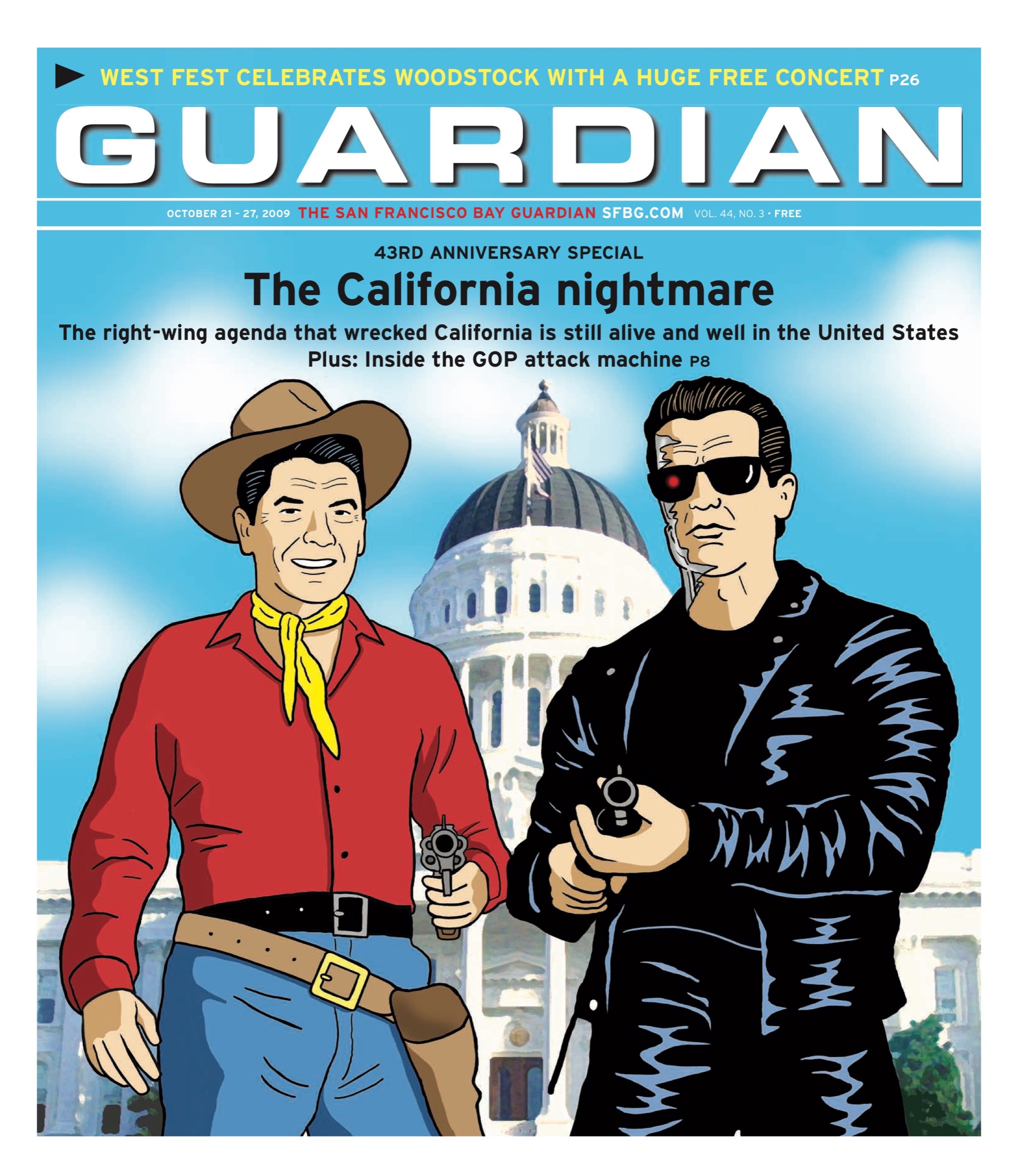
Much of the right-wing agenda that has thrown this nation into economic chaos can be traced back to what was once called the Golden State.

The tax revolts that started here under Gov. Ronald Reagan and continued to sweep the country and the world under President Reagan never abated. Indeed, they have only been strengthened by the big business power that created and benefited from them.

But now that California is showing signs of being the country’s first failed state — caught in fiscal freefall and mired in political gridlock as a generation’s worth of neglected problems surge to the surface — this state has become a cautionary tale for that anti-government ideology.

Trends in America tend to start out west, and the economic and political disaster that California has become contains critical lessons for the rest of the country.

Lewis Uhler — president and founder of the National Tax Limitation Committee — speaks candidly and proudly of his key early role in helping build a conservative movement to limit the size of government and do battle with those who want the public sector to actively promote social and economic justice.

Uhler, a UC Berkeley Boalt Hall School of Law graduate who did legal work for conservative causes in the 1960s, was tapped by then-Gov. Reagan in 1970 to be the director of the Office of Economic Opportunity, a federally-funded legal assistance program created as part of President Lyndon Johnson’s war on poverty.

While that may seem like a strange role for an avowed conservative and former member of the John Birch Society, Uhler says Reagan basically brought him in to wreck the program and fight the feds. “I was asked to put my money where my mouth was for my conservative philosophy,” Uhler told the Guardian. “OEO was set up to ensure conflict and confrontation … The mission of legal services was to change public policy through lawsuits they decided to file. I thought it was a corruption of the legal system.”

At the time, public-interest law and liberal economic and social policies were on the rise in California and spreading to the rest of the nation. So the Reaganites fought back.

Rather than helping poor plaintiffs file environmental, consumer protection, equal rights, or other types of lawsuits designed to level the playing field with powerful interests, Uhler blocked lawsuits brought by attorneys he calls “ambulance-chasers” and gutted the program. “Ultimately,” he said, “we vetoed funding for California Rural Legal Assistance.”

And for his efforts, Uhler was rewarded with a cabinet-level position: assistance secretary of the Health and Welfare Agency. Again, his role wasn’t to make the agency more effective, but to make it less effective in a realm where he believes government was too big and too active.

“The problem was uncontrolled state and local spending,” Uhler said. “Intuitively, everyone who gathered around Reagan shared the same philosophy that government doesn’t really contribute anything to economic growth.”

In 1972, Reagan gave Uhler the opportunity to work more directly on the mission of cutting taxes and shrinking the size of government, naming him chair of the Governor’s Tax Reduction Task Force. It was, in many ways, the beginning of the vast right-wing conspiracy.

“I asked to be given the chance to go across the country and find the best free market minds in the country to develop these policies,” Uhler said, explaining that he wanted to borrow the liberal strategy of giving an academic veneer to their ideas, as presidents Kennedy and Johnson had done in the realm of foreign policy. “Our side had never really done that.”

Uhler’s first stop was the University of Chicago School of Economics, where he met with noted free market economists Milton Friedman, James Buchanan, and George Stigler, who were brought into the cause.

Today’s vast network of conservative think tanks didn’t exist at that time, so Uhler tapped conservative thinkers from the American Enterprise Institute and the Hoover Institute at Stanford University, as well as other conservative economists such as Peter Drucker from Claremont McKenna College.

“There were 35 people who helped us design the first effort at a constitutional initiative in California to limit year-over-year growth of the state’s general fund,” Uhler said. “All of us as free market enthusiasts and economists all shared the belief that government beyond a certain level eats the seed corn of the nation and doesn’t produce anything.”

While voters narrowly rejected their group’s first effort to cap government growth — Proposition 1 on the November 1973 ballot — the ground had been prepared and the seeds had been sown for the tax revolts that would sweep the country in the late 1970s, with many of the campaigns coordinated by Uhler and the organization he formed for that purpose in 1975, the National Tax Limitation Committee, and a rapidly growing network of similar, interconnected organizations.

As Uhler worked with Reagan to weaken California’s government from within, his fellow travelers were developing national and international strategies to create aggressive, coordinated, well-funded campaigns to attack government and spread the free market dogma.

In August 1971, Lewis Powell — a conservative corporate attorney who President Richard Nixon had just nominated to the U.S. Supreme Court (where he served from 1972-87) — wrote a confidential memorandum to the leadership of the U.S. Chamber of Commerce titled “Attack on the American Free Enterprise System.”

He sounded the alarm that the ascendant environmental and consumer movements were going to destroy capitalism in the country unless corporate America aggressively fought back in a coordinated fashion, which he spelled out in great detail.

He called for all major corporations to develop aggressive legal and public relations strategies for fighting the left, creation of a network of think tanks and media outlets to push the conservative message, manipulation of the legal system, and sponsorship of university programs to study conservative ideas and incubate future leaders — which all came to pass in the coming decades.

“American business [is] ‘plainly in trouble’; the response to the wide range of critics has been ineffective and has included appeasement: the time has come — indeed, it is long overdue — for the wisdom, ingenuity, and resources of American business to be marshaled against those who would destroy it,” Powell wrote.

Part of that strategy involved having the federal government promote and popularize free market economic theories being developed by Friedman and his colleagues at the University of Chicago, a movement that is well-documented by journalist Naomi Klein in her book The Shock Doctrine: The Rise of Disaster Capitalism.

In 1971, Friedman and his colleagues began working with rich conservatives in Chile who were allied with Gen. Augusto Pinochet, who in turn were conspiring with the CIA to overthrow and assassinate the democratically elected, leftist President Salvador Allende, which they successfully did on Sept. 11, 1973.

Friedman’s economic theories called for a radical restructuring of society — slashing taxes and social spending; removing most regulation and trade restrictions; crushing labor unions; promoting economic growth at any cost — and Pinochet executed the strategy in brutal fashion, ordering the death of at least 3,200 of his political opponents, including the car-bomb assassination of economist Orlando Letelier in Washington, D.C., in 1976.

Friedman and Pinochet consulted openly and shared a basic disdain for social programs and progressive taxation. “The major error, in my opinion,” Friedman wrote in a letter to Pinochet in 1975, referring to the government antipoverty programs Pinochet dismantled, was “to believe that it is possible to do good with other people’s money.”

The model Pinochet and Friedman developed in Chile would eventually go global — promoted by its top cheerleaders, Reagan and British Prime Minister Margaret Thatcher — and be implemented (with disastrous results for most citizens but creating huge profits for wealthy individuals and corporations) in Indonesia, Bolivia, Argentina, Peru, Russia, Poland, South Africa, Japan, and elsewhere.

But with the corporate media and conservative opinion-shapers focused mostly on economic growth — ignoring persistent poverty and the brutal tactics used to suppress the popular movements that tried to resist Friedman’s “economic shock therapy” — Friedman had become a sort of free-market prophet by the time he died in 2006.

“In the torrent of words written in eulogy to Milton Friedman, the role of shocks and crises to advance his worldview received barely a mention,” Klein wrote. “Instead, the economist’s passing provided an occasion for a retelling of the official story of how his brand of radical capitalism became government orthodoxy in almost every corner of the globe.”

California’s fiscal shackles have been in place since 1978, when Proposition 13 and subsequent measures capped property taxes and required an undemocratic two-thirds vote to either raise taxes or pass the annual budget.

A Republican landlord lobbyist named Howard Jarvis charged onto the field that Reagan, Uhler, and their team had prepared and took advantage of a gaping hole in political leadership to set off a movement that would cripple the United States of America.

There was some logic to it then. Times were good in California in the 1970s, good enough that people were flocking to the state by the millions. That was driving up property values — and thus property taxes.

Jarvis bought his home for $8,000 in 1946; 30 years later, it was assessed at $80,000. In fact, inflation was running at close to 10 percent a year in California. Homeowners were getting huge tax hikes each year, and tenants were getting huge rent hikes at a time when state government had a budget surplus.

Homeowners saw millions of dollars sitting in the coffers in Sacramento while they couldn’t pay their tax bills. Yet nobody in the Legislature or governor’s office came up with a solution.

So when Jarvis showed up with petitions to roll back property taxes and prevent future increases, he found a broad base of support. Even tenants went along — Jarvis and his gang promised that property-tax cuts would be passed on to tenants and would mean the end of the escautf8g rent hikes.

Jarvis collected signatures for a radical measure that essentially blocked all property tax increases and allowed new assessment only when a parcel sold. It was, in the end, a huge tax giveaway to major corporations. Since commercial property turned over far less often than residential property (and since commercial sales could be hidden as stock transfers), big businesses wound up paying far less of the state’s tax burden. Corporations used to pay about two-thirds of the state’s property taxes, and individuals one-third; now that is reversed.

It didn’t help tenants, either. Few of the landlords who saw the benefits of Prop. 13 passed the money along to their renters. Most just kept it. San Francisco activist Calvin Welch likes to say that Howard Jarvis was “the father of rent control.”

The campaign against Prop. 13 warned of the dangers of cutting local government; police and fire chiefs appeared in ads opposing it. But the No on 13 folks never talked about the huge windfall big corporations would get from the measure, or the huge disparities in wealth that would be created by defunding government and dereguutf8g corporations.

If the goal was to skew the concentration of wealth in the state, it worked brilliantly. According to the California Budget Project (CBP) of the Franchise Tax Board, recent data taken before the current economic recession illustrates an ever-widening chasm between the wealthiest taxpayer and the working-class person.

The total adjusted personal income for Californians rose by nearly $64 billion in 2006-07 — with approximately three-quarters of that increase going to the top fifth of wealthiest taxpayers, and 30 percent going to the top 1 percent. That left only $19 billion for everyone else.

“The average taxpayer in the top 1 percent experienced a $128,261 increase in AGI [adjusted gross income] between 2006 and 2007, which was more than three times the total AGI of the average middle-income taxpayer in 2007 ($36,115),” stated the June 2009 report.

This continues a long-term trend in which the wealthy continue to leave the average income-earner behind in a trail of dollar-sign dust. From 1995 to 2007, income gains for that top 1 percent come to a whopping 117.3 percent increase — nearly 13 times more than the gains of the middle-income taxpayer.

The nation’s income gap has reached a “level higher than any other since 1917,” according to a paper by University of California, Berkeley economic professor Emmanuel Saez. According to Saez’s analysis of census data, there’s been a steady increase in the income gap since the 1970s, rising 20 percent over the years.

Yet even today, the defenders of Prop. 13 continue to sound the same consistent themes. “Those who are directly involved in government are a militant special interest,” Howard Jarvis Taxpayer Association executive director Kris Vosburgh told us. “They don’t like anything that limits their revenue stream.”

While that last statement could be applied equally to corporations or other private sector enterprises, as Vosburgh reluctantly admitted when asked, he continues to imply malevolence to those who defend government. He said the state’s current fiscal collapse can only be solved by slashing government expenditures.

“It is not valid to be talking about revenue-side solutions,” he said. “Our position is the state has enough money to accomplish its goals.”

People have never liked paying taxes, but the antitax movement is about far more than just that basic individual desire to hold onto our money.

The attacks were well planned, carefully targeted, and part of a much larger effort aimed at maintaining corporate and conservative power, undermining the New Deal, reducing taxes on the rich, and radically reducing the size and scope of the public sector.

As Powell called for, corporations have aggressively challenged, in legal courts and those of public opinion, every significant progressive advance — from San Francisco’s attempt at universal health care to California’s tentative first steps to address global warming.

With a level of discipline unheard of on the left, conservative opinion-shapers pound their talking points and enforce party unity through mechanisms like the “no new taxes” pledge that every Republican in the California Legislature has signed and heeded, under the very real threat of recall.

Opposition to taxes is now so deeply embedded into the psyche of the California electorate, and such a core tenet of today’s Republican Party, that elected officials who tout fiscal responsibility allowed the state’s debts to go unpaid (destroying its credit rating in the process) and its education and transportation systems to be decimated rather considering new revenues.

Gov. Arnold Schwarzenegger’s spokesperson Aaron McLear told us, “He believes we ought to live within our means and pay for only the programs we can afford.”

That simple talking point gets repeated no matter how the question is asked, or when we point out that it means we’re being forced to live within historic lows this year. But they claim the people support them.

“We had tax increases on the May ballot and they were rejected by a 2-1 margin. We should listen to the will of the voters,” McLear said.

Never mind that this regressive, dishonest package of temporary tax hikes was opposed by the Guardian and a variety of pro-tax progressive groups. McLear wouldn’t even admit that point or respond to it honestly.

And he’s certainly right that most polls show a majority of Californians don’t want new taxes. But these polls also show that people want continued government services, more investment in our neglected state infrastructure, and a whole bunch of other contradictory things.

That’s why newspapers and analysts around the world are looking at California, the world’s eighth largest economy, and wondering (as the Guardian of London headline asked Oct. 4): “Will California become America’s first failed state?”

In many ways, it already is. The question now is whether we’ll try to learn from and correct our mistakes. Ryan Riddle contributed to this report. ———–

THE CONSERVATIVE RELIGION

When I asked Lewis Uhler, one of the architects of the Reagan revolution, what Americans believed in these days — where the people he likes to talk about who hate the government (but are also admittedly disillusioned with Wall Street) turn — he answered simply: religion.

It should come as no surprise that many religious fundamentalists tend to side with the free market conservatives — both ideologies require a leap of faith and ignoring certain troubling facts, such as increasing disparities of wealth, natural resource depletion, and global warming.

Their arguments mostly make sense — until these inconvenient truths come up.

Certainly, turning over more public resources to free market capitalists, cutting taxes, and slashing government regulation will spur private sector economic growth, just as advocates claim.

But that growth has a cost. The wealth won’t be shared by everyone. Indeed, poverty has persisted even through even the economic boom of the 1990s — but almost everyone will be affected by underfunded road, education, public safety, and other essential systems.

As the conservative movement has successfully limited taxes and cut regulation over the last 40 years, working class wages have stagnated as the rich have gotten richer. Many of the world’s oil reserves have peaked and gone into decline, and rapidly increasing carbon emissions have collected in the atmosphere and caused global warming.

So how do conservatives respond to these realities as they argue for the continued dismantling of government, which is the only entity with the scope and incentive to deal with these problems? They simply deny them.

Uhler decried the “pseudoscience of climate change” as hindering economic progress and claimed that there’s actually been a global cooling trend in the last 10 years. (Actually the last 10 years have been some of the hottest on record, causing glaciers around the world to melt, according to data and observations from a consensus of the world’s climate scientists, including NASA, the Union of Concerned Scientists, and the United Nations Climate Change Conference.)

It’s the same story with the consolidation of wealth, which hurts the free market fantasy that letting the super-wealthy keep more money will eventually trickle down to benefit us all. Uhler simply denied the growing disparity of wealth, saying the “movement between quintiles is significant.”

He was talking about people’s ability to go from poor to rich with a little hard work and initiative, the core idea of free market conservatives. But data from the U.S. Census Bureau and many other entities indicate that median wages have been stagnant for decades (which wouldn’t be true if there was lots of upward mobility) and that most of the wealth created in the U.S. over the last 40 years has pooled with the top 1 percent.

In fact, when it comes to measuring social impacts, Uhler has simply one metric: “Governments at all levels are twice the size they should be to maximize economic growth.” (Steven T. Jones)


 

Endorsements

0

San Francisco is facing the worst budget crisis in modern history. More than 1,000 employees, mostly front-line workers in the Department of Public Health, have been laid off, and the red ink continues. Yet the only measure on the November ballot that would raise any money for the city is Sup. Bevan Dufty’s plan to sell off naming rights for Candlestick Park.

That’s pathetic. During the summer budget discussions, Mayor Newsom vowed to work with business, labor, and the supervisors to come up with a reasonable plan to bring in some new cash for the city. But that collapsed — largely because state law would have made it hard to raise taxes this fall without a unanimous vote of the supervisors. And while eight members were willing to put a revenue measure on the ballot, the three supervisors closest to the mayor — Sean Elsbernd, Carmen Chu, and Michela Alioto-Pier, all Newsom appointees — refused to go along. And the mayor made only a weak effort to change their minds.

So while Democrats everywhere decry Gov. Arnold Schwarzenegger’s insistence on a cuts-only budget, the Democratic mayor of San Francisco has forced essentially the same approach on this city. The only revenue increases we’re seeing are fees, like Muni fare hikes, that amount to taxes on the poor.

That’s the state of San Francisco as we head into what will almost certainly be a low-turnout election. Only two elected officials are on the ballot, and both are unopposed. Five ballot measures — several fairly significant — round out the local ballot. And with no big-name races at the top, they will win or lose on the votes of a small majority.

That’s too bad, because the issues matter. Vote Nov. 3 — and let’s hope next year’s ballot actually includes some new, progressive taxes.

OUR RECOMMENDATIONS


City Attorney

Dennis Herrera

San Francisco hasn’t always had a good track record with city attorneys. George Agnost, who ran the office in the 1970s and 1980s, was a dour, secretive, conservative lawyer who let downtown call all the shots. Louise Renne, who took over from Agnost, ran the office in the 1990s as if it was a wholly-owned subsidiary of Pacific Gas and Electric Co. Herrera, who took over in 2001, has been a major improvement. He’s turned the office into a modern operation, professionalized the administration, and taken on an activist role on consumer, environmental, and public-interest issues. He’s been a big supporter of marriage equality and of the city’s landmark health-care legislation. On his own initiative, he sued to end gender rating in health insurance and crack down on predatory payday lenders. He also moved to enforce health codes in housing and has been out front going after corrupt landlords like Skyline Realty.

We have some concerns about Herrera. Although he’s been far more sunshine-friendly than his predecessors, open-government activists are still sometimes forced to sue the city to get access to records. He won’t use his power as city attorney to enforce the Raker Act and bring public power to San Francisco. And during the current budget crisis, he cut the number of city attorney hours the supervisors can use to draft legislation.

And if, as rumored, he wants to run for mayor, Herrera needs to start taking public stands on major issues — like the unfairness of the local tax code and the need for new revenue.

But we’re happy to endorse him for another term.

Treasurer

Jose Cisneros

The incumbent treasurer is running unopposed, and we see no reason not to endorse him. He’s done some very positive things: Cisneros worked to get the big downtown law firms and other partnerships to pay their fair share of city taxes. He closed a tax loophole exploited by the big airlines that put up flight crews in local hotels.

He also convinced local banks and credit unions to accept consular identification cards to allow immigrants to open accounts and has pushed those institutions to offer "second-chance banking" to people with past credit problems. During his tenure, more than half of the 50,000 households in the city that lacked bank accounts have been able to get away from predatory check-cashing outfits and open legitimate accounts.

As an elected official, however, he could be doing a lot more. The city still keeps all its short-term accounts in one bank — Bank of America, which isn’t even local. Cisneros has promised to open that deal up to competitive bidding, but doesn’t have a timeline. And although nobody knows better than the treasurer how unfair and regressive the city’s tax codes are, he has never spoken out or offered any solutions. Cisneros says he wants his office to be apolitical, but city money is, by its nature, a political issue, and we’d like to see a little more leadership from the person who handles it. But overall, he’s a professional money manager who’s done a decent job and deserves another term.

Proposition A

Budget process

YES

We’re a little nervous about Prop. A, which would institute a two-year budget cycle for the city. Sup. Chris Daly, who opposes it, points out that the city controller’s budget projections are often wrong — badly wrong — and trying to plan 24 months ahead when economic conditions (and thus the city’s revenue stream) can change so quickly and unpredictably is a dangerous game.

But on balance, the approach in Prop. A makes sense. The budget debates would still take place every year, and the supervisors would still have to approve an annual budget — although the budget would be a rolling two-year projection. So next year, the board would approve a budget for 2010 and 2011, the following year for 2011 and 2012, and so on — leaving plenty of room for adjusting to meet economic changes. And two-year cycles might make it easier for nonprofits that rely on city funding to do some serious long-term planning.

Equally important, Prop. A requires the police and firefighters to negotiate their union contracts the same time the other unions do — before the budget deadline. The current system allows those unions to make demands that are unrelated to — and often outside — the current year’s budget realities.

Every progressive on the board except Daly supports this, and Sups. Alioto-Pier, Elsbernd and Chu oppose it.

Proposition B

Board of Supervisors aides

YES

This one’s a no-brainer. The City Charter mandates that each supervisor be allowed to hire two aides. The requirement dates back to a long-ago era when city budgets were far smaller, problems were less pressing and complex, and the supervisors worked part-time. It makes perfect sense to take such an archaic law out of the City Charter and allow the supervisors to set their own budgets — and staffing levels — the same way the mayor does. Vote yes.

Proposition C

Candlestick Park Naming Rights

NO

You have to give Sup. Bevan Dufty, the author of Prop. C, credit for trying. He’s looking for any angle he can use to help keep the 49ers in town, and allowing a corporate sponsor to pay for naming rights might possibly help cover the immense cost of substantially renovating aging Candlestick Park. And, like Prop. D (see below), this measure has a nice beneficiary: part of the money from naming rights would go to save the jobs of recreation directors, many of whom have faced budget-driven layoffs.

We agree that rec directors play a crucial role, particularly in neighborhoods with large numbers of at-risk youth. And we wish the Chamber of Commerce, Sup. Elsbernd, and other supporters of Prop. C were willing to accept some progressive tax hikes to fund those jobs.

But this isn’t a good deal. The city owns the stadium; the taxpayers financed its construction and spent 30 years paying off the bonds. But the 49ers, a private outfit owned by a very wealthy family, would get half the money from any naming deal. And the money that would come in would be radically short of what the team would need to rebuild the ‘Stick. Vote no.

Proposition D

Mid-Market special sign district

NO

Again: credit for the effort. David Addington, who owns the Warfield Theater and several other properties on mid-Market Street, accurately notes that the city’s main thoroughfare, between Fifth and Seventh streets, is rundown, ignored, and badly in need of an economic boost. He argues that allowing new digital billboards would create something of a Times Square in San Francisco, attracting tourists and turning mid-Market into a thriving theater district. Nothing else the city has done has worked — why not give this a try?

We aren’t necessarily opposed to digital billboards and we’d love to see mid-Market reinvigorated. But Prop. D would give too much authority to an unelected, unrepresentative group. It would amount to privatizing city planning and set a terrible precedent.

Under the measure, the Central Market Community Benefits District, a private group of property owners, organizations, and residents, would be authorized to approve new general advertising billboards as large as 500 square feet. The ads would have to meet city codes, but the Planning Department and supervisors would have no ability to block new installations. And the money — potentially millions of dollars a year — would go entirely to the property owners and the CBD, which would decide how to distribute it.

Yes, like Prop. C, this measure would help a worthy group: some of the new money would go to youth programs in the Tenderloin. But the process this measure describes isn’t at all democratic. The CBD board selects its own members, and the only oversight the city has is the ability of the Board of Supervisors to abolish the agency and start over.

We’re open to new ideas for central Market Street. We’re open to lights and ads and maybe even billboards. But we’re not willing to turn over zoning and public finance decisions to a private group. Vote no.

Proposition E

Advertisements on city property

YES

Proposition E, written by former Sup. Jake McGoldrick, would freeze new commercial billboards and ads on street furniture at 2008 levels and outlaw advertising on public buildings. It’s an extension of existing city policy, which seeks to limit the increasing blight of commercial ads in public space. Vote yes.

Newsom agrees to meet with Local 1021

4

By Tim Redmond

The members of SEIU Local 1021 have agreed to stand down for a day, suspend their unfair labor practices claim and hold off on sending protesters to Mayor Gavin Newsom’s campaign events — and he’s agreed to meet with the union tomorrow (Tuesday) morning to discuss their grievances.

Larry Bevan, a Local 1021 shop steward who works as a site tech at Laguna Honda Hospital, told me that Labor Council director Tim Paulson has agreed to mediate the discussion.

“I am told that the mayor will be there personally,” Bevan said. “Going through intermediaries doesn’t seem to be working.”

The union wants to challenge the mayor to live up to his promise during budget season — that he’d work to find a way to raise new revenue this fall so that 600 union members, most of them women of color, most of them front-line service workers in the Department of Public Health, wouldn’t face layoffs.

It’s too late for a ballot measure to raise new revenue. That plan fell apart when it became clear that the supervisors would not unanimously declare a state of fiscal emergency — a move that would have allowed a revenue measure to pass with a simple majority of the vote. WIthout all 11 supervisors, any attempt to raise taxes would require an insurmountable two-thirds majority.

The Oakland City Council agreed unanimously to seek new revenue, but in San Francisco, Supervisors Sean Elsbernd, Michela Alioto and Carmen Chu refused. All three were originally Newsom appointees.

Elsbernd told me that the mayor’s office tried to get him on board, but he refused to bend. The reforms that the mayor was proposing weren’t strong enough to get the relatively conservative supervisor to drop his opposition to new taxes. “Oh, they tried, all right,” Elsbernd said. “But the reform was bogus. I said no.”

But I have to wonder how serious Newsom was: He never picked up the phone and called Elsbernd personally. His chief of staff, Steve Kava, did that job.

Sorry, Mr. Mayor — when there are millions of dollars and hundreds of jobs on the line, if you actually want to get a reluctant supervisor who owes his career to you on your side, you talk to him personally. It still might not have worked — but sending an aide over with the message was clearly doomed to fail. It almost seems as if Newsom was fine with that.

At any rate, the unions will try to get Newsom’s support for a new fee on alcoholic beverages, money that could go directly to DPH. Maybe he’ll go along; maybe he’ll drag his feet. Still, Local 1021 got him to the table, which these days, with this mayor, is quite an accomplishment.

Dick Meister: The union makes us strong

0

It’s for very good reason that San Francisco has long been considered a premier “labor town.”

By Dick Meister

(Dick Meister, former San Francisco Chronicle labor editor and labor reporter for KQED-TV’s “Newsroom, ” has covered labor issues for a half-century as an author. reporter, editor and commentator.)

The 75th anniversary of the San Francisco general strike this year should remind us of the key role that organized labor has played in the city’s economic and political life, through good times and bad – often despite fierce opposition, sometimes despite the reluctance of unions to adjust to changing circumstances.

Local labor history is full of dramatic events. But none have been more dramatic than the general strike that brought the city to a standstill for four days in July of 1934 during a time of economic troubles even greater than we’re facing today. People in just about every occupation walked off the job in support of longshoremen who had struck on their own to demand an end to their truly rotten working conditions.

Dick Meister: Labor Day: Hold fast!

0

Labor’s message to its friends is clear: hold fast!

By Dick Meister

(Dick Meister, formerly labor editor of the San Francisco Chronicle and labor reporter for KQED/TV’s Newsroom, has covered labor and political issues for a half-century as a reporter, editor, author and commentator.)

U.S. unions marked Labor Day this year with greater challenges than they’ve faced in many years ­ but also with unusually high expectations of success.

Looming above all is the Employee Free Choice Act ­ the long-pending legislation that would open the way to significant expansion of the labor movement by denying employers the underhanded tactics they’ve used to block workers from unionizing.

The growth of unions, which now represent little more than 10 percent of U.S. workers, would benefit all Americans, union and non-union alike. As former Secretary of Labor Robert Reich notes, “The way to get the economy back on track is to boost the purchasing power of the middle class, and one major way to do this is to expand the percentage of working Americans in unions.”

The BART police review plan

1

By Tim Redmond

The BART Board has released a final draft of its new police-oversight policy, and you can comment on it at a public meeting tomorrow (Thursday) at 6:30 PM at the Joseph Bort Metro Center Auditorium, 101 Eight St. Oakland.

There’s a lot to digest; you can read the whole thing here (PDF). In essence, the Board would create an 11-member citizen oversight commission and an independent police auditor; the auditor would investigate complaints and the commission would monitor the auditor.

It’s going to be a fairly conservative commission — each of the nine BART Board member gets to appoint one commissioner, and it’s a fairly conservative BART Board. And — in a move that’s pretty shocking — BART wants to allow the police unions to appoint their own rep to the commission. (A final member would be chosen at-large by the entire BART board).

And here’s the big problem: The auditor can’t impose discipline — that’s up to the police chief (who reports, by the way, to the BART general manager, not the BART Board). Nothing weakens civilian oversight more than a police chief who won’t discipline the troops, and I suspect that’s what’s going to happen at BART, where the chief didn’t even bother to show up for most of the community meetings on civilian oversight.

Why the budget deal really sucks

2

By Tim Redmond

Calitics, which has done an outstanding job covering the state budget mess from the beginning, has the best line on the rotten deal that the Big Five reached yesterday:

Whoever cares the least about the outcome wins.

If you don’t care whether children get health care, whether the elderly, blind and disabled die in their homes, whether prisoners rot in modified Public Storage units, whether students get educated… you have a very good chance of getting a budget that reflects that.

If on the other hand you claim to care, you will concede and concede and concede so you can at least play the responsible part and say at the end that you didn’t completely eliminate the social safety net, though what you did get in return will be totally unclear.

And you will do it every single time.

On Forum this morning, the talk of course was all about the budget, and of course some of the callers were curious about the prospects for a state Constitutional Convention to rewrite the rules for approving a budget. The California Democratic Party is already on board with eliminating the two-thirds requirement, which is a fine thing and may wind up on the ballot soon. The Constitutional Convention is a bit more tricky.

See, the problem is how you decide who gets to be in the room; who will be the delegates to this convention? And one of the very bad ideas out there is to choose the delegates more or less at random, the same way we choose jurors.

What you will wind up with, I guarantee, is a majority of people who don’t want to raise taxes.

A large part of what has to happen in California is the education of the population, and that’s where the Democratic Party and the other stakeholders ought to be taking the lead. Perhaps the candidates for governor and the senior elected officials can all help raise money for a major statewide campaign explaining to people how the cut of the vehicle license fee, the lack of an oil-severance tax, the corporate loopholes and Prop. 13 have led directly to the cuts that are preventing qualified kids from getting a college education, preventing sick people from getting care, destroying public schools and the like.

Ever few years the Dems, the unions and the other activists have to raise big chunks of money to fight some ballot measure or another. How about, say, $50 million now to try to show the voters what’s really going on, so we don’t have to keep doing this dance over and over and over?

Problems with the BART police plan

1

By Tim Redmond

The final draft of a civilian oversight plan for the BART police is headed for the full BART Board — and while it’s a whole lot better than what we have now (and BART director Tom Radulovich praises it as “the second strongest police oversight system in the Bay Area”), there are some distinctly funky things about it that the board needs to revisit.

The proposal would create a police auditor, who would investigate complaints of BART Police misconduct and recommend discipline. The auditor would report to an 11-member civilian oversight board, with each of the nine BART directors appointing one member, the full BART board appointing an at-large member — and the BART police unions appointing the final member.

That’s unprecedented, in my knowledge. I don’t think any police union anywhere in California gets to name a representative to the police oversight panel. That part of the plan has got to go.

The other problem: The final decision on discipline will be up to the BART Police chief — and if the chief (as is highly likely) refuses ever to impose effective discipline, then the auditor will be stifled.

Yes, the auditor can appeal — the the general manager, who hires the chief. Not much luck there. Beyond that, it would require a two-thirds vote of the civilian oversight board, AND a two-thirds vote of the entire BART Board, to overrule the chief and impose discipline on a cop.

That sort of supermajority requirement hasn’t worked very well at the state-budget level, and there’s a good reason: It means that a small minority (four of the 11 oversight board members, four of the nine BART Board members) can block any action.

And let’s face it — the BART Board is not a bastion of progressive thought. Just getting a majority of those folks (or their appointees) ever to agree to crack down on police misconduct will be a tough job. Getting two-thirds of both bodies is going to be almost impossible.

And since state law pretty much mandates that all police disciplinary procedures are kept secret, there won’t be any public pressure in any individual cases.

Oddly enough, BART — which is fighting bitterly to stop Assemblymember Tom Ammiano’s bill mandating tough police oversight and has got the measure bottled up — now needs state legislation to make its weaker plan work. BART isn’t currently authorized to hold disciplinary hearings or impose discipline on rank-and-file employees. So this whole issue is going to come up before the state Legislature anyway.

Which means Ammiano will have a chance to push for stronger reforms. Perhaps he could offer a few amendments to the enabling legislation that BART is proposing.

And right now, Ammiano’s office isn’t in the mood to accept the current BART plan. “It’s as if the whole Oscar Grant thing never happened,” Quintin Mecke, Ammiano’s press spokesperson, told me.

This is the way the budget deal ends — badly

1

By Tim Redmond

We all know that the main reason we don’t have a budget deal is that everyone — but particularly the governor and the Republicans — wants to escape from this mess with his or her political hide intact. The GOP members all signed a moronic pledge never to raise taxes, and the ones who wind up voting for even minor tax hikes get slammed in their home districts. The Democrats don’t want to cut education or health or other essential services, but have been far more willing to compromise. The governor just wants to look tough.

Seriously — he just wants to look tough, and the longer the standoff continues, the more he gets this sort of press, and the more his abysmal poll numbers go up.

So now the talks are still stalled and the state is losing $25 million a day just to make a washed-up action-movie star happy with his image.

Even after the “big five” — the leaders of the Legislature and the guv — come to a deal, it’s no sure thing. Because in the past, all of the Republicans have refused to vote for deals that their own leadership and their own governor have put together.

And some Democrats may not vote for it, either. Senator Leland Yee of San Francisco told me he won’t vote for any cuts to education. “The Republicans have drawn a line and said no new taxes,” he told me. “We need to draw a line and say no more cuts to health care and education.”

In fact, in the famous late-night session that almost led to a budget deal last week, Yee was holding out, refusing to go along with the cuts until State Sen. President Darrell Steinberg called the lobbyists from the teacher’s unions at 11:30 pm and told them to tell Yee it was okay to accept the leadership plan.

Yee, of course, wants to be able to say after the dirty deal is done that he refused to accept the cuts. So do a lot of the other Dems — but at some point, most of them will bit the bullet and accept some kind of bad deal to end the IOUs and keep the state afloat. Yee wants to see the GOP take some of the heat, too: “If the governor wants us to vote for a bad budget deal, he needs to make the Republicans vote for it, too,” he said.

Which also won’t happen.

So the most likely outcome is that the Democrats will be the ones voting for a shitty deal that screws all of the traditional Democratic constituencies.

I’m sick of being held hostage by Orange County. It’s time to split up this state.

Assessing the city budget deal

6

By Steven T. Jones

Progressives aren’t feeling much joy over the city budget deal that was cut yesterday between Mayor Gavin Newsom and Sups. David Chiu and John Avalos (respectively the board president and chair of the Budget Committee), and that’s not just because it gave the gubernatorial candidate the chance to shamelessly crow, “The contrast is stark, isn’t it? In Sacramento, it’s a state of emergency. In San Francisco, a budget deal.”

It’s true that the deal to restore $43.7 million in Newsom-proposed cuts – more so-called “add-backs” than a Board of Supervisors has ever made to a mayor’s budget — was a real compromise, not coincidentally about half of what the board’s progressive majority was looking for, and it averted bloody budget standoff that neither side wanted.

But the cuts to progressive priorities are still deep and Newsom’s wasteful pet projects and taxpayer-funded political operation remain intact (Paul Hogarth has a good analysis of the numbers here). And the whole episode just feels a little like it was scripted by Team Newsom, starting on June 1 when the mayor unveiled his budget and said, “I count on you to add back a lot of the things I don’t want to see cut.”

Of course, that was followed by an aggressive butting of heads: the police and fire unions slammed the rookie supervisorial leaders hard, even running a sound truck through Avalos’ neighborhood calling for his recall, which progressive activists and union leaders responded to with increasingly confrontational tactics, even blocking Newsom’s Pride Parade vehicle with a “die-in.”

Ultimately, the clashes led to a compromise that Avalos described to us as: “It’s as good as we could possibly get.”

BART strikes looms

3

By Wendi Jonassen
bart_simpson.jpg
BART riders may need to come up with other modes of transportation next week.

A strike by BART employees threatens to shut the system down on Tuesday after weeks of heated labor contract negotiations have gotten nowhere.

At midnight on June 30, BART’s four-year labor contract with five different unions will expire. Workers threaten to strike, effectively shutting down BART and disrupting commutes for thousands as they fight to negotiate a 3 percent increase in pay to accommodate cost of living and better benefits.

But BART management isn’t budging. It wants to balance the $250 million budget deficit by reducing payroll, which its says accounts for 75 percent of the budget, and increasing fares in July and December. BART also wants to work out some outdated work procedures that they say cost time and money.

The cops and the carpetbaggers: Part II

0

This week, we report on the political fireworks surrounding the city’s budget process, which got especially loud last week at the dueling rallies outside City Hall.

As the Chronicle noted, Police Officer’s Association President Gary Delagnes — who lives in Novato — made waves by calling the city’s progressive Supervisors “carpetbaggers” and “idiots” while speaking at a rally organized by the police and firefighters’ unions to protest the Board’s changes to the mayor’s proposed budget. (“What the fuck right does Delagnes, who doesn’t live in the city, doesn’t pay property taxes in the city, doesn’t even get to vote here, have to complain about [Sup. John] Avalos?” Guardian editor Tim Redmond wondered on our blog.)

Mayor Gavin Newsom was onstage shaming the Supes right alongside the police and fire union leaders, helpfully reminding everyone that seismologists have said it’s not if, but when the Big One will strike. (Speaking of earthquakes, do we really want our hospitals to be understaffed and cut to the bone if disaster hits?) To really get a sense of how over the top the whole spectacle was, check out this slideshow of photos from the rally, set to the audio of Delagnes’ speech.

Photos, audio and slideshow produced by Rebecca Bowe