Unions

Dick Meister: Busting the union busters, a labor day lament

2

By Dick Meister

This is not a very happy Labor Day for labor, considering the continued heavy attacks on public employee unions, which have become the vanguard of organized labor. More than one-third of public employees are now in unions, while only about 7 percent of private sector workers are unionized.

Probably nothing could be more damaging to the labor movement in general than the attempts by anti-union forces to weaken unions at all levels of government by trying to limit– if not withdraw – their collective bargaining rights and right to strike, in addition to unilaterally cutting the pay and pensions, health care and other benefits their unions have won in bargaining.

Although that’s all been done in the name of budget balancing, it’s more accurately described as union busting, spurred on by the steady increase in public employee union members, even as the number of private sector unionists has been declining.

It hasn’t helped unions, either, that President Obama has turned out to be far less friendly to labor than he’d promised while securing lots of union money and lots of union supporters to help him win the presidency. Ironically, the key role unions played in Obama’s election has led to moves by anti-union forces to try to also weaken unions’ political rights.

The best example of the heavy pressures public employees and their unions are feeling is in Wisconsin, where the movement to strip public employees of their union rights began, under notoriously anti-labor Gov. Scott Walker.

Republican Walker is not only seeking to deny unionization to most state, county and municipal employees. He’s also been pushing measures that would increase the employees’ contributions to pension and health care funds by up to 50 percent, require their contracts to be re-negotiated yearly, and no longer allow unions to deduct dues from employee paychecks. It’s hard to imagine a union surviving under such restraints. Certainly Gov. Walker and his political friends don’t imagine it.

Wisconsin is but one of at least 18 states, including several once considered union friendly, where public employees are under heavy attack. On the federal level, supposedly labor-friendly Obama has imposed a federal pay freeze.

Ohio’s Republican governor, John Kasich, is trying to outdo Walker. He’s proposing, among other anti-union measures, to eliminate the bargaining rights of more than 35,000 of Ohio’s public employees, to outlaw teacher strikes, prevent child care and home care workers from unionizing and repeal a rule that requires paying union wages to non-union workers on public construction projects.

Gov. Walker, however, remains the poster boy for anti-labor stalwarts. His most outrageous act has been to back a new state law that requires about two-thirds of Wisconsin’s school districts to use employee handbooks to replace collective bargaining agreements that for decades outlined the teachers’ pay and duties.

Substituting the handbooks for negotiated contracts gives school administrators the authority to dictate broad changes in the teachers’ working conditions without so much as consulting the teachers. In some school districts, even the administrators were not consulted before the handbooks with their stringent new conditions were issued.

Teachers are probably our most important public employees. Yet despite their great importance – or maybe because of it – Gov. Walker is eagerly supporting, not only a withdrawal of teachers’ collective bargaining rights, but also an end to teacher tenure, which protects them from unwarranted attacks by union foes such as Walker.

Walker also wants a substantial increase in the already high contributions to their health insurance by teachers and teacher retirees and changes that curtail the teachers’ basic rights and security by allowing them to be hired on a year-to-year basis. The new rules also mandate that in times of financial constraint, seniority can no longer be a basis for deciding which teachers to lay off.

Some Wisconsin school districts are even trying to reduce the number of sick days allowed teachers, however unwise it may seem to have teachers with possible communicative illnesses remain in the classroom because they can’t afford to take days off.

Other districts are doing away with at least some paid holidays or changing extra days used for professional development into workdays and cutting paid lesson preparation periods in half. The Wisconsin Journal Sentinel’s Erin Richards quotes one of Wisconsin’s major teacher union leaders as noting that teachers across the state have been most concerned with losing prep time, which can have a direct effect on the quality of lessons and student performance.

Gov. Walker and other leading Republicans don’t seem to be much concerned about that. What’s more important to them is cutting Wisconsin’s education budget, the influence of teachers on education policy and, of course, all but eliminating the union rights of teachers and all other public employees.

But Walker may very well have gone too far. The negative reaction has been strong and growing in Wisconsin and elsewhere. It’s widely realized that if the public employee union busters are successful, private sector unions throughout the country will feel even stronger opposition. And it’s clear that if anti-union forces can weaken the public employee unions that are the strongest segments of today’s labor movement, it’s more than likely that private sector unions will be the next target.

The good news is that recently, Wisconsin voters easily turned back a GOP attempt to recall two strong pro-worker state senators who had helped lead the fight against Walker’s anti-worker legislation. The fight began in the spring when Republicans targeted eight Democratic senators for recall – and lost. There have been nine recall elections since then and labor has won five of them.

Labor and the Democrats had hoped to wrest control of the State Senate from the GOP. But though failing to do so, they did narrow the Republicans Senate majority to a razor-thin 17-16.

Democrats and union leaders are rightly celebrating the pro-labor election victories as a possible opening shot against anti-labor extremism nationwide, which could in turn lead to an attempt to recall Gov. Walker or at least force him to back off.

Actually, Walker has done his labor enemies a great favor by provoking public outrage that has brought important new strength and solidarity to the cause of working people and their unions everywhere.

So it may be a happy Labor Day after all, thanks to a labor opponent.

Dick Meister, former labor editor of the SF Chronicle and KQED-TV Newsroom, has covered labor and politics for more than a half-century. Contact him through his website, www.dickmeister.com, which includes more than 350 of his columns.

Dick Meister: VIVA EL BOICOTTEO!

2

By Dick Meister

(Third part of a five part daily series)

Although the United Farm Workers initially relied solely on strikes in its drive to win union contracts for California’s farm workers, it soon switched to the much more effective weapon of the boycott.

Growers could easily replace strikers, and often did. But they couldn’t do much about customers – individuals and institutions – who heeded the UFW’s call to not buy any grapes, lettuce or wine from growers who continued to rebuff the UFW demands for union recognition.

The boycotts helped forge a potent coalition of clergymen, industrial unionists, young activists and civil rights advocates, liberal Democratic politicians, socially conscious shoppers and others. They also waved crimson banners, sang the farm workers’ songs, chanted their slogans and espoused non-violence, on city streets, outside supermarkets, in meeting halls, wherever they could. There were an estimated 17 million of them worldwide between 1968 and 1975, including 10 to 12 percent of all U.S. adults. Later boycotts drew less support but were nevertheless effective in winning new contracts.

John Giumarra Jr., a young lawyer who spoke for the grape growers who signed the first UFW contracts, declared that boycott pressures had been threatening to “destroy a number of farmers.” Lionel Steinberg, a major Coachella Valley grape grower who was the first to agree to a UFW contract, urged others to quickly reach an agreement, lest they continue losing millions of dollars in sales.

Steinberg told his fellow growers, “It is costing us more to produce and sell our grapes than we are getting paid for them. We are losing maybe 20 percent of our market. The boycott is illegal and immoral, but it also is a fact.”

The signing of the union contracts with grape growers in Delano signaled the inevitable. California’s farm workers were going to be organized, and the next target would be those in the nearby Salinas and Santa Maria valleys, which produced 70 percent of the nation’s iceberg lettuce and much of its other vegetables. It was called “America’s Salad Bowl,” a flat, fertile place where morning fog hung heavy over land carpeted green for miles.

Men and women hovered over the land, gripping hoes so short their handles scarcely protruded above their fast-moving hands as they stooped and cut, stooped and cut. Most worked under the supervision of men with the broad accents of Texas, Oklahoma and Arkansas who had wielded hoes for small independent growers before giant corporations bought up the land and hired them to manage their new holdings. These men were among the Dust Bowl Refugees of the 1930s who had made their own violently opposed demands for better working lives during the Great Depression.

Many of the former Dust Bowl Refugees were lured into urban employment when the depression ended, but those who remained as managers joined the farm corporations to oppose the demands of the Chicano and Filipino American farm workers who replaced the at the bottom of the economic totem pole.

The demands were for union recognition elections in which the UFW seemed a certain winner. But if they didn’t agree to elections, the growers faced the certain prospect of a boycott like that which had been so costly to grape growers.

There was, however, an alternative that the growers had overlooked until the inevitability of unionization arrived with the UFW demands. They might arrange to bypass elections and sign with another union that would demand less than the aggressive, unorthodox UFW and at the same time ease the sting of a boycott by enabling by enabling growers to point out that their workers were unionized.

The growers found their alternative in the Teamsters Union, which feared that UFW strikes and boycotts would endanger the flow of produce handled by truck drivers, cannery workers and other Teamster members. What’s more, Teamster officials were eager for representation rights that would allow them to control the field workers. The potential was immense: more than 30,000 farm workers in the two valleys alone. That would bring a lot of new money into the dues and pension funds used by leaders of the corruption-ridden Teamsters to gain power, influence and fat salaries for themselves.

Virtually all the 170 growers in the two valleys soon announced they had signed Teamster contracts, even though the Teamsters had no farm worker members. The growers and Teamsters hadn’t even agreed on specific contract terms. They were in so great a rush to head off the UFW, they merely signed agreements that the terms would be filled in later. The terms, however, would not be decided in consultation with the workers or their union. Terms were left solely to grower and Teamster representatives.

The workers were not even allowed to ratify the contracts, although they would be required to join the Teamsters and have union dues deducted from their paychecks. If they didn’t join the Teamsters, they’d be fired. Most workers got basic pay raises of 10 to 50 cents an hour in return for forced membership in the Teamsters and some minimal health and welfare benefits – but that was all.

Teamster recognition was a very small price for growers to pay in exchange for maintaining their ability to make decisions on pay and working conditions in isolation from the direct collective demands of their employees. Since the Teamsters’ main interest lay elsewhere, in transportation and food processing, growers also could expect that even the minimal terms of the contracts would not be fully enforced and that strikes and boycotts were hardly a possibility. But on the slim chance that the growers might still feel insecure, the contracts were written to stand for five years.

Chavez was outraged at the Teamsters’ “act of treason against the legitimate aspirations of farm workers.” He declared “all-out war against the Teamsters and the bosses ” and marched into Salinas with several hundred farm workers and an AFL-CIO contingent headed by Organizing Director Bill Kircher. Pickets went immediately to a farm where 250 workers had been fired for not joining the Teamsters. Hundreds of workers struck at other farms and the UFW began preparing for legal action and a nationwide lettuce boycott.

Growers got a court order against what was ruled an illegal jurisdictional dispute, but the pickets and boycotters kept marching nevertheless and Chavez began “a penitential fast against injustice.”

In less than two weeks, the Teamsters were asking for a treaty with the UFW. It was quickly reached. The Teamsters agreed to reallocate jurisdiction over field workers to the UFW and agreed that growers who had signed with the Teamsters could switch to the UFW without penalty.

But there was a catch. Growers who had signed Teamster contracts would not give them up. Finally, UFW members voted to strike. It was, at the start, the largest and most effective farm strike since the mid-1930s. More than 5000 workers left their jobs at nearly 150 farms, and produce shipments were cut from 200 carloads a day to 75 or less. Growers were losing an average of $500,000 a day.

Unlike the vineyard strike, this dispute was violent, with beatings suffered by UFW and Teamster partisans alike. Some of the turmoil was caused by officials of a Teamster cannery workers local who were charged with using $25,000 in union funds to hire some of the local’s burly members to “guard” fields from UFW organizers.

A judge ruled there could only be one informational picket at 22 of the Salinas Valley farms that made up the strikers’ main targets, none at the eight others. Nor would the UFW be allowed to call a boycott against any of the 170 growers who held Teamster contracts. The union nevertheless called a boycott. Officially, the strike continued, but the major effort was at food markets in 64 cities across the country, where UFW members and supporters urged shoppers to bypass lettuce from the struck growers.

A judge ordered Chavez arrested. He went to jail accompanied by more than 2000 UFW members and supporters, including Coretta King and Ethel Kennedy. They cheered Chavez’ parting advice to “boycott the hell out of them!” and then began a series of prayer vigils and other highly publicized demonstrations. After three weeks, Chavez was released, pending the outcome of a UFW appeal.

The boycott continued at an intensified pace throughout the early months of 1971 until a committee of Catholic bishops mediated a settlement between national Teamster and AFL-CIO leaders. But growers still refused to give up their Teamster contracts. They held them for a half-dozen years more, until the Teamsters, beaten badly in a series of union representation elections under California’s new farm worker bargaining law, finally abandoned as futile the fierce fight they had waged against the UFW for more than a decade.

Meanwhile, the boycott continued, as the UFW expanded its organizing efforts to Florida and Arizona. The UFW’s victory in California was truly spectacular. Imagine, one of the youngest and smallest unions in the country, representing the most oppressed of American workers, decisively beating the country’s largest and most powerful union.

It was the UFW’s incredible use of the boycott that did it,  the major non-violent weapon available to all who would seek justice from an oppressor.

Dick Meister, former labor editor of the SF Chronicle and KQED-TV Newsroom, has covered labor and politics for more than a half-century. Contact him through his website, www.dickmeister.com, which includes more than 350 of his columns.


A lame attack on Avalos and Adachi

30

The Examiner headline today is about as misleading as you can get: “Labor leaders unite against mayor candidates Jeff Adachi, John Avalos.”


That’s pretty ridiculous, since Avalos has the endorsement of the largest city employee union (SEIU Local 1021) and the local teachers union and is about the most pro-labor person in the race. And when you look at what’s actually going on, only three “labor leaders” (out of 150 unions represented in the San Francisco Labor Council) are going after Adachi and Avalos — and they’re among the most conservative labor unions in the city. Who are these “labor leaders?” The cops, the firefighters and the plumbers.


The plumbers, I guess, are mad about Avalos’ local-hire law. The cops and firefighters are mad that Avalos doesn’t give them everything they want. And the fact that they’re going to raise money to go after Adachi and Avalos suggests that they think one or both of them is a serious threat to Mayor Ed Lee.


Or else they’re just blustering and throwing money around because they can.


The reality is that Avalos will have strong labor support, as he always has. Adachi will have a lot more than the cops and firefighters and plumbers to worry about — nobody in organized labor is happy with his pension-reform legislation. So this little rump group making a fuss and getting Examiner headlines means very little.

The real Leland Yee

53

tredmond@sfbg.com

It’s early January 2011, and the Four Seas restaurant at Grant and Clay is packed. Everyone who is anyone in Chinatown is there — and for good reason. In a few days, the Board of Supervisors is expected to appoint the city’s first Asian mayor.

The rally is billed as a statement of support for Ed Lee, the mild-mannered bureaucrat and reluctant mayoral hopeful. But that’s not the entire — or even, perhaps, the central — agenda.

Rose Pak, who describes herself as a consultant to the Chinese Chamber of Commerce but who is more widely known as a Chinatown powerbroker, is the host of the event. She stands in front of the room, takes the microphone, and, in Cantonese, delivers a remarkable political speech.

According to people in the audience, she says, in essence, that the community has come out to celebrate and support Ed Lee — but that’s just the start. She also urges them not just to promote their candidate — but to do everything possible to prevent Leland Yee from becoming mayor.

She continues on for several minutes, lambasting Yee, the state Senator who lived in Chinatown as a child, accusing him of about every possible political sin — and turning the Lee rally into an anti-Yee crusade. And nobody in the crowd seems terribly surprised.

Across Chinatown, from the liberal nonprofits to the conservative Chamber of Commerce, there’s a palpable fear and distrust of the man who for years has been among San Francisco’s most prominent Asian politicians — and who, had Lee not changed his mind and decided to run for a full term this fall, was the odds-on favorite to become the city’s first elected Chinese mayor.

The reasons for that fear are complex and say a lot about the changing politics of Asian San Francisco, the power structure of a city where an old political machine is making a bold bid to recover its lucrative clout — and about the career of Yee himself.

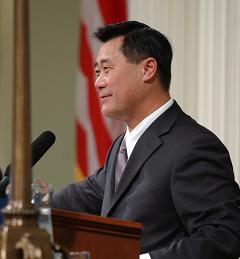
Senator Leland Yee is a political puzzle. He’s a Chinese immigrant who has built a political base almost entirely outside of the traditional Chinatown community. He’s a politician who once represented a deeply conservative district, opposed tenant protections, voted against transgender health benefits and sided with Pacific Gas and Electric Co. on key environmental issues — and now has the support of some of the most progressive organizations in the city. He’s taken large sums of campaign money from some of the worst polluters in California, but gets high marks from the Sierra Club.

His roots are as a fiscal conservative — yet he’s been the only Democrat in Sacramento to reject budget compromises on the grounds that they required too many spending cuts.

He’s grown, changed, and developed his positions over time. Or he’s become an expert at political pandering, telling every group exactly what it wants to hear. He’s the best chance progressives have of keeping the corrupt old political machine out of City Hall — or he’s a chameleon who will be a nightmare for progressive San Francisco.

Or maybe he’s a little bit of all of that.


Leland Yin Yee was born in Taishan, a city in China’s Guangdong province on the South China Sea. The year was 1948; Mao Zedong’s Communist Party of China had taken control of much of the countryside and was moving rapidly to take the major cities. The nationalist army of General Chiang Kai-Shek was falling apart, and Yee’s father, who owned a store, decided it was time for the family to leave.

The Yees made it to Hong Kong, and since Mee G. Yee had previously lived in the United States and served in the U.S. Army during World War II, he was ultimately able to move the family to San Francisco. In 1951, the three-year-old Leland Yee arrived in Chinatown.

For four years, Yee lived with his sister and mother in a one-room apartment with a shared bathroom while his father worked as a sailor in the merchant marine. It was, Yee recalled in a recent interview, a tight, closed, and largely self-sufficient community.

“The movie theater, the shoe store, the barber shop, food — everything you needed you could get in Chinatown,” Yee said. “You never had to leave.”

Of course, after a while, Yee and his mom started to venture out, down Stockton Street to Market, where they’d shop at the Emporium, the venerable department store. “It was like walking into a different country,” he said. “If you didn’t know English, they didn’t have time for you.”

Yee, like a lot of young Chinese immigrants of his era, put much of his time into his studies — in the San Francisco public schools and in a local Chinese school. “My mom spoke a village dialect, and we had to learn Cantonese,” he said. “Every little kid had to go to Chinese school. We hated it.”

When Yee was eight, his parents managed to buy a four-unit building on Dolores Street, and the family moved to the Mission, where he would spend not only the rest of his childhood but much of his early adult life. He graduated from Mission High School, enrolled in City College, studied psychology and after two years won admission to UC Berkeley.

Berkeley in 1968 was a very different world from Chinatown and even the relatively controlled environment he’d experienced at home in the Mission. “You didn’t protest in school. You’d have been sent home, and your mother would kill you,” he said.

At Berekely, all hell was breaking loose, with the antiwar protests, the People’s Park demonstrations, the campaign to create a Third World College (which led to the first Ethnic Studies Department), and a general attitude of mistrust for authority. “I developed a sense of activism,” Yee said. “I realized I could speak out.”

That spirit quickly vanished when Yee lost faith in some of his fellow activists. “People would work with us, then get into positions of power and use that against you,” he recalled. “A lot of my friends said ‘forget it.’ I left the scene.”

Yee once again devoted his energy to school, earning a masters at San Francisco State University and a Ph.D in child psychology from the University of Hawaii. Along the way, he met his wife, Maxine.

With his new degree, the Yees moved back to San Francisco — and back in with his parents at the Dolores property, where he, Maxine and a family that would grow to four kids would live for more than a decade.


Yee worked as a child psychologist for the San Francisco Department of Public Health, starting the city’s first high school mental-health clinic. He went on to become a child psychologist at the Oakland Unified School District, then joined a nonprofit mental health program in San Jose.

In 1986, Yee decided to get active in politics for the first time since college, and ran for the San Francisco School Board. He lost — and that would be the only election he would ever lose. In 1988, he won a seat, and established himself as an advocate for students of color, fighting school closures in minority neighborhoods. He also tried to get the district to modify its harsh disciplinary rules, arguing against mandatory expulsions.

On fiscal issues, though, Yee was a conservative. For his first term, despite the brutal cutbacks of the recession of the late 1980s and early 1990s, he insisted that the district make do with the money it had. His solution to the red ink: Cut waste. Only in 1992, when he was up for re-election, did he acknowledge that the district needed more cash; at that point, he supported a statewide initiative to tax the rich to bring money to the schools.

The sense of fiscal conservatism — of holding the line on taxes, but mandating open and fair contracting procedures and tight financial controls — was a hallmark of much of his political career. When the Guardian endorsed him for re-election to the board in 1992, we wrote that “there’s real value in his continuing vigilance against administrative fat and favoritism in contracts.”

Over the next four years, Yee worked with then-Superintendent Waldemar “Bill” Rojas, a deeply polarizing figure who pushed his own personal theory of “reconstitution” — firing all the staff at low-performing schools — and later was enmeshed in a scandal that led to prison time for a contractor he’d hired. Yee told me he was the only board member to vote against hiring Rojas, but people who were watching the board closely back then say he didn’t always stand up to the superintendent.

He also became what some say was a bit too close with Tim Tronson, a consultant hired by the district as a $1,000-a-day facilities consultant. Tronson wound up getting indicted on 22 counts of grand theft, embezzlement, and conspiracy in a scheme to steal $850,000 from the schools, and was sentenced to four years in state prison.

In 1998, when some school board members wanted to build housing for teachers on property that the district owned in the Sunset, Yee led the opposition — with Tronson’s help. At one meeting at Sunset Elementary School, Yee went so far as to say, according to people present, that “Tim Tronson is my man, and I rely on him for advice.”

Yee acknowledged that he worked closely with Tronson to defeat that housing project. “He was the facilities manager,” Yee explained, “and I said that I trusted his judgment.”


Yee has either a great sense of political timing or exceptional luck. He ran for the Board of Supervisors in 1996, facing one of the weakest fields in modern San Francisco history. He was the only Chinese candidate and one of just two Asians (the other, appointed incumbent Michael Yaki, barely squeaked to re-election). In an at at-large election with the top five winning seats, Yee came in third, with 103,000 votes.

He was never a progressive supervisor. In 2000, the Guardian ranked the good votes of what we referred to as Willie Brown’s Board, and Yee scored only 43 percent. He was against campaign finance reform. He supported the brutal gentrification and community displacement represented by the Bryant Square development. He voted to kill a public-power feasibility study and opposed the Municipal Utility District initiative. He opposed a moratorium on uncontrolled live-work development.

In 2002, Yee was one of only three supervisors to oppose Proposition D, a crucial public-power measure that would have broken up PG&E’s monopoly in the city. He stood with PG&E (and then-Sups. Tony Hall and Gavin Newsom) in opposition to the measure, then signed a pro-PG&E ballot argument packed with PG&E lies.

When I asked him about that stand, Yee at first didn’t recall opposing Prop. D, but then said he “stood with labor” on the issue. In fact, the progressive unions didn’t oppose Prop. D at all; the opposition was led by PG&E’s house union, IBEW Local 1245.

Yee was particularly bad on tenant issues. He not only voted to deny city funding for the Eviction Defense Collaborative, which helped low-income tenants fight evictions; he actually tried to get the city to put up money for a free legal fund to help landlords evict their tenants. He opposed a ballot measure limiting condo conversions. He opposed a measure to limit the ability of landlords to pass improvement costs on to their tenants.

In 2001, Yee voted to uphold a Willie Brown veto of legislation to limit tenancies in common, a backdoor way to get around the city’s condo conversion ordinance. Only Hall and Newsom, then the most conservative supervisors on the board, joined Yee. At one point, he started asking whether the city should consider repealing rent control.

He opposed an affordable housing bond in 2002, joining the big landlord groups in arguing that it would raise property taxes. Every tenant group in town supported the measure, Proposition B; every landlord group opposed it.

I asked Yee about his tenant record, and he told me that he now supports rent control. But he said that he was always on the side of homeowners and small landlords, and that property ownership was central to Chinese culture. “I was responding to the Chinese community and the West Side,” he said.

He wasn’t much of an environmentalist, either — at least not in today’s terms. He was one of the only city officials to support a “Critical Car” rally in 1999, aimed at promoting the rights of vehicle drivers (and by implication, criticizing Critical Mass and the bicycle movement).

His record on LGBT issues was mixed. While he supported a counseling program for queer youth when he was on the school board, he also supported JROTC, angering queer leaders who didn’t want a program in the public schools run by, and used as a recruiting tool for, the military, which at that point open discriminated against gay and lesbian people.


Yee was also one of only two supervisors who voted in 2001 against extending city health benefits to transgender employees.

That was a dramatic moment in local politics. Nine votes were needed to pass the measure, and while eight of the supervisors were in favor, Yee and Hall balked. At one point, Board President Tom Ammiano had to direct the Sheriff’s Office to go roust Sup. Gerardo Sandoval, who was ducking the issue in his office, to provide the crucial ninth vote.

Yee didn’t just vote against the bill. According to one reliable source who was there at the time, Yee spoke to a community meeting out on Ulloa Street in the Sunset and berated his colleagues, quipping that the city should have better things to do than “spend taxpayer money on sex-change operations.”

It was a bit shocking to trans people — Yee had, over the years, befriended some of the most marginalized members of what was already a marginalized community. “There was one person at the rail crying, saying ‘Leland, how could you do this to us,'” Ammiano recalled.

The LGBT community was furious with Yee. “I didn’t speak to him for at least a year,” Gabriel Haaland, one of the city’s most prominent transgender activists, told me.

Yee now says the vote was a mistake — but at the time, he told me, he was under immense pressure. When he voted for the queer youth program, he said, “the elders of the Chinese community ripped me apart. They called my mother’s friends back in the village [where he was born] and said her son was embarrassing the Chinese community.”

That must have been difficult — and he said that “if I had known the pain I had caused, I wouldn’t have voted that way.” But it was hard to miss that pain his vote caused.

On the other hand, people learn from their experiences, attitudes evolve, we all grow up and get smarter, and the way Yee describes it, that’s what happened to him.

In 2006, when he was running for state Senate, Yee met with a group of trans leaders and formally — many now say sincerely — apologized. It was an important gesture that made a lot of his critics feel better about him.

“He didn’t have to do that,” Haaland said. “People change, and he paid for his crime, and that’s genuine enough for me.”

As a former school board member, Yee kept an interest in the schools — but not always a healthy one. At one point, he actually proposed splitting SFUSD into two districts, one on the (poorer) east side of town and one on the (richer) west. “We strongly opposed that,” recalled Margaret Brodkin, who at the time ran Coleman Advocates for Children and Youth. “Eventually he dropped the idea.”

For all the problems, in his time on the Board of Supervisors, Yee developed a reputation for independence from the Brown Machine, which utterly dominated much of city politics in the late 1990s. His weak 43 percent rating on the Guardian scorecard was actually third-best among the supervisors, after Ammiano and the late Sue Bierman.

In 1998, he was one of the leaders in a battle to prevent the owners of Sutro Tower from defying the city’s zoning administrator and placing hundreds of new antennas on Sutro Tower. He, Bierman, and Ammiano were the only supervisors opposing Brown’s crackdown on homeless people in Union Square.

When he ran in the first district elections, in 2000, against two opponents who had Brown’s support and big downtown money, the Guardian endorsed him, noting that while he “can’t be counted on to support worthy legislation … He’s one of only two board members who regularly buck the mayor on the big issues.”

(He never liked district elections, and used to take any opportunity to denounce the system, at times forcing Ammiano to use his position as president to tell Yee to quit dissing the electoral process and get to the point of his speech.)


In 2002, the westside state Assembly district seat opened up, and both Yee and his former school board colleague Dan Kelly ran in the Democratic primary. Yee won, and went on to win the general election with only token opposition.

His legislative record in the Assembly wasn’t terribly distinguished. Yee never chaired a policy committee — although he did win a leadership post as speaker pro tem. And he cast some surprisingly bad votes.

In 2003, for example, then-Assemblymember Mark Leno introduced a bill that would have exempted single-room occupancy hotels from the Ellis Act, which allows landlords to evict tenants for no reason. Yee refused to vote for the bill. Leno was furious — he was one vote short of a majority and Yee’s position would have doomed the bill. At the last minute, a conservative Republican who had grown up in an SRO hotel voted in favor.

When he ran for re-election in 2004, we noted: “What’s Leland Yee doing up in Sacramento? We can’t figure it out — and neither, as far as we can tell, can his colleagues or constituents. He’s introduced almost no significant bills — compared, for example, to Assemblymember Mark Leno’s record, Yee’s is an embarrassment. The only high-profile thing he’s done in the past several years is introduce a bill to urge state and local governments to allow feng shui principles in building codes.”

In 2006, Yee decided to move up to the state Senate, and he won handily, beating a weak opponent (San Mateo County Supervisor and former San Francisco cop Mike Nevin) by almost 2-1. His productivity increased significantly in the upper chamber — and in some ways, he moved to the left. He’s begun to support taxes — particularly, an oil severance tax — and when I’ve questioned him, he somewhat grudgingly admits that Prop. 13 deserves review.

He’s done some awful stuff, like trying to sell off the Cow Palace land to private developers. But he has consistently been one of the best voices in the Legislature on open government, and that’s brought him some national attention.

Yee has been a harsh critic of spending practices and secrecy at the University of California, and when UC Stanislaus refused in 2010 to release the documents that would show how much the school was paying Sarah Palin to speak at a fundraiser, Leland flew into action. He not only blasted the university and introduced legislation to force university foundations to abide by sunshine laws; he worked with two Stanislaus students who had found the contract in a dumpster and made headlines all over the country.

He’s fought for student free speech rights and this year pushed a bill mandating that corporations that get tax breaks for job creation prove that they’ve actually created jobs — or pay the tax money back. He’s also won immense plaudits from youth advocates and criminal justice reformers for his bill that would end life-without-parole sentences for offenders under 18.

Along the way, he compiled a 100 percent voting record from the major labor unions, including the California Nurses Association and SEIU, and with the Sierra Club. All three organizations have endorsed him for mayor.

Yee told me that he thinks he’s become more progressive over the years. “My philosophy has shifted,” he said.

Yet when you talk to his colleagues in Sacramento, including Democrats, they aren’t always happy with him. Yee has a tendency to be a bit of a loner — he’s never chaired a policy committee and in some of the most bitter budget fights, he’s refused to go along with the Democratic majority. Yee insists that he’s taken principled stands, declining to vote for budget bills that include deep service cuts. But the reality in Sacramento is that budget bills have until this year required a two-thirds vote, meaning two or three Republicans have had to accept the deal — and losing a Democratic vote has its cost.

“You have to give up all sorts of things, make terrible compromises, to get even two Republicans,” one legislative insider told me. “When a Democrat goes south, you have to find another Republican, and give up even more.”

In other words: It’s easy to take a principled stand, and make a lot of liberal constituencies happy, when you aren’t really trying to make the state budget work.


I met Rose Pak on a July afternoon at the Chinatown Hilton. She brought along her own loose tea, in a paper package; the waitress, who clearly knew the drill, took it back to the kitchen to brew. Pak and I have not been on the greatest of terms; she’s called the Guardian all kinds of names, and I’ve had my share of critical things to say about her. But on this day, she was polite and even at times charming.

After we got the niceties out of the way (she told me I was unfair to her, and I told her I didn’t like the way she and Willie Brown played politics), we started talking about Yee. And Pak (unlike some people I interviewed for this story) was happy to speak on the record.

She told me Yee had “no moral character.” She told me she couldn’t trust him. She told me a lot of stories and made a lot of allegations that we both knew neither she nor I could ever prove.

Then we got to talking about the politics of Chinatown and Asians in San Francisco, and a lot of the animosity toward Yee became more clear.

For decades, Chinatown and the institutions and people who live and work there have been the political center of the Chinese community. Nonprofits like the Chinatown Community Development Center have trained several generations of community organizers and leaders. The Chinese Chamber of Commerce, the Six Companies, and other business groups have represented the interests of Chinese merchants. And while the various players don’t always get along, there’s a sense of shared political culture.

“In Chinatown,” Gordon Chin, CCDC’s director, likes to say, “it’s all about personal connections.”

There’s a lively infrastructure of community-service programs, some of which get city money. There’s also a sense that any mayor or supervisor who wants to work with the Chinese community needs to at least touch base with the Chinatown establishment.

Yee doesn’t do that. “He doesn’t give a shit about them,” David Looman, a political consultant who has worked with many Chinese candidates over the years, told me.

Yee’s Asian political base is outside of Chinatown; he told me he sees himself representing more of the Chinese population of the Sunset and Richmond and the growing Asian community in Visitacion Valley and Bayview.

Pak is connected closely to Brown, who Yee often clashed with. For Pak, Brown, and their allies, strong connections to City Hall mean lucrative lobbying deals and public attention to the needs of Chinatown businesses. Then there’s the nonprofit sector.

CCDC and other nonprofits do important, sometimes crucial work, building and maintaining affordable housing, taking care of seniors, fighting for workers rights, and protecting the community safety net. Yee, Pak said, “has never shown any interest in our local nonprofits. We all work together here, and he doesn’t seem to care what we do.” Yee told me he has no desire to see funding cut for any critical social services in any part of town. But he has also made no secret of the fact that he questions the current model of delivering city services through a large network of nonprofits, some of which get millions of taxpayer dollars. And the way Pak sees it, all of that — the nonprofits, the business benefits, the contracts — are all at risk. “If Leland Yee is elected mayor,” she told me, “we are all dead.”

I ran into an old San Francisco political figure the other day, a man who has been around since the 1970s, inside and outside of City Hall, who remains an astute observer of the players and the power relationships in the local scene. At the time we talked, he wasn’t supporting any of the mayoral candidates, but he had a thought for me. “This town,” he said, “is being taken over by a syndicate. Willie Brown is the CEO, and Rose Pak is the COO, and it’s all about money and influence.”

That’s not a pleasant thought — I’ve lived through the era of political machine dominance in this town, and it was awful. In the days when Brown ran San Francisco, politics was a tightly controlled operation; only a small number of people managed to get elected to office without the support of the machine. Developers made land-use policy; gentrification and displacement were rampant; corruption at City Hall turned a lot of San Franciscans off, not only to the political process but to the whole notion that government could be a positive force in society.

A few years ago, I thought those days were over — and to a certain extent, district elections will always make machine politics more difficult. But when I see signs of the syndicate popping up — and I see a candidate like Ed Lee, who’s close friends with Brown, leading the Mayor’s Race — it makes me nervous. And for all his obvious flaws, at least Leland Yee isn’t part of that particular operation. If there’s a better reason to vote for him, I don’t know what it is.

YEE HOME PURCHASE RAISES SUSPICIONS

Rose Pak has a question about Leland Yee. “How,” she asked me, “did the guy manage to buy a million-dollar house on a $30,000 City Hall salary?”

Pak isn’t the only one asking — numerous media reports over the years have examined how Yee raised a family of four and bought a house in the Sunset on very little visible income. And while I’m not usually that interested in the personal finances of political candidates, I decided that it was worth a look.

Here’s what I found: Public records show that in July 1999, Yee and his wife, Maxine, purchased a house on 24th Avenue for $875,000 (it’s now assessed at slightly more than $1 million). At the time, Yee was a San Francisco supervisor, earning a little more than $30,000 a year. (The salary of the supervisors was raised dramatically shortly after Yee left the board and went to the state Assembly.) His wife wasn’t working. And his economic interest statements for that period show no other outside earnings. So the disposable, after-tax income of the entire Yee family couldn’t have been much more than $25,000.

That, by any normal standard, shouldn’t have been enough to float a mortgage that, records show, totaled $516,000. In fact, the interest payments alone on that mortgage alone would total $3,600 a month — more than Yee’s gross income.

Documents in the Assessor’s Office show another paper trail, too. In 1989, Jung H. Lee, Yee’s mother, transferred the deed on a four-unit Dolores St. building where the family had been living to Maxine and Leland Yee — for no money. And a few months before the Yees bought the Sunset house, they took out a $320,000 home-equity loan on that property. That was the down payment on the Sunset property.

Still: At that point, the Yees would have been paying off two mortgages, with a total nut of about $5,000 a month — and supporting four kids, in San Francisco. In 2002, Yee’s economic interest statement’s show some modest income from teaching at Lincoln University — but nowhere near enough to pay that level of expenses.

What happened? Yee explains it this way: “For more than 10 years, we were living rent-free in my parents’ property,” he told me I an interview. “We were a close Chinese family, and my parents provided the food and helped pay for the children’s clothing. So we had almost no expenses and we lived very frugally.”

During that period, Yee was working for the San Francisco Department of Public Health, the Oakland Unified School District, and a San Jose nonprofit, earning, he said, between $50,000 and $90,000 a year. If he saved almost all of that money, he would have had more than a half-million dollars in the bank when he bought the Sunset house.

There’s nothing on any of his economic disclosure forms showing any ownership of stocks or other reportable financial interests during that period, so he wasn’t investing the money. In fact, he says, it was, and is, all in simple savings accounts. A bit unusual for that large a sum of money.

How did he get a mortgage? “Back then,” he said, “banks were willing to lend a lot more freely than they do today.”

Starting in 2003, Yee was in the state Assembly, making a higher salary — but still not much in excess of $100,000 a year. After taxes, he was probably taking home about $75,000 — and $60,000 was going to the two mortgages.

How did he do it? “We have been supplementing our income with our savings,” he said. “We don’t take vacations, we are very careful with our money.” And they clearly aren’t desperate for cash — Yee’s daughter occupies two of the four units in the Dolores St. building they own, but the other two units are vacant.

It’s possible. It’s plausible. But I don’t blame people for wondering how he managed to pull it off. (Tim Redmond, with research assistance by Oona Robertson) 


BIG CORPORATIONS HAVE BACKED YEE

Yee became a prodigious fundraiser in Sacramento — and a lot of the money came from big corporations that had business in the Legislature. And while he has perfect scores from the Sierra Club and the big labor unions, he’s taken tens of thousands of dollars from some of the biggest corporations, agribusiness interests, and polluters in the state. And at times, he’s voted their way.

Since 1993, for example, campaign finance records show Yee has taken more than $20,000 from Chevron, ExxonMobil, Valero, Conoco Phillips, and BP. He’s received another $22,450 from the chemical industry (and industry employees). Most of it came from Clorox, Dow Chemical, and Dupont.

And while the Sierra Club may not have considered it a priority, Sen. Mark Leno has worked hard to pass a bill limiting chemical fire retardants in furniture. In 2008, Yee voted against Leno’s AB 706.

That year he also refused to support a bill that would prohibit the use of the chemical diacetyl in workplaces. The industries that opposed AB 514 (including Bayer, Abbott Laboratories, Pfizer, and Johnson & Johnson) have given Yee a total of more than $60,000.

In 2003, Yee voted against a crucial tenant bill, one that would have prevented the owners of single room occupancy hotels from using the Ellis Act to evict tenants. He received a campaign check for $2,500 from the San Francisco Apartment Association the next day. Landlords in general have given Yee close to $40,000.

Then there’s agribusiness. Yee gets a lot of money from the farming industry, despite the fact that there obviously aren’t many farms in his district. Why, for example, would the California Poultry Association, the California Cattlemen’s Association, and the California Farm Bureau give him money? The Poultry Association’s Bill Mattos told us that Yee “has taken a keen interest in California’s poultry industry.”

Yee also took immense flak from the San Francisco Chronicle and other papers over a 2003 vote against a bill to limit emissions from farm vehicles. In an editorial, the paper wrote that he was “doing dirty work for the lobbyists.” In the end, under immense public pressure, he switched positions and voted for the bill. I asked Yee about all that money from all those bad operators, and he told me — as most politicians will — that campaign cash has never influenced any of his votes.

So why do all these groups give him money? “It’s about whether you will sit down and listen,” Yee said. “I will talk to all sides and at least consider the arguments as a thoughtful human being. Then I vote my conscience.” (Tim Redmond, with research by Oona Robertson) 

What the mayoral polls mean

25

We’ve seen a lot of polls on the mayor’s race, and they’re all pretty similar to the one the Examiner reported today: Ed Lee has about 30 percent of the vote, and everyone else is in a big, undifferentiated pack way back in the single digits. A couple of thoughts to put this in perspective:


One: All of these polls have a margin of error; a poll of 500 voters, like this one, has an MOE of at least +/- 5 percent. Which means that Lee has somewhere between about 25% and 35% of the vote. The rest of them? They’re all effectively tied. Yee and Herrera at 7 percent and Avalos at 5 percent is a statistical dead heat.


Two: What a poll like this shows, among other things, is that 70 percent of the voters are not supporting the incumbent right now. About as many are undecided as are supporting Lee. That’s not a whopping show of support for the front-runner.


Three: On the other hand, nobody else in the race is even close to Lee at this point, and he’s far enough ahead that he will be hard to catch — unless either (a) one of the other candidates catches fire, comes up with a campaign that really takes off and pulls away from the pack, or (b) the other candidates attack Lee enough, and the attacks are effective enough, to bring his numbers down significantly.


Four: There’s never been a ranked-choice vote for mayor, so nobody knows exactly how it will play out.


I don’t buy the line that Adachi is a “long shot” — not any more than anyone else. In fact, for better or for worse (and it cuts both ways) he’s better positioned than most of the candidates to get votes from both the right and the left. If I were running Adachi’s campaign, I’d be sending him out to the west side of town to tell everyone he was the only candidate tough enough to stand up to those damn city employee unions — then I’d be going to the east side of town and saying he was the only candidate who could stand up to the cops. Tell the conservatives that pension reform is about the greedy bureaucrats; tell the progressives that it’s about the greedy cops and firefighters. Wear a nice silk suit and look like a manager out west; take the tie off and talk about cops breaking into SRO rooms on the east. And with Ed Lee as an incumbent who supports a more modest pension reform plan, Adachi can run against City Hall wherever he goes.


I’m not saying he’s going to win, or even that he’s the number one challenger, but he did get 190,000 votes the last time he ran. And he can raise money. So he’s going to be a factor in the race.


What I’m waiting for is the breakout issue, the line that takes, say, John Avalos into striking range of Lee (at which point, he can start collecting “anyone but Ed” votes from the other candidates). Remember Harris Wofford, who was given absolutely zero chance of retaining his U.S. Senate seat in November, 1991? Wofford, who had been appointed that spring, was a virutal unknown (and something of a nerd) who was facing the slick and popular former Govenor Dick Thornburgh. Wofford’s campaign came up with a single-issue line that caught Thornburgh by surprise: “If every criminal has the right to a lawyer,” he asked in campaign ads, “then why doesn’t every sick person have the right to a doctor?” That  slogan, and that issue, brought him from about 30 points behind to a ten-point victory.


What’s going to catch the San Francisco public’s attention over the next two months? I don’t know. Here’s my suggestion:


“If San Francisco has 14 billionaires, why can’t we afford to buy pencils for the public schools?”


BART board mulls nation’s first cell service disruption policy

44

A special meeting of BART’s Board of Directors yesterday (Wed/25) was the first step in crafting a policy outlining the circumstances under which BART staff would be authorized to cut off cell phone service in its train stations. The resulting policy will be the first in the nation, and is likely to act as a model for other government agencies to address the issue.

While BART’s top management defended the suspension of cell phone service to disrupt a protest planned for August 11, BART’s board was divided over whether the suspension of cell service to prevent a protest was justified and what would constitute a justification for cutting cell service in the future.

“This group was encouraging, promoting and inciting illegal behavior on our platform,” BART police Chief Kenton Rainey reminded the board.

“Well, there is illegal activity every day at BART. The response does not feel proportional enough for justification,” responded BART director Tom Radulovich,

BART director Robert Raburn echoed Radulovich’s concerns. “Neither speculation about a protest, nor mere disruption of train service, nor other illegal activity by itself constitutes a risk to passenger safety that would warrant interrupting cell service. We must guard First Amendment freedom of speech, and this will become a landmark case,” said Raburn.

Staff and union representatives stressed that public safety was always BART’s top concern.

Officials from BART’s three unions generally agreed that the shutting of cell phone service was inappropriate, but admonished protesters for conducting protests on the platforms where they say there is a safety risk due to crowding.
“I applaud the individuals, the union supports the individuals who organize, for I understand organizing. I understand protesting,” said Austin Thomas, who represents BART employees from SEIU Local 1021. “But, I would like to see that this forum be the forum to bring your protest, to have your grievances redressed here.”

“The bottom line for BART is that downtown San Francisco at 5 pm is the maximum stress point at the maximum stress time. It’s all about public safety and keeping the trains moving,” stressed BART Assistant General Manager of Operations Paul Oversier.

“We keep going around with these safety issues, but do not be confused: We do not have to have one or the other,” urged director Lynette Sweet, who referenced the 1955 case Pike vs Southern Bell Telegraph.

“In this case, a gentleman by the name of Bull Connors ordered Southern Bell to remove the telephone of one Lewis Pike, described by Mr. Connors as a negro of questionable character who is known to be using his phone for unspecified illegal purpose. That is not where we as BART want to go. We don’t want to tell people, or signify, or specify, that you can’t talk, that you don’t have the ability to talk.”

But BART board Vice President John McPartland took a harder stance. saying the action was justified, and BART need to post signs informing the public of possible disruptions in cell service due to safety issues.

“This is the beginning of a review from a national perspective on this issue. I, for one, think we should maintain our ability to control cell service until we have it looked at from a legislative perspective.” said McPartland.

“Not all free speech is protected. There are some very narrow exceptions, and I believed this to be one of them,” Oversier insisted.

“If we are ever going to shut off cell phone service, ever, it should be for the most valid reasons that I equate with 9-11 [terrorist attack] level. Not the protests that we thought were going to happen on August 11th. We can’t do that,” cautioned Sweet, who wondered out loud if BART couldn’t just apologize for making a mistake and move on.

Members of the public present for the meeting remained dubious about BART creating policy concerning cell phone disruption at all.

Speaking on behalf of protest group No Justice No BART, an activist identifying himself only as Christof told the board, “We are not asking you to fix anything. We just simply don’t trust you to run a police force at all. We are not asking you to improve your free speech policy, we already have a free speech policy – it’s called the constitution.”

He expressed doubts as to whether BART should be trusted with the power to cut cell phone service. “What is the first thing that your police officers did on the Fruitvale platform after they shot Oscar Grant in the back? They tried to confiscate video footage taken by passengers,” Christof accused.

That footage from the New Years Eve shooting of Grant by officer Johannes Mehserle was the beginning of BART’s problems with anti-police brutality protesters.

Other speakers from the public had similar concerns about BART overreaching its authority.

“The proper place to present the arguments we have just heard is not to this board, but in a court room before a judge considering a motion or injunction. Instead of using those existing legal mechanisms, you have taken matters into your own hands as vigilantes,” said Edward Hasbrook representing the Identity Project.

BART officials expect the new policy will be crafted and voted on within a month. They say the new policy will be vetted through BART attorneys, the ACLU, and and BART’s civilian advisory committee. But they cautioned that BART could not envision every emergency that would warrant shutting off of cellular service as they craft their forthcoming policy, so the policy would include some flexibility at the discretion of BART management.

Both the California Public Utilities Commission and the Federal Communications Commission, who regulate cell phone providers, are already examining the legality of BART’s actions. As an afterthought, at the close of the meeting, Sweet urged the board to consult with those agencies over the policy before it is implemented.

BART has only provided cell service in its stations for a short time. While BART is under no legal obligation to provide phone service, once they began providing service they fall under the jurisdiction of the FCC, which regulates cell service nationally.

Speaking in Denver to CNET, FCC Commissioner Robert McDowell said the matter was still under investigation.

“What the heck happened, what precedent does it set, were there any laws that were broken?” McDowell questioned. “Let’s continue with the investigation. We’ll draw conclusions after we have all the facts.”

Inside the V.I.P. cocktail party with Willie Brown

The Alliance for Jobs and Sustainable Growth hosted a V.I.P. reception just before a mayoral candidate forum held at UCSF Aug. 16, and former Mayor Willie Brown appeared to be the guest of honor. Although the theme of the event was technically “honoring San Francisco’s mayors” — former Mayor Frank Jordan was there, someone indicated that former Mayor Art Agnos was in the room, former Mayor Gavin Newsom was invited but didn’t show, and Mayor Ed Lee was of course in attendence — Brown seemed to be given more prominent recognition than any of the others.

The moment he strolled in, Sup. Mark Farrell, who was doing introductions for the the affair, scrambled onstage to announce Brown’s presence and deliver a warm welcome, and everyone applauded. Within minutes, the former mayor was seen chatting with a crowd that included Mayor Lee and several others. Soon after, Brown and former Mayor Frank Jordan were summoned to the stage to say a few words.

Once in the limelight, Brown cracked a few jokes. He said he felt for the 36 mayoral candidates, who are forced to campaign in an era when the Internet threatens to reveal videos and photos of them at any time to thousands of online viewers. “I’m glad they didn’t have that kind of communication system when I was running,” he said. “I can’t imagine the photographs you’d have of me floating around doing things I shouldn’t have been doing.”

As for his own time in Room 200, “I enjoyed every single solitary minute of it, and if I really thought I had great skills, I would be number 37,” he said, drawing more applause.

Then again, common wisdom says it isn’t necessary for Brown to bother campaigning in order to gain access to Room 200 these days. Later that same evening, during his own turn in the spotlight at the mayoral debate, Mayor Lee came under fire from Board President David Chiu, who revealed that Lee had privately confided to him about a week before he announced his candidacy that he was having a difficult time saying no to Brown and influential Chinatown business consultant Rose Pak when it came to launching a campaign for a full term.

Chiu’s pointed question for the mayor was what had changed in his mind since that conversation, but Lee referenced neither Brown nor Pak in his answer. Instead, he said he’d changed his mind after witnessing his success in changing the tone of government and getting things done in City Hall.

Back at the V.I.P. reception, Brown and Jordan were invited onstage again, this time to receive awards presented by the Alliance for Jobs and Sustainable Growth. But first Steve Falk, president and CEO of the San Francisco Chamber of Commerce, reminded the crowd that there was still time to buy a drink before the debate got underway. He said, “Debates are much more interesting after three drinks.”

Before Falk presented Brown with a commemorative plaque, he said, “It’s tough to put in a few sentences the life and times of Willie Brown,” and proceeded to note that, with his term in the California Assembly and time serving as mayor of San Francisco behind him, Brown “has now followed his friend Herb Caen into an honest line of work as a columnist for the San Francisco Chronicle.”

Being a newspaper columnist doesn’t mean Brown is always kind to members of the local media. While mixing through the crowd minutes after receiving his award, he fired some harsh words at a well-known City Hall reporter who had recently published some unflattering articles about the “Run, Ed, Run” effort to encourage Lee to seek a full term.

In recent months, Brown’s columns have provided the public at large with a rare glimpse into Mayor Lee’s dining experiences in San Francisco. In February, Brown wrote in one of his columns that he went out to North Beach Restaurant at sat at the window table with Lee, Brown’s “friend” Sonya Molodetskaya, and Jack Baylis, who serves as the US Group Executive of Strategic Development for AECOM, one of the city’s largest contractors and a sponsor of the Alliance for Jobs and Sustainable Growth Event. (Baylis was on the invite list for the V.I.P reception, too.)

Apparently, AECOM had something to celebrate that same day — according to an Aug. 16 press release, an AECOM joint venture was just awarded a $150 million contract for program management services for the San Francisco Public Utilities Commission’s wastewater improvement program.

The V.I.P. reception had representation from many key players in the downtown business community, with sponsorship from AT&T, AECOM, Pacific Gas & Electric Co., Wells Fargo, Motorola, California Pacific Medical Center, the San Francsico Chamber of Commerce, the Building Owners and Managers Association, the San Francisco Police Officer’s Association, Shorenstein Properties, and others. Several labor unions, including the United Association of Plumbers & Pipefitters Union Local 38, United Brotherhood of Carpenters and Joiners of America Local Union No. 22, and United Food and Commercial Workers Union Local 5 were also listed as sponsors. Guests included district supervisors, developers, lobbyists, business owners, mayoral candidates, media spokespeople, executives from the health care industry, and other political insiders.

Clearly, there were many people in the room who wanted to get on Brown’s good side.

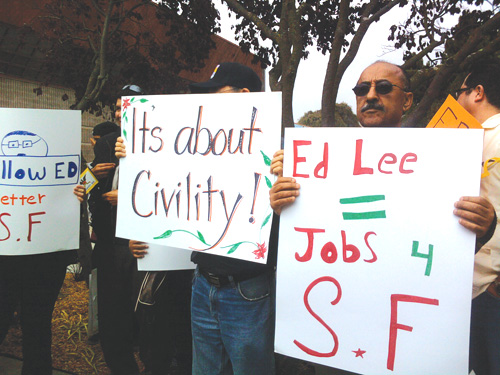
So much for civility

0

rebeccab@sfbg.com

The San Francisco mayor’s race went from a lackluster affair to a dynamic match as the Aug. 12 filing deadline drew near and two prominent city officials who had previously said they wouldn’t run tossed their hats into the ring.

Mayor Ed Lee’s Aug. 8 announcement that he’d seek a full term prompted several of his opponents to use their time onstage at candidate forums to decry his reversal and question his ties to the moneyed, influential backers who openly urged him to run. Several days later, Public Defender Jeff Adachi’s last-minute decision to run for mayor signaled more tension yet to come in the debates.

At this point, eight current city officials are running campaigns for higher office, and the dialogue is beginning to take on a tone that is distinctly more biting than civil. Adachi, who had not yet debated onstage with his opponents by press time, told reporters he was running because he wanted “to make sure there’s a voice in there that’s talking about the fiscal realities of the city.”

Adachi authored a pension reform ballot measure that rivals the package crafted by Lee, labor unions, and business interests (see “Awaiting consensus,” May 31, 2011). At an Aug. 11 candidate forum hosted by the Alice B. Toklas Democratic Club, the San Francisco Young Democrats, and the City Democratic Club, all of the top-tier candidates who were present indicated that they would support Lee’s pension reform measure and not Adachi’s.

“The reforms that I have championed are reforms that are absolutely needed, along with action,” Adachi told reporters moments after making his candidacy official. He added that after watching the mayoral debates, “I became convinced that either the candidates don’t get it, or they don’t want to get it.”

Those fighting words will likely spur heated exchanges in the months to come, but until Adachi’s entrance into the race, it was Lee who took the most lumps from opponents. Even Board President David Chiu, a mayoral candidate whose campaign platform is centered on the idea that he’s helped restore civility to local government, had some harsh words for Lee during an Aug. 11 mayoral debate.

“I do regret my decision to take Ed Lee at his word when he said he would not run,” Chiu said in response to a question about whether he regretted any of his votes. He also said his first interaction with Lee after the mayor had announced his candidacy was “a little like meeting an ex-girlfriend after a breakup.”

Lee, whose pitch on the campaign trail features a remarkably similar narrative about transcending political squabbling in City Hall, became the target of boos, hisses, and noisemaker blasts when a boisterous crowd packed the Castro Theater for an Aug. 8 candidate forum. He received one of the most forceful rebukes from Sen. Leland Yee, an opponent whom Lee supporters are especially focused on defeating.

“Had the mayor said that he would in fact run, he may not have gotten the votes for interim mayor,” Yee said. “Will you resign from your post,” he asked, challenging Lee, “in order to then run for mayor?” Days later, Yee had developed a new mantra about throwing power brokers out of City Hall instead of “wining and dining with them.”

Yet Lee said his decision to enter the race wasn’t because of the push from his backers, but because of how well things have gone during his brief tenure in Room 200. “Things have changed at City Hall, particularly in the last seven months,” he told reporters Aug. 8. “And because of that change, I changed my mind.”

In yet another twist, former Mayor Art Agnos — whom progressives had looked to as a potential appointee to the vacant mayor’s seat back in December, before Lee was voted in to replace former mayor and Lieutenant Governor Gavin Newsom — delivered a surprise endorsement of City Attorney Dennis Herrera shortly after Lee declared. The decision was particularly significant since Agnos first hired Lee to serve in city government, and has a long history of working with him.

“[Herrera] is an independent person who will empower neighborhoods … and won’t be beholden to power brokers,” Agnos said. He also told the Guardian he wasn’t surprised that Lee had opted to run, given the role former Mayor Willie Brown and influential business consultant Rose Pak had played in orchestrating Lee’s appointment.

“Anybody who is an astute political observer saw the signs from the very beginning,” Agnos said. In response to a comment about his unique vantage point as a would-be caretaker mayor, he said, “I would’ve kept my word and not run for reelection.”

Intense focus on Lee’s flip-flop, and on the Progress for All-backed “Run, Ed, Run” effort that was the subject of an Ethics Commission discussion that same week, stemmed at least in part from the threat the incumbent mayor represents to other candidates. A CBS 5-SurveyUSA poll suggested he became an instant front-runner.

Yet questions about “Run, Ed, Run” — some raised by observers unaffiliated with any campaigns — also served to spotlight the candidate’s longstanding ties with backers closely connected to powerful business interests that stand to lose big if their links to city government aren’t preserved.

Retired Judge Quentin Kopp issued an open letter to District Attorney George Gascón Aug. 1 urging him to convene a criminal grand jury to investigate whether illegal and corrupt influencing had occurred when Pak — a close friend of Lee’s and a key driver behind the “Run, Ed, Run” effort — reportedly recruited executives of Recology to gather signatures urging Lee to run.

Recology, which handles the city’s waste, was recently awarded a $112 million city contract, and Lee’s scoring of the company and recommendation to raise rates in his previous capacity as city administrator benefited the company. Brown received substantial campaign donations from Recology in previous bids for mayor. Kopp is the coauthor of a ballot initiative asking San Francisco voters if the company’s monopoly on city garbage contracts should be put out to bid.

“A criminal grand jury is vital in order to put people under oath and interrogate them,” Kopp said. “They would put Willie Brown under oath, put Pak under oath, put [Recology President Mike Sangiacomo] under oath, put [Recology spokesperson Sam Singer] under oath … That’s the course of action that should be pursued by this.”

Although Kopp told the Guardian that he hadn’t yet received a response from Gascón, DA candidates Sharmin Bock, Bill Fazio, and David Onek nevertheless seized the opportunity to publicly and jointly call for Gascón to recuse himself from any investigation into Progress for All. Gascón has a conflict of interest, they argued, since he reportedly sought Pak’s advice when deciding whether to accept Newsom’s offer to switch from his previous post as police chief to his current job as top prosecutor.

The Ethics Commission determined unanimously Aug. 8 that the activities of Progress for All, the committee that was formed to encourage Lee to run, had not run afoul of election laws despite director John St. Croix’s opinion that it had filed improperly as a general purpose committee when it ought to have been a candidate committee, which would have placed caps on contribution limits.

“The Ethics Commission has spoken, and they’ve supported our position,” Progress for All consultant Enrique Pearce of Left Coast Communications told the Guardian.

St. Croix did not return Guardian calls seeking comment, but an Ethics Commission press release included a caveat: “Should facts surface that coordination occurred between Mayor Lee and [Progress for All], such allegations will be investigated under the Commission’s enforcement regulations.”

At a Lee support rally organized by his official campaign team on Aug. 11, volunteers who arrived with “Run, Ed, Run” materials produced by Progress for All were told they could not display those signs and T-shirts; the same people were on a first-name basis with one of Lee’s campaign team members.

Pressed on the question of whether there was any coordination between agents of Progress for All and Lee, Pearce said the Ethics Commission discussion had focused on whether Lee had been a candidate. “Whether or not he’s a candidate has nothing to do with whether or not he has dinner with Rose [Pak],” Pearce noted. He insisted that there had not been coordination, and that the efforts to encourage Lee to run and to support Lee as a candidate were totally separate.

Sup. John Avalos, who is running for mayor on a progressive platform, recalled at an Aug. 8 candidate forum how things unfolded when Lee’s name first came up as an appointee for interim mayor.

Avalos reminded people that he had called for postponing the vote back in December because he hadn’t even had a chance to sit down and meet with Lee, who was in Hong Kong at the time. With behind-the-scenes deals orchestrating his appointment, Avalos said, “We saw City Hall turning into one big back room.”

City workers union backs Yee — and Avalos

18

The press release I got from Leland Yee’s campaign made it sound as if Yee had won a major victory over progressive supervisor John Avalos:


SAN FRANCISCO – Senator Leland Yee has landed the first choice endorsement of the largest organization of city workers – Service Employees International Union (SEIU 1021) – in his campaign for San Francisco Mayor. The move by the 54,000 member union is a complete rejection of the city’s top official, interim Mayor Ed Lee.


The endorsement comes after Yee has landed virtually every major labor endorsement in the race, including the California Nurses Association, California School Employees Association, International Brotherhood of Electrical Workers, San Francisco Building and Construction Trades Council, Laborers International Union, United Brotherhood of Carpenters, Communication Workers of America, and the American Federation of State, County, and Municipal Employees, among others.


Yee has also been endorsed by the major environmental groups, including the Sierra Club and San Francisco Tomorrow.


“I am proud to be the labor candidate in this race and honored to receive the endorsement from SEIU 1021 and our city’s workforce, who run our city and provide us essential services,” said Yee. “SEIU 1021 represents some of our lowest paid and hardest working employees, including healthcare workers, nurses, and janitors. Together, we have fought to ensure greater transparency and accountability at City Hall and within state government. I look forward to working with SEIU as we move San Francisco forward.”


Local 1021 is among the most progressive unions in the city — and when it comes to local politics, one of the most effective. Candidates backed by 1021 get the union’s volunteer work and wealth of political organizing skill, and it can make a huge difference.


Avalos, the leading progressive in the race, would seem a natural for the SEIU nod, and at first glance, it appeared that one of labor’s best friends at City Hall had been stiffed. You don’t learn until the end of the Yee release what really happened:


SEIU 1021 also endorsed John Avalos as a first or second choice and Bevan Dufty as a third choice.


Yep — Yee didn’t win the endorsement outright. Local 1021 was split between Yee supporters and Avalos supporters, and wound up doing a dual endorsement. Here’s what the official 1021 statement says:


The delegates were in support of both Supervisor John Avalos and State Senator Leland Yee, both progressives with strong labor credentials and records, both having been in SEIU at one time, and both friends. The delegates reasoned that with so many candidates in the race, neither could win without the others second votes, so they made a dual endorsement of them, asking members and supporters to vote their choice of first or second between them.


Dufty came in third in part because he did (and does) really well in these kinds of interviews. Watch the candidates on the trail — Dufty is funny, relaxed, personable … the kind of guy you want to go have a beer with. The others often come off as stiff and scripted. That doesn’t mean I’m necessarily voting for Dufty, who has been on the wrong side of too many issues. But in a crowded field, his personality stands out.


What does this mean? It means that SEIU members can and will work for both Yee and Avalos, which is good news for Avalos and probably better news for Yee. The senator has been working hard to get as many Avalos/Yee dual endorsements or 1-2 endorsements as he can, since any apparent connection between the two helps Yee with the progressive vote. And while I understand and appreciate the rights of candidates to promote themselves and hype every endorsement they get in the best terms possible, this one was a bit misleading. 

It’s official: Adachi’s in the race (VIDEO)

Public Defender Jeff Adachi filed to run for mayor of San Francisco on Aug. 12, the last possible day to enter the race.  Adachi said he’d decided to run in order to “make sure there’s a voice in there that’s talking about the fiscal realities of our city.”

At a mayoral candidate forum Aug. 11, every single contender — Mayor Ed Lee, Sup. John Avalos, venture capitalist Joanna Rees, Assessor Recorder Phil Ting, Board President David Chiu, City Attorney Dennis Herrera, former Sup. Michela Alioto-Pier, former Sup. Bevan Dufty, and Sen. Leland Yee — said they would support the pension reform package that was placed on the ballot after discussion with labor unions, the mayor’s office, and business interests, and not the pension reform measure authored by Adachi.

Here’s a video of Adachi explaining his decision to members of the press moments after filling out the paperwork.

Video by Rebecca Bowe

Dick Meister: Labor’s unhappy anniversary

5


By Dick Meister

It was 30 years ago this month that Ronald Reagan struck the blow that sent the American labor movement tumbling into a decline it’s still struggling to reverse.

Reagan, one of the most anti-labor presidents in history, set the decline in motion by firing 11,500 of the overworked and underpaid air traffic controllers whose work was essential to the operation of the world’s most complex aviation system.

Reagan fired them because they dared respond to his administration’s refusal to bargain fairly on a new contract by striking in violation of the law prohibiting strikes by federal employees. What’s more, he virtually destroyed their union, the Professional Air Traffic Controllers Organization (PATCO).

Public and private employers everywhere treated Reagan’s 1981 action as a signal to take an uncompromising stand against the unions that they had accepted and bargained with, however reluctantly, as the legitimate representatives of their workers.

At that time, one-fourth of the U.S. workforce was represented by unions. Today, largely because of employer actions since then – often openly illegal actions – the percentage of workers with union bargaining rights is less than half that.

Ironically, PATCO had broken with other AFL-CIO affiliates to endorse Reagan’s successful run for president in 1980. The union did so because Reagan had promised to “take whatever steps are necessary” to improve working conditions and otherwise “bring about a spirit of cooperation between the president and the air traffic controllers.”

Yet PATCO negotiators were rebuffed a year later when they asked for a reduction in working hours, lowering of the retirement age and other steps to ease the controllers’ extraordinary stress, plus a substantial pay raise and updated equipment.

PATCO was faced with either abandoning its demands or striking to try to enforce them. And when the union struck, Reagan, certain of broad public support because of his great popularity, issued an ultimatum to the strikers: Return to work within 48 hours or be fired and replaced permanently by non-union workers.

Faced with millions of dollars in fines for violating Reagan’s order and the anti-strike injunctions that his administration and airlines had sought, and stripped of its right to represent the controllers, PATCO declared bankruptcy and went out of business.

Reagan’s ban on re-hiring strikers was later lifted by Bill Clinton, and three unions, including a revived PATCO, now represent controllers, among them hundreds of those who had been fired. But safety experts say the air traffic control system remains understaffed and the controllers still under far too much stress.

Part of the blame for that rests with Clinton’s successor, George W. Bush, who was as anti-labor as Reagan. The Bush administration, in fact, imposed an onerous new contract on the controllers that cut their pay and pensions.

It’s not likely that other employers will soon abandon the crippling anti-labor practices that were inspired and furthered by Reagan. Hiring and permanently replacing strikers, previously a rare occurrence, has become a relatively common employer tactic. And strikes – an indispensable weapon for workers in collective bargaining – have become relatively rare post-Reagan.

It isn’t just strikers who face penalties for exercising their legal rights. Some employers also have taken to firing or otherwise penalizing workers who seek union recognition, despite the law that promises them the right to freely choose to unionize. Many employers have also hired “management consultants” who specialize in Reagan-style union busting.

It’s no coincidence that, as union ranks have shrunk under the relentless anti-labor pressures first applied to air traffic controllers three decades ago by Ronald Reagan, the ranks of the middle class also have shrunk –– as has the ordinary American’s share of the country’s wealth.

The situation for air traffic controllers has stayed much the same. They’re still demanding longer rest periods during working hours and between shifts and other improved working conditions that are clearly necessary for their well-being and that of those they serve. And they’re still being rebuffed by the Federal Aviation Administration (FAA).

Republican leaders in Congress have made it even more difficult for the controllers and many others by insisting that a measure making it more difficult for workers to unionize be attached to the current bill that would continue the FAA’s funding for another year. A congressional stalemate over that was the principal reason for the recent partial shutdown of the FAA, which cost the government millions of dollars in lost airline taxes, threw several thousand airport construction workers and FAA employees out of work, and forced airline safety inspectors to work without pay throughout the two-week stalemate.

Although air traffic controllers and other FAA employees are back on the job, that could be only a temporary respite. The stalemate could very well resume when Congress returns from its current recess on September16th and again takes up FAA funding.

The attempt by congressional Republicans to weaken FAA employees’ basic union rights – and their willingness to shut down the air traffic system in order to further that goal ­– is yet another aspect of the legacy of Ronald Reagan, one of the most damaging and successful union-busters of all time.


Dick Meister, former labor editor of the SF Chronicle and KQED-TV Newsroom, has covered labor and politics for more than a half-century. Contact him through his website, www.dickmeister.com, which includes more than 350 of his columns.


Dick Meister: Workers gaining in fight for union rights

0

This year marks the 76th anniversary of the National Labor Relations Act, the Depression-era law that was essential in building an American middle class – and which remains essential to the well-being of all working Americans. 

But you know what? Powerful corporate interests and their Republican buddies in Congress are nevertheless trying mightily to cripple what has so long been one of the most important U.S. laws of any kind.

Their main target currently is the National Labor Relations Board – the NLRB –which administers the National Labor Relations Act and takes seriously the act’s stated purpose of encouraging collective bargaining between workers and their employers.

The five-member labor board did very little to carry out its task of encouraging unionization during the notoriously anti-union Bush administration. But under President Obama, the NLRB has been doing its job – or has been trying to do its job — in the face of stiff Republican opposition.

The Republican opponents claim – what else? – that under Obama, the NLRB has become a tool of organized labor, Big Labor, as they like to call it.

It’s impossible to take those charges seriously. The labor board obviously has not been acting as an agent of unions, big or small. It’s merely been enforcing the law. But that, of course, means anti-labor forces no longer have the firm cooperation of the NLRB in their attempts to weaken unions as much as possible. They no longer have an ally in the White House. Bush is gone.

Imagine that. The National Labor Relations Board is actually doing what the law says it should do. And unions are actually getting a more or less even break vis-à-vis the corporate interests with whom they collectively bargain – or with whom they try to bargain.

What’s really got the anti-labor crowd sputtering lately is a ruling by the NLRB’s acting general counsel, Lafe Solomon,  against the Boeing Aircraft Company. Boeing was charged with breaking the labor law by moving a major assembly line from a unionized plant in Washington State to South Carolina, a notably anti-union state, in response to a machinist strike at the Washington plant. 

Moving the assembly line was done in violation of a provision in the National Labor Relations Act that bans companies from punishing striking unions by withholding or transferring jobs. Thus, said the NLRB’s Solomon, the assembly line should be moved back to Washington State.

Oh, boy, those union-hating Republicans in Congress didn’t like that at all. They threatened to defund the NLRB if it doesn’t withdraw its order to Boeing, trotting out their usual tired response to just about anything done in favor of unions these days. You’ve undoubtedly heard it – thousands of  times, maybe. Yes, that’s right. A ruling in favor of labor and labor law would be . . . Ah, yes, a job killer. Sure.

GOP House members have actually introduced something called – really – “The Protecting Jobs From Government Interference  Act.” that would void the NLRB order against Boeing  and prohibit future such orders. The proposed law undoubtedly has the approval of the union-hating U.S. Chamber of Commerce, which has led the right-wing charge against the NLRB. It complains that the labor board is “out of control.”

Actually, the NLRB is out of control  – out of control of the right-wingers who had  their way throughout Bush’s two terms and are miffed that, unlike Bush, Obama doesn’t think their way is the only way to handle labor-management relations.

Much to the chagrin of the right-wingers, the labor board has come back strong under Obama. One of the board’s most important steps has been to develop rules to streamline the workplace elections that are held to determine if workers want to unionize. 

The board has cut short the pre-election periods that employers have used to harass workers into voting against unionization, approaching them individually and in mass meetings, frequently threatening to fire or otherwise penalize workers who vote for union representation. Obama’s NLRB also has cut back the time for management to appeal the outcome of a vote for unionization.

The changes, as one union attorney noted, are “common sense changes that drag labor law into the 21st century.” 

Common sense often doesn’t mean much to anti-labor Republicans. Sensible or not, they plunge onward on the anti-labor path that’s always been theirs. According to a count by Politico.com’s Joseph Williams, House Republicans have convened oversight hearings on the NLRB or summoned board members to Capitol Hill 14 times since the midterm elections to answer harassing questions and have threatened to severely cut the NLRB’s budget to “bring the board to heel.”

So, it’s still not easy for unions and workers who want to join unions, despite the progressive change in the NLRB’s attitude and operations. 

But the situation is looking much better since the change has come, since the law that promises American workers the right of unionization – and the important benefits that come from it – -is now being enforced by people who believe that their mission is not to hamper unions, but to encourage their growth for the benefit of all Americans.


Dick Meister, former labor editor of the SF Chronicle and KQED-TV Newsroom, has covered labor and politics for more than a half-century. Contact him through his website, dickmeister.com, which includes more than 350 of his columns.


Dick Meister: New hope for domestic workers

0


With a lot of luck, we may finally take decisive action to guarantee decent treatment for the world’s highly exploited housekeepers, maids, nannies and other domestic workers. There are an estimated 100 million of them, working in more than 180 countries.

Their pay is generally at the poverty level, and very few have fringe benefits such as pensions and employer-paid health care. Few have the protection of unions or labor laws, and they’re often at the mercy of unscrupulous labor contractors.  Almost half of them are not entitled to even one day off per week. About a third of the female workers are denied maternity leave.

The hope for improving the domestics’ slavery-like conditions has arisen from action taken in Geneva this month at the annual meeting of the United Nation’s International Labor Organization – the ILO.

Delegates representing unions, employers and governments voted 396 to 16  for what’s called a “Convention on Domestic Workers.” The non-binding convention spells out how domestics should be treated in UN member countries – most importantly in the pace-setting United States.

In the U.S., as in most other countries, an estimated 80 percent of the domestics are women of color, subject to racial discrimination and physical and sexual abuse.  In the United States, most of them are immigrants as well . They’re easy targets for exploitation, especially since, as elsewhere, domestics mainly work in private unregulated households, usually alone.

What’s more, U.S. domestics lack most of the protections of state and federal labor laws that are granted most U.S. workers outside of agriculture . Most other non-agricultural workers at least have the right to unionize. But domestics don’t even have that basic right.

The National Labor Relations Act specifically denies union rights to anyone “in the domestic service of any family or person.” That’s right. The Depression-era law that was designed to pull poverty-stricken workers out of poverty and build a middle class does indeed prohibit an entire group of exceptionally needy workers  from taking a major step to improve their extremely poor working conditions. The word for that is “un-American.” 

That outrageous legal prohibition has its roots in racism. Pressures from southern states, which objected to granting union rights to the mainly black domestics, was the main reason domestics were excluded from the National Labor Relations Act.

 Some domestics have nevertheless formed union-like organizations to seek better treatment. But they need the force of law behind them.

The ILO convention calls for guaranteeing domestic workers in the United States and everywhere else some of the key rights that unionized workers invariably have, among them, regular working hours, vacations, maternity leaves and Social Security benefits.

Domestics would be promised what amount to contracts with employers that would make clear just what they would be expected to do, for how long, and for how much pay.  Their working conditions would have to include time off of at least 24 hours a week.

Migrant workers would have to be provided with a written job offer of employment or a contract before crossing  the border into another country to work.

It took several years for ILO representatives to adopt the domestic workers convention. It was finally adopted as a direct result of campaigning here and aboard by groups of activists from unions and other organizations. They will  be working for the next few years to get as many nations as possible to implement the ILO convention with their help.

The effort in this country is being led by the National Domestic Workers Alliance, with major support from the AFL-CIO, which has arranged to have some domestic workers represent themselves in ILO meetings and voting.

Among other things, proponents hope to make it clear that “domestic workers are real workers, NOT powerless individuals who are expected to remain in quiet servitude and endure long hours without overtime pay, along with hazardous working conditions without access to health and safety protections.”

Proponents also hope to end the “cultural relativity excuse that sleeping on a mattress in an unheated garage is better than he or she would get in their home country, or that the poor treatment of domestics is a tradition.”  The ILO convention says otherwise and workers in the United States and other countries where it is adopted  “will be armed with the knowledge that there is an international standard that protects them.”

Domestics already are granted labor rights in New York State, and California legislators are considering a proposal to bring them under that state’s labor laws. But winning basic rights for the badly exploited domestic workers elsewhere will be very difficult. But so was convincing ILO representatives to take on the task, the long needed task of granting domestic workers union rights and, with them, the decent wages, hours and working conditions that come with unionization.

Yes, winning the union rights for domestics worldwide will be very difficult. But we know it can be done.  And certainly we know that it should be done. 


Dick Meister, former labor editor of the SF Chronicle and KQED-TV Newsroom, has covered labor and politics for more than a half-century.  He can be reached through his website, dickmeister.com, which includes more than 300 of his columns.


Daly blasts HuffPo SF’s choice of bloggers

30

In an open letter to Huffington Post former Sup. Chris Daly lays out why he thinks former Sup. Michela Alioto-Pier, mayoral candidate Joanna Rees and (perhaps not so interim) Mayor Ed Lee aren’t the best of choices to blog about San Francisco politics.

“Thank you for asking me to write for Huffington Post San Francisco,” Daly wrote. “However, I feel as if I must register a significant level of disappointment in who you rolled out today as your featured bloggers from the world of SF politics. It seems as if am the only one from San Francisco’s significant progressive elected political community.”

“Featuring Michela Alioto-Pier on the pages of Huffington Post only gives additional ammunition to those on the left who have become increasingly critical of Huffington Post since AOL’s acquisition,” Daly continued. “Alioto-Pier may seem kind of ‘liberal’ by skewed national standards, but she is decidedly conservative in San Francisco– opposing just about every progressive initiative in the last decade, from protecting rent control to checking reckless development to mitigating the negative influence of special interest money in elections. As an unabashed progressive, I was embarrassed to serve on the same Board as her and am now embarrassed to appear on the same web page with her bashing progressive homeless policy. Simply put, San Francisco’s very own Michele Bachmann now writes for the Huffington Post!”

Next, Daly laid into mayoral candidate Joanna Rees, Sup. Malia Cohen and Mayor Lee. “Rees, Cohen, and Lee may not have quite the same conservative credentials, but Lee and Cohen just green-lighted the largest demolition of rent controlled housing in SF history,” Daly observed. “So it probably shouldn’t surprise anyone that Ed Lee’s initial HuffPo blog is generally based on the Scott Walker political philosophy of blaming unions for current economic/budget woes, when the rest of us know that large corporations, financial institutions, and government deregulators are really to blame. While trying to make public sector workers pay to balance our budget, Lee has left Corporate San Francisco off the hook, with no progressive taxation proposal even on the table for consideration. Meanwhile, Rees can hardly veil her neo-liberal agenda for San Francisco government.”

Daly concluded by suggesting that HuffPo needs to  work harder to incorporate more truly progressive political voices. “If not, you’ll just become a rehash of SFGate, without their more significant rooting in our City,” he warns.

But he didn’t overtly mention HuffPo’s failure to pay its bloggers—a sore point that got a bunch of unpaid bloggers slapping HuffPo and aol.com with a $105 million class action suit earlier this year, after Arianna Huffington sold her website to aol.com for $315 million.

Asked if HuffPo was paying him for his posts, Daly replied, “Nope, I can’t recall ever getting paid for my writing.”

He also noted that Board President David Chiu, mayoral candidate and Sup. John Avalos and Rep. Nancy Pelosi have been invited to write for the online publication, though they don’t have any blog posts up yet. So stay tuned. 

In an emailed reply to Daly, HuffPo SF editor Carly Schwartz claimed that she “completely understands” the former bad-boy-on-the-Board’s concerns.

“But Huffington Post’s mission is to go ‘beyond left and right,’ and as such, we wanted to reflect a wide array of political philosophies in our blogger lineup. (As someone who identifies as a progressive personally, I was quite pleased to feature you second from the top!),” Schwartz wrote. “You’ll notice our national bloggers come from across the spectrum as well — we have everyone from Howard Dean to Andrew Breitbart. Our goal is to bring the voices of the city to life, whether they be progressive, conservative, controversial, or just middle of the road — we want to get our residents talking. Which we have successfully done, given your response!”

“You’ll also notice we have more featured bloggers to roll out from the political community in the coming days, from Dennis Herrera to John Avalos to David Chiu to Nancy Pelosi…we simply didn’t have room for everyone on our launch day,” Schwartz continued (potentially upsetting the mayoral candidate applecart with her decision to feature Daly before folks who are currently in office AND running for office this fall).

“As someone who very much identifies with the progressive community, I would be so thrilled if you could suggest some more progressive political personalities for our page,” Schwartz concluded. Oh, and she suggested that Daly fold his concerns into his next blog post…

Competing claims mark the final pension reform ballot push

43

Public Defender Jeff Adachi held a press conference on the steps of City Hall this afternoon, talking about how his pension reform measure is on track to qualify for the November ballot, calling for the Board of Supervisors to strengthen a rival measure so he can drop his, and wielding a series of colorful charts showing how his measure would save the city far more money.

But those involved with crafting the measure that has come out of City Hall – including Mayor Ed Lee and Sup. Sean Elsbernd – tell the Guardian that Adachi is misrepresenting the numbers in a way that amounts to lying, and that he’s employing a legally risky strategy that could either sink pension reform for the year or set a troubling legal precedent that diminishes the vested rights of all public employees.

The conflict – with its complex claims and counter-claims and dizzying array of big numbers derived from speculative actuarial tables and predictions of future economic realities – offers a preview of what is likely to be a bruising yet bewildering battle if both measures make the ballot.

“We have to have real reform,” Adachi told assembled journalists and activists. “If we had real reform coming from this building, City Hall, I wouldn’t be standing here right now.”

But Elsbernd and Lee each told us that the event had more to do with grabbing headlines with sensational yet misleading claims during the final six days of signature-gathering than it did with Adachi’s claim that his measure will save $138 million annually by 2014-15 compared to a $84 million in the city’s plan.

“It is critical people understand the difference in these costs,” Adachi said.

Lee called the event “weak antics in trying to get a headline,” and said, “His claims are false.” Elsbernd said he spoke with Adachi on the phone for an hour yesterday trying to convince him that his fiscal claims were wrong, but to no avail. “Facts don’t seem to matter to him anymore,” Elsbernd said. “He’s not playing straight with the facts.”

Two issues are central to Adachi’s claims of a big cost savings: his plan’s requirement that employees pay more into their pensions without the city’ plan’s promise of lessening that burden during good years – which city officials say is legally dubious because it simply takes away something to which current employees are entitled to under their contracts – and the deal that the city cut last week with public safety unions to give them the 4 percent raise they were scheduled to receive this year but to increase their pension contributions by a similar amount.

“It’ll cost taxpayers even more than the amount of the raise,” Adachi argued, wielding charts and figures to show that the higher pension payouts due to the increased salaries of cops and firefighters will cost the city $45 million over the next 10 years, and as much as $381 million by 2042.

But Elsbernd said that the raises were part of a contract approved back in 2007 and can’t be just unilaterally taken away. “The raises have been incorporated into pension projections,” Elsbernd said, accusing Adachi of essentially double-counting them in his calculations. “He’s saying this action increases the costs, and that’s just wrong. This deal lowers those costs.”

When we asked Adachi about that point during the press conference, he argued that in these dire fiscal times, all public employee contracts should be renegotiated from scratch and therefore his fiscal claims were correct. “Why should we be talking about a 4 percent raise for anyone when we’re cutting basic services?” Adachi asked.

But simply invalidating approved contracts puts Adachi’s measure on shaky legal ground, Elsbernd said. But it’s ground that the wealthy funders of Adachi’s measure are anxious to plow because if the measure survives a legal challenge, it will weaken the ability of current employees to get the benefits they were promised.

“He wants to challenge the issue of vested rights, and in the end, that’s what this is about,” Elsbernd said, noting that if Adachi’s measure gets more votes and is invalidated, as he thinks it will be by the courts, than the city’s pension problem gets worse as the solution gets pushed back a year.

Adachi claimed during the press conference that he has privately been offered support by some union leaders who are attracted to the big cost savings and what it would mean to the city’s future fiscal health, but he wouldn’t name them or indicate whether they will go public at some point. But Lee said Adachi is just desperately looking for allies.

“He’s looking for someone to support his view of this, but we’re very confident that our proposal is better,” Lee told us, noting how important it was to develop the measure with input and help from the unions. “We’ve done it the right way. You do it with people, not to people.”

But Elsbernd also said Adachi’s pushing of pension reform last year and again this year is a big factor in the union givebacks that the city has received: “We would not be in the place we are with labor if not for Jeff Adachi.”

The board is set to consider the city plan next week, while Adachi says he has 60,000 signatures and plans to gather 5,000 more by the deadline of Monday at 5 pm, which should be enough meet the threshold of about 47,000 valid signatures.

Dick Meister: Farm workers need drastic change

0

No workers are more in need of union protection than the nation’s miserably treated farm workers. Yet a promising new effort to ease their path to unionization has been blocked by one of their former champions, Gov. Jerry Brown.

Brown was rightly hailed for signing, in an earlier term as governor, the 1975 law that granted farm workers in California the collective bargaining rights denied them nationwide. It’s the weapon farm workers must have if they are to escape poverty and the arbitrary and often harmful actions of grower employers.

But now, Brown has vetoed a bill sponsored by the United Farm Workers union, the UFW, that would have made it much easier for farm workers to unionize. Currently, they can be granted bargaining rights only if a majority working for a particular grower votes for unionization. The vetoed measure, the so-called Card-Check Bill, would have granted bargaining rights simply on the showing of union membership cards or petitions for union recognition signed by a majority of workers.

Farm workers, of course, are among our most important workers. They help feed us, after all. Their pay nevertheless averages less than $10,000 a year, and most lack employer-paid health care and other benefits. They work hard, frequently under the blazing sun, with few  – if any – rest breaks and without even such simple on-the-job amenities as fresh drinking water and toilets.

The UFW, which sponsored California’s 1975 law, has been trying for many years to remedy farm workers’ conditions by leading them in drives aimed at winning union contracts that promise them decent treatment and an effective voice in determining their wages, hours and working conditions.

 It’s not been easy for the UFW, even with the law in effect. Thanks mainly to employer intimidation and high worker turnover, the union has been able to sign up only a small part of California’s farm labor force and to win only a relatively few contracts from growers. But it’s an important start. Without the law, it would have been nearly impossible.

So why in the world did self-proclaimed farm worker advocate Jerry Brown veto the bill that would have strengthened the union rights granted farm workers in the bill he signed 36 years earlier?

Well, Brown didn’t say much, but did say he didn’t like the bill because it called for “drastic change.”  Which it did, of course. That, as Brown must know, is exactly what’s needed.

Requiring union rights to be granted only by elections gives growers a great opportunity to unfairly pressure workers into voting against unionization – and many take full advantage of the opportunity.

It’s common for growers faced with elections to require workers to attend meetings at which they rail against unions, threaten to fire union supporters and warn that they might have to go out of business if their farms are unionized, or at least greatly curtail operations and thus job opportunities.

“You’re talking about voting on the employer’s site, with foremen and supervisors making eye-contact with you after they’ve alluded to or flat out threatened you with the loss of your job or your housing,” notes a UFW vice president, Armando Elenes. “It takes a lot of strength to even vote.”

There’s plenty of evidence that employers do indeed put lots of pressure on workers to vote against unionization. UFW President Arturo Rodriguez notes, for example, instances of growers pulling guns on workers who were trying to organize.  That may seem exaggerated – but not to anyone who’s experienced the superheated grower-worker confrontation up close.

The UFW is not giving up the struggle for Card-Check recognition. The union will soon re-introduce the Card-Check bill in Congress with the strong backing of the nation’s labor leaders. Some of them call it the single most important labor bill in the country this year.

It certainly is for farm workers and should be for workers in other industries throughout the country who also seek Card-Check rights, and for anyone who wants decent treatment for those whose vital work helps put food on our tables.


Dick Meister is co-author of “A Long Time Coming: The Struggle to Unionize America’s Farm Workers” (Macmillan). He can be reached through his website, www. dickmeister.com.


Dick Meister: Can a woman beat Hoffa?

0


A woman as president of the macho Teamsters Union that was once headed by supermacho Jimmy Hoffa? It could happen. 

Sandy Pope thinks so, and she’s going to try as hard as she can to make it happen – going to try as hard as she can to succeed Hoffa’s lawyer son, Jimmy junior, as head of one of the country’s largest and most powerful unions.

If a majority of delegates at the Teamster convention that opened today in Las Vegas vote for Pope to unseat Hoffa, who was first elected a dozen years ago, she’ll be only the third woman to ever head an international union.

Randi Weingarten, the highly regarded president of the American Federation of Teachers, who took office in 2008, is one of the others. The third is Mary Kay Henry, who just recently succeeded the controversial Andy Stern as president of the country’s largest union, the 1.3 million-member Service Employees International Union, the SEIU.

The Teamsters comes in at number two, with 1.2 million members. Hoffa’s supporters argue that Sandy Pope is not up to handling such a huge and diverse union. Her record, however, seems to indicate otherwise.

For 33 years, the 54-year-old Pope has held her own in the union’s macho culture, as a driver of big long haul freight trucks and as a warehouse worker.  For seven years she’s been president of a New York Teamster local of drivers and warehouse workers, one of only 16 of the Teamster’s 407 locals nationwide to be headed by a woman.

Before that, Pope was an international union representative in the Teamster’s warehouse division. She’s been a longtime leader of the Teamsters for a Democratic Union (TDU), which has exposed much of the corruption that’s been common in the union since the days of Hoffa senior as president.

The TDU’s work has led to some important corrections in union operations, but much remains to be done, and it’s unlikely that Hoffa junior would do much about it.  As the incumbent, he’s running a status quo campaign. Some local level Teamster officials fear retaliation from Hoffa and his allies if they campaign for Pope.

But Pope certainly isn’t backing off one bit. She’s promising to halt or at least slow the concessions that Teamster negotiators have granted employers in recent years.  Under her, she says, the union” will close the concessions stand.”

It also would push the union’s officers off the gravy train. In one Minnesota Teamsters local closely allied with Hoffa, for instance, the principal officer is paid $200,000 a year. Hoffa himself is paid $363,000.  And that’s going on at the same time that many rank-and-file Teamsters are taking pay and benefit cuts and otherwise feeling the effects of a declining economy.

It’s what the pro-labor magazine “Labor Notes” quite accurately calls “the union leadership’s back-scratching, pocket-lining culture.”

Generally speaking, Pope’s promising to return to the basics of union operations – to build public support, mobilize the union’s current members and wage a major organizing drive to recruit new members. Pope also promises that some 20,000 of the union’s members whose jobs have been downgraded to part-time can expect a drive to make those jobs full-time.

It’s clear that, like many dissident Teamsters, Sandy Pope is “sick of having a lawyer with a big name hijack our union.”


Dick Meister, former labor editor of the SF Chronicle and KQED-TV Newsroom, has covered labor and politics for more than a half-century. Contact him through his website, www.dickmeister.com, which includes more than 300 of his columns.


Cleaning up UC’s mess

5

news@sfbg.com

By 7 a.m., when engineering students begin to trickle into Cory Hall at UC Berkeley, Arnold Meza has already scrubbed the floors, wiped clean the chalkboards, and emptied the trash of 30 offices and many of the classrooms and hallways of the six-floor building.

His early shift as a custodian is a gift, he says, because it is steady compared to his former swing-shift schedule, but Meza is still barely making rent. And he is a single father of four. Like many service workers in the University of California system, Meza wonders how the university can refuse to give him a 3 percent wage increase while top UC executives receive six-figure bonuses every year.

“It falls on broken promises,” Meza said while tying up a bag of trash, one of hundreds he would take out that week. Meza was referring to an agreement in 2009 between the university and its service workers unions, including Meza’s union, AFSCME (American Federation of State, County and Municipal Employees). At that time, the administration established a minimum wage (currently $13 per hour) for the more than 7,000 service workers and agreed, if funding was available, to increase wages annually to bring their low-wage workers out of poverty.

But the university is going back on its promise, refusing to increase wages with the funding dedicated for that very purpose, the East Bay Alliance for a Sustainable Economy and the Partnership for Working Families (EBASE) notes in its recent report titled “Bad Budgeting, Broken Promises.”

As the UC Office of the President sees it, the 2009 discussion was not an agreement at all, but a “conditional memorandum of understanding” that would only be effective if state funding was available, said UCOP spokeswoman Dianne Klein.

“We’ve already taken $500 million in cuts. We’ll have to take another $500 million in cuts. Because there is no new money, the memorandum of understanding is moot,” Klein told us.

The state budget vetoed by Governor Jerry Brown last week would have set the UC system back $150 million in cuts on top of the $500 million in cuts approved by Brown in January. How much more will actually be cut from UC funding remains to be seen, but the forecast is not promising.

Despite the cuts, the proposed budget bill states that $3 million in distributed state funds should go toward the salaries and benefit of service workers in the UC system. In a March 24 letter to the governor, UC President Mark Yudof requested that the governor veto that restriction so the university could use the dedicated $3 million “to preserve our flexibility in dealing with the $500 million reduction.”

Compared to the total UC budget of $21.8 billion, that $3 million makes up only 0.014 percent — nickels and dimes to give employees a living wage.

Meanwhile, Meza and his fellow coworkers struggle to put food on the table, making ends meet by working two jobs. After his 4 a.m. to noon Monday through Friday shift, Meza works eight-hour shifts as a car mechanic on weekends. Similarly, many UC service workers collect cans to get a few dollars from the recycling center.

“When I started here 20 years ago, I was making close to $9 an hour. That wasn’t enough,” recalled Meza, who put his four children through public high school on that salary. Today, Meza brings home about $2,400 a month, barely enough to cover rent and a few bills at his El Cerrito home.

“I want my kids to go to college. But financially, I can’t afford it,” he said. “For me, it’s a sad reality.”

Meza’s union, AFSCME, is working with UC to lower the workers’ contribution to retirement pensions to 1.5 percent. The university proposes a 3.5 percent pension plan to go into effect this July and 5 percent in July 2012—the same amount requested from top UC executives. At their low wage, that would cost the service workers the equivalent of one biweekly paycheck a year.

Some UC executives, such as UC Berkeley Chancellor Robert Birgeneau, receive additional retirement perks. Roughly 200 highly paid UC executives receive a supplemental retirement benefit of 5 percent of their annual pay, said Nikki Fortunato Bas, the executive director of EBASE. That’s a total annual cost to UC of $4 million.

“If UC gets its way in 2011, instead of getting to climb that next rung on the ladder out of poverty, [the low wage workers] will take a step backward through a combination of increased contributions to retirement and healthcare and UC withholding a 3 percent raise,” Bas said. “All the while, UC is showering already highly-paid executives with six-figure bonuses.”

In an infamous budget battle that has required the UC system to restructure its quickly diminishing funding from the state, more than 100,000 employees’ paychecks have been reduced while top execs like UCLA Ronald Reagan Medical Center CEO David Feinberg receive thousands of dollars in bonuses. In September 2010, Feinberg’s base pay was increased by 22 percent and he received a $250,000 “retention bonus,” for a total compensation of $1.33 million.

These astounding numbers, as part of a $3.1 million package in bonuses for 37 UC executives last September, were quoted in the EBASE report, using data from the UC Regents website (www.universityofcalifornia.edu/regents).

UCOP says the retention bonuses are necessary “because we pay below market as it is [for top executives’ salaries],” said Klein, and the UC needs to offer huge bonuses to keep the executives from moving to higher paying universities. “You have two options: sayonara or we’ll match it,” Klein said. “You can’t recruit in the classifieds for these people … and you’ll have to replace them for the same money, anyway.”

The bonuses are not state-funded, said Klein, but are taken from research grants, patient care, and even federal funding. But Bas said the problem is with UC’s priorities: “Time and again, they have shown that they can find money to give bonuses or backfill sports programs,” she said. “UC may look at this as a matter of technicalities, but we cannot ignore the stories of employees and their families who are struggling to get by.”

As it stands, UC is short-staffed when it comes to service workers. “We’ve been short-staffed for the last 10 years,” said Meza, who estimates that UC Berkeley employs about 140 custodians, less than one-third of the 460 or so custodians the university employed in the 1980s. The result is that the students suffer, said Meza. “The students are getting the short end of the stick because we can only clean once a week in some classrooms because we’re short staff. We see the students pay a lot with tuition, and they’re getting less.”

Already, student fees have increased by more than 32 percent, and another 8 percent fee increase is pending, reported EBASE. As the state continues to make cuts, students and low wage service workers suffer the consequences.

According to the California Budget Project, a single-parent family needs to make $68,375 a year just to make ends meet in Alameda County. “UC workers have reduced-cost healthcare, so this number could be adjusted downward to $58,544,” said Bas. “For a custodian at UC Berkeley or UC San Francisco making $30,000 or even $40,000 a year, this means working two jobs and collecting cans just to scrape by.”

When his oldest was nine years old, Meza remembers, he used to drive his family to the recycling center to get cash for cans he had taken out of the garbage. “The kids were happy in the car because I was going to get money for food when I recycled cans,” which meant there would be dinner on the table that night, Meza said, apologizing for getting teary-eyed at the memory.

“I just don’t want people who work here to go through what I went through to raise a family,” he said.

No matter how many cars Meza fixes on the weekend, he never seems to have a break from the stress of trying to cover fuel, rent, heating bills, doctors’ bills, and other necessities. He’s only 43, but he feels much older after 20 years of working two jobs, seven days a week, providing for four children on his own.

UC workers, unions like AFSCME and other stakeholders have proposed $600 million in budget alternatives such as reducing the excessive 7-to-1 employee-to-management ratio (at UC Berkeley, the average is four employees to one manager). Yet UC does not appear to be seriously considering these alternatives; its current goal is to take back the $3 million dedicated to its low-wage service workers.

“We think this is a matter of finding the will within the UC administration to do what’s right by honoring their word to protect working families’ a path out of poverty,” Bas said.

Two months ago, Meza and his fellow union members marched into UC Berkeley’s Chancellor Robert Birgeneau’s office and asked him to spend one day in the life of a service worker on campus. He still hasn’t answered their request.

“People are really struggling here. We are committed to working and we give 110 percent — that should be accounted for,” said Meza. “Give us our 3 percent. We earned it.”

The mayoral poll: No surprises

18

The David Chiu campaign has released a poll that isn’t really all that surprising. It shows that the two candidates who have run citywide races — State Sen. Leland Yee and City Attorney Dennis Herrera — are a little tiny bit ahead, and Chiu is a little tiny bit behind, but all of them are well within the margin of error of a poll sample of only 500 people. Yee is out in front at 17 percent (I’m actually surprised he’s not further ahead at this point, since so much of this is name recognition and he’s been elected so many times, to so many jobs, over so many years that he has by far the best name rec in the race). Chiu and Herrera are tied at 13 and 12 percent (but with a plus-or-minus five percent MOE, all three are statistically in a dead heat).


I would have thought John Avalos would be closer to the top at this point, since he’s doing a good job consolidating the left, but he’s never run citywide, and the campaigns have barely started. Again: It’s name recognition right now.


The bottom line: There is no front runner (with the possible exception of Yee). There may never be a front-runner among the three men bunched in the center of the pack. It’s all going to come down to who gets the second- and third-place votes — which is why ranked-choice voting is so valuable in a race like this. In a traditional race, two candidates who combined might have 35 percent of the vote would be in a runoff, and a candidate who missed the cut by half a percentage point would be out of the running.


One thing we do know: This poll is going to drive Rose Pak and Willie Brown nuts, and increase dramatically the pressure on Ed Lee to run. the more powerful Yee appears, the more likely it is that the center of power in the Asian community will shift away from Pak’s Chinatown operations. Yee’s base is west side, not Chinatown; always has been. Pak despises him (and the feeling is no doubt at least somewhat mutual).


The other fact that weighs in Yee’s favor: He’s doing a better job than anyone of expanding his base. He’s racking up leftside endorsements (unions, the Sierra Club) and aiming hard at the Avalos Number Twos.


As for the questions about what people want in a mayor? Again, these are poll-tested platitudes that we hear every year, and we’re going to hear more of them. “Together.” “Shared values.” “Making the city work.” If it weren’t such a beautiful day, I’d want to puke out my window.

Dick Meister: The battle of our generation

0


President Bob King of the United Auto Workers union is proving again that he’s one of our most astute labor leaders, a worthy occupant of the position once held by the legendary Walter Reuther.

King’s latest column in Solidarity, the UAW’s official magazine, certainly proves that. King writes about the severe weakening of the union rights that are supposedly guaranteed all working people – the right to organize. King calls that “the first amendment for workers.”

That basic and essential right was granted U.S. workers by the National Labor Relations Act – the NLRA – that was enacted in 1935 as part of President Franklin D. Roosevelt’s New Deal measures that were designed in part to pull the country out of the Great Depression.

But now, says UAW President King, the NLRA’s basic process for determining whether workers want to organize – having them vote for or against unionization – is “fatally flawed.” King says the National Labor Relations Board ­–­ the NLRB – which is charged with enforcing the NLRA, does not do that – “does not protect workers’ right to organize.”

Workers’ lack of adequate legal protection is not a new development, as King notes. It’s been a serious problem for several decades. Since the 1970s, employers have been allowed to hire anti-union consultants “to design sophisticated ways to intimidate workers trying to organize.”

Boy, have they. Supervisors are trained to put pressure on individual workers to vote against unionizing. Workers are forced to attend meetings where they are warned of the dire consequences they’ll face if they vote for unionizing. Employers threaten to close down if their employees vote for a union. Union supporters are commonly disciplined, sometimes fired. And employer lawyers “find thousands of excuses for delaying elections. “

King needn’t look beyond his own union for examples of the NLRB’s ineffectiveness against the dictatorial actions of employers against unions. He could cite hundreds of cases involving the UAW.

For instance, last August, six years after the UAW lost a union election by just three votes at a facility in North Carolina, the NLRB finally ordered a new election “because the employer violated the law in more than a dozen ways.” The violations included threatening to do away with the jobs held by union supporters, spying on workers’ meetings and interrogating workers about union activity.

By now, however, all 25 members of the union’s organizing committee have left for other jobs, most union supporters have been fired, laid off or quit. And the new election still hasn’t been scheduled.

Another example involves a California facility. Seventy percent of the workers there signed union membership cards, but were so intimidated by management that only 19 workers out of 161 dared vote for UAW representation.

King says the union is “returning to its roots of direct action on behalf of workers rights.” Which is no small matter, given the UAW’s influential position within the labor movement.

The union is demanding that “all corporations, whether American or foreign-owned, allow their workers to freely decide whether to organize.”

King calls that “the battle of our generation,” as it surely is. He says “the battle for the First Amendment right to organize will determine the survival of the labor movement. It is the mission of our generation of trade unionists to secure these rights for future generations. We must win this fight for our children and grandchildren.”

King and other UAW officers are going to “call upon each and every member to give some time – perhaps two hours a week – to participate in public demonstrations for the First Amendment.”

The union also will be seeking the support of workers and their unions in other countries, since the UAW is dealing with companies whose owners are in Japan, Korea and Germany and whose products are sold worldwide. The UAW will in turn support the struggles of foreign workers for union rights in their countries, as part of “the global fight to force corporations to respect workers’ right to organize.”

It’s important to remember the UAW’s crucial role in helping establish a true middle class in this country through its organizing of the auto industry. That led workers in other industries to also demand – and get – decent wages, benefits and working conditions.

UAW President King thinks his union can lead the way again, this time to reforms that will protect and expand the union rights that the autoworkers and others won seven decades ago. Those are the rights that had so much to do with the rise of a true middle class, whose standing is now endangered by the anti-union onslaughts of employers and their government allies.


Dick Meister, former labor editor of the SF Chronicle and KQED-TV Newsroom, has covered labor and politics for more than a half-century. Contact him through his website, www.dickmeister.com, which includes more than 300 of his columns.


Dick Meister: Unions save lives

1


A miner’s life is like a sailor’s

‘Board a ship to cross the waves

Every day his life’s in danger

Still he ventures being brave

—Traditional labor song

A new study shows that unionization is a sure way to dramatically lessen the many deaths and serious injuries that have been all too common in the nation’s coal mines.

That ‘s the unequivocal conclusion of the independent study of coal mining between 1993 and 2008 conducted by Stanford law professor Allson Morantz and funded by the National Institute for Occupational Safety and Health (NIOSH).

There’s no doubting it: Workers in unionized mines are far less likely to be killed or seriously injured than are workers in non-union mines.

The study indicates that the number of fatalities in individual non-union mines can decline by one-third up to nearly three-fourths and serious injuries decline by as much as one-third if the mines unionize.

It’s no coincidence, notes President Cecil Roberts of the United Mine Workers Union, that several major mine disasters recently were at non-union mines. That includes the explosion at Massey Energies’ Upper Big Branch mine in West Virginia that killed 29 miners last year, the Crandell Canyon, Utah, blast that killed nine miners in 2007 and the Sago explosion in West Virginia in 2006 that killed 12.

“The simple truth,” Roberts concludes, “is that union mines are safer mines, and this study proves that.”

He gets ready agreement for that obvious truth from union leaders and members at all levels of the labor movement, right up to AFL-CIO President Richard Trumka. He was a coal miner himself, as were his father and grandfather.

Trumka says he learned firsthand “the vital importance of workers having a voice on the job through their union.”

Spreading unionization throughout the coal mining industry is a key mission of the United Mine Workers. But though that doubtlessly would lead to greater coal mine safety, the union’s Democratic Party allies must meanwhile continue pressing for stronger mine safety laws – and stronger enforcement of the laws.

Those steps and the labor-management cooperation in collective bargaining and otherwise that the steps would require would guarantee that coal mine job safety would continue to improve – perhaps at even a faster rate than shown by Professor Morantz’ study.

Labor, management and government would be in a far better position to do much more of what’s needed to continue lowering the still high number of mine worker fatalities.

That’s not just a daydream. Listen to the AFL-CIO’s Mike Hall. He knows. Says Hall: “With all we know today, and all the avenues of protection available, there is simply no need for even one life to be lost on the job.”

One of Congress’ most outspoken and effective safety advocates, veteran Democratic Rep. George Miller of California, sees the study as unassailable evidence that unionization leads to greater safety.

Miller, ranking Democrat on the House Education and Workforce Committee, is certain that “when workers have a voice in the mine through their union, they are safer. In union mines, workers are empowered to point out dangerous conditions to inspectors without fear of retaliation from management.”

It clearly demonstrates that “by giving miners the support they need to speak out, unions can save miners lives.”  So can the United Mine Workers’ stepped-up campaign to bring more workers under the direct protection of the union and the union’s expanding safety training programs for miners everywhere.

Saving lives. No union could have a greater purpose.


Dick Meister, former labor editor of the SF Chronicle and KQED-TV Newsroom has covered labor and politics for more than a half-century. Contact him through his website, www.dickmeister.com, which includes more than 300 of his columns.


SEIU 1021 withholds support for newly unveiled pension proposal

San Francisco’s largest labor union, Service Employees International Union 1021, is not on board with a proposed charter amendment that would reform the city’s pension system for public employees.

The pension reform proposal was unveiled by a coalition of city officials, labor representatives, and business leaders at a press conference in the mayor’s office in City Hall this morning, May 24. The plan would yield an estimated savings of $800 million to $1 billion in savings over the course of a decade, the bulk of it coming from increased employee contributions to retirement funds of up to six percent for future and current employees. The proposal would raise the retirement ages from 62 to 65, or 55 to 58 for public-safety workers, and impose caps on pensionable salaries for new employees. Mayor Ed Lee described the plan as “a serious, comprehensive plan and one that reflects the consensus.” The proposed charter amendment must go through the Board of Supervisors’ Rules Committee and win the approval of the full board before it can be placed on the ballot in November.

Lee emphasized that the pension plan had been crafted with a consensus-building approach over the course of several months, which brought business, labor, and city officials together. Billionaire Warren Hellman delivered comments about the historic nature of the proposal, and Rebecca Rhine from the Municipal Executives Association and Steve Falk from the San Francisco Chamber of Commerce each voiced support for the plan.  Sups. Sean Elsbernd and Board President David Chiu spoke of the collaborative and democratic process that had brought everyone in the city family under one tent.

Well, almost everyone.

“We’re stuck on one issue,” noted SEIU 1021 Vice President Larry Bradshaw. Under the plan, a pay cut would go into effect for three groups of lower-paid workers on the same date that they would be responsible for making new pension contributions, July 1, 2012, he explained. The affected workers include nursing assistants, security guards, and clerical workers, he said. While the mayor’s proposal requiring new pension contributions builds in an exemption for city workers making less than $50,000 per year, many of these SEIU employees would fall just above that cutoff mark, Bradshaw said.

“We’ve got workers that are just about at the $50,000 threshold … so they’re going to be paying about $2,000 a year out of their pocket,” toward new pension contributions, he said. “So the mayor’s plan has these workers, who are our lowest-paid workers, taking this huge pay cut, and then they want us to agree to this increase in contributions. And the scale of these pay cuts are just enormous. For someone who’s making $50,000 a year, to ask them to take $2,000 or $3,000 on top of $12,000 in a pay cut, is impossible.”

The pay cut is a leftover from the administration of former Mayor Gavin Newsom. For certified nursing assistants, the shift would amount to a roughly $12,000 annual pay cut, Bradshaw said. Security guards would face an estimated $5,000 per year cut, and clerical workers could face anywhere from $1,000 to $11,000 per year. Bradshaw estimated that a total of about 570 city employees would be affected. The workers faced getting fired and re-hired at lower-paid classifications in a prior budget year to make up for a revenue shortfall, but the union reached an agreement to stave off the worst pay cuts for those “de-skilled” employees by imposing a one percent across-the-board cut for all members in order to restore the salary cuts.

“This was such a sore point with our membership, the membership would not allow us to turn our backs on these workers, and we couldn’t get the city to restore the pay cuts,” Bradshaw said. “So we voluntarily took a one percent pay cut for every member to make up the loss in pay that these workers suffered.”

This arrangement would no longer be possible under the pension reform proposal, he said, because most union members would be asked to contribute 3.5 to 5 percent toward their pensions. “We’re already paying one percent more, so we’re not going to have that option of asking our members to keep funding these workers who have taken this 20 percent pay cut,” he said. “So the same day this goes into effect, these people take this horrible hit in their pay. And these are primarily women and people of color. Our problem is, we can’t leave these workers behind.”

Until that issue is resolved, the union cannot get on board with the plan, he said. “We’ve been waiting three weeks to meet with the mayor, and we can’t fix the problem if we can’t sit down with the mayor and talk about it,” he said, noting that  union representatives had been able to sit down with mayoral chief of staff Steve Kawa. Restoring the pay cut would have an estimated financial impact of $5 to $6 million.

Bradshaw said SEIU 1021 had hoped to fix the problem in order to be able to get on board and voice their support during the announcement this morning. “We were at the table until 11:30 last night,” he said. “We called the mayor, we had Tim Paulson at the [San Francisco Labor Council] text the mayor, we asked the city team to ask the mayor to come in. The mayor was a no show.” The Guardian has placed calls to the mayor’s office seeking comment, but hasn’t yet heard back.

Asked what he thought the outcome might be, Bradshaw said, “We think this situation cries out for justice. We think there are lots of ways to solve this problem, and we keep putting ideas on the table that are rejected by the mayor’s office. We’re hopeful. But, until we sit down with the mayor, it’s kind of a big question mark.”

SEIU 1021 represents around 17,000 city workers, making it the largest and one of the most politically powerful labor unions in the city.

Pattie Tamura attended the press conference on behalf of SEIU 1021, but stopped short of voicing support for the proposal when reporters questioned whether the union was on board with the plan, saying only that negotiations were ongoing. Bradshaw said they sent a representative as a sign of respect for the collaborative process that had been spearheaded by coalition leaders, particularly Warren Hellman.

Igniting a union

5

news@sfbg.com

The most contentious and pivotal election ever for the union of academic student employees at the University of California concluded May 8 in a landslide victory for reformers who will now have the chance to deliver on their promise of a more militant and democratic union. In many ways, it was a microcosm for the larger struggle over how to respond to proposals for deep cuts and tuition hikes in the public university systems.

Local 2865 of the International Union, United Automobile, Aerospace and Agricultural Implement Workers of America (UAW), represents 12,000 teaching assistants, tutors, readers, and researchers, making it the largest UAW union on the West Coast. Higher education workers make up 40,000 of the 390,000 active UAW members, just over 10 percent.

The caucus of reformers, organized under the banner Academic Workers for a Democratic Union (AWDU), won all 10 executive board positions and 45 out 80 seats at the Joint Council, taking control from incumbent leaders from United for Economic and Social Justice (USEJ), which has presided over the union for most of its 11-year history.

Voter turnout spiked tenfold over the last triennial election with 3,400 ballots cast this election cycle. Union organizers said the hike reflects intensive campaigning by both sides and a political atmosphere that is threatening both higher education in California and public employees across the country.

“This was the first real contested election our union ever had,” said Mandy Cohen, a comparative literature graduate student at UC Berkeley and the AWDU recording secretary-elect. “There was a huge increase in participation, and it was very contentious. Our leadership never had to fight for their position.”

The intensive campaigning translated into an unusually bitter battle for votes with ensuing accusations of foul play. The allegations include intimidation, personal attacks on the character of candidates, and ballot tampering. But the height of controversy and drama came once all the ballots were cast, when the USEJ-dominated elections committee suspended the vote count midway and AWDU members responded with an office sit-in of the union’s headquarters.

Each side tells a different tale for these 1,500 disputed ballots from UC Berkeley and UCLA, the two largest campuses.

From USEJ’s perspective, the sheer number of challenged ballots and the heated environment in the counting room overwhelmed elections officials, who decided to refer the matter to the Joint Council, the governing body of the local.

“AWDU had 20-plus people in the [vote-counting] room. They were continuing the intimidation and aggression. The elections committee decided that it was too much to handle,” said Daraka Larimore-Hall, outgoing president of the local. He said that USEJ elections committee members have been so harangued since the incident that they are not granting requests for media interviews.

AWDU members, who consider UC Berkeley their stronghold, think the vote-counting freeze was the first step on the road to invalidating ballots from a campus with many AWDU supporters.

“Even though we knew they were really threatened by us, the very idea that we would try to disenfranchise 800 voters from the biggest campus — and that’s how they would try to win the election — was really shocking,” Cohen said.

She defended the AWDU decision to videotape the remaining ballots via webcam and take over union offices in protest. “We weren’t taking a partisan position; we just said we wanted the votes counted. I felt like we were clearly in the right. We just wanted to defend the election — and that position was so strong.”

Counting resumed when both sides finally settled on a third-party mediator, delivering 55 percent of the vote to AWDU.

However, on May 16, USEJ released a statement documenting a slew of alleged misconduct throughout the election and calling for a rerun. “It is critical that our members have confidence that the election process is fair and democratic,” reads the statement. “It seems that several categories of problems, with many more individual examples, occurred that are serious enough to justify setting this election aside.”

Whatever happens, reformers at least will have some opportunity to translate their political platform into action. They say they will focus on two areas: increasing the participation and power of the rank and file, and a more aggressive stance toward the university administration and the budget cuts.

“There is real institutional power in this union that should be better mobilized in those fights [for public education],” said president-elect Cheryl Deutsch. “We are hoping to bring into that debate a more mobilized membership … so that we can be a stronger coalition [with others in California].”

She added that the election was already a huge victory in the long-term plan to increase involvement. A history of member indifference and vacancies in the governing board hopefully will give way to a revival in the higher education labor movement, she said.

But Larimore-Hall expressed strong disagreement with the sentiment that the election was a victory for the labor movement. He said he heard AWDU people tell workers that USEJ represents “centrist sell-outs” and “out of touch union bureaucrats,” tactics he criticized. “Going around and telling people their union leaders are corrupt union bosses … in a culture that is steeped in anti-union rhetoric is an easy thing to sell people on,” he said.

Deutsch said she couldn’t take responsibility for the actions of a few amid hundreds of supporters and activists, but that AWDU as a whole did not engage in personal attacks. She said she is proud that her winning slate came from rank-and-file workers, not from traditional union leadership and staff.

It wasn’t the first time the two factions confronted each other. The origin of the tensions can be traced to the recent wave of budgets cuts at the university, and to the ensuing protests. In the summer of 2009, the UC Board of Regents announced a 33 percent tuition hike; the resulting discontent sparked a student movement with its own fair share of ups and downs. Among the protestors were many graduate students who would go on to become AWDU leaders.

Cohen recalls that in fall 2009, there was a “huge explosion of organizing and activism on our campus trying to organize resistance to the cuts — but not within our union.”

Cohen said that she and other graduate students approached the union to encourage action, but that union bureaucracy stifled their efforts. “It was too top-down and difficult to participate. We realized the local wasn’t structured in a way that could be powerful.”

Larimore-Hall said UAW already was “one of the unions that [the university administration] fears most.” He said that AWDU’s position overlooks the union’s accomplishments on the public education front, citing a petition to Sacramento legislators that USEJ organizers got thousands of members to sign.

Early this spring, the issue of labor properly and sufficiently flexing its muscles came center stage as the UAW and the university negotiated a contract. With no concessions to management and gains such as a 2 percent wage increase and more childcare subsidies, Larimore-Hall said the contract is a resounding success.

But Deutsch says that the contract is a perfect example of her disillusionment with traditional union organizing and the previous leadership. Union members ultimately voted to ratify it despite AWDU criticism that the union didn’t seek enough input from members or push for a better deal. AWDU gained traction and established a significant public presence for the first time with this opposition.

“It’s not that I think it’s the worst contract we could have gotten,” she said, explaining that her problem is with the process, not necessarily with the results. If more members had been consulted and included, she would have been content. She mentioned the dire need for affordable housing at the Irvine campus as an example of member concerns that were not prioritized.

Peter Chester, chief contract negotiator for the university, said that in the “current budgetary circumstances,” UAW did “very well” and expressed concern that the slate, which opposed the contract, did so well among academic workers.

But the victory by reformers probably signals a new militancy in the union, which is expected to resist proposals to privatize campus services and push for a stronger voice in the tough decisions facing the university system. Cohen said that making the case for taxing the rich to pay for public education is the wider goal and the reason she ran for a position at the union.

“It’s eye-opening to be a student and benefit from education here at the UC, but also to identify as a public employee,” she said. “When I got to the UC, I was so proud. And then this struggle came to my doorstep, and I didn’t have a choice in this moment.”