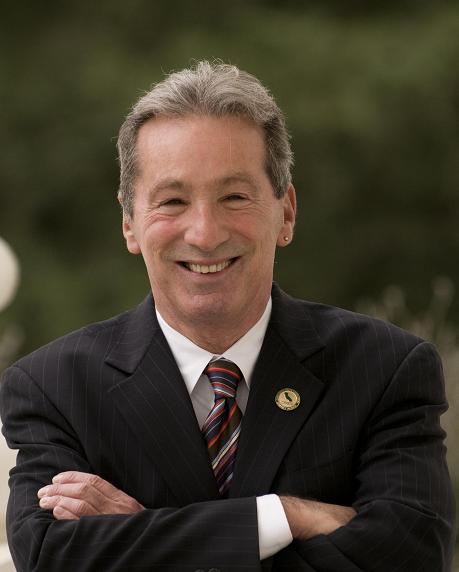
Tom Ammiano

Plazas are public spaces

3

EDITORIAL The attack on public space has been underway for years now in San Francisco. Parks and recreation centers have been turned into pay-to-enter facilities rented out to private organizations. The sit-lie law restricts the use of public sidewalks. Occupy protesters have been evicted from a public plaza. And now, Supervisor Scott Wiener wants to put new restrictions on the mini-parks and plazas that have been a rare bright spot in the battle to reclaim the streets.

Wiener has introduced legislation that would ban camping, cooking, four-wheeled shopping carts, and the sale of merchandise in Harvey Milk Plaza and Jane Warner Plaza, near Market and Castro. He argues that the two parklets — one reclaimed from what had been roadway — are in legal limbo: They aren’t parks, so the city’s park codes don’t apply, and they aren’t sidewalks, so rules like the sit-lie law don’t apply, either.

But there are serious problems with the Wiener legislation. For one thing, it’s clearly directed at homeless people — the ban on shopping carts makes no sense at all except for the fact that a lot of homeless people carry their possessions in those carts. And the ban on camping (which isn’t a problem right now in the two plazas) could be used to prevent an Occupy-style action in the Castro.

The ACLU says there are serious constitutional issues with the bill. In a Jan. 21 letter, ACLU staff attorney Linda Lye notes that the ban on the sale of merchandise without a permit could “burden expressive activity.” And she explains that the shopping cart rules have exceptions for bicycles, strollers, and two-wheeled carts, but “it is wholly unclear why some but not other wheeled conveyances are singled out for prohibition, other than to restrict the activities of an unpopular group.”

A letter signed by 21 members of the Harvey Milk Club, including co-founders Harry Britt and Cleve Jones, Assemblymember Tom Ammiano, and eight past club presidents, points out that “the interests of the LGBT community have always been united with the interests of public space. As a community that is forced—far too often and for far too long—to spend much of our collective lives ‘in the closet,’ the ability to be free in public spaces has been tremendously liberating. Harvey Milk knew that liberation was only possible if we escaped the shadows of anonymity and invisibility. When we restrict these spaces—even when those restrictions are meant, initially, to be applied to another group of people—we damage ourselves.”

The issue goes far beyond the Castro. There are a growing number of small plazas in the city, part of the popular and successful Pavement to Parks Program — and the last thing the city should be doing is putting undue restrictions on their use.

Wiener, to his credit, has been in touch with the ACLU, and amended his original proposal to exempt the sale of newspapers and other printed material. But that doesn’t solve the First Amendment issues — for example, would the sale of t-shirts with political slogans be banned? Could the city decide which political candidates or causes could get a permit and which couldn’t?

The whole thing seems like a solution in search of a problem. The plazas, like most of the city’s parklets, are for the most part clean and well-maintained community gathering spots that don’t need new rules or restrictions. The supervisors should reject the Wiener legislation.

Legal, not legal

4

caitlin@sfbg.com

HERBWISE It’s been a weird year to start a marijuana column. Shortly after we started Herbwise, which was intended to be our weekly look at marijuana culture and events, politics reared its ugly head, rendering it necessary to go to hearings at the State Building, call up California Assembly members, and occasionally wade through seas of legalese. Such is the state of cannabis under ongoing federal prohibition, but it’s been a particularly dramatic year.

And in some moments, news and culture reporting melded together in the marijuana world. Take, for example, the case of Oakland’s Harborside Health Center, which is often called the largest dispensary in the world (it is certainly the largest in California). After years of painstakingly crafting a working relationship with city government, the business was heavily audited by the IRS. The federal agency decided Harborside — and 40 other California dispensaries — fell under the jurisdiction of Section 280E of the Internal Revenue Code, which denies the right for businesses involved in illegal drug trafficking to claim standard business expenditures. The collective now owes $2.4 million in back taxes, an amount that founder Steve DeAngelo asserts will bankrupt it if his business is forced to pay up.

Despite the ever-growing acceptance of the plant in the United States — a Gallup poll put the number at 50 percent in the fall of 2011 — medical marijuana is under attack by the federal government. Last fall, US Attorney for Northern California Melinda Haag sent out letters to the landlords of roughly a dozen Bay Area dispensaries threatening them with civil forfeiture, or possibly four decades in prison, if they failed to move this “trafficking” off their property within 45 days. The letters targeted dispensaries considered to be in a school zone.

Most left without a fight. In San Francisco, the Tenderloin’s Divinity Tree Patients Wellness Cooperative, the Market Street Collective on Upper Market, and the Mission District’s Medithrive and Mr. Nice Guy were among the businesses that shut their doors, some completely and some to transition into delivery-only services. [UPDATE: Attorney Matt Kumin tells the Guardian that Divinity Tree and Medithrive have filed a “coordinated federal lawsuit” through his office in protestation of the closures]

Fairfax’s sole dispensary, Marin Alliance for Medical Marijuana, was forced to close after 15 years of legal operation overseen by long-time cannabis activist Lynette Shaw. The 7,500-person Marin County berg’s town council passed a resolution supporting the Alliance, which served as a symbol of popular support for legal cannabis in a county beset with some of the highest breast cancer rates in the country.

Assemblymember Tom Ammiano and Sen. Mark Leno have been the most outspoken California politicians in coming out against the federal government’s meddling with the state’s cannabis. At a press conference at San Francisco’s State Building in October 2011, Ammiano announced his frustration that the feds would “upset the will of the people” by curtailing safe patient access. Proud to be an elected gay official, he promised to continue to crusade for an issue that he says disproportionately affects the LGBTQ community.

One of the steps Ammiano took was to meet with Haag to discuss what could be done to assuage her concerns with the industry. “That was very, very disappointing,” Ammiano commented on this initial talk. In a recent phone interview with the Guardian, he remembered that Haag implied that the order was coming from above, from high up in the Obama Administration.

Ammiano doubts her assertion that she had little discretion in the matter. “She said she was only doing what the boss was telling her to do. We had a hard time with that.”

He does think that the Obama Administration is sending its attorneys mixed messages — case in point, US Attorney General Eric Holder’s repeated comments that federal interference in state-legal marijuana operations would be “a low priority.” Ammiano also makes the connection between the attacks on cannabis and the self-sustaining industries behind the War on Drugs. “The DEA, some of the diehards, this is like a jobs program for them,” he said.

His meeting with California Attorney General Kamala Harris went more smoothly. Ammiano says Harris, who voiced cautious support for the industry last fall, was eager for a more comprehensive regulatory system to be put into place, but she supported Proposition 215 — the 1996 measure that legalized medical marijuana in California — on principle.

Faced with an ambiguous future, medical cannabis’ proponents — politicians, activists, entrepreneurs, and patients — are putting forth plans for just such a system. This year will be the playing field for a passel of campaigns to take medical marijuana out of the under-supervised arena in which it’s found itself.

Three ballot initiative campaigns seek to address the issue. Two — Regulate Marijuana Like Wine and Repeal Prohibition — would legalize cannabis use for adults across the board. Another, which has perhaps the most likely chance to succeed in the $2 million process of getting onto the ballot, is being put forth by patient advocacy group Americans for Safe Access, the United Food and Commercial Workers (the union that represents many cannabis workers in California), and marijuana collectives. It’s called the Medical Marijuana Regulation, Control, and Taxation Act.

“We decided to focus on medical because we figured that taking that further step at this point is unwise given the federal government’s actions over the last months,” said attorney George Mull, who is part of the team that proposed the measure. If passed, the initiative would establish a 21-member state regulatory board comprised of doctors, industry folk, patients, activists, government officials, and others. A state supplemental tax on cannabis would be levied and local governments would be required to allow one dispensary per 50,000 residents. Ammiano said that he and Leno were also working on proposing legislation that would provide regulations.

But the future of medical marijuana in California remains somewhat cloudy. “I’m worried that even if we come up with the regulations, the feds will find something else,” said Ammiano. Complicating the matter, the California Supreme Court moved unanimously on Jan. 18 to review the power that cities and counties have to make their own laws concerning cannabis accessibility — plus, it plans to look at the old disconnect between state and federal law on the matter..

So much for the politics of marijuana in 2012. Away from the headlines, it’s plain to see that the plant is increasingly accepted in popular culture. On a local level, East Bay YouTube stoner Coral Reefer continues to tweet to thousands of followers every time she sparks a bowl, and on the national stage, Miley Cyrus admits to smoking “way too much fucking weed,” after seeing the birthday cake friends had gotten her. (It had Bob Marley’s face on it.)

On television, the United States is learning about Harborside’s travails — but not just from the news shows. Discovery Channel shot a season of reality TV following DeAngelo and his staff, telling the stories of patients and about the reality of running a dispensary for a show they entitled Weed Wars even before the final $20 million IRS ruling. As the collective is being persecuted by the feds, its fan base across the country grows.

Will Discovery Channel renew Weed Wars for a second season? Regardless of the network’s views on the protagonists’ profession, if the cameras are kept rolling they’re sure to capture another year of interesting times for California cannabis.


Big changes to the DCCC?

14

Half the city probably doesn’t realize there is such a thing as the Democratic County Central Committee, and most of the other half doesn’t realize how powerful it is. The daily papers never cover the DCCC meetings and rarely write about the elections that choose the members of an organization that runs the local Democratic Party — and controls local party endorsements. But it’s a serious factor in local politics — the party slate in a Democratic town is one of the most influential endorsements around. And a lot of the city’s current elected leaders started off as members of the DCCC.


For the past few years, progressives have held a majority on the DCCC, but it’s always up in the air, particularly since every elected state and federal Democrat who lives in SF is automatically an ex-officio voting member. So Senator Dianne Feinstein, Rep. Nancy Pelosi both get to vote (actually, the never show up; they send proxies). Gavin Newsom had a vote until he moved to Marin. You get the picture.


And now, with reapportionment, the part has to change its rules. Under the current system, 12 members are elected from each of the city’s two Assembly districts — but under the new lines, Tom Ammiano’s Assembly district will expand beyond the eastern side of town and he’ll now represent 61 percent of the Democratic voters in the city. Fiona Ma’s district moves south into San Mateo, and she’ll only represent 39 percent of the Democrats.


So now the state has to reapportion the DCCC. Three LGBT members describe the process in a B.A.R. piece here. It seems to me that the easiest thing to do is to add five more members on the east side of town. Good for getting more San Franciscans involved in local politics. Good for the diversity of the DCCC. And good because the more directly elected members you have, the less the ex officios influence the committee.


Seems like a fair easy fix. 

Strong opposition to Wiener plaza plan

17

More than 20 prominent LGBT activists, including eight former presidents of the Harvey Milk Club, have signed a letter opposing legislation by Sup. Scott Wiener that would put some restrictions on the use of the two plazas near Castro and Market.

Harvey Milk Plaza and Jane Warner Plaza are both in an odd legal situation — they aren’t city parks, and they aren’t city streets or sidewalks, so they don’t fit under any existing codes. The park code, for example, bars camping; the sit-lie law applies to sidewalks, but not to these plazas.

So Wiener is seeking some clarity — but his proposal has drawn the ire of the Coalition on Homelessness and the ACLU — and now a group of people who trace their political roots back to Milk, and who say that restricting the use of a plaza with his name is a terrible idea: Here’s their letter:

We, the undersigned members of the Harvey Milk Club, write in opposition to the proposed new regulations for Harvey Milk and Jane Warner Plazas.

We are writing because Harvey Milk’s name is attached to one of the two plazas for which this legislation was written and is a historic space that for decades has been a site of free speech. In the 1970s, Harvey Milk fought against that era’s sit/lie law—a law that had been written to target the hippies of the Haight-Ashbury, but was, in Milk’s day, used as an excuse to attempt to drive gay men out of the Castro. Those of us who have been around long enough, or who are at all in touch with our community’s history, are familiar with the image of Harvey Milk and his megaphone at the plaza which was eventually given his name. To propose to prohibit sitting in that very plaza is not just ironic, it disrespects our community’s legacy.

The interests of the LGBT community have always been united with the interests of public space. As a community that is forced—far too often and for far too long—to spend much of our collective lives “in the closet,” the ability to be free in public spaces has been tremendously liberating. Harvey Milk knew that liberation was only possible if we escaped the shadows of anonymity and invisibility. When we restrict these spaces—even when those restrictions are meant, initially, to be applied to another group of people—we damage ourselves.

We must also recognize that this law does not apply, in any very meaningful way, to another group of people: It applies to us. A great many—perhaps the majority—of homeless people who spend time in the Castro are LGBT San Franciscans, who came from somewhere else, but who came here seeking community and safety. This is most especially notable for the youth of LYRIC. Cuts to the City budget have reduced LYRIC’s drop-in hours to only a few every week. During the other hours, homeless LGBT youth are faced with the choice of either heading to drop-in services in the Mission or Tenderloin—services that are already so overburdened that they must turn clients away, and which likely feel to most youth to be outside of their own communities—or using open spaces in the Castro. With Collingwood Park fenced in, Harvey Milk and Jane Warner Plazas are the last open community spaces in the neighborhood. They are the last places in our community where our community’s most marginalized youth can be.

We have read and share the grave concerns expressed by the ACLU.  Much of the law infringes on important constitutional freedoms, and as they noted, cannot be cured.  We respectfully ask the Board of Supervisors to vote no.

Sincerely,

Tom Ammiano, Assembly member
Harry Britt, Co-Founder, Harvey Milk Club,  Former Supervisor who replaced Harvey Milk on the Board of Supervisors
Cleve Jones, Co-Founder, Harvey Milk Club, Human Rights and AIDS activist, Co-founder of SF AIDS Foundation and AIDS Memorial Quilt
The Harvey Milk LGBT Democratic Club
Stephany Joy Ashley, President, Harvey Milk Club
Gabriel Haaland, Former President, Harvey Milk Club, Former Commissioner
Laura Thomas, Harvey Milk Club member, AIDS activist
Anna Glendon Conda Hyde, Harvey Milk Club member, Commissioner
Esperanza Macias, Former Vice-President, Harvey Milk Club
Eileen Hansen, Harvey Milk Club member, Former Commissioner
Rafael Mandelman, Former President, Harvey Milk Club, Former Commissioner
Gwenn Craig, Former President, Harvey Milk Club, Former Commissioner
David Waggoner, Former President, Harvey Milk Club
Nate Albee, Former President, Harvey Milk Club
Tamara Ching, Harvey Milk Club member
Lisa Feldstein, Harvey Milk Club member, Former Commissioner
Suzanne Rueker, Harvey Milk Club officer
Carol Stuart, Vice-President, Harvey Milk Club
Kim-Shree Maufus, Vice President, Harvey Milk Club, Commissioner
Matt Dorsey, Harvey Milk Club member, SFDCCC
Brian Bassinger, Former President, Harvey Milk Club
Debra Walker, Former President, Harvey Milk Club, Former Commissioner

Editorial: Mayor Lee, support Prop. 13 reform

4

EDITORIAL You want a quick way to cut a huge chunk out of the city’s budget deficit? A way to save essential services without having to put a tax increase before the voters?

Just force the owners of large commercial properties to pay their property taxes.

It’s an open secret in California that the biggest properties are bought and sold under a loophole in the Proposition 13 that prevents city’s from reassessing them. It’s a fairly easy scam, one that almost never happens with lower-priced residential property: Instead of selling, say, a large commercial office building, the owners simply incorporate the building as a limited liability corporation and then sell shares in the LLC. That doesn’t count as a property transfer under Proposition 13, so the building is never reassessed.

That means a building that may have sold for $500 million still pays taxes on an earlier assessment, which is often far, far lower. That loophole alone is costing San Francisco millions of dollars a year, according to Assessor Phil Ting.

The California Tax Reform Association, in a May, 2010 report, notes that many of the biggest mergers, acquisitions, and property sales in the state over the past 30 years have taken place with legal tricks that keep property taxes artificially low.

Assembly Member Tom Ammiano has introduced a bill, AB 448, that would classify any substantive transfer of property, even if it’s done through subsidiaries and corporate shells, as a sale and allow counties to reassess the property. It’s a fairly mild step, far short of a split-roll measure that would treat commercial and residential property differently. In fact, Ting told us, 99 percent of all commercial sales (mostly smaller properties) don’t use the loophole. It’s just (once again) the 1 percent taking advantage of everyone else.

Los Angeles Mayor Antonio Villaraigosa has contacted Ammiano and asked to testify and help pass the bill. But at press time, Ammiano had heard nothing from San Francisco Mayor Ed Lee. (Lee’s spokesperson, Christine Falvey, told us she didn’t think the bill was still alive. It is.)

Lee needs to take a high-profile position in support of this bill — and he needs to encourage every other mayor in the state to do the same. The Board of Supervisors ought to pass a resolution of support — and push the County Supervisors Association of California to make this bill a top priority.

Making even a minor, eminently reasonable change in Prop. 13 is tough, and Ammiano’s best chance is if local elected officials really push for this. It’s crazy that Mayor Lee isn’t leading the way.


The new board committes: Not great news

49

Board President David Chiu has released the new committee assignments for 2012, and they aren’t a whole lot different from last year’s — except in a few areas. And they aren’t exactly an indication of progressive power.

The three most conservative supervisors — Mark Farrell, Sean Elsbernd and Carmen Chu — all were named to chair committees. Supervisors Eric Mar and John Avalos also are committee chairs, although David Campos was relegated to the joint City and School District Select Commitee, which is important but takes no votes and has no role in the legislative process.

Word is, however, that Campos may wind up chairing the Transportation Authority.

The Budget and Finance Committee is run by Chu, but Avalos and Jane Kim are also members, giving a majority to the progressives. But during the budget season, that panel expands to five members — and the additional two, Scott Wiener and Malia Cohen, are both decidedly on the moderate side. That means progressives will not have a majority on the panel that plays the central role in setting the city’s budget.

The Rules Committee is improved from last year — Kim is the chair, joined by Campos and Farrell. But Land Use and Economic Development — possibly the second most important committee after Budget and Finance — is dominated by moderates; Mar is the chair but Cohen and Wiener will have a 2-1 majority.

State Assemblymember Tom Ammiano told me he’s concerned that the two openly gay members of the board, Campos and Wiener, aren’t in more prominent roles. “It seems like there are two very hardworking people who were slighted here,” he said.

But Chiu disagrees, saying that the assignments “reflect the diversity of the board and the city.” He added: “Last year (when conservatives were given key posts) everyone thought the sky would fall, and it didn’t.”

The sky falling is pretty dramatic; I suspect it won’t. But there’s a difference between the sky falling and the progressive agenda moving forward.


Mirkarimi takes the oath

181

The room was packed for the inauguration of Sheriff Ross Mirkarimi, and for the most part, the crowd wasn’t talking about what Mirkarimi referred to as the “cloud” hanging over the event. He mentioned the investigation into possible domestic violence only that once, then joked that he’d managed to get a lot of press to his event.


There was music, dancing, former Mayor Art Agnos administering the oath of office, a long, long Mirkarimi speech on criminal justice policy (please, Ross, 15 minutes would have been plenty). Most of Mirkarimi’s progressive colleagues (including supervisors John Avalos, David Campos, Jane Kim, and Eric Mar, state Sen. Mark Leno and Assemblymember Tom Ammiano) were on hand. And the press conference afterward was surprisingly mild.


Mirkarimi was asked what happened the night in question, and he declined to talk about it, saying the criminal justice system would work its way through the process. Then his wife, Eliana Lopez, interrupted, took the mike, and announced that this was a “family matter” and she would have no more to say – except that she has no complaints about her husband.


That was it. No shouted questions as the sheriff walked away, no 1000-watt camera flashes in his eyes, nothing to indicate that this is the gigantic scandal that it’s become in the daily papers.


But Mirkarimi did make one statement that’s worth mentioning: He said that there were forces in the department (I think he meant the Police Department) that didn’t want to see him as sheriff. That’s absolutely true.


Let me make a few points here.


First, for the record: There’s no excuse for assaulting anyone, and there’s less excuse for assaulting your wife. Domestic violence is a serious, under-reported problem, something all too often dismissed by the authorities – with catastrophic results. Women die because batterers are not held to account. I have close friends who have been in abusive relationships, and it’s not pretty and it’s not a joke and it’s not something to take lightly.


That said: I don’t know what happened that night at Mirkarimi’s house. But I do know that the minute the cops were brought in, it became political.


See, the cops, for the most part, are not Mirkarimi fans. He beat their guy, former Police Officers Association president Chris Cunnie, in the race for sheriff. He’s demanded changes in the department (including foot patrols, which a lot of old-timers don’t like). He also beat a sheriff’s captain. He’s a civilian who is going to run a law-enforcement agency as a civilian, which means he’s not part of the Fraternity.


The news reports about the incident were clearly leaked by the SFPD. So, I’m sure, was the search warrant (that’s a public document, but I honestly don’t think the Examiner tracked it down, I think it was delivered to the paper by a source in the department). Nothing wrong with that – cops (and politicians) tip reporters to stories all the time. I’m not blaming the Chron or the Ex for doing the story – it’s news, you have to report it.


And, of course, if the cops had ignored the case or downplayed it, they would have been criticized for covering up an incident involving the new sheriff.


Again: I’m not excusing Mirkarimi’s behavior (alleged behavior — we don’t know what actually happened). But the way the story and the details were leaked reflects the political reality that the cops don’t love the new sheriff, and a lot of them would be thrilled to take him down. That’s just political reality.


Which means Mirkarimi needs to be very, very careful – there are people watching every single move he makes, every day. And they’re not interested in policy debates.


PS: The D.A. and the cops managed to finish this particular investigation in record time. I wonder what’s happened to the investigation into possible vote fraud in the Ed Lee campaign. Months have passed. Nobody is facing any charges. There are no police leaks about anyone involved. Funny, that.

Ammiano meets with U.S. attorney

59

Assemblymember Tom Ammiano finally got a meeting with the U.S. attorney for Northern California, Melinda Haag, Dec.13 to talk about the feds crackdown on medical marijuana — and he left disappointed that Haag didn’t seem to understand what a mess she’s making.

“The meeting didn’t result in any changes,” Ammiano told me. “But it was good that it happened. We cleared the air about the harm that’s being done.”

According to Ammiano’s aide Quintin Mecke, who was also in the meeting, Haag wasn’t at all clear about what she wanted — what, in other words, would end the crackdown. She talked a lot about “proximity to kids,” suggesting that dispensaries that are close to schools were a problem — although that’s a really bogus argument. I’ve been to a number of local dispensaries and my colleague Steve Jones has been to most of them, and every one requires a drivers license and a medical marijuana ID and they’re really serious about security. No high school kids are getting pot from the clubs.

Now: Pot use is up among high school kids nationally (which is another whole issue) but San Francisco Unified School District surveys show that drug use in general, and pot use in particular, is actually declining in this city. So a city that has a lot of pot clubs — highly regulated — is bucking the national trend on pot use among teens.

Ammiano wants to set strong state regulations for clubs, which most of the dispensary owners would welcome. But Haag wasn’t helpful with that, either — she said she wouldn’t make policy recommendations.

So there you have it — the U.S. Attorney is using demonstrably false allegations to pursue a program that she can’t defend — and she won’t help the Legislature find a solution. Thanks, President Obama.


Ed Lee and “job killers”

15

Every time I hear the word “job killer” I think of the California Chamber of Commerce, which loves to affix the label to anything that might hurt corporate profits. Most environmental legislation, most pro-labor legislation, most financial regulations, anything that improves employer requriements for health insurance — the Chamber dubs it “job killers.”

And now Ed Lee is using that word to slow down progressive taxes, regulations or business mandates. He’s proposing a Charter Amendment to send any bills that might cause job losses to the Small Business Commission for a “jobs impact” public hearing.

That would give another weapon to downtown interests who want to kill, say, improvements to the Healthy San Francisco law, or any changes in the business tax.

Here’s what kills me: How many jobs were destroyed by the LACK of regulations over the U.S. financial industry? How many jobs were destroyed by a tax system that keeps most of the wealth concentrated in the top one percent? How many jobs were destroyed by cutbacks and layoffs in the public sector (which were a direct result of a failure to seek new revenues that business leaders would have called “job killers”?)

But we don’t have a special commission weighing in on tax cuts and tax breaks that cost the city money and kill city jobs.

Assemblymember Tom Ammiano, who has to deal with the California Chamber and its lackeys, told me that Lee “is talking like a Republican, or like the moderate Democrats in Sacramento.” That’s not where the mayor of San Francisco ought to be.


The Phil Ting for Assembly campaign is under way

11

Just a few days after the race for mayor of San Francisco ended, Assessor-Recorder (and mayoral candidate) Phil Ting began his next campaign — for state Assembly.

The Westside district now represented by Fiona Ma opens up in 2012, when Ma will be termed out. And Ting was moving to set himself up as the frontrunner almost as soon as the ink had dried on on the final results from the mayoral election (where he finished a disappointing 11th, behind even Green Party candidate Terry Baum). Philting.com, which had been the official website for Phil Ting for Mayor, has been switched over to Phil Ting for state Assembly. I got an email Dec. 7 inviting me to a reception for his Assembly campaign; several prominent local politicians told me Ting had called even earlier than that to ask for support.

And he’s getting it — both state Sen. Mark Leno and Assemblymember Tom Ammiano are on his already-impressive list of endorsments.

Which is no surprise: The 12th District (which will become the 19th under the new redistricting) is the more conservative side of San Francisco, and by the standards of the state Assembly, Ting would be a pretty solid progressive. He actually understands tax policy, and he’s made a huge issue of removing the commercial property loophole from Prop. 13.

So now comes the interesting part: Who’s going to run against him?

Ting has a relatively cordial relationship with Mayor Ed Lee, and didn’t spend much time in the campaign attacking the appointed incumbent. He’s a former executive director of the Asian Law Caucus, where Lee worked in his early days as a tenant and civil-rights lawyer. There shouldn’t be any reason for the mayor or his pals to try to drum up a candidate to take on Ting … or should there?

Ting is not an enemy of the Willie Brown-Rose Pak folks. But he’s not a loyal ally, either. The most obvious conservative/pro-downtown candidate, one the mayor and his big-business pals could count on, would be Sup. Carmen Chu. I couldn’t get her on the phone, but in the past she’s been only lukewarm about running. The other strong potential candidate would be Sup Sean Elsbernd, but he told me he’s absolutely not running. “I was very interested during my first few years on the Board, but since my son was born, there’s no way I would consider it,” he said. “I am not a candidate and shouldn’t be talked about as a candidate.”

So will we see a “Run, Carmen, Run” campaign? Or will Brown and Pak think about it and realize that giving the mayor an appointment to Ting’s office might be a real advantage? Would they rather control a state Assemblymember — of the county assessor?

Stayed tuned to this one.


Stop downtown’s attack on RCV

52

OPINION The long-time foes of political reform at the Chamber of Commerce and San Francisco Chronicle have launched an effort to repeal ranked choice voting (RCV) and public financing of campaigns. Supervisors Sean Elsbernd and Mark Farrell have introduced a June 2012 charter amendment to repeal RCV, with public financing also in their crosshairs.

Many of us fought hard to pass these reforms, and I am reminded of when the downtown corporate interests repealed district elections in 1980. They blamed the assassinations of Harvey Milk and George Moscone on district elections and the election of Supervisor Dan White. San Francisco has a history of the anti-reformers waiting for their moment of opportunity. Now these same corporate interests think that moment has arrived again.

The Bay Guardian first reported about an anti-RCV campaign in 2009, when a meeting of downtown business leaders was hosted by Steve Falk, Chamber of Commerce CEO (and past publisher of the Chronicle) to discuss repealing RCV.

As part of that effort, polling also was done to see if they could repeal district elections and public financing. They also filed a bogus anti-RCV lawsuit which was unanimously rejected by two courts. Elsbernd’s repeal legislation is the culmination of their calculated efforts.

It’s clear what these special interests want: a return to the days when local races were decided in low-turnout December elections, and those who had the most money pounded their opponents into submission. An Ethics Commission report in 2003 found that independent expenditures increased by a factor of four during December runoffs, while another study found that voter turnout dropped by more than a third in 10 of the 14 December runoff races held from 2000-2003. Turnout in one city attorney runoff dropped to 16 percent.

Just as importantly, the December electorate did not represent the diversity of San Francisco’s population. Voters in the runoffs were overwhelmingly whiter, older and more conservative than the city as a whole, as voter turnout plummeted in December among racial minorities, the poor and young people. Simply put, a return to December runoffs will allow groups like the Chamber and its allies to dump huge amounts of money into negative campaigns aimed at the more conservative December electorate when most San Franciscans don’t vote.

In the era of unlimited independent expenditures by corporations (thanks the Supreme Court decision in Citizens United), political reforms like RCV are crucial for protecting our democracy. Both RCV and public financing have greatly improved local elections — since their inception San Francisco has doubled the number of racial minorities elected to the Board of Supervisors. Elections are now decided in higher turnout November contests, allowing more people to have a voice in choosing their local representatives. Winning candidates in RCV contests have won with an average of 30 percent more votes than winners in the old December runoffs.

San Francisco has saved $10 million in taxes by not holding second elections, money used for other public needs. Candidates also haven’t needed to raise money for a second election, which helps level the playing field. Progressive candidates have never done well in citywide elections, but this year in RCV contests Ross Mirkarimi was elected sheriff and John Avalos mobilized and finished a strong second. That bodes well for progressives’ future.

It’s no coincidence that Supervisor Elsbernd is trying to get his charter amendment on a low-turnout June ballot, when the electorate is more conservative. The downtown corporate interests are clear on what they must repeal in order to elect the candidates they want — RCV, public financing, and ultimately district elections. Progressives need to be just as clear on what reforms we must defend.

Assemblymember Tom Ammiano represents the 13th District.

The problem of the UC police

0

EDITORIAL Twenty years from now, when people look back on the Occupy movement, one of the indelible images will be the video of the University of California police officer casually dousing a group of peaceful, seated students in Davis with pepper spray. It’s a video that’s been seen millions of times around the world. It reflects a serious problem not just with one officer but with the way officials at all levels have responded to the protests — and with the way institutional police forces operate in this state.

In the video, a group of students involved in the OccupyUC movement are seated on the ground with arms linked. Lt. John Pike walks up and down the row, indiscriminately shooting the orange spray — which causes severe pain and breathing problems — over the students, who make no move to resist. It’s horrifying and stunning, the sort of thing that you wouldn’t believe unless you saw it yourself.

The Davis chancellor, Linda Katehi, has been reeling from the incident and is facing calls for her resignation. Pike and the chief of the U.C. Davis police have been put on administrative leave pending an investigation.

But now Assemblymember Tom Ammiano of San Francisco wants to go a step further — he wants to hold hearings in Sacramento not just on this incident but on how police agencies across the state have dealt with mostly nonviolent protesters. He’s absolutely right — and his hearings should also raise a critical question: Why does the University of California need its own armed police force?

The problems with the police at Davis mirror problems with the behavior of the UC Berkeley police — which mirror problems with the BART police. And all of them stem from a central problem: These little police fiefdoms have poor supervision, poor training and limited civilian oversight.

The chancellor of UC Davis doesn’t know anything about running a police department; she’s an electrical engineer and an academic. If she resigns, she’ll be replaced by another academician who knows nothing about law enforcement. And if the UC police misbehave, where do people go to complain? There’s no independent auditor, no office of citizen complaints.

If the Oakland police ran rampant — and they have been known to do exactly that — at least the elected mayor can be held accountable. Same for any city that has a municipal force. But when campus and transit security operations turn into armed paramilitary agencies, it’s a recipe for trouble.

At the very least, the UC police — like the BART police — need an independent oversight agency to handle complaints. But it might be time to discuss whether campuses can best be protected with unarmed security guards supported by local municipal police. The University of California will never take that step on its own, so the state Legislature needs to evaluate whether lawmakers should force the issue.

Guardian editorial: The problem of U.C. police

7

GUARDIAN EDITORIAL Twenty years from now, when people look back on the Occupy movement, one of the indelible images will be the video of the University of California police officer casually dousing a group of peaceful, seated students in Davis with pepper spray. It’s a video that’s been seen millions of times around the world. It reflects a serious problem not just with one officer but with the way officials at all levels have responded to the protests — and with the way institutional police forces operate in this state.

In the video, a group of students involved in the OccupyUC movement are seated on the ground with arms linked. Lt. John Pike walks up and down the row, indiscriminately shooting the orange spray — which causes severe pain and breathing problems — over the students, who make no move to resist. It’s horrifying and stunning, the sort of thing that you wouldn’t believe unless you saw it yourself.

The Davis chancellor, Linda Katehi, has been reeling from the incident and is facing calls for her resignation. Pike and the chief of the U.C. Davis police have been put on administrative leave pending an investigation.

But now Assemblymember Tom Ammiano of San Francisco told us he  wants to go a step further — he  he plans  to hold hearings in Sacramento not just on this incident but on how police agencies across the state have dealt with mostly nonviolent protesters. He’s absolutely right — and his hearings should also raise a critical question: Why does the University of California need its own armed police force?

The problems with the police at Davis mirror problems with the behavior of the U.C. Berkeley police — which mirror problems with the BART police. And all of them stem from a central problem: These little police fiefdoms have poor supervision, poor training,  and limited civilian oversight.

The chancellor of U.C. Davis doesn’t know anything about running a police department; she’s an electrical engineer and an academic. If she resigns, she’ll be replaced by another academician who knows nothing about law enforcement. And if the U.C. police misbehave, where do people go to complain? There’s no independent auditor, no office of citizen complaints.

If the Oakland police ran rampant — and they have been known to do exactly that — at least the elected mayor can be held accountable. Same for any city that has a municipal force. But when campus and transit security operations turn into armed paramilitary agencies, it’s a recipe for trouble.

At the very least, the U.C. police — like the BART police — need an independent oversight agency to handle complaints. But it might be time to discuss whether campuses can best be protected with unarmed security guards supported by local municipal police. The University of California will never take that step on its own, so the state Legislature needs to evaluate whether lawmakers should force the issue.

Postscript: STOP SHOOTING STUDENTS:  The real problem for U.C. Davis’s Kotehi and other U.C. chancellors was illustrated by  this classic J’Accuse open letter by Nathan Brown,  U.C/Davis.assistant professor in the Department of English.

The low-turnout election

25

A factor that hasn’t been discussed much in the analysis of the election results is the very low turnout for a contested mayor’s race. The turnout without the provisionals and final absentees was about 30 percent; by my figures, when the 35,000 remaining ballots are counted, it will total about 37 percent.

That’s about the same level as the 2007 race, when Gavin Newsom had no serious opposition and the races for sheriff and district attorney were essentially uncontested.

The past two contested mayoral races had much higher turnout. In 1999, when Tom Ammiano ran against Willie Brown, 45 percent of the voters turned out; same for the 2003 race pitting Matt Gonzalez against Gavin Newsom.

It’s odd — the weather was good, there were three contested races, all of the candidates had and spent money … and even in traditionally high-turnout areas, not that many voters went to the polls.

In the Mission, where John Avalos won overwhelmingly, turnout was only 30 percent.

Clearly, one of the reasons that Ed Lee won is that he got his voters to the polls. Would higher turnout on election day have made a difference? Maybe. Lee had support all over the city, and he was going to be tough to beat. He also got most of the second-place votes from candidates like David Chiu and even Leland Yee, who had spent much of the fall attacking him. And although Avalos won on election day, Lee was so far ahead from the absentees that catching him would have been difficult.

Still: The race certainly would have been closer. And the low turnout is curious. Did people just assume Lee was going to win? It’s hard to imagine that voters had no appealing candidates — there were so many choices. And there was so much election hype — I got about 30 mail pieces in the last week.

By the way: Randy Shaw did his list of winner and losers, and he left out Avalos entirely. Avalos didn’t win the election, but his suprisingly strong finish established him as a progressive leader for the future and helped keep the left organized and in the game. He also left out Ross Mirkarimi, who is the first solid progressive to win a citywide office in quite a while — and he did it running for sheriff against two law-enforcement types. Mirkarimi has now established himself as someone who can win in all parts of town and has made crime and law-enforcement a progressive issue.

Then there’s OccupySF — and while a lot of the people there probably didn’t vote, the fact that that Avalos stood with the occupiers and contrasted himself to Ed Lee (who came very close to using the cops to evict the protesters) helped his campaign immensely.

Avalos campaign revives the progressive movement

40

As I walked into the John Avalos campaign party in Roccapulco around 11 pm, Sup. David Campos told me, “It’s the best party in town!” And he was right. The speeches were just getting underway on the stage and there was a palpable energy in the large crowd even though many of them had been out campaigning since early in the morning.
Avalos’ wife, veteran progressive organizer Karen Zapata, set the tone. First, she recognized Eric Quezada, the longtime housing rights activist who died in August, and the rest of the progressive leaders, such as Tom Ammiano and Chris Daly, who laid the foundation for a campaign that finished the night strongly in second place, less than 13 percentage points behind with voters’ second and third choices still to be tallied.
If Ed Lee hangs on to win, she said, “We could be screwed unless we work together and organize.” It was a theme and a feeling that would permeate the event, this sense that Avalos and the progressives are enjoying a resurgence in the last month thanks to what’s happening in the streets, both with this campaign and the OccupySF movement that Avalos has taken a lead role at City Hall in supporting.
“We have to stick together and we have to push from outside the system. We have to push John and we have to push everyone in the system,” Zapata said, firing up the young crowd as she introduced her husband.
Avalos praised the campaign for having so much heart and with filling his. “This has been a campaign of the people,” Avalos said, seeming genuinely touched by the energy in the room.
The progressive movement has been fighting for the soul of this city for a long time, he said, citing the anti-displacement movement that became a political force in 2000-01, a struggle that continues today with the latest tech boom. “In a way, we’re embracing change that is accelerating our displacement here in San Francisco,” Avalos said.
But he said people are waking up to the idea that the people need to stand up to the super rich and their political enablers. “The Occupy Wall Street movement is changing the consciousness of this country,” Avalos said, noting how it is echoing themes that progressive San Franciscans have been sounding for years. “Everyone is talking the same language we’ve been talking, because we’ve been talking about the 99 percent for a long time.”
But between that movement and this campaign, he said the battle was just beginning, praising the “new generation of leadership, that’s what this campaign is about. We’re going to take back this city one way or another!”
And he closed with a chant from the streets: “Whose city?” Avalos shouted, and the crowd roared back, “Our city!”

On Guard!

4

news@sfbg.com


VICTORY’S MUDSLINGING

Hit pieces are common in San Francisco politics. So, sadly, are negative mailers funded by outside independent expenditure committees that can raise unlimited money.

But it’s highly unusual for an organization devoted to electing queer candidates to fund an attack on a candidate who is endorsed by both leading LGBT organizations and is, by all accounts, an ally of the community.

That’s what happened last week when the Washington-based Victory Fund — the leading national organization for LGBT political candidates — sent out a bizarre mailer blasting City Attorney Dennis Herrera for taking money from law firms that do business with the city.

The Victory Fund has endorsed former Sup. Bevan Dufty, who is the most prominent LGBT candidate in the mayor’s race. That’s to be expected; it’s what the Victory Fund does.

But why, in a race with 16 candidates, would the fund go after Herrera, who has spent much of the past seven years fighting in court for marriage equality? Why try to knock down a candidate who has the support of both the Harvey Milk Club and the Alice B. Toklas Club?

It’s baffled — and infuriated — longtime queer activist Cleve Jones, who is a Herrera supporter. “I have long respected the Victory Fund,” Jones told us. “But I’ve never seen them do what they did here. And it’s going to undermine the fund’s credibility.”

Jones dashed off an angry letter to the fund’s president, Chuck Wolfe, saying he was “appalled that this scurrilous attack, in the waning days of a mayoral campaign, would go out to the San Francisco electorate under the name of the Victory Fund.

“You really screwed up, Chuck, and I am not alone in my anger.”

We couldn’t get Wolfe on the phone, but the fund’s vice president for communications, Denis Dison, told us that the mailer “is all about fighting for our endorsed candidates.”

So how does it help Dufty, in a ranked-choice election, to attack Herrera? (In fact, given the dynamics of this election, the person it helps most is probably Mayor Ed Lee). Dison couldn’t explain. Nor would he say who at the fund decided to do the attack mailer.

But there are a couple of interesting connections that might help explain what’s going on. For starters, Joyce Newstat, a political consultant who is working for the Dufty campaign, is active in the Victory Fund, sits on the board of the fund’s Leadership Institute, and, according to a March 24 article in the Bay Area Reporter, was among those active in helping Dufty win the Victory Fund endorsement.

But again: Supporting Dufty is one thing. Attacking Herrera is another. Who would want to do that?

Well, if there’s one single constituency in the city that would like to sink Herrera, it’s Pacific Gas and Electric Co. And guess what? PG&E Governmental Affairs Manager Brandon Hernandez chairs the Victory Fund’s Leadership Institute. PG&E’s corporate logo appears on the front page of the fund’s website, and the company gave the Victory Fund more than $50,000 in 2010, according to the fund’s annual report.

Dison insisted that neither Hernadez nor anyone else from PG&E was involved in making the decision to hit Herrera and said the money went to the Leadership Institute, which trains LGBT candidates, not directly to the campaign fund.

Maybe so –- but the folks at the private utility, who are among the top three corporate donors to the Victory Fund, have to be happy. (Tim Redmond)


HERRERA HIT BACKFIRES

Herrera was also the target of another attack on his LGBT credentials last week, this one by the San Francisco Chronicle, which ran a front page story on Oct. 26 in which anonymous sources said he raised doubts in private City Hall meetings about San Francisco’s decision to issue same-sex marriage licenses in 2004. It was entitled, “Fight turns ugly to win gay votes in mayor’s race.”

Despite trying to couch the hit in passive language, writing that ” a surprise issue has emerged” based on accusations “leveled by several members of former Mayor Gavin Newsom’s administration,” it was clear that it was the Chron that made it an issue, for which the newspaper was denounced by leaders of the LGBT community from across the political spectrum at a rally the next day.

“Those who are saying this now anonymously are as cowardly as Dennis and Gavin were courageous back then,” said Deputy City Attorney Theresa Stewart, the lead attorney who defended San Francisco’s decision in 2004 to unilaterally issue marriage licenses to same-sax couples, in defiance of state and federal law, which eventually led to the legalizing of such unions. “We can’t have our community turn on us for petty political gain.”

“WTF, Chronicle?” was how Assemblymember Tom Ammiano began his speech, going on to lay blame for the attack on surrogates for Mayor Ed Lee. Ammiano also called out the mayor for campaign finance violations by his supporters, for undermining the Healthy San Francisco program that was created by Ammiano’s legislation, and for repeatedly ordering police raids on the OccupySF encampment.

“How about some fucking leadership?!” Ammiano said.

Cleve Jones, an early gay rights leader who marched with Harvey Milk, also denounced Lee and his supporters for cronyism, vote tampering, money laundering, and the “fake grassroots” efforts of the various well-funded independent expenditure campaigns, which he said have fooled the Chronicle.

“To the Chronicle and that reporter — really? — this is what you do two weeks before the election? You should be ashamed of yourself,” Jones said. “How stupid do you think we are?”

Yet Chronicle City Editor Audrey Cooper defended the article. “Clearly, I disagree [with the criticisms],” she told the Guardian. “I personally vetted every one of the sources and I’m confident everything we printed is true.” She also tried to cast the article as something other than a political attack, saying it was about an issue of interest to the LGBT community, but no LGBT leaders have stepped up to defend the paper.

Beyond criticizing the obvious political motivations behind the attack, speakers at the rally called the article bad journalism and said it was simply untrue to suggest that Herrera didn’t strongly support the effort to legalize same-sex marriage from the beginning.

“I can tell you that Dennis never once shrank from this fight. I was there, I know,” Stewart said, calling Herrera “a straight ally who’s devoted his heart and soul to this community.”

Sen. Mark Leno, who introduced the first bill legalizing same-sex marriage to clear the Legislature, emphasized that he isn’t endorsing any candidates for mayor and that he didn’t want to comment on the details of the article’s allegations. But he noted that even within the LGBT community, there were differences of opinion over the right timing and tactics for pushing the issue, and that Herrera has been a leader of the fight for marriage equality since the beginning.

“I am here to speak in defense of the character and integrity of our city attorney, Dennis Herrera,” Leno said, later adding, “I do not appreciate when the battle for our civil rights is used as a political football in the waning days of an election.”

Molly McKay, one of the original plaintiffs in the civil lawsuit that followed San Francisco’s actions, teared up as she described the ups and downs that the case took, working closely with Herrera throughout. “But this is one of the strangest twists I can imagine,” she said of the attack by the Chronicle and its anonymous sources. “It’s ridiculous and despicable.”

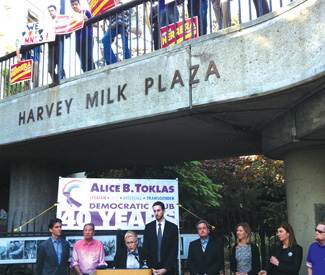
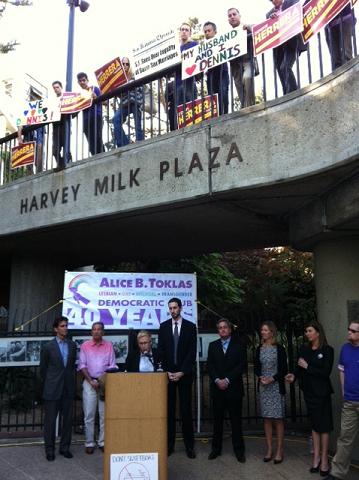
Representatives for both the progressive Harvey Milk LGBT Democratic Club and fiscally conservative Alice B. Toklas LGBT Democratic Club also took to the microphone together, both saying they often disagree on issues, but they were each denouncing the attack and have both endorsed Herrera, largely because of his strong advocacy for the LGBT community.

Sup. Scott Wiener called Herrera, “One of the greatest straight allies we’ve every had as a community.”

When Herrera finally took the microphone, he thanked mayoral opponents Joanne Rees and Jeff Adachi for showing up at the event to help denounce the attack and said, “This is bigger than the mayor’s race. It’s bigger than me.”

He criticized those who would trivialize this issue for petty political gain and said, “It was my pleasure and honor to have been a part of this battle from the beginning — from the beginning — and I’ll be there in the end.” (Steven T. Jones)


BUYING REFORM

UPDATE: THIS ITEM HAS BEEN CHANGED FROM THE PRINT VERSION TO CORRECT INACCURATE INFORMATION DEALING WITH WHETHER PAST INIATIVES CAN BE CHANGED

October yielded tremendous financial contributions from real estate investors and interest groups for Yes on E, feeding fears that the measure will be used to target rent control and development standards in San Francisco.

Sup. Scott Wiener has been the biggest proponent for Prop E since May 2011. He argues that the Board of Supervisors should be able to change or repeal voter-approved ballot measures years after they become law, saying that voters are hampered with too many issues on the ballot. Leaving the complex issues to city officials rather than the voters, makes the most sense of this “common sense measure”, Wiener calls it.

But how democratic is a board that can change laws approved by voters? Calvin Welch, a longtime progressive and housing activist, has his own theory: Wiener is targeting certain landlord and tenant issues that build on the body of laws that began in 1978, when San Francisco voters first started adopting rent control and tenants protection measures. Yet the measure will only allow the board to change initiatives approved after January 2012.

“That is what the agenda is all about — roughly 30 measures that deal with rent control and growth control,” he said. Critics say  the measure will leave progressive reforms vulnerable to a board heavily influence by big-money interests. Although Wiener denies Prop E is an attack on tenants, who make up about two-thirds of San Franciscans, the late financial support for the measure is coming from the same downtown villains that tenant and progressive groups fight just about every election cycle. High-roller donations are coming straight from the housing sector, which would love a second chance after losing at the ballot box.

Contributions to Yes on E include $15,000 from Committee on Jobs Government Reform Fund, $10,000 from Building Owners and Managers Association of SF PAC, another $10,000 from high-tech billionaire Ron Conway, and $2,500 from Shorenstein Realty Services LP. Then — on Oct. 28, after the deadline for final pre-election campaign reporting — the San Francisco Association of Realtors made a late contribution of another $18,772, given through the front group Coalition for Sensible Government.

Prop. E is organized so that the first three years, an initiative cannot be subject to review. However after four years, a two-thirds majority vote by the board could make changes, and after sevens years, a simple majority could do so.

 (Christine Deakers)

Lee benefits from vetoing health care reform

25

Downtown groups that pressured Mayor Ed Lee to veto legislation that would have prevented businesses from raiding their employees’ health savings accounts have been funneling big bucks into independent expenditure campaigns formed to keep Lee in the Mayor’s Office.

Meanwhile, the Board of Supervisors today strengthened a weak alternative to the vetoed legislation by Board President David Chiu, which it then continued for two weeks. The amendments by Sup. Malia Cohen were unanimously approved by the board, but her five allies in supporting the vetoed legislation – David Campos, John Avalos, Ross Mirkarimi, Jane Kim, and Eric Mar – preferred that the measure be returned to committee for more analysis, losing on a 6-5 vote.

“We need more time to understand the implications of the amendments. We’re not sure if it actually closes the loophole,” Campos, the vetoed measure’s sponsor, said of provisions in the Health Care Security Ordinance – the city’s landmark measure that required employers to provide some health coverage to employees – that allowed businesses last year to pocket more than $50 million from health savings accounts they created for their employees.

One Cohen amendment specifically addressed one of the more egregious violations – restaurants that charge customers at 3-5 percent surcharge for employee health care and than pocket that money at the end of the year – which Chiu had addressed only by calling for more scrutiny of the tactic by the Office of Labor Standards. She also would require businesses to keep two years worth of contributions in the account, rather than the one year sought by Chiu to address the so-called “January problem” of businesses draining the account at the end of every year and leaving nothing for employees who get sick or injured at the start of the year.

It was perhaps a sign of the heat that Lee took from labor and consumer groups for his veto that he quickly issued a press release today praising the supervisors for addressing the issue. “I applaud President Chiu, Supervisor Cohen, organized labor, small business owners, and the Department of Public Health for finding the solutions to this important public policy that can strengthen our City’s landmark Health Care Security Ordinance. By closing the loophole through these proposed amendments, we can increase access to health care, protect jobs in our small businesses and protect consumers while growing our economy at the same time,” it read.

But Lee appears to have already benefited from heeding the demands of downtown – particularly the San Francisco Chamber of Commerce and Golden Gate Restaurant Association (GGRA) – who made defeating the Campos legislation a top priority, casting it as a new “fee” that would drain $50 million from the local economy.

The San Francisco Alliance for Jobs and Sustainable Growth PAC, created by notorious downtown bagman Jim Sutton, is the best-funded on the four independent expenditure groups that are supporting Lee, taking in $390,000 this fall, including $27,000 from the GGRA and $25,000 from the Chamber’s SF Forward group. Both groups also support the Committee on Jobs, which kicked in $110,000 to the Alliance campaign. GGRA also gave another $10,000 to the pension reform campaign that Lee is pushing, support the Chamber had threatened to withhold if the Campos measure was approved.

GGRA Executive Director Rob Black denied this was pay-to-play politics, noting that the Alliance is also supporting DA George Gascon, Sheriff candidate Chris Cunnie and two ballot measures. “But absolutely, the mayor’s name is on there and the organization voted to endorse him,” Black said.

GGRA voted in August to endorse Lee, Chiu, and Michela Alioto-Pier for mayor. Black said the organization is “generally supportive of Sup. Chiu’s approach to reforming the Health Care Security Ordinance,” and Black specifically said it supports improving requirements that businesses notify employees about the health savings accounts and how to use them.

The GGRA led the original fight against the HCSO in 2006, which was sponsored by then-Sup. Tom Ammiano, who lined up a veto-proof majority on the progressive-dominated board and eventually persuaded then-Mayor Gavin Newsom to support it. The measure created the Healthy San Francisco program and required employers to spend a minimum amount per employee on health care, although federal ERISA law bars cities from prescribing how that money is spent.

GGRA challenged the employer mandate all the way to the U.S. Supreme Court on the grounds that it violated ERISA, losing the case. Many of its members restaurants then opted to use health savings accounts rather than paying into Healthy San Francisco or private health insurance, even though health experts say such accounts are the worst option.

Campos and his allies have maintained that money in these health savings accounts belongs to employees and that businesses that use and raid them gain an unfair competitive advantage at the expense of their employees, customers, and city taxpayers, who are often forced to foot the bill for the uninsured.

Campos and the coalition that supports him has said they may take this issue to voters if the Chiu/Lee legislative fix doesn’t address their concerns.

LGBT leaders denounce attack on Herrera by the Chronicle

20

Leaders of the LGBT community from across the political spectrum yesterday denounced the San Francisco Chronicle and the anonymous sources it relied on to question City Attorney Dennis Herrera’s early support for legalizing same-sex marriage, calling the paper’s front page article a thinly veiled political hit piece designed to hurt Herrera’s mayoral campaign.

That strong showing of support in the LGBT community and the view offered by many that the attack came from supporters of Mayor Ed Lee – including top former Newsom Administration officials, some of whom now work for Lee – could not only mitigate damage from the article but further sully a Lee election effort that is already marred by allegations of vote tampering, money laundering, and deceptive campaign tactics.

“Those who are saying this now anonymously are as cowardly as Dennis and Gavin were courageous back then,” said Deputy City Attorney Theresa Stewart, the lead attorney who defended San Francisco’s decision in 2004 to unilaterally issue marriage licenses to same-sax couples, in defiance of state and federal law, which eventually led to the legalizing of such unions. “We can’t have our community turn on us for petty political gain.”

“WTF, Chronicle?” was how Assemblymember Tom Ammiano began his speech, going on to lay blame for the attack on surrogates for Lee. Ammiano also called out the mayor for campaign finance violations by his supporters, for undermining the Healthy San Francisco program that was created by Ammiano’s legislation, and for repeatedly ordering police raids on the OccupySF encampment.

“How about some fucking leadership?!” Ammiano said.

Cleve Jones, an early gay rights leader who marched with Harvey Milk, also denounced Lee and his supporters for cronyism, vote tampering, money laundering, and the “fake grassroots” efforts of the various well-funded independent expenditure campaigns, which he said have fooled the Chronicle.

“To the Chronicle and that reporters – really? – this is what you do two weeks before the election? You should be ashamed of yourself,” Jones said. “How stupid do you think we are?”

Yet Chronicle City Editor Audrey Cooper defended the article and disputed the political motivations of its sources. “Clearly, I disagree [with the criticisms],” she told the Guardian. “I personally vetted every one of the sources and I’m confident everything we printed is true.”

Beyond criticizing the obvious political motivations behind the attack, speakers at the rally called the article bad journalism and said it was simply untrue to suggest that Herrera didn’t strongly support the effort to legalize same-sex marriage from the beginning.

“I can tell you that Dennis never once shrank from this fight. I was there, I know,” Stewart said, calling Herrera “a straight ally who’s devoted his heart and soul to this community.”

Sen. Mark Leno, who introduced the first bill legalizing same-sex marriage to clear the Legislature, emphasized that he isn’t endorsing any candidates for mayor and that he didn’t want to comment on the details of the article’s allegations. But he noted that even within the LGBT community, there were differences of opinion over the right timing and tactics for pushing the issue, and that Herrera has been a leader of the fight for marriage equality since the beginning.

“I am here to speak in defense of the character and integrity of our city attorney, Dennis Herrera,” Leno said, later adding, “I do not appreciate when the battle for our civil rights is used as a political football in the waning days of an election.”

Ammiano also noted that even if Herrera raised doubts in early meetings, that was entirely appropriate given his role as city attorney. “Even if there are some questions, they’re about helping, not hurting,” he said, expressing disgust at the Newsom Administration officials for turning on someone who was instrumental to defending the decision: “In my day, you valued your friendships.”

Molly McKay, one of the original plaintiffs in the civil lawsuit that followed San Francisco’s actions, teared up as she described the ups and downs that the case took, working closely with Herrera throughout. “But this is one of the strangest twists I can imagine,” she said of the attack by the Chronicle and its anonymous sources. “It’s ridiculous and despicable.”

Representatives for both the progressive Harvey Milk LGBT Democratic Club and fiscally conservative Alice B. Toklas LGBT Democratic Club also took to the microphone together, both saying they often disagree on issues, but they were each denouncing the attack and have both endorsed Herrera, largely because of his strong advocacy for the LGBT community.

Sup. Scott Wiener called Herrera, “One of the greatest straight allies we’ve every had as a community.”

When Herrera finally took the microphone, he thanked mayoral opponents Joanne Rees and Jeff Adachi for showing up at the event to help denounce the attack and said, “This is bigger than the mayor’s race. It’s bigger than me.”

He criticized those who would trivialize this issue for petty political gain and said, “It was my pleasure and honor to have been a part of this battle from the beginning – from the beginning – and I’ll be there in the end.”

The new attack on Herrera

25

Well, the salvo coming from the Lee campaign trying to smear Dennis Herrera for not being a strong enough supporter of same-sex marraige shows at least one thing: The race is closer than the polls are reporting.

For the former staffers of Gavin Newsom — and everyone knows who they are, because there weren’t that many people in those meetings — to come forward two weeks before the election with these allegations was a serious political risk. For starters, Herrera is really popular in the LGBT community, and already, much of the city’s queer leadership (including Tom Ammiano, Mark Leno and Scott Wiener) has responded by denouncing the attack. The three, along with Phyllis Lyon and representatives of both major clubs, Harvey and Alice, will be holding a press conference Oct. 27 in the Castro. A letter that went out today under Lyon’s name notes:

A petty smear campaign is underway to personally discredit City Attorney Dennis Herrera over his years of work for marriage equality.  Incredibly, despite all the heroic efforts of Dennis and his office right from the start, anonymous sources have pushed a story in the San Francisco Chronicle that Dennis wasn’t “supportive” of Mayor Newsom’s decision to issue same-sex marriage licenses back in February 2004.  It’s not true.  These politically motivated attackers are hoping we’ll forget the years of hard work Dennis and his deputies invested — and continue to invest even now, in the federal challenge to Prop 8 — for LGBT equality.

So this could easily backfire and wind up focusing attention on all of Herrera’s LGBT support.

It’s also a risk for Lee. Although his name isn’t on any of this, his people are clearly behind it; Newsom (who just endorsed Lee) and his former staffers (some of whom are now Lee’s staffers) wouldn’t have contacted the Chronicle and pushed this story without the knowledge and permission of the mayor and his senior campaign people. Wiener, who is often one of Lee’s allies on the board, is clearly unhappy about the blast at his former boss. Leno, who isn’t involved in the election all, is now going to be pissed at the mayor. And if this winds up looking like a Lee-sponsored political swipe at an LGBT community ally, Lee’s going to lose votes and support.

So why do it? It makes no sense — Lee has tried to appear as the candidate of civility and reason, above the mudslinging fray. He’s trying to act so much like the inevitable winner that he doesn’t even show up for a lot of the debates and forums. There’s no point in dishing this kind of story up — unless the Lee camp has polling data showing the race tightenting and Herrera emerging as a serious challenger.

It’s a pretty basic rule in campaigns: You don’t risk political capital attacking candidates who are no threat to you. So if I were Herrera, I’d be mad — but also encouraged. They’re obviously worried.

Blowback

0

caitlin@sfbg.com

HERBWISE A throng of reporter types had gathered in the lobby of the State Building to listen to State Senator Mark Leno and State Assemblymember Tom Ammiano badmouth the feds.

“It is not the purview of the federal government to upset the will of the people,” said Ammiano, to the grunted affirmations of the patients, advocates, and cannabis business owners who had also assembled for the event.

Leno called the recent steps taken against the medicinal cannabis industry — which provides California each year with somewhere between $50 million and $100 million in taxes according to a 2010 estimate by the state’s Board of Equalization — “the exact wrong policy for a deep recession.” And then there’s the patients themselves. The two gay politicians commented that the issue of patient access is especially salient for the LGBT community, given that group’s increased incidence of HIV and AIDS.

Ammiano and Leno announced plans to push for federal regulatory guidelines that would clear up inconsistencies in the way medicinal cannabis works at the state level. As of press time for this article, Ammiano had scheduled another panel to discuss the matter on Tuesday, October 25 where he’ll be joined by marijuana advocates, labor leaders, Steve DeAngelo — founder of Harborside Health Center, which the IRS recently announced owes millions in back taxes because the business cannot legally write off standard expenses — and Matthew Cohen, who was handcuffed for hours along with his wife when the DEA raided his legal Mendocino County grow-op Northside Organics earlier this month. The event is being timed to coincide with President Obama’s visit to San Francisco this week.

When the politicos were done with their spiels, they trotted out Charlie Pappas, the owner of Divinity Tree Patients’ Wellness Cooperative. The landlord of Pappas’ 3,000-member dispensary was served with a cease and desist notice from the DEA that threatened property forfeiture and jail time if he continued to let Divinity Tree operate in his building.

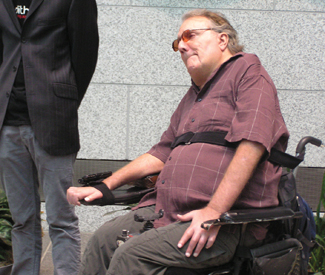
Pappas approached the podium in a wheelchair, a patient himself. As he was introduced, it was noted that here we had one of the little guys, not a tycoon turning millions of dollars of profit as dispensary owners have been portrayed by unsympathetic media and government officials. It’s illegal to turn a profit off of medical marijuana — and who would want to get rich off of sick people anyway?

The controversy over the issue is understandable, but also mind-blowingly hypocritical. You know who turns a profit off of making and distributing medicine? The pharmaceutical industry, to the tune of billions of dollars, in fact. Makes the $1.7 billion national market that constitutes the medical marijuana industry look like shake.

The sound of money talking rendered unsurprising the words of a one Bruce Buckner, who has been a patient “since the laws passed” and who came down from his home in Sonoma County to attend Ammiano and Leno’s press conference. Buckner shared his suspicions about why the federal government turned its eyes to dispensary operations this autumn. Slightly grizzled and wearing a straw hat, Buckner had sat patiently though the event, hooked up to a respirator.

“It’s real obvious why Obama is doing it,” he said. “The pharmaceutical industry is afraid of how potent this medicine is.”

Gee, thanks Kamala

3

After ducking the issue for more than a week, Attorney General Kamala Harris has finally weighed in on the feds crackdown on medical marijuana. Just after Assemblymember Tom Ammiano and state Sen. Mark Leno denounced the bizarre move by the U.S. attorneys, Harris issued a weak, lame and overall pointless statement that shows she is unwilling to be a leader on this issue. The statement doesn’t even appear on the front page of her website.

Here’s what she has to say:

Harris said she was worried that “an overly broad federal enforcement campaign will make it more difficult for legitimate patients to access physician-recommended medicine in California.”

She urged federal authorities to make sure their enforcement efforts are focused on significant traffickers of illegal drugs.

Come on, Kamala. This is a blatant effort by the Obama Administration to overrule state law. It’s an attack on an industry that creates jobs, pays taxes and helps sick people. It’s another front in the failed War on (some) Drugs. And you’re the chief law enforcement officer in the state of California, charged by the Constitution to defend state statutes, including Prop. 215. You can do a lot better than this.

Harris should have joined Ammiano and Leno at their press conference. She should have pointed out that the state is trying to regulate dispensaries, but the federal government has made that almost impossible by pulling this kind of shit.

And the most frustrating this is that Harris could actually make a difference here. What, exactly, is she hiding from? Does she think fighting the U.S. attorneys will make her look soft on drugs or crime and hurt her changes to be elected governor? Doesn’t she realize that medical marijuana is really popular with the voters and that the anti-pot crowd is almost gone?

Dumb. Frustrating and dumb.


The bad old days

0

tredmond@sfbg.com

Willie L. Brown, according to the Chronicle’s John Cote, is “a tremendously popular figure in the city, viewed by many as an avuncular man-about-town, elder statesman and a uniquely San Franciscan character.” The Ed Lee Story, a hagiographic campaign book, refers to Brown’s “characteristic showmanship and hypnotic charm.” Even Randy Shaw, the housing activist who clashed with Brown over gentrification once upon a time, now says in BeyondChron that Brown’s first term “was the most progressive of any mayor in modern San Francisco history.”

I feel as if I’m living in some sort of strange parallel universe, something out of Orwell or North Korea or the Soviet Union of the 1950s. It’s as if history never happened, as if the years between 1996 and 2004 have just vanished, have been deleted from San Francisco’s collective memory. It’s crazy.

I wonder:

What about the thousands and thousands of people who lost their homes and were tossed out of the city like refugees from a war? What about the rampant corruption at City Hall? What about the legions of unqualified political cronies who got good jobs and commission posts? What about the iron-fisted machine rule that kept local politics closed to all but the loyal insiders? Doesn’t any of that count?

Here are some things that absolutely, undeniable, demonstrably happened while Willie Brown was mayor:

Rents on the East Side of town, particularly in the Mission, tripled and sometimes quadrupled between 1996, when Brown took office, and 2004, when he left. Evictions more than tripled, too, and at one point more than 100 people a month were losing their homes. Most of those people were low-income, long-term tenants. They were forced out because richer people were moving into town during the dot-com boom and could pay more for those apartments. We called it the “Economic Cleansing of San Francisco.”

Every day, it seemed, we’d be out at another rally as the Tenants Union and the Mission Antidisplacement Coalition tried to save another family from the forces of gentrification. Every week, it seemed, another group house full of artists would be served an eviction notice. Everywhere you looked, nonprofits and small businesses were losing space to high-tech companies with plenty of money.

I watched the wrecking crew tear down a studio complex on Bryant Street, forcing more than 100 painters and photographers to leave, to make way for a high-tech office project that was approved even though it violated the local zoning laws — and then was never built. For two years, I walked to get my lunch past the empty hole in the ground that had once been a thriving community.

That was typical. Every developer who waved money in front of the mayor got a building permit, no matter how crazy, illogical or illegal the project was. The Planning Department and the Bureau of Building Inspection were little more than fronts for the lobbyists and Brown cronies who determined development policy in the city.

In October, 1999, the author Paulina Borsook wrote a famous piece in Salon called “How the Internet Ruined San Francisco.” I agreed with the sentiment; the influx of the dot-commers was wrecking all that was cool and weird about the city. But she got one point wrong: The Internet didn’t ruin anything. The Internet was, and is, a technology, a tool, something that, like most technological advances, can be used for good or evil.

Mayor Brown didn’t create the dot-com boom. Although he took credit for an awful lot of things, even Willie didn’t claim to have invented the Internet.

But what he did — and what ruined many San Francisco neighborhoods, and ruined the lives of many San Franciscans — was to let the economic cleansing of the city happen, without raising a finger to slow it down or prevent the evictions or protect the most vulnerable people in the city. Over and over, he encouraged it — by appointing commissioners and supervisors and department heads who allowed evictions and development and displacement in the name of growth and prosperity.

In fact, when reporters from the zine Maximum Rock ‘n’ Roll asked Brown about the problems facing poor people, he told them that the city had become so expensive that poor people would be better off living somewhere else.

Because he didn’t care about poor people, or tenants, or artists, or anyone who lacked money and flash and dazzle and clout. He was the worst kind of imperial mayor.

Here’s how we put in it in our 33rd anniversary issue in 1998:

“Let’s say the next major earthquake that hits San Francisco is of roughly the same magnitude of the Loma Prieta quake of 1989, or maybe just a bit stronger. Let’s say it wipes out right 1,000 houses and leave some 5,000 people homeless … and lets say a few unscrupulous profiteers take advantage of the shortages of critical supplies and charge desperate residents triple the normal rate for food, blankets and drinking water….

“The profiteers, speculators and charlatans would be exposed in the press and roundly, loudly denounced by every political and community leader in the city. The ones who didn’t wind up in jail would be forced to leave town in disgrace.”

Or else they wouldn’t. Because when an economic earthquake ravaged San Francisco during his term, Brown — the most powerful mayor in modern history, a guy who could have had an immense impact on what was happening — went to meet the speculators and profiteers with outstretched arms, welcomed them to the city and partied with them at night.

And when he ran for re-election, they thanked him by funding an astonishing $5 million campaign.

Then there was the corruption. Not only did Brown raise pay-to-play to a new art form, he filled the city payroll and key commissions with campaign workers, former political allies, and cronies, subverting the civil service system and undermining both the function of city agencies and public respect for local government. At least seven Brown appointees were indicted or investigated for criminal misconduct. While sentencing a Housing Authority official to five years in prison, U.S. District Judge Charles Legge decried what he called Third World-style corruption at San Francisco City Hall.

When Mayor Ed Lee, who is now seeking a full four-year term, was asked to give Brown a grade for his eight years in Room 200, Lee said: A-Plus.

Which makes us a little nervous. To say the least.

I’ve been going back through the Guardian archives over the past couple of weeks, picking out some great covers to reproduce (see page 18) and looking at four and a half decades of alternative news coverage of San Francisco. And if there’s one theme that emerges from the stacks and stacks and stacks of papers, it’s that local government matters.

In the 1960s, when the underground press was talking about sex, drugs and dropping out, the Guardian was talking about the ways big corporations were stealing the taxpayers’ money at City Hall. (Okay, the Guardian wrote about sex and drugs too. But sex and drugs and political scandals.)

The difference between the independent alternative press and the underground papers of the era was more than just thematic. The underground publishers were having a great time and celebrating culture, but none of those publications was built to last. From the day they published their first issue in October, 1966, Guardian founders Bruce Brugmann and Jean Dibble intended their paper to become a permanent part of San Francisco.

The Guardian quickly demonstrated that it had a different approach than a lot of the “New Left” — particularly when it came to electoral politics. At a time when some were saying that it made no difference whether Ronald Reagan or Pat Brown won the 1966 governor’s race, the Guardian made the key point about Reagan.

“California cannot afford the luxury of this kind of conservatism,” a Nov. 7, 1966 editorial stated. “Because of the millions of people coming to California, because San Francisco and Los Angeles soon will have the greatest concentration of urban power in history, because farm land and open space is vanishing at a suicidal rate, because technology is putting vast populations out of work, because of the social neglect of our cities and the uglification of our countryside, because we now have the knowledge to bridge the gap between the rich and the poor.”

And while the paper devoted considerable space to reporting on and opposing the war in Vietnam, it was also developing a reputation for local investigative reporting. One June 7, 1971 story showed how the city had all of its short-term deposits in local banks that paid no interest at all. The story parked an investigation by the city’s budget analyst, the resignation of the city treasurer — and a new investment policy that brought the city at least $1 million more revenue a year. (Adjusted for inflation, that’s about $5 million a year, times 40 years is a lot of money that the Guardian brought into the city coffers).

And from the start, the Guardian was a nonpartisan, independent foe of corruption, secrecy and undue influence at City Hall. So while the paper eagerly endorsed Phil Burton (and later his brother, John) for Congress and lauded their antiwar and environmental policies, the Guardian also blasted the Burtons for exercising undue influence back home. The paper strongly endorsed George Moscone for mayor — then denounced him when he fired Harvey Milk from a commission post after Milk had the gall to challenge the Moscone/Burton candidate for state Assembly.

The 1999 Sunshine Ordinance, which dramatically opened up City Hall records, was sponsored and promoted by the Guardian. Willie Brown and his cronies hated it.

It’s probably a misnomer to say that the Burtons, who were a dominant force in local politics in the 1970s and 1980s, ran an old-fashioned machine. They didn’t have the iron control over local politics and the patronage jobs system that the word “machine” implies.

But when Brown became mayor of San Francisco, he had all of that. Brown controlled eight solid votes on the Board of Supervisors (and through various political machinations, had managed to appoint most of them). “He ruled the building,” Assemblymember Tom Ammiano, who was a supervisor during those years, recalled. “If you defied him, you were radioactive.”

And one of the people who rose through the ranks as a loyal Brown appointee was Ed Lee. Who to this day thinks things in that administration were just dandy.


The Lee campaign complains about “guilt by association,” and that’s a legitimate point. Ed Lee isn’t Willie Brown. He’s a lot more open, a lot (a lot) more humble, and as numerous progressives have pointed out to us, his door is open. He doesn’t have the history of sleaze that pretty much defined Brown’s political career.

There will be no “Ed Lee Machine.” In fact, with district elections of supervisors pretty much guaranteeing more diffuse political power in the city, there will never be another mayor able to rule the way Brown did.

And these days, Brown’s clout could easily be overstated. Until he engineered the selection of Ed Lee as mayor, his power seemed to be waning. And even Mayor Lee hasn’t done everything that Brown wanted.

Of course, the Chronicle, which he helped immensely when Hearst Corp. bought the paper and had trouble with federal regulators, has helped Brown by giving him a column that created a new, sanitized persona.

But the important thing about the Brown administration was not so much who was in charge but who benefited. The landlords, the developers, the big corporations got pretty much what they wanted from City Hall. The rest of us got screwed.

And now those same interests — in some cases, the exact same people — who supported, promoted and worked with Willie Brown are backing Lee for mayor. If they thought he was going to be an independent progressive, that money and support wouldn’t be coming in. There are people who miss the machine days — and if they think Ed Lee is their guy, it’s reason to worry.

Corruption matters. When people lose faith in local government because they see the kind of sleaze that was daily business under Brown, then they stop wanting to pay taxes for public services. After all, the mayor is wasting our money already. Lee may be a decent guy — but some of the people he hangs out with, some of the people who are supporting him, have a long and very unpleasant history in this town. And all the time he was sitting there at City Hall, while Brown was running a corrupt operation that did lasting damage, Lee never raised a public finger in protest. I hate to see all the history forgotten when people decide who to support for mayor in November, 2011.

Why are Harris, Newsom, and other pols silent on the federal pot crackdown?

24

UPDATED BELOW As I worked on this week’s story about the federal crackdown on California’s marijuana industry, I tried to get a statement from California Attorney General Kamala Harris. After all, it’s her job to defend California’s medical marijuana laws, which she was fairly supportive of as our district attorney. And she was an early Barack Obama backer who could probably get him or U.S. Attorney General Eric Holder on the phone to say, “What the hell are you guys doing? Please, for your own sake and California’s, just back off.”

After all, as I reported, this multi-agency federal crackdown could destroy a thriving industry that is pumping billions of dollars into California’s economy and employing tens of thousands of people – at a cost of many millions of dollars in enforcement costs to simply destroy the state’s top cash crop, ruin the lives of people working in the industry, and strain our already overtaxed court and prison systems.

“It’s a policy with no upsides and all downsides,” Steve DeAngelo of Harborside Health Center correctly told me.

But when I finally got Harris’ Press Secretary Lynda Gledhill on the phone, she said Harris had nothing to say on the issue. “Nothing?” I asked, “Really?” What about off-the-record, I asked, how does she feel about it and might she make some statement in the future. Again, nothing to say, no comment.

So I tried Lieutenant Governor Gavin Newsom, another San Franciscan who as mayor helped oversee the creation of the city’s widely lauded system for regulating the dispensaries, which by all accounts has made it a legitimate and thriving member of the business community. Given Newsom’s current obession with job creation and how hungry he’s been for attention, surely he’d have something to say in defense of the good jobs that this sustainable industry has created in California. Again, nothing. I haven’t even gotten a call back yet from his press secretary, Francisco Castillo.

Also, no public statements have been issued by Mayor Ed Lee, David Chiu, or most other mayoral candidates who have put “jobs” at the center of their agendas – or from the SF Chamber of Commerce or other business groups that regularly deride bad government actions as “job killers – despite this move by the Obama Administration to destroy an important industry in California.

The only major politician from San Francisco (SEE UPDATE BELOW) to come out strongly against the federal crackdown was Assemblymember Tom Ammiano, author of measures to legalize and tax marijuana, who put out the following statement: “I am bitterly disappointed in the Obama Administration for this unwarranted and destructive attack on medical marijuana and patients’ rights to medicine.  Today’s announcement by the Department of Justice means that Obama’s medical marijuana policies are worse than Bush and Clinton.  It’s a tragic return to failed policies that will cost the state millions in tax revenue and harm countless lives. 16 states along with the District of Columbia have passed medical marijuana laws – whatever happened to the promises he made on the campaign trail to not prosecute medical marijuana or the 2009 DOJ memo saying that states with medical marijuana laws would not be prosecuted?  Change we can believe in?  Instead we get more of the same.”

But from most of the politicians who claim to support both jobs and the right of patients to access medical marijuana, we also get more of the same. They pander to people’s economic insecurities in order to give corporations and wealthy what they want – tax cuts, deregulation, union-busting, corporate welfare — but aren’t willing to risk any political capital defending the rest of us.

UPDATE (11/13): San Francisco’s other two representatives in the Legislature have also criticized the crackdown.


Sen. Leland Yee put out a statement saying: “Medical marijuana dispensaries are helping our economy, creating jobs, and most importantly, providing a necessary service for suffering patients. There are real issues and real problems that the US Attorney’s Office should be focused on rather than using their limited resources to prosecute legitimate businesses or newspapers. Like S-Comm, our law enforcement agencies – both state and local – should not assist in this unnecessary action. Shutting down state-authorized dispensaries will cost California billions of dollars and unfairly harm thousands of lives.”

Sen. Mark Leno, another medical marijuana support, also criticized the move. He told the Los Angeles Times, “”The concern here is that the intimidation factor will directly impact safe and affordable access for patients.” And he told Associated Press, “”I don’t understand the politics of it, and certainly if we haven’t learned anything over the past century, it’s that Prohibition does not work.”