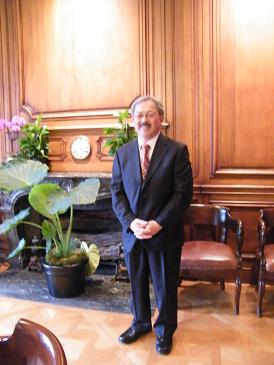
Tom Ammiano

Lee seeks to lessen political damage from his promised veto

3

Mayor Ed Lee says he will veto legislation that the Board of Supervisors approved yesterday that would have banned San Francisco businesses from keeping money they’re required to set aside for employee health care costs. But he seems to be worried about how that move will be seen by voters, touting his support for a “consensus strategy” that doesn’t yet exist and might not be possible given the fundamentally different way both sides see the issue.

The legislation by Sup. David Campos addresses the $50 million per year that businesses have been taking from their employees’ health savings accounts, which they set up to comply with city law requiring them to cover employee health care costs and which many restaurants subsidize by placing a 3-5 percent surcharge on their customers’ bills.

The San Francisco Chamber of Commerce and opponents of the Campos legislation defend the practice and cast efforts to reserve that money for employee health care as a job-killing loss to the business community, although some have finally come around to calling the practice a “loophole” that should be addressed with minor reforms. Yet labor groups and consumer advocates say businesses have no valid claim to that money, making it difficult to see where this elusive common ground might lie.

Supporters of the legislation – including mayoral candidates Leland Yee, Dennis Herrera, John Avalos, and Phil Ting, as well as Assemblymember Tom Ammiano, who authored the Health Care Security Ordinance as a supervisor – rallied on the steps of the City Hall today, calling for Lee to sign the legislation.

Shortly thereafter, the Mayor’s Office issued a press release with the headline “Mayor Lee Convenes Group to Improve Health Care Access & Protect Job,” announcing a “consensus building effort” that includes business groups and Campos and other supporters of the measure. Campos tells the Guardian that he did get a call from the Mayor’s Office today and he agreed to take part in the effort – just as he did in fruitless negotiations with Chamber officials – but he still has a fundamental disagreement with Lee and other Chamber allies over the issue.

“I talked to the Mayor’s Office about their proposal and I have indicated my concerns,” Campos said. He noted that both Lee’s proposal and another alternative by Board President David Chiu – who was quoted in Lee’s press release saying “I am committed to continuing the collaborative effort to ensure health care access to workers while protecting jobs.” – let businesses profit from money that’s supposed to be dedicated to employee health care

“So far, none of the proposals except for mine ensure that whatever consumers pay goes to health care,” Campos said, expressing confidence that public opinion is on his side. “It’s one of those issues that the more everyday San Franciscans hear what’s happening, the more outraged they are.”

But while Lee and Chiu each use the language of seeking compromise and trying to “close the loophole,” both rely on the basic Chamber paradigm that this money belongs to the businesses and setting it aside for employee health care as city law calls for would hurt “jobs.”

When Lee was asked about the issue by a group of reporters today, he said: “Next week, we’re forging a labor and management entities’ meeting with the Mayor’s Office and supervisors to try to forge changes to the Campos legislation. I cannot sign it the way it is now, because of two reasons. One, it does not focus on the healthcare needs of the employees; and two, it will force the employers to just keep millions of dollars lying around without any use and that will decrease the efforts to create more jobs. So both objectives have to be reflected in the ordinance, and I want to make the changes appropriate for that.”

The first reason seems to ignore the fact that the city is barred by federal ERISA law from telling businesses how to provide health coverage, which is why so many of them opted to create these health savings accounts – which are almost useless for people facing serious medical costs – rather than providing health insurance or paying into the city’s Healthy San Francisco program. And supporters of the legislation simply reject the validity of Lee’s second reason.

“That position is based on a false premise. This money belongs to the workers and it’s something that consumers are paying for,” Campos said. “We have a fundamental disagreement.”

Will Mayor Lee veto legislation that helps workers and protects consumers?

10

After the Board of Supervisors today voted 6-5 to bar San Francisco businesses from pocketing money they and their patrons set aside for employee health care, Mayor Ed Lee faces a tough but telling choice: Whether to heed business community demands that he veto legislation that has wide labor and consumer support.
A veto is widely expected, but complicating that decision is the position that was staked out today by one of his main rivals as a mayoral candidate, Leland Yee, who issued a statement echoing supporters claims that this is an issue of workers’ rights and consumer protection versus corporate greed: “This is a defining issue of who we are as a city. If Ed Lee vetoes this legislation, one of my first acts as Mayor will be to reverse his veto and sign this legislation into law.”
Neither Lee’s mayoral nor campaign spokespersons answered a Guardian email about whether he will veto the measure, which would kill it unless two supervisors who opposed the measure (David Chiu, Sean Elsbernd, Mark Farrell, Carmen Chu, and Scott Wiener) break ranks, which is unlikely given the polarization on this measure. San Francisco Chamber of Commerce officials have made a top priority of killing the measure, even threatening to withdraw support from Prop. C, the pension reform measure that they helped create with Lee.
At issue is the roughly $50 million per year that San Francisco businesses have been taking from health savings accounts they create for employee health care – funds that are often subsidized by 3-5 percent surcharges that many restaurants have chosen to tack onto their customers bills – under legislation that then-Sup. Tom Ammiano created to require employers to provide health care coverage for their employees.
The position of the Chamber – which fought Ammiano’s legislation and supported years of unsuccessful lawsuits challenging it – is that this $50 million “loss” to city businesses would be a “job killer.” Chiu has also accepted that paradigm and introduced legislation that would let businesses use that money, but require them to let employees know they can tap into it and other reforms. But supporters of the legislation say these businesses are deceiving their customers, defying city law, and stealing from their employees.
“People have tried to complicate this issue, but it is a simple issue. It’s about the right of workers to have health care,” Sup. David Campos, the author of the legislation, said at today’s hearing.
Campos said he would limit his comments, given how widely the issue has already been discussed, and he announced a limitation on how long employees could tap the fund after their termination “in the spirit of compromise.” But then opposing supervisors attacked the measure, its timing, and supporters’ refusal to “compromise,” with Elsbernd chiding Campos that his legislation is “not the best way to encourage jobs.”
So Campos went into more detail about why his measure was needed, noting that Chiu’s alternative would cap an employee’s access to health care at just $4,300, far less than the cost of a night’s hospital stay and a small fraction of the cost of a serious ailment. “You’re looking at a situation where very little could be provided for them,” Campos said.
He also said how important it is to ban the fraudulent practice of restaurants charging customers for employee health care costs and then simply keeping the money, a practice that a recent Wall Street Journal investigation discovered was widespread. Campos said 80 percent of the money collected on diners’ bills is pocketed by the restaurants.
“When consumers are paying for this, the expectation is that workers will have basic coverage,” Campos said, noting that his legislation would guarantee that “every cent that that consumer pays is actually spent on health care…This is not just about workers, it’s about consumer protection.”
Even worse, Campos noted that these consumers are actually paying twice for restaurant employees’ health coverage, first on their dinner bills, and then again as taxpayers when those uninsured employees end up in General Hospital with their expenses paid for by the city.
Under the federal ERISA law – which was the basis for the failed lawsuit challenging the city program, brought primarily by the Golden Gate Restaurant Association – the city cannot tell employers how to provide health coverage, and so they have the option of providing health insurance, paying into the city’s Healthy San Francisco plan, or providing the medical savings accounts that this legislation addresses.
Sup. Jane Kim said she supported the legislation largely because of the horror stories she’s heard from employees who not only weren’t told of the existence of these accounts, but who were denied payment for medical procedures even after they learned about them. She also said the city could be vulnerable to another ERISA lawsuit if it took Chiu’s approach of directing how businesses used their funds, citing an earlier discussion of the board’s role in protecting the city from litigation.
On that issue, Kim today introduced an alternative to legislation by Farrell and Elsbernd that would end the city’s program of providing matching funds to publicly financed mayoral and supervisorial candidates once their privately financed competitors break the spending cap. The US Supreme Court recently ruled a similar program in Arizona to be unconstitutional.
The Chamber and other downtown groups – mostly supporters of Mayor Lee, who are close to breaking the spending limits – had signaled their intent to sue the city over the issue. The Farrell/Elsbernd legislation, which needed eight votes to change the voter-approved program, today failed on a 6-5 vote, with Sups. Campos, Kim, John Avalos, Eric Mar, and Ross Mirkarimi opposed.

Defy the business community’s shameless ultimatum

3

On the same day that a Wall Street Journal investigation revealed that many San Francisco restaurants are scamming their customers by tacking an employee health care surcharge onto bills and them simply pocketing the money, the Examiner reports that San Francisco business leaders are threatening to withdraw support for pension reform and other measures if the Labor Council supports legislation that would regulate a similar scam.

So, because labor leaders and progressive Sup. David Campos think that employees should actually get health care benefits from the money that city law requires employers to set aside for that purpose — money that many restaurants are supplementing with surcharges on customers of up to 5 percent — the business community is pitching a fit.

We really shouldn’t be surprised that business leaders are acting in such a hostile manner to the city and their own employees. After all, the SF Chamber of Commerce and Golden Gate Restaurant Association bitterly fought the Healthy San Francisco plan created by Tom Ammiano, appealing it all the way to the Supreme Court and losing every step of way.

Then, rather than being gracious losers, they devised deceptive schemes to: 1) jack up people’s dinner bills and make it appear that the city was requiring such a surcharge; and 2) satisfy the letter of the law by creating difficult-to-access health savings accounts for employees, then pocketing what was left unclaimed at the end of the year, which amounted to $50 million last year.

And now, because labor supporters are trying to now, you know, support workers and their rights, the business community has turned on pension reform? Hilarious! I say, good, call their bluff, and let ‘em stop supporting Prop. C. Then next year, we can come around with a new pension reform plan that’s coupled with tax increases on big business, sharing the burden for reforming long-term city finances in a way that it should have been done in the first place.

C’mon, Labor Council, stay strong and show these greedy corporations what we all think of their attacks on their employees, customers, and the city.    

A case for Avalos, Yee and Dufty

121

OPINION Like all of us, SEIU 1021 can take three dates to the prom when it comes to voting for mayor, but narrowing it down in a field of so many candidates was still challenging. After a month-long process, we arrived at a dual endorsement of Supervisor John Avalos and State Senator Leland Yee for first and second choice, and Supervisor Bevan Dufty for our third choice.

It’s a diverse slate, and the choices are representative of the constituencies, perspectives and priorities in our membership.

Yee’s record on labor issues in Sacramento has been impeccable, and he has long been a staunch supporter of our union, so endorsing him was a no-brainer. The Guardian asked me personally, as I am also a transgender activist, how I could support Leland after his vote against transgender health benefits. Frankly, I was disappointed in how my response was framed.

Leland approached transgender activists a number of years ago and apologized for his vote. Instead of denying or rationalizing like other politicians might do, he had the courage to come to a community meeting of transgender activists, stand in front of us, admit he was wrong, and apologize. For people to continue to attack an individual for having a true change of heart is very discouraging. We would never make any advancement of our rights if we continued to shun those who have come to understand and support the transgender fight for equality. In fact, Yee’s support was critical to the collective effort to save Lyon-Martin, a clinic that is a key service provider for trans folks, after it almost closed earlier this year.

That’s why so many in the transgender community now support Yee so strongly and why he has become an even closer, tested ally through this experience.

SEIU 1021 has always had a very close relationship with John Avalos. Avalos has been a steadfast supporter of crucial social and health- care services, and has been a leader in creating needed progressive revenue measures. But most importantly, John understands how essential jobs are for lifting people out of poverty and stimulating the local economy for everyone in San Francisco.

Last year, he introduced a Local Hire ordinance that is becoming a real jobs generator in our city and a national model. Like many of our members when they first started working for the city, workers hired under the Local Hire ordinance may for the first time have a living-wage job with benefits.

And while some in labor have been critical of this legislation — in fact, it cost him the endorsement of the San Francisco Labor Council — that’s a short-sighted criticism.

As more people are employed in San Francisco with living wage jobs, they spend money in San Francisco, boosting tax revenues and in turn creating more jobs across the city. Moreover, this visionary legislation has other benefits — workers coming from low-income communities bring a new found pride in and community spirit to what could be otherwise economically depressed areas. That’s why SEIU 1021 supports Avalos, and why I am proud to endorse him as well.

Rounding out SEIU’s endorsements in this campaign is former Supervisor Bevan Dufty. Dufty has a history of supporting preserving city services. Some have argued that Dufty can’t handle downtown pressure, and yet, Dufty has consistently supported public power, took a stance against Sit-Lie despite intense pressure, and several years ago, at a critical juncture for Tom Ammiano’s signature health care legislation, Healthy San Francisco, he didn’t blink when we called on him to be our 8th vote. In fact, he committed to the bill, unequivocally, and called on other supervisors, like Fiona Ma, to say it was time. She immediately co-sponsored and eventually it was a unanimous 11-0 vote.

For labor and progressives, Ammiano’s Healthy San Francisco legislation was the single most important piece of legislation of the last decade. And while history has been rewritten, and Lt. Gov. Gavin Newsom now takes credit for the legislation, then-Mayor Newsom did not come on board until after Dufty declared his support, and as the 8th supporter, created a veto-proof majority.

Each of these candidates have shown their capacity to grow and transform as leaders making them the best choices for progressive labor, and we believe for the San Francisco. Whatever you do, you have three votes, make them count. 

Gabriel Haaland is a transgender labor activist and the SEIU 1021 San Francisco political coordinator.


Is Peskin plotting a comeback/payback?

36

Many progressives have been disappointed in Board President David Chiu, particularly after his pivotal role in putting Ed Lee into the Mayor’s Office and stacking key board committees with moderates, as well as his controversial swing votes on Parkmerced and other projects. But nobody has been more disappointed than Chiu’s predecessor and one-time mentor, Aaron Peskin (as we detailed in a cover story earlier this year).

Now, knowledgable sources tell the Guardian that Peskin is seriously considering running against Chiu next year for his old District 3 seat on the Board of Supervisors — and that Peskin recently told Chiu that directly — although neither of them is commenting on the record.

So far, Chiu’s run for mayor doesn’t really appear to be catching fire, with Lee leading and only Dennis Herrera, Leland Yee, or Jeff Adachi exhibiting a credible chance of catching him. With many progressive activists actively searching for someone to run against Chiu next year (as Peskin said about another matter, “payback is a bitch”), Chiu is rumored to be eyeing a run for Tom Ammiano’s Assembly seat (which fellow Sup. David Campos is also said to be looking at, probably with Ammiano’s blessing if it happens), either next year or when Ammiano is termed out in 2014.

But Chiu campaign manager Nicole Derse dismisses such speculation, telling us, “The only thing David Chiu is running for is Mayor of San Francisco.  He is not thinking about the 2012 re-election for Supervisor and he is certainly not thinking for a minute about the Assembly race.  If Aaron Peskin decides to run in District 3 next year, it is a free country.”

Team Avalos

63

When Supervisor John Avalos chaired the Budget & Finance Committee in 2009 and 2010, his office became a bustling place in the thick of the budget process. To gain insight on the real-life effects of the mayor’s proposed spending cuts, Avalos and his City Hall staff played host to neighborhood service providers, youth workers, homeless advocates, labor leaders, and other San Franciscans who stood to be directly impacted by the axe that would fall when the final budget was approved. They camped out in City Hall together for hours, puzzling over which items they could live without, and which required a steadfast demand for funding restoration.

“One year, we even brought them into the mayor’s office,” for an eleventh-hour negotiating session held in the wee morning hours, recounted Avalos’ legislative aide, Raquel Redondiez. That move came much to the dismay of Steve Kawa, mayoral chief of staff.

Avalos, the 47-year-old District 11 supervisor, exudes a down-to-earth vibe that’s rare in politicians, and tends to display a balanced temperament even in the heat of high-stakes political clashes. He travels to and from mayoral debates by bicycle. He quotes classic song lyrics during full board meetings, keeps a record player and vinyl collection in his office, and recently showed up at the Mission dive bar El Rio to judge a dance competition for the wildly popular Hard French dance party.

Yet casual observers may not be as familiar with the style Avalos brings to conducting day-to-day business at City Hall, an approach exemplified that summer night in 2010 when he showed up to the mayor’s office flanked by grassroots advocates bent on preserving key programs.

“My role is, I’m an insider, … but it’s really been about bringing in the outside to have a voice on the inside,” Avalos said in a recent interview. “People have always been camped out in my office. These are people who represent constituencies — seniors, recipients of mental health care, unions, people concerned about violence. It’s how we change things in City Hall. It’s making government more effective at promoting opportunities, justice, and greater livelihood.” Part of the thrust behind his candidacy, he added, is this: “We want to be able to have a campaign that’s about a movement.”

That makes Avalos different from the other candidates — but it also raises a crucial question. Some of the most important advances in progressive politics in San Francisco have come not just from electoral victories, but from losing campaigns that galvanized the left. Tom Ammiano in 1999 and Matt Gonzalez in 2003 played that role. Can Avalos mount both a winning campaign — and one that, win or lose, will have a lasting impact on the city?

Workers and families

No budget with such deep spending cuts could have left all stakeholders happy once the dust settled, but Avalos and other progressive supervisors did manage to siphon some funding away from the city’s robust police and fire departments in order to restore key programs in a highly controversial move.

“There’s a Johnny Cash song I really like, written by Tom Petty, called ‘I Won’t Back Down.’ I sang it during that time, because I didn’t back down,” Avalos said at an Aug. 30 mayoral forum hosted by the Potrero Hill Democratic Club. “We made … a symbolic cut, showing that there was a real inequity about how we were doing our budgets. Without impacting public safety services, we were able to get $6 million from the Fire Department. A lot of that went into Rec & Park, and health care programs, and to education programs, and we were able to … find more fat in the Police Department budget than anybody had ever found before, about $3 million.”

Last November, Avalos placed a successful measure on the ballot to increase the city’s real-estate transfer tax, which so far has amassed around $45 million in new revenue for city coffers, softening the blow to critical programs in the latest round of budget negotiations. “Without these measures that community groups, residents, and labor organizations worked for, Mayor Ed Lee would not have been able to balance the budget,” Avalos said.

More recently, he emerged as a champion of the city’s Local Hire Ordinance, designed as a tool for job creation that requires employers at new construction projects to select San Francisco residents for half their work crews, to be phased in over the next several years. That landmark legislation was a year in the making, Redondiez said, describing how union representatives, workers, contractors, unemployed residents of Chinatown and the Bayview, and others cycled through Avalos’ City Hall office to provide input.

His collaborative style stems in part from his background. Avalos formerly worked for Service Employees International Union Local 1877, where he organized janitors, and served as political director for Coleman Advocates for Children & Youth. He was also a legislative aide to former District 6 Sup. Chris Daly, who remains a lightning rod in the San Francisco political landscape.

Before wading into the fray of San Francisco politics, Avalos earned a masters degree in social work from San Francisco State University. But when he first arrived in the city in 1989, with few connections and barely any money to his name, he took a gig at a coffee cart. He was a Latino kid originally from Wilmington, Calif. whose dad was a longshoreman and whose mom was an office worker, and he’d endured a climate of discrimination throughout his teenage years at Andover High in Andover, Mass.

Roughly a decade ago, Avalos and a group of youth advocates were arrested in Oakland following a protest against Proposition 21, which increased criminal penalties for crimes committed by youth. Booked into custody along with him was his wife, Karen Zapata, whom he married around the same time. She is now a public school teacher in San Francisco and the mother of their two children, ages 6 and 9, both enrolled in public schools.

“John has consistently been a voice for disenfranchised populations in this city,” said Sharen Hewitt, who’s known Avalos for more than a decade and serves as executive director of The Community Leadership Academy & Emergency Response Project (CLAER), an organization formed to respond to a rash of homicides and alleviate violence. “He understands that San Francisco is at a major turning point in terms of its ability to keep families and low-income communities housed. With the local hiring ordinance, most of us who have been working around violence prevention agree — at the core of this horrible set of symptoms are root causes, stemming from economic disparity.”

Asked about his top priorities, Avalos will invariably express his desire to keep working families rooted in San Francisco. District 11, which spans the Excelsior, Ingleside, and other southeastern neighborhoods, encompasses multiracial neighborhoods made up of single-family homes — and many have been blunted with foreclosure since the onset of the economic crisis.

“Our motto for building housing in San Francisco is we build all this luxury housing — it’s a form of voodoo economics,” Avalos told a small group of supporters at a recent campaign stop in Bernal Heights. “I want to have a new model for how we build housing in San Francisco. How can we help [working-class homeowners] modify their loans to make if more flexible, so they can stay here?” He’s floated the idea of creating an affordable housing bond to aid in the construction of new affordable housing units as well as loan modifications to prevent foreclosures.

“That’s what is the biggest threat to San Francisco, is losing the working-class,” said community activist Giuliana Milanese, who previously worked with Avalos at Coleman Advocates for Youth and has volunteered for his campaign. “And he’s the best fighter. Basically, economic justice is his bottom line.”

Tenants Union director Ted Gullicksen gave Avalos his seal of approval when contacted by the Guardian, saying he has “a 100 percent voting record for tenants,” despite having fewer tenants in his district than some of his colleagues. “David Chiu, had he not voted for Parkmerced, could have been competitive with John,” Gullicksen said. “But the Parkmerced thing was huge, so now it’s very difficult to even have David in same ballpark. Dennis [Herrera] has always taken the right positions — but he’s never had to vote on anything,” he said. “After that, nobody comes close.”

Cash poor, community rich

There’s no question: The Avalos for Mayor campaign faces an uphill climb. Recent poll figures offering an early snapshot of the crowded field peg him at roughly 4 percent, trailing behind candidates with stronger citywide name recognition like City Attorney Dennis Herrera or the incumbent, Mayor Ed Lee, who hasn’t accepted public financing and stands to benefit from deep-pocketed backers with ties to big business.

Yet as Assembly Member Tom Ammiano phrased it, “he’s actually given progressives a place to roost. He doesn’t pussy-foot around on the issues that are important,” making him a natural choice for San Francisco voters who care more about stemming the tides of privatization and gentrification than, say, rolling out the red carpet for hi-tech companies.

One of Avalos’ greatest challenges is that he lacks a pile of campaign cash, having received less than $90,000 in contributions as of June 30, according to an Ethics Commission filing. “He can’t call in the big checks,” said Julian Davis, board president of Booker T. Washington Community Service Center, “because he hasn’t been doing the bidding of big business interests.” A roster of financial contributions filed with the Ethics Commission shows that his donor base is comprised mainly of teachers, nonprofit employees, health-care workers, tenant advocates, and other similar groups, with almost no representatives of real-estate development interests or major corporations.

Despite being strapped for cash, he’s collected endorsements ranging from the Democratic County Central Committee, to the Harvey Milk Democratic Club, to the city’s largest labor union, SEIU 1021; he’s also won the backing of quintessential San Francisco characters such as renowned author Rebecca Solnit; San Francisco’s radical bohemian poet laureate, Diane di Prima; and countercultural icon Diamond Dave.

While some of Avalos’ core supporters describe his campaign as “historic,” other longtime political observers have voiced a sort of disenchantment with his candidacy, saying it doesn’t measure up to the sweeping mobilizations that galvanized around Gonzalez or Ammiano. Ammiano has strongly endorsed Avalos, but Gonzalez — who now works for Public Defender (and mayoral candidate) Jeff Adachi — has remained tepid about his candidacy, stating publicly in an interview on Fog City Journal, “I like [Green Party candidate Terrie Baum] and John fine. I just don’t believe in them.”

Ironically, Sup. Sean Elsbernd, often Avalos’ political opposite on board votes, had kinder words for him. “John is intelligent, John is honest, and John has integrity,” Elsbernd told the Guardian. “I don’t think he knows the city well enough to serve as chief executive … but I’ve seen the good work he’s done in his district.”

Meanwhile, Avalos is still grappling with the fallout from the spending cut he initiated against the police and fire departments in 2009. Whereas those unions sent sound trucks rolling through his neighborhood clamoring for his recall from office during that budget fight, the San Francisco Police Officers Association (SFPOA), the San Francisco Fire Fighters union, and the plumbers’ union, Local 38, have teamed up now that Avalos is running for mayor to form an independent expenditure committee targeting him and Public Defender Jeff Adachi, a latecomer to the race.

“We’ll make sure we do everything we can to make sure he never sees Room 200,” SFPOA President Gary Delagnes told the Guardian. “I would spend as much money as I could possibly summon to make sure neither ever takes office.” Delagnes added that he believes the political makeup of San Francisco is shifting in a more moderate direction, to Avalos’ disadvantage. “People spend a lot of money to live here,” he said, “and they don’t want to be walking over 15 homeless people, or having people ask them for money.”

If it’s true that the flanks of the left in San Francisco have already been supplanted with wealthy residents whose primary concern is that they are annoyed by the sight of destitute people, then more has already been lost for the progressive movement than it stands to lose under the scenario of an Avalos defeat.

The great progressive hope?

Despite these looming challenges, the Avalos campaign has amassed a volunteer base that’s more than 1,000 strong, in many cases drawing from grassroots networks already engaged in efforts to defend tenant rights, advance workplace protections for non-union employees, create youth programs that aim to prevent violence in low-income communities, and advance opportunities for immigrants. According to some volunteers, linking these myriad grassroots efforts is part of the point. Aside from the obvious goal of electing Avalos for mayor, his supporters say they hope his campaign will be a force to re-energize and redefine progressive politics in San Francisco.

“All the candidates that are running are trying to appeal to the progressive base,” Avalos said. But what does it really mean? To him, being progressive “is a commitment to a cause that’s greater,” he offered. “It’s about how to alter the relationship of power in San Francisco. My vision of progressivism is more inclusive, and more accountable to real concerns.”

N’Tanya Lee, former executive director of Coleman Advocates, was among the people Avalos consulted when he was considering a run for mayor. “The real progressives in San Francisco are the folks on the ground every day, like the moms working for public schools … everyday families, individual people, often people of color, who are doing the work without fanfare. They are the unsung heroes … and the rising progressive leaders of our city,” she said. “John represents the best of what’s to come. It’s not just about race or class. It’s about people standing for solutions.”

When deciding whether to run, Avalos also turned to his wife, Zapata, who has held leadership positions in the San Francisco teacher’s union in the past. She suggested rounding up community leaders and talking it through. “The campaign needed to be a movement campaign,” Zapata told the Guardian. “John Avalos was not running because he thought John Avalos was the most important person in the world to do this job. Our question was, if John were to do this, how would it help people most affected by economic injustice?”

Hewitt, the executive director of CLAER, also weighed in. “My concern is that he has been painted as a leftist, rooted in some outdated ideology,” she said. “I think [that characterization] is one-dimensional, and I think he’s broader than that. My perception of John is that he’s a pragmatist — rooted in listening, and attempting to respond.”

Others echoed this characterization. “He doesn’t need to be the great progressive hope,” said Rafael Mandelman, an attorney who ran as a progressive in District 8 last year. “If people are looking for the next Matt Gonzalez, I’m not sure that’s what John is about. He’s about the communities he’s representing.”

As to whether or not he has a shot at victory, Mandelman said, “It’s a very wide field, and I think John is going to have a very strong base. I think he will get enough first-choice votes to be one of the top contenders. And with ranked choice voting, anything can happen.”


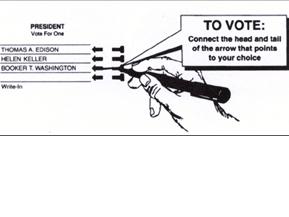
Abolish write-in space on ballots?

5

A bill quietly making its way through the Legislature would eliminate write-in space for some state and federal offices. It’s tucked down near the end of a bill that is supposed to clean up some language in the elections code. You have to scroll through a lot of dense stuff, but check out sections 49 and 54.


I don’t see any need for getting rid of write-in space. I mean, it doesn’t do any harm — and in some cases, write-in campaigns have been a huge deal. Witness Tom Ammiano’s 1999 campaign against Willie Brown — a miraculous, landmark effort that existed only as a write-in. I realize this bill wouldn’t affect local races, but the principle is the same. Why take away the rights of voters to choose a candidate who didn’t get a party nomination?

Editor’s Notes

6

tredmond@sfbg.com

I have friends — progressives, activists, good people — who support Ed Lee for mayor. They tell me that Lee is accessible, that he listens to labor and grassroots community groups, that he’s going to be good on a lot of issues and that, compared to the mayors we’ve had in the past 30 years or so, he won’t be all that bad.

I respect that. I understand. But I try to remind them, and anyone else who’s listening, that the years when Willie Brown ran this town were really, really bad.

At the height of the Brown era, during the dot-com boom, hundreds of evictions were filed every single month. Thousands and thousands of low-income and working-class tenants were displaced, tossed out of San Francisco forever. Blue-collar jobs were destroyed as high-tech offices took over industrial space. Every single developer who waved money at the mayor got a permit, no matter how ridiculous, dangerous or crazy the project was.

In 1999, Paulina Borsook wrote a famous piece for Salon called “How the Internet ruined San Francisco.” But the Internet was just technology; what damaged this city so badly was a mayor who didn’t care what happened to the most vulnerable populations. At one point, Brown even said that poor people shouldn’t live in this city. We called his policies “the economic cleansing of San Francisco.”

He controlled local politics — brutally. If you didn’t kiss the mayor’s ring, you were crushed. He announced one day that the supervisors (then elected citywide) were nothing but “mistresses who have to be serviced” — and since most of them were utterly subservient to Brown, they didn’t even complain. Only one person on the board — Tom Ammiano — regularly defied the mayor; occasionally, Leland Yee and Sue Bierman joined him. But that was it.

The corruption was rampant. People who paid to play got in the door; nobody else came close. You did a favor for Brown and you got a commission appointment or a high-paid job, even if you weren’t remotely qualified.

The ones who suffered most were the poorest residents, particularly tenants, particularly on the east side of town. Brown didn’t seem to care that his appointments, deals and policies were causing terrible pain on the ground; it was as if politics was just a fun game, as if he were some sort of royal potentate, partying in the executive suites and ignoring what was happening on the streets.

There are people who believe that Ed Lee can be independent of Brown, and I hope they’re right. But Lee and Brown are close, and Brown helped put him in office — and the thought of even a small part of that rotten era of sleaze coming back makes me very, very nervous.

The real Leland Yee

53

tredmond@sfbg.com

It’s early January 2011, and the Four Seas restaurant at Grant and Clay is packed. Everyone who is anyone in Chinatown is there — and for good reason. In a few days, the Board of Supervisors is expected to appoint the city’s first Asian mayor.

The rally is billed as a statement of support for Ed Lee, the mild-mannered bureaucrat and reluctant mayoral hopeful. But that’s not the entire — or even, perhaps, the central — agenda.

Rose Pak, who describes herself as a consultant to the Chinese Chamber of Commerce but who is more widely known as a Chinatown powerbroker, is the host of the event. She stands in front of the room, takes the microphone, and, in Cantonese, delivers a remarkable political speech.

According to people in the audience, she says, in essence, that the community has come out to celebrate and support Ed Lee — but that’s just the start. She also urges them not just to promote their candidate — but to do everything possible to prevent Leland Yee from becoming mayor.

She continues on for several minutes, lambasting Yee, the state Senator who lived in Chinatown as a child, accusing him of about every possible political sin — and turning the Lee rally into an anti-Yee crusade. And nobody in the crowd seems terribly surprised.

Across Chinatown, from the liberal nonprofits to the conservative Chamber of Commerce, there’s a palpable fear and distrust of the man who for years has been among San Francisco’s most prominent Asian politicians — and who, had Lee not changed his mind and decided to run for a full term this fall, was the odds-on favorite to become the city’s first elected Chinese mayor.

The reasons for that fear are complex and say a lot about the changing politics of Asian San Francisco, the power structure of a city where an old political machine is making a bold bid to recover its lucrative clout — and about the career of Yee himself.

Senator Leland Yee is a political puzzle. He’s a Chinese immigrant who has built a political base almost entirely outside of the traditional Chinatown community. He’s a politician who once represented a deeply conservative district, opposed tenant protections, voted against transgender health benefits and sided with Pacific Gas and Electric Co. on key environmental issues — and now has the support of some of the most progressive organizations in the city. He’s taken large sums of campaign money from some of the worst polluters in California, but gets high marks from the Sierra Club.

His roots are as a fiscal conservative — yet he’s been the only Democrat in Sacramento to reject budget compromises on the grounds that they required too many spending cuts.

He’s grown, changed, and developed his positions over time. Or he’s become an expert at political pandering, telling every group exactly what it wants to hear. He’s the best chance progressives have of keeping the corrupt old political machine out of City Hall — or he’s a chameleon who will be a nightmare for progressive San Francisco.

Or maybe he’s a little bit of all of that.


Leland Yin Yee was born in Taishan, a city in China’s Guangdong province on the South China Sea. The year was 1948; Mao Zedong’s Communist Party of China had taken control of much of the countryside and was moving rapidly to take the major cities. The nationalist army of General Chiang Kai-Shek was falling apart, and Yee’s father, who owned a store, decided it was time for the family to leave.

The Yees made it to Hong Kong, and since Mee G. Yee had previously lived in the United States and served in the U.S. Army during World War II, he was ultimately able to move the family to San Francisco. In 1951, the three-year-old Leland Yee arrived in Chinatown.

For four years, Yee lived with his sister and mother in a one-room apartment with a shared bathroom while his father worked as a sailor in the merchant marine. It was, Yee recalled in a recent interview, a tight, closed, and largely self-sufficient community.

“The movie theater, the shoe store, the barber shop, food — everything you needed you could get in Chinatown,” Yee said. “You never had to leave.”

Of course, after a while, Yee and his mom started to venture out, down Stockton Street to Market, where they’d shop at the Emporium, the venerable department store. “It was like walking into a different country,” he said. “If you didn’t know English, they didn’t have time for you.”

Yee, like a lot of young Chinese immigrants of his era, put much of his time into his studies — in the San Francisco public schools and in a local Chinese school. “My mom spoke a village dialect, and we had to learn Cantonese,” he said. “Every little kid had to go to Chinese school. We hated it.”

When Yee was eight, his parents managed to buy a four-unit building on Dolores Street, and the family moved to the Mission, where he would spend not only the rest of his childhood but much of his early adult life. He graduated from Mission High School, enrolled in City College, studied psychology and after two years won admission to UC Berkeley.

Berkeley in 1968 was a very different world from Chinatown and even the relatively controlled environment he’d experienced at home in the Mission. “You didn’t protest in school. You’d have been sent home, and your mother would kill you,” he said.

At Berekely, all hell was breaking loose, with the antiwar protests, the People’s Park demonstrations, the campaign to create a Third World College (which led to the first Ethnic Studies Department), and a general attitude of mistrust for authority. “I developed a sense of activism,” Yee said. “I realized I could speak out.”

That spirit quickly vanished when Yee lost faith in some of his fellow activists. “People would work with us, then get into positions of power and use that against you,” he recalled. “A lot of my friends said ‘forget it.’ I left the scene.”

Yee once again devoted his energy to school, earning a masters at San Francisco State University and a Ph.D in child psychology from the University of Hawaii. Along the way, he met his wife, Maxine.

With his new degree, the Yees moved back to San Francisco — and back in with his parents at the Dolores property, where he, Maxine and a family that would grow to four kids would live for more than a decade.


Yee worked as a child psychologist for the San Francisco Department of Public Health, starting the city’s first high school mental-health clinic. He went on to become a child psychologist at the Oakland Unified School District, then joined a nonprofit mental health program in San Jose.

In 1986, Yee decided to get active in politics for the first time since college, and ran for the San Francisco School Board. He lost — and that would be the only election he would ever lose. In 1988, he won a seat, and established himself as an advocate for students of color, fighting school closures in minority neighborhoods. He also tried to get the district to modify its harsh disciplinary rules, arguing against mandatory expulsions.

On fiscal issues, though, Yee was a conservative. For his first term, despite the brutal cutbacks of the recession of the late 1980s and early 1990s, he insisted that the district make do with the money it had. His solution to the red ink: Cut waste. Only in 1992, when he was up for re-election, did he acknowledge that the district needed more cash; at that point, he supported a statewide initiative to tax the rich to bring money to the schools.

The sense of fiscal conservatism — of holding the line on taxes, but mandating open and fair contracting procedures and tight financial controls — was a hallmark of much of his political career. When the Guardian endorsed him for re-election to the board in 1992, we wrote that “there’s real value in his continuing vigilance against administrative fat and favoritism in contracts.”

Over the next four years, Yee worked with then-Superintendent Waldemar “Bill” Rojas, a deeply polarizing figure who pushed his own personal theory of “reconstitution” — firing all the staff at low-performing schools — and later was enmeshed in a scandal that led to prison time for a contractor he’d hired. Yee told me he was the only board member to vote against hiring Rojas, but people who were watching the board closely back then say he didn’t always stand up to the superintendent.

He also became what some say was a bit too close with Tim Tronson, a consultant hired by the district as a $1,000-a-day facilities consultant. Tronson wound up getting indicted on 22 counts of grand theft, embezzlement, and conspiracy in a scheme to steal $850,000 from the schools, and was sentenced to four years in state prison.

In 1998, when some school board members wanted to build housing for teachers on property that the district owned in the Sunset, Yee led the opposition — with Tronson’s help. At one meeting at Sunset Elementary School, Yee went so far as to say, according to people present, that “Tim Tronson is my man, and I rely on him for advice.”

Yee acknowledged that he worked closely with Tronson to defeat that housing project. “He was the facilities manager,” Yee explained, “and I said that I trusted his judgment.”


Yee has either a great sense of political timing or exceptional luck. He ran for the Board of Supervisors in 1996, facing one of the weakest fields in modern San Francisco history. He was the only Chinese candidate and one of just two Asians (the other, appointed incumbent Michael Yaki, barely squeaked to re-election). In an at at-large election with the top five winning seats, Yee came in third, with 103,000 votes.

He was never a progressive supervisor. In 2000, the Guardian ranked the good votes of what we referred to as Willie Brown’s Board, and Yee scored only 43 percent. He was against campaign finance reform. He supported the brutal gentrification and community displacement represented by the Bryant Square development. He voted to kill a public-power feasibility study and opposed the Municipal Utility District initiative. He opposed a moratorium on uncontrolled live-work development.

In 2002, Yee was one of only three supervisors to oppose Proposition D, a crucial public-power measure that would have broken up PG&E’s monopoly in the city. He stood with PG&E (and then-Sups. Tony Hall and Gavin Newsom) in opposition to the measure, then signed a pro-PG&E ballot argument packed with PG&E lies.

When I asked him about that stand, Yee at first didn’t recall opposing Prop. D, but then said he “stood with labor” on the issue. In fact, the progressive unions didn’t oppose Prop. D at all; the opposition was led by PG&E’s house union, IBEW Local 1245.

Yee was particularly bad on tenant issues. He not only voted to deny city funding for the Eviction Defense Collaborative, which helped low-income tenants fight evictions; he actually tried to get the city to put up money for a free legal fund to help landlords evict their tenants. He opposed a ballot measure limiting condo conversions. He opposed a measure to limit the ability of landlords to pass improvement costs on to their tenants.

In 2001, Yee voted to uphold a Willie Brown veto of legislation to limit tenancies in common, a backdoor way to get around the city’s condo conversion ordinance. Only Hall and Newsom, then the most conservative supervisors on the board, joined Yee. At one point, he started asking whether the city should consider repealing rent control.

He opposed an affordable housing bond in 2002, joining the big landlord groups in arguing that it would raise property taxes. Every tenant group in town supported the measure, Proposition B; every landlord group opposed it.

I asked Yee about his tenant record, and he told me that he now supports rent control. But he said that he was always on the side of homeowners and small landlords, and that property ownership was central to Chinese culture. “I was responding to the Chinese community and the West Side,” he said.

He wasn’t much of an environmentalist, either — at least not in today’s terms. He was one of the only city officials to support a “Critical Car” rally in 1999, aimed at promoting the rights of vehicle drivers (and by implication, criticizing Critical Mass and the bicycle movement).

His record on LGBT issues was mixed. While he supported a counseling program for queer youth when he was on the school board, he also supported JROTC, angering queer leaders who didn’t want a program in the public schools run by, and used as a recruiting tool for, the military, which at that point open discriminated against gay and lesbian people.


Yee was also one of only two supervisors who voted in 2001 against extending city health benefits to transgender employees.

That was a dramatic moment in local politics. Nine votes were needed to pass the measure, and while eight of the supervisors were in favor, Yee and Hall balked. At one point, Board President Tom Ammiano had to direct the Sheriff’s Office to go roust Sup. Gerardo Sandoval, who was ducking the issue in his office, to provide the crucial ninth vote.

Yee didn’t just vote against the bill. According to one reliable source who was there at the time, Yee spoke to a community meeting out on Ulloa Street in the Sunset and berated his colleagues, quipping that the city should have better things to do than “spend taxpayer money on sex-change operations.”

It was a bit shocking to trans people — Yee had, over the years, befriended some of the most marginalized members of what was already a marginalized community. “There was one person at the rail crying, saying ‘Leland, how could you do this to us,'” Ammiano recalled.

The LGBT community was furious with Yee. “I didn’t speak to him for at least a year,” Gabriel Haaland, one of the city’s most prominent transgender activists, told me.

Yee now says the vote was a mistake — but at the time, he told me, he was under immense pressure. When he voted for the queer youth program, he said, “the elders of the Chinese community ripped me apart. They called my mother’s friends back in the village [where he was born] and said her son was embarrassing the Chinese community.”

That must have been difficult — and he said that “if I had known the pain I had caused, I wouldn’t have voted that way.” But it was hard to miss that pain his vote caused.

On the other hand, people learn from their experiences, attitudes evolve, we all grow up and get smarter, and the way Yee describes it, that’s what happened to him.

In 2006, when he was running for state Senate, Yee met with a group of trans leaders and formally — many now say sincerely — apologized. It was an important gesture that made a lot of his critics feel better about him.

“He didn’t have to do that,” Haaland said. “People change, and he paid for his crime, and that’s genuine enough for me.”

As a former school board member, Yee kept an interest in the schools — but not always a healthy one. At one point, he actually proposed splitting SFUSD into two districts, one on the (poorer) east side of town and one on the (richer) west. “We strongly opposed that,” recalled Margaret Brodkin, who at the time ran Coleman Advocates for Children and Youth. “Eventually he dropped the idea.”

For all the problems, in his time on the Board of Supervisors, Yee developed a reputation for independence from the Brown Machine, which utterly dominated much of city politics in the late 1990s. His weak 43 percent rating on the Guardian scorecard was actually third-best among the supervisors, after Ammiano and the late Sue Bierman.

In 1998, he was one of the leaders in a battle to prevent the owners of Sutro Tower from defying the city’s zoning administrator and placing hundreds of new antennas on Sutro Tower. He, Bierman, and Ammiano were the only supervisors opposing Brown’s crackdown on homeless people in Union Square.

When he ran in the first district elections, in 2000, against two opponents who had Brown’s support and big downtown money, the Guardian endorsed him, noting that while he “can’t be counted on to support worthy legislation … He’s one of only two board members who regularly buck the mayor on the big issues.”

(He never liked district elections, and used to take any opportunity to denounce the system, at times forcing Ammiano to use his position as president to tell Yee to quit dissing the electoral process and get to the point of his speech.)


In 2002, the westside state Assembly district seat opened up, and both Yee and his former school board colleague Dan Kelly ran in the Democratic primary. Yee won, and went on to win the general election with only token opposition.

His legislative record in the Assembly wasn’t terribly distinguished. Yee never chaired a policy committee — although he did win a leadership post as speaker pro tem. And he cast some surprisingly bad votes.

In 2003, for example, then-Assemblymember Mark Leno introduced a bill that would have exempted single-room occupancy hotels from the Ellis Act, which allows landlords to evict tenants for no reason. Yee refused to vote for the bill. Leno was furious — he was one vote short of a majority and Yee’s position would have doomed the bill. At the last minute, a conservative Republican who had grown up in an SRO hotel voted in favor.

When he ran for re-election in 2004, we noted: “What’s Leland Yee doing up in Sacramento? We can’t figure it out — and neither, as far as we can tell, can his colleagues or constituents. He’s introduced almost no significant bills — compared, for example, to Assemblymember Mark Leno’s record, Yee’s is an embarrassment. The only high-profile thing he’s done in the past several years is introduce a bill to urge state and local governments to allow feng shui principles in building codes.”

In 2006, Yee decided to move up to the state Senate, and he won handily, beating a weak opponent (San Mateo County Supervisor and former San Francisco cop Mike Nevin) by almost 2-1. His productivity increased significantly in the upper chamber — and in some ways, he moved to the left. He’s begun to support taxes — particularly, an oil severance tax — and when I’ve questioned him, he somewhat grudgingly admits that Prop. 13 deserves review.

He’s done some awful stuff, like trying to sell off the Cow Palace land to private developers. But he has consistently been one of the best voices in the Legislature on open government, and that’s brought him some national attention.

Yee has been a harsh critic of spending practices and secrecy at the University of California, and when UC Stanislaus refused in 2010 to release the documents that would show how much the school was paying Sarah Palin to speak at a fundraiser, Leland flew into action. He not only blasted the university and introduced legislation to force university foundations to abide by sunshine laws; he worked with two Stanislaus students who had found the contract in a dumpster and made headlines all over the country.

He’s fought for student free speech rights and this year pushed a bill mandating that corporations that get tax breaks for job creation prove that they’ve actually created jobs — or pay the tax money back. He’s also won immense plaudits from youth advocates and criminal justice reformers for his bill that would end life-without-parole sentences for offenders under 18.

Along the way, he compiled a 100 percent voting record from the major labor unions, including the California Nurses Association and SEIU, and with the Sierra Club. All three organizations have endorsed him for mayor.

Yee told me that he thinks he’s become more progressive over the years. “My philosophy has shifted,” he said.

Yet when you talk to his colleagues in Sacramento, including Democrats, they aren’t always happy with him. Yee has a tendency to be a bit of a loner — he’s never chaired a policy committee and in some of the most bitter budget fights, he’s refused to go along with the Democratic majority. Yee insists that he’s taken principled stands, declining to vote for budget bills that include deep service cuts. But the reality in Sacramento is that budget bills have until this year required a two-thirds vote, meaning two or three Republicans have had to accept the deal — and losing a Democratic vote has its cost.

“You have to give up all sorts of things, make terrible compromises, to get even two Republicans,” one legislative insider told me. “When a Democrat goes south, you have to find another Republican, and give up even more.”

In other words: It’s easy to take a principled stand, and make a lot of liberal constituencies happy, when you aren’t really trying to make the state budget work.


I met Rose Pak on a July afternoon at the Chinatown Hilton. She brought along her own loose tea, in a paper package; the waitress, who clearly knew the drill, took it back to the kitchen to brew. Pak and I have not been on the greatest of terms; she’s called the Guardian all kinds of names, and I’ve had my share of critical things to say about her. But on this day, she was polite and even at times charming.

After we got the niceties out of the way (she told me I was unfair to her, and I told her I didn’t like the way she and Willie Brown played politics), we started talking about Yee. And Pak (unlike some people I interviewed for this story) was happy to speak on the record.

She told me Yee had “no moral character.” She told me she couldn’t trust him. She told me a lot of stories and made a lot of allegations that we both knew neither she nor I could ever prove.

Then we got to talking about the politics of Chinatown and Asians in San Francisco, and a lot of the animosity toward Yee became more clear.

For decades, Chinatown and the institutions and people who live and work there have been the political center of the Chinese community. Nonprofits like the Chinatown Community Development Center have trained several generations of community organizers and leaders. The Chinese Chamber of Commerce, the Six Companies, and other business groups have represented the interests of Chinese merchants. And while the various players don’t always get along, there’s a sense of shared political culture.

“In Chinatown,” Gordon Chin, CCDC’s director, likes to say, “it’s all about personal connections.”

There’s a lively infrastructure of community-service programs, some of which get city money. There’s also a sense that any mayor or supervisor who wants to work with the Chinese community needs to at least touch base with the Chinatown establishment.

Yee doesn’t do that. “He doesn’t give a shit about them,” David Looman, a political consultant who has worked with many Chinese candidates over the years, told me.

Yee’s Asian political base is outside of Chinatown; he told me he sees himself representing more of the Chinese population of the Sunset and Richmond and the growing Asian community in Visitacion Valley and Bayview.

Pak is connected closely to Brown, who Yee often clashed with. For Pak, Brown, and their allies, strong connections to City Hall mean lucrative lobbying deals and public attention to the needs of Chinatown businesses. Then there’s the nonprofit sector.

CCDC and other nonprofits do important, sometimes crucial work, building and maintaining affordable housing, taking care of seniors, fighting for workers rights, and protecting the community safety net. Yee, Pak said, “has never shown any interest in our local nonprofits. We all work together here, and he doesn’t seem to care what we do.” Yee told me he has no desire to see funding cut for any critical social services in any part of town. But he has also made no secret of the fact that he questions the current model of delivering city services through a large network of nonprofits, some of which get millions of taxpayer dollars. And the way Pak sees it, all of that — the nonprofits, the business benefits, the contracts — are all at risk. “If Leland Yee is elected mayor,” she told me, “we are all dead.”

I ran into an old San Francisco political figure the other day, a man who has been around since the 1970s, inside and outside of City Hall, who remains an astute observer of the players and the power relationships in the local scene. At the time we talked, he wasn’t supporting any of the mayoral candidates, but he had a thought for me. “This town,” he said, “is being taken over by a syndicate. Willie Brown is the CEO, and Rose Pak is the COO, and it’s all about money and influence.”

That’s not a pleasant thought — I’ve lived through the era of political machine dominance in this town, and it was awful. In the days when Brown ran San Francisco, politics was a tightly controlled operation; only a small number of people managed to get elected to office without the support of the machine. Developers made land-use policy; gentrification and displacement were rampant; corruption at City Hall turned a lot of San Franciscans off, not only to the political process but to the whole notion that government could be a positive force in society.

A few years ago, I thought those days were over — and to a certain extent, district elections will always make machine politics more difficult. But when I see signs of the syndicate popping up — and I see a candidate like Ed Lee, who’s close friends with Brown, leading the Mayor’s Race — it makes me nervous. And for all his obvious flaws, at least Leland Yee isn’t part of that particular operation. If there’s a better reason to vote for him, I don’t know what it is.

YEE HOME PURCHASE RAISES SUSPICIONS

Rose Pak has a question about Leland Yee. “How,” she asked me, “did the guy manage to buy a million-dollar house on a $30,000 City Hall salary?”

Pak isn’t the only one asking — numerous media reports over the years have examined how Yee raised a family of four and bought a house in the Sunset on very little visible income. And while I’m not usually that interested in the personal finances of political candidates, I decided that it was worth a look.

Here’s what I found: Public records show that in July 1999, Yee and his wife, Maxine, purchased a house on 24th Avenue for $875,000 (it’s now assessed at slightly more than $1 million). At the time, Yee was a San Francisco supervisor, earning a little more than $30,000 a year. (The salary of the supervisors was raised dramatically shortly after Yee left the board and went to the state Assembly.) His wife wasn’t working. And his economic interest statements for that period show no other outside earnings. So the disposable, after-tax income of the entire Yee family couldn’t have been much more than $25,000.

That, by any normal standard, shouldn’t have been enough to float a mortgage that, records show, totaled $516,000. In fact, the interest payments alone on that mortgage alone would total $3,600 a month — more than Yee’s gross income.

Documents in the Assessor’s Office show another paper trail, too. In 1989, Jung H. Lee, Yee’s mother, transferred the deed on a four-unit Dolores St. building where the family had been living to Maxine and Leland Yee — for no money. And a few months before the Yees bought the Sunset house, they took out a $320,000 home-equity loan on that property. That was the down payment on the Sunset property.

Still: At that point, the Yees would have been paying off two mortgages, with a total nut of about $5,000 a month — and supporting four kids, in San Francisco. In 2002, Yee’s economic interest statement’s show some modest income from teaching at Lincoln University — but nowhere near enough to pay that level of expenses.

What happened? Yee explains it this way: “For more than 10 years, we were living rent-free in my parents’ property,” he told me I an interview. “We were a close Chinese family, and my parents provided the food and helped pay for the children’s clothing. So we had almost no expenses and we lived very frugally.”

During that period, Yee was working for the San Francisco Department of Public Health, the Oakland Unified School District, and a San Jose nonprofit, earning, he said, between $50,000 and $90,000 a year. If he saved almost all of that money, he would have had more than a half-million dollars in the bank when he bought the Sunset house.

There’s nothing on any of his economic disclosure forms showing any ownership of stocks or other reportable financial interests during that period, so he wasn’t investing the money. In fact, he says, it was, and is, all in simple savings accounts. A bit unusual for that large a sum of money.

How did he get a mortgage? “Back then,” he said, “banks were willing to lend a lot more freely than they do today.”

Starting in 2003, Yee was in the state Assembly, making a higher salary — but still not much in excess of $100,000 a year. After taxes, he was probably taking home about $75,000 — and $60,000 was going to the two mortgages.

How did he do it? “We have been supplementing our income with our savings,” he said. “We don’t take vacations, we are very careful with our money.” And they clearly aren’t desperate for cash — Yee’s daughter occupies two of the four units in the Dolores St. building they own, but the other two units are vacant.

It’s possible. It’s plausible. But I don’t blame people for wondering how he managed to pull it off. (Tim Redmond, with research assistance by Oona Robertson) 


BIG CORPORATIONS HAVE BACKED YEE

Yee became a prodigious fundraiser in Sacramento — and a lot of the money came from big corporations that had business in the Legislature. And while he has perfect scores from the Sierra Club and the big labor unions, he’s taken tens of thousands of dollars from some of the biggest corporations, agribusiness interests, and polluters in the state. And at times, he’s voted their way.

Since 1993, for example, campaign finance records show Yee has taken more than $20,000 from Chevron, ExxonMobil, Valero, Conoco Phillips, and BP. He’s received another $22,450 from the chemical industry (and industry employees). Most of it came from Clorox, Dow Chemical, and Dupont.

And while the Sierra Club may not have considered it a priority, Sen. Mark Leno has worked hard to pass a bill limiting chemical fire retardants in furniture. In 2008, Yee voted against Leno’s AB 706.

That year he also refused to support a bill that would prohibit the use of the chemical diacetyl in workplaces. The industries that opposed AB 514 (including Bayer, Abbott Laboratories, Pfizer, and Johnson & Johnson) have given Yee a total of more than $60,000.

In 2003, Yee voted against a crucial tenant bill, one that would have prevented the owners of single room occupancy hotels from using the Ellis Act to evict tenants. He received a campaign check for $2,500 from the San Francisco Apartment Association the next day. Landlords in general have given Yee close to $40,000.

Then there’s agribusiness. Yee gets a lot of money from the farming industry, despite the fact that there obviously aren’t many farms in his district. Why, for example, would the California Poultry Association, the California Cattlemen’s Association, and the California Farm Bureau give him money? The Poultry Association’s Bill Mattos told us that Yee “has taken a keen interest in California’s poultry industry.”

Yee also took immense flak from the San Francisco Chronicle and other papers over a 2003 vote against a bill to limit emissions from farm vehicles. In an editorial, the paper wrote that he was “doing dirty work for the lobbyists.” In the end, under immense public pressure, he switched positions and voted for the bill. I asked Yee about all that money from all those bad operators, and he told me — as most politicians will — that campaign cash has never influenced any of his votes.

So why do all these groups give him money? “It’s about whether you will sit down and listen,” Yee said. “I will talk to all sides and at least consider the arguments as a thoughtful human being. Then I vote my conscience.” (Tim Redmond, with research by Oona Robertson) 

Who doesn’t support Ed Lee?

37

One of the more interesting things about the Democratic County Central Committee’s mayoral endorsements was the lack of support for Mayor Ed Lee among the eight state and federal office holders who sit on the panel.


Under the party charter, any Democrat who lives in the city and represents San Francisco in Sacramento or Washington gets to vote at the DCCC. So U.S. Senator Dianne Feinstein, U.S. Reps. Nancy Pelosi and Jackie Speier, state Senators Mark Leno and Leland Yee, State Assembly Members Tom Ammiano and Fiona Ma and Attorney General Kamala Harris all had a say in who the party would support for mayor. None of those people ever show up at the meetings, but they’re allowed to appoint an alternate to represent their views.


And only Feinstein voted to endorse Lee.


Pelosi’s alternate didn’t show up for the endorsement meeting. Speier abstained. Yee voted for himself. Leno voted No Endorsement. Ammiano suported Avalos. Harris abstained. Fiona Ma voted for Bevan Dufty.


Not a rousing show of support for the incumbent.


(It would have been interesting if Lt. Governor Gavin Newsom were still on the DCCC, but Gav has moved to Marin, and he will now have the distinct honor of serving on that county’s committee.)


Meanwhile: I almost want to ignore Randy Shaw’s attempt to portray the DCCC (and some white progressives in general) as racist for not supporting any of the Asian candidates, since I think it’s too easy to throw that word around in this city, and journalists ought to be pretty careful when they do it. White people (like me and Randy Shaw) need to be particularly sensitive to race issues in the media — and I do think there are real tensions between some old-line progressives and emerging Asian political leaders who don’t always agree with progressives on issues. But that sensitivity should include not sensationalizing race or using race to score political points.


That said, it’s worth noting that of the four Asians on the Board of Supervisors, the DCCC endorsed three (Eric Mar, David Chiu, and Carmen Chu). The only one who didn’t get the DCCC nod for supervisor was Shaw’s candidate in District 6, Jane Kim.


Oh, and the Number 1 candidate endorsed by the Democratic Party is Latino. And the two fastest-growing non-white political populations in the city are Asians and Latinos.


You can fight forever about the politics of the DCCC endorsement and why the panel only chose two candidates. The Guardian will almost certainly support three, since that’s how RCV works. Why Yee, who has the support of both SEIU Local 1021 and the Sierra Club, got only two votes at the DCCC is a fair question. Why Chiu, who is a member of the DCCC, didn’t win the third slot is also an interesting political question. But I honestly don’t think race was a factor. Maybe I’m wrong.    


And as for the whole flap about Aaron Peskin, Rose Pak and the People’s Republic of China (based, by the way, on Peskin’s comments in a Falun Gong newspaper): I met with Rose Pak a few weeks ago, and in the course of talking about Leland Yee (who I will be profiling in the Aug. 31 Guardian) she told me that some progressives were accusing her of being a Communist — a reference to comments by Peskin and Chris Daly linking her to the PRC. She called it “red baiting.”


Just for the record: I’d by happy if Pak WAS a communist — maybe she’d be more interested in income redistribution, progressive taxation and land reform in San Francisco. I like communists. I even got me a picture of ol’ Leon Trostky hangin’ in my office (along with a picture of John Ross, another noted pinko). And years ago, when I had a garage, I really did have a commie flag tacked up on the wall. A friend bought it for me in the Soviet Union back in the day, and one of the reasons I loved it was that it was so poorly made that it started to unravel the minute I stuck the tacks in it, and the colors weren’t quite right, and the silkscreened hammer and sickle was way off center. Go team.


Seriously, I think the era when the label “Communist” was a serious smear is long over. Nobody cares any more. Besides, China isn’t really a Communist country these days, is it? I’m not an expert on the Chinese economy, but it seems much more hyper-capitalist to me. And it’s safe to say that there’s no Cuba-style forced economic equality in China, a country that has a handful of billionaires and a lot of very poor people and may have even worse income distribution than the United States.


Maybe we could talk about the issues?

You can’t trust Ethics

2

By Larry Bush

OPINION Proposition F, a measure on the November ballot, is supposed to clean up some provisions of the law that requires political consultants to register and make disclosures about their clients and their work. It was approved by all 11 supervisors.

But Prop. F has some serious problems. For starters, it grants authority to the Ethics Commission to make any other changes it wants in the law.

As the Voter Handbook says:

“A yes vote means: You also want to allow the City to change any of the campaign consultant ordinance’s requirements without further voter approval.”

Why should you oppose that? Because the Ethics Commission can’t be trusted.

The reason San Francisco has a law forcing political consultants to register and make disclosures is because the voters demanded one. City Hall fought against it every step of the way.

Former Supervisor Tom Ammiano introduced the measure in 1996, and it won board approval. Then-Mayor Willie Brown vetoed it. Ammiano rewrote the measure 1997 to meet Mayor Brown’s objections. Brown vetoed it again. And the supervisors who had voted for the law refused to vote for it again and overturn the veto.

So Ammiano and several other supervisors put the measure on the ballot. The political consultants raised a war chest to defeat it and spent more than $100,000 in direct mail, billboards and other voter contacts.

It passed with 61 percent of the vote.

What kind of clean up does Ethics plan now on the political consultant law? You can bet it won’t come down on the side of greater disclosure.

In 2009, two years ago, the Ethics Commission decided to write a clean up of the city lobbyist law. Just like they want to do with the political consultant law now.

And what happened with that law?

It changed one little aspect that didn’t get any real attention. It changed what is defined as a lobbyist — a person or entity who seeks to influence administrative or legislative decisions.

And what is the result?

Now the San Francisco Chamber of Commerce no longer has to file and disclose its lobbying. Neither does Lennar. Neither does the America’s Cup or Larry Ellison.

All those groups had to file under the old rules.

The bottom line is that a sleeping watchdog that can’t be trusted wants the right to change the laws governing political consultants — without any further oversight or public vote.

The former Ethics Commissioners who also are opposing this measure are Paul Melbostad, who served on the commission when the political consultants act was passed; Bob Dockendorff; Joe Julian; Bob Planthold; and Eileen Hansen, who just completed her term and was the only commissioner who voted against the pay-to-play rewrite.

I urge you to join them in opposing this measure.

Larry Bush is the publisher of Citireport.com, a City Hall watchdog.

Editor’s notes

0

So now I’m really confused.

State Assemblymember Tom Ammiano met July 18 with representatives of BART and the BART Police (three BART lobbyists, a deputy chief, and a sergeant). He wanted to get some sense of what’s going on with the investigation into the Civic Center shooting. Ammiano had pushed last year for legislation forcing BART to create a civilian oversight agency for the cops; instead, BART created its own police auditor position.

Ammiano asked when BART would start releasing information, starting with the station video of the event, which ended with a homeless man dead on the platform. BART, Ammiano told me, said the whole thing had been turned over to the San Francisco Police Department.

But the SFPD Public Affairs Office tells me that it won’t release anything — that all information has to come from BART. Linton Johnson, BART’s public affairs person, tells me that it’s SFPD’s investigation and nothing will be forthcoming until SFPD turns its files over to the district attorney — but yes, even then, thanks to an interagency deal, all info will have to come from BART.

Round and round and round we spin. And nobody tells us anything.

There are some serious questions here. BART officials told Ammiano that Charles Hill, the dead man, was “armed with two knives and a bottle.” That’s the current narrative — that the guy was a mortal threat to the officers, who had the discretion to use lethal force.

Quintin Mecke, Ammiano’s press aide, asked the obvious question: Was Hill in fact wielding the weapons in a threatening way? Were the knives later found on his body? Did he throw the bottle or was it in his hand?

BART’s response: “They told me that was part of the investigation,” Mecke said.

As for the SFPD, Mecke said he’s been told that the investigation should be concluded in 45 days — which is crazy. I can’t imagine why it takes that long to review a police shooting that took place on a public train platform — and was recorded on video. “It is,” Mecke told me, “a stonewall all around.”

The good news is that BART now has an official police auditor. His name is Mark Smith. He has no staff at all, so he can’t investigate the case — but that’s okay, because the BART police are offering to help him.

For the record, I remain dubious.

Tom Ammiano and Brad Pitt

6

That’s just the headline to get your attention. Actually, Tom made a great, impassioned speech on the floor of the state Assembly about Sen. Mark Leno’s SB 48, which would mandate that school textbooks include information on the historic role of LGBT people in the development of California. Seems like a no-brainer, but some of the Republicans were pretty awful about it, and there was a fair amount of talk about “sexual preference.”


So up stands Ammiano, who urges his colleagues: “Don’t live in a bubble and encourage me to live a lie because you aren’t confortable. …. I don’t want to be invisible in a textbook. I will not be erased.


“This is about education, about leveling the playing field. This isn’t about trivialization of a very important issue, a life-death issue for so many of us.


“And while I’m at it, let me correct something: My sexual orientation is gay. My sexual preference is Brad Pitt.”


One of the many reasons we love Tom.


Check out the video here.  Tom’s speech is at about 1:25.


The bill passed, 49-25.


A cheap shot at Tom Ammiano

34

Elizabeth Lesly Stevens has done some good work on the insanity of Prop. 13. Check out this, and this, and this — all of which say, more or less, that rich people are getting a great deal under the tax law, and aren’t paying their share.


Correct. Well said. Good points.


So why did she decide to take a cheap shot at the one local politician who’s actually trying to do something about it?


A column that ran in the New York Times July 3 talks about Assemblymember Tom Ammiano, who is leading an effort to reform the worst parts of Prop. 13 — the loopholes that allow commercial property to avoid reassessment, costing the state and local government tens of millions of dollars or more a year.


And what does Stevens, who based on her past writing clearly agrees this is a problem, have to say? Well, she says Ammiano is courageous for taking on the issue — then tweaks him for having a low, Prop. 13-protected assessment on his own house in Bernal Heights:


Yet the feisty Mr. Ammiano is quiet as a church mouse about altering the residential protections of Proposition 13 — of which he is a signal beneficiary.


Mr. Ammiano, who is also a comedian, pays just $530 a year in taxes on the Bernal Heights home he has owned since 1974. As far as the city and Proposition 13 are concerned, his house is worth $45,600. Zillow estimates its current worth at $645,000. At that value, the tax would be about $7,500.


That’s all perfectly true. It’s also true that Ammiano is (a) not rich and (b) has spoken for years of the need to reform all of Prop. 13, not just the commercial loophole he’s going after right now. I’ve known Ammiano a long time — and I can tell you that, since the days he was on the San Francisco School Board in the 1990s, he has consistently favored amending Prop. 13, including the residential benefits that he now enjoys.


So he hasn’t been “quiet as a church mouse.” He’s been pretty loud, for a pretty long time.


He also knows, as does Stevens, that repealing Prop. 13 entirely is a political nonstarter. Not going to happen. Too bad, but even talking about it is a waste of time right now. So Ammiano’s going after the only reform he has a chance of winning — and, by the way, attacking the most outrageous loophole.


I don’t think Stevens meant this to be a hit piece or anything; she, and her editors, are just fascinated by this strange law we Californians call Prop. 13. But when I read her piece, what I got out of it was: Here’s a guy who wants to make other people pay more taxes — but he’s not going to do anything about his own tax breaks. I just don’t think that’s terribly true, or terribly fair.


(By the way, Stevens is on vacation with her family, and, as is her usual practice, didn’t want to comment. She just said people can make their points in the comments section of her piece.)

Ethics chief says “Run, Ed, Run” must register honestly

24

As the pseudo-campaign to convince Mayor Ed Lee to change his mind and run for mayor prepares to open a campaign office tomorrow morning – an event with all the trappings of a real campaign but without the candidate or the regulatory controls – the Ethics Commission is asking it to re-register in a less deceptive way.

As the Examiner reported this morning, Progress for All, the group behind the Run, Ed, Run campaign – which has set up a website, bought advertising, and printed and circulated campaign materials around the sole purpose of promoting a mayoral campaign – registered as a political action committee (one not subject to campaign contribution limits or other controls) even though Ethics Director John St. Croix said it is clearly formed around a primary purpose.

Today, St. Croix tells the Guardian that he has asked Progress for All to re-register as a committee formed around the specific purpose of promoting Lee for mayor, but that “I don’t know that they responded completely in the affirmative.” Guardian calls to the group’s main contract Gordon Chin, who also runs the Chinatown Community Development Center, were not returned.

Despite statements to the Examiner by Progress for All campaign consultant Enrique Pearce that this campaign isn’t unprecedented (he cited the 1999 mayoral write-in campaign of Tom Ammiano, who was a willing participant in the effort and formed a campaign committee), St. Croix said it is unprecedented and his office is figuring out how to regulate it.

“There aren’t regulations specifically designed for a scenario like his,” he told us. “They can’t operate in the absence of regulations.”

Right now, while Progress for All lists five co-chairs of the committee, the public has no way of knowing who’s funding the group, how much individual donors have given, or how much is being spent to make the campaign appear to have popular support. That will become more clear at the end of July when the semi-annual campaign finance reports are due, and St. Croix said his office plans to “carefully examine” those filings in order to decide how to proceed.

The group’s current filings list its purpose as “general civic education and public affairs,” but St. Croix said the public has a right to know that it has actually formed around a single candidate. While the courts have struck down fundraising limits for committees like this, the group’s website seems to limit contributions to the maximum individual contribution of $500, apparently acknowledging that there are potential legal problems with its current approach.

Lee has repeatedly said that he doesn’t want to run for mayor and has not encouraged this effort, but he has done little to discourage the efforts by a group led by his closest political allies, so he could be sullied by group’s tactics if he eventually decides to run. St. Croix says that if Lee runs and his campaign has any overlap with the current efforts, it will raised troubling issues of whether there has been any collusion between the two campaigns, which is illegal.

Despite the concerns expressed by Ethics, the agency doesn’t have a great track record of being tough with powerful campaign finance violators, as a Grand Jury report released this week argues. For example, although the Guardian and Bay Citizen each reported back in October about an independent expenditure (partially funded by Willie Brown) on behalf of Jane Kim’s supervisorial campaign that was done through Pearce’s Left Coast Communications, which was Kim’s campaign consultant, that apparently illegal action was never followed up by the Ethics Commission. St. Croix has said he can’t comment on that incident, and he responded to the grand jury report by noting that its recommendations were mild even though “the report itself uses some fighting words,” and he said he was preparing a formal response.

Although some activists have argued that those expressing concerns about this stealth campaign are somehow being undemocratic, the reality is that Progress for All is the only mayoral campaign not playing by the rules. And there are rules that govern elections, rules set up precisely so the public knows who’s really behind the campaign propaganda.

Civil rights advocates say S-Comm reforms are spin, part of bigger FBI biometric tracking plan

23

In face of mounting criticism nationwide, the U.S. Department of Homeland Security announced today changes to its Secure Communities (S-Comm) deportation program. These changes include protections for domestic violence victims, and immigrants who are pursuing legitimate civil liberties protections. They give more discretion to ICE prosecutors, create a new detainer form that stipulates in multiple languages that arrestees cannot be detained under an ICE hold for more than 48 hours, except on holiday weekends. The form also requires local law enforcement to provide arrestees with a copy, which has a number to call if they believe their civil rights have been violated. The agency also said it will provide civil rights training related to its S-Comm program at the state and local level.

Immigrant and civil rights advocates said the announcement shows that the administration acknowledges that there are serious problems with S-Comm’s design and implementation. But they charged that the announced reforms fall far short of the S-Comm moratorium that an increasing number of advocates and lawmakers, including California Assemblymember Tom Ammiano, have demanded.

And some advocates expressed concern that the feds’ insistence on expanding S-Comm, in which fingerprints taken by local law enforcement agencies are automatically shared with federal and international databases, is proof that the program is the first step towards rolling out a much larger program called the Next Generation Identification (NGI) initiative.

Under the NGI, the FBI plans to phase-in the deployment of a host of new biometric interoperability capabilities to state and local law enforcement agencies within the next five years. And NGI likely won’t be limited to non-citizens and undocumented immigrants, suggesting that US citizens charged with a crime will also find that once their fingerprints are taken, law enforcement agencies will immediately compile a huge and internationally interconnected dossier on them, regardless of whether they are innocent of the charges.

Civil rights advocates also worry that local enforcement agencies’ participation in S-Comm will become inevitable because S-Comm is simply the first of a number of biometric interoperability systems being brought online by the NGI.
In other words, S-Comm is just the first of many additional information systems that are being made available to local law enforcement agencies to fully and accurately identify suspects in their custody.

And, according to the FBI/CJIS’s own documents, the feds have adopted a three-part strategy to deal with jurisdictions that do not wish to participate:
1.    Deploy S-Comm to as many places as possible in the surrounding locale, creating a “ring of interoperability” around the resistant site.
2.    Deploy S-Comm selectively to state correctional system facilities, permitting identification of Level 1 offenders who may have been arrested and sentenced in the non-participating jurisdiction,
3.    Ensure that the jurisdiction understands that non-participation does not equate to non-deployment.
In other words, though a local law enforcement agency is technically free to shut off, or ignore, the receipt of records related to the fed’s fingerprint-matching capabilities, the feds are already warning local law enforcement agencies that local officers may find themselves “deprived of substantive information relating to an arrested subject’s true identity, place of origin, and other pertinent data of significant law enforcement value.”

Ammiano, who is the author of California’s TRUST Act, which would allow local governments to opt out of S-Comm, said: “Today’s announcement by ICE is simply window dressing. How many more innocent people have to be swept up by the ironically named Secure Communities program before the Obama administration will change course? Talking about the need for comprehensive immigration reform is not an excuse for continuing with a flawed, unjust program that is having tragic consequences for communities across the country. It is time for a moratorium on S-Comm pending a real review of the program not just PR spin from ICE.”

Professor Bill Ong Hing, immigration law expert at the University of San Francisco, stated, “The fact is, under our Constitution, immigration is a federal responsibility. Neither a state like Arizona, nor the federal government itself, can force local governments to act as immigration agents. Such measures compound the injustices of our deeply broken immigration system – and public safety and local resources are among the first casualties.”

And the Asian Law Caucus, the ACLU of California, the Coalition for Humane Immigrant Rights of Los Angeles, the California Immigrant Policy Center, and the National Day Laborer Organizing Network released the following joint statement:  “We are deeply disappointed by the inadequacy of the Administration’s response to the mounting body of evidence that the ‘Secure’ Communities program is damaging public safety and ensnaring community members. The painful stories of domestic violence victims and other innocent community members facing deportation thanks to S-Comm underscore that the program has simply gone off the rails. While today’s announcement acknowledges that problems exist with the program, the measures outlined by the Administration are a far cry from workable solutions these problems. To announce “reform” before review is an exercise in politics, not policy. The administration should suspend the program and wait for the Inspector General report in order to develop fair and transparent policies.” 

“Before vital relationships between local law enforcement and immigrant communities are furthered damaged, before more domestic violence victims, street vendors, family members, and workers who are merely striving for the American dream are swept up for deportation, S-Comm must be reigned in,” the coalition continued. “For the sake of public safety and transparency, we need real solutions. We strongly support California’s TRUST Act, which sets safeguards the federal government has failed to implement and allows local governments out of S-Comm, and we continue to call for a national moratorium on this fundamentally flawed program.”

In recent weeks, Illinois, New York, and Massachusetts, have either pulled out or refused participation in the program while numerous local governments have sought a way out of a deportation dragnet that harms public safety and has operated with no transparency or local oversight. And Ammiano’s TRUST Act, which also sets basic standards for those jurisdictions that do want to participate in S-Comm passed the state Assembly in May and the Senate Public Safety Committee this week.

During today’s press conference, ICE Director John Morton told reporters that “it makes sense to prioritize resources. We don’t have enough resources to remove everyone who is here unlawfully.”

But when the Guardian asked if the reforms address the community criticisms that S-Comm was rolled out as a way to catch serious criminals, but has been largely used to deport non-felons, Morton maintained the S-Comm has always focused on serious criminal offenders, but was never limited to that.
“We remove felony offenders at a higher rate than are convicted in the general population,” he stated. ‘But federal law does not provide that you can come here unlawfully and then commit crimes other than violent crimes.”

True, but local law enforcement agencies have repeatedly observed that you break vital trust with immigrant communities if they believe that contact with police, including  being arrested for crimes they did not actually commit, or arrests for very low-level misdemeanors, will lead to deportation.

“This feels like a non-announcement, and it’s far from reform,” said B, Loewe of the National Day Laborers Organizing Network. “You don’t put a collar around a snake and call it a pet.”

And SF Police Commissioner Angela Chan, a staff attorney at the Asian Law Caucus, said the reason ICE and the FBI, “are so crazy for S-Comm is because it’s the first step in a much bigger loop that will include citizens and non-citizens alike.”

NDLON and the Asian Law Caucus are part of the coalition that is calling on the Obama administration to publicly oppose and terminate all programs that create partnerships between state and local law enforcement and the Department of Homeland Security; halt the development of the vast data gathering infrastructure that houses S-Comm, and inform the public of the current scope and purpose of its data collection and dissemination activities; and allow state and local jurisdictions to opt-out of S-Comm.

After today’s press conference, ICE issued a press release stating that through April 30, 2011, more than 77,000 immigrants convicted of crimes, including more than 28,000 convicted of aggravated felony (Level 1) offenses like murder, rape and the sexual abuse of children were removed from the U.S. after identification through S-Comm.

“These removals significantly contributed to a 71 percent increase in the overall percentage of convicted criminals removed by ICE, with 81,000 more criminal removals in FY 2010 than in FY 2008,” ICE stated. “As a result of the increased focus on criminals, this period also included a 23% reduction or 57,000 fewer non-criminal removals.

ICE also observed that the agency currently receives an annual congressional appropriation that is only sufficient to remove a limited number of the more than 10 million individuals estimated to be in the U.S. unlawfully. “As S-Comm is continuing to grow each year, and is currently on track to be implemented nationwide by 2013, refining the program will enable ICE to focus its limited resources on the most serious criminals across the country,” ICE stated.

ICE further noted that it is creating a new advisory committee that will advise ICE on ways to improve S-Comm, including recommending on how to best focus on individuals who pose a true public safety or national security threat.  This panel will be composed of chiefs of police, sheriffs, state and local prosecutors, court officials, ICE agents from the field and community and immigration advocates.  The first report of this advisory committee will be delivered to the Director of ICE within 45 days.

ICE Director Morton also issued a new memo that directs the exercise of prosecutorial discretion to ensure that victims of and witnesses to crimes are properly protected. The memo clarifies that the exercise of discretion is inappropriate in cases involving threats to public safety, national security and other agency priorities.

And ICE and the DHS Office for Civil Rights and Civil Liberties (CRCL) have created an ongoing quarterly statistical review of the program to examine data for each jurisdiction where S-Comm is activated to identify effectiveness and any indications of potentially improper use of the program. “Statistical outliers in local jurisdictions will be subject to an in-depth analysis and DHS and ICE will take appropriate steps to resolve any issues,” ICE stated.
.

The guv’s veto — WTF Jerry?

17

Nobody — least of of the Democrats in the state Legislature — quite knows why Gov. Jerry Brown vetoed the state budget. In fact, he didn’t even tell Legislative leaders what he was about to do. “There was no heads up, and that’s the most annoying part of it,” Assemblymember Tom Ammiano told me.


Brown knew exactly what the Democrats were doing. He also knew (or ought to know) that getting any Republicans ever to vote for his tax extensions was, and is, a pipe dream. If he didn’t like the Dems proposal, he could have asked for changes. But no: Jerry is Jerry, and he did his own thing. (Just like Arnold, he complained about the “can being kicked down the road.”) His veto message talks about how “strong medicine must be taken” to solve the deep fiscal crisis; without taxes (which the GOP won’t allow) I guess he’s talking about more cuts. I guess he’s talking about Californians really feeling the deep pain of another $10 billion cuts to services, so maybe they’ll wake up and demand more revenue and oust the Republicans.


But in the meantime, the governor won’t miss any meals.


Brian at Calitics looks at the bright side — at least that sale/leaseback idea is gone. And yes, the budget that the Democrats put forward was ugly and far from perfect. But I don’t see where we go from here. The Democrats in the Legislature aren’t going to vote for another $10 billion in cuts; no way. And the Republicans aren’t going to vote for tax extensions. And the existing taxes expire at the end of the month.


If there’s a good alternative out there, I don’t see it.


CA Senate committee approves TRUST Act in face of rising “S-Comm” concerns

2

The California Senate Public Safety Committee approved Assemblymember Tom Ammiano’s TRUST Act, (AB 1081) today in a 5-2 vote, in face of rising concerns about a troubled federal fingerprinting and deportation program known as Secure Communities (S-Comm). The TRUST Act would reform California’s participation in S-Comm, which has increasingly come under fire for undermining public safety and operating without transparency or local oversight. Ammiano’s AB 1081 assures that local governments have the ability to opt out of the program and it sets basic standards for jurisdictions that choose to participate. The bill now heads to the Senate Appropriations Committee for consideration.

San Francisco Police Commissioner Angela Chan, a staff attorney with the Asian Law Caucus, says  that immigrants rights activists are calling on California Gov. Jerry Brown and Attorney General Kamala Harris to suspend S-Comm entirely, for now. These calls come in the wake of New York decision to suspend the troubled program, Illinois’s decision to terminate the program, Massachusetts’ decision to refuse to sign the Department of Homeland Security’s proposed S-Comm agreement, and the Inspector General’s announcement that it plans to investigate S-Comm allegations this summer.
“But if S-Comm eventually becomes unsuspended, that’s where the TRUST Act would come into place,” Chan said.

At today’s hearing in Sacramento, retired Sacramento Police Chief Arturo Venegas testified in support of the TRUST Act, calling S-Comm a “Trojan horse,” thanks to Immigration and Customs Enforcement (ICE’s) alleged misrepresentation of S-Comm to law enforcement. And community leader Renee Saucedo read the testimony of Norma, a domestic violence victim whose calls for help landed her in deportation proceedings thanks to S-Comm.

Tuesday’s vote comes on the heels of a growing firestorm of congressional criticism of the program, which reportedly has an annual budget of $200 million. And the latest statistics from ICE show that of all the states, California has deported the most immigrants under S-Comm. As of April 2011, California had deported 41, 833 individuals since it began phasing in its participation in S-Comm in May 2009. These figures include 12,133 folks (30 percent of deportees) who did not have a criminal record. And if you add those with low-level offenses to the non-criminal category, the percentage grows to 70 percent. Texas was in second place after California, with 27,000 S-Comm deportations.

Alerts

0

ALERTS

By Jackie Andrews


WEDNESDAY, JUNE 15

Golden Wheel Awards

Join the SF Bike Coalition to celebrate and congratulate the movers and shakers who realize the potential for connectedness and comfortable biking in San Francisco. Award recipients include the SFMTA for the safer green bike lanes installed along Market Street, which have attracted new commuter cyclists to the Financial District. Also hear from Leah Shahum about the Bike Coalition’s bold vision of cross-town bikeways.

6–9 p.m.,

$75 individual, group packages available

War Memorial Building

401 Van Ness, SF

www.sfbike.org


THURSDAY, JUNE 16

The Castro and LGBTQ history

Attend this panel discussion called “No Equality Without Economic Equality: The Struggle Against Gentrification and Displacement in the Castro in the Late 1990s” and learn about the tumultuous period of dot-com boom and doom in San Francisco’s Castro District — a time when rents soared, long-term tenants were displaced (many living with HIV and AIDS), and queer youth ended up on the street. But there was a silver lining. Out of the gentrification grew a strong community of activists and much- needed social services, as well as historical milestones like the Tom Ammiano write-in mayoral campaign of 1999 and the progressive takeover of the Board of Supervisors the following year. Speakers include Tommi Avicolli Mecca, Jim Mitulski and Gabriel Haaland, and Paola Bacchetta.

7–9 p.m., $5

GLBT Historical Museum

4127 18th St., SF

www.glbthistorymuseum.org


TUESDAY, JUNE 21

Guardian forum: Budget, Healthcare, and Social Services

This is the second forum in a five-part series that examine local issues that are expected to have a major impact in the upcoming mayoral race. Representatives from labor groups and local nonprofits will be on hand, as will budget experts, to discuss the city budget, access to healthcare for San Franciscans, and other useful and threatened social services. This is sure to be a lively discussion and a unique opportunity to get involved in local politics. Be there.

6–8 p.m., free

Local 2 Hall

309 Golden Gate, SF

www.sfbg.com

Media access here and now

Weigh in on the issue of media access in San Francisco and the controversy around the accessibility of media passes for journalists while out on assignment. Panelists at this conversation with the Society of Professional Journalists will include SFPD’s Lt. Troy Dangerfield, attorney David Greene with the First Amendment Project, interim City Administrator Amy Brown, and a local journalist who has experience going through the process of trying to obtain a press pass.

5:30 p.m., free

SF Public Library

Latino Community Room

100 Larkin, SF

www.spj.com 


Mail items for Alerts to the Guardian Building, 135 Mississippi St., SF, CA 94107; fax to (415) 437-3658; or e-mail alert@sfbg.com. Please include a contact telephone number. Items must be received at least one week prior to the publication date.

Ten good bills for 2011

2

The news in Sacramento is mostly bad — Jerry Brown still can’t find the Republicans he needs to pass a budget, although maybe the redistricting process will help him. But it’s not all bad. Some important bills passed their houses of origin in the past week, and with Democrats controlling both the Senate and the Assembly and a Democratic governor, there’s actually a chance they could become law.


At the top of my list is the measure by Darrel Steinberg that could allow counties and school districts to raise a wide range of taxes. It is, as Sen. Mark Leno notes, a “game changer.” And it only requires a simple majority of both houses. (I wonder: Could the San Francisco supervisors put a tax measure on the ballot in November on the assumption that the Steinberg bill will be in effect by then?) If the GOP won’t budge on the budget, the Dems need to at least give local government the chance to find the resources to keep essential services running.


Assemblymember Tom Ammiano got AB 9, also known as Seth’s Law, approved on the Assembly floor. The measure, named in memory of Seth Walsh, a 13-year-old gay student from Tehachipi who suffered years of harassment and abuse, gives school districts the tools (and the mandate) to address bullying.


The Assembly also approved Ammiano’s AB 889, the Domestic Workers Bill of Rights, which gives domestic workers the same basic labor-law protections as other California workers, and AB 1081, the TRUST Act, which would allow California counties to opt out of S-Comm, the awful federal law that seeks to force local cops to become ICE agents.


Over at the state Senate, Mark Leno won approval for 11 bills, including SB 914, which would mandate that police get a warrant before searching the data on a person’s cell phone. It’s crazy that SB 914 is even necessary, but the state Supreme Court has ruled that, while you need a warrant to search a personal computer, you don’t need one to search a cell phone. SB 790 makes it easier for local agencies to form Community Choice Aggregation systems. SB 819 would give the state more authority to take firearms away from people who have committed felonies or have been institutionalized for mental illness. (The NRA’s going to hate this bill — felons have the right to guns, too …) SB 233 — another one I really like — gives local government the right to impose vehicle license fees.


Sen. Leland Yee won overwhelming support for SB 8, which mandates that foundations affiliated with the University of California, Cal State or community college campuses abide by the same public records laws as the schools themselves. (The Sarah Palin speaking fees bill.) SB 364, which requires corporations that get tax breaks for job creation to prove they’ve actually created jobs. SB 9 — another one that ought to be a no-brainer — ends the practice of giving juvenile offenders sentences of life without parole.


Seems likely all of these will emerge from the remaining house — and then we’ll see whether Brown is willing to sign progressive legislation.


Campos plans to plug loophole in SF health care law

1

Back in 2006, when Tom Ammiano was a supervisor, the Board approved his trailblazing San Francisco Health Care Security Ordinance (HCSO).  But the Golden Gate Restaurant Association, which presumably prefers you get served by folks who don’t have health insurance (“Waiter, there’s a booger in my soup!”) sued the city over the program. GRRA was hoping to invalidate the employer spending requirements of the City’s ordinance on the grounds that it violated the federal Employee Retirement Income Security Act. And in its quest, GGRA, which represents restaurants statewide and was concerned that Ammiano’s citywide legislation would spread to other municipalities, tried to take its case all the way to the U.S. Supreme Court. But in June 2010, the “Supremes” denied review to GGRA’s legal challenge, ending a contentious four-year legal battle over “Healthy San Francisco.” Or so everybody thought.But according to Sup. David Campos, who succeeded Ammiano as D9 supervisor and champion of the city’s health care legislation, some employers have been exploiting a loophole in the HCSo legislation to avoid their obligations under the law. And Campos now plans to stick a cork in this loophole.

Since 2008, HCSO has mandated that private businesses with 20 or more employees make minimum health care expenditures to, or on behalf of, their covered employees each quarter. But instead of paying for health insurance or paying into Healthy San Francisco (which provides workers with free or reduced-cost enrollment) some employers allocated money on paper to an account workers can access to reimburse out-of-pocket medical expenses.

“The problem is that most of these accounts are set up with ‘use-it-or-lose it’ provisions, “ a press release from Campos’ office explains. “The employers are credited with making the expenditures, but the balances in the accounts are wiped-out at the end of every year (or when the worker quits or gets fired) and the employers keep the money.” Oops.

So, Campos is introducing an amendment to the HCSO that would close what he’s calling a “don’t get sick in January” loophole (when employers zero-out the account balance at the end of the year, their employees begin the next year without any money available to reimburse health care costs). 

According to Campos, only 20 percent of the $62 million allocated to such reimbursement plans last year was actually reimbursed to the employees.“This means that $50 million, or 80 percent, of the health care expenditure was not spent on employee health care,” Campos stated. “Moreover, employers that meet the spending requirement via use-it-or-lose-it reimbursement accounts have a financial incentive to limit their use (in order to retain more funds at the end of the year).”

Campos’ office cites the words of auto mechanic Ron (who prefers not to use his last name for fear of retaliation by his employer) to explain this problem.

 “My employer provides me and my co-workers with a use-it-or-lose-it reimbursement account to satisfy part of its spending requirement under the Health Care Security Ordinance,” Ron stated. “But the employer does not allow us to use the money to pay for health insurance premiums and has limited the services eligible for reimbursement to such an extent that it is difficult to make good use of the account. As a result, we use a small portion of the money and lose the rest every year.  I finally decided to join Kaiser as a dependent of my wife who is a city employee.” 
 
Campos’ proposed amendment would close the loophole by re-affirming the traditional understanding of a “health care expenditure.”: employers will not be credited with making mandatory health care expenditures unless the expenditure is “irrevocably paid” (the money carries over from quarter to quarter and year to year to the employee.)

Campos’ proposed legislation also requires employers to provide written notice to their employees explaining how they are meeting their health care expenditure, and it streamlines penalties for noncompliant employers.

Zazie restaurant owner Jennifer Piallat says she supports the amendment because it “levels the playing field” for the vast majority of businesses in San Francisco that provide health insurance to their employees.

“A loophole should not disadvantage those of us who agree with the spirit of the Health Care Security Ordinance and who believe that employers should contribute to the well being of our employees,” Piallat stated.

Whether this loophole means that restaurants that were allegedly adding up to 4 percent in surcharges to customers’ bill to cover the alleged cost of paying contributions to their employees’ healthcare costs, have been pocketing the difference remains to be seen. An HCSO analysis by the city’s Office of Labor Standards Enforcement notes that the city’s Treasurer and Tax Collector did not collect industry data from businesses in 2009 and 2010, and therefore expenditures by industry are not available for those years.

But i industry data from 2008 shows that the “accommodations and food services” industry (think hotels and restaurants) “elected reimbursement plans as their primary expenditure at a substantially higher rate than any other industry in 2008,” the OLSE report states. (A table atttached to OLSE’s report shows that this rate was 47 percent in 2008—which was 36 percent more than the next highest ranking industry group listed.)

OLSE’s analysis also reveals that in 2010, 90 percent of all health care dollars were spent on health insurance, 3 percent were spent on Healthy San Francisco (the health access program San Francisco established as an option within HCSO) and only & percent were allocated to reimbursement plans. So, in other words, in 2010, most employers were doing the right thing by their employees, at least in terms of making required health care expenditures.

“The average reimbursement rate of money allocated to reimbursement plans in 2010 was low: only 20 percent of the $62.5 million allocated to such plans in 2010 was actually reimbursed to employees,” states the executive summary of OLSE’s analysis. “The remaining 80 percent, or $50.1 million, went unutilized. The median reimbursement rate for the 29 percent of employers (860 in total) that allocated money to a reimbursement plan in 2010 was even lower, just 12 percent.

OLSE’s report notes that this low utilization rate of reimbursement dollars is consistent with prior years.
“For example, in each of the past three years, over 50 percent of such plans (53 percent in 2008, 52 percent in 2009, and 57 percent in 2010) had a reimbursement rate of between 0 and 10 percent,” OLSE observed. “In other words, more than half of the employers who elected to meet their health care expenditure requirement (entirely or in part) by providing reimbursement plans retained over 90 percent of the money allocated to reimbursement plans. The increase in the percentage of employers utilizing reimbursement plans coupled with continued low reimbursement rates raises public policy concerns.”

Campos will be holding a press conference tomorrow (Friday June 10) at 11.30 a.m. in his office (Room 279 in City Hall) to flesh out the gory details. He’ll be joined by Tim Paulson, Executive Director of the Labor Council; Jennifer Piallat, owner of Zazie; Ron, auto mechanic; Tiffany Crain, Young Workers United; and Matt Goldberg, from the city’s Office of Labor Standards Enforcement.