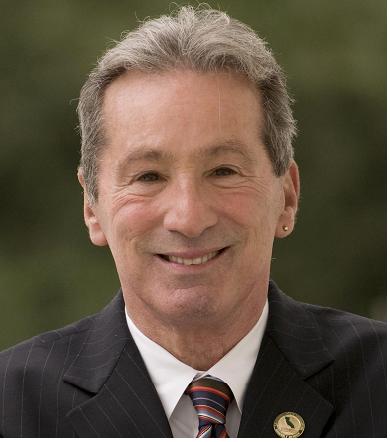
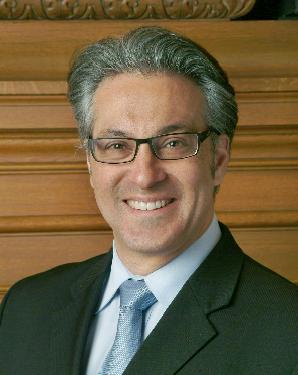
Tom Ammiano

Nevius family values

6

The Chron’s C.W. Nevius has made a big deal of moving back into town from the suburbs — and the offhand comment by Steve Jones in an email to Nevius has almost become a sticky nickname. In fact, his own newspaper’s website, sfgate, headlined his column “Suburban twit moves to city.”

But Chuck’s got some work to do before he starts to understand San Francisco values.

Take his latest column, about the Democratic County Central Commitee. Now, any Chron columnist (or anyone else) has the right to endorse and advocate for any candidates he or she wants. And Nevius is absolutely right to point out that the DCCC race is crucial, that control of the committee will have a significant impact on the fall supervisorial elections.

Here’s what made me want to scream:

“So, if you’re happy with the far-left agenda, check out the Bay Guardian. (Progs with name recognition like Peskin, David Campos, David Chiu, and John Avalos are probably shoo-ins. Daly is not running.) For those who’d like to see a swing to families, kids, and civility on the streets, here are some suggestions.”

 A swing to families and kids? You must be kidding.

The single greatest issue facing families and children in this city is the cost of housing. That’s why Coleman Advocates for Children and Youth, which almost everyone agrees is the premier family-advocate group in the city, has made affordable housing a huge priority.

Some of what a recent Coleman report says:

 “Two-thirds of all children in the city do not have a secure future in San Francisco

More families in San Francisco are low-income (43%) than middle-income (23%), and face economic hardship even when working full-time jobs.

Extreme racial disparities in family income and access to opportunity mean that the majority of children who do not have a secure future in SF are children  of color, and the majority of children who do have a secure future are white.”

Coleman’s recommendations: Build and preserve affordable housing for families — not market-rate condos, not condo conversions, but below-market-rate housing.

From the report:

“1. Prioritize the needs of 45,000 children growing up in 20,000 extremely-poor and low-wage working families.  trategies must combine investing in a stronger social safety-net for families now, and investing in anti-poverty strategies that will prepare today’s poor children to become economically secure San Franciscans of the future. The city’s housing and educational policies must focus on the children and families with the greatest need, and not get sidetracked by the demands of middle-income or upper-income families whose needs are legitimate but not as urgent.

 2. Invest in affordable homeownership programs for middle-income families, but focus the vast majority of limited housing resources on building permanently affordable family rental housing.”

That is exactly what the progressives — the “far left” folks that Nevius decries — have been talking about all these years. The candidates Nevius endorses are of the political camp that advocates more market-rate housing, more condo conversions, fewer tenant protections — more of the kind of things that drive lower-income families out of the city.

The next priority is education. Families that don’t have a lot of money have no option other than the public schools, and a lot of us who might be able to afford private schools still think public education is the way to go. What the schools need in San Francisco is pretty simple: They need more money. The “moderates: Nevius endorses — who actually count as fiscal conservatives, by San Francisco standards — are generally against raising taxes, as is our mayor. The San Francisco city government doesn’t oversee the schools, and most of the education money in California comes from the state — but San Francisco’s Rainy Day Fund, and the willingness of the supervisors to put money into the local schools, has saved hundreds of teacher layoffs and helped the quality of the local public schools.

 Where did that idea come from? Progressive leader Tom Ammiano.

I’m a San Francisco parent with two kids, and I have a lot of friends who are San Francisco families, and none of us see the Nevius agenda as family-friendly. That’s why we’re supporting the progressives.

Newsom doesn’t read the Guardian!

13


Gav was on KQED this morning, talking about his run for Lite Guv, and he started right off by saying how he doesn’t ever — ever — read the Bay Guardian


Michael Krasny started off by asking why Newsom refused to appear on the radio in a debate with Janice Hahn. “She agreed, you didn’t.” Krasny asked. “Why?”


Newsom’s comment: Gee, I didn’t have time for a debate. Too busy running the city, and trying to balance a budget– “the most complex budget in city history.” He insisted that he’d solved a $522 million deficit without laying off police or firefighters, while protecting the soc sev safety net and investing in homeless service and universal health care.


Krasny: “So the Guardian can’t beat you up any more?”


Gav: “Honestly, I haven’t read it in years, with all due respect to Tim Redmond and Brugmann and whatever the team is over there.”


Krasny, politely, tried to bring up the idea that a no-new-taxes budget means fewer jobs, but Newsom had none of it: “They seem to have a tax first policy,” he said (although he doesn’t read us, so he doesn’t know. He complained that San Franciscans are already paying 10 percent in sales tax — “a regressive tax,” and that “they (presumably the Guardian) consistently support it, I don’t.”


Read our paper, Mr. Mayor. The Guardian has consistently, for many years, argued that sales taxes are regressive, and we’ve consistently, for years, argued that there are far better options, ways the city can reclaim money from the wealthy. And we’ve argued that Newsom’s no-new-taxes policy is bad for the economy.


Oh, and by the way: You talked over and over about universal health care in San Francisco, and how proud you were of that policy. But if you were reading the Bay Guardian, you might recall that it wasn’t your policy. That initiative came from then-Sup. Tom Ammiano, and you opposed the key employer mandates that fund it. Hey, you could even pick that up by reading the Chron:


UC, CSU chiefs need to quit the Chamber of Commerce board

1

The California Chamber of Commerce is one of the most consistently right-wing organizations in the state, particularly on economic issues. The Chamber’s against pretty much all taxes and supports pretty much all cuts in government spending.

So why are the heads of the three largest public educational institutions in California, the University of California, California State University, and the California Community Colleges, members of the Chamber board?

It’s a tradition at the Chamber to put the UC president and the CSU and CCC chancellors on the board, which has about 100 members. But the three educators came under fire recently when the Chamber put out a blatantly partisan ad attacking Jerry Brown

And in fact, UC President Mark Yudof told the Chamber’s fundraising chair last year that he couldn’t donate to the CalChamberPAC because that group was trying to make sure that Democrats don’t win enough seats in the Legislature to hold a two-thirds majority. “As president of a public institution that is both in practice and in policy nonpartisan, I must decline your request for a contribution,” Yudof wrote in an Oct. 9, 2009 letter, a copy of which I obtained under the state’s Public Records Act.

But Yudof also stated: “As a member of the Board of Directors, I appreciate the Chamber’s engagement in the political process and its advocacy for a strong and vibrant California economy.”

The truth is, the Chamber’s “engagement in the political process” is almost always adversarial to the interests of the state’s public education system. The fundraising letter Yudof was responding to specifically sought money to block Democrats from holding enough seats to raise taxes — and the refusal of the governor and his GOP colleagues to seek any new revenue sources has been the major reason the state’s budget is so horribly messed up. And that’s the main reason the University of California and CSU have faced such alarming budget cuts.

Why are the people in charge of promoting public higher education willingly putting their names, and their credibility, behind what’s really a Neanderthal institution? Because that’s what’s going on here — Yudof, CSU Chancellor Charles Reed and CCC Chancellor Jack Scott aren’t on the Chamber board to offer advice. They’re on the board to give the Chamber more credibility. They help make the organization seem more friendly, more concerned with the public interest.

They help make an organization devoted to reducing the role of the public sector in this state seem supportive of public education. They help propagate a political lie.

I asked Yudof, Reed and Scott why they’re still on the board, and got pretty weak responses. Here’s Yudof’s spokesperson, Peter King:

[President Yudof] considers the California business community to be one of several key constituency groups that are important to the University, which is why traditionally higher education leaders in California have held seats on the Chamber board. In general, President Yudof has found the Chamber to be highly supportive of higher education in California. He cannot recall in his tenure as President a single Chamber proposal to reduce funding for higher education.

Um, actually that’s not true at all. The Chamber just released its 2010 “job killer” list — a roster of bills that the organization will oppose on the grounds that they’re bad for business. Among them: Assemblymember Tom Ammiano’s bill to fix a loophole in Prop. 13 (and provide more money for public education), and a bill by Sen. Leland Yee that would allow the state to recapture tax-credit money if the company that got the credits (for increasing employment in the state, for example) winds up leaving California or shipping jobs elsewhere. That money would be available for higher education.

 Passage of those bills would allow the state to stop cutting UC and CSU. The Chamber wants to kill them.

King did say, however, that after the Brown ad aired, he “has informed the Chamber that he will continue to serve on the board only if his status is changed to that of an ex officio member.” But that doesn’t mean anything; it’s his name on the letterhead that matters.

Reed’s press person, Erik Fallis, was even more vague. He would only refer me to a statement Reed and Yudof issued after the Brown ad controversy, which said, in part:

We value our inclusion on the Chamber board, which provides an opportunity to interact with business leaders on issues that are of vital importance to the future of California. This is a dialogue that has been of great benefit to higher education, the business community and the state as a whole.

Actually, the inclusion of top state education officials  is detrimental to the public interest, detrimental to public education and really bad form. Particularly now, when the Chamber is going out of its way to make sure that the state budget crisis is solved with nothing but cuts.

Scott has been openly complaining about budget cuts (PDF) but his office hasn’t responded to my questions.

Yee, a frequent critic of UC management, responded, though, and he didn’t mince words:

It would be one thing if President Yudof and Chancellor Reed used their positions on the California Chamber of Commerce board to support more revenue for our beleaguered public universities.  Unfortunately, the CalChamber is categorical in its opposition to new revenues and has become nothing short of a mouthpiece for the Republican Party.  The Chamber benefits from the prestige that Yudof and Reed bring to the table, and uses it to advance a right-wing agenda that includes questioning the validity of global warming (AB 32, 2006) and the need to protect workers from discrimination (AB 793, Jones, 2009), blocking universal health care (SB 810, Leno, 2010), and holding corporations accountable to their promises to create jobs (SB 1391, Yee, 2010).  It is outrageous that Yudof and Reed would serve as accomplices to killing bills that would increase revenue for higher education.

The top education executives need to resign from the Chamber board, now.

Never mind the budget, Gavin’s worried about himself

2

So this afternoon, the governor released a truly horrifying mid-year budget revise, a bloody proposal that would eliminate CALWORKS, the state’s major welfare program, and cut billions out of other essential services. Calitics puts it nicely:


At today’s press conference unveiling the May Revise of the 2010-11 budget, Arnold Schwarzenegger said “the budget should be a reflection of California’s values.” If that’s the case, then California’s values are protecting the wealthy and the large corporations from having to contribute anything to this society while making old people and children suffer. Arnold’s California is a place where if you aren’t wealthy, you don’t deserve to have health, food, or any other form of economic security.


And about an hour later, the mayor of San Francisco sends a text to Assemblymember Tom Ammiano, who represents the city. Was he asking for Ammiano’s help in fighting the budget cuts? Was he suggesting they work together on strategy to save the city’s most needy from the governor’s axe? No. Here’s what the text from Newsom, who is running for Lt. Governor, said:


I hear you voted for Hahn at the convention.


That’s right — a month after the state Democratic Convention, Newsom is complaining that Ammiano voted for his opponent in the endorsement derby. That’s what he cares about? More than the worse budget in state history?


Ammiano’s response:


And what???


Good question.


Ammiano property tax bill passes key committee

12

A bill by Assemblymember Tom Ammiano that would have a huge impact on the state’s budget and close a serious loophole in Prop. 13 cleared the Revenue and Taxation Committee today. AB 2492 won approval on a strict party-line 6-3 vote, with every Democrat in favor and every Republican opposed.


The measure is brilliant: It doesn’t undo Prop. 13 (which a lot of us would love to see, but is politically almost impossible). Instead, it simply defines property transfer in a way that forces commercial property owners to play by the same rules as everyone else.


It would bring in billions for the state — and has a great political twist. Homeowners, for better or for worse, are a powerful voting bloc — and although there hasn’t been much talk about it, over the years, residential property has had to shoulder more and more of the total tax burden. So if Ammiano can keep this debate alive, those more conservative homeowners who would never accept a change in Prop. 13 that might undermine their precious tax break might slowly come to realize that the law, as it’s written, is screwing them. (It’s particularly screwing people who brought property at the height of the boom, and are paying taxes far higher than their neighbors who bought a few years earlier.)


Ammiano told me he was encourged by the vote. The bill now goes to Appropriations, which shouldn’t be a problem since it won’t cost the state anything. And in a few weeks, it will be on the Assembly floor.


I don’t expect this governor to sign it, but if he vetos, it could be a great campaign issue — the Republicans are on the side of big landlords — and against homeowners.


By the way, our old pal Matt Smith at SF Weekly decided to take a swipe at me and the Guardian for our support for AB 2492, arguing that somehow it would benefit those of us who own homes. It’s a refrain I’ve heard from Smith before, and in the caption on his blog picture he talks about “getting in the game early and pulling up the ladder behind you.” I guess that’s about my opposition to more condos for millionaires, which has nothing to do with anything and no basis in reality. Building market-rate housing isn’t going to do anything to help middle-class people (and I assume Matt Smith falls in that category) buy homes in San Francisco.


The point of his blog is that we’re somehow pushing to protect our privileged position under Prop. 13. But anyone who knows me (and reads the Guardian) knows that’s nuts: I have long advocated the complete repeal of Prop. 13, and I’m one of the few people in town who wants higher taxes on myself. Besides, the Guardian’s owners, Bruce Brugmann and Jean Dibble, also own the commerical office building where we do business. So anything that could raise taxes on commerical landlords would directly affect the paper –and we still support it.


I called Smith today to give him a hard time about his item; you can accuse me of a lot of things, and attack my political positions (that’s easy; there are a lot of them, and some are pretty far out there). But don’t say I want to preserve my own (relatively) low property taxes, because that’s demonstrably wrong.


I’ll give Smith credit — he listened to me and reported my comments. But we could have avoided all of this if he’d just called me first.

SFBG radio: Tom Ammiano on Prop. 13 reform

1

Today on SFBG Radio: Johnny Angel Wendell talks to Assemblymember Tom Ammiano about his plans to reform Prop. 13 and add a little fairness to a law that is giving big commercial property owners a huge windfall at the expense of homeowners — and state services. Listen after the jump


sfbgradioammiano by SFBG

A bit of fairness for Prop. 13

1

EDITORIAL Behind the crisis in the San Francisco schools, behind the city’s fiscal nightmare, behind the state’s intractable budget deficit is one gigantic policy mistake that dates back to 1978. It’s almost impossible to talk, even today, about repealing Proposition 13, the measure that limits property taxes. Millions of homeowners love their low taxes, and even the liberals among them are dubious about giving up their cherished perk.

But it’s entirely possible — and absolutely necessary — to look at amending the measure to end the most blatant inequalities and make the state’s property tax system a little more fair. AB 2492, a bill by Assembly Member Tom Ammiano, would do just that — and it deserves the support of every elected official, every community leader, and every voter who wants to save the state’s basic services and prevent the once-vaunted California education system from falling into irreparable collapse.

Ammiano’s bill starts with the basic premise that commercial and residential property should be taxed differently. There’s a good reason for that: Prop. 13 allows tax reassessments only when property changes hands, and residential property turns over far more often than commercial property. So over the past 32 years, homeowners have been taking on more and more of the property-tax burden.

Then there’s the popular scam big companies use to avoid higher assessments. The legal details are complicated, but the basic deal goes like this. A real estate investor or investment group sets up a corporation called, say, Big Building Inc. and buys a commercial office building. A few years later, when the property has doubled in value, the investors sell to a new group — by transferring 51 percent of the stock in Big Building Inc. There’s a new owner of the property, of course — but on the assessment roles, it still reads "Big Building Inc." — and the owners say that means no ownership transfer and no new assessment.

San Francisco Assessor-Recorder Phil Ting has been complaining about this for years, and a few of these investors have been busted and forced to pay the proper taxes. But it’s hard to keep track of every deal — and expensive to fight the legal battles every time some corporation sets up a convoluted structure to hide an ownership transfer.

Ammiano’s bill would put an end to that. AB 2492 would make state law clear: Any time 50 percent or more of the ownership interest in a company changed hands, all of the real property that company owned would be deemed to have changed hands and could be reassessed.

In fact, the bill would create a rebuttable presumption that all property owned by any publicly-traded corporation would be assumed to have changed hands every Jan. 1. If the company wanted to prove that its stock holdings were substantially unchanged in the past 12 months, it could make that case; otherwise, the buildings get reassessed.

The impact on the state’s finances would be massive, in the multiples of billions of dollars. Local governments would see their budget problems diminish; schools would get more money. And the property tax burden would start to shift back off of homeowners, who now pay far more than their fair share.

Ammiano told us that Speaker of the Assembly John Perez is supportive. Even so, passing even such an obvious, fair amendment to Prop. 13 will be a massive struggle. Mayor Gavin Newsom needs to make a strong public statement of support; so do the mayors of every other Bay Area city. School boards, city councils, county supervisors — this is going to be a battle royal, and they all need to be on board. With this reform, an oil severance tax and reinstating the vehicle license fee, California’s budget problems could be nearly solved. What are we waiting for?

A bit of fairness for Prop. 13

1

EDITORIAL Behind the crisis in the San Francisco schools, behind the city’s fiscal nightmare, behind the state’s intractable budget deficit is one gigantic policy mistake that dates back to 1978. It’s almost impossible to talk, even today, about repealing Proposition 13, the measure that limits property taxes. Millions of homeowners love their low taxes, and even the liberals among them are dubious about giving up their cherished perk.

But it’s entirely possible — and absolutely necessary — to look at amending the measure to end the most blatant inequalities and make the state’s property tax system a little more fair. AB 2492, a bill by Assembly Member Tom Ammiano, would do just that — and it deserves the support of every elected official, every community leader, and every voter who wants to save the state’s basic services and prevent the once-vaunted California education system from falling into irreparable collapse.

Ammiano’s bill starts with the basic premise that commercial and residential property should be taxed differently. There’s a good reason for that: Prop. 13 allows tax reassessments only when property changes hands, and residential property turns over far more often than commercial property. So over the past 32 years, homeowners have been taking on more and more of the property-tax burden.

Then there’s the popular scam big companies use to avoid higher assessments. The legal details are complicated, but the basic deal goes like this. A real estate investor or investment group sets up a corporation called, say, Big Building Inc. and buys a commercial office building. A few years later, when the property has doubled in value, the investors sell to a new group — by transferring 51 percent of the stock in Big Building Inc. There’s a new owner of the property, of course — but on the assessment roles, it still reads "Big Building Inc." — and the owners say that means no ownership transfer and no new assessment.

San Francisco Assessor-Recorder Phil Ting has been complaining about this for years, and a few of these investors have been busted and forced to pay the proper taxes. But it’s hard to keep track of every deal — and expensive to fight the legal battles every time some corporation sets up a convoluted structure to hide an ownership transfer.

Ammiano’s bill would put an end to that. AB 2492 would make state law clear: Any time 50 percent or more of the ownership interest in a company changed hands, all of the real property that company owned would be deemed to have changed hands and could be reassessed.

In fact, the bill would create a rebuttable presumption that all property owned by any publicly-traded corporation would be assumed to have changed hands every Jan. 1. If the company wanted to prove that its stock holdings were substantially unchanged in the past 12 months, it could make that case; otherwise, the buildings get reassessed.

The impact on the state’s finances would be massive, in the multiples of billions of dollars. Local governments would see their budget problems diminish; schools would get more money. And the property tax burden would start to shift back off of homeowners, who now pay far more than their fair share.

Ammiano told us that Speaker of the Assembly John Perez is supportive. Even so, passing even such an obvious, fair amendment to Prop. 13 will be a massive struggle. Mayor Gavin Newsom needs to make a strong public statement of support; so do the mayors of every other Bay Area city. School boards, city councils, county supervisors — this is going to be a battle royal, and they all need to be on board. With this reform, an oil severance tax and reinstating the vehicle license fee, California’s budget problems could be nearly solved. What are we waiting for?

Fun with political ads

0

Wowee wow, the political ads are getting strange.


Steve Poizner, desperate to find some kind of traction in the final weeks of the GOP primary campaign, has released a new attack on Meg Whitman that continues in a long line of weird Republican animal flicks. It’s not quite as odd as Carly Fiorina’s demon sheep, but still: There are vultures flying around, vulture squawks in the background, and at one point, a vulture lands on the ground and starts chowing on some carrion.


But there’s a serious point here, too. The ad attacks Whitman for her ties to Goldman Sachs, and points out that she was making big money on dubious insider stock deals just as the rest of the nation’s economy was going to hell. ANd if Poizner thinks this will play with conservative voters, imagine what the Democrats will be able to do with it in the fall.


Then there’s Gavin Newsom’s ad, which starts out reminding us all that his state of the city speech was seven hours long (this is something we want to remember?) then lists all the great accomplishments he’s taking credit for, even though none of them were his initiatives. He talks about San Francisco having the best urban school district in California (although the mayor has no control at all over the schools, and the main reason the district’s finances aren’t worse is because of the Rainy Day Fund, a project of Tom Ammiano). He talks about paid sick leave (which came from the Board of Supervisors, not the mayor’s office) and universal health care (which was sponsored by Ammiano, not Newsom).


Then the ad winds up with Newsom walking back to his office and finding that Willie Brown is sitting in his chair. That, I guess, is a joke — but it only serves to remind viewers that (1) Newsom owes his political life to Brown, one of the most corrupt mayors in San Francisco history and (2) if Newsom wins, he’ll be leaving office early, allowing the supervisors to vote in a new mayor.


Did Gavin’s people even make this ad?

ENDORSEMENTS: Judicial races

2

SUPERIOR COURT JUDGE, SEAT 6


LINDA COLFAX


It’s rare to see an open seat on the Superior Court; judges typically retire midterm and allow the governor to appoint their replacement. And with a Republican governor, the more progressive Democrats have had a hard time getting even close to judicial appointments. Four highly qualified candidates are seeking this seat, and all of them make good cases for election.


Since judicial candidates can’t take stands on most political issues or indicate how they might rule on cases, it’s hard to get a sense of where the candidates stand. But they can talk about their backgrounds and experience — and about how the local courts are run. For example, the Superior Court is managed on a day-to-day basis by a presiding judge, elected by the sitting judges on the San Francisco bench. But those elections are secret; nobody except the judges know who the candidates were; who voted for which one; or what the final tally was. Court administration is done in closed meetings. Most of what happens in the courts is public — but there’s no presumption of cameras in the courtrooms to give the public access to the justice system.


Our choices for judge reflect our interest in a diverse judiciary, judges who have both professional and personal experience that will shape fair decisions — and jurists who believe in open government, including open courts.


Our choice for Seat 6 is Linda Colfax, a deputy public defender with a background in community service (she’s been an ACLU board member) and progressive politics. Like all four candidates, she has impressive legal credentials and trial experience. She also strongly supports sunshine in the courts and told us she would allow the press and public into judges’ meetings when appropriate, supports cameras in the courtrooms (except for cases where a witness or crime victim has to be protected), and efforts to make the courts work more efficiently.


Robert Retana, who grew up in East Los Angeles, has worked in both civil and criminal law, as a prosecutor and a civil litigator. He also has extensive community service with La Raza Centro Legal and the Lawyer’s Committee for Civil Rights. He was awfully vague on cameras in the courtroom and didn’t seem well-informed on open-government issues, but he’s certainly qualified for the job.


Rod Mcleod, a former San Francisco School Board member, told us he won’t raise any money for this race since he thinks judges shouldn’t be captive to special interests. That’s noble, but it also makes it unlikely he’ll be a factor in the end.


Harry Dorfman, a career prosecutor with the District Attorney’s Office, has extensive trial experience but was the least willing of all the candidates we interviewed to expand public access to the courts.


Colfax has the endorsements of Assembly Member Tom Ammiano, Sen. Mark Leno, and Sups. David Campos, John Avalos, and Eric Mar, among others. She would also diversify the bench in a significant way, not just because she’s a lesbian but because she spent her career in the Public Defender’s Office. And since Democratic and Republican governors alike tend not to appoint public defenders to the bench, that background and perspective is rare. Vote for Colfax.


SUPERIOR COURT JUDGE, SEAT 15


MICHAEL NAVA


Another rarity here: a contested race where challengers are taking on a sitting judge. Richard Ulmer, the incumbent, was a Republican living in Hillsborough when Gov. Schwarzenegger appointed him to the bench last year; he quickly changed his registration to independent and took up residence in Park Merced. But two gay men, Michael Nava and Daniel Dean, saw him as potentially vulnerable and, noting the lack of LGBT appointments coming out of the current administration, filed to challenge Ulmer.


Ulmer’s a smart and appealing person with an impressive legal resume, and we see no scandal that would mandate his removal from office. But we also recognize that this is an elected office, and that it’s perfectly acceptable for candidates who think they would better serve the public and the bench to run against an incumbent. In this case, we’re endorsing Michael Nava.


Nava, the grandson of Mexican immigrants, makes the case that judicial appointments can be just as political as elections: out of some 500 judicial appointments, Schwarzenegger has named perhaps five openly LGBT candidates. Nava also would bring a different perspective to the courts. His career has been in the public sector and he currently works as a staff attorney drafting decisions for Superior Court Justice Carlos Moreno. More than anyone else running for judge this year, Nava is an advocate of openness in the judiciary. He told us the courts are the third branch of government and should be held to most of the same sunshine standards at the executive and legislature.


Daniel Dean also makes a compelling case and has extensive courtroom experience as a litigator and judge pro tem. His accessibility and sense of humor would serve him well on the bench, and we hope he continues to seek a judicial slot. But in this race, we’re endorsing Nava.

ENDORSEMENTS: National and state races

15

Editor’s note: the file below contains a correction, updated May 5 2010. 


National races


U.S. SENATE, DEMOCRAT


BARBARA BOXER


The Republican Party is targeting this race as one of its top national priorities, and if the GOP can dislodge a three-term senator from California, it will be a major blow for the party (and agenda) of President Obama. The pundits are happily talking about how much danger Barbara Boxer faces, how the country’s mood is swinging against big-government liberals.


But it’s always a mistake to count out Boxer. In 1982, as a Marin County supervisor with little name recognition in San Francisco, she trounced then-SF Sup. Louise Renne for an open Congressional seat. Ten years later, she beat the odds and won a hotly contested primary and tough general election to move into the Senate. She’s a fierce campaigner, and with no primary opposition, will have a united party behind her.


Boxer is one of the most progressive members of the not-terribly progressive U.S. Senate. She’s been one of the strongest, most consistent supporters of reproductive rights in Washington and a friend of labor (with 100 percent ratings from the AFL-CIO and National Education Association). We’ve had our disagreements: Boxer supported No Child Left Behind, wrote the law allowing airline pilots to carry guns in the cockpit, and was weak on same-sex marriage when San Francisco sought to legalize it (although she’s come around). But she was an early and stalwart foe of the war in Iraq, split with her own party to oppose a crackdown on illegal immigration, and is leading the way on accountability for Wall Street. She richly deserves reelection, and we’re happy to endorse her.


CONGRESS, 6TH DISTRICT, DEMOCRAT


LYNN WOOLSEY


It’s odd that the representative from Marin and Sonoma counties is more progressive by far than her colleague to the south, San Francisco’s Nancy Pelosi. But over the years, Lynn Woolsey has been one of the strongest opponents of the war, a voice against bailouts for the big Wall Street banks, and a foe of cuts in the social safety net. We’re proud to endorse her for another term.


CONGRESS, 7TH DISTRICT, DEMOCRAT


GEORGE MILLER


George Miller has been representing this East Bay district since 1974, and is now the chair of the Education and Labor Committee and a powerhouse in Congress. He’s too prone to compromise (with George W. Bush on education policy) but is taking the right line on California water (while Sen. Dianne Feinstein is on the wrong side). We’ll endorse him for another term.


CONGRESS, 8TH DISTRICT, DEMOCRAT


NANCY PELOSI


We’ve never been terribly pleased with San Francisco’s most prominent Congressional representative. Nancy Pelosi was the author of the bill that created the first privatized national park at the Presidio, setting a horrible standard that parks ought to be about making money. She was weak on opposing the war, ducked same-sex marriage, and has used her clout locally for all the wrong candidates and issues. But we have to give her credit for resurrecting and pushing through the health care bill (bad as it was — and it’s pretty bad — it’s better than doing nothing). And, at a time when the Republicans are trying to derail the Obama presidency, she’s become a pretty effective partner for the president.


Her fate as speaker (and her future in this seat) probably depends on how the Democrats fare in the midterm Congressional elections this fall. But if she and the party survive in decent shape, she needs to take the opportunity to undo the damage she did at the Presidio.


CONGRESS, 9TH DISTRICT, DEMOCRAT


BARBARA LEE


Barbara Lee, who represents Berkeley and Oakland, is co-chair of the Progressive Caucus in the House, one of the most consistent liberal votes in Congress, and a hero to the antiwar movement. In 2001, she was the only member of either house to oppose the Bush administration’s Use of Force resolution following the 9/11 attacks, and she’s never let up on her opposition to foolish military entanglements. We’re glad she’s doing what Nancy Pelosi won’t — represent the progressive politics of her district in Washington.


CONGRESS, 13TH DISTRICT, DEMOCRAT


PETE STARK


Most politicians mellow and get more moderate as they age; Stark is the opposite. He announced a couple of years ago that he’s an atheist (the only one in Congress), opposed the Iraq war early, called one of his colleagues a whore for the insurance industry, and insulted President Bush and refused to apologize, saying: “I may have dishonored the commander-in-chief, but I think he’s done pretty well to dishonor himself without any help from me.” He served as chair of the House Ways and Means Committee for exactly one day — March 3 — before the Democratic membership overruled Speaker Pelosi and chucked him out on the grounds that he was too inflammatory. The 78-year-old may not be in office much longer, but he’s good on all the major issues. He’s also fearless. If he wants another term, he deserves one.


State races


GOVERNOR, DEMOCRAT


EDMUND G. BROWN


Jerry Brown? Which Jerry Brown? The small-is-beautiful environmentalist from the 1970s who opposed Pacific Gas and Electric Co.’s Diablo Canyon nuke and created the California Conservation Corps, the Office of Appropriate Technology, and the Farm Labor Relations Board (all while running a huge budget surplus in Sacramento)? The angry populist who lashed out at corporate power on a KPFA radio talk show and ran against Bill Clinton for president? The pro-development mayor of Oakland who sided with the cops on crime issues and opened a military academy? Or the tough-on-crime attorney general who refuses to even talk about tax increases to solve the state’s gargantuan budget problems?


We don’t know. That’s the problem with Brown — you never know what he’ll do or say next. For now, he’s been a terribly disappointing candidate, running to the right, rambling on about preserving Proposition 13, making awful statements about immigration and sanctuary laws, and even sounding soft on environmental issues. He’s started to hit his stride lately, though, attacking likely GOP contender Meg Whitman over her ties to Wall Street and we’re seeing a few flashes of the populist Brown. But he’s got to step it up if he wants to win — and he’s got to get serious about taxes and show some budget leadership, if he wants to make a difference as governor.


LIEUTENANT GOVERNOR, DEMOCRAT


JANICE HAHN


Not an easy choice, by any means.


Mayor Gavin Newsom jumped into this race only after it became clear that he wouldn’t get elected governor. He sees it as a temporary perch, someplace to park his political ambitions until a better office opens up. He’s got the money, the statewide name recognition, and the endorsement of some of the state’s major power players, including both U.S. Senators and House Speaker Nancy Pelosi. He’s also been a terrible mayor of San Francisco — and some progressives (like Sup. Chris Daly) argue, persuasively, that the best way to get a better person in Room 200 is to ship Newsom off to an office in Sacramento where he can’t do much harm and let the supervisors pick the next mayor.


But it’s hard to endorse Newsom for any higher office. He’s ducked on public power, allowing PG&E to come very close to blocking the city’s community choice aggregation program (See editorial, page 5). His policies have promoted deporting kids and breaking up families. He’s taken an approach to the city budget — no new revenue, just cuts — that’s similar to what the Republican governor has done. He didn’t even bother to come down and talk to us about this race. There’s really no good argument for supporting the advancement of his political career.


Then there’s Janice Hahn. She’s a Los Angeles City Council member, the daughter of a former county supervisor, and the sister of a former mayor. She got in this race way before Newsom, and her nightmare campaign consultant, Garry South, acts as if she has some divine right to be the only Democrat running.


Hahn in not overly impressive as a candidate. When we met her, she seemed confused about some issues and scrambled to duck others. She told us she’s not sure she’s in favor of legalizing pot, but she isn’t sure why she’s not sure since she has no arguments against it. She won’t take a position on a new peripheral canal, although she can’t defend building one and says that protecting San Francisco Bay has to be a priority. She won’t rule out offshore oil drilling, although she said she has yet to see a proposal she can support. Her main economic development proposal was to bring more film industry work to California, even if that means cutting taxes for the studios or locating the shoots on Indian land where there are fewer regulations.


On the other hand, she told us she wants to get rid of the two-thirds threshold in the state Legislature for passing a budget or raising taxes. She supports reinstating the car tax at pre-Gov. Arnold Schwarzenegger levels. She supports a split-roll measure to reform Prop. 13. She wants to see an oil-severance tax to fund education. She’s one of the few statewide candidates who openly advocates higher taxes on the wealthy as part of the solution to the budget crisis.


We are under no illusions that Hahn will be able to use the weak office of lieutenant governor to move on any of these issues, and we’re not at all sure she’s ready to take over the top spot. But on the issues, she’s clearly better than Newsom, so she gets our endorsements.


SECRETARY OF STATE, DEMOCRAT


DEBRA BOWEN


Debra Bowen is the only Democrat running, a sign that pretty much everyone in the party thinks she’s doing a fine job as Secretary of State. She’s run a clean office and we see no reason to replace her.


CONTROLLER, DEMOCRAT


JOHN CHIANG


Like Bowen, John Chiang has no opposition in the primary, and he’s been a perfectly adequate controller. In fact, when Gov. Schwarzenegger tried two years ago to cut the pay of thousands of state employees to the minimum wage level, Chiang defied him and refused to change the paychecks — a move that forced the governor to back down. We just wish he’d play a more visible role in talking about the need for more tax revenue to balance the state’s books.


TREASURER, DEMOCRAT


BILL LOCKYER


Bill Lockyer keeps bouncing around Sacramento, waiting, perhaps, for his chance to be governor. He was attorney general. Now he’s treasurer seeking a second term, which he will almost certainly win. He’s done some good things, including trying to use state bonds to promote alternative energy, and has spoken out forcefully about the governor’s efforts to defer deficit problems through dubious borrowing. He hasn’t, however, come out in favor of higher taxes for the rich or a change in Prop. 13.


ATTORNEY GENERAL, DEMOCRAT


KAMALA HARRIS


There are really only two serious candidates in this race, Kamala Harris, the San Francisco district attorney, and Rocky Delgadillo, the former Los Angeles city attorney. Harris has a comfortable lead, with Delgadillo in second and the others far behind.


Delgadillo is on his second try for this office. He ran against Jerry Brown four years ago and got nowhere. And in the meantime, he’s come under fire for, among other things, using city employees to run personal errands for him (picking up his dry-cleaning, babysitting his kids) and driving his car without insurance. On a more significant level, he made his reputation with gang injunctions that smacked of ethnic profiling and infuriated Latino and civil liberties groups. It’s amazing he’s still a factor in this race; he can’t possibly win the general election with all his baggage.


Harris has a lot going for her. She was among the first California elected officials to endorse Barack Obama for president, and remains close to the administration. She’s a smart, articulate prosecutor and could be one of the few women atop the Democratic ticket this year. We were never comfortable with her ties to Willie Brown, but he’s no longer a factor in state or local politics. These days, she’s more closely allied with the likes of State Sen. Mark Leno.


That said, we have some serious problems with Harris. She’s been up in Sacramento pushing Republican-style tough-on-crime bills (like a measure that would bar registered sex offenders from ever using social networking sites on the Internet) and forcing sane Democrats like Assembly Member and Public Safety Committee Chair Tom Ammiano to try to tone down or kill them (and then take the political heat). If she didn’t know about the problems in the SFPD crime lab, she should have, and should have made a bigger fuss, earlier.


But Harris has kept her principled position against the death penalty, even when it meant taking immense flak from the cops for refusing to seek capital punishment for the killer of a San Francisco police officer. She’s clearly the best choice for the Democrats.


INSURANCE COMMISSIONER, DEMOCRAT


DAVE JONES


Two credible progressives are vying to run for this powerful and important position regulating the massive — and massively corrupt — California insurance industry. Dave Jones and Hector De La Torre are both in the state Assembly, with Jones representing Sacramento and De La Torre hailing from Los Angeles. Both have a record opposing insurance industry initiatives; both are outspoken foes of Prop. 17; and either would do a fine job as insurance commissioner. But Jones has more experience on consumer issues and health care reform, and we prefer his background as a Legal Aid lawyer to De La Torre’s history as a Southern California Edison executive. So we’ll give Jones the nod.


BOARD OF EQUALIZATION, DISTRICT 1, DEMOCRAT


BETTY T. YEE


Betty Yee has taken over a job that’s been a stronghold of progressive tax policy since the days of the late Bill Bennett. She’s done well in the position, supporting progressive financial measures and even coming down, as a top tax official, in favor of legalizing (and taxing) marijuana. We’re happy to endorse her for another term.


SUPERINTENDENT OF PUBLIC INSTRUCTION


TOM TORLAKSON


Two prominent Democratic legislators are running for this nonpartisan post, state Sen. Gloria Romero of Los Angeles and Assembly Member Tom Torlakson of Martinez. It’s a pretty clear choice: Romero is a big supporter of charter schools who thinks parents should be able to move their kids out of one school district and into another (allowing wealthier white parents, for example, to abandon Los Angeles or San Francisco for the suburban districts). She’s been supported in the past by Don and Doris Fisher, who put a chunk of their GAP Inc. fortune into school privatization efforts. Torlakson wants more accountability for charters, opposes the Romero district-option bill, and has the support of every major teachers union in the state. Vote for Torlakson.


STATE SENATE, DISTRICT 8, DEMOCRAT


LELAND YEE


Sen. Leland Yee can be infuriating. Two years ago, he was hell-bent on selling the Cow Palace as surplus state property and allowing private developers to take it over. In the recent budget crisis, he pissed off his Democratic colleagues by refusing to vote for cuts that everyone else knew were inevitable (while never making a strong stand in favor of, say, repealing Prop. 13 or raising other taxes). But he’s always been good on open-government issues and has made headlines lately for busting California State University, Stanislaus over a secret contract to bring Sarah Palin in for a fundraiser — and has raised the larger point that public universities shouldn’t hide their finances behind private foundations.


Yee will have no serious opposition for reelection, and his campaign for a second term in Sacramento is really the start of the Leland Yee for Mayor effort. With reservations over the Cow Palace deal and a few other issues, we’ll endorse him for reelection.


 Correction update: Yee’s office informs us that the senator suports an oil-severance tax and a tax on high-income earners and “believes that Prop. 13 should be reformed,” although he hasn’t taken a position on Assemblymember Tom Ammiano’s reform bill. 


STATE ASSEMBLY, DISTRICT 12, DEMOCRAT


FIONA MA


Fiona Ma’s a mixed bag (at best). She doesn’t like Pacific Gas and Electric Co. and supports public power, but comes up with strange bills that make no sense, like a 2009 measure to limit rent control in trailer parks. Why does Ma, who has no trailer parks in her district, care? Maybe because the landlords who control the mobile home facilities gave her some campaign cash. She faces no opposition, and we’re not thrilled with her record, but we’ll reluctantly back her for another term.


STATE ASSEMBLY, DISTRICT 13, DEMOCRAT


TOM AMMIANO


When the history of progressive politics in modern San Francisco is written, Tom Ammiano will be a central figure. His long-shot 1999 mayoral campaign against Willie Brown brought the left to life in town, and his leadership helped bring back district elections and put a progressive Board of Supervisors in place in 2000. As a supervisor, he authored the city’s landmark health care bill (which Newsom constantly tries to take credit for) and the rainy day fund (which saved the public schools from debilitating cuts). He uses his local influence to promote the right causes, issues, and candidates.


And he’s turned out to be an excellent member of the state Assembly. He forced BART to take seriously civilian oversight of the transit police force. He put the battle to reform Prop. 13 with a split-role measure back on the state agenda. And his efforts to legalize and tax marijuana are close to making California the first state to toss the insane pot laws. As chair of the Public Safety Committee, he routinely defies the police lobbies and the right-wing Republicans and defuses truly awful legislation. We’re glad Ammiano’s still fighting in the good fight, and we’re pleased to endorse him for another term.


STATE ASSEMBLY, DISTRICT 14, DEMOCRAT


NANCY SKINNER


Nancy Skinner has taken on one of the toughest, and for small businesses, most important, battles in Sacramento. She wants to make out-of-state companies that sell products to Californians collect and remit sales tax. If you buy a book at your local bookstore, you have to pay sales tax; if you buy it from Amazon, it’s tax-free. That not only hurts the state, which loses hundreds of millions of dollars in tax revenue, it’s a competitive disadvantage to local shops. Skinner’s a good progressive vote and an ally for Ammiano on the Public Safety Committee. We’re happy to endorse her for another term.


STATE ASSEMBLY, DISTRICT 16, DEMOCRAT


SANDRE SWANSON


Sandre Swanson represents the district where BART police killed Oscar Grant, but he wasn’t the one out front pushing for more civilian accountability; that was left to SF’s Ammiano. And while Swanson was generally supportive of Ammiano’s bill, he was hardly a leader in the campaign to pass it. This is too bad, because Swanson’s almost always a progressive vote and has been good on issues like whistleblower protection (a Swanson bill that passed this year protects local government workers who want to report problems confidentially). We’ll endorse him for another term, but he needs to get tougher on the BART police.


The danger of Props. 16 and 17

2

The problem here is not just two awful laws – it’s the idea that a single company, with loads of cash, can utterly subvert the basic premise of Democracy

EDITORIAL The California Democratic Party voted at its statewide convention April 17 to oppose Propositions 16 and 17. The San Francisco Chronicle — no friend of public power and consumer rights — endorsed strongly against both measures April 18. In fact, most major newspapers and civic groups have come out against what amounts to the most blatant attempt in California history by a pair of big corporations to buy favorable legislation at the ballot box.


And for Pacific Gas and Electric Co. and Mercury Insurance, none of that matters much.

This campaign is all about money — big gobs of money — and PG&E and Mercury have it and their opponents, so far, don’t. And if that doesn’t change in the next few weeks — if Democratic Party leaders, starting with Speaker of the House Nancy Pelosi and Sens. Dianne Feinstein and Barbara Boxer — don’t immediately start making the defeat of these two measures a priority, California will send a signal to every big corporate interest in the world that its laws and policies are for sale.

Prop. 16 is being sold — in slick TV ads and mailers so deceptive they can only be called intentional lies — as giving the voters the right to have a say before local government gets into the business of selling electricity. The proposition, one PG&E flyer notes, “is our best protection against government spending your money to get into a business they [sic] know nothing about.”

Actually, government knows a lot about the electricity business. All over California, public power agencies offer better service and lower rates than the private utilities. Nationwide, residents of more than 2,000 communities have public power — and few want to give it up and return to buying electricity from private utilities.

But that’s not the point. Prop. 16 exists entirely because PG&E wanted to stop competition. The company is spending at least $35 million of its money to pass a law that would require a two-thirds vote (a nearly insurmountable obstacle) before any local agency can offer or expand local electricity service. The Chronicle, which has always opposed public power in San Francisco, argues that “Californians should be skeptical of any local government’s claim that it can deliver cheaper and cleaner power than an established utility. But they should be at least as wary when that monopoly utility wants to deprive them of that choice.”

Prop. 17 is another blatant single-interest measure, sponsored and underwritten entirely by one giant insurance company, to change the way car insurance is regulated in California. It would, among other things, allow insurers to raise rates for people who don’t already have coverage. Give up your car for a year (because you lost your job and couldn’t afford it, or decided that you could commute just as well by bicycle, or for any other reason) and the next time you buy insurance, your rates could soar — even if your driving record was clean.

The problem here is not just two awful laws — it’s the idea that a single company, with loads of cash, can utterly subvert not only the intent of California’s initiative law but the basic premise of Democracy. PG&E and Mercury were unable to get the state Legislature to do what they wanted, so they hired campaign consultants, paid millions for people to gather signatures on petitions, put the self-serving measures on the ballot, and are now flooding airwaves and mailboxes with well-crafted, effective lies. If they succeed, what’s going to stop every other sleazy big-money interest from doing the same?

Well, right now, nothing.

It’s absolutely critical, both for the issues of public power and consumer rights and for the fundamental notion that you can’t simply buy a new law, that Props. 16 and 17 are defeated. But we’re not seeing a lot of evidence that any of the most influential people in California are taking this seriously.

State Sen. Mark Leno has done tremendous work in getting the state party to oppose Prop. 16. Assembly Member Tom Ammiano has been working nonstop in Sacramento to try to get some money into the No on 16 coffers. San Francisco Sup. Ross Mirkarimi has led the statewide organizing efforts. And San Francisco City Attorney Dennis Herrera joined a lawsuit to invalidate the law.

But in all the speeches and public statements that Pelosi, Boxer, Attorney General Jerry Brown, Lt. Gov. candidates Janice Hahn and Gavin Newsom, party chair John Burton, and others delivered at the state party convention, there was nary a mention of the fundamental importance of voting no on 16 and 17. None of the people who are capable of raising millions of dollars, the sort of money needed to defeat these measures, is making much of an effort to do it.

Props. 16 and 17 can be defeated. All it takes is a massive campaign to educate voters in a low turnout election about what these two measures actually are. But if the state’s political leaders allow these two measures to pass, California in 2010 will go down in history as the most corrupt and ungovernable state in America. And it’s very close to happening.


The danger of Props. 16 and 17

0

EDITORIAL The California Democratic Party voted at its statewide convention April 17 to oppose Propositions 16 and 17. The San Francisco Chronicle — no friend of public power and consumer rights — endorsed strongly against both measures April 18. In fact, most major newspapers and civic groups have come out against what amounts to the most blatant attempt in California history by a pair of big corporations to buy favorable legislation at the ballot box.

And for Pacific Gas and Electric Co. and Mercury Insurance, none of that matters much.

This campaign is all about money — big gobs of money — and PG&E and Mercury have it and their opponents, so far, don’t. And if that doesn’t change in the next few weeks — if Democratic Party leaders, starting with Speaker of the House Nancy Pelosi and Sens. Dianne Feinstein and Barbara Boxer — don’t immediately start making the defeat of these two measures a priority, California will send a signal to every big corporate interest in the world that its laws and policies are for sale.

Prop. 16 is being sold — in slick TV ads and mailers so deceptive they can only be called intentional lies — as giving the voters the right to have a say before local government gets into the business of selling electricity. The proposition, one PG&E flyer notes, "is our best protection against government spending your money to get into a business they [sic] know nothing about."

Actually, government knows a lot about the electricity business. All over California, public power agencies offer better service and lower rates than the private utilities. Nationwide, residents of more than 2,000 communities have public power — and few want to give it up and return to buying electricity from private utilities.

But that’s not the point. Prop. 16 exists entirely because PG&E wanted to stop competition. The company is spending at least $35 million of its money to pass a law that would require a two-thirds vote (a nearly insurmountable obstacle) before any local agency can offer or expand local electricity service. The Chronicle, which has always opposed public power in San Francisco, argues that "Californians should be skeptical of any local government’s claim that it can deliver cheaper and cleaner power than an established utility. But they should be at least as wary when that monopoly utility wants to deprive them of that choice."

Prop. 17 is another blatant single-interest measure, sponsored and underwritten entirely by one giant insurance company, to change the way car insurance is regulated in California. It would, among other things, allow insurers to raise rates for people who don’t already have coverage. Give up your car for a year (because you lost your job and couldn’t afford it, or decided that you could commute just as well by bicycle, or for any other reason) and the next time you buy insurance, your rates could soar — even if your driving record was clean.

The problem here is not just two awful laws — it’s the idea that a single company, with loads of cash, can utterly subvert not only the intent of California’s initiative law but the basic premise of Democracy. PG&E and Mercury were unable to get the state Legislature to do what they wanted, so they hired campaign consultants, paid millions for people to gather signatures on petitions, put the self-serving measures on the ballot, and are now flooding airwaves and mailboxes with well-crafted, effective lies. If they succeed, what’s going to stop every other sleazy big-money interest from doing the same?

Well, right now, nothing.

It’s absolutely critical, both for the issues of public power and consumer rights and for the fundamental notion that you can’t simply buy a new law, that Props. 16 and 17 are defeated. But we’re not seeing a lot of evidence that any of the most influential people in California are taking this seriously.

State Sen. Mark Leno has done tremendous work in getting the state party to oppose Prop. 16. Assembly Member Tom Ammiano has been working nonstop in Sacramento to try to get some money into the No on 16 coffers. San Francisco Sup. Ross Mirkarimi has led the statewide organizing efforts. And San Francisco City Attorney Dennis Herrera joined a lawsuit to invalidate the law.

But in all the speeches and public statements that Pelosi, Boxer, Attorney General Jerry Brown, Lt. Gov. candidates Janice Hahn and Gavin Newsom, party chair John Burton, and others delivered at the state party convention, there was nary a mention of the fundamental importance of voting no on 16 and 17. None of the people who are capable of raising millions of dollars, the sort of money needed to defeat these measures, is making much of an effort to do it.

Props. 16 and 17 can be defeated. All it takes is a massive campaign to educate voters in a low turnout election about what these two measures actually are. But if the state’s political leaders allow these two measures to pass, California in 2010 will go down in history as the most corrupt and ungovernable state in America. And it’s very close to happening.

Sit/lie debate takes a strange new turn

Emails are rocketing around San Francisco political circles in anticipation of an April 21 meeting of the Democratic County Central Committee (DCCC), the policy-making body for the Democratic Party in San Francisco. Committee members are slated to discuss the city’s proposed sit/lie ordinance, a controversial measure backed by Mayor Gavin Newsom and Police Chief George Gascon meant to afford police more powers for dealing with hostile youth occupying sidewalk space.

Labor activist Gabriel Haaland, a DCCC committee member, touched off a small firestorm early this week when he submitted a resolution against the sit/lie ordinance. Haaland, who has lived in the Haight for around 15 years, said wayward youth have been flocking to that neighborhood and hurling occasional barbs at passersby (including himself) since he can remember, and recent interest in the issue does not make it a new problem. “What would actually solve the problem?” Haaland asked, and offered that sit/lie is not the answer. According to a post on Fog City Journal, his resolution for the Democratic Party to oppose sit/lie was co-sponsored by Assemblymember Tom Ammiano, Supervisor David Campos, Supervisor Chris Daly, Supervisor Eric Mar, Aaron Peskin, Hene Kelly, Rafael Mandelman, Michael Goldstein, Joe Julian, Jane Morrison, Jake McGoldrick, Michael Bornstein, and Debra Walker.

While some might look at a grungy street kid and see a menace to smooth business functioning or an unruly vagrant not being properly dealt with because the laws are too weak, Haaland said he perceives a kid from a broken home who already feels alienated from society. Incarceration for a nonviolent crime such as lying on the sidewalk would only further alienate these youths, he argued, possibly nudging them toward criminal behavior instead.

“This legislation will not solve longstanding, complex problems,” Haaland’s resolution reads. “City Hall has openly and repeatedly admitted in the press that the criminal justice system is failing to deal with similar issues in the Tenderloin, and has created an alternative known as the Community Justice Court (CJC) that is founded on principles of Restorative Justice.”

Restorative Justice is an alternative approach to dealing with crime that involves bringing together those who are directly affected to understand and address the harm that has been done, with emphasis on personal accountability and transformation. Some models also seek to change the conditions in which harmful actions occurred.

Haaland’s resolution urges the Board of Supervisors and the Mayor to oppose sit/lie, and to explore successful alternatives to incarceration.

The proposal sparked a second resolution, this one from committee member Scott Wiener, who is a candidate for the District 8 seat on the Board of Supervisors. Wiener submitted that the Democratic Party should officially get behind the CJC, and should acknowledge its error in opposing the court, a Newsom pet project, in 2008. “When I saw Gabriel’s resolution … I noticed it contained a positive reference to the [CJC],” Wiener told the Guardian. “I was pleasantly surprised.”

Furthermore, his resolution “encourages the Mayor and Board of Supervisors, budget permitting and based on careful analysis, to consider future expansion of the CJC’s geographic boundaries to include the Haight-Ashbury.”

Wiener is fully behind the sit/lie ordinance. “Right now, the police do not have enough enforcement tools to deal with some of the behavior on the streets,” he said. The measure has been an issue in the District 8 race, since progressive candidate Rafael Mandelman opposes the ordinance.

The resolution contest wasn’t over yet. In response to resolution No. 2, Haaland submitted yet another resolution — along with a personal note that appeared to extend an olive branch — revising Wiener’s proposal by urging support for “the restorative justice model as an alternative to incarceration.” (Haaland wrote an in-depth piece about restorative justice in a recent Guardian editorial.)

“I appreciated him doing that,” Wiener said when asked what he thought about resolution No. 3. “But I’m not convinced that that’s the way to go. That’s why I did not agree to it.”

Perhaps there won’t be any kum-ba-ya moments after all.

Along other email-blast circuits, Haaland’s initial proposal prompted David Villa-Lobos, a strong sit/lie advocate and District-6 contender, to sound his own alarm by urging SFPD officers to attend the April 21 meeting and defend the sit/lie ordinance.

The city Planning Commission recently voted 6-1 against the measure, and a grassroots group that brought opponents of the rule onto city sidewalks last month will hold another Stand Against Sit Lie citywide protest on April 24. The measure is expected to go before the Board of Supervisors near the end of the month.

The DCCC meeting will be held on Wednesday, April 21, at 6 p.m. in the basement auditorium of the California State Building, 455 Golden Gate Ave.

Editor’s Notes

0

Tredmond@sfbg.com

A couple of weeks ago, political consultant David Latterman, who often works with downtown interests, sent off an e-mail warning that the pro big-business, moderate bloc needed to get its act together. "It appears as if different groups are unwilling to set aside their egos or agendas, and pool together resources in a comprehensive plan to take back the [Democratic County Central Committee]," he wrote. "And guess what, we’re going to lose, in June and November."

His point: the DCCC matters, a lot. "The DCCC controls the supe endorsements that matter most," he noted, adding, "The mayor’s race starts now."

And that’s absolutely true — and unless the folks downtown are foolish or have given up (and neither is terribly likely) they’re going to get the message, and there’s going to be a big-money push in the next two months to oust the progressive majority on the county committee.

The DCCC controls the Democratic Party endorsements — and the party slate card is among the most influential political slates in a city where the vast majority of the population votes for Democrats. The DCCC could well make the difference in some of the key supervisorial races this fall — and could play a key role in choosing the next mayor of San Francisco.

But it’s not a high-profile election. More than half the votes will probably be absentees. That means it’s critical that the progressive candidates can raise money, do mailers, and fight back.

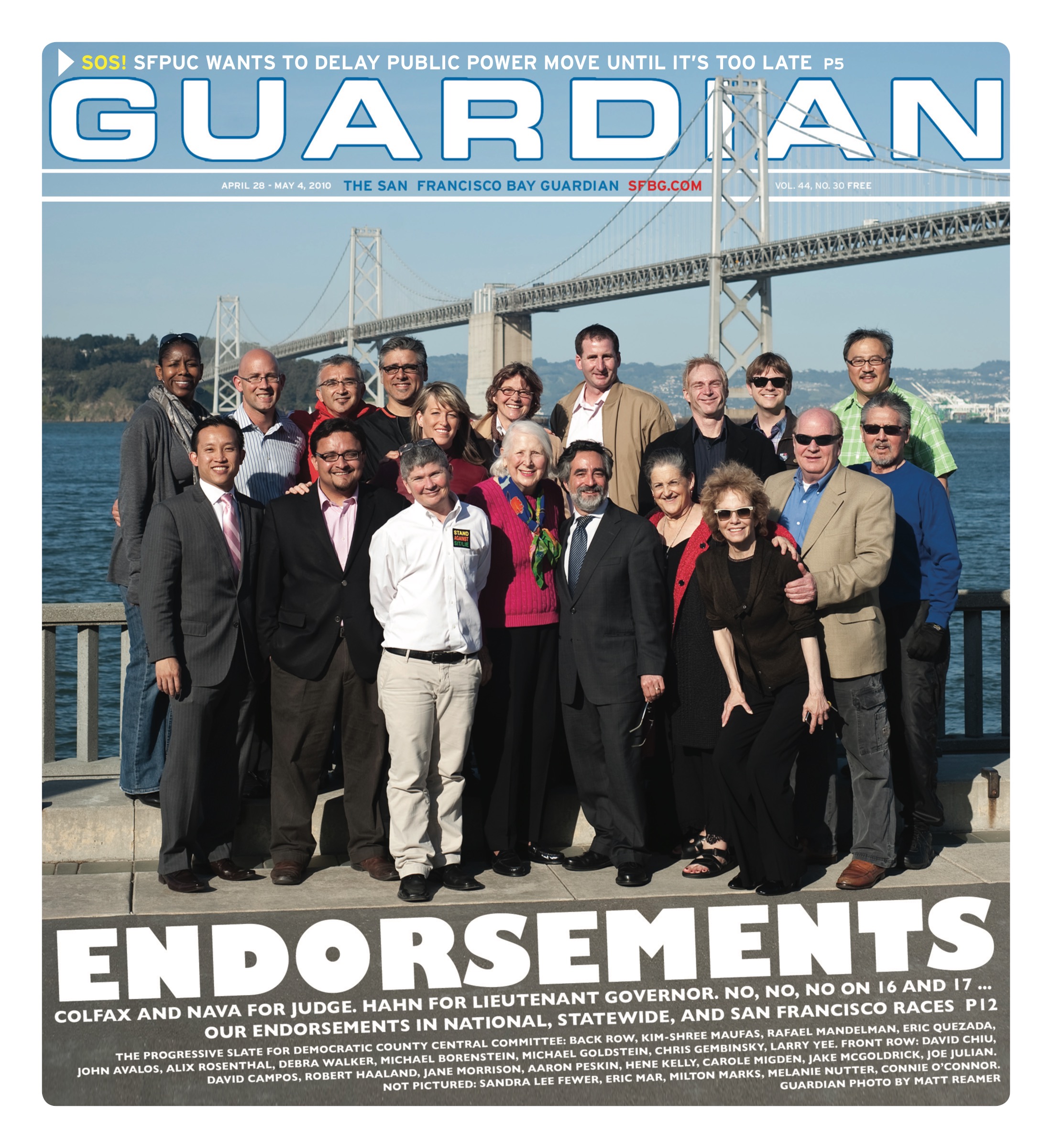
At this point, there’s a pretty good consensus on a progressive slate. We published our endorsements last week, and the Milk Club, Sierra Club, Tenants Union, and Assembly Member Tom Ammiano have endorsed most of the same candidates. In the fall, labor, environmental groups, tenants, and other progressive interests will be putting a lot of money into the races for district supervisor. But I could argue that the DCCC is just as important — and if we don’t fight this one to win, it’s going to be a lot harder in November.

Editor’s Notes

4

Tredmond@sfbg.com

The pot initiative’s going to pass in November. California’s going to legalize personal use and small sales. I think that’s clear from the polls, and from the fact that the pot supporters are raising a fair amount of money, and the fact that there won’t be much effective opposition.

The state Legislature might not like it — ballot measures are impossible to amend, and with debate and discussion the measure might be a little different. But Assembly Member Tom Ammiano has tried, again and again, to get his colleagues to see the light: this is going to happen, and if the folks in Sacramento are afraid of it, then they’re not going to have any influence over the final product.

And it’s amazing to me how many people are afraid of this issue.

All three major candidates for governor, including Jerry Brown, who must have smoked pot at some point in his life (would Linda Ronstadt have gone out with a guy who never smoked weed?), are publicly opposing the measure. Ammiano can’t get a majority of the Assembly to vote yes on his legalization bill — and Democrats control things. You wonder when these people are going to understand that the voters, most of them, really don’t care if pot becomes legal. It doesn’t frighten anybody anymore — except elected officials.

Humboldt County is already preparing for this; business leaders are talking about the economic impact on the region and how the North Coast can become the Napa Valley of green bud. The Obama administration needs to get ready too — ready to tell the federal drug agents to leave California alone. And a few years from now, life will go on, and everyone will take legal pot for granted — and I wonder how silly Jerry Brown’s going to feel. *

Politics and redistricting: The madness in SF’s future

8

The political merry-go-round in San Francisco going to be whirling at light speed soon. It’s partially the fault of term limits — over the next couple of years, some very talented, ambitious politicians are going to be forced to leave local office, and they’re looking for the next step. Part of it is the confluence of a bunch of events, starting with Mayor Gavin Newsom and District Attorney Kamala Harris both seeking statewide office.


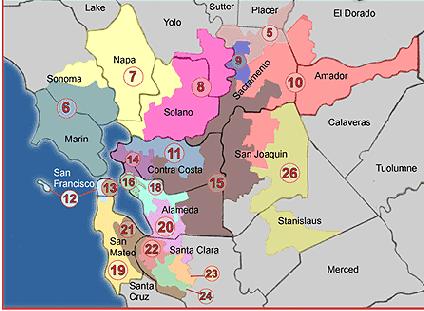
And there’s another factor that hasn’t been talked about much, but it’s really important: Next year, every Congressional, state Legislative and local supervisorial district is going to change.


After the decennial census, everyone has to draw new lines to reflect population shifts. At the state level (and Congressional redistricting is also a state function), that’s in the hands of a reapportionment commission, which I’m dubious about: The majority of the applicants are white people, and it’s supposed to have an equal number of Democrats and Republicans, although the state has far more Democratic voters. It’s anybody’s guess how they’ll actually draw the lines.


An elections task force will do the local lines, and it’s going to be harder to screw up; San Francisco supervisorial districts are supposed to reflect established neighborhood boundaries, and the population shifts within the city haven’t been that dramatic.And it’s unlikely anyone’s going to try to draw lines just to force an incumbent supervisor out of a district. But the districts will be a little bit different, and in San Francisco politics, a little bit can mean a lot.


The state Legislative districts will change significantly — and could change the politics of this area, and the state, in dramatic ways. For example, suppose Mark Leno’s Senate District moves somewhat North, to include a majority of Marin and Sonoma residents and only a small minority of San Franciscans? Suppose that district no longer includes Marin or Sonoma, but includes all of San Francisco (which would put Leno and Leland Yee in the same district)?


Suppose the 12th and 13th Assembly Districts, which now divide about East/West, shift to North and South? What if Tom Ammiano and Fiona Ma end up in the same district? (Um, I think that’s a closer relationship than either of them wants ….)


What happens if Nancy Pelosi is redistricted out of her seat? (Heh heh, won’t happen, but in theory, she and Lynn Woolsey could wind up living in the same district.)


It’s going to change the dynamics in a city that’s already poised for some upsets to the political apple cart.


Ross Mirkarimi’s termed out in 2012, and if he doesn’t run for mayor (or doesn’t get elected) he’ll be looking for the next step, which could be a run for the state Assembly; Tom Ammiano will be termed out in 2014. Of course, that’s been a gay seat for a long time (Carole Migden, Mark Leno, Ammiano) and by them someone like David Campos might be interested.


Or the district lines might have changed so much that both of them – or neither of them – can get elected.


If Bevan Dufty doesn’t get elected mayor, he’s out of a job – and he’s a political junkie who won’t easily retire. He’ll be looking at other offices, too. So will Sean Elsbernd, I suspect.


And that doesn’t even count the mayor’s race, which could, at this point, involve both state Senators, Leno and Leland Yee, and if either one wins, that opens up a Senate seat. And at the same time, if Kamala Harris is elected district attorney, that job will be open, and it’s an open secret that Board of Supervisors President David Chiu, a former prosecutor, would love to be in that office some day.


And in the background is the question of who becomes mayor if Newsom becomes lt. governor


 (and what happens to Aaron Peskin, an astute politician if ever there were one, and a potential mayor if this board of supervisors gets to make the appointment ). At lot to think about – and trust me, the thinking is already going on.

The Green Party’s nadir

2

This should be a great time for the Green Party. Its namesake color is being cited by every corporation and politician who wants to get in good with the environmentally-minded public; voters in San Francisco are more independent than ever; and progressives have been increasingly losing the hope they placed on President Barack Obama.
But the Green Party of San Francisco — which once had an influence on city politics that was disproportionate to its membership numbers — has hit a nadir. The number of Greens has steadily dwindled since its peak in 2003; the party closed its San Francisco office in November; and it has now lost almost all its marquee members.
Former mayoral candidate Matt Gonzalez, school board member Jane Kim, community college board member John Rizzo, and Planning Commissioner Christina Olague have all left the party in the last year or so. Sup. Ross Mirkarimi — a founding member of the Green Party of California and its last elected official in San Francisco — has also been openly struggling with whether to remain with an organization that doesn’t have much to offer him anymore, particularly as he contemplates a bid for higher office.
While a growing progressive movement within the Democratic Party has encouraged some Greens to defect, particularly among those with political ambitions, that doesn’t seem to be the biggest factor. After all, the fastest growing political affiliation is “Decline to State” and San Francisco now has a higher percentage of these independent voters than any other California county: 29.3 percent, according to state figures.
Democratic Party registration in San Francisco stood at 56.7 percent in November, the second-highest percentage in the state after Alameda County, making this essentially a one-party town (at last count, there were 256,233 Democrats, 42,097 Republicans, and 8,776 Greens in SF). Although Republicans in San Francisco have always outnumbered Greens by about 4-1, the only elected San Francisco Republican in more than a decade was BART board member James Fang.
But Republicans could never have made a real bid for power in San Francisco, as Gonzalez did in his electrifying 2003 mayoral run, coming within 5 percentage points of beating Gavin Newsom, who outspent the insurgent campaign 6-1 and had almost the entire Democratic Party establishment behind him.
That race, and the failure of Democrats in Congress to avert the ill-fated invasion of Iraq, caused Green Party membership to swell, reaching its peak in San Francisco and statewide in November 2003. But it’s been a steady downward slide since then, locally and statewide.
So now, as the Green Party of California prepares to mark its 20th anniversary next month in Berkeley, it’s worth exploring what happened to the party and what it means for progressive people’s movements at a time when they seem to be needed more than ever. Mirkarimi was one of about 20 core progressive activists who founded the Green Party of California in 1990, laying the groundwork in the late 1980s when he spent almost two years studying the Green Party in Germany, which was an effective member of a coalition government there and something he thought the United States desperately needed.
“It was in direct response to the right-wing shift of the Democrats during the Reagan and Bush Sr. administrations. It was so obvious that there had been an evacuation of the left-of-center values and policies that needed attention. So the era was just crying out woefully for a third party,” Mirkarimi said of the Green Party of California and its feminist, antiwar, ecological, and social justice belief system.
But he and the other founding Greens have discovered how strongly the American legal, political, and economic structures maintain the two-party system (or what Mirkarimi called “one party with two conservative wings”), locking out rival parties through restrictive electoral laws, control of political debates, and campaign financing mechanisms.
“I’m still very impassioned about the idea of having a Green Party here in the United States and here in California and San Francisco, vibrantly so. But I’m concerned that the Green Party will follow a trend like all third parties, which have proven that this country is absolutely uninviting — and in fact unwelcoming — of third parties and multiparty democracy,” Mirkarimi said.
Unlike some Greens, Mirkarimi has always sought to build coalitions and make common cause with Democrats when there were opportunities to advance the progressive agenda, a lesson he learned in Germany.
When he worked on Ralph Nader’s 2000 presidential campaign — a race that solidified the view of Greens as “spoilers” in the minds of many Democrats — Mirkarimi was involved in high-level negotiations with Democratic nominee Al Gore’s campaign, trying to broker some kind of leftist partnership that would elect Gore while advancing the progressive movement.
“There was great effort to try to make that happen, but unfortunately, everyone defaulted to their own anxieties and insecurities,” Mirkarimi said. “It was uncharted territory. It had never happened before. Everyone who held responsibility had the prospect of promise, and frankly, everybody felt deflated that the conversation did not become actualized into something real between Democrats and Greens. It could have.”
Instead, George W. Bush was narrowly elected president and many Democrats blamed Nader and the Greens, unfairly or not. And Mirkarimi said the Greens never did the post-election soul-searching and retooling that they should have. Instead, they got caught up in local contests, such as the Gonzalez run for mayor — “that beautiful distraction” — a campaign Mirkarimi helped run before succeeding Gonzalez on the board a year later.
Today, as he considers running for mayor himself, Mirkarimi is weighing whether to leave the party he founded. “I’m in a purgatory. I believe in multiparty democracy,” Mirkarimi said. “Yet tactically speaking, I feel like if I’m earnest in my intent to run for higher office, as I’ve shared with Greens, I’m not so sure I can do so as a Green.”
That’s a remarkable statement — in effect, an acknowledgement that despite some success on the local level, the Green Party still can’t compete for bigger prizes, leaving its leaders with nowhere to go. Mirkarimi said he plans to announce his decision — about his party and political plans — soon.
Gonzalez left the Green Party in 2008, changing his registration to DTS when he decided to be the running mate of Nader in an independent presidential campaign. That move was partly necessitated by ballot access rules in some states. But Gonzalez also thought Nader needed to make an independent run and let the Green Party choose its own candidate, which ended up being former Congress member Cynthia McKinney.
“I expressly said to Nader that I would not run with him if he sought the Green Party nomination,” Gonzalez told us. “The question after the campaign was: is there a reason to go back to the Green Party?”
Gonzalez concluded that there wasn’t, that the Greens had ceased to be a viable political party and that it “lacks a certain discipline and maturity.” Among the reasons he cited for the party’s slide were infighting, inadequate party-building work, and the party’s failure to effectively counter criticisms of Nader’s 2000 and 2004 presidential campaigns.
“We were losing the public relations campaign of explaining what the hell happened,” he said.
Gonzalez was also critical of the decision by Mirkarimi and other Greens to endorse the Democratic Party presidential nominees in 2004 and 2008, saying it compromised the Greens’ critique of the two-party system. “It sort of brings that effort to an end.”
But Gonzalez credits the Green Party with invigorating San Francisco politics at an important time. “It was an articulation of an independence from the Democratic Party machine,” Gonzalez said of his decision to go from D to G in 2000, the year he was elected to the Board of Supervisors.
Anger at that machine and its unresponsiveness to progressive issues was running high at the time, and Gonzalez said the Green Party became one of the “four corners of the San Francisco left,” along with the San Francisco Tenants Union, the Harvey Milk LGBT Democratic Club, and the San Francisco Bicycle Coalition, which helped set a progressive agenda for the city.
“Those groups helped articulate what issues were important,” Gonzalez said, citing economic, environmental, electoral reform, and social justice issues as examples. “So you saw the rise of candidates who began to articulate our platform.” But the success of the progressive movement in San Francisco also sowed the seeds for the Green Party’s downfall, particularly after progressive Democrats Chris Daly, Tom Ammiano, and Aaron Peskin waged ideological battles with Mayor Gavin Newsom and other so-called “moderate Democrats” last year taking control of the San Francisco Democratic Party County Central Committee.
“Historically, the San Francisco Democratic Party has been a political weapon for whoever was in power. But now, it’s actually a democratic party. And it’s gotten progressive as well,” Peskin, the party chair, told us. “And for a lot of Greens, that’s attractive.”
The opportunity to take part in that intra-party fight was a draw for Rizzo and Kim, both elected office-holders with further political ambitions who recently switched from Green to Democrat.
“I am really concerned about the Democratic Party,” Rizzo, a Green since 1992, told us. “I’ve been working in politics to try to influence things from the outside. Now I’m going to try to influence it from the inside.”
Rizzo said he’s frustrated by the inability of Obama and Congressional Democrats to capitalize on their 2008 electoral gains and he’s worried about the long-term implications of that failure. “What’s going on in Washington is really counterproductive for the Democrats. These people [young, progressive voters] aren’t going to want to vote again.”
Rizzo and Kim both endorsed Obama and both say there needs to be more progressive movement-building to get him back on track with the hopes he offered during his campaign.
“I think it’s important for progressives in San Francisco to try to move the Democratic Party back to the left,” Kim, who is considering running for the District 6 seat on the Board of Supervisors, told us. “I’ve actually been leaning toward doing this for a while.”
Kim was a Democrat who changed her registration to Green in 2004, encouraged to do so by Gonzalez. “For me, joining the Green Party was important because I really believed in third-party politics and I hope we can get beyond the two-party system,” Kim said, noting the dim hopes for that change was also a factor in her decision to switch back.
Another Green protégé of Gonzalez was Olague, whom he appointed to the Planning Commission. Olague said she was frustrated by Green Party infighting and the party’s inability to present any real political alternative.
“We had some strong things happening locally, but I didn’t see any action on the state or national level,” Olague said. “They have integrity and they work hard, but is that enough to stay in a party that doesn’t seem to be going anywhere?”
But many loyal Greens dispute the assertion that their party is on the rocks. “I think the party is going pretty well. It’s always an uphill battle building an alternative party,” said Erika McDonald, spokesperson for the Green Party of San Francisco, noting that the party plans to put the money it saved on its former Howard Street headquarters space into more organizing and outreach. “The biggest problem is money.”
Green Party activist Eric Brooks agrees. “We held onto that office for year and year and didn’t spend the money on party building, like we should have done a long time ago,” he said. “That’s the plan now, to do some crucial party organizing.”
Mirkarimi recalls the early party-building days when he and other “Ironing Board Cowboys” would canvas the city on Muni with voter registration forms and ironing boards to recruit new members, activities that fell away as the party achieved electoral successes and got involved with policy work.
“It distracted us from the basics,” Mirkarimi said. Now the Green Party has to again show that it’s capable of that kind of field work in support of a broad array of campaigns and candidates: “If I want to grow, there has to be a companion strategy that will lift all boats. All of those who have left the Green Party say they still support its values and wish it future success. And the feeling is mostly mutual, although some Greens grumble about how their party is now being hurt by the departure of its biggest names.
“I don’t begrudge an ambitious politician leaving the Green Party,” said Dave Snyder, a member of the Golden Gate Bridge, Highway, and Transportation District Board of Directors, and one of the few remaining Greens in local government.
But Snyder said he won’t abandon the Green Party, which he said best represents his political values. “To join a party means you subscribe to its ideals. But you can’t separate its ideals from its actions. Based on its actions, there’s no way I could be a member of the Democratic Party,” Snyder said.
Current Greens say many of President Obama’s actions — particularly his support for Wall Street, a health reform effort that leaves insurance companies in control, and the escalation of the war in Afghanistan — vindicate their position and illustrate why the Green Party is still relevant.
“The disillusionment with Obama is a very good opportunity for us,” McDonald said, voicing hope they Green can begin to capture more DTS voters and perhaps even a few Democrats. And Brooks said, “The Obama wake-up call should tell Greens that they should stick with the party.”
Snyder also said now is the time for Greens to more assertively make the case for progressive organizing: “The Democrats can’t live up to the hopes that people put on them.”
Even Peskin agrees that Obama’s candidacy was one of several factors that hurt the Green Party. “The liberal to progressive support for the Obama presidency deflated the Greens locally and beyond. In terms of organizing, they didn’t have the organizational support and a handful of folks alienated newcomers.”
In fact, when Mirkarmi and the other Green pioneers were trying to get the party qualified as a legal political party in California — no small task — Democratic Party leaders acted as if the Greens were the end of the world, or at least the end of Democratic control of the state Legislature and the California Congressional delegation. They went to great lengths to block the young party’s efforts.
It turns out that the Greens haven’t harmed the Democrats much at all; Democrats have even larger majorities at every legislative level today.
What has happened is that the Obama campaign, and the progressive inroads into the local party, have made the Greens less relevant. In a sense, it’s a reflection of exactly what Green leaders said years ago: if the Democrats were more progressive, there would be less need for a third party.
But Mirkarimi and other Greens who endorsed Obama see this moment differently, and they don’t share the hope that people disappointed with Obama are going to naturally gravitate toward the Greens. Rizzo and Kim fear these voters, deprived of the hope they once had, will instead just check out of politics. “They need to reorganize for a new time and new reality,” Rizzo said of the Greens.
Part of that new reality involves working with candidates like Obama and trying to pull them to the left through grassroots organizing. Mirkarimi stands by his decision to endorse Obama, for which the Green Party disinvited him to speak at its annual national convention, even though he was one of his party’s founders and top elected officials.
“After a while, we have to take responsibility to try to green the Democrats instead of just throwing barbs at them,” Mirkarimi said. “Our critique of Obama now would be much more effective if we had supported him.”
Yet that’s a claim of some dispute within the Green Party, a party that has often torn itself apart with differences over strategy and ideology, as it did in 2006 when many party activists vocally opposed the gubernatorial campaign of former Socialist Peter Camejo. And old comrades Mirkarimi and Gonzalez still don’t agree on the best Obama strategy, even in retrospect.
But they and other former Greens remain hopeful that the country can expand its political dialogue, and they say they are committed to continuing to work toward that goal. “I think there will be some new third party effort that emerges,” Gonzalez said. “It can’t be enough to not be President Bush. People want to see the implementation of a larger vision.”

Mirkarimi’s a Democrat, Newsom’s a candidate

47

Supervisor Ross Mirkarimi has done what a lot of us have been expecting for months now: He left me a message tonight saying he’s changed his registration from Green to Democrat. I think that’s a recognition that the Green Party isn’t the functional political entity in San Francisco that it once could have been — and that the only way he’s going to get elected to higher office is as a Dem. He’s clearly looking at the mayor’s race, but I think he’s also looking at the state Legislature; if Mark Leno ran for mayor and won, and Assemblymember Tom Ammiano ran for Leno’s Senate seat and won, then the 13th Assembly District seat would be open. Besides, with term limits, Ammiano’s seat will open up pretty soon anyway. And it’s highly unlikely a Green could win that race right now.


So welcome to the party, Ross — now you get the fun of voting in the Democratic primaries, which are often the only real elections around here, and you can vote for Democratic County Central Committee (although I don’t think you can run; you have to be a Dem for 12 months to do that).


And Gavin Newsom pulled papers for. Lt. Gov.


It’s going to a wild year.


Editor’s Notes

0

Tredmond@sfbg.com

The crowd protesting at San Francisco’s Civic Center March 4 had a different demographic than we’re used to. There were families, moms and dads with their kids. A lot of the people there don’t demonstrate and protest on a regular basis; they have jobs and families and can barely keep up with their day-to-day responsibilities. I know the drill.

But they were out in the streets because they’re furious at what’s happening to public education in California — and they should be. It’s criminal. The state is headed for the very bottom, and at this rate we’ll soon have the worst-funded public schools in America. And a gem of a state higher education system is on its way to becoming a set of overpriced, second-rate institutions.

And now everyone who stood up to be counted last week needs to take the next step and support the only solution that will actually work. It’s called raising taxes.

California’s more than $20 billion in the hole. There’s money going to waste, plenty of it. We could release every prisoner doing time on drug charges and save a few billion. But even that wouldn’t be enough to save the education system.

We all knew, or should have known, back in 1978, when Proposition 13 passed, that this day was coming. When you cut off the main source of revenue for schools — local property taxes — and rely on state funding, and the state Legislature can’t raise new revenue without a two-thirds vote, which means a handful of troglodyte Republicans can prevent it, this kind of crisis is inevitable.

So some intense, ongoing political action has to come out of the exciting and wonderful Day of Action. And if it’s going to make a difference, the action has to take place on three fronts.

1. We’ve got to get rid of the two-thirds majority requirement. There’s a ballot initiative circulating now that would do that.

2. We’ve got to amend Prop. 13. Assembly Member Tom Ammiano is pushing for a split-roll, to tax commercial property at a higher rate. That’s an excellent start.

3. We’ve got to push local government to raise taxes — right here at home — to help fund schools and public services. That means pushing Mayor Gavin Newsom, who loves to crow about education, to work with the supervisors on some major new revenue measures.

Either that or we let the politicians point fingers and blame each other. And the schools fall apart.

Making the protests count

37

It was wonderful to see so many people all over the state taking to the streets to protest cuts in education and public services. The rally at San Francisco’s Civic Center wasn’t just young radical agitators, either — most of the people there were parents with kids, families, people who are just fed up with the threats to the future of this state and don’t want to take it any more.


And now that the press and public and maybe even the elected officials are focused on the issue, it’s time to move to the next step. Politicians can talk all they want about “standing with the families” and supporting education, but in the end, there’s only one way to adequately fund K-12 and higher education in California. And that’s to raise taxes.


You can talk about waste all you want, and there’s certainly waste at the University of California. But we’re looking at a need that runs into the billions, multiple billions, tens of billions — and eliminating a few million bucks of waste here and there isn’t going to solve the problem.


You’re not going to solve it by reallocating the state’s budget money, either, since there’s no single large pot of cash that can be taken and given to the schools without devastating another necessary public service. The only real possibility is the prison system, a financial sink hole if ever there were one — but again: You can’t just cut prison spending by eliminating services to prisoners. They get so little as it is — and the federal courts won’t allow any reductions in health care and the state’s already under court order to reduce overcrowding.


You could probably solve half of the schools’ fiscal problems by releasing from prison every single inmate serving time for a drug offense; that’s the kind of dramatic steps we’re talking about. And if anyone wants to launch a political campaign to let 30,000 prisoners free tomorrow, I’m with you.


But it’s not going to happen, not in this climate. So the only real option is to get more revenue. That means raising taxes at the state level, repealing Prop. 13 to allow local property tax hikes, or raising taxes at the city level.


And here’s who the protesters need to be targeting:


1. The governor. Arnold Schwarzenegger not only refuses to allow new taxes as part of the budget, he vetoed Sen. Mark Leno’s bill that would have allowed local government to raise its own car taxes. He’s at (916)-445-2841.


2. The Republican leadership of the state Legislature. These folks go into the budget talks with the power of a minority that can block the two-thirds vote required for tax hikes, and they’ve both signed “no new taxes” pledges. These two people are among the single largest reason that the California school are facing such huge cuts. Assemblymember Martin Garrick,  916-319-2074. Senator Dennis Hollingsworth, (916) 651-4036.


3. Attorney General Jerry Brown. He’s running for governor as the Democratic candidate, and he has already announced that he won’t raise taxes and that Prop. 13 is untouchable. He won’t even support Assemblymember Tom Ammiano’s bill to legalize and tax marijuana. He needs to hear from his constituents that those positions won’t fly. (916) 322-3360


4. The mayor of San Francisco. Gavin Newsom is happy to announce that he supports education funding, but he’s never come forward with a single significant new tax increase for the city. Local taxes could be split between the general fund and the schools, and the progressives on the Board of Supervisors are looking for revenue options. Call the mayor and tell him: If Sacramento won’t raise taxes to educate our kids, we’d like to do it at home, in San Francisco. 415-554-6141.


5. Any state or local official who claims to support the schools but won’t publicly endorse and work for higher taxes. Folks, there’s no other way out of this.


And at the next rally, let’s chant: Repeal Prop. 13, Now! Tax the rich in San Francisco — Now!

Editor’s Notes

0

Tredmond@sfbg.com

Hundreds of parents packed the Marina Middle School auditorium last week to talk about cuts to public education — and Assembly Member Tom Ammiano, who spoke about reforming Proposition 13, said he thought the response to his suggestions was overwhelmingly positive. That’s not surprising — public school parents in San Francisco are not really the demographic you worry about when you talk about raising taxes to pay for education.

And until fairly recently, I thought it was impossible to do anything worthwhile about tax policy on a statewide level. I figured the state Legislature, with its obstinate Republicans, could never launch a tax reform movement, and that passing a ballot measure to alter Prop. 13 was a long shot at the very best. I was the one telling local officials that we had to look to our own resources, right here in San Francisco.

But when I see hundreds of parents organizing around school cuts, and hundreds of Muni riders organizing around transit cuts, and tens of thousands of students organizing around cuts to higher education, I start to think: maybe there’s hope.

Maybe the state has gotten so bad, the red ink so awful, that Californians will finally realize that they can’t have good public services for free. And maybe they’ll realize that Prop. 13 does a lot more for big commercial property owners than for homeowners, and that a split-roll measure like the one Ammiano is proposing could raise the kind of money we need for decent schools and public services.

I have to hope so.

SF leaders condemn SEIU tactics

104

San Franciscans seem to be turning against Service Employee International Union and its national President Andy Stern this week, first with the vote by SEIU Local 1021 members to oust Stern’s leadership team, and now with a letter signed by a broad array of top political officials condemning SEIU tactics against the National Union of Healthcare Workers.

As the Guardian reported last year, NUHW President Sal Rosselli and his management team broke away from SEIU’s United Healthcare Workers after a protracted conflict that culminated in a hostile SEIU takeover of the local, placing it under a Stern-controlled trusteeship. NUHW had criticized Stern’s autocratic leadership style and undemocratic methods while SEIU accused Rosselli of using union funds to undermine Stern’s decisions.

Since then, a majority of SEIU-UHW workers statewide has filed petitions asking to decertify with SEIU-UHW and affiliate with NUHW, which has won seven of the nine elections that have been held so far. So SEIU filed various complaints with the National Labor Relations Board to try to block those elections, while NUHW has complained of worker harassment and ballot meddling by SEIU.

Earlier today, SEIU-UHW sent out a press release touting an NLRB ruling that clears the way for elections at 51 facilities around the state covering 6,845 voters, blaming NUHW for “violating members’ democratic rights” in opposing those elections.

But NUHW leaders say SEIU-UHW has been “cherry-picking” selected sites where they think their chances of winning are good and keeping their NLRB complaints in place to block other sites, often dividing up bargaining units in the process to raise fears in workers that they might lose bargaining clout if they switch unions. NUHW is a relatively small organization compared to the massive SEIU.

NUHW leaders say they want a fair, up-or-down vote among all of the SEIU-UHW members statewide who have asked for elections, and they’ve asked SEIU to sign a Fair Election Agreement to prevent harassment and intimidation, something that SEIU often asks employers to sign.

Supporting that request is an open letter signed by 116 San Francisco political leaders from across the spectrum, including every member of the Board of Supervisors except Sup. Carmen Chu, Assembly members Tom Ammiano and Fiona Ma, Sen. Mark Leno, Democrat Party chair Aaron Peskin and nine other members of the DCCC, all four major candidates for the Dist. 8 Board of Supervisors seat, United Educators of San Francisco President Dennis Kelly, and representatives from a board array of unions and grassroots organizations, including UNITE-HERE, POWER, Young Workers United, Chinese Progressive Association, Coleman Advocates, and many others.

Interestingly, in addition to his critics on the left within the labor movement, Stern is also being criticized by conservatives right now after President Barack Obama appointed him to his National Commission on Fiscal Responsibility and Reform.

The Guardian has forwarded the letter and allegations to SEIU-UHW officials and is awaiting a response, which I’ll post in the comments section when I hear back.


The letter reads:

WE, THE UNDERSIGNED community leaders of San Francisco, are deeply troubled by allegations that the Service Employees International Union (SEIU) committed multiple, serious violations of state labor law during the union representation election between SEIU United Healthcare Workers – West (SEIU-UHW) and the National Union of Healthcare Workers (NUHW) for 10,000 Fresno County homecare workers this June.

These allegations, made in sworn testimony before the California Public Employment Relations Board, include that SEIU officials directed staff to open, mark, and alter workers’ ballots; threaten the deportation of immigrants; and tell workers they would suffer the loss of wages, benefits and hours to scare them into voting for SEIU. The complaint alleges further that SEIU organizers physically removed ballots from workers’ mailboxes and homes.

Caregivers in San Francisco have complained of similar intimidation and harassment at the hands of SEIU officials trying to block union representation elections requested by them and tens of thousands of other California healthcare workers who have petitioned to join NUHW.

Over the next year, as thousands of San Francisco homecare workers, private sector nursing home workers, and private sector hospital workers make their choice for union representation between SEIUUHW and NUHW, we are committed to see that these workers can make their decision democratically, without intimidation, harassment, threats or coercion of any kind, from any party.

NUHW officials have communicated to us their willingness to enter into Fair Election Agreements, which are common in California’s healthcare industry, and which SEIU officials have long championed throughout the nation, to govern their campaign conduct and protect caregivers’ freedom of choice in their upcoming union representation elections.

Therefore, we are asking that you and San Francisco’s healthcare employers join NUHW in negotiating Fair Election Agreements to establish ground rules for these elections and guarantee that workers can choose their representatives for themselves. Please know that regardless of your decision, we will stand united to ensure that San Francisco’s healthcare workers have the fair elections they deserve.

Questioning Prop. 16

4

rebeccab@sfbg.com

GREEN CITY In Sacramento, at a Feb. 26 joint legislative committee hearing about Proposition 16, a ballot initiative that Pacific Gas & Electric Corp. plans to sink $35 million into, PG&E executive Ed Bedwell found himself in the hot seat. Sen. Mark Leno and Assembly Member Tom Ammiano, who both represent San Francisco, joined Assembly Member Jared Huffman (D-San Rafael) in grilling Bedwell about an initiative that seems to be aimed directly at the efforts of San Francisco and Marin counties to establish alternative power providers to PG&E.

"What this measure is really about is limiting competition," Leno charged as the hearing got underway. "It’s not about anything else, right? In effect, this will do nothing but limit competition."

San Francisco and Marin are both in the process of creating community choice aggregation (CCA) programs, public entities that would offer electricity from clean, renewable technologies. Prop. 16, on the June ballot, would require two-thirds of voters to approve CCAs.

None of the state’s other investor-owned utilities have supported into the initiative, but representatives from the California Chamber of Commerce and the California Taxpayer’s Association joined Bedwell in testifying in favor of Prop 16.

Bedwell said he didn’t believe there is any motive behind it, a statement that prompted laughter from the audience. He argued that Prop. 16 would "give Californians the right to choose who would serve them." He quoted a professor at UC Berkeley’s Haas School of Business who said CCA is "fraught with danger" and added, "We couldn’t agree more."

But if Prop 16 passes, the likelihood that San Franciscans will be able to choose between PG&E or a power provider that offers 51 percent green electricity will be significantly decreased. And if PG&E rates continue to climb, customers will have no choice but to go along for the ride with this energy monopoly.

Mark Toney, executive director of the Utility Reform Network who testified against Prop. 16, said PG&E has requested rate increases amounting to 30 percent by 2013. In rural communities where unemployment is high and farmers rely on energy-intensive water pumping for irrigation, these ballooning energy costs would hurt the economy.

Michael Boccadoro of the Agricultural Energy Consumers Association, an organization representing 40,000 growers that usually partners with PG&E, testified against Prop. 16. "This will have a chilling effect, not just on CCA, but on the irrigation districts as well," he said. In the midst of a recession, "we’re in a very significant water crisis," he said. "Rate increases have a chilling effect on the farming community because we’re paying for higher-priced power from PG&E and we have to pump groundwater."

Paul Hauser, representing municipally-owned Redding Electric Utility, testified that if customers in his economically depressed territory were paying PG&E prices instead of the municipal rates, they would pay an extra $440 per year.

"Never … have I seen political activity by a regulated utility so far outside the bounds of acceptable conduct as PG&E’s sole sponsorship of the Constitutional Amendment politely referred to as Proposition 16," said John Geesman, former executive director of the California Energy Commission. Geesman noted that PG&E Corp. derives all its funding from PG&E Co., which is regulated by the California Public Utilities Commission, meaning ratepayer dollars are being siphoned into the $35 million devoted to the Prop 16 campaign.

"It ought to be illegal to take ratepayer dollars and use it against ratepayer interests," Geesman said.

San Francisco Sup. Ross Mirkarimi testified that the opposition could never amass as much funding for a fight against Prop. 16 as PG&E will spend to promote it. "It should be laughed out of the political arena anywhere near Sacramento," Mirkarimi said.

Yet it’s moving forward. Despite stern warnings from Leno that PG&E is flouting a state law saying utility companies must cooperate fully with CCA programs, Bedwell was free to leave after the tough questioning session from elected officials. Clustered in the hallway just after their pro-Prop. 16 testimony, the men in expensive suits were the ones laughing.