Tech

SF’s culture of corruption

12

EDITORIAL The extent of the charges in the criminal complaint against Sen. Leland Yee, political consultant Keith Jackson, and others are shocking and sensational: international arms trafficking, drug dealing, money laundering, cavorting with organized crime figures, murder for hire. But the basic allegation that Yee and Jackson practiced a corrupt, transactional kind of politics wasn’t surprising to anyone who knew how they operated.

What’s worse, they were simply a more extreme — and now, thanks to FBI wiretaps and undercover agents, a better documented — example of the political corruption that is endemic to San Francisco and some other high-stakes American cities. The city of St. Francis gets sold out to the highest bidders everyday, by politicians who value wealthy constituents over the vast majority of us who are just trying to get by — and over the interests of city finances and governance.

Part of the problem is inherent in our money-driven political system, in which politicians are constantly hustling for cash from people who want things from them. Politicians deny they take actions with political contributions in mind, but well-heeled capital and labor interests don’t spend millions of dollars on contributions out of the goodness of their hearts. These are business transactions.

We wholeheartedly support the call Senate President Darrell Steinberg made for fundamental political reform during the March 28 vote to suspend Yee and two of his allegedly corrupt colleagues. These cases aren’t aberrations, they are indicative of how power get wielded when it’s based on wealth. That’s the reality that has gotten even uglier since the Citizens United decision equated money with political speech and upped the ante for would-be public servants.

But much of the problem is particular to San Francisco, where cozy relationships between politicians and corporate interests are often feted in plain view. Former Mayor Willie Brown — a lawyer and unregistered lobbyist who won’t reveal his huge corporate client list despite having an influential weekly column in the San Francisco Chronicle — helped install his longtime City Hall functionary Ed Lee into Room 200 to guard against anyone asking too much of the rich and powerful. Yee and Lee represented rival Chinatown economic factions, both wanting to use the power of the Mayor’s Office for their interests.

In his March 22 column, Brown once again repeated a joke he’s used before, that the “e” in email stands for “evidence,” which is really only funny in a sick political culture that celebrates slick rule-breakers. And it was from Brown that Lee learned it was acceptable to brazenly give tax breaks and regulatory passes to the tech companies that his top fundraiser, venture capitalist Ron Conway, are invested in.

Megadeveloper Lennar Urban used its wealth and political connections to take control of San Francisco’s biggest tracts of undeveloped and underdeveloped land, including Hunters and Candlestick points and Treasure Island, paying off community groups and hiring Jackson and other political henchmen to get the job done.

In fact, the FBI complaint says Jackson was working on behalf of that project when he approached accused Chinatown gangster Raymond “Shrimp Boy” Chow for support, leading to their alleged involvement in a string of wild criminal conspiracies. Meanwhile, Chow was getting public commendations from San Francisco-based politicians including Lee, Yee, Gavin Newsom, Dianne Feinstein, Fiona Ma, and even Tom Ammiano. Chow courted political legitimacy the same way politicians seek cash, and mainstream media outlets were happy to play along.

Throughout his political career, Yee has carried water for Pacific Gas & Electric, perhaps the most corrupting contributor to political campaigns in the city’s history. PG&E’s influence at City Hall had thankfully waned in recent years as a result of overreach and deadly criminal negligence, until Lee and his appointees last year killed CleanPowerSF (see “Challenge Mayor Lee and his lies,” 9/17/13) on a pretext so thin it could only be gift to PG&E.

In many ways, San Francisco hasn’t changed. It’s still the old Barbary Coast, ruled by capitalist thugs and corrupt politicians, only with glossy modern spin created by armies of well-paid political consultants. But we all deserve better.

Yee and Jackson should go to prison if there’s even a slice of truth to the allegations against them. And maybe they’ll cut deals and take other political figures down with them, giving us more of a peek behind the curtain of political power. But it’s up to all of us to break the close ties between economic and political power and begin to restore the democratic power of everyday people.

Film Listings: April 2 – 8, 2014

0

Film listings are edited by Cheryl Eddy. Reviewers are Kimberly Chun, Dennis Harvey, Lynn Rapoport, Sam Stander, and Sara Maria Vizcarrondo. For rep house showtimes, see Rep Clock.

OPENING

Breathe In In Drake Doremus’s lyrical tale of a man in midlife crisis, Guy Pearce plays Keith Reynolds, a high school music teacher living in upstate New York with his wife, Megan (Amy Ryan), and teenage daughter, Lauren (Mackenzie David). Quietly harboring his discontent, Keith spends solitary moments wistfully sifting through glory-days photographs of his former band and memories of the undomesticated life he and Megan led two decades ago in New York City, which the two revisit in a low-toned call-and-response that doesn’t need to erupt into a blistering argument to clarify their incompatible positions. The melancholy calm is disrupted by the arrival of a British exchange student named Sophie (Felicity Jones, who also starred in Doremus’s 2011 film, Like Crazy). Evading a scene of loss and heartbreak at home, 18-year-old Sophie has come to spend a semester at Lauren’s high school, a juxtaposition that presents us with two wildly distinct species of teenager. Lauren is a brittle, popular party girl whom we watch making poor choices with a predatory classmate; Sophie is a soulful, reserved young woman whose prodigious talent at the piano first jars Keith out of his malaise into an uncomfortable awareness. A scene before Sophie’s arrival in which the family plays Jenga and Keith pulls out the wrong piece, toppling the tower, perhaps presses its ominous visual message too hard. Meanwhile, similarities to 2012’s Nobody Walks underscore the argument that this subject matter is an old, tired tale. But for the most part, the intimacy that develops between Keith and Sophie is constructed with delicate restraint, and Doremus and writing partner Ben York Jones have crafted a textured portrait of a man trying to repossess the past. (1:37) Sundance Kabuki. (Rapoport)

Captain America: The Winter Soldier Marvel’s most wholesome hero returns in this latest film in the Avengers series, and while it doesn’t deviate from the expected formula (it’s not a spoiler to say that yes, the world is saved yet again), it manages to incorporate a surprisingly timely plot about the dangers of government surveillance. Steve Rogers (Chris Evans), hunkiest 95-year-old ever, is still figuring out his place in the 21st century after his post-World War II deep freeze. Nick Fury (Samuel L. Jackson) has him running random rescue missions with the help of Black Widow (Scarlett Johansson), but SHIELD is working on a top-secret project that will allow it to predict crimes before they occur. It isn’t long before Cap’s distrust of the weapon — he may be old-fashioned, but he ain’t stupid — uncovers a sinister plot led by a familiar enemy, with Steve’s former BFF Bucky doing its bidding as the science-experiment-turned-assassin Winter Soldier (Sebastian Stan). Anthony Mackie, Robert Redford, and series regular Colbie Smulders are fine in supporting roles, and Johansson finally gets more to do than punch and pose, but the likable Evans ably carries the movie — he may not have the charisma of Robert Downey Jr., but he brings wit and depth to a role that would otherwise be defined mainly by biceps and CG-heavy fights. Oh, and you know the drill by now: superfans will want to stick around for two additional scenes tucked into the end credits. (2:16) (Eddy)

Frankie & Alice Halle Berry plays a go-go dancer with dissociative identity disorder. (1:42)

Goodbye World The end begins with a text — “Goodbye world,” sent to every cell phone. Once the computer virus-spawned anarchy really gets rolling (internet and power outages, violence and chaos), a group with nerdy-tech past connections descends on the survivalist-chic homestead of responsible James (Adrian Grenier) and “zany” Lily (Kerry Bishé): uptight Becky (Caroline Dhavernas) and unhappy Nick (Ben McKenzie); Lev (Scott Mescudi, aka musician Kid Cudi), who may have accidentally unleashed the virus; Laura (Gaby Hoffman), haunted by a recent political scandal; and ex-con Benji (Marc Webber) with his nubile tagalong (Remy Nozik). Most of these folks — even the ones married to each other — are frenemies at best, and their relationships disintegrate as civilization crumbles from afar. Physical menace enters this Big Chill-off-the-grid reunion when surly National Guardsmen emerge from the woods, but the main dramas take place ‘twixt the members of the angsty ensemble — all of whom are actually in desperate need of a fresh start. Among a cast composed mostly of TV veterans, Hoffman (last seen scene-stealing on Girls) is the standout performer, not to mention the MVP of this particular apocalypse. (1:41) Four Star. (Eddy)

Island of Lemurs: Madagascar Morgan Freeman narrates this 3D IMAX look at lemurs. (:39)

It Felt Like Love Set on the outer edges of Brooklyn and Queens, writer-director Eliza Hittman’s debut feature tracks the summertime wanderings and missteps of 14-year-old Lila (Gina Piersanti), whose days mainly consist of trailing in the wake of her more sexually experienced and perpetually coupled-off best friend, Chiara (Giovanna Salimeni). The camera repeatedly finds Lila in voyeur mode, as Chiara and her boyfriend, Patrick (Jesse Cordasco), negotiate their physical relationship and redefine the limits of PDA, unfazed by Lila’s silent, watchful presence. It’s clear she wants some part of this, though her motivations are a murky compound of envy, loneliness, and longing for a sense of place among her peers. A brief encounter with an older boy, Sammy (Ronen Rubinstein), whom Chiara knows — more of a sighting, really — provides the tiniest of openings, and Lila forces her way through it with an awkward insistence that is uncomfortable and sometimes painful to witness. Lila lacks Chiara’s fluid verbal and physical vernacular, and her attempts at mimicry in the cause of attracting Sammy’s attention only underline how unready and out of her depth she is. As Lila pushes into his seedy, sleazy world — a typical night is spent getting wasted and watching porn with his friends — their encounters don’t look like they feel like love, though Piersanti poignantly signals her character’s physical desire in the face of Sammy’s bemused ambivalence. Hittman unflinchingly leads her hapless protagonist through scenes that hover uneasily between dark comedy and menace without ever quite landing, and this uncertainty generates an emotional force that isn’t dispelled by the drifting, episodic plot. (1:22) Roxie. (Rapoport)

Jinn Horror movie based on the mythical creature from Arabic folklore. (1:37)

The Missing Picture Rithy Panh’s latest film about the homeland he fled as a teenager is atypically, directly autobiographical, and most unusually crafted. He re-creates his once comfortable Phnom Penh family’s grim fate after Pol Pot and company seized control of Cambodia in 1975 — as all fell prey to the starvation, forced labor, and other privations suffered by perceived “enemies” of the new regime — not by any conventional means but via elaborate dioramas of handmade clay figures depicted in prison camp life (and death). There’s also ample surviving propagandic footage of the Khmer Rouge trumpeting its “model society” that was in reality little more than an experiment in mass execution and torture. The result is a unique and powerful take on one of the 20th century’s worst crimes against humanity. (1:36) Opera Plaza. (Harvey)

Nymphomaniac, Volume II The second half of Lars von Trier’s anecdotal epic begins with Joe (Charlotte Gainsbourg) recalling the quasi-religious experience of her spontaneous first orgasm at age 12. Then she continues to tell bookish good Samaritan Seligman (Stellan Skarsgard) — who reveals he’s an asexual 60-something virgin — the story of her sexually compulsive life to date. Despite finding domestic stability at last with Jerome (Shia LeBeouf), she proves to have no talent for motherhood, and hits a tormenting period of frigidity eventually relieved only by the brutal ministrations of sadist K (Jamie Bell, burying Billy Elliott for good). She finds a suitable professional outlet for her peculiarly antisocial personality, working as a sometimes ruthless debt collector under the tutelage of L (Willem Dafoe), and he in turn encourages her to develop her own protégé in the form of needy teenager P (Mia Goth). If Vol. I raised the question “Will all this have a point?,” Vol. II provides the answer, and it’s (as expected) “Not really.” Still, there’s no room for boredom in the filmmaker’s most playfully arbitrary, entertaining, and least misanthropic (very relatively speaking) effort since his last four-hour-plus project 20 years ago, TV miniseries The Kingdom. Never mind that von Trier (in one of many moments when he uses Joe or Seligman as his mouthpiece) protests against the tyranny of political correctitude that renders a word like “Negro” unsayable — you’re still free to feel offended when his camera spends more time ogling two African men’s variably erect dicks in one brief scene that it does all the white actors’ cocks combined. But then there’s considerably more graphic content all around in this windup, which ends on a predictable note of cheap, melodramatic irony. But that’s part of the charm of the whole enterprise: Reeling heedlessly from the pedantic to the shocking to the trivial, like a spoiled child it manages to be kinda cute even when it’s deliberately pissing you off. (2:10) Embarcadero, Smith Rafael. (Harvey)

On My Way Not for nothing too does the title On My Way evoke Going Places (1974): director Emmanuelle Bercot is less interested in exploring Catherine Deneuve’s at-times-chilled hauteur than roughing up, grounding, and blowing fresh country air through that still intimidatingly gorgeous image. Deneuve’s Bettie lost her way long ago — the former beauty queen, who never rose beyond her Miss Brittany status, is in a state of stagnation, working at her seafood restaurant, having affairs with married men, living with her mother, and still sleeping in her girlhood room. One workday mid-lunch hour, she gets in her car and drives, ignoring all her ordinary responsibilities and disappearing down the wormhole of dive bars and back roads. She seems destined to drift until her enraged, equally lost daughter Muriel (Camille) calls in a favor: give her son Charly (Nemo Schiffman) a ride to his paternal grandfather’s. It’s chance to reconnect and correct course, even after Bettie’s money is spent, her restaurant appears doomed, and the adorable, infuriating Charly acts out. The way is clear, however: what could have been a musty, predictable affair, in the style of so many boomer tales in the movie houses these days, is given a crucial infusion of humanity and life, as Bercot keeps an affectionate eye trained on the unglamorous everyday attractions of a French backwater and Deneuve works that ineffable charm that draws all eyes to her onscreen. Her Bettie may have kicked her cigarette habit long ago, but she’s still smokin’ — in every way. (1:53) Clay. (Chun)

The Raid 2 See “Brawl Opera.” (2:19) Metreon, Sundance Kabuki, Shattuck.

Rob the Mob Based on a stranger-than-fiction actual case, this rambunctious crime comedy stars Michael Pitt and Nina Arianda as Tommy and Rosie, a coupla crazy kids in early 1990s Queens — crazy in love, both before and after their strung-out robbery antics win them both a stint in the pen. When Tommy gets out 18 months later, he finds Rosie has managed to stay clean, even getting a legit job as a debt collector for positive-thinking nut and regular employer of strays Dave (a delightful Griffin Dunne). She wants Tommy to do likewise, but the high visibility trial of mob kingpin John Gotti gives him an idea: With the mafia trying to keep an especially low profile at present, why not go around sticking up the neighborhood “social clubs” where wise guys hang out, laden with gold chains and greenbacks but (it’s a rule) unarmed? Whatta they gonna do, call the police? This plan is so reckless it just might work, and indeed it does, for a while. But these endearingly stupid lovebirds can’t be counted on to stay under the radar, magnetizing attention from the press (Ray Romano as a newspaper columnist), the FBI, and of course the “organization” — particularly one “family” led by Big Al (Andy Garcia). Written by Jonathan Fernandez, this first narrative feature from director Raymond DeFitta since his terrific 2009 sleeper hit City Island is less like that screwball fare and more like a scaled down, economically downscaled American Hustle (2013), another brashly comedic period piece inspired by tabloid-worthy fact. Inspiration doesn’t fully hold up to the end, but the film has verve and style to spare, and the performances (also including notable turns from Cathy Moriarty, Frank Whaley, Burt Young, Michael Rispoli, Yul Vazquez and others) are sterling. (1:42) Embarcadero. (Harvey)

The Unknown Known After winning an Oscar for 2003’s The Fog of War: Eleven Lessons from the Life of Robert S. McNamera, Errol Morris revisits the extended-interview documentary format with another Secretary of Defense, Donald Rumsfeld. The film delves into Rumsfeld’s lengthy political career — from Congress to the Nixon, Ford, and George W. Bush administrations — drawing insights from the man himself and his extensive archive of memos (“there have to be millions”) on Vietnam, 9/11, Osama bin Laden, the “chain of command,” torture, the Iraq War, etc., as well as archival footage that suggests the glib Rumsfeld’s preferred spin on certain events is not always factually accurate (see: Saddam Hussein and WMDs). Morris participates from behind the camera, lobbing questions that we can hear and therefore gauge Rumsfeld’s immediate reaction to them. (The man is 100 percent unafraid of prolonging an awkward pause.) A gorgeous Danny Elfman score soothes some of the anger you’ll feel digesting Rumsfeld’s rhetoric, but you still may find yourself wanting to shriek at the screen. In other words, another Morris success. (1:42) Elmwood, Presidio. (Eddy)

ONGOING

Afternoon of a Faun: Tanaquil Le Clercq Writer-director Nancy Buirski’s documentary follows the short, brilliant career of a young dancer named Tanaquil Le Clercq, who came up in the New York City ballet world of the 1940s and ’50s. Le Clercq was discovered by George Balanchine, married him (as three other dancers had done before her), sparked a paradigm shift in the ballet world regarding what was considered the quintessential dancer’s body, had numerous ballets set on her by Balanchine and Jerome Robbins, and then, at the peak of her career, at age 27, was stricken by polio and left paralyzed in both legs. The film takes its time moving toward this catastrophe, recounting Le Clercq’s early adult life through interviews with her contemporaries and tracking her professional progress through gorgeous archival footage of her performances. Equally moving archival material are the letters from a longtime correspondence between Le Clercq and Robbins that documented two very different periods of her life: the first, when Robbins was choreographing ballets for her, including Afternoon of a Faun, and professing his love; the second, after her paralysis, when she wrote him a series of poignant communications describing her impressions of her illness and her new, circumscribed world. The film has some trouble holding on to its center — as in life, Balanchine proves a magnetic force, and Afternoon of a Faun feels inexorably drawn to his professional and personal details. We don’t get enough of Le Clercq, which you could say is the tragedy of her story — nobody did. But the letters do provide a sense of someone resourceful and responsive to life’s richness and joys, someone who would get past this crisis and find a way to reshape her life. (1:31) Opera Plaza. (Rapoport)

American Hustle David O. Russell’s American Hustle is like a lot of things you’ve seen before — put in a blender, so the results are too smooth to feel blatantly derivative, though here and there you taste a little Boogie Nights (1997), Goodfellas (1990), or whatever. Loosely based on the Abscam FBI sting-scandal of the late 1970s and early ’80s (an opening title snarks “Some of this actually happened”), Hustle is a screwball crime caper almost entirely populated by petty schemers with big ideas almost certain to blow up in their faces. It’s love, or something, at first sight for Irving Rosenfeld (Christian Bale) and Sydney Prosser (Amy Adams), who meet at a Long Island party circa 1977 and instantly fall for each other — or rather for the idealized selves they’ve both strained to concoct. He’s a none-too-classy but savvy operator who’s built up a mini-empire of variably legal businesses; she’s a nobody from nowhere who crawled upward and gave herself a bombshell makeover. The hiccup in this slightly tacky yet perfect match is Irving’s neglected, crazy wife Rosalyn (Jennifer Lawrence), who’s not about to let him go. She’s their main problem until they meet Richie DiMaso (Bradley Cooper), an ambitious FBI agent who entraps the two while posing as a client. Their only way out of a long prison haul, he says, is to cooperate in an elaborate Atlantic City redevelopment scheme he’s concocted to bring down a slew of Mafioso and presumably corrupt politicians, hustling a beloved Jersey mayor (Jeremy Renner) in the process. Russell’s filmmaking is at a peak of populist confidence it would have been hard to imagine before 2010’s The Fighter, and the casting here is perfect down to the smallest roles. But beyond all clever plotting, amusing period trappings, and general high energy, the film’s ace is its four leads, who ingeniously juggle the caricatured surfaces and pathetic depths of self-identified “winners” primarily driven by profound insecurity. (2:17) Metreon. (Harvey)

Bad Words Settling a grudge score whose precise origin remains unclear until late in the game, world-class misanthrope Guy Trilby (Jason Bateman) is celebrating his 40th birthday by competing in a national spelling bee. Yes, spelling bees are generally for children, and so is this one. But Guy has found a legal loophole permitting his participation, and the general hate wending his way from contest staff (Allison Janney, Philip Baker Hall) — let alone the tiger-mom-and-dad parents ready to form a lynch mob — is just icing on the cake where he’s concerned. What’s more, as some sort of majorly underachieving near-genius, he’s in fact well equipped to whup the bejesus out of overachieving eight-year-olds when it comes to saying the right letters out loud. The only people on his side, sorta, are the online journalist (Kathryn Hahn) reporting on his perverse quest, and the insidiously cute Indian American competitor (Rohan Chand) who wants to be besties, or perhaps just to psych him out. (Note: The tyke’s admitted favorite word is “subjugate.”) Written by Andrew Dodge, this comedy in the tradition (a little too obviously) of 2003’s Bad Santa and such provides the always enjoyable Bateman with not only a tailor-made lead role, but a directorial debut as well. He does just fine by both. Yet as nicely crafted and frequently-pretty-funny Bad Words is, at core it’s a rather petty movie — small, derivative, and cynically mean-spirited without the courage of genuine biliousness. It’s at once not-half-bad, and not half as badass as it pretends to be. (1:29) Marina, 1000 Van Ness, SF Center, Sundance Kabuki. (Harvey)

Boys of Abu Ghraib First-time feature director-writer Luke Moran stars as Jack, an all-American lad who signs on for an Army stint in the wake of 9/11, and finds himself posted to the titular Iraqi prison turned U.S. military detainee camp 20 miles outside Baghdad. Despite the occasional bombing, however, life is mostly underutilized tedium for he and his fellow grunts. With nothing else to do, Jack volunteers for MP duty as a guard in the cell blocks — where his initial shock at the torture and abuse of prisoners is exacerbated by his friendship with the well educated, friendly, convincingly innocent captive Ghazi (Omid Abtahi). Shot at an abandoned New Mexico penitentiary, this drama is effective as far as it goes in exploring one fictive soldier’s rocky road under the influence of stress, isolation, and boredom. But as it ultimately encompasses the real-life international Abu Ghraib scandal of 2004 — in which leaked photos revealed widespread humiliation and abuse of prisoners for no evident purpose save enlistees’ loutish amusement — Boys falls well short in illuminating just how that kind of systemic breakdown can occur amongst seemingly normal, disciplined military personnel. Moran and company do raise the issue, but it turns out to be a weightier, more disturbing issue than this modestly ambitious feature is equipped to handle. (1:42) Metreon. (Harvey)

Cesar Chavez “You always have a choice,” Cesar Chavez (Michael Peña) tells his bullied son when advising him to turn the other cheek. Likewise, actor-turned-director Diego Luna had a choice when it came to tackling his first English-language film; he could have selected a less complicated, sprawling story. So he gets props for that simple act — especially at a time when workers’ rights and union power have been so dramatically eroded — and for his attempts to impact some complicated nuance to Chavez’s fully evident heroism. Painting his moving pictures in dusty earth tones and burnt sunlight with the help of cinematographer Enrique Chediak, Luna vaults straight into Chavez’s work with the grape pickers that would come to join the United Farm Workers — with just a brief voiceover about Chavez’s roots as the native-born son of a farm owner turned worker, post-Depression. Uprooting wife Helen (America Ferrera) and his family and moving to Delano as a sign of activist commitment, Chavez is seemingly quickly drawn into the 1965 strike by the Mexican workers’ sometime rivals: Filipino pickers (see the recent CAAMFest short documentary Delano Manongs for some of their side of the story). From there, the focus hones in on Chavez, speaking out against violence and “chicken shit macho ideals,” hunger striking, and activating unions overseas, though Luna does give voice to cohorts like Dolores Huerta (Rosario Dawson), growers like Bogdanovitch (John Malkovich), and the many nameless strikers — some of whom lost their lives during the astonishingly lengthy, taxing five-year strike. Luna’s win would be a blue-collar epic on par with 1979’s Norma Rae, and on some levels, he succeeds; scanning the faces of the weathered, hopeful extras in crowd scenes, you can’t help but feel the solidarity. The people have the power, as a poet once put it, and tellingly, his choice of Peña, stolidly opaque when charismatic warmth is called for, might be the key weakness here. One suspects the director or his frequent costar Gael García Bernal would make a more riveting Chavez. (1:38) Metreon. (Chun)

Divergent Based on the blockbuster dystopian-future YA novel by Veronica Roth (the first in a trilogy), Divergent is set in a future city-state version of Chicago in which society is divided into five character-based, color-coded factions: Erudite, Amity, Candor, Abnegation, and Dauntless. Like her peers, Beatrice Prior (Shailene Woodley), the film’s Abnegation-born teenage heroine, must choose a permanent faction — with the help of a standardized aptitude test that forgoes penciling in bubbles in favor of virtual reality psychic manipulation. When the test fails to triangulate her sole innate personality trait, she learns that she belongs to a secret, endangered sixth category: Divergent, an astonishing set of people who are not only capable of, say, acts of selflessness but can also produce intelligent thought, or manifest bravery in the face of danger. Forced to hide her aberrant nature in a society whose leaders (Kate Winslet) are prone to statements like “The future belongs to those who know where they belong,” and seemingly bored among Abnegation’s hive of gray cardigan-wearing worker bees, Beatrice chooses Dauntless, a dashing gang of black-clad, alterna-rock music video extras who jump on and off moving trains and live in a warehouse-chic compound whose dining hall recalls the patio at Zeitgeist. Fittingly, a surly, tattooed young man named Four (Theo James) leads Beatrice, now Tris, and her fellow initiates through a harsh proving regimen that, if they fail, will cast them into an impoverished underclass. Director Neil Burger (2006’s The Illusionist, 2011’s Limitless) and the behemoth marketing force behind Divergent are clearly hoping to stir up the kind of madness stoked by the Twilight and Hunger Games series, but while there are bones a-plenty to pick with those franchises, Divergent may have them beat for pure daffiness of premise and diameter of plot holes — and that’s after screenwriters Evan Daugherty and Vanessa Taylor’s major suturing of the source material’s lacunae. The daffiness doesn’t translate into imaginative world-building, and while a couple of scenes convey the visceral thrills of life in Dauntless, the tension between Tris and Four is awkwardly ratcheted up, and the film’s shift into a mode of crisis is equally jolting without generating much heat. (2:20) Balboa, Metreon, 1000 Van Ness, Sundance Kabuki. (Rapoport)

Ernest & Celestine Belgian animators Vincent Patar and Stéphane Aubier are best known for the stop-motion shorts series (and priceless 2009 subsequent feature) A Town Called Panic, an anarchic, absurdist, and hilarious creation suitable for all ages. Their latest (co-directed with Benjamin Renner) is … not like that at all. Instead, it’s a sweet, generally guileless children’s cartoon that takes its gentle, watercolor-type visual style from late writer-illustrator Gabrielle Vincent’s same-named books. Celestine (voiced by Pauline Brunner) is an orphaned girl mouse that befriends gruff bear Ernest (the excellent Lambert Wilson), though their improbable kinship invites social disapproval and scrapes with the law. There are some clever satirical touches, but mostly this is a softhearted charmer that will primarily appeal to younger kids. Adults will find it pleasant enough — but don’t expect any Panic-style craziness. (1:20) Embarcadero. (Harvey)

Frozen (1:48) Metreon.

The Grand Budapest Hotel Is this the first Wes Anderson movie to feature a shootout? It’s definitely the first Anderson flick to include a severed head. That’s not to say The Grand Budapest Hotel, “inspired by” the works of Austrian novelist Stefan Zweig, represents too much of a shift for the director — his intricate approach to art direction is still very much in place, as are the deadpan line deliveries and a cast stuffed with Anderson regulars. But there’s a slightly more serious vibe here, a welcome change from 2012’s tooth-achingly twee Moonrise Kingdom. Thank Ralph Fiennes’ performance as liberally perfumed concierge extraordinaire M. Gustave, which mixes a shot of melancholy into the whimsy, and newcomer Tony Revolori as Zero, his loyal lobby boy, who provides gravitas despite only being a teenager. (Being played by F. Murray Abraham as an older adult probably helps in that department.) Hotel‘s early 20th century Europe setting proves an ideal canvas for Anderson’s love of detail — the titular creation rivals Stanley Kubrick’s rendering of the Overlook Hotel — and his supporting cast, as always, looks to be enjoying the hell out of being a part of Anderson’s universe, with Willem Dafoe, Jeff Goldblum, and Adrien Brody having particularly oversized fun. Is this the best Wes Anderson movie since 2001’s The Royal Tenenbaums? Yes. (1:40) 1000 Van Ness, SF Center, Sundance Kabuki, Vogue. (Eddy)

Gravity “Life in space is impossible,” begins Gravity, the latest from Alfonso Cuarón (2006’s Children of Men). Egghead Dr. Ryan Stone (Sandra Bullock) is well aware of her precarious situation after a mangled satellite slams into her ship, then proceeds to demolition-derby everything (including the International Space Station) in its path. It’s not long before she’s utterly, terrifyingly alone, and forced to unearth near-superhuman reserves of physical and mental strength to survive. Bullock’s performance would be enough to recommend Gravity, but there’s more to praise, like the film’s tense pacing, spare-yet-layered script (Cuarón co-wrote with his son, Jonás), and spectacular 3D photography — not to mention George Clooney’s warm supporting turn as a career astronaut who loves country music almost as much as he loves telling stories about his misadventures. (1:31) Metreon. (Eddy)

The Great Beauty The latest from Paolo Sorrentino (2008’s Il Divo) arrives as a high-profile contender for the Best Foreign Language Film Oscar, already annointed a masterpiece in some quarters, and duly announcing itself as such in nearly every grandiose, aesthetically engorged moment. Yes, it seems to say, you are in the presence of this auteur’s masterpiece. But it’s somebody else’s, too. The problem isn’t just that Fellini got there first, but that there’s room for doubt whether Sorrentino’s homage actually builds on or simply imitates its model. La Dolce Vita (1960) and 8 1/2 (1963) are themselves swaying, jerry-built monuments, exhileratingly messy and debatably profound. But nothing quite like them had been seen before, and they did define a time of cultural upheaval — when traditional ways of life were being plowed under by a loud, moneyed, heedless modernity that for a while chose Rome as its global capital. Sorrentino announces his intention to out-Fellini Fellini in an opening sequence so strenuously flamboyant it’s like a never-ending pirouette performed by a prima dancer with a hernia. There’s statuary, a women’s choral ensemble, an on-screen audience applauding the director’s baffled muse Toni Servillo, standing in for Marcello Mastroianni — all this and more in manic tracking shots and frantic intercutting, as if sheer speed alone could supply contemporary relevancy. Eventually The Great Beauty calms down a bit, but still its reason for being remains vague behind the heavy curtain of “style.” (2:22) Opera Plaza. (Harvey)

Jodorowsky’s Dune A Chilean émigré to Paris, Alejandro Jodorowsky had avant-garde interests that led him from theater and comic book art to film, making his feature debut with 1968’s Fando y Lis. Undaunted by its poor reception, he created El Topo (1970), a blood-soaked mix of spaghetti western, mysticism, and Buñuellian parabolic grotesquerie that became the very first “midnight movie.” After that success, he was given nearly a million dollars to “do what he wanted” with 1973’s similarly out-there The Holy Mountain, which became a big hit in Europe. French producer Michel Seydoux asked Jodorowsky what he’d like to do next. Dune, he said. In many ways it seemed a perfect match of director and material. Yet Dune would be an enormous undertaking in terms of scale, expense, and technical challenges. What moneymen in their right mind would entrust this flamboyant genius/nut job with it? They wouldn’t, as it turned out. So doc Jodorowsky’s Dune is the story of “the greatest film never made,” one that’s brain-exploding enough in description alone. But there’s more than description to go on here, since in 1975 the director and his collaborators created a beautifully detailed volume of storyboards and other preproduction minutiae they hoped would lure Hollywood studios aboard this space phantasmagoria. From this goldmine of material, as well as input from the surviving participants, Pavich is able to reconstruct not just the film’s making and unmaking, but to an extent the film itself — there are animated storyboard sequences here that offer just a partial yet still breathtaking glimpse of what might have been. (1:30) Embarcadero. (Harvey)

The Lego Movie (1:41) Metroen, 1000 Van Ness.

The Lunchbox Ila (Nimrat Kaur) is a self-possessed housewife and a great cook, whose husband confuses her for another piece of furniture. She tries to arouse his affections with elaborate lunches she makes and sends through the city’s lunchbox delivery service. Like marriage in India, lunchbox delivery has a failure rate of zero, which is what makes aberrations seem like magical occurrences. So when widow Saajan (Irrfan Khan) receives her adoring food, he humbly receives the magical lunches like a revival of the senses. Once Ila realizes her lunchbox is feeding the wrong man she writes a note and Saajan replies — tersely, like a man who hasn’t held a conversation in a decade — and the impossible circumstances lend their exchanges a romance that challenges her emotional fidelity and his retreat from society. She confides her husband is cheating. He confides his sympathy for men of lower castes. It’s a May/December affair if it’s an affair at all — but the chemistry we expect the actors to have in the same room is what fuels our urge to see it; that’s a rare and haunting dynamic. Newcomer Kaur is perfect as Ila, a beauty unmarked by her rigorous distaff; her soft features and exhausted expression lend a richness to the troubles she can’t share with her similarly stoic mother (Lillete Dubey). Everyone is sacrificing something and poverty seeps into every crack, every life, without exception — their inner lives are their richness. (1:44) Embarcadero. (Vizcarrondo)

Mistaken for Strangers Tom Berninger, brother to the National vocalist Matt Berninger, is the maker of this doc — ostensibly about the band but a really about brotherly love, competition, and creation. It spins off a somewhat genius conceit of brother vs. brother, since the combo is composed of two sets of siblings: twins Aaron and Bryce Dessner on guitars and Scott and Bryan Devendorf on bass and drums respectively. The obvious question — what of singer Matt and his missing broheim? Turns out little bro Tom is one of those rock fans — of metal and not, it seems, the National — more interested in living the life and drinking the brewskis than making the music. So when Matt reaches out to Tom, adrift in their hometown of Cincinnati, to work as a roadie for the outfit, it’s a handout, sure, but also a way for the two to spend time together and bond. A not-quite-realized moviemaker who’s tried to make his own Z-budget scary flicks but never seems to finish much, Tom decides to document, and in the process gently poke fun at, the band (aka his authority-figures-slash-employers), which turns out to be much more interesting than gathering their deli platters and Toblerone. The National’s aesthetic isn’t quite his cup of tea: they prefer to wrap themselves in slinky black suits like Nick Cave’s pickup band, and the soft-spoken Matt tends to perpetually stroll about with a glass of white wine or bubbly in hand when he isn’t bursting into fourth-wall-busting high jinks on stage. Proud of his sib yet also intimidated by the National’s fame and not a little envious of the photo shoots, the Obama meetings, and the like, Tom is all about having fun. But it’s not a case of us vs. them, Tom vs. Matt, he discovers; it’s a matter of connecting with family and oneself. In a Michael Moore-ian sense, the sweet-tempered Mistaken for Strangers is as much, if not more so, about the filmmaker and the journey to make the movie than the supposed subject. (1:15) Roxie. (Chun)

Mr. Peabody and Sherman Mr. P. (voiced by Ty Burrell) is a Nobel Prize-winning genius dog, Sherman (Max Charles) his adopted human son. When the latter attends his first day of school, his extremely precocious knowledge of history attracts jealous interest from bratty classmate Penny (Ariel Winter), with the eventual result that all three end up being transported in Peabody’s WABAC time machine to various fabled moments — involving Marie Antoinette, King Tut, the Trojan Horse, etc. — where Penny invariably gets them in deep trouble. Rob Minkoff’s first all-animation feature since The Lion King 20 years ago is spun off from the same-named segments in Jay Ward’s TV Rocky and Bullwinkle Show some decades earlier. It’s a very busy (sometimes to the brink of clutter), often witty, imaginatively constructed, visually impressive, and for the most part highly enjoyable comic adventure. The only minuses are some perfunctory “It’s about family”-type sentimentality — and scenarist Craig Wright’s determination to draw from history the “lesson” that nearly all women are pains in the ass who create problems they must then be rescued from. (1:30) 1000 Van Ness. (Harvey)

Muppets Most Wanted Building on the success of The Muppets, Jim Henson’s beloved creations return to capitalize on their revitalized (and Disney-owned) fame. This follow-up from Muppets director James Tobin — technically, it’s the seventh sequel to the original 1979 Muppet Movie, as Dr. Bunsen Honeydew points out in one of the film’s many meta moments — improves upon the 2011 film, which had its charms but suffered by concentrating too much on the Jason Segal-Amy Adams romance, not to mention annoying new kid Walter. Here, human co-stars Ricky Gervais, Tina Fey, and others (there are more cameos than you can count) are relegated to supporting roles, with the central conflict revolving around the Muppets’ inability to notice that Constantine, “the world’s most dangerous frog,” has infiltrated their group, sending Kermit to Siberian prison in his place. Constantine and his accomplice (Gervais, whose character’s last name is “Badguy”) use the Muppets’ world tour as a front for their jewel-heist operation; meanwhile, his infatuated warden (Fey) forces Kermit to direct the annual gulag musical. Not helping matters are a bumbling Interpol agent (Ty Burrell) and his CIA counterpart (Sam the American Eagle, natch). Really, all that’s needed is a simple plot, catchy songs, and plenty of room to let the Muppets do their thing — Miss Piggy and Animal are particularly enjoyable here; Walter’s still around, but he’s way more tolerable now that he’s gotten past his “man or muppet” angst — and the film delivers. All the knowing winks to the grown-up fans in the audience are just an appreciated bonus. (1:46) Balboa, 1000 Van Ness, SF Center. (Eddy)

Need for Speed Speed kills, in quite a different way than it might in Breaking Bad, in Aaron Paul’s big-screen Need for Speed. “Big” nonetheless signals “B” here, in this stunt-filled challenge to the Fast and the Furious franchise, though there’s no shame in that — the drive-in is paved with standouts and stinkers alike. Tobey (Paul) is an ace driver who’s in danger of losing his auto shop, also the hangout for his pals (Scott Mescudi, Rami Malek, Ramon Rodriguez) and young sidekick Pete (Harrison Gilbertson), when archrival Dino (Dominic Cooper) arrives with a historic Mustang in need of restoration. Tragedy strikes, and Tobey must hook up with that fateful auto once more to win a mysterious winner-takes-all race, staged by eccentric, rich racing-fiend Monarch (Michael Keaton). Along for the ride are the (big) eyes and ears for the Mustang’s new owner — gearhead Julia (Imogen Poots). All beside the point, since the racing stunts, including a showy helicopter canyon save, are the real stars of Speed, while the touchstone for stuntman-turned-director Scott Waugh — considering the car and the final SF and Northern California race settings — is, of course, Bullitt (1968), which is given an overt nod in the opening drive-in scene. The overall larky effect, however, tends toward Smokey and the Bandit (1977), especially with Keaton’s camp efforts at Wolfman Jack verbiage-slanging roaring in the background. And despite the efforts of the multicultural gallery of wisecracking side guys, this script-challenged popcorn-er tends to blur what little chemistry these characters have with each other, skip the residual car culture insights of the more specific, more urban Fast series, and leave character development, in particular Tobey’s, in the dust in its haste to get from point A to B. (2:10) Metreon, 1000 Van Ness. (Chun)

Noah Darren Aronofsky’s Biblical epic begins with a brief recap of prior Genesis events — creation is detailed a bit more in clever fashion later on — leading up to mankind’s messing up such that God wants to wipe the slate clean and start over. That means getting Noah (Russell Crowe), wife Naameh (Jennifer Connelly), and their three sons and one adopted daughter (Emma Watson) to build an ark that can save them and two of every animal species from the imminent slate-wiping Great Flood. (The rest of humanity, having sinned too much, can just feed the fishes.) They get some help from fallen angels turned into Ray Harryhausen-type giant rock creatures voiced by Nick Nolte and others. There’s an admirable brute force and some startling imagery to this uneven, somber, Iceland-shot tale “inspired” by the Good Book (which, needless to say, has endured more than its share of revisions over the centuries). Purists may quibble over some choices, including the device of turning minor Biblical figure Tubal-Cain (Ray Winstone) into a royal-stowaway villain, and political conservatives have already squawked a bit over Aronofsky’s not-so-subtle message of eco-consciousness, with Noah being bade to “replenish the Earth” that man has hitherto rendered barren. But for the most part this is a respectable, forceful interpretation that should stir useful discussion amongst believers and non believers alike. Its biggest problem is that after the impressively harrowing flood itself, we’re trapped on the ark dealing with the lesser crises of a pregnancy, a discontented middle son (Logan Lerman), and that stowaway’s plotting — ponderous intrigues that might have been leavened if the director had allowed us to hang out with the animals a little, rather than sedating the whole menagerie for the entire voyage. (2:07) 1000 Van Ness, SF Center, Shattuck, Sundance Kabuki. (Harvey)

Non-Stop You don’t want to get between Liam Neeson and his human shield duties. The Taken franchise has restyled the once-gentle acting giant into the type of weather-beaten, all-business action hero that Harrison Ford once had a lock on. Throw in a bit of the flying-while-addled antihero high jinks last seen in Flight (2012) and that pressured, packed-sardine anxiety that we all suffer during long-distance air travel, and we have a somewhat ludicrous but nonetheless entertaining hybrid that may have you believing that those salty snacks and the seat-kicking kids are the least of your troubles. Neeson’s Bill Marks signals the level of his freestyle alcoholism by giving his booze a stir with a toothbrush shortly before putting on his big-boy air marshal pants and boarding his fateful flight. Marks is soon contacted by a psycho who promises, via text, to kill one person at a time on the flight unless $150 million is deposited into a bank account that — surprise — is under the bad-good air marshal’s name. The twists and turns — and questions of who to trust, whether it’s Marks’ vaguely likeable seatmate (Julianne Moore) or his business class flight attendant (Michelle Dockery) — keep the audience on edge and busily guessing, though director Jaume Collet-Serra doesn’t quite dispel all the questions that arise as the diabolical scheme plays out and ultimately taxes believability. The fun is all in the getting there, even if the denouement on the tarmac deflates. (1:50) Metreon, 1000 Van Ness. (Chun)

Nymphomaniac: Volume I Found battered and unconscious in a back alley, Joe (Charlotte Gainsbourg) is taken in by good Samaritan Seligman (Stellan Skarsgaard), to whom she explains “It’s all my fault — I’m just a bad human being.” But he doesn’t believe there are such things. She seeks to enlighten him by narrating the story of her life so far, from carnally curious childhood to sexually voracious adulthood. Stacy Martin plays her younger self through a guided tour of excesses variously involving Christian Slater and Connie Nielsen as her parents; a buncha guys fucked on a train, on a teenage dare; Uma Thurman as one histrionically scorned woman; and Shai LaBeouf as a first love who’s a cipher either because he’s written that way, or because this particular actor can’t make sense out of him. For all its intended provocation, including some graphic but unsurprisingly (coming from this director) unerotic XXX action, von Trier’s latest is actually less offensive than much of his prior output: He’s regained his sense of humor here, and annoying as its “Look at me, I’m an unpredictable artist” crap can be (notably all the stuff about fly-fishing, cake forks, numerology, etc. that seems randomly drawn from some Great Big Book of Useless Trivia), the film’s episodic progress is divertingly colorful enough. But is Joe going to turn out to be more than a two-dimensional authorial device from a director who’s never exactly sussed women (or liked people in general)? Will Nymphomaniac arrive at some pointed whole greater than the sum of its naughty bits? The answer to both is probably “Nah.” But we won’t know for sure until the two-hour second half arrives (April 4) of a movie that, in fairness, was never really intended to be split up like this. (1:50) Embarcadero, Smith Rafael. (Harvey)

Particle Fever “We are hearing nature talk to us,” a physicist remarks in awe near the end of Particle Fever, Mark Levinson’s intriguing doc about the 2012 discovery of the Higgs boson particle. Earlier, another scientist says, “I’ve never heard of a moment like this in [science] history, where an entire field is hinging on a single event.” The event, of course, is the launch of the Large Hardon Collider, the enormous machine that enabled the discovery. Though some interest in physics is probably necessary to enjoy Particle Fever, extensive knowledge of quarks and such is not, since the film uses elegant animation to refresh the basics for anyone whose eyes glazed over during high-school science. But though he offers plenty of context, Levinson wisely focuses his film on a handful of genial eggheads who are involved in the project, either hands-on at the European Organization for Nuclear Research (CERN), or watching from afar as the mighty LHC comes to life. Their excitement brings a welcome warmth to the proceedings — and their “fever” becomes contagious. (1:39) Opera Plaza. (Eddy)

RoboCop Truly, there was no need to remake 1987’s RoboCop, Paul Verhoeven’s smart, biting sci-fi classic that deploys heaps of stealth satire beneath its ultraviolent imagery. But the inevitable do-over is here, and while it doesn’t improve on what came before, it’s not a total lost cause, either. Thank Brazilian filmmaker José Padilha, whose thrilling Elite Squad films touch on similar themes of corruption (within police, political, and media realms), and some inspired casting, including Samuel L. Jackson as the uber-conservative host of a futuristic talk show. Though the suit that restores life to fallen Detroit cop Alex Murphy is, naturally, a CG wonder, the guy inside the armor — played by The Killing‘s Joel Kinnaman — is less dynamic. In fact, none of the characters, even those portrayed by actors far more lively than Kinnaman (Michael Keaton, Gary Oldman, Jackie Earle Haley), are developed beyond the bare minimum required to serve RoboCop‘s plot, a mixed-message glob of dirty cops, money-grubbing corporations, the military-industrial complex, and a few too many “Is he a man…or a machine?” moments. But in its favor: Though it’s PG-13 (boo), it’s also shot in 2D (yay). (1:50) Metreon. (Eddy)

Sabotage Puzzle over the bad Photoshop job on the Sabotage poster. The hard-to-make-out Arnold Schwarzenegger in the foreground could be just about any weathered, sinewy body — telling, in gory action effort that wears its grit like a big black sleeve tattoo on its bicep and reads like an attempt at governator reinvention. Yet this blood-drenched twister, front-loaded with acting talent and directed by David Ayer (2012’s End of Watch), can’t quite make up its mind where it stands. Is it a truth-to-life cop drama about a particularly thuggy DEA team, an old-fashioned murder mystery-meets-heist-exercise, or just another crowd-pleasing Pumping Arnie flick? Schwarzenegger is Breacher, the leader of a team of undercover DEA agents who like to caper on the far reaches of bad lieutenant behavior: wild-eyed coke snorting (a scene-chomping Mireille Enos); sorry facial hair (Sam Worthington, as out of his element as the bead at the end of his goatee); unfortunate cornrows (Joe Manganiello); trash-talking (Josh Holloway); and acting like a suspiciously colorless man of color (Terrence Howard). We know these are bad apples from the start — the question is just how bad they are. Also, how fast can the vanilla homicide cops (Olivia Williams, Harold Perrineau) lock them down, as team members are handily, eh, dismembered and begin to turn on each other and Schwarzenegger gets in at least one semi-zinger concerning an opponent with 48 percent body fat? Still, the sutured-on archetypal-Arnie climax comes as a bit of a shock in its broad-stroke comic-book violence, as the superstar pulls rank, sabotages any residual pretense to realism, and dons a cowboy hat to tell his legions of shooting victims, “I’m different!” Get to the choppers, indeed. (1:49) Metreon, 1000 Van Ness. (Chun)

300: Rise of An Empire We pick up the 300 franchise right where director Zack Snyder left off in 2006, with this prequel-sequel, which spins off an as-yet-unreleased Frank Miller graphic novel. In the hands of director Noam Murro, with Snyder still in the house as writer, 300: Rise of an Empire contorts itself, flipping back and forth in time, in an attempt to explain the making of Persian evil prince stereotype Xerxes (Rodrigo Santoro) —all purring androgyny, fashionable piercings, and Iran-baiting, Bush-era malevolence — before following through on avenging 300‘s romantically outnumbered, chesty Spartans. As told by the angry, mourning Spartan Queen Gorgo (Lena Headey of Game of Thrones), the whole mess apparently began during the Battle of Marathon, when Athenian General Themistokles (Sullivan Stapleton) killed Xerxes’s royal father with a well-aimed miracle arrow. That act ushers in Xerxes’s transformation into a “God King” bent on vengeance, aided and encouraged by his equally vengeful, elegantly mega-goth naval commander Artemisia (Eva Green), a Greek-hating Greek who likes to up the perversity quotient by making out with decapitated heads. In case you didn’t get it: know that vengeance is a prime mover for almost all the parties (except perhaps high-minded hottie Themistokles). Very loosely tethered to history and supplied with plenty of shirtless Greeks, taut thighs, wildly splintering ships, and even proto-suicide bombers, Rise skews toward a more naturalistic, less digitally waxy look than 300, as dust motes and fire sparks perpetually telegraph depth of field, shrieking, “See your 3D dollars hard at work!” Also working hard and making all that wrath look diabolically effortless is Green, who as the pitch-black counterpart to Gorga, turns out to be the real hero of the franchise, saving it from being yet another by-the-book sword-and-sandal war-game exercise populated by wholesome-looking, buff, blond jock-soldiers. Green’s feline line readings and languid camp attitude have a way of cutting through the sausage fest of the Greek pec-ing order, even during the Battle of, seriously, Salamis. (1:43) Metreon, 1000 Van Ness. (Chun)

Veronica Mars Since the cult fave TV show Veronica Mars went off the air in 2007, fans of the series, about a smart, cynical teenager who solves mysteries and battles her high school’s 1 percenters — a sort of adolescent noir minus the ex nihilo patois of Rian Johnson’s 2005 Brick — have had their hopes raised and dashed several times regarding the possibility of a big-screen coda. While that sort of scenario usually involves a few of the five stages of grief, this one has a twist happy ending: a full-length film, directed by show creator Rob Thomas and cowritten by Thomas and show producer-writer Diane Ruggiero (with a budget aided by a crowdfunding campaign), that doesn’t suck. It’s been a decade since graduation, and Veronica Mars (Kristen Bell) has put a continent between herself and her creepy, class war–torn hometown of Neptune, Calif. — leaving behind her P.I. vocation and a track record of exposing lies, corruption, and the dark side of the human soul in favor of a Columbia law degree and a career of covering up same. But when Logan Echolls (Jason Dohring), her brooding, troubled ex, gets charged with the murder of his pop star girlfriend and asks Veronica for help, she can’t resist the pull of what she admits is a pathological impulse. Plus, it’s her 10-year reunion. And indeed, pretty much anyone who had a character arc during the show’s three seasons makes an appearance — plus (naturally) James Franco, Dax Shepard (Bell’s husband), and (oddly) Ira Glass. It could have been a cameo fusillade, but the writing here is as smart, tight, funny, and involving as it was on the TV series, and Thomas and Ruggiero for the most part manage to thread everyone in, taking pressure off a murder mystery that falls a little flat, updating the story to reflect current states of web surveillance and pop cultural mayhem, and keeping the focus on the joy of seeing Veronica back where she belongs. (1:43) Metreon. (Rapoport)

Le Week-End Director Roger Michell and writer Hanif Kureishi first collaborated two decades ago on The Buddha of Suburbia, when the latter was still in the business of being Britain’s brashest multiculti hipster voice. But in the last 10 years they’ve made a habit of slowing down to sketching portraits of older lives — and providing great roles for the nation’s bottomless well of remarkable veteran actors. Here Lindsay Duncan and Jim Broadbent play a pair of English academics trying to re-create their long-ago honeymoon’s magic on an anniversary weekend in Paris. They love each other, but their relationship is thorny and complicated in ways that time has done nothing to smooth over. This beautifully observed duet goes way beyond the usual adorable-old-coot terrain of such stories on screen; it has charm and humor, but these are unpredictable, fully rounded characters, not comforting caricatures. Briefly turning this into a seriocomedy three-way is Most Valuable Berserker Jeff Goldblum as an old friend encountered by chance. It’s not his story, but damned if he doesn’t just about steal the movie anyway. (1:33) Embarcadero, Sundance Kabuki. (Harvey)

The Wind Rises Hayao Miyazaki announced that Oscar nominee The Wind Rises would be his final film before retiring — though he later amended that declaration, as he’s fond of doing, so who knows. At any rate, it’d be a shame if this was the Japanese animation master’s final film before retirement; not only does it lack the whimsy of his signature efforts (2001’s Spirited Away, 1997’s Princess Mononoke), it’s been overshadowed by controversy — not entirely surprising, since it’s about the life of Jiro Horikoshi, who designed war planes (built by slave labor) in World War II-era Japan. Surprisingly, a pacifist message is established early on; as a young boy, his mother tells him, “Fighting is never justified,” and in a dream, Italian engineer Giovanni Caproni assures him “Airplanes are not tools for war.” But that statement doesn’t last long; Caproni visits Jiro in his dreams as his career takes him from Japan to Germany, where he warns the owlish young designer that “aircraft are destined to become tools for slaughter and destruction.” You don’t say. A melodramatic romantic subplot injects itself into all the plane-talk on occasion, but — despite all that political hullabaloo — The Wind Rises is more tedious than anything else. (2:06) Sundance Kabuki. (Eddy) *


Brawl opera

0

cheryl@sfbg.com

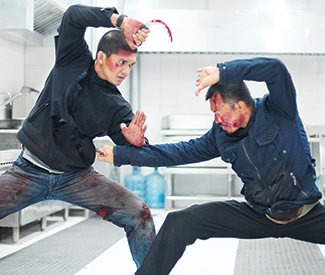
FILM There are action films. And then there’s The Raid 2. One need not have seen 2011’s The Raid: Redemption to appreciate this latest collaboration between Welsh director Gareth Evans and Indonesian actor, martial artist, and fight choreographer Iko Uwais — it’s recommended, of course, but the sequel stands alone on its own merits.

Overstuffed with gloriously brutal, cleverly staged fight scenes, The Raid 2 — sometimes written with the subtitle “Berendal,” which means “thugs” — picks up immediately after the events of the first film. Quick recap of part one: a special-forces team invades an apartment tower controlled by gangsters. Among the cops is idealistic Rama (Uwais). Seemingly bulletproof and fleet of fists and feet, Rama battles his way floor-by-floor, encountering machete-toting heavies and a wild-eyed maniac appropriately named Mad Dog (Yayan Ruhian), as well as his own older brother, who’s a high-up in the organized crime world. Rama also realizes he’s been unwittingly working for a corrupt police lieutenant, who’s got a personal beef with the bad guys. The Raid‘s gritty, unadorned approach (streamlined location and cast, gasp-inducing fights) resonated with thrill seeking audiences weary of CG overload.

“Before we’d screened the first movie anywhere, we watched it to do a tech check on it. After we finished, we thought, ‘Ok. We have … something,'” Evans recalled on a recent visit to San Francisco with Uwais. “But we just kept kind of focusing on, ‘There’s pixellation here, the picture’s not great there.’ We were looking at all the problems that you do when you’re deep into production on something. Then, when [the 2011 Toronto International Film Festival] happened, it was like, ‘Holy shit!’ We had no idea it was going to get received like that. And it kept growing! For us, it was this weird experience where something that we’d made within our own little creative vacuum was suddenly being accepted by people.”

A second Raid film was inevitable, especially since Evans — who became interested in Indonesian martial arts, or pencak silat, while working on 2007 doc The Mystic Art of Indonesia — already had its story in mind: Rama goes undercover in the underworld, a ploy that necessitates he do a prison stint to gain the trust of a local kingpin. Naturally, not much goes according to plan, and blood is shed along the way, as multiple power-crazed villains set their sinister plans into motion. Evans originally wanted to film it after making 2009’s Merantau, his first action film with Uwais, but it proved too costly for the then-unproven team.

“For two years, we were looking for financing, but were not able to get it. So we did the first Raid because it was lower budget. It was like a plan B,” Evans said. “After that, our investor was willing to help finance the second one. It bought us better equipment, more time to shoot, better sets. All of that stuff that we spent extra money on went up on the screen.”

With a fan base established by the first film, Evans — himself a lifelong action movie lover — knew expectations were high. Somehow, he’d have to top The Raid. “It couldn’t be The Raid 2, except now it’s a bigger building,” he joked. “So, what can we do differently? Expand the universe, and expand the characters. Explore different territory and be able to try different action beats: Car chase! Prison riot! And using weapons that we hadn’t introduced before, like the curved blades. It’s one of the weapons in silat. So it’s like, ‘Ok, this thing exists. Why haven’t we used it yet?’ We kind of hinted at it in Merantau — but we never really used it. Indonesian fans of that movie complained, but I was like, ‘Hold tight. We will use it.’ It’s such a violent, aggressive weapon that it wouldn’t have felt right in Merantau. But in The Raid 2, it felt right.”

Evans was also concerned that the “element of surprise” would be lost for audiences who had seen the first film. When asked to elaborate — because Uwais’ character is a mild-mannered nice guy who, surprise, is also an explosive killing machine? — he broke it down.

“[In the first film, audiences] got a taste for our choreography. We try to differentiate ourselves from other martial artists and filmmakers that do this type of stuff. Not in a way of like, ‘What we do is better.’ It’s more a case of, everyone packages their films differently,” he said. “We’re big fans of what Tony Jaa has done, and Sammo Hung, Donnie Yen, and Jackie Chan. But we have certain rules that we just don’t break. We never do a replay of anything when it comes to a stunt or an action sequence. It’s all one flow, and it never breaks rhythm — it keeps going until the thing is finished. In terms of slo-mo, we only ever use it to tell something dramatically within a fight sequence. We never use it to show off a movement. Which segues into, no acrobatics. Because as soon as you do that, you’ve got a stunt guy waiting to get hit. And that takes you out of the scene straightaway.”

Presenting the fight scenes as realistically benefits more than just the audience. “On TV in Indonesia, silat is represented in the most bullshit way possible: people jump into the sky and fly, and turn into jaguars, and shoot fireballs out of their eyes. I’m not exaggerating! When we first went to gather money for Merantau, we’d say, ‘We’re gonna make a silat film!’ and people would be like, ‘Aw, silat? That’s that stupid thing on TV,'” Evans recalled. “But I’d met Iko, and his gurus and teachers, and silat is such an integral part of their lives. [It was important to me that] if we made films about this martial art, we had to do it in a way that reclaims it from what had been done before. We wanted it to be real, and true to what they study.”

Though the actual fighting is realistic, the settings were carefully chosen for cinematic impact. Both of those ante-upping “action beats” Evans mentioned — the car chase, in which Uwais’ character batters his opponents inside of a moving vehicle, and the prison riot, which is muddy, bloody mayhem — are standouts.

“A lot of people responded to the idea of claustrophobia in the first one, because of all the enclosed spaces,” Evans said. “I wanted to find a way to still have these tight moments in the second one, even though the scope was much wider. Even within a car chase, we could dive right inside and have this super claustrophobic fight in the back seat.”

Uwais estimated that each fight scene required three or four months of practice — and even more for the car stunt. “Standing and fighting is very different than sitting and fighting,” he pointed out.

The collaborators, who have an easygoing rapport, have conflicting memories when it comes to filming the sloppy prison brawl — though they agree it was far and away the least fun scene to shoot. (Evans: “We shot that for eight days straight.” Uwais: “Eight days? It was 10 days.” Evans: “The guys were caked in mud all day.” Uwais: “From 6am to 5pm.” Evans: “More like, 4pm.” Uwais: “5pm!” Evans: “Ok, 5pm!”)

As The Raid 2 prepares to open wide, Evans is ramping up plans for the third film in the trilogy. “Whereas The Raid 2 starts like two hours after The Raid finishes, The Raid 3 starts three hours before The Raid 2 finishes,” he revealed. “So there’s a scene toward the end where a certain group makes a decision on something, and part three’s gonna follow the consequences of those actions. The Raid 3 is going to be way more streamlined than part two [which runs 148 minutes], and it’s going to be an homage to certain styles of cinema that I love that I really want to try and play with.”

And yes, there’s an American Raid remake in the works. When asked “Whyyyy?”, Evans was ready with an answer. “I’ve been a huge fan of Asian cinema ever since I was a kid, and I used to have that same feeling: ‘Oh my god, they can’t remake that!’ But in this case, nothing takes the original away. If anything, people who see the remake might get introduced to the original now, because they didn’t know it existed before.”

THE RAID 2 opened Fri/4 in Bay Area theaters.

Massage therapists hope for a happy ending

3

The California Massage Therapy Council, a statewide body that licenses massage practitioners, may expire at the end of this year unless extended by the California Legislature. Some anti-prostitution crusaders say reverting to local control will make it easier to shut down covert brothels, but the practitioners fear a return to the bad old days, when stigmas and stereotypes overcomplicated their lives.

On one side of the debate are the massage therapists, who say that the council protects them from unfair discrimination, replaces a patchwork of local ordinances, and provides a greater level of respectability to their profession. However, an array of city officials, police departments, and powerful groups such as the League of California Cities argue that the CAMTC makes it easier for illicit massage parlors to get away with prostitution and human trafficking.

“I receive complaints from neighbors all the time about certain establishments,” said Sup. Katy Tang about her supervisorial district in San Francisco’s Sunset District. “We can inspect, but we have no ability to enforce any of our regulations. If there are any penalties, we can’t enforce them.”

Tang’s frustration stems from Senate Bill 731, legislation that was signed into law in 2008. That bill created the CAMTC, a nonprofit organization that has the authority to certify massage practitioners and therapists in California. Prior to the creation of this body, each city and county enacted its own certification procedures, leading to a messy patchwork of rules all over the state.

Before the CAMTC, “there were 550 different kinds of regulations from city to city,” said Ahmos Netanel, CEO of the organization. “Within a radius of one mile, you can have a situation where different cities have their own standards. One city may require no training, and another right next door may require 1,000 hours.”

A massage provider working in California pre-2009 not only had to be savvy with the medley of laws, but also needed to purchase expensive licenses for each city he or she planned to practice in. The CAMTC creates a universal—though voluntary—system, where licensed practitioners can travel and work freely around the state.

The contentious part of the law comes from the protection that it offers to licensed practitioners. Any establishment that employs all CAMTC-certified massage providers is exempt from city ordinances that target massage businesses. Law enforcement agencies claim that these restrictions impede their ability to crack down on illegal parlors, but the massage therapists say that they are necessary to fight off discriminatory laws.

Some of these unfair regulations targeted entire establishments, such as zoning rules that forced all massage businesses into run-down or dangerous parts of town, with the assumption that they were brothels. Massage providers argued that this was neither fair nor safe for, say, a 75-year-old woman seeking out massage for arthritis, or a soon-to-be mom trying to obtain a pre-natal massage.

Other laws targeted the therapists themselves. Stacey DeGooyer, a certified massage therapist in the Bay Area, remembers times when practicing massage meant mandatory STD testing and reminders from police to not wear undergarments as exterior clothing.

“I remember thinking, ‘Wow, this is for my profession?'” DeGooyer said, decrying being subjected to “archaic prostitution laws.” Most massage providers aren’t looking to be on par with physicians, but they also don’t want to be on par with prostitutes.

Currently, San Francisco has its own certification program that is regulated by the Department of Public Health. To practice massage in the city, the provider must have a license from either the city or the CAMTC. However, only those who have the state CAMTC license can legally call themselves a “licensed massage” therapist or practitioner.

Tang has been one of the most outspoken critics of the CAMTC in San Francisco, urging the Legislature to let the body sunset at the end of the year.

“I wouldn’t say that I’m against [the CAMTC], but there are structural flaws in how it was designed,” Tang said. “It was created for good reasons, since there were so many jurisdictions and they wanted to standardize it and create a cohesive process. But there are jurisdictions like San Francisco where we have our own robust process.”

The number of massage establishments have surged since the adoption of the CAMTC, which critics use as evidence for a growing number of illicit parlors. But Netanel said his group’s worked to prevent prostitutes from getting licensed in the first place. Out of over 63,000 applicants, Netanel said, the group has never certified a single person who has been convicted of illicit activities. It also utilizes an online complaint form to report questionable behavior, and respond to all complaints within 24 hours.

“Even with those who criticize [the CAMTC], we share the same goals,” Netanel said. “We want a safe, healthy, and reliable certification process, so consumers can trust their therapists. Even more, we want to put an end to illegal massage parlors so they are no longer categorized with honest providers.” (Brian McMahon)

HOT MAIL

Last week’s Bay Guardian featured a cover story on homelessness in San Francisco (“San Francisco’s untouchables”), including communications between local residents and the city’s Homeless Outreach Team, which we obtained in a public records request. So we thought we’d share a few message from the more than 100 we received.

“I don’t know where to begin,” one resident wrote. “I feel between mad, disgusted, and frustrated. This homeless encampment keeps growing. … The city has put up wire fencing only to be cut through by the homeless. … It is within 100 yards of my $1.2M condo.”

Another said: “Something is deeply wrong with San Francisco policy. Cultivating the Bohemian San Francisco style is nice but … it is as if we were in a deteriorated undeveloped country. We live in downtown San Francisco, not in the favelas, which is what it feels like.”

Still another complainant wrote: “Bags distributors are installed in the parks in order to help dog lovers clean up after their dogs, which is completely normal, but nothing is done for all the human beings who stroll, do drugs, eat, sleep, urinate, defecate and so on, on the sidewalks.”

Sometimes these complaints result in HOT visits to homeless encampments. But the emails suggest that while the HOT does approach homeless folks to try and persuade them to access services or go to a shelter, the service workers don’t always have full services to direct them to if the homeless individuals agree to do so.

Psychiatric social worker Jason Albertson, who is part of the HOT, explained this dilemma in an email sent in mid-January. His email noted that the HOT had encountered some homeless people in the vicinity of Harriet Alley and Manolo Draves Park, in response to a neighbor’s urging.

They’re “primarily in transit, meaning that they camp in different places each night and are not regulars,” he explained. “So far, nobody has wanted to enter into shelter or discuss other access to treatment or services.” But even if they had, he said, there wouldn’t be too many options for moving forward with recovery.

“At this time, our case management support is limited with identified clients waiting,” he wrote. “So capacity for full service is limited.” (Rebecca Bowe)

WHITHER GOOGLE BUSES

As the Board of Supervisors prepared for an April 1 hearing to consider an environmental appeal of the San Francisco Municipal Transportation Agency’s program for regulating Google buses and other private shuttles to the Silicon Valley, which charges them one dollar per stop, both sides marshaled their troops.

The pro-business Bay Area Council released a poll of San Franciscans claiming that most of us love tech, we’re totally cool with the Google buses, and we care more about job creation than the cost of living. The group wrote: “Despite what it may look like from recent media coverage, a majority of voters have a positive opinion of the shuttle buses and support allowing buses to use Muni stops.”

SF.citi, an alliance of San Francisco tech companies, touted the poll as it sent out an email blast that reads like a call to arms: “Divisive shuttle opponents are now suing the City to challenge this pilot program before it has the chance to get off the ground. We need YOU to tell the Board of Supervisors in person that you want them reject this lawsuit and let the pilot program go forward.”

Progressive activists countered in a similar tone: “Please join us to support the appeal and to tell the city to hold Big Tech accountable for the actual impact they have on our communities and neighborhoods.”

The hearing was scheduled after Guardian press time, so check www.sfbg.com/politics to find out what happened. (Joe Fitzgerald Rodriguez)

Alerts: April 2 – 8, 2014

0

WEDNESDAY 2


Anti-eviction march

24th and Mission BART Station, SF. evictionfreesf.org. 11:30am, free. Eviction Free San Francisco will lead “a spirited lunchtime march and picket” to the Mission offices of Vanguard Properties, in response to an Ellis Act eviction that has been filed against longtime tenant Benito Santiago, a Duboce Triangle resident who was born and raised in San Francisco.

THURSDAY 3


Public meeting on tech shuttle plan

City Hall, 1 Dr Carlton B Goodlett, SF. 3pm, free. The San Francisco Board of Supervisors will vote on a controversial pilot program that will allow private shuttles, such as Google buses, to use Muni bus stops for a fee of $1 per stop per day. The program, approved by the San Francisco Metropolitan Transportation Agency in January, has been appealed on the grounds that it should undergo a full environmental review under the California Environmental Quality Act. The Board will vote on whether the appeal should move forward.


FRIDAY 4


IMPACT

Laney College, 900 Fallon, Oakl. www.destinyarts.org. 7:30pm, $20. This is the opening night of IMPACT, a full-length work featuring a cast of 42 talented youth ages 9 to 18 performing a combination of hip-hop, modern and aerial dance, theater, spoken word, rap and song. This group has chosen to take a stand around issues that have powerful impact on themselves, their communities and their world: Environmental destruction, unhealthy food and water, negative attitudes about their bodies, and violence of all kinds.


Talk: Robots and new media

Banatao Auditorium, Sutardja Dai Hall, UC Berkeley. 2594 Hearst, Berk. robotsandnewmedia.com. 9am-5pm, free. The Center for New Media at UC Berkeley will host this daylong symposium to explore “a new range of more social, personal, expressive, nurturing, and emotional robotic platforms and applications.” Featuring talks by philosopher Hubert Dreyfus of UC Berkeley, Mark Pauline of Survival Research Labs, UC Berkeley robotics professor Ken Goldberg and more.


SATURDAY 5


SF LGBT Center’s Annual Soiree

City View at Metreon, 135 4th St, SF. tinyurl.com/lgbtsoiree. 6:30-8pm VIP reception; party admission 8pm-midnight; $150 or $95 respectively. Come out in support of San Francisco’s Lesbian Gay Bisexual Transgender (LGBT) Community Center, which offers free services like career counseling, job fairs, social activities, mentorships, youth meals, daycare and a space for LGBT people to organize and secure equal rights. With a hosted bar, gourmet morsels, silent auction, music, dancing and live entertainment it promises to be a fancy affair.

SUNDAY 6

Ending Solitary Confinement Berkeley Fellowship of Unitarian Universalists’ Hall, 1924 Bonita, Berk. www.bfuu.org. 2pm, $5-10 suggested donation, no one turned away for lack of funds. Laura Magnani of the American Friends Service Committee will be speaking on Solitary Confinement in California prisons, and what we can do to work to abolish it or promote its more limited use. She will be joined by Marie Levin, sister of a prisoner who has organized and participated in prisoner hunger strikes in the past few years.

April Fools Day in San Francisco: Acrobats block Google bus

“Everyone say, GMuni!”

Activist “Judith Hart,” clad in corporate attire and donning thick glasses without lenses, called into a microphone as she stood on the sidewalk next to a stationary Google bus. She was there as part of a tech bus blockade staged near 24th and Valencia streets this morning (Tue/1), around 9am.

“GMuni!” The crowd chanted.

“GMuni!” Hart repeated.

“GMuni!!!” Came the enthusiastic response.

Some acrobats stood in the street nearby, blocking the bus with dance-like motions. Occasionally leaning on the front of the bus for support, they lifted yoga balls high into the air while the Google shuttle remained parked with passengers aboard, awaiting departure.

The April Fools Day bus blockade – staged by Heart of the City, a group that has blocked corporate tech shuttles several times now – was more absurdist street theatre than protest.

The prank was to hand out “GMuni” bus passes to anyone wishing to board the Google bus. Hart posed as a Google executive launching a new program to provide free transit to all. But when one of the activists tried to climb aboard, waving the pass issued by the activists, the bus driver blocked him from entering, saying it was a private bus and nobody had informed him of this new program.

Eventually, a police officer arrived and asked activists to move to the sidewalk. They complied, but when the bus drove off, it had some signs affixed to the front that activists had placed there.

The street theatre protest was meant to draw attention to today’s scheduled Board of Supervisors vote to determine whether to approve an appeal of a Metropolitan Transportation Agency pilot program to allow private shuttles to stop in Muni bus zones for a fee of $1 per stop.

The Board is scheduled to vote at 3pm this afternoon. To have your say, go to San Francisco City Hall.

Feel free to borrow these arguments in the Google Bus CEQA appeal

19

Speaking of gun-running, how about that Google Bus?*

The $1/stop SFMTA deal to allow Google Buses to use city bus stops is being appealed to the Board of Supervisors, to be heard on tomorrow [Tues/1]. The $1/stop deal replaced the “handshake agreement” where the tech buses could do whatever they wanted while the SFMTA gazed vacantly into space, which is its forte.

The appeal is a technical invocation of the California Environmental Quality Act, aka CEQA, aka Chief CEQA, aka CEQABACCA. (Full disclosure: I am a consultant for SEIU Local 1021, one of the appellants, on something unrelated to this.) The appeal argues that in Mayor Ed Lee’s heroic pre-emptive capitulation to the $1/stop deal (for the price of a third of a cup of single-origin estate-grown coffee on Valencia!), the Planning Department should have analyzed potential environmental impacts of the Google Buses, and considered alternatives and mitigations. The relevant authorities probably did not want to know the results of a review because data-driven analysis is not outside-the-box disruptive thinking that makes Frisco the World Capital of Innovation.**

Notably, nothing in the deliberations of the MTA or CEQA asked if there should be a bus program at all. Determining whether something is good or bad for the City is apparently beyond the scope of government. I don’t understand it, but I’m not a lawyer. The big criticism of the buses is less the environmental one than the displacement and gentrification they cause. Round peg, meet square hole.

Fortunately, there are legitimate CEQA questions. The full Board of Supervisors will hear the appeal, and for the duration of public comment will transmogrify from a legislative body into a quasi-judicial body to decide the environmental claims. And the supervisors are totally qualified to rule on particulate levels caused by idling buses. Expect them to seek a compromise with science about how many people will get cancer because of the buses.

Since the appeal legally has to link any objections to the buses to environmental impacts, I have some suggestions of new CEQA arguments. The Supervisors should consider significant cumulative unmitigated impacts such as:

  • Influx of toxic concentrations of assholes into affected neighborhoods.
  • Pollution from all the new tinted window factories required to supply the buses.
  • Soaring rates of testicular cancer related to all the Google Bus-related cases of the medical condition known as “Hot Laptop Nuts.”
  • Property destruction during riots in the streets after the last taqueria closes and is replaced by an adorable farm-to-table small plates restaurant.
  • Urban blight and decay in Sunnyvale as tech people abandon Silicon Valley entirely, causing Sunnyvale to lose its coveted title “All-America City.”

I also have two elegant project alternatives to $1/stop: The buses cause displacement on their routes because people riding them make a lot of money. Clearly, the solution is to cut their pay. We just need a maximum wage for tech people. Any income over the maximum would go directly to fund public goods like schools, transit, and healthcare. The program could be called “Wealthy San Francisco.”

Alternatively, the City could use the buses as a positive tool, and move bus routes to areas that need and could support more economic development, like the Outer Sunset, Visitacion Valley, and Stockton.

Finally, I have a pilot program of my own to propose, in which we “accidentally” swap a Google Bus with an Immigration & Customs Enforcement Deportation Bus, delivering undocumented migrants to take charge of Silicon Valley and programmers to Northern Mexico. They can hackathon some apps for the Zetas Cartel.

Gentrification solved. Consensus built. You’re welcome, San Francisco.

*“Google Bus” becoming the generic term for tech colonist commuter shuttles must be an epic migraine for the beleaguered lawyers in the Google Intellectual Property Legal Department. Talk about brand dilution.

**Admittedly, innovation involving a short list of things. Amazing innovation at inventing technology to enhance our capacity to spend money and/or waste time. Innovative ways to house the houseless or feed the hungry—not so much.


Nato Green is a San Francisco-based standup comedian. His podcast is called The Nato Sessions and he can be seen with The Business every Wednesday at the Dark Room Theatre.

Opposing sides rally troops for tech bus throw-down

39

Tomorrow’s (Tue/1) San Francisco Board of Supervisors meeting will feature a hearing on the environmental impact of commuter shuttles, including Google buses. In what promises to be a telling moment in a polarizing controversy that started in late 2013, supervisors will be forced to pick a side.

This past January, the San Francisco Municipal Transportation Agency (SFMTA) voted to approve a pilot program that would allow private shuttle operators, including a host of tech companies, to stop in designated Muni bus areas for a fee of $1 per stop, per day.

The narrative is by now well-worn, with the well-connected, deep-pocketed tech industry on one side and seasoned local activists concerned about gentrification and private use of public bus stops on the other. 

While tomorrow’s hearing comes amid a larger debate about the tech sector’s role in fueling displacement through rising housing prices, it will focus on whether or not to sanction an appeal of the pilot program under the California Environmental Quality Act. 

The proponents of the shuttles — Google, Genentech, Apple and others — maintain they take cars off the road. Many workers commuting to the South Bay, for instance, would drive were it not for the existence of the shuttles.

The CEQA appeal was filed by the SEIU 1021, the League of Pissed Off Voters, and the Harvey Milk LGBT Democratic Club. The groups contend that the private shuttle system is helping to push long-time residents out of the city. Studies show that in areas around the shuttle stops, rents fly high and displacement is rampant

A key argument in favor of conducting an environmental review is that those displaced workers then have to drive into SF to get to work from places like the East Bay, negating any environmental benefits. By calling for a CEQA study, appellants hope to city will study how shuttles are linked to displacement and its associated environmental impacts. 

Tomorrow, the Board must decide whether to allow the 18-month pilot program to move ahead, or to delay it until after an Environmental Impact Review has been completed.

In preparation for tomorrow’s hearing, both sides are drumming up support from their ranks.

SF.citi, an alliance of San Francisco tech companies, sent out an email blast (and web post) that reads like a call to arms: “Divisive shuttle opponents are now suing the City to challenge this pilot program before it has the chance to get off the ground. We need YOU to tell the Board of Supervisors in person that you want them reject this lawsuit and let the pilot program go forward.”

The activists’ call to action takes a similar tone, with liberal use of caps lock: “PLEASE JOIN US TO SUPPORT THE APPEAL AND TO TELL THE CITY TO HOLD BIG TECH ACCOUNTABLE FOR THE ACTUAL IMPACT THEY HAVE ON OUR COMMUNITIES AND NEIGHBORHOODS! 

“We can not do this without a thorough review, which includes robust research and study of what the actual broad impact is. Without it, we can not be assured that tech is paying the fair price for their use of our streets and our transit infrastructure.”

To have your say, go to San Francisco City Hall tomorrow afternoon for the Board meeting

Music Listings: July 2-July 8, 2014

0

WEDNESDAY 2
ROCK
Bottom of the Hill: 1233 17th St., San Francisco. Middlesleep, Halsted, Cazadero, 9pm, $8.
El Rio: 3158 Mission, San Francisco. Jet Trash, The Nurseries, Yet, The Riders, 8pm, $6.
Elbo Room: 647 Valencia, San Francisco. Sean O’Brien & His Dirty Hands, Spider Heart, New American Farmers, 9pm, $8.
The Independent: 628 Divisadero, San Francisco. EMA, Mas Ysa, 8pm, $15.
Milk Bar: 1840 Haight, San Francisco. Down Dirty Shake, The Love Dimension, Buzzmutt, Talk of Shamans, DJ Darragh Skelton, 8pm, $5.
Rickshaw Stop: 155 Fell, San Francisco. Be Calm Honcho, The She’s, Owl Paws, 8pm, $10.
DANCE
Beaux: 2344 Market, San Francisco. “BroMance: A Night Out for the Fellas,” 9pm, free.
The Cafe: 2369 Market, San Francisco. “Sticky Wednesdays,” w/ DJ Mark Andrus, 8pm, free.
Cat Club: 1190 Folsom, San Francisco. “Bondage-A-Go-Go,” w/ DJ Damon, Tomas Diablo, guests, 9:30pm, $7-$10.
Club X: 715 Harrison, San Francisco. “Electro Pop Rocks: EPR USA,” 18+ dance night with Far Too Loud, 9pm
F8: 1192 Folsom, San Francisco. “Housepitality,” w/ King Britt, Fil Latorre, Mike Bee, 9pm, $5-$10.
Infusion Lounge: 124 Ellis, San Francisco. “Indulgence,” 10pm
Lookout: 3600 16th St., San Francisco. “What?,” 7pm, free.
Madrone Art Bar: 500 Divisadero, San Francisco. “Rock the Spot,” 9pm, free.
MatrixFillmore: 3138 Fillmore, San Francisco. “Reload,” w/ DJ Big Bad Bruce, 10pm, free.
Monarch: 101 Sixth St., San Francisco. “Advance,” w/ Flaco, Tchphnx, Professor Bang, Shadow Spirit, Joe Mousepad, 9pm, $5 (free before 10pm).
Q Bar: 456 Castro, San Francisco. “Booty Call,” w/ Juanita More, 9pm, $3.
HIP-HOP
Brick & Mortar Music Hall: 1710 Mission, San Francisco. Evenodds, Equipto, DJ H Holla, 10pm, $10-$15.
Skylark Bar: 3089 16th St., San Francisco. “Mixtape Wednesday,” w/ resident DJs Strategy, Junot, Herb Digs, & guests, 9pm, $5.
ACOUSTIC
Cafe Divine: 1600 Stockton, San Francisco. Craig Ventresco & Meredith Axelrod, 7pm, free.
Fiddler’s Green: 1333 Columbus, San Francisco. Terry Savastano, Every other Wednesday, 9:30pm, free/donation.
Hotel Utah: 500 Fourth St., San Francisco. Karmen Buttler, Bekah Barnett, 8pm, $10.
Plough & Stars: 116 Clement, San Francisco. Jeanie & Chuck’s Bluegrass Country Jam, First Wednesday of every month, 9pm, free.
JAZZ
Amnesia: 853 Valencia, San Francisco. Gaucho, Eric Garland’s Jazz Session, The Amnesiacs, 7pm, free.
Balancoire: 2565 Mission, San Francisco. “Cat’s Corner,” 9pm, $10.
Burritt Room: 417 Stockton St., San Francisco. Terry Disley’s Rocking Jazz Trio, 6pm, free.
Cafe Claude: 7 Claude, San Francisco. The Monroe Trio, 7:30pm, free.
Jazz Bistro at Les Joulins: 44 Ellis, San Francisco. Charles Unger Experience, 7:30pm, free.
Le Colonial: 20 Cosmo, San Francisco. The Cosmo Alleycats featuring Ms. Emily Wade Adams, 7pm, free.
Level III: 500 Post, San Francisco. Sony Holland, Wednesdays-Fridays, 5-8pm, free.
Pier 23 Cafe: Pier 23, San Francisco. Gary Zellerbach, 6pm, free.
Revolution Cafe: 3248 22nd St., San Francisco. Michael Parsons, First Wednesday of every month, 9pm
Savanna Jazz Club: 2937 Mission, San Francisco. Savanna Jazz Jam with Eric Tillman, 7pm, $5.
Top of the Mark: One Nob Hill, 999 California, San Francisco. Ricardo Scales, Wednesdays, 6:30-11:30pm, $5.
Zingari: 501 Post, San Francisco. Anne O’Brien, First Wednesday of every month, 7:30pm, free.
INTERNATIONAL
Bissap Baobab: 3372 19th St., San Francisco. “Baobab!,” timba dance party with DJ WaltDigz, 10pm, $5.
Cafe Cocomo: 650 Indiana, San Francisco. “Bachatalicious,” w/ DJs Good Sho & Rodney, 7pm, $5-$10.
Make-Out Room: 3225 22nd St., San Francisco. “Frigo-Bar,” First Wednesday of every month, 9pm, free.
BLUES
Biscuits and Blues: 401 Mason, San Francisco. Eddie Neon, 7:30 & 9:30pm, $15.
Union Square Park: 333 Post, San Francisco. Dr. Mojo, 6pm, free.
SOUL
Monarch: 101 Sixth St., San Francisco. “Color Me Badd,” coloring books and R&B jams with Matt Haze, DJ Alarm, Broke-Ass Stuart, guests, Wednesdays, 5:30-9:30pm, free.
THURSDAY 3
ROCK
Bottom of the Hill: 1233 17th St., San Francisco. Marine Life, Whiskerman, Mild Meddle, 9pm, $8.
Brick & Mortar Music Hall: 1710 Mission, San Francisco. Sit Kitty Sit, Bent Knee, Strange Hotel, 9pm, $7-$10.
The Chapel: 777 Valencia, San Francisco. Phox, 9pm, $12.
Hemlock Tavern: 1131 Polk, San Francisco. Male Gaze, Thunders, Pat Thomas, 8:30pm, $6.
Make-Out Room: 3225 22nd St., San Francisco. Swiftumz, Dirty Ghosts, DJ Foodcourt, 7:30pm, $8.
Milk Bar: 1840 Haight, San Francisco. The Burning of Rome, The Bixby Knolls, Kingsborough, 8:30pm, $5.
DANCE
1015 Folsom: 1015 Folsom, San Francisco. “The Big Bang,” w/ Giraffage, Crnkn, Jacuzzi, Pumpkin, The Human Experience, Nico Luminous, DJ Dials, Insightful, Releece, Getright, Chad Salty, more, 10pm, $20 advance.
Abbey Tavern: 4100 Geary, San Francisco. DJ Schrobi-Girl, 10pm, free.
Aunt Charlie’s Lounge: 133 Turk, San Francisco. “Tubesteak Connection,” w/ DJ Bus Station John, 9pm, $5-$7.
Beaux: 2344 Market, San Francisco. “Twerk Thursdays,” 9pm, free.
The Cafe: 2369 Market, San Francisco. “¡Pan Dulce!,” 9pm, $5.
Cat Club: 1190 Folsom, San Francisco. “Class of 1984,” ‘80s night with DJs Damon, Steve Washington, Dangerous Dan, and guests, 9pm, $6 (free before 9:30pm).
The Cellar: 685 Sutter, San Francisco. “XO,” 10pm, $5.
Club X: 715 Harrison, San Francisco. “The Crib,” 18+ LGBT dance party, 9:30pm, $10.
The Cosmo Bar & Lounge: 440 Broadway, San Francisco. “Thumpday Thursday,” 9:30pm, $10.
Elbo Room: 647 Valencia, San Francisco. “Hi Life,” w/ resident DJs Pleasuremaker & Izzy*Wize, 9:30pm, $6.
F8: 1192 Folsom, San Francisco. “Beat Church,” w/ resident DJs Neptune & Kitty-D, First Thursday of every month, 10pm, $10.
Harlot: 46 Minna, San Francisco. “#Y2KTHURS,” w/ DJ Mei-Lwun, 9pm, free.
Infusion Lounge: 124 Ellis, San Francisco. “I Love Thursdays,” 10pm, $10.
Madrone Art Bar: 500 Divisadero, San Francisco. “Night Fever,” 9pm, $5 after 10pm
Monarch: 101 Sixth St., San Francisco. “As You Like It,” w/ Marcel Fengler, Sigha, Mossmoss, Brian Knarfield, 9pm, $15-$25.
OMG: 43 Sixth St., San Francisco. “Techno Fun,” w/ Lisa Rose, Mozaic, Lt. Daaan, 9pm, $5.
Raven: 1151 Folsom, San Francisco. “1999,” w/ VJ Mark Andrus, 8pm, free.
Rickshaw Stop: 155 Fell, San Francisco. “Popscene,” w/ Tove Lo, Aaron Axelsen, Miles the DJ, 9pm, sold out.
Ruby Skye: 420 Mason, San Francisco. “Torq,” w/ Autoerotique, 9pm, $10-$25.
Temple: 540 Howard, San Francisco. Pre-Independence Day Party, 18+ dance night with Discopill, Matt Haze, Neon Neo, DJ Imani, 10pm, $10 (free before midnight with RSVP).
Trax: 1437 Haight, San Francisco. “Beats Reality: A Psychelelic Social,” w/ resident DJs Justime & Jim Hopkins, 9pm, free.
Underground SF: 424 Haight, San Francisco. “Bubble,” 10pm, free.
Vessel: 85 Campton, San Francisco. “Big Fun,” w/ Ejeca, 10pm, $5-$10.
HIP-HOP
John Colins: 138 Minna, San Francisco. “Future Flavas,” w/ DJ Natural, 10pm, free.
Mezzanine: 444 Jessie, San Francisco. “Cream of Beat,” w/ Keith Murray, JT the Bigga Figga, Mind Motion, Ivan, Dark Money, Apollo, Mr. E, D-Sharp, Miles Medina, Remedy, 9pm, $20-$50.
Skylark Bar: 3089 16th St., San Francisco. “Peaches,” w/ lady DJs DeeAndroid, Lady Fingaz, That Girl, Umami, Inkfat, and Andre, 10pm, free.
ACOUSTIC
Amnesia: 853 Valencia, San Francisco. The Blue Ribbon Healers, Western Justice, Misisipi Mike & The Midnight Gamblers, 9pm, $7.
Atlas Cafe: 3049 20th St., San Francisco. Bermuda Grass, 8pm, free.
Bazaar Cafe: 5927 California, San Francisco. Acoustic Open Mic, 7pm
Hotel Utah: 500 Fourth St., San Francisco. Songwriters in the Round with Heather Combs, Melissa Phillips & James DePrato, James Nash, Anne Heaton, 8pm, $8.
Musicians Union Local 6: 116 Ninth St., San Francisco. San Francisco Singer-Songwriters’ Workshop, hosted by Robin Yukiko, First Thursday of every month, 6:30pm, $25 (free for AFM members).
Plough & Stars: 116 Clement, San Francisco. The Shannon Céilí Band, First Thursday of every month, 9pm, free.
Red Poppy Art House: 2698 Folsom, San Francisco. Ila Cantor, Jacob Aranda, 7:30pm, $15-$20.
JAZZ
Cafe Claude: 7 Claude, San Francisco. Marcus Shelby Trio, 7:30pm, free.
Jazz Bistro at Les Joulins: 44 Ellis, San Francisco. Eugene Pliner Quartet with Tod Dickow, First and Third Thursday of every month, 7:30pm, free.
Le Colonial: 20 Cosmo, San Francisco. Steve Lucky & The Rhumba Bums, 7:30pm
Level III: 500 Post, San Francisco. Sony Holland, Wednesdays-Fridays, 5-8pm, free.
Pier 23 Cafe: Pier 23, San Francisco. Snakebite & Friends, 7pm, free.
The Royal Cuckoo: 3202 Mission, San Francisco. Charlie Siebert & Chris Siebert, 7:30pm, free.
Savanna Jazz Club: 2937 Mission, San Francisco. Savanna Jazz Jam with Eric Tillman, 7pm, $5.
Top of the Mark: One Nob Hill, 999 California, San Francisco. Pure Ecstasy, 7:30pm, $10.
Yoshi’s San Francisco: 1330 Fillmore, San Francisco. David Murray Infinity Quartet, 8 & 10pm, $19-$28.
INTERNATIONAL
Blush! Wine Bar: 476 Castro, San Francisco. Americano Social Club, 7:30pm, free.
Roccapulco Supper Club: 3140 Mission, San Francisco. Avance, 8pm
Sheba Piano Lounge: 1419 Fillmore, San Francisco. Gary Flores & Descarga Caliente, 8pm
Verdi Club: 2424 Mariposa, San Francisco. The Verdi Club Milonga, w/ Christy Coté, DJ Emilio Flores, guests, 9pm, $10-$15.
Yerba Buena Gardens: Fourth St. & Mission, San Francisco. Les Gwan Jupons, 12:30pm, free.
REGGAE
Pissed Off Pete’s: 4528 Mission St., San Francisco. Reggae Thursdays, w/ resident DJ Jah Yzer, 9pm, free.
BLUES
50 Mason Social House: 50 Mason, San Francisco. Bill Phillippe, 5:30pm, free.
Biscuits and Blues: 401 Mason, San Francisco. Cole Fonseca, 7:30 & 9:30pm, $15.
The Saloon: 1232 Grant, San Francisco. Chris Ford, First Thursday of every month, 4pm
COUNTRY
McTeague’s Saloon: 1237 Polk, San Francisco. “Twang Honky Tonk,” w/ Sheriff Paul, Deputy Saralynn, and Honky Tonk Henry, 7pm
The Parlor: 2801 Leavenworth, San Francisco. “Honky Tonk Thursdays,” w/ DJ Juan Burgandy, 9pm, free.
EXPERIMENTAL
Center for New Music: 55 Taylor, San Francisco. Of Land & Sea: Natural-Object Instruments by Cheryl Leonard, 6pm, free.
The Luggage Store: 1007 Market, San Francisco. Earth Blind, The Norman Conquest, 8pm, $6-$10.
ROCKABILLY
Tupelo: 1337 Green, San Francisco. Whisky Pills Fiasco, First Thursday of every month, 9pm
SOUL
The Independent: 628 Divisadero, San Francisco. Young & Sick, 8pm, $12-$14.
FRIDAY 4
ROCK
Amnesia: 853 Valencia, San Francisco. Should We Run, 7pm, free.
Bottom of the Hill: 1233 17th St., San Francisco. Cuban Cigar Crisis, The Record Winter, Panic Is Perfect, 9pm, $8.
El Rio: 3158 Mission, San Francisco. Ninth Annual El Rio Big Time Freedom Fest, With Golden Void, Bobb Saggeth, Once & Future Band, and Fine Points., 2pm, $8.
Hemlock Tavern: 1131 Polk, San Francisco. The Old Firm Casuals, Pressure Point, Roadside Bombs, 5pm, $12; The Chuckleberries, Thunderroads, 10pm, $5.
Milk Bar: 1840 Haight, San Francisco. The American Professionals, When Particles Collide, The Honey Wilders, 8:30pm, $5.
Thee Parkside: 1600 17th St., San Francisco. Thee Parkside’s Lowdown Throwdown, With Chrome Eagle, Dirty Denim, The Yes-Go’s, DJ Longshot, tricycle races, arm wrestling, and more., 1pm, free.
DANCE
1015 Folsom: 1015 Folsom, San Francisco. Protoculture & Shogun, w/ Taj, Blurr, Meikee Magnetic, MytyMyke, Adam Cova, Kepik, NovaSpace, Non Sequitur, Mario Mar, more, 10pm, $20-$25 advance.
Amnesia: 853 Valencia, San Francisco. “Brass Tax,” w/ resident DJs JoeJoe, Ding Dong, Ernie Trevino, Mace, First Friday of every month, 10pm, $5.
Audio Discotech: 316 11th St., San Francisco. Grum, Kirin Rider, Grensta, 9:30pm, $10 advance.
Beaux: 2344 Market, San Francisco. “Manimal,” 9pm
The Cafe: 2369 Market, San Francisco. “Boy Bar,” 9pm, $5.
Cat Club: 1190 Folsom, San Francisco. “Strangelove: Military Fashion Show,” w/ DJs Tomas Diablo, Lexor, Xander, and Fact.50, 9:30pm, $8 ($5 before 10pm).
The Cellar: 685 Sutter, San Francisco. “F.T.S.: For the Story,” 10pm
DNA Lounge: 375 11th St., San Francisco. “So Stoked: ‘Merica! Fuck Yeah!,” w/ Luna-C, Rhythmics, No Left Turn, Tranz Am, Rafer Rawb, Anglerfish, Darko, DJ Carrotkore, 7pm, $10-$20.
The EndUp: 401 Sixth St., San Francisco. “Trade,” 10pm, free before midnight.
The Grand Nightclub: 520 Fourth St., San Francisco. “We Rock Fridays,” 9:30pm
Infusion Lounge: 124 Ellis, San Francisco. “Flight Fridays,” 10pm, $20.
Lookout: 3600 16th St., San Francisco. “HYSL: Handle Your Shit Lady,” 9pm, $3.
Madrone Art Bar: 500 Divisadero, San Francisco. “Dirty Rotten Dance Party,” w/ Kap10 Harris, Shane King, guests, First Friday of every month, 9pm, $5.
MatrixFillmore: 3138 Fillmore, San Francisco. “F-Style Fridays,” w/ DJ Jared-F, 9pm
Mercer: 255 Rhode Island, San Francisco. “All of the Above,” w/ King Most, Freddy Anzures, Marky, First Friday of every month, 9pm, $10 (free before 10pm).
Mezzanine: 444 Jessie, San Francisco. “Future Fridays,” w/ Kill Paris, TastyTreat, Tech Minds, 9pm, $15.
Mighty: 119 Utah, San Francisco. “Heart Phoenix: Independance,” w/ Justin Jay, Daniel Dubb, David Hohme, Derek Hena, Bo, Deckard, Boris Levit, Josh Vincent, Vitamindevo, Zita Molnar, Alastair,am Rebel, 9pm, $10-$15 advance.
Monarch: 101 Sixth St., San Francisco. “Green Gorilla 4th of July,” w/ Sleight of Hands, Shiny Objects, Bells & Whistles, Joey Alaniz, Jamie James, Joel Conway, Kimmy Le Funk, Mr. Perry, 9pm, $10.
Neck of the Woods: 406 Clement, San Francisco. “That ‘80s Show,” w/ DJ Dave Paul (downstairs), First Friday of every month, 8pm, $5.
OMG: 43 Sixth St., San Francisco. “Deep Inside,” 9pm, free.
Powerhouse: 1347 Folsom, San Francisco. “Nasty,” First Friday of every month, 10pm, $5.
Q Bar: 456 Castro, San Francisco. “Pump: Worq It Out Fridays,” w/ resident DJ Christopher B, 9pm, $3.
Temple: 540 Howard, San Francisco. Independence Day with Monika, DJ Rose, Reflecta, Deejay Tone, 10pm, $15.
Treasure Island Event Venue: 401 California Ave., San Francisco. “Independence Island: 4th of July Raveolution Massive,” 18+ dance party with G. Jones, Sam F, Entyme, SwitchBlade, Carlos Alfonzo, Infusion, Omega, Linx, Nico Crispy, Ross.FM, Frank Nitty, more, 9pm, $15+ advance.
Vessel: 85 Campton, San Francisco. Maor Levi, SNR, Daun Giventi, 10pm, $10-$30.
HIP-HOP
DNA Lounge: 375 11th St., San Francisco. “Indepen-DANCE Day,” w/ DJs Dave Paul, Myster C, and Mr. Washington, 9pm, $5 advance.
EZ5: 682 Commercial, San Francisco. “Decompression,” Fridays, 5-9pm
Manor West: 750 Harrison, San Francisco. “Popular Demand: July 4th Takeover,” w/ P-Lo, DJ ASAP, Caprise, 10pm, $20.
ACOUSTIC
The Sports Basement: 610 Old Mason, San Francisco. “Breakfast with Enzo,” w/ Enzo Garcia, 10am, $5.
St. Cyprian’s Episcopal Church: 2097 Turk, San Francisco. First Fridays Song Circle, First Friday of every month, 7pm, $5-$10.
JAZZ
Atlas Cafe: 3049 20th St., San Francisco. The Emergency Ensemble, First Friday of every month, 7:30pm, free.
Bird & Beckett: 653 Chenery, San Francisco. Don Prell’s SeaBop Ensemble, First Friday of every month, 5:30pm, $10 suggested donation per adult.
Cliff House: 1090 Point Lobos, San Francisco. John Kalleen Group, First Friday of every month, 7pm
Jazz Bistro at Les Joulins: 44 Ellis, San Francisco. Charles Unger Experience, 7:30pm, free.
Level III: 500 Post, San Francisco. Sony Holland, Wednesdays-Fridays, 5-8pm, free.
The Royale: 800 Post, San Francisco. Wrapped in Plastic, First Friday of every month, 9pm, free.
Savanna Jazz Club: 2937 Mission, San Francisco. Savanna Jazz Trio with Eric Tillman, 7:30pm, $8.
Top of the Mark: One Nob Hill, 999 California, San Francisco. Black Market Jazz Orchestra, 9pm, $10.
Zingari: 501 Post, San Francisco. Joyce Grant, 8pm, free.
INTERNATIONAL
Bissap Baobab: 3372 19th St., San Francisco. “Paris-Dakar African Mix Coupe Decale,” 10pm, $5.
Cafe Cocomo: 650 Indiana, San Francisco. Taste Fridays, featuring local cuisine tastings, salsa bands, dance lessons, and more, 7:30pm, $15 (free entry to patio).
Elbo Room: 647 Valencia, San Francisco. “Copa,” w/ DJs Vanka, Zamba, and Elan, 10pm, $5-$10.
Pachamama Restaurant: 1630 Powell, San Francisco. Cuban Night with Fito Reinoso, 7:30 & 9:15pm, $15-$18.
Roccapulco Supper Club: 3140 Mission, San Francisco. Fuego Latino, 9pm
REGGAE
Gestalt Haus: 3159 16th St., San Francisco. “Music Like Dirt,” 7:30pm, free.
Showdown: 10 Sixth St., San Francisco. “How the West Was Won,” w/ Nowtime Sound, First Friday of every month, 10pm, free.
BLUES
Biscuits and Blues: 401 Mason, San Francisco. Junior Watson, 7:30 & 10pm, $20.
Tupelo: 1337 Green, San Francisco. Jinx Jones & The KingTones, First Friday of every month, 9pm
FUNK
Boom Boom Room: 1601 Fillmore, San Francisco. Turkuaz, DJ K-Os, 9:30pm, $15 advance.
SOUL
Edinburgh Castle: 950 Geary, San Francisco. “Soul Crush,” w/ DJ Serious Leisure, 10pm, free.
The Knockout: 3223 Mission, San Francisco. “Oldies Night,” w/ DJs Primo, Daniel, Lost Cat, friends, First Friday of every month, 10pm, $5.
Red Poppy Art House: 2698 Folsom, San Francisco. Gillian Harwin & Reverse Double Clutch, 7:30pm, $10-$15.
SATURDAY 5
ROCK
Bottom of the Hill: 1233 17th St., San Francisco. Daikon, Bang Bang, C’est Dommage, 9:30pm, $7.
The Chapel: 777 Valencia, San Francisco. The Fresh & Onlys, Cold Beat, Devon Williams, 9pm, $15.
El Rio: 3158 Mission, San Francisco. Hung Like a Nun, Bones of a Feather, Middle Class Murder, 9pm, $5.
Hemlock Tavern: 1131 Polk, San Francisco. Balms, Couches, No Maps, Drivers, 9pm, $7.
Make-Out Room: 3225 22nd St., San Francisco. Windham Flat, Sunhaze, 7:30pm, $8.
Neck of the Woods: 406 Clement, San Francisco. People of the Sun, Little Galaxies, Christian Francisco, 9:30pm, $8.
Slim’s: 333 11th St., San Francisco. Kiwi Time, Vela Eyes, Fever Charm, DJ Alex Starfire, 9pm, $11.
Sub-Mission Art Space (Balazo 18 Gallery): 2183 Mission, San Francisco. Bum City Saints, Bloodshot & Dilated, Blank Spots, Instant Gratification, Baja Sociedad, 7pm, $8.
Thee Parkside: 1600 17th St., San Francisco. Black Pussy, Mothership, 9pm, $8.
Tupelo: 1337 Green, San Francisco. Shantytown, 9pm
DANCE
Audio Discotech: 316 11th St., San Francisco. Doctor Dru, Pacific Disco, Papa Lu, Bryan Boogie, 9:30pm, $5-$20.
BeatBox: 314 11th St., San Francisco. “Chaos,” w/ DJs Andrew Gibbons & Tristan Jaxx, 10pm, $10-$20.
Cat Club: 1190 Folsom, San Francisco. “Leisure,” w/ DJs Aaron, Omar, & Jetset James, First Saturday of every month, 10pm, $7.
DNA Lounge: 375 11th St., San Francisco. “Bootie S.F.,” w/ A+D, DJ Tripp, DJ Fox, Mei-Lwun, J-Ev, Joseph Lee, DJ Freccero, John!John!, more, 9pm, $10-$15.
The EndUp: 401 Sixth St., San Francisco. “Play,” w/ Jay Tripwire, Clarian, Nick Williams, Dao & Pwny, 10pm, $15-$20.
Il Pirata: 2007 16th St., San Francisco. “Requiem,” w/ DJs Xiola, MD, and Mystical Krystal, 10pm, $5 before 11:30pm
Lookout: 3600 16th St., San Francisco. “Bounce!,” 9pm, $3.
Madrone Art Bar: 500 Divisadero, San Francisco. “The Prince & Michael Experience,” w/ DJ Dave Paul, First Saturday of every month, 9pm, $5.
Mezzanine: 444 Jessie, San Francisco. Finger Lickin’ Fort Mason After Party, w/ Gareth Emery, Christina Noveli, Mossberg Pump, 10pm, $25-$35.
Mighty: 119 Utah, San Francisco. “Mighty Real,” w/ Dimitri from Paris, David Harness, 10pm, $15-$20 advance.
Monarch: 101 Sixth St., San Francisco. “Stars & Stripes,” w/ DJs Mancub, Sol, Tamo, and Seven, 9:30pm, $10 (free before 10pm).
Public Works: 161 Erie, San Francisco. Cosmic Kids, Honey Soundsystem (Jason Kendig, Jackie House, Robot Hustle), plus a screening of the Tycho Boiler Room performance from 6/26, free with RSVP.
The Regency Ballroom: 1290 Sutter, San Francisco. Finger Lickin’ Fort Mason After Party, w/ 3lau, Don Diablo, WhiteNoize, 10pm, $20-$30.
Slide: 430 Mason, San Francisco. “Lights Out,” w/ Phonat, 10pm, $10 advance.
The Stud: 399 Ninth St., San Francisco. “Go Bang!,” w/ Homero Espinosa, Allen Craig, Tobirus Mozelle, Steve Fabus, Sergio Fedasz, Prince Wolf, 9pm, $7 (free before 10pm).
Supperclub San Francisco: 657 Harrison, San Francisco. “America Fu*k Yeah,” w/ DJs Michael Anthony, B. Smiley, and Yewplay, 10pm
Temple: 540 Howard, San Francisco. Landis, Michael Milano, Philt3r, Gill Trip, Mr. Kitt, A2D, 10pm, $20.
Underground SF: 424 Haight, San Francisco. “Push the Feeling,” w/ Silver Hands, Yr Skull, Epicsauce DJs, 9pm, $6.
Vessel: 85 Campton, San Francisco. Lazy Rich, Hot Mouth, Feldy, 10pm, $10-$30.
HIP-HOP
John Colins: 138 Minna, San Francisco. “N.E.W.: Never Ending Weekend,” w/ DJ Jerry Ross, First Saturday of every month, 9pm, free before 11pm
Slate Bar: 2925 16th St., San Francisco. “Musicology,” w/ DJs Jah Yzer & Ren the Vinyl Archaeologist, 10pm, $5 (free before 11pm).
ACOUSTIC
Atlas Cafe: 3049 20th St., San Francisco. Craig Ventresco and/or Meredith Axelrod, Saturdays, 4-6pm, free.
Bazaar Cafe: 5927 California, San Francisco. David Whitaker, 7pm
Bender’s: 806 S. Van Ness, San Francisco. Sweetdeluxe (Jimmy Sweetwater & Dick Deluxe), 10pm, $5.
Hotel Utah: 500 Fourth St., San Francisco. Salet, Autumn Sky, Karmen Kimball & Alex Lasner, 9pm, $10.
The Independent: 628 Divisadero, San Francisco. S. Carey, The Pines, 9pm, $15.
Pa’ina: 1865 Post, San Francisco. Ukulenny, 7pm, free.
Plough & Stars: 116 Clement, San Francisco. Red, White, and Bluegrass, With music by The Trespassers, The Mountain Men, and One Grass Two Grass Red Grass Bluegrass., 9pm, $10-$15.
Revolution Cafe: 3248 22nd St., San Francisco. Seth Augustus, First Saturday of every month, 9:30pm, free/donation.
St. Cyprian’s Episcopal Church: 2097 Turk, San Francisco. Molly Tuttle Trio with Bill Evans, 8pm, $15-$18.
JAZZ
Biscuits and Blues: 401 Mason, San Francisco. Lavay Smith & Her Red Hot Skillet Lickers, 7:30 & 10pm, $22.
Cafe Claude: 7 Claude, San Francisco. Lori Carsillo, 7:30pm, free.
Jazz Bistro at Les Joulins: 44 Ellis, San Francisco. Bill “Doc” Webster & Jazz Nostalgia, 7:30pm, free.
Red Poppy Art House: 2698 Folsom, San Francisco. Prasant Radhakrishnan & Rohan Krishnamurthy, Kavita Shah, 7:30pm, $15-$20.
Sheba Piano Lounge: 1419 Fillmore, San Francisco. The Robert Stewart Experience, 9pm
INTERNATIONAL
1015 Folsom: 1015 Folsom, San Francisco. “Pura,” 9pm, $20.
Bissap Baobab: 3372 19th St., San Francisco. “Paris-Dakar African Mix Coupe Decale,” 10pm, $5.
Make-Out Room: 3225 22nd St., San Francisco. “El SuperRitmo,” w/ DJs Roger Mas & El Kool Kyle, 10pm, $5-$10.
Pachamama Restaurant: 1630 Powell, San Francisco. Eddy Navia & Pachamama Band, 8pm, free.
Space 550: 550 Barneveld, San Francisco. “Club Fuego,” 9:30pm
REGGAE
Neck of the Woods: 406 Clement, San Francisco. Mango Kingz, Pacific Soul Band, 9pm, $12-$15.
BLUES
Pier 23 Cafe: Pier 23, San Francisco. Bobbie Webb & Smooth Blues, 8pm, free.
The Saloon: 1232 Grant, San Francisco. The Jukes, First Saturday of every month, 4pm; Daniel Castro, First Saturday of every month, 9:30pm
COUNTRY
The Riptide: 3639 Taraval, San Francisco. The Riptide 10th Anniversary Party with Red Meat, 9:30pm, free.
FUNK
Boom Boom Room: 1601 Fillmore, San Francisco. Steppin’, noon, free; Turkuaz, DJ K-Os, 9:30pm, $12-$15.
SOUL
El Rio: 3158 Mission, San Francisco. “Hard French,” w/ DJs Carnita & Brown Amy, First Saturday of every month, 2pm, $7.
Elbo Room: 647 Valencia, San Francisco. “Saturday Night Soul Party,” w/ DJs Lucky, Phengren Oswald, & Paul Paul, First Saturday of every month, 10pm, $10 ($5 in formal attire).
Yoshi’s San Francisco: 1330 Fillmore, San Francisco. “Yoshi’s Got Soul,” w/ Current Personae, The Original Jambassadors, No Water After Midnight (in Yoshi’s lounge), 1pm, free.
SUNDAY 6
ROCK
The Chapel: 777 Valencia, San Francisco. Dot Hacker, 8pm, $15.
DANCE
Audio Discotech: 316 11th St., San Francisco. “London Calling: Chapter 7 – The Final Chapter,” w/ Matt Tolfrey, Nikita, Jason Kendig, Fedora, Spesh, Scott Carrelli, more, 2pm, $10 advance.
The Cellar: 685 Sutter, San Francisco. “Replay Sundays,” 9pm, free.
The Edge: 4149 18th St., San Francisco. “’80s at 8,” w/ DJ MC2, 8pm
Elbo Room: 647 Valencia, San Francisco. “Dub Mission,” w/ DJ Sep & Adam Twelve, 9pm, $6 (free before 9:30pm).
The EndUp: 401 Sixth St., San Francisco. “Sundaze,” 1pm, free before 3 p.m; “BoomBox,” First Sunday of every month, 8pm
F8: 1192 Folsom, San Francisco. “Stamina: 3-Year Anniversary,” w/ Ben Soundscape, Collette Warren, Gridlok, Submorphics, Bachelors of Science, Flaco, Method One, Jamal, 10pm, free.
The Knockout: 3223 Mission, San Francisco. “Sweater Funk,” 10pm, free.
Lookout: 3600 16th St., San Francisco. “Jock,” Sundays, 3-8pm, $2.
MatrixFillmore: 3138 Fillmore, San Francisco. “Bounce,” w/ DJ Just, 10pm
Monarch: 101 Sixth St., San Francisco. “Werd,” 7pm, $5-$10.
The Parlor: 2801 Leavenworth, San Francisco. “Sunday Sessions,” w/ DJ Marc deVasconcelos, 9pm, free.
Q Bar: 456 Castro, San Francisco. “Gigante,” 8pm, free.
Temple: 540 Howard, San Francisco. “Sunset Arcade,” 18+ dance party & game night, 9pm, $10.
HIP-HOP
Boom Boom Room: 1601 Fillmore, San Francisco. “Return of the Cypher,” 9:30pm, free.
El Rio: 3158 Mission, San Francisco. “Swagger Like Us,” First Sunday of every month, 3pm
Public Works: 161 Erie, San Francisco. EMC (featuring Masta Ace, Punchline, Wordsworth, and Stricklin), Opio, BPos, Equipto, Ren the Vinyl Archaelogist, 8pm, $15-$18.
Skylark Bar: 3089 16th St., San Francisco. “Shooz,” w/ DJ Raymundo & guests, First Sunday of every month, 10pm, free.
ACOUSTIC
Bazaar Cafe: 5927 California, San Francisco. Rebecca Chapa, 6pm
The Chieftain: 198 Fifth St., San Francisco. Traditional Irish Session, 6pm
Hotel Utah: 500 Fourth St., San Francisco. Gipsy Moon, Mercury’s Antennae, Emily Yates, 8pm, $10.
The Lucky Horseshoe: 453 Cortland, San Francisco. Bernal Mountain Bluegrass Jam, 4pm, free.
Madrone Art Bar: 500 Divisadero, San Francisco. Spike’s Mic Night, Sundays, 4-8pm, free.
Plough & Stars: 116 Clement, San Francisco. Seisiún with Sean O’Donnell, 9pm
JAZZ
Amnesia: 853 Valencia, San Francisco. Kally Price Old Blues & Jazz Band, First Sunday of every month, 9pm, $7-$10.
Bird & Beckett: 653 Chenery, San Francisco. Buena Vista Jazz, 4:30pm
Black Coalition on AIDS/Rafiki Wellness: 601 Cesar Chavez, San Francisco. Wajeedah Hameed, 4-6pm, $8-$10.
Cafe Claude: 7 Claude, San Francisco. Jean Ramirez, 7pm, free.
Jazz Bistro at Les Joulins: 44 Ellis, San Francisco. Bill “Doc” Webster & Jazz Nostalgia, 7:30pm, free.
Madrone Art Bar: 500 Divisadero, San Francisco. “Sunday Sessions,” 10pm, free.
Musicians Union Local 6: 116 Ninth St., San Francisco. Noertker’s Moxie, DunkelpeK, 7:30pm, $8-$10.
Pier 23 Cafe: Pier 23, San Francisco. Josh Jones Quartet, 5pm, free.
The Royal Cuckoo: 3202 Mission, San Francisco. Lavay Smith & Chris Siebert, 7:30pm, free.
Savanna Jazz Club: 2937 Mission, San Francisco. Savanna Jazz Jam with David Byrd, 7pm, $5.
INTERNATIONAL
50 Mason Social House: 50 Mason, San Francisco. “Sabor Sundays,” w/ Fito Reinoso, 6pm, $10.
Atmosphere: 447 Broadway, San Francisco. “Hot Bachata Nights,” w/ DJ El Guapo, 5:30pm, $10-$20.
Bissap Baobab: 3372 19th St., San Francisco. “Brazil & Beyond,” 6:30pm, free.
Butterfly: Pier 33, San Francisco. “La Tardeada,” w/ resident DJs Mind Motion, WaltDigz, and I-Cue, Sundays, 4-10pm, free.
Revolution Cafe: 3248 22nd St., San Francisco. Balkan Jam Night, 8:30pm
Thirsty Bear Brewing Company: 661 Howard, San Francisco. “The Flamenco Room,” 7:30 & 8:30pm
BLUES
Biscuits and Blues: 401 Mason, San Francisco. Kara Grainger, 7 & 9pm, $24.
The Saloon: 1232 Grant, San Francisco. Blues Power, 4pm
Sheba Piano Lounge: 1419 Fillmore, San Francisco. Bohemian Knuckleboogie, 8pm, free.
Swig: 571 Geary, San Francisco. Sunday Blues Jam with Ed Ivey, 9pm
COUNTRY
The Riptide: 3639 Taraval, San Francisco. Hillbilly Hootenanny West Side Revue, First Sunday of every month, 7:30pm, free.
FUNK
Boom Boom Room: 1601 Fillmore, San Francisco. Steppin’, noon, free.
SOUL
Yoshi’s San Francisco: 1330 Fillmore, San Francisco. “Yoshi’s Got Soul,” w/ Big Blu Soul Revue, Soul Mechanix, The Jurassic (in Yoshi’s lounge), 1pm, free; Teedra Moses, 1-O.A.K., 7 & 9pm, $20-$26.
MONDAY 7
ROCK
Amoeba Music: 1855 Haight, San Francisco. Cloud Nothings, 6pm, free.
Elbo Room: 647 Valencia, San Francisco. Serpent Crown, Tetrach, Hysteria, 9pm, $6.
Hemlock Tavern: 1131 Polk, San Francisco. The Gizmos, Dancer, 8:30pm, $10-$12.
Rickshaw Stop: 155 Fell, San Francisco. Amen Dunes, Axxa/Abraxas, Vaniish, 8pm, $10-$12.
DANCE
DNA Lounge: 375 11th St., San Francisco. “Death Guild,” 18+ dance party with DJs Decay, Joe Radio, Melting Girl, & guests, 9:30pm, $3-$5.
Q Bar: 456 Castro, San Francisco. “Wanted,” w/ DJs Key&Kite and Richie Panic, 9pm, free.
HIP-HOP
Brick & Mortar Music Hall: 1710 Mission, San Francisco. Clipping, Signor Benedick, 9pm, $10-$12.
ACOUSTIC
Amnesia: 853 Valencia, San Francisco. Front Country, Lindsay Lou & The Flatbellys, 9pm, free.
Fiddler’s Green: 1333 Columbus, San Francisco. Terry Savastano, 9:30pm, free/donation.
Hotel Utah: 500 Fourth St., San Francisco. Open Mic with Brendan Getzell, 8pm, free.
Osteria: 3277 Sacramento, San Francisco. “Acoustic Bistro,” 7pm, free.
The Saloon: 1232 Grant, San Francisco. Peter Lindman, 4pm
JAZZ
Cafe Divine: 1600 Stockton, San Francisco. Rob Reich, First and Third Monday of every month, 7pm
Jazz Bistro at Les Joulins: 44 Ellis, San Francisco. Eugene Pliner Quartet with Tod Dickow, 7:30pm, free.
Le Colonial: 20 Cosmo, San Francisco. Le Jazz Hot, 7pm, free.
Make-Out Room: 3225 22nd St., San Francisco. “The Monday Make-Out,” w/ Beauty School, Host Family, Larry Ochs/Donald Robinson Duo, 8pm, free.
Sheba Piano Lounge: 1419 Fillmore, San Francisco. City Jazz Instrumental Jam Session, 8pm
Tupelo: 1337 Green, San Francisco. Carol Doda, Dick Winn, and Friends, First Monday of every month, 8pm
REGGAE
Skylark Bar: 3089 16th St., San Francisco. “Skylarking,” w/ I&I Vibration, 10pm, free.
BLUES
Elite Cafe: 2049 Fillmore, San Francisco. “Fried Chicken & Blues,” 6pm
The Saloon: 1232 Grant, San Francisco. The Bachelors, 9:30pm
SOUL
Madrone Art Bar: 500 Divisadero, San Francisco. “M.O.M. (Motown on Mondays),” w/ DJ Gordo Cabeza & Timoteo Gigante, 8pm, $3 after 9pm
TUESDAY 8
ROCK
Amnesia: 853 Valencia, San Francisco. City Tribe, 9:15pm continues through July 29.
Bottom of the Hill: 1233 17th St., San Francisco. Man with a Mission, Growwler, The Chuckleberries, 9pm, $12.
El Rio: 3158 Mission, San Francisco. Sad Tires, Clumsy Concentration, G.A.F., 7pm, $5.
Hotel Utah: 500 Fourth St., San Francisco. Direction, Grit & Gold, We Is Shore Dedicated, 8pm, $8.
The Knockout: 3223 Mission, San Francisco. TV.Static, The 100 Keens, Dirty Denim, DJ Lacy Lust, 9:30pm, $6.
DANCE
Aunt Charlie’s Lounge: 133 Turk, San Francisco. “High Fantasy,” w/ DJ Viv, Myles Cooper, & guests, 10pm, $2.
Boom Boom Room: 1601 Fillmore, San Francisco. “Time Warp Tuesdays,” w/ DJ Madison, 9pm, free.
Brick & Mortar Music Hall: 1710 Mission, San Francisco. Ryan Farish, Blackburner, T-Mass, Foxchild, 9pm, $10-$12.
Harlot: 46 Minna, San Francisco. “Tutu Tuesday,” w/ resident DJ Atish, Second Tuesday of every month, 9pm, $7 ($2 in a tutu before 11pm).
Monarch: 101 Sixth St., San Francisco. “Soundpieces,” 10pm, free-$10.
Q Bar: 456 Castro, San Francisco. “Switch,” w/ DJs Jenna Riot & Andre, 9pm, $3.
Underground SF: 424 Haight, San Francisco. “Shelter,” 10pm, free.
HIP-HOP
Double Dutch: 3192 16th St., San Francisco. “Takin’ It Back Tuesdays,” w/ DJs Mr. Murdock & Roman Nunez, Second Tuesday of every month, 10pm, free.
ACOUSTIC
Bazaar Cafe: 5927 California, San Francisco. Songwriter in Residence: Bonnie Sun, 7pm continues through July 29.
The Chapel: 777 Valencia, San Francisco. JimBo Trout, 8pm, free.
Plough & Stars: 116 Clement, San Francisco. Seisiún with Vinnie Cronin, 9pm
Revolution Cafe: 3248 22nd St., San Francisco. CelloJoe, Second Tuesday of every month, 9pm
JAZZ
Burritt Room: 417 Stockton St., San Francisco. Terry Disley’s Rocking Jazz Trio, 6pm, free.
Cafe Divine: 1600 Stockton, San Francisco. Chris Amberger, 7pm
Jazz Bistro at Les Joulins: 44 Ellis, San Francisco. Clifford Lamb, Mel Butts, and Friends, 7:30pm, free.
Le Colonial: 20 Cosmo, San Francisco. Lavay Smith & Her Red Hot Skillet Lickers, 7pm
Verdi Club: 2424 Mariposa, San Francisco. “Tuesday Night Jump,” w/ Stompy Jones, 9pm, $10-$12.
Wine Kitchen: 507 Divisadero St., San Francisco. Hot Club Pacific, 7:30pm
Yoshi’s San Francisco: 1330 Fillmore, San Francisco. Tommy Igoe Big Band, 8pm, $22.
INTERNATIONAL
Cafe Cocomo: 650 Indiana, San Francisco. Salsa Tuesday, w/ DJs Good Sho & El de la Clave, 8:30pm, $10.
The Cosmo Bar & Lounge: 440 Broadway, San Francisco. Conga Tuesdays, 8pm, $7-$10.
F8: 1192 Folsom, San Francisco. “Underground Nomads,” w/ rotating resident DJs Amar, Sep, and Dulce Vita, plus guests, 9pm, $5 (free before 9:30pm).
REGGAE
Milk Bar: 1840 Haight, San Francisco. “Bless Up,” w/ Jah Warrior Shelter Hi-Fi, 10pm
BLUES
Biscuits and Blues: 401 Mason, San Francisco. “Bay City Blues,” w/ Chris Cain, 7:30 & 9:30pm, $20.
SOUL
Make-Out Room: 3225 22nd St., San Francisco. “Lost & Found,” w/ DJs Primo, Lucky, and guests, 9:30pm, free.


Aloha, partner

0

culture@sfbg.com

THE WEEKNIGHTER Weekends are for amateurs. Weeknights are for pros. That’s why each week Broke-Ass Stuart (www.brokeassstuart.com) will be exploring a different San Francisco bar, bringing you stories about the places and people who make San Francisco one of the most phenomenal cities in the world. Who wants a drink?

It was nighttime in North Beach and that series of New York Magazine articles had come out earlier in the day. You know the ones: They were saying how San Francisco was more New York than New York, and then demonstrated it by needling us on how tech was ruining our wonderful town. I was bummed.

It was like reading about the reasons they closed Tu-Lan a while back: You knew terrible things were happening, but up until then you were able to suspend your disbelief. I’d finished a vodka soda at Mr. Bing’s with a friend and then decided to see what else I could drink my way into. I imagine it’s that same sentiment that lands most people in Hawaii West (729 Vallejo, SF. 415-362-3220).

Even though I’d miraculously never been there before, this divey North Beach tiki bar felt like home as soon as I walked in. A guy was face-timing with his girlfriend while playing himself at pool, soul and funk emanated from the Music Choice channel on the TV, and a legless foosball table sat abandoned on a side table. It was my kind of rundown, my kind of weird. The bartender asked my name and then introduced me to the six or seven other patrons sitting at the bar. Their friendliness was overwhelming.

“How the fuck have I never been in here before?” I asked myself as I looked at the scores of pool trophies, tiny drink umbrellas, and the laminated poster suggesting a slew of different tropical cocktails. Hawaii West had been around for roughly 50 years, the bartender told me, but she didn’t know much about its history. I gave her my info and asked her to have the owner contact me so I could find out.

A few days later I got a text from Nolan Kellet, Hawaii West’s owner, a union roofer who’s been a building inspector on military bases throughout the US for the past decade. In our conversation he told me how his grandmother moved from Hawaii to SF in the early ’60s and opened the Aloha Café. His father, one-time president of Amalgamated Transit Union Local 1225, reopened the place in 1969 naming it Hawaii West, while his mother worked there serving longshoremen in the ’70s and ’80s and Academy of Art students in the ’90s.

“I remember as young boy in the early ’70s,” Kellet told me, “Hells’ Angels frequented the bar until the police station moved in across the street. I remember motorcycles lined up and down both sides of Vallejo Street. Wish I had some pics. They gave me rides through the Broadway tunnel and around Fisherman’s Wharf at a young age.”

Old bars are like the rings inside a tree trunk, they’re witnesses to history and become a record of it simply by existing. Hawaii West exemplifies this brilliantly. Walking in, you know great stories live there, you just have to dig a little deeper to get them.

“You guys get busy?” I asked the bartender as I was leaving. “Not really,” she told me. “You can pretty much come here with a group of friends anytime and take over the place.” I walked out of there drunk and smiling because I realized New York Magazine had missed a crucial point: We still have Hawaii West.

Stuart Schuffman aka Broke-Ass Stuart is a travel writer, poet, and TV host. You ca find his online shenanigans at BrokeAssStuart.com 

Poll says SF loves tech buses, doesn’t ask Spanish speakers

163

San Franciscans love tech, they’re totally cool with the Google buses, and care more about job creation than the cost of living, according to a newly released poll of San Franciscans by the Bay Area Council.

But though the poll asked respondents these questions in English and Cantonese, the pollsters left out one pretty important group of people in this debate: Spanish speakers. Yes, a poll about tech buses and the tech industry, and tangentially gentrification — which is now hitting the Mission District hard — failed to ask Spanish speaking voters any questions in their native tongue.

“Considering the tech industry’s impact on the Mission district, that’s a little suspcious,” Cynthia Crews, of the League of Pissed Off Voters told us. That’s an understatement. The “Our Mission: No Eviction” protest last October turned out hundreds of Mission residents, many Latino, against the gentrification of the neighborhood (and the lax regulations of the Google buses). The first Google bus protest took place on 24th and Valencia, in the Mission district.

Assemblyman Tom Ammiano said it was especially important to include Spanish-speaking voters. “San Francisco is a very multicultural city,” he said. “Even if the [polling] results were the same,” by polling Spanish speakers, “it would be a truer picture.”

The San Francisco Municipal Transportation Agency announced a pilot program to study the use of commuter shuttles, including tech buses (known commonly as Google buses), but also shuttles from hospitals and universities. The pilot program came to a halt when a coalition of advocates filed an appeal of the pilot program under the California Environmental Quality Act, known as CEQA. Those concerns will be heard at City Hall next Tuesday. The shuttles impacted Latino populations in the Mission particularly hard, leading advocates to say question why their voices were not heard in the poll.

Rufus Jeffris, a spokesperson for the Bay Area Council, who commissioned the poll, told us they just wanted answers on how to move the conversation around tech forward. “Clearly we’re in a time of economic growth, but we want to make sure we’re focused ont he right solutions,” he said.

And the number of Spanish-speaking likely voters was not significant enough to warrant the expense of including them in that conversation, Jeffris told us.

The poll said San Francisco voters’ opinions differed from news coverage of the shuttles: “Despite what it may look like from recent media coverage, a majority of voters have a positive opinion of the shuttle buses and support allowing buses to use Muni stops.”

Of course you’ll find a lot of voters in favor of the Google buses if you fail to interview a major voting bloc of the city that actually lives near them. Latinos make up 15 percent of the city’s population, according to 2012 US Census data. But Jeffris said that may not matter.

“The universe of likely voters does not always mirror [the population],” he said. “Not everyone in the city’s population votes.” Ruth Bernstein, a principal of EMC Research, the pollsters, said the Cantonese speakers usually comprise 9 percent of likely voters.

The poll found that “Tech workers are viewed unfavorably by only a minority.” Just 17 percent of respondents were unfavorable of the tech industry to some degree, while 70 percent were favorable in some fashion. 

pollshuttle

An excerpt from the poll saying most San Franciscans view Google buses favorably.

 But the methodology of the poll may have been flawed regardless of who they talked to. Bernstein told the Guardian that the questions were crafted in sessions between the EMC Research and the Bay Area Council.

“We did a draft,” she said, “and then worked with the Bay Area Council until they were satisfied with what we did.”

The Bay Area Council is a noted pro-business organization, casting a particular narrative behind the questions it asks. Notably, it didn’t ask about the shuttles’ direct ties to displacement in neighborhoods. It did, however, ask many questions about the Google buses, or “shuttles.”

“All I can tell you is what we saw,” Berstein told us, of her company’s methodology. “There are certainly people not happy about [the shuttles]. The voters aren’t opposed to them, but they want regulations.” 

SEIU Local 1021 Political Director Chris Daly was more plain spoken about the business interests behind this poll. “Well it looks like Jim Wunderman seeking a paycheck!” Daly said, referring to the Bay Area Council’s CEO and President. “Get the nice folks at EMC to do a poll for you, probably costs you close to 20 grand. They’ll get a good day of press out of it tomorrow.”

But even if the poll turned out to be the same, or similar, if it included voices of Spanish speakers, Daly said it still wouldn’t get to the heart of the issue.

“Even if the public does like tech shuttles, it has no bearing on the CEQA hearing Tuesday to determine if the City followed categorical law on this ridiculous policy,” he said. “They claim [the shuttles have] no significant environmental impact. “When it comes to displacement, when it comes to air quality and cancer rates, clearly these things are having a huge impact on San Francisco’s environment.”

And though the corporate shuttles do take cars off the road, if those same shuttles displace low-income workers into the suburbs, those low-income workers will then have to drive into San Francisco for work.

The tech workers get to ditch their cars, and the low-income workers will be forced to drive. Sounds just about as equitable as this poll.

If you’d like to see the poll for yourself, we’ve embedded the slides showing the results below.

San Francisco Shuttle Survey by FitztheReporter

Unanswered question on SF housing

3

Nobody has a good answer to San Francisco’s most basic housing problem: How do we build the housing that existing city residents need? It was a question the Guardian has been posing for many years, and one that I again asked a panel of journalists and housing advocates on March 14, again getting no good answers.

The question is an important one given Mayor Ed Lee’s so-called "affordability agenda" and pledge to build 30,000 new housing units, a third of them somehow affordable, by 2020. And it’s a question that led to the founding 30 years ago of Bridge Housing, the builder of affordable and supportive housing that assembled this media roundtable.

"There really isn’t one thing, there needs to be a lot of changes in a lot of areas to make it happen," was the closest that Bridge CEO Cynthia Parker came to answering the question.

One of those things is a general obligation bond measure this fall to fund affordable housing and transportation projects around the Bay Area, which Bridge and a large coalition of other partners are pushing. That would help channel some of the booming Bay Area’s wealth into its severely underfunded affordable housing and transit needs.

When I brought up other ideas from our March 12 Guardian editorial ("Lee must pay for his promises") for capturing more of the city’s wealth — such as new taxes on tech companies, a congestion pricing charge, and downtown transit assessment districts — Parker replied, "We’d be in favor of a lot of that."

Yet it’s going to take far more proactive, aggressive, and creative actions to really bridge the gap between the San Francisco Housing Element’s analysis that 60 percent of new housing should be below-market-rate and affordable to those earning 120 percent or less of the area median income, and the less than 20 percent that San Francisco is actually building and promoting through its policies. (Steven T. Jones)


No charges in CCSF protest

The two formerly jailed City College student protesters can now breathe a sigh of relief, as they learned March 19 that the District Attorney’s Office won’t be filing criminal charges against them.

Otto Pippenger, 20, and Dimitrios Philliou, 21, were detained by SFPD following a violent clash during a City College protest on March 13. Their ideological and physical fight for democracy at their school is also the subject of one of our print articles in this week’s Guardian ("Democracy for none," March 18). Philliou’s attorney confirmed to the Guardian that charges were not pursued by the District Attorney’s Office.

"The charges have been dropped for now, in terms of the criminal case," said Rachel Lederman, president of the San Francisco chapter of the National Lawyers Guild, which is representing Philliou.

But, she noted, they’re not out of the fire yet.

"The fight is not over for them," she said, "as it’s possible they’ll face school discipline."

Heidi Alletzhauser, Pippenger’s mother, told the Guardian that Vice Chancellor Faye Naples indicated the two would face some sort of disciplinary hearing, though Naples told Alletzhauser that Pippenger would not be expelled. (Joe Fitzgerald Rodriguez)


Activists cross the border

Last November, the Guardian profiled Alex Aldana, a queer immigration activist who was born in Mexico but came to Pomona, California with his mother and sister on a visa at the age of 16 ("Undocumented and unafraid," 11/12/14).

On March 18, Aldana joined a group of undocumented immigrants in a protest at the US border crossing at Otay Mesa in San Diego. Chanting together as a group, they marched over the border and presented themselves to U.S. Immigration and Customs and Border protection agents, whom they asked for asylum.

Among the immigrants who surrendered to immigration agents were women, children, and teens. Some are separated from their husbands, children, and families in the US and, like my own mother (see "They deported my mom," March 11), wish to be reunited.

The youth protesters were brought to the US earlier in childhood, but deported to Mexico after being taken into custody and detained by US Immigration and Customs Enforcement. Some would have qualified to remain under the Dream Act, but were forced to leave the country before it was signed into law.

The protesters marched toward the turnstiles that separate Mexico and the US, chanting "Yes we can," and "No human is illegal."

A few feet from the gates, the group paused to listen to a final pep talk from Aldana.

The action was captured and recorded in real time on U-Stream. About 16 minutes into the video, he can be seen addressing the crowd, fist raised. "We have nothing to lose but our chains," Aldana told the group. Then, in Spanish, he said, "Without papers," to which his fellow protesters responded, "without fear."

They made their way to the turnstiles and one by one they walked through, straight into custody of US border guards. As they crossed the border, they told a cameraperson where they hoped to go. They named cities, such as Phoenix and Tucson, and states, such as Alabama, Oregon, and North Carolina. But each one said, in English or Spanish, "we’re going home."

It was part of a series of organized border crossings by the National Immigrant Youth Alliance, to highlight the experiences of young people who lived for years in the United States but were deported due to their immigration status. In Aldana’s case, he traveled to Mexico voluntarily, due to a family emergency. (Francisco Alvarado)


Oakland settles with injured Occupier

Iraq War veteran and injured Occupy Oakland protester Scott Olsen, 26, won a settlement of $4.5 million from the city of Oakland in a federal lawsuit, his attorneys announced March 21.

At the tail end of a thousands-strong 2011 Occupy Oakland protest, an Oakland Police Department officer fired a beanbag directly into Olsen’s head, causing serious and lasting brain injury. His attorney, Rachel Lederman, said that was why the payout was so high.

"His bones were shattered, part of his brain was destroyed," she told the Guardian. "He’d been working as a computer system network administrator. He’s not going back to that kind of work, and it compensates him for his wage loss for his lifetime."

But in the end, she said, "No amount of money can put his head back together." (Joe Fitzgerald Rodriguez)


Guardian seeks columnists

The Bay Guardian is looking for a pair of new freelance writers to do separate monthly columns covering the technology industry and economic/social justice issues. The two new columns would go into a rotation we’re tentatively calling Soul of the City, along with Jason Henderson’s Street Fight column and a new environmental column by News Editor Rebecca Bowe that we’ll debut in our Earth Day issue.

For the technology column, we want someone with a deep understanding of this industry, its economic and personality drivers, and the role it could and should play in the civic life of San Francisco and nearby communities. We aren’t looking for gadget reviews or TechCrunch-style evangelizing or fetishizing of the tech sector, but someone with an illuminating, populist perspective that appeals to a broad base of Guardian readers.

The other column, on economic and social justice issues, would cover everything from housing rights to labor to police accountability issues, with an eye toward how San Francisco can maintain its diversity and cultural vibrancy. We want someone steeped in Bay Area political activism and advocacy, but with an independent streak and fearless desire to speak truth to power.

We strongly encourage candidates of color, young people, and those representing communities that need a stronger voice in the local political discourse to apply.

If you’re interested, please sent your qualifications and concepts, along with one sample column and ideas for future columns, to Editor-in-Chief Steven T. Jones at steve@sfbg.com. Help us escalate this fight for the soul of the city by adding your voice to the Guardian’s mix.

San Francisco’s untouchables

64

Rebecca@sfbg.com

In one sense, San Francisco’s homeless residents have never been more visible than they are in this moment in the city’s history, marked by rapid construction, accelerated gentrification, and rising income inequality. But being seen doesn’t mean they’re getting the help they need.

Not long ago, Lydia Bransten, who heads security at the St. Anthony’s Foundation on 150 Golden Gate, happened upon a group of teenagers clustered on the street near the entrance of her soup kitchen. They had video cameras, and were filming a homeless man lying on the sidewalk.

“They were putting themselves in the shot,” she said.

Giggling, the kids had decided to cast this unconscious man as a prop in a film, starring them. She told them it was time to leave. Bransten read it as yet another example of widespread dehumanization of the homeless.

“I feel like we’re creating a society of untouchables,” she said. “People are lying on the street, and nobody cares whether they’re dead or breathing.”

Condominium dwellers and other District 6 residents of SoMa and the Tenderloin are constantly bombarding Sup. Jane Kim about homelessness via email — not to express concern about the health or condition of street dwellers, but to vent their deep disgust.

“This encampment has been here almost every night for several weeks running. Each night the structure is more elaborate. Why is it allowed to remain up?” one resident wrote in an email addressed to Kim. “Another man can be found mid block, sprawled across the sidewalk … He should be removed ASAP.”

In a different email, a resident wrote: “The police non-emergency number is on my quick dial because we have to call so often to have homeless camps removed.”

It’s within this fractious context that the city is embarking on the most comprehensive policy discussions to take place on homelessness in a decade.

In 2004, city officials and community advocates released a 10-Year Plan to Abolish Chronic Homelessness. One only needs to walk down the street to understand that this lofty objective ultimately failed; people suffering from mental illness, addiction, and poverty continue to live on the streets.

Most everyone agrees that something should be done. But while some want to see homelessness tackled because they wish undesirable people would vanish from view, others perceive a tragic byproduct of economic inequality and a dismantled social safety net, and believe the main goal should be helping homeless people recover.

“The people living in poverty are a byproduct of the system,” said Karl Robillard, a spokesperson for St. Anthony’s. “We will always have to help the less fortunate. That’s not going to go away. But we’re now blaming those very same people for being in that situation.”

sabrina

Sabrina: “The streets can be mean.”

Guardian photo by Rebecca Bowe


HOMELESS MAGNET?

A common framing of San Francisco’s “homeless problem” might be called the magnet theory.

The city has allocated $165 million to homeless services. Over time, it has succeeded in offering 6,355 permanent supportive housing units to the formerly homeless. Nevertheless, the number of homeless people accounted for on the streets has remained stubbornly flat. The city estimates there are about 7,350 homeless people now living in San Francisco.

Since the city has invested so much with such disappointing results, the story goes, there can only be one explanation: Offering robust services has drawn homeless people from elsewhere, like a magnet. By demonstrating kindness, the city has unwittingly converted itself into a Mecca for the homeless, spoiling an otherwise lovely place for all the hardworking, law-abiding citizens who contribute and pay taxes.

That theory was thoroughly debunked in a Board of Supervisors committee hearing on Feb. 5.

“The idea of services as a magnet, … we haven’t seen any empirical data to support that,” noted Peter Connery of Applied Survey Research, a consultant that conducted the city’s most recent homeless count. “The numbers in San Francisco are very consistent with the other communities.”

He went on to address the question on everyone’s mind: Why haven’t the numbers decreased? “Even in this environment where there have obviously been a tremendous number of successes in various departments and programs,” Connery said, “this has been a very tough economic period. Just to stay flat represents a huge success in this environment.”

As former President Bill Clinton’s campaign team used to say: It’s the economy, stupid.


LIFE OUTSIDE

For Sabrina, it started with mental health problems and drug addiction. She grew up in Oakland, the daughter of a single mom who worked as a housecleaner.

“Drugs led me the wrong way, and eventually caught up with me,” she explained at the soup kitchen while cradling Lily, her Chihuahua-terrier mix.

“I had nothing, at first. You have to learn to pick things up. Eventually, I got some blankets,” she said. But she was vulnerable. “It can get kind of mean. The streets can be mean — especially to the ladies.”

She found her way to A Woman’s Place, a shelter. Then she completed a five-month drug rehab program and now she has housing at a single room occupancy hotel on Sixth Street.

“You don’t realize how important those places are,” she said, crediting entry into the shelter and the drug-rehab program with her recovery.

Since the 10-year plan went into effect, Coalition on Homelessness Director Jennifer Friedenbach told us, emergency services for homeless people have been dramatically scaled back. Since 2004, “We lost about a third of our shelter beds,” she explained. About half of the city’s drop-in center capacity was also slashed.

“Between 2007 to 2011, we had about $40 million in direct cuts to behavioral health,” she said at the Feb. 5 hearing, seizing on the lack of mental health care, one of the key challenges to reducing homelessness.

“The result of all three of these things, I can’t really put into words. It’s been very dramatically negative. The increase in acuity, impact on health,” she said, “those cannot be overstated.”

The need for shelters is pressing. The city has provided funding for a new shelter for LGBT homeless people and a second one in the Bayview, but it hasn’t kept up with demand. And for those who lack shelter, life is about navigating one dilemma after another, trying to prevent little problems from snowballing into something heinous.

Consider recent skirmishes that have arisen around the criminalization of homelessness. Department of Public Works street cleaning crews have sprayed homeless people trying to rest on Market Street. Sitting or lying on the sidewalk can result in a ticket. There are few public restrooms, but urinating on the street can result in a ticket. There are no showers, but anyone caught washing up in the library bathroom could be banned from the premises. Sleeping in a park overnight is illegal.

“The bad things that happen are when people don’t see homeless people as people,” said Bevan Dufty, the mayor’s point person on homelessness. “That’s the core of it — to be moved away, to be pushed away, citing people, arresting people.”

Friedenbach said the tickets and criminalization can ultimately amount to a barrier to ending homelessness: “You’re homeless, so you get a ticket, so they won’t give you housing, because you wouldn’t pay the ticket. And so, you’re stuck on the streets.”


ORDINARY EMERGENCIES

A man slumped over his lunch tray and fell to the floor. Within minutes, a medical crew had arrived on the scene, set up a powder-blue privacy screen, and cleared away a table and chairs to administer emergency care.

Throughout the dining hall, most continued lifting forkfuls of mashed potatoes, broccoli, and shredded meat to their mouths, unfazed. Volunteers clad in aprons continued to set down heaping lunch trays in front of diners who held up laminated food tickets. At St. Anthony’s, where between 2,500 and 3,000 hot meals are served daily to needy San Franciscans, this sort of thing happens all the time.

“A lot of our guests are subject to seizures, for one reason or another,” Robillard told me by way of explanation. Behind him, a pair of medics hovered over the man’s outstretched body, his face invisible behind the screen. “In almost all cases, they’re fine.”

Seizures are just one common ailment plaguing the St. Anthony’s clientele, a mix of homeless people, folks living on the economic margins, and tenants housed in nearby single room occupancy hotels.

Jack, an elderly gentleman with a gray beard and stubs on one hand where fingers used to be, told me he’d spent years in prison, battled a heroin addiction, and sustained his hand injury while serving in the military. He previously held jobs as a rigger and a train operator, and said he became homeless after his mother passed away.

St. Anthony’s staff members mentioned that Jack had recently awoken to being beaten in the head by a random attacker after he’d fallen asleep on the sidewalk near a transit station.

A petite woman with a warm demeanor, who introduced herself as Kookie, said she’d been homeless last August when she faced her own medical emergency. “I was in the street,” she said. “I didn’t know I was having a stroke.”

She’d been spending nights on the sidewalk on Turk Street, curled up in a sleeping bag. When she had the stroke, someone called an ambulance. Her emergency had brought her unwittingly into the system. At first, “They couldn’t find out who I was.”

She said she’d stayed in the hospital for six months. Once she’d regained some strength, care providers connected her with homeless services. Now Kookie stays at a shelter on a night-by-night basis, crossing her fingers she’ll get a 90-day bed. She’s on a wait-list to be placed in supportive housing.

Kookie unzipped a tiny pouch and withdrew her late husband’s driver’s license as she talked about him. Originally from Buffalo, NY, she lived in Richmond while in her early 20s and took the train to San Francisco, where she worked as a bartender. She’s now 60.

“When I was not homeless, I used to see people on the ground, and I never knew I would live like that,” she said. “Now I know how it is.”

kookie

Kookie: “I used to see people on the ground, and I never know I would live like that.”

Guardian photo by Rebecca Bowe

HOUSING, HOUSING, HOUSING

Way back in 2003, DPH issued an in-depth report, firing off a list of policy recommendations to end homelessness in San Francisco once and for all. The product of extensive research, the agency identified the most important policy fix: “Expand housing options.”

“Ultimately, people will continue to be threatened with instability until the supply of affordable housing is adequate, incomes of the poor are sufficient to pay for basic necessities, and disadvantaged people can receive the services they need,” DPH wrote. “Attempts to change the homeless assistance system must take place within the context of larger efforts to help the very poor.”

Fast forward more than a decade, and many who work within the city’s homeless services system echo this refrain. The pervasive lack of access to permanent, affordable housing is the city’s toughest nut to crack, but it doesn’t need to be this way.

At the committee hearing, Friedenbach, who has been working as a homeless advocate for 19 years, spelled out the myriad funding losses that have eviscerated affordable housing programs over time.

“We’ve had really huge losses over the last 10 years in housing,” she said. “We’ve lost construction for senior and disability housing. Section 8 [federal housing vouchers] has been seriously cut away at. We’ve lost federal funding for public housing. There were funding losses in redevelopment.”

A comprehensive analysis by Budget and Legislative Analyst Harvey Rose found the city — with some outside funding help — has spent $81.5 million on permanent supportive housing for the formerly homeless.

That money has placed thousands of people in housing. Nevertheless, a massive unmet need persists.


WAITING GAME

Following the hard-hitting economic downturn of 2008 and 2009, San Francisco saw a spike in families becoming homeless for the first time. Although a new Bayview development is expected to bring 70 homeless families indoors, Dufty said 175 homeless families remain on a wait-list for housing.

Yet the wait-list for Housing Authority units has long since been closed. And many public housing units continue to sit vacant, boarded up. Sup. London Breed said at a March 19 committee hearing that fixing those units and opening them to homeless residents should be a priority.

DPH’s Direct Access to Housing program, which provides subsidized housing in SROs and apartments, was also too overwhelmed to accept new enrollees until just recently. Since the applicant pool opened up again in January, 342 homeless people have already signed up in search of units, according to DPH. But only about a third of them will be placed, the results of our public records request showed.

Meanwhile, the city lacks a pathway for moving those initially placed in SROs into more permanent digs, which would free up space for new waves of homeless people brought in off the street.

City officials have conceptualized the need for a “housing ladder” — but if one applies that analogy to San Francisco’s current housing market, it’s a ladder with rungs missing from the very bottom all the way to the very top.

In the last fiscal year, HSA allocated $25 million toward subsidized housing for people enrolled in the SRO master-lease program. “It’s often talked about as supportive housing,” Friedenbach notes. “But supportive housing under a federal definition is affordable, permanent, and supportive.”

In SROs, which are notoriously rundown — sometimes with busted elevators in buildings where residents use canes and wheelchairs to get around — people can fork over 80 percent of their fixed incomes on rent.

“An individual entering our housing system should have an opportunity to move into other different types of housing,” Dufty told the supervisors. “It’s really important that people not feel that they’re stuck.”

Amanda Fried, who works in Dufty’s office, echoed this idea. “Our focus has to be on this ladder,” she told us. “If people move in, then they have options to move on. What happens now is, we build the housing, people move in, and they stay.”


START OF THE CYCLE

Homelessness does begin somewhere. For Joseph, a third-generation San Franciscan who grew up in the Mission and once lived in an apartment a block from the Pacific Ocean, the downward spiral began with an Ellis Act eviction.

After losing his place, he stayed with friends and family members, sometimes on the streets, and occasionally using the shelter system (he hated that, telling us, “I felt safer in Vietnam”). He now receives Social Security benefits and lives in an SRO.

Homelessness is often a direct consequence of eviction. Last year, the city allocated an additional $1 million for eviction defense services. Advocates hope to increase this support in the current round of budget talks. The boost in funding yielded measurable results, Friedenbach pointed out, doubling the number of tenants who managed to stave off eviction once they sought legal defense.

There’s also a trend of formerly homeless residents getting evicted from publicly subsidized housing. Since 2009, the Eviction Defense Collaborative has counted 1,128 evictions from housing provided through HSA programs. Since most came from being homeless, they are likely returning to homelessness.

Dufty said more could be done to help people stay housed. “Yes, we’re housing incredibly challenged individuals. And we have to recognize that allowing those individuals to be evicted, without the city using all of our resources to intervene to help that person, that’s not productive,” he said. “It’s debilitating to the person. It’s just not good.”

Fried said the city could do more to provide financial services to people who were newly housed. “You were homeless on the street — you know you didn’t pay some bill for a long time. Really that’s the time, once you’re housed and stable, to say, ‘let’s go back and pull your credit.’ Once we have people in housing, how are we increasing their income?”

Gary

Gary: “If I knew how to fix it, I would.”

Guardian photo by Mike Koozmin

SEARCH FOR SOLUTIONS

The reopening of [freespace], a community space at Sixth and Market temporarily funded by a city-administered grant, attracted a young, hip crowd, including many tech workers. A girl in a short white dress played DJ on her laptop, against a backdrop where people had scrawled their visions for positive improvements in the city. Some of the same organizers are helping to organize HACKtivation for the Homeless, an event that will be held at the tech headquarters of Yammer on March 28. The event will bring together software developers and homeless service providers to talk about how to more effectively address homelessness.

“The approach we’re talking about is working with organizations and helping them build capacity,” organizer Ilana Lipsett told us. The idea is to help providers boost their tech capacity to become more effective. And according to Kyle Stewart of ReAllocate, an organization that is partnering on the initiative, “The hope is that it’s an opportunity to bridge these communities.”

Other out-of-the box ideas have come from City Hall. Sup. Kim, who stayed at a homeless shelter in 2012 during a brief stint as acting mayor, said she was partially struck by how boring that experience was — once a person is locked into a shelter, there is nothing to do, for 12 hours.

She wondered: Why aren’t there services in the shelters? Why isn’t there access to job training, counseling, or medical care in those facilities? Why are the staffers all paid minimum wage, ill-equipped to deal with the stressful scenarios they are routinely placed in? Her office has allocated some discretionary funding to facilitate a yoga program at Next Door shelter, in hopes of providing a restorative activity for clients and staff.

More recently, Sup. Mark Farrell has focused on expanding the Homeless Outreach Team as an attempt to address homelessness. Farrell recently initiated a citywide dialogue on addressing homelessness with a series of intensive hearings on the issue. He proposed a budgetary supplemental of $1.3 million to double the staff of the HOT team, and to add more staff members with medical and psychiatric certification to the mix.

But the debate at the March 19 Budget and Finance Committee hearing grew heated, because Sup. John Avalos wanted to see a more comprehensive plan for addressing homelessness. “I’m interested in people exiting homelessness,” he said. “I’d like there to be a plan that’s more baked that has a sense of where we’re going.”

Farrell was adamant that the vote was not about addressing homelessness in the broader sense, but expanding outreach. “We have to vote on: do we believe, as supervisors, that we need more outreach on our streets to the homeless population or do we not?” he said.

Sup. Scott Wiener defined it as an issue affecting neighborhoods. “When we’re actually looking at what is happening on our streets, it is an emergency right now,” he said. “It’s not enough just to rely on police officers.”

When other members of the board said homeless advocates should be integrated into the solution, Wiener said, “The stakeholders here are not just the organizations that are doing work around homelessness, they are the 830,000 residents of San Francisco … It impacts their neighborhoods every day.”

Asked what she thought about it, Kim told us she believed sending more nurses and mental-health service providers into the city’s streets was a good plan — but she emphasized that it had to be part of a larger effort.

“If you’re just going to increase the HOT team, but not services,” she said, “then you’re just sending people out to harass homeless people.”


STILL OUT THERE

Mike is 53, and he’s lived on the streets of San Francisco for five years. He was born in Massachusetts, and his brothers and sisters live in Napa. We encountered him sitting on the sidewalk in the Tenderloin. “I don’t like shelters,” he explained. “I got beat up a couple times, there were arguments.” So he sleeps under a blanket outside. “It’s rough,” he said. “I do it how I can.”

A few blocks away we encountered Gary, who said he’s been homeless in San Francisco for 17 years. He was homeless when he arrived from Los Angeles. He said he’d overdosed “a bunch of times,” he’s gone through detox five times, and he’s been hospitalized time and again. “Call 911, and they’ll take care of you pretty good.”

Gary is an addict. “If I knew how to fix it, I would,” he said. “Do yourself a favor, and lose everything. It’s like acting like you’re blind.”

Gary and Mike, chronically homeless people who have been on the streets for years, are HOT’s target clientele. “My slice of the pie is the sickest, the high-mortality, they’re often the ones that are laid out in the street,” said Maria Martinez, a senior staff member at DPH who started the HOT program.

“I went through years of the 10-Year plan,” she added. “Do I feel like I could take this money [the HOT team supplemental] and do something effective with it? Yes. Do I think there’s a lot of other things that we could address? Yes.”

Pressed on what broader solutions would look like, she said, “There has to be an exit into permanent housing. I’ve seen that we’ve been creative around that. We can make lives better. I say that vehemently. And permanent housing is critical to exiting out of homelessness.”

Mike

Guardian photo by Mike Koozmin

Seeking technology and economic/social justice columnists

78

The Bay Guardian is looking for a pair of new freelance writers to do separate monthly columns covering the technology industry and economic/social justice issues. The two new columns would go into a rotation we’re tentatively calling Soul of the City, along with Jason Henderson’s Street Fight column and a new environmental column by News Editor Rebecca Bowe that we’ll debut in our Earth Day issue.

For the technology column, we want someone with a deep understanding of this industry, its economic and personality drivers, and the role it could and should play in the civic life of San Francisco and nearby communities. We aren’t looking for gadget reviews or TechCrunch-style evangelizing or fetishizing of the tech sector, but someone with an illuminating, populist perspective that appeals to a broad base of Guardian readers. 

The other column, on economic and social justice issues, would cover everything from housing rights to labor to police accountability issues, with an eye toward how San Francisco can maintain its diversity and cultural vibrancy. We want someone steeped in Bay Area political activism and advocacy, but with an independent streak and fearless desire to speak truth to power.

We envision the columns running on a monthly rotation at around 1,100-1,400 words each, with the potential to sometimes run longer and to even be featured on our cover when circumstances warrant. Columns can focus on a single issue or multiple items. Pay is 10-15-cents per word depending on the depth of reporting required. We strongly encourage candidates of color, young people, and those representing communities that need a stronger voice in the local political discourse to apply.

If you’re interested, please sent your qualifications and concepts, along with one sample column and ideas for future columns, to Editor-in-Chief Steven T. Jones at steve@sfbg.com. Help us escalate this fight for the soul of the city by adding your voice to the Guardian’s mix.    

On the Rise: Avalon Emerson

1

That delectable boom you hear on dance floors across the city and SoundCloud mixes throughout the cloud-cosmos, overlayed with an earworm diced-diva sample and frenzy-inducing keyboard clang? It’s “Pressure,” the January release from DJ and techno wiz Kahley Avalon Emerson (who goes by her last two names) on local label Icee Hot.

“Pressure’s” a seven-minute beast, and B-side “Quoi” is even deeper, with a smooth acid tune-up mix from the Tuff City Kids. The entire epic shebang has been invading parties like Honey Soundsystem, As You Like It, Icee Hot itself, and Emerson’s own monthly blast, Play It Cool.

And although “Pressure” has been hitting hard in the UK and Australia as well, Emerson is all about transmitting her electronic savvy with a distinctly San Franciscan sensibility. “My next release will drop March 25th on another SF (by way of Paris) label called Spring Theory,” she told us. “It’s called ‘Church of SoMa,’ affectionately named after a big 12-room house in that neighborhood, where I lived and learned to DJ when I first moved here in 2009. It’s more dubby and deep, and it features me singing and playing the Fender Rhodes.”

Emerson came here “to work in tech and get out of Arizona,” but she’s always expressed herself musically. “I’ve been a songwriter since I was a little girl. I was first bit by the studio bug in high school when I bought a few different kinds of microphones, pirated Cool Edit Pro, and recorded my friends’ garage bands. I always liked recording and producing much more than ‘jamming.'”

Heady electronic and house artists like dark-dubby Berliner Shed and Detroit mad scientists Theo Parrish and Carl Craig inspired her to explore more experimental production techniques, and she’s been working with expressionistic, pioneering guitar-software performer Christopher Willits “who has helped me engineer my tracks in his beautiful studio in the East Bay.”

‘Church of SoMa” will help cement Emerson’s emergence on the world techno scene, but she’s got plenty of tunes – and local inspiration — in the vault to keep her momentum going. “For the most part, my music is made to be listened to on a big club sound system — it’s a playful expression of my interests.”

How do you survive here as a musician? What’s the best and worst thing about being a musician in the Bay Area?

SF is not really a place people move to in order to pursue music, and since we’ve been in quite a bit of national news lately, it’s somewhat exotic to be from here. Other than that, it’s so far away from Europe and the East Coast that it’s a little harder to tour. Being a DJ in a 2 o’clock shutdown town with a dwindling selection of alternative music spaces can be a drag, too. But there are venues here like Public Works that have a great sound system and staff, and impressive artists like Matrixxman, Aria Rostam, and Some Ember (who have a killer live show). Also, I love the pho here.

Weirdest thing that’s happened at a show?

Well, last month in Seattle the drugged-out asshat playing after me dropped his Traktor laptop on my record just as I was finishing up my set. I then punished him by playing the entirety of Sinead O’Connor’s “Nothing Compares 2 U,” which is not an easy song or vibe to follow up.

Avalon Emerson on SoundCloud

Last chance for Marcus Books, part of SF’s black history

36

OPINION

It’s taken decades, but the Mahattanization of San Francisco is nearly complete: The immigrants, artists, and natives who built the City and gave it its unique flavor can no longer afford to live here.

With San Francisco’s African American population largely banished to across the bay, along with the working and artists classes, the freethinking lifestyle that attracted so many people to the Bay Area in the first place has largely been and gone.

“What is crucial, is whether or not the country, the people of the country, the citizenry, is able to recognize that there is no moral distance between the facts of life in San Francisco, and the facts of life in Birmingham,” James Baldwin said on a fact-finding trip to San Francisco in 1963, at the height of the Civil Rights Movement, a time at which he would have also visited Marcus Books.

If buildings could talk, the Marcus Books property on Fillmore Street, the onetime “Harlem of the West,” would tell a tale of two cities for over 50 years. Once the jazz club Bop City (where John Coltrane, Charles Mingus, and Billie Holiday performed), the purple Victorian is central to a neighborhood that survived the internment and return of its Japanese American residents, a botched “redevelopment” project that resulted in the permanent displacement of African Americans, and a blueprint for a “Jazz District” that failed to launch.

Now the neighborhood faces a final act as the oldest seller of books “by and about black people” attempts to uphold a part of the history and culture it had a hand in creating, while the City looks away and toward tech as its future.

Every black writer and intellectual in the US knows the store; celebrities, activists, athletes, and literary giants — including Malcolm X, Rosa Parks, Muhammad Ali, Walter Mosely, Alice Walker, Oprah Winfrey, and Toni Morrison — have all passed through the doors of the San Francisco or Oakland stores.

Founded by Julian and Raye Richardson in 1960, their store served as a sanctuary for thinkers, authors, and community members during watershed moments, from the Voting Rights Act through the Black Power Movement and historic SFSU student strike in 1968 (resulting in the establishment of multicultural study programs which flourish at universities today).

Many of San Francisco’s African American faith, civic, arts, and culture leaders were educated through the program at State, either by the Richardsons or the books they stocked at Marcus. The Richardson family continues that tradition today at the bookstore, engaging visitors in discussions on the journey from Jim Crow to the first black president .

Yet for the past year, Marcus Books has struggled to survive. Community activists, elected supervisors, and appointed commissioners helped attain landmark status for the historic building, while attorneys brokered a buyback after the property was sold at auction and a fundraising effort was launched in December (see “Marcus Books can stay if it can raise $1 million,” SFBG Politics blog, Dec. 5). To contribute, visit www.gofundme.com/6bvqlk.

Marcus is not the only community-serving bookseller forced into crowdfunding and community organizing, diverted from its core mission to enlighten and educate. If a city’s bookstores are any indication of its cultural diversity and intellectual health, San Francisco is on the critical list.

The City’s last gay bookstore, A Different Light, was laid to rest three years ago; while our most progressive political book outlet in the Mission District, Modern Times, is on the brink (see “A Modern tragedy,” Jan. 7). A similar fate for Marcus Books would mean the end to a longstanding black-owned business in the Fillmore.

It seems “The City That Knows How” has forgotten where it came from. Baldwin’s 1963 quote may’ve been specifically about racist ways and laws, but a blow to Marcus Books could mean his message remains the same: San Francisco’s reputation as a kindly city of love, tolerance, and diversity will be forever tarnished; in fact, it may have been false advertising all along.

Denise Sullivan is the author of Keep on Pushing: Black Power Music From Blues to Hip Hop.

The unanswered question: How do we bridge SF’s affordable housing gap?

186

Nobody has a good answer to San Francisco’s most basic housing problem: How do we build the housing that existing city residents need? It was a question the Guardian has been posing for many years, and one that I again asked a panel of journalists and housing advocates on Friday, again getting no good answers.

The question is an important one given Mayor Ed Lee’s so-called “affordability agenda” and pledge to build 30,000 new housing units, a third of them somehow affordable, by 2020. And it’s a question that led to the founding 30 years ago of Bridge Housing, the builder of affordable and supportive housing that assembled Friday’s media roundtable.

“There really isn’t one thing, there needs to be a lot of changes in a lot of areas to make it happen,” was the closest that Bridge CEO Cynthia Parker came to answering the question.

One of those things is a general obligation bond measure this fall to fund affordable housing and transportation projects around the Bay Area, which Bridge and a large coalition of other partners are pushing. That would help channel some of the booming Bay Area’s wealth into its severely underfunded affordable housing and transit needs.

When I brought up other ideas from last week’s Guardian editorial for capturing more of the city’s wealth — such as new taxes on tech companies, a congestion pricing charge, and downtown transit assessment districts — Parker replied, “We’d be in favor of a lot of that.”

Yet it’s going to take far more proactive, aggressive, and creative actions to really bridge the gap between the San Francisco Housing Element’s analysis that 60 percent of new housing should be below-market-rate and affordable to those earning 120 percent or less of the area median income, and the less than 20 percent that San Francisco is actually building and promoting through its policies.

Stated another way, about 80 percent of housing we’re building is for a small minority of city residents, or the wealthy people that these developers hope to attract to the city. And we’re not building housing for the vast majority of city residents. That is a recipe for gentrification, displacement, and destruction of San Francisco as a progressive-minded city.

Parker parroted Lee and other pro-development boosters, including SPUR, in arguing that city needs to make it easier and faster for developers to build new housing of all types. “In San Francisco, we do need to expedite the [housing] entitlement process,” Parker said.

But when asked whether meeting or exceeded Lee’s housing production goals would ever bring the price of market-rate housing down to the level where someone more 120 percent of AMI — which HUD recently set at $81,550 for single San Franciscans, or $116,500 for a family of four — Parker conceded that it wouldn’t.

The bottom line for San Francisco and its overheated real estate market is we can never built our way to affordability. The only way to build housing that most people can afford is with public subsidies, and San Francisco just isn’t asking enough from its wealthy individuals, corporations, and developers to create an Affordable Housign Trust Fund that is anywhere near big enough to meet the real demand.

That kind of assertion seems radical by the standards of today’s skewed political (and online) discourse. But when I raised it to a panel that included Bridge Housing officials, members of SPUR and HOPE SF, and a panel of journalists from such pro-development outlets as San Francisco Business Times, San Francisco Magazine, SocketSite, The Registry SF, KQED, and TechCrunch (as well as the more Guardian-aligned Mother Jones), nobody had any good answers or remedies to that basic question that we’ve raised again and again.

Instead, some of the business journalists offered a more sober assessment of what’s to come than most of this city’s pro-development boosters, noting a few signs of irrational exhuberance in the local economy.

The Registry’s Vladimir Bosanac said he’s observed a recent trend of developers buying up unentitled land, indicating more optimism in the sustainability of this development boom than market conditions might warrant. Adam Koval of SocketSite, an early predicter of the last dom-com crash, also voiced sketicism in the pervasive “this time is different” faith in the tech sector, noting how realms such as gaming and online coupons are losing steam and predicting that commercial rents are plateauing.

“I think there are some real gut checks coming up,” Koval said of the tech sector and the sustainability of its growth and valuations.

Perhaps it’s also time for a gut check by Mayor Lee and others who argue that we can build our way to housing affordability without any major new efforts to capture more of the wealth now being generated in San Francisco, wealth that might not be here later if we continue avoiding the question of how to provide the housing that San Francisco needs.