Tech

Sis hop

0

marke@sfbg.com

SUPER EGO Like many of the great, oldish-school Bay Area hip-hop party collectives, the Sisterz of the Underground core crew has skedaddled — founder Sarah Smalls to LA, creative director Traci P. and organizer Crykit to Las Vegas — following their fortunes to other, perhaps fresher climes. But just like those spectacular b-girl (and -boy) cypher dance circles that have been popping up on finer San Francisco floors of late, the Sisterz are returning, hopefully bringing more of that fly feeling back with them.

A huge Sisterz of the Underground 10th Anniversary Celebration on Sat/31 (sisterzunderground.eventbrite.com) includes not just a dazzling nighttime party at Public Works with music by Kid Sister, DJ Shortee, Butterscotch, La Femme Deadly Venoms, Jeanine Da Feen, Green B, Pony P, and more, plus a gallery show of all-female artists, nail art, vendor fair, live painting, and a one-on-one female all-styles dance battle — but also afternoon production tech and dance workshops and a panel discussion about female empowerment and multiculturalism at CellSpace. The Bay is going to get some phenomenal femme in its face, and not a moment too soon OK?

Talking with the Sisterz is a trip — see my full interview on our SFBG Noise blog — with nostalgic name-drops like storied rap and turntablism venue Justice League, the Extra Credit Kru dance battlers (still in effect), graffiti artist Arouz, emcee Inchant, and Def Ed, the incredible education and empowerment program the Sisterz started that reached schools in six counties in the Bay Area before it was disbanded a couple years ago. The general Sisterz network itself is still slamming, with chapters up and down the West Coast, as well as in New Mexico and Brazil.

http://www.youtube.com/watch?v=zOgLK4t-Rts

And the Sisterz still aren’t shy about expressing themselves. When asked about the state of hip-hop, Traci P says, perhaps with a certain super-hyped Bay Area MC in mind, “There is less and less attention paid to substance and more to image and look. Half of these girls can’t even perform live and are in a sense disposable because they have no stage presence. Just a pretty face with flashy clothes and jewelry. At a time when everything seems so fabricated, it’s essential that people be exposed to the roots of the music and the culture.” Werrrd.


SUBB-AN

I caught this UK house wunderkind last year in Berlin at the awesome Tresor club — he played a pumping, expansive set that eventually set off for deeper currents, intricate grooves ride over each other for long periods and innovative technology put into the service of the steamy atmosphere rather than just being “showy.” And he’s cute.

http://www.youtube.com/watch?v=ewt5hS3todw

Thu/29, 10pm, $10. Vessel, 85 Campton Pl., www.vesselsf.com


FORWARD 10TH ANNIVERSARY

Another 10-year banger — this one for adorably talented Adnan Sharif’s Forward tech-house collective, bringing in an absolutely bonkers lineup to move us into the next. Deep and wiggy Clockwork from Milan co-headlines with Seattle smart-techno fave Pezzner, plus Nikola Baytala, the No Way Back crew, and a Silent Disco space out side with Star Kommand and more.

Fri/30, 10pm-5am, $10-20. Mighty, 119 Utah, SF. www.forwardsf.com


LEXINGTON 15TH ANNIVERSARY

Time flies when you’re a flaming hot lesbian! Can it be 15 years already since the proudly dive-y Lex threw open its doors to the gorgeously rough-and-tumble dykes of the Mission and their humble admirers (like yours truly)? Oh hell yes. Congratulate owner Lila and crew on keeping one of the few lesbars in homocity open, with filthy music, smokin’ go-gos, kinky quinceanera shenanigans, and lipstick-obliterating drink specials.

Sat/31, 9pm, free. Lexington Club, 3464 19th St., SF. www.lexingtonclub.com

Hosi Simon of VICE offers tips on this weekend’s Creators Project

6

As most know by now, there’s been an email circulating about a massive free event in San Francisco all weekend with art, tech workshops, food, and live sets by the Yeah Yeahs Yeahs, James Murphy, HEALTH, Teen Daze, Zola Jesus, and more. The catch: to attend the Saturday Creators Project gathering (the day when all those epic bands play), you had to win a virtual lottery, by RSVP-ing and rolling the e-dice.

Most of those with the lucky RSVP have now been notified (as one friend put it: “I got one! I feel like I’m going to Willy Wonka’s Chocolate Factory!”) but fear not everyone else, Hosi Simon, GM of VICE, says more will be dispersed Friday (though RSVP-ing is now closed).

For those who got the winning Wonka email, those still waiting to hear, or everyone else who is perfectly fine just checking out the art+technology on Friday or Sunday – no ticket needed those days –  Simon offered up some pointers on what to look out for, and answered a few additional burning questions:

SFBG Okay, what should attendees check out?
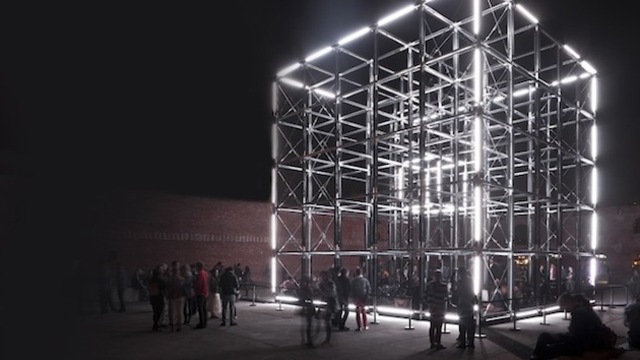
Hosi Simon  Most important, the first one is UVA and Scanner’s piece, “Origin.” The instillation is opening tomorrow night [and is] open through Sunday. It’s the perfect place for a romantic walk – I’ve tried it and it worked in New York. It’s the massive 40×40 foot light instillation that was started at Coachella 2011 and we traveled with it country to country. These steel cubes in different formations have developed.

Secondly, we encourage people to check out all the local artists, born and bred in San Francisco. Casey Reas is doing a workshop that teaches people how to use programming – it’s a super fun thing for people to get involved with. And Chris Milk is debuting his new interactive instillation, “The Treachery of Sanctuary” –  he went to school in San Francisco and did the “Wilderness Downtown” video for  Arcade Fire [“We Used To Wait”], you know?

Third, the legendary Squarepusher will be playing brand new music from his new record coming out in May.

Fourth – it will turn into an epic marathon. On average people stay for about 10 hours – [for] films, panels, workshops, bands. Be prepared to be tired and overwhelmed. Pretty much everything is inside. Eat, hydrate, do some stretching exercises. 

Fifth, If you weren’t able to get a ticket in the lottery for Saturday, Sunday is totally open, you don’t need a ticket. All the artwork including David Bowie’s will still be open Sunday and there will be panels.

SFBG How many tickets did you give away? Why the lottery system?
HS We will be giving away about 12,000 tickets. We’ll give away another quarter of those tickets on Friday. We’ve labored with this, we feel it’s the fairest way to guarantee entry.

The main thing is we don’t want to charge and want to make [tickets] as available as possible. There’s no perfect system for anything. We started as an industry party in New York, and we’ve [since] pushed it as a democratic cultural project. We want it to be open to as many people as we can.

SFBG When did that first New York party happen?
HS The first one was June 2010. It’s gone to seven [Creators Project events] in 2010, nine in 2011, and there will be seven or eight  in 2012 –  São Paulo, Bejing, Paris, New York. This is our first time in San Francisco, we’ve always wanted to bring it here. And a lot of the artworks [created here] will travel to all the stops around the world.

Our Weekly Picks: March 14-20

0

WEDNESDAY 14

“History of the Irish Coffee at the Buena Vista Cafe”

Those hurting from lurid leprechaun depictions could do worse than attend San Francisco’s Crossroads Irish American Festival (going on now through April 7) for legitimate, culturally relevant Éire-inspired happenings. Lectures, live music, dance — and don’t worry, this is no stodgy teetotaler lineup, either. Visitors to the California Historical Society today can check out the group’s collection of artifacts of (and a presentation regarding) that very San Francisco of beverages, the Irish coffee. Ephemera from the drink’s progenitors at Buena Vista Cafe in Fisherman’s Wharf, correspondence with the Irish Consul, drink propaganda going back decades. A trip to your favorite cozy bar to sample a cup is required post-exhibit. (Caitlin Donohue)

5:30-7:30 p.m., free with RSVP (rsvp@calhist.org or 415-357-1848, ext. 229)

California Historical Society

678 Mission, SF

www.irishamericancrossroads.org


The Knux

Hailing from “the real New Orleans” where “every day was hell,” the Knux isn’t fucking around. Brothers Kentrell “Krispy” Lindsey and Alvin “Joey” Lindsey wear skinny jeans and Converse, but if you call them hipster rappers, they will crush you. The Knux released its second full-length album, Eraser, last September and seem to play shows as frequently as humanly possible. Their heady brand of hip hop integrates elements of punk and garage rock, and most of their songs are at least a little bit (if not entirely) about sex; drugs figure in prominently, too. Joey has called their performances “a musical orgasm on stage.” Tempting. (Mia Sullivan)

With Vibrant Sound, the Cuss

9:30 p.m., $12

Café Du Nord

2170 Market, SF

(415) 861-5016

www.cafedunord.com


THURSDAY 15

Willie Nelson

“Outlaw” is a term that tends to be thrown around a little bit too liberally these days, particularly when it comes to discussing musicians — but one man that undoubtedly deserves that title is Willie Nelson, whose five-decade and counting career as a singer, songwriter, poet, author, and social activist has been forged entirely on his own terms. Known for his own recording hits, his partnerships with people such as Johnny Cash, his slew of songwriting successes (notably the classic tune “Crazy,” as made famous by Patsy Cline), the 78-year-old icon continues to prove that he is a musical and social force to be reckoned with. (Sean McCourt)

With Pegi Young and the Survivors

8 p.m., $55

Fox Theater

1807 Telegraph, Oakl.

www.thefoxoakland.com


San Francisco Dance Film Festival

Now San Francisco really has reason to brag about its Dance Film Festival. The first two editions of the fest packed ’em in, not because of big names but because the selections, mostly shorts, were so varied and, for the most part, mesmerizing. This year the festival boasts three different programs in three different locations, with 23 films (including four feature-length documentaries) from ten countries. A particularly fine doc is Joffrey: Mavericks on American Dance, which has an additional post-fest screening at the Balboa Theater on Mon/19 (www.balboamovies.com). As the film demonstrates, Robert Joffrey was one of America’s most adventurous artistic directors, both in terms of commissioning new work and restaging historical ones. (Rita Felciano)

Through Sun/18, $10–$100

Various locations, SF

www.sfdancefilmfest.org


“Life and Death in Black and White: AIDS Direct Action in San Francisco, 1985-1990”

Last month’s splendid display of well-selected AIDS quilt panels in the Castro (which commemorated dozens of passed community members), excellent local HIV oral history doc We Were Here (which should have won the Oscar), and recent fetishization of early 1990s gay party music in the clubs (which … don’t ask) have opened a fascinating wormhole into the recent — and recently unspeakable — past. The invaluable unearthing of contemporary gay history continues: we’ve moved from the Milkeolithic into the HIVoscene. The GLBT History Museum’s new exhibition “Life and Death in Black and White” will help dig even deeper, bringing important and inspiring ACT-UP and other protest photographs by Jane Philomen Cleland, Patrick Clifton, Marc Geller, Rick Gerharter, and Daniel Nicoletta to light. (Marke B.)

Through July 1

Reception tonight, 7-9 p.m., $3-5

GLBT History Museum

4127 18th St., SF

(415) 621-1107

www.glbthistory.org


FRIDAY 16

Lindstrøm (cancelled)

We should all hold off final judgment at least until Mungolian Jet Set makes its way over here, but otherwise, Hans-Peter Lindstrøm is currently Norway’s funkiest export — if for no other reason than that the electronic musician has been anointed by having prog-rock legend Todd Rundgren remix his latest single, “Quiet Place to Live.” It’s an inspired move, particularly since the album it comes from — Six Cups of Rebel — has the same anything-goes eclecticism that marked Rundgren’s work. The result, which feature Lindstrøm’s vocals for the first time, plays like a post-disco version of cuts from Rundgren’s 1973 prog classic A Wizard, a True Star. (Ryan Prendiville)

With Magic Touch, Conar, Solar, and more

9 p.m., $18

Mezzanine

444 Jessie, SF

(415) 625-8880

www.mezzaninesf.com


Hot Buttered Rum

This friendly San Francisco-based quintet delivers twangy bluegrass bliss with its signature woodwind accents. Heavily influenced by jam giants like the Grateful Dead, Phish, and Béla Fleck, Hot Buttered Rum’s music is light, fun, and compositionally lush. Although HBR has developed a jammy, improvisational style and reputation over the years, the group focused more on songwriting while making its latest album, Limbs Akimbo. Band member Erik Yates (banjos, guitars, woodwinds, and vocals) has described the album as “deeper” and more reflective of struggle than its previous work, which explored utopian themes like backpacking, first love, and materialism. Did I mention most of these men were reared in Northern California? (Sullivan)

With Cornmeal

9 p.m., $21

Great American Music Hall

859 O’Farrell, SF

(415) 885-0750

www.gamh.com


Layo & Bushwacka

Matthew Benjamin and Layo Puskin first joined forces in the 1990s during the hustle and bustle of London’s acid house scene. Since then, the affectionately dubbed DJ-producer duo Layo & Bushwacka continue to pump out tracks that straddle the fence between pounding techno and groovy house music on their own Olmeto Records. “Love Story,” from their 2002 release Night Works, remains the seminal example of their classic, no-frills tech house, with vintage-sounding vocals and catchy melodies layered over driving beats. (Kevin Lee)

With !K7, Ripperton, Eduardo Castillo, VOODOO, and Brandt Brauer Frick

9:30 p.m., $20

Public Works

161 Erie, SF

(415) 932-0955

www.publicsf.com


SATURDAY 17

Sonoma Marin Cheese Trail

Wine country tours are all well and good — until it’s your turn to be the designated driver. Enter the cheesemaker tour, brought to you courtesy of the California Artisan Cheese Guild. The association’s nifty new map has directions to 27 producers of blue, washed rind, semi-soft, and surface-ripened wonders in Sonoma and Marin Counties, from Tomales’ Ramini mozzarella (made from the milk of water buffalos) to the Italian-style snacks of Sebastopol’s Bohemian Creamery. Samples and tours are available at many of the cheeseries, consult your handy (available online) map for which ones are which. Two different 50-mile driving routes await you, as does — perhaps less explicitly — a picnic in the high grasses, or perhaps sunny sand dunes with a wheel or three. (Donohue)

Ongoing

Various cheesemakers, Sonoma and Marin Counties

www.cheesetrail.org


Robert Glasper Experiment

Following his singular and hilarious performance with Reggie Watts at Yoshi’s last month, pianist Robert Glasper returns, this time with his full band. The Robert Glasper Experiment has just released Black Radio, in which Glasper seems to be taking a shot at infusing some life back into jazz as well as raising the bar back up on popular music. Prominently blending jazz, R&B, and hip-hop, the album feature collaborations with Erykah Badu, Lupe Fiasco, Mos Def (a.k.a. Yasiin Bey), and many others, as well as an unexpected cover of Nirvana’s “Smells Like Teen Spirit.” The assuredly tight band will features guest vocalist Bilal at these dates. (Prendiville)

Tonight, 8 p.m., $20–$25

New Parish

579 18th St., Oakl.

www.thenewparish.com

Also Sun/18, 9 p.m., $20-25

Brick and Mortar Music Hall

1710 Mission, SF

(415) 800-8782

www.brickandmortarmusic.com


Kafana Balkan

A few short years ago, it seemed like wild Balkan dance parties were everywhere. Not so left-field a concept! (And not just because we have a sizeable population of hard-partying Eastern European immigrants.) The whirling Romany, a.k.a. gypsy, tunes and wanderlust ethos served as perfect redux for post-playa burners, California dreamers, nomadic spirits, and techno-fatigued clubgoers. The music’s woozy brass oompahs, astonishing accordion flights, and multiple time-signatures tapped into familiar, ecstatic Norteño, Irish jig, and polka veins while appealing to musicological intellects and enthusiastic dancers. Some great gypsy parties remain, especially at Amnesia Bar in the Mission. But hoist your glass of rakija for the return of one of the largest and best: Kafana Balkan swings back into action with fantastic DJ Zeljko and a live blast from the Brass Menazeri ensemble. It’ll be rather good-insane. (Marke B.)

9 p.m., $10

Rickshaw Stop

155 Fell, SF

www.rickshawstop.com


SUNDAY 18

Barbary Coast Burlesque

Consider the bunny. Scotty the Blue Bunny that is, a azure spandex-clad gent whose providence could only be, and sure enough is, San Francisco. Scotty stalks the stage in transparent plastic stripper heels and towering blue wabbit ears, a walking, talking, anthropomorphic vaudeville game. Would you believe he’s not the main attraction in his own troupe? No, no, that honor must be bestowed upon the betasseled lovelies of the Barbary Coast Burlesque, formed in 2006 by the elegantly-monikered Bunny Pistol. This, friends, is retro-sex — sleek and classy Burly Q in a city that does it very well. Check out this month’s Barbary Coast showcase at the equally impressive Yoshi’s, and resist the urge to hop-hop-hop onstage to join in the fun. (Donohue)

8 p.m., $20

Yoshi’s San Francisco

1330 Fillmore, SF

(415) 655-5600

www.yoshis.com


TUESDAY 20

Deicide

Led by singer-bassist Glen Benton, Deicide has been storming stages and terrorizing the music world for nearly 25 years with their Florida-bred brand of death metal, stirring up controversy with their anti-religion lyrics, offstage antics, and (of course) their extreme sound. Returning to San Francisco on the “March of Death 2012” tour in support of their latest album, last year’s To Hell With God, fans can expect nothing less than a night of brutal blast beats, demonic vocals, and thrashing guitars. (McCourt)

With Jungle Rot, Abigail Williams, and Lecherous Nocturne

8 p.m., $25–$28

Regency Ballroom

1290 Sutter, SF

www.theregencyballroom.com 


The Guardian listings deadline is two weeks prior to our Wednesday publication date. To submit an item for consideration, please include the title of the event, a brief description of the event, date and time, venue name, street address (listing cross streets only isn’t sufficient), city, telephone number readers can call for more information, telephone number for media, and admission costs. Send information to Listings, the Guardian Building, 135 Mississippi St., SF, CA 94107; or e-mail (paste press release into e-mail body — no text attachments, please) to listings@sfbg.com. Digital photos may be submitted in jpeg format; the image must be at least 240 dpi and four inches by six inches in size. We regret we cannot accept listings over the phone.

The struggle for housing money at City Hall

24

It’s barely March, and the next election isn’t until June and that’s just primaries and the Democratic County Central Committee, but we just started getting political mail anyway. It’s a piece from the Board of Realtors, denouncing plans for an increase in the real-estate transfer tax “to provide subsidized housing to people who want to live in San Francisco but don’t have the means to do so.” Mayor Ed Lee, the flier says, is backing this “outrageous” plan.

What, exactly, is going on here?

Well, for starters, the mayor is distinctly NOT pushing for an increase in the transfer tax, not right now, anyway. What he is doing is meeting with housing advocates and legislators and trying to come up with a stable source of funding for affordable housing — yes, for families and low-income people, many of them longtime residents who are being forced out by Ellis Act evictions, others of them people who work in the city and would rather live here than commute from Pinole, which everyone with any sense agrees is a good idea.

The problem: For years, San Francisco used Redevelopment Agency tax-increment money for affordable housing. Now that money’s gone, since the governor abolished redevelopment agencies. Actually, the money’s not gone, technically — the increased tax revenue from redevelopment project areas still exists. It’s just that the state is now taking a bunch of it, and other taxing entities like BART and the school district get some of it, and now it’s impossible to send bonds and borrow money against it. So what was once tens of millions for affordable housing is now a few million.

“We might have $20 million a year in the general fund,” said housing activist Peter Cohen. “But that’s compared to the $40 million or $50 million we had in the past, and it still leaves housing short.”

Lee has promised repeatedly to fix that problem, to find a way to make sure that there’s enough money that the nonprofits who build housing can plan and develop for the long term. Right now, it’s being called a Housing Trust Fund, but nobody knows exactly how it will actually work.

Remember: The city’s own General Plan states that 60 percent of all new housing should be available at below market rate. All of the regional growth projections say that San Francisco needs to build more housing — for its own workforce, not just for the rich. (And the local workforce, for all the tech jobs the mayor keeps hyping, is still mostly public-sector workers and service employees, most of whom can’t possibly afford the soaring rents and housing prices in this city.)

A lot of the existing affordable housing money comes from the city’s inclusionary housing law, which mandates that market-rate developers set aside a percentage of their new units (usually 20 percent) for lower-income people. Most developers eschew allowing poor people into their condo enclaves, so they pay a fee into a city fund instead.
But if we’re aiming for 60 percent, and we’re getting (at most) 20 percent, we’re a long ways off. Oh, and the developers are starting to argue that the 20 percent rule is too onerous and they can’t build enough condos for the rich if they have to throw scraps to the poor and middle-class, too.

And some supervisors are squawking about building more housing for the middle class, and right now in a zero-sum game, that means less for low-income people.
This all adds up to a mess for the mayor, and it’s no wonder some advocates are talking about raising the transfer tax — which, after all, is paid by the seller of a residential or commercial building, and while there are absolutely some houses underwater in San Francisco (and there should probably be an exemption in the tax for that situation), overall home prices are rising again, and many, probably most home sales these days involve substantial profit. It’s not a perfect tax, but it’s a tax on a class that is (generally) better off to support a class that is typically not so well off.

Here’s the problem: If the mayor supports a transfer tax, and that’s part of the final package, the realtors and the commericial building owners will no doubt put huge amounts of money into defeating it. That would mean Lee would have to raise a bucket of money and campaign really hard to pass it. But Lee’s demonstrated that he’s not the fighting type; he wants something that nobody serious will oppose. Which is why my sources at City Hall say that he wants the transfer tax off the table.

That could mean that the Housing Trust Fund will be a basic set-aside, a budgetary mandate that a certain amount of money go into a reliable fund for housing. That’s one of the city’s most pressing needs (really, if this becomes a city of just the rich, even those of us who own houses or have rent-controlled apartments won’t want to live here any more. Mayor Larry Ellison? Eeew.) So I’m okay with that. I’m not a big fan of set-asides, but this is the whole future of San Francisco we’re talking about.

So the realtors can take a chill pill — the mayor doesn’t want to get in a fight with you. Sigh.

Against the grain

0

marke@sfbg.com

MUSIC It began as a burbling “Eeep!” It was June 7, 2000; we were in Davies Symphony Hall, in the middle of the second movement of Charles Ives’ super-intense Symphony No. 4 from 1910-1916. Yet despite the whirling maelstrom of that work — imagine three Fourth of Julys at once, in which a vast orchestra overlaps itself with marching band themes, spirituals, dance hall ditties, and children’s songs — I could still make out curious sounds coming from the audience behind me. Soon onlookers were shouting out nonsense; one down our row jumped up from his seat. For my part, I felt my shoulders twitch involuntarily, and my partner let out a loud hee-haw guffaw. The memory-triggering dissonance, expertly transmitted through conductor Michael Tilson Thomas, was having a spazzifying physical effect, making us active participants in Ives’ chaotic Main Street Parade.

http://www.youtube.com/watch?v=iYvWwI6YRsE

San Francisco has never lacked for excellent performances of works still often classified as “contemporary classical,” despite many being a century old. But the first American Mavericks festival, more than a decade ago, did much to elevate San Francisco’s status in the cultural world at large. We were at the very edge of the tech bubble, a maverick cultural achievement of its own, of course. Yet not much bold, native art had risen in response to all that “future now” attention and money. The much-hyped Mission School visual art movement was in its infancy, and concerned more with hermetic understatement than Bay reppin’ (a nice answer, in its way, to Web 1.0 bombast). Native dance music forms like turntablism and dirty breaks were being superseded by bland lounge house, hyphy was only hatching, Green Day was over, and literature hadn’t yet been Eggered and Chaboned.

The SF Symphony is justly famed for its impeccably polished sound and MTT’s cheeky programs pairing classical comfort food with spunky aperitifs. But American Mavericks was pretty damned ballsy for a major symphony — almost a month’s worth of edgy, attention-grabbing, well-funded gems from 20th century composers like Ruth Crawford Seeger, George Antheil, Meredith Monk, Duke Ellington, Steve Reich, Frank Zappa, Lukas Foss, and a dozen more. There was a plethora of symphonic reconfigurations and unique instrumentations: an extra brass section blared from the basement for the Ives symphony; audience members brought their own instruments to play along with Terry Riley’s ecstatic “In C.” At a very materialistic moment, American Mavericks illuminated the wild-eared, transcendentalist spirit of native music while showing the world that SF still had a huge, unfettered freak flag to fly.

American Mavericks is back Thu/8-Sun/18, this time spreading its wings to include Symphony stops in Chicago, Ann Arbor, and Carnegie Hall. And while some have bemoaned fewer and somewhat less ambitious performances on the whole (we’re in a recession, after all), there are plenty of pieces to jump up and shout about.

Ives returns, this time with astonishing masterpiece A Concord Symphony — I always hear crisp leaves crunch beneath my mental feet when this is played. Profoundly quirky enchantress Meredith Monk is back as well: in a coup of idiosyncrasy, she’ll be singing John Cage’s Song Books with magnificent diva Jessye Norman and experimental champion Joan La Barbara. Later, Hometown hero John Adams will premiere a new work, Absolute Jest, as will local techno-influenced composer Mason Bates, with “Mass Transmission.” There’s loads more packed into a mere 10 days, including pieces from Oakland instrument-inventor Harry Partch, San Francisco Tape Music Center founder Morton Subotnick, and Bay Area indigenous music devotee Lou Harrison.

Will it have the same cultural impact? Here we are back in an overconfident tech bubble — and once again our total cultural output seems a bit, well, blah. An irony of the social media onslaught is that all this personal expression seems to be quashing true individuality. So we’re having a materialist and conformist moment. A good dose of musical eccentricity from old school visionaries/crazies who turned their backs on the rat race might just do us a world of good. Here’s to more “Eeeps!” among the bleeps.

AMERCAN MAVERICKS FESTIVAL

Thu/8-Sun/18, various prices and times

Davies Symphony Hall

201 Van Ness, SF.

(415) 864-6000

www.americanmavericks.org


The case against 8 Washington

35

tredmond@sfbg.com

In city planning terms, it’s a fairly modest project: 134 condos, no buildings more than 12 stories tall, on a 27,000-square-foot site. It’s projected to meet the highest environmental building standards and offers new open space and pedestrian walkways. It’s near Muni, BART, and ferry lines. And the city will collect millions of dollars in new taxes from it.

But the 8 Washington project, which will come before the Planning Commission March 8, has become a flashpoint in city politics, one of the defining battles of Mayor Ed Lee’s administration — and a symbol of how the city’s housing policy has failed to keep pace with the needs of the local workforce.

Put simply, it will create the most expensive condos in city history, housing for the richest of the 1 percent on the edge of the waterfront — and will further push San Francisco toward becoming a city that caters almost entirely to the very wealthy.

So in a city where the growing divide between the 1 percent and the rest of us has become a central issue and where the lack of affordable housing is one of the top civic concerns, 8 Washington is an important test. By any rational standard, this sort of development is the last thing San Francisco needs.

But some of the best-connected lobbyists in the city are pushing it. One of the mayor’s closest allies, Chinatown powerbroker Rose Pak, is a leading advocate — and the final outcome will say a lot about city politics in the Lee administration.

There are all sorts of half-truths and misleading statements by supporters of 8 Washington. Here are the five main reasons the project shouldn’t be approved.

1. It fills no housing need. San Francisco has no shortage of housing for the very rich; the dramatic need, outlined in both regional planning documents and the city’s own General Plan, is for low- and moderate-income housing for the people who actually work in this city (see “Dollars or sense?” 9/28/10). While San Francisco is getting richer by the day, the core workforce — public employees, workers in the hotel and restaurant industry, service workers, construction and trade workers, and a majority of the people in the lower levels of the finance and tech sector — are being priced out of the city. That means more people working here and living far out of town, often commuting by car, in what everyone agrees is an unsustainable situation. Meanwhile, more and more high-paid workers from Silicon Valley are living in San Francisco — again, commuting to distant jobs, either by car or by corporate bus.

The city’s General Plan states that some 60 percent of all new housing built in the city should be below market rate. San Francisco desperately needs housing for its workforce. This type of project simply puts the city deeper in the hole and further from its housing goals.

2. It’s a reward for bad actors. The main developer of this project is Simon Snellgrove, but one of his partners is, by necessity, Golden Gateway, which owns a significant part of the land — and which has been flouting at least the spirit if not the letter of city and state law and costing San Francisco tens of millions of dollars.

As project opponent Brad Paul has noted in written testimony, when Timothy Foo, the current owner, bought the complex from Perini Corp. about 20 years ago, he used a loophole in state law that allowed him to avoid a formal transfer of ownership. That means the property wasn’t re-assessed, costing the city about $1.5 million a year. According to the Assessor’s Office, the deal wasn’t illegal (and these tricks to avoid reassessment are relatively common) but still: He’s costing the city millions by using a loophole not available to most people.

Golden Gateway, which was built in a redevelopment area as middle-class housing, is now renting out apartments as short-term tourist or corporate rentals. There are dozens of examples right now on Craigslist. City law bars the owners of rental housing from converting it to hotel rooms, but a loophole in that law makes what Foo’s outfit is doing technically legal. But he’s clearly violating the spirit of the city ordinance that seeks to protect rental housing from hotel conversions.

One of the main aesthetic complaints about the area — something Snellgrove’s lobbyists have tried to use to support the project — is the ugly fence that now surrounds the Golden Gateway Tennis and Swim Club. But who do you suppose put that fence there?

Do we as a city want to be giving special zoning benefits to companies that try to circumvent tax and housing laws?

3. It’s an environmental disaster. Snellgrove and his architects, Skidmore Owning and Merrill, are seeking LEED platinum certification for the project, saying that its energy-efficiency, water use, and green building materials will make it one of the most sustainable structures in San Francisco. It is, the project website notes, close to all types of public transit.

But LEED doesn’t take into account what the building is used for (see “Is LEED really green,” 7/5/11) — and in this case, the use makes a huge amount of difference.

People who buy multi-million-dollar condos don’t tend to take Muni or BART when they go places. That’s not conjecture, it’s a proven fact. A 2008 study by the American Public Transportation Association notes, bluntly, that wealthier people are more likely to drive cars. When you move into the stratospheric regions of the ultra-rich, that’s even more true. A 2011 report on the Charting Transport website notes: “The very rich tend to shun public transport.”

The current zoning in the area allows for one parking space for every four residential units. Snellgrove is asking for one space per unit — in other words, he figures every single buyer will have a car.

Many of the people who buy these condos won’t be working or even living most of the time in San Francisco. These are condos for world travelers, second and third homes for people who want to spend a few weeks a year in San Francisco. “They aren’t going to be living here all year,” Christina Olague, a former Planning Commission member who is now the District 5 supervisor, told us last July.

If five of the 165 residents of 8 Washington fly in a private or corporate jet from, say, New York to their SF pad once a month, the project will cause the use of jet fuel equivalent to what a normal family would use driving a car for 330 years, Paul noted.

“How many solar panels are needed compensate for burning 396,000 gallons of jet fuel a year?” he asked.

Then there’s the construction issue. If the developer’s projections are correct, as many as 20,000 dump truck runs will be trundling along the Embarcadero for several months, one every two minutes — and it could be happening right as the traffic nightmare called the America’s Cup is hitting the waterfront.

It also goes against some 40 years of waterfront planning policy, all of which as focused on downzoning and creating open space. This would be the first upzoning of San Francisco waterfront property in decades.

4. It will wipe out what is mostly a middle-class recreation facility. The Golden Gateway Tennis and Swim Club will be closed for three years, then (possibly) reopened later as a smaller facility. The club — with two outdoor pools and six tennis courts — sounds like something for the elite, and it’s managed by the upscale Bay Club, but a lot of the users are longtime Golden Gateway residents and seniors. “I would say 30 or 35 percent of the users are seniors,” Lee Radner, chair of Friends of Golden Gateway, told me. Most, he said, are middle-class people, and the expense isn’t that high. “My wife and I pay $3 a day to use the pool,” he said. “I swim every day, and it would cost more than that to use the public pools in the city.” He added: “There are some wealthier people, of course, but many of us are retired and on fixed incomes.”

We’re talking about 90,000 total square feet of outdoor recreation space — which dwarfs the 20,000 square feet of open space the developer promised to provide.

5. The city doesn’t get much out of the deal. In exchange for upzoning the waterfront, creating a big all of buildings and screwing up the city’s housing balance, what does the San Francisco general fund get? Not a lot. The estimates for new tax revenue run about $1.5 million a year of the next 60 years — and when you translate that to what economist call “net present value,” the cash equivalent today of that revenue stream, it’s about $30 million. The Port of San Francisco is talking about creating a special infrastructure financing district — sort of the equivalent of a redevelopment area — to pull that money out in advance, which may not even be legal (since part of the land is a former redevelopment area, the state law that allows these special finance districts may not apply). But even so, a Jan. 14 Port memo suggests that the agency has plans to spend all that money on its own infrastructure — setting up a potential battle between the supervisors and the Port Commission over where the money, if it actually can be collected up front, will go.

Like any developer, Snellgrove will pay into the city’s affordable housing fund — in this case, about $9 million to pay for the equivalent of 27 units. No affordable units will be on site, of course; that would detract from the uber-wealthy ambience of the place. And it’s not clear when those units would be built. “Nobody builds 27-unit buildings any more,” Paul, a former deputy mayor for housing, said. “We’ll have to wait until there’s enough money for a bigger project, somewhere, sometime down the road. That’s what we’re getting here.”

Either way, it’s not a huge benefit for allowing this disaster of a project — and it’s a terrible statement for San Francisco to make. At a time when the mayor has cleared the Occupy protesters — who are talking about how little the rich pay in taxes — off the waterfront, the city is preparing to move in the exceptionally rich, who aren’t paying anywhere near their fair share in tax revenue to local government.

(Nobody knows for sure whether the costs of servicing high-end residential exceed the revenue the city gets from property taxes. In 1971, the Guardian put together the first-ever cost-benefit study for highrise office development, which showed that commercial buildings cost the city more than they paid; that’s been confirmed and demonstrated over the years to the point where it’s hardly even an argument any more. The supervisors ought to ask the city economist or the budget analyst to do the same sort of analysis for luxury condos.)

There’s another element here: Mayor Lee made a point during his campaign to say over and over again that he was an independent thinker, that powerful and influential allies like Rose Pak would not be calling the shots at City Hall. This will be his first major test: Pak and lobbyist Marcia Smolens are working hard to promote 8 Washington. And we’re already getting some disturbing signals out of the mayor’s office.

Lee told us that he has “no thoughts” about the project and hasn’t been paying any attention to it. That’s an odd stance, considering that his own Port Commission is pushing it and staffers in his office are working with the developer. This is a big priority for Pak, and the notion that she has never mentioned it to the mayor defies reason. Board President David Chiu, who talks to the mayor regularly, opposes the project, which is in Chiu’s district.

It’s hard to imagine that anyone who pays attention to local politics could be missing what will be one of the landmark votes this spring on the Planning Commission — which will take up the project March 8 — and the Board of Supervisors.

The mayor, may, indeed, be ignoring everything that supporters and opponents of 8 Washington have said and may be waiting until the Planning Commission vote to take a position. But if he’s just ducking questions because he’s planning to support it, he’s making a big mistake.

This is a chance for San Francisco to go beyond the platitudes about building housing, go beyond the hype about “green” buildings, see through the fraud about community benefits and consider what this really is: A special favor for a developer who wants to cater to the top 1 percent of the 1 percent and move San Francisco even closer to being a city of, by, and for the elite. The only reasonable vote on 8 Washington is No.

Viva la Vita

0

GAMER News of the Vita’s death in Japan has been greatly exaggerated. Sony’s new handheld console arrived on Japanese shores last November, with meager sales compared to 2005’s PSP and even fewer than the much-ballyhooed Nintendo 3DS launch last spring. Analysts were quick to point to the 3DS’s disappointing launch as the beginning of the end for dedicated handheld systems, and Sony’s comparatively low sales had many pundits patting themselves on the back.

But, unlike Nintendo, Sony seems to have learned that software is as important as hardware. Where the 3DS launched with a sparse game library and hoped to sell units on name recognition and a 3D gimmick, the Vita has arrived with one of the best all-around software launches in recent history. That the hardware is no slouch either indicates we’re looking at a winner — if gamers are willing to carry around another gadget.

The Vita is a system for tech geeks. It’s got gimmicks and novelties — front and rear cameras, tilt control, and a rear touch pad — but it’s the more traditional elements that drive them home. The system is comfortable to hold and has a beautiful OLED front touch-screen. It’s quick as a whip, and best of all it’s aesthetically pleasing. It’s no accident the Vita looks more like an iPhone than a plastic Speak & Spell. (Yes, that’s a dig at the 3DS.)

http://www.youtube.com/watch?v=WfBFx051pWM

Additionally, it’s a real surprise to see Sony at the forefront of the impending digital revolution. Not only is every Vita game available on a cartridge, it’s also available for download — often at a lower price. Flexible pricing is something Sony seems interested in across the board, and it’s a development the industry has needed for a while; helping smaller games release at prices related to their stance in the marketplace makes sense.

Early sales reports for the Vita’s Western launch currently remain low, but the problem is not with the system. The Vita is slicker and quicker than its big brother, the PlayStation 3, and with the right publishers and a steady pace it could be the handheld we’ve all been waiting for. Buying the Vita now means banking on the system’s potential. Its launch lineup is full of games that are undeniably fun to play, but one could argue they are mere previews of the bigger-and-better experiences the Vita can offer. Whether or not we see those experiences is in the hands of a public that just might be OK with 99-cent iPhone games and 10-minute time-wasters.

Check out Peter Galvin’s Vita game reviews over at Pixel Vision.

Mayor Lee makes demands on SFUSD

9

“You thought you felt an earthquake Sunday night. Actually, that was me.”

Assemblymember Tom Ammiano was on the phone, talking to me about Mayor Ed Lee’s plan to demand some changes in the way the San Francisco Unified School District manages its property — and to hold up the $6 million the city owes the district until that happens. The mayor says there will be “strings attached” to the rainy-day fund money that would normally go to help SFUSD avoid teacher layoffs — and while it’s not exactly clear what those strings are, except that the mayor wants surplus property to be developed or sold, it’s not what Ammiano had in mind when he created the fund as a supervisor.

“The mayor is trying to hold the school district hostage,” Ammiano said. “And it’s not well advised.”

It’s also really odd: For one thing, as School Superintendent Carlos Garcia told me in a phone interview, any money the district got from selling off surplus property would be earmarked for use in facilities development and couldn’t go to pay teachers or prevent program cuts. “He wants to see how we’re using the property, and that’s fine, I’m happy to share that with him,” Garcia said. “But selling property doesn’t help. Even if we sold everything, we’d still need the money from the Rainy Day Fund.”

The district is constantly looking at ways to use its surplus property, and does a study on the topic every two years. But it’s not simple — for one thing, enrollment is growing, and it’s entirely possible that some sites that are now surplus will be needed in the next few years. And Garcia is properly cautious about getting rid of public property without a very good reason.

He’s a little curious, too, about what the mayor has in mind. “This did come a little bit out of the blue,” he told me.

The whole situation creates another disturbing conflict, one I’ve been worried about for years. The mayor’s education advisor, Hydra Mendoza, also sits on the School Board. What happens when the guy who pays her salary at her day job — Mayor Lee — takes a position that’s directly at odds with the interests of the job the voters gave her, as a board member? I see that happening right now, and I don’t know how it’s going to play out.

With any luck, the mayor will come to his senses, cut the check and stop trying to tell the school district how to manage its property. If not, his education advisor is going to be in a bit of a pickle.

Mendoza told me she doesn’t see it that way — in fact, she said she doesn’t think the mayor will really hold up the $6 million. “It’s part of an ongoing conversation,” she told me. “People keep telling the mayor that the school district has all this surplus property and needs to sell it before they get any city money. The mayor is just responding to that, saying ‘is there another source of revenue?’ Because the rainy day fund is going to dry up.

“How that got portrayed as ‘strings’ I don’t know.”

She did say, however, that the mayor “has been very clear that he wants to look at other revenue streams” and wants to see a plan in place to use the surplus property. Even though, of course, it’s not that simple and Mendoza was quick to agree that you can’t just put a tech company in a building that’s part of a school site.

She also insisted that there’s no conflict here. “It works well for me and the district,” she said. “If I wasn’t here, the perception of the district at City Hall would be different.”

But still: We’re very close to a situation where the mayor is on one side of an issue and the school district is on the other, and there’s critical money involved, and Mendoza is in the middle. “We haven’t come to those crossroads,” she said. “I haven’t been put in that situation. We’ve had a lot of civil conversations.”

But it’s out there, and it’s a potential problem.


Editorial: The case against the 8 Washington tower

27

Editorial note: In 1971, at the height of the Alvin Duskin anti-highrise battle, the Guardian did a special first ever cost benefit study for high rise office development.

We found that highrises cost the city  more in services than they produce in revenue.  This meant that the commercial high rise boom could be fought on economic grounds, not just aesthietic and environmental grrounds, and the Chamber of Commerce/Big development gang could never adequately refute our findings.  In fact, they are now taken for  granted. So, as the 8 Washington battle is poised to open the floodgates even further for a forest of market rate residential  buildings, it’s time for the city to do its own study to determine the economics of high end  residential buildings.  Does the cost of servicing luxury residential buildings exceed the taxes they pay? We and many others in the neighborhoods are certain that market rate housing doesn’t pay for itself. But the facts are needed and so we urge the supervisors to direct the budget analyst or the city economist to do a similar analysis  for luxury condos.  Below is Executive Editor Tim Redmond’s powerful argument against 8 Washington.

By Tim Redmond

tredmond@sfbg.com

In city planning terms, it’s a fairly modest project: 134 condos, no buildings more than 12 stories tall, on a 27,000-square-foot site. It’s projected to meet the highest environmental building standards and offers new open space and pedestrian walkways. It’s near Muni, BART, and ferry lines. And the city will collect millions of dollars in new taxes from it.

But the 8 Washington project, which will come before the Planning Commission March 8, has become a flashpoint in city politics, one of the defining battles of Mayor Ed Lee’s administration — and a symbol of how the city’s housing policy has failed to keep pace with the needs of the local workforce.

Put simply, it will create the most expensive condos in city history, housing for the richest of the 1 percent on the edge of the waterfront — and will further push San Francisco toward becoming a city that caters almost entirely to the very wealthy.

So in a city where the growing divide between the 1 percent and the rest of us has become a central issue and where the lack of affordable housing is one of the top civic concerns, 8 Washington is an important test. By any rational standard, this sort of development is the last thing San Francisco needs.

But some of the best-connected lobbyists in the city are pushing it. One of the mayor’s closest allies, Chinatown powerbroker Rose Pak, is a leading advocate — and the final outcome will say a lot about city politics in the Lee administration.

There are all sorts of half-truths and misleading statements by supporters of 8 Washington. Here are the five main reasons the project shouldn’t be approved.

1. It fills no housing need. San Francisco has no shortage of housing for the very rich; the dramatic need, outlined in both regional planning documents and the city’s own General Plan, is for low- and moderate-income housing for the people who actually work in this city (see “Dollars or sense?” 9/28/10). While San Francisco is getting richer by the day, the core workforce — public employees, workers in the hotel and restaurant industry, service workers, construction and trade workers, and a majority of the people in the lower levels of the finance and tech sector — are being priced out of the city. That means more people working here and living far out of town, often commuting by car, in what everyone agrees is an unsustainable situation. Meanwhile, more and more high-paid workers from Silicon Valley are living in San Francisco — again, commuting to distant jobs, either by car or by corporate bus.

The city’s General Plan states that some 60 percent of all new housing built in the city should be below market rate. San Francisco desperately needs housing for its workforce. This type of project simply puts the city deeper in the hole and further from its housing goals.

2. It’s a reward for bad actors. The main developer of this project is Simon Snellgrove, but one of his partners is, by necessity, Golden Gateway, which owns a significant part of the land — and which has been flouting at least the spirit if not the letter of city and state law and costing San Francisco tens of millions of dollars.

As project opponent Brad Paul has noted in written testimony, when Timothy Foo, the current owner, bought the complex from Perini Corp. about 20 years ago, he used a loophole in state law that allowed him to avoid a formal transfer of ownership. That means the property wasn’t re-assessed, costing the city about $1.5 million a year. According to the Assessor’s Office, the deal wasn’t illegal (and these tricks to avoid reassessment are relatively common) but still: He’s costing the city millions by using a loophole not available to most people.

Golden Gateway, which was built in a redevelopment area as middle-class housing, is now renting out apartments as short-term tourist or corporate rentals. There are dozens of examples right now on Craigslist. City law bars the owners of rental housing from converting it to hotel rooms, but a loophole in that law makes what Foo’s outfit is doing technically legal. But he’s clearly violating the spirit of the city ordinance that seeks to protect rental housing from hotel conversions.

One of the main aesthetic complaints about the area — something Snellgrove’s lobbyists have tried to use to support the project — is the ugly fence that now surrounds the Golden Gateway Tennis and Swim Club. But who do you suppose put that fence there?

Do we as a city want to be giving special zoning benefits to companies that try to circumvent tax and housing laws?

3. It’s an environmental disaster. Snellgrove and his architects, Skidmore Owning and Merrill, are seeking LEED platinum certification for the project, saying that its energy-efficiency, water use, and green building materials will make it one of the most sustainable structures in San Francisco. It is, the project website notes, close to all types of public transit.

But LEED doesn’t take into account what the building is used for (see “Is LEED really green,” 7/5/11) — and in this case, the use makes a huge amount of difference.

People who buy multi-million-dollar condos don’t tend to take Muni or BART when they go places. That’s not conjecture, it’s a proven fact. A 2008 study by the American Public Transportation Association notes, bluntly, that wealthier people are more likely to drive cars. When you move into the stratospheric regions of the ultra-rich, that’s even more true. A 2011 report on the Charting Transport website notes: “The very rich tend to shun public transport.”

The current zoning in the area allows for one parking space for every four residential units. Snellgrove is asking for one space per unit — in other words, he figures every single buyer will have a car.

Many of the people who buy these condos won’t be working or even living most of the time in San Francisco. These are condos for world travelers, second and third homes for people who want to spend a few weeks a year in San Francisco. “They aren’t going to be living here all year,” Christina Olague, a former Planning Commission member who is now the District 5 supervisor, told us last July.

If five of the 165 residents of 8 Washington fly in a private or corporate jet from, say, New York to their SF pad once a month, the project will cause the use of jet fuel equivalent to what a normal family would use driving a car for 330 years, Paul noted.

“How many solar panels are needed compensate for burning 396,000 gallons of jet fuel a year?” he asked.

Then there’s the construction issue. If the developer’s projections are correct, as many as 20,000 dump truck runs will be trundling along the Embarcadero for several months, one every two minutes — and it could be happening right as the traffic nightmare called the America’s Cup is hitting the waterfront.

It also goes against some 40 years of waterfront planning policy, all of which as focused on downzoning and creating open space. This would be the first upzoning of San Francisco waterfront property in decades.

4. It will wipe out what is mostly a middle-class recreation facility. The Golden Gateway Tennis and Swim Club will be closed for three years, then (possibly) reopened later as a smaller facility. The club — with two outdoor pools and six tennis courts — sounds like something for the elite, and it’s managed by the upscale Bay Club, but a lot of the users are longtime Golden Gateway residents and seniors. “I would say 30 or 35 percent of the users are seniors,” Lee Radner, chair of Friends of Golden Gateway, told me. Most, he said, are middle-class people, and the expense isn’t that high. “My wife and I pay $3 a day to use the pool,” he said. “I swim every day, and it would cost more than that to use the public pools in the city.” He added: “There are some wealthier people, of course, but many of us are retired and on fixed incomes.”

We’re talking about 90,000 total square feet of outdoor recreation space — which dwarfs the 20,000 square feet of open space the developer promised to provide.

5. The city doesn’t get much out of the deal. In exchange for upzoning the waterfront, creating a big all of buildings and screwing up the city’s housing balance, what does the San Francisco general fund get? Not a lot. The estimates for new tax revenue run about $1.5 million a year of the next 60 years — and when you translate that to what economist call “net present value,” the cash equivalent today of that revenue stream, it’s about $30 million. The Port of San Francisco is talking about creating a special infrastructure financing district — sort of the equivalent of a redevelopment area — to pull that money out in advance, which may not even be legal (since part of the land is a former redevelopment area, the state law that allows these special finance districts may not apply). But even so, a Jan. 14 Port memo suggests that the agency has plans to spend all that money on its own infrastructure — setting up a potential battle between the supervisors and the Port Commission over where the money, if it actually can be collected up front, will go.

Like any developer, Snellgrove will pay into the city’s affordable housing fund — in this case, about $9 million to pay for the equivalent of 27 units. No affordable units will be on site, of course; that would detract from the uber-wealthy ambience of the place. And it’s not clear when those units would be built. “Nobody builds 27-unit buildings any more,” Paul, a former deputy mayor for housing, said. “We’ll have to wait until there’s enough money for a bigger project, somewhere, sometime down the road. That’s what we’re getting here.”

Either way, it’s not a huge benefit for allowing this disaster of a project — and it’s a terrible statement for San Francisco to make. At a time when the mayor has cleared the Occupy protesters — who are talking about how little the rich pay in taxes — off the waterfront, the city is preparing to move in the exceptionally rich, who aren’t paying anywhere near their fair share in tax revenue to local government.

(Nobody knows for sure whether the costs of servicing high-end residential exceed the revenue the city gets from property taxes. In 1971, the Guardian put together the first-ever cost-benefit study for highrise office development, which showed that commercial buildings cost the city more than they paid; that’s been confirmed and demonstrated over the years to the point where it’s hardly even an argument any more. The supervisors ought to ask the city economist or the budget analyst to do the same sort of analysis for luxury condos.)

There’s another element here: Mayor Lee made a point during his campaign to say over and over again that he was an independent thinker, that powerful and influential allies like Rose Pak would not be calling the shots at City Hall. This will be his first major test: Pak and lobbyist Marcia Smolens are working hard to promote 8 Washington. And we’re already getting some disturbing signals out of the mayor’s office.

Lee told us that he has “no thoughts” about the project and hasn’t been paying any attention to it. That’s an odd stance, considering that his own Port Commission is pushing it and staffers in his office are working with the developer. This is a big priority for Pak, and the notion that she has never mentioned it to the mayor defies reason. Board President David Chiu, who talks to the mayor regularly, opposes the project, which is in Chiu’s district.

It’s hard to imagine that anyone who pays attention to local politics could be missing what will be one of the landmark votes this spring on the Planning Commission — which will take up the project March 8 — and the Board of Supervisors.

The mayor, may, indeed, be ignoring everything that supporters and opponents of 8 Washington have said and may be waiting until the Planning Commission vote to take a position. But if he’s just ducking questions because he’s planning to support it, he’s making a big mistake.

This is a chance for San Francisco to go beyond the platitudes about building housing, go beyond the hype about “green” buildings, see through the fraud about community benefits and consider what this really is: A special favor for a developer who wants to cater to the top 1 percent of the 1 percent and move San Francisco even closer to being a city of, by, and for the elite. The only reasonable vote on 8 Washington is No.

Bounce to this: Rusty Lazer does Mardi Gras

1

Due to health problems, Big Freedia had to cancel her and Rusty Lazer’s Noise Pop gig at Public Works Sat/25. The event been transmutated into a big gay dance party with Double Duchess, DJ Bus Station John, and more. You should still read this interview, though.

With all its technicolor thrift flair, Mardi Gras costumes in state of midway-preparedness, and sleepy passels of breakfast-cooking houseguests, Jay Pennington’s New Orleans clapboard house is pretty hallucinatory on the Saturday afternoon of Carnaval weekend. Staring out the window waiting for the bounce DJ to call me up for our interview, I was to be excused for imagining that the shed in the side lot was producing actual chords while the New Orleans monsoon that raged outside hit it.

When I come across him in his bedroom, Pennington – who is also known as Rusty Lazer, and is the now-famous transgender NOLA bounce artist Big Freedia’s DJ and informal manager – is threading colored paper onto a string. He was going to be Hanuman the monkey god at the Mardi Gras parades on Sunday, his day off from work over Mardi Gras weekend. Around him, the city has ballooned with tourists and locals chucking beads at targets, high-stepping through brass numbers, eating frosted king cake, and peeing in inappropriate places.

I braved the rain that afternoon to talk about bounce music and Mardi Gras with Pennington, so it was kind of a surprise when our conversation swerved into the intricacies of 501(c)3 registration. It shouldn’t have been. He is a lot like New Orleans itself, a town that counts as a centuries-old melting pot, where the frat boys hang at the same bars as the career jazz musicians hang at the same bars as the pretty queer kids who sometimes party at dark gay leather bars (I was privy to this last comingling within six hours of landing in the Big Easy, at Daddy Aki’s Peacock party at the Phoenix Eagle Leather Bar where Pennington and his new managee Nicky Da B spun). [Correction: An earlier version of this article identified Peacock as Jay Pennington’s party. It is actually organized by Daddy Aki. Our bad.]

If you are a NOLA entertainer, Mardi Gras weekend counts among the most hectic of the year. Pennington had evenly informed me that my suggested meet-up time of noon was at least two hours too early considering the aftermath of the night shift on the decks he’d pulled before and that he would surely pull again that evening. But it’s two thirty now and for the moment, he’s able to focus on Hanuman, and attempt to tell me what’s so special about his city.

Hands-on Hanuman: Rusty Lazer in mid-Mardi Gras repose. Guardian photo by Caitlin Donohue

Though the DJ is playing less and less a role in Big Freedia’s career as she blows up and sells out shows around the country, Pennington continues to be a driving force in bounce’s dispersal outside NOLA. He signed his first official managerial contract with Nicky Da B, an adorable local whose track with Diplo hit Soundcloud last week. Bounce is indigenous to New Orleans — like Chicago’s juke and Detroit’s jit — a Caribbean-inflected dance music that is well known for the way its dancers pop their hips at machine gun rates.

Pennington is also is the co-founder along with Delaney Martin of New Orleans Air Lift, an international program he made to support local artists post-Katrina. This loosely-incorporated organization (it’s not 501(c)3 and relies instead on private donations, like the sales of the work of Swoon, one of the few females in the upper echelons of the street art world – her intricate, delicate wheatpastes blanket the fence next to Pennington’s house.) The Airlift Project has sponsored trips by New Orleanian artists to Berlin, even the import of Siberian breakdancer Ivan Stepanov to New Orleans.

This last story illustrates one of Pennington’s biggest turn-ons — fostering the artistic combustion that happens when a bunch of different energies get together. As illustration, he shows me a high fashion video shoot made by Lady Gaga’s stylist Nick Knight featuring the 19-year-old local bounce dancer Quack. 

After seeing a video of the improbably Barbie-bodied dancer, Knight contacted Pennington to ask if she’d care to do the same dance wearing Alexander McQueen for a fashion film series. Quack didn’t have a passport, but she went and got one with Pennington. The next day they went to London, found themselves “sitting in a room with nothing but Amazonian models.” Quack danced for eight hours to make the video, which turned out to be a testament to not just the extreme sexuality of bounce music, but also its athleticism, and emotional panacea. 

“This is the music that makes people forget that they’re hungry,” Pennington tells me, excitedly clicking through videos of schoolkids bouncing in rec centers, and endless YouTube clips of home bounce practice, done against a wall, ass to the camera. “It’s finally tuned to helping you forget your problems.” He wants to “take a New Orleans plane full of people all over the world,” to teach bounce to the masses. “In case anybody around here has forgotten how to have fun.”

The music lends itself to teaching — singers often give specific commands in songs, a popular request being for everbody to bend over and keep their ass popping. “Bounce is all instructions,” Pennington says.

The ability to move among social groups is one of the reasons why Pennington fell in love with New Orleans. 

“Here, you’re part of a community, not just part of a scene,” he reflects. “The difference is that the communities include all the people in your community. I don’t feel that in Portland or Austin.” He says the young arrivals in other artsy, liberal towns “hang out in mirrored social groups. I don’t know if that means anything, but it makes sense to me.” Pennington considers the neighborhood connections he’s made through participating in NOLA’s famous informal second line parades as, if not more, crucial than the ones he’s made with fellow travelers who have alit upon New Orleans as a haven for weirdos and music freaks. “New Orleans black community is nothing if not family-oriented,” he says.

Those mirrored social groups are a concept that should make sense to those beyond DJ Rusty Lazer. Part of what makes gentrification such a bummer is that when young bohos move into low-rent, family-oriented neighborhoods, they don’t form connections with the existing culture, imposing their own wacky adventures on top of the landscape as though they’re the first to really enjoy it. 

This missed connection leads newcomers away from frequenting established neighborhood businesses, and doesn’t provide for enough interconnectedness to get any kind of organizing come when rents start to rise and the condos come in. So good for New Orleans, and especially the rapidly changing Bywater neighborhood if they can avoid the typical storyline of minority community attracting broke artists attracting yuppies who can pay first, last, second, and third months’ rent in cash. 

Not the town doesn’t have other defense mechanisms. “The heat, the bugs, that lack of industry, the violence — that keeps it from growing out of control,” says Pennington. “It keeps the excessively ambitious away. When this place piles it on, it really piles it on. You can’t just casually live in New Orleans.” Wise words to the San Franciscan exodus that will surely come in the next months after tech boom 2.0

And for the record, I wasn’t hallucinating the house making music. The Ninth Ward’s musician mad scientist Quintron installed a rain organ into the Music Box, a small village of structures built in Pennington’s sideyard by 70 people to be played like a symphony, complete with Quintron playing conductor and a capacity crowd crammed into bleacher seating and crouching amid the structures themselves. At recent performances during last fall, 750 people showed up to watch the show. There was space for 250 in the sidelot. 

Krushin’ on

0

SUPER EGO I’ve only a wee bit of space this week before I rush off back into the Mardi Gras of my mind, but I’ve got to three times diagonal-snap for local fashion designer Jeanette Au (jeanetteau.carbonmade.com) who tore it up for SF on the NY Fashion Week runways last week with her debut collection of 3-D knit fantasias. Ruling!


RED BARAAT

The Non Stop Bhangra (www.nonstopbhangra.com) monthly party’s return two weeks ago was beautiful-insane — if you missed it, or must fulfill your yearning for incredible Indian-inspired dance music sounds before the next installment, check out this live act featuring irrepressible bandleader Sunny Jain on the dhol drum, backed by a high-stepping nine-piece brass band. Bollywood meets Mardi Gras is the shorthand, but the ringing grooves transcend categorization.

Thu/23, 7:30 p.m., $12–$15, all ages. Slim’s, 333 11th St., www.slimspresents.com


ROLLER DISCO

Oh man, David Miles Jr., our patron saint of skate — “The Godfather of Skate,” actually, who founded the essential Black Rock Roller Disco and keeps peeps rollin’ from the Embarcadero to Golden Gate Park — lost everything in a tragic fire. He and his family are OK, but here’s a great event to help get them back on their (wheeled) feet. Skate rental available: Lots of good DJs.

Thu/23, 9 p.m., donations at the door. Mighty, 119 Utah, SF. www.mighty119.com


CUTE FANGS 4EVER!

It’s no secret that hyper-productive tech-breaks player and Cute Fang label owner Forest Green is one of my favorite people. It’s hard not to leave her parties with a smile plastered on your face — partly from the room-wobbling beats, partly from her pure positivity transmission. This is her two-room blowout birthday party, with a slew of bonkers local guests like DJ Denise, Dragn’fly, Raydeus, Tek 9, and Base Hed. And it will be cute!

Fri/24, 9 p.m.-4 a.m., $5 before 10 p.m., $10 after. Icon, 1192 Folsom, SF. www.forestgreen.org


SITUATION

Part of the reason door fees have risen so much in San Francisco is our insistence on relying on foreign or guest DJs to bring something interesting to the table. Flights are expensive, cover rises. Well here comes Situation, a free party deliberately designed to showcase local talent and some snappy grooves: “the new disco sound of New York, bangin’ house joints, 12-inch dance versions, and more than a few non-sequitors to keep things interesting,” quoth host DJ (along with Eug and Ash Williams) Derek Opperman, my nightlife critic counterpart at the Weekly, who’s basically an adorable human Shazam. Move out, yazoo.

Fri/24, 10 p.m., free. 222 Hyde, SF. www.222hyde.com


DJ KRUSH

Let’s just admit that future bass was the trip-hop revival, OK? And while Flying Lotus et al. took the sound to unfathomable new highs/lows (and old hands like Amon Tobin sizzled retinae with his ISAM stage-show comeback), there’s sometimes no beating the originals. After 20 years, Tokyoite chill-wizard DJ Krush can still gently ride those intelli-stoned waves into the stratosphere: a three-hour set should do you quite solid.

Sat/25, 9 p.m., $17.50 advance. Mezzanine, 444 Jessie, SF. www.blasthaus.com

Editor’s Notes

1

“San Francisco’s economy is moving in the right direction,” Mayor Ed Lee told the Examiner last week. “My economic development and job creation policies are setting San Francisco on a path toward economic recovery.”

The normally modest mayor is making a rather sweeping statement there — the US economy is improving in general, and I don’t think the mayor can take credit for all of it. But he’s absolutely correct that he’s promoted policies that are aimed at bringing more tech companies in to San Francisco, and over the next few years, they will no doubt create a lot of high-paid jobs for people with specific skills that require a high degree of training and education.

Is that “the right direction” for the city? I lived here the last time that San Francisco was part of a tech boom, and I’m not so sure.

See, bringing all sorts of new wealth into town sounds good on the surface, and for some people — particularly real-estate speculators, landlords and purveyors of high-end services — it is. But in a city that has limited space and nearly unlimited demand for housing, lots of new rich people and lots of high-paid people looking for places to live puts pressure on the existing residents, particularly the poor and the working class. It screws the middle class, too — if you’re a teacher or a nurse and you want to buy a house in San Francisco during a boom, you’re S.O.L. You can barely afford to rent — and if you’re already renting, you’re constantly at risk of losing your home, and your ability to live in this city, because your landlord can make more money kicking you out and selling the place as a tenancy in common to someone with more money.

There’s no way to build enough new affordable rental housing, or housing that middle-class families can buy, to keep up with the demand. It’s impossible. Developers won’t do that — there’s too much money to be made in high-end housing for anyone in the private marketplace to waste time on anything else.

The only way to preserve the middle class in the upcoming boom that Lee is promoting is to aggressively protect existing rental housing stock — which means preventing condo conversions and TICs and the stuff that gets promoted as “middle-class housing.” The only way to prevent massive displacement of people and existing businesses is to regulate space in the city more tightly than anyone has ever done — which will, by its nature, make it harder for the newcomers and new millionaires to find places to live.

That’s the tradeoff. That’s the fact that Lee and his allies don’t seem to want to grasp

Our Weekly Picks: February 15-21

0

WEDNESDAY 15

The Asteroids Galaxy Tour

Do Danish hipsters listen to American funk music? Apparently the Asteroids Galaxy Tour is keen to show its repertoire goes beyond the catchy pop you’ve likely heard on an Apple iPod ad (“Around the Bend”) or a Heineken commercial (“The Golden Age”). Asteroids, the brainchild of vocalist Mette Lindberg and producer Lars Iversen, gained popularity with their nostalgia-inducing sound on 2009 release Fruit (Small Giants). Lindberg and Iversen push that retro-funkiness even further in newest release Out of Frequency (B.A.R. Music), employing more horns and electronic organ sounds to add some oomph to Lindberg’s sweet tones. It’s as if technicolor was suddenly brought into this high-definition world. (Kevin Lee)

With Vacationer

8 p.m., $10–$15

Independent

628 Divisadero, SF

(415) 771-1421

www.theindependentsf.com


THURSDAY 16

El pasado es un animal grotesco

Acclaimed Argentine director Mariano Pensotti found the roots of this play in a heap of random photographs salvaged from a defunct photo lab. The narrative impulse came from Balzac. The title he borrowed from an Of Montreal song. The result is an ingenious, giddy “mega fiction” that follows the tortuous careers of four 20somethings in Buenos Aires over a single decade, 1999 to 2009, with its intervening economic meltdown and a million other matters expected and unimagined — the detritus of an unwieldy but irresistible urge to meaning. Pensotti makes his San Francisco debut with this low-tech yet wildly ambitious theatrical production. (Robert Avila)

Thurs/16-Sat/18, 8pm, $20–$25

Yerba Buena Center for the Arts

701 Mission, SF

(415) 978-2787

www.ybca.org


BUMP Records on Mark Bradford

Jam the playlist on the website for the Bay Area Video Coalition’s BUMP Records youth-run label and you’ll get a sampling of catchy R&B and hip-hop songs, polished sound from young people who produce and perform their own work, learning about the importance of having a voice in society along the way. But they’re not just radio-ready, these kids. At this SF MOMA event of creative souls established and on-the-rise, BUMP artists will reinterpret hair stylist cum artist Mark Bradford’s character exploration of a Teddy Pendergrass-Pinnochio character, Pinnochio is on Fire. To warm up the crowd, artist Reneke Djikstra will talk about the spirit behind her luminous portrait work. (Caitlin Donohue)

6 p.m.-9:45 p.m., free with $18 museum admission

SF MOMA

151 Third St., SF

(415) 357-4000

www.sfmoma.org


FRIDAY 17

Hold Me Closer, Tiny Dionysus: A Greek Comedy Rock Epic

trixxie carr and Ben Randle put the libation in liberation with the return of their Great Recession–era musical about a lil grape-stained deity named Tiny Dionysus (carr) who, after getting booted off Mount Olympus, comes to San Francisco, where a group of unemployed artists call on him for help weathering the general storm. Randle directs playwright, faux queen, and chanteuse carr and a cast of five as classical Greek and classic rock converge, along with puppetry, drag, and original carr tunes, until no one is sure who is what is where is when — is why it’s so liberating. (Avila)

Fri/17-Sun/19, 8p.m., $20

CounterPULSE

1310 Mission, SF

(800) 838-3006

www.counterpulse.org


The FP

Ever since Snake Plissken played a sadistic life or death version of HORSE in 1996’s Escape from L.A., one question above all has been on the mind of serious filmmakers: what formerly non-threatening competition will inevitably become a bloodsport in our twisted future dystopia? With their directorial debut, The FP, the Trost Brothers have perhaps answered the question once and for all: Dance Dance Revolution (or at least something very similar to avoid trademark violations.) Make sure to strap on your most hardcore head band for the SF IndieFest’s 21+ DDR afterparty at 518 Valencia, where you can scout recruits for your video gang. The film opens theatrically March 16. (Ryan Prendiville)

7:15 p.m., $11

Roxie Theater

3117 16th St., SF

(415) 863-1087

www.roxie.com


Tanya Bello and Alyce Finwall

If Tanya Bello and Alyce Finwall have anything in common besides their friendship and a performance history on the East Coast, it’s fierceness and a take-no-prisoners approach to dance. When the petite Bello’s is on stage, it’s difficult to watch anybody else. If she brings anything like that kind of intensity to her new “Sol y Sombra” for her not even two-year-old Project B company, we should be in for a treat. In one of their early SF performances Finwall Dance Theater’s quartet of women in “Wide Time” just about bounced off the walls. Yet despite its wildness, the work also was tightly controlled. Turns out that Finwall has choreographed for over 10 years. In this program she will premiere the duet “Angel”. (Rita Felciano)

Fri/17-Sat/18, 8 p.m., $10–$20

The Garage

975 Howard, SF

www.975howard.com


Trainwreck Riders

Trainwreck Riders: a collision of country twang and good old rock’n’roll interspersed with hints of bluegrass and notes of garage punk. Their songs feel nostalgic, even upon first listen, and tend to focus on heartbreak. Yet they sing the blues in a way that makes you want to jam out instead of tear up. Yeah, these guys aren’t your run-of-the-mill indie act; but there is something quintessentially indie about them. Maybe it’s their preference for flannel. Or that Peter Frauenfelder’s voice bears a striking resemblance to Isaac Brock’s. Clearly, they’re from San Francisco. Ghost Yards, the band’s fourth full-length release, drops this spring. (Mia Sullivan)

With the Blank Tapes, and the Human Condition

9 p.m., $14

Independent

628 Divisadero, SF

(415) 771-1421

www.theindependentsf.com


SATURDAY 18

Bonobo

Bonobo, aka Britain’s Simon Green, has long reigned as one of the masters of the post-party, chillout tracks that deters drinking headaches in both lounge and living room. With his 2010 release Black Sands (Ninja Tune), Green opted for a more lush, jazzy, and spontaneous sound that edged slightly away from downtempo and toward the dancefloor. Ninja Tune has just released a remix CD of Black Sands that uses Green’s tracks and vocals from Andreya Triana as rich source material. Green could stick in a slow burning rework to begin the set, such as with Letherette’s sublime version of “All In Forms,” then turn up the energy a notch with a track like Machinedrum’s percussive-heavy production on “Eyesdown.” (Lee)

9 p.m.

Mezzanine

444 Jessie

(415) 625-8880

www.mezzaninesf.com


SUNDAY 19

Girl Walk // All Day and Cheryl Dance Party

Partly a 71-minute long music video centered around Girl Talk’s latest mashup album All Day, Girl Walk // All Day is also an ecstatic musical feature following young one dancer as she bursts out of the confines of ballet class and dances her way across New York City. Financed through Kickstarter and filmed largely on the sly in public and not so public (Bloomingdales) spaces, GW//AD involves over 100 dancers, and takes a fanciful poke at the tendency of people to ignore the exceptional, even when it breaks, two steps, or tumbles into their daily life. This screening — followed by a set from CHERYL (NY) — will be suitably projected over the dance floor. (Prendiville)

7 p.m. $10

Public Works

161 Erie, SF

(415) 932-0955

www.publicsf.com


Prime Cuts Film Festival Extravaganza!

The Scary Cow indie film co-op is one of those magical organizations that provide creative people with the network and resources to engage in collaborative creativity. The co-op’s mission is, simply, to cultivate a San Francisco film community equipped to make better films by connecting people who want to make films, and actually making them. (Genius?) Scary Cow has helped fund local films since 2007 and is celebrating its fifth anniversary with a screening of 13 shorts the co-op deems its “prime cuts.” Chosen shorts span the genres — from mockumentary to horror/comedy to sci-fi rock musical —and range from three to 24 minutes in length. (Sullivan)

4 p.m., $15–$40

Castro Theater

429 Castro, SF

(415) 621-6120

www.scarycow.com


MONDAY 20

Chucho Valdes and the Afro-Cuban Messengers

Perhaps the eminent Cuban pianist of his time, Jesus “Chucho” Valdes has spent four decades wowing audiences as performer, composer, and arranger. A co-founder of the legendary Latin American jazz-rock band Irakere, Valdes has won four Grammy awards, including one for his most recent album, Chucho’s Steps (Four Quarters). In Steps, Valdes pays homage to several renowned musicians, including John Coltrane, Cole Porter, George Gershwin and Joe Zawinul. His current band references Art Blakey and the Jazz Messengers, which produced driving, bebop sounds and served as a platform for younger jazz musicians to showcase their skills. (Lee)

7:30 p.m., $35–$75

Herbst Theatre

401 Van Ness, SF

(415) 621-6600

www.sfjazz.org


TUESDAY 21

Doug Stanhope

While his style of comedy has been called abrasive and caustic, Doug Stanhope simply tells it like it is on a variety of cultural and societal subjects, all with hilarious results. Since he won the San Francisco International Comedy Competition in 1995, he has earned a well deserved, wild reputation for his routines and shows, captured most recently on his live DVD/CD Oslo: Burning The Bridge To Nowhere (Roadrunner 2011). Last September Stanhope performed in a maximum security prison in Iceland, telling fans that if they committed a heinous enough crime to be sent there, they could see him for free — thankfully you’ve got an easier option tonight. (Sean McCourt)

8 p.m. $23.50

Cobb’s Comedy Club

915 Columbus, SF

(415) 928-4320

www.cobbscomedyclub.com


The Guardian listings deadline is two weeks prior to our Wednesday publication date. To submit an item for consideration, please include the title of the event, a brief description of the event, date and time, venue name, street address (listing cross streets only isn’t sufficient), city, telephone number readers can call for more information, telephone number for media, and admission costs. Send information to Listings, the Guardian Building, 135 Mississippi St., SF, CA 94107; fax to (415) 487-2506; or e-mail (paste press release into e-mail body — no text attachments, please) to listings@sfbg.com. Digital photos may be submitted in jpeg format; the image must be at least 240 dpi and four inches by six inches in size. We regret we cannot accept listings over the phone.

How business was done

8

news@sfbg.com

A complicated civil lawsuit alleging corruption and fraud and involving several prominent current and former city officials — including Mayor Ed Lee, who took the witness stand to discuss actions he took as city purchaser a decade ago — could end up costing city taxpayers as much as $10 million.

City and County of San Francisco vs. Cobra Solutions and Telecon was being deliberated by jurors in Superior Court at press time. It centers on a fraud and kickback scheme engineered by convicted felon Marcus Armstrong, a former Department of Building Inspection information technology manager who bilked the city out of at least $482,000 between 1999 and 2001 (see “Dirty Business,” 2/8/11). His scheme was exposed by an FBI investigation following a whistleblower’s complaints in September 2001 that sub-contractors were not being paid.

The City Attorney’s Office accused Cobra Solutions of participating in Armstrong’s fraud, but Cobra’s owners denied being part of the scheme and they say their business was wrongfully damaged when their contracts were frozen by city officials.

Armstrong created two phony companies, Monarch Enterprises and Mindstorm Technologies, and ordered master contractor Cobra Solutions to use the phony sub-contractor companies to provide technology services to the city’s Computer Store (a list of approved contractors) under an agreement awarded to Cobra by the Committee on Information Technology (COIT). It also partnered with another company alleged by the city to be fraudulent, Government Computer Sales, Inc. (GCSI), whose principals fled and whose whereabouts are unknown.

Cobra Solutions founder and president James Brady had raised questions about Armstrong as early as 2000, questions that triggered an unfruitful investigation by the city. Brady maintained in court testimony that Cobra, unaware of Armstrong’s fraud, relied on him to sign off on work services that Armstrong’s phony companies were supposed to have supplied to the city.

The Computer Store was set up by then-Purchaser Ed Lee under the administration of then-Mayor Willie Brown to centralize technology procurement across departments. Now-Mayor Lee was deposed in the case and called to the witness stand on Feb. 6, where he said he awarded Cobra Solutions the highest-rated ranking among several vendors being evaluated by COIT for master contract award status. Each of the other city evaluators, including Deputy Controller Monique Zmuda, also ranked Cobra the top service provider.

According to Armstrong’s guilty plea agreement, GCSI partnered with Armstrong to defraud the City out of $240,000. Deborah Vincent James — then-director of COIT and now deceased — testified in a pre-trial deposition that GCSI was “fraudulent,” that city staffers recommended against certifying the company, and that it was only awarded master contract status because of its political ties to Brown, who directed Lee to overrule the staff recommendation. In his deposition, Lee claimed he could not remember GCSI.

Vincent-James and former Purchasing Directory Judith Blackwell forwarded whistleblower complaints about GCSI to the City Attorney’s Office in early 2001, but neither that office nor the Controller’s Office acted on the complaints until GCSI had gone bankrupt and GCSI’s owners, two foreign nationals, had disappeared.

Of note, Lee was not questioned about his and Brown’s involvement in awarding GCSI its master contract status in 1998. Time restrictions placed on attorneys by Judge James McBride limited the scope of witness examinations, so the most politically explosive charges went largely unexplored in court.

The city completed a subsequent investigation in January 2003 that resulted in stopped payments to Cobra, contract termination, and the city’s civil lawsuit filed by City Attorney Dennis Herrera against Cobra in April 2003. Following Herrera’s filing against Cobra, Herrera demanded an audit of Cobra which Cobra refused, citing a conflict of interest. Herrera had previously represented Cobra in private practice before he was elected City Attorney in 2001.

A trial court ruled in that Herrera had a conflict of interest, disqualifying Herrera and his office from participating in the Cobra case, a ruling later upheld by the California Supreme Court. Yet the suit alleges Herrera and his office continued to supply work to various City agencies and to effectively prevent Cobra from doing further business with city. By withholding the $2 million Cobra was owed by the City, COIT was able to disbar Cobra from entering into master contract agreements with the city, claiming Cobra was fiscally “non-responsible,” according to court testimony.

Blackwell, in her testimony at trial, said the determination of Cobra’s non-responsibility was used as a “pretext” for Cobra’s disbarment, a procedure that should have triggered a hearing to allow Cobra to defend itself against debarment. That never happened.

An FBI investigation into Armstrong’s kickback scheme resulted in Armstrong pleading guilty to mail fraud, wire fraud, and obstruction of justice in July 2003. No criminal charges were ever brought against Cobra Solutions or Telecon and yet the city’s outside law firm, Cotchett, Pitre & McCarthy LLP, which tried the case on behalf of the city, held on to the city’s allegation of fraud committed by Cobra and Telecon throughout the case and trial until closing arguments on Feb. 9.

In his closing arguments, attorney Ara Jabagchourian made no mention of Telecon, effectively dropping the city’s claims against Telecon, and constricted the city’s damage claims against Cobra. He asked the jury to award the city up to $266,000, money paid to Cobra for work authorized and signed-off by the city, via Armstrong, for breaching a provision in the contract agreement between the city and Cobra that requires the master contractor to “supervise” sub-contractors.

But Cobra’s lawyers — the firm of Gonzalez & Leigh, which includes former Board of Supervisors President Matt Gonzalez, who took a leave from his current job as deputy public defender to consult on the case — says it is the city that should pay for fatally harming a business without just cause.

“The City and City Attorney’s office falsely accused Cobra and Telecon of stealing $2.4 million dollars from the City, destroying these companies and ruining the lives of good, decent people who were the victims of a city tech official who should not have been hired in the first place,” said attorney Whitney Leigh. “Then the City Attorney made it worse, flatly defying an order disqualifying the City Attorney’s Office and instead driving efforts to run Cobra and Telecon out of business just because Cobra raised the issue of the conflict of interest. I’ve been unable to find any case in which an attorney has so flagrantly ignored a disqualification order.”

Herrera can’t comment on the case, but his office previously told the Guardian, “Immediately upon discovery of Cobra’s role, the office screened Herrera off from further involvement in the investigation and all matters related to it in accordance with a stringent ethical screening policy Herrera established when he took office.”

The-City Controller Ed Harrington, who exerted significant influence over contract awards and debarment proceedings as chair of COIT, conceded in court testimony that internal controls failed to detect Armstrong’s scheme.

“In the case of Marcus Armstrong, the control within the city failed and the control within Cobra failed,” Harrington, now head of the San Francisco Public Utilities Commission, told the court. “We had both controls in place. If they had worked, the city would have been protected. Both failed.”

Cobra is seeking damages for breach of contract (the city’s failure to pay monies owed Cobra), and civil rights due process violations in connection with the city’s apparent conspiracy to bar Cobra from doing further business with the city.

A business valuation expert testified Cobra Solutions was valued between $5.2 million and $8.8 million based on future lost profits from the city’s debarment. With attorney fees and court costs, the city could be on the hook for as much as $10 million.

The city has subsequently established more stringent controls as it relates to the authorization of work assigned to master contractors and sub-contractors. The jury was expected to resume deliberations on Feb. 14 and deliver its verdict by week’s end. Check the SFBG.com Politics blog for the latest.