taxes

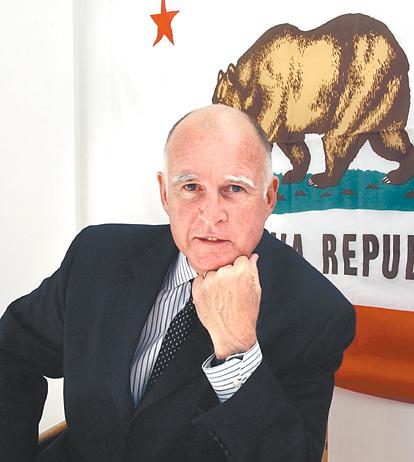
How Jerry Brown got us here

46

Jerry Roberts, who has long been among the best political reporters in California, has a nice, detailed piece on CalBuzz about Jerry Brown’s history and legacy — and how California got into the mess that the Guv is trying to get us out of. (It’s a nice complement to this Chron interview, in which Ol’ Jer takes us back to his seminary days and tells us how much he loves austerity: “I took vows of poverty, chastity and obedience. I am ready, OK?”

Jesus, Guv — we all know you’re cheap, but “obedience” really isn’t part of your personality. And chastity? For real?

But let’s get back to austerity. Brown is clearly hanging his governorship on Prop. 30, his tax measure, and is happily warning us all that things will really, really suck if it doesn’t pass. Roberts does a good job explaining how Prop. 13 — which a much-younger Jerry opposed before he supported it — laid the groundwork for the state’s endless budget mess be capping local property taxes and giving the state Legislature control over how much money flows to cities and counties.

The one missing element: Arnold Schwarzenegger.

The state budget was never simple, and California schools in particular never recovered from Prop. 13, but Schwarzenegger instantly made things much worse the day he took office in 2003 when he terminated much of the Vehicle License Fee, costing state and local government about $4 billion a year. Schwarzenegger derided the fee as a “car tax,” but it’s actually a fee that keeps counties from assessing cars as personal property. Either way, that’s a huge chunk of money, and while it was popular, it played into the idea that we can have something for nothing — similar to the Bush tax cuts.

So I guess all we can do is quote Jerry:

There is a lot of magical thinking in Washington and in Sacramento and, maybe, I might even say, Western civilization,” he said. “We had it easy and now the moment of truth is upon us. … We’ve got to pay for what we want. And if we don’t want to pay, then we have to deprive ourselves of that which we would like, and it’s very hard to get people to make that choice.”

Insurance executive increases his payout to Greenlining

2

A consumer group that supports Mercury Insurance in its efforts to charge some drivers higher rates just got a donation of $195,000 from Mercury’s founder. The money is going to create a political operation supporting two ballot measures – Mercury’s Prop. 33 and Prop. 38, a tax measure sponsored by Molly Munger, who also gave the group $225,000.

Greenlining Institute, which has the mission of protecting low-income people from predatory financial institutions, defends its stands. But since the group opposed a very similar Mercury measure two years ago, critics are wondering how much Greenlining is influenced by its corporate donors.

Just as the Guardian was going to press last week with a story about the strange alliance between Greenlining and Mercury to back Prop. 33, which would increase car insurance rates for those who haven’t maintained continuous coverage, that connection got far cozier and more lucrative for Greenlining.

Greenlining’s General Counsel Sam Kang – the main proponent for backing Prop. 33, a stand that was controversial within the organization – has taken a sabbatical until Election Day to support the Yes on 33 campaign using a $195,000 donation that Mercury founder George Joseph made a new 501c4 offshoot organization: Greenlining Action.

Before the Guardian independently learned of those new developments, Greenlining Executive Director Orson Aguilar contacted us about writing a response to our article, which we welcome, although he hasn’t followed through yet. “Regarding the article, I think it was fair given your early conclusion that $25k led to our decision. Clearly we have issues with that, but enough said,” he wrote to us.

I disputed the characterization that my article implied the $25,000 donation from Joseph to Greenlining was the deciding factor in the organization’s decision to support Prop. 33 after opposing a similar measure in 2010, but Aguilar sounded a similar criticism in a piece he posted to Greenlining’s website on Sept. 6 entitled “Check the Facts and Support Prop. 33.”

“Simply put, Proposition 33 is good policy that will lead to lower rates by encouraging more competition among insurance carriers in California,” Aguilar wrote, a disputable claim that Kang offered. “You may have also heard that Harvey Rosenfield, the founder of Consumer Watchdog, is attacking Greenlining for supporting Prop 33. Harvey claims that a $25,000 table sponsorship by Mercury Insurance at Greenlining’s 2012 Annual Economic Summit led to our support of Prop 33.”

Actually, Rosenfield hadn’t made that claim in the Guardian article that Aguilar referenced in his write-up, nor did he acknowledge the $195,000 donation that Greenlining Action received from Joseph on Sept. 4, two days before posting his open letter minimizing the impact of a $25,000 contribution.

I asked Aguilar why he didn’t mention that hefty donation, or the fact that Kang had taken a long sabbatical to do campaign work (which I learned of by an auto-response to his email about the sabbatical that also said “If your note is regarding Proposition 33, please call my cell phone”), or asking about Kang’s current financial arrangements and possible conflicts of interest.

Aguilar responded with a high-minded announcement of Greenlining Action: “This November, voters will have a chance to pass tax measures that ensure that schools and colleges have enough money to serve our students. Other propositions would make common sense reforms to California’s system of incarceration – saving the state millions in dollars while keeping us safe. Another proposition would give large corporations unlimited influence over California politics and must be defeated. Another would bring lower auto insurance rates for families working from paycheck to paycheck.

“As an organization, we decided not to sit on the sidelines any longer. In our work listening to hundreds of working-class voters, they demanded more concise and accurate information on initiatives from a trusted reliable source.

Greenlining Launches Greenlining Action

“We have decided to take action by re-launching a c4 organization, Greenlining Action. Greenlining Action was originally launched several years ago when we unsuccessfully tried to freeze tuition at the University of California by imposing a tax on millionaires. Unfortunately, we came up a few hundred thousand signatures short to qualify our petition for the ballot. This year we have developed an initiative slate with recommendations on all ballot measures. Our hope is to put this slate in the hands of thousands of voters this election.”

So far, Greenling Action is only listed in campaign filing documents as officially advocating for two measures: Prop. 33 and Prop. 38, which would raise taxes to help fund public education, whose chief sponsor, attorney Molly Munger, also gave $225,000 to Greenlining Action.

Consumer Watchdog founder Harvey Rosenfield said he finds the dual roles played by Kang (who could not be reached for comment) unseemly, particularly if he’s being paid to work on the campaign: “To use the name of the nonprofit to further your personal interests, that’s personal inurement.”

The park bond battle

17

yael@sfbg.com

Recreation and Parks clubhouses are privatized and cut off from public access. Public spaces like the Botanical Gardens and the Arboretum in Golden Gate Park are closed to people who can’t pay the price of admission. Event fees and permit processes have become so onerous that they’ve squeezed out grassroots and free events.

It’s been enough to infuriate a long list of neighborhood groups who have been complaining about the San Francisco Recreation and Park  Department for years.

And now those complaints have led to a highly unusual coalition of individuals and groups across the political spectrum coming together to do what in progressive circles was once considered unthinkable: They’re opposing a park bond.

From environmentalists, tenant advocates, labor leaders, and Green Party members to West Side Republicans and fiscal conservatives,  activists are campaigning to try to defeat Proposition B, the Clean and Safe Neighborhood Parks Bond. 

The bond would allow the city to borrow $195 million for capital projects in several parks around the city. It comes five years after the voters passed a $185 million park bond. 

Environmental groups like San Francisco Tomorrow and SF Ocean Edge oppose the bond, and even the Sierra Club doesn’t support it because “In recent years, we have had many concerns with management of the city’s natural places,” as Michelle Meyers, director of the Sierra Club’s Bay Chapter, told us.  

Matt Gonzalez, the only Green Party member ever to serve as Board of Supervisors president, is part of the opposition, as is progressive leader Aaron Peskin.  Joining them is retired Judge Quentin Kopp, darling of the city’s fiscal conservatives.

The San Francisco Tenants Union wrote a ballot argument opposing Prop. B. The left-leaning Haight Ashbury Neighborhood Council and the more centrist Coalition of San Francisco Neighborhoods both want the bond defeated.

Many of the people opposing Prop. B have never before opposed a city bond act. “This is very difficult for me,” said labor activist Denis Mosgofian. “Some of us always support public infrastructure spending.”

When we called Phil Ginsburg, the director of Rec-Park, for comment, his office referred us to Maggie Muir, who’s running the campaign for Yes on B. She sent a statement saying: “Unfortunately, a small group of individuals are opposing Proposition B because they disapprove of Recreation and Park Department efforts to improve our parks and better serve San Francisco’s diverse communities.” The statement refers to Prop B’s opponents as “single issue activists”

 So who are these activists, and why have they come together to oppose the parks bond?

 Many started with, as Muir put it, a single issue.  Journalist Rasa Gustaitis  didn’t want to see fees to enter the Botanical Gardens and Arboretum in Golden Gate Park.  West of Twin Peaks resident George Wooding was upset that Rec-Park has been leasing public clubhouses to private interests. Landscape Architect Kathy Howard took issue with a plan to renovate Beach Chalet soccer fields, complete with artificial turf and stadium lighting.

After a few years of fighting these small battles, people like Gustaitis, Wooding, and Howard started to see a pattern.  Park property was being privatized.

THE ENTERPRISE

Some city departments, like the airport and the port, are so-called enterprise agencies. They don’t receive allocations from the city’s general fund, and operate entirely on money they charge users. In the case of the airport, most of the money comes from landing fees paid by airlines. The port charges ships that dock here, and takes in rent from its real-estate holdings.

Other departments, like Recreation and Parks, provide free services, funded by taxpayer money. In theory, the department creates and maintains open spaces for public use. The recreation side offers services like classes and after-school activities, many of which are centered in recreation centers and clubhouses in parks throughout the city. 

These have been staffed in the past by recreation directors, adults who coordinated and supervised play, in many cases becoming beloved community figures.

But some city officials want that mission to change. In a time of tight budgets (and facing significant cuts to its operating funds), Rec-Park has been looking for ways to increase revenue by charging fees for what was once free.

In fact, in a 2010 Rec-Park Commission meeting, interim General Manager Jared Rosenfeld said, “the sooner we become an enterprise agency, the better off we will be.”

In August 2010, the department fired 48 recreation directors.  In their place, Rec-Park hired part-time workers who were paid to put on programs but not to staff neighborhood rec centers. The department also hired six more employees in the Property Management Division, tasked with leasing out and renting parks property.

In 2010, the commission also approved a plan to impose a fee for non-residents and require residents to show ID to enter the Arboretum. The once-free public garden was on its way to becoming a cash cow (operated in part by the private San Francisco Botanical Society).

A fledgling group formed to fight the fees – and its members soon connected People from SF Ocean Edge, the Parks Alliance and SPEAK who were not pleased with a proposal to install artificial turf and floodlights at the Beach Chalet soccer field and people who opposed the leasing of clubhouses.

 Mosgofian, a member of the Labor Council and worker with Graphic Communications International Union Local 4-N, helped bring together many disparate groups who, they realized, have a common goal in halting the privatization of the parks system.

“It started with a number of different people who were involved in a number of different efforts to get the Rec and Park Department to do the right thing running into each other and eventually getting together,” said Mosgofian “People from these groups found themselves listening to each other’s efforts and got together.”

Subhed: The empty clubhouse

One of the turning points was the fight over J.P. Murphy Clubhouse in the Sunset.

 In July 2010, Rec-Park quietly began taking clubhouses, previously free and open to anyone in the neighborhood, and putting them up for lease. Nonprofits, some of them offering expensive programs,  took exclusive control of public facilities.

For Rec-Park, it was more money. For neighborhood residents, it was a sign they were being cut off from the resources their tax dollars built and funded.

“They would put a notice on the clubhouse door for a hearing, they would have four or five concerned mothers show up, and they would lease the facility,” said George Wooding, then-president of the West of Twin Peaks neighborhood group that got involved in opposing the clubhouse privatization.

The J.P. Murphy clubhouse in the inner sunset had benefitted from the 2008 bond. The building was renovated at a cost of $3.8 million. But when the shiny new rec center was finished, Rec-Park tried to put it up for lease.

Wooding helped organize strong opposition to the lease. They had already paid for the clubhouse through taxes and bond money, the opposition figured—why shouldn’t it be kept open to the public, free? 

 “I’d had enough. We felt, this is our park,  they just spent a ton of money. They fired the rec director. When Rec-Park came to rent out the facility, we just said no way,” Said Wooding.

The department gave up, and J.P. Murphy wasn’t leased. But without a lessee, the department simply closed the center. It’s empty and dark – although it’s available for $90 an hour rent.

Other similarly frustrating battles were going on around the city. 

Muir called the opposition “short-sighted.” 

“This opposition is punishing the people who use the facilities across the city, children who need safe parks to play in, seniors, and those who are disabled who need ADA compliance,” said Muir.

But Friends of Ethics, another group opposing the bond, argues that Rec-Park shouldn’t get another cent until the agency cleans up its act. In a paid ballot argument against Prop B, the group brought up the controversial process of leasing out the Stowe Lake Boathouse last year. The move to put Bruce McLellan, longtime operator of the family business that sold snacks and rented paddle boats, on a month-to-month lease before auctioning a new lease to the highest bidder created a serious backlash.

 On top of that, commission officials were accused of bias when they recommended a lobbyist, Alex Tourk, to one of the companies vying for the contract. 

 “It’s unseemly and it clouds public trust,” said No on Prop B proponent Larry Bush,  who publishes Citireport. 

The boathouse isn’t the only much-beloved tradition ended under the current Rec-Park administration’s reign. The Power the Peaceful festival, which brought big name musicians and thousands of attendants, all for free, has been priced out due to dramatic increases in fees. So has the Anarchist Book Festival. 

 Bob Planthold, a disability rights advocate who is also a member of Friends of Ethics, says that there are issues in the ADA compliance plans for the Parks Bond as well. Planthold says that money from the last bond measure in 2008 was misspent in terms of disability access.

 “Trails weren’t graded properly. There was no attention to whether there were tree roots that might be rising above the level of the trail that could trip somebody,” said Planthold. “They didn’t do a good, proper, fair job on making trails accessible.”

 The bond got unanimous support from the Board of Supervisors. That’s because it earmarks money for parks that desperately need it throughout the city. 

 But that doesn’t mean all the supervisors are pleased with the way Rec- is being run, either. In July 2010, Sup.  David Campos and then-Sup.  Ross Mirkarimi tried to pass a Charter Amendment to split the appointments to the commission among the mayor and the supervisors. 

 But they couldn’t get the measure through, and the commission remains entirely composed of mayoral appointees.  

So now the voters have a choice: Give more money to what  many say is a badly managed department moving toward the privatization of public property – or shoot down what almost everyone agrees is badly needed maintenance money. Of course, the critics say, Rec-Park can always change its direction then come back and try again in a year or two – but once public facilities become pay-per-use private operations, they tend to never come back. 

Yes on Prop. A rally urges support for City College parcel tax measure

18

Those who work at, attend and support City College of San Francisco have a lot of work ahead of them. The school’s budget has been regularly slashed, losing $20 million last year alone. The school cut 700 classes this semester. After receiving notice that they faced losing accreditation, students, faculty, staff and administrators have been working tirelessly to save the school.

A rally yesterday highlighted one issue of importance to City College: Proposition A.

Prop. A would create a parcel tax of $79 per year for eight years for San Francisco tax payers. The revenue, estimated at $15 million per year, would go to City College.

Prop. A will be one of three ballot measures that increase taxes in November, including Prop 30 and Prop 38. The second two are statewide measures that also raise taxes to fund schools. 

If both Prop. A and Prop. 30 pass it would restore much of the funds cut from City College. If either measure doesn’t pass, the college would face a large deficit.

Several members of the board of supervisors, the school board, and candidates for those seats spoke in support of City College. 

As Community College Board President John Rizzo mentioned at the rally, the school has cut 700 classes this semester alone. For many of those classes, the school still offers the subject but in far fewer class sections, lengthening wait lists and making it more difficult for students to get into the classes they need to graduate.

“This does not restore all the funding, but it goes a good way forward,” said Norman Yee, president of the board of education. Yee attended City College before going on to UC Berkeley, and taught ESL classes at City College for 10 years.

“If it wasn’t for City College I would have gone down a different path,” said Yee.

Alex Tom, Executive Director of the Chinese Progressive Association, emphasized that support for Prop A should be a citywide issue. He also pointed out that supporting City College “Is a big issue for Asian Americans.”

“Most people don’t know that half of the population of City College is Asian students,” said Tom.

Students, labor, and Democratic Party members also lended their voices to support Prop A. “It’s so important and critical for students to have this resource,” said Shanell Williams, president of the Associated Students organization at City College. 

Sup. John Avalos told Guardsman reporter Joe Fitzgerald that the accreditation process is related but separate from the need to pass Prop A. 

“We need to actually fund it, and make sure it’s around,” said Avalos. “If the parcel tax fails, we’ll see a real diminishment of the effectiveness of City College, and that’s something that I think would further deteriorate its ability to get accredited.”

Video by Joe Fitzgerald

The latest insurance scam

0

steve@sfbg.com

Mercury Insurance and its billionaire founder George Joseph are trying, for the second time in two years, to charge infrequent drivers more for car insurance.

Only this time, the measure has the surprising support of a progressive advocacy group that represents low-income communities of color — and that recently received a substantial donation from Mercury.

Proposition 33 — which so far has received fairly little news media attention in an election dominated by talk of taxes — is a reprise of a similar measure, Prop. 17, that went down to defeat in 2010.

The measure seeks to allow insurance companies to set premiums based in part on whether consumers have had continuous coverage. In other words, Mercury wants to raise rates on people who take a break from driving for economic, environmental, or other reasons.

The new measure contains a few exemptions targeted at sympathetic groups singled out by opponents in the last campaign, including active-duty soldiers and those unemployed due to layoffs.

And Prop. 33 also has a significant new backer, the Berkeley-based Greenlining Institute.

That alliance has drawn the ire of Consumer Watchdog, the nonprofit group that created California’s regulated car insurance system with Prop. 103 in 1988 and has been fighting to defend it ever since.

“It raises rates on the people that Greenlining claims to represent,” Consumer Watchdog President Jamie Court told us.

GOLDEN STATE GOLD

Mercury got its start in the 1960s, selling insurance to car owners who had spotty records, charging high rates — and aggressively challenging claims. About 80 percent of its business is in California.

And Mercury has been trying for some time to challenge the landmark Prop. 103, the 1988 ballot measure that set tight regulations on what car-insurance companies can charge — and what they can use to set rates.

Under that law, insurance companies can only use three basic rating factors: how long someone has been driving, vehicle miles traveled per year, and a driver’s safety record. There are 16 more factors that the state has allowed to have a smaller impact on rates, including the “persistency discount” that rewards drivers for staying with a single company.

Court said there are good reasons for that discount, noting that it costs companies more to market to and administer new customers than to serve existing ones.

Prop. 33 would allow consumers to shop around and still keep that discount — something that Court said only makes sense if you want to give insurance companies the power to divide customers by class and punish people who choose to give up driving for a while.

“It’s sleight of hand,” Court said. “Some drivers get a discount, everybody else is going to get a surcharge.”

Two years ago, every single legitimate consumer group in the state opposed Mercury’s efforts. So why is the prominent Greenlining Institute changing its tune?

Greenlining says the new measure is better. But the group’s staffers also acknowledge that Mercury is now a significant donor to Greenlining. Joseph appeared as a panelist at Greenlining’s 19th Annual Economic Summit in April, and the company donated $25,000 at that time.

Greenlining General Counsel Sam Kang, who pushed for the new position and is the designated point person in defending the stance, told us the new exemptions make the measure worth supporting. “The protections are what really distinguish Prop. 17 from Prop. 33,” Kang said. “It’s better than what we’ve got now.”

Kang argues that the increased competition it could foster among insurance companies might lower premiums for everyone. “If customers are willing to walk away” from their current insurance provider and still keep their continuous coverage discount, Kang told us, “that’s how it will drive down rates.”

Court called it “ridiculous” to claim this corporate-sponsored measure — Joseph has personally given almost $8.3 million to the Yes on 33 campaign, the lion’s share of its total funding — would drive down premiums through increased competition for customers.

“There’s no dispute on that and Greenlining is using tactics that are really reprehensible, and it’s a shame because they are likely to be the centerpiece of Mercury’s campaign,” he said. “George Joseph is trying to get cover from a group that has no business doing this.”

Greenlining Executive Director Orson Aguilar acknowledged the organization was divided on this measure, and that is still open to being convinced it made the wrong call. “This was hotly debated. This was not an easy issue for us,” Aguilar told us. “Frankly, if we’re wrong, we’re happy to be convinced.”

GREENLINING’S CAMPAIGN ROLE

Yet it may be too late for that: The state voter handbook has already been printed, and the Yes on 33 campaign has been touting the group’s support. “The Greenlining Institute — a consumer group founded to fight unfair business practices — supports Proposition 33 because it protects consumers and allows this discount to everyone who has followed the law,” says a ballot argument that signed by Kang and CDF Firefighters President Robert T. Wolf and California Hispanic Chamber of Commerce President Julian Canete.

“As you know, we opposed Prop. 17 and we opposed it quite vigilantly,” Kang told us. And the main reason was the organization didn’t buy Mercury’s spin that it would simply lower rates for those with continuous coverage. “If someone is going to get a discount, someone else is going to pay more,” Kang acknowledges.

Yet he is now parroting the Yes on 33 campaign’s rhetoric that the measure simply rewards drivers who “followed the law” and maintained continuous insurance coverage, saying the exemptions that Mercury wrote into the new measure actually give those groups — soldiers and the unemployed, which he notes are disproportionately poor people of color — more protections than they now enjoy.

“If you have continuous coverage for five years, you are eligible for a persistency discount,” Kang said, casting the measure as simple and straightforward.

Court and his group strongly object to that simplistic approach, asking why an insurance company would sponsor a measure that lowers premiums. The reality, consumer advocates say, is that this is a duplicitous measure that relies on a flawed premise and is really about giving insurance companies a new tool to capture certain customers and bilk those who can least afford it.

“These exemptions are bullshit, and they are written to be very narrow. It’s lipstick on a pig,” Court said. “It exposes how it raises rates for all low-income people who don’t meet these very narrow exemptions.”

In fact, the official summary by the Attorney General’s Office makes it clear that prop. 33 “Will allow insurance companies to increase cost of insurance to drivers who have not maintained continuous coverage.”

Kang disputes that objective analysis, telling us, “The ballot title and summary is up for discussion as far as what it meant.”

Kang admitted that Mercury is supporting Greenlining. “They gave us $25,000 in anticipation of the summit, and we anticipate they they’ll help us out in the advocacy of this measure,” Kang said. “Corporations regularly contribute to us, and it has never guaranteed our consent or dissent on anything.”

He defended the approach, telling us, “Sometimes working with corporations is the only way to make monumental changes,” citing their successful efforts to improve the billing practices of PG&E, which regularly makes six-figure donations to Greenlining.

Aguilar also strongly defended the organization’s integrity. “To say that just because we got a stipend from Mercury Insurance” that bought their support, Aguilar said, is simply wrong. “Money comes from somewhere.”

Greenlining’s allies in various campaigns to protect low-income communities say they’re willing to give the group the benefit of the doubt. Joshua Arce, executive director of the SF-based Brightline Defense Project, doesn’t think donations from Mercury Insurance influenced the group’s position, noting that it has also received contributions from PG&E and AT&T then subsequently joined campaigns that opposed those companies’ practices.

Instead, he said Greenlining was probably just offering support to the measure because Mercury had addressed Greenlining’s criticism of Prop. 17 two years ago. “That’s one of the things about Greenlining,” Arce told us, “they say, ‘If you fix all the things we laid out, if you address them, then we’ll support it.” Yet Court said the minor changes made between Props. 17 and 33 shouldn’t have won over such a potentially influential ally. “I’m told they’re going to use Greenlining in the commercial. It’s clearly a transactional relationship,” Court said. “When the billionaire behind Mercury Insurance says it, it’s hard to believe, but it’s easier to believe coming from an organization called Greenlining.”

Why?

44

steve@sfbg.com

Just a couple years ago, it seemed like the golden age of marijuana in San Francisco, the birthplace of the movement to legalize medical pot and a national leader in creating an effective regulatory framework to govern an industry that had become a legitimate, respected member of the business community.

More than two dozen patient cooperatives jumped through a variety of bureaucratic hoops to become licensed dispensaries, most of them opening storefront businesses that were often the most attractive, clean, and secure retail outlets on their blocks, sometimes in gritty stretches of SoMa, the Tenderloin, or the Mission.

“Pretty much everyone involved agrees that San Francisco’s system for distributing marijuana to those with a doctor’s recommendation for it is working well: the patients, growers, dispensary operators, doctors, politicians, police, and regulators with the planning and public health departments,” I wrote in “Marijuana goes mainstream” (1/28/10).

Since then, San Francisco’s medical marijuana industry has only become more established and professional, complying with new city regulations (such as changing how edibles are packaged to avoid tempting children), paying taxes and fees — and making very few waves. According to city officials, there have been almost no complaints from anyone about the dispensaries — and in San Francisco, people complain about everything.

But in the last six months, the full force of the federal government has brought the hammer down hard on this budding business sector, forcing the closure of eight brick-and-mortar dispensaries and instilling paranoia and insecurity in those that remain.

In just the past few weeks, two of the city’s oldest and most respected dispensaries –- HopeNet and the Vapor Room -– were forced to close their doors.

There’s been little rhyme or reason to which clubs get those dreaded letters warning operators and landlords to shut it down or be subject to asset forfeiture and prison time — and the officials involved have refused to explain their actions, except with moralistic anti-drug statements or unsupported accusations.

“These are people who played by the rules and paid their taxes, and now they’re being punished for it,” said Assembly member Tom Ammiano, a leader in creating a state regulatory framework to govern the distribution of medical marijuana, which California voters legalized in 1996. “This is pure thuggery. They are ignoring due process out of blind prejudice and ambition.”

Ammiano met with Melinda Haag, the US Attorney for the Northern District of California, who has coordinated the local crackdown from her 11th floor office in the Federal Building near City Hall, shortly after she announced her intentions to go after medical marijuana. He said she was like a throwback to a less enlightened era.

“In talking to Haag, not only is she a bit of a bully, but she’s totally uneducated about the issue,” Ammiano told us. When she told him that her office has received many complaints about the dispensaries, he asked to see them -– even making a formal Freedom of Information Act document request –- but she has yet to produce them. “Her duplicity is very moralistic, it’s like going back 100 years.”

Neither Haag nor anyone from the White House or Justice Department would grant an interview to the Guardian to discuss the reasons for and implications of the crackdown, or to answer the list of written questions her office asked us to submit. Instead, Haag gave the Guardian this statement and refused to respond to our follow-up questions:

“Although all marijuana stores are illegal under federal law, I decided to use our limited resources to address those that are in close proximity to schools, parks and playgrounds and operations so large that they constitute marijuana superstores. I hope that those who believe marijuana stores should be left to operate without restriction can step back for a moment and understand that not everyone shares their point of view, and that my office has received many phone calls, letters and emails from people who are deeply troubled by the tremendous growth of the marijuana industry in California and its influence on their communities.”

But in San Francisco, where more than 80 percent of residents consistently support medical marijuana in polls and at the ballot box, most people don’t share Haag’s point of view. And city officials contest many of her claims, from saying the dispensaries are “left to operate without restriction” to her implication that they promote crime or endanger children to the haphazard way she has targeted dispensaries to the characterization that many people are “deeply troubled by the tremendous growth of the marijuana industry.”

In fact, to talk to city officials, virtually nothing Haag says is true.

“We’re not getting nuisance complaints [about the dispensaries],” Dr. Rajiv Bhatia, the city’s medical director who oversees regulation of the dispensaries by the Department of Public Health, told the Guardian. “We’ve had very few complaints over the years and good cooperation with the storefront part of the regulations.”

Almost across the board, city officials and club operators praise one another and the cooperative relationship they’ve established over the last four years. Some of San Francisco’s biggest dispensaries have somehow avoided Haag’s wrath, but their once-open operators are now afraid to speak publicly, warily checking the mailbox each day. A thriving industry eager to pay its taxes and submit to regulation is being driven back underground, with all the uncertainty and hazards that creates.

“The question everyone is asking: Why here, why now, why these businesses? Nobody knows the answer,” Bhatia said. “We’re left to speculate and guess about motives.”

MULTI-AGENCY ATTACK

The federal crackdown has been stunning in both its speed and breadth, with various federal agencies coordinating their attacks. The IRS is auditing the biggest clubs and denying write-offs for routine business expenses, the DEA is threatening asset forfeiture efforts, and Haag and the DOJ are threatening prison time and court injunctions.

Underlying all of that is President Barack Obama, who pledged not to use federal resources to go after those in compliance with state law in the 17 states where medical marijuana is legal. Then, last year, Attorney General Eric Holder suddenly announced a new policy: “It will not be a priority to use federal resources to prosecute patients with serious illnesses or their caregivers who are complying with state laws on medical marijuana, but we will not tolerate drug traffickers who hide behind claims of compliance with state law to mask activities that are clearly illegal.”

When we sought an explanation and clarification from the White House Communications Office about why well-established medical marijuana collectives carefully operating under California law were suddenly deemed “drug traffickers” that wouldn’t be tolerated, they refused to answer and referred us to a statement Obama made to Rolling Stone magazine.

“What I specifically said was that we were not going to prioritize prosecutions of persons who are using medical marijuana. I never made a commitment that somehow we were going to give carte blanche to large-scale producers and operators of marijuana -— and the reason is, because it’s against federal law. I can’t nullify congressional law,” Obama told the magazine.

That simplistic explanation – which conveniently ignores how people are supposed to get this medicine – has infuriated local growers and patients. It’s particularly galling for those who supported Obama and took him at his word in the last election, and who don’t understand why he is suddenly escalating the federal war on drugs, ignoring local laws and values, and re-criminalizing their communities.

FUNERAL PROCESSION

Hundreds of medical marijuana supporters gathered on Aug. 1 for a New Orleans-style funeral procession at the Lower Haight intersection near where Vapor Room had operated -– without incident and with praise as a model business from three successive district supervisors –- from 2004 until the previous day.

The mood was festive and defiant on that sunny afternoon, where advocates from both sides of the bay gathered to express solidarity with the closed clubs and resolve to battle through the recent setbacks.

“I’m feeling the fight,” Steve DeAngelo, star of the reality television show Weed Wars and head of Oakland’s Harborside Health Center, which received Haag’s shut-down-or-else letter last month, told the Guardian. “I don’t think we can allow taking a few hits to break our spirit….We started this struggle to win it and we’re not going to stop until we do.”

Local politicians and business leaders also came to offer their support.

“As president of the Lower Haight Merchants Association, I’m upset that Vapor Room had to shut down,” Thea Selby, who is also running for the District 5 supervisorial seat, told us. “The Vapor Room did a lot of good for this neighborhood and was a great business.”

Marchers, most clad in black, carried “Cannabis is Medicine: Let States Regulate” and other signs -– as well as a makeshift coffin and massive puppet depicting a scowling Haag -– and danced down the middle of the street as Brass Mafia horns belted out lively jazz tunes. By the time the procession reached Haag’s office at the Federal Building, a chill fog had darkened the skies and the mood.

DeAngelo took the bullhorn first and called out Obama directly: “Either you were lying, sir, or your employees are out of step with your policies.” Steph Sherer, executive director of the DC-based Americans for Safe Access, told the crowd, “We need to tell Obama to lose Haag or lose California.”

Ammiano and the other mostly Democratic Party politicians who spoke tried to avoid putting Obama directly into the crosshairs of the angry activists, although he did say those executing this crackdown “are harming Obama’s chances of winning.” He also urged activists to put the pressure on politicians in Sacramento and Washington DC: “We need to be a voice in reshaping what’s happened in these last few months.”

Ammiano said the crackdown “empowers the cartels and the people who use violence,” contrasting that with San Francisco’s civilized approach to regulating marijuana.

“We in San Francisco have been a model for how to regulate this industry and we have been successful. We are not going to let the federal government interfere with our rights in this city,” Sup. David Campos told the crowd.

Cathy Smith, the founder of HopeNet, who was still reeling from watching her club gutted and shuttered the day before, also sounded an angry and defiant tone, urging supporters to make their voices heard by Haag and others.

“Everybody that’s here needs to go up to this evil woman’s office tomorrow and tell them what we think,” Smith said.

The general feeling was that if the feds can target model clubs like HopeNet and Vapor Room –- which had deep community roots and generous compassionate care programs for low-income patients -– then all clubs are in danger.

“I’m very upset that we’re losing two great medical marijuana dispensaries where patients could medicate on site,” said David Goldman, a local ASA activist and member of the city’s Medical Cannabis Task Force, noting how important that is for patients who live in apartments that ban smoking.

HopeNet and Vapor Room were some of the only dispensaries in town where smoking was allowed on site, because they were more than 1,000 feet from schools, playgrounds, or day care facilities, the city’s standard. Bhatia said that’s a very strict standard in a city as dense as San Francisco, which is why only four clubs ever met it.

Yet the feds saw things differently, ostensibly targeting HopeNet because a small private school opened two blocks away last year, and the Vapor Room because the feds didn’t use the city’s standard of being more than 1,000 feet from the playground at Duboce Park, instead deciding the dispensary was a community menace because it was a little under 1,000 feet from that dog-friendly park’s nearest patch of grass.

LAST DAYS

Vapor Room founder Martin Olive was a bundle of complicated emotions on the club’s last day in business (it will still operates as delivery-only, just like HopeNet, Medithrive, and a few other shuttered clubs have done). Initially, he didn’t want to talk to us: “I’m trying to keep a lower profile because it’s scary out there now.”

But he slowly opened up and tried to describe the feeling of watching his proudest accomplishment so rapidly undone by the one-two punch of a letter from the merchant services company cutting off credit card access (just like every dispensary in the city, returning pot sales to a cash-only status) followed days later by Haag’s shut-down letter.

“It’s complicated emotions that I’m feeling -– let down, confused. At the end of the day, I don’t understand why this is happening,” Olive said. “It’s a community tragedy, it really is.”

Vapor Room was a welcoming gathering place for its members and a supporter of a variety of community events and causes.

“I’ve always treated this as if it were just a nice coffee house. I’m not an outlaw,” Olive said. “I almost forgot I was breaking federal law. It was so normal, so legitimate.”

In fact, some club owners say their establishments helped clean up rough streets. “We took care of the entire block. Before us, it was all dealers, so there’s a safety issue,” HopeNet’s Smith told me as the once-welcoming club on 9th Street near Howard was reduced to bare walls.

Patients were also feeling the pain, including a 48-year-old ex-con who said he was paroled two years ago after serving 25 years in prison for attempted murder. “I have anger issues, big time. The only thing that keeps me calm and quiet and not blowing up is medical marijuana,” he told us, seething, before praising HopeNet’s “homelike environment” and supportive community. “It’s important to sit and relax in an environment that is comfortable and safe. All this is doing is pushing us into the streets.”

DRIVEN UNDERGROUND

Before going through his latest official misconduct battles and fighting to return to his job as the elected sheriff, Ross Mirkarimi was the District 5 supervisor who sponsored the creation of the city’s medical marijuana regulatory system, the product of a long and arduous legislative process.

“We developed the system out of stark necessity because neither local government nor state government gave a roadmap to the dispensaries,” Mirkarimi said. “Prop. 215 legalized medical marijuana, but there were no rules around it.”

After an intensely collaborative process that lasted more than a year, the city in 2005 adopted a process for licensing dispensaries that balanced the needs of this nascent industry with concerns by police, patients, disability rights activists, neighborhood groups, and health officials. Mirkarimi said that maybe it’s time for city officials to consider an idea he floated a few years ago of having the city itself directly distribute medical marijuana through General Hospital.

“I still think that’s a good idea, particularly if the feds are going to force medical marijuana dispensaries back into the dark ages.” For all his praise of the city’s dispensaries, Dr. Bhatia will admit that the industry still needed better oversight -– dealing with issues such as standards for growing and transporting cannabis, fiscal transparency, and potency and dosage standards –- but the federal crackdown has scuttled his efforts to expand the city’s regulatory system.

“This DEA action stops us from making progress on the regulation of clubs that we need to make,” Bhatia said. “There are lots of issues, but we had just finished getting the clubs into their housing.” Now the industry is being driven back underground.

Ironically, Haag and other federal officials have accused dispensary operators of profiteering, which they’ll certainly be more free to do now that local officials have lost their leverage to begin regulating the finances of the supposedly nonprofit patient collectives that officially operate each dispensary.

“That was one of the areas that we never developed the tools or capacity to look at,” said Bhatia, who proposed more transparent record-keeping by dispensaries last year, only to have the operators express concern about how the feds might use that information, which turned out to be an understandable fear.

Compromise measures

3

news@sfbg.com

San Franciscans are poised to vote this November on two important, complicated, and interdependent ballot measures — one a sweeping overhaul of the city’s business tax, the other creating an Affordable Housing Trust Fund that relies on the first measure’s steep increase in business license fees — that were the products of intense backroom negotiations over the last six months.

Mayor Ed Lee and his business community allies sought a revenue-neutral business tax reform measure that might have had to compete against an alternative proposal developed by Sup. John Avalos and his labor and progressive allies, who sought around $40 million in new revenue, although both sides wanted to avoid that fight and find a compromise measure.

Meanwhile, Mayor Lee was having trouble securing business community support for the housing trust fund that he pledged to create during his inaugural address in City Hall in January. So he modified his business tax proposal to bring in $13 million that would be dedicated to the Affordable Housing Trust Fund, but that didn’t satisfy the Avalos camp, who insisted the city needed more general revenue to offset cuts to city services and help with the city’s structural budget deficit.

Less than a day before the competing business reform measures came before the Board of Supervisors on July 24, a compromise was finally struck that would bring $28.5 million a year, with $13 million of that set aside for the affordable housing fund, tying the fate of the two measures together and creating a kumbaya moment at City Hall that was reminiscent of last year’s successful pension reform deal between labor and the business community.

But there was one voice raised at that July 24 meeting, that of Sup. David Campos, who asked questions and expressed concerns over whether this deal will adequately address the “crisis” faced by the working class in a city that will continue to gentrify even if both of these measures pass. Affordable housing construction still won’t meet the long-term needs outlined in the city’s Housing Element that indicates 60 percent of housing construction would need public subsidies to be affordable to current city residents.

It’s also worth asking why a business tax reform measure that doubles the tax base — just 8.4 percent of businesses in San Francisco now pay the payroll tax, whereas 16.4 percent would pay the gross receipts tax that replaces it — doesn’t increase its current funding level of $410 million (the $28.5 million comes from increased business license fees). Some industries — most notably the technology and restaurant industries that have strongly supported Mayor Lee’s political ambitions — could receive substantial tax cuts.

Politics is about compromise, and Avalos tells us that in the current political climate, these measures are the best that we can hope for and worthy of progressive support. And that may be true, but it also indicates that San Francisco will continue to be more welcoming to businesses than the working class residents struggling to remain here.


SOARING HOUSING COSTS

As Mayor Lee acknowledged during his inaugural speech, the boom times in the technology industry has also been driving up commercial and residential rents, he sought to create “housing for the 100 percent.”

The median rent in San Francisco has been steadily rising, jumping again in June an astounding 12.9 percent over June of last year, according to real estate monitor RealFacts, leaving renters shelling out on average an extra $350 a month to landlords.

Driven by a booming tech industry and a lag in new housing, the average San Francisco apartment now rents for $2,734. That’s an annual increase of $4,000 per unit over last year, in a city that saw the highest jumps in rent nationally in the first quarter of 2012. Even prices for the average studio apartment have edged up to $1,800 a month.

The affordability gap between housing and wages in the city is stark. Somebody spending a quarter of their income on rent would need to be making $85,000 a year just to keep up with the average studio. With a mean wage of $64,820 in the San Francisco metro area, even middle class San Franciscans have a difficult time affording a modest apartment. For the city’s lowest paid workers, even earning the country’s highest minimum wage of $10.25 an hour, even devoting every earned dollar to rent still wouldn’t pay for the average small studio apartment.

For those looking to buy a home in the city, it can be a huge hurdle to put aside a down payment while keeping up with the city’s high rents. Almost 90 percent of San Franciscans cannot afford a market rate home in the city. The average San Francisco home price was up 1.9 percent in June over May, climbing to $713,500, or a leap of $50,000 per unit over last year’s prices.

In the 2010 census, before the recent boom in the local real estate market, San Francisco already ranked third in the nation for worst ratio between income and home ownership prices, behind Honolulu and Santa Cruz.

But as the city leadership grapples to mitigate the tech boom’s effects, the lingering recession and conservative opposition to new taxes have gutted state and federal funds for affordable housing. Capped off last December by the California Legislature’s decision to dissolve the State Redevelopment Agency, a major source of money for creating affordable housing, San Francisco has seen a drop of $56 million in annual affordable housing funds since 2007.

Trying to address dwindling funding for affordable housing, the Board of Supervisors voted 8-2 on July 24 to place the Affordable Housing Trust Fund measure on the fall ballot. Only the most conservative supervisors, Sups. Sean Elsbernd and Carmen Chu, opposed the proposal. Sup. Mark Farrell, who has signaled his support for the measure, was absent.

“Creating a permanent source of revenue to fund the production of housing in San Francisco will ensure that San Francisco is a viable place to live and work for everyone, at every level of the economic spectrum. I applaud the Board of Supervisors,” Mayor Lee said in response.

At the heart of the program, the city hopes to create 9,000 new units of affordable housing over 30 years. The measure would set aside money to help stabilize the ongoing foreclosure crisis and replenish the funds of a down payment assistance program for those earning 80 to 120 percent of the median income.

To do so, the city anticipates spending $1.2 billion over the 30-year lifespan of the program, with a $20 million annual contribution the first year increasing $2.5 million annually in subsequent years. It would fold some existing funding in with new revenue sources, including $13 million yearly from the business tax reform measure. Language in the housing fund measure would allow Mayor Lee to veto it is the business tax reform measure fails.

The board was forced to delay consideration of the business tax measure until July 31 because of changes in the freshly merged measures. That meeting was after Guardian press time, although with nine co-sponsors on the board, its passage seemed assured even before the Budget and Legislative Analysts Office had not yet assessed its impacts, as Campos requested on July 24.

“I do believe that we have to ask certain questions when a proposal of this magnitude comes forward,” Campos said at the hearing, later adding, “When you have a proposal of this magnitude, you’re not going to be able to adjust it for some time, so you want it to be right.”

The report that Campos requested, which came out in the late afternoon before the next day’s hearing, agreed that it would stabilize business tax revenue, but it raised concerns that some small businesses exempt from the payroll tax would pay more under the proposal and that it would create big winners and losers compared to the current system.

For example, it calculated that between the gross receipts tax and business license fee, a sample full service restaurant would pay 69 percent less taxes and a supermarket 33 percent less taxes, while a commercial real estate leasing firm would pay 46.7 percent more tax and a large engineering firm would see its business tax bills more than double.

Board President David Chiu, who has co-sponsored the business tax reform measure with Mayor Lee since its inception, agreed that it is a “once in a decade reform,” calling it a “compromise that reflects the best sense of that word.” And that view, that this is the best compromise city residents can expect, seems to be shared by leaders of various stripes.


BACKING THE COMPROMISE

The business community and fiscally conservative politicians have long called for the replacement of the city payroll tax — which they deride as a “job killer” because it uses labor costs to gauge the size of company’s size and ability to pay taxes — with a gross receipts tax that uses a different gauge. But the devil has been in the details.

Chiu praised the “dozens and dozens and dozens of companies that have worked with us to fine-tune this measure,” and press reports indicate that representatives of major corporations and economic sectors have all spent hours in the closed door meetings shaping the complicated formulas for how they will be taxed, which vary by industry.

When the Guardian made a Sunshine Ordinance request to the Mayor’s Office for a list of all the business representatives that have been involved in the meetings, its spokespersons said no such list exists. They have also asked for a time extension in our request to review all documents associated with the deliberations, delaying the review until next week at the earliest, after the board approves the measure.

But the business community seems to be on board, even though some economic sectors — including real estate firms and big construction companies — are expected to face tax hikes.

“The general reaction has been neutral to favorable, and I expect we’ll be supportive,” Jim Lazarus, the vice president of public policy for the San Francisco Chamber of Commerce, who participated in crafting the proposal but who said the Chamber won’t have an official position until it votes later this week.

Lazarus noted the precipitous rise in annual business license fees — the top rate for the largest companies would go from just $500 now to $35,000 under the proposal, going up even more in the future as the Consumer Price Index rises — “but some of it will be offset by a drop in the payroll tax,” Lazarus said.

He also admitted that the new tax system will be “hugely complicated” compared to the payroll tax, with complex formulas that differ by sector and where economic transactions take place. But he said the Chamber has long supported the switch and he was happy to see a compromise.

“I’m assuming it will pass. I don’t believe there will be any major organized opposition to the measure,” Lazarus said.

Labor and progressive leaders also say the measure — which exempts small businesses with less than $1 million in revenue and has a steeply progressive business license fee scale — is a good proposal worth supporting, even if they didn’t get everything they wanted.

“We fared pretty well, the royal ‘we,’ with the mayor starting off from the position that he wanted a revenue-neutral proposition,” Chris Daly, who unsuccessfully championed affordable housing ballot measures as a supervisor before leaving office and becoming the political director for SEIU Local 1021, the largest union of city employees.

Both sides say they gave considerable ground to reach the compromise.

“Did we envision $28.5 million in new revenue? No,” said Lazarus, who had insisted from the beginning that the tax measure be revenue-neutral. “But we also didn’t envision the Affordable Housing Trust Fund.”

Daly and Avalos also said the measures need to be considered in the context of current political and economic realities.

“We were never going to be able to pass — or even to craft — a measure to meet all of the unmet needs in San Francisco,” Daly said. “Given the current political climate, we did very well.”

“If we had a different mayor who was more interested in serving directly the working class of the city, rather than supporting a business class that he hopes will serve all the people, the result might have been different,” Avalos said. “But what’s significant is we have a tax measure that really is progressive.”

Given that “we have an economic system that is based on profits and not human needs,” Avalos said, “This is a good step, better that we’ve had in decades.”


THE HOUSING CRISIS

The tax and housing measures certainly do address progressive priorities — bringing in more revenue and helping create affordable housing — even if some progressives express concerns that conditions in San Francisco could get worse for their vulnerable, working class constituents.

“I don’t know if the proposal before us is aggressive enough in terms of dealing with a crisis,” Campos told his colleagues on July 24 as they discussed the housing measure, later adding, “As good as this is, we are truly facing a crisis and a crisis requires a level of response that I unfortunately don’t think we are providing at this point.”

Not wanting to let “the perfect be the enemy of the good,” Campos said he still wanted to be able to support both measures, urging the board to have a more detailed discussion of their impacts.

“I wish this went further and created even more funding for critically needed affordable housing,” Sup. Eric Mar said before joining Campos in voting for the proposal anyway. “I think they need to build 60 percent of those units as below market rate otherwise we face more working families leaving the city, and the city becoming less diverse.”

Yet affordable housing advocates are desperate for something to replace the $56 million annual loss in affordable housing the city has faced in recent years, creating an immediate need for action and potentially allowing Lee to drive a wedge between the affordable housing advocates and labor if the latter held out for a better deal.

Many have heralded the mayor’s process in bringing together developers, housing advocates, and civic leaders to build a broad political consensus for the measure, particularly given the three affordable housing measures crafted by progressives over the last 10 years were all defeated by voters.

“One of the goals of any measure like this is for it to gain broad enough support to actually pass,” Sup. Scott Wiener said at a Rules Committee hearing on the measure.

In the measure’s grand bargain, developers receive a reduction in the percentage of on-site affordable housing units they are required to build, from 15 percent of units to 12 percent. The city will also buy some new housing units in large projects, paying market rate and then holding them as affordable housing — the buying power of which could be a boon to developers while creating affordable housing units.

At its root, the measure shifts some of the burden of funding affordable housing from developers to a broader tax base and locks in that agreement for 30 years, which could also spur market rate housing development in the process.

A late addition to the proposal by Farrell would create funding to help emergency workers with household earnings up to 150 percent of average median income buy homes in the city, citing a need to have these workers close at hand in the event of an earthquake or other emergency.

While some progressives have grumbled about the givebacks to developers and the high percentage of money going to homebuyer assistance in a city where almost two-thirds of residents rent, affordable housing advocates are pleased with the proposal.

“Did we gain out of this local package? Yes, we got 30 years of local funding. We came out net ahead in an environment where cities are crashing. We essentially caught ourselves way early from the end of redevelopment funds,” said Peter Cohen, executive director of the San Francisco Council of Community Housing Organizations.

Without it, Cohen says many affordable housing projects in the existing pipeline would be lost. “This last year was a bumpy year, and we will not be back to the same operation level for a number of years,” Cohen said. “There was a dip and we are coming out of that dip. It will take us a while to get back up to speed.”

The progressive side was also able to eliminate some of the more controversial items in the original proposal, including provisions that would expand the number of annual condo conversions allowed by the city and encourage rental properties to be converted into tenancies-in-common.

With ballot measures notoriously hard to amend, the Affordable Housing Trust Fund measure is a broad outline with many of the details of how the fund would be administered yet to be filled in. If passed, it will be up to Olson Lee, head of the Mayors Office on Housing and former local head of the demised redevelopment agency, to fill in the details, folding what was essential two partnered affordable housing agencies into a single local unit.

But even the most progressive members of the affordable housing community said there was no other alternative to addressing affordable housing in the wings — which is indeed a crisis now that redevelopment funds are gone — making this measure essential.

As Sara Shortt of the Housing Rights Committee of San Francisco told the Rules Committee, “We lost a very important funding mechanism. We have to replace it. We have no choice.”

Dick Meister: Good news–and bad–about jobs

2

By Dick Meister

Dick Meister, former labor editor of the SF Chronicle and KQED-TV Newsroom, has covered labor and politics for more than a half century. Contact him through his website, www.dickmeister.com

It’s of course good news that unemployment among workers in private industry has been steadily declining. But that comes along with the bad news that unemployment among public employees has been growing – and with it a decline in vital government services.

A recent  report in the New York Times has made that very clear.  Reporters Shaila Dewan and Motoko Rich noted that government payrolls grew in the early part of the recovery from the Great Recession in 2009, mainly because of federal stimulus measures. But they said that since then, “the public sector has shrunk by 706,000 jobs.  The losses appeared to be tapering off earlier this year, but have accelerated for the last three months, creating the single biggest drag on the recovery in many areas.”

Albeit slowly, the economy generally has been improving, with state tax revenues expected to go beyond pre-recession levels by next year.  Yet the Times’ reported that “governors and legislatures are keeping a tight rein on spending, whether to refill depleted rainy day funds or because of political inclination.”

Holding tight won’t be easy, with the costs of health care, social services, education and employee pensions steadily rising, and property taxes and other tax revenues steadily shrinking.  More than a dozen states have tried to do it by trimming their aid to local governments. And that will undoubtedly lead to more public worker layoffs, more unemployment and more reductions in important public services.

Local governments already have been making budget cuts that far outweigh the slight economic relief that’s come with a recent growth in state and federal jobs.  It’s certain to worsen, since more than 25 percent of municipalities are planning layoffs this year. 

President Obama has proposed easing the financial plight of states and their employees by providing $30 billion more for teachers, police officers and firefighters.  Such aid is essential if public services – and the compensation of those who provide them – are to be maintained at a significant yet reasonable level.

Predictably, the  conservatives who don’t really care for government are in a snit over Obama’s proposal.  The Times quoted Michael D. Tanner, a senior fellow at the Cato Institute, as complaining that the additional public sector jobs  “must be paid for with more debt and taxes borne by the private sector.”

Now, isn’t that a revelation! Imagine that, people taxing themselves and hiring people to provide services they and everyone else needs if they are to live a decent life, if they are to find meaningful work.

We need more, not less government, and we can provide it by employing for reasonable compensation many of the millions of Americans now suffering from unemployment. We need to open more government jobs for them so they may help provide essential services.

The lack of sufficient public workers, as the Times said, “can mean longer response times to fires, larger class sizes, and in some cases lawsuits when short-staffed agencies are unable to provide the required services.”

The Times quoted Mike Whited, president of the firefighters union local in Muncie, Ind., who said the area which could be reached within eight minutes after an alarm was sounded was cut in half.

The Times said, “Mr. Whited chafed at portrayals of public workers as overpaid or greedy, saying his union and others had made concessions, including paying more for their health insurance and forfeiting raises. I think a lot of people don’t understand what we do. They’re looking for somebody to blame, and I think they’re being led the wrong way.”

One of the hardest hit cities, Trenton, New Jersey, has laid off fully one-third of its police force, hundreds of school district workers and at least 150 other public employees, and now faces loss of 60 more firefighters.

More than half the job losses in local governments have come in education.  Thousands of teachers have been laid off throughout the country, and thousands more are being threatened with layoffs.

 Many teachers have agreed to help ease their school districts financial problems by taking unpaid “furlough days” or agreeing to less pay and benefits than they had sought or had been granted in contract negotiations.

The widespread teacher layoffs have nevertheless continued. In Cleveland, for instance, more than 500 teachers were laid off this spring because  of a claimed $66 million budget shortfall. That came after two years of cutbacks and $25 million in concessions, teachers union leader David Quolke told the Times’ reporters.

One consequence: Some classes will have more than 40 students, a serious hardship on students and teachers alike.

Relatively large teacher layoffs and cuts in public jobs and services generally have hit every state hard, including the largest, wealthiest and most influential states.  In California, for example, Gov. Jerry Brown is threatening to eliminate 15,000 state jobs.

The Times said Pennsylvania “has shed 5,400 government jobs this year, and many school districts and social service agencies are contemplating more layoffs.”

Yes, it will take higher taxes and more public debt in Pennsylvania, California and everywhere else to combat the severe economic problems that have left millions of Americans without the jobs  and public services they so badly need.

Dick Meister, former labor editor of the SF Chronicle and KQED-TV Newsroom, has covered labor and politics for more than a half century. Contact him through his website, www.dickmeister.com

The NY Times and class struggle

7

The NY Times isn’t exactly a revolutionary left-wing publication — and while columnist Paul Krugman routinely talks about the income and wealth divide, it’s not typically a staple of how the Times cover the news. But David Leonhardt is starting a blog on the decline in the middle class and is going to turn it into an article during the later parts of the presidential campaign — and amazingly enough, he’s got it pretty much right:

In addition to the slow growth in overall size of the pie, the share that has been going to anyone but the richest Americans has been declining. The top-earning 1 percent of households now bring home about 20 percent of total income, up from less than 10 percent 40 years ago. The top-earning 1/10,000th of households — each earning at least $7.8 million a year, many of them working in finance — bring home almost 5 percent of income, up from 1 percent 40 years ago. In the simplest terms, the relatively meager gains the American economy has produced in recent years have largely flowed to a small segment of the most affluent households, leaving middle-class and poor households with slow-growing living standards.

It’s simple, and it’s pretty clear — as is the fact that it’s not random but the result of specific policies. From one of the (many intelligent) comments (my trolls, please take note):

The middle class is an artificial construct, something deliberately created through the enactment of policy. It emerged in the U.S. largely because of political, economic and social changes that were imposed: the New Deal, the Great Society, the creation of the suburbs and highway systems, strong unions that demanded fair wages and protections, etc. All of these developments happened only because people willed them and fought to ensure economic expansion benefited regular people. It could have just as easily gone the other way; indeed, it IS going the other way now (and has been for the last 30 years or so). The choices today are different: to let the markets decide, to deregulate and bolster corporations, to exacerbate the wealth divide, to enforce an unfair tax system, to shift essential costs (healthcare, environmental remediation, etc.) to the taxpayer, and so on. And so the middle class erodes. It should come as no surprise.

What’s talked about less in this NYT piece is the role of government in redistributing income. The idea that the US tax system should take more than half of the income people earn beyond a certain point is hardly radical; as early as the 1920s, the highest earners turned over as much as 70 percent to the government — and unlike today’s billionaires, they actually paid it. The JP Morgans of the world got really really rich AND paid high taxes AND gave a lot of money to public enterprises (public libraries, public museums etc.).

That as much as unionization and post-War industrialization created the middle class.

Another interesting comment:

Our “free-market” policies of the last 30 years have favored efficiency and productivity above all else. The result has been sending American jobs overseas on a massive scale. Now we have inexpensive tee-shirts and computers, but vast unemployment and underemployment. Instead, I believe our culture should favor creating as many high paying middle-class jobs as possible without regard to “productivity”. This requires protective trade barriers. Yes, prices will go up, but for a more affluent society, it’s a cheap price to pay.

Obama talks a good line about the middle class, but he’s not offering any specific ideas that would fundamentally change the direction of US economic policy. In fact, the biggest issue in the campaign isn’t even an issue.

Oh, and by the way: I have to note that Randy Shaw at BeyondChron is now talking about the important of “class diversity.” He’s right — there need to be more tenants (and working-class tenants) on the Planning Commission and Board of Appeals. There also needs to be a consciousness of class issues in general at City Hall — and a discussion of how policies that favor high-tech companies, like those of his beloved Mayor Lee, are pretty clearly NOT in the interests of protecting class diversity in the city.


Guardian feminism panel calls for change, gang activity

31

In the interest of behaving badly, let us first say that we won’t apologize for the “roving feminist gangs” comment, nor the laughter that ensued at our July 11 “Bay Area Feminism Today” panel. In the light of the sexual attacks that have terrorized Mission District residents this year, Celeste Chan’s joke (actually a reference to comments made by Fox News in reference to the New Jersey Seven) has to be read as a self defense tactic — and source of comfort and strength to the women living in the neighborhood. Not a threat to men. Unless they’re commiting sexual assault, of course — but then, women commiting sexual assault will probably have the gang’s wrath to face as well. 

Seven women from all walks of Bay Area activism — arts, nightlife, immigrant advocacy, domestic violence organizations, and more — came together at City College’s Mission branch to discuss what our SF progressive community needs to work on, recent feminist victories, whether they even believe in the term “feminism,” and everything in between. Our “Faces of feminism” cover story announcing the event attracted a decent-sized crowd of around 120 (mainly young women, with zero male elected officials in attendance.) We laughed, we nearly cried, we came away with a lot to think about. Here’s some of the general topics that were discussed. And here’s to this being a spark for continued talks, however a Fourth Wave Bay feminism may take shape.

>>FOR THE FULL BIOS OF OUR PANELISTS, CHECK OUT THE EVENT ANNOUNCEMENT 

Reproductive justice

Reproductive justice has long been a feminist goal, but with the recent spate of attacks on birth control and abortion access it’s come up again. Are we here in the Bay Area isolated from the War On Women?Some panelists thought we can affect the country’s situation positively.

“Part of what we do here in the Bay Area is we send strong women to Washington,” the Drug Policy Alliance‘s Laura Thomas said. “We are responsible for a significant amount of women in Congress.” But California’s reproductive justice situation is more complicated than it may seem. St. James Infirmary‘s Stephany Ashley noted that reproductive health here is under attack with “criminalization of HIV-positive people,”  and that California “just cut all funding for HIV prevention for women.”

>>CHECK OUT REBECCA BOWE’S RECORDED LIVESTREAM OF THE EVENT HERE

Chan, founder of Queer Rebels Productions, added that California is cutting domestic violence services through slashing CalWORKS funding. Mujeres Unidas‘ Juana Flores noted that the Bay’s Latino communities can find it difficult to support aspects of reproductive health because of religion and tradition. But she said that people need to work together and realize that “it’s a real war. It’s a real war on us.” She warned that “politicians are not going to fix things just because they want to improve our lives. We need to fight back.”

Transgender activist and member of SF’s Youth Commission Mia Tu Mutch said that part of the war on women has been a wave of anti-trans legislation across the country, as well as a wave of hate crimes, especially against trans women of color. Some legislation in Tennessee is making it more difficult for trans people to go the bathroom, she said. “Reproductive justice is important, but we also need just the simple right to pee.”

But what about the word itself?

Does feminism have power as its own concept now, or has its work been rightly subsumed into the queer movement, the civil rights movement, and other forms of activism? “A lot of us can agree that there isn’t something you can point to and say, this is the feminist movement in San Francisco,” Ashley said. “But there are many important feminist projects happening.”
Alix Rosenthal, who created a controversial women’s slate in her bid for re-election on the SF Democratic County Central Committee recalled how “30 to 40 years ago, we all had to join together because there weren’t enough of us. Now people have splintered off.” Chan brought up the bicycle scene in 1983’s feminist sci-fi film Born in Flames, and quoted Audre Lourde: “for so long, we’ve been on the edge of each other’s battles.”

Tu Mutch said that she “would rather identify as fighting for LGBT rights, progressive rights” than as feminist. But, she continued that it is “under the system of patriarchy that we’re all getting screwed over.” She said that women are treated as second-class citizens, and trans and gender non-conforming people are treated as third class citizens in our society.  Edaj, longtime Bay Area DJ and director of the Women’s Stage at Pride for a decade, agreed that the word feminism “sparks a lot of emotion in people” and can create obstacles in growing support. Said Flores: “it’s a big word. People call me a feminist when I claim my rights. When I see another women who is suffering or being abused it’s unbearable to me,” Flores said. “When someone calls me a feminist, I feel proud.”

The inward gaze: how does the San Francisco progressive community do on feminist issues?

In a word: okay. But there’s work to be done even here, in “progressive” San Francisco. Thomas led the charge, talking about the state’s current legal ability to shackle women prisoners during childbirth. Tu Mutch expressed a need to stop “pitting groups against each other,” and to get rid of a City Hall attitude that says “my budget is more important than yours.” Tu Mutch said “there’s still rampant transphobia and gender essentialism,” that affects not just women, but the “countless people born with intersex conditions and who identify outside the binary.”

Ashley pointed out that “even some of our favorite male progressive politicians, you don’t see them cultivating leadership among women, queer people, trans people.” She talked about how that’s a traditional feminist organizing principle, “mentorship and meaningful participation, not just tokenizing participation.”

As a (not) side note, there wasn’t a single male politician in the audience that day. As Ashley put it, “patriarchy is really the problem.” Ashley and panel moderator, SFBG culture editor Caitlin Donohue shared the fact that they’ve felt diminished by remarks made by and in the company of the city’s so-called “progressive politicians.”

Recent feminist victories

But enough depressing stuff. How about recent feminist victories, asked an audience member.

This question was met with a disconcerting silence. Until Chan jumped in: “I’m really inspired by the place queer arts are at right now.” She told of the “lineage of resistance” of art that deals with questions like “how do people survive the unimaginable? How do people survive the truly horrific?” Disturbing incidents like that of transgender prisoner Cece McDonald beg the question, “is the perfect victim a dead victim? If you fight back, you’ll be criminalized? Now more than ever we need a movement. We really need to come together,” concluded Chan.

Rosenthal saw hope in surprising places. “Sarah Palin and Michelle Bachman,” she said. “These women are so incompetent. But they made it. They really made it.” She talked about how usually women have had to be five times better than the men they competed with, but “Sarah Palin and Michelle Bachman are not five times better than anyone. But they made it.”
Laura Thomas was inspired by Julia Bluhm, the 14-year old ballet dancer from Maine whose online petition led Seventeen to promise to stop using Photoshop to alter women’s body types. Ashley acknowledged Tu Mutch’s advocacy work, and said she was recently inspired by a “take back the plaza” event Tu Mutch had organized. Edaj was inspired by being named a Pride Grand Marshall, and the feeling that the Pride organization was acknowledging the importance of the space created at the Women’s Stage. She was also inspired by Morningstar Vancil, a Filipino vet who is a two-spirit drag king, and Vancil’s commitment to disabled veterans issues.

Action items

In response to a question that asked what the 2012 action plan for Bay Area feminists should involve, Ashley said “principles of intersectionality, anti-colonialism, anti-capitalism” had to be valued more than they have been in past feminist movements. They’re there in Third Wave feminism, Ashely said, only they are “wrapped up in theory and academia.” Those guiding principles should have “more on the ground” applicability. What needs to happen right now, speaking of on the ground? Back to 2012’s spate of sexual violence in the Mission, there’s a distinct necessity for “a perfect community response that doesn’t involve the police, so that we all of a sudden feel really comfortable taking a walk at 3 in the morning through our favorite neighborhood.”

Flores said that any new form of feminism would need to be about “mutual respect” and “against any form of injustice,” to which Thomas agreed, saying it needs to be “less theory, more practice.” It also, Thomas said “has to deal with gender in a different way. A new feminism needs to go beyond gender, or deal with gender differently” in the sense of respecting gender non-conforming identities. A tricky prospect, she admitted. “How you develop a gendered movement that doesn’t use gender as a defining construct, I don’t know.” More specifically, she underlined the importance of “progressive revenue measures,” and “an end to cuts to childcare and domestic violence programs.” “Our economy’s not coming back through more cuts. We need revenue, more taxes,” she said, to cheers from the crowd. Well this was a Guardian forum, after all. 

Edaj reiterated that “that word scares off a lot of people who might otherwise want to join.” Tu Mutch underlined that it would need to “take up the idea that men and women are opposites. That only serves to degrade women.” A new feminism, she said, would be about “turning away from that and realizing there’s lots of different genders.”

Tu Mutch said she would like to see success for her organization to fight for trans healthcare rights, FEATHER. “People have to spend ridiculous amounts of money to transition,” she said. “We need universal healthcare for all, including trans people.”

Chan pondered the question. In the end, she concluded, “roving feminist gangs,” inspiring at least one angry letter from a slighted middleaged white man in the crowd. Which wasn’t the only reason why we deemed the panel a success, but an important one.

Dick Meister: A sure path to economic health

0

By Dick Meister 

Guardian columnist Dick Meister is former labor editor of the SF Chronicle and KQED-TV Newsroom. He has covered labor and politics for more than a half-century. Contact him through his website, www.dickmeister.com, which includes more than 350 of his columns.

It’s way past time to raise the pitifully low federal minimum wage. That would provide badly needed help to the millions who are living in poverty or near-poverty at the current rate of $7.25 an hour, and would help all Americans by stimulating the sagging economy.

Democratic Sen. Tom Harkin of Iowa and Democratic Rep. Jesse Jackson Jr. of Illinois are carrying bills that would set a new minimum of $10 an hour. They’re pressing hard – as they very well should – to get the general public and their allies in Congress to fully appreciate the widespread good that would come from helping some of the country’s neediest workers.

“We’ve bailed out banks, we’ve bailed out corporations, we’ve bailed out Wall Street, we’ve tried to create sound fundamentals in the economy,” Jackson noted. “Now it’s time to bail out working people who work hard every day and still make only $7.25. The only way to do that is to raise the minimum wage.”

It’s been five years since the minimum was last raised, from $5.15 an hour to the current level. States, cities and counties are allowed to set their own minimums, as long as they at least equal the federal rate, and 18 states and several cities and counties have enacted minimums greater than the federal rate. But even their rates are below what’s needed for a decent living.

About four million workers are now paid at or below the federal minimum and obviously need help if they are to escape poverty. Even those paid at the full minimum earn a mere $15,000 a year before taxes and other deductions.  They are among some 28 million workers whose earnings – and spending  – would immediately increase under the proposed bills.

Legislation to raise the minimum has been called for repeatedly in the years since the last raise in 2007, but has gained only relatively minimal support in Congress and the White House. President Obama pledged during his election campaign to get the rate increased to $9.50 an hour by 2011, but has taken no public action. Mitt Romney, Obama’s Republican opponent in his re-election campaign this year, has wavered. He once voiced support for a raise, but later said he opposed an increase.

Polls have clearly shown strong public support for a raise. That support is likely to grow significantly if the economic benefits that a raise would undoubtedly bring to all Americans can be clearly shown – and it can.

It’s simple: Raise the pay of working people, and as the workers buy more goods and services with their new earnings, the businesses that sell them will hire more people to provide what they want to buy with the extra money they’ve earned at a higher minimum wage.

The National Employment Law Project estimates that the increased consumer spending generated by the proposed raise would create the equivalent of more than 100,000 full-time jobs. Other estimates indicate that every dollar increase in wages for workers at the minimum creates more than $3,000 in new spending after a year.

And so the cycle goes, round and round:  More pay, more spending on goods and services, more hiring of people to provide them, more important government services and the taxes to support them, a healthier and wealthier economy.

Guardian columnist Dick Meister is former labor editor of the SF Chronicle and KQED-TV Newsroom. He has covered labor and politics for more than a half-century. Contact him through his website, www.dickmeister.com, which includes more than 350 of his columns.


Guardian Voices: There’s something happening here

25

There are distinct signs of the rebirth of a grassroots  balanced-growth  movement in San Francisco, and some small indication that it’s even beginning to shift, ever so slightly,  the politics of the Board of Supervisors.  This is very good news for the vast majority of San Franciscans.

First, a little history.

Land use and the approval of major development projects lie at the very heart of San Francisco politics. Developers and their allies (the building trades, contractors, bankers, architects, land-use lawyers, consultants, and  permit expeditors) are the primary source of political money for candidates for local office. Since the freeway and urban renewal fights of the 1960s, the very definition of  progressive  politics in San Francisco has been the attempt to build a political base of  residents to resist that money.  So-called moderates are simply the political extension of the pro-development lobby using its money to consolidate developer control of the public approval process.

In most cities, land-use issues — zoning, permits, urban design — is left to elites. Not so in San Francisco. Here, land use is talked about at neighborhood meetings and on street corners. The heart the reason is our compact size: 46.7 square miles, and the prohibition of filling in any more of the Bay to create new land. There is no vacant land in San Francisco. Any new major development almost always displaces something already there.  Development is a zero sum game, with winner and losers.  And the losers  leave town.

Land-use politics is about staying here — and that creates real interest among San Francisco residents.

The funding for major development in San Francisco has dramatically changed in the 45 years since the freeway and anti-urban-renewal fights of the mid-1960s. Back then, it was public sector money that fueled development. Yet, with that money, due to the actions of  progressive politicians like Phil and John Burton and George Moscone, came its own remedy: votes to not accept the public money for freeways (Moscone) and votes creating either laws that either prohibited displacement or funded legal assistance to the poor, empowering  them to stop government agencies through litigation (the Burtons at both the state and federal level).

Since the money for freeways and urban renewal was from the government, the focus of the early balanced growth  forces was on government itself, through massive lobbying campaigns to affect officials’ votes (the freeway fight), or the use of government-funded lawyers  to protect poor people’s  interests ( the WACO and TOOR lawsuits against redevelopment).

All of that changed starting in the 1970s, when Richard Nixon and later Ronald Reagan deregulated oversight of urban development by creating a system of  block grants and ended funding for legal assistance for the poor.  Large-scale development was effectively privatized, moving it from being designed, funded, and approved at public meetings by government officials following regulations to being designed and funded in private — and having a Kabuki-play-like public approval process with little real oversight. With the passage of Prop 13 in 1978, which limited the main source of local government revenue — property taxes — local governments became even more reliant on private developer money to create new revenue.

The popular response to this change in the development process in San Francisco was the emergence of a politics that relied on the old progressive-era reforms of the initiative, referendum, and recall. Through a series of initiatives, the community sought to impose regulations on the development process, culminating in the 1986 Proposition M, which actually limited the amount of high-rise office space developers could build, completely imposing the popular will over a supine set of local officials and politicians. Indeed, ten years earlier, again through the initiative processes, the very nature of the Board of Supervisors was changed from a developer-friendly at-large system to a district-election system. Hotly opposed by real estate and development interests, district elections in its brief three years of existence (repealed in the wake of the Moscone-Milk assassinations, even though they were both strong supporters of the system and their assassin opposed it…ironies abound in San Francisco politics) saw limits placed on condo conversions and the passage of rent control.

In each of these multi-year efforts, a citywide coalition was formed, including an ever-expanding set of communities and neighborhoods.  Common interests were defined that cut across race, class, and geography and issues of community (neighborhood) control and funding for essential services like Muni, affordable housing, childcare, and employment training were placed on the table – and developers had to address them if they wanted projects approved.

The point is that balanced growth came from community-based political forces, not elected officials.  Broad movements were built — in the end, encompassing elements of labor. These were victories won not by elected officials but by a popular movement.

In 2000, in the wake of  the dot-com bust, another balanced-growth measure, Prop. L, aimed at cutting then-Mayor Willie Brown’s power over development, was paired with the new district election system — and a broad coalition of forces including labor, community and neighborhood organizations won a major progressive victory.

Every candidate for supervisor who supported the balanced-growth measure won. Every candidate who opposed it and supported Brown lost. While Prop L narrowly lost, its policies and objectives were passed as ordinances by the new Board of Supervisors (banning live-work lofts, closing loopholes in the planning code, requiring neighborhood-based plans for the Mission, SOMA, and Potrero Hill).

But as is so often the case, the victory of 2000 led to the slow dissolution of the coalition that created it. Folks had won. Our supervisors could handle all these issues; we no longer had to. By the end of the term of the supervisors elected as the class of 2000, very little of that citywide coalition existed any more.

With the Great Recession of 2008, advances were rolled back.  Fees on local developers for affordable housing, childcare and transit were deferred in order to stimulate development.  A new era of “moderation” was announced by elected officials, led by Mayor Gavin Newsom. Desires to “attract and retain”  business saw new tax concessions in the name of “jobs” and a new willingness to use open space and public facilities for “private/public partnerships” was announced.

By 2012 any concept of balanced growth had been replaced with a new era of “cooperation” between city officials and developers.

Until recently, that is.

It should be clear to all that for the last four years, City Hall has been eager to approve any scheme presented by private developers — from the America’s Cup nonsense to highrise luxury condos on the waterfront. The siren song of the developers — more revenue if you approve our project — has been proven false again and again, as the revenue never really matches the real costs of these projects. The city’s essential services continue to shrink. Transit fees are too low to pay for the actual new costs of Muni. The affordable housing  fees are too little to actually meet the affordable housing needs of the new, poorly-paid workers employed in the retail and service industry that is always a part of these projects.

More and more of our parks and public open spaces are made available to private users, while few if any new public parks or open spaces are being created.  Indeed, the Department of Parks and Recreation often opposes new public parks — because it can’t maintain what it has.

So it is with fondness that these old eyes see the stirring of what appears to be the awakening political  giant of a new controlled-growth movement.

Here’s how it’s happening: The formation of a multi-neighborhood coalition to oppose fee increases at the Arboretum leads to a bigger coalition to oppose artificial turf  fields in western Golden Gate Park, which leads to an even-bigger coalition placing a policy statement against the privatization of Coit Tower on the ballot and winning.

These are important indications of a broad dissatisfaction with the endless private-public-partnership ( in which all the costs are public and all the profits are private) babble from Rec and Park.

The submission by a broad based coalition of more than 30,000 signatures to place the 8 Washington on the ballot — the first land-use referendum in decades — is an incredibly important achievement, and shows the popular sentiment against much of the City Hall happy talk about development on the waterfront.

But it was the unanimous ( yes, unanimous) vote by the Board of Supervisors last Tuesday to hold California Pacific Medical Center accountable for its constant shape shifting  on its massive project at Geary and Van Ness that shows, perhaps, the outline of the potential future of the balanced-growth movement in San Francisco.

Six supervisors stated their willingness to turn down the environmental impact report on the project unless Sutter/CPMC committed to a project that addressed not only the promise to keep St. Luke’s open for at least 20 years but also hired more San Franciscans, corrected the traffic nightmare predicted for Geary and Van Ness, provided more affordable housing for its own low-income new workforce, and committed  to cap the city’s health care costs as a result of CPMC’s market control the new project would create.

There is always the possibility that the two-week delay will go nowhere, but this kind of talk from this Board of Supervisors to a huge private developer simply has not occurred in the recent past.  No one from Room 200 showed up to twist supervisors’ arms in favor of Sutter.  Sutter was on its own and got rolled.

The coalition that fought Sutter to a standstill at the board, that defined the inadequacies of  the project listed by the supervisors, was a multi-neighborhood, multi-issues organization composed of community, neighborhoods, and labor. Middle class “Baja” Pacific Heights residents and low income seniors from Bernal Heights, non-profit affordable housing advocates and trade unionists, tenant organizers from the Tenderloin and Sierra Club members from the Haight-Ashbury; single moms from the Bayview and Filipino youth from the South of Market.

It was a San Francisco coalition, one that has been working together for nearly three years, blending issues, making concessions to one another and staying together.  A group like this with a set of demands such as these has not prevailed at City Hall for nearly a decade.  It still may not, indeed the chances are slim that its full demands will be achieved.

But this group moved the Board of Supervisors in a way not seen in years.  If the folks mobilized about our parks and the folks mobilized about our waterfront and the folks mobilized about CPMC get together, we have something very big happening. And it might be just in time to make a real difference.
It reminds me of an old saying: “ The people alone are the makers of world history.”

Music Listings

0

Since club life is unpredictable, it’s a good idea to call ahead or check the venue’s website to confirm bookings and hours. Prices are listed when provided to us. Visit www.sfbg.com/venue-guide for venue information. Submit items for the listings at listings@sfbg.com. For further information on how to submit items for the listings, see Picks.

WEDNESDAY 18

ROCK/BLUES/HIP-HOP

Brian Bergeron Johnny Foley’s. 9pm, free.

Bouncing Souls, Menzingers, Luther Slim’s. 8pm, $19-$21.

Charles vs. Rags Tuttle Johnny Foley’s Dueling Pianos. 9:30pm.

Chatham County Line, Easy Leaves Cafe Du Nord. 8pm, $15.

Eddie Money Yoshi’s. 8pm, $35.

Johnny Rawls Biscuits and Blues. 8 and 10pm, $15.

SO, Glass Gavel, Shake Me! Bottom of the Hill. 9pm, $10.

Soul Train Revival Boom Boom Room. 8pm, $5.

Upstairs Downstairs, Origami Ghosts, Myonics Hemlock Tavern. 9pm, $6.

Valient Sailors Hotel Utah. 9pm.

Waters, Chasms, Churches Brick and Mortar Music Hall. 9pm, $10-$12.

Scott Weiland Independent. 8pm, $49.50.

JAZZ/NEW MUSIC

Cat’s Corner with Nathan Dias Savanna Jazz. 9pm, $10.

Cosmo AlleyCats Le Colonial, 20 Cosmo Place, SF; www.lecolonialsf.com. 7-10pm.

Dink Dink Dink, Gaucho, Eric Garland’s Jazz Session Amnesia. 7pm, free.

Ricardo Scales Top of the Mark, 999 California, SF; www.topofthemark.com. 6:30pm, $5.

Sonic Poetry Community Music Center, 544 Capp, SF; www.outsound.org. 7:30pm. $10-$12; $45 festival pass. Outsound New Music Summit.

FOLK/WORLD/COUNTRY

Cumbia Tokeson, Radio La Chusma, DJ Rabeat Elbo Room. 9pm, $8-$10.

DANCE CLUBS

Booty Call Q-Bar, 456 Castro, SF; www.bootycallwednesdays.com. 9pm. Juanita MORE! and Joshua J host this dance party.

Coo-Yah! Som., 2925 16th St, SF; (415) 558-8521. 10pm, free. DJs Daneekah and Green B spin reggae and dancehall with weekly guests.

Hardcore Humpday Happy Hour RKRL, 52 Sixth St, SF; (415) 658-5506. 6pm, $3. With Therinds, Dick Wolf, Holy Blowout.

Mary Go Round Lookout, 3600 16th St, SF; www.lookoutsf.com. 10pm, $5. Drag with Suppositori Spelling, Mercedez Munro, and Ginger Snap.

Megatallica Fiddler’s Green, 1333 Columbus, SF; www.megatallica.com. 7pm, free. Heavy metal hangout.

Obey the Kitty: Richie Panic, Justin Milla Vessel, 85 Campton, SF; www.vesselsf.com. 10pm, $10.

THURSDAY 19

ROCK/BLUES/HIP-HOP

Beachwood Sparks, Allah-Las, Sweet Chariots Independent. 8pm, $18.

Boneless Children Foundation, Bonnie & the BANG BANG, Taxes Brick and Mortar Music Hall. 7:30pm, $5-$8.

Fountains of Wayne, Mike Viola Great American Music Hall. 8pm, $26.

Guido vs. Charles Johnny Foley’s Dueling Pianos. 9:30pm.

Handshake, Fierce Creatures, Conveyor, Coast Jumper Bottom of the Hill. 9pm, $10.

“In a Cloud 2” SF compilation release Amnesia.

Jay Trainer Band, Segue & Jeff Zittrain Band Red Devil Lounge. 8pm, $8.

John Lawton Trio Johnny Foley’s. 9pm, free.

Eddie Money Yoshi’s. 8pm, $35; 10pm, $30.

Oliver, popscene DJs Rickshaw Stop. 10pm, $13-15.

Spencey Dude and Doodles record release variety show Hemlock Tavern. 9pm, $5.

Walter Trout Biscuits and Blues. 8pm, $30-$35.

Why I Hate, Shell Corporation, Mighty Fine, Hooray for Everything Thee Parkside. 9pm, $7.

JAZZ/NEW MUSIC

Composers Muse Community Music Center, 544 Capp, SF; www.outsound.org. 7:30pm. $10-$12; $45 festival pass. Outsound New Music Summit with Christina Stanley’s Skadi Quartet, and more.

Jazz Jam with Eddie Ramirez Savanna Jazz. 7:30pm, $5.

FOLK/WORLD/COUNTRY

JimBo Trout and the Fishpeople Atlas Cafe, 3049 20th St, SF; www.atlascafe.net. 8-10pm.

Twang! Honky Tonk Fiddler’s Green, 1330 Columbus, SF; www.twanghonkytonk.com. 5pm. Live country music, dancing, and giveaways.

DANCE CLUBS

Afrolicious Elbo Room. 9:30pm, $5. DJ Pleasuremaker spins Afrobeat, Tropicália, electro, samba, and funk, plus Sola Rosa.

Arcade Lookout. 9pm, free. Indie dance party.

Base: Chris Liebing Vessel, 85 Campton, SF; www.vesselsf.com. 10pm, $10.

Get Low Som., 2925 16th St, SF; (415) 558-8521. 10pm, free. Jerry Nice and Ant-1 spin Hip-Hop, ’80s and Soul with weekly guests.

Thursdays at the Cat Club Cat Club. 9pm, $6 (free before 9:30pm). Two dance floors bumpin’ with the best of 80s mainstream and underground with DJ’s Damon, Steve Washington, Dangerous Dan, and guests.

Tropicana Madrone Art Bar. 9pm, free. Salsa, cumbia, reggaeton, and more with DJs Don Bustamante, Apocolypto, Sr. Saen, Santero, and Mr. E.

FRIDAY 20

ROCK/BLUES/HIP-HOP

Back Pages Johnny Foley’s. 9pm, free.

Rome Balestrieri, Charles, Guido Johnny Foley’s Dueling Pianos. 9pm.

Frank Bey Biscuits and Blues. 8 and 10pm, $20.

Sam Bush, Allison Harris & the Barn Owls Great American Music Hall.9pm, $26.

Fast Times Maggie McGarry’s, 1353 Grant, SF; www.maggiemcgarrys.com. 9pm, free.

Glimpse Trio, Points North, S.K.O.P.E Bottom of the Hill. 10pm, $12.

Grass Widow, American Splits, Wax Idols, Worlds Longest Guitar Solo With Breaks Rickshaw Stop. 9pm, $10-$12.

Collin Ludlow-Mattson & Folks, Blank Tapes, Ash Reiter, Pat Hull Amnesia. 9pm, $8-$10.

Melvins Lite Slim’s. 9pm, $21.

Moonbell, Some Embers, Chasms, DJs Kevin Johnson and Nako Thee Parkside. 9pm, $5.

Pow!, Permanent Collection, Future Twin, Al Lover & the Haters Brick and Mortar Music Hall. 9pm, $5-$8.

Strangled Darlings, Ian Fays, Blonde Stranger Hemlock Tavern. 9:30pm, $7.

Tainted Love Bimbo’s. 9pm, $23.

Tosh Meets Marley Elbo Room. 10pm, $15. With Nnuklee Dube, DJ Irie Dole and King of Hearts.

“Vagabond Lovers Club” Cafe Du Nord. 9pm, $12-$15. With Slim Jenkins, Frantic Rockers, Golden West Trio, burlesque, DJs, and more.

JAZZ/NEW MUSIC

Audium 1616 Bush, SF; www.audium.org. 8:30pm, $20. Theater of sound-sculptured space.

Benn Bacot Savanna Jazz. 7:30pm, $8.

Midnight Sun Jazz Quartet Bubble Lounge, 714 Montgomery, SF; www.bubblelounge.com. 6-9pm, free.

Thwack. Bome. Chime Community Music Center, 544 Capp, SF; www.outsound.org. 7:30pm. $10-$12; $45 festival pass. Outsound New Music Summit.

Markus Wettstein, Betsey Biggs, Dylan Bolles, Edward Schocker Meridian Gallery, 535 Powell, SF; www.meridiangallery.org. 8-10pm.

FOLK/WORLD/COUNTRY

Bluegrass Bonanza Plough and Stars. 9:30pm, $8-$10. With Travers Chandler, Avery County, Woody Hill.

Taste Fridays 650 Indiana, SF; www.tastefridays.com. 8pm, $18. Salsa and bachata dance lessons, live music.

DANCE CLUBS

DJ What’s His Fuck Riptide Tavern, 3639 Taraval, SF; (415) 681-8433. 9pm, free. Spinning old school punk and other gems.

Joe Lookout, 3600 16th St.,SF; www.lookoutsf.com. 9pm. Eight rotating DJs, shirt-off drink specials.

Night of the Living Deadwardians Cat Club, 1190 Folsom SF; www.dancingghosts.com. 9:30pm. Miz Margo and Sage spin darkwave, synthpop, post-punk, and Xander and Fact.50 spin old world cabaret and steampunk.

Old School JAMZ El Rio. 9pm. Fruit Stand DJs spinning old school funk, hip-hop, and R&B.

Paris to Dakar Little Baobab, 3388 19th St, SF; (415) 643-3558. 10pm, $5. Afro and world music with rotating DJs including Stepwise, Steve, Claude, Santero, and Elembe.

Pledge: Fraternal Lookout. 9pm, $3-$13. Benefiting LGBT and nonprofit organizations. Bottomless kegger cups and paddling booth with DJ Christopher B and DJ Brian Maier.

Raindance Presents: Reflections with Dubtribe Sound System, Heyoka, and more Public Works. 9pm, $20.

Ron Reeser Vessel, 85 Campton, SF; www.vesselsf.com. 10pm, $10-$20.

SATURDAY 21

ROCK/BLUES/HIP-HOP

Charles, Rome Balestrieri, Guido Johnny Foley’s Dueling Pianos. 9pm.

City Deluxe, Limes, Sir Lord Von Raven Thee Parkside. 9pm, $5.

Cockasterphy, Edge Play Thee Parkside. 3pm, free.

Dig, Happy Body Slow Brain, Time Spent Driving Bottom of the Hill. 10pm, $10.

Fast Times Top of the Mark, One Nob Hill, SF; (415) 392-3434. 8pm, free.

Low Rollers Riptide Tavern, 3639 Taraval, SF; (415) 681-8433. 9:30pm, free.

My Best Fiend, White Cloud Brick and Mortar Music Hall. 9pm, $7-$10.

Owl City, Jayme Dee Slim’s. 8pm, $21-$25.

“Patiopalooza” El Rio. 4-8pm, $8 (includes barbecue). With Chris James & the Showdowns, Mission:Blackout, Finding Stella, Burn River Burn.

“Phono Del Sol Music and Food Festival” Potrero Del Sol Park, San Bruno Avenue and 25th Street, SF; www.phonodelsol.com. 11:30am-6pm. $7-$10. With Fresh & Onlys, Unknown Mortal Orchestra, La Sera, Gardens & Villa, and more.

San Francisco Music Club Biscuits and Blues. 8 and 10pm, $20.

Sonny & the Sunsets, Wet Illustrated, Pink Films, Cool Ghouls Independent. 9pm, $15.

Sole Johnny Foley’s. 9pm, free.

Sydney Ducks, Ruleta Rusa, Between Your Teeth El Rio. 10pm, $7.

Tainted Love Bimbo’s. 9pm, $23.

Thunderbleed AKA Blind Vengeance, Nate’s Denver Neck, DJ Real Hemlock Tavern. 9:30pm, $7.

Too $hort Yoshi’s Lounge. 10:30pm, $30.

JAZZ/NEW MUSIC

Audium 1616 Bush, SF; www.audium.org. 8:30pm, $20. Theater of sound-sculptured space.

Fire & Energy Community Music Center, 544 Capp, SF; www.outsound.org. 7:30pm. $10-$12; $45 festival pass. Outsound New Music Summit with Jack Wright, Dave Bryant Trio, Vinny Golia Sextet, and more.

Future Bionic Lab, 2948 16 St, SF; www.projectsoundwave.com. 8pm, $12-$25. Soundwave 5 multimedia and interactive performances by Jay Kreimer, Diana Burgoyne, and Cellar Ensemble.

Harmolodics Workshop Community Music Center, 544 Capp, SF; www.outsound.org. 2-4pm, free. Outsound New Music Summit.

Gina Harris & Torbie Philips Savanna Jazz. 7:30pm, $10.

Tiempo Libre with San Francisco Symphony Davies Symphony Hall, 201 Van Ness, SF; www.sfsymphony.org. 7:30pm.

FOLK/WORLD/COUNTRY

Andy y Su Orquesta Callao Ramp, 855 Terry Francois, SF; www.theramprestaurant.com. 5-8pm.

Alfonso Maya Mission Cultural Center, 2868 Mission, SF; www.missionculturalcenter.org. 7:30pm, $15.

Joy Mills, Miss Lonely Hearts Plough and Stars. 9pm.

Will Magid’s World Wide Dance Party: Balkan Extravaganza Cafe Du Nord. 9:30pm, $15.

DANCE CLUBS

Bootie SF: Triple Tribute DNA Lounge. 9pm, $10-$15. Bootie pays tribute to MCA of the Beastie Boys, Donna Summer, and Robin Gibb of the Bee Gees.

DJ Scotty Boy Vessel, 85 Campton, SF; www.vesselsf.com. 10pm, $10-$20.

Fringe Madrone Art Bar. 9pm, $5. Indie music video dance party with DJ Blondie K and subOctave.

Forward with Nitin, Tomas Barfod, Adnan Sharif, Galen Public Works. 9pm, $15-$20.

OK Hole Amnesia. 9pm, $7.

Paris to Dakar Little Baobab, 3388 19th St, SF; (415) 643-3558. 10pm, $5. Afro and world music with rotating DJs including Stepwise, Steve, Claude, Santero, and Elembe.

Reunited Rickshaw Stop. 10pm, $10-15. Presented by Jeffrey Paradise and Ava Berlin.

Saturday Night Soul Party Elbo Room. 10pm, $5-$10. DJs Lucky, Paul Paul, and Phengren Oswald spin ’60s soul 45s.

Ana Sia Mighty. 10pm.

Smiths Night SF Rock-It Room. 9pm, free. Revel in 80s music from the Smiths, Joy Division, New Order, and more.

Radio Franco Bissap, 3372 19th St, SF; (415) 826 9287. 6 pm. Rock, Chanson Francaise, Blues. Senegalese food and live music.

Wild Nights Kok BarSF, 1225 Folsom, SF; www.kokbarsf.com. 9pm, $3. With DJ Frank Wild.

SUNDAY 22

ROCK/BLUES/HIP-HOP

Bekah Barnett Martuni’s, Four Valencia, SF; www.urbanminstrel.com. 7pm.

City of Ships, Young Lions, Abstracer Hemlock Tavern. 6pm, $7.

John Lawton Trio Johnny Foley’s. 9pm, free.

Los Boleros Ramp, 855 Terry Francois, SF; www.theramprestaurant.com. 5-8pm.

Rome DNA Lounge. 8pm, $15.

JAZZ/NEW MUSIC

Next Generation of Jazz Orchestra Yoshi’s. 8pm, $10.

Noertker’s Moxie Quartet Cafe Royale, 800 Post, SF; www.caferoyale-sf.com. 7pm, free.

Savanna Jazz Jam Savanna Jazz. 7pm, $5.

Faith Winthrop Bliss Bar, 4026 24 St, SF; www.blissbarsf.com. 4:30-7:30pm, $10.

FOLK/WORLD/COUNTRY

E Family Sigmund Stern Grove, 19th Avenue and Sloat Boulevard, SF; www.sterngrove.org. 2pm, free. Featuring Pete, Sheila E, Juan and Peter Michael Escovedo.

Jack Gilder, Darcy Noonan, Richard Mandel Plough and Stars. 9pm.

Heel Draggers, Merchants of Moonshine Amnesia. 8pm, $7-$10.

Twang Sunday Thee Parkside. 4pm, free. With Devil’s Own, Grief Counselors.

DANCE CLUBS

Dub Mission Elbo Room. 9pm, $6. Dub, dubstep, roots, and dancehall with DJ Sep, Ludichris, and guest Dub Snakkr.

Jock Lookout, 3600 16th St, SF; www.lookoutsf.com. 3pm, $2. Raise money for LGBT sports teams while enjoying DJs and drink specials.

La Pachanga Blue Macaw, 2565 Mission, SF; www.thebluemacawsf.com. 6pm, $10. Salsa dance party with live Afro-Cuban salsa bands.

MONDAY 23

ROCK/BLUES/HIP-HOP

Adventure Playground, Froadz El Rio. 8pm, $5.

Before You Fall, Five Characters In Search of an Exit, Sun Sets Here Brick and Mortar Music Hall. 8pm, $5-$8.

Damir Johnny Foley’s. 9pm, free.

Earl Brothers Amnesia. 6pm.

Reel Big Fish, Big D and the Kids Table, Suburban Legends, Maxies Regency Ballroom. 7pm, $22.

Religious Girls, Young Lions, Hides Bottom of the Hill. 9pm, $8.

JAZZ/NEW MUSIC

Bossa Nova Tunnel Top, 601 Bush, SF; (415) 722-6620. 8-11:30pm, free. Live acoustic Bossa Nova.

DANCE CLUBS

Death Guild DNA Lounge. 9:30pm, $3-5. Gothic, industrial, and synthpop with Joe Radio, Decay, and Melting Girl.

Krazy Mondays Beauty Bar, 2299 Mission, SF; www.thebeautybar.com. 10pm, free. Hip-hop and other stuff.

M.O.M. Madrone Art Bar. 6pm, free. DJs Timoteo Gigante, Gordo Cabeza, and Chris Phlek playing all Motown every Monday.

Vibes’N’Stuff El Amigo Bar, 3355 Mission, SF; (415) 852-0092. 10pm, free. Conscious jazz and hip-hop from 1960s-early ’90s with DJs Luce Lucy, Vinnie Esparza, and more.

TUESDAY 24

ROCK/BLUES/HIP-HOP

Ava Luna, That Ghost, Youngman Grand Bottom of the Hill. 9pm, $10.

Boca Do Rio Elbo Room. 9pm, $7.

Donna Jean Godchaux Band Brick and Mortar Music Hall. 9pm, $10-$13.

Family Folk Explosion Amnesia. 9:15pm, $5.

Hollow Earth, Heavy Action, Winter Teeth Knockout. 9:30pm, $6.

Seisiun Plough and Stars. 9pm.

Stan Erhart Band Johnny Foley’s. 9pm, free.

System and Station, Brain on Fire, Control-R Hemlock Tavern. 9pm, $7.

“Summer of Love Tour” Slim’s. 8pm, $16. With Allstar Weekend, Honor Society, Namesake.

Two-Tone Steiny & the Cadillacs Biscuits and Blues. 8 and 10pm, $15.

“Wake Up Madagascar” Yoshi’s. 8pm, $20. With Jaojoby, Razia Said, Saramba and Charles Kely.

JAZZ/NEW MUSIC

Marty Eggers Pier 23 Cafe, Embarcadero, SF; (415) 362-5125. 5-8pm.

Andrea Marcovicci Rrazz Room. 7:30pm, $35-$45.

DANCE CLUBS

Eclectic Company Skylark, 9pm, free. DJs Tones and Jaybee spin old school hip hop, bass, dub, glitch, and electro.

Post-Dubstep Tuesdays Som., 2925 16th St, SF; (415) 558-8521.10pm, free. DJs Dnae Beats, Epcot, Footwerks spin UK Funky, Bass Music.

Study Hall John Colins Lounge, 138 Minna, SF; www.johncolins.com. 9pm. Hip-hop, dancehall, and Bay slaps with DJ Left Lane.


City College fights back

19

news@sfbg.com

When your options are bad, terrible, and unthinkable, how do you choose which way to go? And should that decision be graded on a curve that takes into account the dire fiscal circumstances facing most public colleges in California these days?

City College of San Francisco (CCSF), which serves more than 90,000 students a year, last year did what some consider unthinkable: laying off administrators and leaving a reserve fund at dangerously low levels in order to save classes and stave off faculty layoffs. The current $187 million operating budget has a reserve of only $2.2 million, or just over 1 percent compared to the state-recommended 5 percent.

Such decisions may cost the college its accreditation and threaten its very existence, but they also represent legitimate differences over what role educational institutions should play in their communities.

In June, the college came under fire for administrative and financial mismanagement by the Accrediting Commission for Community and Junior Colleges, a private organization that evaluates K-12 schools and higher education institutions every six years.

Although the commission applauded the school for its commitment to students, it placed the school under its most severe sanction before accreditation is terminated: “show cause.”

It identified eight problem areas that the college has failed to address since 2006, which include measuring student learning outcomes, attaining financial solvency, and revising the college’s mission statement to reflect current fiscal realities.

“The team finds that the current, ongoing funding for San Francisco City College appears insufficient to fully fund the mission of the college as it is currently conceived,” the commission wrote in its June report. “The team advises the college to assure the mission of the college is obtainable based on accurate short-term and long-term funding assumptions.”

Essentially, the commission is recommending a refocusing of the school’s mission to prioritize college transfer classes. The report went on to say that too many people making decisions through a highly decentralized governance system slowed down or halted altogether the college’s ability to make cuts where it needed to — or where the state and commission thought cuts should be made.

These competing visions of how community colleges should continue to exist have driven a wedge between local college officials and state-level decision makers — a clash made clear through City College’s accreditation woes.

“It’s not that City College isn’t doing a good job, it’s that these are emerging trends we have,” former Student Trustee Jeffrey Fang said. “In the long run, it might actually improve City College. The bad part is that it came at a time when we are so strapped and mired neck deep in political games.”

Those games have starved funding for public education statewide, in the process redefining the role of community colleges.

“City College has a very ambitious mission. Part of that mission is that it’s a true community college,” CCSF spokesperson Larry Kamer said. “Now, decisions are being made de facto by the budget and we need to re-evaluate that mission.”


PUTTING THE “COMMUNITY” IN COLLEGE

Adult education used to be integrated into K-12 districts. But over the years, two-year “junior” colleges took over that responsibility, transforming them into today’s “community” colleges.

The newly minted community colleges began serving thousands of immigrants learning English, job seekers needing new skills, and elderly citizens looking to continue their education. But when California’s budget crisis hit a critical point, that all began to change.

Three years ago, the California Legislature said when the community colleges cut courses, they shouldn’t cut courses involving transfer, career technical education, and basic skills, State Community College Chancellor Jack Scott said in a phone interview.

Scott is responsible for overseeing all 112 community colleges in California, a quarter of all community colleges in the country. He’s on the cusp of retirement, and the end of his tenure has been marked with the changing mission of the colleges he oversees.

“I want it clearly understood that I personally want to see the community colleges offer all the classes it wants to,” he said. “But with scarcity, you have to prioritize. If you offer the same classes you did before, you’ll go bankrupt. Something has to give.”

The state agreed and asked community colleges to prioritize enrollment, with a focus on recent high school graduates who plan to transfer to a university in two years and anyone else seeking a degree or certificate.

If community colleges can’t afford to offer classes sought by their broader communities, and K-12 schools are ill-equipped to plug back into that task, does the notion of continuing adult education just fade away?

David Plank, executive director of policy analysis for California Education, a Stanford University-based research center, says it just may: “I don’t think that responsibility will be reimposed on K-12 districts because it was always seen as a sort of add-on supplementary responsibility.”


BUDGET WOES TRICKLE DOWN

California’s Master Plan for Higher Education — which mandates that community colleges provide classes for everyone — only worked as long as there was money to fund it. But Plank says that money has been steadily shrinking since 1978 when voters passed Proposition 13, which capped property tax increases and raised the voting threshold for the Legislature to increase other taxes.

As funding from Sacramento has been slashed by more than $500 million in the past year alone, California’s 112 community colleges have turned away more than 300,000 students trying to enter the system. If Governor Jerry Brown’s tax proposal wins in November, community college funding will stay at about the same level, but if it fails, the system will see further cuts of more than $340 million.

“The system now is breaking down,” Plank said. “We’ve finally reached a point where the state’s share is too small to hold things together. We see tuition going up at very rapid rates and a substantial deterioration both in access and affordability.”

In flush times, community colleges could serve everyone — rich and poor, those seeking new skills and others working toward a new degree. Now, the community college system faces two choices if it’s unable to find new sources of revenue: continue on the path of deep cuts, or change its priorities altogether.

City College Board member Steve Ngo cites new statistics that show enrollment in English as Second Language (ESL) classes are trending down, a sign that those classes should be cut first. “The community should lead. If the demand is down, you’re not serving your community,” he said.

Yet others say community colleges should strive to serve everyone who needs them.

“Some [classes] are really valued by our Pacific Islander population, but their enrollment may not be as high. Should those classes go away? I don’t think so. It’s something I feel like the whole college community needs to come to grips with” CCSF math instructor Hal Hunstman said.

City College ESL instructor Susan Lopez said her classes have been cut about 29 percent over a decade, which she considers drastic.

“Despite that large and somewhat intentional reduction, we still serve 20,000 annually throughout the city. By comparison with our very large ESL Department, the English Department serves only 7,000,” Lopez said. “How could we abandon those who are most educationally needy and often desperately poor in favor of those who are less needy?

“We need to step up adult education across the board,” she said. “The problem is all the pressure to do less and to fund less of this type of education.”


SMOTHERED ON ALL SIDES

The accreditation commission is an independent body, but it’s been pressured too.

“In the current climate of increased accountability, our regional accrediting associations find that tight spot to be more like a vice,” a commission newsletter said in 2006. “On one side are forces at the national level ready to throw out regional accreditation in favor of a federal approach; while at the local level, they are faced with institutions resistant to rapid change and increased scrutiny.”

In the past year, private entities ponied up thousands of dollars to help usher in a new numbers-based approach to education. In 2011, a 20-member body comprised of public and private representatives was charged with evaluating the community college system.

Called the California Community College Student Success Task Force, its creation was mandated by the state, but to many people it reeked of privatization.

Several private organizations funded the task force’s work, including the Lumina Foundation, an educational research and grant-making institution with ties to the American Legislative Exchange Council (ALEC), a controversial lobbying group for private interests that authored the Stand Your Ground gun law.

By fall 2011, students, faculty, and administrators across the state began to question the task force’s methods and recommendations, which initially included proposals to cut many non-credit and enrichment courses, restrict financial aid, prioritize transfer students, and cap the number of units one person could take.

Under the veil of increasing so-called “student success,” the task force was asking schools to prioritize limited funds and change their missions to once again become “junior” colleges — a fate that City College has refused to accept.

City College’s Board of Trustees passed a resolution in November 2011 opposing the task force, nearly unanimously, with Ngo the sole dissenting vote. Then-Chancellor Don Griffin warned that the task force’s agenda was a transparent attack on open access that would disproportionately affect poor people and people of color, imploring the board to reject its recommendations.

“They’re talking about taking over the vehicle of community colleges and turning it into something else,” Griffin said. “We have to take a hard stand because everybody around the state is watching City College of San Francisco.”

Students and faculty at City College joined the fight. They spoke out at Board of Governors meetings in Sacramento. They wrote letters, emails, and scathing editorials. The school’s student-run school newspaper, The Guardsman, led a statewide campaign opposing the task force.

Despite the public’s concerns, the California Community Colleges Board of Governors adopted the task force’s final report in January.

“As wonderful as open admissions is, if it’s a false promise to an objective, it fails,” Peter MacDougall, Board of Governors member and task force chair, said at the January meeting.

“Our objective is to have that promise realized, that’s what the recommendations are intended to achieve.”

Ultimately, the initiative succeeded, shifting priority enrollment to students who are freshly in the college system. The Task Force report is now Senate Bill 1456, sponsored by Sen. Alan Lowenthal and commonly known as the Student Success Act of 2012.


AHEAD OF THE PACK

As everyone waits with crossed fingers hoping for a favorable outcome at the ballot in November, City College officials are fighting keep the school open.

“Do we alter our mission slightly, or fundamentally? It’s not clear yet what we’re going to do,” Ngo said.

The trustees have until October to present the commission with a plan and then until March to prove they can achieve it. In the meantime, the commission requires that preparations be made for potential closure, which Interim Chancellor Pamila Fisher and other CCSF officials say won’t happen.

Only two other community colleges received a “show cause” order this year: College of the Redwoods and Cuesta College. Yet as of January, 25 percent of California’s community colleges are under sanctions, according to the accreditation commission documents.

Federal funding hinges on the certification and other educational institutions, such as the University of California and the California State University systems, only accept transfer credits from other accredited institutions.

Everyone seems to agree that City College is too big to fail — with more than 90,000 students, it’s the largest community college in the nation — but how it will look and operate in the future remains unknown.

City College already cut dozens of classes this year — including many with students already enrolled after the spring semester began. But City College isn’t alone in its plight.

Santa Monica Community College caused an uproar earlier this year when it proposed charging more for popular classes. As of July 1, classes cost $46 per unit but under Santa Monica’s proposal students would pay $180 per unit for courses in high demand.

When students protested this two-tiered payment system in April, police pepper-sprayed them, just five months after UC Davis students received the same brutal treatment for holding a non-violent Occupy-style action against their own tuition hikes.

“What we see is a move towards privatization, in the sense that we are now expecting students to pay a larger share of the cost,” Plank said. “Over certainly the last 40 years, California has been steadily disinvesting in post secondary education.” Whether tuition increases at the CSUs and UCs in the near future depends on whether voters approve Brown’s tax proposal this November. City College’s financial future hinges not only on the governor’s tax proposal, but a local parcel tax initiative as well. City College needs both to pass in November just to break even. “A lot of San Francisco’s workforce is educated at City College,” City College board member Chris Jackson said, adding that for poor and working class people, it’s the only affordable option. In addition, as veterans return from foreign conflicts, ex-offenders are released from prison and enrollment capped at the state universities, Jackson said, “We need local investment in City College.”

Oakland councilperson responds to Harborside Health Center targeting by feds

19

Have you heard the news about our most Hollywood dispensary getting put on notice by the feds? Harborside Health Center staff, stars of everyone’s favorite marijuana reality show Weed Wars, arrived to work July 9 to a letter from US Attorney Melinda Haag.

She’s no one’s favorite pen pal in the medical cannabis industry these days. (xoxo) In the letter, she filed civil forfeiture actions against Harborside, despite the fact that unlike most of her office’s previous targets, the two Harborside dispensaries are not within 1,000 feet of a school or park. After the federal raid of educational institution Oaksterdam University in April it seems that now, all dispensaries are fair game for federal targeting. This could be curtains for patients’ safe and easy access to cannabis. 

Haag explained her office’s reasoning in a statement released yesterday.

This office has used its limited resources to address those marijuana dispensaries that operate close to schools, parks and playgrounds. As I have said in the past, this is a non-exclusive list of factors relevant to whether we should commence civil forfeiture actions against marijuana properties, and circumstances may require us to address other situations. 

I now find the need to consider actions regarding marijuana superstores such as Harborside. The larger the operation, the greater the likelihood that there will be abuse of the state’s medical marijuana laws, and marijuana in the hands of individuals who do not have a demonstrated medical need.

The filing of the civil forfeiture complaints against the two Harborside properties is part of our measured effort to address the proliferation of illegal marijuana businesses in the Northern District of California.

Basically, no rationale for targeting Harborside besides the fact that it’s a big operation (probably the largest in California.) The situation echoes the recent federal raid of cannabis educational institution Oaksterdam University. Harborside has struggled in the past with castigating audits by the IRS, which declared that the collective was unable to claim simple business expenses on its taxes. 

Oakland city councilperson Rebecca Kaplan recently released a statement in response. Here is the full text:

We are disappointed to learn that yet another licensed, legal and locally regulated medical cannabis facility has come under federal attack.

The last time that the federal government used its resources to go after a permitted facility with no history of crime or violence, there was a school shooting taking place across town while federal agents tagged and bagged medical marijuana plants.

We can’t let this happen again.

The Justice Department has said in the past that it wouldn’t target medical marijuana.

They went back on their word – starting to target medical cannabis facilities allowed under California law.  Then, the U.S. Attorney’s Office said they are specifically targeting cannabis facilities located within 1,000 feet of parks and schools.

Let’s be clear: Harborside Health Center is in compliance with our democratically-enacted laws – and is not near either a park or a school.

During the raid on Oaksterdam University, the federal government used cops – this time they’re using lawyers.

If federal prosecutors have extra time available, I ask – on behalf of my constituents all across the city – that they instead prosecute the illegal gun dealers who are the source of death and violence in Oakland.

Federal agents have worked successfully with local law enforcement this year to go after guns and violence – and we are deeply thankful and appreciative of that help.

That’s what we need more of.

If there are federal resources available, we need them directed against the violent perpetrators and co-conspirators of the senseless gun violence on our streets. 

Local news media reported recently that, on the day of the federal raid and the school shooting, local law enforcement said the federal raid against Oaksterdam University ‘drained the vast majority of [the department’s] west-end staffing thus resulting in several priority calls being stacked — something that might have [been] prevented.

Wasting resources going after legal, licensed and locally regulated medical marijuana facilities is not only inappropriate, but directly harms our ability to fight crime and respond to violence in our city.

We respectfully ask the Justice Department to devote any available resources to fight gun crime and stop the interstate flow of illegal guns into our city.

Thank you.

The People’s School

0

yael@sfbg.com

Oakland elementary schools that were packed with kids until a few weeks ago are now closed for the summer — and five are closed for good. In October the school board voted to close them in a move that would save about $2 million per year.

But many Oakland Unified School District (OUSD) residents are not pleased. At the Oct. 26 meeting where the vote was cast, 500 protested. Concerned parents and teachers have been petitioning and meeting with school board members and Superintendent Tony Smith for months, trying to reverse the decision.

“No one wants to close schools, but the OUSD made this difficult decision because it’s in the best long-term interest of students,” reads a June 22 press release.

Resistance to that decision now continues at one school that was supposed to close June 18. To the dismay of the district, it remains open. Lakeview Elementary is the site of a sit-in and free school, orchestrated by parents and teachers.

“Lakeview has strengths,” the June 22 press release goes on to say. “It has shown improved academic performance in recent years and, boasts a strong sense of community and close alignment with its afterschool programs.” But low rankings in attendance and test scores overshadowed those strengths in the decision to close the school.

Yet it seems that “strong sense of community” seems to be more powerful than the school board thought.

SENSE OF COMMUNITY

Joel Velasquez, a parent of three and PTA member who has had children at Lakeview for 10 years, didn’t think it would come to this.

“I’ve watched everything that went on as a parent here for 10 years,” Velasquez said. When the school was threatened, “I probably spent 20 hours a week meeting, talking, emailing, researching, sending, forwarding — I mean, this is something that has been ongoing.”

“I met with Tony Smith for an hour,” Velasquez said. “I sat with board members.”

But as the end of the school year approached, he was growing more desperate, so he ended up making an announcement: “On the last day of school, I’m not going to leave. And I hope that people join me.”

They did. Lakeview’s building is slated to be turned into administrative offices, and that process was scheduled to begin two weeks ago.

Now, the school that should be filling up with district employees’ office supplies still has children running around its grounds. Organizers opened the People’s School for Public Education, and classes, taught by an army of credentialed teachers and qualified volunteers, run from 9am to 3pm, Monday through Friday.

At a June 27 visit, I toured the school and sat in during a Social Justice class. In the People’s School’s organic garden, a smiling gardening teacher had to stop an overzealous six-year-old from drowning the kale. “They love watering!” he shrugged. Another child, still mesmerized 30 minutes after the official end of music class, improvised on the djembe along with the drumming teacher. From a balcony, a volunteer called to him: “There’s ice cream!” he looked up, considered, and then kept drumming.

The group of kids has grown since the school opened June 15, as parents hear about the summer school and come see it for themselves. The Lakeview sit-in is unlike other recent occupations in the careful vetting process each visitor gets. After all, protecting the kids and their education is the most important goal of the project. But during school hours, parents are permitted to come inside and stay with their children as long as they want, seeing what the school is like.

Still, getting parents to send their children to a summer camp that isn’t technically legal isn’t always easy. “I think our society, not just parents, are really reluctant to do something like this,” Velasquez said. “But I see it as a positive service to the community. We’re using the building for what it’s intended to be used for.”

Julia Fernandez, a high school math teacher, got involved with the effort to save the schools through the Occupy Oakland Education Committee, and her two children, ages 2 and 4, are enrolled in the summer school.

As a nine-year resident of Oakland, Fernandez says, the cuts affect her and her family. She’s taking part in the demonstration partly “for my own kids,” Fernandez said. She said the cuts “affect the school where my kids would go. It’s likely that it’s going to be closed or turned into a charter school.”

“But the thing that motivates me the most is all these attacks that are happening against people,” Fernandez said. She guessed that it was adversity of many kinds, not just school closures, that motivated many parents to join the protest and send their kids to the People’s School.

“People are really upset about all the attacks that are being done on regular working class people. People are losing their homes, they’re getting laid off, and now their schools are closing. It just seems like all these services, all these rights people should have, are being taken away”

MORE THAN MONEY

Organizers emphasize that the money saved seems paltry, just $2 million for five functioning schools.

“Think about it, this is not very much,” Velasquez said. “And they’re wasting almost $4 million to do these transitions to close the schools. They’re spending more than the savings.”

OUSD spokesperson Troy Flint confirmed that the savings will be “in the $2 million range,” and that the total cost of the transition is about $3.7 million.

These expenses include about $117,000 one-time moving related costs and about $200,000 in staffing, including paying a transition director.

They also include $95,000 in transportation costs, which may not be one-time expenditures; they may “as needed for an additional year or more,” Flint said in an email.

Meanwhile, about 1,000 students will be displaced by the move. Many will move to Grass Valley and Burckhalter, and these school’s capacities will be expanded with portable classrooms.

“The promise that we made to students was that we would guarantee students at the closing school a place at a school that was higher performing than the one we were leaving. We were able to live up to that promise,” Flint said.

However, there was a problem: “Most of the schools that perform in the top tier are already subscribed to capacity, so we had to expand the capacity using portables.”

Will these high performing schools remain high-performing as an influx of new students show up at their doors in the fall? After all, Oakland has many more elementary schools than comparable districts, a result of the small schools movement, a policy adopted in 2000 that led to the closure of some larger schools, which were replaced by smaller ones. According to a study conducted by Brown University’s Annenburg Institute for Education Reform, Oakland small schools are “safer, calmer, and more welcoming to families” than the schools they replaced.

But as private donations from those excited about small schools, notably the Bill and Melinda Gates Foundation, run out — along with federal and state money — Oakland may be reverting to larger institutions.

And as the OUSD sees it, that may not be a bad thing.

“To build toward the day when every OUSD school is a high-quality school, we need to concentrate our time, attention and resources in a manageable number of sites instead of spreading ourselves too thin,” he said in an email. “Quality over quantity is the goal when we can’t do both and the current financial environment prevents us from properly caring for 101 schools.

THE NEIGHBORHOOD PROBLEM

One of the reasons for the stated school closure is that it ranked in “the bottom quarter of elementary schools in terms of the number of children living within a half-mile of the school or within the attendance area” and the “lowest percentage of neighborhood students attending the school (30 percent).”

The school is also 99 percent children of color.

As Oakland Tribune education reporter Katy Murphy has written, about half of students in Oakland attend schools outside their district. As a statement from the group Decolonize Oakland points out, “We have to question why the families of black and brown students who live outside of Adams Point have chosen Lakeview.”

Maybe it’s that strong sense of community? All of the other schools slated for closure are also in the flatlands and serve mostly African American and Latino students.

Root, formerly Occupy the Hood Oakland, has played a big part in the organizing. So has Education for the 99 Percent, Occupy Oakland’s education working group, and other Occupy Oakland volunteers.

“A lot of people from Occupy have been extremely supportive and we wouldn’t be able to do this action without that support,” Velasquez said. “For example, the food, they have come every single day to feed, not just breakfast, lunch and dinner, but snacks and drinks.”

The sit-in has also received support from labor groups. A letter signed by more than 50 teachers’ union leaders and local school employees declares, “An injury to one is an injury to all. Let’s seize this opportunity to fight alongside parents, students, and community. We will mobilize our members to support this struggle.”

LEADERSHIP?

The demonstration has not, however, received support from the city of Oakland. Officers from the OUSD Police Service has visited the school several times (and Velasquez says they have done so without warning, despite agreeing to call first to avoid scaring children). Oakland police have been on site as well, and the protesters have received warnings to leave.

“I still remain hopeful that the protesters will see that the most forward-looking resolution to the standoff is to disperse peacefully and to concentrate their efforts on improving the school district for the year 2012/2013 and beyond,” Flint told me. “Right now we still believe that if there’s a relatively prompt resolution to the standoff, we’ll be able to meet our targets to get the facilities ready.”

“It’s not clear why they’re doing this sit-in in Oakland, an overwhelmingly Democratic district where Republicans can’t get elected,” Flint said. “The fundamental problem with this issue is all the Republicans have taken a no taxes pledge.”

Velasquez agrees. “It’s criminal what the state of California is doing right now,” he said. “But we’re focusing our attention on Tony Smith and the board because they’re accepting these conditions, and they shouldn’t…So if they feel that way, why are they not doing something about it, instead of accepting the conditions, and hurting the families and the students? Most importantly the kids.” Flint said the board would be willing to work with the group, but that the sit-in is pointless. “I don’t view this current action as something that is providing us any additional leverage,” he said, though he noted that his office had not attempted to use the sit-in to pressure the state. “We’ve coordinated people across the state, sending in postcards and petitions,” he explained. But when asked what worked best, he said nothing has. “I can’t name a time we’ve been successful,” he said, “because I don’t think we’ve been successful.” As budget cuts sweep the country many governments are feeling this kind of defeatism. The Peoples School for Public Education may not last forever. But they’ve taught 30 kids for free for more than two weeks now, and despite limited time and resources, show no sign of stopping.

Ed Lee gets frisky

33

I knew Mayor Ed Lee was going to be more friendly to developers that I would have liked, and I knew he’d be a tough sell on new taxes, but I didn’t expect to see him talking about a program that has racial profiling and civil liberties issues written all over it.

Yeah, we could find some weapons if we simply gave up all rights to privacy. Yeah, if we put a metal detector on Market Street and strip-searched everyone who passed by we’d find some contraband. But seriously — I don’t think even my crazy trolls think this is a good idea.


Conservative attitudes cost California, but the kids are on the case

57

I hope you’ll all indulge me a proud papa moment, because it’s one that also has important public policy implications for California as state officials and voters wrestle with serious budget problems and a severely overcrowded prison system against the backdrop of conservative interests wielding more political and fiscal power than their numbers should indicate.

My oldest daughter, Breanna Jones, last week graduated with honors from Stanford University with a degree in public policy. At the ceremony, she received an award for her honors thesis – “California’s Tragedy of the Commons: How a Few Voters Disproportionately Influence County Use of State Prisons” – which I’m attaching as a PDF.

“California’s prison system has overrun maximum capacity, causing a public health conundrum, constitutional violations, and hemorrhaging finances. Even the public – which overwhelmingly endorsed past ‘tough-on-crime’ policies – has expressed its outrage about this waste of tax dollars. Recently, new research revealed that some California counties incarcerate more prisoners than the crime rate should dictate. That ‘surplus incarceration’ disproportionately contributes to the prison problem and thereby poses a significant tax burden on the state,” her report’s abstract begins.

Her research isolated a multitude of variables to show how it is the decisions that district attorneys in conservative counties make in how they charge crimes – with those prosecutors becoming especially aggressive after closely contested district attorneys races – that has the biggest impact on these high incarceration rates.

In other words, conservative attitudes toward crime and criminals are causing these usually small counties to have big impacts on the state’s prison budget – not to mention being unfair to those being sent to prison – something that ought to concern all of us.

Couple this with other studies showing that conservative counties also tend to use a disproportionate share of other state resources – and with the requirement of a two-thirds vote in the Legislature to raise taxes, which Democrats fall just a couple votes short of – and it becomes clear that these right-wing political attitudes aren’t benign. Indeed, we’re all suffering from the outsized influence of a vocal minority of state residents.

Luckily, voters will have some opportunities to correct this imbalance in November when there will be revenue measures that need only a simply minority to be approved, as well as measures that would repeal the death penalty and reform the Three Strikes You’re Out law, approval of which would begin to undo some of the damage done by these tight-fisted hypocrites.

California has lost its way and its balance. Luckily, the younger generation understands the situation and is willing to help us clean up the messes we’ve created for ourselves. It is the only thing that gives me hope for the future.

Taxes and pension reform

15

Our friends at CalBuzz, who are almost always right, have a point when they say that the right wing is going to use the lack of comprehensive pension reform against Jerry Brown’s tax measure in the fall. That’s unless the Legislature does something productive in August, which is always a challenge.

But whenever I hear this kind of analysis, I think about some of the political campaigns I’ve seen — the tobacco tax is an excellent example — and I wonder: Will it really make a difference?

No matter what the Leg does, Joel Fox and company are going to raise a ton of money and attack the tax plan — and no matter what happens in August, they’ll use public employees, and public employee pensions, as a flash point.

Brown could propose eliminating every dollar of pension spending tomorrow — and he’d wind up in court, because a lot of this is mandated by contracts. But even if he could get away with it, the righties would still harp about pensions. Because even if we weren’t paying modest pensions today, we used to — and in these campaigns, the facts don’t matter at all. See: Prop. 29. The truth is irrelevant when this much money is involved.

I guarantee the anti-tax groups will find some overpaid public employees and a couple of folks who spiked their pensions and they’ll plaster it all over the airwaves. And the fact that Brown and the Democrats in Sacramento are working 23 hours a day to try to craft a reform plan won’t matter a bit. Even if the reform plan passes, it won’t be enough for these clowns — and if they can outspend Brown’s side by 5-1, well … start holding bake sales for your local public school.

And by the way, who’s going to put up a lot of the money for the Jerry Tax Plan? Public-sector unions.

My point is not that Brown and the Legislature should ignore pension reform (although, as Calbuzz also notes, public-employee pensions aren’t the major cause of the state’s fiscal problems). I know it’s a huge political flashpoint, and the Righties have done an exceptional job at blaming union members for just about everything wrong with the state, and most people now believe that pensions are bankrupting us all and saddling our kids (who will work nonunion jobs with no pensions) with mountains of debt.

(Wait a second. Two wars? More than a trillion dollars wasted? The repeal of the CA vehicle license fee? Prop. 13? But never mind that; the debt’s coming from pensions.)

The missed opportunity here, and the move I wish Brown had been willing to make, was to combine the two in the same package, to wit:

We’re going to ask the public employees, who have already taken tens of millions in pay cuts and furloughs and suffered huge layoffs, to suffer even more and give up part of their pension package. And we’re going to ask everyone who benefits from the Bush tax cuts and all of the corporations who benefit from loopholes in the state code to take a proportional haircut.

Proportional — that is, if a union worker who gets a (typical) $30,000 a year pension has to pay 15 percent more of his or her paycheck a year into the pension fund, then a hedge-fund manager who makes $50 million a year has to pay 15 percent more of that paycheck to help fund for education and public services.

Everyone suffers, equally. Come on, Jerry — put that on the ballot and make Joel Fox fight it.