taxes

Time for serious budget reform

0

EDITORIAL Rahm Emanuel, President Obama’s chief of staff, likes to say that politicians should never let a crisis go to waste — but that’s what happened in San Francisco last summer, when the mayor and the supervisors approved a budget deal that didn’t involve any real structural reform, didn’t solve any long-term problems, and didn’t even last six months.

Now there’s a new crisis, one that, if anything, is worse. Cutting almost a half-billion dollars from the city budget last year was absolutely brutal. But cutting another half-billion, which is what the controller is now talking about, seems almost inconceivable.

It’s time to quit with the patches, quit with the one-time solutions and fee hikes. And with the mayor missing in action, the supervisors simply have to take the lead here and begin working on major systemic changes that shift the way the city is financed and the way money is spent.

The biggest problem with last summer’s deal was the lack of any serious attempt at bringing in new revenue. Newsom and his advisors all said that tax hikes weren’t looking good in the polls and probably wouldn’t get voter approval, but election results around the Bay suggest otherwise: In city after city, voters approved new taxes to fund essential public services.

And Newsom never gave the revenue side of the equation a fighting chance. He never made any personal effort to lobby the three supervisors he had appointed to the board, who were all reluctant to put emergency tax measures on the ballot. He just let the idea die.

And now the city is paying the price. Everyone with any sense knew last summer that the recession wasn’t going to magically end in time to make this budget work. It was clear that property tax and sales tax revenue would drop even further — and that the only way to avoid brutal midyear cuts was to look for new sources of money. Now the mayor and the board have to slice close to $50 million to keep the red ink at bay, and next year’s deficit is pegged at 10 times that much.

The other glaring problem with the mayor’s budget approach is that it sought to cut only from the front lines. But the highest-paid workers, the folks who make way more than $100,000 a year, the management ranks that have become very well staffed in recent years, were largely untouched. And frankly, there are a lot of people in that category who don’t do much of anything that’s essential to the functioning of the city.

During the dot-com boom, when Willie Brown was mayor and the city was awash in cash, the ranks of the politically appointed managers grew dramatically. Some of those folks are still around. Newsom has added his own. And the structure of management and organization in this city has never been a model of efficiency. So if the mayor wants another round of deep cuts — 20 percent from every department — he should start with a management audit of some of the biggest departments and take a hard look at exactly what all those senior employees do all day — and whether their work might be less important than, say, nurse aides who take care of the sick elderly.

As a simple show of good faith, Newsom shouldn’t replace Nate Ballard, the press secretary, or Kevin Ryan, his criminal justice advisor. There are still four other people in the mayor’s press office, more than any mayor in modern history has ever needed. And the city already has a police chief, police commission, district attorney, and sheriff. Why the mayor needs his own criminal justice office is a mystery to us.

There are other policy issues that need to be examined. The current budget shortfall memo from the city controller notes that some departments are already over budget — the Sheriff’s Office, for example, needs an additional $2.7 million dollars. The public defender and the courts need and additional $4.9 million. Why? Well, one reason is the new police chief’s crackdown on drug sales in the Tenderloin — which is packing the jails. "We’re defiantly looking at a lot of new drug cases," Sheriff Mike Hennessey, who has had to open three new housing units to fit all the prisoners, told us. The crackdown may be good public policy (or not) — but there was never any discussion of how much it would cost. And the mayor and the chief never asked the supervisors to authorize adequate spending for it.

So as a matter of policy, the mayor apparently thinks it’s worth $7 million to arrest drug dealers — but not worth $7 million to keep public-health workers who save lives every day on the job. That’s a policy decision that was made arbitrarily — and that kind of discussion needs to happen on a dozen or more fronts.

The mayor told his department heads Nov. 19 to expect 20 percent cuts — and to prepare for as much as 30 percent. But that’s not going to happen across the board. Unless the police stop arresting people, for example, the sheriff won’t be able to cut 20 percent of his budget without letting prisoners go. The mayor won’t take the political heat for cutting that much from cops and fire. So the burden will fall on public health, Muni, human services, recreation and parks, and other smaller departments. And the level of cuts will render those agencies unable to provide basic services.

So let’s be honest: there is simply no way to close a deficit this large without new taxes. That’s just reality, and anyone who denies it is refusing to face facts. San Francisco can’t survive with basic services — like police, fire, and public health — intact on the amount of money the controller projects the city will collect in the next year.

Newsom will be guilty of destroying the entire social service infrastructure in this city if he refuses to push tax hikes. And he’ll be damaging the local economy if he does it piecemeal.

We’ve been clamoring for years for an overhaul of the city’s tax structure, and now there’s a hurricane-force fiscal storm forcing the issue. If Newsom doesn’t announce plans to hold open, public discussions and draft a new tax policy for the city (and we doubt that will happen) then the supervisors must act, now. Board President David Chiu already had a broad-based committee work on tax reform. Now the board needs to begin drafting comprehensive legislation to change the way the city collects money — with the aim of putting a measure on the ballot as early as possible next year.

The goal should be not only to bring in another $250 million (at least) in new revenue, but to shift the tax burden away from small businesses and the poor and middle class and onto the wealthy. A big first step: get rid of the flat business tax and replace it with a progressive gross receipts tax that charges the biggest companies a higher percentage. Other cities have found numerous other ways to raise money — such parcel taxes, which aren’t quite as fair as ad valorem property taxes, but at least tax property owners, who in general are a wealthier class. A properly written utility users tax would hit big companies that use (and sometimes waste) a lot of power. And of course, a tax on income earned in the city — which would cover commuters who use city services but don’t pay city taxes — is among the most progressive ways to bring in new money.

Meanwhile, let’s remember: fee hikes (for Muni rides, for use of city pools and playing fields etc.) are just hidden taxes — on the poor and middle class.

State law makes it hard to raise taxes; any measure would have to go to the voters. But a major tax-reform overhaul that doesn’t just raise a few taxes on a targeted group but makes the entire system more fair for everyone, ought to be a ballot-box winner — particularly if the mayor is willing to raise money and lead the battle to pass it.


In a Nov. 18 interview with Hank Plante, the KCBS political editor, a testy and impatient Newsom ducked specific questions about how he was going to solve the budget shortfall. After saying that he doesn’t read the newspapers (which, frankly, is either a lie or utterly shameful for a big-city mayor, and leaves him looking as ill-informed as former President Ronald Reagan) he simply said the deficit would be "a lot of work."

That’s an understatement — and Newsom needs to do more than sit in his office and whine about the media. He needs to be out in public, addressing the budget crisis — and he needs to let reporters and residents and business people and the supervisors ask questions and get straight answers.

It’s fine to say that at this point, nobody knows how to solve the problem. It’s not okay to say: trust me, I’ll get back to you on that. This is a citywide crisis, and it’s essential that the public feels involved.

This is the biggest crisis since Gavin Newsom took office. It’s time he started acting like it.

Newsom talks taxes

0

By Tim Redmond

And he appears to be against them. At least, that’s what a brief interview with SF Appeal suggests:

Although that doesn’t mean the Mayor is seriously considering EVERYTHING — especially not tax hikes. The same wisdom as before applies: tax hikes don’t poll well, therefore it’s probably a waste of time to present them to voters. Newsom doesn’t support browning out fire stations, and wants to protect police officers’ salaries (which increased by another 4 percent this year). A bigger sales tax only hits poor voters, Newsom said. The state’s already raising taxes, and the school district has its own parcel tax measure, so we’re back to controversial moneymakers like the condo-conversion fee.

“They hate it,” said Newsom, gesturing to Board members’ doors. Though the Mayor was quick to mention that he and Avalos have a good working relationship, something that might not always play well with Avalos’s progressive buddies on the board.

Ah yes, the condo conversion fees. The idea is to make it easier to turn rental housing into condominiums as long as you pay a fee. That would, of course, decimate the rental housing stock and lead to more evictions.

But the Examiner reports that the mayor seems to be ready to play some political hardball — he won’t talk about new taxes unless the supes give him his condo conversions and a equally bad plan to sell of taxicab permits:

Generating more revenue could soften the blow of the cuts. Newsom indicated he has not ruled out tax measures on the November ballot. But he also emphasized the need to approve two of his previous proposals that stalled after meeting opposition, including from members of the Board of Supervisors. Those proposals are charging a fee for people who want to do a condo-conversion right away, instead of having to wait for years, and auctioning off permits to drive taxicabs.

The thing about both of those items is that they represent short-term money. You’ll get a lot of fees quickly — but no structural fix.

And the supervisors won’t want to go for either of them.

A timely move on Prop. 13

5

By Tim Redmond

Calitics reports this morning that the California Nurses Association is preparing a split-roll ballot initiative for 2010. The outline of the measure looks good, both in terms of impact (billions and billions in extra tax revenue for local government) and politics (a clear message to homeowners that this won’t raise their taxes). As Robert Cruickshank notes, the proposals would

• Tax commercial property at fair market value, and frequently reassess property taxes at fair market value (instead of locking in a value and rate, as Prop 13 currently does). The main difference between the two initiatives is how that reassessment is accomplished.

• Provide a small business exclusion of up to $1 million

• Double homeowners’ exemption from $7,000 to $14,000 (as a sweetener to voters)

It’s a clever approach, one that almost certainly polls well with voters, since the initiatives offer tax relief for residential owners and small businesses – making it crystal clear, at least in the initiative language, that this is NOT an attack on the sacred cow of residential property protections offered in Prop 13.

CNA has the money and the clout to get this going, and it could become one of the most important campaigns of the year. If the group goes forward — and I hope that happens — wafflers like Jerry Brown will have to take a stand, and tell us whether they’re with big business and commercial landlords or with the millions of Californians who are getting screwed by an unfair tax system and deep cuts in public services.

Editor’s Notes

0

Tredmond@sfbg.com

You can see the city’s next fiscal crisis, and all the bloodshed it will involve, sticking up its ugly head at the Board of Supervisors these days.

The immediate issue on the table is a supplemental appropriation of $7 million to save the jobs of some 500 frontline public health workers who are scheduled to receive pink slips this month. But the deeper issue is how the supervisors are going to deal with the fundamental unfairness of the mayor’s budget — particularly as the issue gets reopened this winter. Because the city’s finances are not improving, and it’s almost certain that there will have to be midyear changes. And — sadly — there’s no indication that Mayor Gavin Newsom is going to be any more willing to work with the board and look for progressive solutions than he was in the summer.

The budget deal the supervisors signed off on in June wasn’t such a good deal at all, in part because it rested on Newsom’s promise to work toward a revenue measure for the November ballot. In retrospect, San Francisco missed an opportunity here — lots of Bay Area cities went to the ballot with tax increases to head off service cuts, and voters approved nearly all of them.

But Newsom never tried very hard to convince his allies on the board to go along with that plan and let the whole thing slide, putting the city in the position where layoffs that will cut deeply into the public health infrastructure are moving forward.

And now seven supervisors — all of the progressives plus Bevan Dufty — are ready to take an emergency step to stop the layoffs. They’re willing to put $7 million in reserve money up front, now. And if they can convince Sophie Maxwell to change her position and join them, the board will put the ball right back in the mayor’s court.

The thing is, the city’s budget crisis never really goes away. It’s a structural imbalance; save for the occasional boom years, San Francisco simply doesn’t bring in enough revenue to cover the costs of services people in this city want and need. It’s much worse in a recession, of course, but it’s always bad. And it’s going to remain an annual problem until the folks at City Hall make some major structural changes.

If, for example, we really want to avoid raising any new taxes — Newsom’s line — then we have to downsize, and the only fair way to do that is to start at the top. There are highly paid managementlevel people all over this city who don’t do nearly as much work in a week as a typical nurse’s aide does every day. The rampant cronyism slowed down after Mayor Willie Brown left office, but it never went away. A lot of Brown appointees still have cush jobs, and Newsom has added to the list. None of those folks ever get laid off.

With the layoffs scheduled this month, more than 1,000 members of SEIU Local 1021 — the union that represents frontline workers — will have been laid off. How many members of the Management Employees Association? Exactly 25.

And if we’re not going to look at radical restructuring, starting with department organization and management, then we have to bring in more money. That’s taxes, Gavin. In fact, to make this city solvent for the future we should probably do both.

Nobody wants to talk about that, though. So the women who hold the public health system together get canned, the wealthy enjoy low taxes, and the crisis goes one, year after year.

I hope Sup. Maxwell realizes what this is about — because if she votes the right way, it might actually force the mayor to make some of those tough choices he loves to talk about.

The Jerry Brown tapes

3

By Tim Redmond
111709brown.jpg
Hillary Clinton never did this!

I think it’s pretty clear now that Jerry Brown’s press office made a huge mistake in secretly recording conversations with reporters. (For starters, why do it in secret? I’ve done plenty of interviews where I turned on the tape recorder and the politician’s press secretary said, hey, I’m going to record this, too, just so we have a copy and we can be sure you’re report is accurate. Which is always fine with me, and I’m sure would have been fine with the reporters in this case.)

But one good thing came out of it: We have the full transcripts of some fascinating interviews.

Joe Matthews at Foxandhoundsdaily has posted the full 93-page pdf here.

I agree with Matthews — the best interview is the one with AP reporter Beth Fouhy. It shows the good and the bad side of Jerry Brown in full glory, more than any summary or even detailed profile could. It also shows why the progressives need to be prepared to really push Brown on some critical issues — because whatever he was in the 1970s, he’s not acting like a progressive today.

Some of the remarkable details from the interview:

Fouhy: I think you make a really good point. Hillary [Clinton] had never been a candidate.

JB: She doesn’t have the scope. She didn’t work with Mother Theresa. She didn’t spend six months working in a Zen Buddhism. She didn’t take Linda Ronstadt to Africa. She didn’t have her own astronaut. I had Rusty Triker (sic), an astronaut. I put him on the state energy commission. There is a certain texture to who I am, and it’s unique, so I don’t know how you compare it.

JB: I’d like to do something about the prisons. They’re very expensive and have a gross inefficiency, the recidivism rate in California prisons is the highest in the country. What that means is that they’re not working. They keep people off the street, but when they return them, they’re as bad as when they went in, if not worse.

JB: The last time there was real creativity in the state was when I was governor. We created the California Conservation Corp., made the state the leader in wind energy, that was the time when these new innovations in Silicon Valley came along. I brought people into government. We protected the wild and scenic rivers. In fact, people stigmatized, they said there were too many new ideas.

JB: Is the past yesterday? Or ten years from today?

Fouhy: Do you think that Prop. 13 needs to go away?

JB: The real estate taxes have grown since Prop. 13 dramatically. Because property has shifted. Property shits, the tax rate goes up to the current assessed value. …. 13 has centralized decision making in state government and it may be that local government needs more authority to make decisions and I think that’s worth looking at.

So Brown at least gets the point on the state prisons — but he pulls a world-class duck on Prop. 13. He talks about creativity in government, and it’s true — back in his first term, the state did all sorts of cool stuff. But that was when Brown was willing to take risks. Now he’s sounding too much like a grump who doesn’t think anything can really change — witness his battle with John Burton, in which he proclaimed that single-payer “is never going to happen.”

The old Jerry Brown would never have used that term.

So he’s got his old weird (sometimes lovable) spacy-ness, but not so much of the bold vision. Not a great combo.

Sophie Maxwell’s big test

19

By Tim Redmond

Shortly after the new supervisors were elected last fall, Sup. Sophie Maxwell came by the Bay Guardian to talk about the board presidency. She was a candidate, and she knew she needed progressive support to get the job. So she told us about her political views and accomplishments and asked why we didn’t consider her a “progressive.”

Well, we’ve had some (respectful) disagreements with Sup. Maxwell over redevelopment and Home Depot. But what really concerned us, then and now, was whether Maxwell was willing to defy the mayor and take a hard line on city budget issues.

And now comes a major test.

The progressives on the board — along with Sup. Bevan Dufty, who is often a more moderate vote — are pushing to force the mayor to rescind the layoffs of 500 front-line health-care workers.

The nurses aides and clerical workers are almost all people of color, mostly women, and mostly making less than $50,000 a year. Sup. John Avalos has proposed that the city take $7 million out of reserves to save their jobs. That’s a temporary fix — in the long run, San Francisco needs to raise taxes to get some more revenue in, or at least do layoffs more equitably.

The Avalos legislation requires eight votes. Union activists say Maxwell appeared to be on their side last week, but after meeting with the mayor’s chief of staff, Steve Kawa, she voted against the measure Nov. 10th. That left it one vote short of passage.

It also sparked a fight between Maxwell and Sup. Chris Daly, which isn’t doing anyone any good.

But it’s not over. The Avalos bill is back in committee, and will come before the board again in the next two weeks. And Maxwell has to face a tough decision.

The argument that there’s no money available to save these jobs doesn’t make sense to me. The city’s likely to receive $33 million in extra public health money next year through a state bill known as AB 1383.

Besides, the entire city budget is out of whack already; revenue isn’t up to expectations and the deficit is growing for next year, so the mayor could (and should) make some mid-year changes — like layoffs at the top.

I haven’t been able to reach Maxwell by phone. But this one’s going to go down as a litmus test: When it comes to saving the jobs of working-class people of color, or siding with the mayor, where will she come down?

It’s clear where all the progressives on the board are. And that’s where Maxwell should be.

Newsom and the next chapter

3

By Tim Redmond

It’s a little weird that Gavin Newsom just disappeared after dropping out of the governor’s race. I had a feeling that he wasn’t going to hold up well under the pressure; he loves celebrity, loves to be on the A-List and loves to hear himself talk, but he can’t take a punch. And getting hit, a lot, is a big part of statewide politics. So I suspect that when he realized that this particular dream was over — clunk! — and that in two years, he’s not going to be anything but Gavin Newsom, citizen, he had a little meltdown.

This ought to be cause for concern: Somebody has to run the city for the next two years, and either Newsom is going to buck up, get back to work and try to change the way he does business — or he’s going to be a bitter lame-duck who can’t get anything accomplished except to go all Nixonian and attack his enemies.

I’m really hoping it’s the former — and now that he’s off his statewide horse, I think it’s safe to say that most of the supervisors, including the progressives he so disdains, would be more than willing to start working with him. I’d love to see the mayor come back from Hawaii with a clear understanding of what went wrong with his campaign. As we point out in an editorial today:

If the real Gavin Newsom had been anything like the campaign picture his handlers tried to present, he would have been a serious candidate. Newsom the candidate was a leader who brought San Franciscans together to get things accomplished. He was a progressive thinker who created universal health care and an effective budget process with a rainy day fund that prevented teacher layoffs. He was bold enough to challenge federal and state law on same-sex marriage and demand equality for all.

But Newsom the mayor was actually a snippy politician who refused to work with the Board of Supervisors and would never engage his opponents. He was great at press releases but short on accomplishments — universal health care and the rainy day fund were projects put together by Tom Ammiano, one of the supervisors the mayor disdained, who is now a state Assembly member. He refused to take a lead role fighting Pacific Gas and Electric Co. to promote clean energy and public power. And for all his success in moving same-sex marriage forward, he never once managed to bring that kind of progressive energy or policy-making to economic issues. His budget this year was the same as Republican Gov. Arnold Schwarzenegger’s budget — cuts and fees only. No new taxes.

As a result, the progressives and independent voters in his own town didn’t support his campaign — and without the environmentalists, labor, tenants, and progressive elected officials from San Francisco behind him, there was no way he could generate an honest grassroots movement.

I’d love to see the mayor reach out to the folks who have been snubbed all these years. Let’s talk about making the city budget work for everyone — and if that means some new revenue sources (which lots of other cities seemed to be able to pull off), at least he doesn’t have to worry about running statewide after raising local taxes.

He can take a hard look at where his cuts have really hit and try to work with labor to spread the pain a little better and chop from the top, not just the bottom.

He can become a real, serious clean-energy leader by strongly supporting CCA and taking a visible public role in the campaign against PG&E’s anti-public-power initiative.

The city’s ready for a Gavin, Chapter Two. And he wouldn’t be the first politician to rebound from a defeat, learn his lesson and start his career up again.

Any bets on whether that’s going to happen?

SF leaders blew it on taxes

13

By Steven T. Jones
govmon.jpg
San Francisco missed an important opportunity to pass new taxes yesterday, and it was an opportunity missed because of a lack of political leadership in this city, which failed to put any tax measures on the ballot. Because there are signs in yesterday’s votes that, while people may not like new taxes, they hate the drastic downsizing of government even more.

As the Chronicle reported, tax measures passed in several Bay Area cities that are far less politically progressive than San Francisco. And in Maine, voters rejected same-sex marriage, but they voted overwhelming against measures to lower the car tax and require voter approval for tax increases (the latest battle in a right-wing crusade that began in California).

Here in San Francisco, where voters don’t like advertising signs or corporate sell-outs, we nonetheless voted to sell naming rights to Candlestick Park. And the nearly 40,000 people who went that way, 57.5 percent of the voters, was almost identical to the number who approved Prop. E, which banned new general advertising on public property.
To me, that’s not a contradiction, but a clear sign that people desperately want local government to have more money, even if it means accepting things they don’t like. Such as signs, or taxes.

Prop. D, which would have allowed billboards along a stretch of Market Street, was another indicator. Even some progressives supported the measure out of desperation to address blight in mid-Market, but it ultimately failed by 10 percentage points. But we don’t need to be that desperate, not if our political leaders start making the argument now for higher taxes on the wealthiest individuals and corporations in the city.

The Right (and that includes all those San Francisco economic conservatives who call themselves “moderates,” such as Gavin Newsom) is wrong. People no longer buy the Reagan mantra “government is the problem,” and perhaps, just maybe, they’re starting to realize that we need to begin to rescue the public sector from these anti-tax zealots.

Editorial: The next Gavin Newsom

0

EDITORIAL It’s possible that Mayor Gavin Newsom took a long look at himself, his life, and his future last week and decided that politics — intense, 24/7/365 politics — wasn’t what he wanted right now. It’s possible (as Randy Shaw noted in Beyondchron.org) that Newsom "now joins longtime adversary Chris Daly in putting family relationships ahead of one’s political career." It’s possible that he never really wanted a future in electoral politics and was driven to run for governor less by personal ambition than by the desire of his advisors to see him in a higher political role.

In that case, Newsom has a responsibility to do the best job he can over the final two years of his term as mayor, then step away and find something else to do with his life.

But since it’s also possible — even likely — that Newsom still hopes to have a political career, and that his decision to drop out of the governor’s race was as much about his failure to gain any traction as it was about his family obligations, it’s worth talking about why his campaign failed and what he can and should do next.

For starters, Newsom never expected to beat Attorney General Jerry Brown in the big-donor fundraising battle. He was hoping to put together a grassroots operation, to mobilize the Obama constituency, and build a war chest with tens of thousands of small donors organized through social media and technology. And that kind of effort could have worked — Brown has name recognition and money, but not much else. It’s hard to imagine large masses of young activists donating time and energy to his primary campaign.

The problem was, those legions of California activists weren’t terribly excited about Newsom either. And there are good reasons for that — reasons Newsom needs to understand if he wants to run for statewide elected office in the future.

If the real Gavin Newsom had been anything like the campaign picture his handlers tried to present, he would have been a serious candidate. Newsom the candidate was a leader who brought San Franciscans together to get things accomplished. He was a progressive thinker who created universal health care and an effective budget process with a rainy day fund that prevented teacher layoffs. He was bold enough to challenge federal and state law on same-sex marriage and demand equality for all.

But Newsom the mayor was actually a snippy politician who refused to work with the Board of Supervisors and would never engage his opponents. He was great at press releases but short on accomplishments — universal health care and the rainy day fund were projects put together by Tom Ammiano, one of the supervisors the mayor disdained, who is now a state Assembly member. He refused to take a lead role fighting Pacific Gas and Electric Co. to promote clean energy and public power. And for all his success in moving same-sex marriage forward, he never once managed to bring that kind of progressive energy or policy-making to economic issues. His budget this year was the same as Republican Gov. Arnold Schwarzenegger’s budget — cuts and fees only. No new taxes.

As a result, the progressives and independent voters in his own town didn’t support his campaign — and without the environmentalists, labor, tenants, and progressive elected officials from San Francisco behind him, there was no way he could generate an honest grassroots movement in a Democratic primary.

Now he’s back from the campaign trail — and he has two years to pick up on the lessons of his ignominious political collapse. If he wants any kind of a political future, he needs to change. First, he needs to start engaging and working with the supervisors — even the ones who disagree with him. (Showing up for "question time" would be a huge step). He needs to take the city’s structural budget deficit seriously and present plans for progressive taxes to help close it. He needs to show he can take on big powerful local interests — PG&E, for example — by opposing the utility’s anti-public power initiative and putting his political capital on the line to support community choice aggregation.

Newsom the imperial mayor has, we hope, been a bit humbled. Let’s see if he comes out of this chapter as an embittered, angry (and ultimately unsuccessful) mayor committed to punishing his enemies — or a serious city leader who can live up to his own hype.

We want free parking!

0

steve@sfbg.com

GREEN CITY The strong visceral reactions to extending parking meter hours in San Francisco and Oakland present a difficult challenge to those who seek to have motorists pay for more of their societal impacts and help offset declining public transit resources.

When the San Francisco Municipal Transportation Agency held an Oct. 20 public hearing on its proposal to extend parking meter hours to evenings and Sundays in order to better manage parking demand and raise $8.8 million for Muni in the process, the proposal was fiercely attacked as a tax on motorists and burden on businesses.

That outrage was expected from conservative factions — landlords, west side residents, and much of the business community — who consistently oppose progressive reforms. But it was surprising to hear the antiwar ANSWER coalition, an immigrant group, and self-described socialists also angrily opposing the proposal.

"The working class is being driven out, and I hope this is the straw that breaks the camel’s back," ANSWER’s Forrest Schmidt said at the hearing, calling for taxes on rich individuals and companies instead. "Someone else needs to pay for the budget deficit that giant corporations created."

"This is a class issue. The rich and the well-to-do don’t have to worry about where to park in this small and crowded city. They have garages or can afford to pay for parking. It is overwhelmingly working class people who are being hit and who will be hit much, much harder if the new policy goes into effect," ANSWER (which stands for Act Now to Stop War and End Racism) wrote in a press release the next day.

But it’s a demonstrably false statement that the working class will be disproportionately affected by the proposal. Average incomes for drivers are far higher than those of Muni riders, who have borne the brunt of MTA budget cuts and will be hit even harder if this proposal fails.

A recent Transportation Authority study associated with the stalled proposal to charge a congestion-pricing fee on motorists entering the city core found that only 6 percent of them earned less than $50,000 per year. And in the census tract around ANSWER’s Mission District office, where Schmidt said poor workers who need cars are being aggressively ticketed, less than half the households actually own cars.

Beyond the fact that drivers are generally richer than the carless, there’s the established fact that they don’t come anywhere close to paying for their full societal impacts, from road building and maintenance to health care costs from accidents and air pollution to global warming.

"These are facts that a lot of people ignore," said Tom Radulovich, executive director of Livable City, calling ANSWER’s position "just a very limited perspective that they haven’t thought through yet."

Indeed, when I discussed the campaign with ANSWER’s regional director, Richard Becker, his arguments were almost entirely anecdotal. "I participate in the scramble for parking on a daily basis," he said.

The emotional reactions to taking away free parking also cause critics to lose sight of the facts. The proposal only affects metered spots in commercial districts, not street parking in neighborhoods. And the study treats every neighborhood differently based on parking demand, with the goal of reaching 85 percent occupancy to make parking more available — the very thing many critics of the proposal are demanding.

"They don’t understand that if we don’t raise the price of parking, we’re going to raise the price of Muni. They are extremely naïve beyond all reason," said Jason Henderson, a San Francisco State University geography professor who has studied the politics of parking and is current writing a book on the subject.

"There are people who want to democratize unsustainable lifestyles," Radulovich said, calling it "a strategy without a future."

Transportation activist Dave Snyder got into a heated discussion with some ANSWER members outside the hearing room, faulting them for failing to oppose the Muni fare hikes and service cuts that were approved last spring and for refusing to accept the need to discourage environmentally damaging activities like driving cars.

"To use price to discourage that is indeed a regressive tax. It’s still worth doing, but we have to think about [ANSWER’s reaction]," Snyder later told us.

But Henderson, Snyder, and Radulovich see a silver lining in this discussion. "It’s a sign of progress," Henderson said. "The more this floats to the surface and we can deal with it now, the better we’ll all be in the long run."

Beer here!

0

molly@sfbg.com

It all started with Stella.

I’d made my weekly (OK, sometimes twice or thrice-weekly) stop at Amnesia and ordered a pint of the Belgian lager not-so-affectionately known among beer snobs as "British Budweiser." Why Stella? It’s light, easy to drink a lot of, and feels classier than PBR. So when I’m not on a $2-a-beer budget, Stella Artois is often what I order.

This time, however, the mustachioed bartender Matthew Harman didn’t simply poor me a glass. It was earlier than usual. He had some time. And he knew me well enough to guess I might be open to the speech he was about to give.

"Do you really want a Stella?" he asked. "Because there are better beers that aren’t shipped halfway across the world and owned by InBev." I consented to let him give me tastes of alternatives and eventually settled on a slightly more hoppy but equally drinkable lager from Sudwerk brewery in Davis.

I enjoyed the beer. But better yet, I enjoyed the wake-up call. Though I’ve become accustomed to buying groceries, clothing, gifts, coffee, and even liquor from local, independent manufacturers and retailers, when it comes to beer, I’ve been lazy. I don’t think before I drink.

What’s worse? I live in the land of craft brews. Though there are now 1,500 craft breweries nationwide, the movement started in Northern California, Oregon, and Washington — with flagship brands like Anchor, Pyramid, and Anderson Valley within driving distance (or, in the case of Anchor, a stone’s throw) from my office. And as the industry has grown and changed, there are ever more options for a range of palates — and purses. In short: there’s little excuse for thoughtless imbibing.

So why drink local? First, there’s the environmental reason: it requires a lot of energy to ship all those heavy bottles and kegs full of liquid across the country and around the world. Then there’s wanting to support the local economy: money spent on Bay Area businesses stays in the Bay Area. There’s the more intangible concept of local pride. "We support our lousy local sports teams," says Lars Larson, master brewer at Berkeley’s Trumer Brauerei. "Why not support our local brewing excellence?" And perhaps most important is taste: beer, like produce and dairy products, is best when fresh.

But the world of beer-making is complex. When it comes to assessing a brewery’s greenness, for example, the question often becomes: how green? If you grow your own hops but send them to Wisconsin for brewing, is that still environmentally sound? Or if a brewery is based in Seattle but makes beer in Berkeley, does it still support the local economy? The answers vary and can be subjective. But the good news is that whatever the reason for wanting to choose brews more thoughtfully, there’s a nearby option — or 12 — to satisfy it.

If you still just love the taste of Stella, or want an import that has no local substitute (like Guinness), or appreciate that the Budweiser you’re sipping was probably made in a brewery 60 miles away, well, more power to you. Even Harman won’t argue (though he’ll happily give tastings of alternatives to anyone who stops by the Valencia Street bar Sundays at 6 p.m.). The real point is to use the same criteria for choosing beer — values, politics, and palate — you do for food and wine. Here’s hoping our guide to some of the Bay Area’s famed and favorite breweries will help you make that decision.

ANCHOR BREWING COMPANY


This landmark brewery has existed in one form or another since 1896, making it the granddaddy of Bay Area brewing. Its current identity comes to us with thanks to Fritz Maytag, who bought 51 percent of the operation in 1965 and is still the driving force behind the company best known for its unique Anchor Steam beer. We love Anchor’s handcrafted brews, commitment to the community, and willingness to experiment with new ideas, including distilling gin and whiskey.

1705 Mariposa, SF. (415) 863-8350, www.anchorbrewing.com

ANDERSON VALLEY BREWING COMPANY


This pillar of the Bay Area craft brew scene has been building its reputation on balanced, drinkable options like Boont Amber since 1987. Other favorites include the nearly hopless Summer Solstice, the oh-so-hoppy Hop Ottin’ IPA, and the Brother David line of abbey-style ales (named for Toronado owner David Keene). But we’re particularly excited about the 2009 Estate Fresh Hop beer, produced with hops grown on brewery grounds (where, by the way, all water is taken from wells on the property and all beer is made in a facility that’s 40 percent solar-powered).

17700 Hwy 253, Boonville. (707) 895-2337, www.avbc.com

MOONLIGHT BREWING


Beer drinkers looking for a truly local, truly independent brewery need look no further than this Sonoma County one-man operation. Well-respected brewer Brian Hunt established the tiny business in 1992 and still delivers his keg-only offerings like Death and Taxes black beer, Reality Czeck pils, and Homegrown Fresh Hop Ale himself. Hunt also has been growing a share of his hops onsite since 2003.

Santa Rosa. (707) 528-2537, www.moonlightbrewing.com

PYRAMID BREWING COMPANY


One of the first craft breweries to appear on the public’s radar, this Seattle-based company also has been operating out of its Berkeley brewery and alehouse since 1997. Until recently, Pyramid operated as a publicly-owned company; now it is part of the Independent Brewers Union. Under this arrangement, the brewery is owned by East Coast brewers Mad Hat but conducts its business as an autonomous unit. The company also has revamped its image, renaming classics like Pyramid Hefeweizen (now Haywire Hefeweizen) and Pyramid Apricot Ale (now Audacious Apricot Ale) and introducing a host of new offerings — some only available at Pyramid brewpubs. But with locations in Sacramento, Walnut Creek, and Berkeley, that means plenty of access to exclusives like the nitrogenated Draught Pale Ale or the session beer Crystal Wheat Ale.

901 Gilman, Berk. (510) 527-9090, www.pyramidbrew.com

RUSSIAN RIVER


Now based in Santa Rosa, the brewery most famous for its Pliny the Elder Double IPA used to be owned by Korbel Champagne Cellars. Vinnie Cilurzo and his partner bought the business in 2003, but have continued to combine aspects of both industries, including a line of beers that are aged in used wine barrels from local wineries. Look for tasting nights of this special line, nicknamed the "’Tion" beers, at pubs like Toronado.

725 Fourth St., Santa Rosa; (707) 545-BEER, www.russianriverbrewing.com

SIERRA NEVADA


The big news surrounding the Chico-based brewery that introduced much of America to Pale Ale is its upcoming Estate Harvest Ale, inspired by the winemaking of its Napa and Sonoma neighbors and made with hops and barley grown onsite. Also exciting? Two collaborations with Maryland-based brewery Dogfish Head — Limb and Life, released on draft this month, and Life and Limb, due out in 24-oz bottles and limited draft in November.

1075 E. 20th St., Chico. (530) 893-3520, www.sierranevada.com

SPEAKEASY ALES & LAGERS


Many beer drinkers gravitate to Speakeasy because of the distinctive, noir-feeling of its packaging and stay for the big, satisfying taste of classics like Big Daddy I.P.A. and Prohibition Ale. Though the Bayview-based brewery’s offerings are available on tap and in the bottle all over the Bay Area, we suggest visiting a Firkin’ Friday happy hour open house at the brewery from 4 to 9 p.m. every week.

1195 Evans Ave, SF. (415) 64-BEER-1, www.goodbeer.com

TRUMER BRAUEREI


This Berkeley brewery encompasses what’s advantageous about imported and local beers. The only non-Austrian outlet for this 400-year-old recipe gets many of its ingredients from its sister company in Salzburg. But bottles, packaging, and, of course, the beer, all are made in the East Bay. What makes Trumer special is a process called "endosperm mashing," which means brewers separate the barley husks from the starchy endosperm during milling, then reintroduce them at the end of the process to highlight the warm, toasty flavor of the malt. Trumer also uses a process called krausening, a slow, secondary fermentation that helps build natural carbonation. (One reason for its signature glassware is to show off the tiny Champagne-like bubbles.)

1404 Fourth St., Berk. (510) 526-1160

21ST AMENDMENT


This Prohibition-themed South Park brewery has been getting lots of attention lately for its canned craft beers — Hell or High Watermelon Wheat Beer and Brew Free! Or Die IPA — and for good reason. Though cans are the best way to keep beer fresh (since sunlight can’t penetrate metal), convenient for carrying, allowed at locales where glass isn’t, and (let’s face it) good for shotgunning, the delivery method has long been associated with cheap, watery beer. But this stigma seems to be slowly eroding, thanks in no small part to forward-thinking breweries like 21st Amendment.

563 Second St., SF. (415) 369-0900, www.21st-amendment.com

We realize that this list is only a tiny glimpse at the myriad breweries, alehouses, brewpubs, and better beer bars in and around the Bay Area. Indeed, Northwest Brewing News lists more than 100 such places between Bakersfield and Blue Lake — and we’re willing to bet there are many more. Check our Web site for information and extended interviews about breweries like Bear Republic, Shmaltz, Thirsty Bear, Triple Rock, and Magnolia, plus recommendations from beer experts at Toronado, City Beer, and Healthy Spirits.

Still think we’re missing someone? Let us know.

———

Light beer’s plight

I like to drink beers. Plural. I’m the guy the ad men were thinking of in that classic jingle, the one that goes "Shaefer is the one beer to have when you’re having more than one." One summer a few years back, my friends and I polished off 1,000 cans of beer over a four-day weekend on Lake Shasta; there were only about 10 of us drinking. Do the math on that one, and you get a sense of my taste for the blessed amber fluid.

But that was then, and this is now. And today I have two kids who wake up at 6 a.m. and keep me on the go day and night; I’m not as young as I used to be; and I can’t handle the intoxication the way I once did.

But I still drink beers, plural, every day, and I’m not about to give it up. What I’ve done is switched to light beer. Correction: "Light" is a bad word. Among serious drinkers, it’s called "session beer."

It’s a choice more and more people are making in this country — beer with lower alcohol content is one of the fastest growing parts of the industry. But it presents a problem: how do you drink local (and high quality beer) when most of the craft breweries and brewpubs focus almost entirely on the heavy and the strong?

Quick definition here: light beer is generally promoted and advertised as having fewer calories than regular brew. But I could care less about beer making me fat (I can always give up food). What I’m talking about is what’s known in the business as ABV; that’s alcohol by volume. Typical American beer — say, Budweiser — runs about 5 percent. Typical craft brew — say, Anchor Liberty Ale — is about 6 percent. The more serious stuff is even stronger — Lagunitas Maximum India Pale Ale, for example, clocks in at 7 percent.

Typical light beer — say, Bud Light, at 4.2 percent ABV — has almost 20 percent less alcohol than Bud, 30 percent less than Liberty Ale, and only about half as much as some of the more extreme brews.

And for those of us who would rather have four light beers than two Imperial Red Ales (and really — in America, is that even a choice?), the craft brew pickings are fairly slim. Especially in Northern California.

"You are living in the land of the IPA," Bill Manley, communications coordinator for Sierra Nevada brewery, which makes no lighter beers, told me.

It’s not as if we’re without choices. Anchor makes a Small Beer (with the leftovers from it’s brutally strong Barleywine Ale) that comes in at about 3.5 percent ABV, but you almost never see it in stores. The 21st Amendment brewpub makes an excellent Great American Bitter that meets the session-beer standard of less than 4.5 percent. Magnolia makes an English Mild, and there’s Stone Levitation Ale (4.4 percent). But again: check out most liquor stores and none of those are on the shelf.

Across the country, that’s starting to change. Lew Bryson, a beer writer and blogger in Pennsylvania, has started the Session Beer Project (sessionbeerproject.blogspot.com) to share information about full-flavored, high-quality brews that don’t knock you silly after a bottle or two. "There are more people like us than most craft brewers would credit," Bryson told me.

The term "session beer" comes from England. By some accounts, it dates back to World War II when pubs were only open for short "sessions" so the workers could get back to the munitions plants in a relatively functional state. By Bryson’s definition, a session beer has an ABV below 4.5 percent and doesn’t overwhelm the party.

There are distinct advantages to lower-alcohol beers. "I was at a session brew festival two years ago and went through six pints in about two hours," he said. "I keep a Breathalyzer in my car, and when it was time to go home, I blew .02" — well within the legal limit in every state in America.

A brewpub near Bryson’s house on the outskirts of Philly sells a Belgian ale called Mirage with an ABV of just 2.9 percent. "I can have a couple of pints with lunch and it doesn’t blow my entire afternoon," he said.

Yet the reluctance remains. "A lot of brewers, they hear low-alcohol and they think light beer — and that’s the enemy," Bryson said.

Mike Riley, marketing director at Anderson Valley Brewing that makes no beer with less than 5 percent ABV, added: "It’s one of those stigmas that’s gone on for a long time."

In fact, I could only find one craft brewer in the country that actually makes a "light" beer: Minhas Brewery in Monroe, Wis., which makes Huber Light and Minhas Light. "People were asking for it," Gary Olsen, the brewery manager told me. "Our first reaction was, why make something that doesn’t taste like anything? But we found out you can make a very good lighter beer."

Yes, indeed. And when Anchor starts making (and marketing) Liberty Ale Light, I promise — I’ll give up Bud Light forever. (Tim Redmond)

The old Gov. Moonbeam shit

1

Okay, I’ve got a lot of problems with Jerry Brown. He was an awful mayor of Oakland, sided with the developers and the cops, and seemed to lose almost all of his progressive insticts. He’s against raising taxes on the rich. He won’t even support marijuana decriminalization.

There are good reasons to criticize the guy, and I’m right there at the front of the line.

But I fear that’s not what the press is going to do over the next year. It’s way too much fun to dredge up the old Gov. Moonbeam shit

Check out Carla Marinucci today:

now’s a good time to re-introduce you to author Jerry Brown, whose ’90s book “Dialogues” also contains a few memorable quotes that may end up in some 2010 gubernatorial campaign ads …. For Brown fans, the material illustrates the intellectual curiousity and independence that they say set him apart in the current pack of pols. For conservatives, it’s more proof he’s still that ultra-liberal, wacky “Moonbeam” character.

(btw, ultra-liberal is the Chron’s disparaging term for progressive. Although C.W. Nevius seems to like “militantly liberal.”)

So here are some of the examples of questions Brown asked in his interviews that the Chron thinks are utterly wacky:

*To author and philosopher Noam Chomsky:

*”How would you compare the propaganda system in the so-called free world to an authoritarian system? What are the differences?”

Umm, Chomsky is a brilliant linguist, an expert on the use of words. That’s a perfectly legit question to ask him. And it’s based on what anyone who follows the news media knows very well — that a lot of what is presented as unbiased news is actually slanted to promote a point of view. Why is that strange or wacky?

OR:

*To Judi Bari, late “Earth First!” enviromental activist:

*”None of us is an isolated monad with this bundle of private property rights outside the fabric of these larger obligations. So I very much believe that it’s time to take another step in the evolution of capitalism. Right now, I don’t think the federal government can make that happen…it can’t even operate what it owns, so that’s not the answer. But we’re on a track of real destruction socially and ecologically and we have to understand that as clearly as we can in order to come up with a better set of rules.”

*To Wolfgang Sachs, author and enviromental researcher:

*”As you observe modernizing projects in the world today that are operated by multinational corporations without much interference from national governments, do you see fascistic elements there? There are certainly enormous changes imposed without the consent of the governed.”

Again: Brown’s points are pretty basic, pretty clear — and almost indisputably correct.

The Sacramento Bee has had fun with some of Brown’s old lefty stuff on KPFA, but again, I have to ask: What did he say that was wrong?

He called capital punishment “state murder” and said U.S. Sens. Dianne Feinstein and Barbara Boxer, both Democrats, had “sold out” U.S. truck drivers by letting their Mexican counterparts drive uninspected vehicles into the United States.

In one of the most controversial excerpts, Brown called the prison system a racket that pumped profits out of the poor’s misfortunes and into the pockets of prison guards.

“The big lockup is about drugs,” Brown stated in an excerpt from late 1995. “Here’s the real scam. The drug war is one of the games to get more convictions and prisoners. There’s a lot of chemicals out there and when certain ones are made illegal, they become a huge profit opportunity and bring violence, crime and more people to imprison.”

Again: What, exactly, is wrong with anything he said? It’s all perfectly true.

More from the Bee:

Garry South, a top strategist for Democratic gubernatorial candidate Gavin Newsom, said the KPFA (94.1 FM) broadcasts would make Brown vulnerable if he reaches the general election.

Brown opened an exploratory committee for a gubernatorial run last month but has not officially announced his candidacy.

“California Democrats need to ponder very seriously the prospect of putting up a candidate for governor who comes with reams of radio-show rantings and ravings like Brown,” South wrote in an e-mail.

Rantings and ravings? Does Newsom support the death penalty? NAFTA? The drug war? If he does, that’s a bigger problem than Brown’s off-the-cuff radio remarks.

Killing the dream

0

tredmond@sfbg.com

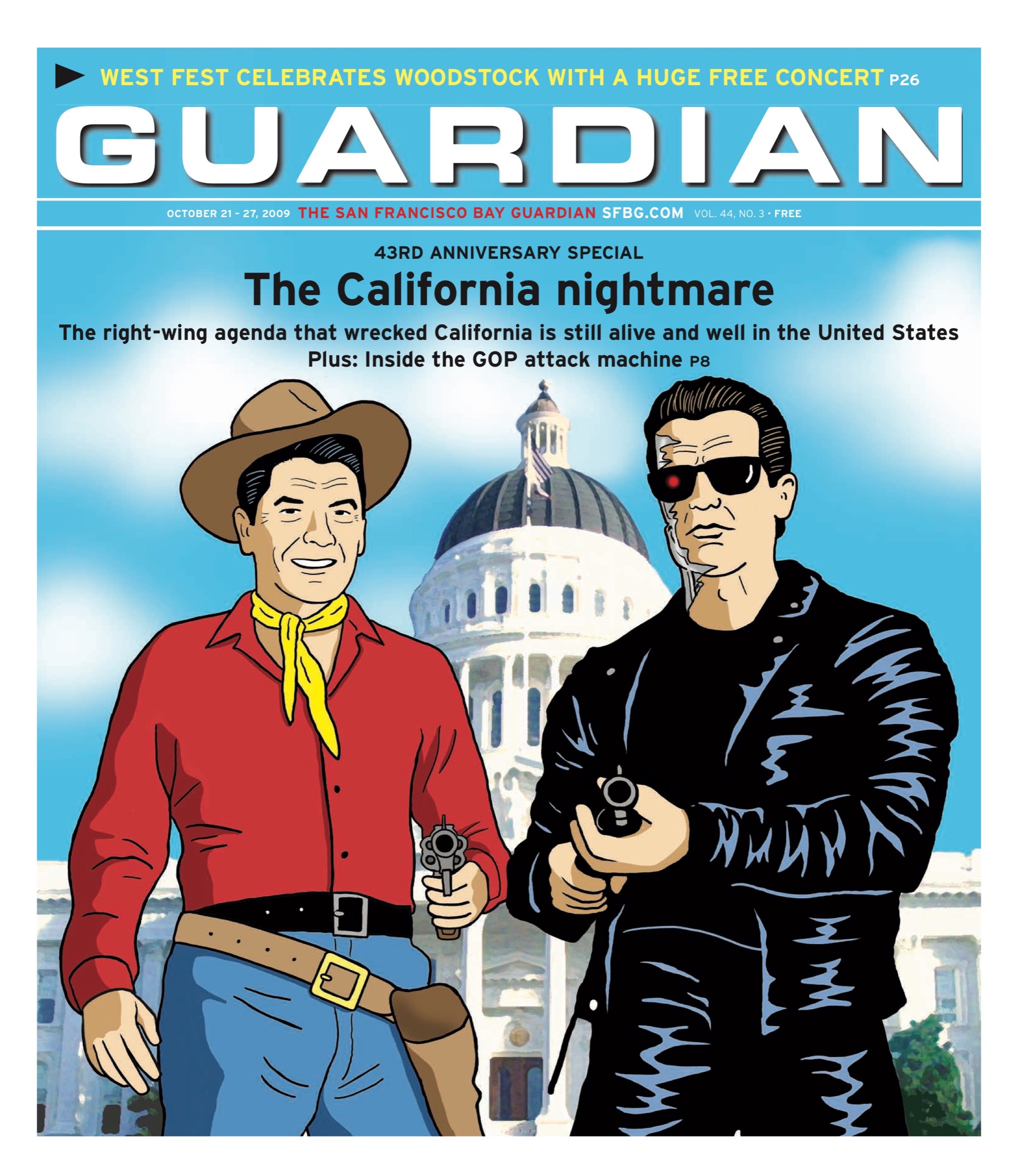
When the first issue of the Bay Guardian hit the stands in 1966, it was still really possible to talk about the California dream. The state had seemingly limitless potential and was in many way a model for the nation — a free public university system that was the envy of the world, an economy that provided jobs to hundreds of thousands of new arrivals, the beginnings of what would be the nation’s premier environmental movement pushing to save San Francisco Bay, save the coast, save Lake Tahoe … and the Free Speech Movement, the Summer of Love, the United Farm Workers Union, and so much more that was transforming politics and culture in the United States from the West Coast.

Twelve years later, it was all falling apart. Eight years of Gov. Ronald Reagan and then the passage of Proposition 13 launched a very different kind of movement out of the West, a movement that sought to dismantle the public sector and the social safety net, to treat government as the enemy, and to use culture wars to convince working-class Americans to vote against their own economic interests.

And now California is being described as the nation’s first failed state. Gov. Arnold Schwarzenegger — the second Republican actor to hold that role — has driven the state to the brink of bankruptcy. The University of California is drowning in red ink, raising fees and turning away students. The state’s water system is a mess; cities and counties are in fiscal collapse; the economy’s in the tank; and nobody seriously talks about a California dream anymore.

The story of how that happened — and how the diseases of tax-revolts, privatization, government corruption, and public disempowerment spread east from California — is the focus of this 43rd anniversary issue. It’s both enlightening and a bit scary to read through old issues, because in hundreds of stories over the past four decades, the Guardian has warned of exactly what was to come.

The very first issue of the Bay Guardian talked about the "historic election" pitting the incumbent, Democrat Pat Brown, against Reagan. A lot of people in the emerging "new left" were arguing that there wasn’t a bit of difference between the two, and that you might as well sit out the election. But the Guardian had a different take. The election was really about the direction California wanted to go, the paper said, a choice between a state that cares about the public sector and social welfare and a state where those things don’t matter.

"Reagan’s stands typify the temper of the cause," the Nov. 7, 1966 editorial stated. "He is on record, at various times, in opposition to the progressive income tax, Social Security, Medicare, the anti-poverty program, farm subsidies, the TVA, the Civil Rights Act, the Voting Rights Act, public housing, federal aid to education, and veterans hospitalization for anything other than service-connected disabilities. How can a man or a movement govern the state of California with such a political philosophy?"

Reagan’s election may have seemed like a fluke, but it was nothing of the sort. By the mid 1960s, with the counterculture — and equally important, the economic left — looking to make major inroads in American policy, the broad outlines of a right-wing attack plan were in place.

That’s something the Guardian always recognized — that powerful people who moved the levers of government typically did so with a long-term plan.

In San Francisco, part of that plan was the transformation of a human-scale city to a West Coast version of Manhattan. The idea: tear up South of Market (then mostly low-income housing) for a shiny new convention center and hotels. Dump dozens of big high-rise office buildings downtown. Construct a fixed-rail system to carry suburban commuters into the dense downtown. Drive up property values — massively — and if that means blue collar jobs and working class people had to go to make way for wealthier office workers, so be it. In the end, of course, the architects of the plan — landowners, developers, bankers, and big business leaders — became immensely wealthy.

On the state and national level, their plans were broader. Even so, they had one major aim: throttle the pubic sector. Cut off the funding for government programs, reduce regulations, undermine any concept of a welfare estate — and cut taxes on the rich.

As we report on page 8, the architects of this plan are happy today to talk about how it worked — how Reagan launched his war on government back in the 1970s, how a group of well-funded think tanks developed plans, and political consultants took advantage of people’s fears (and the Democratic Party’s failures) to put those plans into action.

The movement really got off the ground in 1978 with the passage of Proposition 13.

Prop. 13 emerged from a state in the middle of a massive growth spurt and a heated political cauldron of money, race, and Legislative failure. Howard Jarvis, a Republican landlord lobbyist who hated taxes, hated government, hated public schools, and disdained most Californians — "63 percent of [public school] graduates are illiterate" and would have no need for public libraries, he once quipped — took advantage of a gaping hole in political leadership and set off a movement that would cripple the United States of America.

The measure marked the final, fatal end in California of the era known as the ’60s — a period when the left was ascendant, when taxes on the wealthy funded education, infrastructure and programs for inner cities, and when economic and cultural liberalization seemed to be spreading across the nation.

Rising property values, driven by rapid population growth, were driving up property taxes — and the problem was real. Long-time residents, particularly people on fixed incomes, saw their taxes rise so high they couldn’t afford to stay in their homes. The Legislature could have addressed that (with, say, a split-roll measure that taxed residential and commercial property at different rates) but utterly failed to move on the crisis.

A series of assessor’s office scandals didn’t help, either. And, at the same time, the California Supreme Court ruled that rich school districts had to share revenue with poor districts, infuriating wealthy white property owners.

Jarvis and his partner Paul Gann circulated petitions to roll back property taxes and make it almost impossible to raise taxes in the future. It passed with 65 percent of the vote.

Of course, big businesses (particularly utilities) were the big winners. As the Guardian pointed out on June 1, 1978, the top five utilities in California alone (including Pacific Gas and Electric Co.) would gain billions from the tax cuts.

But beneath it all was a simmering discontent with government — something Jarvis had set afire and would later be used by Ronald Reagan and the right-wing operatives who backed him to undermine the New Deal, the social safety net, and the basic social contract in America. The antitax folks played to white people who didn’t want to see their money going to minorities, to the middle-class folks who thought (thanks to the assessor scandals) their tax money was being wasted by corruption — and to a lot of younger people coming out of the 1960s who had learned from Vietnam, COINTELPRO, and Watergate not to trust government.

The Bay Guardian opposed the measure strongly: "Most analyses indicate that without replacement taxes, hundreds of thousands of California public servants would be thrown out of work (which is exactly what Howard Jarvis intends) … " a May 18, 1978 editorial noted. "Vote for Prop. 13 only if you favor decreased government services (including cutbacks in everything from libraries to schools to street-cleaning crews and possibly police and fire departments) and are fond of half-baked measures that favor the rich."

Prop. 13 set off a national movement to cut taxes — and riding that wave, Reagan was elected president in 1980. He immediately set about attempting to slash taxes on big business and the wealthiest Americans, and eliminate environmental, workplace safety, and employment regulations.

You can see the results in California — and across the nation. The very strategies that emerged in this state and that the right has supported over the years have come very close to destroying the United States economy, leaving millions out of work — while the gap between the rich and the poor has risen to unsustainable levels.

Part of the reason this national attack on government and the public sector worked was the failure of Democrats to recognize that corruption matters. It was no small wonder that Californians were losing faith in government — in the 1970s and 1980s, the state Legislature, under the Democratic control of Speaker Willie Brown, was awash in sleaze, paralyzed by lobbyist influence and campaign money. Yet leading Democrats, fearful of Brown’s power, did little to reign in the appalling corruption.

In fact, when Brown became mayor of San Francisco, the entire Democratic Party, from the president of the United States on down, seemed to treat him as royalty — despite the fact that he was selling the city to every developer and corporate lobbyist who waved money under his nose. When taxpayers knew that a large part of their money was going to fund juicy jobs for Brown’s cronies and pet projects, it was hard to argue for higher taxes.

And it was the Democratic Party leadership in San Francisco who presided over two of the greatest examples of privatization of public resources in modern history: the Presidio and the Raker Act. Rep. Nancy Pelosi was the author of the bill that, for the first time, turned a national park over to the private sector — and hardly a Democratic leader in the city dared to lift a finger in opposition. And for decades — since the Guardian first broke the story in 1969 — the city’s Democratic power brokers have bowed and genuflected to PG&E and allowed the private utility to control the local electric grid and block implantation of the federal law that mandates public power for San Francisco.

And now PG&E wants to pull off one of the greatest feats of privatization in American history. The company has launched a ballot initiative that would wipe out any further attempts at public power in California, essentially guaranteeing that private companies, not the public sector, control the vast, critical resource of electric power in this state.

It’s the latest big battle between two divergent visions of America — and this time, the folks who have done so much damage to this state and this nation can’t be allowed to win. In fact, maybe the campaign against PG&E can be the turning point, the time when California realizes that privatization, attacks on the public sector, tax cuts for the rich, and political sleaze are a formula for disaster.

The lesson of California

0

news@sfbg.com

Much of the right-wing agenda that has thrown this nation into economic chaos can be traced back to what was once called the Golden State.

The tax revolts that started here under Gov. Ronald Reagan and continued to sweep the country and the world under President Reagan never abated. Indeed, they have only been strengthened by the big business power that created and benefited from them.

But now that California is showing signs of being the country’s first failed state — caught in fiscal freefall and mired in political gridlock as a generation’s worth of neglected problems surge to the surface — this state has become a cautionary tale for that anti-government ideology.

Trends in America tend to start out west, and the economic and political disaster that California has become contains critical lessons for the rest of the country.

Lewis Uhler — president and founder of the National Tax Limitation Committee — speaks candidly and proudly of his key early role in helping build a conservative movement to limit the size of government and do battle with those who want the public sector to actively promote social and economic justice.

Uhler, a UC Berkeley Boalt Hall School of Law graduate who did legal work for conservative causes in the 1960s, was tapped by then-Gov. Reagan in 1970 to be the director of the Office of Economic Opportunity, a federally-funded legal assistance program created as part of President Lyndon Johnson’s war on poverty.

While that may seem like a strange role for an avowed conservative and former member of the John Birch Society, Uhler says Reagan basically brought him in to wreck the program and fight the feds. “I was asked to put my money where my mouth was for my conservative philosophy,” Uhler told the Guardian. “OEO was set up to ensure conflict and confrontation … The mission of legal services was to change public policy through lawsuits they decided to file. I thought it was a corruption of the legal system.”

At the time, public-interest law and liberal economic and social policies were on the rise in California and spreading to the rest of the nation. So the Reaganites fought back.

Rather than helping poor plaintiffs file environmental, consumer protection, equal rights, or other types of lawsuits designed to level the playing field with powerful interests, Uhler blocked lawsuits brought by attorneys he calls “ambulance-chasers” and gutted the program. “Ultimately,” he said, “we vetoed funding for California Rural Legal Assistance.”

And for his efforts, Uhler was rewarded with a cabinet-level position: assistance secretary of the Health and Welfare Agency. Again, his role wasn’t to make the agency more effective, but to make it less effective in a realm where he believes government was too big and too active.

“The problem was uncontrolled state and local spending,” Uhler said. “Intuitively, everyone who gathered around Reagan shared the same philosophy that government doesn’t really contribute anything to economic growth.”

In 1972, Reagan gave Uhler the opportunity to work more directly on the mission of cutting taxes and shrinking the size of government, naming him chair of the Governor’s Tax Reduction Task Force. It was, in many ways, the beginning of the vast right-wing conspiracy.

“I asked to be given the chance to go across the country and find the best free market minds in the country to develop these policies,” Uhler said, explaining that he wanted to borrow the liberal strategy of giving an academic veneer to their ideas, as presidents Kennedy and Johnson had done in the realm of foreign policy. “Our side had never really done that.”

Uhler’s first stop was the University of Chicago School of Economics, where he met with noted free market economists Milton Friedman, James Buchanan, and George Stigler, who were brought into the cause.

Today’s vast network of conservative think tanks didn’t exist at that time, so Uhler tapped conservative thinkers from the American Enterprise Institute and the Hoover Institute at Stanford University, as well as other conservative economists such as Peter Drucker from Claremont McKenna College.

“There were 35 people who helped us design the first effort at a constitutional initiative in California to limit year-over-year growth of the state’s general fund,” Uhler said. “All of us as free market enthusiasts and economists all shared the belief that government beyond a certain level eats the seed corn of the nation and doesn’t produce anything.”

While voters narrowly rejected their group’s first effort to cap government growth — Proposition 1 on the November 1973 ballot — the ground had been prepared and the seeds had been sown for the tax revolts that would sweep the country in the late 1970s, with many of the campaigns coordinated by Uhler and the organization he formed for that purpose in 1975, the National Tax Limitation Committee, and a rapidly growing network of similar, interconnected organizations.

As Uhler worked with Reagan to weaken California’s government from within, his fellow travelers were developing national and international strategies to create aggressive, coordinated, well-funded campaigns to attack government and spread the free market dogma.

In August 1971, Lewis Powell — a conservative corporate attorney who President Richard Nixon had just nominated to the U.S. Supreme Court (where he served from 1972-87) — wrote a confidential memorandum to the leadership of the U.S. Chamber of Commerce titled “Attack on the American Free Enterprise System.”

He sounded the alarm that the ascendant environmental and consumer movements were going to destroy capitalism in the country unless corporate America aggressively fought back in a coordinated fashion, which he spelled out in great detail.

He called for all major corporations to develop aggressive legal and public relations strategies for fighting the left, creation of a network of think tanks and media outlets to push the conservative message, manipulation of the legal system, and sponsorship of university programs to study conservative ideas and incubate future leaders — which all came to pass in the coming decades.

“American business [is] ‘plainly in trouble’; the response to the wide range of critics has been ineffective and has included appeasement: the time has come — indeed, it is long overdue — for the wisdom, ingenuity, and resources of American business to be marshaled against those who would destroy it,” Powell wrote.

Part of that strategy involved having the federal government promote and popularize free market economic theories being developed by Friedman and his colleagues at the University of Chicago, a movement that is well-documented by journalist Naomi Klein in her book The Shock Doctrine: The Rise of Disaster Capitalism.

In 1971, Friedman and his colleagues began working with rich conservatives in Chile who were allied with Gen. Augusto Pinochet, who in turn were conspiring with the CIA to overthrow and assassinate the democratically elected, leftist President Salvador Allende, which they successfully did on Sept. 11, 1973.

Friedman’s economic theories called for a radical restructuring of society — slashing taxes and social spending; removing most regulation and trade restrictions; crushing labor unions; promoting economic growth at any cost — and Pinochet executed the strategy in brutal fashion, ordering the death of at least 3,200 of his political opponents, including the car-bomb assassination of economist Orlando Letelier in Washington, D.C., in 1976.

Friedman and Pinochet consulted openly and shared a basic disdain for social programs and progressive taxation. “The major error, in my opinion,” Friedman wrote in a letter to Pinochet in 1975, referring to the government antipoverty programs Pinochet dismantled, was “to believe that it is possible to do good with other people’s money.”

The model Pinochet and Friedman developed in Chile would eventually go global — promoted by its top cheerleaders, Reagan and British Prime Minister Margaret Thatcher — and be implemented (with disastrous results for most citizens but creating huge profits for wealthy individuals and corporations) in Indonesia, Bolivia, Argentina, Peru, Russia, Poland, South Africa, Japan, and elsewhere.

But with the corporate media and conservative opinion-shapers focused mostly on economic growth — ignoring persistent poverty and the brutal tactics used to suppress the popular movements that tried to resist Friedman’s “economic shock therapy” — Friedman had become a sort of free-market prophet by the time he died in 2006.

“In the torrent of words written in eulogy to Milton Friedman, the role of shocks and crises to advance his worldview received barely a mention,” Klein wrote. “Instead, the economist’s passing provided an occasion for a retelling of the official story of how his brand of radical capitalism became government orthodoxy in almost every corner of the globe.”

California’s fiscal shackles have been in place since 1978, when Proposition 13 and subsequent measures capped property taxes and required an undemocratic two-thirds vote to either raise taxes or pass the annual budget.

A Republican landlord lobbyist named Howard Jarvis charged onto the field that Reagan, Uhler, and their team had prepared and took advantage of a gaping hole in political leadership to set off a movement that would cripple the United States of America.

There was some logic to it then. Times were good in California in the 1970s, good enough that people were flocking to the state by the millions. That was driving up property values — and thus property taxes.

Jarvis bought his home for $8,000 in 1946; 30 years later, it was assessed at $80,000. In fact, inflation was running at close to 10 percent a year in California. Homeowners were getting huge tax hikes each year, and tenants were getting huge rent hikes at a time when state government had a budget surplus.

Homeowners saw millions of dollars sitting in the coffers in Sacramento while they couldn’t pay their tax bills. Yet nobody in the Legislature or governor’s office came up with a solution.

So when Jarvis showed up with petitions to roll back property taxes and prevent future increases, he found a broad base of support. Even tenants went along — Jarvis and his gang promised that property-tax cuts would be passed on to tenants and would mean the end of the escautf8g rent hikes.

Jarvis collected signatures for a radical measure that essentially blocked all property tax increases and allowed new assessment only when a parcel sold. It was, in the end, a huge tax giveaway to major corporations. Since commercial property turned over far less often than residential property (and since commercial sales could be hidden as stock transfers), big businesses wound up paying far less of the state’s tax burden. Corporations used to pay about two-thirds of the state’s property taxes, and individuals one-third; now that is reversed.

It didn’t help tenants, either. Few of the landlords who saw the benefits of Prop. 13 passed the money along to their renters. Most just kept it. San Francisco activist Calvin Welch likes to say that Howard Jarvis was “the father of rent control.”

The campaign against Prop. 13 warned of the dangers of cutting local government; police and fire chiefs appeared in ads opposing it. But the No on 13 folks never talked about the huge windfall big corporations would get from the measure, or the huge disparities in wealth that would be created by defunding government and dereguutf8g corporations.

If the goal was to skew the concentration of wealth in the state, it worked brilliantly. According to the California Budget Project (CBP) of the Franchise Tax Board, recent data taken before the current economic recession illustrates an ever-widening chasm between the wealthiest taxpayer and the working-class person.

The total adjusted personal income for Californians rose by nearly $64 billion in 2006-07 — with approximately three-quarters of that increase going to the top fifth of wealthiest taxpayers, and 30 percent going to the top 1 percent. That left only $19 billion for everyone else.

“The average taxpayer in the top 1 percent experienced a $128,261 increase in AGI [adjusted gross income] between 2006 and 2007, which was more than three times the total AGI of the average middle-income taxpayer in 2007 ($36,115),” stated the June 2009 report.

This continues a long-term trend in which the wealthy continue to leave the average income-earner behind in a trail of dollar-sign dust. From 1995 to 2007, income gains for that top 1 percent come to a whopping 117.3 percent increase — nearly 13 times more than the gains of the middle-income taxpayer.

The nation’s income gap has reached a “level higher than any other since 1917,” according to a paper by University of California, Berkeley economic professor Emmanuel Saez. According to Saez’s analysis of census data, there’s been a steady increase in the income gap since the 1970s, rising 20 percent over the years.

Yet even today, the defenders of Prop. 13 continue to sound the same consistent themes. “Those who are directly involved in government are a militant special interest,” Howard Jarvis Taxpayer Association executive director Kris Vosburgh told us. “They don’t like anything that limits their revenue stream.”

While that last statement could be applied equally to corporations or other private sector enterprises, as Vosburgh reluctantly admitted when asked, he continues to imply malevolence to those who defend government. He said the state’s current fiscal collapse can only be solved by slashing government expenditures.

“It is not valid to be talking about revenue-side solutions,” he said. “Our position is the state has enough money to accomplish its goals.”

People have never liked paying taxes, but the antitax movement is about far more than just that basic individual desire to hold onto our money.

The attacks were well planned, carefully targeted, and part of a much larger effort aimed at maintaining corporate and conservative power, undermining the New Deal, reducing taxes on the rich, and radically reducing the size and scope of the public sector.

As Powell called for, corporations have aggressively challenged, in legal courts and those of public opinion, every significant progressive advance — from San Francisco’s attempt at universal health care to California’s tentative first steps to address global warming.

With a level of discipline unheard of on the left, conservative opinion-shapers pound their talking points and enforce party unity through mechanisms like the “no new taxes” pledge that every Republican in the California Legislature has signed and heeded, under the very real threat of recall.

Opposition to taxes is now so deeply embedded into the psyche of the California electorate, and such a core tenet of today’s Republican Party, that elected officials who tout fiscal responsibility allowed the state’s debts to go unpaid (destroying its credit rating in the process) and its education and transportation systems to be decimated rather considering new revenues.

Gov. Arnold Schwarzenegger’s spokesperson Aaron McLear told us, “He believes we ought to live within our means and pay for only the programs we can afford.”

That simple talking point gets repeated no matter how the question is asked, or when we point out that it means we’re being forced to live within historic lows this year. But they claim the people support them.

“We had tax increases on the May ballot and they were rejected by a 2-1 margin. We should listen to the will of the voters,” McLear said.

Never mind that this regressive, dishonest package of temporary tax hikes was opposed by the Guardian and a variety of pro-tax progressive groups. McLear wouldn’t even admit that point or respond to it honestly.

And he’s certainly right that most polls show a majority of Californians don’t want new taxes. But these polls also show that people want continued government services, more investment in our neglected state infrastructure, and a whole bunch of other contradictory things.

That’s why newspapers and analysts around the world are looking at California, the world’s eighth largest economy, and wondering (as the Guardian of London headline asked Oct. 4): “Will California become America’s first failed state?”

In many ways, it already is. The question now is whether we’ll try to learn from and correct our mistakes. Ryan Riddle contributed to this report. ———–

THE CONSERVATIVE RELIGION

When I asked Lewis Uhler, one of the architects of the Reagan revolution, what Americans believed in these days — where the people he likes to talk about who hate the government (but are also admittedly disillusioned with Wall Street) turn — he answered simply: religion.

It should come as no surprise that many religious fundamentalists tend to side with the free market conservatives — both ideologies require a leap of faith and ignoring certain troubling facts, such as increasing disparities of wealth, natural resource depletion, and global warming.

Their arguments mostly make sense — until these inconvenient truths come up.

Certainly, turning over more public resources to free market capitalists, cutting taxes, and slashing government regulation will spur private sector economic growth, just as advocates claim.

But that growth has a cost. The wealth won’t be shared by everyone. Indeed, poverty has persisted even through even the economic boom of the 1990s — but almost everyone will be affected by underfunded road, education, public safety, and other essential systems.

As the conservative movement has successfully limited taxes and cut regulation over the last 40 years, working class wages have stagnated as the rich have gotten richer. Many of the world’s oil reserves have peaked and gone into decline, and rapidly increasing carbon emissions have collected in the atmosphere and caused global warming.

So how do conservatives respond to these realities as they argue for the continued dismantling of government, which is the only entity with the scope and incentive to deal with these problems? They simply deny them.

Uhler decried the “pseudoscience of climate change” as hindering economic progress and claimed that there’s actually been a global cooling trend in the last 10 years. (Actually the last 10 years have been some of the hottest on record, causing glaciers around the world to melt, according to data and observations from a consensus of the world’s climate scientists, including NASA, the Union of Concerned Scientists, and the United Nations Climate Change Conference.)

It’s the same story with the consolidation of wealth, which hurts the free market fantasy that letting the super-wealthy keep more money will eventually trickle down to benefit us all. Uhler simply denied the growing disparity of wealth, saying the “movement between quintiles is significant.”

He was talking about people’s ability to go from poor to rich with a little hard work and initiative, the core idea of free market conservatives. But data from the U.S. Census Bureau and many other entities indicate that median wages have been stagnant for decades (which wouldn’t be true if there was lots of upward mobility) and that most of the wealth created in the U.S. over the last 40 years has pooled with the top 1 percent.

In fact, when it comes to measuring social impacts, Uhler has simply one metric: “Governments at all levels are twice the size they should be to maximize economic growth.” (Steven T. Jones)


 

Endorsements

0

San Francisco is facing the worst budget crisis in modern history. More than 1,000 employees, mostly front-line workers in the Department of Public Health, have been laid off, and the red ink continues. Yet the only measure on the November ballot that would raise any money for the city is Sup. Bevan Dufty’s plan to sell off naming rights for Candlestick Park.

That’s pathetic. During the summer budget discussions, Mayor Newsom vowed to work with business, labor, and the supervisors to come up with a reasonable plan to bring in some new cash for the city. But that collapsed — largely because state law would have made it hard to raise taxes this fall without a unanimous vote of the supervisors. And while eight members were willing to put a revenue measure on the ballot, the three supervisors closest to the mayor — Sean Elsbernd, Carmen Chu, and Michela Alioto-Pier, all Newsom appointees — refused to go along. And the mayor made only a weak effort to change their minds.

So while Democrats everywhere decry Gov. Arnold Schwarzenegger’s insistence on a cuts-only budget, the Democratic mayor of San Francisco has forced essentially the same approach on this city. The only revenue increases we’re seeing are fees, like Muni fare hikes, that amount to taxes on the poor.

That’s the state of San Francisco as we head into what will almost certainly be a low-turnout election. Only two elected officials are on the ballot, and both are unopposed. Five ballot measures — several fairly significant — round out the local ballot. And with no big-name races at the top, they will win or lose on the votes of a small majority.

That’s too bad, because the issues matter. Vote Nov. 3 — and let’s hope next year’s ballot actually includes some new, progressive taxes.

OUR RECOMMENDATIONS


City Attorney

Dennis Herrera

San Francisco hasn’t always had a good track record with city attorneys. George Agnost, who ran the office in the 1970s and 1980s, was a dour, secretive, conservative lawyer who let downtown call all the shots. Louise Renne, who took over from Agnost, ran the office in the 1990s as if it was a wholly-owned subsidiary of Pacific Gas and Electric Co. Herrera, who took over in 2001, has been a major improvement. He’s turned the office into a modern operation, professionalized the administration, and taken on an activist role on consumer, environmental, and public-interest issues. He’s been a big supporter of marriage equality and of the city’s landmark health-care legislation. On his own initiative, he sued to end gender rating in health insurance and crack down on predatory payday lenders. He also moved to enforce health codes in housing and has been out front going after corrupt landlords like Skyline Realty.

We have some concerns about Herrera. Although he’s been far more sunshine-friendly than his predecessors, open-government activists are still sometimes forced to sue the city to get access to records. He won’t use his power as city attorney to enforce the Raker Act and bring public power to San Francisco. And during the current budget crisis, he cut the number of city attorney hours the supervisors can use to draft legislation.

And if, as rumored, he wants to run for mayor, Herrera needs to start taking public stands on major issues — like the unfairness of the local tax code and the need for new revenue.

But we’re happy to endorse him for another term.

Treasurer

Jose Cisneros

The incumbent treasurer is running unopposed, and we see no reason not to endorse him. He’s done some very positive things: Cisneros worked to get the big downtown law firms and other partnerships to pay their fair share of city taxes. He closed a tax loophole exploited by the big airlines that put up flight crews in local hotels.

He also convinced local banks and credit unions to accept consular identification cards to allow immigrants to open accounts and has pushed those institutions to offer "second-chance banking" to people with past credit problems. During his tenure, more than half of the 50,000 households in the city that lacked bank accounts have been able to get away from predatory check-cashing outfits and open legitimate accounts.

As an elected official, however, he could be doing a lot more. The city still keeps all its short-term accounts in one bank — Bank of America, which isn’t even local. Cisneros has promised to open that deal up to competitive bidding, but doesn’t have a timeline. And although nobody knows better than the treasurer how unfair and regressive the city’s tax codes are, he has never spoken out or offered any solutions. Cisneros says he wants his office to be apolitical, but city money is, by its nature, a political issue, and we’d like to see a little more leadership from the person who handles it. But overall, he’s a professional money manager who’s done a decent job and deserves another term.

Proposition A

Budget process

YES

We’re a little nervous about Prop. A, which would institute a two-year budget cycle for the city. Sup. Chris Daly, who opposes it, points out that the city controller’s budget projections are often wrong — badly wrong — and trying to plan 24 months ahead when economic conditions (and thus the city’s revenue stream) can change so quickly and unpredictably is a dangerous game.

But on balance, the approach in Prop. A makes sense. The budget debates would still take place every year, and the supervisors would still have to approve an annual budget — although the budget would be a rolling two-year projection. So next year, the board would approve a budget for 2010 and 2011, the following year for 2011 and 2012, and so on — leaving plenty of room for adjusting to meet economic changes. And two-year cycles might make it easier for nonprofits that rely on city funding to do some serious long-term planning.

Equally important, Prop. A requires the police and firefighters to negotiate their union contracts the same time the other unions do — before the budget deadline. The current system allows those unions to make demands that are unrelated to — and often outside — the current year’s budget realities.

Every progressive on the board except Daly supports this, and Sups. Alioto-Pier, Elsbernd and Chu oppose it.

Proposition B

Board of Supervisors aides

YES

This one’s a no-brainer. The City Charter mandates that each supervisor be allowed to hire two aides. The requirement dates back to a long-ago era when city budgets were far smaller, problems were less pressing and complex, and the supervisors worked part-time. It makes perfect sense to take such an archaic law out of the City Charter and allow the supervisors to set their own budgets — and staffing levels — the same way the mayor does. Vote yes.

Proposition C

Candlestick Park Naming Rights

NO

You have to give Sup. Bevan Dufty, the author of Prop. C, credit for trying. He’s looking for any angle he can use to help keep the 49ers in town, and allowing a corporate sponsor to pay for naming rights might possibly help cover the immense cost of substantially renovating aging Candlestick Park. And, like Prop. D (see below), this measure has a nice beneficiary: part of the money from naming rights would go to save the jobs of recreation directors, many of whom have faced budget-driven layoffs.

We agree that rec directors play a crucial role, particularly in neighborhoods with large numbers of at-risk youth. And we wish the Chamber of Commerce, Sup. Elsbernd, and other supporters of Prop. C were willing to accept some progressive tax hikes to fund those jobs.

But this isn’t a good deal. The city owns the stadium; the taxpayers financed its construction and spent 30 years paying off the bonds. But the 49ers, a private outfit owned by a very wealthy family, would get half the money from any naming deal. And the money that would come in would be radically short of what the team would need to rebuild the ‘Stick. Vote no.

Proposition D

Mid-Market special sign district

NO

Again: credit for the effort. David Addington, who owns the Warfield Theater and several other properties on mid-Market Street, accurately notes that the city’s main thoroughfare, between Fifth and Seventh streets, is rundown, ignored, and badly in need of an economic boost. He argues that allowing new digital billboards would create something of a Times Square in San Francisco, attracting tourists and turning mid-Market into a thriving theater district. Nothing else the city has done has worked — why not give this a try?

We aren’t necessarily opposed to digital billboards and we’d love to see mid-Market reinvigorated. But Prop. D would give too much authority to an unelected, unrepresentative group. It would amount to privatizing city planning and set a terrible precedent.

Under the measure, the Central Market Community Benefits District, a private group of property owners, organizations, and residents, would be authorized to approve new general advertising billboards as large as 500 square feet. The ads would have to meet city codes, but the Planning Department and supervisors would have no ability to block new installations. And the money — potentially millions of dollars a year — would go entirely to the property owners and the CBD, which would decide how to distribute it.

Yes, like Prop. C, this measure would help a worthy group: some of the new money would go to youth programs in the Tenderloin. But the process this measure describes isn’t at all democratic. The CBD board selects its own members, and the only oversight the city has is the ability of the Board of Supervisors to abolish the agency and start over.

We’re open to new ideas for central Market Street. We’re open to lights and ads and maybe even billboards. But we’re not willing to turn over zoning and public finance decisions to a private group. Vote no.

Proposition E

Advertisements on city property

YES

Proposition E, written by former Sup. Jake McGoldrick, would freeze new commercial billboards and ads on street furniture at 2008 levels and outlaw advertising on public buildings. It’s an extension of existing city policy, which seeks to limit the increasing blight of commercial ads in public space. Vote yes.

Hear from constitutional convention proponents

11

By Melanie Ruiz

California’s government is broken, unable to deal with this state’s many challenges, and it’s time for fundamental reform. That call was sounded in the summer of 2008 by Jim Wunderman, president and CEO of the Bay Area Council (BAC), and it was heeded by disparate allies who formed a movement that is pushing for a constitutional convention.

Tomorrow, Oct. 14, representatives from the BAC, Courage Campaign, California Forward and Political Reform Program at the New America Foundation will explain why a convention is necessary to get California out of crisis and gridlock and into prosperity. San Francisco Young Democrats (SFYD) and Citizen Hope (the grassroots political group that formed about Barack Obama successful presidential campaign) are sponsoring the panel discussion starting at 7 pm at the California State Building Auditorium, 455 Golden Gate Ave. The event is free.

One of the biggest impediments to good government is the hefty two-thirds vote requirement for passing budgets and raising taxes. Though supporters of this initiative often have opposing views on controversial issues like taxes, they all agree that one of the oldest state constitutions needs an overhaul.

Gavin Newsom’s “reform” pitch

6

By Tim Redmond

Mayor Gavin Newsom doesn’t have enough money to do a major statewide TV buy, but he’s making his early pitch, and trying to define the race, with a new internet ad. Calitics points out that the ad

mentions not once, but twice, both the Constitutional Convention and eliminating the 2/3rds rule. Newsom is positioning himself as the candidate of not just “change” but of structural reform:

Of course, those of us who live in San Francisco know that Newsom has done nothing — nothing — in terms of real structural reform in the city, and has pused a Schwarzenegger-style no-new-taxes budget. He was at first very wary about Constitutional change, but now is embracing it, sensing, no doubt, that the mood of the public is so down on Sacramento and Sacto politiciians that the concept of fundamental change is attractive — even when peddled by someone who has no credentials as a “change” candidate.

But for Jerry Brown, this is serious stuff — the candidate who defines the race first is often in a much better position to make the case for his or her election. And Newsom is trying to define the race as insider-outsider, change v. politics as usual. Brown may have the poll numbers and the money, but if he sits around and lets Newsom define the race, he’s playing a dangerous game.

SF vs. the Catholic Church, round 3

5

By Ryan Thomas Riddle

A decision is expected next month in the high-stakes battle
between the Archdiocese of San Francisco and Assessor-Record Phil Ting, which will determine whether the church will pay out millions in transfer taxes.

On Thursday, Oct. 8, Ting once again went before the Transfer Tax Review Board to counter the Archdiocese’s
assertions that its extensive 2008 property transfers aren’t taxable. The board then called for final legal documentation in the case, including closing briefs, to be delivered by both sides on Nov. 9. The board will render its final ruling two weeks later, according to Ting.

“It is in the capable hands of the tax review board,” he told the Guardian.

Ting said he expects that the verdict will be in his office’s favor, which could force the Catholic Church to pay somewhere between $3 million and $15 million in transfer taxes to the city. Church officials, who have yet to respond to our calls, contend that the properties the archdiocese moved from one interdenominational entity to another are considered a “gift” under canon law, and thus do not qualify for transfer taxation since the properties still belong to the greater Catholic Church.

The Assessor’s Office reviewed a January 2009 California Supreme Court ruling that reaffirmed the national Episcopal Church’s ownership of local church buildings and properties, a case the archdiocese has cited. “Basically, it’s an interdenominational conflict that has no barring on this case,” Ting said.

As for accusations from the more militant church supporters that this is the city’s retaliation for the passing of Proposition 8
, Ting said that his office made overtures on the transfer taxes long before the same-sex marriage issue went to the election ballot. Craig Dziedzic, manager of the recording division within the Assessor’s Office who testified in Thursday’s hearing, sent emails out to the legal counsel for the diocese regarding the transfer taxes back in April 2008, months before Prop 8 was passed.

SF vs. the Catholics, Round Two

1

By Ryan Thomas Riddle

Today, as Assessor-Recorder Phil Ting and the Archdiocese of San Francisco continue their ongoing battle over millions in transfer tax revenue, witnesses on both sides are being called to testify in this high-stakes case.

The two sides previously squared off on Tuesday, Oct. 6, when Ting got to present his side of the case before the Transfer Tax Review Board, countering church officials’ claims that their extensive 2008 property transfers doesn’t qualify for taxation. But the Assessor’s Office told the Guardian that it will take time before there is a resolution.

At issue are the diocese’s transferred properties, valued at anywhere from $210 million to $1.25 billion. If that’s the case then the transfer tax revenue could fall somewhere between $3 and $15 million, and more could be collected in property taxes once the properties are reassessed.

After the peak

0

news@sfbg.com

To prepare for the inevitable decline in fossil fuel production, San Francisco’s Peak Oil Preparedness Task Force (see "Running on Empty," 1/30/08) has concluded the city needs to rapidly implement the community choice aggregation and its related renewable energy projects, beef up "buy local" programs, convert unused land (including some park and golf course property) into public food gardens, and consider implementing city carbon, gas, vehicle, and fast food taxes.

The task force presented its findings, contained in a 125-page report, to the Board of Supervisors’ Government Audit and Oversight Committee on Sept. 24. It notes the city’s weak current position with respect to the economy, food security, and transportation, yet it remains to be seen how the Board of Supervisors will answer the task force’s call. Sup. Ross Mirkarimi says he will look for ways to initiate some of the short- and long-term recommendations "to legitimize its most salient parts."

San Francisco is the largest U.S. city to produce a sweeping report on the potential impacts of peak oil, a term that refers to the point of maximum oil production, after which extracting dwindling supplies gets steadily more difficult and expensive. Although there isn’t consensus on when the peak will come, the task force’s message is clear: action must be taken now. "The transition cannot be done quickly; the city faces a limited window of opportunity to begin, after which adaptation will become enormously difficult, painful, and expensive," concludes the report. Without sufficient preparation, dwindling supplies of oil and fossil fuel could have dire impacts on San Francisco’s economy, food supply, and security.

Many actions recommended by the task force focus on developing local sustainability. For example, disaster planning needs to cover peak oil phenomena. If delivery of food is delayed or reduced due to fuel shortage, food prices could soar, creating a great need for local options, particularly for low-income families. So the report recommends maximizing the amount of time San Francisco can sustain itself locally.

Specifically, implementing an aggressive "Buy Local First" program that prompts public institutions to purchase regionally produced food when possible would encourage more local food production. A fast food tax could further support this goal. Other recommendations include establishing food production education programs and conducting a comprehensive evaluation of which public lands could be converted to food production. Although the Bay Area is capable of producing enough food to sustain itself, food currently being produced is not diverse enough, and much of it is exported.

The report also warns of the social unrest that could result from improper preparation. San Francisco’s economy depends heavily on travel and visitors, with about 18 percent of city revenue coming from tourism. Escautf8g energy costs and its myriad impacts could send the economy into a prolonged downward spiral.

"With food becoming increasingly expensive, travel and the distribution of goods significantly affected, and unemployment climbing, economically vulnerable populations — including a high percentage of people of color — could experience increasing malnutrition, and some may not be able to maintain health without government intervention," the report reads.

Such future scenarios should affect today’s decisions in all realms, including transportation. Tom Radulovich, executive director of Livable Cities and an elected BART board member, said at the Sept. 24 hearing that it doesn’t make sense to fund highway expansions when future resources might not be able to support even the current number of automobiles on the roads.

In fact, he said, there is a cultural shift already underway in which people want to move away from the car-dependant suburbs and into more pedestrian-friendly urban areas, although policymakers haven’t caught up with this trend yet. While BART and Muni fight uphill battles to expand public transit service with dwindling resources, Radulovich pointed out that the Bay Area Metropolitan Transport Commission (MTC) is proposing to direct $6.4 billion toward highway expansion, despite a decline in vehicle miles traveled. Livable Cities coauthored a resolution, recently approved by the Board of Supervisors, urging the MTC to redirect these funds toward improving transit.

As oil becomes scarcer, the need to create and improve communities where people can safely get around by foot or bicycle will be paramount. Ben Lowe, a task force member specializing in transportation security, noted how important it is to look for regional solutions that go beyond individual cities. There is no magic single solution, but dealing with limited-supply and cost-prohibitive oil requires numerous small solutions as we make this transition.

The main obstacle, as Mirkarimi sees it, is that the sense of urgency is not there. Public officials need to educate the public and "to find something, key pieces of legislation, to rally around," he said. He plans to look into formal ways to keep the seven task force members involved in this process, for example, by matching them with policy experts who can facilitate creation of pertinent legislation.

The task force’s mantra for dealing with forthcoming shortages in oil is to integrate peak oil consideration into government planning and all the decisions made by the mayor and Board of Supervisors. Mirkarimi warns that it would be myopic for San Franciscans not to deliberate on the dangers and opportunities outlined in this report.

Read the report at www.sfenvironment.org/our_policies/overview.html?ssi=20.

SF vs. Frank Lembi

0

news@sfbg.com

One of San Francisco’s largest and most notorious landlords and the many shell corporations under his control have been withholding money from their tenants, the banks that financed their rapid real estate acquisitions, and even San Francisco’s public treasury.

But while the banks have acted, seizing property from the delinquent borrowers, city officials have let Skyline Realty, CitiApartments, Lembi Group, and related corporations stonewall the city and pay far less property taxes than they should have owed, depriving city programs of hundreds of thousands of dollars.

The various corporations run by real estate mogul Frank E. Lembi (who has not returned our calls seeking comment) have earned a terrible reputation in San Francisco, even as they’ve expanded their rental property holdings in recent years.

An award-winning, three-part Guardian series ("The Scumlords," March 2006) documented how the companies used intimidating goons and an arsenal of nefarious tactics meant to drive out low-income tenants from rent-controlled units, prompting City Hall hearings and an ongoing lawsuit against the enterprise by the City Attorney’s Office.

Then, earlier this year, many tenants joined a class action lawsuit against the Lembi enterprises, alleging the landlords have been illegally withholding deposits from departing tenants as a routine business practice, even after admitting that the tenants were entitled to full refunds (see "CitiApartments once again accused of mistreating tenants," Politics blog, July 15).

Attorneys for the firm Seeger Salvas LLP filed the complaint, which tells several appalling stories, including that of Joy Anderson. When Anderson went to retrieve the deposit she was owed, CitiApartments employees allegedly threatened her in front of her eight-year-old son, telling her that if she wanted her money back, she should talk to a lawyer.

Yet in that lawsuit and the one filed by City Attorney Dennis Herrera, which deals with harassment of tenants and other business practices that the city contends are illegal, Lembi’s empire has refused to cooperate, employing a variety of delay tactics. The city’s lawsuit has been stuck in the discovery process for years.

A court filing by the city alleges Lembi’s enterprise has participated in "well over a year of discovery gamesmanship." New counsel for the defendants has promised to speed things up, but Herrera told us it is still an ongoing battle. "It has been incredibly hard to get documents and information in this case. He’s been stonewalling us," Herrera told the Guardian.

Seegar Salvas attorney Brian Devine said six defendants named in his complaint didn’t respond to discovery requests and were found to be in default by the judge, meaning they basically opted not to contest their culpability. Meanwhile, 75 other defendants did respond but haven’t turned over any documents to the plaintiffs, dragging out the discovery process.

"It’ll take sometime for anything to happen," Devine told us. "There’s no Matlock moment where it all comes to a head. There are a lot of procedures to go through."

And apparently the Lembi enterprises know a little something about how to use legal and bureaucratic procedures to hang onto their money for as long as possible, judging from how they’ve worked the process to avoid paying the full amount of property taxes on their holdings.

At last count, there were 13 property foreclosure lawsuits pending on Lembi properties because he couldn’t pay the loans. The banks have seized many of his properties and started selling them off. But while the banks are getting their due, the Assessor’s Office and city taxpayers seem to be getting stiffed.

Lembi has been on the radar of city officials for quite awhile, but he is still managing to avoid getting some of his recently purchased properties reassessed, according to a Guardian investigation of city records. For example, one Lembi-controlled corporation — Trophy Properties X — snatched up a Russian Hill parking garage for $4.7 million in 2007.

Under Proposition 13, that property should have been reassessed when it was purchased, but it wasn’t. The current taxable price tag on the property is still slightly more than $443,000, a gap that costs the city upwards of $50,000 a year in taxes.

In general, property is reassessed at fair market value when there is a change in ownership, increasing the taxes owed on the property. According to the California Board of Equalization, the purchase price is the basis for reassessed value in most cases, although officials can also take into account comparable sales and other factors to increase value even more.

Yet nearly three years later, this property still hasn’t been reassessed.

Assessor-Recorder Phil Ting told the Guardian the reason for the delay is because Lembi hasn’t been cooperative in providing the information needed to do a reassessment. We obtained an October 2007 letter sent out by the Assessor’s Office requesting Lembi’s limited liability corporation provide information on the acquisition of the property and statistics on the garage itself. That letter and others went unanswered.

Common sense suggests that the sale price be used to reassess the garage and be done with it. Yet Ting said he fears that using that price would result in an inaccurate reassessment, which in turn might screw up the amount of taxes the city could ultimately collect. Then again, simply waiting on the unresponsive Lembi enterprise has resulted in less taxes being collected on the parking garage last year and again this year, according to public tax records.

"We try to get it right the first time. If we don’t get it right the first time, then oftentimes it creates a lengthier appeals process and a much lengthier, more adversarial [relationship] between us and the taxpayer," Ting said. "We absolutely don’t want to reassess that property too low because of Prop. 13. You only get one chance, so you have to be high."

Ting told us that the only recourse he has with an uncooperative taxpayer like Lembi is to reassess using information from similar properties in the same area. Once this is done, the negligent taxpayer can either agree with or challenge the new market value, a move that would switch the burden to Lembi. But that wasn’t done for the Russian Hill parking garage.

"That’s the only recourse we have, meaning that we can’t fine them; we can’t subpoena them; we can’t force them to give us the information," Ting said. "By law, they’re supposed to give us the information. But there are no real enforcement powers behind it."

According to Section 480 of the Revenue and Taxation Code, the assessor does have an option and can levy a penalty if a property owner fails to file a change in ownership statement, which can be up to 10 percent of the taxes due on the newly appraised value.

Several other Lembi-controlled properties have been reassessed recently after a delay, including 19,650-square-foot apartment building down the street from the parking garage at 2238 Hyde St. Before the reassessment, the property was valued at a little over $1 million. The current value is $11.7 million, which amounts to a tax bill of more than $137,000 this year.

Lembi bought the building in December 2005, and the Assessor’s Office got in just under the wire of the four-year statue of limitations for reassessments. Last year the taxes paid on the building came to a little more than $13,000, based on its previous $1 million value.

Then there is the 31,812-square-foot apartment building on 1735 Van Ness Ave. that Lembi bought back in June 2006. According the city records, the taxes paid last year on the property were nearly $48,000 based on a market value of $3.9 million. Recently the building was reassessed with a value of $9.6 million. This year’s taxes amount to more than $114,000. Whether or not the Van Ness Avenue building is a case in which the Lembi Group also withheld information is currently being looked into by the Assessor’s Office.

Yet on the Russian Hill parking garage, Lembi is still getting away with withholding the necessary documents for an accurate reassessment — and time is running out. In a little over a year, the statue of limitations runs out and the city will no longer be able to collect anything from Lembi.

Further complicating the city’s efforts to collect is the fact that some other the properties in question have been foreclosed on.

When the Russian Hill garage and other Lembi properties went back to the banks, the Assessor’s Office looked into what could be done to collect the city’s lost revenue. Its solution: a transfer tax. But that was not an option because the bank held the main mortgage, so it wasn’t considered a change of ownership.

Even though the parking garage and other properties have slipped out of Lembi’s control, he is still responsible for the taxes on them during his period of ownership, according to Ting. But given the experiences of others who have tried to collect money from Lembi, that could be a long, expensive process.

While the Lembi enterprises may be stingy in giving the city and tenants their money, they haven’t had a problem making political campaign contributions. Taylor Lembi, grandson of Frank, gave $500 to Mayor Gavin Newsom’s reelection campaign in 2006, according to public campaign contribution records, although Newsom’s campaign offices returned the money exactly two months later (Newsom’s campaign office didn’t respond to our questions about the contributions or reason for returning it).

Skyline Properties, parent of Skyline Realty, also donated $100 to Newsom’s initial mayoral campaign in 2003, and supported Mayor Willie Brown before that. Lembi continues to be a prominent landlord, the subject of a sympathetic profile by the San Francisco Apartment Association in August 2008.

Yet with lawsuits mounting, the banks foreclosing, and the real estate market slumping, the multigenerational Lembi empire that once controlled more rental units in San Francisco than any other entity appears to be in trouble.

And lest anyone slide under its control unaware, the Lembi empire’s many enemies have organized into a group called CitiStop, supported by groups that include the San Francisco Tenants Union and Pride at Work, which argues that "nothing frightens CitiApartments more than knowledgeable tenants."

www.citistop.live.radicaldesigns.org/index.php

www.sfaa.org/aug2008/0808chapleau.html

Editor’s Notes

0

Tredmond@sfbg.com

The folks at SEIU Local 1021 have been getting the mayor’s panties in a bunch lately — and it’s caused Newsom to make something of an ass of himself.

The union, which represents city employees, is still seething about the mayor’s failure to follow through on a deal he cut during the summer budget crunch. The way it was supposed to work, the union members gave $38 million in concessions, and Newsom agreed to hold off on major layoffs until this November — when he was going to support a measure to raise new revenue for San Francisco.

That never happened, and the layoff notices — more than 600 of them — have gone out, mostly to women of color who work on the front lines in the Department of Public Health. At the same time, the city’s forcing some skilled workers into lower-paid job classifications, in essence slicing their pay by more than 20 percent.

So the union put out a flyer demanding that Newsom stop the layoffs — and when a Local 1021 member handed it to the mayor at an event Sept. 28, Newsom went ballistic. According to union member (and certified nursing assistant assistant) Evalyn Morales, the mayor "said, ‘this is a lie,’" referring to the flyer. He then went on to say: "I don’t want to do anything to deal with the union. I hate Robert [SEIU organizer Robert Haaland]. What you’re doing now is hurting me … I hate Robert. I don’t want to do anything for the union."

Which is all too typical of how Newsom responds to criticism — particularly when the critics are going around to his gubernatorial campaign events and reminding people that this is the mayor who, like (Republican) Gov. Arnold Schwarzenegger, produced an all cuts, no-new-taxes budget. He gets pissy. He loses his shit. He looks like … well, like someone who isn’t quite ready to be the governor of the nation’s most populous and probably most complex and contentious state.

Newsom agrees to meet with Local 1021

4

By Tim Redmond

The members of SEIU Local 1021 have agreed to stand down for a day, suspend their unfair labor practices claim and hold off on sending protesters to Mayor Gavin Newsom’s campaign events — and he’s agreed to meet with the union tomorrow (Tuesday) morning to discuss their grievances.

Larry Bevan, a Local 1021 shop steward who works as a site tech at Laguna Honda Hospital, told me that Labor Council director Tim Paulson has agreed to mediate the discussion.

“I am told that the mayor will be there personally,” Bevan said. “Going through intermediaries doesn’t seem to be working.”

The union wants to challenge the mayor to live up to his promise during budget season — that he’d work to find a way to raise new revenue this fall so that 600 union members, most of them women of color, most of them front-line service workers in the Department of Public Health, wouldn’t face layoffs.

It’s too late for a ballot measure to raise new revenue. That plan fell apart when it became clear that the supervisors would not unanimously declare a state of fiscal emergency — a move that would have allowed a revenue measure to pass with a simple majority of the vote. WIthout all 11 supervisors, any attempt to raise taxes would require an insurmountable two-thirds majority.

The Oakland City Council agreed unanimously to seek new revenue, but in San Francisco, Supervisors Sean Elsbernd, Michela Alioto and Carmen Chu refused. All three were originally Newsom appointees.

Elsbernd told me that the mayor’s office tried to get him on board, but he refused to bend. The reforms that the mayor was proposing weren’t strong enough to get the relatively conservative supervisor to drop his opposition to new taxes. “Oh, they tried, all right,” Elsbernd said. “But the reform was bogus. I said no.”

But I have to wonder how serious Newsom was: He never picked up the phone and called Elsbernd personally. His chief of staff, Steve Kava, did that job.

Sorry, Mr. Mayor — when there are millions of dollars and hundreds of jobs on the line, if you actually want to get a reluctant supervisor who owes his career to you on your side, you talk to him personally. It still might not have worked — but sending an aide over with the message was clearly doomed to fail. It almost seems as if Newsom was fine with that.

At any rate, the unions will try to get Newsom’s support for a new fee on alcoholic beverages, money that could go directly to DPH. Maybe he’ll go along; maybe he’ll drag his feet. Still, Local 1021 got him to the table, which these days, with this mayor, is quite an accomplishment.

The local list of censored stories

2

539-cover.web.jpg
By Guardian News Staff
Every year, when the Guardian covers the release of Project Censored’s list of underreported news story, we also try to list a few local stories that didn’t get the coverage they deserve. For 2009, they include:

Gavin Newsom’s no-new-taxes budget
When Gov. Arnold Schwarzenegger and the Republicans in Sacramento insisted that they wouldn’t raise taxes to address the budget deficit, it was big news — and plenty of San Francisco officials were critical. When Mayor Gavin Newsom took the exact same stance — no new taxes — the news media largely ignored the story and let him off the hook.

What happened to the tax measures?
Last winter, there were big fights over putting revenue measures on the fall ballot. Progressives dug in and fought through a mayoral veto. Commissions were convened. Polls were taken. Promises were made. And then the election deadline simply passed and it was as if the whole thing never happened.

The demise of newspapers
The San Francisco Chronicle has done a few, weak stories about its own extensive layoffs, and other news outlets have discussed the paper’s shaky finances. And the news industry fretted about MediaNews gobbling up most Bay Area newspapers. But there’s been little deep analysis or attention to the end game: What would San Francisco be like with no daily newspaper? Is that where this city is headed? Who will speak truth to power?