taxes

Music listings

0

Music listings are compiled by Paula Connelly and Cheryl Eddy. Since club life is unpredictable, it’s a good idea to call ahead to confirm bookings and hours. Prices are listed when provided to us. Submit items for the listings at listings@sfbg.com.

WEDNESDAY 8

ROCK/BLUES/HIP-HOP

Chris Kid Anderson Biscuits and Blues. 8 and 10pm, $15.

Beak> Amoeba, 1855 Haight, SF; www.amoebamusic.com. 6pm, free.

Crooked Fingers, Mynabirds Café Du Nord. 9:30pm, $12.

Alberta Cross, Dead Confederate, J. Roddy Walston and the Business Great American Music Hall. 8pm, $15.

Dale Earnhardt Jr. Jr., Taxes, Oona Milk. 8pm.

Damn Handsome and the Birthday Suits, Generals, Scarlet Stoic Bottom of the Hill. 9pm, $8.

Deadstring Brothers, Careless Hearts Thee Parkside. 8pm, $7.

Deep Teens, Sleepwalkers, Quiet Coyote, Homewreckers El Rio. 8pm, $3-5.

Good Luck at the Gunfight, DJ Eli Glad Elbo Room. 8:30pm, $8.

Hello Evening, Brendan Getzell, JJ Schultz, Wolf Larsen Hotel Utah. 8pm, $7.

Night Beats, Terry Malts, Larry and the Angriest Generation Hemlock Tavern. 9pm, $6.

Joel Streeter, Brad Brooks, Megan Slankard Band Rickshaw Stop. 8pm, $10.

Titus Andronicus, Free Energy Independent. 8pm, $15.

DANCE CLUBS

Booty Call Q-Bar, 456 Castro, SF; www.bootycallwednesdays.com. 9pm. Juanita Moore hosts this dance party, featuring DJ Robot Hustle.

Hands Down! Bar on Church. 9pm, free. With DJs Claksaarb, Mykill, and guests spinning indie, electro, house, and bangers.

Jam Fresh Wednesdays Vessel, 85 Campton, SF; (415) 433-8585. 9:30pm, free. With DJs Slick D, Chris Clouse, Rich Era, Don Lynch, and more spinning top40, mashups, hip hop, and remixes.

Mary-Go-Round Lookout, 3600 16th St, SF; (415) 431-0306. 10pm, $5. A weekly drag show with hosts Cookie Dough, Pollo Del Mar, and Suppositori Spelling.

Open Mic Night 330 Ritch. 9pm, $7.

RedWine Social Dalva. 9pm-2am, free. DJ TophOne and guests spin outernational funk and get drunk.

Respect Wednesdays End Up. 10pm, $5. Rotating DJs Daddy Rolo, Young Fyah, Irie Dole, I-Vier, Sake One, Serg, and more spinning reggae, dancehall, roots, lovers rock, and mash ups.

Synchronize Il Pirata, 2007 16th St, SF; (415) 626-2626. 10pm, free. Psychedelic dance music with DJs Helios, Gatto Matto, Psy Lotus, Intergalactoid, and guests.

THURSDAY 9

ROCK/BLUES/HIP-HOP

Apocalyptica, Dir En Grey, Evaline Regency Ballroom. 8pm, $28.

Brilliant Colors, Milk Music, White Boss Hemlock Tavern. 9pm, $7.

*Coliseum, Burning Love, Walken, Buried at Birth Thee Parkside. 9pm, $8.

Forrest Day, Shotgun Wedding Quintet, Fishbear, Soulaki Slim’s. 8pm, $15.

George Lacson Project Coda. 10pm, $7.

*Gories, Haunted George, Nice Smile Independent. 8pm, $20.

Little Wings, Michael Musika, Honeycomb Café Du Nord. 9pm, $12.

Mosquitos in Yo’ Grill, Buxter Hoot’n, Emily Bonn and the Vivants, BrownChicken BrownCow Stringband, Kamp Camille Rickshaw Stop. 8pm, $10.

John Nemeth Biscuits and Blues. 8 and 10pm, $18.

Trey Songz, Monica Warfield. 8pm, $45-75.

Sundowner, Hanalei, Jaake Margo Bottom of the Hill. 9pm, $10.

Young and Tender, dot punto., Brown Dwarf, Upsets Hemlock Tavern. 8pm, $7.

Nick Zinner, Zachary Lipez, Stacy Wakefield Hemlock Tavern. 6pm, free. Book release party for Please Take Me Off the Guest List, created by the three artists on the bill.

FOLK/WORLD/COUNTRY

Music and Poetry Shelton Theater, 533 Sutter, SF; (415) 433-1226. 8pm, $2-$20. Poet Timothy Trygg with muscial acts Copus, Jason Marble, Dionne Pickard and Nathan Choo, and Blvd Park.

DANCE CLUBS

Afrolicious Elbo Room. 9:30pm, $10. DJs Pleasuremaker and Señor Oz, plus guest J Boogie’s Dubtronic Science, spin Afrobeat, Tropicália, electro, samba, and funk.

CakeMIX SF Wish, 1539 Folsom, SF; www.wishsf.com. 10pm, free. DJ Carey Kopp spinning funk, soul, and hip hop.

Caribbean Connection Little Baobab, 3388 19th St, SF; (415) 643-3558. 10pm, $3. DJ Stevie B and guests spin reggae, soca, zouk, reggaetón, and more.

Drop the Pressure Underground SF. 6-10pm, free. Electro, house, and datafunk highlight this weekly happy hour.

Good Foot Som., 2925 16th St, SF; (415) 558-8521. 10pm, free. With DJs spinning R&B, Hip hop, classics, and soul.

Gymnasium Matador, 10 Sixth St, SF; (415) 863-4629. 9pm, free. With DJ Violent Vickie and guests spinning electro, hip hop, and disco.

Jivin’ Dirty Disco Butter, 354 11th St., SF; (415) 863-5964. 8pm, free. With DJs spinning disco, funk, and classics.

Kissing Booth Make-Out Room. 9pm, free. DJs Jory, Commodore 69, and more spinning indie dance, disco, 80’s, and electro.

Koko Puffs Koko Cocktails, 1060 Geary, SF; (415) 885-4788. 10pm, free. Dubby roots reggae and Jamaican funk from rotating DJs.

Mestiza Bollywood Café, 3376 19th St, SF; (415) 970-0362. 10pm, free. Showcasing progressive Latin and global beats with DJ Juan Data.

Motion Sickness Vertigo, 1160 Polk, SF; (415) 674-1278. 10pm, free. Genre-bending dance party with DJs Sneaky P, Public Frenemy, and D_Ro Cyclist.

Nacht Musik Knockout. 10:30pm, $4. Dark, minimal, and electronic with Omar, Josh, and Justin.

Peaches Skylark, 10pm, free. With an all female DJ line up featuring Deeandroid, Lady Fingaz, That Girl, and Umami spinning hip hop.

Popscene 330 Rich. 10pm, $10. Rotating DJs spinning indie, Britpop, electro, new wave, and post-punk.

Solid Thursdays Club Six. 9pm, free. With DJs Daddy Rolo and Tesfa spinning roots, reggae, dancehall, soca, and mashups.

FRIDAY 10

ROCK/BLUES/HIP-HOP

"Battle of the Bands" DNA Lounge. 5:30pm, $12. With Six Weeks Sober, Gladiators of Rock, Ten Days New, and more.

Clientele, Lay Low, Northern Key Independent. 9pm, $15.

La Corde, Procedure Club, Burning Yellows, Ggreen Hemlock Tavern. 9:30pm, $7.

Dirt Nasty, Andre Lagacy, Beardo Slim’s. 9pm, $16.

Felonious Café Du Nord. 9:30pm, $12.

Michael Franti and Spearhead Fillmore. 8pm, $27.50. "Power to the Peaceful Pre-Party/CARE Forum."

Gentlemen, Stomacher, Oh Darling Bottom of the Hill. 10pm, $10.

Guttermouth, Penny Dreadfuls, Friends With the Enemy Thee Parkside. 9pm, $10.

Crystall Monee Hall Coda. 9pm, $10.

Hold Outs, Beautiful Losers, Essence, Billy Schafer Hotel Utah. 9pm, $10.

Mason Jennings Yoshi’s San Francisco. 8pm, $25.

Justin Nozuka Band, Ry Cuming Great American Music Hall. 9pm, $21.

Mark Kozelek Palace of Fine Arts, 3301 Lyon, SF; www.gamh.com. 8pm, $30-50.

Jake Mann, Bye Bye Blackbirds, Horns of Happiness, Spires Knockout. 9pm, $7.

Kevin Russell Biscuits and Blues. 8 and 10pm, $20.

FOLK/WORLD/COUNTRY

Blue Tango Community Music Center, 544 Capp, SF; (415) 647-6015. 8pm, $15. With Maria Volonte and Kevin Footer.

Rumba Sin Fronteras Sub-Mission Art Space, 2183 Mission, SF; (415) 431-4210. 8pm, $7-$20. With Grupo Candelaria, Santero, Power Struggle, De Rompe y Raja, Turbo Mex, and DJs Roger Mas and Mixtek.

DANCE CLUBS

Benny Benassi Bike Tour Ruby Skye. 9pm, $45.

Club Dragon Club Eight, 1151 Folsom, SF; www.eightsf.com. 9pm, $8. A gay Asian paradise. Featuring two dance floors playing dance and hip hop, smoking patio, and 2 for 1 drinks before 10pm.

Data, DJ Nisus, DJ Sleazemore Rickshaw Stop. 9pm, $10. Disco funk.

Exhale, Fridays Project One Gallery, 251 Rhode Island, SF; (415) 465-2129. 5pm, $5. Happy hour with art, fine food, and music with Vin Sol, King Most, DJ Centipede, and Shane King.

Fat Stack Fridays Koko Cocktails, 1060 Geary, SF; (415) 885-4788. 10pm, free. With rotating DJs B-Cause, Vinnie Esparza, Mr. Robinson, Toph One, and Slopoke.

Fo’ Sho! Fridays Madrone Art Bar. 10pm, $5. DJs Kung Fu Chris and Makossa spin rare grooves, soul, funk, and hip-hop classics.

Fubar Fridays Butter, 354 11th St., SF; (415) 863-5964. 6pm, $5. With DJs spinning retro mashup remixes.

Good Life Fridays Apartment 24, 440 Broadway, SF; (415) 989-3434. 10pm, $10. With DJ Brian spinning hip hop, mashups, and top 40.

Tim Green, Catz N Dogz, Martin Brothers Mighty. 9pm, $20. With special guests.

Heartical Roots Bollywood Café. 9pm, $5. Recession friendly reggae.

Heavy Rotation El Rio. 9pm. Outsider’s dance club with Palo Verde.

Hot Chocolate Milk. 9pm, $5. With DJs Big Fat Frog, Chardmo, DuseRock, and more spinning old and new school funk.

Mandala Presents: Let’s A Go-Go! Amoeba, 1855 Haight, SF; www.amoebamusic.com. 6pm, free. World psych with Special Lord B and DJ Sid Presley.

Rockabilly Fridays Jay N Bee Club, 2736 20th St, SF; (415) 824-4190. 9pm, free. With DJs Rockin’ Raul, Oakie Oran, Sergio Iglesias, and Tanoa "Samoa Boy" spinning 50s and 60s Doo Wop, Rockabilly, Bop, Jive, and more.

Some Thing The Stud. 10pm, $7. VivvyAnne Forevermore, Glamamore, and DJ Down-E give you fierce drag shows and afterhours dancing.

Strictly Video 111 Minna. 9pm, $10. With VDJs Shortkut, Swift Rock, GoldenChyld, and Satva spinning rap, 80s, R&B, and Dancehall.

Treat Em Right Elbo Room. 10pm, $5. Hip-hop, funk, and reggae with DJs B. Cause and Vinnie Esparza.

SATURDAY 11

ROCK/BLUES/HIP-HOP

*AC/DShe, Upper Crust Slim’s. 9pm, $15.

Curtis Bumpy Coda. 10pm, $10.

Business, Hollowpoints, Hounds and Harlots, Box Squad Thee Parkside. 9pm, $13-15.

StormMiguel Florez, Shawna Virago El Rio. 3pm, $6-10.

Michael Franti and Spearhead Fillmore. 9pm, $35. "Power to the Peaceful Rocking Heads After Party."

Grass Widow Amoeba, 1855 Haight, SF; www.amoebamusic.com. 2pm, free.

Mason Jennings Yoshi’s San Francisco. 8 and 10pm, $25.

Stephen Kellogg and the Sixert, Audra Mae, Roy Jay Independent. 9pm, $17.

"Mix Tape Show" Thee Parkside. 3pm, $8.

Charlie Musselwhite Biscuits and Blues. 8 and 10pm, $35.

*"Power to the Peaceful Festival" Speedway Meadow, Golden Gate Park, SF; www.powertothepeaceful.org. 9am-5pm. With Michael Franti and Spearhead, Rebelution, Rupa and the April Fishes, and more.

Dax Riggs, Lloyd’s Garage Café Du Nord. 9:30pm, $15.

"Rotfest II" Hemlock Tavern. 5:30pm, $7. With 3 Stoned Men, Smile God Loves You, Vanilla Whores, Count Dante, and more.

Southern Culture on the Skids, Aloha Screwdriver Great American Music Hall. 9pm, $16.

We Barbarians, Magic Bullets, Superhumanoids Bottom of the Hill. 10pm, $12.

FOLK/WORLD/COUNTRY

Orquesta Bakan The Ramp, 855 Terry Francois, SF; (415) 621-2378. 5:15pm, $7.

Tempo Icthus Gallery, 1769 15th St., SF; (415) 359-7500. 7:30pm, $20. Brazilian music with Joseh Garcia, Bryan Olson, Chi Chen, and Felix Macnee.

Craig Ventresco and Meredith Axelrod Atlas Café. 8pm, free.

DANCE CLUBS

Bar on Church 9pm. Rotating DJs Foxxee, Joseph Lee, Zhaldee, Mark Andrus, and Nuxx.

Blow Up Kelly’s Mission Rock, 817 Terry Francois, SF; (415) 252-5017. 9pm, $20. Presented by Jeffrey Paradise and Ava Berlin with the Tenderloins, Udachi, and Sticky K.

Bootie DNA Lounge. 9pm, $6-12. Mash-ups with Tripp doing an iPad DJ set and residents Adrian and Mysterious D.

Club Gossip Cat Club, 1190 Folsom, SF; (415) 703-8964. 9pm, $8. With DJs and VJs spinning a tribute to Erasure.

Cockblock Rickshaw Stop. 10pm, $5-7. Queer dance party with DJ Nuxx and friends.

DJ Ayres, Eric Sharp, Shane King Som. 10pm. Spinning house, electro, nu-disco, Baltimore club tracks, and dubstep.

Electricity Knockout. 10pm, $4. A decade of 80s with Deadbeat, Yule Be Sorry, and Cat Fancy.

Frolic Stud. 9pm, $3-7. DJs Dragn’Fly, NeonBunny, and Ikkuma spin at this celebration of anthropomorphic costume and dance. Animal outfits encouraged.

HYP Club Eight, 1151 Folsom, SF; www.eightsf.com. 10pm, free. Gay and lesbian hip hop party, featuring DJs spinning the newest in the top 40s hip hop and hyphy.

*Need for Speed Hot Pursuit Tour Mighty. 9pm; free, RSVP is required and does not guarantee admission: www.trueskool.com. With Mixmaster Mike, a live performance by Del the Funky Homosapien, and DJs Sake One, Teeko, Ren the Vinyl Archaeologist, and Justin Johnson.

Rock City Butter, 354 11th St., SF; (415) 863-5964. 6pm, $5 after 10pm. With DJs spinning party rock.

Same Sex Salsa and Swing Magnet, 4122 18th St, SF; (415) 305-8242. 7pm, free.

Spirit Fingers Sessions 330 Ritch. 9pm, free. With DJ Morse Code and live guest performances.

Spotlight Siberia, 314 11th St, SF; (415) 552-2100. 10pm. With DJs Slowpoke, Double Impact, and Moe1.

Tight Pants Edinburgh Castle Pub. 10pm, free. With DJs Peter Noble, Jules, and Kvon spinning indie and electro.

Tormenta Tropical Elbo Room. 10pm, $5-10. Electro cumbia with DJs Rampage, Disco Shawn, and Oro 11.

Tristes Tropiques Koko Cocktails, 1060 Geary, SF; (415) 885-4788. 9pm, free. With Robotsinheat and Bookworms spinning afro cosmic, italo disco, and kraut jams.

SUNDAY 12

ROCK/BLUES/HIP-HOP

Attaloss, Lucy Schwartz, Henry Wagons Solo Hotel Utah. 8pm, $8.

"Battle of the Bands" DNA Lounge. 5:30pm, $12. With Soothing Sound of Flight, I Broke the Sky, Handshake, and more.

Tracy Bonham, Kaisercartel Café Du Nord. 8pm, $12.

Karina Denike, Upstairs Downstairs Rite Spot, 2099 Folsom, SF; www.ritespotcafe.net. 9pm, free.

Destroy Nate Allen Hemlock Tavern. 5pm, $5.

Deviated Instinct, Lecherous Gaze, Vastum Kimo’s. 5:30pm, $8.

Michael Franti and Spearhead Fillmore. 10:30am, 1:30pm, 4pm. $20-30. "Power to the Peaceful Yoga and Brazilian Dance Workshop" (earlier shows); "Power to the Peaceful Family Matinee" (later show).

Shonen Knife, Go-Going-Gone Girls, T and A Bottom of the Hill. 9pm, $14.

*Sleep, Thrones Regency Ballroom. 8pm, $25.

Thrift Store Cowboys, Warren Jackson Hearne, Slow Poisoner Hemlock Tavern. 8:30pm, $7.

FOLK/WORLD/COUNTRY

Cecilio and Kapono Yoshi’s San Francisco. 7 and 9pm, $40.

Forro Brazuca The Ramp, 855 Terry Francois, SF; (415) 621-2378. 5:15pm, $7.

Going Away Party Thee Parkside. 4pm, free.

DANCE CLUBS

Death Guild DNA Lounge. 9:30pm, $3-5. Gothic, industrial, and synthpop with Decay, Joe Radio, and Melting Girl.

DiscoFunk Mashups Cat Club. 10pm, free. House and 70’s music.

Dub Mission Elbo Room. 9pm, $6. DJ Sep, Maneesh the Twister, and guest DJ Chicus spin dub, roots, and classic dancehall.

Gloss Sundays Trigger, 2344 Market, SF; (415) 551-CLUB. 7pm. With DJ Hawthorne spinning house, funk, soul, retro, and disco.

Honey Soundsystem Paradise Lounge. 8pm-2am. "Dance floor for dancers – sound system for lovers." Got that?

Jock! Lookout, 3600 16th St, SF; (415) 431-0306. 3pm, $2. This high-energy party raises money for LGBT sports teams.

Kick It Bar on Church. 9pm. Hip-hop with DJ Zax.

Lowbrow Sunday Delirium. 1pm, free. DJ Roost Uno and guests spinning club hip hop, indie, and top 40s.

Religion Bar on Church. 3pm. With DJ Nikita.

Stag AsiaSF. 6pm, $5. Gay bachelor parties are the target demo of this weekly erotic tea dance.

Swing Out Sundays Rock-It Room. 7pm, free (dance lessons $15). DJ BeBop Burnie spins 20s through 50s swing, jive, and more.

MONDAY 13

ROCK/BLUES/HIP-HOP

Sam Amidon, Chloe Makes Music Café Du Nord. 9:30pm, $12.

Federale, 1776, Hawkeye, Fresh Prairie Bottom of the Hill. 8:30pm, $12.

Ed Jones Rite Spot, 2099 Folsom, SF; www.ritespotcafe.net. 8pm, free.

Radio Moscow, Dzjenghis Khan, Sandwitches Elbo Room. 9pm, $8.

Omar Rodriguez-Lopez, Le Butcherettes Great American Music Hall. 9pm, $21.

*Sleep, Saviours, Black Cobra Regency Ballroom. 8pm, $25.

Tallest Man on Earth Fillmore. 8pm, $18.50.

Vibrators, Poison Control Hemlock. 7pm, $8.

DANCE CLUBS

Black Gold Koko Cocktails, 1060 Geary, SF; (415) 885-4788. 10pm-2am, free. Senator Soul spins Detroit soul, Motown, New Orleans R&B, and more — all on 45!

Death Guild DNA Lounge. 9:30pm, $3-5. Gothic, industrial, and synthpop with Decay, Joe Radio, and Melting Girl.

Krazy Mondays Beauty Bar. 10pm, free. With DJs Ant-1, $ir-Tipp, Ruby Red I, Lo, and Gelo spinning hip hop.

M.O.M. Madrone Art Bar. 6pm, free. With DJ Gordo Cabeza and guests playing all Motown every Monday.

Manic Mondays Bar on Church. 9pm. Drink 80-cent cosmos with Djs Mark Andrus and Dangerous Dan.

Musik for Your Teeth Revolution Café, 3248 22nd St., SF; (415) 642-0474. 5pm, free. Soul cookin’ happy hour tunes with DJ Antonino Musco.

Network Mondays Azul Lounge, One Tillman Pl, SF; www.inhousetalent.com. 9pm, $5. Hip-hop, R&B, and spoken word open mic, plus featured performers.

Punk Rock Sideshow Hemlock Tavern. 10pm, free. With DJ Tragic and Duchess of Hazard.

Skylarking Skylark. 10pm, free. With resident DJs I & I Vibration, Beatnok, and Mr. Lucky and weekly guest DJs.

TUESDAY 14

ROCK/BLUES/HIP-HOP

Bird Call, il gato, We Is Shore Dedicated Bottom of the Hill. 9pm, $8.

Jrod Indigo Coda. 9pm, $7.

Eilen Jewell, Shants Café Du Nord. 9:30pm, $12.

Menomena, Suckers, Tu Fawning Great American Music Hall. 8pm, $16-18.

Rockin’ Jake Biscuits and Blues. 8 and 10pm, $15.

Richie Spice, Snaccha Independent. 9pm, $25.

Damon Suomi and the Minor Prophets, Bird By Bird Thee Parkside. 8pm, $7.

*Terrible Twos, Midnight Snaxx, Uzi Rash Hemlock Tavern. 9pm, $6.

DANCE CLUBS

Alcoholocaust Presents Argus Lounge. 9pm, free. With DJ Puta Madre and DJ Johnny Repo.

Fromagique Elbo Room. 9pm, $10. Live music and burlesque with Bombshell Betty.

Eclectic Company Skylark, 9pm, free. DJs Tones and Jaybee spin old school hip hop, bass, dub, glitch, and electro.

Rock Out Karaoke! Amnesia. 7:30pm. With Glenny Kravitz.

Share the Love Trigger, 2344 Market, SF; (415) 551-CLUB. 5pm, free. With DJ Pam Hubbuck spinning house.

Womanizer Bar on Church. 9pm. With DJ Nuxx.
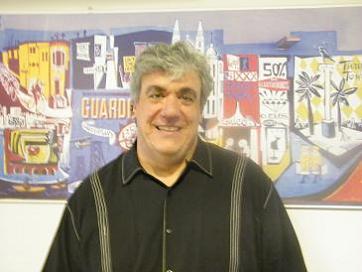
Endorsement interview: Tony Kelly

7

Tony Kelly’s been involved in land-use and development battles in the district for more than a decade — and it shows. He talks about zoning, redevelopment, and urban finance with the ease of an expert. He complains that funding affordable housing just by asking developers to include a little bit in their market-rate units is “a sucker’s game.” He talks about the need for public-sector investment to handle the major influx of population projected for the district over the next 20 years. He’s also thought a lot about city finance, and suggests, among other things, that San Francisco demand that the University of California pay some sort of fee in lieu of the $60 million the giant institution doesn’t pay in local property taxes.


Kelly also talks about environmental justice in the district, and is willing to go as far as suggesting that the city look at ending I-280 at either Cesar Chavez or Alemany as part of a program to expand rail service along the corridor. You can listen to our interview here:


kelly by endorsements2010

Lynette Sweet and the IRS: The strange story

3

Lots of people have trouble with the IRS. Almost everyone I know has run afoul of the tax man at some point in time, and the fact that BART Board member and District 10 candidate Lynette Sweet at one point owed the feds $14,500 isn’t exactly a major crime.


But there’s a part of her story, at least at Matier and Ross present it, that strikes me as odd:


Sweet says she thought the tax lien was cleared up years ago.


She said she cut a deal with the IRS in 2007 to pay $14,500 in back taxes plus interest, in return for additional fines being dropped.


Sweet said she sent the feds a cashier’s check and pretty much forgot about it.


The thing is, the IRS never cashed the cashier’s check – which, it turns out, was made out to Sweet herself, according to a copy of a 2007 check she provided to us.


IRS spokesman Jesse Weller declined to discuss details of the case, but said: “The IRS does not accept checks – personal or cashier – or money orders made out to individuals. We ask that the payment be made out to the United States Treasury.”


Sweet “sent a cashier’s check and pretty much forgot about it” — although the check was never cashed? And she didn’t notice? Here’s where it gets strange.


Sweet told me that she bought the cashier’s check from Wells Fargo, mistakenly made it out to herself and mailed it off to the IRS in 2007. At that point, the money had already come out of her account, so she assumed the debt was paid. But the IRS never cashed the check, since it wasn’t made out to the United States Treasury and, of course, the agency couldn’t cash a check made out to someone else.


And Wells, she said, never told her that the check hadn’t been cashed. (That makes sense, in an odd way; I just talked to a banker who couldn’t comment for the record but who comfirmed that cashier’s checks are like cash; once the bank issues one it doesn’t have any responsibility to call the buyer if the check is never cashed.)


“That’s why I don’t recommend the use of cashier’s checks for tax payments,” the banker said. “You want your own hard copy of your payment when it’s cashed.”


So how come the IRS didn’t contact Sweet for three years to tell her the check she sent was invalid? That’s not like the IRS I know. Sweet’s response: She was using a tax firm to help her with the account, and the notices must have gone there, and those people must never have told her.


And she never knew that she had an IRS lien on her house that had grown to $20,000.


Could be. But what a bizarre story. 


(By the way, I also invited Sweet to come down to the Guardian for an endorsement interview, and she had her campaign manager call to say she’d declined to talk to us. That’s pretty unusual behavior, esp. for an elected official. Even Gavin Newsom came to talk to us when he was running for re-election for mayor and we’d been blasting him for four years. Pretty weak.)


Editor’s Notes

1

Tredmond@sfbg.com

The rich are getting screwed in the United States today. And that’s not a statement from Sarah Palin, Glenn Beck, or the remnants of George W. Bush’s brain. It’s coming from mainstream, even liberal economists, who have looked at the hard numbers around the battle over the expiration of the Bush tax cuts.

See, if you consider anyone who makes more than $250,000 a year "rich," then they’re due to lose the income-tax break they got under Bush. And they can afford to pay higher taxes, and most of them are doing fine, despite the complaints about the cost of private schools these days.

But they’re still getting screwed. Because, as James Surowiecki noted in the Aug. 16 issue of The New Yorker, ordinary, garden-variety rich people haven’t seen a lot of income growth in the past decade. They aren’t gaining much more than the middle class. The money in this country isn’t going to the rich any more. It’s not even going to the very rich, say, the people who make more than $500,000 a year, or even $1 million a year.

No, the extraordinary income growth in this country has been going to the very, very rich, the top 1 percent of the top 1 percent —the 5,600 families who now have more wealth than the bottom 120 million. And, as Surowiecki points out, those very, very, exceedingly filthy rich pay the same tax rates as the people who earn $250,000 a year.

The New York Times ran an interesting report Aug. 29 on the looming problems of crumbling old infrastructure in the United States — dams that are well beyond their designed life, levees that are crumbling, subway switching stations designed and built in the 1920s. Millions of people can’t find jobs and the government can’t afford to pay for the work that desperately needs to be done. The economic policies of the past decade have sucked all the money out of society — and given it to a tiny number of people who live like ancient feudal royalty.

That’s what we’ve achieved in this country of late. I don’t know why this isn’t the biggest — or the only — issue in the fall campaigns.

It’s not about taxes

3

I heard an executive from Coda Automotive, which makes electric cars, talking on NPR this morning about why the company is going to locate its manufacturing plant in Southern California. He talked about the quality of the workforce, about the demographics of the state, about the fact that Californians understand environmental issues … all sorts of reasons to build a plant here. And he never once mentioned taxes.


That’s not surprising — for all the whining the California Chamber of Commerce does, corporate taxes aren’t a major factor when businesses look at setting up shop in this state. We’d do a lot better to raise taxes to the level where we could afford to educate the next generation of workers. That’s far more important in building a strong economy.

Hands off social security!

2

Dick Meister, former labor editor of the SF Chronicle and KQED-TV Newsroom, has covered labor and politics for a half-century. Contact him through his website, www.dickmeister.com, which includes more than 250 of his recent columns.

Republican leaders in Congress would have us believe that most Americans support cutting Social Security and Medicare payments as a way to cut the federal budget deficit. But don’t you believe it.

As the AFL-CIO and other labor sources have discovered, that’s at best a figment of the Republican imagination. Or, as is most likely, it’s a bald-faced political lie.

The proof came in a poll marking the 75th anniversary of Social Security this year. It was conducted by a prominent research organization, Greenberg Quilan Rosner, and commissioned by the nation’s leading public employee unions, the Service Employees International and American Federation of State, County and Municipal Employees, joined by MoveOn.org and the Campaign for America’s Future.

The poll was in response to Republican House leader John Boehner’s call for reducing the federal budget deficit by raising the Social Security retirement age to 70, while continuing President Bush’s massive tax breaks for multi-billion-dollar corporations and wealthy individuals.

Boehner, that is, wants to lower the Republicans’ rich friends’ taxes at the expense of Americans who must rely on Social Security payments, averaging less than $14,000 a year, to meet their basic living expenses.

It would make much more sense, of course, to reduce the deficit by increasing taxes on the wealthy at least to the level they were before Bush’s tax cuts, rather than do it by raising the retirement age and making other financial cutbacks that hurt low and middle income Americans.

So, what did the poll show?

Most Democrats and independents responding wanted to end the Bush tax cuts that, if not repealed, will increase the deficit by an estimated $3.1 trillion over the next decade and reduce government revenue by more than $650 billion. That obviously would greatly curtail Social Security and other government programs for poor and middle class Americans.

It shouldn’t surprise anyone that most of the Republicans polled did not want to repeal the tax cuts and thus help government provide more services to those who need them, often badly need them.

Nevertheless, nearly 70 percent of the probable voters polled, whatever their political party, opposed cutting Social Security and Medicare to reduce the deficit.
What’s more, two-thirds of the Republicans also opposed raising the retirement age, despite their general dislike of the Social Security system. Raising the retirement age from 67 to 70 obviously would greatly curtail Social Security and other government programs designed to help poor and middle class Americans. But that apparently didn’t disturb many of the Republicans polled. Most of them did not want to repeal the tax cuts under any circumstance.

The AFL-CIO concluded – and quite accurately, I think – that “those conservative politicians who want to use concern about deficits as an opening to go after Social Security or Medicare risk a backlash” from voters.

The poll made clear that relatively few people are buying the Republican claims that Social Security and Medicare outlays are a major cause of the continuing federal budget deficit. Too many people have too much sense to believe that.

But what did sensible voters see as the main causes of the deficit?

Nearly half of those polled blamed the costs of the wars in Iraq and Afghanistan.
About a third blamed the bailouts of big banks and the auto industry.

Nearly a third blamed lobbyists and special interests for getting unnecessary spending put into the budget.

Almost as many placed the major blame on President Obama’s economic recovery or stimulus plan.

About one-fourth blamed the Bush tax cuts.  A relative few blamed the economic recession that reduced tax revenue and required costly government support for the unemployed. A relatively few others blamed the deficit on the cost of Medicare prescription drug benefits.

What it boils down to is this, as the AFL-CIO’s James Parks said in a bit of public advice to GOP Congressman Boehner:  “The public doesn’t like your plan to cut their Social Security so your rich friends can get another tax break.”

Anyone doubting the popularity and importance of Social Security need only consider a recent AARP survey that showed  “exceedingly high” support for the program.

” Clearly,” said AARP researcher Colette Thayer, ” most Americans rely on Social Security and expect it to be a source of income in their retirement. In fact, it is the most commonly cited source of retirement income.”

    Whatever their ages, whether over 30 or under, the poll – just as others like taken on the program’s anniversary dates five, 15 and 25 years ago – shows that Social Security is one of the government’s most important programs in that it provides essential retirement income to millions of Americans who would otherwise have little or no income.

The Campaign for America’s Future and MoveOn.org, will be jointly campaigning for candidates in the coming midterm elections who’ll pledge to block cuts in Social Security and Medicare and otherwise back the organizations’ liberal agendas. The unions that helped them sponsor the poll will also be waging major campaigns, as will other AFL-CIO affiliates.

They’re backing the kind of political candidates we should all back – and as strongly as we can. Our social security depends on it.

Dick Meister, former labor editor of the SF Chronicle and KQED-TV Newsroom, has covered labor and politics for a half-century. Contact him through his website, www.dickmeister.com, which includes more than 250 of his recent columns.

The Chamber of Commerce is clueless

7

Check out the Chamber of Commerce and its vice president for public policy, Jim Lazarus, commenting on the state of the city’s finances in the Chron:


The Chamber opposes forcing the mayor to appear at “question time,” — “pure political theater,” — and an increase in property transfer tax — “Why do we need it? The budget is balanced.”


Yes, Jim — the budget is balanced. That’s a legal requirement. And it’s balanced by cutting all sorts of essential services. You like what’ s happening to Muni, and to public health? You like having mentally ill homeless people on the streets because there’s nowhere for them to get treatment?


But don’t worry — the budget is balanced.


Editor’s Notes

1

tredmond@sfbg.com

Every once in a while, The New York Times Magazine drops a profound and staggeringly important bit of information into a slot that typically reserved for softer articles. So I read at least the first few paragraphs of everything — and on Aug. 22 the opening essay by Judith Warner made a point that ought to be the center of the national debate on the Bush tax cuts, the value of philanthropy, and the direction of economic policy in a lingering recession.

Warner was struck, as I was (see Editor’s Notes, Aug. 18) by the massive praise heaped on Bill Gates and Warren Buffet for their vows to donate half their wealth to charity. "After all," she noted, "what better illustration could there be of the great social good that wealthy people can do when the government lets them keep their hard-earned dollars to spend as they please?"

Yet it turns out that Gates and Buffet are very much the exception. It’s odd and counterintuitive, but the truth is that most rich people give less of their money to charity than most poor people. Upper-class people, studies show, are much less compassionate toward others and more likely to be selfish with their money.

"This compassion deficit," she wrote, "is perhaps not so surprising in a society that for decades has seen the experiential gap between the well-off and the poor (or even the middle class) significantly widen."

In other words: we already know that cutting taxes on the rich hurts the economy, makes the deficit worse, and does little or nothing to improve the lot of others. Trickle-down economics has been widely proven a fraud.

But the new evidence shows that letting the very wealthy decide how the wealth of society should be divided doesn’t work well either. For one thing, very little of the charity coming from the rich goes to the poor; those tax write-off donations tend to wind up helping big cultural institutions or successful universities — and those gifts, Warner notes, "come with the not-inconsequential payoff of enhancing the donor’s status among his or her peers."

More important, it’s a public policy failure. You can’t trust the rich to make the right decisions about where the nation’s resources should go; that’s why we have elections, open government hearings, political debates. And that’s why that big, bad word "taxation" — taking the money from the rich and giving it out the way the representatives of the rest of us decide is best — is actually a far more efficient and fair way to go.

Brilliant essay on the state of California

6

Vast treatises have been written about the California mess and how we got where we are today. But a professor at UC Berkeley’s school of public policy sums the whole thing up in one brilliant, short letter to his students. You can read the whole thing here (thanks, Calitics), but the gist is that today’s generation of California kids is the collective victim of a massive swindle:


Swindle–what happened? Well, before you were born, Californians now dead or in nursing homes made a remarkable deal with the future.  (Not from California? Keep reading, lots of this applies to you, with variations.) They agreed to invest money they could have spent on bigger houses, vacations, clothes, and cars into the world’s greatest educational system, and into building and operating water systems, roads, parks, and other public facilities, an infrastructure that was the envy of the world. They didn’t get everything right: too much highway and not enough public transportation. But they did a pretty good job.


Young people who enjoyed these ‘loans’ grew up smarter, healthier, and richer than they otherwise would have, and understood that they were supposed to “pay it forward” to future generations, for example by keeping the educational system staffed with lots of dedicated, well-trained teachers, in good buildings and in small classes, with college counselors and up-to-date books.  California schools had physical education, art for everyone, music and theater, buildings that looked as though people cared about them, modern languages and ancient languages, advanced science courses with labs where the equipment worked, and more. They were the envy of the world, and they paid off better than Microsoft stock. Same with our parks, coastal zone protection, and social services.


This deal held until about thirty years ago, when for a variety of reasons, California voters realized that while they had done very well from the existing contract, they could do even better by walking away from their obligations and spending what they had inherited on themselves.  “My kids are finished with school; why should I pay taxes for someone else’s?  Posterity never did anything for me!”  An army of fake ‘leaders’ sprang up to pull the moral and fiscal wool over their eyes, and again and again, your parents and their parents lashed out at government (as though there were something else that could replace it) with tax limits, term limits, safe districts, throw-away-the-key imprisonment no matter the cost, smoke-and-mirrors budgeting, and a rule never to use the words taxes and services in the same paragraph.


That about sums it up, and I hate to say it, but my generation — the baby boomers who were supposed to change the world in such a wonderful way — is guilty of just the opposite. If the WWII folks were the Greatest Generation, then the boomers are the Selfish Generation.

High time

34

steve@sfbg.com

DRUGS With polls showing that California voters are probably poised to approve Proposition 19 in November and finally fully legalize marijuana, this should be a historic moment for jubilant celebration among those who have long argued for an end to the government’s costly war on the state’s biggest cash crop. But instead, many longtime cannabis advocates — particularly those in the medical marijuana business — are voicing only cautious optimism mixed with fear of an uncertain future.

Part of the problem is that things have been going really well for the medical marijuana movement in the Bay Area, particularly since President Barack Obama took office and had the Justice Department stop raiding growing operations in states that legalized cannabis for medical uses, as California did through Proposition 215 in 1996.

In San Francisco, for example, more than two dozen clubs form a well-run, regulated, taxed, and legitimate sector of the business community that has been thriving even through the recession (see “Marijuana goes mainstream,” Jan. 27). The latest addition to that community, San Francisco Patient and Resource Center (SPARC), opened for business on Mission Street on Aug. 13, an architecturally beautiful center that sets a new standard for quality control and customer service.

“This is the culmination of a 10-year dream. We’re going to have a real community center for patients with a great variety of services,” longtime cannabis advocate Michael Aldrich, who cofounded SPARC along with Erich Pearson, told us at the club, which includes certified laboratory testing of all its cannabis and free services through Quan Yin Healing Arts Center and other providers.

Yet cash-strapped government agencies have been hastily seeking more taxes and permitting fees from the booming industry, particularly since the ballot qualification of Prop. 19, an initiative that was written and initially financed by Oaksterdam University founder Richard Lee that would let counties legalize and regulate even recreational uses of marijuana.

Oakland, Berkeley, Richmond, and other California cities have placed measures on the November ballot to tax marijuana sales, and the Oakland City Council last month approved a controversial plan to permit large-scale cannabis-growing operations on industrial land (see “Growing pains,” July 20).

In an increasingly competitive industry, many small growers fear they’ll be put out of business and patient rights will suffer once Prop. 19 passes and counties are free to set varying regulatory and tax systems, concerns that have been aired publicly by advocates ranging from Prop. 15 author Dennis Peron to Kevin Reed, founder of the Green Cross medical marijuana delivery service.

“It’s tearing the medical marijuana movement apart,” Reed told the Guardian. “It’s a little scary that we’re going to go down an uncertain road that may well scare the hell out of mainstream America.” Indeed, U.S. Attorney General Eric Holder — who ended the raids on medical marijuana growers — has said the feds may reengage with California if voters legalize recreational weed.

Yet Lee said people shouldn’t get distracted from the measure’s core goal: “The most important thing is to stop the insanity of prohibition.” He expects the same jurisdictions that set up workable systems to deal with medical marijuana to also take the lead in setting rules for other uses of marijuana.

“It will be just like medical marijuana was after [Prop.] 215, when a few cities were doing it, like San Francisco, Oakland, and Berkeley,” Lee told us. “And for cities just coming to grips with medical marijuana, it will be clean-up language that clarifies how they can regulate and tax it.”

Indeed, the tax revenue — estimated to be around $2 billion for the state annually, according to the California Legislative Analyst’s Office — has been the main selling point for the Yes on 19 campaign (whose website is www.taxcannabis.org) and Assembly Member Tom Ammiano, who authored bills to legalize marijuana and has current legislation to set up a state regulatory framework if Prop. 19 passes.

“It makes it more seductive,” Ammiano said of revenue potential from legalized marijuana. “I’ve been working with Betty Yee [who chairs the California Board of Equalization, the state’s main taxing authority] on a template and structure for taxing it.”

Reed and others say they fear taxes at the state and local levels will drive up the price of marijuana, as governments have done with tobacco and alcohol, and hinder access by low-income patients. But Ammiano scoffed at that concern: “Even with the tax structure on booze, there was no diminishing of access to booze.”

Pearson said he believes Prop. 19 will actually help the medical marijuana industry. “Anything that takes the next step toward legalizing recreational use only helps medical cannabis,” he said. Pearson moved to California to grow medical marijuana more than 10 years ago, at a time when the federal government was aggressively trying to crush the nascent industry.

“When you’re packing up and running from the DEA all the time, you’re not thinking about the quality of the medicine. You’re trying to stay out of jail,” Pearson said. “Now, we can be transparent, which is huge.”

Like most dispensaries, SPARC is run as a nonprofit cooperative where most of the growing is done by member-patients. Speaking from his office, with its clear glass walls in SPARC’s back room, Pearson said the Obama election ushered in a new openness in the industry.

“Everything is on the books now, whereas before nothing was on the books because it would be evidence if we got busted … We are allowed to have banks accounts; we’re allowed to use accountants; I can write checks; we can talk to government officials,” Pearson said. “It helps with the public and governments, where they see the transparency, to normalize things.”

He also said Prop. 19 will only further that normalizing of the industry, which ultimately helps patients and growers of medical marijuana. SPARC, for example, gives free marijuana to 40 low-income patients and offers cheap specials for others (opening day, it was an eighth of Big Buddha Cheese for $28) because others are willing to pay $55 for a stinky eighth of OG Kush.

“Our objective here is to bring the cost of cannabis down. We can subsidize the medicine for people who can’t afford it with sales to people who can,” Pearson said, noting that dynamic will get extended further if the legal marketplace is expanded by Prop. 19.

While Pearson strongly supports the measure, he does have some minor concerns about it. “The biggest concern is if local governments muddy the line between medical and nonmedical,” Pearson said, noting that he plans to remain exclusively in medical marijuana and develop better strains, including those with greater CBD content, which doesn’t get users high but helps with neuromuscular diseases and other disorders.

Reed also said he’s concerned that patients who now grow their own and sell their excess to the clubs to support themselves will be hurt if big commercial interests enter the industry. Yet for all his concerns, Reed said he plans to reluctantly vote for Prop. 19 (which he doesn’t believe will pass).

“They’ll get my vote because not having enough yes votes will send the wrong message to law enforcement and politicians [that Californians don’t support legalizing marijuana],” Reed said, noting that would rather see marijuana uniformly legalized nationwide, or at least statewide.

Attorney David Owen, who works with SPARC, said the momentum is now there for the federal government to revisit its approach to marijuana. But in the meantime, he said Prop. 19 has come along at a good time, given the need for more revenue and more legal clarity following the federal stand-down.

And even if the measure isn’t perfect, he said those who have devoted their lives to legalizing marijuana will still vote for it: “A lot of these folks, intellectually and emotionally, will have a hard time voting against Prop. 19.”

Behind Whitman’s attack on nurses

0

OPINION Meg Whitman’s increasingly high-profile war with California’s nurses poses important questions about a potential Whitman term as governor and the implications for California.

California’s nurses began pressing Whitman during the primary, when she was spending up to $21,000 an hour — more than many California families earn in a year — in a frenzy well on its way to smashing all previous campaign finance records.

Whitman’s pledge to spend up to $180 million out of her billionaire pocket by November to drown out all competition was accompanied by other disturbing trends. She refused to engage regular Californians in public events and avoided the public’s watchdog, the press. And she demonstrated a haughty temperament symbolized by her now-famous altercation with a subordinate employee to whom she paid a $200,000 settlement.

In short, Whitman was acting as if she was entitled to be crowned governor because of her wealth and privilege, a hubris also indicated by her failure to vote for much of her adult life but assumption that her billions and social rank alone qualify her to be governor.

Thus, the parody of Queen Meg was born, in which the California Nurses Association trailed Whitman to campaign events with a mock Queen Meg; her court, including chaperones Mr. Goldman and Mr. Sachs (in honor of her checkered career on the Goldman Sachs board); and nurses waving “Rich Enough to Rule” signs.

Whitman, who appears not to handle stress well, reacted with a full-scale assault on CNA and nurses. She demanded the home addresses of CNA members but refused CNA’s offer to meet with nurses in unscripted forums instead.

It turned out she just wanted to bully nurses, not actually talk to them. So Whitman began to bombard registered nurses in the state with multiple attack mailings and phone calls from a purchased outside list (is there anything she can’t or won’t buy?), and created a union-busting “nurse” website. What next, an enemies list?

In addition to reservations about Whitman’s temperament, attitude toward her opponents, and her royal pretensions, nurses have significant concerns about her policies as well, including her plans to:

Slash 40,000 state jobs, creating hardship for thousands of additional California families in the midst of our ongoing recession, just as she sent 40 percent of company jobs overseas as the chief executive of eBay.

Freeze regulations opposed by her CEO friends, presumably including many that will impair workplace safety rules, clean air and water requirements, and protections against food toxins.

Suspend California’s new law to reduce greenhouse gases and the impact of climate change.

Expand tax breaks for corporations and multimillionaires while pushing even deeper cuts in critical safety-net programs that will punish the most vulnerable Californians.

Make new budget cuts that will likely reduce education funding by some $7 billion.

Roll back public pensions, even for those who have sacrificed pay or other benefits for a more secure retirement.

End workplace standards such as guaranteed meal and rest breaks and overtime pay.

All these programs have a common theme: they’re the wish list of the corporate CEOs who for the past seven years have taken residency in the governor’s office under Arnold Schwarzenegger. And they want more.

With Whitman, they would get it. Her pledges to “streamline” regulations, slash corporate taxes, and curtail workplace economic and safety standards, reflect the corporate agenda Whitman embodies and an escalation of the policies that have plagued our state under Schwarzenegger.

The troubling combination of Whitman’s sense of entitlement, intolerance of critics, and corporate to-do list are an ominous mix for California. She may be rich enough to rule, but her character and values say we should all be wary. *

Zenei Cortez is a registered nurse and co-president of the California Nurses Association.


Editor’s Notes

4

tredmond@sfbg.com

I suppose I should be thrilled that 40 of the richest people in the United States have agreed to give away half their money before they die. Actually, it kind of makes me sick.

The concept is called the Giving Pledge, and Bill Gates and Warren Buffet started it. The two have been on the phones this summer, dialing up other really, really rich people and asking them to sign on. I’ve got nothing against Gates and Buffet (well, Gates has always been into world domination, so that’s a problem, but Buffet seems a decent sort for a billionaire). In fact, Buffet has promised to give away 99 percent of his $47 billion, which would leave him and his heirs with just a paltry $470 million.

Even that much money fits into New York Mayor (and billionaire) Michael Bloomberg’s entirely accurate statement: “The reality of great wealth is that you can’t spend it and you can’t take it with you.”

That’s the thing: You can’t spend that much money, and you can’t take it with you, and the United States used to be the kind of country that disdained inherited monarchy. Bloomberg says he wants his kids to have to work for a living, which is nice, although even after he gives away half his wealth, none of them are likely to miss any meals or have trouble paying the rent. His children, and their children, and their children, will all be able to afford to go to good schools and colleges, even if the public education system in America completely collapses for lack of adequate funding.

The irony is that, for the most part, these exceptionally rich people who feel so good about giving their money to charities of their choosing (which then honor them with awards and testimonials and dinners) oppose the notion of raising taxes on high incomes.

The problem with charity is that it won’t ever really reduce the gap between the rich and the poor in this country. The only way you do that is with aggressive, effective government action: by taxing the great wealth when it comes in (as income) and when it goes out (as estates) — and then, through a democratic process involving elected representatives, deciding where the money should go.

The Bill and Melinda Gates Foundation is wonderful, I guess, but it won’t provide mental health care for homeless people in San Francisco. That’s a government job. It also won’t ensure that every kid in America gets quality preschool, good teachers, schools that aren’t falling apart, and access to a college education. That’s what we pay taxes for.

But wait a minute. There’s never enough money for these things, because we keep cutting taxes on the rich. Instead, these guys can give money to their own pet projects — and pay no taxes at all. It’s charity! It’s a tax write-off!

I wanna throw up.

Two steaming non-scandals

24

The political press is all over two of the big non-scandals of the day, Jerry Brown’s pension and Jeff Adachi’s budget. Let’s start with ol’ Jer’.


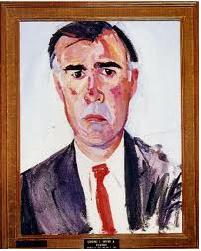
You can say a lot of things about Jerry Brown, and I’ve said a lot of them myself, but the guy has never tried to enrich himself off the public dollar. Fact is, Jerry’s about as cheap as you can get, and hates to spend money — his money, campaign money, public money. In some ways, he’s responsible for Prop. 13, because he was such a cheapskate as governor in the 1970s that he ran up a huge billion-dollar-plus surplus in Sacramento at a time when property taxes were soaring.


But Matt Drudge, playing off public anger at state employee pensions, decided that Brown was “double dipping,” citing and OC Register report, and suddenly, the former gov’s secret pension was big news. But wait, the Chron actually figured it out: Brown isn’t drawing any pension at all right now. If he were to retire after about 25 years of service as secretary of state, governor, mayor of Oakland, attorney general and a Supreme Court clerk, he’d be eligible for a pension of $78,450 — considerably less than your average San Francisco cop or firefighter. Knowing Jerry, he’ll probably decline it anyway.


In other words: No story.


Then there’s Jeff Adachi’s budget. I know, it looks bad for a guy who’s trying to cut worker pensions and health care to be seeing budget increases and still leave the city with a $2 million legal tab for work he refused to handle. But really, this is old news — Adachi’s been warning for a couple of years that he was going to have to decline cases (and thus stick the city with a private legal bill). And let’s remember: The staff in the Public Defender’s Office handles almost twice as many cases as they ought to.


Adachi’s ballot initiative annoys me — he’s going after city employee benefits instead of looking at where the city can raise new revenue. And he’s acting like a lone wolf, demanding that his office is properly staffed and launching an initiative that attacks public employee unions instead of trying to work with them.


But I don’t blame him for being agressive in pushing for adequate funding for his shop — I wish the director of public health was willing to try as hard to avoid cutbacks instead of going along with whatever the mayor proposes. And his current budget is nowhere near as scandalous as what happens every single year with police and fire.


How to save Muni

22


Editors note: In this week’s paper, we offered a series of proposals for discussion at the community congress Aug. 14th and 15th. Here’s one that we couldn’t fit:

By Jerry Cauthen

San Francisco is a transit-first city, yet its bus system is perennially in crisis. Everyone knows Muni needs fixing—but how do we do it in a way that honors the needs of both drivers and riders, while deepening San Francisco’s commitment to sustainability and transit innovation? How do we maintain and improve service when Muni and the San Francisco Municipal Transportation Agency face deep budget deficits and service cuts on a regular basis?

Here are a few priorities that Muni advocates have identified:

1. The discussion around MUNI must include everyone–motorists, Muni drivers and riders, neighborhood groups, business people, labor groups, low-income people, communities of color, seniors, youth and the disabled. 

2. Muni drivers should be encouraged and empowered to take an active part in the discussion.  In order to creatively address Muni’s operating problems, we must tap into the knowledge and experience of those on the front lines driving our buses.

Accountability, reasonable work rules and good performance are essential. While changes to the current work rules and practices deserve consideration, it must be recognized that Muni drivers have difficult jobs and important responsibilities that warrant good pay and proper respect—from both Muni riders and SFMTA Management.

3. An outside financial audit of the SFMTA should commence immediately.  The audit should include an analysis of how overtime is assigned, how other departments assess Muni for services, and how developer transit assessment fees and other revenues for Muni are assessed and collected. 

4. There’s been no management audit of the SFMTA since 1996.  Such an audit is long overdue, and should be performed as soon as possible.
Some other recommendations discussed at a Muni summit this spring:

A) Improving the flow of Muni Vehicles.  In September 2009, SFMTA Executive Director Nathaniel Ford supported the idea of conducting test programs to improve the flow of transit vehicles on congested streets such as Stockton Street and Columbus Avenue.  To date, there has been no follow through on this promise.  Action on this should proceed at once.

B) Priority for Light Rail Vehicles.  We must take steps to prevent trucks, automobiles, bicycles and pedestrians from slowing down light rail vehicles.  This would include pre-empted signals, signals in place of stop lights and traffic barriers, and eliminating the queues of automobiles that block the flow of light rail vehicles.  Similar steps would help facilitate the flow of buses: eliminating parking lanes on certain streets, limiting deliveries to off-peak hours and creating special parking zones for trucks.

C) Improved Customer Service. Buses will run faster and more smoothly with greater emphasis on getting riders to the back of the bus.  This would involve stationing rear door loaders to sell and collect tickets during peak commute periods. Conveniently located ticket vending machines would help speed up the loading process and allow passengers to pay fares with either credit cards or cash.
Funding and Costs

We all know that Muni must be adequately funded and efficiently run – but how?

To boost Muni use and revenues, the city can:

Work with large and small employers, apartment owners, residential developers and Municipal permitting authorities to provide incentives for people to use Muni Fast Passes and/or TransLink. 
Create a moderately priced all-day pass, and a higher cost day pass also valid on ferries and commuter bus services. Along major commercial corridors, businesses and employers who benefit from Muni should help subsidize the system — for instance, through progressive impact taxes.

Increase parking meter fees/hours/days and garage taxing rates as appropriate.  Eliminate parking exemptions, discounted all-day parking (except for neighborhood protected parking) and all other special parking privileges.

These are just some of our ideas.  We invite you to attend the Community Congress to continue this important dialogue and draft your own recommendations on transit issues. 

The Crisis Down Under

3

Joseph E. Stiglitz is University Professor at Columbia University and a Nobel laureate in Economics.

CANBERRA – The Great Recession of 2008 reached the farthest corners of the earth. Here in Australia, they refer to it as the GFC – the global financial crisis.

Kevin Rudd, who was prime minister when the crisis struck, put in place one of the best-designed Keynesian stimulus packages of any country in the world. He realized that it was important to act early, with money that would be spent quickly, but that there was a risk that the crisis would not be over soon. So the first part of the stimulus was cash grants, followed by investments, which would take longer to put into place.

Rudd’s stimulus worked: Australia had the shortest and shallowest of recessions of the advanced industrial countries. But, ironically, attention has focused on the fact that some of the investment money was not spent as well as it might have been, and on the fiscal deficit that the downturn and the government’s response created.

Of course, we should strive to ensure that money is spent as productively as possible, but humans, and human institutions, are fallible, and there are costs to ensuring that money is well spent. To put it in economics jargon, efficiency requires equating the marginal cost associated with allocation (both in acquiring information about the relative benefits of different projects and in monitoring investments) with the marginal benefits. In a nutshell: it is wasteful to spend too much money preventing waste. 

While the focus for the moment is on public-sector waste, that waste pales in comparison to the waste of resources resulting from a malfunctioning private financial sector, which in America already amounts to trillions of dollars. Likewise, the waste from not fully utilizing society’s resources – the inevitable consequence of not having had such a quick and strong stimulus – exceeds that of the public sector by an order of magnitude.

For an American, there is a certain amusement in Australian worries about the deficit and debt: their deficit as a percentage of GDP is less than half that of the US; their gross national debt is less than a third.

Deficit fetishism never makes sense – the national debt is only one side of a country’s balance sheet. Cutting back on high-return investments (like education, infrastructure, and technology) just to reduce the deficit is truly foolish, but especially so in the case of a country like Australia, whose debt is so low. Indeed, if one is concerned with a country’s long-run debt, as one should be, such deficit fetishism is particularly silly, since the higher growth resulting from these public investments will generate more tax revenues.

There is another irony: some of the same Australians who have criticized the deficits have also criticized proposals to increase taxes on mines. Australia is lucky to have a rich endowment of natural resources, including iron ore. These resources are part of the country’s patrimony. They belong to all the people. Yet in all countries, mining companies try to get these resources for free – or for as little as possible.

Of course, mining companies need to get a fair return on their investments. But the iron-ore companies have gotten a windfall gain as iron-ore prices have soared (nearly doubling since 2007). The increased profits are not a result of their mining prowess, but of China’s huge demand for steel.

There is no reason that mining companies should reap this reward for themselves. They should share the bonanza of higher prices with Australia’s citizens, and an appropriately designed mining tax is one way of ensuring that outcome.

This money should be set aside in a special fund, to be used for investment. The country will inevitably become poorer as it depletes its natural resources, unless the value of its human and physical capital increases.

Another issue playing out down under is global warming. If not a climate-change denier, the previous Australian government led by John Howard joined President George W. Bush in being a climate-change free rider: others would have to take responsibility for ensuring the planet’s survival.

This was especially strange, given that Australia has been one of the big beneficiaries of the Montreal convention, which banned ozone-destroying gases. Holes in the ozone layer exposed Australians to cancer-causing radiation. The international community banded together, banned the substances, and the holes are now closing. Nevertheless, the Howard government, like the Bush administration, was willing to expose the entire planet to the risks of global warming, which threaten the very existence of many island states.

Rudd campaigned on a promise to reverse that stance, but the failure of the climate-change talks in Copenhagen last December, when President Barack Obama refused to make the kind of commitment on behalf of the United States that was required, left Rudd’s government in an awkward position. The failure of US leadership has global consequences.

Citizens should consider the legacy they leave to their children, part of which is the financial debts they will pass down. But another part of our legacy is environmental. It is two-faced to claim to care about the future and then fail to ensure that the country is adequately compensated for the depletion of its resources, or ignore the degradation of the environment. It is even worse to leave our children without adequate infrastructure and the other public investments needed to be competitive in the twenty-first century.

Every country faces these issues. Sometimes, one can see them with greater clarity by observing how others are confronting them. How Australians vote in their coming election may be a harbinger of things to come. Let’s hope – for their sake and for the world’s – that they see through the rhetorical flourishes and personal foibles to the larger issues at stake.

Joseph E. Stiglitz is University Professor at Columbia University and a Nobel laureate in Economics. His latest book, Freefall: Free Markets and the Sinking of the Global Economy, is now available in French, German, Japanese, and Spanish.

Copyright: Project Syndicate, 2010.
www.project-syndicate.org

Adachi’s pension reform and the D. 10 candidates

37

As pretty much everyone knows by now, Jeff Adachi collected enough signatures to place a charter amendment on the November ballot that would reform the city’s retirement and health benefits plan. His amendment has become such a hot political topic that the Potrero Hill Democractic Club asked the 15 candidates who spoke at the club’s  August 2 and 3 District 10 forums what they thought of Adachi’s “smart reform.”

By my understanding of what the candidates said, four seemed unsure what the Adachi amendment would do, or were open to the idea, while the other eleven were opposed. But read for yourself what the D. 10 candidates said and decide where they stand on this issue:

Kristine Enea: “Certainly something needs to be done. I did sign [Adachi’s] petition. Adjusting for new employees has an inherent fairness. The path we are on is not sustainable.”

Nyese Joshua: (After admitting that she didn’t know much about Adachi’s amendment), “In terms of bringing it to the ballot, I agree.”

Lynette Sweet: “What Jeff Adachi did was not a bad thing, but the way he went about it was.”

Stephen Weber: “I don’t believe it was done right way, but I like the idea. The labor leaders are willing to sit down and discuss the pension plan. They just want to discuss it with the Board that is sitting there now.”

Eric Smith. “I love Jeff Adachi. And initially it looked great. But Beyond Chron [for which Smith sometimes writes] has an interesting story: When I read it, it says the measure goes after people’s health benefits. That’s troubling. I can’t really get behind this. We need to do reform from the bottom up, not from the top down.”

Malia Cohen: “Adachi’s a great public defender, but he’s taken an approach that’s disrespectful of public policy. Instead, he’s created a policy. I’m not in favor of it, if it unfairly taxes those at the bottom.”

Steve Moss: “The labor unions are rightfully furious. Pensions need reform. Things are out of whack. But this could lead to folks losing healthcare because they have to pay more to cover their dependants.”

Geoffrea Morris: “He had a point. The unions are very powerful in the city, he didn’t want to go through the red tape. Something needs to be done to reform healthcare and pensions.”

Isaac Bowers: “I thoroughly reviewed the San Francisco civil grand jury’s ‘Pension Tsunami’ report. I don’t think his initiative is the right way to go. I fear copayments for healthcare will throw people back on the city.”

Tony Kelly: “Great guy, stupid idea.”

Espanola Jackson: “You should talk to Adachi. Don’t shoot him down.”

Chris Jackson: “The measure is popular, it’s polling in the 60 percent range. But Adachi never talked to the nurses and the workers who make $35,000. And then there is the fact that this in an attack on healthcare. So a large percentage of the ‘savings’ is what workers will have to contribute. It’s a move away from supporting working class individuals.”

DeWitt Lacy: “We need pension reform. But no one likes change rammed down their throats without any negotation with, or input from, the workers. It addresses an important issue, but it’s too divisive.”

Diane Wesley Smith: “It’s ridiculous. Some reform has to happen, but this isn’t it.”

Marlene Tran: “Jeff Adachi took a lot of risks in this pro-labor town. He claims a $170 million savings. I would support it, because everyone should pay into the pension fund.”

The politics of unity and division

7

steve@sfbg.com

These are strange days for the San Francisco Democratic Party, which is seeking to overcome bitter divisions on the local level and come together around candidates for statewide office that include Mayor Gavin Newsom, whose fiscal conservatism and petulant political style are the main sources of that local division.

The tension has played out recently around the Board of Supervisors deliberations on the new city budget and November ballot measures and in dramas surrounding the newly elected Democratic County Central Committee, where the battles during its July 28 inaugural meeting previewed a more significant fight over local endorsements coming up Aug. 11.

Almost every elected official in San Francisco is a Democrat. Newsom, the Democratic nominee for lieutenant governor, has been the main obstacle to new taxes that progressives and labor leaders say are desperately needed to preserve public services, deal with massive projected deficits in the next two years, and quit balancing budgets on the backs of workers.

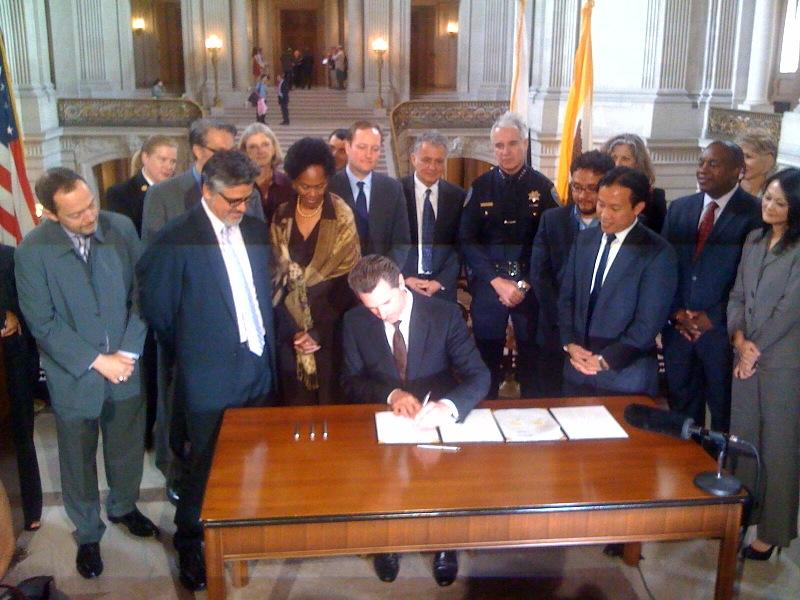
“We balanced the budget without raising taxes. I don’t believe in raising taxes. We don’t need to raise taxes,” Newsom said proudly at his July 29 budget signing ceremony, during which he also effusively praised the labor unions whose support he needs this fall: “Labor has been under attack in this state and country. They’ve become a convenient excuse for our lack of leadership in Sacramento and around the country.”

That hypocritical brand of politics has been frustrating to his fellow Democrats, particularly progressive supervisors and DCCC members. At the July 27 board meeting, Sup. Ross Mirkarimi and Board President David Chiu reluctantly dropped their pair of revenue measures that would have raised $50 million, bowing to opposition by Newsom and the business community.

The San Francisco Chamber of Commerce has become such a vehicle for antitax and antigovernment vitriol that the DCCC on July 29 approved a resolution calling for the organization — which hosted a speech by Republican National Chair Michael Steele in June — to renounce the platform of the Republican National Committee.

“The Chamber is not a knee-jerk right-wing organization,” Chamber President Steve Falk felt compelled to clarify in a July 28 letter to DCCC Chair Aaron Peskin, closing with, “Anything you can do to avoid painting the Chamber as a pawn of the GOP would be greatly appreciated — because it just isn’t true.”

Yet Rafael Mandelman, who sponsored the resolution and is a progressive supervisorial candidate in District 8, told us the Chamber’s fiscal policies are indistinguishable from those pushed by Republicans. “They’re the leading force pushing the Republican agenda in San Francisco,” Mandelman said, calling the stance short-sighted. “It’s not in the long-term interests of the business community for our public sector to fall apart.”

Chiu’s business tax reform measure is a good example of how conservative ideology seems to be trumping progressive policy, even among Democrats. Only 10 percent of businesses in the city pay any local business tax, and the measure would increase taxes on large corporations, lower them on small businesses, create private sector jobs, bring $25 million per year into the city, and expand the tax burden to 25 percent of businesses, including the large banks, insurance companies, and financial institutions that are now exempt. But even the Small Business Commission refused to support the plan, prompting Chiu to drop the proposal and tell his colleagues, “There is still not consensus about whether this should move forward.”

Sup. Chris Daly, the lone vote against the budget compromise with Newsom and the removal of revenue measures from the November ballot, noted at the July 27 board meeting how the business community has sabotaged city finances, citing its 2002 lawsuit challenging the gross receipt taxes, which the board settled on a controversial 8-3 vote. “This is a large part of our structural budget deficit,” Daly said.

But antitax sentiment has only gotten worse with the current recession and political dysfunction, causing Democrats like Newsom to parrot Republicans’ no-new-taxes mantra, much to the chagrin of progressives.

“A lot of this is being driven by statewide politics. [Newsom] needs to not have taxes go up but he also needs the support of the labor unions, so we get weird stuff happening in San Francisco,” Mandelman said.

The situation has also fed Newsom’s animus toward progressives, who have enjoyed more local electoral success than the mayor. Newsom responded in June to the progressive slate winning a majority on the DCCC by placing a measure on the November ballot that would ban local elected officeholders from serving on that body, which includes four progressive supervisors and three supervisorial candidates.

Nonetheless, Newsom then unexpectedly sought a seat on the DCCC, arguing that his lieutenant governor nomination entitled him to an ex officio seat (those held by state and federal elected Democrats) even though the DCCC’s legal counsel disagreed. While noting the hypocrisy of the request, Party Chair Aaron Peskin took the high road and proposed to change the bylaws to seat Newsom.

Some progressives privately groused about giving a seat to someone who, as DCCC member Carole Migden said at the meeting, was “picking a fight” with progressives by pushing a measure she called “disrespectful and unconstitutional.” But in practice, the episode seems to have hurt Newsom’s relations with progressives without really strengthening his political hand.

Newsom ally Scott Wiener — a DCCC member and District 8 supervisorial candidate (who told us he opposes the mayor’s DCCC ballot measure) — proposed to amend Peskin’s motion to change the bylaws in order to seat Newsom with language that would allow Newsom to continue serving even if he loses his race in November.

That amendment was defeated on a 17-13 vote that illustrated a clear dividing line between the progressive majority and the minority faction of moderates and ex officio members. Even with Newsom and District Attorney Kamala Harris (who was seated as the Democratic nominee for attorney general) being seated — and counting the one absent vote, Sen. Leland Yee, who is expected to sometimes vote with progressives and sometimes with moderates — progressives still hold the majority going into the process of endorsing local candidates and allocating party resources for the fall campaign.

“Presuming that 17 people of that 33-member body all agree on something, then the presence of Mayor Newsom doesn’t change anything,” Peskin said. He also noted that even if Newsom’s measure passed and the progressive supervisors were removed, “the irony is that the chair of the party [Peskin] would appoint their successors.”

Also ironic is the political reality that it is Newsom who most needs his party’s support right now, while it is progressives who are adopting the most conciliatory tone.

“We should all be working to turn out the vote and help Democrats win,” Peskin told us. “I implore our mayor and lieutenant gubernatorial candidate to work with us and get that done.”

Yet after Newsom gave a budget-signing speech that included the line, “At the end of the day, it comes down to leadership, stewardship, collaboration, partnership,” he told the Guardian that he has no intention of removing or explaining his DCCC ballot measure, saying only, “If the voters support it, then it would be the right thing to do.”

Chiu responded to the news by telling us, “I hope the mayor can move beyond the politics of personality and build a party vehicle that is about unity.”

A new community congress

0

EDITORIAL The first time a group of activists from across San Francisco met in a Community Congress, it was 1975 and the city was in trouble. Runaway downtown development was creating massive displacement and threatening the quality of life. Rents were rising and tenants were facing eviction. An energy crisis had left residents and businesses with soaring power bills. The manifesto of the Congress laid out the problem:

"Every poor and working class community in San Francisco has learned the hard way that its interests are at the bottom of the list as far as City Hall is concerned. At the top of the list are the banks, real estate interests, and large corporations, who view San Francisco not as a place for people to live and work and raise families, but as a corporate headquarters city and playground for corporate executives. By using their vast financial resources, they have been able to persuade local government officials that office buildings, hotels, and luxury apartments are more important than blue-collar industry, low-cost housing and decent public services and facilities."

The Community Congress hammered out a platform — a 40-page document that pretty much defined what progressive San Francisco believed in and wanted for the city. It included district elections of supervisors, rent control, public power, a requirement that developers build affordable housing, and a sunshine ordinance — in fact, much of what the left has accomplished in this town in the past 35 years was first outlined in that document.

Beyond the details, what the platform said was profound: it suggested that the people of San Francisco could reimagine their city, that local government could become a force for social and economic change on the local level, even when politics in Washington and Sacramento were lagging behind. It called for a new relationship between San Franciscans and their city government and looked not just at what was wrong, but what was possible.

That’s something that too often gets lost in political debate today. With urban finances in total collapse, the progressives are on defense much of the time, trying to save the basic safety net and preserve essential programs and services. It seems as if there’s little opportunity to talk about a comprehensive alternative vision for San Francisco.

But bad times are great times to try new ideas — and when the second Community Congress convenes Aug. 14 and 15 at the University of San Francisco, that’s exactly what they’ll be trying to do. It’s not going to be easy — the left in San Francisco has always been fractious, and there’s no consensus on a lot of central issues. But if the Community Congress attracts a broad enough constituency and develops a coherent platform that can guide future political organizing efforts, it will have made a huge contribution to the city.

The event also offers the potential for the creation of a permanent progressive organization that can serve as a forum for discussion, debate, and action on a wide range of issues. That’s something the San Francisco left has never had. Sup. Chris Daly tried to create that sort of organization but it never really worked out. The city’s full of activist groups — the Tenants Union, the Harvey Milk LGBT Club, the Sierra Club, and many others — that work on important issues and generally agree on things, but there’s no umbrella group that can knit all those causes together. It may be an impossible dream, but it’s worth discussing.

The organizers of the Community Congress discuss some of their agenda in the accompanying piece on this page. It should be based on a vision of what a city like San Francisco can be. Think about it:

This can be a city where economic development is about encouraging small businesses and start-ups, where public money goes to finance neighborhood enterprises instead of subsidizing massive projects.

This can be a city where planning is driven by what the people who live here want for their community, not by what big developers can make a profit doing.

This can be a city where housing is a right, not a privilege, where new residential construction is designed to be affordable for the people who work here.

This can be a city where renewable energy powers nearly all the needs of residents and businesses and where the public controls the electricity grid.

This can be a city where the wealthy pay the same level of taxes that rich people paid in this country before the Reagan era, where the individuals and corporations that have gotten filthy rich off Republican tax cuts give back a little bit to a city that is proud of its liberal Democratic values.

This can be a city where it’s safe to walk and bike on the streets and where clean, reliable buses and trains have priority over cars.

This can be a city where all kids get a good education in public schools.

Despite all the economic woes, this is one of the richest cities in one of the richest countries in the history of human civilization. There are no economic or physical or scientific or structural constraints to reimagining the city. The only obstacles are political.

In the next two years, control of City Hall will change dramatically. Five seats on the Board of Supervisors are up in November, and the mayor’s office is open the year after that. The progressives have made great progress in the past few years — but downtown is gearing up to try to reverse those advances. The community congress needs to address not just the battle ahead, but describe the outcome and explain why San Francisco’s future is worth fighting for.

A new community congress

2

Bad times are great times to try new ideas – the second Community Congress convenes Aug. 14 and 15 at the University of San Francisco

EDITORIAL The first time a group of activists from across San Francisco met in a Community Congress, it was 1975 and the city was in trouble. Runaway downtown development was creating massive displacement and threatening the quality of life. Rents were rising and tenants were facing eviction. An energy crisis had left residents and businesses with soaring power bills. The manifesto of the Congress laid out the problem:

“Every poor and working class community in San Francisco has learned the hard way that its interests are at the bottom of the list as far as City Hall is concerned. At the top of the list are the banks, real estate interests, and large corporations, who view San Francisco not as a place for people to live and work and raise families, but as a corporate headquarters city and playground for corporate executives. By using their vast financial resources, they have been able to persuade local government officials that office buildings, hotels, and luxury apartments are more important than blue-collar industry, low-cost housing and decent public services and facilities.”

The Community Congress hammered out a platform — a 40-page document that pretty much defined what progressive San Francisco believed in and wanted for the city. It included district elections of supervisors, rent control, public power, a requirement that developers build affordable housing, and a sunshine ordinance — in fact, much of what the left has accomplished in this town in the past 35 years was first outlined in that document.

Beyond the details, what the platform said was profound: it suggested that the people of San Francisco could reimagine their city, that local government could become a force for social and economic change on the local level, even when politics in Washington and Sacramento were lagging behind. It called for a new relationship between San Franciscans and their city government and looked not just at what was wrong, but what was possible.

That’s something that too often gets lost in political debate today. With urban finances in total collapse, the progressives are on defense much of the time, trying to save the basic safety net and preserve essential programs and services. It seems as if there’s little opportunity to talk about a comprehensive alternative vision for San Francisco.

But bad times are great times to try new ideas — and when the second Community Congress convenes Aug. 14 and 15 at the University of San Francisco, that’s exactly what they’ll be trying to do. It’s not going to be easy — the left in San Francisco has always been fractious, and there’s no consensus on a lot of central issues. But if the Community Congress attracts a broad enough constituency and develops a coherent platform that can guide future political organizing efforts, it will have made a huge contribution to the city.

The event also offers the potential for the creation of a permanent progressive organization that can serve as a forum for discussion, debate, and action on a wide range of issues. That’s something the San Francisco left has never had. Sup. Chris Daly tried to create that sort of organization but it never really worked out. The city’s full of activist groups — the Tenants Union, the Harvey Milk LGBT Club, the Sierra Club, and many others — that work on important issues and generally agree on things, but there’s no umbrella group that can knit all those causes together. It may be an impossible dream, but it’s worth discussing.

The organizers of the Community Congress discuss some of their agenda in the accompanying piece on this page. It should be based on a vision of what a city like San Francisco can be. Think about it:

This can be a city where economic development is about encouraging small businesses and start-ups, where public money goes to finance neighborhood enterprises instead of subsidizing massive projects.

This can be a city where planning is driven by what the people who live here want for their community, not by what big developers can make a profit doing.

This can be a city where housing is a right, not a privilege, where new residential construction is designed to be affordable for the people who work here.

This can be a city where renewable energy powers nearly all the needs of residents and businesses and where the public controls the electricity grid.

This can be a city where the wealthy pay the same level of taxes that rich people paid in this country before the Reagan era, where the individuals and corporations that have gotten filthy rich off Republican tax cuts give back a little bit to a city that is proud of its liberal Democratic values.

This can be a city where it’s safe to walk and bike on the streets and where clean, reliable buses and trains have priority over cars.

This can be a city where all kids get a good education in public schools.

Despite all the economic woes, this is one of the richest cities in one of the richest countries in the history of human civilization. There are no economic or physical or scientific or structural constraints to reimagining the city. The only obstacles are political.

In the next two years, control of City Hall will change dramatically. Five seats on the Board of Supervisors are up in November, and the mayor’s office is open the year after that. The progressives have made great progress in the past few years — but downtown is gearing up to try to reverse those advances. The community congress needs to address not just the battle ahead, but describe the outcome and explain why San Francisco’s future is worth fighting for.

Newsom’s budget and DCCC hypocrisy

9

Hypocrisy hung thickly in the air at City Hall today as Mayor Gavin Newsom refused to responsively address glaring contradictions on a pair of high-profile policy stances, pursuing naked self interest while cloaking himself in deceptive but high-minded rhetoric. Newsom used the city budget-signing ceremony to effusively praise the labor unions that he publicly shamed into giving back $250 million over two years to balance the budget without tax increases, a budget that cut services and increased various fees and fines.

“Labor has been under attack in this state and country. They’ve become a convenient excuse for our lack of leadership in Sacramento and around the country,” Newsom said without blushing, defending unions against pension reform measures such as Public Defender Jeff Adachi’s SF Smart Reform, which he opposes while continuing to support the need for pension reform.

But Newsom seemed unaware that the layoffs, forced furloughs, and voluntary pay cuts accepted by the unions that he publicly demonized just a couple months ago and now praises – whose support he needs for his current run for lieutenant governor – is connected to his steadfast opposition to new taxes, which he reiterated today: “We balanced the budget without raising taxes. I don’t believe in raising taxes, we don’t need to raise taxes.”

Despite the fact that just 10 percent of San Francisco businesses pay any business taxes to the city, Newsom opposed and this week helped kill a measure by Board President David Chiu to reform the business tax system in a way that would increase taxes on large corporations, lower them on small businesses, create private sector jobs, bring $25 million per year into the city, and expand the tax burden to 25 percent of businesses, including the large banks, insurance companies, and financial institutions that are now exempt. Instead, labor took a deep hit and the city still faces projected $500 million budget deficits each of the next two fiscal years.

But Newsom’s hypocrisy isn’t confined fiscal issues. After the ceremony, he told reporters that he was sticking by his November ballot measure to ban local elected officials from serving on the Democratic County Central Committee, even after last night insisting that body give him a seat, which they had to change the bylaws to accommodate.

At last night’s DCCC meeting, members of an elected committee that includes four progressive supervisors and three current supervisorial candidates called for Newsom or his proxy John Shanley to explain why he is pushing a policy to ban locally elected officials from serving on the DCCC, a body in which elected state and federal officials automatically get seats.

“This mayor is on record as saying local officials should not serve on the committee,” Sup. David Campos said at the meeting, calling for Newsom to clarify this policy contradiction and offer his reasoning for the policy: “We don’t want to do anything that is inconsistent with what the mayor has said so far.”

Chair Aaron Peskin translated Campos’s comments as indicating “some level of irony or hypocrisy,” but Campos objected, insisting “it’s not a personal attack” but a genuine desire to know why Newsom sought to ban local elected officials after progressives won a majority of the DCCC seats in June.

Both Shanley last night and Newsom today gave the same legalistic answers, noting that he’s not serving in his capacity as the mayor, but as an ex officio member who automatically gets a seat for being the Democratic nominee for a statewide office (although the DCCC legal counsel said Newsom wasn’t entitled to a seat because the bylaws only award a seat when the current holder of the office being sought is a Democrat).

But DCCC member Carole Migden objected to Shanley’s answer, saying of Newsom’s effort to unseat duly elected members, “That’s picking a fight, if we want to be clear…That effects my vote, I have to say. It’s disrespectful and unconstitutional.”

DCCC member David Chiu noted that Newsom’s ballot measure would explicitly ban supervisors and the mayor from serving on the DCCC and said that the mayor still had a few days before the deadline for him to withdraw the measure, which he single-handedly placed on the ballot using his authority as mayor.

But today, when asked by the Guardian, Newsom said he had no intention of either withdrawing the measure or explaining it to the DCCC. When we asked about the contradiction in his positions, Newsom said only, “If the voters support it then it would be the right thing to do.”

He was similarly dismissive when other reporters continued to ask about the controversy, gesturing toward me with a dismissive wave of his hand as he said, “Certain people with certain newspapers major in the minor.”

After being told that Newsom is sticking by his DCCC ballot measure, Chiu told us, “I hope the mayor can move beyond the politics of personality and build a party vehicle that is about unity.”


81 percent support amnesty for undocumented immigrants

2

Here’s a statistic that’s guaranteed to get anti-immigrant groups seeing majorly red: A CNN poll found the 81 percent of those questioned support a program that would allow undocumented workers who have already been living in the country for a number of years to remain legally if they had a job and paid taxes.

The same poll found that 78 percent of white respondents favor the program, which is 16 points lower than the 94 percent of Latinos questioned who back the plan.


Board progressives ditch their own tax measures

5

After failing to win support from the small business community for a measure that would have helped it and fearing a well-funded attack from large corporations, Board of Supervisors President David Chiu today made the motion to reject his business tax reform ballot measure.
Labor leaders have also raised concerns about not having enough resources to fight for several revenue measures on the November ballot, mostly because they are focused on approving a hotel tax increase, supporting progressive supervisorial candidates, and defeating Jeff Adachi’s measure to increase how much city employees pay for health care and into their pensions.
“There is still not consensus about whether this should move forward,” Chiu said of his measure, which also suffered from being complicated and not easy to explain in an election campaign. It would have created a more progressive payroll tax structure – increasing taxes on large corporations and lowering them on small businesses – and a commercial rent tax that also would have exempted small businesses, raising about $25 million for the city and creating hundreds of private sector jobs, according to the city’s Office of Economic Analysis.
But the fear among some progressives is that too many revenue proposals would hurt their individual chances, given that the ballot will now include a hotel tax increase, a real estate transfer tax on properties worth more than $5 million (which the board approved today on an 8-3 vote), a $10 local surcharge on vehicle license fees, and a parcel tax from the Community College District.
So Sup. Ross Mirkarimi today also abandoned his proposal to increase the city’s parking tax from 25 percent to 35 percent, which would have raised about $25 million per year. Both Chiu and Mirkarimi said their measures were good policy and would have raised desperately needed revenue, but they were bowing to political reality.
“We’re challenged by the practicality of mounting a fall campaign around these revenue measures,” Mirkarimi said at the meeting.
The board voted 10-1 to table both measures, with a dissenting vote by Sup. Chris Daly, who said, “I just disagree with that political analysis.” He said voters would consider the measures individually and “I don’t think disappearing a progressive payroll tax and progressive parking tax are going to help the real estate transfer tax.”

SFBG Radio: Meg’s taxes, Jerry’s campaign, Linda’s music

4

In today’s episode, Johnny and Tim talk about why Meg Whitman wants to avoid paying taxes, why Jerry Brown is so late in getting a campaign started … and why the oldies stations never play Linda Rondstadt songs. You can check it out after the jump.

sfbgradio7/21/2010 by johnnywangel

Growing pains

1

steve@sfbg.com

The medical marijuana movement was born and raised in the Bay Area, and now the city of Oakland is poised to take the next big step forward by being the first city to explicitly allow and permit several massive cannabis cultivation facilities on industrial land, making millions of dollars in taxes in the process.

It’s the latest move in a growing trend toward Bay Area cities figuring out how to regulate and tax a booming industry that could really explode if California voters approve Proposition 19 in November, which would legalize even recreational uses of marijuana and give local jurisdictions more authority to control it.

Pot growing has long been the murkiest realm within an increasingly legitimate and professional medical marijuana industry (see “Marijuana goes mainstream,” 1/27/10). While Oakland, Berkeley, and San Francisco all have well-defined and regulated systems governing the 30 licensed cannabis dispensaries in those three cities, most of their growers are underground operations with no official oversight.

Public officials on both sides of the bay — who almost universally voice their support for the medical marijuana industry — say there can be problems associated with unregulated grows. Jerry-rigged wiring can pose a fire danger, and valuable crops can be targeted by criminals. Growers can be raided by police even when they have valid paperwork. And cash-strapped city governments aren’t able to tax or regulate an industry that has kept on booming throughout the Great Recession.

“There is no system to regulate production,” Oakland City Council member Rebecca Kaplan, who has authored cultivation regulations, along with co-sponsor Council member Larry Reid. Although the city may lack resources to enforce new requirements on growers, Kaplan believes growers will sign up voluntarily: “Every time we’ve created a permitting system, people have sought to use it. They want to be above board.”

The measure would permit growing facilities of more than 100,000 square feet, charging them each a $5,000 permit fee and $211,000 “regulatory fee,” as well as a gross receipts tax to be determined. The Oakland City Council approved the measure July 20 after Kaplan agreed to have staff also create a permit system for smaller growers, with both regulatory systems slated to take effect Jan. 1, 2011.  Kaplan has also proposed a November ballot measure to increase the current gross receipts tax on cannabis-related businesses from 1.8 percent now to up to as high as 11.2 percent, which the council is set to consider July 22.

Kaplan’s cultivation proposal initially generated a backlash from some small growers and Harborside Health Center, Oakland’s largest dispensary, because of its focus on creating mega-facilities that could monopolize the market and hurt the small growers who have been at the heart of the medical marijuana movement.

“All we’re asking for is a level playing field and a fair opportunity to compete with these factories,” attorney James Anthony, who represents Harborside and its network of growers, told the Guardian. “As medical cannabis comes into the light, it’s still capitalism out here in the world.”

Oakland developer and business person Jeff Wilcox, who is new to the marijuana industry, has been aggressively pushing to create a massive cannabis growing and manufacturing facility on his 7.4-acre warehouse complex near the Oakland Coliseum, covering 172,000 square feet over four buildings.

On May 21, Wilcox and his company, AgraMed, released a report showing how the facility could produce about 21,100 pounds of high-grade marijuana per year, generating about $60 million in gross sales and more than $2 million a year in taxes for Oakland, assuming a 3 percent tax rate (or about $3.5 million if the rate is set at 5 percent). The report was based partly on information gathered from independent local growers.

“By closing the loop and regulating the entire industry, we can ensure the healthy production and use of cannabis, and ensure its legitimate standing in our society. We’re working with public health and public safety agencies to make sure we do this right,” Wilcox, who did not return Guardian calls for comment, said in his press release.

Anthony said he was wary of Oakland politicians handing so much market power to one person: “It’s not for the government to pick the winners and losers through a regulatory scheme.” But he does agree that growers are overdue for regulation. “It’s time for cultivation to come into the light.”

State law requires growers to be part of the collective that uses or distributes the product, and the facility proposed by Wilcox would contract with many collectives, a model that hasn’t been tested in the courts yet. In fact, Council member Nancy Nadel has expressed concern that what she called “a structurally flawed proposal” could be on shaky legal ground (City Attorney John Russo, who has endorsed Prop. 19, did not return our calls with questions about the Oakland measure’s legality. His office also has not issued an opinion because it conflicts with federal law).

“Though state law allows for the operation of medical marijuana cooperatives by primary caregivers and patients, it does not legitimize large-scale growing operations. Just in the past few months, the DEA has raided two medical cannabis testing labs in Colorado. We need to retain a level of good sense and discretion,” Nadel wrote in a July 13 memo to her council colleagues, urging them to hold off on approving the measure until after voters decide Prop. 19 in November.

Yet Kaplan told us that even though the council moved the legislation forward, staff would continue to work through its myriad regulatory details and no permits will be issued until January. She also agreed that “it’s really important for Prop. 19 to pass,” giving Oakland more explicit authority to regulate the industry.

Oaksterdam University founder Richard Lee, who bankrolled the campaign to place Prop. 19 on the ballot, supports Kaplan’s regulations (although he told us he would like to see a greater focus on small cultivators) and called regulation of growers “a historic next step” that further legitimizes the industry.

“I think this will help Prop. 19 pass and help Oakland be ready when it does,” Lee said, voicing support for Wilcox and other business people who seek to join this movement. “We need everyone we can get on our side.”

Most polls show that Californians are split fairly evenly on Prop. 19. Even so, several California cities are already making preparations to use the new taxation and regulation authority that the measure would bestow.

Lee said Sacramento, Oakland, Stockton, Long Beach, San Jose, and Berkeley all have been working on cannabis regulatory schemes for voters to approve. For example, on July 13, the Berkeley City Council placed a measure on the November ballot proposing a gross receipts tax of 2.5 percent on medical marijuana and a 10 percent tax on recreational pot, as well as a system for permitting up to 10 medical marijuana growing operations.

“State law is really a mess at the moment and there are a number of things happening now that violate state law,” Lee told us. “That’s why Prop. 19 is going to be a cleanup law to deal with a lot of the stuff that’s going on now.”

Kaplan, who has been working on her ordinance for almost a year and got help from students in UC Berkeley’s Goldman School of Public Policy, agreed that the current legal requirements for growing medical marijuana are unclear: “There isn’t a right way [to permit cultivation facilities] under state law. The law isn’t clear.”

Attorney David Owen, who has researched medical marijuana laws for the new SPARC dispensary in San Francisco and for local growers, echoed the point. “The short answer is that we know so little about the boundaries of state law.”

Prop. 215, the 1996 measure that legalized medical marijuana, was broadly written and then codified largely by Senate Bill 420, portions of which were later struck down by the courts. But enforcement of marijuana laws has primarily been done by the federal government, which backed off after President Barack Obama took office, leaving state and local officials to regulate a fast-growing industry using standards that the courts have yet to clarify.

“We don’t have appellate court decisions to interpret a lot of key terms in state law,” Owen said. “We don’t really know what state law says.”

For example, Owen said the widely used term “dispensary” doesn’t even appear in state law. Local jurisdictions often define how much pot a patient can grow. For example, Oakland allows groups of three patients to grow up to 72 plants in 96 square feet. But most of those standards haven’t been held up by the courts. And even though state law says growers must be part of the same collective as their patients, Owen said, “In theory, you could have a collective with 37 million members.”

Although Owen said a large scale doesn’t necessarily make a marijuana operation illegal, he said permitting a 170,000 square foot facility is bound to draw attention from the feds: “I guarantee the DEA will be at their doorstep the day they open.”

Council member Nadel said Oakland could be liable then as well, noting that it would be permitting a facility that would meet about 60 percent of the entire Bay Area’s demand for 35,000 pounds of pot per year. “Thus, to prevent diversion to illegal markets and collective members outside of the cultivation collective (which would violate state law), the city must act responsibly and set a limit on the total size of cultivation allowed in Oakland. While the memo from the Council members discusses the alternative method [permitting a smaller capacity], it does not recognize the problems with projecting sales to dispensaries outside the Bay Area,” Nadel wrote.

Kaplan said the ordinance is a starting point that can be further refined by staff. But she emphasized the need to regulate the industry, warning of risks to Oakland residents. Her measure’s staff report attributes at least seven house fires, eight robberies, seven burglaries, and two homicides to unregulated growing operations in 2008 and 2009. Kaplan also said she worries about the possibility of “another Oakland Hills fire.”

Yet Kaplan, who is running for mayor, also told us the taxes are important in a city that was recently forced to fire 80 police officers. “Given Oakland’s budget crisis,” she said, “the revenue for the city is no small thing.”