taxes

SFBG Radio: What if we stopped shopping?

83

Today, Johnny offers a fascinating idea. The GOP in Arizona has been forced to back down on some of its worst immigration policies — purely because of the economic impact. What if the 26 million or so American consumers who fall into the general category of the Left (and the anti-war Right) just stopped spending money on anything beyond essentials for one week — a boycott against the wars in Iraq and Afghanistan and in favor of taxes on the rich. Would it make anyone in Washington listen? You, of course, can listen all you want, after the jump.

sfbgradio3212011 by endorsements2010

Is the California GOP done?

16

The folks at CalBuzz — veteran political reporters who know their shit — thing the CAGOP is teetering on the brink of irrelevance:


Like a herd of wooly mammoths at the end of the Pleistocne epoch, the California Republican Party is on the verge of extinction.


It may still recover. The CRP has come back from near death before. And redistricting, alongside the top-two primary system may yet revive it. But judging from the infighting, narrow thinking and rigid ideological positioning on display at the party’s organizing convention last weekend in Sacramento, the signs are not good.


But that assumes that the party wants to recover, wants to be part of governing the state and actually has a plan to do that. Right now, Republicans in Sacramento are standing up and denouncing some of Gov. Brown’s proposed cuts — while refusing to even allow a public vote on extending taxes.


Over at Calitics, David Atkins suggests another perspective:


In reality, the GOP at a national and state level exists to 1) deliver money from the poor and middle class to the rich; and 2) feed enough red meat to their prejudiced and unthinking base to garner just enough votes to continue achieving objective #1. That’s pretty much it.


Right now, the GOP doesn’t actually need to win any of the statewide elections in order to accomplish those goals. Winning them would be helpful, but is ultimately unnecessary. Knowing that the chances of anyone overturning Prop 13 and the 2/3 requirement on revenues are slim to none, all they need is at least 1/3 of the members of just one of the statehouse chambers. To ram through all cuts budgets and destroy faith in government, they need do nothing more.


In fact:


There’s nothing that serves Republican interests at a state and national level more than to see California fiscally collapse. That means shock doctrine, a transfer of wealth from the middle class to the rich, an ability to end all state labor contracts in a way Governor Walker would only dream of, and ultimately the ability to crush the belief of the People in the power of their government to do good on their behalf.


I’m not sure everyone in the GOP thinks this way, but on a macro level, it certainly makes sense. That’s exactly what the Repubicans are doing in Congress — make it impossible for the Obama Administration to succeed, and you’ve done your job. It doesn’t hurt that Obama is allowing that to happen.


Brown continues to say that he doesn’t want to pull any legal chicanery, that he wants Republican support for his plan to but the tax extensions before the voters in June. But if this is the game they’re playing, he may have to reconsider.

Taxes = prosperity

4

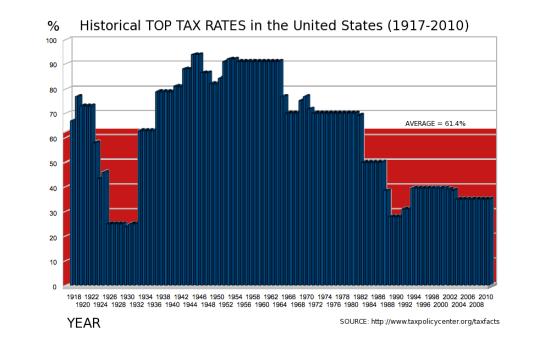
I found this nifty chart on DailyKos, along with an article about the idiot who wants to cut taxes on the rich again. I realize it’s a little hard to read the exact dates, but here’s the overall point:


High taxes on the wealthy, generally speaking, correspond to periods of economic prosperity. Low taxes on the rich, generally speaking, correspond to bad economic periods.


Gee, could there be a connection here?

The GOP convention dilemma

9

Word in Sacramento is that five Republicans may be close to going along with the governor’s plan to put $12 billion in tax extensions (NOT tax increases, just extensions of existing taxes) before the voters. The problem: They don’t want to vote for taxes and then have to show up at the state convention March 18 — where there’s a move afoot (I kid you not) to pass a resolution (thanks, CalBuzz) that calls on the party to censure any “traitorous Republicans-in-Name-Only, ask for their resignation from their positions within the California Republican Party, pledge to endorse and support efforts to recall them from office, and direct the California Republican Party staff, agents and officers to refuse to provide them with funding or assistance in future elections.”


Why can’t the Democrats do shit like this? Censure and abandon any Democrat-in-Name-Only who supports continuing the wars in Iraq and Afghanistan and refuses to increase taxes on the rich? (Oh, wait — then we wouldn’t have very many Democrats left. Which, I guess, is the GOP problem.)


At any rate, the Legislature is going into session this afternoon to try to push this package through — and it could be one of those marathon sessions that lasts all night. Or maybe the Republicans will vote for the budget plan — but only if they can wait until Monday.


By the way: Isn’t it odd that two crazy talk-show hosts in L.A. can hold an entire state hostage? How come we don’t have a couple of crazy talk show hosts in San Francisco who can make very Democrat in Sacramento pay attention?

How taxes on millionaires could save the NBA

6

March is heaven for basketball junkies. The NCAA tournament goes full-tilt boogie and for fans of the pro game, playoff jockeying intensifies into overdrive. As a member of the latter camp whose team sits atop the NBA East, there is a river of joy flowing through the ventricles of my pumping heart.


But this year, the happy is tempered with the specter of dread. In July, the NBA’s collective bargaining agreement expires and it is a near certainty that there will be a lockout. Despite a projected revenue increase of anywhere from 3-5% in this allegedly recuperating economy of ours, the owners will padlock their doors shut, terminating contracts they signed in supposedly good faith, because they claim that they lost $370 million last season (the union disputes this). Who loses ultimately is the game itself–fan goodwill can only bend so far.


There’s plenty of blame to go around, but ultimately all of it rests with the owners who flout their own salary caps with ridiculous deals to borderline players like a Hedo Turkoglu or a Rashard Lewis, as well as the talent dilution in having teams in exotic locales that can’t support them (e.g. The Memphis Grizzzlies and the soon to be in Anaheim Sacramento Kings). But much of the issue of inflated salaries comes back to the same problem that is plaguing the entire economy–low taxation on the very wealthy has priced the NBA out of profitability.


Suppose the 91% tax in place during the 50’s was reinstated for people making over 10 million dollars a year (it used to be over a million to be in that bracket, let’s adjust for inflation). Why would a player demand a salary of 20 million a year (or Kobe Bryant’s 24M escalating to 32M due next year), when the net wouldn’t exceed 11M? Makes no economic sense. A GM can offer a ten year deal at 99M instead of 5 years/20M, same amount of money (not counting bonuses, endorsements and the like).


What low tax proponents never ever grasp is that lower taxes on the top 1% inevitably lead to these situations, the NBA is a micro in the macro of Wall Street, CEO compensations, estates. When massive amounts of money accumulate with the few (even hard earned, no one can deny the skill and work ethic of a LeBron or a Ray Allen), the ripple effect is that the system cannot sustain–the fans will not pay higher tickets and greater merchandise charges forever. The players and owners have effectively killed off the golden goose–let’s take the ax from their hands with reasonable taxes from now on in ours.


Johnny Angel Wendell  is a talk show host at KTLK AM1150 in Los Angeles, webcaster at sfbg.com and a 30 plus year veteran of the American music scene.
 

Board considers extra $75.4 million for Mission Bay redevelopment

0

UPDATE: An earlier version of this post reported that the Board was meeting in closed session. This was incorrect.

The Board is meeting today  to consider amending the San Francisco Redevelopment Agency’s (SFRA)  budget to issue an additional $70 million in tax increment bonds and appropriate $75.4 million ($70 million in bond proceeds, plus $5.4 million tax increment). The request, which comes on the heels of last year’s $64 million request, represents a 109.4 increase of tax increment bonds in 2010-2011. The city says thiis has nothing to do with Gov. Jerry Brown’s proposal to eliminate redevelopment agencies. But the last-minute timing of today’s session looks a tad fishy at best. And it’s playing out as a vote on Treasure Island’s final environmental impact report approaches, and against a backdrop of extreme funcertaintly related to all things Redevelopment, as Mayor Ed Lee and other city leaders try to figure out ways to prevent or reduce the affordable housing fallout from the governor’s elimination proposal.

According to a Budget and Legislative Analyst’s summary of today’s request, the requested bond issuance and expenditure is part of the “SFRA’s normal course of fulfilling its obligations under the tax increment allocation pledge agreements between the city, SFRA and FOCIL-MB (Catellus’ successor entity at the Mission Bay redevelopment sites), and not as a result of the Governor’s proposal to eliminate local redevelopment agencies. Ms. Lee [deputy executive director at the SFRA] states, that, as of the writing of this report, the impact of the Governor’s proposal on the Mission Bay Redevelopment Project is currently unclear and ambiguous as to whether approval of the Governor’s proposal would affect the requested bond issuance and expenditure authority.”

“At the time of the development and approval of the FY 2010-2011 budget, the Agency and Tax Assessor did not have available tax roll information that resulted in a significant increase in property taxes in Mission Bay due to the accelerated assessment agreement between the Assessor and the Agency,” states today’s Board resolution that Mayor Lee sponsored, explaining why there’s a request for an additional $70 million in bonds, so soon on the heels of the $64 million that the Board approved last year.

“The Agency wishes to amend its budget for the fiscal year 2010-2011 to permit the receipt of additional tax increment of $5.44 million and bond proceeds in the amount of $70 million for the purposes of low moderate housing and for the reimbursement of public improvements made by Catellus pursuant to the tax increment allocation pledge agreement between the City and County of San Francisco, San Francisco Redevelopment Agency and Catellus made in November 16,1998 for Mission Bay North and South,” the resolution continues.

 Mission Bay North and South are two separate redevelopment areas that encompass 303 acres, bounded by King Street and AT&T Park on the north, the San Francisco Bay and the I-280 freeway on the east and west, and Mariposa Street to the south, according to Redevelopment Agency documents.

The Budget and Legislative Analyst notes that of the $5.4 million in additional tax increment, an estimated $3.48 million would fund a portion of the Agency’s required educational revenue augmentation fund payment to the state for FY 2010-2011. And that the remaining $1.95 million would be distributed to tax entities, with $870,400 to be expended on the agency’s low and moderate income housing fund.

 The BLA notes that the proposed sale of $70 million in tax increment bonds will provide $60.345 million bond proceeds, including $12 million (20 percent) to fund the construction of 1180 4th Street, a development of 150 units of family rental housing, including 25 units for formerly homeless families and $48. 276 million (80 percent) to reimburse Catellus’ successor, FOCIL-MB, LLC, for public infrastructure development that FOCIL-MB constructed..

“If the proposed resolution is approved, of the $177 million total estimated debt service, $100, 890,000 or 57 percent will be paid from the City’s General Fund. The City’s General Fund estimated additional annual cost would be $3,648,000 for the first 20 years, decreasing to $2,793,000 for the next ten years.” The BLA concludes, explaining that approval of the proposed resolution is a Board policy decision because it adds up to a total General Fund cost of more than $100 million.

 According to the BLA report, Amy Lee, SF Redevelopment Agency deputy executive director, the requested $70 million in tax increment bonds would be sold in late March 2011, “such that no debt service payments would be required in FY 2010-2011.

 The BLA also notes that if the Board approves the proposed resolution, the net effect of each property tax dollar expended for tax increment that is provided to SFRA would result in a reduction of $0.57 on each dollar from the city’s General Fund.

“In other words, for each tax increment dollar provided to SFRA, the City would no longer have to provide payments to other tax entities,” the BLA observes.

These entities include the city’s Children’s Fund, Library Preservation Fund, Open Space Acquisition Fund, and the General City Bond Debt fund, the Community College district, the San Francisco United School District, BART, and the Bay Area Air Quality Management District, which total approximately $0.43 of each property tax dollar.

It’s because of these property tax dollar equations that the annual cost to the city’s general fund for proposed increased debt service would rise, if the Board approves today’s Redevelopment resolution, by more than $100 million over the next 30 years.

And as local Democratic Party chair and former Board President Aaron Peskin explains, there’s nothing much the Board can do about the deal today, but they might want to reconsider getting into more deals like this at Treasure Island and beyond, in future.

“A deal is a deal is a deal,” Peskin said. ‘So, there’s nothing the Board could do differently, but that’s $3.648 million that otherwise would be going into the General Fund, and it’s a sign we should pay attention to, when considering Treasure Island, as deals like this will continue to impoverish the General Fund.”

 “Even though they deny it has nothing to do with Gov. Jerry Brown’s pending legislation to eliminate redevelopment agencies, I have never seen something scheduled so quickly,” Peskin added, noting that the Board’s agenda is published Thursday evening or Friday morning, but this item wasn’t on that agenda, hence the need to publish a separate notice.

Meanwhile, Treasure Island’s final environmental impact report has been released, and the way the current plan looks, will forever alter our view of the Bay.

“It will have enormous impacts on services for the City and traffic for the entire Bay Area,” Saul Bloom, executive director of Arc Ecology, told the Guardian.

On April 7, a joint session of the San Francisco Planning Commission and Treasure Island Development Authority will be meeting to consider certifying the EIR, but Arc is asking for an extension of two more weeks to provide the public with 42 days for review.

“Fourteen additional days for public review is a very modest request for a project with such significant impacts yet, the City has thus far refused,” Bloom notes.

A meeting of Mayor Lee and Bloomberg’s minds

0

Mayor Ed Lee described New York Mayor Michael Bloomberg as “a model of mine” as the two men exchanged gifts in the Mayor’s Office, and reporters unsuccessfully tried to figure out which of the two men is taller.

Bloomberg gave Lee a box of golf balls, Lee gave Bloomberg a trolley bell, organic hot dogs, a lifetime membership to the San Francisco Museum of Modern Art, and the two men had a meeting of the minds when it came to the need for big cities to reduce greenhouse gas emissions.

Lee prefaced his gift giving by saying he intended to make Bloomberg an honorary citizen of San Francisco.

“Does that mean I’ll have to pay taxes?” Bloomberg quipped.
“If they go up, you’ll be the first to know,” Lee replied.

Bloomberg said it was “fun to talk” with Mayor Lee about energy conservation and environmental activism. “Things like the environment are things mayors have to deal with every day,” Bloomberg said, noting that cities account for 70 percent of the world’s greenhouse gas emissions.”

Bloomberg praised San Francisco for approving an ordinance that requires owners of non-residential buildings to make public how much energy each building consumes each year. The legislation is meant to improve energy efficiency in existing buildings, reduce greenhouse gas emissions, lower energy costs and create green jobs. It also requires commercial buildings over 10,000 square feet to conduct energy-efficiency audits every five years.

“Each can profit from each other’s experiences,” Bloomberg said, noting that because NYC has a more carbon efficient mass transit than most U.S. cities, its buildings are responsible for creating 80 percent of NYC’s emissions. 

Asked about a lawsuit that his transportation commissioner Janette Sadik-Khan reportedly triggered by installing a bike lane along the boundary of an affluent Brooklyn neighborhood, Bloomberg flashed a smile that didn’t suggest he thinks Sadik-Khan is now a PR liability for his administration.

“Change is difficult,” Bloomberg replied, acknowledging that there are “battles between those who drive cars and ride bikes.”

“Mass transit is the solution for every big city,” he continued. “And the bicycle is one of the answers, but they can be dangerous. Roads are not just for motor vehicles. They are also for bikes and pedestrians. The key is pedestrian safety.”

“Our transportation commissioner is very innovative,” Bloomberg continued, referring back to the reportedly embattled Sadik-Khan. “She therefore does come under criticism, but I should be the one taking the heat, not her!”

“Closing Times Square was one of the most successful things we’ve done,” he added, referring to another initiative that Sadik-Khan championed, in addition to installing bike lanes on crowded streets and proposing to shut part of NYC’s 34th Street to cars.

Asked for his impressions of San Francisco’s homeless problem, Bloomberg pointed out that he had just traveled straight from the airport to City Hall by BART, and therefore didn’t have a deep grasp of the issue locally. “I don’t know the specifics,” he said.

But he was happy to outline how New York set “a very aggressive goal” of reducing its homeless population that it then failed to meet it, in part because the economy tanked. “The numbers are down about 13 percent each year,” he said, noting that he hasn’t seen the 2010 statistics.  “But only a small number sleep on the streets,” he continued, noting that folks in NYC, “have to work to qualify for rental assistance.”

Asked to give Lee some mayoral advice, Bloomberg said, “The public wants elected officials who are genuine, who are doing things for what they think are the right reasons.

Asked to give Lee specific advice on how to stay out of trouble as the city’s top official, Bloomberg joked that Lee should move to New York until the end of the year, when his term as interim mayor expires. “But then he’d get into trouble for doing that,” he said. And then he and his coterie of security guards and photographers were out of the press conference and into the elevators, faster than a cabbie trying to beat a red light on a sweltering night in the Big Apple.

What has happened to America?

13

I’m serious. I listened to the news this morning on the radio, and I started to wonder if I hadn’t gone through some kind of a time warp, back to the 1950s. The House Homeland Security Committee is actually holding hearings on whether members of a certain religion have become too radical — and what the U.S. government can do about it.


Richard Nixon used to say that the Jews were part of the Commie Radical Conspiracy, and J. Edgar Hoover thought that black religious leaders, including the Rev. Marting Luther King, Jr, were linked to the Communist Party, but it’s been a while since the U.S. government officially investigated an entire religion on the grounds that it might contain radical elements.


Of course, as Rep. Loretta Sanchez (D-Calif.) notes:


Yet, since September 11, 2001, there have been at least 78 terrorist attacks around the world which did not involve Muslim perpetrators. During the same period, there were 45 incidents connected to Islamic radicals.


Same thing in the United States. Timothy McVeigh? Not a Muslim.


Here’s Rep. Dan Lundgren (R-Calif.) telling us all about this particular scare:


I think moderate voices in this country are intimidated by the radicals. If we hide this and pretend that it doesn’t exist, we’re ignoring reality.


It’s funny — I could make that same argument about the Republican Party. The moderates (if any are left) are intimidated by the Tea Party and anti-tax radicals. Now we have a HUAC-style investigation of the Muslims.


And then in Wisconsin, one of the birthplaces of the modern labor movement in America, the state Legislature is stripping public employees of almost all collective bargaining rights. Forget wages and benefits, which the unions have already agreed to open up for discussion. This is about the most central tenet of organized labor — the right to collective bargaining. It’s as if all the victories we’ve won in the past half century (or more) are going away. With a Democrat in the White House.


It’s funny: I was drinking beer with my neighbor the other night and talking about tax policy (you wonder why I have so many friends) and he told me he’d  given up any thoughts of socialist revolution or radical change: “I’d just take the 1950s,” he said.


Because in the 1950s, the rich people paid taxes.


So now we’ve got the worst of both worlds: We have 50s-era witch hunts and union busting — and we don’t even have 50s-era taxes. What the fuck?   


Is David Crane just another Kochhead?

24

This week the Chronicle majorly attacked State Sen. Leland Yee, claiming Yee tried “to distort the words” of billionaire investment banker and UC Regent David Crane on collective bargaining.

The Chron’s attack came on the heels of Yee’s attempt to block Crane’s UC Regents confirmation. And Yee’s attempt to block Crane came in response to an op-ed Crane wrote for the Chron titled “Should public employees have collective bargaining rights?”

In its counter-counter attack editorial this week, the Chronicle accused Yee of falsely claiming that Crane had “called for an end to collective bargaining rights for California teachers, nurses, firefighters, university employees and other public sector worker.”

“What the former adviser to Gov.Arnold Schwarzenegger did was present a history of collective bargaining in California and explain how a 1977 law had changed the balance of power by giving public employees power over their compensation and benefits,” the Chronicle stated. “Crane did assert that extending collective bargaining to employees who already have civil service protections ‘serves to reduce benefits for citizens and to raise costs for taxpayers. Anyone who would argue with that fact has not been paying attention to what is happening with state and local budgets lately.”

The Chronicle finished by praising Crane, who is currently a lecturer on Public Policy at Stanford University and is reportedly working with former Fed Chairman Paul Volcker to form a task force to examine current state budget practices. Crane, the Chron asserted, has “long been widely respected as a teller of inconvenient truths about the rising costs of public-employee pensions and benefits. He should not be silenced – or misquoted by opportunistic politicians. The Senate should vote to confirm him as regent.”

Now, when Schwarzenegger appointed Crane as a UC Regent in December 2010 as one of his last acts as Governor, the Sacramento Bee described Crane as Schwarzenegger’s “chief public employee pension critic.” But here in San Francisco, the Chron didn’t bother to flesh out Crane’s history of employment, campaign contributions, prior statements on collective bargaining, and financial investments.

Maybe it was because these public records reveal Crane to be less a dyed-in-the-wool Democrat and more of a Bushocrat, an ultra-rich investor who supported G.W. Bush through two elections, and repeatedly frames the collective bargaining rights of government employees as an obstacle standing in the way of pension reform and budget balancing.

Campaign finance records show that in March 1999, when Democrats were trying to hang onto the White House in the wake of Clinton’s sex scandals, Crane gave $1,000 to Bush. And in June 2003, just three months after Bush invaded Iraq on a false pretext, Crane saw fit to give Bush another $2,000.

The good news? Crane didn’t support Sarah Palin and John McCain in 2008. But he did donate $7,200 to Republican Tom Campbell’s unsuccessful 2010 bid for US Sen. Barbara Boxer’s seat. And here in San Francisco, Crane was one of several billionaires who wrote big fat checks last fall in support of Measure B, which sought to curb the pension and health benefits of city workers, most of whom will make a fraction in their lifetime of what Crane rakes in each year from his widely diversified financial portfolio.

Crane’s 2009 statement of economic interest shows he has over $1 million invested in Farallon Capital Partners, one of the world’s largest hedge funds, many of whose investors include top university endowments.

Crane also has over $1 million invested in Acacia Partners, over $1 million in Bislett Partners, over $1 million in Kensico Partners, over $1 million in Semper Vic Partners, over $1 million in Berkshire Hathaway, whose CEO is Warren Buffet, over $1 million in the HCP Absolute Return Fund, whose Board includes Warren Hellman, and up to $1 million in Hall Capital Management, whose Board includes Hellman and Gap heir John Fisher. Crane also owns several million dollars stake in real estate investments, and has sizeable stock in Wells Fargo, Chesapeake Energy, Microsoft, Google, Pangloss Oil, Whole Foods Market, M&T Bank Corp., IBM, American Express, WalMart and Exxon.

And he gets income from Acacia Partners and Babcock & Brown, where he was a former partner from 1979 to 2003. While at Babcock, Crane reportedly brokered a controversial jet-lease deal between Arnold Schwarzenegger and Singapore Airlines that allowed Schwarzenegger to defer taxes on millions of dollars. And in 2004, Crane went to work for then Republican Gov. Schwarzenegger as special advisor for Jobs and Economic Growth. The Terminator returned the favor by appointing Crane to the California Commission in Economic Development and the California High Speed Rail Authority. But Crane was rejected in Senate confirmation proceedings for a position on the board of California State Teachers Retirement System.

Now, clearly it’s not a crime to be a billionaire, even though the way some folks make their billions is criminal. But you have to wonder if UC really needs another ultra-rich Regent on its Board. You also have to wonder why the wealthy Crane sought reimbursements of $2,812 from UC in 2009, if he cares about saving the state money.

And Crane has made plenty of statements about collective bargaining rights and pension reform in recent months that seem to frame government employees as the bogey men, not just in California, but across the entire nation.

Take his April 2010 comments to the Los Angeles Times: “State legislators are afraid even to utter the words ‘pension reform’ for fear of alienating what has become — since passage of the Dills Act in 1978, which endowed state public employees with collective bargaining rights on top of their civil service protections — the single most politically influential constituency in our state: government employees,” Crane said.

Or what he said in August 2010 to the Fox Business Network: “Even if you took care of every one of these spiked above the iceberg level pensions in California, you would not take care of the pension problem in California, which is true of virtually every state in the country, at least those where, you know, government employees have collective bargaining rights,” Crane said

In December 2010, he told the L.A. Times that the year 1978, ”wasn’t notable just because of Proposition 13. That was also the year public employees gained a power Franklin D. Roosevelt had warned against: collective bargaining rights.”

“California hasn’t been the same since,” Crane continued. “Public workers have gained at the expense of private workers as government spending was redirected from infrastructure and education to higher salaries, pensions and other benefits.”

And in his Feb. 27 Chronicle op-ed, Crane claimed that, “The battle in Wisconsin is not over collective bargaining rights generally but rather the appropriateness of those rights in the public sector ”

“Collective bargaining is a good thing when it’s needed to equalize power, but when public employees already have that equality because of civil service protections, collective bargaining in the public sector serves to reduce benefits for citizens and to raise costs for taxpayers,” Crane continued. “Citizens and taxpayers should consider this as they watch events unfold in Madison.”

As of today, letters are circulating in Sacramento opposing Crane’s confirmation. And Sen. Ted W. Lieu (D-Torrance), Chair of the Labor and Industrial Relations Committee in Sacramento, has already signaled his opposition.

“I cannot support someone for the powerful post of UC Regent who continues to perpetuate the myth that collective bargaining caused our state economic crisis and has a fundamental misunderstanding of how our state budget operates,” Lieu said in a statement. He noted that in the Chron op-ed Crane claimed that because of collective bargaining, “general fund spending on higher education, parks and environmental protection was flat or lower.” 
“As a matter of historical fact, that is false,” Lieu countered. “ Our general fund spending generally declined because of a national economic recession.  The recession was not caused by collective bargaining or public sector unions, but by private sector, out of control Wall Street firms at the time.”

“The specific reason our general fund spending sharply declined was because the person Mr. Crane advised, former Gov. Arnold Schwarzenegger, reduced the Vehicle License Fee and replaced it with . . . nothing,” Lieu continued. “As a result, the state general fund lost over $5 to $6 billion in revenues per year for every year Mr. Schwarzenegger was in office.  The VLF reduction has resulted in a total loss of over $30 billion to the state, an amount in excess of the current California budgetary shortfall.  How conveniently Mr. Crane forgot to mention that critical fact when it doesn’t suit his ideological assault on public sector unions.”

“Now that Mr. Crane senses his confirmation may be in jeopardy, he attempts to marginalize his own Op-Ed by releasing a new statement saying he really didn’t mean to attack all public sector unions, just those who happen to have statutory civil service protections,” Lieu added. “For those in Ivory Towers that distinction may have some academic meaning, but for everyone else in the real world that is a distinction without a difference. Civil Service protections do not prevent employees from being terminated or laid off, they provide standards for government to follow when firing or disciplining employees. Such protections do not guarantee appropriate wages or benefits, nor address a plethora of other issues, such as workforce safety issues.”
 
“Mr. Crane’s Op-Ed also discusses political spending by public sector unions, “Lieu concluded. “In his world view, political spending by the California Teachers Association is inappropriate, but the massive political spending by the Koch Brothers would presumably be acceptable. I cannot, and will not, support someone for the post of UC Regent who blames public sector employees, such as teachers, for somehow being responsible for our economic crisis or the resulting decline in general fund spending.  We need UC Regents who are interested in solving problems, not those who twist historical facts to suit an ideological agenda.”

So, as I wait for Crane to return my call, I’ll leave you with something reporter Peter Byrne, who authored the award-winning investigative series ‘Investor’s Club” How the Regents of the University of California spin public funds into private profit,” said to me yesterday when I asked him about the wisdom of putting investment bankers on the UC Regents Board. “Putting investment bankers in front of a plate of $63 billion is like putting a pound of hamburger in front of a bunch of feral cats. They are going to eat it. It’s in their nature.”

So, would confirming Crane be like adding another feral cat to the mix? Is he just another Kochhead? Or is he just maligned and misunderstood, as the Chron vehemently implies?

More than 80 percent of Americans want to tax the rich

9

Senator Bernie Sanders (I-VT) is calling for an emergency surtax on millionaires as a way to combat the deficit. Which, of course, is a great idea. His colleague Chuck Schumer (D-NY) is on the same page. And the polls show that most of the country agrees with the concept; in fact, a Wall Street Journal/NBC News poll says that a staggering 81 percent of Americans think it’s basically a good idea to increase taxes on incomes of more than $1 million a year.


I imagine that the population of San Francisco is somewhat more liberal on the issue of taxes than the nation as a whole, which leads me to believe that a very substantial percentage of the city’s residents (including some of the very rich ones) was support increased local taxes that would require the wealthy to pay more to preserve city services.


There are, I’m sure, plenty of creative ways to do that. But it doesn’t seem to be at the top of the budget discussion at City Hall.


I realize that it would require a two-thirds vote in November for any tax hikes — unless the supervisors declared a financial emergency. And it certainly seems as if we’re in a state of emergency — and if the governor can’t find a couple of Republicans to vote for his budget package, it’s going to get much worse, very quickly.


If we can’t do that, and we have to wait a year and do it next fall, we still ought to be starting now — and the supervisors ought to be telling every community that’s facing cuts that there won’t be any more reductions without at least a plan for new revenue.


Editor’s Notes

1

Tredmond@sfbg.com

Back in the early 1990s, when the city was hurting for money even more than usual, Sue Hestor, the environmental lawyer who is always full of good ideas, called me up and suggested that the city start charging banks a fee for every storefront ATM. "They have turned the public sidewalks into their bank lobbies," she said. ATMs can lead to congestion and are magnets for crime; why shouldn’t the banks (which made a lot of money replacing human tellers with machines and costly private space with public property) help pay for some of those impacts? After all, banks escaped most local business taxes.

I ran that one up the old flagpole, and got nowhere. Back then, the city attorney was Louise Renne, who wasn’t known for aggressive approaches to revenue generation; she immediately told me it wasn’t legal. Back then, at least nine of the 11 supervisors were guaranteed to vote against anything that would offend big business.

A few years later, Tom Ammiano, who had become the only supervisor serious about brining in new money for San Francisco, suggested that the city put a tiny tax on transactions at the Pacific Stock Exchange. A similar tax in New York City had brought in millions. The exchange quickly marched up to Sacramento and got the state to outlaw the idea.

Down in Los Angeles, they’re trying to put a severance tax on oil production. Great idea. Too bad (not really) we have no oil wells here.

Lots of good ideas. It’s time for some more.

Things in San Francisco are really, really dire, and the district-elected supervisors are far more open to progressive approaches to the budget crisis. And if you’re willing to stipulate — as I am — that San Francisco has a revenue problem as much as a spending problem, and that the rich and big businesses are radically undertaxed, then its time for a comprehensive look at the ways this city might bring in some more money.

There are some nice concepts floating around. David Chiu, the Board of Supervisors president, is talking about reforming the city’s business tax. Sup. John Avalos tried to put a nickel-a-drink impact fee on alcohol wholesalers. Sup. David Campos thinks downtown should help pay for Muni service. I still like the notion of a city income tax.

But what we need is a long list of options — a complete guide to how a charter city and county in California in 2011 is legally allowed to raise money.

Dennis Herrera, the city attorney, is a smart guy; he’s figured out all kinds of ways to use his office to go after polluters, scam artists, and crooks. I suspect that with a bit of a nudge, he could help develop a few dozen legally sound ways to tax the wealthy individuals and institutions. That ought to be priority one for the Budget Committee.

I’m not sure what would work best, and nobody else is either. But we ought to have all the options.

In Wisconsin, it’s all about jobs–249,865 of them

1


By Jess Brownell

(Jess Brownell is a freelance writer in Milwaukee who keeps a sharp eye on job-creating events in Madison, Wisconsin.)

  According to our new Governor, Scott Walker, his budget – which includes big tax breaks for the private sector and strips public employees and teachers of their collective bargaining rights – will engender a business climate that will soon produce 250,000 new jobs in Wisconsin.  Right now the outcome remains uncertain.  The battle is on, and after the battle the war will continue.   Yet who can argue with the need for jobs?  And what state couldn’t use 250,000 new ones?  So in the interest of fairness, let us put aside our differences for a moment and peer into this rosy future . . .

(The Governor of Wisconsin and an aide are showing a prospective factory site to a manufacturer who is considering moving his production facility to Wisconsin.)

WisGov:  I’m sure you’ll like it here.  We are all very proud of our natural beauty.  Why, not far from here Frank Lloyd Wright built his dazzling Taliesin.  With no help from the state, I might add.  And with my new budget and laws governing bargaining and employment we’re attracting attention all over the world.  You could lose out on this prime location if you don’t move quickly.

Mfr:  Very nice, the beauty and the Frank-What’s-His-Name and all that, but what about the nitty-gritty?  What about taxes?

WisGov:  No taxes.

Mfr:  No taxes?

WisGov:  None at all.  We’ve eliminated all taxes on business.  I would point out that even Alabama and Mississippi still collect some taxes, or try to.   We’ve given that up. So there you go.  Moving to Wisconsin just makes economic sense.

Mfr:  It’s very tempting, I must admit.  Could you tell me a little about the public school system?

WisGov:  Don’t have one.

Mfr:  No public schools?

WisGov:  Nope.  We used to have them, but after I gave the teachers the ass-kicking they had coming our damn test scores kept going down.  So we closed the public schools and now we give every kid a voucher for a private school instead.

Mfr:  And the test scores are better? 

WisGov:  That’s the beauty part.  There’s no requirement for testing private school students.  We are totally off the hook on education.  Saves a ton of money.

Aide:  We’re pretty sure that a lot of those kids can read and write.

WisGov:  And do simple sums.

Mfr:  Well, our jobs aren’t terribly demanding in that way.  But it could cause some problems in assembling a competent work force.

WsGov:  We’ve got that covered, too.  Our new laws say that you don’t have to pay any employee until you are completely satisfied with his or her performance.  It’s part of what we call the Wisconsin Idea.

Mfr:  Wow.  How long does that provision last?

WisGov:  There’s no time limit.  (Laughs.)  Wink, wink, nudge, nudge.

Mfr:  Got ya.  I have to hand it to you folks in state government here.  You really do have your people on the run.  Talk about desperation!

WisGov:  I said I was going to create a business-friendly climate, and with the help of the good Lord and a Republican majority, that’s what I’ve done.

Mfr:  You’ve convinced me.  I’m moving the business to Wisconsin.  Uh, you wouldn’t throw in a sign, would you?

WisGov:  You bet we would.  Neon, if you want.  I can see it now, right out on the highway.  The H. Allen Smith Putty Knife Factory.

Mfr:  Big letters?

WisGov:  As big as you want.  By the way, how many jobs are we talking about?

Mfr:  Oh, 25, maybe 30.

Aide:  That’s really great.  (To WisGov, looking at his clipboard.)  Only 249, 865 to go.  Or 249,870, as the case may be.  (To Mfr.)  That’s counting the 105 new state workers we hired to run the Business Development Department, of course.

Mfr:  (Glancing up at the sky.)  What was that?

WisGov:  That?  Just a snowflake.

Mfr.  You have snow?

Wisgov:  It’s Wisconsin.  You have to expect a little snow in the winter.

Mfr:  There wasn’t anything in your brochure about snow.  Or winter.

WisGov:  We didn’t really think it was necessary.

Mfr:  I’m not moving anyplace that’s got winter.

WisGov:  You don’t have to live here, for God’s sake.

Mfr:  Yeah, but what if I have to come here in the wintertime for a meeting or something.  I could get snowed in.  I could slip and fall on the ice and hurt myself.

WisGov:  We’ve got snowplows.  We’ve got salt.

Mfr:  That’s just it.  I don’t want anything to do with any place that needs snowplows and salt.

WisGov:  Look, we’re burning coal and oil as fast as we can.  We buy it at a discount from the Koch brothers.  At least they assured me over the phone it was a discount.  But climate change doesn’t happen overnight, you know.

Mfr:  But you do expect a winter this year?

WisGov:  Yes.

Mfr:  And next year?

Wisgov:  Probably.

Mfr:  Sorry, but that’s a deal-breaker for me.  I’m outa here.  (Shivers, puts up his collar and hurriedly departs.)

Aide:  Well, I guess we’re back to 249, 895.

WisGov:  Goddamn wimp.

Aide:  Don’t take it so hard, Governor.  We’ve got that delegation coming in from Fiji tomorrow.  They’re sure to love it here.

Okay, the above is admittedly fanciful.  Given its current poisonous political climate, not even a putty knife manufacturer would consider moving to Wisconsin.   Also, I know the reference to H. Allen Smith is pretty obscure.  Anyone who recalls H. Allen Smith reveals a lot about both his age and his taste in literature, but I always thought that his Life in a Putty Knife Factory was one of the great American book titles.  I never thought that as a concept it would be preferable to life in Wisconsin, though.


Divergent views on Chiu’s challenge

86

The political season is definitely upon us, and despite all the sunny statements coming from mayoral hopefuls, I predict is going to get ugly. One gauge was the split reactions to my stories on David Chiu getting into the mayor race and how his belief that “there’s always common ground” to be attained on big issues will be tested this year.

Some in his camp were mad at how I characterized the problems progressives have with Chiu, believing it was unfair to blame two years worth of bad budget compromises and aborted progressive initiatives on him (indeed, some of his progressive colleagues did go along with some of those decisions). Then again, Green Party activist Eric Brooks was outraged that I went too easy on Chiu, writing in an online comment that Chiu has “totally betrayed and stabbed in the back the progressives who got him elected.”

As for Chiu, he was a little more circumspect about his role, and he basically agreed with the premise of my article that he’s uniquely positioned to prove or disprove his theory on governance as the board wrestles with some big issues this year.

“We have a lot of decisions coming up before us at the board on which I’ll be working with our colleagues to see if we can bridge differences and address everyone’s concerns,” Chiu told me, citing the upcoming debates over pension reform and the CPMC and ParkMerced projects as examples that will test his consensus-building approach.

An even earlier test will be the mid-Market tax breaks that he’s pushing with Sup. Jane Kim and the Mayor’s Office. All three entities have been trying to cast that vote as an unavoidable fait accompli, but many progressives and union activists are gearing up for a fight when that measure is heard by a board committee, probably on March 16.

In his campaign kickoff speech on Monday, Chiu alternatively sounded progressive themes and those of the fiscally conservative corporate Democrats. “We need to stop being a bedroom community for Silicon Valley and actually compete with Silicon Valley,” Chiu said.

Now, if competition means getting into a bidding war over which cities can offer tech companies the lowest taxes and most taxpayer-subsidized benefits, Chiu’s problems with progressives are only going to get worse. But if he’d like to address the “bedroom community” problem by building more affordable housing that working class San Franciscans can afford – rather than all the luxury condos favored by the Google set – that’s something progressives could get behind.

But Chiu’s actions this year will speak far louder than his words. And with lots of chatter still rippling through progressive circles about someone else jumping into the mayor’s race – a play that would probably come in mid-to-late summer – the clock is running for Chiu or someone else to win over the left.

A game of GOP chicken in Sacto

2

Will any Republicans crack and allow a vote on taxes in June? That’s what everyone in Sacramento is wondering, and the insiders I’ve talked to say they think it’s an even bet. Without a couple of GOP votes, Gov. Brown and the Legislature won’t have the two-thirds majority they need to put a measure before the voters that would stave of horrifying cuts.


But there’s plenty of backroom intrigue: Calitics points out that


The Republicans understand that there have to be some additional revenues.  They know that even they couldn’t come up with the full $25 Billion in cuts in any way that could possibly help them politically. But, on the other side, they are terrified of their own base.


So what they’re trying to do is force the Democrats to do it without a two-thirds majority. There are some tricky legal ways to maybe make that happen — to place the measure on the ballot with a simply majority vote — and it now looks as if the GOP is actually pushing that alternative. The idea: Accept taxes that they know the state needs — but blame the Democrats for it and keep the no-new-taxes types happy.


And the Assembly speaker isn’t going for it. From the Sacramento Bee:


“I know that Senator Dutton has suggested that there’s a way for us to do this as a simple majority effort. Had I proposed it, the Republicans would have been up in arms, saying that I was trying to thwart the will of the public,” Pérez said.


The Assembly speaker accused Republicans of “trying to abdicate their responsibility as elected officials” by suggesting that Democrats could decide the issue without Republican support.


Yep: That’s exactly what they’re doing.


The problem, of course, is that the Dems need the tax vote, too (and I think some of them actually care about the future of the state, which no Republicans do). Who’s going to blink first?


The future of the San Francisco left

72

That, at least, was the title of the Milk Club forum March 1. Quite a panel, too: Sups. Avalos, Campos, Chiu, Kim and Mar. Tim Paulson from the Labor Council. Former Milk Club Prez Jef Sheehy. Tiny from Poor Magazine. And me.


I told the assembled that it was worth reminding ourselves how far we’ve come — when I started in this business, in 1982, Dianne Feinstein was mayor, there was exactly one reliable progressive on the Board of Supervisors (Harry Britt) and it was impossible for grassroots types without big gobs of money to get elected to high office. I’ve lived through Feinstein, Agnos, Jordan and Brown, all (until the end of the Brown Era) with at-large boards. It was awful trying to get anything good done; all we could do was fight to prevent the truly horrible from happening. Under Brown, as Sheehy noted, San Francisco politics was locked down, tight; the machine ruled, the Democratic Party was not a force for progressive issues and only a few exceptional leaders, like Tom Ammiano, kept the spirit alive.


Today, the very fact that five supervisors showed up at a Milk Club event to talk about progressive politics shows how district elections has transformed the city and how far we’ve come.


That said, we’ve still failed to make much progress on the most important issue of the day — the gap between the rich and the poor, the fact that this city has great povery and great wealth and the utterly unsustainable economic and tax system that has made us the most socially unequal society in the industrialized world.


Sheehy talked about the schools (both he and are are parents of kids in the public schools). Good schools, he said, are one of the most important socialequalizers; with a good education, poor kids have a chance. But while our local billionaires enjoy nice tax breaks, we’re starving the schools.


Kim talked abou the need for summer school and longer school years (I would add longer school days). These are things San Francisco can do — if we’re willing. “We’re talking about taxes,” Sheehy said, and he’s right.


In the past five years, I think we’ve cut about a billion dollars out of the General Fund, labor has given back more than $300 million — and we’ve raised $90 million in new taxes. Not good enough, not even close.


Yes, the bad economy is to blame for our fiscal problems, but so is the fact that we have a tax structure that systematically underfunds the public sector. (And yes, my conservative friends, cops shouldn’t retire with $250,000 a year pensions. Got it.)


Tiny made a strong statement about the essential problem facing the city when she asked, “who isn’t here?” She didn’t just mean that there were too many white people in the room (althought that was true); she meant that there were were too many working-class and poor people who can no longer live in San Francisco.


Sheehy was even more blunt: “In five years,” he said, looking out at the room, “none of us are going to be here.”
And my essential message to the crowd (and the elected officials on the panel) was: We don’t have to accept that. These are problmes we can address, right here in San Francisco. If we want to, we can shift the burden of paying the costs of society at least a little bit off the backs of the poor and middle class and onto the rich.


Nobody directly disagreed with me. In fact, Chiu announced that “income inequality is something all of us care about.”
How agressively he and others try to turn that concern into legislation will tell us something.


Two other interesting moments:


1. Every single person on the panel talked about how important Tom Ammiano was to the modern progressive movement. One by one, every panelists described the 1999 Ammiano for Mayor campaign as a defining moment in their lives and in the emergence of today’s progressive politics. Good to see the guy get the recognition he so richly deserves.


2. Campos, who was sitting next to Chiu, made a point of saying that there’s no longer a progressive majority on the board, and he pointed to the committee assignments that gave conservatives control of some key panels. Chiu responded: “At the end of the day, we have a progressive majority on the board that will serve as a backstop” to anything bad that comes out of committees.


It was curious; it sounded almost as if Chiu was disappointed in his own assignments. Why would you need a “backstop” if the committees were good in the first place?


So I called him the next day and asked him about it. First he said he thought the commitees were balanced and it was all going to be fine. But when I asked him directly — why not appoint progressive majorities on the key committees? — he responded:


“I wish the board presidency vote hadn’t turned out the way it did.”


In other words: If the progressives had all voted for Chiu, he wouldn’t have appointed conservatives to key posts of power. Instead, some progressives voted for Avalos, and Chiu won with the votes of Carmen Chu, Scott Wiener, Sean Elsbernd and Mark Farrell (along with Kim and Mar). The payback, the deal, the whatever you want to call it, means that bad decisions will be made at Land Use and Rules and maybe in the Budget Committee, and Chiu as much as admitted that the progressive majority will have to go to unusual lengths to undo them.


I know how politics works; I know you have to dance with the ones that brung you and all that. But it would be nice if every now and then someone would do something just because it was the right thing to do, and to hell with the political consequences.


I suppose that’s too much to ask.


Redevelopment debate full of bum choices

3

At the Potrero Hill Democratic Club’s debate about Gov. Jerry Brown’s proposal to ax local redevelopment agencies to balance the state’s $26 billion deficit, folks attempted to evaluate if redevelopment agencies are essential for job creation and community revitalization, if reform, not total destruction, is possible, and if bum choices are all we have to look forward to.

The Chronicle’s Marisa Lagos, who moderated the debate, noted that redevelopment agencies were created over 60 years ago to create economic development opportunities by borrowing against future tax increases that agencies think they can create.

 “That’s a fancy way to say ‘borrow against future taxes,’” Lagos joked, pointing to the Candlestick Point/Hunters Point Shipyard project as an example of an ongoing project, and the Yerba Buena project as an example of a completed success.

 “The Governor is arguing that when the state is cutting schools and other essential services, this is not the best use of tax dollars,” Lagos stated.

 Panelist Olson Lee, deputy executive director of San Francisco’s Redevelopment Agency, pointed to affordable housing as evidence of the agency’s positive impact.

 “I think Redevelopment is important because of the good things it has done,” Lee said, pointing to 11,000 units of affordable housing that the agency helped build in the city.

 Panelist Carroll Wills, the communications director for the California Professional Firefighters, said “many wonderful projects” have occurred under Redevelopment. But he pointed to what he called “a decade of tricks and games,” on the part of Redevelopment agencies as one reason why the state is in a fiscal crisis that threatens firefighters’ jobs.

 “Concrete does not trump core services,” Wills said, arguing that it’s not clear that many affordable housing projects would not have been built without redevelopment aid

Arc Ecology’s Saul Bloom accused Gov. Brown of “short-circuiting” what could have been an important statewide discussion about redevelopment reform, with his bombshell suggestion in January to eliminate redevelopment agencies entirely

 “I’m sympathetic to the argument that Redevelopment takes money away from core services,” Bloom said. “But what do we do to replace it? And is economic development versus core services a false choice?”

Lee pointed to Mission Bay as further evidence of Redevelopment’s success.

“It was considered a brown field, and through development, it’s much different,” Lee said, noting that 20 percent of tax increment financing goes to the General Fund to pay for redevelopment infrastructure. “Clearly the university would not have been there. It was an opportunity to place UC there and generate economic opportunities.”

 Wills argued that Redevelopment Agencies are a luxury we can no longer afford, even as he acknowledged being unfamiliar with local redevelopment projects.

“At best, redevelopment moves around the pieces,” Wills said. “It doesn’t increase economic development and it doesn’t necessarily pay for itself.”

Bloom noted that developments like Mission Bay are dependent on large institutions, like the University of California, which can’t be forced to implement city laws like local hire.

And he said he found it “disappointing” that there wasn’t much more of a dialogue around the plans to redevelop Candlestick Point and the Shipyard, despite the fact that the city held hundreds of meetings over the past decade.

“It was more a case of, Here’s our idea, tell us what you think of it,’” Bloom said. “Perhaps if we had invited the nation’s largest industrial developer, instead of the nation’s second largest home developer, we would have had a different dialogue.”

 Lee replied that the Shipyard has been under discussion for 15 years.

“It’s a very large project, the largest in the Western United States,” Lee said. “It’s a brownfield, though I know Espanola will say it’s a Superfund site,” he continued, as Bayview elder Espanola Jackson bristled under her hat, and the audience wondered if Lee meant that the US E.P.A. somehow got it all wrong.

Lee further shocked audience members by saying Treasure Island was not a redevelopment project (leading Bloom to clarify that Treasure Island is under the jurisdiction of the local Treasure Island Development Authority, if not the SF Agency).

“People felt they wanted economic development at the shipyard,” Lee continued, noting that the neighborhood suffered after the Navy withdrew from the shipyard in the 1970s. But he did not mention that major bones of contention around the redevelopment proposal, centered on plans to build 10,000 mostly market-rate condos, a bridge over an environmentally sensitive slough, the taking of a chunk of the community’s only major park, and no proof that thousands of promised jobs will materialize.

Wills noted that most local redevelopment commissions are peopled by the members of each municipality’s city council, a situation he believes leads to a lack of accountability. But members of the audience, including this reporter, noted that San Francisco’s Redevelopment Agency consists entirely of mayoral appointees, who, unlike elected officials, can’t easily be voted off the proverbial island.

It was at this point that panelist Calvin Welch, a longtime housing activist, showed up at the debate, apologizing for being late, but blaming his tardiness on being on a phone call with Sen. Mark Leno to discuss Brown’s redevelopment proposal.

And from there, the conversation veered towards discussions of what could happen to existing redevelopment projects if Brown goes through with his elimination threat.

 Lee noted that if projects simply had a disposition and development Aagreement (DDA), but Redevelopment was no longer there, there would be no project financing. “The devil’s in the details,” Lee said. “Because if you don’t have bonds, what’s the point of having an agreement.”

 Wills opined that Gov. Brown’s proposal has “a vehicle to roll back the bum’s rush” of projects that local municipalities have been trying to push across the finish line, ever since Brown dropped his Redevelopment elimination bomb in January.

 Welch went off on a historical riff about how the San Francisco Redevelopment Agency (SFRA) was met with controversy and outrage until 1988, when Art Agnos was elected mayor, and brokered a deal under which SFRA could do tax increment financing, provided the majority of funds were used for affordable housing.

“It became a finance agency to build infrastructure and affordable housing,” Welch said, noting that attempts to build out Mission Bay around commercial offices and high rises failed, until the Agency used tif to redevelop the site.

 “But mark my words, Lennar is going to come out of this just fine,” Welch added, reminding me of a recent comment that former Lennar executive Emile Haddad reportedly made that suggests Haddad believes the California housing market is poised for a rebound.

(The article outlined how Haddad sold 12,000 acres in California for a $277 million profit at the housing market’s peak four years ago, reacquired it at half the price in 2009, and is now saying it’s time to build in his new role as CEO of FivePoint Communities Inc., which is developing four new master-planned communities with a combined 45,000 residences at Newhall Ranch north of L.A., the El Toro Marine Corps Air Station in Orange County, the Candlestick Point/Hunters Point shipyard and Treasure Island  in San Francisco, with investors including Lennar, Michael S. Dell’s MSD Capital LP, Ross Perot Jr.’s Hillwood Development Co. and Rockpoint Group LLC. “I don’t want the party to show up and I’m not dressed,” Haddad, 52, reportedly said in a recent interview. “When the market says ‘I’m here,’ we’ll be one of the few that can deliver inventory.” 

(The Haddad article, which appears to be a non-bylined reprint from Bloomberg News, also claimed that Hunters Point sales are set to begin by late 2012 with prices starting at $525,000, as the Navy continues its cleanup of the 700-acre site. And that the plan now calls for as many as 12,000 homes, 3 million square feet (of commercial space and a new stadium for the 49ers. And that 7,000 homes may eventually be built on Treasure Island and adjoining Yerba Buena Island, under terms of a final development agreement that may go before the San Francisco Board of Supervisors for approval in May, with units averaging  $800,000 and reaching up to $2 million, according to Lennar V.P Kofi Bonner.)

And during the Potrero Hill Dems debate, Bloom noted that the Treasure Island plan is being “sped up” and that the Board is expected to vote on the plan as soon as possible. “But since these plans were not bonded before January [when Gov. Brown took office], what’s the point of speeding up the process?” Bloom asked.

“We’re basically seeing a brick wall,” Welch interjected. “There are virtually no funds for permanent affordable housing in San Francisco.But Jerry Brown is not going to commit financial hari kari. Every major developer of market rate housing will come out just fine, because of state actions, not because of a local vote. Deals are going to be made. It’s the question of affordable housing that’s our challenge. You’re gonna be stuck with public housing, as it is, unless there’s affordable housing financing.”

 Wills claimed that Prop. 22, which voters approved last November, “created a mechanism so rigid,” that the state’s only option was to eliminate redevelopment. “Basic services are dying on the vine,” he said. “We can’t afford to give developers subsidies.”

 Lee noted that SFRA built thousands of affordable units over the years that saved the city thousands in terms of core services it would otherwise have to provide. “Affordable housing is so basic, you can’t do things we take for granted if you are living under a freeway,” he said.

 Bloom suggested Redevelopment could do a better job of economic development, including the creation of permanent and sustainable jobs, like his proposal to create maritime uses at the Shipyard—something not entertained under the city’s Shipyard plan.

 Welch connected the dots between the taxpayer revolt that led to Prop. 13’s passage and the current fiscal woes of municipalities unable to raise taxes on commercial development. “That’s a killer,” he said, noting that housing costs more to build and maintain than it generates property taxes, especially if it’s family housing. ‘It’s those damn kids,” he joked.

Welch noted that Gov. Brown used redevelopment money to enable market rate development in downtown Oakland when he was mayor of Oakland—and claimed that Brown equated affordable housing with crime, at the time.

“We love Brown better than Meg Whitman, but it’s 2011 and we face bum choices.”

Community advocate Sharen Hewitt, who heads the C.L.A.E.R. project, asked if the panel thought San Francisco could be a “demonstration model” for using Redevelopment funds to build 50 percent affordable housing.

Welch said conversations have “already happened” between Mayor Ed Lee and Gov. Jerry Brown that have led him to believe that, “all of San Francisco’s redevelopment projects will be made whole, affordable housing will be protected and Brown will be committed to a San Francisco model.”

“It’s like the film Casablanca, when people are shocked to find out that gambling is going on in a casino,” Welch said. “People are shocked to find out that capital talks in a capitalist system.”

 Espanola Jackson asked Welch what will happen to the shipyard development, in face of a lawsuit that POWER brought that’s due to be heard March 24.

“The shipyard plan has a political function,” Welch said, noting that it was the result of a citywide vote in 2008. ‘We opposed it, but we lost. The structure of that deal flows from the vote.”

 City College Board member Chris Jackson expressed frustration that the Redevelopment conversation had devolved into a housing conversation.

“Mission Bay is all about biotech, but who works at UCSF?” Jackson said, noting that Redevelopment, as a state-funded agency, does not have to agree to the city’s newly approved local hire law.

Welch acknowledged that there has never been a study to determine the tipping point required to lift the Bayview out of poverty.

Lee admitted that Redevelopment’s focus has been housing, “because San Francisco is such an unaffordable city.” But he claimed that SFRA had a “much more aggressive program on local hire than the city, for many years.” Noting that SFRA has tried to attract restaurants and food establishments to Third Street, over the years, Lee said, “It hasn’t been something we’ve been particularly successful at.”

Welch opined that the “skills and abilities of the San Francisco community are far greater at stopping projects and protecting neighborhood character, but we can’t figure out how community-based organizations can employ their own people.”

 And then it was time to go back out into the cold March wind and try to wrap our minds about the true meaning of “bum choices” in 2011.

Meet the new boss

3

news@sfbg.com

The Guardian hasn’t been invited into City Hall’s Room 200 for a long time. Former Mayor Gavin Newsom, who frequently criticized this newspaper in his public statements, had a tendency to freeze out his critics, adopting a supercilious and vinegary attitude toward any members of the press who questioned his policy decisions. So it was almost surreal when a smiling Mayor Ed Lee cordially welcomed two Guardian reporters into his stately office Feb. 15.

Lee says he plans to open his office to a broader cross-section of the community, a move he described as a way of including those who previously felt left out. Other changes have come, too. He’s replaced Newsom’s press secretary, Tony Winnicker, with Christine Falvey, former communications director at the Department of Public Works (DPW). He’s filled the Mayor’s Office with greenery, including giant tropical plants that exude a calming green aura, in stark contrast to Newsom — whose own Room 200 was sterile and self-aggrandizing, including a portrait of Robert Kennedy, in whose footsteps Newsom repeatedly claimed to walk.

When it comes to policy issues, however, some expect to see little more than business-as-usual in the Mayor’s Office. Democratic Party chair Aaron Peskin, a progressive stalwart, said he sees no substantive changes between the new mayor and his predecessor. “It seems to me that the new administration is carrying forward the policies of the former administration,” Peskin said. “I see no demonstrable change. And that makes sense. Lee was Willie Brown and former Mayor Gavin Newsom’s handpicked successor. So he’s dancing with the guys that brought him in.”

Sup. David Campos, viewed as part of the city’s progressive camp along with Peskin, took a more diplomatic tack. “So far I’ve been very pleased with what I’ve seen,” Campos noted. “I really appreciate that he’s reached out to the community-based organizations and come out to my district and done merchant walks. I think we have to wait to see what he does on specific policy issues.”

But while Lee has already garnered a reputation for being stylistically worlds apart from Newsom, he still hews close to his predecessor’s policies in some key areas. In our interview, Lee expressed an unwillingness to consider tax-revenue measures for now, but said he was willing to take condo conversions into consideration as a way to bring in cash. He was unenthusiastic about community choice aggregation and dismissive of replacing Pacific Gas & Electric Co. with a public-power system. He hasn’t committed to overturning the pending eviction of the Haight Ashbury Neighborhood Council’s recycling center, and he continued to argue for expanding Recology’s monopoly on the city’s $206 million annual trash stream, despite a recent Budget and Legislative Analyst’ report that recommended putting the issue to the voters.

Public Defender Jeff Adachi, who met Lee in 1980 through the Asian Law Caucus, said Lee would be facing steep challenges. “It’s a fascinating political karmic outcome that he is now our appointed mayor. He didn’t seek it out, as he says, but the opportunity he has now is to focus his efforts on fixing some of the problems that have gone unaddressed for decades, pension reform being one of them. I think he realizes he has a limited time to achieve things of value. The question I and others have is, can he do it?”


THE RELUCTANT MAYOR

Lee identified as a non-politician, patently rejecting the notion that he would enter the race for mayor. In meetings with members of the Board of Supervisors at the end of 2010, he said he didn’t want the job.

Yet while vacationing in Hong Kong, Lee became the subject of a full-court press. “When the lobbying and phone calls started … clearly they meant a lot to me,” Lee told us, adding that the choice “was very heavy on my mind.” He finally relented, accepting the city’s top post.

Although rumors had been circulating that Lee might seek a full term, he told the Guardian he’s serious about serving as a caretaker mayor. “If I’m going to thrust all my energy into this, I don’t need to have to deal with … a campaign to run for mayor.”

Adachi offered an interesting take on Lee as caretaker: “Somewhere along the way, [Lee] became known as the go-to guy in government who could take care of problems,” Adachi said, “like the Wolf in Pulp Fiction.”

Sounding rather unlike Harvey Keitel’s tough-talking character, Lee noted, “One of my goals is to rebuild the trust between the Mayor’s Office and the Board of Supervisors. I think I can do that by being consistent with the promises I make.”

Lee’s vows to keep his promises, mend rifts with the board, and stay focused on the job could be interpreted as statements intended to set him apart from Newsom, who was frequently criticized for being disengaged during his runs for higher office, provoking skirmishes with the board, and going back on his word.

The new mayor also said he’d be willing to share his working calendar with the public, something Newsom resisted for years. Kimo Crossman, a sunshine advocate who was part of a group that began submitting requests for Newsom’s calendar in 2006, greeted this news with a wait-and-see attitude. “I’ve already put in a request,” Crossman said. “Politicians are always in support of sunshine — until they have to comply with it.”


THE ELEPHANT IN THE ROOM

Pointing to the tropical elephant-ear plants adorning his office, Lee noted that elephants are considered lucky in Chinese culture. With the monstrous issues of pension reform and a gaping budget deficit hitting his mayoral term like twin tornadoes, it might not hurt to have some extra luck.

Pension reform is emerging as the issue du jour in City Hall. A round of talks on how to turn the tide on rising pension costs has brought labor representatives, Sup. Sean Elsbernd, billionaire Warren Hellman, City Attorney Dennis Herrera, labor leaders, and others to the table as part of a working group.

Gabriel Haaland, who works for SEIU Local 1021, sounded a positive note on Lee. “He’s an extraordinarily knowledgeable guy about government. He seems to have a very collaborative working style and approach to problem-solving, and he is respectful of differing opinions,” Haaland said. “Where is it going to take us? I don’t know yet.”

Lee emphasized his desire to bring many stakeholders together to facilitate agreement. “We’re talking about everything from limiting pensionable salaries, to fixing loopholes, to dealing with what kinds of plans we can afford in the health care arena,” he noted. Lee said the group had hashed out 15 proposals so far, which will be vetted by the Controller’s Office.

A central focus, Lee said, has been “whether we’ve come to a time to recognize that we have to cap pensions.” That could mean capping a pension itself, he said, or limiting how much of an employee’s salary can be counted toward his or her pension.

Since Lee plans to resume his post as city administrator once his mayoral term has ended, he added a personal note: “I want to go back to my old job, do that for five years, and have a pension that is respectable,” he said. “At the same time, I feel others who’ve worked with me deserve a pension. I don’t want it threatened by the instability we’re headed toward and the insolvency we’re headed toward.”


BRACING FOR THE BUDGET

If pension reform is shaping up to be the No. 1 challenge of Lee’s administration, tackling the city budget is a close second. When Newsom left office, he passed Lee a budget memo containing instructions for a 2.5 percent reduction in most city departments, part of an overarching plan to shave 10 percent from all departments plus another 10 percent in contingency cuts, making for a bruising 20 percent.

Lee said his budget strategy is to try to avert what Sup. David Chiu once characterized as “the typical Kabuki-style budget process” that has pitted progressives against the mayor in years past. That means sitting down with stakeholders early.

“I have opened the door of this office to a number of community groups that had expressed a lot of historical frustration in not being able to express to the mayor what they feel the priorities of their communities are,” Lee said. “I’ve done that in conjunction with members of the Board of Supervisors, who also felt that they weren’t involved from the beginning.”

Affordable-housing advocate Calvin Welch said Lee’s style is a dramatic change. “I think he’s probably equaled the total number of people he’s met in six weeks with the number that Newsom met in his seven years as mayor,” Welch said.

Sup. Carmen Chu, recently installed as chair of the Budget & Finance Committee, predicted that the budget will still be hard to balance. “We are still grappling with a $380 million deficit,” Chu told us, noting that there are some positive economic signs ahead, but no reason to expect a dramatic improvement. “We’re been told that there is $14 million in better news. But we still have the state budget to contend with, and who knows what that will look like.”

Sup. John Avalos, the former chair of the Board’s powerful Budget Committee, said he thinks the rubber hasn’t hit the road yet on painful budget decisions that seem inevitable this year — and the outcome, he said, could spell a crashing halt to Ed Lee’s current honeymoon as mayor.

“We are facing incredible challenges,” Avalos said, noting that he heard that labor does not intend to open up its contracts, which were approved in 2010 for a two-year period. And federal stimulus money has run out.


DID SOMEONE SAY “CONDO CONVERSIONS”?

Asked whether he supported new revenue measures as a way to fill the budget gap, Lee initially gave an answer that seemed to echo Newsom’s inflexible no-new-taxes stance. “I’m not ready to look at taxes yet,” he said.

He also invoked an idea that Newsom proposed during the last budget cycle, which progressives bitterly opposed. In a conversation with community-based organizations about “unpopular revenue-generating ideas,” Lee cautioned attendees that “within the category of unpopular revenue-generating ideas are also some that would be very unpopular to you as well.”

Asked to explain, Lee answered: “Could be condo conversion. Could be taxes. I’m not isolating any one of them, but they are in the category of very unpopular revenue-generating ideas, and they have to be carefully thought out before we determine that they would be that seriously weighed.”

Ted Gullicksen, who runs the San Francisco Tenants Union, said tenant advocates have scheduled a meeting with Lee to talk about condo conversions. Thanks to Prop. 26’s passage in November 2010, he said, any such proposal would have to be approved by two-thirds of the board or the voters. “It’s pretty clear that any such measure would not move forward without support from all sides,” Gullicksen said. “If anyone opposes it, it’s going to go nowhere.”

Gullicksen said he’d heard that Lee is willing to look at the possibility of significant concessions to renter groups in an effort to broker a condo conversion deal, such as a moratorium on future condo conversions. “If, for example, 1,000 TICs [tenants-in-common] became condos under the proposal, then we’d need a moratorium for five years to minimize and mitigate the damages,” Gullicksen explained.

More important, some structural reform of TIC conversions may be on the table, Gullicksen said. “And that would be more important than keeping existing TICs from becoming condos.”

Gullicksen acknowledged that Lee has the decency to talk to all the stakeholders. “Newsom never attempted to talk to tenants advocates,” he said.


GREEN, WITHIN LIMITS

Lee’s two children are in their early 20s, and the mayor said he takes seriously the goal of being proactive on environmental issues in order to leave them with a more sustainable San Francisco. He trumpeted the city’s green achievements, saying, “We’re now on the cutting edge of environmental goals for the city.”

Leading bicycle activist Leah Shahum of the San Francisco Bicycle Coalition had praise for Lee on bike issues. “I’m really encouraged by his very public support of the new green separate bikeways on Market Street and his interest and commitment to creating more,” she said. “I believe Mayor Lee sees the value of connecting the city with cross town bicycle lanes, which serve a wide range of folks, including business people and families.”

Yet some proponents of green causes are feeling uncertain about whether their projects will advance under Lee’s watch.

On the issue of community choice aggregation (CCA), the ambitious green-energy program that would transfer Pacific Gas & Electric Co. customers to a city-run program with a cleaner energy mix, Lee — who helped determine rates as city administrator — seemed lukewarm. “I know Mr. [Ed] Harrington and his staff just want to make sure it’s done right,” he said, referring to the general manager of the city’s Public Utilities Commission, whose tepid attitude toward the program has frequently driven him to lock horns with the city’s chief CCA proponent, Sup. Ross Mirkarimi.

Lee noted that CCA program goals were recently scaled back. He also said pretty directly that he opposes public power: “We’re not in any day getting rid of PG&E at all. I don’t think that is the right approach.”

The controversial issue of the Haight Ashbury Neighborhood Council Recycling Center’s pending eviction from Golden Gate Park still hangs in the balance. The Recreation and Park Commission, at Newsom’s behest, approved the eviction despite overwhelming community opposition.

Lee said he hadn’t looked at the issue closely. “I do know that there’s a lot of strong debate around the viability, what that operation attracts and doesn’t attract,” he said. “I had the owner of HANC here along with a good friend, Calvin Welch, who made a plea that I think about it a bit. I agreed that I would sit down and talk with what I believe to be the two experts involved in that decision: Melanie Nutter at the Department of the Environment and then Phil Ginsburg at the Rec and Park.” Nutter and Ginsburg supported HANC’s eviction.

Welch, who is on the board of HANC, noted that Lee could be swayed by his staff. “The bunch around Newsom had old and bad habits, and old and bad policies. In dealing with mayors over the years, I know how dependent they are on their staff. They’re in a bubble, and the only way out is through a good staff. Otherwise, Lee will come to the same conclusions as Newsom.”

HANC’s Jim Rhoads told the Guardian he isn’t feeling reassured. “He said he would keep asking people about it. Unfortunately, if he asked his own staff, it would be a problem because they’re leftovers from Newsom.”

Speaking of leftovers, Lee also weighed in on the debate about the city’s waste-management contract — and threw his support behind the existing private garbage monopoly. Campos is challenging a perpetual waste-hauling contract that Recology has had with the city since 1932, calling instead for a competitive-bidding process. When the Department of the Environment recommended awarding the city’s landfill disposal contract to Recology last year, it effectively endorsed a monopoly for the company over managing the city’s entire waste stream, at an estimated value of $206 million per year.

The final decision to award the contract was delayed for two months at a February Budget & Finance Committee hearing. Campos is contemplating putting the issue to the voters this fall, provided he can find six votes on the Board.

“I know that Sup. Campos had given his policy argument for why he wants that revisited,” Lee said. “I have let him know that the Recology company in its various forms has been our very dependable garbage-hauling company for many, many decades. … I feel that the company has justified its privilege to be the permit holder in San Francisco because of the things that it has been willing to do with us. Whether or not we want to use our time today to revisit the 1932 ordinance, for me that wouldn’t be a high priority.”


UNFINISHED BUSINESS

In the last week of 2010, Avalos pushed through groundbreaking local-hire legislation, without the support of then Mayor Gavin Newsom or his chief of staff, Steve Kawa, who wanted Avalos to back off and let Newsom takeover the task.

With Lee now in Room 200, things appear to be moving forward on local hire, in face of misleading attacks from Assemblymember Jerry Hill (D-San Mateo), who wants to make sure no state money is used on local-hire projects, presumably because the building trades are upset by it. And Kawa, whom Lee has retained as chief of staff, doesn’t really support the legislation. Indeed, Kawa’s presence in the Mayor’s Office has his detractors believing that the new boss in Room 200 is really the same as the old boss.

“I feel like things are moving forward in the right direction around local hire, though a little more quietly than I’d like,” Avalos told the Guardian. Avalos noted that he is going to hold a hearing in March on implementing the legislation that should kick in March 25.

Welch said he believes that if Lee starts replacing staff wholesale, it could indicate two things: he’s a savvy guy who understands the difficulties of relying on Newsom’s chief of staff Steve Kawa for a budget, and he’s not ruling out a run for mayor.

“If I was in his position, the first thing out of my mouth would be, ‘I’m not running.’ I think he’s very focused in the budget. And it’s going to make or break him. But if he starts overriding Kawa and picks staff who represent him … well, then I’d revisit the question of whether he’s contemplating a run for mayor, say, around June.”