taxes

Occupy’s next steps

6

EDITORIAL In less than three months, the Occupy movement has changed the national political debate — and possibly the course of U.S. history. A small group of protesters, derided in the mainstream media, grew to a massive outpouring of anger at economic inequality — and it’s no coincidence that politicians at all levels have begun to respond. At least five different measures aimed at raising taxes on the rich are in the works in California. In Kansas Dec. 6, President Obama made one of the most progressive speeches of his career, talking directly about the need for economic justice.

While even some supposed allies say the encampments weren’t effective, the truth is that the out-front, in-your-face tactic of holding nonstop protests in the financial heart of places like Manhattan and San Francisco got attention. The visibility of the Occupy camps forced everyone to pay attention. The U.S. economy is in a crisis; less disruptive tactics wouldn’t have worked. But now most of the encampments are gone, broken up by police forces and scattered from the central areas of major cities. It’s crucial that this growing and powerful national movement not fall apart after the almost inevitable crackdown on one style of protest. Occupy needs to look forward and plan its next steps.

Some of that is already happening, with Occupy activists targeting home foreclosures and marching on West Coast ports. But it’s worth considering another tactic, too: Occupy ought to begin planning now for a massive spring mobilization in Washington and a series of nationwide actions that could bring millions more people into the movement.

Part of the strategy of the Occupy camps was to maintain a presence, day after day — and that made perfect sense when the movement was starting. But single-day events, if organized on a massive scale as part of a larger campaign, can have a profound and lasting impact.

The original Earth Day — April 22, 1970 — involved 20 million people across the United States. There were events in hundreds of cities and thousands of high school and college campuses. It brought together old-school, sometime stodgy conservation groups with radical young environmentalists, the United Auto Workers with people concerned about pollution from car exhaust. It was, by any reasonable account, the birth of the modern American environmental movement.

The other great thing about Earth Day — and the reason it makes a great model for the Occupy movement — is that it was largely a grassroots event. Although there was a national office, most of the work was done spontaneously, in local communities, with no top-down direction.

And everyone — from Washington D.C. to the state capitols and city halls — paid attention.

Mass marches and mobilizations helped end the Vietnam War, spark the Civil Rights Movement and fight the anti-labor politics of the Reagan Administration. None of those events took place in isolation, any more than a national Occupy Day would take place in isolation. The nation’s ready for major economic change — and organizing a national event alone could help make stronger connections among the broad constituency that is the 99 percent.

Why we need Occupy

7

Not than anyone needs this kind of reminder any more, but more reports seem to come out every day highlighting the level of economic injustice in the United States. The Organization of Economic Cooperation and Development reported Dec. 5 that the United States now has the fourth-highest inequality level in the OECD, behind only Mexico, Chile and Turkey. Not distinguished company. Perhaps more important:

Income taxes and cash benefits play only a small role in redistributing income in the United States … only in Korea, Chile and Switzerland is the effect still smaller.

In other words, not only are we among the worst countries on Earth for economic inequality, we aren’t doing shit to change the situation.

Oh, and by the way — San Francisco has the worst income inequality in California.

That’s why we need Occupy. Because nobody else is making us pay attention.

Should Occupy pull back and reinvent itself?

14

Maybe it’s time for the Occupy movement to simply take a bow, step off the national stage for now, and start planning its next big production. Because at this point, Occupy has been a smashing success – winning over its audiences and key critics, influencing the national debate – but it’s in danger of losing that luster if its lingers too long in its current form.

Consider the events of this week. When OccupySF’s long-standing encampment was finally removed by police and city workers, the general public barely noticed or reacted. Unlike during previous police raids, hundreds of supporters didn’t pour in to defend the camp and social media sites didn’t light up with messages of indignation and solidarity.

Why? Well it’s not because people don’t support the movement. Polls have consistently shown most people back Occupy, and even higher percentages support its basic message that the 99 percent are being screwed over by the 1 percent. Top political leaders at every level – Mayor Ed Lee, Gov. Jerry Brown, and President Barack Obama – made statements and speeches this week that echo the themes and ideas that Occupy has injected into the national dialogue.

But the tactic of occupation was only going to get us so far. It was a great way to start a conversation and demonstrate a broad discontent with this country’s inequities and plutocratic excess. Finally, the people have started to challenge those who are exploiting them, and it’s been particularly exciting to see young people fighting to reclaim their stolen futures.

That energy hasn’t dissipated, and it’s interesting to see it morphing into other campaigns, such as the recent takeovers of vacant foreclosed homes, the human rights march planned for tomorrow, and West Coast port shutdown scheduled for Monday. But I predict the crowds blockading the Port of Oakland will be a fraction of the size of the tens of thousands who took to the streets during the Oakland General Strike on Nov. 2.

Then, people were reacting to police violently crushing Occupy Oakland’s peaceful political assembly on Oct. 25, a galvanizing event, much like the raid on Occupy Wall Street and the abusive police tactics against occupiers on the UC Berkeley and UC Davis campuses. Each example showcased the police state’s willingness to use a heavy hand against peaceful protesters, demonstrating for a global audience what an important struggle this is and what we’re up against.

Yet it was hard to summon up much indignation over this week’s raid on OccupySF, even as protesters complained about being given just five minutes to get out and having their belonging seized and destroyed. Mayor Lee had been threatening the raid for weeks and had offered the group a free new home in the Mission – an offer they probably should have taken, one that would have allowed the group to declare victory and have a base of operations throughout the winter.

But unlike my cranky, “you kids get off my lawn” colleagues in the mainstream press, who have consistently derided the movement and valued anti-camping laws over the core constitutional right to peaceably assemble to petition for a redress of grievances, I think Occupy has been extremely important and effective. My desire is to see it evolve and continue.

Mayor Lee and other city officials have praised the goals and worldview of Occupy at every turn, even as they oppose the tactic of camping. As Police Chief Greg Suhr raided OccupySF, he told reporters that “part of the 99 percent removed part of the 99 percent to give the other part of 99 percent some relief,” tipping his hat to Occupy’s basic paradigm. Gov. Brown echoed Occupy’s economic inequity language in his call for higher taxes on the rich this week.

“I’m here in Kansas to reaffirm my deep conviction that we’re greater together than we are on our own. I believe that this country succeeds when everyone gets a fair shot, when everyone does their fair share, when everyone plays by the same rules. These aren’t Democratic values or Republican values. These aren’t 1 percent values or 99 percent values. They’re American values. And we have to reclaim them,” Obama said in his big speech this week, embracing the Occupy paradigm even as he tried to transcend it. But go back and read the whole speech and you’ll see that it would have fit right in during any Occupy General Assembly, with its regular calls to tax the rich, something this movement has given him the political cover to more forcefully advocate.

So the conversation has now begun, thanks largely to this movement. But, as most supporters of Occupy already know, our elected officials won’t simply enact the reforms we need on their own. They will need to be pushed and prodded relentlessly by a restive public, so the supporters of Occupy still have a lot of work to do.

How will they do that and what will it look like? I don’t know, but after watching these smart, creative, courageous, and committed young people and their supporters change the political dynamics of this country over the last three months, I’m anxious to see what they come up with and I stand read to chronicle and support the next phase, whatever it’s called and whenever it begins.

Occupy movement targets foreclosed homes

14

Throughout the Bay Area on Tuesday (Dec. 6), Occupy activists and housing advocates launched what they said will be an ongoing effort to place families back into their foreclosed homes, seizing bank-owned homes to put pressure on the banking industry to cooperate with homeowners in loan trouble.

In San Francisco, San Jose, and Oakland, activists highlighted the nation’s foreclosure crisis by occupying foreclosed homes as part of the Occupy movement’s national day of action against foreclosures. Occupy Oakland activists said the tents are gone in downtown Oakland, but the move toward house occupations represents a new phase for the movement.

“I am here fighting for my home,” said Margarita Ramirez, addressing a crowd of 150 supporters at the West Oakland BART station. Ramirez said her family fell behind on their mortgage payments after her husband was laid off at the onset of the recession. The Ramirez family applied for a loan modification under the federally subsidized Home Affordable Modification Program(HAMP) hoping for some relief, but their lender, Bank of America, denied their request. Though HAMP is a federal program, it is administered though individual mortgage lenders.

According to Ramirez, with time left before her foreclosure, Bank of America urged them to explore other options to save their home. Then, inexplicably, Bank of America sold her home to Fannie Mae, leaving her family out of options despite what Ramirez says is Bank of America’s later admission to the error and willingness to work with the family. Fannie Mae however has held firm that the sale was valid, leaving the Ramirez family in an uncomfortable comprise of renting their own home.

In order to pressure Fannie Mae on behalf of the Ramirez family, activists with Occupy Oakland and Just Cause seized a vacant Fannie Mae owned foreclosure at 1417 Tenth street in West Oakland.

“This house is owned by the federal government, who we pay taxes to,” said Occupy Oakland activist Thaddeus Guidry, who said that he had struggled hard to get by during the recession. As he stood over a grill cooking hotdogs for the crowd gathered in the yard of the newly occupied house, he said he had found new inspiration and hope after becoming part of Occupy Oakland.

“Tonight will be the first night here in the house,” said Guidry. “This is my home now. We hope to house eight people here.”

Fannie Mae, which was effectively foreclosed on by the U.S. Treasury in 2008 under a process know as conservatorship, has received $169 billion in federal bailout money and remains under federal control.

The house on Tenth street is modest but spacious, with electricity and water. Downstairs, Just Cause is getting ready to start an eviction defense clinic. Just Cause organizer Maria Zamudio told the Bay Guardian that the group holds regular eviction defense clinics in San Francisco and Oakland, but the freshly occupied house in West Oakland would serve as a community space that people can drop into to learn their rights.

“We have been doing eviction defense for a long time. Since the recession, we have seen a change to tenants being pressured to leave by banks after landlords lose a house to foreclosure,” said Zamudio. “It is important for tenants to know that they do not need to leave a foreclosed property. The tenant has more rights in these situations then the homeowner.”

Only blocks away, Gayla Newsome stood in front of her house at 1536 Adeline St with another crowd of supporters from Occupy Oakland, and housing advocates from the Alliance of Californians for Community Empowerment(ACCE). She has been out of the house for six months after the foreclosure, leaving her and her children to stay with family in an overcrowded situation as the house sat vacant.

“This is the moment I take my house back. I’m a little scared, a little nervous, but I have to do this for my kids and grandkids. I have to do this for the other people who are going through this,” said Newsome.

Newsome said Chase Bank repeatedly denied receiving her HAMP loan modification paperwork. When she finally sent a copy by certified mail, they acknowledged the application and denied her eligibility in the program.

The eviction came swiftly. Unaware of the looming eviction, and believing she still had time to save her house even though Chase was outside the HAMP program, Newsome was called by her children while at work the morning of July 19.

“The kids were given 10 minutes to grab what they could before they were put on the sidewalk in their pajamas by the bank representative and the sheriff. They called me frantic,” recalled Newsome.

The recession has been hard on West Oakland. One out of 236 houses in West Oakland are in foreclosure, with many more families hard-pressed to hang on. Housing advocates say that foreclosures destabilize entire neighborhoods, as surrounding property values plummet and blight spreads.

“I’m not just here personally to reclaim my house, I’m here to say it is time to reclaim this neighborhood,” said Newsome, who laid the blame for the neighborhood’s sharp decline at the feet of the banks.

Residents of the neighborhood gathered for the rally shared stories of realtors cruising the neighborhood stopping to photograph even properties that are not in foreclosure or for sale.

“This was not an accident, this is redlining,” said Nell Myhand of Just Cause about West Oakland’s housing troubles.

“It’s time to take this to the politicians,” said ACCE organizer Shirley Burnell. “If they are not willing to help us, then they got to go. We will take them to the streets.”

Outside, activists signed up for shifts to help defend Newsome’s home from eviction, and started an emergency phone tree in case of trouble.

“The tents are gone but we are still here!” yelled an Occupy activist from the crowd as home defense clipboards circulated.

“I appreciate everyone doing this with me,” said Newsome. “That’s what Occupy is all about. We will take our homes back one at a time – no, five at a time.”

Stop downtown’s attack on RCV

52

OPINION The long-time foes of political reform at the Chamber of Commerce and San Francisco Chronicle have launched an effort to repeal ranked choice voting (RCV) and public financing of campaigns. Supervisors Sean Elsbernd and Mark Farrell have introduced a June 2012 charter amendment to repeal RCV, with public financing also in their crosshairs.

Many of us fought hard to pass these reforms, and I am reminded of when the downtown corporate interests repealed district elections in 1980. They blamed the assassinations of Harvey Milk and George Moscone on district elections and the election of Supervisor Dan White. San Francisco has a history of the anti-reformers waiting for their moment of opportunity. Now these same corporate interests think that moment has arrived again.

The Bay Guardian first reported about an anti-RCV campaign in 2009, when a meeting of downtown business leaders was hosted by Steve Falk, Chamber of Commerce CEO (and past publisher of the Chronicle) to discuss repealing RCV.

As part of that effort, polling also was done to see if they could repeal district elections and public financing. They also filed a bogus anti-RCV lawsuit which was unanimously rejected by two courts. Elsbernd’s repeal legislation is the culmination of their calculated efforts.

It’s clear what these special interests want: a return to the days when local races were decided in low-turnout December elections, and those who had the most money pounded their opponents into submission. An Ethics Commission report in 2003 found that independent expenditures increased by a factor of four during December runoffs, while another study found that voter turnout dropped by more than a third in 10 of the 14 December runoff races held from 2000-2003. Turnout in one city attorney runoff dropped to 16 percent.

Just as importantly, the December electorate did not represent the diversity of San Francisco’s population. Voters in the runoffs were overwhelmingly whiter, older and more conservative than the city as a whole, as voter turnout plummeted in December among racial minorities, the poor and young people. Simply put, a return to December runoffs will allow groups like the Chamber and its allies to dump huge amounts of money into negative campaigns aimed at the more conservative December electorate when most San Franciscans don’t vote.

In the era of unlimited independent expenditures by corporations (thanks the Supreme Court decision in Citizens United), political reforms like RCV are crucial for protecting our democracy. Both RCV and public financing have greatly improved local elections — since their inception San Francisco has doubled the number of racial minorities elected to the Board of Supervisors. Elections are now decided in higher turnout November contests, allowing more people to have a voice in choosing their local representatives. Winning candidates in RCV contests have won with an average of 30 percent more votes than winners in the old December runoffs.

San Francisco has saved $10 million in taxes by not holding second elections, money used for other public needs. Candidates also haven’t needed to raise money for a second election, which helps level the playing field. Progressive candidates have never done well in citywide elections, but this year in RCV contests Ross Mirkarimi was elected sheriff and John Avalos mobilized and finished a strong second. That bodes well for progressives’ future.

It’s no coincidence that Supervisor Elsbernd is trying to get his charter amendment on a low-turnout June ballot, when the electorate is more conservative. The downtown corporate interests are clear on what they must repeal in order to elect the candidates they want — RCV, public financing, and ultimately district elections. Progressives need to be just as clear on what reforms we must defend.

Assemblymember Tom Ammiano represents the 13th District.

The problem with the tax initiative

3

EDITORIAL The Occupy movement — despite police abuse, official hostility and dismissive media — is changing the mainstream of discussion in American politics. For the first time in years, it’s actually possible to talk about raising taxes on the very wealthy. All the polls show strong, and growing, public sentiment in favor of economic equality. It’s a great opportunity to reform California’s tax system — but Gov. Jerry Brown seems unwilling to take advantage of what could be the most important moment in his political career.

At least five groups are preparing tax-reform measures for the November, 2012 ballot. One of them — the so-called Think Long proposal supported by billionaire Nicolas Berggruen and Google executive Eric Schmidt — is largely regressive. Much of the $10 billion it would raise would come from sales taxes on services, which amounts to a whopping new tax on the middle class. Another, known as the Clean Energy Jobs Act (also backed by a billionaire, hedge fund manager Tom Steyer) would force corporations to pay taxes based on sales in the state, which in and of itself isn’t a terrible idea. But that’s the beginning and end of the measure, and half of the $1 billion it would raise would be earmarked for (private sector) clean energy projects.

Then there are the income tax proposals. One, sponsored by a Los Angeles attorney named Molly Munger (whose father happens to be a billionaire investor) would raise almost everyone’s income taxes, although the wealthy would pay more; every penny of the $10 billion in new revenue would be earmarked for education. The Courage Campaign and the California Federation of Teachers want to raise taxes on incomes of more than $1 million, with the money also dedicated to education.

Then there’s the governor’s plan. Brown’s offering a mix of a half-cent sales-tax hike and higher income taxes to raise about $7.5 billion. Some major labor groups are already on board — as are some business groups, which would rather see a tax on consumers than higher taxes on big corporations and the wealthy. His plan may seem pragmatic — but it’s hardly progressive and won’t solve the state’s $13 billion budget shortfall for this year, much less restore funding to the services that have been cut in past budget battles.

All of the plans have problems. While we’re much more aligned with the Courage Campaign’s goal of taxing the rich, and we agree that education is a critical need, there are other critical needs in the state, too (affordable housing, health and social services, for example) and we’re not sure the education earmark makes sense. And most of them don’t go beyond personal income taxes, when taxes on big businesses are often scandalously low.

Brown ought to be taking the best of the various proposals, adding other ideas that have been put forward by Democrats in the Legislature, and producing a final product that would shift the state’s tax burden onto those who can most afford it. That means scrapping the sales tax and replacing it with steeper income tax increases on the highest earners and an oil-severance tax (which could alone bring in as much as $8 billion a year). Higher taxes on financial institutions ought to be part of the deal, too.

With the presidential election driving a high turnout in California, and public anger at the greed of the top one percent defining the electoral debate, it’s foolish to put forward a half-assed measure that doesn’t amount to real reform. Brown and his team need to make some major changes before a tax measure heads to the Nov. 2012 ballot.

Guardian editorial: The problem with the tax initiatives

1

 The Occupy movement — despite police abuse, official hostility and dismissive media — is changing the mainstream of discussion in American politics. For the first time in years, it’s actually possible to talk about raising taxes on the very wealthy. All the polls show strong, and growing, public sentiment in favor of economic equality. It’s a great opportunity to reform California’s tax system — but Gov. Jerry Brown seems unwilling to take advantage of what could be the most important moment in his political career.

At least five groups are preparing tax-reform measures for the November, 2012 ballot. One of them — the so-called Think Long proposal supported by billionaire Nicolas Berggruen and Google executive Eric Schmidt — is largely regressive. Much of the $10 billion it would raise would come from sales taxes on services, which amounts to a whopping new tax on the middle class. Another, known as the Clean Energy Jobs Act (also backed by a billionaire, hedge fund manager Tom Steyer) would force corporations to pay taxes based on sales in the state, which in and of itself isn’t a terrible idea. But that’s the beginning and end of the measure, and half of the $1 billion it would raise would be earmarked for (private sector) clean energy projects.

Then there are the income tax proposals. One, sponsored by a Los Angeles attorney named Molly Munger (whose father happens to be a billionaire investor) would raise almost everyone’s income taxes, although the wealthy would pay more; every penny of the $10 billion in new revenue would be earmarked for education. The Courage Campaign and the California Federation of Teachers want to raise taxes on incomes of more than $1 million, with the money also dedicated to education.

Then there’s the governor’s plan. Brown’s offering a mix of a half-cent sales-tax hike and higher income taxes to raise about $7.5 billion. Some major labor groups are already on board — as are some business groups, which would rather see a tax on consumers than higher taxes on big corporations and the wealthy. His plan may seem pragmatic — but it’s hardly progressive and won’t solve the state’s $13 billion budget shortfall for this year, much less restore funding to the services that have been cut in past budget battles.

All of the plans have problems. While we’re much more aligned with the Courage Campaign’s goal of taxing the rich, and we agree that education is a critical need, there are other critical needs in the state, too (affordable housing, health and social services, for example) and we’re not sure the education earmark makes sense. And most of them don’t go beyond personal income taxes, when taxes on big businesses are often scandalously low.

Brown ought to be taking the best of the various proposals, adding other ideas that have been put forward by Democrats in the Legislature, and producing a final product that would shift the state’s tax burden onto those who can most afford it. That means scrapping he sales tax and replacing it with steeper income tax increases on the highest earners and an oil-severance tax (which could alone bring in as much as $8 billion a year). Higher taxes on financial institutions ought to be part of the deal, too.

With the presidential election driving a high turnout in California, and public anger at the greed of the top one percent defining the electoral debate, it’s foolish to put forward a half-assed measure that doesn’t amount to real reform. Brown and his team need to make some major changes before a tax measure heads to the Nov. 2012 ballot.


The always amazing John Burton

1

John Burton, former member of Congress, the state Assembly and the state Senate and now the chair of the state Democratic Party, has represented PG&E and real-estate developers and helped build a political machine that stifled local politics for years. But I have to say: The guy is a great interview. Deep down, he really thinks like the 99 percent and every other word out of his mouth is “fuck.”

Oh, and he’s always an example of sartorial splendor. Everyone in Sacramento politics wears fancy suits; John dresses like he just came from the Occupy campground. On a good day.

Check out this outstanding interview on The Daily Show (thanks, Calitics).

My favorite line:

“My daughter bought me a Kindle for my birthday and I won’t use it because of those goddam people at Amazon. I go to the book store and buy a goddam book and I read it. I can read it while I’m taking a crap.”

Oh, and when the Daily Show interviewer tells Burton “you cuss more than a West Coast rapper,” he says:

“I who?”

There’s nobody else like him in politics.

Lt. Gov. Press Release

2

We used to call Gavin Newsom Mayor Press Release because he was always ready to go before the cameras and announce some bold plan that never amounted to anything. And now he’s at it again.

Newsom — to his credit, I must admit — was the only member of the Board of Regents who didn’t flee when the protesters arrived. Instead, he sat down with some of them and announced that “you have my support.”

In fact, he’s happy to denounce the cuts to higher education:

In an interview Thursday, Newsom said he was deeply alarmed by what he called the dismantling of the UC and CSU systems and gently criticized the budget deal struck by Gov. Jerry Brown last year that included steep cuts to financing for both institutions.

“You can’t cut $650 million from both systems and tell me you value the system,” he said. “I believe we could’ve avoided a substantial portion of these cuts.”

Yes: you could have avoided those cuts by raising taxes. But that’s something Newsom refused to do as mayor. He mentions nothing on his website about tax increases on the rich. He said nothing in his campaign about taxes. And unless I’ve missed something, he hasn’t endorsed any of the possible tax measures that might be headed for the November ballot.

So he’s going to go after the student vote in his next campaign — but without alienating big corporate supporters who don’t want to pay more taxes. And with that approach, nothing will happen to improve higher education in the state.

California, meet Lt. Gov. Press Release.

PS: I called and emailed Newsom’s media person, Francisco Castillo, to see if the Lite Gov was going to support any of the November tax measures. If they get back to me, I’ll let you know.

Protesters target UC to demand openness, accountability, and the restoration of cuts

2

UPDATED BELOW — Protesters with ReFund California and other groups are gathering today (Mon/28) at UCSF-Mission Bay and three other UC campuses to protest a teleconference of the UC Board of Regents, which will discuss state funding levels and tuition increases, as well as recent incidents of police violence against nonviolent student protesters.

ReFund California, a coalition of student and labor groups, is angry with the UC’s decision to abruptly cancel the Nov. 16-17 Regents meeting at UCSF, citing public safety concerns surrounding a meeting that the group had been planning a convergence on for months – as well as a hastily called meeting on the day after Thanksgiving.

The group has created a pledge that it wants the Regents to agree to, which includes calling for higher taxes on the rich, a restoration of cuts to the public university systems, removal of commercial land from Prop. 13 property tax caps, and a fee on Wall Street financial transactions.

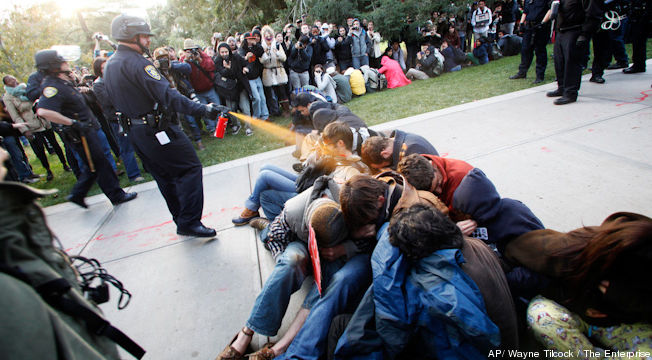
ReFund California is also dismissive of independent investigations the UC has initiated to look at aggressive police repression of students protests, including police at UC Berkeley using batons and mass arrests to dismantle an OccupyCal tent city and police at UC Davis dousing passive protesters with pepper spray. Video of both incidents went viral and have helped galvanize the overlapping Occupy and student movements.

“No amount of new ‘police protocols’ will prevent violence against students and workers, as long California’s corporate and financial elite along with their representatives among the Regents and administrators of the UC rely on police to address the concerns of students and workers,” the ReFund California Coalition wrote in the letter to the UC.

Today’s action at UCSF – centered around the meeting site at 1675 Owens Street, where a Guardian reporter is on the scene and will offer her report later today – joins similar protests at UC Davis, UCLA, and UC Merced, the four sites where the Regents will gather.

Meanwhile, ReFund and other groups are also angry that the CSU Board of Trustees went ahead with its Nov. 16 meeting behind closed doors, clearing out student protesters and the public before they approved a 9 percent tuition hike, an action that Lt. Gov. Gavin Newsom (a member of that body) denounced.

“While I understand the CSU leadership’s concerns regarding public safety, the spirit of open deliberations has been marred,” Newsom wrote in a Nov. 18 letter to Chancellor Charles Reed, calling for the matter to be re-voted at the Dec. 5 meeting to “allow the full board to hold an open debate, with full public comment and members of the media present.”

In related news, many students and faculty at UC Davis are on strike today to protest the pepper-spraying incident. And tomorrow (Tues/29) at noon, members of OccupyOakland say they plan to retake Frank Ogawa Plaza (which they renamed Oscar Grant Plaza) and set up another 24/7 encampment.

UPDATE NOON: Guardian reporter Christine Deakers says there is a heavy police presence at the UCSF meeting, where only 50 members of the public are allowed inside and most of those seats have been claimed by ReFund California members. When the Regents decided to limit the time for public testimony, the group held a General Assembly in the meeting, drowning out the Regents and causing the meeting to adjourn until 1:30 pm. You can follow her tweets here or here.

UPDATE 1:50 PM: The UC Board of Regents did not reconvene, instead cancelling the rest of the meeting without taking action. The San Francisco Chronicle quotes Newsom as saying he supports the demands of ReFund but that he’s not willing to sign its pledge.

Dick Meister: The lessons of Ohio

0

By Dick Meister

Dick Meister, former labor editor of the SF Chronicle and KQED-TV Newsroom, has covered labor and politics for more than a half-century. Contact him through his website, www.dickmeister.com, which includes more than 350 of his columns.

AFL-CIO President Richard Trumka has drawn some important lessons from last week’s election in Ohio that repealed a state law severely limiting the collective bargaining rights of public employees. Worse, it threatened to inspire passage of similar anti-bargaining laws elsewhere.

Listen to Trumka, a man who obviously knows what he’s talking about. In an article he wrote for Reader Supported News, he cites post-election polls showing that more than half of Ohio’s voters correctly “perceived the law as a political maneuver by Gov. John Kasich and state Republicans to weaken labor unions, rather than a genuine effort to make state government more efficient.”

Another poll, done for the AFL-CIO, showed that more than half the voters also found that Kasich and his allies “are putting the interests of big corporations ahead of average working people.”<–break->

Voters everywhere in the mid-term elections clearly wanted change. But, as Trumpka says, they did not want “political maneuvers and overreach” like those of Kasich and Republican legislators. They want effective action to curb unemployment, create jobs and deal with the other severe economic problems facing the country.

As Trumka notes, public employees, union members, Democrats and liberals voted overwhelmingly to repeal the Ohio law, but so did a majority of voters “from households with no public employee, workers without union representation and independents – as well as 30 percent of Republicans and 36 percent of conservatives.”

One of the key lessons Trumka draws from Ohio’s election is that “the myth of the pampered public employee has been busted. Public employees didn’t cause the economic crisis and they’re not the enemy. Demonization of public employees is neither a strategy nor a solution and the heartland Americans who voted to restore rights for public employees understood that.”

The election also reinforced the continued need for working people, public and private employees alike, to join closely together. That’s what happened in Ohio. There, as Trumka notes, “firefighters, teachers and other public employees were joined by plumbers, pilots and all kinds of private sector employees to win. Worker to worker, neighbor to neighbor, the message spread, and what began as an attempt to divide workers flopped famously. In the end, working people’s solidarity was the message.”

Politicians could also learn important lessons – if they will. For the Ohio voters “showed that when fundamental rights and livelihoods are targeted, working people will not only defend themselves, but come back stronger.”

The outcome of the Ohio vote should show politicians seeking office that it would be wise for them to pay much more attention to the wishes of working and middle class voters than to those of the wealthy and privileged. Says Trumka:

“Cutting taxes for millionaires and billionaires, scapegoating working Americans and their unions and downsizing Social Security and Medicare may get you a standing ovation from the 1%, but the voters who decide elections will not be fooled – and you may just get more than you bargained for.”

Trumka’s correct. But despite the results in Ohio and the lessons they hold for the anti-labor political right, many undoubtedly will continue what the AFL-CIO sees as “part of Wall Street’s strategy to chip away at collective bargaining rights, piece by piece, law by law, until unions and collective bargaining rights are destroyed.”

Working people and their unions can be reasonably certain, at least, that they’ll have strong support in trying to withstand the attack – including support from the Occupy Wall Street movement, which Trumka credits with “redefining the political narrative.”

The next major test will come in the presidential and congressional elections in 2012. They’re especially looking for support from the swing voters who supported President Obama in the 2008 election and generally have the same political views as the majority of Ohio voters.

Trumka describes the swing voters as “working Americans with modest incomes, moderate views and little patience for polices that aren’t fair and don’t work.”

He says politicians seeking election or re-election next year must heed them and “support public policies for the 99 percent – policies that create jobs, invest in America’s future, safeguard Social Security, Medicare and Medicaid, and promote fiscal sanity by requiring millionaires and billionaires to pay their fair share.”

OK, that’s asking for much more than we’ve been getting. But the Ohio vote demonstrated that it is possible to garner the votes necessary to overcome the forces that would deny us vital economic and political rights.

Dick Meister, former labor editor of the SF Chronicle and KQED-TV Newsroom, has covered labor and politics for more than a half-century. Contact him through his website, www.dickmeister.com, which includes more than 350 of his columns.

Will Occupy message reach Sacramento?

26

One of the early tests of the political impact of the Occupy movement will come in the next two months, as California prepares to make drastic further cuts in education and social services for the poor and the Democratic governor begins — cautiously and hesitantly — to talk about new revenues.

The numbers from the Legislative Analysts Office are fairly bleak — the state budget relied on $4 billion in revenue that hasn’t been collected. That’s because Gov. Brown and the Democrats in the Legislature assumed that the economy would pick up more than it has. We don’t know what the final shortfall will be — but because the budget deal included automatic trigger cuts, it’s clear that K-12 education, CSU and UC are going to get hit again, as will, for example, medical assistance for the disabled.

So just as students and faculty all over the state are protesting existing cuts and tuition hikes, more are on the way. I expect this will go over extremely well on the campuses.

The cops may be poised to shut down OccupySF, but this is a movement that isn’t about to go away. And if the governor and the Democrats in the Legislature (who are going to be running from new districts next fall) start to feel the heat and realize that the Occupy movement is already influencing the political debate and will, directly or indirectly, be playing a major role in state and national politics, they’re going to have to respond.

How? Well, the Legislature can always decide to scrap the cuts and raise taxes now. Unlikely, since that would require a two-thrids vote and the Republicans still care more about their no-taxes pledge than they do about the tens of thousands of people (including in their own districts) who are taking to the streets to protest economic inequality.

More likely the talk will be about November, 2012, and what sort of revenue measures Jerry Brown wants to put on the ballot. And that’s where the politics of Occupy can have a significant impact.

There are so many ways to go with tax measures; the easiest, in some ways, is to talk about the state sales tax, which bothers the GOP hardliners (like any tax) but bothers the big-business world a lot less. Most of any sales tax hike would be paid by consumers and the poor would pay more than the rich; typically, big business groups are willing to accept a sales tax hike before they’ll go for anything more progressive.

Obviously, the best option is to do exactly what Occupy is talking about, and raise the income tax on the top brackets (and cut corporate loopholes, and pass an oil severance tax). And that’s what will drive the California Chamber of Commerce types absolutely mad.

But I think a there’s a way to make this a winner at the polls, and a winner for the legislators who push it — and maybe even a winner for a Dem or a moderate Republican in some of the potential swing districts. Just call it a One Percent Tax — that is, a tax on the One Percent. Could be a combination of income taxes and corporate taxes, as long as it’s a package carefully written to target largely the wealthiest in the state.

Hard for anyone these days to oppose something that is totally defined and promoted that way. Gives the Occupy movement something to vote for. Could save jobs, keep classrooms open, keep sick people alive … I see no downside at all.


What if you were rich?

14

There seem to be more and more millionaires coming out of the nicely paneled woodwork to tell us that they should pay higher taxes.  I heard one of these folks on NPR yesterday and she was talking about what made her happy in life. She’s loaded, young, and could have anything she wanted, but what she said made a lot of sense: She said she would be better off and a lot happier if everyone in the country had access to decent housing, enough to eat, quality transportation and a chance at a good education. 

So I started thinking about it, I guess there’s a reason that I’m a horrible capitalist, because I totally agree with her. If I hit the lottery …  well (geek alert), I’ve had my eye on that cool Visconti lava fountain pen, but there’s really not of lot of stuff that I want. And maybe I’m not that odd – maybe most people really don’t want isn’t Michael Moore’s mansion (gawd, who would keep it clean? I can’t even get the dog hair off the floor of my little place in Bernal Heights). Maybe most of us want to make sure our family has a place to live and there’s money for the kids to go to college and medical care for our aging parents and a job that’s not awful.

What else do I want? I want to be able to ride high-speed rail to L.A. instead of driving the car on I-5 on Thanksgiving week. I want the kids to be able to take buses directly to school so I don’t have to drive them. I want more nudity on TV (well, that’s not really about money, I guess). I want the rec centers and libraries to be open every day and on the weekends, and I want them to have great programs, and I want to have more swim classes at the public pools so I don’t have to pay to send my daughter to the YMCA, and I want to be able to see a doctor when my leg hurts without waiting a month for a manged-care appointment. A nice fishing boat would be cool, but I could share.

Seriously: I’m like the rich girl on NPR (kind of): Most of what I want is stuff that the government ought to be providing to everyone anyway. If only she and the rest of the rich people in the country, who already have everything they want, were paying fair taxes. I got no problem with people wanting to be the next Bill Gates, and even in a really good capitalist system (is that possible?) there will always be rich people, and I suppose the desire for financial success drives progress.

But wouldn’t we all be better if … we were all better? What would you want if you were rich?

And if I do hit the lottery, do I get a tax deduction on the boat?

Dick Meister: Strange bedfellows: Labor’s Tim Paulson and the Chamber’s Steve Falk

5

By Dick Meister

Dick Meister, former labor editor of the SF Chronicle and KQED-TV Newsroom and a former city editor of the Oakland Tribune, has covered labor and politics for a half-century as a reporter, editor, author and commentator. Contact him through his website, dickmeister.com, which includes more than 300 of his columns.

It’s hard to imagine organized labor and the thoroughly anti-labor Chamber of Commerce on the same side, especially in a city like San Francisco with a major union presence.

It’s especially hard to imagine it at a time when unions everywhere are joining with Occupy Wall Streeters to demand justice from anti-labor business and corporate leaders like those who control the Chamber.

But consider what Tim Paulson, executive director of SF’s Labor Council, and President Steve Falk of the SF Chamber of Commerce had to say in a joint statement about the results of Tuesday’s election.

They were downright overjoyed about the passage of Proposition C, which will raise the amounts city employees must pay toward their less-than lucrative pensions and limit future cost-of-living raises. That’s a way to avoid raising business taxes to maintain city services in these recessionary times.

Perhaps most distressing, the passage of Prop C shifted control of the City Health Service System from the employees who are covered by the system to City Hall appointees who won’t have to demonstrate any particular experience in health care matters.

At least Paulson and Falk said they were pleased with the defeat of Public Defender Jeff Adachi’s outrageous Prop D – even though it would have changed the city pension system in almost exactly the same ways as Prop C.

In any case, the difference between C and D was not necessarily their content, but how they got on to the ballot.

Why, exclaimed Paulson in a separate, self-congratulatory statement, the results “sent new shock waves across San Francisco and America as workers demonstrated that collaborative democracy is the best way to set public policy.”

Collaborative democracy? By that I guess Tim was referring to the joining together of labor leaders and public employee unions and Chamber of Commerce members in a coalition with city officials, non-profit social agencies and community groups to put Prop C on the ballot.

The collaborators didn’t even include representatives of the retired employees whose health care would be seriously affected and who were quite active in helping elect labor-friendly candidates.

Paulson, a generally ineffective leader who always seems to be seeking approval of the City establishment, singled out billionaire Warren Hellman for being one of the principal collaborators.

Paulson boasted that every city employee union joined in what he actually described as “a real San Francisco way of doing things.” Hardly. If there really were such a thing, it would be a far cry from the “collaborative” approach that involved labor giving in to the wishes of its anti-labor corporate and business opponents.

Paulson and Falk claimed the approach will be “a model for the rest of the country.” Thankfully for the rest of the country, that seems highly unlikely given the widespread demands for actual reform triggered by the Occupy Wall Street protests.

Negotiations between labor and management eventually reach agreements that both can live with, albeit often uncomfortably. But no agreement can be reached, or should be reached, when one party – the Chamber of Commerce in this case – is not seeking real compromise with an enemy – namely unions – that it would like to put out of business, or at least seriously weaken. Unions, of course, have the same feelings about union foes like the Chamber.

Tim Paulson actually declared the election results “a great victory during difficult times.”

Dick Meister, former labor editor of the SF Chronicle and KQED-TV Newsroom and a former city editor of the Oakland Tribune, has covered labor and politics for a half-century as a reporter, editor, author and commentator. Contact him through his website, dickmeister.com, which includes more than 300 of his columns.


The growing 99 percent

0

steve@sfbg.com

In recent weeks, the Bay Area has been roiled by anger and frustration with how the rich have grown richer while the rest of us endure underemployment, foreclosures, and deep cuts to public education and services, peaking with the Nov. 2 Oakland General Strike that drew more than 10,000 people into the streets to demand economic justice.

The Occupy Wall Street movement — and its many local manifestations, including OccupySF and Occupy Oakland — has been the main vehicle for those populist passions for the last two months, with the support of the labor movement. But now, student and faculty groups from California’s three public university systems are about to get involved in the fight in a big way.

Student and labor groups allied with the ReFund California coalition are planning a week of action for Nov. 9-16, culminating that final day in demonstrations outside the California State University Board of Trustees meeting in Fullerton and University of California Board of Trustees meeting at the UCSF campus in San Francisco’s Mission Bay.

Those protests aim to connect the problem of deep cuts and tuition hikes in the public university systems with the larger issue of wealthy individuals and corporations that haven’t been paying their fair share. The coalition wants the boards to pledge support for a five-point action plan that includes taxes on the wealthy, removing commercial property from Prop. 13 caps on property taxes, restoration of cuts to higher education, a sales tax on Wall Street financial transactions, and pressuring banks to reduce mortgage debt on underwater homes.

Charlie Eaton, a ReFund California organizer from United Auto Workers Local 2865, which represents teaching assistants at UC, notes that many UC and CSU board members also sit on the boards of major banks and corporations that have contributed to the current financial crisis and which have been in the crosshairs of the Occupy Wall Street movement.

“It’s really a club of California’s corporate elites,” Eaton said. “It’s about saying to these folks: if you aren’t willing to actively support paying your fair share, or at least get out of the way, we can’t let it be business as usual at the Wall Street institutions that you help run.”


NO BUSINESS AS USUAL

He said there’s a direct connection between the actions of these corporate boards and lack of resources in California for public education and services, so it’s only right that these powerful board members — from Regent Richard Blum, the investment banker husband of Sen. Dianne Feinstein, to Trustee Bill Hauck, former head of the California Business Roundtable — support the needs of the 99 percent.

“We’ll be there to call on them to sign the pledge,” Eaton said of the Nov. 16 meetings. “And if they aren’t prepared to make that pledge, we’re headed to the Financial District to make sure there is no business as usual for these corporations.”

That day of action will echo the last ReFund California protest in San Francisco, the Sept. 29 “Make Banks Pay” march through the Financial District that was one of the first high-profile demonstrations involving OccupySF. The march was several hundred strong, targeting major financial institutions including a Chase Bank branch on Market Street that was occupied by protesters, resulting in six arrests.

When we asked Eaton whether the Occupy movement would lend its energy and numbers to these ReFund California protests, he said, “We’re embedded in the Occupy movement, so it’s not quite right to say it’s something the Occupy movement might help with…I think the Occupy Wall Street movement shows we can make them pay.”

Meanwhile, the next day (Nov. 17), Occupy Wall Street plans to march the 11-mile length of Manhattan in a day of action that will be supported by solidarity marches by Occupy encampments across the country. That is also the day that a two-campus strike is being threatened by the California Faculty Association.

“I think that day is going to be a busy day all around the nation,” Kim Geron, a political science professor at CSU East Bay and vice president of the CFA, told us.

On Nov. 7, the CFA Board of Directors authorized one-day strikes for Nov. 17 at the CSU East Bay and CSU Dominguez Hills campuses to protest CSU Chancellor Charles B. Reed’s decision to withhold negotiated faculty pay raises. It would be the first faculty strike in the system since 1983, although a strike was authorized in 2007 but called off after a negotiated settlement.

After the vote, according to a statement put out to members, CFA President Lillian Taiz told her board, “We hope this carefully targeted strike, which symbolizes both our anger and our commitment to fairness, will lead to changes in his priorities and his positions. If it does not, the CFA leadership—and the CSU faculty we represent—are prepared to escalate the fight.”


DUCKING THE TAX ISSUE

CSU spokesperson Mike Uhlenkamp said the campuses will remain open despite the strikes. “We expect it to be business as usual,” he said. As for the pledge that ReFund California is seeking, “We don’t get into advocating between taxing and not taxing,” he said, saying that’s a state decision and “we’re not going to push them to make that determination.”

Guardian calls to the UC President’s Office were not returned by press time. A spokesperson for Gov. Jerry Brown, who is the subject of a student letter-writing campaign urging him to tax the rich and stop cutting public services, continued to blame Republicans.

“We too are deeply concerned about cuts to the state’s universities and colleges, which is why the Governor pushed for a solution to our budget deficit that included extending revenues. Unfortunately, Republicans in the Legislature refused to even allow the people of California to vote on the measure, which could have helped prevent future cuts,” Brown spokesperson Evan Westrup responded via email.

When we asked whether Brown was simply giving up, how he planned to deal with the problem, and why Brown has not followed up his campaign pledge to tax the rich with any proposals to do so, he wrote simply, “There are a number of ways to pursue additional revenue moving forward and these options are being considered.”

Geron said there is a clear connection between problems in the CSU system and the hoarding of resources by the richest one percent of Americans, the main critique of Occupy Wall Street, a movement driven largely by current and recent college students.

“We are part of it. One of our slogans is we are the 99 percent and we teach the 99 percent,” Geron told us.

While the CFU is focused on decisions by the Chancellor’s Office — indeed, the strike is legally allowed only because the chancellor broke the contract by withholding negotiated pay increases — Geron said those decisions were made in a climate of deep funding cuts prompted by the state budget crisis.

“Obviously, the economic crisis is a lot of the reason why all this happened. It’s part of a larger crisis that is going on about how to fund the public good, including higher education,” Geron said. “Students are paying a lot more and getting a lot less. That’s the heart of what’s going on.”

The UC Student Association is taking part in the ReFund California week of action, but has not yet voted to participate in direct action against corporations on Nov. 16, Executive Director Matt Haney told us. But he said that many UC students will still take part in that action, just as they’ve been taking part in the Occupy movement.

“It’s the same frustrations. We have to get out there and start pushing this ourselves,” he told us. “We need to show the state that things can’t just keep moving along as they have. We have to put a stop to business as usual. The economic collapse is what destroyed the UC system.”

Haney sees the student, labor, and Occupy movements starting to come together in a very natural way. “It has really put the wind in the sails of student activists to see the energy of the Occupy movement,” Haney said. “There is a coming together of students and labor, and it’s overlapping with the Occupy movement in a powerful way.” *

Find details about the ReFund California Week of Action at www.makebankspaycalifornia.com.

Helping the 99 percent — with less

2

OPINION La Raza Centro Legal, an organization central to the empowerment of San Francisco’s low-wage immigrant workers, finds common cause with the Occupy movement during a time when our programs combining legal services and worker organizing are in jeopardy. Our hour of need falls within a window of tough times, but heightened political awareness, and we are calling out to the community to join us in solidarity as members of the 99 percent.

La Raza’s resonance with Occupy shows on a bilingual sign printed for the movement. Under a day laborer’s face, the sign reads, “We are the 99 percent. I’m blamed for the economic crisis, but what about the Wall Street banks?” Immigrants pay more in taxes than they use in government services, generate revenue exceeding the services they receive, subsidize the Social Security system, and provide labor that supports entire industries.

Contrary to the red herring propaganda generated by the 1 percent, the scapegoated low-wage immigrant worker is not the cause of the financial crisis in the United States. Occupy has resuscitated public discourse with the plain facts of shocking economic inequity and the corruption of our democracy. Immigration debate can now rise to the surface after nearly drowning in the lies that spawned the recent legal abominations in Arizona, Alabama, and Georgia.

In the current political and economic climate, immigrant rights organizations face an intractable three-pronged challenge: dangerous policies born of anti-immigrant zeal, a crushing economic crisis that disproportionately impacts low-income communities of color, and dwindling funds from the government and foundations that used to support our work. The Obama administration’s Orwellian-named “Secure Communities” deportation program creates an unprecedented stream of profits for privately contracted immigration detention facilities rife with human rights abuses. At the same time, employers take advantage of job scarcity to exploit low-wage immigrant workers. On the same days that our advocacy and services are needed more than ever, we’ve receive news that a grant that we depend on will not be renewed in the coming year.

Just like so many other members of the 99 percent, La Raza Centro Legal is in financial crisis. If the organization cannot find immediate support, some of La Raza’s programs that help so many people in the immigrant community could die. If La Raza is diminished, who will reunite a family unjustly torn apart, or take an employer to task for ripping off a day laborer so that the worker can feed his children? Who will organize the community so that, through La Raza’s Day Labor Program and Women’s Collective, low-wage immigrant workers can find their voice and build their own innate capacity for leadership in their community?

We aren’t giving up. Because the Occupy movement has pushed into public consciousness the well-established but long-ignored truth of how the status quo is hurting us all, it offers incredible hope. An October 20 community meeting kicked off a new fundraising drive for La Raza. San Franciscans and the city must join us in solidarity to help us find ways to support community nonprofits in declining economies and increasing civil rights abuses — which is when they are needed most.

Kate Hegé and Kate Deeny work in the Workers’ Rights Program at La Raza Centro Legal. For more information about how to help, contact Genevie Gallegos, Executive Director of La Raza Centro Legal at Genevie@lrcl.org.

Impertinent questions to Sup. Sean Elsbernd

9

 At Tuesday’s Board of Supervisors meeting, Sup. Sean Elsbernd voted against a sensible resolution supporting regulated and safe patient access to medical cannabis in San Francisco.

He was on the losing end of an an 8-3 vote, with Sups. Carmen Chiu and Mark Farrell also voting against.

I was curious why, in San Francisco in November of 2011, he would vote against what I and many others considered a sensible but restrained resolution supporting local small businesses that are regulated and paying taxes and about the only business showing growth in the city.

So I emailed him some Impertinent Questions:

“Why do you continue to support a federal crackdown on medical marijuana? Why do you do this as a purported advocate of small business and bringing in more tax revenue to the city?”

I  also asked Elbernd who he now supported for mayor, since the last time I heard from him he said he would support Mayor Ed Lee only if there were no other candidate who could beat State Sen. Leland Yee. He replied that had not endorsed a candidate for mayor, but if I contacted him after the election he would tell me who he voted for. “Rest assured,” he said, “the Bay Guardian endorsements will certainly influence my decision making process.”

On the marijuana issue, Elsbernd objected strenuously to my statement that he “supported the federal crackdown. Please send me the recording, clip, reporter’s notes, or any other documentation you have that demonstrates t hat I specifically said I supported the federal crackdown.”

Elsbernd asked if I was referring to his note vote on the resolution. (B3 answer: I was.)

“Are you erroneously extrapolating an opinion of mine based on my ‘no’ vote. Is that journalism or is that political spin? Would not a journalist simply ask the question like this, ‘Why did you vote no” on the resolution Making assumptions without any fact to back it up seems a bit irresponsible and lazy for a journalist. While you e-mail me under the guise of being a constituent, and your certainly live in District 7, we both know that this email discussion will be posted very soon on your Bay Guardian website (hello to all of who have time in your day to read Bruce’s blog) with additional edits and snide comments to which you will not me the opportunity to respond. (B3 comment: Elsbernd knows that I send him Impertinent Questions from time to time and that the Q and A will appear on my blog. And he knows he can answer in the blog comments or in a letter to the Guardian. To his credit, Elsbernd always answers me and I enjoy hearing from him. And I keep inviting him to talk things over at tapas night on Thursday night at the Que Syrah wine bar in West Portal in his district. I even offer to buy the first flight, but alas  he never shows.)

Elsbernd then says he will answer my real question. “Why did I vote ‘no’ on the resolution?

Did you read the entire resolution? (B3 answer: yes.) Did you agree with every ‘whereas’ clause and every ‘resolved’ clause? (B3 answer: Yes.) Elsbern continued, “I do not. In particular, I strenuously object to the ‘whereas’ clause on page l, line 12-16, which implies that all licensed medical cannabis dispensaries in San Francisco are ‘clearly acting in good faith,’ and that they ‘take every measure possible to be safe and professional members of the community.’

Elsbernd then gets specific: “I suggest you talk to your neighbors on the other side of Portola/Junipero Serra who live near the dispensary on Ocean Avenue and ask them if ‘every measure’ has been taken to to be safe and professional members of their community. I suggest you read the police reports in and around the area over the last five years and compare those same reports o before the opening of the dispensaries and ask whether or not ‘every measure possible’ has indeed been taken. If you take the time and do that work, I think you’ll understand, why, as the representative of those neighborhoods, I voted against that resolution. (B3 answer: I am always take note  when Elsbernd purports to represent his constituents in his district. But he could have amended the motion in committee (he was absent on the committee vote) or at the board. Instead, he used this single example to justify his opposition to a timely resolution putting the city squarely on record as being opposed to the ridiculous, expensive, job-killing, and tax-killing crackdown by the federal government on medical marijuana and its use in treating debilitating diseases and chronic pain in thousands of patients in San Francisco and throughout the state. The resolution also resolved that the supervisors “encourage the President and Congress of the United States to enact legislation requiring federal law enforcement to respect state medical cannabis laws.”)

Elsbernd also argued that the resolution called “for a massive tax reduction for all dispensaries in its resolved clause to support HR 1985, a bill by Rep.Stark granting a tax exemption for all such businesses? I know the Guardian typically opposes all business tax exemptions. Do you guys support this one.” (B3 answer: The Stark bill is not a a tax reduction bill. It is a bill aimed at reversing an IRS crackdown on many large dispensaries—including Harborside Health Center in Oakland, the largest in Northern California, that they cannot write off normal business expenses and must pay a 35 per cent levy on those claims going back for three years. Harborside’s Steve DeAngelo told the Guardian that this IRS attack would put Harborside—or any company with high overhead costs—out of business.  http://www.sfbg.com/2011/10/11/feds-crack-down

Stark’s bill would reverse that IRS decision and allow dispensaries to deduct expenses according to state law just like all other businesses in California.
http://americansforsafeaccess.org/downloads/Stark_bill_2011.pdf

And so my original Impertinent Question remains: why is Elsbernd (and Chiu and Farrell)  supporting in effect a federal crackdown aimed at killing off marijuana dispensaries and killing off a growing sector of small business and a valuable source of tax revenue? If he isn’t supporting the federal crackdown with this vote, what is his position on medical marijuana dispensaries?  Wine and tapas, Sean?  B3)

Blowback

0

caitlin@sfbg.com

HERBWISE A throng of reporter types had gathered in the lobby of the State Building to listen to State Senator Mark Leno and State Assemblymember Tom Ammiano badmouth the feds.

“It is not the purview of the federal government to upset the will of the people,” said Ammiano, to the grunted affirmations of the patients, advocates, and cannabis business owners who had also assembled for the event.

Leno called the recent steps taken against the medicinal cannabis industry — which provides California each year with somewhere between $50 million and $100 million in taxes according to a 2010 estimate by the state’s Board of Equalization — “the exact wrong policy for a deep recession.” And then there’s the patients themselves. The two gay politicians commented that the issue of patient access is especially salient for the LGBT community, given that group’s increased incidence of HIV and AIDS.

Ammiano and Leno announced plans to push for federal regulatory guidelines that would clear up inconsistencies in the way medicinal cannabis works at the state level. As of press time for this article, Ammiano had scheduled another panel to discuss the matter on Tuesday, October 25 where he’ll be joined by marijuana advocates, labor leaders, Steve DeAngelo — founder of Harborside Health Center, which the IRS recently announced owes millions in back taxes because the business cannot legally write off standard expenses — and Matthew Cohen, who was handcuffed for hours along with his wife when the DEA raided his legal Mendocino County grow-op Northside Organics earlier this month. The event is being timed to coincide with President Obama’s visit to San Francisco this week.

When the politicos were done with their spiels, they trotted out Charlie Pappas, the owner of Divinity Tree Patients’ Wellness Cooperative. The landlord of Pappas’ 3,000-member dispensary was served with a cease and desist notice from the DEA that threatened property forfeiture and jail time if he continued to let Divinity Tree operate in his building.

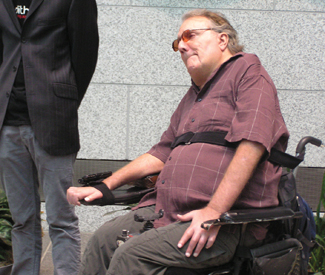
Pappas approached the podium in a wheelchair, a patient himself. As he was introduced, it was noted that here we had one of the little guys, not a tycoon turning millions of dollars of profit as dispensary owners have been portrayed by unsympathetic media and government officials. It’s illegal to turn a profit off of medical marijuana — and who would want to get rich off of sick people anyway?

The controversy over the issue is understandable, but also mind-blowingly hypocritical. You know who turns a profit off of making and distributing medicine? The pharmaceutical industry, to the tune of billions of dollars, in fact. Makes the $1.7 billion national market that constitutes the medical marijuana industry look like shake.

The sound of money talking rendered unsurprising the words of a one Bruce Buckner, who has been a patient “since the laws passed” and who came down from his home in Sonoma County to attend Ammiano and Leno’s press conference. Buckner shared his suspicions about why the federal government turned its eyes to dispensary operations this autumn. Slightly grizzled and wearing a straw hat, Buckner had sat patiently though the event, hooked up to a respirator.

“It’s real obvious why Obama is doing it,” he said. “The pharmaceutical industry is afraid of how potent this medicine is.”

Stealing an election — and more

5

news@sfbg.com

OPINION The emergence of apparent voter fraud that mars San Francisco’s mayoral election rightly resulted in calls for a federal investigation and federal monitors. It’s not the political interests of rival candidates that are at issue. It is the consequences of a dishonest election process for our city and its future.

Almost exactly 20 years ago, the McArthur Foundation, home of the genius awards, recognized the Democracy Index for showing the connection between voter participation and election and campaign reforms. The group found that the greater the transparency in political contributions, the stronger the protections against pay-to-play politics, and the greater protection against voter fraud, the higher voter participation climbed.

Today it doesn’t take a genius to recognize that sleazy tactics, end-runs around campaign rules, and dubious voting schemes do as good a job suppressing voter interest as the Republicans did in Florida in the 2000 election victory of George W. Bush, or poll taxes did in the past.

In this year’s mayoral election, we appear to be headed toward the bottom of a slippery slope. Campaigns hungry for advantage aren’t slow to recognize loopholes; soon a loophole becomes a strategy. What follows then is to push the envelope over the line. A candidate’s honorable intentions too quickly fall prey to the politics of convenience.

This year, with an interim mayor pledged not to run for election and thus avoid the entanglements of political self-interest, the expectation was raised high.

“My goal is to restore the trust in the mayor’s office of the past,” Mayor Ed Lee said in an interview just two weeks after assuming office.

In the ensuing months, Lee’s posture changed. He would be no better than the minimum standard required in the law, he said in his interview with the San Francisco Examiner.

He would not release the names of his finance committee, he claimed that a Run Ed Run effort was blameless after the Ethics Commission found a loophole that left them outside the city’s campaign laws, he complained that keeping track of contractor contributions was burdensome paperwork that he should be spared, and he maintained a close relationship with the leaders of independent expenditure committees while insisting he knew nothing of their activities.

When new tools can provide citizens with near instant access to everything from when the next bus comes to restaurant inspection scores, Lee’s campaign is supported by efforts that are deliberately opaque, designed to misinform if not to mislead.

Clearly this is not a mayor trying to leave the city, or its political process, better than he found it.

A 2011 mayoral victory under fraudulent terms would make everyone a loser, regardless of candidate preference.

It’s not just an election that might be “stolen” by unethical or illegal manipulation.

We would be defrauded of what we are entitled to have: the chance for all of us to forge a better future for the city without our optimism shattered by dishonest, unethical practices. That should not be sacrificed for anyone’s political advantage…

Larry Bush publishes citireport, a journal of politics and money


Editor’s notes

0

tredmond@sfbg.com

I say it over and over again, because some people clearly aren’t paying attention:

Corruption matters.

When the mayor of San Francisco surrounds himself with people who don’t show any respect for campaign finance or ethics regulations, who think it’s fine to skirt (and possibly break) election laws, it undermines faith in local government.

And at a time when conservatives at the national and state level are mounting a concerted campaign to shrink, weaken and ultimately burn down government, the last thing San Francisco needs is to give them fuel.

Listen: When Willie Brown was mayor, a tax lawyer named Ron Chun was running for assessor. Generally a good guy, generally progressive, full of creative ideas. But when I asked him about how to get more revenue into the city, he said:

“Why should we bring in more revenue? Willie Brown’s just going to waste it on his cronies anyway.”

He wasn’t alone. A lot of generally progressive people felt as if paying taxes was throwing money down the sewer. Because everyone knew that Brown was hiring unqualified people, pouring cash into contracts for his pals, handing out raises and benefits to city workers who supported him — and treating critics as if they were traitors to the nation.

Mayor Lee says he doesn’t approve of what looks an awful lot like voter fraud and doesn’t support what the independent expenditure committees are doing in his name. But anyone with any sense knows that the IE groups and the Lee campaign and the Lee administration are all parts of a permanent floating crap game where the players move around but everybody knows everybody else and there’s no way to keep communications completely shut off. If Lee wanted these “independent” groups to quit using stencils to make sure voters choose him for mayor, these operators would stop.

But he talks to people like Brown, people who have disdain for honest, open government, and they tell him not to worry. These things blow over. Once he wins the election, it won’t matter.

But when you have a mayor who invites corrupt actors into the house, it does matter. It matters a lot.