Sunshine

How they’re sitting

182

caitlin@sfbg.com

I’ve been hanging out with the Haight Street kids. Over the course of a week or so, I smoked weed, drank malt liquor, witnessed nasty run-ins with police officers — all events that anyone who has walked down the sidewalks of that legendary street would expect. But I also met people who’d give away their last dollar to a friend, people who know a thing or two about community, and people who don’t see sidewalks only as thoroughfares to commerce.

Ironically, though the homeless kids on Haight are the explicit inspiration for Proposition L, the sit-lie measure on the Nov. 2 ballot, their voices have been significantly absent from the vitriolic debate on its merits and faults. Ironic because of all people, it’s these young men and women — and the citizens of San Francisco who interact humanely with them — who could teach us the most about what public space in San Francisco could be.

I didn’t just stand with a notebook, fire questions, and walk away. I took a seat and spent time with the kids, to see for myself whether its true that they’re harassing people, letting their dogs run amok, and generally ruining everyone’s lives as much as sit-lie supporters say they are. That it turned out to be uplifting was an added bonus. I got to see what many don’t on their way to shop for souvenir bongs, retro dresses, and designer skateboards — the reason young people from around the country come to the neighborhood.

It doesn’t have anything to do with fancy Victorians and boutiques, which may explain the disconnect between the street kids and their detractors. They come for the legacy of individuals brave enough to slough off social mores that Haight-Ashbury residents are so ostensibly proud of — not to mention the companionship of others who are comfortable with their rejection of and by society. They come to share stories and pipes and encouragement, and it was cool to watch a streetscape in San Francisco that wasn’t geared solely to commerce.

And while the young people I talked to told me how much they liked to travel, to live free of convention and without ties to the workday world, after a while most acknowledged that they had left behind families who couldn’t or didn’t care for them, home situations that were uncomfortable enough to make life on the streets seem like a better alternative.

Although violent incidents, uncivil behavior, and threatening dogs are well-documented by other news sources, I didn’t see any of that when I was hanging out on Haight. That doesn’t mean that these things don’t exist — but it might suggest that some of the strident supporters of Prop. L are seeing what they want to see.

SPANGING

Steven, who asked us not to use his full name, is 20 and homeless. He grew up in Stockton, became a welder after high school, then decided he “didn’t want the hassle” of staying put for a wage job. His fingernails play host to an ungodly amount of dirt, but his tight blonde curls, pretty golden eyes (“they look like a lion’s!” says one friend in amazement) and mellow, generous demeanor make him a popular hub among his homeless peers.

It doesn’t hurt that he sells weed, small amounts at a time to passing tourists and acquaintances. He silently passes a pipe around to his companions with the slightest provocation. Steven approached me on the street before he knew I was a journalist, a fact that seemed to make little difference to him.

He says he came to the Haight “for the people,” for the area’s reputation of open souls and unconventional artists that originated in the glory days of Janis Joplin and the Grateful Dead. Like most of the kids I talked to, he eschewed the often dangerous shelter scene to sleep in Golden Gate Park or nearby Buena Vista Park despite the police surveillance that could result in spendy fines for park camping.

Although Steven’s worldly possessions fit into the large camping backpack he carries with him 24 hours a day, and even though he’s been living on Haight less than nine months — broken by a jaunt to Eugene, Ore., where he found it “too rainy” to join the town’s expansive street kid community — he doesn’t plan on being homeless forever. It’s just that nothing about this economic climate inspires him to sell his freedom for a paycheck. He plans to go to a four-year college eventually. He sees an education as the only way to get a “real” job. “But until then, why not do this?” he asks. I’m not sure if he’s waiting for my answer.

“This” is sit on Haight Street and “spange,” the term used for “flying a sign” and asking shoppers and neighbors walking by for money, often in a creative way. Of the many crimes street kids are guilty of in the eyes of supporters, spanging is the only one Prop. L would effect.

If Francisco voters approve it, anyone who sits or reclines on the sidewalk (with exceptions for the handicapped and those with permits — but not for the tired, workers on breaks, or people waiting for buses) will be subject to a fine of $50 to $100 for the first offense and $300 to $500, or a maximum of 10 days in jail, for someone found guilty twice within 24 hours of unduly supporting his or her body on the sidewalk between 7 a.m. and 11 p.m. Similar laws can be found up and down the West Coast — although Portland’s was pulled from the books last year after being found unconstitutional because it targeted the homeless.

I ask street kid after street kid why they’ve chosen this lifestyle. Many wouldn’t have it any other way. “Why do people want us off the street?” says Oz, a 21 year old from upstate New York who deals alongside Steven. “Probably because they can’t do this themselves.”

Though I’m skeptical at first, after a while I see why the unconventional group of “travelers” on Haight choose to spend their time spanging. Conversations get struck up with the most unusual people — the old hippie who bought a new Mad Hatter cap for the weekend, the suburban woman who might or might not like to buy some weed (she can’t decide). When a few businesses ask us to move so they can sweep the sidewalk or clear a doorway, the street kids I’m watching relocate with little protest. Many who walk past Steven seemed to find humor in his sign, which that day reads “Are you one paycheck away from having this be your job too?” He says he likes to switch his message daily. “Keep it fresh.”

By hanging out with the spangers, I get to see a Haight Street with human interaction at its core. People walk by, often dropping off surprisingly generous gifts: a ex-Grateful Dead roadie with a massive beard who lives in Fairfax and stopped by the neighborhood for a quick lunch with his daughter parks in front of Steven’s group and approaches them. “You kids hungry? You look like you could use a pizza.”

He emerges a half-hour later with a large cheese pie and drives away after chatting for a few minutes about the old days, to the glee of the group (many of the street kids are Dead Heads). The kids eat their fill, then start handing out the remaining pizza to people walking by, a comic role reversal. “I like to support the community — they get back all the money they get sucked out of them,” Steven tells me.

“NARCOTIC FUELED, ANTISOCIAL THUGS”

The campaign to put a sit-lie ordinance into effect in San Francisco kicked into gear with a Saturday morning stroll. As San Francisco Chronicle columnist C.W. Nevius — who regularly publicizes complaints against the Haight street kid culture — reported Feb. 27, Mayor Gavin Newsom recently relocated to the neighborhood and saw evidence of drug use on the main stretch of Haight where he was walking with his infant daughter. “As God as my witness, there’s a guy on the sidewalk smoking crack,” Newsom reportedly said.

The mayor threw his support behind a sentiment already being voiced by the Haight Ashbury Improvement Association, a resident-merchant alliance in the area. HAIA sees the street kids as disruptive outsiders. “These are not the flower children of the 1960s. It’s narcotic fueled, antisocial thugs who act like a quasi-gang,” Ted Loewenberg, president of the association, was quoted as saying in Business Week.

Adds the Prop L website: ” … the Haight-Ashbury district — once synonymous with peace and love — this corridor is now a hot spot for street bullies, pit bulls, and drug abuse.” It’s a deft cultural lobotomy that dissociates drugs from the Summer of Love, and a devious one that implies that street kids weren’t major players in that social revolution.

As for the bullies, I didn’t see any violence from the street kids in the days and nights I spent out on Haight Street.

I couldn’t get cops to talk to me about it, either. There were two police officers on foot traversing Haight’s main strip and I introduced myself when they stood chatting with a coffee shop owner in the afternoon sunshine and asked them about the sort of neighborhood complaints they regularly received about the street kids.

“No comment,” Cop No. 1 told me. Okay, Cop No. 2, your thoughts? “I don’t speak English.”

To my requests that they share their view of crime on Haight, I could get one response: “It’s complicated.” Later, when I returned to write down their badge numbers, they were standing silently, staring at a lone young man sitting against a wall next to his skateboard. The kid was looking at the ground. Eventually they handcuffed him and put him in a police car while he pleaded meekly about it “only being a little bit of weed — and I was only skateboarding on the sidewalk.”

The most aggression I witnessed from any party took place while I was tapping my feet to a group of traveling bluegrass musicians performing around 10 p.m. on a Thursday. Their cover of Del Shannon’s “Runaway” had inspired an older homeless man to strike up a curiously graceful stomp dance on the sidewalk. He was so drunk and fully immersed in the music that the bottle of Jim Beam in his flailing hand didn’t even register when the police officer approached him and asked, “What do you think you’re doing?”

The musicians began to pack up. “I could have told you this would happen 20 minutes ago,” one tells me, nodding toward the old man. “Don’t say a word or I’ll fucking take you in,” said the cop, who poured out the half-full bottle and wrote a ticket for the older man, who had made a few feeble protests that ended abruptly with the cop’s obscenity.

The officer said he’d received a complaint about the music, a line I heard from each cop I came into contact with on Haight — including one officer who cautioned a family with a toddler to pack up the bracelets they were selling to pay the towing charges on their van. “People don’t like to see people with kids out here, you better move it along,” the cop said.

“I’ve seen aggression because people start shit,” Steven tells me when I ask him about his experience with street violence. A man has just walked by chanting “dirty, dirty” in Steven’s and his friends’ faces. “They don’t like to see people sit on the ground.”

“There are people who come down here just to make themselves look better,” chimes in Oz. “Like ‘ha ha ha, I have air conditioning.’ All kinds of people start shit”

I asked if they knew they were the focus of a massive political debate in San Francisco. “No, what debate?” asked Steven.

“You mean sit-lie?” Oz asks. “It probably has to do with tourism. I don’t see why else they would do that.”

Even the most well-known recent case of Haight Street violence — which was reported June 11 by New York Times reporter Scott James as having “inspired a grass roots movement” that propelled Prop. L, seems to be a question of mutual aggression on the two sides of the street kids issue.

The story goes that a man named Thomas was hosing down the sidewalk in front of his house — a practice that is growing more common in the Haight to make property inhospitable to the homeless. He found himself “surrounded and engaged in a heated confrontation,” as James reports. Thomas reportedly shouted “Do you want a piece of me?” and a scuffle erupted between him and Chad Potter, a 26-year old homeless man, culminating with Potter being arrested and set free the next day. Thomas says Potter and friends continued to harass him after the incident.

James Orr, 24, is busking with his flute when I meet him sitting by a store that sells flowing hippie skirts and bumper stickers that command future tailgaters to “Coexist.” He’s looking to trade his wind instrument for a banjo, which he plays in addition to guitar. A rolling stone, Orr is in town for the Hardly Strictly Bluegrass festival that weekend — he travels the country going to festivals, and even scored a job recently at upstate New York’s Mountain Jam for the event’s blog site, taking photos with a borrowed camera of performances by (ex-member of The Band) Levon Helm and Michael Franti.

Orr’s quite erudite and eager to “say something articulate” about the situation of the street kids and travelers on Haight. He tells me that yeah, he’s seen aggression go down here on occasion. But he resents those situations leading to laws against sitting on the street.

“It’s another example of the few that do mess up casting a bad light on everyone else. Most of us just want to make some money, put a smile on someone’s face.” As a busker, he finds it baffling that people who are against the presence of the homeless would want him to stop plying his trade by making sitting illegal. “You should point out also that it’s how we make money!” he exclaims.

THE PIT BULLS

Snarling ruffians on frayed rope leashes stalking the city streets! As evidenced by the Civil Sidewalks campaign, dogs — specifically pit bulls — are another source of controversy on the pavement. Last December, SFist identified a C.W. Nevius tirade against the breed as example of its ongoing feature “Pit Bull Hate Watch.” The paper has pointed out that the demonized dogs can make great members of society and are often the subject of a media smear campaign.

But for many homeless youth, their dogs aren’t the means of imposing chaos on the gentry. They keep them for the same reasons we do: friendship, protection, love — and during the days I spent on Haight, it was a pleasure to pat the doggies while interviewing their owners. Most were as gentle and laid back as the kids they sprawled next to, a reasonably expected result from the 24 hours a day of socialization with humans that the homeless lifestyle affords.

Smiley is an inveterate street kid unlikely to go indoors anytime soon. “I don’t know how to do anything else,” she tells me. Now in her early 20s with a shock of magenta, purple, and dirty blonde hair and fanciful purple ear plugs that pierce her lobes before spiraling nearly to her shoulders, she’s been traveling since she was 12 — “a Bohemian by blood,” as she puts it. Not only did her parents move their household regularly throughout her childhood, but their heritage is Romani, from the traveling tribes of Eastern Europe.

For Smiley, travel outside the bounds of business trips and weekend vacations is her life’s norm, and Haight Street’s legacy resounds in her nomadic soul. “Most of the people that travelers idolize were here,” she tells me.

Smiley has a year-old behemoth black mutt with droopy eyes. He obliges her as she leans into him holding her spanging sign, which tells the world the pup needs Benadryl for an upcoming van ride to Southern California. “He’s carsick,” she tells me sheepishly. She admits that the dog can limit her mobility on public transportation, but his benefits outweigh his cost. He keeps her warm at night — and, more important for a young woman who is often on her own, he protects her. For a moment breaking out of tough girl mode, she tell me, “oh yeah, I don’t have to worry about anything when he’s around.”

We talk about the perceived threat of dogs on Haight Street. “They want us to leash them, which I guess I understand — but look at that!” A well-dressed woman in her 40s has her Chihuahua off its leash and it has run into the busy street, with her in hot pursuit. “That dog’s out of control,” Smiley smiles.

PISS

Sitting against a mural on a wall where Haight meets Clayton, I watch Piss, an outgoing, gangly guy in his early 20s with a curly blonde mohawk in a growing-out stage. I ask him where he got his unusual moniker. “I like to get drunk and piss on things,” he says.

Well. Originally from Billings, Mont., Piss has been traveling since his mid-teens. “Let’s just say me and my family don’t get along,” he tells me.

His answers to my questions about why he’s on the streets follow a path I see with many of the younger homeless youth: they insist that the lure of the open road was too hard to ignore, but eventually reveal that their parents kicked them out or were unable to care for them at a young age. Many, like Juju, another small-time weed dealer I met, bounced from family member to family member until frictions with them and their significant others left no recourse but the street.

Piss says he’s been to every state in the country, plus Canada and Mexico. With so many years on the road, he is, as they say, letting his freak flag fly. Piss has a blue, vaguely tribal tattoo that curls around his right eye. He’s wearing white tube socks on the dirty pavement. At first glance, he could be crazy — and maybe he is. Whatever his motivation for travel, it’s not to blend in with the locals.

Piss is also actively spanging passersby in a manner that oscillates between off-putting and charming. “You got some money for some crack and ice cream?” he inquires of a passing trio of young women. They shake their head, but before they’re gone completely he continues “I’m just kidding! I don’t like ice cream! Hey miss, you have a nice ass … day!”

Over the course of the hour that I watch him a stand up routine emerges. Beneath the grime, he’s a charismatic kid with an enviable sense of comedic timing.

As he ranges up and down a 20-foot stretch of sidewalk, belly laughs are elicited from a few targets, dollars surfacing here and there. One man carrying an accordion and wearing an expensive-looking pair of leather Chaco sandals donates a handful of strawberries to Piss and to those of us acting as his entourage.

But Piss’ play is a little rough — like a big puppy — and he’s alienating the people who don’t crack up over crack. A couple of people walk away quickly from his petitions shaking their heads over one of the zingers, their suspicions confirmed about those rowdy Haight Street kids.

He’s not doing anything more than what young travelers do all over the world. Thousands of families bid see you later to young adults en route to Prague, Peru, and Perth each year, where they lug their dirty backpacks through the world’s most wondrous towns.

Of course, these kids aren’t sleeping in the public parks of Cuzco — but in countries with plenty of cheap travelers’ hostels, you don’t have to. And though international flights cost more than the van rides and freight train hops that brought in most of the Haight Street kids, backpackers abroad do the same things: take fewer showers and flaunt social norms — not because they want to cause a problem for the natives of the lands they pass through, but because they are young, and discovering themselves for the first time, and can’t see much past that. Piss isn’t being violent, but he has lost the language to deal with “normies” and he’s seen as unpredictable to the not-traveling, not-disenfranchised around him. Which to those who see public space as a place that should be predictable, mean he’s a threat.

The clash between the settled and transient in the Haight is not new. Indeed, it’s what made the neighborhood famous. As far back as the mid-1960s, officials have been simultaneously fighting and publicizing the Haight’s worldwide reputation as a traveler’s meeting place, a place with a culture of loosened societal moorings and enlightenment through free love, drugs, and art.

Businesses claim that the omnipresent homeless drive away paying customers from Haight Street. It a curious claim in an area where the vagrant hippie culture made the place the tourist attraction it is today, and one that is belied by the entry of Whole Foods, which plans to open a branch this year at a lot at Haight and Stanyan vacant since 2006. When contrasted with the Tenderloin — another neighborhood with a visible street community — and its chronic problems attracting a grocery store, the Haight street kids’ effect on local commerce doesn’t seem to be all that grave.

They certainly aren’t making the place any less desirable of a neighborhood to live in for the wealthy. Real estate website Trulia.com puts the median listing price for homes in the Haight-Ashbury neighborhood at $962,264.

The Haight Street kids I spoke could all too easily see what sit-lie would mean for San Francisco. When you control public space, you control who is in public space — and they have no illusions about whether or not they’re included in the perfect world of those who push the measure. If it’s enacted, the subculture that made Haight famous — part of which still survives today in a different form — would be gone, leaving it sterile and safe for the head shops and clothing boutiques, an even less authentic version of the ’60s love fest their patrons come to the street for. One wonders if a scrubbed-clean Haight is even what the residents and business owners who have thrown their lot behind sit-lie truly want, or if they’ve been duped into sit-lie’s efficacy by the same forces that on a national level have convinced us that curtailing civil liberties will lead to freedom for the real Americans. It comes down to this: What do we want Haight Street to be? Do we want to capitalize and benefit from the accepting, messy, wildly creative legacy the 20th century endowed our streets, or do we want a clean, friendly, outdoor mall? The powers of homogenization and gentrification can demonize the little heathens on Haight Street all they want, but they’ve miscalculated if they think that they don’t belong in San Francisco — after all, Haight created them, not the other way around.

Our 44th Anniversary Issue also includes stories by Sarah Phelan on SF’s disadvantaged youth, Rebecca Bowe’s look at ageing out of the foster care system, and Tim Redmond’s editorial on the issues facing our rising generation
Music listings

0

Music listings are compiled by Paula Connelly and Cheryl Eddy. Since club life is unpredictable, it’s a good idea to call ahead to confirm bookings and hours. Prices are listed when provided to us. Submit items for the listings at listings@sfbg.com.

WEDNESDAY 20

ROCK/BLUES/HIP-HOP

Aerosols, Montra, Skystone Hemlock Tavern. 9pm, $6.

Pryor Baird and the Deacons Biscuits and Blues. 8 and 10pm, $15.

Blood and Sunshine, Callow, Shauna Regan Red Devil Lounge. 8pm, $6.

Deer Tick, J. Roddy Walston and the Business Regency Ballroom. 8pm, $17.

Ennen Enne, Winebirds, Zoo Elbo Room. 9pm, $7.

Four Year Strong, Wonder Years, American Fangs Slim’s. 8pm, $17.

Hedley, Gold Motel, Chairman Wow Café Du Nord. 8pm, $12.

Hesta Prynn, Kenan Bell, 40Love Rickshaw Stop. 8pm, $12.

Scout Niblett, Esben and the Witch, Excuses for Skipping Bottom of the Hill. 9pm, $12.

Suicidal Tendences, (hed)p.e. Fillmore. 8pm, $26.50.

UK Subs, Total Chaos, Sore Thumbs, Final Summation Thee Parkside. 8pm, $10-12.

Vaselines, Dum Dum Girls Great American Music Hall. 8pm, $23.

Hawksley Workman, Joe Firstman, Aimee Francis, Trey Lockerbie Hotel Utah. 7:30pm, $10.

DANCE CLUBS

Booty Call Q-Bar, 456 Castro, SF; www.bootycallwednesdays.com. 9pm. Juanita Moore hosts this dance party, featuring DJ Robot Hustle.

Breezin Koko Cocktails, 1060 Geary, SF; (415) 885-4788. 9:30pm, free. With DJs Amy A and Brynnie Mac spinning yacht rock od smooth 70s.

Hands Down! Bar on Church. 9pm, free. With DJs Claksaarb, Mykill, and guests spinning indie, electro, house, and bangers.

Jam Fresh Wednesdays Vessel, 85 Campton, SF; (415) 433-8585. 9:30pm, free. With DJs Slick D, Chris Clouse, Rich Era, Don Lynch, and more spinning top40, mashups, hip hop, and remixes.

Mary-Go-Round Lookout, 3600 16th St, SF; (415) 431-0306. 10pm, $5. A weekly drag show with hosts Cookie Dough, Pollo Del Mar, and Suppositori Spelling.

RedWine Social Dalva. 9pm-2am, free. DJ TophOne and guests spin outernational funk and get drunk.

Respect Wednesdays End Up. 10pm, $5. Rotating DJs Daddy Rolo, Young Fyah, Irie Dole, I-Vier, Sake One, Serg, and more spinning reggae, dancehall, roots, lovers rock, and mash ups.

Synchronize Il Pirata, 2007 16th St, SF; (415) 626-2626. 10pm, free. Psychedelic dance music with DJs Helios, Gatto Matto, Psy Lotus, Intergalactoid, and guests.

THURSDAY 21

ROCK/BLUES/HIP-HOP

Ancestors, Pins of Light, Fucking Wrath Hemlock Tavern. 9pm, $7.

Atreyu, Bless the Fall, Chiodos, Architects, Endless Hallway Regency Ballroom. 6:30pm, $23.

Bell X1 Swedish American Hall (upstairs from Café Du Nord). 8pm, $18.

Company Car, Pebble Theory, Farewell Typewriter El Rio. 9pm, $6.

Stan Erhart with Garth Webber Biscuits and Blues. 8 and 10pm, $15.

Harry and the Hitmen, Hypnotist Collectors, Jugtown Pirates Rickshaw Stop. 8pm, $10.

Dave Mason Yoshi’s San Francisco. 8pm, $36.

Joey McIntyre, Emanuel Kiriakou Great American Music Hall. 8pm, $34.

Mischka, White Buffalo, Chris Velan Independent. 8pm, $15.

Old Man Markley, Whisky Richards, West Nile Ramblers Bottom of the Hill. 9pm, $10.

Recoil: A Strange Hour, Alan Wilder and Paul Kendall, Architect, Conjure One Mezzanine. 8pm, $25.

*Saviours, Kowloon Walled City Thee Parkside. 9pm, free.

Scrams, Airfix Kits, Dirty Cupcakes, Bad Backs Knockout. 9:30pm.

DANCE CLUBS

Afrolicious Elbo Room. 9:30pm, $10. DJs Pleasuremaker and Señor Oz and guest Choco Mann spin Afrobeat, tropicália, electro, samba, and funk.

Caribbean Connection Little Baobab, 3388 19th St, SF; (415) 643-3558. 10pm, $3. DJ Stevie B and guests spin reggae, soca, zouk, reggaetón, and more.

Club Jammies Edinburgh Castle. 10pm, free. DJs EBERrad and White Mice spinning reggae, punk, dub, and post punk.

John Digweed Ruby Skye. 9pm, $30.

Drop the Pressure Underground SF. 6-10pm, free. Electro, house, and datafunk highlight this weekly happy hour.

Electric Feel Lookout, 3600 16th St, SF; (415) 431-0306. 9pm, $2. With DJs subOctave and Blondie K spinning indie music videos.

Good Foot Som., 2925 16th St, SF; (415) 558-8521. 10pm, free. With DJs spinning R&B, Hip hop, classics, and soul.

Jivin’ Dirty Disco Butter, 354 11th St., SF; (415) 863-5964. 8pm, free. With DJs spinning disco, funk, and classics.

Koko Puffs Koko Cocktails, 1060 Geary, SF; (415) 885-4788. 10pm, free. Dubby roots reggae and Jamaican funk from rotating DJs.

Mestiza Bollywood Café, 3376 19th St, SF; (415) 970-0362. 10pm, free. Showcasing progressive Latin and global beats with DJ Juan Data.

Nightvision Harlot, 46 Minna, SF; (415) 777-1077. 9:30pm, $10. DJs Danny Daze, Franky Boissy, and more spinning house, electro, hip hop, funk, and more.

Peaches Skylark, 10pm, free. With an all female DJ line up featuring Deeandroid, Lady Fingaz, That Girl, and Umami spinning hip hop.

Popscene 330 Rich. 10pm, $10. Rotating DJs spinning indie, Britpop, electro, new wave, and post-punk.

FRIDAY 22

ROCK/BLUES/HIP-HOP

Born Ruffians, Meligrove Band Slim’s. 9pm, $16.

Fleeting Trance, Wish Inflicted, Jeremy Serwer Hotel Utah. 9pm, $8.

Jon B. Yoshi’s San Francisco. 10:30pm, $25.

Lyrics Born, Chali 2na, Rakaa Independent. 9pm, $25.

Never Shout Never, Maine, I Can Make a Mess Like Nobody’s Business, Carter Hulsey Warfield. 6:30pm, $20.

Jack O and the Tearjerkers, Roy Loney, East Bay Grease, Wrong Words, Scrams Thee Parkside. 8:30pm, $10. Part of Budget Rock 9.

Mississippi Man, Silent Comedy, Michael Beach Hemlock Tavern. 9:30pm, $8.

Pierced Arrows, Bare Wires, Burnt Ones Rickshaw Stop. 8:30pm, $12.

Lavay Smith and Her Red Hot Skillet Lickers Biscuits and Blues. 8 and 10pm, $20.

Starfucker, Octopus Project, Strength Great American Music Hall. 9pm, $14.

Stone Foxes, Soft White Sixties, Real Nasty Bottom of the Hill. 10pm, $12.

JAZZ/NEW MUSIC

*Yusef Lateef Grace Cathedral, 1100 California, SF; www.sfjazz.org. 8pm, $30-50.

Gretchen Parlato Swedish American Hall (upstairs from Café Du Nord). 8pm, $30.

Marlena Teich Savanna Jazz. 7:30pm, $8.

FOLK/WORLD/COUNTRY

Boca do Rio Coda. 10pm, $10.

Marina Lavalle Brava Theater, 2781 24th St., SF; www.brownpapertickets.com. 8pm, $22.

DANCE CLUBS

Afrobeat Lab Elbo Room. 10pm, $10. Featuring a live performance by ALBINO! with DJs Señor Oz and guests.

Alcoholocaust Presents Riptide Tavern. 9pm, free. DJ What’s His Fuck spins old-school punk rock and other gems.

Club Dragon Club Eight, 1151 Folsom, SF; www.eightsf.com. 9pm, $8. A gay Asian paradise. Featuring two dance floors playing dance and hip hop, smoking patio, and 2 for 1 drinks before 10pm.

Duniya Dancehall Blue Macaw, 2565 Mission, SF; (415) 920-0577. 10pm, $10. With live performances by Duniya Drum and Dance Co. and DJs dub Snakr and Juan Data spinning bhangra, bollywood, dancehall, African, and more.

Exhale, Fridays Project One Gallery, 251 Rhode Island, SF; (415) 465-2129. 5pm, $5. Happy hour with art, fine food, and music with Vin Sol, King Most, DJ Centipede, and Shane King.

Fat Stack Fridays Koko Cocktails, 1060 Geary, SF; (415) 885-4788. 10pm, free. With rotating DJs B-Cause, Vinnie Esparza, Mr. Robinson, Toph One, and Slopoke.

Fubar Fridays Butter, 354 11th St., SF; (415) 863-5964. 6pm, $5. With DJs spinning retro mashup remixes.

Good Life Fridays Apartment 24, 440 Broadway, SF; (415) 989-3434. 10pm, $10. With DJ Brian spinning hip hop, mashups, and top 40.

Hot Chocolate Milk. 9pm, $5. With DJs Big Fat Frog, Chardmo, DuseRock, and more spinning old and new school funk.

House of Voodoo Medici Lounge, 299 9th St., SF; (415) 501-9162. 9pm, $5. With DJ Purgatory and Stiletto spinning goth, industrial, deathrock, glam, darkwave, and eighties.

Psychedelic Radio Club Six. 9pm, $7. With DJs Kial, Tom No Thing, Megalodon, and Zapruderpedro spinning dubstep, reggae, and electro.

Queens are Wild Mezzanine. 8pm, $25-$500. A benefit casino night costume party with host Juanita More and DJs Gemini Disco.

Rockabilly Fridays Jay N Bee Club, 2736 20th St, SF; (415) 824-4190. 9pm, free. With DJs Rockin’ Raul, Oakie Oran, Sergio Iglesias, and Tanoa "Samoa Boy" spinning 50s and 60s Doo Wop, Rockabilly, Bop, Jive, and more.

Scientist with Roots Radics Rock-it Room. 9pm, $17.

Some Thing The Stud. 10pm, $7. VivvyAnne Forevermore, Glamamore, and DJ Down-E give you fierce drag shows and afterhours dancing.

Soul in the Machine DNA Lounge. 8pm, $20. Techno and industrial with Dyloot, Taj, and more.

$3 Dance Party Knockout. 10pm, $3. Eclectic tunes with DJs Paul Paul, dX the Funky Gran Paw, and Deadbeat.

SATURDAY 23

ROCK/BLUES/HIP-HOP

Laurie Anderson Yoshi’s San Francisco. 8pm, $55.

Bilal Ameoba, 1855 Haight, SF; www.amoeba.com. 2pm, free. 2pm, free.

Chuck Alvarez Band Biscuits and Blues. 8:30pm, $15.

Crosstops, Sassy Bender’s, 800 S. Van Ness, SF; www.bendersbar.com. 10pm, $5.

Electric Six, Constellations, Ghost Robot Independent. 9pm, $16.

Frail, Savage Resurrection El Rio. 9pm, donations to Rocket Dog Rescue accepted.

Giovenco Project Coda. 10pm, $10.

JP, Chrissie and the Fairground Boys, Amy Correia Bimbo’s 365 Club. 9pm, $33.

Oblivians, Icky Boyfriends, Wounded Lion, Wild Thing Bottom of the Hill. 9pm, $20.

Rubinoos Great American Music Hall. 9pm, $18. Part of Budget Rock 9.

*Skipper, Shannon and the Clams, C’Mon Everybody, Tropical Sleep, Larry and the Angriest Generation, Midnite Snaxx Thee Parkside. 2pm, $7. Part of Budget Rock 9.

Trashcan Sinatras Swedish American Hall (upstairs from Café Du Nord). 8pm, $20.

Triptykon, 1349, Yakuza Slim’s. 9pm, $23.

Women, French Miami, Manchild Hemlock Tavern. 9:30pm, $10.

JAZZ/NEW MUSIC

Bill Frisell and the 858 Quartet Noe Valley Ministry, 1021 Sanchez, SF; www.noevalleymusicseries.com. 7:30 and 9:30pm, $25.

JFJO, Con Brio, Evarusnik Café Du Nord. 9:30pm, $15.

Will Sellenraad Coda. 7pm, $7.

Suzanna Smith Savanna Jazz. 7:30pm, $8.

FOLK/WORLD/COUNTRY

Ashwin Batish and friends of Sitar Power Red Poppy Art House. 7pm, $25. With dance artist Rasa Vitalia.

Greensky Bluegrass Boom Boom Room. 8pm, $15.

Ten Sorrowful Songs and a Crane San Francisco Community Music Center, 544 Capp, SF; (415) 647-6015. 8pm, free.

Craig Ventresco and Meredith Axelrod Atlas Café. 4pm, free.

DANCE CLUBS

Bar on Church 9pm. Rotating DJs Foxxee, Joseph Lee, Zhaldee, Mark Andrus, and Nuxx.

Barracuda 111 Minna. 9pm, $10. Eclectic 80s music with DJs Damon and Phillie Ocean plus 80s cult video projections, a laser light show, prom balloons, and 80s inspired fashion.

Bootie DNA Lounge. 9pm, $6-12. Mash-ups with guest VJ Faroff and more.

Derrick Carter Ruby Skye. 9pm, $15.

Cockblock Rickshaw Stop. 10pm. Queer dance party with DJ Nuxx and friends.

David J. Cat Club. 9:30pm, $10-12. Music from the dark side.

Debaser Knockout. 9pm, $5. Hip-hop hits of the 90s with DJs Jamie Jams, EmDee, and Stab Master Arson.

4OneFunktion Elbo Room. 10pm, $5-10.

Go Bang! Deco Lounge, 510 Larkin, SF; (415) 346 – 2025. 9pm, $5. Recreating the diversity and freedom of the 70’s/ 80’s disco nightlife with DJs Steve Fabus, Tres Lingerie, Sergio, and more.

HYP Club Eight, 1151 Folsom, SF; www.eightsf.com. 10pm, free. Gay and lesbian hip hop party, featuring DJs spinning the newest in the top 40s hip hop and hyphy.

Icee Hot 222 Hyde, SF; www.iceehotmartyn.eventbrite.com. 10pm. With Dutch drum and bass veteran and producer Martyn.

Reggae Gold Club Six. 9pm, $15. With DJs Daddy Rolo, Polo Mo’qz, Tesfa, Serg, and Fuze spinning dancehall and reggae.

Rock City Butter, 354 11th St., SF; (415) 863-5964. 6pm, $5 after 10pm. With DJs spinning party rock.

Spirit Fingers Sessions 330 Ritch. 9pm, free. With DJ Morse Code and live guest performances.

SUNDAY 24

ROCK/BLUES/HIP-HOP

Laurie Anderson Yoshi’s San Francisco. 8pm, $55.

Azure Ray, Whispertown, Tim Fite Independent. 8pm, $15.

"Battle of the Bands" DNA Lounge. 5:30pm, $12. With House of Clouds, Twisted Blues, and more.

Happy Body Slow Brain, Please Do Not Fight, Bird by Bird, Girlfriend Season Rickshaw Stop. 7pm, $10.

Making Dinner Café Du Nord. 8pm, $10.

Muskrats, Tee’n’Dee Explosion, Outdoorsmen, Spencey Dude and the Doodles, Angora Debs, Skkkumby Thee Parkside. 1pm, $7. Part of Budget Rock 9.

Lucky Peterson Biscuits and Blues. 8 and 10pm, $20.

Reigning Sound, Flakes, Ty Segall, Touch-Me-Nots Bottom of the Hill. 9pm, $15. Part of Budget Rock 9.

Safes, Cellar Doors, Dead Westerns Hemlock Tavern. 8pm, $7.

JAZZ/NEW MUSIC

Anthony Brown and friends Koret Auditorium, de Young Museum, Golden Gate Park, 50 Hagiwara Tea Garden Dr, SF; www.theintersection.org. 2pm, free.

Bill Frisell Ameoba, 1855 Haight, SF; www.amoeba.com. 2pm, free.

Bill Frisell and the 858 Quartet Noe Valley Ministry, 1021 Sanchez, SF; www.noevalleymusicseries.com. 7:30pm, $25.

FOLK/WORLD/COUNTRY

Kenny Barron Trio with David Sanchez Herbst Theatre, 401 Van Ness, SF; www.sfjazz.org. 7pm, $25-65.

Big Tings Gravity, 3251 Scott, SF; (415) 776-1928. 5pm, free.

Jon Jang SF Conservatory of Music, 50 Oak, SF; www.sfjazz.org. 3pm, $30-50.

Barrington Levy Slim’s. 9pm, $30.

Orquesta America El Rio. 4pm, $8.

Josh Workman, Bryan Bowman, Ravi Abcarian Bliss Bar, 4026 24th St, SF; (415) 826-6200. 4:30pm, $10.

DANCE CLUBS

DiscoFunk Mashups Cat Club. 10pm, free. House and 70’s music.

Dub Mission Elbo Room. 9pm, $6. Dub, dubstep, roots, and dancehall with DJ Sep, Ludachris, and DJ Tomas.

Gloss Sundays Trigger, 2344 Market, SF; (415) 551-CLUB. 7pm. With DJ Hawthorne spinning house, funk, soul, retro, and disco.

Honey Soundsystem Paradise Lounge. 8pm-2am. "Dance floor for dancers – sound system for lovers." Got that?

Jock! Lookout, 3600 16th St, SF; (415) 431-0306. 3pm, $2. This high-energy party raises money for LGBT sports teams.

Kick It Bar on Church. 9pm. Hip-hop with DJ Zax.

Lowbrow Sunday Delirium. 1pm, free. DJ Roost Uno and guests spinning club hip hop, indie, and top 40s.

Pachanga Coda. 5pm, $10. Salsa with DJs Fab Fred, DJ Antonio, and Montuno Swing.

Religion Bar on Church. 3pm. With DJ Nikita.

Stag AsiaSF. 6pm, $5. Gay bachelor parties are the target demo of this weekly erotic tea dance.

Swing Out Sundays Rock-It Room. 7pm, free (dance lessons $15). DJ BeBop Burnie spins 20s through 50s swing, jive, and more.

MONDAY 25

ROCK/BLUES/HIP-HOP

Lights, Jeremy Fisher Slim’s. 8pm, $15.

Lucky Peterson Biscuits and Blues. 8 and 10pm, $20.

Russian Circles, Keelhaul, Call Me Lightning Bottom of the Hill. 9pm, $13.

Seabear, Grandchildren Independent. 8pm, $15.

Amanda Shires, Jesse Brewster, Heather Combs Elbo Room. 9pm, $7.

DANCE CLUBS

Black Gold Koko Cocktails, 1060 Geary, SF; (415) 885-4788. 10pm-2am, free. Senator Soul spins Detroit soul, Motown, New Orleans R&B, and more — all on 45!

Death Guild DNA Lounge. 9:30pm, $3-5. Gothic, industrial, and synthpop with DJs Decay, Joe Radio, and Melting Girl.

Krazy Mondays Beauty Bar. 10pm, free. With DJs Ant-1, $ir-Tipp, Ruby Red I, Lo, and Gelo spinning hip hop.

M.O.M. Madrone Art Bar. 6pm, free. With DJ Gordo Cabeza and guests playing all Motown every Monday.

Manic Mondays Bar on Church. 9pm. Drink 80-cent cosmos with Djs Mark Andrus and Dangerous Dan.

Musik for Your Teeth Revolution Café, 3248 22nd St., SF; (415) 642-0474. 5pm, free. Soul cookin’ happy hour tunes with DJ Antonino Musco.

Network Mondays Azul Lounge, One Tillman Pl, SF; www.inhousetalent.com. 9pm, $5. Hip-hop, R&B, and spoken word open mic, plus featured performers.

Skylarking Skylark. 10pm, free. With resident DJs I & I Vibration, Beatnok, and Mr. Lucky and weekly guest DJs.

TUESDAY 26

ROCK/BLUES/HIP-HOP

Best Coast, Sonny and the Sunsets Great American Music Hall. 8pm, $15.

Billy Nayer Show, Lee Vilensky Trio Café Du Nord. 8:30pm, $12.

Breathe Owl Breathe, Little Wings, Kacey Johansing Bottom of the Hill. 9pm, $10.

Ego Likeness, Chant, Slave Unit Elbo Room. 9pm, $10.

Mariah Larkin El Rio. 7pm, free.

DANCE CLUBS

Alcoholocaust Presents Argus Lounge. 9pm, free. "Stump the Wizard" with DJs What’s His Fuck and DJ Wizard.

Eclectic Company Skylark, 9pm, free. DJs Tones and Jaybee spin old school hip hop, bass, dub, glitch, and electro.

Rock Out Karaoke! Amnesia. 7:30pm. With Glenny Kravitz.

Share the Love Trigger, 2344 Market, SF; (415) 551-CLUB. 5pm, free. With DJ Pam Hubbuck spinning house.

Womanizer Bar on Church. 9pm. With DJ Nuxx.

To tell the truth

0

cheryl@sfbg.com

FILM Have you heard the one about the hook-handed killer who stalks little kids deep in the woods? Filmmakers Barbara Brancaccio and Joshua Zeman met as adults, but they both grew up on Staten Island, hearing stories of a local boogeyman nicknamed Cropsey — campfire tales that took on more sinister shades when a girl with Down syndrome went missing in 1987. Turns out a lot of children vanished from Staten Island over the years. Was the urban legend real?

Brancaccio and Zeman’s fascinating documentary, Cropsey, is obsessed with answering this question. The film follows the recent trial of transient Andre Rand — convicted of that 1987 kidnapping and suspected by a fearful community of more terrible crimes. Was bringing Rand up on new charges the result of a witch hunt, or was justice finally being served? Cropsey, which considers layers of details (from circumstantial evidence to wild rumors), encourages the viewer to form his or her own opinion on the case. Along the way, there are visits to abandoned mental hospitals, discussions of Satanism, and glimpses of hidden histories stashed all over Staten Island.

As Brancaccio and Zeman worked on Cropsey, they became so involved with the material that they weren’t sure what to believe themselves. “We each had a viewpoint about whether [Rand] was guilty or innocent, and it switched during the middle of the filming,” Zeman recalls. “At times we didn’t know what to think. I think that’s something we wanted to convey to the audience. There was definitely enough doubt to go around.”

Unsurprisingly, given its subject matter, Cropsey is genuinely scary. (It’s attracted horror fans for that reason, including director Peter Jackson, who recently requested a copy.) “At times it’s part crime thriller, at times it plays like a narrative horror film,” Zeman says. “That was not an easy task — we really had to play with the tone [while editing] and figure out what kind of movie we wanted to make. Also, how do you make a documentary seem literally scary? Thing is, filming the movie, we were scared all the time. We weren’t creating an emotion that wasn’t there — we would come home from shooting and have nightmares.”

Rand, who communicated with the filmmakers from prison via a series of incoherent letters, hasn’t seen Cropsey — yet. In the meantime, fans of the doc can be assured the legend will live on: “We’re trying to work on a narrative remake of Cropsey,” Zeman says. “There was so much we couldn’t put in the doc, so rather than make Cropsey 2: Electric Boogaloo, we’re going to try and tell some other parts of the story in a narrative version.”


PARTY AT GROUND ZERO

Cropsey made its local debut at the 2009 San Francisco Documentary Film Festival; this year’s DocFest kicks off with Everyday Sunshine: The Story of Fishbone, codirected by San Franciscan Chris Metzler (2004’s Plagues and Pleasures on the Salton Sea). Sunshine, which Metzler made with Lev Anderson (Salton Sea co-helmer Jeff Springer served as Sunshine‘s cinematographer and editor), is a lively, revealing look at cult SoCal ska-punk rockers Fishbone.

Its formation — circa 1979, in a San Fernando Valley junior high newly filled with bussed-in South Central kids — is explored via animation, which is used periodically throughout the film. The film’s quirkier stylistic choices offer evidence that Sunshine was made by two guys who don’t like traditional music docs. It’s a label they resist because it could potentially limit the film’s audience.

“I find music documentaries kind of boring and formulaic,” admits Anderson, who worked on Taggart Siegel’s 2005 doc The Real Dirt on Farmer John. A lifelong music fan, his father took him to a Fishbone concert when he was 10 years old. “But I figured if you could make a music documentary that would be interesting, have good characters, have a good story, and be able to reflect on some larger cultural issues — I thought that would be the Fishbone story.”

Anderson, who met Metzler at a Salton Sea-era film festival party and pitched him the Fishbone idea on the spot, was confident the band would be an ideal subject. “I knew that we could interview just about anybody in popular music, from Ice-T to Mike Watt, Flea to George Clinton — I knew that those were all people who were aware of Fishbone in one way or another. The musical legacy they have is inspiring. If you’re going to do one music documentary, that’s the one, because you can talk to everybody.”

In addition to chatting with famous faces (and getting longtime Fishbone fan Laurence Fishburne to narrate), the filmmakers spent months on the road with the band, capturing the infectious energy of its live shows in addition to behind-the-scenes tension. Past members chime in, but the main protagonists are bassist-vocalist Norwood Fisher and lead vocalist-saxophone player Angelo Moore. Their intertwining stories offer a poignant portrait of creative soulmates who’ve weathered many storms (personality conflicts, legal and money troubles, an industry that didn’t know how to categorize them) without once giving up on their music.

Metzler sees Sunshine‘s appeal as extending beyond Fishbone fans, or even music fans. “We’re hoping that the people who come to see the film are the same sort of people who were attracted to the Salton Sea film,” he says. “People who want to watch an engaging, offbeat story about these eccentric personalities and their perseverance to do things their own way. The Fishbone story is an outsider tale about these guys who fit in everywhere — yet didn’t fit in anywhere, all at the same time.”

CROPSEY

Fri/15–Tues/19, $6–$10

Red Vic

1727 Haight, SF

www.redvicmoviehouse.com

SF DOCFEST

Oct. 15–28, $11

Roxie

3117 16th St., SF

www.sfindie.com


Music listings

0

Music listings are compiled by Paula Connelly and Cheryl Eddy. Since club life is unpredictable, it’s a good idea to call ahead to confirm bookings and hours. Prices are listed when provided to us. Submit items for the listings at listings@sfbg.com.

WEDNESDAY 13

ROCK/BLUES/HIP-HOP

*Dead Sea, Grayceon, DJ Crackwhore Elbo Room. 9pm, $7.

Femka Project, Sleeping Desires Knockout. 9:30pm, $6. With DJs Omar, Josh, and Justin.

Floater, Trophy Fire, Apopka Darkroom Bottom of the Hill. 9pm, $10.

Macy Gray Bimbo’s 365 Club. 8pm, $25.

*Immolation, Vader, Abigail Williams, Lecherous Nocturne, Pathology DNA Lounge. 6:30pm, $22.

Jason King Band Biscuits and Blues. 8 and 10pm, $15.

Jolly Good Fellows, Astral Force, Zej El Rio. 8pm, $5.

K-OS, Shad, Astronautilus Slim’s. 9pm, $16.

Jane Lui, Goh Nakamura, Melissa Polinar Café Du Nord. 9:30pm, $10.

Script Fillmore. 8pm, $25.

Shadow Shadow Shade, AM Magic, Upstairs Downstairs Red Devil Lounge. 8pm, $8.

Shuteye Union, Carcrashlander, Silian Rail Rickshaw Stop. 8pm, $10.

Skarhead, Alcatraz, Dro City Holocaust, Plead the Fifth, Adlib and Panic Thee Parkside. 8pm, $13-15.

Th Mrcy Hot Springs, Pure Country Gold, Mystery Lights Hemlock Tavern. 9pm, $6.

Hawksley Workman, Sallie Ford and the Sound Outside, Paul M. Davis Hotel Utah. 8pm, $10.

DANCE CLUBS

Booty Call Q-Bar, 456 Castro, SF; www.bootycallwednesdays.com. 9pm. Juanita Moore hosts this dance party, featuring DJ Robot Hustle.

Hands Down! Bar on Church. 9pm, free. With DJs Claksaarb, Mykill, and guests spinning indie, electro, house, and bangers.

Jam Fresh Wednesdays Vessel, 85 Campton, SF; (415) 433-8585. 9:30pm, free. With DJs Slick D, Chris Clouse, Rich Era, Don Lynch, and more spinning top40, mashups, hip hop, and remixes.

Mary-Go-Round Lookout, 3600 16th St, SF; (415) 431-0306. 10pm, $5. A weekly drag show with hosts Cookie Dough, Pollo Del Mar, and Suppositori Spelling.

Open Mic Night 330 Ritch. 9pm, $7.

RedWine Social Dalva. 9pm-2am, free. DJ TophOne and guests spin outernational funk and get drunk.

Respect Wednesdays End Up. 10pm, $5. Rotating DJs Daddy Rolo, Young Fyah, Irie Dole, I-Vier, Sake One, Serg, and more spinning reggae, dancehall, roots, lovers rock, and mash ups.

Switch Triple Crown. 9pm, free. With DJ Cheb i Sabbah.

Synchronize Il Pirata, 2007 16th St, SF; (415) 626-2626. 10pm, free. Psychedelic dance music with DJs Helios, Gatto Matto, Psy Lotus, Intergalactoid, and guests.

THURSDAY 14

ROCK/BLUES/HIP-HOP

Acorn, Leif Vollebekk, Angel Island Café Du Nord. 9pm, $12.

Atomic Love Bombs, Blisses B, Stove, Friends of the River Hotel Utah. 8pm, $8.

Dan Black, Butterfly Bones, DJ Morale Independent. 9pm, $15.

Chikita Violenta, Leopold and His Fiction, Echo Twin Bottom of the Hill. 9pm, $12.

Crayon Fields, Magic Bullets, Mystery Claws Rickshaw Stop. 8pm, $12.

*Fishbone, Everything Must Go, Loyd Family Players DNA Lounge. 8pm, $14. SF DocFest opening night party.

Larry Garner Biscuits and Blues. 8 and 10pm, $15.

Hoodoo Gurus, Wrong Words Great American Music Hall. 8pm, $26.

Jail Weddings, Lotus Moons, We Are Country Mice Hemlock Tavern. 9pm, $7.

Erica Sunshine Lee, Camaron Ochs, Kelly McFarling Slim’s. 8pm, $13.

Mental 99 El Rio. 7pm, free.

*Silver Griffin, Manzanita, Orchestra of Antlers Red Devil Lounge. 8pm, $6.

JAZZ/NEW MUSIC

Brian Andres and the Afro-Cuban Jazz Cartel Coda. 8:30pm, $10.

Kasey Knudsen, Liza Mezzacappa, Permanent Wave Ensamble Amnesia. 9pm, $5. Part of SFJazz Hotplate Series.

Manhattan Transfer Herbst Theatre, 401 Van Ness, SF; www.sfjazz.org. 7:30pm, $30-75.

FOLK/WORLD/COUNTRY

Savannah Blue Atlas Café. 8pm, free.

“Songwriters Unplugged Showcase III” Yoshi’s San Francisco. 8pm, $14. With Bonnie Hayes, Heather Combs, Anita Lofton, Valerie Orth, and Ziva.

Tu Gusto Musical Coda. 8:30pm, $10. With Brian Andres and the Afro-Cuban Jazz Cartel, Avotcja and Modupue, Alejandro Chavez and Friends, Patricio Angulo and the Sonado Project, and more.

DANCE CLUBS

Afrolicious Elbo Room. 9:30pm, $10. DJs Pleasuremaker and Señor Oz spin Afrobeat, tropicália, electro, samba, and funk.

CakeMIX SF Wish, 1539 Folsom, SF; www.wishsf.com. 10pm, free. DJ Carey Kopp spinning funk, soul, and hip hop.

Caribbean Connection Little Baobab, 3388 19th St, SF; (415) 643-3558. 10pm, $3. DJ Stevie B and guests spin reggae, soca, zouk, reggaetón, and more.

Drop the Pressure Underground SF. 6-10pm, free. Electro, house, and datafunk highlight this weekly happy hour.

Good Foot Som., 2925 16th St, SF; (415) 558-8521. 10pm, free. With DJs spinning R&B, Hip hop, classics, and soul.

Jivin’ Dirty Disco Butter, 354 11th St., SF; (415) 863-5964. 8pm, free. With DJs spinning disco, funk, and classics.

Kissing Booth Make-Out Room. 9pm, free. DJs Jory, Commodore 69, and more spinning indie dance, disco, 80’s, and electro.

Koko Puffs Koko Cocktails, 1060 Geary, SF; (415) 885-4788. 10pm, free. Dubby roots reggae and Jamaican funk from rotating DJs.

Libra Dance Party Deco Lounge, 510 Larkin, SF; (415) 346-2025. 8:30pm, free. With DJs L’Elephant, Tres Lingerie, Steve Fabus, Sergio, Ken Vulsion, André Lucero, and more spinning dance, housem funk, jazz, boogie, and more.

Mestiza Bollywood Café, 3376 19th St, SF; (415) 970-0362. 10pm, free. Showcasing progressive Latin and global beats with DJ Juan Data.

Motion Sickness Vertigo, 1160 Polk, SF; (415) 674-1278. 10pm, free. Genre-bending dance party with DJs Sneaky P, Public Frenemy, and D_Ro Cyclist.

Paul Oakenfold, Chuckie, Kenneth Thomas Fillmore. 8pm, $35. Spinning electronic.

Peaches Skylark, 10pm, free. With an all female DJ line up featuring Deeandroid, Lady Fingaz, That Girl, and Umami spinning hip hop.

Popscene 330 Rich. 10pm, $10. Rotating DJs spinning indie, Britpop, electro, new wave, and post-punk.

Queer Porn TV El Rio. 8pm, $5. A super sexy variety show with Venus in Furs, DJs PRDCT, and Primo, Boylesque by James Darling, a kinky kissing booth, a porno-preview peepshow, and more.

FRIDAY 15

ROCK/BLUES/HIP-HOP

Birds and Batteries, Geographer, Holy Rolling Empire Bottom of the Hill. 10pm, $12.

Blood Red Shoes, Sky Larkin, My First Earthquake Rickshaw Stop. 8:30pm, $12.

Matt Costa, Threes and Nines Slim’s. 9pm, $16.

“Delta Wire’s 40th Year Celebration” Biscuits and Blues. 8 and 10pm, $20.

Jason Derulo, Auburn Regency Ballroom. 8pm, $28.

*Die Antwoord Ameoba, 1855 Haight, SF; www.amoeba.com. 6pm, free.

Girls, Holy Shit, She’s Fillmore. 9pm, $22.50.

Hollyhocks, Billy and Dolly Make-Out Room. 7:30pm, $7.

Indian Jewelry, Clipd Beaks, Late Young Hemlock Tavern. 9:30pm, $10.

Rubblebucket, Kiss and Tell Boom Boom Room. 9:30pm, $10.

Scream, Dusted Angel, Dead Meat Thee Parkside. 9pm, $10-12.

7 Orange ABC, King Baldwin, Maiden Lane, Ladies on a Train Hotel Utah. 8:30pm, $8.

*Kelley Stoltz, Fresh and Onlys, Carletta Sue Kay Café Du Nord. 9:30pm, $12.

Soundearth, Bpos, Agentstriknine, Mantis One El Rio. 9pm, $10.

Tainted Love Bimbo’s 365 Club. 9pm, $23.

JAZZ/NEW MUSIC

Garaj Mahal Swedish American Hall (upstairs from Café Du Nord). 8pm, $35.

FOLK/WORLD/COUNTRY

Meredith Axelrod and Craig Ventresco Amnesia. 7pm, free.

Gaelic Storm Great American Music Hall. 9pm, $20.

Latin Kings All-Stars Yoshi’s San Francisco. 8 and 10pm, $25.

Native Elements Coda. 10pm, $10.

DANCE CLUBS

Club Dragon Club Eight, 1151 Folsom, SF; www.eightsf.com. 9pm, $8. A gay Asian paradise. Featuring two dance floors playing dance and hip hop, smoking patio, and 2 for 1 drinks before 10pm.

Dirty Rotten Dance Party Madrone Art Bar. 9pm, $5. With DJs Morale, Kap10 Harris, and Shane King spinning electro, bootybass, crunk, swampy breaks, hyphy, rap, and party classics.

Exhale, Fridays Project One Gallery, 251 Rhode Island, SF; (415) 465-2129. 5pm, $5. Happy hour with art, fine food, and music with Vin Sol, King Most, DJ Centipede, and Shane King.

Fat Stack Fridays Koko Cocktails, 1060 Geary, SF; (415) 885-4788. 10pm, free. With rotating DJs B-Cause, Vinnie Esparza, Mr. Robinson, Toph One, and Slopoke.

Fubar Fridays Butter, 354 11th St., SF; (415) 863-5964. 6pm, $5. With DJs spinning retro mashup remixes.

Good Life Fridays Apartment 24, 440 Broadway, SF; (415) 989-3434. 10pm, $10. With DJ Brian spinning hip hop, mashups, and top 40.

Hella Tight Amnesia. 10pm, $3.

Hot Chocolate Milk. 9pm, $5. With DJs Big Fat Frog, Chardmo, DuseRock, and more spinning old and new school funk.

Hubba Hubba Revue: Mad Science DNA Lounge. 9pm, $10-15. Burlesque gone mad with the Fuxedos.

Jah Yzer’s Nickel Bag of Funk Birthday Celebration Elbo Room. 10pm, $5. Hip-hop and reggae with DJs Ant-One, Sean G, and Jah Yzer.

Mercury Soul 111 Minna Gallery. 5pm, free. A happy hour filled with DJ sets and string quartets.

Oldies Night Knockout. 9pm, $2-4. Doo-wop and one-hit wonders with DJs Primo, Daniel, and Lost Cat.

Radioactivity 222 Hyde, SF; (415) 440-0222. 6pm. Synth sounds of the cold war era.

Rockabilly Fridays Jay N Bee Club, 2736 20th St, SF; (415) 824-4190. 9pm, free. With DJs Rockin’ Raul, Oakie Oran, Sergio Iglesias, and Tanoa “Samoa Boy” spinning 50s and 60s Doo Wop, Rockabilly, Bop, Jive, and more.

Some Thing The Stud. 10pm, $7. VivvyAnne Forevermore, Glamamore, and DJ Down-E give you fierce drag shows and afterhours dancing.

*Z-Trip Mighty. 9pm, $25.

SATURDAY 16

ROCK/BLUES/HIP-HOP

Big Lion, Mental 99, Clair, True Margrit, Battlin’ Bluebirds Bottom of the Hill. 9:30pm, $10.

Burmese, Kowloon Walled City, Nero Order Hemlock Tavern. 9:30pm, $7.

Meklit Hadero Swedish American Hall (upstairs from Café Du Nord). 8pm, $25.

Jackie Payne Band Biscuits and Blues. 8 and 10pm, $20.

McTuff Coda. 10pm, $10.

Morning Benders, Twin Sister, Cults Fillmore. 9pm, $20.

No Alternative, Everything Must Go, Hightower El Rio. 10pm, $7.

Rogue Wave, Mumlers Independent. 9pm, $15.

Rubblebucket, Katdelic Boom Boom Room. 9:30pm, $10.

Sic Alps, Howlin Rain, Wooden Shjips, Greg Ashley, Assemble Head in Sunburst Sound Thee Parkside. 1:30pm, $15. With Carlton Melton, White Manna, Young Prisms, and more.

Scott Alan Simmons, JJ Schultz Band, Glittersnatch Hotel Utah. 9pm, $10.

Street Dogs, Devil’s Brigade, Flatfoot 56, Continental Slim’s. 8pm, $16.

Tainted Love Bimbo’s 365 Club. 9pm, $23.

Wiz Khalifa, Yelawolf 8pm, $22.50.

JAZZ/NEW MUSIC

“Ladies of Jazz” Noe Valley Ministry, 1021 Sanchez, SF; www.noevalleymusicseries.com. 8:15pm, $25. With Cathi Walkup, Jennifer Lee, Leanne Weatherly, and Melissa Dinwiddie.

Stella Royale Café Royale, 800 Post, SF; (415) 641-6033. 8pm, free.

FOLK/WORLD/COUNTRY

Robert Gastalum, Esben and the Witch Amnesia. 7pm, free.

Craig Ventresco and Meredith Axelrod Atlas Café. 4pm, free.

DANCE CLUBS

Bar on Church 9pm. Rotating DJs Foxxee, Joseph Lee, Zhaldee, Mark Andrus, and Nuxx.

Bootie: Hubba Hubba Revue Pirate Show DNA Lounge. 9pm, $6-12. Mash-ups, burlesque, and more.

Booty Bassment Knockout. 10pm, $5. Hip-hop with DJs Ryan Poulsen and Dimitri Dickenson.

Cock Fight Underground SF. 9pm, $7. Gay locker room antics galore with electro-spinning DJ Earworm, MyKill, and Dcnstrct.

Fire Corner Koko Cocktails, 1060 Geary, SF; (415) 885-4788. 9:30pm, free. Rare and outrageous ska, rocksteady, and reggae vinyl with Revival Sound System and guests.

Fringe Madrone Art Bar. 9pm, $5. With DJs Blondie K and subOctave spinning indie music videos.

Full House Gravity, 3505 Scott, SF; (415) 776-1928. 9pm, $10. With DJs Roost Uno and Pony P spinning dirty hip hop.

HYP Club Eight, 1151 Folsom, SF; www.eightsf.com. 10pm, free. Gay and lesbian hip hop party, featuring DJs spinning the newest in the top 40s hip hop and hyphy.

Ok Hole Amnesia. 9pm, $5. With DJs Nay Nay, Muscledrum, and C.L.A.W.S. spinning dance music.

Prince vs. Michael Madrone Art Bar. 8pm, $5. With DJs Dave Paul and Jeff Harris battling it out on the turntables with album cuts, remixes, rare tracks, and classics.

Rock City Butter, 354 11th St., SF; (415) 863-5964. 6pm, $5 after 10pm. With DJs spinning party rock.

Saturday Night Soul Party Elbo Room. 10pm-2am, $10. DJs Lucky, Paul Paul, and Phengren Oswald spin butt-shakin’ ’60s soul on 45.

Spirit Fingers Sessions 330 Ritch. 9pm, free. With DJ Morse Code and live guest performances.

SUNDAY 17

ROCK/BLUES/HIP-HOP

Arrington De Dionysos Malaikat dan Singa, Edmund Welles, Lickets Hotel Utah. 9pm, $7.

*Batusis, Re-Volts Thee Parkside. 8pm, $12-15.

Craig Chaquico Yoshi’s San Francisco. 7 and 9pm, $25.

Lloyd Gregory Biscuits and Blues. 8 and 10pm, $15.

Hot Chip, Sleigh Bells Warfield. 9pm, $38.

Johnny Hi-Fi, Lion Riding Horses, Festizio Café Du Nord. 8pm, $10.

Living Colour, Against the Girl Independent. 8pm, $25.

Amy Obenski Rock-It Room. 7pm, free.

Say Anything, Motion City Soundtrack, Saves the Day, Valencia Regency Ballroom. 8pm, $27.

Toys That Kill, Fleshies, Rank/Xerox Hemlock Tavern. 8pm, $7.

JAZZ/NEW MUSIC

Laurie Antonioli, Matt Clar, and John Shifflett Bliss Bar, 4026 24th St, SF; (415) 826-6200. 4:30pm, $10.

Clarinet Thing Koret Auditorium, de Young Museum, Golden Gate Park, 50 Hagiwara Tea Garden Dr, SF; www.theintersection.org. 2pm, free.

FOLK/WORLD/COUNTRY

Candela El Rio. 4pm, $8.

Gayle Lynn and Her Hired Hands Thee Parkside. 4pm, free.

DANCE CLUBS

Call In Sick Skylark. 9pm, free. DJs Animal and I Will spin danceable hip-hop.

DiscoFunk Mashups Cat Club. 10pm, free. House and 70’s music.

Dub Mission Elbo Room. 9pm, $6. Dub, dubstep, roots, and dancehall with Vinnie Esparza and J Boogie.

Gloss Sundays Trigger, 2344 Market, SF; (415) 551-CLUB. 7pm. With DJ Hawthorne spinning house, funk, soul, retro, and disco.

Honey Soundsystem Paradise Lounge. 8pm-2am. “Dance floor for dancers – sound system for lovers.” Got that?

Jock! Lookout, 3600 16th St, SF; (415) 431-0306. 3pm, $2. This high-energy party raises money for LGBT sports teams.

Kick It Bar on Church. 9pm. Hip-hop with DJ Zax.

Lowbrow Sunday Delirium. 1pm, free. DJ Roost Uno and guests spinning club hip hop, indie, and top 40s.

Pachanga Coda. 7pm, $10. Salsa dance party with DJs Fab Fred and DJ Antonio, with Louie Romero y Mazacote.

Religion Bar on Church. 3pm. With DJ Nikita.

Stag AsiaSF. 6pm, $5. Gay bachelor parties are the target demo of this weekly erotic tea dance.

Swing Out Sundays Rock-It Room. 7pm, free (dance lessons $15). DJ BeBop Burnie spins 20s through 50s swing, jive, and more.

MONDAY 18

ROCK/BLUES/HIP-HOP

David Bazan, Wye Oak Independent. 8pm, $15.

Califone, Greg Ashley Bottom of the Hill. 9pm, $12.

Tia Carroll Biscuits and Blues. 8 and 10pm, $15.

Envy, La Dispute, Touche Amore, And So I Watch You From Afar Café Du Nord. 8pm, $14.

Flyleaf, Story of the Year Regency Ballroom. 7:30pm, $25.

Jugtown Pirates, Rob and Cindy, Chris Jeffries and the Plastic Fantastic Lovestains Elbo Room. 9pm, $5.

*Lydia and the Projects, Dina Maccabee Band, Matthew Edwards and the Unfortunates Knockout. 9pm, $7.

Elissa P., Dot Punto, Moonlight Orchestra El Rio. 7pm, $5.

DANCE CLUBS

Black Gold Koko Cocktails, 1060 Geary, SF; (415) 885-4788. 10pm-2am, free. Senator Soul spins Detroit soul, Motown, New Orleans R&B, and more — all on 45!

Death Guild DNA Lounge. 9:30pm, $3-5. Gothic, industrial, and synthpop with DJs Decay, Joe Radio, and Melting Girl.

Household Triple Crown. 9pm, free. With DJs Mr. White, Kimmy Le Funk, Gabriel Testadorra, and Daren Grant spinning house, disco, techno, hip hop, funk, and soul.

Krazy Mondays Beauty Bar. 10pm, free. With DJs Ant-1, $ir-Tipp, Ruby Red I, Lo, and Gelo spinning hip hop.

M.O.M. Madrone Art Bar. 6pm, free. With DJ Gordo Cabeza and guests playing all Motown every Monday.

Manic Mondays Bar on Church. 9pm. Drink 80-cent cosmos with Djs Mark Andrus and Dangerous Dan.

Musik for Your Teeth Revolution Café, 3248 22nd St., SF; (415) 642-0474. 5pm, free. Soul cookin’ happy hour tunes with DJ Antonino Musco.

Network Mondays Azul Lounge, One Tillman Pl, SF; www.inhousetalent.com. 9pm, $5. Hip-hop, R&B, and spoken word open mic, plus featured performers.

Punk Rock Sideshow Hemlock Tavern. 10pm, free. With DJ Tragic and Duchess of Hazard.

Skylarking Skylark. 10pm, free. With resident DJs I & I Vibration, Beatnok, and Mr. Lucky and weekly guest DJs.

TUESDAY 19

ROCK/BLUES/HIP-HOP

Cory Chisel, Sahara Smith Café Du Nord. 8pm, $12.

Dahga Bloom, Moccreto, Superstitions Five Points Arthouse, 72 Tehama, SF; www.fivepointsarthouse.com. 9pm.

Electric Shepherd, Outlets, Swaybone Bottom of the Hill. 9pm, $8.

Film School, LoveLikeFire, Fake Your Own Death Independent. 8pm, $15.

Half Handed Cloud, Roar, Carol Cleveland Sings Hemlock Tavern. 9pm, $6.

Minus the Bear, Tim Kasher, AM Regency Ballroom. 7:30pm, $24.

Nick Moss and the Flip Tops Biscuits and Blues. 8 and 10pm, $20.

Ash Reiter, Petracovich, Jamie Drake, Carly Escoto Hotel Utah. 9pm, $6.

Sentinel Beast, Hatchet, Vindicator, Possessor Thee Parkside. 8pm, $8.

Villagers, Dave Smallen, Attachments, Yourstru.ly Rickshaw Stop. 8pm, $12.

DANCE CLUBS

Alcoholocaust Presents Argus Lounge. 9pm, free. With DJ What’s His Fuck.

Brazilian Wax Elbo Room. 9pm, $7. With Forro Brazuca and DJs Carioca and P-Shot.

Eclectic Company Skylark, 9pm, free. DJs Tones and Jaybee spin old school hip hop, bass, dub, glitch, and electro.

Rock Out Karaoke! Amnesia. 7:30pm. With Glenny Kravitz.

Share the Love Trigger, 2344 Market, SF; (415) 551-CLUB. 5pm, free. With DJ Pam Hubbuck spinning house.

Womanizer Bar on Church. 9pm. With DJ Nuxx.


Appetite: 3 recent food books pique our palates

0

These three books (one factual journey, one memoir, one cookbook) have two things in common: they’re all new this year and centered around food.

TWAIN’S FEAST by Andrew Beahrs — Andrew Beahrs, an East Bay local, displays his affection for the great Mark Twain in this thoroughly researched book. Twain’s Feast explores the history of foods Twain waxed eloquent about that are either gone entirely or slowly making their way back into the American landscape.  Experiencing food and coffee in his European travels “as tasteless as paper”, Twain found American cooking of his time “generous”, “genuine”, “real”. Of course, the prairie hens he grew up with, fresh possum and raccoon, New Orleans’ sheep-head and croakers, and the “heaven on the half shell” of San Francisco’s own oysters and mussels, are largely extinct or rare nowadays.

The book is, yes, a poignant ode to the pre-mass-produced, homogenized, dangerously grown American “food” we now know. It’s also a hopeful challenge to the reader, worded gently in the epilogue: “… choices about what we eat help to determine which American landscapes survive and thrive.”

There are many worthy stories here, both for the Twain aficionado and food historian. What I came away with, besides a reminder to support the craftswomen and men making food and growing animals with care (which we’re heavily blessed with in the Bay Area), was Twain’s insataible passion for robust flavor, a hunger to drink life to the dregs. I relate to the way he eats… and heartily writes about it.

As Beahrs says, “… Twain’s love for a dish was inseparable from his love of life.” Amen.

HUNGRY TOWN by Tom Fitzmorris — Make no bones about it, I have a mad love affair with New Orleans, a city you hear me go on about often enough. Naturally, I ate up (no pun intended) Tom Fitzmorris‘ new Hungry Town, a leading Nola restaurant reviewer both in print and on the radio for decades.

He knows the city’s food scene intimately: its history, key players, essential recipes (included in the book), and the post-Katrina struggle that has brought the culinary magic of the ultimate Southern city back to even greater heights (and more restaurants) than before the storm. His post-Katrina assessments are honest insights into just how torn apart families and businesses were, including his own. But he unabashedly claims: “Food Saves New Orleans”.

I value his commitment to Creole and Cajun as the “default” styles of cooking in New Orleans, essential to the city’s future. He states: “The genius of New Orleans cooking is not that we cook better than anyone else. It’s that nobody in the world cooks our local specialties – except when they consciously imitate us (usually badly, I’ve found). The day that our food fails to be flagrantly distinctive… is the day we become Anywhere, USA. That’s also the day I’m leaving town.”

THE SUNSET COOKBOOK — Cooks take note: 10/19 is the release date of the massive, 1000+ recipe tome that is the latest edition of the Sunset Cookbook. It’s a fine one. Not only are the clean, bright photos dangerous to peruse on an empty stomach, but the book manages to be both approachable and widely comprehensive, with sections on every aspect of a meal you can think of from bread to cocktails to preserves and pickles.

Sunset magazine‘s food editor, Margo True, is also the book’s editor and she maintains a cohesive standard of ‘farmers-market-fresh’ ingredients with regional Western foods. Yes, Sunset magazine is based in the Bay Area, so California ethos displays prominently with international influences married to a rich range of produce. But the styles of cooking cover the world, showcasing food of the West as what it truly is: global.

Many recipes tempt me here, including this snack and shake:

Avocado Fries
SERVES 6 | TIME 30 minutes

Canola oil for frying
1⁄4 cup flour
1⁄4 tsp. kosher salt, plus more to taste
2 eggs, beaten to blend
11⁄4 cups panko (Japanese-style bread crumbs)
2 firm-ripe medium Hass avocados, pitted, peeled, sliced into 1⁄2-in. wedges

1. Preheat oven to 200°. In a medium saucepan, heat 11⁄2 in. oil until it registers 375° on a deep-fry thermometer.

2. Meanwhile, mix flour with salt in a shallow plate. Put eggs and panko in separate shallow plates. Dip avocado wedges in flour, shaking off excess. Dip in egg, then panko to coat. Set on two plates in a single layer.

3. Fry a quarter of the avocado wedges at a time until deep golden, 30 to 60 seconds. Transfer wedges to a plate lined with paper towels. Keep warm in oven while cooking remainder. Sprinkle with salt to taste.

California Date Shake
One of the great foods of the Sunshine State, the date shake is exactly what you want to be slurping while visiting baking-hot date country near Palm Springs. Our favorite shake is the one at Shields Date Gardens, in Indio. Shields uses its own date “crystals”—dehydrated Deglet Noor and Blonde dates (the latter is one of its signature varieties). You can order these online or substitute fresh, as we’ve done here. This shake is sensational with a shot of rum stirred in.

Makes 1 shake (11⁄3 cups) | TIME 10 minutes

4 pitted Medjool dates (about 3 oz.), coarsely chopped
1⁄4 cup very cold milk
11⁄4 cups high-quality vanilla ice cream

In a blender, blend dates and milk until smooth and super-frothy. Add ice cream and pulse a few times, until just blended.

Subscribe to Virgina’s twice monthly newsletter, The Perfect Spot

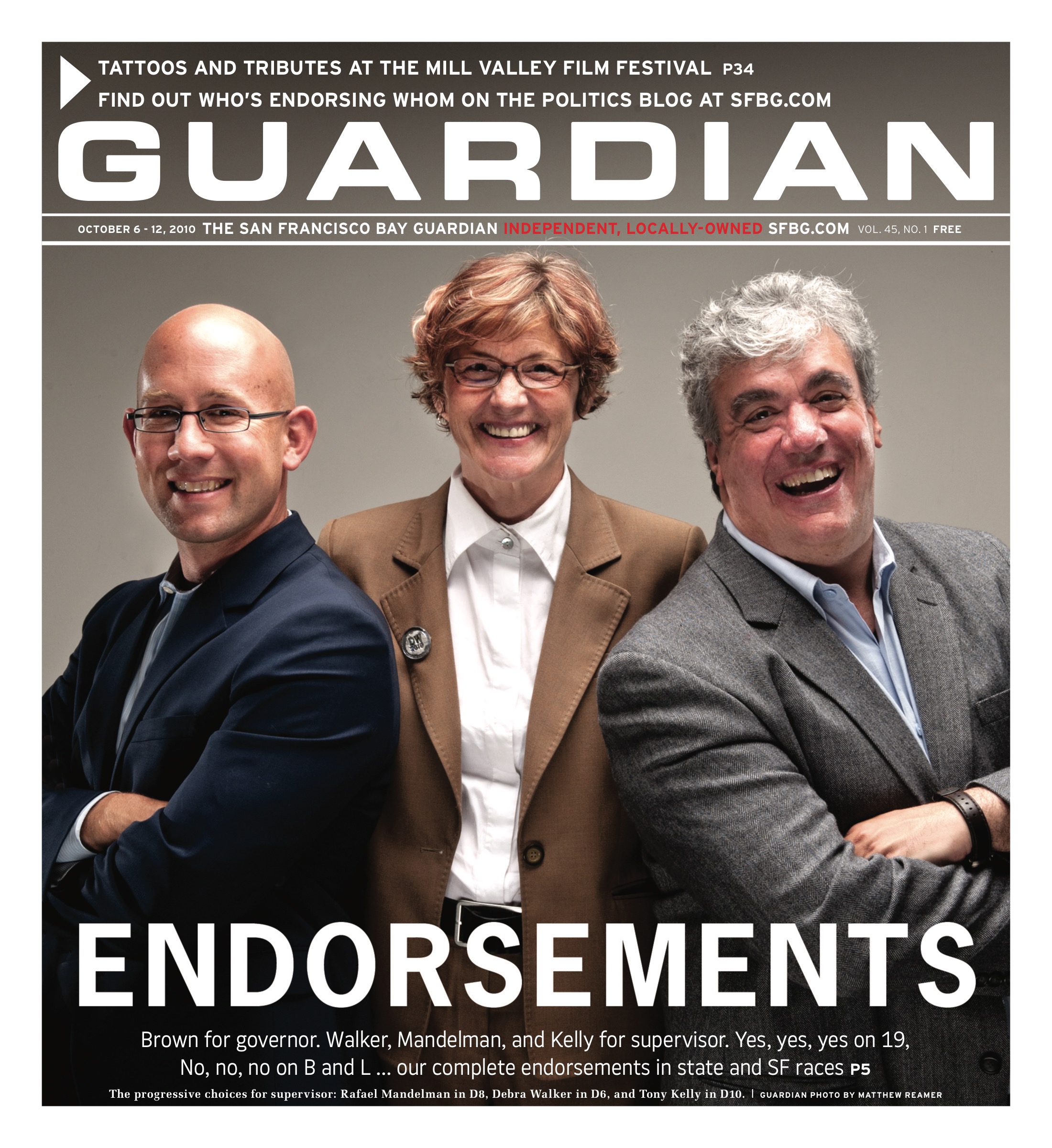
Endorsements 2010: San Francisco candidates

53

SUPERVISOR, DISTRICT 2


JANET REILLY


Frankly, we were a little surprised by the Janet Reilly who came in to give us her pitch as a District 2 supervisorial candidate. The last time we met with her, she was a strong progressive running for state Assembly as an advocate of single-payer health care. She was challenging Fiona Ma from the left, and easily won our endorsement.


Now she’s become a fiscal conservative — somewhat more in synch with her district, perhaps, but not an encouraging sign. Reilly seems to realize that there’s a $500 million budget deficit looming, but she won’t support any of the tax measures on the ballot. She’s against the hotel tax. She’s against the real estate transfer tax on high-end properties. She’s against the local car tax. She opposed Sup. David Chiu’s business tax plan that would have shifted the burden from small to larger businesses (even though it was clear from our interview that she didn’t understand it).


She talked about merging some of the nonprofits that get city money, about consolidating departments, and better management — solutions that might stem a tiny fraction of the red ink. But she wouldn’t even admit that the limited tax burden on the very rich was part of San Francisco’s budget problem.


Her main proposal for creating jobs is more tax credits for biotech, life sciences, and digital media and more public-private partnerships.


It’s too bad, because Reilly’s smart, and she’s far, far better than Mark Farrell, the candidate that the current incumbent, Michela Alioto-Pier, is backing. We wish she’d be realistic about the fiscal nightmare she would inherit as a supervisor.


On the positive side, she’s a strong supporter of public power and she has good connections to the progressive community. Unlike Alioto-Pier, she’d be accessible, open-minded, and willing to work with the progressive majority on the board. That would be a dramatic change, so we’ll give her the nod.


We were also impressed with Abraham Simmons, a federal prosecutor who has spent time researching city finance on the Civil Grand Jury. But he supports sit-lie, Prop. B and Prop. S, and opposes most new tax proposals and needs more political seasoning.


DISTRICT 4


NO ENDORSEMENT


We’ve always wanted to like Carmen Chu. She’s friendly, personable, intelligent, and well-spoken. But on the issues, she’s just awful. Indeed, we can’t think of a single significant vote on which she’s been anything but a call-up loyalist for Mayor Newsom. She even opposed the public power measure, Prop. H, that had the support of just about everyone in town except hardcore PG&E allies.


She’s running unopposed, and will be reelected. But we can’t endorse her.


DISTRICT 6


1. DEBRA WALKER


2. JANE KIM


3. GLENDON “ANNA CONDA” HYDE


CORRECTION: In our original version of this endorsement, we said that Jim Meko supports the sit-lie ordinance. That was an error, and it’s corrected below.


A year ago, this race was artist and activist Debra Walker’s to lose. Most of the progressive community was united behind her candidacy; she’d been working on district issues for a couple of decades, fighting the loft developers during the dot-com boom years and serving on the Building Inspection Commission. Then School Board member Jane Kim decided to enter the race, leaving the left divided, splitting resources that might have gone to other critical district races — and potentially helping to put the most pro-business downtown candidate, Theresa Sparks, in a better position to win.


Now we’ve got something of a mess — a fragmented and sometimes needlessly divisive progressive base in a district that’s key to holding progressive control of the board. And while neither of the two top progressive candidates is actively pursuing a credible ranked-choice voting strategy (Kim has, unbelievably, endorsed James Keys instead of Walker, and Walker has declined to endorse anyone else), we’re setting aside our concern over Kim’s ill-advised move and suggesting a strategy that is most likely to keep the seat Chris Daly has held for the past 10 years from falling to downtown control.


Walker is far and away our first choice. She understands land use and housing — the clear central issues in the district — and has well thought-out positions and proposals. She says that the current system of inclusionary housing — pressing market-rate developers to include a few units of below-market-rate housing with their high-end condos — simply doesn’t work. She supports an immediate affordable housing bond act and a long-term real estate transfer tax high enough to fund a steady supply of housing for the city’s workforce. She told us the city ought to be looking at planning issues from the perspective of what San Francisco needs, not what developers want to build. She’s in favor of progressive taxes and a push for local hiring. We’re happy to give her our first-place ranking.


Jane Kim has been a great SF School Board member and has always been part of the progressive community. But she only moved into District 6 a year and a half ago — about when she started talking about running for supervisor (and she told us in her endorsement interview that “D6 is a district you can run in without having lived there a long time.”) She still hasn’t been able to explain why she parachuted in to challenge an experienced progressive leader she has no substantive policy disagreements with.


That said, on the issues, Kim is consistently good. She is in favor of indexing affordable housing to market-rate housing and halting new condo development if the mix gets out of line. She’s for an affordable housing bond. She supports all the tax measures on this ballot. She’s a little softer on congestion pricing and extending parking-meter hours, but she’s open to the ideas. She supports police foot patrols not just as a law-enforcement strategy, but to encourage small businesses. She’d be a fine vote on the board. And while we’re sympathetic to the Walker supporters who would prefer that we not give Kim the credibility and exposure of an endorsement, the reality is that she’s one of two leading progressives and would be better on the board than the remaining candidates.


Hyde, a dynamic young drag queen performer, isn’t going to win. But he’s offered some great ideas and injected some fun and energy into the race. Hyde talks about creating safe injection sites for IV drug users to reduce the risk of overdoses and the spread of disease. He points out that a lot of young people age out of the foster-care system and wind up on the streets, and he’s for continuum housing that would let these young people transition to jobs or higher education. He talks about starting a co-op grocery in the Tenderloin. He proposes bus-only lanes throughout the district and wants to charge large vehicles a fee to come into the city. He’s a big advocate of nightlife and the arts. He lacks experience and needs more political seasoning, but we’re giving him the third-place nod to encourage his future involvement.


Progressives are concerned about Theresa Sparks, a transgender activist and former business executive who now runs the city’s Human Rights Commission. She did a (mostly) good job on the Police Commission. She’s experienced in city government and has good financial sense. But she’s just too conservative for what remains a very progressive district. Sparks isn’t a big fan of seeking new revenue for the city telling us that “I disagree that we’ve made all the cuts that we can” — even after four years of brutal, bloody, all-cuts budgets. She doesn’t support the hotel tax and said she couldn’t support Sup. David Chiu’s progressive business tax because it would lead to “replacing private sector jobs with public sector jobs” — even though the city’s own economic analysis shows that’s just not true. She supports Newsom’s sit-lie law.


Sparks is the candidate of the mayor and downtown, and would substantially shift the balance of power on the board. She’s also going to have huge amounts of money behind her. It’s important she be defeated.


Jim Meko, a longtime neighborhood and community activist, has good credentials and some solid ideas. He was a key player in the western SoMa planning project and helped come up with a truly progressive land-use program for the neighborhood. But he supports Prop. B and is awfully cranky about local bars and nightlife.


James Keys, who has the support of Sup. Chris Daly and was an intern in Daly’s office, has some intriguing (if not terribly practical) ideas, like combining the Sheriff’s Department and the Police Department and making Muni free). But in his interview, he demonstrated a lack of understanding of the issues facing the district and the city.


So we’re going with a ranked-choice strategy: Walker first, Kim second, Hyde third. And we hope Kim’s supporters ignore their candidate’s endorsement of Keys, put Walker as their second choice, and ensure that they don’t help elect Sparks.


DISTRICT 8


RAFAEL MANDELMAN


This is by far the clearest and most obvious choice on the local ballot. And it’s a critical one, a chance for progressives to reclaim the seat that once belonged to Harvey Milk and Harry Britt.


Mandelman, a former president of the Milk Club, is running as more than a queer candidate. He’s a supporter of tenants rights, immigrants’ rights, and economic and social justice. He also told us he believes “local government matters” — and that there are a lot of problems San Francisco can (and has to) solve on its own, without simply ducking and blaming Sacramento and Washington.


Mandelman argues that the public sector has been starved for years and needs more money. He agrees that there’s still a fair amount of bloat in the city budget — particularly management positions — but that even after cleaning out the waste, the city will still be far short of the money it needs to continue providing pubic services. He’s calling for a top-to-bottom review of how the city gets revenue, with the idea of creating a more progressive tax structure.


He’s an opponent of sit-lie and a supporter of the sanctuary city ordinance. He supports tenants rights and eviction protection. He’s had considerable experience (as a member of the Building Inspection Commission and Board of Appeals and as a lawyer who advises local government agencies) and would make an excellent supervisor.


Neither of the other two contenders make our endorsement cut. Rebecca Prozan is a deputy city attorney who told us she would be able to bring the warring factions on the board together. She has some interesting ideas — she’d like to see the city take over foreclosed properties and turn them into housing for teachers, cops, and firefighters — and she’s opposed to sit-lie. But she’s weak on tenant issues (she told us there’s nothing anyone can do to stop the conversion of rental housing into tenancies-in-common), doesn’t seem to grasp the need for substantial new revenues to prevent service cuts, and doesn’t support splitting the appointments to key commissions between the mayor and the supervisors.


Scott Wiener, a deputy city attorney, is a personable guy who always takes our phone calls and is honest and responsive. He’s done a lot of good work in the district. But he’s on the wrong side of many issues, and on some things would be to the right of the incumbent, Sup. Bevan Dufty.


He doesn’t support public power (which Dufty does). He says that a lot of the city’s budget problems can’t be solved until the state gets its own house in order (“we can’t tax our way out of this”) and favors a budget balanced largely by further cuts. In direct contrast to Mandelman, Wiener said San Franciscans “need to lower our expectations for government.” He wants broad-based reductions in almost all city agencies except Muni, “core” public health services, and public safety. He doesn’t support any further restrictions on condo conversions or TICs. And he has the support of the Small Property Owners Association — perhaps the most virulently anti-tenant and anti-rent control group in town.


This district once gave rise to queer political leaders who saw themselves and their struggles as part of a larger progressive movement. That’s drifted away of late — and with Mandelman, there’s a chance to bring it back.


DISTRICT 10


1. TONY KELLY


2. DEWITT LACY


3. CHRIS JACKSON


District 10 is the epicenter of new development in San Francisco, the place where city planners want to site as many as 40,000 new housing units, most of them high-end condos, at a cost of thousands of blue-collar jobs. The developers are salivating at the land-rush opportunities here — and the next supervisor not only needs to be an expert in land-use and development politics, but someone with the background and experience to thwart the bad ideas and direct and encourage the good ones.


There’s no shortage of candidates — 22 people are on the ballot, and at least half a dozen are serious contenders. Two — Steve Moss and Lynette Sweet — are very bad news. And one of the key priorities for progressives is defeating the big-money effort that downtown, the police, and the forces behind the Van Ness Avenue megahospital proposal are dumping into the district to elect Moss.


Our first choice is Tony Kelly, who operates Thick Description Theater and who for more than a decade has been directly involved in all the major neighborhood issues. He has a deep understanding of what the district is facing: 4,100 of the 5,300 acres in D10 have been rezoned or put under the Redevelopment Agency in the past 10 years. Planners envision as many as 100,000 new residents in the next 10 years. And the fees paid by developers will not even begin to cover the cost of the infrastructure and services needed to handle that growth.


And Kelly has solutions: The public sector will have to play a huge role in affordable housing and infrastructure, and that money should come from higher development fees — and from places like the University of California, which has a huge operation in the district and pays no property taxes. Kelly wants to set up a trigger so that if goals for affordable housing aren’t met by a set date, the market-rate development stops. He supports the revenue measures on the ballot but thinks we should go further. He opposes the pension-reform measure, Prop. B, but notes that 75 percent of the city’s pension problems come from police, fire, and management employees. He wants the supervisors to take over the Redevelopment Agency. He’s calling for a major expansion of open space and parkland in the district. And he thinks the city should direct some of the $3 billion in short-term accounts (now all with the Bank of America) to local credit unions or new municipal bank that could invest in affordable housing and small business. He’s a perfect fit for the job.


DeWitt Lacy is a civil-rights lawyer and a relative newcomer to neighborhood politics. He speaks passionately about the need for D10 to get its fair share of the city’s services and about a commitment to working-class people.


Lacy is calling for an immediate pilot program with police foot patrols in the high-crime areas of the district. He’s for increasing the requirements for developers to build affordable housing and wants to cut the payroll tax for local businesses that hire district residents.


Lacy’s vision for the future includes development that has mixed-use commuter hubs with shopping and grocery stores as well as housing. He supports the tax measures on the ballot and would be willing to extend parking meter hours — but not parking fines, which he calls an undue burden on low-income people.


He’s an outspoken foe of sit-lie and of gang injunctions, and with his background handling police abuse lawsuits, he would have a clear understanding of how to approach better law-enforcement without intimidating the community. He lacks Kelly’s history, experience, and knowledge in neighborhood issues, but he’s eminently qualified and would make a fine supervisor.


Chris Jackson, who worked at the San Francisco Labor Council and serves on the Community College Board, is our third choice. While it’s a bit unfortunate that Jackson is running for higher office only two years after getting elected to the college board, he’s got a track record and good positions on the issues. He talks of making sure that blue-collar jobs don’t get pushed out by housing, and suggested that the shipyard be used for ship repair. He wants to see the city mandate that landlords rent to people with Section 8 housing vouchers. He supports the tax measures on the ballot, but also argues that the city has 60 percent more managers than it had in 2000 and wants to bring that number down. He thinks the supervisors should take over Redevelopment, which should become “just a financing agency for affordable housing.” He wants to relocate the stinky sewage treatment plant near Third Street and Evans Avenue onto one of the piers and use the area for a transit hub. He’s still relatively unseasoned, but he has a bright political future.


Eric Smith, a biodiesel activist, is an impressive candidate too. But while his environmental credentials are good, he lacks the breadth of knowledge that our top three choices offer. But we’re glad he’s in the race and hope he stays active in community politics.


Malia Cohen has raised a lot of money and (to our astonishment) was endorsed No. 2 by the Democratic Party, but she’s by no means a progressive, particularly on tenant issues — she told us that limiting condo conversions is an infringement of property rights. And she’s way too vague on other issues.


Moss is the candidate of the big developers and the landlords, and the Chamber of Commerce is dumping tens of thousands of dollars into getting him elected. He’s got some good environmental and energy ideas — he argues that all major new developments should have their own energy distribution systems — but on the major issues, he’s either on the wrong side or (more often) can’t seem to take a stand. He said he is “still mulling over” his stand on sit-lie. He supports Sanctuary City in theory, but not the actual measure Sup. David Campos was pushing to make the policy work. He’s not sure if he likes gang injunctions or not. He only moved back to the district when he decided to run for supervisor. He’s way too conservative for the district and would be terrible on the board.


Lynette Sweet, a BART Board member, has tax problems (and problems explaining them) and wouldn’t even come to our office for an endorsement interview. The last thing D10 needs is a supervisor who’s not accountable and unwilling to talk to constituents and the press.


So we’re going with Kelly, Lacy, and Jackson as the best hope to keep D10 from becoming a district represented by a downtown landlord candidate.


SAN FRANCISCO BOARD OF EDUCATION


MARGARET BRODKIN


KIM-SHREE MAUFAS


HYDRA MENDOZA


Three seats are up on the School Board, and three people will get elected. And it’s a contested race, and in situations like that, we always try to endorse a full slate.


This fall, it was, to put it mildly, a challenge.


It’s disturbing that we don’t have three strong progressive candidates with experience and qualifications to oversee the San Francisco Unified School District. But it seems to be increasingly difficult to find people who want to — and can afford to — devote the time to what’s really a 40-hour-a-week position that pays $500 a month. The part-time school board is an anachronism, a creature of a very different economic and social era. With the future of the next generation of San Franciscans at stake, it’s time to make the School Board a full-time job and pay the members a decent salary so that more parents and progressive education advocates can get involved in one of the most important political jobs in the city.


That said, we’ve chosen the best of the available candidates. It’s a mixed group, made up of people who don’t support each other and aren’t part of anyone’s slate. But on balance, they offer the best choices for the job.


This is not a time when the board needs radical change. Under Superintendent Carlos Garcia, the local public schools are making huge strides. Test scores are up, enrollment is increasing, and San Francisco is, by any rational measure, the best big-city public school district in California. We give considerable credit for that to the progressives on the board who got rid of the irascible, secretive, and hostile former Superintendent Arlene Ackerman and replaced her with Garcia. He’s brought stability and improvement to the district, and is implementing a long-term plan to bring all the schools up to the highest levels and go after the stubborn achievement gap.


Yet any superintendent and any public agency needs effective oversight. One of the problems with the district under Ackerman was the blind support she got from school board members who hired her; it was almost as if her allies on the board were unable to see the damage she was doing and unable to hold her accountable.


Our choices reflect the need for stability — and independence. We are under no illusions — none of our candidates are perfect. But as a group, we believe they can work to preserve what the district is doing right and improve on policies that aren’t working.


Kim-Shree Maufas has been a staunch progressive on the board. She got into a little trouble last year when the San Francisco Chronicle reported that she’d been using a school district credit card for personal expenses. That’s not a great move, but she never actually took public money since she paid back the district. Maufas said she thought she could use the card as long as she reimbursed the district for her own expenses; the rules are now clear and she’s had no problems since. We don’t consider this a significant enough failure in judgment to prevent her from continuing to do what she’s been doing: serving as an advocate on the board for low-income kids and teachers.


Maufas is a big supporter of restorative justice and is working for ways to reduce suspensions and expulsions. She wants to make sure advanced placement and honors classes are open to anyone who can handle the coursework. She supports the new school assignment process (as do all the major candidates), although she acknowledges that there are some potential problems. She told us she thinks the district should go back to the voters for a parcel tax to supplement existing funding for the schools.


Margaret Brodkin is a lightening rod. In fact, much of the discussion around this election seems to focus on Brodkin. Since she entered the race, she’s eclipsed all the other issues, and there’s been a nasty whisper campaign designed to keep her off the board.


We’ve had our issues with Brodkin. When she worked for Mayor Newsom, she was part of a project that brought private nonprofits into city recreation centers to provide services — at a time when unionized public employees of the Recreation and Parks Department were losing their jobs. It struck us as a clear privatization effort by the Newsom administration, and it raised a flag that’s going to become increasingly important in the school district: there’s a coming clash between people who think private nonprofits can provide more services to the schools and union leaders who fear that low-paid nonprofit workers will wind up doing jobs now performed by unionized district staff. And Brodkin’s role in the Newsom administration — and her background in the nonprofit world — is certainly ground for some concern.


But Brodkin is also by far the most qualified person to run for San Francisco school board in years, maybe decades. She’s a political legend in the city, the person who is most responsible for making issues of children and youth a centerpiece of the progressive agenda. In her years as director of Coleman Advocates for Children and Youth, she tirelessly worked to make sure children weren’t overlooked in the budget process and was one of the authors of the initiative that created the Children’s Fund. She’s run a nonprofit, run a city department, and is now working on education issues.


She’s a feisty person who can be brusque and isn’t always conciliatory — but those characteristics aren’t always bad. Sup. Chris Daly used his anger and passion to push for social justice on the Board of Supervisors and, despite some drawbacks, he’s been an effective public official.


And Brodkin is full of good ideas. She talks about framing what a 21st century education looks like, about creating community schools, about aligning after-school and summer programs with the academic curriculum. She wants the next school bond act to include a central kitchen, so local kids can get locally produced meals (the current lunch fare is shipped in frozen from out of state).


Brodkin needs to remember that there’s a difference between being a bare-knuckles advocate and a member of a functioning school board. But given her skills, experience, and lifetime in progressive causes, we’re willing to give her a chance.


We also struggled over endorsing Hydra Mendoza. She works for Mayor Newsom as an education advisor — and that’s an out-front conflict of interest. She’s a fan of Obama’s Education Secretary, Arne Duncan, whose policies are regressive and dangerous.


On the other hand, she cares deeply about kids and public education. She’s not a big supporter of charter schools (“I’ve yet to see a charter school that offers anything we can’t do ourselves,” she told us) and while she was on the wrong side of a lot of issues (like JROTC) early in her tenure, over the past two years she’s been a good School Board member.


There are several other candidates worth mentioning. Bill Barnes, an aide to Michela Alioto-Pier, is a good guy, a decent progressive — but has no experience in or direct connection to the public schools. Natasha Hoehn is in the education nonprofit world and speaks with all the jargon of the educrat, but her proposals and her stands on issues are vague. Emily Murase is a strong parent advocate with some good ideas, but she struck us as a bit too conservative (particularly on JROTC and charter schools.) Jamie Wolfe teaches at a private school but lacks any real constituency or experience in local politics and the education community.


So given a weak field with limited alternatives, we’re going with Maufas, Brodkin and Mendoza.


SAN FRANCISCO COMMUNITY COLLEGE BOARD


JOHN RIZZO


The San Francisco Community College District has been a mess for years, and it’s only now starting to get back on track. That’s the result of the election of a few progressive reformers — Milton Marks, Chris Jackson, and John Rizzo, who now have enough clout on the seven-member board to drag along a fourth vote when they need it.


But the litany of disasters they’ve had to clean up is almost endless. A chancellor (who other incumbent board members supported until the end) is now under indictment. Public money that was supposed to go to the district wound up in a political campaign. An out-of-control semiprivate college foundation has been hiding its finances from the public. The college shifted bond money earmarked for an arts center into a gigantic, expensive gym with a pool that the college can’t even pay to operate, so it’s leased out to a private high school across the street.


And the tragedy is that all three incumbents — two of whom should have stepped down years ago — are running unopposed.


With all the attention on the School Board and district elections, not one progressive — in fact, not one candidate of any sort — has stepped forward to challenge Anita Grier and Lawrence Wong. So they’ll get another term, and the reformers will have to continue to struggle.


We’re endorsing only Rizzo, a Sierra Club staffer who has been in the lead in the reform bloc. He needs to end up as the top vote-getter, which would put him in position to be the board president. Rizzo has worked to get the district’s finances and foundation under control and he richly deserves reelection.


BART BOARD OF DIRECTORS, DISTRICT 8


BERT HILL


It’s about time somebody mounted a serious challenge to James Fang, the only elected Republican in San Francisco and a member of one of the most dysfunctional public agencies in California. The BART Board is a mess, spending a fortune on lines that are hardly ever used and unable to work effectively with other transit agencies or control a police force that has a history of brutality and senseless killing.


Fang supports the suburban extensions and Oakland Airport connector, which make no fiscal or transportation sense. He’s ignored problems with the BART Police for 20 years. It’s time for him to leave office.


Bert Hill is a strong challenger. A professional cost-management executive, he understands that BART is operating on an old paradigm of carrying people from the suburbs into the city. “Before we go on building any more extensions,” he told us, “we should take care of San Francisco.” He wants the agency to work closely with Muni and agrees there’s a need for a BART sunshine policy to make the notoriously secretive agency more open to public scrutiny. We strongly endorse him.


ASSESSOR-RECORDER


PHIL TING


San Francisco needs an aggressive assessor who looks for every last penny that big corporations are trying to duck paying — but this is also a job that presents an opportunity for challenging the current property tax laws. Phil Ting’s doing pretty well with the first part — and unlike past assessors, is actually stepping up to the plate on the second. He’s been pushing a statewide coalition to reform Prop. 13 — and while it’s an uphill battle, it’s good to see a tax assessor taking it on. Ting has little opposition and will be reelected easily.


PUBLIC DEFENDER


JEFF ADACHI


Adachi’s done a great job of running the office that represents indigent criminal defendants. He’s been outspoken on criminal justice issues. Until this year, he was often mentioned as a potential progressive candidate for mayor.


That’s over now. Because Adachi decided (for reasons we still can’t comprehend) to join the national attack on public employees and put Prop. B on the ballot, he’s lost any hope of getting support for higher office from the left. And since the moderate and conservative forces will never be comfortable with a public defender moving up in the political world, Adachi’s not going anywhere anytime soon.


Which is fine. He’s doing well at his day job. We wish he’d stuck to it and not taken on a divisive, expensive, and ill-conceived crusade to cut health care benefits for city employees.


SAN FRANCISCO SUPERIOR COURT


SEAT 15


MICHAEL NAVA


To hear some of the brahmins of the local bench and bar tell it, the stakes in this election are immense — the independence of the judiciary hangs in the balance. If a sitting judge who is considered eminently qualified for the job and has committed no ethical or legal breaches can be challenged by an outsider who is seeking more diversity on the bench, it will open the floodgates to partisan hacks taking on good judges — and force judicial candidates to raise money from lawyers and special interests, thus undermining the credibility of the judiciary.


We are well aware of the problems of judicial elections around the country. In some states, big corporations that want to influence judges raise and spend vast sums on trial and appellate court races — and typically get their way. In Iowa, three judges who were willing to stand on principle and Constitutional law and declare same-sex marriage legal are facing what amounts to a well-funded recall effort. California is not immune — in more conservative counties, liberal judges face getting knocked off the bench by law-and-order types.


It’s a serious issue. It’s worth a series of hearings in the state Legislature, and it might be worth Constitutional change. Maybe trial-court elections should be eliminated. Maybe all judicial elections should have public campaign financing. But right now, it’s an elected office — at least in theory.


In practice, the vast majority of the judicial slots in California are filled by appointment. Judges serve for four-year terms but tend to retire or step down in midterm, allowing the governor to fill the vacancy. Unless someone files specifically to challenge an incumbent, typically appointed judge, that race never even appears on the ballot.


The electoral process is messy and political, and raising money is unseemly for a judicial officer. But the appointment process is hardly pure, either — and governors in California have, over the past 30 years, appointed the vast majority of the judges from the ranks of big corporate law firms and district attorney’s offices.


There are, of course, exceptions, and Gov. Arnold Schwarzenegger has been better than his predecessor, Democrat Gray Davis. But overall, public interest lawyers, public defenders, and people with small community practices (and, of course, people who have no political strings to pull in Sacramento) have been frustrated. And it’s no surprise that some have sought to run against incumbents.


That’s what’s happening here. Michael Nava, a gay Latino who has been working as a research attorney for California Supreme Court Justice Carlos Moreno, was going to run for a rare open seat this year, but the field quickly got crowded. So Nava challenged Richard Ulmer, a corporate lawyer appointed by Schwarzenegger who has been on the bench a little more than a year.


We will stipulate, as the lawyers say: Ulmer has done nothing wrong. From all accounts, he’s a fine judge (and before taking the bench, he did some stellar pro bono work fighting for reforms in the juvenile detention system). So there are two questions here: Should Nava have even filed to run against Ulmer? And since he did, who is the better candidate?


It’s important to understand this isn’t a case of special interests and that big money wanting to oust a judge because of his politics or rulings. Nava isn’t backed by any wealthy interest. There’s no clear parallel to the situations in other areas and other states where the judiciary is being compromised by electoral politics. Nava had every right to run — and has mounted an honest campaign that discusses the need for diversity on the bench.


Ulmer’s supporters note — correctly — that the San Francisco courts have more ethnic and gender diversity than any county in the state. And we’re not going to try to come to a conclusion here about how much diversity is enough.


But we will say that life experience matters, and judges bring to the bench what they’ve lived. Nava, who is the grandson of Mexican immigrants and the first person in his family to go to college, may have a different perspective on how low-income people of color are treated in the courts than a former Republican who spent his professional career in big law firms.


We were impressed by Nava’s background and knowledge — and by his interest in opening up the courts. He supports cameras in the courtrooms and allowing reporters to record court proceedings. He told us the meetings judges hold on court administration should be open to the public.


We’re willing to discuss whether judicial elections make sense. Meanwhile, judges who don’t like the idea of challenges should encourage their colleagues not to retire in midterm. If all the judges left at the end of a four-year term, there would be plenty of open seats and fewer challenges. But for now, there’s nothing in this particular election that makes us fear for the independence of the courts. Vote for Nava.


>>BACK TO ENDORSEMENTS 2010

Flagging in the Park: the whirl story

0

“This is the gayest thing I’ve ever done in my life!” laughed my friend Ricky Strawberry as he twirled around and around, unfurling lengths of tie-dyed cloth to Hi-NRG dance tracks from a live DJ in the sunshine. If you know Ricky Strawberry, that’s pretty damn sparkly pink unicorn in a rainbow thong bathing under a Splenda waterfall gay. In fact, it was the gayest thing anyone in my pinko posse had ever done, as well, and we had a ball. It was gay, it was amazing, it was gaymazing, and you should do it too.

It? Flagging in the Park, the summertime monthly gathering of fluttering human butterflies in the AIDS Memorial Grove in Golden Gate Park. I wrote about it in this week’s Super Ego nightlife column — and it happens for the final time this year on Sat/2, 1 p.m.- 4p.m. 

Flagging — or flag dancing, wherein the dancer whirls around waving psychedelic-patterned, weighted pieces of fabric — has been around for several decades. I remember the first time I saw it was in the ’80s at a giant outdoor picnic in Detroit organized by Metra magazine, but it really took hold inside gay clubs during the ’90s, when circuit parties were on the rise. (Flag dancing of a non-gay-specific kind, using actual flags with poles, is an ancient art still practiced especially in Italy and New Orleans — and in Midwestern marching bands.) The exact gay origins are fuzzy — men dancing with giant fans at disco clubs were a common sight, and you will see lots of flaggers at the disco-celebrating Remember the Party event next weekend, for instance, which acts as a reunion for patrons of the classic Trocadero Transfer venue in the ’70s and ’80s.

Like many alternaqueers of my generation, flagging was a turnoff in the ’90s — it was too associated with annoyingly relentless circuit music, mainstream gym culture, and bad drugs in my mind. But that was a long time ago, and like a lot of things from that time, a rediscovery after old conflicts have died out puts things into a totally different perspective. (You don’t see much flagging in mainstream gay clubs these days, and the music at Flagging in the Park is a bit more fun and interesting than I thought it would be. For the October installment, the DJ is Steve Sherwood.) I was able to appreciate the art in a different context, and without prejudice. Flagging in the Park is a beautiful event, full of rich historical meaning. It welcomes everyone — there are also large contingents of hula-hoopers, poi-twirlers, and other talents — and has taken on a more spiritual aspect.

http://www.youtube.com/watch?v=Me3rZ99ArbU

When I went in August (I had heard about it for months, and was encouraged to finally attend by my friend Steven Satyricon’s lovely writeup over at The Juice Box site) I was lucky enough to see the organizer, Xavier Caylor, be sainted by the Sisters of Perpetual Indulgence for his community work. And Flagging in the Park (FITP) really does bring in a bunch of donations for community organizations, as well as provide community healing. “Without grief, you can’t have joy,” said Xavier, referencing the spirits around us in the AIDS Grove. Xavier took over FITP 10 years ago, and he teaches a flagging class at Gold’s Gym in the Castro every Wednesday, 6 p.m.-8 p.m. He’s also several thousand degrees of hotness, yowza. I wanted to know more about how he got involved, and some of the spiritual aspects of the art. His story is below — and you should drift on by this Saturday afternoon to see for yourself. Xavier provides plenty of free flags to borrow, and flagging really is a bit of good exercise, I discovered. 

XAVIER CAYLOR: “I picked up my first set of flags from a friend of a friend at a party on Will Rogers Beach in 1997. I was hooked and we proceeded to flag everywhere we could: at home, in clubs and circuit parties. I heard about FITP from a fellow that I met at a circuit party in Palm Springs; he told me of a community of good friends that met during the summer months at a park in SF. I managed to contact someone and planned a weekend getaway from So. Cal. to attend in July of 1998.

“In 1998 the recently dedicated National AIDS Memorial Grove was young, the flaggers met in the then newly planted fern grove and gravel circle on the far West side. Twenty people gathered on what was a truly magical day for me; I was amazed with the variety of people, flags, and energy there – like a kid in a candy store. I not only left my heart in San Francisco but gave it freely to a tie-dye artist that became the catalyst for me moving here in just three short months. For the next few years he and I co-produced the event, popularity soon crowded us out of the circle and into the meadow. I have been producing the event since 2001 less two years that a friend took it and moved it to Dolores Park. Originally the events were planned a few days in advance around a sunny weather forecast. In 2002 this changed, acquiring permits and making these outreach events for charity brought a whole new dimension to our gatherings.

“What does the event mean to me? It was and is a magical space where love was born and flourishes, where flaggers can come out of the clubs and into nature. Held in a place that was built out of grief, mourning, and reflection by something that devastated our community and for a few hours we pour color, love, celebration, and heritage carefully back while raising consciousness by giving back. It is the place that our tribes come together to socialize, bond, and strengthen community. It is also a place that people walking through the park can happen upon a surreal event, take it in for a minute, and leave having had the opportunity to try something new or just stop and take in the music and visuals before moving along to where ever it is they are going. I usually plan 3 or 4 FITPs per year between May and October — the last one was supposed to be the final one this year, but we had such a great crowd and great vibe that we decided to have one more.

http://www.youtube.com/watch?v=fd3pX-Ys1wI

“If you’ve picked up flags you’ve most likely been asked by someone to show them how to do “it.” I’ve been showing friends since day one, taught at workshops in SF, NY, SD, and Dallas. I’ve been involved with group and solo performances, led people in tie-dye, and given away hundreds of flags while traveling to parties in Brazil, Australia, Thailand, Spain and the UK ,not to mention many cities around the US.

“About my class at Gold’s Gym: When I moved to San Francisco Club Universe, 177 Townsend, on Sundays was known as Pleasuredome and was a venue with a huge stage that flaggers flocked to weekly to play and share their art. It was a beacon to flag dancers on the West coast and beyond, introducing a steady stream of club goers weekly to the glowing fabric twirling in the U.V. flooded stage. It’s close in 2002 was a blow to the dance and flag communities. In 2007 I approached the management at Gold’s and asked if I could hold a weekly space for flaggers to come and practice – I was envisioning a free space that I would hold for a year with the purpose of re-energizing my tribe and reviving that weekly space. Troy at Gold’s Gym enthusiastically offered me a position and added the class to their Group X fitness program – I’ve been teaching Wednesday nights since. It is a place that people that have never flagged can come and learn – I have flags for use and set up black lights to make them come to life. The community comes to practice, play and socialize. I support new and old flaggers at the gym and outside of the gym by leading tie-dye classes/open studios so people can make their own flags. Weekly pre class discussions are opportunities to share history, personal stories and current events. Other flow toys (like poi and fans) show up from time to time and I support them if and when I can.

http://www.youtube.com/watch?v=GC4qFjeSTvg

“The group of guys that started FITP in 1996 shared a common experience, they had all gone to a week long experience in consciousness building in San Diego called the Miracle of Love which used active meditation techniques developed by Osho Rajneesh. Those flaggers came together in 1998 to bring those techniques to the gay community through a weekend seminar that is still going strong called the ‘Men’s Inner Journey.’ It was through delving deep into the techniques of active meditation that I realized what a spiritual event flagging is. Though people don’t usually make the connection between flagging and meditation, there is a point when the body and mind are so engaged that in the exuberance of the dance the mind is set free to a place of stillness. I believe that meditation something lacking in our lives and something we need to recharge our spirit and connect with our soul.

“Flagging is a visually appealing dance that has lived primarily in the gay community for the past 40 years. It touches on spirituality by being an alternative form of meditation palatable for people on the go. I am proud to be one of the many that keeps this art form flourishing by holding the space to pass it to the next generation of artists. www.flaggercentral.com is a great resource for our community.”

High on arrival

0

arts@sfbg.com

MUSIC If hip-hop is jazz, then Curren$y can be described as a traditionalist. His debut album, Pilot Talk (DD172/Def Jam), is pure braggadocio, with rhymes about fancy cars and free-flowing liquor and free-loving women. The music, lovingly produced and arranged by Ski Beatz, sounds like an update of Dr. Dre’s The Chronic, all the way down to the New York session musicians recruited to crank out mellow grooves. It’s as if Curren$y has reinterpreted the Sugar Hill Gang’s “Rapper’s Delight” for the new millennium.

In the world of jazz, the traditionalists famously waged war against the free jazz nuts who wanted to strip the form of tonality, and then against the fusionists who sought to infect it with slovenly rock and roll. With help from Dixieland revivalists and Ken Burns’s Jazz documentary, they succeeded. In contrast, rap nerds have always viewed avant-garde experimentation with suspicion at best, and complete ignorance at worst. The furthest we’ll go, it seems, is the high-tech funk of Big Boi’s Sir Lucious Left Foot: Son of Chico Dusty, or Madlib’s Medicine Show of gutbucket blues and crusty soul-jazz loops.

If fitted with John Coltrane’s sheets of sound or Ornette Coleman’s harmolodics, Pilot Talk would be a strangely awesome experience. As is, it’s soothing yet enlightening, like an animated chop session after smoking a joint or two with a friend. Curren$y clearly made it on blunted terms: the album artwork depicts a lone airplane flying over a landscape of lush green marijuana foliage.

So Pilot Talk is like weed talk, with several narratives hidden underneath the stoner blather. On “Example,” Curren$y claims “reimbursement for paid dues,” then states, “I am an example of what can happen when you quit being afraid to gamble.” On “Seat Change,” he mocks a girl who wants to “ride with a G,” concluding that “somewhere along the line she fucked up and realized she lost her seat.” His lines are pimp slick but thankfully shorn of delusion. When he flips a bevy of yeyo metaphors for “Audio Dope,” he clearly does it in service of the concept, not to build a farcical image of himself as a drug kingpin. The image is of a neighborhood (or, more accurately, Internet) baller.

Curren$y’s persistence comes from years spent toiling for various rap crews, hip-hop’s version of the mailroom. As a young scrapper from New Orleans’s Uptown neighborhood, he rolled with C-Murder’s TRU family before C-Murder infamously caught a life bid for murder, then transferred to Master P’s No Limit label. Then he landed at Lil Wayne’s fledgling Young Money Entertainment, dropping burner verses for Weezy’s The Carter II and Dedication mixtapes, before landing under the aegis of reformed hip-hop mandarin Damon Dash, whose DD172 label released Pilot Talk in July. It’s ironic that since Curren$y’s departure, Weezy has decided to transform Young Money into an overpublicized pop star boot camp for teen idols like Nicki Minaj and Drake. Then again, the fact that even Curren$y sounds alternative when posited against mainstream rap’s scions demonstrates how rigid the culture has truly become.

However, Curren$y also benefits from marketing, albeit of a viral nature. Pilot Talk boasts the cream of the blog rap crop, including Mikey Rocks from the Cool Kids, Big K.R.I.T., and Jay Electronica (who sharply compares Flavor Flav’s signature bow tie to the Nation of Islam’s attire). Even much-beloved weed rapper Devin the Dude drops a verse for “Chilled Coughphee.” A writer friend of mine, Christopher Weingarten, remarked to me that when Devin the Dude jumps in with sly wit like “I can fuck a bum up quick / But that’s some tenth grade shit,” it only underscores Curren$y’s relative lack of vocal presence.

Other critics have theorized that Pilot Talk‘s artistic triumph is largely due to Ski Beatz’s memorable accompaniment. An NY vet whose catalog ranges from membership in early-’90s woulda-beens Original Flavor to credits on Jay-Z’s 1996 classic Reasonable Doubt and Camp Lo’s “Luchini AKA (This Is It),” Ski Beatz initially produced Pilot Talk‘s tracks himself and then hired talented unknowns like bassist Brady Watt to transform them into instrumental gems. True, any rapper would sound incredible against the majestic sunshine funk of “Address.” But give Curren$y credit for lodging its hook in your brain — “Still nothing changed but the address.”

CURREN$Y

With C-Plus and NPire Da Great, J-Billion and P-Funk, DJ ANT-1

Wed/29, 9 p.m., $16–$20

330 Ritch

330 Ritch, SF

(415) 541-9574

www.330ritch.com


Music listings

0

Music listings are compiled by Paula Connelly and Cheryl Eddy. Since club life is unpredictable, it’s a good idea to call ahead to confirm bookings and hours. Prices are listed when provided to us. Submit items for the listings at listings@sfbg.com.

WEDNESDAY 29

ROCK/BLUES/HIP-HOP

Biffy Cylro, Picture Atlantic Rickshaw Stop. 8pm, $12.

Erin Brazil and the Hitchcock Blondes, Fancy Dan Band, Passenger and Pilot, Middle Maki Café Du Nord. 8pm, $10.

Nick Curran, Siddhartha, Tokyo Raid, DJ Ron Elder Elbo Room. 9pm, $7.

*High on Fire, Torche, Kylesa Great American Music Hall. 8pm, $20.

*Jon Spencer Blues Explosion, Thee Oh Sees Bimbo’s 365 Club. 8pm, $18.

*Judgement Day, Tornado Rider, Definite Articles Independent. 8pm, $12.

Jesse Malin and the St. Marks Social, Moneybrother, Dave Smallen Bottom of the Hill. 9pm, $12.

Party Owl, Mallard, Burrows Hemlock Tavern. 9pm, $6.

Joey Ryan and Kenneth Pattengale, Ari Herstand, Sarah Dashew Hotel Utah. 8pm, $10.

DANCE CLUBS

Booty Call Q-Bar, 456 Castro, SF; www.bootycallwednesdays.com. 9pm. Juanita Moore hosts this dance party, featuring DJ Robot Hustle.

Hands Down! Bar on Church. 9pm, free. With DJs Claksaarb, Mykill, and guests spinning indie, electro, house, and bangers.

Indulgence Wednesdays Harry Denton’s Starlight Room, Sir Francis Drake Hotel, 450 Powell, SF; (415) 395-8595. 9:30pm. With DJs Cams, Daniella D, and Bruce.

Jam Fresh Wednesdays Vessel, 85 Campton, SF; (415) 433-8585. 9:30pm, free. With DJs Slick D, Chris Clouse, Rich Era, Don Lynch, and more spinning top40, mashups, hip hop, and remixes.

Kids in America Koko Cocktails, 1060 Geary, SF; (415) 885-4788. 9pm, free. With DJs Fuzzprobe and Bryna spinning eighties.

Mary-Go-Round Lookout, 3600 16th St, SF; (415) 431-0306. 10pm, $5. A weekly drag show with hosts Cookie Dough, Pollo Del Mar, and Suppositori Spelling.

RedWine Social Dalva. 9pm-2am, free. DJ TophOne and guests spin outernational funk and get drunk.

Respect Wednesdays End Up. 10pm, $5. Rotating DJs Daddy Rolo, Young Fyah, Irie Dole, I-Vier, Sake One, Serg, and more spinning reggae, dancehall, roots, lovers rock, and mash ups.

Synchronize Il Pirata, 2007 16th St, SF; (415) 626-2626. 10pm, free. Psychedelic dance music with DJs Helios, Gatto Matto, Psy Lotus, Intergalactoid, and guests.

THURSDAY 30

ROCK/BLUES/HIP-HOP

Françoiz Breut, Marianne Dissard, Joanna Barbera Hotel Utah. 9pm, $10.

*Despised Icon, Misery Index, Revocation, Arise DNA Lounge. 7:30pm, $16.

*Easy Star All-Stars, Cas Haley Slim’s. 9pm, $20.

Hans Grusel No Kabinet, Andrea Williams’ Anais Din, Spider Compass, Good Crime All Vulture Band, Organ of Qwerty, pl0c Munster, Mr. Cluck Hemlock Tavern. 9pm, $7.

Jimmy Eat World, We Were Promised Jetpacks Warfield. 8pm, $40.

Mark Matos and Os Beaches, Ghost Town Refugees, Alright Class Bottom of the Hill. 9pm, $10.

Matt and Kim, Limousines Fillmore. 8pm, $18.50.

Musashi Trio Coda. 9pm, $7.

Rank/Xerox, Ed Mudshi, Ornithology Eagle Tavern. 9:30pm, $6.

Reverend Peyton’s Big Damn Band, Mighty Regis, Jesse Morris and the Man Cougars Thee Parkside. 9pm, $10.

School of Seven Bells, Active Child, Foster the People Independent. 8pm, $15.

Vandella, todayokay Rickshaw Stop. 8pm, $10.

JAZZ/NEW MUSIC

MS Collective Enrico’s, 504 Broadway, SF; www.enricossf.com. 7pm.

FOLK/WORLD/COUNTRY

Aiden James Dolores Park Café. 7:30pm, $10 suggested donation.

Misisipi Rider, Toshio Hirano Amnesia. 9pm, $3.

DANCE CLUBS

Afrolicious Elbo Room. 9:30pm, $10. DJs Pleasuremaker and Señor Oz spin Afrobeat, tropicália, electro, samba, and funk.

CakeMIX SF Wish, 1539 Folsom, SF; www.wishsf.com. 10pm, free. DJ Carey Kopp spinning funk, soul, and hip hop.

Caribbean Connection Little Baobab, 3388 19th St, SF; (415) 643-3558. 10pm, $3. DJ Stevie B and guests spin reggae, soca, zouk, reggaetón, and more.

Drop the Pressure Underground SF. 6-10pm, free. Electro, house, and datafunk highlight this weekly happy hour.

Good Foot Som., 2925 16th St, SF; (415) 558-8521. 10pm, free. With DJs spinning R&B, Hip hop, classics, and soul.

Jivin’ Dirty Disco Butter, 354 11th St., SF; (415) 863-5964. 8pm, free. With DJs spinning disco, funk, and classics.

Koko Puffs Koko Cocktails, 1060 Geary, SF; (415) 885-4788. 10pm, free. Dubby roots reggae and Jamaican funk from rotating DJs.

LoDubs Pacific Tour Triple Crown. 9pm, $10. With DJs Clubroot, Jon AD, DJG, and Djunya spinning dubstep and bass.

Mestiza Bollywood Café, 3376 19th St, SF; (415) 970-0362. 10pm, free. Showcasing progressive Latin and global beats with DJ Juan Data.

Peaches Skylark, 10pm, free. With an all female DJ line up featuring Deeandroid, Lady Fingaz, That Girl, and Umami spinning hip hop.

Popscene 330 Rich. 10pm, $10. Rotating DJs spinning indie, Britpop, electro, new wave, and post-punk.

Solid Thursdays Club Six. 9pm, free. With DJs Daddy Rolo and Tesfa spinning roots, reggae, dancehall, soca, and mashups.

Wax Candy Beauty Bar. 10pm, free. With DJs Sergio, André Lucero, Worker, and Travis Dalton spinning disco, funk, house, techno, and more.

FRIDAY 1

ROCK/BLUES/HIP-HOP

"Costello Sings Lowe/Nick Sings Elvis" Great American Music Hall. 8 and 11pm, $125-200. Benefit for the Richard de Lone Special Housing Project. Austin and Caroline de Lone open the first show only.

Aram Danesh and the Superhuman Crew Coda. 10pm, $10.

Dolorata, Love Darling, Jo Boyer Thee Parkside. 9pm, $8-12.

Drums, Young Friends Independent. 9pm, $15.

44s, Kid Ramos Biscuits and Blues. 8 and 10pm, $20.

Jokes for Feelings, Rockfight Bottom of the Hill. 10pm, $12.

Jon Langford and Skull Orchard, Walter Salas-Humara, Mini-Mekons Café Du Nord. 9pm, $19.

Jamie Lidell, Zeus, Twin Shadow Bimbo’s 365 Club. 9pm, $25.

Mantles, Super Wild Horses, Royal Baths Hemlock Tavern. 9:30pm. $8.

Railroad Earth, Toubab Krewe Fillmore. 9pm, $25.

"Rock N’ Roll Sideshow" DNA Lounge. 9pm, $20. With Vau de Vire Society, Eric McFadden Trio, and more.

White Hills, Lumerians, White Cloud Rickshaw Stop. 8:30pm, $12.

JAZZ/NEW MUSIC

Roy Ayers Yoshi’s San Francisco. 8 and 10pm, $15-25.

"Wrack + Rova: On Procedural Grounds" Community Music Center, 544 Capp, SF; www.kylebruckmann.com. 8pm, $8-12.

FOLK/WORLD/COUNTRY

*Brass Tax Amnesia. 10pm, $5.

Emil Brynge, Emaline Dalapaix Amnesia. 9pm, free.

Carolina Chocolate Drops, Stairwell Sisters Slim’s. 9pm, $17.

Cornmeal, Devil’s Own, Michael Dean Damron Hotel Utah. 9pm, $12.

*Hardly Strictly Bluegrass Festival Speedway Meadows, Golden Gate Park, SF; www.strictlybluegrass.com. 2pm-7pm, free. Featuring the Subdudes, Sarah Lee & Johnny, The Ebony Hillbillies, Ralph Stanley & the Clinch Mountain Boys, Jenny and Johnny, George Porter Jr., Papa Mali and Matt Hubbard, MC Hammer, and more.

DANCE CLUBS

Braza! Som.10pm, $10. With special guest DJ Smash spinning an all Brazilian set.

Club Dragon Club Eight, 1151 Folsom, SF; www.eightsf.com. 9pm, $8. A gay Asian paradise. Featuring two dance floors playing dance and hip hop, smoking patio, and 2 for 1 drinks before 10pm.

Deeper 222 Hyde, 222 Hyde, SF; (415) 345-8222. 9pm, $10. With rotating DJs spinning dubstep and techno.

Dirty Bird Mezzanine. 9pm, $20. With DJs Justin Martin, Claude Vonstroke, Christian Martin, and Worthy.

Dirty Rotten Dance Party Madrone Art Bar. 9pm, $5. With DJs Morale, Kap10 Harris, and Shane King spinning electro, bootybass, crunk, swampy breaks, hyphy, rap, and party classics.

Exhale, Fridays Project One Gallery, 251 Rhode Island, SF; (415) 465-2129. 5pm, $5. Happy hour with art, fine food, and music with Vin Sol, King Most, DJ Centipede, and Shane King.

Fat Stack Fridays Koko Cocktails, 1060 Geary, SF; (415) 885-4788. 10pm, free. With rotating DJs B-Cause, Vinnie Esparza, Mr. Robinson, Toph One, and Slopoke.

Felabration 222 Hyde, 222 Hyde, SF; (415) 345-8222. 9pm, $10. With DJs David Harness and Said spinning Afro beat, house, and more in a celebration of Fela Kuti’s legacy.

Fubar Fridays Butter, 354 11th St., SF; (415) 863-5964. 6pm, $5. With DJs spinning retro mashup remixes.

Good Life Fridays Apartment 24, 440 Broadway, SF; (415) 989-3434. 10pm, $10. With DJ Brian spinning hip hop, mashups, and top 40.

Hot Chocolate Milk. 9pm, $5. With DJs Big Fat Frog, Chardmo, DuseRock, and more spinning old and new school funk.

Rockabilly Fridays Jay N Bee Club, 2736 20th St, SF; (415) 824-4190. 9pm, free. With DJs Rockin’ Raul, Oakie Oran, Sergio Iglesias, and Tanoa "Samoa Boy" spinning 50s and 60s Doo Wop, Rockabilly, Bop, Jive, and more.

Some Thing The Stud. 10pm, $7. VivvyAnne Forevermore, Glamamore, and DJ Down-E give you fierce drag shows and afterhours dancing.

Strangelove Cat Club. 9:30pm, $6. An undead wedding with DJs Tomas Diablo, Melting Girl, Xander, and Mz Samantha spinning goth and industrial.

That’s the Blap Elbo Room. 10pm, $5. With Low Limit, Dnae Beats, Benito, Salva, Kozee, Dials, and Bogl, plus host Z-Man.

Vitalic, Teenage Bad Girl 103 Harriet, 103 Harriet, SF; (415) 431-1200. 9pm, $22.50.

SATURDAY 2

ROCK/BLUES/HIP-HOP

Melissa Auf der Maur Café Du Nord. 9:30pm, $12.

EPMD Yoshi’s San Francisco. 10:30pm, $22.

Futureheads, So So Glos Great American Music Hall. 9pm, $17.

Jukebox the Ghost, AB and the Sea, Hooray for Earth Bottom of the Hill. 10pm, $10.

Infected Mushroom, Shpongle, Hallucinogen, Dissolve, Liam Shy Warfield. 8pm, $60.

Mammatus, Swanifant, Shari La Las Hemlock Tavern. 9:30pm, $7.

*La Plebe, Meat Sluts, Started-Its, Bloody Hells, Ol’ Cheeky Bastards, Girls with Guns Thee Parkside. 7pm, $10.

John Nemeth Biscuits and Blues. 8 and 10pm, $20.

Railroad Earth, Toubab Krewe Fillmore. 9pm, $25.

Adam Haworth Stephens, Mini Mansions, Sea of Bees Independent. 9pm, $15.

*Sword, Karma to Burn, Mount Carmel Regency Ballroom. 8:30pm, $20.

Peter Wolf Yoshi’s San Francisco. 8pm, $27.50.

JAZZ/NEW MUSIC

Brian Pardo Coda. 7pm, $5.

Stefanie Powers Rrazz Room. 8pm, $45.

FOLK/WORLD/COUNTRY

*Hardly Strictly Bluegrass Festival Speedway Meadows, Golden Gate Park, SF; www.strictlybluegrass.com. 11am-7pm, free. Featuring Kelly Willis, Carolyn Wonderland, Margot Leverett and the Klezmer Mountain Boys, Joan Baez, Trombone Shorty & Orleans Avenue, Bonnie Prince Billy & the Cairo Gang, Dry Branch Fire Squad, Buddy Miller, Gillian Welch, Hot Tuna Electric, The Wronglers, Carolina Chocolate Drops, Holly Golightly and the Brokeoffs, Conor Oberst, and more.

Very Be Careful Amnesia. 9pm, $7.

DANCE CLUBS

Bar on Church 9pm. Rotating DJs Foxxee, Joseph Lee, Zhaldee, Mark Andrus, and Nuxx.

Debaser Knockout. 11pm, $5. Wear your flannel and get in free before 11pm to this party, where DJ Jamie Jams and Emdee play alternative hits from the 1990s.

Everlasting Bass 330 Ritch. 10pm, $5-10. Bay Area Sistah Sound presents this party, with DJs Zita and Pam the Funkstress spinning hip-hop, soul, funk, reggae, dancehall, and club classics.

Fire Corner Koko Cocktails, 1060 Geary, SF; (415) 885-4788. 9:30pm, free. Rare and outrageous ska, rocksteady, and reggae vinyl with Revival Sound System and guests. Foundation Som., 2925 16th St., SF; (415) 558-8521. 10pm.

Gemini Disco Underground SF. 10pm, $5. Disco with DJ Derrick Love and Nicky B. spinning deep disco.

Get Loose Beauty Bar. 10pm, free. With DJ White Mike spinning hip hop, rock, indie dance, funk, soul, and more.

HYP Club Eight, 1151 Folsom, SF; www.eightsf.com. 10pm, free. Gay and lesbian hip hop party, featuring DJs spinning the newest in the top 40s hip hop and hyphy.

Kontrol Endup. 10pm, $20. With resident DJs Alland Byallo, Craig Kuna, Sammy D, and Nikola Baytala spinning minimal techno and avant house.

Leisure Paradise Lounge. 10pm, $7. DJs Omar, Aaron, and Jet Set James spinning classic britpop, mod, 60s soul, and 90s indie.

New Wave City DNA Lounge. 9pm, $7-12. The 80s dance party celebrates its 18th anniversary with Skip and Shindog, Lowlife, and Melting Girl.

Rock City Butter, 354 11th St., SF; (415) 863-5964. 6pm, $5 after 10pm. With DJs spinning party rock.

Saturday Night Soul Party Elbo Room. 10pm, $10. Sixties soul with DJs Lucky, Phengren Oswald, and Paul Paul.

Souf Club Six. 9pm, $7. With DJs Jeanine Da Feen, Motive, and Bozak spinning southern crunk, bounce, hip hop, and reggaeton.

Soundscape Vortex Room, 1082 Howard, SF; www.myspace.com/thevortexroom. With DJs C3PLOS, Brighton Russ, and Nick Waterhouse spinning Soul jazz, boogaloo, hammond grooves, and more.

Spirit Fingers Sessions 330 Ritch. 9pm, free. With DJ Morse Code and live guest performances.

Spirit Games Vol. 4 Rickshaw Stop. 8pm, $12-15. With Lagos Roots, DJs Papa Chango and Kush Arora, and bellydancer Jill Parker.

SUNDAY 3

ROCK/BLUES/HIP-HOP

First Aid Kit, Ferraby Lionheart, Sea of Cortez Bottom of the Hill. 9pm, $14.

Gotan Project, General Electriks Warfield. 8pm, $39-47.50.

Jon Langford, Justin Townes Earle Ameoba, 1855 Haight, SF; www.amoeba.com. 2pm, free.

Red Hot Blues Sisters Biscuits and Blues. 8 and 10pm, $15.

Vamps Great American Music Hall. 8pm, $41.

FOLK/WORLD/COUNTRY

Africa Rising featuring DJ Jerimiah Coda. 10pm, $10.

Ely Guerra, Kavarzee, Pastilla, DJ Juan Data Independent. 8pm, $22.

*Hardly Strictly Bluegrass Festival Speedway Meadows, Golden Gate Park, SF; www.strictlybluegrass.com. 11am-7pm, free. Martin Sexton, Randy Newman, Earl Scruggs, Emmylou Harris, Kate Gaffney, Indigo Girls, Sharon Jones & the Dap-Kings, MarchFourth Marching Band, Lucero, Elvis Costello and the Sugarcanes, Patti Smith, Rosanne Cash, Doc Watson & David Holt, The Avett Brothers, Nick Lowe and his Band, Nathaniel Rateliff, and more.

Kally Price, Old Blues, Emperor Norton’s Jazz Band Amnesia. 9pm, $5.

DANCE CLUBS

Afterglow Nickies, 466 Haight, SF; (415) 255-0300. An evening of mellow electronics with resident DJs Matt Wilder, Mike Perry, Greg Bird, and guests.

Call In Sick Skylark. 9pm, free. DJs Animal and I Will spin danceable hip-hop.

DiscoFunk Mashups Cat Club. 10pm, free. House and 70’s music.

Dub Mission Elbo Room. 9pm, $6. DJ Sep, Maneesh the Twister, and guest Robert Rankin’ spin dub, roots, and classic dancehall.

Gloss Sundays Trigger, 2344 Market, SF; (415) 551-CLUB. 7pm. With DJ Hawthorne spinning house, funk, soul, retro, and disco.

Honey Soundsystem Paradise Lounge. 8pm-2am. "Dance floor for dancers – sound system for lovers." Got that?

Jock! Lookout, 3600 16th St, SF; (415) 431-0306. 3pm, $2. This high-energy party raises money for LGBT sports teams.

Kick It Bar on Church. 9pm. Hip-hop with DJ Zax.

Lowbrow Sunday Delirium. 1pm, free. DJ Roost Uno and guests spinning club hip hop, indie, and top 40s.

Religion Bar on Church. 3pm. With DJ Nikita.

Stag AsiaSF. 6pm, $5. Gay bachelor parties are the target demo of this weekly erotic tea dance.

Swing Out Sundays Rock-It Room. 7pm, free (dance lessons $15). DJ BeBop Burnie spins 20s through 50s swing, jive, and more.

MONDAY 4

ROCK/BLUES/HIP-HOP

Alvon Biscuits and Blues. 8 and 10pm, $15.

Australian Pink Floyd Fillmore. 8pm, $41.50.

Clean, Barbara Manning Independent. 8pm, $20.

*Guitar Wolf, Hans Condor, Midnite Snaxxx, DJ Classic Bar Music Bottom of the Hill. 9pm, $15.

Pigeon John, DJ Abilities, Dark Time Sunshine Café Du Nord. 9pm, $12.

Talvin Singh presents Tablatronica Live, Janaka Selekta Bimbo’s 365 Club. 8pm, $25.

So Cow, Wrong Words, Neighbors Hemlock Tavern. 6:30pm, $7.

FOLK/WORLD/COUNTRY

Pedro Moraes Elbo Room. 9pm, $10.

Savannah Blue Amnesia. 8:30pm, free.

DANCE CLUBS

Black Gold Koko Cocktails, 1060 Geary, SF; (415) 885-4788. 10pm-2am, free. Senator Soul spins Detroit soul, Motown, New Orleans R&B, and more — all on 45!

Death Guild DNA Lounge. 9:30pm, $3-5. Gothic, industrial, and synthpop with Decay, Joe Radio, and Melting Girl.

Krazy Mondays Beauty Bar. 10pm, free. With DJs Ant-1, $ir-Tipp, Ruby Red I, Lo, and Gelo spinning hip hop.

M.O.M. Madrone Art Bar. 6pm, free. With DJ Gordo Cabeza and guests playing all Motown every Monday.

Manic Mondays Bar on Church. 9pm. Drink 80-cent cosmos with Djs Mark Andrus and Dangerous Dan.

Musik for Your Teeth Revolution Café, 3248 22nd St., SF; (415) 642-0474. 5pm, free. Soul cookin’ happy hour tunes with DJ Antonino Musco.

Network Mondays Azul Lounge, One Tillman Pl, SF; www.inhousetalent.com. 9pm, $5. Hip-hop, R&B, and spoken word open mic, plus featured performers.

Skylarking Skylark. 10pm, free. With resident DJs I & I Vibration, Beatnok, and Mr. Lucky and weekly guest DJs.

TUESDAY 5

ROCK/BLUES/HIP-HOP

Aural Logic Sound System, Back Beat Coda. 9pm, $7.

Clare Burson Café Du Nord. 8pm, $10.

Casiokids, Elissa P., Pixel Memory Bottom of the Hill. 9pm, $12.

CocoRosie Regency Ballroom. 8pm, $25.

Dead Meadow, 1776 Great American Music Hall. 8pm, $15.

Dead Westerns, Graves Brothers Deluxe, Mermaid Bones, THC: The Human Condition Elbo Room. 9pm, $7.

Guided By Voices, Times New Viking Warfield. 8pm, $34.

High Castle, Zulus, Scumby Hemlock Tavern. 9pm, $6.

"Steve Edmonson Get Well Benefit" Biscuits and Blues. 8 and 10pm, $15.

Touch Me Nots, Hans Condor, Guitar Magazine Knockout. 9:30pm, $5.

DANCE CLUBS

Alcoholocaust Presents Argus Lounge. 9pm, free. With DJ Johnny Repo and DJ Taypoleon.

Eclectic Company Skylark, 9pm, free. DJs Tones and Jaybee spin old school hip hop, bass, dub, glitch, and electro.

Rock Out Karaoke! Amnesia. 7:30pm. With Glenny Kravitz.

Share the Love Trigger, 2344 Market, SF; (415) 551-CLUB. 5pm, free. With DJ Pam Hubbuck spinning house.

Womanizer Bar on Church. 9pm. With DJ Nuxx.

Hot sexy events Sept 22-28

0

What’s going on in sexy San Francisco this week? Everything. End of column. Jokes! As a matter de facto, however, Folsom Street Fair has unfurled its chaps from its carry-on from Detroit and would already be generating some friction between its thighs (were they not a crotchless affair), the amount of sexy parties its been stirring up from SoMa to NoMa to Ma and beyond. After all, with all the fresh meat on the street this week, it seems a shame to relegate all the naughtiness to Sunday’s main event. Here’s a smattering of what’s going on in terms of pre-planned bacchanalia.


Lesbo Retro: A Dyke Porn Retrospective

Sexy founder of Harlem Shake Burlesque (and one of SFBG’s 2001 Sexiest People in the Bay Area ass pat) Simone de la Getto performs at this retrospective of films of lustful ladies, by lustful ladies. Shar and Jackie of S.I.R. Productions take you down this memory lane of film clips. Plus, free pizza!

Weds/22 8-9:30 p.m., $10

The Women’s Building

3543 18th St., SF

www.gv-ixff.org


Indie Erotic Film Festival

A whole Castro Theatre full of San Franciscans watching other San Franciscans get it on in homemade short films? And it’s the same week as Folsom? Sounds like a recipe for sweet, sweet trouble. Peaches Christ and her fab friends and Carol Queen will be on hand to add some levity to the goings-on – and to hand out the $1,500 for the best clip.

Thurs/23 7-8 p.m., $10

Castro Theatre

429 Castro, SF

www.gv-ixff.org


How To Eat a Peach: Pleasuring Her

Midori teaches the method for sucking out the sweetest juices (fruit props will be involved, natch) at this workshop for all those that love loving the ladies.

Sat/25 8- 10 p.m., $20

SF Citadel

1277 Mission, SF

(415) 626-1746

www.sfcitadel.org


Slut!

Dykey sluts, slutty dykes – you too deserve your own Folsom party! Host Oxana Olsen of Mall Madness hosts this hawt dance party, where prizes will be awarded for best uniform, leather outfit, and fetish wear.

Sat/25 9 p.m., free

The Lexington Club

3464 19th< St., SF

(415) 863-2052

www.lexingtonclub.com


Perverts Put Out


Oh how we love the words: as seen on Fox News! An onstage celebration of all things demonstrably slutty, this sporadic series will feature performances by Meliza Bañales, Greta Christina, Stephen Elliot, Robert Lawrence, Thomas Roche, Lori Selke, and horehound stillpoint. It may well be more than enough sexual confessional, monolouging, and live smut to satisfy for the evening.

Sat/25 7:30 p.m., $10-15 sliding scale

Center for Sex and Culture

1519 Mission, SF

(415) 255-1155

www.simonsheppard.com/pervertsputout.html


Magnitude

Folsom Street’s official dance party – because why ever would you romp about in the sunshine? Hit the floor to work up a froth to the tunes of DJ Manny Letham. Stay later for the Aftershock party to ensure you’ll be a hot mess for the Fair the next day! ($30-40 www.thediscosf.com)

Sat/25 10 p.m.-4 a.m., $80

525 Harrison, SF

www.folsomstreetfair.org


Pussyfest

Here kitty, kitty, kitty! Kinky Salon’s cat-themed play party is here, so grab your partner (no singles allowed), fluff your whiskers, and swing over to the cat fight.

Sat/25 9 p.m., $25-30 (members only)

Mission Control

2519 Mission, SF

www.kinkysalon.com


Folsom Street Fair

The grandaddy of all public, streetside leather events assumes its five-block throne in SoMa, where leather bars have been located since The Tool Box’s grand arrival in 1961. Join the 400,000 strong who will be frolicking at the third largest street fair in Cali.

Sun/26 11 a.m.- 6 p.m., $7 suggested donation

Folsom between Seventh and 12th Sts., SF

www.folsomstreetfair.org

Our Weekly Picks: September 15-21, 2010

0

WEDNESDAY 15


MUSIC

Head Cat

Boasting a bona fide all-star lineup of musicians, rockabilly super group the Head Cat features Lemmy Kilmister of Motorhead on bass and vocals, Slim Jim Phantom of the Stray Cats on drums, and Danny B. Harvey of the Rockats on guitar and piano. Breathing new life and a new attitude into classic tunes by Buddy Holly, Eddie Cochran, Carl Perkins, Johnny Cash, and others, the trio hits the road for a few special gigs whenever they can find the rare time in their mutually busy touring schedules. Fans can expect a new slew of hell-bent covers from their yet untitled forthcoming second album, along with a couple of original songs born from the same vein of the seminal sound that forged the template for all rock ‘n’ roll to come. (Sean McCourt)

With Red Meat and Bad Men

9 p.m., $20

Uptown

1928 Telegraph, Oakl.

www.uptownnightclub.com


THURSDAY 16


MUSIC

Wild Nothing

Don’t call it “chillwave:” Wild Nothing’s Jack Tatum makes woozy beach music that owes more to ’80s Cocteau Twins dream-pop than the recent lo-fi progeny who bear that wince-inducing label. The dream-pop badge is one Tatum wears proudly, initially gaining online chatter from a faithful rendition of Kate Bush’s “Cloudbusting” before releasing debut album Gemini, which features a lot of those deep drum machine sounds you used to hear out of Collins and Gabriel before they moved on to Disney theme songs and cover albums, respectively. Joining Tatum at this Popscene event is Swedish Balearic pop star Eric Berglund, of Tough Alliance fame, performing as DJ CEO. Don’t forget the beach ball! (Peter Galvin)

With DJ CEO and JJ

9 p.m., $10–$13

Popscene

330 Ritch, SF

www.popscene-sf.com

EVENT

“w00tstock”

Though the Revenge of the Nerds movies were made back in the 1980s, the collective social paradigm had yet to really shift in favor of our pocket protector-wearing brethren. But now, with the near ubiquity of computers, entertainment technology, and mainstream success of events like Comic-Con, the time has come to push those horn-rimmed glasses back up our noses and bask in the geek glory that is upon us. Join Adam Savage from Mythbusters, Wil Wheaton from Star Trek: The Next Generation, music-comedy team Paul and Storm, and others for a night of music, comedy, readings, films, demonstrations, and more that embrace geek pride. (McCourt)

Through Fri/17

7:30 p.m., $30

Great American Music Hall

859 O’Farrell, SF

(415) 885-0750

www.gamh.com


FRIDAY 17


FILM

The Room

Oh, hi. You know, we have a policy about not running sold-out events in Picks, and I suspect tickets for the Red Vic’s screenings of 2003’s The Room — hot commodities under any circumstances — are in scarce supply, especially since writer-director-producer-star Tommy Wiseau plans to attend each showing in person. But how could I naaaht include what just might be the cinematic event of the year? If you’ve seen The Room, you know whereof I speak. If you haven’t seen it, you are tearing me a part [sic]. Gather your spoons, your football, your red roses, your red dress, your pizza, your tuxedo, your drug debts, your green screen, your phone-tapping device, and your most romantic slow jamz — maybe that’ll be enough Room mojo to secure a front-row seat. (Cheryl Eddy)

Through Sat/18

8 p.m. and midnight, $15

Red Vic

1727 Haight, SF

(415) 668-3994

www.redvicmoviehouse.com


SATURDAY 18


MUSIC

Kele

Kele Okereke has a deeply soulful voice that forms the heart of his steady band, Bloc Party, consistently matching dramatic post-punk guitars and ruthless drums with gusto. But it appears Kele’s interests are more far-reaching than anyone ever thought: he brings those soulful vocals to a collection of chintzy U.K. house in his first ever solo album. The Boxer is a hodgepodge of ideas and styles that survives solely on the exuberance Okereke brings to each performance. He’s so happy to be making these songs, you can literally hear him smiling as he sings. (Galvin)

With Does It Offend You, Yeah?, Innerpartysystem, Aaron Axelsen, and Miles

9 p.m., $20

Mezzanine

444 Jessie, SF

(415) 625-8880

www.mezzaninesf.com

DANCE

Mary Armentrout Dance Theater

Mary Armentrout is a choreographer of keen perception and sharp intelligence. As an artist, her pieces are witty and wonderfully theatrical — yet they also explore important ideas. Unfortunately, she is not very prolific, so this premiere should be a real treat. The site-specific the woman invisible to herself explores issues around identity even as it questions the very nature of performance — as a state of being and as a theatrical practice. Armentrout structured woman as a solo for herself — and for Natalie Green, Nol Simonse, and Frances Rotario. It will be performed for small audiences at sunset in and around her studio, the Milkbar in East Oakland. (Rita Felciano)

Through Oct. 3

Sat.–Sun., 6:30 p.m. (times vary), $20

Milkbar at the Sunshine Biscuit Factory

851 81st St., Oakl.

(510) 845-8604

www.maryarmentroutdancetheater.com

EVENT

Creature Feature Night at AT&T Park

Beloved local TV horror host and writer John Stanley resurrects the classic Creature Features show for a spooktacular evening at the ballpark tonight — after cheering on the Giants as they take on the Milwaukee Brewers, fans can head out onto the field for some eerie entertainment, prizes, and limited edition T shirts. Then, under cover of darkness (and likely shrouded in a perfect scene-setting fog), the high tech scoreboard will transform into a giant movie screen, showing the 1954 Universal monster melee Creature From The Black Lagoon. Be sure to bring a blanket — and watch out for any beasts clamoring out of McCovey Cove! (McCourt)

6:05 p.m., $25

AT&T Park

24 Willie Mays Plaza, SF

www.sfgiants.com/specialevents

www.bayareafilmevents.com

EVENT

“A Tribute to Fess Parker”

For multiple generations of kids, Fess Parker was a true American hero. Though he was just an actor, he came to embody the stature and values of the roles he played, particularly those of Daniel Boone, and of course, the one he is most remembered for, Davy Crockett. Parker passed away earlier this year, but his legacy will live on in the hearts of his fans, who can celebrate his life and work this weekend with a series of Davy Crockett screenings and a special tribute event featuring members of his family. (McCourt)

Sat/18–Sun/19, 3 p.m. (also Sat/18, 10:15 a.m.), $5–$12

Walt Disney Family Museum Theater

104 Montgomery, Presidio, SF

(415) 345-6800

www.waltdisney.org

EVENT

UFO X Fest

Because you’ve only got 472 days left until 2012. Because that lenticular cloud you peeped over Mount Shasta on Labor Day weekend left you a little tingly. Because The X-Files hasn’t been on TV for eight years. Whatever the reason, mysterious forces are pulling you to UFO X Fest. G’wan, heed them — the two-day lineup of speakers, films, and collegiate paranoia is just the ticket for truthiness. Speakers include a chappie who has assembled a database of 142,000 recorded UFO sightings and a cryptohunter whose specialty lies in scrutinizing unexplained cattle mutilations. Through Sun/19. (Caitlin Donohue) 

9:30 a.m., $89.99 (weekend pass, $149.99)

Historic Bal Theater

14808 East 14th St., San Leandro

(510) 614-1224

www.ufoxfest.com


SUNDAY 19


MUSIC

Melvins

No strangers to the SF stage, Seattle’s iconoclastic sludge merchants the Melvins are back, with a new album, The Bride Screamed Murder, in tow. The band has long specialized in mind-bending songwriting and arrangement, and The Bride doesn’t disappoint, working in everything from free jazz to boot camp-style call-and-response — “Captain Beefheart playing heavy metal” according to guitarist/vocalist King Buzzo (and his legendary coiffure). The dual-drummered quartet (Big Business skinsperson Coady Willis joined in 2006) will be presaged by the delectably grungesque L.A.-by-way-of-SF trio Totimoshi, touring on 2008’s thumping Milagrosa but touting a new record very soon. (Ben Richardson)

With Totimoshi

9 p.m., $21

Slim’s

333 11th St, SF

(415) 255-0333

www.slims-sf.com

FILM


“Radical Light: Landscape as Expression”

San Francisco plays itself in dozens of Hollywood movies, but the avant-garde works featured in the inaugural “Radical Light” program explore the imaginary city, the one perpetually coming into shape through the fog and over the hills. Of the city’s topography, filmmaker-teacher Sidney Peterson noted with some delight, “The straight line simply resisted use.” Tonight’s bill draws on the works of artists similarly disinclined: Bruce Baillie’s lovely Ella Fitzgerald-scored camera movement (1966’s All My Life); Chris Marker’s science-fiction views of Emeryville trash sculptures (1981’s Junkopia); Dion Vigne’s electrifying survey of North Beach’s surfaces (1958’s North Beach); and in-person appearances from two established masters, Lawrence Jordan (1957-78’s Visions of a City) and Ernie Gehr (1991’s Side/Walk/Shuttle). (Max Goldberg)

6:30 p.m., $9.50

Pacific Film Archive

2575 Bancroft, Berk.

(510) 642-1412

www.bampfa.berkeley.edu


TUESDAY 21


MUSIC

Cloud Cult

The inspiration for much of Craig Minowa’s music with Cloud Cult is, and seemingly will always be, the sudden death of his two-year-old son in 2002. An event like that is likely to shape any man’s future. Although the Cloud Cult moniker existed previous to that devastating moment, it’s absolutely appropriate for a band that thrives on songs about the next life, fear, and pain. Let me backpedal a bit though, because while those are scary subjects, this is not scary music. We’re talking jubilant indie music here, and, judging the tunes apart from their lyrical content, Minowa crafts some wildly fun, experimental beats that prove that the things that shape you don’t have to define you. (Galvin)

With Mimicking Birds

8 p.m., $15

Independent

628 Divisadero, SF

(415) 771-1421

www.theindependentsf.com

FILM

“Robert Altman vs. Friendship!”

Of the three consecutive Robert Altman double-headers at the Roxie this week, I’ll put my money on this one every time. California Split (1974) remains one of the great troves of talk in American movies and a prime example of the director’s open sound design. In a just world, lovers of 1998’s The Big Lebowski would line up for Elliot Gould and George Segal as compulsive gamblers and friends, blurting out pearls on betting, the Seven Dwarves, stealing time, and California (“Everybody’s named Barbara”). As for 3 Women (1977), I still think I must have dreamed Shelley Duvall and Sissy Spacek being in the same movie. (Goldberg)

7 and 9 p.m., $6–10

Roxie Theater

3117 16th St., SF

(415) 863-1087

www.roxie.com 

The Guardian listings deadline is two weeks prior to our Wednesday publication date. To submit an item for consideration, please include the title of the event, a brief description of the event, date and time, venue name, street address (listing cross streets only isn’t sufficient), city, telephone number readers can call for more information, telephone number for media, and admission costs. Send information to Listings, the Guardian Building, 135 Mississippi St., SF, CA 94107; fax to (415) 487-2506; or e-mail (paste press release into e-mail body — no text attachments, please) to listings@sfbg.com. We cannot guarantee the return of photos, but enclosing an SASE helps. Digital photos may be submitted in jpeg format; the image must be at least 240 dpi and four inches by six inches in size. We regret we cannot accept listings over the phone.

Sunny Sunday smile

1

arts@sfbg.com

MUSIC Michael Franti has definite ideas on the best manner in which to enjoy his music. "I wanna see you jumping!" the dreadlocked star of conscious pop music repeats numerous times throughout last weekend’s Power to the Peaceful concert in Golden Gate Park. But the crowd of 80,000 doesn’t mind — in fact, judging from the beaming faces in Speedway Meadow, Franti’s fervent messaging, mixed with liberal doses of dub sounds, reggae, hip-hop, and sunshine positivity, is the reason they came to the event in the first place.

Good thing, because Franti’s touch is everywhere. He started Power to the Peaceful in 1998 in Dolores Park to promote advocacy for death row prisoner-activist Mumia Abu Jamal. The concert’s date, Sept. 11, was chosen to highlight the urgency of Abu Jamal’s release, though now the event also honors victims of the World Trade Center attacks. Franti’s earnest odes to social justice attracted a crowd of 3,500 that first year, and twice that the next. Now Power to the Peaceful is a three-day event (Sept. 10-12) that includes mass yoga sessions, social justice organizations, and a weekend of benefit concerts at the Fillmore.

The vibe is feel-good to the point of theatrics. Throughout Saturday’s program, there was much turning to one’s neighbor and embracing. That many people wishing the world peace in synchronicity is heady, no doubt — but at one point during the yoga (while we are helping our partners, who are lying on their bellies, to "fly") I catch four face-painted Juggalos sniggering at the sheer compassion of it all.

"In order to sustain your activism, you have to have something inside you." Mid-interview, the six-foot, six-inch Franti is sitting cross-legged at my knee in a tapestried tent behind Saturday’s main stage. "It’s easy to get frustrated — you have to have something in your life to give you that fire." He smiles with the same easy grace he bestows throughout the weekend on everyone from toddlers to police officers. He likens PTTP to the battery recharging stations found in airport terminals.

This kind of spiritual activism and change through the shaking of hips hasn’t always been Franti’s modus operandi. At the start of his career, as an adopted kid in the Bay Area sick of hearing the n-word thrown at him (Franti’s birth father is Native American-black; his birth mother white), he called his first group the Beatnigs. Their hip-hop industrial punk songs railed against Ronald Reagan and the CIA.

But over the years, the anger behind Franti’s voice segued into something else. Sample lyric: "Even our worst enemies/ They deserve music." That music he slaps his guitar to, prances across the stage with, and compels us to jump in last weekend’s September sun is less "them" and more "us."

Which isn’t to say he’s given up on making a difference. Before his 2006 album Yell Fire (Anti) Franti, a staunch opponent of U.S. wars in the Middle East, took his show on the road to Iraq, Palestine, and Israel. He played for anyone who’d listen, from war zone families to American troops.

He’s still talking about the issues, just changing the approach. His most recent offering is The Sound of Sunshine (Capitol), whose album cover’s sweet scrawl of a boombox smiling bears the Franti signature. Live performances are ecstatic, infectious recitations of all things beautiful: multiculturalism, celebration, and the line "How ya feeeelin!" — a trademark he booms 11 times on Saturday.

By the family matinee concert Sunday at the Fillmore (a benefit for Hunter’s Point Family, a support center in the neighborhood that Franti has called home for 14 years), it’s clear that his appeal goes beyond the straightforward lyrics and infectious glee of his hits, which make a perfect fit for the little ones hoisted on their parents’ shoulders. He knows — as we do — the world’s got problems. But we do ourselves no favors if we don’t meet them with a smile.

Michael Franti’s bare feet

0

Entering into its twelfth year of existence this weekend, Michael Franti’s Power to the Peaceful music and yoga festival doesn’t appear to pack quite the big name punch on (recycled, written on with hemp ink) paper – the Talib Kwelis and String Cheese Incidents that shared the bill with Franti in years past have been cycled out for Rupa and the April Fishes, SambaDa, and other relatively little known acts. But we caught up with Franti a few weeks ago to talk about this weekend’s (Fri/10-Sun/12) life-loving festivities while he was driving through the Nevadan desert, and he says there’s a method to the grooviness.

“It’s like being in a western movie out here,” Franti tells me after our call is dropped for lack of service. Reconnected, I ask: Michael, how’d you choose your supporting lineup for the concert you created to free Mumia, spread love, and perpetuate peace in Speedway Meadows?

“Last year we had Alanis Morrissette, lots of groups that we brought in from afar. This year we wanted to highlight Bay Area music,” says Franti, a Hunter’s Point resident himself. He took me through the lineup, which truth be told will probably make for a far more fun crowd than that of the year I had to throw bows to make it through the Indigo Girls crush. 

The patchouli-heavy roster includes the Santa Cruz capoeira crew SambaDa, bringing in a high-energy sound straight from the beach. All the acts involved have some smattering of multi-culturalism, including the Rupa and the April Fishes, of whose front lady Franti tells me “her family is Indian, but she grew up in America and sings in French and Spanish. She’s a M.D. half the year, and tours the other half of the year. I’ve always thought she was an amazing person.” We’ve got Rebelution to look forward to, surf-reggae boys from Santa Barbara, local emcee Sellassie, and… American Idol‘s Crystal Bowersox? She’s from Ohio, but hey she’s got dreadlocks – she’s in!

Most of the acts on the roster share the distinction for explicitly progressive social thinking, pretty key for a concert that Franti says he started to raise awareness of the fight to free Mumia Abu-Jamal, the Black Panther sentenced to Death Row for his alleged murder of a Philadelphia police officer. Tied to the concert, which focuses on promoting peace on an institutional and personal level, will be a 9 a.m. “1,000 Yogis for Peace” mass sun salutation (Sat/10), and a variety of paid shows meant to raise funds for future PTTP events. Though the Saturday Golden Gate shows will be the only free events of the weekend, the Fillmore Theater will also play host to Franti’s vibe, starting on Friday night when he’ll perform his new album, The Sound of Sunshine, continuing with a Talking Heads tribute Saturday night, and yoga-Brazilian dance workshops during the day on Sunday.

But before I hung up with Franti we had another hard-soled issue to discuss. That being, his lack of them. Franti threw off the shackles of tounges and laces a decade ago – kinda. “It comes up quite regularly that I go into a restaurant or store and they’ll ask me to wear shoes. So I put on flip-flops.” Damn the man! Oh, and he wears them running as well. 

Must we ask why? We must. Franti tells me through the savannah-induced static that he had been playing a lot of shows in developing countries, and the kids there thought his fragile, callus-free feet hilarious. Once back in SF, he decided to go unshod for three days, and the rest is history. Ironically, he’s been pretty involved in getting those things back on the feet of people that need them – donations are being collected at the concert for one of his favorite charities, Souls 4 Souls. That group will join over 100 social justice organizations at the concert on Saturday, where they will be offering information on everything from environmental issues to gang intervention. So wait, we’re listening to propaganda here? “The idea is to plug people into serving,” Franti says. 


As a willing member of the liberal media, I’ll be at Power to the Peaceful all weekend, and how! Check out my take on the downward dogs and loosely cinched fisherman’s pants in next week’s print edition of the SFBG


Power to the Peaceful 

main concert: Sat/11  9 a.m.-5 p.m., $5 suggested donation

Speedway Meadows

Golden Gate Park, SF

other live events: Fri/10-Sun/11, times and prices vary

Fillmore Theater

1805 Geary, SF

www.powertothepeaceful.org

Play at work, or more at play?

8

rebeccab@sfbg.com

There’s a long-standing perception in San Francisco that certain development firms are treated more favorably than others thanks to insider politics. And while supporters of Mayor Gavin Newsom say he’s cleaned up the pay-to-play culture, a look at the list of contributors to Newsom’s run for lieutenant governor at the very least raises questions.

For example, according to campaign filings, Newsom received $6,500 from a business called 706 Mission Street Co. LLC, which was formed to construct a condo high-rise at Yerba Buena Center. The building would also be a new permanent home for the city’s Mexican Museum. The 706 Mission project, which has been in the works for several years, is a joint venture between developer Millennium Partners and JMA Ventures, a San Francisco-based real estate investment firm. JMA Ventures contributed $5,000 to Newsom, campaign finance records show, and the firm’s president and CEO, Todd Chapman, also made a generous donation of $1,000. Effectively, Newsom’s campaign received a total of $12,500 from individuals or firms associated with 706 Mission.

The project has been under the jurisdiction of the San Francisco Redevelopment Agency since 2008, when the Redevelopment Commission authorized an exclusive negotiations agreement with the developer for the mixed-use high-rise and museum, to be partially constructed on a parcel owned by Redevelopment and later included plans to integrate the landmark Mercantile Building. The project went dormant in the face of the economic downturn, but it’s now moving forward again, and the environmental review of the proposed 600-foot tower falls under the purview of the city’s Planning Department. On Sept. 1, Newsom mentioned 706 Mission, a “new, world-class facility,” in a press release announcing a new director for the Mexican Museum.

“The Redevelopment Agency and the city are fully committed to the public/private/nonprofit partnership that will eventually bring the Mexican Museum to a new home in the heart of Yerba Buena Center, San Francisco’s premier cultural district,” Redevelopment Agency executive director Fred Blackwell proclaimed.

Another contributor that demonstrated strong financial support for Newsom’s bid is a global technical firm that has a hand in several major infrastructure and development projects throughout San Francisco. AECOM contributed $13,000 to Newsom’s campaign, and a handful of people who work for AECOM chipped in smaller amounts totaling $3,600, according to campaign-finance records. In an April 15 news release for investors, AECOM noted that it had been awarded a $26 million contract for construction management of the San Francisco Public Utilities Commission’s Water Improvement Infrastructure Project. As the San Francisco Chronicle reported in May, the firm was also awarded a five-year, $147 million contract with the San Francisco Metropolitan Transportation Agency for construction management on the Central Subway project. AECOM is also playing a role in a number of major developments currently under review in city planning. It is the prime environmental impact report consultant for the California Pacific Medical Center proposal for a giant new hospital on Van Ness Avenue. It’s also completing a traffic corridor analysis for 19th Avenue on behalf of the developers of Parkmerced, a renovation and in-fill project on track to be one of the largest new residential developments in the city.


A $2 MILLION BONUS

The Parkmerced developers have helped Newsom’s campaign along too. Craig Hartman, an internationally renowned architect with Skidmore, Owings & Merrill who is a design partner for the project, dropped $1,000 into Newsom’s hat. Two executives associated with Parkmerced each pitched in another $1,000.

A smaller project that has been in the works for years also seems close to home for Newsom. Michael Yarne, of the Mayor’s Office of Economic and Workforce Development, is a former director of development of the Martin Building Co., the lead developer on mixed-use residential project located in Central Waterfront at 2235 Third St. The project has commendable features such as a reuse of an existing industrial building, proximity to transit, and 39 below-market-rate units — and the project developer managed to secure an incredible deal with the city.

This past April, the Planning Commission approved an unprecedented in-kind agreement with Martin Building Co. that waived nearly $2 million in development fees, including about $1.2 million for 2235 Third St. and the rest for a second Martin Building Co. project on Townsend Street, in exchange for the developer’s commitment to construct a space for a day-care facility on the Third Street site and lease that portion of the property to a childcare provider for free for 55 years. The provider would have to operate the facility without profit and would be required to have low-income child-care slots, so this bargain would serve to create affordable day care.

Yarne’s close ties to the mayor and the developer — plus a $2,000 campaign contribution to Newsom from the head of the project’s general contractor, a building company called Nibbi Bros. — could raise a few eyebrows in light of this unprecedented deal, especially given the city’s gaping deficit and the question of how else that $2 million might have been put to use. The project was also awarded more than $1.6 million in American Recovery and Reinvestment Act funds to excavate lead-contaminated soil from the property and transport it away for off-site disposal. The project, which has already been approved and moved to the Department of Building Inspection phase, also incorporates a City CarShare space. Yarne’s on the board of City CarShare, too.

It’s always possible that there is no connection between Newsom’s campaign contributions, his personal staff, and contributors’ connections to the myriad development projects in the hopper — but that doesn’t stop observers from asking questions. Developers who are anxious about the economic downturn may be motivated do everything in their power to speed a project along, and it’s possible that throwing money at a political campaign is just one tool among many.

Or maybe they just think Newsom would make a great lieutenant governor.


PLANNERS COMPLAIN

Nonetheless, the perception that certain developers get special treatment is shared by at least two former planners in the city’s Planning Department — one of whom is facing termination in the wake of a recent investigation surrounding porn email.

Following an internal shake-up at the planning department triggered by the discovery that some staffers shared pornographic e-mails, messages started flying about what was behind the crackdown. “Porn is not the real story,” Lois Scott, a retired planner and former president of International Federation of Professional and Technical Engineers Local 21 wrote in an e-mail to the Guardian.

After the porn scandal broke, the hammer came down. Five people were terminated effective this past May, and another 20 or more reportedly faced some form of disciplinary action.

Some have interpreted the move as a signal that Planning Director John Rahaim, a Newsom appointee, won’t stand for inappropriate conduct on his watch. At the same time, others have contacted the Guardian to voice concerns that the firings and internal shakeup were connected to something deeper than dirty emails.

Although speculative theories abound and there is a paucity of official comments on the firings due to privacy laws, one point is abundantly clear. In a city where powerful developers will go to great lengths to secure approval for lucrative projects, there’s a great deal of wariness surrounding city planning. San Francisco is host to leagues of developers, real estate investment groups, prestigious law firms specializing in land use, technical consultants, and politically powerful associations of residential builders, building owners, and building-trade unions — all with a huge financial stake in seeing projects make it past the approval finish line and onto groundbreaking.

When it comes to a major project that will transform a city block in San Francisco, the planning department (which relies on development fees to pay the bills) inevitably encounters pressure from two sides: well-connected development teams with economic interests on the one hand, and neighborhood groups or historic preservationists who aren’t shy about hurling criticism on the other.

So it’s no surprise than anything affecting the planning staff in a major way would not pass quietly.

One of the planners affected by the firings told the Guardian that the porn investigation went on for months. There were one-on-one interviews, and some 70 staff members were called in and questioned, some two or three times. Contents of computer hard drives and city e-mail accounts were analyzed. Later, huge posters went up, displaying questions like, “How Are You Going to Make a Better Planning Department?”

“It was bizarre,” the former planner said.

According to Leigh Kienker — a former planner who recently retired and was not implicated in the computer misuse investigation — the result of all this was to create a sort of chilling effect on the planning staff, especially since she said two of the five individuals who lost their jobs had been more likely to question management and speak up when they didn’t think a project was being handled properly. When it comes to ensuring that projects conform to the planning code, “We need to be able to speak up,” she said. “This is our expertise.”

Jim Miller, who had been with the department for more than 32 years and is regarded by his peers as very outspoken, discussed his own termination in an e-mail to a number of supporters. “I was given a loose-leaf binder indicating the reasons for the firing,” he wrote. “The information contained therein was decidedly very thin. This, plus the fact that others who had a greater role in the ‘wrongdoing’ received job suspension rather than termination, leads me to believe that there is some other reason for the action taken. This reason is heretofore unbeknownst to me.”

Cynthia Servetnick, shop steward for IFPTE Local 21 planner’s chapter and a historic preservation advocate, voiced concerns about how the department dealt with the porn problem in an e-mail to Rahaim. “Frankly, the firing of so many senior Planning Department staff members not only seems like a ‘witch hunt,’ but smacks of age discrimination against a class of union-represented employees for the purpose of shoring-up budget deficits and intimidating less senior employees,” she charged. In response, Rahaim dismissed her comments as baseless accusations.


BADINER GETS $82,500

At a Feb. 18 Planning Commission meeting, when the department’s proposed budget came under review, commissioners noted that Rahaim was in the unenviable position of having to lay off four to six staffers in order to balance the budget. Noting that a great deal of effort had gone into attracting fresh talent and hiring younger planners, several commissioners expressed hope that they wouldn’t be the first to go. Rahaim responded that, given the union’s seniority rules, his hands were tied to an extent. In light of that conversation, Servetnick suggested that the porn e-mails presented a convenient solution for a director faced with a thinly stretched budget. All of the five who were fired were 50 or older.

At the same time, others who closely follow city planning rejected the idea of any ulterior motive. Sue Hestor, a land-use attorney who seems to have her finger firmly on the pulse of San Francisco development, told the Guardian that she’d heard plenty of rumors, but wasn’t necessarily buying the hype. Charles Marsteller, a former director of Common Cause and a keen observer of the planning process, said he had little reason to suspect that what had happened was anything more than responding to inappropriate conduct.

Zoning Administrator Larry Badiner, a 28-year veteran of the department who critics say was friendly to high-end developers, was fired in the wake of the porn investigation along with three lower-level staffers — but he appeared to walk away with a better deal than his subordinates.

A Guardian sunshine request revealed that Badiner received a six-month severance package amounting to $82,500, plus benefits he was eligible for that could have amounted to more than $57,000 (but may be significantly less). In exchange, he agreed not to sue the city. None of the other planning staffers who were terminated appear to have received such a payout.

Meanwhile, Badiner may not have been the highest-ranking city employee to be snagged in the porn investigation. An e-mail address of dlmacris[at]aol.com was included on an e-mail provided to the Guardian that contained a rather tame pornographic image.

The planner who sent the e-mail was fired after the porn investigation, and so were three of the recipients. Former Planning Director Dean Macris, who more recently served as a special advisor to Newsom, stopped working for the city around the same time Badiner and the others were terminated. Mayoral spokesperson Tony Winnicker told the Guardian he could not discuss anything related to how or why Macris left city service.

Rahaim said he had no choice in the Badiner severance. “The issue with Larry Badiner was required as part of a MEA labor contract. It requires a payout in any situation where a person is terminated or laid off.” He added that the firings were “strictly because of inappropriate use of city resources and also because of the type of material” that was being viewed. There was “absolutely no other reason.”

And he insisted that no developers get favoritism: “I have no idea who’s contributing to whose campaign.”

At least one response to the rash of firings commended the planning director for taking action. “I applaud your efforts to address hostile working conditions related to gender and sexual preference, which have long existed in the Planning Department,” a retired senior planner wrote to Rahaim shortly after the firings. “There is, perhaps as you have realized, a deep undercurrent of unresolved and unpleasant practices which perhaps finally led to the present complaints.”

Does the planning department shake-up indicate a move away from the bad old days of quid pro quo dealings and hostile working conditions, thanks to a director who’s standing strong against inappropriate conduct — or is it a move to consolidate power in a department led by a mayoral appointee at a time when the development community is particularly hungry to move new projects forward? Given the knock-down, drag-out fights that have unfolded over planning in the city’s history, and the high sums of money that are gushing into project proposals and campaign coffers, it’s no wonder the question is being posed.

“The bottom line is, the public is not being served,” Servetnick said. “Developers shouldn’t be able to come in and say, ‘Just for me!’ If everybody who pays to play gets away with that, we’re going to end up with a really ugly city.”

Film listings

0

Film listings are edited by Cheryl Eddy. Reviewers are Kimberly Chun, Michelle Devereaux, Peter Galvin, Max Goldberg, Dennis Harvey, Johnny Ray Huston, Louis Peitzman, Lynn Rapoport, Ben Richardson, and Matt Sussman. For rep house showtimes, see Rep Clock. For first-run showtimes, see Movie Guide. Due to the Labor Day holiday, theater information was incomplete at presstime.

OPENING

*The Agony and the Ecstasy of Phil Spector See “Agony Uncle.” (1:42) Roxie, Smith Rafael.

Bran Nue Dae An energetic screen translation of a 1990 Australian stage musical, Rachel Perkins’ film is tourist cliché spun into crowd-pleasing slop, like a Down Under Riverdance. Young Aboriginal Willie (Rockie McKenzie) escapes the “corrective” environ of a 1969 Perth Catholic boarding school and flees homeward, only to be pursued by mercilessly hammy Geoffrey Wright’s racist priest baddie. The crude humor, generic tunes, and hectically shot and dance-poor numbers have about as much to do with Aussie abo culture as The Lion King does with “Africa” — it’s prefab feel-good pap posing as multicultural representation. (1:28) Sundance Kabuki. (Harvey)

Change of Plans Emmanuelle Seigner stars in this ensemble comedy revolving around a dysfunctional Parisian dinner party. (1:40) Sundance Kabuki.

I’m Still Here Casey Affleck’s long-awaited Joaquin Phoenix documentary follows the maybe-crazy actor during his mountain man-bearded hip-hop phase. (1:48)

*Mademoiselle Chambon See “Mellow Noir.” (1:41)

Resident Evil: Afterlife Milla Jovovich picks up her guns again, this time to fight zombies in 3D. (1:30)

*White Wedding Every culture’s gotta have its own version of the wacky road-trip movie, in which a series of snafus (mechanical failure, miscommunication, booze, rednecks, farm animals, etc.) sidetrack hapless travelers en route to their (inevitably very important) destination. If the basic structure of Jann Turner’s White Wedding feels rather familiar, at least this South African import has its share of original charm. Groom-to-be Elvis (Kenneth Nkosi) misses a bus at the beginning of the film (we know he’s a nice guy, because he misses it helping a lost child), setting in motion a series of mostly comical disasters en route to his Johannesburg wedding. While his beloved, Ayanda (Zandile Msutwana), clashes with her mother over her choice of wedding (she wants a modern, sophisticated affair; mom wants a more traditional party) — and fends off the advances of a suave ex — Elvis and best friend Tumi (Rapulana Seiphemo, who co-wrote with Turner and Nkosi) attempt to cross miles of countryside despite fate throwing every kind of theoretical and metaphorical roadblock in their paths. One happy distraction is Rose (Jodie Whittaker), an English doctor grappling with travel woes of her own. There’s never any real doubt that Elvis and Ayanda will get hitched at film’s end, but White Wedding‘s journey, which is mostly featherlight despite some eye-opening insights into South Africa’s post-apartheid culture, is worth taking. (1:33) (Eddy)

A Woman, a Gun and a Noodle Shop Zhang Yimou remakes (kind of) the Coen Brothers’ 1984 Blood Simple. (1:35)

ONGOING

*The American George Clooney caught in a moodily paranoid, yet exquisitely photographed, ’70s-style suspense-arthouse death-trap? Belmondo and Beatty could empathize. Nonetheless, veteran rock photographer and Control (2007) director Anton Corbijn suffuses the chilly proceedings with a fresh, wintry beauty, the carefully balanced sense of highly charged tension and silky smoothness that a gunsmith would appreciate, and a resonance that feels personal. How else would an ex-rock shooter like Corbijn, who’s made iconic images of the Clash, U2, and others, connect with this tale of an assassin masquerading as a photographer, one who’s constantly glancing behind and around himself — justifiably wary of being caught in another killer’s sights — and seemingly just as wary of the director’s, and audience’s, gaze? A character who wouldn’t be out of place in a Camus novella or a Melville brooder, Jack/Edward, or more accurately “the American,” (Clooney) is in exile after a bad collision with a girlfriend and hitmen in Sweden and hiding out in a picturesque Italian village, conspicuously the more-cold-than-cool outsider and doing one immaculate job for a gorgeous mysterious woman (Thekla Reuten). Is he a good or bad guy? The local priest (Paolo Bonacelli), who knows and sees all like a great eye in the sky, is trying to find out, as is the most beautiful prostitute in town (Violante Placido). The answers are nowhere near as clear or as plainly painted as a Sergio Leone Western, although Corbijn nods to the maestro when stone-cold killer Henry Fonda, then playing shockingly against type, appears on a cafe TV screen in Once Upon a Time in the West (1968). But the director’s care and attention to beauty — as well as the lines carved in the face of Clooney’s lean, mean-looking American, a whore like any other — say more than words. (1:43) (Chun)

*Animal Kingdom More renowned for its gold rush history and Victorian terrace homes than its criminal communities, Melbourne, Australia gets put on the same gritty map as Martin Scorsese’s ’70s-era New York City and Quentin Tarantino’s ’90s Los Angeles with the advent of director-writer David Michôd’s masterful debut feature. The metropolis’ sun-blasted suburban homes, wood-paneled bedrooms, and bleached-bone streets acquire a chilling, slowly building power, as Michôd follows the life and death of the Cody clan through the eyes of its newest member, an unformed, ungainly teenager nicknamed J (James Frecheville). When J’s mother ODs, he’s tossed into the twisted arms of her family: the Kewpie doll-faced, too-close-for-comfort matriarch Smurf (Jacki Weaver), dead-eyed armed robber Pope (Ben Mendelsohn), Pope’s best friend Baz (Joel Edgerton), volatile younger brother and dealer Craig (Sullivan Stapleton), and baby bro Darren (Luke Ford). Learning to hide his responses to the escalating insanity surrounding the Codys’ war against the police — and the rest of the world — and finding respite with his girlfriend, Nicky (Laura Wheelwright), J becomes the focus of a cop (Guy Pearce) determined to take the Codys down — and discovers he’s going to have use all his cunning to survive in the jungle called home. Stunning performances abound — from Frecheville, who beautifully hides a growing awareness behind his character’s monolithic passivity, to the adorably scarifying Weaver — in this carefully, brilliantly detailed crime-family drama bound to land at the top of aficionados’ favored lineups, right alongside 1972’s The Godfather and 1986’s At Close Range and cult raves 1970’s Bloody Mama and 1974’s Big Bad Mama. (2:02) (Chun)

Avatar: Special Edition (2:51)

Cairo Time (1:29)

*Centurion Neil Marshall is the kind of filmmaker who inspires glee among horror and action junkies, but indifference among mainstream moviegoers. Centurion isn’t likely to change this. It’s the second century, and Romans are invading what’s now the Scottish Highlands, much to the displeasure of the Picts, the tribal people who’re already living there. Enter Quintus Dias (Michael Fassbender), a Roman soldier who becomes the de facto leader of an ever-shrinking group of men trapped behind enemy lines after their general (The Wire‘s Dominic West) is captured. Devotees of Marshall (2002’s Dog Soldiers, 2005’s The Descent, 2008’s Doomsday) will recognize certain elements: an ensemble cast, a military setting, the presence of a fierce female (Bond heroine Olga Kurylenko, who makes Pict warrior drag both spooky and sexy). Unlike his earlier films, though, there’s no supernatural twist; it’s just good old battlefield guts and gore. Sure, the romantic subplot feels a little forced, but this is genre filmmaking in its purest form, to be celebrated with gusto by those who appreciate grisly decapitations and the like. (Read my interview with Marshall at www.sfbg.com/pixel_vision.) (1:39) (Eddy)

The Concert (1:47)

Despicable Me Judging from the adorable, booty-shaking, highly merchandisable charm of its sunny-yellow Percocet-like minions, Despicable Me‘s makers have more than a few fond memories of the California Raisins. That gives you an idea of the 30-second attention-span level at work here. Thanks to Pixar and company, our expectations for animated features are high, but despite the single lob at Lehman Brothers aimed toward the grown-ups, the humor here is pitched straight at the eight and younger crowd: from the mugging, child-like minions to the all-in-good-fun, slightly quease-inducing 3-D roller-coaster ride. Gru (Steve Carell) is Despicable‘s also-ran supervillain — a bit too old and too unoriginal for a game that’s been rigged in the favor of the youthful, annoyingly perky Vector (Jason Segel), who’s managed to swipe the Giza Pyramids and become the world’s number one bad dude. When Vector steals away the crucial shrink ray needed for Gru’s plot to thieve the moon, the latter pulls out the big guns: three adorable orphans who have managed to penetrate Vector’s defenses with their fund-raising cookie sales. It turns out kids have their own insidiously heart-warming way of wrecking havoc on one’s well-laid plans. Filmmakers Pierre Coffin and Chris Renaud do their best to exploit the 3-D medium, but Avatar (2009) this is not. Nor will many adults be able to withstand the onslaught of cute undertaken by all those raisins, I mean, minions. (1:35) (Chun)

Dinner for Schmucks When he attracts favorable notice and a possible promotion from his corporate boss, Tim (Paul Rudd) is invited to an annual affair in which executives compete to see who can dig up the freakiest loser dweeb for everyone to snicker at. He literally runs into the perfect candidate: Barry (Steve Carrell), an IRS employee whose hobby is making elaborate tableaux with stuffed dead nice in tiny human clothes. He’s also the sort of person who, in trying to be helpful, inevitably wreaks havoc on the unlucky person being helped. Which means the 24 hours or so before the “Biggest Idiot” contest provide plenty of time for well-intentioned Barry to nearly destroy Tim’s relationship with a girlfriend (Stephanie Szostak), reunite him with Crazy Stalker Chick (Lucy Punch), and imperil his wooing of a multimillion-dollar account. Director Jay Roach (of the Austin Powers and Meet the Fockers series) has a full load of comedy talent on board here. So why are the results so tepid? This remake softens the bite of Francis Veber’s 1998 original French The Dinner Game by making Tim not a yuppie scumbag but a nice guy who just happens to have a jerk’s job (his company seizes ailing firms and liquidates them), and who doesn’t really want to expose hapless Barry to humiliation. But even with that satirical angle removed and a wider streak of sentimentality, it should cough up more laughs than it does. (1:50) (Harvey)

Dogtooth A man, his wife, and their three children live in a country house with a swimming pool and a huge yard enclosed by a high fence. So far, so good. But the kids, who don’t have names, appear to be in their 20s. They’ve never left the property, and they won’t, Dad (Christos Stergioglou) says, until they lose a “dogtooth,” at which time they’ll be mature enough to deal with the terrors of the outside world. In the meantime, they’re trapped in the only world they’ve ever known, carefully constructed by their domineering father. Greek writer-director Yorgos Lanthimos, who picked up the Prize Un Certain Regard at Cannes for this slice of disturbing domesticity, offers little explanation for Dad’s motives, or why Mom (Michelle Valley) goes along with his plan. The only hint comes from one of few scenes set outside the family’s compound, in which Dad goes to check on the progress of the family’s soon-to-be new dog. “Dogs are like clay, and our job here is to mold them,” the trainer explains. “Every dog is waiting for us to show it how to behave.” Indeed. It’s pretty clear Dad — master of his own private North Korea — is aware of that concept. Though Dogtooth‘s main themes enfold cruelty and child abuse, it also deploys the kind of black humor and button-pushing that fans of shock-trader Harmony Korine would appreciate. There is casual violence, extreme animal cruelty, full-frontal nudity, several disturbing sex scenes, and maybe the most alarming dance routine ever captured on film. (1:36) (Eddy)

Eat Pray Love The new film based on Elizabeth Gilbert’s chart-busting memoir, Eat Pray Love, benefits greatly from the lead performance by Julia Roberts, an actor who can draw from her own reserves of pathos when a project has none of its own. The adaptation, about a whiny American author farting around the globe in search of what amounts to spiritual room service, is nothing without her. The journey begins with the Type-A, book contract-inspired premise that Gilbert will travel to three appointed countries over the course of a year in order that, having thrice denied herself absolutely nothing, she might come out the other end a better-balanced human being. The first stop is Italy, where her entire plan is to finally unbutton her jeans and indulge in a celebrated cuisine, as if her home base of Manhattan were a culinary backwater. But this film is all about tired equivalencies, so Italy equals food, and expressive hand gestures, and “the art of doing nothing.” India, her next stop, equals enlightenment (her discovery that the guru she’s come to see is currently at an ashram in New York is an irony lost on the movie). And Bali, her final getaway, apparently equals contradictory but flattering aphorisms and thematically hypocritical romances. The sole appeal to a moviegoer here is aspirational. What’s so embarrassing about Eat Pray Love is its insistence that this appeal sprouts from the spiritual quest itself, and not just from the privilege that enables Gilbert to have such an extravagant quest in the first place. But then, self-awareness is supposed to be a obstacle to enlightenment. She’s got nothing to worry about there. (2:30) (Jason Shamai)

The Expendables Exactly what you’re expecting: a completely ludicrous explosion-o-thon about mercenaries hired by Bruce Willis to take down a South American general who’s actually a puppet for evil CIA agent-turned-coke kingpin Eric Roberts. Clearly, Sylvester Stallone (who directed, co-wrote, stars, and even coaxed a cameo out of Schwarzenegger) knows his audience, but The Expendables — bulging with a muscle-bound cast, including Dolph Lundgren, Terry Crews, Jason Statham, and Steve Austin, plus Jet Li, who suffers many a short-guy joke — is content to simply tap every expected rung on the 80s-actioner homage ladder. There’s no self-awareness, no truly witty one-liners, no plot twists, and certainly no making a badass out of any female characters (really, couldn’t the South American general’s daughter have packed some heat, or kicked someone in the balls — anything besides simply heaving her cleavage around?) The only truly memorable thing here is the inclusion of Mickey Rourke as Stallone’s tattoo-artist pal; I would possibly wager that Rourke was allowed to write his own weepy monologue, delivered in a close-up so extreme it’s more mind-searing than any of the film’s many machine-gun brawls. (1:43) (Eddy)

The Extra Man The polar opposite of buddy cop action flicks and spoofs a la The Other Guys, with only a faint resemblance to the bromances of Judd Apatow, Adam McKay, Will Ferrell, Seth Rogen, and so on, The Extra Man is a gently weird throwback to another era, much like its title character, Henry Harrison (Kevin Kline). Sweet, cross-dressing-curious teacher and would-be writer Louis Ives (Paul Dano) is drifting though life passively when he stumbles on eccentric playwright Harrison’s room-for-let and his oddball realm of hangers-on. A blustery, prickly, proudly misogynistic collector of Christmas balls, given to spasms of improvisational dancing, Harrison relishes his role as an escort to aged socialites, crankily shucking and jiving to score invites to fancy dinner parties and vacation homes in Florida. When Ives isn’t courting environmental magazine editor Mary (Katie Holmes) or hiding from the fearsome-looking wooly recluse Gershon (John C. Reilly), the mentor-able young man turns out to be more adept at the role than Harrison ever imagined. And like fossilized grande dames in Chanel, literate audiences also might be charmed by director-writer Shari Springer Berman’s unassuming, crushed-out bon mot, based on the novel by Jonathan Ames, to a few mannered, less-than-examined, happily twisted New York City subcultures. (1:45) (Chun)

Flipped I’m sure a “he said/she said” film exists that makes good on the premise, but Rob Reiner’s Flipped doesn’t quite cut it. Nestled safely in 1960s small-town America, the film is first narrated by Bryce, an eighth grader who’s spent the past four years rebuking the advances of Juli, the girl who lives across the street. Bryce is a pretty typical boy, bumbling and unsure of just what he wants, but soon the story “flips” and we see the same events narrated from Juli’s POV. Juli is drawn to Bryce’s “sparkling eyes,” yes, but with a poor family and an annoyingly sincere love for life, she has problems outside of lusting for Bryce. Based on a tween-hit novel by author Wendelin Van Draanen, the story’s familiarity perhaps stems from the source material — in my experience those sorts of novels rarely invite readers older than high school — and similarly in the case of Flipped, I think this might be something we should leave to the kids. (1:30) (Galvin)

Get Low Born from the true story of Felix Bush, an eccentric Tennessee hermit who invited the world to celebrate his funeral in advance of his own death, Get Low is a loose take on what might inspire a man to do a thing like that. It’s a small story, and unlikely to attract the attention of popcorn-addled viewers in the midst of the summer blockbuster season, but Get Low has a whopper of a character in Felix Bush. Robert Duvall becomes Bush, constructing a quiet man who sees it all and speaks only when he has something to say, and supporting roles from Sissy Spacek and Bill Murray are expectedly solid, but the real surprise is what a strong eye director Aaron Schnieder has. In allowing scenes to unfold on their own terms and in their own time, Schneider gives a real humanity to what could have been a Hallmark movie. (1:42) (Galvin)

*The Girl Who Played With Fire Lisbeth Salander is cooler than you are. The heroine of Stieg Larsson’s bestselling book series is fierce, mysterious, and utterly captivating: in the movie adaptations, she’s perfectly realized by Noomi Rapace, who has the power to transform Lisbeth from literary hero to film icon. Rapace first impressed audiences in The Girl With the Dragon Tattoo (2009), a faithful adaptation of Larsson’s premiere novel, and she returns as Lisbeth in The Girl Who Played With Fire. The sequel, as is often the case, isn’t quite on par with the original, but it’s still a page-to-screen success. And while the first film spent equal time on journalist Mikael Blomkvist (Michael Nyqvist), The Girl Who Played With Fire is almost entirely Lisbeth’s story. Sure, there’s more to the movie than the hacker-turned-sleuth — and the actor who plays her — but she carries the film. Rapace is Lisbeth; Lisbeth is Rapace. I’d watch both in anything. (2:09) Smith Rafael. (Peitzman)

Going the Distance If you live in San Francisco, don’t try to date someone in New York. It’s just not worth the hassle. But hey, maybe you’re as adorable as Drew Barrymore, and your boyfriend’s as charming as Justin Long — you can’t be expected to let a little geographical complication get in the way. That’s the driving force behind Going the Distance, a romcom that stars real-life couple Barrymore and Long as Erin and Garrett, two crazy kids trying to make it work cross-country. In many ways, the film is your standard boy-meets-girl story, but it’s cute enough that the predictability factor doesn’t really matter. The cast is universally strong, with bonus points to the standouts: It’s Always Sunny in Philadelphia‘s Charlie Day as Garrett’s embarrassing roommate, and Christina Applegate as Erin’s germaphobe sister. The humor is surprisingly sharp — and raunchy, which earned Going the Distance an R-rating. I’m not going to say Long’s bare ass is worth the price of admission, but it’s certainly a selling point. (1:43) (Peitzman)

Highwater The latest from the first family of surf movies comes courtesy of Dana Brown (2003’s Step Into Liquid), son of Bruce (1964’s The Endless Summer) and father of Wes (an up-and-comer who co-edited Highwater). The film focuses on Oahu’s legendary North Shore — “the one path all surfers must take,” per Dana’s occasionally woo-woo narration — and the annual big-wave contests held there each year. Though the majority of screen time is (of course) taken up by sweeping, slo-mo shots of pros tangling with looming walls of water, Highwater reaches out to civilian audiences with sidebars on the North Shore’s eccentric local culture, the science behind the 10-mile beach’s massive waves, and profiles of the sport’s more colorful characters. Brown is also careful to highlight the growing amount of women in the sport, who surf the exact same breaks as the men but earn far less prize money for it. Diehards might notice events in the film feel a bit dated, and indeed, Highwater was shot in 2005. But since surfers operate under the assumption that “one wave can make a person’s career” (especially if it’s captured on film), there’s presumably no sell-by date violation here. (1:30) (Eddy)

Inception As my movie going companion pointed out, “Christopher Nolan must’ve shit a brick when he saw Shutter Island.” In Nolan’s Inception, as in Shutter Island, Leonardo DiCaprio is a troubled soul trapped in a world of mind-fuckery, with a tragic-vengeful wife (here, Marion Cotillard) and even some long-lost kids looming in his thoughts at all times. But Inception, about a team of corporate spies who infiltrate dreams to steal information and implant ideas, owes just as much to The Matrix (1999), Eternal Sunshine of the Spotless Mind (2004), and probably a James Bond flick or two. Familiar though it may feel, at least Inception is based on a creative idea — how many movies, much less summer blockbusters, actually require viewer brain power? If its complex house-of-cards plot (dreams within dreams within dreams) can’t quite withstand nit-picking, its action sequences are confidently staged and expertly directed, including a standout sequence involving a zero-gravity fist fight and elevator ride. Though it’s hardly genius — and Leo-recycle aside — Inception is worth it, if you don’t mind your puzzle missing a few pieces. (2:30) (Eddy)

Jean-Michel Basquiat: The Radiant Child In 1986, filmmaker Tamra Davis was six years away from her breakthrough (1992’s Guncrazy; she also made 1998’s Half Baked and 2002 Britney Spears misfire Crossroads, and is married to one of the Beastie Boys). But she was already friends with artist Jean-Michel Basquiat, then at the height of his career. He died two years later of a heroin overdose, equally shaken by close friend Andy Warhol’s death and the pressures of his own skyrocketing fame. This tender doc weaves Davis’ 1986 interview with a low-key Basquiat (shot in a Beverly Hills hotel room) with recollections from his New York City circle (girlfriends, gallery owners, fellow artists, art critics). Though his art-world rise was breathtaking — he went from graffiti-scrawling kid to a hip painter whose works sold for hundreds of thousands (and now, multi-millions) — Davis’ doc suggests it was too much, too soon, creating distractions that first interfered with his creativity, then his well-being. Even if you don’t care for his art, Radiant Child is a compelling, insidery look at the dark side of celebrity. (1:34) (Eddy)

*Joan Rivers: A Piece of Work Whether you’re a fan of its subject or not, Ricki Stern and Annie Sundberg’s documentary is an absorbing look at the business of entertainment, a demanding treadmill that fame doesn’t really make any easier. At 75, comedian Rivers has four decades in the spotlight behind her. Yet despite a high Q rating she finds it difficult to get the top-ranked gigs, no matter that as a workaholic who’ll take anything she could scarcely be more available. Funny onstage (and a lot ruder than on TV), she’s very, very focused off-, dismissive of being called a “trailblazer” when she’s still actively competing with those whose women comics trail she blazed for today’s hot TV guest spot or whatever. Anyone seeking a thorough career overview will have to look elsewhere; this vérité year-in-the-life portrait is, like the lady herself, entertainingly and quite fiercely focused on the here-and-now. (1:24) (Harvey)

*The Kids Are All Right In many ways, The Kids Are All Right is a straightforward family dramedy: it’s about parents trying to do what’s best for their children and struggling to keep their relationship together. But it’s also a film in which Jules (Julianne Moore) goes down on Nic (Annette Bening) while they’re watching gay porn. Director Lisa Cholodenko (1998’s High Art) co-wrote the script (with Stuart Blumberg), and the film’s blend between mainstream and queer is part of what makes Kids such an important — not to mention enjoyable — film. Despite presenting issues that might be contentious to large portions of the country, the movie maintains an approachability that’s often lacking in queer cinema. Of course, being in the gay mecca of the Bay Area skews things significantly — most locals wouldn’t bat an eye at Kids, which has Nic and Jules’ children inviting their biological father (“the sperm donor,” played by Mark Ruffalo) into their lives. But for those outside the liberal bubble, the idea of a nontraditional family might be more eye-opening. It’s not a message movie, but Kids may still change minds. And even if it doesn’t, the film is a success that works chiefly because it isn’t heavy-handed. It refuses to take itself too seriously. At its best, Kids is laugh-out-loud funny, handling the heaviest of issues with grace and humor. (1:47) (Peitzman)

The Last Exorcism Latest in a long line of Louisiana preachers, genial extrovert Cotton Marcus (Patrick Fabian) isn’t even sure he believes in God anymore — but it’s the family business, and it’s a living. He definitely doesn’t believe in demonic possession, yet has presided over many an “exorcism” if only to fool the psychologically damaged into thinking they’re “cured” of delusional ails. But now he’s decided such hijinks might be more harmful than helpful. So to debunk the whole idea, he takes a documentary filmmaking crew on one last “soul-saving” trek, answering a desperate letter from a widowed farmer (Louis Herthum) whose 16-year-old daughter (Ashley Bell) is believed possessed. Cotton deploys theatrical tricks to rig an alleged purging of Satan’s minion. And it works … but this wouldn’t be a horror movie if that rationalist triumph didn’t turn out to be a false finish, followed by all kinds of inexplicable WTF. German director Daniel Stamm’s first English-language feature (written by Huck Botko and Andrew Gurland) is being positioned by Lionsgate as the next viral word-of-mouth horror sensation a la prior faux-docs The Blair Witch Project (1999) and Paranormal Activity (2007). But the “reality” illusion is more transparent here. Despite some clever buildup tactics, okay twists, and a handful of scares, this ultimately disappoints — a preview audience’s catcalls at its underwhelming fadeout suggested there will be no Last Exorcism 2. (1:27) (Harvey)

Lebanon Das Boot in a tank” has been the thumbnail summary of writer-director Samuel Maoz’s film in its festival travels to date, during which it’s picked up various prizes including a Venice Golden Lion. On the first day of Israel’s 1982 invasion (which Maoz fought in), an Israeli army tank with a crew of three fairly green 20-somethings — soon joined by a fourth with even less battle experience — crosses the border, enters a city already halfway reduced to rubble, and promptly gets its inhabitants in the worst possible fix, stranded without backup. Highly visceral and, needless to say, claustrophobic (there are almost no exterior shots), Lebanon may for some echo The Hurt Locker (2009) in its intense focus on physical peril. It also echoes that film’s lack of equally gripping character development. But taken on its own willfully narrow terms, this is a potent exercise in squirmy combat you-are-thereness. (1:33) Smith Rafael. (Harvey)

The Life and Times of Allen Ginsberg Here’s your chance to get to know the late poet before he’s portrayed by non-doppelgänger James Franco in the upcoming Howl. Whereas Howl, title drawn from his most famous and controversial creation, focuses on Ginsberg’s 1957 obscenity trial, Jerry Aronson’s 1994 doc offers a more sweeping take on his life. Friends and relatives (in both new and archival interviews), home-movie footage and photographs, talk show excerpts (William F. Buckley: so not down with the counterculture), and the man himself (reading his work, powerfully) help piece together what was undeniably a passionate and remarkable existence. (1:22) Roxie. (Eddy)

Lottery Ticket (1:39)

*Machete Probably the first movie that was initially conceived solely as a fake-movie trailer (as part of Quentin Tarantino and Robert Rodriguez’s 2007 Grindhouse), Rodriguez’s Machete emerges in full-length form to take on everyone’s sky-high expectations. I mean, the trailer promised motorcycles soaring through flames, a gun-toting priest, and the line “You just fucked with the wrong Mexican.” Fortunately, Machete the film does Machete the trailer proud; its deliberately silly revenge plot is both spot-on vintage homage and semi-serious commentary on America’s ongoing immigration debate. In addition, it features more severed limbs, gunshots to the head, irresponsible sex, and smirking Steven Seagal close-ups than any other movie in recent memory. Frequent Rodriguez supporting player Danny Trejo pretty much kills it as the title badass — but then, you already knew he would. (1:45) (Eddy)

*Mao’s Last Dancer Based on the subject’s autobiography of the same name, this Australian-produced drama chronicles the real-life saga of Li Cunxin (played as child, teen, and adult by Huang Wen Bin, Chengwu Guo, and Chi Cao), who was plucked from his rural childhood village in 1972 to study far from home at the Beijing Dance Academy. He attracted notice from Houston Ballet artistic director Ben Stevenson (Bruce Greenwood) during a cultural-exchange visit, and was allowed to go abroad for a Texas summer residency. At first the film looks headed toward well-handled but slightly pat inspirational territory pitting bad China against good America, as it cuts between Li’s grueling training by (mostly) humorless Party ideologues, and his astonishment at the prosperity and freedom in a country he’d been programmed to believe was a capitalist hellhole of injustice and deprivation. (Though as a Chinese diplomat cautions, not untruthfully, he’s only been exposed to “the nice parts.”) Swayed by love and other factors, Li created an international incident — tensely staged here — when he chose to defect rather than return home. But Jan Sardi’s script and reliable Aussie veteran Bruce Beresford’s direction refuse to settle for easy sentiment, despite a corny situation or two. Our hero’s new life isn’t all dream-come-true, nor is his past renounced without serious consequence (a poignant Joan Chen essays his peasant mother). The generous ballet excerpts (only slightly marred by occasional slow-mo gimmickry) offer reward enough, but the film’s greatest achievement is its honestly earning the right to jerk a few tears. (1:57) (Harvey)

*Mesrine: Killer Instinct This first half of a two-part film about notorious French bank robber Jacques Mesrine examines the early life of its subject, before he was a flamboyant, headline-grabbing folk hero. The very first scene uses 70s-style split-screens to revel Mesrine’s violent 1979 death; writer-director Jean-François Richet (2005’s Assault on Precinct 13) then jumps back 15 or so years for a glimpse of our (anti-) hero’s soldiering days in Algeria. Before long, “Jacky” (an outstanding Vincent Cassel, in a César-winning performance) is back in Paris, horrifying his upper-class parents and young wife by choosing the underworld over conventional pencil-pushing. (A near-unrecognizable Gérard Depardieu appears as a mob boss.) Killer Instinct, which is adapted from Mesrine’s own prison-penned autobiography, suffers from some standard biopic problems — it tries to cram in too much, and feels mighty rushed at times. But there’s still plenty of bad, bad behavior to enjoy, including the film’s spectacular last act, a breakneck recreation of one of the daring prison escapes that helped make Mesrine a legend. Continuation Mesrine: Public Enemy No. 1, which beings where this film ends, is now playing. (1:53) (Eddy)

*Mesrine: Public Enemy No. 1 If you see writer-director Jean-François Richet’s Mesrine: Killer Instinct (review below), you’re pretty much obligated to see this sequel, especially since the earlier film beings with the main character’s death, then flashes back and never catches up to it. This installment was actually filmed first, allowing star Vincent Cassell to pack on nearly 50 pounds to play the oldier, portlier version of the legendary French bank robber. Mesrine’s prowess as an escape artist allows him to spend much of this film on the lam with partner François (Mathieu Amalric) and girlfriend Sylvia (Ludivine Sagnier). Along the way, the headline-hungry crook declares himself a revolutionary, poses for Paris Match, kidnaps a billionaire, spends his ill-gotten money on diamonds and BMWs, tortures a journalist, and does as much as he can to further the Myth of Mesrine. The foreknowledge of Mesrine’s ultimate end lends a sense of ticking-clock doom; the first time we see it, in Killer Instinct, it’s from the point of view of Mesrine and Sylvia. Richet films the death scene here from the perspective of the police who tracked him, with increasing frustration, for years. Clever twists like this make it preferable to watch both films back-to-back, though Cassell’s commanding performance makes each a worthwhile stand-alone. (2:14) (Eddy)

Nanny McPhee Returns Emma Thompson is back as the titular Mary Poppins type who’s far from practically perfect, her extreme case of the uglies lessening whenever children in her charge learn a “lesson.” The family in need this time belongs to harried Isabel Green (Maggie Gyllenhaal, trying a little too hard like everyone here), who’s got way more than she can handle raising three unruly children and running an English farm while her husband’s away fighting World War II. Making matters worse is the arrival of a horribly bratty nephew and niece fleeing the London Blitz, not to mention the constant pestering of a brother-in-law (Rhys Ifans) who wants the farm sold to cover his secret gambling debts. Enter guess who, restoring order and civility with the thump of her magic walking stick. The first Nanny McPhee (2005) movie, adapted from Christianna Brand’s children’s books by Thompson and directed by Kirk Jones, was an old-fashioned delight adults could thoroughly enjoy. This sequel, again written by Thomson though directed by Susanna White, is roughly what Babe: Pig in the City (1998) was to the original Babe (1995): something endearingly simple and charming turned shrill, overproduced, and charmless, with way too many CGI animals doing stupid things (like porcine synchronized swimming). It’s bad enough that Ralph Fiennes and Ewan McGregor — no doubt beguiled by the earlier film — chose to do thankless cameos in such dross. But it’s pretty unforgivable that Dame Maggie Smith should suffer a career nadir as a senile old dear who at one point happily plops down on a big pat of cow shit. (1:48) (Harvey)

The Other Guys Will Ferrell and Adam McKay can do no wrong in some bro-medy aficionados’ eyes, but The Other Guys is no Talladega Nights: The Ballad of Ricky Bobby (2006) or Anchorman: The Legend of Ron Burgundy (2004). The other two Ferrell-McKay team-ups made short work of men’s jobs, in addition to genre filmmaking tropes, with crisper, cut-to-the-gag punchiness. And despite its laugh-out-loud first quarter — and some surprising TLC references by Michael Keaton, of all people, The Other Guys is about half a genuinely hilarious film that pokes fun at masculinity, as well as, interestingly, whiteness and beyond-the-pale, big-bucks white-collar crime. This lampoon of action buddy-cop flicks is dealt a semi-fatal blow when excess-loving, damage-dealing supercops Samuel Jackson and Dwayne Johnson exit, manically chewing scenery as they go. Two forgotten desktop jocks, forensic accounting investigator-with-a-past Allen (Ferrell) and ragaholic screwup Terry (Mark Wahlberg), must step it up when the dynamic duo dissipates, and go after crooked financier David Ershon (Steve Coogan). The second half of The Other Guys could have used some of the dramatic tension budding between buddy team Jackson-Johnson and reluctant cohorts Ferrell-Wahlberg, especially when Wahlberg begins to get bogged down in single-gear disbelief. But perhaps we should just be grateful for what few yuks we can glean from the atrocities of Great Recession-era robber barons. (1:47) (Chun)

The People I’ve Slept With Legions of walk-ons lay claim to the title role in the latest from Quentin Lee (1997’s Shopping for Fangs). The People I’ve Slept With‘s heroine, late-twentysomething L.A. dweller Angela (Karin Anna Cheung), leads a life of qualm-free sexual rapaciousness. That is, until the day when she finds herself — whether owing to a drunken bout of bad judgment or a breakdown in latex technology — pregnant, perplexed in regard to the issue of paternity, and forced to consult the thick stack of homemade baseball-style trading cards with which she documents her sexploits, using descriptive monikers and salient stats. Is Daddy dildo-lovin’ Mr. Hottie from down the hall? The smarmy gent with whom she briefly exchanged intimacies in the bathroom of a bar, a.k.a. Five-Second-Guy? Or the most appealing and least absurd contender, a local politico dubbed Mystery Man? Nothing in Angela’s track record suggests that the answer should matter as much as the location of the nearest Planned Parenthood clinic, but as in Knocked Up (2007), if it was less inexplicable, it would be a much shorter film. Instead, Angela, with the help of her snarky, romantically challenged gay BFF Gabriel (Wilson Cruz), sets off in pursuit of DNA samples from the likeliest candidates and, with slightly unhinged optimism, starts planning her nuptials. These events offer some very mild comedy and the occasional gross-out gag; the film’s maneuverings as Angela fumbles toward a position on motherhood, slutdom, and constructing the perfect life are sweet, earnest, and a little clumsy. (1:29) Viz Cinema. (Rapoport)

Piranha 3D (1:29)

Salt Angelina Jolie channels the existential crisis of Jason Bourne and the DIY spirit of MacGyver in a film positing that America’s most pressing concern is extant Russian cold warriors, who are plotting to reestablish their country’s pre-glasnost glory via nuclear holocaust and a Dark Angel–style army of spy kids. Jolie plays CIA agent Evelyn Salt, a woman who can stymie the top-shelf surveillance system at work using her undergarments and fashion a shoulder-mounted rocket out of interrogation-room furniture and cleaning supplies. These talents surface after Salt is accused of being a Russian operative in league with the aforementioned disturbers of the new world order and takes flight, with her agency coworkers (Liev Schreiber and Chiwetel Ejiofor) in hot pursuit. What ensues is a vicious and confounding assault on the highest levels of the U.S. government, most known rules of logic, and the viewer’s patience and powers of suspending disbelief. Salt’s off-the-ranch maneuverings are moderately engaging, particularly in the first leg of the chase, but clunky expository flashbacks, B-movie-grade dialogue, and an absurd plotline slow the momentum considerably. (1:31) (Rapoport)

*Scott Pilgrim vs. The World For fans of Bryan Lee O’Malley’s just-completed comics saga Scott Pilgrim, the announcement that Edgar Wright (2004’s Shaun of the Dead, 2007’s Hot Fuzz) would direct a film version was utterly surreal. Geeks get promises like this all the time, all too often empty (Guillermo del Toro’s Hobbit, anyone?). But miraculously, Wright indeed spent the past five years crafting the winning Scott Pilgrim vs. the World. The film follows hapless Toronto 20-something Scott Pilgrim (Michael Cera), bassist for crappy band Sex Bob-omb, as he falls for delivery girl Ramona Flowers (Mary Elizabeth Winstead), only to find he must defeat her seven evil exes — like so many videogame bosses — before he can comfortably date her. As it happens, he’s already dating a high-schooler, Knives (Ellen Wong), who’s not coping well with Scott moving on. Cera plays a good feckless twerp; his performance isn’t groundbreaking, but it dodges the Cera-playing-his-precious-self phenomenon so many have lamented. The film’s ensemble cast maintains a sardonic tone, with excellent turns by Alison Pill, Aubrey Plaza, and newcomer Wong. Jason Schwartzman is perfectly cast as the ultimate evil ex-boyfriend — there’s really no one slimier, at least under 35.The film brilliantly cops the comics’ visual language, including snarky captions and onomatopoetic sound effects, reminiscent onscreen of 1960s TV Batman. Sometimes this tends toward sensory overload, but it’s all so stylistically distinctive and appropriate that excess is easily forgiven. (1:52) (Sam Stander)

Soul Kitchen Director Fatih Akin (2004’s Head-On) offers a tribute to the German Heimat (“homeland”) film, as well as to his own hometown, Hamburg, with this gritty comedy set in a restaurant dubbed Soul Kitchen. Star Adam Bousdoukos, who co-wrote the script with Akin, really did own a similar greasy spoon, and his knowledge of what makes an eatery soar or fail is exaggerated here to humorous and occasionally surreal effect. Bousdoukos’ character, the scruffy Zinos, loves funk music; he’s also in an existential funk, having just seen his girlfriend move to Shanghai. What’s worse, he’s just injured his back, necessitating the hiring of snooty chef Shayn (Head-On‘s Birol Ünel); his ne’er-do-well brother (Moritz Bleibtreu) is freshly out of jail; and he owes big bucks to the local tax board. Also, an old childhood pal turned sleazy businessman (Wotan Wilke Möhring) is circling his property with sharky hunger. Will everything that can possibly go wrong, go wrong, with a side of ketchup and mayonnaise? Of course it will. Stylish direction and a game cast, including winning newcomer Anna Bederke as Zinos’ shot-gulping waitress, make Soul Kitchen a fun if non-essential diversion. (1:33) Smith Rafael. (Eddy)

Step Up 3D The third installment of the Step Up enterprise graduates performing arts high school and moves to the sidewalks, rooftops, and warehouses of New York City, as well as the occasional venue — part underground club, part ad-plastered sports arena — where packs of street dancers battle and mop up the floor with their rivals, employing only the weaponry of a fierce routine. That, and the fast-forward button in the editing suite — beyond drop kicks and droplets of water coming out of the screen at your face, Step Up 3D unabashedly adopts the choreographed F/X of contemporary action films, manipulating footage to make the dancers look like nimble, ferocious, supernatural creatures with a youthful disdain for gravity and the space-time continuum. There is a plot of sorts, involving a crew called the Pirates; their fearless leader Luke (Rick Malambri); his mysterious lady friend Natalie (Sharni Vinson); an NYU freshman named Moose (Adam Sevani of 2008’s Step Up 2: The Streets), who was, in Luke’s oft-repeated words, “born from a boombox” (or BFAB); and the warehouse wonderland where the Pirates live and train, amid a decor of tape-deck-womb walls and galleries of limited-edition sneakers. It’s best, though, not to follow along too closely on the rare occasions when director Jon Chu (Step Up 2) mistakenly lets more than four lines of earnest dialogue stack up without a dance-scene intervention. The near-continuous wave of choreographed outbursts is like eye candy injected with multiple shots of 5-Hour Energy drink, but those who flinch at the idea of Auto-Tuning dance performance may want to stay home and rent 2000’s Center Stage. (1:46) (Rapoport)

*The Switch Has any hard-working actor ever made as many mediocre, albeit vigorously marketed, movies as Jennifer Aniston? It seems like an age since her last good one, Nicole Holofcener’s Friends with Money (2006), though some might go as far back as 2002’s The Good Girl, her dramatic and cinematic breakthrough. Perhaps that dry spell seems extra long due to Aniston’s tabloid overexposure, or maybe it’s just the feeble conceits (a la 2009’s Love Happens) that Aniston allows herself to get roped into. In any case, armed with a sharp script based on a Jeffrey Eugenides short story and a less-than-perfect but comically well-equipped everyman foil in Jason Bateman, The Switch turns out to be a refreshing break from Aniston’s run of predictability: it’s actually good, girl (if a bit far-fetched that even a neurotic, successful financial whiz could be so emotionally constipated). Heeding her biological alarm clock over the objections of best friend Wally (Bateman), Kassie (Aniston) decides to get artificially inseminated by handsome, smart, and charming donor Roland (Patrick Wilson), but nothing goes according to plan when Wally gets wasted at her insemination party and — no use crying over spilled semen — woozily decides to substitute his own emissions for Roland’s. Funny, tender, heart-strings-tugging shenanigans ensue when Kassie returns to NYC after seven years with her adorable, neurotic mini-Wally Sebastian (Thomas Robinson). Bateman is as reliably excellent as ever. Blades of Glory (2007) directors Will Speak and Josh Gordon put care into the details — from the lighting, to the scene-swiping cameos by Juliette Lewis and Jeff Goldblum, to the on-point yet relatively realistic dialogue, and it shows, making this, along with The Kids Are All Right, a, ahem, seminal year for donor-coms. (1:56) (Chun)

*Takers Likely the best movie to be advertised on billboards all over Oakland in a while, Takers is one of those likeable, smart, and faintly ludicrous genre flicks — a gangsta B with a hip-hop heart, centered on a cadre of high-style, Rat Pack-like bank robbers — that redeems its playas all around. It gives T.I., in both starring and executive producer roles and tellingly emerging from the clink in his first scene, a career beyond the rap game and the pen: he’s a snottily charmismatic Little Caesar here, a slight, serpentine mini-Snoop. It gives the formidable Idris Elba (The Wire) as the group’s leader something to wrap his sonorous Cockney around as he plays off crack ‘ho sister (Marianne Jean-Baptiste) as if they were English-accented castaways on island L.A. It gives Paul Walker, the second-banana princeling of the urban action flick, something to do: namely function as Elba’s lieutenant. And it gives the benighted Chris Brown, who gets his share of fast-stepping glory via a nice, meaty chase scene, a way to recast and strive toward redeeming himself on the silver screen — while giving the little-girls-who-love-bad-boys something to scream about. See, something for everyone (except maybe Zoe Saldana, who gets saddled with the arm candy role). (1:57) (Chun)

*The Tillman Story To what extent is our government prepared to lie to us? Not just on a policy level, but a personal level, perverting actual instances of heroic self-sacrifice into propagandistic pablum? The answer during our prior White House administration was clearly: as far as possible, until caught. Perhaps the most egregious such instance was the case of Pat Tillman, who gave up a lucrative NFL contract, becoming a U.S. Army Ranger enlistee in a burst of genuine patriotic fervor post-9/11. He was subsequently killed in Afghanistan — but the “friendly fire” circumstances of that death, and its apparent cover-up, scandalized not only his military superiors but a command chain of deliberate disinformation stretching all the way to the White House. Amir Bar-Lev’s The Tillman Story is a documentary expose of unusual immediacy, narrative thrust, and outrage, which may partly stem from its being such a Bay Area story. The deceased subject’s South Bay family were diehard liberals dedicated to values that might be considered eccentric anywhere else. The mistake authorities made in casting Tillman’s death as a battlefield martyrdom — a scenario amply undermined by footage and testimony here — lay in underestimating the well-educated skepticism and doggedness of his blood relations, most notably mom, Mary. While other families might have simply accepted an official scenario, the Tillmans found logistical gaps, then pushed, and pushed. The Tillman Story is a journey toward justice (if not nearly enough). It’s engrossing, appalling, heartrending, and enraging, the nonfiction equivalent to last year’s underseen body bag drama The Messenger. (1:34) (Harvey)

Vampires Suck (1:40)

The Wildest Dream: Conquest of Everest The Everest documentary has, by now, become a genre unto itself. It’s got its own tropes (sweeping shots of the mountain’s face, somber voice-over philosophizing about the human struggle with nature) and its own canon (topped, perhaps, by the harrowing 1998 IMAX hit Everest). The latest entry into this field is National Geographic Entertainment’s The Wildest Dream, which chronicles early-20th century explorer George Mallory’s lifelong — and ultimately life-ending — quest to reach Everest’s summit, and modern mountaineer Conrad Anker’s attempt to recreate his predecessor’s final climb. Director Anthony Geffen unfolds his tale in standard adventure-doc fashion. We get a lot of scratchy footage from Mallory’s climbs, a few risibly awkward dramatic re-creations, and quite a lot of portentous voiceover work. These are worn techniques, to be sure, but that doesn’t make the story told any less compelling. Mallory himself emerges as a particularly fascinating figure — a talented and charming scholar, a devoted husband, and an irresponsible, borderline suicidal obsessive. It’s a shame that we’re only able to observe him at a century’s distance. (1:33) (Zach Ritter)

*Winter’s Bone Winter’s Bone has already won awards at the Berlin International Film Festival and the Sundance Film Festival, but it’s the kind of downbeat, low-key, quiet film that may elude larger audiences (and, as these things go, Oscar voters). Like Andrea Arnold’s recent Fish Tank, it tells the story of a teenage girl who draws on unlikely reserves of toughness to navigate an unstable family life amid less-than-ideal economic circumstances. And it’s also directed by a woman: Debra Granik, whose previous feature, 2004’s Down to the Bone, starred Vera Farmiga (2009’s Up in the Air) as a checkout clerk trying to balance two kids and a secret coke habit. Drugs also figure into the plot of the harrowing Winter’s Bone, though its protagonist, Ree Dolly (Jennifer Lawrence), is faced with a different set of circumstances: her meth head father has jumped bail, leaving the family’s humble mountain home as collateral; the two kids at stake are her younger siblings. With no resources other than her own tenacity, Ree strikes out into her rural Missouri community, seeking information from relatives who clearly know where her father is — but ain’t sayin’ a word. It’s a journey fraught with menace, shot with an eye for near-documentary realism and an appreciation for slow-burn suspense; Lawrence anchors a solid cast with her own powerful performance. Who says American independent film is dead? (1:40) (Eddy)

Film listings

0

Film listings are edited by Cheryl Eddy. Reviewers are Kimberly Chun, Michelle Devereaux, Peter Galvin, Max Goldberg, Dennis Harvey, Johnny Ray Huston, Louis Peitzman, Lynn Rapoport, Ben Richardson, and Matt Sussman. For rep house showtimes, see Rep Clock. For first-run showtimes, see Movie Guide.

OPENING

*The American George Clooney caught in a moodily paranoid, yet exquisitely photographed, ’70s-style suspense-arthouse death-trap? Belmondo and Beatty could empathize. Nonetheless, veteran rock photographer and Control (2007) director Anton Corbijn suffuses the chilly proceedings with a fresh, wintry beauty, the carefully balanced sense of highly charged tension and silky smoothness that a gunsmith would appreciate, and a resonance that feels personal. How else would an ex-rock shooter like Corbijn, who’s made iconic images of the Clash, U2, and others, connect with this tale of an assassin masquerading as a photographer, one who’s constantly glancing behind and around himself — justifiably wary of being caught in another killer’s sights — and seemingly just as wary of the director’s, and audience’s, gaze? A character who wouldn’t be out of place in a Camus novella or a Melville brooder, Jack/Edward, or more accurately "the American," (Clooney) is in exile after a bad collision with a girlfriend and hitmen in Sweden and hiding out in a picturesque Italian village, conspicuously the more-cold-than-cool outsider and doing one immaculate job for a gorgeous mysterious woman (Thekla Reuten). Is he a good or bad guy? The local priest (Paolo Bonacelli), who knows and sees all like a great eye in the sky, is trying to find out, as is the most beautiful prostitute in town (Violante Placido). The answers are nowhere near as clear or as plainly painted as a Sergio Leone Western, although Corbijn nods to the maestro when stone-cold killer Henry Fonda, then playing shockingly against type, appears on a cafe TV screen in Once Upon a Time in the West (1968). But the director’s care and attention to beauty — as well as the lines carved in the face of Clooney’s lean, mean-looking American, a whore like any other — say more than words. (1:43) Cerrito, Presidio. (Chun)

Dogtooth See "Father Knows Best." (1:36) Sundance Kabuki.

Going the Distance If you live in San Francisco, don’t try to date someone in New York. It’s just not worth the hassle. But hey, maybe you’re as adorable as Drew Barrymore, and your boyfriend’s as charming as Justin Long — you can’t be expected to let a little geographical complication get in the way. That’s the driving force behind Going the Distance, a romcom that stars real-life couple Barrymore and Long as Erin and Garrett, two crazy kids trying to make it work cross-country. In many ways, the film is your standard boy-meets-girl story, but it’s cute enough that the predictability factor doesn’t really matter. The cast is universally strong, with bonus points to the standouts: It’s Always Sunny in Philadelphia‘s Charlie Day as Garrett’s embarrassing roommate, and Christina Applegate as Erin’s germaphobe sister. The humor is surprisingly sharp — and raunchy, which earned Going the Distance an R-rating. I’m not going to say Long’s bare ass is worth the price of admission, but it’s certainly a selling point. (1:43) California, Marina. (Peitzman)

Highwater The latest from the first family of surf movies comes courtesy of Dana Brown (2003’s Step Into Liquid), son of Bruce (1964’s The Endless Summer) and father of Wes (an up-and-comer who co-edited Highwater). The film focuses on Oahu’s legendary North Shore — "the one path all surfers must take," per Dana’s occasionally woo-woo narration — and the annual big-wave contests held there each year. Though the majority of screen time is (of course) taken up by sweeping, slo-mo shots of pros tangling with looming walls of water, Highwater reaches out to civilian audiences with sidebars on the North Shore’s eccentric local culture, the science behind the 10-mile beach’s massive waves, and profiles of the sport’s more colorful characters. Brown is also careful to highlight the growing amount of women in the sport, who surf the exact same breaks as the men but earn far less prize money for it. Diehards might notice events in the film feel a bit dated, and indeed, Highwater was shot in 2005. But since surfers operate under the assumption that "one wave can make a person’s career" (especially if it’s captured on film), there’s presumably no sell-by date violation here. (1:30) Metreon. (Eddy)

Jean-Michel Basquiat: The Radiant Child Director Tamra Davis, a personal friend of Basquiat’s, draws on her insider knowledge for this doc about the late artist. (1:34) Lumiere, Shattuck.

The Life and Times of Allen Ginsberg Here’s your chance to get to know the late poet before he’s portrayed by non-doppelgänger James Franco in the upcoming Howl. Whereas Howl, title drawn from his most famous and controversial creation, focuses on Ginsberg’s 1957 obscenity trial, Jerry Aronson’s 1994 doc offers a more sweeping take on his life. Friends and relatives (in both new and archival interviews), home-movie footage and photographs, talk show excerpts (William F. Buckley: so not down with the counterculture), and the man himself (reading his work, powerfully) help piece together what was undeniably a passionate and remarkable existence. (1:22) Roxie. (Eddy)

*Machete Probably the first movie that was initially conceived solely as a fake-movie trailer (as part of Quentin Tarantino and Robert Rodriguez’s 2007 Grindhouse), Rodriguez’s Machete emerges in full-length form to take on everyone’s sky-high expectations. I mean, the trailer promised motorcycles soaring through flames, a gun-toting priest, and the line "You just fucked with the wrong Mexican." Fortunately, Machete the film does Machete the trailer proud; its deliberately silly revenge plot is both spot-on vintage homage and semi-serious commentary on America’s ongoing immigration debate. In addition, it features more severed limbs, gunshots to the head, irresponsible sex, and smirking Steven Seagal close-ups than any other movie in recent memory. Frequent Rodriguez supporting player Danny Trejo pretty much kills it as the title badass — but then, you already knew he would. (1:45) Presidio. (Eddy)

*Mesrine: Public Enemy No. 1 If you see writer-director Jean-François Richet’s Mesrine: Killer Instinct (review below), you’re pretty much obligated to see this sequel, especially since the earlier film beings with the main character’s death, then flashes back and never catches up to it. This installment was actually filmed first, allowing star Vincent Cassell to pack on nearly 50 pounds to play the oldier, portlier version of the legendary French bank robber. Mesrine’s prowess as an escape artist allows him to spend much of this film on the lam with partner François (Mathieu Amalric) and girlfriend Sylvia (Ludivine Sagnier). Along the way, the headline-hungry crook declares himself a revolutionary, poses for Paris Match, kidnaps a billionaire, spends his ill-gotten money on diamonds and BMWs, tortures a journalist, and does as much as he can to further the Myth of Mesrine. The foreknowledge of Mesrine’s ultimate end lends a sense of ticking-clock doom; the first time we see it, in Killer Instinct, it’s from the point of view of Mesrine and Sylvia. Richet films the death scene here from the perspective of the police who tracked him, with increasing frustration, for years. Clever twists like this make it preferable to watch both films back-to-back, though Cassell’s commanding performance makes each a worthwhile stand-alone. (2:14) Embarcadero, Shattuck. (Eddy)

The People I’ve Slept With Legions of walk-ons lay claim to the title role in the latest from Quentin Lee (1997’s Shopping for Fangs). The People I’ve Slept With‘s heroine, late-twentysomething L.A. dweller Angela (Karin Anna Cheung), leads a life of qualm-free sexual rapaciousness. That is, until the day when she finds herself — whether owing to a drunken bout of bad judgment or a breakdown in latex technology — pregnant, perplexed in regard to the issue of paternity, and forced to consult the thick stack of homemade baseball-style trading cards with which she documents her sexploits, using descriptive monikers and salient stats. Is Daddy dildo-lovin’ Mr. Hottie from down the hall? The smarmy gent with whom she briefly exchanged intimacies in the bathroom of a bar, a.k.a. Five-Second-Guy? Or the most appealing and least absurd contender, a local politico dubbed Mystery Man? Nothing in Angela’s track record suggests that the answer should matter as much as the location of the nearest Planned Parenthood clinic, but as in Knocked Up (2007), if it was less inexplicable, it would be a much shorter film. Instead, Angela, with the help of her snarky, romantically challenged gay BFF Gabriel (Wilson Cruz), sets off in pursuit of DNA samples from the likeliest candidates and, with slightly unhinged optimism, starts planning her nuptials. These events offer some very mild comedy and the occasional gross-out gag; the film’s maneuverings as Angela fumbles toward a position on motherhood, slutdom, and constructing the perfect life are sweet, earnest, and a little clumsy. (1:29) Viz Cinema. (Rapoport)

Soul Kitchen Director Fatih Akin (2004’s Head-On) offers a tribute to the German Heimat ("homeland") film, as well as to his own hometown, Hamburg, with this gritty comedy set in a restaurant dubbed Soul Kitchen. Star Adam Bousdoukos, who co-wrote the script with Akin, really did own a similar greasy spoon, and his knowledge of what makes an eatery soar or fail is exaggerated here to humorous and occasionally surreal effect. Bousdoukos’ character, the scruffy Zinos, loves funk music; he’s also in an existential funk, having just seen his girlfriend move to Shanghai. What’s worse, he’s just injured his back, necessitating the hiring of snooty chef Shayn (Head-On‘s Birol Ünel); his ne’er-do-well brother (Moritz Bleibtreu) is freshly out of jail; and he owes big bucks to the local tax board. Also, an old childhood pal turned sleazy businessman (Wotan Wilke Möhring) is circling his property with sharky hunger. Will everything that can possibly go wrong, go wrong, with a side of ketchup and mayonnaise? Of course it will. Stylish direction and a game cast, including winning newcomer Anna Bederke as Zinos’ shot-gulping waitress, make Soul Kitchen a fun if non-essential diversion. (1:33) Embarcadero, Smith Rafael. (Eddy)

*The Tillman Story "See Notes on a Scandal." (1:34) Shattuck.

ONGOING

*Animal Kingdom More renowned for its gold rush history and Victorian terrace homes than its criminal communities, Melbourne, Australia gets put on the same gritty map as Martin Scorsese’s ’70s-era New York City and Quentin Tarantino’s ’90s Los Angeles with the advent of director-writer David Michôd’s masterful debut feature. The metropolis’ sun-blasted suburban homes, wood-paneled bedrooms, and bleached-bone streets acquire a chilling, slowly building power, as Michôd follows the life and death of the Cody clan through the eyes of its newest member, an unformed, ungainly teenager nicknamed J (James Frecheville). When J’s mother ODs, he’s tossed into the twisted arms of her family: the Kewpie doll-faced, too-close-for-comfort matriarch Smurf (Jacki Weaver), dead-eyed armed robber Pope (Ben Mendelsohn), Pope’s best friend Baz (Joel Edgerton), volatile younger brother and dealer Craig (Sullivan Stapleton), and baby bro Darren (Luke Ford). Learning to hide his responses to the escalating insanity surrounding the Codys’ war against the police — and the rest of the world — and finding respite with his girlfriend, Nicky (Laura Wheelwright), J becomes the focus of a cop (Guy Pearce) determined to take the Codys down — and discovers he’s going to have use all his cunning to survive in the jungle called home. Stunning performances abound — from Frecheville, who beautifully hides a growing awareness behind his character’s monolithic passivity, to the adorably scarifying Weaver — in this carefully, brilliantly detailed crime-family drama bound to land at the top of aficionados’ favored lineups, right alongside 1972’s The Godfather and 1986’s At Close Range and cult raves 1970’s Bloody Mama and 1974’s Big Bad Mama. (2:02) Shattuck, Sundance Kabuki. (Chun)

Avatar: Special Edition (2:51) 1000 Van Ness, SF Center, Sundance Kabuki.

Cairo Time (1:29) Embarcadero, Piedmont, Shattuck, Smith Rafael.

*Centurion Neil Marshall is the kind of filmmaker who inspires glee among horror and action junkies, but indifference among mainstream moviegoers. Centurion isn’t likely to change this. It’s the second century, and Romans are invading what’s now the Scottish Highlands, much to the displeasure of the Picts, the tribal people who’re already living there. Enter Quintus Dias (Michael Fassbender), a Roman soldier who becomes the de facto leader of an ever-shrinking group of men trapped behind enemy lines after their general (The Wire‘s Dominic West) is captured. Devotees of Marshall (2002’s Dog Soldiers, 2005’s The Descent, 2008’s Doomsday) will recognize certain elements: an ensemble cast, a military setting, the presence of a fierce female (Bond heroine Olga Kurylenko, who makes Pict warrior drag both spooky and sexy). Unlike his earlier films, though, there’s no supernatural twist; it’s just good old battlefield guts and gore. Sure, the romantic subplot feels a little forced, but this is genre filmmaking in its purest form, to be celebrated with gusto by those who appreciate grisly decapitations and the like. (Read my interview with Marshall at www.sfbg.com/pixel_vision.) (1:39) Lumiere, Shattuck. (Eddy)

The Concert (1:47) Clay.

Despicable Me Judging from the adorable, booty-shaking, highly merchandisable charm of its sunny-yellow Percocet-like minions, Despicable Me‘s makers have more than a few fond memories of the California Raisins. That gives you an idea of the 30-second attention-span level at work here. Thanks to Pixar and company, our expectations for animated features are high, but despite the single lob at Lehman Brothers aimed toward the grown-ups, the humor here is pitched straight at the eight and younger crowd: from the mugging, child-like minions to the all-in-good-fun, slightly quease-inducing 3-D roller-coaster ride. Gru (Steve Carell) is Despicable‘s also-ran supervillain — a bit too old and too unoriginal for a game that’s been rigged in the favor of the youthful, annoyingly perky Vector (Jason Segel), who’s managed to swipe the Giza Pyramids and become the world’s number one bad dude. When Vector steals away the crucial shrink ray needed for Gru’s plot to thieve the moon, the latter pulls out the big guns: three adorable orphans who have managed to penetrate Vector’s defenses with their fund-raising cookie sales. It turns out kids have their own insidiously heart-warming way of wrecking havoc on one’s well-laid plans. Filmmakers Pierre Coffin and Chris Renaud do their best to exploit the 3-D medium, but Avatar (2009) this is not. Nor will many adults be able to withstand the onslaught of cute undertaken by all those raisins, I mean, minions. (1:35) SF Center. (Chun)

Dinner for Schmucks When he attracts favorable notice and a possible promotion from his corporate boss, Tim (Paul Rudd) is invited to an annual affair in which executives compete to see who can dig up the freakiest loser dweeb for everyone to snicker at. He literally runs into the perfect candidate: Barry (Steve Carrell), an IRS employee whose hobby is making elaborate tableaux with stuffed dead nice in tiny human clothes. He’s also the sort of person who, in trying to be helpful, inevitably wreaks havoc on the unlucky person being helped. Which means the 24 hours or so before the "Biggest Idiot" contest provide plenty of time for well-intentioned Barry to nearly destroy Tim’s relationship with a girlfriend (Stephanie Szostak), reunite him with Crazy Stalker Chick (Lucy Punch), and imperil his wooing of a multimillion-dollar account. Director Jay Roach (of the Austin Powers and Meet the Fockers series) has a full load of comedy talent on board here. So why are the results so tepid? This remake softens the bite of Francis Veber’s 1998 original French The Dinner Game by making Tim not a yuppie scumbag but a nice guy who just happens to have a jerk’s job (his company seizes ailing firms and liquidates them), and who doesn’t really want to expose hapless Barry to humiliation. But even with that satirical angle removed and a wider streak of sentimentality, it should cough up more laughs than it does. (1:50) 1000 Van Ness, SF Center. (Harvey)

Eat Pray Love The new film based on Elizabeth Gilbert’s chart-busting memoir, Eat Pray Love, benefits greatly from the lead performance by Julia Roberts, an actor who can draw from her own reserves of pathos when a project has none of its own. The adaptation, about a whiny American author farting around the globe in search of what amounts to spiritual room service, is nothing without her. The journey begins with the Type-A, book contract-inspired premise that Gilbert will travel to three appointed countries over the course of a year in order that, having thrice denied herself absolutely nothing, she might come out the other end a better-balanced human being. The first stop is Italy, where her entire plan is to finally unbutton her jeans and indulge in a celebrated cuisine, as if her home base of Manhattan were a culinary backwater. But this film is all about tired equivalencies, so Italy equals food, and expressive hand gestures, and "the art of doing nothing." India, her next stop, equals enlightenment (her discovery that the guru she’s come to see is currently at an ashram in New York is an irony lost on the movie). And Bali, her final getaway, apparently equals contradictory but flattering aphorisms and thematically hypocritical romances. The sole appeal to a moviegoer here is aspirational. What’s so embarrassing about Eat Pray Love is its insistence that this appeal sprouts from the spiritual quest itself, and not just from the privilege that enables Gilbert to have such an extravagant quest in the first place. But then, self-awareness is supposed to be a obstacle to enlightenment. She’s got nothing to worry about there. (2:30) Cerrito, Empire, Marina, 1000 Van Ness, SF Center, Sundance Kabuki. (Jason Shamai)

The Expendables Exactly what you’re expecting: a completely ludicrous explosion-o-thon about mercenaries hired by Bruce Willis to take down a South American general who’s actually a puppet for evil CIA agent-turned-coke kingpin Eric Roberts. Clearly, Sylvester Stallone (who directed, co-wrote, stars, and even coaxed a cameo out of Schwarzenegger) knows his audience, but The Expendables — bulging with a muscle-bound cast, including Dolph Lundgren, Terry Crews, Jason Statham, and Steve Austin, plus Jet Li, who suffers many a short-guy joke — is content to simply tap every expected rung on the 80s-actioner homage ladder. There’s no self-awareness, no truly witty one-liners, no plot twists, and certainly no making a badass out of any female characters (really, couldn’t the South American general’s daughter have packed some heat, or kicked someone in the balls — anything besides simply heaving her cleavage around?) The only truly memorable thing here is the inclusion of Mickey Rourke as Stallone’s tattoo-artist pal; I would possibly wager that Rourke was allowed to write his own weepy monologue, delivered in a close-up so extreme it’s more mind-searing than any of the film’s many machine-gun brawls. (1:43) 1000 Van Ness. (Eddy)

The Extra Man The polar opposite of buddy cop action flicks and spoofs a la The Other Guys, with only a faint resemblance to the bromances of Judd Apatow, Adam McKay, Will Ferrell, Seth Rogen, and so on, The Extra Man is a gently weird throwback to another era, much like its title character, Henry Harrison (Kevin Kline). Sweet, cross-dressing-curious teacher and would-be writer Louis Ives (Paul Dano) is drifting though life passively when he stumbles on eccentric playwright Harrison’s room-for-let and his oddball realm of hangers-on. A blustery, prickly, proudly misogynistic collector of Christmas balls, given to spasms of improvisational dancing, Harrison relishes his role as an escort to aged socialites, crankily shucking and jiving to score invites to fancy dinner parties and vacation homes in Florida. When Ives isn’t courting environmental magazine editor Mary (Katie Holmes) or hiding from the fearsome-looking wooly recluse Gershon (John C. Reilly), the mentor-able young man turns out to be more adept at the role than Harrison ever imagined. And like fossilized grande dames in Chanel, literate audiences also might be charmed by director-writer Shari Springer Berman’s unassuming, crushed-out bon mot, based on the novel by Jonathan Ames, to a few mannered, less-than-examined, happily twisted New York City subcultures. (1:45) Opera Plaza. (Chun)

Flipped I’m sure a "he said/she said" film exists that makes good on the premise, but Rob Reiner’s Flipped doesn’t quite cut it. Nestled safely in 1960s small-town America, the film is first narrated by Bryce, an eighth grader who’s spent the past four years rebuking the advances of Juli, the girl who lives across the street. Bryce is a pretty typical boy, bumbling and unsure of just what he wants, but soon the story "flips" and we see the same events narrated from Juli’s POV. Juli is drawn to Bryce’s "sparkling eyes," yes, but with a poor family and an annoyingly sincere love for life, she has problems outside of lusting for Bryce. Based on a tween-hit novel by author Wendelin Van Draanen, the story’s familiarity perhaps stems from the source material — in my experience those sorts of novels rarely invite readers older than high school — and similarly in the case of Flipped, I think this might be something we should leave to the kids. (1:30) Opera Plaza. (Galvin)

Get Low Born from the true story of Felix Bush, an eccentric Tennessee hermit who invited the world to celebrate his funeral in advance of his own death, Get Low is a loose take on what might inspire a man to do a thing like that. It’s a small story, and unlikely to attract the attention of popcorn-addled viewers in the midst of the summer blockbuster season, but Get Low has a whopper of a character in Felix Bush. Robert Duvall becomes Bush, constructing a quiet man who sees it all and speaks only when he has something to say, and supporting roles from Sissy Spacek and Bill Murray are expectedly solid, but the real surprise is what a strong eye director Aaron Schnieder has. In allowing scenes to unfold on their own terms and in their own time, Schneider gives a real humanity to what could have been a Hallmark movie. (1:42) Albany, Empire, Opera Plaza. (Galvin)

*The Girl Who Played With Fire Lisbeth Salander is cooler than you are. The heroine of Stieg Larsson’s bestselling book series is fierce, mysterious, and utterly captivating: in the movie adaptations, she’s perfectly realized by Noomi Rapace, who has the power to transform Lisbeth from literary hero to film icon. Rapace first impressed audiences in The Girl With the Dragon Tattoo (2009), a faithful adaptation of Larsson’s premiere novel, and she returns as Lisbeth in The Girl Who Played With Fire. The sequel, as is often the case, isn’t quite on par with the original, but it’s still a page-to-screen success. And while the first film spent equal time on journalist Mikael Blomkvist (Michael Nyqvist), The Girl Who Played With Fire is almost entirely Lisbeth’s story. Sure, there’s more to the movie than the hacker-turned-sleuth — and the actor who plays her — but she carries the film. Rapace is Lisbeth; Lisbeth is Rapace. I’d watch both in anything. (2:09) Lumiere, Shattuck, Smith Rafael. (Peitzman)

Inception As my movie going companion pointed out, "Christopher Nolan must’ve shit a brick when he saw Shutter Island." In Nolan’s Inception, as in Shutter Island, Leonardo DiCaprio is a troubled soul trapped in a world of mind-fuckery, with a tragic-vengeful wife (here, Marion Cotillard) and even some long-lost kids looming in his thoughts at all times. But Inception, about a team of corporate spies who infiltrate dreams to steal information and implant ideas, owes just as much to The Matrix (1999), Eternal Sunshine of the Spotless Mind (2004), and probably a James Bond flick or two. Familiar though it may feel, at least Inception is based on a creative idea — how many movies, much less summer blockbusters, actually require viewer brain power? If its complex house-of-cards plot (dreams within dreams within dreams) can’t quite withstand nit-picking, its action sequences are confidently staged and expertly directed, including a standout sequence involving a zero-gravity fist fight and elevator ride. Though it’s hardly genius — and Leo-recycle aside — Inception is worth it, if you don’t mind your puzzle missing a few pieces. (2:30) Empire, 1000 Van Ness, Sundance Kabuki. (Eddy)

*Joan Rivers: A Piece of Work Whether you’re a fan of its subject or not, Ricki Stern and Annie Sundberg’s documentary is an absorbing look at the business of entertainment, a demanding treadmill that fame doesn’t really make any easier. At 75, comedian Rivers has four decades in the spotlight behind her. Yet despite a high Q rating she finds it difficult to get the top-ranked gigs, no matter that as a workaholic who’ll take anything she could scarcely be more available. Funny onstage (and a lot ruder than on TV), she’s very, very focused off-, dismissive of being called a "trailblazer" when she’s still actively competing with those whose women comics trail she blazed for today’s hot TV guest spot or whatever. Anyone seeking a thorough career overview will have to look elsewhere; this vérité year-in-the-life portrait is, like the lady herself, entertainingly and quite fiercely focused on the here-and-now. (1:24) Four Star. (Harvey)

*The Kids Are All Right In many ways, The Kids Are All Right is a straightforward family dramedy: it’s about parents trying to do what’s best for their children and struggling to keep their relationship together. But it’s also a film in which Jules (Julianne Moore) goes down on Nic (Annette Bening) while they’re watching gay porn. Director Lisa Cholodenko (1998’s High Art) co-wrote the script (with Stuart Blumberg), and the film’s blend between mainstream and queer is part of what makes Kids such an important — not to mention enjoyable — film. Despite presenting issues that might be contentious to large portions of the country, the movie maintains an approachability that’s often lacking in queer cinema. Of course, being in the gay mecca of the Bay Area skews things significantly — most locals wouldn’t bat an eye at Kids, which has Nic and Jules’ children inviting their biological father ("the sperm donor," played by Mark Ruffalo) into their lives. But for those outside the liberal bubble, the idea of a nontraditional family might be more eye-opening. It’s not a message movie, but Kids may still change minds. And even if it doesn’t, the film is a success that works chiefly because it isn’t heavy-handed. It refuses to take itself too seriously. At its best, Kids is laugh-out-loud funny, handling the heaviest of issues with grace and humor. (1:47) Bridge, Piedmont, Presidio, SF Center, Shattuck. (Peitzman)

The Last Exorcism Latest in a long line of Louisiana preachers, genial extrovert Cotton Marcus (Patrick Fabian) isn’t even sure he believes in God anymore — but it’s the family business, and it’s a living. He definitely doesn’t believe in demonic possession, yet has presided over many an "exorcism" if only to fool the psychologically damaged into thinking they’re "cured" of delusional ails. But now he’s decided such hijinks might be more harmful than helpful. So to debunk the whole idea, he takes a documentary filmmaking crew on one last "soul-saving" trek, answering a desperate letter from a widowed farmer (Louis Herthum) whose 16-year-old daughter (Ashley Bell) is believed possessed. Cotton deploys theatrical tricks to rig an alleged purging of Satan’s minion. And it works … but this wouldn’t be a horror movie if that rationalist triumph didn’t turn out to be a false finish, followed by all kinds of inexplicable WTF. German director Daniel Stamm’s first English-language feature (written by Huck Botko and Andrew Gurland) is being positioned by Lionsgate as the next viral word-of-mouth horror sensation a la prior faux-docs The Blair Witch Project (1999) and Paranormal Activity (2007). But the "reality" illusion is more transparent here. Despite some clever buildup tactics, okay twists, and a handful of scares, this ultimately disappoints — a preview audience’s catcalls at its underwhelming fadeout suggested there will be no Last Exorcism 2. (1:27) 1000 Van Ness, Shattuck. (Harvey)

Lebanon "Das Boot in a tank" has been the thumbnail summary of writer-director Samuel Maoz’s film in its festival travels to date, during which it’s picked up various prizes including a Venice Golden Lion. On the first day of Israel’s 1982 invasion (which Maoz fought in), an Israeli army tank with a crew of three fairly green 20-somethings — soon joined by a fourth with even less battle experience — crosses the border, enters a city already halfway reduced to rubble, and promptly gets its inhabitants in the worst possible fix, stranded without backup. Highly visceral and, needless to say, claustrophobic (there are almost no exterior shots), Lebanon may for some echo The Hurt Locker (2009) in its intense focus on physical peril. It also echoes that film’s lack of equally gripping character development. But taken on its own willfully narrow terms, this is a potent exercise in squirmy combat you-are-thereness. (1:33) Smith Rafael. (Harvey)

Lottery Ticket (1:39) 1000 Van Ness.

*Mao’s Last Dancer Based on the subject’s autobiography of the same name, this Australian-produced drama chronicles the real-life saga of Li Cunxin (played as child, teen, and adult by Huang Wen Bin, Chengwu Guo, and Chi Cao), who was plucked from his rural childhood village in 1972 to study far from home at the Beijing Dance Academy. He attracted notice from Houston Ballet artistic director Ben Stevenson (Bruce Greenwood) during a cultural-exchange visit, and was allowed to go abroad for a Texas summer residency. At first the film looks headed toward well-handled but slightly pat inspirational territory pitting bad China against good America, as it cuts between Li’s grueling training by (mostly) humorless Party ideologues, and his astonishment at the prosperity and freedom in a country he’d been programmed to believe was a capitalist hellhole of injustice and deprivation. (Though as a Chinese diplomat cautions, not untruthfully, he’s only been exposed to "the nice parts.") Swayed by love and other factors, Li created an international incident — tensely staged here — when he chose to defect rather than return home. But Jan Sardi’s script and reliable Aussie veteran Bruce Beresford’s direction refuse to settle for easy sentiment, despite a corny situation or two. Our hero’s new life
isn’t all dream-come-true, nor is his past renounced without serious consequence (a poignant Joan Chen essays his peasant mother). The generous ballet excerpts (only slightly marred by occasional slow-mo gimmickry) offer reward enough, but the film’s greatest achievement is its honestly earning the right to jerk a few tears. (1:57) Albany, Embarcadero, Sundance Kabuki. (Harvey)

*Mesrine: Killer Instinct This first half of a two-part film about notorious French bank robber Jacques Mesrine examines the early life of its subject, before he was a flamboyant, headline-grabbing folk hero. The very first scene uses 70s-style split-screens to revel Mesrine’s violent 1979 death; writer-director Jean-François Richet (2005’s Assault on Precinct 13) then jumps back 15 or so years for a glimpse of our (anti-) hero’s soldiering days in Algeria. Before long, "Jacky" (an outstanding Vincent Cassel, in a César-winning performance) is back in Paris, horrifying his upper-class parents and young wife by choosing the underworld over conventional pencil-pushing. (A near-unrecognizable Gérard Depardieu appears as a mob boss.) Killer Instinct, which is adapted from Mesrine’s own prison-penned autobiography, suffers from some standard biopic problems — it tries to cram in too much, and feels mighty rushed at times. But there’s still plenty of bad, bad behavior to enjoy, including the film’s spectacular last act, a breakneck recreation of one of the daring prison escapes that helped make Mesrine a legend. Continuation Mesrine: Public Enemy No. 1, which beings where this film ends, comes out Fri/3. (1:53) Embarcadero, Shattuck, Sundance Kabuki. (Eddy)

Nanny McPhee Returns Emma Thompson is back as the titular Mary Poppins type who’s far from practically perfect, her extreme case of the uglies lessening whenever children in her charge learn a "lesson." The family in need this time belongs to harried Isabel Green (Maggie Gyllenhaal, trying a little too hard like everyone here), who’s got way more than she can handle raising three unruly children and running an English farm while her husband’s away fighting World War II. Making matters worse is the arrival of a horribly bratty nephew and niece fleeing the London Blitz, not to mention the constant pestering of a brother-in-law (Rhys Ifans) who wants the farm sold to cover his secret gambling debts. Enter guess who, restoring order and civility with the thump of her magic walking stick. The first Nanny McPhee (2005) movie, adapted from Christianna Brand’s children’s books by Thompson and directed by Kirk Jones, was an old-fashioned delight adults could thoroughly enjoy. This sequel, again written by Thomson though directed by Susanna White, is roughly what Babe: Pig in the City (1998) was to the original Babe (1995): something endearingly simple and charming turned shrill, overproduced, and charmless, with way too many CGI animals doing stupid things (like porcine synchronized swimming). It’s bad enough that Ralph Fiennes and Ewan McGregor — no doubt beguiled by the earlier film — chose to do thankless cameos in such dross. But it’s pretty unforgivable that Dame Maggie Smith should suffer a career nadir as a senile old dear who at one point happily plops down on a big pat of cow shit. (1:48) 1000 Van Ness, SF Center. (Harvey)

The Other Guys Will Ferrell and Adam McKay can do no wrong in some bro-medy aficionados’ eyes, but The Other Guys is no Talladega Nights: The Ballad of Ricky Bobby (2006) or Anchorman: The Legend of Ron Burgundy (2004). The other two Ferrell-McKay team-ups made short work of men’s jobs, in addition to genre filmmaking tropes, with crisper, cut-to-the-gag punchiness. And despite its laugh-out-loud first quarter — and some surprising TLC references by Michael Keaton, of all people, The Other Guys is about half a genuinely hilarious film that pokes fun at masculinity, as well as, interestingly, whiteness and beyond-the-pale, big-bucks white-collar crime. This lampoon of action buddy-cop flicks is dealt a semi-fatal blow when excess-loving, damage-dealing supercops Samuel Jackson and Dwayne Johnson exit, manically chewing scenery as they go. Two forgotten desktop jocks, forensic accounting investigator-with-a-past Allen (Ferrell) and ragaholic screwup Terry (Mark Wahlberg), must step it up when the dynamic duo dissipates, and go after crooked financier David Ershon (Steve Coogan). The second half of The Other Guys could have used some of the dramatic tension budding between buddy team Jackson-Johnson and reluctant cohorts Ferrell-Wahlberg, especially when Wahlberg begins to get bogged down in single-gear disbelief. But perhaps we should just be grateful for what few yuks we can glean from the atrocities of Great Recession-era robber barons. (1:47) California, 1000 Van Ness, Presidio. (Chun)

Pirahna 3D (1:29) 1000 Van Ness.

Salt Angelina Jolie channels the existential crisis of Jason Bourne and the DIY spirit of MacGyver in a film positing that America’s most pressing concern is extant Russian cold warriors, who are plotting to reestablish their country’s pre-glasnost glory via nuclear holocaust and a Dark Angel–style army of spy kids. Jolie plays CIA agent Evelyn Salt, a woman who can stymie the top-shelf surveillance system at work using her undergarments and fashion a shoulder-mounted rocket out of interrogation-room furniture and cleaning supplies. These talents surface after Salt is accused of being a Russian operative in league with the aforementioned disturbers of the new world order and takes flight, with her agency coworkers (Liev Schreiber and Chiwetel Ejiofor) in hot pursuit. What ensues is a vicious and confounding assault on the highest levels of the U.S. government, most known rules of logic, and the viewer’s patience and powers of suspending disbelief. Salt’s off-the-ranch maneuverings are moderately engaging, particularly in the first leg of the chase, but clunky expository flashbacks, B-movie-grade dialogue, and an absurd plotline slow the momentum considerably. (1:31) 1000 Van Ness, Sundance Kabuki. (Rapoport)

*Scott Pilgrim vs. The World For fans of Bryan Lee O’Malley’s just-completed comics saga Scott Pilgrim, the announcement that Edgar Wright (2004’s Shaun of the Dead, 2007’s Hot Fuzz) would direct a film version was utterly surreal. Geeks get promises like this all the time, all too often empty (Guillermo del Toro’s Hobbit, anyone?). But miraculously, Wright indeed spent the past five years crafting the winning Scott Pilgrim vs. the World. The film follows hapless Toronto 20-something Scott Pilgrim (Michael Cera), bassist for crappy band Sex Bob-omb, as he falls for delivery girl Ramona Flowers (Mary Elizabeth Winstead), only to find he must defeat her seven evil exes — like so many videogame bosses — before he can comfortably date her. As it happens, he’s already dating a high-schooler, Knives (Ellen Wong), who’s not coping well with Scott moving on. Cera plays a good feckless twerp; his performance isn’t groundbreaking, but it dodges the Cera-playing-his-precious-self phenomenon so many have lamented. The film’s ensemble cast maintains a sardonic tone, with excellent turns by Alison Pill, Aubrey Plaza, and newcomer Wong. Jason Schwartzman is perfectly cast as the ultimate evil ex-boyfriend — there’s really no one slimier, at least under 35.The film brilliantly cops the comics’ visual language, including snarky captions and onomatopoetic sound effects, reminiscent onscreen of 1960s TV Batman. Sometimes this tends toward sensory overload, but it’s all so stylistically distinctive and appropriate that excess is easily forgiven. (1:52) California, Four Star, 1000 Van Ness. (Sam Stander)

Step Up 3D The third installment of the Step Up enterprise graduates performing arts high school and moves to the sidewalks, rooftops, and warehouses of New York City, as well as the occasional venue — part underground club, part ad-plastered sports arena — where packs of street dancers battle and mop up the floor with their rivals, employing only the weaponry of a fierce routine. That, and the fast-forward button in the editing suite — beyond drop kicks and droplets of water coming out of the screen at your face, Step Up 3D unabashedly adopts the choreographed F/X of contemporary action films, manipulating footage to make the dancers look like nimble, ferocious, supernatural creatures with a youthful disdain for gravity and the space-time continuum. There is a plot of sorts, involving a crew called the Pirates; their fearless leader Luke (Rick Malambri); his mysterious lady friend Natalie (Sharni Vinson); an NYU freshman named Moose (Adam Sevani of 2008’s Step Up 2: The Streets), who was, in Luke’s oft-repeated words, "born from a boombox" (or BFAB); and the warehouse wonderland where the Pirates live and train, amid a decor of tape-deck-womb walls and galleries of limited-edition sneakers. It’s best, though, not to follow along too closely on the rare occasions when director Jon Chu (Step Up 2) mistakenly lets more than four lines of earnest dialogue stack up without a dance-scene intervention. The near-continuous wave of choreographed outbursts is like eye candy injected with multiple shots of 5-Hour Energy drink, but those who flinch at the idea of Auto-Tuning dance performance may want to stay home and rent 2000’s Center Stage. (1:46) 1000 Van Ness, SF Center. (Rapoport)

*The Switch Has any hard-working actor ever made as many mediocre, albeit vigorously marketed, movies as Jennifer Aniston? It seems like an age since her last good one, Nicole Holofcener’s Friends with Money (2006), though some might go as far back as 2002’s The Good Girl, her dramatic and cinematic breakthrough. Perhaps that dry spell seems extra long due to Aniston’s tabloid overexposure, or maybe it’s just the feeble conceits (a la 2009’s Love Happens) that Aniston allows herself to get roped into. In any case, armed with a sharp script based on a Jeffrey Eugenides short story and a less-than-perfect but comically well-equipped everyman foil in Jason Bateman, The Switch turns out to be a refreshing break from Aniston’s run of predictability: it’s actually good, girl (if a bit far-fetched that even a neurotic, successful financial whiz could be so emotionally constipated). Heeding her biological alarm clock over the objections of best friend Wally (Bateman), Kassie (Aniston) decides to get artificially inseminated by handsome, smart, and charming donor Roland (Patrick Wilson), but nothing goes according to plan when Wally gets wasted at her insemination party and — no use crying over spilled semen — woozily decides to substitute his own emissions for Roland’s. Funny, tender, heart-strings-tugging shenanigans ensue when Kassie returns to NYC after seven years with her adorable, neurotic mini-Wally Sebastian (Thomas Robinson). Bateman is as reliably excellent as ever. Blades of Glory (2007) directors Will Speak and Josh Gordon put care into the details — from the lighting, to the scene-swiping cameos by Juliette Lewis and Jeff Goldblum, to the on-point yet relatively realistic dialogue, and it shows, making this, along with The Kids Are All Right, a, ahem, seminal year for donor-coms. (1:56) 1000 Van Ness. (Chun)

*Takers Likely the best movie to be advertised on billboards all over Oakland in a while, Takers is one of those likeable, smart, and faintly ludicrous genre flicks — a gangsta B with a hip-hop heart, centered on a cadre of high-style, Rat Pack-like bank robbers — that redeems its playas all around. It gives T.I., in both starring and executive producer roles and tellingly emerging from the clink in his first scene, a career beyond the rap game and the pen: he’s a snottily charmismatic Little Caesar here, a slight, serpentine mini-Snoop. It gives the formidable Idris Elba (The Wire) as the group’s leader something to wrap his sonorous Cockney around as he plays off crack ‘ho sister (Marianne Jean-Baptiste) as if they were English-accented castaways on island L.A. It gives Paul Walker, the second-banana princeling of the urban action flick, something to do: namely function as Elba’s lieutenant. And it gives the benighted Chris Brown, who gets his share of fast-stepping glory via a nice, meaty chase scene, a way to recast and strive toward redeeming himself on the silver screen — while giving the little-girls-who-love-bad-boys something to scream about. See, something for everyone (except maybe Zoe Saldana, who gets saddled with the arm candy role). (1:57) 1000 Van Ness, Shattuck. (Chun)

*The Two Escobars In America, the World Cup ends, and most sports fans turn their attentions elsewhere. In other countries, soccer is a year-round happening that inspires religious devotion. Putting this fact into perspectives both glorious and cruel is The Two Escobars, Jeff and Michael Zimbalist’s involving new doc about the rise of "narco-soccer" in Colombia, circa the coke-crazed 1980s and early 90s. One Escobar, we’ve all heard of: Pablo, a noted drug kingpin who was also a hero to the slum-dwellers who benefited from his donations of housing and, perhaps more importantly, soccer fields. A rabid footy fan himself, Pablo invested in Colombian teams, an influx of cash that helped the national team become one of the strongest in the world. Escobar number two is Andrés, the affable, wholesome defender who served as team captain in the 1994 World Cup. The events that caused both Escobars to meet untimely and brutal deaths are detailed here, by people who knew them well, in a moving, well-edited film that’s as cautionary as it is celebratory. Highly recommended. (1:40) Sundance Kabuki. (Eddy)

Vampires Suck (1:40) 1000 Van Ness.

The Wildest Dream: Conquest of Everest The Everest documentary has, by now, become a genre unto itself. It’s got its own tropes (sweeping shots of the mountain’s face, somber voice-over philosophizing about the human struggle with nature) and its own canon (topped, perhaps, by the harrowing 1998 IMAX hit Everest). The latest entry into this field is National Geographic Entertainment’s The Wildest Dream, which chronicles early-20th century explorer George Mallory’s lifelong — and ultimately life-ending — quest to reach Everest’s summit, and modern mountaineer Conrad Anker’s attempt to recreate his predecessor’s final climb. Director Anthony Geffen unfolds his tale in standard adventure-doc fashion. We get a lot of scratchy footage from Mallory’s climbs, a few risibly awkward dramatic re-creations, and quite a lot of portentous voiceover work. These are worn techniques, to be sure, but that doesn’t make the story told any less compelling. Mallory himself emerges as a particularly fascinating figure — a talented and charming scholar, a devoted husband, and an irresponsible, borderline suicidal obsessive. It’s a shame that we’re only able to observe him at a century’s distance. (1:33) Opera Plaza. (Zach Ritter)

*Winter’s Bone Winter’s Bone has already won awards at the Berlin International Film Festival and the Sundance Film Festival, but it’s the kind of downbeat, low-key, quiet film that may elude larger audiences (and, as these things go, Oscar voters). Like Andrea Arnold’s recent Fish Tank, it tells the story of a teenage girl who draws on unlikely reserves of toughness to navigate an unstable family life amid less-than-ideal economic circumstances. And it’s also directed by a woman: Debra Granik, whose previous feature, 2004’s Down to the Bone, starred Vera Farmiga (2009’s Up in the Air) as a checkout clerk trying to balance two kids and a secret coke habit. Drugs also figure into the plot of the harrowing Winter’s Bone, though its protagonist, Ree Dolly (Jennifer Lawrence), is faced with a different set of circumstances: her meth head father has jumped bail, leaving the family’s humble mountain home as collateral; the two kids at stake are her younger siblings. With no resources other than her own tenacity, Ree strikes out into her rural Missouri community, seeking information from relatives who clearly know where her father is — but ain’t sayin’ a word. It’s a journey fraught with menace, shot with an eye for near-documentary realism and an appreciation for slow-burn suspense; Lawrence anchors a solid cast with her own powerful performance. Who says American independent film is dead? (1:40) Empire, Four Star, Opera Plaza. (Eddy)

The Performant: Nerds vs. Geeks and other four-letter words

0

Scoping out the local arts and culture scene …

Are you a nerd, or are you a geek? A geek, or a nerd? I like to think of myself as a word nerd. Doctor Popular claims to be a super nerd. The organizers of the next San Francisco-based BarCamp claim to be geeks — though they do allow that one can “geek out” about almost anything, including peanut butter and jelly sandwiches.

Yet both nerds and geeks presenting at Noisebridge’s monthly “5 Minutes of Fame,” to a crowd composed of nearly 100 folks who mainly, though not exclusively, could be categorized as either, or possibly both. The premise of 5MoF is short (very) and sweet: in five minutes or less each presenter gives a talk, makes a pitch, or demonstrates a work in progress to the general public who may then in turn offer assistance or appreciation.

Topics this week included why dumb is good (‘cause Socrates said so), music you can make on your iPhone, how to combat global ignorance with a video game, the creation of a new Tenderloin performance space dedicated to “cutting-edge vintage,” the demise of the fourth estate, and what the heck is in my kombucha anyway? Best of all, during the post-show mingling, people who’d asked for assistance with projects were almost all approached by people equipped to do just that. Maybe that’s the vital ingredient in what makes a nerd a nerd or a geek a geek — that an entire social event can be built around the moral equivalent of helping people out with their trig homework. Journalist Quinn Norton inadvertently summed up the collaborative spirit of the event by promising in her talk “Manufacturing Dissent” to stop “only writing about the shit that geeks break, but writing about the shit that geeks build.”

What else do geeks build? Well, while some geeks are building pathways to newer computers, others are building pathways out of old ones. The Sculpture Garden at the San Francisco Dump has an entire walkway made of cement slabs with embedded ephemera — computer chips, silverware, random tools, colored glass. But it’s the sculptures lining the walkway that really dazzle. A dragonfly made of a propeller, a fence made of bicycle wheels, a double archway decorated with a dazzling mosaic of tiles and glass, nesting balls of webbed wires. Free tours of the garden, the facility, and the Artist-in-residence studios take place every third Saturday of the month, inspiring not a small dose of waste stream envy.

Wrapping up my dork-tastic journey a couple weekends ago was the They Might Be Giants concert in Stern Grove, where myself and all my pasty brethren were treated to an afternoon of unseasonal sunshine and a 25-song set stuffed with maths, geography, the periodic table, space ships, the alphabet, shriners, and drum-playing worms. Since TMBG has been crossing over into the kid market since 2002, there were lots of little’uns jumping up and down to the geek groove, but not nearly as many as there were awkwardly-limbed adults trying to frug to “Upside Down Frown”. Which in many ways proved just as entertaining to watch as the band — another one of my favorite four-letter words.

Film listings

0

Film listings are edited by Cheryl Eddy. Reviewers are Kimberly Chun, Michelle Devereaux, Peter Galvin, Max Goldberg, Dennis Harvey, Johnny Ray Huston, Louis Peitzman, Lynn Rapoport, Ben Richardson, and Matt Sussman. For rep house showtimes, see Rep Clock. For first-run showtimes, see Movie Guide.

OPENING

Avatar: Special Edition Now with nine extra minutes? Wasn’t this movie long enough the first time? (2:51)

Cairo Time Patricia Clarkson plays a married magazine editor who unexpectedly falls in love while on vacation in Cairo. (1:29) Embarcadero, Piedmont, Shattuck, Smith Rafael.

*Centurion Neil Marshall is the kind of filmmaker who inspires glee among horror and action junkies, but indifference among mainstream moviegoers. Centurion isn’t likely to change this. It’s the second century, and Romans are invading what’s now the Scottish Highlands, much to the displeasure of the Picts, the tribal people who’re already living there. Enter Quintus Dias (Michael Fassbender), a Roman soldier who becomes the de facto leader of an ever-shrinking group of men trapped behind enemy lines after their general (The Wire‘s Dominic West) is captured. Devotees of Marshall (2002’s Dog Soldiers, 2005’s The Descent, 2008’s Doomsday) will recognize certain elements: an ensemble cast, a military setting, the presence of a fierce female (Bond heroine Olga Kurylenko, who makes Pict warrior drag both spooky and sexy). Unlike his earlier films, though, there’s no supernatural twist; it’s just good old battlefield guts and gore. Sure, the romantic subplot feels a little forced, but this is genre filmmaking in its purest form, to be celebrated with gusto by those who appreciate grisly decapitations and the like. (Read my interview with Marshall at www.sfbg.com/pixel_vision.) (1:39) Lumiere, Shattuck. (Eddy)

Flipped I’m sure a "he said/she said" film exists that makes good on the premise, but Rob Reiner’s Flipped doesn’t quite cut it. Nestled safely in 1960s small-town America, the film is first narrated by Bryce, an eighth grader who’s spent the past four years rebuking the advances of Juli, the girl who lives across the street. Bryce is a pretty typical boy, bumbling and unsure of just what he wants, but soon the story "flips" and we see the same events narrated from Juli’s POV. Juli is drawn to Bryce’s "sparkling eyes," yes, but with a poor family and an annoyingly sincere love for life, she has problems outside of lusting for Bryce. Based on a tween-hit novel by author Wendelin Van Draanen, the story’s familiarity perhaps stems from the source material — in my experience those sorts of novels rarely invite readers older than high school — and similarly in the case of Flipped, I think this might be something we should leave to the kids. (1:30) Embarcadero. (Galvin)

The Last Exorcism Latest in a long line of Louisiana preachers, genial extrovert Cotton Marcus (Patrick Fabian) isn’t even sure he believes in God anymore — but it’s the family business, and it’s a living. He definitely doesn’t believe in demonic possession, yet has presided over many an "exorcism" if only to fool the psychologically damaged into thinking they’re "cured" of delusional ails. But now he’s decided such hijinks might be more harmful than helpful. So to debunk the whole idea, he takes a documentary filmmaking crew on one last "soul-saving" trek, answering a desperate letter from a widowed farmer (Louis Herthum) whose 16-year-old daughter (Ashley Bell) is believed possessed. Cotton deploys theatrical tricks to rig an alleged purging of Satan’s minion. And it works … but this wouldn’t be a horror movie if that rationalist triumph didn’t turn out to be a false finish, followed by all kinds of inexplicable WTF. German director Daniel Stamm’s first English-language feature (written by Huck Botko and Andrew Gurland) is being positioned by Lionsgate as the next viral word-of-mouth horror sensation a la prior faux-docs The Blair Witch Project (1999) and Paranormal Activity (2007). But the "reality" illusion is more transparent here. Despite some clever buildup tactics, okay twists, and a handful of scares, this ultimately disappoints — a preview audience’s catcalls at its underwhelming fadeout suggested there will be no Last Exorcism 2. (1:27) Shattuck. (Harvey)

*Mesrine: Killer Instinct This first half of a two-part film about notorious French bank robber Jacques Mesrine examines the early life of its subject, before he was a flamboyant, headline-grabbing folk hero. The very first scene uses 70s-style split-screens to revel Mesrine’s violent 1979 death; writer-director Jean-François Richet (2005’s Assault on Precinct 13) then jumps back 15 or so years for a glimpse of our (anti-) hero’s soldiering days in Algeria. Before long, "Jacky" (an outstanding Vincent Cassel, in a César-winning performance) is back in Paris, horrifying his upper-class parents and young wife by choosing the underworld over conventional pencil-pushing. (A near-unrecognizable Gérard Depardieu appears as a mob boss.) Killer Instinct, which is adapted from Mesrine’s own prison-penned autobiography, suffers from some standard biopic problems — it tries to cram in too much, and feels mighty rushed at times. But there’s still plenty of bad, bad behavior to enjoy, including the film’s spectacular last act, a breakneck recreation of one of the daring prison escapes that helped make Mesrine a legend. Continuation Mesrine: Public Enemy No. 1, which beings where this film ends, comes out Sept 3. (1:53) Embarcadero, Shattuck. (Eddy)

Takers This just in: Hayden Christensen still getting work. (1:57) Shattuck.

*The Two Escobars In America, the World Cup ends, and most sports fans turn their attentions elsewhere. In other countries, soccer is a year-round happening that inspires religious devotion. Putting this fact into perspectives both glorious and cruel is The Two Escobars, Jeff and Michael Zimbalist’s involving new doc about the rise of "narco-soccer" in Colombia, circa the coke-crazed 1980s and early 90s. One Escobar, we’ve all heard of: Pablo, a noted drug kingpin who was also a hero to the slum-dwellers who benefited from his donations of housing and, perhaps more importantly, soccer fields. A rabid footy fan himself, Pablo invested in Colombian teams, an influx of cash that helped the national team become one of the strongest in the world. Escobar number two is Andrés, the affable, wholesome defender who served as team captain in the 1994 World Cup. The events that caused both Escobars to meet untimely and brutal deaths are detailed here, by people who knew them well, in a moving, well-edited film that’s as cautionary as it is celebratory. Highly recommended. (1:40) Sundance Kabuki. (Eddy)

ONGOING

*Animal Kingdom More renowned for its gold rush history and Victorian terrace homes than its criminal communities, Melbourne, Australia gets put on the same gritty map as Martin Scorsese’s ’70s-era New York City and Quentin Tarantino’s ’90s Los Angeles with the advent of director-writer David Michôd’s masterful debut feature. The metropolis’ sun-blasted suburban homes, wood-paneled bedrooms, and bleached-bone streets acquire a chilling, slowly building power, as Michôd follows the life and death of the Cody clan through the eyes of its newest member, an unformed, ungainly teenager nicknamed J (James Frecheville). When J’s mother ODs, he’s tossed into the twisted arms of her family: the Kewpie doll-faced, too-close-for-comfort matriarch Smurf (Jacki Weaver), dead-eyed armed robber Pope (Ben Mendelsohn), Pope’s best friend Baz (Joel Edgerton), volatile younger brother and dealer Craig (Sullivan Stapleton), and baby bro Darren (Luke Ford). Learning to hide his responses to the escalating insanity surrounding the Codys’ war against the police — and the rest of the world — and finding respite with his girlfriend, Nicky (Laura Wheelwright), J becomes the focus of a cop (Guy Pearce) determined to take the Codys down — and discovers he’s going to have use all his cunning to survive in the jungle called home. Stunning performances abound — from Frecheville, who beautifully hides a growing awareness behind his character’s monolithic passivity, to the adorably scarifying Weaver — in this carefully, brilliantly detailed crime-family drama bound to land at the top of aficionados’ favored lineups, right alongside 1972’s The Godfather and 1986’s At Close Range and cult raves 1970’s Bloody Mama and 1974’s Big Bad Mama. (2:02) Shattuck, Sundance Kabuki. (Chun)

Army of Crime In 1941 Paris, a group of resistance fighters — mostly foreign-born, many Jewish — form an underground network to sabotage the ever-growing Nazi presence in France. Their schemes range from the clever (playing loud piano to disguise the sound of a printing press) to the violent (grenades tossed under buses). Tension builds as the film progresses, though we learn in the first three minutes which characters will have "Died for France" at the end. In addition to its important historical lesson (with a modern-day nod toward the shifting definition of what makes a terrorist), Army of Crime also boasts a strong, easy-on-the-eyes ensemble cast and a depiction of wartime Paris that favors glamorous nostalgia. (2:13) Sundance Kabuki. (Eddy)

Cats and Dogs: The Revenge of Kitty Galore (1:40) 1000 Van Ness, SF Center.

The Concert (1:47) Clay.

Cyrus It’s tempting to label Mark and Jay Duplass’ Cyrus as "mumblecore goes mainstream." Yes, the mumblecore elements are all there: plentiful moments of awkward humiliation, characters fumbling verbally and sometimes physically in desperate attempts to establish emotional connections, and a meandering, character-driven plot, in the sense that the characters themselves possess precious little drive. The addition of bona fide indie movie stars John C. Reilly, Catherine Keener, and Marisa Tomei — not to mention Hollywood’s chubby-funny guy du jour, Jonah Hill — could lead some to believe that the DIY-loving Duplass brothers (2005’s The Puffy Chair, 2008’s Baghead) have gone from slacker disciples of John Cassavetes (informally known as "Slackavetes") to worshippers at the slickly profane (with a heart) altar of Judd Apatow. But despite the presence of Apatow protégé Hill (2007’s Superbad) in the title role, Cyrus steers clear of crowd-pleasing bombast, instead favoring small, relatively naturalistic moments. That is to say, not much actually happens. Mumblecore? More or less. Mainstream? Not exactly. Despite playing a character with some serious psychological issues, Hill comes off as likeable. Unfortunately the movie is neither as broadly comic nor as emotionally poignant as it needs to be — the two opposing forces seem to cancel each other out like acids and bases. (1:32) Four Star. (Devereaux)

Despicable Me Judging from the adorable, booty-shaking, highly merchandisable charm of its sunny-yellow Percocet-like minions, Despicable Me‘s makers have more than a few fond memories of the California Raisins. That gives you an idea of the 30-second attention-span level at work here. Thanks to Pixar and company, our expectations for animated features are high, but despite the single lob at Lehman Brothers aimed toward the grown-ups, the humor here is pitched straight at the eight and younger crowd: from the mugging, child-like minions to the all-in-good-fun, slightly quease-inducing 3-D roller-coaster ride. Gru (Steve Carell) is Despicable‘s also-ran supervillain — a bit too old and too unoriginal for a game that’s been rigged in the favor of the youthful, annoyingly perky Vector (Jason Segel), who’s managed to swipe the Giza Pyramids and become the world’s number one bad dude. When Vector steals away the crucial shrink ray needed for Gru’s plot to thieve the moon, the latter pulls out the big guns: three adorable orphans who have managed to penetrate Vector’s defenses with their fund-raising cookie sales. It turns out kids have their own insidiously heart-warming way of wrecking havoc on one’s well-laid plans. Filmmakers Pierre Coffin and Chris Renaud do their best to exploit the 3-D medium, but Avatar (2009) this is not. Nor will many adults be able to withstand the onslaught of cute undertaken by all those raisins, I mean, minions. (1:35) SF Center. (Chun)

Dinner for Schmucks When he attracts favorable notice and a possible promotion from his corporate boss, Tim (Paul Rudd) is invited to an annual affair in which executives compete to see who can dig up the freakiest loser dweeb for everyone to snicker at. He literally runs into the perfect candidate: Barry (Steve Carrell), an IRS employee whose hobby is making elaborate tableaux with stuffed dead nice in tiny human clothes. He’s also the sort of person who, in trying to be helpful, inevitably wreaks havoc on the unlucky person being helped. Which means the 24 hours or so before the "Biggest Idiot" contest provide plenty of time for well-intentioned Barry to nearly destroy Tim’s relationship with a girlfriend (Stephanie Szostak), reunite him with Crazy Stalker Chick (Lucy Punch), and imperil his wooing of a multimillion-dollar account. Director Jay Roach (of the Austin Powers and Meet the Fockers series) has a full load of comedy talent on board here. So why are the results so tepid? This remake softens the bite of Francis Veber’s 1998 original French The Dinner Game by making Tim not a yuppie scumbag but a nice guy who just happens to have a jerk’s job (his company seizes ailing firms and liquidates them), and who doesn’t really want to expose hapless Barry to humiliation. But even with that satirical angle removed and a wider streak of sentimentality, it should cough up more laughs than it does. (1:50) 1000 Van Ness, SF Center. (Harvey)

*The Disappearance of Alice Creed The reliably alarming Eddie Marsen (concurrently Life During Wartime‘s pederast) plays bullying Vic, one-half of a criminal duo — with puppyish Danny (Martin Compston) his younger subordinate — who abduct grown child of wealth Alice (Gemma Arterton) for ransom in a carefully-thought-out kidnapping. This simple setup, for the most part very simply set in the two abandoned-apartment-complex rooms where Alice is held captive, allows talented British writer-director J. Blakeson to spring a number of escalating narrative surprises. The whole endeavor is almost too chamber-scaled to justify being seen on the big screen (let alone being shot in widescreen format). But it does have some mighty satisfying tricks up its sleeve. (1:40) Sundance Kabuki. (Harvey)

Eat Pray Love The new film based on Elizabeth Gilbert’s chart-busting memoir, Eat Pray Love, benefits greatly from the lead performance by Julia Roberts, an actor who can draw from her own reserves of pathos when a project has none of its own. The adaptation, about a whiny American author farting around the globe in search of what amounts to spiritual room service, is nothing without her. The journey begins with the Type-A, book contract-inspired premise that Gilbert will travel to three appointed countries over the course of a year in order that, having thrice denied herself absolutely nothing, she might come out the other end a better-balanced human being. The first stop is Italy, where her entire plan is to finally unbutton her jeans and indulge in a celebrated cuisine, as if her home base of Manhattan were a culinary backwater. But this film is all about tired equivalencies, so Italy equals food, and expressive hand gestures, and "the art of doing nothing." India, her next stop, equals enlightenment (her discovery that the guru she’s come to see is currently at an ashram in New York is an irony lost on the movie). And Bali, her final getaway, apparently equals contradictory but flattering aphorisms and thematically hypocritical romances. The sole appeal to a moviegoer here is aspirational. What’s so embarrassing about Eat Pray Love is its insistence that this appeal sprouts from the spiritual quest itself, and not just from the privilege that enables Gilbert to have such an extravagant quest in the first place. But then, self-awareness is supposed to be a obstacle to enlightenment. She’s got nothing to worry about there. (2:30) Empire, Marina, 1000 Van Ness, SF Center, Sundance Kabuki. (Jason Shamai)

The Expendables Exactly what you’re expecting: a completely ludicrous explosion-o-thon about mercenaries hired by Bruce Willis to take down a South American general who’s actually a puppet for evil CIA agent-turned-coke kingpin Eric Roberts. Clearly, Sylvester Stallone (who directed, co-wrote, stars, and even coaxed a cameo out of Schwarzenegger) knows his audience, but The Expendables — bulging with a muscle-bound cast, including Dolph Lundgren, Terry Crews, Jason Statham, and Steve Austin, plus Jet Li, who suffers many a short-guy joke — is content to simply tap every expected rung on the 80s-actioner homage ladder. There’s no self-awareness, no truly witty one-liners, no plot twists, and certainly no making a badass out of any female characters (really, couldn’t the South American general’s daughter have packed some heat, or kicked someone in the balls — anything besides simply heaving her cleavage around?) The only truly memorable thing here is the inclusion of Mickey Rourke as Stallone’s tattoo-artist pal; I would possibly wager that Rourke was allowed to write his own weepy monologue, delivered in a close-up so extreme it’s more mind-searing than any of the film’s many machine-gun brawls. (1:43) 1000 Van Ness, Sundance Kabuki. (Eddy)

The Extra Man The polar opposite of buddy cop action flicks and spoofs a la The Other Guys, with only a faint resemblance to the bromances of Judd Apatow, Adam McKay, Will Ferrell, Seth Rogen, and so on, The Extra Man is a gently weird throwback to another era, much like its title character, Henry Harrison (Kevin Kline). Sweet, cross-dressing-curious teacher and would-be writer Louis Ives (Paul Dano) is drifting though life passively when he stumbles on eccentric playwright Harrison’s room-for-let and his oddball realm of hangers-on. A blustery, prickly, proudly misogynistic collector of Christmas balls, given to spasms of improvisational dancing, Harrison relishes his role as an escort to aged socialites, crankily shucking and jiving to score invites to fancy dinner parties and vacation homes in Florida. When Ives isn’t courting environmental magazine editor Mary (Katie Holmes) or hiding from the fearsome-looking wooly recluse Gershon (John C. Reilly), the mentor-able young man turns out to be more adept at the role than Harrison ever imagined. And like fossilized grande dames in Chanel, literate audiences also might be charmed by director-writer Shari Springer Berman’s unassuming, crushed-out bon mot, based on the novel by Jonathan Ames, to a few mannered, less-than-examined, happily twisted New York City subcultures. (1:45) Opera Plaza. (Chun)

Get Low Born from the true story of Felix Bush, an eccentric Tennessee hermit who invited the world to celebrate his funeral in advance of his own death, Get Low is a loose take on what might inspire a man to do a thing like that. It’s a small story, and unlikely to attract the attention of popcorn-addled viewers in the midst of the summer blockbuster season, but Get Low has a whopper of a character in Felix Bush. Robert Duvall becomes Bush, constructing a quiet man who sees it all and speaks only when he has something to say, and supporting roles from Sissy Spacek and Bill Murray are expectedly solid, but the real surprise is what a strong eye director Aaron Schnieder has. In allowing scenes to unfold on their own terms and in their own time, Schneider gives a real humanity to what could have been a Hallmark movie. (1:42) Albany, Embarcadero, Piedmont. (Galvin)

*The Girl Who Played With Fire Lisbeth Salander is cooler than you are. The heroine of Stieg Larsson’s bestselling book series is fierce, mysterious, and utterly captivating: in the movie adaptations, she’s perfectly realized by Noomi Rapace, who has the power to transform Lisbeth from literary hero to film icon. Rapace first impressed audiences in The Girl With the Dragon Tattoo (2009), a faithful adaptation of Larsson’s premiere novel, and she returns as Lisbeth in The Girl Who Played With Fire. The sequel, as is often the case, isn’t quite on par with the original, but it’s still a page-to-screen success. And while the first film spent equal time on journalist Mikael Blomkvist (Michael Nyqvist), The Girl Who Played With Fire is almost entirely Lisbeth’s story. Sure, there’s more to the movie than the hacker-turned-sleuth — and the actor who plays her — but she carries the film. Rapace is Lisbeth; Lisbeth is Rapace. I’d watch both in anything. (2:09) Lumiere, Shattuck, Smith Rafael. (Peitzman)

*I Am Love I Am Love opens in a chilly, Christmastime Milan and deliberately warms in tandem with its characters. Members of the blue-blood Recchi family are content hosting lavish parties and gossiping about one another, none more than the matriarch Emma (Tilda Swinton). But when prodigal son Edoardo befriends a local chef, Emma finds herself taken by both the chef’s food and his everyman personality, and is reminded of her poor Soviet upbringing. The courtship that follows is familiar on paper, but director Luca Guadagnino lenses with a strong style and small scenes acquire a distinct energy through careful editing and John Adams’ unpredictable score. Swinton portrays Emma’s unraveling with the same gritty gusto she brought to Julia (2008), and her commitment to the role recognizes few boundaries. You’ve probably seen this story before, but it has rarely been this powerful. (2:00) Opera Plaza. (Galvin)

Inception As my movie going companion pointed out, "Christopher Nolan must’ve shit a brick when he saw Shutter Island." In Nolan’s Inception, as in Shutter Island, Leonardo DiCaprio is a troubled soul trapped in a world of mind-fuckery, with a tragic-vengeful wife (here, Marion Cotillard) and even some long-lost kids looming in his thoughts at all times. But Inception, about a team of corporate spies who infiltrate dreams to steal information and implant ideas, owes just as much to The Matrix (1999), Eternal Sunshine of the Spotless Mind (2004), and probably a James Bond flick or two. Familiar though it may feel, at least Inception is based on a creative idea — how many movies, much less summer blockbusters, actually require viewer brain power? If its complex house-of-cards plot (dreams within dreams within dreams) can’t quite withstand nit-picking, its action sequences are confidently staged and expertly directed, including a standout sequence involving a zero-gravity fist fight and elevator ride. Though it’s hardly genius — and Leo-recycle aside — Inception is worth it, if you don’t mind your puzzle missing a few pieces. (2:30) Empire, Marina, 1000 Van Ness, Sundance Kabuki. (Eddy)

*Joan Rivers: A Piece of Work Whether you’re a fan of its subject or not, Ricki Stern and Annie Sundberg’s documentary is an absorbing look at the business of entertainment, a demanding treadmill that fame doesn’t really make any easier. At 75, comedian Rivers has four decades in the spotlight behind her. Yet despite a high Q rating she finds it difficult to get the top-ranked gigs, no matter that as a workaholic who’ll take anything she could scarcely be more available. Funny onstage (and a lot ruder than on TV), she’s very, very focused off-, dismissive of being called a "trailblazer" when she’s still actively competing with those whose women comics trail she blazed for today’s hot TV guest spot or whatever. Anyone seeking a thorough career overview will have to look elsewhere; this vérité year-in-the-life portrait is, like the lady herself, entertainingly and quite fiercely focused on the here-and-now. (1:24) Four Star, Opera Plaza. (Harvey)

*The Kids Are All Right In many ways, The Kids Are All Right is a straightforward family dramedy: it’s about parents trying to do what’s best for their children and struggling to keep their relationship together. But it’s also a film in which Jules (Julianne Moore) goes down on Nic (Annette Bening) while they’re watching gay porn. Director Lisa Cholodenko (1998’s High Art) co-wrote the script (with Stuart Blumberg), and the film’s blend between mainstream and queer is part of what makes Kids such an important — not to mention enjoyable — film. Despite presenting issues that might be contentious to large portions of the country, the movie maintains an approachability that’s often lacking in queer cinema. Of course, being in the gay mecca of the Bay Area skews things significantly — most locals wouldn’t bat an eye at Kids, which has Nic and Jules’ children inviting their biological father ("the sperm donor," played by Mark Ruffalo) into their lives. But for those outside the liberal bubble, the idea of a nontraditional family might be more eye-opening. It’s not a message movie, but Kids may still change minds. And even if it doesn’t, the film is a success that works chiefly because it isn’t heavy-handed. It refuses to take itself too seriously. At its best, Kids is laugh-out-loud funny, handling the heaviest of issues with grace and humor. (1:47) Bridge, California, Piedmont, Presidio, SF Center. (Peitzman)

Lebanon "Das Boot in a tank" has been the thumbnail summary of writer-director Samuel Maoz’s film in its festival travels to date, during which it’s picked up various prizes including a Venice Golden Lion. On the first day of Israel’s 1982 invasion (which Maoz fought in), an Israeli army tank with a crew of three fairly green 20-somethings — soon joined by a fourth with even less battle experience — crosses the border, enters a city already halfway reduced to rubble, and promptly gets its inhabitants in the worst possible fix, stranded without backup. Highly visceral and, needless to say, claustrophobic (there are almost no exterior shots), Lebanon may for some echo The Hurt Locker (2009) in its intense focus on physical peril. It also echoes that film’s lack of equally gripping character development. But taken on its own willfully narrow terms, this is a potent exercise in squirmy combat you-are-thereness. (1:33) Lumiere, Smith Rafael. (Harvey)

Lottery Ticket (1:39) 1000 Van Ness.

*Mao’s Last Dancer Based on the subject’s autobiography of the same name, this Australian-produced drama chronicles the real-life saga of Li Cunxin (played as child, teen, and adult by Huang Wen Bin, Chengwu Guo, and Chi Cao), who was plucked from his rural childhood village in 1972 to study far from home at the Beijing Dance Academy. He attracted notice from Houston Ballet artistic director Ben Stevenson (Bruce Greenwood) during a cultural-exchange visit, and was allowed to go abroad for a Texas summer residency. At first the film looks headed toward well-handled but slightly pat inspirational territory pitting bad China against good America, as it cuts between Li’s grueling training by (mostly) humorless Party ideologues, and his astonishment at the prosperity and freedom in a country he’d been programmed to believe was a capitalist hellhole of injustice and deprivation. (Though as a Chinese diplomat cautions, not untruthfully, he’s only been exposed to "the nice parts.") Swayed by love and other factors, Li created an international incident — tensely staged here — when he chose to defect rather than return home. But Jan Sardi’s script and reliable Aussie veteran Bruce Beresford’s direction refuse to settle for easy sentiment, despite a corny situation or two. Our hero’s new life
isn’t all dream-come-true, nor is his past renounced without serious consequence (a poignant Joan Chen essays his peasant mother). The generous ballet excerpts (only slightly marred by occasional slow-mo gimmickry) offer reward enough, but the film’s greatest achievement is its honestly earning the right to jerk a few tears. (1:57) Albany, Embarcadero, Sundance Kabuki. (Harvey)

Nanny McPhee Returns Emma Thompson is back as the titular Mary Poppins type who’s far from practically perfect, her extreme case of the uglies lessening whenever children in her charge learn a "lesson." The family in need this time belongs to harried Isabel Green (Maggie Gyllenhaal, trying a little too hard like everyone here), who’s got way more than she can handle raising three unruly children and running an English farm while her husband’s away fighting World War II. Making matters worse is the arrival of a horribly bratty nephew and niece fleeing the London Blitz, not to mention the constant pestering of a brother-in-law (Rhys Ifans) who wants the farm sold to cover his secret gambling debts. Enter guess who, restoring order and civility with the thump of her magic walking stick. The first Nanny McPhee (2005) movie, adapted from Christianna Brand’s children’s books by Thompson and directed by Kirk Jones, was an old-fashioned delight adults could thoroughly enjoy. This sequel, again written by Thomson though directed by Susanna White, is roughly what Babe: Pig in the City (1998) was to the original Babe (1995): something endearingly simple and charming turned shrill, overproduced, and charmless, with way too many CGI animals doing stupid things (like porcine synchronized swimming). It’s bad enough that Ralph Fiennes and Ewan McGregor — no doubt beguiled by the earlier film — chose to do thankless cameos in such dross. But it’s pretty unforgivable that Dame Maggie Smith should suffer a career nadir as a senile old dear who at one point happily plops down on a big pat of cow shit. (1:48) 1000 Van Ness, Presidio, Shattuck. (Harvey)

The Other Guys Will Ferrell and Adam McKay can do no wrong in some bro-medy aficionados’ eyes, but The Other Guys is no Talladega Nights: The Ballad of Ricky Bobby (2006) or Anchorman: The Legend of Ron Burgundy (2004). The other two Ferrell-McKay team-ups made short work of men’s jobs, in addition to genre filmmaking tropes, with crisper, cut-to-the-gag punchiness. And despite its laugh-out-loud first quarter — and some surprising TLC references by Michael Keaton, of all people, The Other Guys is about half a genuinely hilarious film that pokes fun at masculinity, as well as, interestingly, whiteness and beyond-the-pale, big-bucks white-collar crime. This lampoon of action buddy-cop flicks is dealt a semi-fatal blow when excess-loving, damage-dealing supercops Samuel Jackson and Dwayne Johnson exit, manically chewing scenery as they go. Two forgotten desktop jocks, forensic accounting investigator-with-a-past Allen (Ferrell) and ragaholic screwup Terry (Mark Wahlberg), must step it up when the dynamic duo dissipates, and go after crooked financier David Ershon (Steve Coogan). The second half of The Other Guys could have used some of the dramatic tension budding between buddy team Jackson-Johnson and reluctant cohorts Ferrell-Wahlberg, especially when Wahlberg begins to get bogged down in single-gear disbelief. But perhaps we should just be grateful for what few yuks we can glean from the atrocities of Great Recession-era robber barons. (1:47) California, 1000 Van Ness, Presidio. (Chun)

Pirahna 3D (1:29) 1000 Van Ness.

Salt Angelina Jolie channels the existential crisis of Jason Bourne and the DIY spirit of MacGyver in a film positing that America’s most pressing concern is extant Russian cold warriors, who are plotting to reestablish their country’s pre-glasnost glory via nuclear holocaust and a Dark Angel–style army of spy kids. Jolie plays CIA agent Evelyn Salt, a woman who can stymie the top-shelf surveillance system at work using her undergarments and fashion a shoulder-mounted rocket out of interrogation-room furniture and cleaning supplies. These talents surface after Salt is accused of being a Russian operative in league with the aforementioned disturbers of the new world order and takes flight, with her agency coworkers (Liev Schreiber and Chiwetel Ejiofor) in hot pursuit. What ensues is a vicious and confounding assault on the highest levels of the U.S. government, most known rules of logic, and the viewer’s patience and powers of suspending disbelief. Salt’s off-the-ranch maneuverings are moderately engaging, particularly in the first leg of the chase, but clunky expository flashbacks, B-movie-grade dialogue, and an absurd plotline slow the momentum considerably. (1:31) 1000 Van Ness, Sundance Kabuki. (Rapoport)

*Scott Pilgrim vs. The World For fans of Bryan Lee O’Malley’s just-completed comics saga Scott Pilgrim, the announcement that Edgar Wright (2004’s Shaun of the Dead, 2007’s Hot Fuzz) would direct a film version was utterly surreal. Geeks get promises like this all the time, all too often empty (Guillermo del Toro’s Hobbit, anyone?). But miraculously, Wright indeed spent the past five years crafting the winning Scott Pilgrim vs. the World. The film follows hapless Toronto 20-something Scott Pilgrim (Michael Cera), bassist for crappy band Sex Bob-omb, as he falls for delivery girl Ramona Flowers (Mary Elizabeth Winstead), only to find he must defeat her seven evil exes — like so many videogame bosses — before he can comfortably date her. As it happens, he’s already dating a high-schooler, Knives (Ellen Wong), who’s not coping well with Scott moving on. Cera plays a good feckless twerp; his performance isn’t groundbreaking, but it dodges the Cera-playing-his-precious-self phenomenon so many have lamented. The film’s ensemble cast maintains a sardonic tone, with excellent turns by Alison Pill, Aubrey Plaza, and newcomer Wong. Jason Schwartzman is perfectly cast as the ultimate evil ex-boyfriend — there’s really no one slimier, at least under 35.The film brilliantly cops the comics’ visual language, including snarky captions and onomatopoetic sound effects, reminiscent onscreen of 1960s TV Batman. Sometimes this tends toward sensory overload, but it’s all so stylistically distinctive and appropriate that excess is easily forgiven. (1:52) California, Four Star, Presidio. (Sam Stander)

Step Up 3D The third installment of the Step Up enterprise graduates performing arts high school and moves to the sidewalks, rooftops, and warehouses of New York City, as well as the occasional venue — part underground club, part ad-plastered sports arena — where packs of street dancers battle and mop up the floor with their rivals, employing only the weaponry of a fierce routine. That, and the fast-forward button in the editing suite — beyond drop kicks and droplets of water coming out of the screen at your face, Step Up 3D unabashedly adopts the choreographed F/X of contemporary action films, manipulating footage to make the dancers look like nimble, ferocious, supernatural creatures with a youthful disdain for gravity and the space-time continuum. There is a plot of sorts, involving a crew called the Pirates; their fearless leader Luke (Rick Malambri); his mysterious lady friend Natalie (Sharni Vinson); an NYU freshman named Moose (Adam Sevani of 2008’s Step Up 2: The Streets), who was, in Luke’s oft-repeated words, "born from a boombox" (or BFAB); and the warehouse wonderland where the Pirates live and train, amid a decor of tape-deck-womb walls and galleries of limited-edition sneakers. It’s best, though, not to follow along too closely on the rare occasions when director Jon Chu (Step Up 2) mistakenly lets more than four lines of earnest dialogue stack up without a dance-scene intervention. The near-continuous wave of choreographed outbursts is like eye candy injected with multiple shots of 5-Hour Energy drink, but those who flinch at the idea of Auto-Tuning dance performance may want to stay home and rent 2000’s Center Stage. (1:46) 1000 Van Ness, SF Center. (Rapoport)

*The Switch Has any hard-working actor ever made as many mediocre, albeit vigorously marketed, movies as Jennifer Aniston? It seems like an age since her last good one, Nicole Holofcener’s Friends with Money (2006), though some might go as far back as 2002’s The Good Girl, her dramatic and cinematic breakthrough. Perhaps that dry spell seems extra long due to Aniston’s tabloid overexposure, or maybe it’s just the feeble conceits (a la 2009’s Love Happens) that Aniston allows herself to get roped into. In any case, armed with a sharp script based on a Jeffrey Eugenides short story and a less-than-perfect but comically well-equipped everyman foil in Jason Bateman, The Switch turns out to be a refreshing break from Aniston’s run of predictability: it’s actually good, girl (if a bit far-fetched that even a neurotic, successful financial whiz could be so emotionally constipated). Heeding her biological alarm clock over the objections of best friend Wally (Bateman), Kassie (Aniston) decides to get artificially inseminated by handsome, smart, and charming donor Roland (Patrick Wilson), but nothing goes according to plan when Wally gets wasted at her insemination party and — no use crying over spilled semen — woozily decides to substitute his own emissions for Roland’s. Funny, tender, heart-strings-tugging shenanigans ensue when Kassie returns to NYC after seven years with her adorable, neurotic mini-Wally Sebastian (Thomas Robinson). Bateman is as reliably excellent as ever. Blades of Glory (2007) directors Will Speak and Josh Gordon put care into the details — from the lighting, to the scene-swiping cameos by Juliette Lewis and Jeff Goldblum, to the on-point yet relatively realistic dialogue, and it shows, making this, along with The Kids Are All Right, a, ahem, seminal year for donor-coms. (1:56) 1000 Van Ness, Shattuck. (Chun)

Tales from Earthsea Drawn from Ursula K. Le Guin’s Earthsea series of fantasy novels, the feature debut of Goro Miyazaki, the legendary Hayao Miyazaki’s son, is the latest to come out of Japan’s Studio Ghibli. It tells the story of angsty patricidal prince-refugee Arren, who finds himself in the company of the wise Archmage Sparrowhawk and must help him and his friends defeat a Maleficent-esque evil sorcerer. But this film’s fantastical world tends too often toward the unengagingly mundane, with a cast of half-baked archetypes battling over overwrought metaphysical concepts. To boot, too many of the weird creatures and unreal elements seem reminiscent of the elder Miyazaki’s creations in films like Princess Mononoke (1997) and Spirited Away (2001). Ghibli is famed for its relentlessly creative productions, but Earthsea misses the mark, even if it is entirely watchable. It’s worth noting that Le Guin herself has written a lengthy piece on the film’s many problems. (1:55) Sundance Kabuki. (Stander)

*Toy Story 3 You’ve got a friend in Pixar. We all do. The animation studio just can’t seem to make a bad movie — even at its relative worst, a Pixar film is still worlds better than most of what Hollywood churns out. Luckily, Toy Story 3 is far from the worst: it’s actually one of Pixar’s most enjoyable and poignant films yet. Waiting 11 years after the release of Toy Story 2 was, in fact, a stroke of genius, in that it amplifies the nostalgia that runs through so many of the studio’s releases. The kids who were raised on Toy Story and its first sequel have now grown up, gone to college, and, presumably, abandoned their toys. For these twentysomethings, myself included, Toy Story 3 is a uniquely satisfying and heartbreaking experience. While the film itself may not be the instant classic that WALL-E (2008) was, it’s near flawless regardless of a viewer’s age. Warm, funny, and emotionally devastating—it’s Pixar as it should be. (1:49) Shattuck. (Peitzman)

Vampires Suck (1:40) 1000 Van Ness.

The Wildest Dream: Conquest of Everest The Everest documentary has, by now, become a genre unto itself. It’s got its own tropes (sweeping shots of the mountain’s face, somber voice-over philosophizing about the human struggle with nature) and its own canon (topped, perhaps, by the harrowing 1998 IMAX hit Everest). The latest entry into this field is National Geographic Entertainment’s The Wildest Dream, which chronicles early-20th century explorer George Mallory’s lifelong — and ultimately life-ending — quest to reach Everest’s summit, and modern mountaineer Conrad Anker’s attempt to recreate his predecessor’s final climb. Director Anthony Geffen unfolds his tale in standard adventure-doc fashion. We get a lot of scratchy footage from Mallory’s climbs, a few risibly awkward dramatic re-creations, and quite a lot of portentous voiceover work. These are worn techniques, to be sure, but that doesn’t make the story told any less compelling. Mallory himself emerges as a particularly fascinating figure — a talented and charming scholar, a devoted husband, and an irresponsible, borderline suicidal obsessive. It’s a shame that we’re only able to observe him at a century’s distance. (1:33) Opera Plaza. (Zach Ritter)

*Winter’s Bone Winter’s Bone has already won awards at the Berlin International Film Festival and the Sundance Film Festival, but it’s the kind of downbeat, low-key, quiet film that may elude larger audiences (and, as these things go, Oscar voters). Like Andrea Arnold’s recent Fish Tank, it tells the story of a teenage girl who draws on unlikely reserves of toughness to navigate an unstable family life amid less-than-ideal economic circumstances. And it’s also directed by a woman: Debra Granik, whose previous feature, 2004’s Down to the Bone, starred Vera Farmiga (2009’s Up in the Air) as a checkout clerk trying to balance two kids and a secret coke habit. Drugs also figure into the plot of the harrowing Winter’s Bone, though its protagonist, Ree Dolly (Jennifer Lawrence), is faced with a different set of circumstances: her meth head father has jumped bail, leaving the family’s humble mountain home as collateral; the two kids at stake are her younger siblings. With no resources other than her own tenacity, Ree strikes out into her rural Missouri community, seeking information from relatives who clearly know where her father is — but ain’t sayin’ a word. It’s a journey fraught with menace, shot with an eye for near-documentary realism and an appreciation for slow-burn suspense; Lawrence anchors a solid cast with her own powerful performance. Who says American independent film is dead? (1:40) Empire, Four Star, Opera Plaza, Shattuck. (Eddy)